1. Introduction
Nanopositioning systems (NPS) are widely used in the semiconductor industry, optics, nano- and microelectronics, and microscopy to precisely position and manipulate objects [
1,
2,
3], as well as in the manufacturing and inspection of wafers [
4]. As modern technologies continue to demand smaller, faster, and more complex structures, the performance requirements for NPS—particularly in terms of positioning accuracy and dynamic responsiveness—have increased significantly. This push towards higher dynamic performance introduces substantial mechanical and thermal stresses within the system, both of which negatively impact positioning precision. Mechanical stress may cause structural vibrations or elastic deformation, while thermal stress will lead to expansion, drift or misalignment of critical components [
5,
6]. Consequently, identifying the sources of stress and implementing effective compensation strategies has become increasingly important to ensure precise positioning [
2,
7]. In particular, thermal effects such as heat-induced deformation have a significant impact on nanopositioning accuracy, especially under high-dynamic operating conditions [
1,
8,
9,
10]. Thermal stress, whether induced by environmental factors such as ambient temperature changes or internal sources like drive and measurement systems, leads to deformation in critical structural elements, resulting in drift and loss of positioning precision over time [
4,
11].
Recognizing thermal disturbances in NPS typically involves experimental methods such as placing temperature sensors at critical locations. Controlled experiments may involve applying known thermal loads and observing the resulting mechanical deformation or positioning errors [
5,
6,
12]. While such experimental analysis is crucial for identifying thermal behavior and validating models, it is often constrained by practical factors. These include limited accessibility to internal components, time-consuming setups, and the high cost of specialized measurement equipment. Moreover, experiments typically capture system behavior under specific conditions and may not provide a complete picture of transient or localized thermal effects.
For these reasons, simulations provide a detailed, non-invasive, and efficient method for analyzing heat distribution and thermal stress under a wide range of operating scenarios. Simulations help to predict behavior beyond the scope of physical testing and enable faster iterations during system development [
1,
2,
13].
One example of a typical modeling approach is model-based systems engineering (MBSE). As described in [
14], complex systems and decision processes are simplified by a systematic approach. This leads to generally lower costs in decision-making processes and simplifies, e.g., prototype determination. Another example is surrogate modeling [
15] or meta-modeling [
16], in which complex and computationally expensive models are approximated by simplified systems. In CFD and thermal modeling, 3D numerical models are classic examples of simulation approaches. The following work shows a 3D numerical simulation approach in combination with a physically reduced metamodel for the reduction of computational cost. Applied to an NPS, the approach shows how the combination of 3D modeling and model reduction leads to a highly functional and computationally efficient model.
The aim of this work is the development and experimental validation of a computationally efficient, reduced-order thermal simulation model of a coil assembly used for the planar propulsion in a nanopositioning device. Within the NPS, the coil assembly is part of the electromagnetic drive that generates precise motion, and it is a particularly important internal heat source that leads to deformation of surrounding components. Localized heating due to ohmic losses in the coils creates non-uniform temperature gradients and thermal expansion, which deform parts of the system and reduce accuracy. Recognizing and compensating for such thermal effects is therefore essential to maintain long-term stability and sub-nanometer accuracy. This approach is implemented on a long-range NPS system with closed-loop control in 6 degrees of freedom, referred to as NPS6D200, which offers sub 10 nm positioning performance and is described further in the following sections [
4].
Unlike purely experimental approaches, this study places the simulation model at the center of the analysis. The role of the experiments is to validate the reduced models under realistic boundary conditions, confirm temperature predictions, and support confidence in using the model for system-level thermal assessments. The validated sub-models are then used for simulation of the full coil assembly, enabling accurate prediction of temperature distributions with significantly reduced computational effort. As a result of the fluid-based cooling system in the coil assembly, CFD simulation is necessary and also used for the creation of sub-models for straightforward application of the reduced model in the coil assembly model.
By combining reduced sub-systems such as the coil models from our previous work [
17] and heat exchangers, a computationally efficient but adequately accurate model is created. The resulting models offer researchers the opportunity to investigate resulting temperature gradients that affect the NPS and its accuracy, e.g., from high-dynamic applications, and furthermore, they allow deepening knowledge of composed materials’ reactions to temperature changes. This includes physical reduction of models and simulating various use cases of not only the assembly but also sub-systems. For validation of simulation results and to narrow the gap between experimental and modeling approaches, equivalent experiments are conducted, and the results are compared with assess simulation accuracy. Finally, the presented approach provides a reliable basis for further investigations such as thermal stress analysis, cooling system optimization, and design evaluation in high-precision positioning systems.
Following the introduction and description of the nanopositioning system in
Section 2,
Section 3 and its subsections describe simulation setups and conduct.
Section 4 reports the experimental setups, and in
Section 5, a comparison between simulation and experiments, as well as a discussion of the results, follows. Finally, an outlook in
Section 6 concludes this paper.
2. Composition of the Nanopositioning System
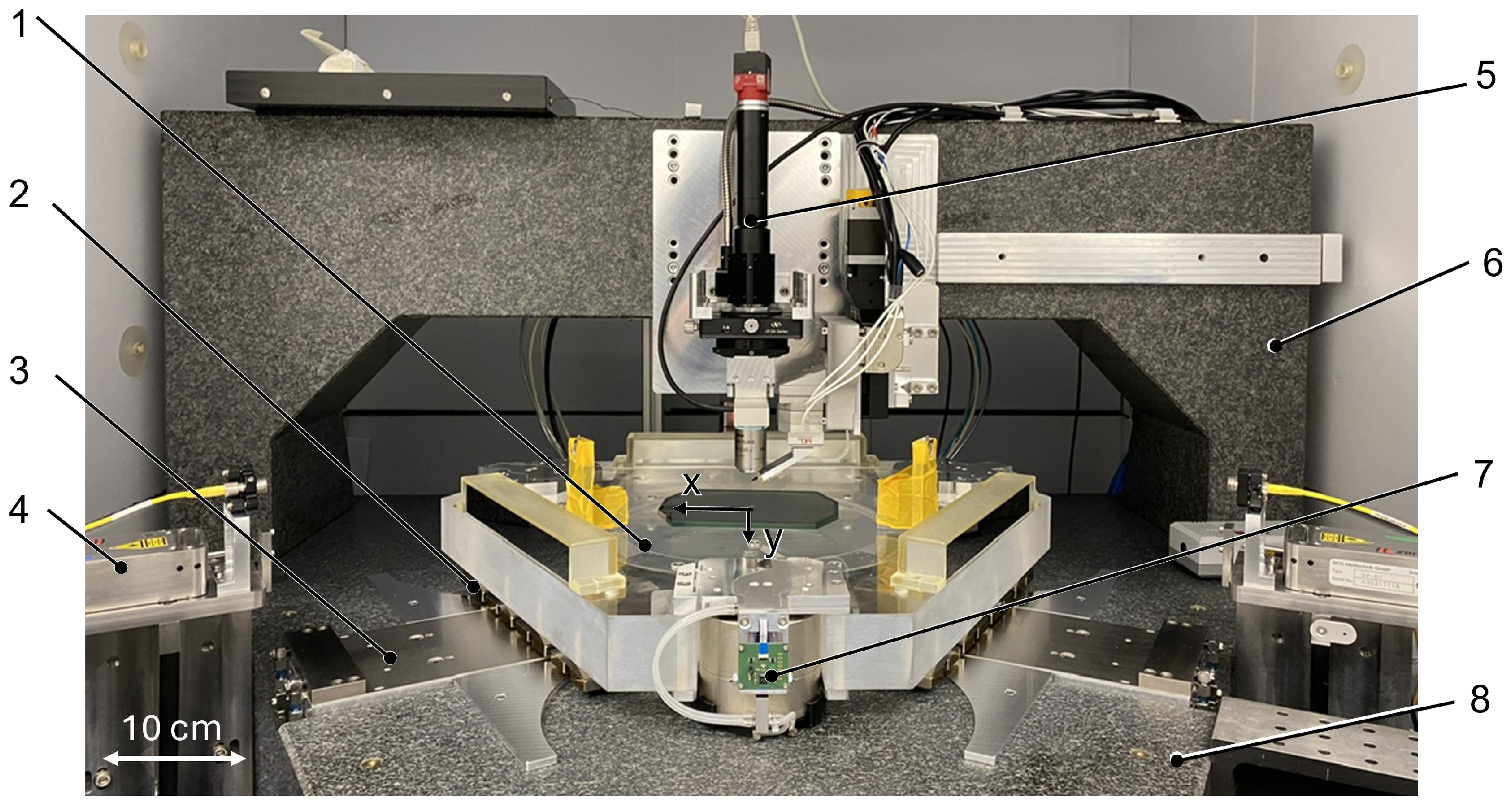
The presented work is based on a long-range planar drive of a nanopositioning system with six degrees of freedom (6DOF), operating in closed-loop control with sub 10 nm positioning performance, referred to as the NPS6D200. The system shown in
Figure 1 enables high-precision movement and alignment in both vertical and horizontal directions. Vertical motion of up to 25 mm and tilting around the
x- and
y-axes are enabled by three lifting and actuating units (LAU, 7) located at the corners of the moving slider (1), combined with an additional coil lift unit that provides full control in the
z-direction and angular adjustment. Additionally, air bearings at the bottom of each LAU support the moving slider, minimizing friction between the slider and the granite base (8). Horizontal positioning over a
mm circular area is realized using a planar direct drive system based on the Lorentz force principle, where permanent magnets mounted to the moving slider (2) interact with three two-phase coil arrangements (3) on the base.
Figure 1 illustrates function-defining components of the NPS6D200, with further details available in ref. [
4].
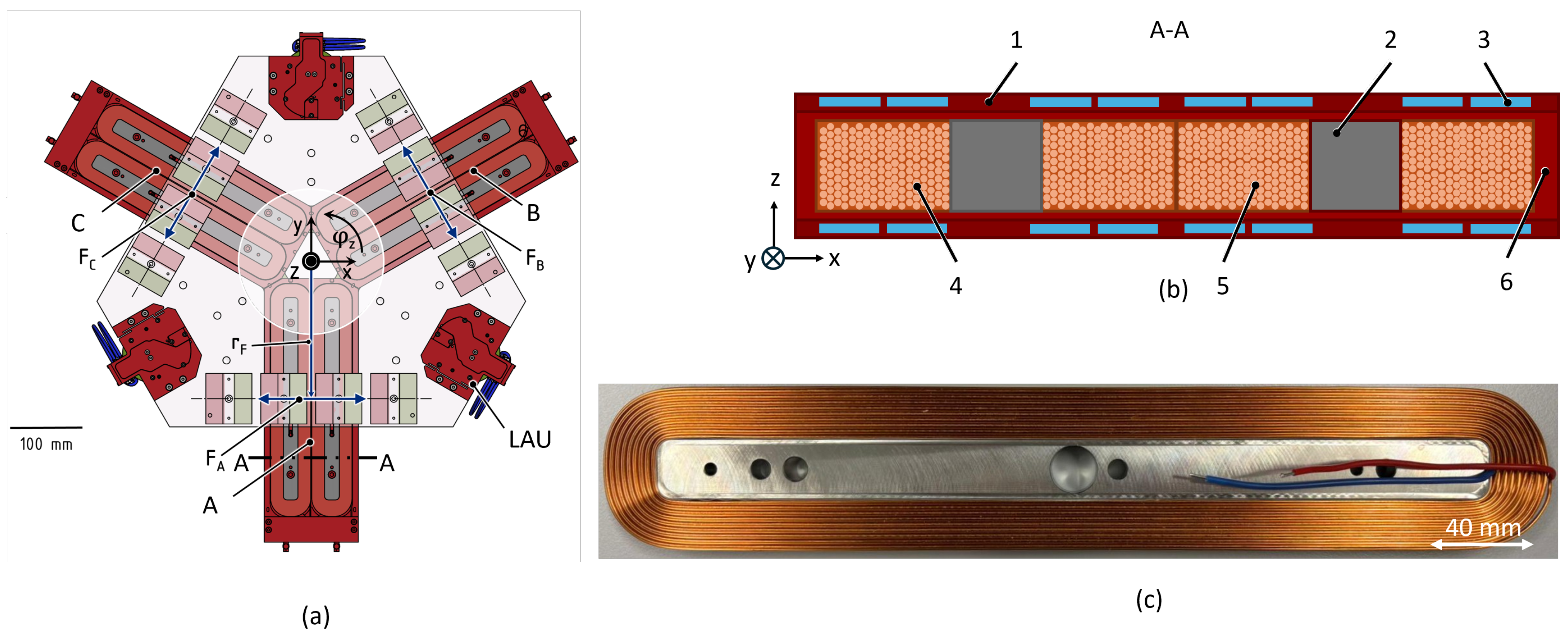
This work focuses on the stationary part of the planar drive system, referred to as the “coil assemblies” (see
Figure 1: (3)). These are labeled A, B, and C in
Figure 2a and are arranged at 120° intervals to allow force generation in any direction within the
-plane. Each coil assembly consists of two coils (copper windings (4, 5), embedded in thermal epoxy, wound around aluminum coil cores (2)), mounted within an aluminum coil frame (6), and encapsulated by stainless steel heat exchangers (1) (see
Figure 2b).
These components together form the primary volumetric heat source within the system due to ohmic heating during actuation. To manage this internally generated heat, stainless steel 310 s heat exchangers, called “cooling element sandwiches” (CES), are used. These CES units contain internal cooling channels (3), filled with “Thermal G” (a 50/50 mixture of water and glycol) for efficient thermal management. Material properties of important components are brought in
Table 1 [
4].
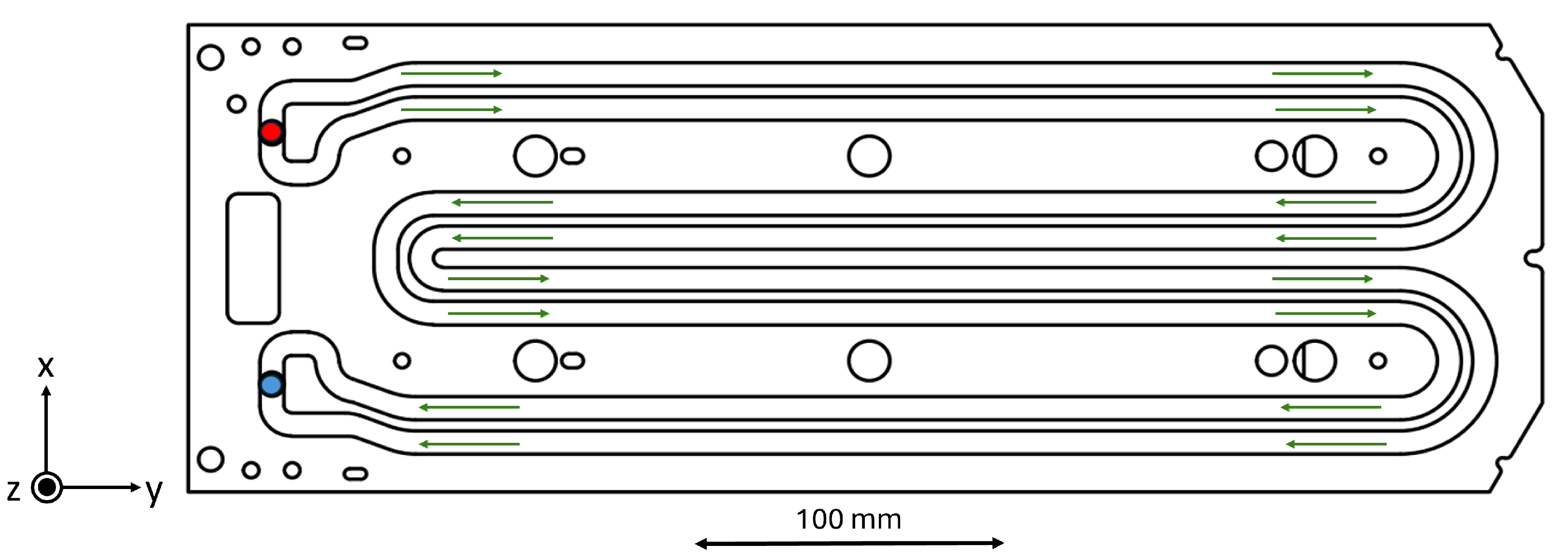
A sectional top view of a CES is shown in
Figure 3, in which the flow path of the cooling medium is illustrated. The parallel meander shape of the channels maximizes the contact area with the coils, thereby increasing heat transfer. The inlet (red), outlet (blue), and direction of fluid flow (green) are indicated in the figure. For maximization of the motor constant by minimization of the gap between the coils and the moving magnets on the slider, the CES and corresponding cooling channels are designed to be as flat as possible. This results in a small aspect ratio of the channel cross-section of
with
mm and
mm. This compact geometry, while beneficial for magnetic efficiency, increases the challenge of efficient heat dissipation and requires careful thermal modeling.
This system composition forms the physical foundation for the simulation models developed and analyzed in the following sections. Emphasis is placed on the coil assemblies and cooling structure, as they play a critical role in thermal behavior and are the main focus of the reduced-order simulation model.
3. Development of a Reduced Thermal Simulation Model
Accurate thermal modeling of the coil assemblies is the key to predicting temperature distribution and mitigating heat-induced disturbances within the NPS, since the electrical coils function as volumetric heat sources. However, the complex geometry of the coils, combined with their multi-material composition, leads to high computational demands when using fully detailed CFD models that represent the entire 3D geometry, heat, fluid domain, and heat transfer. As the complex coil geometry requires significant computational effort without providing proportionally greater insight, a simplified geometry is pursued to reduce computational load while still reliably representing the thermal behavior of the coil [
2,
19,
20,
21,
22,
23,
24]. To address this, the following work develops a reduced computational approach, beginning with individual simulations of the coil and the CES. An overview of the chosen solver settings is given in
Table 2.
For each geometry, a mesh-independence study was conducted to ensure that the mesh had no influence on the simulation results. Additionally, the mesh quality was evaluated, particularly with respect to skewness and orthogonal quality, ensuring that the mesh quality was sufficient.
Convergence criteria were set to for x, y, and z velocity as well as for omega, for continuity, and for energy. Continuity convergence was difficult to achieve due to the shallow but elongated geometry and the abrupt change in flow direction, located where the inlet/outlet length connects to the channel.
3.1. Numerical Simulation Model of the Coil
The physical reduction of the coil model is derived from our previous work [
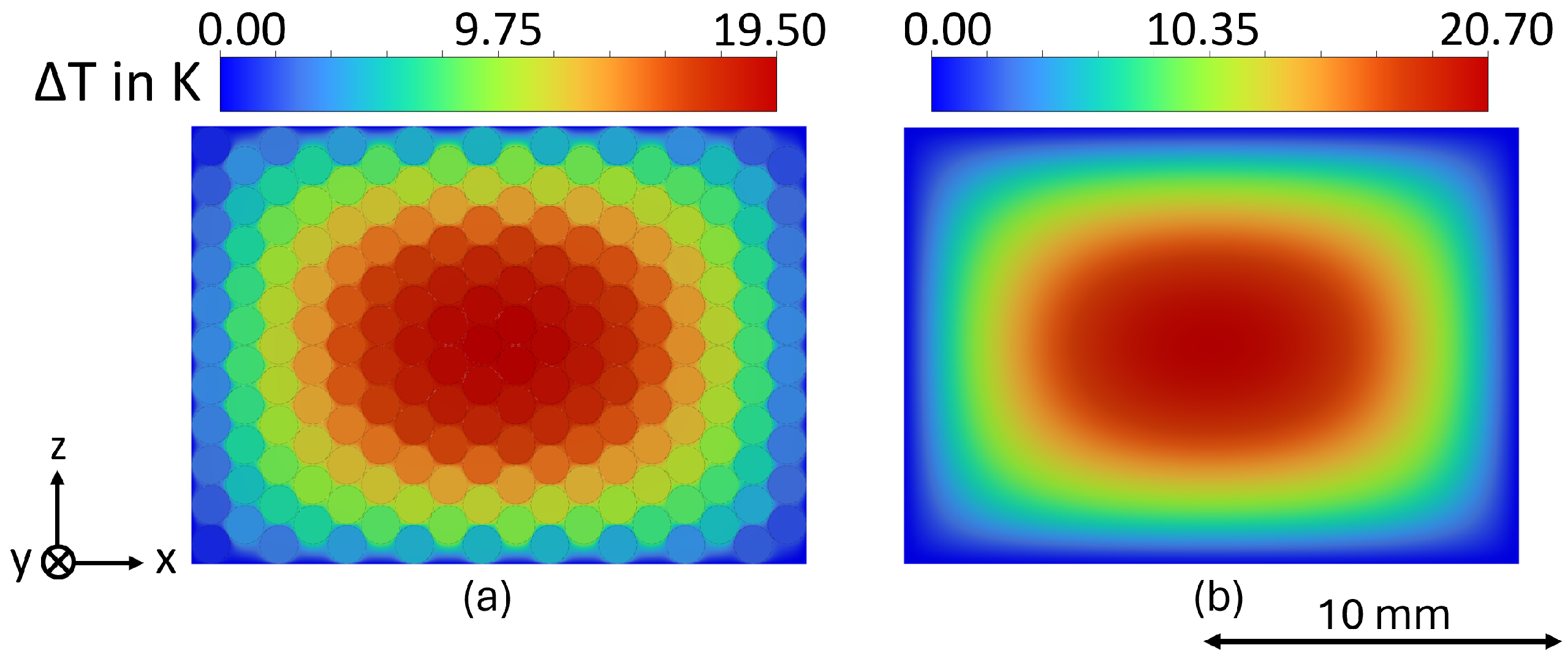
17], where the microscopical investigation of coil composition allowed a reduction of the coil windings’ multi-component complexity to one substitute material. Therefore, the microscopic analysis was utilized to derive the averaged volumetric material fractions for the substitute. The substitute was then investigated via simulation regarding its thermomechanical properties (such as thermal conductivity) compared with a detailed model that depicted the 189 coil windings and all filling material volumes. A visualization of the detailed (a) and reduced (b) models is shown in
Figure 4. The figure shows the comparison of the resulting temperature gradient in the coil with internal heat sources and static temperature boundary conditions on the sides. This investigation showed that anisotropic thermal conductivity must be considered when physically reducing the coil. Interested readers may seek more information in [
17].
Since modeling and simulating a highly complex structure, such as the coil, is computationally exorbitant, the determination of thermal properties and the estimation of computational savings were restricted to sub-structures where the
y-dimension was minimized to only 0.5 mm in order to keep the computation time manageable. The detailed sub-model with all wires had a calculation time of ≈8.2 min compared with the reduced model with ≈6 s, which shows the very successful model reduction while maintaining typical reduction deviations below 436 mK.
Table 3 compares the number of simulated elements and nodes in the detailed and reduced models. It is evident that the main savings in computational time is attributable to the significant reduction of the mesh size.
Validation of the coil simulation was achieved by comparing the time-dependent thermal development of the powered coil windings, made from the substitute material, and the coil core in the simulation with a validation experiment. The thermal resistivity between the aluminum coil core (
Table 1) and the coil windings is set to 50 m · K ·
. The result shows a compromise in the heat development between the coil windings and the coil core that accurately represents the total heat development of the coil. While the windings tend to have a slight overestimation of temperature development in the curved sections and an underestimation on the straight parts, the coil core slightly underestimates the temperature development. The comparison demonstrates that the reduced model reproduces the thermal behavior of the coil with adequate accuracy.
The data for the coil’s substitute material, which will be utilized further in the following study, is shown in
Table 4. The interested reader may seek further information on the reduction and verification in ref. [
17].
Mesh independence was ensured by comparison of the resulting heat flux on the coil’s outside walls with the results of a simulation with a substantially finer discretization. The results, as well as the element and node count for the mesh independence study, are summarized in
Table 5 and show that the regular mesh is sufficient since the maximal deviation between the regular and finer mesh is below
with an increase in elements/nodes of >1000%.
3.2. Numerical Simulation Model of the CES
For accurate modeling of the heat dissipation in the coil assembly, the cooling system, specifically the cooling element sandwich (CES), is simulated separately. The cooling performance of the CES was investigated using computational fluid dynamics (CFD) simulations in ANSYS Fluent 2024 R1, with a focus on modeling heat transfer between the coolant and the solid structure. To accurately capture this interaction, the conjugate heat transfer (CHT) approach was used, allowing simultaneous simulation of heat flow through both fluid and solid domains [
25]. Given the significantly higher computational cost of fluid simulations compared with solid ones, the CES was first analyzed and validated as a standalone unit. This strategy ensures accurate modeling of thermal and fluid behavior while maintaining computational efficiency. esh independence was validated by comparing the total surface heat flux on the CES outer walls, as well as the surface heat transfer coefficient in the cooling channel, with an additional simulation using significantly finer discretization.
Table 6 summarizes the results from the mesh independence study and shows that a finer mesh is not necessary since the deviation between the regular and finer mesh is <1% with an increase in elements and nodes of ≈80%.
Key parameters such as inlet velocity, coolant temperature, and applied heat flux were systematically varied and are summarized in
Table 7. These boundary conditions were directly extracted from the experimental setup to ensure consistency. The inlet velocity is defined by the selectable pump levels of the thermostat and the heat flux contributed by the heating mats. The working points were chosen to resemble a wide range of operating conditions while respecting the equipment’s boundaries. To simulate realistic operating conditions, heat flux was applied at the bottom surface of the CES, where heating mats are attached in the experimental setup (
Section 4.1). Heating mats are used in the CES experiments to simulate the defined heat input that would normally come from the electrical coils during real operation. The simulation evaluation is focused on the temperature difference between inlet and outlet, with the inlet temperature used as a reference point in all evaluations.
Mesh metrics for the cooling channel simulation are collected in
Table 8 and visualized in
Figure 5:
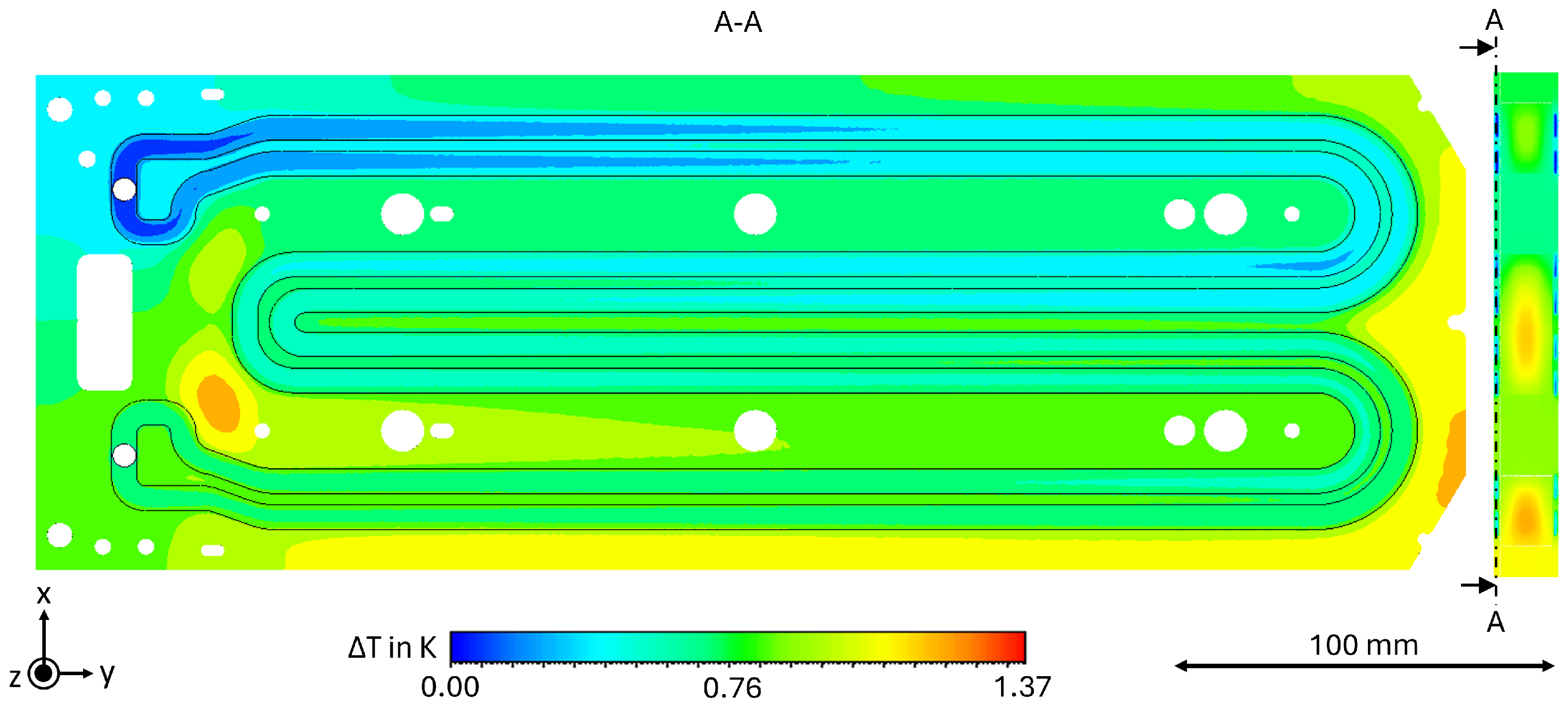
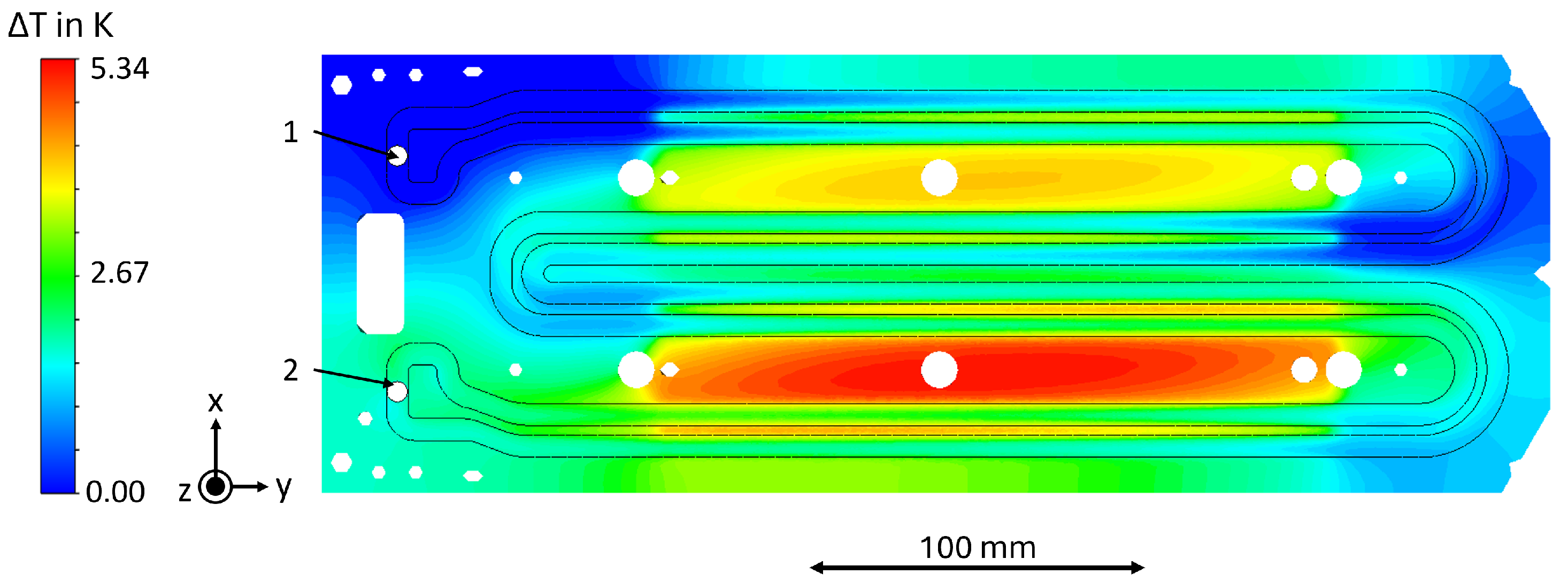
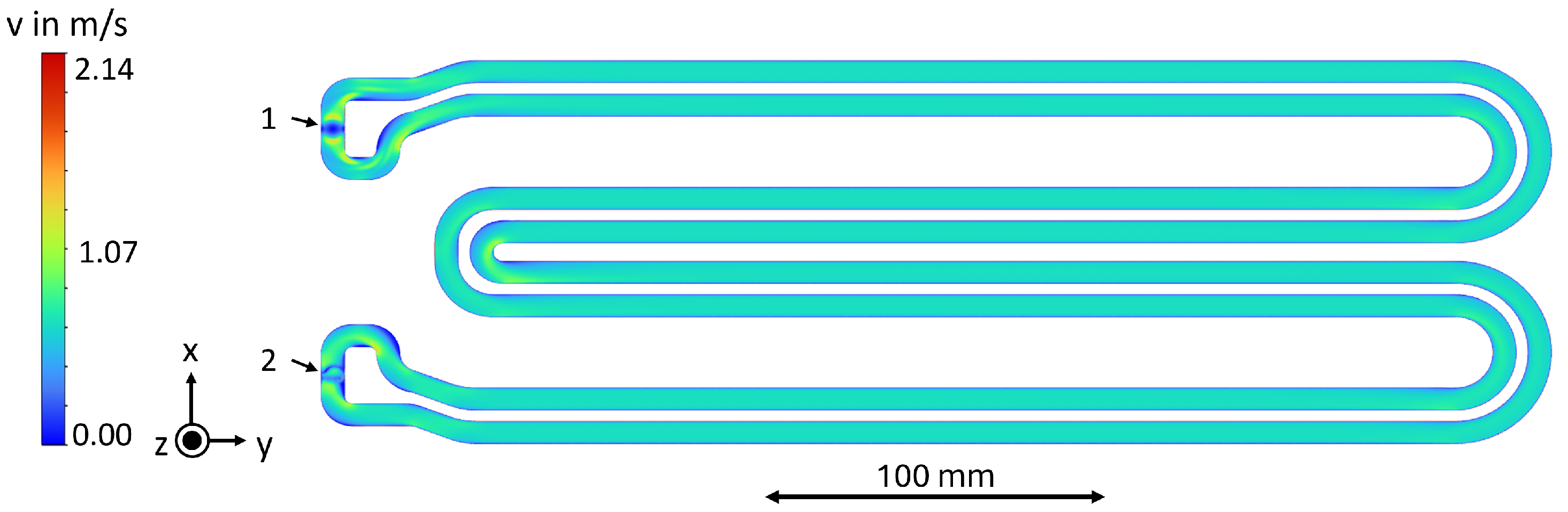
Thermal performance under a representative operating scenario is illustrated in
Figure 6, which shows the temperature gradient on the top surface of the CES compared with the inlet temperature. The resulting velocity in the cooling channel is represented in
Figure 7. This simulation was conducted with an inlet velocity of
, an inlet temperature of
, and a wall heat flux of
. The resulting temperature gradient clearly demonstrates heat transfer from the externally applied heating mats into the CES structure and circulating coolant, validating the model’s ability to represent both conductive and convective heat transfer accurately. This model provides the thermal behavior of the CES under various load and flow conditions, which can serve as a modular sub-model for integration into the coil assembly simulation.
3.3. Numerical Simulation Model of the Coil Assembly
To fully capture the thermal interaction between the coil, coil frame, and cooling system, a comprehensive simulation model of the entire coil assembly is developed. This model combines the previously validated sub-models of the coil [
17] and CES into a single system-level CFD simulation. The goal is to evaluate the overall heat dissipation performance and identify thermal gradients across the complete assembly under operating conditions. Since mesh independence had already been demonstrated for the sub-models, an additional mesh independence study of the full system was considered unnecessary.
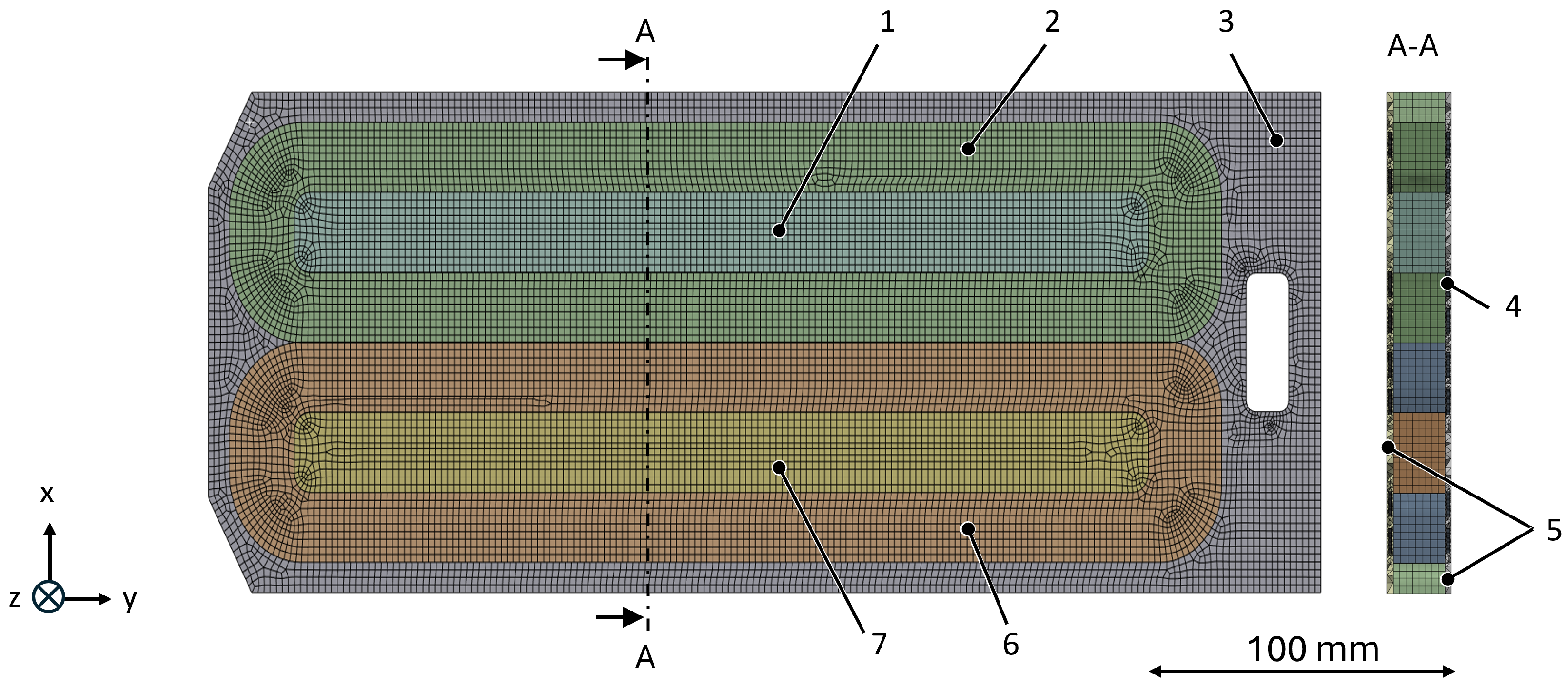
A detailed visualization of the simulation solid, and fluid geometry, and related meshes is provided in
Figure 8. In alignment with the experimental setup described in
Section 4.2, where an isolated coil assembly is considered, the model includes two coils (2, 6) with coil cores (1, 7), an aluminum coil frame (3) with material properties listed in
Table 1, and two CES units (5) containing internal cooling channels (4). The shallow design of the cooling channels requires significantly finer meshing to accurately resolve fluid flow. Consequently, the number of elements in the channels exceeds that in the solid components. Specifically, each coil consists of
elements, each coil core of
, the frame of
, each CES of
, and each set of cooling channels of
elements. Mesh metrics were checked, and the average values are collected in
Table 9.
The parameters and boundary conditions used for the coil assembly modeling are summarized in
Table 10. The working points were derived from the experimental setup described in
Section 4.2 with respect to the limitations of the measurement equipment while creating a comprehensive but realistic database.
Representative simulation results are shown in
Figure 9, presenting cross-sectional temperature gradients in both
- and
-directions. In this case, a power input of 10 W is applied to each coil, and an inlet velocity of 0.202 m ·
is used for the cooling liquid. The contact resistivity between the coil and coil core, as well as between the steel and aluminum of the CES and other parts, was applied with 50 m · K ·
; see
Section 3.1. The resulting temperature gradients plausibly reflect heat dissipation within the assembly. Since the coils act as internal heat sources, the highest temperature naturally occurs within them. However, the effectiveness of heat removal is strongly influenced by the layout of the cooling channels. In regions where the channel pathway does not directly cover the coil windings, insufficient cooling leads to localized temperature buildup. This effect is further intensified by the use of adiabatic boundary conditions, which prevent heat dissipation to the environment.
4. Experimental Methodology
Evaluation of the simulation accuracy was achieved by a series of systematic experiments under conditions matched to the simulation inputs, and deviations were analyzed quantitatively in this work. These experiments are used to validate the individual sub-model for the CES, as well as the combined coil assembly model. Each setup aims to replicate the boundary conditions used in simulation while allowing temperature measurements with NTC thermistors at critical locations. All experiments were conducted in insulated environments to replicate quasi-adiabatic boundary conditions.
4.1. CES Validation Experiment
A dedicated experiment was carried out for the CES to validate the reliability of this component’s modeling, leading to an accurate simulation of the coil assembly.
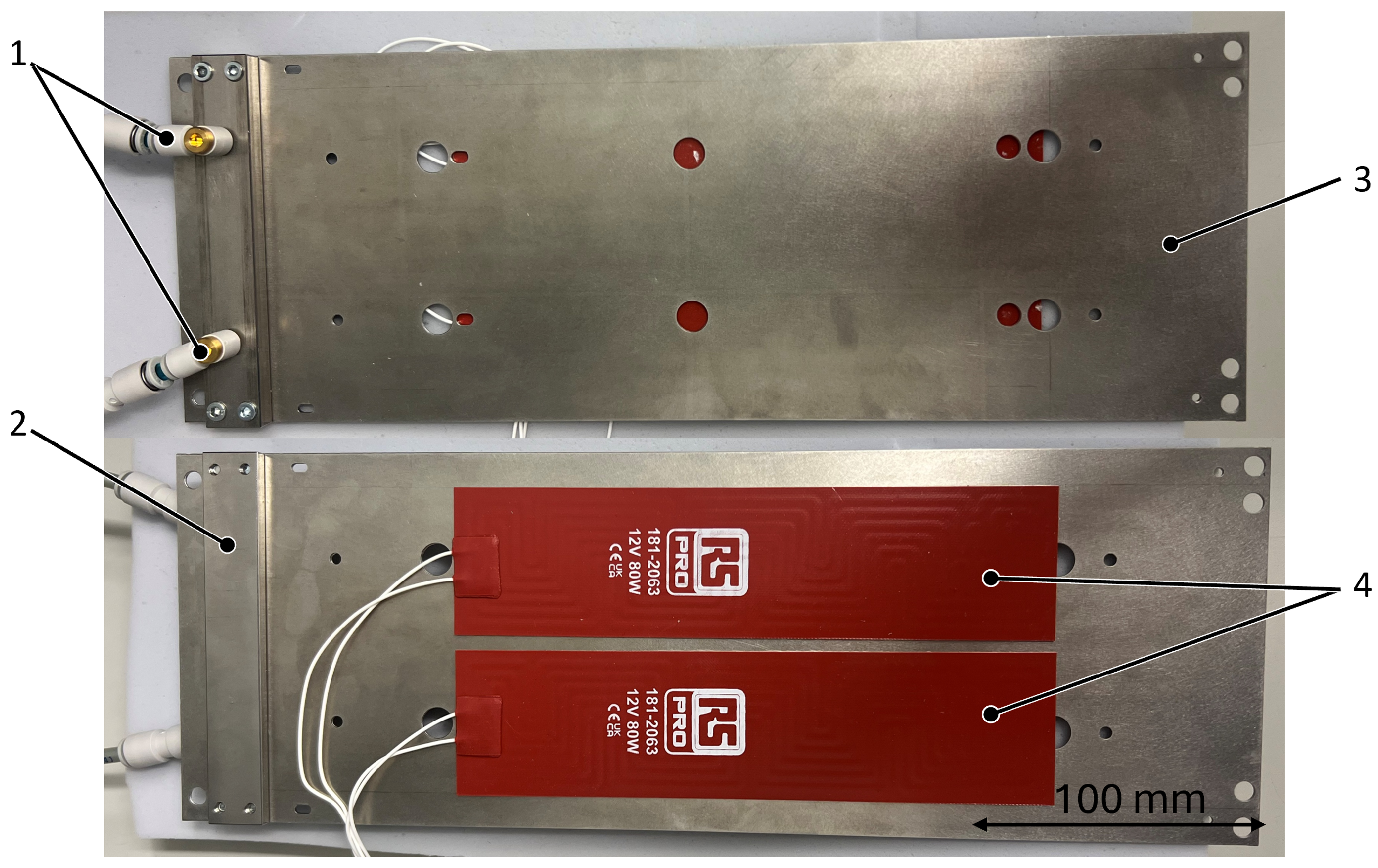
Figure 10 shows the experimental setup from top and bottom views. To imitate a defined heat input comparable to that generated by the coils, heating mats (4) were attached to the bottom surface of the CES (3), as depicted in the figure. These heating mats allow a defined heat input of up to 80 W per mat with a mat surface area of (50 × 203) mm. Thin film NTC thermistors integrated into the tubes were used to measure inlet and outlet (1) fluid temperature close to the connector (2). These sensors allow the measurement of temperature change across the CES and thus the evaluation of its heat removal potential.
Measurements were taken once the system had reached steady-state conditions. By varying the applied power to the heating mats and therefore the heat input, as well as the inlet temperature and flow velocity with the thermostat (Julabo FPW50-HL, JULABO GmbH, Seelbach, Germany), a variety of operating conditions were tested. The resulting temperature change of the cooling liquid (Thermal G) between the inlet and outlet is collected in
Table 11 for a variation of operating conditions. This provides a broad dataset for validating the CES simulation model across multiple thermal scenarios.
4.2. Coil Assembly Validation Experiment
For the validation of the complete coil assembly simulation, a dedicated experiment was conducted that replicates the thermal and geometric setup used in the simulation. This includes both internal heat generation from the coils and active cooling through the CES units. The objective is to assess whether the simulation accurately predicts temperature development across the assembly under realistic boundary conditions. The experimental setup is shown in
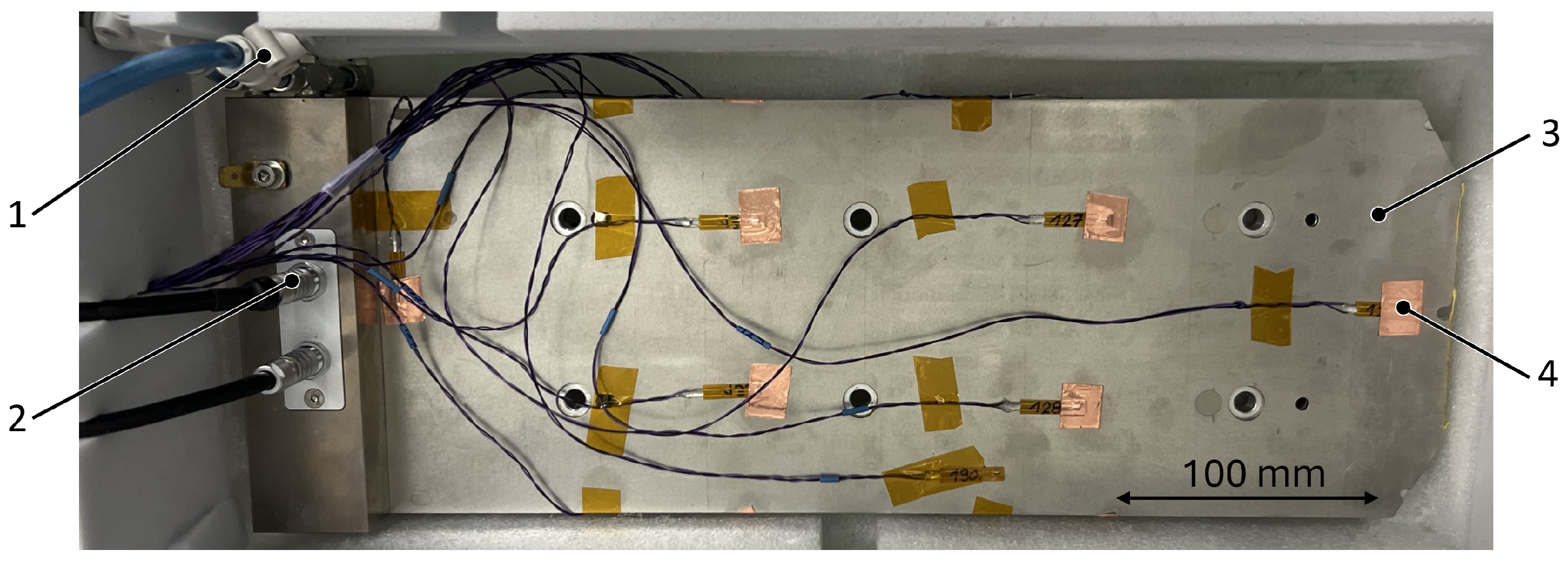
Figure 11. It consists of connections to the thermostat (1), power supply unit (PSU), internal NTC thermistors, and data acquisition unit (DAQ) (2), as well as the coil assembly (3) and surface-mounted NTC thermistors (4) used for temperature measurement.
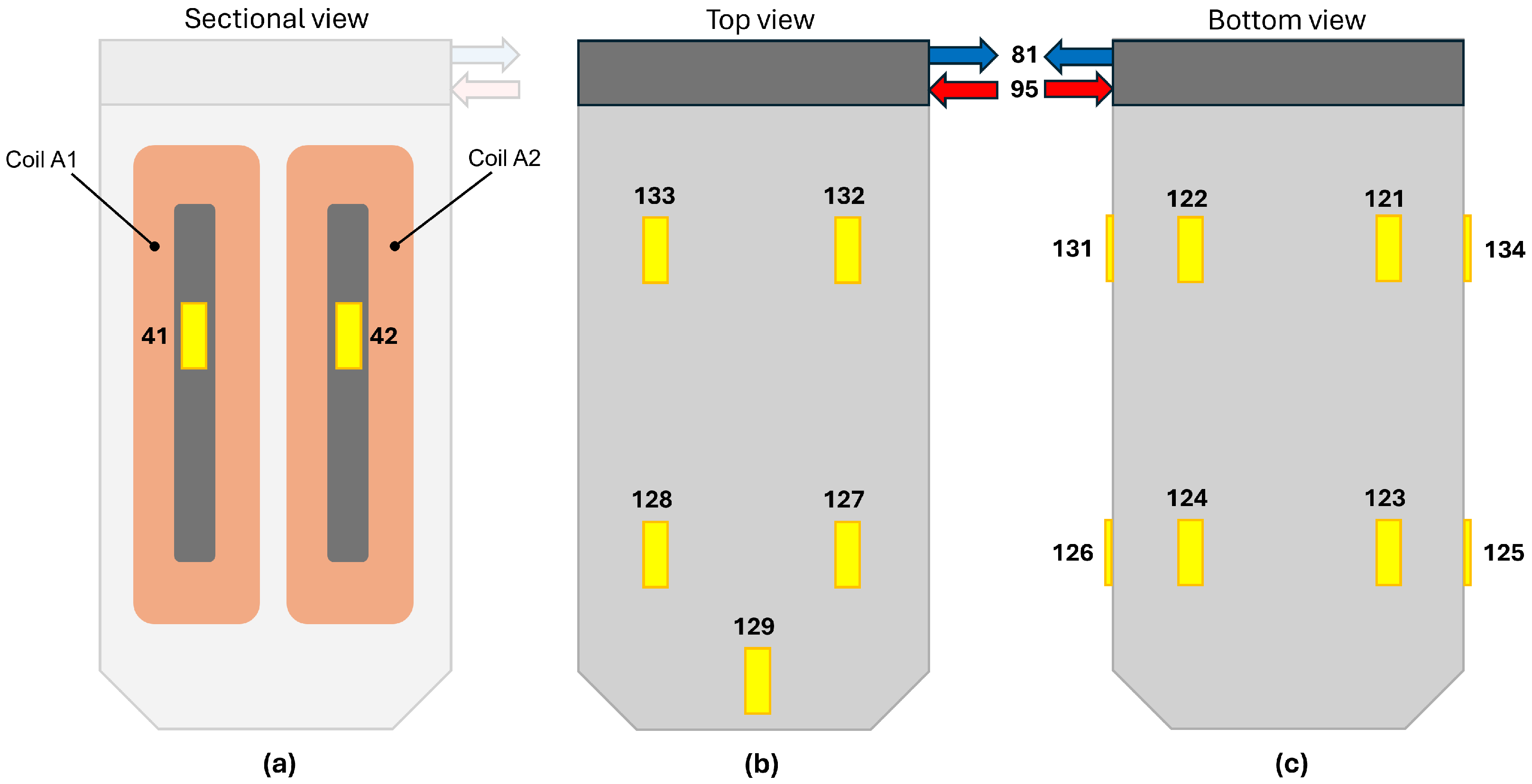
A comprehensive experimental dataset of temperature values was collected by placing sensors at key locations, as illustrated in
Figure 12, in order to assess simulation accuracy. Besides the surface-mounted thin film NTC thermistors, additional ones were installed inside the assembly, specifically on the coil cores, to capture internal temperatures, as well as in the cooling fluid at inlet and outlet points. The inlet temperature, set by the thermostat, served both as a reference value for evaluating simulation results and as a boundary condition within the simulation. A flow meter was used to measure the mass flow rate of the coolant. These values are summarized in
Table 12.
The expanded temperature measurement uncertainty was again determined to be , calculated with a safety factor of .
5. Results and Discussion
The experimental setups described in
Section 4 provide the reference data required to evaluate the accuracy of the reduced simulation models. In this section, the simulation results for the CES and full coil assembly are compared against the corresponding experimental measurements. The expanded measurement uncertainties from each experiment determine the acceptable range of deviation since experimental data can vary in this range.
Following the coil validation, the CES simulation was evaluated using experimental data to assess its accuracy. For the CES, the deviation between simulated and experimental temperature lies within a range of K K|, with an average deviation of K. These results confirm that the CFD simulation model accurately captures the thermal behavior of the cooling liquid and CES. Consequently, the CES model is considered suitable for integration into the full coil assembly simulation.
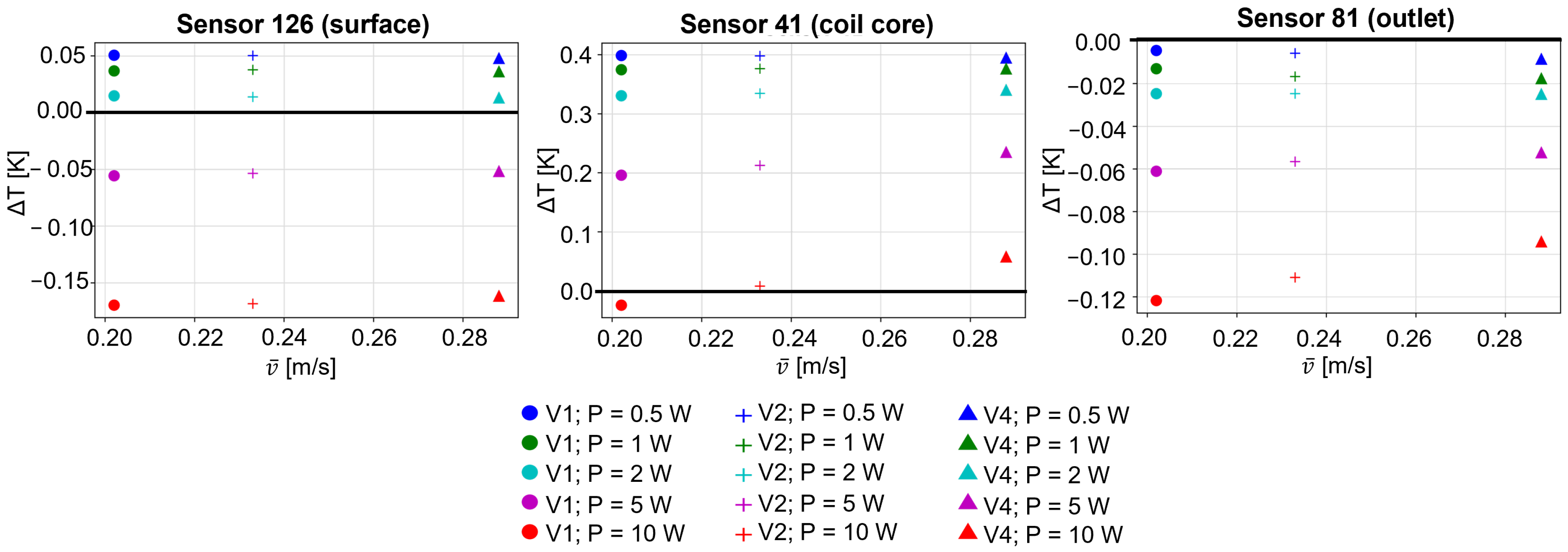
The final validation step compares the coil assembly simulation with experimental data. The results are analyzed by correlating simulated temperatures with reference values from the experiment. Deviations for three representative sensors are illustrated in
Figure 13 and discussed further, including sensor 126 on the assembly surface, sensor 41 on a coil core, and sensor 81 in the coolant outlet (see
Figure 12 for sensor locations). The investigated working points follow the velocities listed in
Table 12 and the different power settings on the coils described in the legend of
Figure 13. The plotted deviations show how the simulation either overestimates or underestimates temperature development, depending on sensor location and parameter variation. For both the assembly surface and the outlet, the deviation decreases with increasing fluid velocity, as expected, since a higher velocity enhances convective heat transfer. In contrast, deviation increases on the coil core, indicating that the simulation underestimates the internal coil temperature. This can be attributed to the reduced coil model and the sensor placement on the coil core. As described in
Section 3.1, to obtain an overall accurate heat development of the coil, a local over- and underestimation occurs and is accepted since it remains below 436 mK. Meanwhile, the fluid outlet temperature is slightly overestimated. One obvious reason for this is that, due to the adiabatic boundary conditions in the simulation, no heat loss to the environment occurs and thus, more heat is transported into the cooling channel. This is also evident in the surface sensors, where, especially for higher power levels, the simulation overestimates the temperature.
The overall deviation of temperature values from the assembly surface remains well within the measurement uncertainty. As presented, the deviation of the surface temperature is only slightly dependent on fluid velocity. However, with increasing coil power, the simulated surface temperature tends to exceed the experimental value as presumed. This behavior is primarily attributed to the idealized boundary conditions used in the simulation, which prevent any heat loss to the surroundings, leaving the velocity outlet as the only heat sink. In contrast, during the validation experiments, heat transfer to the surroundings cannot be fully mitigated, even though the implemented isolation setup ensures almost adiabatic boundary conditions. While this explains the tendency of the observed temperature deviation, it still remains within the experimental measurement uncertainty, which ensures the applicability of the overall approach.
Across all evaluated conditions, the simulation models show low deviation from experimental results well within the bounds of measurement uncertainty. Therefore, the simulation model is considered sufficiently accurate for representing the thermal behavior of the physical coil assembly as a heat source across the validated range of parameters. The model provides a reliable basis for optimizing the cooling system and conducting further thermal analysis of NPS.
6. Conclusions and Outlook
This work presents a simulation-driven approach for modeling the thermal behavior of a coil assembly used in an NPS. Due to the complexity of the physical geometry and material composition, full-scale simulation of the system is computationally demanding. Therefore, reduced-order modeling strategy was developed and validated to achieve high accuracy with significantly reduced computational effort.
The simulation model was built step-by-step, utilizing a previously generated thermally representative model of the coil from ref. [
17] and the cooling element sandwich (CES). The coil model treats the windings as volumetric heat sources with anisotropic thermal conductivity, while the CES model accounts for conjugate heat transfer using CFD. These models were then combined into a full coil assembly simulation that reflects realistic operating conditions. The main reduction of the models takes place in the coil, where the multi-component material is substituted by a homogeneous material, and the reduction of calculation time is significant. Combined with the computationally expensive simulation of the fluid domain, the total reduction is estimated to be below the
mark. An exact comparison with a full-scale model was omitted since the computational effort to simulate the full-scale model exceeds a reasonable amount.
Following model development, each simulation was validated experimentally. The CES model accurately predicts inlet-outlet temperature differences under varying flow conditions. The complete coil assembly simulation replicates the spatial temperature distribution observed in the experiment, with deviations remaining within the measurement uncertainty.
The validated simulation framework is now suitable for use in further analysis, including optimization of cooling channel layouts for improved thermal uniformity, evaluation of heat-induced drift or deformation in precision structures, and system-level integration for predictive thermal management in NPS design. Future work may focus on extending the model to include thermo-mechanical coupling, enabling estimation of stress and deformation caused by thermal gradients. Additionally, transient simulations may be explored to reflect real-world dynamic operating scenarios and guide advanced control strategies.
Author Contributions
Conceptualization, I.N. and L.H.; methodology, I.N. and L.H.; software, I.N.; validation, I.N., L.H. and S.H.; formal analysis, I.N.; investigation, I.N.; resources, I.N.; data curation, I.N.; writing—original draft preparation, I.N.; writing—review and editing, I.N., L.H., S.H. and P.S.; visualization, I.N.; supervision, L.H.; project administration, L.H. All authors have read and agreed to the published version of the manuscript.
Funding
The research group “Application of AI-based virtual sensor technology to effectively increase the precision of positioning systems–VirtuSen” is funded by the German Land of Thüringen.
Institutional Review Board Statement
Not applicable.
Informed Consent Statement
Not applicable.
Data Availability Statement
Conflicts of Interest
All authors were employed by the company IMMS Institut für Mikroelektronik- und Mechatronik-Systeme gemeinnützige GmbH (IMMS GmbH). The authors declare that the research was conducted in the absence of any commercial or financial relationships that could be construed as a potential conflict of interest.
Abbreviations
The following abbreviations are used in this manuscript:
| CFD | Computational fluid dynamics |
| CHT | Conjugate heat transfer |
| DAQ | Data Acquisition Unit |
| DOF | Degrees of freedom |
| CES | Cooling Element Sandwich |
| LAU | Lifting and Actuating Unit |
| MBSE | Model-Based System Engineering |
| NPS | Nanopositioning System |
| NTC | Negative Temperature Coefficient |
| PSU | Power Supply Unit |
References
- Huang, W.W.; Wang, X.; Meng, Y.; Li, L.; Zhang, X.; Ren, M.; Zhu, L.M. Design, modeling and control of high-bandwidth nano-positioning stages for ultra-precise measurement and manufacturing: A survey. Int. J. Extrem. Manuf. 2024, 6, 062007. [Google Scholar] [CrossRef] [Scilit]
- Wang, J.; Zhu, C.; Feng, M.; Ren, W. Thermal error modeling and compensation of long-travel nanopositioning stage. Int. J. Adv. Manuf. Technol. 2013, 65, 443–450. [Google Scholar] [CrossRef] [Scilit]
- Gorges, S.; Hesse, S.; Schäffel, C.; Ortlepp, I.; Manske, E.; Langlotz, E.; Dontsov, D. Integrated Planar 6-DOF Nanopositioning System. Ifac-Papersonline 2019, 52, 313–318. [Google Scholar] [CrossRef] [Scilit]
- Hesse, S.; Huaman, A.; Katzschmann, M.; Leistritz, B.; Herzog, L. NPS6D200—A Long Range Nanopositioning Stage with 6D Closed Loop Control. Appl. Sci. 2024, 14, 6972. [Google Scholar] [CrossRef] [Scilit]
- Wiederhorn, S.; Fields, R.; Low, S.; Bahng, G.W.; Wehrstedt, A.; Hahn, J.; Tomota, Y.; Miyata, T.; Lin, H.; Freeman, B.; et al. Mechanical Properties. In Springer Handbook of Materials Measurement Methods; Czichos, H., Saito, T., Smith, L., Eds.; Springer: Berlin/Heidelberg, Germany, 2006; pp. 283–397. [Google Scholar] [CrossRef] [Scilit]
- Mayr, J.; Jedrzejewski, J.; Uhlmann, E.; Donmez, M.A.; Knapp, W.; Härtig, F.; Wendt, K.; Moriwaki, R.; Shore, P.; Schmitt, R.; et al. Thermal issues in machine tools. Cirp Ann. 2012, 61, 771–791. [Google Scholar] [CrossRef] [Scilit]
- Hernández-Becerro, P.; Mayr, J.; Wegener, K. Efficient thermo-mechanical model of a precision 5-axis machine tool. In Special Interest Group Meeting: Thermal Issues; The Euspen SIG: Aachen, Germany, 2020. [Google Scholar]
- Devasia, S.; Eleftheriou, E.; Moheimani, S.O.R. A Survey of Control Issues in Nanopositioning. IEEE Trans. Control Syst. Technol. 2007, 15, 802–823. [Google Scholar] [CrossRef] [Scilit]
- Diethold, C.; Kühnel, M.; Hilbrunner, F.; Fröhlich, T.; Manske, E. Determination of force to displacement curves using a nanopositioning system based on electromagnetic force compensated balances. Measurement 2014, 51, 343–348. [Google Scholar] [CrossRef] [Scilit]
- Torralba, M.; Valenzuela, M.; Yagüe-Fabra, J.; Albajez, J.; Aguilar, J. Large range nanopositioning stage design: A three-layer and two-stage platform. Measurement 2016, 89, 55–71. [Google Scholar] [CrossRef] [Scilit]
- Brix, T.; Husung, S.; Döring, U. Strategies and methods for robust design in the early phases of product development in precision engineering. In Proceedings of the 3rd International Conference on Advanced Mechanism and Machine Technology (iCMMT 2024), Taipei, Taiwan, 3–5 May 2024; p. 11. [Google Scholar] [CrossRef]
- Hey, J.; Kiew, C.M.; Yang, G.; Martinez-Botas, R. Model-Based Compensation of Thermal Disturbance in a Precision Linear Electromagnetic Actuator. IEEE/Asme Trans. Mechatronics 2014, 19, 1477–1488. [Google Scholar] [CrossRef] [Scilit]
- Yong, Y.K.; Eielsen, A.A.; Fleming, A.J. Thermal Protection of Piezoelectric Actuators Using Complex Electrical Power Measurements and Simplified Thermal Models. IEEE/Asme Trans. Mechatronics 2024, 29, 798–800. [Google Scholar] [CrossRef] [Scilit]
- Lipsinic, Z.; Pavkovic, N.; Husung, S. A Review on the Application of Model-Based Systems Engineering in the Development of Safe Circular Systems. IEEE Access 2025, 13, 100042–100063. [Google Scholar] [CrossRef] [Scilit]
- Ankenman, B.; Nelson, B.L.; Staum, J. Stochastic kringing for simulation metamodeling. Oper. Res. 2010, 58, 371–382. [Google Scholar] [CrossRef] [Scilit]
- Steck, M.; Husung, S. Systematic Optimization Process for an Ebike Drive Unit in a Highly Variable Environment. Proc. Des. Soc. 2023, 3, 3305–3314. [Google Scholar] [CrossRef] [Scilit]
- Naujokat, I.; Herzog, L.; Hesse, S.; Salimitari, P. Development and validation of a simplified coil model for CFD simulation of a nanopositioning planar drive system. In Proceedings of the Euspen Precision and Performance 2025, Cranfield, UK, 18–20 November 2025; pp. 45–48. [Google Scholar]
- Salimitari, P.; Hesse, S.; Katzschmann, M.; Herzog, L. Experimental characterization of thermal disturbances in a 6DOF nanopositioning system under varying operational conditions. In Proceedings of the Euspen Precision and Performance, 2025, Cranfield, UK, 18–20 November 2025; pp. 41–44. [Google Scholar]
- Zupančič, B.; Karba, R.; Blažič, S.; Univerza v Ljubljani (Eds.) Simulating the Dynamics of Nanopositioning and Nanomeasuring Machines using Methods of Multi-Body System Dynamics. In Proceedings of the 6th EUROSIM Congress on Modelling and Simulation, Ljubljana, Slovenia, 9–13 September 2007. Meeting Name: Congress on Modelling and Simulation. [Google Scholar]
- Zeigler, B.P.; Muzy, A.; Kofman, E. Theory of Modeling and Simulation: Discrete Event and Iterative Yystem Computational Foundations, 3rd ed.; Academic Press: San Diego, CA, USA, 2019. [Google Scholar]
- Thakur, A.; Banerjee, A.G.; Gupta, S.K. A survey of CAD model simplification techniques for physics-based simulation applications. Comput.-Aided Des. 2009, 41, 65–80. [Google Scholar] [CrossRef] [Scilit]
- Benner, P.; Gugercin, S.; Willcox, K. A Survey of Projection-Based Model Reduction Methods for Parametric Dynamical Systems. Siam Rev. 2015, 57, 483–531. [Google Scholar] [CrossRef] [Scilit]
- Van Der Zee, D.J. Approaches for simulation model simplification. In Proceedings of the 2017 Winter Simulation Conference (WSC), Las Vegas, NV, USA, 3–6 December 2017; pp. 4197–4208. [Google Scholar] [CrossRef] [Scilit]
- Jobert, N.; Thomasset, M.; Cauchon, G.; Dennetiere, D. Thermal Modal Analysis Including Static Correction and Efficient Tool to Model and Design Thermal Compensation Systems. In Proceedings of the Euspen SIG: Thermal Issues, Aachen, Germany, 24–25 November 2020. [Google Scholar]
- ANSYS, Inc. Ansys® Fluent 2024R1 Theory Guide; Ansys Inc.: Canonsburg, PA, USA, 2024. [Google Scholar]
Figure 1.
Photograph of the NPS6D200 [
18]. 1—moving slider, 2—magnets of the planar direct drive (moving with slider), 3—coil assemblies of the planar drive system, 4—laser interferometer, 5—mounted tools (here: laser focus sensor and atomic force microscope), 6—granite portal with probe mount, 7—lifting and actuating unit (LAU), 8—granite base.
Figure 1.
Photograph of the NPS6D200 [
18]. 1—moving slider, 2—magnets of the planar direct drive (moving with slider), 3—coil assemblies of the planar drive system, 4—laser interferometer, 5—mounted tools (here: laser focus sensor and atomic force microscope), 6—granite portal with probe mount, 7—lifting and actuating unit (LAU), 8—granite base.
Figure 2.
(
a) Schematic illustration of the drive system with coil assemblies A–C and LAUs (retrieved from ref. [
4]); (
b) schematic view of section A–A from (
a). 1—cooling element sandwich (CES), 2—coil core, 3—cooling channel, 4—coil A1, 5—coil A2, 6—coil frame (retrieved from ref. [
17]); (
c) picture of a coil.
Figure 2.
(
a) Schematic illustration of the drive system with coil assemblies A–C and LAUs (retrieved from ref. [
4]); (
b) schematic view of section A–A from (
a). 1—cooling element sandwich (CES), 2—coil core, 3—cooling channel, 4—coil A1, 5—coil A2, 6—coil frame (retrieved from ref. [
17]); (
c) picture of a coil.
Figure 3.
Schematic illustration of the cooling element sandwich with pathway of the cooling channel. Inlet (red), outlet (blue), and direction of fluid flow (green).
Figure 3.
Schematic illustration of the cooling element sandwich with pathway of the cooling channel. Inlet (red), outlet (blue), and direction of fluid flow (green).
Figure 4.
(a) Resulting temperature gradient in the detailed model with all wires; (b) Resulting temperature gradient in the reduced model.
Figure 4.
(a) Resulting temperature gradient in the detailed model with all wires; (b) Resulting temperature gradient in the reduced model.
Figure 5.
Sectional view of the cooling channel (fluid volume) for mesh visualization.
Figure 5.
Sectional view of the cooling channel (fluid volume) for mesh visualization.
Figure 6.
Resulting temperature gradient in CES and cooling channel obtained from CFD simulation, relative to the inlet temperature: 1—inlet, 2—outlet.
Figure 6.
Resulting temperature gradient in CES and cooling channel obtained from CFD simulation, relative to the inlet temperature: 1—inlet, 2—outlet.
Figure 7.
Resulting velocity in the cooling channel obtained from CFD simulation: 1—inlet, 2—outlet.
Figure 7.
Resulting velocity in the cooling channel obtained from CFD simulation: 1—inlet, 2—outlet.
Figure 8.
Meshing of the coil assembly simulation. 1—coil core A1, 2—coil A1, 3—coil frame, 4—cooling element channel, 5—CES, 6—coil A2, 7—coil core A2.
Figure 8.
Meshing of the coil assembly simulation. 1—coil core A1, 2—coil A1, 3—coil frame, 4—cooling element channel, 5—CES, 6—coil A2, 7—coil core A2.
Figure 9.
Resulting temperature gradient on the coil assembly for a power of 10 W and inlet velocity of .
Figure 9.
Resulting temperature gradient on the coil assembly for a power of 10 W and inlet velocity of .
Figure 10.
Experimental setup for CFD validation of a CES. 1—inlet and outlet, 2—connector, 3—cooling element sandwich, 4—heating mats.
Figure 10.
Experimental setup for CFD validation of a CES. 1—inlet and outlet, 2—connector, 3—cooling element sandwich, 4—heating mats.
Figure 11.
Experimental setup for validation of the coil assembly simulation. 1—connection to the thermostat with internal NTCs; 2—connection to DAQ, internal NTCs on the coil cores and PSU for coils; 3—coil assembly; 4—NTCs on assembly surface attached with copper foil.
Figure 11.
Experimental setup for validation of the coil assembly simulation. 1—connection to the thermostat with internal NTCs; 2—connection to DAQ, internal NTCs on the coil cores and PSU for coils; 3—coil assembly; 4—NTCs on assembly surface attached with copper foil.
Figure 12.
Sensor positions of the coil assembly experiment and simulation. Red arrow: inlet position, blue arrow: outlet position. (a) Sectional view, (b) top view, (c) bottom view.
Figure 12.
Sensor positions of the coil assembly experiment and simulation. Red arrow: inlet position, blue arrow: outlet position. (a) Sectional view, (b) top view, (c) bottom view.
Figure 13.
Resulting temperature difference between simulation and experimental results in relation to inlet (reference) temperatures for sensor 126 (assembly surface), sensor 41 (coil core), and sensor 81 (outlet) (see
Figure 12).
Figure 13.
Resulting temperature difference between simulation and experimental results in relation to inlet (reference) temperatures for sensor 126 (assembly surface), sensor 41 (coil core), and sensor 81 (outlet) (see
Figure 12).
Table 1.
Material properties of coil assembly components.
Table 1.
Material properties of coil assembly components.
| Property | Thermal G | Stainless Steel | Aluminum |
|---|
| Density in | 1070 | 7900 | 2660 |
| Thermal conductivity in | | 15 | 120 |
| Specific thermal capacity in | 3350 | 500 | 900 |
| Kinematic viscosity in | | | |
| Dynamic viscosity in | | | |
Table 2.
Solver settings for the conducted simulations in Ansys FLUENT.
Table 2.
Solver settings for the conducted simulations in Ansys FLUENT.
| Setting | Selection |
|---|
| Solver Type | Pressure-based |
| Time | Steady |
| Model | SST-k-omega with viscous heating and Low-Re correction |
Table 3.
Mesh statistic comparison for the detailed and reduced coil model.
Table 3.
Mesh statistic comparison for the detailed and reduced coil model.
| | Detailed Model | Reduced Model |
|---|
| Elements | 851,642 | 15,300 |
| Nodes | 1,109,316 | 20,984 |
Table 4.
Material data for the physically reduced material for thermal simulation of the coil.
Table 4.
Material data for the physically reduced material for thermal simulation of the coil.
| Property | Value |
|---|
| Density | |
| Thermal conductivity (x, y) | |
| Thermal conductivity (z) | |
| Specific heat capacity | |
Table 5.
Mesh independence study for the coil.
Table 5.
Mesh independence study for the coil.
| | Regular Mesh | Fine Mesh |
|---|
| Nodes | | |
| Elements | | |
| Maximal Deviation Total Surface Heat Flux [%] | 0.2 |
Table 6.
Mesh independence study for the CES.
Table 6.
Mesh independence study for the CES.
| | Regular Mesh | Fine Mesh |
|---|
| Nodes | | |
| Elements | | |
| Deviation Total Surface Heat Flux [%] | 0.003 |
| Deviation Surface Heat Transfer Coefficient [%] | 0.75 |
Table 7.
CES simulation parameters and boundary conditions.
Table 7.
CES simulation parameters and boundary conditions.
| Boundary Condition/Parameter | Value |
|---|
| Inlet velocity in | |
| Inlet temperature in °C | |
| Heat flux from heating pads in | |
| Outside walls | adiabatic |
Table 8.
Mesh settings for the CES channel.
Table 8.
Mesh settings for the CES channel.
| Setting | Details |
|---|
| Element Size | m |
| Inflation Layers | First Layer Thickness: m |
| Nodes | |
| Elements | |
Table 9.
Mesh metrics for the coil assembly simulation.
Table 9.
Mesh metrics for the coil assembly simulation.
| Mesh Metric | Value |
|---|
| Skewness | |
| Orthogonal Quality | |
| Aspect Ratio | |
| Element Quality | |
Table 10.
Coil assembly simulation parameters and boundary conditions.
Table 10.
Coil assembly simulation parameters and boundary conditions.
| Boundary Condition/Parameter | Value |
|---|
| Power in W | |
| Inlet velocity in | |
| Inlet temperature in °C | 20 |
| Outside walls | adiabatic |
Table 11.
Temperature change of the cooling liquid between inlet and outlet in the CES validation experiment.
Table 11.
Temperature change of the cooling liquid between inlet and outlet in the CES validation experiment.
| Heat Flux in | Inlet Velocity in | Inlet Temperature in °C | in °C |
|---|
| 2880 | | 20 | |
| 2880 | | 20 | |
| 2880 | | 15 | |
| 2880 | | 25 | |
| 1440 | | 20 | |
| 3600 | | 20 | |
Table 12.
Measured mass flow rate, calculated fluid velocity in the tube, and velocity in the cooling channels for the coil assembly.
Table 12.
Measured mass flow rate, calculated fluid velocity in the tube, and velocity in the cooling channels for the coil assembly.
| Mass Flow Rate in | Inlet Velocity in | Channel Velocity in | Abbreviation |
|---|
| | | V1 |
| | | V2 |
| | | V4 |
| Disclaimer/Publisher’s Note: The statements, opinions and data contained in all publications are solely those of the individual author(s) and contributor(s) and not of MDPI and/or the editor(s). MDPI and/or the editor(s) disclaim responsibility for any injury to people or property resulting from any ideas, methods, instructions or products referred to in the content. |