1. Introduction
PV (Photovoltaic) and storage technologies have been recognized as significant advantages. Zhang evaluated the potential for battery-based resilience [
1]. Laws investigated microgrid applications at the building level [
2]. Galvan focused on rooftop PV deployments [
3].
Adequate transportation is crucial to disaster resilience, and researchers have examined resilient transport systems. For example, Elluru et al. (2019) studied robust logistics for networks [
4], and Murray-Tuite (2006) quantified transportation recovery after major events [
5]. The integration of electricity as a vital energy source and transportation as a key physical lifeline has been further strengthened by the adoption of BEVs.
The automobile battery in SEV provides energy resilience [
6]. Integrating a vehicle battery into electrical utility systems poses several challenges, as outlined by Mohammad et al. (2022) [
7]. These include how charging stations affect the grid [
8], shifting peak loads with car batteries [
9], reducing negative consequences from PV integration into the grid [
10], and optimizing the way vehicles are incorporated into the grid, an approach proposed by Slavatti et al. (2020) [
11].
BEVs can also be connected to smaller systems, such as residential buildings, through vehicle-to-home (V2H) setups. Recent advances include cost optimization for load management (Abdalla et al., 2020) [
12], improved EV (Electric Vehicle) charger inverters (Ali et al., 2021) [
13], and better V2H scheduling (Wang et al., 2022) [
14].
Vehicle resilience increases with PV charging [
15]. Studies have compared AC (Alternating Current) and DC (Direct Current) power systems for building applications with PV and storage [
16] and projected the role of PV generation in enhancing building energy systems [
17]. The “Internet of Energy” concept, like IoT, is being applied to electric vehicles in distributed energy systems [
18].
Energy balance analysis is practical for small networks. Studies, such as Cieslik et al. (2021) [
19], highlighted the role of electric vehicles in addressing PV supply imbalances, with further research exploring low-voltage networks [
20] and community-based models [
21].
Recent studies addressed optimal planning of PV charging stations [
22], financial considerations in the US [
23], and ecological optimization algorithms [
24]. Mohammed et al. (2022) used weather forecasts to improve the operation of PV stations [
25], while Petrusic and Janjic (2021) applied these concepts to hybrid vehicle charging stations [
26]. Additionally, the development of a multi-agent particle swarm optimization algorithm [
27], cost reduction in battery integration [
28], new methods for forecasting electric vehicles [
29], PV charging stations for e-bikes [
30], and EVs’ smaller CO
2 footprint as a significant benefit [
31] have been reported.
In addition to these studies, many recent works have focused on the use of EVs for resilience, primarily in transportation and charging station networks [
32,
33,
34,
35]. Recent international research has increasingly emphasized the role of electric vehicles as distributed energy resources that can enhance community resilience during extreme events. Studies in North America, Europe, and Asia have explored how vehicle-to-grid (V2G) and vehicle-to-home (V2H) technologies can support critical loads, stabilize microgrids, and accelerate post-disaster recovery. These works generally highlight the technical feasibility of using EV batteries for mobile storage. However, they also point out substantial uncertainties regarding user behavior, participation rates, and the spatial distribution of available vehicles. For example, several simulation-based studies demonstrate that coordinated EV fleets can support black-start operations or maintain essential services in microgrids; however, these analyses typically assume full or near-full participation by EV owners, which may not hold under real disaster conditions.
Another important trend in the literature is the growing interest in integrating renewable energy sources with EV-based resilience strategies. Solar-powered EV charging, mobile PV units, and hybrid PV-EV microgrids have been proposed to reduce dependence on damaged infrastructure and provide energy in remote or isolated areas. While these studies show promising results, most focus on technical optimization, such as charger placement, power-flow control, or renewable-EV scheduling, and do not fully address the social dynamics that influence EV owners’ willingness to share their stored energy during emergencies.
A recurring limitation in existing research is the implicit assumption that EV owners will cooperate and make their vehicles available for public resilience purposes. In reality, disaster psychology research suggests that individuals often prioritize household needs and may be reluctant to donate energy when facing uncertainty about future access to charging. This behavioral dimension is rarely incorporated into resilience models, despite its critical importance for evaluating the practical viability of EV-based support systems.
Therefore, there is a clear need for analytical frameworks that integrate the technical characteristics of EV and VIPV systems with the social factors shaping voluntary participation. This study addresses this gap by developing a Monte Carlo-based model that explicitly incorporates behavioral variability, energy-sharing probabilities, and the stochastic nature of solar generation. By doing so, the analysis provides a more realistic assessment of how many SEVs or BEVs would be required to sustain essential facilities during prolonged outages, and under what conditions voluntary contributions can meaningfully enhance resilience. The approach is designed to be generalizable and adaptable to different geographic, climatic, and social contexts, offering insights for policymakers and researchers seeking to evaluate the real-world potential of EV-supported disaster resilience.
Specifically, the following concerns need to be solved.
Is the resilience by EVs supported by transportation networks and charging station optimization able to work through voluntary actions by EV-owners? And how?
Do we expect that the energy stored by the battery is provided to the resilience facilities rather than kept by EV-owners?
Does the recent introduction of the SEV help the circulation of the required energy for resilience?
We examined the impact of natural disasters and the role of PV-equipped vehicles within this framework, with particular focus on Japan. As previous reports have shown, it is insufficient to assert merely that a specific amount of energy, e.g., “xxx kWh,” is necessary. While understanding the total energy requirement is important, we must also critically assess how to secure that energy during an actual disaster and evaluate the feasibility of such preparations. Without this essential context, the numbers may become
Furthermore, it is important to handle the data supporting these discussions with scientific objectivity and impartiality. In disaster preparedness, scientists should avoid bias and not make overly optimistic claims about available technologies. This approach promotes a realistic and practical perspective, ultimately strengthening community resilience in the face of challenges.
In this report, we examined the profound ways natural disasters affect people’s lives and explored how they might adapt and thrive in the future. We also examined the pivotal role that PV equipped vehicles would play in this transformation, with a particular focus on Japan.
Drawing on a questionnaire distributed to parents and siblings of junior high school students in the Kibana district of Miyazaki City, Miyazaki University’s location, an analysis was conducted on how surplus energy generated by vehicles with on-board solar cells could support evacuation centers during disasters. The study also considered factors such as sunlight, shadows, and weather patterns across local streets.
Focusing on specific communities emphasized the importance of self-sufficiency in isolated areas following disasters, as evidenced by past incidents in Japan. While the impact of disasters varies across regions, the mathematical analyses performed in these targeted areas offer insights that can be adapted to other regions with appropriate adjustments.
By examining individual cases in detail, a benchmark and a learning model were developed to improve understanding and preparedness across different scenarios and locations. Nonetheless, challenges remain in integrating vehicle batteries into the electrical utility system. PV charging stations serve as intermediaries between vehicles and utilities, and linking EVs to these stations has been recognized as a potential method to boost resilience.
We examined the concept of voluntary resource sharing, given the widespread availability of solar energy. Instead of merely stating that PV technology offers benefits, we conducted detailed analyses of the resources needed in different scenarios. We also assessed how voluntary resource sharing could enhance resilience. Contributions to the common good were analyzed using the Monte Carlo method to evaluate their potential impact on resilience.
2. Methods
In the field of natural disaster countermeasures, the concept of resilience for systems can be classified into two types: (1) the concept of resilience as the stability of the system, and (2) the concept of resilience as the ability to adapt to the reconstruction of the system. (1) The concept of resilience as system stability is influenced by the concept of engineering resilience in ecological systems. On the other hand, (2) the concept of resilience as the ability to adaptively reconstruct the system is influenced by the concept of resilience in socio-ecological systems. In this section, we first describe the systems that are subject to the concept of resilience in the field of natural disaster countermeasures.
2.1. Lesson from Natural Disasters–Case Study in Japan
Japan, though covering just 0.28% of the world’s land area, accounts for 18.5% of global earthquakes of magnitude 6 or higher, 1.5% of global disaster-related deaths, and 17.5% of global disaster-related damage [
36]. Major recent disasters include the 1995 Great Hanshin-Awaji Earthquake, the 2011 Great East Japan Earthquake, and the 2016 Kumamoto Earthquake, as well as severe rainfall and typhoons that have caused significant loss of life.
Disasters often result in prolonged isolation for residents of island communities with collapsed bridges or mountainous regions where landslides block roads. During the Great East Japan Earthquake, many villages—including Sanriku—were cut off, hindering emergency rescues. With ongoing depopulation in rural mountain areas, such risks are rising. A 2009 Cabinet Office survey found that approximately 30% of agricultural and fishing villages could become isolated during disasters such as earthquakes and tsunamis, affecting over half of all prefectures.
Many agricultural and fishery villages lack sufficient earthquake-resistant evacuation facilities, limited food and water stockpiles, and inadequate communication systems, owing to financial constraints. To address these challenges, it is essential to maintain evacuation facilities, stockpile essential supplies, ensure diverse emergency communication methods, and properly manage vital community roads.
In isolated regions, individuals must independently secure food and water until external assistance becomes available. In the event of a power outage, it is critical to ensure an electricity supply for at least 72 h to protect lives, with provisions to extend this supply to approximately seven days if outages persist. Furthermore, elderly evacuees may experience adverse health effects resulting from stress and inadequate electrical resources while residing in evacuation centers, even when evacuation is possible.
2.2. Cities and Communities as Systems
In the systems approach, cities and communities are regarded as systems (urban systems) whose functions support residents’ lives and companies’ activities. Cities and communities are considered systems comprising physical, socio-economic, and institutional/organizational subsystems. Cities and communities are formed by complex interactions among their subsystems and components [
37,
38,
39,
40,
41].
A physical system is the environment that underpins the activities of a city or community. It includes both natural elements (like terrain, water, weather, plants, and soil) and built elements (such as utilities, infrastructure, buildings, equipment, and farmland).
Social and economic systems function as subsystems built upon physical infrastructure and shaped by the activities of residents and businesses. Within these systems, individuals and firms facilitate the exchange of goods, services, capital, and labor that are essential to daily operations. Moreover, artificial environments, including buildings, are constructed through actions within social and economic frameworks. These activities are influenced by various demographic factors (such as age, gender, occupation, race, and education level), corporate characteristics (including industry and size), and social networks (for example, geographic organizations and chambers of commerce) [
38,
42,
43].
Institutional and organizational systems comprise entities that directly or indirectly manage physical, social, and economic systems in alignment with public interests. Such organizations, including administrative bodies and public-interest groups, oversee the development and operation of critical artificial environments—like roads, railways, utilities, communication infrastructure, and public housing [
37]. The system integrates urban planning and land-use strategies to regulate the development of built environments [
44,
45] while also delivering essential public services, including education, healthcare, and welfare. Overall, urban systems are designed to facilitate both residential life and commercial activity through the coordinated interaction of physical, social, economic, institutional, and organizational systems.
2.3. Resilience as Stability
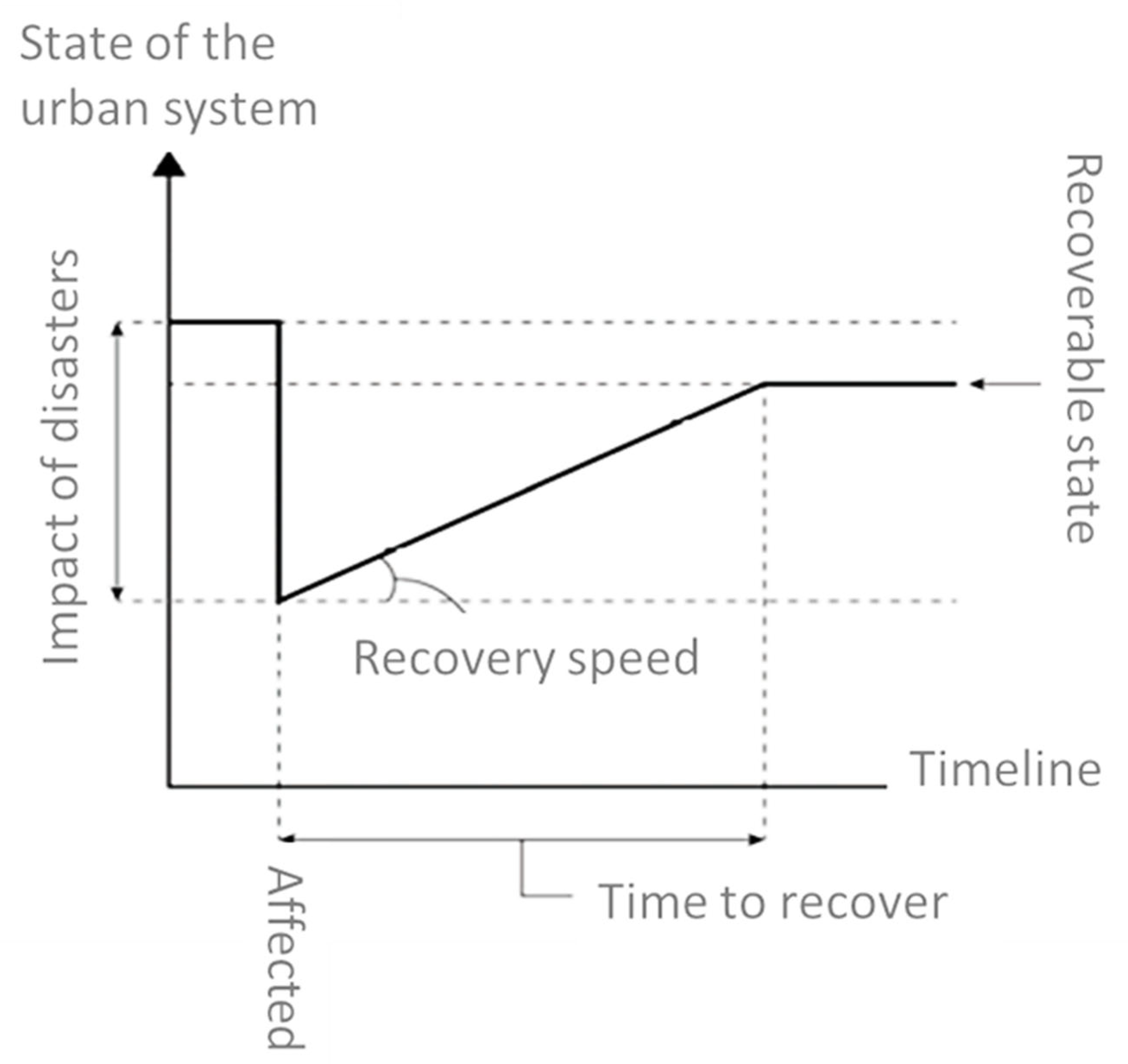
The concept assumes a system maintains its state and function during disasters, defining resilience as system stability. Stability includes (1) maintaining operations when exposed to hazards (“robustness”) and (2) recovering quickly to pre-disaster levels (“recovery”). Some definitions separate these, using “resistance” for (1) and “resilience” for (2). Despite variations, all focus on system stability, which is divided into two main components. This report refers to them as “robustness” and “recovery” [
46,
47,
48,
49] (
Figure 1).
Bruneau et al. [
37] describe (1) as robustness and (2) as rapidity, both contributing to resilience. Alternatively, some define only (2) as resilience, with (1) termed resistance and (2) as resilience [
50,
51,
52,
53]. Despite varying definitions, both approaches decompose system stability into two key components. This study refers to (1) as “robustness” and (2) as “recovery power.”
Figure 1 shows resilience as stability, illustrating how a system responds to hazards over time. The vertical axis indicates the system’s state, which reflects its ability to function and declines when impacted by hazards, while the horizontal axis represents time. The state of a system can be measured using specific indicators; for example, physical systems such as electricity, gas, water, sewerage, and communications use their respective utilization rates to represent system status [
37,
51].
On the other hand, when targeting social and economic systems, the state of the social and economic systems in the affected areas is expressed by indicators such as the resident population, working population, gross regional product (Gross Regional Product (GRP)), and the number of housing supplies in the affected areas [
37,
38,
39,
40,
41]. The robustness of an urban system is the property of preserving the system’s state and function as much as possible when exposed to hazards. In
Figure 1, the level of the system’s state immediately after the disaster is measured relative to its pre-disaster level.
To strengthen system robustness:
- -
Manage building sites with hazard-aware land use [
44].
- -
Reinforce structures against hazards; use elevated or piloti buildings for floods.
- -
Ensure emergency lifeline redundancy, like backup power supplies [
37].
- -
Establish emergency protocols: evacuation sites, warning systems, plans, and disaster response activities.
Urban system resilience refers to the capacity to promptly restore functions and states impacted by hazards to pre-disaster levels or other acceptable benchmarks. However, urban systems may not always revert to their prior conditions following a disruptive event. Consequently, resilience also encompasses the system’s capacity to assess the extent of recovery following a disaster [
41]. As depicted in
Figure 1, resilience is assessed through (1) the level to which the system recovers relative to its pre-disaster state or an acceptable standard, and (2) the duration or rate at which this recovery occurs.
The restoration of state operations and system functionality relies on reestablishing both artificial infrastructure and socio-economic frameworks. To revitalize the socio-economic system, initial efforts must focus on restoring key elements of the built environment—such as electricity, gas, water and sewerage, telecommunications, roads, and railways. Once these critical infrastructure systems are operational, the socio-economic system can recover as residents and businesses return, facilitated by the reconstruction of housing, commercial buildings, and essential equipment.
Urban resilience is influenced by physical, economic, social, and institutional/organizational factors. Physical factors concern how quickly infrastructure, such as utilities and transport, can recover, which depends on repairability, emergency plans, and organizational capabilities. Economic factors include resident income, savings, employment, company finances, and business continuity plans. Social factors involve community cohesion, communication, problem-solving, support networks, collaboration, attachment, education, and skills. Institutional and organizational factors cover public support, zoning and building regulations, and cooperation among administrative bodies [
37,
38].
When planning system recovery, it is important to recognize that components are influenced by the status of other elements, meaning their interactions must be evaluated. Infrastructure systems—such as electricity, gas, water, sewerage, telecommunications, roads, and railways—often interoperate. For instance, railway and communication networks depend on electrical power; therefore, repairs to the electric grid must occur first. Therefore, assessing the resilience of any one system requires understanding how it connects with others [
54]. Research also shows that residents returning to an area are associated with the reopening of retail stores within the socio-economic network, underscoring the need for recovery plans that account for relationships among all components.
2.4. The Concept of Resilience as an Adaptive Restructuring Capability
This concept recognizes that a system can have several acceptable states beyond its original condition, enabling flexibility after a disaster. Resilience here refers to a system’s capacity to adapt and reorganize into a desirable state following disruption [
42,
43,
45,
55].
The capacity to reconstruct a system is influenced by elements such as the economic strength of its components and social capital. These factors closely align with those associated with the concept of “resilience as stability” [
23,
24,
48].
2.5. VIPV
A PV-based system poses a lower risk of battery depletion than a BEV system, since energy transfer stops when the car battery is fully depleted. Moreover, PV systems effectively supply energy directly at the source of use.
VIPV may resolve the charging system issues discussed earlier [
56,
57]. Demonstration vehicles have been developed by Ford [
58], Toyota [
59], Karma [
60], Hanergy [
61], and Nissan [
62].
VIPV poses minimal risk to utilities. Unlike stationary PV systems, which can be severely damaged in disasters, mobile VIPV units can be relocated to continue generating power and delivering supplies to affected areas.
PV modules play an essential role as power sources in cars [
63]. New solar cell technologies, such as perovskite solar cells, are being developed primarily for automotive applications [
64]. In our earlier research, we carefully documented and examined how vehicle-integrated PV modules generate power [
65].
VIPV systems present distinct challenges, including power losses from curved PV panels [
66,
67,
68,
69], nonuniform and partial shading [
70,
71,
72,
73,
74], and structural, packaging, and testing issues that differ significantly from those of III-V solar cells and conventional flat installations [
75,
76,
77,
78,
79,
80,
81,
82]. Performance is also affected by driving conditions, such as parking and MPPT (Maximum Power Point Tracking) [
83,
84,
85]. Additionally, there are reliability concerns, such as vibration [
86].
These factors influence resilience research related to natural disasters.
2.6. VIPV Versus PV Charging Stations
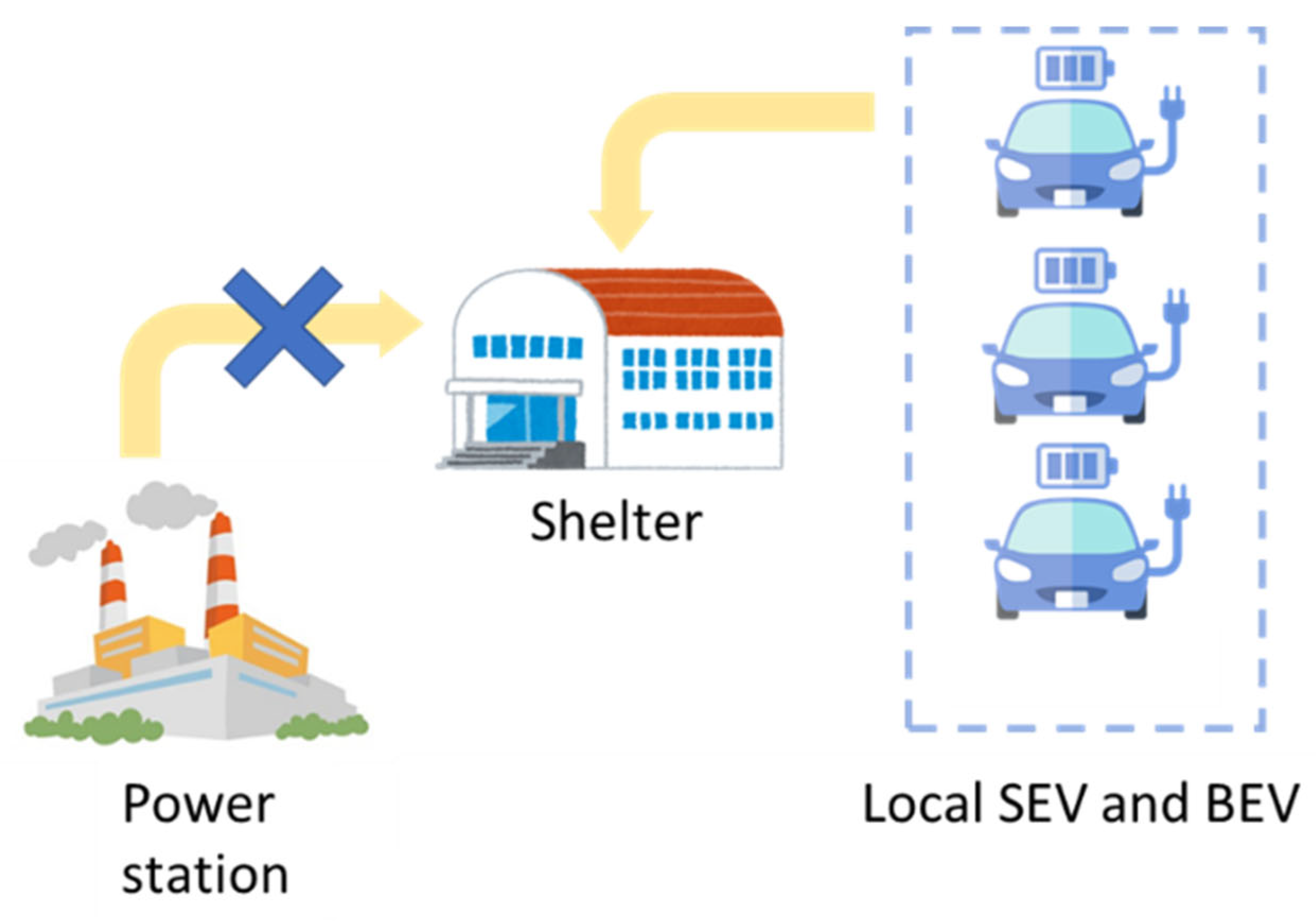
Most disaster shelters rely on emergency generators for electricity, but these have drawbacks, including fuel limitations, a need to replace them every 3 to 6 months, limited output, and ongoing maintenance costs. To address these issues (
Figure 2), SEVs will be used around evacuation centers. Advantages of SEVs for resilience include:
SEVs can generate electricity whenever there is sunlight, unlike emergency generators that cease operation when out of fuel, thereby reducing the likelihood that their battery power will run out.
Because SEVs offer portable power with limited capacity, owners may voluntarily assist in supplying shelters.
If a stationary PV system is installed in an evacuation center, severe damage to the center may render the PV unusable. Using several SEVs around the shelter helps distribute this risk.
The output of SEV power generation varies with weather conditions: production on cloudy days is typically less than half that on sunny days, whereas on rainy days it is approximately one-tenth of that on sunny days. Unlike stationary photovoltaic systems, SEVs can reposition themselves to optimise exposure to sunlight and enhance electricity generation.
In situations where an evacuation center lacks sufficient storage batteries, the SEV can be utilized as a temporary power source or deployed to supply electricity to other centers experiencing power shortages.
Throughout this paper, the considerations of a reduced reachable fleet fraction, increased travel distance and time, and road-closure probability are not included. Nevertheless, an advantage of this approach is its flexibility in placing temporary relief centers. Furthermore, mobility is essential for delivering relief supplies and providing medical care. Overemphasizing mobility and access may hinder constructive discussion. The results should be interpreted as upper-bound feasibility estimates, given that mobility constraints and road-closure effects are not explicitly modeled.
2.7. Energy Demand in an Emergency
Fragility science, which combines the social sciences, natural sciences, and engineering, incorporates a risk-based model of vulnerability. The Cutter hazard-of-place model [
41] assesses a region’s vulnerability by synthesizing physical and social factors. Physical vulnerability is measured using indicators that estimate the likelihood of various hazards occurring in a given area. Social vulnerability, on the other hand, is assessed based on factors such as residents’ income, occupation, education level, and race. In this study, it is assumed that residents willingly provide electricity. Thus, the model’s framework was used to determine the voluntary provision rate.
Policymakers have thoroughly studied energy resilience in disaster response, with Japan providing comprehensive documentation on the topic. Disaster response plans generally include a central headquarters to coordinate efforts across the region, along with facilities like care homes, community halls, and evacuation centers. These sites are commonly equipped with diesel generators and stationary photovoltaic systems with fixed-tilt installations to enhance their resilience (see
Table 1 and
Table 2).
The VIPV supply must meet the energy needs of resilient facilities. Unlike standard PV models, this resilience model accounts for abrupt increases in energy demand during natural disasters, necessitating a worst-case scenario approach. Furthermore, as social activities influence energy distribution, human activity patterns should also be integrated into resilience planning.
The typical design of resilience facilities often excludes air conditioning, especially in non-medical evacuation centers, where the costs of diesel generators or portable PV systems are high. However, there is growing recognition that air conditioning is vital, due to the increased risk of heatstroke-related mortality. Usually, disaster response plans also do not account for charging mobile devices.
The following facilities are used in evacuation centers during disasters.
- (A)
Disaster Response Headquarters;
- (B)
Large-scale evacuation centers;
- (C)
Community evacuation centers (community centers);
- (D)
Nursing homes and nursing homes;
- (E)
Temporary relief and evacuation centers;
- (F)
Mobile phone and smartphone charging port.
In addition to the standard functions (A)–(D), modes (E) and (F) leverage SEV’s mobility and flexibility for temporary relief. While (A)–(D) Support disaster-prevention infrastructure; (E) and (F) offer adaptable, supplemental systems during emergencies [
35]. SEVs can also strengthen existing infrastructure; therefore, we will first assess whether VIPV can supply emergency power.
Assuming conditions in
Table 1 and
Table 2 are met, survivors can be rescued within 72 h. The onboard PV system can recharge the needed stationary battery.
For (D)–(F), assume there is no stationary storage battery for 72-h survival. In this scenario, local SEVs transport power to evacuation centers, gradually charging them to meet minimum requirements. The electricity is stored in SEVs at these centers and delivered with supplies to various remote facilities.
The power demands for temporary relief facilities, smartphone charging ports, and air conditioning—meant to support disaster prevention with EVs—were calculated. Disaster prevention bases are expected to have a 24-h electricity supply, with the evacuation center steering committee managing usage and ensuring continuous access. Additionally, each district will set up one temporary relief facility within a 5 km radius to accommodate disaster victims, along with other key infrastructure.
Each smartphone charging port delivers 20 W, supporting up to 10 devices simultaneously at one location. There is no fixed storage battery; all power is supplied directly by the SEV when plugged in. For convenience, 25 charging spots are distributed within 5 km, allowing you to walk about 1 km between stations.
The plan was to install 2.2 kW spot coolers in one temporary relief and evacuation center and in five other facilities requiring air conditioning. These include evacuation centers and nursing care facilities, where many older people are present.
The isolation area covers a 5 km radius, allowing people to reach temporary relief and evacuation centers on foot. Facilities described in
Table 1 are distributed within this zone.
This report examines residential areas in Miyazaki to examine self-consumption during selfish power hoarding, assuming households supply their own electricity.
2.8. The Public Goods Model Versus the Voluntary Contribution Model
In many discussions about resilience, the common approach is to quantify the resources required to build resilience by using the allocation of resources to public purposes as a benchmark. This method simplifies the debate by ensuring that the required resources are secured. However, practical issues often arise, such as how to provide public goods effectively, whether to forcibly requisition them, and whether such requisition will proceed smoothly. Additionally, there is a psychological tendency to prioritize securing private resources, especially during disasters.
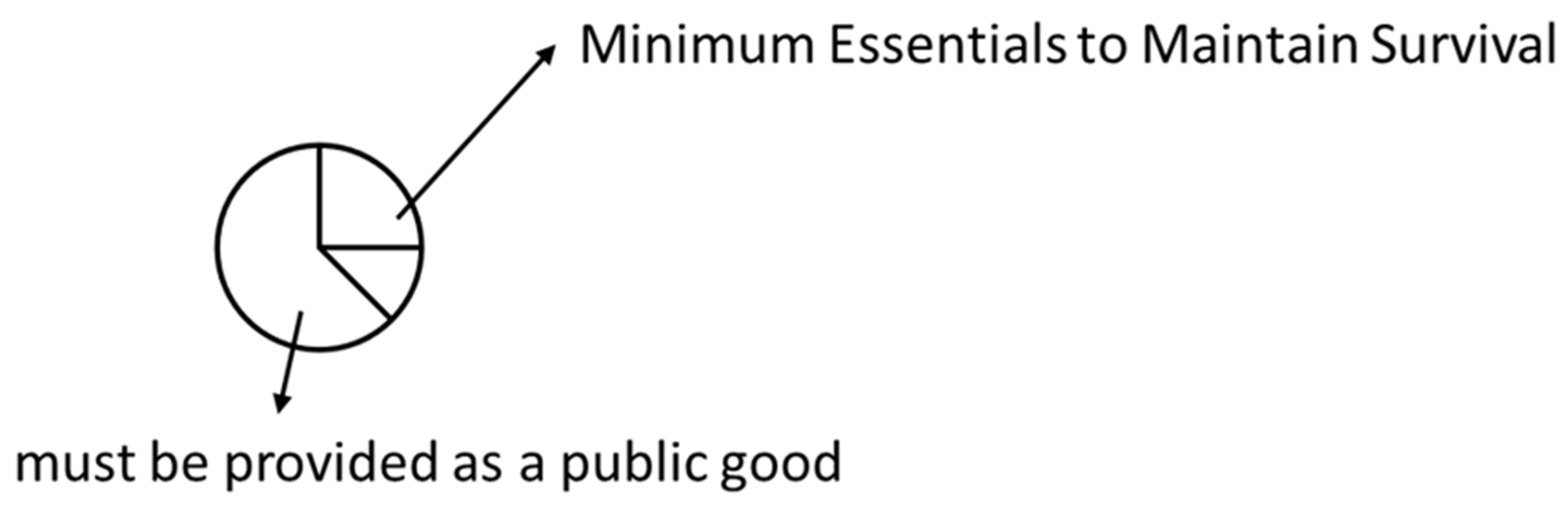
The concept of public goods can be effectively quantified using a straightforward formula:
To illustrate (
Figure 3), consider a BEV with a battery capacity of 48 kWh per person. If each person requires 15 kWh over three days, the available energy for public goods totals 33 kWh. This is derived from the total capacity of 48 kWh, with 15 kWh subtracted for essential needs. Remarkably, this means an astounding 69% of the total energy can be devoted to supporting communal shelters and services. This insight highlights the potential of our collective energy resources to enhance societal well-being.
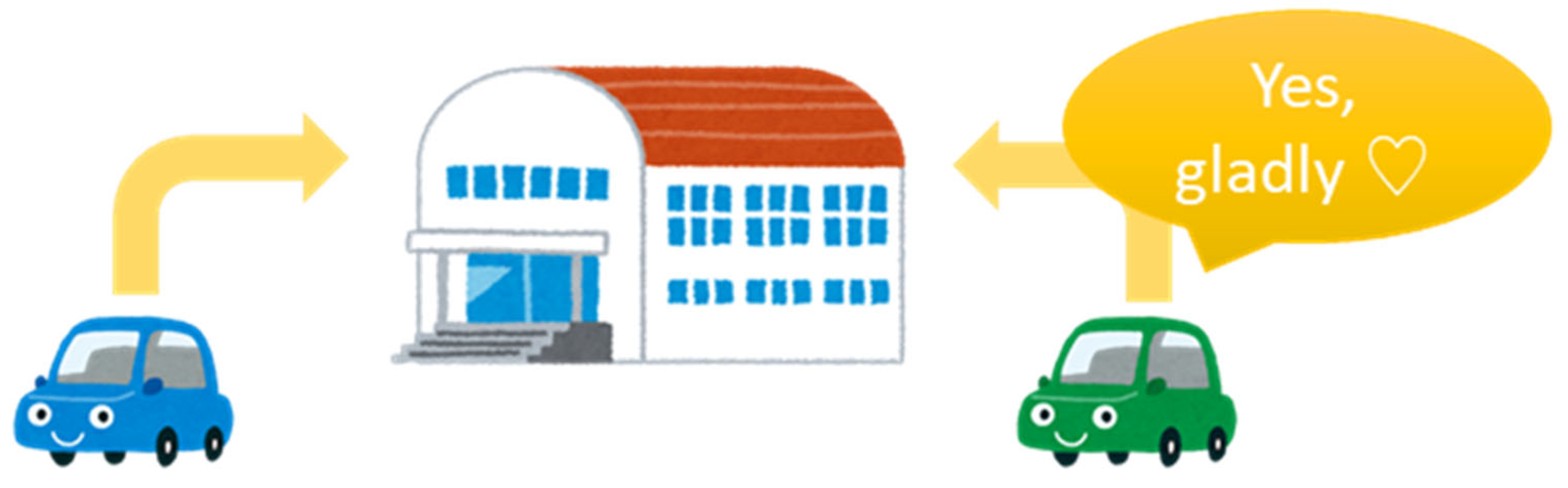
In the voluntary provision model (
Figure 4), individuals are expected to take the initiative to supply resources for public goods, such as shelters. Experience from past disasters, particularly in isolated areas, demonstrates that many community members actively contribute to survival and early recovery through altruistic behavior and mutual assistance. However, it is unrealistic and presumptuous to assume that all individuals will implicitly sacrifice their assets; this attitude mirrors the public goods model discussed earlier.
Some community members will survive by relying on resources, while others will have surplus supplies. Individual motivations will differ—some are altruistic, while others are purely self-interested. Utilizing a probability model clarifies these dynamics. For instance, if x% of SEV or BEV owners maintain a state of charge (SoC) of y%, then z% of these owners will undoubtedly contribute their surplus energy to the shelter. It is critical to recognize that x, y, and z are interrelated. Typically, the greater the surplus energy, the more likely individuals are to offer resources, and the amount of resources donated tends to be substantial.
2.9. 100% Voluntary or Selfish Power Hoarding
In the previous chapter, we established a fundamental assumption: a specific percentage of surplus energy is provided to the shelter with equal probability, depending on the total energy possessed by all members. However, we must recognize that individuals often prioritize personal needs during disasters. Consequently, it is essential to develop a model that accounts for this self-reservation behavior. A Monte Carlo simulation that treats self-reserves as a random variable is not only beneficial; it also provides a more accurate representation of reality (
Figure 5).
3. Results
Voluntary contributions to the common good are a key benefit of VIPV. The probabilities, benefits, and potential risks were quantitatively examined through Monte Carlo simulations, accounting for both social and technical factors [
35].
PV systems produce varying levels of energy depending on their location. Similarly, the type and density of disaster-prevention equipment required also differ by region. While simulating PV energy for vehicles and EV charging stations is relatively simple, estimating energy supply for the resilience center requires accounting for worst-case scenarios—such as unexpected events and obstacles arising from human actions. Resilience scenarios can vary depending on the severity and type of natural disasters, as well as regional factors and limitations.
To simulate such unpredictable and diverse scenarios, a Monte Carlo approach can be useful, incorporating the characteristics of the natural disaster—such as location, date, time—and the level of human activity. An example scenario might involve an earthquake hitting “PV City” within a 5 km radius. In the initial hours, local authorities convert schools, community centers, and care centers into evacuation sites equipped with six 4 hp spot coolers. They also set up temporary first-aid stations and multiple mobile device charging points to help residents access disaster information, supplementing traditional infrastructure. Within a 1 km radius, there are 25 electricity-dependent charging stations. The city requests voluntary electricity donations from PV-powered vehicles; some drivers monitor their vehicle’s State of Charge (SoC) hourly. When the SoC exceeds 90%, they travel to a designated area to supply power until the battery drops to 50%. These batteries are recharged by PV panels on the vehicles. Additional measures ensure disaster-prevention equipment stays operational. After seven days, the local government receives updates that regional lifelines have been restored.
3.1. Energy Demand in the Disaster Zone
We used the same energy-demand scenario as in our previous study [
35].
Policymakers often focus on energy resilience during disaster response, with Japan having well-established plans. These include a central disaster management headquarters, evacuation centers, community halls, and care homes, all generally equipped with diesel generators and fixed-tilt PV systems for added resilience. Typically, these facilities lack air conditioning due to the costs of diesel generators or portable PV units, especially at non-medical evacuation sites. However, growing awareness highlights the need for air conditioning, particularly given the rising number of heatstroke-related fatalities. Standard disaster response plans usually do not include provisions for charging mobile devices.
Therefore, after a disaster, three key temporal facilities and functions are necessary, each capable of utilizing voluntarily contributed VIPV energy: a temporary shelter with medical support, a mobile device charging station within walking distance, and backup power for air conditioning.
3.2. Energy Donation from VIPV
The results of a community survey in our previous study showed that more than 40% of University of Miyazaki residents reported optimism about donating electricity to public facilities during a disaster [
35]. We varied the assumptions used in our previous study.
Over 40% of respondents indicated willingness to donate electricity to public facilities during a disaster. The initial estimate assumes 5% for SoC > 90%. Some participants believed no one would want to donate the energy stored in SEVs, while others thought the 5% figure was overly pessimistic. Parents of students at a nearby junior high school near the University of Miyazaki evaluated how many residents are willing to volunteer donations. In the Miyazaki community, energy resilience systems that incorporate VIPV and SEV energy sources, along with voluntary mutual aid, are considered practical possibilities.
3.3. Demand-Supply Balance of Emergency Energy
We used the same method as in our previous study to model social activity involvement and the probabilities of success and disconnection from the energy supply, using a logistic probability function [
35].
A Monte Carlo simulation was conducted that incorporated human activities. Random numbers, similar to dice rolls, determine the parameters of disaster events and each SEV’s status. Dice rolls set the earthquake’s occurrence time, as well as the vehicle battery levels, climate, and solar irradiation, including deviations from the annual average. Notably, human activity was simulated as in the simplest example—in the Public Goods Model versus Voluntary Contribution Model [
35].
Given the aforementioned considerations, for each vehicle (e.g., in a scenario with 1000 vehicles within a designated area), the anticipated power generation is computed from the current solar radiation intensity, incorporating a stochastic disturbance modeled as a random variable and the vehicle’s parameters. Subsequently, the state of charge (SoC) variation in the storage battery is determined using a per-vehicle, gradual update formula. During this process, the SoC of each vehicle is evaluated one hour after the remaining stored energy is transferred to the resilience facility, and the electricity consumed during movement related to the primary supply is quantified. This assessment employs a Monte Carlo simulation technique, leveraging a social behavior model derived from social science methodologies. The outlined calculations are performed hourly over seven days. Throughout this period (168 h), the capacity of all resilience facilities is monitored to identify instances where storage capacity falls below zero, which are then recorded as failures of operational resilience. The simulation is executed 100 times under identical conditions, tracking the number of attempts in which the system maintains surplus power for the entire seven-day period. The probability of system survival under specified conditions (e.g., 1000 vehicles) is estimated by dividing the number of successful attempts by the total number of simulations. To model this probability, the count of surviving vehicles is regressed on the number of vehicles in the scenario, using a logistic function estimated by generalized least squares. This approach involves solving a nonlinear regression (not a linear regression) problem that numerically minimizes the sum of squared residuals across the data points, thus determining the coefficients of the logistic function as specified in Equation (1).
where
L is the upper limit constrained by (
L > 0) and in this particular case,
L = 1;
k is the growth rate constrained by (
k > 0);
x0 is the inflection point as a real value. The target variables of minimizing the problem for function fitting are
k and
x0.
3.4. Repeatability of the Monte Carlo Simulation
The Monte Carlo simulation uses probabilistic models to quantitatively discuss events. Therefore, to ensure repeatability, it is necessary to carefully and quantitatively determine the number of trials and the conditions required to ensure reproducibility, thereby ensuring the reliability of the calculation results.
Probability variables were assigned for the disaster date, disaster time, vehicles present in the relevant area, the remaining battery charge of each vehicle at the time of the disaster, weather conditions for the year and month, the probability that vehicle owners will be willing to provide surplus power, and for all these aspects. After the disaster, probability calculations were performed every hour for seven days (168 h). For example, if there are 1000 vehicles in the area, 168,000 calculations (1000 × 168) are performed. Furthermore, to achieve a 95% survival probability by fitting a logistic curve, the above calculations were summed over 10 to 20 levels. Like reproducibility in ray-tracing simulations, more than one million trials were conducted.
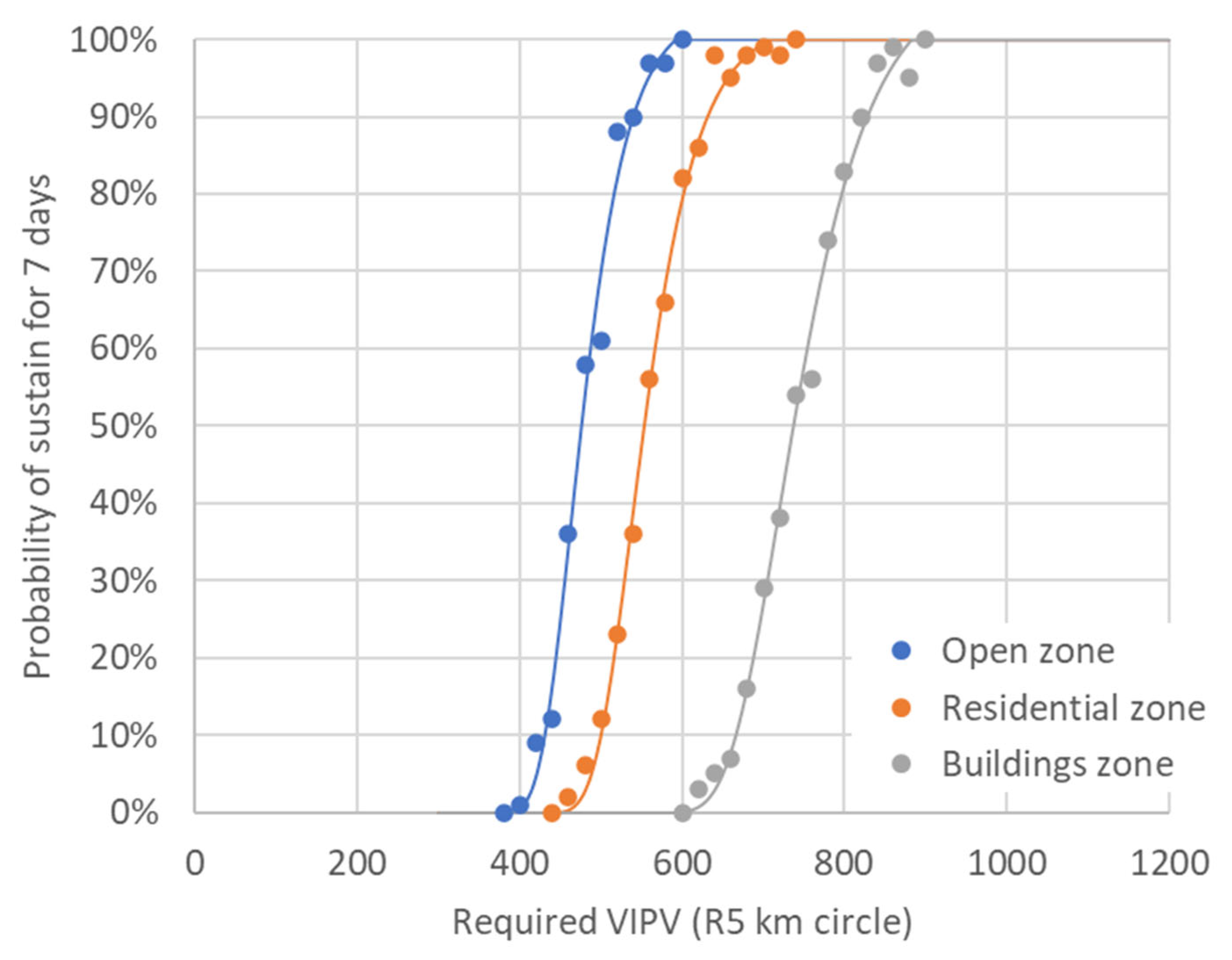
To verify accuracy, Monte Carlo simulations were conducted in three regions under different shading conditions. The results are shown in
Figure 6 and
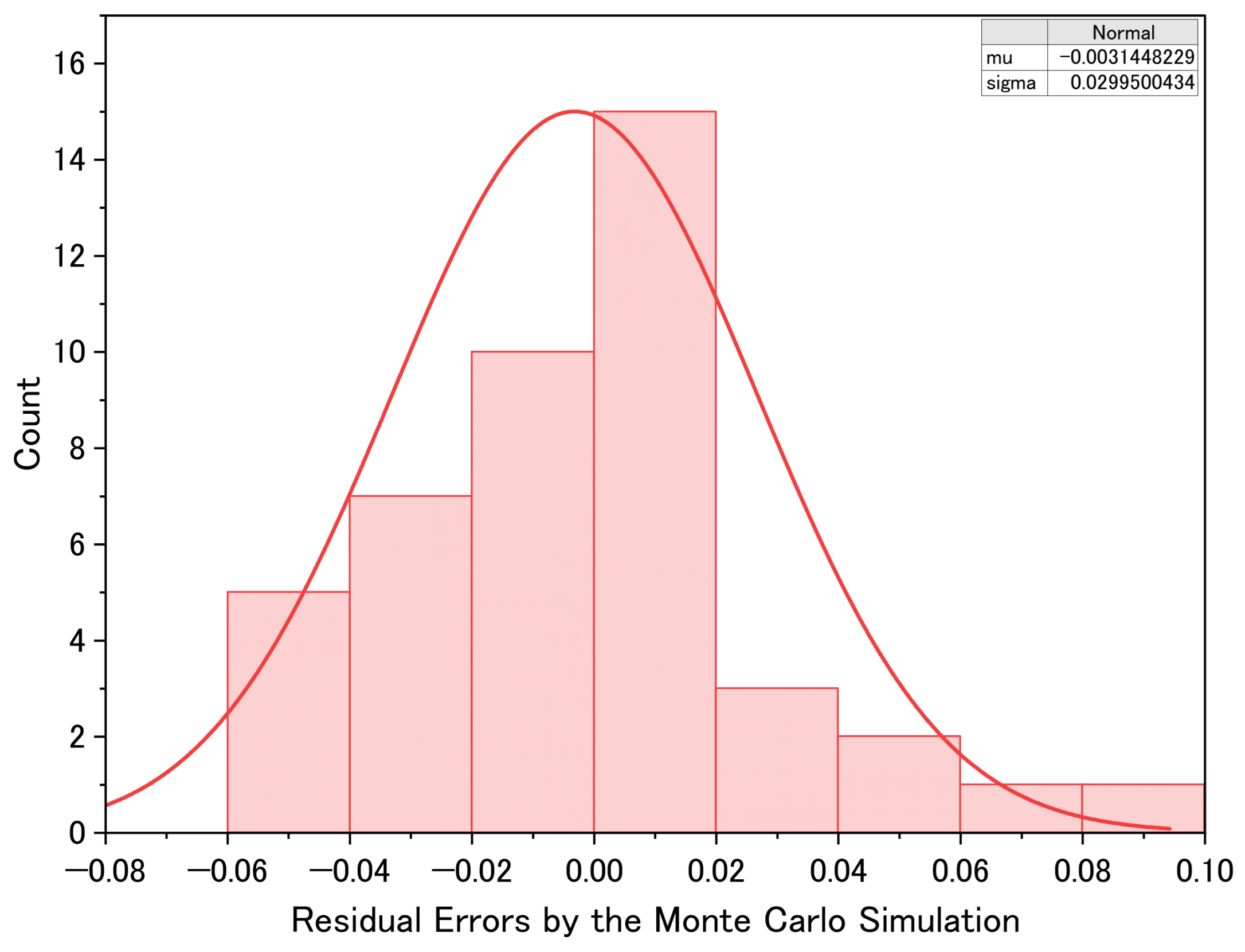
Figure 7. The residual error in
Figure 7 is defined as (Actual probability by counting the 168,00 trials of the Monte Carlo simulation) minus (probability assumed by the logistics curve). Note that the distribution of the residual errors from the Monte Carlo simulation was centered with a mean error of minus 0.3%, corresponding to our Monte Carlo simulation being non-biased. In
Figure 6, the
x-axis corresponds to the required number of VIPVs within a 5 km radius circle, and the
y-axis corresponds to the probability of survival for seven days. The calculation was done by three levels of shading environments. In
Figure 7, the residual errors of the Monte Carlo simulation were plotted as a histogram. The
x-axis corresponds to the bins of the residual errors, and the
y-axis corresponds to the count of the residual error records in the bin.
3.5. Resilience Scenario Using BEV Using a Simple Voluntary Model
We will directly compare the resilience effects of BEVs without PV and SEVs with PV, assuming that 5% of BEV owners with automotive solar cells will actively supply surplus energy when their batteries are nearly fully charged. This approach will not impose any obligations on BEV owners who are unable to recharge their vehicles.
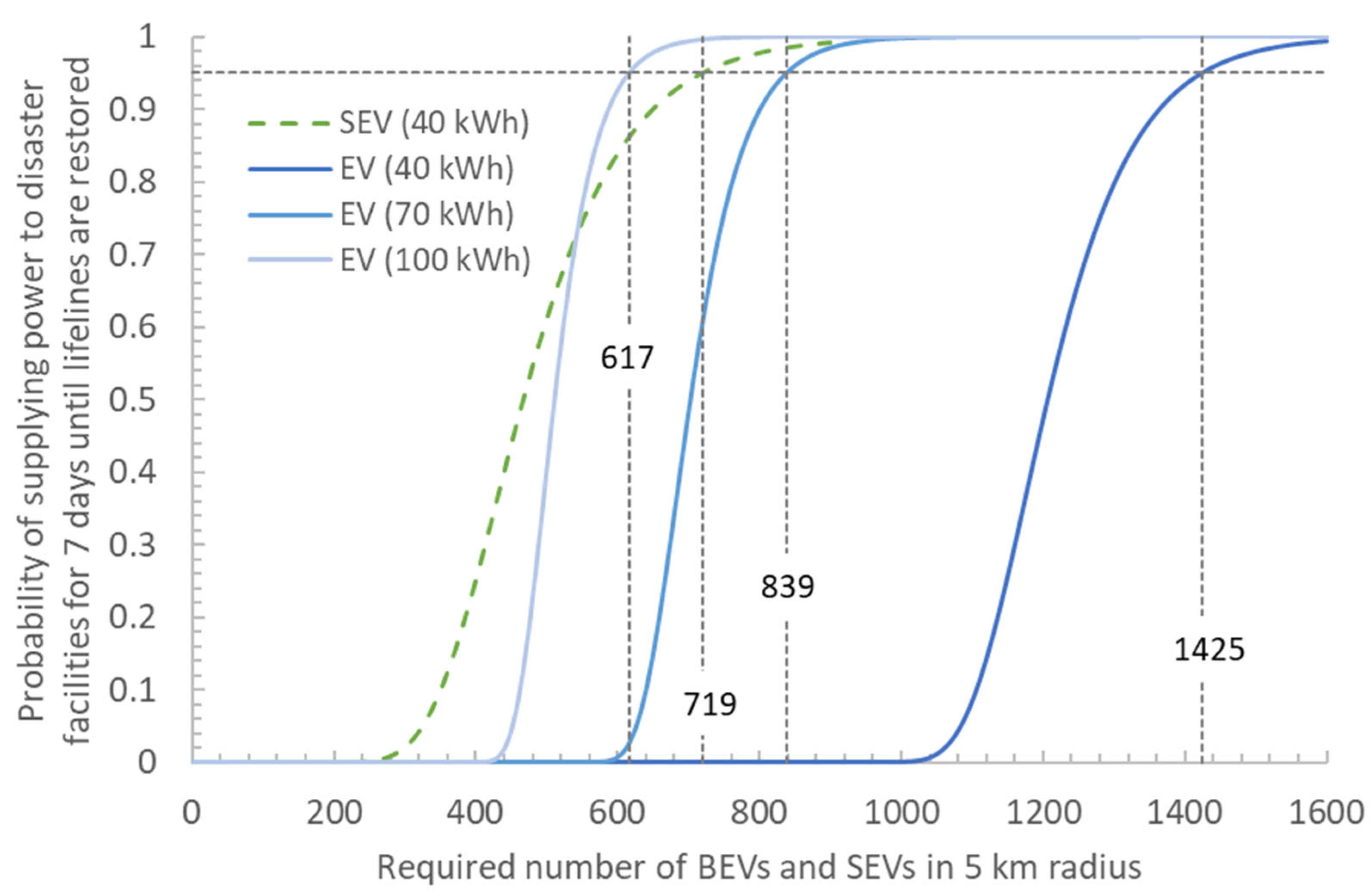
Not all vehicles will be fully charged at the time of the disaster. Moreover, sunny weather is expected to persist after the disaster, although solar radiation availability may be limited. Depending on their location, some vehicles are likely to remain in the shade. Therefore, we will calculate the remaining charge for each car in the affected area and assess shading conditions at the time of the disaster using a robust probabilistic model. Each vehicle’s initial charge will be assigned a random value, and we will determine whether the vehicle owner contributes excess energy as a random variable according to the established probabilities. The results are clearly illustrated in
Figure 8. Psychological barriers to donating from BEVs without PV, which were not fully charged, were not considered. In
Figure 8, the
x-axis corresponds to the required number of BEVs without PV and SEVs within a 5 km radius of the circle. In contrast, the
y-axis corresponds to the probability of supplying power to disaster facilities for seven days until lifelines are restored. The plot lines correspond to the different levels of the battery capacitances.
Installing VIPV helps store power even when unattended, reducing the number of vehicles with batteries in disaster-affected areas. This can support better energy availability and resilience during emergencies.
3.6. Resilience Scenario Using VIPV with Selfish Power Hoarding
We must adopt a more realistic model for reserving self-consumption and delivering surplus energy to shelters during disasters. Given that self-retention is permitted, it is unnecessary to impose rigid restrictions, such as mandating an offering when the SoC exceeds 90%. Even if the surplus is slightly higher, as long as the self-reserve is secured, we ran the Monte Carlo simulation assuming the surplus will be available.
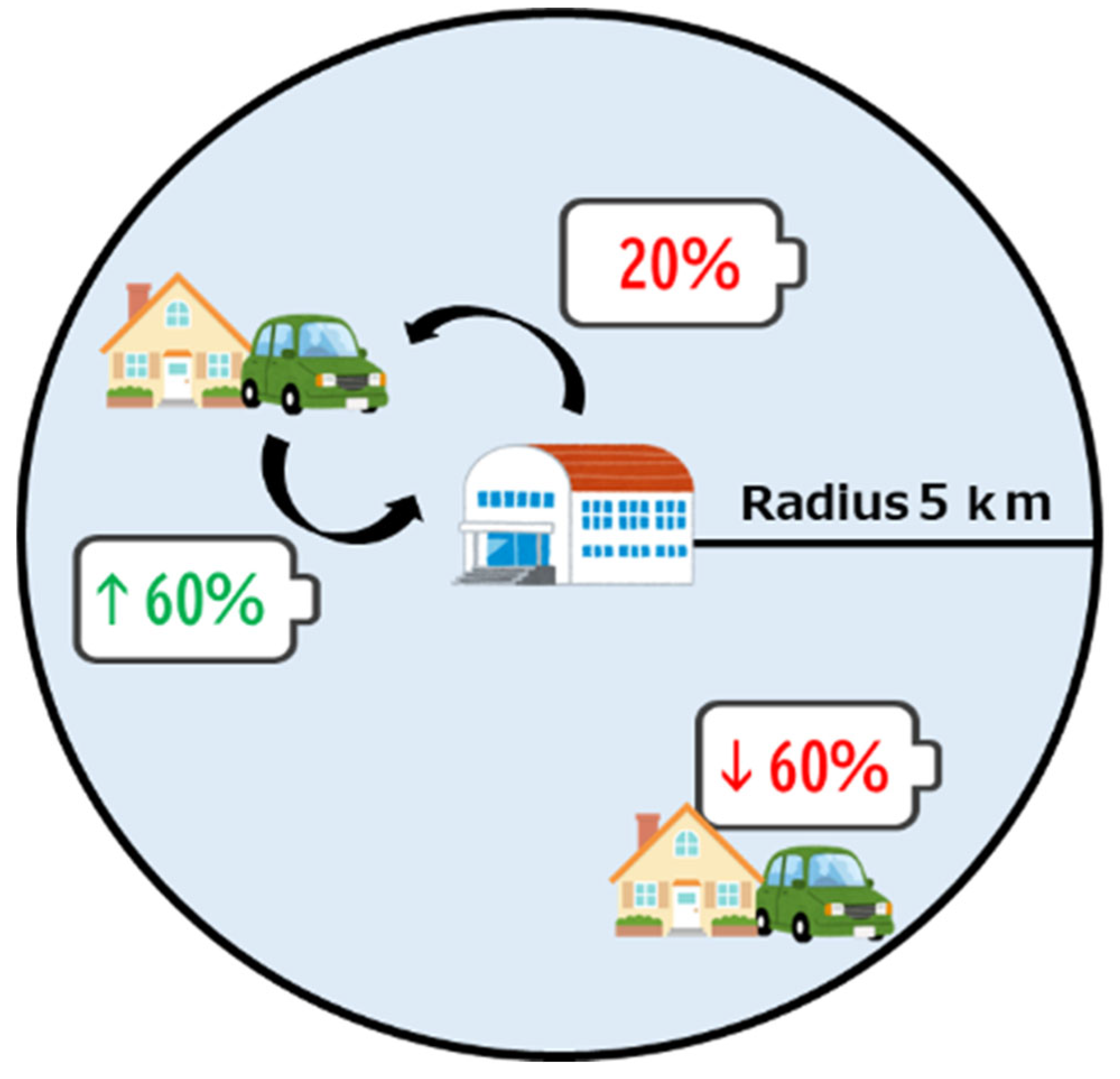
Drivers of SEVs with at least 60% or 70% battery capacity will supply power to the facility until their vehicle’s battery reaches 20% or 30%, depending on the chosen provision rate. When traveling to the facility, energy is drawn from the on-board battery, and drivers return home with the remaining charge (
Figure 9).
The voluntary provision rate is based on Cutter’s hazard-of-place model, utilizing the number of vehicles owned per household in the region as the variable x. The provision rate adjusts in phases according to the residual charge level. Note that the distribution of the rate for voluntary provision was hard to know through questionnaires of local people, as we did in
Section 3.2. Regarding the proposed percentage of energy storage assets held at the time of the disaster that will be provided as public goods, we have not found any quantitative research. As a research field, it is thought close to “ethics, behavioral economics, and public goods provision models for resource allocation in the event of a disaster”, but we assume that there are almost no studies that experiment and investigate “what percentage of privately owned energy resources,” such as storage batteries, are provided for the following reasons.
Behavior during disasters is highly ethical, psychological, and situationally dependent, making it difficult to quantify.
Until recent years, it was not common for individuals to own storage batteries and provide them to those around them.
There are many public goods games, but none have been found that target the remaining battery level.
Energy sharing in the event of a disaster is often discussed on the side of institutional design (microgrid, V2H/V2G (Vehicle to Grid)). In other words, the idea that all stored assets are shared and a part of personal assets is not considered as a premise.
Therefore, we sought to develop a model for voluntary provisions by a group of students at the University of Miyazaki who live alone in apartment houses, separated from their families, to help them gain experience surviving on their own resources. The spontaneous provision rate by remaining charge, as a result of the discussion, is given in
Table 3. Note that the voluntary provision rates (
Table 3) represent exploratory scenario assumptions rather than empirically validated behavioral parameters.
Given that research is only possible if spare power is available seven days after a disaster, a Monte Carlo simulation was used to estimate the surplus car power available by that time. The analysis assumed 1000 affected individuals.
SEV’s value is assessed by comparing it with EVs:
Both formulas help simulate surplus power during a disaster.
Table 4 divides disaster power consumption into air conditioning, lighting, kettle, mobile charging, and hot water supply, with set utilization rates and required power for each. The electricity used per person varied randomly, as illustrated below.
For the Monte Carlo simulation involving hourly dice throws, it is necessary to allocate the daily energy demand to the corresponding time intervals. This allocation was performed by weighting the consumption according to the schedule outlined in
Table 3. For instance, air conditioning demand is considered fully active between 06:00 and 17:00, and lighting demand is weighted to be fully active between 17:00 and 21:00.
How many SEVs are needed to continue supplying power to evacuation centers for seven days after the disaster occurs, using Monte Carlo simulations?
The selection of cars shall be once a day and shall be randomly selected from 24 h, with each hour separated.
If it does not exceed the default value (60% or 70% of the remaining charge), it is not eligible.
For each car, the voluntary provision rate is determined according to the remaining charge. After that, perform a probability calculation and select the target car.
Since isolated areas are assumed to have a radius of 5 km, the power required for 5 km of driving is subtracted and provided until the remaining charge reaches the specified level (20% or 30% of the remaining charge), and the power required to return home is deducted. When providing electricity, if the power at the evacuation center is at its maximum, electricity shall not be provided.
These will be carried out for 7 days, depending on the number of cars, and it will be determined whether it is possible to continue supplying power to the evacuation center. If the power of the evacuation center is 0 for even 1 day over 7 days, it is considered a failure to provide electricity; if it remains greater than 0, it is considered successful.
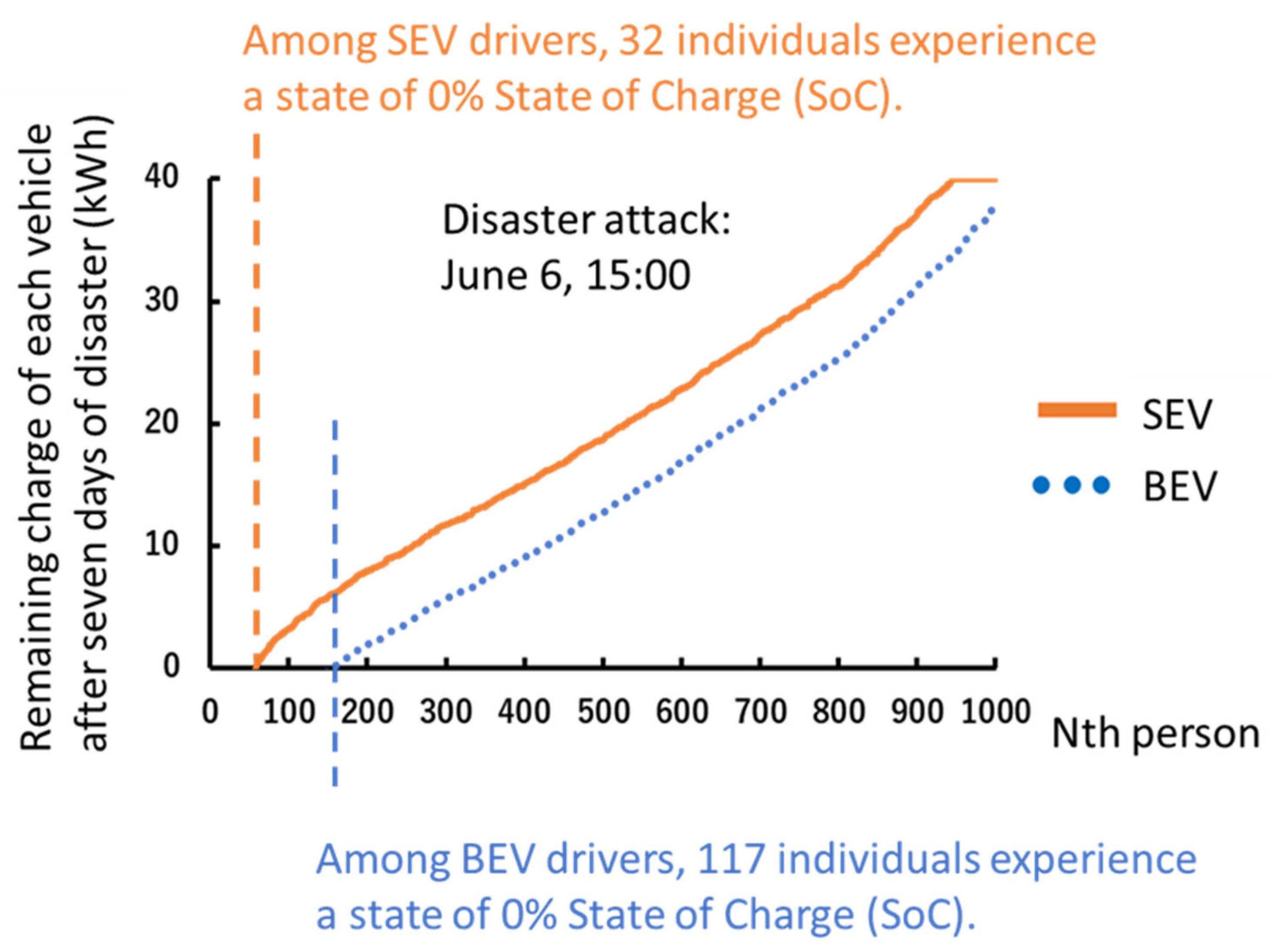
The results are examined using the number of vehicles equipped with PV as an explanatory variable, the car’s remaining charge 7 days after the disaster as the objective variable, and the number of vehicles needed to remain above 0 even after 7 days. For example, in the case below, 32 SEVs were fine, while BEVs require 117 units (
Figure 10). The
x-axis shows the Nth person, ordered by the remaining charges, while the
y-axis shows the remaining charges for each vehicle after seven days of the disaster. Two plot lines correspond to SEV and BEV.
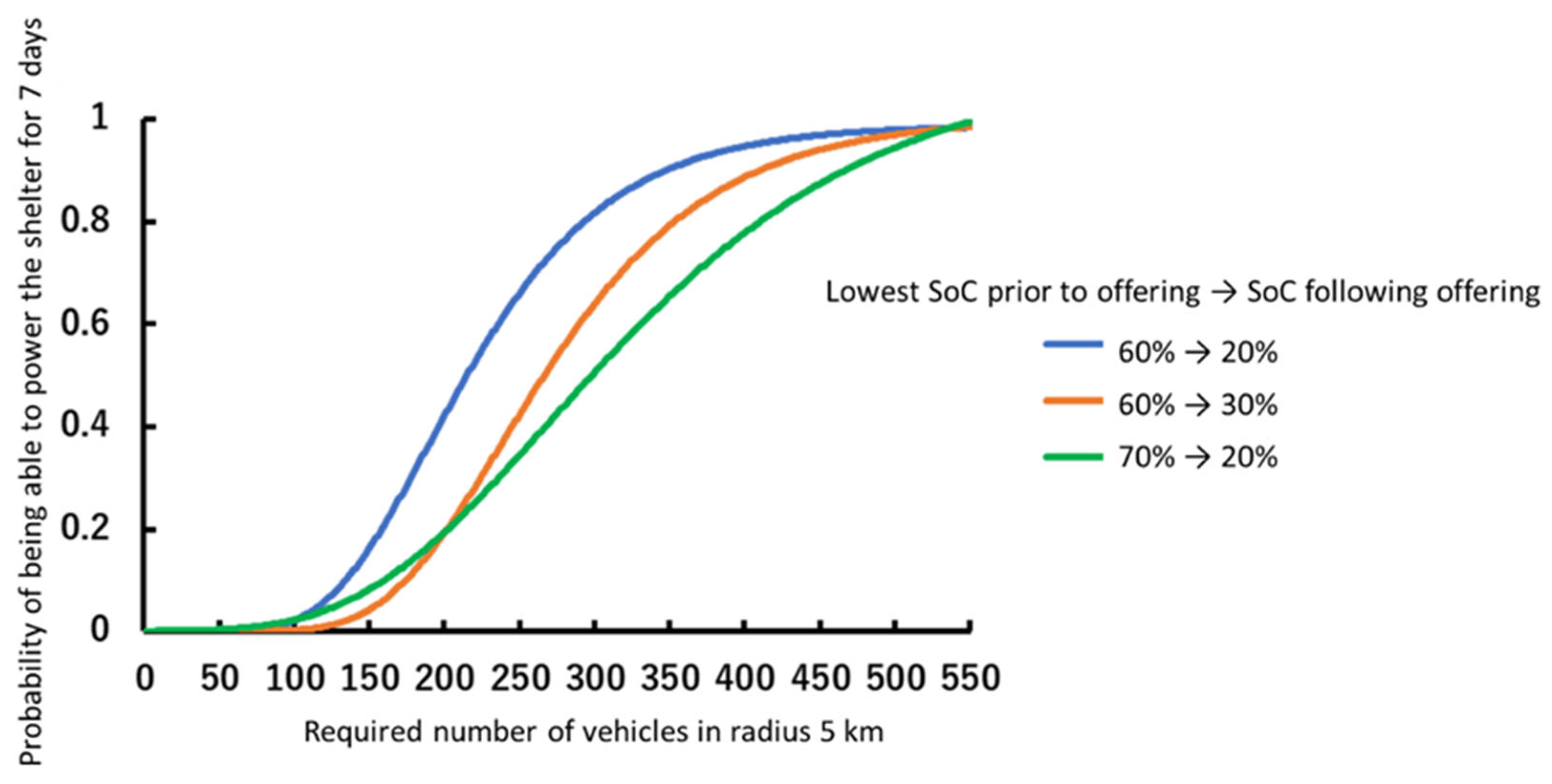
Likewise, it can be expressed as a probability maintained for 7 days, as in the previous chapter (
Figure 11). The
x-axis shows the Nth person, ordered by the remaining charges, while the
y-axis shows the remaining charges for each vehicle after seven days of the disaster. We compared three cases of the “lowest SoC prior to offering” and “SoC following offering”.
The 70%-20% line shown in solid green indicates that if the battery’s surplus power exceeds 70%, there is a 1% chance it will continue supplying power until the remaining power falls to 20%. The blue color indicates that power is being provided to evacuation centers until the remaining charge is 20% for cars with 60% or more charge. The probability gradually increases from around 100 units, and once it reaches 450 or more, the power supply to the evacuation center stabilizes. Based on this value, we sought a future approach by considering cases in which the power supply is reduced from 20% to 30% (orange graph) and in which the scope of supply is increased from 60% or more to 70% or more (green graph). The graph from 60% or more to 30% has the same general shape as the blue graph, and it seems that the number of requests increased. In addition, the graph from 70% or more to 20% has a gentle slope and is closer to a straight line. Both graphs showed that if there were more than 550 SEVs, the evacuation center’s capacity could be sustained for 7 days.
In this way, if the probability of providing electricity to the disaster base decreases due to selfish judgment in addition to self-consumption, the opportunity to provide it to public goods decreases, so even if the number of EVs increases compared to
Figure 8, the probability that the required power at the disaster base can be maintained until the lifeline is restored does not increase easily. Based on numerical experiments that varied various parameters, the most effective approach is to “catch from where you can catch it”. In other words, it is not 60%-30%, but 20%. This is more effective than “attracting motivated people” by changing 70%-20% to 60%-20%.
Incentive design plays a role in public goods policies. When creating a system like “let us take what we can,” it is helpful to offer appropriate rewards to donors.
From the simulation results, it was found that more than 450 SEVs are required in the area to continue supplying power to the evacuation center for 7 days if it is isolated in a radius of 5 km due to a disaster, but in order to know how much is 450 units within a 5 km radius,
Table 5 shows the indicators of Miyazaki Prefecture and Miyazaki City, which are the target areas of this time. In Miyazaki Prefecture, the penetration rate will be 6%, assuming 1 in 16 SEVs are present. If it is limited to Miyazaki City, the penetration rate is 1%, so 1 SEV is enough for every 100 vehicles. Although SEV is not yet widespread, it is thought to be sufficient for disaster resilience if it becomes widespread in the future (
Table 5).
Looking at the comparison between the case of reducing the power supply and the narrowing of the range of recipients, as the number of units increased, the probability of stability was shown when the power provided was reduced, so when there were many SEVs in isolated areas, it was easier to gather power if the number of people was increased even if the number of people provided per person was reduced. However, if there are few SEVs in isolated areas, it is more likely that the power supply will continue, even if it can only draw as much as the person providing the electricity can.
In addition, this survey is a case where the SEV that stores and transports electricity collected at scattered temporary relief facilities operates without incident. Even if the total electricity at scattered relief facilities is supplied by SEV drivers in isolated areas who voluntarily provide it, if the SEVs carrying it are not operational, the number of relief facilities experiencing power shortages will increase. Therefore, to respond effectively, it is necessary to coordinate with the government’s traffic maintenance and with those who transport supplies, and I believe it is important to clarify response measures and the chain of command in the event of a disaster.
4. Discussions
The results of this study provide new insights into the potential role of SEVs and VIPV-equipped vehicles in supporting disaster resilience, particularly under conditions where voluntary energy sharing is required. Previous research has demonstrated that EVs can contribute to microgrid stability, black-start operations, and critical-load support when coordinated through V2G or V2H systems, e.g., [
12,
13,
14,
19,
22]. However, most of these studies assume either centralized control or high levels of user participation, conditions that may not be realistic during large-scale disasters. Our findings extend this literature by explicitly incorporating behavioral uncertainty into the resilience assessment. The Monte Carlo simulations show that the number of SEVs required to sustain essential facilities increases substantially when voluntary participation is low, aligning with observations from disaster psychology research that individuals tend to prioritize household needs under uncertainty.
The results also reinforce the growing body of work suggesting that renewable-integrated EV systems can enhance resilience by reducing dependence on damaged infrastructure [
15,
16,
17,
18,
25]. SEVs, in particular, offer advantages in mobility and autonomous energy generation that are not captured in studies that focus solely on stationary PV or grid-connected EVs. Our analysis indicates that even modest PV generation can meaningfully reduce the risk of complete battery depletion, thereby increasing the likelihood that SEVs remain available for energy sharing. This complements earlier findings on the benefits of distributed VIPV systems in remote or isolated regions.
From a theoretical perspective, the study contributes to resilience research by integrating socio-ecological concepts of adaptive capacity with engineering-based robustness and recovery metrics. The model demonstrates that resilience is not solely a function of technical capacity but also of social behavior, spatial distribution of resources, and the stochastic nature of renewable energy. This supports the argument that resilience assessments must account for both physical and social subsystems within urban environments, as emphasized in prior systems-based resilience frameworks [
37,
38,
39,
40,
41].
Practically, the findings highlight several implications for policymakers and emergency planners. First, relying solely on voluntary energy sharing may be insufficient without support from incentives, communication strategies, or pre-established community agreements. Second, increasing the penetration of SEVs or SEVs could reduce the burden on centralized emergency power systems, particularly in regions prone to prolonged isolation. Third, the results suggest that resilience planning should consider not only the number of EVs in a region but also their spatial distribution, typical usage patterns, and expected availability during disasters.
Despite these contributions, the study has several limitations that should be acknowledged. The behavioral parameters used in the Monte Carlo model are based on simplified assumptions and limited survey data, which may not fully capture the diversity of responses across different cultural or socioeconomic contexts. Solar irradiance and weather patterns were modeled using representative conditions, but actual disaster scenarios may involve prolonged cloud cover or physical obstructions that reduce PV output. Additionally, the analysis focuses on a 5 km radius and specific facility types, which may limit the generalizability of the numerical results to other geographic settings. The model also does not account for potential damage to vehicles, transportation barriers, or competing household energy needs that could further reduce participation rates.
Future research should incorporate more detailed behavioral datasets, explore region-specific irradiance and mobility patterns, and evaluate hybrid strategies that combine voluntary contributions with institutional support. Integrating real-time mobility data or agent-based modeling could further improve the accuracy of participation estimates. Moreover, comparative studies across different countries or climates would help assess the broader applicability of the findings.
Overall, the study underscores the importance of considering both technical and social dimensions when evaluating the resilience potential of SEVs and VIPV systems. While the results demonstrate that these technologies can contribute meaningfully to disaster response, their effectiveness ultimately depends on user behavior, local conditions, and the design of supportive policies.
In addition to the reflection on the study discussed above, let us consider a simplified approach based on VIPV’s recent advances in rating and testing technologies. The Monte Carlo simulation described thus far is a powerful tool for evaluating resilience, as it can depict not only PV power generation output but also social behavior, disasters, and the community’s condition at that time. This model is highly transparent and utilizes probability-based numerical methods. However, the calculations can be complex and challenging to grasp. It may be more intuitive to multiply the power generation amount by a proportional coefficient. This chapter explores this approach. Indoor test results are used to evaluate the basic performance of PV modules, but they do not serve to certify the modules themselves. The VIPV product’s rating may be indirectly affected by its performance within a specific zone.
Multiple factors complicate the assessment of solar irradiance and its impact on VIPV performance.
The orientation angle of the VIPV changes frequently during driving.
The VIPV has a higher probability of shading.
Shading objects, such as street trees and signals, are small and highly influenced by partial shading loss.
Curved surface.
The impacts above interact and depend on the module’s local coordinates.
Rapid solar irradiance fluctuations, generally occurring in milliseconds, result from dynamic partial shading.
Rapid fluctuations of the solar spectrum.
Temperature variation between parking and driving.
The annual energy yield is calculated as follows:
IEC 60904-1-3 (International Electrotehcnical Comissions) is currently under discussion in an IEC TC82 (Technical Committee) project and has not yet been finalized for publication. Various IEC standards provide the fundamental procedures for performance measurement and rating.
Solar irradiance on VIPV is influenced by the surrounding shading environment, which can be categorized into three zones: lightly shaded (suburban area, SVF 0.9), medium shaded (residential area, SVF 0.7), and deep shaded (valleys between skyscrapers or hills, SVF 0.5) [
81]. The shading factors discussed in the IEC TC82 PT600 project team are presented in our previous open-access article [
81], which includes complete numerical tables. To make this calculation easier, fleet operators use the solar energy-generation calculation spreadsheet for VIPV, which is provided as a
supplemental data file (Supplementary Material) for PV-equipped trucks and can be used for passenger cars. Note that this spreadsheet is not protected, so that the entire calculation is transparent and can be reused.
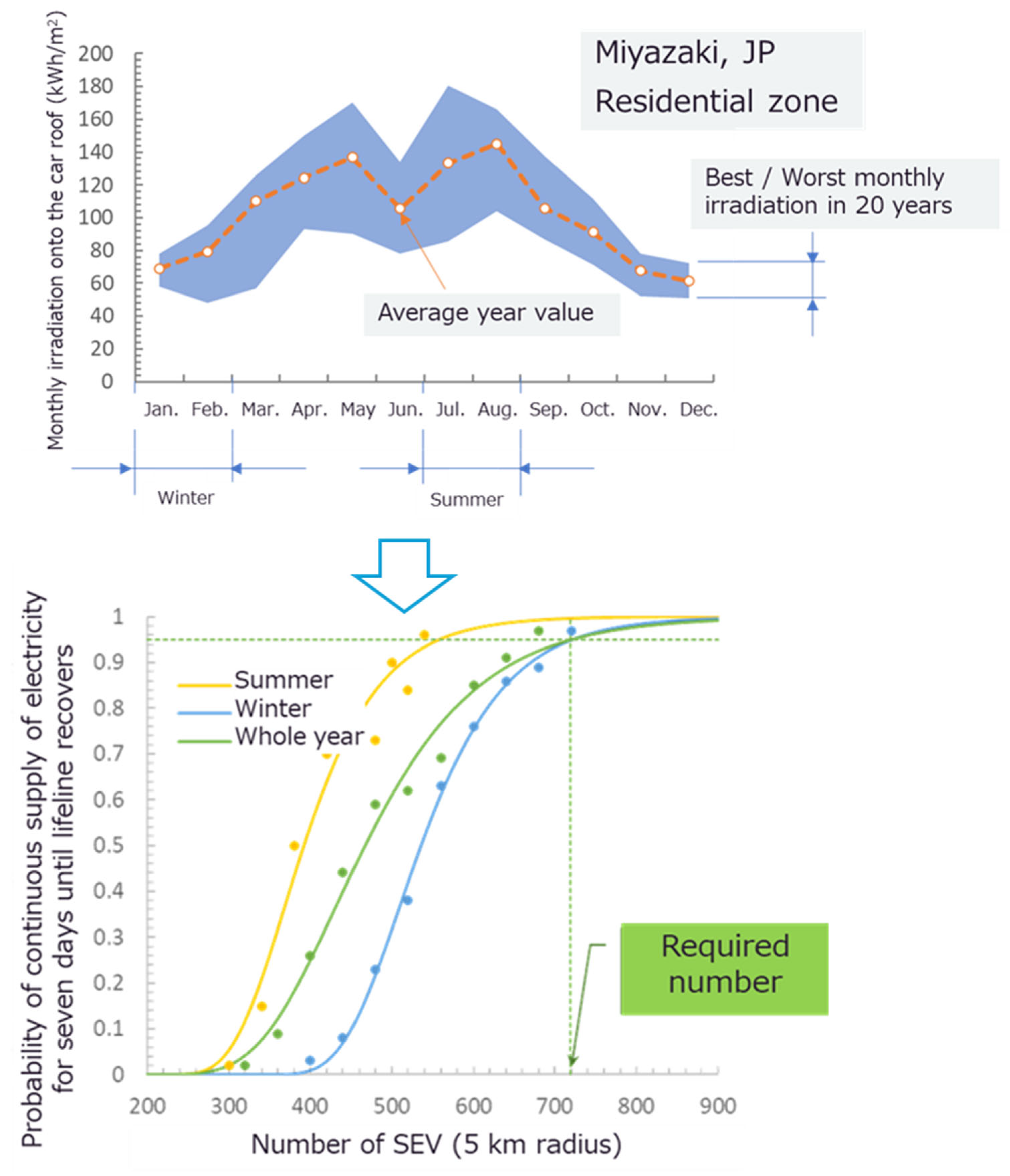
Focusing on Miyazaki City, a region with relatively stable solar radiation, it is crucial to recognize that these levels can fluctuate by tens of percent from year to year. Seasonal changes are also critical and must not be ignored. Relying on annual data or seasonal averages to calculate probabilities yields vastly different results. Using annual data for power generation estimates results in significant overestimation.
Moreover, solar radiation data must be viewed through the lens of “the amount of solar radiation required to maintain a lifeline with a probability of more than 95% of the time,” rather than merely considering average survival probabilities in resilience design (
Figure 12). Therefore, we must specifically evaluate solar radiation levels during the week when solar exposure is at its worst, rather than indiscriminately applying annual solar radiation data, as shown in the numerical tables in our previous study [
78].
Q1. Should we provide an approximate estimate of vehicle numbers for typical cities worldwide?
–Yes, that might be necessary.
Q2. Is it appropriate to use a standard VIPV solar irradiance database, such as the PT100 (Project Team) table, for a basic calculation?
–Likely not for a simple interpretation. Apply the solar irradiance and energy demand from the worst week instead.
5. Conclusions
This study explored how SEVs can contribute to energy resilience during disasters, focusing on both technical performance and the social dynamics surrounding voluntary energy sharing. While the specific numerical results depend on local conditions such as climate, vehicle density, and community behavior, the broader findings highlight several general tendencies relevant across many regions.
VIPV can complement conventional BEVs by providing a modest yet continuous energy source, even when external infrastructure is disrupted. This characteristic reduces the risk of complete battery depletion and enables flexible, mobile energy support. Compared with stationary PV systems, mobile PV units also offer advantages in terms of risk diversification and the ability to relocate to areas with better sunlight.
The simulations suggest that voluntary energy sharing can play a meaningful role in maintaining essential services during prolonged outages. However, the effectiveness of such contributions depends strongly on behavioral factors, including how individuals balance self-preservation with community support. Models incorporating more conservative, or “self-protective,” behavior indicate that more SEVs would be required to sustain critical loads. This underscores the importance of designing incentive structures and communication strategies that encourage participation without assuming universal altruism.
The Monte Carlo framework proved useful for examining uncertainty in both environmental conditions and human decision-making. Because disaster scenarios vary widely across regions, probabilistic approaches allow planners to evaluate resilience under a range of plausible conditions rather than relying on average case assumptions.
The results indicate that SEVs, whether VIPV or conventional EVs supported by PV, can contribute to disaster resilience when integrated into broader emergency energy strategies. Their effectiveness depends on local adoption rates, solar availability, infrastructure conditions, and social behavior. As such, the findings should be interpreted as general insights rather than prescriptive values for any specific region. Future work may benefit from applying similar models across diverse geographic and social contexts and from exploring policy mechanisms that support voluntary energy sharing during emergencies.
Future research should build on the present findings by adopting more rigorous methodological approaches and expanding the conceptual scope of EV-based resilience studies.
We need more detailed behavioral datasets that capture how EV owners make decisions under uncertainty, including factors such as risk perception, household energy needs, trust in public institutions, and willingness to participate in community-based energy sharing schemes. Collecting such data through large-scale surveys, longitudinal behavioral tracking, or controlled experiments would allow future models to incorporate empirically grounded behavioral parameters rather than relying on simplified assumptions.
Future studies should also explore hybrid modeling frameworks that combine Monte Carlo simulations with agent-based modeling (ABM) or system dynamics (SD). These approaches would enable researchers to represent heterogeneous actors, dynamic feedback loops, and evolving social interactions during prolonged disaster scenarios. Integrating mobility data, real-time traffic patterns, and geospatial constraints would further improve the realism of resilience assessments, particularly in urban areas where accessibility and congestion influence the availability of EVs for energy sharing.
The technical dimension of VIPV and SEV performance warrants deeper investigation. Future work could incorporate high-resolution irradiance data, shading models, and vehicle-specific PV performance characteristics to better estimate energy generation under adverse weather or post-disaster environmental conditions. Similarly, evaluating the degradation of batteries and PV modules under repeated emergency use would provide insights into the system’s long-term sustainability.
Comparative studies across different countries, climates, and socio-economic contexts would help determine the generalizability of the present findings. Regions with high EV penetration, strong community networks, or established V2G infrastructure may exhibit different resilience dynamics.