Article

Yield and Nitrogen Management of Festulolium braunii (K. Richt.) A. Camus Treated with Spent Mushroom Substrate and Mineral Fertilizers

by
Beata Wiśniewska-Kadżajan
1,*,
Stanisław Sienkiewicz
2,
Andrzej Wysokiński
1,
Sławomir Józef Krzebietke
2 and
Anna Nogalska
2
1
Institute of Agriculture and Horticulture, Faculty of Agricultural Sciences, University of Siedlce, B. Prusa 14, 08-110 Siedlce, Poland
2
Department of Agricultural and Environmental Chemistry, Faculty of Agriculture and Forestry, University of Warmia and Mazury in Olsztyn, Oczapowskiego 8, 10-719 Olsztyn, Poland
*
Author to whom correspondence should be addressed.
Appl. Sci. 2026, 16(5), 2500; https://doi.org/10.3390/app16052500
Submission received: 31 January 2026 / Revised: 2 March 2026 / Accepted: 4 March 2026 / Published: 5 March 2026
(This article belongs to the Special Issue Soil Fertility and Nutrients in Sustainable Agriculture)

Abstract

More efficient use of nutrients by crops and their reduced dispersion in the environment are essential elements of sustainable agriculture. The purpose of the present experiment was to determine the effects of mineral (Nmin) and spent mushroom substrate (SMS) nitrogen on Festulolium braunii yield, but also on the uptake of that chemical element, use efficiency, and its accumulation in the soil. Results indicated that organic waste applied together with mineral fertilizers increased plant utilization of nutrients, their soil content and, consequently, the yield. SMS was applied once at the beginning of the experiment at three levels: SMS1—10; SMS2—15; SMS3—20 Mg·ha−1, supplying plants with 75, 112, and 150 kg N·ha−1. Supplementary mineral nitrogen was applied at three levels as well: N1—30; N2—68; N3—105. Additionally, 180 kg N·ha−1 was applied without SMS (N4). Treatment significantly affected grass yield, daily growth, and productivity of 1 kg of nitrogen. Their values were the highest on the N2 + SMS2 plot (68 + 112 kg N·ha−1). Nitrogen content was the highest in grass treated with mineral nitrogen without SMS (N4). When the share of SMS nitrogen was higher, its content in the biomass was lower. The absorption of nitrogen (Nup) and its use efficiency (NUE) by plants on the plots with SMS and mineral fertilizers (105 + 75 kg N·ha−1, as well as 68 + 112 kg N·ha−1) were similar to the values recorded on the plot with mineral nitrogen only (N4). After two years, there was no increase in total nitrogen soil accumulation as a result of applied treatment. Mushroom substrate nitrogen allowed for a reduction of nitrogen fertilizer doses by 40 to even 60%. Such fertilizer treatment fits into the closed economy model based on minimizing the consumption of raw materials and on increasing environmentally friendly waste disposal.

1. Introduction

Because of demographic growth, global agriculture faces a challenge of providing sufficient amounts of food. On the one hand, mineral nitrogen application is the main force intensifying agricultural production and increasing crop yields, but on the other hand, its impact on the natural environment raises numerous controversies and causes a lot of problems. Improper or excessive use of mineral fertilizers can have a negative impact on the environment [1]. Nitrogen volatilization in the form of gases such as ammonia or nitrogen oxides contributes to atmospheric pollution, which has a direct impact on human health [2]. The leaching of nitrogen into groundwater and surface water can lead to the eutrophication of aquatic ecosystems [3]. Thus, the development and adoption of sustainable farming practices, both environmentally friendly and economical, have become a priority [4]. One of such solutions can be the use of organic waste nitrogen.
Undoubtedly, organic waste also includes spent mushroom substrate (SMS). In the production of mushrooms, Poland ranks the first in Europe and third in the world. Each kilogram of mushrooms produced generates 5–6 kg of that byproduct [5,6]. Currently, about 340,000 tons of mushrooms are produced in Poland every year, leaving as much as 1,680,000 tons of SMS [7,8]. Many authors stress the fact that it contains high amounts of dry matter [9,10,11], organic matter [12,13,14,15,16], and a high concentration of carbon and nitrogen [17]. The ratio of these chemical elements is close to that in the humus layer of mineral soils, biologically active [18,19]. In addition, SMS is rich in other macro and micronutrients, easily absorbed by plants, but its trace amounts of heavy metals do not cause soil pollution [20,21]. Containing valuable plant nutrients, SMS is comparable to other organic fertilizers and in some respects even surpasses them [22,23].
Around the world, mushroom substrate is widely used as fertilizer, applied to field crops [11,24,25], vegetables [26,27,28,29,30], ornamental crops [31,32], and energy crops [33,34]. It is also used in the establishment and maintenance of green areas [35] and in the bioremediation, reclamation, and renovation of degraded and devastated land [17,36,37,38], and it can be reused in the cultivation of the same or other mushroom species [39]. The physicochemical properties of SMS, especially its high nitrogen content and the impact of its organic matter on the soil environment, justify its agricultural utilization [40]. Due to variability of its chemical composition, there is a need to supplement missing nutrients with mineral fertilizers. In addition, the management of waste organic materials intended for fertilizer use should be conducted in accordance with the principles of good agricultural practice. According to the European Union’s Nitrates Directive, the amounts of fertilizer materials applied to the soil are limited to the maximum nitrogen dose of 170 kg N/ha on arable land [41].
On farms with ruminants and low areas of permanent grassland, the cultivation of forage grasses on arable land is limited to one to two years because grass species grown using this system usually reach their maximum yield in the first or second year. They are usually intensively fertilized with nitrogen and take up large amounts of nutrients. Festulolium braunii, a suitable species of grass for growing in such a system, is an intergeneric hybrid between Lolium multiflorum and Festuca pratensis. Festulolium combines the beneficial characteristics of those species, and it has better durability than Lolium, but higher growth energy, higher yield, and higher biomass quality than Festuca. Because of water deficits in Central and Eastern Europe and worsening overwintering conditions, Festulolium is gaining importance as a species with high tolerance to abiotic stress.
Intensive grass production in arable fields requires a rational approach to the selection of nitrogen sources and the determination of its doses. Although the literature confirms that combined application of organic and mineral nitrogen increases fertilization efficiency and reduces leaching processes [31,42], a study trying to define the optimal ratio of nitrogen from both sources is still lacking. Determining the optimal ratio of mineral and SMS nitrogen will allow for its more efficient use by plants, significantly reducing its losses while maintaining the desired agricultural production. The research was conducted to determine the effect of SMS and mineral nitrogen on the increase in Festulolium braunii content of this chemical element, but also on its uptake, use efficiency, and accumulation in the soil.

2. Materials and Methods

2.1. Experimental Design

The two-year field experiment was conducted between 2017 and 2018 in the experimental field of the University of Siedlce, eastern Poland (52°10′ N, 22°17′ E). The experiment was established with three replications in a completely randomized system on 6 m2 plots, and on loamy soil belonging to the order of anthropogenic soils, the culture-earth type and hortisol subtype [43]. Different proportions of mineral and SMS nitrogen were use in the experiment. SMS left after the production of two-spore mushrooms (Agaricus bisporus) was applied. It was produced on the basis of cereal straw, chicken manure, low peat, and gypsum. The chemical characteristics of the soil and mushroom substrate are presented in Table 1.
SMS was applied once in the autumn of 2016 at three levels: SMS1—10 Mg·ha−1 (75 kg N·ha−1); SMS2—15 Mg·ha−1 (112 kg N·ha−1); SMS3—20 Mg·ha−1 (150 kg N·ha−1). These doses did not exceed the maximum amounts of organic nitrogen presented in EU guidelines [41]. Each year plots with SMS were supplemented with mineral nitrogen at three levels (N1—30; N2—68; N3—105). The proportions of mineral to SMS nitrogen introduced into the soil were different, but in the first year its total amount applied to each plot was at the same level (180 kg·ha−1). One of the experimental units was treated with mineral nitrogen, with no SMS, at 180 kg of N·ha−1 (N4). Additionally, to each plot, apart from the control one, mineral phosphorus and potassium were applied at 60 kg P·ha−1 and 150 kg K·ha−1. The following research plots were thus created: control (no fertilizer treatment); N4; N3 + SMS1; N2 + SMS2; N1 + SMS3 (Table 2). Mineral nitrogen (in the form of ammonium nitrate) and potassium (in the form of potassium sulfate) were applied three times each growing season, the first time in spring, before the start of the growing period, and the second and third before the second and third regrowth. Phosphorus (in the form of triple superphosphate) was applied once in the spring. The amounts of SMS nitrogen and mineral nitrogen introduced into the soil are presented in Table 2.
According to the Polish legislation [44], the total amount of nitrogen introduced into the soil along with organic fertilizers is converted into nitrogen available to plants (which can actually be taken up by plants). However, in relation to SMS, which is classified as an organic waste substance in accordance with the Waste Act [45], such conversion is not used.
It is assumed that nitrogen from mineral fertilizers is available to plants only in the first year after their application [46]. According to scientific reports, about 30% of nitrogen contained in mushroom substrate organic compounds is mineralized at the rate of 15, 8, 4, 2, and 1% in consecutive five years [47]. Due to this slow release it was assumed that 180 kg N·ha−1 of nitrogen was introduced to the soil of every fertilized plot each year. This amount was used to calculate the productivity of 1 kg of nitrogen and its use efficiency. The test plant in the experiment was Festulolium braunii forage grass of the Sulino variety, sown in autumn 2016 in the quantity of 35 kg·ha−1, according to the seeding standard. The research data come from two years of full use, i.e., 2017 and 2018.
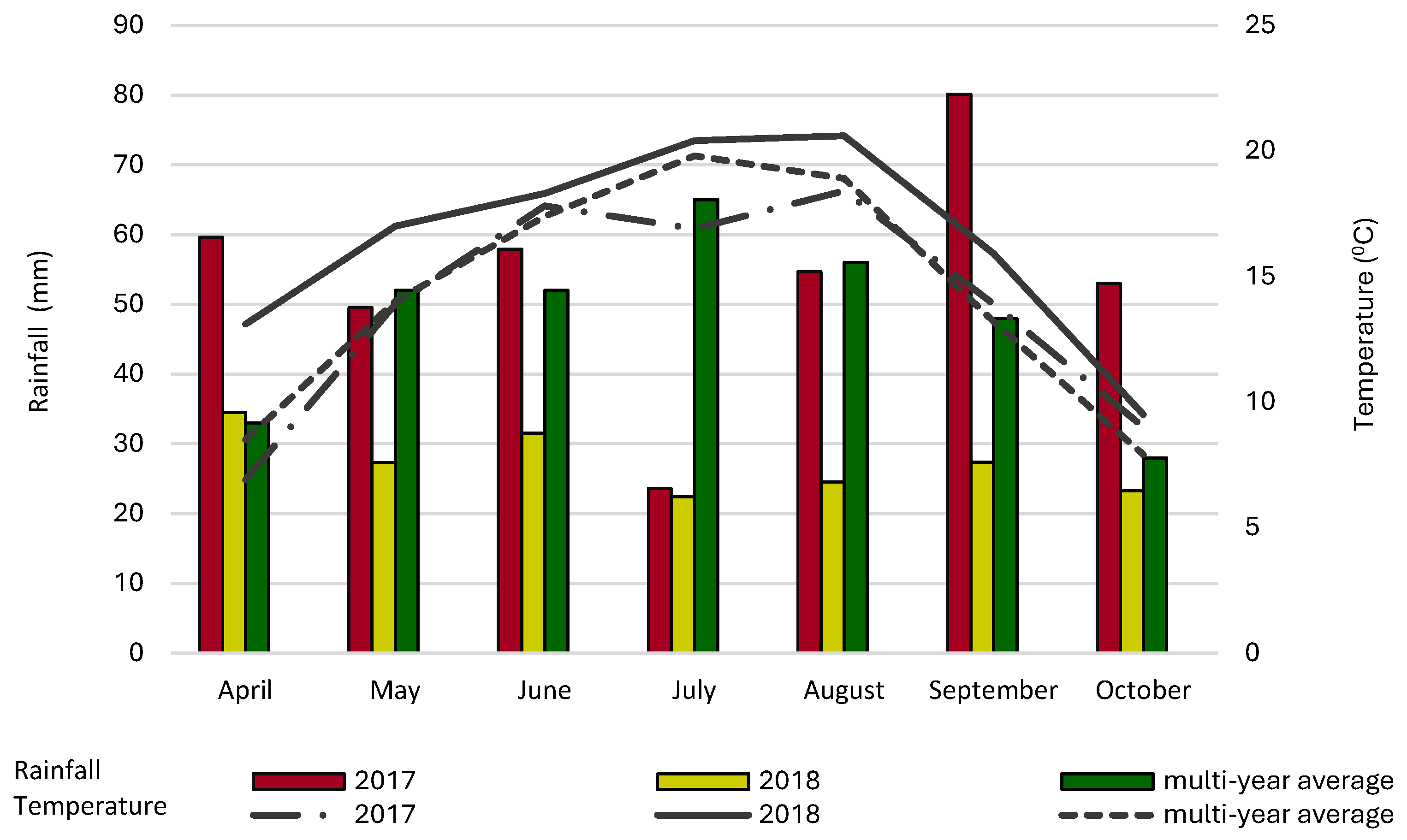
Data on weather conditions were provided by the Hydrological and Meteorological Station in Siedlce (Figure 1). To assess the effect of weather conditions on plant growth and development, Sielianinov’s hydrothermal coefficient (Table 3) was calculated for each month of the growing period [48]. Its value (K) was determined based on total monthly precipitation (P) and the monthly sum of average daily air temperatures (∑t), according to the formula K = P/0.1Σt [49].
In both growing seasons (2017 and 2018), May and August were dry with the deficiency of moisture needed for organic nitrogen mineralization and its uptake by grass. The hydrothermal coefficient for another important month, June, indicated moderate weather conditions.

2.2. Sampling, Measurements, and Calculations

In each of the two growing periods three harvests were collected and samples were used to determine the yield and nitrogen content in plants. Fresh biomass was weighed, and 0.5 kg of sample was collected. The grass was dried first naturally in a ventilated room and then at 105 °C. Plants dried that way were weighed and dry matter content (DM) was calculated. Next, the plants were crushed in a laboratory mill, and a homogeneous sample was collected for chemical analysis.
Topsoil samples (from the humus layer of 25 cm) were collected before the experiment started and at the end of each growing season and then sieved through a 2 mm mesh pore size. SMS samples were collected, dried at 105 °C to constant weight, and ground in the agate grinder. SMS samples prepared in this way were subjected to chemical analyses.
Total nitrogen (Ntot) content in plant, soil (before and after the experiment), and organic material (SMS) samples was determined using the Kjeldahl method after mineralization in concentrated sulfuric acid (Avantor, Gdańsk, Poland) using a Gerhardt mineralizer (Gerhardt, Königswinter, Germany) followed by distillation (the VELP UDK 149 automatic Kjeldahl distiller, Velp, Usmate, Italy) and titration using a TITRONIC Basic burette (Brand, Wertheim, Germany) [50].
In soil samples (before the start of the experiment and at the end of the 1st and 2nd year) and in SMS samples, the content of mineral nitrogen (N-NH4 and N-NO3) in 1 M KCl extract was determined using the Bremner and Keeney method [51].
Soil (before the start of the experiment) and SMS properties were also determined:
  • pH in a mol·L−1 KCl solution (Stanlab, Lublin, Poland), by the potentiometric method [52], using the Mettler Toledo FiveEasy Plus FP20 camera (Mettler Toledo, Warsaw, Poland);
  • Total carbon content, using the CHNS/O 2400 Series II elemental analyzer (Perkin Elmer Inc., Norwalk, CT, USA).
The content of available forms of phosphorus and potassium was determined using a calcium lactate solution (Avantor, Gdańsk, Poland) with a concentration of 0.0275 mol·L−1 and the Egner–Riehm method, and then atomic absorption spectrometry (AAS) with the Varian Spectra AA220 absorption spectrometer (Markham, ON, Canada), in relation to Merck standards [52]. Available magnesium content was determined in calcium chloride solution (Avantor, Gdańsk, Poland) with a concentration of 0.025 mol·L−1 and the Schachtschabel method with atomic absorption spectrometry (AAS), using the Varian Spectra AA20 absorption spectrometer (Markham, ON, Canada), in relation to Merck standards [52].
On the basis of the amount of biomass and its nitrogen content, calculations were made according to the below formulas.
Yield increase as a result of nitrogen applied (Yi_Ntot):
Yi_Ntot = Y_Ntot − Y_0 (Mg DM·ha−1),
where
  • Y_Ntot—grass biomass yield in response to SMS and mineral nitrogen (Mg DM·ha−1);
  • Y_0—grass biomass yield on the control plot, with no fertilizer treatment (Mg DM·ha−1).
Dry matter growth per day in each growth cycle (DM_Gcut):
DM_Gcut = DM_Y/D (kg DM·ha−1),
where
  • DM_Gcut—dry matter growth per day (kg DM·ha−1);
  • D—the number of days between harvests, in the first year: growth cycle 1 = 50 days, growth cycle 2 = 57 days, growth cycle 3 = 58 days; in the second year: growth cycle I = 47 days, growth cycle II = 52 days, growth cycle III = 63 days.
Productivity of 1 kg of nitrogen introduced into the soil with all fertilizers (E):
E = Y_Ntot − Y_0/Napplied (kg DM·ha−1),
where
  • E—productivity of 1 kg of nitrogen (kg DM·ha−1);
  • Y_Ntot—grass biomass yield in response to SMS and mineral nitrogen (kg DM·ha−1);
  • Y_0—grass biomass yield on the control plot (kg DM·ha−1);
  • Napplied—total amount of SMS and mineral nitrogen applied (kg N·ha−1) (for each growing period it was 180 kg N·ha−1).
The two-year productivity of 1 kg of nitrogen was calculated as the sum of the values from the 1st and 2nd year.
Nitrogen uptake by grass biomass (Nup):
Nup = Y × Ntot(kg N·ha−1),
where
  • Nup—nitrogen uptake with grass biomass yield (kg N·ha−1);
  • Y—the yield of dry matter;
  • Ntot—concentration of total nitrogen in dry matter.
Nitrogen use efficiency (NUEtot):
NUEtot = (Nup_N − Nup_N0)/Napplied × 100% (%),
where
  • Nup_N—nitrogen uptake by grass fertilized with nitrogen (kg N·ha−1);
  • Nup_N0—nitrogen uptake by grass not fertilized with nitrogen (kg N·ha−1);
  • Napplied—total amount of SMS and mineral nitrogen applied (for each growing period it was 180 kg N·ha−1).

2.3. Statistical Analysis

The following research factors were selected for the experiment: (A)—treatments, (B)—years of research (B1—2017, B2—2018), and (C)—growth cycles (grass harvested three times). The significance of the effect of research factors on the investigated characteristics was measured with the Fisher-Snedecor F test. Tukey’s LSD test was used to check the significance of differences between means. The correlations between the investigated characteristics were assessed using the simple correlation analysis method (p = 0.05). The Statistica 13.1.336.0 PL statistics package (StatSoft Inc., Tulsa, OK, USA) was used for all calculations.
To statistically process biomass yield (Y), dry matter growth per day (DM_Gcut), nitrogen content (Ntot), and nitrogen uptake (Nup) three-factor analysis of variance was used according to the following mathematical model:
yijlp = m + ai +bj + cl + abij + acil + bcjl + abcijl + eijlp,
where
  • yijlp—the value of the tested characteristic,
  • m—population average,
  • ai—the effect of the i-th level of factor A,
  • bj—the effect of the j-th level of factor B,
  • cl—the effect of the l-th level of factor C,
  • abij,—the effect of the interaction of factor A and B,
  • acil—the effect of the interaction of factor A and C,
  • bcjl,—the effect of the interaction of factor B and C
  • abcijl,—the effect of the interaction of factors A, B and C
  • eijlp—random effect.
To statistically process biomass yield (Y), yield increase (Yi_Ntot), productivity of 1 kg of nitrogen (E), nitrogen uptake (Nup), and nitrogen efficiency (NUE), as well as the content of total nitrogen and mineral nitrogen in the soil, two-factor analysis of variance was used according to the following mathematical model:
yijl = m + ai + bj + abij + eijl,
where
  • yijl—the value of the tested characteristic,
  • m—population average,
  • ai—the effect of the i-th level of factor A,
  • bj—the effect of the j-th level of factor B,
  • abij—the effect of the interaction of factors A and B,
  • eijl—random effect.
For the overall assessment of the effect of treatment (A) on biomass yield (Y), yield increase (Yi_Ntot), productivity of 1 kg of nitrogen, nitrogen uptake (Nup), and nitrogen use efficiency (NUE), analysis of variance for univariate experiments was used according to the following mathematical model:
yij = m + ai + eij,
where
  • yij—the value of the tested characteristic,
  • m—population average,
  • ai—the effect of the i-th level of factor A,
  • eij—random error.

3. Results

3.1. Yield of the Tested Plant

Harvest yields were significantly dependent on treatment (Table 4). Statistically significantly, the greatest biomass amount was on the plot treated with the medium dose of SMS and mineral nitrogen (N2 + SMS2), while the smallest was on the control plot (O). SMS medium and highest doses (N2 + SMS2, N1 + SMS3) significantly increased biomass yield compared to the lowest one (N3 + SMS1) or to the effect of mineral nitrogen (N4). Significantly more biomass was recorded in harvests I and II than in III. Wiśniewska-Kadżajan and Malinowska [25] conducted a similar experiment presenting Festulolium braunii biomass total yield as a sum of harvest yields.
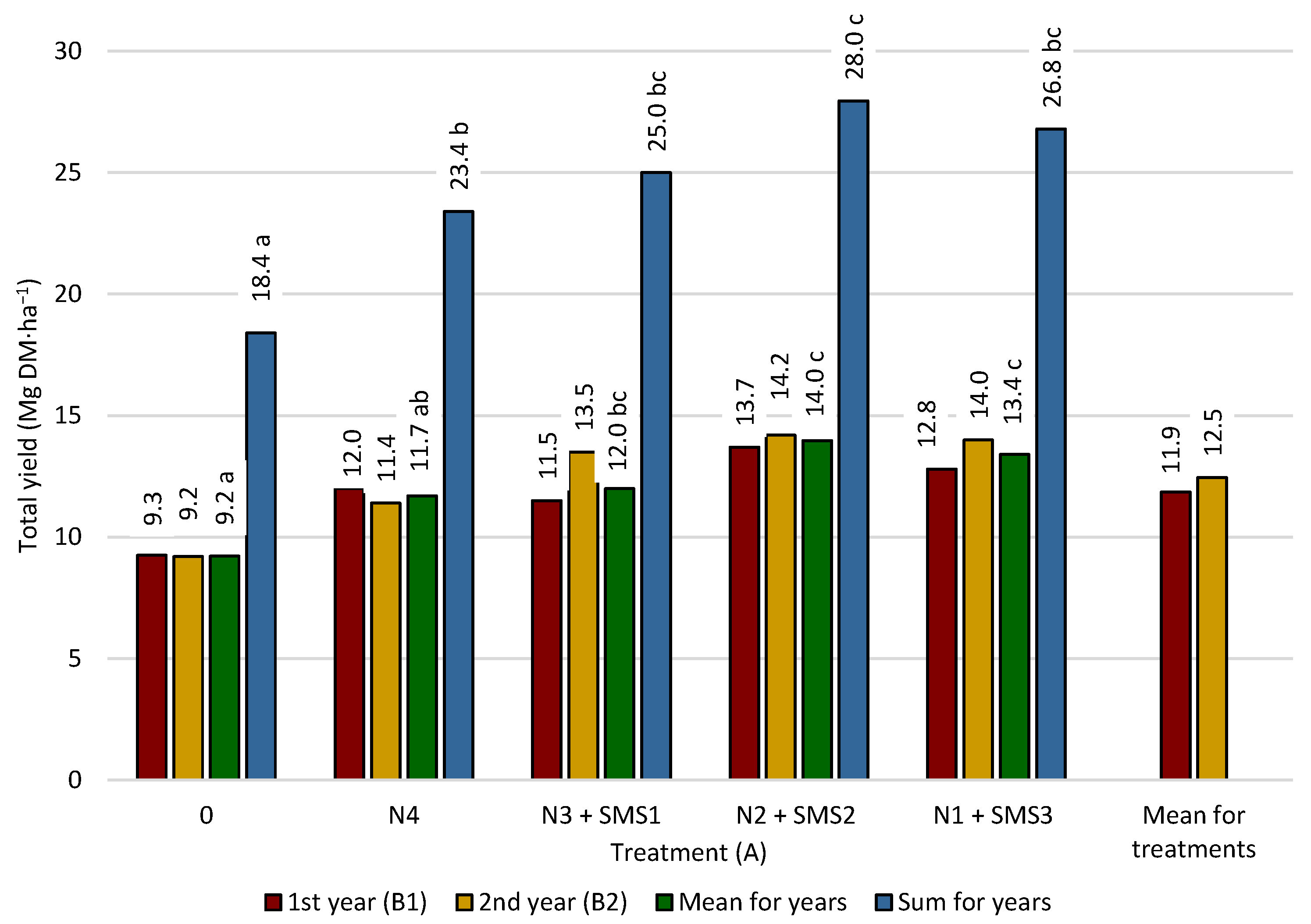
The annual yield of grass was calculated based on harvest yields (Figure 2). It statistically significantly varied across treatments. Compared to control, significantly more biomass was collected in response to each SMS treatment combination (N3 + SMS1, N2 + SMS2, N1 + SMS3). Biomass yields on plots with the medium and highest doses of SMS nitrogen (N2 + SMS2, N1 + SMS3) were significantly higher than on plots treated with its mineral form. However, they did not differ significantly from the yield of plants fertilized with the lowest dose of SMS (N3 + SMS1). The two-year amounts of Festulolium braunii biomass were significantly higher on the plot with the medium SMS dose (N2 + SMS2) than on the control plot (O) or on the one with mineral nitrogen (N4). However, the values on plots with the lowest and highest doses of SMS (N3 + SMS1, N1 + SMS3) were significantly higher in relation to control plants only (O).
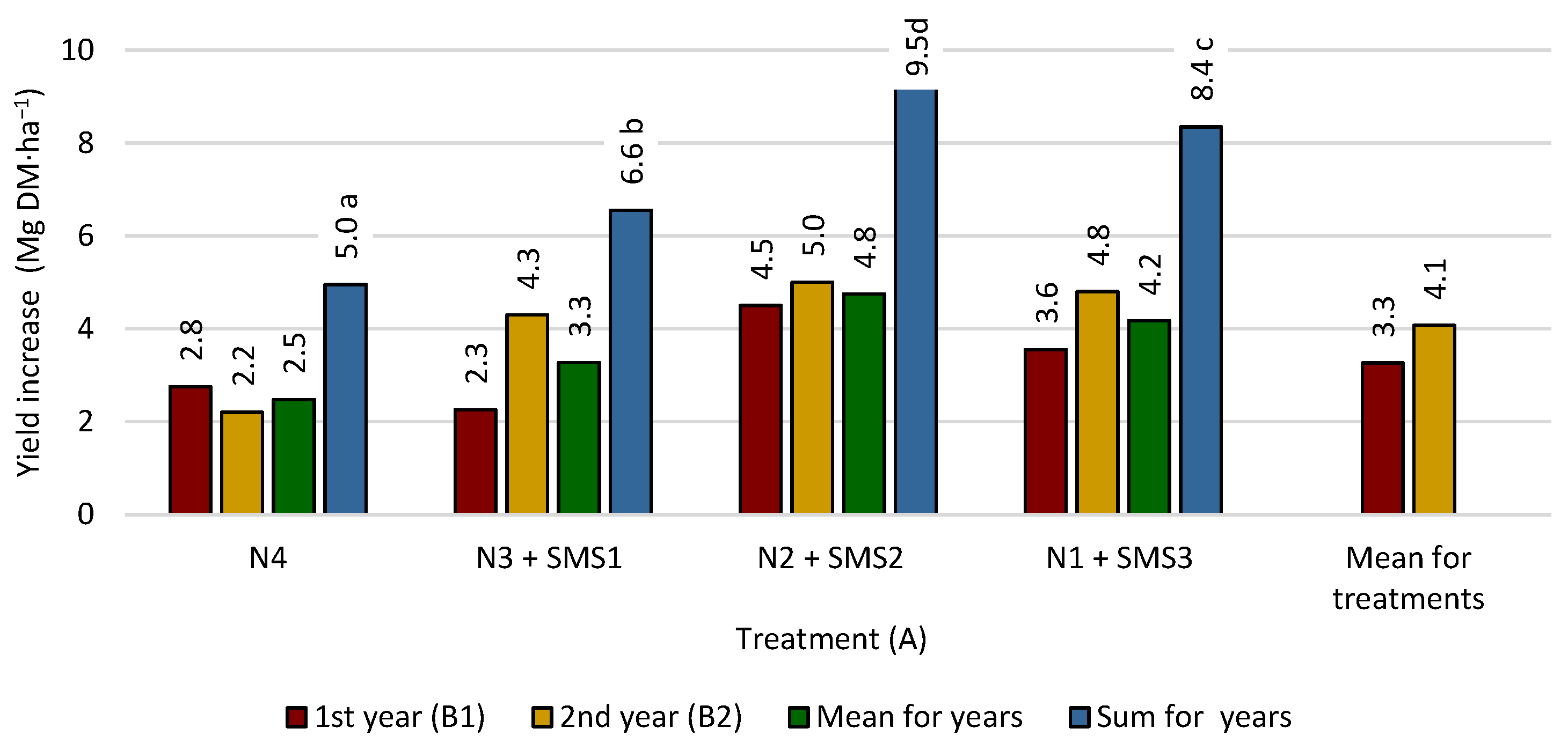
An increase in the average annual Festulolium braunii yield in response to nitrogen applied (Figure 3) did not significantly vary across treatments. However, two-year values statistically significantly varied over treatment combinations. The yield increase in plants treated with SMS nitrogen (N3 + SMS1, N2 + SMS2, N1 + SMS3) was statistically significantly higher than the effect of mineral nitrogen (N4). The largest increase was recorded in response to the medium SMS dose (N2 + SMS2).
Daily growth of Festulolium braunii significantly varied across treatments, growing periods, and growth cycles (Table 5). Those values were statistically significantly higher on each plot where nitrogen was applied (N4, N3 + SMS1, N2 + SMS2, N1 + SMS3) than on the control plot (O). The values on plots fertilized with different SMS amounts (N3 + SMS1, N2 + SMS2, N1 + SMS3) did not vary in a statistically significant way. However, a significantly higher daily growth was recorded for plants fertilized with the medium dose of SMS nitrogen (N2 + SMS2) than for those treated with mineral nitrogen (N4). Daily growth was significantly higher in the second (2018) than in the first (2017) year. Over all harvests, significant differences in daily growth were noted. Significantly higher values were recorded for harvest I and lower for harvests II and III.
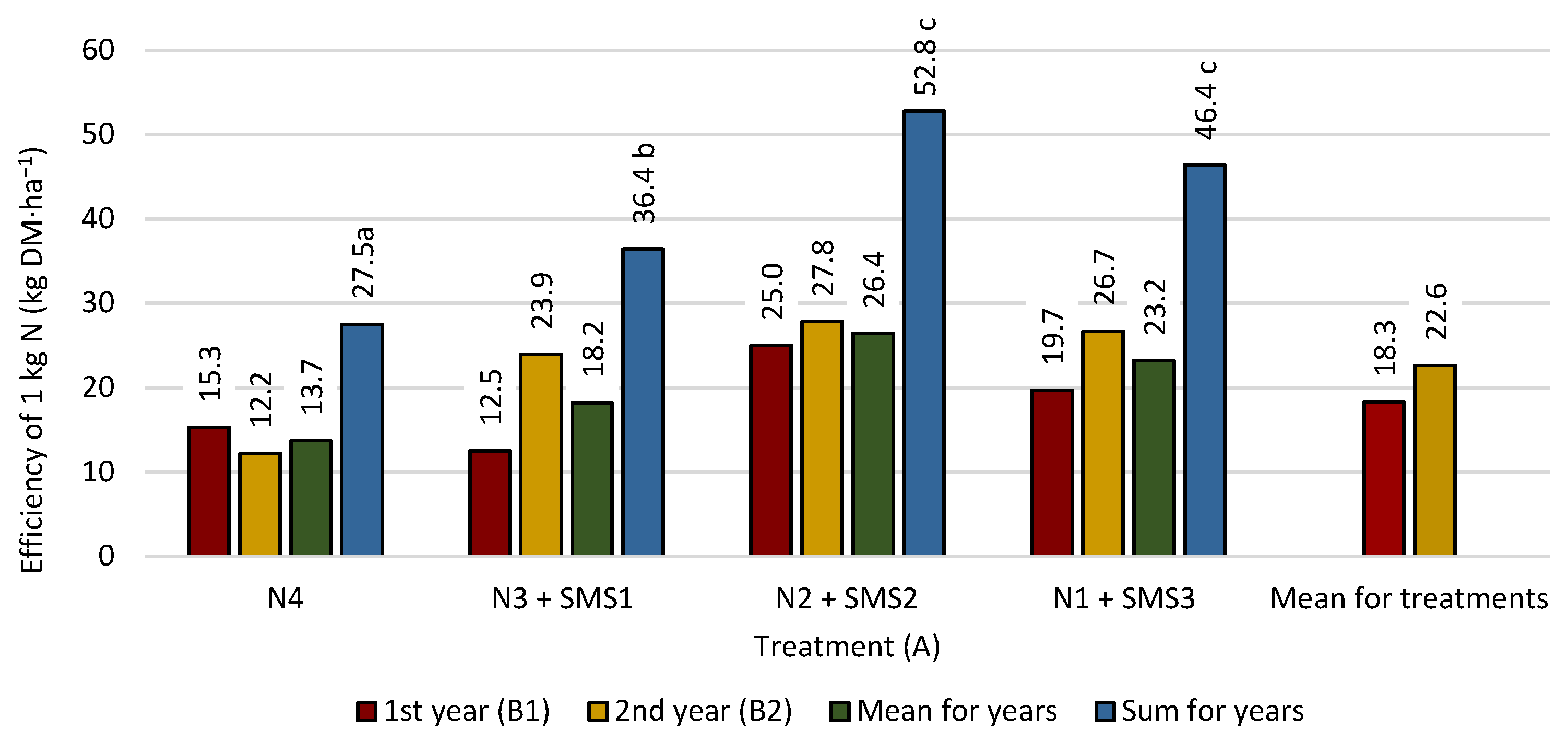
An average Festulolium braunii yield increase caused by 1 kg of nitrogen applied (Figure 4), defined as the productivity of 1 kg of nitrogen, did not differ significantly across treatments and growing periods. On the other hand, the productivity of 1 kg of nitrogen, average of two years, differed significantly depending on treatment. It was the highest on the plot with the medium SMS nitrogen dose (N2 + SMS2), while it was the lowest on the control plot (O). Its higher values were noted on all plots with SMS nitrogen than on that treated with mineral nitrogen (N4). The productivity of 1 kg of nitrogen on the plots with the medium and highest doses of SMS (N2 + SMS2, N1 + SMS3) was significantly higher than on the plot fertilized with its lowest amount (N3 + SMS1).

3.2. Nitrogen Content in Plants, Its Uptake and Utilization

Nitrogen concentration in Festulolium braunii biomass (Table 6) statistically significantly varied over treatments and harvests. The values were significantly different for all treatment combinations. The highest concentration was recorded in plants treated with mineral nitrogen (N4), while the lowest was recorded on the control plot (O). Differences were also noted between the effects of different SMS nitrogen doses. Significantly higher values were recorded for plants fertilized with its lowest dose (N3 + SMS1) compared to the medium and highest ones (N2 + SMS2, N1 + SMS3). According to statistical analysis, there was a significant interaction between treatments, as well as growing periods, and plant nitrogen concentration. In both the first (2017) and second (2018) years, significantly, the highest amount of nitrogen was recorded in biomass fertilized with mineral nitrogen (N4) and the lowest in control plants (O). In the first year nitrogen concentration in plants treated with each amount of SMS was statistically significantly different. In the second year, only biomass fertilized with the lowest dose of SMS (N3 + SMS1) differed from that treated with the highest dose (N1 + SMS3). Considering the harvests, the most nitrogen was recorded in the biomass of the I harvest and the least in the III, but the biomass of harvest II and III did not differ significantly.
The nitrogen uptake of Festulolium braunii biomass (Table 7) significantly varied over treatments and growth cycles. In a statistically significantly way, Festulolium braunii took up the most nitrogen on the plot with mineral nitrogen (N4), and the value was significantly the lowest on the control plot. Nitrogen uptake by plants on plots with the lowest and medium doses of SMS nitrogen (N3 + SMS1, N2 + SMS2) was significantly higher than on the plot with mineral nitrogen (N4) but lower when grass was treated with the highest dose (N1 + SMS3). Across Festulolium braunii harvests, significantly, the highest value was noted for harvest I and the lowest for harvest III.
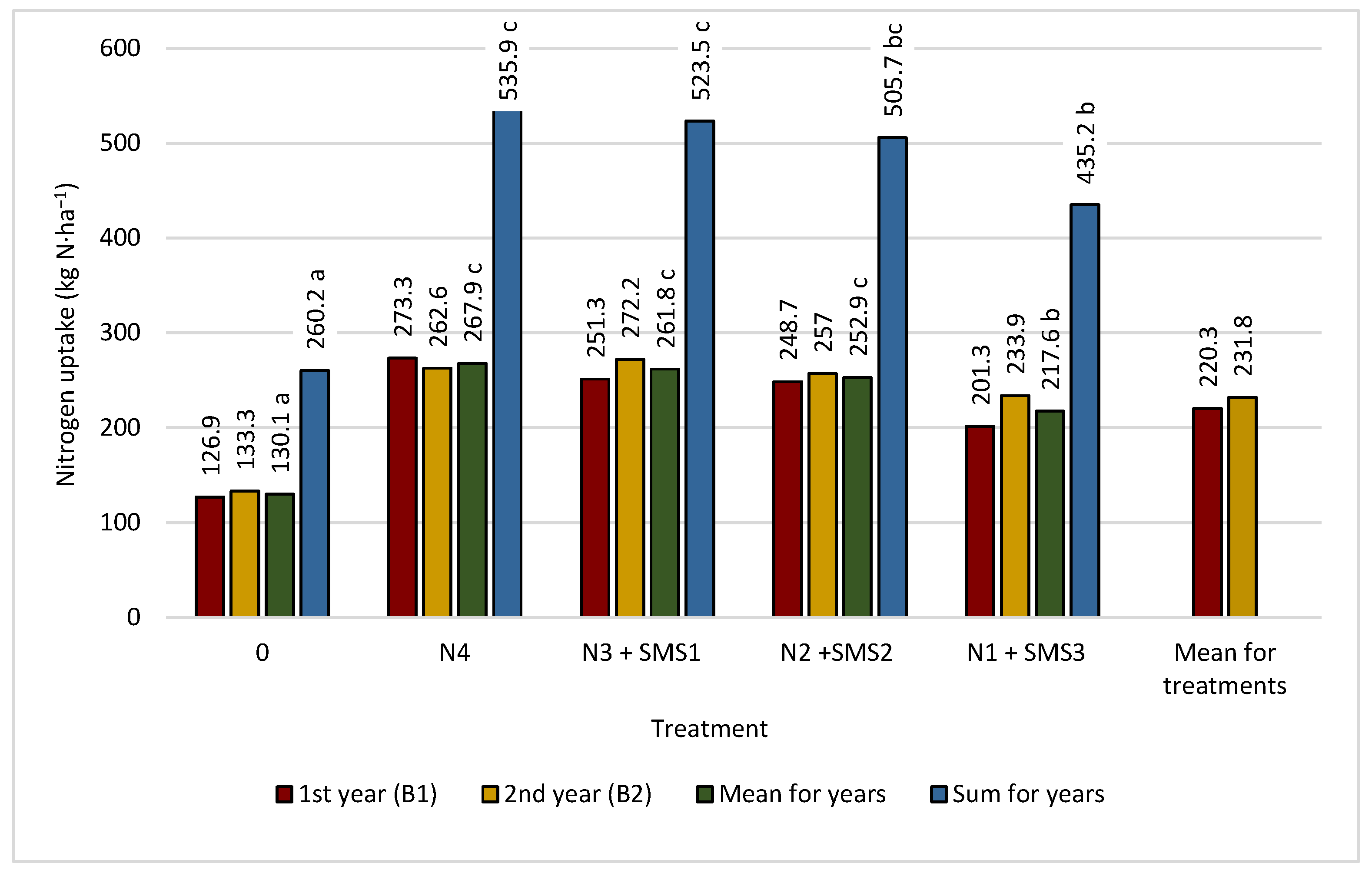
Annual nitrogen uptake by grass biomass (Figure 5) statistically significantly varied over fertilizer treatments. Significantly, Festulolium braunii biomass fertilized exclusively with mineral nitrogen (N4) took up the most nitrogen, while the lowest value was noted on the plot without treatment (O). Nitrogen uptake by grass treated with the smallest and medium SMS doses (N3 + SMS1, N2 + SMS2) was similar to the value recorded for plants fertilized with mineral nitrogen, without SMS, but significantly lower than for the biomass fertilized with the highest amount of SMS nitrogen (N1 + SMS3). Significantly, the highest two-year value was recorded on the plot with mineral nitrogen (N4), and the lowest on the control plot (O). Among the plots with SMS, the nitrogen uptake of plants with the lowest amount of SMS applied (N3 + SMS1) was higher than that recorded for biomass fertilized with its highest dose (N1 + SMS3).
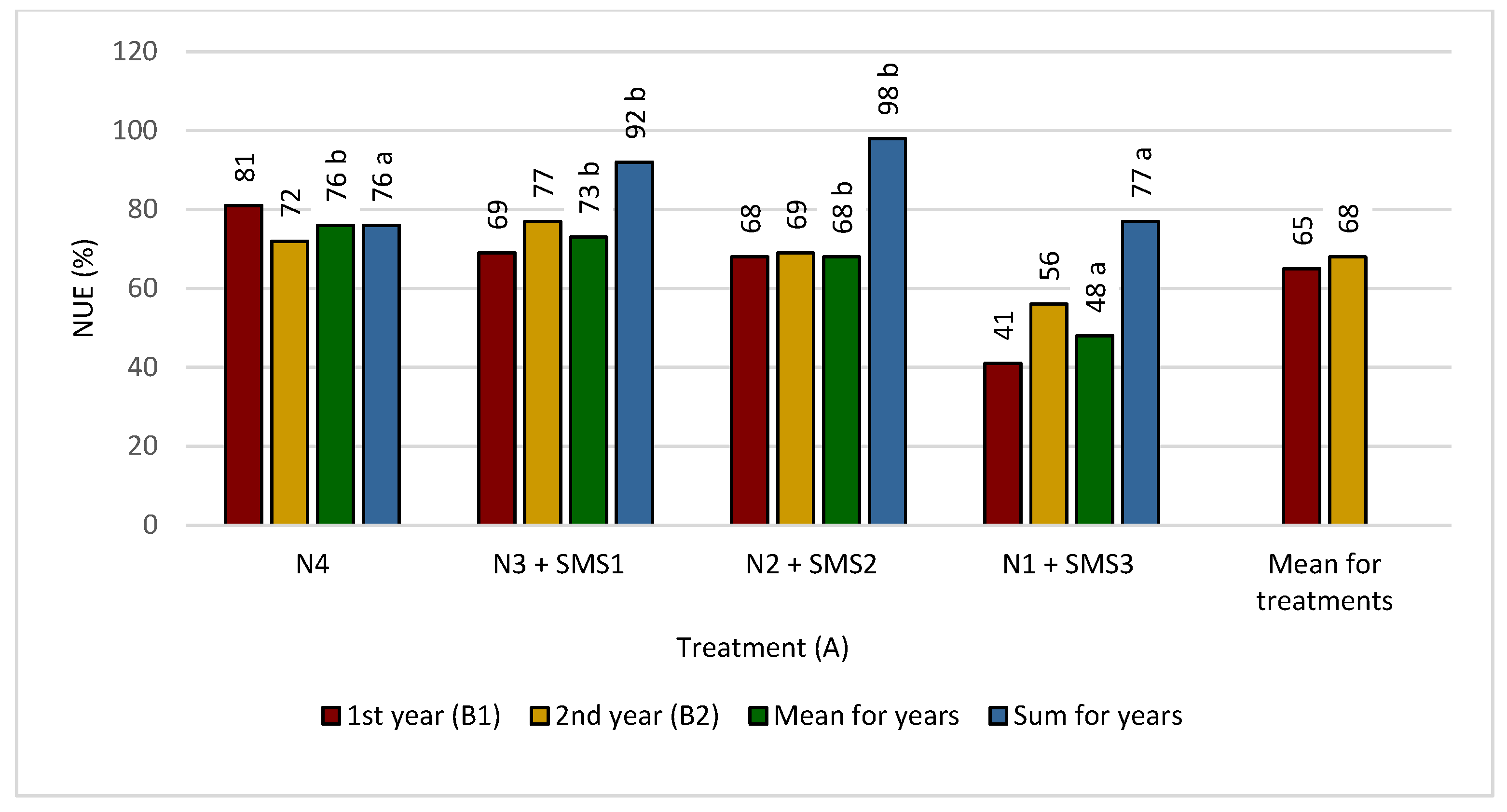
Nitrogen use efficiency by Festulolium braunii varied significantly depending on treatment (Figure 6). It was higher for biomass fertilized with mineral nitrogen (N4) and with SMS nitrogen introduced in the smallest and medium amounts (N3 + SMS1, N2 + SMS2) than for plants fertilized with the greatest amount of SMS (N1 + SMS3). Two-year values for plots with the lowest and medium doses of SMS nitrogen (N3 + SMS1, N2 + SMS2) were significantly higher than for the plot with mineral nitrogen (N4) and for the one with the highest amount of SMS (N1 + SMS3).

3.3. Nitrogen in the Soil

The application of SMS nitrogen and mineral nitrogen did not significantly affect its accumulation in the soil, but differences in the concentration of its mineral forms were noted (Table 8). In a statistically significant way, the most N-NH4 remained in the soil fertilized with mineral nitrogen (N4), with the least on the control plot (O). N-NH4 accumulation in response to mineral nitrogen and to the lowest dose of SMS nitrogen was similar to the amount recorded in the soil with the medium dose of SMS nitrogen (N2 + SMS2) but greater than on the plot with the highest dose of SMS (N1 + SMS3). The concentration of N-NO3 in the soil fertilized with mineral nitrogen (N4) and with the lowest dose of SMS nitrogen (N3 + SMS1) was significantly higher than in the control plot soil (O). The value on the mineral nitrogen plot did not differ significantly from the one for the soil fertilized with the medium and highest doses of SMS (N2 + SMS2, N1 + SMS3). The statistically significantly highest amount of mineral nitrogen was recorded in the soil with mineral nitrogen (N4), and the lowest on the plot without treatment (O). The amounts of mineral nitrogen in the soil fertilized with mineral nitrogen (N4) and with the lowest and medium doses of SMS nitrogen (N3 + SMS1, N2 + SMS2) were similar. Among the plots fertilized with SMS, significantly more mineral nitrogen was recorded in the soil with the lowest dose of SMS nitrogen (N3 + SMS1) than in that with the highest (N1 + SMS3). The percentage share of N-NO3 in the total mineral nitrogen amounts in the soil did not vary significantly over fertilized plots.
Correlation analysis (p < 0.05) (Table 9) indicated that biomass yield and grass nitrogen utilization (NUE) were significantly negatively correlated with soil total nitrogen content determined at the end of the experiment. However, those parameters were significantly positively correlated with the soil content of N-NH4, N-NO3, and their sum total (Nmin).

4. Discussion

Remaining after mushroom production, spent mushroom substrate (SMS) is a waste requiring disposal, which, consequently, generates costs. Unprocessed SMS can pose a serious environmental problem [3,53]. Proper SMS processing not only reduces costs but is also crucial for sustainable development. SMS content of organic matter, plant nutrients, and its beneficial physical properties provide a solid foundation for the development of its many applications. The latest research by Dai et al. [22] and Rinker [23] confirms a growing interest in using SMS potential in farming, as it has all the necessary characteristics of organic fertilizer.
Nitrogen is a macronutrient essential for plants, and its content in mushroom substrate is high (19.3–26.2 g·kg−1) according to many studies [9,54,55,56,57,58]. Steward et al. [59] report that about 94% of SMS nitrogen is incorporated into organic compounds, and it gradually becomes available to plants after the organic material is applied to the soil. According to Becher [9], its content of ammonium (N-NH4) and nitrate (N-NO3) forms constitutes only 1.24% of total nitrogen amounts.
Thus, the mineralization of SMS organic compounds gradually releases nitrogen in available forms, which allows plants to be systematically supplied with this macronutrient. Contrary to that, according to Wysokiński and Kożuchowska [46] and Allart et al. [60], entire nitrogen from mineral fertilizers is usually available to plants immediately after their application, while its availability decreases significantly during the growing period. For this reason, supplementing mineral nitrogen with organic fertilizers allows for optimal nitrogen supply to plants throughout the growing period and reduces its losses, which is confirmed by the studies of Allart et al. [60], Iqbal et al. [61], and Liu et al. [62].
An intergeneric hybrid, Festulolium braunii is a highly productive and nitrogen-loving forage grass species [63,64,65]. The results of the present experiment indicate that the ratio between mineral and organic nitrogen affects its growth. Its yields across harvests (Table 4) were significantly greater on plots with mineral and SMS nitrogen applied together than on the control plot (O) or on the one with mineral nitrogen (N4). A significant yield variation was also noted between plots with SMS applied together with mineral nitrogen in different combinations, with the highest amounts of biomass obtained in response to the medium dose of SMS nitrogen (N2 + SMS2), with a ratio of SMS nitrogen to mineral nitrogen of 1:0.6. The effects of treatment on annual biomass yield (the sum of harvests) as well as on the two-year value (Figure 2) were similar. However, the amounts of biomass on plots treated with different doses of SMS and mineral nitrogen did not differ much, but they were higher than the yield on plots fertilized with mineral nitrogen. Thus, the large amount of mineral nitrogen directly available to plants (180 kg·ha−1) did not increase the yield. In a pot experiment conducted by Wiśniewska-Kadżajan and Malinowska [11], in which similar fertilizer combinations were applied to Dactylis glomerata and Phleum pratense, the application of SMS nitrogen supplemented with mineral nitrogen into the soil in a 1:1 ratio resulted in the highest biomass production.
The reaction of plants to fertilizer treatment is a result of factors such as the amount of available nitrogen in the soil, but it also depends on soil moisture. In the two years of the experiment, hydrothermal conditions in May, July, and August indicated periods of droughts and even extreme droughts. Despite adverse weather conditions, the annual biomass amounts of Festulolium braunii on fertilized plots were high, with 11.9 Mg·ha−1 in the first year and 12.5 Mg·ha−1 in the second. High yields in conditions of moisture deficiency were a result of the species’ high resistance to environmental stress such as drought [66,67,68,69,70]. Higher grass yields in response to a combination of mineral and organic nitrogen were a result of an interactive effect. Mineral nitrogen acts quickly but for a shorter time. In turn, SMS organic matter increases soil ability to store water, this way allowing plants to better utilize mineral nitrogen. This is crucial for grass, which, due to its shallow root systems, is highly sensitive to water deficits. Furthermore, organic matter positively affects soil structure, optimizing air–water proportions. This improves soil aeration, directly stimulating root system expansion and biomass growth [71,72]. Soil treated with SMS retains moisture longer, allowing the grass to survive drought. SMS enriches soil in macronutrients such as phosphorus, calcium, magnesium, and in micronutrients that are not present in typical mineral fertilizers. These components stimulate the dynamics of nitrogen uptake and other metabolic processes in the plant [73,74].
The largest yield increase of Festulolium braunii throughout the two years of research (Figure 3), as well as the largest daily growth (Table 5), was on the plot with the medium dose of SMS nitrogen supplemented with the medium amounts of mineral nitrogen (N2 + SMS2), with a ratio of the former to the latter of 1:0.6. The results proved that larger amounts of mineral nitrogen available to plants did not result in a yield increase, which indicated that this macronutrient dispersed in the environment. The highest productivity of applied nitrogen, average of two years, (Figure 4) was on the plot fertilized with the medium dose of SMS nitrogen and supplemented with the lowest dose of mineral nitrogen, with their ratio of 1:0.6. The total productivity of 1 kg of nitrogen was significantly higher on each SMS plot than on the one with mineral nitrogen. Another aim of the experiment was to determine the most favorable ratio of SMS nitrogen to mineral nitrogen, affecting its concentration in the grass, its uptake, and use efficiency. Paradoxically, with an increase in SMS nitrogen, its content in plants decreased (Table 6). Increasing the share of SMS nitrogen in the fertilizer combination reduced the biomass nitrogen concentration. This phenomenon could be explained by the synergy of SMS nutrients, which increased grass biomass production but nitrogen uptake did not increase proportionally. Furthermore, SMS is a source of carbon, the main carbohydrate component of plant cell walls. The walls form the bulk of the plant, and because they do not require nitrogen for their structure, they “dilute” absorbed nitrogen, reducing its biomass concentration. A similar relationship was noted by Wiśniewska-Kadżajan and Malinowska [11] in a pot experiment with SMS supplemented with mineral nitrogen, as well as by Godlewska et al. [75] in their studies using bio stimulants with mineral nitrogen in Lolium multiflorum fertilization.
The concentration of nitrogen in biomass from fertilized plots was in the range of 16.18–22.89 g·kg−1 and was lower than the amounts required by dairy cattle (26.5–32.0 g·kg−1) provided by the National Research Council [76]. According to the Council [76], such an amount of nitrogen in plants is needed for them to produce crude protein in the range of 165.0–200.0 g·kg−1, ensuring the production of 20–30 kg of milk per day with fat content of 3.0 to 3.5%. The reason for the reduced nitrogen content in the biomass of Festulolium braunii was probably the insufficient amount of water in the soil during the growing season, which limited the uptake of nitrogen by the cultivated grass.
Across harvests and growing periods, the nitrogen uptake of Festulolium braunii (Table 7 and Figure 5) did not vary between the plot fertilized with mineral nitrogen (N4) and plots with the lowest and medium SMS nitrogen doses (N3 + SMS1, N2 + SMS2). The largest share of SMS nitrogen (N1 + SMS3) resulted in a significantly lower nitrogen uptake in relation to other treatment combinations. A significant negative correlation was noted (Table 9) between nitrogen uptake and yield; nitrogen concentration decreased when yield increased. The uptake of nitrogen by grass biomass directly affected its use efficiency (Figure 6). The latter was significantly lower on the plot with the highest dose of SMS nitrogen (SMS3), with a ratio of SMS nitrogen to mineral nitrogen of 1:0.2, than on the one with SMS2 and SMS1, with a ratio of 1:0.6 and 1:1.4, respectively. At the time of sustainable agriculture, higher values of nitrogen use efficiency indicate increased yields and decreased negative impact of nitrogen loss in the environment [77,78,79,80]. In the experiment, plants used on average 67% of applied nitrogen. Govindasama et al. [81], Ali et al. [82] and Anas et al. [77] have found that plants efficiently use only 50% of applied nitrogen, while the rest is lost in processes such as volatilization, leaching, or denitrification. Other studies on the use efficiency of nitrogen applied to grassland indicate a significant dependence of its value on water conditions, limiting the productivity of nitrogen [83].
The results of the present experiment were probably also affected by unfavorable hydrothermal conditions affecting nitrogen management. On the one hand, water shortage could reduce the plant uptake and use efficiency of nitrogen from mineral fertilizers. On the other hand, droughts could weaken the rate of mineralization of organic nitrogen forms contained in mushroom substrate. In optimal soil moisture conditions, plants have a greater potential to take up and use nitrogen from fertilizers, especially from mineral fertilizers [11,84].
Investigating the interaction of mineral nitrogen with bio stimulants, Godlewska et al. [75] recorded a significant positive effect of a dose of mineral nitrogen on its uptake by Lolium multiflorum and on its effectiveness. An addition of 120 kg N·ha−1 of mineral nitrogen to bio stimulants not only increased yields but also nitrogen content and uptake by grass. However, a dose of 180 kg N·ha−1 contributed to a significant decrease in agricultural efficiency. Using SMS nitrogen and mineral nitrogen in the cultivation of Dactylis glomerata and Phleum pratense with a 1:1 ratio, Wiśniewska-Kadżajan and Malinowska [11] noted a higher nitrogen uptake and use efficiency compared to 1:2 and 2:1 ratios.
Due to SMS high nitrogen content, Lou et al. [56] recommend its use to improve soil quality. To fully assess the effects of SMS and mineral nitrogen on Festulolium braunii yield and nitrogen management, it is also necessary to determine the accumulation of this macronutrient in the soil (Table 8). On SMS plots no significant increase in total nitrogen soil content was noted compared to plots with mineral nitrogen. Compared to the mineral nitrogen plot, a significant reduction in mineral nitrogen content in the soil treated with SMS was recorded only for the highest dose of SMS supplemented with mineral nitrogen (N1 + SMS3). The negative correlation between total soil nitrogen content and either NUE or biomass yield on the plot with the highest dose of SMS indicated the reduced efficiency of its nitrogen. It might have been caused by the slower decomposition of organic matter due to drought. Furthermore, higher SMS doses might have increased salinity, causing osmotic stress and inhibiting water uptake [74,85].
The results indicated that the most recommended nitrogen ratio was N2 + SMS2, as it had a positive effect on most nitrogen management indicators. Higher amounts of mineral nitrogen proved less effective, probably due to slow nitrogen mineralization because of drought. According to Wiśniewska-Kadżajan and Malinowska [25], SMS applied in combination with mineral nitrogen increased the protein content and energy yield of grass biomass, but the digestibility, net lactation energy and crude fiber content remained at a level similar to the effects of mineral fertilizer applied on its own.
The results of the present research indicate the possibility of reducing the amount of nitrogen introduced with mineral fertilizers and replacing it with SMS nitrogen. According to many researchers, this is a beneficial alternative because it generates lower production costs and contributes to environmental protection [31,42,86,87,88,89].
The main problem of such research is usually the variability of organic fertilizer chemical composition, which requires constant monitoring. Additionally, in contrast to mineral fertilizers, nitrogen availability from organic fertilizers is not stable and depends on the rate of microbial mineralization, which is often limited by moisture deficiency. The use of SMS as a fertilizer aligns with the principles of circular economy aimed at reducing waste and achieving agricultural policy goals [90]. The optimal ratio of mineral and SMS nitrogen not only increases yields but also ensures effective nitrogen management. Due to its low cost, widespread availability, and environmental benefits, SMS use in sustainable agriculture is highly advisable.

5. Conclusions

The application of SMS into the soil reduces the amounts of mineral fertilizers and the cost of plant cultivation, protecting the natural environment in this way. In the present experiment, the productivity of 1 kg of nitrogen increased significantly with an increase in the share of SMS nitrogen. There was an increase in the yield of Festulolium braunii, and in its daily growth was the greatest on the plot with mineral nitrogen applied together with SMS nitrogen, in a combination of 68 and 112 kg N·ha−1 (N2 + SMS2). However, a significant decrease in biomass nitrogen content was noted when the share of SMS in fertilizer combinations increased. The calculated values of grass nitrogen uptake (Nup) and use efficiency (NUE) on the plot with mineral nitrogen only and on those with both SMS and mineral nitrogen were at a very similar level. This was noted both on the 105 + 75 kg N/ha and 68 + 112 kg N·ha−1 (N3 + SMS1, N2 + SMS2) plots. After two years of research, the combined use of SMS with mineral nitrogen did not result in a significant increase in soil nitrogen content. The application of SMS nitrogen and mineral nitrogen in a ratio of 1:0.2 contributed to significant reduction in nitrogen soil content compared to the effect of the 1:1.4 ratio and to the effect of mineral nitrogen applied without SMS. The results confirmed the benefits of using SMS as a source of nitrogen for Festulolium braunii and indicated that nitrogen from mineral fertilizers could be partially replaced with SMS nitrogen. Research results proved that, at the time of ongoing climate change and longer droughts, the use of mineral fertilizers without organic ones increases production risk. Agricultural policy should consider organic fertilizers not only as a source of nutrients, but also as a way to improve soil conditions by increasing soil water capacity and humus content. Investing in organic soil management should be a key element of drought adaptation strategies.

Author Contributions

Conceptualization, B.W.-K.; methodology, B.W.-K.; software, A.W.; validation, B.W.-K., A.W. and S.S.; formal analysis, B.W.-K. and A.W.; investigation, B.W.-K.; resources, B.W.-K. and A.W.; data curation, A.W. and B.W.-K.; writing—original draft preparation, B.W.-K. and A.W.; writing—review and editing, B.W.-K., A.W., S.S., A.N. and S.J.K.; visualization, B.W.-K. and S.J.K.; supervision, A.W.; project administration, B.W.-K. and A.W. All authors have read and agreed to the published version of the manuscript.

Funding

This research received no external funding.

Institutional Review Board Statement

Not applicable.

Informed Consent Statement

Not applicable.

Data Availability Statement

The data of this article will be made available by the authors on request.

Conflicts of Interest

The authors declare no conflicts of interest.

References

  1. Martin, C.; Zervakis, G.I.; Xiong, S.; Koutrotsios, G.; Strætkvern, K.O. Spent substrate from mushroom cultivation: Exploitation potential toward various applications and value-added products. Bioengineered 2023, 14, 2252138. [Google Scholar] [CrossRef]
  2. Joniec, J.; Kwiatkowska, E.; Kwiatkowski, C.A. Assessment of the effects of soil fertilization with spent mushroom substrate in the context of microbial nitrogen transformations and the potential risk of exacerbating the greenhouse effect. Agriculture 2022, 12, 1190. [Google Scholar] [CrossRef]
  3. Beyer, D.M.; State, P. Impact of the Mushroom Industry on the Environment. Penn State Extension. Pennsylvania State University. 2011. Available online: https://extension.psu.edu/impact-of-the-mushroom-industry-on-the-environment (accessed on 14 December 2025).
  4. Ma, R.; Jiang, C.; Shou, N.; Gao, W.; Yang, X. An Optimized Nitrogen Application Rate and Basal Topdressing Ratio Improves Yield, Quality, and Water- and N-use Efficiencies for Forage Maize (Zea mays L.). Agronomy 2023, 13, 181. [Google Scholar] [CrossRef]
  5. Finney, K.N.; Ryu, C.; Sharifi, V.N.; Swithenbank, J. The reuse of pent mushroom compost and coal tailings for energy recovery: Comparison of thermal treatment technologies. Bioresour. Technol. 2009, 100, 310–315. [Google Scholar] [CrossRef] [PubMed]
  6. Zisopoulos, F.K.; Ramírez, H.A.B.; Van der Goot, A.J.; Boom, R.M. A resource efficiency assessment of the industrial mushroom production chain: The influence of data variability. J. Clean. Prod. 2016, 126, 394–408. [Google Scholar] [CrossRef]
  7. Eurostat 2023. Available online: https://ec.europa.eu/eurostat/comext/newxtweb/ (accessed on 20 November 2025).
  8. GUS 2023. Available online: https://stat.gov.pl/obszary-tematyczne/roczniki-statystyczne/roczniki-statystyczne/rocznik-statystyczny-rzeczypospolitej-polskiej-2025,2,25.html (accessed on 20 October 2025).
  9. Becher, M. Chemical composition of mushroom cultivation substrate as organic waste material. Econ. Environ. 2013, 4, 207–213. (In Polish) [Google Scholar]
  10. Becher, M.; Banach-Szott, M.; Godlewska, A. Organic matter properties of spent button mushroom substrate in the context of soil organic matter reproduction. Agronomy 2021, 11, 204. [Google Scholar] [CrossRef]
  11. Wiśniewska-Kadżajan, B.; Malinowska, E. Evaluation of forage grasses yield, and nitrogen use efficiency in response to combined application of spent mushroom substrate and mineral nitrogen. Agronomy 2024, 14, 2680. [Google Scholar] [CrossRef]
  12. Herrero-Hernandez, E.; Andrades, M.S.; Rodriguez-Cruz, M.S.; Sanchez-Martin, M.J. Effect of spent mushroom substrate applied to vineyard soil on the behavior of copper-based fungicide residues. J. Environ. Manag. 2011, 92, 1849–1857. [Google Scholar] [CrossRef]
  13. Jordan, S.N.; Mullen, G.J.; Murphy, M.C. Composition variability of spent mushroom compost in Ireland. Bioreosur. Technol. 2008, 99, 411–418. [Google Scholar] [CrossRef]
  14. Kalembasa, D.; Becher, M. Speciation of carbon and selected metals in spent mushroom substrates. J. Elem. 2012, 3, 409–419. [Google Scholar] [CrossRef]
  15. Peregrina, F.; Larrieta, C.; Colina, M.; Mariscal-Sancho, I.; Martín, I.; Martínez-Vidaurre, J.M.; García-Escudero, E. Spent mushroom substrates influence soil quality and nitrogen availability in a semiarid vineyard soil. Soil Sci. Soc. Am. J. 2012, 76, 1655–1666. [Google Scholar] [CrossRef]
  16. Wang, A.; Zou, D.; O’Connor, P.; Chen, B.; Zou, J.; Zhou, Y.; Wang, H.; Zhang, M. Assistant effects of spent mushroom substrate and its derived biochar on soil phytoremediation. J. Soils Sediments 2023, 23, 1641–1653. [Google Scholar] [CrossRef]
  17. Andrews, A.; Singh, S.; Chandhrapati, A.I.; Kumar, Y.V. Utilization of spent mushroom substrate: A review. Pharma Innov. 2021, 10, 1017–1021. [Google Scholar]
  18. Kalembasa, D.; Becher, M.; Bik, B.; Makolewski, A. Properties of organic matter in the substrate after mushroom cultivation. Acta Agrophys. 2012, 19, 713–723. (In Polish) [Google Scholar]
  19. Majchrowska-Safaryan, A.; Tkaczuk, C. Possibility to use the spent mushroom substrate in soil fertilization as one of its disposal methods. J. Res. Appl. Agric. Eng. 2013, 58, 57–62. (In Polish) [Google Scholar]
  20. Kalembasa, D.; Majchrowska-Safaryan, A. Heavy metal fractions in used mushroom growing media. Nat. Resour. Prot. 2009, 41, 572–577. (In Polish) [Google Scholar]
  21. Rutkowska, B. Possibilities of agricultural use of used mushroom substrates. Probl. Issues Prog. Agric. Sci. 2009, 535, 349–354. (In Polish) [Google Scholar]
  22. Aona, D.; Yaning, L.; Jun, Q. Life cycle assessment of edible fungi residue compost—A case study of Beijing. Nat. Environ. Pollut. Technol. 2017, 16, 643–646. [Google Scholar]
  23. Rinker, D.L. Spent mushroom substrate uses. In Edible and Medicinal Mushrooms: Technology and Applications; Diego, C.Z., Pardo-Giménez, A., Eds.; John Wiley & Sons Ltd.: West Sussex, UK, 2017; pp. 427–454. [Google Scholar] [CrossRef]
  24. Majchrowska-Safaryan, A. Effect of spent mushroom substrate application for yield and content of selected macroelements in potato tubers and grain of winter wheat. Fragm. Agron. 2015, 32, 63–70. (In Polish) [Google Scholar]
  25. Wiśniewska-Kadżajan, B.; Malinowska, E. The effects of spent mushroom substrate on the yield and nutritional value of Festulolium braunii (K. Richt.) A. Camus. Agriculture 2022, 12, 1537. [Google Scholar] [CrossRef]
  26. Gobbi, V.; Bonato, S.; Nicoletto, C.; Zanin, G. Spent mushroom substrate as organic fertilizer: Vegetable organic trials. Acta Hortic. 2016, 1146, 49–56. [Google Scholar] [CrossRef]
  27. Prasad, R.; Lisiecka, J.; Antala, M.; Rastogi, A. Influence of different spent mushroom substrates on yield, morphological and photosynthetic parameters of strawberry (Fragaria × ananassa Duch.). Agronomy 2021, 11, 2086. [Google Scholar] [CrossRef]
  28. Roy, S.; Barman, S.; Chakraborty, U.; Chakraborty, B. Evaluation of spent mushroom substrate as biofertilizer for growth improvement of Capsicum annuum L. J. Appl. Biol. Biotechnol. 2015, 3, 22–27. [Google Scholar] [CrossRef]
  29. Stoknes, K.; Wojciechowska, E.; Jasinska, A.; Noble, R. Amelioration of composts for greenhouse vegetable plants using pasteurised Agaricus mushroom substrate. Sustainability 2019, 11, 6779. [Google Scholar] [CrossRef]
  30. Szulc, W.; Rutkowska, B.; Kuśmirek, E.; Spychaj-Fabisiak, E.; Kowalczyk, A.; Dębska, K. Yielding, chemical composition and nitrogen use efficiency determined for white cabbage (Brassica oleracea L. var. capitata L.) supplied organo-mineral fertilizers from spent mushroom substrate. J. Elem. 2019, 24, 1063–1077. [Google Scholar] [CrossRef]
  31. Ngan, N.M.; Riddech, N. Use of spent mushroom substrate as an inoculant carrier and an organic fertilizer and their impacts on Roselle growth (Hibiscus sabdariffa L.) and soil quality. Waste Biomass Valorization 2021, 12, 3801–3811. [Google Scholar] [CrossRef]
  32. Young, J.R.; Holcomb, E.J.; Heuser, C.W. Greenhouse growth of marigolds in three leached sources of spent mushroom compost over a 3-year period. HortTechnology 2002, 12, 701–705. [Google Scholar] [CrossRef]
  33. Malinowska, E.; Kania, P. The effect of waste organic matter on the soil chemical composition after three years of Miscanthus × giganteus cultivation in East-Central Poland. Sustainability 2025, 17, 2532. [Google Scholar] [CrossRef]
  34. Malinowska, E.; Torma, S. Evaluation of organic waste long-term effects on cellulose, hemicellulose and lignin content in energy grass species grown in east-central Poland. Energies 2024, 17, 5598. [Google Scholar] [CrossRef]
  35. Wiśniewska-Kadżajan, B. Impact of different spent mushrooms substrate doses on compactness and regrowth different kind of lawns mixtures. Folia Pomer. Univ. Technol. Stetin. Agric. Aliment. Pisc. Zootech. 2013, 305, 75–82. (In Polish) [Google Scholar]
  36. Chamoli, V.; Singh, K.; Parashar, G.K.; Pant, A. The usage of spent mushroom substrate. Int. J. Plant Pathol. Microbiol. 2023, 3, 48–50. [Google Scholar]
  37. Corral-Bobadilla, M.; González-Marcos, A.; Vergara-González, E.P.; Alba-Elías, F. Bioremediation of waste water to remove heavy metals using the spent mushroom substrate of Agaricus bisporus. Water 2019, 11, 454. [Google Scholar] [CrossRef]
  38. Singh, A.D.; Abdullah, N.; Vikineswary, S. Optimization of extraction of bulk enzymes from spent mushroom compost. J. Chem. Technol. Biotechnol. 2003, 78, 743–752. [Google Scholar] [CrossRef]
  39. Zied, D.C.; Sánchez, J.E.; Noble, R.; Pardo-Giménez, A. Use of spent mushroom substrate in new mushroom crops to promote the transition towards a circular economy. Agronomy 2020, 10, 1239. [Google Scholar] [CrossRef]
  40. Atallah, E.; Zeaiter, J.; Ahmad, M.N.; Leahy, J.J.; Kwapinski, W. Hydrothermal carbonization of spent mushroom compost waste compared against torrefaction and pyrolysis. Fuel Process. Technol. 2021, 216, 106795. [Google Scholar] [CrossRef]
  41. Council Directive of 12 December 1991 Concerning the Protection of Waters Against Pollution Caused by Nitrate from Agri cultural Sources (91/676/EWG) (Dz. U. UE L of 31 December 1991). Available online: https://eur-lex.europa.eu/legal-content/EN/ALL/?uri=celex:31991L0676 (accessed on 14 December 2025).
  42. Paredes, C.; Medina, E.; Bustamante, M.A.; Moral, R. Effects of spent mushroom substrates and inorganic fertilizer on the characteristics of calcareous clayey-loam soil and lettuce production. Soil Use Manag. 2016, 32, 487–494. [Google Scholar] [CrossRef]
  43. IUSS Working Group WRB. World Reference Base for Soil Resources. International Soil Classification System for Naming Soils and Creating Legends for Soil Maps, 4th ed.; International Union of Soil Sci (IUSS): Vienna, Austria, 2022; 234p, Available online: https://files.isric.org/public/documents/WRB_fourth_edition_2022-12-18.pdf (accessed on 14 December 2025).
  44. Regulation of the Council of Ministers. Regulation of the Council of Ministers of 31 January 2023 on the Action Programme to Reduce Water Pollution with Nitrates from Agricultural Sources and Prevent Further Pollution. J. Laws Pol. 2023, 244. Available online: https://isap.sejm.gov.pl/isap.nsf/download.xsp/WDU20230000244/O/D20230244.pdf (accessed on 15 November 2025).
  45. Waste Act. Waste Act Dated 14th December 2012. J. Laws Pol. 2013, 21. Available online: https://isap.sejm.gov.pl/isap.nsf/download.xsp/WDU20130000021/U/D20130021Lj.pdf (accessed on 15 November 2025).
  46. Wysokinski, A.; Kożuchowska, M. Increasing silage maize yield and nitrogen use efficiency as a result of combined rabbit manure and mineral nitrogen fertilization. Sci. Rep. 2024, 14, 5856. [Google Scholar] [CrossRef]
  47. Stewart, D.P.C.; Cameron, K.C.; Cornforth, I.S. Inorganic-N release from spent mushroom compost under laboratory and field conditions. Soil Biol. Biochem. 1998, 30, 1689–1699. [Google Scholar] [CrossRef]
  48. Bac, S.; Koźmiński, C.; Rojek, M. Agrometeorology; PWN: Warsaw, Poland, 1993; pp. 32–33. (In Polish) [Google Scholar]
  49. Skowera, B.; Puła, J. Pluviometric extreme conditions in spring season in Poland in the years 1971–2000. Acta Agrophys. 2004, 3, 171–177. (In Polish) [Google Scholar]
  50. Nelson, D.W.; Sommers, L.E. Determination of total nitrogen in plant material. Agron. J. 1973, 65, 109–111. [Google Scholar] [CrossRef]
  51. Kalembasa, S. Application of 15N and 13N Isotopes in Soil Science and Chemical-Agricultural Research; Scientific and Technical Publishing House: Warsaw, Poland, 1995; p. 252. (In Polish) [Google Scholar]
  52. Kabała, C.; Karczewska, A. Methodology of Laboratory Analyses of Soils and Plants; Wrocław University of Environmental and Life Sciences: Wrocław, Poland, 2019; pp. 4–51. Available online: http://karnet.up.wroc.pl/~kabala/Analizy2017v8.pdf (accessed on 14 December 2025).
  53. Mohd Hanafi, F.H.; Rezania, S.; Mat Taib, S.; Md Din, M.F.; Yamauchi, M.; Sakamoto, M.; Hara, H.; Park, J.; Ebrahimi, S.S. Environmentally sustainable applications of agro-based spent mushroom substrate (SMS): An overview. J. Mater. Cycles Waste Manag. 2018, 20, 1383–1396. [Google Scholar] [CrossRef]
  54. Becher, M.; Pakuła, K. Nitrogen fractions in spent muschroom substrate. J. Elem. 2014, 19, 947–958. [Google Scholar] [CrossRef]
  55. Czop, M.; Kłapcia, E. Evaluation of the suitability to organic recycling of the base coming from champignon mushroom farming. Arch. Waste Manag. Environ. Prot. 2015, 17, 139–150. [Google Scholar]
  56. Lou, Z.; Sun, Y.; Bian, S.; Baig, S.A.; Hu, B.; Xu, X. Nutrient conservation during spent mushroom compost application using spent mushroom substrate derived biochar. Chemosphere 2017, 169, 23–31. [Google Scholar] [CrossRef]
  57. Lou, Z.; Sun, Y.; Zhou, X.; Baig, S.A.; Hu, B.; Xu, X. Composition variability of spent mushroom substrates during continuous cultivation, composting process and their effects on mineral nitrogen transformation in soil. Geoderma 2017, 307, 30–37. [Google Scholar] [CrossRef]
  58. Owaid, M.N.; Abed, I.A.; Al-Saeedi, S.S. Applicable properties of the bio-fertilizer spent mushroom substrate in organic systems as a byproduct from the cultivation of Pleurotus spp. Inform. Process. Agric. 2017, 4, 78–82. [Google Scholar] [CrossRef]
  59. Stewart, D.P.C.; Cameron, K.C.; Confort, I.S. Effect of spent mushroom substrate on soil chemical conditions and plant growth in an intensive horticultural system: A comparison with inorganic fertilizer. Aust. J. Soil Res. 1998, 36, 185–198. [Google Scholar] [CrossRef]
  60. Allart, K.; Almoussawi, A.; Kerbey, L.; Catterou, M.; Roger, D.; Mortier, D.; Blanc, E.; Robert, B.; Spicher, F.; Emery, L.; et al. Splitting nitrogen fertilization is more important than nitrogen level when mixed wheat varieties are cultivated in a conservation agriculture system. Agronomy 2023, 13, 1295. [Google Scholar] [CrossRef]
  61. Iqbal, A.; Ali, I.; Yuan, P.; Khan, R.; Liang, H.; Wei, S.; Jiang, L. Combined application of manure and chemical fertilizers alters soil environmental variables and improves soil fungal community composition and rice grain yield. Front. Microbiol. 2022, 13, 856355. [Google Scholar] [CrossRef] [PubMed]
  62. Liu, B.; Wang, X.; Ma, L.; Chadwick, D.; Chen, X. Combined applications of organic and synthetic nitrogen fertilizers for improving crop yield and reducing reactive nitrogen losses from China’s vegetable systems: A meta-analysis. Environ. Pollut. 2021, 269, 116143. [Google Scholar] [CrossRef] [PubMed]
  63. Gutmane, I.; Adamovics, A. Influence of nitrogen fertilization rates on Festulolium and Lolium × boucheanum forage and persistency. Grassl. Sci. Eur. 2009, 14, 336–338. [Google Scholar]
  64. Nekrošas, S.; Kemešyte, V. Breeding of ryegrass and Festulolium in Lithuania. Žemdirbystė 2007, 94, 29–39. [Google Scholar]
  65. Østrem, L.; Larsen, A. Winter survival, yield performance and forage quality of Festulolium cvs. for Norwegian farming. Grassl. Sci. Eur. 2008, 13, 293–295. [Google Scholar]
  66. Kitczak, T.; Jänicke, H.; Bury, M.; Malinowski, R. The usefulness of mixtures with Festulolium braunii for the Regeneration of Grassland under Progressive Climate Change. Agriculture 2021, 11, 537. [Google Scholar] [CrossRef]
  67. Østrem, L.; Volden, B.; Larsen, A. Morphology, dry matter yield and phenological characters at different maturity stages of x Festulolium compared with other grass species. Acta Agric. Scand. Sect. B Soil Plant Sci. 2013, 63, 531–542. [Google Scholar] [CrossRef]
  68. Šimkūnas, A.; Valašinaite, S.; Mažeika, V. Peculiarities of various Festulolium braunii cultivars development and overwintering. LŽŪU Mokslo. Darbai 2009, 85, 35–38. [Google Scholar]
  69. Staniak, M.; Harasim, E. Changes in nutritive value of alfalfa (Medicago × varia T. Martyn) and Festulolium (Festulolium braunii (K. Richt) A. Camus) under drought stress. J. Agron. Crop Sci. 2018, 204, 456–466. [Google Scholar] [CrossRef]
  70. Touno, E.; Shingu, H.; Kushibiki, S.; Shinoda, M.; Oshibe, A. Changes in feeding characteristics of the first crop with advancing growth in festulolium (×Festulolium braunii) cultivars. Jap. J. Grassl. Sci. 2006, 52, 176–182. [Google Scholar]
  71. Ma, X.; Yan, S.; Wang, M. Spent mushroom substrate: A review on present and future of green applications. J. Environ. Manag. 2025, 373, 123970. [Google Scholar] [CrossRef] [PubMed]
  72. Nakatsuka, H.; Oda, M.; Hayashi, Y.; Tamura, K. Effects of fresh spent mushroom substrate of Pleurotus ostreatus on soil micromorphology in Brazil. Geoderma 2016, 269, 54–60. [Google Scholar] [CrossRef]
  73. Domínguez-Gutiérrez, M.; Gaitán-Hernández, R.; Moctezuma-Pérez, I.; Barois, I.; Domínguez, J. Stabilization of spent mushroom substrate by composting and vermicomposting: Nutrient dynamics and suitability for soil amendment. Emir. J. Food Agric. 2022, 33, 743–753. [Google Scholar] [CrossRef]
  74. Postinguel, R.D.B.; Alves, L.D.S.; Ré, B.B.; Caitano, C.E.C.; Barretto, V.C.D.M.; Zied, D.C. Spent mushroom substrate for eucalyptus seedling growth under varying water deficiency conditions. New For. 2025, 56, 9. [Google Scholar] [CrossRef]
  75. Godlewska, A.; Ciepiela, G.A.; Becher, M.; Jaremko, D.; Matyszczak, A. The influence of biostimulants used in the cultivation of Italian ryegrass (Lolium multiflorum Lam.) on nitrogen uptake and the efficiency of nitrogen fertilization. Agron. Sci. 2024, 79, 5–17. [Google Scholar] [CrossRef]
  76. National Research Council. Nutrient Requirements of Dairy Cattle: Seventh Revised Edition; The National Academies Press: Washington, DC, USA, 2001. [Google Scholar] [CrossRef]
  77. Anas, M.; Liao, F.; Verma, K.K.; Sarwar, M.A.; Mahmood, A.; Chen, Z.L.; Li, Q.; Zeng, X.P.; Liu, Y.; Li, Y.R. Fate of nitrogen in agriculture and environment: Agronomic, eco-physiological and molecular approaches to improve nitrogen use efficiency. Biol. Res. 2020, 53, 47. [Google Scholar] [CrossRef]
  78. Hirel, B.; Tétu, T.; Lea, P.J.; Dubois, F. Improving nitrogen use efficiency in crops for sustainable agriculture. Sustainability 2011, 3, 1452–1485. [Google Scholar] [CrossRef]
  79. Zhang, C.; Gu, B.; Liang, X.; Lam, S.K.; Zhou, Y.; Chen, D. The role of nitrogen management in achieving global sustainable development goals. Resour. Conserv. Recycl. 2024, 201, 107304. [Google Scholar] [CrossRef]
  80. Yadav, M. Nitrogen uptake in wheat: A comprehensive study. Int. J. Res. Agron. 2024, 7, 101–103. [Google Scholar] [CrossRef]
  81. Govindasamy, P.; Muthusamy, S.K.; Bagavathiannan, M.; Mowrer, J.; Jagannadham, P.T.K.; Maity, A.; Halli, H.M.; Sujayananad, G.K.; Vadivel, R.; Das, T.K.; et al. Nitrogen use efficiency—A key to enhance crop productivity under a changing climate. Front. Plant Sci. 2023, 14, 1121073. [Google Scholar] [CrossRef] [PubMed]
  82. Ali, A.; Jabeen, N.; Farruhbek, R.; Chachar, Z.; Laghari, A.A.; Chachar, S.; Ahmed, N.; Ahmed, S.; Yang, Z. Enhancing nitrogen use efficiency in agriculture by integrating agronomic practices and genetic advances. Front. Plant Sci. 2025, 16, 1543714. [Google Scholar] [CrossRef] [PubMed]
  83. Keating, T.; O’Kiely, P. Comparison of old permanent grassland, Lolium perenne and Lolium multiflorum swards grown for silage 1. Effects on beef production per hectare. Irish J. Agric. Food Res. 2000, 39, 1–24. [Google Scholar]
  84. Van den Bossche, T.; De Boever, J.L.; Haesaert, G.; Cougnon, M.; Debevere, S.; Vandaele, L.; Goossens, K. Management strategies to improve the nitrogenuse efficiency in grasslands and the protein quality in grass silages: Lessons from a practical study on dairy farms in Flanders. Grassl. Res. 2024, 3, 18–32. [Google Scholar] [CrossRef]
  85. Lethin, J.; Byrt, C.; Berger, B.; Brien, C.; Jewell, N.; Roy, S.; Mousavi, H.; Sukumaran, S.; Olsson, O.; Aronsson, H. Improved salinity tolerance-associated variables observed in EMS mutagenized wheat lines. Int. J. Mol. Sci. 2022, 23, 11386. [Google Scholar] [CrossRef]
  86. Lassaletta, L.; Billen, G.; Garnier, J.; Bouwman, L.; Velazquez, E.; Mueller, N.D.; Gerber, J.S. Nitrogen use in the global food system: Past trends and future trajectories of agronomic performance, pollution, trade, and dietary demand. Environ. Res. Lett. 2016, 11, 095007. [Google Scholar] [CrossRef]
  87. Luo, H.; Zilio, M.; Sigurnjak, I.; Robles-Aguilar, A.A.; Michels, E.; Adani, F.; De Neve, S.; Meers, E. Dynamics of soil nitrogen and N-cycling-related genes following the application of biobased fertilizers. Appl. Soil Ecol. 2023, 191, 105033. [Google Scholar] [CrossRef]
  88. Medina, E.; Paredes, C.; Bustamante, M.A.; Moral, R.; Moreno-Caselles, J. Relationships between soil physico-chemical, chemical and biological properties in a soil amended with spent mushroom substrate. Geoderma 2012, 173–174, 152–161. [Google Scholar] [CrossRef]
  89. Ribas, L.C.C.; De Mendonca, M.M.; Camelini, C.M.; Soares, C.H.L. Use of spent mushroom substrates from Agaricus subrufescens (syn. A. blazei, A. brasiliensis) and Lentinula edodes productions in the enrichment of a soil-based potting media for lettuce (Lactuca sativa) cultivation: Growth promotion and soil bioremediation. Bioresour. Technol. 2009, 100, 4750–4757. [Google Scholar] [CrossRef]
  90. Quisth, I.; Ulfsparre, I.; Müller, B.; Passoth, V.; Solberg, S.; Øivind Martín, C.; Romero-Soto, L.A.; Pent, M.; Mousavi, H. Spent Mushroom Substrate (SMS) as a Sustainable Soil Amendment and Biofertilizer: A Review of Opportunities and Challenges in Agricultural and Horticultural Systems. Agric. Food Sci. 2025, 34, 323–338. [Google Scholar] [CrossRef]
Figure 1. Cumulative monthly rainfall and average monthly air temperatures during the growing periods (Institute of Meteorology and Water Management, National Research Institute in Warsaw, Siedlce measurement station).
Applsci 16 02500 g001
Figure 2. The effect of treatment on Festulolium braunii (Mg DM·ha−1) biomass yield over growing periods. 0—control (without fertilization); N4—mineral nitrogen each year (180 kg N·ha−1); N3 + SMS1—mineral nitrogen each year (105 kg N·ha−1) + nitrogen in spent mushroom substrate only in first year (75 kg N·ha−1); N2 + SMS2—mineral nitrogen each year (68 kg N·ha−1) + nitrogen in spent mushroom substrate only in first year (112 kg N·ha−1); N1 + SMS3—mineral nitrogen each year (30 kg N·ha−1) + nitrogen in spent mushroom substrate only in first year (150 kg N·ha−1). Means for years (LSD0.05): A = 3.2, B = NS, A/B = NS. Sum for years (LSD0.05): A = 3.9. NS—not significant. Mean values marked with different lowercase letters above the bars (a, b, c) differ significantly at p ≤ 0.05.
Applsci 16 02500 g002
Figure 3. The effect of treatment on a Festulolium braunii yield increase over growing periods (Mg DM·ha−1). N4—mineral nitrogen each year (180 kg N·ha−1); N3 + SMS1—mineral nitrogen each year (105 kg N·ha−1) + nitrogen in spent mushroom substrate only in the first year (75 kg N·ha−1); N2 + SMS2—mineral nitrogen each year (68 kg N·ha−1) + nitrogen in spent mushroom substrate only in the first year (112 kg N·ha−1); N1 + SMS3—mineral nitrogen each year (30 kg N·ha−1) + nitrogen in spent mushroom substrate only in the first year (150 kg N·ha−1). Means for years (LSD0.05): A = NS, B = NS, A/B = NS. Sum for years (LSD0.05): A = 1.1. NS—not significant. Mean values marked with different lowercase letters above the bars (a, b, c, d) differ significantly at p ≤ 0.05.
Applsci 16 02500 g003
Figure 4. The effect of treatment on 1 kg N productivity over growing periods (kg DM·ha−1). 0—control (without fertilization); N4—mineral nitrogen each year (180 kg N·ha−1); N3 + SMS1—mineral nitrogen each year (105 kg N·ha−1) + nitrogen in spent mushroom substrate only in the first year (75 kg N·ha−1); N2 + SMS2—mineral nitrogen each year (68 kg N·ha−1) + nitrogen in spent mushroom substrate only in the first year (112 kg N·ha−1); N1 + SMS3—mineral nitrogen each year (30 kg N·ha−1) + nitrogen in spent mushroom substrate only in the first year (150 kg N·ha−1). Means for years (LSD0.05): A = NS, B = NS, A/B = NS. Sum for years (LSD0.05): A = 8.1. NS—not significant. Mean values marked with different lowercase letters above the bars (a, b, c) differ significantly at p ≤ 0.05.
Applsci 16 02500 g004
Figure 5. The effect of treatment on Festulolium braunii nitrogen uptake over growing periods (kg N·ha−1). 0—control (without fertilization); N4—mineral nitrogen each year (180 kg N·ha−1); N3 + SMS1—mineral nitrogen each year (105 kg N·ha−1) + nitrogen in spent mushroom substrate only in first year (75 kg N·ha−1); N2 + SMS2—mineral nitrogen each year (68 kg N·ha−1) + nitrogen in spent mushroom substrate only in first year (112 kg N·ha−1); N1 + SMS3—mineral nitrogen each year (30 kg N·ha−1) + nitrogen in spent mushroom substrate only in first year (150 kg N·ha−1). Means for years (LSD0.05): A = 31.1, B = NS, A/B = NS. Sum for years (LSD0.05): A = 83.7. NS—not significant. Mean values marked with the different lowercase letters above the bars (a, b, c) differ significantly at p ≤ 0.05.
Applsci 16 02500 g005
Figure 6. The effect of treatment on Festulolium braunii nitrogen use efficiency (NUE) over growing periods (%). N4—mineral nitrogen each year (180 kg N·ha−1); N3 + SMS1—mineral nitrogen each year (105 kg N·ha−1) + nitrogen in spent mushroom substrate only in the first year (75 kg N·ha−1); N2 + SMS2—mineral nitrogen each year (68 kg N·ha−1) + nitrogen in spent mushroom substrate only in the first year (112 kg N·ha−1); N1 + SMS3—mineral nitrogen each year (30 kg N·ha−1) + nitrogen in spent mushroom substrate only in the first year (150 kg N·ha−1). Means for years (LSD0.05): A= 12, B = NS, A/B = NS. Sum for years (LSD0.05): A = 13. Mean values marked with the different lowercase letters above the bars (a, b) differ significantly at p ≤ 0.05.
Applsci 16 02500 g006
Table 1. Selected physicochemical properties of SMS and soil.
ParameterUnit of MeasurementContent
SoilSMS
pH (1 mol·L−1)-6.76.8
C:N ratio10:114:1
dry matter content%-30.0
Ctotalg·kg−1 DM14.5355.0
Ntotal1.4025.1
NH4+ (available N)mg·kg−1 DM2.700.63
NO3 (available N)1.900.05
H2PO4 (available P)170.0-
K+ (available K)114.0-
Mg2+ (available Mg)84.0-
Table 2. Total nitrogen doses (Ntot) (kg·ha−1).
Treatment CombinationsYears of Research
1st2nd
0 (without fertilization)00
N4180180
N3 + SMS1105 + 75105
N2 + SMS268 + 11268
N1 + SMS330 + 15030
0—control (without fertilization); N4—mineral nitrogen each year (180 kg N·ha−1); N3 + SMS1—mineral nitrogen each year (105 kg N·ha−1) + nitrogen in spent mushroom substrate only in first year (75 kg N·ha−1); N2 + SMS2—mineral nitrogen each year (68 kg N·ha−1) + nitrogen in spent mushroom substrate only in first year (112 kg N·ha−1); N1 + SMS3—mineral nitrogen each year (30 kg N·ha−1) + nitrogen in spent mushroom substrate only in first year (150 kg N·ha−1).
Table 3. Sielianinov’s hydrothermal coefficient (K).
YearMonth
AprilMayJuneJulyAugustSeptemberOctober
20172.88 (sw)1.15 (md)1.08 (md)0.45 (sd)0.96 (d)1.92 (mw)1.90 (mw)
20182.63 (sw)0.16 (ed)1.72 (mw)1.10 (md)1.19 (md)1.72 (mw)2.43 (w)
Values are rated as: K ≤ 0.4 extremely dry (ed), 0.4 < K ≤ 0.7 severely dry (sd), 0.7 < K ≤ 1.0 dry (d), 1.0 < K ≤ 1.3 moderately dry (md), 1.3 < K ≤ 1.6 optimal (o), 1.6 < K ≤ 2.0 moderately wet (mw), 2.0 < K ≤ 2.5 wet (w), 2.5 < K ≤ 3.0 severely wet (sw), K > 3.0 extremely wet (ew).
Table 4. The effect of treatment on Festulolium braunii biomass yield over growth cycles (Mg DM·ha−1).
Growing Period
(B)
Growth Cycle
(C)
Treatment (A)Means
0N4N3 + SMS1N2 + SMS2N1 + SMS3
1stI3.204.004.204.704.204.06
II3.154.203.904.604.504.07
III2.903.803.404.454.103.73
Mean3.084.003.834.584.273.95
2ndI2.803.804.505.005.204.26
II3.304.104.804.704.504.28
III3.103.504.204.504.303.92
Mean3.073.084.504.734.674.15
Means across growing periods3.07 a3.90 b4.17 bc4.66 d4.47 cd4.05
Means across growth cycles
I3.003.904.354.854.704.16 B
II3.224.154.354.654.504.17 B
III3.003.653.804.474.203.82 A
LSD0.05: A = 0.46, B = NS, C = 0.30, A/B = NS, A/C = NS, C/B = NS
0—control (without fertilization); N4—mineral nitrogen each year (180 kg N·ha−1); N3 + SMS1—mineral nitrogen each year (105 kg N·ha−1) + nitrogen in spent mushroom substrate only in first year (75 kg N·ha−1); N2 + SMS2—mineral nitrogen each year (68 kg N·ha−1) + nitrogen in spent mushroom substrate only in first year (112 kg N·ha−1); N1 + SMS3—mineral nitrogen each year (30 kg N·ha−1) + nitrogen in spent mushroom substrate only in first year (150 kg N·ha−1). NS—not significant. Mean values marked with the different lowercase letters in rows (a, b, c, d) differ significantly at p ≤ 0.05. Mean values marked with the different uppercase letters in columns (A, B) differ significantly at p ≤ 0.05.
Table 5. The effect of treatment on Festulolium braunii biomass growth per day over growth cycles (kg DM·ha−1).
Growing Period
(B)
Growth Cycle
(C)
Treatment (A)Means
0N4N3 + SMS1N2 + SMS2N1 + SMS3
1stI64.080.084.094.084.081.2
II55.373.768.480.778.971.4
III50.065.558.676.770.764.3
Mean56.473.170.383.877.972.3 A
2ndI59.680.895.7106.4110.690.6
II63.578.892.390.486.582.3
III49.255.566.771.468.262.2
Mean57.471.784.989.488.578.4 B
Means across growing periods56.9 a72.4 b77.6 bc86.6 c83.2 bc75.3
Means across growth cycles
I61.880.489.9100.297.385.9 C
II59.476.380.485.582.776.8 B
III49.660.562.674.169.563.3 A
LSD0.05: A = 11.4, B = 5.0, C = 7.5, A/B = NS, A/C = NS, C/B = NS
0—control (without fertilization); N4—mineral nitrogen each year (180 kg N·ha−1); N3 + SMS1—mineral nitrogen each year (105 kg N·ha−1) + nitrogen in spent mushroom substrate only in first year (75 kg N·ha−1); N2 + SMS2—mineral nitrogen each year (68 kg N·ha−1) + nitrogen in spent mushroom substrate only in first year (112 kg N·ha−1); N1 + SMS3—mineral nitrogen each year (30 kg N·ha−1) + nitrogen in spent mushroom substrate only in first year (150 kg N·ha−1). NS—not significant. Mean values marked with the different lowercase letters in rows (a, b, c) differ significantly at p ≤ 0.05. Mean values marked with the different uppercase letters in columns (A, B, C) differ significantly at p ≤ 0.05.
Table 6. The effect of treatment on Festulolium braunii nitrogen concentration overgrowth cycles (g·kg−1 DM).
Growing Period
(B)
Growth Cycle
(C)
Treatment (A)Means
0N4N3 + SMS1N2 + SMS2N1 + SMS3
1stI14.2525.2523.4518.5617.3619.77
II13.8022.7421.5417.6014.5018.04
III13.0520.2020.2518.1015.4017.40
Mean13.70 a22.73 d21.75 d18.09 c15.75 b18.40
2ndI15.5424.7821.0019.5018.4019.84
II13.2622.9519.5817.8015.8017.88
III14.8521.2518.8016.8515.6017.47
Mean14.55 a22.99 d19.79 c18.05 bc16.60 b18.40
Means across treatments14.12 a 22.86 e 20.77 d 18.07 c16.18 b18.40
Means across growth cycles
I14.8925.0122.2219.0317.8819.81 B
II13.5322.8420.5617.7015.1517.96 A
III13.9520.7219.5217.4715.5017.43 A
LSD0.05: A = 1.64, B = NS, C = 1.08, A/B = NS, A/C = NS, C/B = NS
0—control (without fertilization); N4—mineral nitrogen each year (180 kg N·ha−1); N3 + SMS1—mineral nitrogen each year (105 kg N·ha−1) + nitrogen in spent mushroom substrate only in the first year (75 kg N·ha−1); N2 + SMS2—mineral nitrogen each year (68 kg N·ha−1) + nitrogen in spent mushroom substrate only in the first year (112 kg N·ha−1); N1 + SMS3—mineral nitrogen each year (30 kg N·ha−1) + nitrogen in spent mushroom substrate only in the first year (150 kg N·ha−1). NS—not significant. Mean values marked with different lowercase letters in rows (a, b, c, d, e) differ significantly at p ≤ 0.05. Mean values marked with different uppercase letters in columns (A, B) differ significantly at p ≤ 0.05.
Table 7. The effect of treatment on Festulolium braunii nitrogen uptake over growth cycles (kg N·ha−1).
Growing Period
(B)
Growth Cycle
(C)
Treatment (A)Means
0N4N3 + SMS1N2 + SMS2N1 + SMS3
1stI45.6101.098.587.272.981.0
II43.595.584.080.965.273.8
III37.876.868.880.563.165.4
Mean42.391.183.882.967.173.4
2ndI43.594.294.597.595.785.1
II43.894.198.883.771.178.3
III46.074.478.975.867.168.4
Mean44.487.590.785.777.977.3
Means across treatments43.4 a89.3 c 87.3 c84.3 c72.5 b75.3
Means across growth cycles
I44.697.696.592.484.383.1 B
II43.694.891.482.368.276.1 B
III41.975.673.978.265.166.9 A
LSD0.05: A = 11.1, B = NS, C = 7.3, A/B = NS, B/C = NS, C/B = NS
0—control (without fertilization); N4—mineral nitrogen each year (180 kg N·ha−1); N3 + SMS1—mineral nitrogen each year (105 kg N·ha−1) + nitrogen in spent mushroom substrate only in the first year (75 kg N·ha−1); N2 + SMS2—mineral nitrogen each year (68 kg N·ha−1) + nitrogen in spent mushroom substrate only in the first year (112 kg N·ha−1); N1 + SMS3—mineral nitrogen each year (30 kg N·ha−1) + nitrogen in spent mushroom substrate only in the first year (150 kg N·ha−1). NS—not significant. Mean values marked with the different lowercase letters in rows (a, b, c) differ significantly at p ≤ 0.05. Mean values marked with the different uppercase letters in columns (A, B) differ significantly at p ≤ 0.05.
Table 8. The effect of treatment on mineral nitrogen (mg·kg−1 DM) and total nitrogen (g·kg−1 DM) concentration in the soil over growing periods.
SpecificationGrowing Period
(B)
Treatment (A)Means
0N4N3 + SMS1N2 + SMS2N1 + SMS3
(g·kg−1)
Ntot.1st1.351.361.381.391.411.38
2nd1.301.311.331.321.341.32
Means across treatments1.321.331.351.371.351.35
LSD0.05: A = NS, B = NS, A/B = NS
(mg·kg−1)
N-NH41st2.456.195.704.153.144.30
2nd1.705.054.904.402.953.80
Means across treatments2.07 a5.62 c5.30 c4.27 bc3.04 ab4.06
LSD0.05: A = 1.73, B = NS, A/B = NS
N-NO31st1.754.705.453.152.403.49
2nd1.545,404.204.303.103.71
Means across treatments1.64 a5.05 b4.82 b3.72 ab2.75 ab3.60
LSD0.05: A = 3.01, B = NS, A/B = NS
Sum Nmin1st4.2010.8911.157.305.547.82
2nd3.2410.459.108.706.057.51
Means across treatments3.71 a10.67 c10.12 c7.99 bc5.79 ab7.66
LSD0.05: A = 4.18, B = NS, A/B = NS
(%)
N-NO3 in Nmin1st41.6643.1648.8843.1543.3244.65
2nd47.5351.6746.1549.4251.2449.40
Means across treatments44.1447.3347.6346.5347.4546.98
LSD0.05: A = NS, B = NS, A/B = NS
0—control (without fertilization); N4—mineral nitrogen each year (180 kg N·ha−1); N3 + SMS1—mineral nitrogen each year (105 kg N·ha−1) + nitrogen in spent mushroom substrate only in first year (75 kg N·ha−1); N2 + SMS2—mineral nitrogen each year (68 kg N·ha−1) + nitrogen in spent mushroom substrate only in first year (112 kg N·ha−1); N1 + SMS3—mineral nitrogen each year (30 kg N·ha−1) + nitrogen in spent mushroom substrate only in first year (150 kg N·ha−1). NS—not significant. Mean values marked with the different lowercase letters in rows (a, b, c) differ significantly at p ≤ 0.05.
Table 9. Linear correlation coefficients between some parameters of cultivated grass and soil.
ParametersYieldN ContentN UptakeNUE
Ntotal in soil−0.60 *−0.220.31−0.91 *
Nmin in soil0.69 *0.310.420.86 *
N-NH4 in soil0.67 *0.300.410.87 *
N-NO3 in soil0.68 *0.300.400.79 *
N uptake−0.58 *0.23-0.25
*—values are significant (p < 0.05).
Disclaimer/Publisher’s Note: The statements, opinions and data contained in all publications are solely those of the individual author(s) and contributor(s) and not of MDPI and/or the editor(s). MDPI and/or the editor(s) disclaim responsibility for any injury to people or property resulting from any ideas, methods, instructions or products referred to in the content.