Article

Synergistic Reinforcement of Butadiene Rubber via Syndiotactic 1,2-Polybutadiene Predispersion: Balancing Modulus, Toughness, and Dynamic Performance

1
Huangpu Institute of Materials, Centers for Aircraft Science, Guangzhou 510700, China
2
Changchun Institute of Applied Chemistry, Chinese Academy of Sciences, Changchun 130102, China
*
Authors to whom correspondence should be addressed.
Appl. Sci. 2026, 16(5), 2465; https://doi.org/10.3390/app16052465
Submission received: 16 January 2026 / Revised: 1 March 2026 / Accepted: 2 March 2026 / Published: 4 March 2026
(This article belongs to the Section Materials Science and Engineering)

Abstract

As a novel semi-crystalline elastomer, syndiotactic 1,2-polybutadiene (SPB) grants unique advantages in reinforcing diene elastomers. However, SPB requires high-temperature processing due to its ultrahigh melting point, which leads to substantial energy consumption and risks of oxidation, ultimately degrading material performance. In this work, a SPB@BR predispersion with controlled microstructure was obtained by dispersing SPB toward the end of the solution polymerization of neodymium-catalyzed polybutadiene (Nd-BR). Benefiting from the regular and flexible molecular chain structure and intrinsically low hysteresis characteristics of Nd-BR, SPB undergoes uniform confined crystallization within the rubber matrix, forming a characteristic hard-island/elastic-sea microstructure. SPB microcrystals act as aggregates larger than 100 nm, forming reversible microcrystalline hard domains through confined crystallization within the Nd-BR matrix. This reversible microcrystalline and crosslinking architecture enhances stiffness and effectively inhibits crack propagation while avoiding the excessive restriction of chain mobility typically imposed by permanent rigid constraints. As a result, the cooperative network simultaneously improved mechanical properties (tear strength by 24.4%, modulus by 10.7%, crack resistance by 23.2%) and dynamic performance (rolling resistance reduced by 33.6%, wet skid resistance improved by 21.0%) compared to the references. This work presents a green, effective reinforcing strategy providing a potential pathway for the application in tire sidewall and tire tread materials.

1. Introduction

With the increasing demand for high-performance and low-energy-consumption tires, rubbers used in tire sidewalls and treads are required to simultaneously exhibit high stiffness, excellent toughness, and low hysteresis loss [1,2,3,4,5]. However, these properties are intrinsically conflicting. Conventional reinforcement strategies boost modulus by typically relying on high filler loadings or elevated crosslink densities, which often sacrifices toughness and dynamic energy dissipation. In particular, under cyclic deformation, excessive hysteresis loss leads to significant heat build-up, accelerating material fatigue and crack propagation, thereby compromising the long-term durability and safety [6,7,8].
Besides raising filler content, reinforcement strategies have also been explored by the use of rubber-plastic blending. For example, Ning et al. [9] prepared BIIR/PA12-based vulcanizates achieving improvements in mechanical properties and gas barrier performance. Wang et al. [10] fabricated HIPS/SBR-based composites that enhanced strength and hardness within specific composition ranges. Laksana Saengdee et al. [11] prepared reprocessable NR/PP composites which exhibited a tensile strength of 7.84 MPa and an elongation at break of 171.4%. However, such approaches generally rely on phase-separated permanent rigid domains, while the size and distribution of hard phases and interfacial structures are difficult to precisely control. Under cyclic dynamic loading, these irreversible rigid constraints tend to induce stress concentration and increased hysteresis loss, thereby limiting ductility, fatigue resistance, and long-term service stability [12,13,14,15].
Against this backdrop, semi-crystalline elastomers, featuring a dual-phase architecture of reinforcing crystalline domains and a high-elasticity amorphous matrix, have emerged as alternatives to plastics for rubber reinforcement. The syndiotactic 1,2-polybutadiene (SPB) with the structural unit of butadiene has emerged as a novel semi-crystalline elastomer. Owing to its high vinyl content, highly crystallization behavior, and good compatibility with butadiene-based rubbers, SPB exhibits unique advantages in reinforcing [16,17,18,19]. Sen et al. [20] introduced SPB to improve the thermo-mechanical and fatigue crack growth resistance of tire sidewall compound. However, the high melting point of SPB necessitates high-temperature processing, leading to significant energy consumption and increasing the risk of adverse side reactions like oxidation and crosslinking, ultimately impairing the material’s performance. Takahashi et al. [21] prepared SPB-reinforced butadiene rubber (BR) composites via a one-pot two-step polymerization process, confirming the effective reinforcing capability of SPB. Yu et al. [22] used iron-catalyzed SPB for NR nanocomposites with ~25% abrasion improvement, 12.8% wet-skid gain, and 10% rolling resistance reduction. However, the complex synthesis procedures and relatively high cost have limited its widespread application in tire industry.
To address these challenges, the present study proposes a novel, simple and convenient pre-dispersion strategy where SPB is introduced at the terminal stage of the solution polymerization of Nd-BR. This strategy tackles the issue of polymer degradation and oxidation resulting from elevated temperature processing required by the high melting point of SPB while also avoiding the technical complexities typically involved in the synthesis procedures. Benefiting from the regular and flexible molecular chain structure of Nd-BR and its intrinsically low hysteresis characteristics, SPB undergoes uniform confined crystallization within the matrix, resulting in a typical “hard-island/elastic-sea” microstructure. In this system, the hard phases of crystalline SPB act as reversible microcrystalline nodes that synergistically coexist with the chemical sulfur crosslinking networks of the matrix. The cooperative interactions enhance stiffness and load-bearing capacity while avoiding excessive restriction of chain mobility caused by permanent rigid constraints and suppressing crack extension, thereby effectively improving hysteresis loss, mechanical properties and flex fatigue resistance. Consequently, this work achieves effective decoupling of stiffness, toughness, and dynamic energy dissipation. It offers a reinforcement strategy distinct from conventional particulate filler reinforcement and thermoplastic blending approaches, supporting high-performance, energy-efficient materials especially in tire manufacturing.

2. Experimental

2.1. Materials

Neodymium-catalyzed polybutadiene rubber (Nd-BR) was synthesized in-house, with a density of 0.92 g/cm3, a number-average molecular weight (Mn) of 93,380 g/mol, and a molecular weight distribution (MWD) of 3.72. The microstructure of Nd-BR is characterized by a high cis-1,4 content of >96%, a trans-1,4 content ranging from 1% to 4%, and a 1,2-vinyl structure content of 0.5% to 2%. The syndiotactic 1,2-polybutadiene (SPB) resin, designated as RB840 with a 1,2-vinyl content of 93%, crystallinity of 34% and melting point of 198~210 °C, was supplied by JSR Corporation (Tokyo, Japan) and was used as received. Commercial natural rubber (NR, SCR-5) was purchased from Hainan Rubber Industry Group (China) Co., Ltd. (Haikou, China) and used as received. Two grades of carbon black (N330 and N660) were supplied by Jiangxi Black Cat Carbon Black (China) Co., Ltd. (Jingdezhen, China). Other rubber compounding ingredients, including zinc oxide, stearic acid, processing oil, accelerators, and sulfur, were obtained from commercial sources in the tire industry.

2.2. Preparation of SPB@BR Predispersion

The polybutadiene used in this study was synthesized via neodymium-catalyzed coordination polymerization. In brief, dehydrated butadiene was dissolved in n-hexane (water content < 10 ppm) to form the monomer solution, which was then fed into a moisture- and oxygen-free polymerization reactor. Upon reaching 30–40 °C, polymerization was initiated by introducing a rare-earth catalyst system of neodymium neodecanoate, diisobutylaluminum chloride, and Al2Et3Cl3. Once monomer conversion reached the target value of ≥95%, the reaction was quenched with an alcohol-based agent to obtain the final polybutadiene. Subsequently, SPB was added and fully dissolved in the BR solution by the sufficient dissolution time of 48 h with different concentrations, referred to as SPBx@BR, where x denotes the concentration of SPB in BR, followed by solvent removal and drying to obtain the predispersions of SPB@BR.

2.3. Preparation of NR/SPB@BR Composites

According to the formulation listed in Table 1, the rubber compounds were prepared via a two-stage mixing process. In the first stage, rubbers, carbon black, plasticizer, and antioxidant were mixed in an internal mixer (SS-806M1, Guangzhou Yihesheng Technology Co., Ltd., Guangzhou, China). After thin sheeting, the compound was discharged and rested at room temperature for 4 h. The second-stage mixing was performed to add the curing agents on an open mill. The compounds were then vulcanized in a flat press at 145 °C and 15 MPa according to the optimum curing time of each formulation, followed by conditioning at room temperature for more than 12 h prior to testing.

2.4. Characterizations

Atomic force microscopy (AFM) was used to characterize the microstructure of SPB@BR using a Bruker Dimension Icon microscope (Billerica, MA, USA) with a scanning area of 3 μm × 3 μm and a scan frequency of 0.5–1 Hz; quantitative nanomechanical mapping with tapping mode was applied to analyze nanoscale phase distribution and interfacial features. AFM measurements were performed using a silicon-based probe with a force setpoint of 1–20 nN (adjusted according to the modulus). Scanning electron microscopy (SEM) was performed on a JSM-7500F microscope (JEOL, Tokyo, Japan). The specimens were examined after sputter coating with a thin film of gold. Attenuated total reflection Fourier-transform infrared (ATR-FTIR) spectroscopy was conducted on a VERTEX-70 spectrometer (Bruker, Mannheim, Germany). Differential scanning calorimetry (DSC) measurements were carried out using a DSC25 instrument (TA Instruments, New Castle, DE, USA) from 30 to 180 °C, cooled to room temperature, and then subjected to a second heating cycle at consistent 5 °C/min under nitrogen to obtain the melting temperature.
Rubber processing performance was evaluated using a Rubber Process Analyzer (RPA200, Alpha Technologies, Hudson, OH, USA) from 0.01 to 400% at a constant frequency of 10 Hz and a temperature of 60 °C. Mechanical properties were measured according to ISO 37:2024 [23] on an Instron Z005, with five specimens tested per formulation at room temperature. Stress/strain tests were performed at a crosshead speed of 500 mm/min using optical strain control. For tear strength, the vulcanizates were tested using angle-shaped rubber specimens with the same machine and speed as applied for tensile tests. Shore A hardness was determined in accordance with ISO 48-4:2018 [24]. Dynamic mechanical analysis (DMA) was conducted on a DMA850 (TA Instruments, USA) at strain amplitude of 0.5% and 10 Hz with a heating rate of 3 K/min from −60 to 100 °C. The flexural test was executed according to the ISO 132:2017 standard [25], employing the De-Mattia769LS flex testing machine from Tianjin Nikos Testing Technology Co., Ltd. (Tianjin, China). A 2 mm long incision was made on the flex test specimen for the crack propagation test, and the crack length was measured every 20,000 flexing cycles by a vernier caliper with visual observation. The fracture energy (W) was calculated from the area under the stress−strain curve by the following equation [26]:
W = 0 ε m a x σ d ε
in which σ corresponds to the stress and ε indicates the strain.
The bound rubber content (BRC) was determined by immersing the compound in xylene at room temperature for seven days, during which the solution was renewed once per day. The samples were further dried in a vacuum oven at 50 °C for 48 h. The BRC was calculated by the following formula:
B R C % = ( m 2 m s ) ( m 1 m s ) × 100 %
in which m 1 refers to the mass of the compound, m 2 indicates the mass of the sample after extraction, and m s represents the mass of the filler in the compound, which could be calculated from the formulation.

3. Results and Discussion

3.1. Proposed Strategy for Fabrication and Characterization of SPB@BR Predispersion

The proposed fabrication process of the SPB@BR is schematically illustrated in Figure 1. Firstly, SPB was predispersed at the terminal stage of the solution polymerization of BR. Subsequently, the solvent was removed via steam stripping and recovery to obtain the SPB@BR predispersion. The predispersion was further compounded with NR to prepare the NR/SPB@BR rubber compounds and then vulcanized to form the NR/SPB@BR vulcanizate. This processing strategy enables the uniform distribution of SPB within the rubber matrix and allows for the recycling and reuse of solvents from the solution-polymerized BR, making the overall process environmentally friendly. Additionally, it establishes a controllable microstructural foundation for subsequent performance optimization.
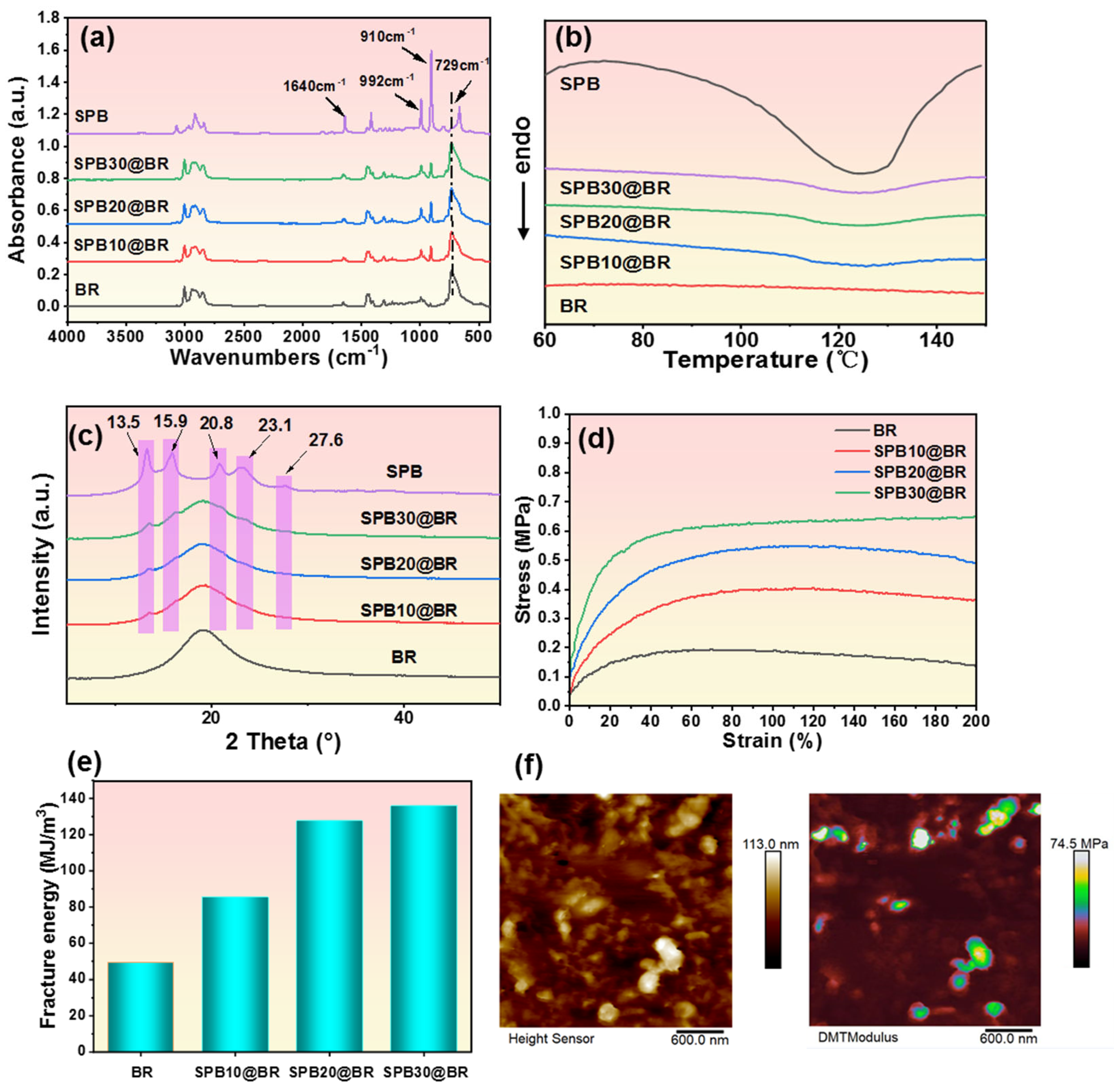
The structural features and the reinforcing role of SPB in the BR matrix were investigated systematically. FTIR spectra are displayed in Figure 2a to characterize the molecular structure. The pure SPB exhibits a strong absorption band at 910 cm−1 and 664 cm−1, indicating a higher concentration of 1,2-units [17]. A peak at 3071 cm−1 was found which is due to the vinyl C-H stretching of SPB. A moderate intensity at 992 cm−1 is detected, indicative of the vinyl group characteristic peak arising from the out-of-plane C–H bending vibration in syndiotactic sequence, and the intensity of the band at 729 cm−1 (cis-1,4-units) is almost vanishing [4]. The 1,2-vinyl structure increases progressively with the enhancement of the SPB content in SPB@BR, confirming the successful incorporation of SPB without introducing new chemical bonds. The absorption band at approximately 1640 cm−1 is attributed to the stretching vibration of carbon–carbon double bonds (C=C) in both the Nd-BR main chain and the 1,2-vinyl side groups of SPB [18].
Further, the specific crystallization behavior of SPB and SPB@BR, attributed to their regular molecular structure, was investigated via DSC and XRD. Although a distinct crystallization-related thermal event at 125 °C is observed for the pure SPB, it is significantly weakened in the SPB@BR composites and is not observed in the BR sample as shown in Figure 2b. This suggests that the crystallization of SPB is restricted by the surrounding amorphous BR chains. As shown in Figure 2c, XRD analysis of SPB@BR perdispersions with different concentrations revealed diffraction peaks at 2θ = 13.5° (010), 15.9° (200|110), 20.8° (210), 23.1° (110|201), and 27.6° (120), corresponding to the crystalline structure of syndiotactic 1,2-SPB [27]. The broad peak observed in the XRD spectrum of BR demonstrates its amorphous nature at room temperature. The molecular chains of BR are arranged with long-range disorder but maintain a degree of short-range order. Consistent with this observation, the crystalline reflections of SPB in BR are retained but exhibit reduced intensity, suggesting the formation of dispersed and imperfect microcrystalline domains within the matrix.
The presence of these microcrystalline hard domains leads to an effective reinforcing effect even in the unvulcanized state. As shown in Figure 2d, the modulus of the unvulcanized SPB@BR compounds increases monotonically with SPB loading. The modulus at 100% elongation enhances from 0.189 to 0.633 by loading 30% SPB. In the meanwhile, the fracture energy is concurrently enhanced by SPB (Figure 2e), demonstrating an improvement in stiffness without embrittlement. Furthermore, AFM images detect a relative ‘hard-island/elastic-sea’ morphology on the surface, in which higher-modulus SPB microdomains are distributed in the continuous BR phase (Figure 2f). These results demonstrate that SPB acts as a physically reinforcing microcrystalline phase, providing an efficient microstructural basis for the improved mechanical performance of the composites.

3.2. Curing and Rheological Properties of NR/SPB@BR Compounds

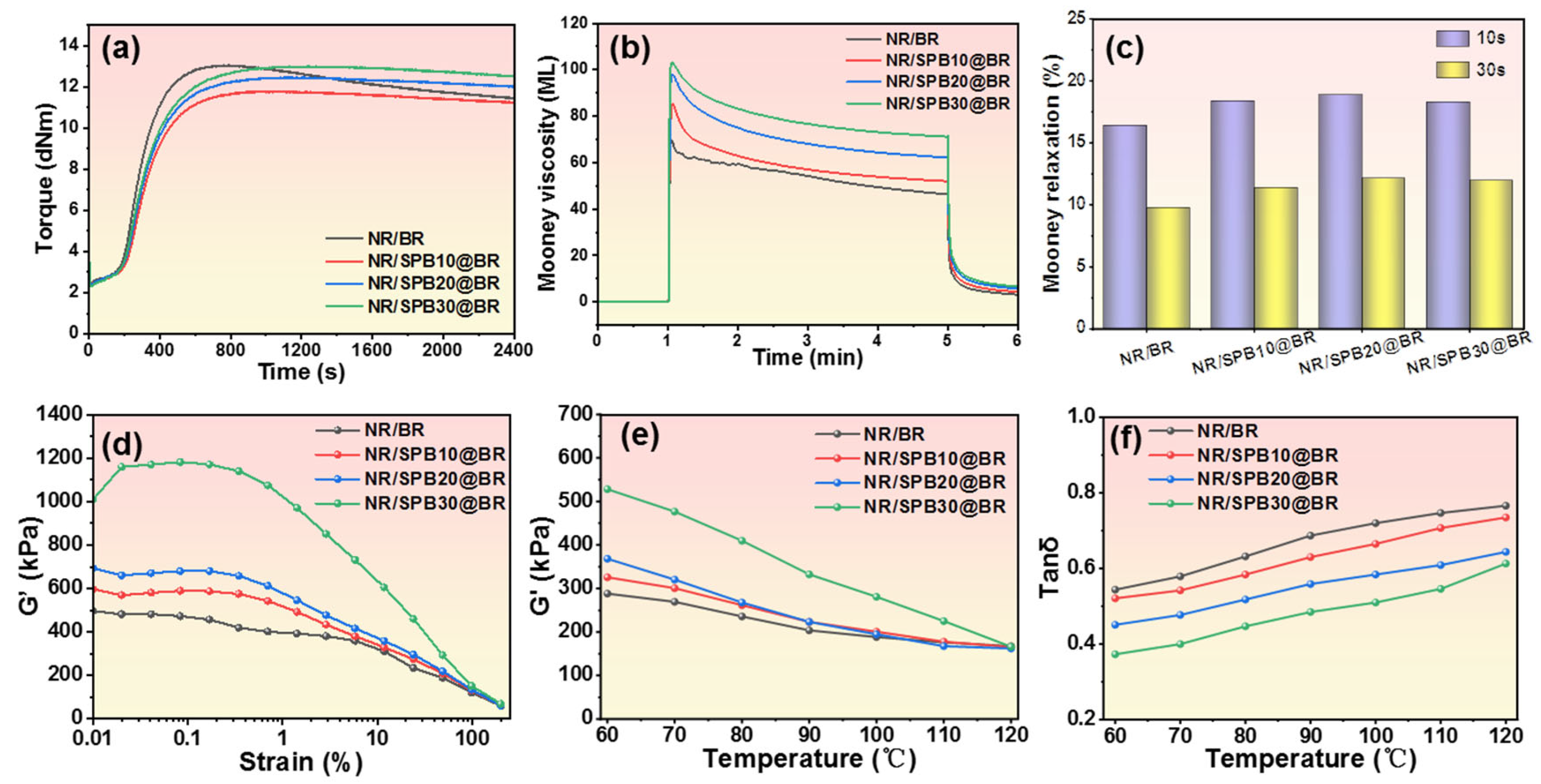
To fabricate high-performance rubber composites, the SPB@BR predispersion was introduced into a hybrid-filled rubber compounding system. SPB is uniformly dispersed in the BR matrix in the form of confined microcrystalline hard domains, a typical “hard-island/elastic-sea” structure. These microcrystalline domains act as reversible microcrystalline points, providing additional load-bearing capacity prior to vulcanization. Thus, they are expected to directly influence the curing behavior and dynamic rheological response of the compounds. The vulcanization curves are presented in Figure 3a, in which the rigid SPB microcrystalline domains slightly restrict the mobility of rubber chains, resulting in a marginal decrease in the curing rate index (Figure S1). Interestingly, the incorporation of SPB results in both an extended vulcanization plateau and the absence of reversion for the NR/BR compound. This suggests that the microcrystalline structure of SPB significantly improves the heat resistance of the compound. Correspondingly, the increase in SPB content leads to a higher maximum torque (MH) value, demonstrating the reinforcing effect of SPB in the composite.
Mooney viscosity progressively increases as the SPB content is raised (Figure 3b), whereas the Mooney relaxation is accelerated by the addition of SPB (Figure 3b). The Mooney relaxation at retention time of 10 s and 30 s is presented in Figure 3c. The NR/SPB20@BR compound shows optimal processing performance, with a distinct advantage in both short-time load-bearing (10 s) and preserved stress relaxation (30 s). The stress retention slightly decreases at higher SPB loading, implying the existence of an optimal SPB content that balances load-bearing capacity and processability. Compared to high-cis Nd-BR, SPB contains a higher proportion of 1,2-structural units, which is beneficial for improving the relaxation rate of Nd-BR. However, since SPB crystallizes at room temperature, an excessively high content (30%) can conversely reduce the relaxation rate.
Moreover, the dynamic rheological measurements reveal a similar trend. The incorporation of SPB microcrystalline domains increases the initial storage modulus (G’) at small strain and enhances the Payne effect, characteristic of a strain-sensitive physical network (Figure 3d). The G’ gradually converges with increasing strain, indicating progressive disruption of reversible physical interactions. Typically, an increase in the Payne effect indicates stronger filler–filler interactions. Since the test temperature is 60 °C, SPB is in a crystalline state and acts as a rigid filler within the blend, thus leading to an enhanced Payne effect. The temperature-dependent measurements further reveal that SPB microcrystalline domains significantly enhance stiffness at lower temperatures. In contrast, their partial softening at elevated temperatures attenuates the microcrystalline effect, which diminishes the modulus differences between formulations (Figure 3e). Correspondingly, a decrease in tan δ is observed with higher SPB content. The evolution of tan δ demonstrates that the hard-island/elastic-sea structure effectively modulates energy dissipation, contributing to reduced hysteresis at elevated temperatures (Figure 3f), which could be beneficial for reducing the rolling resistance of a tire tread.

3.3. Characterization of the NR/SPB@BR Vulcanizates

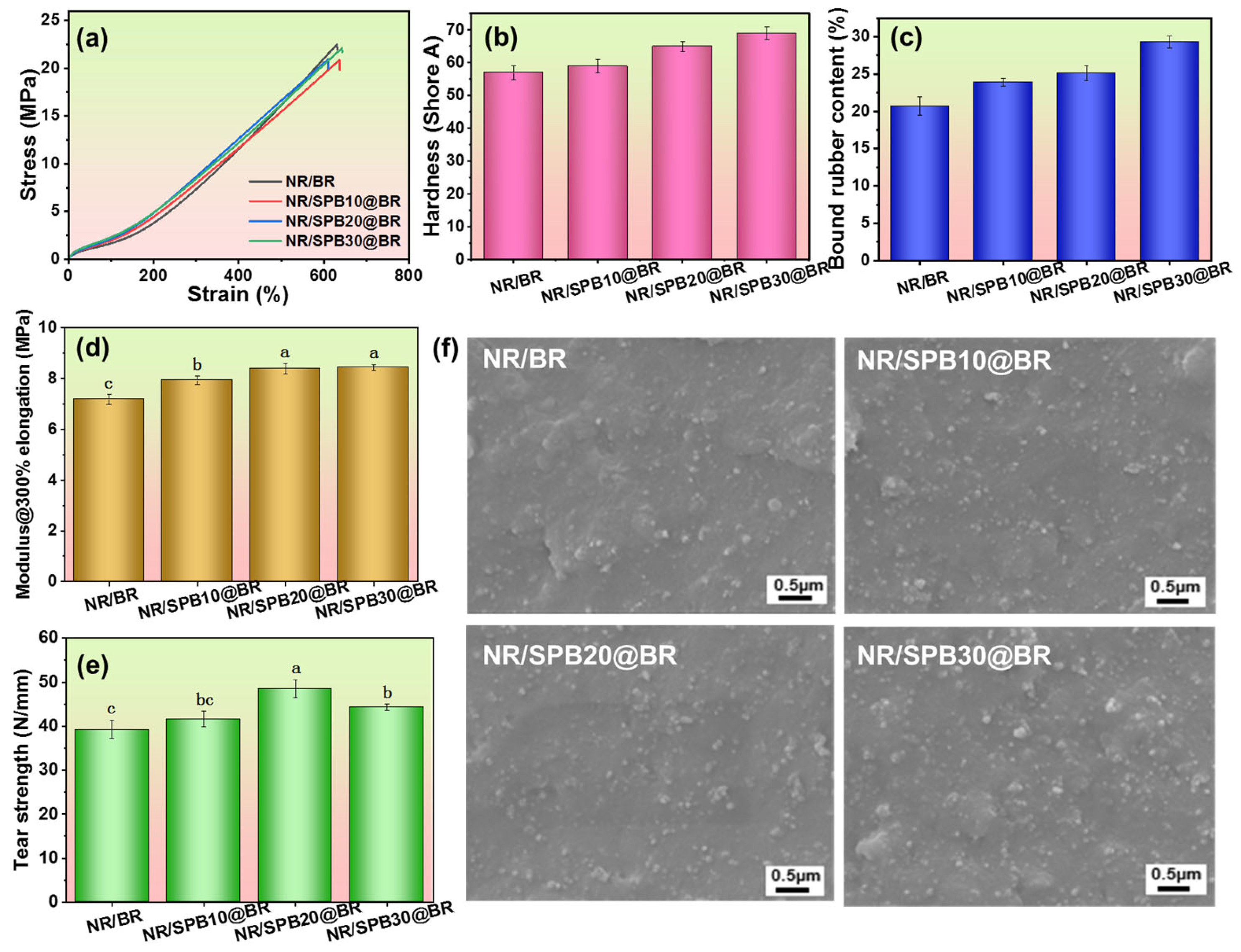
The influence of SPB on the physical mechanical and dynamic mechanical properties of the composites was further investigated. As shown in Figure 4a, the tensile stress–strain curves shift upward with increasing SPB content in the small strain region (less than 100%), indicating an enhancement in the modulus of the material. The Shore A hardness (Figure 4b) increases gradually with SPB loading, demonstrating the effective reinforcing role of SPB. The bound rubber content increases markedly with increasing SPB content (Figure 4c), indicating that a larger fraction of the fillers is constrained or strongly associated with the SPB microcrystalline hard domains and rubber chains, thereby enhancing interfacial stress transfer. Consistent with this observation, the modulus at 300% elongation also increases with SPB content, reflecting enhanced stiffness and resistance to large deformation (Figure 4d).
In contrast, the tear strength exhibits a non-monotonic dependence on SPB content, reaching a maximum at 20% SPB, where the tear strength is approximately 24.4% higher than that of composites without SPB (Figure 4e). This result indicates that tear resistance is governed primarily by crack-blunting mechanisms rather than by overall stiffness. At an intermediate SPB content, the number, size, and spatial distribution of SPB microcrystalline domains are blunting crack-tip deflection, thereby introducing more effective energy dissipation during crack propagation. At higher SPB loadings, although the overall stiffness continues to increase, the efficiency of crack-arresting mechanisms does not increase proportionally, leading to a plateau or slight reduction in tear strength. SEM images of the fracture surfaces show that SPB-containing samples exhibit rougher fracture morphologies and more tortuous crack paths compared with NR/BR composite (Figure 4f). In particular, the composite of NR/SPB20@BR displays richer fine-scale fracture features, which is consistent with its superior tear resistance.
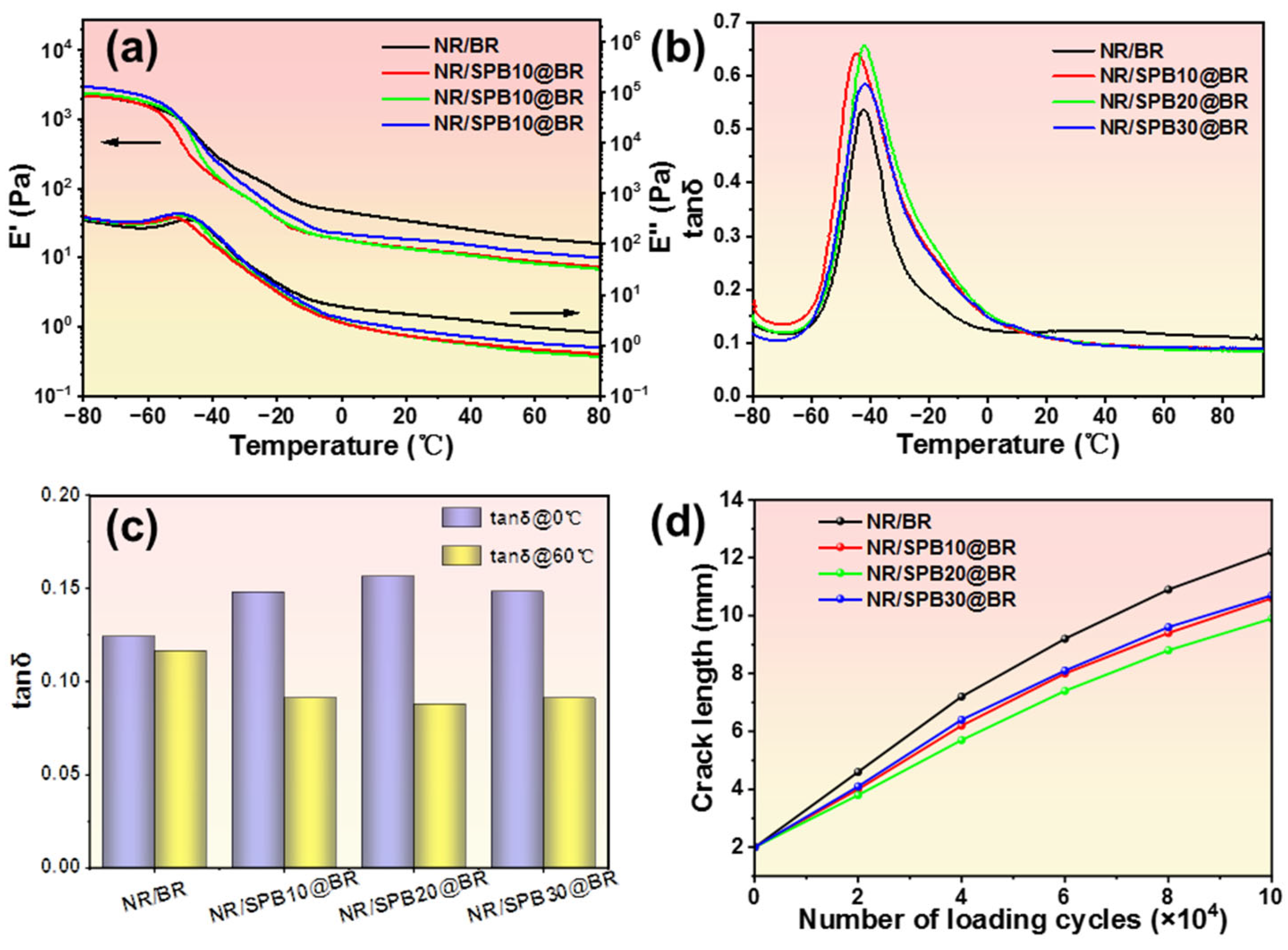
The viscoelastic response to cyclic deformation was assessed using dynamic mechanical analysis (DMA) temperature sweeps. The mechanical loss factor, tan δ = E″/E′, serves as a direct indicator of molecular mobility and segmental transitions in rubber, where E″ and E′ represent the viscous (loss) and elastic (storage) moduli, respectively. The temperature dependencies of E″ and E′ for the NR/BR and NR/SPB@BR composites are shown in Figure 5a. Above the glass transition temperature (Tg), both the E′ and E″ of the NR/SPB@BR composites exhibit a decline compared to the NR/BR composite. This finding indicates the introduction of SPB simultaneously attenuates both the viscous and elastic properties of the composites. Since E″ is primarily attributed to friction between filler particles, the observed changes suggest that SBP alters the polymer–filler interaction.
Further, the corresponding temperature dependence of tan δ is presented in Figure 5b. The peak height of tan δ correlates with the mobility of the rubber chains and the energy dissipated at the rubber–filler interface, thus reflecting both molecular dynamics and interfacial interactions [28]. The incorporation of SPB into the composites leads to the decrease in E′ and E″ above Tg and an increase in the height of tan δ peak, with 20% SPB content resulting in a more pronounced enhancement. A possible reason is that the incorporation of SPB improves the processability of the rubber, which facilitates filler dispersion and enhances the rubber–filler interaction. Moreover, from the indirect laboratory indicators of tire service performance, the dynamic mechanical behaviors provide important indications for rolling resistance, wet skid resistance, and low-temperature traction (ice grip). With the incorporation of SPB, the tan δ at 60 °C decreases significantly, indicating reduced hysteresis loss, which is beneficial for lowering rolling resistance. This is attributed to the enhanced filler–polymer interaction. At the same time, the reduced energy dissipation combined with enhanced structural stability helps suppress excessive tread deformation during periodic rolling. This result is consistent with the previous rheological findings. In contrast, an increase in tan δ in the vicinity of 0 °C suggests enhanced energy dissipation of a tire tread under wet conditions, which is favorable for improving the adhesion on the road surface and thus enhancing wet skid resistance. Furthermore, the elevated tan δ observed at −20 °C indicates that the rubber compound retains a certain degree of viscoelastic compliance at low temperatures, enabling better adaptation to the micro-roughness of icy or snowy surfaces and providing potential benefits for low-temperature traction and ice grip performance. For a comparison of the tan δ values at 0 °C and 60 °C, the NR/SPB20@BR composite exhibits superior wet traction and rolling resistance properties, i.e., the highest tan δ at 0 °C and the lowest tan δ at 60 °C (Figure 5c).
To better evaluate the dynamic performance of the composites, flex fatigue and crack growth tests were conducted. Firstly, the unnotched specimens were subjected to flexural fatigue testing and exhibited no crack development after 2 million cycles (Figure S2). This result verifies the stability of tires during their service life at a handling response speed. In addition, the fatigue flexural tests were conducted on notched specimens, and the crack propagation rate was determined as shown in Figure 5d. The crack propagation rate in the composite containing SPB was significantly reduced compared to the NR/BR composite, especially the composite of NR/SPB20@BR. After 100,000 flexing cycles, the crack length of the NR/SPB20@BR specimen was only 9.9 mm, representing an 18.9% and 7.5% improvement over the NR/BR and NR/SPB30@BR specimens, respectively. The reversible physical network formed by SPB microcrystalline domains under dynamic loading allows the effect of inhibiting crack propagation while avoiding excessive hysteresis loss.
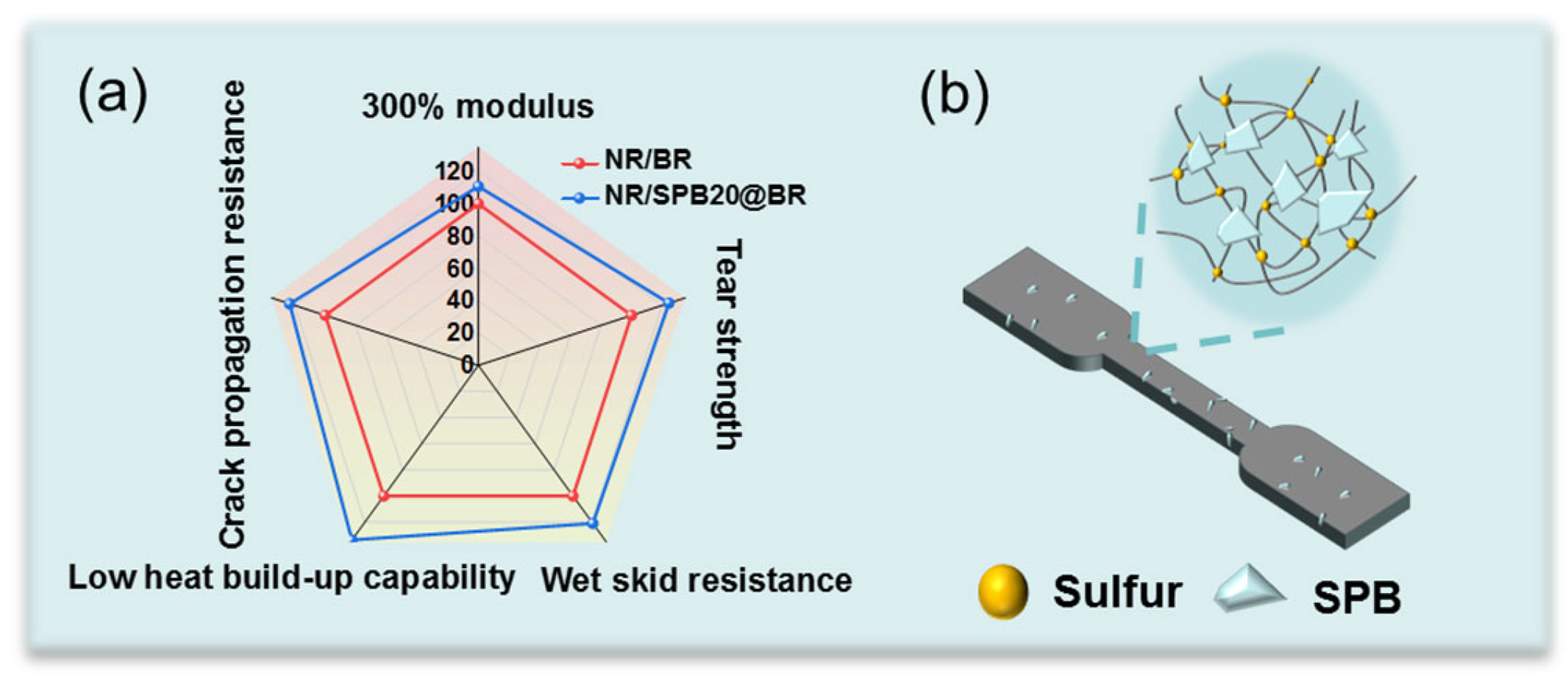
The comprehensive performance of NR/BR and NR/SPB20@BR vulcanizates are summarized in Figure 6a. The performance of the NR/BR specimen was normalized to 100, and the relative ratios of the NR/SPB20@BR specimen are presented in the radar plot. The NR/SPB20@BR composite exhibits a simultaneous improvement in 300% modulus, tear strength, wet traction, rolling resistance, and crack propagation resistance compared to the reference (NR/BR). This advanced performance profile indicates that an appropriate SPB content enables the enhancement of load-bearing capacity and resistance to damage while effectively suppressing hysteretic energy dissipation. Such a synergistic improvement demonstrates an effective decoupling of stiffness, toughness, and dynamic energy loss, which is difficult to achieve in conventional rubber reinforcement systems. Therefore, based on the established relationships between the polymer structure and the properties, the reinforcement mechanism of SPB in rubber composites was summarized, as illustrated in Figure 6b. As evidenced by AFM and SEM images, SPB exists as aggregates larger than 100 nm, forming reversible microcrystalline hard domains through confined crystallization within the Nd-BR matrix. These domains then synergistically interact with the chemical crosslinks during vulcanization to form a hierarchical, load-bearing structure. This mechanism fundamentally accounts for the ability of the SPB@BR system to achieve high modulus, enhanced crack resistance, and reduced hysteresis loss.

4. Conclusions

This work proposes an energy-efficient predispersion reinforcement strategy for high-melting-point elastomers. It entails introducing SPB into Nd-BR upon the completion of solution polymerization. This process facilitates the uniform confined crystallization of SPB within the rubber matrix, yielding a characteristic hard-domain/soft-matrix microstructure. Within this system, SPB microcrystals serve as reversible microcrystalline hard domains that coexist synergistically with the chemical sulfur network. This dual-network design enhances material stiffness and load-bearing capacity, yet avoids the over-restriction of polymer chain mobility associated with solely permanent crosslinks. Consequently, the composites demonstrate significantly enhanced crack propagation resistance and retained tensile ductility. The tear strength, 300% modulus and crack propagation resistance of the SPB20@BR composite are increased by approximately 24.4%, 10.7% and 23.2% compared to the reference compound, respectively. Meanwhile, the cooperative network effectively suppresses hysteresis loss, and the rolling resistance is reduced by 33.6% under cyclic deformation, thereby improving the overall dynamic response characteristics. The wet skid resistance is improved by 21.0%. These results demonstrate that moderate, confined-crystallization-induced reversible microcrystallinity offers a promising reinforcement strategy for applications in both tire treads and sidewalls.

Supplementary Materials

The following supporting information can be downloaded at https://www.mdpi.com/article/10.3390/app16052465/s1, Figure S1: Cure rate index of the compounds calculated to equal 100/(t90–scorch time); Figure S2: The optical image of samples after 2 million flex fatigue cycles.

Author Contributions

Conceptualization, Y.W. and X.L.; methodology, X.L. and Y.W.; software, Y.W.; validation, X.L. and X.X.; formal analysis, Y.W.; investigation, Y.W.; resources, X.L. and X.K.; data curation, X.L. and Y.W.; writing—original draft preparation, Y.W.; writing—review and editing, X.L.; visualization, X.X.; supervision, X.K. and Y.W.; project administration, Y.W. and X.K.; funding acquisition, X.K. and Y.W. All authors have read and agreed to the published version of the manuscript.

Funding

This research was funded by the Department of Science and Technology of Guangdong Province with the project “High level innovation research institute” (No. 2020B0909010004).

Institutional Review Board Statement

Not applicable.

Informed Consent Statement

Not applicable.

Data Availability Statement

The data that support the findings of this work are available from the corresponding author on reasonable request.

Conflicts of Interest

The authors declare no conflicts of interest.

References

  1. Kim, H.J.; Hamed, G.R. On the Reason that Passenger Tire Sidewalls are Based on Blends of Natural Rubber andcis-Polybutadiene. Rubber Chem. Technol. 2000, 73, 743–752. [Google Scholar] [CrossRef]
  2. Ma, L.; Zhang, Z.; Peng, Z.; Formela, K.; Wang, S. Dynamic mechanical properties and flexing fatigue resistance of tire sidewall rubber as function of waste tire rubber reclaiming degree. J. Appl. Polym. Sci. 2021, 138, 51290. [Google Scholar] [CrossRef]
  3. Scarton, C.T.; Guerra, N.B.; Giovanela, M.; Moresco, S.; Crespo, J.D.S. Evaluation of natural and epoxidized vegetable oil in elastomeric compositions for tread rubber. J. Elastomers Plast. 2021, 54, 264–278. [Google Scholar] [CrossRef]
  4. Zhu, H.; Tang, M.; Hao, Y.-Q.; Zhou, Z.-F.; Sun, D.; Yu, P.-F.; Wu, Y.-X. Novel polybutadiene rubber with long cis-1,4 and syndiotactic vinyl segments (CVBR) for high performance sidewall of all-steel giant off-the-road tire. Compos. Part B Eng. 2024, 275, 111349. [Google Scholar] [CrossRef]
  5. Tomazi, R.C.; Guerra, N.B.; Giovanela, M.; Moresco, S.; da Silva Crespo, J. Evaluation of vulcanization systems in natural rubber elastomeric tire sidewall compositions with lignin as a stabilizing agent. Polym. Bull. 2022, 80, 8977–8994. [Google Scholar] [CrossRef]
  6. Fröhlich, J.; Niedermeier, W.; Luginsland, H.D. The effect of filler–filler and filler–elastomer interaction on rubber reinforcement. Compos. Part A Appl. Sci. Manuf. 2005, 36, 449–460. [Google Scholar] [CrossRef]
  7. Głowacka, K.; Klemenc, J.; Nagode, M.; Łagoda, T. Fatigue lifetime of rubber composites—State-of-the-art. Polym. Test. 2025, 143, 108713. [Google Scholar] [CrossRef]
  8. Schieppati, J.; Schrittesser, B.; Wondracek, A.; Robin, S.; Holzner, A.; Pinter, G. Effect of mechanical loading history on fatigue crack growth of non-crystallizing rubber. Eng. Fract. Mech. 2021, 257, 108010. [Google Scholar] [CrossRef]
  9. Ning, N.; Hu, L.; Yao, P.; Wu, H.; Han, J.; Zhang, L.; Tian, H.; Tian, M. Study on the microstructure and properties of bromobutyl rubber (BIIR)/polyamide-12 (PA12) thermoplastic vulcanizates (TPVs). J. Appl. Polym. Sci. 2015, 133. [Google Scholar] [CrossRef]
  10. Wang, Z.; Zhao, H.; Zhao, J.; Wang, X. Rheological, mechanical and morphological properties of thermoplastic vulcanizates based on high impact polystyrene and styrene-butadiene rubber. J. Appl. Polym. Sci. 2010, 117, 2523–2529. [Google Scholar] [CrossRef]
  11. Saengdee, L.; Daniel, P.; Amornsakchai, T.; Chaiyanurakkul, A.; Phinyocheep, P. Thermoplastic vulcanizates derived from modified natural rubbers and polypropylene. Iran. Polym. J. 2021, 31, 287–299. [Google Scholar] [CrossRef]
  12. Rana, L.; Kouka, S.; Gajdosova, V.; Strachota, B.; Konefał, M.; Pokorny, V.; Pavlova, E.; Stary, Z.; Lukes, J.; Patocka, M.; et al. Thermoplastic Starch with Maltodextrin: Preparation, Morphology, Rheology, and Mechanical Properties. Materials 2024, 17, 5474. [Google Scholar] [CrossRef] [PubMed]
  13. Tang, Q.; Hu, S.; Han, L.; Zong, C.; Sun, J. Morphological Evolution and Damping Properties of Dynamically Vulcanized Butyl Rubber/Polypropylene Thermoplastic Elastomers. Polymers 2022, 14, 2740. [Google Scholar] [CrossRef] [PubMed]
  14. Wu, H.; Tian, M.; Zhang, L.; Tian, H.; Wu, Y.; Ning, N.; Hu, G.-H. Effect of Rubber Nanoparticle Agglomeration on Properties of Thermoplastic Vulcanizates during Dynamic Vulcanization. Polymers 2016, 8, 127. [Google Scholar] [CrossRef]
  15. Bayati, A.; Yousefi, M.A.; Rahmatabadi, D.; Baniassadi, M.; Abrinia, K.; Bodaghi, M.; George, D.; Baghani, M. 3D printing thermoplastic vulcanizates: Current limitations, innovative solutions, and emerging applications. Mater. Today Adv. 2025, 28, 100664. [Google Scholar] [CrossRef]
  16. Liang, S.; Zhang, H.; Cong, R.; Liu, H.; Wang, F.; Hu, Y.; Zhang, X. In-chain functionalized syndiotactic 1,2-polybutadiene by a Ziegler-Natta iron(iii) catalytic system. RSC Adv. 2019, 9, 33465–33471. [Google Scholar] [CrossRef]
  17. Pan, W.; Chen, H.; Mu, J.; Li, W.; Jiang, F.; Weng, G.; Hu, Y.; Gong, D.; Zhang, X. Synthesis of high crystalline syndiotactic 1,2-polybutadienes and study on their reinforcing effect on cis-1,4 polybutadiene. Polymer 2017, 111, 20–26. [Google Scholar] [CrossRef]
  18. Xia, B.; Li, Z.; Lin, T.; Gao, M.; Zhao, C.; Wu, X.; Lin, C.; Wang, J. Self-Healing, Recyclable Syndiotactic 1,2-Polybutadiene-Based Thermadapt Shape Memory Polymers with Cold-Programmed Shape Memory Effect. ACS Appl. Polym. Mater. 2023, 6, 102–114. [Google Scholar] [CrossRef]
  19. Yu, Y.; Xu, S.; Pang, L.; Jiang, B.; Liu, H.; Zhang, C.; Zhang, X. Enhancing dynamic properties of natural rubber nanocomposites: A novel syndiotactic 1,2-polybutadiene via iron-catalyzed butadiene-ethylene copolymerization. Chem. Eng. J. 2025, 525, 170255. [Google Scholar] [CrossRef]
  20. Sen, A.K.; Chanda, J.; Shee, B.; Mazumder, A.; Dasgupta, M.; Ghosh, P.; Mukhopadhyay, R. Improvement of thermo-mechanical and fatigue crack growth resistance of tire sidewall compound by introducing syndiotactic polybutadiene. J. Appl. Polym. Sci. 2022, 139, e52602. [Google Scholar] [CrossRef]
  21. Takahashi, Y.; Liang, X.; Nakajima, K. Mechanical property and structure of a butadiene rubber composite filled with syndiotactic polybutadiene resin. J. Appl. Polym. Sci. 2019, 136, 47934. [Google Scholar] [CrossRef]
  22. Yu, Y.; Xu, S.; Zhao, Y.; Sun, Y.; Liu, H.; Zhang, C.; Zhang, X. Syndiotactic 1,2-polybutadiene with regulable viscoelasticity and crystallinity via a steric hindrance strategy for promoting the dynamic mechanical properties of nanocomposites. Compos. Part A Appl. Sci. Manuf. 2025, 191, 108723. [Google Scholar] [CrossRef]
  23. ISO 37:2024; Rubber, Vulcanized or Thermoplastic—Determination of Tensile Stress-Strain Properties. International Organization for Standardization: Geneva, Switzerland, 2024.
  24. ISO 48-4:2018; Rubber, Vulcanized or Thermoplastic—Determination of Hardness—Part 4: Indentation Hardness by Durometer Method (Shore Hardness). International Organization for Standardization: Geneva, Switzerland, 2018.
  25. ISO 132:2017; Rubber, Vulcanized or Thermoplastic—Determination of Flex Cracking and Crack Growth (De Mattia). International Organization for Standardization: Geneva, Switzerland, 2017.
  26. Yu, P.; He, H.; Luo, Y.; Jia, D.; Dufresne, A. Reinforcement of Natural Rubber: The Use of in Situ Regenerated Cellulose from Alkaline-Urea-Aqueous System. Macromolecules 2017, 50, 7211–7221. [Google Scholar] [CrossRef]
  27. Liu, E.; Li, X.; Zhang, A.; Tang, J.; Hua, J. Synthesis and Performance of Vinyl Butadiene-Pentadiene Copolymers with Tunable Melting Points Based on Cobalt Catalytic Systems: Toward Low-Melting, High-Strength, and High-Toughness Syndiotactic 1,2-Polybutadiene. Ind. Eng. Chem. Res. 2025, 64, 24264–24274. [Google Scholar] [CrossRef]
  28. Xu, M.; Zhang, K.; Wang, L.; Wang, Q. Spider silk inspired bead-like aramid nanofibers via hydrogen-bond donor strategy for synergistic reinforcement of high-performance rubber composite. Compos. Part B Eng. 2023, 255, 110616. [Google Scholar] [CrossRef]
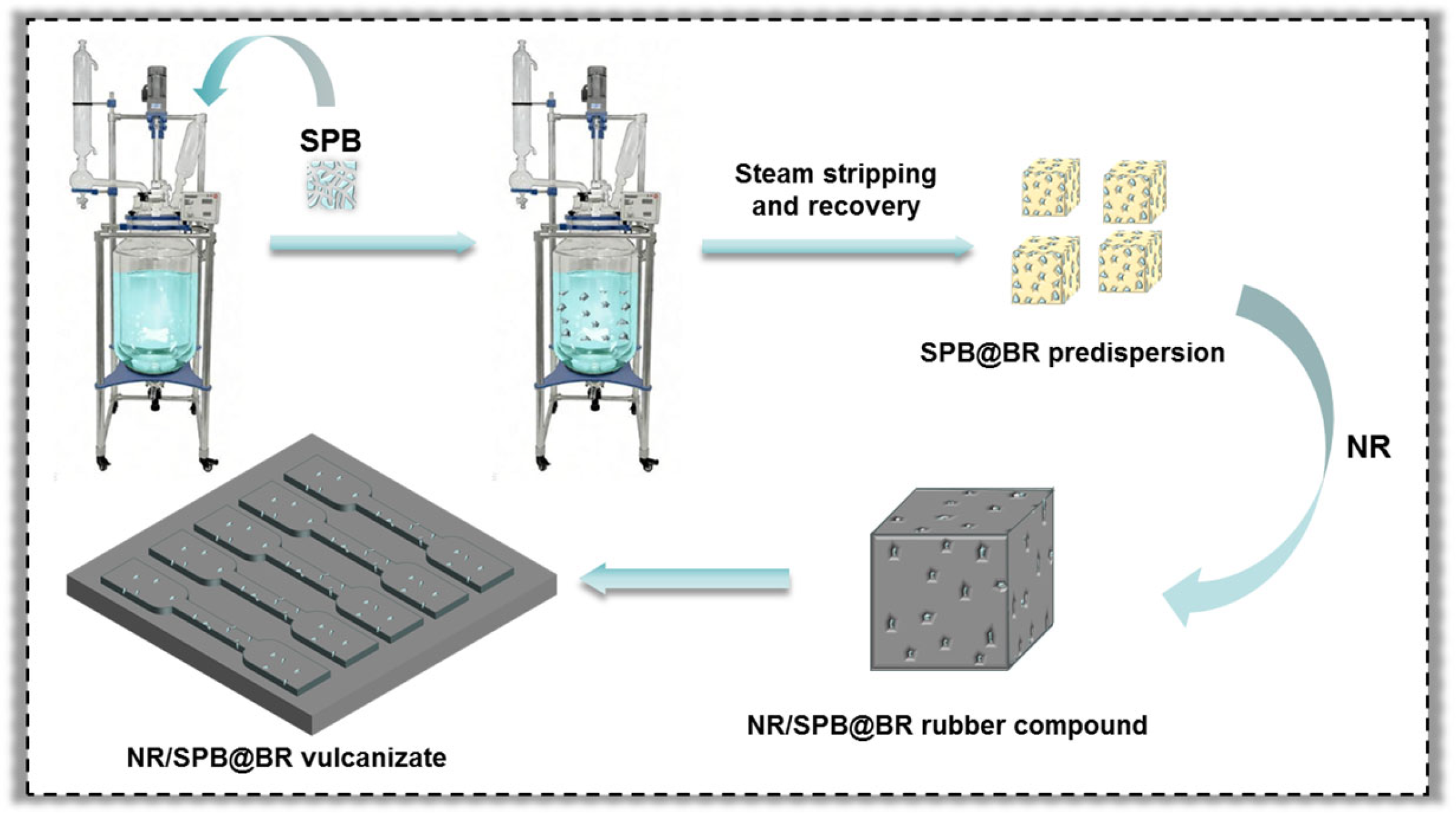
Figure 1. Schematic illustration of the fabrication process.
Applsci 16 02465 g001
Figure 2. (a) FTIR spectra; (b) DSC curves; (c) XRD patterns; (d) stress–strain curves; (e) fracture energy of unvulcanized rubbers; (f) AFM of SPB30@BR.
Applsci 16 02465 g002
Figure 3. (a) Vulcanization curves; (b) Mooney viscosity and Mooney relaxation; (c) Mooney relaxation at the retention time of 10 s and 30 s; (d) dependencies of storage moduli G′ on the strain amplitude; (e) dependencies of G′ on temperature; (f) temperature Dependencies of tan δ.
Applsci 16 02465 g003
Figure 4. Effects of the SPB content on the (a) stress–strain curves; (b) Shore A hardness; (c) bound rubber content; (d) modulus at 300% elongation; (e) tear stress; (f) SEM images of the tensile specimen fracture surface. Significant differences among groups in post-hoc tests are indicated by lowercase letters (a, b, c) as follows: groups sharing the same letter are not significantly different, whereas groups with different letters are.
Applsci 16 02465 g004
Figure 5. Temperature dependencies of (a) the storage modulus E′ and loss modulus E″ and (b) the tan δ; (c) comparison of the tan δ at 0 and 60 °C for the vulcanizates; (d) dynamic crack propagation.
Applsci 16 02465 g005
Figure 6. (a) Radar plot comparing the comprehensive performances; (b) the reinforcement mechanism of SPB in vulcanizate.
Applsci 16 02465 g006
Table 1. Formulation of the composites.
Ingredients (phr)NR/BRNR/SPB10@BRNR/SPB20@BRNR/SPB30@BR
NR (SCR 5)40404040
BR60---
SPB@BR-60 (SPB10@BR)60 (SPB20@BR)60 (SPB30@BR)
Note: The other ingredients in the formulation are identical as follows: N330 30, N660 20, ZnO 4, Stearic acid 1, aromatic oil 10, Sulfur 1.6, N-Cyclohexyl-2-benzothiazolesulfenamide (CZ) 0.7, N-1,3-dimethylbutyl-N-phenyl-p-phenylenediamine (DMPPD) 5, and poly(1,2-dihydro-2,2,4-trimethyl-quinoline) (RD) 1.
Disclaimer/Publisher’s Note: The statements, opinions and data contained in all publications are solely those of the individual author(s) and contributor(s) and not of MDPI and/or the editor(s). MDPI and/or the editor(s) disclaim responsibility for any injury to people or property resulting from any ideas, methods, instructions or products referred to in the content.