Article

Relationships of Bone Mineral Density and Femur Strength Index with Aerobic Capacity, Body Composition and Carbohydrate Metabolic Indices in Postmenopausal Women


by
Krystian Wochna
1,*,
Rafał Stemplewski
2,†,
Piotr Leszczyński
3,
Katarzyna Domaszewska
4,
Anna Huta-Osiecka
5 and
Alicja Nowak
6
1
Department of Swimming and Water Lifesaving, Poznan University of Physical Education, 61-871 Poznan, Poland
2
Department of Digital Technologies in Physical Activity, Poznan University of Physical Education, 61-871 Poznan, Poland
3
Department and Clinic of Internal Medicine and Metabolic Disorders, Poznan University of Medical Sciences, 61-701 Poznan, Poland
4
Department of Physiology, Poznan University of Physical Education, 61-871 Poznan, Poland
5
Chair of Dietetics, Poznan University of Physical Education, 61-871 Poznan, Poland
6
Department of Biochemistry, Poznan University of Physical Education, 61-871 Poznan, Poland
*
Author to whom correspondence should be addressed.
Visiting Researcher at Centre for Movement Occupation and Rehabilitation Sciences, Oxford Brookes University, Oxford OX3 0BP, UK.
Appl. Sci. 2026, 16(5), 2338; https://doi.org/10.3390/app16052338
Submission received: 19 December 2025 / Revised: 6 February 2026 / Accepted: 27 February 2026 / Published: 27 February 2026

Abstract

Objectives: Hormonal changes during the postmenopausal period of life predispose women to changes in fat tissue distribution and the risk of insulin resistance, and may lead to deterioration of bone metabolism. Physical activity plays a significant role in improving metabolic health and may inhibit bone mass decrease. The purpose of this study was to analyze the relationships between bone health, body composition, maximal oxygen uptake (VO2max), and carbohydrate metabolic indices in non-diabetic postmenopausal women. Methods: Fifty-seven postmenopausal women were included in the study (64.9 ± 4.8 years). The areal bone mineral density (aBMD) of femoral neck and L1–L4, femur strength index (FSI), total fat (FM), lean body mass (LBM), VO2max, serum insulin, and glucose concentrations were determined. The insulin resistance index (HOMA-IR) was also calculated. The main statistical analyses were performed using hierarchical multiple linear regression models. Results: Body mass index (BMI), FM and LBM positively correlated with aBMD results (p ≤ 0.01) and FM negatively with FSI levels (p < 0.05). VO2max showed a positive association with FSI and this relationship was confirmed in hierarchical multiple regression analysis (p < 0.05). Regression analysis revealed that the base model including age and BMI explained the variance in the femoral neck aBMD (p ≤ 0.01) and L1–L4 aBMD (p ≤ 0.01), respectively. In the case of the femoral neck aBMD model, adjustment for VO2max increased the explained variance. Alternative models with carbohydrate metabolic indicators did not increase the explained variance. Conclusion: Our results suggest that aerobic capacity may be related to the level of femur bone strength. Somatic characteristics and carbohydrate metabolic status appear to play a role in the correlations between femur bone health and VO2max.

1. Introduction

Postmenopausal women are particularly at high risk of developing metabolic disorders through the loss of the protective effect of estrogen [1,2]. Hormonal changes during the postmenopausal period of life predispose women to increased visceral adipose tissue accumulation and adipocyte hypertrophy contributing to the risk of insulin resistance [3]. Moreover, menopausal transition may lead to the uncoupling of bone formation and resorption [4,5].
Many studies have shown a strong association between body fat content and bone mineral density (BMD) [6,7,8]. This relationship stems both from the mechanical impact of body weight on bone tissue and from the influence of hormones and adipokines produced by adipocytes, e.g., estrogen, adiponectin, leptin, and interleukins [7]. In research conducted among young women, Gilsanz et al. [8] indicated that subcutaneous and visceral adiposity have strong but opposing relations with femoral bone structure and strength. They suggested a detrimental impact of cytokines and inflammatory factors released by visceral adipose tissue on bone health and a protective effect of adiponectin, whose expression in subcutaneous tissue is higher than in visceral adipose tissue.
Furthermore, several authors have shown that increased visceral adipose tissue was associated with insulin resistance [9,10]. However, evidence is inconclusive on the relationship between insulin resistance and bone mass [11,12]. It should be noted that studies in this area have evaluated these relationships for different skeletal regions, often independent of fat mass and body weight [13]. Yang et al. [14] observed that elevated insulin resistance index (Homeostatic Model Assessment, HOMA-IR) was associated with lower cortical bone volume of the proximal femur and bone strength indices in non-diabetic postmenopausal women, independent of age and body size. On the other hand, in studies among non-diabetic postmenopausal women, Shanbhogue et al. [13] found that insulin resistance (HOMA-IR) was associated with favorable bone microarchitecture at the distal radius and tibia. Campillo-Sánchez et al. [15] indicated a positive relationship between insulin resistance (HOMA-IR) and volumetric bone mineral density (vBMD), at both the cortical and trabecular femur regions. Fu et al. [16] investigated the associations of insulin resistance and β-cell secretion with BMD at the lumbar spine, hip joint, and various parts of the femur and osteoporosis (T-score ≤ −2.5 SD). They reported a negative association between β-cell function (HOMA-β) and osteoporosis when HOMA-IR was less than 2.0. Their findings suggest that the association between insulinemia and BMD/T-score may differ depending on an individual’s insulin resistance status, as insulin has an anabolic effect on bone tissue [16].
Previous studies have shown that physical activity programs play a substantial role in improving metabolic health [17], inhibiting bone mass decrease and reducing propensity to fractures [18]. Mechanical stimulation can reduce the number and activity of osteoclasts and inhibit bone resorption, as well as promote the differentiation and osteogenic function of osteoblasts and prevent the loss of bone mass [19]. Although endurance exercises are recommended to improve metabolic processes [20], impact and resistance exercises are more strongly advocated for the prevention of osteoporosis [21,22,23]. In their meta-analysis of prospective randomized controlled trials, Sanchez-Trigo et al. [21] assessed the effect of unsupervised training intervention on the femoral neck and lumbar spine BMD in adult women. They found that interventions with dynamic skeletal loads (weight-bearing and impact exercises), e.g., jogging, jumping, running, dancing, and vibration platform training, caused significant improvement in femoral neck aBMD.
Even though individuals may participate in single sessions of physical activity programs, a sedentary lifestyle can have a profound impact on health and may reduce the benefits of regular exercise. This led us to investigate the relationship between bone mass and strength with maximal oxygen uptake (VO2max). Previous research had shown that cardiorespiratory fitness, expressed as VO2max, is positively associated with the amount of daily vigorous activity [24]. We hypothesized that aerobic capacity, metabolic status and body composition may play an important role in bone health in postmenopausal women.
The ultimate purpose of the study was to analyze the relationships between bone health, estimated VO2max, body composition, and carbohydrate metabolic indices in non-diabetic postmenopausal women.

2. Materials and Methods

2.1. Participants

The research results were collected over a period of two years at the Poznan University of Physical Education. Subjects were recruited by advertisements in local media and at information events. Eligibility criteria required participants not to have chronic or autoimmune diseases. Furthermore, participants who declared recent infections, inflammatory disorders, diabetes mellitus, or cancer, or who were undergoing hormone replacement therapy, were not included in the study. Six women who declared taking medication drugs for thyroid abnormalities were enrolled because, during the analysis of the data, it was noticed that these drugs did not cause significant changes in the test results. Ultimately, the study included 57 postmenopausal women. All subjects declared that they did not have a history of participating in professional sports. All participants gave written informed consent to participate in the study program. The study protocol was approved by the Ethics Committee of Poznan University of Medical Sciences (1224/17; 245/19). Our study was performed in accordance with the Declaration of Helsinki of the World Medical Association.

2.2. The Dual X-Ray Absorptiometry Measurements

Measurements were performed as previously described in Wochna et al. [25,26]. DXA measurements were expressed as areal bone mineral density aBMD (g/cm2) at the left femoral neck (femoral neck aBMD) and the lumbar spine (L1–L4 aBMD), with an effective radiation dose of 1–10 μSv, depending on the measurement region. Total fat (FM) and lean body mass (LBM) were also determined using the DXA. These measurements were obtained using a Lunar Prodigy Advance densitometer (General Electric, Chicago, IL, USA). All scans were taken by the same technician, using the same device, which was calibrated daily. Quality control of the DXA scanner was performed in accordance with the manufacturer’s instructions, and scan analysis was performed using the integrated GE Healthcare software enCORE version 16, according to the manufacturer’s recommendations. The femur strength index (FSI) of the left hip was calculated automatically using the ratio of estimated compressive yield strength of the femoral neck to the expected compressive stress of a fall on the greater trochanter adjusted for the subject’s age, height and weight. This algorithm considers the shape of the proximal femur as well as the cross-sectional moment of inertia in the estimate [27].

2.3. Biochemical Analysis

Blood was collected from the ulnar vein between 7:30 and 9:30 am (after participants had fasted overnight) and centrifuged to obtain serum for biochemical analysis. The samples were frozen and stored at −80 °C until the time the analyses were performed (U410, Ultra-Low Temperature Freezer, New Brunswick Scientific, Edison, NJ, USA). Biochemical analyses were performed as previously described in Huta-Osiecka et al. [28]. The concentrations of glucose were determined using an automatic biochemical analyzer (ACCENT 220S; Cormay, Warsaw, Poland) and dedicated enzymatic tests supplied by Cormay (Warsaw, Poland). The test sensitivity was 0.41 mg/dL. Insulin concentration was determined by immunoenzymatic ELISA (DRG Instruments GmbH, Marburg, Germany), with a sensitivity of 1.76 µIU/mL. Spectrophotometric measurements for the ELISA test were performed using a multi-mode microplate reader (Synergy 2 SIAFRT, BioTek, Winooski, VT, USA). The insulin resistance index (Homeostatic Model Assessment, HOMA-IR) was calculated using the formula described by Matthews et al. [29]:
HOMA-IR = (Insulin [IU/mL] × Glucose [mmol/L])/22.5.

2.4. Aerobic Capacity

Aerobic capacity was assessed as previously described in Domaszewska et al. [30] with the modified Åstrand–Rhyming protocol for predicting VO2max by a Kettler DX1 Pro ergometer (Heinz Kettler GmbH, Ense-Parsit, Germany) and heart rate (HR) was monitored using a Polar A-5 pulse meter (Polar Electro Oy, Kernpele, Finland) [31]. The exercise was performed in an air-conditioned exercise laboratory in accordance with the basic criteria for conducting exercise tests. The Åstrand test was immediately interrupted if, during its performance, symptoms indicating exercise intolerance, a threat to the health of the subject, or the inability to meet the technical conditions necessary for the proper conduct of the test occurred. The predicted VO2max was read from the nomogram or accompanying tables [32] and multiplied by both the Åstrand and the von Dobeln age correction factors.
The Åstrand–Rhyming test is one of the most commonly used submaximal cycle ergometry tests. Previous studies showed that the protocol and results of this test indicate adequate validity and reliability in healthy populations [33]. The Åstrand method is preferred in studies of certain populations due to the safety and feasibility of the test. Submaximal tests are less demanding on the cardiovascular system, which is particularly important for older adults and those with comorbid conditions, who are more likely to participate in less intense tests [34].

2.5. Statistical Analysis

All dependent and independent variables are presented using descriptive statistics (mean, standard deviation, minimum, maximum, and 95% confidence intervals). The distribution of variables was assessed using the Shapiro–Wilk test. Bivariate associations between study variables were examined using Pearson’s correlation coefficients and were treated as exploratory and descriptive.
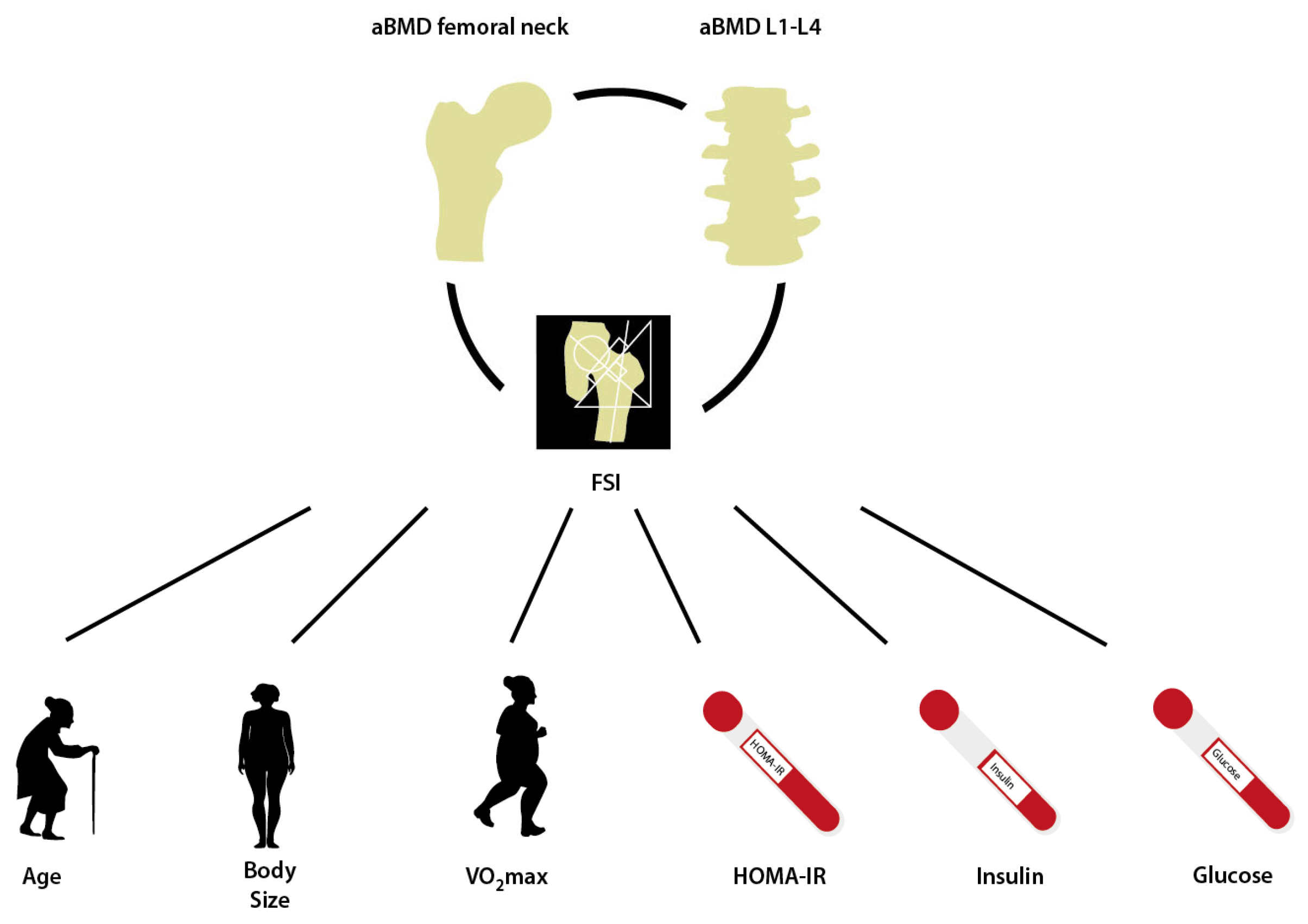
The main analyses were performed using hierarchical multiple linear regression models to examine associations of body size (BMI), aerobic capacity, and carbohydrate metabolism markers with femoral neck aBMD, L1–L4 aBMD, and femur strength index (FSI) (Figure 1). For femoral neck and L1–L4 aBMD, age and BMI were entered in the first block as basic covariates. VO2max was introduced in the second block as an index of aerobic capacity. Markers of carbohydrate metabolism were examined in separate alternative hierarchical models (models A–C) by entering HOMA-IR, insulin, or glucose concentration as an additional block. For FSI, regression models were specified without the initial covariate block, as this index is intrinsically adjusted for age, body height, and body weight. VO2max was entered as the primary predictor, followed by carbohydrate metabolism markers examined in separate alternative models. Because the assumption of normality was not met for several variables, bootstrap procedures (percentile method, 5000 resamples) were applied to both correlation and regression analyses. Multicollinearity was assessed using the variance inflation factor (VIF), with all values remaining below 2. Statistical significance was set at p < 0.05. All analyses were performed using SPSS v20.0 (IBM, Armonk, NY, USA).

2.6. Sample Size

The final sample comprised 57 postmenopausal women. In the analysis, hierarchical multiple linear regression models with forced entry were applied, with a limited number of predictors specified a priori. In each model, the number of predictors was restricted to a maximum of four (body mass index as an indicator of body size, VO2max as an index of aerobic capacity, and one marker of carbohydrate metabolism examined in alternative models). According to commonly cited recommendations for multiple regression analyses (approximately 10–15 observations per predictor), the available sample size was adequate for the specified models. In addition, a supporting power analysis using G*Power v3.1.9.7 (Franz Faul, Christian-Albrechts-Universitat, Kiel, Germany) software, for linear multiple regression and single regression coefficient, indicated that a minimum sample size of 43 participants would be required to detect a medium effect size (f2 = 0.15) at α = 0.05 and power = 0.80. Therefore, the sample size of 57 participants can be considered sufficient to detect moderate associations in the present study.

3. Results

The mean age of the study group was 64.9 ± 4.8 years with a minimum value of 53.2 years and a maximum value of 75 years. Average values of height and body mass amounted to 1.61 m (range: 1.51–1.74 m) and 70.2 kg (range: 41.0–135.4 kg), respectively. BMI for the whole group was 27.3 ± 5.3 kg/m2 on average. The lowest and the highest observed values were 18 kg/m2 and 51 kg/m2, respectively. Detailed basic statistics related to all dependent and independent variables are presented in Table 1.

3.1. Relationships of Femoral Neck aBMD with Age, FM, LBM, VO2max, and Indicators of Carbohydrate Metabolism

BMI, FM and LBM were moderately positively correlated with femoral neck aBMD. Given the overlapping variance among somatic characteristics, BMI was selected as the indicator of body size in further analyses. We also found significantly positive relationships between HOMA-IR, glucose and insulin levels, and femoral neck aBMD. However, these correlations were weak (Table 2).
The results of the hierarchical multiple regression for femoral neck aBMD are presented in Table 3. The introduction of the first block, age and BMI (base model), was statistically significant, explaining 32% of the variance in femoral neck aBMD (F = 12.57, p < 0.001, R2 = 0.318). However, only BMI had a significant impact here. In the second step of the analysis, VO2max was added (VO2max-adjusted model) increasing the explanation of variance by about 6% (R2 = 0.377). The change in the overall model was significant (ΔF = 5.06, p = 0.029). The introduction of the third block with HOMA-IR, insulin or glucose (alternative metabolic models A, B, C, respectively) did not result in a significant increase in the explained variance.

3.2. Relationship of FSI with Age, FM, LBM, VO2max, and Indicators of Carbohydrate Metabolism

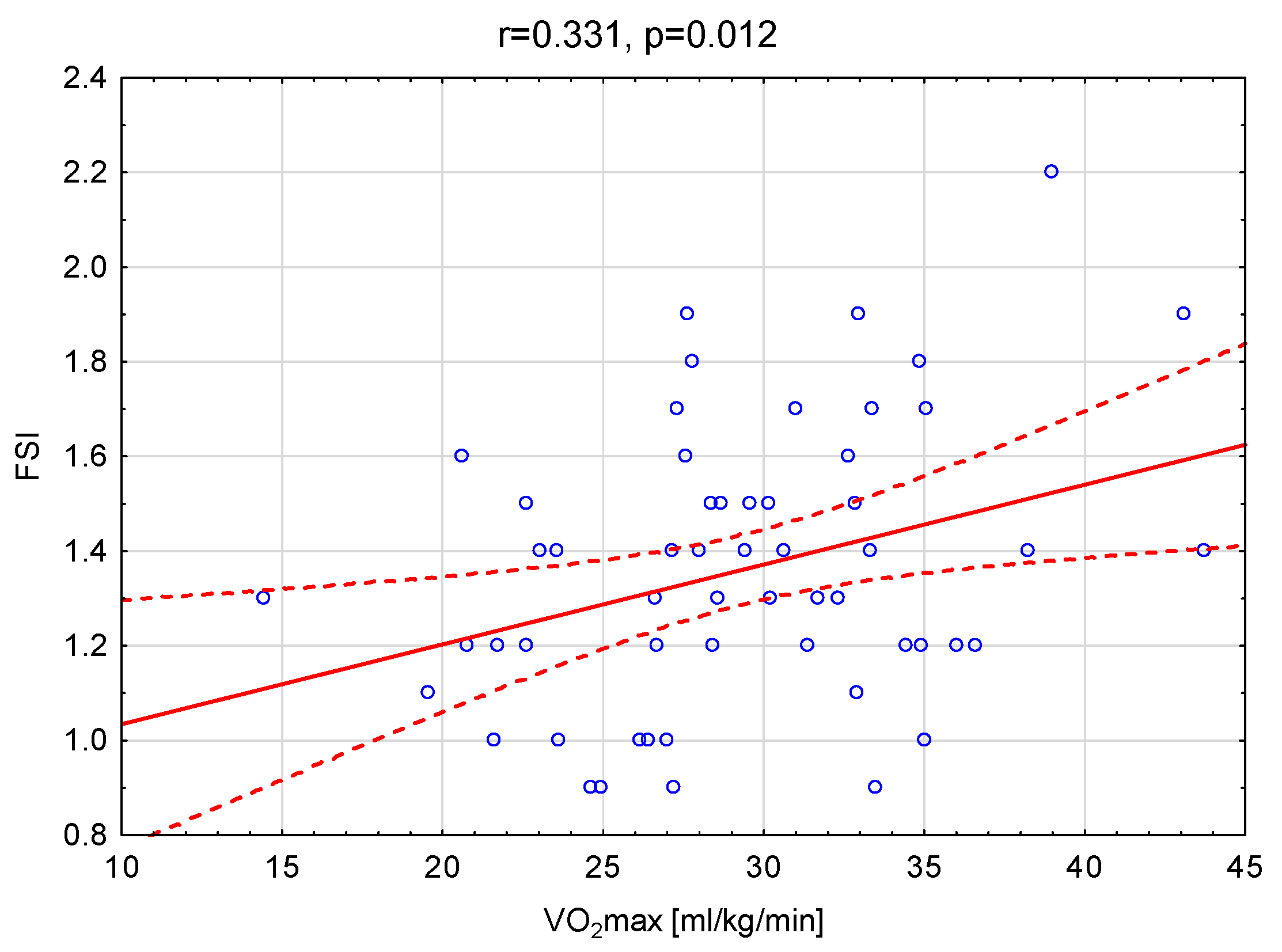
FM showed a negative, and VO2max a positive, association with FSI (Figure 2). Correlation coefficients between variables were statistically significant but weak (Table 2). Because FSI is a measure adjusted for age and body size, VO2max was introduced as the first block in hierarchical regression analysis. The base model (Table 4) was significant (F = 6.77, p = 0.012) and explained approximately 11% of the variance (R2 = 0.110). Alternative metabolic models with HOMA-IR and insulin did not provide any change. In model C, with glucose, the explained variance increased by 6%. However, this change did not reach statistical significance (ΔF = 3.98, p = 0.051).

3.3. Relationship of L1–L4 aBMD with Age, FM, LBM, VO2max, and Indicators of Carbohydrate Metabolism

BMI, FM and LBM were moderately positively correlated with L1–L4 aBMD (Table 2). In the hierarchical multiple regression analysis (Table 5), the base model including age and BMI was significant (F = 8.94, p < 0.001), explaining 24.9% of the variance (R2 = 0.249, adjusted R2 = 0.221). Adjustment for VO2max increased the explained variance by 4% but the change remained insignificant (F = 2.88, p = 0.096). Introducing indicators of carbohydrate metabolism (alternative metabolic models A, B, and C) added less than 1% to approximately 3% of the explained variance and did not result in statistically significant model improvement (p > 0.05).

4. Discussion

In our study on non-diabetic postmenopausal women, we observed that femur bone strength is related to aerobic capacity. In hierarchical models, it was found that femoral neck and L1–L4 aBMD are strongly associated with BMI. These relationships are also confirmed by simple correlations.
We can assume that the positive associations of BMD at both measured regions with BMI, as well as with LBM and FM, may be due to increased mechanical load on the skeleton. Estrogens produced by the adipose tissue, especially in postmenopausal women [6], and carbohydrate metabolism [16] may also play a role. The relationship between body composition and bone health was analyzed in different age groups [35]. However, in studies analyzing older adults, authors have reported that fat mass positively influences bone tissue in non-obese individuals, whereas excessive adiposity is associated with impaired bone quality in obese individuals [36]. Nevertheless, this apparent protective effect of fat mass on bone has been questioned in analyses adjusted for body weight, with several studies reporting no association or even a negative relationship. Moreover, computed tomography showed negative effects of visceral adiposity on bone health [37].
The associations of LBM with both femoral neck and L1–L4 aBMD (Table 2) suggest muscle–bone crosstalk. Muscle may influence bone metabolism by means of several mechanisms, including biomechanical stimulation during physical activity [38]. Moreover, endocrine pathways such as myokines, e.g., irisin, released during muscle activation may play a role in this mechanism [39]. Skeletal muscle remains one of the most plastic of all tissues, with rapid changes in the rates of protein synthesis and degradation in response to physical activity [40]. Therefore, in order to exclude the influence of body weight on the relationship between bone mass with VO2max, we incorporated BMI values into the regression model.
Carbohydrate metabolism markers did not reach statistical significance in the hierarchical regression models but this does not imply the absence of an association with bone-related outcomes per se. The observed bivariate correlations indicate that metabolic indices are related to bone parameters at the unadjusted level. However, these variables did not meet the assumptions of the incremental hypothesis, as they did not explain additional variance beyond that accounted for by earlier predictors included in the models. This pattern suggests that the associations between metabolic markers and bone outcomes may be largely shared with, or mediated by, body size and aerobic capacity rather than representing independent effects.
The positive bivariate associations of insulin levels and HOMA-IR values with femoral neck aBMD suggest that energy metabolism is an important factor in maintaining bone mass [41]. Insulin is involved in the control and maintenance of bone tissue homeostasis—directly through receptors located in bone cells [42] and indirectly through stimulation of the hepatic synthesis of insulin-like growth factor (IGF-1). Both insulin and IGF-1 stimulate bone metabolism by binding to and activating the tyrosine kinase of their respective receptors [43]. Fulzele et al. [44] documented how activation of insulin receptor signaling in osteoblasts induces differentiation and development of said cells and stimulates osteocalcin expression. Aging is an important risk factor for impaired glucose tolerance [45]. Insulin resistance increases with age and several studies have confirmed the existence of those processes at the muscle level [46]. However, in our study, we did not find any associations between age and indicators of carbohydrate metabolism.
The evidence is inconclusive on the relationship between insulin resistance and bone mass [13,14,15]. Our results are partially in line with observations by Fu et al. [16], whose cross-sectional study found similar relationships, but only in the group of subjects with HOMA-IR < 2. In contrast, in the group of people with HOMA-IR ≥ 2, these relationships were negative, and the authors stated that insulin resistance status may play an important role in bone metabolism. Although values of HOMA-IR were higher than 2.0 in most participants in our study (n = 43), we observed positive correlations of insulin concentrations and HOMA-IR with femoral neck aBMD. It should be emphasized that our study participants were non-diabetic. In spite of diabetes being associated with fractures in several regions of the skeleton, the impact of diabetes and subsequent fracture at different sites may vary depending on patient characteristics [47].
In the case of FSI, it is noteworthy that only FSI values, and not aBMD, correlated with VO2max, and this relationship was confirmed in regression analysis. The significant positive association between VO2max and FSI may indicate the importance of lifestyle, mostly aerobic capacity, for maintaining bone health. When examining cardiorespiratory parameters, Aadahl et al. [24] found that VO2max is positively correlated with the amount of daily vigorous physical activity. Therefore, it can be speculated that the measurement of aerobic capacity, especially in the elderly population, may reflect the level of overall physical activity, while a more active lifestyle is important for maintaining femoral bone health. Although the FSI index does not directly reflect the strength of the femoral neck, it expresses its structural properties, which may determine bone strength. In their study conducted in a sample of women above 50 years, Faulkner et al. [27] showed that FSI was a predictor of hip fracture independent of BMD in mostly postmenopausal women. Therefore, we hypothesize that the positive relationship between FSI and VO2max may be the result of the significant impact of general physical activity on bone structure. Interestingly, our study found a negative correlation between FSI and FM, and we can assume that this is due to the effect of FM modification in more active participants, which in turn may be relevant to bone tissue.
We hypothesize that the different directions of FM’s association with aBMD and FSI may result from the fact that FSI expresses the geometrical parameters of femoral bone tissue, which is characterized by a significant proportion of trabecular structure. However, we should interpret this relationship with caution, as the FSI index is calculated during DXA measurement with age, weight, and height adjustments. In order to speculate about the relationship between FM and bone health, it is worth emphasizing that the trabecular bone is filled with bone marrow, which can transmit inflammatory signals from accumulated adipocytes, particularly in obesity and during aging [48]. Some studies have found a positive association between visceral fat and bone marrow adipocytes. It was documented that bone marrow adiposity is related to weaker bone mass and increases after menopause in women (55–65 years of age) [49]. The increased adiposity within the bone marrow exacerbates age-related inflammation and promotes increased secretion of inflammatory cytokines and adipokines, as well as radical oxygen species, and contributes to reduced bone health [50]. However, physical activity may lead to a reduction in bone marrow adiposity [51]. In the animal model, Fonseca et al. [52] observed that the amount of physical activity on the wheel inversely correlated with visceral and bone marrow adiposity, confirming the positive impact of aerobic activity on bone health. In light of their research, it can be concluded that aerobic activity (not only resistance training or dynamic skeletal loads) is also important for bone health.
In future research, it could be interesting to focus on the different directions of aBMD and FSI relationships with adiposity and to consider the possibility of including fat tissue composition when calculating fracture risk in postmenopausal women.
This study has certain limitations. Firstly, it is impossible to distinguish visceral from subcutaneous fat in the DXA measure, so it is difficult to draw conclusions about our results based specifically on data regarding visceral fat. Moreover, we did not use direct measurements of daily physical activity. Instead, we used an aerobic capacity assessment method to predict the participants’ level of activity, with VO2max estimated using the Åstrand–Rhyming submaximal test rather than measured via direct gas exchange due to safety considerations and test feasibility. Information on other confounders such as nutritional factors, vitamin D status, sex hormones and inflammatory markers could also have been included to expand the scope of research. Conducting research on a larger population would increase the value of the study. Regression models should be based on the largest possible sample.

5. Conclusions

Our results suggest that aerobic capacity may be related to the level of femur bone strength. Somatic characteristics and carbohydrate metabolic status appear to play a role in the correlations between femur bone health and VO2max. Our results indicate opposite effects of fat mass on femoral neck aBMD and FSI, which require further research.

Author Contributions

All authors have made substantial contributions to various elements of the study. Conceptualization K.W. and A.N.; Data curation K.W., A.H.-O. and A.N.; Formal analysis K.W., R.S. and A.N.; Investigation K.W., A.H.-O., K.D. and A.N.; Methodology K.W., P.L. and A.N.; Project administration K.W.; Supervision A.N.; Visualization K.W.; Writing—original draft K.W., R.S. and A.N.; Writing—review and editing K.W., R.S. and A.N. All authors have read and agreed to the published version of the manuscript.

Funding

This research did not receive any specific grant from funding agencies in the public, commercial, or not-for-profit sectors.

Institutional Review Board Statement

The study protocol was approved by the Ethics Committee of Poznan University of Medical Sciences (protocol code: 1224/17, approval date: 17 December 2017; protocol code: 245/19, approval date: 7 February 2019). Our study was performed in accordance with the Declaration of Helsinki of the World Medical Association.

Informed Consent Statement

Informed consent was obtained from all subjects involved in the study.

Data Availability Statement

The datasets used and/or analyzed during the current study are available from the corresponding author upon reasonable request.

Acknowledgments

The authors would like to thank Dorota Bukowska for her assistance in the aerobic capacity analysis.

Conflicts of Interest

The authors declare no conflict of interest.

References

  1. Motlani, V.; Motlani, G.; Pamnani, S.; Sahu, A.; Acharya, N. Endocrine changes in postmenopausal women: A comprehensive View. Cureus 2023, 15, e51287. [Google Scholar] [PubMed]
  2. Gurka, M.J.; Vishnu, A.; Santen, R.J.; DeBoer, M.D. Progression of metabolic syndrome severity during the menopausal transition. J. Am. Heart Assoc. 2016, 5, e003609. [Google Scholar] [CrossRef] [PubMed]
  3. Abildgaard, J.; Ploug, T.; Al-Saoudi, E.; Wagner, T.; Thomsen, C.; Ewertsen, C.; Bzorek, M.; Pedersen, B.K.; Pedersen, A.T.; Lindegaard, B. Changes in abdominal subcutaneous adipose tissue phenotype following menopause is associated with increased visceral fat mass. Sci. Rep. 2021, 11, 14750. [Google Scholar] [CrossRef] [PubMed]
  4. Sipilä, S.; Törmäkangas, T.; Sillanpää, E.; Aukee, P.; Kujala, U.M.; Kovanen, V.; Laakkonen, E.K. Muscle and bone mass in middle-aged women: Role of menopausal status and physical activity. J. Cachexia Sarcopenia Muscle 2020, 11, 698–709. [Google Scholar] [CrossRef]
  5. Karlamangla, A.S.; Burnett-Bowie, S.M.; Crandall, C.J. Bone health during the menopause transition and beyond. Obstet. Gynecol. Clin. N. Am. 2018, 45, 695–708. [Google Scholar]
  6. Charoenngam, N.; Apovian, C.M.; Pongchaiyakul, C. Increased fat mass negatively influences femoral neck bone mineral density in men but not women. Front. Endocrinol. 2023, 14, 1035588. [Google Scholar] [CrossRef]
  7. Zillikens, M.C.; Uitterlinden, A.G.; van Leeuwen, J.P.; Berends, A.L.; Henneman, P.; van Dijk, K.W.; Oostra, B.A.; van Duijn, C.M.; Pols, H.A.; Rivadeneira, F. The role of body mass index, insulin, and adiponectin in the relation between fat distribution and bone mineral density. Calcif. Tissue Int. 2010, 86, 116–125. [Google Scholar] [CrossRef]
  8. Gilsanz, V.; Chalfant, J.; Mo, A.O.; Lee, D.C.; Dorey, F.J.; Mittelman, S.D. Reciprocal relations of subcutaneous and visceral fat to bone structure and strength. J. Clin. Endocrinol. Metab. 2009, 94, 3387–3393. [Google Scholar] [CrossRef]
  9. Kang, S.M.; Yoon, J.W.; Ahn, H.Y.; Kim, S.Y.; Lee, K.H.; Shin, H.; Choi, S.H.; Park, K.S.; Jang, H.C.; Lim, S. Android fat depot is more closely associated with metabolic syndrome than abdominal visceral fat in elderly people. PLoS ONE 2011, 6, e27694. [Google Scholar] [CrossRef]
  10. Wu, F.Z.; Wu, C.C.; Kuo, P.L.; Wu, M.T. Differential impacts of cardiac and abdominal ectopic fat deposits on cardiometabolic risk stratification. BMC Cardiovasc. Disord. 2016, 16, 20. [Google Scholar] [CrossRef]
  11. Hilton, C.; Vasan, S.K.; Neville, M.J.; Christodoulides, C.; Karpe, F. The associations between body fat distribution and bone mineral density in the Oxford Biobank: A cross sectional study. Expert Rev. Endocrinol. Metab. 2022, 17, 75–81. [Google Scholar] [CrossRef]
  12. Shirinezhad, A.; Azarboo, A.; Ghaseminejad-Raeini, A.; Kanaani Nejad, F.; Zareshahi, N.; Amiri, S.M.; Tahmasebi, Y.; Hoveidaei, A.H. A systematic review of the association between insulin resistance surrogate indices and bone mineral density. Front. Endocrinol. 2024, 15, 1499479. [Google Scholar] [CrossRef] [PubMed]
  13. Shanbhogue, V.V.; Finkelstein, J.S.; Bouxsein, M.L.; Yu, E.W. Association between insulin resistance and bone structure in nondiabetic postmenopausal women. J. Clin. Endocrinol. Metab. 2016, 101, 3114–3122. [Google Scholar] [CrossRef] [PubMed]
  14. Yang, J.; Hong, N.; Shim, J.S.; Rhee, Y.; Kim, H.C. Association of insulin resistance with lower bone volume and strength index of the proximal femur in nondiabetic postmenopausal women. J. Bone Metab. 2018, 25, 123–132. [Google Scholar] [CrossRef] [PubMed]
  15. Campillo-Sánchez, F.; Usategui-Martín, R.; Ruiz-de Temiño, Á.; Gil, J.; Ruiz-Mambrilla, M.; Fernández-Gómez, J.M.; Dueñas-Laita, A.; Pérez-Castrillón, J.L. Relationship between Insulin Resistance (HOMA-IR), Trabecular Bone Score (TBS), and Three-Dimensional Dual-Energy X-ray Absorptiometry (3D-DXA) in Non-Diabetic Postmenopausal Women. J. Clin. Med. 2020, 9, 1732. [Google Scholar] [CrossRef]
  16. Fu, Y.-H.; Liu, W.-J.; Lee, C.-L.; Wang, J.-S. Associations of insulin resistance and insulin secretion with bone mineral density and osteoporosis in a general population. Front. Endocrinol. 2022, 13, 971960. [Google Scholar] [CrossRef]
  17. Thyfault, J.P.; Bergouignan, A. Exercise and metabolic health: Beyond skeletal muscle. Diabetologia 2020, 63, 1464–1474. [Google Scholar] [CrossRef]
  18. Chang, X.; Xu, S.; Zhang, H. Regulation of bone health through physical exercise: Mechanisms and types. Front. Endocrinol. 2022, 13, 1029475. [Google Scholar] [CrossRef]
  19. Liu, P.; Tu, J.; Wang, W.; Li, Z.; Li, Y.; Yu, X.; Zhang, Z. Effects of mechanical stress stimulation on function and expression mechanism of osteoblasts. Front. Bioeng. Biotechnol. 2022, 10, 830722. [Google Scholar] [CrossRef]
  20. Bateman, L.A.; Slentz, C.A.; Willis, L.H.; Shields, A.T.; Piner, L.W.; Bales, C.W.; Houmard, J.A.; Kraus, W.E. Comparison of aerobic versus resistance exercise training effects on metabolic syndrome (from the studies of a targeted risk reduction intervention through defined exercise—STRRIDE-AT/RT). Am. J. Cardiol. 2011, 108, 838–844. [Google Scholar] [CrossRef]
  21. Sanchez-Trigo, H.; Rittweger, J.; Sañudo, B. Effects of non-supervised exercise interventions on bone mineral density in adult women: A systematic review and meta analysis. Osteoporos. Int. 2022, 33, 1415–1427. [Google Scholar] [CrossRef] [PubMed]
  22. Kitsuda, Y.; Wada, T.; Noma, H.; Osaki, M.; Hagino, H. Impact of high-load resistance training on bone mineral density in osteoporosis and osteopenia: A meta-analysis. J. Bone Miner. Metab. 2021, 39, 787–803. [Google Scholar] [CrossRef] [PubMed]
  23. Korpelainen, R.; Keinänen-Kiukaanniemi, S.; Heikkinen, J.; Väänänen, K.; Korpelainen, J. Effect of impact exercise on bone mineral density in elderly women with low BMD: A population-based randomized controlled 30-month intervention. Osteoporos. Int. 2006, 17, 109–118. [Google Scholar] [CrossRef] [PubMed]
  24. Aadahl, M.; Kjaer, M.; Kristensen, J.H.; Mollerup, B.; Jørgensen, T. Self-reported physical activity compared with maximal oxygen uptake in adults. Eur. J. Cardiovasc. Prev. Rehabil. 2007, 14, 422–428. [Google Scholar] [CrossRef]
  25. Wochna, K.; Nowak, A.; Huta-Osiecka, A.; Sobczak, K.; Kasprzak, Z.; Leszczyński, P. Bone mineral density and bone turnover markers in postmenopausal women subjected to an aqua fitness training program. Int. J. Environ. Res. Public Health 2019, 16, 2505. [Google Scholar] [CrossRef]
  26. Wochna, K.; Ogurkowska, M.; Leszczyński, P.; Stemplewski, R.; Huta-Osiecka, A.; Błaszczyk, A.; Mączyński, J.; Nowak, A. Nordic walking with an integrated resistance shock absorber affects the femur strength and muscles torques in postmenopausal women. Sci. Rep. 2022, 12, 20089. [Google Scholar] [CrossRef]
  27. Faulkner, K.G.; Wacker, W.K.; Barden, H.S.; Simonelli, C.; Burke, P.K.; Ragi, S.; Del Rio, L. Femur strength index predicts hip fracture independent of bone density and hip axis length. Osteoporos. Int. 2006, 17, 593–599. [Google Scholar] [CrossRef]
  28. Huta-Osiecka, A.; Wochna, K.; Stemplewski, R.; Marciniak, K.; Podgórski, T.; Kasprzak, Z.; Leszczyński, P.; Nowak, A. Influence of Nordic walking with poles with an integrated resistance shock absorber on carbohydrate and lipid metabolic indices and white blood cell subpopulations in postmenopausal women. PeerJ 2022, 10, e13643. [Google Scholar] [CrossRef]
  29. Matthews, D.R.; Hosker, J.P.; Rudenski, A.S.; Naylor, B.A.; Treacher, D.F.; Turner, R.C. Homeostasis model assessment: Insulin resistance and beta-cell function from fasting plasma glucose and insulin concentrations in man. Diabetologia 1985, 28, 412–419. [Google Scholar] [CrossRef]
  30. Domaszewska, K.; Koper, M.; Wochna, K.; Czerniak, U.; Marciniak, K.; Wilski, M.; Bukowska, D. The effects of nordic walking with poles with an integrated resistance shock absorber on cognitive abilities and cardiopulmonary efficiency in postmenopausal women. Front. Aging Neurosci. 2020, 12, 586286. [Google Scholar] [CrossRef]
  31. Gillett, P.A. Senior women’s fitness project: A pilot study. J. Women Aging 1993, 5, 49–66. [Google Scholar] [CrossRef]
  32. Astrand, P.O.; Ryhming, I. A nomogram for calculation of aerobic capacity (physical fitness) from pulse rates during submaximal work. J. Appl. Physiol. 1954, 7, 218–221. [Google Scholar] [CrossRef] [PubMed]
  33. Hoehn, A.M.; Mullenbach, M.J.; Fountaine, C.J. Actual versus predicted cardiovascular demands in submaximal cycle ergometer testing. Int. J. Exerc. Sci. 2015, 8, 4–10. [Google Scholar] [CrossRef] [PubMed]
  34. Väisänen, D.; Ekblom, B.; Wallin, P.; Andersson, G.; Ekblom-Bak, E. Reference values for estimated VO2max by two submaximal cycle tests: The Åstrand-test and the Ekblom-Bak test. Eur. J. Appl. Physiol. 2024, 124, 1747–1756. [Google Scholar] [CrossRef] [PubMed]
  35. Sulis, S.; Falbová, D.; Beňuš, R.; Švábová, P.; Hozáková, A.; Vorobeľová, L. Sex and Obesity-Specific Associations of Ultrasound-Assessed Radial Velocity of Sound with Body Composition. Appl. Sci. 2024, 14, 7319. [Google Scholar] [CrossRef]
  36. Xu, H.; Wang, Z.; Meng, X.H.; Zhu, F.L.; Zhong, Y.Q. Associations between abdominal fat, psoas muscle fat, and lumbar spine bone density: Insights from quantitative CT imaging. BMC Musculoskelet. Disord. 2025, 26, 325. [Google Scholar] [CrossRef]
  37. Sheu, Y.; Cauley, J.A. The role of bone marrow and visceral fat on bone metabolism. Curr. Osteoporos. Rep. 2011, 9, 67–75. [Google Scholar] [CrossRef]
  38. Laurent, M.R.; Dubois, V.; Claessens, F.; Verschueren, S.M.; Vanderschueren, D.; Gielen, E.; Jardí, F. Muscle-bone interactions: From experimental models to the clinic? A critical update. Mol. Cell. Endocrinol. 2016, 432, 14–36. [Google Scholar] [CrossRef]
  39. Nowak, A.; Ogurkowska, M. Bone health and physical activity—The complex mechanism. Aging Dis. 2024, 16, 3400–3420. [Google Scholar] [CrossRef]
  40. Evans, W.J.; Guralnik, J.; Cawthon, P.; Appleby, J.; Landi, F.; Clarke, L.; Vellas, B.; Ferrucci, L.; Roubenoff, R. Sarcopenia: No consensus, no diagnostic criteria, and no approved indication-How did we get here? Geroscience 2024, 46, 183–190. [Google Scholar] [CrossRef]
  41. Veldhuis-Vlug, A.G.; Fliers, E.; Bisschop, P.H. Bone as a regulator of glucose metabolism. Neth. J. Med. 2013, 71, 396–400. [Google Scholar]
  42. Akune, T.; Ogata, N.; Hoshi, K.; Kubota, N.; Terauchi, Y.; Tobe, K.; Takagi, H.; Azuma, Y.; Kadowaki, T.; Nakamura, K.; et al. Insulin receptor substrate-2 maintains predominance of anabolic function over catabolic function of osteoblasts. J. Cell Biol. 2002, 159, 147–156. [Google Scholar] [CrossRef]
  43. Wong, S.K.; Mohamad, N.V.; Jayusman, P.A.; Ibrahim, N. A review on the crosstalk between insulin and wnt/β-catenin signalling for bone health. Int. J. Mol. Sci. 2023, 24, 12441. [Google Scholar] [CrossRef]
  44. Fulzele, K.; Riddle, R.C.; DiGirolamo, D.J.; Cao, X.; Wan, C.; Chen, D.; Faugere, M.C.; Aja, S.; Hussain, M.A.; Brüning, J.C.; et al. Insulin receptor signaling in osteoblasts regulates postnatal bone acquisition and body composition. Cell 2010, 142, 309–319. [Google Scholar] [CrossRef] [PubMed]
  45. Gong, Z.; Muzumdar, R.H. Pancreatic function, type 2 diabetes, and metabolism in aging. Int. J. Endocrinol. 2012, 2012, 320482. [Google Scholar] [CrossRef] [PubMed]
  46. Guillet, C.; Boirie, Y. Insulin resistance: A contributing factor to age-related muscle mass loss? Diabetes Metab. 2005, 2, 5S20–5S26. [Google Scholar] [CrossRef] [PubMed]
  47. Wang, H.; Ba, Y.; Xing, Q.; Du, J.L. Diabetes mellitus and the risk of fractures at specific sites: A meta-analysis. BMJ Open 2019, 9, e024067. [Google Scholar] [CrossRef]
  48. Pluijm, S.M.; Visser, M.; Smit, J.H.; Popp-Snijders, C.; Roos, J.C.; Lips, P. Determinants of bone mineral density in older men and women: Body composition as mediator. J. Bone Miner. Res. 2001, 16, 2142–2151. [Google Scholar] [CrossRef]
  49. Aparisi Gómez, M.P.; Ayuso Benavent, C.; Simoni, P.; Aparisi, F.; Guglielmi, G.; Bazzocchi, A. Fat and bone: The multiperspective analysis of a close relationship. Quant. Imaging Med. Surg. 2020, 10, 1614–1635. [Google Scholar] [CrossRef]
  50. Aaron, N.; Costa, S.; Rosen, C.J.; Qiang, L. The implications of bone marrow adipose tissue on inflammaging. Front. Endocrinol. 2022, 13, 853765. [Google Scholar] [CrossRef]
  51. Pagnotti, G.M.; Styner, M. Exercise regulation of marrow adipose tissue. Front. Endocrinol. 2016, 7, 94. [Google Scholar] [CrossRef]
  52. Fonseca, H.; Bezerra, A.; Coelho, A.; Duarte, J.A. Association between visceral and bone marrow adipose tissue and bone quality in sedentary and physically active ovariectomized wistar rats. Life 2021, 11, 478. [Google Scholar] [CrossRef]
Figure 1. Graphical conceptualization of analyzed variables.
Applsci 16 02338 g001
Figure 2. Correlation between femur strength index (FSI) and maximum oxygen uptake (VO2max) (solid line—regression line, dashed lines—95% confidence intervals, circles—values).
Applsci 16 02338 g002
Table 1. Means, standard deviations, confidence intervals, and minimum and maximum values for the analyzed variables.
x ¯ ± S D Bootstrap 95% CIMin–Max
Age [years]64.9 ± 4.863.6–66.153.2–75.0
AgeMP [years]49.95 ± 4.5548.81–51.1840–60
BMI27.28 ± 5.3325.98–28.7518–51
LBM [kg]40.53 ± 6.3838.95–42.3329.51–67.24
FM [kg]28.10 ± 9.6725.67–30.617.10–64.30
VO2max [mL/kg/min]29.38 ± 5.7327.91–30.8714.41–43.71
Glucose [mmol/L]5.22 ± 0.665.06–5.404.18–7.31
Insulin [IU/mL]14.61 ± 7.2612.75–16.611.80–37.74
HOMA-IR3.44 ± 1.852.96–3.940.40–9.59
Femoral neck aBMD [g/cm2]0.84 ± 0.110.82–0.870.65–1.16
FSI1.36 ± 0.291.29–1.440.90–2.20
L1–L4 aBMD [g/cm2]1.05 ± 0.171.01–1.100.77–1.53
AgeMP—age of menopause; BMI—body mass index; LBM—lean body mass; FM—fat mass; VO2max—maximum oxygen uptake; aBMD—areal bone mineral density; FSI—femur strength index; HOMA-IR—insulin resistance index.
Table 2. Relationships of age, age of menopause, BMI, FM, LBM, VO2max, glucose, insulin, HOMA-IR with femoral neck aBMD, FSI and L1–L4 aBMD (Pearson’s correlation coefficient r values with bootstrap 95% confidence intervals) (n = 57).
VariablesaBMD Femoral NeckFSIaBMD L1–L4
r (p)Bootstrap 95% CIr (p)Bootstrap 95% CIr (p)Bootstrap 95% CI
Age [years]−0.098 (0.468)−0.412–0.226−0.026 (0.850)−0.265–0.226−0.142 (0.292)−0.408–0.158
AgeMP [years]0.081 (0.549)−0.143–0.305−0.046 (0.734)−0.281–0.2050.207 (0.123)−0.026–0.407
BMI [kg/m2]0.562 (0.000)0.357–0.720−0.223 (0.095)−0.436–−0.0440.489 (0.000)0.200–0.682
LBM [kg]0.619 (0.000)0.393–0.773−0.189 (0.159)−0.363–−0.0180.466 (0.000)0.149–0.682
FM [kg]0.541 (0.000)0.293–0.700−0.318 (0.016)−0.520–−0.1420.445 (0.001)0.142–0.652
VO2max [mL/kg/min]−0.050 (0.711)−0.324–0.2590.331 (0.012)0.087–0.542−0.052 (0.701)−0.320–0.247
Glucose [mmol/L]0.264 (0.048)0.037–0.4940.107 (0.428)−0.185–0.3740.215 (0.108)−0.002–0.434
Insulin [μIU/mL]0.298 (0.024)0.012–0.521−0.123 (0.363)−0.335–0.0950.110 (0.416)−0.212–0.384
HOMA-IR0.336 (0.010)0.074–0.537−0.085 (0.531)−0.288–0.1230.152 (0.259)−0.167–0.427
r—correlation coefficient; CI—confidence intervals; AgeMP—age of menopause; BMI—body mass index; LBM—lean body mass; FM—fat mass; VO2max—maximum oxygen uptake; HOMA-IR—insulin resistance index.
Table 3. Hierarchical regression models examining associations of body size, VO2max, and metabolic indices with femoral neck areal bone mineral density (n = 57).
ModelPredictorRegression CoefficientsVIFModel F (p)adj. R2R2Change R2Change F (p)
BetaB (Bootstrap 95% CI)
Base modelAge [year]−0.046−0.001 (−0.007, 0.005)1.0112.57 (0.000)0.2920.3180.31812.57 (0.000)
BMI [kg/m2]0.5570.012 (0.007, 0.019)1.01
VO2max-adjusted modelAge [year]−0.0180.000 (−0.006, 0.005)1.0210.69 (0.000)0.3420.3770.0595.06 (0.029)
BMI [kg/m2]0.6930.015 (0.009, 0.021)1.32
VO2max
[mL/kg/min]
0.2790.005 (0.001, 0.010)1.31
Alternative metabolic model AAge [year]−0.026−0.001 (−0.007, 0.005)1.057.95 (0.000)0.3320.3790.0020.207 (0.651)
BMI [kg/m2]0.6560.014 (0.008, 0.020)1.87
VO2max
[mL/kg/min]
0.2980.006 (0.000, 0.011)1.45
HOMA−IR0.0700.004 (−0.013, 0.023)1.97
Alternative
metabolic model B
Age [year]−0.0200.000 (−0.006, 0.005)1.067.87 (0.000)0.3290.3770.0000.010 (0.919)
BMI [kg/m2]0.6850.014 (0.009, 0.020)1.80
VO2max
[mL/kg/min]
0.2820.005 (0.000, 0.011)1.40
Insulin [μIU/mL]0.0150.000 (−0.004, 0.005)1.79
Alternative metabolic model CAge [year]−0.0210.000 (−0.007, 0.005)1.028.37 (0.000)0.3450.3920.0151.25 (0.269)
BMI [kg/m2]0.6580.014 (0.008, 0.021)1.40
VO2max
[mL/kg/min]
0.3120.006 (0.001, 0.011)1.39
Glucose [mmol/L]0.1340.023 (−0.014, 0.057)1.23
CI—confidence intervals; BMI—body mass index; VO2max—maximum oxygen uptake; models A, B, and C represent alternative hierarchical regression models examining carbohydrate metabolism using HOMA-IR, insulin concentration, or glucose concentration, respectively.
Table 4. Hierarchical regression models examining associations of VO2max and metabolic indices with femur strength index (n = 57).
ModelPredictorRegression CoefficientsVIFModel F (p)adj. R2R2Change R2Change F (p)
BetaB (Bootstrap 95% CI)
Base modelVO2max [mL/kg/min]0.3310.017 (0.004, 0.031)1.06.77 (0.012)0.0930.1100.1106.77 (0.012)
Alternative metabolic model AVO2max [mL/kg/min]0.3950.020 (0.003, 0.036)1.383.70 (0.031)0.0880.1210.0110.67 (0.417)
HOMA-IR0.1230.019 (−0.026, 0.066)1.38
Alternative metabolic model BVO2max [mL/kg/min]0.3530.018 (0.001, 0.034)1.303.38 (0.041)0.0780.1110.0020.10 (0.754)
Insulin [μIU/mL]0.0460.002 (−0.009, 0.014)1.30
Alternative metabolic model CVO2max [mL/kg/min]0.4290.022 (0.008, 0.037)1.165.556 (0.006)0.1400.1710.0613.98 (0.051)
Glucose [mmol/L]0.2660.118 (−0.013, 0.224)1.16
CI—confidence intervals; VO2max—maximum oxygen uptake; models A, B, and C represent alternative hierarchical regression models examining carbohydrate metabolism using HOMA-IR, insulin concentration, or glucose concentration, respectively.
Table 5. Hierarchical regression models examining associations of body size, VO2max, and metabolic indices with lumbar spine (L1–L4) areal bone mineral density (n = 57).
ModelPredictorRegression CoefficientsVIFModel F (p)adj. R2R2Change R2Change F (p)
BetaB (Bootstrap 95% CI)
Base modelAge [year]−0.097−0.003 (−0.011, 0.04)1.018.94 (0.000)0.2210.2490.2498.94 (0.000)
BMI [kg/m2]0.4800.015 (0.008, 0.024)1.01
VO2max-
adjusted model
Age [year]−0.075−0.003 (−0.011, 0.005)1.027.13 (0.000)0.2470.2870.0392.88 (0.096)
BMI [kg/m2]0.5900.019 (0.010, 0.028)1.32
VO2max [mL/kg/min]0.2250.007 (0.000, 0.013)1.31
Alternative metabolic model AAge [year]−0.051−0.002 (−0.010, 0.006)1.055.83 (0.001)0.2570.3100.0221.67 (0.202)
BMI [kg/m2]0.7010.022 (0.012, 0.033)1.87
VO2max [mL/kg/min]0.1700.005 (−0.004, 0.013)1.49
HOMA-IR−0.209−0.019 (−0.053, 0.014)1.97
Alternative metabolic model BAge [year]−0.040−0.001 (−0.010, 0.006)1.066.14 (0.000)0.2680.3210.0332.54 (0.117)
BMI [kg/m2]0.7160.023 (0.012, 0.034)1.80
VO2max [mL/kg/min]0.1710.005 (−0.001, 0.013)1.40
Insulin [μIU/mL]−0.243−0.006 (−0.014, 0.003)1.79
Alternative metabolic model CAge [year]−0.077−0.003 (−0.011, 0.005)1.025.45 (0.001)0.2410.2950.0080.57 (0.453)
BMI [kg/m2]0.5650.018 (0.008, 0.027)1.40
VO2max [mL/kg/min]0.2490.007 (0.000, 0.015)1.39
Glucose [mmol/L]0.0980.025 (−0.025, 0.096)1.23
CI—confidence intervals; BMI—body mass index; VO2max—maximum oxygen uptake; models A, B, and C represent alternative hierarchical regression models examining carbohydrate metabolism using HOMA-IR, insulin concentration, or glucose concentration, respectively.
Disclaimer/Publisher’s Note: The statements, opinions and data contained in all publications are solely those of the individual author(s) and contributor(s) and not of MDPI and/or the editor(s). MDPI and/or the editor(s) disclaim responsibility for any injury to people or property resulting from any ideas, methods, instructions or products referred to in the content.