Artificial Intelligence–Enabled Dementia Risk Prediction for Smart and Sustainable Healthcare: An Interpretable Machine Learning Study Using NHATS


Abstract
1. Introduction
2. Related Work
2.1. Machine Learning–Based Dementia Risk Prediction
2.2. Behavioral, Social, and Digital Predictors
2.3. Explainable AI and Longitudinal Cohorts
2.4. Study Contributions
2.4.1. Integrated Interpretable ML Framework
2.4.2. Emphasis on Modifiable, Non-Clinical Predictors
2.4.3. Cross-Model Interpretability and Predictor Stability
2.4.4. Applied and Translational Contribution
- RQ1. Do modifiable behavioral and technological factors improve dementia risk prediction when combined with demographic and health-related variables in a longitudinal setting?
- RQ2. How do commonly used ML algorithms compare in predictive performance and calibration within an interpretable framework?
- RQ3. Which predictors consistently emerge as influential across models, and how stable are these signals?
- RQ4. How effectively can explainable ML methods support transparent and prevention-oriented dementia risk assessment?
3. Materials and Methods
3.1. Dataset Source and Study Sample
3.2. Outcome Variable (Dementia Onset)
3.3. Predictor Variables and Feature Engineering
3.4. Feature Engineering and Data Preparation
3.5. Rationale for Algorithm Selection
4. ML Pipeline and Model Implementation
4.1. ML Algorithms
4.2. Training Procedure and Cross-Validation
4.3. Class Imbalance Handling
4.4. Performance Evaluation Metrics
4.5. Model Development and Validation
4.5.1. Data Preprocessing
4.5.2. Models and Training Procedure
4.5.3. Performance Evaluation
4.5.4. Reproducibility and Interpretability
5. Hypotheses
5.1. Hypothesis 1 (H1): Behavioral and Technological Predictors
5.2. Hypothesis 2 (H2): Model Performance Relative to Random Baseline
5.3. Hypothesis 3 (H3): Feature Importance Patterns Across Models
- H0: Feature importance values do not significantly differ across models.
- H1: At least one model assigns significantly different importance rankings to predictors.
- H0: Behavioral and technological features such as technology use, how often people go outside, and the size of social networks are not consistently ranked as the top features.
- H1: These modifiable predictors consistently appear among the top-ranked features across all models.
5.4. Hypothesis 4 (H4): Cross-Model Calibration Differences
- H0: All models provide equally calibrated predictions (no difference in Brier scores).
- H1: At least one model provides better calibration (lower Brier score).
6. Results and Analysis
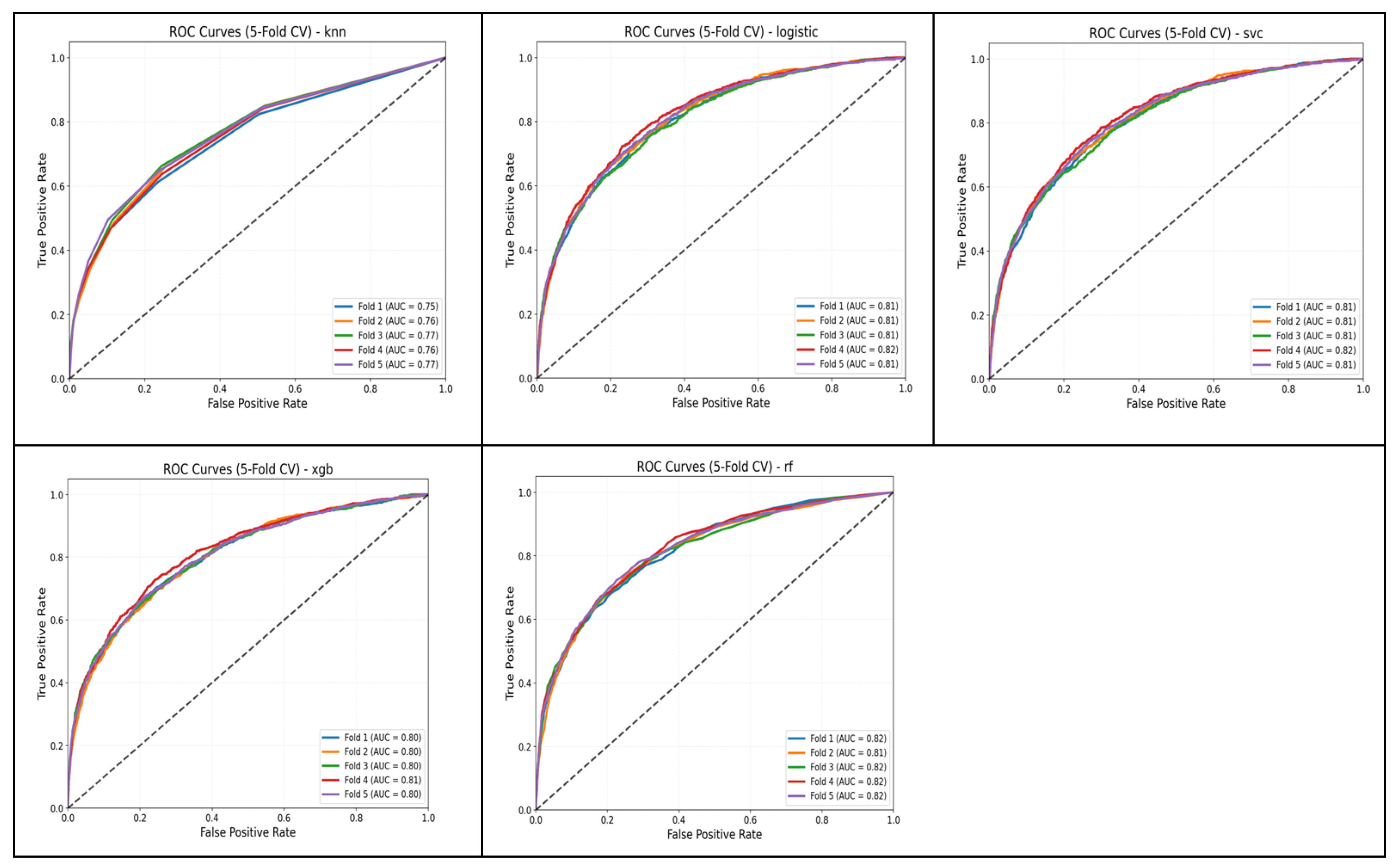
6.1. Model Performance Comparison
6.2. Statistical Testing
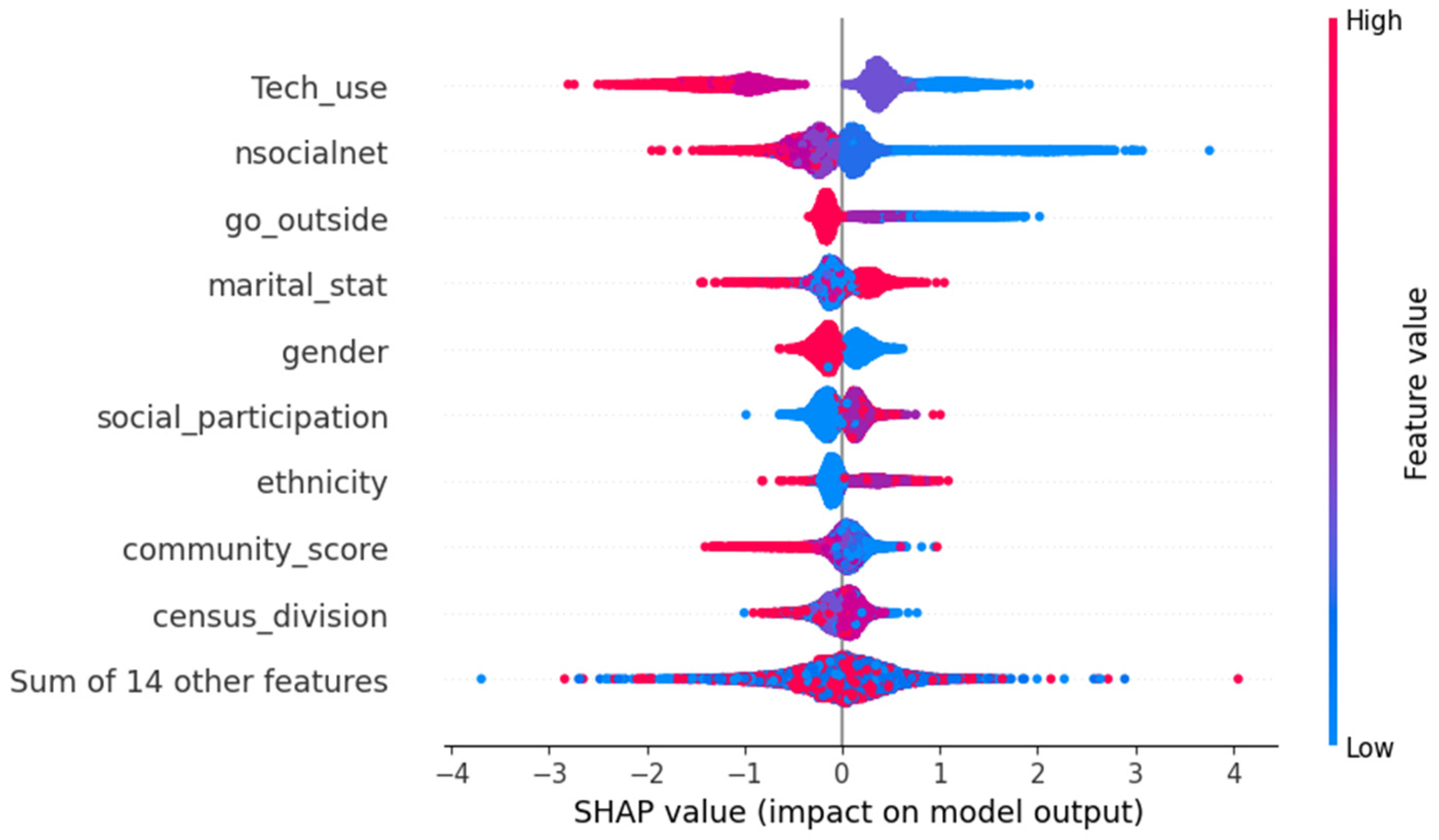
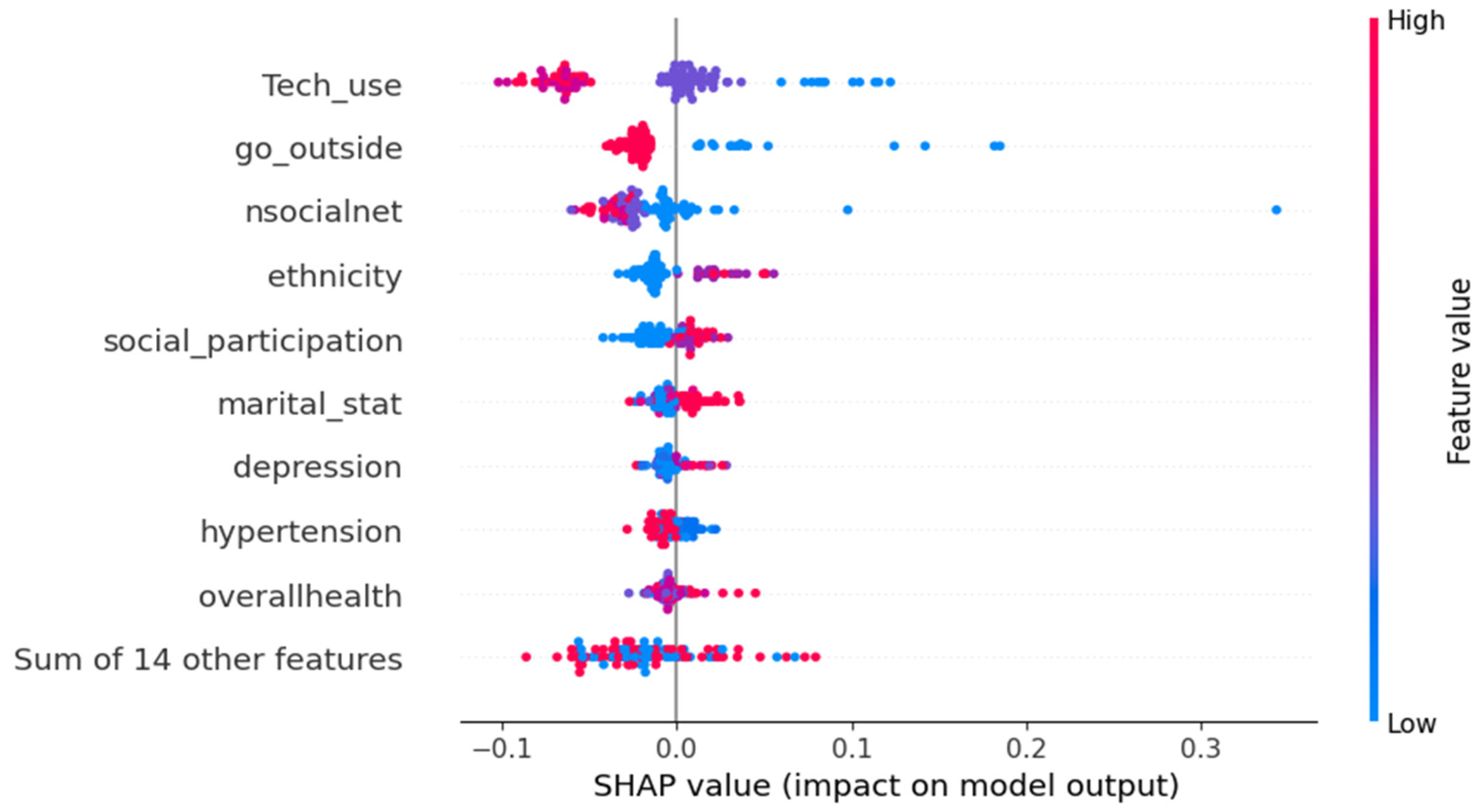
6.2.1. Model Interpretability
6.2.2. Hypothesis 1 (H1): Behavioral/Social Predictors and Dementia Risk
6.2.3. Hypothesis 2 (H2): Model Performance vs. Chance
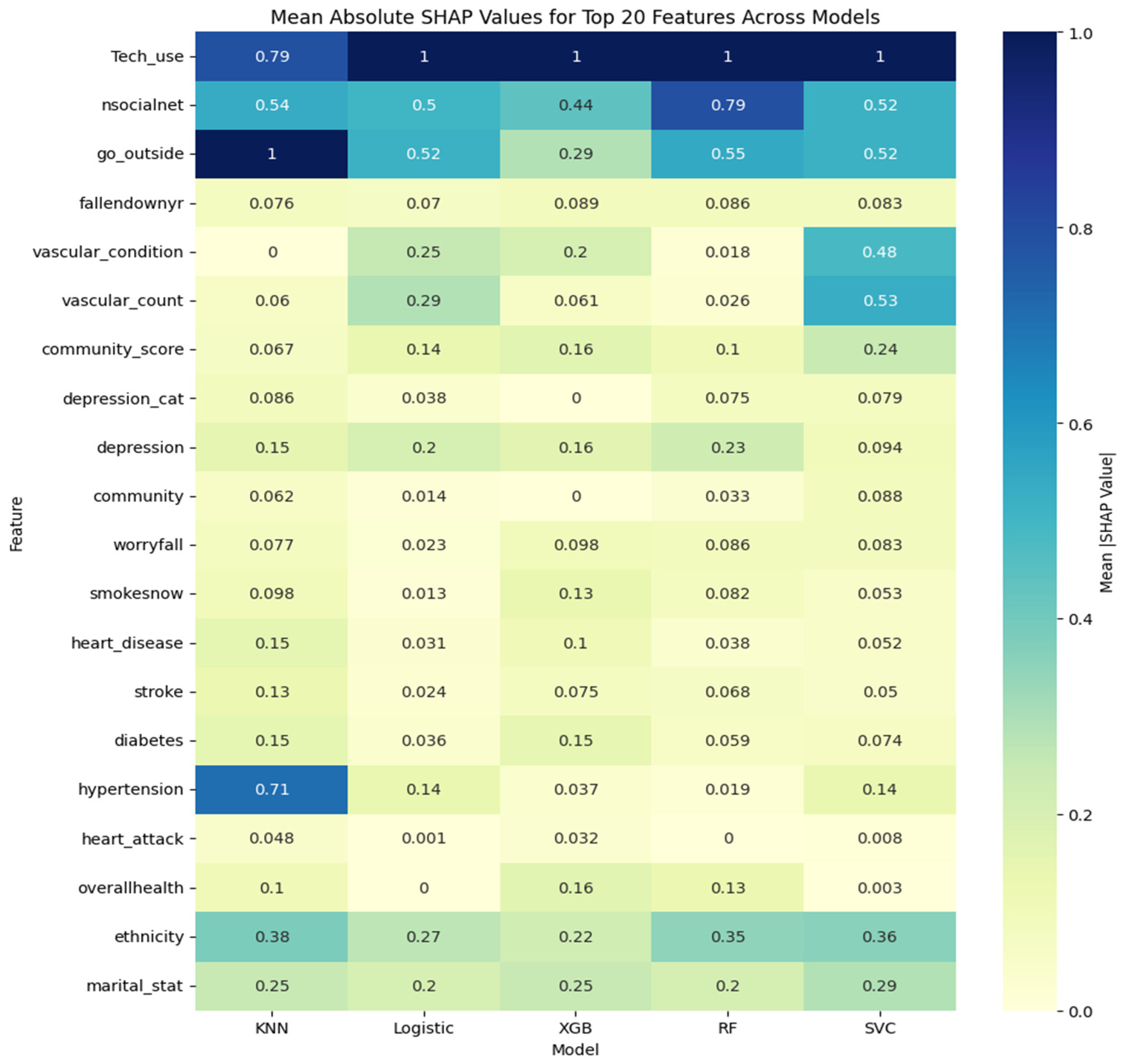
6.2.4. Hypothesis 3 (H3): Variation and Consistency in Feature Importance
6.2.5. Hypothesis 4 (H4): Differences in Predictive Performance
7. Discussion
7.1. Behavioral, Social, and Technology-Related Factors Associated with Dementia
7.2. Comparative Performance of ML Models
7.3. Key Predictors of Cognitive Decline Across Models
7.4. Implications for Interpretable and Actionable Dementia Risk Assessment
7.5. Limitations and Future Research
8. Conclusions
Author Contributions
Funding
Institutional Review Board Statement
Data Availability Statement
Conflicts of Interest
Abbreviations
| Abbreviation | Full Term |
| AI | Artificial Intelligence |
| AUC | Area Under the Receiver Operating Characteristic Curve |
| Brier | Brier Score |
| CV | Cross-Validation |
| F1 | F1 Score |
| ICT | Information and Communication Technology |
| KNN | K-Nearest Neighbors |
| LR | Logistic Regression |
| ML | Machine Learning |
| NHATS | National Health and Aging Trends Study |
| PR | Precision–Recall |
| RF | Random Forest |
| ROC | Receiver Operating Characteristic |
| SHAP | SHapley Additive exPlanations |
| SVM | Support Vector Machine |
| XGBoost | eXtreme Gradient Boosting |
References
- Dementia. Available online: https://www.who.int/news-room/fact-sheets/detail/dementia (accessed on 17 May 2025).
- Nichols, E.; Steinmetz, J.D.; Vollset, S.E.; Fukutaki, K.; Chalek, J.; Abd-Allah, F.; Abdoli, A.; Abualhasan, A.; Abu-Gharbieh, E.; Akram, T.T.; et al. Estimation of the global prevalence of dementia in 2019 and forecasted prevalence in 2050: An analysis for the Global Burden of Disease Study 2019. Lancet Public Health 2022, 7, e105–e125. [Google Scholar] [CrossRef]
- Barrett, J.P.; Olivari, B.S.; Price, A.B.; Taylor, C.A. Cognitive decline and dementia risk reduction: Promoting healthy lifestyles and blood pressure control. Am. J. Prev. Med. 2021, 61, e157–e160. [Google Scholar] [CrossRef]
- Li, J.; Pandian, V.; Davidson, P.M.; Song, Y.; Chen, N.; Fong, D.Y.T. Burden and attributable risk factors of non-communicable diseases and subtypes in 204 countries and territories, 1990–2021: A systematic analysis for the Global Burden of Disease Study 2021. Int. J. Surg. 2025, 111, 2385–2397. [Google Scholar] [CrossRef] [PubMed]
- Brain, J.; Kafadar, A.H.; Errington, L.; Kirkley, R.; Tang, E.Y.; Akyea, R.K.; Bains, M.; Brayne, C.; Figueredo, G.; Greene, L.; et al. What’s new in dementia risk prediction modelling? An updated systematic review. Dement. Geriatr. Cogn. Disord. Extra 2024, 14, 49–74. [Google Scholar] [CrossRef] [PubMed]
- Walters, K.; Hardoon, S.; Petersen, I.; Iliffe, S.; Omar, R.Z.; Nazareth, I.; Rait, G. Predicting dementia risk in primary care: Development and validation of the dementia risk score using routinely collected data. BMC Med. 2016, 14, 6. [Google Scholar] [CrossRef]
- Vermeulen, R.J.; Andersson, V.; Banken, J.; Hannink, G.; Govers, T.M.; Rovers, M.M.; Rikkert, M.G. Limited generalizability and high risk of bias in multivariable models predicting conversion risk from mild cognitive impairment to dementia: A systematic review. Alzheimer’s Dement. 2025, 21, e70069. [Google Scholar] [CrossRef]
- Rudin, C. Stop explaining black box machine learning models for high-stakes decisions and use interpretable models instead. Nat. Mach. Intell. 2019, 1, 206–215. [Google Scholar] [CrossRef]
- Obermeyer, Z.; Emanuel, E.J. Predicting the future—Big data, machine learning, and clinical medicine. N. Engl. J. Med. 2016, 375, 1216–1219. [Google Scholar] [CrossRef] [PubMed]
- Veronese, N.; Bolzetta, F.; Gallo, L.; Durante, G.; Vernuccio, L.; Saccaro, C.; Gambino, C.M.; Custodero, C.; Portincasa, P.; Morotti, A.; et al. Clinical prediction models using artificial intelligence approaches in dementia. Aging Clin. Exp. Res. 2025, 37, 233. [Google Scholar] [CrossRef]
- Martin, S.A.; Townend, F.J.; Barkhof, F.; Cole, J.H. Interpretable machine learning for dementia: A systematic review. Alzheimer’s Dement. 2023, 19, 2135–2149. [Google Scholar] [CrossRef]
- Piolatto, M.; Bianchi, F.; Rota, M.; Marengoni, A.; Akbaritabar, A.; Squazzoni, F. The effect of social relationships and cognitive decline in older adults: A systematic review and meta-analysis. BMC Public Health 2022, 22, 278. [Google Scholar] [CrossRef]
- Floud, S.; Balkwill, A.; Sweetland, S.; Brown, A.; Reus, E.M.; Hofman, A.; Blacker, D.; Kivimaki, M.; Green, J.; Peto, R.; et al. Cognitive and social activities and long-term dementia risk. Lancet Public Health 2021, 6, e116–e123. [Google Scholar] [CrossRef]
- Stern, Y. Cognitive reserve in ageing and Alzheimer’s disease. Lancet Neurol. 2012, 11, 1006–1012. [Google Scholar] [CrossRef] [PubMed]
- Benge, J.F.; Scullin, M.K. Technology use and cognitive aging: A meta-analysis. Nat. Hum. Behav. 2025, 9, 1405–1419. [Google Scholar] [CrossRef]
- Deng, C.; Shen, N.; Li, G.; Zhang, K.; Yang, S. Digital isolation and dementia risk in older adults: A longitudinal cohort study. J. Med. Internet Res. 2025, 27, e65379. [Google Scholar] [CrossRef]
- Lundberg, S.M.; Allen, P.G.; Lee, S.-I. A Unified Approach to Interpreting Model Predictions. Available online: https://github.com/slundberg/shap (accessed on 17 May 2025).
- Kavitha, C.; Mani, V.; Srividhya, S.R.; Khalaf, O.I.; Tavera Romero, C.A. Early-stage Alzheimer’s disease prediction using machine learning. Front. Public Health 2022, 10, 853294. [Google Scholar] [CrossRef]
- Hossain, M.K.; Ashraf, A.; Islam, M.M.; Sourav, S.H.; Shimul, M.M.H. Optimizing Alzheimer’s disease prediction through ensemble learning and feature interpretability with SHAP-based feature analysis. Alzheimer’s Dement. Diagn. Assess. Dis. Monit. 2025, 17, e70162. [Google Scholar] [CrossRef]
- Fernández-Blázquez, M.A.; Ruiz-Sánchez de León, J.M.; Sanz-Blasco, R.; Verche, E.; Ávila-Villanueva, M.; Gil-Moreno, M.J.; Montenegro-Peña, M.; Terrón, C.; Fernández-García, C.; Gómez-Ramírez, J. XGBoost models based on non-imaging features for the prediction of mild cognitive impairment in older adults. Sci. Rep. 2025, 15, 29732. [Google Scholar] [CrossRef] [PubMed]
- D’Amour, A.; Heller, K.; Moldovan, D.; Adlam, B.; Alipanahi, B.; Beutel, A.; Chen, C.; Deaton, J.; Eisenstein, J.; Hoffman, M.D.; et al. Underspecification presents challenges for credibility in modern machine learning. J. Mach. Learn. Res. 2022, 23, 1–61. [Google Scholar]
- Carvalho, D.V.; Pereira, E.M.; Cardoso, J.S. Machine learning interpretability: A survey on methods and metrics. Electronics 2019, 8, 832. [Google Scholar] [CrossRef]
- Ahmmad, M.R.; Hossain, E.; Khan, M.T.F.; Paudel, S. Using Machine learning to identify risk factors for Alzheimer’s disease among older adults in the United States. J. Alzheimer’s Dis. Rep. 2025, 9, 25424823251377691. [Google Scholar] [CrossRef] [PubMed]
- Gu, Z.; Liu, S.; Ma, H.; Long, Y.; Jiao, X.; Gao, X.; Du, B.; Bi, X.; Shi, X. Estimation of Machine learning–based models to predict dementia risk in patients with atherosclerotic cardiovascular disease: UK Biobank study. JMIR Aging 2025, 8, e64148. [Google Scholar] [CrossRef]
- Li, W.; Zeng, L.; Yuan, S.; Shang, Y.; Zhuang, W.; Chen, Z.; Lyu, J. Machine learning for the prediction of cognitive impairment in older adults. Front. Neurosci. 2023, 17, 1158141. [Google Scholar] [CrossRef]
- Benge, J.; Scullin, M.K. The technological reserve hypothesis: A meta-analysis. Alzheimer’s Dement. 2023, 19, S23. [Google Scholar] [CrossRef]
- Hsu, E.-C.; Spaulding, E.M.; Jutkowitz, E. Technology activities and cognitive trajectories among community-dwelling older adults: NHATS. JMIR Aging 2025, 8, e77227. [Google Scholar] [CrossRef]
- Ren, X.; Qin, Y.; Li, B.; Wang, B.; Yi, X.; Jia, L. A core-space gradient projection-based continual learning framework under variable operating conditions. Reliab. Eng. Syst. Saf. 2024, 252, 110428. [Google Scholar] [CrossRef]
- Jeon, S.; Charles, S.T. Internet-based social activities and cognitive functioning two years later among middle-aged and older adults. JMIR Aging 2024, 7, e63907. [Google Scholar] [CrossRef]
- Topol, E.J. High-performance medicine: The convergence of human and artificial intelligence. Nat. Med. 2019, 25, 44–56. [Google Scholar] [CrossRef]
- Yi, F.; Yang, H.; Chen, D.; Qin, Y.; Han, H.; Cui, J.; Bai, W.; Ma, Y.; Zhang, R.; Yu, H. XGBoost–SHAP-based interpretable diagnostic framework for Alzheimer’s disease. BMC Med. Inform. Decis. Mak. 2023, 23, 137. [Google Scholar] [CrossRef]
- Alatrany, A.S.; Khan, W.; Hussain, A.; Kolivand, H.; Al-Jumeily, D. An explainable machine learning approach for Alzheimer’s disease classification. Sci. Rep. 2024, 14, 2637. [Google Scholar] [CrossRef] [PubMed]
- Kasper, J.D.; Freedman, V.A. Findings from the First Round of the National Health and Aging Trends Study (NHATS): Introduction to a Special Issue. J. Gerontol. B Psychol. Sci. Soc. Sci. 2014, 69, S1–S7. [Google Scholar] [CrossRef]
- Freedman, V.A. Late-Life Disability and Care: An Update from the National Health and Aging Trends Study at Its 10-Year Mark. J. Gerontol. B Psychol. Sci. Soc. Sci. 2022, 77, S1–S8. [Google Scholar] [CrossRef]
- Majlatow, M.; Shakil, F.A.; Emrich, A.; Mehdiyev, N. Uncertainty-Aware Predictive Process Monitoring in Healthcare: Explainable Insights into Probability Calibration for Conformal Prediction. Appl. Sci. 2025, 15, 7925. [Google Scholar] [CrossRef]
- Huang, Y.; Li, W.; Macheret, F.; Gabriel, R.A.; Ohno-Machado, L. A Tutorial on Calibration Measurements and Calibration Models for Clinical Prediction Models. J. Am. Med. Inform. Assoc. 2021, 27, 621–633. [Google Scholar] [CrossRef]
- Yoon, H.-K.; Kim, B.R.; Kim, H.Y.; Park, D.K.; Kim, H.S.; Cho, H.-Y.; Lee, H.-C.; Lee, H. Multicenter Validation of a Scalable, Interpretable, Multitask Prediction Model for Multiple Clinical Outcomes. npj Digit. Med. 2025, 8, 583. [Google Scholar] [CrossRef] [PubMed]
- Baumgart, M.; Snyder, H.M.; Carrillo, M.C.; Fazio, S.; Kim, H.; Johns, H. Summary of the Evidence on Modifiable Risk Factors for Cognitive Decline and Dementia: A Population-Based Perspective. Alzheimer’s Dement. 2015, 11, 718–726. [Google Scholar] [CrossRef] [PubMed]
- Yang, M.; Pajewski, N.; Espeland, M.; Easterling, D.; Williamson, J.D. Modifiable Risk Factors for Homebound Progression among Those with and without Dementia in a Longitudinal Survey of Community-Dwelling Older Adults. BMC Geriatr. 2021, 21, 561. [Google Scholar] [CrossRef] [PubMed]
- Ranson, J.M.; Rittman, T.; Hayat, S.; Brayne, C.; Jessen, F.; Blennow, K.; van Duijn, C.; Barkhof, F.; Tang, E.; Mummery, C.J.; et al. Modifiable Risk Factors for Dementia and Dementia Risk Profiling: A User Manual for Brain Health Services—Part 2 of 6. Alzheimer’s Res. Ther. 2021, 13, 169. [Google Scholar] [CrossRef]
- Lin, L.; Wang, Y. SHAP Stability in Credit Risk Management: A Case Study in Credit Card Default Model. Risks 2025, 13, 238. [Google Scholar] [CrossRef]
- Givisis, I.; Kalatzis, D.; Christakis, C.; Kiouvrekis, Y. Comparing Explainable AI Models: SHAP, LIME, and Their Role in Electric Field Strength Prediction over Urban Areas. Electronics 2025, 14, 4766. [Google Scholar] [CrossRef]
- Sun, D.Q.; Huang, J.; Varadhan, R.; Agrawal, Y. Race and Fall Risk: Data from the National Health and Aging Trends Study (NHATS). Age Ageing 2016, 45, 120–127. [Google Scholar] [CrossRef]
- Long, E.; Gould, E.; Maslow, K.; Lepore, M.; Bercaw, L.; Leopold, J.; Lyda-McDonald, B.; Ignaczak, M.; Yuen, P.; Wiener, J.M.; et al. Identifying and Meeting the Needs of Individuals with Dementia Who Live Alone; United States Department of Health and Human Services: Washington, DC, USA, 2015.
- Nakahara, K.; Yokoi, K. Role of Meaningful social participation and technology use in mitigating loneliness and cognitive decline among older adults. Am. J. Occup. Ther. 2024, 78, 7806205150. [Google Scholar] [CrossRef] [PubMed]
- Liu, Y.; Lu, G.; Liu, L.; He, Y.; Gong, W. Cognitive reserve over the life course and risk of dementia: A systematic review and meta-analysis. Front. Aging Neurosci. 2024, 16, 1358992. [Google Scholar] [CrossRef] [PubMed]
- Meng, X.; D’Arcy, C. Education and dementia in the context of the cognitive reserve hypothesis: A systematic review and meta-analysis. PLoS ONE 2012, 7, e38268. [Google Scholar] [CrossRef]
- Fancourt, D.; Steptoe, A.; Cadar, D. Community engagement and dementia risk: Time-to-event analyses from a national cohort study. J. Epidemiol. Community Health 2020, 74, 71–77. [Google Scholar] [CrossRef]
- Chen, Y.; Grodstein, F.; Capuano, A.W.; Wang, T.; Bennett, D.A.; James, B.D. Late-life social activity and subsequent risk of dementia and mild cognitive impairment. Alzheimer’s Dement. 2025, 21, e14316. [Google Scholar] [CrossRef] [PubMed]
- James, B.D.; Wilson, R.S.; Barnes, L.L.; Bennett, D.A. Late-life social activity and cognitive decline in old age. J. Int. Neuropsychol. Soc. 2011, 17, 998–1005. [Google Scholar] [CrossRef]
- Crooks, V.C.; Lubben, J.; Petitti, D.B.; Little, D.; Chiu, V. Social network, cognitive function, and dementia incidence among elderly women. Am. J. Public Health 2008, 98, 1221–1227. [Google Scholar] [CrossRef]
- Rocha, R.; Fernandes, S.M.; Santos, I.M. Technology-assisted cognitive and physical interventions in older adults: A systematic review. Healthcare 2023, 11, 2375. [Google Scholar] [CrossRef]
- Zhang, J.; Wang, J.; Liu, H.; Wu, C. Association of dementia comorbidities with caregivers’ physical, psychological, social, and financial burden. BMC Geriatr. 2023, 23, 60. [Google Scholar] [CrossRef]
- Sacchetti, S.; Locatelli, G.; Altomare, D.; Guaita, A.; Rolandi, E. Evidence on protective factors for dementia and cognitive impairment in older adults: An umbrella review. Dement. Geriatr. Cogn. Disord. 2025, 54, 394–408. [Google Scholar] [CrossRef]
- Chen, B.; Yang, C.; Ren, S.; Li, P.; Zhao, J. Internet use and cognitive function among middle-aged and older adults. J. Med. Internet Res. 2024, 26, e57301. [Google Scholar] [CrossRef]
- Taniguchi, R.; Ukawa, S. Participation in social group activities and risk of dementia. Open Public Health J. 2022, 15, 1–10. [Google Scholar] [CrossRef]
- Cho, E.; Kim, S.; Heo, S.J.; Shin, J.; Hwang, S.; Kwon, E.; Lee, S.; Kim, S.; Kang, B. Machine learning-based predictive models for the occurrence of behavioral and psychological symptoms of dementia. Sci. Rep. 2023, 13, 8073. [Google Scholar] [CrossRef]
- Abegaz, T.M.; Ahmed, M.; Ali, A.A.; Bhagavathula, A.S. Predicting health-related quality of life using social determinants of health: A machine learning approach with the all of us cohort. Bioengineering 2025, 12, 166. [Google Scholar] [CrossRef]
- Olson, R.S.; La Cava, W.; Mustahsan, Z.; Varik, A.; Moore, J.H. Data-driven advice for applying machine learning to bioinformatics problems. Pac. Symp. Biocomput. 2018, 23, 192–203. [Google Scholar]
- Yuan, L.; Zhang, Y.; Wu, Y.; Zhang, A.; Bai, H.; He, M.; Wang, Z.; Zheng, L. Machine learning-based early screening of mild cognitive impairment using nutrition-related biomarkers and functional indicators. Front. Aging Neurosci. 2025, 17, 1641690. [Google Scholar] [CrossRef] [PubMed]
- Akter, S.; Guess, T.M.; Sarker, S.; Hocket, S.A.; Kiselica, A.M.; Hall, J.B.; Rao, P. Explainable machine learning for early detection of mild cognitive impairment, fall risk, and frailty using sensor-based motor function data. medRxiv 2025. [Google Scholar] [CrossRef]
- He, Y.; Leng, Y.; Vranceanu, A.M.; Ritchie, C.S.; Blacker, D.; Das, S. Predictive model for cognitive decline using social determinants of health. J. Aging Res. Lifestyle 2026, 15, 100056. [Google Scholar] [CrossRef] [PubMed]
- Hasanzadeh Khosroshahi, M.; Morasi, S.; Gharkhanlou, S.; Matamedi, A.; Hassannabghlou, S.; Vahedi, H.; Pedrammehr, S.; Kabir, H.M.D.; Jafarizadeh, A. Explainable Artificial Intelligence in Neuroimaging of Alzheimer’s Disease. Diagnostics 2025, 15, 612. [Google Scholar] [CrossRef]
- Lee, J.Y.; Lee, S.Y. AI-based predictive algorithm for early diagnosis of high-risk dementia groups. Healthcare 2024, 12, 1872. [Google Scholar] [CrossRef]
- Arnaud, É.; Moreno-Sanchez, P.A.; Elbattah, M.; Ammirati, C.; van Gils, M.; Dequen, G.; Ghazali, D.A. Development and clinical interpretation of an explainable AI model for predicting patient pathways in the emergency department: A retrospective study. Appl. Sci. 2025, 15, 8449. [Google Scholar] [CrossRef]
- Netayawijit, P.; Chansanam, W.; Sorn-In, K. Interpretable machine learning framework for diabetes prediction. Healthcare 2025, 13, 2588. [Google Scholar] [CrossRef]
- Cui, X.; Zheng, X.; Lu, Y. Prediction model for cognitive impairment among disabled older adults. Healthcare 2024, 12, 1028. [Google Scholar] [CrossRef] [PubMed]
- Pamias-Lopez, D.; Keck, T. Healthy ageing centres in Bosnia and Herzegovina is associated with increased physical activity, social interactions, and life satisfaction among older people. J. Ageing Longev. 2025, 5, 5. [Google Scholar] [CrossRef]
- Zhang, M.; Cui, Q.; Lü, Y.; Yu, W.; Li, W. Multimodal learning framework for Alzheimer’s disease diagnosis. Comput. Ind. Eng. 2024, 197, 107968. [Google Scholar] [CrossRef]
- Henríquez, P.A.; Araya, N. Multimodal Alzheimer’s disease classification via ensemble neural networks. PeerJ Comput. Sci. 2024, 10, e2590. [Google Scholar] [CrossRef]
- Krawczyk, B. Learning from imbalanced data: Open challenges and future directions. Prog. Artif. Intell. 2016, 5, 221–232. [Google Scholar] [CrossRef]
- Besnard, Q.; Ragot, N. Continual Learning for Time Series Forecasting: A First Survey. Eng. Proc. 2024, 68, 49. [Google Scholar]
- Alsubaie, M.G.; Luo, S.; Shaukat, K. Alzheimer’s disease detection using deep learning on neuroimaging: A systematic review. Mach. Learn. Knowl. Extr. 2024, 6, 464–505. [Google Scholar] [CrossRef]
- Zhou, Q.; Wang, J.; Yu, X.; Wang, S.; Zhang, Y. Deep learning for mathematical reasoning. Proc. Annu. Meet. Assoc. Comput. Linguist. 2023, 1, 14605–14631. [Google Scholar]
- De Lange, M.; Aljundi, R.; Masana, M.; Parisot, S.; Jia, X.; Leonardis, A.; Slabaugh, G.; Tuytelaars, T. A Continual learning survey: Defying forgetting in classification tasks. IEEE Trans. Pattern Anal. Mach. Intell. 2022, 44, 3366–3385. [Google Scholar] [PubMed]




| Variable | Description | Feature Name | Type | Value |
|---|---|---|---|---|
| Technology Use | Use of computers/tablets, mobile phones, email, internet browsing, online shopping, and online banking | tech_use | Binary | 0 = No use, 1 = Regular use |
| Gender | Self-reported sex | gender | Binary | 0 = Female, 1 = Male |
| Education Level | Highest educational attainment | education | Ordinal | 0 = <High school, 1 = High school, 2 = Some college, 3 = College and above |
| Race/Ethnicity | Self-identified race/ethnicity | ethnicity | Nominal | Categorical |
| Marital Status | Married/partnered, divorced/separated, widowed, or never married | marital_stat | Nominal | Categorical |
| Census Division | U.S. Census geographic division | census_division | Nominal | Categorical |
| Community Engagement | Perceived community trust and cohesion | community | Ordinal | 1 = Do not agree, 2 = Neutral, 3 = Agree a lot |
| Well-being | Emotional and psychological self-assessment | wellbeing | Ordinal | 1 = Most of the days, 3 = Rarely |
| Vascular Condition | Binary indicator of the presence of any vascular comorbidity (heart attack, heart disease, stroke, lung disease, cancer) | vascular_condition | Binary | 0 = No vascular condition, 1 = ≥1 vascular condition |
| Overall Health Condition | Self-reported overall health status | overallhealth | Ordinal | 1 = Excellent, 5 = Poor |
| Depressive Symptoms | Symptoms of low mood or loss of interest | depression_cat | Ordinal | 1 = None, 5 = Severe |
| Heart Disease | Self-reported heart disease (e.g., angina, heart failure) | heart_disease | Binary | 0 = No, 1 = Yes |
| Hypertension | Self-reported high blood pressure | hypertension | Binary | 0 = No, 1 = Yes |
| Heart Attack | Self-reported history of myocardial infarction | heart_attack | Binary | 0 = No, 1 = Yes |
| Worry About Falling | Fear of falling affects daily activities | worryfall | Binary | 0 = No, 1 = Yes |
| Fall in Past Year | Self-reported fall within the last year | fallendownyr | Binary | 0 = No, 1 = Yes |
| Vascular Count | Count of reported vascular comorbidities | vascular_count | Count | Integer count (0–N) |
| Current Smoking | Current smoking status | smokesnow | Binary | 0 = No, 1 = Yes |
| Going Outside | Frequency of leaving home to go outside | go_outside | Binary | 0 = Rarely/Never, 1 = Regularly |
| Number of Social Networks | Number of close contacts for sharing important matters | nsocialnet | Ratio | Count |
| Diabetes | Self-reported diabetes diagnosis | diabetes | Binary | 0 = No, 1 = Yes |
| Stroke | Self-reported history of stroke | stroke | Binary | 0 = No, 1 = Yes |
| Dementia Onset (Outcome) | Incident dementia during the follow-up period | dementia | Binary | 0 = No dementia, 1 = Dementia |
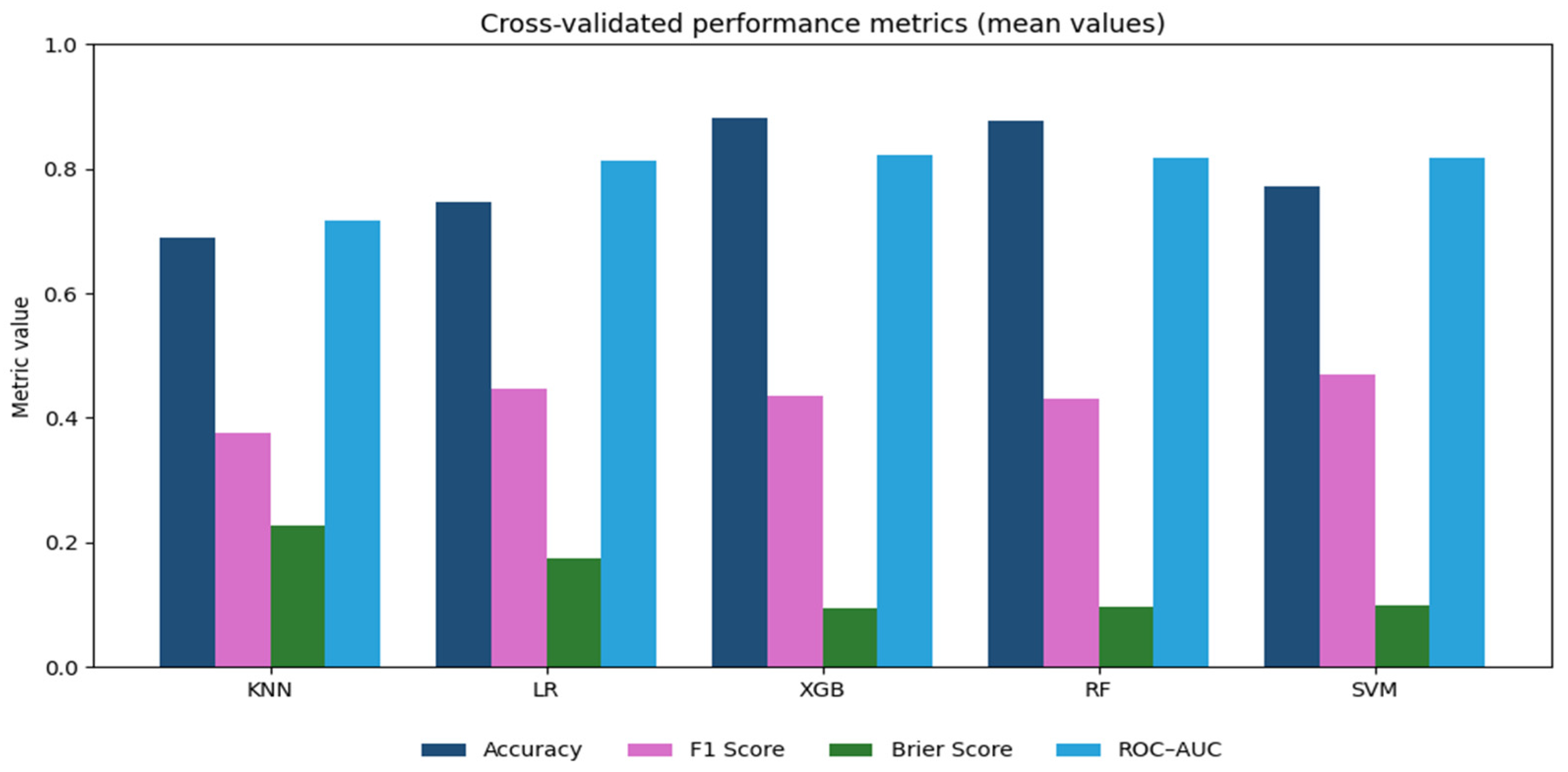
| Model | Accuracy (Mean ± SD) | Mean Exec. Time [ms] (Mean ± SD) | F1 Score (Mean ± SD) | Brier Score (Mean ± SD) | ROC-AUC (Mean ± SD) |
|---|---|---|---|---|---|
| KNN | 0.689 ± 0.003 | 56.300 ± 39.161 | 0.377 ± 0.004 | 0.228 ± 0.001 | 0.717 ± 0.004 |
| LR | 0.746 ± 0.006 | 640.256 ± 95.533 | 0.448 ± 0.011 | 0.174 ± 0.002 | 0.813 ± 0.006 |
| XGB | 0.881 ± 0.004 | 1291.280 ± 295.747 | 0.435 ± 0.013 | 0.094 ± 0.002 | 0.823 ± 0.005 |
| RF | 0.878 ± 0.004 | 18,522.245 ± 734.812 | 0.432 ± 0.013 | 0.096 ± 0.001 | 0.818 ± 0.004 |
| SVM | 0.772 ± 0.007 | 568,935.469 ± 28,281.250 | 0.469 ± 0.010 | 0.098 ± 0.001 | 0.817 ± 0.003 |
| Feature | KNN | LR | XGBoost | RF | SVC |
|---|---|---|---|---|---|
| gender | 0.6027 | 0.0741 | 0.8271 | 0.1219 | 0.0741 |
| hypertension | 0.7098 | 0.1405 | 0.0375 | 0.0186 | 0.1405 |
| go_outside | 0.9674 | 0.1695 | 0.3624 | 0.0989 | 0.1695 |
| census_division | 0.2366 | 0.1890 | 0.8062 | 0.6895 | 0.1890 |
| nsocialnet | 0.8691 | 0.1925 | 0.8515 | 0.4520 | 0.1925 |
| social_participation | 0.4457 | 0.1939 | 0.9125 | 0.4627 | 0.1939 |
| worryfall | 0.6260 | 0.2697 | 0.0959 | 0.3814 | 0.2697 |
| community_score | 0.3098 | 0.3863 | 0.4537 | 0.5803 | 0.3863 |
| ethnicity | 0.9789 | 0.4931 | 0.9682 | 0.6481 | 0.4931 |
| community | 0.5073 | 0.5394 | 1.0000 | 0.3798 | 0.5394 |
| vascular_condition | 0.0021 | 0.6532 | 1.0000 | 0.9653 | 0.6532 |
| overallhealth | 0.8100 | 0.6251 | 0.4695 | 0.1164 | 0.6251 |
| heart_disease | 0.8706 | 0.6633 | 0.5750 | 0.6116 | 0.6633 |
| depression | 0.3352 | 0.6321 | 0.1776 | 0.9220 | 0.6321 |
| Feature | Odds Ratio (OR) | 95% CI (OR) | p-Value |
|---|---|---|---|
| Tech_use | 0.47 | (0.45, 0.50) | <0.001 |
| go_outside | 0.66 | (0.63, 0.68) | <0.001 |
| nsocialnet | 0.63 | (0.60, 0.66) | <0.001 |
| Ethnicity | 1.19 | (1.15, 1.23) | <0.001 |
| marital_stat | 1.13 | (1.08, 1.18) | <0.001 |
| social_participation | 1.12 | (1.07, 1.16) | <0.001 |
| Gender | 0.89 | (0.85, 0.93) | <0.001 |
| fallendownyr | 0.92 | (0.89, 0.95) | <0.001 |
| Stroke | 0.95 | (0.93, 0.98) | 0.001 |
| hypertension | 0.93 | (0.89, 0.97) | 0.002 |
| census_division | 1.05 | (1.01, 1.10) | 0.007 |
| Diabetes | 0.95 | (0.92, 0.99) | 0.013 |
| overallhealth | 0.96 | (0.92, 1.00) | 0.057 |
| depression | 1.10 | (0.98, 1.22) | 0.113 |
| heart_attack | 0.98 | (0.95, 1.01) | 0.177 |
| Worryfall | 1.03 | (0.99, 1.06) | 0.186 |
| heart_disease | 1.02 | (0.98, 1.06) | 0.337 |
| Algorithm | p-Value (μ ≠ μ0) | p-Value (μ < μ0) | p-Value (μ > μ0) |
|---|---|---|---|
| KNN | 1.037482 × 10⁻⁹ | 5.187412 × 10⁻¹⁰ | 1.0 |
| LR | 1.503313 × 10⁻⁷ | 7.516564 × 10⁻⁸ | 1.0 |
| XGB | 5.617123 × 10⁻⁸ | 2.808561 × 10⁻⁸ | 1.0 |
| RF | 1.304699 × 10⁻⁹ | 6.523494 × 10⁻¹⁰ | 1.0 |
| SVM | 2.354709 × 10⁻¹⁰ | 1.177355 × 10⁻¹⁰ | 1.0 |
| Feature | p-Value | χ2 | KNN | LR | XGB | RF | SVM |
|---|---|---|---|---|---|---|---|
| Tech_use | <0.001 ** | 17.86 | 55.0 | 90.0 | 40.0 | 15.0 | 65.0 |
| nsocialnet | <0.001 ** | 17.86 | 58.0 | 90.0 | 15.0 | 65.0 | 65.0 |
| go_outside | <0.001 ** | 17.86 | 52.0 | 90.0 | 40.0 | 15.0 | 65.0 |
| fallendownyr | <0.001 ** | 16.21 | 63.0 | 81.0 | 15.0 | 40.0 | 74.0 |
| vascular_condition | <0.001 ** | 16.46 | 72.0 | 74.0 | 15.0 | 40.0 | 84.0 |
| vascular_count | <0.001 ** | 16.14 | 60.0 | 75.0 | 40.0 | 15.0 | 65.0 |
| community_score | <0.001 ** | 16.90 | 54.0 | 69.0 | 15.0 | 70.0 | 60.0 |
| depression_cat | 0.005 ** | 12.98 | 64.0 | 65.0 | 40.0 | 15.0 | 76.0 |
| depression | 0.023 * | 9.570 | 57.0 | 71.0 | 19.0 | 67.0 | 53.0 |
| community | 0.002 ** | 14.95 | 61.0 | 59.0 | 15.0 | 60.0 | 70.0 |
| worryfall | 0.007 ** | 12.23 | 59.0 | 62.0 | 45.0 | 61.0 | 70.0 |
| smokesnow | 0.002 ** | 14.73 | 53.0 | 46.0 | 59.0 | 40.0 | 55.0 |
| heart_disease | <0.001 ** | 16.55 | 70.0 | 71.0 | 15.0 | 40.0 | 84.0 |
| stroke | <0.001 ** | 17.10 | 74.0 | 68.0 | 40.0 | 15.0 | 87.0 |
| diabetes | <0.001 ** | 16.42 | 69.0 | 72.0 | 15.0 | 40.0 | 83.0 |
| hypertension | <0.001 ** | 15.96 | 71.0 | 70.0 | 18.0 | 37.0 | 85.0 |
| heart_attack | 0.003 ** | 14.18 | 66.0 | 43.0 | 76.0 | 16.0 | 75.0 |
| overallhealth | 0.007 ** | 12.13 | 62.0 | 38.0 | 52.0 | 90.0 | 30.0 |
| ethnicity | <0.001 ** | 16.90 | 68.0 | 69.0 | 40.0 | 15.0 | 86.0 |
| marital_stat | <0.001 ** | 17.58 | 56.0 | 66.0 | 15.0 | 45.0 | 69.0 |
Disclaimer/Publisher’s Note: The statements, opinions and data contained in all publications are solely those of the individual author(s) and contributor(s) and not of MDPI and/or the editor(s). MDPI and/or the editor(s) disclaim responsibility for any injury to people or property resulting from any ideas, methods, instructions or products referred to in the content. |
© 2026 by the authors. Licensee MDPI, Basel, Switzerland. This article is an open access article distributed under the terms and conditions of the Creative Commons Attribution (CC BY) license.
Share and Cite
Alam, A.; Rabbani, M.G.; Prybutok, V.R. Artificial Intelligence–Enabled Dementia Risk Prediction for Smart and Sustainable Healthcare: An Interpretable Machine Learning Study Using NHATS. Appl. Sci. 2026, 16, 2180. https://doi.org/10.3390/app16052180
Alam A, Rabbani MG, Prybutok VR. Artificial Intelligence–Enabled Dementia Risk Prediction for Smart and Sustainable Healthcare: An Interpretable Machine Learning Study Using NHATS. Applied Sciences. 2026; 16(5):2180. https://doi.org/10.3390/app16052180
Chicago/Turabian StyleAlam, Ashrafe, Md Golam Rabbani, and Victor R. Prybutok. 2026. "Artificial Intelligence–Enabled Dementia Risk Prediction for Smart and Sustainable Healthcare: An Interpretable Machine Learning Study Using NHATS" Applied Sciences 16, no. 5: 2180. https://doi.org/10.3390/app16052180
APA StyleAlam, A., Rabbani, M. G., & Prybutok, V. R. (2026). Artificial Intelligence–Enabled Dementia Risk Prediction for Smart and Sustainable Healthcare: An Interpretable Machine Learning Study Using NHATS. Applied Sciences, 16(5), 2180. https://doi.org/10.3390/app16052180