1. Introduction
A fundamental parameter to consider in static computer-guided surgery (SCGS) is accuracy [
1], which can be assessed by comparing the planned implant position within the design software with the actual final position of the implant in the patient’s mouth.
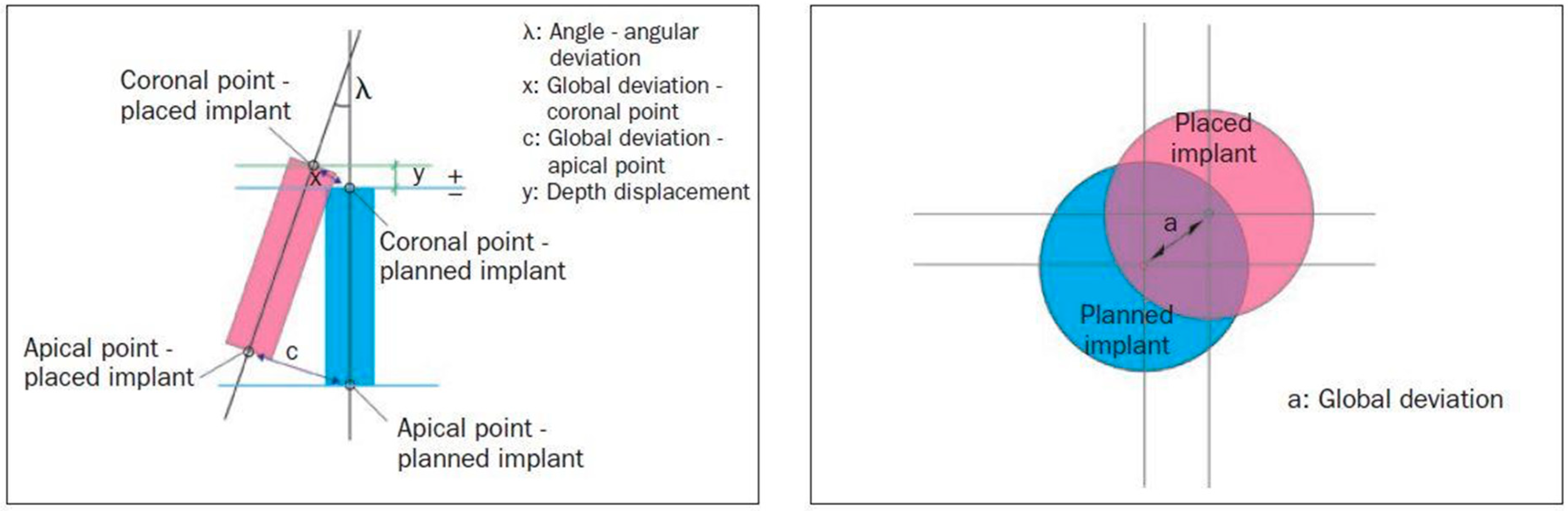
Accuracy is defined as the spatial discrepancy between the virtually planned and the clinically achieved implant position. It includes linear deviations at the implant platform (coronal) and apex, expressed as lateral (X–Y), vertical (Z), and three-dimensional (3D) Euclidean distances, as well as angular deviation between the planned and actual implant axes.
The scientific community now agrees that the accuracy values of SCGS are generally higher compared to traditional freehand implantology [
2,
3]. The discrepancy between the planned and actual implant position can be caused by various errors affecting each phase of the process: errors in acquiring radiographic data, during impression taking (conventional or digital), intrinsic characteristics of the design software, the type of support of the surgical guide (dental, mucosal, or mixed) [
4], during intraoral placement of the surgical guide, and mechanical errors caused by tool tolerance [
5], housing and friction of bushings, incorrect cooling, bone chips left in the site.
The sum of these errors generates a cumulative discrepancy called “total error”. The study considered a single surgical protocol performed by a single experienced operator M.S. This protocol was applied to patients with partial edentulism (minimum 2 adjacent missing teeth) and consists of the following phases: after planning the surgical procedure in three dimensions (3D), a surgical guide was produced in stereolithographic resin by superimposing the data derived from CBCT, digital impression, and digital prosthetic mock-up of the arches, including the previously planned implant position. The surgical guide thus produced allowed the exact transfer of the implant position from the design software to the patient’s mouth.
Although accuracy in static computer-guided implant surgery has been widely examined, the available literature presents substantial heterogeneity in study designs, guide-support types, and operator workflows [
6,
7]. Many investigations include mixed samples of fully and partially edentulous arches, or combine mucosa- [
8], bone-, and dental-supported guides, making it difficult to isolate the intrinsic performance of dental-supported templates in partial rehabilitations. Furthermore, only a limited number of clinical studies have evaluated accuracy using a fully standardized digital workflow—same software, same guide fabrication method, same implant system, and a single experienced operator—thereby minimizing variability from confounding technical factors. The present study addresses this gap by prospectively assessing the accuracy and precision of static computer-guided flapless surgery exclusively in partially edentulous arches using dental-supported guides and by examining differences across Kennedy classes, an aspect scarcely investigated in the previous literature. This focused design allows a clearer evaluation of the intrinsic reproducibility of dental-supported guided surgery in real clinical scenarios.
The aim of the present study was to assess how accurately computer-guided systems can place dental implants. To accomplish this, linear and angular deviations for each dental implant were compared among themselves. Moreover, the presence of any variations in accuracy based on the edentulous class (first, second, third, and fourth Kennedy class) or the oral region (upper/lower jaw) were evaluated.
The outcome would determine if digital methods can accurately predict the final result of computer-guided surgery, assessing whether the outcome significantly deviates from the expected position according to the computerized planning.
2. Materials and Methods
The study protocol received ethical approval from the Ethics Committee of ASST Santi Paolo e Carlo, Milan Area 1 (protocol n. 1361, 12 July 2017). All procedures conformed to the principles of the Declaration of Helsinki (1964, last revision 2013). Each participant was assigned a unique identification number to ensure compliance with EU GDPR regulations (2016/679), and written informed consent was obtained before inclusion. All surgical procedures were carried out at the Implantology and Prosthodontics Department of the Giorgio Vogel Clinic (ASST Santi Paolo e Carlo, Milan) by a single experienced clinician (M.S.). The study followed STROBE recommendations for reporting observational research. This study received material support (Prime® dental implants) from Prodent® Italia (Pero, Milan, Italy). The company had no role in the design of the study, data acquisition, data analysis, interpretation, or manuscript preparation. The authors declare no conflicts of interest. Prodent® had no influence on the scientific content of the study.
2.1. Study Design and Eligibility Criteria
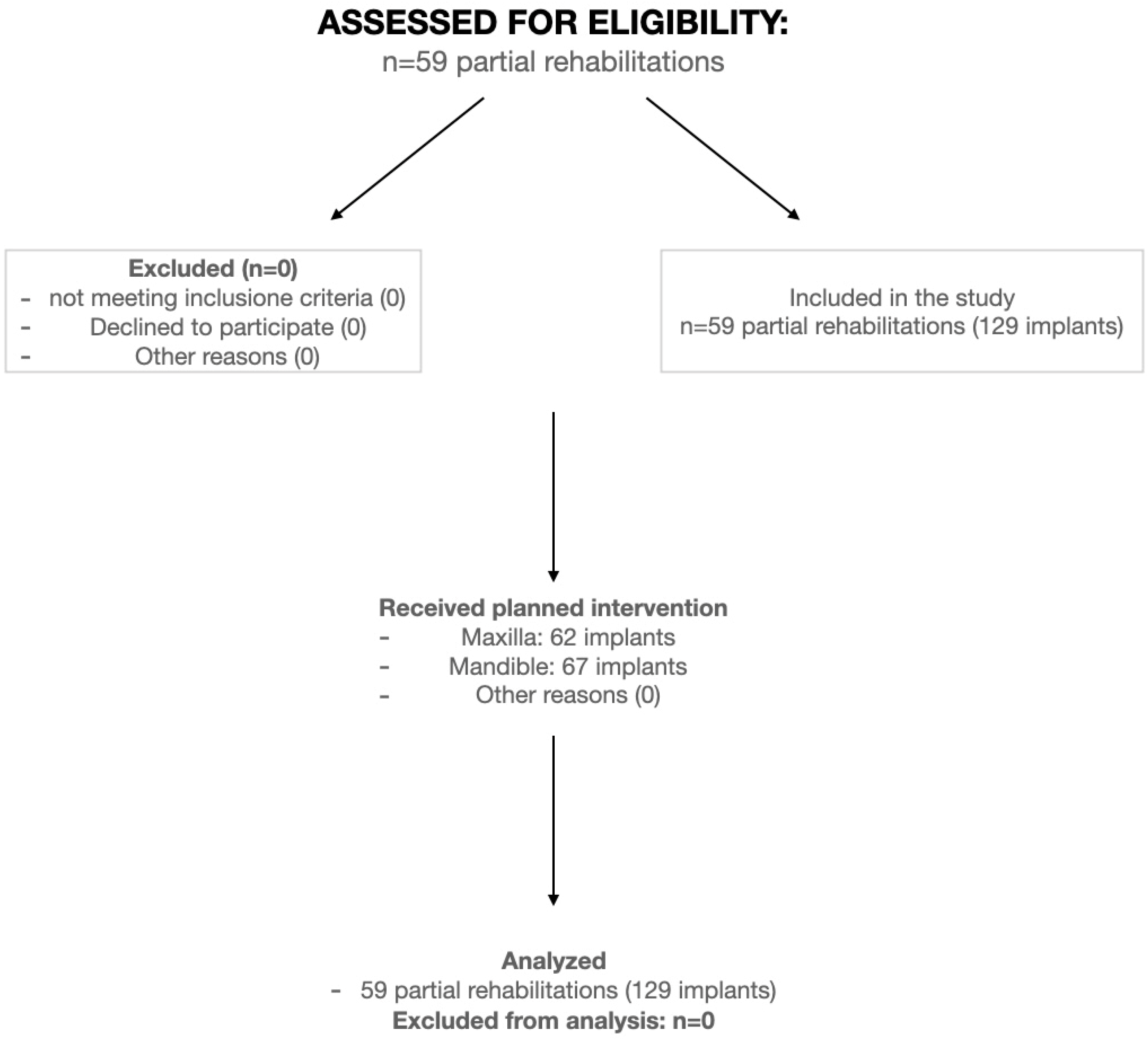
This prospective clinical study enrolled patients treated between 2017 and 2022. Individuals were considered eligible after signing informed consent and receiving a full explanation of the protocol and associated risks. The study follows the STROBE (Strengthening the Reporting of Observational Studies in Epidemiology) recommendations for observational cohort studies (
Figure 1).
2.1.1. Inclusion Criteria
Participants met the following criteria:
- −
Age 18–80 years;
- −
Implant placement in healed sites (minimum 8 weeks post-extraction or ≥6 months after regenerative treatment), allowing guided insertion of implants ≥3.3 mm in diameter or ≥8.5 mm in length;
- −
Absence of active infection or residual pathology at the intended implant site;
- −
Good systemic health and satisfactory oral hygiene;
- −
Healthy opposing dentition or implants;
- −
Presence of at least two adjacent missing teeth.
2.1.2. Exclusion Criteria
Patients were excluded if they presented with:
- −
Conditions requiring prolonged corticosteroid therapy;
- −
Disorders affecting leukocyte function;
- −
Severe hemophilia;
- −
Pregnancy;
- −
Current or past head/neck radiotherapy or chemotherapy;
- −
Renal insufficiency;
- −
Use of bisphosphonates;
- −
Uncontrolled endocrine disease;
- −
Motor limitations compromising oral hygiene;
- −
Substance or alcohol abuse;
- −
Smoking habit >10 cigarettes/day;
- −
Untreated periodontitis;
- −
Mucosal diseases (e.g., erosive lichen planus);
- −
Severe parafunction (bruxism or clenching);
- −
Persistent intraoral infections;
- −
Known allergies to restorative materials;
- −
Full edentulism;
- −
Limited mouth opening;
- −
Poor oral hygiene or inadequate motivation;
- −
Uncontrolled systemic disease;
- −
Chronic or untreated oral conditions;
- −
Completely edentulous arches.
2.1.3. Sample Size Calculation
The primary endpoint for the sample size calculation was the agreement between the virtually planned and postoperative implant positions, quantified using the intraclass correlation coefficient (ICC). Based on prior literature reporting high reproducibility for guided surgery accuracy measurements, we assumed an expected ICC of 0.90 and a minimum acceptable ICC of 0.80, with α = 0.05 and 80% power. Under these assumptions, at least 46 rehabilitations were required. ICC was selected rather than mean positional differences because the study was designed to evaluate reproducibility and concordance rather than group comparisons, and preliminary variance estimates necessary for mean-difference–based calculations were not available. Due to recruitment unpredictability during the COVID-19 pandemic, the dropout buffer was increased from 10% to 30%, resulting in a target of 59 rehabilitations.
2.2. Statistical Analysis
Given the observational design and the absence of a hypothesis-driven comparison among subgroups, all measurements were summarized descriptively. Subgroup analyses (jaw and Kennedy class) were reported descriptively only, and no inferential statistical tests were performed, as the study was not powered to detect differences among subgroups.
2.3. Digital Planning and Surgical Guide Fabrication
All participants underwent CBCT imaging with Orthophos XG 3D (Dentsply Sirona, Charlotte, NC, USA) [
9,
10]. Intraoral scans of both arches were acquired using a TRIOS 3Shape scanner (3Shape, Copenhagen, Denmark), generating STL files. A virtual diagnostic wax-up was produced (Exoplan Matera 2.3, Exocad GmbH, Darmstadt, Germany) by the laboratory. DICOM data from CBCT and STL surface files were aligned using residual dentition as reference landmarks, optimized through a best-fit algorithm.
Implant planning was completed using RealGuide 5.0 software (3DiEmme, Figino Serenza, Italy). A bone-level placement strategy was followed for all cases, with implants positioned to rehabilitate partial edentulism of at least two adjacent missing teeth. The PRIME implant system (Prodent Italia, Pero, Italy) featuring a three-level internal connection was used for guided insertion.
Surgical guides were printed in biocompatible transparent resin (MED610, Stratasys, Eden Prairie, MN, USA) using an Objet Eden 260VS 3D printer (Stratasys, Eden Prairie, MN, USA) [
11] and equipped with 5 mm metal sleeves for drill guidance. All guides provided dental support, with variations corresponding to Kennedy classification:
- −
Group A: Dental support with distal support (Kennedy Class III–IV);
- −
Group B: Dental support lacking distal support (Kennedy Class II);
- −
Group C: Mesial dental support with bilateral distal edentulous ridges and fixation pins (Kennedy Class I).
2.4. Surgical Protocol
A flapless approach was used in all interventions [
12]. A small 5 mm micro-incision was performed through the guide sleeve to facilitate osteotomy access, no mucoperiosteal flap was reflected. This technique is commonly included under the umbrella of flapless guided surgery.
Patients received prophylactic amoxicillin (2 g) one hour before surgery, followed by 0.2% chlorhexidine rinse and local anesthesia (2% mepivacaine with vasoconstrictor). After positioning the surgical guide, soft-tissue access was created by inserting a 15C scalpel blade through the sleeve to produce a small (approximately 5 mm) tissue punch, without raising a flap, preventing the need for mucotomy drills and preserving keratinized mucosa.
Osteotomies were prepared using the fully guided PRODENT 3D surgical kit (Prodent Italia, Pero, Italy), following manufacturer instructions. Implants were inserted manually using a torque wrench with alignment facilitated by matching hex geometry between inserter and guide. Healing abutments were placed immediately.
2.5. Prosthetic Workflow
After a 10-week healing period, implant positions were digitally recorded using TRIOS 3Shape with PEEK scan bodies (Scanmarker, Prodent Italia, Pero, Italy). Metal-ceramic restorations were fabricated and cemented onto prefabricated anti-rotational abutments using zinc-oxide–eugenol temporary cement (Temp Bond; Kerr, Berlin, Germany). Occlusal contacts were assessed in maximum intercuspation and during lateral excursions.
2.6. Outcome Measures
The primary outcome of interest was the accuracy of implant placement, defined as the spatial difference between the virtually planned implant position (RealGuide 5.0) and the actual postoperative location. Precision, considered as the reproducibility of these deviations across comparable clinical situations, represented the secondary outcome.
Accuracy assessment was performed by comparing pre- and postoperative 3D datasets using Geomagic Studio (3D Systems v2012). This study was designed exclusively to evaluate positional accuracy. No clinical follow-up outcomes (implant survival, biological or technical complications, or prosthetic success) were recorded. Subgroup comparisons (jaw and Kennedy class) were performed descriptively only, as the study was not powered for inferential statistical testing.
STROBE Participant Flow Diagram (
Figure 1).
Alignment Procedure and Measurement Workflow
Preoperative planning files (STL surfaces derived from the intraoral scan and the virtual implant positions exported from RealGuide 5.0) were compared with postoperative datasets obtained after healing (STL files derived from intraoral scans with scan bodies). All measurements were performed using Geomagic Studio (3D Systems), following a validated workflow for guided surgery accuracy assessment.
- (1)
Surface alignment
The postoperative STL model was aligned to the preoperative dataset using a surface-based best-fit algorithm. Alignment was performed on stable anatomical regions that were not altered by surgery—namely, the residual dentition and non-operated mucosal/osseous contours. Regions close to implant sites were excluded to avoid bias.
- (2)
Validation of alignment
To ensure correct registration, the software-reported root-mean-square error (RMSE) of the superimposition was inspected. Only alignments with an RMSE < 30 µm were accepted. Visual inspection of the surface overlap was used as additional qualitative verification.
- (3)
Virtual landmarking of implants
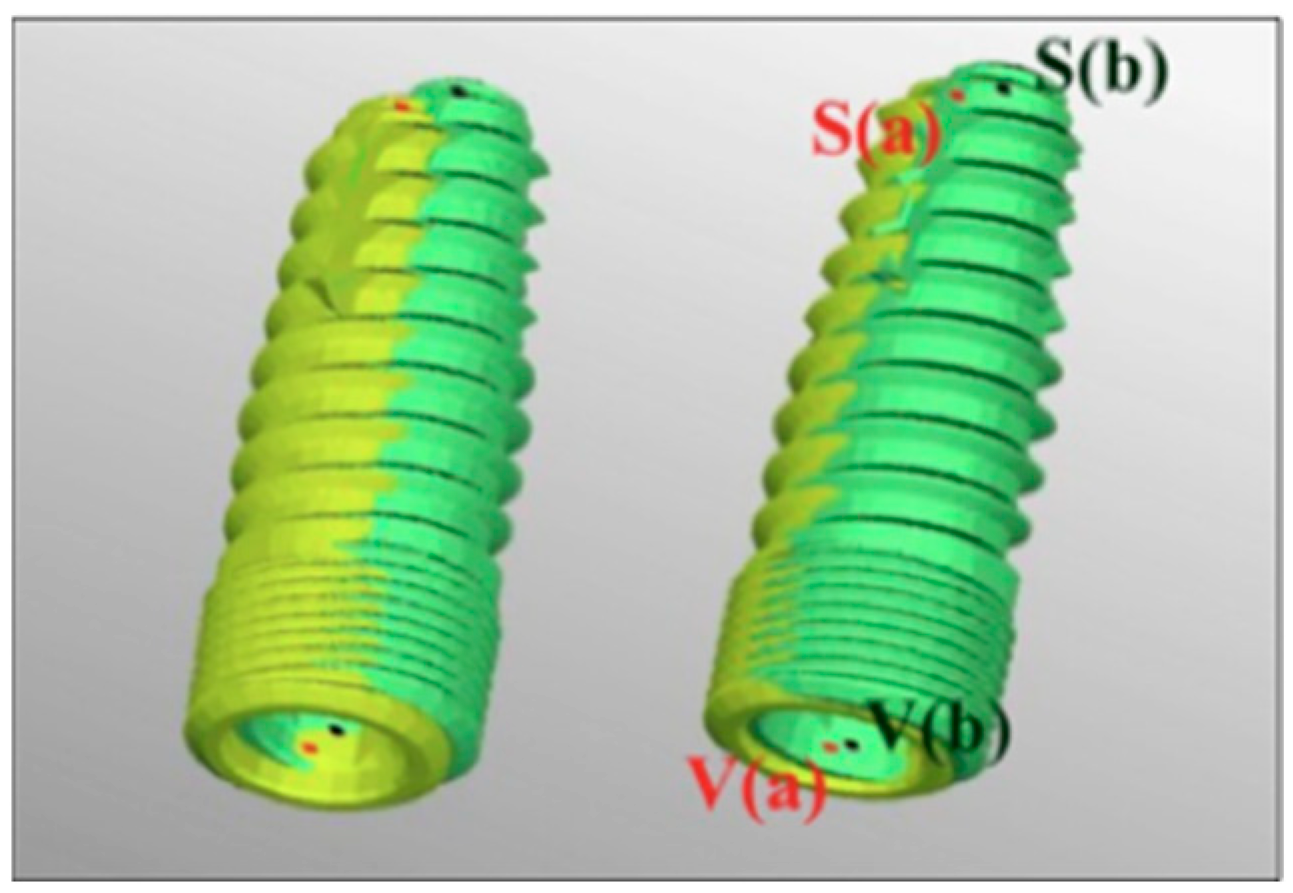
Each implant was represented as a geometric cylinder positioned according to the planned trajectory. The geometric centers of the platform (V) and apex (S) were automatically calculated using the cylinder axis and calibrated implant geometry.
- (4)
Deviation calculations
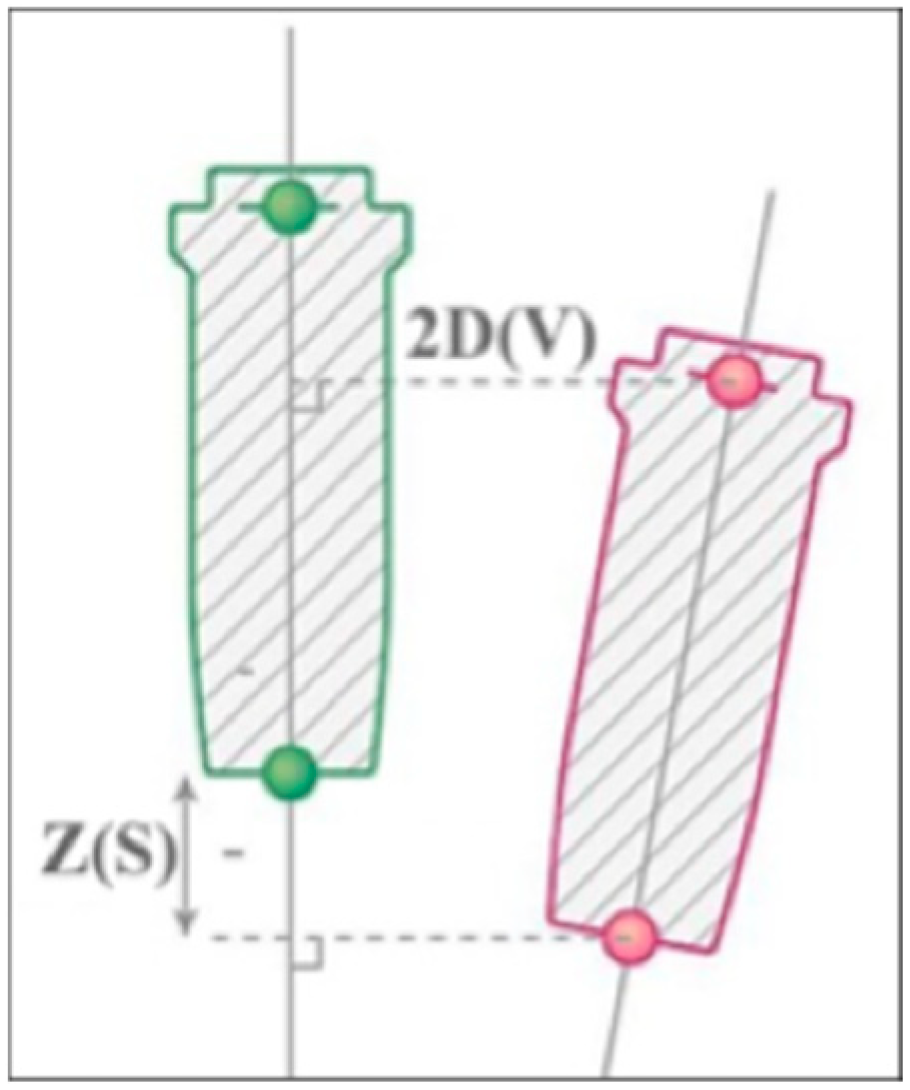
For each implant, the following discrepancies between planned and actual positions were computed: Linear deviation at the implant platform (coronal) and apex was decomposed into lateral deviation (X–Y plane) (
Figure 2), vertical deviation (Z axis) (
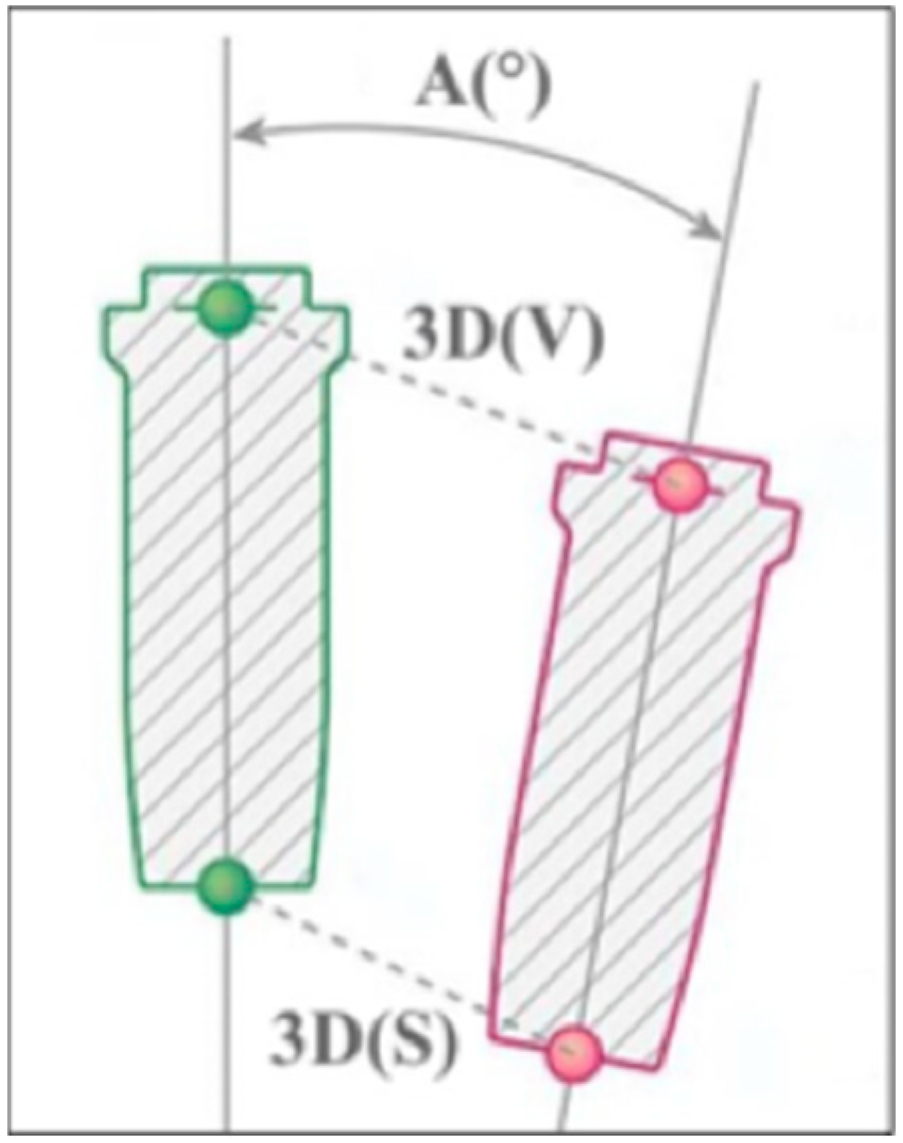
Figure 3), and 3D linear deviation calculated as the Euclidean distance between planned and actual coordinates. Angular deviation was calculated as the 3D angle between the planned and achieved implant axes (
Figure 4).
- (5)
Workflow validation
The described approach follows established methodologies in the literature for evaluating accuracy in static computer-guided implant surgery [
13]. The measurement protocol was tested on five randomly selected cases repeated twice, showing negligible variation (<0.05 mm) after re-alignment, confirming reproducibility.
4. Discussion
The present study evaluated the accuracy of static computer-guided flapless implant placement in partially edentulous patients using a fully standardized digital workflow. The main findings were: (1) overall high accuracy with low 3D and angular deviations; (2) slightly higher deviations in the mandible compared with the maxilla; and (3) small, non-significant trends across the three Kennedy groups. These observations are consistent with previous accuracy studies and support the reproducibility of dental-supported guides in partial arches [
1,
2].
Accuracy in computer-guided implant surgery is defined as the spatial discrepancy between the virtually planned and the clinically achieved implant position [
14]. It includes linear deviations at the implant platform and apex (lateral, vertical, 3D Euclidean distance) and angular deviation between the planned and actual implant axes. The smaller the deviations from the expected position, the more accurate the system is considered.
The quantification of this difference is evaluated by measuring:
- −
Lateral deviation (X–Y) at platform and apex;
- −
Vertical deviation (Z);
- −
Three-dimensional linear deviation (Euclidean distance) at platform and apex;
- −
Angular deviation between the planned and actual implant axes (
Figure 5).
These definitions allow direct comparison with previous systematic reviews and accuracy studies.
Comparing the obtained data with those in the literature is challenging due to the disparity in study methodologies and parameters investigated.
Furthermore, most studies and reviews include totally edentulous patients, whereas the present study investigated partial edentulism with the use of dental supported surgical guides.
In the present study, the average difference between the planned and achieved position was 1.16 mm at the apex and 0.80 mm at the coronal level. The angular deviation was 3.23 degrees.
In a review by Schneider [
15], the mean total deviation was 1.07 mm (95% CI: 0.76–1.22 mm) at the entry point and 1.63mm (95% CI: 1.26–2 mm) at the apex, with a mean angular discrepancy of 5.261° (95% CI: 3.94–6.581°).
The meta-analysis of the systematic review by Tahmaseb in 2018 [
1] found mean discrepancies at the platform and implant apex levels of 1.2 mm (1.04–1.44 mm) and 1.4 mm (1.28–1.58 mm), respectively, with a mean angular discrepancy of 3.5° (3.0–3.96°). It was also reported that accuracy was superior in partial edentulism compared to full edentulism.
The systematic review by Zhou in 2018 [
2] found mean discrepancies at the platform and implant apex levels of 1.25 mm (95% CI: 1.22–1.29) and 1.57 mm (95% CI: 1.53–1.62), respectively, with a mean angular discrepancy of 4.1° (95% CI: 3.97–4.23). Statistically significant differences were also observed between the maxilla and mandible, as well as between the partially and fully guided methods.
Jung et al. [
16] analyzed 19 studies that defined a mean error at the entry point of 0.99 mm (max 6.5 mm), a mean apical error of 1.24 mm (max 6.9 mm), a mean angular error of 3.81° (max 24.9°), and a mean vertical error of 0.46 mm (max 4.2 mm). In this case, as is often the case in reviews, the maximum values were reported only in a single study, while the others all had lower values.
First, regarding the linear deviation, we measured both at the apex and at the coronal Platform (coronal) of the implant:
- −
At the apex, the mean linear deviation was 1.16 mm, with a standard deviation of 0.58 mm and a 95% confidence interval ranging from 1.06 to 1.27 mm.
- −
At the Platform (coronal), the mean linear deviation was 0.80 mm, with a standard deviation of 0.41 mm, and a 95% confidence interval between 0.72 and 0.87 mm.
Second, we evaluated the lateral deviation, which refers to the lateral deviation relative to the planned position:
- −
At the apex, the mean lateral deviation was 0.99 mm, with a standard deviation of 0.57 mm and a 95% confidence interval of 0.88 to 1.10 mm.
- −
At the Platform (coronal), we found a mean deviation of 0.57 mm, with a standard deviation of 0.34 mm, and a confidence interval of 0.50 to 0.63 mm.
Third, we considered the vertical deviation, meaning the vertical discrepancy along the implant axis.
- −
The mean value was 0.45 mm, with a standard deviation of 0.41 mm, and a 95% confidence interval from 0.38 to 0.53 mm.
Finally, we assessed the angular deviation, that is, the difference in orientation between the planned and placed implants.
- −
The mean angular deviation was 3.23 degrees, with a standard deviation of 1.86 degrees, and a 95% confidence interval ranging from 2.88 to 3.58 degrees.
General considerations on CBCT artifacts, guide fabrication tolerances, scanner accuracy, and other technical factors were intentionally minimized, as these aspects are widely established in prior literature and not directly investigated in the present dataset. Only elements relevant to interpreting our accuracy results were retained to maintain a focused and clinically meaningful Discussion.
Operator-dependent factors—such as the design and positioning of the diagnostic and radiologic guides, the accuracy of radiographic acquisition, software-based implant planning, and the placement of the surgical template—can contribute to overall deviation. These aspects, although well documented in the literature, were not specifically evaluated in the present study.
In other scientific works, Di Giacomo [
12] and Vasak [
6] highlighted lower deviations in anterior implants compared to posterior ones, as well as consistent discrepancies in direction depending on whether the operators were right-handed or left-handed.
CBCT accuracy may be affected by scatter and patient movement, which can obscure anatomical details or distort landmark positioning [
17]. These factors are well-known limitations of radiologic imaging but were not assessed in the present analysis.
Numerous studies and systematic reviews agree that CBCT has an accuracy sufficient to be used in surgical planning, despite not being free from inherent issues within the technology itself [
18]. These issues range from the algorithms used to correct distortions of geometric errors in nearby objects, to the circumference of the imaging field, to the error caused by sensor undulation during movement, to the size of the voxels used, or simply the way in which these studies are conducted (often ex vivo).
Such data necessitate consideration of the type of template we wish to use. Of the three types of support that surgical guides offer, the mucosal support proves to be the least accurate, precisely for the reasons we mentioned earlier. Studies by Ozan et al. [
19] and Turbuush et al. [
20] confirm these results, highlighting that guides with purely dental support are more precise, with an average angular deviation of 2.91°, followed by bone-supported and mucosal-supported guides with deviations of 4.63° and 4.51°, respectively.
Stereolithographic 3D printing contributes to overall guide accuracy, although multiple technical variables can influence dimensional precision [
4]. Despite these factors, current dental printers consistently achieve accuracy in the tens-of-microns range, which is considered more than adequate for computer-guided implant surgery [
21].
Digital acquisition systems, whether intraoral or laboratory scanners, generally provide accuracy comparable to conventional impressions for limited-span restorations. Although performance varies among scanners, most achieve clinically acceptable precision, making them suitable for use within full-digital guided surgery workflows. Although no inferential statistics were performed, slight trends were observed among Kennedy classes, with marginally higher deviations in Class I configurations, possibly related to reduced distal support and guide stability. These observations remain exploratory and should be interpreted with caution. The maximum apical deviation observed in this study (up to 1.74 mm overall, and 1.82 mm in Kennedy Class I cases) may have relevant clinical implications, particularly in narrow ridges. Considering an average implant diameter of 4 mm and the recommended ≥1 mm buccal and lingual bone walls, deviations of this magnitude could necessitate a minimum ridge width close to 9–10 mm to avoid dehiscence or perforation. Static guided surgery therefore cannot be relied upon to compensate for insufficient bone volume, and appropriate case selection remains essential.
4.1. Clinical Implications of Deviation Magnitude
From a clinical standpoint, the deviations observed in this study must be interpreted in relation to the anatomical safety margins recommended in implant surgery. In the literature, a minimum distance of 2 mm from the inferior alveolar nerve canal is generally advised to compensate for both radiographic uncertainty and potential deviations during guided osteotomy [
22]. Similarly, a safety buffer of approximately 1.5–2 mm is recommended when approaching the maxillary sinus floor or adjacent tooth roots [
23].
In our cohort, the mean deviation at the implant apex was 1.16 mm, with the upper limit of the 95% confidence interval reaching 1.27 mm. At the platform level, the mean deviation was 0.80 mm (95% CI: 0.72–0.87 mm), while the average angular deviation was 3.23°, which could translate into an additional apical displacement depending on implant length. These values indicate that, although the accuracy achieved with static computer-guided surgery remains well within the generally accepted safety tolerances, clinicians should maintain a conservative approach when planning implant positions near critical structures. For example, an angular deviation of approximately 3° in a 10–12 mm implant may result in an additional apical shift of roughly 0.5–0.6 mm, which should be included when calculating the overall safety distance.
Therefore, the deviation magnitudes reported in this study support the use of a minimum 2 mm safety margin when operating close to the mandibular canal or maxillary sinus. Likewise, when working in narrow edentulous spaces, especially in Kennedy Class I or II situations with reduced guide stability, the observed deviations further justify caution and the avoidance of planning implants with minimal clearance from anatomical boundaries.
Limitations
This study presents several limitations. First, the single-center, single-operator design improves workflow standardization, but limits generalizability. Second, although the sample size was adequate for descriptive accuracy analysis, it was not powered for inferential comparisons among subgroups such as jaw or Kennedy class. Third, only postoperative CBCT evaluation was used, and minor registration errors cannot be excluded. Fourth, long-term clinical outcomes beyond implant positioning were not assessed. Future multicenter studies with larger samples are warranted to confirm these findings.
Despite these limitations, the results confirm that static computer-guided surgery provides predictable accuracy in partially edentulous arches when a standardized workflow is followed. The findings support the clinical reliability of dental-supported guides in everyday practice.
Considering the maximum apical deviation observed in this study (1.74 mm overall and 1.82 mm in Kennedy Class I cases), an implant of 4 mm diameter would require approximately 9–10 mm of ridge width to maintain ≥1 mm of bone on both buccal and lingual aspects. Such ridge dimensions are not commonly encountered clinically, particularly in posterior mandibles, reinforcing that guided surgery cannot compensate for insufficient anatomical bone volume.
Given the maximum apical deviation recorded in this study (1.74 mm overall and 1.82 mm in Kennedy Class I cases), a 4 mm implant would require approximately 9–10 mm of ridge width to maintain at least 1 mm of buccal and lingual bone. Such dimensions are uncommon in narrow posterior ridges, reinforcing that static guided surgery cannot compensate for insufficient bone volume and that appropriate case selection remains mandatory.




 ,
,