MDMF: A Market-Mainline-Driven Multi-Feature Fusion Model for Stock Trend Forecasting


Abstract
1. Introduction
- (1)
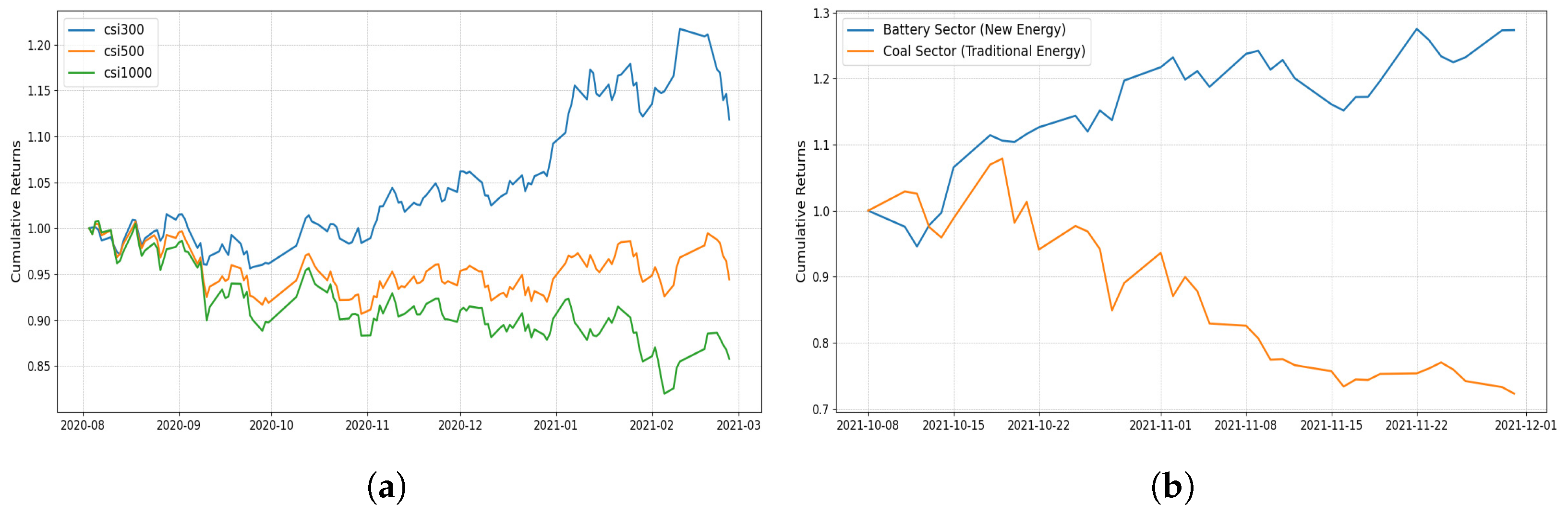
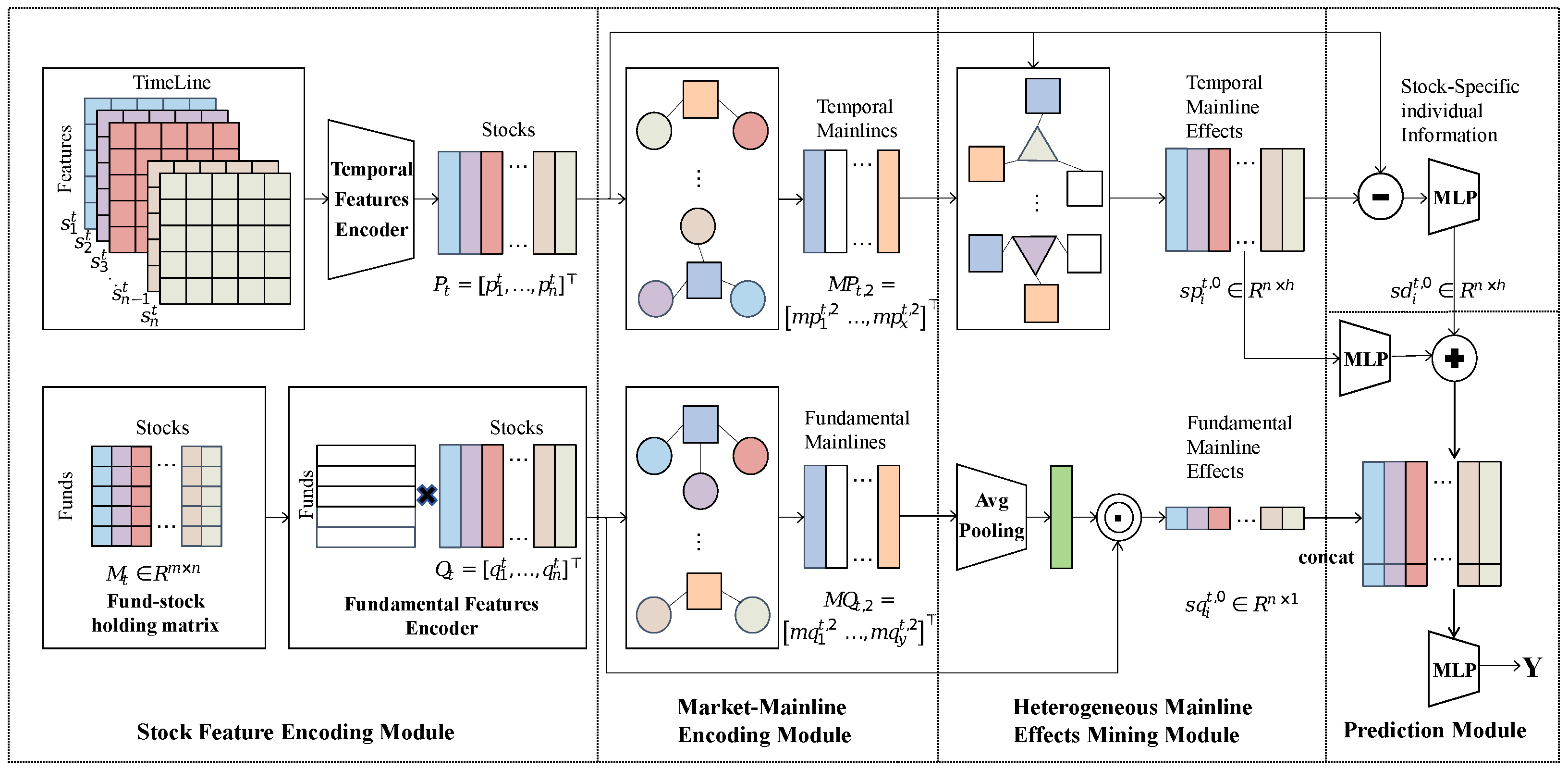
- The formation of the market mainline involves complex and volatile factors—such as price fluctuations, economic cycles, and policy directions. To better capture its dynamic evolution, we propose a dual-channel stock feature encoding method combined with a dynamic stock set aggregation algorithm. Specifically, a multidimensional representation of stock features is collaboratively constructed through both temporal and fundamental channels. Meanwhile, the dynamic stock set aggregation algorithm extracts latent market mainline features from specific groups of stocks. The representation of these features is then refined by uncovering the underlying relationships between all stocks and the market mainline.
- (2)
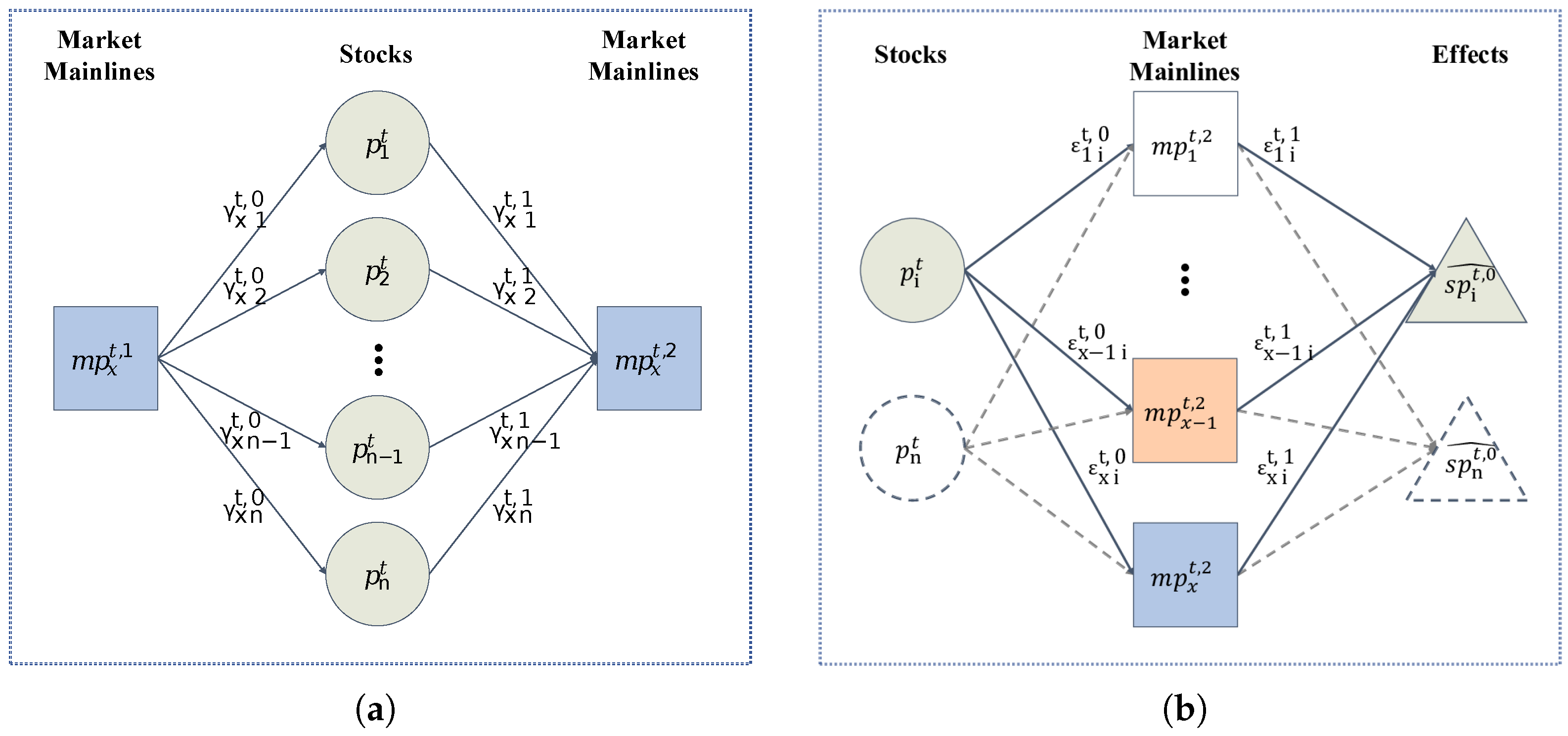
- To deeply explore the underlying connections between individual stocks and the multidimensional dynamic market state, a differential impact mechanism of the market mainline is further introduced. This mechanism captures the complex relationships between the market mainline and individual stocks from multiple perspectives. Specifically, within the temporal and fundamental dimensions, two distinct algorithms are employed to dynamically analyze the differentiated influence of the market mainline on various stocks.
- (3)
- To effectively extract the individual characteristics of each stock, the impact of the dynamic market mainline is filtered out to isolate stock-specific attributes. On this basis, multidimensional influence information from the market mainline is integrated with idiosyncratic stock features to achieve accurate prediction of stock price trends.
- (1)
- We proposes a novel model that captures dynamic evolutionary characteristics of market mainlines from both temporal and fundamental perspectives, effectively addressing the challenge of complex and volatile formation factors.
- (2)
- Our model enhances stock trend prediction performance by simultaneously leveraging differentiated impacts of temporal and fundamental market mainlines on individual stocks alongside stock-specific attributes.
- (3)
- We validated the effectiveness of our MDMF framework through experimental evaluations and investment simulations on real-world stock market datasets.
2. Related Works
2.1. Single-Stock-Based Methods
2.2. Cross-Stock-Based Methods
3. Methodology
3.1. Problem Definition
3.2. Stock Feature Encoding
3.2.1. Temporal Feature Extraction
3.2.2. Fundamental Feature Extraction
3.3. Market-Mainline Encoding
3.3.1. Market-Mainline Initialization via High-Return Stocks
- (1)
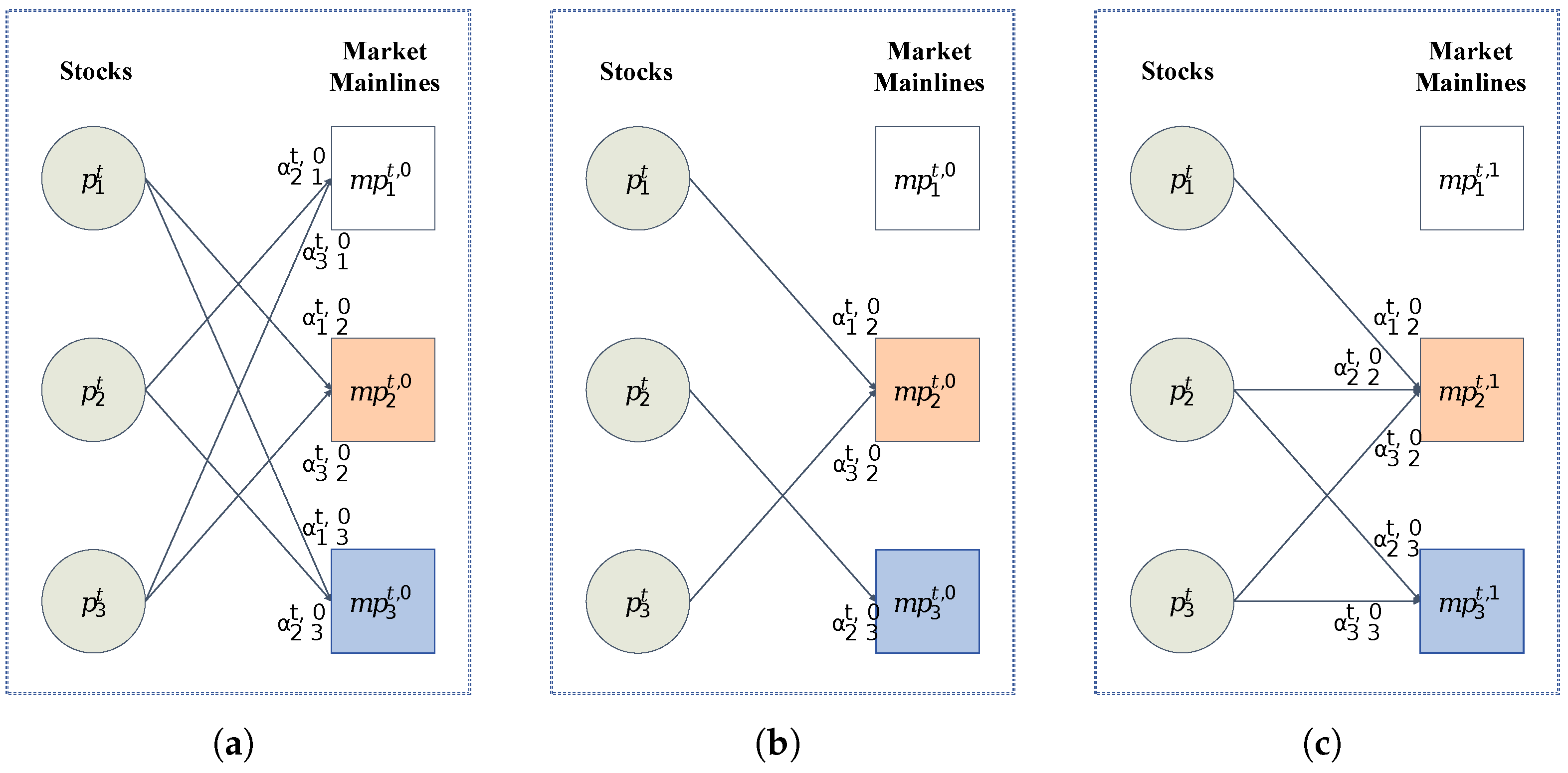
- For each trading day t, the top-n stocks by return are selected to form the set , which represents the core stocks driving market gains. We initialize representations of multiple coexisting market mainlines for the current day, assuming n mainlines corresponding to the n stocks. Using each stock i’s embeddings and , initialize the embeddings and for temporal mainline and fundamental mainline , where index i corresponds to return rankings at t.
- (2)
- Compute cosine similarities between all stocks and market mainlines for both temporal and fundamental features:where and represent the cosine similarity between stock i and temporal market mainline /fundamental market mainline , respectively. The initialization and similarity computation process is illustrated in Figure 3a.
- (3)
- Stocks are assigned to their most similar market mainlines, excluding the mainline they initially generated. Mainlines unconnected to any stocks are pruned. This process is illustrated in Figure 3b; stocks , and are assigned to their most similar market mainline , and , respectively, while is pruned due to the absence of any connecting stock.
- (4)
- For stocks whose originally initialized mainline remains after pruning, the connection to their counterpart is retained.
- (5)
- Using the stock-to-mainline cosine similarities and as aggregation weights, we compute updated representations and for temporal market mainline and fundamental market mainline :where denotes the set of stocks connected to temporal market mainline , and represents the stock set associated with fundamental market mainline . The aggregation and representation update process is shown in Figure 3c.
3.3.2. Market Mainline Representation Refinement
- (1)
- Stocks highly correlated with market mainlines may be omitted due to insufficient return rankings, resulting in incomplete mainline representations.
- (2)
- Certain high-return stocks may lack substantive mainline relevance, and their inclusion could introduce noise during mainline formation.
3.4. Heterogeneous Dynamic Effects of Market Mainlines on Stocks
3.4.1. Temporal Mainline Effects on Stocks
3.4.2. Fundamental Mainline Effects on Stocks
3.5. Stock-Specific Individual Information
3.6. Prediction Module
3.7. Training Objective
4. Experiments
4.1. Experimental Setup
4.1.1. Datasets
Stock Sets
Stock Features
Mutual Fund Semi-Annual Portfolio Reports
4.1.2. Parameter Settings
4.1.3. Compared Methods
- GRU [45]: GRU is a variant of RNN with gating mechanisms that effectively addresses long-term dependency issues when learning sequential features from time-series data, mitigating gradient vanishing and explosion problems. It has been widely applied in stock prediction.
- IMSR [11]: IMSR integrates dynamic stock representations with their correlations to market states, using MLPs to predict next-period stock rankings. It dynamically captures market preferences based on market representations to enhance stock prediction.
- GATs_ts [46]: A dynamic graph attention network that feeds GRU-encoded stock embeddings into GATs. It aggregates these embeddings on stock graphs using graph attention networks to capture dynamic dependencies between stocks.
- FinGAT [47]: A graph neural network-based model that constructs fully connected graphs to learn intra-industry relationships, employs graph pooling mechanisms to generate industry embeddings, and combines graph attention networks to learn inter-industry relationships. It models hierarchical relationships between stocks and industries to learn mutual influences.
- HIST [48]: A graph-based stock trend prediction framework that fully utilizes shared information in graphs constructed from predefined and hidden concepts by mining concept-oriented shared information.
- MTMD [49]: An extension of the HIST model incorporating learnable embeddings, external attention mechanisms, and memory modules. It adaptively fuses heterogeneous multi-scale information through graph networks to improve prediction accuracy.
- ESTIMATE [50]: Combines temporal generative filters with hypergraph convolution. It uses temporal generative filters on LSTM networks to learn stock-specific patterns via memory-based mechanisms, while employing hypergraph attention to capture non-paired correlations. Wavelet bases simplify message passing to focus on local convolution, addressing efficient convolution of high-order dynamics.
- STHAN-SR [51]: Utilizes Hawkes process-based temporal attention LSTM to model stock relationships. It constructs hypergraphs from inter-stock relationships and employs designed spatial hypergraph convolution modules with attention mechanisms to capture spatio-temporal dependencies, generating stock rankings.
- StockMixer [52]: An MLP-based stock price prediction architecture that processes through three stages: indicator mixing, temporal mixing, and stock mixing. It efficiently captures complex relationships in stock data across indicators, time, and inter-stock associations.
4.1.4. Metrics
- Information Coefficient (IC): This metric measures the linear correlation between the model’s predicted values and the actual directional labels of stock returns. It is calculated as the Pearson correlation coefficient between these two sets of values across all trading days and for each individual stock.
- Rank Information Coefficient (RIC): This metric assesses the consistency between the ranking order of model predictions and the ranking order of actual labels. It is calculated as the Spearman’s rank correlation coefficient across all trading days and stocks, providing a more robust measure of monotonic relationship.
- Information Ratio (ICIR): This ratio evaluates the stability and significance of the Information Coefficient. It is calculated as the ratio of the mean IC to its standard deviation, typically annualized. The formula is . A higher ICIR indicates more consistent and reliable predictive ability of the model.
- Rank Information Ratio (RICIR): This metric is analogous to the ICIR but is calculated based on the Rank IC to assess the stability and significance of ranking prediction capability. Its annualized formula is .
- Sharpe Ratio (SR): This metric measures the risk-adjusted return of a daily portfolio constructed from the model’s top-2% predicted stocks (equally weighted). Assuming a zero risk-free rate and 252 trading days per year, the annualized Sharpe Ratio is computed as , where and are the sample mean and standard deviation of the daily portfolio returns.
- Precision@N: This metric evaluates the model’s accuracy in identifying stocks with the highest potential for price increase. Specifically, on each trading day, all stocks are ranked in descending order based on the model’s prediction scores. The top N stocks are selected, and the proportion of these with true positive labels (i.e., actual price increase) is calculated. We report the daily average Precision@N for and 30.
4.2. Main Results
4.3. Ablation Study
- (1)
- As evidenced by the performance differences in Table 8, both the temporal and fundamental market-mainline information provide distinct and complementary signals for stock trend prediction; removing either component leads to a noticeable performance decline.
- (2)
- The integration of stock-specific individual information proves indispensable. Its ablation leads to the most significant performance drop across all evaluation metrics. This result underscores that accurate forecasting requires modeling both collective market dynamics and the unique attributes of individual stocks.
- (3)
- As shown in Table 9, the refined model based on the temporal market mainline significantly outperforms the initialization-only version. This improvement is consistent across all evaluation metrics. It demonstrates that the optimization module plays a critical role in enhancing feature completeness and suppressing noise. For the fundamental market mainline, refinement yields a more nuanced outcome. Although improvements in IC and Rank IC are limited, the SR increases markedly. This indicates that the optimization process effectively improves the risk-adjusted return of the portfolio and helps to build more robust predictive signals.
4.4. Investment Simulation
5. Conclusions
Author Contributions
Funding
Institutional Review Board Statement
Informed Consent Statement
Data Availability Statement
Conflicts of Interest
References
- Hu, Z.; Zhao, Y.; Khushi, M. A Survey of Forex and Stock Price Prediction Using Deep Learning. Appl. Syst. Innov. 2021, 4, 9. [Google Scholar] [CrossRef]
- Ferro, J.V.R.; Santos, R.J.R.D.; de Barros Costa, E.; da Silva Brito, J.R. Machine learning techniques via ensemble approaches in stock exchange index prediction: Systematic review and bibliometric analysis. Appl. Soft Comput. 2024, 167, 112359. [Google Scholar] [CrossRef]
- Blasco, T.; Sánchez, J.S.; García, V. A survey on uncertainty quantification in deep learning for financial time series prediction. Neurocomputing 2024, 576, 127339. [Google Scholar] [CrossRef]
- Vishwakarma, V.K.; Bhosale, N.P. A survey of recent machine learning techniques for stock prediction methodologies. Neural Comput. Appl. 2025, 37, 1951–1972. [Google Scholar] [CrossRef]
- Gupta, U.; Bhattacharjee, V.; Bishnu, P.S. StockNet—GRU based stock index prediction. Expert Syst. Appl. 2022, 207, 117986. [Google Scholar] [CrossRef]
- Chen, T.C. Deep learning-based feature fusion and Forecasting approach for stock market Prediction. Appl. Soft Comput. 2025, 182, 113623. [Google Scholar] [CrossRef]
- Li, Y.; Zhuang, M.; Wang, J.; Zhou, J. Leveraging multi-time-span sequences and feature correlations for improved stock trend prediction. Neurocomputing 2025, 620, 129218. [Google Scholar] [CrossRef]
- Yang, Z.; Zhao, T.; Wang, S.; Li, X. MDF-DMC: A stock prediction model combining multi-view stock data features with dynamic market correlation information. Expert Syst. Appl. 2024, 238, 122134. [Google Scholar] [CrossRef]
- Yilmaz, M.; Keskin, M.M.; Ozbayoglu, A.M. Algorithmic stock trading based on ensemble deep neural networks trained with time graph. Appl. Soft Comput. 2024, 163, 111847. [Google Scholar] [CrossRef]
- Zhu, P.; Li, Y.; Hu, Y.; Xiang, S.; Liu, Q.; Cheng, D.; Liang, Y. MCI-GRU: Stock prediction model based on multi-head cross-attention and improved GRU. Neurocomputing 2025, 638, 130168. [Google Scholar] [CrossRef]
- Chen, C.; Zhao, L.; Bian, J.; Xing, C.; Liu, T.Y. Investment Behaviors Can Tell What Inside: Exploring Stock Intrinsic Properties for Stock Trend Prediction. In KDD ’19 Proceedings of the 25th ACM SIGKDD International Conference on Knowledge Discovery & Data Mining, Anchorage, AK, USA, 4–8 August 2019; ACM: New York, NY, USA, 2019; pp. 2376–2384. [Google Scholar] [CrossRef]
- Chen, Y.; Ye, N.; Zhang, W.; Lv, S.; Shao, L.; Li, X. VMD-MSANet: A multi-scale attention network for stock series prediction with Variational Mode Decomposition. Neurocomputing 2025, 650, 130854. [Google Scholar] [CrossRef]
- Bikhchandani, S.; Sharma, S. Herd Behavior in Financial Markets. IMF Staff Pap. 2000, 47, 279–310. [Google Scholar] [CrossRef]
- Barber, B.M.; Odean, T. All That Glitters: The Effect of Attention and News on the Buying Behavior of Individual and Institutional Investors. Rev. Financ. Stud. 2007, 21, 785–818. [Google Scholar] [CrossRef]
- Li, L.; Leng, S.; Yang, J.; Yu, M. Stock Market Autoregressive Dynamics: A Multinational Comparative Study with Quantile Regression. Math. Probl. Eng. 2016, 2016, 1285768. [Google Scholar] [CrossRef]
- Ariyo, A.A.; Adewumi, A.O.; Ayo, C.K. Stock Price Prediction Using the ARIMA Model. In Proceedings of the 2014 UKSim-AMSS 16th International Conference on Computer Modelling and Simulation, Cambridge, UK, 26–28 March 2014; IEEE: New York, NY, USA, 2014; pp. 106–112. [Google Scholar] [CrossRef]
- Sonkavde, G.; Dharrao, D.S.; Bongale, A.M.; Deokate, S.T.; Doreswamy, D.; Bhat, S.K. Forecasting Stock Market Prices Using Machine Learning and Deep Learning Models: A Systematic Review, Performance Analysis and Discussion of Implications. Int. J. Financ. Stud. 2023, 11, 94. [Google Scholar] [CrossRef]
- Lin, C.Y.; Lobo Marques, J.A. Stock market prediction using artificial intelligence: A systematic review of systematic reviews. Soc. Sci. Humanit. Open 2024, 9, 100864. [Google Scholar] [CrossRef]
- Hochreiter, S.; Schmidhuber, J. Long Short-Term Memory. Neural Comput. 1997, 9, 1735–1780. [Google Scholar] [CrossRef]
- Zhao, J.; Zeng, D.; Liang, S.; Kang, H.; Liu, Q. Prediction model for stock price trend based on recurrent neural network. J. Ambient Intell. Humaniz. Comput. 2021, 12, 745–753. [Google Scholar] [CrossRef]
- Yang, F.; Chen, J.; Liu, Y. Improved and optimized recurrent neural network based on PSO and its application in stock price prediction. Soft Comput. 2023, 27, 3461–3476. [Google Scholar] [CrossRef]
- Bhandari, H.N.; Rimal, B.; Pokhrel, N.R.; Rimal, R.; Dahal, K.R.; Khatri, R.K. Predicting stock market index using LSTM. Mach. Learn. Appl. 2022, 9, 100320. [Google Scholar] [CrossRef]
- Botunac, I.; Bosna, J.; Matetić, M. Optimization of Traditional Stock Market Strategies Using the LSTM Hybrid Approach. Information 2024, 15, 136. [Google Scholar] [CrossRef]
- Gülmez, B. Stock price prediction with optimized deep LSTM network with artificial rabbits optimization algorithm. Expert Syst. Appl. 2023, 227, 120346. [Google Scholar] [CrossRef]
- Ali, M.; Khan, D.M.; Alshanbari, H.M.; El-Bagoury, A.A.A.H. Prediction of Complex Stock Market Data Using an Improved Hybrid EMD-LSTM Model. Appl. Sci. 2023, 13, 1429. [Google Scholar] [CrossRef]
- Lu, M.; Xu, X. TRNN: An efficient time-series recurrent neural network for stock price prediction. Inf. Sci. 2024, 657, 119951. [Google Scholar] [CrossRef]
- Wang, C.; Chen, Y.; Zhang, S.; Zhang, Q. Stock market index prediction using deep Transformer model. Expert Syst. Appl. 2022, 208, 118128. [Google Scholar] [CrossRef]
- Wang, S. A Stock Price Prediction Method Based on BiLSTM and Improved Transformer. IEEE Access 2023, 11, 104211–104223. [Google Scholar] [CrossRef]
- Teng, X.; Zhang, L.; Gao, P.; Yu, C.; Sun, S. BERT-Driven stock price trend prediction utilizing tokenized stock data and multi-step optimization approach. Appl. Soft Comput. 2025, 170, 112627. [Google Scholar] [CrossRef]
- Zhang, Q.; Qin, C.; Zhang, Y.; Bao, F.; Zhang, C.; Liu, P. Transformer-based attention network for stock movement prediction. Expert Syst. Appl. 2022, 202, 117239. [Google Scholar] [CrossRef]
- Li, T.; Liu, Z.; Shen, Y.; Wang, X.; Chen, H.; Huang, S. MASTER: Market-Guided Stock Transformer for Stock Price Forecasting. Proc. AAAI Conf. Artif. Intell. 2024, 38, 162–170. [Google Scholar] [CrossRef]
- Muhammad, T.; Aftab, A.B.; Ibrahim, M.; Ahsan, M.M.; Muhu, M.M.; Khan, S.I.; Alam, M.S. Transformer-Based Deep Learning Model for Stock Price Prediction: A Case Study on Bangladesh Stock Market. Int. J. Comput. Intell. Appl. 2023, 22, 2350013. [Google Scholar] [CrossRef]
- Saha, S.; Gao, J.; Gerlach, R. A survey of the application of graph-based approaches in stock market analysis and prediction. Int. J. Data Sci. Anal. 2022, 14, 1–15. [Google Scholar] [CrossRef]
- Patel, M.; Jariwala, K.; Chattopadhyay, C. A Systematic Review on Graph Neural Network-based Methods for Stock Market Forecasting. ACM Comput. Surv. 2024, 57, 34. [Google Scholar] [CrossRef]
- Das, N.; Sadhukhan, B.; Chatterjee, R.; Chakrabarti, S. Integrating sentiment analysis with graph neural networks for enhanced stock prediction: A comprehensive survey. Decis. Anal. J. 2024, 10, 100417. [Google Scholar] [CrossRef]
- Xiang, S.; Cheng, D.; Shang, C.; Zhang, Y.; Liang, Y. Temporal and Heterogeneous Graph Neural Network for Financial Time Series Prediction. In CIKM ’22 Proceedings of the 31st ACM International Conference on Information & Knowledge Management, Atlanta, GA, USA, 17–21 October 2022; ACM: New York, NY, USA, 2022; pp. 3584–3593. [Google Scholar] [CrossRef]
- Ma, D.; Yuan, D.; Huang, M.; Dong, L. VGC-GAN: A multi-graph convolution adversarial network for stock price prediction. Expert Syst. Appl. 2024, 236, 121204. [Google Scholar] [CrossRef]
- Qian, H.; Zhou, H.; Zhao, Q.; Chen, H.; Yao, H.; Wang, J.; Liu, Z.; Yu, F.; Zhang, Z.; Zhou, J. MDGNN: Multi-Relational Dynamic Graph Neural Network for Comprehensive and Dynamic Stock Investment Prediction. Proc. AAAI Conf. Artif. Intell. 2024, 38, 14642–14650. [Google Scholar] [CrossRef]
- Han, H.; Xie, L.; Chen, S.; Xu, H. Stock trend prediction based on industry relationships driven hypergraph attention networks. Appl. Intell. 2023, 53, 29448–29464. [Google Scholar] [CrossRef]
- Shi, Y.; Wang, Y.; Qu, Y.; Chen, Z. Integrated GCN-LSTM stock prices movement prediction based on knowledge-incorporated graphs construction. Int. J. Mach. Learn. Cybern. 2024, 15, 161–176. [Google Scholar] [CrossRef]
- Liu, H.; Zhao, T.; Wang, S.; Li, X. A stock rank prediction method combining industry attributes and price data of stocks. Inf. Process. Manag. 2023, 60, 103358. [Google Scholar] [CrossRef]
- Liu, R.; Liu, H.; Huang, H.; Song, B.; Wu, Q. Multimodal multiscale dynamic graph convolution networks for stock price prediction. Pattern Recognit. 2024, 149, 110211. [Google Scholar] [CrossRef]
- Wang, T.; Guo, J.; Shan, Y.; Zhang, Y.; Peng, B.; Wu, Z. A knowledge graph–GCN–community detection integrated model for large-scale stock price prediction. Appl. Soft Comput. 2023, 145, 110595. [Google Scholar] [CrossRef]
- Yang, X.; Liu, W.; Zhou, D.; Bian, J.; Liu, T.Y. Qlib: An AI-oriented Quantitative Investment Platform. arXiv 2020, arXiv:2009.11189. [Google Scholar] [CrossRef]
- Chung, J.; Gulcehre, C.; Cho, K.; Bengio, Y. Empirical Evaluation of Gated Recurrent Neural Networks on Sequence Modeling. arXiv 2014, arXiv:1412.3555. [Google Scholar] [CrossRef]
- Veličković, P.; Cucurull, G.; Casanova, A.; Romero, A.; Liò, P.; Bengio, Y. Graph Attention Networks. arXiv 2018, arXiv:1710.10903. [Google Scholar]
- Hsu, Y.L.; Tsai, Y.C.; Li, C.T. FinGAT: Financial Graph Attention Networks for Recommending Top-KK Profitable Stocks. IEEE Trans. Knowl. Data Eng. 2023, 35, 469–481. [Google Scholar] [CrossRef]
- Xu, W.; Liu, W.; Wang, L.; Xia, Y.; Bian, J.; Yin, J.; Liu, T.Y. HIST: A Graph-based Framework for Stock Trend Forecasting via Mining Concept-Oriented Shared Information. arXiv 2022, arXiv:2110.13716. [Google Scholar]
- Wang, M.; Tian, J.; Zhang, M.; Guo, J.; Jia, W. MTMD: Multi-Scale Temporal Memory Learning and Efficient Debiasing Framework for Stock Trend Forecasting. IEEE Trans. Emerg. Top. Comput. Intell. 2025, 9, 2151–2163. [Google Scholar] [CrossRef]
- Huynh, T.T.; Nguyen, M.H.; Nguyen, T.T.; Nguyen, P.L.; Weidlich, M.; Nguyen, Q.V.H.; Aberer, K. Efficient Integration of Multi-Order Dynamics and Internal Dynamics in Stock Movement Prediction. In WSDM ’23 Proceedings of the Sixteenth ACM International Conference on Web Search and Data Mining, Singapore, 27 February–3 March 2023; ACM: New York, NY, USA, 2023; pp. 850–858. [Google Scholar] [CrossRef]
- Sawhney, R.; Agarwal, S.; Wadhwa, A.; Derr, T.; Shah, R.R. Stock Selection via Spatiotemporal Hypergraph Attention Network: A Learning to Rank Approach. Proc. AAAI Conf. Artif. Intell. 2021, 35, 497–504. [Google Scholar] [CrossRef]
- Fan, J.; Shen, Y. StockMixer: A Simple Yet Strong MLP-Based Architecture for Stock Price Forecasting. Proc. AAAI Conf. Artif. Intell. 2024, 38, 8389–8397. [Google Scholar] [CrossRef]
- Lin, H.; Zhou, D.; Liu, W.; Bian, J. Learning Multiple Stock Trading Patterns with Temporal Routing Adaptor and Optimal Transport. In KDD ’21 Proceedings of the 27th ACM SIGKDD Conference on Knowledge Discovery & Data Mining, Virtual, 14–18 August 2021; ACM: New York, NY, USA, 2021; pp. 1017–1026. [Google Scholar] [CrossRef]
- Li, Z.; Yang, D.; Zhao, L.; Bian, J.; Qin, T.; Liu, T.Y. Individualized Indicator for All: Stock-wise Technical Indicator Optimization with Stock Embedding. In KDD ’19 Proceedings of the 25th ACM SIGKDD International Conference on Knowledge Discovery & Data Mining, Anchorage, AK, USA, 4–8 August 2019; ACM: New York, NY, USA, 2019; pp. 894–902. [Google Scholar] [CrossRef]



| Attribute | CSI 300 | CSI 500 | Full-Market (Excl. ST) |
|---|---|---|---|
| Number of Stocks | 300 | 500 | 2146 to 3959 |
| Industry Coverage | Broad, covering major sectors | Broad, covering major sectors | Broad, covering all market sectors |
| Market Cap Range | Large-cap | Mid- and Small-cap | Full range |
| Market | China A-Share | China A-Share | China A-Share |
| Market Cap Coverage | Covers about 70% of total A-share market cap | Covers about 15% of total A-share market cap | Covers the vast majority of non-ST stocks |
| Start Time | 1 September 2013 | 1 September 2013 | 1 September 2013 |
| End Time | 31 August 2024 | 31 August 2024 | 31 December 2020 |
| Dataset | Data Type | Start Time | End Time | Days | Data Volume |
|---|---|---|---|---|---|
| Train | 1 September 2013 | 31 August 2017 | 976 | 268,084 | |
| CSI 300 (2013–2020) | Valid | 1 September 2017 | 31 December 2018 | 334 | 93,208 |
| Test | 1 January 2019 | 31 December 2020 | 481 | 125,539 | |
| Train | 1 September 2013 | 31 August 2019 | 1463 | 419,950 | |
| CSI 300 (2013–2024) | Valid | 1 September 2019 | 31 August 2021 | 486 | 145,524 |
| Test | 1 September 2021 | 31 August 2024 | 728 | 217,979 | |
| Train | 1 September 2013 | 31 August 2017 | 976 | 433,432 | |
| CSI 500 (2013–2020) | Valid | 1 September 2017 | 31 December 2018 | 334 | 152,705 |
| Test | 1 January 2019 | 31 December 2020 | 481 | 208,973 | |
| Train | 1 September 2013 | 31 August 2019 | 1463 | 688,224 | |
| CSI 500 (2013–2024) | Valid | 1 September 2019 | 31 August 2021 | 486 | 242,473 |
| Test | 1 September 2021 | 31 August 2024 | 728 | 362,466 | |
| Train | 1 September 2013 | 31 August 2017 | 976 | 2,344,660 | |
| Full-market (2013–2020) | Valid | 1 September 2017 | 31 December 2018 | 334 | 1,067,545 |
| Test | 1 January 2019 | 31 December 2020 | 481 | 1,531,085 |
| Methods | IC (↑) | RIC (↑) | ICIR (↑) | RICIR (↑) | SR (↑) | Precision@N (↑) | |||
|---|---|---|---|---|---|---|---|---|---|
| 3 | 5 | 10 | 30 | ||||||
| GRU | 0.085 | 0.082 | 0.714 | 0.689 | 4.64 | 56.93 | 56.70 | 56.44 | 55.94 |
| HIST | 0.105 | 0.103 | 0.763 | 0.741 | 5.54 | 58.17 | 57.96 | 57.62 | 57.32 |
| IMSR | 0.088 | 0.084 | 0.733 | 0.704 | 5.04 | 56.27 | 56.09 | 55.85 | 55.49 |
| GATs | 0.086 | 0.082 | 0.766 | 0.723 | 5.27 | 56.92 | 56.56 | 55.83 | 55.69 |
| FinGAT | 0.092 | 0.090 | 0.701 | 0.685 | 5.61 | 57.11 | 56.80 | 56.71 | 55.99 |
| MTMD | 0.103 | 0.101 | 0.732 | 0.705 | 5.27 | 57.46 | 57.23 | 57.88 | 56.86 |
| StockMixer | 0.087 | 0.084 | 0.735 | 0.710 | 5.14 | 56.76 | 56.53 | 55.91 | 55.64 |
| STHAN-SR | 0.095 | 0.090 | 0.751 | 0.712 | 5.06 | 58.01 | 57.84 | 57.33 | 56.97 |
| ESTIMATE | 0.097 | 0.091 | 0.747 | 0.709 | 4.95 | 60.12 | 59.49 | 58.04 | 54.77 |
| MDMF | 0.108 | 0.106 | 0.801 | 0.777 | 5.96 | 59.11 | 58.59 | 58.18 | 57.45 |
| Methods | IC (↑) | RIC (↑) | ICIR (↑) | RICIR (↑) | SR (↑) | Precision@N (↑) | |||
|---|---|---|---|---|---|---|---|---|---|
| 3 | 5 | 10 | 30 | ||||||
| GRU | 0.105 | 0.096 | 1.004 | 0.921 | 5.61 | 58.05 | 57.03 | 56.03 | 55.74 |
| HIST | 0.121 | 0.115 | 1.031 | 0.962 | 6.01 | 58.17 | 57.67 | 57.02 | 57.07 |
| IMSR | 0.111 | 0.100 | 1.046 | 0.947 | 6.24 | 58.40 | 57.62 | 57.14 | 56.03 |
| GATs | 0.104 | 0.097 | 0.994 | 0.915 | 5.66 | 57.42 | 56.23 | 55.07 | 55.04 |
| FinGAT | 0.113 | 0.104 | 1.031 | 0.948 | 5.87 | 56.51 | 55.81 | 55.60 | 55.48 |
| MTMD | 0.120 | 0.115 | 1.004 | 0.942 | 5.79 | 57.96 | 55.90 | 55.54 | 56.11 |
| StockMixer | 0.106 | 0.097 | 1.015 | 0.924 | 5.32 | 57.05 | 56.28 | 55.70 | 55.49 |
| STHAN-SR | 0.116 | 0.109 | 0.986 | 0.915 | 5.68 | 58.17 | 58.00 | 57.04 | 55.86 |
| ESTIMATE | 0.114 | 0.108 | 0.930 | 0.876 | 5.70 | 57.98 | 56.78 | 55.55 | 55.26 |
| MDMF | 0.124 | 0.117 | 1.050 | 0.971 | 6.38 | 58.87 | 58.36 | 57.12 | 56.73 |
| Methods | IC (↑) | RIC (↑) | ICIR (↑) | RICIR (↑) | SR (↑) | Precision@N (↑) | |||
|---|---|---|---|---|---|---|---|---|---|
| 3 | 5 | 10 | 30 | ||||||
| GRU | 0.154 | 0.134 | 1.626 | 1.350 | 18.39 | 90.76 | 86.37 | 78.02 | 64.58 |
| HIST | 0.162 | 0.150 | 1.699 | 1.485 | 18.93 | 91.88 | 87.56 | 79.62 | 66.94 |
| IMSR | 0.153 | 0.135 | 1.691 | 1.437 | 19.26 | 89.92 | 85.26 | 77.99 | 66.39 |
| GATs | 0.149 | 0.131 | 1.683 | 1.399 | 17.65 | 90.74 | 86.11 | 77.31 | 64.45 |
| FinGAT | 0.158 | 0.135 | 1.705 | 1.392 | 18.28 | 89.92 | 85.26 | 77.99 | 66.39 |
| MTMD | 0.161 | 0.145 | 1.729 | 1.435 | 18.76 | 91.87 | 86.56 | 79.27 | 66.85 |
| StockMixer | 0.155 | 0.139 | 1.699 | 1.394 | 17.49 | 87.96 | 84.74 | 78.10 | 64.81 |
| STHAN-SR | 0.158 | 0.141 | 1.777 | 1.463 | 18.73 | 91.73 | 86.62 | 78.95 | 65.62 |
| ESTIMATE | 0.159 | 0.141 | 1.768 | 1.456 | 18.80 | 91.95 | 87.64 | 79.63 | 66.37 |
| MDMF | 0.168 | 0.151 | 1.737 | 1.471 | 19.68 | 92.06 | 87.88 | 79.91 | 67.34 |
| Methods | IC (↑) | RIC (↑) | ICIR (↑) | RICIR (↑) | SR (↑) | Precision@N (↑) | |||
|---|---|---|---|---|---|---|---|---|---|
| 3 | 5 | 10 | 30 | ||||||
| GRU | 0.064 | 0.062 | 0.523 | 0.501 | 1.85 | 52.07 | 51.96 | 52.36 | 52.83 |
| HIST | 0.067 | 0.064 | 0.457 | 0.434 | 2.77 | 54.61 | 54.13 | 53.93 | 54.11 |
| IMSR | 0.066 | 0.064 | 0.447 | 0.426 | 2.72 | 55.70 | 55.23 | 54.18 | 54.27 |
| GATs | 0.053 | 0.050 | 0.427 | 0.394 | 1.48 | 52.21 | 52.28 | 52.40 | 52.49 |
| FinGAT | 0.058 | 0.056 | 0.439 | 0.417 | 1.98 | 53.59 | 52.92 | 53.27 | 53.41 |
| MTMD | 0.067 | 0.065 | 0.454 | 0.431 | 2.78 | 54.63 | 54.91 | 54.78 | 53.99 |
| StockMixer | 0.059 | 0.057 | 0.438 | 0.409 | 1.52 | 52.08 | 51.49 | 52.32 | 52.64 |
| STHAN-SR | 0.068 | 0.066 | 0.486 | 0.465 | 2.39 | 53.65 | 53.11 | 52.62 | 52.89 |
| ESTIMATE | 0.069 | 0.067 | 0.536 | 0.518 | 2.10 | 53.18 | 53.25 | 53.27 | 53.91 |
| MDMF | 0.070 | 0.067 | 0.472 | 0.449 | 2.93 | 54.11 | 54.13 | 53.94 | 53.80 |
| Methods | IC (↑) | RIC (↑) | ICIR (↑) | RICIR (↑) | SR (↑) | Precision@N (↑) | |||
|---|---|---|---|---|---|---|---|---|---|
| 3 | 5 | 10 | 30 | ||||||
| GRU | 0.068 | 0.064 | 0.558 | 0.531 | 2.17 | 52.59 | 53.37 | 53.28 | 52.64 |
| HIST | 0.072 | 0.069 | 0.675 | 0.618 | 2.31 | 54.26 | 53.63 | 53.51 | 53.72 |
| IMSR | 0.071 | 0.067 | 0.538 | 0.509 | 1.98 | 54.74 | 53.06 | 53.31 | 53.83 |
| GATs | 0.059 | 0.056 | 0.516 | 0.487 | 1.69 | 52.56 | 52.39 | 52.36 | 52.26 |
| FinGAT | 0.063 | 0.061 | 0.527 | 0.499 | 2.20 | 53.67 | 52.78 | 52.56 | 52.31 |
| MTMD | 0.070 | 0.064 | 0.682 | 0.627 | 2.20 | 54.04 | 53.43 | 53.08 | 53.32 |
| StockMixer | 0.062 | 0.058 | 0.439 | 0.404 | 1.43 | 53.46 | 52.51 | 51.99 | 52.70 |
| STHAN-SR | 0.074 | 0.071 | 0.568 | 0.543 | 2.66 | 53.18 | 53.35 | 53.43 | 53.90 |
| ESTIMATE | 0.073 | 0.069 | 0.571 | 0.535 | 2.39 | 53.82 | 52.90 | 53.59 | 54.03 |
| MDMF | 0.071 | 0.068 | 0.547 | 0.518 | 2.79 | 54.24 | 54.11 | 53.96 | 54.06 |
| Temporal | Fundamental | Individual | Metrics | |||||
|---|---|---|---|---|---|---|---|---|
| IC (↑) | RIC (↑) | ICIR (↑) | RICIR (↑) | SR (↑) | Precision@30 (↑) | |||
| CSI 300 (2013–2020) | ||||||||
| ✓ | - | - | 0.091 | 0.088 | 0.731 | 0.711 | 4.92 | 56.52 |
| - | ✓ | - | 0.089 | 0.086 | 0.741 | 0.712 | 5.04 | 55.65 |
| ✓ | ✓ | - | 0.092 | 0.089 | 0.749 | 0.723 | 4.35 | 56.67 |
| ✓ | ✓ | ✓ | 0.108 | 0.106 | 0.801 | 0.777 | 5.96 | 57.45 |
| CSI 500 (2013–2020) | ||||||||
| ✓ | - | - | 0.108 | 0.100 | 0.984 | 0.908 | 5.40 | 55.85 |
| - | ✓ | - | 0.111 | 0.101 | 1.046 | 0.947 | 6.24 | 56.03 |
| ✓ | ✓ | - | 0.106 | 0.098 | 0.951 | 0.880 | 4.92 | 55.60 |
| ✓ | ✓ | ✓ | 0.124 | 0.117 | 1.050 | 0.971 | 6.38 | 56.73 |
| Temporal | Fundamental | Metrics | |||||||
|---|---|---|---|---|---|---|---|---|---|
| Initialization | Refinement | Initialization | Refinement | IC (↑) | RIC (↑) | ICIR (↑) | RICIR (↑) | SR (↑) | Precision@30 (↑) |
| CSI 300 (2013–2020) | |||||||||
| ✓ | - | - | - | 0.087 | 0.085 | 0.704 | 0.683 | 4.69 | 56.37 |
| ✓ | ✓ | - | - | 0.091 | 0.088 | 0.731 | 0.711 | 4.92 | 56.52 |
| - | - | ✓ | - | 0.089 | 0.086 | 0.744 | 0.714 | 4.88 | 55.70 |
| - | - | ✓ | ✓ | 0.089 | 0.086 | 0.741 | 0.712 | 5.04 | 55.65 |
| ✓ | - | ✓ | - | 0.084 | 0.083 | 0.636 | 0.628 | 4.46 | 55.73 |
| ✓ | ✓ | ✓ | ✓ | 0.108 | 0.106 | 0.801 | 0.777 | 5.96 | 57.45 |
| CSI 500 (2013–2020) | |||||||||
| ✓ | - | - | - | 0.106 | 0.099 | 0.980 | 0.910 | 5.09 | 55.48 |
| ✓ | ✓ | - | - | 0.108 | 0.100 | 0.984 | 0.908 | 5.40 | 55.85 |
| - | - | ✓ | - | 0.111 | 0.101 | 1.045 | 0.946 | 6.04 | 55.80 |
| - | - | ✓ | ✓ | 0.111 | 0.101 | 1.046 | 0.947 | 6.24 | 56.03 |
| ✓ | - | ✓ | - | 0.108 | 0.100 | 0.909 | 0.835 | 5.99 | 55.48 |
| ✓ | ✓ | ✓ | ✓ | 0.124 | 0.117 | 1.050 | 0.971 | 6.38 | 56.73 |
Disclaimer/Publisher’s Note: The statements, opinions and data contained in all publications are solely those of the individual author(s) and contributor(s) and not of MDPI and/or the editor(s). MDPI and/or the editor(s) disclaim responsibility for any injury to people or property resulting from any ideas, methods, instructions or products referred to in the content. |
© 2026 by the authors. Licensee MDPI, Basel, Switzerland. This article is an open access article distributed under the terms and conditions of the Creative Commons Attribution (CC BY) license.
Share and Cite
Shi, Z.; Zhao, Y.; Zhang, Y.; Wu, H. MDMF: A Market-Mainline-Driven Multi-Feature Fusion Model for Stock Trend Forecasting. Appl. Sci. 2026, 16, 1648. https://doi.org/10.3390/app16031648
Shi Z, Zhao Y, Zhang Y, Wu H. MDMF: A Market-Mainline-Driven Multi-Feature Fusion Model for Stock Trend Forecasting. Applied Sciences. 2026; 16(3):1648. https://doi.org/10.3390/app16031648
Chicago/Turabian StyleShi, Zichen, Yuli Zhao, Yin Zhang, and Hongfei Wu. 2026. "MDMF: A Market-Mainline-Driven Multi-Feature Fusion Model for Stock Trend Forecasting" Applied Sciences 16, no. 3: 1648. https://doi.org/10.3390/app16031648
APA StyleShi, Z., Zhao, Y., Zhang, Y., & Wu, H. (2026). MDMF: A Market-Mainline-Driven Multi-Feature Fusion Model for Stock Trend Forecasting. Applied Sciences, 16(3), 1648. https://doi.org/10.3390/app16031648