Mechanical Evaluation of Bioabsorbable and 3D-Printable Materials as Clavicle Plate Fixation Alternatives Using Finite Element Analysis


Abstract
1. Introduction
2. Materials and Methods
2.1. Materials and Methods Introduction
2.2. Material Properties
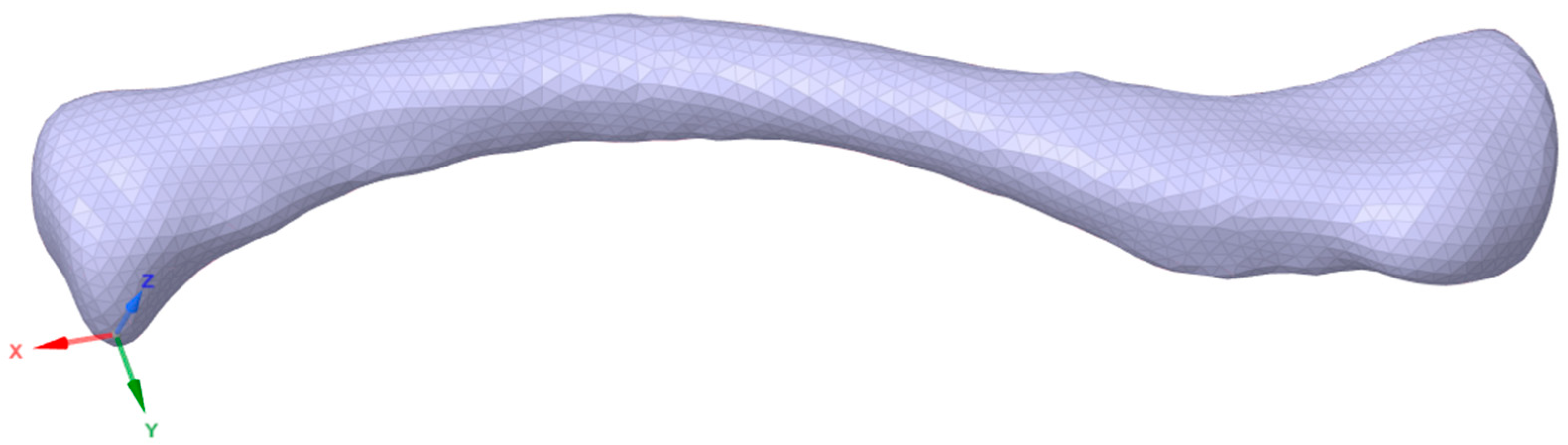
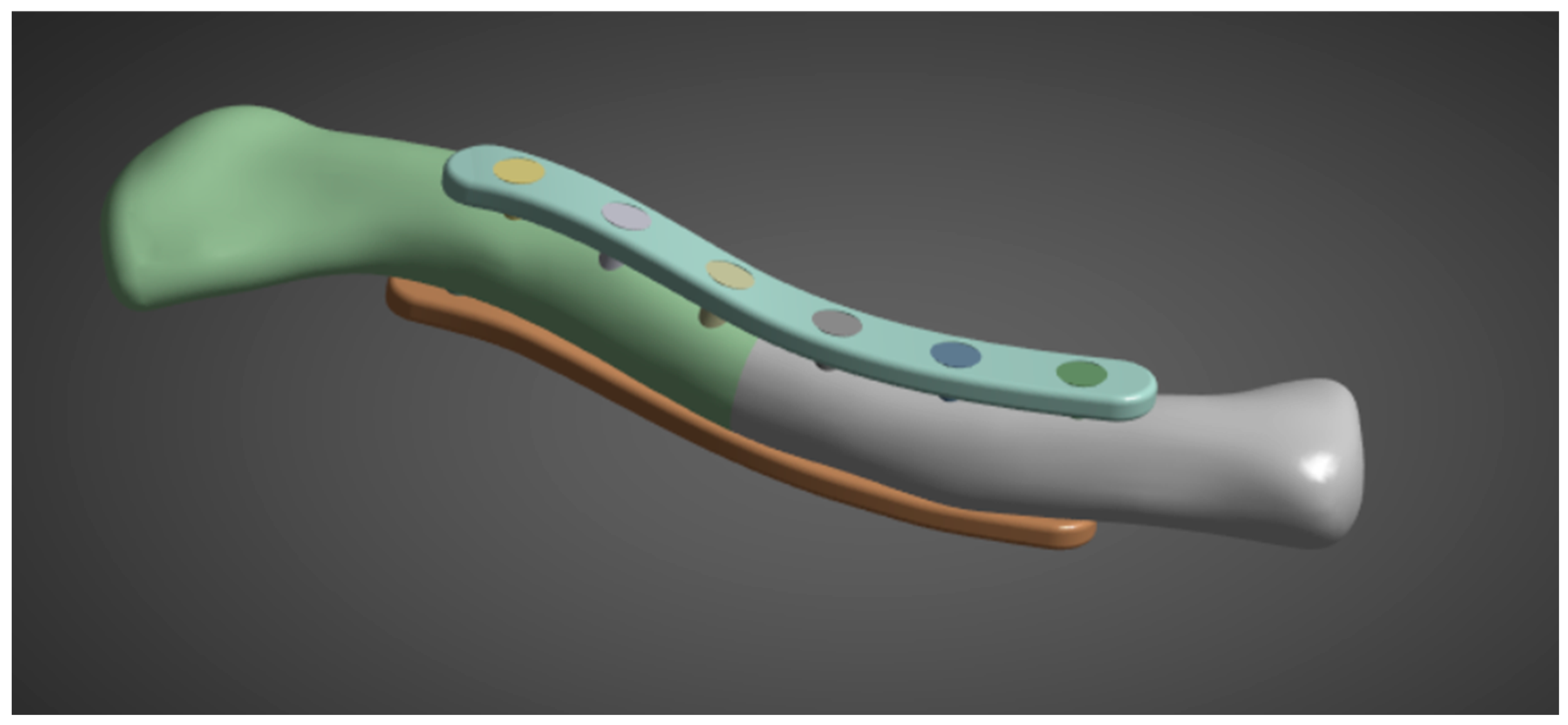
2.3. Clavicle Geometry
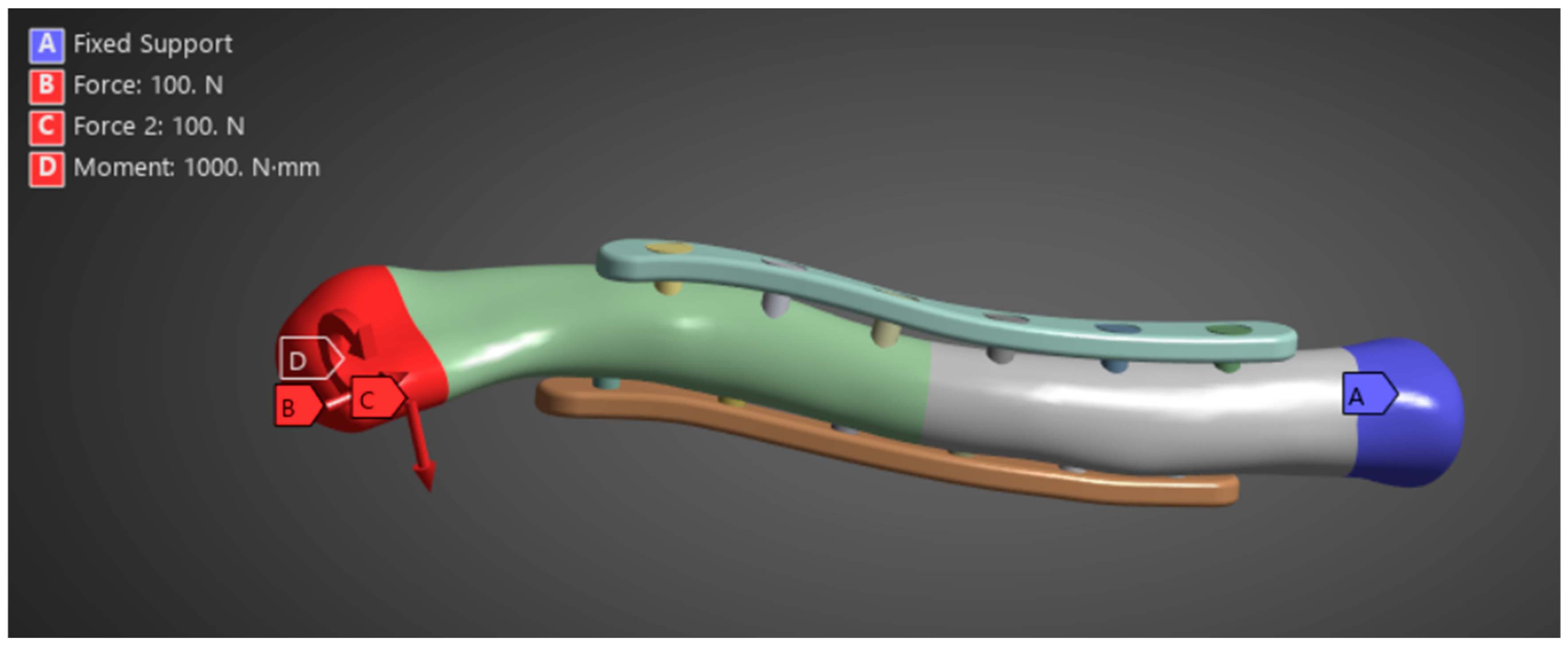
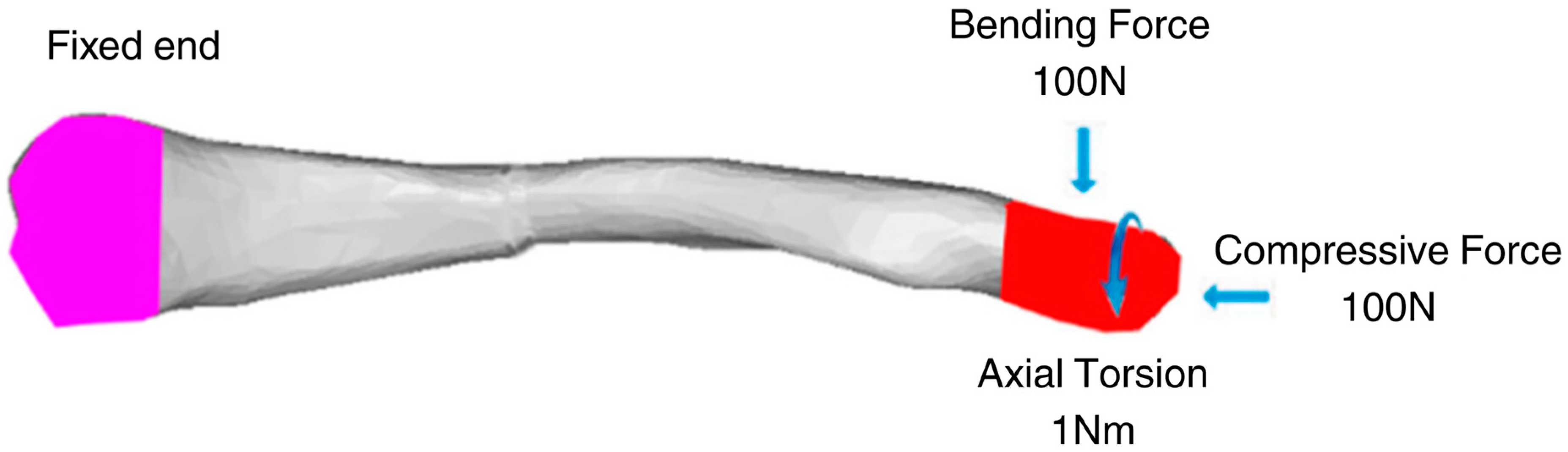
2.4. Boundary and Loading Conditions
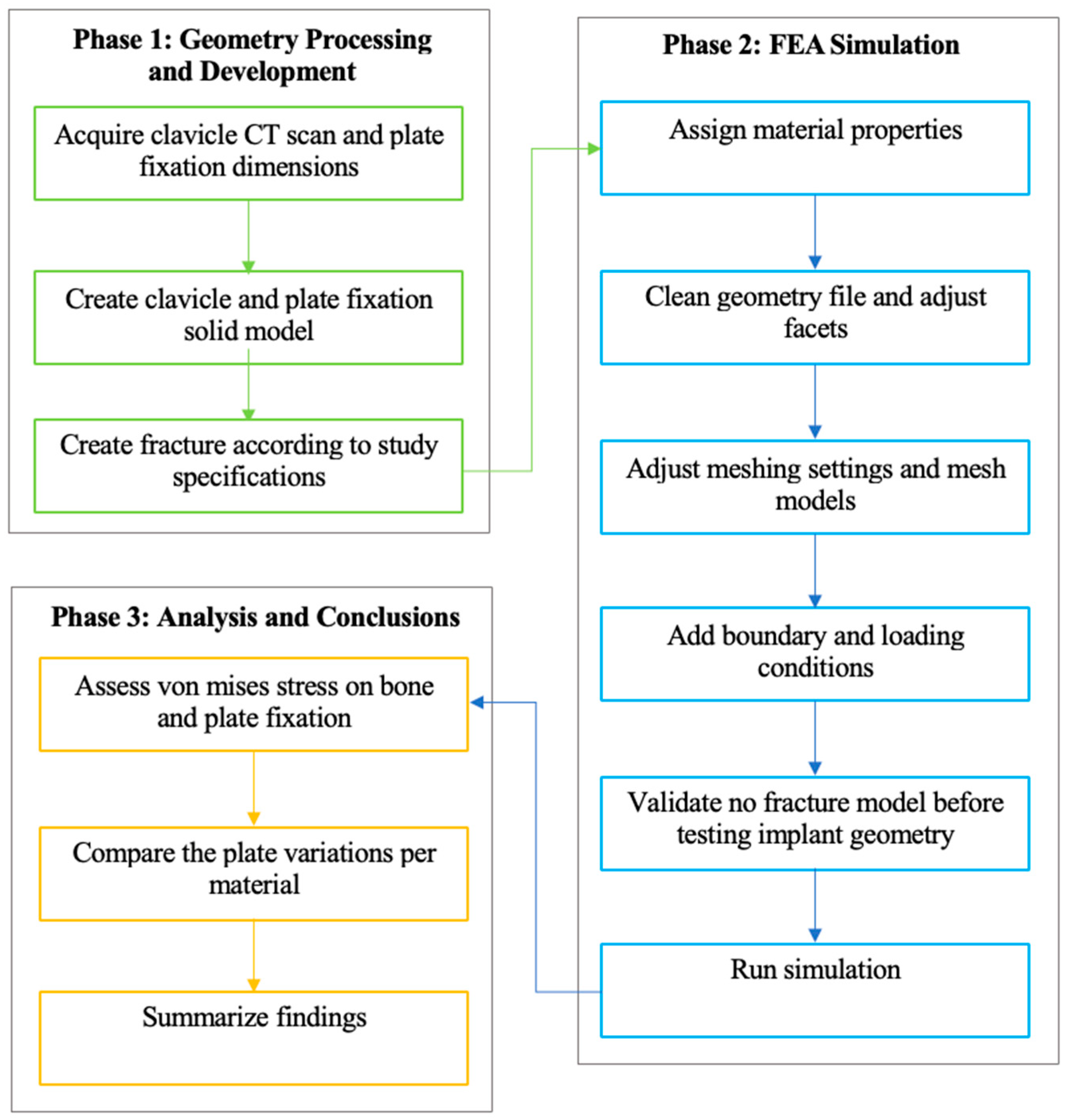
2.5. Research Design
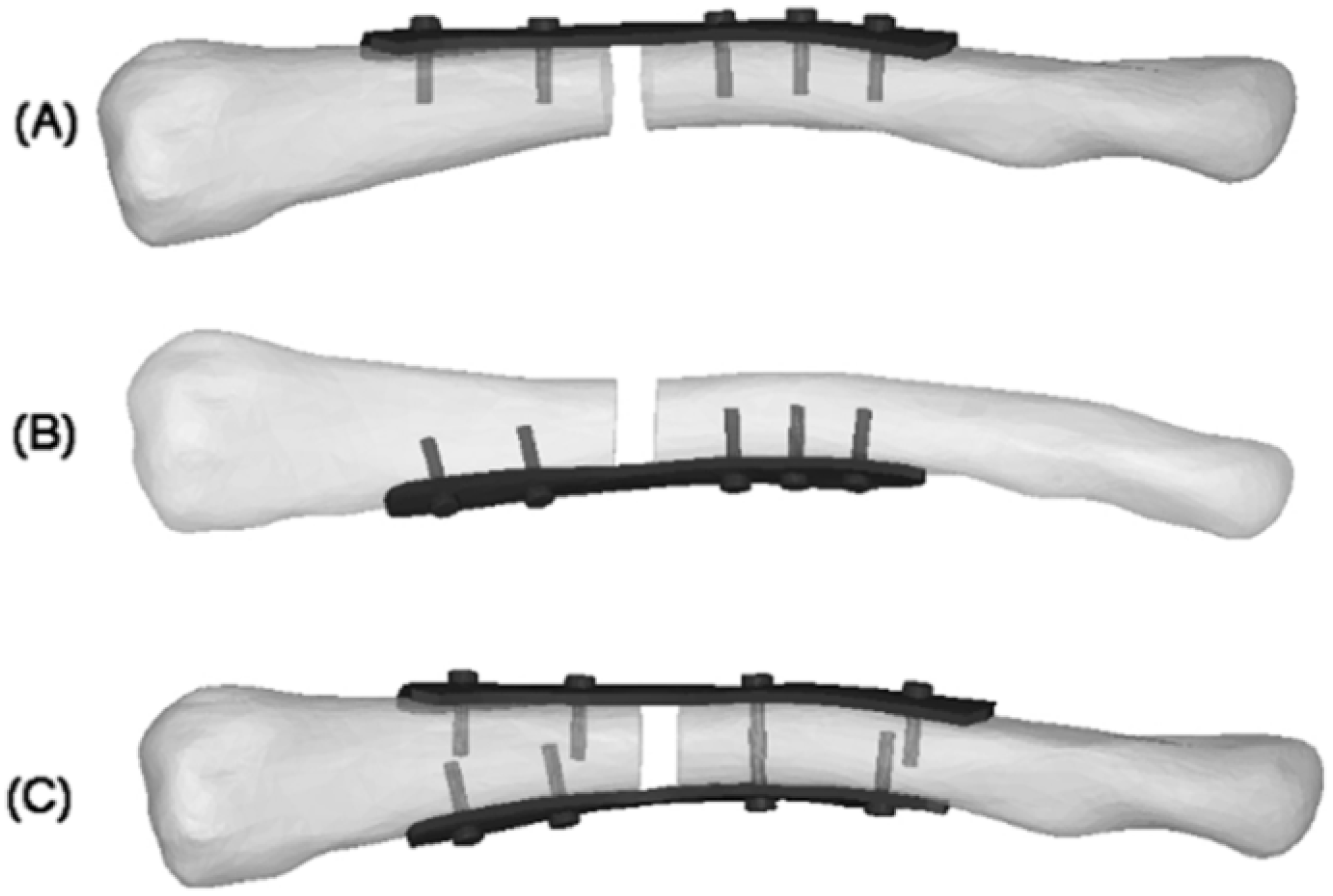
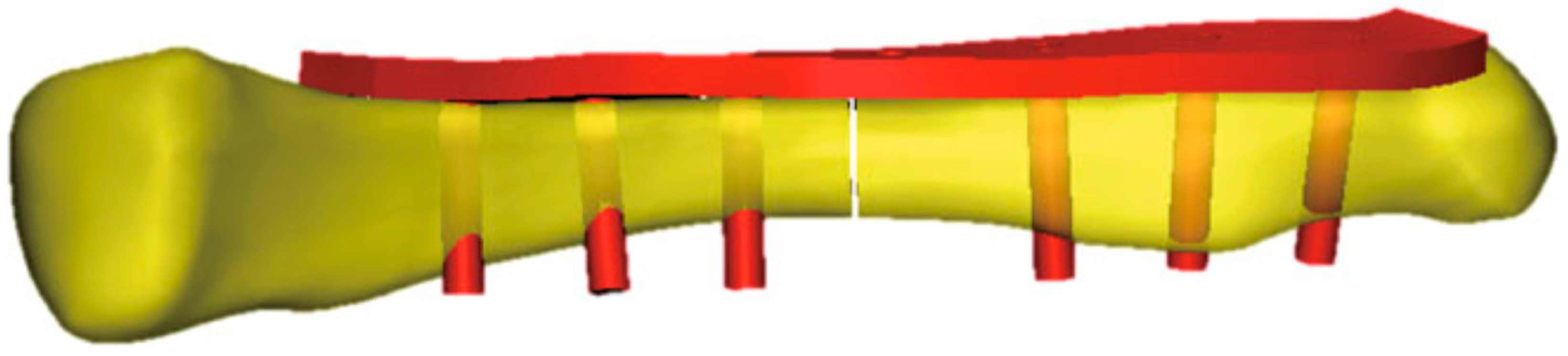
2.5.1. Phase 1: Geometry Processing and Development
2.5.2. Phase 2: FEA Simulation
2.5.3. Phase 3: Analysis and Conclusions
2.6. Validation
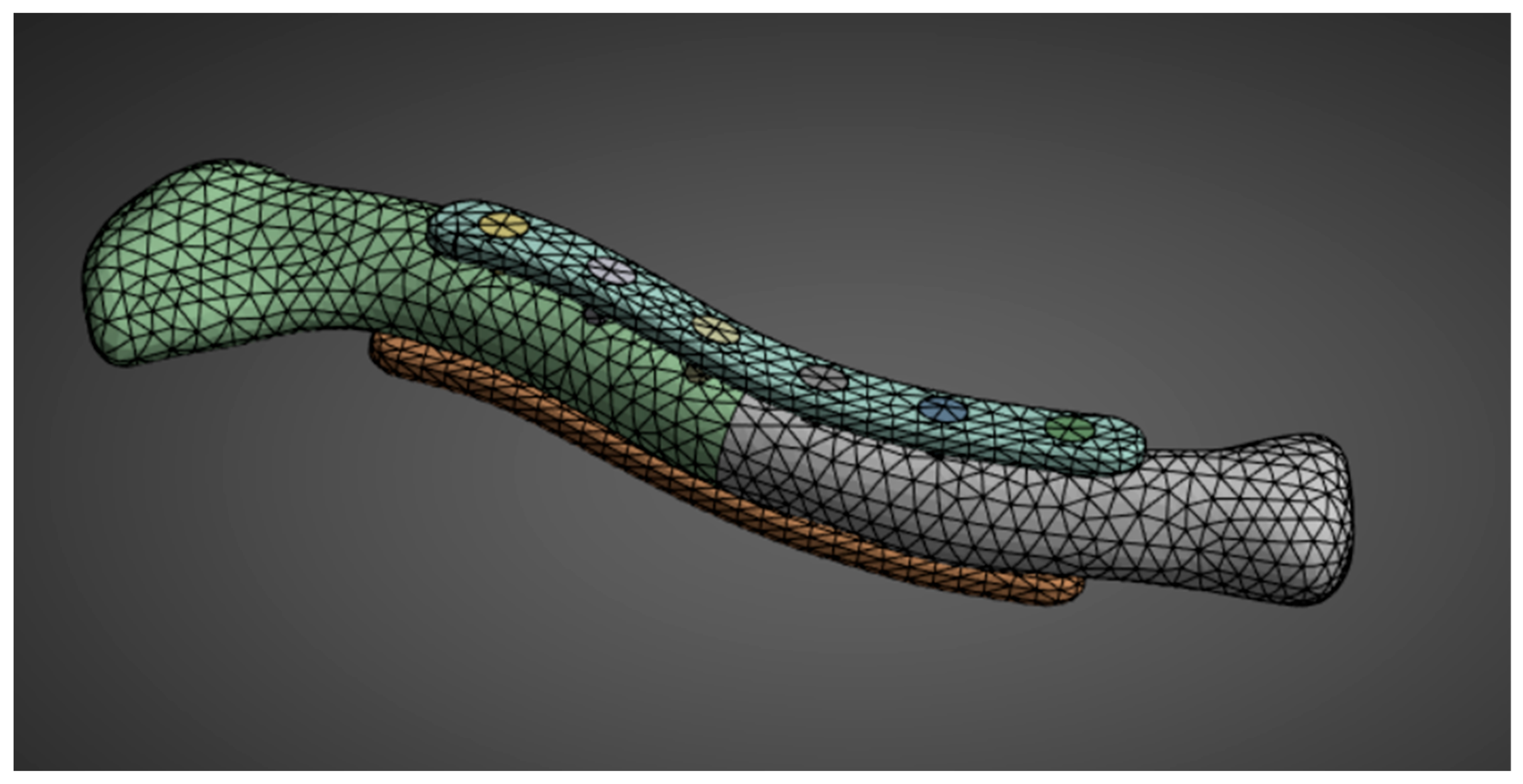
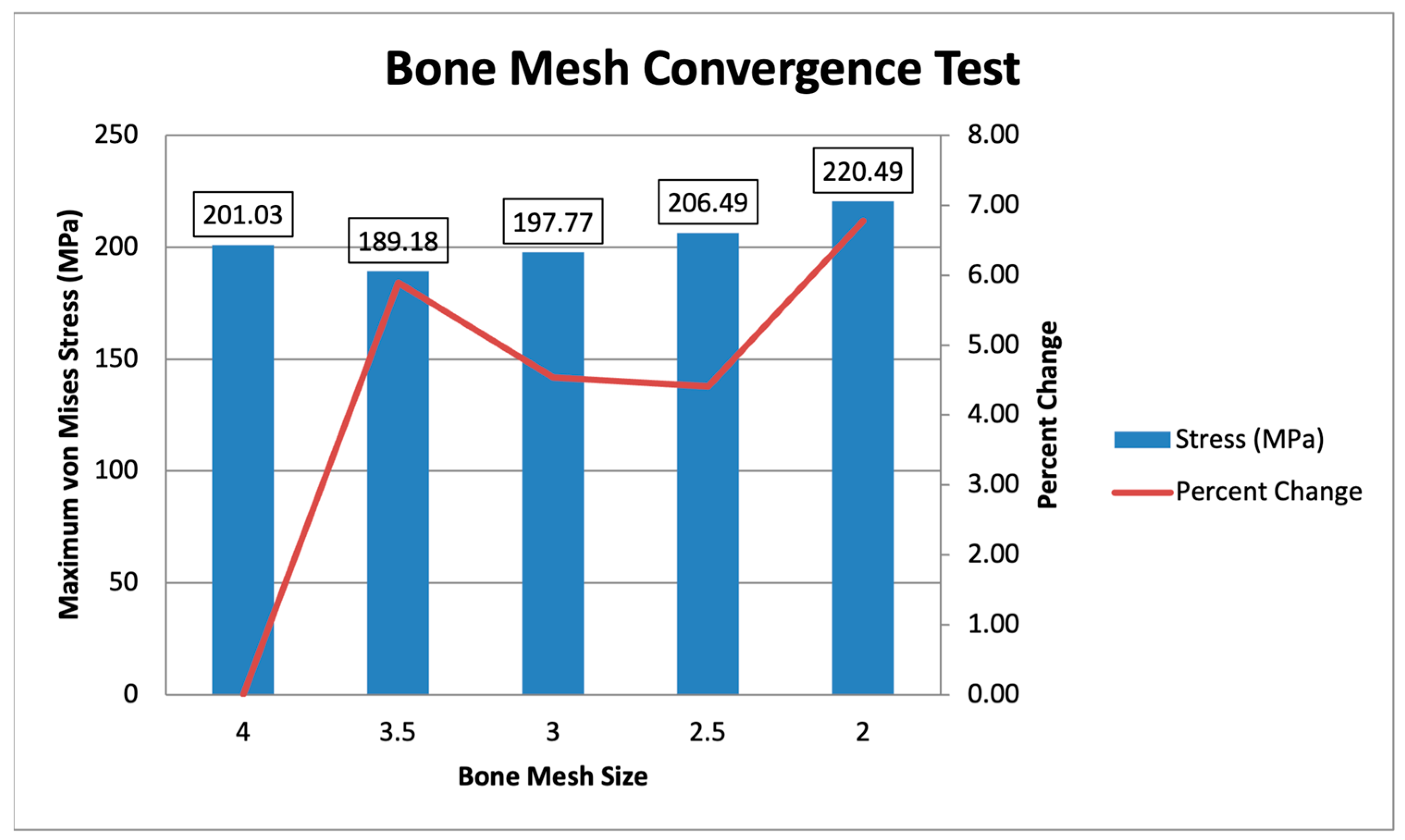
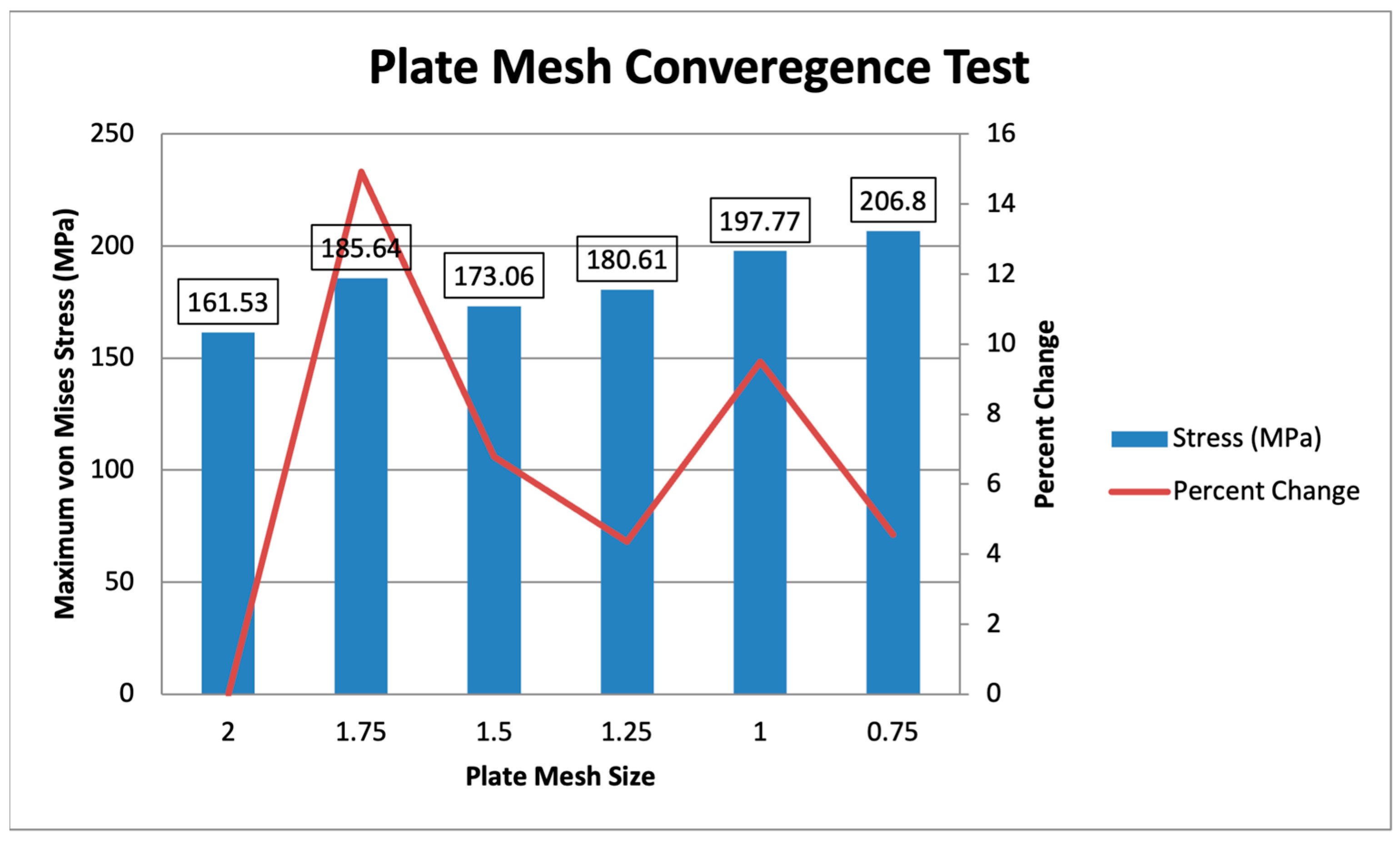
2.7. Convergence Testing
3. Results
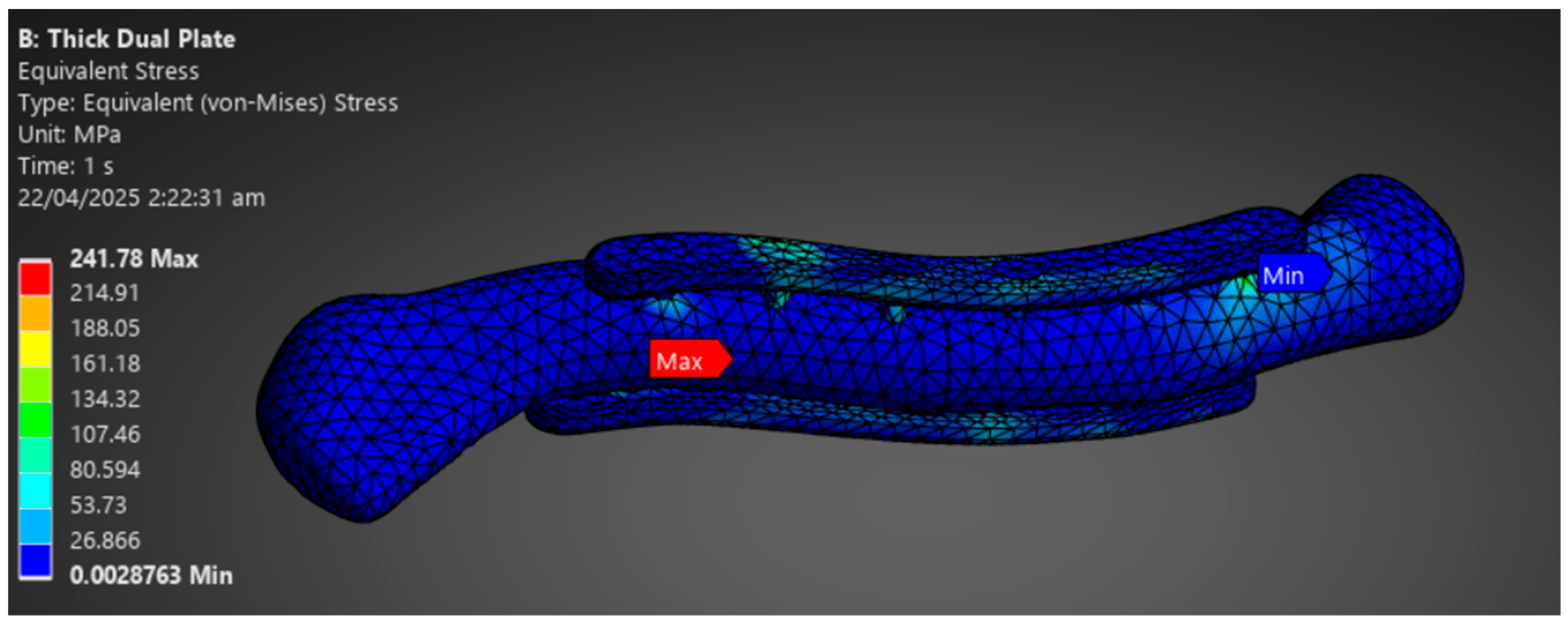
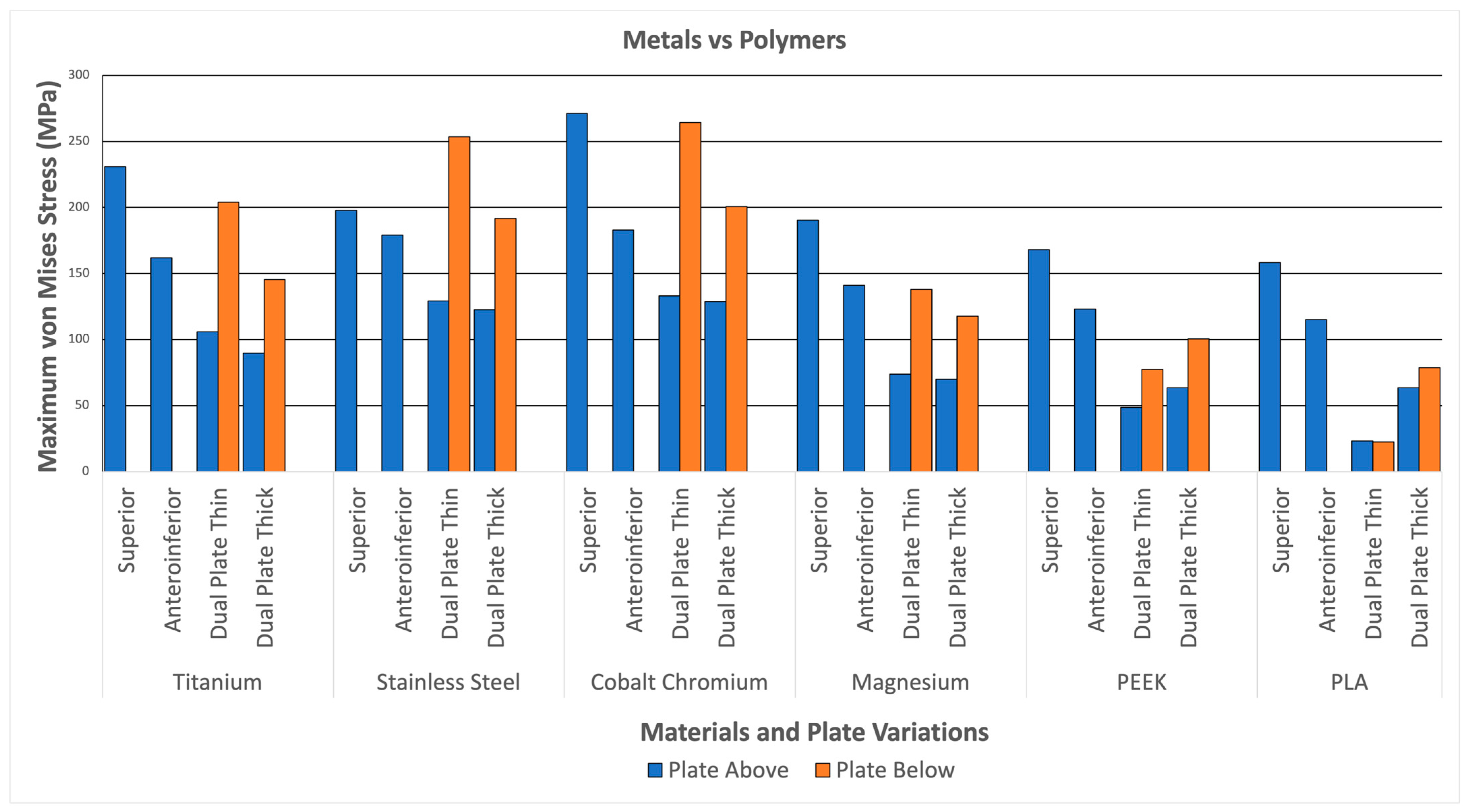
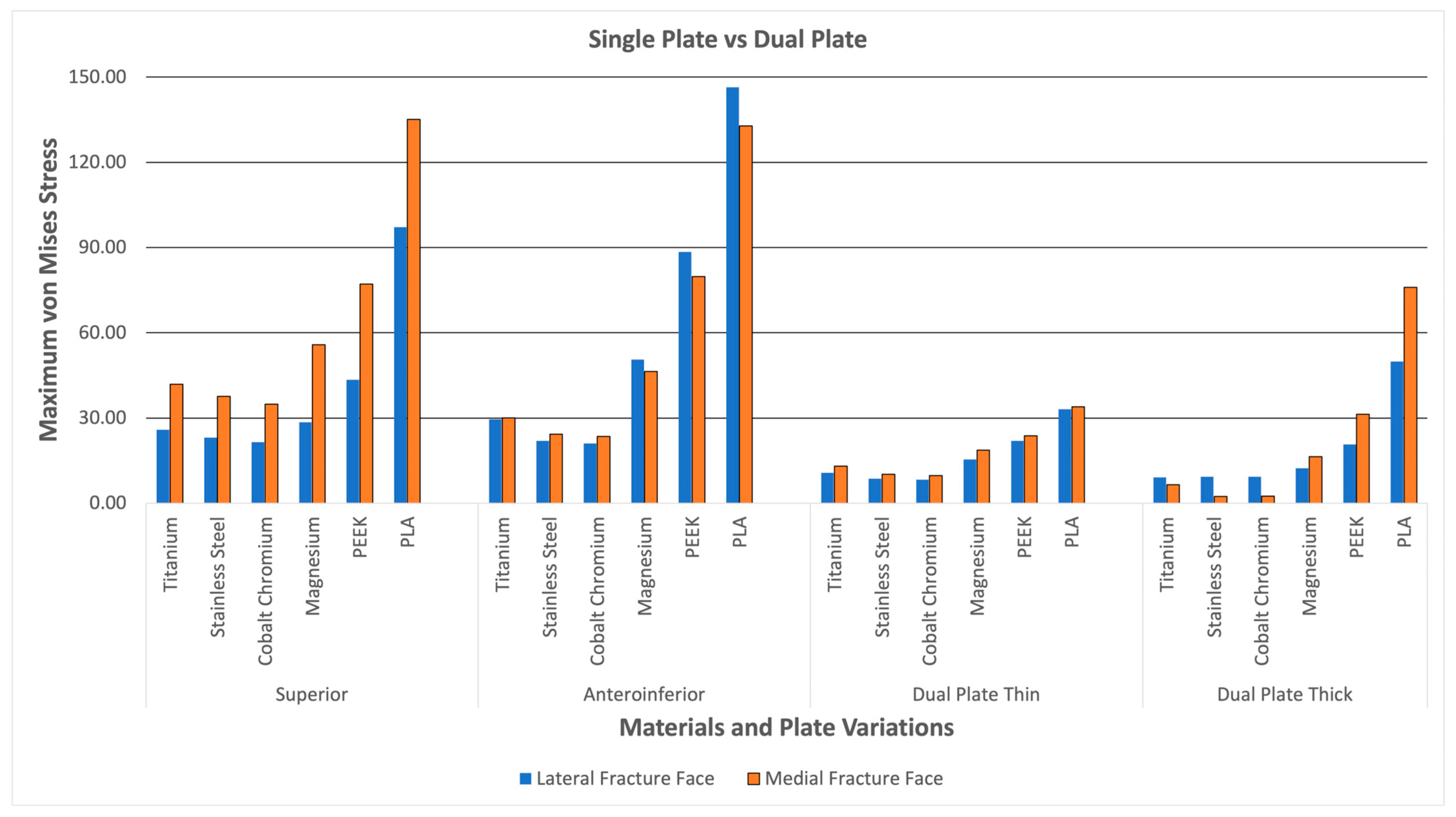
3.1. Maximum von Mises Stress Results for All Materials and Variations
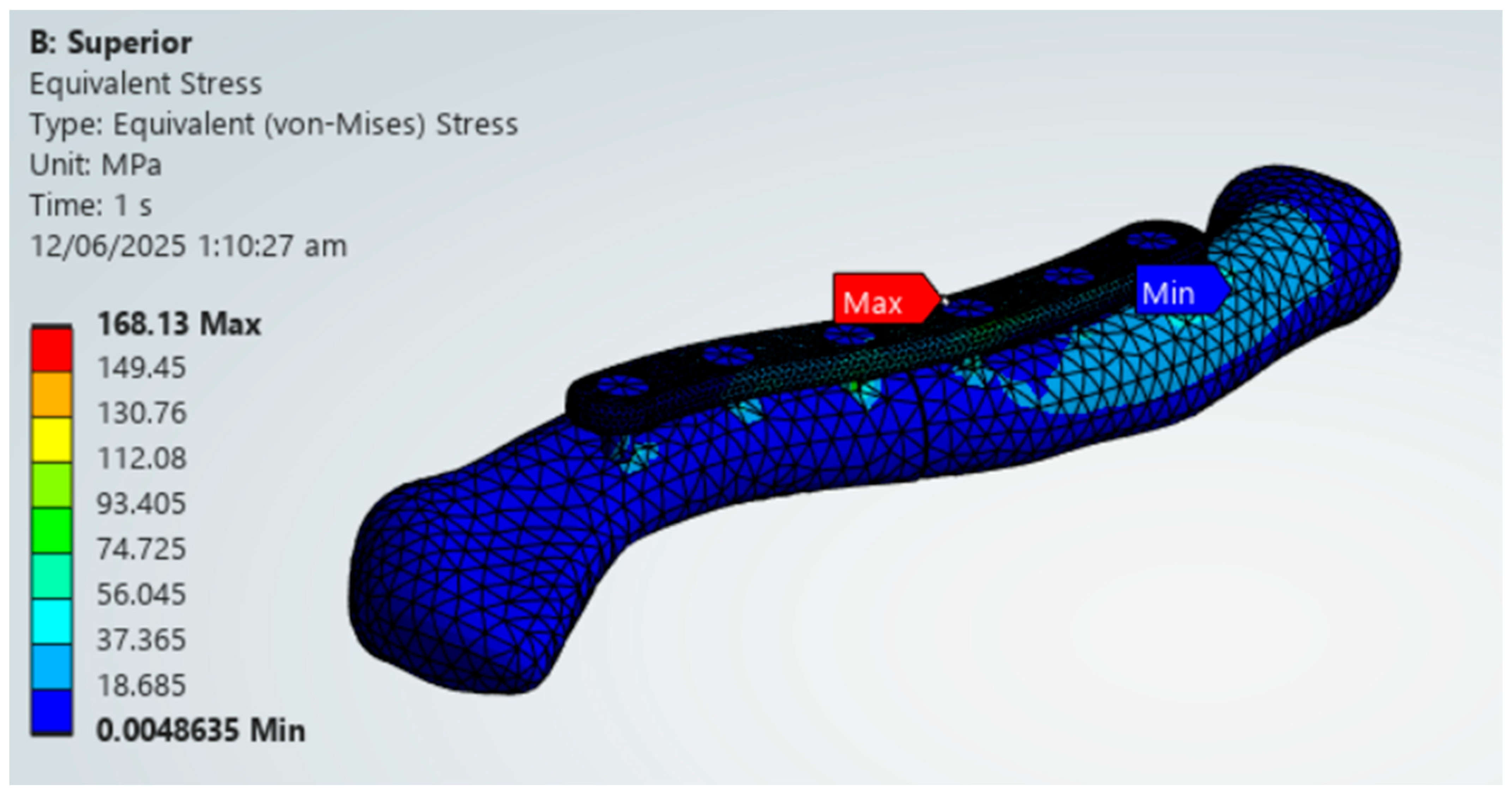
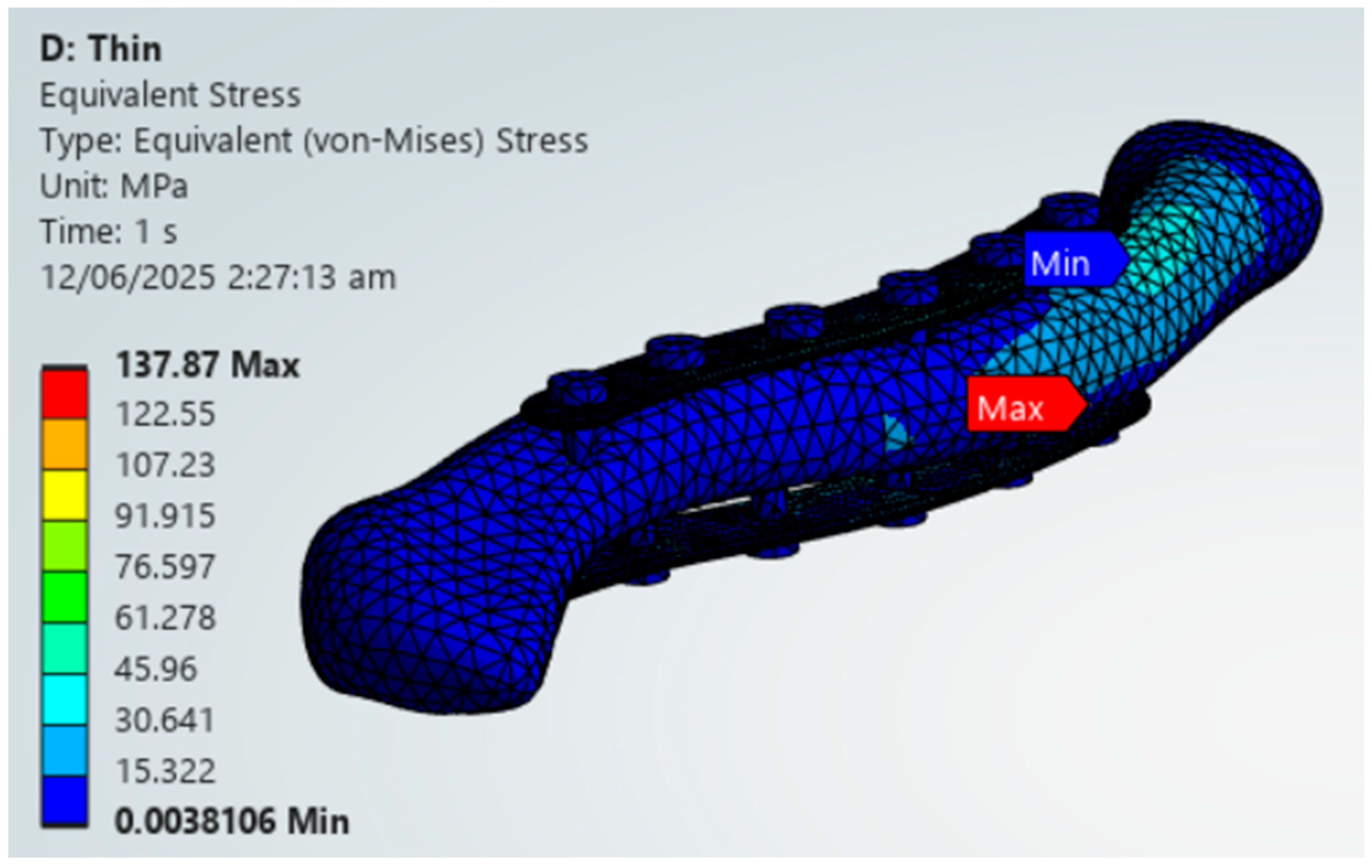
3.2. Plate Stresses
3.3. Maximum von Mises Stress per Material
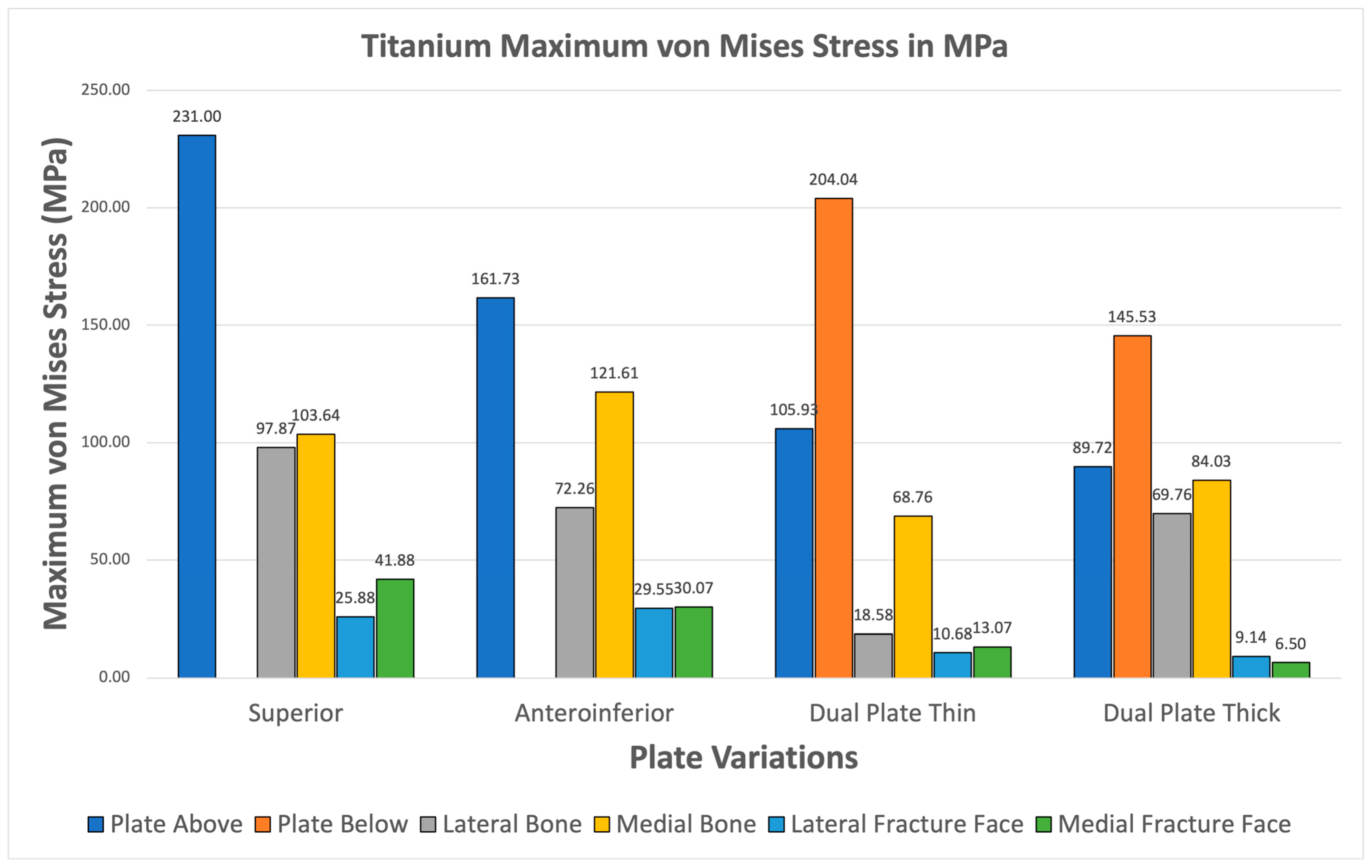
3.3.1. Titanium
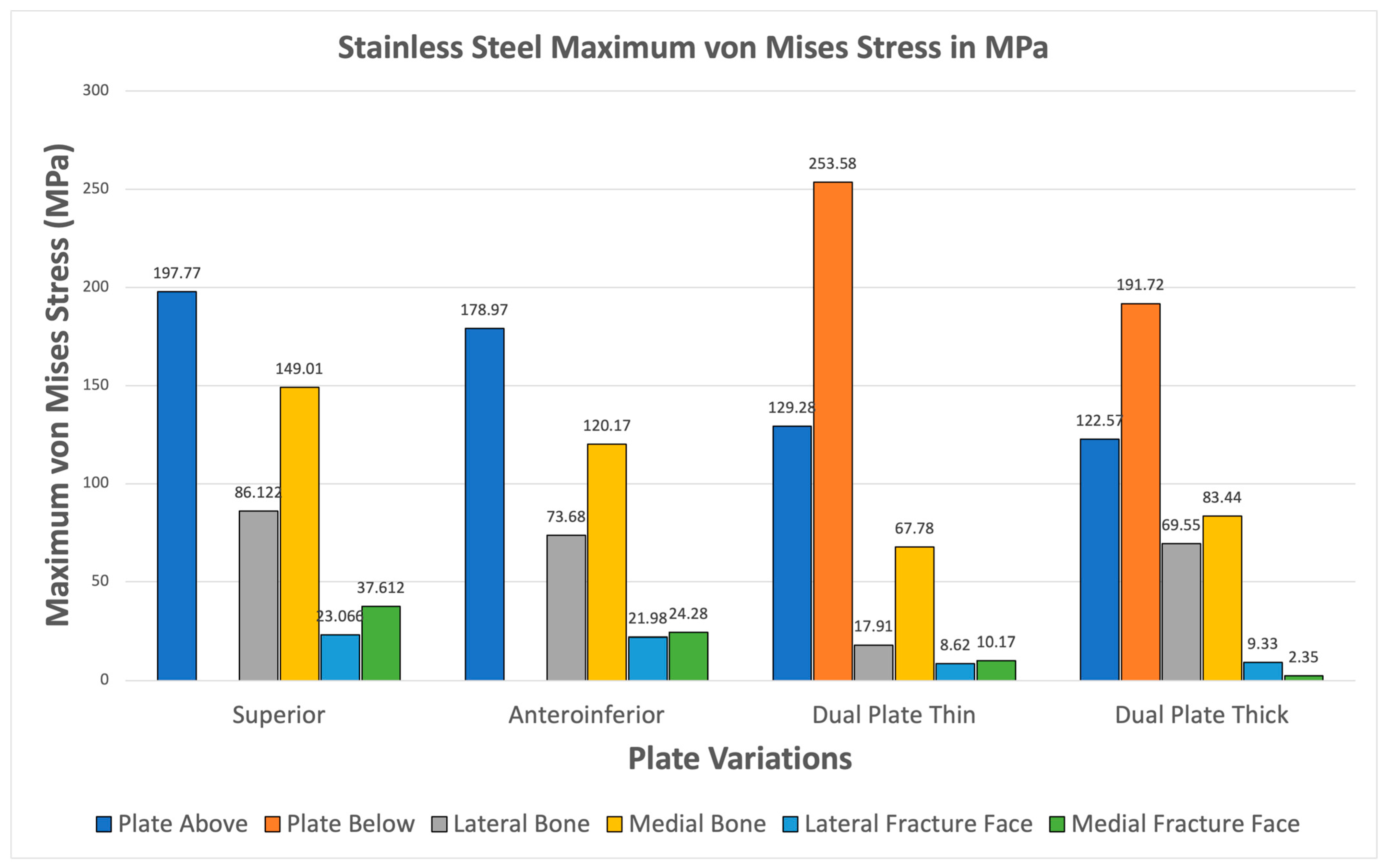
3.3.2. Stainless Steel
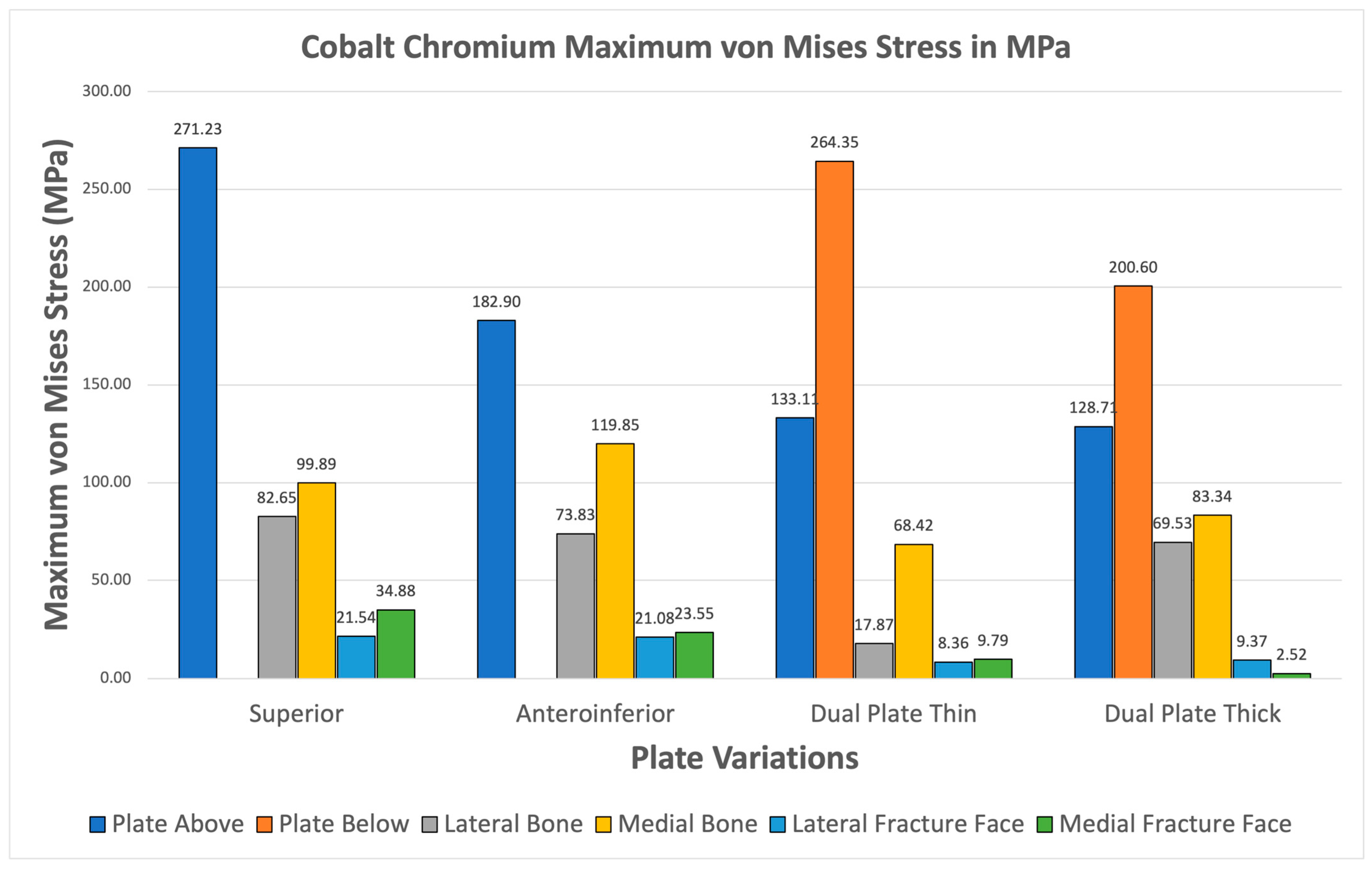
3.3.3. Cobalt Chromium
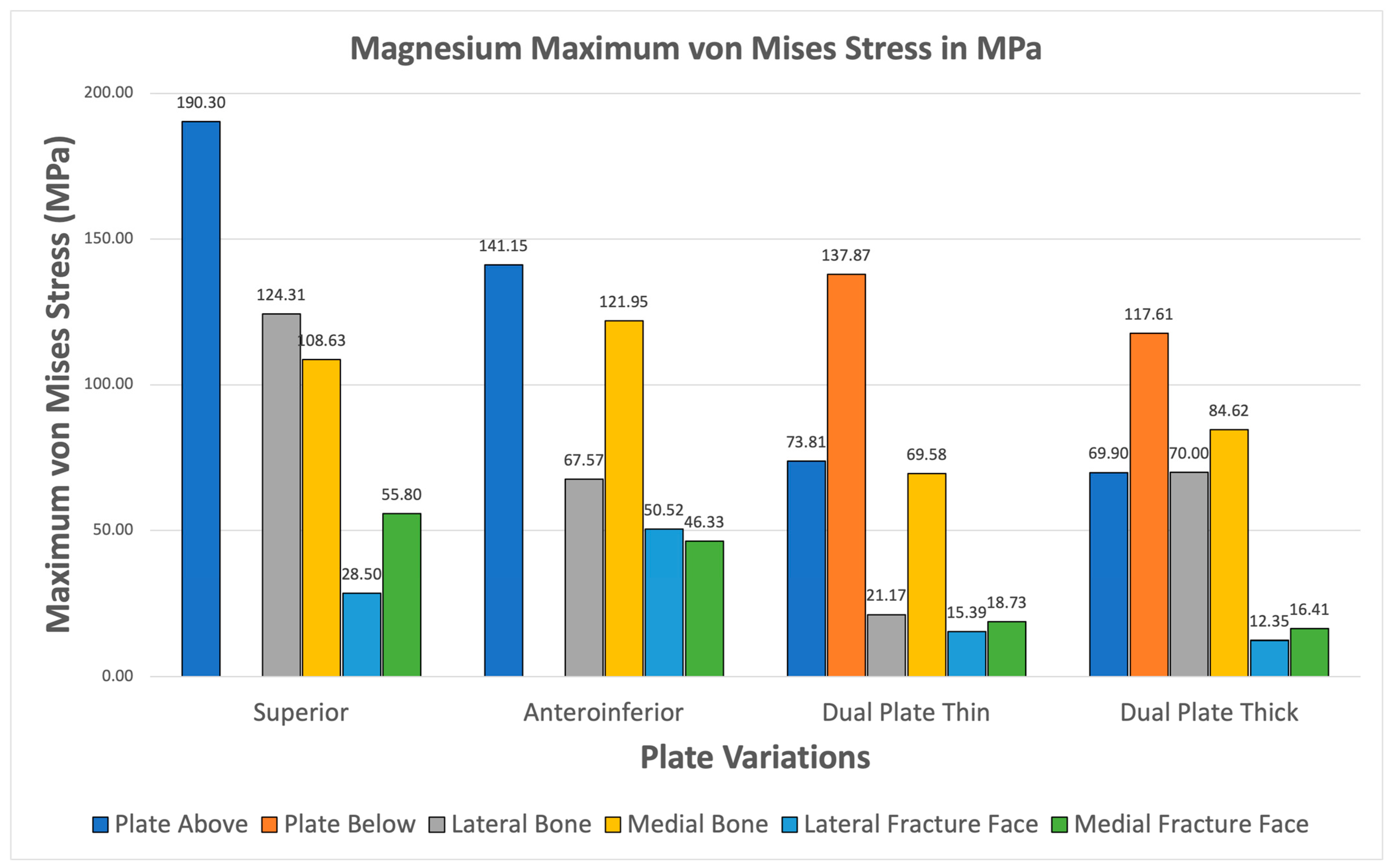
3.3.4. Magnesium
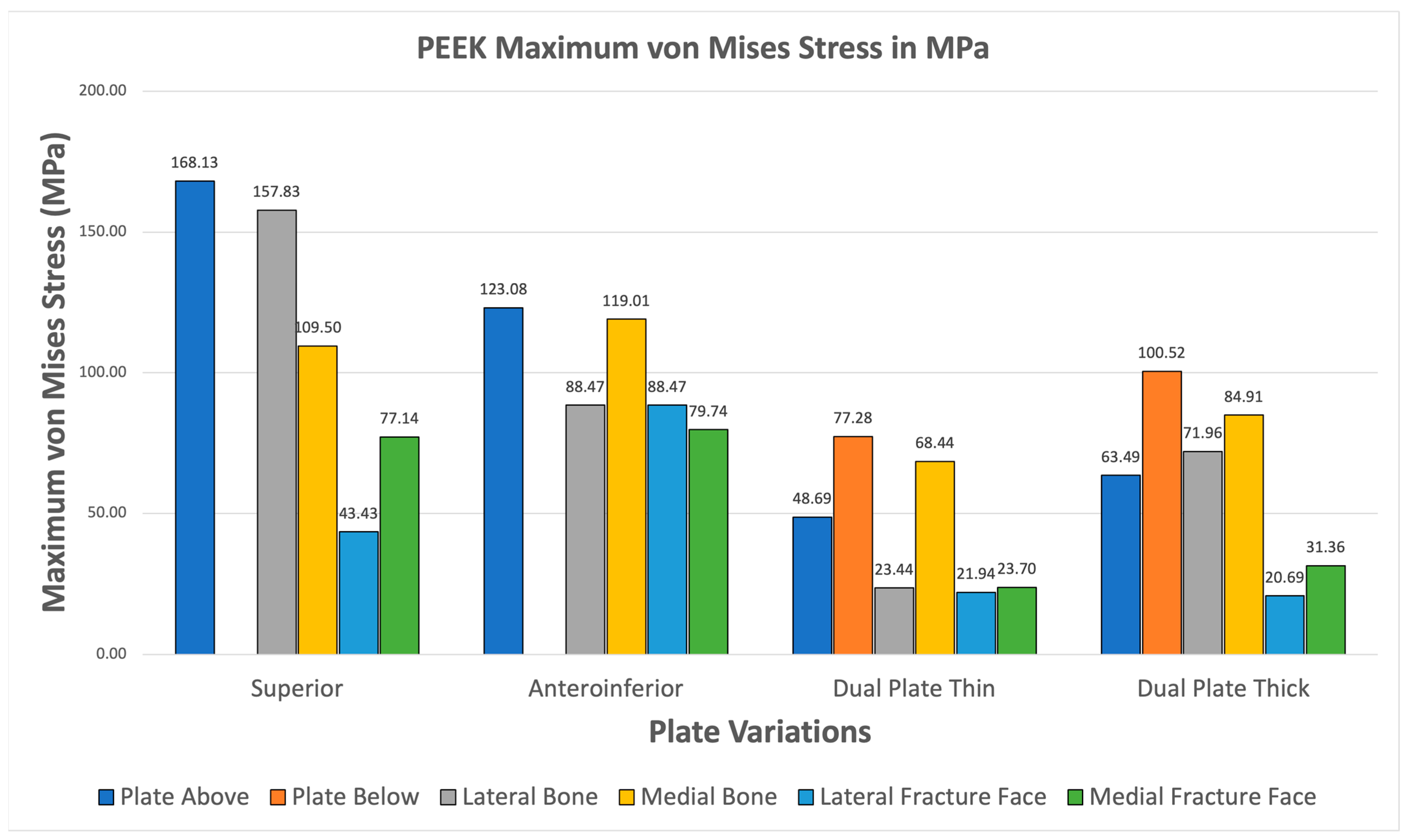
3.3.5. PEEK
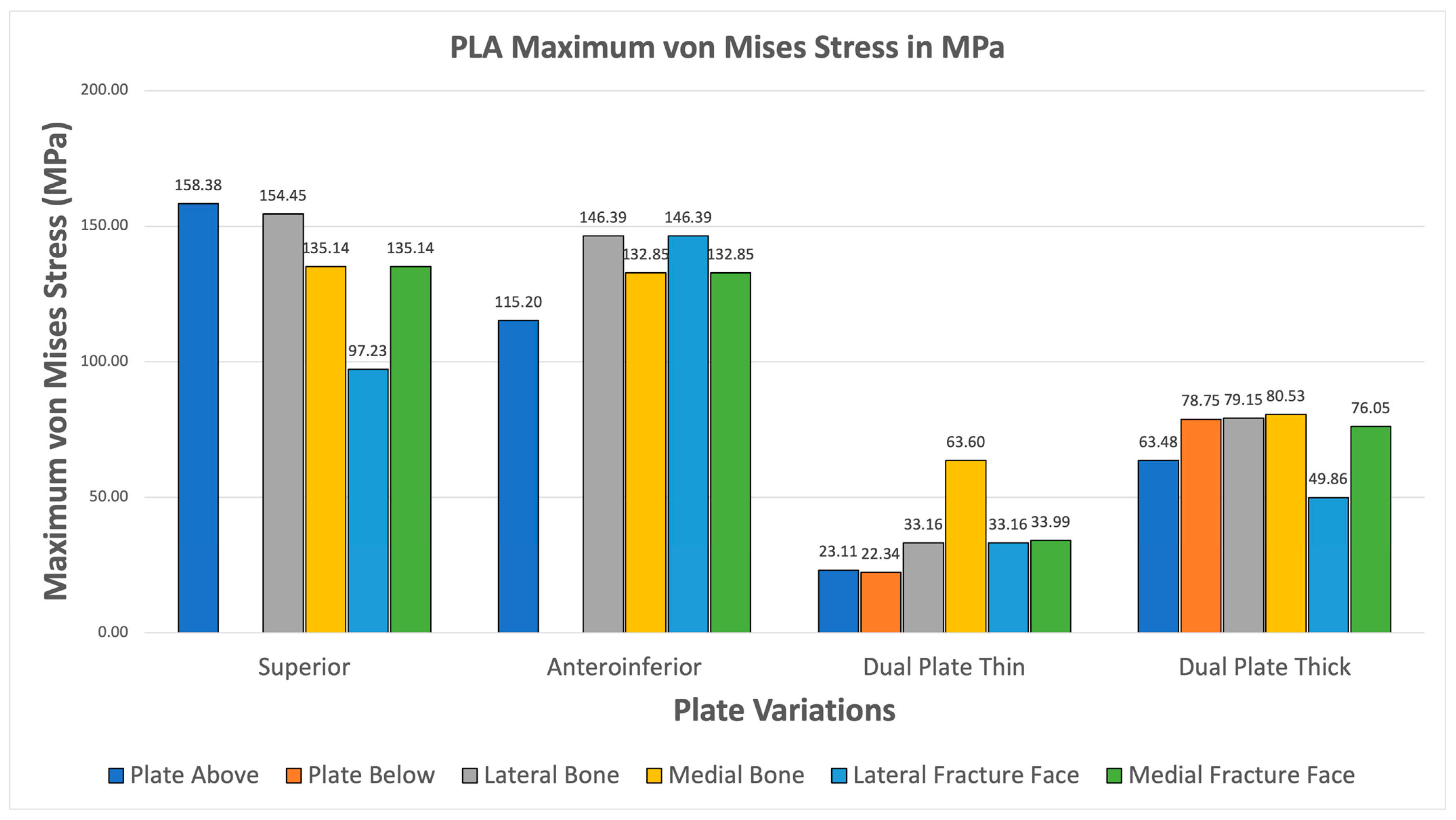
3.3.6. PLA
3.4. Fracture Line Stresses
3.5. Material Failure Analysis
4. Discussion
4.1. Material Viability
4.2. Material Behavior
4.3. Comparison to Literature
5. Conclusions
Author Contributions
Funding
Data Availability Statement
Conflicts of Interest
Abbreviations
| FEA | Finite Element Analysis |
| CT | Computed Tomography |
| PLA | Polylactic Acid |
| PEEK | Polyether Ether Ketone |
| MPa | Megapascal |
| Nm | Newton-Meter |
| S-Plate | Superior Plate |
References
- Bentley, T.P.; Hosseinzadeh, S. Clavicle Fractures. StatPearls. 2025. Available online: https://www.ncbi.nlm.nih.gov/books/NBK507892/ (accessed on 20 July 2025).
- Barber, C.C.; Burnham, M.; Ojameruaye, O.; McKee, M.D. A systematic review of the use of Titanium versus stainless steel implants for fracture fixation. OTA Int. 2021, 4, e138. [Google Scholar] [CrossRef] [PubMed]
- Wijdicks, F.-J.; Houwert, M.; Dijkgraaf, M.; de Lange, D.; Oosterhuis, K.; Clevers, G.; Verleisdonk, E.-J. Complications after plate fixation and elastic stable intramedullary nailing of dislocated midshaft clavicle fractures: A retrospective comparison. Int. Orthop. 2012, 36, 2139–2145. [Google Scholar] [CrossRef] [PubMed]
- Li, Z.; Khor, K.A. Preparation and properties of coatings and thin films on metal implants. In Encyclopedia of Biomedical Engineering; Narayan, R., Ed.; Elsevier: Amsterdam, The Netherlands, 2019; pp. 203–212. [Google Scholar] [CrossRef]
- Safavi, S.; Yu, Y.; Robinson, D.L.; Gray, H.A.; Ackland, D.C.; Lee, P.V.S. Additively manufactured controlled porous orthopedic joint replacement designs to reduce bone stress shielding: A systematic review. J. Orthop. Surg. Res. 2023, 18, 42. [Google Scholar] [CrossRef] [PubMed]
- Yurteri, A.; Mercan, N.; Uğur, L. Comparison of the use of biocompatible materials and Titanium in the treatment of midshaft clavicle fractures with a patient-specific plate: A finite element analysis study. Arch. Orthop. Trauma Surg. 2024, 144, 3255–3266. [Google Scholar] [CrossRef] [PubMed]
- Cheng, R.; Jiang, Z.; Dimitriou, D.; Gong, W.; Tsai, T.-Y. Biomechanical analysis of personalised 3D-printed clavicle plates of different materials to treat midshaft clavicle fractures. J. Shanghai Jiaotong Univ. Sci. 2021, 26, 259–266. [Google Scholar] [CrossRef]
- Nazzal, A.; Lozano-Calderón, S.; Jupiter, J.B.; Rosenzweig, J.S.; Randolph, M.A.; Lee, S.G.P. A histologic analysis of the effects of stainless steel and titanium implants adjacent to tendons: An experimental rabbit study. J. Hand Surg. 2006, 31, 1123–1130. [Google Scholar] [CrossRef] [PubMed]
- Zhu, Y.; Hu, J.; Zhan, T.; Zhu, K.; Zhang, C. Refracture after plate removal of midshaft clavicle fractures after bone union-incidence, risk factors, management, and outcomes. BMC Musculoskelet. Disord. 2023, 24, 308. [Google Scholar] [CrossRef] [PubMed]
- Chen, A.; Kurmis, A.P. Understanding immune-mediated cobalt/chromium allergy to orthopaedic implants: A meta-synthetic review. Arthroplasty 2024, 6, 1. [Google Scholar] [CrossRef] [PubMed]
- Hasanzadeh, R.; Mihankhah, P.; Azdast, T.; Rasouli, A.; Shamkhali, M.; Park, C.B. Biocompatible tissue-engineered scaffold polymers for 3D printing and their application for 4D printing. Chem. Eng. J. 2023, 476, 146616. [Google Scholar] [CrossRef]
- Wang, N.; Yang, S.; Shi, H.; Song, Y.; Sun, H.; Wang, Q.; Tan, L.; Guo, S. Magnesium alloys for orthopedic applications: A review on the mechanisms driving bone healing. J. Magnes. Alloys 2022, 10, 3327–3353. [Google Scholar] [CrossRef]
- Narayanan, G.; Vernekar, V.N.; Kuyinu, E.L.; Laurencin, C.T. Poly(lactic acid)-based biomaterials for orthopaedic regenerative engineering. Adv. Drug Deliv. Rev. 2016, 107, 247–276. [Google Scholar] [CrossRef] [PubMed]
- Zhang, X.; Cheng, X.; Yin, B.; Wang, J.; Li, S.; Liu, G.; Hu, Z.; Wu, W.; Zhang, Y. Finite element analysis of spiral plate and Herbert screw fixation for treatment of midshaft clavicle fractures. Medicine 2019, 98, e16898. [Google Scholar] [CrossRef] [PubMed]
- Zhang, F.; Chen, F.; Qi, Y.; Qian, Z.; Ni, S.; Zhong, Z.; Zhang, X.; Li, D.; Yu, B. Finite element analysis of dual small plate fixation and single plate fixation for treatment of midshaft clavicle fractures. J. Orthop. Surg. Res. 2020, 15, 148. [Google Scholar] [CrossRef] [PubMed]
- American Elements. Cobalt Chromium Alloy. Available online: https://www.americanelements.com/cobalt-chromium-alloy (accessed on 20 July 2025).
- Pengrung, N.; Lakdee, N.; Puncreobutr, C.; Lohwongwatana, B.; Sa-Ngasoongsong, P. Finite element analysis comparison between superior clavicle locking plate with and without screw holes above fracture zone in midshaft clavicular fracture. BMC Musculoskelet. Disord. 2019, 20, 465. [Google Scholar] [CrossRef] [PubMed]
- Hoogervorst, P.; Bolsterlee, B.; Pijper, M.; Aalsma, A.M.M.; Verdonschot, N. Forces acting on the clavicle during shoulder abduction, forward humeral flexion, and activities of daily living. Clin. Biomech. 2019, 69, 79–86. [Google Scholar] [CrossRef] [PubMed]
- Zeng, L.; Wei, H.; Liu, Y.; Zhang, W.; Pan, Y.; Zhang, W.; Zhang, C.; Zeng, B.; Chen, Y. Titanium elastic nail (TEN) versus reconstruction plate repair of midshaft clavicular fractures: A finite element study. PLoS ONE 2015, 10, e0126131. [Google Scholar] [CrossRef] [PubMed]
- Cao, R.; Tan, J.; Zhang, Y.; Dai, Y.; Zhang, X.; Han, X.; Jiang, X. Finite element analysis of antegrade and retrograde internal intramedullary nailing for mid-shaft clavicle fracture. BMC Musculoskelet. Disord. 2025, 26, 172. [Google Scholar] [CrossRef] [PubMed]
- Oefner, C.; Herrmann, S.; Kebbach, M.; Lange, H.-E.; Kluess, D.; Woiczinski, M. Reporting checklist for verification and validation of finite element analysis in orthopedic and trauma biomechanics. Med. Eng. Phys. 2021, 90, 25–32. [Google Scholar] [CrossRef] [PubMed]
- Zheng, J.; Shen, J.; Zhao, Y.; Chen, Z.; Wang, Y.; Yang, C.; Du, X.; Qiu, G. Construction and validation of a three-dimensional finite element model of adolescent idiopathic scoliosis spine. J. Orthop. Surg. Res. 2015, 10, 189. [Google Scholar]
- ASM. Material Data Sheet. Available online: https://asm.matweb.com/search/specificmaterial.asp?bassnum=mtp641 (accessed on 20 July 2025).
- Ulbrich. 316LVM Stainless Steel UNS S31673. Available online: https://www.ulbrich.com/alloys/316lvm-stainless-steel-uns-s31673/ (accessed on 20 July 2025).
- ARCAM. ASTM F-75 Cobalt Chrome Alloy. Available online: https://www.matweb.com/search/datasheet_print.aspx?matguid=df8d3cd30d5149cfaca9a3c6e3268655 (accessed on 20 July 2025).
- AZoM. Magnesium AZ31B Alloy (UNS M11311). Available online: https://www.azom.com/article.aspx?ArticleID=6707 (accessed on 20 July 2025).
- MatWeb. Overview of Materials for Polyetheretherketone, Unreinforced. Available online: https://www.matweb.com/search/datasheet_print.aspx?matguid=2164cacabcde4391a596640d553b2ebe (accessed on 20 July 2025).
- MatWeb. Overview of Materials for Polylactic Acid (PLA) Biopolymer. Available online: https://www.matweb.com/search/DataSheet.aspx?MatGUID=ab96a4c0655c4018a8785ac4031b9278&ckck=1 (accessed on 20 July 2025).







| Materials | Young’s Modulus | Poisson’s Ratio |
|---|---|---|
| Stainless Steel [7] | 193 GPa | 0.3 |
| Titanium [7] | 110 GPa | 0.3 |
| Cobalt Chromium [16] | 210 GPa | 0.29 |
| Magnesium Alloy [7] | 44 GPa | 0.27 |
| Polylactic Acid [6] | 3.5 GPa | 0.36 |
| Polyether Ether Ketone [6] | 18 GPa | 0.3 |
| Cortical Bone [6] | 17 GPa | 0.3 |
| Cancellous Bone [6] | 1 GPa | 0.3 |
| Axial Load | Bending Load | |
|---|---|---|
| Cao et al. (2025) [20] | 31.08 MPa | 51.95 MPa |
| Present Study | 27.57 MPa | 56.88 MPa |
| Percent Difference | 11.29% | 9.49% |
| Material | Variation | Plate Above | Plate Below | Lateral Bone | Medial Bone | Lateral Fracture Face | Medial Fracture Face |
|---|---|---|---|---|---|---|---|
| Titanium | Superior | 231 | 97.869 | 103.64 | 25.877 | 41.88 | |
| Titanium | Anteroinferior | 161.73 | 72.259 | 121.61 | 29.551 | 30.065 | |
| Titanium | Dual Plate Thin | 105.93 | 204.04 | 18.578 | 68.762 | 10.675 | 13.071 |
| Titanium | Dual Plate Thick | 89.718 | 145.53 | 69.761 | 84.027 | 9.1359 | 6.4985 |
| Stainless Steel | Superior | 197.77 | 86.122 | 149.01 | 23.066 | 37.612 | |
| Stainless Steel | Anteroinferior | 178.97 | 73.678 | 120.17 | 21.981 | 24.284 | |
| Stainless Steel | Dual Plate Thin | 129.28 | 253.58 | 17.913 | 67.783 | 8.6185 | 10.173 |
| Stainless Steel | Dual Plate Thick | 122.57 | 191.72 | 69.553 | 83.444 | 9.3287 | 2.3502 |
| Cobalt Chromium | Superior | 271.23 | 82.648 | 99.886 | 21.536 | 34.884 | |
| Cobalt Chromium | Anteroinferior | 182.9 | 73.834 | 119.85 | 21.08 | 23.553 | |
| Cobalt Chromium | Dual Plate Thin | 133.11 | 264.35 | 17.874 | 68.418 | 8.3566 | 9.7947 |
| Cobalt Chromium | Dual Plate Thick | 128.71 | 200.6 | 69.528 | 83.337 | 9.3689 | 2.5222 |
| PEEK | Superior | 168.13 | 157.83 | 109.5 | 43.428 | 77.144 | |
| PEEK | Anteroinferior | 123.08 | 88.471 | 119.01 | 88.471 | 79.735 | |
| PEEK | Dual Plate Thin | 48.687 | 77.28 | 23.441 | 68.442 | 21.939 | 23.7 |
| PEEK | Dual Plate Thick | 63.485 | 100.52 | 71.96 | 84.905 | 20.687 | 31.363 |
| PLA | Superior | 158.38 | 154.45 | 135.14 | 97.225 | 135.14 | |
| PLA | Anteroinferior | 115.2 | 146.39 | 132.85 | 146.39 | 132.85 | |
| PLA | Dual Plate Thin | 23.107 | 22.337 | 33.159 | 63.597 | 33.159 | 33.986 |
| PLA | Dual Plate Thick | 63.484 | 78.754 | 79.147 | 80.527 | 49.863 | 76.045 |
| Magnesium | Superior | 190.3 | 124.31 | 108.63 | 28.498 | 55.798 | |
| Magnesium | Anteroinferior | 141.15 | 67.566 | 121.95 | 50.517 | 46.327 | |
| Magnesium | Dual Plate Thin | 73.807 | 137.87 | 21.173 | 69.578 | 15.391 | 18.734 |
| Magnesium | Dual Plate Thick | 69.903 | 117.61 | 70.001 | 84.617 | 12.351 | 16.406 |
| Material | Variation | Max Plate Stress | Yield Strength | Safety Factor |
|---|---|---|---|---|
| Titanium | Superior | 231 MPa | 880 MPa [23] | 3.81 |
| Titanium | Anteroinferior | 161.73 MPa | 880 MPa [23] | 5.44 |
| Titanium | Dual Plate Thin | 204.04 MPa | 880 MPa [23] | 4.31 |
| Titanium | Dual Plate Thick | 145.53 MPa | 880 MPa [23] | 6.05 |
| Stainless Steel | Superior | 197.77 MPa | 434 MPa [24] | 2.19 |
| Stainless Steel | Anteroinferior | 178.97 MPa | 434 MPa [24] | 2.42 |
| Stainless Steel | Dual Plate Thin | 253.58 MPa | 434 MPa [24] | 1.71 |
| Stainless Steel | Dual Plate Thick | 191.72 MPa | 434 MPa [24] | 2.26 |
| Cobalt Chromium | Superior | 271.23 MPa | 614 MPa [25] | 2.26 |
| Cobalt Chromium | Anteroinferior | 182.90 MPa | 614 MPa [25] | 3.36 |
| Cobalt Chromium | Dual Plate Thin | 264.35 MPa | 614 MPa [25] | 2.32 |
| Cobalt Chromium | Dual Plate Thick | 200.60 MPa | 614 MPa [25] | 3.06 |
| Magnesium | Superior | 190.30 MPa | 200 MPa [26] | 1.05 |
| Magnesium | Anteroinferior | 141.15 MPa | 200 MPa [26] | 1.42 |
| Magnesium | Dual Plate Thin | 137.87 MPa | 200 MPa [26] | 1.45 |
| Magnesium | Dual Plate Thick | 117.61 MPa | 200 MPa [26] | 1.70 |
| PEEK | Superior | 168.13 MPa | 125 MPa [27] | 0.74 |
| PEEK | Anteroinferior | 123.08 MPa | 125 MPa [27] | 1.02 |
| PEEK | Dual Plate Thin | 77.28 MPa | 125 MPa [27] | 1.62 |
| PEEK | Dual Plate Thick | 100.52 MPa | 125 MPa [27] | 1.24 |
| PLA | Superior | 158.38 MPa | 103 MPa [28] | 0.65 |
| PLA | Anteroinferior | 115.2 MPa | 103 MPa [28] | 0.89 |
| PLA | Dual Plate Thin | 23.11 MPa | 103 MPa [28] | 4.46 |
| PLA | Dual Plate Thick | 78.75 MPa | 103 MPa [28] | 1.31 |
| Material | Variation | Criteria 1 | Criteria 2 | Yield Strength |
|---|---|---|---|---|
| Titanium | Superior | PASS | PASS | PASS |
| Titanium | Anteroinferior | PASS | PASS | PASS |
| Titanium | Dual Plate Thin | PASS | PASS | PASS |
| Titanium | Dual Plate Thick | PASS | PASS | PASS |
| Stainless Steel | Superior | PASS | PASS | PASS |
| Stainless Steel | Anteroinferior | PASS | PASS | PASS |
| Stainless Steel | Dual Plate Thin | PASS | PASS | PASS |
| Stainless Steel | Dual Plate Thick | PASS | PASS | PASS |
| Cobalt Chromium | Superior | PASS | PASS | PASS |
| Cobalt Chromium | Anteroinferior | PASS | PASS | PASS |
| Cobalt Chromium | Dual Plate Thin | PASS | PASS | PASS |
| Cobalt Chromium | Dual Plate Thick | PASS | PASS | PASS |
| Magnesium | Superior | PASS | PASS | PASS |
| Magnesium | Anteroinferior | PASS | PASS | PASS |
| Magnesium | Dual Plate Thin | PASS | PASS | PASS |
| Magnesium | Dual Plate Thick | PASS | PASS | PASS |
| PEEK | Superior | PASS | PASS | FAIL |
| PEEK | Anteroinferior | PASS | PASS | PASS |
| PEEK | Dual Plate Thin | PASS | PASS | PASS |
| PEEK | Dual Plate Thick | PASS | PASS | PASS |
| PLA | Superior | PASS | PASS | FAIL |
| PLA | Anteroinferior | FAIL | PASS | FAIL |
| PLA | Dual Plate Thin | FAIL | PASS | PASS |
| PLA | Dual Plate Thick | FAIL | PASS | PASS |
| Study | Previous Study Findings | Current Study Findings |
|---|---|---|
| Yurteri et al. [6] | For superior plate variations, PEEK is a viable option, while PLA is not. | PEEK is not viable for superior plate variation but is viable for anteroinferior and dual plate variations. PLA is not viable for all variations. |
| Cheng et al. [7] | Magnesium is a viable material for clavicle plate fixations. | For all plate variations, Magnesium is a viable alternative to traditional plate materials for clavicle plate fixations. |
| Zhang et al. [15] | No significant difference in stability between single plate and dual plate variations. | Dual plate variations have lower fracture stresses, which indicates better stability compared to single plate variations. |
Disclaimer/Publisher’s Note: The statements, opinions and data contained in all publications are solely those of the individual author(s) and contributor(s) and not of MDPI and/or the editor(s). MDPI and/or the editor(s) disclaim responsibility for any injury to people or property resulting from any ideas, methods, instructions or products referred to in the content. |
© 2026 by the authors. Licensee MDPI, Basel, Switzerland. This article is an open access article distributed under the terms and conditions of the Creative Commons Attribution (CC BY) license.
Share and Cite
Reyes, L.E.P.; Honra, J.P. Mechanical Evaluation of Bioabsorbable and 3D-Printable Materials as Clavicle Plate Fixation Alternatives Using Finite Element Analysis. Appl. Sci. 2026, 16, 1602. https://doi.org/10.3390/app16031602
Reyes LEP, Honra JP. Mechanical Evaluation of Bioabsorbable and 3D-Printable Materials as Clavicle Plate Fixation Alternatives Using Finite Element Analysis. Applied Sciences. 2026; 16(3):1602. https://doi.org/10.3390/app16031602
Chicago/Turabian StyleReyes, Luis Enrique P., and Jaime P. Honra. 2026. "Mechanical Evaluation of Bioabsorbable and 3D-Printable Materials as Clavicle Plate Fixation Alternatives Using Finite Element Analysis" Applied Sciences 16, no. 3: 1602. https://doi.org/10.3390/app16031602
APA StyleReyes, L. E. P., & Honra, J. P. (2026). Mechanical Evaluation of Bioabsorbable and 3D-Printable Materials as Clavicle Plate Fixation Alternatives Using Finite Element Analysis. Applied Sciences, 16(3), 1602. https://doi.org/10.3390/app16031602