Mechanical Response Characteristics of Prefabricated Utility Tunnel Joints Considering Jacking Load Imbalance


Featured Application
Abstract
1. Introduction
2. Project Overview and Structural Characteristics
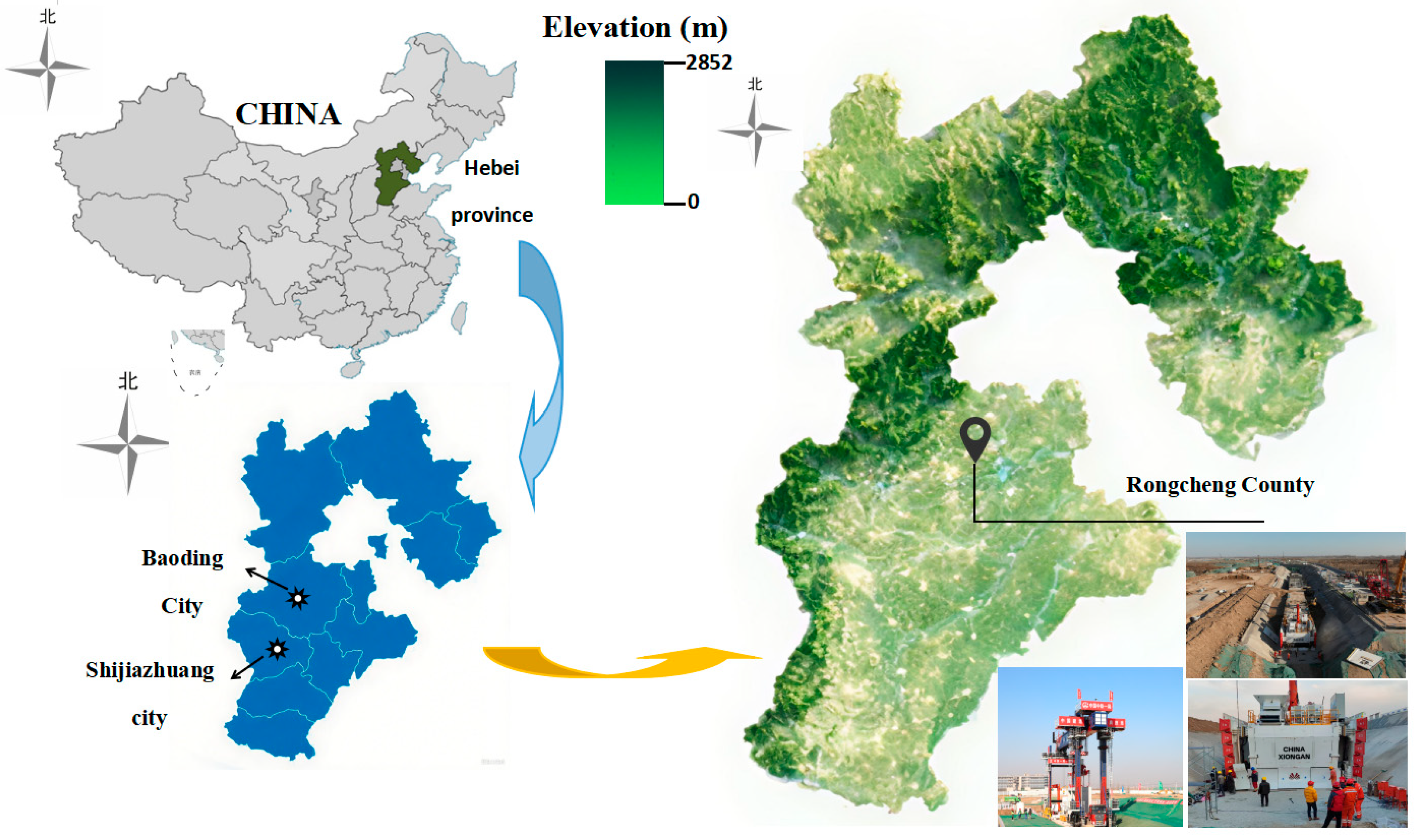
2.1. Project Overview
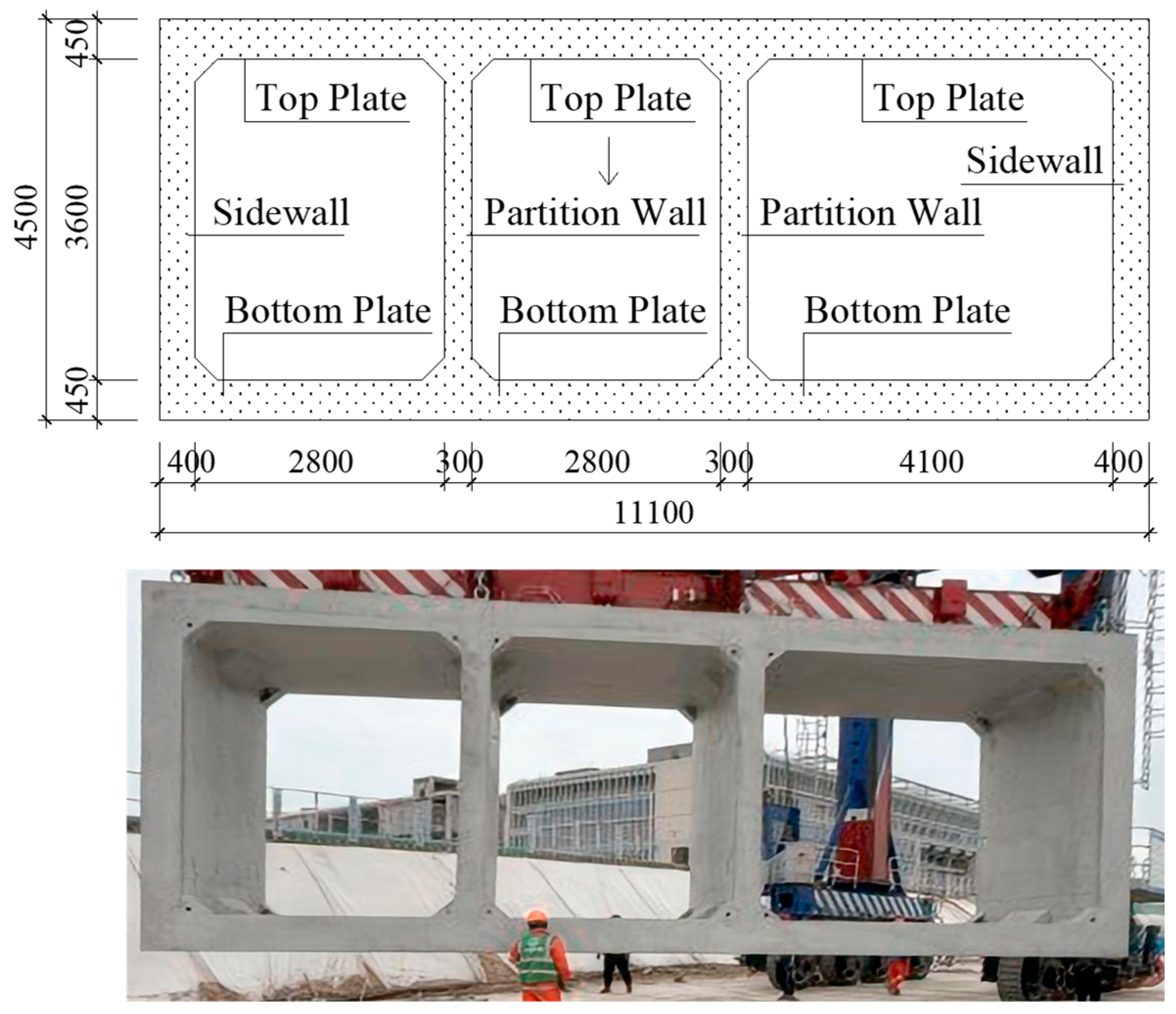
2.2. Structural Characteristics of the Three-Cell Prefabricated Segment
3. Numerical Modeling and Computational Method
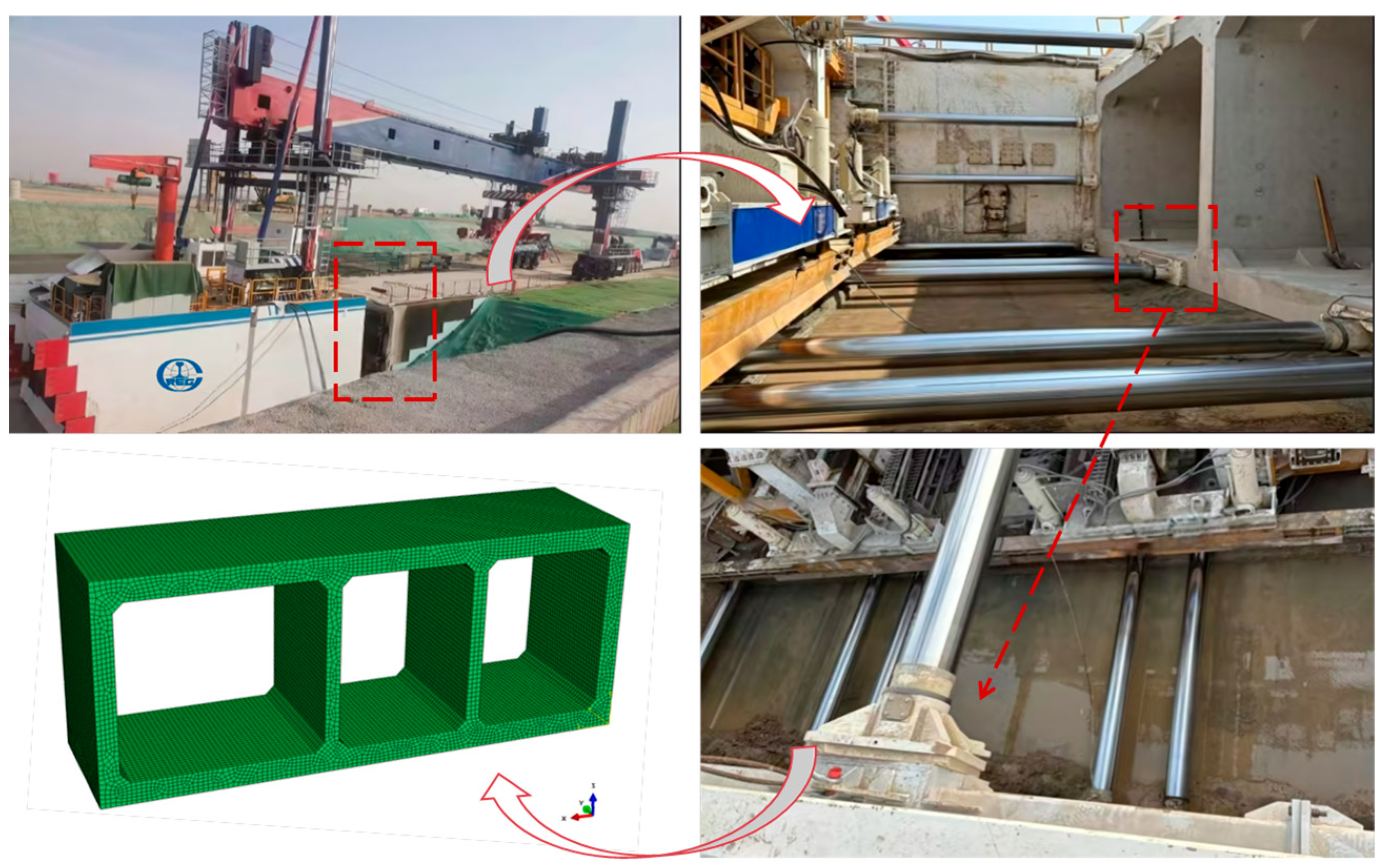
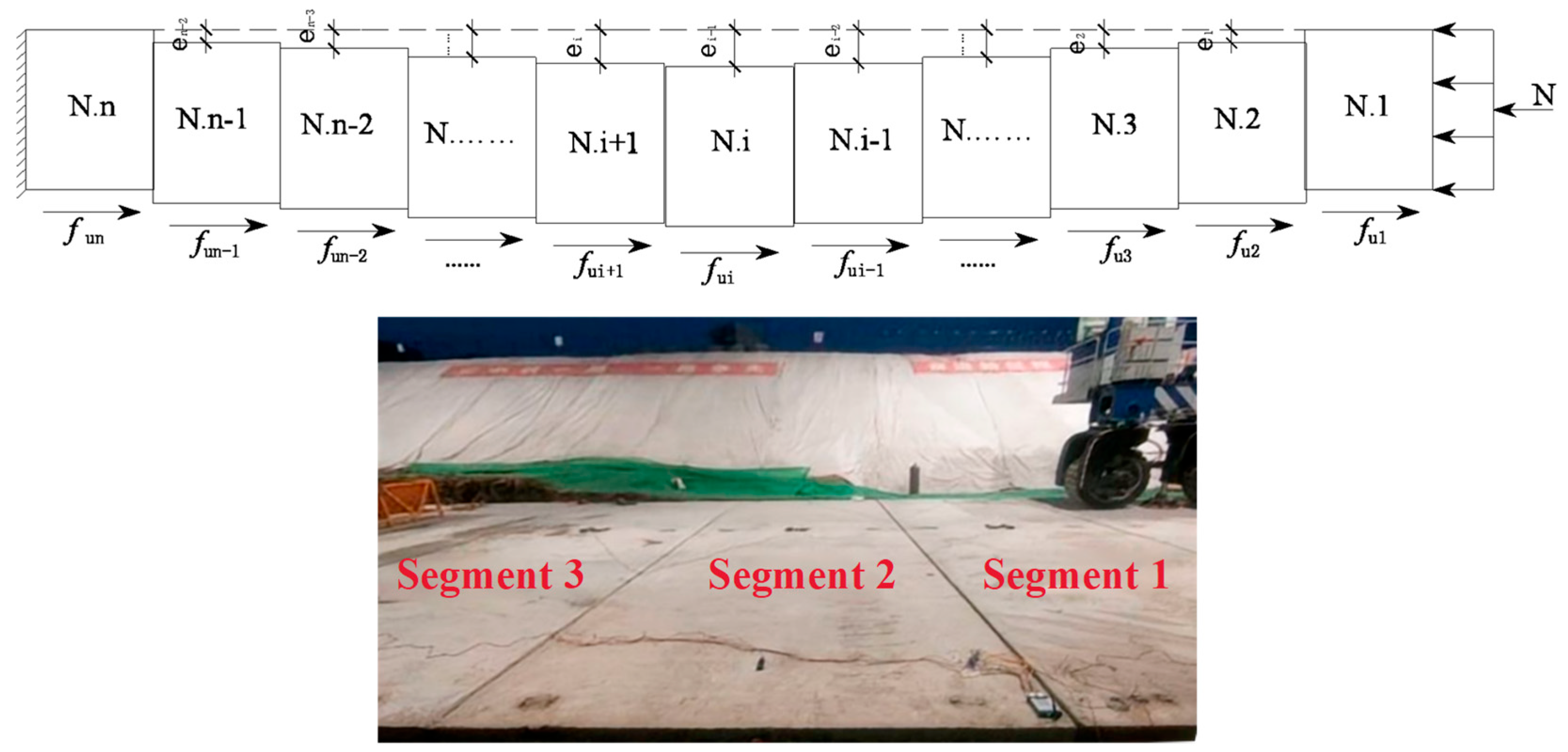
3.1. Mechanical Characteristics of the Jacking Process
3.2. Geometric Model and Meshing
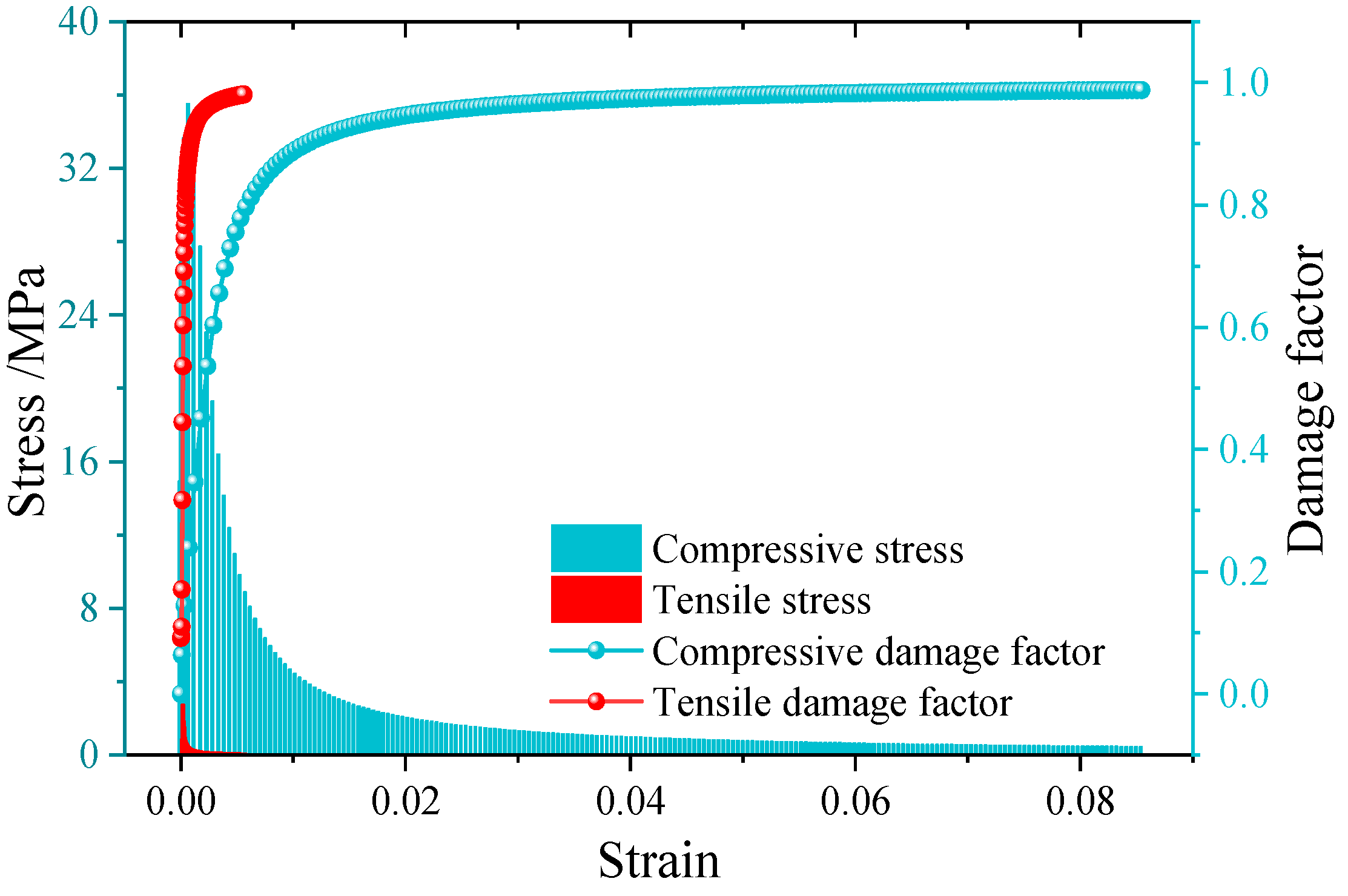
3.3. Material Constitutive Models, Boundary Conditions, and Connections
3.4. Loading Cases and Application
4. Results and Analysis
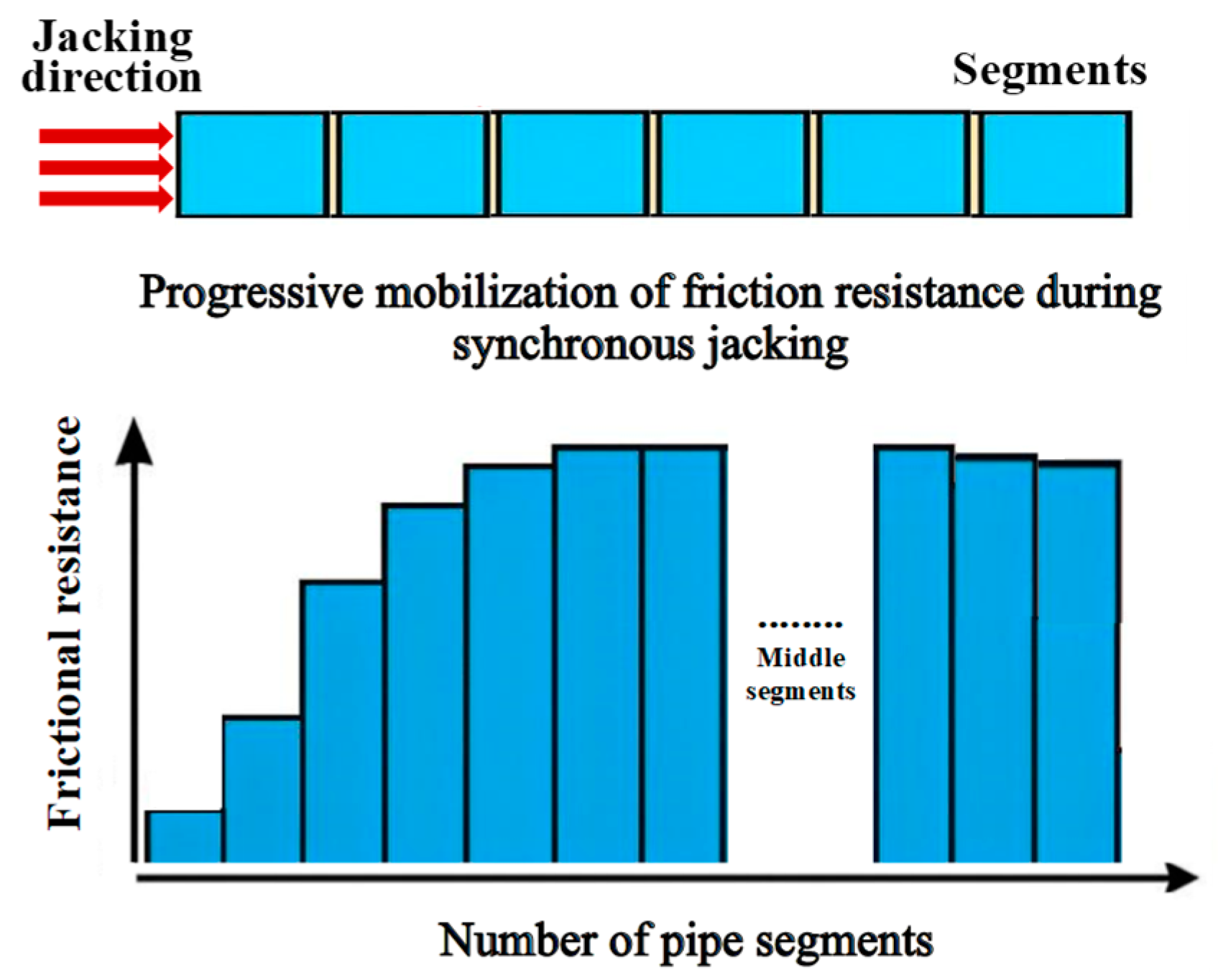
4.1. Load Transfer and Segment Response Under Synchronous Jacking
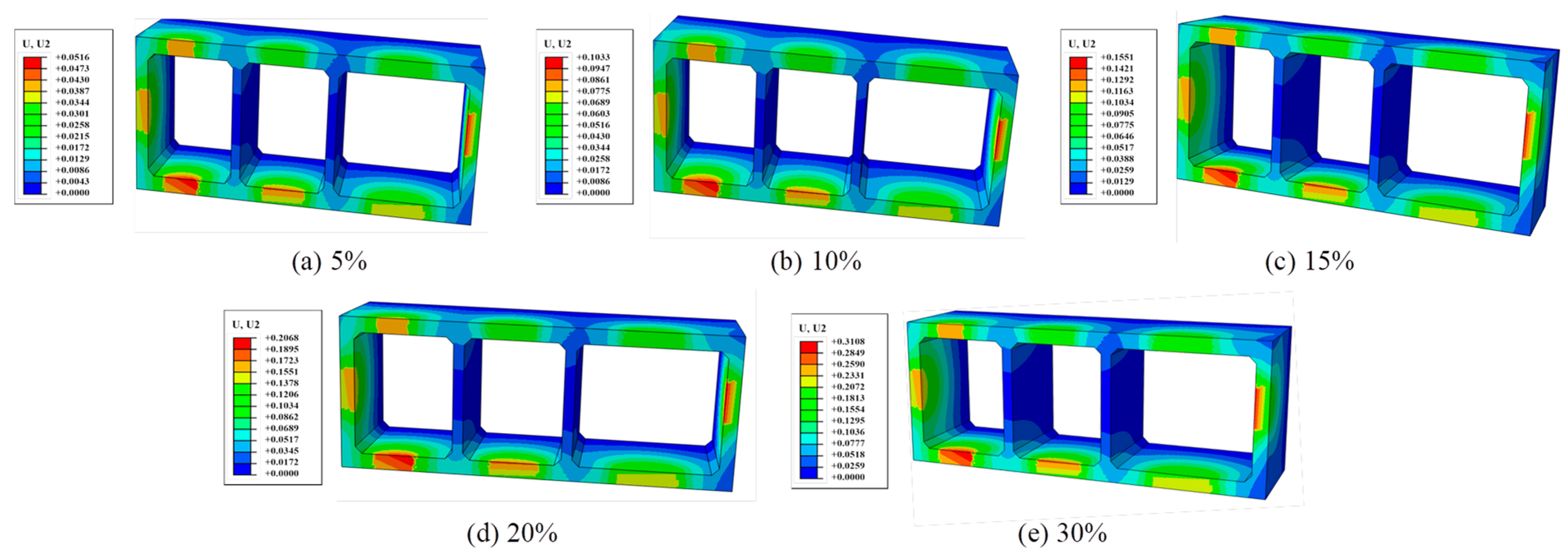
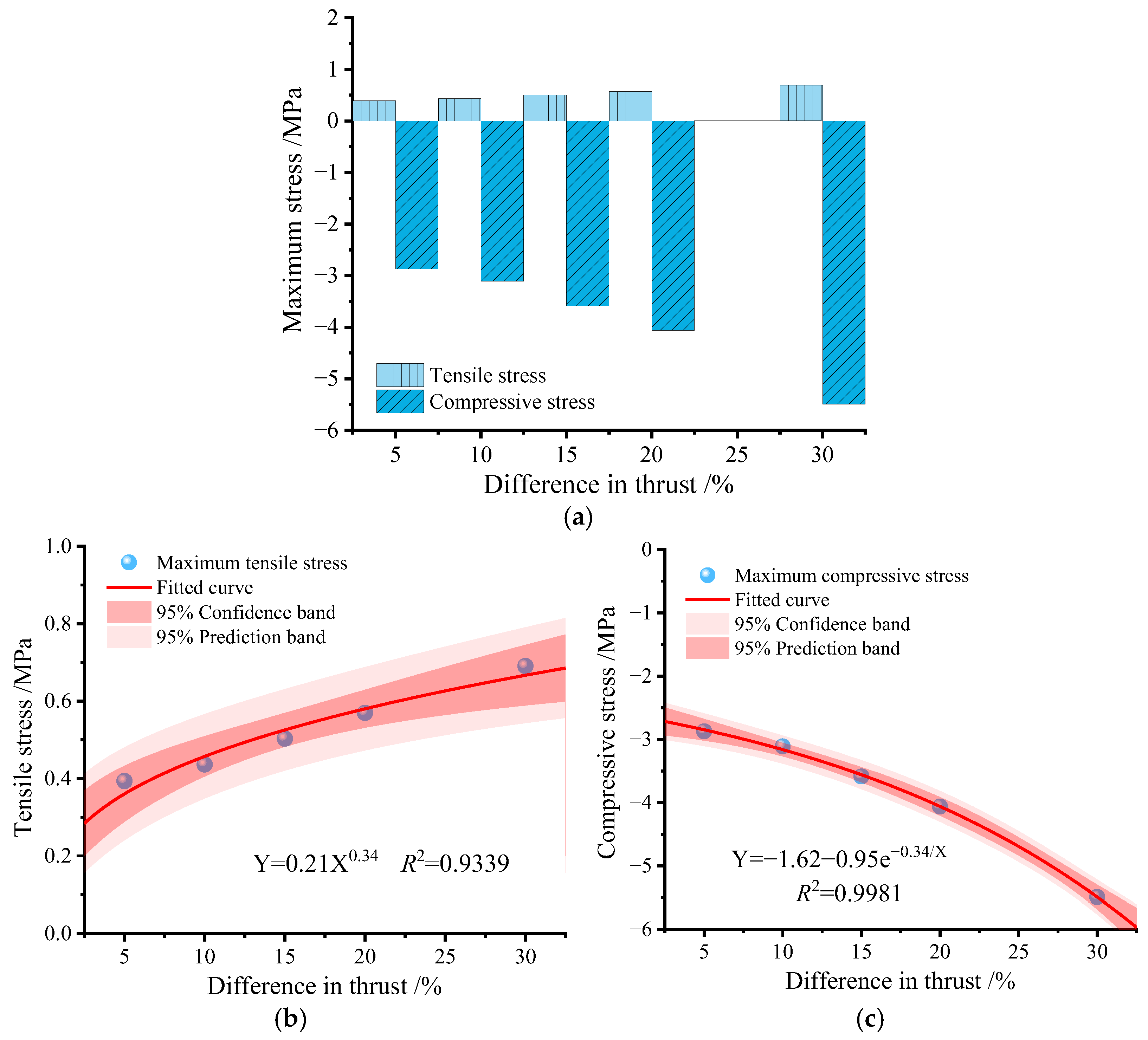
4.2. Stress–Displacement Response Considering Thrust Imbalance
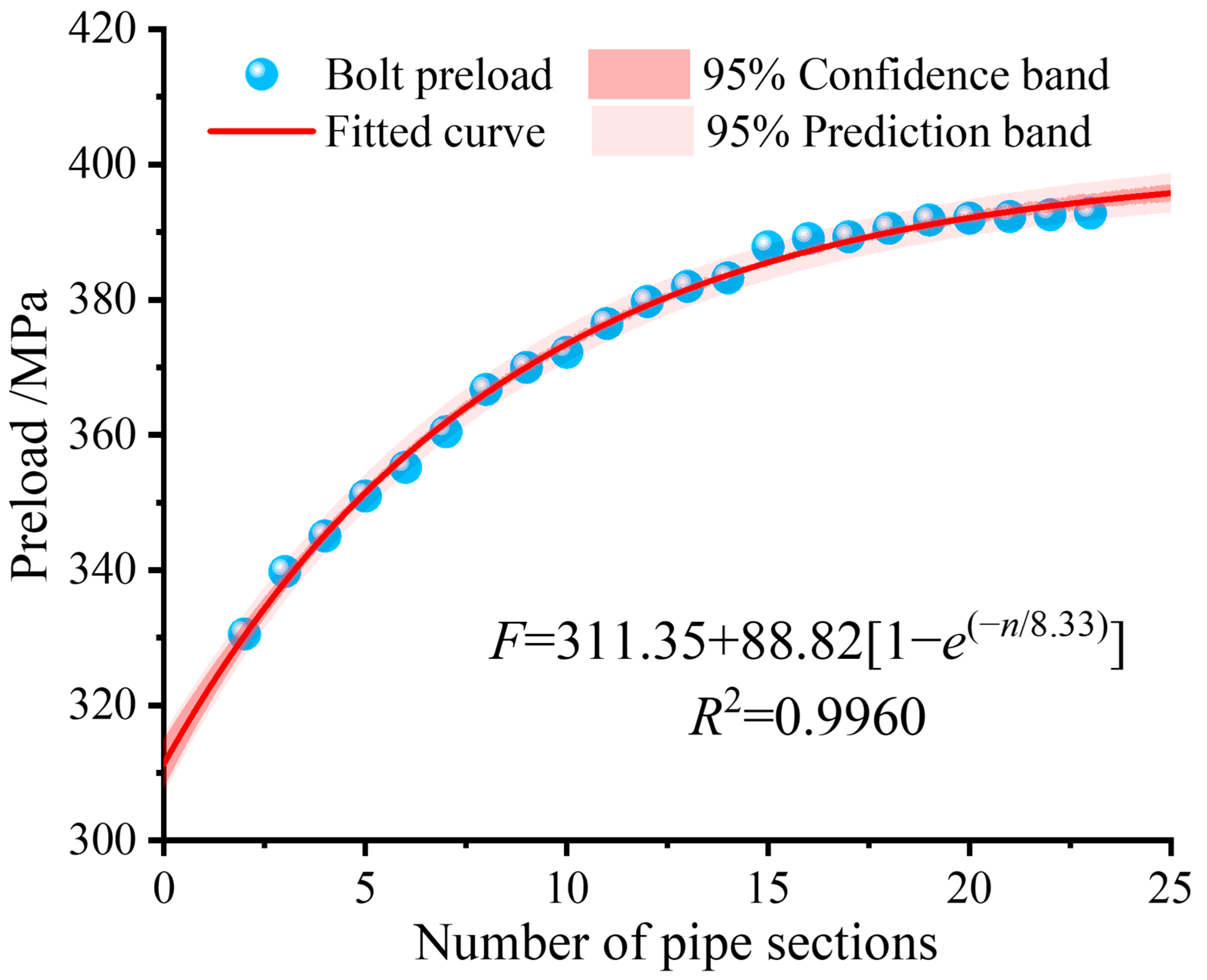
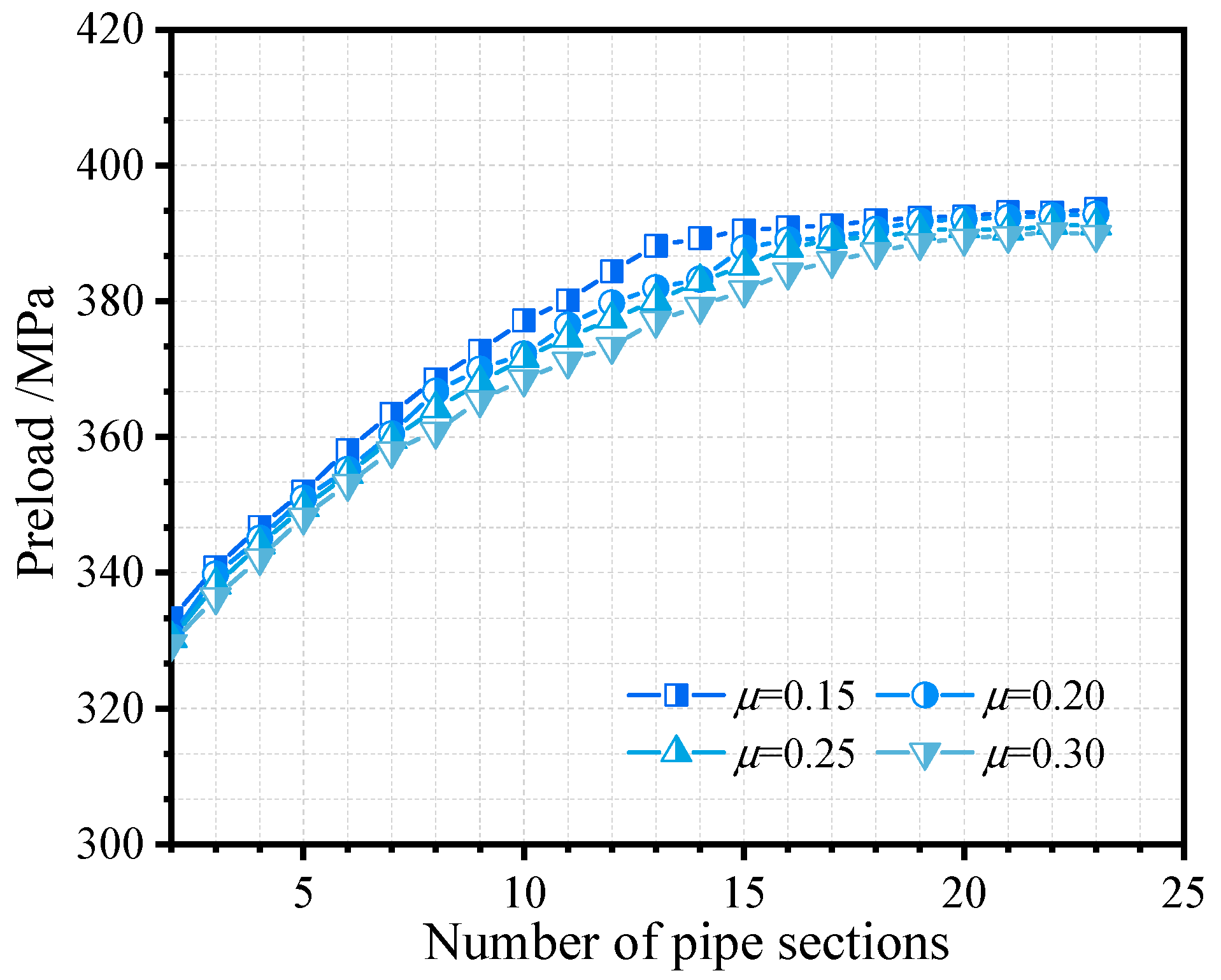
4.3. Effect of Friction Coefficient on the Evolution of Bolt Preload
5. Discussion
5.1. Load Transfer and Friction Mobilization Under Synchronous Jacking
5.2. Leading-End Stress Evolution and Control Thresholds Under Asynchronous Jacking
5.3. Process Response and Safety Assessment Under the Most Unfavorable Condition
6. Conclusions
- (1)
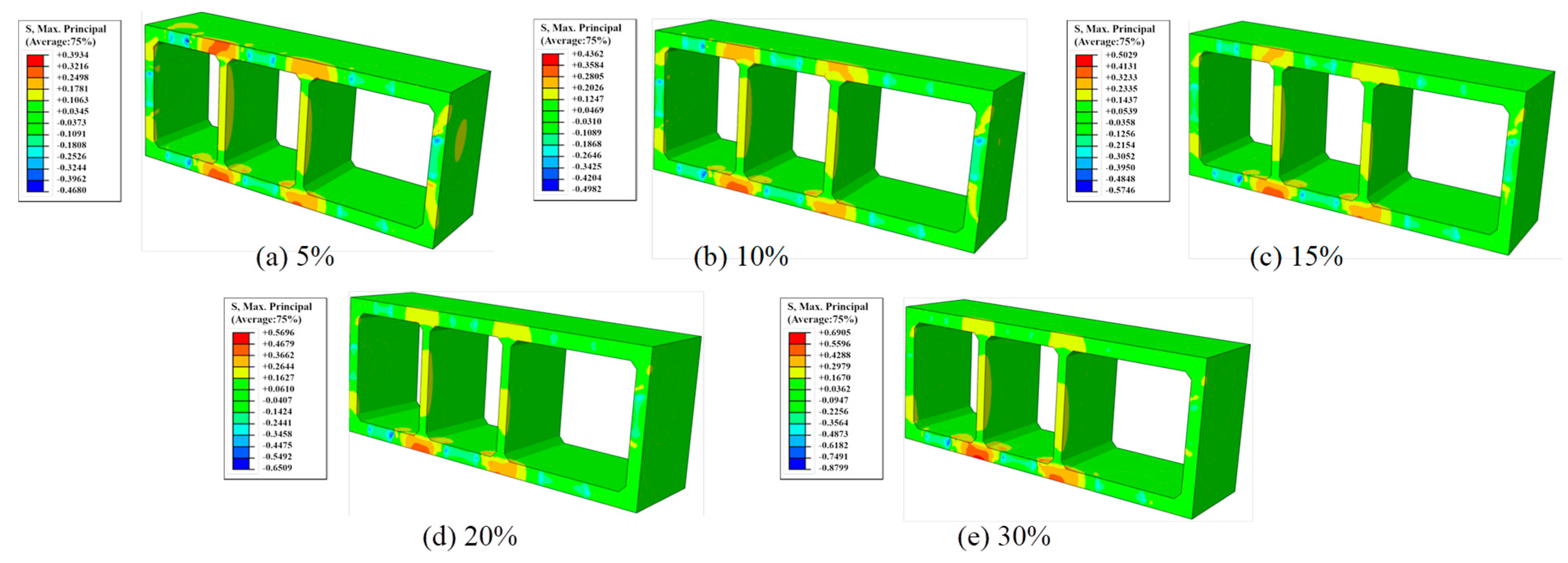
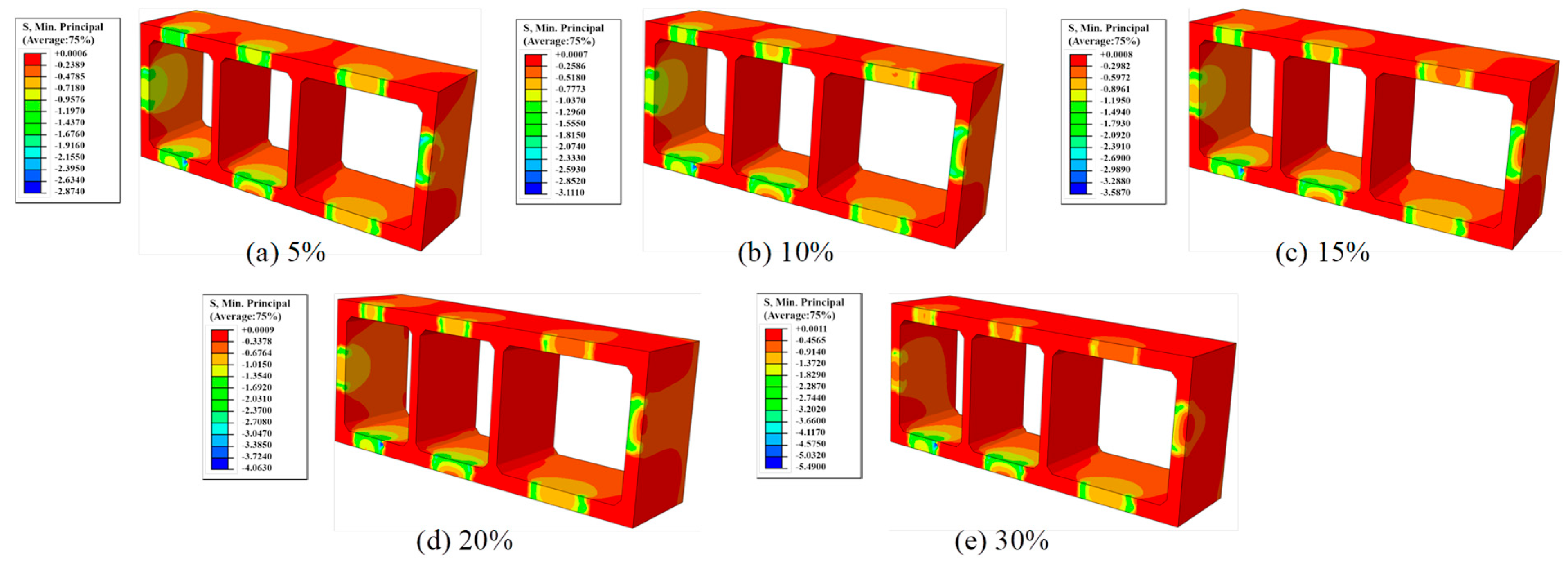
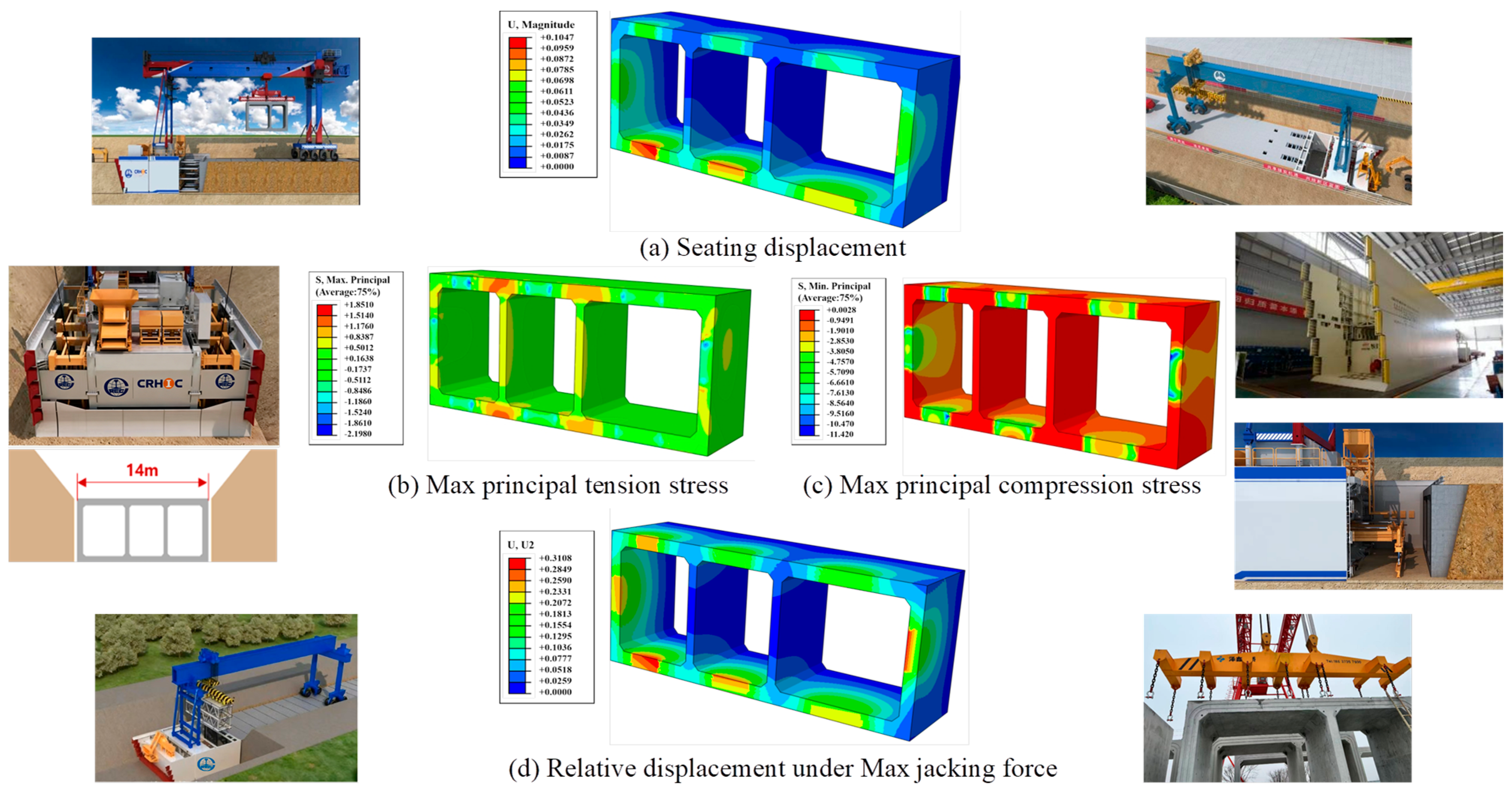
- Asynchronous jacking significantly alters structural load distribution. As the thrust difference increases from 5% to 30%, both maximum principal tensile and compressive stresses rise, with the compressive stress reaching 5.49 MPa and tensile stress 1.85 MPa. The stress state transitions from axial compression to eccentric compression-bending, with more pronounced stress and deformation concentration at a 30% thrust difference, highlighting the significant impact of asynchronous jacking on the tunnel structure’s load distribution.
- (2)
- Frictional effects play an important role in the jacking process. Variations in the friction coefficient influence the load-transfer range and stress distribution. As the friction coefficient increases, frictional resistance increases, leading to a more localized load transfer and higher stress concentration on the loaded side. Numerical results indicate that when the friction coefficient increases from 0.15 to 0.30, compressive and tensile stresses increase by approximately 20% and 15%, respectively, highlighting the significance of frictional effects during jacking.
- (3)
- The leading segment of the tunnel retains a safety margin under the most unfavorable conditions. At a 30% thrust difference, the maximum principal compressive and tensile stresses in the leading segment do not exceed the design compressive strength of concrete (25.3 MPa), and both stress increases remain within the allowable design limits. This indicates that, even under extreme conditions, the structure can maintain sufficient safety margin and exhibits strong safety and stability.
- (4)
- A safety control strategy for asynchronous jacking is proposed based on the research findings. During construction, it is essential to monitor the changes in compressive and tensile stresses at the loaded-side roof edge, inter-segment joints, and invert-partition wall roots. Measures to control the friction coefficient and thrust difference should be implemented to reduce the impact of eccentricity. Additionally, real-time monitoring of bolt forces, joint opening/closure, and invert deformation at key segments is necessary to ensure overall structural safety.
Author Contributions
Funding
Data Availability Statement
Acknowledgments
Conflicts of Interest
References
- Luo, Z.; Chen, J.; Zhang, Y.; Wu, H.; Zhang, X. Study on the stress response and deformation mechanism of pipe jacking segments under the coupling effect of defects and deflection. Appl. Sci. 2025, 15, 12465. [Google Scholar] [CrossRef]
- Lin, Z.; Guo, C.; Ni, P.; Cao, D.; Huang, L.; Guo, Z.; Dong, P. Experimental and numerical investigations into leakage behaviour of a novel prefabricated utility tunnel. Tunn. Undergr. Space Technol. 2020, 105, 103529. [Google Scholar] [CrossRef]
- Kuang, Y.; Peng, Z.; Yang, J.; Zhou, M.; He, C.; Liu, Y.; Mo, X.; Song, Z. Physical and numerical simulations on mechanical properties of a prefabricated underground utility tunnel. Materials 2022, 15, 2276. [Google Scholar] [CrossRef]
- Zhang, Z.; Li, W.; Sheng, J.; Leng, B.; Zhang, M. Study on the Support Pressure of Tunnel Face for the Construction of Pipe-Jacking Across Thin Overburden River Channel Based on Mud-Water Balance. Appl. Sci. 2025, 15, 7060. [Google Scholar] [CrossRef]
- Zhang, C.; Zhao, Z.; Xu, Y.; Nie, X. Study on the shear mechanical response and failure characteristics of prefabricated double-cabin utility tunnel joints. J. Civ. Struct. Health Monit. 2024, 14, 1595–1610. [Google Scholar] [CrossRef]
- Cui, G.; Zhou, Q.; Song, Z. Exploration of the construction and development of urban underground comprehensive pipeline corridor. J. Xi’an Univ. Arch. Technol. (Nat. Sci. Ed.) 2020, 52, 660–666. [Google Scholar]
- Xue, W.; Chen, S.; Wang, Q. Cyclic loading test conducted on the bottom joints of a hybrid precast utility tunnel composed of double-skin sidewalls and a precast bottom slab. Buildings 2024, 14, 341. [Google Scholar] [CrossRef]
- Wang, Q.; Gong, G.; Hao, J.; Bao, Y. Numerical investigation of prefabricated utility tunnels composed of composite slabs with spiral stirrup-constrained connection based on damage mechanics. Materials 2022, 15, 6320. [Google Scholar] [CrossRef]
- Li, F.; Luo, J.; Wang, D.; Wang, L. Aerodynamic characteristics when trains pass each other in high-speed railway shield tunnel. Appl. Sci. 2022, 12, 6244. [Google Scholar] [CrossRef]
- Feng, Y.; Li, W.; Lu, N. Research on experimental and numerical methods for mechanical properties of lightweight hollow precast utility tunnels. Buildings 2022, 12, 1483. [Google Scholar] [CrossRef]
- Qian, H.; Li, J.; Pan, Y.; Zong, Z.; Wu, C. Blast performance of precast segmental utility tunnel against ground surface explosion. Part 1: Experimental analysis. Structures 2025, 63, 108192. [Google Scholar] [CrossRef]
- Xue, W.; Chen, S.; Wang, Q. Pseudo-static tests on double-cell precast utility tunnel composed of groove-shaped elements with prestressing tendons. Structures 2024, 82, 107912. [Google Scholar] [CrossRef]
- Xue, W.; Chen, S.; Bai, H. Pseudo-static tests on top joints of hybrid precast utility tunnel. Buildings 2023, 13, 2567. [Google Scholar] [CrossRef]
- Yue, F.; Liao, K.; Min, A.K.; Xiong, S.; Liu, B.; Jiang, X.; Bao, X.; Fu, M. Seismic performance of joints of prefabricated corrugated steel utility tunnels. Part I: Experimental analysis. J. Constr. Steel Res. 2024, 220, 108616. [Google Scholar] [CrossRef]
- Hu, Y.; Li, Z.; He, J.; Huang, Z. Experimental study on seismic performance of prefabricated joints of underground utility tunnel. IOP Conf. Ser. Earth Environ. Sci. 2019, 267, 042109. [Google Scholar] [CrossRef]
- Tu, J.; Fu, Q.; Zhong, D. Rapid installation technology of prefabricated integrated pipe gallery. J. Phys. Conf. Ser. 2020, 1578, 012177. [Google Scholar] [CrossRef]
- Zhao, G.Y.; Zhu, L.; Wu, S. Experimental and numerical investigation on the cross-sectional mechanical behavior of prefabricated multi-cabin RC utility tunnels. Structures 2022, 42, 466–479. [Google Scholar] [CrossRef]
- Yue, F.; Liu, B.; Zhu, B.; Jiang, X.; Chen, L.; Liao, K. Shaking table test and numerical simulation on seismic performance of prefabricated corrugated steel utility tunnels on liquefiable ground. Soil Dyn. Earthq. Eng. 2021, 141, 106527. [Google Scholar] [CrossRef]
- Guo, Y.C.; Zhao, L.; Zou, H.; Li, T. Study on the impact of partial unloading on the structural response of prefabricated segment tunnels. Sci. Rep. 2023, 13, 95900. [Google Scholar]
- Wang, L.; Chen, X.S.; Su, D.; Zhou, W.P.; Sun, B.; Pan, J.Y.; Wu, Y.Z.; Feng, M. Construction of a super-large prefabricated rectangular tunnel beneath a box culvert using pipe jacking: A case study. Tunn. Undergr. Space Technol. 2024, 139, 105913. [Google Scholar] [CrossRef]
- Wang, Y.; Liu, Z. Face stability of shallowly buried large-section EPB box jacking: A case study. Tunn. Undergr. Space Technol. 2024, 139, 105973. [Google Scholar]
- Li, X.Z.; Hou, D.; Hou, Y. Analysis of shield tunnel ground deformation characteristics and affecting factors in water-rich soft stratum: A case study on the section tunnel of Tianjin Metro Line 6. Appl. Sci. 2022, 12, 6208. [Google Scholar] [CrossRef]
- Balkaya, C. Finite element modelling and simulation of tunnel gates of dam structures in ABAQUS using reduced-integrated 8-node hexahedral solid-shell element. Model. Simul. Eng. 2024, 2024, 7142460. [Google Scholar] [CrossRef]
- Rodríguez, C.A.; Rodríguez-Pérez, Á.M.; López, R.; Hernández-Torres, J.A.; Caparrós-Mancera, J.J. A finite element method integrated with Terzaghi’s principle to estimate settlement of a building due to tunnel construction. Buildings 2023, 13, 1343. [Google Scholar] [CrossRef]
- Huang, B.; Zhu, J.; Weng, K.; Huang, J.; Dai, J. Prefabricated UHPC-concrete-ECC underground utility tunnel reinforced by perforated steel plate: Experimental and numerical investigations. Case Stud. Constr. Mater. 2021, 15, e00856. [Google Scholar] [CrossRef]
- Liang, J.; Zhang, J.; Xu, A.; Dong, B.; Ba, Z. Shaking table tests on transverse seismic performance of a new type of combined prefabricated utility tunnel. Structures 2024, 74, 107340. [Google Scholar] [CrossRef]
- Liang, J.; Zhang, J.; Dong, B.; Xu, A.; Ba, Z. Shaking table test on the seismic performance of prefabricated utility tunnel passing through hard–soft strata under longitudinal excitation. Soil Dyn. Earthq. Eng. 2024, 183, 108788. [Google Scholar] [CrossRef]
- Peng, J.; He, K.; Tong, X.; Huang, Q.; Liu, C. Mechanical response and deformation mechanism of the utility tunnel crossing earth fissure. Structures 2024, 53, 1234–1245. [Google Scholar]
- Wang, Q.; Gong, G.; Hao, J.L. Double-cell prefabricated utility tunnel composed of groove-shaped elements: An extended study of stiffness reduction method. Appl. Sci. 2022, 12, 5982. [Google Scholar] [CrossRef]
- Pan, Y.; Yi, D.H.; Wu, W.L. Mechanical performance test and finite element analysis of prefabricated utility tunnel L-shaped joint. Struct. Des. Tall Spec. Build. 2020, 29, 1748. [Google Scholar] [CrossRef]



| Case | Description | Control Variables | Loading Sequence | Objective |
|---|---|---|---|---|
| S1 | Synchronous jacking | Total thrust N * (uniform over section); friction μ *; bolt preload | Dead load → preload → synchronous jacking | Load transfer pattern and effective transfer length (m *) |
| S2 | Asynchronous jacking | N fixed; thrust difference δ * = 5%, 10%, 15%, 20%, 30% | Dead load → preload → unequal top-bottom jacking | End response under eccentric jacking: σ1,max/σ3,max, U2 *, and relative U2 * |
| S3 | Friction sensitivity | Only μ * varied (others as S1/S2) | Same as S1/S2 | Effect of friction level on transfer length scale and axial-force convergence |
| Category | Plasticity Parameters | Compression Behavior | Tension Behavior |
|---|---|---|---|
| CDP plasticity | φ = 30°; ε = 0.10; σbo/σco = 1.16; Kc = 0.67 | Post-peak softening included; stress-inelastic strain formulation | Fracture-energy-based softening; ft = 4.0 MPa; Gf = 0.265 N/mm |
| Damage evolution | - | Compressive damage Dc defined | Tensile damage Dt defined |
| Component | Parameter | Value | Description |
|---|---|---|---|
| Rebar | Layout | Longitudinal + transverse | Joint reinforcement configuration |
| Diameter | Φ 12 mm | Uniform rebar diameter | |
| Spacing | 150 mm | Center-to-center spacing | |
| Bolt | Length | 1.20 m | Effective bolt length |
| Installation position | Through joint region | Consistent with joint configuration | |
| Preload magnitude | 100 kN | Applied pretension force | |
| Preload method | Bolt-load (pretension) | ABAQUS pretension method |
| Segment Range | Preload Response | Engineering Implication |
|---|---|---|
| 1–15 | Rapid increase; large growth rate | Main load-transfer and restraint redistribution zone near the advancing end; end response most sensitive |
| 15–20 | Growth rate weakens; transition toward plateau | Friction/contact mobilization progressively strengthens; boundary effects start to decay |
| 20–25 | Approaches plateau (390–400 MPa) | Response stabilizes; provides an empirical basis for selecting model length/convergence criterion |
| Thrust Difference δ/% | Max Principal Tensile Stress σ1,max/MPa | Max Principal Compressive Stress σ3,max/MPa | Max End Vertical Disp. U2/mm | Compressive Utilization ηc | Safety Reserve γ | Peak Location |
|---|---|---|---|---|---|---|
| 5 | +0.394 | −2.874 | 0.052 | 0.114 | 8.803 | Loaded-side invert; partition-wall root |
| 10 | +0.436 | −3.111 | 0.103 | 0.123 | 8.132 | Loaded-side invert; end partition wall |
| 15 | +0.503 | −3.587 | 0.155 | 0.142 | 7.053 | Mid-span of invert; partition-wall root |
| 20 | +0.570 | −4.063 | 0.207 | 0.160 | 6.227 | Loaded-side invert; corner region |
| 30 | +0.691 | −5.490 | 0.311 | 0.217 | 4.608 | Loaded-side invert; partition-wall root |
Disclaimer/Publisher’s Note: The statements, opinions and data contained in all publications are solely those of the individual author(s) and contributor(s) and not of MDPI and/or the editor(s). MDPI and/or the editor(s) disclaim responsibility for any injury to people or property resulting from any ideas, methods, instructions or products referred to in the content. |
© 2026 by the authors. Licensee MDPI, Basel, Switzerland. This article is an open access article distributed under the terms and conditions of the Creative Commons Attribution (CC BY) license.
Share and Cite
Sui, S.; Jiao, X.; Zhang, H.; Wang, T.; Hu, R.; He, K.; Song, Z. Mechanical Response Characteristics of Prefabricated Utility Tunnel Joints Considering Jacking Load Imbalance. Appl. Sci. 2026, 16, 1458. https://doi.org/10.3390/app16031458
Sui S, Jiao X, Zhang H, Wang T, Hu R, He K, Song Z. Mechanical Response Characteristics of Prefabricated Utility Tunnel Joints Considering Jacking Load Imbalance. Applied Sciences. 2026; 16(3):1458. https://doi.org/10.3390/app16031458
Chicago/Turabian StyleSui, Shubo, Xiangpan Jiao, Hongjun Zhang, Tong Wang, Ruoqi Hu, Kang He, and Zhanping Song. 2026. "Mechanical Response Characteristics of Prefabricated Utility Tunnel Joints Considering Jacking Load Imbalance" Applied Sciences 16, no. 3: 1458. https://doi.org/10.3390/app16031458
APA StyleSui, S., Jiao, X., Zhang, H., Wang, T., Hu, R., He, K., & Song, Z. (2026). Mechanical Response Characteristics of Prefabricated Utility Tunnel Joints Considering Jacking Load Imbalance. Applied Sciences, 16(3), 1458. https://doi.org/10.3390/app16031458