Article

Integrated Methane Sensor Prototype Based on H-QEPAS Technique with a 3D-Printed Gas Chamber

National Key Laboratory of Laser Spatial Information, Harbin Institute of Technology, Harbin 150001, China
*
Author to whom correspondence should be addressed.
These authors contributed equally to this work.
Appl. Sci. 2026, 16(3), 1427; https://doi.org/10.3390/app16031427
Submission received: 5 December 2025 / Revised: 30 December 2025 / Accepted: 10 January 2026 / Published: 30 January 2026
(This article belongs to the Special Issue Latest Applications of Laser Measurement Technologies)

Abstract

In the paper, a heterodyne quartz-enhanced photoacoustic spectroscopy (H-QEPAS)-based integrated methane (CH4) sensor prototype is reported. The CH4 absorption line located at 1650.96 nm was selected as the target spectral line. The design features an integrated, 3D-printed gas chamber for reduced size and weight. To realize the coordinated operation of each hardware component, a control program was designed based on LabVIEW platform, enabling the adjustment of various hardware parameters. The piezoelectric signal generated by the quartz tuning fork (QTF) was amplified via a trans-impedance amplifier (TIA), acquired by a data acquisition card (DAQ), and then transmitted to a virtual lock-in amplifier (LIA) on the PC terminal for processing. The dimensions of the integrated CH4 sensor prototype are 33 cm in length, 27 cm in width, and 15 cm in height. The final test results demonstrate that the sensor prototype exhibits an excellent concentration linear response, with a detection limit of 26.72 ppm and a short detection time of approximately 4 s.

1. Introduction

Monitoring methane (CH4) is essential due to its significant environmental impact and widespread industrial relevance. On one hand, it identifies early explosion risks of CH4 in scenarios such as coal mines and gas infrastructure [1,2,3,4]. On the other hand, it aids environmental protection by locating emission sources to curb CH4 emissions [5,6,7,8]. It not only reduces energy waste resulting from natural gas leakage but also facilitates the evaluation of CH4 recyclability through concentration detection [9,10,11,12]. Therefore, there is an urgent need for alternative methodological frameworks to achieve rapid detection of CH4.
The method for gas detection has witnessed substantial advancements, with a diverse array of approaches having been developed [13,14,15,16,17,18,19]. Laser absorption spectroscopy has provided robust support for gas detection, attributed to its superior detection stability, remarkable adaptability to hazardous measurement environments, and inherent capability of enabling remote online monitoring [20,21,22]. As a technique belonging to the category of laser absorption spectroscopy, photoacoustic spectroscopy (PAS) [23,24,25,26,27] determines the concentration of a target gas by measuring the intensity of the acoustic waves it generates upon light absorption. Photoacoustic gas sensors have been successfully deployed in a variety of real-world monitoring scenarios, demonstrating their practicality beyond laboratory environments. Commercial systems based on photoacoustic spectroscopy are widely used for applications such as CH4 leak detection in natural gas infrastructure, industrial safety monitoring of combustible gases, greenhouse gas emission assessment, and environmental compliance monitoring. These systems highlight the strong demand for sensitive, selective, and reliable gas sensors capable of operating under field conditions. Common acoustic wave transducers in PAS include microphone and quartz tuning fork (QTF) [28,29,30,31]. By using QTF, quartz-enhanced photoacoustic spectroscopy (QEPAS) [32,33,34] was proposed in 2002. It skillfully leverages the inherent merits of QTF, such as its compact configuration, narrow bandwidth, robust anti-interference performance, and cost-effectiveness [35,36,37,38,39]. When the laser wavelength matches the gas absorption line, the gas absorbs laser energy and undergoes a transition to the excited energy level. Owing to the intrinsic instability of the higher energy level, the gas subsequently falls back to the ground state, converting the absorbed energy into thermal energy [40,41,42]. Modulating the laser at a specific frequency can induce periodic expansion of the gas, thereby generating acoustic waves [43,44,45]. The acoustic waves drive the QTF into vibration, which subsequently generates piezoelectric signals. Systematic processing of these signals enables the effective derivation of key data pertaining to gas concentrations [46,47]. To date, the highly sensitive QEPAS technology has been widely adopted in various critical fields, making significant contributions to the advancement of science and technology across multiple domains.
Conventional quartz-enhanced photoacoustic spectroscopy (QEPAS) is an extremely sensitive technique, but it also suffers from several inherent limitations. First, the quartz tuning fork (QTF) must be driven close to its mechanical resonance, typically in the tens of kilohertz range. This requires high-frequency, low-noise electronics and a lock-in amplifier operating at the QTF resonance, which increases system complexity and cost. Second, the QTF resonance frequency is essentially fixed, so the modulation frequency has only a narrow tolerance. Any drift in the QTF resonance or in the modulation conditions can lead to a noticeable loss in signal amplitude and stability. Third, the useful photoacoustic signal is a very small current at high frequency, so it has to be amplified with large gain. By contrast, heterodyne quartz-enhanced photoacoustic spectroscopy (H-QEPAS) [48,49] is well suited for implementing transient or beat-frequency based retrieval schemes, while preserving all intrinsic benefits of QEPAS such as high sensitivity, compactness and wavelength independence. Experimental comparisons have shown that, for a similar detection limit, H-QEPAS can operate with shorter averaging times than conventional QEPAS, enabling faster gas-concentration measurements. Specifically, only a shortened excitation time is requisite to furnish the energy for transient response generation, thereby achieving a substantial enhancement in the sensor’s response speed. To further broaden the application scope of sensors and adapt to complex environments, sensors require further integration and portability [50,51,52,53]. Compared to traditionally machined components, 3D-printed gas chamber offers significantly reduced weight and volume [54,55,56]. They can be tightly integrated with optical components, enhancing the mechanical stability of the system.
In this paper, an integrated sensor prototype for CH4 detection was proposed with a 3D-printed gas chamber. The designed sensing system comprises two layers: the lower layer contains the power supply module; the upper layer includes optical components. A LabVIEW programming framework to create a human–machine interface that supports dynamic configuration of experimental setting. Rather than aiming for the ultimate detection limit, the proposed system is specifically tailored to meet the application’s need for moderate detection sensitivity, compact design, and compatibility with cost-effective near-infrared diode laser sources. These features collectively indicate that the present H-QEPAS prototype provides a practical platform for the development of portable CH4 monitoring instruments, particularly for on-site measurements in industrial or technological gas environments, where compactness, reliability, and ease of integration are of primary importance.

2. Experimental Setup

2.1. Selection of Absorption Line of CH4

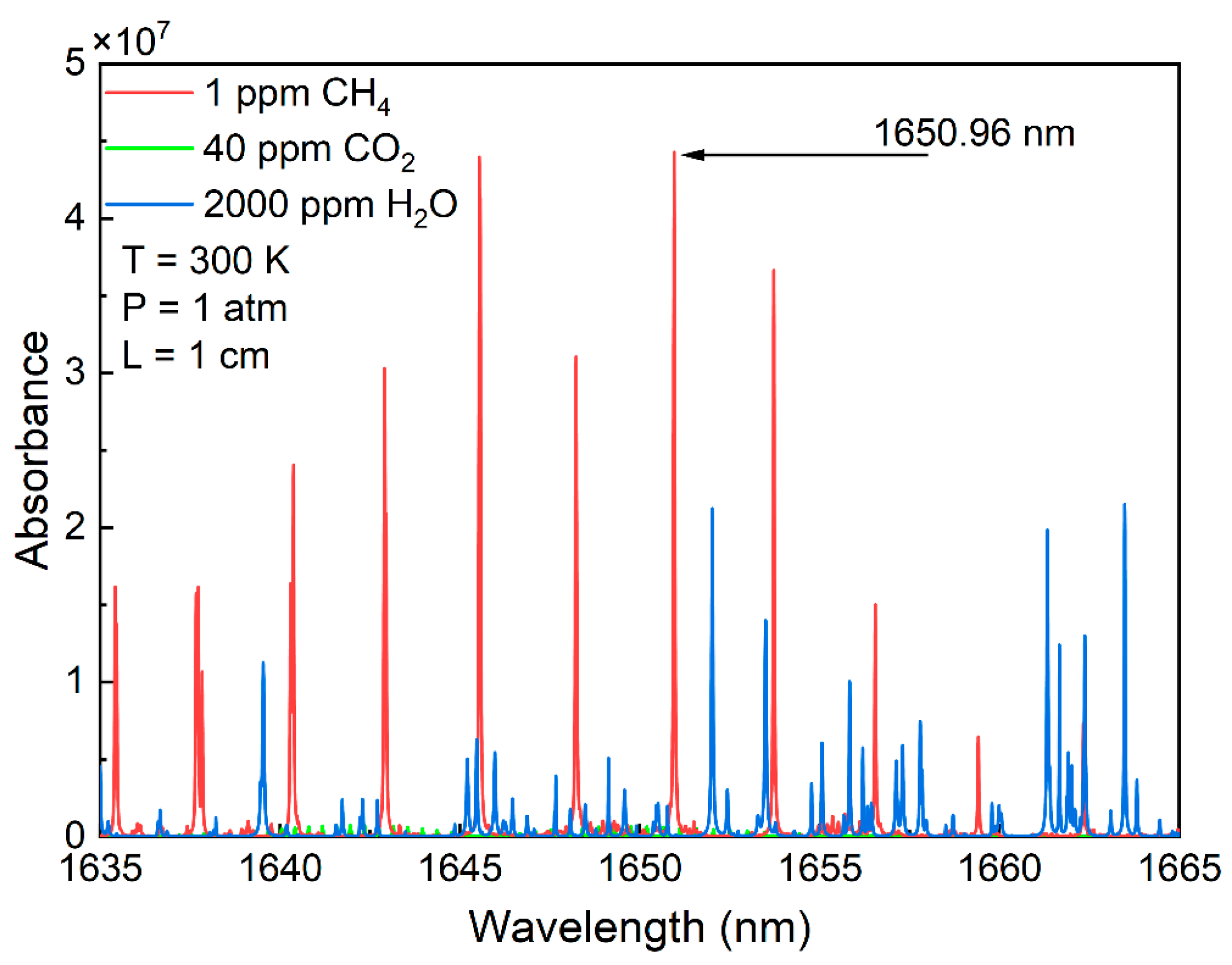
Diode lasers emitting in the near-infrared wavelength range offer advantages such as compact size, low cost, and fiber-coupled output capability. Therefore, selecting absorption lines within the near-infrared region enables the use of diode lasers as excitation sources for gas sensing applications. A simulation of CH4 absorption lines in the spectral range from 1635 nm to 1665 nm was performed, as shown in Figure 1. The simulation was based on the HITRAN 2020 database under standard conditions, including a temperature of 300 K, atmospheric pressure, and an optical path length of 1 cm. As can be clearly observed, the absorption feature near 1650 nm exhibits a relatively strong CH4 absorption strength while showing minimal spectral interference from common atmospheric constituents such as H2O and CO2. Since the selectivity of QEPAS-based sensors is primarily determined by the targeted molecular absorption line, non-spectral interference background gases do not contribute to the photoacoustic signal. Consequently, the absorption line located at 1650.96 nm was selected for subsequent CH4 detection experiments, providing good intrinsic selectivity and reduced cross-sensitivity under typical ambient conditions.

2.2. The Principle of H-QEPAS

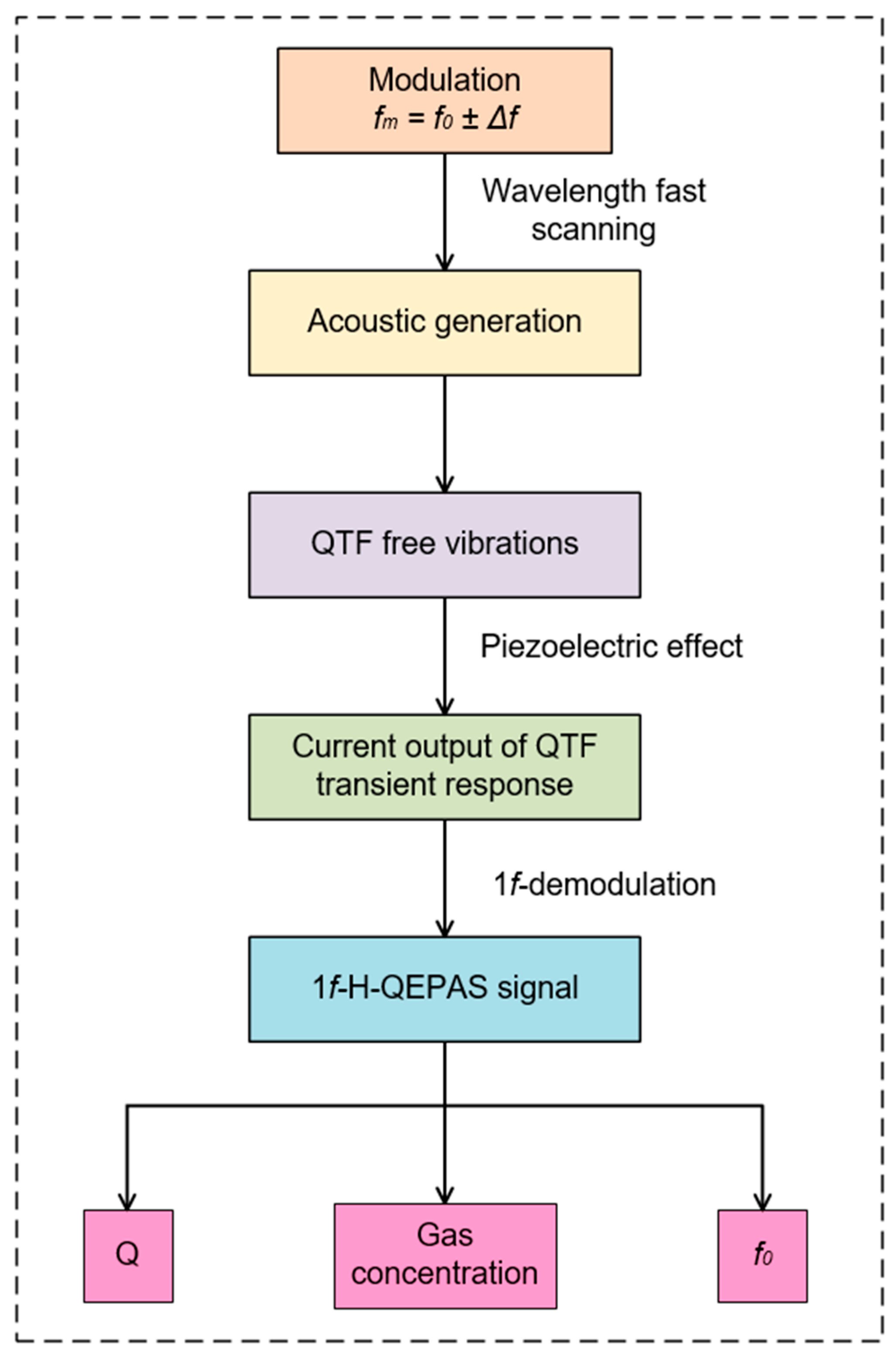
The principle of H-QEPAS as depicted in Figure 2. In the H-QEPAS scheme, a diode laser is wavelength-modulated at a frequency fm that is slightly detuned from the resonance frequency f0 of the quartz tuning fork (QTF), so that fm = f0 ± Δf, At the same time, the laser wavelength is rapidly scanned across a selected gas absorption line. This modulation transfers a periodic intensity variation to the laser beam whenever it passes through an absorbing gas. When the modulated laser beam propagates through the target gas, periodic absorption of the optical power produces cyclical local heating and cooling. This thermo-elastic process generates acoustic waves. The acoustic waves are focused on the QTF placed near the laser beam. The pressure fluctuations periodically drive the prongs of the QTF. Because the QTF is a High-Q mechanical resonator, each acoustic pulse excites it and the QTF subsequently undergoes free vibrations, ringing down at its own resonance frequency f0. The QTF is made of piezoelectric quartz. Its mechanical free vibrations induce an alternating electrical charge on the electrodes. This charge is converted into a transient current output that faithfully reflects the temporal evolution of the QTF ring-down after each excitation event. The transient QTF current is fed to a lock-in amplifier and demodulated at the first harmonic of the modulation frequency, this extracts the component of the QTF response that is phase-coherent with the laser modulation, strongly suppressing broadband noise. The result is the 1f H-QEPAS signal, which contains both amplitude and phase information. By simultaneously exploiting the transient ring-down of the QTF and the heterodyne condition fm = f0 ± Δf, H-QEPAS achieves sensitive gas-concentration measurements while also providing access to the QTF’s dynamical parameters Q and f0.

2.3. The Output Performance of the Diode Laser

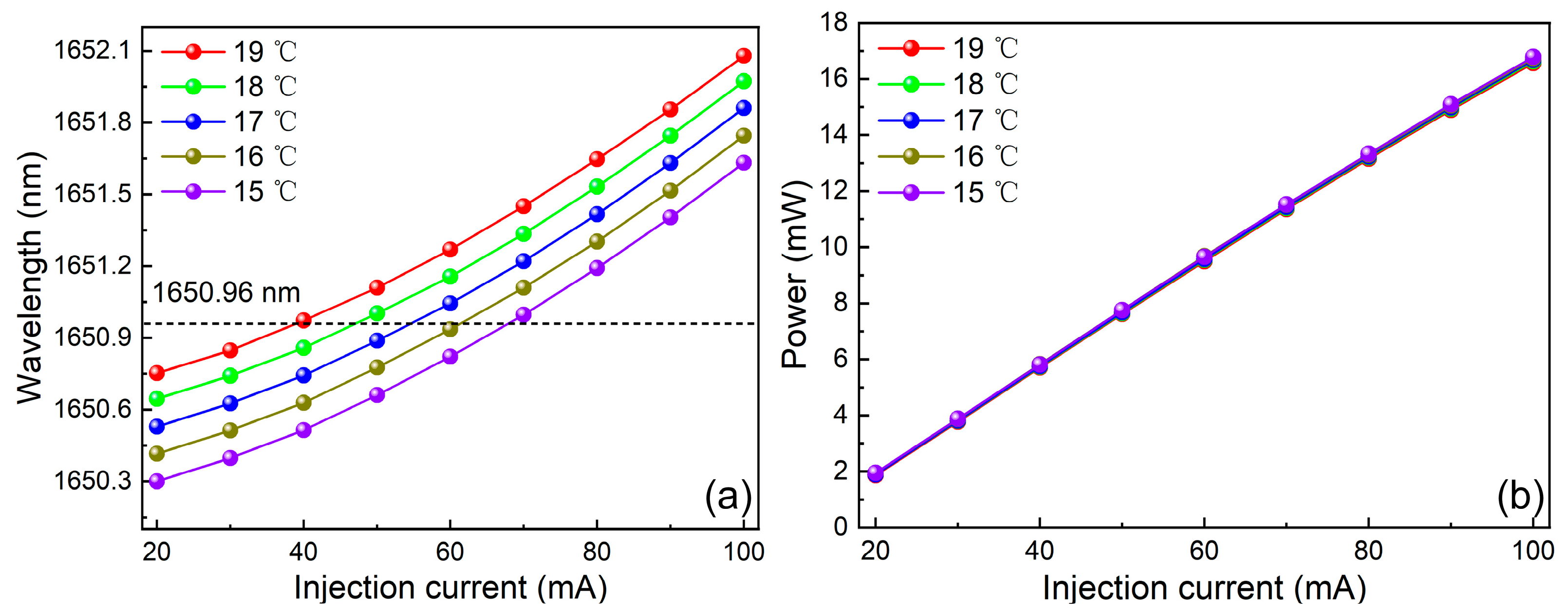
To ensure a single mode laser output, a continuous wave distributed feedback (CW-DFB) diode laser is employed as the excitation source. The performance curve of the laser’s output wavelength variation with current at different temperatures was tested and the results are shown in Figure 3. As indicated by the dashed line in Figure 3a, the output wavelength can satisfy the selected absorption spectral line when the temperature is set to 15 °C and the current is set to 64.9 mA. As shown in Figure 3b, the output power at different temperatures is largely consistent, with the power at 64.9 mA being approximately 10 mW.

2.4. 3D-Printing Gas Chamber

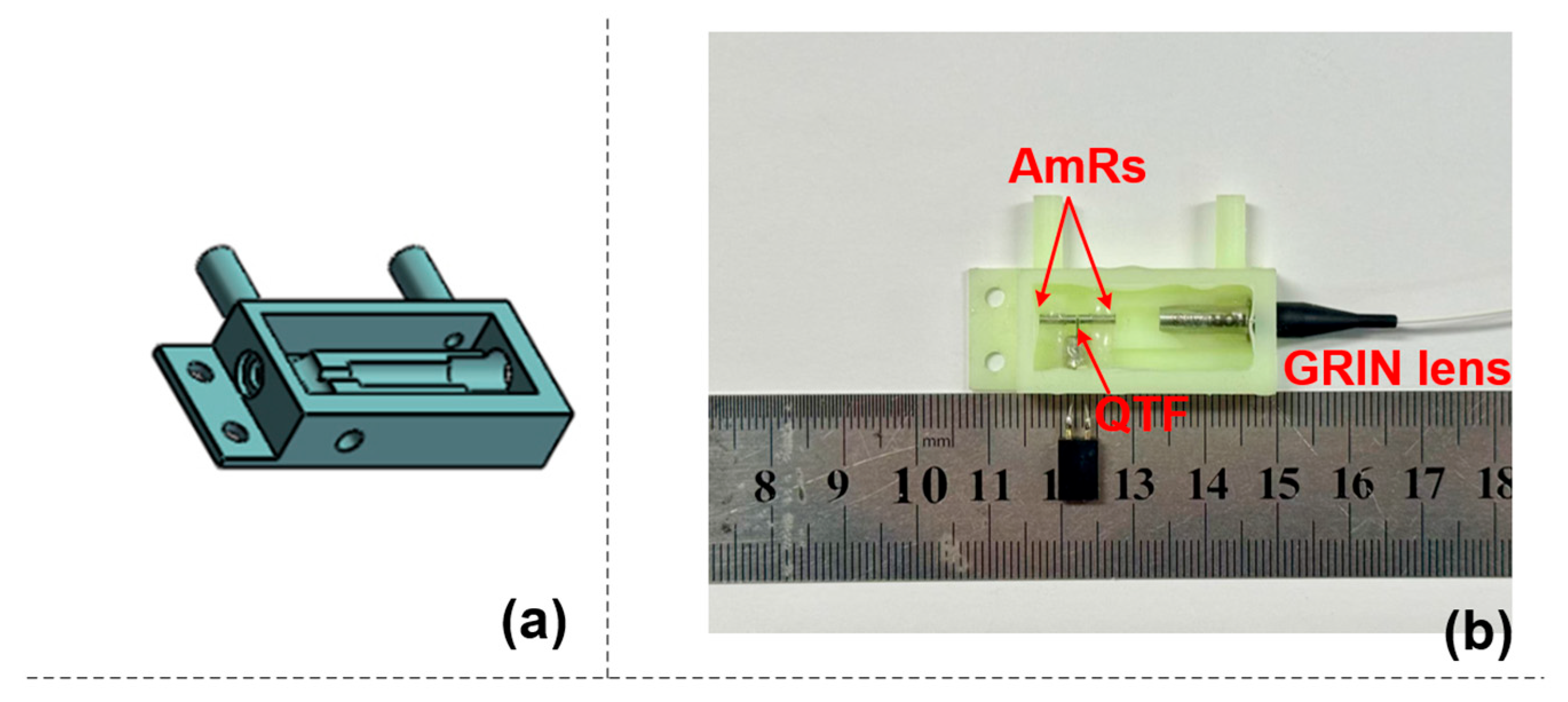
3D-printing stands out for its strengths in high integration, elevated production efficiency, and cost-effectiveness. To address the limitations in size and stability of conventional H-QEPAS sensors produced through machining processes, 3D-printing was leveraged to fabricate a gas chamber, utilizing commercial acrylate-based UV-curable photopolymer resin as the base material. It is noted that freshly printed photopolymer materials may release residual volatile compounds after fabrication. To minimize potential interference, the printed gas cell was thoroughly post-processed, including solvent cleaning and prolonged air exposure prior to experimental measurements. In addition, all measurements were performed under continuous gas flow conditions, which further reduces the accumulation of any residual outgassing species. The design configuration of the gas chamber is depicted in Figure 4, with measurements of 42 mm in length, 27 mm in width, and 8 mm in height. This unit integrates a QTF, a set of acoustic micro-resonators (AmRs), and a fiber-coupled GRIN (Gradient Refractive Index) lens incorporated specifically for laser transmission and collimation purposes. The 3D-printed gas chamber is sealed using quartz glass windows. The QTF is centrally mounted inside the gas cell, with the laser beam aligned to pass through the gap between the QTF prongs. A pair of AmRs is positioned symmetrically along the laser propagation axis to enhance the photoacoustic signal through acoustic confinement. When accounting for all its components, the total mass of this 3D-printed gas chamber amounts to 6 g.
The design of the 3D-printed gas chamber was optimized to enhance the H-QEPAS signal by improving acoustic confinement and coupling efficiency. The AmRs were designed with dimensions corresponding to approximately one quarter of the acoustic wavelength associated with the QTF resonance frequency, enabling effective buildup of acoustic pressure at the position of the QTF prongs. Specifically, each AmR had a length of 5 mm, an inner diameter of 0.5 mm, and an outer diameter of 1.27 mm, which provide efficient acoustic coupling between the photoacoustic source region and the QTF and thereby maximize the detected signal. The laser beam was carefully aligned to traverse the inter-prong gap of the QTF with an optimized beam-prong separation. This configuration maximizes photoacoustic driving efficiency by strengthening the acoustic coupling to the QTF, while maintaining sufficient clearance to prevent any mechanical interaction with the prongs. Moreover, the compact, highly integrated geometry of the 3D-printed chamber reduces acoustic attenuation and improves mechanical robustness, thereby increasing the detected signal amplitude and improving measurement repeatability. Collectively, these design choices lead to a higher signal-to-noise ratio and enhanced overall system performance.

2.5. Design of LabVIEW-Based Control Program

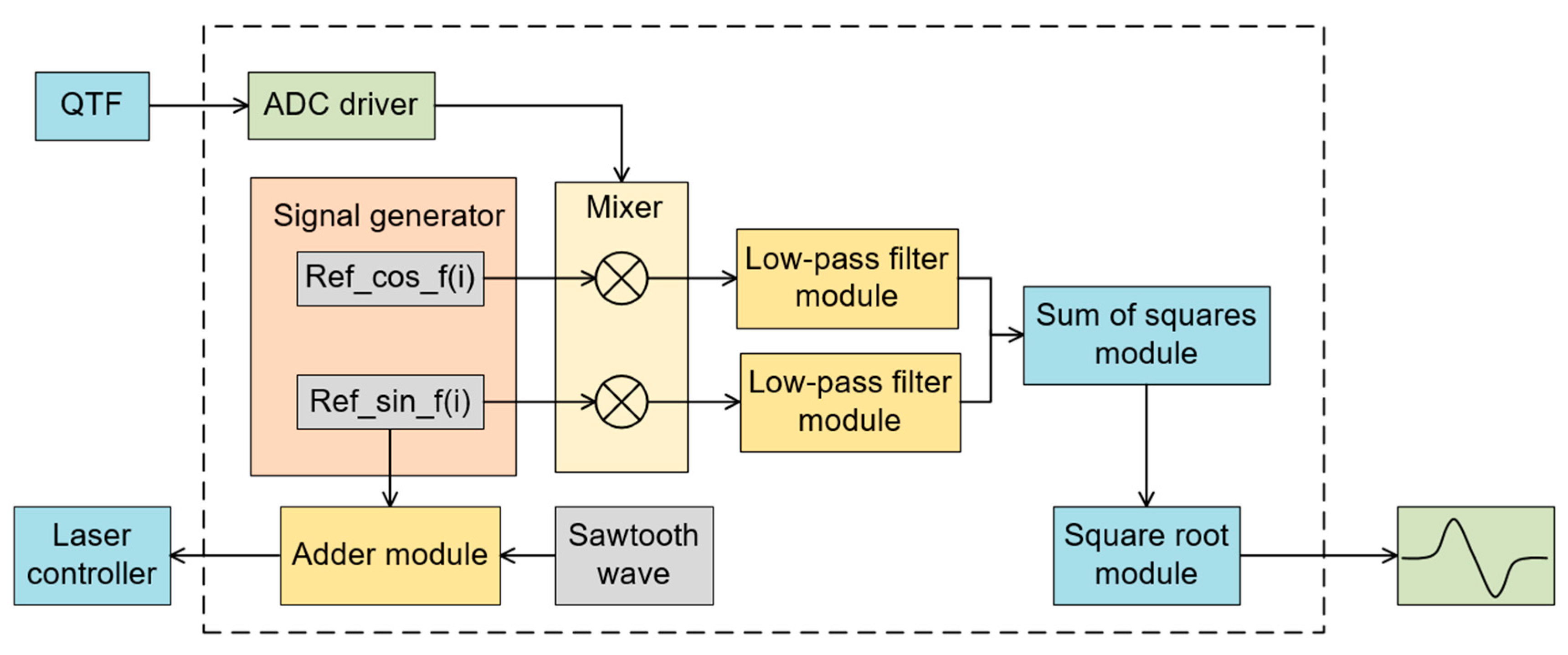
The laser controller provides stable current and temperature for the diode laser. It communicates with the PC via a USB serial port. The current and temperature can be sequentially set to the laser controller via a LabVIEW program. The modulation signals for the laser originate from a signal generator circuit equipped with two signal channels capable of generating distinct waveforms. Within the H-QEPAS system, the modulation signal comprises a sine wave and a sawtooth wave. The sine wave modulates the laser’s output wavelength, while the sawtooth wave induces a periodic variation in the piezoelectric signal. It is worth noting that the sine wave serves as a reference signal in the subsequent demodulation process. The control program for the signal generator is also based on LabVIEW platform. The program allows adjustment of signal type, amplitude, frequency, and offset.
The lock-in amplifier is a core component in spectral detection, capable of extracting weak signals with frequencies identical to the reference signal. Its fundamental principle is phase-sensitive detection. Assume the measured signal is
x ( t ) = A I sin ( w t + φ ) + N ( t )
Here, AI sin(wt + φ) is a useful signal, N(t) is noise. The reference signal consists of two components with a phase difference of 90°:
R 1 = A R sin ( w t + δ ) R 2 = A R cos ( w t + δ )
Signal x(t) is multiplied by the reference signal, and then through the product-to-sum formulas, Equations (3) and (4) are obtained, respectively:
S 1 = x ( t ) R 1 = 1 2 A I A R cos ( φ δ ) 1 2 A I A R cos ( 2 w t + φ + δ ) + A R N ( t ) sin ( w t + δ )
S 2 = x ( t ) R 2 = 1 2 A I A R sin ( φ δ ) + 1 2 A I A R sin ( 2 w t + φ + δ ) + A R N ( t ) cos ( w t + δ )
The terms in Equations (3) and (4) denote the DC component, the second harmonic components, and the product of noise and the reference signal. Given that the reference signal is periodic and uncorrelated with noise, this product term vanishes. Subsequent to low-pass filtering, the resulting equation is as follows:
X = 1 2 A I A R cos ( φ δ ) Y = 1 2 A I A R sin ( φ δ )
The signal’s magnitude and phase information can be obtained as shown in Equation (6):
A I = 2 X 2 + Y 2 A R φ δ = arctan Y X
The lock-in amplifier program developed in LabVIEW for the host computer is shown in Figure 5. Since the piezoelectric signal is converted into a discrete signal after acquisition, the process is modified to a digital signal processing procedure.
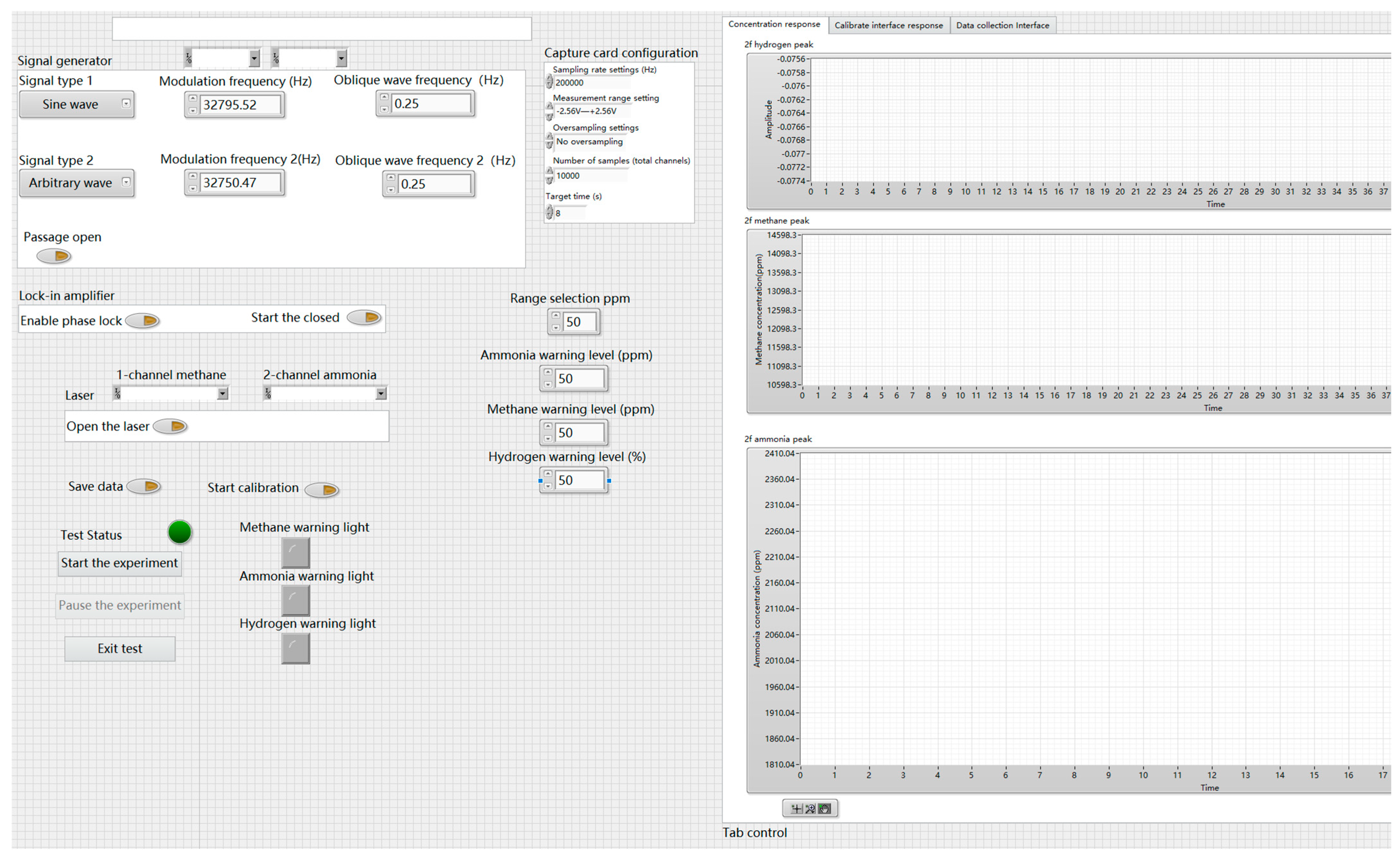
The aforementioned program block diagrams are integrated via sub-VIs and then enter the circular queue in sequence. When the corresponding key event occurs, the sub-VI is dequeued, and the key value is input into the corresponding instrument through the USB serial port. The front panel of the corresponding button is shown in Figure 6, and the right half of the figure displays the concentration at different times.

2.6. The Architecture of Integrated CH4 Sensor Prototype

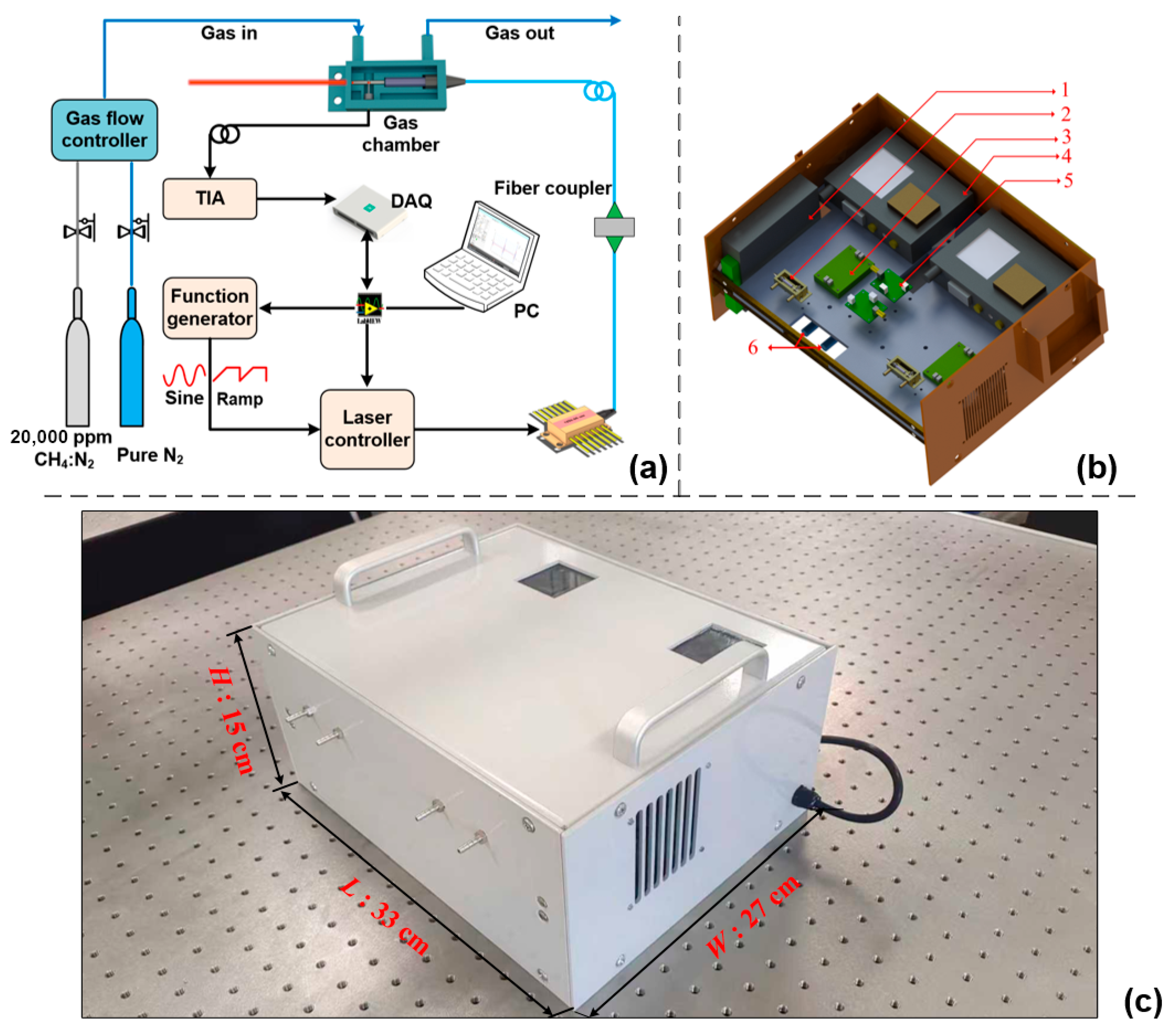
The workflow of the integrated CH4 sensor prototype is illustrated in Figure 7a. A 1.65 μm laser beam emitted from the diode laser is delivered via an optical fiber to a GRIN lens for collimation and subsequently coupled into the gas chamber. The laser propagates sequentially through the AmRs and the QTF where photoacoustic signals are generated. These photoacoustic signals induce free vibration of the QTF, thereby yielding piezoelectric signals. Owing to the ultra-weak nature of the piezoelectric signals, they are input into a trans-impedance amplifier (TIA) for amplification. The amplified piezoelectric signals are converted into digital signals by a data acquisition card (DAQ, USB6503; Henkai Electronic Technology Co., Ltd., Zhengzhou, China), enabling subsequent processing by a lock-in amplifier in LabVIEW. In this system, both the signal generator (JDS6600; Minghe Electronic Technology Co., Ltd., Hangzhou, China) and the laser controller (DFB2000; Ningbo Haierxin Optoelectronic Technology Co., Ltd., Ningbo, China) are coordinately controlled via the LabVIEW program. The signal generator can produce two types of modulation signals including sine wave and ramp wave, which are transmitted to the laser controller after superposed by an adder. CH4 gases with different concentrations are prepared by adjusting the flow rate ratio of 20,000 ppm CH4 and pure nitrogen (N2). The schematic diagram of the internal structure of the device is presented in Figure 7b. The internal structure of the device is divided into upper and lower layers: the lower layer integrates the power supply module and the signal generator; the upper layer arranges the laser controller, adder, TIA, and 3D-printed gas chamber; the DAQ runs through both upper and lower layers and is mounted laterally to achieve full-system signal acquisition. All controlled modules establish communication connections with the PC terminal via USB serial ports. The modules corresponding to each number in the figure are specified in the figure caption. The physical photograph of the device is shown in Figure 7c, with dimensions of 33 cm in length, 27 cm in width, and 15 cm in height. The front of the system is equipped with an air inlet and outlet to facilitate the gas to be detected. A transparent window is installed on the top of the system, allowing real-time observation of the laser controller’s operating status.

3. Results and Discussions

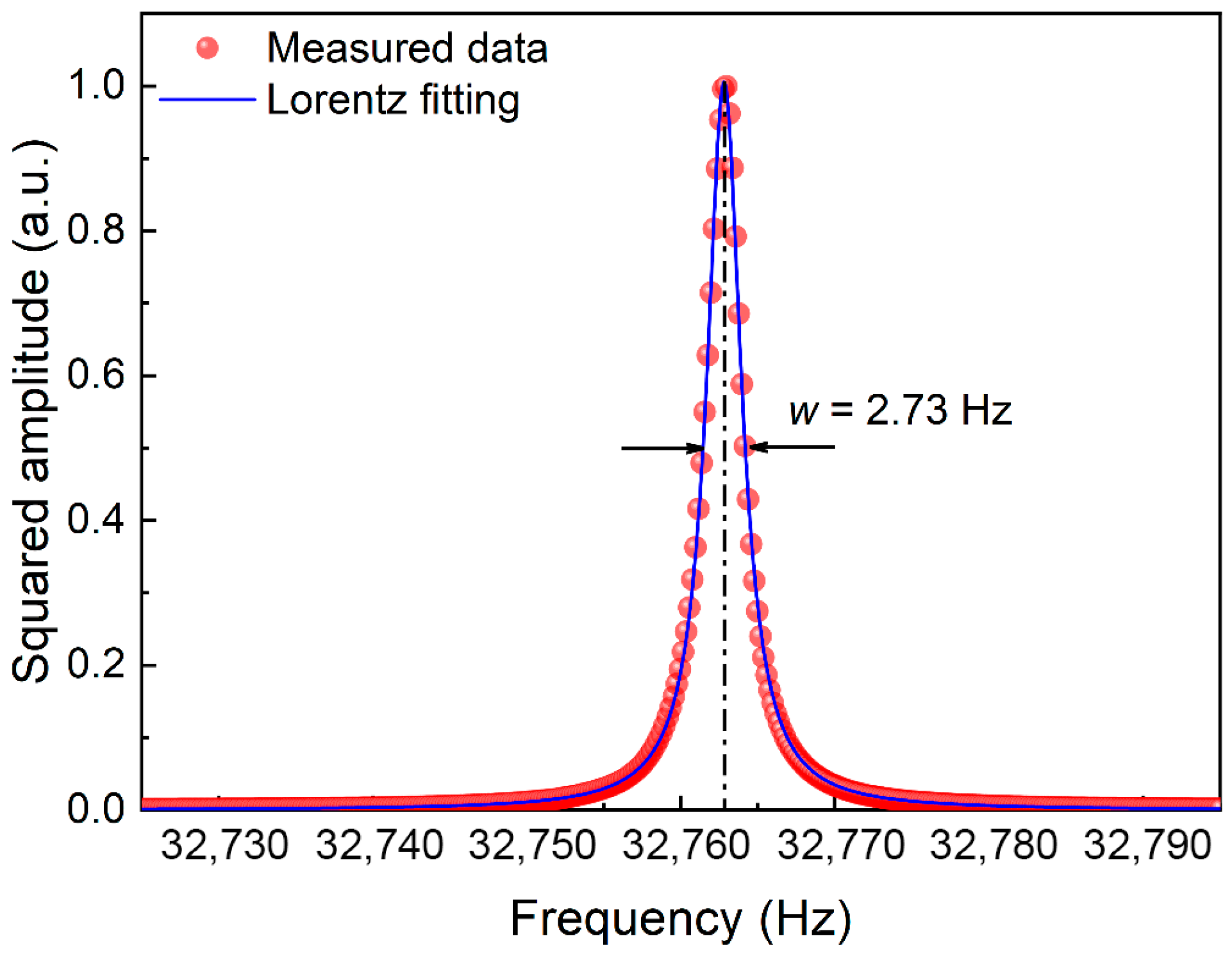
The frequency characteristics of the QTF are crucial parameters in H-QEPAS, exerting a significant influence on the detection performance of the sensing system. The signal response of the QTF within a frequency interval of ±30 Hz centered at 32.76 kHz is illustrated by red dots in Figure 8, incorporating a total of 400 signal points. All signal points underwent square normalization processing, followed by the acquisition of a Lorentzian fitting curve. Based on the fitting curve, the resonant frequency (f0) of the QTF employed in the experiment was determined to be 32,762.81 Hz, with a bandwidth (w) of 2.73 Hz. Employing the formula Q = f0/w, the quality factor of the QTF was calculated as 12,001.03.
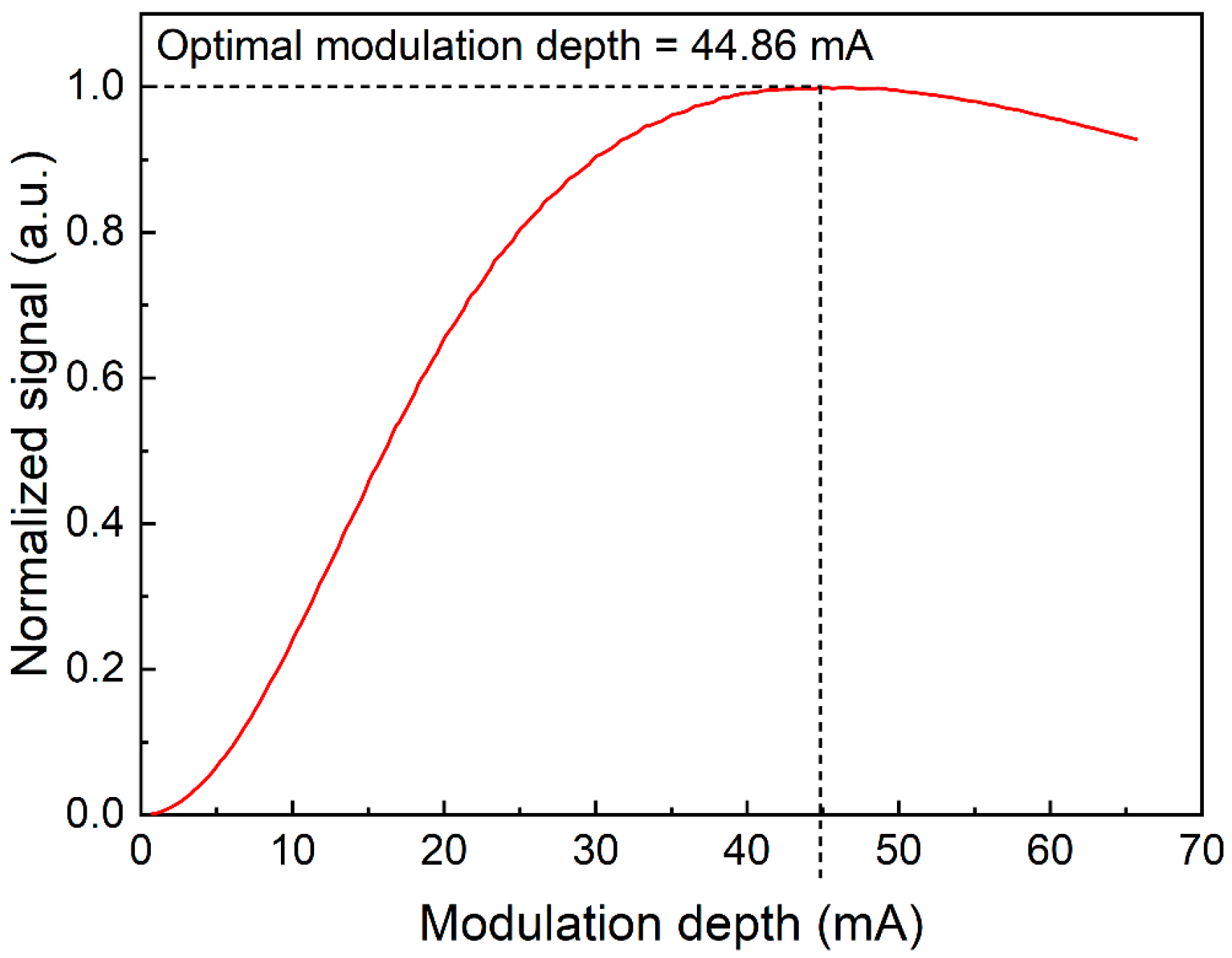
Given that the amplitude of harmonic signals exhibits a positive correlation with the signal-to-noise ratio (SNR), adjustments to the modulation depth exert a direct influence on the harmonic signal amplitude. To investigate the effect of modulation depth on detection sensitivity, modulation depth spanning from 0 mA to 100 mA was established to acquire the harmonic amplitude variation curve, as illustrated in Figure 9. Experimental results demonstrate that the harmonic amplitude presents a typical nonlinear relationship with modulation depth, and its variation trend is consistent with theoretical expectations. Quantitative analysis reveals that the system possesses a unique optimal modulation depth of 44.86 mA, at which the second harmonic amplitude achieves a maximum value. Accordingly, 44.86 mA was adopted as the standard modulation parameter for subsequent experimental procedures.
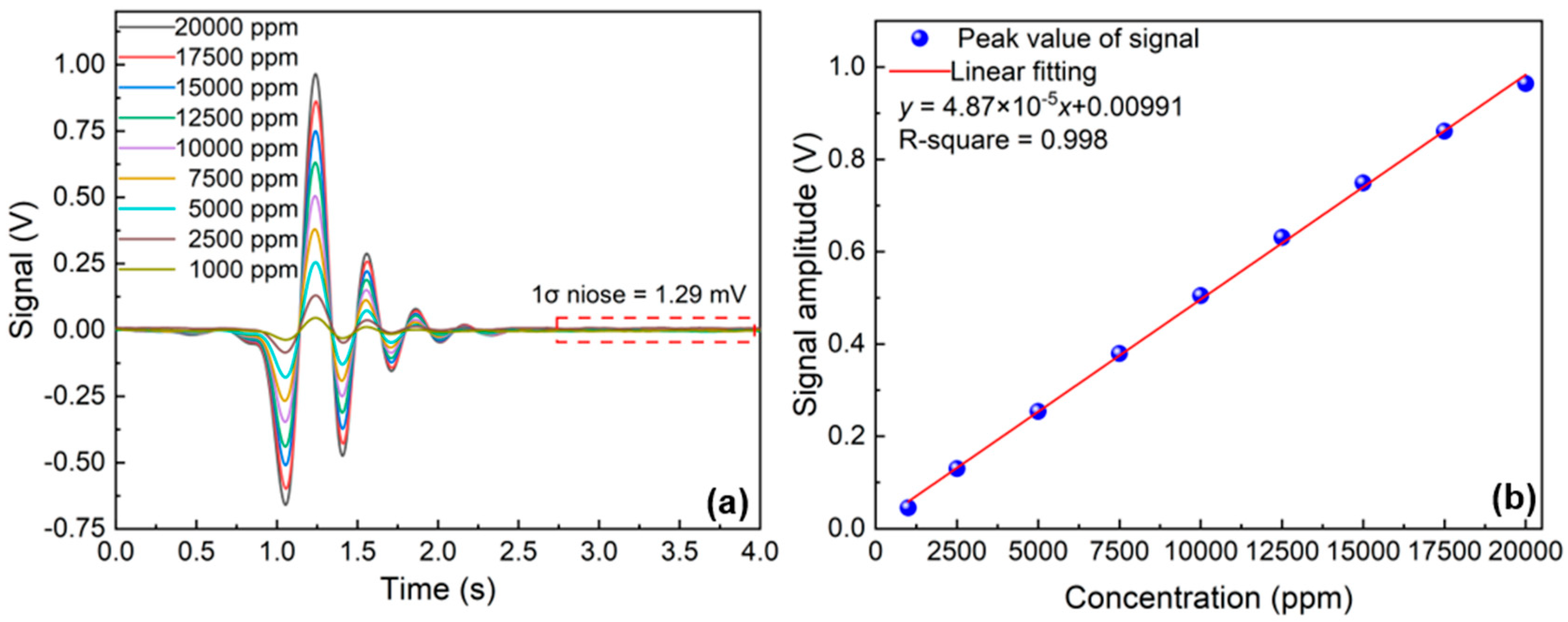
A concentration detection experiment was conducted. By adjusting the flow rate ratio, CH4 gas with concentrations ranging from 1000 ppm to 20,000 ppm was prepared in the experiment. The detection signals output by the prototype were exported from the test program, and the results are shown in Figure 10a. The linear response characteristic of CH4 concentration was evaluated through the signal peaks, and the corresponding fitting curve is presented in Figure 10b. This behavior is consistent with the basic principles of photoacoustic spectroscopy (PAS) and the H-QEPAS mechanism used in this study. The photoacoustic signal arises when the target gas absorbs modulated laser radiation and relaxes non-radiatively, leading to periodic heating and the generation of an acoustic pressure wave. According to the Lambert–Beer law, optical absorption is linearly related to concentration only when the laser energy is not completely absorbed. When the concentration increases to the point where the laser beam is almost completely absorbed, further increases in concentration do not lead to a proportional increase in absorbed energy, thus limiting the potential for the photoacoustic signal to rise. Experimental results demonstrate that the prototype detection system exhibits excellent linear response performance to CH4 at different concentrations, with a goodness of fit R2 reaching 0.998 and a linear fitting function of y = 4.8663 × 10⁻⁵x + 0.00991. The concentration inversion algorithm in the program can be implemented based on this fitting function. To investigate the detection limit of the prototype, the noise standard deviation of the signal tail was measured, yielding a result of 1.29 mV. Based on this noise data, the detection limit of the prototype was calculated as 26.72 ppm.
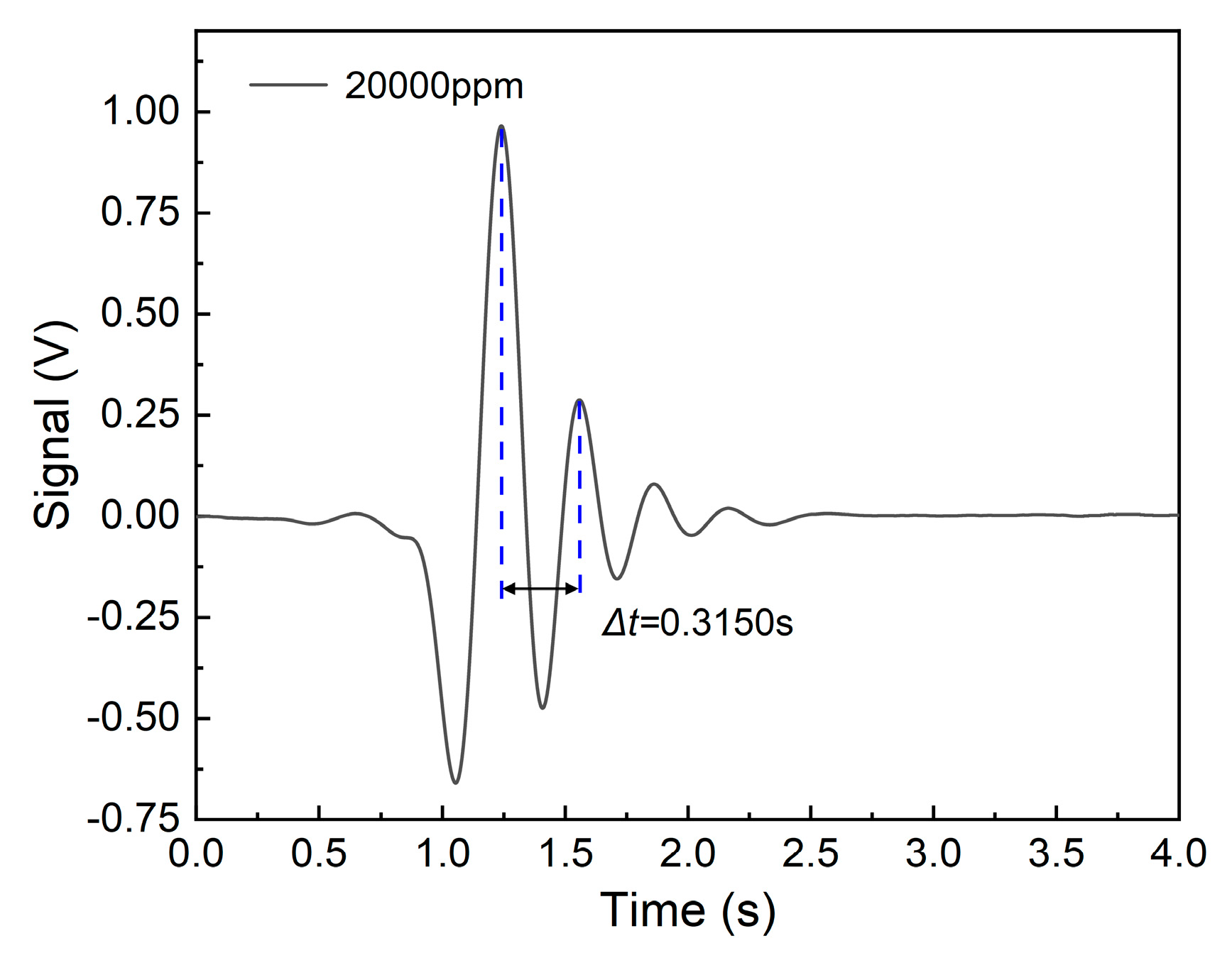
H-QEPAS can capture the entire heterodyne signal waveform in a very short period of time and simultaneously measure f0 for the QTF. Signals from H-QEPAS systems were measured at a CH4 concentration level of 2%. The results are shown in Figure 11, the heterodyne signal frequency could be calculated as Δf = 1/Δt = 3.17 Hz, and then the f0 of QTF can be retrieved according to the formula: f0 = fm + Δf = 32,762.81 Hz.
It should be emphasized that the 3D-printed gas chamber employed in this study is used exclusively as a laboratory prototype to facilitate rapid structural iteration and system integration during the early development stage. The use of 3D printing does not constitute a methodological claim for industrial or commercial gas analyzers. In practical field or industrial applications, gas chambers are typically fabricated from materials such as stainless steel or fluoropolymers to minimize outgassing, adsorption effects, and long-term drift.
Environmental factors such as humidity and ambient temperature are known to influence QEPAS-based sensors. In the present H-QEPAS system, humidity mainly affects the signal through vibrational-translational (V-T) relaxation processes. The presence of water vapor can enhance the relaxation efficiency of CH4 molecules, leading to an increased photoacoustic signal amplitude, while excessive humidity may introduce additional background absorption. Since the selected CH4 absorption line at 1650.96 nm exhibits weak interference from H2O, the influence of humidity is expected to be dominated by relaxation effects rather than spectral overlap. Ambient temperature variations can influence gas absorption parameters, acoustic propagation, and the resonance characteristics of the QTF. However, within typical laboratory temperature fluctuations, these effects are relatively small. Moreover, the H-QEPAS scheme allows real-time retrieval of the QTF resonance frequency, which effectively mitigates the impact of temperature-induced frequency drift. Therefore, the proposed sensor is expected to maintain stable performance under moderate environmental variations. A more systematic investigation of humidity and temperature effects will be carried out in future work.
As summarized in Table 1, the proposed H-QEPAS sensor operating at 1.65 μm achieves a favorable trade-off between fast temporal response and high detection sensitivity for CH4. While maintaining a 4 s response time, this work attains a minimum detection limit (MDL) of 26.72 ppm with an integration time of 100 s, which outperforms the previously reported 1.65 μm H-QEPAS result of 28.35 ppm obtained at 114 s integration time. The simultaneous reduction in MDL and integration time indicates an improved overall measurement efficiency, reflecting enhanced signal generation and heterodyne demodulation performance in the proposed scheme. In contrast, conventional QEPAS implementations exhibit substantially slower dynamics response despite delivering markedly higher MDLs under short integration conditions. Therefore, the present H-QEPAS approach provides a clear advantage for applications demanding rapid, real-time tracking of CH4 concentration variations, such as leak detection and transient monitoring, while preserving competitive sensitivity.
To provide a concise, performance-oriented comparison of portable CH4 sensing technologies, we benchmark four representative approaches—H-QEPAS, non-dispersive infrared (NDIR), tunable diode laser absorption spectroscopy (TDLAS), and cavity-enhanced absorption spectroscopy (CEAS)—using the reported detection limits as the primary figures of merit. The proposed integrated H-QEPAS sensor achieves a 26.72 ppm MDL, indicating superior volumetric sensitivity among the compared portable in situ techniques while maintaining strong potential for miniaturization and system integration. In contrast, portable NDIR sensor (300 ppm MDL [60]) quantify CH4 via broadband mid-IR absorption in a short gas cell with optical filtering; despite their low cost and simplicity, performance is typically constrained by limited effective path length and detector drift, rendering sub-100 ppm operation difficult without larger multi-pass cells and rigorous environmental compensation. Handheld open-path TDLAS sensor report a MDL of 43.14 ppm·m (path-integrated [61]), offering clear advantages for standoff leak screening; however, the ppm·m metric is inherently dependent on plume thickness and measurement geometry, leading to substantial variability in the equivalent volumetric concentration sensitivity under field conditions. CEAS sensor extend the effective optical path length using a high-reflectivity cavity and retrieve CH4 from broadband spectra, but practical performance (MDL 460 ppm [62]) can be limited by coupling stability and cavity contamination. Overall, the integrated H-QEPAS approach combines the lowest reported detection limit (26.72 ppm) with reduced optical alignment burden, underscoring its promise for portable leak inspection, confined-space safety monitoring, and scalable deployment in distributed sensing nodes. Looking forward, continued miniaturization—through tighter optical–acoustic co-packaging, low-power drive and demodulation electronics, and robust flow-through materials—should further reduce size, weight, and power consumption, enabling truly handheld form factors and facilitating large-scale deployment in battery-powered.

4. Conclusions

This paper reported a high-performance integrated CH4-QEPAS sensor prototype. A hardware control and concentration inversion program were developed based on the LabVIEW platform, enabling real-time data display on a PC terminal. The system achieves accurate detection of CH4 gas concentration by heterodyne modulating a DFB diode laser with a central wavelength of 1650.96 nm. In the experiment, the gas chamber fabricated via 3D-printing integrates core components including a GRIN lens, a QTF, and AmRs. Experimental results demonstrate that the amplitude of the harmonic signal exhibits a significant positive correlation with the gas concentration, with R2 up to 0.998, verifying the excellent performance of the system in weak signal extraction. Under this condition, the detection limit of CH4 concentration is calculated to be approximately 26.72 ppm. It should be noted that the experiments presented in this work were conducted under controlled laboratory conditions using CH4 diluted in nitrogen, which does not fully represent ambient air environments with variable humidity and complex gas compositions. Therefore, the current results are not intended to directly demonstrate sensor performance for atmospheric CH4 monitoring. Instead, the proposed H-QEPAS system is particularly relevant for applications involving technological or process gases, where CH4 is monitored in inert carrier gases such as nitrogen or argon. Typical scenarios include chemical production lines, material processing, and industrial gas quality control, where low humidity and well-defined gas matrices are commonly encountered. In such environments, the compactness, stability, and near-infrared operation of the developed sensor provide clear advantages. These results establish a foundation for future investigations under more complex gas matrices, including humid air, where the influence of water vapor and background gases on sensor performance can be systematically evaluated.

Author Contributions

Investigation, methodology and writing—original draft preparation, J.C. and Y.C.; investigation, H.M.; validation, S.Q., Y.H., Q.L. and T.D.; writing—review and editing, supervision, Y.M. All authors have read and agreed to the published version of the manuscript.

Funding

This research was funded by National Natural Science Foundation of China (Grant No. 62335006, 62275065, 62505066, 62022032, and 62405078), Heilongjiang Postdoctoral Fund (Grant No. LBH-Z23144 and LBH-Z24155), Natural Science Foundation of Heilongjiang Province (Grant No. LH2024F031), China Postdoctoral Science Foundation (Grant No. 2024M764172), Open Subject of Hebei Key Laboratory of Advanced Laser Technology and Equipment (HBKL-ALTE2025001).

Institutional Review Board Statement

Not applicable.

Informed Consent Statement

Not applicable.

Data Availability Statement

The data presented in this study are available on request from the corresponding author.

Conflicts of Interest

The authors declare no conflicts of interest.

References

  1. Joo, J.; Jeong, S.; Shin, J.; Chang, D.Y. Missing methane emissions from urban sewer networks. Environ. Pollut. 2024, 342, 123101. [Google Scholar] [CrossRef] [PubMed]
  2. Li, C.; Deng, P.; Guo, Y.; Zhang, B.; Zhang, Y.; Wei, X. Experimental and simulation study on the explosion of a coal/methane mixed system. ACS Omega 2025, 10, 24730–24739. [Google Scholar] [CrossRef]
  3. Zhou, G.; Gao, S.; Xu, C.; Dou, F.; Shimizu, K.-y.; Cao, W. Rational utilization of leguminous green manure to mitigate methane emissions by influencing methanogenic and methanotrophic communities. Geoderma 2020, 361, 114071. [Google Scholar] [CrossRef]
  4. Loman, M.L.; Murray, L.T.; Leibensperger, E.M.; Maasakkers, J.D. A high-resolution inventory of anthropogenic methane emissions in New York State. Environ. Sci. Technol. 2025, 59, 16933–16946. [Google Scholar] [CrossRef]
  5. Lin, Y.; Li, X.; Liu, X.; Qi, B.; Zhang, F.; Yang, S. Enhancing coalbed methane recovery in anthracite coal via organic solvent treatment: Insights from chemical structure evolution. Chem. Eng. Sci. 2026, 320, 122639. [Google Scholar] [CrossRef]
  6. Kapit, J.A.; Youngs, S.; Pardis, W.A.; Padilla, A.M.; Michel, A.P.M. An underwater methane sensor based on laser spectroscopy in a hollow core optical fiber. ACS Sens. 2024, 9, 5896–5905. [Google Scholar] [CrossRef]
  7. Liu, J.; Yu, R.; Ma, B.; Tang, C. On the second explosion limits of hydrogen, methane, ethane, and propane. ACS Omega 2020, 5, 19268–19276. [Google Scholar] [CrossRef]
  8. Neil, C.W.; Mehana, M.; Hjelm, R.P.; Hawley, M.E.; Watkins, E.B.; Mao, Y.; Viswanathan, H.; Kang, Q.; Xu, H. Reduced methane recovery at high pressure due to methane trapping in shale nanopores. Commun. Earth Environ. 2020, 1, 49. [Google Scholar] [CrossRef]
  9. Li, C.; He, Y.; Qiao, S.; Ma, Y. Indirect detection of hydrogen based on light-induced thermoelastic spectroscopy. Opt. Express 2026. [Google Scholar] [CrossRef]
  10. Poma, N.; Bonini, A.; Vivaldi, F.; Biagini, D.; Di Luca, M.; Bottai, D.; Di Francesco, F.; Tavanti, A. Biosensing systems for the detection and quantification of methane gas. Appl. Microbiol. Biotechnol. 2023, 107, 5627–5634. [Google Scholar] [CrossRef]
  11. Qiao, S.; Lang, Z.; He, Y.; Zhi, X.; Ma, Y. Calibration-free measurement of absolute gas concentration and temperature via light-induced thermoelastic spectroscopy. Adv. Photonics 2025, 7, 066007. [Google Scholar] [CrossRef]
  12. Ma, H.; Li, C.; He, Y.; Qiao, S.; Zhang, C.; Ma, Y. Dual-mode quartz-enhanced spectroscopy enabled by mixed heterodyne demodulation for frequency-mismatch-free gas sensing. Laser Photonics Rev. 2025, e02059. [Google Scholar] [CrossRef]
  13. Xie, Y.; Xiong, H.; Feng, S.; Pan, N.; Li, C.; Liu, Y.; Zhang, Y.; Shao, L.; Lu, G.; Liu, K.; et al. Sensitivity improvement of quartz-enhanced photoacoustic spectroscopy using the stochastic resonance method. Photoacoustics 2025, 43, 100707. [Google Scholar] [CrossRef] [PubMed]
  14. He, Y.; Qiao, S.; Lang, T.; Zhang, C.; Qi, H.; Huang, W.; Ma, Y. Optical component-free dual-gas quartz-enhanced photoacoustic spectroscopy sensor based on highly integrated interband cascade lasers. ACS Sens. 2025, 10, 5238–5244. [Google Scholar] [CrossRef] [PubMed]
  15. Sun, X.; Sun, H.; He, Y.; Qiao, S.; Ma, Y. An ultrahighly sensitive CH4-TDLAS sensor based on an 80-m optical path length multipass cell with a dense circular spot pattern. Anal. Chem. 2025, 97, 10886–10892. [Google Scholar] [CrossRef]
  16. Sun, H.; Qiao, S.; He, Y.; Sun, X.; Ma, Y. Parts-per-quadrillion level gas molecule detection: CO-LITES sensing. Light Sci. Appl. 2025, 14, 180. [Google Scholar] [CrossRef]
  17. Ma, Y.; Sun, X.; Sun, H.; He, Y.; Qiao, S. An ultra-highly sensitive LITES sensor based on multi-pass cell with ultra-dense spot pattern designed by multi-objective algorithm. PhotoniX 2025, 6, 26. [Google Scholar] [CrossRef]
  18. Ma, H.; Qiao, S.; He, Y.; Zhang, C.; Ma, Y. Overtone acoustic feedback enhanced light-induced thermoelastic spectroscopy sensing. Photonics Res. 2026. [Google Scholar] [CrossRef]
  19. Ma, Y.; Liu, Y.; He, Y.; Qiao, S.; Sun, H. Design of multipass cell with dense spot patterns and its performance in a light-induced thermoelastic spectroscopy-based methane sensor. Light Adv. Manuf. 2025, 6, 1. [Google Scholar] [CrossRef]
  20. Liu, Y.; Lin, H.; Montano, B.A.Z.; Zhu, W.; Zhong, Y.; Kan, R.; Yuan, B.; Yu, J.; Shao, M.; Zheng, H. Integrated near-infrared QEPAS sensor based on a 28 kHz quartz tuning fork for online monitoring of CO2 in the greenhouse. Photoacoustics 2022, 25, 100332. [Google Scholar] [CrossRef]
  21. Wang, G.; Cui, R.; Di, J.; Wang, J.; Wang, Y.; Shang, Z.; Liu, X.; Tian, Q.; Wu, H.; Dong, L. Portable methane sensor system using miniature multi-pass cell for mobile monitoring of natural gas leaks. Sens. Actuators B Chem. 2025, 431, 137457. [Google Scholar] [CrossRef]
  22. Rück, T.; Müller, M.; Jobst, S.; Weigl, S.; Pangerl, J.; Bierl, R.; Matysik, F.-M. Digital twin of a photoacoustic trace gas sensor for monitoring methane in complex gas compositions. Sens. Actuators B Chem. 2023, 378, 133119. [Google Scholar] [CrossRef]
  23. Kinjalk, K.; Paciolla, F.; Sun, B.; Zifarelli, A.; Menduni, G.; Giglio, M.; Wu, H.; Dong, L.; Ayache, D.; Pinto, D.; et al. Highly selective and sensitive detection of volatile organic compounds using long wavelength InAs-based quantum cascade lasers through quartz-enhanced photoacoustic spectroscopy. Appl. Phys. Rev. 2024, 11, 021427. [Google Scholar] [CrossRef]
  24. Zhang, T.; Wang, W.; Zhang, Q.; Wang, J.; Wei, Y.; Wang, L.; Gu, Y.; Li, C. A photoacoustic spectroscopy gas sensor based on double-cone resonant photoacoustic cells for simultaneous detection of CH4/C2H2. Sens. Actuators A Phys. 2025, 393, 116819. [Google Scholar] [CrossRef]
  25. Mhanna, M.; Rochussen, J.; Kirchen, P. An ML-enhanced laser-based methane slip sensor using wavelength modulation spectroscopy. ACS Sens. 2025, 10, 835–845. [Google Scholar] [CrossRef]
  26. Sun, B.; Wei, T.; Zhang, M.; Qiao, L.; Ma, Z.; Sampaolo, A.; Patimisco, P.; Spagnolo, V.; Wu, H.; Dong, L. Optical synchronous signal demodulation-based quartz-enhanced photoacoustic spectroscopy for remote, multi-point methane detection in complex environments. Photoacoustics 2025, 43, 100708. [Google Scholar] [CrossRef]
  27. Qiao, S.; He, Y.; Sun, H.; Patimisco, P.; Sampaolo, A.; Spagnolo, V.; Ma, Y. Ultra-highly sensitive dual gases detection based on photoacoustic spectroscopy by exploiting a long-wave, high-power, wide-tunable, single-longitudinal-mode solid-state laser. Light Sci. Appl. 2024, 13, 100. [Google Scholar] [CrossRef] [PubMed]
  28. Zhang, X.; Bi, S.; Zhang, Z.; Liu, X.; Qin, L.; Shi, J.; Zhao, Y.; Wang, Z. A quartz-enhanced dual-spectroscopy gas sensor based on dual quartz tuning forks. Opt. Lasers Eng. 2025, 193, 109049. [Google Scholar] [CrossRef]
  29. Wang, L.; Lv, H.; Zhao, Y.; Wang, C.; Luo, H.; Lin, H.; Xie, J.; Zhu, W.; Zhong, Y.; Liu, B.; et al. Sub-ppb level HCN photoacoustic sensor employing dual-tube resonator enhanced clamp-type tuning fork and U-net neural network noise filter. Photoacoustics 2024, 38, 100629. [Google Scholar] [CrossRef]
  30. Wang, R.; Guan, X.; Qiao, S.; Jia, Q.; He, Y.; Wang, S.; Ma, Y. Ultrahigh sensitive LITES sensor based on a trilayer ultrathin perfect absorber coated T-head quartz tuning fork. Laser Photon. Rev. 2025, 19, 2402107. [Google Scholar] [CrossRef]
  31. Wang, Y.; He, Y.; Qiao, S.; Liu, X.; Zhang, C.; Duan, X.; Ma, Y. Fast step heterodyne light-induced thermoelastic spectroscopy gas sensing based on a quartz tuning fork with high frequency of 100 kHz. Opto-Electron. Adv. 2026, 9, 250150. [Google Scholar] [CrossRef]
  32. Wang, Z.; Tian, C.; Qian, S.; Yu, Y.; Chang, J.; Zhang, Q.; Feng, Y.; Li, H.; Feng, Z. A comprehensive dual-spectroscopy detection technique based on TDLAS and QEPAS using a quartz tuning fork. Opt. Laser Technol. 2022, 145, 107483. [Google Scholar] [CrossRef]
  33. Wang, R.; Han, G.; He, Y.; Qiao, S.; Ma, Y. Lithium niobate tuning fork-enhanced photoacoustic spectroscopy and light-induced thermoelastic spectroscopy. Appl. Phys. Rev. 2025, 12, 041404. [Google Scholar] [CrossRef]
  34. Wang, R.; Qiao, S.; He, Y.; Ma, Y. Highly sensitive laser spectroscopy sensing based on a novel four-prong quartz tuning fork. Opto-Electron. Adv. 2025, 8, 240275. [Google Scholar] [CrossRef]
  35. Menduni, G.; Zifarelli, A.; Kniazeva, E.; Dello Russo, S.; Ranieri, A.C.; Ranieri, E.; Patimisco, P.; Sampaolo, A.; Giglio, M.; Manassero, F.; et al. Measurement of methane, nitrous oxide and ammonia in atmosphere with a compact quartz-enhanced photoacoustic sensor. Sens. Actuators B Chem. 2023, 375, 132953. [Google Scholar] [CrossRef]
  36. Twomey, C.F.; Biagi, G.; Ruth, A.A.; Giglio, M.; Spagnolo, V.; O’Faolain, L.; Walsh, A.J. Evanescent wave quartz-enhanced photoacoustic spectroscopy employing a side-polished fiber for methane sensing. Photoacoustics 2024, 36, 100586. [Google Scholar] [CrossRef]
  37. Sang, C.; Zhang, C.; Wang, R.; Qiao, S.; He, Y.; Ma, Y. Tapered acoustic resonator-based quartz-enhanced photoacoustic spectroscopy. Opt. Lett. 2025, 50, 4646–4649. [Google Scholar] [CrossRef]
  38. K, S.K.; Jothimani, D.; Manoharan, M.; Rela, M.; Selvaraj, R.; Seshadri, S.; Sm, S.N.; Vasa, N.J. Quartz-enhanced photoacoustic spectroscopy-based acetone and ammonia measurements from human breath near 8 μm wavelength band. ACS Sens. 2025, 10, 254–263. [Google Scholar]
  39. Qiao, S.; Liu, X.; Lang, Z.; He, Y.; Chen, W.; Ma, Y. Quartz-enhanced laser spectroscopy sensing. Light Sci. Appl. 2026, 15, 5. [Google Scholar] [CrossRef] [PubMed]
  40. Xie, Y.; Zhang, Y.; Zhu, D.; Chen, X.; Lu, J.; Shao, J. Compact QEPAS CO2 sensor system using a quartz tuning fork-embedded and in-plane configuration. Opt. Laser Technol. 2023, 159, 109018. [Google Scholar] [CrossRef]
  41. Kosterev, A.A.; Bakhirkin, Y.A.; Tittel, F.K.; McWhorter, S.; Ashcraft, B. QEPAS methane sensor performance for humidified gases. Appl. Phys. B 2008, 92, 103–109. [Google Scholar] [CrossRef]
  42. Olivieri, M.; Giglio, M.; Dello Russo, S.; Menduni, G.; Zifarelli, A.; Patimisco, P.; Sampaolo, A.; Wu, H.; Dong, L.; Spagnolo, V. Assessment of vibrational–translational relaxation dynamics of methane isotopologues in a wet-nitrogen matrix through QEPAS. Photoacoustics 2023, 31, 100518. [Google Scholar] [CrossRef]
  43. Sun, J.; He, Y.; Qiao, S.; Zhang, C.; Ma, Y. Acetylene-enhanced methane-QEPAS sensing. Opt. Lett. 2025, 50, 3760–3763. [Google Scholar] [CrossRef]
  44. Menduni, G.; Zifarelli, A.; Sampaolo, A.; Patimisco, P.; Giglio, M.; Amoroso, N.; Wu, H.; Dong, L.; Bellotti, R.; Spagnolo, V. High-concentration methane and ethane QEPAS detection employing partial least squares regression to filter out energy relaxation dependence on gas matrix composition. Photoacoustics 2022, 26, 100349. [Google Scholar] [CrossRef]
  45. Mu, J.; Han, G.; Wang, R.; Qiao, S.; He, Y.; Ma, Y. Photoacoustic spectroscopy and light-induced thermoelastic spectroscopy based on inverted-triangular lithium niobate tuning fork. Opto-Electron. Sci. 2025, 4, 250035. [Google Scholar] [CrossRef]
  46. Zhao, Z.; Kravtsov, V.; Wang, Z.; Zhou, Z.; Dou, L.; Huang, D.; Wang, Z.; Cheng, X.; Raschke, M.B.; Jiang, T. Applications of ultrafast nano-spectroscopy and nano-imaging with tip-based microscopy. eLight 2025, 5, 1. [Google Scholar] [CrossRef]
  47. Wu, G.; Yu, H. Research highlight: Breaking the shot noise limit of mid-infrared dual-comb spectroscopy using intensity-difference squeezing. eLight 2025, 5, 24. [Google Scholar] [CrossRef]
  48. Li, B.; Menduni, G.; Giglio, M.; Patimisco, P.; Sampaolo, A.; Zifarelli, A.; Wu, H.; Wei, T.; Spagnolo, V.; Dong, L. Quartz-enhanced photoacoustic spectroscopy (QEPAS) and Beat Frequency-QEPAS techniques for air pollutants detection: A comparison in terms of sensitivity and acquisition time. Photoacoustics 2023, 31, 100479. [Google Scholar] [CrossRef]
  49. Ye, W.; He, L.; Liu, W.; Yuan, Z.; Zheng, K.; Li, G. Optomechanical energy enhanced BF-QEPAS for fast and sensitive gas sensing. Photoacoustics 2025, 41, 100677. [Google Scholar] [CrossRef]
  50. Shi, J.; Jiang, Y.; Duan, Z.; Li, J.; Yuan, Z.; Tai, H. Designing an optical gas chamber with stepped structure for non-dispersive infrared methane gas sensor. Sens. Actuators A Phys. 2024, 367, 115052. [Google Scholar] [CrossRef]
  51. Wu, H.; Li, D.; Liu, J.; Gong, X.; Wang, T.; Zhao, L.; Wang, T.; Yan, X.; Liu, F.; Sun, P.; et al. Portable and hand-held ammonia gas sensor enables noninvasive prediagnosis of Helicobacter pylori infection. ACS Sens. 2024, 9, 5384–5393. [Google Scholar] [CrossRef]
  52. Zong, B.; Wu, S.; Yang, Y.; Li, Q.; Tao, T.; Mao, S. Smart gas sensors: Recent developments and future prospective. Nano-Micro Lett. 2024, 17, 54. [Google Scholar] [CrossRef]
  53. Panda, S.; Mehlawat, S.; Dhariwal, N.; Kumar, A.; Sanger, A. Comprehensive review on gas sensors: Unveiling recent developments and addressing challenges. Mater. Sci. Eng. B 2024, 308, 117616. [Google Scholar] [CrossRef]
  54. Chang, C.; Fu, B.; Liu, L.; Jiang, Q.; Guo, F.; Su, F.; Ji, Y. Fabrication and performance evaluation of a polymer-based vapor chamber via 3D printing technology. Int. J. Heat Mass Transf. 2025, 246, 127095. [Google Scholar] [CrossRef]
  55. Gu, Z.; Liu, H.; Yang, K.; Wang, Q.; Xu, H.; Zhang, L. Enhancing heat transfer performance in 3D-printed integrated vapor chamber using composite structures. Appl. Therm. Eng. 2023, 234, 121292. [Google Scholar] [CrossRef]
  56. Szmelter, A.; Jacob, J.; Eddington, D.T. 96-well oxygen control using a 3D-printed device. Anal. Chem. 2021, 93, 2570–2577. [Google Scholar] [CrossRef]
  57. Olivieri, M.; Menduni, G.; Giglio, M.; Sampaolo, A.; Patimisco, P.; Wu, H.; Dong, L.; Spagnolo, V. Characterization of H2S QEPAS detection in methane-based gas leaks dispersed into environment. Photoacoustics 2023, 29, 100438. [Google Scholar] [CrossRef]
  58. Wu, H.; Dong, L.; Zheng, H.; Yu, Y.; Ma, W.; Zhang, L.; Yin, W.; Xiao, L.; Jia, S.; Tittel, F.K. Beat frequency quartz-enhanced photoacoustic spectroscopy for fast and calibration-free continuous trace-gas monitoring. Nat. Commun. 2017, 8, 15331. [Google Scholar] [CrossRef] [PubMed]
  59. Ye, W.; Liu, W.; Luo, W.; Xiao, J.; He, L.; Huang, Y.; Zhu, D. Calibration-free near-infrared methane sensor system based on BF-QEPAS. Infrared Phys. Technol. 2023, 133, 104784. [Google Scholar] [CrossRef]
  60. Mahbub, P.; Noori, A.; Parry, J.S.; Davis, J.; Lucieer, A.; Macka, M. Continuous and real-time indoor and outdoor methane sensing with portable optical sensor using rapidly pulsed IR LEDs. Talanta 2020, 218, 121144. [Google Scholar] [CrossRef] [PubMed]
  61. Wu, Q.; Yang, Y.; Shi, Y.; Xu, Y.; Wang, W.; Men, C.; Yang, B. Highly responsive, miniaturized methane telemetry sensor based on open-path TDLAS. Photonics 2023, 10, 1281. [Google Scholar] [CrossRef]
  62. Prakash, N.; Ramachandran, A.; Varma, R.; Chen, J.; Mazzoleni, C.; Du, K. Near-infrared incoherent broadband cavity enhanced absorption spectroscopy (NIR-IBBCEAS) for detection and quantification of natural gas components. Analyst 2018, 143, 3284–3291. [Google Scholar] [CrossRef] [PubMed]
Figure 1. Absorption lines from 1635 nm to 1665 nm of CH4, CO2 and H2O at an atmosphere pressure, temperature of 300 K and optical absorption length of 1 cm according to the HITRAN 2020 database.
Applsci 16 01427 g001
Figure 2. Schematic diagram of H-QEPAS principle.
Applsci 16 01427 g002
Figure 3. Output performance curves of the 1.65 μm diode laser. (a) Output wavelength; (b) output power.
Applsci 16 01427 g003
Figure 4. Image of the 3D-printed gas chamber. (a) 3D model of printing chamber. (b) The physical image of the 3D-printed gas chamber.
Applsci 16 01427 g004
Figure 5. Block diagram of the lock-in amplifier program.
Applsci 16 01427 g005
Figure 6. Control panel of the main program.
Applsci 16 01427 g006
Figure 7. Workflow diagram and structural appearance of the integrated CH4 sensor prototype. (a) Workflow of the sensor prototype. (b) The internal structure of the sensor prototype. 1: DAQ; 2: gas chamber; 3: adder; 4: laser controller; 5: TIA; 6: signal generator. (c) Appearance of the sensor prototype.
Applsci 16 01427 g007
Figure 8. The frequency response of the used QTF.
Applsci 16 01427 g008
Figure 9. The optimization procedure of modulation depth.
Applsci 16 01427 g009
Figure 10. The concentration responses of integrated CH4 sensor prototype. (a) Signals with different CH4 concentrations; (b) signal peak as a function of CH4 concentration.
Applsci 16 01427 g010
Figure 11. Heterodyne signal in the H-QEPAS system.
Applsci 16 01427 g011
Table 1. Quantitative comparison between traditional QEPAS and H-QEPAS systems.
MethodWavelengthMDL (ppm)
(@Integration Time)
Response TimeReference
QEPAS2.64 μm85.00 (@2 s)50 s[57]
QEPAS3.58 μm55.57 (@1 s)30 s[58]
H-QEPAS1.65 μm28.35 (@114 s)4 s[59]
H-QEPAS1.65 μm26.72 (@100 s)4 sthis work
Disclaimer/Publisher’s Note: The statements, opinions and data contained in all publications are solely those of the individual author(s) and contributor(s) and not of MDPI and/or the editor(s). MDPI and/or the editor(s) disclaim responsibility for any injury to people or property resulting from any ideas, methods, instructions or products referred to in the content.