Review

Tracing Microplastic Pollution Through Animals: A Narrative Review of Bioindicator Approaches

by
Kuok Ho Daniel Tang
Department of Environmental Science, University of Arizona, Tucson, AZ 85721, USA
Appl. Sci. 2026, 16(3), 1413; https://doi.org/10.3390/app16031413
Submission received: 4 January 2026 / Revised: 21 January 2026 / Accepted: 29 January 2026 / Published: 30 January 2026
(This article belongs to the Section Green Sustainable Science and Technology)

Abstract

Monitoring microplastic pollution relies increasingly on bioindicators that integrate environmental exposure across habitats. This review presents animals explicitly proposed as microplastic bioindicators in recent literature and qualitatively evaluates their appropriateness using established biomonitoring criteria encompassing ecological, physiological, and methodological dimensions. In aquatic systems, bivalves (clams and mussels) demonstrate high suitability due to wide distribution, habitat-specific feeding, effective microplastic retention, and well-established analytical protocols. Fish exhibit intermediate suitability, as ecological representativeness and retention vary among species, and standardized methods often require multi-species approaches. Sessile organisms, including barnacles and sea anemones, align strongly with all three dimensions through spatial fidelity, effective retention, and methodological ease. Crustaceans and sponges also exhibit robust ecological relevance and high retention, with sponges uniquely integrating fine particles over time. Terrestrial and aerial indicators, such as carabid beetles and insectivorous birds, provide complementary coverage with moderate physiological integration and feasible ethical sampling. Sea turtles demonstrate exceptional physiological integration and methodological robustness at regional scales, despite non-sedentary behavior. Overall, taxa combining sedentary or spatially faithful ecology, effective microplastic retention, and standardized laboratory applicability, particularly bivalves, sponges, barnacles, sea anemones, and sediment-associated crustaceans, emerge as the most suitable bioindicators. Future research should prioritize harmonized, multi-taxa frameworks to improve standardization, cross-ecosystem comparability, and long-term microplastic monitoring.

1. Introduction

Microplastic pollution represents one of the most pervasive global environmental crises of our time. Defined as synthetic polymer particles smaller than 5 mm, microplastics have infiltrated virtually all environmental compartments, from surface waters and sediments to the deepest ocean trenches and even remote polar regions [1,2,3]. The environmental burden of microplastics continues to escalate at an alarming rate, with emissions estimated between 10 and 40 million tonnes annually, and projections suggesting this volume could double by 2040 [4]. Beyond their ubiquitous distribution, microplastics pose significant ecological and health threats, having been detected in over 1300 aquatic and terrestrial species, from invertebrates at the base of food webs to apex predators [4]. These particles are ingested by marine organisms and subsequently transferred through food chains, ultimately reaching human populations through seafood consumption and drinking water [5]. Furthermore, microplastics serve as vectors for persistent organic pollutants, heavy metals, and pathogenic microorganisms, compounding their toxicological significance [6,7,8]. Accumulating evidence indicates that microplastic exposure can cause oxidative stress, inflammation, metabolic disruption, and impaired growth and reproduction in aquatic organisms, while also altering microbial community structure and ecosystem functioning [9]. In mammals and other vertebrates, microplastics and associated additives have been linked to gastrointestinal irritation, immune modulation, and potential endocrine-disrupting effects, raising concerns about long-term health risks from chronic exposure [10].
To effectively monitor and manage microplastic pollution across diverse ecosystems, there is an urgent need to identify and implement bioindicators. These are sentinel species that reliably reflect environmental microplastic contamination levels [11]. Bioindicators are not intended to replace physicochemical methods for microplastic quantification and characterization. They represent two complementary approaches to assessing microplastic pollution, differing mainly in what they measure and how they reflect environmental risk [12]. Typical physicochemical monitoring methods for microplastics involve direct analysis of environmental samples using various instrumental and optical techniques. These methods fall into several categories: visual/microscopic inspection, spectroscopic analysis, and thermal degradation approaches [13]. Visual observation and optical microscopy represent the most basic detection approaches. Stereo microscopy, polarized light microscopy, and scanning electron microscopy provide morphological characterization of microplastics by examining their size, shape, color, and surface features [13]. Fourier Transform Infrared Spectroscopy (FTIR) has emerged as one of the most widely used techniques for microplastic identification and quantification. FTIR provides polymer-specific fingerprints by detecting characteristic absorption bands, enabling accurate identification of different plastic types. µ-FTIR imaging spectroscopy offers the advantage of analyzing individual particles while mapping their spatial distribution across samples [14]. Raman spectroscopy complements FTIR by providing vibrational data that can distinguish between polymers and differentiate aged microplastics from fresh ones. Pyrolysis Gas Chromatography-Mass Spectrometry (Py-GC/MS) is a thermal analytical method that enables mass-based quantification of microplastics. This destructive method vaporizes polymer samples and identifies the volatile products produced during heating, yielding information on polymer composition and mass concentration [15].
In addition to these established approaches, emerging and novel detection strategies are increasingly being explored. These include biosensor-based methods, such as surface plasmon resonance and electrochemical sensors, which offer rapid, label-free detection of microplastics or associated additives through changes in optical or electrical signals [16]. Other developing techniques include fluorescence tagging, hyperspectral imaging, and machine learning-assisted image analysis, which aim to improve detection limits, automation, and throughput [17,18,19]. While many of these novel methods remain at experimental or proof-of-concept stages, they highlight ongoing efforts to complement conventional techniques and address current limitations in sensitivity, scalability, and real-time monitoring.
In contrast, bioindicators use living organisms to reflect the presence, bioavailability, uptake, and accumulation of microplastics, thereby integrating exposure over time and linking contamination to ecological and toxicological effects [11]. While physicochemical monitoring is essential for identifying sources, spatial patterns, and temporal trends, bioindicator-based approaches better capture chronic exposure and potential biological impacts, including sublethal stress and genotoxic responses [20]. By selecting appropriate bioindicator species, environmental managers and policymakers can establish coordinated monitoring programs essential for understanding regional pollution patterns and implementing targeted mitigation strategies [11].
Selecting suitable bioindicator species for microplastics requires careful consideration of multiple ecological and practical criteria. These criteria are elaborated in Section 3. Filter-feeding organisms such as bivalve mollusks (mussels and oysters) have gained considerable attention due to their ability to concentrate microplastics from suspension [21,22]. Species with established commercial value or ecological importance, such as fish from various trophic levels, crustaceans, and marine invertebrates, offer additional advantages for monitoring programs [23]. Additionally, organisms with broader feeding habits and diverse prey spectra tend to ingest greater quantities and varieties of microplastics. They are often proposed as bioindicators [24]. A comprehensive monitoring approach generally includes multiple bioindicator species representing different habitats (pelagic, benthopelagic, and demersal) to capture the full diversity and distribution of microplastics in marine ecosystems [24].
Despite the significance of microplastic bioindicators in reflecting the severity of microplastic pollution, very few reviews have addressed this topic. Most relevant publications focus on biomarkers of microplastic exposure, rather than their effects on organisms and populations [10,25,26]. For instance, the review by Curren et al. [27] is limited to the potential role of gastropods as bioindicators of microplastic pollution in the sea. Similarly, Carrasco et al. [28] only examined birds as potential bioindicators because they are frequently exposed to microplastics or items containing them, while Li et al. [29] reviewed the potential of mussels to monitor microplastic pollution due to their broad geographic presence, important ecological roles, high capacity to ingest microplastics, and their strong linkage to marine food webs, including implications for higher predators and human exposure. Savoca et al. [30] reviewed programs using bioindicators to monitor plastic pollution globally, without delving into the bioindicator species. Additionally, the review is not specific to microplastics.
Existing reviews are largely limited to single taxonomic groups, specific ecosystems, or biomarker-based responses, and often fail to distinguish microplastics from broader plastic pollution or to evaluate bioindicator suitability systematically and comparably [27,28,29]. Consequently, there is no unified framework that links organism-level microplastic accumulation with ecological relevance and monitoring applicability across trophic levels and environments.
Given the lack of reviews integrating different bioindicator organisms, this review aims to synthesize evidence from aquatic and terrestrial environments to comprehensively present diverse bioindicator animals proposed for microplastics, ranging from invertebrates and fish to birds and those at other trophic levels. It then qualitatively evaluates the suitability of the bioindicators using criteria from the literature and established biomonitoring programs. By integrating organism-level accumulation patterns with population- and ecosystem-level implications, this review seeks to identify knowledge gaps and support the novel development of more robust, standardized bioindicator-based frameworks for microplastic monitoring and ecological risk assessment.

2. Review Methodology

This study adopts a narrative review approach to synthesize and critically evaluate existing knowledge on the use of bioindicators for monitoring microplastic pollution across aquatic and terrestrial ecosystems. A narrative methodology was selected because the field of microplastic bioindicators is highly heterogeneous across target organisms, sampling strategies, analytical methods, and reporting metrics, making strict systematic approaches challenging at the current stage of research development.
A comprehensive literature search was conducted using major scientific databases, including Web of Science, Scopus, and Google Scholar, to identify peer-reviewed articles published between 2015 and 2025. Search terms were combined using Boolean operators and included keywords such as “microplastics,” “bioindicator,” “sentinel species,” “biomonitoring,” “microplastic ingestion,” “microplastic accumulation,” “aquatic organisms,” “terrestrial organisms,” and “trophic transfer.” Reference lists of relevant reviews and key articles were also screened to identify additional studies not captured through database searches.
Publications were selected based on their relevance to bioindicator-based assessment of microplastic pollution, rather than solely laboratory-based biomarker or toxicological studies. Eligible studies included field investigations and monitoring studies reporting microplastic accumulation, abundance, and characteristics within organisms, specifically animals, explicitly linking these findings to their potential roles as bioindicators, as well as studies linking organismal exposure to environmental contamination levels. Articles focusing exclusively on physicochemical monitoring without biological data, or on biomarkers without consideration of organism-level or population-level relevance, were excluded. Articles reporting the occurrence and characteristics of microplastics in organisms without explaining or evaluating their suitability as microplastic bioindicators were also excluded, as there are numerous studies detecting and characterizing microplastics in various organisms. Both aquatic and terrestrial ecosystems were considered to ensure broad ecological coverage.
A total of 258 articles were retrieved from the databases. The titles of the articles were screened for relevance and repetition, yielding 162 articles. These articles were further selected using the inclusion and exclusion criteria above. Numerous articles on microplastic bioindicators reported only the detection and characteristics of microplastics in certain organisms without explaining their suitability as bioindicator species, for instance, by comparing the characteristics of microplastics detected in the organisms with those in their surroundings or by examining their bioaccumulation and egestion of microplastics. Some studies focused on biomarkers rather than bioindicators. This process resulted in a final 81 relevant studies included in this review.
Information extracted from the selected literature included bioindicator species, habitat type, feeding strategy, geographic distribution, sampling matrix (e.g., tissue type), microplastic characteristics (size, shape, polymer type), and reported accumulation patterns. Rather than quantitative pooling, findings were synthesized qualitatively to identify recurring patterns, consistencies, and discrepancies across taxa and ecosystems.

3. Biomonitoring Programs and Microplastic Bioindicators

Biomonitoring programs use selected organisms to integrate and reflect changes in environmental quality over time, providing a biologically meaningful complement to physicochemical measurements. Long-standing programs such as the National Oceanic and Atmospheric Administration (NOAA) Mussel Watch Program exemplify this approach [31]. Initiated in the United States, it is the world’s longest-running coastal contaminant biomonitoring program and uses mussels (Mytilus sp.) to track spatial and temporal trends of inorganic and organic contaminants, thereby establishing baselines and supporting risk assessment and management [31]. In Europe, a similar philosophy underpins the Commission for the Protection of the Marine Environment of the North-East Atlantic (OSPAR) Coordinated Environmental Monitoring Program (CEMP), which employs mussels, fish (e.g., dab, Limanda limanda), and other biota to monitor metals, persistent organic pollutants, and emerging contaminants across the North-East Atlantic [32]. OSPAR plays a crucial coordinating and harmonizing role by developing common indicators, methodologies, and Ecological Quality Objectives (EcoQOs), which directly support implementation of the Marine Strategy Framework Directive (MSFD) of the European Union (EU) [33]. The MSFD provides the overarching legal framework, requiring Member States to achieve Good Environmental Status (GES), including Descriptor 10 on marine litter [34]. Within this framework, OSPAR functions as the regional seas convention that operationalizes MSFD requirements through coordinated monitoring of beach litter, seafloor litter, and biota-based indicators such as plastics ingested by Northern Fulmars and other sentinel species [33,34]. Together, NOAA’s Mussel Watch demonstrates the long-term value of bioindicator-based contaminant monitoring, while OSPAR and the MSFD translate this approach into a regional, policy-driven system that increasingly incorporates plastic and microplastic indicators to assess trends, impacts, and progress towards marine environmental protection.
In the Mediterranean, the United Nations Environment Program/Mediterranean Action Plan (UNEP/MAP) manages the Regional Plan for Marine Litter Management, which is closely connected to MSFD through their shared objectives, complementary indicators, and coordinated implementation of marine litter monitoring [35]. The UNEP/MAP framework provides the regional policy and technical basis for Mediterranean countries to address marine litter, while the MSFD serves as the binding legal instrument for EU Member States to achieve GES in their marine waters [35]. Within UNEP/MAP, the Integrated Monitoring and Assessment Program (IMAP), adopted in 2016, explicitly promotes the use of bioindicator species through Candidate Indicator 24, which tracks trends in litter ingestion and entanglement in marine organisms under Ecological Objective 10 (EO10). This indicator conceptually aligns with MSFD Descriptor 10 (D10), which requires that the properties and quantities of marine litter, including plastics, do not cause harm to the marine environment [35,36].
Biomonitoring of microplastics is relatively new, and there is no single program that specifically addresses it. NOAA’s Mussel Watch Program and the OSPAR CEMP were developed to monitor chemical contaminants (e.g., metals, polycyclic aromatic hydrocarbons, polychlorinated biphenyls) using bioaccumulation in sentinel species such as mussels and fish [31,32]. The underlying biomonitoring concept, i.e., using widely distributed organisms that integrate environmental exposure over time, is highly relevant to microplastics, but microplastics differ fundamentally from dissolved chemicals. They are particulate, highly heterogeneous (in size, shape, polymer, and additives), and subject to depuration and size-selective ingestion, which limits the direct transferability of existing contaminant-based protocols [11].
Under the MSFD and IMAP, microplastics are indirectly addressed through Descriptor 10 and EO10 (marine litter), respectively [36]. To date, most MSFD and OSPAR assessments have focused on macroplastics, with biological indicators such as the Northern Fulmar used to track trends in ingested plastics [33]. This approach has been extended conceptually to microplastics, but harmonized protocols for microplastic extraction, polymer identification, size thresholds, and quality control in biota are still under development. OSPAR has begun to address this gap by developing new indicators, including microplastics in seafloor sediments, and by exploring biota-based microplastic monitoring, but these efforts are not yet fully operational or standardized across regions [37].
Similar plastic biomonitoring programs have been initiated in other parts of the world. South Korea has established one of the most comprehensive and long-term plastic biomonitoring frameworks in the western North Pacific, distinguished by its systematic use of bioindicator species. Developed by the Korea Institute of Ocean Science and Technology (KIOST), national protocols assess ingestion of macro-, meso-, and microplastics in a wide range of marine organisms, including bivalves (oysters, mussels, and Manila Clams), fish, seabirds, and sea turtles [30]. In 2020, this effort was expanded into the National Marine Microplastic Monitoring Program, which integrates biotic and abiotic monitoring across 50 coastal sites along Korea’s western, southern, and eastern coastlines. Blue Mussels and oysters are sampled annually together with seabed sediments, while seawater is collected twice per year, enabling direct linkage between organismal plastic loads and environmental conditions [22]. Plastic particles ranging from 20 μm to 5 mm are characterized by abundance, size, shape, color, polymer type, and estimated mass. The program is operated by the Korea Ocean Environment Management on behalf of the government, with strong inter-institutional collaboration. In parallel, KIOST, the National Marine Biodiversity Institute of Korea, and the National Institute of Ecology jointly investigate plastic ingestion in stranded or by-caught sea turtles, analyzing gastrointestinal contents to quantify plastic abundance and characteristics while linking pollution data with ecological, genetic, and health assessments [38].
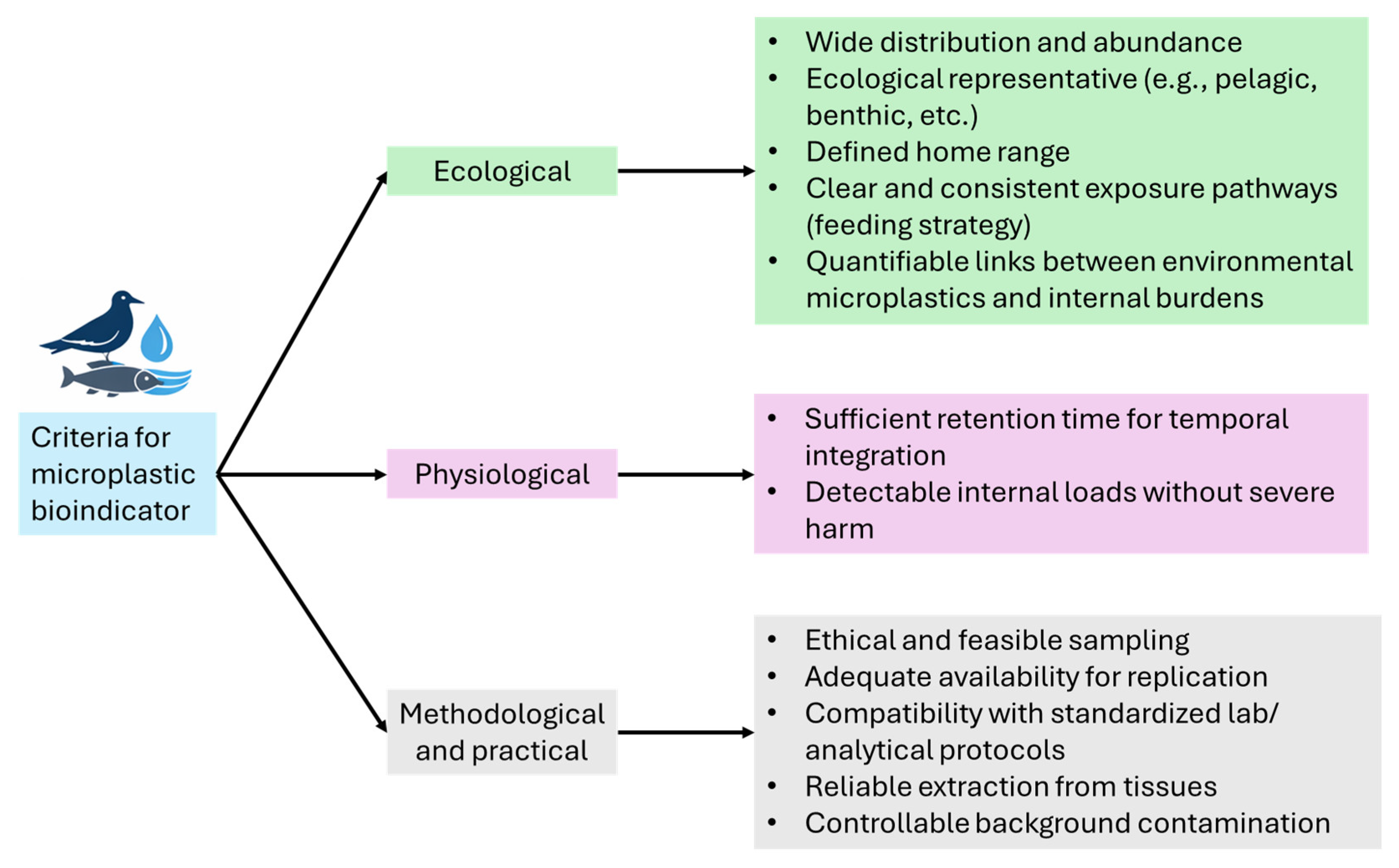
Despite increasing global efforts in plastic biomonitoring, there is currently no single, globally binding set of criteria for selecting bioindicator species for microplastics, but there is strong convergence across the NOAA, OSPAR, MSFD, IMAP, and wider scientific literature on a core set of biological, ecological, and methodological criteria [11,31,32,36]. These criteria are largely adapted from classical contaminant biomonitoring and are being refined to address the specific challenges posed by microplastics.
Ecologically, a suitable bioindicator species should be widely distributed and abundant, allowing repeated sampling across large spatial scales and over long time periods [39,40]. The species should be ecologically representative of the target habitat (e.g., pelagic, benthic, coastal, freshwater) and have a relatively sedentary lifestyle or well-defined home range so that measured microplastic burdens can be linked to local environmental conditions. A clear and consistent exposure pathway is essential; feeding strategy (e.g., filter feeding, sediment ingestion, surface feeding) should lead to predictable and reproducible microplastic uptake [34]. Ideally, the species should show a quantifiable relationship between environmental microplastic levels and internal loads, providing sensitivity to spatial and temporal trends rather than sporadic or opportunistic ingestion [20].
From a physiological perspective, indicator species should be capable of accumulating or retaining microplastics for a sufficient duration to integrate exposure over time, without excessively rapid egestion that would obscure environmental signals [41]. At the same time, microplastic presence should be detectable without causing severe harm that would compromise population viability, particularly for protected species [42].
Methodological and practical criteria are equally important. The species must be easy to sample ethically and logistically, available in adequate numbers, and suitable for standardized laboratory processing [41]. Tissues should allow reliable extraction of microplastics and unambiguous polymer identification using spectroscopic techniques such as FTIR or Raman spectroscopy. Background contamination must be controllable, and results should be reproducible across laboratories [29]. The criteria are summarized in Figure 1.

4. Aquatic Bioindicators

Various aquatic bioindicators have been proposed, including bivalves, fish, barnacles, and sponges. Bivalves have received considerable attention due to their filter-feeding behavior, broad geographic distribution, and capacity to integrate exposure to microplastics over time.

4.1. Bivalves

Bivalve mollusks have been extensively applied in studies investigating microplastic occurrence, characteristics, and spatial–temporal variability in aquatic environments due to their widespread distribution and filter-feeding behavior. Numerous field investigations have demonstrated the pervasive presence of microplastics in bivalve digestive systems across marine and freshwater ecosystems. For example, Ding et al. [43] reported microplastic detection in 80% of sampled bivalves collected across four seasons in Qingdao, China, with abundances varying among scallops, mussels, oysters, and clams. Microplastics ranged from several micrometers to millimeter scale and were dominated by fibers, with polymer composition primarily consisting of polyvinyl chloride (PVC) and rayon, as confirmed by μ-FTIR analysis. Species-specific differences were observed in particle-size distributions and polymer associations, highlighting differential interactions between bivalves and surrounding environmental compartments [43].
Comparative analyses have shown that microplastic characteristics in bivalves often resemble those in adjacent environmental matrices. Studies by Li et al. [29] and Qu et al. [44] demonstrated consistency between microplastic morphotypes and polymer composition in mussels and surrounding seawater, with quantitative correlations observed when abundances were normalized to comparable units. Similar relationships have been reported for clams, where microplastic abundance, size distribution, and color more closely matched sediment profiles than water columns in both marine and freshwater systems [45]. Principal component and correlation analyses further indicated strong associations between polymer types in clams and sediments across geographically distinct regions, including the Yangtze River Basin, Taihu Lake, and coastal China [43].
Laboratory and in situ experiments have provided mechanistic insight into how physical characteristics of microplastics influence ingestion and retention in bivalves. Controlled exposure studies with oysters (Crassostrea virginica) and mussels (Mytilus edulis) revealed size-selective ingestion of polystyrene microspheres and differential rejection of fibers through pseudofeces and feces [46,47]. Smaller particles were retained for longer durations within the digestive tract, whereas larger particles were preferentially rejected or rapidly egested [47]. These findings indicate that the composition of microplastics detected in bivalves reflects not only environmental availability but also particle-specific biological processing.
Freshwater bivalves have similarly been employed in regional-scale assessments. Pastorino et al. [48] documented spatial gradients in microplastic abundance and composition in Zebra Mussels (Dreissena polymorpha) in Lake Iseo, with higher particle loads recorded near wastewater discharge points. Likewise, Su et al. [45] conducted a basin-wide survey of Asian Clams across diverse freshwater systems, demonstrating strong statistical relationships between microplastics in clams, sediments, and water. Fibers dominated across all matrices, and median particle sizes in clams closely aligned with those in sediments.
Recent nationwide monitoring efforts further illustrate the integration of bivalves into structured microplastic surveillance programs. Cho et al. [22] reported widespread microplastic occurrence in oysters, mussels, and Manila Clams along Korean coastlines, with dominant characteristics, such as small particle sizes, fragments, and polymer composition, closely matching those of local seawater. Similarly, Liang et al. [49] examined seasonal variation in microplastic communities in oysters and surrounding seawater, revealing distinct compositional patterns and highlighting the influence of biological growth stages, depuration rates, and environmental conditions on observed microplastic profiles [50,51,52].
Collectively, these studies demonstrate how bivalves have been widely applied to characterize microplastic abundance, size distribution, morphology, and polymer composition across marine and freshwater environments. Their use has enabled comparisons between biological compartments and environmental matrices, supported large-scale monitoring initiatives, and contributed to understanding the biological processing and environmental distribution of microplastics across diverse aquatic systems.

4.2. Fish

Fish have been widely employed in microplastic ingestion studies across marine and freshwater systems, providing insights into spatial patterns, polymer composition, particle characteristics, and exposure pathways across habitats and trophic levels. Recent work by Valente et al. [34] introduced a bioindication score framework to characterize how different fish species capture complementary aspects of microplastic bioavailability. In their assessment of eight fish species from the Central Tyrrhenian Sea, microplastics were detected in 38.8% of individuals, with ingestion frequencies varying markedly among species. Fibers and fragments dominated the ingested particles, with most microplastics falling within the smallest size class (100–330 μm). Differences in microplastic abundance, diversity, color, and polymer composition among species highlighted how pelagic and benthopelagic/demersal fishes reflect distinct exposure compartments. Species such as Mullus barbatus and Scomber colias showed higher ingestion frequencies, while Pagellus acarne and Trachurus trachurus recovered a broader diversity of microplastic types, illustrating how multispecies approaches can capture different dimensions of microplastic pollution [34].
Freshwater fish have similarly been applied to assess microplastic contamination in urbanized inland systems. Koutsikos et al. [53] documented moderate microplastic occurrence in the gastrointestinal tracts of the introduced chub Squalius vardarensis in an urban river flowing through the Athens metropolitan area. Approximately one-third of specimens contained microplastics, with polymer composition dominated by polyethylene (PE), polyvinyl alcohol, and polypropylene (PP), reflecting fragmentation of urban-derived plastic waste. Comparable to their established use in monitoring metals and persistent organic pollutants [54,55], fish species with broad habitat use and high population abundance have been used to characterize microplastic exposure in freshwater environments, linking biological uptake with ambient contamination levels.
Coastal fish species have also been used to evaluate gradients of anthropogenic pressure. Analysis of gastrointestinal contents of bogue (Boops boops) along the Catalan coast revealed higher microplastic ingestion frequencies and abundances in areas with greater industrialization and urbanization, particularly near Barcelona [56]. The dominance of blue PP fragments in nearshore specimens supports observations that microplastic exposure is elevated in coastal waters influenced by dense human activity, shipping, and tourism. Statistical modeling further indicated increased ingestion rates closer to the coastline, consistent with spatial distributions of marine litter.
In the open ocean and deep-sea environments, mesopelagic fishes have provided long-term perspectives on microplastic exposure. Ferreira et al. [57] analyzed archived lanternfish (Myctophidae) specimens collected between 1999 and 2017, detecting microplastics in 55% of individuals and documenting temporal increases in ingestion probability over nearly two decades. Particle sizes ranged from tens of micrometers to several millimeters, with ingestion patterns strongly influenced by vertical migration behavior. Upper mesopelagic migrants exhibited significantly higher microplastic loads than lower mesopelagic species, underscoring the role of depth distribution and diel migration in shaping exposure. Differences in microplastic occurrence across bathymetric zones further demonstrated how fish can reflect vertical heterogeneity in plastic pollution within the water column [57].
Across these studies, fish-based microplastic monitoring has revealed consistent patterns in particle size, shape, color, and polymer composition, while also capturing variability driven by habitat, behavior, migration, and proximity to anthropogenic sources. The use of diverse taxa, from coastal and freshwater fishes to mesopelagic species, has enabled assessments of microplastic pollution across environmental compartments and time scales, contributing to an increasingly detailed understanding of microplastic distribution and exposure dynamics in aquatic ecosystems. The findings on studies using bivalves and fish as potential microplastic bioindicators are summarized in Table 1.

4.3. Barnacles and Anemones

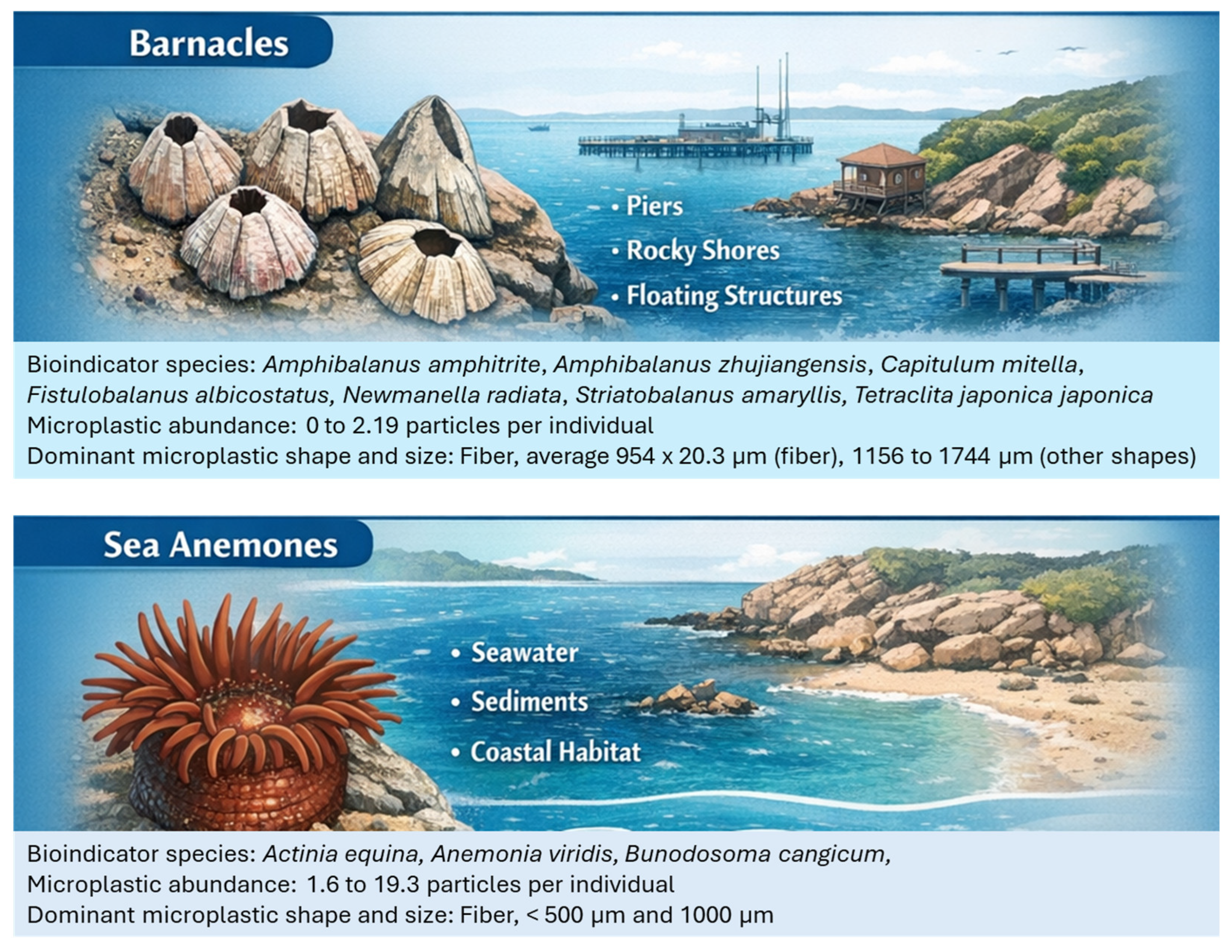
The quantification of microplastics in sessile invertebrates has been increasingly applied to characterize exposure pathways and spatial contamination patterns. Barnacles, owing to their filter-feeding behavior and direct contact with surrounding water and suspended particles, have been extensively examined for microplastic occurrence across diverse coastal settings. Investigations conducted across 30 sites in Hong Kong waters documented the presence of microplastics in four acorn barnacle species (Amphibalanus amphitrite, Fistulobalanus albicostatus, Tetraclita japonica japonica) and one goose barnacle (Capitulum mitella), with median microplastic abundances ranging from 0 to 8.63 particles g−1 wet weight or 0 to 1.9 particles per individual (Figure 2) [61]. Fibers constituted the dominant microplastic type, consistent with the prevalence of fibrous debris in coastal marine environments.
Polymer characterization using μ-FTIR revealed a mixture of synthetic and natural materials, with cellophane representing the most abundant polymer type, alongside PE, PP, and other plastics [61]. Inter-specific variability in microplastic abundance was evident, suggesting differences in ingestion and retention processes among barnacle taxa. Correlation analyses further demonstrated species-specific relationships between microplastic abundance in sediments and in barnacle tissues, indicating differential coupling between environmental compartments and biological uptake [61].
More recent work by Raudanda et al. [39] reported microplastics in 84% of examined barnacle individuals across multiple regions, with abundances ranging from 1 to 53 particles g−1 wet weight and 0.33 to 2.19 particles per individual (Figure 2). Among the species studied, A. amphitrite consistently exhibited higher microplastic loads compared with A. zhujiangensis, Newmanella radiata, and Striatobalanus amaryllis. Pearson correlation analyses identified strong positive relationships between microplastic abundance in water and microplastic levels in S. amaryllis and A. zhujiangensis, highlighting distinct exposure pathways linked to water-column contamination. Habitat-associated distribution patterns were also reported, with barnacle species occurring across piers, rocky shores, floating structures, and embankments, enabling microplastic assessments across a range of coastal environments [39,62,63].
Sea anemones have also been examined as part of integrated assessments of microplastic distribution across seawater, sediments, and biota. Studies conducted in Mersin Bay extracted and characterized microplastics from surface seawater, sediments, and the sea anemone Actinia equina using confocal µ-Raman spectroscopy and scanning electron microscopy (Figure 2) [64]. The average microplastic abundance in anemones was 19.3 particles per individual, corresponding to approximately 1.95 particles g−1 wet weight, with smaller microplastics (<0.5 mm) comprising a substantial proportion of detected particles (43.4–56.8%). Polymer compositions included PE, polyethylene terephthalate (PET), PP, polystyrene (PS), polyurethane (PU), and polyamide/nylon (PA/NY), with a greater diversity of polymer types detected in anemones relative to surrounding environmental matrices.
Spatial patterns of microplastic abundance in A. equina closely mirrored those observed in surface seawater and sediments, despite overall microplastic concentrations being significantly lower in anemone tissues (p < 0.05). Dominant polymers varied among sampling stations, indicating spatial heterogeneity in microplastic sources and environmental inputs. These findings align with earlier observations by Morais et al. [65], who documented spatial variability in polymer composition ingested by the anemone Bunodosoma cangicum along the Brazilian Amazon coast.
Morais et al. [65] reported, for the first time, the ingestion of both microplastics (1 μm–5 mm) and mesoplastics (5.01–25 mm) by B. cangicum, with plastic particles detected in 75.6% of individuals. Fibers dominated the recovered debris (~84%), followed by fragments and films (Figure 2). Polymer analysis identified PET, PP, PA, PU, PE, acrylonitrile butadiene styrene (ABS), PS, and rayon, reflecting a broad spectrum of anthropogenic materials. Weak but significant correlations were observed between anemone wet weight, prey abundance, and the number of ingested plastic particles, suggesting interactions between feeding dynamics and microplastic exposure. Notably, higher microplastic loads were associated with more urbanized sampling sites, indicating spatial gradients in plastic contamination.
Experimental and field studies demonstrate consistent microplastic uptake across all individuals of common snakelocks anemone (Anemonia viridis) sampled, with accumulation largely independent of particle size, shape, food availability, or temperature, indicating that internal burdens reliably reflect environmental exposure (Figure 2) [66]. Microplastics are captured through both ingestion and external adhesion, with mucus-mediated trapping appearing to be a key mechanism. Field-collected anemones show microplastic profiles dominated by fibers and fragments, closely matching those reported in surrounding coastal waters [67] and consistent with patterns observed in other anemone species [65]. Spectroscopic analyses confirm that most retained particles are anthropogenic polymers.

4.4. Crustaceans

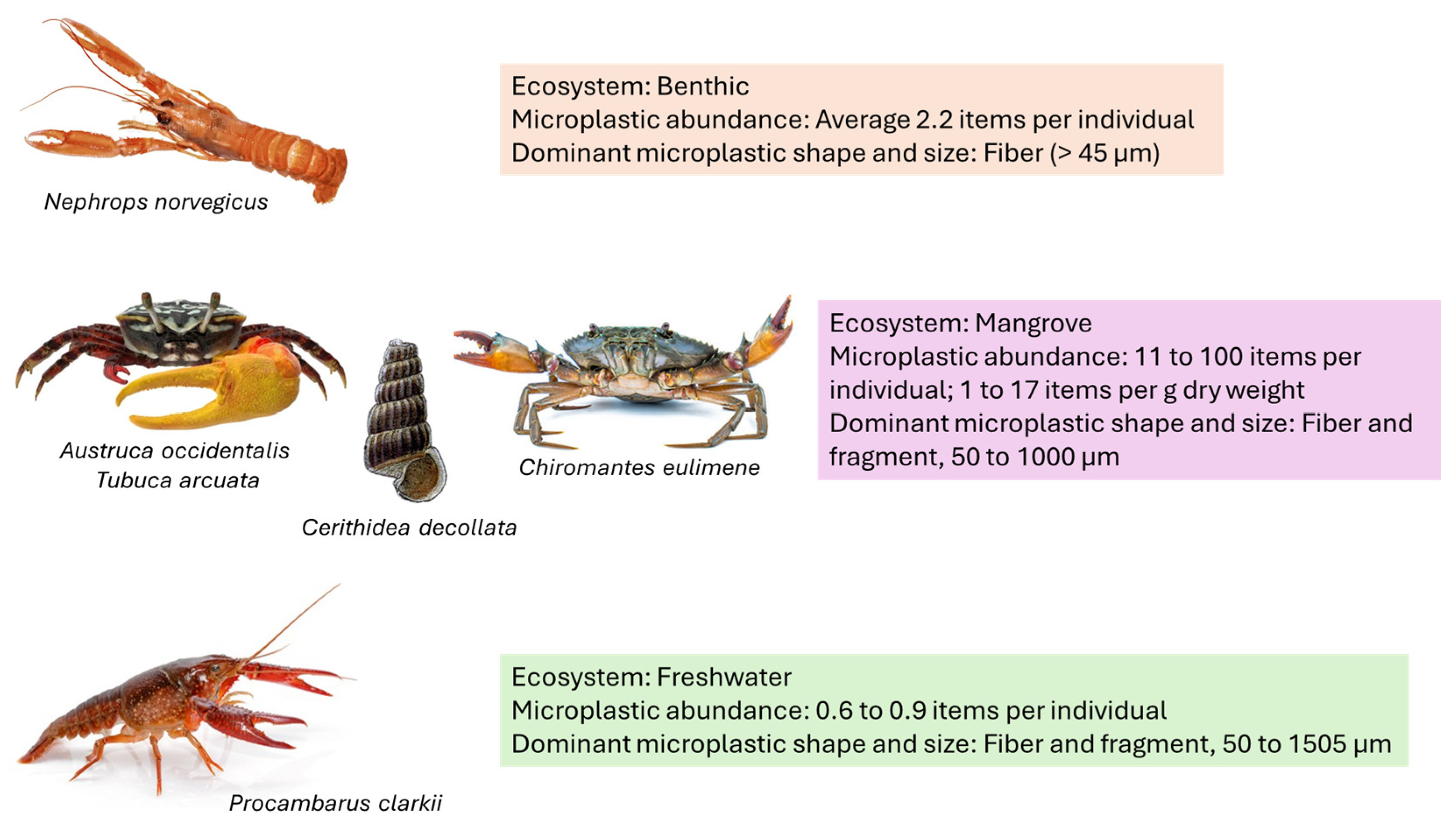
Crustaceans have been increasingly examined in microplastic research due to their close interaction with sediments and water columns in both marine and freshwater environments. In mangrove ecosystems, the distribution of microplastics in surface sediments and fiddler crabs (Tubuca arcuata) has been investigated to elucidate biological–environmental linkages in microplastic contamination [68]. Microplastic abundances in mangrove sediments ranged from 1160 to 12,120 items kg−1, while fiddler crabs contained between 11 and 100 items per individual (Figure 3). In both compartments, fragments were the dominant microplastic shape, with particle sizes primarily between 20 and 1000 μm, and a notable prevalence of larger microplastics (50–1000 μm). PP was identified as the dominant polymer type, reflecting its widespread environmental presence.
A strong linear relationship was observed between microplastic abundances in fiddler crabs and surface mangrove sediments (R2 > 0.8, p < 0.05), indicating a close coupling between sedimentary contamination and microplastic occurrence in crab tissues [68]. Target group index (TGI) analyses further revealed non-random patterns in microplastic ingestion, with small particles (20–50 μm) exhibiting higher TGIs than larger size classes. Polymer-specific patterns were also evident, with higher TGIs for PA, PE/low-density PE (LDPE), and poly(ethylene propylene diene), while site-specific differences were observed in preferred shapes and polymer types, such as PET, PS, and PVC fibers in Beiyue mangrove sediments. These results highlight spatial heterogeneity in microplastic characteristics and their biological representation within mangrove food webs.
Freshwater crustaceans have also been examined in lentic systems. Pastorino et al. [69] investigated microplastic occurrence in water, sediments, and the invasive crayfish Procambarus clarkii in Lake Candia (Italy) over two consecutive years. Microplastic concentrations in water ranged from 1.75 ± 0.95 to 2.00 ± 0.81 items m−3, while sediment concentrations ranged from 6.75 ± 1.50 to 8.00 ± 0.81 items kg−1. In crayfish tissues, microplastic abundances ranged between 0.04 and 0.06 items g−1, with no pronounced differences between sexes across sampling years (Figure 3). Fibers and fragments composed primarily of PP and PET were detected consistently across biotic and abiotic compartments [69].
Generalized linear mixed modeling indicated that microplastic abundance per gram of tissue was inversely related to individual body weight, with lower microplastic concentrations observed in larger individuals, potentially reflecting feeding behavior and ingestion dynamics [69]. Notably, microplastics identified in crayfish digestive tracts closely matched those detected in water and sediments in terms of shape, color, and polymer composition, supporting observations of congruence between environmental contamination and biological uptake.
Joyce et al. [70] examined microplastics in Nephrops norvegicus and surrounding benthic sediments across six areas in the Northeast Atlantic. Although no significant correlations were found, microplastic abundance, size, shape, and polymer composition in N. norvegicus closely reflected those in nearby sediments, with PS, polyamide, and PP dominating both. Overall, microplastic levels were low compared with other regions, suggesting limited local contamination (Figure 3). Larger individuals contained fewer microplastics, indicating no evidence of bioaccumulation and suggesting that microplastic presence primarily reflects local environmental exposure.
However, quantification of microplastics in surface water, sediments, and three key invertebrate species (Austruca occidentalis, Chiromantes eulimene, and Cerithidea decollata) in an urban mangrove (Durban Bay) and a peri-urban mangrove (Mngazana Estuary) in South Africa revealed that their levels varied across compartments, with fibers dominating in both sites (Figure 3) [71]. Although all species showed microplastic uptake, concentrations in biota differed significantly from those in water and sediments, indicating that biological accumulation did not directly mirror abiotic contamination patterns.

4.5. Sponge

Marine sponges have been examined as part of broader assessments of microparticulate pollutants due to their capacity to interact continuously with large volumes of surrounding seawater. Girard et al. [72] analyzed 15 coral reef demosponges from Bangka Island (Indonesia) using histological methods, advanced light microscopy, Raman spectroscopy, and two-photon microscopy. The study identified the incorporation of fine sediment particles (<200 μm), including degraded man-made materials, within sponge tissues, particularly in the ectosome and spongin fibers. A total of 34 distinct particle types were recorded, including PS, particulate cotton, titanium dioxide, and blue-pigmented particles, at concentrations ranging from 91 to 612 particles g−1 dry tissue. Extrapolations suggested that large sponge individuals may incorporate substantial numbers of microparticulate pollutants, reflecting the diversity of the ambient environment [72].
Complementary findings were reported by Celis-Hernandez et al. [73], who quantified microplastics in surface water, sediments, and three marine sponge species (Haliclona implexiformis, Halichondria melanadocia, and Amorphinopsis atlantica). Microplastic concentrations ranged from 1861 to 3456 items kg−1 dry weight in sponges, 130 to 287 items L−1 in water, and 6 to 11 items kg−1 in sediments. Fibers were the exclusive microplastic type detected across all compartments, with dominant colors including blue, red, black, and white. Spatial differences in fiber color distributions were observed among matrices, with blue fibers predominating in sediments and sponges, while white fibers were more prevalent in water samples. The highest microplastic concentrations were recorded in A. atlantica at disturbed sites, coinciding with elevated microplastic levels in the surrounding environmental matrices [73].
Long-term and retrospective insights into microplastic occurrence in sponges were provided by Modica et al. [74], who analyzed museum specimens collected over two decades ago from the northeastern Atlantic Ocean. Across 170 samples representing 79 species and 34 sponge families, synthetic textile microfibers were detected in 57 species, indicating widespread microplastic retention across diverse taxa. Microplastic presence was independent of sampling depth and ecotope, suggesting broad exposure across environmental gradients.
Across studies, spatial variability in microplastic concentrations within sponge tissues has been linked to surrounding environmental conditions rather than material-specific selectivity [72,73]. Reported bioaccumulation factor values exceeding unity further indicate the concentration of microplastics in sponge tissues relative to ambient seawater, with higher values observed at disturbed sites, despite non-significant differences in seawater microplastic concentrations between sites.

4.6. Other Aquatic Organisms

Beyond commonly studied taxa such as fish, crustaceans, and benthic invertebrates, a range of other aquatic organisms, including gelatinous zooplankton and marine reptiles, and seabirds, have been examined to characterize microplastic distribution and exposure across marine ecosystems.
Jellyfish have attracted attention due to their abundance and interactions with suspended particles in the water column. In a study by Sucharitakul et al. [75], 83% of collected medusae (Catostylus pentastoma) contained at least one microplastic particle in their gut. The mean microplastic abundance was 3.1 ± 0.6 particles per individual, with no significant differences among sampling sites and no correlation between microplastic ingestion and medusa bell diameter. These findings indicate relatively uniform exposure levels across locations and size classes.
The composition of microplastics recovered from medusae differed notably from that present in the surrounding seawater. Ingested particles consisted primarily of microfibers larger than 100 μm. Polymer analysis revealed that PET dominated the ingested microplastics (59.7%), followed by PP (26.9%), polytetrafluoroethylene (PTFE; 9.6%), and PVC (3.8%). PTFE was not detected in water samples, suggesting a divergence between ambient microplastic composition and ingested material. Color-based analyses showed inconsistent selection patterns for blue and transparent microplastics among sites, while red, black, white, and green microplastics were consistently underrepresented in medusae guts [75]. Overall, the spectrum of polymers and colors found in medusae did not mirror those in the water column, reflecting complex interactions between particle properties and ingestion processes. The lack of correlation between microplastic quantity in jellyfish and that in the surrounding environment was also reported by Iliff et al. [76].
Sea turtles have been extensively studied in the context of marine debris ingestion, including microplastics. Green Turtles (Chelonia mydas) and Loggerhead Turtles (Caretta caretta) exhibit high frequencies of plastic ingestion across broad geographic ranges, including tropical to temperate regions of the North Pacific [24]. Reported frequencies of occurrence of ingested plastics range from 0.25 to 0.41 across the region, reflecting widespread exposure.
An important physiological characteristic of sea turtles relevant to microplastic monitoring is their prolonged gastrointestinal retention time. Ingested material can remain in the gut for two to three weeks [77], providing an integrated record of plastic exposure over extended temporal scales compared with organisms exhibiting rapid gut turnover. Long-term datasets on plastic ingestion by sea turtles have been initiated in several regions, including Japan and South Korea, contributing to the assessment of spatial and temporal trends in marine plastic pollution [38,78]. Sampling has been conducted through fisheries bycatch and stranded individuals, offering multiple avenues for data collection [38,79].

5. Terrestrial Bioindicators

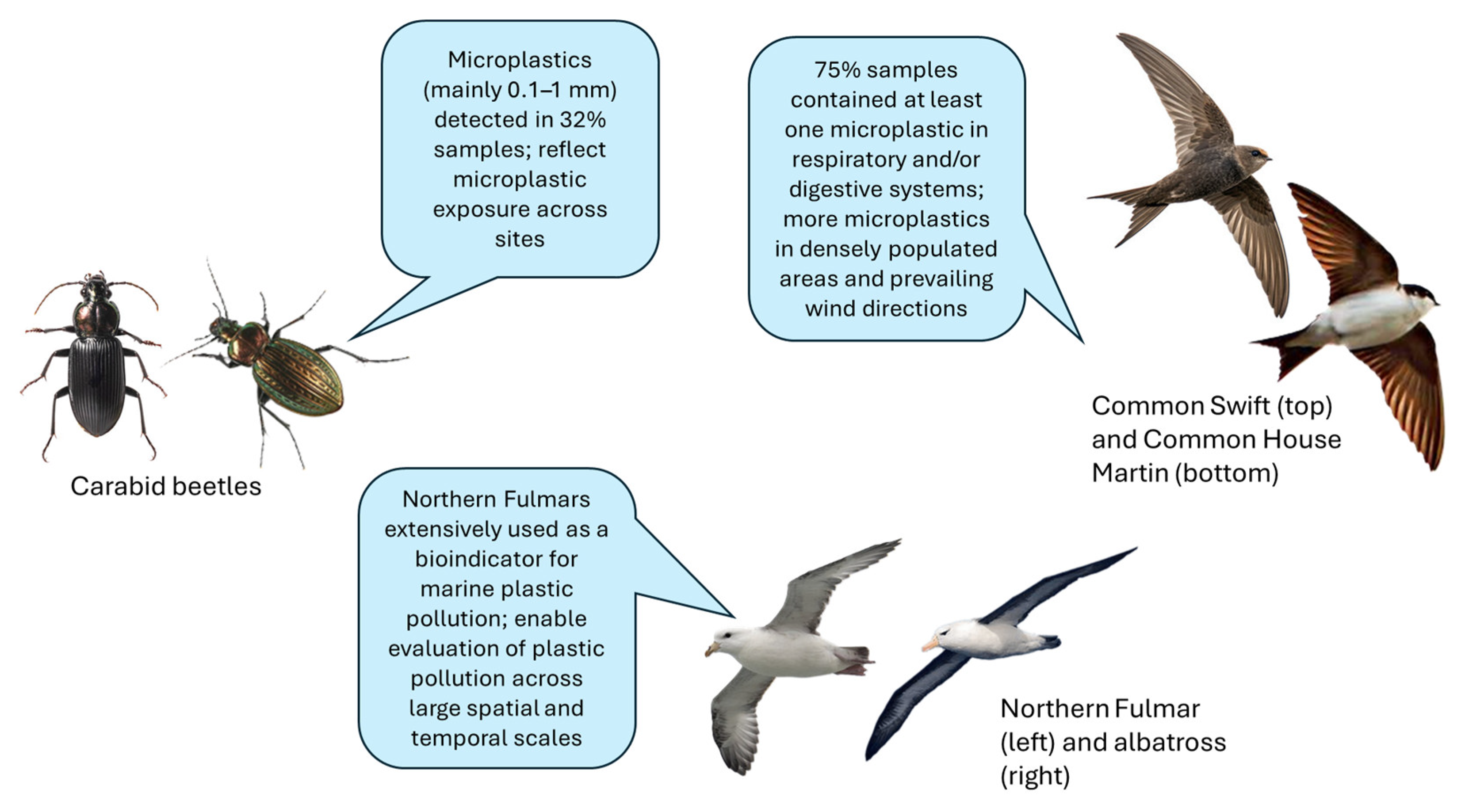
Considerably fewer terrestrial bioindicators of microplastics have been investigated. These bioindicators primarily consist of insects and birds. Recent research has expanded microplastic monitoring to terrestrial invertebrates, with carabid beetles (Coleoptera: Carabidae) investigated as indicators of soil-associated plastic contamination. In a pilot study conducted along the Conero coast in Italy, Meacci et al. [80] examined microplastic ingestion in carabid beetles collected monthly between July and October 2022 from three sites characterized by differing degrees of anthropogenic pressure (Figure 4). Beetles were sampled using pitfall traps, ensuring the collection of taxa closely associated with soil habitats.
Microplastics were extracted from beetle gastrointestinal tracts via oxidative digestion and vacuum filtration, followed by optical microscopy and μ-FTIR spectroscopy for characterization. Overall, microplastics were detected in 32% of the analyzed individuals. Although the number of particles per individual did not display consistent spatial or temporal trends, ingestion frequency differed significantly among sampling sites (Pearson’s chi-squared test, p = 0.028). The highest ingestion rates were recorded at a stony beach site subject to intense seasonal tourism, reaching 75% in July and 87.5% in August [80].
The recovered microplastics were predominantly fragments within the 0.1–1 mm size range. Polymer analysis indicated that polyester and silicone were the most frequently identified materials. The study design did not require identification of beetles to species level, allowing aggregation of results at the family scale. This approach facilitated sampling across an extended period by encompassing carabid species with differing phenologies and larval development strategies [81]. The collected dataset thus reflects microplastic exposure in soil-associated insect assemblages across sites with contrasting levels of human activity.
Birds have been widely studied in the context of plastic pollution, and recent work has extended this focus to airborne microplastics and artificial fibers (AFs). Wayman et al. [82] investigated the presence of microplastics and AFs in two abundant aerial insectivorous species, the Common House Martin (Delichon urbicum) and the Common Swift (Apus apus), in the Community of Madrid, Spain (Figure 4). These species spend most of their life airborne, creating opportunities for exposure through both inhalation and ingestion.
Samples were obtained from necropsies of 24 individuals collected between 2021 and 2023, with strict selection criteria applied to minimize post-mortem contamination. Microplastics and AFs were identified and characterized using µ-FTIR spectroscopy. Overall, 75% of examined birds contained at least one microplastic in their respiratory and/or digestive systems. All identified microplastics were fibers, dominated by polyester (48%), followed by acrylic (28%) and PE (18%) [82].
Quantitative analyses showed microplastics and AFs in both respiratory and digestive compartments. In Common Swifts, average concentrations reached 1.12 ± 0.45 microplastics and 2.78 ± 1.04 AFs per specimen in the respiratory system, and 1.92 ± 0.72 microplastics and 3.42 ± 0.69 AFs per specimen in the digestive tract. Corresponding values for House Martins were slightly lower. Birds collected from areas with high human population density and aligned with prevailing wind directions exhibited significantly higher microplastic concentrations in the digestive system, indicating spatial variability in exposure [82].
Beyond terrestrial birds, seabirds have long been incorporated into marine plastic monitoring frameworks. The Northern Fulmar (Fulmarus glacialis), a surface-feeding procellariiform with a circumpolar distribution, has been used extensively to assess trends in marine plastic pollution through stomach-content analysis [23] (Figure 4). Fulmar monitoring enables evaluation of the abundance and composition of small plastic debris (1–10 mm) across large spatial and temporal scales, providing comparative datasets for the Arctic, North Atlantic, North Sea, and North Pacific regions.
Additional seabird taxa, such as Laysan and Black-footed Albatrosses, have been examined due to their broad foraging ranges and ingestion of a wide size spectrum of marine debris (Figure 4). The capacity to track foraging movements and analyze regurgitated boluses from chicks allows detailed investigation of plastic distribution and sources without destructive sampling [83]. These avian datasets complement long-term monitoring efforts in other taxa, including marine turtles in Japan and South Korea [38,78], contributing to a multi-taxon perspective on plastic pollution across environmental compartments.

6. Evaluation of Proposed Bioindicators for Microplastic Monitoring

6.1. Ecological Aspects

This category is characterized by several interrelated criteria: wide distribution and sufficient abundance, ecological representativeness, clear and consistent exposure pathways, and, critically, the existence of robust and reproducible relationships between environmental microplastic levels and internal burdens [34,39,40]. Applying these criteria across taxa reveals marked contrasts in performance, reflecting differences in life history, mobility, feeding strategies, and habitat use.
Bivalves remain among the most extensively studied and widely applied bioindicators for microplastic pollution, particularly in coastal and benthic environments. Their global distribution, high local abundance, and ecological representativeness facilitate repeated sampling across broad spatial and temporal scales [22,43]. Most bivalves are sedentary and rely on filter-feeding or sediment-associated feeding strategies, which establish direct and continuous exposure pathways to microplastics present in seawater and sediments [84].
Numerous studies have demonstrated statistically significant relationships between microplastic characteristics in bivalves and those in the surrounding environmental compartments. For instance, strong correspondence between polymer types in the Manila Clam (R. philippinarum) and sediments across geographically distinct regions highlights their sensitivity to spatial patterns of sedimentary microplastic pollution [43,45]. In contrast, mussels (Mytilus sp.) often show closer alignment with microplastic characteristics in the water column, including particle size, polymer composition, and morphotype, supported by quantitative correlations and field observations [29,44]. Scott et al. [85] also found that microplastic quantities in mussels were associated with levels in nearby sediments, though polymer composition showed no such relationship.
However, laboratory and field experiments also demonstrate that bivalves do not ingest microplastics passively. Selective ingestion, particle rejection via pseudofeces, rapid egestion of certain size classes, and growth dilution effects can modulate internal microplastic loads [46,51]. Environmental factors such as temperature, food availability, and physiological condition further influence microplastic retention, particularly in oysters (C. gigas) [49,52]. These processes do not negate their bioindicator value but indicate that bivalves primarily reflect bioavailable microplastics within specific size ranges and exposure pathways rather than total environmental inventories. When species ecology is explicitly considered, bivalves, especially clams for sediments and mussels for seawater, closely align with established bioindicator criteria.
In contrast, jellyfish show limited suitability as microplastic bioindicators despite frequent detection of microplastics in their tissues. Although a high proportion of individuals may contain microplastics, internal microplastic loads often lack spatial differentiation and do not mirror the composition of the surrounding seawater [75,76]. Inconsistent particle selection by polymer type and color, combined with low ingestion numbers, undermines predictability and weakens quantitative links with environmental microplastic levels.
From an ecological perspective, jellyfish are highly mobile, seasonally abundant, and patchily distributed. These traits complicate efforts to associate internal microplastic burdens with localized environmental conditions and directly conflict with the criterion of a sedentary lifestyle or defined home range [86]. Consequently, jellyfish may indicate the presence of microplastics in marine systems, but lack sensitivity to spatial or temporal gradients and do not provide robust, reproducible correlations with environmental contamination.
Fish occupy a more intermediate position, with suitability strongly dependent on species-specific traits. Their mobility, habitat breadth, and trophic diversity result in variable alignment with bioindicator criteria. Valente et al. [34] demonstrated through a bioindication scoring approach that no single fish species adequately captures all dimensions of microplastic exposure; instead, assemblages of pelagic and demersal species provide complementary insights into microplastic bioavailability across habitats.
Field studies have revealed coherent spatial patterns between microplastic ingestion in fish and environmental pressures. Elevated microplastic ingestion frequencies in species such as bogue (Boops boops) and lanternfish have been linked to proximity to urbanized coastlines, depth distribution, and migration routes [56,59]. In freshwater systems, chubs (Squalius vardarensis), already used in conventional pollution monitoring, showed promise in reflecting moderate microplastic contamination in urban rivers due to their abundance and broad distribution [53].
Nevertheless, several biological constraints limit fish as standalone bioindicators. High mobility, short gut retention times, selective feeding, and the absence of clear bioaccumulation or biomagnification patterns weaken the linkage between internal microplastic loads and localized environmental conditions, particularly for migratory species [87,88]. These limitations suggest that fish are best applied as habitat-specific indicators within multi-species frameworks rather than as universal bioindicators.
Barnacles meet many core criteria for microplastic bioindication, particularly in coastal and intertidal zones. Their sessile lifestyle and permanent attachment to substrates ensure that internal microplastic burdens can be directly associated with local environmental conditions. High microplastic occurrence rates (76–84%) have been reported, with fibers typically dominating, reflecting the prevailing microplastic types in coastal waters [39,61].
Importantly, several studies demonstrate statistically significant correlations between environmental microplastic concentrations and internal loads, though these relationships are species-specific. For example, Amphibalanus amphitrite showed strong positive correlations with sediment microplastic abundance, whereas other barnacle species did not, despite broader spatial distributions [61,63]. Similar species-dependent associations have been reported between microplastics in seawater and barnacles inhabiting different microhabitats [39]. These findings emphasize that feeding efficiency, retention capacity, and elimination rates are key determinants of bioindicator performance.
The ecological versatility of A. amphitrite, which colonizes mudflats, piers, docks, and embankments, enhances its applicability across diverse coastal settings. However, short life spans and seasonal population fluctuations linked to thermal stress may constrain long-term temporal monitoring [89].
Sea anemones exhibit strong alignment with several bioindicator criteria, particularly ecological representativeness, sedentary behavior, and spatial fidelity. Species such as Actinia equina and Bunodosoma cangicum are sessile benthic predators with well-defined home ranges, allowing internal microplastic burdens to be reliably linked to local environmental conditions. Microplastics are consistently detected in anemones, with polymer types, sizes, and colors broadly reflecting those in adjacent seawater and sediments [65].
Quantitative spatial coherence has been demonstrated in multiple regions. In Mersin Bay, the spatial distribution and polymer dominance of microplastics in sea anemones closely matched those in surface waters and sediments across all sampling stations (p < 0.05) [64]. Moreover, microplastic ingestion increased significantly at more urbanized sites, indicating sensitivity to anthropogenic pollution gradients [65]. Correlations between microplastic abundance and anemone weight or prey intake further support the existence of predictable exposure pathways linked to feeding behavior.
High local abundance, ease of sampling, and wide distribution, particularly for B. cangicum along the Amazon coast, enhance reproducibility and reduce taxonomic ambiguity [65]. Collectively, these attributes support sea anemones as robust localized bioindicators of microplastic contamination, including in relatively undisturbed environments.
Crustaceans show strong potential as microplastic bioindicators, especially in sediment-dominated systems. Fiddler crabs (Tubuca arcuata) are abundant, benthic, and relatively sedentary, making them ecologically representative of mangrove ecosystems. Their deposit-feeding behavior establishes a clear exposure pathway to sediment-associated microplastics. Strong linear correlations (R2 > 0.8, p < 0.05) between microplastic abundance in crabs and mangrove sediments demonstrate a robust quantitative relationship between environmental contamination and internal loads [68].
TGI analyses further reveal selective ingestion of specific microplastic size classes, shapes, and polymers, particularly small particles (20–50 μm), indicating sensitivity to bioavailable fractions rather than random ingestion. Similar patterns have been observed in freshwater crayfish (Procambarus clarkii), where identical microplastic characteristics were found in water, sediments, and digestive tracts across consecutive years [69]. Although body size influences microplastic abundance per gram, smaller individuals consistently mirrored environmental microplastic composition, supporting their use in freshwater monitoring.
Marine sponges rank among the most promising microplastic bioindicators due to their sessile nature, wide distribution, and exceptionally high filtration capacity. By filtering large volumes of water (100–1200 mL h−1 g−1 dry weight), sponges experience continuous and predictable exposure to suspended microplastics [72]. Microplastic concentrations in sponge tissues often exceed those in surrounding water and sediments, with bioaccumulation factors greater than one [73].
Sponges also show clear sensitivity to spatial pollution gradients. Significant differences in microplastic concentrations have been observed between disturbed and pristine sites, even when seawater microplastic levels did not differ statistically, indicating effective temporal integration of exposure [72,90]. Their ability to retain very fine particles (<200 μm) enhances monitoring resolution, while retrospective analyses demonstrate microplastic retention over decades, supporting temporal robustness [74]. Although species-specific accumulation patterns are weak, this may facilitate broader applicability across taxa.
Sea turtles, particularly Green (Chelonia mydas) and Loggerhead (Caretta caretta) Turtles, are well-suited as bioindicators of microplastic pollution at large spatial and temporal scales. Both species are widely distributed from tropical to temperate regions and are sufficiently abundant in the North Pacific (PICES region) to allow repeated sampling via fisheries bycatch and stranding networks [24,38,79]. Their established history of use in plastic pollution research further supports their relevance as bioindicators.
Ecologically, sea turtles represent pelagic and coastal marine habitats. Although not sedentary, they exhibit defined foraging areas and population structuring, particularly in Green Turtles, enabling internal plastic burdens to be interpreted at regional scales [91]. Their feeding behavior provides a clear and consistent exposure pathway, with plastics ingested during routine foraging in surface waters and nearshore habitats, reflected in relatively high ingestion frequencies (0.25–0.41) [77]. Long-term monitoring programs in Japan and South Korea further enhance their value for detecting temporal trends [38,78].
In terrestrial systems, carabid beetles represent a promising but still emerging group of microplastic bioindicators. They are globally distributed, species-rich, and often abundant, with soil-associated lifestyles that ensure close interaction with terrestrial substrates [80]. Microplastics have been detected in a substantial proportion of individuals, with ingestion frequency varying significantly among sites and correlating with anthropogenic pressure. While quantitative relationships with environmental microplastic concentrations remain weak, carabids appear well-suited for detecting the presence and relative differences in soil microplastic exposure [80].
Birds, particularly aerial insectivores such as the Common Swift (Apus apus) and Common House Martin (Delichon urbicum), offer a unique perspective on atmospheric microplastic pollution. Despite high mobility, these species integrate exposure over large air masses during defined breeding periods. High frequencies of artificial fibers in both respiratory and digestive systems, coupled with spatial sensitivity to population density and wind direction, indicate clear exposure pathways [82]. However, short gut residence times and the lack of historical baselines limit their temporal resolution compared to established marine avian indicators [23]. Nonetheless, the Northern Fulmar (Fulmarus glacialis) has been widely used as a bioindicator of plastic pollution. It has a wide circumpolar distribution and sufficient abundance, enabling repeated monitoring across regions, including the Arctic [92]. As a surface-feeding seabird, it exhibits clear and consistent exposure pathways through ingestion of floating plastics [93]. Multiple studies, including work in Svalbard, report uniformly high ingestion frequencies and substantial plastic burdens in fulmar stomachs, demonstrating reproducible internal contamination patterns [94,95,96]. The similarity in particle types and polymers across studies suggests a robust link between environmental plastic availability and internal burdens. The use of fledglings further reduces biological variability, supporting temporal trend analysis.
Based on the synthesized evidence, the most suitable organisms for microplastic bioindication are those that combine sedentary behavior, clear exposure pathways, and demonstrated quantitative relationships with environmental microplastics. Marine sponges, bivalves (particularly clams and mussels), barnacles (Amphibalanus amphitrite), sea anemones, and sediment-associated crustaceans (e.g., fiddler crabs and crayfish) emerge as the most robust candidates. Fish are best applied within multi-species assemblages tailored to specific habitats, while sea turtles and Northern Fulmars are considered suitable bioindicators for microplastics at regional to basin scales, though not necessarily for fine-scale local monitoring. Carabid beetles and aerial insectivorous birds represent valuable complementary indicators for terrestrial and atmospheric microplastic monitoring, respectively.

6.2. Physiological Aspects

From a physiological perspective, effective microplastic bioindicators must retain microplastics long enough to integrate environmental exposure, avoid excessively rapid egestion that masks signals, and allow detection without causing severe harm, particularly for protected species [41]. Unlike ecological criteria, which determine whether exposure is meaningful and representative, physiological criteria focus on whether that exposure is biologically integrated and preserved. Across taxa, substantial variation exists in how well these criteria are met.
Bivalves demonstrate strong physiological relevance. High detection frequencies (>80%) and relatively stable microplastic burdens after intake–egestion equilibrium allow temporal integration of bioavailable microplastics, particularly particles < 500 μm [29,43,44,97]. Although rapid egestion of certain particle types has been observed, especially in oysters [46,51], overall retention is sufficient to reflect environmental conditions. Microplastics are detectable without severe harm, and widespread harvesting reduces ethical concerns, supporting their suitability despite some physiological modulation by growth and environmental factors [50,52].
Jellyfish perform poorly under physiological criteria. Despite high detection frequency, low and inconsistent microplastic loads, rapid digestion, short retention times, and weak correspondence with environmental microplastics severely limit their capacity for temporal integration [75,76]. Their physiology thus undermines their indicator value.
Fish show intermediate and species-dependent suitability. While microplastics are frequently detected, gut residence times are generally short and individual loads are low, limiting integration [34,53]. Certain taxa exhibit consistent ingestion patterns and sensitivity to environmental gradients [56,59], but the absence of bioaccumulation or biomagnification constrains their use to exposure assessment rather than long-term integration.
Barnacles, particularly Amphibalanus amphitrite, exhibit strong physiological suitability. High detection rates (up to 84%), reduced elimination efficiency, and clear correlations between tissue microplastic loads and sediment concentrations indicate sufficient retention to integrate exposure. Microplastics are detectable without reported severe harm, though short lifespan and seasonal mortality may limit long-term temporal resolution [39,61].
Sea anemones perform well physiologically. High ingestion frequencies, retention of diverse microplastic sizes and polymers, and close spatial correspondence with sediment and water microplastic distributions indicate effective accumulation and integration [65]. Detection occurs without evident population-level harm, and their sessile nature enhances signal stability.
Crustaceans show species-specific but often strong suitability. Fiddler crabs and crayfish display correlations between tissue microplastics and environmental compartments, indicating effective retention and integration. Higher microplastic burdens in smaller individuals suggest limited egestion, and microplastics are detectable without apparent severe harm, particularly in sediment-associated habitats [68,69].
Sponges represent the most physiologically robust indicators. Their filter-feeding strategy leads to the retention of large quantities of microplastics and diverse microplastic types, often with bioaccumulation factors > 1 and long-term tissue incorporation. Microplastics are detectable without compromising viability, making sponges exceptional integrators of microplastic exposure [72,73].
For terrestrial and higher-trophic organisms, carabid beetles show moderate physiological suitability. Microplastics are detectable (32% of individuals), and site-level differences suggest retention sufficient to reflect local exposure [80]. However, rapid gut turnover limits long-term integration, positioning beetles as indicators of presence rather than cumulative burden.
Birds, particularly aerial insectivores and established indicators such as the Northern Fulmar, demonstrate repeated ingestion and inhalation that allows seasonal integration of atmospheric microplastics [23,82]. While gut retention is short, continuous exposure compensates physiologically, and microplastics are detectable without severe harm through ethical sampling approaches [95,96].
Sea turtles exhibit the strongest physiological integration capacity. A major advantage is their long gastrointestinal residence time, with plastics retained for two to three weeks, allowing internal loads to integrate environmental exposure over time [77]. Although protected, reliance on strandings and bycatch mitigates ethical concerns [24,38].
The comparative synthesis presented here demonstrates that taxa such as sponges, bivalves, barnacles, sea anemones, and certain sediment-associated crustaceans best meet these criteria, as their feeding strategies and internal processing allow sustained integration of environmental microplastic exposure. In contrast, organisms characterized by rapid gut turnover or low retention efficiency, including jellyfish and many fish species, are physiologically constrained to serving as short-term exposure indicators rather than integrative monitors. Long gastrointestinal residence times in sea turtles and continuous exposure in selected bird species further highlight how physiological traits can compensate for limited retention through cumulative intake.

6.3. Methodological and Practical Aspects

Methodological and practical criteria are central to the selection of reliable microplastic bioindicators. Across the taxa considered, suitability is also determined by the ethical and logistical feasibility of sampling, availability in sufficient numbers, compatibility with standardized laboratory workflows, reliability of microplastic extraction, robustness of spectroscopic polymer identification (FTIR, μ-FTIR, Raman), control of background contamination, and reproducibility across laboratories.
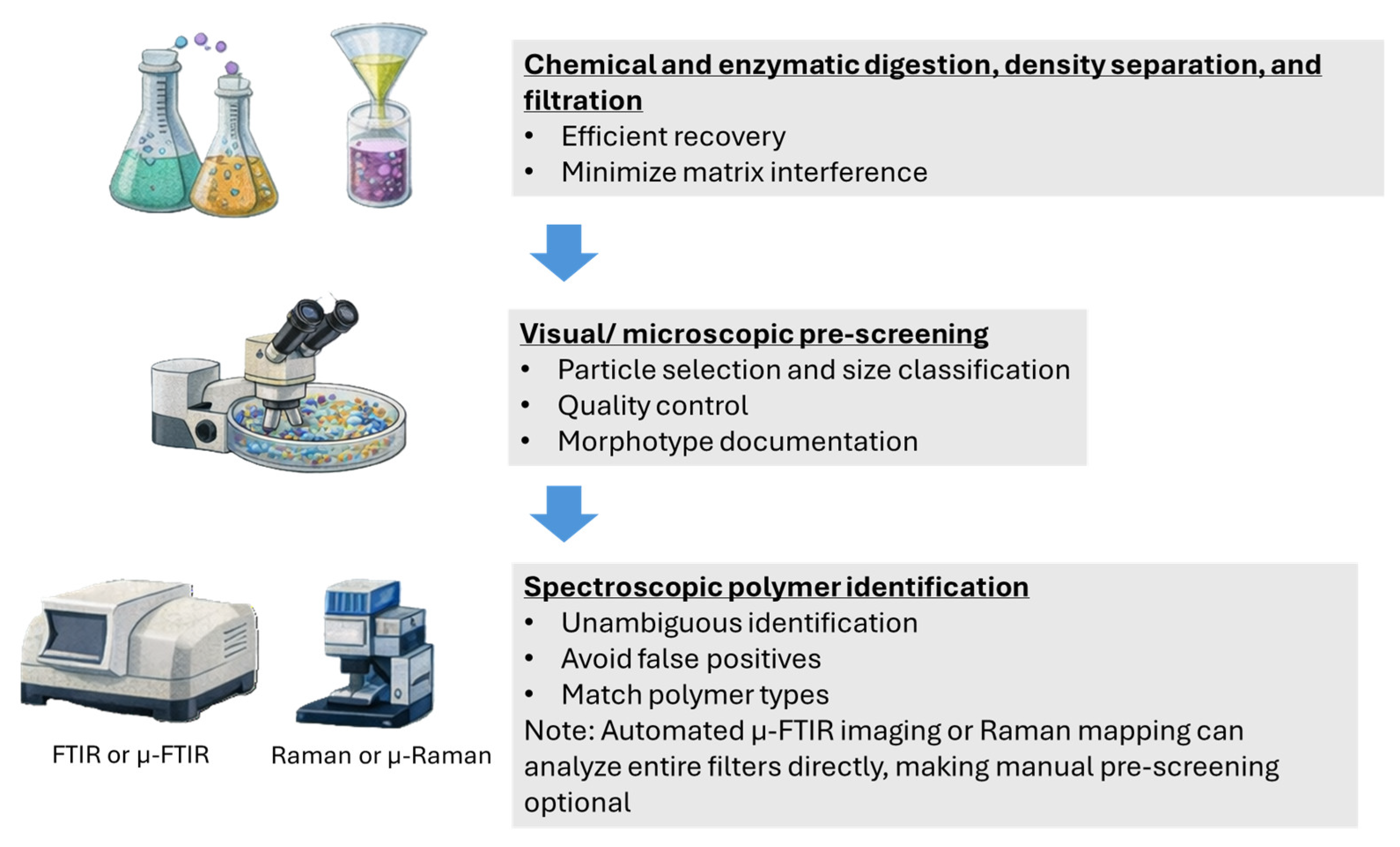
Overall, sessile or low-mobility organisms with simple or well-defined tissues consistently show the strongest methodological advantages. Bivalves, barnacles, sponges, sea anemones, and some crustaceans stand out in this respect. These organisms are generally easy to sample ethically and repeatedly, often without lethal collection, and are widely distributed, allowing for spatially and temporally replicated monitoring [29,44,65,72,89]. Their tissues permit efficient chemical digestion and filtration, yielding high recovery rates of microplastics with manageable contamination risks. Importantly, microplastics extracted from these taxa are routinely identifiable using FTIR- or Raman-based techniques across a broad size range, enabling unambiguous polymer characterization. The extensive prior use of these organisms has also supported the development of standardized protocols, which enhance inter-laboratory comparability and reproducibility [73,97].
Bivalves exemplify methodological robustness. Their sedentary nature allows targeted site-specific sampling, composite sampling is easily standardized, and soft tissues, particularly digestive glands, are well-suited to oxidative or enzymatic digestion. FTIR and μ-FTIR identification is routine, and background contamination can be tightly controlled. Their widespread use in both marine and freshwater systems has led to harmonized workflows and strong reproducibility across laboratories [22,43,45].
Sponges and barnacles share similar strengths. Their ease of collection, suitability for whole-organism or tissue-based processing, and compatibility with spectroscopic identification techniques make them analytically efficient. Large biomass (sponges) or small, uniform body size (barnacles) facilitates subsampling and protocol standardization, while archived specimens further support reproducibility and retrospective analyses [39,72].
Crustaceans, including fiddler crabs, crayfish, and other benthic species, also perform well methodologically. Established trapping methods allow ethical and repeatable sampling, and digestive tissues are robust enough to withstand standardized digestion protocols. FTIR-based polymer identification is well established, and handling losses are relatively low, supporting consistent results across studies [68,69].
In contrast, organisms with fragile or complex tissue matrices present greater methodological challenges. Jellyfish, while analytically tractable, are limited by high water content, gelatinous tissues, and strong seasonal and spatial variability. These factors complicate standardized laboratory processing, increase sensitivity to contamination, and reduce inter-laboratory reproducibility, despite the feasibility of FTIR-based identification [75,76].
Fish occupy an intermediate methodological position. Many species are readily available through fisheries and routine monitoring programs, and gastrointestinal tracts allow straightforward microplastic extraction and spectroscopic identification [34,53]. However, dissection requirements, species-specific anatomical differences, and generally low particle numbers necessitate larger sample sizes and careful harmonization of protocols. Standardization is achievable, particularly through guild-based or multi-species approaches, but methodological complexity is higher than for sessile taxa. Within fishes, lanternfishes demonstrate particularly strong methodological promise. Their high abundance, accessibility through standardized nocturnal sampling, and demonstrated compatibility with archived museum specimens support both contemporary and retrospective analyses. Successful FTIR-based identification from historical samples highlights their value for reproducible, long-term monitoring [59].
Terrestrial insects, specifically carabid beetles, extend methodological suitability into soil environments. They are widely distributed, abundant, and easily sampled using standardized pitfall traps. Whole-gut extraction followed by oxidative digestion and μ-FTIR allows reliable microplastic recovery and polymer identification. Notably, the avoidance of species-level identification simplifies workflows and enhances reproducibility across regions, while laboratory contamination can be effectively controlled [80].
Birds contribute methodological strengths primarily through ethical sampling strategies and standardized tissue analysis. Necropsy-based sampling of deceased individuals avoids harm, and both respiratory and digestive tissues are amenable to microplastic extraction and µ-FTIR identification [82]. Established protocols for species such as the Northern Fulmar further strengthen methodological consistency, supported by international monitoring frameworks, accessibility via strandings or bycatch, and harmonized laboratory procedures [23,94,96].
Finally, sea turtles, particularly Green and Loggerhead Turtles, demonstrate high methodological robustness despite their protected status. Ethical sampling through strandings and fisheries bycatch is well established, and large gastrointestinal tracts facilitate standardized processing, efficient extraction, and polymer identification using FTIR or Raman spectroscopy. Long-term monitoring programs in multiple regions further enhance methodological consistency, comparability, and reproducibility across laboratories [24,38,83].
In summary, from a strictly methodological and practical perspective, bivalves, sponges, barnacles, crustaceans, and sea anemones offer the highest analytical efficiency and reproducibility. Fish, birds, beetles, and sea turtles are also methodologically viable when standardized protocols and ethical sampling frameworks are applied, while jellyfish remain constrained by practical and processing limitations.
Detection of microplastics in biological matrices inherently benefits from a combination of complementary analytical methods, rather than reliance on a single technique. Most biomonitoring studies employ a multi-step workflow consisting of (i) optimized extraction and digestion, (ii) visual or microscopic pre-screening, and (iii) spectroscopic polymer identification [22,34,80]. Chemical or enzymatic digestion, followed by density separation and filtration, ensures efficient particle recovery while minimizing matrix interference, particularly in organisms with simple or well-defined tissues, such as bivalves, sponges, and barnacles (Figure 5) [47,63,72]. Subsequent microscopic screening enables size-based selection and quality control, but is insufficient for definitive identification (Figure 5). Therefore, spectroscopic confirmation using FTIR, μ-FTIR, or Raman spectroscopy is essential to unambiguously identify polymer types and avoid misclassification of natural particles (Figure 5) [45,65]. Combining FTIR-based techniques with Raman spectroscopy is particularly advantageous when targeting broad size ranges, as FTIR is well-suited to larger particles while Raman provides higher spatial resolution for smaller microplastics [98]. This integrative approach improves analytical robustness, reduces false positives, and enhances inter-laboratory reproducibility, which is critical for long-term and cross-ecosystem biomonitoring programs.
Nonetheless, the workflow should be standardized for particular bioindicators to ensure comparable results. Standardization should occur within a tiered, flexible framework rather than a single universal protocol, involving harmonized field sampling rules, taxon-appropriate digestion and extraction protocols, mandatory spectroscopic confirmation with defined particle-size cutoffs, and uniform contamination control and QA/QC procedures.

7. Conclusions

This review highlights that the most appropriate microplastic bioindicators are those combining ecological relevance, physiological retention, and methodological robustness. Sessile or low-mobility organisms with clear and predictable exposure pathways, sufficient retention of microplastics, and compatibility with standardized analytical workflows are most effective.
In aquatic systems, marine sponges, bivalves (clams and mussels), barnacles (Amphibalanus amphitrite), sea anemones, and sediment-associated crustaceans (fiddler crabs and crayfish) emerge as the most reliable indicators. Their sedentary nature enables spatially explicit interpretation of contamination, while tissue properties allow efficient microplastic extraction and unambiguous polymer identification via FTIR or Raman spectroscopy. Established protocols, contamination control, and inter-laboratory reproducibility further enhance their suitability for long-term monitoring.
Fish provide habitat-specific insights but require multi-species approaches due to mobility, short gut residence, and species-specific feeding, with lanternfishes showing particular promise for mesopelagic monitoring. Sea turtles integrate exposure at regional and basin scales through long gut retention and defined foraging areas, although mobility and protected status limit local monitoring. Birds, including aerial insectivores and marine species like Northern Fulmars, contribute to atmospheric and surface-ocean microplastic monitoring, especially seasonally, but with lower spatial resolution. Carabid beetles are promising for terrestrial soil monitoring, reflecting presence and relative exposure, though limited retention reduces their capacity for cumulative assessment. Studies on jellyfish as microplastic bioindicators are relatively limited, and the available ones indicate their high mobility, seasonal occurrence, lack of correlation with environmental microplastics, fragile tissues, and rapid digestion, which reduce their reliability for quantitative monitoring.
These findings indicate that effective monitoring should prioritize environment-specific, multi-taxon frameworks that integrate complementary spatial and temporal scales. Future research should strengthen quantitative links between environmental microplastics and internal burdens, expand long-term and retrospective analyses, refine polymer- and size-specific bioindicator applications, and integrate biological data with physicochemical monitoring and modeling. Such approaches will enhance reproducibility, comparability, and policy relevance of microplastic biomonitoring, supporting informed environmental risk assessment and management.

Funding

This research received no external funding.

Institutional Review Board Statement

Not applicable.

Informed Consent Statement

Not applicable.

Data Availability Statement

This review paper does not report original data. All data presented or discussed are derived from previously published studies, which are cited throughout the manuscript. No new datasets were generated or analyzed for this study.

Acknowledgments

The author wishes to thank the University of Arizona for the administrative support provided.

Conflicts of Interest

The author declares no conflicts of interest.

References

  1. Tang, K.H.D. Microplastics in and Near Landlocked Countries of Central and East Asia: A Review of Occurrence and Characteristics. Trop. Aquat. Soil Pollut. 2023, 3, 120–130. [Google Scholar] [CrossRef]
  2. Caruso, G.; Bergami, E.; Singh, N.; Corsi, I. Plastic occurrence, sources, and impacts in Antarctic environment and biota. Water Biol. Secur. 2022, 1, 100034. [Google Scholar] [CrossRef]
  3. Abel, S.M.; Wu, F.; Primpke, S.; Gerdts, G.; Brandt, A. Journey to the deep: Plastic pollution in the hadal of deep-sea trenches. Environ. Pollut. 2023, 333, 122078. [Google Scholar] [CrossRef] [PubMed]
  4. Thompson, R.C.; Courtene-Jones, W.; Boucher, J.; Pahl, S.; Raubenheimer, K.; Koelmans, A.A. Twenty years of microplastic pollution research—What have we learned? Science 2024, 386, eadl2746. [Google Scholar] [CrossRef] [PubMed]
  5. Tang, K.H. Counteracting the Harms of Microplastics on Humans: An Overview from the Perspective of Exposure. Microplastics 2025, 4, 47. [Google Scholar] [CrossRef]
  6. Tang, K.H. Combined Toxicity of Microplastics and Antimicrobials on Animals: A Review. Antibiotics 2025, 14, 896. [Google Scholar] [CrossRef]
  7. Tang, K.H. Effects of Microplastics on Bioavailability, Persistence and Toxicity of Plant Pesticides: An Agricultural Perspective. Agriculture 2025, 15, 356. [Google Scholar] [CrossRef]
  8. Li, Z.; Junaid, M.; Chen, G.; Wang, J. Interactions and associated resistance development mechanisms between microplastics, antibiotics and heavy metals in the aquaculture environment. Rev. Aquac. 2022, 14, 1028–1045. [Google Scholar] [CrossRef]
  9. Tang, K.H. Toxic Effects of Nanoplastics on Animals: Comparative Insights into Microplastic Toxicity. Environments 2025, 12, 429. [Google Scholar] [CrossRef]
  10. Tang, K.H.D. A review of the toxic effects of microplastics based on studies on mammals and mammalian cell lines. Environ. Sci. Adv. 2024, 3, 1669–1678. [Google Scholar] [CrossRef]
  11. Pastorino, P.; Barceló, D. Bioindicators selection in the strategies for monitoring microplastic pollution. Ecol. Indic. 2024, 166, 112337. [Google Scholar] [CrossRef]
  12. Kılıç, E.; Yücel, N. Microplastic occurrence in the gastrointestinal tract and gill of bioindicator fish species in the northeastern Mediterranean. Mar. Pollut. Bull. 2022, 177, 113556. [Google Scholar] [CrossRef]
  13. Wang, Z.; Wang, X.; Hu, C.; Ge, T.; Wang, L.; Xing, J.; He, X.; Zhao, Y. Comparative Evaluation of Analytical Techniques for Quantifying and Characterizing Polyethylene Microplastics in Farmland Soil Samples. Agriculture 2024, 14, 554. [Google Scholar] [CrossRef]
  14. Xu, J.-L.; Thomas, K.V.; Luo, Z.; Gowen, A.A. FTIR and Raman imaging for microplastics analysis: State of the art, challenges and prospects. Trends Anal. Chem. 2019, 119, 115629. [Google Scholar] [CrossRef]
  15. Bouzid, N.; Tassin, B.; Gasperi, J.; Dris, R. Sequential combination of micro-FTIR imaging spectroscopy and pyrolysis-GC/MS for microplastic quantification. Application to river sediments. Anal. Methods 2025, 17, 3781–3792. [Google Scholar] [CrossRef]
  16. Daoutakou, M.; Kintzios, S. Biosensors for Micro- and Nanoplastics Detection: A Review. Chemosensors 2025, 13, 143. [Google Scholar] [CrossRef]
  17. Maes, T.; Jessop, R.; Wellner, N.; Haupt, K.; Mayes, A.G. A rapid-screening approach to detect and quantify microplastics based on fluorescent tagging with Nile Red. Sci. Rep. 2017, 7, 44501. [Google Scholar] [CrossRef]
  18. Wander, L.; Vianello, A.; Vollertsen, J.; Westad, F.; Braun, U.; Paul, A. Exploratory analysis of hyperspectral FTIR data obtained from environmental microplastics samples. Anal. Methods 2020, 12, 781–791. [Google Scholar] [CrossRef]
  19. Khanam, M.M.; Uddin, M.K.; Kazi, J.U. Advances in machine learning for the detection and characterization of microplastics in the environment. Front. Environ. Sci. 2025, 13, 1573579. [Google Scholar] [CrossRef]
  20. de Jourdan, B.; Philibert, D.; Asnicar, D.; Davis, C.W. Microplastic biomonitoring studies in aquatic species: A review & quality assessment framework. Sci. Total Environ. 2024, 957, 177541. [Google Scholar] [CrossRef]
  21. Dettling, V.; Samadi, S.; Ratti, C.; Fini, J.-B.; Laguionie, C. Can natural history collection specimens be used as aquatic microplastic pollution bioindicators? Ecol. Indic. 2024, 160, 111894. [Google Scholar] [CrossRef]
  22. Cho, Y.; Shim, W.J.; Jang, M.; Han, G.M.; Hong, S.H. Nationwide monitoring of microplastics in bivalves from the coastal environment of Korea. Environ. Pollut. 2021, 270, 116175. [Google Scholar] [CrossRef]
  23. Savoca, M.S.; Kühn, S.; Sun, C.; Avery-Gomm, S.; Choy, C.A.; Dudas, S.; Hong, S.H.; Hyrenbach, K.D.; Li, T.-H.; Ng, C.K.-Y.; et al. Towards a North Pacific Ocean long-term monitoring program for plastic pollution: A review and recommendations for plastic ingestion bioindicators. Environ. Pollut. 2022, 310, 119861. [Google Scholar] [CrossRef]
  24. Fossi, M.C.; Pedà, C.; Compa, M.; Tsangaris, C.; Alomar, C.; Claro, F.; Ioakeimidis, C.; Galgani, F.; Hema, T.; Deudero, S.; et al. Bioindicators for monitoring marine litter ingestion and its impacts on Mediterranean biodiversity. Environ. Pollut. 2018, 237, 1023–1040. [Google Scholar] [CrossRef]
  25. Patra, I.; Huy, D.T.N.; Alsaikhan, F.; Opulencia, M.J.C.; Van Tuan, P.; Nurmatova, K.C.; Majdi, A.; Shoukat, S.; Yasin, G.; Margiana, R.; et al. Toxic effects on enzymatic activity, gene expression and histopathological biomarkers in organisms exposed to microplastics and nanoplastics: A review. Environ. Sci. Eur. 2022, 34, 80. [Google Scholar] [CrossRef]
  26. Compa, M.; Capó, X.; Alomar, C.; Deudero, S.; Sureda, A. A meta-analysis of potential biomarkers associated with microplastic ingestion in marine fish. Environ. Toxicol. Pharmacol. 2024, 107, 104414. [Google Scholar] [CrossRef] [PubMed]
  27. Curren, E.; Yu, D.C.Y.; Leong, S.C.Y. From the Seafloor to the Surface: A Global Review of Gastropods as Bioindicators of Marine Microplastics. Water Air Soil Pollut. 2023, 235, 45. [Google Scholar] [CrossRef]
  28. Carrasco, L.; Jiménez-Mora, E.; Utrilla, M.J.; Pizarro, I.T.; Reglero, M.M.; Rico-San Román, L.; Martin-Maldonado, B. Birds as Bioindicators: Revealing the Widespread Impact of Microplastics. Birds 2025, 6, 10. [Google Scholar] [CrossRef]
  29. Li, J.; Lusher, A.L.; Rotchell, J.M.; Deudero, S.; Turra, A.; Bråte, I.L.N.; Sun, C.; Shahadat Hossain, M.; Li, Q.; Kolandhasamy, P.; et al. Using mussel as a global bioindicator of coastal microplastic pollution. Environ. Pollut. 2019, 244, 522–533. [Google Scholar] [CrossRef]
  30. Savoca, M.S.; Abreo, N.A.; Arias, A.H.; Baes, L.; Baini, M.; Bergami, E.; Brander, S.; Canals, M.; Choy, C.A.; Corsi, I.; et al. Monitoring plastic pollution using bioindicators: A global review and recommendations for marine environments. Environ. Sci. Adv. 2025, 4, 10–32. [Google Scholar] [CrossRef]
  31. Castillo, N.A.; Swam-Jaramillo, L.M.; Rider, M.M.; Apeti, D.A.; Pisarski, E.C. A 2021 Assessment of Contaminants of Emerging Concern on the Mid-Atlantic Coast; NOAA Technical Memorandum NOS NCCOS 361; NOAA NCCOS Monitoring and Assessment Branch: Silver Spring, MD, USA, 2025.
  32. Larsen, M.; Hjermann, D. Status and Trend for Heavy Metals (Mercury, Cadmium and Lead) in Fish, Shellfish and Sediment. In OSPAR, 2023: The 2023 Quality Status Report for the Northeast Atlantic; OSPAR Commission: London, UK, 2022. [Google Scholar]
  33. van Franeker, J.A.; Kühn, S.; Anker-Nilssen, T.; Edwards, E.W.J.; Gallien, F.; Guse, N.; Kakkonen, J.E.; Mallory, M.L.; Miles, W.; Olsen, K.O.; et al. New tools to evaluate plastic ingestion by northern fulmars applied to North Sea monitoring data 2002–2018. Mar. Pollut. Bull. 2021, 166, 112246. [Google Scholar] [CrossRef] [PubMed]
  34. Valente, T.; Costantini, M.L.; Ventura, D.; Careddu, G.; Ciaralli, L.; Monfardini, E.; Tomassetti, P.; Piermarini, R.; Silvestri, C.; Matiddi, M. Hit the target: A new experimental method to select bioindicators of microplastic ingestion by marine fish. Environ. Res. 2025, 269, 120940. [Google Scholar] [CrossRef] [PubMed]
  35. French, M.A.; Lipizer, M. Improving data reliability to support marine pollution assessment according to MSFD Descriptor 8 in the European Seas: The contribution of EMODnet Chemistry. Front. Mar. Sci. 2023, 10, 1275097. [Google Scholar] [CrossRef]
  36. UNEP. Agenda item 7: Implementation of Decision IG 22/7 on IMAP and Articles 7 and 8 of the LBS Protocol. 2017. Available online: https://mcc.jrc.ec.europa.eu/documents/Decision_IG.22-7_IMAP_FINAL.pdf (accessed on 28 December 2025).
  37. Joyce, H.; Nash, R.; Frias, J.; White, J.; Cau, A.; Carreras-Colom, E.; Kavanagh, F. Monitoring microplastic pollution: The potential and limitations of Nephrops norvegicus. Ecol. Indic. 2023, 154, 110441. [Google Scholar] [CrossRef]
  38. Moon, Y.; Shim, W.J.; Han, G.M.; Jeong, J.; Cho, Y.; Kim, I.-H.; Kim, M.-S.; Lee, H.-R.; Hong, S.H. What type of plastic do sea turtles in Korean waters mainly ingest? Quantity, shape, color, size, polymer composition, and original usage. Environ. Pollut. 2022, 298, 118849. [Google Scholar] [CrossRef]
  39. Raufanda, M.S.; Prabowo, R.E.; Nuryanto, A. DNA barcoding of intertidal barnacles as potential bioindicators of microplastic pollution in Seribu Islands and Jakarta Bay, Indonesia. Biodiversitas J. Biol. Divers. 2024, 25, 4664–4676. [Google Scholar] [CrossRef]
  40. De Witte, B.; Catarino, A.I.; Vandecasteele, L.; Dekimpe, M.; Meyers, N.; Deloof, D.; Pint, S.; Hostens, K.; Everaert, G.; Torreele, E. Feasibility Study on Biomonitoring of Microplastics in Fish Gastrointestinal Tracts. Front. Mar. Sci. 2022, 8, 794636. [Google Scholar] [CrossRef]
  41. Mor, V.; Singh, W.; Khyalia, P. Potential Bioindicators of Microplastics for Monitoring Microplastic Pollution. In Microplastic Pollution in India and Its Environmental Impacts: Assessment of Ecosystems and Aquatic Environments, Impacts on Human Health, Management and Mitigation; Khyalia, P., Yadav, S., Eds.; Springer Nature: Cham, Switzerland, 2025; pp. 193–206. [Google Scholar]
  42. Multisanti, C.R.; Merola, C.; Perugini, M.; Aliko, V.; Faggio, C. Sentinel species selection for monitoring microplastic pollution: A review on one health approach. Ecol. Indic. 2022, 145, 109587. [Google Scholar] [CrossRef]
  43. Ding, J.; Sun, C.; He, C.; Li, J.; Ju, P.; Li, F. Microplastics in four bivalve species and basis for using bivalves as bioindicators of microplastic pollution. Sci. Total Environ. 2021, 782, 146830. [Google Scholar] [CrossRef]
  44. Qu, X.; Su, L.; Li, H.; Liang, M.; Shi, H. Assessing the relationship between the abundance and properties of microplastics in water and in mussels. Sci. Total Environ. 2018, 621, 679–686. [Google Scholar] [CrossRef]
  45. Su, L.; Cai, H.; Kolandhasamy, P.; Wu, C.; Rochman, C.M.; Shi, H. Using the Asian clam as an indicator of microplastic pollution in freshwater ecosystems. Environ. Pollut. 2018, 234, 347–355. [Google Scholar] [CrossRef]
  46. Woods, M.N.; Stack, M.E.; Fields, D.M.; Shaw, S.D.; Matrai, P.A. Microplastic fiber uptake, ingestion, and egestion rates in the blue mussel (Mytilus edulis). Mar. Pollut. Bull. 2018, 137, 638–645. [Google Scholar] [CrossRef]
  47. Ward, J.E.; Zhao, S.; Holohan, B.A.; Mladinich, K.M.; Griffin, T.W.; Wozniak, J.; Shumway, S.E. Selective Ingestion and Egestion of Plastic Particles by the Blue Mussel (Mytilus edulis) and Eastern Oyster (Crassostrea virginica): Implications for Using Bivalves as Bioindicators of Microplastic Pollution. Environ. Sci. Technol. 2019, 53, 8776–8784. [Google Scholar] [CrossRef]
  48. Pastorino, P.; Prearo, M.; Anselmi, S.; Menconi, V.; Bertoli, M.; Dondo, A.; Pizzul, E.; Renzi, M. Use of the Zebra Mussel Dreissena polymorpha (Mollusca, Bivalvia) as a Bioindicator of Microplastics Pollution in Freshwater Ecosystems: A Case Study from Lake Iseo (North Italy). Water 2021, 13, 434. [Google Scholar] [CrossRef]
  49. Liang, H.; Liu, S.; Sun, S.; Zhang, L.; Yu, M.; Tang, Y. The relationship of microplastic pollution between seawater and oyster: A holistic perspective for bioindicator selection. Ocean Coast. Manag. 2026, 273, 108052. [Google Scholar] [CrossRef]
  50. Zhu, J.; Wang, Z.; Li, W.; Hu, C.; Chen, Z.; Li, J.; Lan, W. From Spat to Adult: Investigating Microplastic Accumulation in Crassostrea hongkongensis of Varying Sizes. Environ. Sci. Technol. 2025, 59, 18372–18380. [Google Scholar] [CrossRef]
  51. Craig, C.A.; Fox, D.W.; Zhai, L.; Walters, L.J. In-situ microplastic egestion efficiency of the eastern oyster Crassostrea virginica. Mar. Pollut. Bull. 2022, 178, 113653. [Google Scholar] [CrossRef] [PubMed]
  52. Stamataki, N.; Hatzonikolakis, Y.; Tsiaras, K.; Tsangaris, C.; Petihakis, G.; Sofianos, S.; Triantafyllou, G. Modelling mussel (Mytilus spp.) microplastic accumulation. Ocean Sci. 2020, 16, 927–949. [Google Scholar] [CrossRef]
  53. Koutsikos, N.; Koi, A.M.; Zeri, C.; Tsangaris, C.; Dimitriou, E.; Kalantzi, O.-I. Exploring microplastic pollution in a Mediterranean river: The role of introduced species as bioindicators. Heliyon 2023, 9, e15069. [Google Scholar] [CrossRef]
  54. Dragun, Z.; Tepić, N.; Krasnići, N.; Teskeredžić, E. Accumulation of metals relevant for agricultural contamination in gills of European chub (Squalius cephalus). Environ. Sci. Pollut. Res. 2016, 23, 16802–16815. [Google Scholar] [CrossRef]
  55. Pacini, N.; Abate, V.; Brambilla, G.; De Felip, E.; De Filippis, S.P.; De Luca, S.; di Domenico, A.; D’Orsi, A.; Forte, T.; Fulgenzi, A.R.; et al. Polychlorinated dibenzodioxins, dibenzofurans, and biphenyls in fresh water fish from Campania Region, southern Italy. Chemosphere 2013, 90, 80–88. [Google Scholar] [CrossRef]
  56. Rios-Fuster, B.; Alomar, C.; Compa, M.; Guijarro, B.; Deudero, S. Anthropogenic particles ingestion in fish species from two areas of the western Mediterranean Sea. Mar. Pollut. Bull. 2019, 144, 325–333. [Google Scholar] [CrossRef]
  57. Ferreira, F.V.; Cividanes, L.S.; Gouveia, R.F.; Lona, L.M.F. An overview on properties and applications of poly(butylene adipate-co-terephthalate)–PBAT based composites. Polym. Eng. Sci. 2019, 59, E7–E15. [Google Scholar] [CrossRef]
  58. Li, J.; Qu, X.; Su, L.; Zhang, W.; Yang, D.; Kolandhasamy, P.; Li, D.; Shi, H. Microplastics in mussels along the coastal waters of China. Environ. Pollut. 2016, 214, 177–184. [Google Scholar] [CrossRef]
  59. Ferreira, G.V.B.; Justino, A.K.S.; Martins, J.R.; Eduardo, L.N.; Schmidt, N.; Albignac, M.; Braga, A.C.; Costa, P.A.S.; Fischer, L.G.; ter Halle, A.; et al. Lanternfish as bioindicator of microplastics in the deep sea: A spatiotemporal analysis using museum specimens. J. Hazard. Mater. 2025, 487, 137125. [Google Scholar] [CrossRef]
  60. Ding, J.; Ju, P.; Ran, Q.; Li, J.; Jiang, F.; Cao, W.; Zhang, J.; Sun, C. Elder fish means more microplastics? Alaska pollock microplastic story in the Bering Sea. Sci. Adv. 2023, 9, eadf5897. [Google Scholar] [CrossRef]
  61. Xu, X.Y.; Wong, C.Y.; Tam, N.F.Y.; Liu, H.M.; Cheung, S.G. Barnacles as potential bioindicator of microplastic pollution in Hong Kong. Mar. Pollut. Bull. 2020, 154, 111081. [Google Scholar] [CrossRef] [PubMed]
  62. Chiani, M.M.; Rasta, M.; Taleshi, M.S.; Elmi, F. The role of organisms’ size in microplastic pollution monitoring: Insights from Mytilaster lineatus and Amphibalanus improvisus. Mar. Environ. Res. 2025, 204, 106863. [Google Scholar] [CrossRef] [PubMed]
  63. Barrientos, E.E.; Tanoiri, H.; Yokota, M. Temporal variability of microplastics contaminant ingested by striped barnacles Amphibalanus amphitrite in tidal flat of the Tsurumi River estuary, Tokyo Bay Area, Japan. Reg. Stud. Mar. Sci. 2025, 85, 104127. [Google Scholar] [CrossRef]
  64. Aksun Tümerkan, E.T.; Köse, E.; Aksu, S.; Mol, O.; Kantamaneni, K.; Başkurt, S.; Çınar, E.; Emiroğlu, Ö. Beadlet anemone: A novel bio-indicator of microplastic pollution in the marine environment. J. Environ. Manag. 2024, 349, 119538. [Google Scholar] [CrossRef]
  65. Morais, L.M.S.; Sarti, F.; Chelazzi, D.; Cincinelli, A.; Giarrizzo, T.; Martinelli Filho, J.E. The sea anemone Bunodosoma cangicum as a potential biomonitor for microplastics contamination on the Brazilian Amazon coast. Environ. Pollut. 2020, 265, 114817. [Google Scholar] [CrossRef]
  66. Savage, G.; Porter, A.; Simpson, S.D. Uptake of microplastics by the snakelocks anemone (Anemonia viridis) is commonplace across environmental conditions. Sci. Total Environ. 2022, 836, 155144. [Google Scholar] [CrossRef]
  67. Lindeque, P.K.; Cole, M.; Coppock, R.L.; Lewis, C.N.; Miller, R.Z.; Watts, A.J.R.; Wilson-McNeal, A.; Wright, S.L.; Galloway, T.S. Are we underestimating microplastic abundance in the marine environment? A comparison of microplastic capture with nets of different mesh-size. Environ. Pollut. 2020, 265, 114721. [Google Scholar] [CrossRef]
  68. Xu, X.; He, L.; Huang, F.; Jiang, S.; Dai, Z.; Sun, R.; Li, C. Fiddler crabs (Tubuca arcuata) as bioindicators of microplastic pollution in mangrove sediments. Chemosphere 2024, 364, 143112. [Google Scholar] [CrossRef]
  69. Pastorino, P.; Anselmi, S.; Zanoli, A.; Esposito, G.; Bondavalli, F.; Dondo, A.; Pucci, A.; Pizzul, E.; Faggio, C.; Barceló, D.; et al. The invasive red swamp crayfish (Procambarus clarkii) as a bioindicator of microplastic pollution: Insights from Lake Candia (northwestern Italy). Ecol. Indic. 2023, 150, 110200. [Google Scholar] [CrossRef]
  70. Joyce, H.; Frias, J.; Kavanagh, F.; Lynch, R.; Pagter, E.; White, J.; Nash, R. Plastics, prawns, and patterns: Microplastic loadings in Nephrops norvegicus and surrounding habitat in the North East Atlantic. Sci. Total Environ. 2022, 826, 154036. [Google Scholar] [CrossRef] [PubMed]
  71. Johnson, J.; Peer, N.; Sershen; Rajkaran, A. Microplastic abundance in urban vs. peri-urban mangroves: The feasibility of using invertebrates as biomonitors of microplastic pollution in two mangrove dominated estuaries of southern Africa. Mar. Pollut. Bull. 2023, 196, 115657. [Google Scholar] [CrossRef] [PubMed]
  72. Girard, E.B.; Fuchs, A.; Kaliwoda, M.; Lasut, M.; Ploetz, E.; Schmahl, W.W.; Wörheide, G. Sponges as bioindicators for microparticulate pollutants? Environ. Pollut. 2021, 268, 115851. [Google Scholar] [CrossRef]
  73. Celis-Hernández, O.; Ávila, E.; Ward, R.D.; Rodríguez-Santiago, M.A.; Aguirre-Téllez, J.A. Microplastic distribution in urban vs pristine mangroves: Using marine sponges as bioindicators of environmental pollution. Environ. Pollut. 2021, 284, 117391. [Google Scholar] [CrossRef]
  74. Modica, L.; Lanuza, P.; García-Castrillo, G. Surrounded by microplastic, since when? Testing the feasibility of exploring past levels of plastic microfibre pollution using natural history museum collections. Mar. Pollut. Bull. 2020, 151, 110846. [Google Scholar] [CrossRef] [PubMed]
  75. Sucharitakul, P.; Pitt, K.A.; Welsh, D.T. Assessment of microplastics in discharged treated wastewater and the utility of Chrysaora pentastoma medusae as bioindicators of microplastics. Sci. Total Environ. 2021, 790, 148076. [Google Scholar] [CrossRef]
  76. Iliff, S.M.; Wilczek, E.R.; Harris, R.J.; Bouldin, R.; Stoner, E.W. Evidence of microplastics from benthic jellyfish (Cassiopea xamachana) in Florida estuaries. Mar. Pollut. Bull. 2020, 159, 111521. [Google Scholar] [CrossRef]
  77. González-Paredes, D.; Ariel, E.; David, M.F.; Ferrando, V.; Marsh, H.; Hamann, M. Gastrointestinal transit times in juvenile green turtles: An approach for assessing digestive motility disorders. J. Exp. Mar. Biol. Ecol. 2021, 544, 151616. [Google Scholar] [CrossRef]
  78. Fukuoka, T.; Yamane, M.; Kinoshita, C.; Narazaki, T.; Marshall, G.J.; Abernathy, K.J.; Miyazaki, N.; Sato, K. The feeding habit of sea turtles influences their reaction to artificial marine debris. Sci. Rep. 2016, 6, 28015. [Google Scholar] [CrossRef] [PubMed]
  79. Lynch, J.M. Quantities of Marine Debris Ingested by Sea Turtles: Global Meta-Analysis Highlights Need for Standardized Data Reporting Methods and Reveals Relative Risk. Environ. Sci. Technol. 2018, 52, 12026–12038. [Google Scholar] [CrossRef] [PubMed]
  80. Meacci, S.; Orsini, M.; Pittura, L.; Nardi, A.; Gorbi, S.; Regoli, F.; Abulebda, A.M.A.; Riolo, P.; Ruschioni, S. A pilot study to assess carabids (Coleoptera: Carabidae) as potential bioindicators of microplastics contamination in soils. Environ. Sustain. Indic. 2025, 27, 100729. [Google Scholar] [CrossRef]
  81. Kosewska, A.; Kędzior, R.; Nietupski, M.; Borkowski, J. Epigeic Carabids (Coleoptera, Carabidae) as Bioindicators in Different Variants of Scots Pine Regeneration: Implication for Forest Landscape Management. Sustainability 2023, 15, 13322. [Google Scholar] [CrossRef]
  82. Wayman, C.; Fernández-Piñas, F.; Fernández-Valeriano, R.; García-Baquero, G.A.; López-Márquez, I.; González-González, F.; Rosal, R.; González-Pleiter, M. The potential use of birds as bioindicators of suspended atmospheric microplastics and artificial fibers. Ecotoxicol. Environ. Saf. 2024, 282, 116744. [Google Scholar] [CrossRef]
  83. Thibault, M.; Hoarau, L.; Lebreton, L.; Le Corre, M.; Barret, M.; Cordier, E.; Ciccione, S.; Royer, S.-J.; Ter Halle, A.; Ramanampamonjy, A.; et al. Do loggerhead sea turtle (Caretta caretta) gut contents reflect the types, colors and sources of plastic pollution in the Southwest Indian Ocean? Mar. Pollut. Bull. 2023, 194, 115343. [Google Scholar] [CrossRef]
  84. Bendell, L.I.; LeCadre, E.; Zhou, W. Use of sediment dwelling bivalves to biomonitor plastic particle pollution in intertidal regions; A review and study. PLoS ONE 2020, 15, e0232879. [Google Scholar] [CrossRef] [PubMed]
  85. Scott, N.; Porter, A.; Santillo, D.; Simpson, H.; Lloyd-Williams, S.; Lewis, C. Particle characteristics of microplastics contaminating the mussel Mytilus edulis and their surrounding environments. Mar. Pollut. Bull. 2019, 146, 125–133. [Google Scholar] [CrossRef] [PubMed]
  86. Baumsteiger, J.; O’Rear, T.A.; Cook, J.D.; Manfree, A.D.; Moyle, P.B. Factors affecting distribution and abundance of jellyfish medusae in a temperate estuary: A multi-decadal study. Biol. Invasions 2018, 20, 105–119. [Google Scholar] [CrossRef]
  87. Ory, N.C.; Sobral, P.; Ferreira, J.L.; Thiel, M. Amberstripe scad Decapterus muroadsi (Carangidae) fish ingest blue microplastics resembling their copepod prey along the coast of Rapa Nui (Easter Island) in the South Pacific subtropical gyre. Sci. Total Environ. 2017, 586, 430–437. [Google Scholar] [CrossRef]
  88. Roch, S.; Friedrich, C.; Brinker, A. Uptake routes of microplastics in fishes: Practical and theoretical approaches to test existing theories. Sci. Rep. 2020, 10, 3896. [Google Scholar] [CrossRef] [PubMed]
  89. Xu, X.; Fang, J.K.-H.; Wong, C.-Y.; Cheung, S.-G. Experimental accumulation of microplastics in acorn barnacle Amphibalanus amphitrite and its use in estimating microplastic concentration in coastal waters. Front. Mar. Sci. 2023, 9, 1081329. [Google Scholar] [CrossRef]
  90. Janßen, A.; Wizemann, A.; Klicpera, A.; Satari, D.Y.; Westphal, H.; Mann, T. Sediment Composition and Facies of Coral Reef Islands in the Spermonde Archipelago, Indonesia. Front. Mar. Sci. 2017, 4, 144. [Google Scholar] [CrossRef]
  91. Pilcher, N.J.; Rezaie-Atagholipour, M.; Ghavasi, M.; Dakhteh, S.M.; Shokri, M.R.; Javidkar, M.; Jensen, M. Population structure of green sea turtles at a foraging ground in the southeastern Persian Gulf. Front. Mar. Sci. 2025, 12, 1572931. [Google Scholar] [CrossRef]
  92. Baak, J.E.; Linnebjerg, J.F.; Barry, T.; Gavrilo, M.V.; Mallory, M.L.; Price, C.; Provencher, J.F. Plastic ingestion by seabirds in the circumpolar Arctic: A review. Environ. Rev. 2020, 28, 506–516. [Google Scholar] [CrossRef]
  93. Collard, F.; Ask, A. Plastic ingestion by Arctic fauna: A review. Sci. Total Environ. 2021, 786, 147462. [Google Scholar] [CrossRef]
  94. Trevail, A.M.; Gabrielsen, G.W.; Kühn, S.; Van Franeker, J.A. Elevated levels of ingested plastic in a high Arctic seabird, the northern fulmar (Fulmarus glacialis). Polar Biol. 2015, 38, 975–981. [Google Scholar] [CrossRef]
  95. Tulatz, F.; Gabrielsen, G.W.; Bourgeon, S.; Herzke, D.; Krapp, R.; Langset, M.; Neumann, S.; Lippold, A.; Collard, F. Implications of Regurgitative Feeding on Plastic Loads in Northern Fulmars (Fulmarus glacialis): A Study from Svalbard. Environ. Sci. Technol. 2023, 57, 3562–3570. [Google Scholar] [CrossRef] [PubMed]
  96. Collard, F.; Benjaminsen, S.C.; Herzke, D.; Husabø, E.; Sagerup, K.; Tulatz, F.; Gabrielsen, G.W. Life starts with plastic: High occurrence of plastic pieces in fledglings of northern fulmars. Mar. Pollut. Bull. 2024, 202, 116365. [Google Scholar] [CrossRef]
  97. Beyer, J.; Green, N.W.; Brooks, S.; Allan, I.J.; Ruus, A.; Gomes, T.; Bråte, I.L.N.; Schøyen, M. Blue mussels (Mytilus edulis spp.) as sentinel organisms in coastal pollution monitoring: A review. Mar. Environ. Res. 2017, 130, 338–365. [Google Scholar] [CrossRef] [PubMed]
  98. Zhang, Z.; Geng, Y.; Zhou, W.; Shao, X.; Lin, H.; Zhou, Y. Development of a multi-spectroscopy method coupling μ-FTIR and μ-Raman analysis for one-stop detection of microplastics in environmental and biological samples. Sci. Total Environ. 2024, 917, 170396. [Google Scholar] [CrossRef] [PubMed]
Figure 1. Criteria from biomonitoring programs and the included literature for bioindicators.
Applsci 16 01413 g001
Figure 2. Barnacles and sea anemones as bioindicators of microplastics.
Applsci 16 01413 g002
Figure 3. Characteristics of microplastics in crustaceans across habitats.
Applsci 16 01413 g003
Figure 4. Terrestrial microplastic bioindicators proposed.
Applsci 16 01413 g004
Figure 5. Workflow for microplastic recovery and characterization in biomonitoring studies.
Applsci 16 01413 g005
Table 1. Summary of bivalves and fish as microplastic bioindicators.
Study/LocationAnimal StudiedMicroplastic Abundance & CharacteristicsRelationship with EnvironmentBioindicator Implication
Lower trophic level—bivalves
Qingdao, China [43]Scallop (Chlamys farreri), mussel (Mytilus galloprovincialis), oyster (Crassostrea gigas), clam (Ruditapes philippinarum)0.5–3.3 items/ind.; fibers dominant; PVC & rayon common; 7–5000 µm (size)Clams correlated with sediment polymers; mussels correlated with water polymersClams suitable for sediment microplastics; mussels better for water microplastics
Global review of field and laboratory studies [29]Mussels0.05–259 items/g; microplastics ≥ 5 µm; dominant small size ranges (<1 mm)Strong similarity in morphotype and polymer with waterMussels reflect ambient microplastic pollution
25 coastal sites, China [44]Mussels (M. edulis, Perna viridis)Fibers dominant in water and mussels; more likely for smaller microplastics to be ingested; sizes of 0.25 to 1 mm dominant (48–76% of the total)Strong positive linear relationship between microplastic levels in seawater and in musselsConsistent, quantitative correlation supports mussels as bioindicators
22 coastal sites, China [58]Mussels (M. edulis)0.9–4.6 items g−1 and 1.5–7.6 items individual−1, with higher levels in wild mussels than in farmed ones; <250 µm in diameter dominant (17–79%); fibers most commonMicroplastic loads in mussels closely associated with environmental contamination levels, particularly the degree of surrounding human activityClear linkage between mussel burdens and environmental contamination
Laboratory ingestion studies [46]Mussels (M. edulis)Uptake reached 95% of the maximum ingestion rate (~5227 fibers h−1 at 13 fibers mL−1; 71% fibers were rejected as pseudofeces; average length of 459 ± 2.25 µmExposure to microplastics reduced mussel filtration rates, but mussel uptake and rejection dynamics are environmentally relevantQuantifiable relationship between microplastic level and uptake; mussels as integrators of microplastics rather than direct quantitative proxies
Laboratory ingestion studies [47]Eastern Oysters (Crassostrea virginica), Blue Mussels (M. edulis)Size-selective ingestion; high rejection of large particles/fibers (up to 98% for the largest); 19–1000 µm for PS microsphere and 75–1075 µm (length) × 30 µm (diameter) for nylon microfibersUptake not proportional to exposure because ingestion, rejection (pseudofeces), and egestion varied with particle size and shapeInternal microplastic burdens do not reliably mirror environmental conditions, limiting effectiveness as bioindicators
Lake Iseo, Italy [48]Zebra Mussel (D. polymorpha)Higher microplastic loads near wastewater treatment plant; PET dominant; 0.5–1.0 µm in diameter highest retention efficiencyMicroplastic abundance decreases with distance from sourceEffective freshwater microplastic bioindicator
Yangtze River Basin, China [45]Asian Clam (Corbicula fluminea)0.3–4.9 items/g; fibers dominant; microplastics closer to sediment patterns; 0.25–1 mm in diameter dominantStrong correlation with sediment and waterAsian Clam suitable sediment-focused bioindicator
Shandong, China [49]Oyster (C. gigas)No correlation with seawater abundance; distinct microplastic features; median particle size < 600 µm; fiber and fragment predominantInfluenced by growth, egestion, environmentOyster less reliable as microplastic bioindicator
South Korea nationwide [22]Oyster (C. gigas), mussel (M. edulis), Manila Clam (R. philippinarum)High detection frequency; similar microplastic features to seawater; particles < 300 µm dominant; fragments most commonCharacteristics (not abundance) aligned with waterSupports bivalves as qualitative bioindicators
Higher trophic level—fish (from low to high trophic levels)
Urban river, Athens (Greece) [53]Introduced chub (Squalius vardarensis)Microplastics in ~35% of fish; mean 1.7 ± 0.2 items ind−1; polymers mainly PE, polyvinyl alcohol, PP; mean dimension length of 2.55 mmMicroplastic occurrence reflected moderate water contamination; linked to urban runoff and riverine inputsWidely distributed, abundant, and generalist species suitable as freshwater microplastic bioindicator
Catalan coast, Spain [56]Bogue (Boops boops)Microplastics in 46% of samples; 0–6 items ind−1; mainly blue fragments (0.1–0.5 mm); PP dominant; sizes < 3 mm dominantHigher microplastic ingestion near urbanized, industrialized coastal areas; proximity to coastline increased exposureReflects spatial gradients of coastal microplastic pollution; useful for nearshore monitoring
Museum specimens, Brazil [59]Lanternfishes (Myctophidae), including Diaphus dumeriliiMicroplastics in 55% of specimens; mean 0.95 items individual−1; sizes 21–4982 μm; fibers and fragments common; PE dominantMicroplastic ingestion increased over time and varied with migratory behavior and depth; upper mesopelagic migrants most exposedStrong candidates for deep-sea bioindication due to abundance, distribution, and trophic role, though retention and selectivity remain uncertain
Northeastern Mediterranean [12]Commercial fish species (M. barbatus, Mullus surmuletus, Mugil cephalus, and Saurida undosquamis)Highest abundances occurred in the gut of M. cephalus from the Asi River estuary; most particles were black fibers smaller than 1 mm, with PE as the dominant polymerMicroplastic abundance in fish gills closely reflected surrounding environmental contamination, while gut burdens were additionally shaped by species-specific traits such as habitat use, feeding strategy, and particle characteristicsGill-associated microplastics provide a particularly direct signal of ambient environmental contamination, enabling these fish species as bioindicators
Bering Sea [60]Alaska pollock (Gadus chalcogrammus)Microplastics detected in 85% of samples; over one-third ingested particles were 100–500 µm; older fish contained larger microplastics with more diverse polymer typesMicroplastic features linked to those present in surrounding seawater;Alaska pollock can reflect regional microplastic contamination over extended spatial scales; age-related effects highlight the need for age-standardized sampling
Disclaimer/Publisher’s Note: The statements, opinions and data contained in all publications are solely those of the individual author(s) and contributor(s) and not of MDPI and/or the editor(s). MDPI and/or the editor(s) disclaim responsibility for any injury to people or property resulting from any ideas, methods, instructions or products referred to in the content.