Article

Effects of Polyvinyl Alcohol on the Early-Age Mechanical Properties and Carbon Uptake of Lime-Enriched Binders: A Comparative Study with Pure Lime and Portland Cement Systems

1
School of Civil Engineering, Wanjiang University of Technology, Ma’anshan 243031, China
2
College of Civil and Transportation Engineering, Hohai University, Nanjing 210098, China
*
Author to whom correspondence should be addressed.
Appl. Sci. 2026, 16(3), 1244; https://doi.org/10.3390/app16031244 (registering DOI)
Submission received: 24 December 2025 / Revised: 16 January 2026 / Accepted: 23 January 2026 / Published: 26 January 2026
(This article belongs to the Section Civil Engineering)

Abstract

With the development of novel production routes enabling near-zero emissions from lime manufacturing, the use of lime as a carbon-sequestering component in cementitious materials has attracted increasing attention. To address the intrinsically low early-age strength of lime-enriched binders (LP), this study investigates the modification effect of polyvinyl alcohol (PVA) on LP, with systematic comparisons to ordinary Portland cement (PO) and pure lime systems (LE). The results indicate that, in terms of mechanical performance, the incorporation of PVA significantly enhances the early-age strength of LP, particularly the flexural strength, which increases by 119.3%. In contrast, the strength of PO shows a certain degree of reduction after PVA addition. Regarding carbon uptake performance, the CO2 sequestration capacity of PO and LE increases by 16.8% and 16.9%, respectively, whereas that of LP slightly decreases by 5.5%. From the hydration perspective, both the heat release rate and cumulative heat of PO and LP are reduced after PVA incorporation. Combined with microstructural analysis, the mechanical enhancement of LP induced by PVA is mainly attributed to the polymer film-forming effect, which compensates for the negative impact caused by the inhibition of hydration.

1. Introduction

Global carbon emissions have exceeded 36.3 billion tons and continue to rise, posing severe challenges to achieving the 1.5 °C climate target [1]. Carbon mitigation in the cement industry is therefore a critical component of the global low-carbon transition. The application of carbon capture, utilization, and storage (CCUS) technologies in construction materials offers a promising pathway toward accelerating carbon neutrality. During the service life, hardened Portland cement exhibits a certain capacity for CO2 sequestration [2,3,4,5]; however, its primary carbon-sequestering phase, calcium hydroxide, is present in limited amounts, thereby restricting its overall carbonation potential [6].
Lime is an ancient construction material that dominated building practices prior to the advent of Portland cement. Owing to its strong CO2 absorption capacity and relatively simple chemical reactions, lime has regained attention in the design of carbon-sequestering construction materials [7,8,9]. Theoretically, one ton of hydrated lime can absorb up to 0.59 tons of CO2. Although lime production is still mainly based on the energy-intensive calcination of limestone, emerging technologies—such as calcium hydroxide recovery from waste streams and the use of renewable energy for calcination—have enabled production routes with carbon emissions lower than 0.59 tons per ton of lime, thus providing new opportunities for the development of near-zero-carbon building materials [10,11]. Consequently, extensive research has been conducted on lime-based cementitious materials [12,13]. Adesina et al. [14] reported that the incorporation of lime enhances the pozzolanic reaction of cementitious systems. A combination of rice husk ash and hydrated lime can replace 25% of traditional cement. Mehdipour et al. [15] demonstrated that lime-enriched binders can reduce the carbon footprint by up to 50% and clarified the influence of pore saturation on carbonation efficiency. Jia et al. [16] investigated the effects of ammonium carbonate on air-hardening lime mortars. The results showed that ammonium carbonate enhanced both the carbonation reaction and the early-age mechanical properties of the lime system. This improvement was mainly attributed to an increase in pores larger than 70 nm within the dense Ca(OH)2/CaCO3 composite, while the presence of amino groups also improved the aggregation behavior of nano calcium carbonate. Li et al. [9] investigated lime–fly ash carbon-sequestering binders and showed that optimizing carbonation parameters and introducing hydrothermal curing can significantly improve both carbon uptake and mechanical properties. Nevertheless, excessive replacement of cement with lime generally leads to a pronounced reduction in mechanical performance, particularly early-age strength. Therefore, identifying suitable additives to balance strength development and carbon sequestration remains a key challenge for lime-rich carbon-sequestering binders [17].
Polyvinyl alcohol (PVA) is a widely used polymer with good water solubility and cost-effectiveness. It has been extensively applied in the modification of construction materials [18,19,20,21] and has shown considerable potential for enhancing the CO2 capture efficiency of inorganic binders [22,23,24,25]. Zhu et al. [26] investigated the effect of self-crosslinked poly(vinyl alcohol) (PVA) on calcium–silicate–hydrate (C–S–H) gel. The results demonstrated that the introduction of a PVA film significantly enhanced the energy dissipation capacity of C–S–H, which was likely associated with a reduction in the pore size of the C–S–H gel and an increase in the average chain length of C–S–H. Wang et al. [27] modified high-performance conductive cement anode materials (HCCAMs) using PVA. Their results showed that the incorporation of 0.25 wt% PVA reduced the electrical conductivity by 8.21%, thereby mitigating ionic polarization reactions. In addition, the drying shrinkage and durability of the HCCAMs were improved. Kravchenko et al. [24] employed PVA to modify recycled concrete powder, and the results indicated that the carbon sequestration performance of the recycled concrete powder was enhanced after modification. Moreover, when an optimal treatment time was adopted, the mechanical properties were also improved. Wang et al. [17] investigated the effect of PVA on lime–cement composite carbon-sequestering binders (CSBs) and reported improved mechanical properties under both natural and accelerated carbonation conditions. Despite these advances, studies focusing on CSB systems with lime contents exceeding 50 wt% remain limited. In such lime-rich systems, the deterioration of early-age mechanical properties is even more pronounced. Further research is needed on how to improve the early strength of a CSB while minimizing its impact on carbon uptake performance.
In this study, lime is employed as the primary carbon-sequestering component, replacing 60 wt% of cement to formulate a lime-enriched binder (LP). Through mechanical testing, isothermal calorimetry, carbonation kinetics analysis, thermodynamic modeling, and microstructural characterization, the effects of PVA on LP under both natural and accelerated carbonation conditions are systematically investigated and compared with those of pure Portland cement (PO) and pure lime (LE) systems. The findings aim to provide insights for the development of effective additives for lime-rich carbon-sequestering cementitious materials.

2. Materials and Methods

2.1. Raw Materials

Ordinary Portland cement (OPC) was supplied by Anhui Conch Cement Co., Ltd. (Wuhu, China). The chemical composition of the cement is listed in Table 1. Polyvinyl alcohol (PVA 1795) was provided by Shanghai Aladdin Biochemical Technology Co., Ltd. (Shanghai, China), with a degree of alcoholysis of 92–94%. Calcium hydroxide was obtained from Chengdu Kelong Chemical Co., Ltd. (Chengdu, China).

2.2. Mix Proportions and Specimen Preparation

The mix proportions of the binders are summarized in Table 2. Three binder systems were investigated: ordinary Portland cement binder (PO), pure lime binder (LE), and lime–Portland cement composite binder (LP). A small dosage of polycarboxylate-based superplasticizer and cellulose ether was used to adjust the workability of fresh mixtures. Cubic specimens with dimensions of 40 mm × 40 mm × 40 mm were prepared for compressive strength tests, while prismatic specimens with dimensions of 10 mm × 2 mm × 2 mm were used for three-point flexural tests.
All raw materials were dry-mixed to achieve homogeneity and then mixed with water using a laboratory mixer (NJ-160, Wuxi Dingli Building Materials & Instruments, Wuxi, China). The fresh pastes were cast into molds, vibrated to remove entrapped air, and surface-finished. After casting, specimens were stored at room temperature and demolded after 24 h.
Two curing regimes were adopted: natural carbonation and accelerated carbonation. For natural carbonation, demolded specimens were stored in a curing room at 20 °C and 50% relative humidity until the designated testing age. For accelerated carbonation, specimens were placed in a curing chamber (20 ± 2 °C, 70% relative humidity) for 1 day after demolding, and then placed in a carbonation chamber (20 ± 2 °C, 70% relative humidity, and 20% CO2 concentration) for 1 day, and subsequently transferred to the curing chamber until testing.

2.3. Experimental Methods

2.3.1. Compressive and Flexural Strength Tests

Compressive strength tests were conducted on 40 mm × 40 mm × 40 mm cubic specimens using a universal testing machine (HG-YS600S, Jiangsu Zhuoheng Testing Technology Co., Ltd., Wuxi, China). Flexural strength tests were performed on 10 mm × 2 mm × 2 mm prismatic specimens using a hydraulic testing machine, and the loading rate was set as 1 mm/min. All mechanical tests were carried out at an age of 3 days. The strength reported is the average of three replicates.

2.3.2. Carbonation Kinetics

After demolding, specimens were first conditioned in a constant temperature and humidity chamber (20 °C, 70% relative humidity) to reach moisture equilibrium. Subsequently, the specimens were exposed in a carbonation chamber under controlled conditions (CO2 concentration of 20 ± 2%, relative humidity of 70 ± 5%, and temperature of 20 °C). The mass of the specimens was recorded at 0, 1, 2, 3, 4, 6, 24, 48, and 72 h to characterize the carbonation kinetics.

2.3.3. Thermodynamic Modeling

Thermodynamic simulations were performed using the GEMS V3.7 software, coupled with the CEMDATA18 database and PSI/Nagra thermodynamic database [28]. The equilibrium phase assemblage was calculated by minimizing the total Gibbs free energy of the system. The modeling was performed at 20 °C and 101 KPa. This approach, originally developed for fluid–rock geochemical systems, has been successfully adapted for cementitious materials and enables reliable prediction of phase evolution during carbonation.

2.3.4. Isothermal Calorimetry

The hydration heat of the binders was measured using an eight-channel isothermal calorimeter (TAM-AIR, TA Instruments, Newcastle, DE, USA). The heat flow and cumulative heat release were continuously monitored for 60 h and the temperature was set at 20 °C. Prior to testing, binder powders and water were mixed uniformly for 2 min, sealed in glass ampoules, and placed in the calorimeter sample cells.

2.3.5. Scanning Electron Microscopy (SEM)

Microstructural observations were conducted using a scanning electron microscope (EM-30AX, COXEM, Daejeon, Republic of Korea). Hardened specimens were crushed into small fragments with relatively flat surfaces, coated with gold, and examined under an accelerating voltage of 5.0 kV.

3. Results

3.1. Mechanical Properties

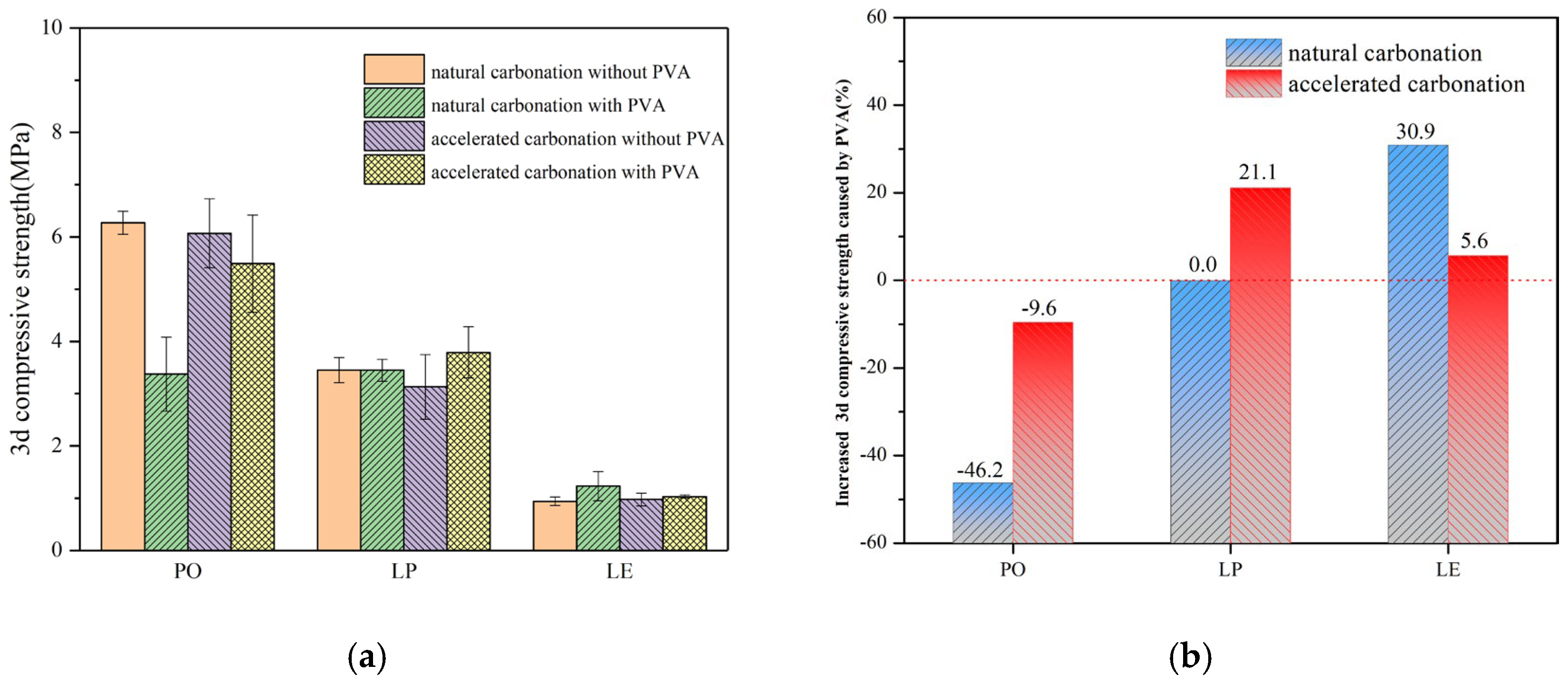
Figure 1 illustrates the effect of PVA on the early-age compressive strength of the carbon-sequestering binders. As shown in Figure 1a, under natural carbonation conditions and without PVA addition, PO exhibits the highest compressive strength, followed by LP, while LE shows the lowest strength. Under accelerated carbonation, the compressive strengths of LP and LE remain significantly lower than that of PO.
This behavior can be attributed to the lower intrinsic binding capacity and slower setting of lime compared with cement, resulting in higher strength for cement-rich systems. Cement hydrates at a relatively high rate, with hydration products dominated by calcium–silicate–hydrate (C–S–H) gel, the primary source of binding capacity. In contrast, the main carbonation product of lime is calcium carbonate, which has considerably weaker binding ability than C–S–H gel.
Moreover, compared with cement hydration, the carbonation reaction of lime proceeds at a much slower rate, with the reaction kinetics differing by orders of magnitude. Consequently, although accelerated carbonation can increase the reaction rate of lime and promote the formation of carbonation products, thereby leading to some improvement in mechanical performance, the resulting strength remains markedly lower than that of hardened cement-based systems.
After PVA incorporation, under natural carbonation, the compressive strengths of PO and LP become comparable and remain higher than that of LE. Under accelerated carbonation, the 3-day compressive strength follows the order PO > LP > LE.
Figure 1b presents the variation in 3-day compressive strength after PVA addition. Under natural carbonation, the greatest improvement occurs for LE, with a strength increase of 30.9%, which is likely associated with the formation of a continuous PVA film contributing to load transfer. In contrast, the compressive strength of PO decreases by 46.2%, probably due to the retardation of cement hydration induced by PVA. Under accelerated carbonation, PVA exhibits the most significant enhancement effect on LP, increasing its 3-day compressive strength by 21.1%, while LE shows a moderate increase of 5.6%. Meanwhile, the strength of PO decreases by 9.6%.
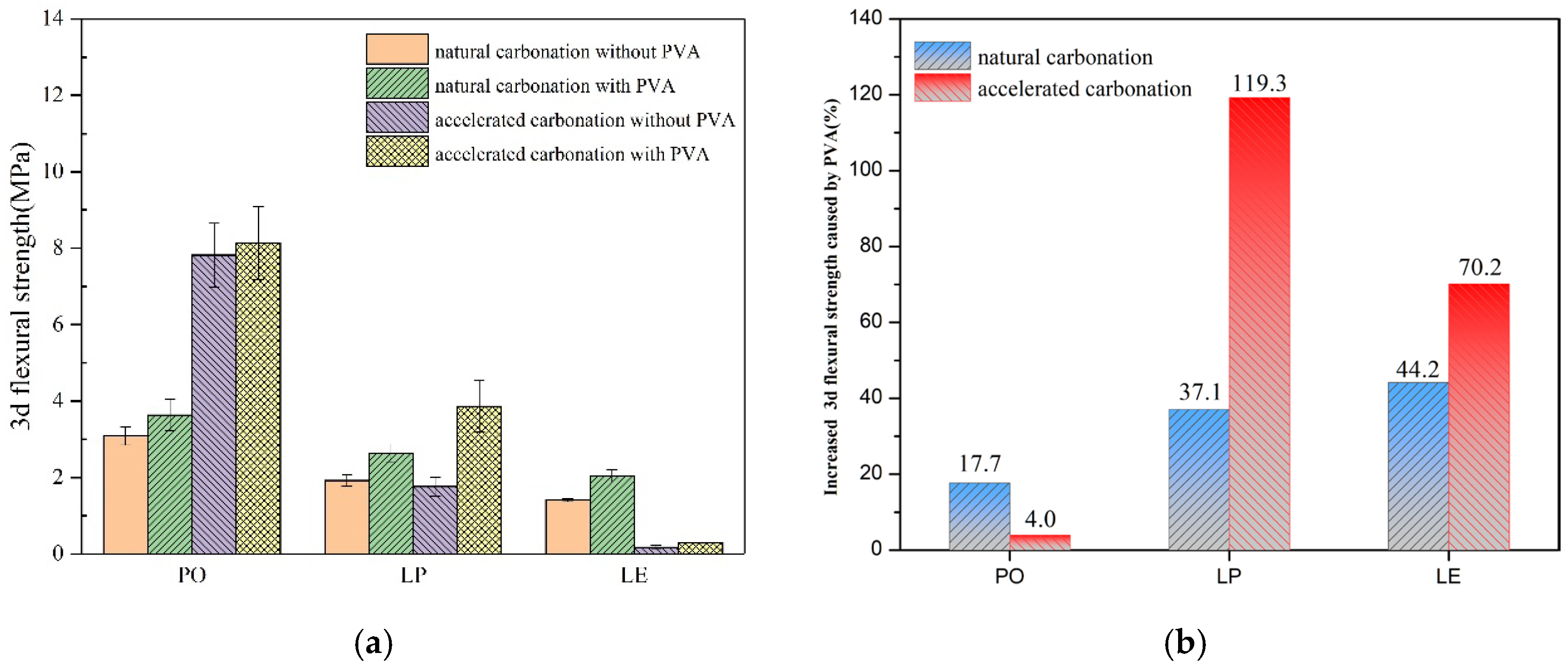
Figure 2 shows the influence of PVA on the early-age flexural strength of different binders. As illustrated in Figure 2a, regardless of the carbonation regime, PVA addition improves the flexural strength of all three binder systems. Figure 2b further quantifies the variation in 3-day flexural strength. Under natural carbonation, the flexural strength of PO, LP, and LE increases by 17.7%, 37.1%, and 44.2%, respectively. Under accelerated carbonation, the corresponding increases are 4.0%, 119.3%, and 70.62%, respectively. These results indicate that PVA is particularly effective in enhancing the flexural performance of lime-rich binders, especially under accelerated carbonation conditions. This may be attributed to the fact that the functional sites on the PVA film can induce the crystallization of calcium carbonate, while simultaneously forming strong interfacial bonding with lime and calcium carbonate crystals through interactions such as hydrogen bonding.

3.2. Carbonation Kinetics

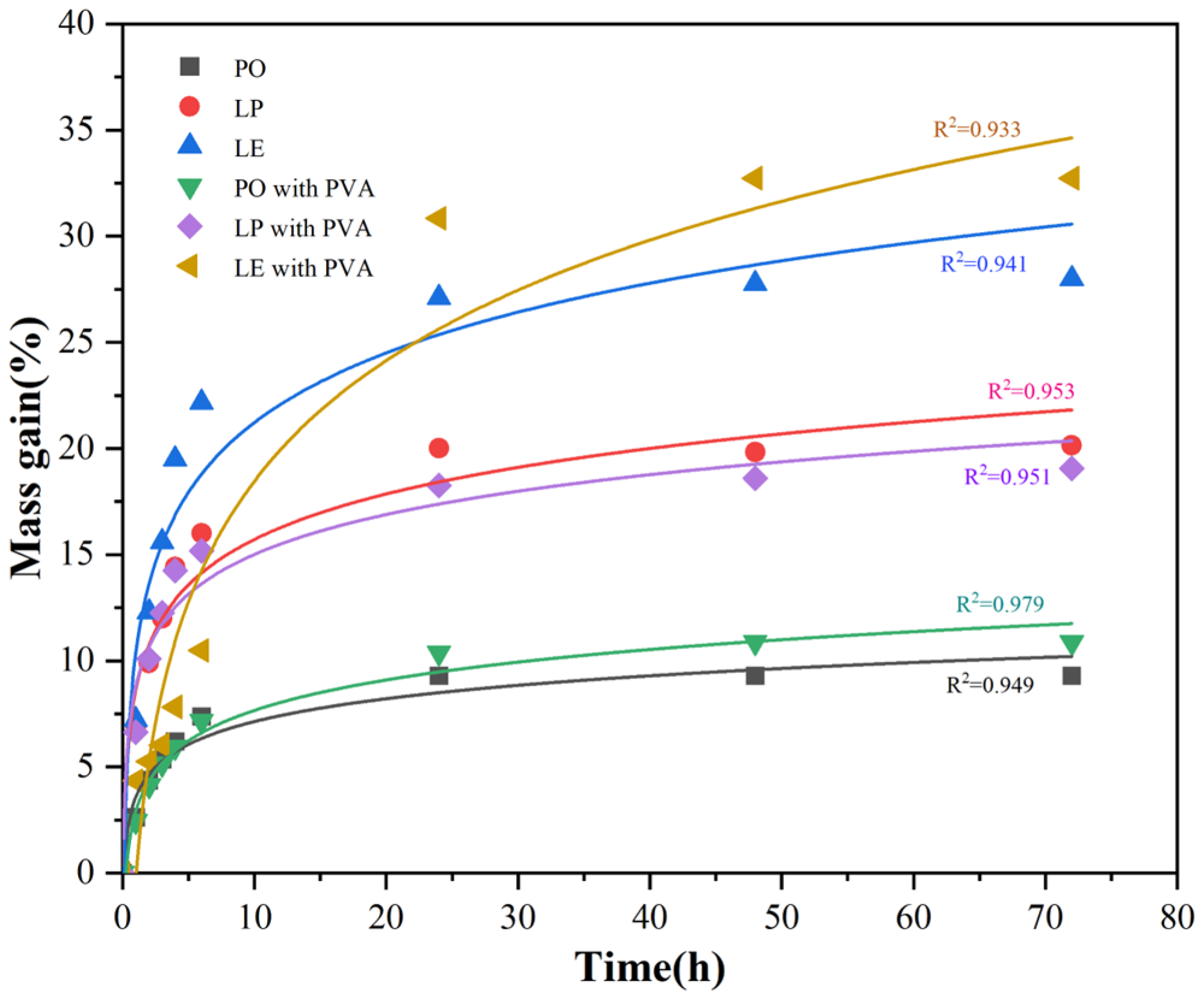
The carbonation kinetics of the binders were characterized by the mass change ratio, as shown in Figure 3. The Elovich equation [29] was employed to fit the relationship between mass change ratio and carbonation time:
S = a ln(t) + b
where S is the percentage mass change (%), t is the carbonation time (h), b represents the intrinsic carbonation capacity of the material, and a denotes the apparent carbonation rate.
As shown in Figure 3, regardless of PVA addition, the apparent carbonation rate consistently follows the order LE > LP > PO, which is mainly governed by binder composition. Lime-rich systems exhibit stronger reactivity with CO2. Table 3 summarizes the fitted parameters and correlation coefficients. After PVA addition, the apparent carbonation rate of PO and LE increases by 33.5% and 72.7%, respectively, whereas that of LP decreases by 12.2%. In terms of total CO2 uptake after 72 h, PVA increases the sequestration capacity of PO and LE by 16.8% and 16.9%, respectively, while that of LP slightly decreases by 5.5%.
PVA can form a continuous film within cementitious matrices. On the one hand, this film contributes to the enhancement of the mechanical properties of the matrix. On the other hand, when the PVA film is combined with inorganic phases, a porous structure may develop within the film [24], which can facilitate the localized transport of carbon dioxide and thereby further enhance carbon sequestration performance. In the LP system, the matrix itself is relatively porous, allowing carbon dioxide to be more readily transported and to participate in carbonation reactions. As a result, the introduction of PVA is mainly governed by the film effect. In contrast, PO and LE matrices are comparatively dense, and the additional porosity introduced by PVA becomes more significant, as it promotes the transport and reaction of carbon dioxide in the vicinity of the PVA film.

3.3. Thermodynamic Analysis

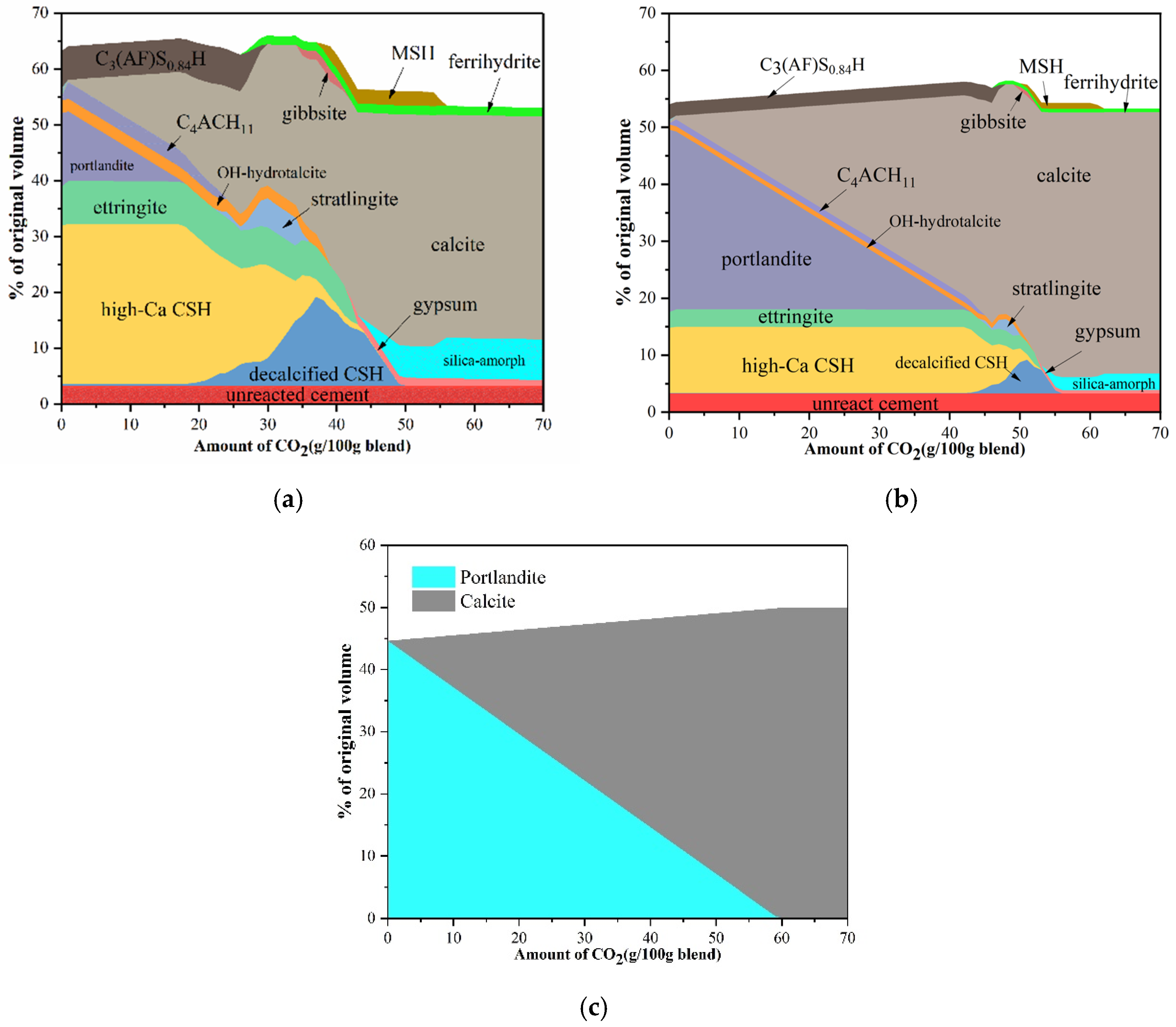
Figure 4 presents the phase evolution during carbonation as predicted by GEMS simulations. For PO, the primary hydration products include C–S–H, calcium hydroxide, ettringite, siliceous hydrogarnet solid solution, and hydroxylated hydrates. During carbonation, calcium hydroxide reacts first with CO2 to form calcium carbonate, while other phases show limited reactivity at this stage.
Once calcium hydroxide is depleted, high-calcium C–S–H starts to carbonate, producing low-calcium C–S–H and calcium carbonate. With further carbonation, low-calcium C–S–H continues to decompose until complete consumption. Ettringite carbonates only after most of the high-calcium C–S–H has reacted, whereas the siliceous hydrogarnet solid solution decomposes prior to ettringite. Upon full carbonation, the final solid phases are mainly calcium carbonate and amorphous silica.
The carbonation sequence and products of LP are similar to those of PO, but the higher calcium hydroxide content enables greater theoretical CO2 uptake. In the LE system, calcium hydroxide is the sole reactive phase, and carbonation proceeds through its gradual conversion to calcium carbonate.

3.4. Hydration Heat

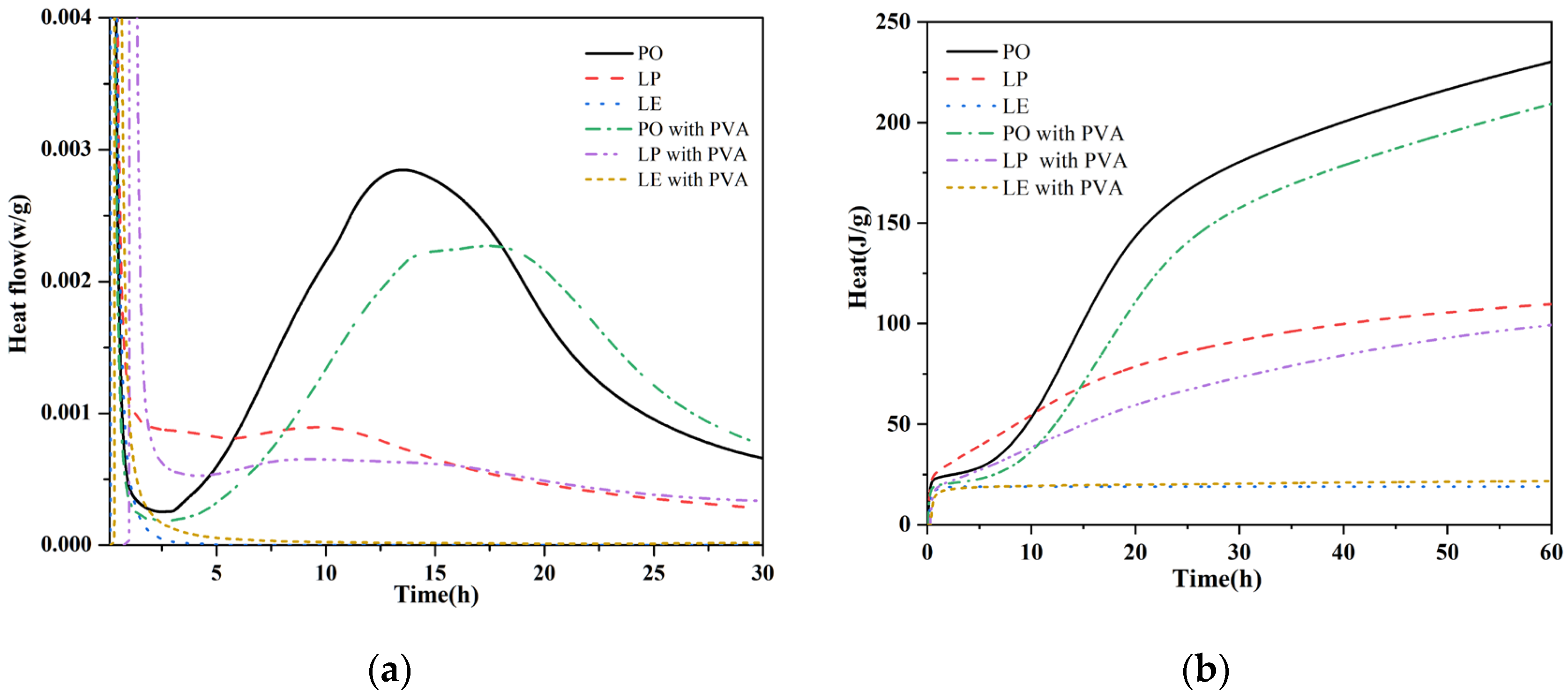
Figure 5 shows the effect of PVA on the hydration heat evolution of different binders. Both PO and LP exhibit two characteristic peaks: the first corresponds to the initial dissolution of mineral phases, while the second is associated with the accelerated hydration of cement. In contrast, LE shows only the initial dissolution peak due to the absence of hydraulic phases.
As shown in Figure 5a, PVA addition significantly retards the hydration of PO and LP. For PO, the induction period is not markedly affected, but the second peak occurs later, and its maximum heat flow is reduced. For LP, both the heat flow at the end of the induction period and the peak value of the second hydration peak decrease after PVA addition.
Since cement is the only hydraulic component in LP and the relative PVA dosage is higher than that in PO, the retardation effect is more pronounced. This hydration inhibition is likely caused by the adsorption of PVA on cement particle surfaces, which delays dissolution, as well as the adsorption of hydrolyzed PVA groups on hydration products, further hindering their growth [30].
Furthermore, the dissolution of PVA releases acetate groups, which hinder the formation of ettringite from the reaction between C3A and gypsum, thereby delaying the destruction of the protective layer on the surface of the reactants by ettringite. With an increasing amount of dissolved PVA, the conversion of ettringite to monosulphate is also accelerated, which further suppresses the hydration reactions [31].
Figure 5b presents the cumulative heat release. After PVA addition, the total heat release of PO and LP decreases, while that of LE remains nearly unchanged. At 60 h, the cumulative heat release of PO and LP decreases by 9.1% and 9.5%, respectively.

3.5. Microstructural Analysis

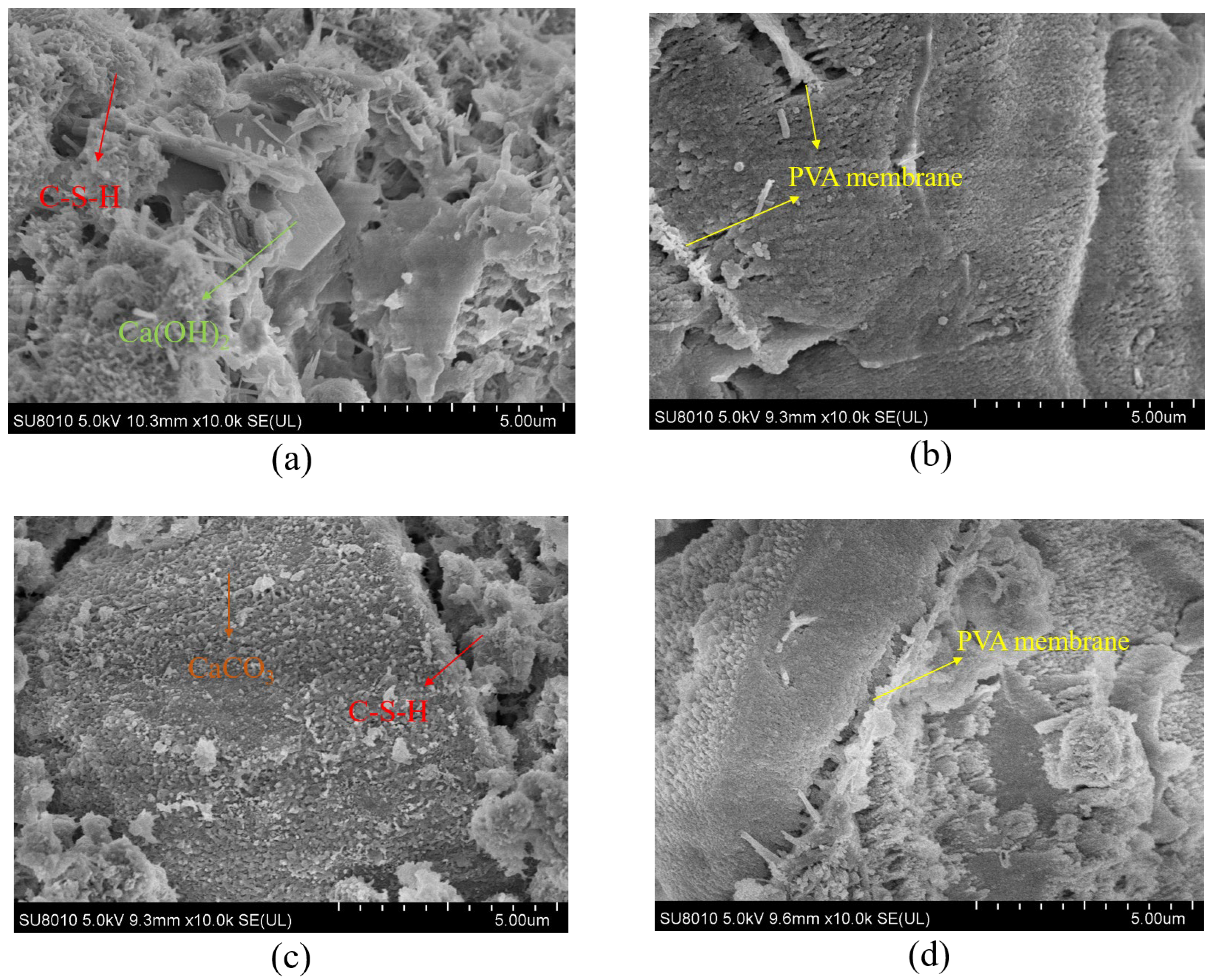
Figure 6 shows the microstructure of LP at 3 days under different conditions. Figure 6a illustrates the microstructure of LP after natural carbonation, where abundant clustered C–S–H gel and hexagonal plate-like Ca(OH)2 crystals are observed, with little visible calcium carbonate. Figure 6c shows the microstructure under accelerated carbonation, where cubic calcium carbonate crystals are clearly observed and the matrix appears denser.
Figure 6b,d present the microstructures of LP with PVA under natural and accelerated carbonation, respectively. Large amounts of clustered agglomerates are observed, which are attributed to the interaction between PVA and hydration products, forming a three-dimensional polymer–hydrate network. This network reduces internal porosity, bridges microcracks, absorbs external loading energy, and delays crack propagation, thereby enhancing the mechanical performance of the binder. The oxygen atoms in the hydroxyl groups of PVA exhibit a strong affinity for calcium atoms in hydration or carbonation products [32], thereby strengthening interfacial interactions and promoting good integrity between PVA and the matrix. This enhanced interfacial bonding also mitigates the inherently weak binding capacity of calcium carbonate.

4. Conclusions

This study investigated the effects of PVA on the early-age mechanical performance and carbon sequestration behavior of lime-enriched binders (LP), with comparisons to ordinary Portland cement (PO) and pure lime (LE) systems. The main conclusions are as follows:
(1)
PVA effectively improves the early-age mechanical properties of lime-enriched binders, particularly flexural strength. Under accelerated carbonation, the compressive strength of LP and LE increases by 21.1% and 5.6%, respectively, whereas that of PO decreases. The flexural strength of PO, LP, and LE increases by 4.0%, 119.3%, and 70.62%, respectively.
(2)
Carbonation kinetics analysis shows that PVA increases the carbonation rate and CO2 uptake of PO and LE, with increases of 16.8% and 16.9% in total CO2 sequestration, respectively. In contrast, the CO2 uptake of LP slightly decreases by 5.5% after PVA addition.
(3)
Thermodynamic modeling indicates that calcium hydroxide is the first phase to carbonate in all binder systems. Ettringite carbonates only after the near-complete reaction of high-calcium C–S–H, while siliceous hydrogarnet decomposes prior to ettringite.
(4)
Isothermal calorimetry results demonstrate that PVA reduces both the hydration rate and cumulative heat release of cement-containing binders, indicating a certain retardation effect on hydration.
(5)
Microstructural observations reveal that PVA forms polymer films within the LP matrix, bridging microcracks and contributing to the enhanced flexural strength of the binder.
In this study, the water-to-binder ratio and PVA dosage were fixed, and only one type of PVA was used. Further studies on how variations in material ratios and environmental conditions affect PVA-modified lime-based systems are needed.

Author Contributions

Conceptualization, Y.G.; methodology, X.Y. and X.W.; validation, C.Y.; formal analysis, X.Y.; investigation, X.Y. and C.Y.; resources, Y.G.; writing—original draft preparation, X.Y. and X.W.; writing—review and editing, Y.G.; visualization, C.Y.; supervision, Y.G.; project administration, Y.G.; funding acquisition, X.Y. All authors have read and agreed to the published version of the manuscript.

Funding

This research was funded by Major Scientific Research Projects (Natural Science Category) of Higher Education Institutions in Anhui Province (No. 2023AH040335) and The Open Fund of Ma’anshan Engineering Technology Research Center of Engineering Monitoring and Safety Monitoring (No. GCJC24003).

Institutional Review Board Statement

Not applicable.

Informed Consent Statement

Not applicable.

Data Availability Statement

Data will be made available on request.

Conflicts of Interest

The authors declare no conflicts of interest.

References

  1. Deng, Z.; Zhu, B.; Davis, S.J.; Ciais, P.; Guan, D.; Gong, P.; Liu, Z. Global carbon emissions and decarbonization in 2024. Nat. Rev. Earth Environ. 2025, 6, 231–233. [Google Scholar] [CrossRef]
  2. Xi, F.; Davis, S.J.; Ciais, P.; Crawford-Brown, D.; Guan, D.; Pade, C.; Shi, T.; Syddall, M.; Lv, J.; Ji, L.; et al. SP-Substantial global carbon uptake by cement carbonation. Nat. Geosci. 2016, 9, 880–883. [Google Scholar] [CrossRef]
  3. Sun, Y.; Zhang, C.; Wei, Y.-H.; Jin, H.; Shen, P.; Poon, C.S.; Yan, H.; Wei, X.-Y. Machine learning for efficient CO2 sequestration in cementitious materials: A data-driven method. npj Mater. Sustain. 2025, 3, 9. [Google Scholar] [CrossRef]
  4. Jungclaus, M.A.; Williams, S.L.; Arehart, J.H.; Srubar, W.V. Whole-life carbon emissions of concrete mixtures considering maximum CO2 sequestration via carbonation. Resour. Conserv. Recycl. 2024, 206, 107605. [Google Scholar] [CrossRef]
  5. Fan, D.; Zhang, C.; Li, X.; Lv, X.; Lu, J.-X.; Yu, R.; Noguchi, T.; Poon, C.S. Development of Foam Concrete toward High Strength and CO2 Sequestration. ACS Sustain. Chem. Eng. 2024, 12, 16622–16637. [Google Scholar] [CrossRef]
  6. Hanifa, M.; Agarwal, R.; Sharma, U.; Thapliyal, P.; Singh, L. A review on CO2 capture and sequestration in the construction industry: Emerging approaches and commercialised technologies. J. CO2 Util. 2023, 67, 102292. [Google Scholar] [CrossRef]
  7. Hwang, H.-Y.; Park, J.; Moon, J.; Kang, S.-H.; Hong, S.-G. Impact of in-situ CO2 injection on natural and accelerated carbonation performance of aerial lime mortar. Constr. Build. Mater. 2024, 449, 138469. [Google Scholar] [CrossRef]
  8. Mohan, M.; Singh, B.K. Enhanced Pozzolanic Activity of Crushed Brick Powder with Hydrated Lime: Concrete Durability Study. J. Mater. Civ. Eng. 2024, 36, 4024363. [Google Scholar] [CrossRef]
  9. Li, C.; Liu, B.; Li, Y.; Zheng, Q.; Fang, Y.; Zhao, Q.; Jiang, Z.; Li, J. Reaction mechanism of CaOH2-based carbon storage suitable for the production of building materials. Cem. Concr. Compos. 2024, 153, 105737. [Google Scholar] [CrossRef]
  10. Leão, A.; Collin, M.; Ghodkhande, S.; Bouissonnié, A.; Chen, X.; Malin, B.; Liu, Y.; Hovey, G.; Govindhakannan, J.; La Plante, E.; et al. ZeroCAL: Eliminating Carbon Dioxide Emissions from Limestone’s Decomposition to Decarbonize Cement Production. ACS Sustain. Chem. Eng. 2024, 12, 15762–15787. [Google Scholar] [CrossRef] [PubMed]
  11. Castaño, S.V.; La Plante, E.C.; Collin, M.; Sant, G.; Pilon, L. A pilot-process for calcium hydroxide production from iron slag by low-temperature precipitation. J. Environ. Chem. Eng. 2022, 10, 107792. [Google Scholar] [CrossRef]
  12. Rodriguez-Navarro, C.; Ilić, T.; Ruiz-Agudo, E.; Elert, K. Carbonation mechanisms and kinetics of lime-based binders: An overview. Cem. Concr. Res. 2023, 173, 107301. [Google Scholar] [CrossRef]
  13. Wu, M.; Zhang, Y.; Jia, Y.; She, W.; Liu, G.; Wu, Z.; Sun, W. Influence of sodium hydroxide on the performance and hydration of lime-based low carbon cementitious materials. Constr. Build. Mater. 2019, 200, 604–615. [Google Scholar] [CrossRef]
  14. Adesina, P.A.; Olutoge, F.A. Structural properties of sustainable concrete developed using rice husk ash and hydrated lime. J. Build. Eng. 2019, 25, 100804. [Google Scholar] [CrossRef]
  15. Mehdipour, I.; Falzone, G.; La Plante, E.C.; Simonetti, D.; Neithalath, N.; Sant, G.N. How Microstructure and Pore Moisture Affect Strength Gain in Portlandite-Enriched Composites That Mineralize CO2. ACS Sustain. Chem. Eng. 2019, 7, 13053–13061. [Google Scholar] [CrossRef]
  16. Jia, M.; Zhao, Y.; Wu, X.; Ma, X. The effect of carbonation accelerator on enhancing the carbonation process and mechanical strength of air-hardening lime mortars. Constr. Build. Mater. 2024, 425, 136067. [Google Scholar] [CrossRef]
  17. Wang, L.; Gu, Y.; Jiang, L.; Jin, W.; Guo, M.; Xia, K.; Yang, G. Hydrated Lime–Enriched CO2 Sequestration Binders Reinforced by Polyvinyl Alcohol. J. Mater. Civ. Eng. 2023, 35, 4023184. [Google Scholar] [CrossRef]
  18. Dong, D.; Huang, Y.; Gao, X.; Bian, Y.; Zhu, J.; Hou, P.; Chen, H.; Zhao, P.; Wang, S.; Lu, L. Effect of polyvinyl alcohol powder on the impermeability, frost resistance and pore structure of calcium sulfoaluminate cement concrete. Constr. Build. Mater. 2023, 409, 133858. [Google Scholar] [CrossRef]
  19. Xie, Z.; Yao, H.; Yuan, Q.; Zhong, F. The roles of water-soluble polymers in cement-based materials: A systematic review. J. Build. Eng. 2023, 73, 106811. [Google Scholar] [CrossRef]
  20. Qiao, G.; Zhao, Y.; Wang, P.; Hou, D.; Chen, B. Nanoscale measurement of adhesion forces and atomic-scale mechanisms at CSH/SiO2 and CSH/PVP-co-PAA interfaces. Cem. Concr. Res. 2025, 195, 107900. [Google Scholar] [CrossRef]
  21. Jia, J.; Zaoui, A.; Sekkal, W. Impact of polymer binders on the aggregation modes of two-pieces CSH composites. Cem. Concr. Res. 2025, 189, 107779. [Google Scholar] [CrossRef]
  22. Cao, D.; Gu, Y.; Jiang, L.; Jin, W.; Lyu, K.; Guo, M. Effect of polyvinyl alcohol on the performance of carbon fixation foam concrete. Constr. Build. Mater. 2023, 390, 131775. [Google Scholar] [CrossRef]
  23. Kravchenko, E.; Qin, C.; Lin, Z.; Ng, C.W.W. Effect of polyvinyl alcohol on the CO2 uptake of carbonated steel slag. Constr. Build. Mater. 2023, 375, 130761. [Google Scholar] [CrossRef]
  24. Kravchenko, E.; Lazorenko, G.; Besklubova, S.; Raza, M.H. Optimizing carbon dioxide sequestration in waste concrete powder through polymer treatment. J. Environ. Chem. Eng. 2025, 13, 117144. [Google Scholar] [CrossRef]
  25. Deng, Q.; Zhang, X.; Li, S.; Yu, Q. Long-term salt freeze-thaw resistance of polyvinyl alcohol (PVA) modified mortar: The role of molecular structure. Cem. Concr. Compos. 2025, 162, 106159. [Google Scholar] [CrossRef]
  26. Zhu, H.; Lan, X.; Zeng, X.; Long, G.; Xie, Y. Enhancement of the energy dissipation capacity C-S-H gel through self-crosslinking the poly (vinyl alcohol). Cem. Concr. Res. 2024, 185, 107648. [Google Scholar] [CrossRef]
  27. Wang, P.; Jia, L.; Li, W.; Jin, Z.; Nadeem, B.M.; Zhao, H.; Ji, X. Microstructure and property study of polyvinyl alcohol modified high performance conductive cementitious anode materials. Constr. Build. Mater. 2025, 495, 143664. [Google Scholar] [CrossRef]
  28. Shi, Z.; Lothenbach, B.; Geiker, M.R.; Kaufmann, J.; Leemann, A.; Ferreiro, S.; Skibsted, J. Experimental studies and thermodynamic modeling of the carbonation of Portland cement, metakaolin and limestone mortars. Cem. Concr. Res. 2016, 88, 60–72. [Google Scholar] [CrossRef]
  29. Zhang, L.; Dzombak, D.A.; Nakles, D.V.; Hawthorne, S.B.; Miller, D.J.; Kutchko, B.G.; Lopano, C.L.; Strazisar, B.R. Rate of H2S and CO2 attack on pozzolan-amended Class H well cement under geologic sequestration conditions. Int. J. Greenh. Gas Control 2014, 27, 299–308. [Google Scholar] [CrossRef]
  30. Nguyen, D.D.; Devlin, L.P.; Koshy, P.; Sorrell, C.C. Effects of chemical nature of polyvinyl alcohol on early hydration of Portland cement. J. Therm. Anal. Calorim. 2015, 123, 1439–1450. [Google Scholar] [CrossRef]
  31. Nguyen, D.D.; Devlin, L.P.; Koshy, P.; Sorrell, C.C. Effects of acetic acid on early hydration of Portland cement. J. Therm. Anal. Calorim. 2016, 123, 489–499. [Google Scholar] [CrossRef]
  32. Chen, Y.; Zheng, Y.; Zhou, Y.; Zhang, W.; Li, W.; She, W.; Liu, J.; Miao, C. Multi-layered cement-hydrogel composite with high toughness, low thermal conductivity, and self-healing capability. Nat. Commun. 2023, 14, 3438. [Google Scholar] [CrossRef] [PubMed]
Figure 1. Compressive strength of different carbon-sequestering binders at 3d: (a) compressive strength; (b) change rate.
Applsci 16 01244 g001
Figure 2. Flexural strength of different carbon-sequestering binders at 3d: (a) flexural strength; (b) change rate.
Applsci 16 01244 g002
Figure 3. Carbonation kinetics curve of different carbon-sequestering binders.
Applsci 16 01244 g003
Figure 4. Modeled phase assemblage of different carbon-sequestering binders under carbonation (a) PO; (b) LP; (c) LE.
Applsci 16 01244 g004
Figure 5. Effects of PVA on hydration rate of different carbon-sequestering binders: (a) differential profile; (b) cumulative profile.
Applsci 16 01244 g005
Figure 6. Micromorphology of LP: (a) natural carbonation; (b) natural carbonation with PVA; (c) accelerated carbonation; (d) accelerated carbonation with PVA.
Applsci 16 01244 g006
Table 1. Chemical compositions of OPC.
ComponentCaOSiO2Al2O3Fe2O3SO3MgOK2OL.O.I.
Content (wt%)62.8320.505.613.843.071.701.311.14
L.O.I.: Lost on ignition.
Table 2. Mix proportions of specimens.
IDWater/BinderCH/BinderCement/BinderPVA/Binder
OPC (without PVA)0.55010
LP (without PVA)0.550.60.40
LE (without PVA)0.55100
OPC (with PVA)0.55010.02
LP (with PVA)0.550.60.40.02
LE (with PVA)0.55100.02
Table 3. The fitted parameters and correlation coefficients.
abR2
PO1.553.560.949
LP3.098.590.953
LE4.7410.300.941
PO (with PVA)2.072.900.979
LP (with PVA)2.718.770.951
LE (with PVA)8.19−0.410.933
Disclaimer/Publisher’s Note: The statements, opinions and data contained in all publications are solely those of the individual author(s) and contributor(s) and not of MDPI and/or the editor(s). MDPI and/or the editor(s) disclaim responsibility for any injury to people or property resulting from any ideas, methods, instructions or products referred to in the content.