Article

Experimental and Molecular Dynamics Simulation Study on Influencing Factors of Barium Sulfate Scaling in Low-Permeability Sandstone Reservoirs


1
National Engineering Laboratory for Exploration and Development of Low-Permeability Oil and Gas Fields, Xi’an 710018, China
2
Xi’an Changqing Chemical Industry Group Co., Ltd., Xi’an 710021, China
3
Engineering Technology Research Center of Oil & Gas Storage and Transportation of Hubei Province, Wuhan 430100, China
4
School of Petroleum Engineering, Yangtze University, Wuhan 430100, China
5
Laboratory of Oil and Gas Drilling and Production Engineering of Hubei Province, Yangtze University, Wuhan 430100, China
*
Author to whom correspondence should be addressed.
Appl. Sci. 2026, 16(3), 1204; https://doi.org/10.3390/app16031204 (registering DOI)
Submission received: 23 December 2025 / Revised: 14 January 2026 / Accepted: 19 January 2026 / Published: 24 January 2026
(This article belongs to the Topic Advances in Oil and Gas Wellbore Integrity, 2nd Edition)

Abstract

This study aims to investigate the influencing factors and mechanisms of barium sulfate (BaSO4) scaling under low-permeability reservoir conditions, providing a scientific basis for water quality selection during water injection. The effects of key scaling ions and flow conditions on scaling behavior were examined through integrated experimental core flooding tests and molecular dynamics (MD) simulations. Experiments were conducted using synthetic cores simulating the ultra-low permeability Chang-8 Reservoir of the Jiyuan Oilfield, analyzing the impact of ion concentrations (Ba2+, SO42−, Na+, Ca2+, HCO3), flow velocity, and injection pressure. MD simulations were performed based on an interfacial SiO2(010)–BaSO4 solution model constructed in Materials Studio to elucidate the micro-mechanisms. Results indicate that increasing concentrations of Ba2+ and SO42− significantly promote scaling. High Ca2+ concentration (>8000 mg/L) inhibits BaSO4 deposition via competitive adsorption. High Na+ concentration (>70,000 mg/L) reduces Ba2+ activity due to ionic strength effects. When HCO3 concentration exceeds 600 mg/L, CaCO3 coprecipitation occurs, reducing effective SO42− concentration and thus inhibiting BaSO4 scaling. Increased flow velocity enhances scaling, whereas elevated injection pressure suppresses deposition. MD simulations reveal that increased ion concentrations decrease the mean square displacement (MSD) of Ba2+ and SO42−, weakening diffusion and enhancing scaling tendency. Elevated temperature promotes ion diffusion and inhibits scaling, while pressure shows negligible effect on ion diffusion at the molecular scale. This study provides theoretical insights for scaling prevention in low-permeability sandstone reservoirs.

1. Introduction

Low-permeability oil and gas reservoirs constitute a vital component of global energy supply, yet their efficient development presents numerous challenges [1]. Such reservoirs typically exhibit complex pore structures, extremely low permeability (often below 1 mD), and minute pore throat dimensions (frequently less than 200 nm) [2]. During water injection development in these reservoirs, incompatibility between the injected water and formation water readily induces mineral scaling. Among these, barium sulphate (BaSO4) deposits pose particular concern. Due to its extremely low solubility and the dense, hard nature of its crystals, once formed deep within the reservoir, it causes severe throat blockage. This leads to a sharp increase in injection pressure and a rapid decline in hydrocarbon production. Furthermore, conventional treatment methods using acids, alkalis, or chelating agents prove ineffective in removing such scale deposits [3,4,5]. Barium sulphate deposition primarily originates from an incompatibility reaction between formation water rich in barium ions (Ba2+) and injection water containing anions such as sulphate ions (SO42−) [6,7]. Therefore, a thorough understanding of its deposition patterns and microscopic mechanisms is crucial for optimising water injection schemes and preventing reservoir damage.
Currently, research methodologies for BaSO4 deposition can be broadly categorised into macroscopic and microscopic approaches. Macroscopic studies typically employ core displacement experiments to monitor ionic concentration variations and assess deposition trends based on solubility product theory, or utilise commercial software for geochemical modelling predictions. Whilst these methods reflect macroscopic patterns, they often entail high experimental costs, extended timelines, and struggle to elucidate dynamic processes and fundamental mechanisms at the pore scale. Microscopic investigations predominantly rely on characterisation techniques such as scanning electron microscopy (SEM) and X-ray diffraction (XRD) to observe post-depositional morphology and phase composition [8,9]. These approaches cannot capture in real time the dynamic initial stages of deposition, the mechanisms of interfacial reactions, or the microscopic effects of key environmental parameters (such as pressure, temperature, and ionic strength) [10,11]. These spatio-temporal observational limitations impede a profound understanding of deposition mechanisms.
With the advancement of computational materials science, molecular dynamics simulations have emerged as a powerful tool bridging microscopic atomic motion and macroscopic material properties, enabling the investigation of dynamic behaviour in complex systems across diverse temporal and spatial scales [12]. Depending on the scale and precision requirements of the investigated problem, different levels of MD simulation methods can be employed: Full-atom molecular dynamics simulations retain detailed information about all atoms in the system, utilising classical molecular force fields to describe interatomic interactions. They accurately depict atomic interactions and solvation effects, making them suitable for studying intricate processes such as interfacial adsorption and ionic coordination. Stanković et al. employed full-atom MD to reveal the critical influence of water content on the transport and thermodynamic properties of ionic liquids [13]. Ren et al. employed full-atom MD to investigate the adsorption behaviour of calcium carbonate in different phases on corroded surfaces, demonstrating that the presence of corrosion products further accelerates scale deposition rates [14]. Coarse-grained molecular dynamics significantly enhances the spatio-temporal resolution of simulations by merging multiple atoms into a single entity, making it suitable for investigating mesoscopic structures and transport phenomena in larger systems over extended time scales. Dašić et al. employed coarse-grained MD to investigate the flow and lubrication behaviour of ionic liquids under confined conditions [15]. Zhang et al. employed coarse-grained MD to investigate the freezing mechanism of pore water in calcium silicate hydrate [16]. For deposition reactions involving chemical bond formation and breaking, reactive molecular dynamics utilises reaction force fields to simulate chemical reactions, enabling studies of initial nucleation and interfacial reactions. Dašić et al. applied this method to investigate the tribological properties of materials such as vanadium oxide [17]. Yuan employed reactive MD to obtain detailed reaction insights during the pyrolysis of three typical single-component plasticiser systems—NG, BTTN, and Bu-NENA—including the decomposition of initial plasticiser molecules into radicals, followed by the development and stabilisation of radicals, revealing the microscopic mechanism of thermal reactions in typical energetic plasticisers [18]. Collectively, these approaches demonstrate that MD simulations offer flexible solutions to scientific problems across different scales. Their unique advantage lies in precisely controlling boundary conditions such as temperature and pressure, making them an ideal tool for elucidating the mechanisms of complex interfacial processes under multi-physics coupling.
In light of this, the present study employs simulated low-permeability sandstone cores to investigate the influence patterns of key depositional ions and flow conditions on BaSO4 deposition, aiming to provide a basis for selecting water quality for injection into low-permeability reservoirs. Concurrently, by integrating full-atom molecular dynamics simulations, the study elucidates the microscopic mechanisms through which pressure, temperature, and key ion concentrations influence the deposition process. This reveals the mechanism governing BaSO4 deposition on sandstone surfaces, thereby providing theoretical guidance for developing efficient scale prevention and removal technologies.

2. Materials and Methods

2.1. Materials

(1) Synthetic Cores: To accurately simulate the ultra-low permeability and micro-pore structure characteristics of the Chang 8 reservoir in the Jiyuan oilfield, synthetic cores were prepared using the following materials and techniques. The skeleton material comprised refined quartz sand with a mineral composition dominated by quartz (>99%), having a particle size range of 100–120 mesh. The binder comprised a 1:1 mass ratio mixture of bisphenol A epoxy resin E-44 and its curing agent (diethylenetriamine). The quartz sand and epoxy resin mixture were uniformly blended at a 1:0.15 mass ratio, then moulded under 40 MPa pressure and cured at 60 °C for 12 h. The simulated cores exhibited permeability values of 0.026–0.22 mD (average 0.078 mD) and porosity ranging from 8% to 12% (average 10.94%). Characterisation via high-pressure mercury porosimetry revealed throat radii predominantly distributed within the 0.1–1.0 μm range.
(2) Simulated Formation Water: Reference mineralisation levels of formation water in the Chang 8 reservoir of the Ji Yuan oilfield, Changqing Oilfield. As the simulated formation water contains Na+, K+, Ca2+, Mg2+, Ba2+, Sr2+, Cl, SO42−, and HCO3, wherein Ca2+, Mg2+, SO42−, and HCO3 may buffer the system and induce additional precipitation, we first prepare components prone to precipitation separately when formulating the simulated formation water. For instance, prepare CaCl2, BaCl2, K2SO4, and NaHCO3 solutions. During displacement experiments, these components were then mixed, with the system pH readjusted and maintained at 7 to ensure the final simulated water ion concentrations met the following specifications: Cations: Na+ + K+: 30,000 mg/L; Ca2+: 10,000 mg/L; Mg2+: 800 mg/L; Ba2+: 500 mg/L; Sr2+: 50 mg/L. Anions: Cl: 50,000 mg/L; SO42−: 500 mg/L (sulphate ions derived from injection water); HCO3: 600 mg/L. All salt solutions undergo pre-filtration through a 0.45-micron membrane to remove particulate matter.

2.2. Methods

(1) Core Flooding Experiment: The synthetic core was vacuumed and saturated with simulated formation water to establish irreducible water saturation. It was then placed in a core flooding apparatus. Simulated water with different ion concentrations was injected, or the injection velocity and pressure were varied. Effluent samples were collected at the core outlet every 10 min. The Ba2+ concentration in the effluent was determined using Inductively Coupled Plasma Optical Emission Spectrometry (ICP-OES). The amount of BaSO4 precipitated in the rock core was calculated by determining the Ba2+ and SO42− concentrations in the solution before and after the displacement experiment (ΔBa2+ = initial concentration—real-time concentration). The calculation method followed the classical mass conservation model [19], with the deposition mass formula shown in Equation (1).
m BaSO 4 = Δ Ba 2 +   ×   V effluent   ×   M BaSO 4 M Ba .
where MBaSO4 = 233.39g/mol, MBa2+ = 137.33g/mol.
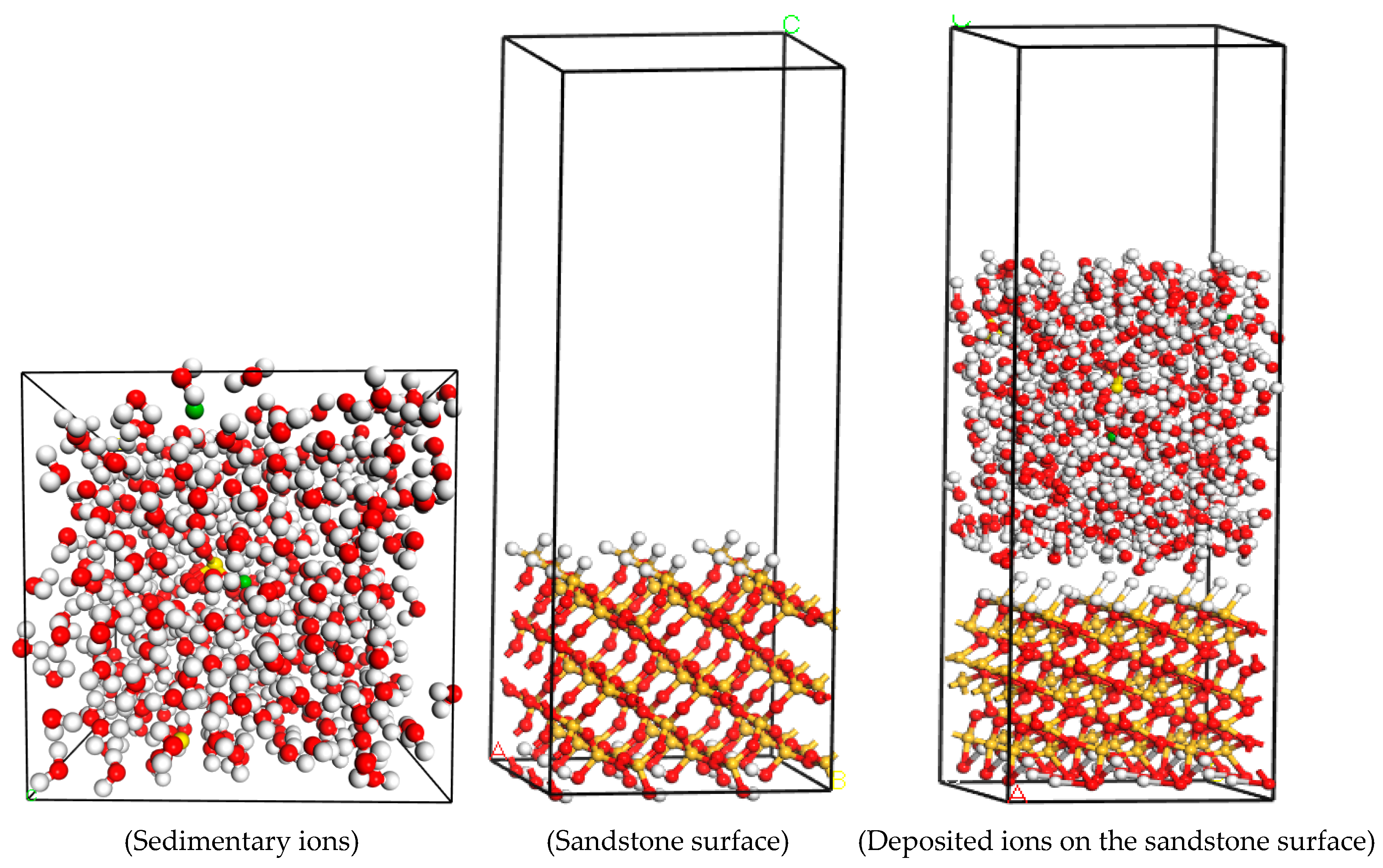
(2) Molecular Dynamics Simulation: The mineral composition of dense sandstone is dominated by quartz; therefore, quartz crystals were selected from the Materials Studio software package database to represent the sandstone [20,21,22]. To achieve a more realistic representation of the rock structure, after cutting the SiO2 (010) plane, the SiO2 surface undergoes hydroxylation treatment. This removes silicon atoms not forming tetrahedra and hydrogenates oxygen atoms bonded to only one silicon atom via unsaturated bonds, yielding a hydrophilic sandstone surface more consistent with actual conditions [23]. Considering the negative charge on the sandstone surface, only half of the unsaturated bond oxygen atoms were selected for hydrogenation during the hydrogenation process. A vacuum layer of 35 Å thickness was added above the solid surface, creating a periodic simulation box with dimensions of 16.2060 Å × 14.7300 Å × 42.1180 Å. The Amorphous Cell module was used to construct BaSO4 aqueous solution models containing different numbers of ion pairs (water molecules fixed at 500), followed by geometry optimization. The optimized solution model was placed above the sandstone surface, and the entire system was optimized again. The construction process is illustrated in Figure 1. The Forcite module with the Universal force field was used for geometry optimization, employing the Smart algorithm (Fine convergence criteria, Atom-based summation method) for 500 iterations to obtain the minimum energy configuration. To study the effect of ion concentration, systems containing 1 to 5 pairs of Ba2+ and SO42− ions, denoted as C1 to C5, were simulated at 303 K. To study the temperature effect, simulations were performed at temperatures ranging from 293 K to 363 K in 10 K increments. To study the pressure effect, the system temperature was fixed at 353 K, and pressures were set at 0.1, 5, 10, 15, 20, and 25 MPa.

3. Results and Discussion

3.1. Influence of Key Scaling Ions and Flow Conditions on Scaling Behavior

3.1.1. Influence of Key Scaling Ions

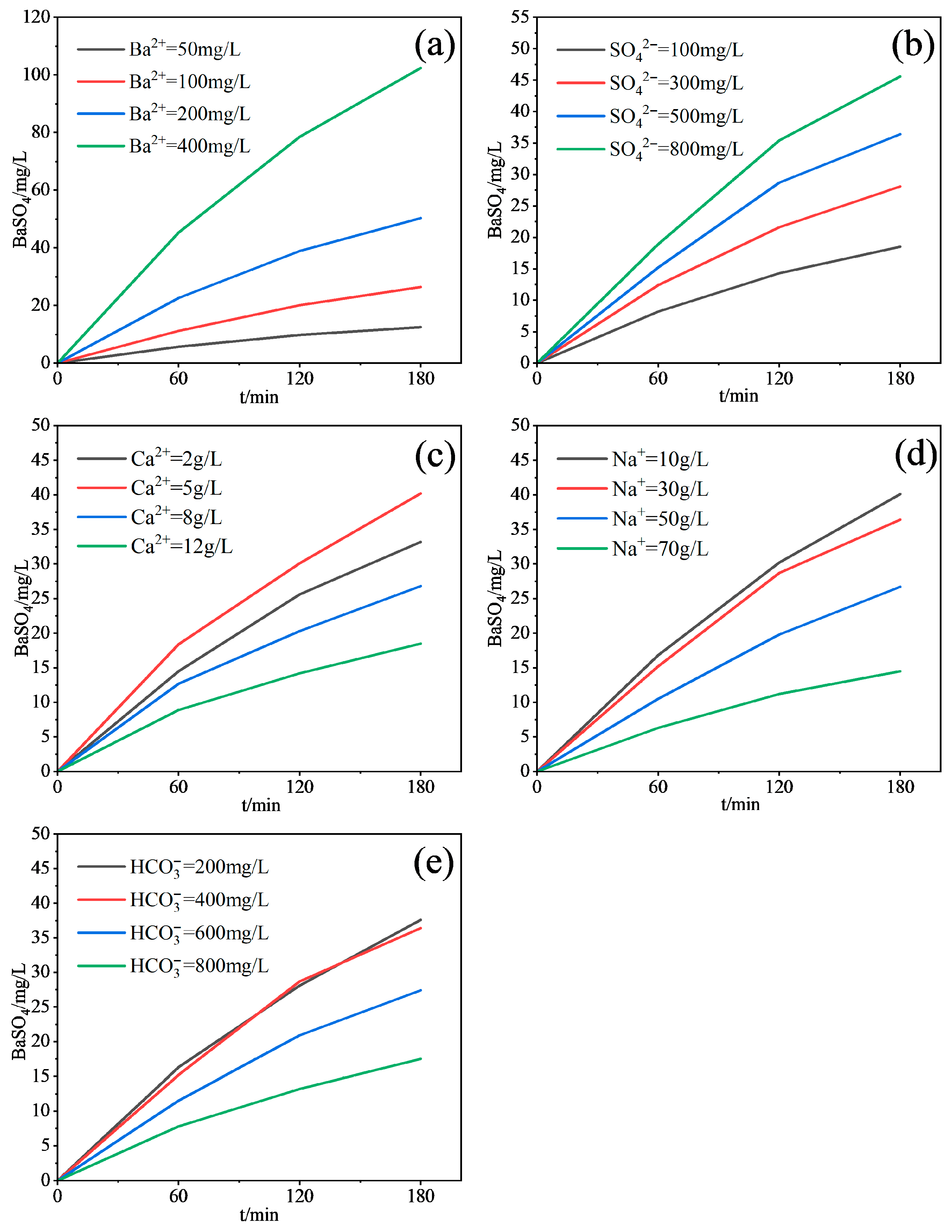
The experimental design is shown in Table 1. The influence of individual ion concentration on BaSO4 scaling mass was investigated by varying one ion at a time. The results are shown in Figure 2.
As the primary scaling ions, increasing concentrations of Ba2+ and SO42− significantly promote BaSO4 scaling (Figure 2a,b). This aligns with classical thermodynamics, where higher ion concentrations increase the ion activity product (IAP), making it easier to exceed the solubility product (Ksp) of BaSO4 and driving the precipitation reaction forward. Notably, within the confined pore throats of low-permeability cores, localized supersaturation can be exacerbated by limited fluid flow, significantly increasing scaling risk even without a substantial increase in bulk concentration.
The influence of Ca2+ is non-monotonic (Figure 2c). Scaling mass peaks at a concentration of approximately 5000 mg/L. One possible explanation is that moderate Ca2+ concentrations compress the diffuse double layer on the negatively charged sandstone (primarily SiO2) surface, reducing the electrostatic repulsion for approaching Ba2+ ions, thereby promoting Ba2+ enrichment near the interface and indirectly accelerating the heterogeneous nucleation of BaSO4. However, when Ca2+ concentration exceeds 8000 mg/L, scaling mass decreases. This is primarily attributed to competitive adsorption and ion pairing effects. High concentrations of Ca2+ directly compete with Ba2+ for limited adsorption sites on the sandstone surface, reducing the effective interfacial concentration of Ba2+. Concurrently, Ca2+ forms ion pairs with SO42− in solution (e.g., CaSO4), reducing the activity of free SO42− ions, thereby inhibiting the formation and growth of BaSO4 nuclei.
As an inert electrolyte (non-scaling), Na+ influences the scaling process mainly by altering the solution ionic strength (Figure 2d). When Na+ concentration increases from 10,000 mg/L to 70,000 mg/L, the ionic strength of the system rises significantly. According to Debye-Hückel theory, high ionic strength reduces the activity coefficients of Ba2+ and SO42−, lowering their effective concentration (activity), which consequently decreases the IAP and retards the precipitation reaction. Therefore, barium sulfate scaling tendency may be somewhat suppressed in high-salinity formation water due to the presence of background ions like Na+.
The mechanism of HCO3 influence is more complex (Figure 2e). At concentrations below 600 mg/L, its effect on BaSO4 deposition is minimal. Once the concentration exceeds this threshold, HCO3 reacts with Ca2+ in the system to form calcium carbonate (CaCO3) precipitate. This coprecipitation process inhibits BaSO4 scaling through two pathways: First, this is achieved through the direct consumption of reactants. The formation of CaCO3 consumes part of the Ca2+, potentially indirectly alleviating excessive competitive adsorption of Ca2+ against Ba2+. More importantly, the CaCO3 precipitation process may consume or passivate some SO42− through interfacial adsorption or micro-crystal encapsulation. Second, alteration of the interfacial microenvironment: newly formed CaCO3 micro-crystals covering the sandstone surface may change its physicochemical properties, providing a new interface less favorable for BaSO4 nucleation.
Based on the above analysis, when formulating water injection strategies for low-permeability reservoirs, besides strictly controlling the Ba2+ and SO42− content in the injected water (e.g., SO42− recommended below 300 mg/L), synergistic regulation using ions like Ca2+, Na+, and HCO3 present in formation water or additives can be considered. For instance, appropriately increasing Na+ concentration within safe limits to utilize its ionic strength effect, or leveraging natural HCO3 components to induce mild CaCO3 precipitation to alter rock surface properties, can serve as auxiliary scale control strategies.

3.1.2. Influence of Injection Conditions

Influence of Injection Velocity
Under fixed pH = 7 and confining pressure of 10 MPa, scaling behavior was investigated at injection velocities of 0.5, 1.0, and 2.0 mL/min. Results are shown in Table 2.
As injection velocity increased from 0.5 mL/min to 2.0 mL/min, the average effluent Ba2+ concentration decreased from 485 mg/L to 445 mg/L, and the scaling mass increased from 3.1 mg to 9.3 mg. Higher flow velocity enhances convective diffusion of ions, promoting rapid contact and reaction between Ba2+ and SO42−. Simultaneously, fluid shear forces may inhibit the back-migration or erosion of formed scale particles, leading to increased scaling, predominantly near the inlet region.
Influence of Injection Pressure
Under fixed injection velocity of 1.0 mL/min, pH = 7, and confining pressure of 10 MPa, scaling behavior was investigated at injection pressures of 5, 10, and 15 MPa. Results are shown in Table 3.
A fixed injection rate of 1.0 mL/min was maintained at pH = 7 and confining pressure of 10 MPa, with injection pressure gradients of 5 MPa, 10 MPa, and 15 MPa. The experiment lasted 24 h, with Ba2+ concentrations at the outlet recorded. As shown in Table 3, increasing the injection pressure from 5 MPa to 15 MPa raised Ba2+ concentration from 455 mg/L to 475 mg/L, while deposition decreased from 8.3 mg to 4.1 mg. This occurs because the elevated injection pressure alters the system’s hydrodynamic state, increasing the displacement fluid velocity. Consequently, the effective reaction time for ions to precipitate within the rock core diminishes, reducing opportunities for ions to encounter each other and form stable nucleation sites. Concurrently, the heightened velocity of the displacement fluid more readily dislodges and disperses sedimentary deposits from the sandstone surface. This occurs primarily because high-velocity fluid experiencing abrupt momentum changes when traversing surface deposits generates greater impact forces, thereby imposing increased shear stresses or viscous drag forces upon the sandstone surface [24]. Consequently, even if deposits form, they are less likely to stabilise and adhere to the sandstone surface.

3.2. Molecular Dynamics Simulation of Barium Sulfate Deposition

3.2.1. Model Establishment

Using Materials Studio2020 software, a framework comprising aqueous solutions containing barium ions and sulphate ions was established. Dense sandstone was represented by quartz crystals selected from the Materials Studio software package database. These were cut along the (010) crystal plane and subjected to surface hydroxylation to create a hydrophilic sandstone surface. The deposited ionic aqueous solution and sandstone surface frameworks were then merged to construct a barium sulphate deposition model, as illustrated in Figure 3.

3.2.2. Influence of Different Factors on Ion Diffusion and Deposition Tendency

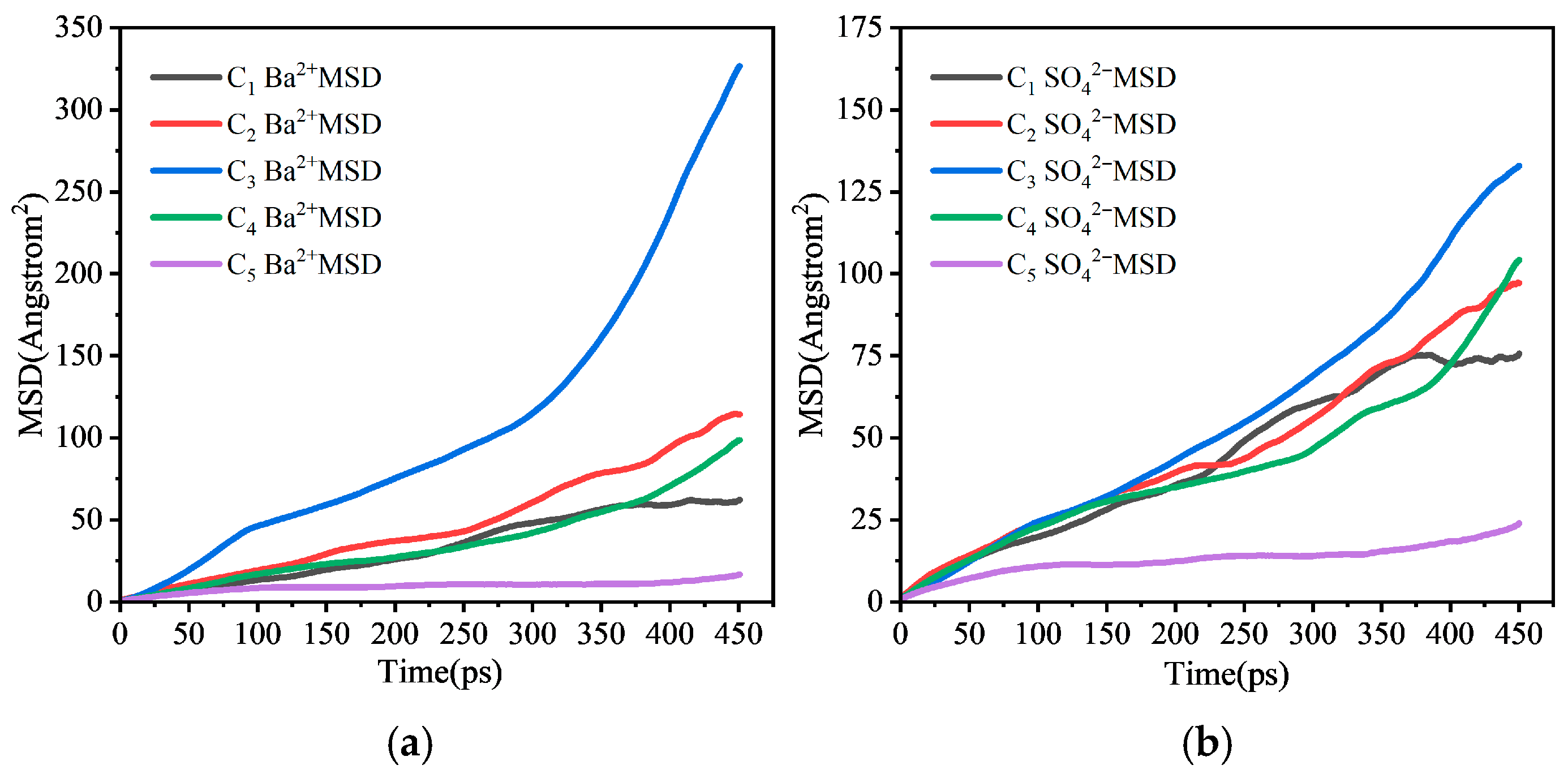
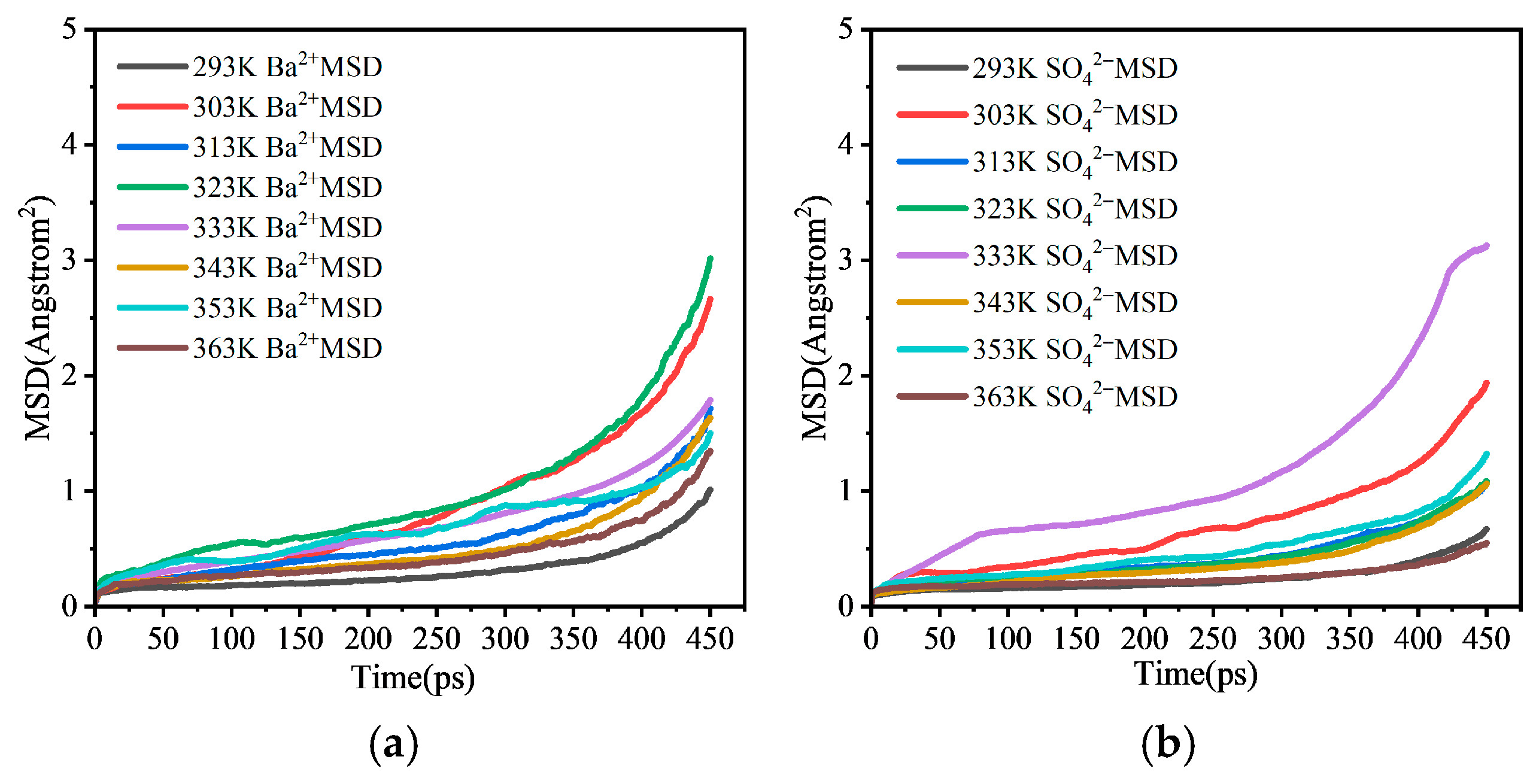
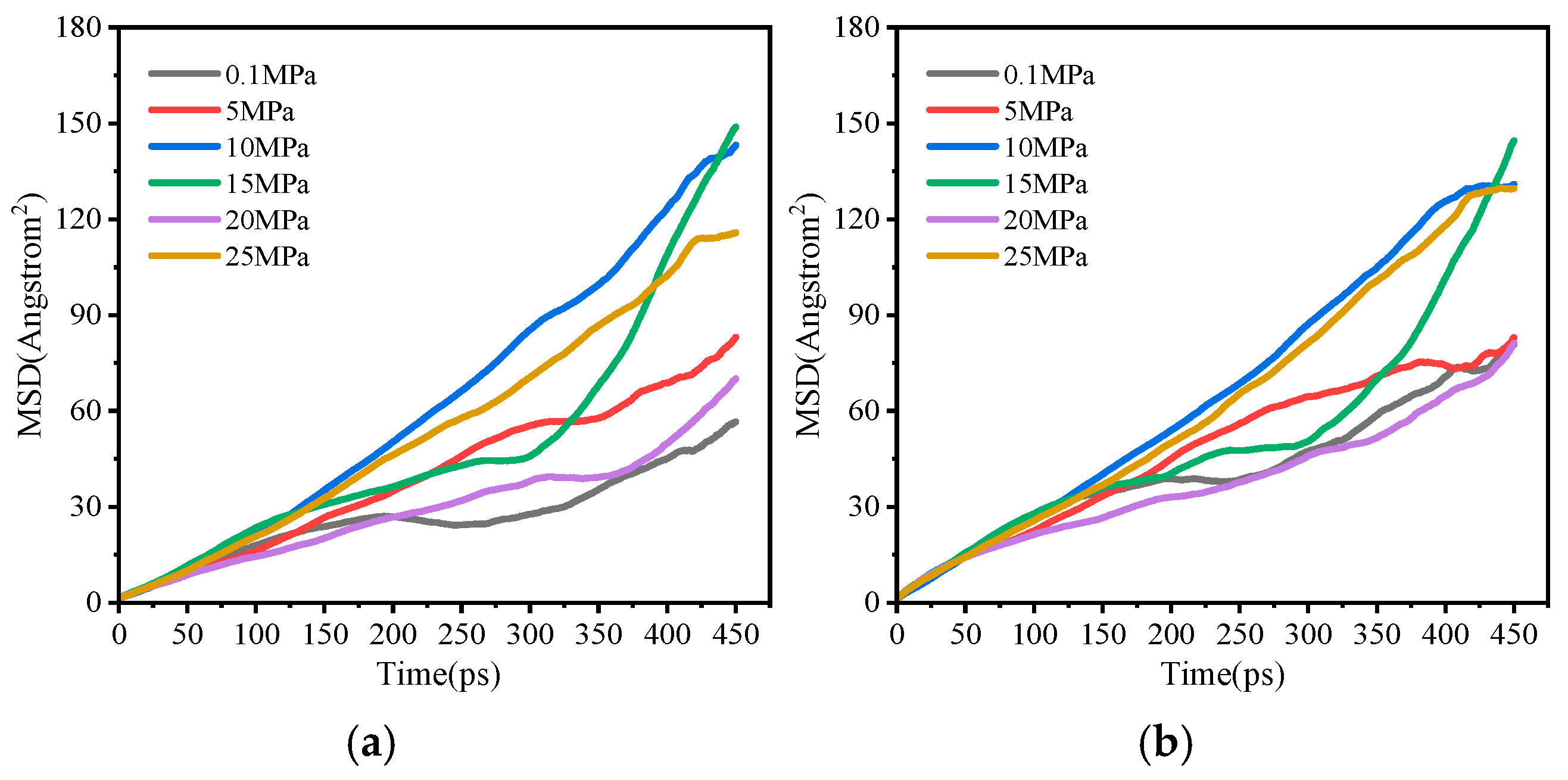
The mean square displacement (MSD) is a key metric for evaluating particle diffusion capacity [25]. A lower MSD indicates more restricted diffusion and a greater tendency for particles to reside and deposit [26,27,28,29]. This study analyzed the effects of concentration, temperature, and pressure on the diffusion behavior of Ba2+ and SO42− through MSD.
Effect of Ion Concentration (Figure 4): As the number of ion pairs increased from C1 to C5, the MSD slopes for both Ba2+ and SO42− decreased significantly, indicating a reduction in their diffusion coefficients (D). Calculation shows that the diffusion coefficient of SO42− in the C5 system was approximately 40% lower than in the C1 system. This directly confirms the macroscopic inference that “high concentration leads to restricted ion diffusion.” At the microscopic level, higher ion concentrations reduce inter-ion distances and enhance electrostatic interactions, particularly the strong Coulombic attraction between Ba2+ and SO42−. This leads to the formation of more short-lived ion pairs and even pre-nucleation clusters [30]. These clusters have larger hydrated radii and exhibit more sluggish motion. Furthermore, the more pronounced decrease in MSD for SO42− suggests it may have stronger specific interactions (e.g., hydrogen bonding or electrostatic attraction) with the hydroxylated SiO2 surface, making it more readily “anchored” near the interface, creating a favorable local high-concentration environment for subsequent Ba2+ binding [31].
Effect of Temperature (Figure 5): Increasing temperature from 293 K to 363 K significantly increased the MSD of both Ba2+ and SO42−, enhancing their diffusion capacity. Elevated temperature intensifies the thermal motion of water molecules, causing greater disturbance to the solvation shells of ions, making it easier for ions to escape from transient solvent cages or surface adsorption sites [32]. Although the solubility of BaSO4 does not change drastically with temperature, the MD results (increased MSD) and macroscopic understanding (slightly increased solubility) collectively indicate that the enhanced ion diffusion and migration capability is the dominant factor. This reduces the residence time of ions at the interface, hindering the formation and growth of stable nuclei, thus manifesting as temperature-inhibited scaling at the macro scale.
Effect of Pressure (Figure 6): Pressure variation had a negligible effect on MSD within the range of 0.1 to 25 MPa, as the curves for Ba2+ and SO42− essentially overlapped. This appears inconsistent with the macroscopic experimental conclusion that high pressure inhibits scaling. This discrepancy precisely reveals the difference in pressure’s role at the microscopic diffusion versus macroscopic flow scales. At the molecular scale, liquid water is nearly incompressible within the 0.1–25 MPa range, and ion hydration structure and diffusion motion are minimally affected, hence the negligible change in MSD. The scaling inhibition observed in macroscopic experiments primarily stems from the effect of high pressure on the porous medium itself: compression of the rock skeleton narrows pore throats and makes flow paths more tortuous, significantly increasing the macroscopic flow resistance for ions to transport to reaction sites, prolonging reaction time, and potentially reducing the effective reactive surface area. Therefore, pressure mainly inhibits scaling by altering the macroscopic transport pathway and rate, rather than changing the microscopic diffusion properties of the ions themselves.
MD simulations explain the intrinsic kinetic reasons for “ion concentration promoting scaling” and “temperature inhibiting scaling” at the molecular motion level. Macroscopic experiments incorporate more complex integrated effects such as pore structure and fluid dynamics. Their differing manifestations regarding the “pressure effect” are not contradictory but rather provide a complete revelation of the full-chain mechanism from molecular motion to reservoir flow: in near-wellbore zones or under high-pressure injection conditions, although the ions’ own diffusion capacity remains unchanged, the deterioration of the macroscopic transport pathway becomes the new bottleneck controlling the scaling process.

4. Conclusions

(1)
Ba2+ and SO42− are the primary controlling ions for barium sulfate scaling. Increasing their concentrations significantly enhances scaling mass. Ca2+ may promote scaling at moderate concentrations (~5000 mg/L) by affecting interfacial properties, but excess (>8000 mg/L) causes competitive adsorption inhibition. High Na+ concentration (>70,000 mg/L) inhibits scaling via ionic strength effects. HCO3 concentration above 600 mg/L indirectly inhibits BaSO4 deposition by inducing CaCO3 coprecipitation.
(2)
Increased injection velocity promotes scaling by enhancing ion convection and mass transfer. Elevated injection pressure inhibits scaling by compressing pore space and reducing ion migration rates.
(3)
Molecular dynamics simulations reveal from a micro-scale perspective: increased ion concentration enhances deposition tendency by lowering MSD values and restricting diffusion; elevated temperature inhibits scaling by increasing MSD values and enhancing ion diffusion; pressure has an insignificant effect on ion diffusion behavior at the molecular scale.
(4)
Based on integrated findings, it is recommended to control the SO42− concentration in injected water below 300 mg/L for water injection development in low-permeability sandstone reservoirs. Optimizing the concentrations of Na+, Ca2+, and HCO3 to regulate ionic strength and competitive effects, while avoiding excessively high injection rates, can effectively mitigate the risk of barium sulfate scaling.
Although this study has preliminarily revealed the influence of key ions and flow conditions on barium sulphate deposition and its micro-mechanisms through a combined experimental and simulation approach, several important avenues warrant further exploration in future work. Future research may focus on establishing a multi-scale simulation framework that integrates the atomic-scale nucleation mechanisms revealed by reactive molecular dynamics with mesoscale precipitation growth simulated by coarsening methods, thereby comprehensively describing the dynamic evolution of deposits within porous media. Concurrently, systematic investigations are required into synergistic deposition behaviours under multi-ion competition, heterogeneous wettability, and coupled temperature-pressure effects within complex chemical environments more closely resembling real geological fluids (e.g., multi-component systems containing Sr2+, Mg2+, and organic matter). Building upon this foundation, integrating multi-scale simulation data with macro- and micro-scale experimental results can establish machine learning predictive models. These models provide a theoretical basis and decision-making tools for rapid assessment of injection compatibility risks and intelligent optimisation of field process parameters.

Author Contributions

Methodology, H.Y., X.X. and M.D.; software, H.Y. and X.X.; validation, H.Y., X.X., M.D. and A.W.; formal analysis, H.Y. and A.W.; investigation, H.Y. and M.L.; resources, C.M.; data curation, H.Y. and C.M.; writing—original draft preparation, H.Y., X.X. and M.D.; writing—review and editing, A.W., M.L. and C.M.; visualization, H.Y.; supervision, X.X.; project administration, M.D.; funding acquisition, A.W. All authors have read and agreed to the published version of the manuscript.

Funding

This research was funded by the Open Fund of the National Engineering Laboratory for Exploration and Development of Low-Permeability Oil and Gas Fields, grant number is “No. KFKT2024-32” and the funded project is “Study on Sulfate Scaling Mechanism and a Neutral Emulsion Scale Removal System in Ultralow-Permeability Reservoirs”.

Institutional Review Board Statement

Not applicable.

Informed Consent Statement

Not applicable.

Data Availability Statement

The original contributions presented in this study are included in the article. Further inquiries can be directed to the corresponding author.

Acknowledgments

The authors have reviewed and edited the output and take full responsibility for the content of this publication.

Conflicts of Interest

Author Haien Yang, Xuan Xie, Miao Dou and Ajing Wei are employed by the company Xi’an Changqing Chemical Industry Group Co., Ltd. The remaining authors declare that the research was conducted in the absence of any commercial or financial relationships that could be construed as a potential conflict of interest.

References

  1. Li, F.L. Research and Application of Advance Water Injection Technology in Low-Permeability Oilfields. China Pet. Chem. Stand. Qual. 2025, 45, 169–171. [Google Scholar]
  2. Liu, L.; Tang, F.; Xu, C.; Wang, Q.; Li, H.; Yao, R. Performance Evaluation of GX-S Nano-Based Oil Displacement Agent. Drill. Prod. Technol. 2022, 45, 137–142. [Google Scholar]
  3. Lin, K.X.; Ren, K.F.; Luo, G.; Pan, D.C.; Chen, K. Synthesis and mechanism study of a novel barium sulfate scale inhibitor. Chem. Eng. 2024, 38, 11–14. [Google Scholar]
  4. Tong, Y.Q.; Bai, H.L.; Ouyang, X.N.; Jiang, Y.M.; Pan, C.; Liang, Z.H. Preparation and performance evaluation of a novel barium sulfate scale inhibitor. Drill. Prod. Technol. 2021, 44, 120–123. [Google Scholar]
  5. Qu, Z.Q.; Fan, J.C.; Guo, T.K.; Wang, Y.N.; Liu, X.Q. Preparation and performance evaluation of barium sulfate scale inhibitor. Oilfield Chem. 2021, 38, 536–539. [Google Scholar]
  6. Wang, H.T. Research on Scale Prevention Technology in X block of Changqing Oilfield. Master’s Thesis, Xi’an Shiyou University, Xi’an, China, 2020. [Google Scholar]
  7. Wang, J. Research on Squeeze Scale Inhibition Technology for Barium-Strontium Scale Formation in LP Oilfield. Master’s Thesis, China University of Petroleum (East China), Dongying, China, 2019. [Google Scholar]
  8. Zhou, S.J.; Ren, Z.; Yang, Y.S.; Ren, M. Preparation of Metal Oxides with Different Morphologies and Their Application in Industrial Catalytic Reactions. Acta Chim. Sin. 2021, 72, 2972–3001. [Google Scholar]
  9. Fan, J.C. Development and Prevention Mechanism Research of Barium/Strontium Sulfate Scale Inhibitor. Master’s Thesis, China University of Petroleum (East China), Dongying, China, 2019. [Google Scholar]
  10. Yu, X.Z. Study on Sulfate Scaling Model Based on Thermodynamic and Kinetic Principles. Master’s Thesis, Southwest Petroleum University, Chengdu, China, 2018. [Google Scholar]
  11. Li, H.J.; Yu, X.Z.; Zhou, W.J.; Zhu, M.; Cui, X.Y. Study on the model of barium sulfate scaling effect on core permeability. Sci. Technol. Eng. 2017, 17, 216–221. [Google Scholar]
  12. Xu, W.; Xian, H.; Li, T.; Yin, L.; Ma, Z.; Xing, C.; Feng, M.; Li, H.; Wang, K. Mechanism insight into the role of hydrogen on xylan hydropyrolysis by the combination of experiments and ReaxFF-MD simulation. J. Anal. Appl. Pyrolysis 2026, 194, 107573. [Google Scholar] [CrossRef]
  13. Stanković, I.; Dašić, M.; Jovanović, M.; Martini, A. Effects of Water Content on the Transport and Thermodynamic Properties of Phosphonium Ionic Liquids. Langmuir 2024, 40, 9049–9058. [Google Scholar] [CrossRef] [PubMed]
  14. Ren, L.; Cheng, Y.; Yang, J.; Wang, Q.; Song, D.; Du, W. Simulation and experiment of adsorption behavior of calcite, aragonite and vaterite on alpha-Fe2O3 surface. Comput. Mater. 2020, 182, 109762. [Google Scholar] [CrossRef]
  15. Dašić, M.; Stanković, I.; Gkagkas, K. Influence of confinement on flow and lubrication properties of a salt model ionic liquid investigated with molecular dynamics. Eur. Phys. J. E 2018, 41, 130. [Google Scholar] [CrossRef]
  16. Zhang, H.; Tian, X.; Gu, X.; Zhang, Q. Simulation of Free Water and Hydrated Calcium Silicate Pore Water Freezing Based on Coarse-Grained Molecular Dynamics. J. Comput. Mech. 2024, 41, 194–201. [Google Scholar]
  17. Dašić, M.; Ponomarev, I.; Polcar, T.; Nicolini, P. Tribological properties of vanadium oxides investigated with reactive molecular dynamics. Tribol. Int. 2022, 175, 107795. [Google Scholar] [CrossRef]
  18. Yuan, B.Y. Reaction Molecular Dynamics Simulation of Thermal Decomposition Mechanisms for Multiple Energetic Plasticisers. Master’s Thesis, China University of Petroleum (Beijing), Beijing, China, 2024. [Google Scholar]
  19. Shabani, A.; Kalantariasl, A.; Abbasi, S.; Shahrabadi, A.; Aghaei, H. A coupled geochemical and fluid flow model to simulate permeability decline resulting from scale formation in porous media. Appl. Geochem. 2019, 107, 131–141. [Google Scholar] [CrossRef]
  20. Chai, J.C.; Liu, S.Y.; Yang, X.N. Molecular dynamicssimulation of wetting on modified amorphous silica surface. Appl. Surf. Sci. 2009, 255, 9078–9084. [Google Scholar] [CrossRef]
  21. Liu, S.Y.; Yang, X.N.; Qin, Y. Molecular dynamicssimulation of wetting behavior at CO2/water/solid interfaces. Chin. Sci. Bull. 2010, 55, 2252–2257. [Google Scholar] [CrossRef]
  22. Fan, C.F.; Cagin, T. Wetting of crystalline polymer sur-faces: A molecular dynamics simulation. J. ChemPhys. 1995, 103, 9053–9061. [Google Scholar]
  23. Qi, Y.; Shu, Z.; Luo, P.; Zhu, S.; Liu, W. Molecular Simulation Study on the Adsorption of Hydrophobic Associating Polymers and Anionic Surfactants on Sandstone Surfaces. Bull. Polym. Sci. 2025, 38, 472–479. [Google Scholar]
  24. Li, R.; Zhai, H.Y.; Jiang, C.; Zhu, W.; Li, X.; Wang, Y. Effects of High-Pressure Fluids on Shale Fracturing and Fracture Development Processes. Acta Geophys. Sin. 2025, 68, 4851–4867. [Google Scholar]
  25. Chen, M.Z.; Ma, J.M.; Zhao, Y.C.; He, J.; Yu, J.J. Molecular simulation study on diffusion characteristics of waste cooking oil components in aged asphalt. New Chem. Mater. 2024, 11, 207–214. [Google Scholar]
  26. Ren, L.; Cheng, Y.; Wang, Q.; Yang, J. Simulation of the relationship between calcium carbonate fouling and corrosion of iron surface. Colloids Surf. A Physicochem. Eng. Asp. 2019, 582, 123882. [Google Scholar] [CrossRef]
  27. Yang, J.L. Molecular Dynamics Study on Deposition Characteristics of Mixed Silica and Calcium Carbonate Fouling. Master’s Thesis, Northeast Electric Power University, Jilin, China, 2024. [Google Scholar]
  28. Xie, W. Molecular Dynamics Simulation of CaCO3 Growth Characteristics on Its Fouling Surface in Solution. Master’s Thesis, Lanzhou Jiaotong University, Lanzhou, China, 2023. [Google Scholar]
  29. Separdar, L.; Rino, J.P.; Zanotto, E.D. Crystal Growth Kinetics in BaS Semiconductor: Molecular Dynamics Simulation and Theoretical Calculations. Acta Mater. 2024, 267, 119716. [Google Scholar] [CrossRef]
  30. Wu, D.; Liu, D.; Luo, H.; Wang, J.; Zhao, H.; Dong, Y. Studies on the dissolution mechanism of barium sulfate by different alkaline metal hydroxides: Molecular simulations and experiments. J. Mol. Liq. 2025, 418, 126708. [Google Scholar] [CrossRef]
  31. Ma, C.; Liu, X.; Wang, C.; Gao, S.; Huang, X. Preparation of barium sulfate chelating agent DTPA-5Na and molecular dynamics simulation of chelating mechanism. RSC Adv. 2023, 13, 34455–34463. [Google Scholar] [CrossRef] [PubMed]
  32. Wu, D.; Liu, D.; Wang, J.; Zhao, H.; Dong, Y.; Wang, X. High-Performance Barium Sulfate Scale Inhibitors: Monomer Design and Molecular Dynamics Studies. Processes 2025, 13, 660. [Google Scholar] [CrossRef]
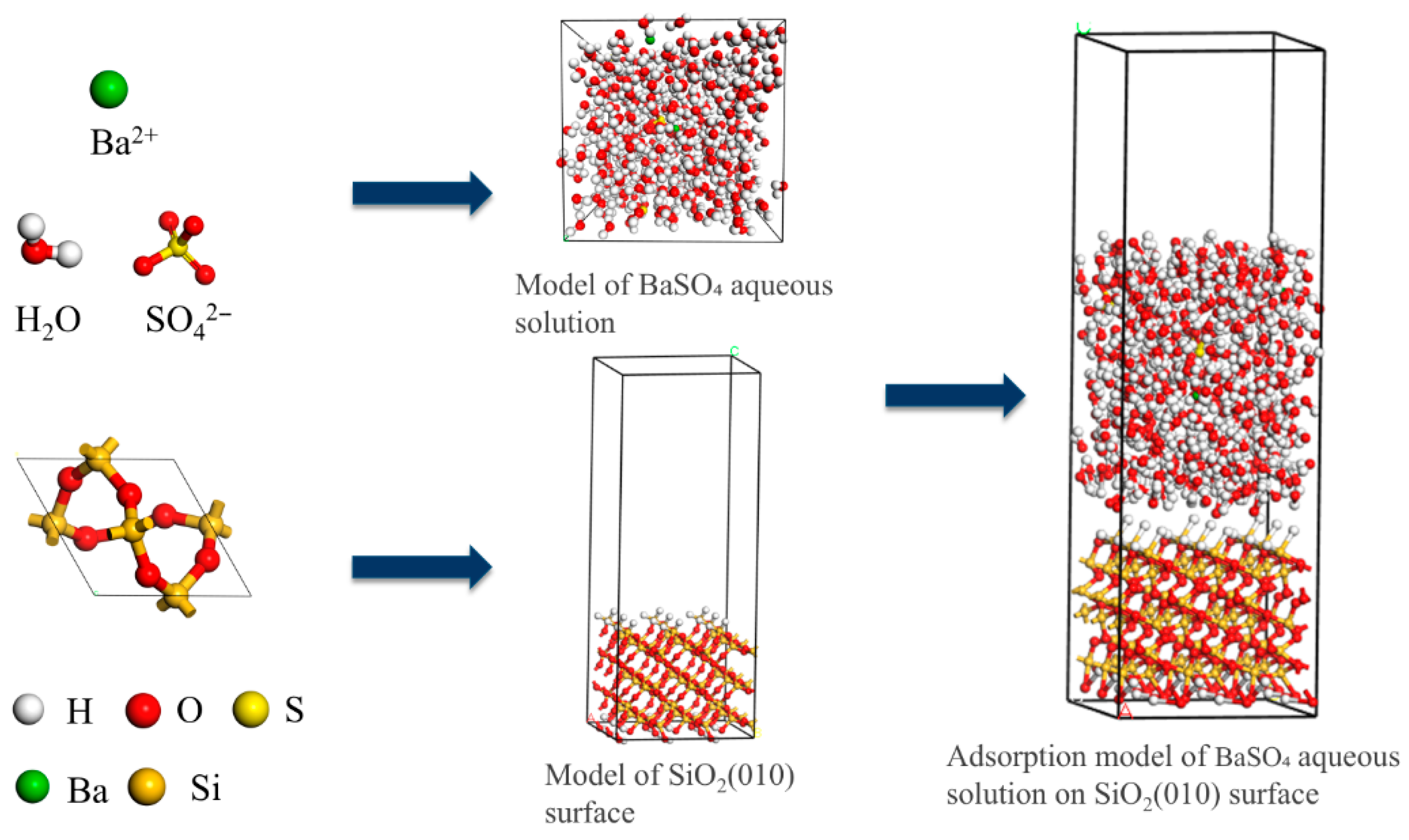
Figure 1. Process of constructing a deposition model for barium sulphate on sandstone surfaces.
Applsci 16 01204 g001
Figure 2. Influence of key scaling ions on barium sulfate deposition: (a) Ba2+ concentration; (b) SO42− concentration; (c) Ca2+ concentration; (d) Na+ concentration; (e) HCO3 concentration.
Applsci 16 01204 g002
Figure 3. Establishment of the molecular dynamics simulation model for barium sulfate deposition.
Applsci 16 01204 g003
Figure 4. Effect of ion concentration on the mean square displacement (MSD) of (a) Ba2+ and (b) SO42−.
Applsci 16 01204 g004
Figure 5. Effect of temperature on the mean square displacement (MSD) of (a) Ba2+ and (b) SO42−.
Applsci 16 01204 g005
Figure 6. Effect of pressure on the mean square displacement (MSD) of (a) Ba2+ and (b) SO42−.
Applsci 16 01204 g006
Table 1. Experimental design for studying the influence of key scaling ions.
GroupVariable IonConcentration Gradient (mg/L)Fixed Concentration of Other Ions
(mg/L)
1Ba2+50, 100, 200, 400SO42− = 500, Na+ = 30,000, Ca2+ = 5000, HCO3 = 400
2SO42−100, 300, 500, 800Na+ = 30,000, Ca2+ = 5000, HCO3 = 400
3Na+10,000, 30,000, 50,000, 70,000SO42− = 500, Ca2+ = 5000, HCO3 = 400
4Ca2+2000, 5000, 8000, 12,000SO42− = 500, Na+ = 30,000, HCO3 = 400
5HCO3200, 400, 600, 800SO42− = 500, Na+ = 30,000, Ca2+ = 5000
Table 2. Influence of injection velocity on effluent Ba2+ concentration and scaling mass.
GroupInj. Velocity
(mL/min)
Time (h)Effluent [Ba2+]
(mg/L)
Avg. [Ba2+]
(mg/L)
BaSO4 Scale (mg)
1-10.50.54804853.1
1-20.51.0488
1-30.52.0490
1-40.512.0482
1-50.524.0483
2-11.00.54604656.2
2-21.01.0468
2-31.02.0470
2-41.012.0462
2-51.024.0463
3-12.00.54404459.3
3-22.01.0448
3-32.02.0450
3-42.012.0442
3-52.024.0443
Table 3. Influence of injection pressure on effluent Ba2+ concentration and scaling mass.
IDInj. Pressure
(MPa)
Time (h)Effluent [Ba2+]
(mg/L)
Avg. [Ba2+]
(mg/L)
BaSO4 Scale (mg)
7-150.54504558.3
7-251.0458
7-3512.0452
7-4524.0451
8-1100.54604656.2
8-2101.0468
8-31012.0462
8-41024.0463
9-1150.54704754.1
9-2151.0478
9-31512.0472
9-41524.0471
Disclaimer/Publisher’s Note: The statements, opinions and data contained in all publications are solely those of the individual author(s) and contributor(s) and not of MDPI and/or the editor(s). MDPI and/or the editor(s) disclaim responsibility for any injury to people or property resulting from any ideas, methods, instructions or products referred to in the content.