1. Introduction
The global rise in residential barbecuing, particularly in urban areas, is a cherished and often culturally significant activity that has led to a steady increase in the sales of grills and smokers. However, the environmental and health impacts of barbecue grills, particularly energy use and resulting emissions, are growing concerns [
1,
2]. The emissions released are heavily dependent on the type of fuel used, such as charcoal and wood pellets [
3,
4]. In the case of wood-pellet- or chip-fed grills, the choice of pellet can positively influence the sensory qualities of the cooked meat, potentially leading to an increase in its use [
5,
6,
7]. Despite a strong push to adopt cleaner energy and cooking technology, limited information exists on the environmental impact of wood-pellet-fed barbecues.
The Italian barbecue grill market is experiencing a significant transformation driven by the robust growth of the hospitality sector and the expanding outdoor dining culture. The market is currently estimated at USD 134.63 million and is expected to reach USD 169.31 million by 2030 [
8]. Barbecue grills can be classified according to the fuel type used for cooking, which includes gas-fired, electric, and solid biomass-fed. In Italy, gas grills are the most owned grills, accounting for 52% of the market share, followed by charcoal and wood (42%), and electric (6%) [
8]. The market is witnessing a gradual shift toward sustainable and technologically advanced grilling equipment. Therefore, manufacturers are increasingly incorporating less environmentally impactful materials and energy-efficient designs into their products, responding to growing environmental consciousness among Italian consumers [
8].
The life cycle assessment (LCA) method is a standardized framework, governed by the ISO 14040 and 14044 standards [
9,
10], which are designed to assess the environmental impacts of a product or service throughout its entire life cycle at various decision levels. Within the food sector, LCA has been widely applied to analyze various products and supply chains [
11,
12,
13]. However, studies often define their system boundaries at the farm or factory gate, frequently excluding the consumption or use phase because of high variability [
14]. This gap is particularly pronounced for products such as grilled meats, where the environmental impact of the consumer use phase is influenced by highly variable factors like cooking methods, fuel types, and cultural or personal cooking preferences. Thus, these factors remain under-researched [
15]. Despite this, a growing body of research has begun to address the environmental footprint of food preparation [
16,
17]. Given that meat consumption, particularly beef, has a disproportionately high environmental footprint compared to other protein sources [
18,
19], and considering the global popularity of outdoor barbecue grilling, there is a clear need for more dedicated LCA studies. This is necessary to complete the environmental profile of the meat consumption value chain and enable meaningful comparisons with alternative protein sources.
The current LCA literature on the environmental performance of barbecuing processes for meat products is limited [
20,
21,
22]. To enhance environmental sustainability in barbecuing, research highlights wood pellets and electricity as having the least grill-specific footprint among different fuel sources [
20]. However, these analyses, which focused on the comparison of different fuels, did not provide detailed experimental information. Other, more detailed and experimental studies have analyzed the more “traditional” and impactful fuels for the European continent, such as gas, charcoal, and electricity [
22]. Therefore, the lack of studies dedicated to more “sustainable” fuels is clear, and this study aims to comprehensively evaluate the various aspects of the environmental sustainability of barbecue use, from fuel and equipment to emissions, efficiency, and consumption assessment. A critical methodological challenge in conducting an LCA of barbecue grilling is the definition of an appropriate functional unit for the cooking phase. Existing studies used units such as one barbecue event for several people [
22] or per grill session [
20,
21]. These are inherently variable and insufficient for robust comparisons, as they fail to account for the significant diversity in real-world grilling practices. Key sources of variability include culinary preferences based on the desired level of cooking (e.g., rare, medium, well-done), which directly dictate cooking time and temperature profiles, and meat characteristics such as the type, cut, thickness, and mass, which significantly influence energy demand. Additionally, the equipment and fuel efficiency in terms of emissions from fuel combustion (e.g., wood pellets, charcoal, gas) can vary by appliance and user technique.
Therefore, to enable meaningful and reproducible assessments, the functional unit must be based on the core cooking function and parameterized to accommodate variability. A more rigorous unit would specify the amount of meat cooked to a defined cooking level, allowing for the modeling of key parameters like grilling time, temperature settings, and associated fuel combustion emissions. This approach provides a flexible yet standardized basis for users to input their specific conditions. To address this methodological gap, this study aimed to conduct a comprehensive LCA to quantify the environmental burden of meat grilling. The assessment focused on a hybrid barbecue system utilizing wood pellets and electricity, employing a parameterized functional unit to ensure accurate and transferable results across different grilling scenarios.
2. Materials and Methods
2.1. Device Description
The smoker analyzed in this study was a commercial pellet smoker, the “PitBoss Austin XL-Copper model” (Pit Boss Grills 3411 North 5th Avenue, Phoenix, AZ, USA), manufactured by PitBoss, a well-known American barbecue producer under Dansons Inc. (Scottsdale, AZ, USA). Generally, pellet smokers can be considered modified and reimagined versions of conventional pellet stoves, sharing similar fundamental components. They consist of a hopper connected to an auger that transports the pellets to the cooking chamber (combustion chamber), where combustion occurs to cook the food. The smoke generated from the combustion is then expelled through a chimney.
2.2. Pellet Description
The device assessed in this study operated using biofuels, specifically pellets. According to the technical standard UNI-EN ISO 17225-2 [
23], pellets are defined as “densified biofuels produced from woody biomass, with or without the addition of binders (used to aid densification). They are cylindrical in shape, with a length varying from 5 to 40 mm and a diameter up to 25 mm, and exhibit smooth broken edges.” This section of the standard also defines quality classes (A1, A2, and B), each of which must meet specific requirements. For instance, class A1 requires that the pellet be made from virgin material and/or chemically untreated wood residues, with a diameter between 6 and 8 mm, a length of up to 40 mm, a maximum moisture content of 10%, an ash content up of to 0.7%, a mechanical durability of 97%, an additive content below 2%, specific minimum calorific values, and limited concentrations of heavy metals and major elements.
In practical terms, to meet these quality standards, producers tend to favor virgin (or residual) softwood, as it generally provides a lower ash content. Exceptions exist for hardwoods, but these are often limited to species like beech and chestnut. In the context of this study, the pellets used are unconventional, as they must not be derived from the woody biomass of the Pinophyta division (conifers) but from hardwood species (e.g., oak, poplar, and maple). This requirement arises from the fact that coniferous wood imparts undesirable and bitter aromas to food during combustion, owing to the degradation of resins, which is unacceptable in food cooking. In contrast, criteria such as ash content are less stringent in this application, as smokers are used far less frequently than conventional stoves.
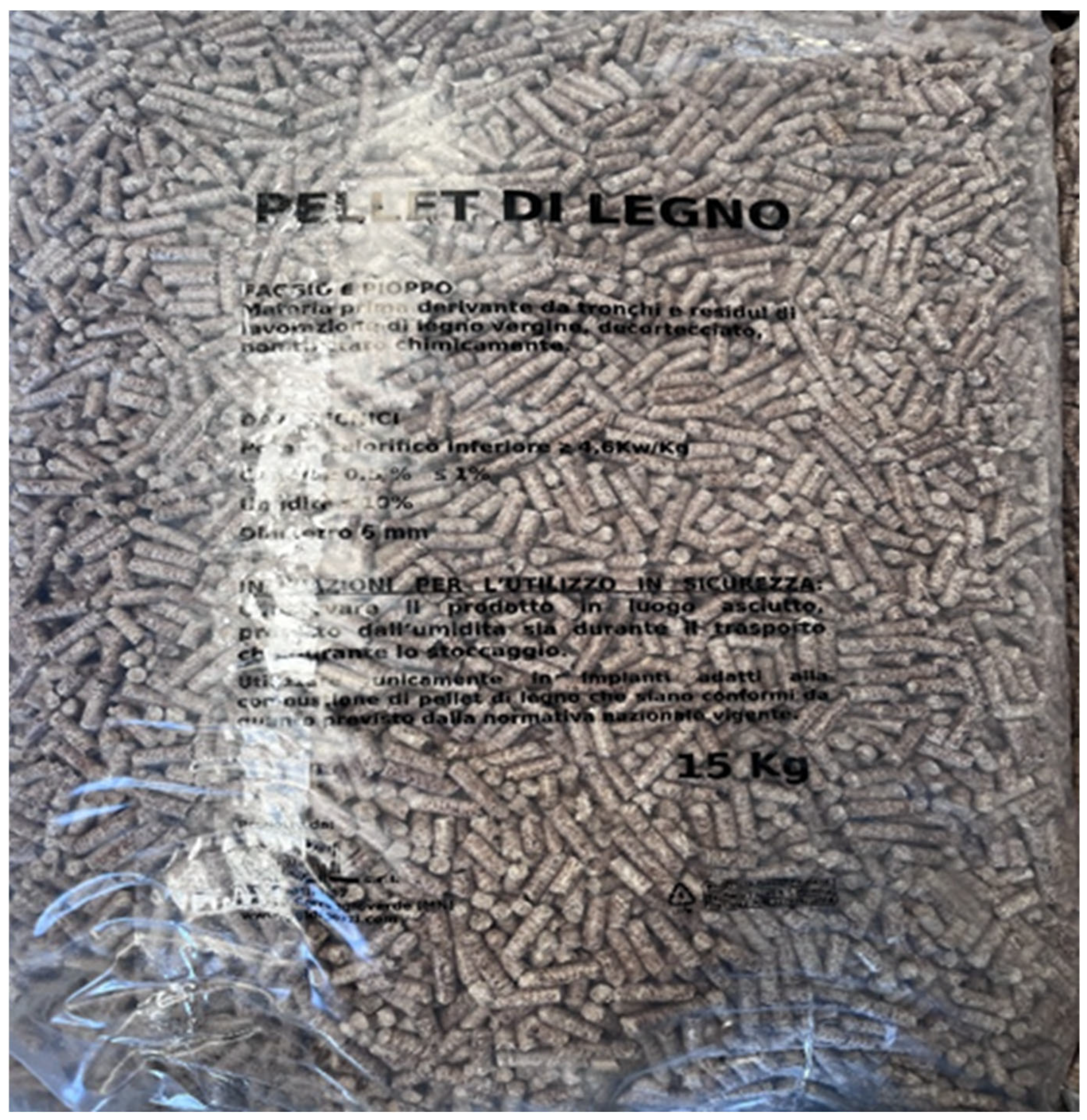
Currently, no specific regulatory standard exists for “culinary-grade” pellets (pellets used solely for cooking rather than generating thermal energy for heating). Such culinary pellets are often composed of densified woody biomass from hardwood species and can even have added flavorings. The pellet analyzed in this study originated from hardwood biomass. However, pellets intended for energy production are typically made from coniferous wood, as these more easily meet the A1 category standards. For culinary applications, coniferous wood pellets impart unpleasant flavors to food. Thus, hardwood pellets, which lack this drawback, are preferred, even though they may not meet A1 category requirements. Specifically, the pellet used here is made from a blend of beech and poplar biomass (in unknown proportions) (
Figure 1). Chemical, physical, and energy-related analyses were performed on the pellets by the Biomass Laboratory of Università Politecnica delle Marche (UNIVPM) (
Table 1).
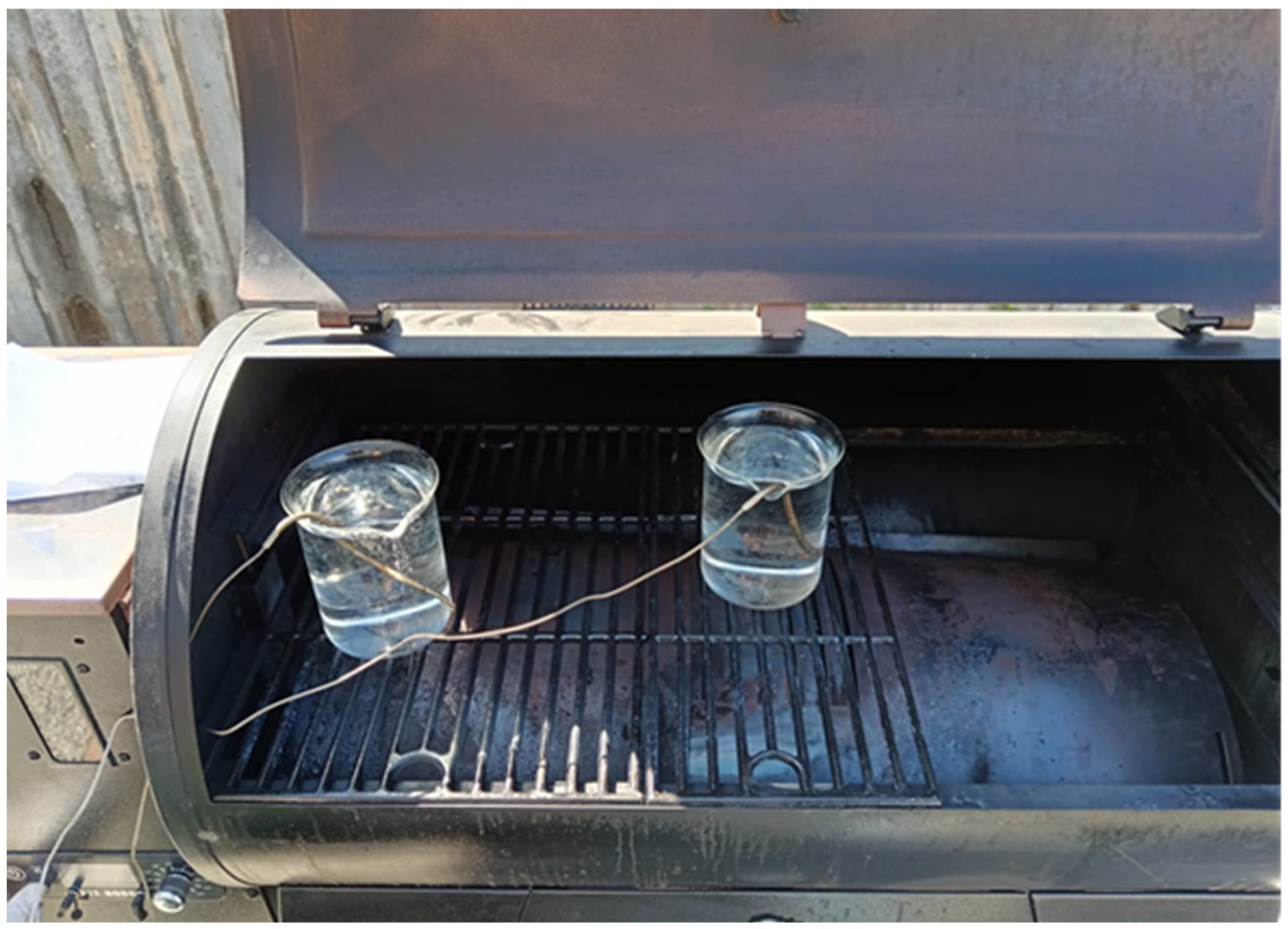
The experiments were conducted to measure the energy required to heat 2 L of water from ambient temperature to 95 °C (or 366.15 K) situated in the smoker with the lid closed (
Figure 2). Two 1 L beakers, each filled with water at ambient temperature, were placed on the main grill grate inside the smoker, and the lid was closed. During the experiment, four temperature measurements were continuously monitored to assess the thermal performance of the system:
Analog temperature of the smoke expansion chamber: measured using an analog thermometer mounted on the smoker lid.
Digital temperature of the smoke expansion chamber: measured using a thermocouple connected to the smoker’s display.
Temperature of beaker 1: measured using probe 1 of the temperature monitoring device.
Temperature of beaker 2: measured using probe 2 of the same device.
The energy efficiency (
η) was calculated from the consumed energy and from the theoretical value for the sensible heat required to heat 2 L of water from ambient temperature to 90 °C:
where “
m” is the mass of the water, “
Cp” is the water mass calorific capacity, and Δ
T is the temperature increment. For the pellet, “E
exp” was calculated by multiplying the net calorific value by the mass of the pellet used in the experiment.
In this case, the values are m1 = 1 L, m2 = 1 L, Cp = 4.186 J/(kg∙°C), ΔT1 = 305.15 K, ΔT2 = 318.15 K, PCN = 17,254 JKL, and pellet mass = 0.3661 kg.
2.3. Environmental Impacts of the Smoker
The LCA method was used to assess the environmental impacts of the pellet-fueled smoker for cooking following the ISO 14040 and ISO 14044 standards [
9,
10].
2.3.1. Goal and Scope
The goal of this study was to analyze the impacts of a pellet-fueled barbecue used for smoking and cooking food in Italy. The reasons for conducting the study were to evaluate the environmental aspects of a practice that is well-established in the United States and Canada but is becoming increasingly widespread in Europe and Italy. The target audience of the study is primarily the final user of BBQ and smokers, as well as the manufacturers, to help them make informed decisions to reduce the environmental impacts associated with the activity. This study does not intend to make comparisons with similar systems because the lack of information would risk providing irrelevant comparative evaluations. The study was commissioned by the same authors who purchased the devices and combustible materials from the market. Furthermore, no collaboration, contact, or financing was initiated with any stakeholders in the BBQ or pellet world.
The system boundary for this study included pellet production, smoker manufacturing (materials), and the use phase (combustion emissions, pellet consumption, auxiliary electricity use). The end-of-life of materials (recycling of metals, disposal of electronics, or insulation) was not considered.
Two functional units have been defined for this study. The first functional unit selected is 1 h of usage for maintaining a target temperature at a set function on the smoker (smoke, 95 °C, 110 °C, 120, 150 °C, 175 °C, 205 °C, 230 °C, 245 °C, and 260 °C), since the smoker use is always first filtered by selecting the desired temperature level and then maintaining cooking for the time established by the recipe. However, considering that the smoker is a device for the energy valorization of the pellet, we considered another relevant functional unit as the unit of energy released in combustion (1 kWh). We also report the energy released for each temperature level, from which the impact can be easily calculated.
2.3.2. Life Cycle Inventory
The inventory analysis involved several aspects. First, the device was analyzed in its entirety by performing a preliminary disassembly and subsequently noting each component with its characteristics. Subsequently, the pellet mass flow rate of the system was assessed by measuring the quantity of pellets fed for each function. The consumption of the various motors present in the system was measured using a power analyzer and data logger (PCE-PA 8000, PCE Instruments, PCE Holding GmbH, Hamburg, Germany). Finally, the emissions were assessed for each function using a flue gas analyzer.
To produce the LCI of the BBQ device, all the barbecue components were grouped according to their shared functions into six specific areas (or “macro-components”) listed below:
Barrel: The barrel forms the central part of the smoker and contains the cooking chamber, which includes an auger, fire pot, and cover panel. The barrel is cylindrical, with an opening on one side, which is approximately 25% of its surface, designed to hold the lid. The two faces of the barrel are in contact with the hopper and chimney. Inside the barrel, there are slots for the thermocouple to enter and supports to hold various cooking grids. The lid on the barrel consists of a lid plate, handle, handle collars, thermometer, lid supports to keep it in position, and a lid rest to support the lid when open.
Internal components: The cooking chamber of the barrel contains several elements: two larger steel grids, one smaller steel grid, and an iron grid, all suitable for cooking food. Additionally, there is a “main plate” to separate open flames from food, on top of which is a “slider” that can cover or uncover the smoker opening, exposing food to the flame. A covering sheet is also present at the level of the firepot, which protects the bottom of the barrel from ash deposition.
Chimney: Located on the upper right side of the barrel, the chimney consists of a cap that covers the smoke outlet tube, a stack or 90° bent tube forming the chimney body, and a plate welded to the stack’s terminal with bolt holes for connection to the barrel. A rock wool “gasket” is also placed between the chimney and barrel for insulation.
Serving tray: The serving tray is situated on the right side of the barrel, below the chimney, and is attached to the barrel using four screws. It includes a tray support, the tray itself with handles, and three utensil hangers for tools needed for the smoker’s operation (tongs, spatulas, skewers).
Hopper and feed auger: The hopper occupies the entire left side of the barrel and serves as the loading zone for the pellets. It includes a lid, a wide-mesh grid, and an opening connecting it to the auger assembly. The hopper also houses a display connected to the device’s circuit board, from which all electrical cables are connected to the respective electrical components. At the base of the hopper, there is an access panel to reach the electronic components, which also houses the power socket of the device. The auger assembly is located at the lower part of the hopper and contains an auger powered by its own electric motor. This assembly includes a cylindrical cover around the auger and a parallelepiped housing the fire pot, which acts as the primary air channel driven by a fan motor. It also features a slot for the heating element that ignites the biomass in the firepot. Finally, a sheet of insulating rock wool was positioned between the auger–hopper assembly and the barrel.
Legs and bottom platform: The legs of the smoker are located at the bottom of the device, each connected to the barrel with three screws, and come in two types: a pair of legs with swivel wheels that allow rotation and a pair of legs with directional wheels for forward movement only. In addition to the four legs, there are four support covers, two larger ones (one of which bears the PitBoss logo) placed on the front and back, and two smaller ones on the sides. Finally, a base was placed at the bottom of the device. The covers and base are essential to provide stability to the system and barrel or to store materials and fuels.
For each component, the following parameters were measured: quantity, weight, surface area, thickness, and material. These components are listed in
Table 2, which lists the type of component, its part, a brief description, quantity, weight, surface area, and thickness.
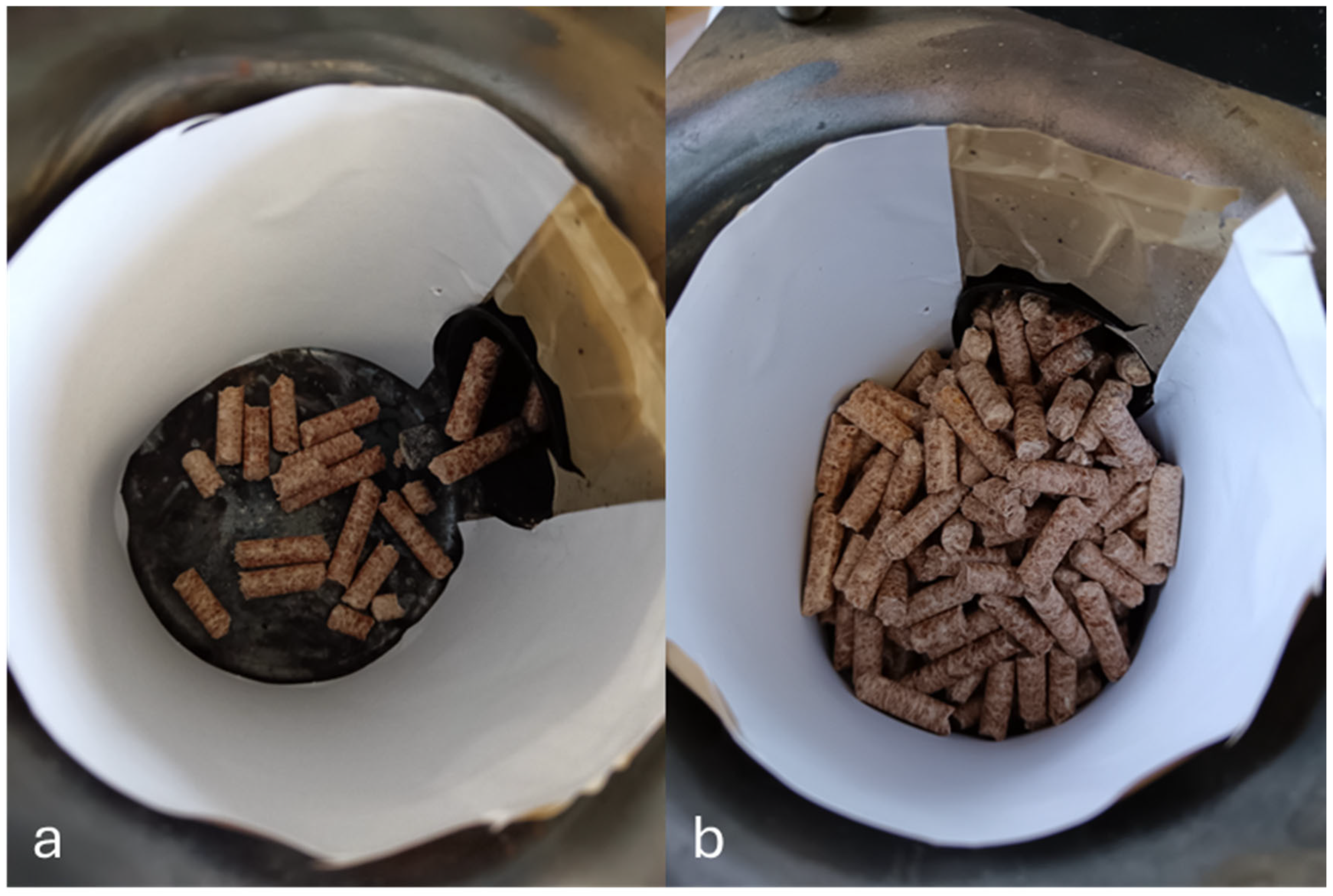
The LCI data of pellet was collected by measuring the mass of pellets fed directly into the brazier (up to the lower limit of the feed screw) over a given period of time, the factor that remained stable over time was the volume (corresponding to the brazier volume) (
Figure 3), while the filling time and pellet mass were measured as shown in
Table 3. The electricity consumption relative to different temperature settings by the smoker components, namely the auger motor, fan motor, electric resistance, and display, is also reported in the same table. In detail, the auger motor showed a power of around 0.020 kW, the fan motor 0.022 kW, the resistance 0.2 kW, and the display was so low that it could not be calculated.
Emissions during grilling (without food) were measured using a portable VARIOLuxx industrial multi-gas analyzer (MRU GmbH, Neckarsulm, Germany) to determine oxygen (O2), carbon monoxide (CO), carbon dioxide (CO2), methane (CH4), nitrogen oxides (NOx), and flue gas temperature. The analyzer features a probe that is inserted into the chimney of the device. To accommodate this, a custom chimney was fabricated with a lateral opening for the probe. The system is equipped with an isokinetic autosampler and a filter to prevent sensor damage during high gas concentrations. To avoid overloading the probe, measurements began at the highest combustion temperature and proceeded in decreasing order, starting with the ‘High’ function (260 °C) and moving down through 245 °C, 230 °C, etc. This assumes that gas concentrations are lower at higher temperatures. The analyzer sampled gases every 10 sec over a 30 min duration for each temperature level, with a 15 min stabilization period between intervals. Finally, all measurements were normalized to a reference oxygen level before being used in the LCA.
2.3.3. Life Cycle Impact Assessment (LCIA)
The CML_IA baseline method was applied to estimate the environmental impacts based on the midpoint characterization factors. In this study, the impact categories examined for CML_IA included the following: abiotic depletion potential (ADP), abiotic depletion potential (fossil fuels) (ADPff), acidification potential (AP), eutrophication potential (EP), global warming potential (GWP 100 yr), ozone depletion potential (ODP), human toxicity potential (HTP), freshwater aquatic ecotoxicity potential (FETP), marine aquatic ecotoxicity potential (METP), terrestrial ecotoxicity potential (TETP), and photochemical ozone creation Potential (POCP).
2.3.4. Interpretation
The interpretation phase consists of a contribution analysis, a sensitivity analysis through a variation in the time of use of the device considering as a baseline 1000 h of total use per year over a 5-year lifespan while as alternative scenarios this value has been increased by 1.5, 2, and 3 times (as a baseline use 2 days per week for 5 h of use over 5 months, spring and summer, in 5 years were assumed). The baseline lifespan of five years was selected based on typical service lives documented in previous studies [
22].
3. Results and Discussion
3.1. Smoker Energy Efficiency
Using the experimental measurements previously described, the energy input “Eexp” was calculated to be equal to 6316.689 J, considering the net calorific value of the fuel and the total mass of pellets consumed.
Considering the two separate beakers, the useful energy (
Eth) was calculated for each as follows:
To compute the overall efficiency, the sum of both values was used, resulting in a total of 2609.134 J.
The energy efficiency of the system has been calculated using all the previous parameters and by applying the formula presented earlier in this paragraph:
Evaluations for higher temperatures have not been made due to the boiling effect, which would make the evaluations for both evaporation and water loss too variable.
The calculated energy efficiency of 41.31% represents the proportion of chemical energy from the wood pellets that was successfully transferred as useful heat to the water load during the low-temperature smoking simulation. This result highlights a significant energy conversion loss of approximately 59%, which is attributed primarily to inherent inefficiencies in the combustion and heat transfer processes, including radiative and convective losses from the smoker body, incomplete combustion, and exhaust heat. This measured efficiency reflects the appliance’s performance under a stable, low-temperature operating regime typical of smoking. Efficiency may vary at higher cooking temperatures due to changes in combustion dynamics and heat transfer rates, though such conditions fall outside the scope of this steady-state analysis.
3.2. Environmental Impacts of the Smoker by Operating Mode
The environmental performance of the smoker across its various functions is summarized in
Table 4 (impacts per hour of cooking) and
Table 5 (impacts per kWh of energy consumption). The analysis reveals that for most impact categories, including GWP, the impacts per hour for the Smoke function and low-to-mid temperature settings (95–175 °C) are comparable to, or slightly lower than, those for higher temperature settings (205–260 °C). Specifically, the GWP for one hour of operation ranged from 0.44 to 0.63 kg CO
2 eq., with lower-temperature operations generally favoring the lower end of this range. This suggests that extended low-temperature smoking does not necessarily incur a disproportionate climate burden compared to shorter, high-heat grilling on a per-hour basis.
However, for the air quality-related impact categories like POCP, AP, and EP, an opposite trend was observed. For these impacts, the higher temperature settings resulted in lower scores than the smoke and low-temperature modes. This could be attributed to the lower relative auxiliary electricity consumption at higher settings. At high temperatures, the combustion of pellets supplies most of the energy demand, reducing the relative contribution of the electricity grid mix, which can be a source of NOx and sulfur dioxide (SO2) emissions that drive these impact categories.
When impacts are expressed per unit of energy delivered (1 kWh), the results showed a general trend where higher temperature settings had lower impact scores across most categories compared to lower-temperature operations, with the dedicated Smoke function showing the highest impacts. This pattern indicates improved energy efficiency at higher outputs, as the fixed energy overhead of ignition and system control is distributed over greater useful heat. The GWP for 1 kWh of energy consumption ranged from 0.057 to 0.18 kg CO2 eq. However, AP and EP deviated from this pattern, with the 120 °C and 175 °C settings producing lower scores than the highest temperatures.
In practical terms, the relatively small variation in impacts across most categories for different cooking modes is a positive finding. This indicates that user choice based on culinary need, whether slow-smoking or high-heat grilling, does not lead to drastic differences in the smoker’s environmental footprint per hour of use. This functional flexibility can therefore be exercised without a high environmental cost for most impact indicators, with the noted exception of air quality impacts where higher-temperature cooking is marginally advantageous.
Contribution Analysis
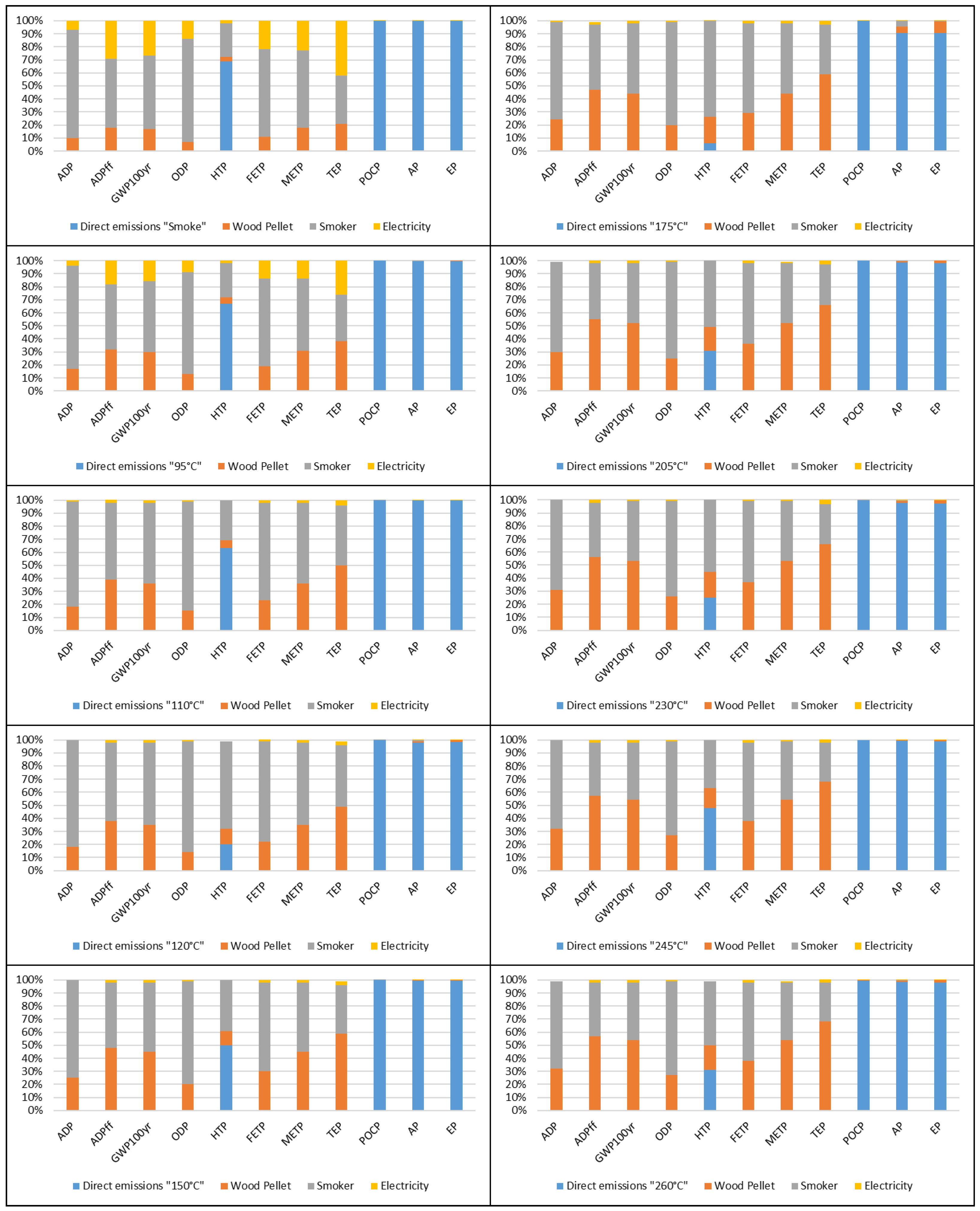
The contribution analysis, presented in
Figure 4, highlights the distinct environmental profiles associated with the different cooking modes. The results reveal a consistent pattern where key life cycle stages dominate specific groups of impact categories, showing hotspots for potential environmental improvement.
Direct emissions from pellet combustion constitute the predominant contributor to impacts closely linked to air quality. Specifically, NOx emissions account for more than 70% of the total impact in the categories of EP, AP, POCP, and HTP. Furthermore, CO and CH4 emissions from combustion make notable additional contributions to POCP, with CO also being a direct driver of HTP. This identifies the operational, or use, phase as the critical determinant for atmospheric pollution impacts.
In contrast, the manufacturing of the smoker, encompassing material extraction and processing, was the major contributor across nearly all other impact categories. It was responsible for more than 50% of the total impact share in ADP, ADPff, GWP, ODP, FETP, METP, and TEP. This finding highlights the environmental burden of the appliance itself, from resource extraction to fabrication. However, the impacts are dependent on the lifespan of the device, which was assumed to be 5 years, but could exceed 10 years.
The upstream production of commercial wood pellets was also relevant in some impact categories across different cooking options. For the primary smoking function, its contribution remains below 20% across all impact categories. However, for other cooking options, its share becomes more pronounced, showing notable contributions to ADPff, GWP, METP, and TEP. The contribution from electricity use for the smoker’s auger and controller is negligible across most scenarios and categories. Minor exceptions occur in extended operational modes like smoking and low-temperature cooking, where electricity use registers a small but measurable share in ADPff, GWP, ODP, FETP, METP, and TEP.
The environmental performance of the pellet smoker depends on a key trade-off. Reducing air-pollution impacts (such as eutrophication, acidification, and photochemical ozone formation) requires improving combustion efficiency to lower NOx, CO, and CH4 emissions. On the other hand, reducing impacts like global warming and resource use depends more on design choices, including materials, supply chains, and product durability.
3.3. Scenario Analysis
The scenario analysis of smoker usage is presented in
Table 6. The impact scores for POCP, AP, and EP remain unchanged, as these categories are primarily driven by direct emissions during operation. Because the smoker’s combustion efficiency and emission profile per operating hour are assumed to be constant, doubling the total usage time results in a proportional increase in total emissions and, therefore, no change in the impact per hour.
In contrast, the scores of the remaining impact categories decrease by approximately 25–50%. These categories are more strongly influenced by smoker manufacturing and material production. As the total useful output (operating hours) increases, the one-time environmental burden associated with manufacturing is amortized over a greater number of use hours. This leads to a lower impact per hour of use and underscores the importance of product durability and utilization rate in improving environmental performance.
3.4. Practical Scenarios
To offer a practical perspective, two common use patterns can be considered: high-intensity use (maximizing the cooking surface and energy output) and lower-intensity, hobbyist use. The most pragmatic way to estimate the impact of the cooking phase is to follow the barbecue manufacturer’s own guidelines for quantities, meat types, and cooking times. Therefore, the following scenarios utilize recipe data from the barbecue manual alongside established food life cycle inventory data [
30] to provide illustrative impact projections (
Table 7).
The following three specific cooking cases were analyzed:
Case 1: Whole turkey (4.5–5.0 kg), grilled for 90–120 min (190–232 °C). The total impact for 1 kg of cooked turkey is estimated at 10.07 to 10.11 kg CO2 eq. Within this total, the contribution from the barbecue’s operation (pellet combustion and electricity) is relatively minor, accounting for approximately 2%.
Case 2: Beef rib roast (5.44–6.35 kg), cooked for 2.5–2.75 h at medium heat (162–190 °C). This scenario reveals a dramatically higher impact, with 1 kg of cooked beef ranging from 99.7 to 99.72 kg CO2 eq. Here, the immense carbon footprint of beef production from dedicated herds dominates the result, reducing the relative contribution of the barbecue process to a negligible 0.2%.
Case 3: Pork rib crown roast (1.81–2.26 kg), roasted for 2–3 h (135–162 °C). The impact of 1 kg of cooked pork ribs falls between 12.79 and 13.00 kg CO2 eq. The barbecue’s operational share in this case is slightly more pronounced than in the others, contributing between 3.8 and 5.3% of the total impact.
The environmental footprint of food products, particularly meat, is often high and highly variable compared to that of the grill’s production and use of the grill. Furthermore, the vast diversity of ingredients, recipes, and portion sizes makes modeling the cooking phase exceptionally complex, which is why it is frequently excluded from product-level life cycle assessments. These cases demonstrate that while the pellet smoker’s operational impact is a relevant factor, it is consistently dwarfed by the embedded footprint of the food itself, especially for high-impact meats like beef. This reinforces the principle that the primary environmental leverage for a meal cooked on a barbecue lies in the choice of food, not the efficiency of the appliance. The analysis also illustrates that the relative importance of the cooking process varies significantly depending on the type and quantity of meat being prepared. To put the results in a practical context, three scenarios for cooking meat were considered.
These findings align with the established literature, which identifies the environmental footprint of the food itself, particularly meat and other grilling ingredients, as the dominant contributor to the overall impact of a barbecue meal, often overshadowing the impacts from fuel and equipment [
22]. Thus, for sustainable consumption, the choice of food is a greater determinant of a meal’s environmental footprint than the cooking method used.
3.5. Limitations
Despite the strengths of this study, a few limitations must be highlighted. First, it was not possible to conduct an operational cooking case study to evaluate the smoker under real culinary conditions. As a result, key parameters such as food type and composition (particularly meat), portion dimensions, loading configuration, and variability in cooking practices were not experimentally assessed, even though these factors represent the true functional context of the smoker’s use phase and may influence both emissions and energy performance. Furthermore, the analysis relied on secondary data for pellet production, which, although sourced from the Ecoinvent database, may not fully capture regional or technological variability in feedstock composition, processing efficiency, or supply chain characteristics. In addition, the experimental assessment considered only a single commercially available wood pellet. Other pellet types, differing in species composition, density, or additive content, may exhibit distinct combustion behavior and emission profiles. Such differences could also influence the sensory characteristics of the cooked food. However, this aspect was beyond the scope of the present study and was not evaluated. Finally, the assessment did not extend to downstream life cycle stages, including maintenance, repair, or end-of-life management of the smoker. Excluding these phases limits the completeness of the system boundary and may underestimate potential benefits or burdens associated with material recovery, reuse, or disposal pathways.
3.6. Overcoming Limits
There are several strategies to address the identified limitations, ranging from short-term empirical adjustments to more resource-intensive, long-term methodological refinements.
Regarding the operational phase involving food, short-term improvements could be achieved by evaluating the environmental impacts associated with standardized food products (e.g., hamburgers, whole poultry, or briskets). This would allow for the development of targeted case studies limited to specific food categories. In the long term, research should assess not only the process-related impacts on different food types but also the appliance’s degradation over time and its subsequent service life. Naturally, such longitudinal studies involve significant financial and logistical commitments. Furthermore, experimental setups for cooking-related emissions must be adapted; the moisture and fats released from meat or vegetables can produce significant steam and particulate matter that may interfere with sensor accuracy. In these instances, flue gas pretreatment (e.g., moisture removal and filtration) is essential to protect analytical equipment.
Concerning pellet production, impacts should ideally be assessed on a case-by-case basis in collaboration with manufacturers, as food-grade pellets for smokers differ from conventional heating pellets. Given the absence of specific quality standards and the use of diverse wood species to impart flavor, generalizing the impact of a single pellet type is challenging. In this context, the environmental footprint is driven primarily by the biomass origin rather than the pelletization process itself. For example, applewood pellets are often derived from agricultural pruning residuals, whereas oak pellets typically originate from primary forestry activities—each carrying a distinct carbon and land-use profile.
Finally, for end-of-life (EoL) processes, assessments should incorporate the characteristics of regional or national recycling and disposal infrastructures for the specific materials used in the smoker’s construction. However, a comprehensive evaluation remains difficult, as the frequency of maintenance and repair depends heavily on individual user behavior and intensity of use. Given the complexity of tracking these variables experimentally, a robust scenario-based modeling approach likely represents the most viable strategy for capturing the variability of downstream impacts.
4. Conclusions
This study presented a life cycle assessment of a domestic wood-pellet barbecue smoker, quantifying its environmental impacts for smoking. As a pioneering analysis, it establishes a critical methodological foundation and baseline for understanding the environmental profile of this increasingly popular appliance category. The results identify key hotspots across the product’s life cycle. For most impact categories, including GWP and ADP, the materials and manufacturing phase constitutes the dominant burden. However, impacts such as POCP, AP, and EP are overwhelmingly driven by direct NOx and CO emissions during pellet combustion. This distinction highlights separate pathways for environmental improvement. Mitigating the former requires eco-design and material choices as well as recycling at the end-of-life, while reducing the latter demands combustion optimization.
From an operational perspective, the analysis demonstrates that intermediate-temperature cooking functions (e.g., 110 °C and 120 °C) generally yield the lowest impact per hour of use across most categories when results are expressed per hour of cooking. The exception is for energy efficiency, where higher temperatures show a lower impact per kilowatt-hour delivered. A key finding is the significant role of product utilization and lifetime; sensitivity analysis confirmed that increasing the total hours of use substantially reduces the normalized impact of manufacturing, with reductions exceeding 50% for several categories at higher usage intensities. This underscores that product durability and frequency of use are decisive factors for the overall environmental performance.
Given the global growth in outdoor cooking and the associated energy use, this study sought to address this gap in the literature. Future research should build upon this parameterized framework to enable robust comparisons between different fuels (e.g., different wood pellets, charcoal, gas, electricity), appliance types, and cooking practices. Expanding the assessment to include the full meal footprint, where the choice of meat dominates the climate impact, would provide consumers and policymakers with a complete picture for sustainable decision-making. From the perspective of the grilling/smoking industry, and especially for manufacturers, possible suggestions are limited, as the sector is well-structured with experience dating back to the last two decades of the 20th century. However, given the significant dependence of these devices (especially pellet smokers) on fuel, it would be desirable for pellet manufacturers and international standards bodies to initiate standardization processes for these fuels. This would not only help consumers use devices more sustainably but also ensure they use a more food-safe fuel. Ultimately, advancing such research is essential to inform the development of lower-impact grilling/smoking technologies and more sustainable outdoor cooking cultures.




 ,
,