Article

Study on Methods and a System for Real-Time Monitoring of the Remaining Useful Life of a Milling Cutter

Department of Mechanical Engineering, National Chung Hsing University, Taichung 40227, Taiwan
*
Author to whom correspondence should be addressed.
Appl. Sci. 2026, 16(2), 958; https://doi.org/10.3390/app16020958
Submission received: 25 October 2025 / Revised: 13 January 2026 / Accepted: 14 January 2026 / Published: 16 January 2026

Abstract

Tool wear degrades sharpness and durability, causing poor surface quality, dimensional errors, and high costs. Precise RUL prediction optimizes production, reduces rework, and prevents downtime. Conventional replacement relies on experience and risks inaccuracy. Real-time monitoring enables optimal intervals. Predictive maintenance cuts tooling costs and ensures quality. Industry 4.0 integrates sensors for intelligent wear management. This study applies GRNN to predict RUL with minimal TMD. A C#-based system with intuitive HMI was validated in real machining.

1. Introduction

The machinery sector serves as the foundation for societal progress and economic development. Taiwan possesses a complete supply chain for machine tools and precision mechanical components. However, rising labor costs and higher educational levels have reduced interest in traditional manufacturing jobs, which involve factory environments and shift work, leading many machining manufacturers to face rising operational costs and severe labor shortages. Therefore, adopting Industry 4.0 concepts and developing unmanned factories has become the mainstream trend in the machinery industry. Real-time tool wear monitoring, machining quality prediction, and anomaly detection are core elements of intelligent manufacturing. Without robust quality control in unmanned factories, substantial defective or reworkable parts may be produced, causing significant time and cost waste and affecting corporate profitability. In summary, implementing tool wear monitoring systems provides three primary benefits: 1. Enhanced workpiece quality, 2. Increased machining efficiency, and 3. Reduced operational expenditures.
Tool wear directly affects workpiece quality. As wear progresses, cutting resistance increases, leading to greater dimensional variation in finished parts and compromised quality. Modern processes often use multiple tools for different operations: severe roughing tool wear increases fracture risk and causes cascading failures in subsequent tools due to excessive stock; finishing tool wear or fracture violates tolerances. Tool breakage reduces machine uptime, requiring halts for replacement, setup, and rework.
Traditional management relies on technician experience and conservative schedules, often resulting in premature tool discard. Shift handovers lack quantitative metrics, leading to unnecessary replacements. Monitoring systems provide real-time quantifiable data and numerical indicators, reducing subjectivity and tool wastage.
This study developed a tool wear monitoring system by simultaneously measuring spindle current and machining vibration using an ammeter and accelerometer during cutting experiments. Signal features were extracted and analyzed via regression to establish the correlation between tool wear and spindle current, with vibration data used to verify the reliability of the spindle load current trend. Based on these findings, a real-time tool remaining useful life prediction method based on spindle load current was developed, and a smart monitoring system incorporating this method was implemented. Experiments used casting parts for real-world cutting validation to confirm the efficacy and reliability of the prediction method and monitoring system.
However, traditional regression methods have limitations in tool wear prediction, requiring extensive material-specific experiments for robust monitoring across diverse workpieces. Extrapolating models from known materials to unknown ones risks significant predictive inaccuracy. Therefore, this study develops material-specific tool wear monitoring methods using minimal cutting experiments. A Generalized Regression Neural Network (GRNN) was employed to train a tool remaining useful life prediction model using a small dataset of target material experiments augmented with larger related datasets. Predictive accuracy was compared with models trained on extensive target material data to determine the minimum target data required for comparable performance. This approach allows industries to use existing machining signal data as a base, requiring only limited target material data for effective monitoring.
Scholars worldwide have proposed various methods for remaining useful life (RUL) prediction. In machine learning, Almeshaiei et al. [1] used GRNN to build a predictive model for tool nose wear in turning, trained with six inputs—cutting speed, feed rate, depth of cut, and tri-axial forces (Fx, Fy, Fz)—along with actual nose wear measurements. Validation showed GRNN’s efficacy in creating accurate wear prediction models integrable into intelligent manufacturing systems for real-time prediction and assessment. Jain et al. [2] explored CNN weight transfer in image recognition, finding same-task transfer (BnB) performance declined with more layers due to interlayer dependency, while cross-task transfer (AnB) maintained baseline performance for ≤2 layers, indicating early layers detect universal features and deeper layers task-specific ones.
In intelligent monitoring, Altıntaş et al. [3] used feed-axis motor current to estimate cutting forces, demonstrating that with sufficient current control and sampling frequency, time-domain measurements effectively predict cutting force magnitude. Li et al. [4] monitored tool wear via turning tool feed-axis input current, identifying accelerated wear rate at tool life end as a diagnostic threshold through extensive experiments, and established a current-based diagnostic method by analyzing current increase rate.
Conventional monitoring approaches often employ multi-sensor fusion, including cutting forces (via load cells), vibrations (accelerometers), acoustic emission (AE), and motor power consumption, to detect changes in tool condition. Recent advancements include sensorless methods that estimate cutting forces from motor current/voltage or reconstruct force signals using accelerometers for wide-bandwidth monitoring. Olmo et al. [5] proposes a hybrid method combining real-time monitoring (accelerometers, load cells, motor consumption) with offline inspection, focusing on signal sensitivity to process variations and establishing the relationship between tool wear and broaching natural frequencies. This method simultaneously records multiple signals, enhancing applicability in daily production and addressing the gap in real-time wear estimation for high-tolerance aerospace broaching operations.
Simultaneously collecting cutting forces and tool positions (X, Y, Z coordinates) during milling enables precise correlation between force signals and machining locations, enhancing diagnostic capabilities for complex part machining issues. Traditional force signals recorded only in time or spindle rotation domains fail to accurately correspond to varying workpiece geometries or feed changes; position-oriented monitoring generates spatial force distribution maps, suitable for thin-walled parts or freeform surface milling. Lacalle et al. [6] proposed a diagnostic system that synchronously collects data via a dynamometric plate and position loop analog outputs, with post-processing to generate chromatic and vector maps for spatial event diagnosis in milling. This method is better suited for complex part testing, addressing the gap in visualized position-related force distributions, and validated across three research projects.
Exit burr formation during drilling of aerospace aluminum alloys (e.g., Al 7075-T6) is a major quality issue, leading to additional deburring costs, potential structural damage, and assembly precision problems, particularly under dry high-speed conditions. Peña et al. [7] proposed a monitoring method based on internal spindle torque signals, selecting five features correlated with burr height and developing a threshold algorithm, achieving over 92% prediction accuracy in dry high-speed drilling of Al 7075-T6. Compared to traditional external sensors, this sensorless approach is more cost-effective and robust, addressing the gap in real-time quality control for aerospace drilling and suitable for daily production. In high-speed milling of complex parts, continuous feed rate variations due to look-ahead functions in CNC systems and unexpected residual stock from previous semi-finishing operations prevent accurate correlation between part geometry and cutting forces in traditional time- or rotation-domain recordings, hindering diagnostic accuracy. Lacalle et al. [8] presented a data acquisition system that synchronously records cutting forces and tool positions, resolving diagnostic challenges from feed variations and unexpected stock, and generating geometry-related force maps to enhance testing efficiency on complex parts. This tool is suitable for diagnosing real geometric issues, validated in three cases: accelerated model validation, unexpected engagement detection, and thin-wall milling analysis, addressing the gap in spatial force distribution diagnostics.
Song et al. [9] measured spindle current and end mill flank wear, corroborated by vibration data, showing load current and vibration effectively represent flank wear characteristics; data labeled as normal, severe, or abnormal vibration states trained a CNN with high test accuracy. Yang et al. [10] measured milling machine servo motor current and cutting load, finding a linear relationship; regression derived the feed-axis current-load equation, with validation showing estimated forces from motor current had <8% error.
This study investigates GRNN application for RUL prediction with reduced training data requirements. A C#-based intelligent tool life monitoring system with an intuitive human–machine interface was developed and rigorously validated in real machining environments.

2. Research Methodology

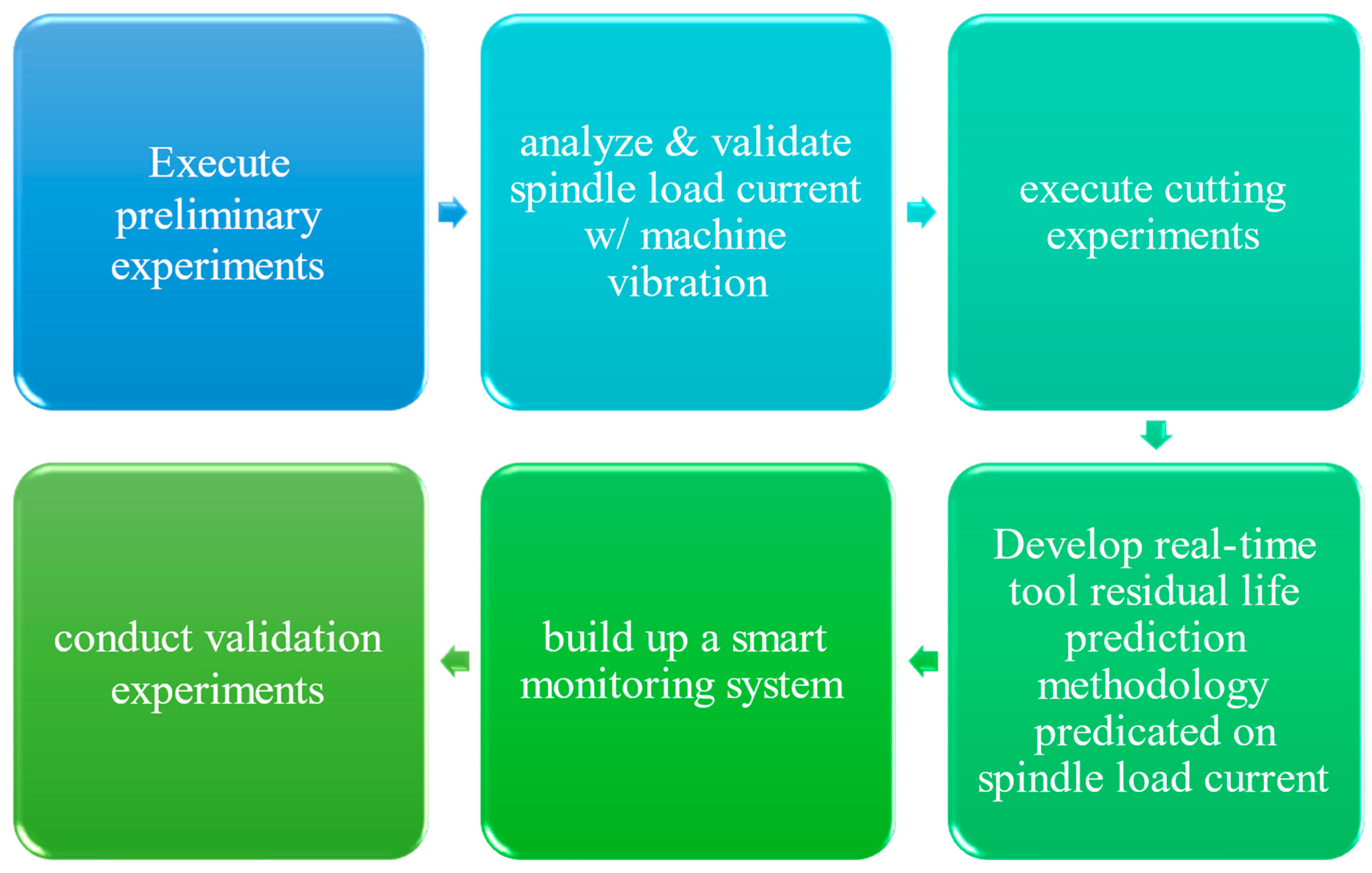
To optimize efficiency and cost-effectiveness in smart manufacturing applications, an anomaly monitoring system must facilitate real-time communication, adaptable threshold settings, and precise parameter adjustments to accommodate diverse machining conditions. This study employs cost-efficient digital ammeters, primarily focusing on spindle current measurement, while corroborating its accuracy through simultaneous vibration analysis, thereby circumventing the substantial investment associated with dynamometers and accelerometers. Two distinct preliminary experiments were executed to elucidate the characteristic current signals indicative of tool wear and machining anomalies. The initial experiment involved a straightforward linear cutting path, wherein spindle load current and machine vibration were concurrently measured for validation purposes. Subsequently, to enhance RUL prediction, linear cutting experiments were performed on three distinct ferrous materials, AISI 1045, AISI 4140, and AISI W2, characterized by varying hardness levels, while meticulously recording tool usage time for each material. A Generalized Regression Neural Network (GRNN) methodology was then employed to develop a predictive model for RUL across these diverse materials, with a concurrent effort to minimize the training dataset size, thereby identifying the optimal data volume for achieving maximum predictive efficacy. Figure 1 shows the block diagram of the methodology described above.
To address the contemporary demands of intelligent machining monitoring, this research develops a sophisticated RUL prediction system, predicated upon extensive experimental data. This system, meticulously designed to align with the workflow of machine operators—from material inspection and NC program development to machine setup and execution—comprises two key interfaces: a pre-processing interface for machining parameter and threshold configuration, and a real-time monitoring interface for signal time-domain analysis, tool anomaly detection, and process status assessment. This intelligent machining anomaly monitoring system is engineered to accommodate diverse machining methodologies and objectives. Additionally, to minimize false positive rates and accurately pinpoint tool wear characteristics, the system incorporates advanced filtering capabilities, effectively eliminating non-cutting, corner cutting, and outlier current signals, thereby mitigating the risk of erroneous algorithmic judgments due to unstable cutting currents.
To rigorously validate the accuracy of the predictive algorithm and the diagnostic reliability of the system under complex machining trajectories, the deviation between predicted and actual RUL was analyzed. The root mean square error (RMSE) and mean absolute percentage error (MAPE) metrics were employed to rigorously assess the precision of the RUL prediction methodology.

2.1. Signal Processing Methodologies

To effectively delineate the signal characteristics indicative of tool wear, this section elucidates the methodologies employed for processing current and vibration signals. A meticulous analysis of the time-domain features of these signals is conducted, as temporal variations in current and vibration patterns provide a robust reflection of signal characteristics associated with both incipient and severe tool wear. This analysis facilitates a comprehensive understanding of the tool wear degradation process through the interpretation of these characteristic signal patterns.

2.1.1. Methodologies for the Sampling and Processing of Spindle Load Current

This research leverages spindle current for tool wear estimation, predicated on the intrinsic correlation between input current and output torque. While torque constants are inherent to motor design and independent of input current, machine tool spindles predominantly employ alternating current (AC) motors. The principal distinction between AC and direct current (DC) motors lies in the former’s reliance on frequency inverters for speed and torque regulation. Given that the magnetic flux in AC motors is influenced by input current, contemporary control methodologies utilize vector control techniques to decouple the system’s control loops. To streamline the analysis of AC motor control principles, phasor control methods can be employed to model their behavior, thereby approximating the control dynamics of permanent magnet DC motors.
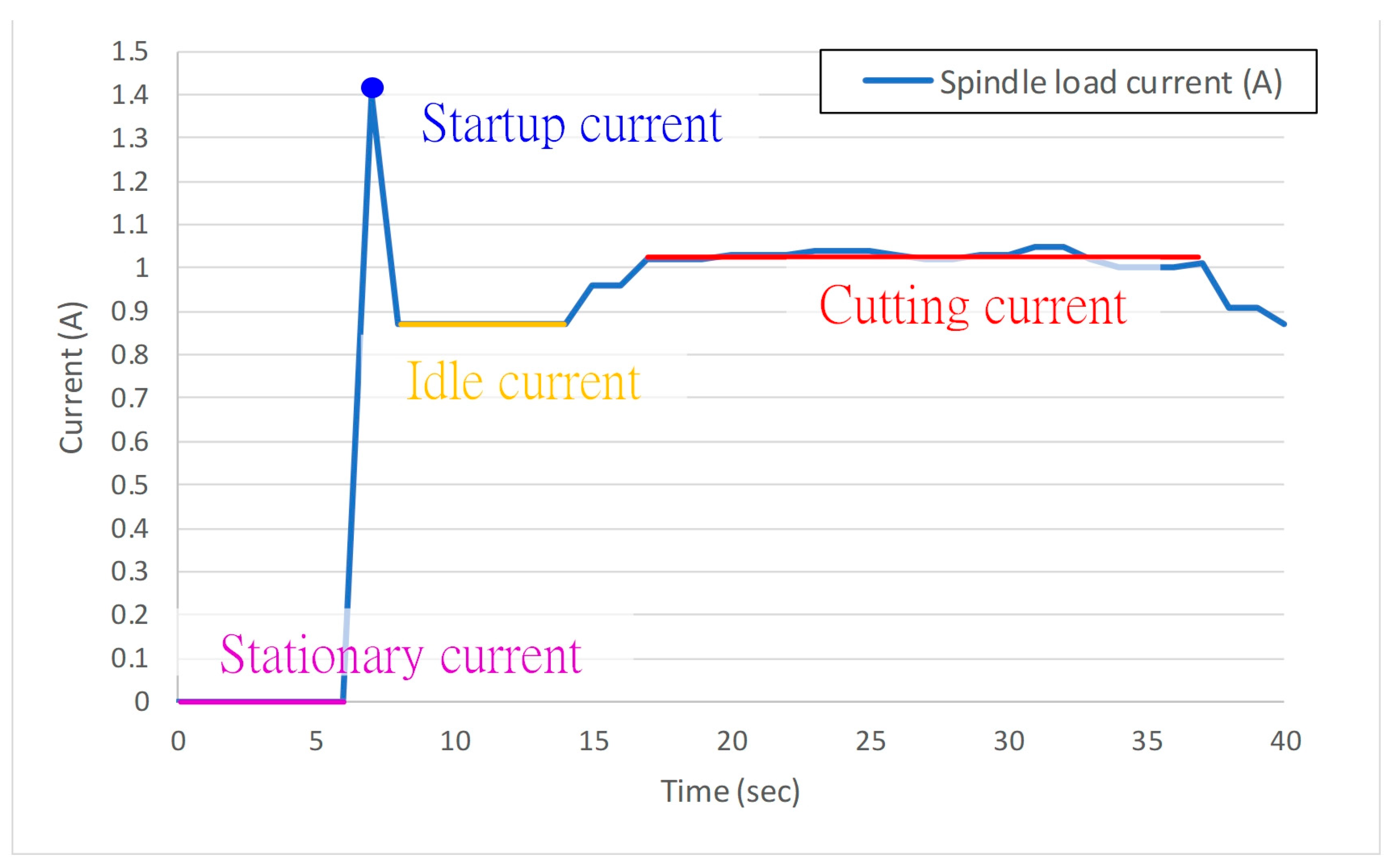
The experimental current sampling was conducted at a frequency of 1 Hz, the maximum rate achievable by the ammeter utilized in this study. As illustrated in Figure 2, the spindle current registers zero when the spindle is stationary, exhibits a transient surge during startup, and settles at an idle current during non-cutting rotation. Upon tool engagement with the workpiece, the machining current requires two to three seconds to stabilize, and conversely, upon tool disengagement, it decays until it approximates the idle current. This transient response is attributed to the fact that the current magnitude does not directly mirror instantaneous cutting load fluctuations; rather, it is modulated by a velocity loop controller that compensates for discrepancies between commanded and actual spindle speeds. Consequently, the steady-state cutting current embodies the time-domain signature of tool wear. The signal processing methodology employed in this study involved the initial exclusion of startup and idle current data, followed by the averaging of the top 20% of current data during a fixed machining pass, thereby accentuating the stable cutting current and reflecting the tool wear characteristics.

2.1.2. Outlier Detection Using Quartiles

To mitigate the influence of outliers within spindle load current data, this study adopts the quartile method, as introduced in previous research [11]. This statistical technique identifies data points that deviate significantly from the dataset by assessing whether they exceed dynamically determined upper and lower thresholds within a predefined data interval. If a data point surpasses these thresholds, it is classified and subsequently excluded as an outlier. The computational procedure for the quartile method is delineated by the following equation:
IQR   ( Inter   Quartile   Range )   =   Q 3 Q 1
FenceMax = Q 3 +   1.5   ×   IQR
FenceMin = Q 1 1.5   ×   IQR
where Q 1   represents the first quartile, corresponding to the 25th percentile of the ascendingly ordered dataset, Q 2 denotes the median, the central value of the sorted dataset, and Q 3 signifies the third quartile, representing the 75th percentile of the ascendingly ordered dataset.
Based on the outlier detection results obtained through the quartile method, data points exceeding FenceMax or falling below FenceMin are identified and subsequently removed as outliers from the dataset. The range of outlier exclusion is dynamically determined by the probability density function inherent to the data group. The application of the quartile method effectively mitigates the deleterious effects of outlier data, with the upper and lower bounds of outlier removal being adaptively determined by the distributional range of the data within the respective group.

2.2. Modeling Method

To effectively analyze the signal characteristics indicative of tool wear, this study employs machine learning methodologies [12] to construct a predictive model. Given that variations in spindle current under constant cutting volume signify tool wear, and that tool wear concomitantly leads to an increase in workpiece surface roughness, the primary objective of this research, utilizing regression analysis, is to facilitate the real-time estimation of machining surface roughness and the computation of current rise rate. Acknowledging the multifarious factors that influence actual tool lifespan during machining, and recognizing the inherent limitations of traditional regression analysis due to its relatively low model complexity, which may impede accurate prediction, this study leverages a Generalized Regression Neural Network (GRNN) to train a RUL prediction model. The model’s inputs encompass tool usage time, current rise rate, depth of cut, and material hardness, thereby enabling the prediction of RUL.

2.2.1. Generalized Regression Neural Network (GRNN) Methodology

The Generalized Regression Neural Network (GRNN) is a supervised learning methodology that necessitates the explicit definition of input and output data states or values during the training phase. A key advantage of GRNN is its capacity to construct predictive models without requiring a priori specification of the regression model architecture; it achieves this through training on a sufficient dataset. Furthermore, the model’s output can assume arbitrary values based on the training data, demonstrating its versatility. GRNN is characterized by its multi-input capability, abbreviated training duration, simplified parameter tuning, and exceptional model approximation prowess. Consequently, in scenarios where complex input-output relationships render traditional linear regression models inadequate, GRNN facilitates the development of models that effectively approximate these relationships for accurate predictions.
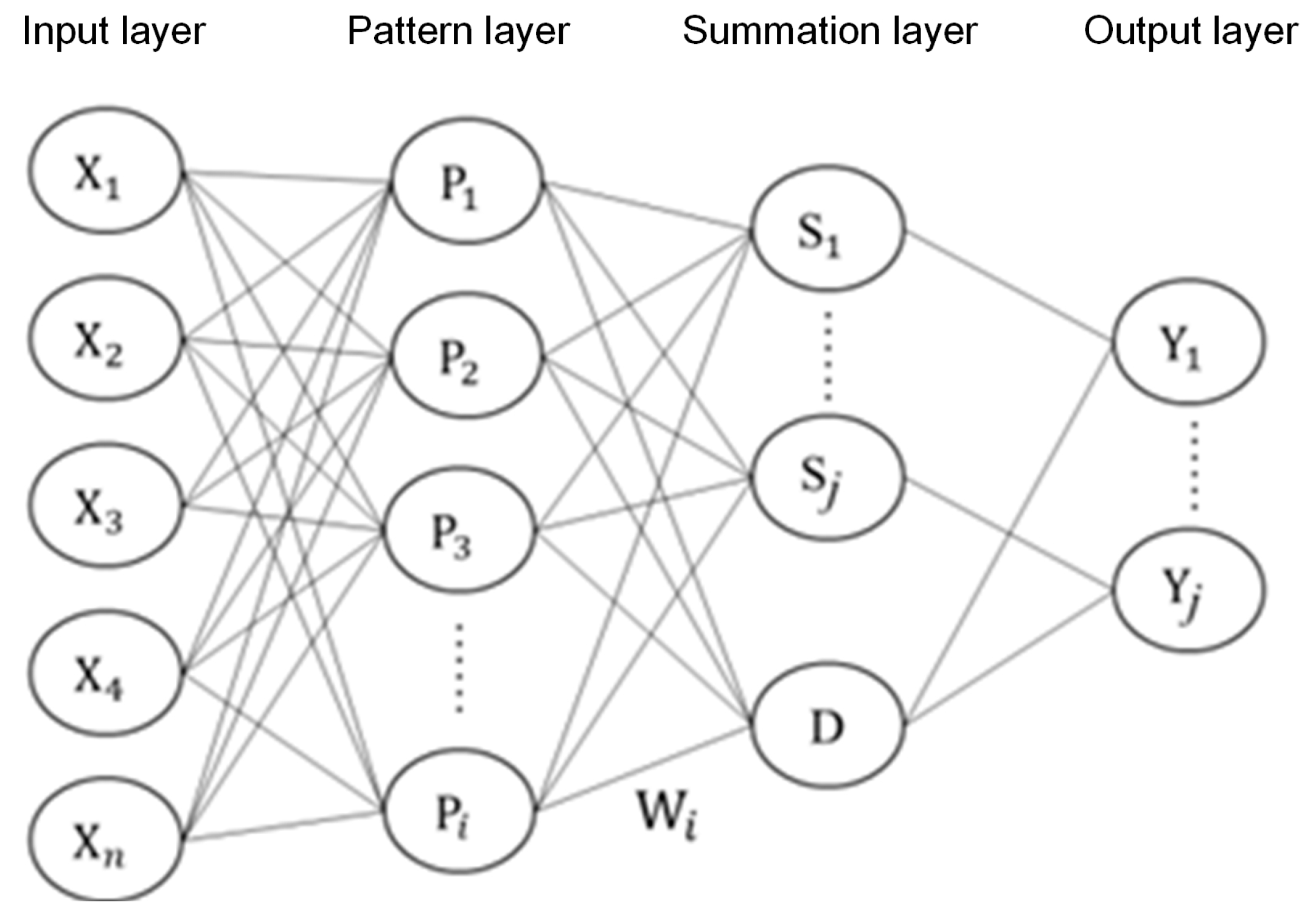
The architecture of the GRNN model, as depicted in Figure 3, is composed of four distinct layers: the input layer, the pattern layer (also known as the radial basis layer), the summation layer, and the output layer. The input layer (X) defines the data format for model training and can be represented in matrix form as Equation (4):
X = [ X 1 , X 2 , X 3 , X n ] T
where X represents the matrix of model input data and n denotes the cardinality of the training dataset.
The primary function of the pattern layer is to evaluate the similarity between input and training samples, a process facilitated by radial basis functions (RBFs). Among various RBFs, the Gaussian function is predominantly employed due to its advantageous characteristics. Upon the introduction of a new input sample into the pattern layer, it is compared against each training sample, and their Euclidean distance is computed, as delineated in Equation (5).
D i 2 = X X i T X X i ,   i = 1 , 2 , , n
P i = e x p D i 2 2 x 2
The primary function of the summation layer is to amalgamate the similarity information generated by the pattern layer with the corresponding output values of the training samples, thereby estimating the expected value of the output variable under given input sample conditions through a weighted summation process. The summation layer is effectively composed of two sub-layers: the numerator summation layer and the denominator summation layer. The numerator summation layer computes the sum of the weighted output values, as delineated in Equation (7), while the denominator summation layer calculates the sum of the weights, as depicted in Equation (8). The ultimate output value, representing the GRNN’s predictive result, is derived by dividing the output of the numerator summation layer by that of the denominator summation layer, as illustrated in Equation (9). This weighted averaging mechanism enables the GRNN to more precisely estimate the values of the output variable based on the similarity between the input sample and the training samples.
S j = i = 1 n y i × P i
D = i = 1 n P i
Y j = S j D

2.2.2. K-Fold Cross-Validation Methodology

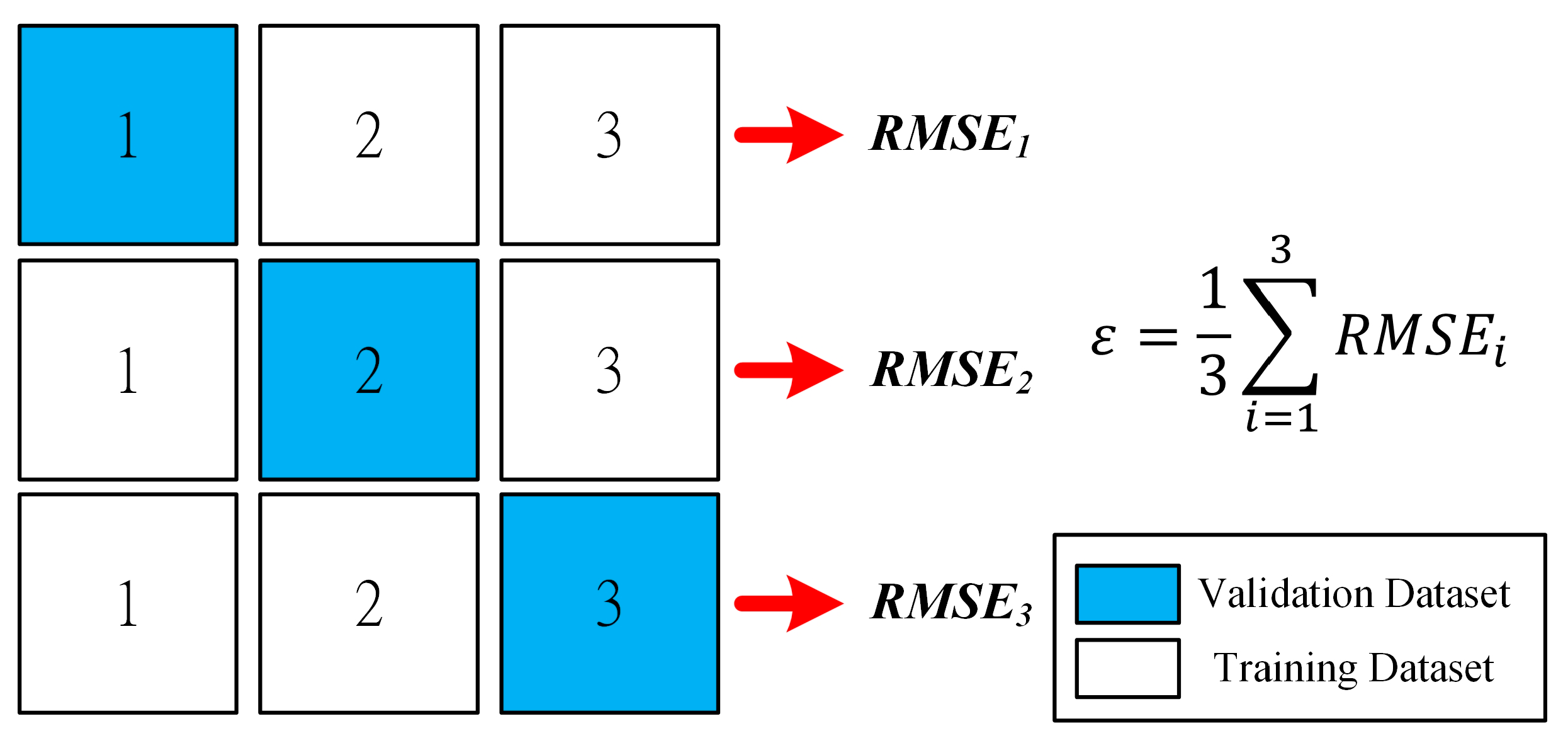
K-fold cross-validation methodology [13] is a prevalent technique employed in neural network modeling, primarily to mitigate the issue of overfitting on training data. Prior to implementing K-fold cross-validation, the training dataset is assessed and partitioned into K equal subsets. One subset is designated as the validation set, while the remaining subsets constitute the training data. As illustrated in Figure 4, the training data are divided into three subsets: the first subset serves as the validation set, while the second and third subsets are utilized for training. Subsequently, the second subset is designated as the validation set, with the first and third subsets used for training, and so forth. This process is iterated K times, with each subset serving as the validation set once. The final evaluation metric is the average of the RMSE values obtained from each of the K training iterations. In this study, when training the GRNN model for RUL prediction, RMSE is utilized as the loss function to evaluate the model’s performance. The computational procedure for RMSE is delineated by the following equation
R M S E = i = 1 n ( Y i y i ) 2 n
where Y i represents the model’s predicted output value, y i denotes the actual output value of the validation data, and n signifies the cardinality of the validation dataset.

2.3. Experimental Setup

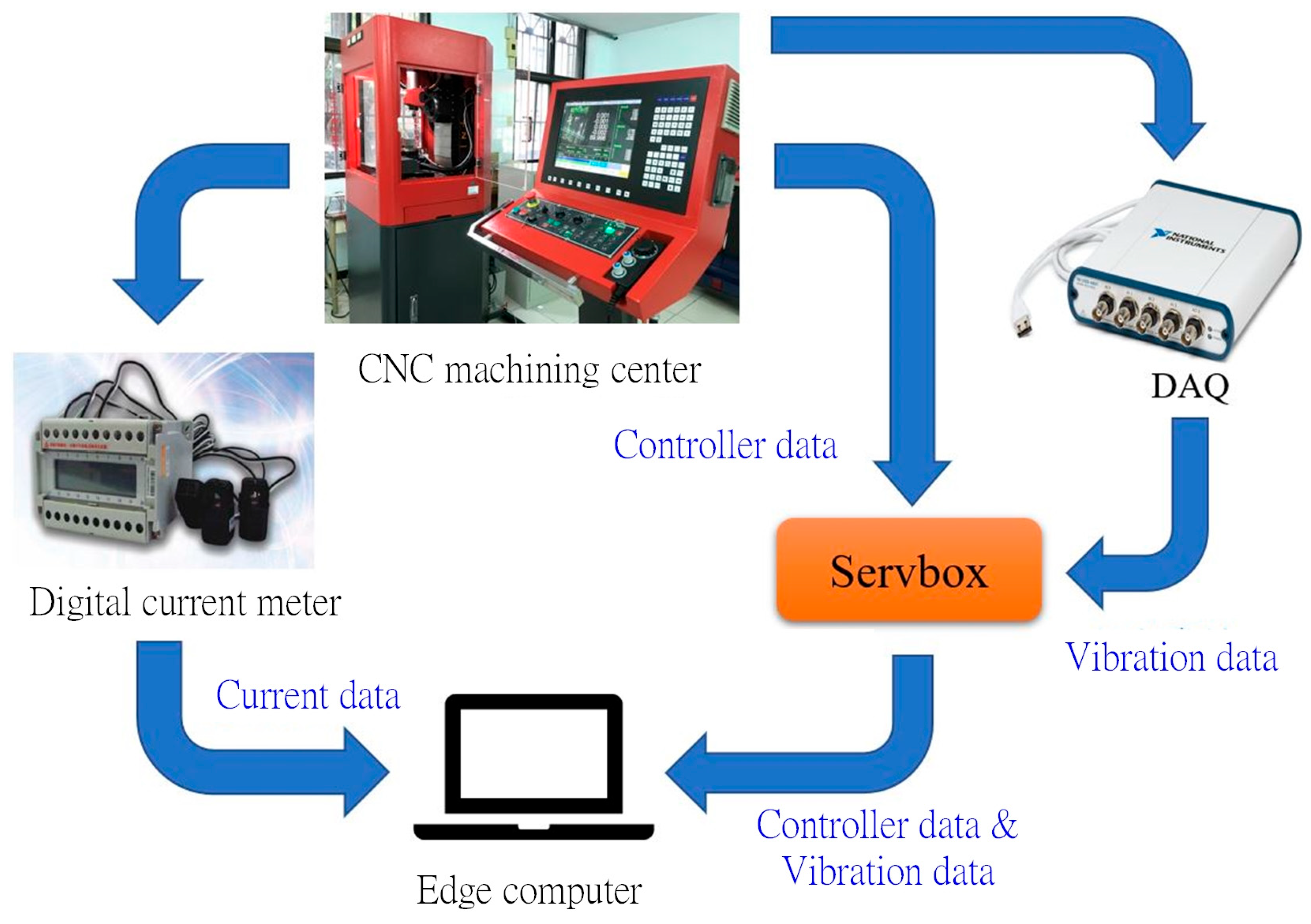
The experimental data acquisition architecture is depicted in Figure 5, with Table 1 delineating the specifications of the cutting tools employed in the preliminary experiments. To ensure the reproducibility of results, each set of machining parameters was subjected to three independent trials. Synchronous data acquisition was conducted for spindle current, machining vibration, and controller-derived machining parameters. Spindle current was directly captured from a digital ammeter through a custom-developed C# program, while machining vibration and process data were obtained via Servbox (Servcore version), interfacing with both a Data Acquisition (DAQ) system and the machine tool controller. Post-machining, tool flank wear was measured using an industrial camera. The experimental setup utilized a comprehensive suite of equipment, including a PMC 5-axis machining center (A), a piezoelectric accelerometer coupled with a vibration signal acquisition card (B), Servbox software integrated with a Visual Studio 2017 development environment (C), an industrial camera fitted with a telecentric lens (D), a surface roughness measurement instrument (E), and a digital ammeter (F).

2.4. Development of Tool Wear Monitoring Methodologies

2.4.1. Utilization of the GRNN Methodology for Tool Residual Life Estimation

The actual RUL of a cutting tool is influenced by a multitude of machining parameters, including feed rate per tooth, depth of cut, material characteristics such as cutting speed and hardness, tool geometry, and coatings; conversely, depth of cut exhibits a comparatively diminished effect. This research deliberately omits the influence of feed rate variations on RUL, focusing instead on the development of a predictive model for RUL under varying material hardness and depth of cut conditions, with preliminary experiments conducted to acquire the requisite training data. The preliminary experimental phase involved the utilization of three distinct material types and three unique sets of machining parameters, with each experimental run replicated thrice to ensure the reproducibility of the results. The input data for the training model comprised the following parameters: 1. tool usage time, 2. current rise rate, 3. depth of cut, and 4. material hardness.
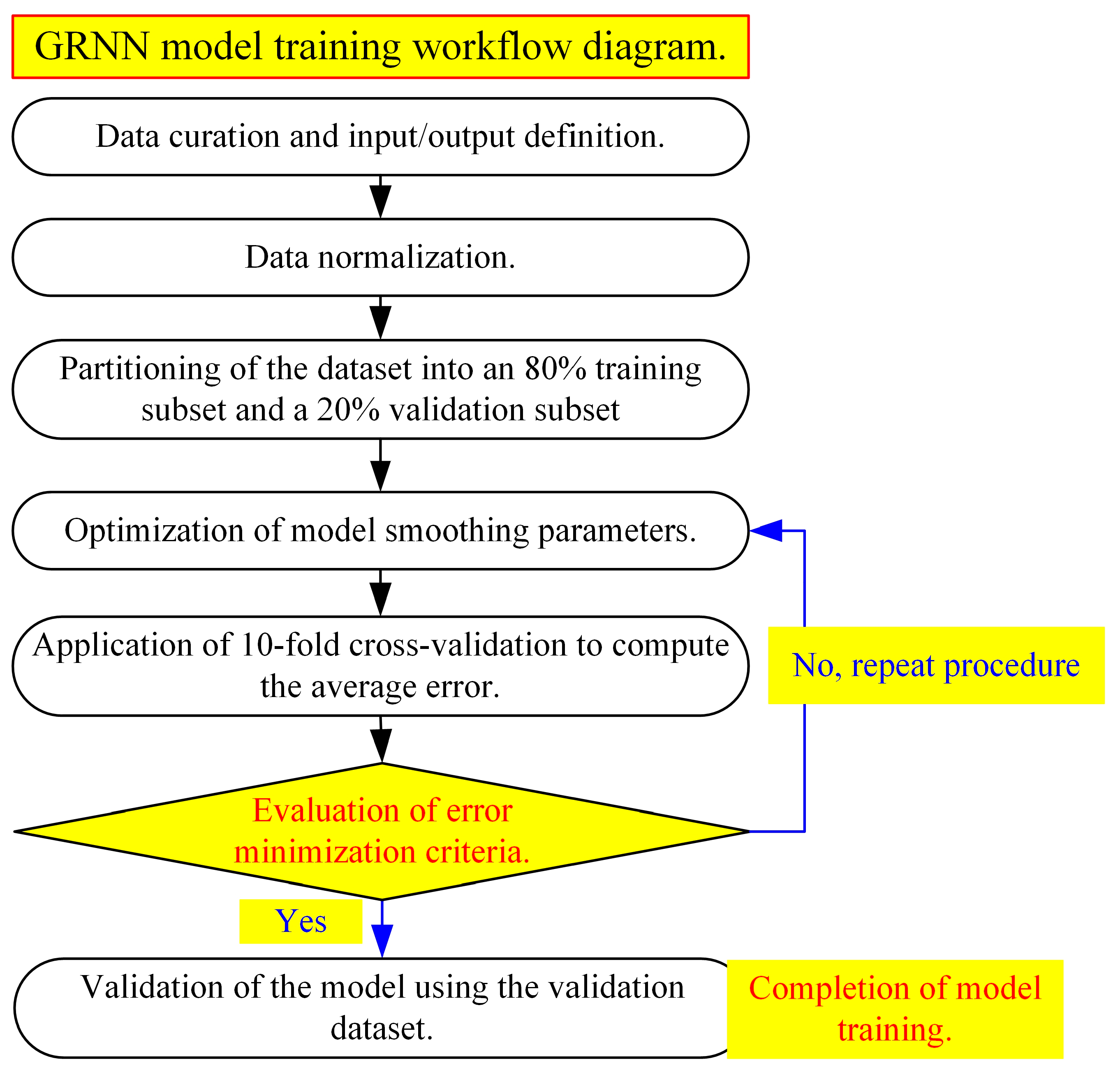
The research model training workflow, as depicted in Figure 6, commences with the normalization of preliminary experimental data to ensure homogeneity in the magnitude and scale of input features. Subsequently, the dataset is partitioned into an 80% training set and a 20% validation set, selected uniformly across the entire data range. To enhance model precision, a 10-fold cross-validation methodology, as detailed in Section 2.2.2, is employed for parameter fine-tuning. The training dataset is randomly divided into 10 equal subsets, with each subset serving as a validation set in turn, while the remaining nine subsets are utilized for model training, resulting in ten distinct modeling combinations. The optimal smoothing parameter is determined by identifying the parameter that minimizes the average RMSE across these ten combinations. The adjustment of the smoothing parameter is guided by the gradient descent optimization technique, wherein an initial smoothing parameter and learning rate are defined at the onset of model training. The model is initially trained using the starting smoothing parameter, and the training error is computed. An iterative process ensues, wherein the smoothing parameter is incrementally adjusted by the learning rate, and the training error is recalculated. By comparing the training errors before and after each adjustment, the direction of parameter iteration is determined, thereby facilitating the identification of a smoothing parameter that minimizes training error. Upon determining the optimal smoothing parameter, the model is retrained using this parameter and the entire 80% training dataset. The predictive accuracy of the retrained model is then validated using the remaining 20% validation dataset. If the predictive accuracy falls within an acceptable threshold, the model is designated as the final prediction model.

2.4.2. GRNN Model Training Paradigms

This research employs material hardness as a classification criterion, positing three distinct operational paradigms and objectives, to train GRNN RUL prediction models utilizing varied data classification methodologies. The three model training paradigms are broadly classified into two categories: Paradigm A and Paradigm B. Paradigm A encompasses scenarios where the user possesses a comprehensive dataset comprising experimental data for all three materials, enabling the training of a model capable of predicting RUL across these materials. Paradigm B investigates whether, given a robust dataset sufficient for training a RUL prediction model for material A, the incorporation of a limited dataset of cutting experiments for a novel material B can yield a new predictive model with adequate accuracy for predicting RUL under the novel material’s conditions. The following section provides a detailed exposition of the specific model training paradigms.
  • GRNN model training paradigm A-1
    Training paradigm A-1 employs the entirety of the experimental data from all three materials to train the model. The optimal smoothing parameters, which minimize the predictive error of RUL across the three materials, are determined in accordance with the model training methodology previously delineated. Subsequently, the predictive accuracy of the model is validated for each individual material by utilizing their respective validation datasets.
  • GRNN model training paradigm A-2
    Training paradigm A-2 involves the utilization of discrete training datasets for each of the three materials, culminating in the development of three distinct predictive models, each specifically tailored to estimate the RUL of tools used on a particular material. The optimal smoothing parameters for each material-specific model are determined by minimizing the training error within that specific material’s dataset. Subsequently, the predictive accuracy of these three distinct models is assessed using their respective validation datasets, and the results are compared with those obtained from the model trained under paradigm A-1. This comparative analysis aims to elucidate the discrepancies in predictive accuracy observed between the two distinct data classification methodologies when applied to the validation datasets.
  • GRNN model training paradigm B
    In training paradigm B, nine distinct experimental datasets were generated for each of the three materials, encompassing three variations in machining parameters and three replicates per variation. Subsequently, the aggregate experimental data was randomized and partitioned into five distinct subsets, representing 100%, 75%, 50%, 25%, and 0% of the total dataset, respectively. Each of these five subsets was amalgamated with the complete experimental datasets of the remaining two materials, resulting in the training of five unique RUL prediction models. Consequently, the model trained using the 100% dataset in paradigm B mirrors the training dataset utilized in paradigm A-1. The predictive accuracy of these models, trained with varying dataset sizes, was then evaluated using the respective validation datasets for each of the three materials. This evaluation aimed to compare the predictive accuracy against that of the model trained under paradigm A-1, which employed the entire dataset of all three materials, thereby facilitating the determination of the optimal dataset size for achieving the most favorable cost-effectiveness ratio.
In summation, the principal objectives of this research in training RUL prediction models are twofold: firstly, to evaluate the predictive accuracy of models trained with extensive datasets for predicting RUL across multiple materials, in comparison to models trained with limited datasets for predicting RUL for a single material; and secondly, to develop a methodology for constructing RUL prediction models for novel materials using a limited experimental dataset specific to the novel material, augmented by a comprehensive dataset collected from prior experiments on legacy materials. This approach aims to facilitate the training of predictive models for RUL in novel materials with minimal experimental effort, leveraging the wealth of data acquired from legacy materials.
The subsequent section delineates the comprehensive workflow employed in this research for training GRNN models to predict RUL, followed by a detailed exposition of the procedural steps specific to training paradigms A and B.
  • Workflow for GRNN model training in tool residual life prediction
    • Cutting experiments were performed using three distinct ferrous materials (AISI 1045, AISI 4140, AISI W2), with three variations in machining parameters and three replicates per variation, to collect spindle current, tool usage time, and current rise rate data.
    • A 1.4-fold increase in spindle current was established as the cessation criterion for tool life.
    • The dataset was preprocessed to define input and output variables. Input parameters, including depth of cut, material hardness, tool usage time, and current rise rate, were meticulously selected to predict the RUL. The output variable was defined as the actual RUL for each data point.
    • Data planning and organization involved partitioning the experimental data for each of the three materials, allocating 80% for training purposes and the remaining 20% for model testing. The testing dataset, which was not utilized in model fine-tuning, served to evaluate the predictive accuracy of the trained model.
    • All experimental data underwent normalization to enforce a uniform scale across all features within the training dataset during the model training process.
  • Workflow for GRNN model training paradigm A
    • A baseline model was trained utilizing the complete preliminary experimental dataset encompassing all three material hardness levels (AISI 1045, AISI 4140, AISI W2), enabling the prediction of RUL across varying material hardness.
    • Ten-fold cross-validation was employed to optimize the smoothing parameters of the training data, thereby minimizing the predictive error.
    • Following an initial training iteration, outliers were identified and removed from the training dataset, and the model was subsequently retrained.
    • The baseline model’s performance was validated by computing the RMSE and MAPE across the three material hardness levels, serving as a comparative benchmark.
    • Material-specific predictive models for tool residual life were independently trained for each of the three material hardness levels.
    • Ten-fold cross-validation was applied to fine-tune the material-specific models, aiming to minimize the predictive error.
    • Outliers were removed from the training datasets based on the initial training results, and the material-specific models were subsequently retrained.
    • The performance of each material-specific model was validated by computing the RMSE and MAPE for its respective material hardness level.
    • A comparative analysis was conducted to evaluate the discrepancies in predictive accuracy between the baseline model and the material-specific models, thereby assessing the impact of different training methodologies.
  • Workflow for GRNN model training paradigm A
    • A baseline model was trained utilizing the complete preliminary experimental dataset, encompassing all three material hardness levels (AISI 1045, AISI 4140, AISI W2), enabling the prediction of tool residual life across varying material hardness.
    • Ten-fold cross-validation was employed to optimize the model’s smoothing parameters, thereby minimizing the predictive error.
    • Following an initial training iteration, outliers were identified and removed from the training dataset, and the model was subsequently retrained.
    • The baseline model’s performance was validated by computing the RMSE and MAPE across the three material hardness levels, using the validation dataset, and serving as a comparative benchmark.
    • Data partitioning was conducted, wherein subsets comprising 75%, 50%, 25%, and 0% of the experimental data for a specific material were generated through random sampling. Each subset was then amalgamated with the complete experimental datasets of the remaining two materials, resulting in the training of distinct models.
    • Ten-fold cross-validation was employed to fine-tune the models trained with the partitioned datasets, aiming to minimize the predictive error.
    • Outliers were removed from the training datasets based on the initial training results, and the models were subsequently retrained.
    • The performance of each model trained with partitioned datasets was validated by computing the RMSE and MAPE using the respective validation dataset for the specific material, and the results were compared with the errors obtained from the baseline model trained with the complete dataset of all three materials.

3. Tool Wear Surveillance and Diagnostic System

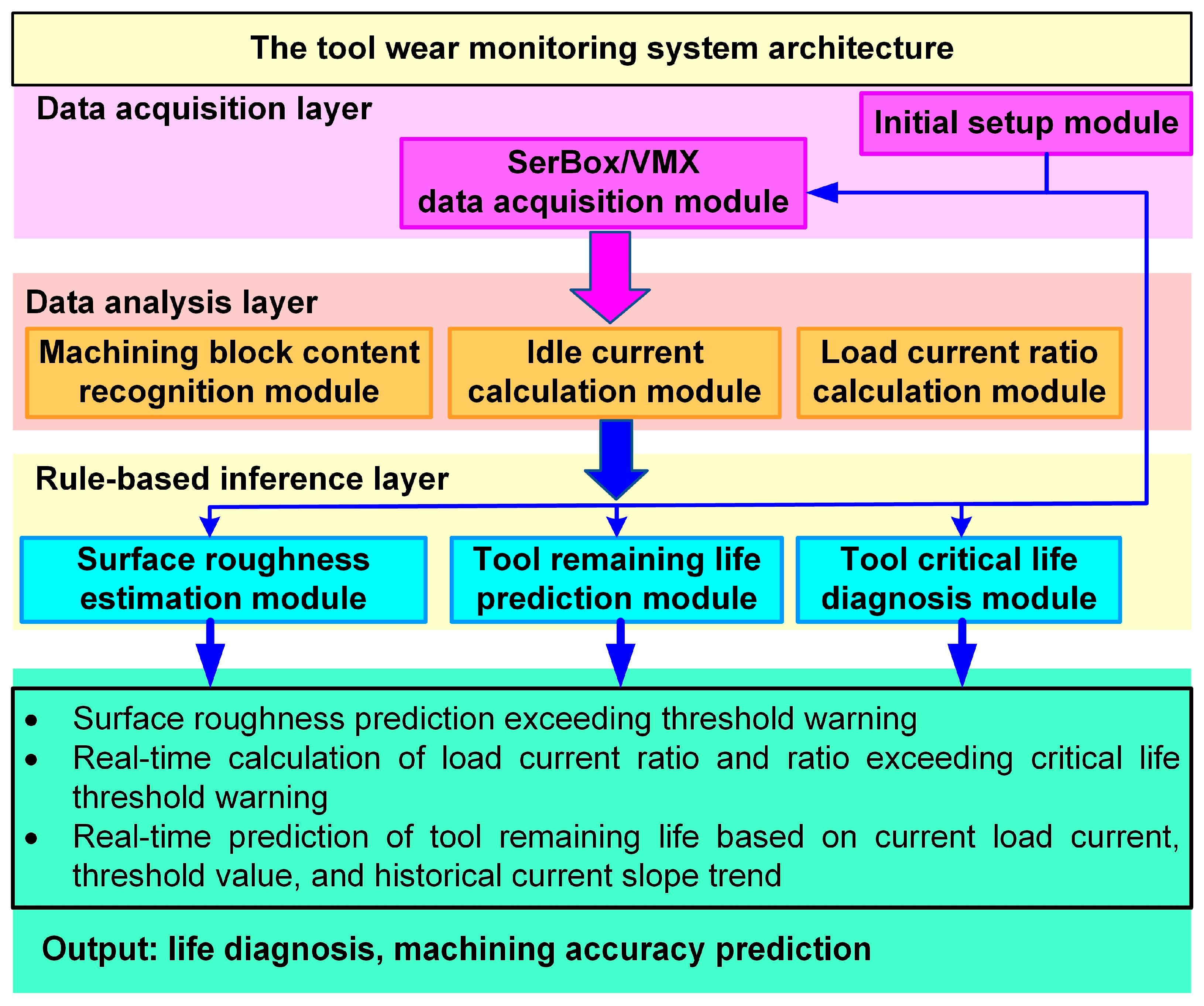
The tool wear monitoring system architecture developed based on the methodologies outlined in the preceding chapter is illustrated in Figure 7. The system performs real-time analysis and diagnostics of machining conditions through a tiered architecture comprising a data acquisition layer, a data analysis layer, a rule-based inference layer, and an anomaly alert output layer. Within the system’s configuration module, machining program content and preliminary settings are stored. Based on the controller’s current program name, the module outputs the program content and pre-stored settings to the monitoring panel. The data acquisition module, utilizing Servbox, captures real-time controller data and tri-axial machining vibration, while simultaneously commanding the ammeter to output spindle current measurements at 1 s intervals. The module polls the controller at a frequency of 0.5 s, transmitting the current execution line number to the block recognition module. The block recognition module extracts keywords from the current block content, including movement mode, tool number, and feed rate, and relays these to other modules. The idle current recognition module combines spindle speed and current readings to automatically collect and average spindle idle current, forwarding this data to the load current multiplier module. The load current multiplier module employs a user-defined diagnostic region (stable cutting block numbers) as a baseline. When the current execution line number enters the diagnostic region, the system automatically removes idle current, collects 30 spindle current data points (approximately 30 s), removes outliers using the quartile method described in Section 2.1.2, calculates the average current from the top 20% of the remaining data, and computes the current increase ratio relative to the new tool’s average current. This ratio is then transmitted to the rule-based inference layer for evaluation. The inference layer integrates pre-defined parameters and thresholds to diagnose machining anomalies, and the anomaly alert output layer provides tool critical life diagnostics, surface roughness estimation, and RUL prediction.

3.1. Configuration and Operational Procedures for the Tool Wear Surveillance and Diagnostic System

The machining wear surveillance and diagnostic system comprises a user pre-configuration interface and a real-time machining status monitoring interface. Prior to initiating monitoring, the system necessitates the configuration of requisite parameters and thresholds for the program being monitored. The real-time monitoring interface subsequently integrates the pre-configured parameters with data acquired from controllers and edge devices to perform anomaly surveillance, culminating in the generation of an anomaly monitoring event log for user review.

3.1.1. User Pre-Configuration Interface

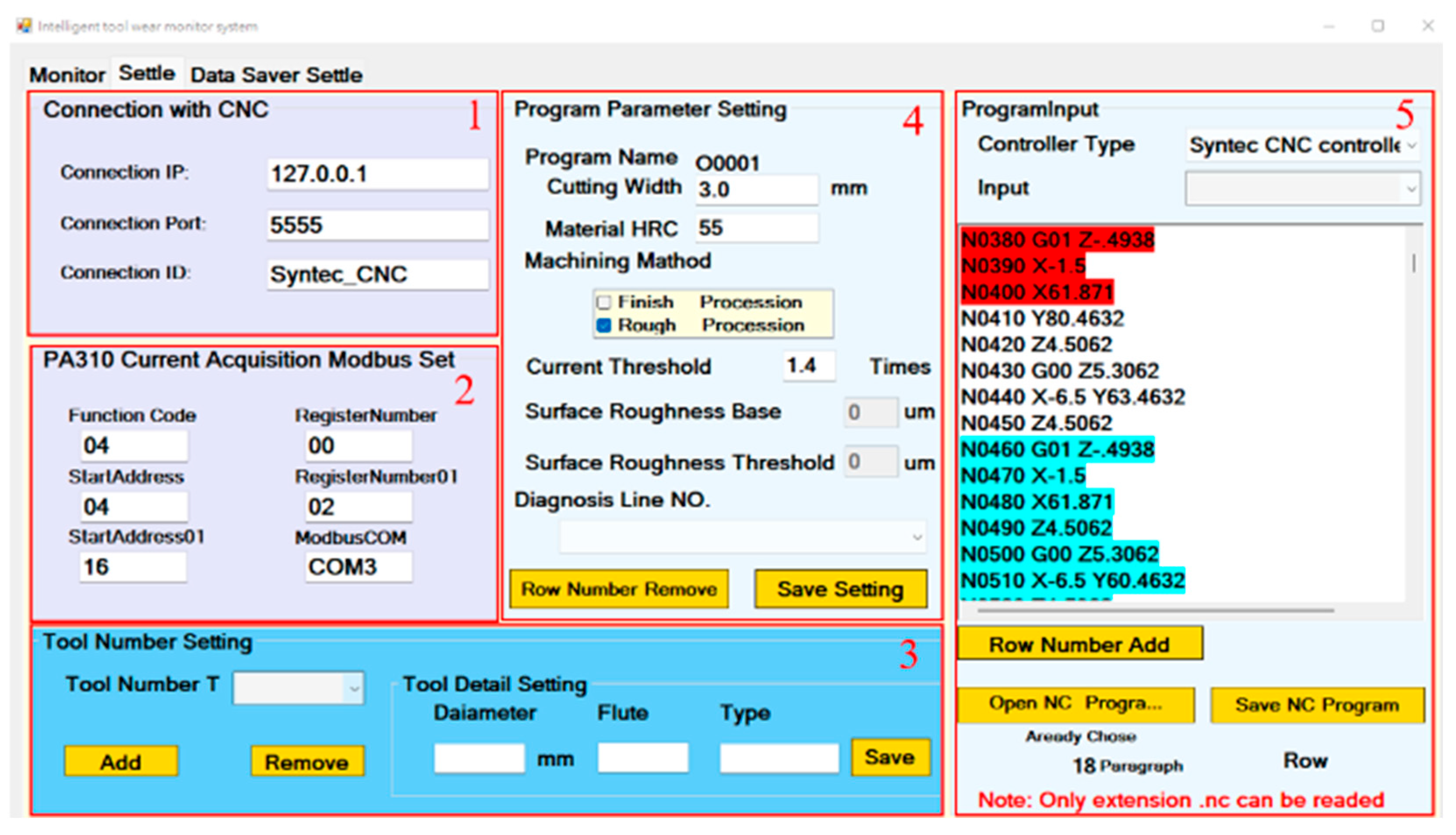
The user pre-configuration interface, depicted in Figure 8, is structured into five primary sub-interfaces, each serving distinct functionalities. These sub-interfaces facilitate the configuration of connectivity parameters for controllers and edge devices, the specification of detailed tool parameters, the definition of diagnostic thresholds (e.g., critical RUL or surface roughness limits), the setting of machining parameters inaccessible or absent within the controller, program content importation, and the configuration of machining diagnostic line numbers. A detailed description of these five sub-interfaces follows:
  • Configuring controller connectivity parameter sub-interface
    As outlined in Section 2.3, the monitoring system architecture employs Servbox as an intermediary for controller communication. The Connection IP and PORT adhere to the default format for invoking Servbox via TMTC commands, the syntax and controller compatibility of which are detailed in the TMTC user manual. The Connection ID serves as a user-defined identifier for the machine connected to Servbox, which can be modified within Servbox to suit specific requirements. This functionality enables users to retrieve data from diverse controller brands by altering the Connection ID when Servbox is concurrently connected to multiple machines.
  • Configuring ammeter connectivity parameter sub-interface
    The PA310 ammeter utilizes the RS485 communication protocol to transmit data to the host PC. This research employed the EasyModBus API provided by Hsin Cheng Corporation (Taoyuan City, Taiwan) to establish a direct communication interface with the ammeter. Users must verify that the COM port assigned to the ammeter matches the configuration settings to establish a successful connection. Subsequently, a clamp meter is installed on the spindle power supply to acquire spindle current data.
  • Configuring detailed tool parameter configuration sub-interface
    The tool detail parameter configuration function enables the specification of detailed tool parameters, such as tool name, number of flutes, and diameter. Users sequentially define and store the detailed parameters for each tool, following the tool number sequence in the machine tool magazine. The system automatically generates a file corresponding to each tool number in a designated directory to store the tool’s detailed parameters. Upon selection of a tool number with pre-configured details, the software autonomously searches the directory for a file matching the selected tool number and populates the interface with the stored parameters. During machining, when a block executes a tool change command, the system promptly displays the current tool number and automatically imports the associated detailed parameters into the tool wear surveillance and diagnostic system.
  • Threshold and machining parameter sub-interface
    This sub-interface facilitates the configuration of monitoring thresholds and machining parameters for specific programs. The monitoring interface provides real-time display of the imported program name, prompting users to specify the depth of cut, material hardness, and machining mode (roughing or finishing) associated with the program. Upon selection of the roughing mode, surface roughness threshold settings are automatically disabled, and the surface roughness prediction module is deactivated during machining monitoring. Users define a critical RUL threshold multiplier (recommended value: 1.4×) to establish the tool replacement criterion. Conversely, when the finishing mode is engaged, users are required to stipulate both the baseline surface roughness value—representing the surface finish achievable with a new tool under the designated machining parameters—and the permissible surface roughness threshold. The system will subsequently initiate a tool replacement notification upon the projected surface roughness surpassing the established threshold. The configured parameters are stored in a file named after the program within a designated directory. Similar to the tool detail parameter configuration sub-interface, the system automatically searches for and populates the interface with previously stored settings when a program is selected from the dropdown menu.
  • Machining program importation and diagnostic region sub-interface
    Upon selection of the “input” dropdown menu within the program importation interface, the system initiates a search for all files with the “.nc” extension within the designated directory, presenting them for user program importation. To mitigate the potential for misinterpretations arising from fluctuations in tool cutting volume, the system provides a user-definable diagnostic block feature, thereby minimizing the impact of cutting volume variations on anomaly surveillance. Users are required to manually define contiguous program segments characterized by consistent cutting volumes to serve as diagnostic blocks. Diagnostic procedures are exclusively activated when the machining block traverses a designated stable cutting region; conversely, diagnostic processes are suspended when the machining block is situated outside these regions. The system automatically designates the leading segment within the stable cutting region (identified by the two lowest sequential block numbers) as the program’s initial machining current acquisition zone, which is visually distinguished by a red background. Subsequently, users select a stable cutting region exhibiting machining conditions analogous to the initial current acquisition zone to function as the diagnostic block for machining anomaly surveillance, which is visually represented by a cyan background. Anomaly surveillance is initiated upon the machining block’s entry into the user-defined diagnostic region.

3.1.2. Real-Time Machining Status Monitoring Interface

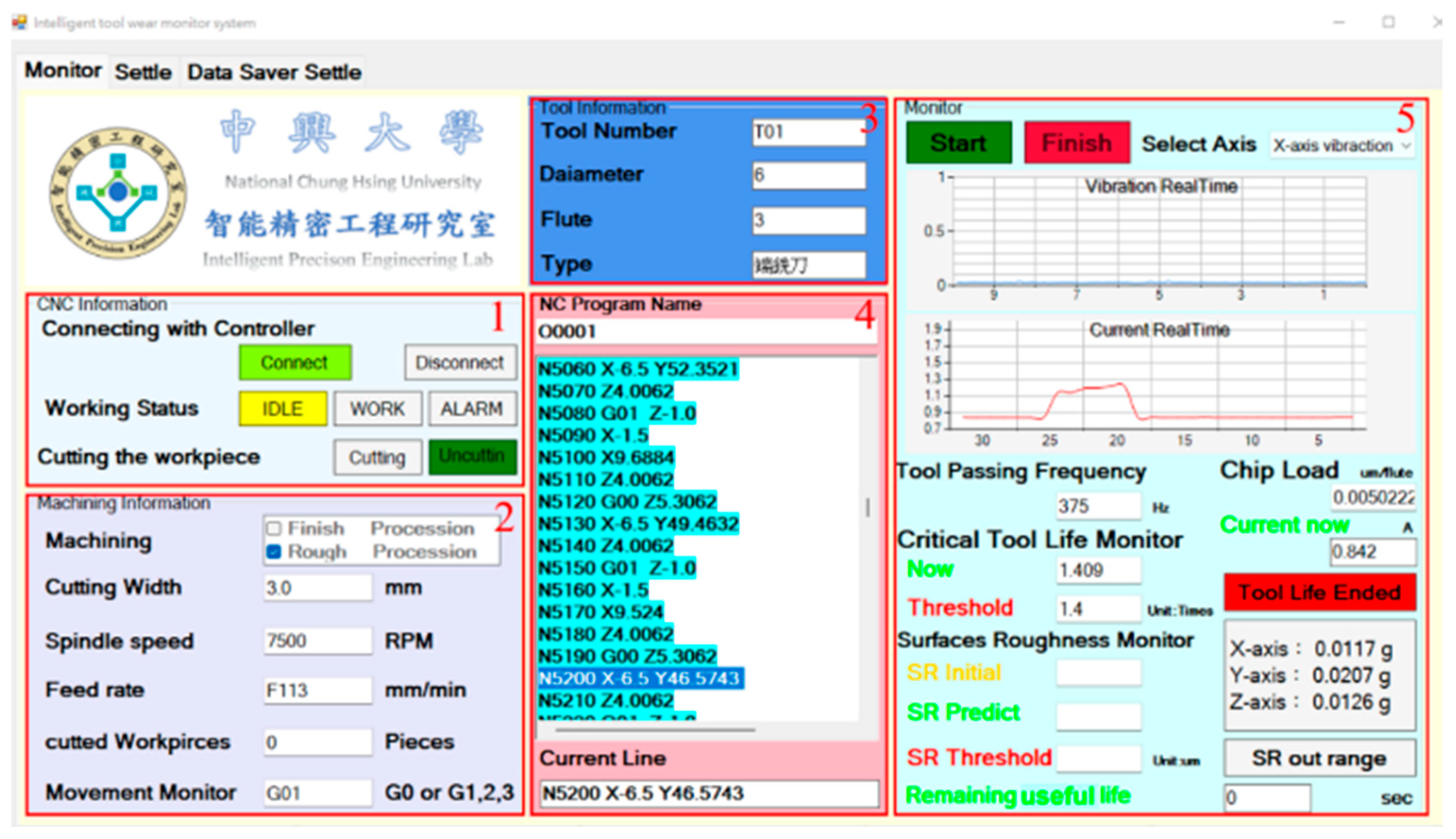
The real-time machining status monitoring interface, as depicted in Figure 9, is structured into five distinct sub-interfaces: controller status, machining parameter surveillance, current tool and detailed tool parameter display, program and block content monitoring, and machining status and anomaly surveillance. A detailed description of these five sub-interfaces follows:
  • Controller status sub-interface
    The controller status sub-interface verifies the connectivity of Servbox with the controller and peripheral devices. A green “Connect” indicator illuminates upon successful establishment of all device connections; conversely, a red “Disconnect” indicator signals a failure in Servbox connectivity with the controller or data acquisition (DAQ) system. The CNC operational status indicator mirrors the machine tool’s alert lights, providing real-time visualization of the controller’s current operational state (paused, running, or alarm). Workpiece engagement detection involves the real-time monitoring of collected current values, which are subsequently compared against idle current values to ascertain tool engagement with the workpiece.
  • Machining parameter surveillance sub-interface
    The machining parameter surveillance sub-interface provides real-time visualization of the following data points: the current machining program’s operational mode (roughing or finishing), the programmed depth of cut, the commanded spindle speed, the active feed rate, the cumulative workpiece count recorded by the controller, and the current positional status of the machine tool’s feed axes.
  • Current tool and detailed tool parameter display sub-interface
    Upon the machining block reaching a tool change command, the tool parameter surveillance sub-interface promptly displays the currently selected tool number. The system then retrieves and populates the status fields with user-defined detailed tool parameters corresponding to the displayed tool number by searching within a designated directory. The system polls the controller at a frequency of 0.5 s to update the current execution line number. In instances where the selected tool number does not correspond to an actual physical tool change, it is recommended to introduce a delay of at least one second within the tool change block to ensure accurate tool number acquisition by the system.
  • Program and block content monitoring sub-interface
    Upon initiating monitoring, the developed system automatically retrieves the machining program name and imports the corresponding pre-stored program data and threshold configurations. This approach is necessitated by Servbox’s limitation to extracting only the current machining program name and execution line number from the SINUMERIK controller. The system’s monitoring sub-interface provides real-time visualization of the user-defined initial machining current acquisition zone (indicated by a red background) and the anomaly diagnostic region (indicated by a cyan background). The currently executing block within the program is highlighted in real time, with the block’s content also displayed in a dedicated lower panel. Anomaly monitoring is automatically activated when the system’s execution reaches a user-defined region and is suspended upon the block’s departure from the diagnostic region.
  • Machining status and anomaly surveillance sub-interface
    The machining status and anomaly surveillance sub-interface features time-domain monitoring panels for vibration and current values. The vibration panel displays a 10 s time-domain plot, representing the average of the top 20% of vibration values sampled every 0.1 s. Users can select specific axes (X, Y, or Z) for vibration monitoring via a dropdown menu, with the system dynamically displaying the selected axis’s vibration data on the time-domain plot. The current panel presents a 30 s time-domain plot of the spindle current, updated at a frequency of one sample per second, based on measured current values. The system calculates the tooth passing frequency and feed per tooth based on the current spindle speed, number of flutes, and feed rate. The sub-interface provides real-time visualization of measured current, tri-axial vibration values, and estimated RUL for user reference. During roughing operations, the critical tool life threshold and current machining current multiplier are displayed in real time. During finishing operations, the surface roughness threshold and predicted surface roughness are displayed. The system triggers a red light indicator to alert users when a threshold is exceeded, signaling the need for tool replacement.

4. Experimental Validation and Discourse

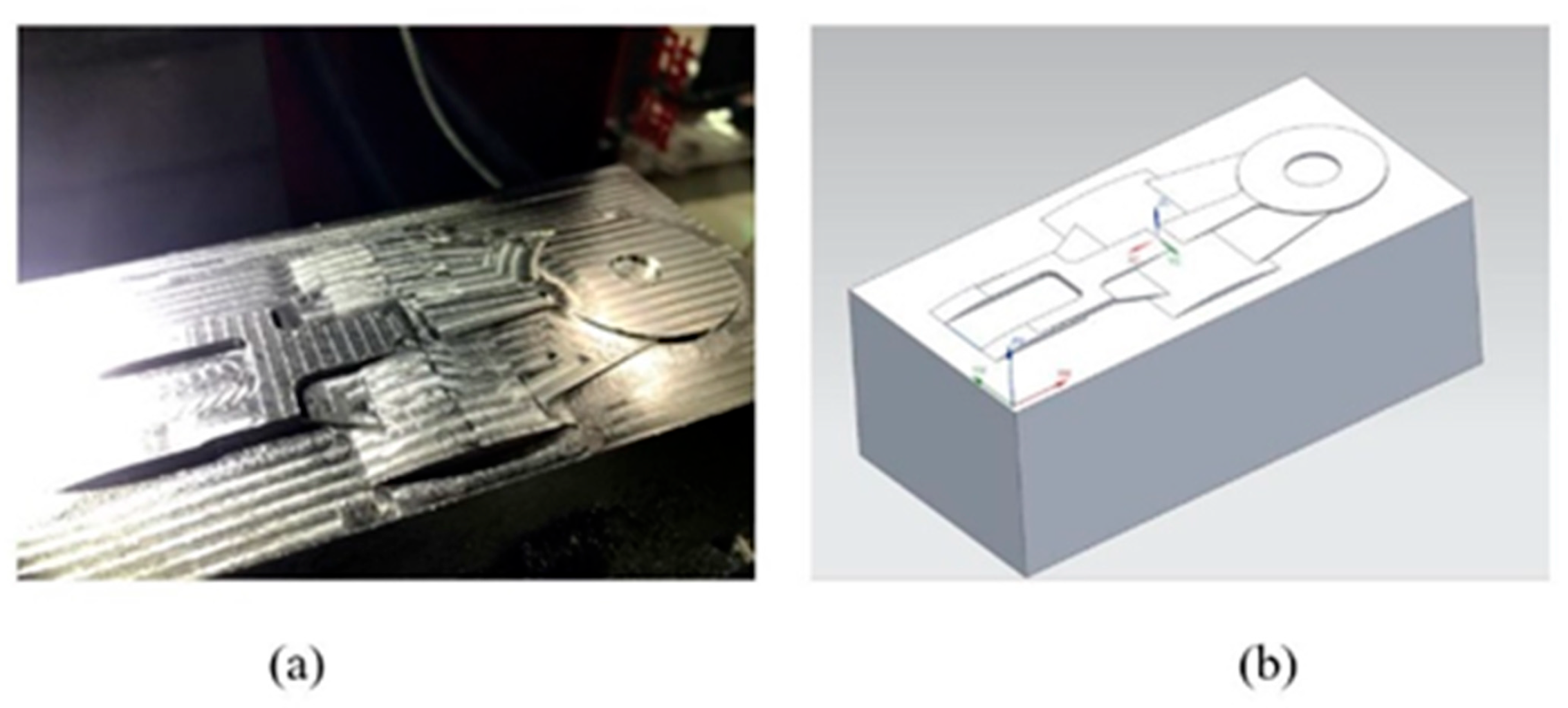
To rigorously validate the accuracy, reproducibility, and robustness of the machining anomaly surveillance system, a rocker arm model was designed as the validation experimental workpiece, as illustrated in Figure 10, drawing inspiration from reference examples in engineering graphics textbooks. NXCAM (v2023.06) software was employed to generate simulated tool paths for roughing and finishing machining operations. The critical tool life validation experiments utilized linear cutting for material removal, while the surface roughness prediction validation experiments employed contour cutting with a reduced depth of cut to emulate finishing passes. These validation experiments were conducted to evaluate the accuracy of the critical tool life diagnostic module, the surface roughness prediction module, and the RUL prediction module, respectively.

4.1. Training and Validation of the Tool Residual Life Prediction Model

This study employed distinct training methodologies tailored to specific modeling objectives. Preliminary experiments were conducted utilizing three distinct materials, involving simplified linear cutting procedures. The specifications of the experimental materials and cutting tools are detailed in Table 2 and Table 1, respectively, while the experimental machining parameters are delineated in Table 3. Each set of machining parameters was subjected to three replicate trials to ascertain reproducibility, resulting in the collection of 27 machining experimental datasets for model training. Initially, RUL prognostic models were trained under varying operational scenarios. Subsequently, these models were integrated with the tool wear surveillance module, and their accuracy and reliability were validated through physical machining experiments.

4.1.1. Training Outcomes for Model Training Paradigm A

The primary objective of model training paradigm A was to develop a robust model utilizing a comprehensive dataset. Consequently, the model was trained using all available data from the three distinct experimental materials. A comparative analysis was then conducted to evaluate the predictive accuracy of this model against three separate models, each trained exclusively on data from a single material, using validation datasets specific to each material.
  • Model training paradigm A-1
Model training paradigm A-1 utilized the complete datasets from three distinct materials: AISI 1045, AISI 4140, and AISI W2. Subsequently, the model’s predictive accuracy across these materials was validated using material-specific validation datasets. The predictive accuracy results for each material are presented in Table 4, demonstrating the model’s capability to simultaneously predict RUL across the three material types. For AISI 1045, the average total machining time in the experiments was 6251 s, while the model’s RMSE for predicting the machining time was 280 s. Analysis of the validation results for AISI 1045 revealed that the model exhibited higher accuracy in predicting RUL during the early and mid-stages of tool life, with decreased accuracy in the later stages. This discrepancy may be attributed to inherent deviations within the validation dataset, as certain data points deviated from the overall trend, leading to larger discrepancies between actual and predicted RUL.
For AISI 4140, the experimental mean total machining duration was 6613 s, with an RMSE of 241 s in the model’s prediction of machining time. The trend of prediction errors closely mirrored that observed in the validation experiments for AISI 1045, with the discrepancy between predicted and actual RUL fluctuating within a consistent range. Conversely, for AISI W2, the experimental mean total machining duration was 9880 s, and the model exhibited an RMSE of 462 s in predicting machining time. Furthermore, validation experiments on AISI W2 revealed that the model’s RUL prediction errors remained consistently stable throughout the tool’s lifespan, indicating a uniform prediction error magnitude regardless of the tool’s operational stage.
2.
Model training paradigm A-2
Model Training paradigm A-2 involved the development of three distinct RUL prognostic models, each trained exclusively on the experimental datasets corresponding to individual material types. The predictive accuracy of these models was subsequently validated using material-specific validation data. The RMSE values for each model are summarized in Table 5. The AISI 1045-specific model exhibited an RMSE of 323 s, with a prediction error trend analogous to that observed in Model A-1, characterized by lower errors during the tool’s early life and higher errors in the later stages. This suggests a common challenge encountered by both models in the validation experiments for AISI 1045, potentially attributed to inherent errors within the validation dataset leading to larger discrepancies between predicted and actual RUL. The AISI 4140-specific model demonstrated an RMSE of 242 s, with prediction errors fluctuating within a consistent range. Similarly, the AISI W2-specific model exhibited an RMSE of 482 s, with prediction errors also fluctuating within a comparable range.
A comparative analysis of Model Training paradigm A-1 and A-2 revealed a 15.3% reduction in predictive accuracy for AISI 1045 and a 4.3% reduction for AISI 4140 in paradigm A-2, while the predictive accuracy for AISI W2 remained comparable to paradigm A-1. Experimental observations on AISI 1045 indicated a distinct tool wear pattern compared to other materials, potentially attributable to significant errors in specific experimental runs. Due to limitations in data volume and inherent data anomalies, training models with anomalous data can lead to underfitting issues. Conversely, training with data from all three materials demonstrated that increasing the dataset size effectively mitigated underfitting. Even with indirect correlations between training and validation data, larger datasets can enhance model predictive accuracy.

4.1.2. Training Outcomes for Model Training Paradigm B

Model Training paradigm B, mirroring paradigm A, utilized the experimental datasets from three distinct material types to evaluate the impact of varying data combinations on the predictive accuracy of the models across the three material-specific validation datasets. The objective was to ascertain the efficacy of incorporating limited quantities of novel contextual data into a substantial corpus of pre-existing experimental data for model training, subsequently assessing the predictive accuracy of the resultant models in novel contexts using the three material-specific validation datasets. This was then compared to the performance of Model Training paradigm A-1, serving as a benchmark for evaluating the efficacy of training models with limited novel contextual data in Model Training paradigm B. Specifically, in paradigm B, four distinct subsets, comprising 0%, 25%, 50%, and 75% of the total training data for each individual material, were randomly selected. Each subset was then augmented with the complete training datasets from the remaining two materials, and the resulting combined datasets were used to train the models. The predictive accuracy of these models was subsequently evaluated using the respective material-specific validation datasets, enabling a direct comparison of paradigm B’s performance against that of Model Training paradigm A-1.
Subsequently, each material dataset was sequentially designated as the novel dataset, subjected to paradigm B processing, and then amalgamated with the datasets from the remaining two materials. The ensuing discussion will focus on the model training outcomes derived from these combinations.
1.
Model training paradigm B AISI 1045-specific model
Within the Model Training Paradigm B AISI 1045-specific model, the training dataset was constructed by randomly selecting subsets of AISI 1045 experimental data, comprising 0%, 25%, 50%, and 75% of the total, and amalgamating these with the complete experimental datasets of AISI 4140 and AISI W2. The model’s performance was subsequently evaluated using the remaining AISI 1045 experimental data as a validation set. The validation results, presented in Table 6, summarize the RMSE for each model’s predictions on the AISI 1045 validation data. The findings indicate that when the model was trained without any AISI 1045 data, relying solely on the data from the other two materials, the prediction errors for AISI 1045 RUL were substantial, with an RMSE of 2265 s. This represents an 8.09-fold increase in RMSE compared to the Model Training paradigm A-1, which utilized the complete datasets from all three materials. Incorporating 25% of the AISI 1045 experimental data into the training dataset reduced the RMSE to 783 s, corresponding to a 2.8-fold increase relative to paradigm A-1. Further increases in the AISI 1045 data, to 50% and 75%, resulted in RMSE values of 511 s (1.83-fold increase) and 349 s (1.25-fold increase), respectively, demonstrating a consistent reduction in prediction errors with increasing inclusion of AISI 1045 data.
Analysis of the model training results indicates that incorporating 25% of the AISI 1045 experimental data into the training dataset, alongside the complete datasets from the other two materials, effectively enhances the RUL prediction accuracy for AISI 1045. Subsequent inclusion of 50% of the AISI 1045 data further improved prediction accuracy, although the prediction error remained approximately 1.8 times that of Model A-1, suggesting potential for further optimization. With the incorporation of 75% of the AISI 1045 data, the prediction error decreased to approximately 1.25 times that of Model A-1, signifying that the model’s prediction accuracy closely approached that of paradigm A-1.
2.
Model training paradigm B_AISI 4140-specific model
Within the Model Training Paradigm B_AISI 4140-specific model, the training dataset was constructed by randomly selecting subsets of AISI 4140 experimental data, comprising 0%, 25%, 50%, and 75% of the total, and amalgamating these with the complete experimental datasets of AISI 1045 and AISI W2. The model’s performance was subsequently evaluated using the remaining AISI 4140 experimental data as a validation set. The validation results, presented in Table 7, summarize the RMSE for each model’s predictions on the AISI 4140 validation data. The findings indicate that when the model was trained without any AISI 4140 data, relying solely on the data from the other two materials, the prediction errors for AISI 4140 RUL were substantial, with an RMSE of 2825 s. This represents an 11.72-fold increase in RMSE compared to the Model Training paradigm A-1, which utilized the complete datasets from all three materials. Incorporating 25% of the AISI 4140 experimental data into the training dataset reduced the RMSE to 1365 s, corresponding to a 5.66-fold increase relative to Model A-1. Further increases in the AISI 4140 data, to 50% and 75%, resulted in RMSE values of 449 s (1.86-fold increase) and 339 s (1.40-fold increase), respectively, demonstrating a consistent reduction in prediction errors with increasing inclusion of AISI 4140 data.
3.
Model training paradigm B_AISI W2-specific model
Within the Model Training Paradigm B_AISI W2-specific model, the training dataset was constructed by randomly selecting subsets of AISI W2 experimental data, comprising 0%, 25%, 50%, and 75% of the total, and amalgamating these with the complete experimental datasets of AISI 1045 and AISI 4140. The model’s performance was subsequently evaluated using the remaining AISI W2 experimental data as a validation set. The validation results, presented in Table 8, summarize the RMSE for each model’s predictions on the AISI W2 validation data. The findings indicate that when the model was trained without any AISI W2 data, relying solely on the data from the other two materials, the prediction errors for AISI W2 RUL were substantial, with an RMSE of 2803 s. This represents a 6.07-fold increase in RMSE compared to Model A-1, which utilized the complete datasets from all three materials. Incorporating 25% of the AISI W2 experimental data into the training dataset reduced the RMSE to 733 s, corresponding to a 1.67-fold increase relative to Model A-1. Further increases in the AISI W2 data, to 50% and 75%, resulted in RMSE values of 593 s (1.28-fold increase) and 450 s (0.97-fold increase), respectively, demonstrating a consistent reduction in prediction errors with increasing inclusion of AISI W2 data, ultimately approaching the performance levels of Model A-1.
Analysis of the model training results demonstrates that incorporating 50% of the AISI W2 experimental data into the training dataset, alongside the complete datasets from the other two materials, results in a prediction accuracy for AISI W2 that closely approximates that of Model Training paradigm A-1. Furthermore, the inclusion of 75% of the AISI W2 data in the training dataset achieves a prediction accuracy that is statistically equivalent to that of Model A-1.
Analysis of the experimental results demonstrates that incorporating 25% of the experimental data from each individual material, alongside the complete datasets from the remaining two materials, significantly enhances the model’s predictive accuracy for each respective material compared to training solely on the data from the other two materials. Training models with 50% of the data from a specific material, combined with the complete datasets from the other two materials, results in prediction errors ranging from 1.28 to 1.86 times that of Model Training paradigm A-1, indicating a reasonable level of predictive accuracy. Furthermore, training models with 75% of the data from a specific material, in conjunction with the complete datasets from the other two materials, yields prediction errors ranging from 0.97 to 1.41 times that of the model trained with all experimental data, signifying that the RUL prediction errors closely approximate the predictive accuracy of Model Training paradigm A-1.

4.1.3. Validation of the Tool Residual Life Prognostic Module

To facilitate the integration of the model trained in Section 2.4 into the tool wear surveillance system, Model Training paradigm B was employed as the validation model for physical machining experiments. The validation process utilized the critical tool life diagnostic module to evaluate the predictive accuracy of the model in estimating RUL under actual cutting conditions. Simultaneously, the experiments aimed to validate whether models trained with randomly partitioned datasets, comprising subsets of individual material data augmented with the complete datasets of the remaining two materials, exhibited comparable predictive accuracy to Model Training paradigm B under actual cutting conditions.
Table 9 presents the RUL prediction outcomes from the critical tool life validation experiments, which utilized AISI W2 material with a total machining duration of 7125 s. When the training dataset comprised 0% of the AISI W2 experimental data, and the model was trained solely on the complete datasets of the other two materials, the RMSE was 3029 s. Increasing the AISI W2 data in the training dataset to 25% resulted in a reduction of the RMSE to 2113 s. Further increases to 50% and 75% yielded RMSE values of 1984 s and 1914 s, respectively, in the physical machining experiments. In contrast, Model Training paradigm A-1, utilizing the complete datasets from all three materials, achieved an RMSE of 1772 s. The validation results demonstrated a trend of decreasing RMSE with increasing AISI W2 training data, although the RUL prediction errors remained substantial in the physical machining experiments. This suggests that the primary source of error stemmed from the slope calculation algorithm’s inability to accurately capture the current slope changes induced by tool wear. While model accuracy improved with increasing AISI W2 training data, the marginal gains in accuracy diminished as the dataset size increased.
The aforementioned validation experiments revealed that the magnitude of the RMSE in RUL prediction is significantly influenced by the tool wear rate. Despite training the RUL prognostic model with comprehensive datasets, substantial room for improvement in prediction accuracy remains, primarily due to discrepancies between the experimental conditions of the training data and those of the physical machining validation experiments. Given that wear rates vary across different cutting conditions, it is imperative to investigate the relative relationship between stable and accelerated wear regimes. The GRNN model in this study was trained using simple linear cutting data, resulting in a consistent machining load and relatively linear and complete current data. Consequently, the model’s ability to discern changes in current slope trends (approaching or exceeding zero) proved sufficient for estimating the tool’s remaining useful life, differentiating between stable wear during the tool’s early to mid-life and accelerated wear during its end-life phase. Conversely, the physical machining experiments involved more complex cutting paths, leading to variations in machining load (spindle motor current) due to path changes such as corners and curves. To mitigate potential misinterpretations caused by these load variations, the system employed a quartile-based outlier removal method for the current change data calculated every 30 s. Additionally, the system design provided users with the option to select near-linear or constant load path segments within the cutting trajectory as reference paths for diagnostic data extraction.
Furthermore, the system’s fixed 180 s data acquisition window for slope trend calculation presents a challenge in complex machining trajectories, which seldom feature uninterrupted, stable segments of such duration. Additionally, instantaneous current surges occur during cornering due to increased tool engagement, resulting in transient fluctuations in the current slope, thereby compromising the GRNN model’s accuracy in estimating RUL based on current slope trends.
The confluence of the aforementioned factors explains the discrepancy in prediction accuracy between simple linear cutting and complex machining operations. Specifically, the slope-based algorithm’s inability to accurately extract features indicative of tool wear progression results in substantial errors in the model’s estimation of actual RUL. Consequently, the validation experiments underscore the necessity of selecting machining paths with minimal load variation and sustained continuity (approximately 180 s) for accurate RUL prognostication in real-world machining scenarios. Alternatively, reducing the update frequency of the slope-based algorithm (currently 30 s in this study) and selectively extracting short segments of stable cutting current signals to calculate the current increase slope trend across two time intervals can provide a more accurate reflection of the tool wear trend for RUL estimation.

4.2. Discussion of Limitations

The experiments were conducted on only three workpiece materials and a limited set of machining parameters, which may restrict the direct applicability of the proposed method to a broader range of materials and cutting conditions. The model was trained and validated using laboratory-scale cutting experiments; real industrial environments with varying coolant conditions, machine tool dynamics, and environmental disturbances may affect prediction performance. Sensor placement and signal noise in actual production lines could differ from the controlled experimental setup, potentially influencing monitoring accuracy. The study focused on spindle current and vibration signals; incorporating additional sensors (e.g., acoustic emission or cutting force dynamometers) could further improve robustness but was not explored due to cost and complexity considerations.

5. Conclusions

This research developed an intelligent tool anomaly surveillance system predicated on the measurement of spindle machining load current and conducted physical machining validation experiments to ascertain the system’s predictive accuracy under real-world conditions. The resulting conclusions are delineated below:
  • The RUL prognostic model, trained with experimental data from materials of varying hardness, exhibited an increase in predictive accuracy for specific hardness materials commensurate with the expansion of the training dataset. However, the marginal gains in model accuracy diminished as the training dataset size increased. Specifically, utilizing approximately 50% of the initial experimental data, augmented with a substantial volume of relevant data, yielded a predictive accuracy comparable to that achieved with the complete dataset. Furthermore, training the model with 75% of the total dataset resulted in a predictive accuracy statistically indistinguishable from that obtained with the full dataset.
  • The RUL prognostic model, as validated through physical machining experiments, demonstrated a need for substantial improvement in predicting RUL under complex machining conditions. This limitation primarily stemmed from the slope calculation methodology employed within the validation experimental system. Consequently, it is recommended that future studies involving complex machining operations focus on acquiring stable and continuous signal features to facilitate more accurate slope calculations, which are essential for precise RUL prognostication.
The tool wear monitoring system proposed can in-time identify the wear status of cutting tools during the machining process and predict the remaining tool life, enabling operators to select the most appropriate tool change timing without affecting machining accuracy, thereby preventing defective products, rework, or unplanned downtime for tool replacement. The absence of robust quality control in unmanned factories can result in the production of substantial volumes of defective or reworkable parts, leading to significant time and cost inefficiencies, thereby adversely impacting corporate profitability. In summary, the implementation of this system yields three primary benefits: 1. Enhanced workpiece quality, 2. Increased machining efficiency, and 3. Reduced operational expenditures.

Author Contributions

Conceptualization, S.-M.W.; methodology, S.-M.W. and W.-S.T.; software, W.-S.T. and J.-W.H.; validation, S.-M.W., W.-S.T. and J.-W.H.; formal analysis, S.-M.W., W.-S.T. and J.-W.H.; investigation, W.-S.T. and J.-W.H.; resources, S.-M.W. and C.-C.W.; data curation, W.-S.T. and J.-W.H.; writing—original draft preparation, S.-M.W., W.-S.T. and J.-W.H.; writing, W.-S.T., J.-W.H. and S.-E.C.; visualization, S.-E.C.; supervision, S.-M.W.; project administration, S.-M.W. and C.-C.W.; funding acquisition, S.-M.W. and C.-C.W. All authors have read and agreed to the published version of the manuscript.

Funding

This research was funded by National Science and Technology Council, R.O.C., grant number: NSTC 113-2221-E-005-044-MY2.

Institutional Review Board Statement

Not applicable.

Informed Consent Statement

Not applicable.

Data Availability Statement

Data are unavailable due to privacy restrictions.

Conflicts of Interest

The authors declare no conflicts of interest. The funders had no role in the design of the study; in the collection, analyses, or interpretation of data; in the writing of the manuscript; or in the decision to publish the results.

References

  1. Almeshaiei, E.A.; Oraby, S.E.; Mahmoud, M.A. Tool Wear Prediction Approach for Turning Operations Based on General Regression Neural Network (GRNN) Technique. In Adaptive Computing in Design and Manufacture VI; Springer: London, UK, 2004; pp. 161–172. [Google Scholar]
  2. Yosinski, J.; Clune, J.; Bengio, Y.; Lipson, H. How transferable are features in deep neural networks? Adv. Neural Inf. Process. Syst. 2014, 27, 3320–3328. [Google Scholar]
  3. Altintas, Y. Prediction of Cutting Forces and Tool Breakage in Milling from Feed Drive Current Measurements. J. Eng. Ind. 1992, 114, 386–392. [Google Scholar] [CrossRef]
  4. Li, X. Real-time tool wear condition monitoring in turning. Int. J. Prod. Res. 2001, 39, 981–992. [Google Scholar] [CrossRef]
  5. Del Olmo, A.; De Lacalle, L.N.; De Pissón, G.M.; Pérez-Salinas, C.; Ealo, J.A.; Sastoque, L.; Fernandes, M.H. Tool wear monitoring of high-speed broaching process with carbide tools to reduce production errors. Mech. Syst. Signal Process. 2022, 172, 109003. [Google Scholar] [CrossRef]
  6. de Lacalle, L.N.; Lamikiz, A.; Sánchez, J.A.; de Bustos, I.F. Simultaneous measurement of forces and machine tool position for diagnostic of machining tests. IEEE Trans. Instrum. Meas. 2005, 54, 2329–2335. [Google Scholar] [CrossRef]
  7. Peña, B.; Aramendi, G.; Rivero, A.; de Lacalle, L.N. Monitoring of drilling for burr detection using spindle torque. Int. J. Mach. Tools Manuf. 2005, 45, 1614–1621. [Google Scholar] [CrossRef]
  8. De Lacalle, L.N.; Lamikiz, A.; Sánchez, J.A.; De Bustos, I.F. Recording of real cutting forces along the milling of complex parts. Mechatronics 2006, 16, 21–32. [Google Scholar] [CrossRef]
  9. Song, K.; Wang, M.; Liu, L.; Wang, C.; Zan, T.; Yang, B. Intelligent recognition of milling cutter wear state with cutting parameter independence based on deep learning of spindle current clutter signal. Int. J. Adv. Manuf. Technol. 2020, 109, 929–942. [Google Scholar] [CrossRef]
  10. Kim, T.Y.; Kim, J. Adaptive cutting force control for a machining center by using indirect cutting force measurements. Int. J. Mach. Tools Manuf. 1996, 36, 925–937. [Google Scholar] [CrossRef]
  11. Wang, S.M.; Tsou, W.S.; Huang, J.W.; Chen, S.E.; Wu, C.C. Development of a Method and a Smart System for Tool Critical Life Real-Time Monitoring. J. Manuf. Mater. Process. 2024, 8, 194. [Google Scholar] [CrossRef]
  12. Specht, D.F. A general regression neural network. IEEE Trans. Neural Netw. 1991, 2, 568–576. [Google Scholar] [CrossRef] [PubMed]
  13. Brownlee, J. A Gentle Introduction to k-Fold Cross-Validation. Machine Learning Mastery. 2023. Available online: https://machinelearningmastery.com/k-fold-cross-validation/ (accessed on 12 January 2026).
Figure 1. A block diagram of the methodology.
Applsci 16 00958 g001
Figure 2. Spindle current variation over time (yellow, red and purple curve represent the currents measured at different machining stage).
Applsci 16 00958 g002
Figure 3. Architecture of a GRNN.
Applsci 16 00958 g003
Figure 4. The schematic of 3-fold cross-validation.
Applsci 16 00958 g004
Figure 5. Schematic diagram of experimental setup.
Applsci 16 00958 g005
Figure 6. GRNN model training workflow diagram.
Applsci 16 00958 g006
Figure 7. Schematic diagram of tool wear monitoring system architecture.
Applsci 16 00958 g007
Figure 8. User pre-configuration interface.
Applsci 16 00958 g008
Figure 9. Real-time machining status monitoring interface.
Applsci 16 00958 g009
Figure 10. Validation experimental workpiece: (a) Fabricated component, (b) 3D digital model.
Applsci 16 00958 g010
Table 1. Specification table of end mills.
NameModeFlutesHelix AngleCoatingDiameter (mm)
T01PPE0603345°TiSiN6
Table 2. Experimental material hardness values.
Experimental Material DesignationMaterial Hardness
AISI 1045Rockwell B 84 ± 2
AISI 4140Rockwell B 92 ± 2
AISI W2Rockwell C 55 ± 2
Table 3. Machining parameter table for cutting trials.
Expt. No.Width
(mm)
Depth
(mm)
Chip Load
(mm/flout)
Speed
(rpm)
Feed
(mm/min)
012.00.50.00510,000150
023.00.50.00510,000150
034.00.50.00510,000150
Table 4. Table of predictive accuracy outcomes for model training paradigm A-1 across three material types.
Material TypeMean Total Manufacturing Cycle Time (s)Mean RMSE (s)
AISI 10456251280
AISI 41406613241
AISI W29880462
Table 5. Table of predictive accuracy outcomes for the models of training paradigm A-2 across three material types.
ModelMean Total Manufacturing Cycle Time (s)Mean RMSE (s)
AISI 1045-specific model6251323
AISI 4140-specific model6613242
AISI W2-specific model9880482
Table 6. Table of predictive accuracy outcomes for Model training paradigm B AISI 1045-specific model.
Percentage of AISI 1045 Experimental DataModel Smoothing
Parameter Values
Mean RMSE (s)RMSE Ratio
Relative to Model A-1
0%2.5 × 10 3 22658.09
25%3.0 × 10 3 7832.80
50%2.5 × 10 3 5111.83
75%3.0 × 10 3 3491.25
100% (Model A-1)2.5 × 10 3 2801.00
Table 7. Table of predictive accuracy outcomes for the Model training paradigm B AISI 4140-specific model.
Percentage of AISI 4140 Experimental Data Model Smoothing
Parameter Values
Mean RMSE (s) RMSE Ratio
Relative to Model A-1
0%3.0 × 10 3 282511.72
25%2.5 × 10 3 13635.66
50%3.0 × 10 3 4491.86
75%3.0 × 10 3 3391.40
100% (Model A-1)2.5 × 10 3 2411.00
Table 8. Table of predictive accuracy outcomes for the Model training paradigm B AISI W2-specific model.
Percentage of AISI W2 Experimental DataModel Smoothing
Parameter Values
Mean RMSE (s)RMSE Ratio
Relative to Model A-1
0%3.0 × 10 3 2806.07
25%3.0 × 10 3 7731.67
50%2.5 × 10 3 5931.28
75%3.0 × 10 3 4500.97
100% (Model A-1)2.5 × 10 3 4621.00
Table 9. Table of tool residual life prognostic outcomes for each training Model in physical machining trials.
Model Training TypeMean RMSE (s)
Model training paradigm B_0% AISI W2-specific model3029
Model training paradigm B_25% AISI W2-specific model2113
Model training paradigm B_50% AISI W2-specific model1984
Model training paradigm B_75% AISI W2-specific model1914
Model Training paradigm A-11772
Disclaimer/Publisher’s Note: The statements, opinions and data contained in all publications are solely those of the individual author(s) and contributor(s) and not of MDPI and/or the editor(s). MDPI and/or the editor(s) disclaim responsibility for any injury to people or property resulting from any ideas, methods, instructions or products referred to in the content.