Review

High-Speed Electric Motors for Fuel Cell Compressor System Used for EV Application—Review and Perspectives


Electrical Machines and Drives Department, Technical University of Cluj-Napoca, 400114 Cluj-Napoca, Romania
Appl. Sci. 2026, 16(1), 476; https://doi.org/10.3390/app16010476
Submission received: 22 October 2025 / Revised: 25 December 2025 / Accepted: 30 December 2025 / Published: 2 January 2026
(This article belongs to the Section Transportation and Future Mobility)

Abstract

This study introduces a review on high-speed electrical motors (HSEMs) used for fuel cell (FC) compressor systems, to feed air into the FC stack. This technology is designed for electric vehicle (EV) applications. First, an evaluation of electrical machines as the main energy consumers of EVs is conducted to situate the current study in terms of the mechanical characteristics. Next, the main electrical motor configurations found in the scientific literature, and suitable for applications in FC compressor systems, are presented. Three case studies are depicted to identify the main challenges of this application in terms of the mechanical robustness and efficiency. Finally, a perspective on improving the energetic performance of HSEMs is presented, in terms of the materials used, the shape of the geometry, the winding type and insulation, the cooling, and the optimization techniques used to maximize the performance of HSEMs.

1. Introduction

Discussions on high-speed electrical machines should always be considered in the context of a specific application [1,2]. For instance, in the medical industry, particularly in stomatology, electrical machines often operate at speeds exceeding 100 kr/min. Similarly, when using levitated rotors [3], the operational speed range typically lies between 100 and 300 kr/min. In Formula One racing cars, the electrical machines for TURBO and KERS subsystems operate at speeds of 40–120 kr/min. For higher-power applications, even with bearingless rotors [4], maximum achievable speeds are significantly lower. In the power-generation domain, machines considered high-speed typically reach 8.5 kr/min [5]. In aeronautics, operational speeds are generally in the range of 30–40 kr/min [6,7]. For ship propulsion, large ferryboats commonly use machines operating around 10 kr/min, while smaller, faster vessels typically operate between 25 and 50 kr/min [8]. Examining additional domains such as train propulsion [9,10] or automotive subsystems, including air conditioning [11,12], fuel cell compressors and turbochargers [13], or propulsion systems [14,15], reveals a consistent trend: as the required power increases, the achievable operating speed decreases. Thus, we aimed to investigate the current trends with respect to the speed range and the technology of high-speed electrical motors (HSEMs) used in fuel cell (FC) compressor systems.
By investigating literature reviews related to similar topics [16,17,18,19,20,21,22,23,24,25,26,27,28,29,30,31,32], we have not found a review dealing with the specific topic of HSEMs in FC compressor systems. However, some studies have investigated electric propulsion for trains [16,17] and electric vehicles (EVs) [18,19], or the traction configuration [20,21]. In addition, reviews of power converters used in EVs are presented in [22,23,24,25], as well as control techniques [26,27,28] and energy management [29]. In [30], a turbocharger application for ICEs was investigated. The instability phenomena and critical subsystems in compressors and hydrogen-based units were investigated in [31] and [32], respectively.
The technical roadmap for this review is structured based on seven steps:
-
Database Selection: The literature search was conducted using MDPI, Scopus, Web of Science, IEEE Xplore, and ScienceDirect, which collectively cover the majority of peer-reviewed journals and conference proceedings in the field of electric machines, compressors, and fuel cell technologies.
-
Search Strategy: Keyword combinations such as “fuel cell air compressor”, “high-speed electric motor”, “materials”, “mechanical challenges and constraints”, “thermal problems”, “efficiency parameters”, “optimization”, and “durability” were applied using Boolean operators (“and”, “or”).
-
Time Span and Language: Publications between 2005 and 2025, written in English, were included to capture recent technological and scientific advances.
-
Inclusion Criteria: Studies were included if they addressed: the electric motor topology and operation within FC systems, if it would consider the analysis of compressor technologies for fuel cells or if they examined efficiency and durability topics.
-
Exclusion Criteria: Publications unrelated to FC applications (e.g., general industrial compressors or non-hydrogen systems) were excluded.
-
Screening and Classification: After initial retrieval, titles and abstracts were screened for relevance. The remaining studies were classified into categories such as FC compressor topologies, motor variants, materials and durability, and system integration.
-
Analysis and Synthesis: Quantitative bibliometric indicators (e.g., publication trends, keyword frequency) and qualitative assessments were combined to identify technological gaps and future research needs.
If a bibliometric analysis were conducted on review articles related to fuel cell (FC) systems, it would reveal that:
-
Among broader “fuel cell system” reviews, the fraction that dive into compressor/air-supply subsystem is very small.
-
The number of dedicated reviews on compressors for fuel-cell systems is extremely limited, since over the past 5 years only one review (from 2025) appears to focus on compressor/air-supply in FC systems, but it concerns mechanical hydraulic topologies.
-
The proportion of reviews in the past 5 years that address FC-compressors (or air/oxygen supply systems) is likely < 10% of total “FC system review” articles.
-
A comprehensive review dedicated to HSEM has not yet been conducted.
It can be concluded that the subsystem of air/oxygen supply, especially compressors (and implicitly the motors/impellers within them), is under-represented in the review literature of fuel cell systems. This gap supports the argument that our focus on the HSEM for FC compressor application is novel and timely.
Recent studies have increasingly focused on intelligent energy management and predictive control strategies for fuel cell vehicles [33,34]. For instance, deep reinforcement learning and other artificial intelligence-based methods have been proposed to optimize power distribution, predict driving behavior, and enhance system efficiency. Such approaches enable adaptive energy management in real-world conditions by considering variables such as vehicle speed, passenger load, and route profile. These developments represent an important trend in advancing the reliability and efficiency of next-generation fuel cell vehicles.
Based on reviews and considering the main electric power consumers of an EV, we present the speed and torque range for the main subsystems in Table 1. Special attention should be paid with respect to the key challenges of each application concerned (last column from Table 1). Since the topic of this research concerns a technological review of the electrical motors used in FC compressor subsystems, some information about this application will be given next.
When discussing hydrogen-based energy storage units in EV applications, proton-exchange membrane fuel cell (PEMFC) technology is mainly used. It is widely known that a PEMFC is an energy conversion device with which the chemical energy in hydrogen and oxygen molecules can be converted into electrical energy through the proton-exchange membrane. Water is a side product. Hydrogen-based storage units have the superiority of cleanliness and an acceptable energy density when working at high pressures, and they are seen by many scientists as a future preferred energy source for transportation applications in EVs, ships, and aircraft [35].
Even though approximately a decade has passed since the launch of the first hydrogen-based automobile in series manufacturing, the number of sold units with such technology is still low. For example, Toyota has sold less than 18,000 units of its Mirai model worldwide [36]. Other car manufacturers cannot report better figures. This is mainly due to the new technology, which is used for mobile applications, but also due to some objective considerations: the lack of infrastructure, the cost of a hydrogen-based charging station (in comparison to battery-type chargers), and the lack of appropriate legislation in most countries. For example, many countries do not have legislation for hydrogen-based applications beyond 200 bar. The Toyota Mirai has a tank of 700 bar; even if it offers an autonomy of 800 km and a recharge time of 5 min, worldwide positive acceptance is not yet possible. Thus, when discussing complex systems such as compressor circuits, realistic endurance and degradation studies are difficult to approach. The current study reviews the technology of electrical machines used as the main consumer within the compressor subsystem of FC systems used in EV applications.
In scientific literature, we have found a wide range of operating speeds for FC compressor systems, from 14 kr/min to 80 kr/min. Thus, we exploited a wide speed range in our study, from 18 kr/min to 80 kr/min. When it comes to high-speed electrical machines, the main failures are caused by thermal, electro-magnetic, ambient, and mechanical stress [37,38,39]. Working at high current densities necessitates the cooling of the motor. If a failure in the cooling system appears, the first element at risk of being degraded is the insulation, and next are the permanent magnets (PMs), which can be irreversibly demagnetized. Electromagnetic forces affect the structural behavior of the machine, and important forces of deformation accompanied by resonance superposition can mechanically damage the iron cores. In addition, a partial discharge during high-voltage operation can accelerate the aging of the HSEM. The ambient conditions, including the temperature, altitude variations, and the humidity, can affect the housing integrity, the electrical connectivity between the propulsion components, and the inner active components of the HSEM. Mechanical stress appears mainly on the rotating parts of the HSEM, i.e., the bearings and the rotor structure, especially when flux barriers are considered. In this paper, some elements of the above issues are discussed.
The emphasis of this review is on the technology used for the high-speed electrical machines considered for FC compressors. A state-of-the-art analysis is accompanied by three case studies, where three main candidates were evaluated in terms of their electromechanical performances. Next, solutions to improve the performance of motor–compressor technology are emphasized, keeping in mind the durability of the HSEM technology. Thus, in addition to a classical review, a detailed perspective Section completes the current analysis.
This paper is organized as follows: first, the existing HSEMs suited for the given application are presented; next, the best-suited candidates were investigated, keeping in mind the application demands; and finally, solutions for improving the performance of HSEMs are presented.

2. HSEM for FC System

2.1. The FC System Application

A fuel cell needs to be mainly fed with hydrogen and oxygen. This is achieved through the balance-of-plant (BoP) unit of the FC system, the function of the load demands, the operating conditions (pressure and thermal), and energy management [40,41,42,43,44,45,46,47,48]. Since the emphasis of this review is on the air circuit, we present an overall diagram for the motor–compressor identification within the FC compressor system in Figure 1. The compressor subsystem mainly prepares the volume of air to be sent towards the FC stack, as a function of the reactant’s need. The air supply subsystem regulates the amount of oxygen in the cathode by controlling the speed of the motor–compressor. If load variations appear (i.e., higher load demands), it is necessary to ensure that oxygen is sufficient to avoid starvation, which results in irreversible damage and impedes the chemical reactions within the fuel cells.
Moreover, an excessive cathode air supply does not always lead to a better output performance; rather, it may result in higher parasitic power loss, thus reducing the operating efficiency of the FC subsystem. It is worth noting that the retention of liquid water in the gas diffusion layer significantly exacerbates oxygen transport resistance. Using gradient porosity GDL design can reduce the probability of water blockage by 35%, which has guiding significance for optimizing compressor supply parameters. Therefore, air supply management in FC systems is crucial for achieving ideal performance [49].
We should recall that the dynamics of this application are not the same as with EV propulsion; thus, fewer constraints should be considered with respect to the inertia of the motor–compressor subsystem. On the other hand, operation at high speeds in an environment with mechanical shock and vibrations, and consequently, noise, will demand motor solutions with a reduced level of vibrations and noise (for an electric motor, this is translated into reduced torque ripples). Additionally, even if there are no clear standardized demands from this point of view, the lowest level of torque ripples was a target in our design and affects the choice of a specific motor configuration. Of course, performance improvements are always desired; thus, we investigated the influence of materials and specific geometrical configurations on these two criteria. (Sometimes an expander, directly attached to the other shaft of the HSEM, is used to evacuate the pressured air used in the cooling circuit of the FC stack, adding a supplementary load to the motor and influencing its dynamics.) Thus, we discuss the existing motor–compressor solutions available in the literature in the next Subsection.

2.2. HSEM Topologies—Current Trends

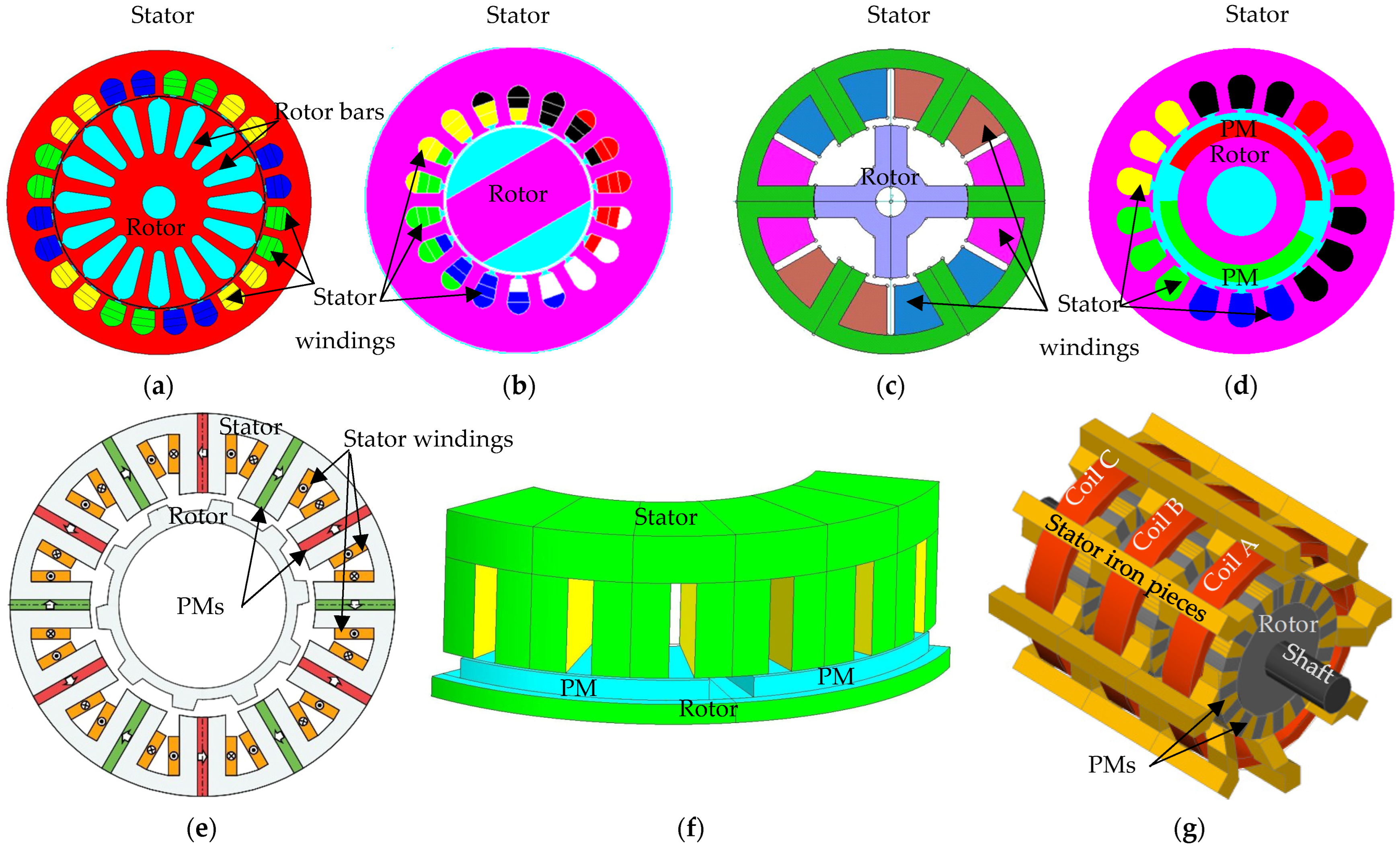
In this Subsection, we discuss the common electric motor topologies that have been studied in scientific literature. Later, we present three case studies of the best potential candidates in this field. Even from the beginning, we would like to emphasize the absence of classic synchronous machines, which have electromagnets on the rotor core, among the studied compressor solutions. This might be due to the presence of the sliding electrical contact at the brush level, which is used to feed the rotor winding. This can produce sparks, which should be avoided in a system fed with hydrogen and oxygen (air). In addition, configurations based on a Halbach array arrangement for the magnets are not suited for configurations with a reduced number of poles and a reduced volume. Without claiming to have found all the possible motor–compressor variants in the scientific literature, we introduce the existing solutions here (see Figure 2).
A first possible candidate for our compressor is the high-speed induction motor (HS-IM) [50,51,52], shown in Figure 2a. With a reduced number of poles (usually two), one can exploit reduced frequencies, which could affect the iron losses within the active parts of the machine. If the cage is made of aluminum, pear-shaped rotor bars are considered. These do not carry the risk of high inertia, since aluminum is three times lighter than copper, but they have poor electrical conductivity. If copper is used (to maximize the electric performance and improve efficiency, with the acceptance of an increase in the inertia), the slot should be circular to mitigate the mechanical risk in high-speed operation.
If the first discussed variant has an active rotor but no supplementary feeding source, the second investigated variant, the high-speed synchronous reluctance motor (HS-SynRM), has a passive rotor [53,54]. As an ac-fed machine, it produces significant iron losses, but these can be reduced (or partially eliminated, at least at the stator level) if slot-less variants are considered. The absence of PMs and the robustness of such a topology make the HS-SynRM an important candidate for applications in FC compressors. Special attention should be paid to the ventilator effect of the rotor, which increases the load, while the torque ripples are not negligible.
The third evaluated variant again has a passive rotor: the high-speed switched reluctance motor (HS-SRM) [55,56,57], which is fed in dc. Similarly to the previous option, the HS-SRM (shown in Figure 2c) is very robust and cheap but has similar issues in terms of noise and torque ripples. Also, the energetic performance is weaker than that of the HS-SynRM.
The fourth discussed variant is the high-speed permanent-magnet synchronous motor (HS-PMSM). One can find a variety of configurations: those with surface-mounted PMs, those with buried magnets, and the spoke variant [58,59,60,61,62]. With the best power density due to the higher energy offered by the rare earth material (NdFeB or SmCo), the HS-PMSM is an expensive solution with good efficiency. A variant that somehow reduces the volume of expensive material is the high-speed flux-switching motor (HS-FSM) [63,64]. It has a passive rotor, and the field source and the PMs are placed on the stator. It represents an improvement over the HS-SRM in terms of efficiency but is a little more expensive, while a reduced volume and weight are the benefits of magnet usage.
Figure 2. HSEM variants used in FC compressor system for EV application: (a) squirrel cage induction motor; (b) synchronous reluctance motor; (c) switched reluctance motor; (d) permanent magnet synchronous motor; (e) flux switching motor [63]; (f) axial flux motor; (g) transverse flux motor.
Applsci 16 00476 g002
Another complex variant suitable for FC compressor systems is the high-speed axial flux permanent-magnet synchronous motor (HS-AF-PMSM) [65]. Usually, AF-PMSM variants have a high number of poles, which enables them to achieve the best power density. However, since it is necessary to exploit the minimum frequencies for the supplied voltage in compressor applications, this variant has not been frequently considered in the literature for such an application. Lately, it has become a very attractive candidate for EV propulsion. However, the reduced volume of non-active material and the possibility of using two or three rotors on the same structure [65] indicates that this variant has potential for the given application.
The last variant, which has been surprisingly well studied in the scientific literature [66,67,68], is the high-speed transverse flux motor (HS-TFM). Again, the stator is fed in dc via homopolar-type winding, and it requires special material for 3D flux flow. Even if enough structures based on the transverse flux configuration have been investigated in the literature, their power density advantage is not so obvious due to a reduced energetic performance, since we utilized very high speeds.

2.3. Study Cases—HSEM for FC Compressor Application

This study aims to exploit the minimum possible frequency for the feeding voltage. The frequency of the fundamental voltage is proportional to the revolving speed of the rotor and the number of poles; this means that, in order to obtain the minimum possible frequency, one should impose one pair of poles for our application. When running at higher speeds, it is expected that the mechanical characteristics will be the smoothest. Even if the compressor application does not currently demand important dynamics, as in the case of the EV propulsion, we still want to avoid controllability issues. For this reason, we aimed to exploit the lowest possible torque ripple level. This was also coupled with the benefit of having potentially reduced vibration, and consequently, reduced noise. For all of the abovementioned reasons, we did not consider a further comparison of the HS-SRM (since it is very noisy and has very high torque ripples, which involve controllability issues), the HS-FSM (since it is more expensive and has similar drawbacks to the HS-SRM), the HS-AF-PMSM (since it is commonly used with at least four poles, and thus, has higher potential iron losses and a reduced efficiency), and the HS-TFM (since it has a very complex construction, and is only used with a high number of poles).
The three proposed case studies were as follows: the HS-SynRM, the HS-PMSM, and the HS-IM. Even though we tackled the possibility of using an HS-SRM [55], its poor energetic performance directed our attention mainly to the previously mentioned variants.

2.3.1. Study Case 1—High Speed Synchronous Reluctance Motor (HS-SynRM)

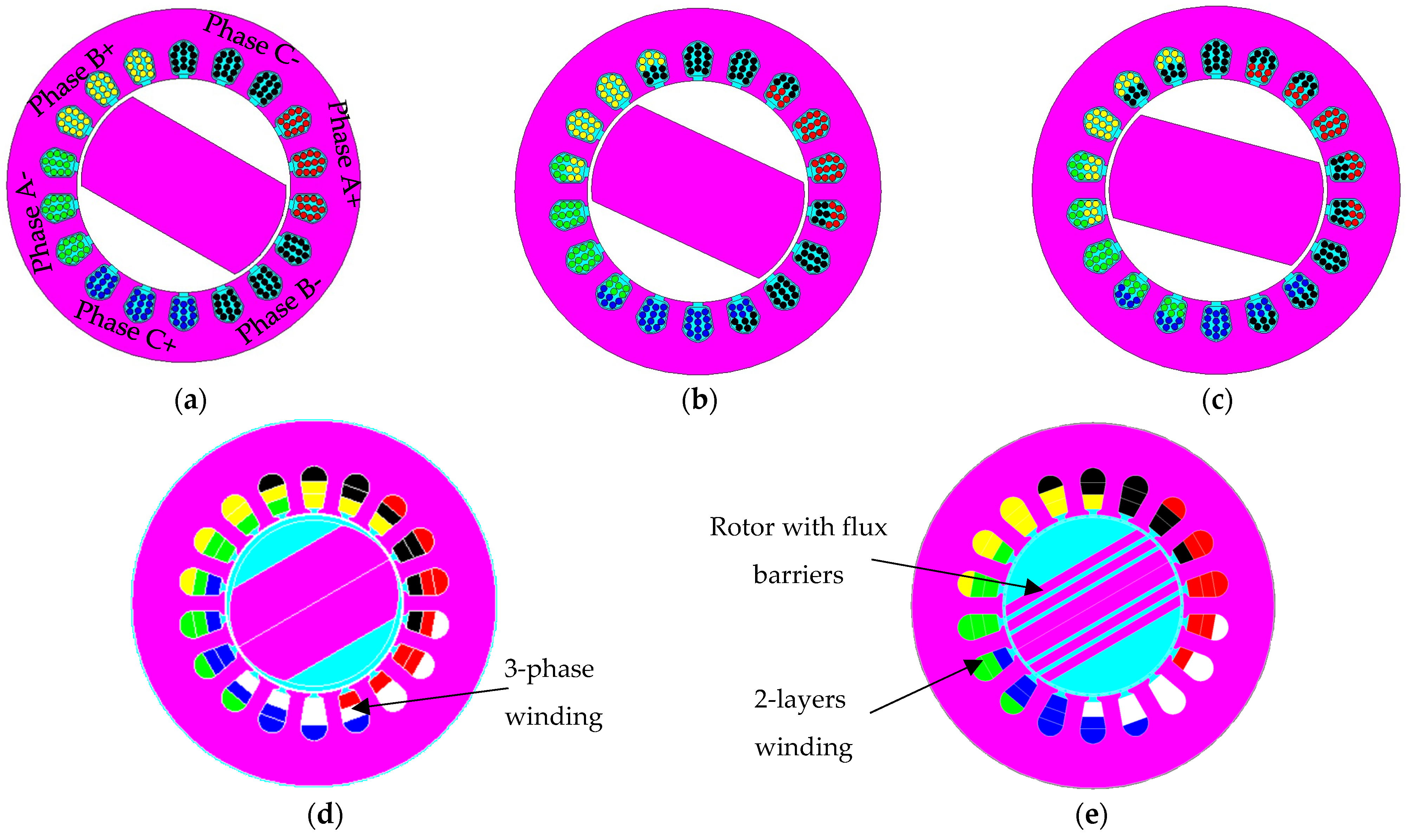
The first analyzed high-speed motor is a two-pole synchronous reluctance motor, the HS-SynRM, which is like the one shown in Figure 2b. We considered three winding types (with one, two, or three layers) and three slots per pole and per phase (see Figure 3). Our main reason for not considering four poles for the HS-SynRM, besides the high risk of flux bridges breaking at high speeds, was to obtain the minimum frequency.
The use of four-pole machines doubles the frequency of the fed voltage, and since the iron losses are proportional to the square of the frequency (as well as the flux density—four-pole machines are usually highly saturated at the flux barrier level to achieve a smoother induced emf), this means that the motor’s efficiency is affected by increased iron losses. For this variant, we designed a 7.5 kW SynRm, running at 18,000 r/min [69]. Anticipating high torque ripples, we further investigated a variant with a rounded shape at the rotor’s corner (at the air-gap level; see Figure 3d). Moreover, we considered another rotor with flux barriers (see Figure 3e). Of course, for this last variant, we needed a consolidation device at the rotor level. For that, we considered a non-magnetic sleeve at the air-gap level, which produced a cylindrical shape for the entire rotor structure. Thus, the ventilator effect of the rotor was avoided. A similar device was considered for the previous variants (Figure 3a–c) to emulate the same conditions as in the case of the last HS-SynRM, and to avoid the ventilation effect of the rotor. In this way, the comparison of the obtained performances was consistent, not only from an electromagnetic point of view but also in terms of structural behavior. Thus, no supplementary loss component needed to be considered due to the volume of air manipulated within the machine.
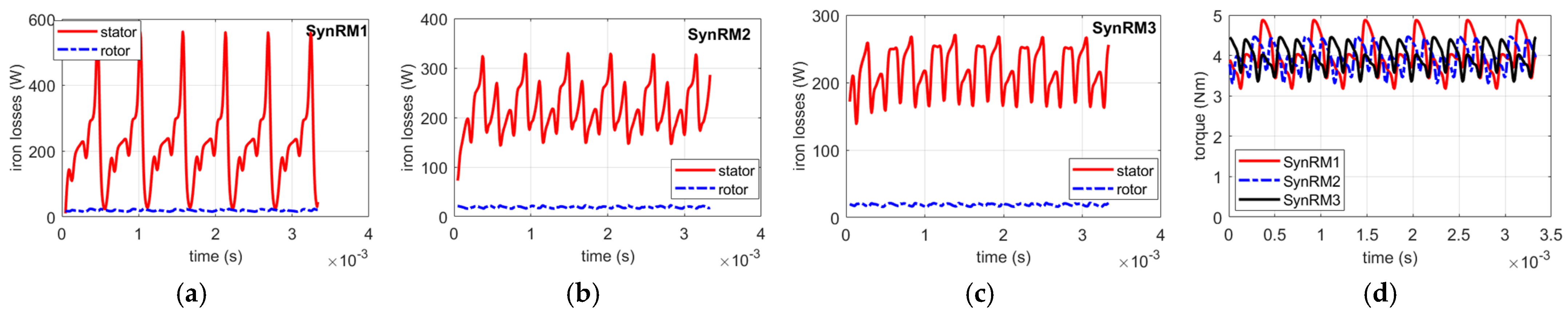
To probe the discussed results, in Figure 4 the iron losses are plotted, as well as the rated dynamic torque for the first three SynRM variants.
We introduced the five structures into finite element method (FEM) software, Flux2d, to evaluate electromagnetic computation performance. The analytical and numerical results are presented in Table 2. For all the considered HS-SynRM variants, the circumferential speed was 59.5 m/s (at 18 kr/min).
By investigating the results depicted in Table 2, one can see that the winding for two and three layers reduced the torque ripple. Moreover, when rounded corners were used for the rotor, the ripples drastically decreased. On the other hand, the volume of the structure was affected, with the power density being reduced in this case, while the cost of the raw material was slightly increased. The presence of flux barriers did not show any significant benefit. To further exploit the HS-SynRM topology, the third and fourth variants seemed best suited to the application demands. Thus, the reader can make a choice with respect to the usage of an HS-SynRm for FC systems.

2.3.2. Study Case 2—High Speed Permanent Magnet Synchronous Motor (HS-PMSM)

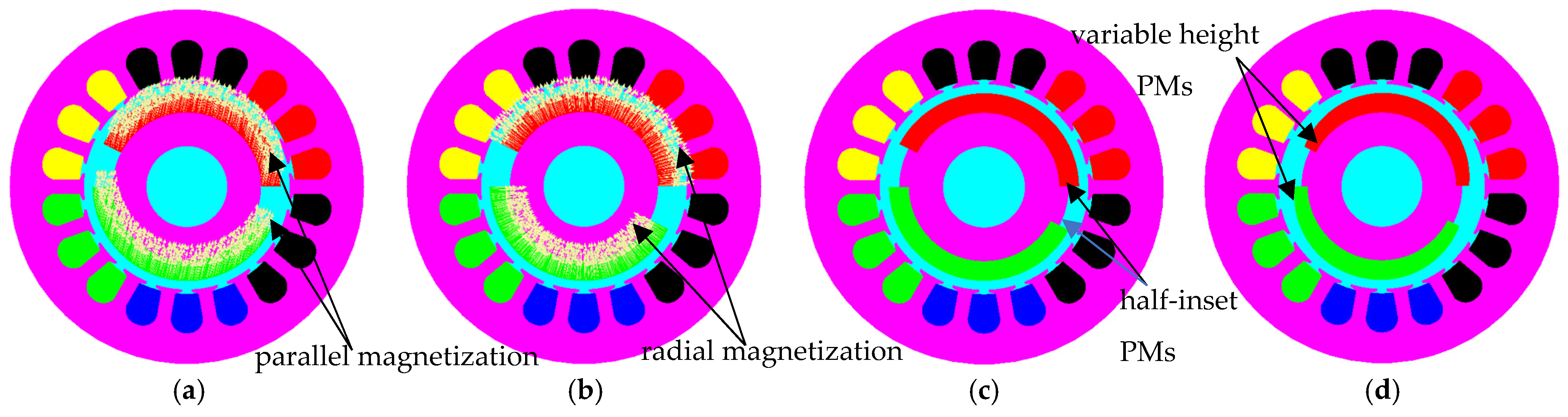
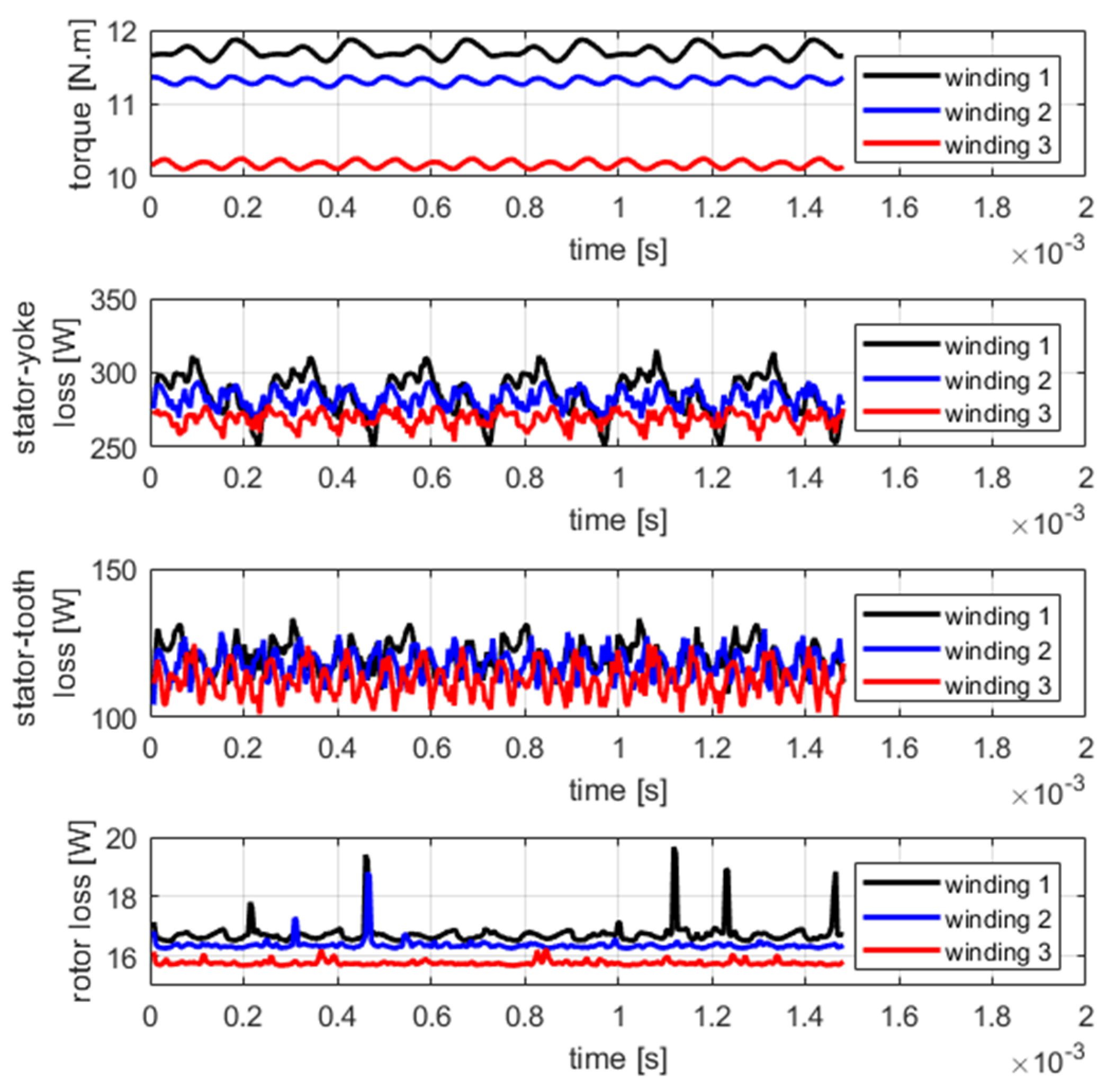
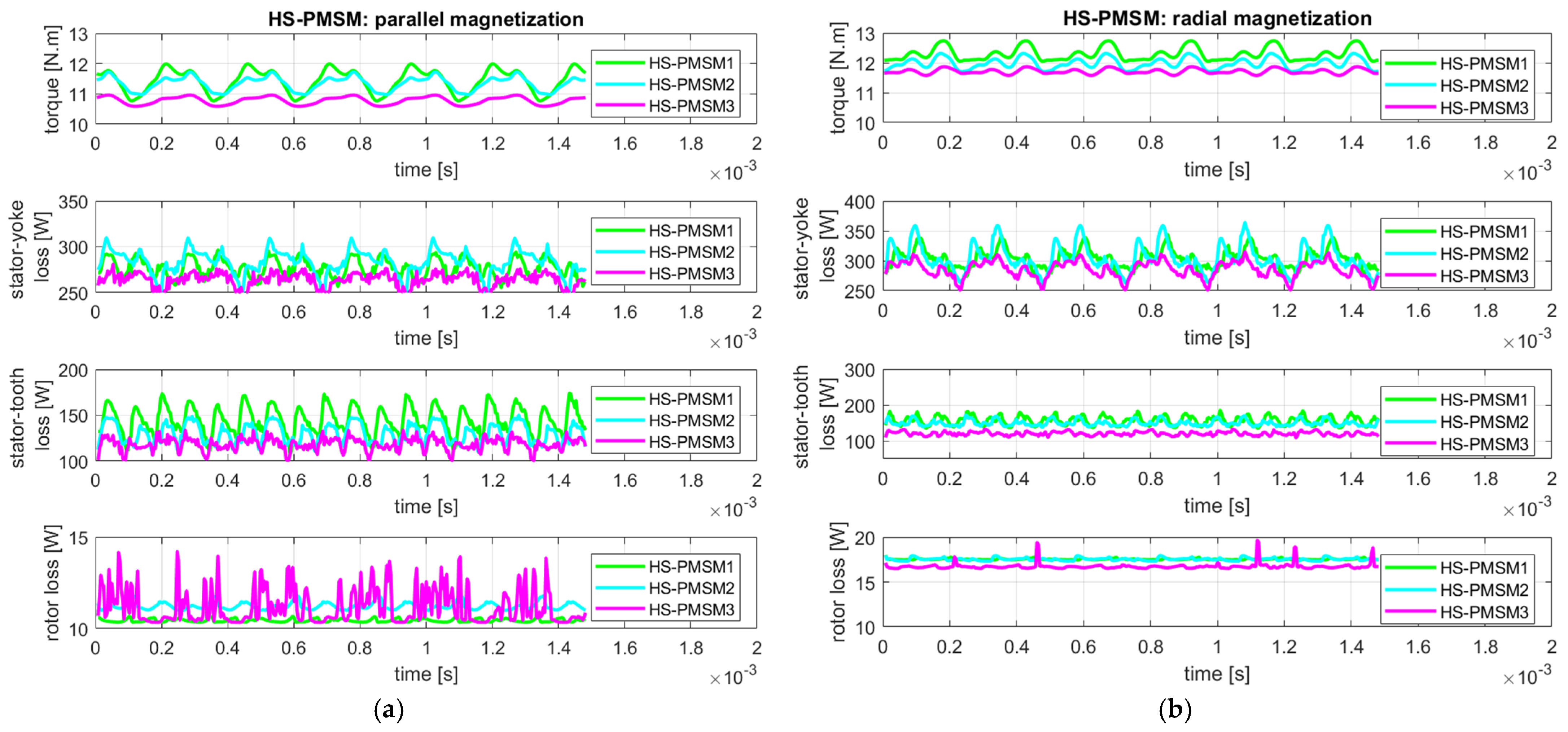
The second analyzed high-speed motor was the permanent-magnet synchronous type, the HS-PMSM. This time, the operating point was at 40 kW and 40.5 kr/min [14]. Here, the parallel (see Figure 5a) and radial (see Figure 5b) magnetization variants were evaluated. The basic configuration contained surface-mounted magnets (HS-PMSM1; depicted in Figure 2d). The second evaluated topology had half-inset magnets (HS-PMSM2; depicted in Figure 5c), while the third one had half-inset magnets and a variable height for the magnets in the magnetization direction (HS-PMSM3; depicted in Figure 5d). For this last variant, the middle section of the magnet piece had the greatest height, and at the corners of one magnet piece, we found the lowest height. For the same outer diameter of the stator, injected current, and number of turns and material properties, we computed the axis torque and the iron losses within the active parts of the machines; the rotor iron losses cannot be neglected at such high speeds. Thus, by employing the same type of numerical analysis through the FEM, we plotted the results given in Figure 6. It can be observed that radial magnetization produced a higher average torque.
On the other hand, the torque ripple levels and the function of the magnetization direction (parallel first and radial second) were as follows: 10.69% and 5.57% for HS-PMSM1, respectively; 6.56% and 5.11% for HS-PMSM2, respectively; and 3.45% and 2.49% for HS-PMSM3, respectively. For all considered HS-PMSM variants, the circumferential speed was 129.3 m/s (at 40.5 kr/min).
To better summarize the numerically obtained results plotted in Figure 6, Table 3 shows the mean values of the FEM results for the axis torque and torque ripples, as well as for the iron losses.
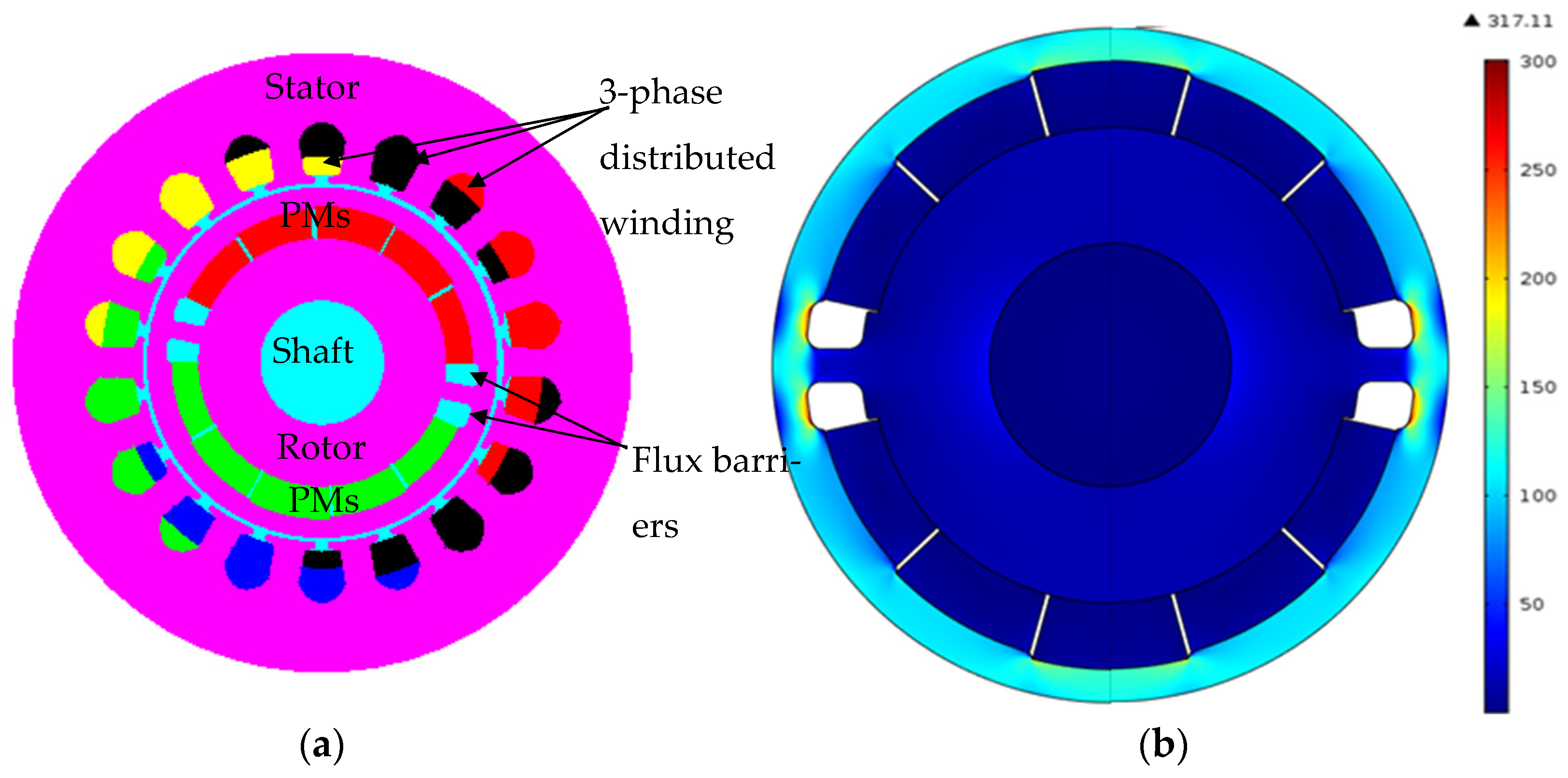
Thus, we can say that the HS-PMSM3 responded the best for the application demands. The electromagnetic numerical analysis revealed the expected results. Next, a mechanical evaluation of the tensile stress should reveal whether the PMSM-based variants are suitable for the given application. For the HS-SynRM, only the fifth variant had a mechanical risk, due to the rotor iron being very compact and consolidated to the shaft (actually comprising the shaft itself). Anticipating this analysis (detailed in Section 3.2.4), we identified the configuration that remained mechanically intact at 26 kr/min [70], depicted in Figure 7.
The surface-mounted-magnet variant necessitated a retaining sleeve of 3 mm, which altered the performance of the HS-PMSM. Thus, we considered a modification of the topology by inserting the PMs into the rotor core.
Since it was difficult to shape one PM piece at the given radius and opening angle, with a variable height, we decided to use a segmented PM comprising five pieces (as shown in Figure 7). Supplementary flux barriers are needed to limit the flux leakage.
We should reiterate that the tensile stress limit for the used iron (Vacodur50) is 390 MPa, while for the considered rare earth magnet material (SmCo), it is 350 MPa. Thus, one can see from Figure 7b that the mechanical limit of the structure was not surpassed (317 MPa) at a speed of 26 kr/min. This variant was suitable for a 22 kW output power. (We should also state that 0.2 mm steel sheets were used in this analysis.)

2.3.3. Study Case—High Speed Induction Motor (HS-IM)

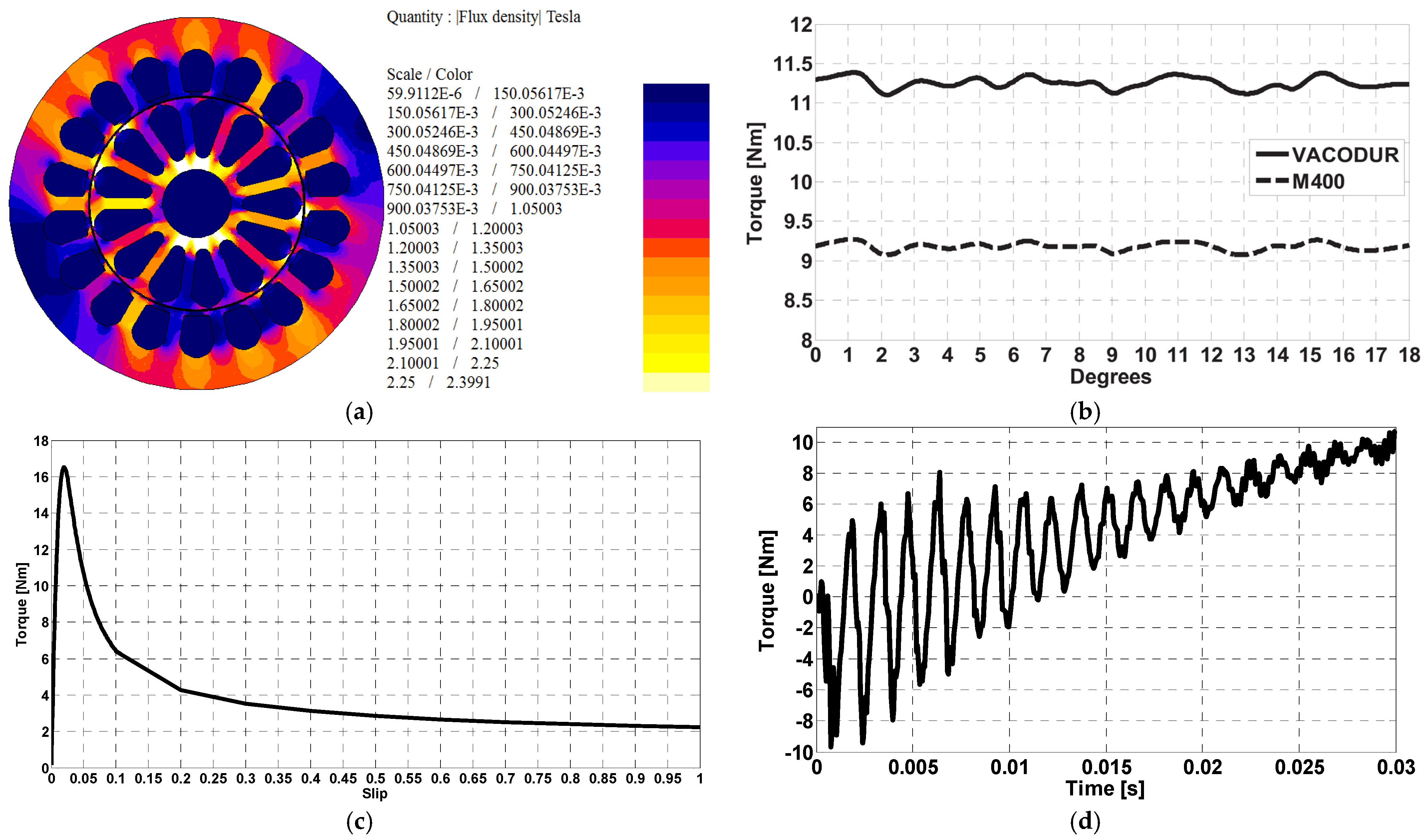
The third analyzed high-speed motor was the induction motor, the HS-IM [71]. A similar 40 kW, 40.5 kr/min design was used for this IM configuration, and after the numerical computation, we obtained the expected performance. The flux density distribution within the active parts of the machine is depicted in Figure 8a. The use of classic M400 steel or Vacodur50 steel for the active parts was compared, and the obtained torque is shown in Figure 8b. Also, the slip dependence of the axis torque and the starting of the motor are depicted in Figure 8c and Figure 8d, respectively. The results indicate that, for a sheet of 0.2 mm and good-quality Vacodur50 steel, the gain in torque was 18.14%—of course, this was coupled with a substantial increase in the cost. For the studied HS-PMSM, the circumferential speed was 131.4 m/s (at 40.5 kr/min).
Next, we investigated the possible options intended to improve the performance of HSEMs in general.

3. Technological Trends for Efficiency Improvement for HSEM

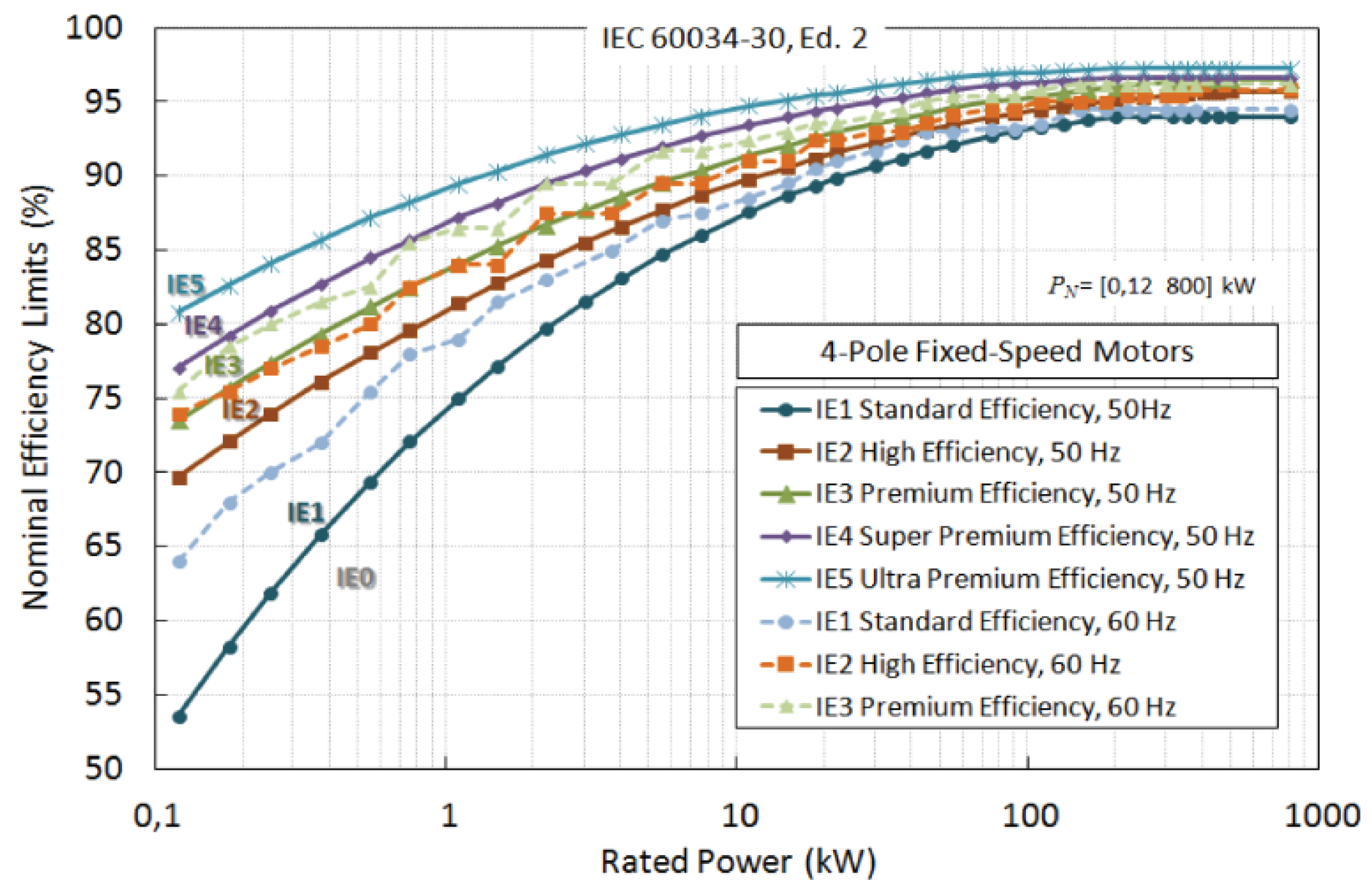
The goal of this Section is not to present all the approaches needed to improve the efficiency of HSEMs. Here, only the framework is given, i.e., the efficiency standard (see Figure 9), based on which electrical machines are classified.
The major components influencing the efficiency of HSEMs will be briefly provided: the materials, the winding and insulation, the geometry configurations, and the mechanical consolidation. Today’s electric machines need to comply with at least the IEC-IE3 standard [72].

3.1. Materials Used in the Construction of HESM

The materials used in the construction of electrical machines affect their performance and costs, and scientific documents usually provide only their electric and magnetic properties. However, when it comes to high-speed electric motors, the mechanical characteristics are equally important. In Table 4, the most common materials used in the study of HSEMs are depicted [73,74,75,76,77,78,79,80].
When someone uses a common steel, such as M530-35A, higher iron losses are expected, as well as a lower power density and cost. On the contrary, when Vacoflux48 or Vacodur50 steel is used, the best magnetic properties are obtained, with the lowest possible iron loss level; however, the cost is extremely high. Thus, a good compromise needs to be found, depending on the application. For reduced-volume HSEMs, expensive material could be considered, especially when supplementary volume and weight constraints are indicated for the application. For 3D flux configurations, a soft magnetic composite material, such as Somaloy, is needed, even if the saturation level is not so high [77,78]. When it comes to the permanent magnets used as the main excitation source, the temperature operating point imposes the use of specific materials, such as NdFeB or SmCo. When dealing with surface-mounted PM variants, a retaining sleeve is absolutely needed, usually of titanium material; carbon fiber may also be used due to its good density and strength, even at higher circumferential speeds. When inset PMs are considered, a resin is used mainly at the level of the flux barriers where the magnets are inserted. With respect to the winding, copper is mainly used at the stator level. For the rotor, aluminum is considered for induction motors with a squirrel cage due to its reduced density, which decreases the inertia and improves the controllability [79]. Nevertheless, when an improved performance is required for the induction motor type, copper rotor bars with a high current density can be considered. Sometimes, for the operation of electrical machines at high temperatures, the volume of air is also important in the design from a controllability point of view. This is especially true for reluctance-type machines, where the air gap is high on the quadrature (q) axis, producing a ventilation effect and, thus, increasing the inertia of the rotor at high speeds [80].
Recent advances in material science have opened new avenues for the development of HSEM, particularly those designed for high power density and long-term reliability. Thus, high-strength non-oriented silicon steels have been developed for rotor and stator laminations, offering improved mechanical yield strength while maintaining adequate magnetic performance under high rotational speeds and elevated temperatures. Also, as stated when introducing the transverse flux configuration, soft magnetic composites and high-strength copper alloys are being adopted in laminated rotor and stator assemblies to achieve higher peripheral speeds, enhanced structural integrity, and reduced dependence on rare-earth materials. In parallel, research into magnet-reduced or magnet-free topologies, enabled by advances in magnetic and conductive materials, aims to alleviate critical-material shortages and cost challenges associated with conventional rare-earth permanent magnets. Collectively, these innovations contribute to higher achievable rotational speeds, improved thermal robustness, reduced iron and eddy-current losses, and greater design flexibility for compact high-speed drives. Future research should focus on validating these emerging materials within ultra-high-speed compressor motors and fuel cell balance-of-plant systems, emphasizing their manufacturability, cost-effectiveness, and long-term operational reliability.

3.2. Technology Improvement for HSEM

3.2.1. Winding Configurations

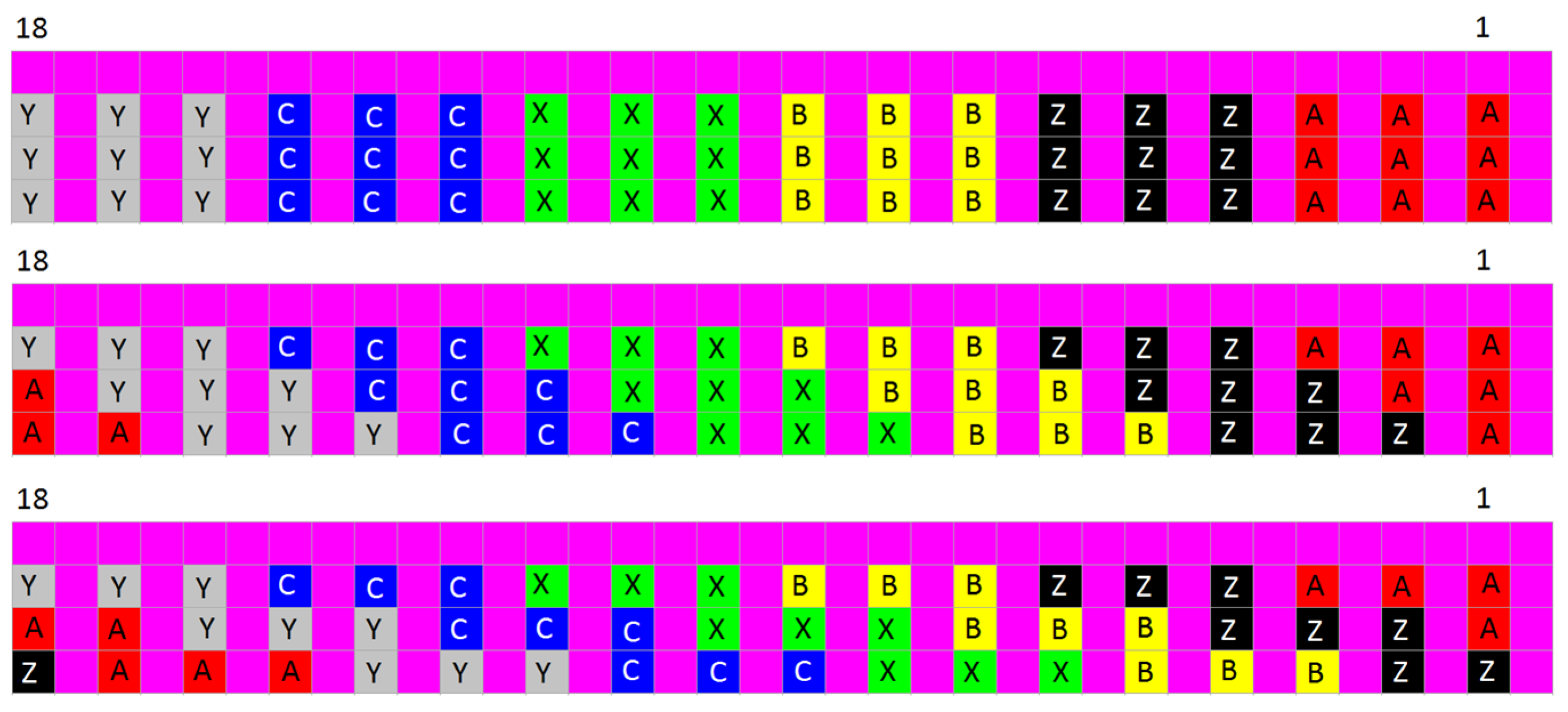
The goal of this Section is to indicate the common winding configuration when dealing with HSEMs. Three main approaches were identified based on a literature survey [81,82,83,84,85,86,87,88]: the shortened span-winding, the modular tooth/slot, and the hairpin configurations. Normally, no parallel turns are used in such configurations, and a reduced number of conductors per slot is usually employed. The effect of winding type is depicted based on the configuration shown in Figure 10 for the HS-PMSM3 depicted in Figure 5d, while the torque and iron losses are shown in Figure 11.
For an already optimized structure and distributed winding, the effect of the most complex winding configuration (Figure 10-bottom) is not significant with respect to torque ripple mitigation. On the other hand, the average value of the torque is quite affected. It can be concluded from this analysis that it is the designer’s responsibility to define the main criteria for the decision with respect to the employed topology: if reducing the torque ripple is critical, then the 3rd winding type should be used; if it is instead better to have a larger average torque with an acceptable torque ripple, the 2nd winding variant should be sufficient.

3.2.2. Insulation

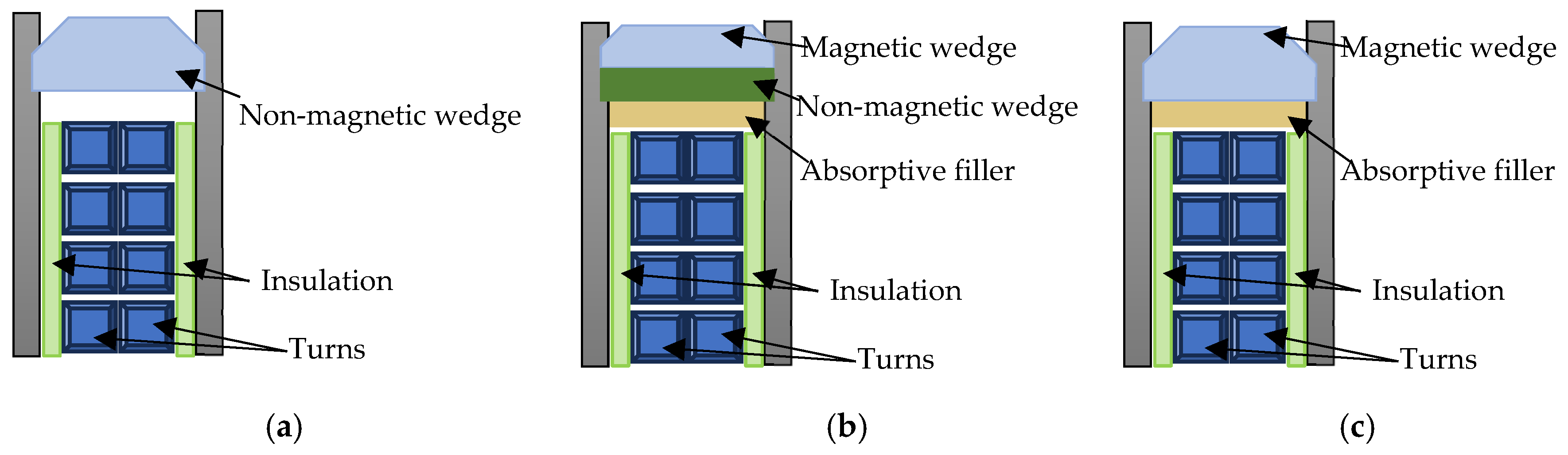
As in the case of the winding configuration, only the specific new elements of insulation are depicted here. For common industrial electrical machines, the insulation is not an expensive material, as it is used only to protect the conductors from scratches while being inserted into the slots. However, for HSEMs, the influence of the insulation has been discussed in the literature [16,89,90]. For ordinary electrical machines, the insulation elements are fewer, and they have a protective role. Figure 12a depicts the classic insulation of a slot, with the wedge and the slot insulation part. In HSEMs, magnetic and non-magnetic wedges with a configuration similar to that shown in Figure 12b,c have been investigated, and it was found that “the relative permeability and thickness of the wedge material affect the electromagnetic performance, such as torque, output power, and efficiency” [16]. This has been confirmed by other studies, such as [89]. Thus, for ac machines, the influence of wedges and insulation should be carefully considered.

3.2.3. Geometry Configurations

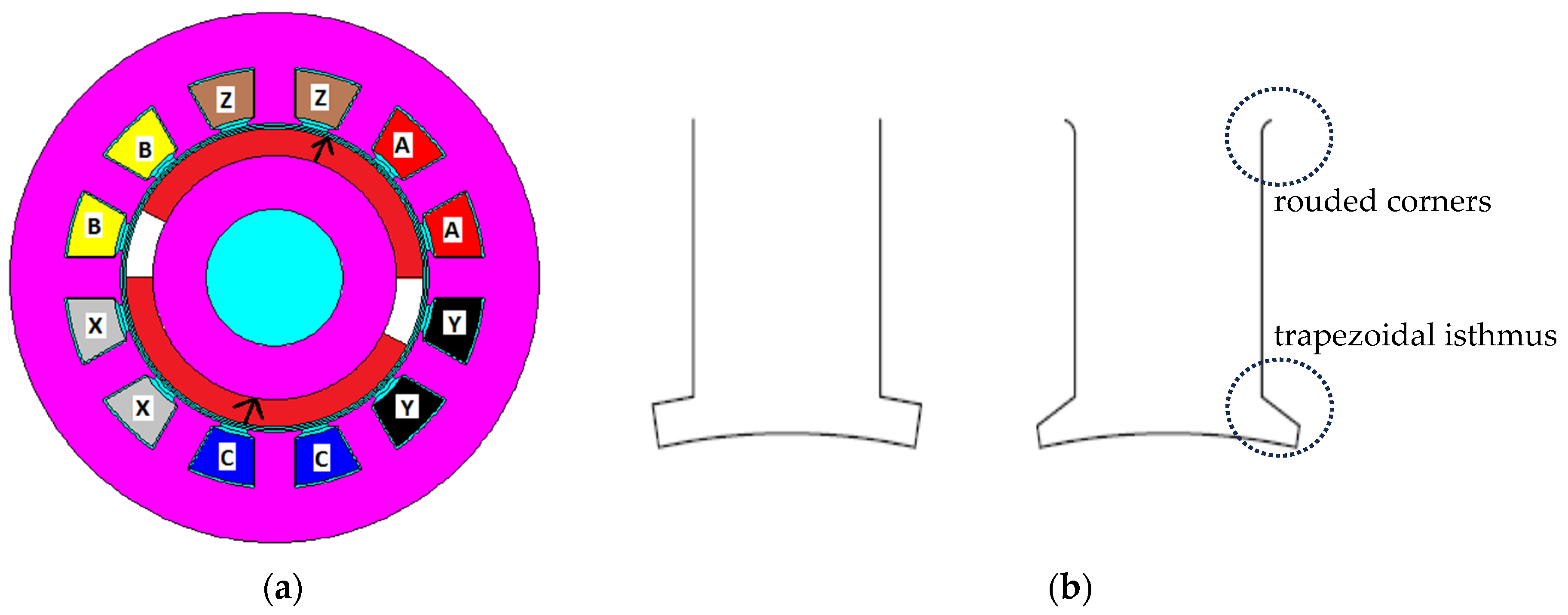
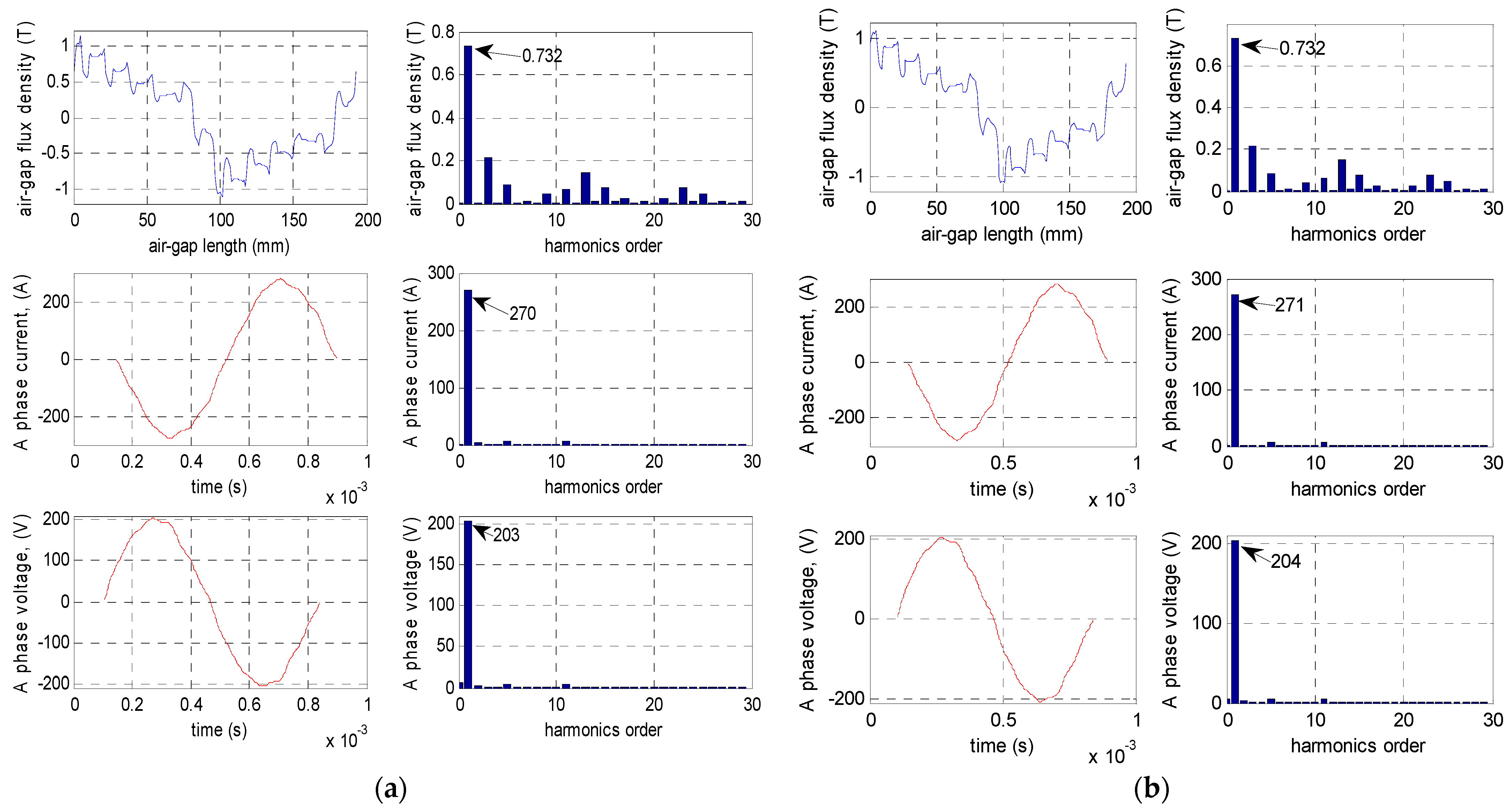
We have already discussed the influence of the magnet position and shape in the operation of the HS-PMSM. Next, we investigated the influence of the slot’s geometry on the HS-PMSM’s characteristics and efficiency [91,92,93]. We investigated the characteristics of a 2-pole and 12-slot HS-PMSM (see Figure 13) designed for 70 kW and 80 kr/min. Figure 14 and Table 5 depict the findings of the FEM analysis in two cases: case 1, with a straight slot (Figure 2b—left), and case 2, with rounded slot corners and a trapezoidal isthmus (Figure 13b—right). For the studied HS-PMSMS, the circumferential speed was 255.9 m/s (at 80 kr/min). It can be seen in Figure 14 that both configurations produced approximately the same results, with the shape of the induced emf and the current being similar. The harmonic content of the wave was also approximately the same, for both the induced electromotive force (emf) and the phase-current. The rms values of the emf, the currents, the average torque, the torque ripples, and the iron losses for the studied cases are given in Table 5. The conclusion of this comparison is that the case 1 variant produced slightly less power. This was likely due to the straight isthmus inducing local saturation at the slot’s corners. The effect of this local saturation was also visible in the iron losses, which were higher in the first case; this consequently translated into weaker efficiency. Even if similar torque ripples and losses can be observed for this rounded-shape bottom slot corner (case 2) compared to the initial configuration (case 1), we must always expect higher local saturation points at the slot corners, which should be avoided. If no outer diameter limit constraint is imposed, a more rounded bottom slot can be shaped, with the potential of improved results.
Thus, we observed the effect of rounded slots in the operation of HSEMs. The above analysis was employed for a stator and rotor steel of the M400 type, with a 0.5 mm steel sheet. It is expected that, by using a thinner sheet of 0.35 mm or even 0.2 mm (as in the case of the structures shown in Figure 5, where Vacodur50 was used), the efficiency would be significantly improved. However, this would be accompanied by an increase in the cost of the active parts for the HSEM.
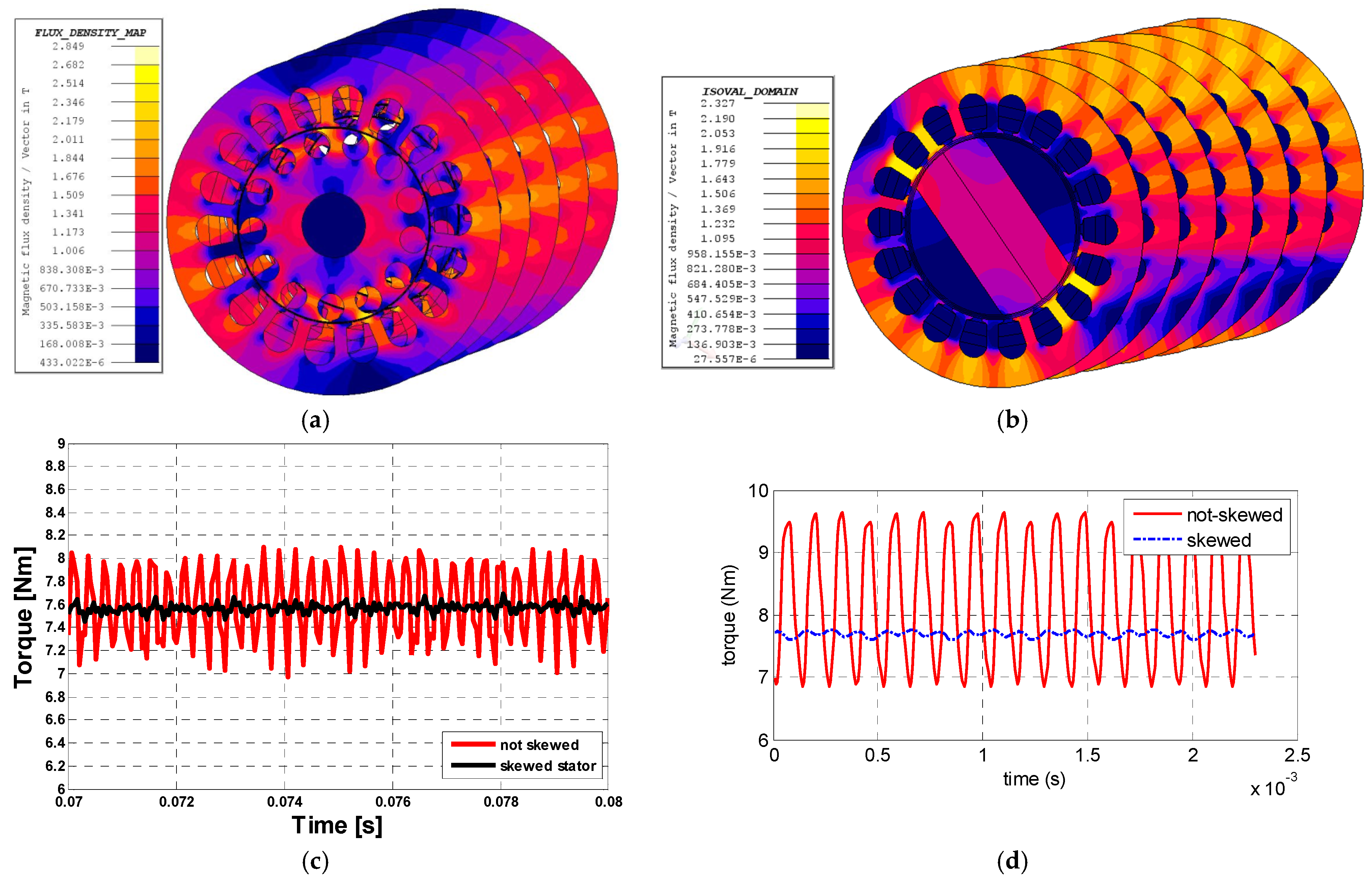
Another geometric modification that can be considered for HSEMs to improve the performance is the skewing of the stator (or rotor core) with an angle of 360/Ns (where Ns is the number of slots) [11,70]. This has been evaluated for an HS-IM (this time, with rounded rotor bars, since copper material was considered for the rotor winding) and for an HS-SynRM (see Figure 15a,b). It was obvious that the skewing substantially reduced the torque ripples, while the mean value of the torque was not drastically affected (see Figure 15c,d). Thus, skewing is a must in the study of HSEMs for applications in FC compressors, especially for passive rotor variants.

3.2.4. Mechanical Consolidation

Any mechanical imbalance produces local heat on the bearings and supplementary mechanical loss, which affects the efficiency of the HSEM. Some authors have proposed high-speed variants with magnetic levitation to avoid losses in the bearings [50,52,63,84,94], but in the case of an automobile, where vibrations and shock are always present, the use of bearings is a necessity.
Operation at high speeds demands a detailed structural investigation with respect to the mechanical stress on the rotating elements: the steel, the magnets, the retaining sleeve, and, when necessary, the flux barriers [70,95].
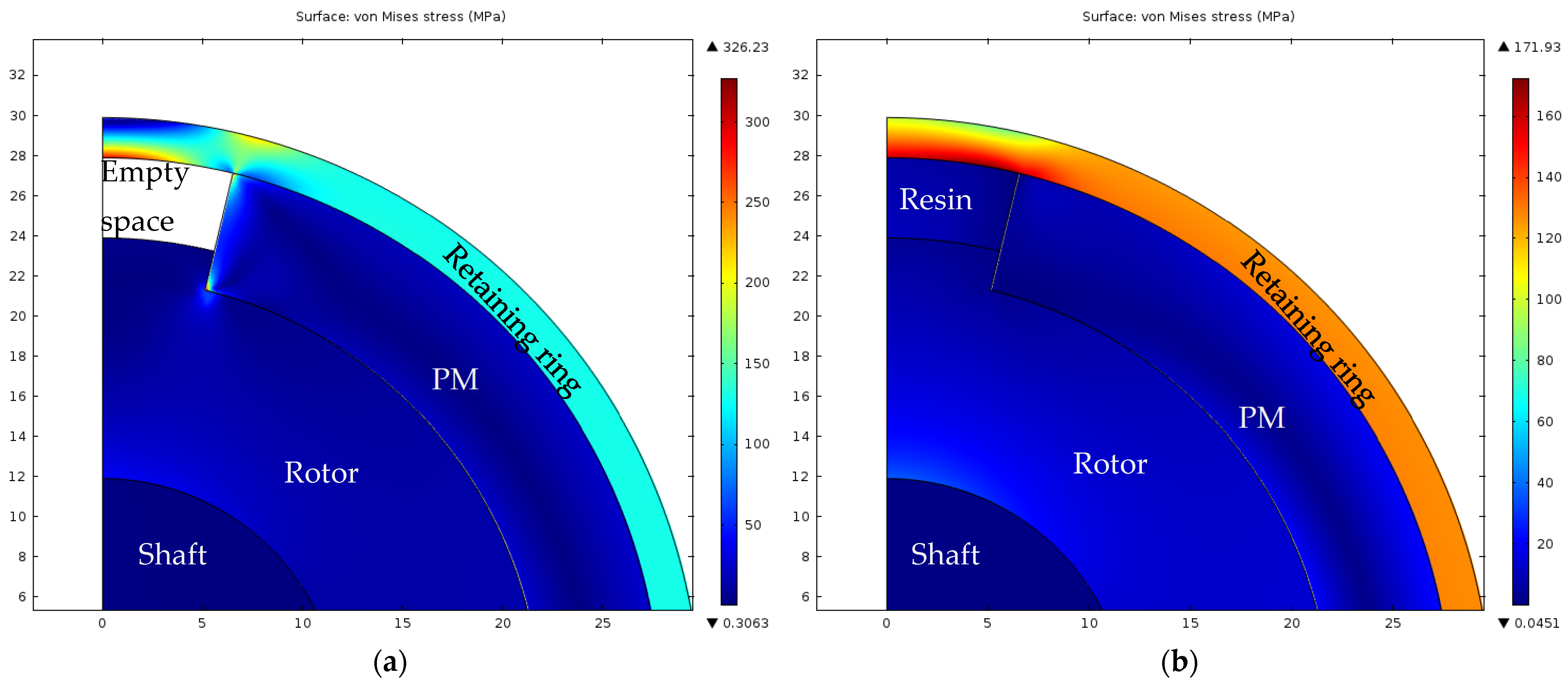
The first case study investigated the HS-PMSM2 topology, with partially inset magnets. An HS-PMSM with surface-mounted magnets is not advisable, since the attachment of the magnets on the rotor surface is a difficult task, and due to high centrifugal forces, there is a critical risk of magnet displacement. Thus, for inset-magnet variants, a retaining sleeve needs to be considered. Sleeves are usually constructed from titanium material, and in our case, it was 3 mm. Two situations were evaluated: an empty space between two consecutive magnets (Figure 16a), and the insertion of a resin between the magnets (Figure 16b). Even if the mechanical integrity of the rotor structure is kept safe in both cases, simply adding the resin between consecutive magnets will cut the mechanical stress almost in half during the motor’s operation at high speeds. Additionally, since the resin is not expensive and does not drastically affect the rotor’s inertia, such a solution would be desirable. The use of a retaining sleeve produces a higher equivalent air gap, and consequently, a higher volume of magnets is needed to obtain the desired electromechanical performance.
Moreover, titanium material is expensive and increases the raw material cost significantly. Thus, in the process of developing the HS-PMSM solution in Figure 6a, where the magnets are entirely buried within the rotor core, we investigated several flux barrier variants, which led us to the validated solution depicted in Figure 6b.
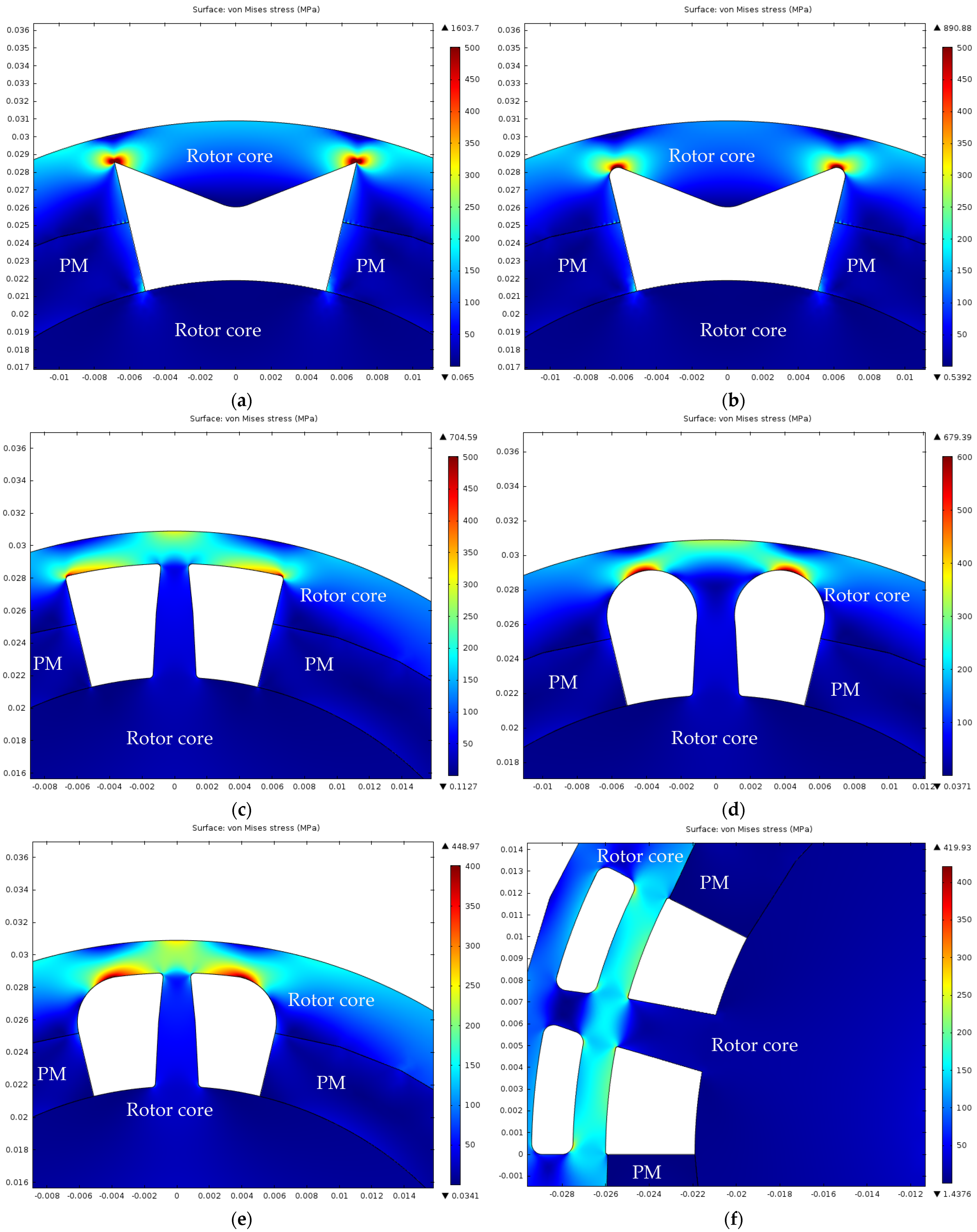
The initial buried PM configuration is depicted in Figure 17a. Here, sharp corners were used for the flux barrier, since it is cheaper to cut the iron this way. However, the mechanical integrity of the HS-PMSM was not reached, since the mechanical stress was 1603 MPa.
By simply rounding the previous cut, the mechanical stress reached 890 MPa (see Figure 17b), which was still too high (we recall that, for the iron used, the mechanical stress was 390 MPa, while that for the considered rare earth magnet material was 350 MPa). Improvement is still needed. Thus, we decided to split the flux barrier into two parts, with rounded corners (Figure 17c). This time, the mechanical stress was 704 MPa. By further reshaping the flux barriers (Figure 17d), we reduced the mechanical stress to 679 MPa. By using a non-symmetrical, round-shape flux barrier, we reached a level of 448 MPa (see Figure 17e). We also investigated the option of using more than two flux barriers, and the result in terms of the mechanical stress was improved (419 MPa, as shown in Figure 17f). However, the flux leakage is more important here, and the HS-PMSM suffered from the point of view of the output performance. Thus, we decided to reshape the structure, and we reached 319 MPa for the variant with magnet pieces of a variable height shown in Figure 6b. Moreover, based on the conclusions of the evaluation depicted in Figure 16b, by filling the rotor holes with resin, the stress on the rotor iron should be almost half of the previous value, drastically reducing the breaking risk.
The use of HSEMs necessitates supplementary cooling. Water cooling is usually employed, offering an improved current density. Motor cooling failure not only causes magnet demagnetization but may also disrupt the stack’s thermal balance. Studies have shown that PEMFC temperature fluctuations exceeding ±5 °C will reduce membrane electrode lifetime by 40%. The air exiting the impeller is heated as a result of compression; however, the balance of plant (BoP) of the fuel cell (FC) system regulates its temperature and humidity before it enters the cathode. Nevertheless, the warm air surrounding the motor must be carefully vented to prevent thermal interference with the fuel cell stack. Future research is recommended to explore integrated motor-stack thermal management architecture. Thus, in the next Subsection, the issue of water cooling is addressed.

3.2.5. Cooling for HSEM

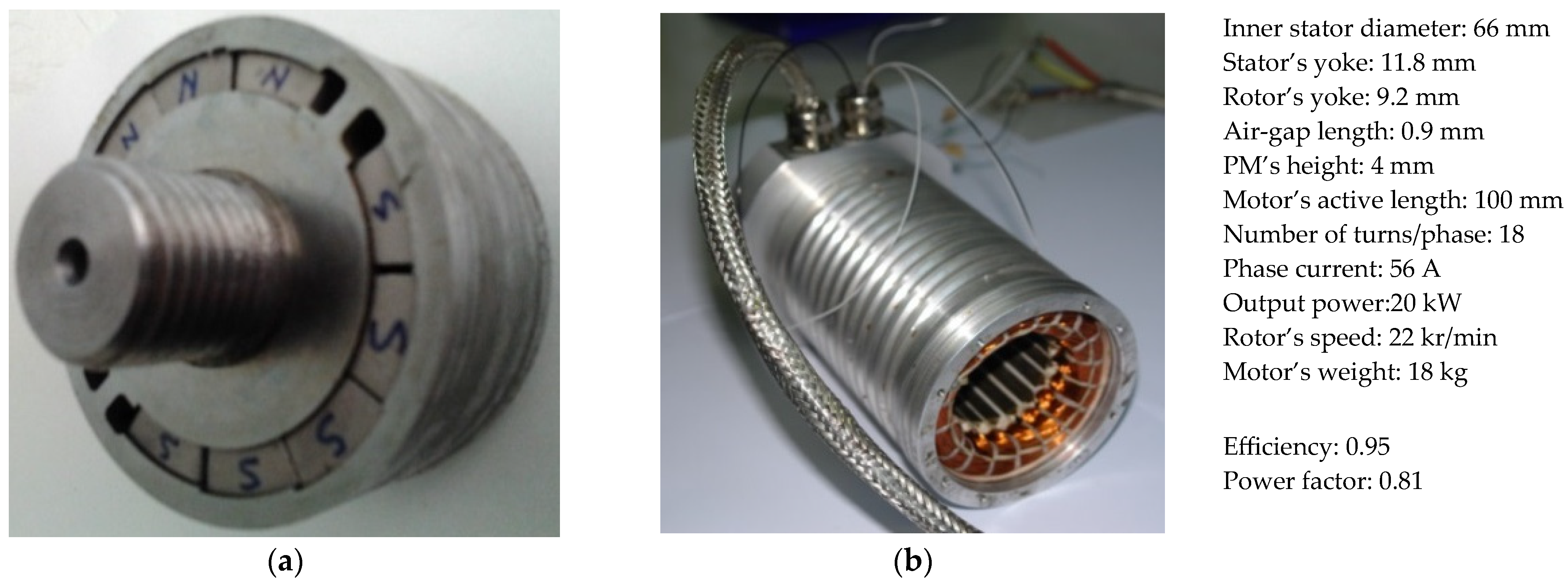
Air cooling is not an option for high-speed machines, but water cooling is [96,97,98]. For the variant depicted in Figure 6, we constructed a prototype for which cooling was facilitated via a water jacket placed on the stator armature (see Figure 18). The volume of air between stator and rotor was significantly reduced, since there was a quasi-constant air gap; thus, the friction torque from this point of view should be as reduced as possible. During the motor’s dynamic operation for the tested prototype, no abnormal behavior was observed, and the expected performance was obtained. The motor’s main data are given beside the motor’s armature.
In scientific literature a wide range of cooling options for electrical machines can be found, and Table 6 summarizes the most common options, as well as their capabilities.

3.2.6. Optimization of HSEM

When discussing the optimization of electrical machines, the objective function would be the minimization of the weight of the machine (i.e., active parts) while maintaining the output power at the rated value. In such a case, we can speak of power density optimization, meaning that we want to increase the ratio between the output power and the weight of the active parts of the machine. Thus, the objective function is the minimization of the mass of the machine, with the constraint of keeping the power level at a desired level. In the optimization process, it is necessary to define the solution space, which is imposed by the variation in the parameters that mainly affect the objective function. We can add other constraints, such as a current limitation, since we do not want to allow higher copper losses. With respect to the power factor and efficiency, we want them to be increased or kept at the same level. Decreasing the weight of the machine has an intrinsic benefit: the iron losses will be decreased as well, since the iron volume is reduced. Moreover, since the mechanical loss is proportional to the volume of the machine, decreasing the machine’s active part will decrease the mechanical loss component and, eventually, the rotor’s inertia, which has another benefit from a control point of view.
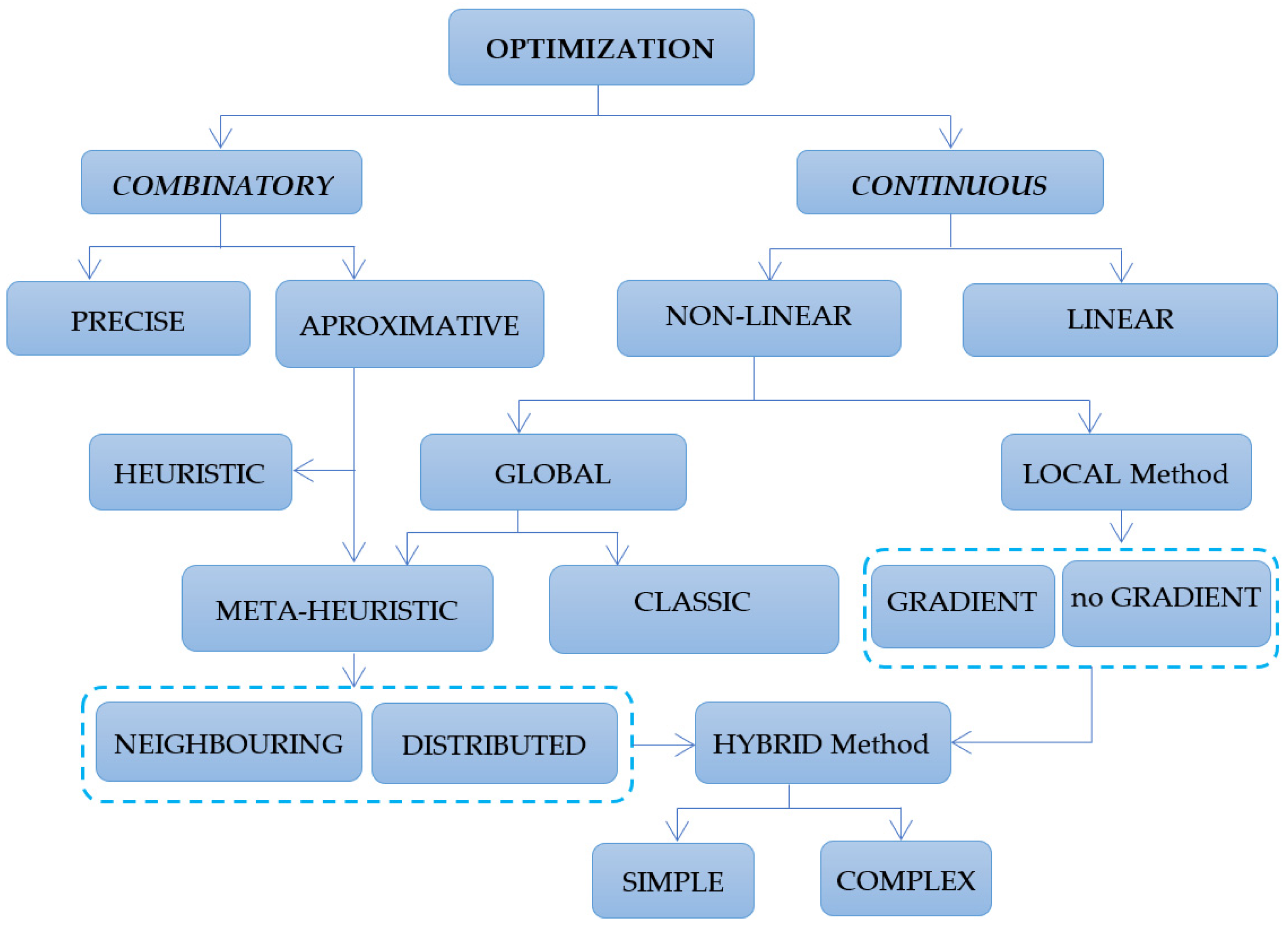
The classification of the existing optimization methods is presented in the diagram shown in Figure 19 [103,104,105,106,107,108,109,110,111,112]. When speaking about the choice of the optimization method, we should think about the complexity of the method, its limitations, the implementation time, the capacity to avoid local minima, and the capacity to reach the global minimum.
In the optimization process, the following steps need to be addressed:
  • Choosing the optimization variables (starting value and boundaries);
  • Imposing special limitations on other variables;
  • Defining the objective function;
  • Setting the initial and final values of global increment (initially, with a larger increment, which will be further decreased to refine the search space);
  • Computing the geometrical and electromagnetic parameters, and the objective function;
  • Making a movement in the solution space and recomputing the objective function and its gradient;
  • Moving to the better solution, while the objective function decreases;
Figure 19. Classification of optimization methods.
Applsci 16 00476 g019
h.
Reducing the variation step and repeating the previous steps (the algorithm stops when the research movement cannot find a better solution, even with the smallest variation step).
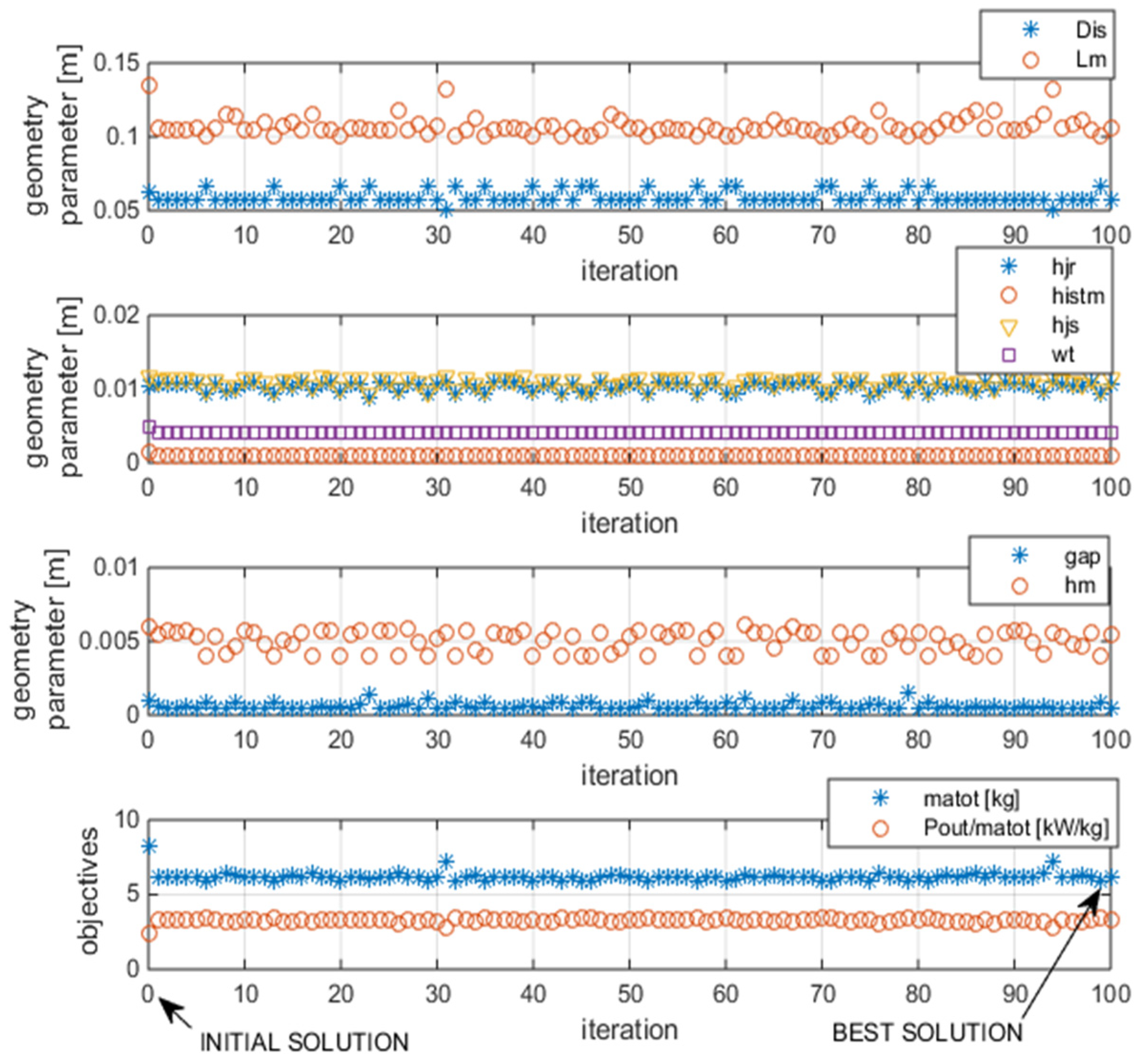
Several optimization algorithms were evaluated, including the simulated annealing [103], hybrid metaheuristic [107], and differential evolutionary approaches [70,112]. The optimization results for the HS-PMSM (depicted in Figure 7) are presented in Figure 20.
Figure 20 shows the variation in the geometrical parameters and the objective function during the hybrid evolutionary optimization approach employed on the constructed HS-PMS, designed for 20 kW and 26 kr/min. The advantages of a hybrid optimization approach include an accelerated optimization process and an enhanced ability to avoid convergence to local minima. The following notation is used in Figure 20: Dis is the inner stator diameter, Lm is the active length of the machine, hjr and hjs are the height of the rotor and stator yoke, histm is the height of the stator tooth isthmus, wt is the width of the stator tooth, gap is the air-gap length, hm is the height in the magnetization direction of the PM, matot is the total mass or weight for the active parts of the machine, and Pout is the output power of the HS-PMSM. By investigating Figure 20 one would observe that from the INITIAL SOLUTION the employed optimization algorithm would rapidly find an improved variant. This fast improvement is justified by the hybrid method’s capability to reach rapidly the global minimum, this being verified on specific benchmark functions [107]. During the iteration process the algorithm will allow even wors solutions, to avoid local minimum, while continuing the search within the space of solutions. Nevertheless, after a specific number of iterations, established by the designer, the optimization algorithm will stop, providing the BEST SOLUTION found, meaning the best power density or the minimum weight for the active parts of the HSEM.

3.2.7. The Durability of HSEM Within the FC System Application

Since the motor–compressor is an important component within FC systems used in the automobile industry, it is worth mentioning certain elements with respect to the degradation of the HSEM. With FC systems being a rather new component used in the automobile industry, important recent studies have been conducted to evaluate the degradation and life span of these systems [113,114,115,116]. Concerning the FC stack, membrane [114], or electrocatalyst [116], degradations have mainly been investigated. In a paper published in 2018, it was stated that, starting from a 3000-h lifetime for the Chinese vehicular PEMFC stack technology in 2015, the following lifetimes are targeted in the years to come [115]: 10,000 h for the year 2020, 20,000 h for 2025, and 30,000 h for 2030. When it comes to electric machines, as a more mature technology, they have already fulfilled their 2030 lifetime expectancies; electric trains, trolleybuses, electric buses, and cars have already been tested and have proven their capabilities in terms of their life span expectancy.
Regarding HSEMs, based on literature reviews [117,118,119,120,121], it can be stated that the main cause of failure is the degradation of the insulation (see Table 7), with the major cause of insulation degradation being aging (see Table 8).
The main online monitoring testing techniques that are performed to evaluate the main causes of failure within HSEMs, at the insulation level, are as follows [121]: the partial discharge method, the time frequency characteristics of leakage current method, the broadband impedance spectrum method, and the high-frequency current ringing method. With respect to the degradation of the remanent flux density of PMs, a simple online operational test using electromotive force monitoring can reveal the degradation of the main field source. Winding failure or fatigue can also be easily investigated through the online monitoring of electromagnetic parameters (i.e., resistance and inductance). Eccentricities or bearing failures can be easily observed through an online investigation of the mechanical characteristics.
With respect to the considered application, perhaps the HS-SynRM with two poles has the highest endurance in terms of durability, since there are no mechanical risks affecting the active part of the rotor. For electrical or insulation failures, the risk should be the same for all machines, perhaps with a higher percentage for the HS-IM, since it is necessary to feed the stator to produce the rotor reaction field.
It is generally assumed that no hydrogen leakage occurs that could corrode or otherwise affect the internal structure of the electrical machine. Nevertheless, specific failure modes relevant to fuel cell (FC) compressors may arise, such as the aging and degradation of insulation materials in a hydrogen-rich environment. Two potential risks are highlighted here: reference [122] demonstrates that hydrogen saturation, microstructural alterations, and embrittlement can significantly impact rotating machine components; additionally, reference [123] reports that exposure to hydrogen-rich, high-temperature, and reactive environments can lead to corrosion, embrittlement, and mechanical degradation of metallic parts. These findings suggest potential vulnerabilities in motor components such as bearings, shafts, and housings when operating in hydrogen-containing atmospheres. Consequently, dedicated design and safety measures are required to mitigate possible hydrogen leakage and prevent degradation or failure of the overall fuel cell system.
A comprehensive life prediction model for HSEM under actual operating conditions in FC systems is currently lacking. The dynamic environment of the applications (including fluctuating load profiles, elevated rotational speeds, temperature variations, and potential hydrogen exposure) can significantly influence insulation degradation and mechanical wear. Existing models for HSEM often rely on accelerated aging tests or simplified thermal-stress analyses, which may not fully capture the complex interactions in real FC system operation. Future work should focus on developing physics-based or data-driven predictive models that incorporate thermal, electrical, and mechanical stressors, enabling more accurate estimation of motor lifespan, proactive maintenance scheduling, and improved reliability in FC applications.

3.2.8. Comparison of the Studied HS-EM Topologies for a Given Operating Point

A detailed comparison of the three main variants (HS-PMSM, HS-IM, and HS-SynRM) is presented in Table 9, offering a broad range of insights into the proposed configurations. To ensure a fair comparison, all topologies are evaluated using the same rated power, rated speed, stator geometry (number of slots, slot shape, inner and outer diameters), materials, and number of poles as common reference parameters. In addition, stator skewing is applied to reduce torque ripple. The main advantages and disadvantages of each topology are also highlighted. It can be noted that the HS-SynRM has no critical speed limitations related to steel consolidation, since no flux barriers are present in the rotor. Conversely, the mass of the active rotor part in the HS-IM imposes a speed limit due to potential structural failure at the slot openings. Windage losses are highest for the HS-SynRM because of the rotor’s ventilating effect, and its length is nearly double that of the HS-PMSM. Other relevant characteristics, including geometric details, are also summarized in Table 9.

3.3. Extras

3.3.1. Discussions on the Impeller of the Compressor Subsystem

Nine primary types of impeller configurations are commonly employed for air or oxygen compression in fuel cell systems [124,125,126,127,128,129]:
-
The Centrifugal Compressor is a dynamic compressor that utilizes the centrifugal force generated by a rotating impeller to accelerate and compress the working fluid. It exhibits high efficiency at elevated flow rates; however, its performance decreases at higher pressure ratios.
-
The Claw Compressor operates with two non-contact, counter-rotating claw-shaped rotors. This design enables oil-free (dry) compression, ensuring clean gas delivery and high operational reliability, particularly in industrial applications.
-
The Lobe Compressor comprises two or more rotating lobes that displace air through the compression chamber. Although it features a simple mechanical design and robust operation, its overall efficiency is generally lower compared to other positive displacement compressors.
-
The Membrane Compressor employs a flexible diaphragm that oscillates or pulsates to compress air. It is particularly suited for applications requiring high gas purity, as it eliminates oil contamination and prevents direct contact between moving mechanical parts and the airflow.
-
The Piston Compressor utilizes a reciprocating piston within a cylinder to achieve compression. This conventional positive displacement design can attain high pressures, but it is typically characterized by significant weight, noise, and vibration.
-
The Rotary Vane Compressor incorporates an eccentric rotor equipped with sliding vanes that divide the compression chamber into variable volumes. It offers compactness, mechanical reliability, and relatively low noise levels, making it a versatile choice for medium-pressure applications.
-
The Screw Compressor employs two intermeshing helical rotors to progressively compress air as it is conveyed along the rotor axes. This configuration provides high efficiency, low noise, and long service life, making it well-suited for continuous-duty operation.
-
The Scroll Compressor consists of two spiral elements: one stationary and one orbiting, that compress air through a series of increasingly confined pockets. It operates with minimal noise and vibration, does not require lubrication.
-
The Side-Channel Compressor, utilizes an impeller with blades rotating within a housing that incorporates side channels to impart both radial and axial velocity components to the air. It enables gentle, oil-free compression at high volumetric flow rates and low pressures; it is commonly employed in blower-type applications.
Although impeller configurations could be examined in a dedicated review, it is important to emphasize that the structure of the high-speed electric motor (HSEM) is independent of the impeller configuration.

3.3.2. Compressor’s Duty Cycle and Transient Requirements

Fuel-cell electric vehicles (FCEV) air compressors typically operate under high duty cycles because the fuel cell requires continuous air supply proportional to the stack’s output power. During high load, driving the compressor must deliver higher mass flow, pressure and increasing continuous torque demand. Modern FCEV compressors frequently operate between 8 kr/min to 40 kr/min, and for ultra-high-speed configurations up to 120 kr/min, function of the stack size and compressor type [130]. Motors driving these compressors therefore must sustain significant continuous torque at extreme rotational speeds, maintain thermal stability and minimize mechanical losses and rotor stress.
FC stacks exhibit complex transient behavior driven by rapid changes in demanded current, air-path pressure dynamics, throttle valve adjustments and sudden changes in load. Thus, the compressor must react quickly. Studies show that transient torque, torque ripple and motor current fluctuations have a direct impact on stack pressure stability and efficiency [131]. Key transient scenarios include start-up (very rapid motor acceleration from standstill to tens of thousands of r/min), load ramps (sudden increases in airflow when vehicle power demand rises) and disturbances (voltage dips, stack hydration fluctuations, or pressure oscillations). Ultra-high-speed PMSM designs must provide high peak torque capability during these events. Research on sensorless PMSM startup methods for compressors confirms that inadequate transient torque control can cause torque breakdown, slow speed convergence, or instability during acceleration [132].
In fuel-cell air sub-systems the compressor’s torque, air mass flow, oxygen excess ratio, and stack voltage interact dynamically. As shown in [133], insufficient control bandwidth in any part of the air-path system leads to pressure oscillations, slow response to power demand, reduced stack efficiency and increased membrane stress and degradation. Advanced control strategies (predictive current control, HF-injection sensorless methods, and high-bandwidth current loops) are essential to maintain torque stability at extreme speeds. Without adequate bandwidth, the compressor cannot regulate air supply quickly enough to match stack demand, leading to voltage undershoots and efficiency losses.
To achieve optimal performance, the compressor duty cycle, transient torque behavior, motor torque-speed envelope and drive bandwidth must be treated as a single integrated design problem. Research on oil-free positive-displacement FC compressors confirms that minimizing torque ripple and stabilizing transient airflow significantly improves parasitic efficiency and reduces stack degradation mechanisms [134]. Well-integrated air-compression systems therefore enhance stack power response, reduce hydrogen consumption, improve cold-start robustness and extend stack lifetime through smoother pressure regulation. Real-world studies confirm that high-duty operation requires robust continuous-torque capability, transient torque and ripple directly influence stack pressure and efficiency and high control bandwidth (beyond 1–2 kHz) is critical for stability and performance. These factors collectively determine the efficiency, responsiveness, and durability of FCEV air-supply systems.

4. Conclusions

This manuscript presents a review of the main existing solutions in terms of high-speed electric motors (HSEMs) used for fuel cell (FC) compressor systems, which are needed in the air circuit of FC stacks and are applied in electric vehicles (EVs). Next, through the investigation of three case studies, we presented the best potential candidates for applications in FC compressors. Two-pole variants were mainly considered, which facilitates the minimum frequency needed for the motor supply. The investigated machines included a high-speed synchronous-reluctance motor, a high-speed permanent-magnet synchronous motor, and a high-speed induction motor. For these structures, several geometrical and winding variations were investigated to improve the motors’ performance in a way suitable for the given application. Moreover, we introduced several technical aspects meant to further investigate improvements to the operation of HSEMs, to increase their efficiency: the winding effect, the slot insulation effect, the shape of slots and skewing, the mechanical consolidation issue, cooling, and optimization. In addition, elements influencing the durability of HSEMs involved in FC compressor systems for EV applications were introduced. Thus, a perspective on improving HSEM efficiency was laid out for future research.

Funding

This work was supported by a grant co-financed by the European Regional Development Fund, within the Smart Growth, Digitization and Financial Instruments Program 2021–2027, as part of project Romanian Hub for Hydrogen and new energy technologies-Ro-HydroHub, contract no G 2025-113330/30.09.2025, to contract no G 2024-81692/390006/13.11.2024, SMIS code: 351358.

Institutional Review Board Statement

Not applicable.

Informed Consent Statement

Not applicable.

Data Availability Statement

Not applicable.

Conflicts of Interest

The author declares no conflicts of interest.

References

  1. Gerada, D.; Mebarki, A.; Brown, N.L.; Gerada, C.; Cavagnino, A.; Boglietti, A. High-Speed Electrical Machines: Technologies, Trends, and Developments. IEEE Trans. Ind. Electron. 2014, 61, 2946–2959. [Google Scholar] [CrossRef]
  2. Huang, Z.; Le, Y. Rotor dynamics modelling and analysis of high-speed permanent magnet electrical machine rotors. IET Electr. Power Appl. 2018, 12, 1104–1109. [Google Scholar] [CrossRef]
  3. Li, Y.; Zhu, C.; Wu, L.; Zheng, Y. Multi-Objective Optimal Design of High-Speed Surface-Mounted Permanent Magnet Synchronous Motor for Magnetically Levitated Flywheel Energy Storage System. IEEE Trans. Magn. 2019, 55, 8202708. [Google Scholar] [CrossRef]
  4. Dong, B.; Wang, K.; Han, B.; Zheng, S. Thermal Analysis and Experimental Validation of a 30 kW 60,000 r/min High-Speed Permanent Magnet Motor with Magnetic Bearings. IEEE Access 2019, 7, 92184–92192. [Google Scholar] [CrossRef]
  5. Su, W.; Lin, N.; Zhang, X.; Wang, D. Electromagnetic performance analysis of a new high-speed hybrid excitation synchronous machine. IET Electr. Power Appl. 2024, 18, 717–727. [Google Scholar] [CrossRef]
  6. Tameemi, A.; Degano, M.; Murataliyev, M.; Di Nardo, M.; Valente, G.; Gerada, D.; Xu, Z.; Gerada, C. Design procedure and optimisation methodology of permanent magnet synchronous machines with direct slot cooling for aviation electrification. IET Electr. Power Appl. 2023, 17, 522–534. [Google Scholar] [CrossRef]
  7. Baker, N.J.; Jordan, S. Comparison of Two Transverse Flux Machines for an Aerospace Application. IEEE Trans. Ind. Appl. 2018, 54, 5783–5790. [Google Scholar] [CrossRef]
  8. Gerada, D.; Xu, Z.; Huang, X.; Gerada, C. Fully-integrated high-speed IM for improving high-power marine engines. IET Electr. Power Appl. 2019, 13, 148–153. [Google Scholar] [CrossRef]
  9. Sun, Q.; Zhu, J.; Chen, C. A Novel Detection Scheme for Motor Bearing Structure Defects in a High-Speed Train Using Stator Current. Sensors 2024, 24, 7675. [Google Scholar] [CrossRef] [PubMed]
  10. Kondo, M.; Kawamura, J.; Terauchi, N. Performance Comparison between a Permanent Magnet Synchronous Motor and an Induction Motor as a Traction Motor for High Speed Train. IEEJ Trans. Ind. Appl. 2006, 126, 168–173. [Google Scholar] [CrossRef]
  11. Popa, D.C.; Fodorean, D. Electrical Machines Solutions for Air Conditioning System in Automotive Industry. In Proceedings of the 2016 International Conference and Exposition on Electrical and Power Engineering (EPE), Iasi, Romania, 20–22 October 2016; pp. 261–266, ISBN 978-1-5090-6128-0. [Google Scholar]
  12. Zhou, J.; Li, Y.; Zhang, J.; Yi, F.; Feng, C.; Zhang, C.; Deng, B.; Qi, H.; Wang, Y.; Wang, S. ADRC Control of Ultra-High-Speed Electric Air Compressor Considering Excitation Observation. Actuators 2024, 13, 420. [Google Scholar] [CrossRef]
  13. Shi, T.; Peng, X. Performance Assessment and Optimization of the Ultra-High Speed Air Compressor in Hydrogen Fuel Cell Vehicles. Appl. Sci. 2024, 14, 1232. [Google Scholar] [CrossRef]
  14. Fodorean, D. Study of a High-Speed Motorization With Improved Performances Dedicated for an Electric Vehicle. IEEE Trans. Magn. 2014, 50, 921–924. [Google Scholar] [CrossRef]
  15. Ebbesen, S.; Salazar, M.; Elbert, P.; Bussi, C.; Onder, C.H. Time-optimal Control Strategies for a Hybrid Electric Race Car. IEEE Trans. Control Syst. Technol. 2018, 26, 233–247. [Google Scholar] [CrossRef]
  16. Sarbajit, P.; Pil-Wan, H.; Junghwan, C.; Yon-Do, C.; Jae-Gil, L. State-of-the-art review of railway traction motors for distributed traction considering South Korean high-speed railway. Energy Rep. 2022, 8, 14623–14642. [Google Scholar]
  17. Goli, C.S.; Manjrekar, M.; Essakiappan, S.; Sahu, P.; Shah, N. Landscaping and Review of Traction Motors for Electric Vehicle Applications. In Proceedings of the IEEE Transportation Electrification Conference & Expo (ITEC), Chicago, IL, USA, 21–25 June 2021; pp. 162–168. [Google Scholar] [CrossRef]
  18. Kumari, P.S.; Lalitha, M.P. Analysis and Review of Various Motors Used for Electric Vehicle Propulsion. In Proceedings of the 2023 International Conference on Smart Systems for applications in Electrical Sciences (ICSSES), Tumakuru, India, 7–8 July 2023; pp. 1–5. [Google Scholar] [CrossRef]
  19. Krings, A.; Monissen, C. Review and Trends in Electric Traction Motors for Battery Electric and Hybrid Vehicles. In Proceedings of the International Conference on Electrical Machines (ICEM), Gothenburg, Sweden, 23–26 August 2020; pp. 1807–1813. [Google Scholar] [CrossRef]
  20. Mishra, H.; Gnanavignesh, R.; Narayanan, G. Review of Traction Standards and Simulation of Traction Power Supply System. In Proceedings of the IEEE India Council International Subsections Conference (INDISCON), Bhubaneswar, India, 15–17 July 2022; pp. 1–6. [Google Scholar] [CrossRef]
  21. Karamuk, M. Review of Electric Vehicle Powertrain Technologies with OEM Perspective. In Proceedings of the 2019 International Aegean Conference on Electrical Machines and Power Electronics (ACEMP) & 2019 International Conference on Optimization of Electrical and Electronic Equipment (OPTIM), Istanbul, Turkey, 27–29 August 2019; pp. 18–28. [Google Scholar] [CrossRef]
  22. Rind, S.J.; Ren, Y.; Hu, Y.; Wang, J.; Jiang, L. Configurations and control of traction motors for electric vehicles: A review. Chin. J. Electr. Eng. 2017, 3, 1–17. [Google Scholar] [CrossRef]
  23. Tintu George, T.; Sahayadhas, A. A Review on Drive Selection, Converters and Control for Electric Vehicle. In Proceedings of the IEEE 3rd International Conference on Technology, Engineering, Management for Societal Impact Using Marketing, Entrepreneurship and Talent (TEMSMET), Mysuru, India, 10–11 February 2023; pp. 1–7. [Google Scholar] [CrossRef]
  24. Joseph, J.J.; Juliha, J.L.; Josh, F.T. Review on the recent development of the power converters for electric vehicle. In Proceedings of the 2017 2nd International Conference on Communication and Electronics Systems (ICCES), Coimbatore, India, 19–20 October 2017; pp. 641–644. [Google Scholar] [CrossRef]
  25. Goli, C.S.; Essakiappan, S.; Sahu, P.; Manjrekar, M.; Shah, N. Review of Recent Trends in Design of Traction Inverters for Electric Vehicle Applications. In Proceedings of the 2021 IEEE 12th International Symposium on Power Electronics for Distributed Generation Systems (PEDG), Chicago, IL, USA, 28 June–1 July 2021; pp. 1–6. [Google Scholar] [CrossRef]
  26. De Klerk, M.L.; Saha, A.K. A Comprehensive Review of Advanced Traction Motor Control Techniques Suitable for Electric Vehicle Applications. IEEE Access 2021, 9, 125080–125108. [Google Scholar] [CrossRef]
  27. Rind, S.J.; Jamil, M.; Amjad, A. Electric Motors and Speed Sensorless Control for Electric and Hybrid Electric Vehicles: A Review. In Proceedings of the 2018 53rd International Universities Power Engineering Conference (UPEC), Glasgow, UK, 4–7 September 2018; pp. 1–6. [Google Scholar] [CrossRef]
  28. Ivanov, V.; Savitski, D.; Shyrokau, B. A Survey of Traction Control and Antilock Braking Systems of Full Electric Vehicles with Individually Controlled Electric Motors. IEEE Trans. Veh. Technol. 2015, 64, 3878–3896. [Google Scholar] [CrossRef]
  29. Aruna, P.; Vasan, P.V. Review on Energy Management System of Electric Vehicles. In Proceedings of the 2019 2nd International Conference on Power and Embedded Drive Control (ICPEDC), Chennai, India, 21–23 August 2019; pp. 371–374. [Google Scholar] [CrossRef]
  30. Lee, W.; Schubert, E.; Li, Y.; Li, S.; Bobba, D.; Sarlioglu, B. Overview of Electric Turbocharger and Supercharger for Downsized Internal Combustion Engines. IEEE Trans. Transp. Electrif. 2017, 3, 36–47. [Google Scholar] [CrossRef]
  31. Cravero, C.; Marsano, D. Instability Phenomena in Centrifugal Compressors and Strategies to Extend the Operating Range: A Review. Energies 2024, 17, 1069. [Google Scholar] [CrossRef]
  32. Han, J.; Feng, J.; Chen, P.; Liu, Y.; Peng, X. A review of key components of hydrogen recirculation subsystem for fuel cell vehicles. Energy Convers. Manag. 2022, 15, 100265. [Google Scholar] [CrossRef]
  33. Han, R.; He, H.; Wang, Y.; Wang, Y. Reinforcement Learning Based Energy Management Strategy for Fuel Cell Hybrid Electric Vehicles. Chin. J. Mech. Eng. 2025, 38, 66. [Google Scholar] [CrossRef]
  34. Shen, Y.; Zhou, J.; Zhang, J.; Yi, F.; Wang, G.; Pan, C.; Guo, W.; Shu, X. Research on Energy Management of Hydrogen Fuel Cell Bus Based on Deep Reinforcement Learning Considering Velocity Control. Sustainability 2023, 15, 12488. [Google Scholar] [CrossRef]
  35. Yoshida, L.; Hakari, T.; Matsui, Y.; Deguchi, M.; Yamamoto, H.; Inoue, M.; Ishikawa, M. Understanding the improved performances of Lithium–Sulfur batteries containing oxidized microporous carbon with an affinity-controlled interphase as a sulfur host. J. Power Sources 2024, 624, 235572. [Google Scholar] [CrossRef]
  36. Available online: https://www.topspeed.com/why-toyota-mirai-alive-despite-poor-sales/#:~:text=Ever%20since%20its%20introduction%20in%202015%2C%20Toyota%20has,including%202%2C737%20examples%20in%202023%2C%20according%20to%20CarFigures (accessed on 18 January 2025).
  37. Bao, H.; Fu, J.; Sun, X.; Sun, C.; Kuang, J.; Wang, X.; Liu, J. Performance prediction of the centrifugal air compressor for fuel cells considering degradation characteristics based on the hierarchical evolutionary model. Therm. Sci. Eng. Prog. 2023, 46, 102212. [Google Scholar] [CrossRef]
  38. Hu, Y.; Li, L.; Guo, W.; Zhang, F.; Li, G. Research to the strength of High Speed Interior Permanent Magnet Synchronous Motor. In Proceedings of the 2021 24th International Conference on Electrical Machines and Systems (ICEMS), Gyeongju, Republic of Korea, 31 October–3 November 2021; pp. 1181–1185. [Google Scholar] [CrossRef]
  39. Durantay, L.; Velly, N.; Pradurat, J.-F.; Chisholm, M. New Testing Method for Large High-Speed Induction Motors. IEEE Trans. Ind. Appl. 2017, 53, 660–666. [Google Scholar] [CrossRef]
  40. Barbir, F. Vehicles with Hydrogen-Air Fuel Cells. Energy Carr. Convers. Syst. 2008, 2, 25–45. [Google Scholar]
  41. Klütsch, J.; Pischinger, S. Systematic Design of Cathode Air Supply Systems for PEM Fuel Cells. Energies 2024, 17, 3534. [Google Scholar] [CrossRef]
  42. Plait, A.; Saenger, P.; Bouquain, D. Fuel Cell System Modeling Dedicated to Performance Estimation in the Automotive Context. Energies 2024, 17, 3850. [Google Scholar] [CrossRef]
  43. Vanhaelst, R.; Begerow, D.; Timmann, K.B.; Liebe, T.K. Experimental Methods for Evaluating Components of Turbomachinery, for Use in Automotive Fuel Cell Applications. Machines 2022, 10, 177. [Google Scholar] [CrossRef]
  44. Blunier, B.; Miraoui, A. Air Management in PEM Fuel Cells: State-of-the-Art and Prospectives. In Proceedings of the ACEMP ’07 International Aegean Conference on Electrical Machines and Power Electronics, Bodrum, Turkey, 10–12 September 2007; pp. 245–254. [Google Scholar]
  45. Schödel, M.; Menze, M.; Seume, J.R. Numerical Investigation of a Centrifugal Compressor with Various Diffuser Geometries for Fuel Cell Applications. In Proceedings of the 14th European Conference on Turbomachinery Fluid Dynamics & Thermodynamics, ETC2021-686, Gdansk, Poland, 12–16 April 2021. [Google Scholar]
  46. Capata, R. Experimental Fitting of Redesign Electrified Turbocompressor of a Novel Mild Hybrid Power Train for a City Car. Energies 2021, 14, 6516. [Google Scholar] [CrossRef]
  47. Dimitriou, P.; Burke, R.; Zhang, Q.; Copeland, C.; Stoffels, H. Electric Turbocharging for Energy Regeneration and Increased Efficiency at Real Driving Conditions. Appl. Sci. 2017, 7, 350. [Google Scholar] [CrossRef]
  48. Schoedel, M.; Menze, M.; Seume, J.R. Experimentally Validated Extension of the Operating Range of an Electrically Driven Turbocharger for Fuel Cell Applications. Machines 2021, 9, 331. [Google Scholar] [CrossRef]
  49. Li, H.; Sun, C.; Li, J.; Mei, J.; Jiang, J.; Fan, F.; Yang, W.; Zhuo, R.; Song, K. Self-Tuning Oxygen Excess Ratio Control for Proton Exchange Membrane Fuel Cells Under Dynamic Conditions. Processes 2024, 12, 2807. [Google Scholar] [CrossRef]
  50. Ke, L.; Guoyu, C.; Xiaodong, S.; Zebin, Y.; Yeman, F. Performance optimization design and analysis of bearingless induction motor with different magnetic slot wedges. Results Phys. 2019, 12, 349–356. [Google Scholar] [CrossRef]
  51. Gerada, D.; Mebarki, A.; Brown, N.L.; Bradley, K.J.; Gerada, C. Design Aspects of High-Speed High-Power-Density Laminated-Rotor Induction Machines. IEEE Trans. Ind. Electron. 2011, 58, 4039–4047. [Google Scholar] [CrossRef]
  52. Chiba, A.; Asama, J. Influence of Rotor Skew in Induction Type Bearingless Motor. IEEE Trans. Magn. 2012, 48, 4646–4649. [Google Scholar] [CrossRef]
  53. Xing, F.; Zhang, J.; Zuo, F.; Gao, Y. Optimization of an Asymmetric-Rotor Permanent Magnet-Assisted Synchronous Reluctance Motor for Improved Anti-Demagnetization Performance. Appl. Sci. 2024, 14, 11233. [Google Scholar] [CrossRef]
  54. Degano, M.; Carraro, E.; Bianchi, N. Selection criteria and robust optimization of a traction PM-assisted synchronous reluctance motor. IEEE Trans. Ind. Appl. 2015, 51, 4383–4391. [Google Scholar] [CrossRef]
  55. Raminosoa, T.; Blunier, B.; Fodorean, D.; Miraoui, A. Design and Optimization of a Switched Reluctance Motor Driving a Compressor for a PEM Fuel-Cell System for Automotive Applications. IEEE Trans. Ind. Electron. 2010, 57, 2988–2997. [Google Scholar] [CrossRef]
  56. Lukman, G.F.; Hieu, P.T.; Jeong, K.-I.; Ahn, J.-W. Characteristics Analysis and Comparison of High-Speed 4/2 and Hybrid 4/4 Poles Switched Reluctance Motor. Machines 2018, 6, 4. [Google Scholar] [CrossRef]
  57. Potgieter, J.H.J.; Marquez-Fernandez, F.J.; Fraser, A.G.; McCulloch, M.D. Performance evaluation of a high speed segmented rotor axial flux switched reluctance traction motor. In Proceedings of the XXII International Conference on Electrical Machines (ICEM), Lausanne, Switzerland, 4–7 September 2016; pp. 531–537. [Google Scholar] [CrossRef]
  58. Ren, X.; Feng, M.; Liu, J.; Du, R. Multi-Physical Field Analysis and Optimization Design of the High-Speed Motor of an Air Compressor for Hydrogen Oxygen Fuel Cells. Energies 2024, 17, 2722. [Google Scholar] [CrossRef]
  59. Cupertino, F.; Leuzzi, R.; Monopoli, V.G.; Cascella, G.L. Design Procedure for High-Speed PM Motors Aided by Optimization Algorithms. Machines 2018, 6, 5. [Google Scholar] [CrossRef]
  60. Park, J.-W.; Koo, M.-M.; Seo, H.-U.; Lim, D.-K. Optimizing the Design of an Interior Permanent Magnet Synchronous Motor for Electric Vehicles with a Hybrid ABC-SVM Algorithm. Energies 2023, 16, 5087. [Google Scholar] [CrossRef]
  61. Lim, M.-S.; Kim, J.-M.; Hwang, Y.-S.; Hong, J.-P. Design of an Ultra-High-Speed Permanent-Magnet Motor for an Electric Turbocharger Considering Speed Response Characteristics. IEEE/ASME Trans. Mechatron. 2017, 22, 774–784. [Google Scholar] [CrossRef]
  62. Lee, T.-W.; Hong, D.-K. Rotor Design, Analysis and Experimental Validation of a High-Speed Permanent Magnet Synchronous Motor for Electric Turbocharger. IEEE Access 2022, 10, 21955–21969. [Google Scholar] [CrossRef]
  63. Jurdana, V.; Bulic, N.; Gruber, W. Topology Choice and Optimization of a Bearingless Flux-Switching Motor with a Combined Winding Set. Machines 2018, 6, 57. [Google Scholar] [CrossRef]
  64. Wang, Q.; Zhao, X.; Niu, S. Flux-Modulated Permanent Magnet Machines: Challenges and Opportunities. World Electr. Veh. J. 2021, 12, 13. [Google Scholar] [CrossRef]
  65. Minaz, M.R.; Celebi, M. Design and analysis of a new axial flux coreless PMSG with three rotors and double stators. Results Phys. 2017, 7, 183–188. [Google Scholar] [CrossRef]
  66. Yang, X.; Kou, B.; Luo, J.; Zhang, H. Electromagnetic Design of a Dual-Consequent-Pole Transverse Flux Motor. IEEE Trans. Energy Convers. 2020, 35, 1547–1558. [Google Scholar] [CrossRef]
  67. Liu, C.; Du, H.; Lei, G.; Wang, Y.; Zhu, J. Design and Analysis of Modular Permanent Magnet Claw Pole Machines With Hybrid Cores for Electric Vehicles. IEEE Trans. Energy Convers. 2025, 40, 1047–1061. [Google Scholar] [CrossRef]
  68. Sangdehi, S.M.K.; Abdollahi, S.E.; Gholamian, S.A. Analysis of a Novel Transverse Laminated Rotor Flux Switching Machine. IEEE Trans. Energy Convers. 2018, 33, 1193–1202. [Google Scholar] [CrossRef]
  69. Derban, M.-S.; Fodorean, D. A Study of a 7.5 kW and 18,000 r/min Synchronous Reluctance Motor for Fuel Cell Compressor Applications. Eng. Proc. 2024, 79, 14. [Google Scholar] [CrossRef]
  70. Fodorean, D.; Idoumghar, L.; Brevilliers, M.; Minciunescu, P.; Irimia, C. Hybrid Differential Evolution Algorithm employed for the Optimum Design of a High-Speed PMSM used for EV Propulsion. IEEE Trans. Ind. Electron. 2017, 64, 9824–9833. [Google Scholar] [CrossRef]
  71. Popa, D.C.; Fodorean, D. Design and performances evaluation of a high speed induction motor used for the propulsion of an electric vehicle. In Proceedings of the Symposium on Power Electronics, Electrical Drives, Automation and Motion, Ischia, Italy, 18–20 June 2014; pp. 88–93. [Google Scholar] [CrossRef]
  72. Hendershot, J.R. Tutorial: Electric Machine Design Strategies to Achieve IE2, IE3 & HEM (IE4) Efficiencies. In Proceedings of the ICEM 2014, Berlin, Germany, 2–5 September 2014. [Google Scholar]
  73. Artudean, D.; Kertész, N.; Popa, D.-C.; Bacali, L.; Szabó, L. Navigating Supply Chain Shortages in the Transition to Sustainable Transportation: The Role of Critical Materials Beyond Batteries. Eng. Proc. 2024, 79, 13. [Google Scholar] [CrossRef]
  74. Shuhua, F.; Huan, L. High Power Density PMSM with Lightweight Structure and High-Performance Soft Magnetic Alloy Core. IEEE Trans. Appl. Supercond. 2019, 29, 0602805. [Google Scholar] [CrossRef]
  75. Tong, W.; Sun, R.; Zhang, C.; Wu, S.; Tang, R. Loss and Thermal Analysis of a High-Speed Surface-Mounted PMSM With Amorphous Metal Stator Core and Titanium Alloy Rotor Sleeve. IEEE Trans. Magn. 2019, 55, 8102104. [Google Scholar] [CrossRef]
  76. Huynh, T.A.; Hsieh, M.-F. Improvement of Traction Motor Performance for Electric Vehicles Using Conductors with Insulation of High Thermal Conductivity Considering Cooling Methods. IEEE Trans. Magn. 2021, 57, 8202405. [Google Scholar] [CrossRef]
  77. Doering, J.; Steinborn, G.; Hofmann, W. Torque, Power, Losses, and Heat Calculation of a Transverse Flux Reluctance Machine With Soft Magnetic Composite Materials and Disk-Shaped Rotor. IEEE Trans. Ind. Appl. 2015, 51, 1494–1504. [Google Scholar] [CrossRef]
  78. Ballestin-Bernad, V.; Kulan, M.C.; Baker, N.J.; Dominguez-Navarro, J.A. Power Analysis in an SMC-Based Aerospace Transverse Flux Generator for Different Load and Speed Conditions. IEEE Trans. Transp. Electrif. 2025, in press. [Google Scholar] [CrossRef]
  79. Popescu, M.; Di Leonardo, L.; Fabri, G.; Volpe, G.; Riviere, N.; Villani, M. Design of Induction Motors with Flat Wires and Copper Rotor for E-Vehicles Traction System. IEEE Trans. Ind. Appl. 2023, 59, 3889–3900. [Google Scholar] [CrossRef]
  80. Kondo, M.; Ebizuka, R.; Yasunaga, A. Rotor design for high efficiency induction motors for railway vehicle traction. In Proceedings of the International Conference on Electrical Machines and Systems, Tokyo, Japan, 15–18 November 2009; pp. 1–4. [Google Scholar] [CrossRef]
  81. Selema, A.; Ibrahim, M.N.; Sergeant, P. Development of Novel Semi-Stranded Windings for High Speed Electrical Machines Enabled by Additive Manufacturing. Appl. Sci. 2023, 13, 1653. [Google Scholar] [CrossRef]
  82. Martins, F.S.; Alvarenga, B.P.; Paula, G.T. Electrical Machine Winding Performance Optimization by Multi-Objective Particle Swarm Algorithm. Energies 2024, 17, 2286. [Google Scholar] [CrossRef]
  83. Shams Ghahfarokhi, P.; Podgornovs, A.; Cardoso, A.J.M.; Kallaste, A.; Belahcen, A.; Vaimann, T. Hairpin Windings for Electric Vehicle Motors: Modeling and Investigation of AC Loss-Mitigating Approaches. Machines 2022, 10, 1029. [Google Scholar] [CrossRef]
  84. Dietz, D.; Messager, G.; Binder, A. 1 kW/60,000 min−1 bearingless PM motor with combined winding for torque and rotor suspension. IET Electr. Power Appl. 2018, 12, 1090–1097. [Google Scholar] [CrossRef]
  85. Lee, T.-W.; Hong, D.-K. Electrical and Mechanical Characteristics of a High-Speed Motor for Electric Turbochargers in Relation to Eccentricity. Energies 2021, 14, 3340. [Google Scholar] [CrossRef]
  86. Huynh, C.; Zheng, L. Design and Control of a High-Speed Motor and Generator Unit for Electric Turbocharger (E-Turbo) Application. In Proceedings of the 2019 IEEE Transportation Electrification Conference and Expo (ITEC), Detroit, MI, USA, 19–21 June 2019; pp. 1–5. [Google Scholar]
  87. Han, P.-W.; Seo, U.-J.; Paul, S.; Chang, J. Computationally efficient stator AC winding loss analysis model for traction motors used in high-speed railway electric multiple unit. IEEE Access 2022, 10, 28725–28738. [Google Scholar] [CrossRef]
  88. Dubas, F.; Espanet, C.; Miraoui, A. Field Diffusion Equation in High-Speed Surface Mounted Permanent Magnet Motors, Parasitic Eddy-Current Losses. In Proceedings of the ELECTROMOTION Conference, Lausanne, Switzerland, 27–29 September 2005; pp. 1–6, hal-00322441. [Google Scholar]
  89. Xue, S.; Michon, M.; Popescu, M.; Volpe, G. Optimisation of Hairpin Winding in Electric Traction Motor Applications. In Proceedings of the 2021 IEEE International Electric Machines & Drives Conference (IEMDC), Hartford, CT, USA, 17–20 May 2021; pp. 1–7. [Google Scholar] [CrossRef]
  90. Dannier, A.; Di Bruno, F.; Fiume, F.; Fedele, E.; Brando, G. Hairpin Winding Technology for Electric Traction Motors: Design, Prototyping, and Connection Rules. In Proceedings of the International Conference on Electrical Machines (ICEM), Valencia, Spain, 5–8 September 2022; pp. 1170–1175. [Google Scholar] [CrossRef]
  91. Zhang, H.; Yu, W.; Hua, W. Research on Stator Iron Loss of Ultra-high-speed Permanent Magnet Motor for Hydrogen Fuel Cell Air Compressor. In Proceedings of the IEEE Transportation Electrification Conference and Expo, Asia-Pacific (ITEC Asia-Pacific), Haining, China, 28–31 October 2022; pp. 1–6. [Google Scholar] [CrossRef]
  92. Fodorean, D.; Viorel, I.A.; Djerdir, A.; Miraoui, A. Performances for a Synchronous Machine with Optimized Efficiency while Wide Speed Domain is Attempted. IET Electr. Power Appl. 2008, 2, 64–70. [Google Scholar] [CrossRef]
  93. Zhou, J.; Shu, X.; Zhang, J.; Yi, F.; Hu, D.; Zhang, C.; Li, Y. Load Torque Component Extraction and Analysis of Ultra-High-Speed Electric Air Compressors for Fuel Cell Vehicles. Actuators 2024, 13, 320. [Google Scholar] [CrossRef]
  94. Kepsu, D.; Jastrzebski, R.P.; Pyrhönen, O. Modeling of a 30 000 Rpm Bearingless SPM Drive With Loss and Thermal Analyses for a 0.5 MW High-Temperature Heat Pump. IEEE Trans. Ind. Appl. 2021, 57, 6965–6976. [Google Scholar] [CrossRef]
  95. Kim, J.H.; Kim, D.M.; Jung, Y.-H.; Lim, M.-S. Design of Ultra-High-Speed Motor for FCEV Air Compressor Considering Mechanical Properties of Rotor Materials. IEEE Trans. Energy Convers. 2021, 36, 2850–2860. [Google Scholar] [CrossRef]
  96. Oh, S.-R.; Sun, J.; Dobbs, H.; King, J. Model Predictive Control for Power and Thermal Management of an Integrated Solid Oxide Fuel Cell and Turbocharger System. IEEE Trans. Control Syst. Technol. 2014, 22, 911–920. [Google Scholar] [CrossRef]
  97. Zhu, G.; Liu, X.; Li, L.; Chen, H.; Tong, W.; Zhu, J. Cooling System Design of a High-Speed PMSM Based on a Coupled Fluidic–Thermal Model. IEEE Trans. Appl. Supercond. 2019, 29, 0601405. [Google Scholar] [CrossRef]
  98. Wu, S.; Hao, D.; Tong, W. Cooling System Design and Thermal Analysis of Modular Stator Hybrid Excitation Synchronous Motor. CES Trans. Electr. Mach. Syst. 2022, 6, 241–251. [Google Scholar] [CrossRef]
  99. Meier, M.; Strangas, E.G. Cooling Systems for High-Speed Machines—Review and Design Considerations. Energies 2025, 18, 3954. [Google Scholar] [CrossRef]
  100. Deisenroth, D.C.; Ohadi, M. Thermal Management of High-Power Density Electric Motors for Electrification of Aviation and Beyond. Energies 2019, 12, 3594. [Google Scholar] [CrossRef]
  101. Park, J.-S.; Tai, L.D.; Lee, M.-Y. Numerical Study on the Heat Transfer Characteristics of a Hybrid Direct–Indirect Oil Cooling System for Electric Motors. Symmetry 2025, 17, 760. [Google Scholar] [CrossRef]
  102. Yin, J.; Wang, S.; Sang, X.; Zhou, Z.; Chen, B.; Thrassos, P.; Romeos, A.; Giannadakis, A. Spray Cooling as a High-Efficient Thermal Management Solution: A Review. Energies 2022, 15, 8547. [Google Scholar] [CrossRef]
  103. Fodorean, D.; Idoumghar, L.; N’diaye, A.; Bouquain, D.; Miraoui, A. Simulated Annealing Algorithm for the Optimisation of an Electrical Machine. IET Electr. Power Appl. 2012, 6, 735–742. [Google Scholar] [CrossRef]
  104. Niknejad, P.; Agarwal, T.; Barzegaran, M.R. Utilizing Sequential Action Control Method in GaN-Based High-Speed Drive for BLDC Motor. Machines 2017, 5, 28. [Google Scholar] [CrossRef]
  105. Kim, J.; Ahn, J.; Jeong, S.; Park, Y.-G.; Kim, H.; Cho, D.; Hwang, S.-H. Driving Control Strategy and Specification Optimization for All-Wheel-Drive Electric Vehicle System with a Two-Speed Transmission. World Electr. Veh. J. 2024, 15, 476. [Google Scholar] [CrossRef]
  106. Brest, J.; Maucec, M.S.; Boskovic, B. Differential evolution algorithm for single objective bound-constrained optimization: Algorithm j2020. In Proceedings of the IEEE Congress on Evolutionary Computation (CEC 2020), Glasgow, UK, 19–24 July 2020; pp. 1–8. [Google Scholar]
  107. Fodorean, D.; Idoumghar, L.; Szabo, L. Motorization for electric scooter by using permanent magnet machines optimized based on hybrid metaheuristic algorithm. IEEE Trans. Veh. Technol. 2013, 62, 39–49. [Google Scholar] [CrossRef]
  108. Mohamed, A.W.; Hadi, A.A.; Mohamed, A.K.; Awad, N.H. Evaluating the performance of adaptive gaining sharing knowledge based algorithm on CEC 2020 benchmark problems. In Proceedings of the IEEE Congress on Evolutionary Computation (CEC 2020), Glasgow, UK, 19–24 July 2020; pp. 1–8. [Google Scholar]
  109. Kumar, A.; Kumar Misra, R.; Singh, D. Improving the local search capability of effective butterfly optimizer using covariance matrix adapted retreat phase. In Proceedings of the IEEE congress on Evolutionary Computation (CEC 2017), Donostia, Spain, 5–8 June 2017; pp. 1835–1842. [Google Scholar]
  110. Ravinath, G.; Pushpa Latha, P.; Priya, L.; Ramesh, J. Optimizing and Analyzing a Centrifugal Compressor Impeller for 50,000 rpm: Performance Enhancement and Structural Integrity Assessment. Eng. Proc. 2023, 59, 221. [Google Scholar] [CrossRef]
  111. Awad, N.H.; Ali, M.Z.; Suganthan, P.N. Ensemble sinusoidal differential covariance matrix adaptation with Euclidean neighborhood for solving CEC 2017 benchmark problems. In Proceedings of the IEEE Congress on Evolutionary Computation (CEC 2017), Donostia, Spain, 5–8 June 2017; pp. 372–379. [Google Scholar]
  112. Pop, C.V.; Essaid, M.; Idoumghar, L.; Fodorean, D. Novel Differential Evolutionary Optimization Approach for an Integrated Motor-Magnetic Gear used for Propulsion Systems. IEEE Access 2021, 9, 142114–142128. [Google Scholar] [CrossRef]
  113. Wu, J.; Yuan, X.Z.; Martin, J.J.; Wang, H.; Zhang, J.; Shen, J.; Wu, S.; Merida, W. A review of PEM fuel cell durability: Degradation mechanisms and mitigation strategies. J. Power Sources 2008, 184, 104–119. [Google Scholar] [CrossRef]
  114. Chandesris, M.; Vincent, R.; Guetaz, L.; Roch, J.-S.; Thoby, D.; Quinaud, M. Membrane degradation in PEM fuel cells: From experimental results to semi-empirical degradation laws. Int. J. Hydrogen Energy 2017, 42, 8139–8149. [Google Scholar] [CrossRef]
  115. Chen, H.; Song, Z.; Zhao, X.; Zhang, T.; Pei, P.; Liang, C. A review of durability test protocols of the proton exchange membrane fuel cells for vehicle. Appl. Energy 2018, 224, 289–299. [Google Scholar] [CrossRef]
  116. Wei, X.; Wang, R.Z.; Zhao, W.; Chen, G.; Chai, M.R.; Zhang, L.; Zhang, J. Recent research progress in PEM fuel cell electrocatalyst degradation and mitigation strategies. EnergyChem 2021, 3, 100061. [Google Scholar] [CrossRef]
  117. Rusu-Zagar, C.; Notingher, P.V.; Cristina, S. Ageing and Degradation of Electrical Machines Insulation. J. Int. Sci. Publ. Mater. Methods Technol. 2014, 8, 526–546. Available online: https://api.semanticscholar.org/CorpusID:53612410 (accessed on 25 December 2025).
  118. Bian, C.; Yang, S.; Huang, T.; Xu, Q.; Liu, J.; Zio, E. Performance Degradation Assessment for Electrical Machines Based on SOM and Hybrid DHMM. arXiv 2018, arXiv:1809.02342. [Google Scholar] [CrossRef]
  119. Szczepanski, M.; Malec, D.; Maussion, P.; Manfé, P. Design of Experiments Predictive Models as a Tool for Lifespan Prediction and Comparison for Enameled Wires Used in Low-Voltage Inverter-Fed Motors. IEEE Trans. Ind. Appl. 2020, 56, 3100–3113. [Google Scholar] [CrossRef]
  120. Bruno, L.; D’Amato, D.; Leuzzi, R.; Monopoli, V.G. Analysis of Electrical Aging Effects on AC High Frequency Motor Based on Exchange Market Algorithm Model Parameter Identification. IEEE Access 2024, 12, 32753–32761. [Google Scholar] [CrossRef]
  121. Zou, Z.; Liu, S.; Kang, J. Degradation Mechanism and Online Electrical Monitoring Techniques of Stator Winding Insulation in Inverter-Fed Machines: A Review. World Electr. Veh. J. 2024, 15, 444. [Google Scholar] [CrossRef]
  122. Balitskii, A.I.; Kolesnikov, V.O.; Havrilyuk, M.R.; Balitska, V.O.; Ripey, I.V.; Królikowski, M.A.; Pudlo, T.K. Steel Hydrogen-Induced Degradation Diagnostics for Turbo Aggregated Rotor Shaft Repair Technologies. Energies 2025, 18, 4368. [Google Scholar] [CrossRef]
  123. Shuhayeu, P.; Dybiński, O.; Majewska, K.; Martsinchyk, A.; Łazor, M.; Martsinchyk, K.; Szczęśniak, A.; Milewski, J. Degradation and Corrosion of Metal Components in High-Temperature Fuel Cells and Electrolyzers: Review of Protective Approaches. Energies 2025, 18, 3317. [Google Scholar] [CrossRef]
  124. Tirnovan, R.; Giurgea, S.; Miraoui, A.; Cirrincione, M. Surrogate modelling of compressor characteristics for fuel-cell applications. Appl. Energy 2008, 85, 394–403. [Google Scholar] [CrossRef]
  125. M’Boua, J. Contribution à la Modélisation et au Contrôle de Compresseurs. Application à la Gestion de l’Air Dans les Systèmes Piles à Combustible de Type PEM. Ph.D. Thesis, University of Technology from Belfort Montbeliard, Montbeliard, France, 2010. [Google Scholar]
  126. Barbir, F. PEM Fuel Cells, Theory and Practice; EG&G Technical Services; Fuel Cell Handbook; Academic Press: New York, NY, USA, 2013. [Google Scholar]
  127. Wu, Y.; Bao, H.; Fu, J.; Wang, X.; Liu, J. Review of recent developments in fuel cell centrifugal air compressor: Comprehensive performance and testing techniques. Int. J. Hydrogen Energy 2023, 30, 32039–32055. [Google Scholar] [CrossRef]
  128. Tao, Y.; Xue, R.; Wu, Q.; Wang, B.; Fang, M.; Ruan, Q.; Liu, W.; Ren, Y. Polarization-Selective Dynamic Coupling: Electrorotation-Orbital Motion of Twin Colloids in Rotating Fields. Electrophoresis 2025. [Google Scholar] [CrossRef]
  129. Tao, Y.; Liu, W.; Li, X.; Wang, S.; Sun, Y.; Wu, Q.; Xu, H.; Tu, L.; Ren, Y. Alternating-current induced-charge electrokinetic self-propulsion of metallodielectric Janus particles in confined microchannels within a wide frequency range. J. Appl. Phys 2025, 138, 184702. [Google Scholar] [CrossRef]
  130. Antivachis, M.; Dietz, F.; Zwyssig, C.; Bortis, D.; Kolar, J.W. Novel High-Speed Turbo Compressor With Integrated Inverter for Fuel Cell Air Supply. Front. Mech. Eng. 2021, 6, 612301. [Google Scholar] [CrossRef]
  131. Chen, S.; Zuo, S.; Wu, Z.; Liu, C. Dynamic Modeling of Fuel Cell Air Management System and Influence Analysis of Motor Torque Ripple; SAE Technical Paper 2022-01-0695; SAE International: Warrendale, PA, USA, 2022. [Google Scholar]
  132. Xing, J.; Xu, Y.; Zhang, J.; Li, Y.; Jiang, X. A Reliable and Efficient I-f Startup Method of Sensorless Ultra-High-Speed SPMSM for Fuel Cell Air Compressors. Actuators 2024, 13, 203. [Google Scholar] [CrossRef]
  133. Bacher-Chong, E.; Ayubirad, M.A.; Qiu, Z.; Wang, H.; Goshtasbi, A.; Ossareh, H.R. Hierarchical Fuel-Cell Airpath Control: An Efficiency-Aware MIMO Control Approach Combined With a Novel Constraint-Enforcing Reference Governor. IEEE Trans. Control Syst. Technol. 2024, 32, 534–549. [Google Scholar] [CrossRef]
  134. Sun, J.; Peng, B.; Zhu, B. Performance Analysis and Test Research of PEMFC Oil-Free Positive Displacement Compressor for Vehicle. Energies 2021, 14, 7329. [Google Scholar] [CrossRef]
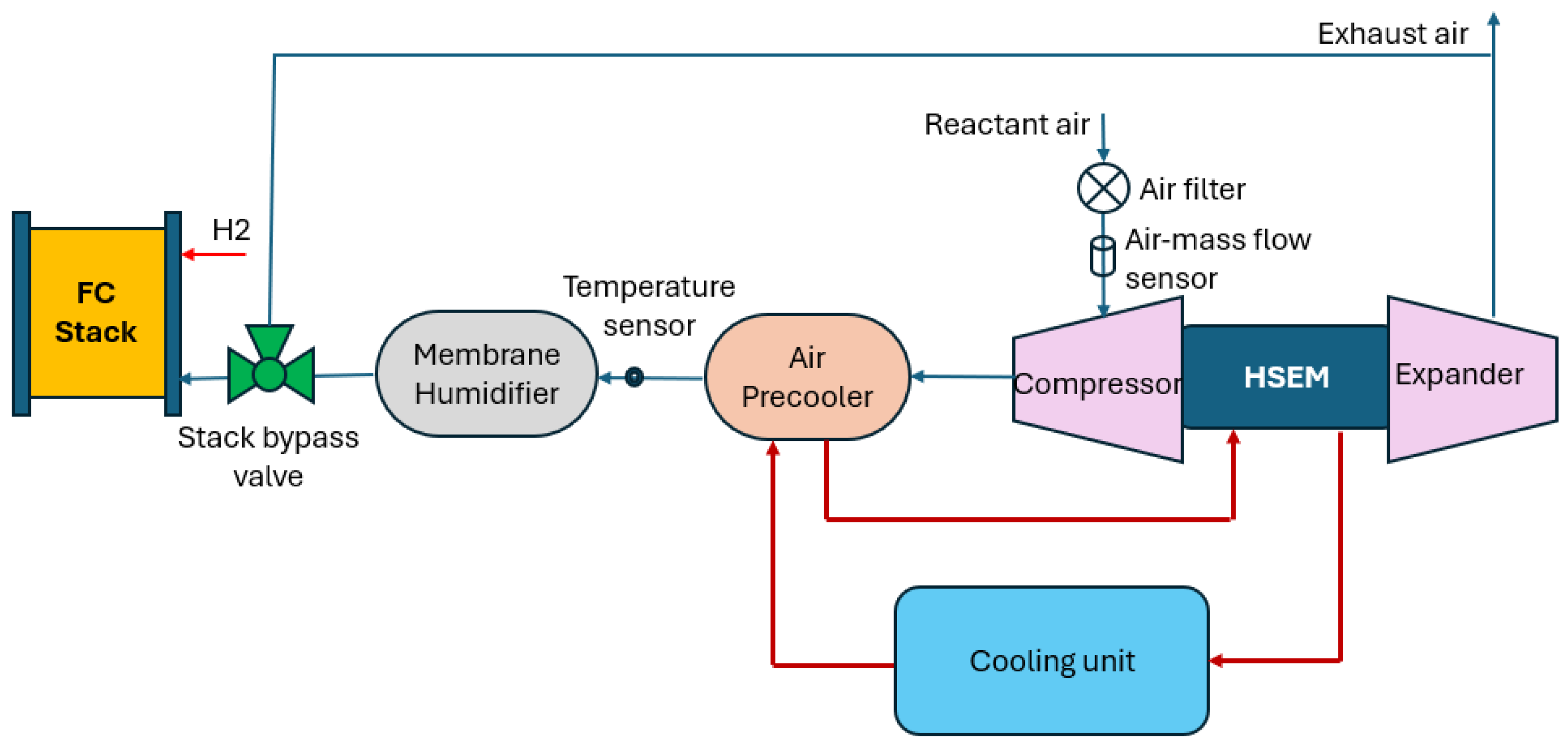
Figure 1. Air-supply flow for a FC stack compressor system used in EV application.
Applsci 16 00476 g001
Figure 3. Studied 2-poles HS-SynRM studied configurations: (a) classic rotor and winding in 1-layer (HS-SynRM1); (b) classic rotor and winding in 2-layers and coil span 8 (HS-SynRM2); (c) classic rotor and winding in 2-layers and coil span 7 (HS-SynRM3); (d) curved rotor shape and winding in 3-layers (HS-SynRM4); (e) rotor with flux barriers (HS-SynRM5).
Applsci 16 00476 g003
Figure 4. FEM results for the studied SynRMs: (a) iron losses within HS-SynRM1; (b) iron losses within HS-SynRM2; (c) iron losses within HS-SynRM3; (d) rated dynamic torque for HS-SyrRM1&2&3.
Applsci 16 00476 g004
Figure 5. Studied HS-PMSM configurations: (a) surface-mounted PMs with parallel magnetization; (b) surface-mounted PMS with radial magnetization; (c) half-inset PMs; (d) half-inset PMs with variable height on magnetization direction.
Applsci 16 00476 g005
Figure 6. HS-PMSM numerical results (designed for the FC system compressor application): (a) the torque and iron losses for HS-PMSM1,2,3 configurations, with parallel magnetization; (b) the torque and iron losses for HS-PMSM1,2,3 configurations, with radial magnetization.
Applsci 16 00476 g006
Figure 7. The final HS-PMSM variant, mechanically valid: (a) 2D cross section; (b) mechanical stress level at 26 kr/min.
Applsci 16 00476 g007
Figure 8. The HS-IM studied variant: (a) flux density distribution; (b) torque wave function of used material, at 40.5 kr/min; (c) axis torque dependence with the slip; (d) motor’s starting torque.
Applsci 16 00476 g008
Figure 9. The electrical machines efficiency standard [72].
Applsci 16 00476 g009
Figure 10. Three-phase winding type configurations studied for the HS-PMSM: winding 1 (top), winding 2 (middle), winding 3 (bottom).
Applsci 16 00476 g010
Figure 11. Torque and iron losses in a HESM with PMs, for three winding types.
Applsci 16 00476 g011
Figure 12. Slot’s wedges and insulation in HSEM: (a) standard wedge and insulation; (b) layers of magnetic and non-magnetic wedge and absorptive filler; (c) layers of magnetic wedge and absorptive filler.
Applsci 16 00476 g012
Figure 13. The HS-PMSM for studying the slot geometry influence on machine’s performances: (a) 2D cross section of geometry; (b) two slots configuration: straight slot (left), and slot with rounded corners and trapezoidal isthmus (right).
Applsci 16 00476 g013
Figure 14. FEM results in generator operation of the HS-PMSM 70 kW-80 kr/min: (a) case 1, with distributed winding type (1-layer), straight isthmus, M400-50A steel for stator and rotor core; (b) distributed winding type, trapezoidal isthmus and round corners for the slot, M400-50A steel for stator and rotor.
Applsci 16 00476 g014
Figure 15. FEM results for two skewed HSEM of 20 kW, at 26 kr/min: (a) HS-IM with rounded rotor bars; (b) HS-SynRM; (c) torque ripples mitigation due to skewing, for HS-IM; (d) torque ripples mitigation due to skewing, for HS-SynRM.
Applsci 16 00476 g015
Figure 16. Mechanical stress on the HS-PMSM with half-inset magnets: (a) with retaining sleeve and empty space between consecutive PMs; (b) with retaining sleeve and resin between consecutive PMs.
Applsci 16 00476 g016
Figure 17. Mechanical stress on the HESM with inset PMs: (a) type-1 flux barrier; (b) type-2 flux barrier; (c) type-3 flux barrier; (d) type-4 flux barrier; (e) type-5 flux barrier; (f) type-6 flux barrier.
Applsci 16 00476 g017
Figure 18. Constructed HS-PMSM prototype: (a) rotor core with magnets and flux barrier; (b) water cooled jacket for the stator [70].
Applsci 16 00476 g018
Figure 20. Optimization results for the HS-PMSM, with buried and variable height magnets [70].
Applsci 16 00476 g020
Table 1. Torque and speed of electromechanical systems on board of EV, HV, ICE.
ApplicationAverage Speed (r/min)Average Torque (Nm)Application Key Challenges
Starter-Generator (SG)100300the best power-density is requested, usually obtained with expensive materials and water cooling
Electro-Hydraulic Active Suspension (EHAS)50010high-density currents requested, while coreless solutions are to be employed
Electric Power Assisted Steering (EPAS)8009.5the best power-density is requested, usually obtained with expensive materials
Variable Valve Timing (VVT)10007high-temperature capability is requested, with artificial cooling
Electric Gearbox (EG)1000250high-density water-cooled poli-phased motors needed, with 3D core materials
Electro-Mechanical Active Suspension (EMAS)400095higher speed and power density, usually obtained with expensive materials
Electric Assisted Front Steering (EAFS)65001high-speed and high-current density motors with rare earth materials
Hybrid Vehicle propulsion (HV)9000250maximized propulsion speed, water cooled and pin-type winding, with limited rare earth material
Electric Vehicle propulsion (EV)11,000400maximized propulsion speed, water cooled and pin-type winding, with limited rare earth material
Fuel Cell Air-Compressor (FCAC)20,00010maximized speed, water cooled, decreased magnetic poles and frequency, mechanical stress
Heating, Ventilation, Air-Conditioning (HVAC)40,0006maximized speed, water cooled, decreased magnetic poles and frequency, mechanical stress
Electric Assisted Turbochargers (EATC)80,0001maximized speed, water cooled, decreased magnetic poles and frequency, mechanical stress
Table 2. Main performances of the studied HS-SynRM variants for the FC system application.
ParameterHS-SynRM1HS-SynRM2HS-SynRM3HS-SynRM4HS-SynRM5
Phase current (A, rms)18
Winding factor (--)0.960.940.90.90.9
Average torque (Nm)3.98
Torque ripple (%)42.8528.9627.6616.0728.12
Active part weight (kg)7.698.018.7511.168.90
Active part cost for raw material (EUR)41.8542.3944.6059.0644.75
Table 3. The average values of the axis torque, torque ripple and iron losses within the studied HS-PMSM variants.
ParameterMean Torque (N·m)Torque Ripples (%)Stator Iron Loss (W)Rotor Iron Loss (W)
Machine
Parallel magnetization
HS-PMSM18.4110.69310.467.68
HS-PMSM28.356.56304.218.26
HS-PMSM37.933.45281.508.24
Radial magnetization
HS-PMSM19.045.57339.4612.91
HS-PMSM28.805.11334.2812.90
HS-PMSM38.702.49298.6112.32
Table 4. Materials used for HSEMs.
MaterialPropertyValue (Unit)Material Density (kg·m−3)Cost (€·kg−1)
airmagnetic permeability1.2566·10−6 (m·kg·A−2·s−2)0.9996 (at 90 °C)-
copperelectric resistivity2.438·10−8 (Ω·m)89548
Young’s modulus130 (GPa)
Poisson’s ratio0.343
aluminumelectric resistivity2.65·10−8 (Ω·m)27005
Young’s modulus77 (GPa)
Poisson’s ratio0.33
Nd-Fe-B magnetremanent flux density1.15 T (at 160 °C)740070
magnetic field coercitivity907 (kA·m−1)
relative magnetic permeability1.05
Young’s modulus150 (GPa)
Poisson’s ratio0.3
Sm-Co magnetremanent flux density1.1 T (at 160 °C)830080
magnetic field coercitivity1000 (kA·m−1)
relative magnetic permeability1.04
Young’s modulus 150 (GPa)
Poisson’s ratio0.3
M530 steelflux density saturation limit1.8 (T)78003
sheet stack coefficient (0.35 mm)0.97
Young’s modulus 210 (GPa)
Poisson’s ratio0.3
Vacoflux48/Vacodur50flux density saturation limit2.2 (T)8120~100
sheet stack coefficient (0.2 mm)0.95
Young’s modulus 150 (GPa)
Poisson’s ratio0.3
Somaloy steelflux density saturation limit1.6 (T)780030
stack coefficient1
Young’s modulus 170 (GPa)
Poisson’s ratio0.23
Titanium alloyYoung’s modulus 114 (GPa)4500~200
Poisson’s ratio0.34
Epoxy resinYoung’s modulus 5 (GPa)1300~20
Poisson’s ratio0.4
Table 5. Main characteristic for the studied HS-PMSM 70 kW-80 kr/min variants.
ParameterCase 1Case 2
RMS phase emf (V)143.5144.2
RMS phase current (A)190.9191.6
Mean torque (Nm)9.149.13
Torque’s ripples (%)32.132.2
Total iron losses (W)4213.94181.3
Table 6. Thermal management technologies for HESM.
ParameterCooling Capacity Characteristics
Cooling Method
Free air-cooling0.1–0.3 (W/cm2)Reduced cooling capacity due to very low heat capacity of air [99].
Forced air-cooling0.5–1.5 (W/cm2)Limited cooling capacity due to small surface area and air drag [99].
Water jacket cooling1–10 (W/cm2)Very good cooling capability [100].
Oil (spray or jet) cooling0.75 (W/cm2·K)15–19% improved capability with respect to water cooling [101].
Direct liquid cooling (embedded channels)10–40 (W/cm2)Most effective method for high-speed electrical machines [99].
Spray cooling (high flux)50 (W/cm2)Not recommended for all application, with cooling capability of up to 500 W/cm2—mainly in electronic applications [102].
Table 7. Failures risks in electrical machines.
InsulationMechanicalThermalBearings
Risk Percentage56%24%17%3%
Table 8. Causes for insulation failure.
AgingContaminationDischargeTurns/Bars MovementThermal OverloadingDefective Corona ProtectionOvervoltage
Risk Percentage31%25%22%10%7%3%2%
Table 9. Comparison of the studied HS-PMSM, HS-IM and HS-SynRM for a given operating point.
ParameterHS-PMSM
(Figure 7)
HS-IM
(Figure 15a)
HS-SynRM
(Figure 15b)
Rated power (kW)202020
Rated speed (r/min)26,00026,0002600
Phase current (A)556060
Supplying frequency (Hz)433437433
Number of stator slots181818
Number of magnetic poles222
Stator and rotor steel materialVacodur 48Vacodur 48Vacodur 48
Permanent magnet materialSmCo--
Rotor bar material-Copper-
Stack length (mm)135210250
Stator inner diameter (mm)575757
Stator outer diameter (mm)105105105
Air-gap (mm)10.51.5
Torque ripples, non-skewed/skewed (%)10.2/1.811.9/2.133.7/2.6
Stator iron loss (W)203204454
Rotor iron loss (W)405033
Mechanical loss (W)274297436
Power factor (--)0.8490.9250.884
Efficiency (%)95.691.588.9
Coolingwaterwaterwater
Inverter losseslowhighhigh
Manufacturing challengesRotor flux barriersRotor slots towards air-gap-
Power density (kW/kg)2.481.681.33
Critical speed (r/min)29,00027,300-
Cost for the active part (€)1139269
Considered bearing typeAerodynamic bearingAerodynamic bearingAerodynamic bearing
Main advantagesPower density and efficiencyCost, acceptable power densityCost and robustness
Main disadvantagesCost and robustness, PM demagnetization riskRobustness and controllabilityPower density and efficiency
Disclaimer/Publisher’s Note: The statements, opinions and data contained in all publications are solely those of the individual author(s) and contributor(s) and not of MDPI and/or the editor(s). MDPI and/or the editor(s) disclaim responsibility for any injury to people or property resulting from any ideas, methods, instructions or products referred to in the content.