Review

Real-Driving Emissions of Euro 2–Euro 6 Vehicles in Poland—17 Years of Experience


1
Faculty of Civil and Transport Engineering, Poznan University of Technology, 5 M. Sklodowskiej-Curie Square, 60-965 Poznan, Poland
2
Faculty of Mechanical Engineering and Aeronautics, Rzeszow University of Technology, 12 Powstancow Warszawy Street, 35-959 Rzeszów, Poland
3
Motor Transport Institute, 80 Jagiellonska Street, 03-301 Warsaw, Poland
4
Department of Mechanical Engineering, Koszalin University of Technology, Raclawicka 15-17, 75-620 Koszalin, Poland
*
Author to whom correspondence should be addressed.
Appl. Sci. 2026, 16(1), 348; https://doi.org/10.3390/app16010348 (registering DOI)
Submission received: 28 November 2025 / Revised: 19 December 2025 / Accepted: 27 December 2025 / Published: 29 December 2025

Abstract

The article presents the development and results of emission studies conducted in Poland in the context of global real-driving emissions research. Although the European Union has continuously tightened exhaust-emission standards, road transport remains one of the major sources of air pollution. Several research centers in Poland—including Rzeszów University of Technology, Poznan University of Technology, and the Motor Transport Institute—have been conducting on-road emission measurements for many years across a wide spectrum of vehicles: conventional, hybrid (including plug-in hybrids), and fully electric. The findings show that emissions under real-world driving conditions often differ from those obtained in homologation tests, particularly for nitrogen oxides and particulate matter. Ambient temperature, road gradient, and driving phases (urban, rural, motorway) were also identified as influential factors. Polish research centers have developed analytical tools enabling comparison between laboratory and on-road tests and allowing real-driving emissions to be estimated based on chassis-dynamometer data. Studies on plug-in hybrids highlighted that these vehicles remain environmentally beneficial only when regularly charged; otherwise, their emissions can increase sharply. Overall, the research confirms that on-road testing is essential for a reliable evaluation of vehicle performance, and the results can contribute to designing more eco-friendly technologies and improving future emission regulations.

1. Introduction

RDE (Real-Driving Emissions) testing has become one of the key tools for assessing the real environmental impact of vehicles, serving as an essential complement to traditional laboratory-based procedures. The growing need to reduce the environmental burden of transport and to improve air quality has led the European Union to shift away from exclusively stationary emission tests: NEDC (New European Driving Cycle) [1], and later WLTP (Worldwide harmonized Light-duty Test Cycle) [2]) toward measurements performed under real operating conditions. RDE tests provide a far more accurate representation of vehicle behavior in natural traffic environments, accounting for variations in load, terrain, ambient temperature, driving style, and traffic intensity. This enables the identification of differences between declared and actual emissions, supporting efforts to reduce nitrogen oxides, particulate matter, and carbon dioxide emissions.
The introduction of RDE testing has been closely linked to the development of Euro emission standards. The procedure was formally established under the Euro 6 framework, with its scope and requirements expanded progressively through four regulatory packages: RDE1 (Regulation 2016/427) [3], RDE2 (2016/646) [4], RDE3 (2017/1154) [5], and RDE4 (2018/1832) [6]. These packages gradually introduced mandatory PEMS (Portable Emissions Measurement System) measurements, defined CF (Conformity Factors), refined route-validation criteria, set temperature and altitude requirements, and harmonized procedures for type-approval testing and in-service conformity checks.
RDE is now required not only for conventional gasoline and diesel vehicles but also for HEV (Hybrid Electric Vehicle) and PHEV (Plug-in Hybrid Electric Vehicle) systems [7]. In the context of electric vehicles, the procedure serves as a foundation for future regulations addressing non-exhaust emissions, such as brake and tire wear, as well as metrics related to drivetrain energy consumption.
With the preparation of the new Euro 7 standard, the importance of real-world testing continues to increase. Euro 7 introduces an expanded scope for RDE tests, including a broader ambient-temperature range, higher altitudes, more intensive driving conditions, and the inclusion of brake-emission assessment and durability requirements for emission-control systems [8]. The objective of these changes is to further strengthen the evaluation framework for vehicle environmental impact and to ensure that declared emission levels accurately reflect real-world performance during everyday use.
Research centers in Europe and worldwide play a key role in the development and validation of RDE testing. Within the European Union, the JRC (Joint Research Centre) [9] has fundamental importance, being responsible for validating conformity factors [10], developing WLTC–RDE comparison methodologies [11], and preparing reports that form the basis for regulatory frameworks [12,13]. Homologation authorities such as TÜV (Technischer Überwachungsverein) [14] and DEKRA (Deutsche Kraftfahrzeug-Überwachungs-Verein eV) [15] also hold an important position, carrying out extensive RDE measurements for passenger cars, light commercial vehicles, and hybrids, as well as durability testing of emission-control systems within the ISC (In-Service Conformity) procedures.
In France, UTAC CERAM (Union Technique de l’Automobile, du motocycle et du Cycle—Centre d’Essais et de Recherche Automobile de Mortefontaine) [16] specializes in urban-driving evaluations and in comparative testing of PEMS equipment. Outside Europe, significant activity is conducted by the US EPA (Environmental Protection Agency) [17] and CARB (California Air Resources Board) [18], which perform market-surveillance emission testing and measurement campaigns for PHEV and hybrid vehicles under demanding real-world conditions.
In Asia, national versions of RDE testing are carried out by centers such as CATARC (China Automotive Technology and Research Center) [19] in China, JARI (Japan Automobile Research Institute) [20] in Japan, and KATECH (Korea Automotive Technology Institute) [21] in South Korea, conducting, among others, low-temperature emission tests, urban-driving studies, and analyses of energy consumption in electric vehicles. International data exchange among these institutions contributes to the harmonization of standards and the development of future iterations of RDE procedures.
As a result, real-driving emission testing has become a fundamental component of modern emission standards in Europe and an increasingly important element of global regulation. Its continued development—particularly in the context of the upcoming Euro 7 requirements—indicates that RDE measurements will remain a key tool for reducing the environmental impact of road transport, designing advanced powertrain systems, and shaping public policy based on real operational data.

2. Real-Driving Emissions Studies Worldwide

2.1. North America

National Vehicle and Fuel Emissions Laboratory (NVFEL) is a leading research center operated by the US EPA and located in Ann Arbor, Michigan. NVFEL’s activities focus on supporting the implementation of national emission standards for engines and vehicles, assessing compliance with environmental regulations, and advancing technologies that reduce pollutant emissions and improve transport energy efficiency. Research infrastructure includes chassis-dynamometer test cells that allow simulation of real-world driving conditions for passenger vehicles in a controlled laboratory environment. Based on standardized test cycles reflecting typical urban, suburban, and highway operation, exhaust-emission values are determined [22].
A key area of NVFEL’s work involves emission measurements under real-world operating conditions, comparable in scope to European RDE procedures. For this purpose, mobile measurement systems are used, enabling the assessment of exhaust emissions from vehicles driven on public roads. Resulting datasets support in-use compliance analysis and the development and validation of test procedures that more accurately represent real operating conditions [23]. Additional analytical capabilities include advanced systems for particulate mass and particle-number measurements, essential for evaluating the performance of modern emission-control technologies such as three-way catalytic converters and particulate filters [24].
NVFEL also serves as a certification center where vehicles and engines undergo testing to obtain homologation compliant with US emission standards. Within RDE studies, EPA researchers use PEMS equipment to measure gaseous and particulate emissions under real-world operating conditions, including the influence of road grade and atmospheric conditions. GPS (Global Positioning Systems) data and CAN-bus (Control Area Network) signals are integrated with simulation models such as ‘GT-DRIVE+’ to reproduce realistic speed profiles and engine loads. This approach enables detailed analysis of fuel consumption, GHG (Greenhouse Gas) emissions, and NOx (nitrogen oxides), with results showing high consistency with on-road testing data [25,26].
Beyond field measurements, NVFEL conducts advanced simulation studies covering pollutant-emission behavior and fuel-efficiency performance across various powertrain configurations. These analyses provide more accurate reproduction of vehicle operation across diverse speed profiles and load conditions, supporting the development of modern control strategies for propulsion systems [27,28]. In recent years, NVFEL researchers have also focused on UFP (Ultrafine Particles), which represent one of the major challenges in contemporary emission research [29].
Southwest Research Institute (SwRI) is one of the world’s largest independent non-profit research organizations, specializing in interdisciplinary scientific research and advanced technology development. Established in 1947 in San Antonio, Texas, the institute has since carried out research and development projects for industrial clients, government agencies, and international organizations. SwRI’s activities span a wide range of engineering and natural-science fields, including energy systems, materials engineering, transportation technologies, automation, and environmental protection [30]. Within SwRI’s structure, a significant role is played by the Automotive & Transportation Division, which conducts comprehensive research on combustion-engine, hybrid, and electric vehicles. The institute carries out projects involving vehicle software, durability and efficiency of powertrain systems, exhaust-emission analysis, fuel testing, and the development of alternative propulsion technologies [31]. SwRI laboratories are equipped with test facilities that enable vehicle evaluation across the full range of loads and temperature conditions, in accordance with procedures of the US EPA, the CARB, and European homologation standards. The test scope includes both laboratory cycles and real-world emission measurements, allowing for a comprehensive assessment of vehicle behavior under actual pollutant-emission conditions [32].
Southwest Research Institute conducts scientific work on pollutant emissions from passenger vehicles and the environmental impact of different propulsion technologies. One of the key research directions involves analyzing degradation processes in exhaust- aftertreatment systems, particularly selective catalytic reduction [33]. SwRI also carries out intensive studies on exhaust emissions from combustion engines fueled with hydrogen. Research teams investigate hydrogen-combustion processes in engines, focusing on reducing nitrogen-oxide formation and simulating conditions representative of real operating scenarios [34]. Additional activities include eco-driving studies aimed at lowering electric-energy consumption in passenger vehicles, along with modeling of embedded vehicle software under realistic driving conditions [35,36].

2.2. Asia

Japan Automobile Research Institute [37] is a leading Japanese research institution in Asia, focused on automotive science, technology development, vehicle testing, and comprehensive evaluation of vehicles and their components. Established in April 1969 through the reorganization of an existing high-speed vehicle proving ground, the institute evolved into an interdisciplinary research center covering a wide range of topics related to automotive engineering. In 2003, JARI expanded its activities by integrating organizations specializing in electric vehicles and automotive electronics, including the Japan Electric Vehicle Association (JEVA) and the Association of Electronic Technology for Automobile Traffic and Driving (JSK). This integration enabled the institute to advance research in energy systems, electromobility, and information- and communication-technology applications in transport. The headquarters is located in Tokyo, while the main research and testing facilities operate in Shirosato and at the Jtown Test Center in Tsukuba. JARI’s organizational structure is built around three core research pillars: Environment, Safety, and Mobility.
Within the research domain Environment, Japan Automobile Research Institute carries out extensive studies on the environmental impact of vehicles. This work covers both combustion-engine vehicles and modern electric and hybrid designs. Key research directions focus on improving the energy efficiency of powertrain systems, reducing harmful emissions, and analyzing how different vehicle operating modes influence pollutant levels under real-world driving conditions [38]. A significant component of JARI’s activities involves LCA (Life-Cycle Assessments) and WtW (Well-to-Wheel) analyses, which provide a comprehensive evaluation of the energy and environmental balance throughout the entire vehicle life cycle—from production, through operation, to end-of-life processing. Additional research is dedicated to non-exhaust emissions, including particulate matter generated by the wear of components such as brakes and tires [39].
Researchers at the Japan Automobile Research Institute also maintain intensive scientific and publication activity in the field of passenger-vehicle pollutant emissions. One of the institute’s notable achievements was co-development of international test standards for light-duty vehicles. In 2015, Takahiro Haniu of JARI contributed to the creation of the Worldwide harmonized Light vehicles Test Cycle, developed on the basis of measurement data obtained under real-driving conditions [40]. In subsequent years, institute researchers focused on improving methods for simulating real-world traffic conditions in laboratory environments. This work included procedures for generating random driving cycles for chassis-dynamometer testing, enabling more representative emission assessments compared with traditional homologation tests [41,42].
In October 2022, Japan introduced real-driving emission procedures for diesel vehicles, supplementing previously used laboratory tests. In the same year, JARI published a technical report presenting a comprehensive evaluation framework for RDE testing, including route descriptions, measurement-system configuration, and validation methodology [43]. Specialists at the institute continue to advance methods for assessing measurement uncertainty in RDE studies, with emphasis on ensuring high data quality and repeatability. In 2025, the JARI research team released a study analyzing uncertainty of a nitrogen-oxide analyzer in accordance with EN 17507 [44], providing an important contribution to the improvement of reference methodologies used in on-road emission testing.
Researchers at the JARI laboratory use two types of on-board exhaust emission analyzers. The first system is the HORIBA OBS-ONE-GS, which measures gaseous concentrations under wet conditions, without drying the sample. The second system is the AVL M.O.V.E iX Gas, which performs measurements after prior drying of the exhaust gases (dry measurement), with the obtained results subsequently converted to wet conditions based on the fuel H/C ratio. The applied systems also differ in the method used for nitrogen oxides measurement: in the first case, the chemiluminescence method (CLD) is employed, whereas in the second case the non-dispersive ultraviolet absorption method (NDUV) is used, enabling independent measurement of NO and NO2 concentrations [43].
China Merchants Testing Vehicle Technology Research Institute (CMVR) functions as a key organization within the Chinese automotive industry, covering vehicle research, testing, and certification, as well as technological innovation and support for vehicle manufacturing and associated systems. The institute was established as part of CMG (China Merchants Group) and serves as a national research and testing center for the automotive sector. Its core activities focus on three principal areas: safety, environmental performance, and intelligent vehicle technologies [45]. CMRV operates two research and testing bases, Jinfeng and Jinshan. Together, these facilities support the construction of a mandatory vehicle-inspection proving ground and more than ten specialized test buildings for vehicle performance, exhaust emissions, power systems, crash testing, components, electromagnetic compatibility, intelligent connected vehicles, new-energy vehicles, and motorcycles. The institute also maintains fully enclosed, semi-open, and open road-test areas designed for the evaluation and validation of autonomous-vehicle technologies [46]. Within the structure of the China Merchants Vehicle Testing Research Institute, the New Energy Engine Laboratory (NEEL) holds particular importance for environmental and emission-related research. The laboratory conducts comprehensive studies in the field of environmental protection, covering conventional combustion engines, as well as electric and hybrid powertrain systems. Its activities include environmental testing of engines for both passenger cars and heavy-duty vehicles. It also performs emission measurements for non-road machinery engines and marine engines. Additional research areas encompass combustion analysis, calibration of OBD (On-Board Diagnostic) systems, NVH testing (noise, vibration, and acoustic comfort), along with durability and reliability assessments of powertrain units [47]. Researchers at CMVR are authors or co-authors of numerous studies on RDE testing in passenger vehicles. Xiaoliu Xu contributed to a scientific publication addressing challenges related to RDE methodology. The study evaluated 29 passenger cars across 10 cities with the aim of resolving issues associated with the underestimation of real-world exhaust-emission results caused by the Moving Average Window (MAW) method [48]. The research team at CMVTR also co-authored a publication proposing a shortened RDE test and evaluating its impact on the emission levels of harmful compounds such as CO, NOx, and PM10 [49]. At the China Merchants Testing Vehicle Technology Research Institute, exhaust emission measurements are conducted mainly using the on-board measurement system HORIBA OBS-ONE-GS. This equipment corresponds to the technical solutions applied at the JARI laboratory in Japan and constitutes the primary tool used for emission studies carried out at this institute. The researchers additionally carried out studies on ammonia emissions from plug-in hybrid vehicles under real-world operating conditions [50].

2.3. Europe

Ricardo is a global consulting and engineering company operating in the fields of transportation, energy, and environmental technologies, founded in 1915. Its headquarters are located in Shoreham-by-Sea in the United Kingdom, and the company maintains a global presence in more than 20 countries [51]. Ricardo operates through a network of specialized technical centers where it develops and tests advanced powertrain systems, exhaust-aftertreatment technologies, vehicle electrification solutions, hydrogen and biofuel concepts, as well as conducting life-cycle environmental analyses. A key component of the company’s research infrastructure is the Vehicle Emissions Research Centre (VERC) in Shoreham-by-Sea, United Kingdom. The laboratory’s activities include gaseous and particulate emission measurements, evaluation of exhaust-aftertreatment performance, fuel-consumption testing, and analysis of vehicle behavior during cold and hot starts.
A particularly important area of Ricardo’s research is real-driving emission testing. Portable emission-measurement systems are used to determine concentrations of nitrogen oxides, carbon monoxide, hydrocarbons, particulate matter, and carbon dioxide during actual vehicle operation. The data obtained from on-road measurements are then compared with chassis-dynamometer results, enabling a comprehensive assessment of the vehicle’s real environmental impact. RDE studies conducted by Ricardo support the homologation process for passenger vehicles in accordance with European Euro 6d regulations and, in the future, Euro 7 requirements [52].
Ricardo conducts exhaust emission measurements under real-driving conditions using portable emissions measurement systems. The studies employ HORIBA OBS-ONE systems, which are analogous to the solutions used by other leading research centers involved in the assessment of on-road vehicle emissions. Ricardo’s research infrastructure also includes equipment for particle number measurement as well as tools for processing and analyzing measurement data, and the conducted tests comply with the applicable requirements of RDE procedures [52].
Ricardo also supports scientific research activities. According to the company’s 2023 publication, the use of remote-emission sensing technology enabled the collection of more than one million measurements from vehicles operating under real-world traffic conditions on public roads. This resulted in the creation of the largest emissions database in the United Kingdom. Many of Ricardo’s studies on pollutant emissions from passenger vehicles have been carried out in collaboration with the University of York. One of the experts working with Ricardo is David C. Carslaw, who has conducted numerous investigations with researchers from the aforementioned university, analyzing the influence of various factors on nitrogen oxide emissions [53]. A notable example was a study conducted at 26 measurement sites across 10 regions of the United Kingdom, which made it possible to determine how nitrogen oxide emissions vary with changes in ambient air temperature [54,55,56].
TNO (Nederlandse Organisatie voor Toegepast Natuurwetenschappelijk Onderzoek) is a Dutch research institute operating in the fields of mobility and sustainable development, focusing on emission reduction and improving the efficiency of road, maritime, and rail transport, as well as on the deployment of renewable energy sources and technologies such as fuel cells and powertrain electrification. The institute supports the industrial sector by providing expertise in propulsion systems, alternative fuels, and data analysis, while also assisting public authorities in developing air-quality policies and strategies [57]. TNO operates a number of research facilities across the Netherlands, while most emission-testing and powertrain-related work is carried out at the Automotive Campus research center located in Helmond.
In the field of real-world emission monitoring, TNO conducts measurements of exhaust emissions during the actual operation of road vehicles, ships, and trains. The methods used include PEMS equipment as well as the institute’s proprietary SEMS (Smart Emissions Measurement System), which enables continuous measurements under natural vehicle-use conditions [58]. SEMS is a compact, sensor-based exhaust emission monitoring system developed by TNO, which is installed on the vehicle and measures—without operator intervention—NOx and O2 concentrations in the exhaust gases, as well as indirectly CO2, together with the recording of operational data and GPS signals. This approach enables an in-depth analysis of how factors such as fuel type, powertrain technology, road and climatic conditions, vehicle age, and mileage affect emission levels. TNO also conducts studies on non-road vehicles that operate continuously under real-world conditions, providing data that go beyond standard laboratory tests. The analyses cover the influence of logistics processes, topography, atmospheric conditions, and patterns of vehicle use [59]. The TNO website provides numerous scientific publications covering studies of various vehicle types and powertrains under real-world operating conditions. The institute’s activities include research on real fuel and electric-energy consumption in passenger cars [60], emission measurements for two-wheel vehicles [61], exhaust-emission testing of urban buses [62], studies on heavy-duty vehicle emissions [63], and investigations of non-road machinery emissions [64].
The Joint Research Centre is a key scientific and research institution operating within the European Commission [65]. Its mission is to provide independent, evidence-based knowledge and analysis to support EU policy and to establish a strong knowledge base for legislative and strategic decision-making. JRC operates on three main pillars: anticipation (identifying upcoming challenges and opportunities), integration (bringing together diverse scientific disciplines and policy areas), and impact (assessing the effectiveness and influence of policies). The institute is geographically distributed across several EU countries and maintains research facilities that include specialized laboratories and measurement infra-structure in multiple domains. Its current strategic framework, Strategy 2030, emphasizes that scientific work must be closely aligned with policy needs, positioning JRC as a trusted partner that bridges scientific expertise with regulatory practice. In practical terms, this means that the institution not only conducts fundamental research but also actively contributes to the development of standards, test procedures, and methodologies—particularly in areas such as mobility, air quality, energy, climate, and environmental protection.
In the field of passenger-vehicle emission research, JRC conducts its work primarily through the specialized Vehicle Emissions Laboratories (VELA) located in Ispra, Italy. VELA consists of two dedicated laboratories for chemical and physical analysis and approximately ten main test facilities capable of performing emission measurements—including evaporative-emission testing—on a wide range of vehicles, from motorcycles and passenger cars to large off-road engines [66]. The laboratory operates with an independent diagnostic and inspection status, ensuring reliability and impartiality in carrying out both type-approval and in-use compliance testing.
Within the Vehicle Emissions Laboratories of the European Commission’s Joint Research Centre, advanced exhaust emission studies are conducted both under laboratory conditions and during on-road driving. The laboratory is equipped with infrastructure for simulating real-world vehicle operating conditions, including climatic chambers, chassis dynamometer facilities, and measurement systems for regulated and unregulated emissions. Various measurement systems are employed in the studies, including portable PEMS from different manufacturers such as AVL, HORIBA, and SENSORS. The flexibility of the instrumentation results from the fact that JRC also conducts comparative studies and evaluations of different measurement methods and supports the development of procedures and metrological tools for vehicle emission assessment.
The JRC undertakes a wide range of scientific activities and shares its publications related to emission studies of passenger vehicles. The institute has conducted early analyses of RDE methodology for passenger cars, including a 2020 report in which a dataset of 11 vehicles and 79 on-road tests was examined. Through this work, JRC contributed to the development of GTR (Global Technical Regulations) under the framework of the UNECE (United Nations Economic Commission for Europe) [67]. An important project conducted by the JRC involved testing the same vehicle in seven different laboratories across Europe and on various RDE routes. The results showed significant variability in harmful-emission levels depending on the characteristics of each measurement route. The uncertainty values derived from this study can be applied to the assessment of vehicles using different powertrain technologies during RDE testing [68]. The JRC has also focused on the measurement uncertainty of PEMS devices used in RDE testing. In its 2021 report, the institute evaluated measurement-error margins and proposed possible reductions in tolerance limits—for example, the NOx margin was lowered from 0.32 to 0.23 in the recommendations for regulatory updates [69]. Another important publication by the JRC research team, released in 2025, presented the findings of a pilot campaign at JRC-VELA aimed at comparing different PEMS instruments under identical test conditions. The study demonstrated comparable results across devices, supporting the standardization of RDE measurements and emphasizing the importance of a unified testing procedure [68].

2.4. Current Emission Limits and Regulatory Framework Evolution

The emission research centers described in the preceding sections operate within complex and continuously evolving regulatory frameworks that define acceptable limits for vehicle pollutants. Understanding these limits is essential for contextualizing the scientific work conducted by research institutions worldwide. This subsection presents the current emission limits for major pollutants across key regulatory jurisdictions, highlighting recent regulatory changes that reflect the automotive industry’s transition toward zero-emission mobility. The following table summarizes the emission limits for nitrogen oxides, particulate matter, and carbon monoxide under the major regulatory standards applied in regions discussed in Section 2.
Nitrogen oxides remain among the most stringently regulated pollutants due to their contribution to tropospheric ozone formation and harmful effects on human respiratory health. Current NOx limits reflect a progression toward increasingly tighter control across regulatory jurisdictions. European Euro 6d-Temp standards (Table 1) specify laboratory limits of 0.06 g/km for gasoline and 0.08 g/km for diesel vehicles, with RDE (real-driving emissions) limits of 0.168 g/km achieved through application of a conformity factor of 2.1. Euro 7, adopted in 2024, maintains the same laboratory limits but introduces a reduced conformity factor of 1.43, lowering RDE limits to approximately 0.086–0.114 g/km, representing stricter real-world compliance [70]. China’s CN 6b standard, implemented in 2023, establishes significantly more stringent laboratory limits of 0.035 g/km for both gasoline and diesel vehicles (fuel-neutral), with RDE limits of 0.0735 g/km [71]. In North America, US EPA Tier 3 and CARB LEV III standards employ combined NMOG + NOx metrics, with EPA targeting approximately 19 mg/km fleet average and California’s ULEV category achieving approximately 34 mg/km—substantially more stringent than European standards when converted to equivalent units [72].
Particulate matter regulation encompasses both mass (mg/km) and particle number, with Euro 7 marking a significant advancement by extending PM regulations to all gasoline engines (previously limited to direct-injection engines), reducing the minimum measured particle size from 23 nm to 10 nm for more comprehensive assessment of ultrafine particles, and harmonizing laboratory and on-road test procedures [73]. Carbon monoxide regulation ensures that modern powertrains, particularly hybrid and plug-in hybrid vehicles, maintain stringent limits despite advances in diesel aftertreatment systems [74].
A major innovation introduced by Euro 7 (2026) is the regulation of non-exhaust emissions for the first time in European standards, including brake wear particles (microplastics from brake pad wear) and tire wear particles (microplastics from tire abrasion), with an EU target of 30% reduction in microplastic pollution by 2030. This expansion reflects growing scientific evidence that non-exhaust emissions contribute substantially to urban air quality degradation and environmental contamination [75].
In December 2025, the European Commission announced a significant revision to its automotive regulatory framework. The original regulation adopted in March 2023 mandated a 100% reduction in CO2 emissions from new passenger cars from 2035 onward, effectively banning internal combustion engine (ICE) vehicles. However, following sustained pressure from EU member states including Germany, Italy, Poland, Hungary, Czech Republic, Bulgaria, and Slovakia, as well as from the automotive industry, the Commission revised this approach [76].
The new framework replaces the complete ban with a 90% CO2 emission reduction requirement for manufacturers’ fleets, allowing 10% flexibility allocation for vehicles equipped with internal combustion engines or hybrid powertrains, including plug-in hybrid electric vehicles, range-extender electric vehicles (REV), mild hybrid vehicles, and limited numbers of conventional gasoline and diesel vehicles. To compensate for this 10% allowance, manufacturers must either use low-carbon steel produced in the European Union or utilize sustainable fuels such as e-fuels and biofuels to power their remaining combustion-engine vehicles. The framework also includes incentive structures granting enhanced credits for small electric vehicles under 4.3 m in length (counting as 1.3 units toward CO2 reduction targets), and has reduced the required share of pure electric vans post-2035 from 50% to 40%.
This regulatory adjustment reflects pragmatic recognition of supply chain challenges in battery production and critical mineral availability, lower-than-expected EV consumer adoption in some markets (particularly Southern and Central Europe), competitive pressures from Chinese EV manufacturers, and concerns about the technical and economic feasibility of complete ICE phase-out within a decade. A mandatory review point in 2026 will assess progress toward the 90% CO2 reduction targets and evaluate alternative compliance pathways. The Commission maintains that this approach preserves long-term commitment to zero-emission mobility by 2050 while providing realistic transition pathways accounting for technological limitations and market dynamics.

3. Research on Passenger Cars Conducted at the Rzeszów University of Technology

Rzeszów University of Technology, through the Department of Motor Vehicles and Transport Engineering, has been conducting research on exhaust emissions and the energy efficiency of passenger cars for many years. The research activities span a wide range of methodologies, from classical chassis-dynamometer tests performed according to NEDC and WLTC procedures to advanced RDE measurements using PEMS. The university’s research infrastructure enables precise analysis of CO2, CO, HC, and NOx emissions under controlled laboratory conditions with ambient temperatures ranging from −20 °C to 30 °C, as well as comprehensive on-road measurements in real-world driving scenarios.
Advanced emission-modeling capabilities rely on sophisticated software tools integrated with traffic microsimulation, allowing the development of detailed emission inventories with high spatial and temporal resolution.
The research portfolio extends to specialized studies on public transport fleets, including the development of emission reduction strategies for municipal bus systems, analysis of alternative fuel impacts on emission performance, and innovative methodologies for intersection and roundabout emission assessment.
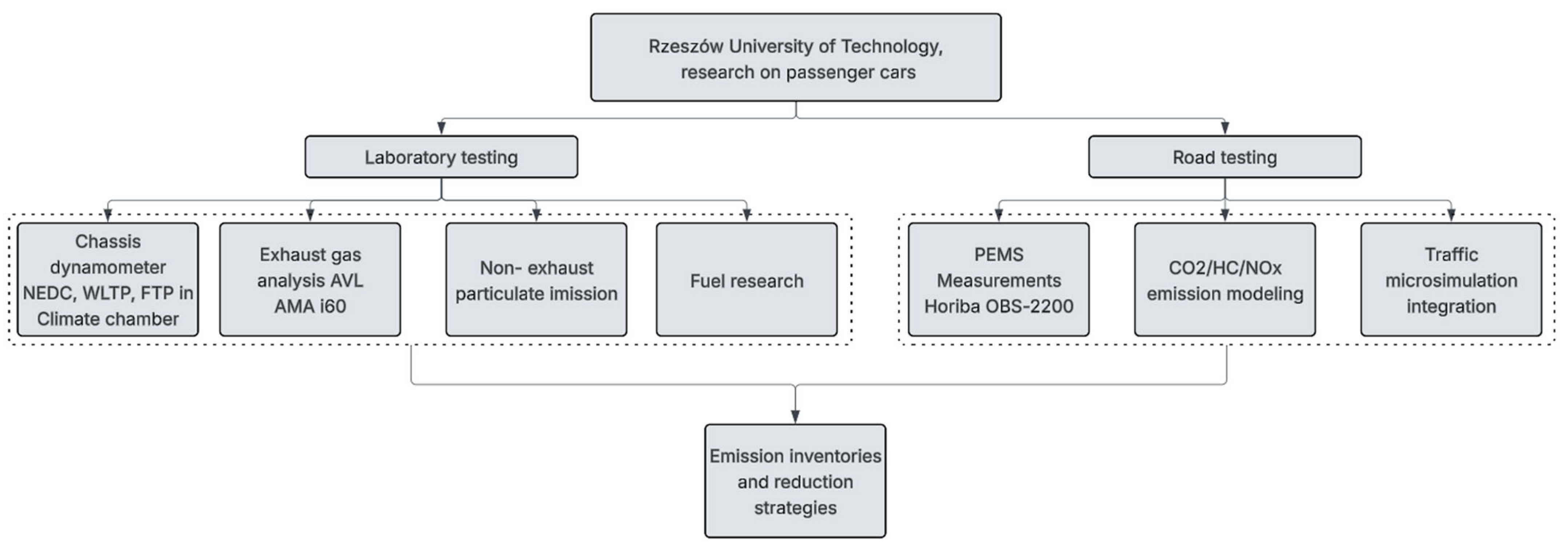
Figure 1 shows a diagram of selected works carried out at the Department of Motor Vehicles and Transport Engineering at the Rzeszów University of Technology. The schematic flowchart opens with Research on Passenger Cars at Rzeszów University of Technology, from which two parallel research streams emerge. The first, Laboratory Testing, encompasses chassis dynamometer experiments under standardized NEDC, WLTC, and FTP cycles within a climate chamber, where exhaust gases are analyzed by an AVL AMA i60 system and non-exhaust particulates from tires and brakes are monitored in the chamber atmosphere, and is complemented by fuel research involving physicochemical characterization and spray visualization of alternative fuel blends using CVCC (Constant-Volume Combustion Chamber) and HFRR (High-Frequency Reciprocating Rig) apparatus. The second, Field Testing, involves on-road measurements with a HORIBA OBS-2200 PEMS, feeding real-driving emissions data into CO2, HC, and NOx modeling workflows and integrating results with traffic microsimulation tools. Both streams then converge to produce comprehensive Emission Inventories and Reduction Strategies, leveraging controlled and real-world insights to develop spatially resolved pollutant inventories and inform targeted measures for reducing vehicle emissions and optimizing urban energy use.
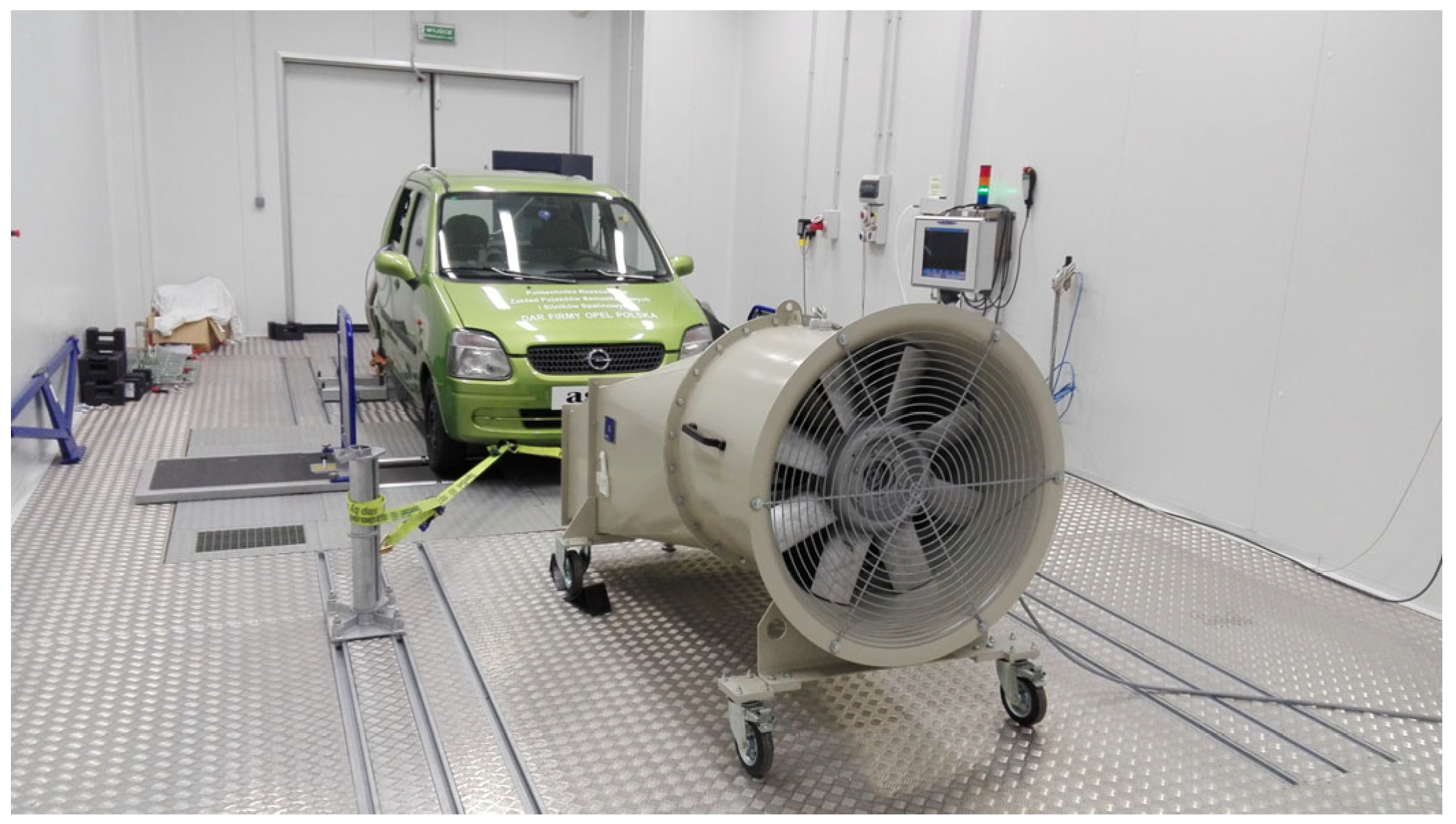
The laboratory is equipped for comprehensive assessment of passenger-car powertrain emissions and environmental performance under both controlled and real-world conditions. A chassis dynamometer (AVL-Zollner FPS 2700/5500, 150 kW) is installed within a climatic chamber (−20 °C to 30 °C) to perform NEDC, FTP, Japan 10.15 and WLTC driving cycles, including cold-start tests (Figure 2). Exhaust gases are sampled via an AVL CVS i60 dilution tunnel and analyzed by an AVL AMA i60 system, which uses NDIR (Non-Dispersive Infrared) for CO and CO2 (±2%), FID (Flame Ionization Detector) for CH4 and total hydrocarbons (±3%) and CLD (Chemiluminescence Detector) for NOx (±2%). Vehicle kinematics—speed and acceleration—are recorded by a DATRON DLS-2 optoelectronic sensor (±0.1 km/h, ±0.02 m/s2), and test sequences are automated through AVL iGEM software (cycle repeatability ± 0.2%).
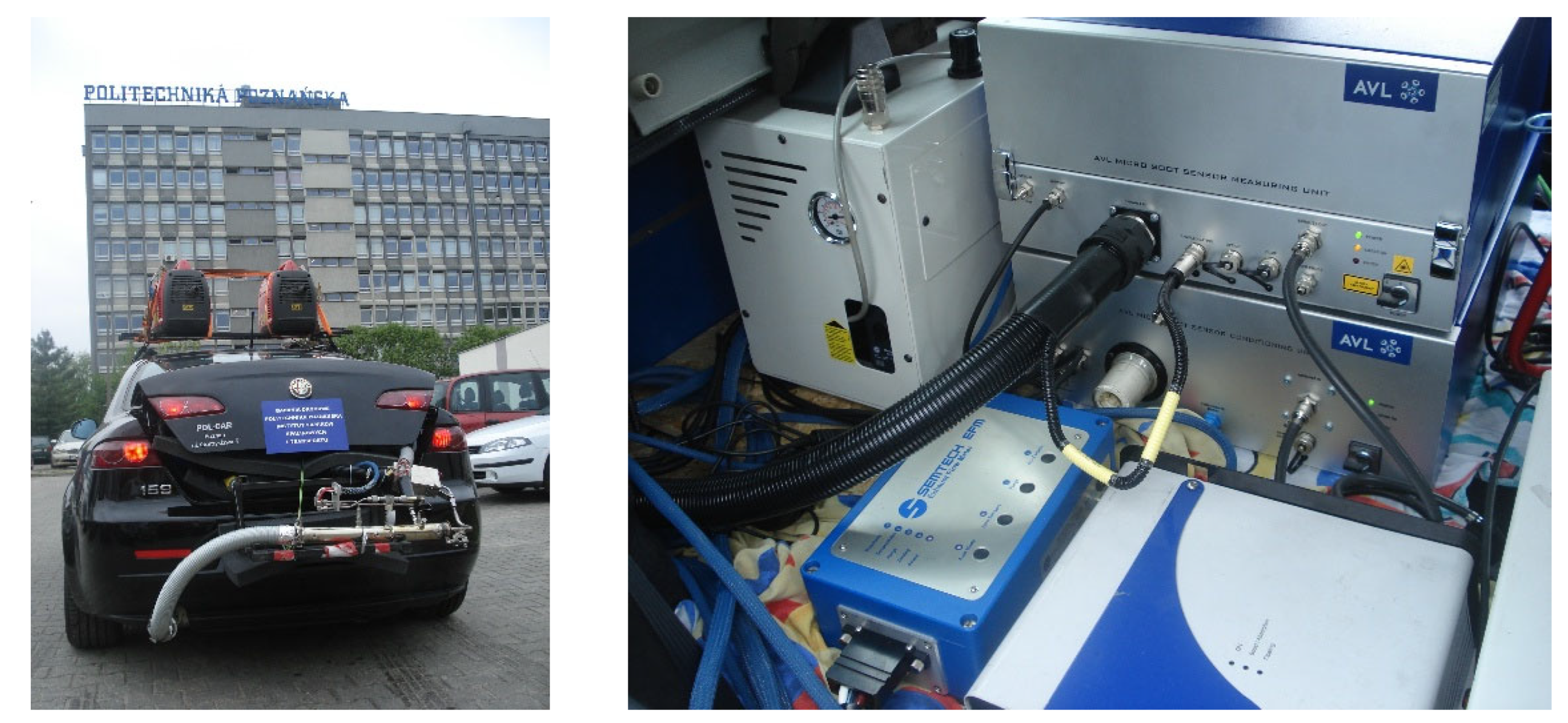
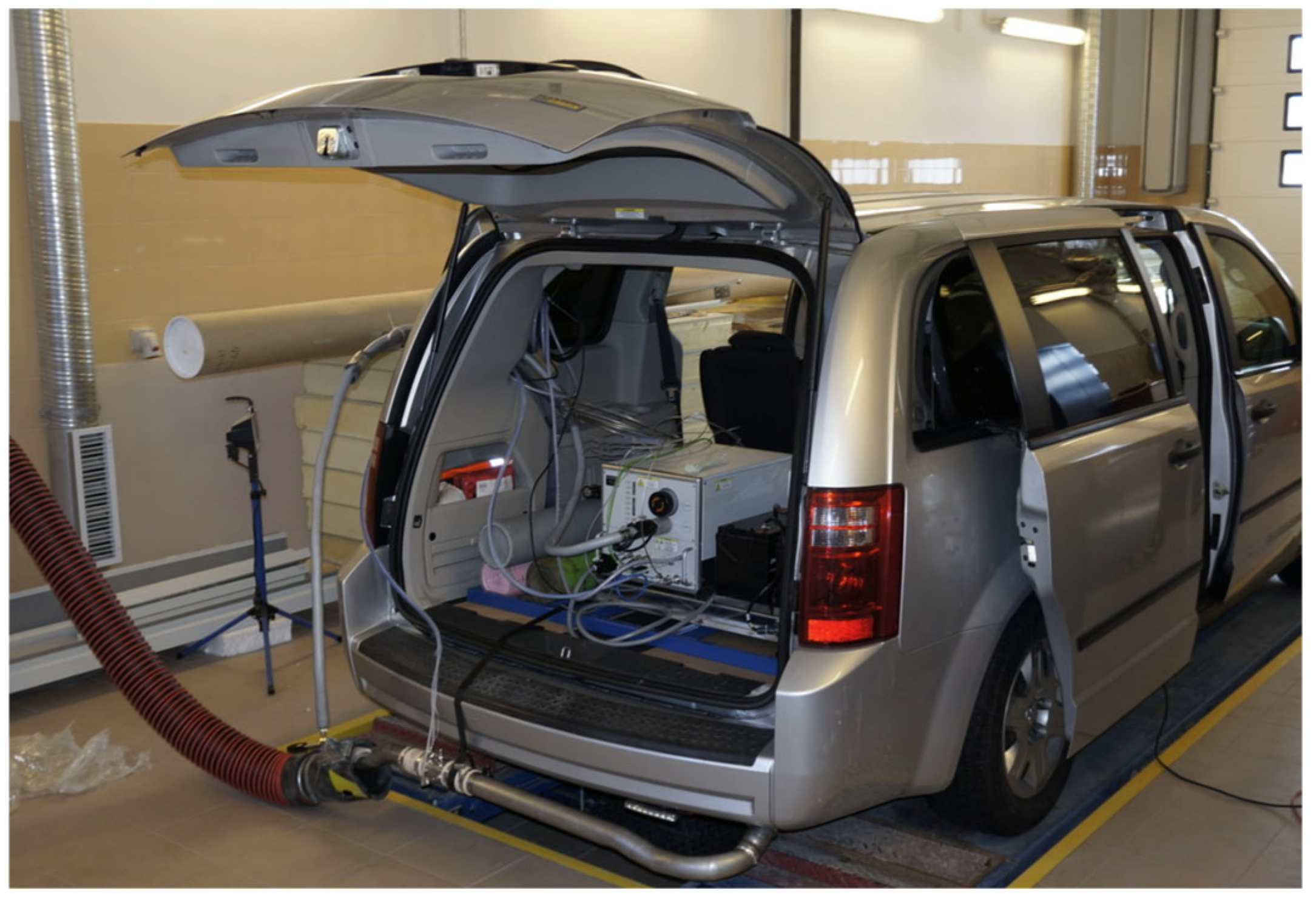
Real-world emission measurements from on-road vehicles, construction machinery and stationary generators are conducted using a HORIBA OBS-2200 portable emissions measurement system, which provides NDIR CO/CO2 (±2%), FID HC (±3%) and CLD NOx (±2%) analysis (Figure 3). This combination of controlled laboratory testing, aftertreatment evaluation and mobile field measurement ensures a complete understanding of emission behavior and supports development of robust emission inventories and reduction strategies.
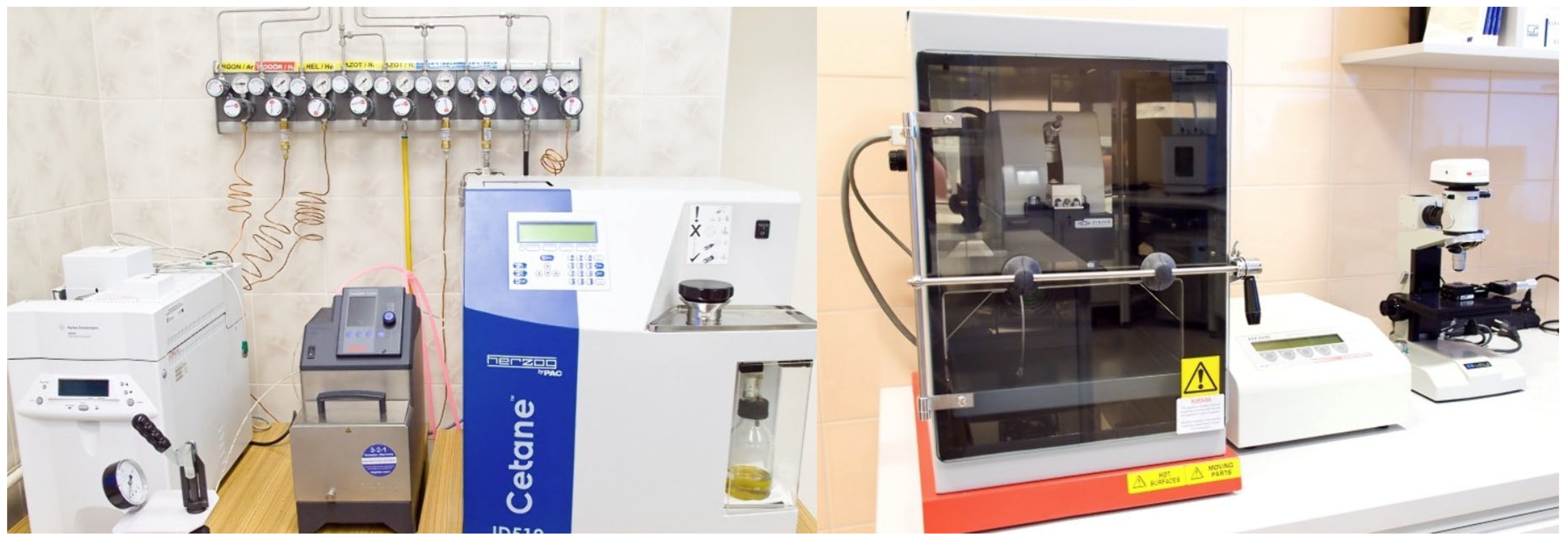
Complementing on-road testing, preliminary evaluation of alternative fuels can be achieved through physicochemical examination of fuel spray and blend properties, forming the first stage of assessing fuel suitability for conventional engines. The Transport Fuel and Material Testing Laboratory at Rzeszów University of Technology complements on-road emissions measurements with a comprehensive fuel evaluation platform in which physicochemical spray analysis and blend characterization form the first stage of alternative-fuel assessment for conventional engines (Figure 4).
A constant-volume combustion chamber fitted with a CID 510 unit enables precise determination of ignition delay, combustion delay and derived cetane number under ambient gas temperatures of 550–650 °C and injection pressures of 80–140 MPa, while a high-frequency reciprocating rig oscillates a steel ball against a disc under controlled load to measure wear scar diameter and assess lubricity risks in high-pressure injection components. In parallel, a dedicated visualization test stand equipped with low- and high-pressure hydraulic circuits, a Common Rail injection system and a transparent chamber is paired with a high-speed camera and microprocessor-based injector controller—adjusting opening duration, dwell phase, pulse frequency and duty cycle and monitoring injector temperature via thermal imaging—to capture spray penetration and cone-angle dynamics. Together, these facilities provide indispensable insights into how fuel composition and injection parameters influence atomization, combustion kinetics, and tribological behavior, thereby laying the groundwork for robust evaluation of novel fuel blends before full-scale road testing.
Rzeszów’s climate is temperate continental, with mean annual temperature 7.5 °C and average annual precipitation around 650 mm. January averages −4.6 °C, while July peaks at 17.6 °C. Prevailing westerly and north-westerly winds influence pollutant dispersion, while the local topography—transition zone between the Sandomierz Basin and Carpathian Foothills (elevations 195–290 m)—affects airflow and deposition patterns.
Rzeszów operates a network of three fixed air quality monitoring stations that record PM10, PM2.5, NO2, and SO2, with 2020–2024 data showing a marked seasonal increase in particulate matter during the heating season (October–March), which significantly affects assessment of vehicular emissions in urban conditions. Traffic composition includes passenger cars (average age 11 years, with a higher share of Euro 3 and lower vehicles during peak hours), light commercial vehicles (12%), taxis (3%), and motorcycles (2%), while the city bus fleet runs on CNG (Compressed Natural Gas) with hydrogen buses planned. The highest traffic volumes (30,000–45,000 vehicles/day) occur on Rejtana Avenue, Lubelska Street and Podkarpacka Street, where street canyon geometry increases local NO2 concentrations by up to 20% compared to suburban areas.
The Automotive Ecology Laboratory at Rzeszów University of Technology has conducted numerous studies in recent years based both on chassis dynamometer tests and on-road measurements using a portable emissions measurement system. The rise of vehicles powered by compressed natural gas and LPG (Liquefied Petroleum Gas), along with the implementation of start–stop technology, has stimulated extensive research into reducing greenhouse gas and pollutant emissions in road transport [77]. Comparative testing of compressed natural gas (CNG) vehicles demonstrates that although direct CO2 emissions are substantially lower than gasoline equivalents, transient methane slip during acceleration and gear transitions can offset some of these benefits by raising the overall CO2 equivalent. However, total CO2eq remains approximately 15–25% lower compared to conventional gasoline engines, highlighting CNG’s environmental potential. Achieving these reductions optimally requires development of Natural Gas-specific catalytic converters and engine-control strategies to minimize methane slip during transient operating conditions.
Empirical evidence suggests that increasing the electric fleet share by 25% at roundabouts can yield substantial air-quality benefits, including approximately 30% reductions in PM10 concentrations and contraction of high-pollution zones at roundabout approaches, demonstrating the potential of electrification in dense urban areas. Studies [78] examining Euro 3 and Euro 6 vehicles at temperatures from 0 °C to 30 °C documented significantly higher CO2, CO, THC, and NOx emissions during cold-start conditions prior to catalyst warm-up, highlighting the need to include these phases in emission modeling. In their subsequent work [79], they demonstrated that chassis dynamometer settings based on actual road load yield higher CO2, CO, and THC emissions in the NEDC cycle compared to alternative load methods, highlighting the critical role of accurate road-load calibration. Analysis of PEMS data has quantified elevated CO2, THC, CO, and NOx emissions at roundabouts due to repeated acceleration and braking cycles. Boosted regression tree models based on these measurements accurately reproduced observed emission patterns and provided design recommendations for traffic infrastructure. These findings underscored the critical importance of measurement reliability across varying ambient and driving conditions, essential for developing robust emission models under real-world scenarios.
A 2024 study [80] applied three AI methods to predict instantaneous CO2 emissions in a Euro 6 start–stop vehicle and identified gradient boosting as the most accurate via R2 and MSE (Mean Squared Error) validation. Later in 2024, work [81] presented XGBoost models for CNG vehicle CO2 emissions calibrated on chassis dynamometer and PEMS data, yielding R2 = 0.9/0.7 and RMSE = 0.49/0.71 (Root Mean Square Error). These models, with proven accuracy across heterogeneous datasets, provide robust tools for urban environmental decision-making and can be extended to other powertrains and emission compounds under varying operating modes.
Building on chassis dynamometer and on-road emission tests, preliminary physicochemical and spray-structure investigations offer a vital first step in evaluating alternative fuels for conventional powertrains. Autoignition studies in a constant-volume combustion chamber revealed that adding up to 14% (vol.) ethanol to diesel prolongs ignition and combustion delays, with cetane number dropping by approximately 1.7 units per 2% ethanol; elevating chamber temperature from 550 °C to 650 °C partially compensates for ethanol’s low reactivity, while 10,000 ppm of 2-ethylhexyl nitrate restores cetane number and smooths pressure rise rates. Biodiesel–ethanol blends (up to 25% ethanol) exhibited ignition delays longer than pure biodiesel and a cetane-number decline of about 3.4 units per 5% ethanol, underscoring the need for injection-timing adjustments. In n-butanol–diesel blends, ignition delay increased nearly linearly with butanol content (2.9 unit DCN loss per 5%), and higher ambient gas temperatures significantly shortened delays, whereas injection pressure (80–140 MPa) had minimal impact. Lubricity tests via HFRR confirmed that ethanol additions up to 14% do not compromise wear-scar diameters, meeting standard criteria for fuel injection durability. Complementary spray visualization at 75, 100, and 125 MPa showed that moderate ethanol blends (5–10%) achieve spray cone angles equal to or exceeding diesel—up to 69% wider for a 10% blend at 125 MPa—while higher ethanol fractions yield narrower sprays, highlighting that 5–10% ethanol–diesel mixtures deliver atomization performance close to diesel under typical injection conditions. These combined findings furnish actionable data for calibrating injection strategies and selecting fuel blends that maintain combustion quality and injector reliability prior to full-scale road testing.
The Automotive Ecology Laboratory at Rzeszów University of Technology has systematically investigated how chassis dynamometer settings and real-world driving conditions influence energy consumption and exhaust emissions of hybrid vehicles. Comprehensive comparative testing of full-hybrid vehicles demonstrates that standardized laboratory test cycles (NEDC, WLTC, FTP) and actual urban driving produce substantially different results. Multiple road-load functions applied on a chassis dynamometer generate varying THC, CO, CO2, and NOₓ emissions profiles and energy demand values. These differences are attributable to the inherent limitations of fixed dyno cycles: they cannot accurately replicate the unrepeatable transient behaviors and dynamic control strategies characteristic of real traffic—particularly the switching between electric and combustion modes that defines hybrid vehicle operation. Such discrepancies underscore why on-road validation testing remains essential for understanding true vehicle environmental performance.
Further research has examined CO2 emissions and energy demand specifically for full-hybrid passenger cars during NEDC tests, providing detailed insights into hybrid vehicle performance under standardized cycles [82]. Three methods for defining motion resistance on the chassis dynamometer yielded CO2 emission variations of up to 35% across the same cycle. The study highlighted that without explicit reporting of the adopted resistance-function, inter-laboratory and regulatory comparisons may be misleading, underscoring the necessity for standardized dyno-load protocols in hybrid vehicle testing. To enable accurate large-scale emissions assessments without equipping every vehicle with PEMS, a microscale CO2 emission model tailored to full hybrids was developed. Evaluating multiple machine-learning techniques—including linear and robust regression, decision-tree variants, support vector machines, GPR (Gaussian Process Regression), and neural networks—they found that GPR delivered the most precise fit to road-measured data. This model requires only speed, acceleration, and road gradient as inputs, and its computational efficiency and validated accuracy make it suitable for integrating into traffic simulations and emission inventories for hybrid fleets. Such approaches provide a scalable pathway for assessing energy consumption and emissions across diverse urban road layouts and low-emission zones.
Collectively, these investigations reveal that both dyno-load calibration and real-world driving dynamics critically influence hybrid-vehicle energy use and emissions. Standardized reporting of chassis-dynamometer load functions, coupled with advanced machine-learning emission models, can bridge the gap between laboratory tests and on-road performance, thereby guiding regulators, manufacturers, and city planners toward more accurate emissions inventories and effective low-emission strategies.
The Automotive Ecology Laboratory at Rzeszów University of Technology has extended its research focus to EVs (Electric Vehicles), with particular emphasis on advanced data-driven models for energy consumption and battery state of charge. Advanced AI-driven microscale models of EV energy consumption were developed using real-driving cycles and real-world operational data. Employing neural networks and gradient boosting techniques, multiple models were trained and validated across diverse ambient conditions and driving patterns. These models can generate high-resolution energy predictions rapidly, aiding infrastructure planners and decision-makers in optimizing charging networks, route planning, and fleet management strategies.
To enable real-time traffic microsimulation and operational energy forecasting, machine learning models employing XGBoost have predicted SOC using minimal inputs: speed, acceleration, gradient, and temperature [83]. Trained on 87,000 real-world observations spanning –1 °C to 35 °C, the model reached R2 = 0.86 and RMSE = 7.21% SOC. Integrated into Vissim and SUMO simulations, this minimalist framework enables scalable SOC mapping and energy-aware traffic management without costly onboard sensors. The approach demonstrates that with careful feature selection and machine-learning methodology, reliable EV energy and battery-state predictions can be achieved from readily available vehicle telemetry, supporting both research applications and practical fleet-management tools.

4. Exhaust-Emission Studies of Passenger Cars Conducted at Poznan University of Technology

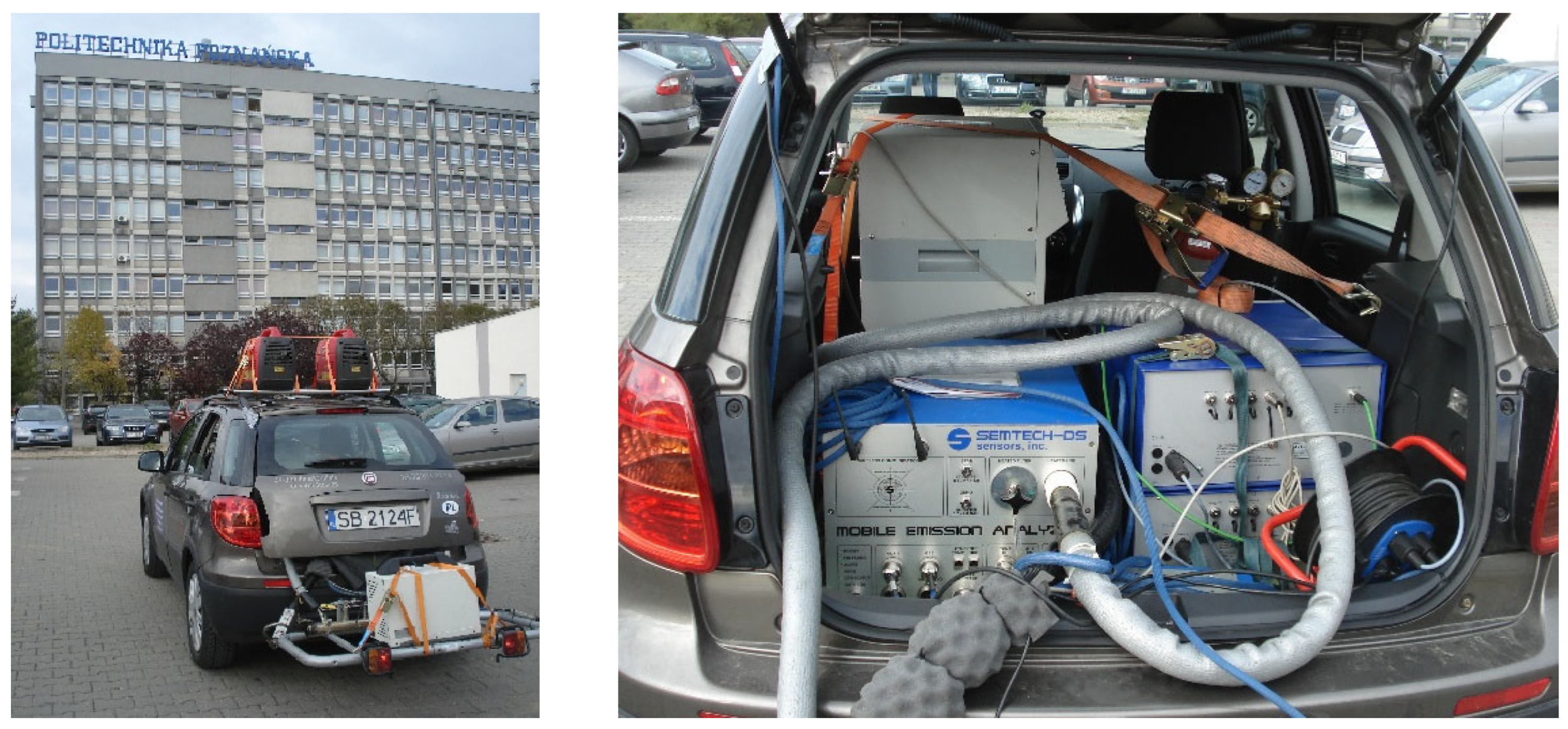
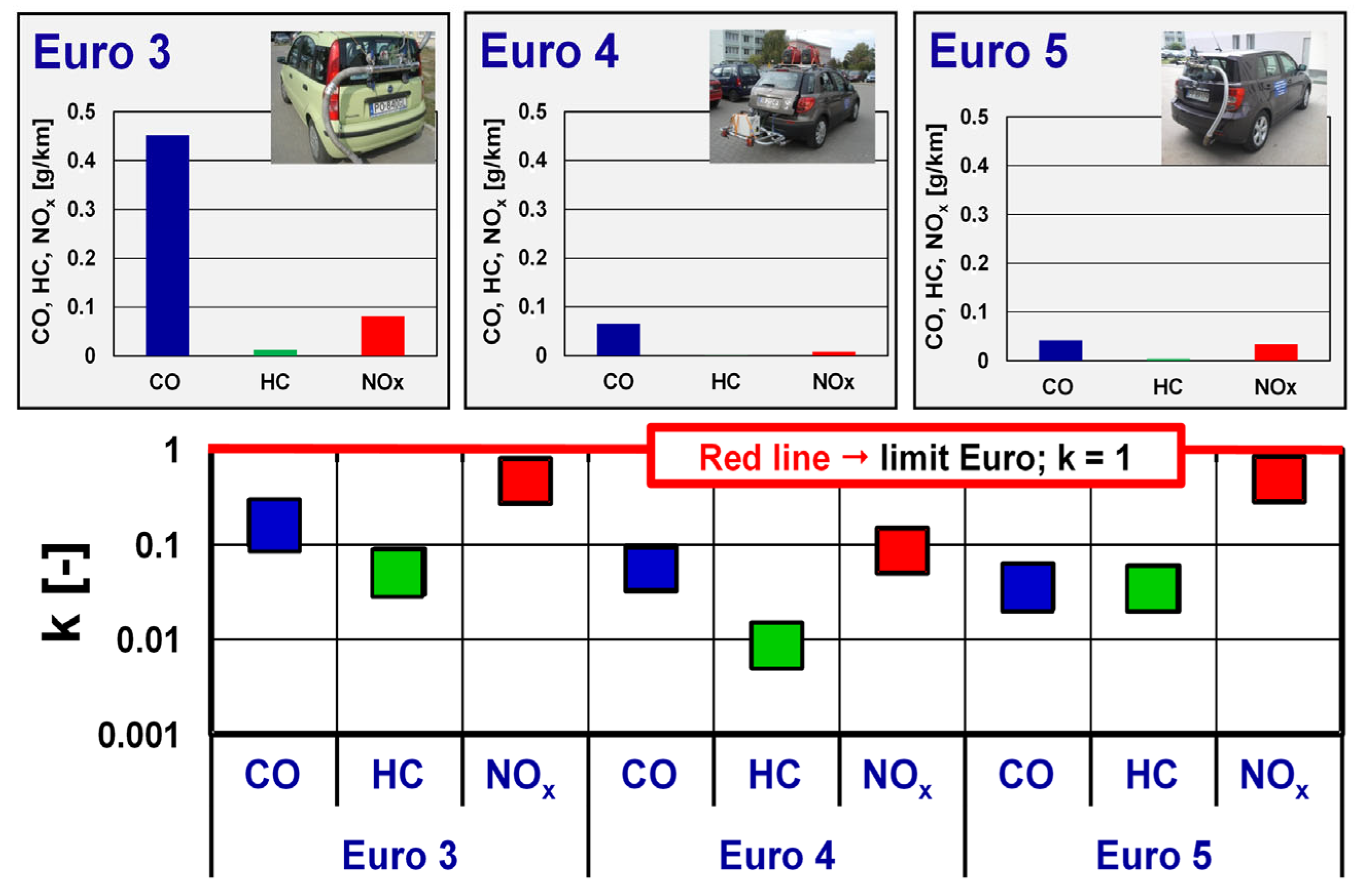
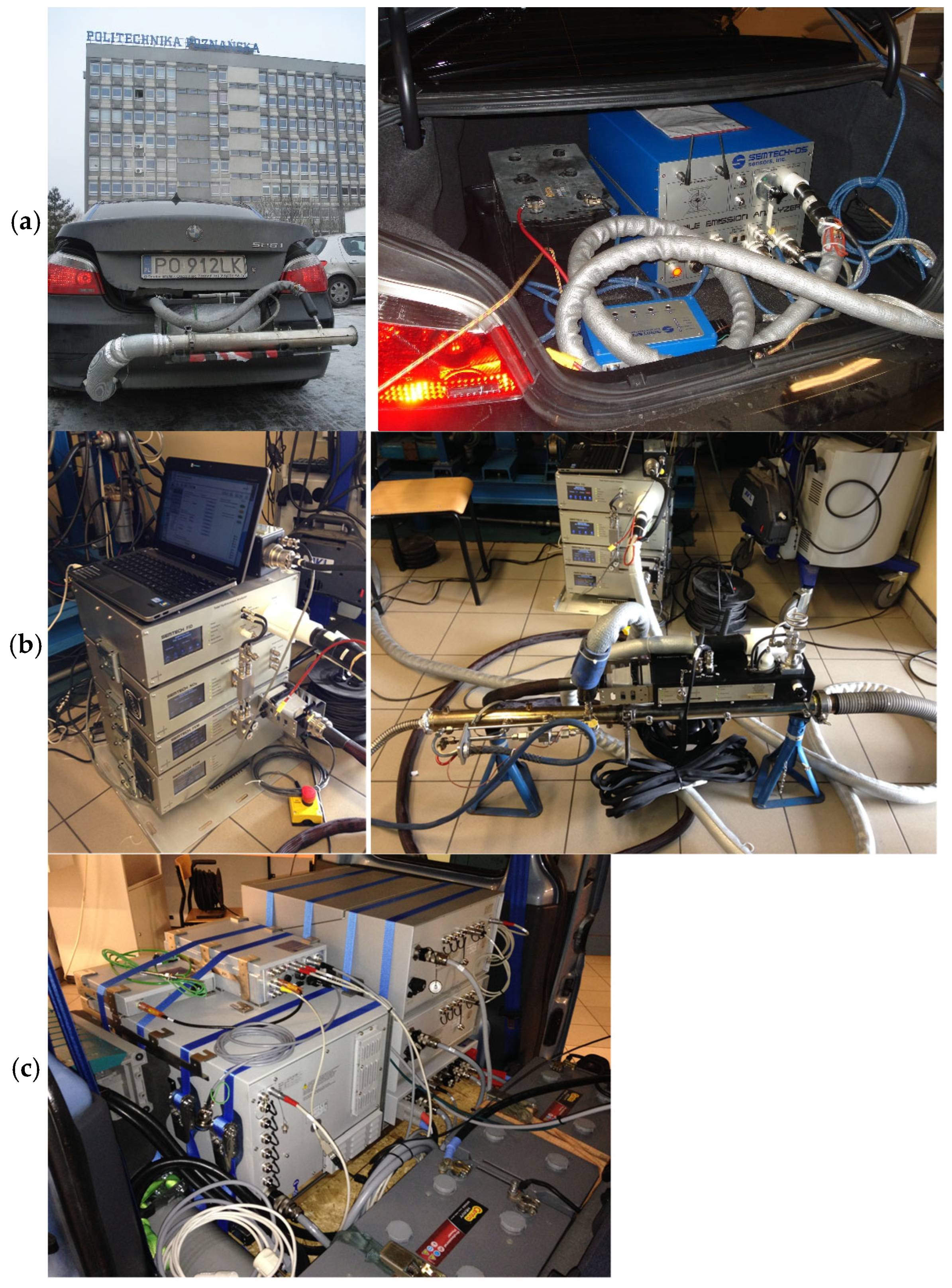
Since 2008, Poznan University of Technology has conducted real-world driving studies using dedicated measurement equipment that enables on-road emission testing. The available instrumentation included analyzers for determining the concentrations of harmful exhaust compounds, as well as devices for measuring particulate mass and particle number [84]. This setup made it possible to carry out on-road investigations of passenger vehicles with respect to gaseous pollutant emissions (Figure 5), particulate-mass concentrations (Figure 6), and particle-number emissions (Figure 7).
The first studies on on-road exhaust-emission measurements began before the official introduction of related regulations by the European Union. Researchers proposed the use of an emission indicator representing the factor by which pollutant emissions increase (or decrease) under real-world driving conditions compared with the homologation test [85]. For a given pollutant, this indicator was defined as follows:
kj = breal,j/bEuro,j
where j—the pollutant for which the emission indicator was determined, breal,j—the on-road emission obtained under real-world driving conditions, mg/km, bEuro,j—the on-road emission obtained in the homologation test, mg/km.
If the on-road emission value was not known, the emission rate of a given pollutant determined under real-world conditions and during the homologation test could be used. In this case, the formula remained unchanged, but the on-road emission term was replaced with the emission rate expressed in g/s. The real-world emission rate can be calculated using the vehicle operating-time share function u ( a , V ) and the emission-rate characteristic for the j -th pollutant e j ( a , V ) :
E r e a l , j = a V u ( a , V ) e j ( a , V )
If no information is available on pollutant emissions from the vehicle during the homologation test, the permissible emission limits specified by the applicable Euro emission standard for that vehicle may be used. The permissible emission values for a given pollutant, provided in g/km (or g/kW·h), can be converted into emission-rate values (in g/s) by using the duration of the test (e.g., t N E D C = 1180   s ) and the distance covered (e.g., S N E D C = 11 , 007   m ) in the homologation procedure.
The emission indicators (corresponding to individual pollutants) can be calculated as the value of the following:
  • The instantaneous value—characterized by high variability because it is calculated for each second of the test.
  • The cumulative value—during the test, calculated as the current on-road emission of the given pollutant (from the start of the test to the current moment) relative to the normative value.
  • The total-test value—defined as the ratio of the on-road emission measured in the real-world driving test to the corresponding normative value.
The on-road emission indicator for a given pollutant may assume values within the range [ 0 , ] . This means that if the vehicle’s on-road emission does not exceed the normative limit, the indicator is lower than one; if the normative value is exceeded, the indicator is greater than one; and when the real-world emission equals the normative value, the indicator is equal to 1.
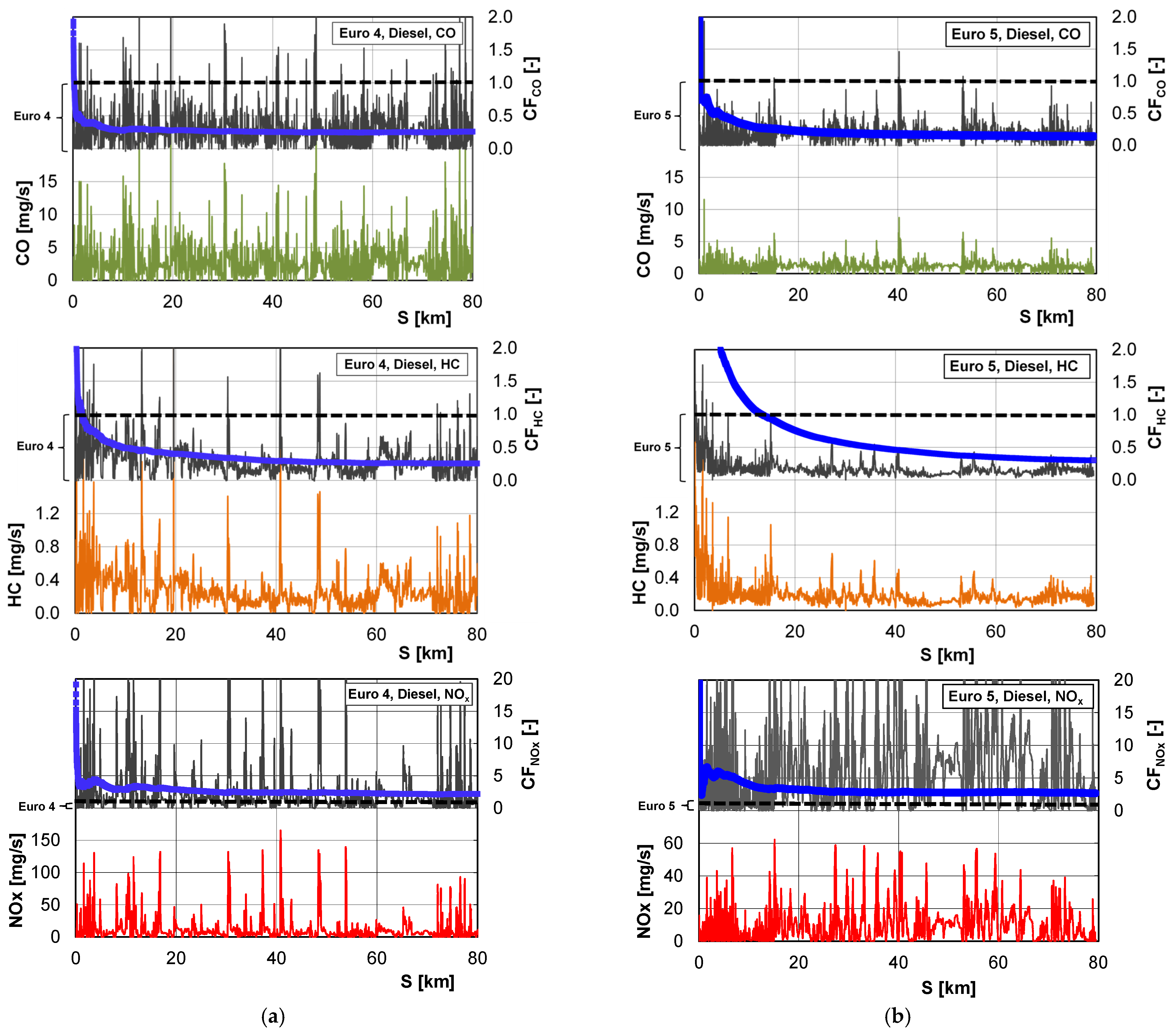
The outcome of this approach was a comparison of Euro 4 and Euro 5 passenger cars over an approximately 80 km route under varied traffic conditions. The plots (Figure 8) show, for each pollutant, the range of emission-indicator values for which the normative limit is met (dashed line). Despite the high instantaneous variability of the emission indicator (blue line), its cumulative value is characterized by the following:
  • For carbon monoxide—a very rapid increase during engine start-up, followed by a subsequent decrease; under real-world operating conditions, a satisfactory reduction below the required limit is achieved within a short period for vehicles meeting Euro 4 and Euro 5 standards; the indicator values are comparable for the tested vehicles.
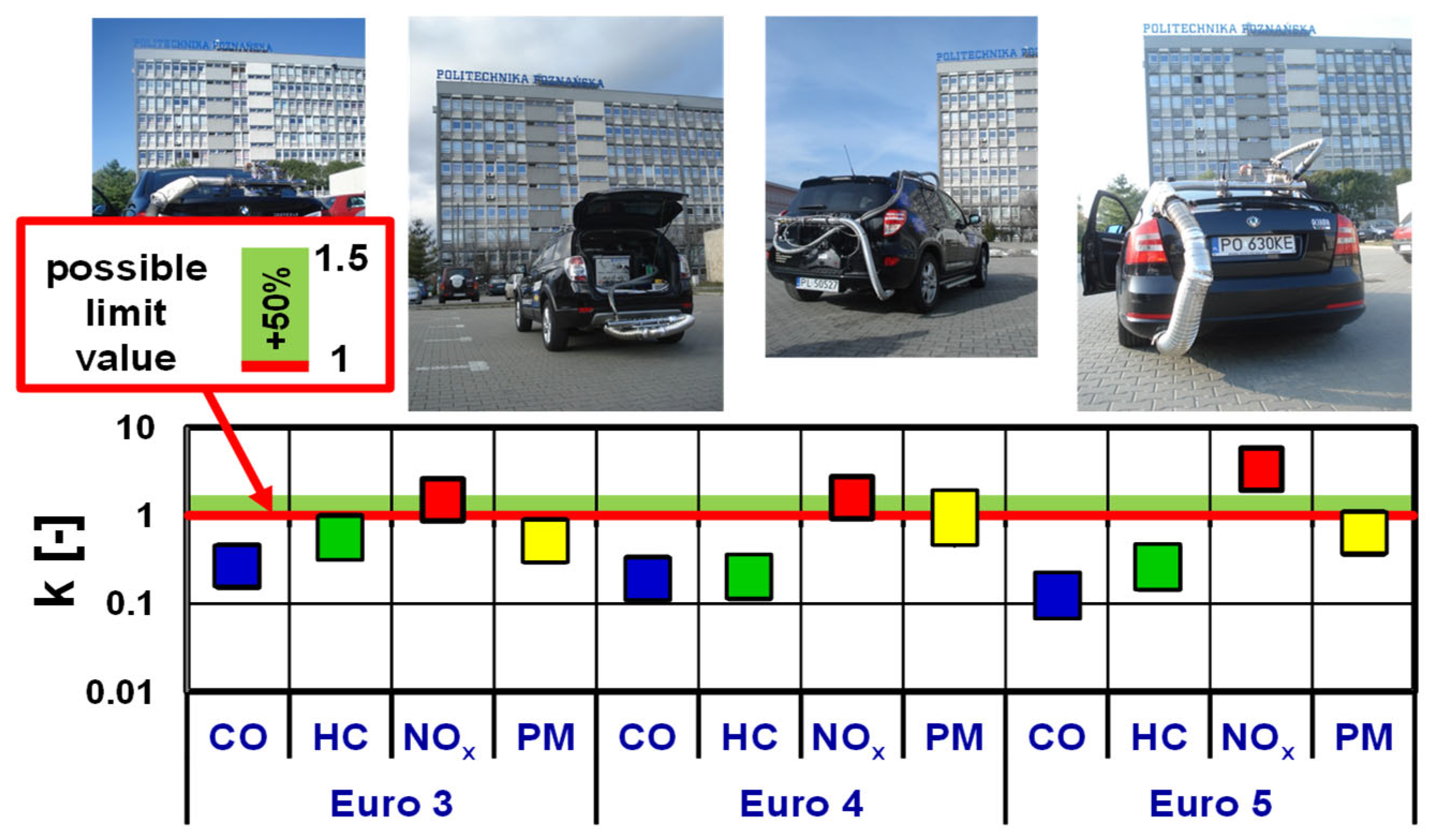
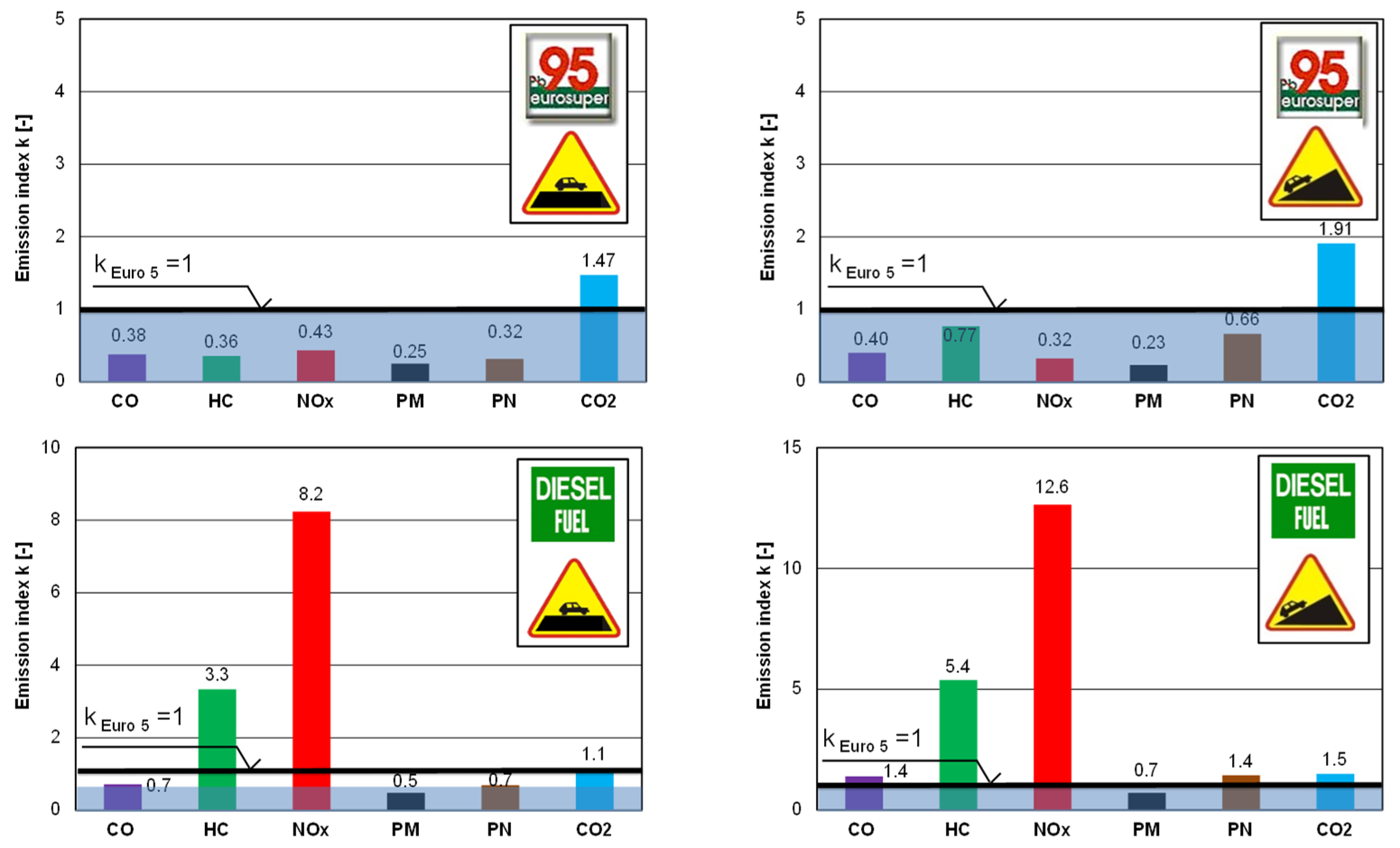
Subsequent verification studies of exhaust emissions from passenger cars equipped with combustion engines (gasoline and diesel, meeting Euro 2–Euro 5 standards—Figure 9) under real-world driving conditions constituted the first validation of the usefulness of the developed tool—a universal measurement system for harmful pollutants. Determining on-road emissions and comparing them with values obtained on a chassis dynamometer during the homologation test made it possible to calculate the emission indicator. Analysis of the data presented in Figure 9 and Figure 10 shows that real-world emissions are exceeded for diesel vehicles, whereas gasoline engines do not provide a clear result when compared with the normative value. Variability of the measurement results is observed across different routes: for carbon monoxide and hydrocarbons the variation is ±60%, for nitrogen oxides ±50% (depending on cold- and hot-start measurements), and for carbon dioxide ±30% (lower values on rural routes and higher values under urban-traffic conditions).
Another example of research involves comparing the particulate matter emission rates of in-use passenger cars (differing, among other factors, in production year) that meet successive exhaust-emission standards. Particulate parameters were measured during cold starts of 20 vehicles equipped with diesel and gasoline engines. Gasoline engines were included to enable comparison with diesel engines and to develop a classification of vehicles in terms of particulate emissions.
The vehicles selected for testing were equipped with gasoline engines featuring single-point injection systems (Euro 1) and multi-point injection systems (Euro 2–Euro 4). All gasoline vehicles were fitted with catalytic converters. Diesel vehicles were equipped with in-line injection pumps (Euro 1), common-rail systems (Euro 3–Euro 4), or unit injectors (Euro 4). Euro 4 diesel vehicles were also equipped with diesel particulate filters. The mileage of the tested vehicles varied widely—from 20,000 km to 280,000 km. The tests were carried out in the morning hours after a 12-h parking period, with ambient temperatures of 4–7 °C. Measurements began at the moment of cold-start ignition and continued for a 5-min warm-up period. To perform the planned scope of research, instrumentation capable of measuring the main gaseous pollutants was used, featuring a heated sample line and enabling exhaust-flow rate measurement (Semtech DS by Sensors). The exhaust-flow values were subsequently used during particle mass and particle number measurements.
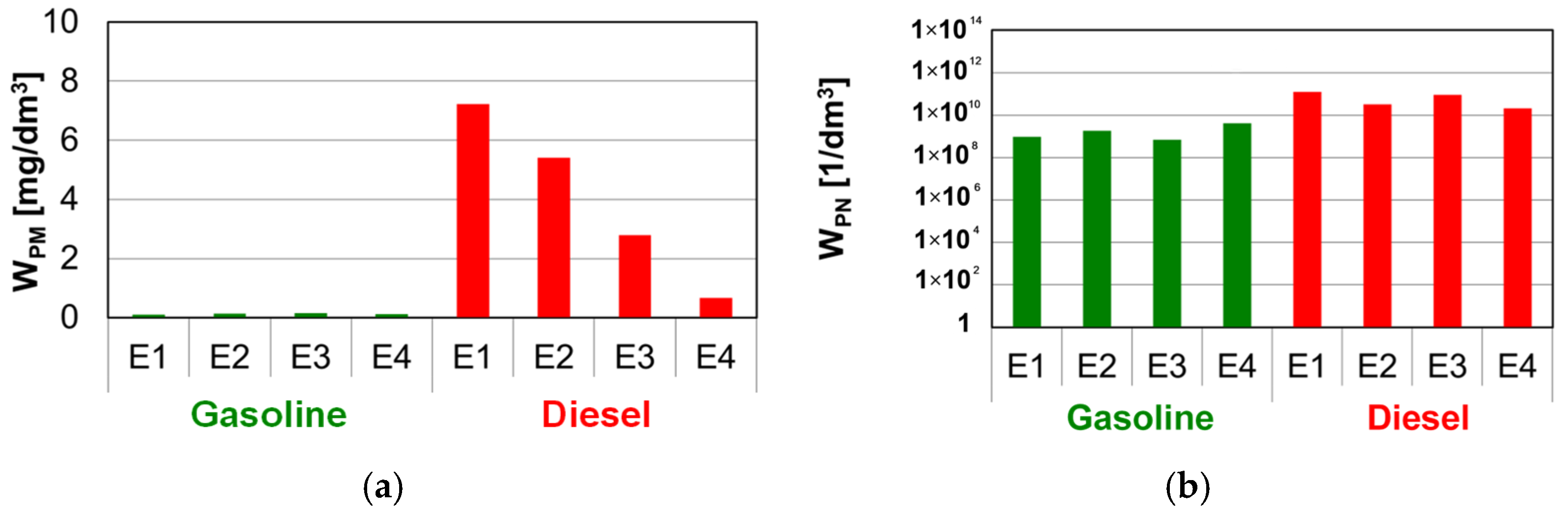
To allow comparison of particulate-emission rates, the results were normalized to the measurement duration (5 min) and to engine displacement, yielding a volumetric emission index. This provided a representative indicator whose values can be compared irrespective of engine type or displacement (Figure 11). The volumetric particulate-emission index determined for diesel engines is approximately 50 times higher (the average volumetric PM emission index W P M for Euro 1 and Euro 2 vehicles is around 5 mg/dm3) than for gasoline engines (average index value below 0.1 mg/dm3). This indicates that particulate emissions from gasoline engines remain very low even during cold-start operation. Considering the particle-number emissions of different engines, it can be observed that the values are essentially independent of vehicle age (mileage). For gasoline engines, the volumetric particle-number emission index WPN is 1 × 10⁹ 1/dm3 over the 5-min period, whereas for diesel engines it ranges from—(1–10) × 1010 1/dm3 over the same measurement interval. This means that gasoline engines emit 10 to 100 times fewer particles than diesel engines.
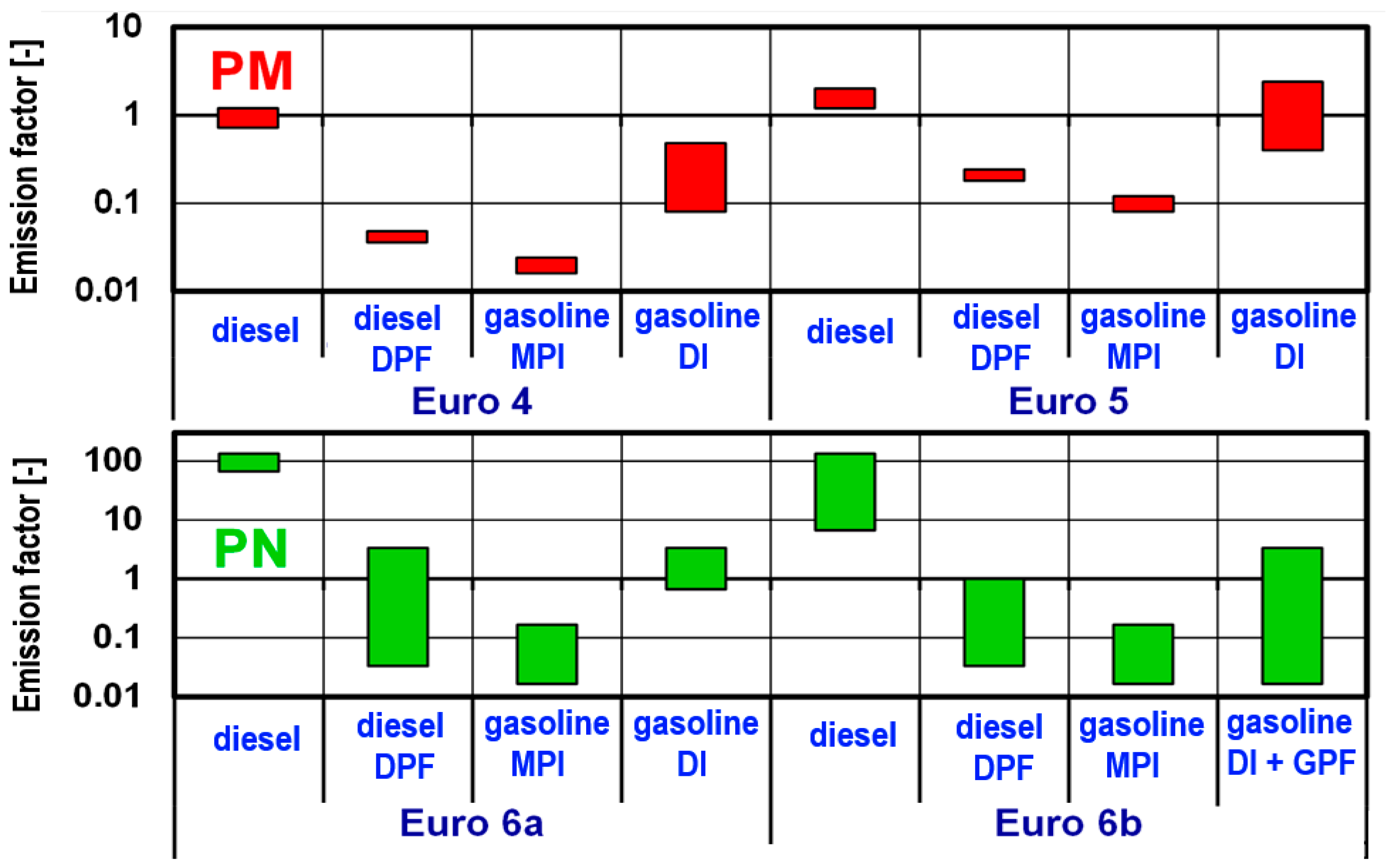
Classifying vehicles according to particulate emissions based on the emission standard they meet (Euro 1–Euro 4) revealed substantial differences in emissions during engine start-up (both the start phase and the 5-min warm-up period) for vehicles equipped with different engine types. Characteristics of the volumetric particulate-mass and particle-number emission indices were obtained, along with particle-size distributions, depending on the applicable emission standard and on the operational age of vehicles fitted with various engine types. This provided the basis for vehicle classification in terms of particulate emissions and led to the development of a testing methodology and indicators that may also be applied to particulate-matter investigations under real-world conditions during urban-driving tests (Figure 12). The methodology can be used for vehicles within the same emission category but with significantly different mileage, forming a basis for conclusions regarding engine durability and the performance of exhaust-aftertreatment systems.
Another example of research involved comparing exhaust emissions as a function of road gradient during on-road tests. The authors [86] indicated that, for small variations in road gradient, carbon monoxide proved to be the most sensitive pollutant. For higher gradients, the largest increase in emissions was observed for particulate matter (diesel engines). The study showed that increasing the road gradient to 10% resulted in an average twofold increase in the emission levels of harmful exhaust components (Figure 13).
Road tests of conventional vehicles have also examined the influence of temperature on exhaust-emission levels. The main objective was to determine how ambient temperature affects pollutant emissions, particularly during cold-start operation. Tests were carried out at two ambient temperatures: 25 °C (summer conditions) and 8 °C (cool conditions still falling within the RDE range of 0–30 °C). The study was conducted using a gasoline direct-injection vehicle equipped with a particulate filter, with both tests performed on the same route of approximately 90 km. The authors confirmed that, within the ambient-temperature range considered “normal conditions” for RDE testing, lower temperatures worsen pollutant emissions following engine start-up. As a result, the current regulations—which do not include any correction factor within the 0–30 °C range—may not fully reflect the impact of temperature on real-world emissions. The authors suggested that future studies should cover a broader temperature range (including sub-zero conditions) and additional driving scenarios, such as shorter urban trips or immediate high-load operation.
Given the wide diversity of vehicles operated in Poland, the road tests focused on the models with the highest market share. Conventional and hybrid vehicles each accounted for roughly 45% of sales, forming about 90% of the total fleet. At Poznan University of Technology, the study selected hybrid passenger cars with engine displacements ranging from 1.4 to 2.5 dm3 and emission classes from Euro 6 to Euro 6d-Temp. Their on-road emissions were compared primarily with conventional gasoline vehicles. The research team developed an analytical tool enabling comparison between homologation and on-road tests, both for the full test cycles and for individual phases. Four computational approaches were applied: the standard homologation procedure, the standard RDE procedure, a homologation procedure combining the first two phases, and an RDE-based identification of homologation phases. This framework resulted from observing strong similarities in vehicle operating conditions across the test cycles.
In the next stage, vehicle dynamic parameters were compared between the homologation and on-road emission tests. A high correlation (above 0.95) was found between the operational conditions in both tests. Based on this, on-road pollutant emissions were compared, leading to the conclusion that real-driving emissions of combustion and hybrid vehicles can be estimated using only homologation-test results for selected phases. A summary of the findings is presented in Table 2.
The presented data indicate that it is not possible to estimate all RDE test parameters using only the results obtained from the WLTC test for a given vehicle. However, it is feasible to estimate selected parameters (using the WLTC1+2 or WLTCRDE procedures), with estimation accuracy exceeding 90% for some parameters and being considerably lower for others. Nevertheless, the topic has significant potential and clearly warrants further, more in-depth investigation.
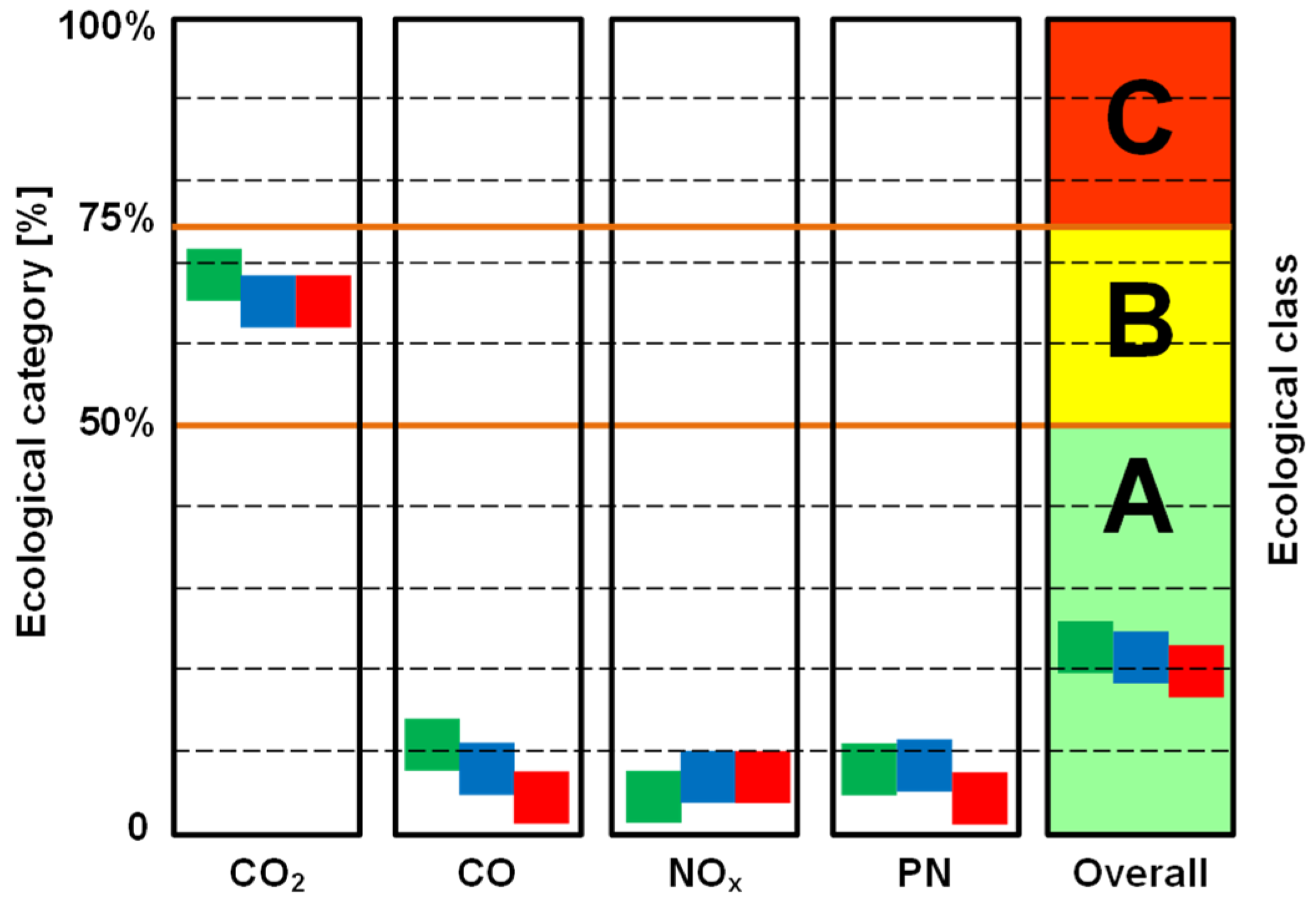
RDE tests of plug-in hybrid vehicles were carried out in the context of a proposed classification system based on exhaust-emission performance, defining three ecological classes: A, B, and C [87]. These classes indicated the extent to which a vehicle meets the Euro 6d-Temp emission limits. The study involved three plug-in hybrid cars differing in combustion-engine displacement and electric-battery capacity: vehicle 1: turbocharged 1.4 dm3 engine, 13.6 kWh battery; vehicle 2: 1.8 dm3 engine, 8.8 kWh battery; vehicle 3: 2.0 dm3 engine, 3.3 kWh battery.
The main conclusions of the study are as follows:
  • All vehicles met the Euro 6d-Temp requirements, and their emissions were significantly lower than the permissible limits.
  • CO2 emissions were in the range of 60–80 g/km, confirming the high energy efficiency of PHEVs.
  • NOx emissions were very low (3–8 mg/km), up to ten times below the regulatory limit.
  • CO emissions were 10–20 times lower than the permissible limit.
  • The particle-number emissions were far below the limit.
  • The urban phase was characterized by zero CO2 emissions, as the vehicles operated exclusively in electric mode.
  • The largest differences between the vehicles occurred in the rural and motorway phases, where the combustion engine engaged.
As part of the study, a new ecological assessment method for PHEVs was developed, enabling vehicles to be assigned to emission classes A–C based on their RDE test results (Figure 14).
This approach allows for a more accurate evaluation of the real environmental impact of these vehicles and supports the design of more environmentally friendly powertrain systems in the future. The authors emphasized that plug-in hybrid cars are considerably more environmentally beneficial than conventional combustion vehicles, although the results depend on battery capacity, user behavior, and driving conditions. Future work is planned to extend the methodology to include an analysis of electric-energy consumption, allowing for a full assessment of the energy efficiency of hybrid and electric vehicles.
For PHEV vehicles, the issue of user operation patterns was also examined. It was noted that, under Polish economic conditions, many users do not regularly charge their vehicles from the electrical grid. As a result, these cars are frequently operated primarily in combustion-engine mode, which significantly increases exhaust emissions and fuel consumption. The study was conducted in accordance with the RDE procedure. Tests were performed at different battery state-of-charge levels: SOC = 100%—fully charged, SOC = 50%—partially discharged, SOC = 0%—operation solely on the combustion engine, and SOC = 0 → 100%—forced battery charging during driving.
The key findings were as follows:
  • At full battery charge (SOC = 100%), the results were CO2—12 g/km, CO—6 mg/km, NOx—1.8 mg/km, PN—1.8 × 10¹⁰ 1/km,
  • In the forced-charging mode (SOC = 0 → 100%), the results were CO2—over 300 g/km, CO—147 mg/km, NOx—22 mg/km, PN—2.0 × 10¹¹ 1/km.
  • When the vehicle operated solely on the combustion engine (SOC = 0%), fuel consumption increased thirteenfold, and the emissions of CO, NOx, and PN rose by factors of 10, 6, and 4, respectively.
The results confirmed that infrequent charging of PHEV vehicles leads to a substantial increase in emissions and fuel consumption, effectively eliminating their environmental benefits. In Poland, this issue is amplified by the insufficient development of the charging infrastructure, which limits the use of electric propulsion.

5. Real-Driving Emission Studies Conducted at the Motor Transport Institute in Warsaw

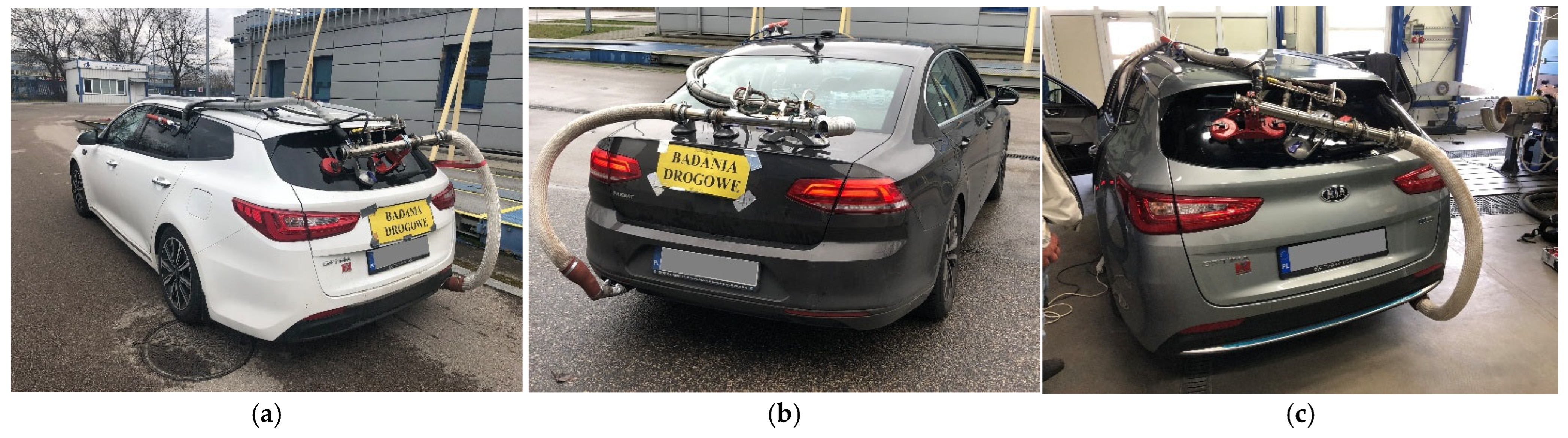
The Motor Transport Institute (ITS) in Warsaw is one of Poland’s leading research institutions specializing in the environmental impact of transport, particularly in the area of emissions from road vehicles. The Institute operates accredited laboratories, including the Exhaust Emissions Laboratory, equipped with engine test stands, a chassis dynamometer, and on-road testing instrumentation using PEMS. ITS performs emission measurements in accordance with current European procedures such as WLTC, RDE, and, previously, NEDC. Its research focuses on exhaust-emission measurements, real-world emission assessments, the influence of driving style and operating conditions on pollutant levels, and the evaluation of emission-reduction technologies in combustion and hybrid vehicles. The Institute also maintains close collaboration with Poznan University of Technology, as demonstrated by numerous joint studies on vehicle emission-related issues (Figure 15).
The first studies published between 2009 and 2015 focused primarily on comparative assessments of exhaust emissions from passenger vehicles. In study [88], the emissions of a gasoline-powered vehicle and an LPG-fueled vehicle (Euro 2) were compared during real-world driving tests. Speed–acceleration analysis showed that the LPG vehicle produced higher emissions in high-acceleration regions and under heavy-load operation. Significant differences were recorded between the two fueling systems: compared with gasoline, the LPG installation generated approximately five times higher CO emissions, twice the HC emissions, and about 50% higher NOx emissions. For Euro 4 vehicles, gaseous and particulate emissions from a diesel vehicle equipped with a diesel particulate filter (DPF) were compared between the NEDC test and real-world driving conditions. The highest intensities of CO, HC, and NOx emissions occurred at high speeds and high accelerations. For particulate matter, typical DPF-related trends were observed: particle mass increased at low and very high speeds, while particle number peaked at low speeds and moderate accelerations. Average on-road emissions exceeded the Euro 4 reference values for NOx by approximately 120% and for HC + NOx by 80%, whereas CO and PM were lower by around 60% and 50%, respectively.
In study [89], exhaust emissions from gasoline, diesel, and CNG-fueled vehicles were compared under real-world driving conditions. The analysis showed that only the CNG vehicle met the Euro 4 emission levels. The gasoline vehicle exceeded the NOx limit, while the diesel vehicle exceeded both NOx and the combined HC + NOx limits. The emission factors determined in on-road conditions indicated substantial exceedances of homologation limits.
Different results were obtained for Euro 5 vehicles; in this case, only the gasoline vehicle met the emission limits. The emission indicators determined in these studies confirmed significant discrepancies between real-world and homologation emissions, highlighting the need to include PEMS measurements when assessing the true environmental impact of vehicles. In the following years, the research focus shifted primarily toward the assessment of hybrid and electric vehicles. Study [90] discussed charging infrastructure for hybrid vehicles and the RDE requirements used to evaluate energy consumption in electric cars. A representative RDE test for an EV demonstrated energy consumption in the range of 18–20 kWh/100 km, corresponding to low operating costs. Despite rapid growth in vehicle numbers, the global share of plug-in vehicles in 2017 was only about 0.3%, far below projections made in the early 2000s.
The authors further indicated that by 2040–2050 Poland should operate 200–600 hydrogen stations and a fleet ranging from several hundred thousand to several million hydrogen vehicles. They stressed that the development of hydrogen transport in Poland requires dedicated infrastructure, a national implementation roadmap, large-scale hydrogen purification, and systematic economic support.
The Motor Transport Institute also conducts legislative work, preceded by detailed studies including exhaust-emission analysis. In study [91], the exhaust emissions of two gasoline vehicles (Euro 5 and Euro 6) were measured under real-world conditions (PEMS) at speeds of 110, 120, 140, and 160 km/h. The influence of maximum driving speed on emission levels was evaluated, along with the justification for reducing speed limits on expressways and motorways.
The results clearly confirmed that increasing speed leads to a significant rise in the emissions of all measured pollutants, particularly NOx and CO2. The Euro 5 vehicle exhibited higher CO2, NOx, and HC emissions than the Euro 6 vehicle, although in certain speed ranges the Euro 6 car showed higher CO and HC emissions—especially at 140–160 km/h.
A comparison of emissions under speed reduction by 10 km/h showed that lowering speed from 120 to 110 km/h reduced CO2 emissions by approximately 8–10%, CO by 7–17%, and NOx by 15–23%. Reducing speed from 140 to 120 km/h yielded even greater benefits, with NOx reductions in the range of 24–42%. The authors concluded that a 10 km/h reduction in speed is environmentally justified and leads to a noticeable decrease in emissions in real-world driving.
The joint research conducted by Poznan University of Technology and the Motor Transport Institute also resulted in studies aimed at proposing a new, universal, dimensionless emission index combining three key pollutants (CO2, NOx, PN), with weighting factors dependent on environmental or health-related perspectives:
EF   = α i b i b i , l i m i t
where EF—emission factor, i—number of harmful compounds included in the factor (e.g., NOx, PN, CO2, CO, HC, NH3, and other), α—weight fraction of the exhaust component [-], b—road (unit) emission of a particular component of the exhaust emissions (mg/km (1/km for PN) or mg/kWh (1/kWh for PN)), and bi,limit—limit value of the exhaust component concerned (emission limit or target in the case of mileage fuel consumption) (mg/km (1/km for PN) or mg/kWh (1/kWh for PN)). A lower value of this index indicated better environmental performance of the vehicle. Its application may be useful for comparing different types of vehicles.
The research was not limited to gaseous pollutants; particulate emissions were also investigated. Study [92] showed that the highest particle-number emissions occur during cold-start operation, regardless of the powertrain type. In gasoline vehicles, particles were predominantly 80–100 nm in diameter, whereas in diesel vehicles, they were smaller—approximately 40–60 nm—due to the effective operation of the DPF. The mild-hybrid vehicle exhibited a substantial increase in cold-start emissions because the frequent engine shutdowns led to the cooling of aftertreatment systems. In the plug-in hybrid, the cold start occurred under high load (high driving speed), producing the highest instantaneous PN concentrations.
Analysis of individual RDE phases revealed significant differences in emissions depending on the powertrain. The gasoline vehicle emitted more small particles during motorway driving, the diesel engine generated the lowest particle numbers thanks to the DPF, and the plug-in hybrid showed a steep increase in emissions when the combustion engine engaged at different battery state-of-charge levels.
The authors also proposed a new dimensionless indicator comparing particle numbers in exhaust gases with their ambient concentration. They noted that during cold starts, the number of particles with diameters around 100 nm increased by up to a factor of 300, confirming the substantial impact of combustion-engine vehicles on air quality, regardless of the powertrain configuration.

6. Conclusions

The article presents a comprehensive assessment of real-driving emissions (RDE) from passenger vehicles equipped with various powertrain configurations, based on measurements performed under real-world operating conditions. The introduction discusses the development of European RDE regulations, their role in controlling real-world emissions, and the forthcoming Euro 7 extensions, which will include brake-particle and tire-wear emissions. It is emphasized that the primary objective of Euro 7 is not a substantial reduction in gaseous pollutants, but improved durability of emission-control systems and reduced energy demand over the vehicle life cycle.
The review section summarizes global research findings, which clearly indicate that hybrid vehicles—particularly in urban conditions—exhibit lower CO2 and NOx emissions than conventional vehicles. Studies conducted in multiple countries also highlight the crucial influence of battery state-of-charge in PHEVs, which strongly affects instantaneous emission levels, especially when the combustion engine engages at high speeds or loads.
In Poland, RDE research is carried out in several leading centers. Rzeszów University of Technology focuses on dynamic emission behavior and aftertreatment-system performance under variable driving conditions, confirming the high sensitivity of NOx and PN emissions to engine temperature and load. Poznan University of Technology has long conducted RDE campaigns with gaseous and particulate measurement systems, analyzing combustion and hybrid vehicles, including particulate-size distribution. These studies revealed a strong cold-start effect and a significant dependence of PHEV emissions on energy-management strategy and battery charge level. The Motor Transport Institute conducts long-term assessments of M1-category vehicles in real-world tests, confirming pronounced differences between short and long RDE routes, particularly for NOx emissions in combustion and hybrid vehicles.
A comparison of the periods during which RDE regulations (RDE1–RDE4 since 2016) were introduced with the research timeline in Poland shows that Polish institutions began and continued RDE studies in parallel with the implementation of successive EU regulatory packages. The studies presented in the article include both current procedures and preparatory tests for Euro 7 (short phases of approx. 8 km), enabling early estimation of future requirements for real-driving emissions after Euro 7 enters into force.
In conclusion, the research conducted in Poland by the Motor Transport Institute, Poznan University of Technology, and Rzeszów University of Technology aligns with global trends in real-world vehicle assessment and confirms the critical operational conditions for vehicle emissions, particularly cold-start, engine load, and hybrid-system operating characteristics. The results clearly indicate that improving charging infrastructure, introducing short-distance testing, and adopting more stringent evaluation procedures will be essential for assessing PHEV and HEV performance under the upcoming regulatory framework.
Future research initiatives should prioritize collaborative investigations involving multiple European research centers, harmonized measurement protocols, and shared data resources. The demonstrated expertise of Polish institutions in longitudinal RDE studies, combined with the established infrastructure and capabilities of leading European research centers such as the Joint Research Centre (JRC-VELA in Ispra, Italy), TNO (Netherlands), Ricardo (United Kingdom), and homologation authorities including TÜV and DEKRA (Germany), creates significant opportunities for coordinated, pan-European research programs. Comparative studies conducted on the same vehicle models and standardized test routes across different European climatic regions would enable quantification of geographic factors—including ambient temperature, topography, traffic density, and fuel quality—on vehicle emission performance, while simultaneously validating the representativeness of RDE test routes and supporting the refinement of Euro 7 procedures. Such coordination should address emerging research priorities of collective European interest, including non-exhaust emissions (brake and tire wear particles) under diverse driving and climatic conditions, optimal battery management strategies for PHEV fleets across temperature gradients, ultra-low emission zone compliance verification across major urban centers, and long-term durability of emission-control systems.

Author Contributions

Conceptualization, J.P., P.W., H.K., M.M., A.K., P.K., W.G., P.P., and J.S.; methodology, J.P., H.K., M.M., A.K., P.K., W.G., P.P., and J.S.; software, J.P., H.K., M.M., A.K., P.K., W.G., P.P., and J.S.; validation, J.P., H.K., M.M., A.K., P.K., W.G., P.P., and J.S.; formal analysis, J.P., P.W., H.K., M.M., A.K., P.K., W.G., P.P., and J.S.; investigation, J.P., H.K., M.M., A.K., P.K., W.G., P.P., and J.S.; resources, J.P., H.K., M.M., A.K., P.K., W.G., P.P., and J.S.; data curation, J.P., H.K., M.M., A.K., P.K., W.G., P.P., and J.S.; writing—original draft preparation, J.P., P.W., H.K., M.M., A.K., P.K., W.G., P.P., and J.S.; writing—review and editing, J.P., P.W., H.K., M.M., A.K., P.K., W.G., P.P., and J.S.; visualization, J.P., H.K., M.M., A.K., P.K., W.G., P.P., and J.S.; supervision, J.P., P.W., H.K., M.M., A.K., P.K., W.G., P.P., and J.S.; project administration, J.P.; funding acquisition, J.P., H.K., M.M., A.K., P.K., W.G., P.P., and J.S. All authors have read and agreed to the published version of the manuscript.

Funding

This research received no external funding.

Data Availability Statement

The original contributions presented in this study are included in the article material. Further inquiries can be directed to the corresponding author.

Conflicts of Interest

The authors declare no conflict of interest.

Abbreviations

The following abbreviations are used in this manuscript:
CANControl Area Network
CATARCChina Automotive Technology and Research Center
CERAMCentre d’Essais et de Recherche Automobile de Mortefontaine
CFConformity Factors
CMGChina Merchants Group
CMVRChina Merchants Testing Vehicle Technology Research Institute
CNGCompressed Natural Gas
COCarbon Monoxide
CO2Carbon Dioxide
CVCCConstant-Volume Combustion Chamber
DEKRADeutsche Kraftfahrzeug-Überwachungs-Verein eV
DPFDiesel Particulate Filter
EPAEnvironmental Protection Agency
EVElectric Vehicle
FIDFlame Ionization Detector
GHGGreenhouse Gas
GPRGaussian Process Regression
GPSGlobal Positioning Systems
GTRGlobal Technical Regulations
HEVHybrid Electric Vehicle
HFRRHigh-Frequency Reciprocating Rig
ICEInternal Combustion Engine
JARIJapan Automobile Research Institute
JEVAJapan Electric Vehicle Association
JRCJoint Research Centre
JSKAssociation of Electronic Technology for Automobile Traffic and Driving
KATECHKorea Automotive Technology Institute
LCALife-Cycle Assessments
LPGLiquefied Petroleum Gas
MMotorway
MAWMoving Average Window
MSEMean Squared Error
NDIRNon-Dispersive Infrared
NEDC New European Driving Cycle
NEELNew Energy Engine Laboratory
NGNatural Gas
NMHCNon-Methane Hydrocarbons
NVFELNational Vehicle and Fuel Emissions Laboratory
NVHNoise, Vibration and Harshness
NOxNitrogen Oxides
OBDOn-Board Diagnostic
PEMSPortable Emissions Measurement System
PHEVPlug-in Hybrid Electric Vehicle
PMParticulate Matter
PM2.5Particulate Matter (<2.5 μm)
PM10Particulate Matter (<10 μm)
PNParticle Number
RRural
RDEReal-Driving Emissions
REVRange-Extender Electric Vehicles
RMSERoot Mean Square Error
RPARelative positive acceleration
SEMSSmart Emissions Measurement System
SOCState-of-Charge
SwRISouthwest Research Institute
THCTotal Hydrocarbons
TNONederlandse Organisatie voor Toegepast Natuurwetenschappelijk Onderzoek
TÜVTechnischer Überwachungsverein
UUrban
UFPUltrafine Particles
UNECEUnited Nations Economic Commission for Europe
URRCUrban Road Cycle
USUnited States
VVelocity
V·a+[95]95th percentile of the product of vehicle speed and positive acceleration
VELAVehicle Emissions Laboratories
VERCVehicle Emissions Research Centre
WLTCWorldwide harmonized Light-duty Test Cycle
WtWWell-to-Wheel

References

  1. Commission Regulation (EC) No 692/2008 of 18 July 2008 Implementing and Amending Regulation (EC) No 715/2007 of the European Parliament and of the Council on Type-Approval of Motor Vehicles with Respect to Emissions from Light Passenger and Commercial Vehicles (Euro 5 and Euro 6) and on Access to Vehicle Repair and Maintenance Information. Available online: http://data.europa.eu/eli/reg/2008/692/oj (accessed on 13 November 2025).
  2. Commission Regulation (EU) 2017/1151 of 1 June 2017 Supplementing Regulation (EC) No 715/2007 of the European Parliament and of the Council on Type-Approval of Motor Vehicles with Respect to Emissions from Light Passenger and Commercial Vehicles (Euro 5 and Euro 6) and on Access to Vehicle Repair and Maintenance Information, Amending Directive 2007/46/EC of the European Parliament and of the Council, Commission Regulation (EC) No 692/2008 and Commission Regulation (EU) No 1230/2012 and Repealing Commission Regulation (EC) No 692/2008. Available online: http://data.europa.eu/eli/reg/2017/1151/oj (accessed on 13 November 2025).
  3. Commission Regulation (EU) 2016/427 of 10 March 2016 Amending Regulation (EC) No 692/2008 as Regards Emissions from Light Passenger and Commercial Vehicles (Euro 6)—RDE Package 1. Available online: https://eur-lex.europa.eu/eli/reg/2016/427/oj (accessed on 13 November 2025).
  4. Commission Regulation (EU) 2016/646 of 20 April 2016 Amending Regulation (EC) No 692/2008 as Regards Emissions from Light Passenger and Commercial Vehicles (Euro 6)—RDE Package 2. Available online: https://eur-lex.europa.eu/eli/reg/2016/646/oj (accessed on 13 November 2025).
  5. Commission Regulation (EU) 2017/1154 of 7 June 2017 Amending Regulation (EU) 2017/1151 Supplementing Regulation (EC) No 715/2007 of the European Parliament and of the Council on Type-Approval of Motor Vehicles with Respect to Emissions from Light Passenger and Commercial Vehicles (Euro 5 and Euro 6) and on Access to Vehicle Repair and Maintenance Information, Amending Directive 2007/46/EC of the European Parliament and of the Council, Commission Regulation (EC) No 692/2008 and Commission Regulation (EU) No 1230/2012 and Repealing Regulation (EC) No 692/2008 and Directive 2007/46/EC of the European Parliament and of the Council as Regards Real-Driving Emissions from Light Passenger and Commercial Vehicles (Euro 6)—RDE Package 3. Available online: https://eur-lex.europa.eu/eli/reg/2017/1154/oj (accessed on 13 November 2025).
  6. Commission Regulation (EU) 2018/1832 of 5 November 2018 Amending Directive 2007/46/EC of the European Parliament and of the Council, Commission Regulation (EC) No 692/2008 and Commission Regulation (EU) 2017/1151 for the Purpose of Improving the Emission Type Approval Tests and Procedures for Light Passenger and Commercial Vehicles, Including Those for in-Service Conformity and Real-Driving Emissions and Introducing Devices for Monitoring the Consumption of Fuel and Electric Energy—RDE Package 4. Available online: https://eur-lex.europa.eu/eli/reg/2018/1832/oj (accessed on 13 November 2025).
  7. Regulation (EU) 2019/631 of the European Parliament and of the Council of 17 April 2019 Setting CO2 Emission Performance Standards for New Passenger Cars and for New Light Commercial Vehicles, and Repealing Regulations (EC) No 443/2009 and (EU) No 510/2011 (Recast). Available online: http://data.europa.eu/eli/reg/2019/631/oj (accessed on 13 November 2025).
  8. Proposal for a Regulation of the European Parliament and of the Council on Type-Approval of Motor Vehicles and Engines and of Systems, Components and Separate Technical Units Intended for Such Vehicles, with Respect to Their Emissions and Battery Durability (Euro 7) and Repealing Regulations (EC) No 715/2007 and (EC) No 595/2009). Available online: https://eur-lex.europa.eu/legal-content/EN/TXT/?uri=CELEX:52022PC0586 (accessed on 13 November 2025).
  9. Publications Office of the European Union. Connection of Early Stage Smart Investors with Technology-Based Start-Ups in Innovation Ecosystems; Publications Office of the European Union: Luxembourg, 2017; Available online: https://data.europa.eu/doi/10.2760/0770 (accessed on 10 November 2025).
  10. Publications Office of the European Union. PEMS Based in-Service Testing—Practical Recommendations for Heavy-Duty Engines/Vehicles; Publications Office of the European Union: Luxembourg, 2015; Available online: https://data.europa.eu/doi/10.2790/959024 (accessed on 10 November 2025).
  11. Suarez-Bertoa, R.; Valverde, V.; Clairotte, M.; Pavlovic, J.; Giechaskiel, B.; Franco, V.; Kregar, Z.; Astorga, C. On-road emissions of passenger cars beyond the boundary conditions of the real-driving emissions test. Environ. Res. 2019, 176, 108572. [Google Scholar] [CrossRef]
  12. Publications Office of the European Union. Assessment of a Real Driving Emissions Inter-Laboratory Correlation Circuit; Publications Office of the European Union: Luxembourg, 2025; Available online: https://data.europa.eu/doi/10.2760/3632769 (accessed on 10 November 2025).
  13. Publications Office of the European Union. European Market Surveillance of Pollutant Emissions from Internal Combustion Engine Vehicles; Publications Office of the European Union: Luxembourg, 2024; Available online: https://data.europa.eu/doi/10.2760/191638 (accessed on 10 November 2025).
  14. EU—Draft Commission Implementing Regulation Laying Down Rules, Procedures and Testing Methodologies for the Application of Regulation (EU) 2024/1257 as Regards Exhaust and Evaporative Emission Type-Approval of Vehicles of Categories M1 and N1. Available online: https://www.tuv.com/world/en/vehicle-emissions.html (accessed on 13 November 2025).
  15. Mandatory Periodical Emission Test. Available online: https://www.dekra.com/en/mandatory-periodical-emission-test-b2c/ (accessed on 13 November 2025).
  16. Green NCAP is Evolving: New rules in 2025 to Better Assess the Environmental Performance of Vehicles. Available online: https://www.utac.com/news/green-ncap-is-evolving-new-rules-in-2025-to-better-assess-the-environmental-performance-of-vehicles (accessed on 13 November 2025).
  17. Benchmarking Advanced Low Emission Light-Duty Vehicle Technology. Available online: https://www.epa.gov/vehicle-and-fuel-emissions-testing/benchmarking-advanced-low-emission-light-duty-vehicle-technology (accessed on 13 November 2025).
  18. EPA-420 Series: Technical Reports on Portable Emission Measurement Systems. Available online: https://www.ecfr.gov/current/title-40/chapter-I/subchapter-U/part-1065/subpart-J (accessed on 13 November 2025).
  19. China Published New National Regulation for ICV Road Test. Available online: https://europe.catarctc.com/en/content?id=24 (accessed on 13 November 2025).
  20. Iwasa, T.; Matsuoka, M.; Haniu, T. Uncertainty evaluation of a portable emission measurement system (PEMS) during real driving tests. JARI Res. J. 2025, 6, 1–10. Available online: https://img.jari.or.jp/v=1749525241/files/user/pdf/JRJ/JRJ20250601_protection.pdf (accessed on 13 November 2025).
  21. Korea Automotive Technology Institute—Leading a Future with Creativity & Innovation. Available online: https://www.katech.re.kr/eng (accessed on 13 November 2025).
  22. About the National Vehicle and Fuel Emissions Laboratory (NVFEL). Available online: https://www.epa.gov/aboutepa/about-national-vehicle-and-fuel-emissions-laboratory-nvfel (accessed on 12 November 2025).
  23. EPA Can’t Let “Off-Cycle” Credits Become an Off-Ramp for Automakers. Available online: https://blog.ucs.org/dave-cooke/epa-cant-let-off-cycle-credits-become-an-off-ramp-for-automakers (accessed on 12 November 2025).
  24. Vehicle and Fuel Emissions Testing. Available online: https://www.epa.gov/vehicle-and-fuel-emissions-testing/technical-capabilities-national-vehicle-and-fuel-emissions (accessed on 12 November 2025).
  25. Lee, S.; Fulper, C.; McDonald, J.; Olechiw, M. Real-World Emission Modeling and Validations Using PEMS and GPS Vehicle Data; SAE Technical Paper; SAE International: Warrendale, PA, USA, 2019; 2019-01-0757. [Google Scholar] [CrossRef]
  26. Lee, S.; Fulper, C.; Cullen, D.; McDonald, J.; Fernandez, A.; Doorlag, M.H.; Sanchez, L.J.; Olechiw, M. On-road portable emission measurement systems test data analysis and light-duty vehicle in-use emissions development. SAE Int. J. Electrified Veh. 2020, 9, 111–131. [Google Scholar] [CrossRef]
  27. Lee, S.; Cherry, J.; Safoutin, M.; Neam, A.; McDonald, J.; Newman, K. Modeling and Controls Development of 48 V Mild Hybrid Electric Vehicles; SAE Technical Paper; SAE International: Warrendale, PA, USA, 2018; 2018-01-0413. [Google Scholar] [CrossRef]
  28. Lee, S.; Cherry, J.; Safoutin, M.; McDonald, J.; Olechiw, M. Modeling and validation of 48V mild hybrid lithium-ion battery pack. SAE Int. J. Altern. Powertrains 2018, 7, 273–287. [Google Scholar] [CrossRef]
  29. Kittelson, D.; Khalek, I.; McDonald, J.; Stevens, J.; Giannelli, R. Particle emissions from mobile sources: Discussion of ultrafine particle emissions and definition. J. Aerosol Sci. 2022, 159, 105881. [Google Scholar] [CrossRef]
  30. What We Do. Available online: https://www.swri.org/what-we-do (accessed on 12 November 2025).
  31. Southwest Research Institute® an Integral Part of San Antonio’s Aviation Heritage. Available online: https://www.deehoward.org/news/posts/item/southwest-research-institute-an-integral-part-of-san-antonio-s-aviation-heritage (accessed on 12 November 2025).
  32. Light-Duty Cars & Trucks. Available online: https://www.swri.org/markets/automotive-transportation/automotive/emissions/light-duty-cars-trucks (accessed on 12 November 2025).
  33. Chundru, V.; Adsule, K.; Sharp, C. Prediction and Control of Long-Term System Degradation for a Light-Off SCR in an Ultra-Low NOx Aftertreatment System; SAE Technical Paper; SAE International: Warrendale, PA, USA, 2025; 2025-01-8488. [Google Scholar] [CrossRef]
  34. Chundru, V.; Sharp, C.; Rahman, M.; Balakrishnan, A. System Level Simulation of H2 ICE After Treatment System; SAE Technical Paper; SAE International: Warrendale, PA, USA, 2024; 2024-01-2625. [Google Scholar] [CrossRef]
  35. Deshpande, S.R.; Bhagdikar, P.; Gankov, S.; Sarlashkar, J.V.; Hotz, S. Real-time eco-driving algorithm for connected and automated vehicles using quadratic programming. In Proceedings of the 2024 IEEE Transportation Electrification Conference and Expo (ITEC), Chicago, IL, USA, 19–21 June 2024. [Google Scholar] [CrossRef]
  36. Bhagdikar, P.; Sarlashkar, J.; Gankov, S.; Rengarajan, S. Demonstration of ego vehicle and system level benefits of eco-driving on chassis dynamometer. SAE Int. J. Adv. Curr. Pract. Mobil. 2024, 6, 121–132. [Google Scholar] [CrossRef]
  37. Japan Automobile Research Institute. Available online: https://www.jari.or.jp/en/about/ (accessed on 15 November 2025).
  38. The Shirosato Test Center. Available online: https://www.jari.or.jp/en/test-courses/ (accessed on 15 November 2025).
  39. Environment. Available online: https://www.jari.or.jp/en/research-content/environment/ (accessed on 15 November 2025).
  40. Tutuianu, M.; Bonnel, P.; Ciuffo, B.; Haniu, T.; Ichikawa, N.; Marotta, A.; Pavlovic, J.; Heinz, S. Development of the World-wide harmonized Light duty Test Cycle (WLTC) and a possible pathway for its introduction in the European legislation. Transp. Res. Part D Transp. Environ. 2015, 40, 61–75. [Google Scholar] [CrossRef]
  41. Matsuoka, M.; Ito, T.; Soma, S.; Haniu, T. Study of a real driving emission test using a random cycle generator on a chassis dynamometer. JARI Res. J. 2020, 10, JRJ20201002. [Google Scholar] [CrossRef]
  42. Haniu, T.; Matsuoka, M.; Ito, T. Overview of the development of WLTC and application for the random cycle generator. JARI Res. J. 2022, 10, JRJ20221010. [Google Scholar] [CrossRef]
  43. Haniu, T.; Ito, T.; Soma, S.; Matsuoka, M.; Iihara, K. Research Activities on Real Driving Emission (RDE) Tests in JARI. JARI Res. J. 2022, 12, JRJ20221202. [Google Scholar] [CrossRef]
  44. EN 17507:2021; Road Vehicles—Portable Emission Measuring Systems (PEMS)—Performance Assessment. European Committee for Standardization: Brussels, Belgium, 2021. Available online: https://standards.iteh.ai/catalog/standards/cen/f79f0c51-bc57-40bd-b29d-71d193f9c71a/en-17507-2021 (accessed on 26 December 2025).
  45. China Merchants Testing Vehicle Technology Research Institute. Available online: https://www.cmvr.com.cn/ (accessed on 15 November 2025).
  46. Service Capabilities. Available online: https://www.cmvr.com.cn/html/fwnl/lgyjcsjd/ (accessed on 15 November 2025).
  47. National Quality Inspection Center. Available online: https://www.cmvr.com.cn/html/fwnl/gjzjzx/gjxnyqjz/ (accessed on 15 November 2025).
  48. Wang, Y.; Yin, H.; Wang, J.; Hao, C.; Xu, X.; Wang, Y.; Yang, Z.; Hao, L.; Tan, J.; Wang, X.; et al. China 6 moving average window method for real driving emission evaluation: Challenges, causes, and impacts. J. Environ. Manag. 2022, 319, 115737. [Google Scholar] [CrossRef]
  49. Zhao, H.; Shi, L.; Xu, X.; Qiu, J.; Li, L.; Wang, J.; Yu, W.; Ge, Y. Impact of shortening Real Driving Emission (RDE) test trips on CO, NOx, and PN10 emissions from different vehicles. Sustainability 2024, 16, 9453. [Google Scholar] [CrossRef]
  50. Wen, M.; Wang, X.; Zhao, H.; Feng, J.; Xu, X.; Ge, Z.; Lyu, L.; Wang, C.; Ge, Y. Ammonia emissions from series and series-parallel plug-in hybrid electric vehicles under real driving condition. J. Hazard. Mater. 2025, 495, 1389. [Google Scholar] [CrossRef]
  51. Ricardo. Available online: https://www.ricardo.com/en/who-we-are (accessed on 15 November 2025).
  52. Vehicle Emissions Testing. Available online: https://www.ricardo.com/en/services/transport/emissions-testing (accessed on 15 November 2025).
  53. Ricardo’s Real-World Vehicle Emission Database Reaches a Million Vehicle Measurements. Available online: https://www.ricardo.com/en/news-and-insights/industry-insights/ricardo-s-real-world-vehicle-emission-database-reaches-a-million-vehicle-measurements (accessed on 15 November 2025).
  54. Carslaw, D.C.; Beevers, S.D. Estimations of road vehicle primary NO2 exhaust emission fractions using monitoring data in London. Atmos. Environ. 2005, 39, 167–177. [Google Scholar] [CrossRef]
  55. Grange, S.K.; Farren, N.J.; Vaughan, A.R.; Rose, R.A.; Carslaw, D.C. Strong temperature dependence for light-duty diesel vehicle NOx emissions. Environ. Sci. Technol. 2019, 53, 6587–6596. [Google Scholar] [CrossRef] [PubMed]
  56. Carslaw, D.C.; Farren, N.J.; Vaughan, A.R.; Drysdale, W.S.; Young, S.; Lee, J.D. The diminishing importance of nitrogen dioxide emissions from road vehicle exhaust. Atmos. Environ. X 2019, 1, 100002. [Google Scholar] [CrossRef]
  57. Innovations for Quantum Technology. This is Our Time: Towards the Quantum Age. Available online: https://www.tno.nl/en/ (accessed on 15 November 2025).
  58. Automotive Campus, Home Meetin. Helmond and Automotive. Available online: https://www.automotivecampus.com/en/about-the-campus/history (accessed on 15 November 2025).
  59. Monitoring Actual Emissions: Report Summary. Real-World Emission Policy & Strategy—Sustainable Mobility. Available online: https://www.tno.nl/en/sustainable/mobility-logistics/monitoring-actual-emissions (accessed on 15 November 2025).
  60. van Gijlswijk, R.; Ligterink, N.; Bhorasar, A.; Smokers, R. Real-World Fuel Consumption and Electricity Consumption of Passenger Cars and Light Commercial Vehicles—2021. TNO Report 2022, R10409. Available online: https://publications.tno.nl/publication/34639300/erZOUs/TNO-2022-R10409.pdf (accessed on 14 November 2025).
  61. Eijk, A.; van Mensch, P.; Elstgeest, M. Tailpipe Emissions of Mopeds in the Dutch fleet. TNO Report 2017, R11495. Available online: https://publications.tno.nl/publication/34625952/CKWYaj/TNO-2017-R11495.pdf (accessed on 14 November 2025).
  62. Vermeulen, R.; van Gijlswijk, R.; van Goethem, S. Tail-pipe NOx Emissions of Euro VI Buses in Daily Operation in the Netherlands. TNO Report 2018, R11328. Available online: https://publications.tno.nl/publication/34627250/9C8rot/TNO-2018-R11328.pdf (accessed on 14 November 2025).
  63. Vermeulen, R.J. Emissions Testing of a Euro VI LNG-Diesel Dual Fuel Truck in the Netherlands. TNO Report 2019, R10193. Available online: https://publications.tno.nl/publication/34633965/pl7KqC/TNO-2019-R10193.pdf (accessed on 14 November 2025).
  64. Vermeulen, R.J.; Ligterink, N.E.; van der Mark, P.J. Real-World Emissions of Non-Road Mobile Machinery. TNO Report 2021, R946931. Available online: https://repository.tno.nl/SingleDoc?find=UID%20a1c81fc2-3ad6-4020-a405-bf8d99830fbe (accessed on 14 November 2025).
  65. JRC Mission Statement & Work Programme. Available online: https://joint-research-centre.ec.europa.eu/jrc-mission-statement-work-programme_en?pk_source=website&pk_medium=link&pk_campaign=hp_mission (accessed on 14 November 2025).
  66. Vehicle Emissions Laboratories. Available online: https://joint-research-centre.ec.europa.eu/laboratories-z/vehicle-emissions-laboratories_en (accessed on 14 November 2025).
  67. Publications Office of the European Union. Real Driving Emissions Regulation—European Methodology to Fine Tune the EU Real Driving Emissions Data Evaluation Method; Publications Office of the European Union: Luxembourg, 2020. [Google Scholar] [CrossRef]
  68. Giechaskiel, B.; Valverde, V.; Melas, A.; Clairotte, M.; Bonnel, P.; Dilara, P. Comparison of the Real-Driving Emissions (RDE) of a Gasoline Direct Injection (GDI) vehicle at different routes in Europe. Energies 2024, 17, 1308. [Google Scholar] [CrossRef]
  69. Publications Office of the European Union. Real Driving Emissions (RDE)—2020 Assessment of Portable Emissions Measurement Systems (PEMS) Measurement Uncertainty; Publications Office of the European Union: Luxembourg, 2021. [Google Scholar] [CrossRef]
  70. Selleri, T.; Melas, A.; Bonnel, P.; Suarez-Bertoa, R. NH3 and CO emissions from fifteen Euro 6d and Euro 6d-TEMP gasoline-fuelled vehicles. Catalysts 2022, 12, 245. [Google Scholar] [CrossRef]
  71. Ball, D.; Meng, X.; Weiwei, G. Vehicle Emission Solutions for China 6b and Euro 7; SAE Technical Paper; SAE International: Warrendale, PA, USA, 2020; 2020-01-0654. [Google Scholar] [CrossRef]
  72. Lin, S.; Xue, Y.; Thandra, S.; Qi, Q.; Thurston, S.W.; Croft, D.P.; Utel, M.J.; Hopke, P.K.; Rich, D.Q. Source specific fine particles and rates of asthma and COPD healthcare encounters pre-and post-implementation of the Tier 3 vehicle emissions control regulations. J. Hazard. Mater. 2025, 484, 136737. [Google Scholar] [CrossRef] [PubMed]
  73. Barbier, A.; Salavert, J.M.; Palau, C.E.; Guardiola, C. Analysis of the Euro 7 on-board emissions monitoring concept with real-driving data. Transp. Res. Part D Transp. Environ. 2024, 127, 104062. [Google Scholar] [CrossRef]
  74. Pavlovic, J.; Tansini, A.; Suarez, J.; Fontaras, G. Influence of vehicle and battery ageing and driving modes on emissions and efficiency in Plug-in hybrid vehicles. Energy Convers. Manag. X 2024, 24, 100776. [Google Scholar] [CrossRef]
  75. Dornoff, J.; Rodríguez, F. Euro 7: The New Emission Standard for Light-and Heavy-Duty Vehicles in the European Union. International Council on Clean Transportation 2024. Available online: https://theicct.org/wp-content/uploads/2024/03/ID-116-%E2%80%93-Euro-7-standard_final.pdf (accessed on 18 December 2025).
  76. Kozyra, J.; Łukasik, Z.; Kuśmińska-Fijałkowska, A.; Folęga, P.; Janota, A. Standards and requirements concerning reduction of CO2 emission for new passenger cars. Arch. Transp. 2025, 74, 7–22. [Google Scholar] [CrossRef]
  77. Jaworski, A.; Mądziel, M.; Kuszewski, H.; Lejda, K.; Balawender, K.; Jaremcio, M.; Jakubowski, M.; Wojewoda, P.; Lew, K.; Ustrzycki, A. Analysis of Cold Start Emission from Light Duty Vehicles Fueled with Gasoline and LPG for Selected Ambient Temperatures; SAE Technical Paper; SAE International: Warrendale, PA, USA, 2020; 2020-01-2207. [Google Scholar] [CrossRef]
  78. Jaworski, A.; Mądziel, M.; Kuszewski, H.; Lejda, K.; Balawender, K.; Jaremcio, M.; Jakubowski, M.; Woś, P.; Lew, K. The Impact of Driving Resistances on the Emission of Exhaust Pollutants from Vehicles with the Spark Ignition Engine Fuelled by Petrol and LPG; SAE Technical Paper; SAE International: Warrendale, PA, USA, 2020; 2020-01-2206. [Google Scholar] [CrossRef]
  79. Mądziel, M. Instantaneous CO2 emission modelling for a Euro 6 start-stop vehicle based on portable emission measurement system data and artificial intelligence methods. Environ. Sci. Pollut. Res. 2024, 31, 6944–6959. [Google Scholar] [CrossRef] [PubMed]
  80. Mądziel, M. Modelling CO2 emissions from vehicles fuelled with compressed natural gas based on on-road and chassis dynamometer tests. Energies 2024, 17, 1850. [Google Scholar] [CrossRef]
  81. Mądziel, M. Quantifying emissions in vehicles equipped with energy-saving start–stop technology: THC and NOx modeling Insights. Energies 2024, 17, 2815. [Google Scholar] [CrossRef]
  82. Jaworski, A.; Mądziel, M.; Lew, K.; Campisi, T.; Woś, P.; Kuszewski, H.; Wojewoda, P.; Ustrzycki, A.; Balawender, K.; Jakubowski, M. Evaluation of the effect of chassis dynamometer load setting on CO2 emissions and energy demand of a full hybrid vehicle. Energies 2022, 15, 122. [Google Scholar] [CrossRef]
  83. Mądziel, M. State of charge prediction for Li-Ion batteries in EVs for traffic microsimulation. Energies 2025, 18, 4992. [Google Scholar] [CrossRef]
  84. Merkisz, J.; Merkisz-Guranowska, A.; Pielecha, J.; Fuć, P.; Jacyna, M. On-road exhaust emissions of passenger cars using Portable Emission Measurement System (PEMS). In Proceedings of the Annual International Conference on Architecture and Civil Engineering (ACE 2013), Singapore, 18–19 March 2013. [Google Scholar] [CrossRef]
  85. Merkisz, J.; Pielecha, J.; Bielaczyc, P.; Woodburn, J. Analysis of Emission Factors in RDE Tests as Well as in NEDC and WLTC Chassis Dynamometer Tests; SAE Technical Papers; SAE International: Warrendale, PA, USA, 2016; 2016-01-0980. [Google Scholar] [CrossRef]
  86. Merkisz, J.; Pielecha, J. Real driving emissions—Vehicle tests in variable terrain. J. KONES—Powertrain Transp. 2015, 22, 217–225. [Google Scholar] [CrossRef]
  87. Skobiej, K.; Pielecha, J. Plug-in hybrid ecological category in real driving emissions. Energies 2021, 14, 2340. [Google Scholar] [CrossRef]
  88. Merkisz, J.; Pielecha, J.; Gis, W. Gasoline and LPG Vehicle Emission Factors in a Road Test; SAE Technical Paper; SAE International: Warrendale, PA, USA, 2009; 2009-01-0937. [Google Scholar] [CrossRef]
  89. Pielecha, J.; Merkisz, J.; Markowski, J.; Gis, W. On-Board Emissions Measurement from Gasoline, Diesel and CNG Fuelled Vehicles; SAE Technical Paper; SAE International: Warrendale, PA, USA, 2010; 2010-01-1568. [Google Scholar] [CrossRef]
  90. Gis, W.; Merkisz, J. The development status of electric (BEV) and hydrogen (FCEV) passenger cars park in the world and new research possibilities of these cars in real traffic conditions. Combust. Engines 2019, 178, 144–149. [Google Scholar] [CrossRef]
  91. Gis, W.; Gis, M.; Wiśniowski, P.; Taubert, S. Initial assessment of the legitimacy of limiting the maximum permissible speed on highways and motorways based on tests in real traffic conditions. IOP Conf. Ser. Mater. Sci. Eng. 2021, 642, 012016. [Google Scholar] [CrossRef]
  92. Pielecha, J.; Skobiej, K.; Gis, M.; Gis, W. Particle number emission from vehicles of various drives in the RDE tests. Energies 2022, 15, 6471. [Google Scholar] [CrossRef]
Figure 1. Diagram showing the research scope of the Department of Automotive Engineering and Transport Engineering at the Rzeszów University of Technology.
Applsci 16 00348 g001
Figure 2. View of the chassis dynamometer room located in the climate chamber.
Applsci 16 00348 g002
Figure 3. The Horiba OBS 2200 PEMS system installed inside the tested vehicle.
Applsci 16 00348 g003
Figure 4. View of the Transport Fuel and Material Testing Laboratory, including the constant-volume combustion chamber and the high-frequency reciprocating rig test stand for fuel tribological property evaluation.
Applsci 16 00348 g004
Figure 5. Example of gaseous pollutant emission measurements: (a) Semtech DS by Sensors, (b) Ecostar by Sensors, (c) M.O.V.E by AVL.
Applsci 16 00348 g005
Figure 6. Example of particulate-mass concentration measurement (Micro Soot Sensor by AVL).
Applsci 16 00348 g006
Figure 7. Example of gaseous-emission, particulate-mass, and particle-number measurements (EEPS 3090 by TSI).
Applsci 16 00348 g007
Figure 8. Emission-rate values and on-road emission indicators for passenger cars meeting the emission standards: (a) Euro 4, (b) Euro 5.
Applsci 16 00348 g008
Figure 9. Emission-indicator values for vehicles equipped with gasoline engines.
Applsci 16 00348 g009
Figure 10. Emission-indicator values for vehicles equipped with diesel engines.
Applsci 16 00348 g010
Figure 11. Volumetric emission index during engine start-up and warm-up, referring to particle mass (a) and particle number (b); emission-class designations of the vehicles: E1—Euro 1, E2—Euro 2, E3—Euro 3, E4—Euro 4.
Applsci 16 00348 g011
Figure 12. Mass and particle-number emission indices for passenger vehicles during urban driving.
Applsci 16 00348 g012
Figure 13. Values of emission factors for vehicles fitted with gasoline and diesel engine in Euro 5 emission class obtained in emission tests in flat and mountainous terrain.
Applsci 16 00348 g013
Figure 14. Value of the minimum road emission in the RDE test (—vehicle 1, —vehicle 2, —vehicle 3) [87].
Applsci 16 00348 g014
Figure 15. Examples of vehicle testing conducted at the Motor Transport Institute: (a) gasoline, (b) diesel, (c) hybrid.
Applsci 16 00348 g015
Table 1. Key pollutants regulations; * RDE (Real-Driving Emissions) limits = Laboratory limit × Conformity Factor (CF); ** Euro 7 employs reduced conformity factor (1.43 for NOx) compared to Euro 6d.
StandardRegionDateTest
Type
NOx
[g/km]
PM [g/km]CO [g/km]Fuel TypeNotes
Euro
6d-Temp
Europe2020WLTC/RDE0.06/0.168 *0.0051.0GasolineRDE with
CF = 2.1
Euro
6d-Temp
Europe2020WLTC/RDE0.08/0.168 *0.0050.50DieselRDE with
CF = 2.1
Euro 7Europe2026WLTC/RDE0.06/0.086 **0.00451.0GasolinePN limit
reduced
to 10 nm
Euro 7Europe2026WLTC/RDE0.08/0.114 **0.00450.50DieselNon-exhaust emissions
included
China 6bChina2023WLTP/RDE0.035/0.0735 *0.0030.5Gasoline and DieselRDE with
CF = 2.1
EPA Tier 3North
America
2025FTP cycle~0.019
(fleet avg.)
~0.00191.7GasolineNMOG + NOx combined; phased through 2025
CARB
LEV III
California2025FTP/SFTP~0.034 (ULEV)0.00190.6–4.2GasolineStricter than federal EPA; technology driver
Japan (JC08)Japan2015JC08 cycle0.080.0051.15GasolineRDE
procedures under
development
Table 2. Possibilities for estimating real-driving emissions in an on-road test based on chassis-dynamometer results.
Type of EngineExhaust
Compounds
R2Possibility of Determining Emissions
in the RDE Test Based on
GasolineCO20.855WLTCRDE
CO0.936WLTCRDE
NOx
PN0.480WLTCRDE
DieselCO20.853WLTC1+2
CO0.939WLTC1+2
NOx0.963WLTC1+2
PN0.982WLTCRDE
HybridCO20.923WLTCRDE
CO0.980WLTCRDE
NOx0.767WLTC1+2
PN0.999WLTCRDE
WLTCRDE—procedure involving the division of the WLTC test into phases (U, R, M) and the determination of emissions in the homologation test according to the RDE procedure. WLTC1+2—procedure in which the WLTC test was divided into phases 1 + 2, 3, and 4, corresponding to the segmentation used in the RDE procedure: RDEU = WLTCphase1+2, RDER = WLTC3, RDEM = WLTCphase4.
Disclaimer/Publisher’s Note: The statements, opinions and data contained in all publications are solely those of the individual author(s) and contributor(s) and not of MDPI and/or the editor(s). MDPI and/or the editor(s) disclaim responsibility for any injury to people or property resulting from any ideas, methods, instructions or products referred to in the content.