Phase-Specific Joint Mechanical Power Contribution to the Half Squat Exercise: A PBT Framework Analysis

 , , ,
, , ,  and
and
Abstract
1. Introduction
1.1. Contextualization of Strength Training and Joint Biomechanics
1.2. Relevance of Joint Mechanical Power
1.3. Relevance of Joint Contribution
1.4. Limitations of Previous Literature
1.5. Introduction of the Power-Based Training (PBT) Approach
1.6. Objective of the Study
2. Materials and Methods
2.1. Experimental Design
2.2. Subjects
2.3. Instrumental
2.4. Procedure
2.4.1. Signal Processing
2.4.2. Determination of the Phases
2.4.3. Parameter Calculation
2.5. Statistical Analysis
3. Results
Joint Mechanical Power
4. Discussion
5. Conclusions
Author Contributions
Funding
Institutional Review Board Statement
Informed Consent Statement
Data Availability Statement
Acknowledgments
Conflicts of Interest
Appendix A
Appendix A.1

| Hip–Knee | Knee–Ankle | Hip–Ankle | ||
|---|---|---|---|---|
| P1 | S1 | 0.2 | −0.6 | −0.2 |
| S2 | 0.6 | −0.2 | −0.2 | |
| S3 | 0.2 | −0.6 | −0.2 | |
| S4 | −0.6 | −1 * | −0.2 | |
| S5 | 0.2 | −1 * | −0.6 | |
| P2 | S1 | 0.2 | −0.6 | −0.6 |
| S2 | 0.2 | −0.6 | −0.6 | |
| S3 | 0.2 | −1 * | −1 * | |
| S4 | −0.2 | −1 * | −0.6 | |
| S5 | −0.2 | −0.6 | −0.6 | |
| P3 | S1 | −0.2 | 1 * | 1 |
| S2 | −0.2 | 0.6 | 0.6 | |
| S3 | 0.2 | 0.6 | 0.2 | |
| S4 | 1 * | 1 * | 1 * | |
| S5 | 1 * | 1 * | 0.6 | |
| P4 | S1 | −0.2 | 0.6 | 1 * |
| S2 | 0.6 | 0.6 | −0.6 | |
| S3 | 0.2 | 1 * | 0.2 | |
| S4 | 0.2 | 1 * | 0.6 | |
| S5 | 0.2 | 0.2 | −0.6 |
Appendix A.2
| Joint Mechanical Power (W/kg) and Standard Deviations (SD) | |||||||||||
|---|---|---|---|---|---|---|---|---|---|---|---|
| Phase | Sets | Avg. Dur. | HIP | KNEE | ANKLE | GLOBAL | |||||
| (s) | SD | Value | SD | Value | SD | Value | SD | Value | SD | ||
| P1 | S1 | 0.42 | 0.24 | −0.53 | 0.58 | −0.78 | 0.50 | −0.46 | 0.15 | −1.76 | 0.41 |
| S2 | 0.33 | 0.12 | −0.71 | 0.54 | −0.94 | 0.48 | −0.53 | 0.14 | −2.19 | 0.63 | |
| S3 | 0.34 | 0.10 | −1.29 | 0.53 | −1.03 | 0.49 | −0.56 | 0.32 | −2.88 | 0.88 | |
| S4 | 0.31 | 0.08 | −1.66 | 0.43 | −1.29 | 0.43 | −0.86 | 0.23 | −3.81 | 0.48 | |
| S5 | 0.31 | 0.07 | −1.63 | 0.50 | −1.20 | 0.63 | −0.84 | 0.41 | −3.67 | 0.72 | |
| P2 | S1 | 0.34 | 0.13 | −2.72 | 1.56 | −2.45 | 1.58 | −0.56 | 0.29 | −5.73 | 3.13 |
| S2 | 0.38 | 0.15 | −2.36 | 0.82 | −2.11 | 0.78 | −0.44 | 0.18 | −4.91 | 1.03 | |
| S3 | 0.39 | 0.12 | −2.62 | 1.06 | −2.66 | 1.22 | −0.64 | 0.40 | −5.92 | 2.10 | |
| S4 | 0.40 | 0.11 | −3.55 | 1.48 | −2.89 | 1.18 | −0.82 | 0.29 | −7.26 | 2.36 | |
| S5 | 0.41 | 0.09 | −3.10 | 0.46 | −2.43 | 0.87 | −0.70 | 0.28 | −6.23 | 0.58 | |
| P3 | S1 | 0.28 | 0.07 | 2.98 | 1.11 | 3.14 | 1.72 | 0.71 | 0.27 | 6.83 | 2.79 |
| S2 | 0.30 | 0.05 | 2.90 | 0.64 | 2.39 | 0.92 | 0.73 | 0.24 | 6.02 | 1.15 | |
| S3 | 0.34 | 0.05 | 2.96 | 1.08 | 2.34 | 0.97 | 0.88 | 0.48 | 6.18 | 2.07 | |
| S4 | 0.38 | 0.06 | 3.43 | 1.15 | 2.70 | 0.93 | 0.97 | 0.24 | 7.10 | 2.17 | |
| S5 | 0.45 | 0.10 | 3.10 | 0.30 | 1.95 | 0.60 | 0.93 | 0.47 | 5.97 | 0.97 | |
| P4 | S1 | 0.34 | 0.20 | 0.95 | 0.35 | 1.05 | 0.39 | 0.47 | 0.08 | 2.47 | 0.58 |
| S2 | 0.33 | 0.19 | 1.16 | 0.25 | 0.89 | 0.74 | 0.65 | 0.20 | 2.70 | 0.71 | |
| S3 | 0.34 | 0.14 | 1.74 | 0.88 | 0.95 | 0.61 | 0.96 | 0.50 | 3.65 | 1.13 | |
| S4 | 0.29 | 0.11 | 2.20 | 0.93 | 1.38 | 0.77 | 1.24 | 0.40 | 4.82 | 0.92 | |
| S5 | 0.27 | 0.08 | 2.25 | 0.50 | 0.92 | 0.97 | 1.49 | 0.54 | 4.66 | 1.16 | |
References
- Suchomel, T.J.; Nimphius, S.; Stone, M.H. The Importance of Muscular Strength in Athletic Performance. Sports Med. 2016, 46, 1419–1449. [Google Scholar] [CrossRef]
- Quiceno, C.; Alfonso Mantilla, J.I.; Samudio, M.A.; Arevalo Parra, J.C. Caracterización de fuerza de cadena muscular anterior y posterior en futbolistas colombianos, categorías U17 y U20. VIREF Rev. Educ. Física 2020, 9, 38–47. [Google Scholar]
- Aliaga Reynaldo, J.R.; Núñez Aliaga, F. Distribución del volumen de trabajo de la fuerza muscular en atletas del área de velocidad del atletismo (Original). Olimp. Publ. Científica Fac. Cult. Física Univ. Granma 2016, 13, 192–201. [Google Scholar]
- Rosa-Guillamón, A.; García-Cantó, E. Relación entre fuerza muscular y otros parámetros de la condición física en escolares de primaria. SPORT TK-Rev. Euroam. Cienc. Deporte 2017, 6, 107–116. [Google Scholar] [CrossRef] [PubMed]
- Fernandez Ortega, J.A.; Hoyos Cuartas, L.A. Efectos de La Velocidad de Entrenamiento En Fuerza Sobre Diversas Manifestaciones de La Fuerza En Mujeres Adultas Mayores (Effect of the Velocity Resistance Training on Various Manifestations of Resistance in Older Women). Retos 2020, 38, 325–332. [Google Scholar] [CrossRef]
- Stone, M.H.; Hornsby, W.G.; Mizuguchi, S.; Sato, K.; Gahreman, D.; Duca, M.; Carroll, K.M.; Ramsey, M.W.; Stone, M.E.; Pierce, K.C.; et al. The Use of Free Weight Squats in Sports: A Narrative Review—Terminology and Biomechanics. Appl. Sci. 2024, 14, 1977. [Google Scholar] [CrossRef]
- Bird, S.P.; Tarpenning, K.M.; Marino, F.E. Designing Resistance Training Programmes to Enhance Muscular Fitness. Sports Med. 2005, 35, 841–851. [Google Scholar] [CrossRef]
- Nigro, F.; Bartolomei, S. A Comparison Between the Squat and the Deadlift for Lower Body Strength and Power Training. J. Hum. Kinet. 2020, 73, 145–152. [Google Scholar] [CrossRef]
- Farris, D.J.; Lichtwark, G.A.; Brown, N.A.; Cresswell, A.G. Deconstructing the Power Resistance Relationship for Squats: A Joint-Level Analysis. Scand. J. Med. Sci. Sports 2016, 26, 774–781. [Google Scholar] [CrossRef]
- Cormie, P.; McCaulley, G.O.; Triplett, N.T.; McBride, J.M. Optimal Loading for Maximal Power Output during Lower-Body Resistance Exercises. Med. Sci. Sports Exerc. 2007, 39, 340–349. [Google Scholar] [CrossRef]
- Baker, D.; Nance, S.; Moore, M. The Load That Maximizes the Average Mechanical Power Output during Jump Squats in Power-Trained Athletes. J. Strength Cond. Res. 2001, 15, 92–97. [Google Scholar]
- Soriano, M.A.; Jiménez-Reyes, P.; Rhea, M.R.; Marín, P.J. The Optimal Load for Maximal Power Production During Lower-Body Resistance Exercises: A Meta-Analysis. Sports Med. 2015, 45, 1191–1205. [Google Scholar] [CrossRef]
- Loturco, I.; Nakamura, F.Y.; Tricoli, V.; Kobal, R.; Abad, C.C.C.; Kitamura, K.; Ugrinowitsch, C.; Gil, S.; Pereira, L.A.; González-Badillo, J.J. Determining the Optimum Power Load in Jump Squat Using the Mean Propulsive Velocity. PLoS ONE 2015, 10, e0140102. [Google Scholar] [CrossRef] [PubMed]
- Latash, M.L.; Zatsiorsky, V. Biomechanics and Motor Control: Defining Central Concepts; Academic Press: New York, NY, USA, 2015; ISBN 978-0-12-800519-4. [Google Scholar]
- Winter, D.A. Biomechanics and Motor Control of Human Movement; John Wiley & Sons: Hoboken, NJ, USA, 2009; ISBN 978-0-470-39818-0. [Google Scholar]
- Kipp, K.; Kim, H.; Wolf, W.I. Muscle-Specific Contributions to Lower Extremity Net Joint Moments While Squatting With Different External Loads. J. Strength Cond. Res. 2022, 36, 324. [Google Scholar] [CrossRef] [PubMed]
- Diggin, D.; O’Regan, C.; Whelan, N.; Daly, S.; McLoughlin, V.; McNamara, L.; Reilly, A. A Biomechanical Analysis Of Front Versus Back Squat: Injury Implications. In Proceedings of the 29th International Symposium on Biomechanics in Sports (ISBS 2011, Porto, Portugal, 4–8 July 2011); Vilas-Boas, J.P., Machado, L., Kim, E., Veloso, A.P., Eds.; Portuguese Journal of Sport Sciences: Porto, Portugal, 2011; Volume 11, (Suppl. 2), pp. 643–646. [Google Scholar]
- Armstrong, R.; Baltzopoulos, V.; Langan-Evans, C.; Clark, D.; Jarvis, J.; Stewart, C.; O’Brien, T. An Investigation of Movement Dynamics and Muscle Activity during Traditional and Accentuated-Eccentric Squatting. PLoS ONE 2022, 17, e0276096. [Google Scholar] [CrossRef] [PubMed]
- Liu, M.-F.; Chou, P.-H.; Liaw, L.-J.; Su, F.-C. Lower-Limb Adaptation during Squatting after Isolated Posterior Cruciate Ligament Injuries. Clin. Biomech. 2010, 25, 909–913. [Google Scholar] [CrossRef]
- Lake, J.P.; Lauder, M.; Smith, N. Barbell Kinematics Should Not Be Used to Estimate Power Output Applied to the Barbell-and-Body System Center of Mass During Lower-Body Resistance Exercise. J. Strength Cond. Res. 2012, 26, 1302–1307. [Google Scholar] [CrossRef]
- Sanchez-Medina, L.; Perez, C.E.; Gonzalez-Badillo, J.J. Importance of the Propulsive Phase in Strength Assessment. Int. J. Sports Med. 2010, 31, 123–129. [Google Scholar] [CrossRef]
- Loturco, I.; Suchomel, T.; Bishop, C.; Kobal, R.; Pereira, L.; McGuigan, M. Determining the Optimum Bar Velocity in the Barbell Hip Thrust Exercise. Int. J. Sports Physiol. Perform. 2020, 15, 585–589. [Google Scholar] [CrossRef]
- Rodal, M.; Arrayales-Millán, E.M.; Gonzalez-Macías, M.E.; Pérez-Gómez, J.; Gianikellis, K. Half Squat Mechanical Analysis Based on PBT Framework. Bioengineering 2025, 12, 603. [Google Scholar] [CrossRef]
- Zatsiorsky, V.M. Metrología Deportiva: Libro de Texto; Planeta: Barcelona, Spain, 1989; ISBN 978-5-85250-257-5. [Google Scholar]
- Bernshteĭn, N.A. The Co-Ordination and Regulation of Movements; Pergamon Press: Oxford, UK, 1967. [Google Scholar]
- Zatsiorsky, V. Biomechanics in Sport. Performance Enhancement and Injury Prevention; John Wiley & Sons: Hoboken, NJ, USA, 2000; Volume 33, ISBN 978-0-632-05392-6. [Google Scholar]
- Haff, G.G.; Triplett, N.T. Essentials of Strength Training and Conditioning, 4th ed.; Human Kinetics: Champaign, IL, USA, 2015; ISBN 978-1-4925-0162-6. [Google Scholar]
- Enoki, S.; Shiba, J.; Hakozaki, T.; Suzuki, Y.; Kuzuhara, K. Correlations between One-Repetition Maximum Weights of Different Back Squat Depths. Isokinet. Exerc. Sci. 2023, 31, 97–102. [Google Scholar] [CrossRef]
- Matos, F.; Ferreira, B.; Guedes, J.; Saavedra, F.; Reis, V.M.; Vilaça-Alves, J. Effect of Rest Interval Between Sets in the Muscle Function During a Sequence of Strength Training Exercises for the Upper Body. J. Strength Cond. Res. 2021, 35, 1628–1635. [Google Scholar] [CrossRef]
- Santana, W.D.J.; Bocalini, D.S.; João, G.A.; Caperuto, E.C.; Araujo, I.P.D.; Figueira Junior, A. Recovery between Sets in Strength Training: Systematic Review and Meta-Analysis. Rev. Bras. Med. Esporte 2023, 30, e2021_0037. [Google Scholar] [CrossRef]
- Harris, J. Establishing an Optimal Recovery Time Between Repeated Maximal Stength Sets on the Squat and Bench Press. 2008. Available online: https://www.semanticscholar.org/paper/Establishing-an-optimal-recovery-time-between-sets-Harris/5a6bd288edf99464dd917a13d3b2bffe5bc566a8#cited-papers (accessed on 28 May 2025).
- Perez-Castilla, A.; Garcia-Ramos, A.; Padial, P.; Morales-Artacho, A.; Feriche, B. Load-Velocity Relationship in Variations of the Half-Squat Exercise: Influence of Execution Technique. J. Strength Cond. Res. 2020, 34, 1024–1031. [Google Scholar] [CrossRef] [PubMed]
- Sánchez-Medina, L.; González-Badillo, J.J. Velocity Loss as an Indicator of Neuromuscular Fatigue during Resistance Training. Med. Sci. Sports Exerc. 2011, 43, 1725–1734. [Google Scholar] [CrossRef] [PubMed]
- Chapman, M.; Larumbe-Zabala, E.; Gosss-Sampson, M.; Colpus, M.; Triplett, N.T.; Naclerio, F. Perceptual, Mechanical, and Electromyographic Responses to Different Relative Loads in the Parallel Squat. J. Strength Cond. Res. 2019, 33, 8–16. [Google Scholar] [CrossRef]
- Hirayama, K. Acute Effects of an Ascending Intensity Squat Protocol on Vertical Jump Performance. J. Strength Cond. Res. 2014, 28, 1284–1288. [Google Scholar] [CrossRef]
- Gao, Y.; Zhang, J.; Zou, C.; Bi, L.; Huang, C.; Nie, J.; Yan, Y.; Yu, X.; Zhang, F.; Yao, F.; et al. A Method for Calculating Vector Forces at Human-Mattress Interface during Sleeping Positions Utilizing Image Registration. Sci. Rep. 2024, 14, 15238. [Google Scholar] [CrossRef]
- Jin, Y.; Alvarez, J.T.; Suitor, E.L.; Swaminathan, K.; Chin, A.; Civici, U.S.; Nuckols, R.W.; Howe, R.D.; Walsh, C.J. Estimation of Joint Torque in Dynamic Activities Using Wearable A-Mode Ultrasound. Nat. Commun. 2024, 15, 5756. [Google Scholar] [CrossRef]
- King, E.L.; Patwardhan, S.; Bashatah, A.; Magee, M.; Jones, M.T.; Wei, Q.; Sikdar, S.; Chitnis, P.V. Distributed Wearable Ultrasound Sensors Predict Isometric Ground Reaction Force. Sensors 2024, 24, 5023. [Google Scholar] [CrossRef]
- Lloyd, D.G.; Besier, T.F. An EMG-Driven Musculoskeletal Model to Estimate Muscle Forces and Knee Joint Moments in vivo. J. Biomech. 2003, 36, 765–776. [Google Scholar] [CrossRef]
- Vicon Motion Systems Ltd. Vicon Motion Capture System. 2024. Oxford, UK. Available online: https://www.vicon.com (accessed on 28 May 2025).
- Vicon Motion Systems Ltd. Vicon Nexus. 2024. Oxford, UK. Available online: https://www.vicon.com/software/nexus (accessed on 28 May 2025).
- Vicon Motion Systems Ltd. Plug-in Gait Reference Guide Vicon Help. 2023. Oxford, UK. Available online: https://help.vicon.com/space/Nexus216/11611993/PDF+downloads+for+Vicon+Nexus (accessed on 28 May 2025).
- AMTI. Force Platform, Model OR6-6; Advanced Mechanical Technology Inc.: Watertown, MA, USA.
- Yu, B.; Gabriel, D.; Noble, L.; An, K.-N. Estimate of the Optimum Cutoff Frequency for the Butterworth Low-Pass Digital Filter. J. Appl. Biomech. 1999, 15, 318–329. [Google Scholar] [CrossRef]
- Roithner, R.; Schwameder, H.; Müller, E. Determination of Optimal Filter Parameters for Filtering Kinematic Walking Data Using Butterworth Low-Pass Filter. In Proceedings of the 18th International Symposium on Biomechanics in Sports, Hong Kong, China, 25–30 June 2000; International Society of Biomechanics in Sports: Konstanz, Germany, 2000; pp. 1–4. [Google Scholar]
- AMTI. NetForce/BioAnalysis Software (Optima SC); Advanced Mechanical Technology, Inc.: Watertown, MA, USA.
- Robertson, G.; Caldwell, G.; Hamill, J.; Kamen, G.; Whittlesey, S. Research Methods in Biomechanics, 2nd ed.; Human Kinetics: Champaign, IL, USA, 2013; ISBN 978-0-7360-9340-8. [Google Scholar]
- Hochmuth, G. Biomechanics of Athletic Movement; Sportverlag: Berlin, Germany, 1984. [Google Scholar]

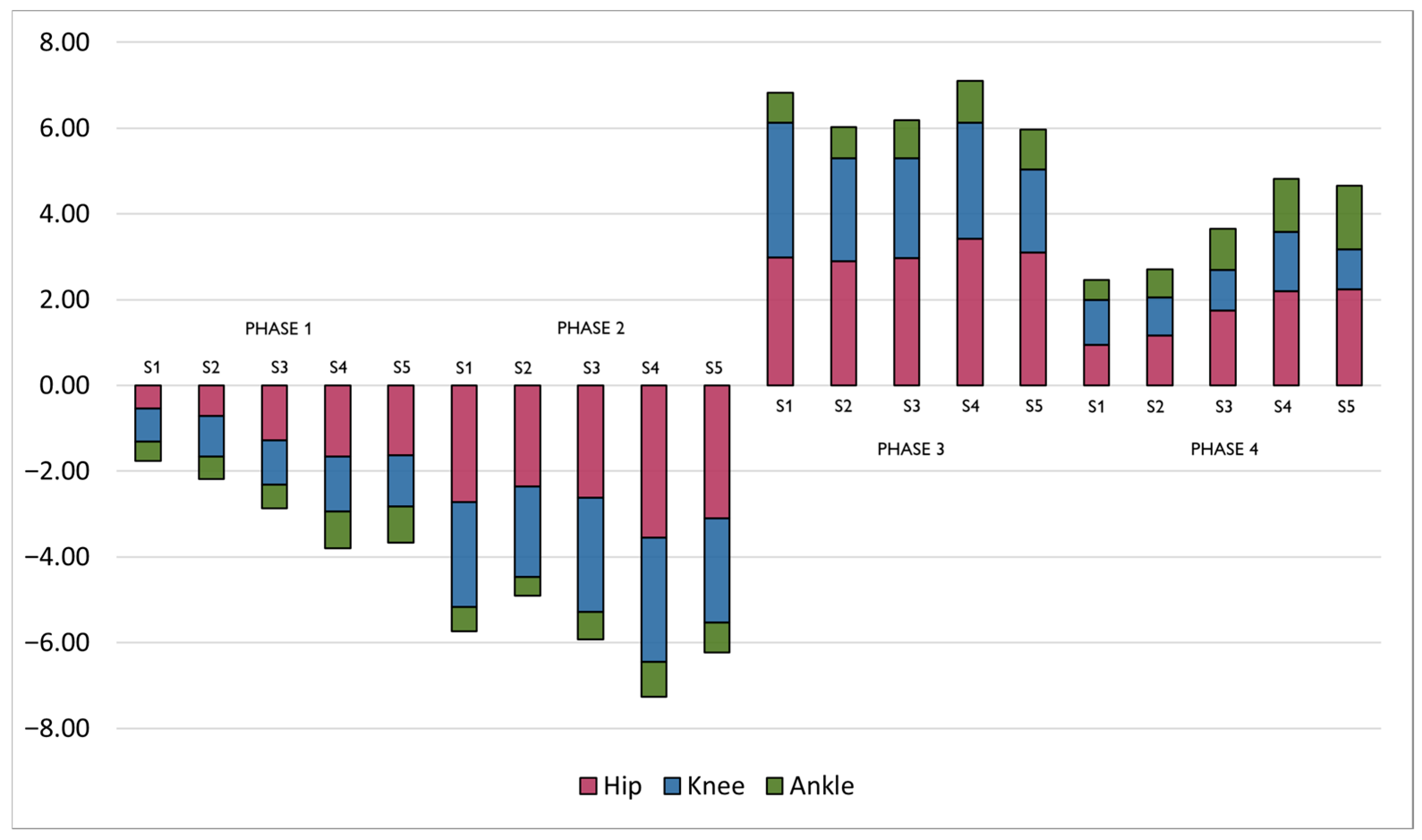
| Joint Mechanical Power (W/kg) | ||||||||||||||
|---|---|---|---|---|---|---|---|---|---|---|---|---|---|---|
| Phase | Sets | Avg. Dur. | Value | Contribution | ||||||||||
| (s) | (%) | H | K | A | Global | H | K | A | Global | |||||
| P1 | S1 | 0.42 | 28.9% | −0.53 | −0.78 | −0.46 | −1.76 | 30.2% | 44.0% | 25.8% | 100% | |||
| S2 | 0.33 | 24.4% | −0.71 | −0.94 | −0.53 | −2.19 | 32.7% | 43.0% | 24.4% | 100% | ||||
| S3 | 0.34 | 24.3% | −1.29 | −1.03 | −0.56 | −2.88 | 44.8% | 35.7% | 19.6% | 100% | ||||
| S4 | 0.31 | 22.5% | −1.66 | c | −1.29 | −0.86 | c | −3.81 | 43.7% | 33.8% | 22.5% | 100% | ||
| S5 | 0.31 | 21.4% | −1.63 | c | −1.20 | −0.84 | c | −3.67 | 44.4% | 32.7% | 22.9% | 100% | ||
| P2 | S1 | 0.34 | 25.0% | −2.72 | −2.45 | −0.56 | −5.73 | 47.4% | 42.7% | 9.8% | 100% | |||
| S2 | 0.38 | 28.2% | −2.36 | −2.11 | −0.44 | −4.91 | 48.1% | 42.9% | 9.1% | 100% | ||||
| S3 | 0.39 | 27.5% | −2.62 | c | −2.66 | b | −0.64 | b,c | −5.92 | 44.3% | 44.9% | 10.7% | 100% | |
| S4 | 0.40 | 28.6% | −3.55 | c | −2.89 | −0.82 | c | −7.26 | 48.9% | 39.8% | 11.2% | 100% | ||
| S5 | 0.41 | 28.5% | −3.10 | −2.43 | −0.70 | −6.23 | 49.7% | 39.0% | 11.2% | 100% | ||||
| P3 | S1 | 0.28 | 22.0% | 2.98 | c | 3.14 | b | 0.71 | b,c | 6.83 | 43.6% | 46.0% | 10.4% | 100% |
| S2 | 0.30 | 23.9% | 2.90 | 2.39 | 0.73 | 6.02 | 48.2% | 39.8% | 12.0% | 100% | ||||
| S3 | 0.34 | 25.0% | 2.96 | 2.34 | 0.88 | 6.18 | 47.9% | 37.9% | 14.2% | 100% | ||||
| S4 | 0.38 | 28.0% | 3.43 | a,c | 2.70 | a,b | 0.97 | b,c | 7.10 | 48.3% | 38.0% | 13.7% | 100% | |
| S5 | 0.45 | 31.2% | 3.10 | a,c | 1.95 | a | 0.93 | c | 5.97 | 51.9% | 32.6% | 15.5% | 100% | |
| P4 | S1 | 0.34 | 24.1% | 0.95 | 1.05 | b | 0.47 | b | 2.47 | 38.6% | 42.5% | 18.9% | 100% | |
| S2 | 0.33 | 23.5% | 1.16 | 0.89 | 0.65 | 2.70 | 43.0% | 32.9% | 24.1% | 100% | ||||
| S3 | 0.34 | 23.3% | 1.74 | c | 0.95 | 0.96 | c | 3.65 | 47.6% | 26.1% | 26.3% | 100% | ||
| S4 | 0.29 | 20.9% | 2.20 | c | 1.38 | 1.24 | c | 4.82 | 45.7% | 28.6% | 25.8% | 100% | ||
| S5 | 0.27 | 18.8% | 2.25 | 0.92 | 1.49 | 4.66 | 48.2% | 19.8% | 32.0% | 100% | ||||
Disclaimer/Publisher’s Note: The statements, opinions and data contained in all publications are solely those of the individual author(s) and contributor(s) and not of MDPI and/or the editor(s). MDPI and/or the editor(s) disclaim responsibility for any injury to people or property resulting from any ideas, methods, instructions or products referred to in the content. |
© 2025 by the authors. Licensee MDPI, Basel, Switzerland. This article is an open access article distributed under the terms and conditions of the Creative Commons Attribution (CC BY) license.
Share and Cite
Rodal, M.; Arrayales-Millán, E.M.; González-Macías, M.E.; Espinosa-Mogollón, L.; Pérez-Gómez, J.; Gianikellis, K. Phase-Specific Joint Mechanical Power Contribution to the Half Squat Exercise: A PBT Framework Analysis. Appl. Sci. 2026, 16, 199. https://doi.org/10.3390/app16010199
Rodal M, Arrayales-Millán EM, González-Macías ME, Espinosa-Mogollón L, Pérez-Gómez J, Gianikellis K. Phase-Specific Joint Mechanical Power Contribution to the Half Squat Exercise: A PBT Framework Analysis. Applied Sciences. 2026; 16(1):199. https://doi.org/10.3390/app16010199
Chicago/Turabian StyleRodal, Miguel, Emilio Manuel Arrayales-Millán, Mirvana Elizabeth González-Macías, Laura Espinosa-Mogollón, Jorge Pérez-Gómez, and Kostas Gianikellis. 2026. "Phase-Specific Joint Mechanical Power Contribution to the Half Squat Exercise: A PBT Framework Analysis" Applied Sciences 16, no. 1: 199. https://doi.org/10.3390/app16010199
APA StyleRodal, M., Arrayales-Millán, E. M., González-Macías, M. E., Espinosa-Mogollón, L., Pérez-Gómez, J., & Gianikellis, K. (2026). Phase-Specific Joint Mechanical Power Contribution to the Half Squat Exercise: A PBT Framework Analysis. Applied Sciences, 16(1), 199. https://doi.org/10.3390/app16010199