
Photovoltaic Power Plants with Horizontal Single-Axis Trackers: Influence of the Movement Limit on Incident Solar Irradiance

Abstract
1. Introduction
- (i)
- In [11], the optimal deployment of horizontal single-axis trackers in a terrain characterised by its tilt angle and variable orientation was studied. A single movement limit of (°) was used without considering the effects of this parameter on the results of incident solar irradiance on the field.
- (ii)
- López [12] analysed a real power plant from the point of view of the tilt angle and orientation of the horizontal single-axis trackers. A movement limit of () was used without further investigation of the influence of this parameter.
- (iii)
- Keiner et al. [13] presented a study on backtracking strategies in horizontal single-axis trackers. The objective of the work was to choose the backtracking strategy that optimised the incident solar irradiance on the field. This paper took into account the limit of movement, which remained constant throughout the study at a value of (). Therefore, this study did not take into account the influence of the movement limit of the solar tracker on the incident solar irradiance on the field.
- (iv)
- The optimisation of power plants with horizontal single-axis trackers was the subject of the study presented in [9]. In this work, equations were presented for the calculation of the incident solar irradiance on the field, which took into account several design parameters such as the irregular shape of the terrain, the size and configuration of the module mounting system, the row spacing, the operating periods, and the optimal deployment of the module mounting systems. A movement limit of () was used, but the influence of this parameter was not taken into account.
- (v)
- A study on tree crops between rows of horizontal single-axis trackers was presented in [14]. A movement limit of () was chosen, without analysing the influence of this factor.
- (vi)
- An energy analysis of the influence of the movement limit on a solar tracker was presented in [15]. In this study, only one location was analysed, so a detailed comparison of the impact of the motion limit was not performed.
- (i)
- Anderson and Jensen [16] developed a generalised equation for horizontal single-axis trackers deployed on cross-slope terrain. By not taking into account the movement limit, the developed equation loses generality.
- (ii)
- Huang et al. [17] analysed the optimal tilt angle of horizontal single-axis trackers using a spatial projection model and a dynamic shadow evaluation method. This work could be completed by analysing the static mode, defined by a movement limit, and the backtracking mode.
- (iii)
- Alves et al. [18] optimised the design of power plants with horizontal single-trackers using a new evaluation metric. This new assessment metric is not fully defined as it does not consider the movement limit.
- (iv)
- Sun et al. [19] presented a model for a horizontal single-axis tracking bracket with an adjustable tilt angle to increase incident solar irradiance regardless of the maximum movement limit.
- (v)
- Kamran et al. [20] presented a new algorithm based on the energy valley optimiser to extract the maximum energy from solar power. This study did not take into account the movement limit and the backtracking mode.
- (vi)
- Tina et al. [21] presented an economic study of solar-tracking photovoltaic systems installed on the water surface. The calculation of the energy generated by the field did not take into account the limit of movement.
- (i)
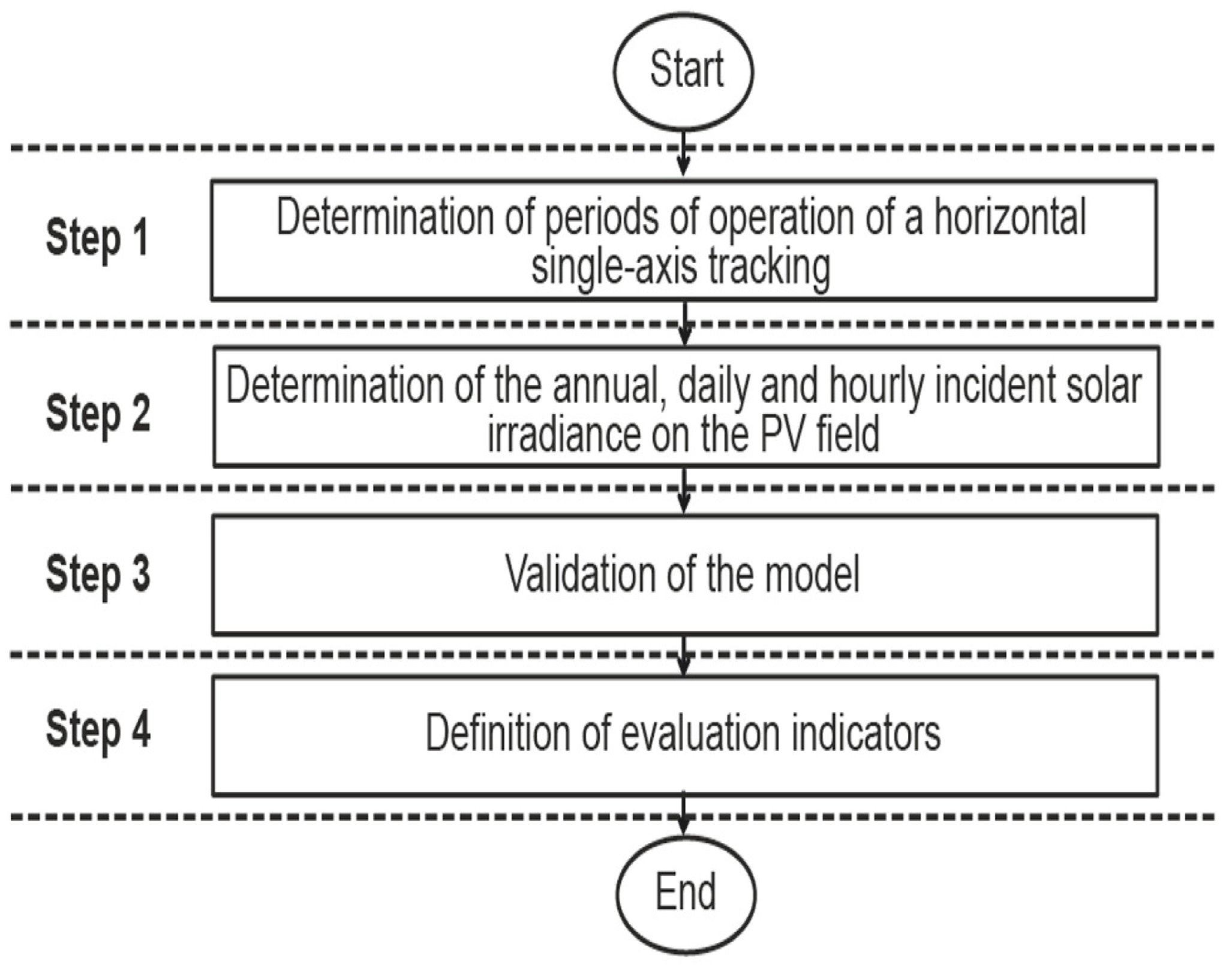
- A study of the annual energy losses due to the choice of a non-optimal horizontal single-axis tracker movement limit.
- (ii)
- A seasonal study of the energy losses as a function of the movement limit.
- (iii)
- A detailed analysis of the influence of the movement limit on the components of the incident solar irradiance on the photovoltaic field.
2. Materials and Methods
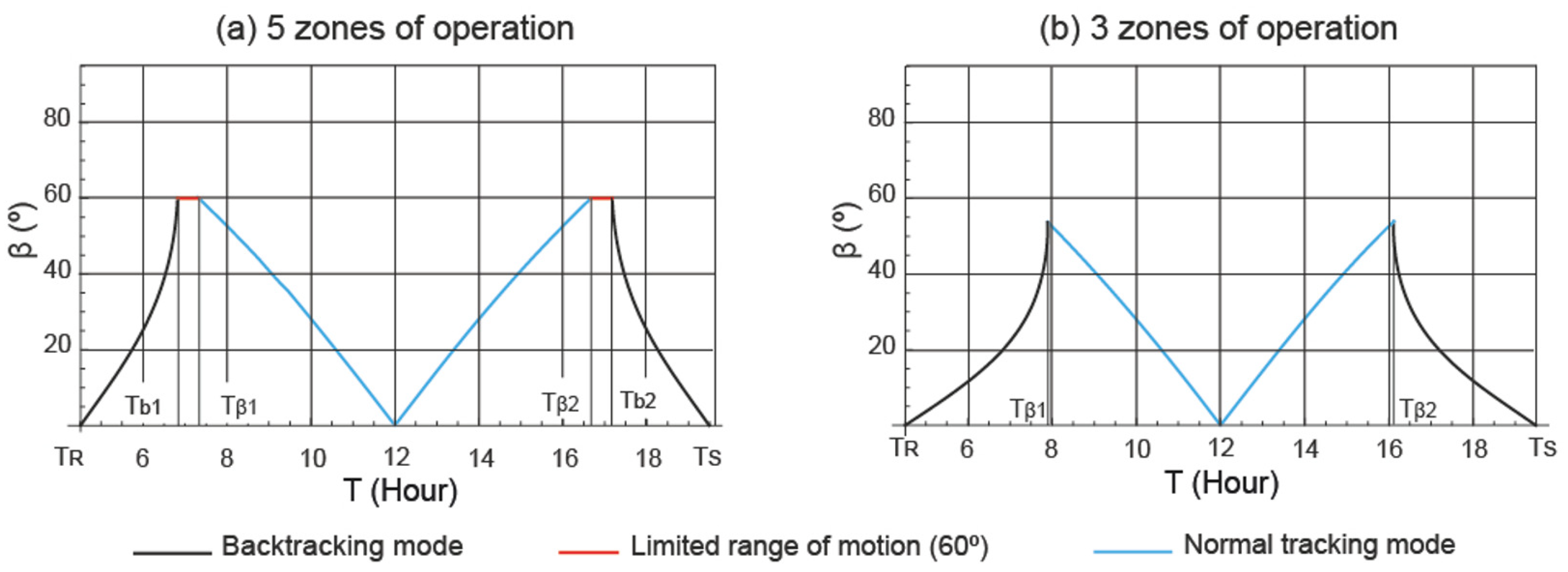
2.1. Periods of Operation of a Horizontal Single-Axis Tracking
- (i)
- Sunrise backtracking mode. This mode of operation starts at sunrise () and ends at the limited range of movement (). During sunrise, the position of the field is horizontal and at the end of sunrise backtracking mode the tilt angle of the field is .
- (ii)
- Static mode. This mode of operation starts at the end of the sunrise backtracking mode () and ends at the beginning of the normal tracking mode ().
- (iii)
- Normal tracking mode. This mode of operation starts at the movement limit before noon () and ends at the movement limit after noon ().
- (iv)
- Static mode. This mode of operation starts at the end of normal tracking mode () and ends at the beginning of the sunset backtracking mode ().
- (v)
- Sunset backtracking mode. This mode of operation starts at the limited range of movement () and ends at sunset (). During the beginning of the sunset backtracking mode, the tilt angle of the field is , and at sunset the position of the field, the tilt angle is horizontal.
2.2. Incident Solar Irradiance on the Photovoltaic Field
2.2.1. Beam Component Modelling
2.2.2. Diffuse Component Modelling
2.2.3. Ground-Reflected Component Modelling
- (i)
- parameter. The equations for determining this parameter in each mode of operation are as follows:
- (ii)
- parameter. The equations for determining this parameter in each mode of operation are as follows:
- (iii)
- and parameters. To calculate the three components of the incident solar irradiance on the field, it is necessary to determine the incident solar irradiance on a horizontal surface, i.e., and . The incident solar irradiance on a horizontal surface is site-specific, as it is significantly influenced by the local distribution of cloud cover [27]. The ideal situation for calculating and is to have a ground-level weather station at each location. The actual situation, however, is that the number of weather stations worldwide is very low. Evidently, it is unlikely that a weather station is close to the location under study. Therefore, it is necessary to use models for the estimation of these parameters. A large number of models can be found in the specialised literature, such as the clear sky models [25], satellite-based models [28], etc.
2.3. Model Validation
2.4. Assessment Indicators
2.4.1. Annual Energy Loss
2.4.2. Daily Energy Loss
2.4.3. Analysis of the Components of the Incident Solar Irradiance on the Field
3. Results and Discussion
3.1. PV Power Plants Under Study
- (i)
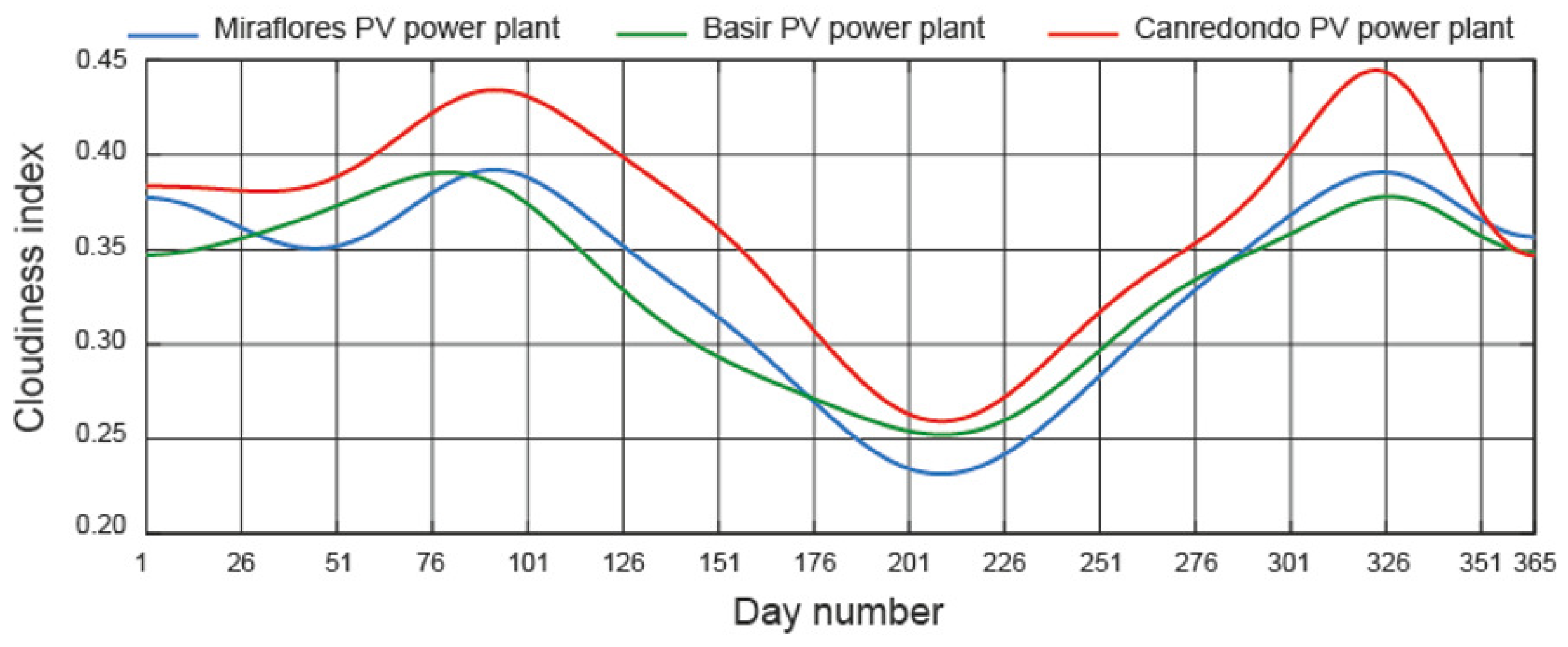
- The selected power plants should have different levels of horizontal global and diffuse solar irradiance, in order to analyse the influence of the on the incident solar irradiance on the field.
- (ii)
- The selected power plants should have a limit of movement equal to (°), in order to be able to compare the results obtained from other limits of movement.
3.2. Annual Energy Loss
- (i)
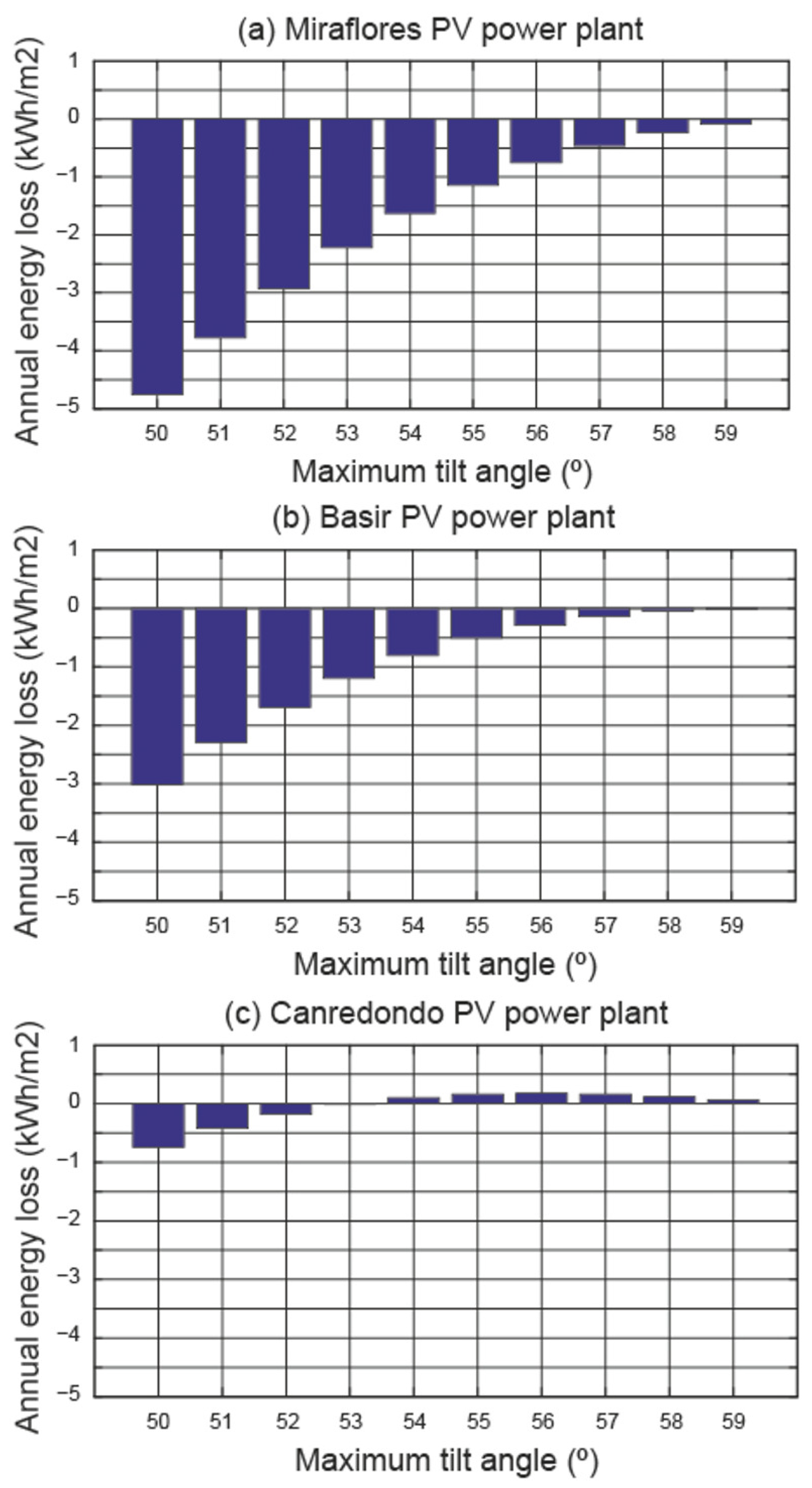
- In the three power plants analysed, the energy loss per square metre is small, but as the surface of the field is large, these losses cannot be neglected. The choice of a movement limit different from the optimum produces energy losses that cannot be neglected, taking into account the large surface area of the field. The surface area of the field at the Miraflores power plant is 105,109.81 (m2), and at the Basir and Canredondo power plant it is (m2) 95,616.64 and 105,012.67 (m2), respectively.
- (ii)
- According to Figure 7a, the use of movement limits lower than (°) increases the annual energy losses. Therefore, the Miraflores power plant uses the optimal movement limit. The annual energy loss would be (MWh) per year if the movement limit of this power plant were (°).
- (iii)
- Based on Figure 7b, the annual energy loss increases for movement limits below (°). Therefore, the Basir power plant uses the optimal movement limit. Using a limiting movement of (°) would result in an energy loss per year of (MWh).
- (iv)
- According to Figure 7c, the maximum annual incident solar irradiation on the field corresponds to a movement limit of (°). Therefore, as the movement limit of the Canredondo power plant is currently (°), the movement limit is not optimised. Therefore, the annual energy loss at this power plant is (MWh).
3.3. Daily Energy Loss
- (i)
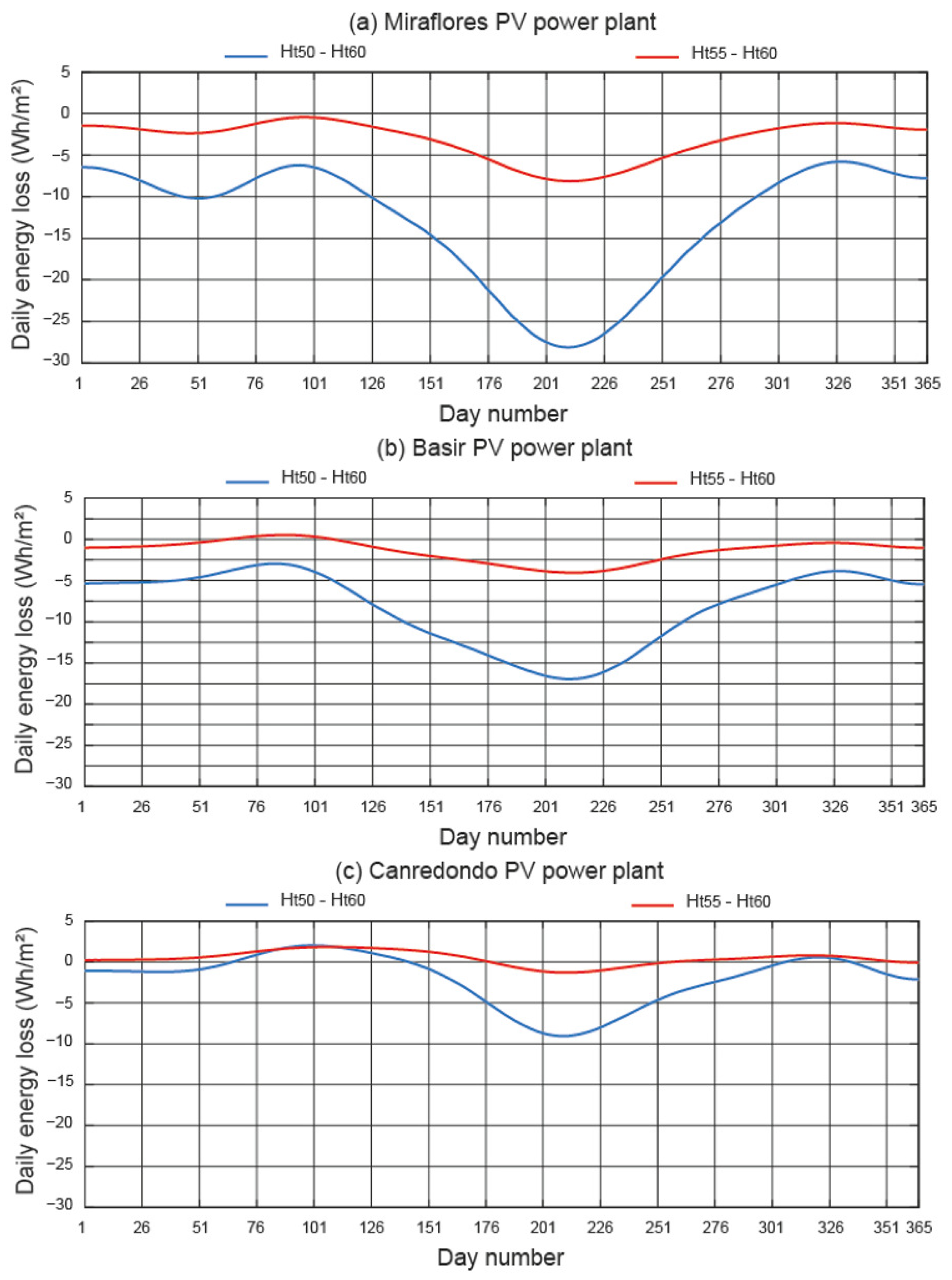
- According to the red line in Figure 8a, on all days of the year, the scenario (°) performs worse than the current scenario. The worst results are obtained in the summer months (low ), and the best results are obtained in the spring months (high ). According to the blue line, for every day of the year too, the scenario (°) performs worse than the current scenario. The worst results occur in the summer months (low ). The results of the (°) scenario (the blue line) are worse than those of the (°) scenario (the red line). For example, for the day 21 March (), the (°) configuration has a higher incident energy of and compared to the (°) and (°) configurations, respectively. Furthermore, for day 21 June (), the (°) configuration has a higher incident energy of and compared to the (°) and (°) configurations, respectively.
- (ii)
- According to the red line in Figure 8b, there are very few days per year when the scenario (°) performs better than the current scenario. This time period corresponds to spring season (high ). Moreover, this difference is very small. In addition, the biggest difference occurs in the summer months (low ). On the other hand, according to the blue line, for every day of the year, the scenario (°) obtains worse results than the current scenario. The worst results occur in the summer months (low ). The results of the (°) scenario (the blue line) are worse than those of the (°) scenario (the red line). For example, for the day 21 March (), the configuration (°) has an incident energy higher than the configuration (°) and lower than the configuration (°). Furthermore, for day 21 June (), the (°) configuration has a higher incident energy of and compared to the (°) and (°) configurations, respectively.
- (iii)
- According to the red line in Figure 8c, on most days of the year, the scenario (°) performs better than the current scenario. The best results are obtained in the spring months (high ) and the worst results in the summer months (low ). According to the blue line, on most days of the year, the scenario (°) performs worse than the current scenario. The best results are obtained in the spring months (high ) and the worst results in the summer months (low ). The results of the (°) scenario (the blue line) are worse than those of the (°) scenario (the red line). For example, for day 21 March (), the (°) configuration has a lower incident energy of and compared to the (°) and (°) configurations, respectively. Furthermore, for day 21 June (), the (°) configuration has a higher incident energy of with respect to the (°) configuration and a lower incident energy of compared to the (°) configuration.
3.4. Analysis of the Components of the Incident Solar Irradiance on the Field
3.4.1. Solar Tracker Operating Tilt Angles
- (i)
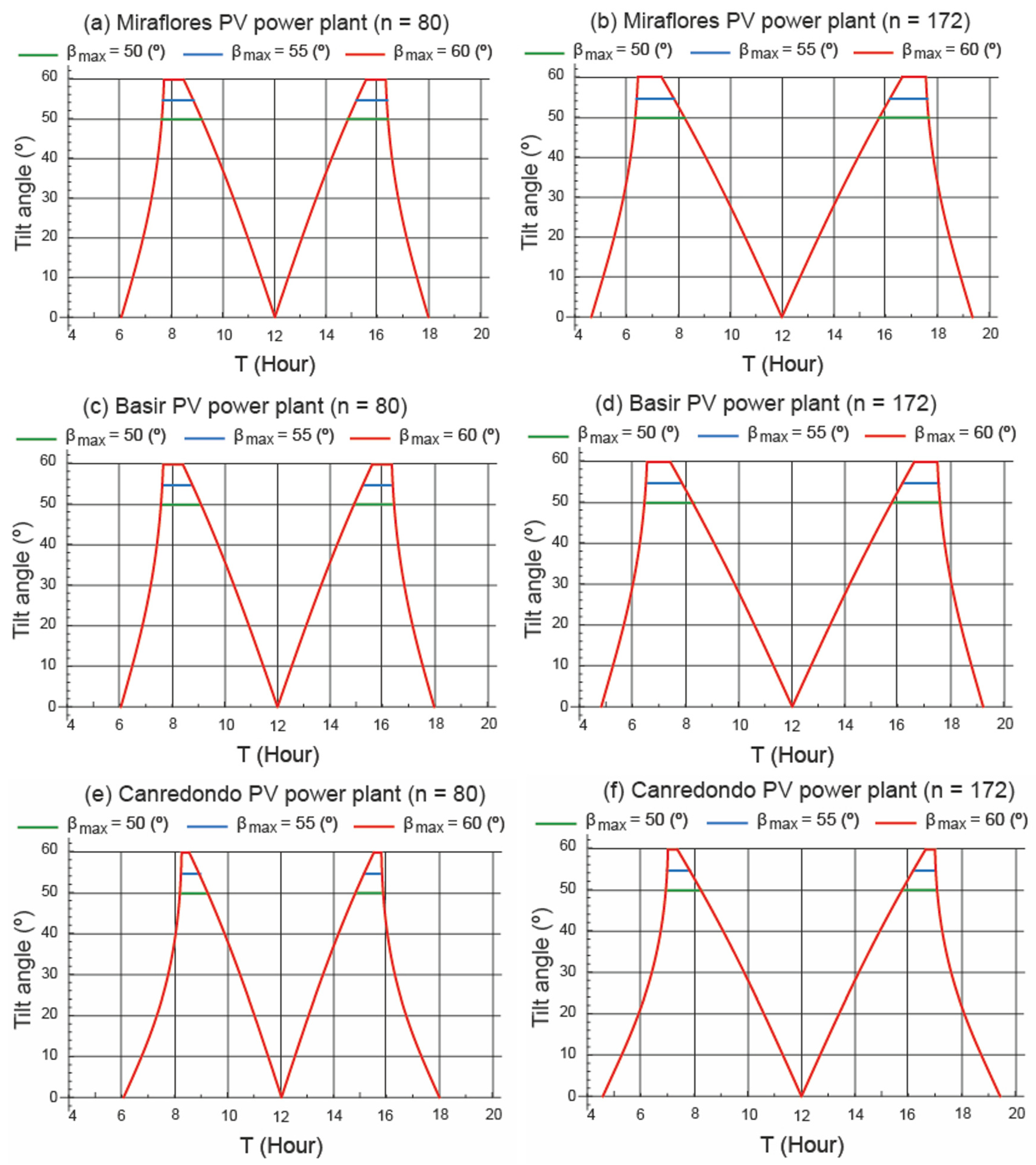
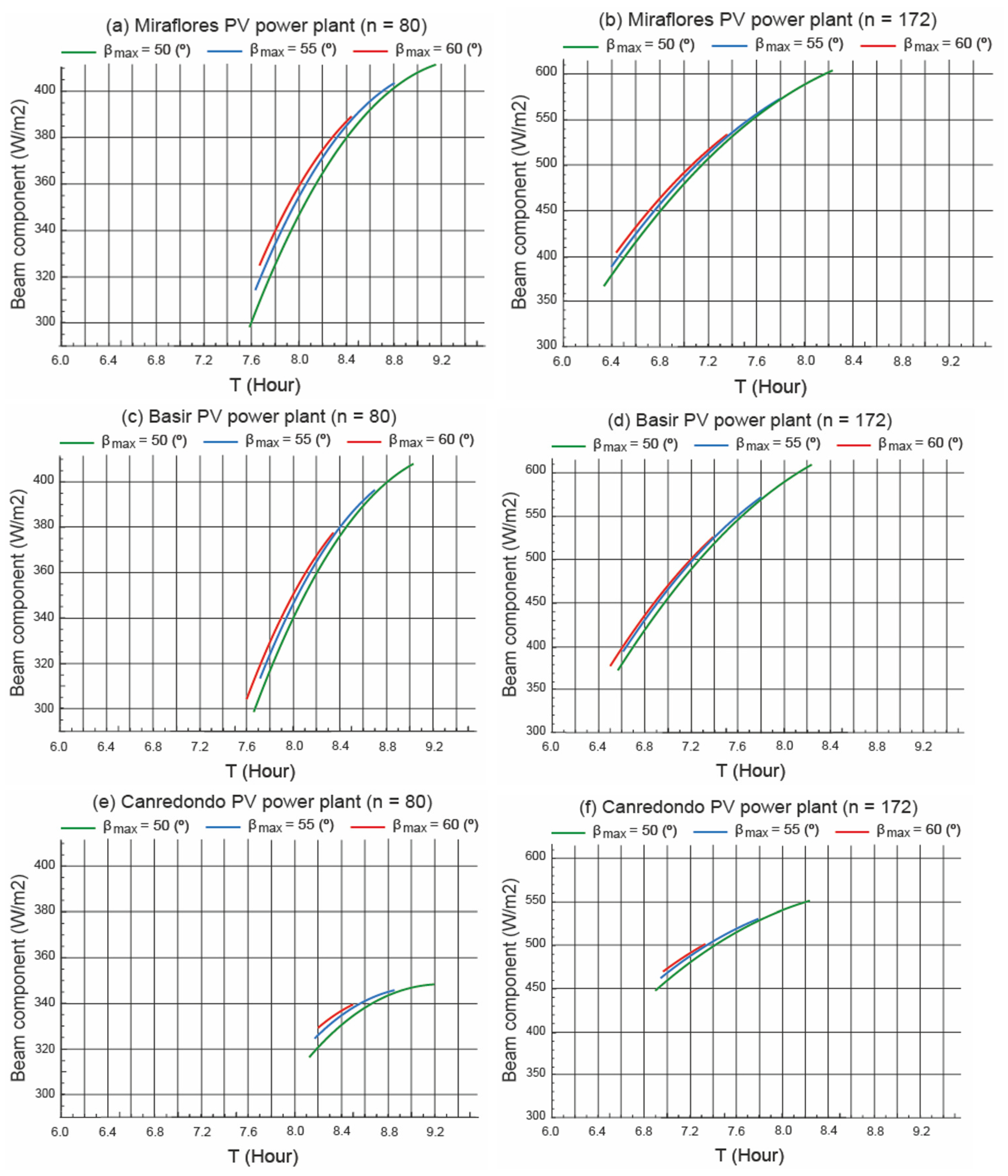
- In all locations, the current scenario has the shortest static mode duration operation period. Therefore, when the current scenario starts the normal tracking mode (where the beam component is maximised), the other two scenarios remain in the operation static mode, impairing the incidence of the beam component on the field.
- (ii)
- Evidently, in most of the operating hours, the three operating profiles overlap. The difference between the three profiles is due to the duration of the operation static mode. Therefore, the duration time of the operation static mode is the period to be studied. The smaller the movement limit angle, the longer the duration of the operation static mode.
- (iii)
- The duration period of the operation static mode at Miraflores power plant is the longest compared to the other two power plants. In contrast, the Canredondo power plant has the shortest operation static mode duration period.
3.4.2. Beam Component
- (i)
- If the beam component is predominant, the longer the duration of operation in static mode, the better the performance of the current scenario. Since the current scenario first starts the normal tracking mode that favours the beam component, the rest of the scenarios follow in the horizontal position.
- (ii)
- During the operation static mode, on day , the Miraflores power plant has the highest beam component. This fact favours the current scenario. In contrast, the Canredondo power plant has the lowest beam component. This fact favours the current scenario, but the diffuse component has to be analysed.
- (iii)
- During the static operation mode, on day , the Miraflores power plant has the highest beam component. This fact favours the current scenario. In contrast, the Canredondo power plant has the lowest beam component. This fact favours the current scenario, but the diffuse component has to be analysed.
3.4.3. Diffuse Component
- (i)
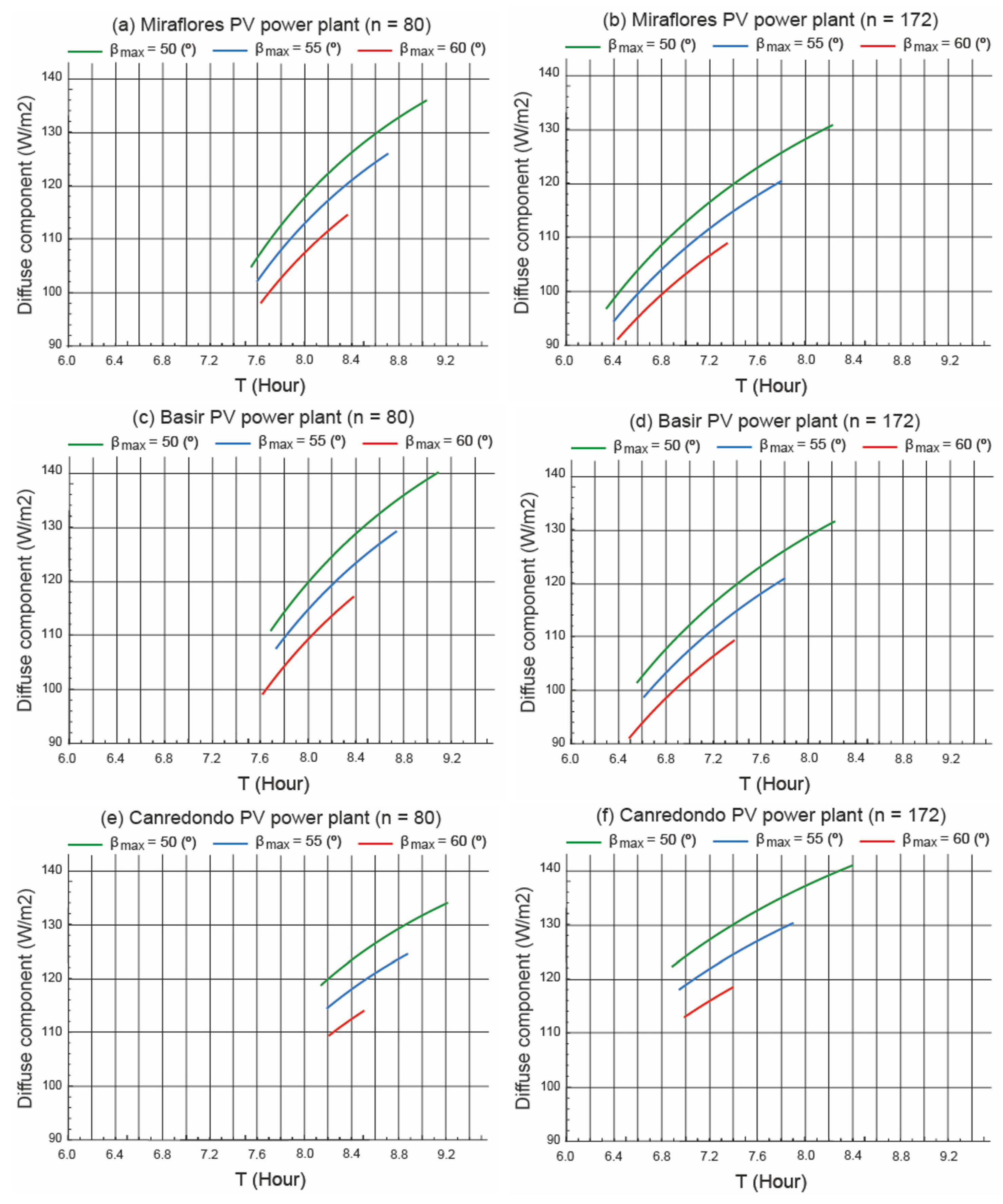
- If the diffuse component is predominant, the longer the duration of operation in static mode, the worse the performance of the current scenario. Since the current scenario starts the normal tracking mode first, the rest of the scenarios follow in the horizontal position that favours the diffuse component.
- (ii)
- During the static operation mode, on day , the Miraflores power plant has the smallest diffuse component. This favours the current scenario. In contrast, the Canredondo power plant has the highest diffuse component. This fact favours a scenario that is different from the current one.
- (iii)
- During the static operation mode, on day , the Miraflores power plant has the smallest diffuse component. This fact favours the current scenario. In contrast, the Canredondo power plant has the highest diffuse component. This fact favours a scenario that is different from the current one.
4. Conclusions
- (i)
- In all three power plants analysed, the energy loss per square metre is small, but as the surface of the field is large, these losses cannot be neglected. The choice of a movement limit different from the optimum produces energy losses that cannot be neglected, taking into account the large surface area of the field. The surface area of the field at the Miraflores power plant is 105,109.81 (m2), and at the Basir and Canredondo power plant it is (m2) 95,616.64 and 105,012.67 (m2), respectively.
- (ii)
- Although most power plants in Spain use a movement limit of (), a study on the optimum movement limit is necessary. The movement limit of the Canredondo power plant is currently (). It has been demonstrated that the movement limit is not optimised. The annual energy loss is (MWh). Therefore, it is necessary to calculate the optimal movement limit for each location under study, as the annual losses of the incident energy are not negligible. In contrast, the Miraflores and Basir power plants do use an optimal movement limit.
- (iii)
- In all locations, the current scenario has the shortest static mode operation period. Therefore, when the current scenario starts the normal tracking mode (where the beam component is maximised), the other two scenarios remain in the operation static mode, impairing the incidence of the beam component on the field.
- (iv)
- Considering the current scenario as a basis for comparison, the most favourable results for this scenario are obtained in the summer months (low ) and the least favourable in the spring months (high ).
- (v)
- If the beam component is predominant, the longer the duration of operation in static mode, the better the performance of the current scenario. Since the current scenario first starts the normal tracking mode that favours the beam component, the rest of the scenarios follow in the horizontal position.
- (vi)
- If the diffuse component is predominant, the longer the duration of operation in static mode, the worse the performance of the current scenario. Since the current scenario starts the normal tracking mode first, the rest of the scenarios follow in the horizontal position that favours the diffuse component.
- (vii)
- It can be concluded that high values of the beam component favour the current scenario. In contrast, high values of the diffuse component favour scenarios other than the current scenario.
Author Contributions
Funding
Institutional Review Board Statement
Informed Consent Statement
Data Availability Statement
Acknowledgments
Conflicts of Interest
Nomenclature
| Annual energy loss () | |
| Comparison of the annual incident energy (%) | |
| Daily energy loss () | |
| Pitch (m) | |
| Total irradiation on a tilted surface () | |
| Beam irradiance on a horizontal surface () | |
| Diffuse irradiance on a horizontal surface () | |
| Total irradiance on a tilted surface () | |
| n | Ordinal of the day (day) |
| T | Solar time (h) |
| Sunrise solar time (h) | |
| Sunset solar time (h) | |
| End of the bactracking mode (h) | |
| Start of the bactracking mode (h) | |
| Start of the normal tracking mode (h) | |
| End of the normal tracking mode (h) | |
| Tilt angle of photovoltaic module (°) | |
| Backtracking angle (°) | |
| Limited range of motion angle (°) | |
| Azimuth angle of photovoltaic module (°) | |
| Azimuth of the Sun (°) | |
| Solar declination (°) | |
| Incidence angle (°) | |
| Transversal angle (°) | |
| Zenith angle of the Sun (°) | |
| Ground reflectance (dimensionless) | |
| Hour angle (°) |
References
- IEA. Electricity 2024. Available online: https://iea.blob.core.windows.net/assets/18f3ed24-4b26-4c83-a3d2-8a1be51c8cc8/Electricity2024-Analysisandforecastto2026.pdf (accessed on 23 November 2024).
- IEA. World Energy Outlook 2023. Available online: https://www.iea.org/reports/world-energy-outlook-2023?language=es (accessed on 23 November 2024).
- European Union. Directive 2018/2001/EC, on the Promotion of the Use of Energy from Renewable Sources. 2018. Available online: https://eur-lex.europa.eu/eli/dir/2018/2001/oj/eng (accessed on 23 November 2024).
- Future Market Insights, Solar Trackers Market: Solar Trackers Market Analysis by Single-Axis and Dual-Axis for 2023 to 2033. Available online: https://www.futuremarketinsights.com/reports/solar-trackers-market#:\protect\char126\relax:text=The%20global%20solar%20trackers%20market,to%20renewable%20energy%20sources%20grows (accessed on 23 November 2024).
- Gonvarri Solar Steel. Available online: https://www.gsolarsteel.com/ (accessed on 23 November 2024).
- Barbón, A.; Fortuny Ayuso, P.; Bayón, L.; Silva, C.A. A comparative study between racking systems for photovoltaic power systems. Renew. Energy 2021, 180, 424–437. [Google Scholar] [CrossRef]
- Martín-Martínez, S.; Cañas-Carretón, M.; Honrubia-Escribano, A.; Gómez-Lázaro, E. Performance evaluation of large solar photovoltaic power plants in Spain. Energy Convers. Manag. 2019, 183, 515–528. [Google Scholar] [CrossRef]
- Antaisolar. Available online: https://www.antaisolar.com/ (accessed on 23 November 2024).
- Barbón, A.; Carreira-Fontao, V.; Bayón, L.; Silva, C.A. Optimal design and cost analysis of single-axis tracking photovoltaic power plants. Renew. Energy 2023, 211, 626–646. [Google Scholar] [CrossRef]
- Duffie, J.A.; Beckman, W.A. Solar Engineering of Thermal Processes, 4th ed.; John Wiley & Sons: New York, NY, USA, 2013. [Google Scholar]
- Ledesma, J.R.; Lorenzo, E.; Narvarte, L. Single-axis tracking and bifacial gain on sloping terrain. Prog. Photovoltaics Research Appl. 2024, 33, 309–325. [Google Scholar] [CrossRef]
- López, M. Detection of tracker misalignments and estimation of cross-axis slope in photovoltaic plants. Solar Energy 2024, 272, 112490. [Google Scholar] [CrossRef]
- Keiner, D.; Walter, L.; ElSayed, M.; Breyer, C. Impact of backtracking strategies on techno-economics of horizontal single-axis tracking solar photovoltaic power plants. Sol. Energy 2024, 267, 112228. [Google Scholar] [CrossRef]
- Casares de la Torre, F.J.; Varo, M.; López-Luque, R.; Ramírez-Faz, J.; Fernández-Ahumada, L.M. Design and analysis of a tracking / backtracking strategy for PV plants with horizontal trackers after their conversion to agrivoltaic plants. Renew. Energy 2022, 187, 537–550. [Google Scholar] [CrossRef]
- Barbón, A.; Bayón-Cueli, C.; Bayón, L.; Carreira-Fontao, V. Study of the influence of the motion limit of a horizontal single-axis tracker on the annual incident energy in a PV power plant. In Proceedings of the 2024 IEEE International Conference on Environmental and Electrical Engineering (EEEIC2024), Rome, Italy, 17–20 June 2024; pp. 1–4. [Google Scholar]
- Anderson, K.S.; Jensen, A.R. Shaded fraction and backtracking in single-axis trackers on rolling terrain. J. Renew. Sustain. Energy 2024, 16, 023504. [Google Scholar] [CrossRef]
- Huang, B.; Huang, J.; Xing, K.; Liao, L.; Xie, P.; Xiao, M.; Zhao, W. Development of a solar-tracking system for horizontal single-axis PV arrays using spatial projection analysis. Energies 2023, 16, 4008. [Google Scholar] [CrossRef]
- Alves Veríssimo, P.H.; Antunes Campos, R.; Vivian Guarnieri, M.; Alves Veríssimo, J.P.; do Nascimento, L.R.; Rüther, R. Area and LCOE considerations in utility-scale, single-axis tracking PV power plant topology optimization. Sol. Energy 2020, 211, 433–445. [Google Scholar] [CrossRef]
- Sun, L.; Bai, J.; Kumar Pachauri, R.; Wang, S. A horizontal single-axis tracking bracket with an adjustable tilt angle and its adaptive real-time tracking system for bifacial PV modules. Renew. Energy 2024, 221, 119762. [Google Scholar] [CrossRef]
- Kamran Khan, M.; Hamza Zafar, M.; Riaz, T.; Mansoor, M.; Akhtar, N. Enhancing efficient solar energy harvesting: A process-in-loop investigation of MPPT control with a novel stochastic algorithm. Energy Convers. Manag. 2024, 21, 100509. [Google Scholar] [CrossRef]
- Tina, G.M.; Bontempo Scavo, F.; Micheli, L.; Rosa-Clot, M. Economic comparison of floating photovoltaic systems with tracking systems and active cooling in a Mediterranean water basin. Energy Sustain. 2023, 76, 101283. [Google Scholar] [CrossRef]
- Antonanzas, J.; Urraca, R.; Martinez-de-Pison, F.J.; Antonanzas, F. Optimal solar tracking strategy to increase irradiance in the plane of array under cloudy conditions: A study across Europe. Sol. Energy 2018, 163, 122–130. [Google Scholar] [CrossRef]
- López, M.; Soto, F.; Hernández, Z.A. Assessment of the potential of floating solar photovoltaic panels in bodies of water in mainland Spain. J. Clean. Prod. 2022, 340, 130752. [Google Scholar] [CrossRef]
- Makhdoomi, S.; Askarzadeh, A. Impact of solar tracker and energy storage system on sizing of hybrid energy systems: A comparison between diesel/PV/PHS and diesel/PV/FC. Energy 2021, 231, 120920. [Google Scholar] [CrossRef]
- Zhu, Y.; Liu, J.; Yang, X. Design and performance analysis of a solar tracking system with a novel single-axis tracking structure to maximize energy collection. Appl. Energy 2020, 264, 114647. [Google Scholar] [CrossRef]
- Farahat, A.; Kambezidis, H.D.; Almazroui, M.; Ramadan, E. Solar Energy Potential on Surfaces with Various Inclination Modes in Saudi Arabia: Performance of an Isotropic and an Anisotropic Model. Appl. Sci. 2022, 12, 5356. [Google Scholar] [CrossRef]
- Peña-Cruz, M.I.; Díaz-Ponce, A.; Sánchez-Segura, C.D.; Valentín-Coronado, L.; Moctezuma, D. Short-term forecast of solar irradiance components using an alternative mathematical approach for the identification of cloud features. Renew. Energy 2024, 237, 121691. [Google Scholar] [CrossRef]
- Salazar, G.; Gueymard, C.; Bezerra Galdino, J.; Castro Vilela, O. Solar irradiance time series derived from high-quality measurements, satellite-based models, and reanalyses at a near-equatorial site in Brazil. Renew. Sustain. Energy Rev. 2020, 117, 109478. [Google Scholar] [CrossRef]
- Barbón, A.; Fortuny Ayuso, P.; Bayón, L.; Fernández-Rubiera, J.A. Predicting beam and diffuse horizontal irradiance using Fourier expansions. Renew. Energy 2020, 154, 46–57. [Google Scholar] [CrossRef]
- Jallal, M.A.; El Yassini, A.; Chabaa, S.; Zeroual, A.; Ibnyaich, S. Ensemble learning algorithm-based artificial neural network for predicting solar radiation data. In Proceedings of the IEEE International Conference on Decision Aid Sciences and Application (DASA), Sakheer, Bahrain, 8–9 November 2020; pp. 526–531. [Google Scholar]
- PVGIS. Joint Research Centre (JRC). 2024. Available online: https://re.jrc.ec.europa.eu/pvg_tools/ (accessed on 23 November 2024).
- PVSyst. Available online: https://www.pvsyst.com/ (accessed on 10 January 2025).
- Kambezidis, H.D. The solar radiation climate of Athens: Variations and tendencies in the period 1992–2017, the brightening era. Sol. Energy 2018, 173, 328–347. [Google Scholar] [CrossRef]
- Kong, H.J.; Kim, J.T. A Classification of real sky conditions for Yongin, Korea. In Sustainability in Energy and Buildings. Smart Innovation, Systems and Technologies; Springer: Berlin/Heidelberg, Germany, 2013; Volume 22, pp. 1025–1032. [Google Scholar]





| PV | Location | Latitude | Longitude | Altitude | Power | Movement Limit |
|---|---|---|---|---|---|---|
| Power Plant | (m) | (MWp) | () | |||
| Basir | Cádiz | N | W | 104 | 20.013 | |
| Yarte | Cadiz | N | W | 143 | 50.000 | |
| Mula II | Murcia | N | W | 313 | 114.400 | |
| Jumilla | Murcia | N | W | 510 | 8.900 | |
| Campos | Murcia | N | W | 172 | 109.190 | |
| Miraflores | Badajoz | N | W | 1162 | 22.000 | |
| Plato | Madrid | N | W | 809 | 22.580 | |
| Campos de Teruel | Teruel | N | E | 1292 | 25.000 | |
| Canredondo | Guadalajara | N | W | 1162 | 21.980 |
| Specifications | PV Power Plant | ||
|---|---|---|---|
| Basir | Miraflores | Canredondo | |
| Location | Medina Sidonia, (Spain) | Castuera, (Spain) | Canredondo, (Spain) |
| Latitude | N | N | N |
| Longitude | W | W | W |
| Altitude (m) | 104 | 389 | 1162 |
| Power (MWp) | 20.013 | 22.000 | 21.980 |
| PV mod. number | 37,408 | 41,122 | 41,084 |
| PV mod. model | LR5-72HBD 535 (LONGI) | LR5-72HBD 535 (LONGI) | LR5-72HBD 535 (LONGI) |
| PV mod. dim. (mm) | 2256 × 1133 | 2256 × 1133 | 2256 × 1133 |
| Tracking type | Horiz. single-axis tracker | Horiz. single-axis tracker | Horiz. single-axis tracker |
| Type of control | Astronomical algorithm | Astronomical algorithm | Astronomical algorithm |
| Rotation angle | (°) | (°) | (°) |
| Configuration | 1V | 1V | 1V |
| Pitch () (m) | 6000 | 6500 | 5100 |
| Reflectance () | 0.2 | 0.2 | 0.2 |
| Specifications | Basir | Miraflores | Canredondo | |||
|---|---|---|---|---|---|---|
| (kWh/m2) | ||||||
| January | 56.03 | 30.17 | 48.02 | 28.51 | 41.23 | 25.61 |
| February | 64.19 | 37.39 | 64.59 | 34.21 | 51.81 | 31.87 |
| March | 85.76 | 55.02 | 86.08 | 52.56 | 71.22 | 51.80 |
| April | 109.94 | 64.58 | 102.51 | 64.75 | 86.08 | 65.02 |
| May | 152.00 | 68.64 | 141.68 | 71.77 | 120.92 | 75.57 |
| June | 169.40 | 65.56 | 164.27 | 66.70 | 147.19 | 72.93 |
| July | 182.42 | 62.35 | 189.83 | 58.26 | 176.54 | 63.24 |
| August | 162.41 | 57.08 | 167.48 | 53.68 | 153.86 | 57.90 |
| September | 115.55 | 52.42 | 115.99 | 49.69 | 104.50 | 52.09 |
| October | 84.56 | 44.92 | 79.17 | 42.69 | 68.37 | 40.61 |
| November | 54.12 | 33.08 | 47.97 | 31.21 | 36.17 | 30.11 |
| December | 51.14 | 28.37 | 44.36 | 25.50 | 39.62 | 23.13 |
| Movement Limit | Basir | Miraflores | Canredondo |
|---|---|---|---|
| () | (kWh/m2) | (kWh/m2) | (kWh/m2) |
| 2249.16 | 2219.79 | 2007.89 | |
| 2249.88 | 2220.77 | 2008.22 | |
| 2250.48 | 2221.62 | 2008.46 | |
| 2250.97 | 2222.33 | 2008.63 | |
| 2251.36 | 2222.92 | 2008.74 | |
| 2251.66 | 2223.41 | 2008.80 | |
| 2251.88 | 2223.79 | 2008.82 | |
| 2252.03 | 2224.09 | 2008.80 | |
| 2252.12 | 2224.31 | 2008.76 | |
| 2252.16 | 2224.46 | 2008.70 | |
| 2252.17 | 2224.55 | 2008.64 |
Disclaimer/Publisher’s Note: The statements, opinions and data contained in all publications are solely those of the individual author(s) and contributor(s) and not of MDPI and/or the editor(s). MDPI and/or the editor(s) disclaim responsibility for any injury to people or property resulting from any ideas, methods, instructions or products referred to in the content. |
© 2025 by the authors. Licensee MDPI, Basel, Switzerland. This article is an open access article distributed under the terms and conditions of the Creative Commons Attribution (CC BY) license (https://creativecommons.org/licenses/by/4.0/).
Share and Cite
Barbón, A.; Martínez-Suárez, J.; Bayón, L.; Bayón-Cueli, C. Photovoltaic Power Plants with Horizontal Single-Axis Trackers: Influence of the Movement Limit on Incident Solar Irradiance. Appl. Sci. 2025, 15, 1175. https://doi.org/10.3390/app15031175
Barbón A, Martínez-Suárez J, Bayón L, Bayón-Cueli C. Photovoltaic Power Plants with Horizontal Single-Axis Trackers: Influence of the Movement Limit on Incident Solar Irradiance. Applied Sciences. 2025; 15(3):1175. https://doi.org/10.3390/app15031175
Chicago/Turabian StyleBarbón, Arsenio, Jaime Martínez-Suárez, Luis Bayón, and Covadonga Bayón-Cueli. 2025. "Photovoltaic Power Plants with Horizontal Single-Axis Trackers: Influence of the Movement Limit on Incident Solar Irradiance" Applied Sciences 15, no. 3: 1175. https://doi.org/10.3390/app15031175
APA StyleBarbón, A., Martínez-Suárez, J., Bayón, L., & Bayón-Cueli, C. (2025). Photovoltaic Power Plants with Horizontal Single-Axis Trackers: Influence of the Movement Limit on Incident Solar Irradiance. Applied Sciences, 15(3), 1175. https://doi.org/10.3390/app15031175