Evaluation of Data Augmentation Under Label Scarcity for ECG-Based Detection of Sleep Apnea


Abstract
1. Introduction
2. Related Studies
2.1. ECG-Based Sleep Apnea Detection
2.2. Data Augmentation for ECG Signals
2.3. Evaluation Protocols and Reproducibility
2.4. Label-Efficient and Semi-Supervised ECG Learning
2.5. Synthetic ECG and Advanced Augmentation
3. Materials and Methods
3.1. Dataset and Preprocessing
3.2. Evaluation Protocols
- Subject-Independent (SI) Splitting. In the SI protocol, subjects were partitioned such that no individual appeared in more than one split, ensuring that all segments from a given subject were assigned exclusively to a single set. Because the Apnea–ECG dataset contains four recording prefixes (a, b, c, and x), the SI allocation was stratified by prefix prior to shuffling to preserve the dataset’s natural distribution. All 70 subjects (20 “a”, 5 “b”, 10 “c”, and 35 “x”) were divided into five folds using this prefix-stratified strategy, so that each fold received a comparable mixture of subjects from all prefixes. For each fold, the held-out subjects formed the test set, and the remaining subjects were split into training and validation subsets using an 80–20 prefix-stratified split. The validation and test subjects for each fold are presented in Table 1, and the corresponding segment-level class statistics are summarized in Table 2. This protocol evaluates the performance of entirely unseen participants.
- Subject-Dependent (SD) Splitting. In the SD protocol, every subject contributes segments to all folds; however, each subject’s own segments remain strictly partitioned across training, validation, and testing for any given fold. For each subject, apnea and normal segments were first separated and stratified, after which the subject’s data were divided into five label-balanced partitions. For a global fold k, the subject’s k-th partition was assigned as the test set, the -th partition (in cyclic order) served as the validation set, and the remaining three partitions were designated as the training set. This scheme maintains a per-subject label balance while preventing segment-level leakage. Table 3 summarizes the segment distributions for the SD setting.
3.3. Label-Scarcity Simulation and Augmentation
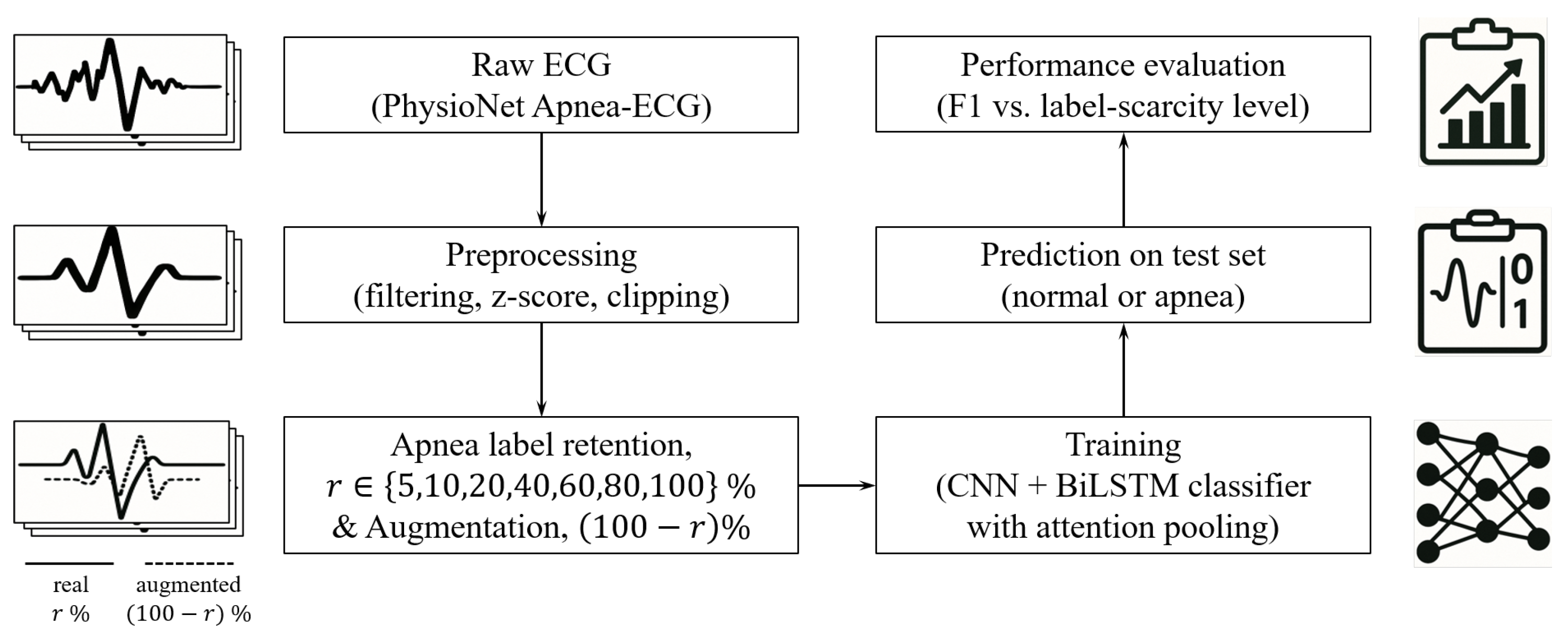
- Offline augmentation (apnea class only). Offline augmentation was applied exclusively to apnea-class training samples to restore the full apnea count under label scarcity. New samples were generated from a pool of real apnea segments using a set of morphology-preserving transformations. The specific transformations used in offline augmentation are summarized in Table 4. Each transformation is activated independently with a fixed probability (e.g., –, depending on the perturbation type), to produce a diverse collection of synthesized variants. This probabilistic design avoids deterministic augmentation patterns, increases morphological diversity, and maintains physiological plausibility while preventing overfitting to a narrow set of handcrafted transformations. All synthesized segments were stored on disk and used only within the training split.
- On-the-fly augmentation (all training samples). A lightweight perturbation pipeline was applied to every training sample (normal and apnea) at mini-batch time. The operations used for on-the-fly augmentation are likewise summarized in Table 4. All operations were implemented stochastically, and each the magnitude of each perturbation was sampled from a predefined distribution, which resulted in a negligible effect when the sampled value was near zero. This yielded natural variability across mini-batches without systematically altering the ECG morphology. In contrast with offline augmentation, which expands the apnea dataset, on-the-fly perturbations act solely for regularization and do not change the total number of samples.
3.4. Classifier Architecture
3.5. Experimental Setup
- (i)
- Full-label baseline (100% labels): the setting, using only on-the-fly augmentation.
- (ii)
- Label-scarcity settings (): reduced apnea supervision, where offline augmentation was applied to restore the apnea count to the full-label level.
4. Results
4.1. Effect of Label Scarcity and Augmentation
4.2. Impact of Augmentation on Data Variability
5. Discussion
5.1. Summary of Main Findings
5.2. Implications for Data-Efficient Apnea Screening
5.3. Augmentation Quality and Physiological Preservation
5.4. Limitations and Future Research
5.5. Overall Significance
6. Conclusions
Author Contributions
Funding
Institutional Review Board Statement
Informed Consent Statement
Data Availability Statement
Conflicts of Interest
Abbreviations
| AUPRC | Area Under the Precision–Recall Curve |
| AUROC | Area Under the Receiver Operating Characteristic Curve |
| BN | Batch Normalization |
| BiLSTM | Bidirectional Long Short-Term Memory |
| CNN | Convolutional Neural Network |
| EMA | Exponential Moving Average |
| HRV | Heart Rate Variability |
| KL | Kullback–Leibler Divergence |
| MLP | Multi-Layer Perceptron |
| OSA | Obstructive Sleep Apnea |
| PSD | Power Spectral Density |
| SD | Subject-Dependent |
| SI | Subject-Independent |
References
- Dey, D.; Chaudhuri, S.; Munshi, S. Obstructive Sleep Apnoea Detection Using Convolutional Neural Network Based Deep Learning Framework. Biomed. Eng. Lett. 2018, 8, 95–100. [Google Scholar] [CrossRef] [PubMed]
- Ramachandran, A.; Karuppiah, A. A Survey on Recent Advances in Machine Learning Based Sleep Apnea Detection. Healthcare 2021, 9, 914. [Google Scholar] [CrossRef] [PubMed]
- Penzel, T.; Moody, G.B.; Mark, R.G.; Goldberger, A.L.; Peter, J.H. The Apnea–ECG Database. In Proceedings of the Computers in Cardiology 2000, Cambridge, MA, USA, 24–27 September 2000; pp. 255–258. [Google Scholar] [CrossRef]
- Goldberger, A.L.; Amaral, L.A.N.; Glass, L.; Hausdorff, J.M.; Ivanov, P.C.; Mark, R.G.; Mietus, J.E.; Moody, G.B.; Peng, C.K.; Stanley, H.E. PhysioBank, PhysioToolkit, and PhysioNet: Components of a New Research Resource for Complex Physiologic Signals. Circulation 2000, 101, e215–e220. [Google Scholar] [CrossRef] [PubMed]
- Sheta, A.; Turabieh, H.; Thaher, T.; Too, J.; Mafarja, M.; Hossain, M.S.; Surani, S.R. Diagnosis of Obstructive Sleep Apnea from ECG Signals Using Machine Learning and Deep Learning Classifiers. Appl. Sci. 2021, 11, 6622. [Google Scholar] [CrossRef]
- Liu, M.H.; Chien, S.Y.; Wu, Y.L.; Sun, T.H.; Huang, C.S.; Hsu, K.C.; Hang, L.W. EfficientNet-based Machine Learning Architecture for Sleep Apnea Identification in Clinical Single-Lead ECG Signal Data Sets. BioMed. Eng. Online 2024, 23, 57. [Google Scholar] [CrossRef]
- Yamane, T.; Fujii, M.; Morita, M. Clinical-Level Screening of Sleep Apnea Syndrome with Single-Lead ECG Alone Using Machine Learning with Appropriate Time Windows. Sleep Breath. 2025, 29, 156. [Google Scholar] [CrossRef]
- Wang, T.; Lu, C.; Shen, G.; Hong, F. Sleep apnea detection from a single-lead ECG signal with automatic feature-extraction through a modified LeNet-5 convolutional neural network. PeerJ 2019, 7, e7731. [Google Scholar] [CrossRef]
- Almutairi, H.; Hassan, G.M.; Datta, A. Classification of Obstructive Sleep Apnoea from Single-Lead ECG Signals Using Convolutional Neural and Long Short-Term Memory Networks. Biomed. Signal Process. Control 2021, 69, 102906. [Google Scholar] [CrossRef]
- Pham, D.T.; Mouček, R. Efficient Sleep Apnea Detection Using Single-Lead ECG: A CNN–Transformer–LSTM Approach. Comput. Biol. Med. 2025, 196, 110655. [Google Scholar] [CrossRef]
- Hu, S.; Cai, W.; Gao, T.; Wang, M. A Hybrid Transformer Model for Obstructive Sleep Apnea Detection Based on Self-Attention Mechanism Using Single-Lead ECG. IEEE Trans. Instrum. Meas. 2022, 71, 2514011. [Google Scholar] [CrossRef]
- Nguyen, H.X.; Nguyen, D.V.; Pham, H.H.; Do, C.D. MPCNN: A Novel Matrix Profile Approach for CNN-based Sleep Apnea Classification. arXiv 2023, arXiv:2311.15041. [Google Scholar]
- Ahmadzadeh, S.; Luo, J.; Wiffen, R. Review on Biomedical Sensors, Technologies and Algorithms for Diagnosis of Sleep Disordered Breathing: Comprehensive Survey. IEEE Rev. Biomed. Eng. 2022, 15, 4–22. [Google Scholar] [CrossRef] [PubMed]
- Rahman, M.M.; Rivolta, M.W.; Badilini, F.; Sassi, R. A Systematic Survey of Data Augmentation of ECG Signals for AI Applications. Sensors 2023, 23, 5237. [Google Scholar] [CrossRef] [PubMed]
- Hu, S.; Wang, Y.; Liu, J.; Yang, C.; Wang, A.; Li, K.; Liu, W. Semi-Supervised Learning for Low-Cost Personalized Obstructive Sleep Apnea Detection Using Unsupervised Deep Learning and Single-Lead Electrocardiogram. IEEE J. Biomed. Health Inform. 2023, 27, 5281–5292. [Google Scholar] [CrossRef]
- Safdar, M.F.; Nowak, R.M.; Pałka, P. Pre-Processing Techniques and Artificial Intelligence Algorithms for Electrocardiogram (ECG) Signals Analysis: A Comprehensive Review. Comput. Biol. Med. 2024, 170, 107908. [Google Scholar] [CrossRef]
- Fatimah, B.; Singh, P.; Singhal, A.; Pachori, R.B. Detection of Apnea Events from ECG Segments Using Fourier Decomposition Method. Biomed. Signal Process. Control 2020, 61, 102005. [Google Scholar] [CrossRef]
- Mashrur, F.R.; Islam, M.S.; Saha, D.K.; Islam, S.R.; Moni, M.A. SCNN: Scalogram-Based Convolutional Neural Network to Detect Obstructive Sleep Apnea Using Single-Lead ECG Signals. Comput. Biol. Med. 2021, 134, 104532. [Google Scholar] [CrossRef]
- Pan, H.; Yu, Y.; Ye, J.; Zhang, X. MobileNetV2: A Lightweight Classification Model for Home-Based Sleep Apnea Screening. arXiv 2024, arXiv:2412.19967. [Google Scholar]
- Mohammadi, Z.; Mohammadi, S. SleepLiteCNN: Energy-Efficient Sleep Apnea Subtype Classification with 1-Second Resolution Using Single-Lead ECG. arXiv 2025, arXiv:2508.02718. [Google Scholar]
- Islam, M.A.; Chaki, S.; Yousuf, M.A.; Moni, M.A. Sleep Apnea Detection through HRV and SpO2 Analysis of Wearable Sensors. In Proceedings of the ICCA 2024: 3rd International Conference on Computing Advancements, Dhaka, Bangladesh, 17–18 October 2024. [Google Scholar] [CrossRef]
- Mehari, T.; Strodthoff, N. Self-supervised representation learning from 12-lead ECG data. Comput. Biol. Med. 2022, 141, 105114. [Google Scholar] [CrossRef]
- Chen, T.; Kornblith, S.; Norouzi, M.; Hinton, G. A simple framework for contrastive learning of visual representations. In Proceedings of the International Conference on Machine Learning, Virtual, 13–18 July 2020; pp. 1597–1607. [Google Scholar]
- Eldele, E.; Ragab, M.; Chen, Z.; Wu, M.; Kwoh, C.K.; Li, X.; Guan, C. Time-series representation learning via temporal and contextual contrasting. arXiv 2021, arXiv:2106.14112. [Google Scholar]
- Kachuee, M.; Fazeli, S.; Sarrafzadeh, M. ECG Heartbeat Classification: A Deep Transferable Representation. In Proceedings of the 2018 IEEE International Conference on Healthcare Informatics (ICHI), New York, NY, USA, 4–7 June 2018; Volume 32. [Google Scholar]
- Zou, Y.; Wang, P.; Du, L.; Chen, X.; Li, Z.; Song, J.; Fang, Z. A Multi-Level Multiple Contrastive Learning Method for Single-Lead Electrocardiogram Atrial Fibrillation Detection. Bioengineering 2025, 12, 44. [Google Scholar] [CrossRef] [PubMed]
- Aslam, M.; Naqvi, S.S.; Khan, T.M.; Holmes, G.; Naffa, R. Trainable guided attention based robust leather defect detection. Eng. Appl. Artif. Intell. 2023, 124, 106438. [Google Scholar] [CrossRef]
- Zanchi, B.; Monachino, G.; Fiorillo, L.; Conte, G.; Auricchio, A.; Tzovara, A.; Faraci, F.D. Synthetic ECG Signals Generation: A Scoping Review. Comput. Biol. Med. 2025, 184, 109453. [Google Scholar] [CrossRef] [PubMed]
- Venugopal, A.; Resende Faria, D. Boosting EEG and ECG Classification with Synthetic Data: A WGAN-GP Approach. Appl. Sci. 2024, 14, 10818. [Google Scholar] [CrossRef]
- Alcaraz, J.M.L.; Strodthoff, N. Diffusion-based conditional ECG generation with structured state space models. Comput. Biol. Med. 2023, 163, 107115. [Google Scholar] [CrossRef]
- Zama, M.H.; Schwenker, F. ECG Synthesis via Diffusion-Based State Space Augmented Transformer. Sensors 2023, 23, 8328. [Google Scholar] [CrossRef]
- Wicaksono, P.; Philip, S.; Alam, I.N.; Isa, S.M. Dealing with Imbalanced Sleep Apnea Data Using Deep Convolutional Generative Adversarial Networks. Traitement du Signal 2022, 39, 1527–1536. [Google Scholar] [CrossRef]
- Shajari, S.; Kuruvinashetti, K.; Komeili, A.; Sundararaj, U. The emergence of AI-based wearable sensors for digital health technology: A review. Sensors 2023, 23, 9498. [Google Scholar] [CrossRef]
- Cheng, L.; Bai, J.; Liu, A.; Feng, S.; Sun, R. Automated OSAHS detection from ECG using temporal convolutional network. Sci. Rep. 2025, 15, 35915. [Google Scholar] [CrossRef]
- Osa-Sanchez, A.; Ramos-Martinez-de Soria, J.; Mendez-Zorrilla, A.; Ruiz, I.O.; Garcia-Zapirain, B. Wearable Sensors and Artificial Intelligence for Sleep Apnea Detection: A Systematic Review. J. Med. Syst. 2025, 49, 66. [Google Scholar] [CrossRef] [PubMed]
- Lee, S.; Yun, S. Sleep Apnea Detection Using Wireless Wearable Single-Lead ECG: A One Dimensional Convolutional Neural Network Approach. Digit. Health Res. 2024, 2, e3. [Google Scholar] [CrossRef]
- Bagga, M.; Jeon, H.; Issokson, A. ECGNet: A Generative Adversarial Network Approach to the Synthesis of 12-Lead ECG Signals from Single-Lead Inputs. arXiv 2023, arXiv:2310.03753. [Google Scholar]
- Iglesias, G.; Talavera, E.; González-Prieto, Á.; Mozo, A.; Gómez-Canaval, S. Data augmentation techniques in time series domain: A survey and taxonomy. Neural Comput. Appl. 2023, 35, 10123–10145. [Google Scholar] [CrossRef]
- Eisner, D.A. Pseudoreplication in physiology: More means less. J. Gen. Physiol. 2021, 153, e202012826. [Google Scholar] [CrossRef]
- Papini, G.B.; Fonseca, P.; van Gilst, M.M.; van Dijk, J.P.; Pevernagie, D.A.A.; Bergmans, J.W.M.; Vullings, R.; Overeem, S. Estimation of the apnea-hypopnea index in a heterogeneous sleep-disordered population using optimised cardiovascular features. Sci. Rep. 2019, 9, 17448. [Google Scholar] [CrossRef]



| Fold | Validation Subjects | Test Subjects |
|---|---|---|
| 1 | a07, a10, a19, b05, c04, c05, x05, x07, x12, x16, x17, x34 | a14, a17, a18, a20, b01, c01, c06, x01, x03, x08, x20, x25, x27, x29 |
| 2 | a01, a02, a10, b02, c05, c08, x05, x06, x13, x16, x30, x34 | a06, a08, a11, a16, b04, c03, c07, x07, x18, x19, x24, x28, x32, x35 |
| 3 | a05, a06, a14, b04, c07, c08, x04, x10, x11, x19, x21, x24 | a02, a09, a15, a19, b03, c05, c09, x06, x12, x15, x16, x22, x26, x33 |
| 4 | a04, a10, a15, b05, c06, c07, x07, x13, x16, x19, x20, x33 | a01, a05, a07, a12, b02, c08, c10, x02, x04, x05, x14, x21, x23, x31 |
| 5 | a15, a16, a17, b03, c05, c09, x04, x08, x14, x19, x20, x23 | a03, a04, a10, a13, b05, c02, c04, x09, x10, x11, x13, x17, x30, x34 |
| Training | Validation | Test | ||||
|---|---|---|---|---|---|---|
| Fold | Normal | Apnea | Normal | Apnea | Normal | Apnea |
| 1 | 12,867 | 8626 | 4463 | 1367 | 3852 | 3063 |
| 2 | 13,094 | 8510 | 3896 | 2088 | 4192 | 2458 |
| 3 | 12,258 | 9417 | 4188 | 1516 | 4736 | 2123 |
| 4 | 13,984 | 7392 | 3590 | 2250 | 3608 | 3414 |
| 5 | 13,012 | 8583 | 3376 | 2475 | 4794 | 1998 |
| Training | Validation | Test | ||||
|---|---|---|---|---|---|---|
| Fold | Normal | Apnea | Normal | Apnea | Normal | Apnea |
| 1 | 12,665 | 7797 | 4252 | 2622 | 4265 | 2637 |
| 2 | 12,692 | 7823 | 4238 | 2611 | 4252 | 2622 |
| 3 | 12,723 | 7846 | 4221 | 2599 | 4238 | 2611 |
| 4 | 12,755 | 7870 | 4206 | 2587 | 4221 | 2599 |
| 5 | 12,711 | 7832 | 4265 | 2637 | 4206 | 2587 |
| Strategy | Target Samples | Transformations |
|---|---|---|
| Offline | Apnea only | Temporal shift () Amplitude scaling () Gaussian noise (0.5–1.5% of s.d.) Low-frequency drift Local dropout (0.5–1.0%) Global time warping () |
| On-the-fly | All training | Temporal shift () Amplitude jitter [0.9, 1.1] Gaussian noise (∼2% of s.d.) Random masking (1–3%) |
| r (%) | F1-Score | AUPRC | AUROC | Accuracy |
|---|---|---|---|---|
| 5 | 0.565 [0.472–0.649] 0.716 [0.654–0.769] | 0.563 [0.396–0.734] 0.747 [0.638–0.838] | 0.671 [0.522–0.812] 0.832 [0.780–0.883] | 0.571 [0.437–0.701] 0.792 [0.703–0.861] |
| 10 | 0.630 [0.580–0.677] 0.764 [0.725–0.798] | 0.698 [0.514–0.858] 0.828 [0.783–0.872] | 0.782 [0.701–0.853] 0.876 [0.831–0.914] | 0.706 [0.600–0.802] 0.825 [0.774–0.868] |
| 20 | 0.696 [0.614–0.773] 0.754 [0.712–0.789] | 0.800 [0.699–0.882] 0.779 [0.687–0.857] | 0.877 [0.835–0.913] 0.855 [0.786–0.919] | 0.805 [0.767–0.840] 0.802 [0.735–0.859] |
| 40 | 0.742 [0.655–0.818] 0.768 [0.712–0.816] | 0.817 [0.739–0.889] 0.823 [0.743–0.887] | 0.873 [0.818–0.917] 0.877 [0.811–0.932] | 0.819 [0.769–0.865] 0.821 [0.756–0.879] |
| 60 | 0.768 [0.731–0.799] 0.773 [0.726–0.812] | 0.858 [0.822–0.892] 0.859 [0.797–0.912] | 0.896 [0.865–0.924] 0.902 [0.846–0.948] | 0.838 [0.801–0.869] 0.825 [0.769–0.874] |
| 80 | 0.770 [0.707–0.825] 0.752 [0.673–0.820] | 0.844 [0.793–0.886] 0.852 [0.795–0.903] | 0.887 [0.824–0.939] 0.887 [0.828–0.936] | 0.829 [0.772–0.878] 0.820 [0.758–0.873] |
| 100 | 0.789 [0.766–0.810] | 0.865 [0.833–0.894] | 0.906 [0.882–0.926] | 0.842 [0.817–0.865] |
| r (%) | F1-Score | AUPRC | AUROC | Accuracy |
|---|---|---|---|---|
| 5 | 0.609 [0.568–0.646] 0.878 [0.872–0.884] | 0.727 [0.492–0.913] 0.950 [0.946–0.954] | 0.796 [0.653–0.919] 0.963 [0.958–0.967] | 0.671 [0.602–0.732] 0.910 [0.907–0.914] |
| 10 | 0.762 [0.744–0.779] 0.893 [0.889–0.897] | 0.908 [0.883–0.928] 0.958 [0.957–0.959] | 0.936 [0.917–0.951] 0.970 [0.969–0.971] | 0.847 [0.823–0.868] 0.919 [0.918–0.920] |
| 20 | 0.851 [0.833–0.868] 0.904 [0.901–0.906] | 0.930 [0.921–0.937] 0.964 [0.963–0.966] | 0.957 [0.951–0.963] 0.974 [0.973–0.975] | 0.893 [0.880–0.905] 0.927 [0.926–0.928] |
| 40 | 0.883 [0.879–0.887] 0.913 [0.909–0.916] | 0.944 [0.941–0.947] 0.969 [0.967–0.971] | 0.966 [0.964–0.969] 0.979 [0.977–0.981] | 0.911 [0.908–0.914] 0.933 [0.931–0.936] |
| 60 | 0.893 [0.889–0.897] 0.918 [0.914–0.921] | 0.952 [0.946–0.957] 0.972 [0.969–0.975] | 0.970 [0.967–0.972] 0.981 [0.979–0.983] | 0.918 [0.914–0.921] 0.937 [0.934–0.939] |
| 80 | 0.897 [0.860–0.927] 0.920 [0.915–0.925] | 0.956 [0.936–0.970] 0.972 [0.969–0.974] | 0.972 [0.963–0.980] 0.982 [0.980–0.984] | 0.921 [0.901–0.937] 0.939 [0.938–0.940] |
| 100 | 0.899 [0.895–0.902] | 0.956 [0.952–0.959] | 0.973 [0.970–0.975] | 0.922 [0.918–0.925] |
| r (%) | Pearson r | KL (real || mix) | KL (mix || real) | LF P (%) | MF P (%) | HF P (%) |
|---|---|---|---|---|---|---|
| 5 | 0.9981 | 4.7190 × | 4.4930 × | −2.40 | −3.10 | −13.46 |
| 10 | 0.9984 | 4.5270 × | 4.2910 × | −0.01 | −3.31 | −12.25 |
| 20 | 0.9989 | 2.9320 × | 2.8160 × | +0.07 | −2.99 | −10.82 |
| 40 | 0.9989 | 1.7900 × | 1.7530 × | +1.10 | −2.05 | −8.20 |
| 60 | 0.9997 | 7.4800 × | 7.3200 × | −0.19 | −1.51 | −5.56 |
| 80 | 0.9999 | 2.3100 × | 2.2800 × | +0.29 | −0.48 | −2.80 |
| r (%) | QRSmix (ms) | QRS (%) | RRImix (ms) | RRI (%) | EDRmix | EDR (%) |
|---|---|---|---|---|---|---|
| 5 | 86.89 | 0.09 | 689.28 | 1.41 | 2.48 × | −8.66 |
| 10 | 88.32 | 1.74 | 677.51 | −0.32 | 2.51 × | −7.49 |
| 20 | 87.08 | 0.32 | 679.98 | 0.05 | 2.61 × | −3.88 |
| 40 | 87.46 | 0.75 | 679.67 | 0.00 | 2.61 × | −3.91 |
| 60 | 87.14 | 0.38 | 680.79 | 0.17 | 2.67 × | −1.93 |
| 80 | 87.22 | 0.47 | 679.43 | −0.04 | 2.70 × | −0.69 |
Disclaimer/Publisher’s Note: The statements, opinions and data contained in all publications are solely those of the individual author(s) and contributor(s) and not of MDPI and/or the editor(s). MDPI and/or the editor(s) disclaim responsibility for any injury to people or property resulting from any ideas, methods, instructions or products referred to in the content. |
© 2025 by the authors. Licensee MDPI, Basel, Switzerland. This article is an open access article distributed under the terms and conditions of the Creative Commons Attribution (CC BY) license (https://creativecommons.org/licenses/by/4.0/).
Share and Cite
Ryu, S.; Koh, J.; Jeong, I.c. Evaluation of Data Augmentation Under Label Scarcity for ECG-Based Detection of Sleep Apnea. Appl. Sci. 2025, 15, 13231. https://doi.org/10.3390/app152413231
Ryu S, Koh J, Jeong Ic. Evaluation of Data Augmentation Under Label Scarcity for ECG-Based Detection of Sleep Apnea. Applied Sciences. 2025; 15(24):13231. https://doi.org/10.3390/app152413231
Chicago/Turabian StyleRyu, Semin, Jeonghwan Koh, and In cheol Jeong. 2025. "Evaluation of Data Augmentation Under Label Scarcity for ECG-Based Detection of Sleep Apnea" Applied Sciences 15, no. 24: 13231. https://doi.org/10.3390/app152413231
APA StyleRyu, S., Koh, J., & Jeong, I. c. (2025). Evaluation of Data Augmentation Under Label Scarcity for ECG-Based Detection of Sleep Apnea. Applied Sciences, 15(24), 13231. https://doi.org/10.3390/app152413231