


Abstract
Large-scale Low Earth Orbit (LEO) satellite constellations have become critical infrastructure for global communications, yet routing optimization remains challenging. Due to high-speed satellite mobility and limited local perception capabilities, traditional shortest-path algorithms struggle to adapt to dynamic topology changes and effectively handle random fluctuations in traffic loads and inter-satellite link states. Meanwhile, as constellation scales expand, centralized routing mechanisms face deployment difficulties due to high communication latency and computational complexity. To address these issues, this paper proposes a hierarchical load-balanced routing optimization algorithm based on geographic partitioning. The algorithm divides the constellation into multiple regions by latitude and longitude, establishing a hierarchical cooperative decision mechanism: the upper layer handles inter-region routing decisions while the lower layer manages intra-region routing optimization. Within regions, a load-aware K-shortest paths algorithm enables path diversification, achieving global coordination through cross-region information sharing and dynamic path selection, thereby reducing end-to-end routing latency while enhancing adaptability to dynamic environments and balancing routing performance with system scalability. In simulation scenarios with a Starlink-like architecture of 1512 satellites, experimental results demonstrate that compared to shortest-path routing, the algorithm reduces end-to-end latency by 14.1% and average satellite load by 15.9%. Under dynamic load scenarios with incrementally increasing user traffic, the algorithm maintains stable performance, validating its robustness under traffic fluctuations and link state variations.
1. Introduction
With the sustained rapid growth of global communication demands, the inherent limitations of terrestrial networks in remote area coverage, maritime communications, and emergency communication scenarios have become increasingly prominent. Large-scale Low Earth Orbit (LEO) satellite networks, with their unique advantages of low latency, wide coverage, and high throughput, are gradually becoming a key component of sixth-generation (6G) communication networks [1,2]. Currently, LEO mega-constellations represented by SpaceX’s Starlink, OneWeb, and Amazon’s Project Kuiper are in rapid deployment stages [3,4], while China Satellite Network Group is also advancing the “GuoWang” constellation construction, planning to deploy over 13,000 LEO satellites. These constellations achieve direct inter-satellite data forwarding through inter-satellite links (ISLs), reducing dependence on ground communication infrastructure, and have demonstrated broad application potential in the Internet of Things (IoT), real-time multimedia communications, and global broadband services [5,6,7]. As LEO mega-constellation scales continue to expand and application scenarios broaden, constructing efficient and stable routing has become a critical objective for mega-constellations.
LEO satellites orbit at high speeds, with operational velocities varying across different orbital altitudes. Taking Starlink constellation at orbital altitude approximately 550 km as an example, its satellites operate at approximately 7.6 km/s, while in the case of OneWeb constellation at orbital altitude approximately 1200 km, its satellites operate at approximately 7.4 km/s [4,5]. This high-speed motion causes frequent ISL reconstruction, forming highly dynamic time-varying topologies [8,9]. In Walker-delta configurations, when satellites move from the equator to polar regions, 2–3 of the original four ISLs may need to be re-established. Furthermore, ISLs are susceptible to Acquisition, Pointing and Tracking (APT) errors [10]. APT errors stem from satellite high-speed motion and platform vibrations that make antenna systems difficult to precisely acquire, align, and continuously track target satellites. Particularly in laser ISLs, satellite vibrations significantly increase beam acquisition time and pointing errors [10,11]. Yang et al. [12] analyzed laser ISL connecting stability and proposed topology design methods to establish greater stability and higher channel gain for mega-constellation networks, achieving significant improvements in average network latency and hop count. Additionally, thermal expansion and contraction effects when satellites enter and exit Earth’s shadow regions further exacerbate pointing deviations, potentially increasing link interruption probability by 20–30% [13]. Traditional routing protocols such as OSPF have convergence times of 30–60 s, far exceeding topology stability windows, causing frequent routing information invalidation [14,15]. Compared to traditional LEO constellations, modern mega-constellations have experienced exponential scale growth, with Starlink planning to deploy 42,000 satellites, OneWeb 6372, and Kuiper 3236 satellites [4,5]. In Walker-delta configurations, when satellite numbers increase from 100 to 10,000, potential routing path numbers surge from O(102) to O(108), far exceeding traditional distributed protocol processing capabilities. Individual LEO satellites typically only have processors of several hundred MHz and MB-level memory, making it difficult to support real-time routing computation demands of large-scale networks [16,17]. LEO networks also face significant traffic imbalance problems, with communication demands in densely populated regions orders of magnitude higher than in remote areas, and business peaks in different time zones presenting staggered distributions, causing the same satellite to face vastly different load situations at different orbital positions [6,7]. When LEO satellites move from the Pacific to North America–Europe communication zones, data traffic can surge from several Mbps to several Gbps, while onboard cache is only MB-level, making data overflow highly likely. Unlike terrestrial networks, all ISL transmission capacities in LEO networks are essentially identical, making it difficult to respond to traffic fluctuations through hardware differentiation [18,19]. Therefore, characteristics such as numerous satellites, spatiotemporally uneven communication demand distribution, strictly limited onboard resources, and dynamic topology changes collectively constitute key technical challenges that must be addressed in designing efficient routing algorithms for LEO mega-constellations.
To address these challenges, researchers have proposed various intelligent routing methods based on load balancing. Zhang et al. [20] proposed the GRLR scheme combining graph neural networks with reinforcement learning, achieving distributed minimum-latency decisions in dynamic environments, but it is sensitive to feature modeling and model complexity, with limitations in online adaptability and scalability under onboard computing constraints. Li et al. [21] proposed the MRJR method utilizing network calculus for region partitioning and deterministic backlog derivation, with low-latency awareness and high scalability; however, its performance relies on strong assumptions about arrival/service processes and time-slot calibration precision, requiring enhanced balancing capabilities when facing bursty and non-stationary traffic. Yan et al. [22] proposed the LoHi mechanism using grouping and logical path identifiers (PID) to stabilize topology and achieve hierarchical load awareness, suitable for content distribution scenarios, but with trade-offs between end-to-end host routing adaptability and PID maintenance overhead. Lozano-Cuadra et al. [23] proposed a decentralized continual learning framework with model training and federated aggregation, improving long-term performance and adaptability, but under ultra-large-scale constellations, this scheme still faces cooperative synchronization costs and convergence efficiency bottlenecks, with insufficient immediate response capability for fine-grained load balancing. Additionally, Shi et al. [18] proposed a load-balancing routing algorithm based on traffic pre-shunting, achieving load balancing by predicting congestion in advance and shunting traffic; however, its prediction accuracy depends on the stability of historical traffic patterns, with limited adaptability when facing sudden traffic changes.
This paper focuses on the routing optimization problem for mega LEO constellations, aiming to reduce end-to-end latency and achieve load balancing by proposing a hierarchical adaptive routing scheme. First, the constellation is regionalized according to latitude–longitude grids, establishing lightweight routing logic for intra-region and inter-region separately, and introducing a load-aware boundary satellite selection mechanism at the regional level to suppress hotspot convergence from the source, reduce signaling and search overhead, and provide stable load balancing execution under highly dynamic topologies. Second, a K-shortest paths algorithm is adopted within regions to achieve path diversification, combined with real-time load information for dynamic optimal path selection, minimizing end-to-end latency under large-scale, highly time-varying, and traffic-imbalanced conditions. However, this method still has certain limitations: the geographic partitioning granularity and inter-region coordination strategies rely on manually designed heuristic rules, with room for improvement in adaptability under extreme non-uniform traffic distribution scenarios.
Our main contributions are summarized as follows:
- For the routing problem of mega LEO satellites, we construct the complete data flow forwarding process from ground source nodes through the satellite constellation to ground destination nodes, incorporating the influence of space-ground-air time-varying links and communication caching, establishing a comprehensive model of topology dynamics, traffic uncertainty, and computational resource constraints. The objective is to minimize E2E latency in large-scale, highly time-varying environments while balancing high throughput and load balancing, and maintaining scalability and robustness of online decisions.
- To achieve efficient routing decisions, this paper proposes a hierarchical routing framework based on geographic partitioning. The framework divides regions by latitude and longitude, establishing upper-lower layer cooperative mechanisms: inter-region routing achieves path planning through pre-computed routing tables and load-aware dynamic exit-entry selection; intra-region routing adopts K-shortest paths algorithm for path diversification, dynamically selecting optimal paths based on real-time queue loads. This architecture effectively reduces computational complexity, minimizing end-to-end latency while improving system robustness and scalability under dynamic topology and non-uniform traffic.
- Simulation experiments are conducted in a Starlink-like architecture with 1512 satellites, validating through comparison with shortest path algorithms the performance advantages of the proposed scheme in end-to-end latency, load balancing, and system robustness.
The remainder of this paper is organized as follows: Section 2 reviews related work, including traditional routing algorithms and load balancing techniques; Section 3 establishes the system model for LEO satellite networks; Section 4 details the proposed hierarchical load-balanced routing algorithm, including inter-region routing strategies and K-shortest path-based intra-region routing; Section 5 presents simulation experiment setup and performance evaluation results, validating the algorithm; and Section 6 concludes the paper and discusses future research directions.
2. Related Work
To address the routing challenges of LEO satellite networks, existing research primarily focuses on two directions: traditional routing algorithms and load balancing routing technologies.
2.1. Traditional Routing Algorithms
According to different decision-making approaches, traditional routing algorithms can be classified into centralized routing and distributed routing.
Centralized routing algorithms compute optimal paths by aggregating global network state information at routing control centers. Early satellite routing research focused on adapting terrestrial protocols to space environments. Werner and Delucchi [15] developed Asynchronous Transfer Mode (ATM)-based virtual path routing for LEO/MEO networks with inter-satellite links, emphasizing traffic engineering importance in satellite networks and proposing time-based routing strategies to adapt to satellite orbital periodicity. Chang et al. [24] proposed finite state automaton (FSA)-based link assignment and routing methods, modeling satellite network time-varying characteristics as finite state transitions, achieving routing decision pre-computation.
In modern mega-constellation research, Tang et al. [25] proposed multi-path cooperative routing algorithms based on source and destination nodes, dynamically coordinating different parts of data flows through multiple non-crossing link paths. Wang et al. [26] proposed Fuzzy-CNN-based multi-task routing algorithms, using CNN models for centralized training and routing computation, employing fuzzy logic to evaluate task requirements for multi-task routing optimization. Li et al. [27] proposed knowledge graph-assisted LEO network representation architectures, embedding network entities (such as nodes, links, and packets) and their relationships into low-dimensional vectors, computing routing paths centrally based on these vectors. Additionally, Software-Defined Networking (SDN)-based centralized routing schemes have been developed. Kumar et al. [28] proposed Quality of Service (QoS)-aware fybrrLink routing algorithms, designing flow rule transmission and topology monitoring methods to collect network state information, achieving efficient QoS-guaranteed routing.
However, despite progress in load balancing and latency guarantees, when facing modern mega-constellations composed of thousands of satellites, mechanisms relying on centralized computation and global state maintenance are difficult to scale. In large-scale LEO satellite networks, numerous nodes and ISLs cause extreme information interaction delays, significantly affecting centralized routing efficiency and accuracy, unable to meet real-time routing demands under highly dynamic, large-scale topologies. Distributed routing algorithms aim to overcome centralized routing deficiencies through local information interaction for routing decisions. Xu et al. [29] proposed spatial location-assisted fully distributed routing algorithms based on multi-agent deep reinforcement learning, modeling partially observable Markov decision processes for each satellite, requiring only one-hop neighbor satellite spatial positions, queuing states, and propagation delay information. Deng et al. [30] proposed distance-based back-pressure routing strategies for LEO satellite networks, using new distance-based metrics to calculate link weights, selecting congestion-free short-distance paths to destinations. Liu et al. [31] proposed low-complexity load balancing routing algorithms, utilizing neighbor congestion information for distributed computation to select low-congestion transmission nodes. Although these distributed strategies can handle link state changes and reduce routing computation complexity, their passive congestion avoidance mechanisms cannot fundamentally solve load imbalance problems. When processing large-scale ground network traffic, these methods easily lead to ISL regional congestion and routing instability, struggling to simultaneously consider all influencing factors, with limited performance in dynamic environments.
2.2. Load Balancing Routing Technologies
To address spatio-temporal heterogeneous characteristics of traffic distribution in satellite networks, load balancing routing technologies have gradually gained attention. Existing load balancing methods can be divided into network calculus-based theoretical methods and other load balancing technologies.
Network calculus (NC) theory is a network performance analysis tool capable of precisely analyzing network QoS parameters. Many researchers have applied NC theory to routing in terrestrial mobile networks, wireless ad hoc networks, and IoT. Guck and Kellerer [32] proposed DetServ methods using software-defined networking to provide end-to-end real-time QoS guarantees, constructing deterministic network models and using NC theory to compute optimal paths for each flow through priority queues. Katsaros et al. [33] proposed location-based routing mechanisms for hybrid vehicular networks, using NC theory to analyze network delay upper bounds and separating data flows and signaling flows to improve network performance. Additionally, NC theory has been used to analyze precise bounds of satellite network transmission performance. Li et al. [21] proposed the MRJR method utilizing network calculus for region partitioning and deterministic backlog derivation, with low-latency awareness and high scalability. However, unlike terrestrial networks, large-scale LEO satellite networks have high dynamics and perception challenges, making the above NC-based routing methods difficult to directly apply. Their performance relies on strong assumptions about arrival/service processes and time-slot calibration precision, requiring enhanced balancing capabilities when facing bursty and non-stationary traffic. Besides network calculus, researchers have proposed various load balancing routing technologies. Yan et al. [22] proposed Load-aware Hierarchical information-centric routing (LoHi) for large-scale LEO networks, dividing networks into multiple hierarchical structures to achieve load balancing within each level, adopting logical path identifiers (PID) to stabilize topology and implement hierarchical load awareness, suitable for content distribution scenarios. Liu et al. [34] proposed cluster-based multi-path load balancing algorithms (MPJOL), achieving QoS guarantees and shunting through K-shortest paths and intra-cluster maintenance.
However, these methods mostly adopt static or semi-static load balancing strategies, lacking real-time perception and adaptive routing decision capabilities. In mega-constellations, cluster maintenance/path splicing overhead is high, and frequent topology reconstruction further affects stability. Trade-offs exist between end-to-end host routing adaptability and PID maintenance overhead. Additionally, accurate traffic forecasting is crucial for routing optimization in mega-constellation networks. Han et al. [35] proposed a hybrid forecasting model for self-similar traffic patterns in LEO mega-constellation networks, which can provide key information for routing and resource allocation decisions, improving forecasting accuracy and efficiency for handling bursty and long-range dependent traffic characteristics.
3. System Model
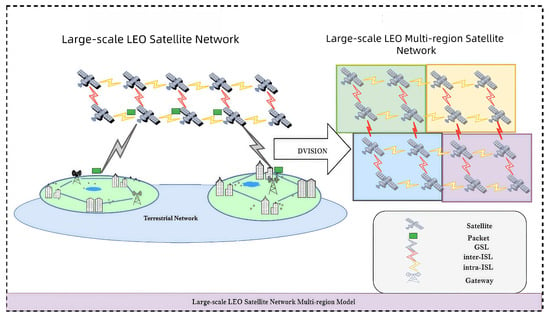
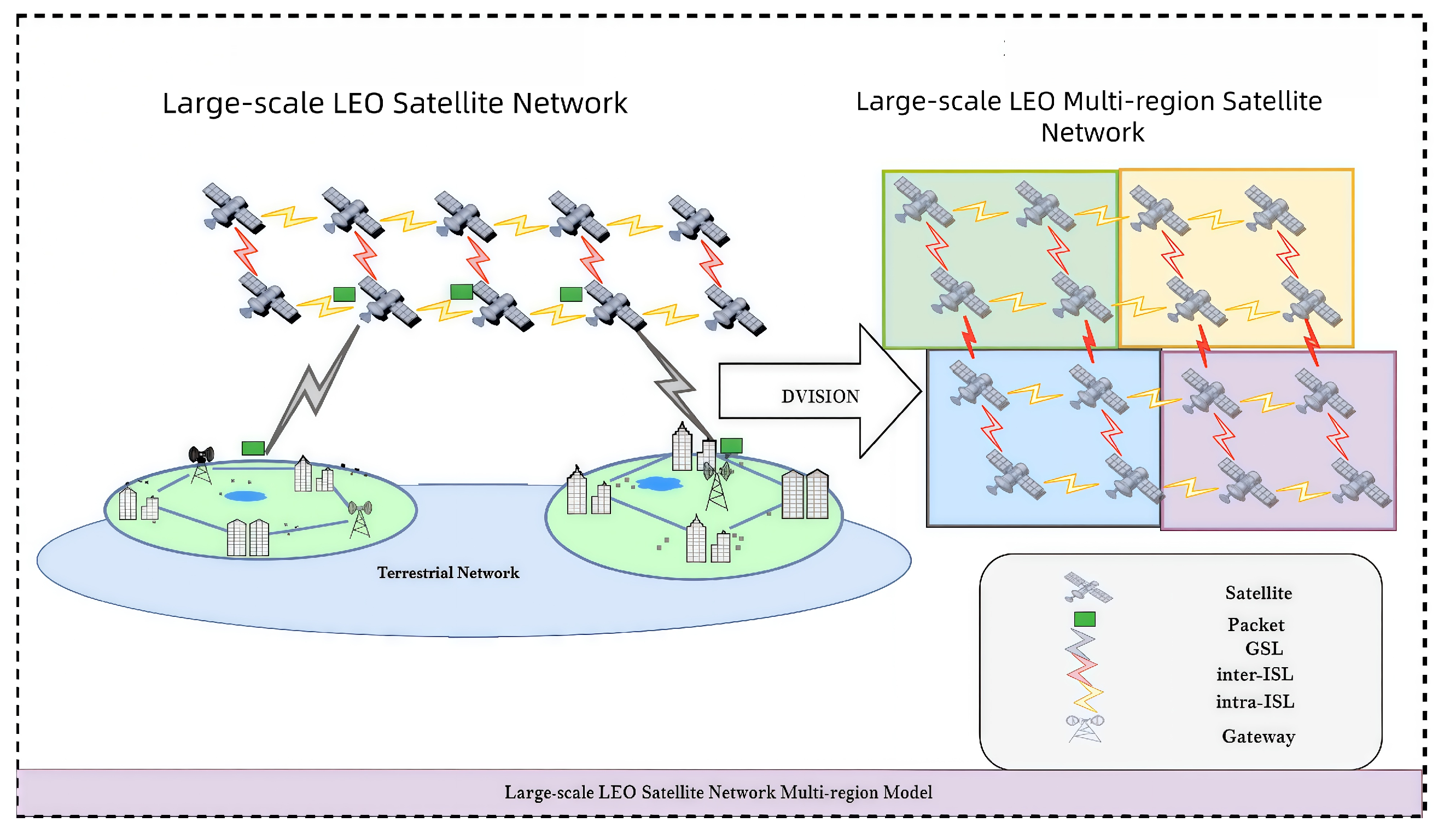
We consider a mega LEO satellite constellation system as shown in Figure 1, where multiple ground gateways achieve interconnection through the satellite constellation, with their generated traffic data packets forwarded via inter-satellite links. End-to-end routing connects multiple ground gateways through the LEO satellite constellation, integrating the space segment and ground segment into a unified communication network. The relevant symbols introduced in this section are listed in Table 1.
Figure 1.
LEO satellite network system model.
Table 1.
System model symbol definitions.
3.1. Satellite Constellation Model
3.1.1. Walker Constellation Configuration
This paper adopts the Walker-Delta constellation configuration [36], parameterized as . The constellation consists of orbital planes, with each orbital plane containing uniformly distributed satellites. The orbital inclination is (typically ), with the right ascension of ascending node (RAAN) difference between adjacent orbits being . The phase factor is a key parameter of the Walker constellation used to determine the phase offset between satellites in adjacent orbits . Different phase factor configurations lead to different satellite distribution patterns, thus affecting inter-satellite link topology. Unlike Walker-Star constellations, Walker-Delta constellations can establish long-term stable and sustainable intra-orbital and inter-orbital links by selecting appropriate phase factors. To simplify analysis and ensure inter-orbital ISL stability, this paper sets , which maintains fixed geometric relationships between satellites at the same corresponding positions in adjacent orbits, forming a regular Manhattan street network topology. This topology has good symmetry and predictability, facilitating routing algorithm design and optimization. The total number of satellites in the constellation is . Each orbital plane typically approximates a circular orbit, deployed at height h above Earth’s surface.
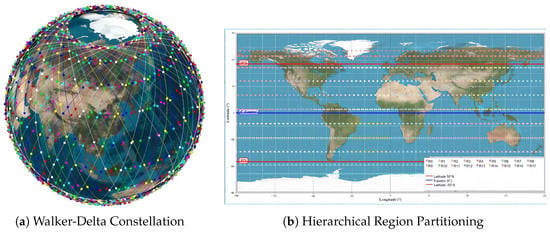
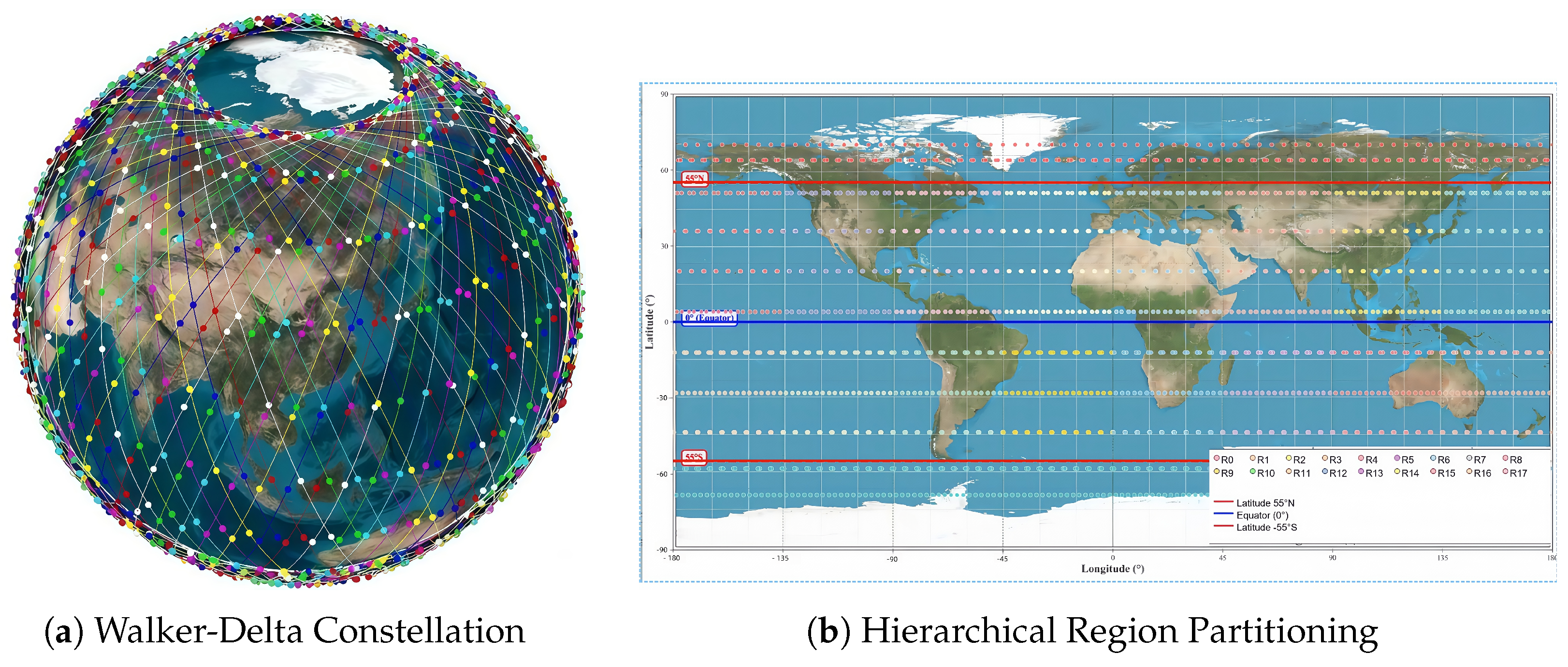
As shown in Figure 2, mega LEO satellite constellations construct dense inter-satellite link networks globally through thousands of satellites, achieving global seamless coverage and efficient data transmission. The total number of satellites in the constellation is . Each orbital plane typically approximates a circular orbit, deployed at height h above Earth’s surface.
Figure 2.
Mega LEO satellite constellation visualization. (a) Global 3D deployment showing the Walker-Delta constellation structure with inter-satellite links (ISLs) forming a mesh network topology. (b) Geographic partitioning scheme dividing the network into regions based on latitude–longitude coordinates, with high-latitude regions () and low-latitude sectors ( longitude intervals). Each region (R0–R17) is color-coded with distinct satellite distributions.
Each satellite is uniquely numbered according to its position in the constellation. For the m-th satellite in orbital plane (), its global index i can be calculated as
3.1.2. Network Topology Architecture
LEO satellite networks can be modeled as a time-varying dynamic graph , where the node set and edge set evolve dynamically over time. The node set consists of two disjoint subsets, i.e., , where represents the set of satellite nodes, and represents the set of ground gateways. Correspondingly, the edge set represents communication links in the network, defined as , where is the inter-satellite link (ISL) set, and is the ground-satellite link (GSL) set. The ISL set can be further expressed as the union of all satellites’ currently feasible links, i.e., , where represents the set of ISLs available for communication for satellite i at the current moment.
3.1.3. Inter-Satellite and Satellite-Ground Links
Satellites move at high speeds in space; however, under the same constellation configuration, relative positions between satellites can remain stable, enabling ISL connections to have persistence and predictability. Each satellite is equipped with four antennas for inter-satellite communication, capable of establishing and maintaining up to four ISLs. These links are classified into two categories, presented below.
Intra-orbital links: Using two antennas on either side of the roll axis, establishing communication links with front and rear neighbor satellites in the same orbital plane. For the m-th satellite in orbit o, its intra-orbital neighbor satellite indices are and .
Inter-orbital links: Through two antennas on either side of the pitch axis, establishing communication links with satellites in adjacent orbital planes. For the m-th satellite in orbit o (), its inter-orbital neighbors are located at corresponding positions in orbital planes and . Boundary orbits ( and ) can only establish one inter-orbital link.
Therefore, the number of feasible ISLs for each satellite i satisfies .
Ground user terminals interact with the satellite constellation through gateways, which aggregate communication traffic from users within their coverage area and access the satellite network through ground-satellite links. The ground segment consists of multiple gateways distributed globally, forming the gateway set . The location of each gateway is uniquely determined by its latitude–longitude coordinates , where and represent latitude and longitude, respectively. At any moment, each gateway dynamically establishes and maintains one GSL with the nearest satellite within its line-of-sight range. Let the distance between satellite and gateway be , and elevation angle be . When the elevation angle satisfies (typical value is ), the link is considered available. Gateway selects the access satellite from all visible satellites based on minimum distance criterion as
3.2. User Traffic Model
3.2.1. User Distribution Model
User traffic demands depend on the number of ground users, which can be obtained from high-resolution population distribution maps [37]. This map divides Earth’s surface into regular latitude–longitude grids, distributed at fixed intervals in both latitude and longitude directions. Earth is divided into a region set , where each region is characterized by its center coordinates and the number of users within the region. Gateway service coverage is determined by geographic distance, with each region r assigned to the nearest gateway g, which collects and aggregates data generated by all users within its service area.
3.2.2. Traffic Generation and Allocation Model
To simulate real network data generation, queuing, and transmission processes, we adopt a Poisson process at gateways to simulate packet generation, with time intervals between data block arrivals following an exponential distribution. The research focus is on characterizing spatial load distribution under given traffic arrival intensities and on assessing how routing decisions impact load balancing, rather than on accurately reproducing all higher-order temporal statistics of traffic processes; therefore, the Poisson arrival model is adopted as a first-order approximation that enables tractable performance evaluation. The uplink data generation rate of gateway g is denoted as (in bps), where represents the packet arrival rate (traffic intensity). When the source gateway accumulates data of size B bits with the same destination gateway, it is packaged into a data block for transmission.
Maximum traffic load supported by the network is determined by uplink and downlink GSL rates:
where represents the satellite connected to gateway . Since ISL capacity within the constellation is sufficient, maximum traffic load supported by the network is mainly limited by total GSL capacity. Normalized total traffic load is defined as
Each gateway transmits data packets to other gateways through the LEO satellite constellation. After destination gateways receive packets, they distribute data to connected ground users. To design routing optimization algorithms, this paper adopts an all-to-all communication mode, with each gateway’s uplink traffic uniformly allocated to the other destination gateways. Therefore, total downlink data rate transmitted to gateway is the sum of traffic from other gateways, expressed as
More generally, Equation (5) can be rewritten as
Under the above symmetric traffic pattern, all gateways have identical uplink traffic, and each gateway’s uplink traffic equals its downlink traffic. The downlink data rate of any gateway must satisfy its satellite-ground link data transmission rate constraint:
3.3. Satellite Communication Model
For ISLs and GSLs, the data transmission rate between nodes i and j is determined by real-time channel state. The system adopts an adaptive coding and modulation mechanism based on the DVB-S2 (Digital Video Broadcasting-Satellite-Second Generation) standard [38]. For any feasible link , the system selects the highest-order modulation and coding scheme ensuring reliable communication based on current signal-to-noise ratio (SNR); if the communication link is unavailable due to exceeding communication distance or being obstructed, the transmission rate is zero.
The DVB-S2 standard defines a series of modulation and coding schemes, with each scheme corresponding to a specific spectral efficiency and its required minimum SNR, denoted as . Higher spectral efficiency requires higher minimum SNR. Under free space path loss model assumptions [39], the system first calculates the current link’s instantaneous , then selects the highest-order scheme from available scheme set satisfying minimum SNR requirements. Therefore, data transmission rate from node i to node j is given by
where is the optimal spectral efficiency satisfying SNR constraints: satisfying constraint . Here, W is communication bandwidth, is the modulation and coding scheme set defined by DVB-S2 standard, and is the SNR of the link from node i to j, calculated as
where is transmission power, and are transmit and receive antenna gains, respectively, is carrier wavelength, is distance between nodes, is the Boltzmann constant, and is system noise temperature.
3.4. Delay Model
In satellite networks, end-to-end delay of data blocks from source gateway to destination gateway consists of accumulated single-hop delays between all nodes on the transmission path. This section establishes a delay model to provide performance metrics for routing optimization. We define the process of sending a data block of size B bits to neighbor node j as one-hop transmission. In this process, the data block experiences three types of delays at node i: queuing delay, transmission delay, and propagation delay.
3.4.1. Queuing Delay
Queuing delay is the time a data block waits in the transmission buffer queue at node i to be served. Each node maintains a first-in-first-out (FIFO) queue with maximum capacity . For a newly arrived data block at node i, its queuing delay depends on the number of data blocks already in the queue at arrival and the service time of preceding blocks. According to buffer queue service mechanisms, queuing delay can be expressed as
where is the number of data blocks waiting for transmission in the queue of node i, B is data block size, and is the average data transmission rate across all output links of node i. In discrete event simulation environments, queuing delay can also be obtained through direct measurement, i.e., the difference between data block transmission start time and arrival time.
3.4.2. Transmission Delay
Transmission delay is the time required for node i to completely send a data block of size B bits to the link at data transmission rate . According to fundamental principles of digital communication, transmission delay is proportional to data block size and inversely proportional to link transmission rate:
where is adaptively determined by real-time channel state according to Equation (8).
3.4.3. Propagation Delay
Propagation delay is the time required for electromagnetic wave signals to propagate at speed of light c through free space over distance between nodes i and j. According to electromagnetic wave propagation theory
where m/s is the speed of light in vacuum. For ISLs, propagation delay is typically in the order of milliseconds; for GSLs, due to relatively shorter distances, propagation delay is generally less than ISLs.
3.4.4. Single-Hop Total Delay
Combining the above three delay components, single-hop total delay for a data block from node i to neighbor node j can be expressed as
Substituting each component into Equation (13), the complete expression for single-hop delay is
For end-to-end path (where is the source node and is the destination node), total delay is the sum of all single-hop delays on the path:
This delay model provides a quantitative performance evaluation basis for subsequent routing optimization algorithm design.
4. Hierarchical Load-Balanced Routing Algorithm
To address routing challenges in mega LEO satellite constellations with thousands of satellites forming high-dimensional dynamic networks, this section proposes a hierarchical load-balanced routing algorithm based on geographic partitioning. The proposed framework aims to achieve three primary objectives: (1) reducing end-to-end latency through region-aware path selection, (2) balancing traffic load across inter-satellite links to avoid congestion hotspots, and (3) enhancing scalability by decomposing the global routing problem into intra-region and inter-region subproblems. These objectives form a natural hierarchy: geographic partitioning determines the routing granularity, intra-region routing focuses on selecting locally efficient paths, while inter-region routing coordinates traffic exchange between regions to alleviate global bottlenecks. The algorithm decomposes the global routing problem into inter-region routing and intra-region routing subproblems, significantly reducing computational complexity and enhancing system scalability. First, the global satellite network is divided into disjoint regions based on latitude and longitude, making the topology within each region relatively stable; second, a hierarchical graph model containing intra-region and inter-region subgraphs is constructed, achieving topology abstraction from satellite-level to region-level through attribute aggregation; finally, a hierarchical routing framework is proposed, integrating load-aware exit-entry satellite selection, differentiated path pre-computation, and adaptive routing decisions based on queue state to ensure load balancing and robustness under high-load scenarios.
4.1. Hierarchical Network Architecture and Modeling
4.1.1. Region Partitioning Strategy
This paper designs a static hierarchical region partitioning strategy based on latitude–longitude coordinates, dividing the global satellite network into fixed regions, decomposing routing computation into independent execution at region granularity, effectively avoiding direct search on global graphs containing thousands of satellites.
The partitioning strategy follows three principles: (1) Geographic symmetry: utilizing Earth’s natural latitude–longitude symmetry for regular partitioning; (2) Latitude partitioning: adopting fixed threshold partitioning based on different latitude orbital geometry characteristics, merging high latitudes into polar large regions, and further dividing low latitudes into sectors uniformly by longitude; and (3) Relative topology stability: satellites within regions mainly come from adjacent orbital planes, with slowly changing relative positions, reducing routing table update frequency. The rationale for differentiated granularity stems from the distinct ISL dynamics across latitudes. In high-latitude regions, orbital convergence increases satellite density and relative ground velocity, causing inter-orbital ISLs to experience rapid distance and angle variations, frequent crosslink swaps, and consequently high topological volatility. Conversely, in low-latitude regions, maximum orbital spacing and stable relative motion enable inter-orbital ISLs to maintain long-term stable connections with slow angular changes. Therefore, coarse-grained partitioning in high latitudes mitigates routing oscillations induced by topology changes, while fine-grained partitioning in low latitudes exploits link stability for efficient local routing organization and load balancing. Based on the above principles, this paper divides the global satellite network into fixed regions, including high-latitude regions and low-latitude regions. Thus, total region number is decoupled from total satellite number , ensuring scalability for large-scale LEO satellite constellations.
Based on this, we provide formal definitions for region sets: the global region set is represented by tuple . The region assignment function , which uniquely maps satellite to region based on the satellite’s latitude–longitude coordinates , is defined. Then the satellite subset within region can be expressed as
To ensure completeness and mutual exclusivity of region partitioning, all regions must satisfy the following two key constraints:
4.1.2. Regional Boundary Satellites
In hierarchical routing architecture, boundary satellites serve as exit-entry nodes for inter-region data transmission. Satellite is identified as a boundary satellite of region if and only if it establishes inter-satellite links (ISL) with at least one satellite belonging to other regions, expressed as
4.1.3. Hierarchical Graph Model Construction
To support hierarchical routing computation, this section constructs a two-layer graph model, consisting of intra-region network graphs and inter-region network graphs, described as follows.
(1) Global network graph serves as the underlying physical topology, containing all satellite nodes, ground gateways, inter-satellite and satellite-ground links, recording dynamic attributes such as distance and rate, providing specific data for intra-region and inter-region graphs. The node set , where is the satellite set and is the ground gateway set; the edge set , where is the inter-satellite link set and is the satellite-ground link set. To support routing decisions based on link attributes, each ISL has the following attributes: —physical distance between satellites i and j, calculated from both parties’ instantaneous positions; —instantaneous data transmission rate, based on DVB-S2 adaptive coding and modulation mechanism, determined by instantaneous signal-to-noise ratio (SNR); and —transmission delay, ratio of data block size B to data transmission rate.
(2) Intra-region graph is a subgraph projection of global graph G on region , where only retains intra-region satellite nodes, includes all ISLs connecting them, forming mutually independent local topologies, reducing intra-region routing computation spatial complexity from to .
(3) Inter-region graph serves as high-level network abstraction, with each region abstracted as a node, and cross-boundary ISLs between adjacent regions aggregated as an aggregated edge. The inter-region graph node set consists of regions, represented by set , where each node represents a region, encapsulating aggregated information of all satellites within that region. Edge exists between regions and if and only if at least one physical ISL exists between boundary satellites of these two regions, i.e., , ensuring that inter-region edge existence is based on underlying physical connections, avoiding introduction of unreachable virtual links.
In actual constellations, multiple cross-region ISLs usually exist between two adjacent regions, representing different boundary satellite links. To use unified link attributes in inter-region routing, these scattered ISL attributes need to be aggregated into single values. First, we define the set of all cross-region ISLs between regions and :
Since inter-region graph abstracts each region as a single node, attributes of multiple physical ISLs connecting adjacent regions need to be aggregated into unified weights for region-level edges to support inter-region path planning. This paper adopts arithmetic mean aggregation strategy. For edge between regions and , its aggregated link attributes are defined as follows.
Average physical distance : spatial separation degree of inter-region cross-boundary ISLs, calculated as arithmetic mean of physical distances between all boundary satellite pairs in set :
Average transmission rate : characterizing average data transmission capability between regions, obtained through arithmetic mean of instantaneous transmission rates of all cross-region ISLs:
Average transmission delay : quantifying average transmission time of data blocks on inter-region links, defined as arithmetic mean of transmission delays of all cross-region ISLs:
where is the transmission delay of individual ISL, and B is data block size.
4.2. Hierarchical Routing Algorithm Framework
4.2.1. Hierarchical Routing Representation
The hierarchical routing framework decomposes end-to-end routing problems into two subproblems. Complete end-to-end path is obtained by concatenating all intra-region paths and cross-region ISLs:
4.2.2. Inter-Region Routing
Inter-region routing executes on inter-region graph , aiming to find optimal inter-region path sequences from source region to destination region . Using aggregated link attributes, the Dijkstra algorithm is adopted with reciprocal of average transmission rate as weight to compute shortest paths:
For adjacent regions and in the sequence, exit-entry satellite pair selection aims to minimize maximum queue load:
4.2.3. Intra-Region Routing
After determining exit-entry satellites, intra-region path selection adopts K-shortest paths algorithm [40] to pre-compute multiple diversified paths:
The k-th path is computed by applying weight penalties to edges in the first paths:
Optimal paths are selected based on real-time queue loads:
4.2.4. Algorithm Execution Flow
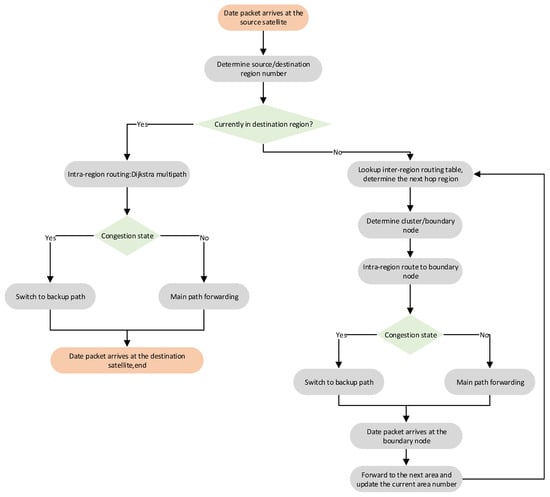
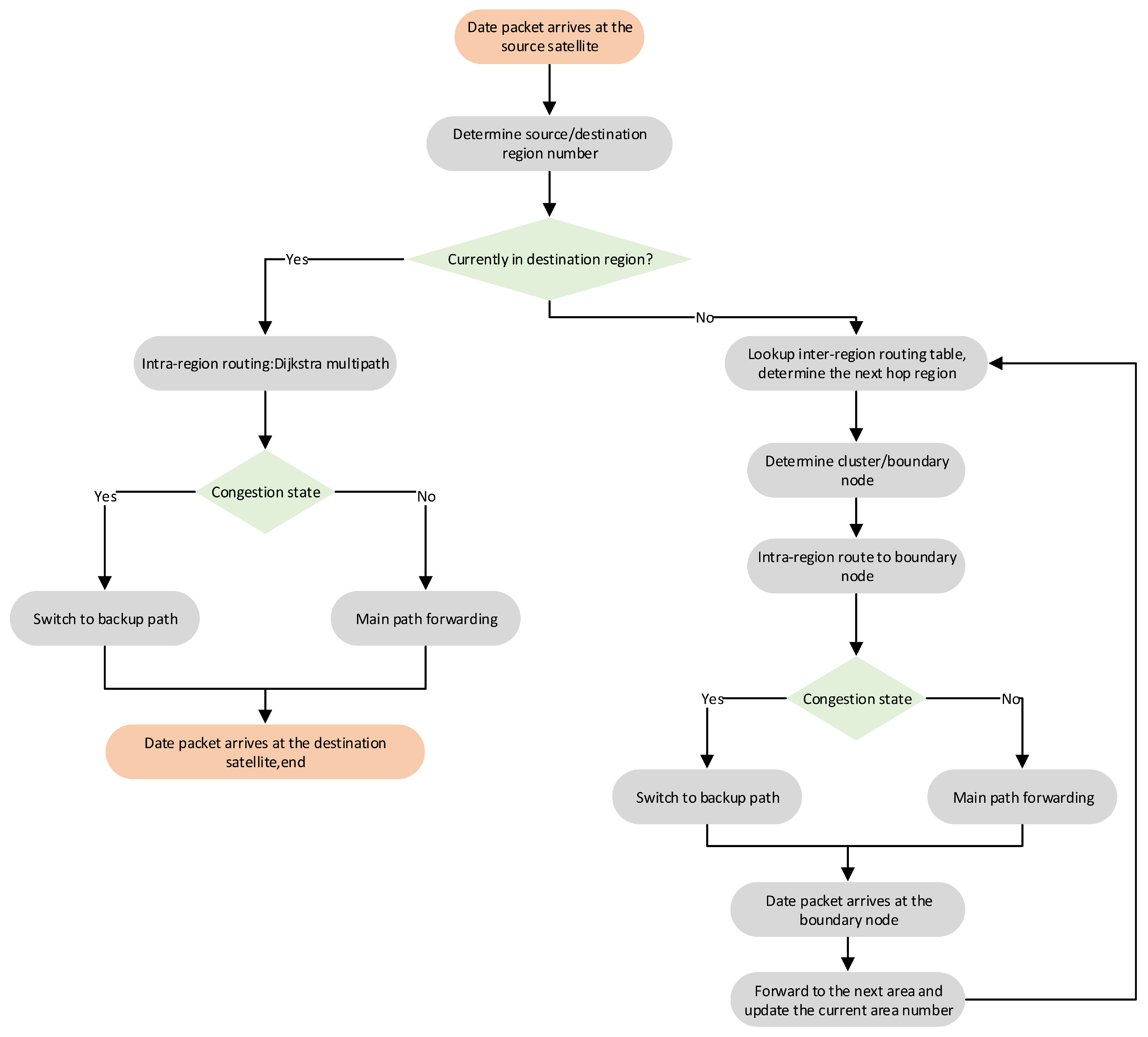
Based on the above problem decomposition, Figure 3 illustrates the complete decision-making process of the hierarchical routing algorithm, including region determination, intra-region Dijkstra multipath routing with congestion detection and backup path switching, inter-region routing table lookup, and load-aware boundary satellite selection. This hierarchical decision mechanism effectively balances routing performance and computational complexity while maintaining load distribution across the constellation.
Figure 3.
Hierarchical load-balanced routing algorithm decision flowchart.
Algorithm 1 formalizes this process with detailed pseudocode, incorporating load-aware decision-making at multiple levels.
The algorithm incorporates load-aware decision-making at multiple levels. For same-region routing, it directly computes K-shortest paths (Equation (27)) and selects the path with minimum maximum queue load (Equation (29)). For cross-region routing, the algorithm operates in three stages:
Stage 1 (Route Retrieval): The algorithm queries the pre-computed inter-region routing table using the source and destination regions as indices. This routing table is constructed offline by running shortest-path algorithm on the inter-region graph , where each region is abstracted as a node. The table stores candidate region sequences representing high-level paths with minimum aggregated transmission cost.
Stage 2 (Path Construction): For each candidate region sequence, the algorithm constructs a complete satellite-level path by iteratively processing consecutive region pairs. At each inter-region boundary, two key operations are performed: (1) the algorithm evaluates all available boundary satellite pairs connecting the two regions and selects the pair that minimizes the maximum queue load between them (Equation (26)), thereby avoiding congested boundary nodes; (2) if the current satellite position differs from the selected exit satellite, the algorithm computes an intra-region path segment using the K-shortest paths method (Equation (27)), selecting the path with minimum bottleneck load (Equation (29)). This process continues until the destination satellite is reached, with the algorithm tracking the maximum queue load encountered across all traversed satellites.
Stage 3 (Optimal Selection): After constructing paths for all candidate region sequences, the algorithm compares their bottleneck loads and returns the complete end-to-end path with the minimum bottleneck load, ensuring globally optimal load-aware routing.
| Algorithm 1 Load-Aware Hierarchical Routing Algorithm |
|
4.2.5. Computational Scalability of Hierarchical Routing
The hierarchical decomposition also reduces the asymptotic complexity of routing computation. In a flat design, running Dijkstra once on the global satellite graph with satellites incurs a time complexity of . Because each satellite maintains a bounded number of ISLs, , and thus the overall complexity is . In the proposed hierarchical architecture, the routing problem is decomposed into an inter-region part and multiple intra-region parts. Inter-region routing is performed on the region-level graph , which contains only nodes () and has , leading to a complexity of . For each region , intra-region routing is executed on the local subgraph , where and , so each shortest-path computation has complexity . Overall, the hierarchical framework replaces a single global shortest-path search of order with several searches on much smaller graphs; when is fixed and grows, the total complexity scales as , which has a reduced logarithmic factor compared to . This shows that geographic partitioning effectively reduces routing computation complexity and improves scalability for mega-constellations. Moreover, the hierarchical structure confines the per-satellite computational load to the regional scale, i.e., , which aligns well with the capabilities of typical LEO onboard processors. Inter-region routing tables and K-shortest paths are pre-computed on the ground and uploaded via Telemetry, Tracking, and Command (TT&C) links, while load-aware exit-entry selection and optimal path decisions are executed onboard using queue state information obtained through periodic ISL exchanges with neighboring satellites.
5. Simulation Results
5.1. Simulation Setup
To evaluate the performance of the hierarchical load-balanced routing algorithm, this simulation study constructs a LEO satellite network simulation environment based on a Starlink-type Walker Delta constellation consisting of satellites. The satellite constellation is deployed at orbital altitude km, containing orbital planes with each orbital plane uniformly distributing satellites, and orbital inclination set to . In the network topology, each satellite establishes connections with the adjacent four satellites through inter-satellite links (ISL), forming a space backbone network with good connectivity. The minimum elevation angle threshold for ground gateways is , ensuring reliable communication links between satellites and ground gateways. Simulation duration is seconds. Within the first 0.1 s of simulation start, global users generate data requests, and gateways generate data blocks based on user demands for transmission through the satellite network to destination gateways.
To simulate heterogeneous load conditions in mega satellite networks, satellites are randomly selected for link degradation processing with degradation factor , reducing their ISL transmission rates to 20% of original rates. Data block size is set to KB and single user baseline data generation rate is KB/s. To test algorithm performance under different load conditions, network load is gradually increased by adjusting traffic generation multiplier factors within [20, 60] interval, simulating changes from low load to high load processes. Routing algorithms tested include shortest path algorithm and hierarchical load balancing algorithm. The hierarchical algorithm divides the globe into geographic regions, with each region independently maintaining intra-region and inter-region routing tables. Within regions, fast diversified path algorithm pre-computes backup paths, which strikes an optimal trade-off between linear computational complexity growth and diminishing marginal returns of path diversity, while inter-region routing selects optimal exit-entry satellite pairs based on load awareness.
Simulation adopts queue length-based congestion control mechanism. When hierarchical algorithm selects inter-region exit-entry satellite pairs, load threshold is used as the load balancing criterion, ensuring efficient data transmission and load distribution. During simulation, satellite movement and link reconstruction occur every seconds, while recording key performance metrics such as end-to-end delay, throughput, and packet loss rate. Main simulation parameters are shown in Table 2.
Table 2.
System simulation parameters.
5.2. Performance Evaluation
To comprehensively evaluate the performance of hierarchical load balancing algorithm, this section analyzes performance differences between hierarchical algorithm and shortest path algorithm from three dimensions: end-to-end delay, load balancing, and throughput.
5.2.1. End-to-End Delay Performance
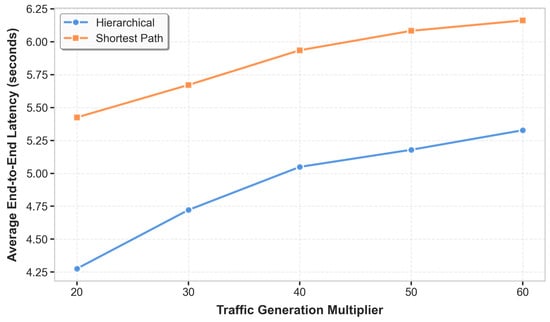
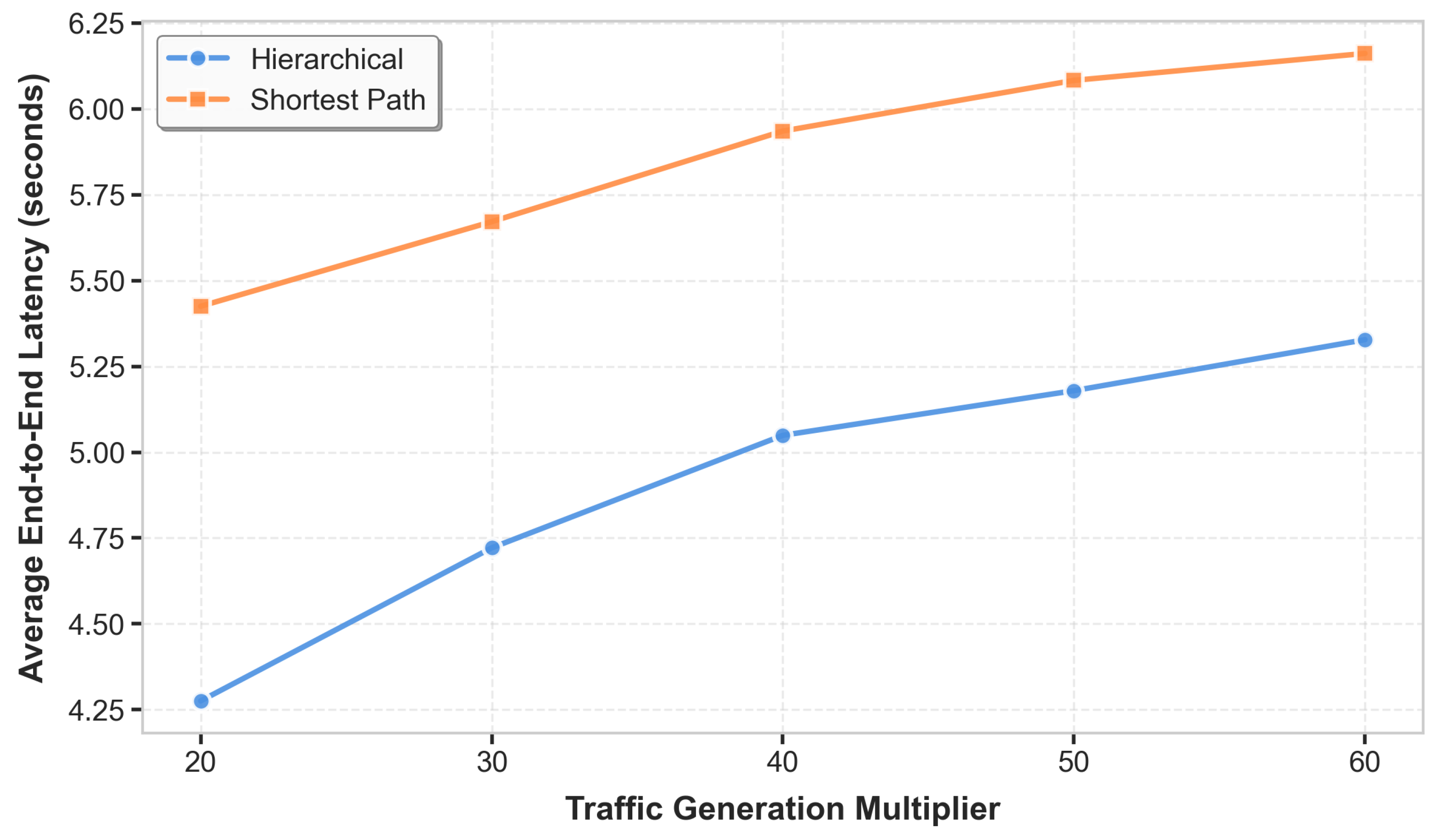
End-to-end delay consists of propagation delay, transmission delay, and queuing delay. Figure 4 shows end-to-end delay comparison under different traffic multipliers. As traffic multiplier increases from 20 to 60, shortest path algorithm’s end-to-end delay rises from 5.43 s to 6.18 s, an increase of approximately 13.8%; hierarchical algorithm’s end-to-end delay rises from 4.27 s to 5.31 s, an increase of approximately 24.4%. Although hierarchical algorithm’s end-to-end delay increases somewhat with increasing traffic, it remains lower than shortest path algorithm under all traffic multiplier scenarios. At 20× traffic, hierarchical algorithm’s end-to-end delay is 21.4% lower than shortest path; at 60× traffic, it remains 14.1% lower. End-to-end delay increase mainly comes from queuing delay growth, because as traffic increases, overall network load increases. Even with load balancing strategies, queuing cannot be completely eliminated. However, hierarchical algorithm effectively reduces queuing delay growth rate through traffic dispersion.
Figure 4.
End-to-end delay comparison under different traffic multipliers.
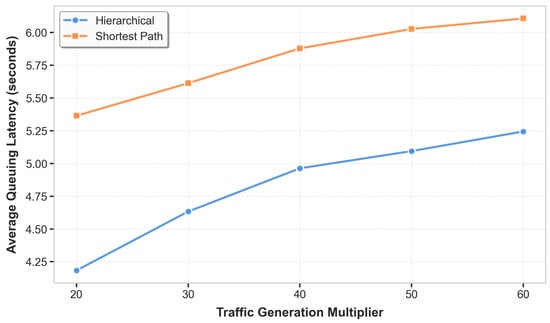
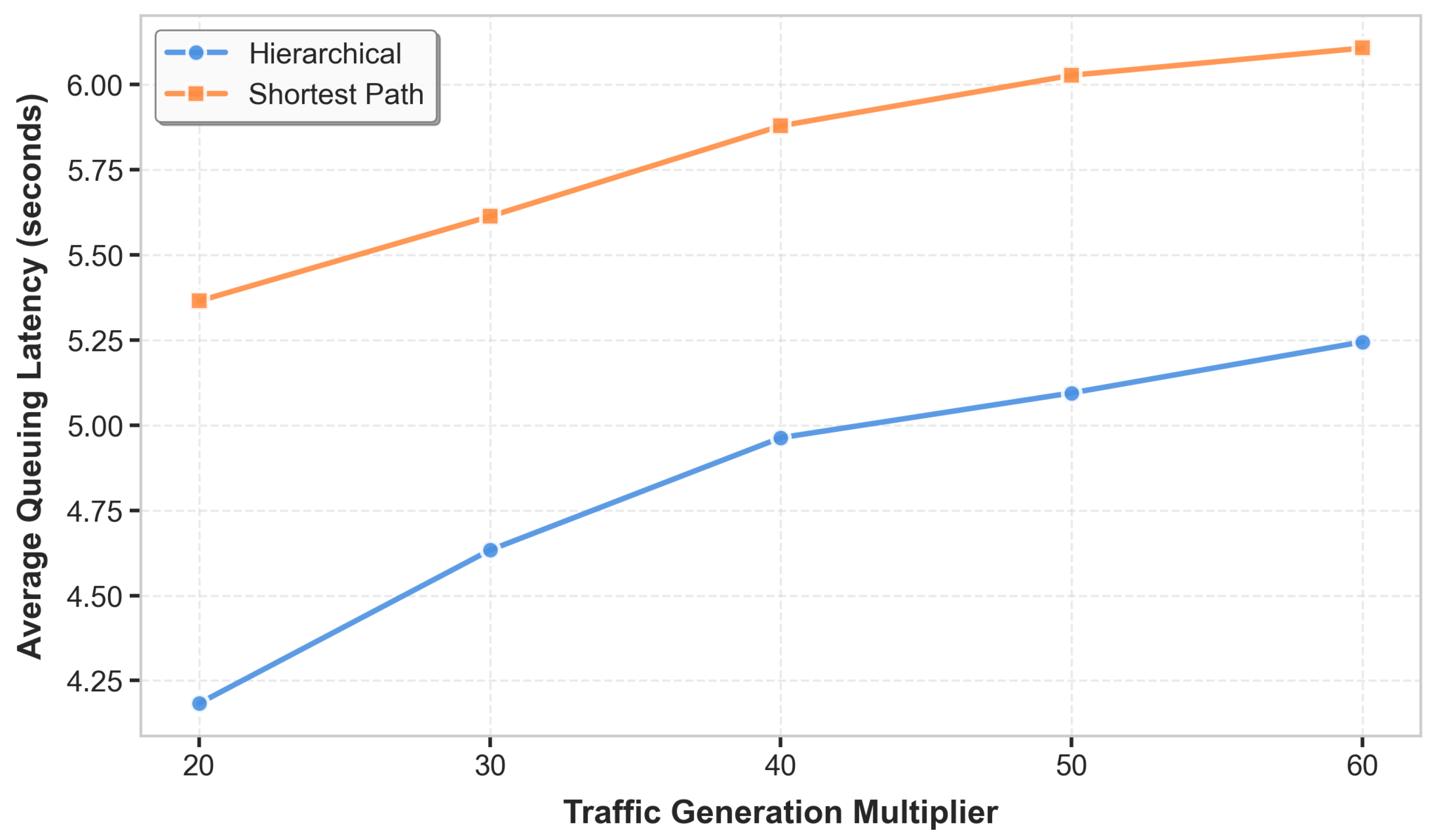
Queuing delay is the most traffic-sensitive component in end-to-end delay. Figure 5 shows queuing delay comparison under different traffic multipliers. As traffic multiplier increases, shortest path algorithm’s queuing delay rises from 5.37 s to 6.09 s; hierarchical algorithm’s queuing delay rises from 4.18 s to 5.24 s. Hierarchical algorithm significantly outperforms shortest path algorithm in queuing delay, remaining lower than shortest path under all traffic multiplier scenarios, with reduction ranging from 14 to 22%. Hierarchical algorithm reduces queuing delay through three-layer load dispersion mechanism: first, aggregated link attributes in inter-region graph provide macro load view, avoiding high-load regions; second, dynamic exit-entry satellite selection avoids overloaded nodes; third, K diversified paths within regions disperse traffic. Shortest path algorithm’s static routing strategy causes traffic convergence on fixed geometric shortest paths, forming high-load satellite nodes where large numbers of data packets accumulate in these satellites’ queues, leading to persistently high queuing delay.
Figure 5.
Queuing delay comparison under different traffic multipliers.
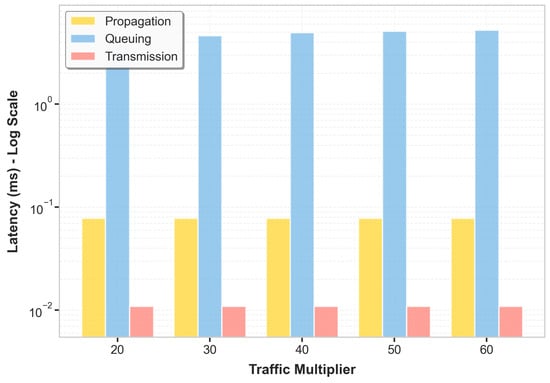
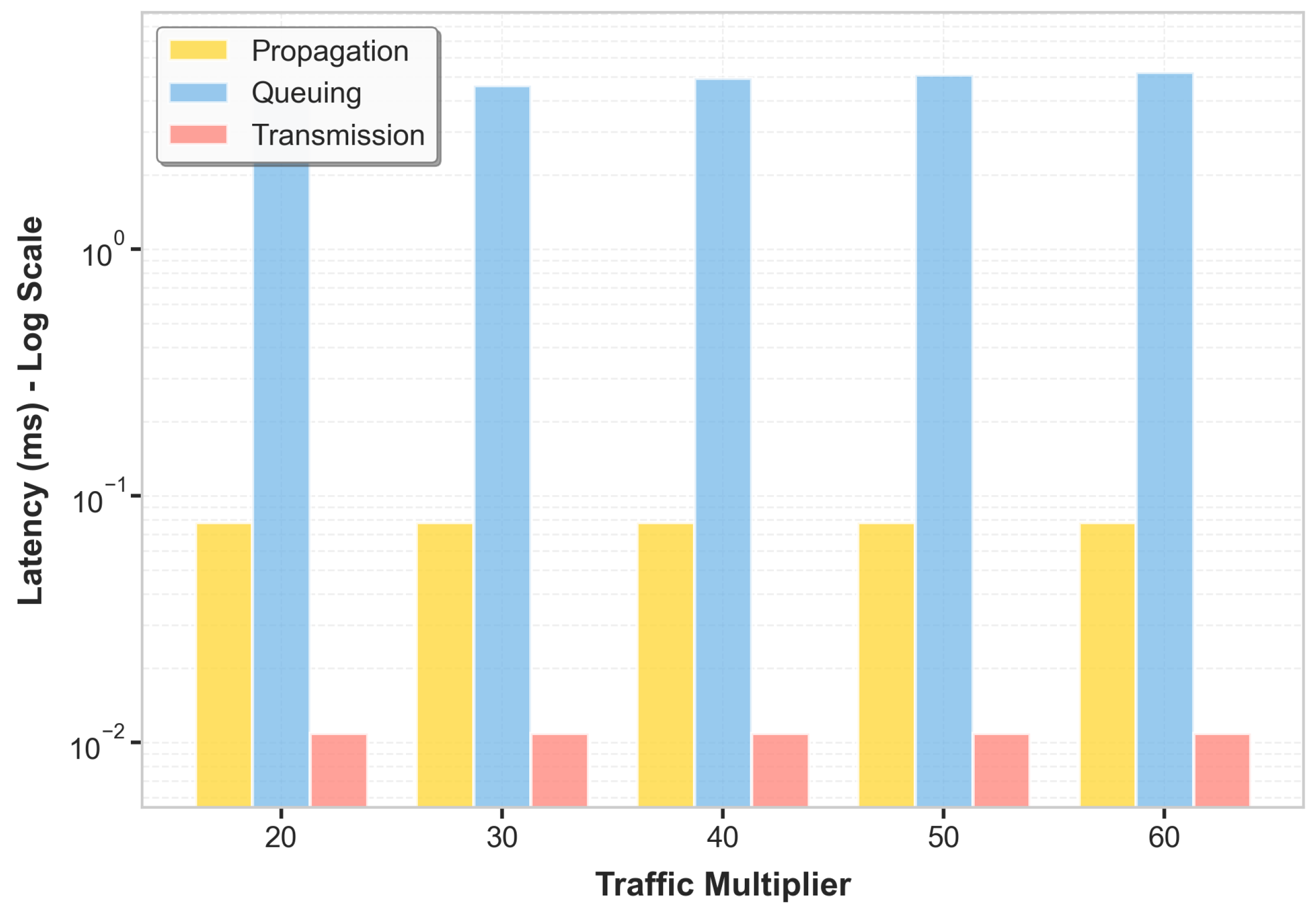
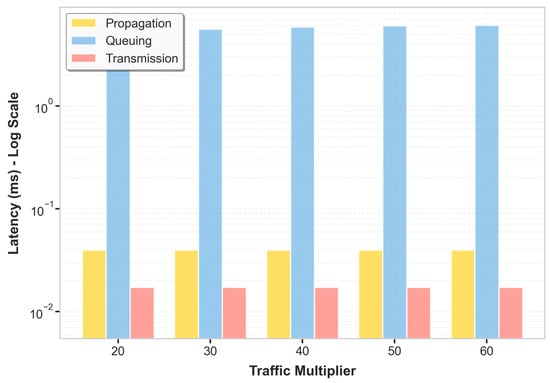
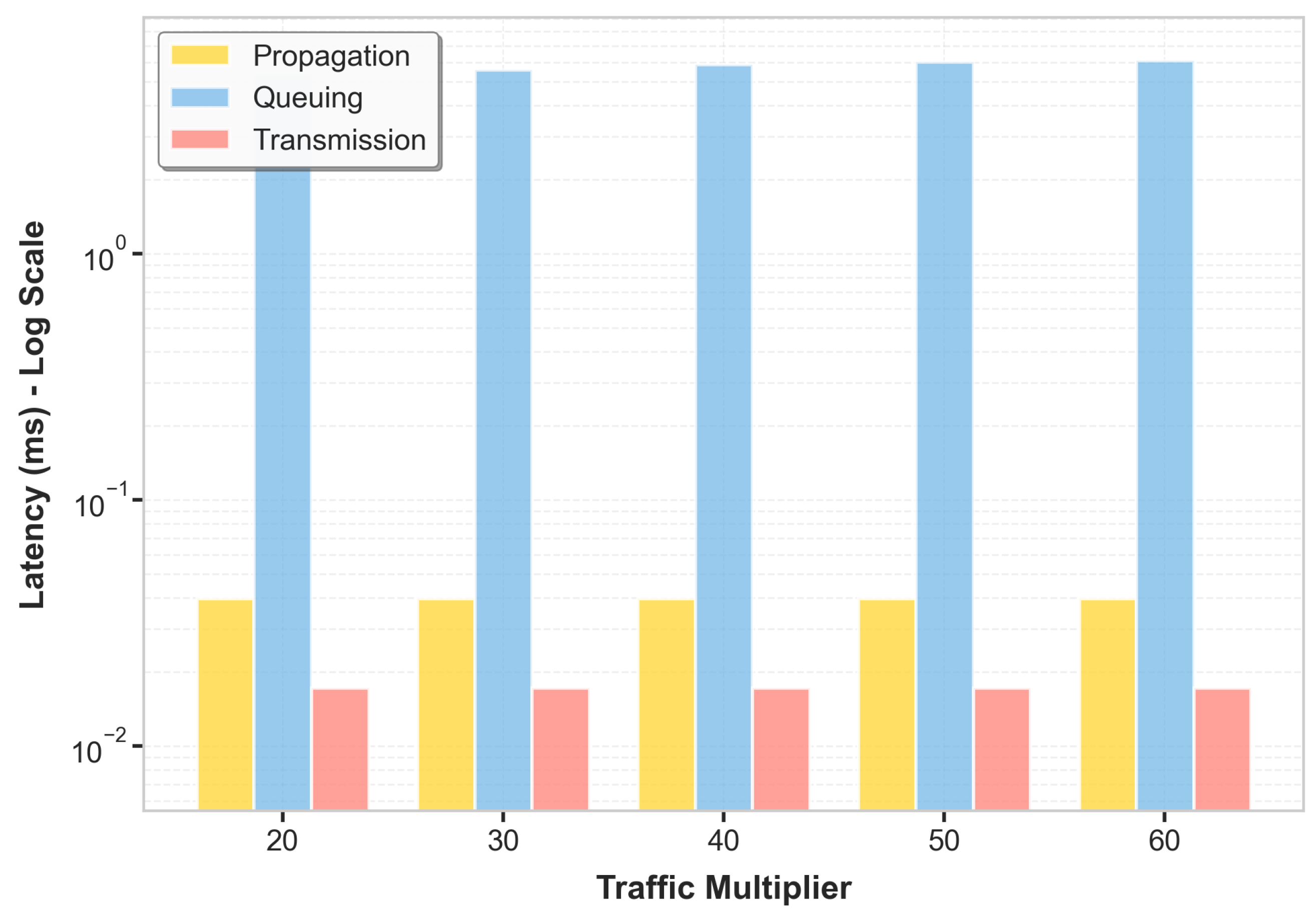
Figure 6 and Figure 7 demonstrate the delay component proportion analysis of the two algorithms. Queuing delay accounts for over 98% across all traffic scenarios, indicating that network bottlenecks primarily manifest as queuing congestion rather than physical transmission limitations. The hierarchical algorithm exhibits approximately 2× higher propagation delay, as it may select paths crossing more regions to avoid congested areas, and its load-aware exit-entry satellite selection prioritizes queue load over physical distance. Since high-load environments are primarily considered, a 20% reduction in queuing delay translates to approximately 19.6% reduction in total end-to-end delay. The hierarchical algorithm achieves superior performance through multi-path traffic distribution: when certain path links are busy, newly arrived data blocks are assigned to alternative paths, enabling parallel utilization of multiple edges within regions.
Figure 6.
Delay composition of hierarchical algorithm under different traffic multipliers (logarithmic scale).
Figure 7.
Delay composition of shortest path algorithm under different traffic multipliers (logarithmic scale).
Delay composition analysis indicates that although the hierarchical algorithm has longer physical paths, by focusing optimization efforts on the dominant queuing delay component through load-aware routing and multi-path distribution strategies, it effectively minimizes end-to-end latency while maintaining robustness under varying traffic conditions. This validates that in mega-constellation routing optimization, intelligent load balancing is far more critical than simply minimizing hop count or physical distance.
5.2.2. Load Balancing Performance
Average satellite load is defined as the spatio-temporal average queue length of all satellites in the network during simulation duration:
where is the number of data blocks in the queue of satellite i at time t, is total constellation satellite count, and is total simulation duration. This metric directly reflects traffic distribution balance—lower indicates that the algorithm effectively avoids high-load satellite node overload.
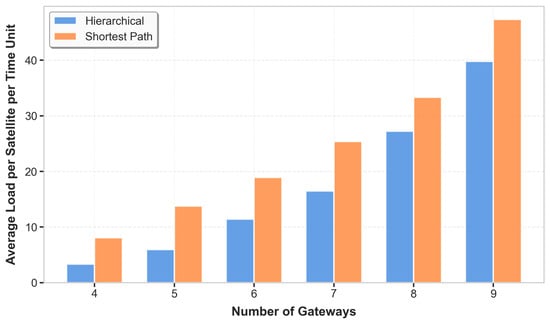
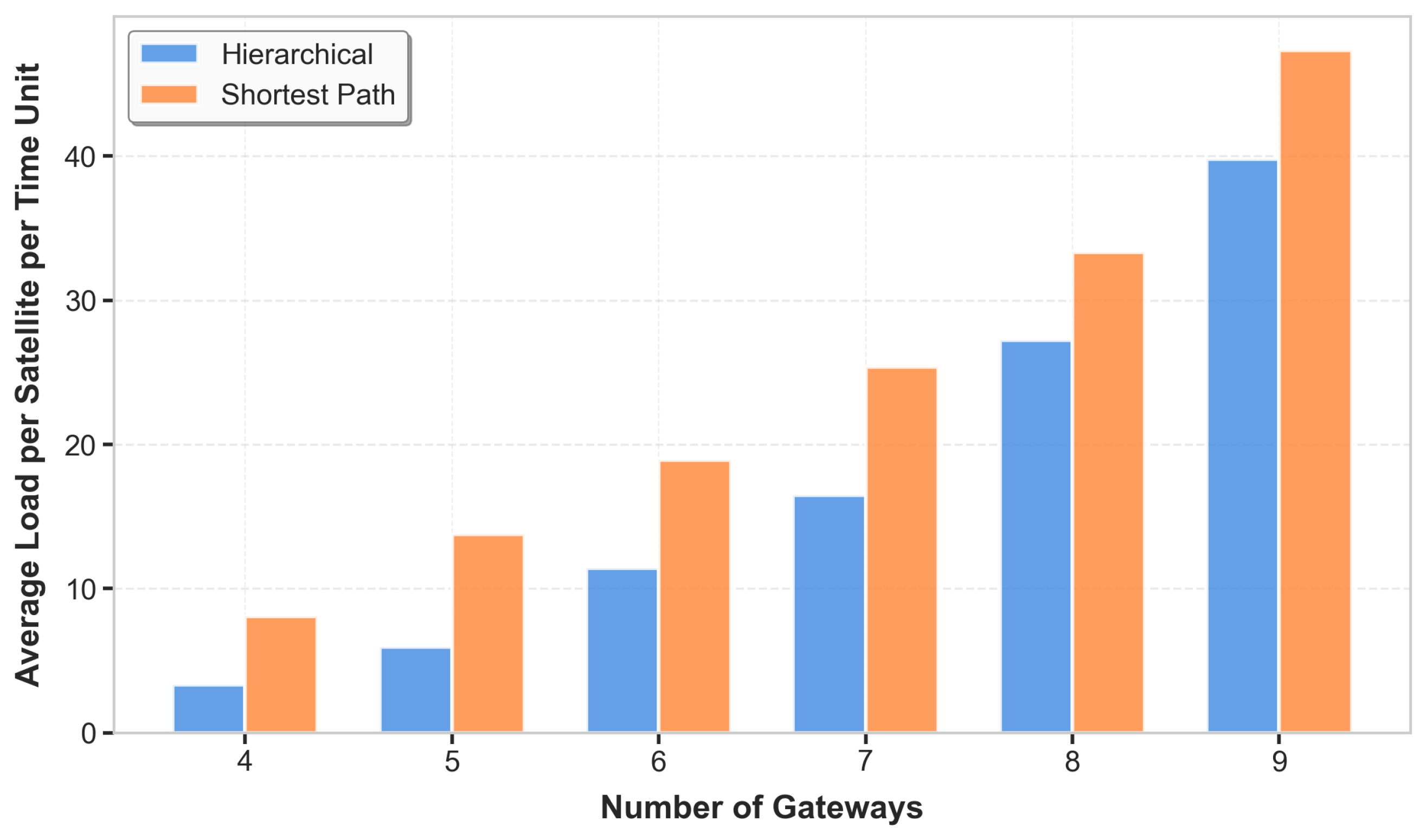
Figure 8 shows satellite average load variation trends with gateway count. As gateway count increases from 4 to 9, hierarchical algorithm’s average load rises from 3.3 to 39.8, consistently lower than shortest path algorithm (from 8.1 to 47.3), with load reduction ranging from 15.9 to 59.3%. Hierarchical algorithm’s growth slope is significantly lower, indicating better scalability. Hierarchical algorithm achieves load balancing through three-layer mechanisms: inter-region load awareness, dynamic exit-entry selection, and intra-region multi-path shunting, effectively avoiding local overload problems caused by shortest path algorithm’s traffic concentration on fixed paths.
Figure 8.
Average satellite load comparison under different numbers of gateways.
5.2.3. Throughput Performance
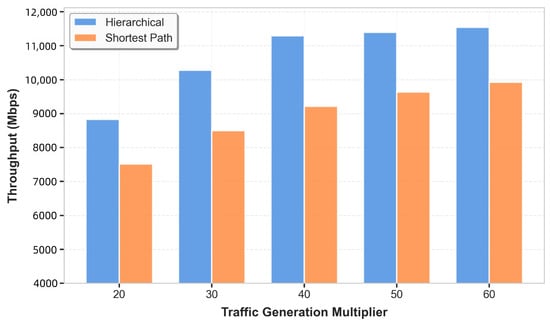
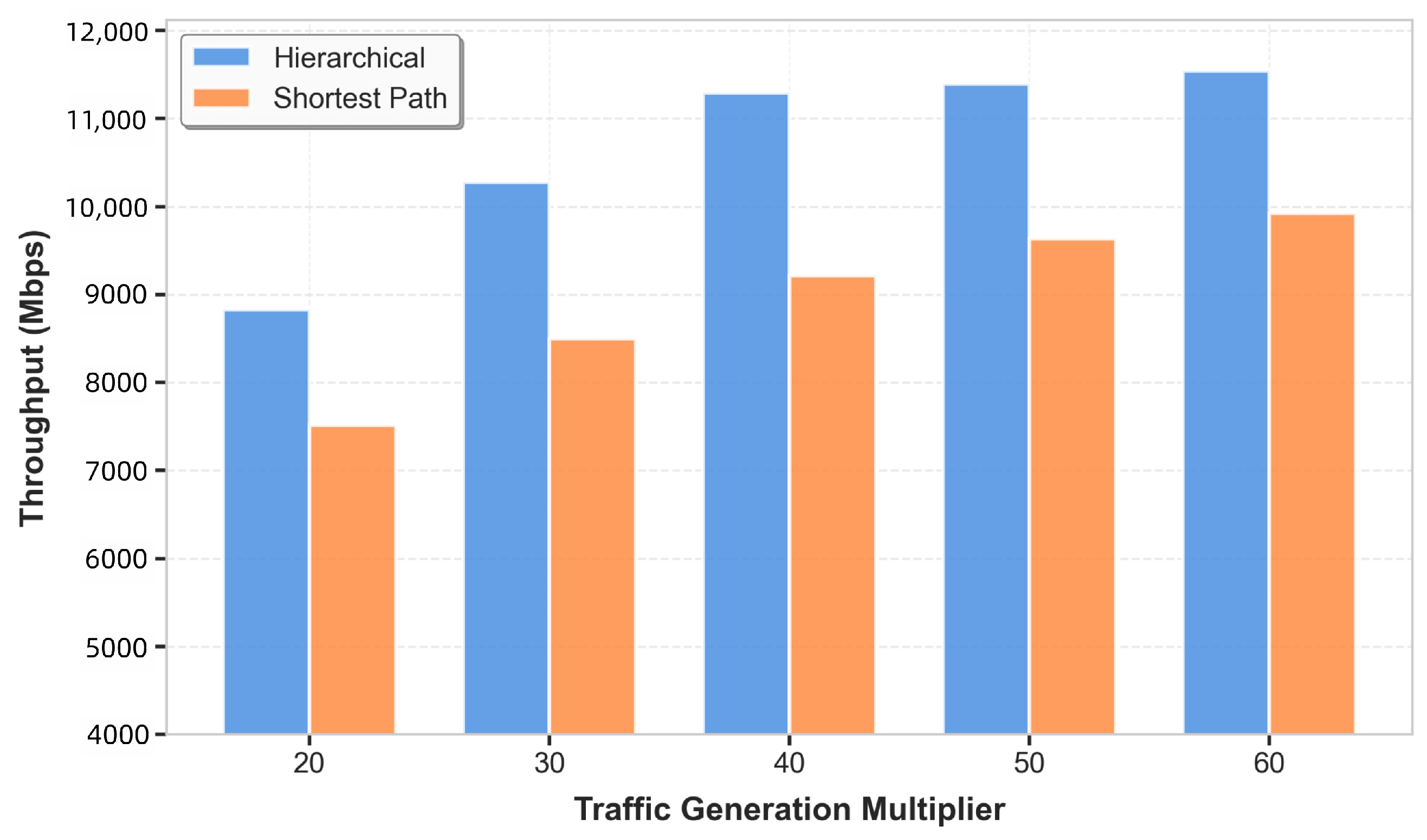
Figure 9 shows system throughput variation trends with traffic multipliers. Hierarchical algorithm significantly outperforms shortest path algorithm in throughput, remaining approximately 16–21% higher across all traffic scenarios. As traffic multiplier increases, both algorithms’ throughput shows upward trends, but hierarchical algorithm’s growth is more stable, indicating it maintains good transmission performance even under high loads. Hierarchical algorithm achieves spatial-temporal multiplexing through K diversified paths: when links on path 1 are in waiting states, newly arrived data blocks are allocated to path 2 or path 3, enabling multiple edges in intra-region graphs to work in parallel, improving link utilization. Additionally, load balancing reduces queuing packet loss rate, enabling more data blocks to transmit successfully. Shortest path algorithm’s static routing causes some links to frequently experience inefficient send-wait-send cycles with higher queuing packet loss rates, limiting throughput.
Figure 9.
Network throughput comparison under different traffic multipliers.
5.2.4. Sensitivity Analysis of Region Partitioning
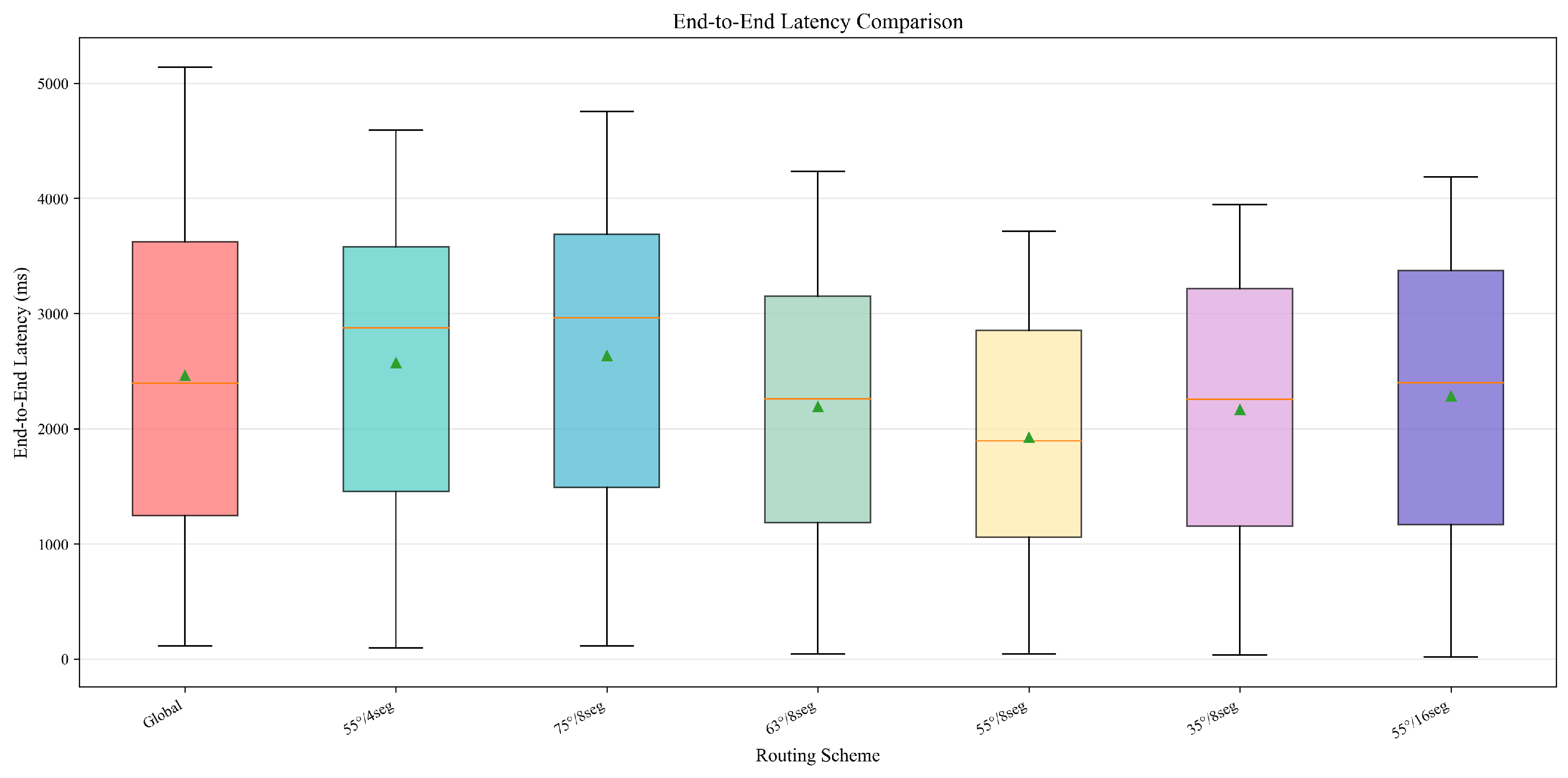
This section investigates the impact of region partitioning parameters on algorithm performance through sensitivity analysis. The experiments vary two key parameters: (1) latitude threshold (35°, 55°, 65°, 75°) with a fixed 8-sector configuration, and (2) sector number (4, 8, 16 sectors) with a fixed 55° latitude threshold. The global shortest-path algorithm without geographic partitioning serves as the baseline for comparison.
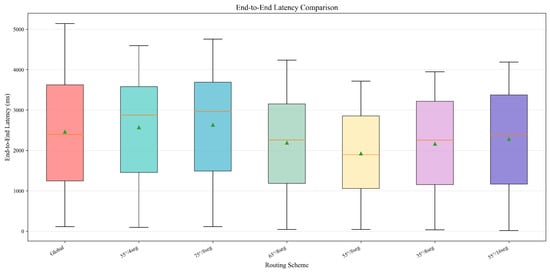
Figure 10 presents the end-to-end latency distribution across different partitioning configurations using box plots. For latitude threshold sensitivity, the 55° configuration achieves the lowest median latency and narrowest interquartile range. At this threshold, the boundary between coarse-grained high-latitude regions and fine-grained low-latitude sectors aligns well with the physical transition zone where inter-orbital ISL stability changes significantly. When the latitude threshold is set too low, a substantial portion of satellites operating in relatively stable mid-latitude orbits are incorrectly grouped into high-latitude regions that employ coarse-grained partitioning; this prevents these satellites from benefiting from the fine-grained load balancing mechanisms designed for stable ISL environments, leading to suboptimal traffic distribution. Conversely, when the threshold is set too high, the polar regions with highly dynamic ISL characteristics are not adequately isolated; the resulting fine-grained partitioning in these volatile zones causes frequent routing table updates as crosslink swaps continuously alter the regional topology, ultimately degrading routing stability and increasing end-to-end latency.
Figure 10.
End-to-end latency sensitivity to region partitioning parameters. Box plots compare latency distributions across different latitude thresholds (35°, 55°, 65°, 75° with 8 sectors) and sector numbers (4, 8, 16 sectors with 55° threshold). The 55°/8seg configuration achieves optimal performance with lowest median latency and smallest variance.
For sector number sensitivity, the 8-sector configuration demonstrates superior performance compared to both fewer and more sectors. When too few sectors are used, each low-latitude region spans an excessively large longitude range containing a high number of satellites; this increases the computational complexity of intra-region path searches, reduces the granularity of load-aware routing decisions, and limits the algorithm’s ability to isolate and circumvent localized congestion. Furthermore, large regions exhibit greater internal traffic heterogeneity, making it difficult for the K-diversified path mechanism to effectively balance loads across all constituent satellites. On the other hand, when too many sectors are employed, the inter-region routing overhead becomes dominant: data flows must traverse more regional boundaries, each boundary crossing incurs additional exit-entry satellite selection overhead, and the increased number of small regions reduces the path diversity available within each region. Additionally, excessive partitioning fragments the network topology, causing the hierarchical abstraction to lose its efficiency advantage as inter-region coordination complexity approaches that of flat routing.
The sensitivity analysis confirms that while algorithm performance varies with partitioning parameters, the hierarchical routing framework consistently outperforms the shortest-path baseline across all tested configurations. Even under suboptimal partitioning settings, the three-layer load dispersion mechanism, which includes inter-region load awareness, dynamic exit-entry selection, and intra-region multi-path distribution, continues to provide substantial performance gains over non-hierarchical approaches. These results validate the robustness of the hierarchical architecture.
6. Conclusions
This paper addresses routing challenges in mega LEO satellite constellations by proposing a hierarchical load-balanced routing algorithm based on geographic partitioning. As mega-constellations like Starlink and OneWeb containing thousands of satellites are rapidly deployed, traditional routing methods face fundamental scalability and adaptability limitations due to highly dynamic topology changes, heterogeneous traffic distribution, and limited onboard computing resources.
This algorithm introduces three key technical contributions. First, a geographic region partitioning strategy based on latitude–longitude coordinates divides the global satellite network into disjoint regions, reducing routing computation complexity from to per region, where . Second, a two-layer graph model consisting of global graph G, intra-region graph , and inter-region graph is constructed, achieving hierarchical topology abstraction from satellite-level to region-level. Third, a hierarchical routing framework integrates load-aware exit-entry satellite selection, K-diversified path pre-computation, and dynamic routing table maintenance mechanisms, achieving load balancing and system robustness.
Extensive simulation experiments are conducted on a Starlink-like Walker constellation with satellites. Under heterogeneous load and dynamic topology scenarios, the hierarchical algorithm achieves 14.1% reduction in end-to-end delay, 14% reduction in queuing delay, 16% improvement in system throughput, and 15.9% reduction in average satellite load compared to shortest path routing. Experimental results demonstrate that the hierarchical load balancing mechanism achieves significant improvements in end-to-end performance, throughput, and load balancing through coordinated effects of region partitioning, dynamic path selection, and load awareness, maintaining stable performance advantages under different load conditions.
The algorithm’s scalability stems from routing complexity decoupling from constellation scale: inter-region routing operates on a fixed node graph independent of , while intra-region routing scales linearly with regional satellite count. Load dispersion mechanisms—region-level load awareness through aggregated link attributes, dynamic exit-entry selection through min-max strategy, and K-diversified paths within regions—collectively prevent high-load node formation and maintain routing stability under traffic fluctuations.
Future research directions include the following: first, extending geographic partitioning strategy to adaptive region boundaries that dynamically adjust based on real-time traffic patterns and constellation density variations. Second, optimizing intra-region K-shortest path algorithms by introducing more refined load prediction mechanisms, enabling path selection to anticipate potential congestion and proactively adjust. Third, validating algorithm robustness under satellite failures, antenna pointing errors causing link interruptions, and extreme asymmetric traffic distribution scenarios. Fourth, incorporating more sophisticated traffic models such as self-similar and bursty traffic patterns to evaluate algorithm performance under extreme traffic burstiness conditions, which better reflect realistic Internet traffic characteristics. Fifth, conducting comprehensive sensitivity studies of region partitioning parameters across diverse constellation configurations, as optimal partitioning choices exhibit significant dependence on constellation architecture and are jointly influenced by orbital altitude, inclination, and traffic distribution patterns.
Author Contributions
Conceptualization, G.F. and W.Z.; methodology, G.F. and Y.X.; software, Y.X.; validation, Y.Z., W.Z.; formal analysis, W.Z.; investigation, Y.X.; resources, W.Z.; data curation, Y.X.; writing—original draft preparation, Y.X.; writing—review and editing, G.F.; visualization, Y.Z.; supervision, W.Z.; project administration, W.Z.; funding acquisition, G.F. and W.Z. All authors have read and agreed to the published version of the manuscript.
Funding
This research was funded by the Key Laboratory of Intelligent Space TTC&O (Space Engineering University), Ministry of Education, China, under Grant No. CYK2024-02-12.
Institutional Review Board Statement
Not applicable.
Informed Consent Statement
Not applicable.
Data Availability Statement
Research data is available at https://github.com/MRMAN666/Routing_Simulator (accessed on 10 November 2025).
Acknowledgments
The authors thank all reviewers for their valuable comments and suggestions that helped improve the quality of this paper.
Conflicts of Interest
Authors Guinian Feng and Yang Zhao were employed by the company Beijing Tianwen Space Technology Co., Ltd. The remaining authors declare that the research was conducted in the absence of any commercial or financial relationships that could be construed as a potential conflict of interest.
Abbreviations
The following abbreviations are used in this manuscript:
| LEO | Low Earth Orbit |
| ISL | Inter-Satellite Link |
| GSL | Ground-Satellite Link |
| QoS | Quality of Service |
| IoT | Internet of Things |
| APT | Acquisition, Pointing and Tracking |
| OSPF | Open Shortest Path First |
| PID | Path Identifier |
| RAAN | Right Ascension of Ascending Node |
| E2E | End-to-End |
| MPJOL | Multi-Path load balancing algorithms based on Joint Optimization and Learning |
| GRLR | Graph Reinforcement Learning Routing |
| MRJR | Multi-Region Joint Routing |
| LoHi | Load-aware Hierarchical mechanism |
| 6G | Sixth-Generation |
References
- Chen, S.; Sun, S.; Kang, S. System integration of terrestrial mobile communication and satellite communication—the trends, challenges and key technologies in B5G and 6G. China Commun. 2020, 17, 156–171. [Google Scholar] [CrossRef] [Scilit]
- Hassan, S.S.; Nguyen, L.X.; Tun, Y.; Han, Z.; Hong, C.S. Semantic enabled 6G LEO satellite communication for earth observation: A resource-constrained network optimization. In Proceedings of the IEEE Global Communications Conference (GLOBECOM), Cape Town, South Africa, 8–12 December 2024. [Google Scholar] [CrossRef] [Scilit]
- Pattnaik, S.K.; Samal, S.; Bandopadhaya, S.; Swain, K.; Choudhury, S.; Das, J.K.; Mihovska, A.; Poulkov, V. Future wireless communication technology towards 6G IoT: An application-based analysis of IoT in real-time location monitoring of employees inside underground mines by using BLE. Sensors 2022, 22, 3438. [Google Scholar] [CrossRef] [Scilit] [PubMed]
- Li, Y.F.; Li, H.; Liu, W.; Liu, L.; Zhao, W.; Chen, Y.; Wu, J.; Wu, Q.; Liu, J.; Lai, Z.; et al. A networking perspective on Starlink’s self-driving LEO mega-constellation. In Proceedings of the 29th Annual International Conference Mobile Computing and Networking (MobiCom), Madrid, Spain, 2–6 October 2023; pp. 1–16. [Google Scholar] [CrossRef] [Scilit]
- Kozhaya, S.E.; Kanj, H.; Kassas, Z.M. Multi-constellation blind beacon estimation, Doppler tracking, and opportunistic positioning with OneWeb, Starlink, Iridium NEXT, and Orbcomm LEO satellites. In Proceedings of the 2023 IEEE/ION Position, Location and Navigation Symposium (PLANS), Monterey, CA, USA, 24–27 April 2023; pp. 1217–1228. [Google Scholar] [CrossRef] [Scilit]
- Talgat, A.; Wang, R.; Kishk, M.A.; Alouini, M.S. Enhancing physical-layer security in LEO satellite-enabled IoT network communications. IEEE Internet Things J. 2024, 11, 35188–35203. [Google Scholar] [CrossRef] [Scilit]
- Wang, Q.; Chen, S.; Yang, C.; Qi, W.; Zong, J.; Xia, X.; Wang, D. Energy-efficient task split and resource allocation in LEO-satellite-assisted IoT network. IEEE Internet Things J. 2024, 11, 40324–40337. [Google Scholar] [CrossRef] [Scilit]
- Han, Z.; Xu, C.; Zhao, G.; Wang, S.; Cheng, K.; Yu, S. Time-varying topology model for dynamic routing in LEO satellite constellation networks. IEEE Trans. Veh. Technol. 2023, 72, 1007–1019. [Google Scholar] [CrossRef] [Scilit]
- Zhu, Q.; Tao, H.; Cao, Y.; Li, X. Laser inter-satellite link visibility and topology optimization for mega constellation. Electronics 2022, 11, 2232. [Google Scholar] [CrossRef] [Scilit]
- Lee, K.; Mai, V.; Kim, H. Acquisition time in laser inter-satellite link under satellite vibrations. IEEE Photonics J. 2023, 15, 7304911. [Google Scholar] [CrossRef] [Scilit]
- Ding, Y.; Shi, X.; Gao, S.; Wu, H.; Zhang, R. Analysis of tracking-pointing error and platform vibration effect in inter-satellite terahertz communication system. In Proceedings of the 36th Chinese Control Conference (CCC), Dalian, China, 26–28 July 2017; pp. 11384–11388. [Google Scholar] [CrossRef] [Scilit]
- Yang, J.; Li, B.; Fan, K.; An, L.; Zhang, Q. Analysis of laser intersatellite links and topology design for mega-constellation networks. IEEE Internet Things J. 2024, 11, 22879–22893. [Google Scholar] [CrossRef] [Scilit]
- Yang, H.; Guo, B.; Xue, X.; Deng, X.; Zhao, Y.; Cui, X.; Pang, C.; Ren, H.; Huang, S. Interruption tolerance strategy for LEO constellation with optical inter-satellite link. IEEE Trans. Netw. Serv. Manag. 2023, 20, 4483–4499. [Google Scholar] [CrossRef] [Scilit]
- Pan, T.; Huang, T.; Li, X.; Chen, Y.; Xue, W.; Liu, Y. OPSPF: Orbit prediction shortest path first routing for resilient LEO satellite networks. In Proceedings of the IEEE International Conference Communications (ICC), Shanghai, China, 20–24 May 2019. [Google Scholar] [CrossRef] [Scilit]
- Werner, M.; Delucchi, C. ATM virtual path routing for LEO/MEO satellite networks with intersatellite links. In Proceedings of the IEEE Colloquium on Satellite Systems for Mobile Communications and Navigation, London, UK, 13–15 May 1996. [Google Scholar] [CrossRef] [Scilit]
- Zhang, H.; Xi, S.; Jiang, H.; Shen, Q.; Shang, B.; Wang, J. Resource allocation and offloading strategy for UAV-assisted LEO satellite edge computing. Drones 2023, 7, 383. [Google Scholar] [CrossRef] [Scilit]
- Xia, S.; Luo, J.; Ran, Y. Joint optimization of computing and routing in LEO satellite constellations with distributed deep reinforcement learning. In Proceedings of the IEEE Vehicular Technology Conference (VTC-Fall), Washington, DC, USA, 7–10 October 2024. [Google Scholar] [CrossRef] [Scilit]
- Shi, W.; Liu, J.; Liu, S. Load balancing routing algorithm with traffic pre-shunting in the LEO satellite network. In Proceedings of the IEEE Vehicular Technology Conference (VTC-Spring), Helsinki, Finland, 19–22 June 2022. [Google Scholar] [CrossRef] [Scilit]
- Liu, S.; Liu, J.; Xia, B. Adaptive timescale load balancing routing algorithm for LEO satellite network. In Proceedings of the IEEE International Conference Innovative Computing and Cloud Computing (ICCC), Haikou, China, 10–12 August 2023. [Google Scholar] [CrossRef] [Scilit]
- Zhang, S.; Liu, A.; Han, C.; Xu, X.; Liang, X.; An, K.; Zhang, Y. GRLR: Routing with graph neural network and reinforcement learning for mega LEO satellite constellations. IEEE Trans. Veh. Technol. 2025, 74, 1064–1080. [Google Scholar] [CrossRef] [Scilit]
- Li, S.; Wang, F.; Mai, R.; Dong, Z.; Yao, H.; Xin, X. Network-calculus-based multiregion joint routing algorithm for large-scale LEO satellite networks. IEEE Internet Things J. 2025, 12, 37571–37589. [Google Scholar] [CrossRef] [Scilit]
- Yan, F.; Wang, Z.; Zhang, S.; Meng, Q.; Luo, H. Load-aware hierarchical information-centric routing for large-scale LEO satellite networks. In Proceedings of the IEEE Wireless Communications and Networking Conference (WCNC), Dubai, United Arab Emirates, 21–24 April 2024. [Google Scholar] [CrossRef] [Scilit]
- Lozano-Cuadra, F.; Soret, B.; Leyva-Mayorga, I.; Popovski, P. Continual deep reinforcement learning for decentralized satellite routing. IEEE Trans. Commun. 2025, 73, 8996–9012. [Google Scholar] [CrossRef] [Scilit]
- Chang, H.S.; Kim, B.W.; Lee, C.G.; Min, S.; Choi, Y.; Yang, H.; Kim, D.; Kim, C.S. FSA-based link assignment and routing in low-earth orbit satellite networks. IEEE Trans. Veh. Technol. 1998, 47, 1037–1048. [Google Scholar] [CrossRef] [Scilit]
- Tang, F.; Zhang, H.; Yang, L. Multipath cooperative routing with efficient acknowledgement for LEO satellite networks. IEEE Trans. Mobile Comput. 2019, 18, 179–192. [Google Scholar] [CrossRef] [Scilit]
- Wang, F.; Jiang, D.; Wang, Z.; Lv, Z.; Mumtaz, S. Fuzzy-CNN based multi-task routing for integrated satellite-terrestrial networks. IEEE Trans. Veh. Technol. 2022, 71, 1913–1926. [Google Scholar] [CrossRef] [Scilit]
- Li, C.; He, W.; Yao, H.; Mai, T.; Wang, J.; Guo, S. Knowledge graph aided network representation and routing algorithm for LEO satellite networks. IEEE Trans. Veh. Technol. 2023, 72, 5287–5301. [Google Scholar] [CrossRef] [Scilit]
- Kumar, P.; Bhushan, S.; Halder, D.; Baswade, A.M. fybrrLink: Efficient QoS-aware routing in SDN enabled future satellite networks. IEEE Trans. Netw. Serv. Manag. 2022, 19, 471–487. [Google Scholar] [CrossRef] [Scilit]
- Xu, G.; Zhao, Y.; Ran, Y.; Zhao, R.; Luo, J. Towards spatial location aided fully-distributed dynamic routing for LEO satellite networks. In Proceedings of the IEEE Global Communications Conf. (GLOBECOM), Rio de Janeiro, Brazil, 4–8 December 2022. [Google Scholar] [CrossRef] [Scilit]
- Deng, X.; Chang, L.; Zeng, S.; Cai, L.; Pan, J. Distance-based back-pressure routing for load-balancing LEO satellite networks. IEEE Trans. Veh. Technol. 2023, 72, 5019–5035. [Google Scholar] [CrossRef] [Scilit]
- Liu, X.; Yan, X.; Jiang, Z.; Li, C.; Yang, Y. A low-complexity routing algorithm based on load balancing for LEO satellite networks. In Proceedings of the 2015 IEEE 82nd Vehicular Technology Conference (VTC Fall), Boston, MA, USA, 6–9 September 2015. [Google Scholar] [CrossRef] [Scilit]
- Guck, J.W.; Bemten, A.V.; Kellerer, W. DetServ: Network models for real-time QoS provisioning in SDN-based industrial environments. IEEE Trans. Netw. Serv. Manag. 2017, 14, 1003–1017. [Google Scholar] [CrossRef] [Scilit]
- Katsaros, K.; Dianati, M.; Tafazolli, R.; Guo, X. End-to-end delay bound analysis for location-based routing in hybrid vehicular networks. IEEE Trans. Veh. Technol. 2016, 65, 7462–7475. [Google Scholar] [CrossRef] [Scilit]
- Liu, Q.; Li, X.; Ji, H.; Zhang, H. Multi-path routing algorithm with joint optimization of load-balancing for cluster-based LEO satellite networks. In Proceedings of the 2023 IEEE International Conference Network Infrastructure and Digital Content (IC-NIDC), Beijing, China, 3–5 November 2023. [Google Scholar] [CrossRef] [Scilit]
- Han, C.; Xiong, W.; Yu, R. A hybrid forecasting model for self-similar traffic in LEO mega-constellation networks. Aerospace 2024, 11, 191. [Google Scholar] [CrossRef] [Scilit]
- Walker, J.G. Satellite constellations. J. Br. Interplanet. Soc. 1984, 37, 559–572. [Google Scholar]
- Tatem, A. WorldPop, open data for spatial demography. Sci. Data 2017, 4, 170004. [Google Scholar] [CrossRef] [Scilit]
- ETSI EN 302 307 V1.4.1; Digital Video Broadcasting (DVB); Second Generation Framing Structure, Channel Coding and Modulation Systems for Broadcasting, Interactive Services, News Gathering and Other Broadband Satellite Applications (DVB-S2). European Telecommunications Standards Institute: Sophia Antipolis, France, 2014.
- Rappaport, T.S. Wireless Communications: Principles and Practice, 2nd ed.; Prentice Hall PTR: Upper Saddle River, NJ, USA, 2002. [Google Scholar]
- Yen, J.Y. Finding the k shortest loopless paths in a network. Manag. Sci. 1971, 17, 712–716. [Google Scholar] [CrossRef] [Scilit]

Disclaimer/Publisher’s Note: The statements, opinions and data contained in all publications are solely those of the individual author(s) and contributor(s) and not of MDPI and/or the editor(s). MDPI and/or the editor(s) disclaim responsibility for any injury to people or property resulting from any ideas, methods, instructions or products referred to in the content. |
© 2025 by the authors. Licensee MDPI, Basel, Switzerland. This article is an open access article distributed under the terms and conditions of the Creative Commons Attribution (CC BY) license (https://creativecommons.org/licenses/by/4.0/).