Article

GNSS Vector Networks in a Local Conventional Reference Frame


Department of Geodesy, Faculty of Environmental Engineering and Land Surveying, University of Agriculture in Krakow, 253a Balicka Street, 30-149 Krakow, Poland
Appl. Sci. 2025, 15(24), 12867; https://doi.org/10.3390/app152412867
Submission received: 15 October 2025 / Revised: 28 November 2025 / Accepted: 3 December 2025 / Published: 5 December 2025

Abstract

The paper presents a proposal for a simple method of transforming initial GNSS vectors into a spatial local conventional reference frame. This transformation can serve as an alternative to the complex traditional procedure, which involves projecting coordinates onto a reference ellipsoid, mapping them onto a plane of an official local reference frame, and converting ellipsoidal heights into a system of orthometric heights. Local vectors (increments in horizontal coordinates and height differences) are often used in land surveying to analyse relative ground displacement, for example. The article offers a detailed definition of a local conventional reference frame and discusses its potential value for surveying practice. The proposed computation procedure was verified using a control network established to monitor displacement in a mining area. The calculated values of vector components in the local conventional reference frame were compared with the results of the traditional method for transforming GNSS vectors into official local reference frames (the PL-2000 coordinate system and the PL-EVRF2007-NH vertical reference frame). The results of both methods were verified against reference values from typical terrestrial surveys (electronic distance measurement and high-precision geometric levelling). The analysis demonstrates that the proposed numerical procedure is appropriate for control networks with certain areal limitations (up to about 300 m).

1. Introduction

Methods involving GNSS (Global Navigation Satellite Systems) have gained a solid footing in many surveying disciplines. Their popularity is amplified by the availability and improving accuracy of the technology. Other drivers include the ease of use and automated computations. It is particularly true for kinematic surveys, such as RTK (Real-Time Kinematic) or RTN (Real-Time Network) [1,2,3], where the measured point is positioned almost immediately using a selected reference frame. Additionally, the paradigm is supported by many different systems of active reference stations (such as ASG-EUPOS) [1,4,5,6], which facilitate measurements even without georeferencing to a traditional control network.
Still, kinematic techniques may be inadequate for some survey problems, such as ground displacement [7,8,9,10,11,12,13,14,15], given the accuracy and reliability of their results (coordinates). In this case, static GNSS can be used. Its downsides include longer survey times (typically 30–60 min) and a dedicated post-processing step after the measurements are completed [5,16,17]. As reported in easily available literature [18,19,20,21], satellite surveys generate results in the form of 3D vectors (ΔX, ΔY, ΔZ). The operator can easily convert them into XYZ coordinates in a geocentric, Cartesian reference frame linked to ellipsoid GRS80/WGS84 (Geodetic Reference System 80/World Geodetic System 84; both reference ellipsoids are virtually the same and are used interchangeably in geodesy [22]). For displacement surveys, periodic survey results are usually analysed in local reference frames [6,23,24,25,26] because they require information on changes in the relative positions of control points in the plane (horizontal distance) and in the vertical (height differences). In this case, the 3D coordinates (XYZ) are converted into local reference frames: xy (horizontal) and H (vertical). Regrettably, this ‘transition’ involves complicated multi-stage computations, such as the projection of coordinates onto the XYZ reference ellipsoid, map projection of the ellipsoidal coordinates (BLh) onto a local reference frame’s plane [22,25,27], and transformation of height coordinates from the ellipsoidal reference frame (h) into an orthometric reference frame [18] based on a local geoid model [28,29,30,31]. Such transformations from initial GNSS coordinates to local reference frames must involve errors (e.g., projection errors, geoid model errors, etc.).
Existing scientific studies on the processing of GNSS observations do not indicate any simple way of utilizing original vector measurement results in relation to a local reference frame. In many engineering surveying applications (e.g., when determining displacements in landslide areas), it is essential to perform analyses of changes in horizontal distances and heights (differences in height). Periodic measurements of GNSS vectors (ΔX, ΔY, ΔZ), after their transformation to a local planar coordinate system (Δx, Δy) and a local height system (ΔH), can be the source of necessary information about the changes in points’ position (horizontally and vertically).
This article presents a simplified method for converting initial GNSS vectors from a global (XYZ) reference frame to a so-called local conventional reference frame (xyH) [25,32]. This conventional reference frame is defined based on the assumption that heights H are calculated perpendicular to the 2D xy coordinate system’s plane, which is tangent to the reference ellipsoid at a point of tangency P (Figure 1, cf. [23]). This assumption holds for surveys of relatively small areas, where the impact of Earth’s curvature is negligible (considering the required accuracy, mainly for height H). Assuming the mean Earth radius of R = 6370 km, the height difference (ΔH) error can be easily estimated at below 1 mm for 100 m, about 7 mm for 300 m, and about 2 cm at 500 m, for example [33] (p. 234).
Are the accuracies given above sufficient, for example, for control network points used to determine displacements? The answer should consider both the expected (required) accuracy of the points’ location and the accuracy of the measurement technology. Another factor is the approximation for calculating height from a numerical geoid. An acclaimed scholar and expert in reference frame transformation, Łyszkowicz [23] provides the following accuracy estimates in his monograph: ellipsoidal height (h) error (from GNSS measurements) is about 2.5 cm, while the accuracy of geoid models used is about 1 cm (note that he describes the accuracies as ‘optimistic’). Therefore, the resultant mean error of orthometric height (in relation to the geoid) is about 2.7 cm.
In light of this accuracy estimate, it seems that it is fairly safe to propose a computation method in the conventional reference frame for vector networks up to 200–300 m as defined in the article (for such distances, the height error caused by disregarding Earth’s curvature does not exceed the geoid model error).
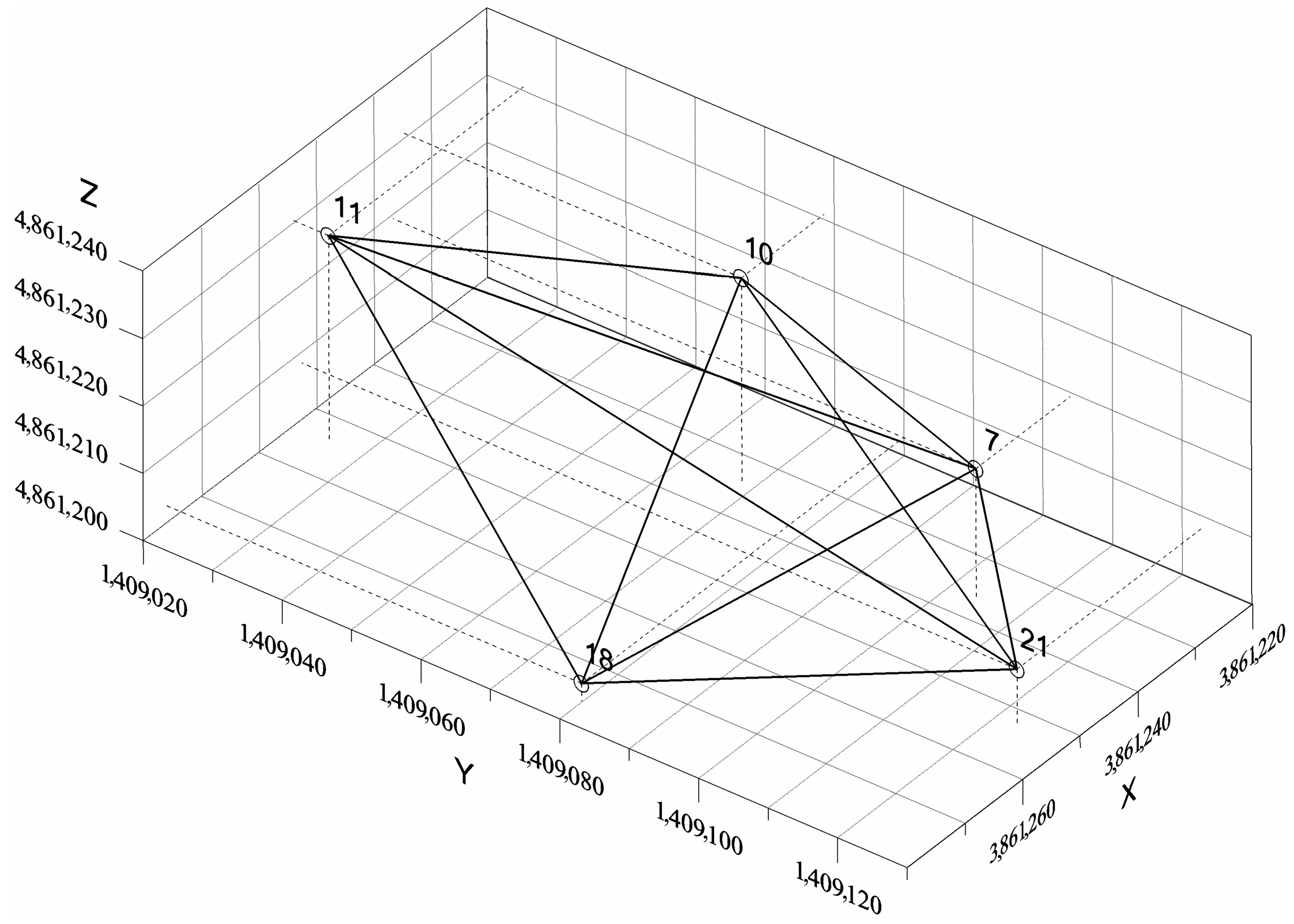
The proposed method for converting a GNSS vector network into a local conventional reference frame does not require map projection onto a plane or the use of a local geoid model when converting heights. The primary characteristic of the conversion should be the preservation of the geometry of the space figure composed of the measured GNSS vectors (see the example in Figure 2 and Figure 3). Kutoglu [24] proves that the slope (spatial) lengths based on the components of vectors of observation (ΔX, ΔY, ΔZ), when subjected to transformation between two systems of coordinates do not depend on the reference frame. Consequently, the components of the local vectors calculated in the conventional reference frame (Δx, Δy, ΔH) will also not depend on the terrain height difference. The ΔH component, however, may be affected by an error resulting from the very definition of the conventional frame (neglecting the effect of Earth’s curvature).
The numerical method has been verified with a real-life vector network established to monitor ground displacement. Its results have been compared with a conventional transformation (projection onto an ellipsoid, map projection of ellipsoidal coordinates onto a plane, and calculation of heights relative to the geoid). Both methods were verified for the consistency of the local vectors (Δx, Δy, ΔH) with results from typical terrestrial surveys (electronic distance measurement and an altimetric survey with high-precision geometric levelling).

2. Materials and Methods

This section first presents the traditional procedure for converting GNSS survey results into official local reference frames [34]. The objective is to demonstrate the complexity of the traditional procedure compared to the proposed method for transforming GNSS vectors into a 3D local conventional reference frame.

2.1. Traditional Procedure for GNSS Vector Conversion into Local Reference Frames

Static GNSS surveys produce a set of observations in the form of vectors (ΔX, ΔY, ΔZ) in a 3D space of a geocentric reference frame based on the WGS84 ellipsoid. Certain computations (conversions) are necessary to transform these observations into 2D vectors Δx, Δy (for example, on the projection plane of the official coordinate system PL-2000 for Poland, see [34]) and height difference ΔH. They can be divided into several stages.
  • Adjust GNSS vectors in the geocentric reference frame based on the WGS84 ellipsoid
This step involves solving a set of linear equations of adjustments (with the least squares method [35,36]) for each vector ij [18,37,38], such as:
v i j Δ X = δ X j δ X i + l i j Δ X v i j Δ Y = δ Y j δ Y i + l i j Δ Y v i j Δ Z = δ Z j δ Z i + l i j Δ Z
where
l i j Δ X = X j 0 X i 0 Δ X i j ;       l i j Δ Y = Y j 0 Y i 0 Δ Y i j ;       l i j Δ Z = Z j 0 Z i 0 Δ Z i j
X, ΔY, ΔZ) is the GNSS vector (its components); vX), vY), vZ) are the adjustments for the GNSS vector components; X(0), Y(0), Z(0) are the approximate coordinates; δX, δY, δZ are the estimated increments of the approximate coordinates; and lX), lY), lZ) are absolute terms.
2.
Calculate adjusted Cartesian coordinates XYZ
Cartesian coordinates of each point j are calculated by adding the adjusted components of vector ij to the known coordinates of point i:
X j = X i + Δ X i j + v i j Δ X Y j = Y i + Δ Y i j + v i j Δ Z Z j = Z i + Δ Z i j + v i j Δ Z
3.
Project the points onto the surface of the WGS84 reference ellipsoid (convert Cartesian coordinates XYZ to ellipsoidal coordinates BLh)
This task requires basic geodetic equations [22,27]:
X = R N + h · cos B · cos L Y = R N + h · cos B · sin L Z = R N · 1 e 2 + h · sin B
where
R N = a 1 e 2 · sin 2 B ;       e 2 = a 2 b 2 a 2 ,
B, L are the latitude and longitude, respectively; h is the point’s height above the ellipsoid (calculated along the normal to the ellipsoid); RN is the radius of curvature in the prime vertical; e is the first eccentric of the ellipsoid; and a, b are the WGS84 ellipsoid’s semi-axes (a = 6,378,137.0000; b = 6,356,752.31414 [34]).
Equations (3) are used to solve the problem directly: BLhXYZ. For a ‘reversed’ problem (XYZBLh), they have to be transformed. The first step is to find the meridian radius (r) for the projection of a point onto the ellipsoid (one potential solution) with a function derived from relationship (3):
F r = R N + h · cos B e 2 · r · a r · a + r Z · r · b a = 0
Radius r is calculated iteratively:
r i + 1 = r i F r i F r i
where
i = 0, 1, 2, … are the iteration indices and F r i is the value of the derivative of function F r i with respect to r.
A complete derivation of the presented Formulas (4) and (5) can be found in many literature references, e.g., [22,25,27,36].
The initial value of r is assumed as the distance between the point and the ellipsoid’s axis of rotation (assuming for the time being that h = 0):
r 0 = R N + h · cos B = X 2 + Y 2
The iteration procedure (5) is terminated when r exhibits no significant numerical changes (at the level of significant figures). Finally, the ellipsoidal coordinates are determined from the following equations (cf. [22]):
B = π 2 arctg b · r a · a r · a + r L = arccos X X 2 + Y 2 = arcsin Y X 2 + Y 2 h = X 2 + Y 2 r 2 + Z b · a r · a + r a 2
4.
Project the BL ellipsoidal coordinates onto the plane of a local reference frame (such as xy2000)
This task involves several steps (cf. [22]).
  • (4.1). Transform the ellipsoid into a sphere (Lagrange projection): B , L φ , λ = L
The following equation represents the relationship between ellipsoidal latitude B and spherical latitude φ
tan φ 2 + π 4 = 1 e · sin B 1 + e · sin B e 2 · tan B 2 + π 4
To solve Equation (8), one has to employ the so-called approximation using power series or trigonometric series.
  • (4.2). Apply transverse cylindrical Mercator projection: φ , λ x M E R C , y M E R C
x M E R C = R 0 · arctan sin φ cos φ · cos λ λ 0 y M E R C = 0.5 · R 0 · ln 1 + cos φ · sin λ λ 0 1 cos φ · sin λ λ 0
where λ0 is the meridian of tangency for the sphere and cylinder, and R0 is the sphere radius.
  • (4.3). Project the Mercator plane onto the Gauss-Krüger (G-K) plane: x M E R C , y M E R C x G - K , y G - K
Typically, trigonometric polynomials are used as
x G - K = x M E R C + R 0 · k = 2 , 4 , 6 a k · sin k · x M E R C R 0 · cosh k · y M E R C R 0 y G - K = y M E R C + R 0 · k = 2 , 4 , 6 a k · cos k · x M E R C R 0 · sinh k · y M E R C R 0
where ak is the coefficient of the polynomial.
  • (4.4). Convert G-K coordinates into a local projection system (such as PL-2000): x G - K , y G - K x 2000 , y 2000
After introducing conventional displacement parameters (x0 and y0), scale parameter(m0) (relative to the initial G-K projection), and projection zone number (c), it yields
x 2000 = m 0 · x G - K + x 0 y 2000 = c · 10 6 + m 0 · y G - K + y 0
For the coordinate system used in Poland, PL-2000 (see [34]), the transformation parameters are: x0 = 0; y0 = 500,000 m; m0 = 0.999923; c = (5, 6, 7, 8).
5.
Create a set of 2D vectors (for each vector ij)
Δ x i j = x j x i ;       Δ y i j = y j y i
where (xi, yi) and (xj, yj) are the coordinates after transformation (11).
6.
Convert ellipsoidal heights (h) (7) into orthometric heights (Hn)
This task is addressed using a numerical model of the geoid [31]:
H n = h N
where Hn are the normal heights with respect to the official quasi-geoid used in Poland; N is the geoid-ellipsoid separation [23,30,31].
7.
Create differences (increments) in normal heights (for each vector ij)
Δ H n i j = H n j H n i
The numerical stages listed above (1–14) are usually performed by computer software for survey network adjustments and coordinate conversion (for example, [16,39,40]).

2.2. Procedure for Transforming GNSS Vectors into a Local Conventional Reference Frame

The transformation method proposed here is much simpler than the traditional one (1–14). This is mainly because no map projection and conversion of geometric (ellipsoidal) heights into orthometric heights are necessary, as no numerical model of the local geoid is involved. However, the theoretical assumptions underlying the definition of the conventional reference frame (see the Introduction section) impose certain limitations on the method’s practicability.
At the heart of the method lies the mathematical relationship between components of an adjusted GNSS vector (ΔX, ΔY, ΔZ) (1) and the associated differences in relation to the coordinates in the conventional local reference frame (Δx, Δy, ΔH) [21,23,36]:
Δ X Δ Y Δ Z = R · Δ y Δ x Δ H
where R is the transformation matrix:
R = sin L sin B · cos L cos B · cos L cos L sin B · sin L cos B · sin L 0 cos B sin B
In this case, a reverse transformation is necessary:
Δ y Δ x Δ H = R 1 · Δ X Δ Y Δ Z
To use relationship (17), one must first calculate the ellipsoidal coordinates B and L (7). Increments in coordinates Δx, Δy (17) on the plane of the conventional reference frame are not identical to the respective values on a map plane in PL-2000 because of orientation differences in relation to the reference ellipsoid (Figure 1). The definition of the local conventional reference frame (see Section 1) must be complemented with the directions of reference frame’s axes (cf. [23]): The H axis is along the normal to the ellipsoid, the y axis (positive, eastward) is perpendicular to the plane of the meridian of point P (the origin of the 3D coordinate system), and the x axis (positive, northward) is on the meridian’s plane.
The elements of the R transformation matrix (16) obviously depend on the values of the ellipsoidal coordinates B and L, i.e., on the adopted point of tangency (P) between the plane and the ellipsoid (see Figure 1). A change in the point of tangency results in a change in the R matrix, and consequently, a change in the conventional reference frame. In order to preserve a single reference frame, one point of tangency P must be adopted as the initial point for all transformed vectors.
The results of the two methods, (12), (14) and (17), can be compared by aligning the reference frames after calculating the rotation angle (if the coordinates of at least two ij points in the PL-2000 system are known):
γ = A i j U A i j K
where Aij is the geodetic azimuth; (U) is the conventional reference frame; and (K) is the map coordinate system.
Next, simplified formulae for the Helmert transformation in the plane are used [22,40,41,42], without translation or scaling:
x K y K = cos γ sin γ sin γ cos γ · x U y U
The final coordinate increments, determined in the conventional reference frame and reduced to the PL-2000 coordinate system, are calculated as shown below:
Δ x i j K = x j K x i K ;       Δ y i j K = y j K y i K

2.3. Diagram of the Computational Procedures

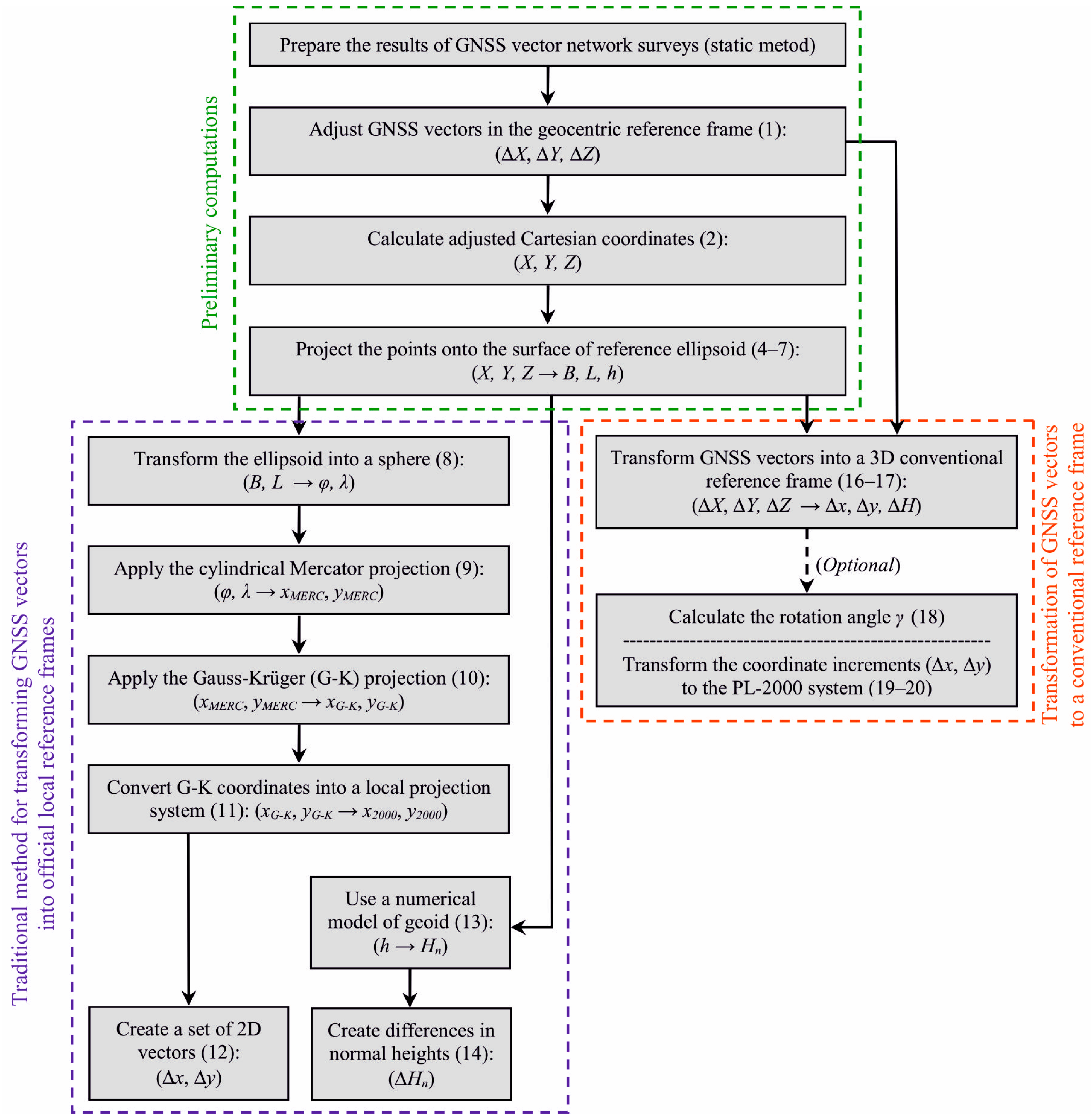
The entire computational procedures (see Section 2.1 and Section 2.2) are organised into a diagram (Figure 4), which involves three parts:
-
Preliminary computations (common to both methods);
-
Traditional procedure for converting GNSS vectors into official local reference frames;
-
Transforming GNSS vectors into the conventional reference frame (the method proposed in this paper).
The individual calculation steps are implemented using the corresponding equations, which are given in brackets.

3. Numerical Example (Results and Discussion)

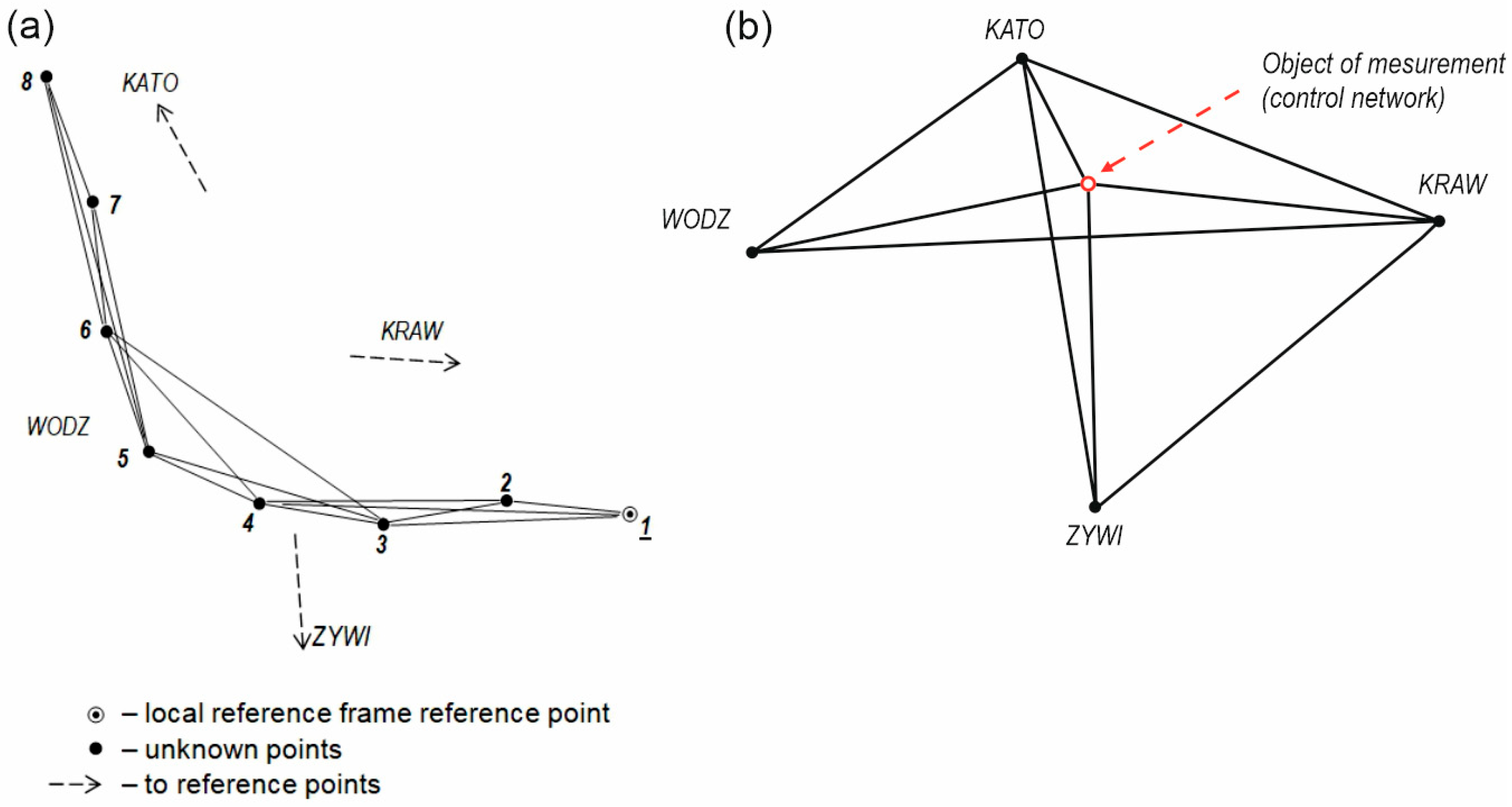
The proposed procedure for transforming initial GNSS vectors into a 3D conventional reference frame has been verified with real-life data. The analysis involves the results of a periodic survey of a control network for determining displacement in a mining area (Figure 5). Control points 1–8 were measured with static GNSS, which yielded 16 local vectors (ΔX, ΔY, ΔZ) tied in to four ASG-EUPOS reference stations. The results are summarised in Table 1 (the table does not include values for the 25 tie-in vectors between the control network points and the reference stations due to a large volume of data).
The vector network was adjusted using the standard least squares method (1)–(2). Values of the adjusted vectors are summarised in Table 2, while the final coordinates with tie-in points are in Table 3 (ETRF89 based on the WGS84 ellipsoid).
Next, the vectors were transformed into the 2D map coordinate system, PL-2000 and to the orthometric height reference frame, PL-EVRF2007-NH (the official height reference frame used in Poland, cf. [34]), as per the traditional numerical procedure (3)–(14). Selected intermediate results for the stages are reported in Table 4, Table 5 and Table 6. Table 4 also provides an average of the ellipsoidal coordinates (B, L) to facilitate further comparisons.
Table 6 shows the end results of the traditional numerical procedure, the GNSS vectors transformed into the official local reference frame (Table 2). We expect to obtain a similar outcome using the proposed procedure for transforming vectors into a 3D conventional reference frame (17). Each point of the control network (Figure 5) has ellipsoidal coordinates (Table 4). Therefore, it is possible to calculate increments Δx, Δy, and ΔH in several conventional reference frames with different points of tangency (cf. Figure 1) and then evaluate changes in the increments for individual point pairs (vectors). The next comparison option is to calculate the increments for the averaged ellipsoidal coordinates of points 18 (the last row in Table 4). The results for this stage are summarised in Table 7 (with an additional theoretical vector 81). For the purpose of the comparative analysis, the results are reported down to three decimal places. This seems sufficient considering the accuracy of GNSS measurements, the geoid model accuracy, etc.
A comparison of increments for individual points of tangency (Table 7) reveals minor differences (below 1 mm) only for some height differences ΔH; slightly larger discrepancies (2–3 mm) were found for the longest vector 81. This order of magnitude of the changes seems of little importance compared to the accuracy of GNSS measurements.
Horizontal increments (Δx, Δy, summarised in Table 7) cannot be consistent with values calculated in PL-2000 (Table 6). Still, after the angle of rotation is calculated (18) for the longest direction 81, for example, and a 2D transformation is applied (19), it is easy to calculate the corrected values of the increments (Table 8).
Table 8 presents the final outcome of the transformation of the GNSS vectors into a 3D conventional reference frame (Δx, Δy, ΔH). It is clear that the values are nearly identical to those for the traditional procedure for transforming coordinates into a 2D map coordinate system (Δx, Δy) and an orthometric height system (ΔHn). The only discrepancies of millimetres were found for height differences (ΔH) for some vectors, which seems a very good result. Errors of this magnitude are acceptable even for high-precision displacement measurements [13]. These minor discrepancies are most likely due to ignoring Earth’s curvature (for the conventional reference frame), leading to the plumb line deviating from the normal to the ellipsoid [18].
Because relevant positions of points are critical for ground displacement measurements (which was the primary objective of the control network used in the study, Figure 5), it is necessary to analyse the magnitudes of the vectors (distances between points) calculated using the increments in each reference frame (Table 9 and Table 10).
Table 9 summarises the actual (spatial) distances calculated as resultants of three component increments, ΔX, ΔY, and ΔZ or Δx, Δy, and ΔH (as appropriate). The distances in the conventional reference frame are exactly consistent (to within 1 mm) with the lengths of the initial GNSS vectors (Table 2), indicating that the proposed transformation of their components (17) does not distort the relative positioning of the points. The minor differences in distances for the traditional transformation into PL-2000 and PL-EVRF2007-NH can be accounted for by the fact that the height increments (ΔHn, Table 6) were calculated along the local plumb line instead of the normal to the ellipsoid.
Table 10 summarises 2D (horizontal) distances calculated as the resultants of increments Δx and Δy and their deviations from the distances as measured accurately with a total station. A similar list was compiled for vertical distances, that is, differences in heights (ΔH, right-hand part of Table 10) in relation to results of high-precision geometric levelling (results summarised with an accuracy down to 1 mm). In both cases (distances and heights), the direct on-site measurements can be considered a reference for the GNSS measurements.
Analysis of the horizontal distance deviations (Table 10) reveals that they are similar for both reference frames (PL-2000 and conventional), with a minor advantage of the conventional reference frame, where the deviations are slightly lower (by about 1 mm for short vectors and about 5 mm for the longest vector 81). In the case of height differences, the official reference frame (PL-EVRF2007-NH) fares slightly better than the conventional reference frame. Still, the differences are measured in millimetres.
It is also a good opportunity to comment on the magnitudes of deviations from the reference values, which are mostly several millimetres (for both distances and height differences). The deviations seem to originate from random errors of static GNSS measurement (linked to receiver centring or antenna height measurement), which is best evidenced in point 1 (the largest deviations for vectors 81 and 12 for both distances and height differences).

4. Summary and Conclusions

The article outlines a transformation method of initial GNSS vectors (ΔX, ΔY, ΔZ) into a certain local, 3D conventional reference frame. New increments in coordinates (Δx, Δy, ΔH) are, in this case, a function of ellipsoidal coordinates B, L (latitude and longitude) of the point of the local reference frame tangency to the reference ellipsoid. The increments of horizontal coordinates (Δx, Δy) are on the plane of the local conventional reference frame, while height increments (ΔH) are calculated along the normal to the ellipsoid at the point of tangency (which makes them perpendicular to the 2D coordinate system xy).
The proposed procedure can serve as an alternative to the traditional transformation of GNSS vectors into official local reference frames, which involves many stages of complex calculations. Increments in plane coordinates and local height differences are often used to determine so-called relative displacements [11,12,13,43] in potentially unstable sites, such as mining areas (replacing XYZ or xyH coordinates).
The advantages of the proposed method compared to the traditional approach include:
  • Simple computation (no need to convert the ellipsoidal height into the orthometric height system using the geoid model or use map projection onto the plane of the official local reference frame);
  • The local height difference (ΔH) is free from the impact of the geoid numerical model’s uncertainty;
  • Increments of 2D coordinates (Δx, Δy) are free from map projection errors.
Its downsides include:
  • Survey (control network) area limited to about 300 m;
  • The calculated height difference (ΔH) does not account for Earth’s curvature (still, for a vector magnitude up to about 300 m, the impact is below the local geoid model error).
The verification of the method on results from a real-life control network (for displacement measurements) demonstrated complete consistency between the local increments in coordinates (Δx, Δy) calculated with the new method and those from traditional calculations. Only small discrepancies were found (±1 mm) for height differences (ΔH) and several vectors (including for the longest vector of about 144 m).
Horizontal distances between the control network points, calculated based on the local increments (Δx, Δy), were also analyzed. The discrepancies between the two methods were up to ±1 mm for shorter vectors (about 25 m) and 5 mm for the longest vector (about 144 m).
Therefore, the numerical analyses suggest that the errors involved in converting GNSS vectors into a conventional local reference frame are of negligible impact compared to the estimated accuracy of GNSS measurements. The error in the local height difference calculated with the proposed method also appears minuscule compared to the accuracy of the geoid models used to calculate orthometric heights. Hence, there seems to be no reason not to use the proposed numerical method in various survey engineering tasks (such as analysis of relative displacement of the ground), always assuming a limited size of the survey area (up to about 300 m).

Funding

Funded with a subsidy from the Ministry of Science and Higher Education for the University of Agriculture in Kraków for 2025.

Institutional Review Board Statement

Not applicable.

Informed Consent Statement

Not applicable.

Data Availability Statement

The study did not report any data.

Conflicts of Interest

The authors declare no conflicts of interest.

References

  1. Kudrys, J.; Krzyżek, R. Analysis of Coordinates Time Series Obtained Using the NAWGEO Service of the ASG-EUPOS System. Geomat. Environ. Eng. 2011, 5, 39–46. [Google Scholar]
  2. Krzyżek, R. Routing corners of building structures—By the method of vector addition—Surveyed with RTN GNSS technology using indirect methods of measurement. Artif. Satel. J. Planet. Geod. 2015, 50, 181–200. [Google Scholar] [CrossRef]
  3. Mszanik, M.; Gargula, T. Satellite leveling as an alternative to classic height measurements for typical engineering problems. Geomat. Landmanag. Landsc. 2024, 4, 249–265. [Google Scholar] [CrossRef]
  4. Bogusz, J.; Kłos, A.; Grzempowski, P.; Kontny, B. Modelling the Velocity Field in a Regular Grid in the Area of Poland on the Basis of the Velocities of European Permanent Stations. Pure Appl. Geoph. 2014, 171, 809–833. [Google Scholar] [CrossRef]
  5. Kudas, D.; Wnek, A. Operation of ASG-EUPOS POZGEO sub-service in the event of failure of reference stations used in the standard solution—Case study. Geomat. Landmanag. Landsc. 2019, 4, 59–71. [Google Scholar] [CrossRef]
  6. Head Office of Geodesy and Cartography in Poland. Technical Guidelines G-1.12. Satellite Measurements Based on the ASGEUPOS Precise Positioning System—Draft Dated March 1, 2008, with Amendments; Head Office of Geodesy and Cartography in Poland: Warszawa, Poland, 2008. (In Polish)
  7. Acosta, L.E.; De Lacy, M.C.; Ramos, M.I.; Cano, J.P.; Herrera, A.M.; Avilés, M.; Gil, A.J. Displacements study of an earth fill dam based on high precision geodetic monitoring and numerical modeling. Sensors 2018, 18, 1369. [Google Scholar] [CrossRef]
  8. Baryła, R.; Oszczak, S.; Koczot, B.; Szczechowski, B. A concept of using static GPS measurements for determination of vertical and horizontal land deformations in the Main and Old City of Gdansk. Rep. Geod. 2007, 1, 17–24. [Google Scholar]
  9. Gargula, T. A kinematic model of a modular network as applied for the determination of displacements. Geod. Cartogr. 2009, 58, 51–67. [Google Scholar]
  10. Gargula, T. Integrated Modular Networks in the Application for Determination of the Displacements; Zeszyty Naukowe Uniwersytetu Rolniczego: Krakow, Poland, 2011; p. 473. (In Polish) [Google Scholar]
  11. Kadaj, R. Models, Methods and Computing Algorithms of Kinematic Networks in Geodetic Measurements of Movements and Deformation of Objects; Publishing House of Agricultural University of Krakow: Krakow, Poland, 1998. (In Polish) [Google Scholar]
  12. Preweda, E. Estymacja Parametrów Kinematycznego Modelu Przemieszczeń (Estimation of Parameters of the Kinematic Displacement Model); Wydawnictwo Naukowe i Dydaktyczne AGH: Kraków, Poland, 2002; p. 110. (In Polish) [Google Scholar]
  13. Prószyński, W.; Kwaśniak, M. Basics of the Geodetic Assignation of Movements. Concepts and Elements of the Methodology; Publishing House of Warsaw University of Technology: Warszawa, Poland, 2006. (In Polish) [Google Scholar]
  14. Saleh, B.; Al-Bayari, O. Geodetic monitoring of a landslide using conventional surveys and GPS techniques. Surv. Rev. 2007, 39, 252–260. [Google Scholar] [CrossRef]
  15. Wiśniewski, Z.; Kamiński, W. Estimation and Prediction of Vertical Deformations of Random Surfaces, Applying the Total Least Squares Collocation Method. Sensors 2020, 20, 3913. [Google Scholar] [CrossRef]
  16. Kadaj, R.; Świętoń, T. GPS postprocessing module in GEONET system. Bull. Milit. Univ. Technol. 2010, 59, 153–161. (In Polish) [Google Scholar]
  17. Kudas, D.; Wnek, A. Validation of the number of tie vectors in post-processing using the method of frequency in a centric cube. Open Geosci. 2020, 12, 242–255. [Google Scholar] [CrossRef]
  18. Czarnecki, K. Contemporary Geodesy; Gall: Katowice, Poland, 2010. (In Polish) [Google Scholar]
  19. Leick, A. GPS Satellite Surveying; John Wiley & Sons. Inc.: Hoboken, NJ, USA, 2004. [Google Scholar]
  20. Seeber, G. Satellite Geodesy; Walter de Gruyter: Berlin, Germany; New York, NY, USA, 2003. [Google Scholar] [CrossRef]
  21. Hoffmann-Wellenhof, B.; Lichtenegger, H.; Collins, J. Global Positioning System: Theory and Practice; Springer: Wien, Austria, 2001; Available online: https://link.springer.com/book/10.1007/978-3-7091-6199-9 (accessed on 7 October 2025).
  22. Head Office of Geodesy and Cartography in Poland. Technical Guidelines G-1.10. Cartographic Projection Formulas and Coordinate System Parameters; Head Office of Geodesy and Cartography in Poland: Warszawa, Poland, 2001. (In Polish)
  23. Łyszkowicz, A. Geodetic Systems and Reference Frames; Military Aviation Academy: Dęblin, Poland, 2024. (In Polish)
  24. Kutoglu, H.S. Direct determination of local coordinates from GPS without transformation. Surv. Rev. 2009, 41, 162–173. [Google Scholar] [CrossRef]
  25. Gargula, T. GPS Vector Network Adjustment in a Local System of Coordinates Based on Linear-Angular Spatial Pseudo-Observations. J. Surv. Eng. 2011, 137, 60–64. [Google Scholar] [CrossRef]
  26. Bosy, J. Global, Regional and National Geodetic Reference Frames for Geodesy and Geodynamics. Pure Appl. Geoph. 2014, 171, 783–808. [Google Scholar] [CrossRef]
  27. Hlibowicki, R.; Krzywicka-Blum, E.; Galas, R.; Borkowski, A.; Osada, E.; Cacoń, S. Advanced Geodesy and Geodetic Astronomy; PWN: Warszawa, Poland, 1988. (In Polish) [Google Scholar]
  28. Kadaj, R. Transformations between the height reference frames: Kronsztadt’60, PL-KRON86-NH, PL-EVRF2007-NH. J. Civ. Eng. Environ. Archit. 2018, 65, 5–24. [Google Scholar]
  29. Krynski, J.; Łyszkowicz, A. Study on choice of global geopotential model for quasi-geoid determination in Poland. Geod. Cartogr. 2005, 54, 17–36. [Google Scholar]
  30. Łyszkowicz, A. Geoid in the area of Poland in the author’s investigations. Tech. Sci. Univ. Warm. Mazury Olszt. 2012, 15, 49–63. [Google Scholar]
  31. Head Office of Geodesy and Cartography in Poland. Model of the Valid Quasi-Geoid PL-Geoid2021 in the PL-EVRF2007-NH System; Head Office of Geodesy and Cartography in Poland: Warszawa, Poland, 2022. Available online: https://www.gov.pl/web/gugik/modele-danych (accessed on 7 October 2025). (In Polish)
  32. Beluch, J. Detailed Situational and Height Geodetic Networks Determined in a Conventional Spatial System; Zeszyty Naukowe Akademii Górniczo-Hutniczej: Krakow, Poland, 1981; p. 850. (In Polish) [Google Scholar]
  33. Lazzarini, T.; Hermanowski, A.; Gaździcki, J.; Dobrzycka, M.; Laudyn, I. Geodesy—Detailed Geodetic Control Network; PPWK: Warszawa, Poland, 1990. (In Polish) [Google Scholar]
  34. Regulation of the Council of Ministers in Poland of 15 October 2012 on the National Spatial Reference System; Prime Minister of Poland: Warszawa, Poland, 2012. Available online: https://isap.sejm.gov.pl/ (accessed on 7 October 2025). (In Polish)
  35. Wiśniewski, Z. Adjustment Calculus in Geodesy; Publications of University of Warmia and Mazury in Olsztyn: Olsztyn, Poland, 2005. (In Polish) [Google Scholar]
  36. Ghilani, C.D. Adjustment Computations: Spatial Data Analysis; John Wiley & Sons. Inc.: Hoboken, NJ, USA, 2018. [Google Scholar]
  37. Gargula, T. Adjustment of an Integrated Geodetic Network Composed of GNSS Vectors and Classical Terrestrial Linear Pseudo-Observations. Appl. Sci. 2021, 11, 4352. [Google Scholar] [CrossRef]
  38. Gargula, T. Point position accuracy in a vector GNSS Network and the way it is linked to reference stations. Geomat. Landmanag. Landsc. 2021, 2, 23–37. [Google Scholar] [CrossRef]
  39. GeoNet Geodetic System. AlgoRes-Soft. Available online: https://www.geonet.net.pl/oferta/ (accessed on 7 October 2025). (In Polish).
  40. Head Office of Geodesy and Cartography in Poland. Transpol v.20.6, A Computer Program for Transforming Coordinates and Heights in the National Spatial Reference System; Head Office of Geodesy and Cartography in Poland: Warszawa, Poland, 2013. Available online: https://www.gov.pl/attachment/6ed73b13-f1cd-426c-8e06-4e92014c4dcf (accessed on 7 October 2025). (In Polish)
  41. Gargula, T.; Gawronek, P. The Helmert transformation: A proposal for the problem of post-transformation corrections. Adv. Geod. Geoinf. 2023, 72, 1–15. [Google Scholar] [CrossRef]
  42. Mitsakaki, C.; Agatza-Balodimou, A.; Papazissi, K. Geodetic reference frames transformations. Surv. Rev. 2006, 38, 608–618. [Google Scholar] [CrossRef]
  43. Beluch, J. A generalized method for determination of point displacements in control networks, based on the modified method of observation differences. Geod. Cartogr. 1997, 46, 149–162. [Google Scholar]
Figure 1. Global (XYZ) and local (xyH) conventional reference frame s: B, L—ellipsoidal coordinates (latitude and longitude, respectively); N, S—North and South Poles, respectively.
Applsci 15 12867 g001
Figure 2. Example of a vector network in a global reference frame XYZ (see [10]).
Applsci 15 12867 g002
Figure 3. Vector network in a local conventional reference frame xyH (cf. Figure 2, see [10]).
Applsci 15 12867 g003
Figure 4. Comparison of two computational procedures (Section 2.1 and Section 2.2).
Applsci 15 12867 g004
Figure 5. Static GNSS measurement of the control network: (a) vectors between control network points, (b) vectors to ASG-EUPOS reference stations.
Applsci 15 12867 g005
Table 1. Results of static GNSS measurements of the vector network.
Vector
Index
Observations (Components of GNSS Vectors)
[m]
Mean Errors of Measurement
[m]
fromtoΔXΔYΔZmΔXmΔYmΔZ
1318.8574−46.1353−2.50650.00620.00520.0061
1426.0581−69.9464−1.60110.00680.00560.0066
21−9.122723.20290.89910.00620.00510.0061
239.7354−22.9314−1.60570.00370.00320.0039
2416.9362−46.7425−0.69960.00360.00310.0038
347.2020−23.81020.90880.00410.00320.0032
53−8.792447.6362−6.09450.00750.00580.0056
54−1.589823.8237−5.18550.00660.00510.0052
57−29.2102−26.775029.67110.00560.00490.0059
58−43.3054−40.975444.70310.00560.00490.0058
635.346761.6613−20.59540.00470.00360.0036
6412.549737.8504−19.68650.00480.00370.0038
6514.139714.0259−14.50220.00580.00510.0061
67−15.0700−12.748815.17010.00430.00380.0047
68−29.1668−26.949930.20070.00370.00320.0040
78−14.0972−14.201015.03010.00390.00340.0042
Table 2. Adjusted vectors.
Vector
Index
Adjusted GNSS Vectors
[m]
fromtoΔXΔYΔZ
129.1255−23.1996−0.9019
239.7368−22.9292−1.6060
347.2019−23.80990.9069
451.5923−23.82125.1854
56−14.1382−14.027014.5021
67−15.0709−12.748215.1687
78−14.0965−14.201215.0313
Table 3. Coordinates adjusted (2) in the geocentric ETRF89 reference frame and their mean errors.
PointX [m]Y [m]Z [m]mX [m]mY [m]mZ [m]
13,871,848.01731,345,998.15644,870,464.08740.00730.00620.0073
23,871,857.14281,345,974.95684,870,463.18550.00540.00470.0054
33,871,866.87961,345,952.02764,870,461.57950.00500.00420.0046
43,871,874.08151,345,928.21774,870,462.48640.00510.00430.0046
53,871,875.67381,345,904.39654,870,467.67180.00720.00580.0062
63,871,861.53561,345,890.36954,870,482.17390.00620.00510.0054
73,871,846.46471,345,877.62134,870,497.34260.00880.00760.0085
83,871,832.36821,345,863.42014,870,512.37390.00880.00760.0085
KATO3,862,992.38061,332,822.67414,881,105.4573---
KRAW3,856,936.17431,397,750.48154,867,719.4488---
WODZ3,896,698.78071,300,673.70664,863,029.3737---
ZYWI3,904,633.32071,360,191.89204,840,630.7894---
Table 4. Ellipsoidal coordinates and orthometric heights (7, 13).
Point
No.
Geographic Ellipsoidal Coordinates (WGS84)Ellipsoidal Height
h [m]
Orthometric Height
(PL-EVRF2007-NH)
Hn [m]
Latitude B [º]Longitude L [º]
150.104457759319.1693493783279.8002238.7604
250.104445649919.1690012024279.7508238.7105
350.104424884819.1686537911279.5885238.5477
450.104437116919.1683063863279.6331238.5918
550.104510588919.1679845766279.5595238.5179
650.104718081919.1678642683279.1664238.1252
750.104932598719.1677651230278.9891237.9482
850.105143265619.1676423213278.9908237.9503
Mean50.104633743319.1683208809--
Table 5. Horizontal coordinates in the map coordinate system (11).
Point
No.
2D Coordinates (PL-2000)
x [m]y [m]
15,552,693.27226,583,648.1303
25,552,691.53546,583,623.2456
35,552,688.83706,583,598.4307
45,552,689.80856,583,573.5587
55,552,697.61986,583,550.4112
65,552,720.56236,583,541.4443
75,552,744.30966,583,533.9792
85,552,767.60236,583,524.8286
Table 6. Horizontal vectors (12) on the plane of PL-2000 and height differences (14) in PL-EVRF2007-NH.
Vector
Index
Coordinate Differences
[m]
fromtoΔxΔyΔHn
12−1.7368−24.8847−0.0499
23−2.6984−24.8149−0.1628
340.9715−24.87200.0441
457.8113−23.1475−0.0739
5622.9425−8.9669−0.3927
6723.7473−7.4651−0.1770
7823.2927−9.15060.0021
Table 7. Increments in the conventional reference frame depending on the point of tangency (B, L).
Vector IndexB, L–Point 1B, L–Point 4B, L–Point 8B, L–Mean
fromtoΔxΔyΔHΔxΔyΔHΔxΔyΔHΔxΔyΔH
12−1.347−24.910−0.049−1.347−24.910−0.049−1.348−24.910−0.049−1.347−24.910−0.049
23−2.310−24.855−0.162−2.310−24.855−0.162−2.310−24.855−0.162−2.310−24.855−0.162
341.361−24.8550.0441.361−24.8550.0451.360−24.8550.0451.361−24.8550.045
458.173−23.023−0.0748.173−23.023−0.0748.173−23.023−0.0738.173−23.023−0.074
5623.081−8.607−0.39323.081−8.607−0.39323.081−8.607−0.39323.081−8.607−0.393
6723.862−7.093−0.17823.862−7.093−0.17723.862−7.093−0.17723.862−7.093−0.177
7823.434−8.7850.00123.434−8.7850.00123.434−8.7860.00223.434−8.7850.002
81−76.254122.1270.811−76.253122.1280.810−76.251122.1290.808−76.253122.1280.809
Table 8. Increments corrected in the conventional reference frame and compared to the initial reference frame (Table 6): δ—deviation.
Azimuth of Direction 81
Angle of Rotation (19)
[gon]
Vector
Index
Conventional Reference Frame, Corrected
[m]
Deviations from PL-2000
and PL-EVRF2007-NH [m]
fromtoΔxΔyΔHδx)δy)δH)
12−1.737−24.886−0.0490.0000.0000.001
A(U) = 135.532523−2.699−24.816−0.1620.0000.0000.001
340.972−24.8730.0450.0000.0000.001
A(K) = 134.5365457.812−23.148−0.0740.0000.0000.000
5622.943−8.967−0.3930.0000.0000.000
γ = 0.99606723.748−7.465−0.1770.0000.0000.000
7823.293−9.1510.0020.0000.000−0.001
81−74.333123.3060.8090.0000.000−0.001
Table 9. Spatial distances between control network points (see Table 2, Table 6 and Table 8).
Vector
Index
Actual (Spatial) Distances [m]
Initial
GNSS Vectors
PL-2000;
EVRF2007
Conventional
System
fromto
1224.94624.94524.946
2324.96324.96224.963
3424.89224.89124.892
4524.43124.43024.431
5624.63624.63624.636
6724.89524.89424.895
7825.02625.02625.026
81143.980143.975143.980
Table 10. Horizontal distances and height differences (ΔH) juxtaposed with direct measurements: (T)—total station measurement, (U)—conventional reference frame, (K)—PL-2000, (G)—geometric levelling.
Vector
Index
Horizontal Distance [m]Height Difference [m]
Measurement
on Site
Map Coordinate System
PL-2000
Conventional Reference FrameGeometric
Levelling
Height Deviation
(See Table 6 and Table 8)
fromtod(T)d(K)d(K)d(T)d(U)d(U)− d(T)ΔH(G)ΔH(EVRF)− ΔH(G)ΔH(U)− ΔH(G)
1224.95824.945−0.01324.946−0.012−0.0580.0080.009
2324.96424.961−0.00324.962−0.002−0.1630.0000.001
3424.89224.891−0.00124.8920.0000.0420.0020.003
4524.44224.430−0.01224.431−0.011−0.072−0.002−0.002
5624.63724.633−0.00424.633−0.004−0.3990.0060.006
6724.89824.893−0.00524.894−0.004−0.173−0.004−0.004
7825.01925.0260.00725.0260.007−0.0020.0040.004
81143.992143.973−0.019143.978−0.0140.825−0.015−0.016
Disclaimer/Publisher’s Note: The statements, opinions and data contained in all publications are solely those of the individual author(s) and contributor(s) and not of MDPI and/or the editor(s). MDPI and/or the editor(s) disclaim responsibility for any injury to people or property resulting from any ideas, methods, instructions or products referred to in the content.