1. Introduction
With the rapid global development of intermodal transportation, intermodal routing problems have been widely explored in the transportation planning field [
1]. The aim is to provide the best intermodal route for the transportation organizer, who represents the consigner and consignee, to coordinate carriers and node operators to accomplish origin-to-destination transportation of goods carried in standardized containers. In addition to economic considerations, the consignee prefers a timely intermodal transportation to match their post-transportation goods-processing strategy that aims to reduce inventory costs and respond to the market quickly. Furthermore, the transportation sector is a major contributor to the carbon emissions that challenge the global climate and environment [
2], and nearly 30% of the carbon emissions are produced by transportation activities [
3]. In the food industry, carbon emissions of food transportation account for 20% of the total carbon emissions of the food system [
4]. Carbon emissions of transportation increased by approximately 80% from 1990 to 2019, and after a reduction of 12% during the COVID-19 outbreak, the emission level of transportation has rebounded in recent years [
5]. As for intermodal transportation, it is usually employed in long-distance transportation that results in higher carbon emissions [
4]. Therefore, it is necessary to build an environmentally sustainable intermodal transportation system through planning, such as routing optimization. Meanwhile, large carbon emissions also increase the total costs of transportation under carbon emission reduction regulations (e.g., carbon tax regulations) and are of concern to the customers served by the intermodal transportation. Therefore, the intermodal routing should pay attention to the timeliness and carbon emission issues.
By resolving these issues, the intermodal routing optimization can find an intermodal route that balances the economics, timeliness, and environmental sustainability of transportation [
6,
7]. By applying this plan to actual transportation, the transportation organizer is able to improve the comprehensive service level for its customers, and the environment can also benefit from carbon emission reduction in the transportation system. Therefore, green intermodal routing with time window is a key direction in transportation planning. Furthermore, there is a high demand for reliable, pre-planned intermodal routes from both the transportation organizer and the customers. For transportation organizers, such a route can help successfully transport goods without any interruptions, which also improves service quality. Customers can refer to the planned costs to fully prepare the transportation budget and better implement their post-transportation goods-processing plans. In this situation, reliable intermodal routing should be paid attention to by the transportation organizer and the customers. It is widely acknowledged that uncertainty modeling ensures the reliability of prescribed intermodal routing [
8]. Due to changes in production and marketing, modification of post-transportation goods-processing plans, and other various influencing factors [
9], the consignee cannot exactly determine its demand for goods in the routing decision-making stage, which leads to demand uncertainty. As a result, reliable intermodal routing should take demand uncertainty into consideration.
Fuzzy numbers have been widely adopted to model demand uncertainty, since they do not rely on large amounts of historical data, which are difficult to obtain in most cases, to represent uncertainty when compared to stochastic programming [
10]. Currently, triangular and trapezoidal fuzzy numbers have been extensively used to describe demand uncertainty in intermodal routing [
11,
12,
13,
14]. But the consignee usually does not have enough data or other references to accurately determine the most likely demand condition(s), which makes it difficult to effectively propose triangular or trapezoidal fuzzy demand [
15]. As an alternative, interval fuzzy numbers can avoid such difficulties and help the consignee to model their uncertain demand based on minimum and maximum possible demand conditions that are easily determined.
To date, there are few studies that take advantage of interval fuzzy numbers in intermodal routing problems considering demand uncertainty. However, Guo et al. [
15] modeled interval fuzzy capacities when studying intermodal routing and verified that such modeling can improve problem optimization compared to deterministic modeling. Moreover, demand uncertainty leads to uncertainty in various variables directly associated with it, e.g., costs, time, and carbon emissions. Demand uncertainty might also cause further fuzziness in some cases (e.g., where the time window is considered in the problem). However, the resulting uncertainty has not been fully modeled as interval fuzzy variables in the existing relevant literature.
Environmental issues have been widely studied in green logistics studies [
16]. Green logistics optimization has discussed various carbon emission reduction approaches, e.g., carbon tax regulation, carbon trading regulation, carbon emission constraint, and multi-objective optimization, in achieving a green logistics system. Among these approaches, carbon tax regulation has been implemented by a large number of countries in practice [
17]. It has also been commonly employed in the literature to identify low-carbon intermodal routes. Carbon tax regulation converts all the carbon emissions produced in intermodal transportation into a carbon tax that is further formulated as a part of the objective of minimizing costs. Cheng et al. [
18] pointed out that carbon tax regulation cannot always reduce the carbon emissions associated with intermodal transportation. Guo et al. [
15] and Sun et al. [
19,
20] analyzed the feasibility of carbon tax regulation in their green intermodal routing problems by comparing this approach to minimizing carbon emissions, in which they all modeled a fuzzy environment that leads to fuzziness of carbon emissions. In these studies, Sun et al. [
19,
20] indicated that carbon tax regulation can result in carbon emissions that are close to their minimum, and thus, it is feasible. On the contrary, Guo et al. [
15] found that carbon tax regulation still leads to significant carbon emissions compared to their minimum and, consequently, is infeasible in some decision-making cases, and they proposed the use of bi-objective optimization as an alternative to achieve improved carbon emission reduction.
However, none of these studies discussed the worsening of other objectives brought about by using carbon tax regulation, which makes their feasibility analysis incomplete. Furthermore, the sole use of bi-objective optimization might be unsuitable when the carbon tax regulation is promoted by the government and implemented by the transportation industry. Moreover, none of these studies formulated an interval fuzzy demand and the resulting interval fuzzy carbon emissions. Therefore, evaluating the feasibility of carbon tax regulation is necessary for the proposed problem, since it can avoid carbon tax regulation from considerably worsening other objectives while not leading to satisfying carbon emission reduction. In this case, we should first determine if carbon tax regulation can reduce carbon emissions with an acceptable worsening of other objectives, and then check the reduction effect that it can achieve. We should then resolve the question of how to achieve a better reduction effect when the carbon tax regulation is not significant or satisfactory, in situations where this regulation must be implemented.
A soft time window has been a popular setting to help the transportation organizer and the consignee identify an appropriate intermodal route to improve timeliness. It can also help the consignee implement advanced production and manufacturing strategies, such as the “just-in-time” concept, in their post-transportation goods processing. In theory, compared to a hard time window, this type of time window allows for violation of its upper and lower bounds to a certain degree in order to achieve economic benefits [
21]. Currently, the majority of intermodal routing studies model soft time windows under certainty (e.g., references [
6,
22,
23]), in which violation of the time window, represented by storage and penalty periods, is modeled using deterministic variables. To date, Sun et al. [
11] have formulated such periods in the intermodal routing problem to be uncertain, specifically trapezoidal fuzzy variables resulting from trapezoidal fuzzy demand.
However, there is no existing literature that formulates the uncertainty of violation of a soft time window caused by interval fuzzy demand. Additionally, all the above works focused on the employment of a soft time window. They did not verify its feasibility and confirm whether it can achieve any improvement in problem optimization. As a result, it is necessary for our study to show the feasibility of the soft time window in the green intermodal routing problem, in which an interval fuzzy demand makes violation of a time window uncertain, and the storage and penalty periods are the interval fuzzy variables.
To bridge the above gaps in intermodal routing studies, we continue to investigate the intermodal routing problem. The main contributions in theory of our study are as follows:
- (1)
We consider carbon tax regulation, a soft time window, and uncertain demand in an intermodal routing problem to comprehensively improve the economics, timeliness, environmental sustainability, and reliability of intermodal transportation. This is the key for the transportation organizer to provide a high-quality transportation service for the consignee in practice.
- (2)
We fully formulate the uncertain demand and its resulting uncertainty using interval fuzzy numbers that are more applicable in practice. We further model the intermodal routing problem in a multi-uncertainty environment caused by the interval fuzzy demand.
- (3)
We build an interval fuzzy nonlinear optimization model to deal with the proposed problem that comprehensively formulates carbon tax regulation, a soft time window, and interval fuzzy demand. We further obtain its equivalent reformation, which is crisp and linear, to make the problem easily solvable.
The practical contributions of our study are as follows:
- (1)
The feasibility of carbon tax regulation in the intermodal routing problem where carbon emissions are uncertain is verified in a numerical case study by comparison to conditions neglecting carbon emission reduction and minimizing carbon emissions, which helps the policy maker to systematically test the feasibility of carbon tax regulation in making green transportation planning. A carbon emission reduction approach is proposed to address the condition where carbon emission reduction by carbon tax regulation alone is not satisfactory, which enables the transportation organizer to effectively organize green transportation to benefit the environment.
- (2)
The feasibility of a soft time window associated with interval fuzzy storage and penalty periods is also demonstrated in the same case, in which its advantages in the proposed routing optimization are revealed, which makes its adoption in the proposed problem meaningful and enables the consignee to pay attention to making a plan for the time window according to the post-transportation goods processing.
- (3)
We define the uncertainty level of the interval fuzzy demand and analyze its influence on the routing optimization, which points out a direction for the consignee to lower costs for accomplishing their transportation order using a green and reliable intermodal transportation scheme. We also discuss how the capacity level of the intermodal network influences optimization and reveal how the transportation organizer can help the consignee to reduce the costs of reliable intermodal transportation while benefiting the environment.
2. Optimization Model
In this section, we first describe the problem scenario where the interval fuzzy demand is introduced and give the assumptions for the problem modeling. Then, we establish an optimization model for the proposed problem in which interval fuzzy demand, a soft time window, and carbon tax regulation are comprehensively considered.
2.1. Problem Description
In this study, we use the interval fuzzy number
to describe interval fuzzy demand.
and
are the minimum and maximum possible demand conditions determined by the consignee based on the evaluation of historical data and experience. According to Dong and Zhang [
24], we define
as the mean value of the interval fuzzy number
and
as its spread, indicating how uncertain the interval fuzzy number is. It is obvious that when
remains unchanged, decreasing
reduces the uncertainty level of the interval fuzzy number
, which means the stability of the uncertain demand around its mean value is improved [
15]. The uncertain demand further leads to the following uncertainties in the proposed problem, and the resulting uncertain variables are also interval fuzzy numbers:
- (1)
Total costs of the planned intermodal route. This uncertainty influences the consignee’s transportation budget planning.
- (2)
Carbon emissions of transportation. This uncertainty might influence the feasibility of carbon tax regulation in planning a green intermodal route.
- (3)
Transportation time and the associated storage and penalty periods. This uncertainty might influence the feasibility of a soft time window in planning a timely intermodal route.
Furthermore, demand uncertainty also causes capacity constraint uncertainty. This uncertainty leads to the risk that the use of a planned intermodal route might face transportation interruptions resulting from real-time capacity shortage in practice.
In this study, we aim to provide decision support for the transportation organizer handling a transportation order proposed by the consignee in a given intermodal network. The following assumptions are made before modeling the proposed problem:
- (1)
The following intermodal network information is known:
Locations, transfer types, and operation parameters (costs, times, and capacities) of the transfer nodes;
Edges connecting the nodes;
Transportation modes on the edges and their operation parameters (costs, distances, speeds, and capacities).
- (2)
The following transportation order information is known:
- (3)
According to the regulation of intermodal transportation, the transportation order should not be split into more than one suborder [
25].
Consequently, the proposed problem in our study is static routing instead of dynamic routing.
2.2. Interval Fuzzy Nonlinear Optimization Model
In this section, using the symbols defined in
Appendix A, we construct an interval fuzzy nonlinear optimization model whose objective is to minimize the total costs of accomplishing the transportation order to deal with the proposed routing problem. Then, we process the proposed model in
Section 3 to make it easily solvable and to make the global optimum solution attainable:
Equation (1) presents the optimization objective, which is to minimize the total costs of the planned intermodal route. The total costs summarize the transportation costs (travel costs and transfer costs), carbon tax, and time costs (storage costs and penalty costs). This objective actually combines reducing transportation costs, lowering carbon emissions, and improving timeliness using a weighted sum method, in which the weights are 1 for transportation costs, for carbon emissions, and and for timeliness. Through minimizing Equation (1), balanced optimization of the three objectives can be achieved.
Equations (2)–(6) are commonly used constraints to ensure that one smooth intermodal route can be obtained to realize origin-to-destination transportation of the goods ordered by the consignee from the consignor, in which Equation (2) is the flow equilibrium constraint, Equations (3) and (4) ensure that the transportation order cannot be split during the entire intermodal transportation process, and Equations (5) and (6) ensure a smooth connection of the travel and transfer processes. Equations (7) and (8) are used to determine the interval fuzzy representations of the storage period caused by early transportation, and Equations (9) and (10) give the interval fuzzy penalty period caused by delayed transportation. Both variables are interval fuzzy numbers, since they are associated with the interval fuzzy transportation time of the goods. Equations (11) and (12) are the capacity constraints of the intermodal network. Equations (13)–(16) restrict the domains of the variables.
4. Numerical Case Analysis
In this section, we present a numerical case study to first verify the feasibility of the proposed model in
Section 3. Furthermore, we carry out numerical case analysis to demonstrate the feasibility of carbon tax regulation and soft time window in the problem optimization. We also reveal the influence of the uncertainty level of the interval fuzzy demand and the capacity level of the intermodal network on the problem optimization. Managerial insights are accordingly drawn in this section.
4.1. Numerical Case Description and Optimization Result
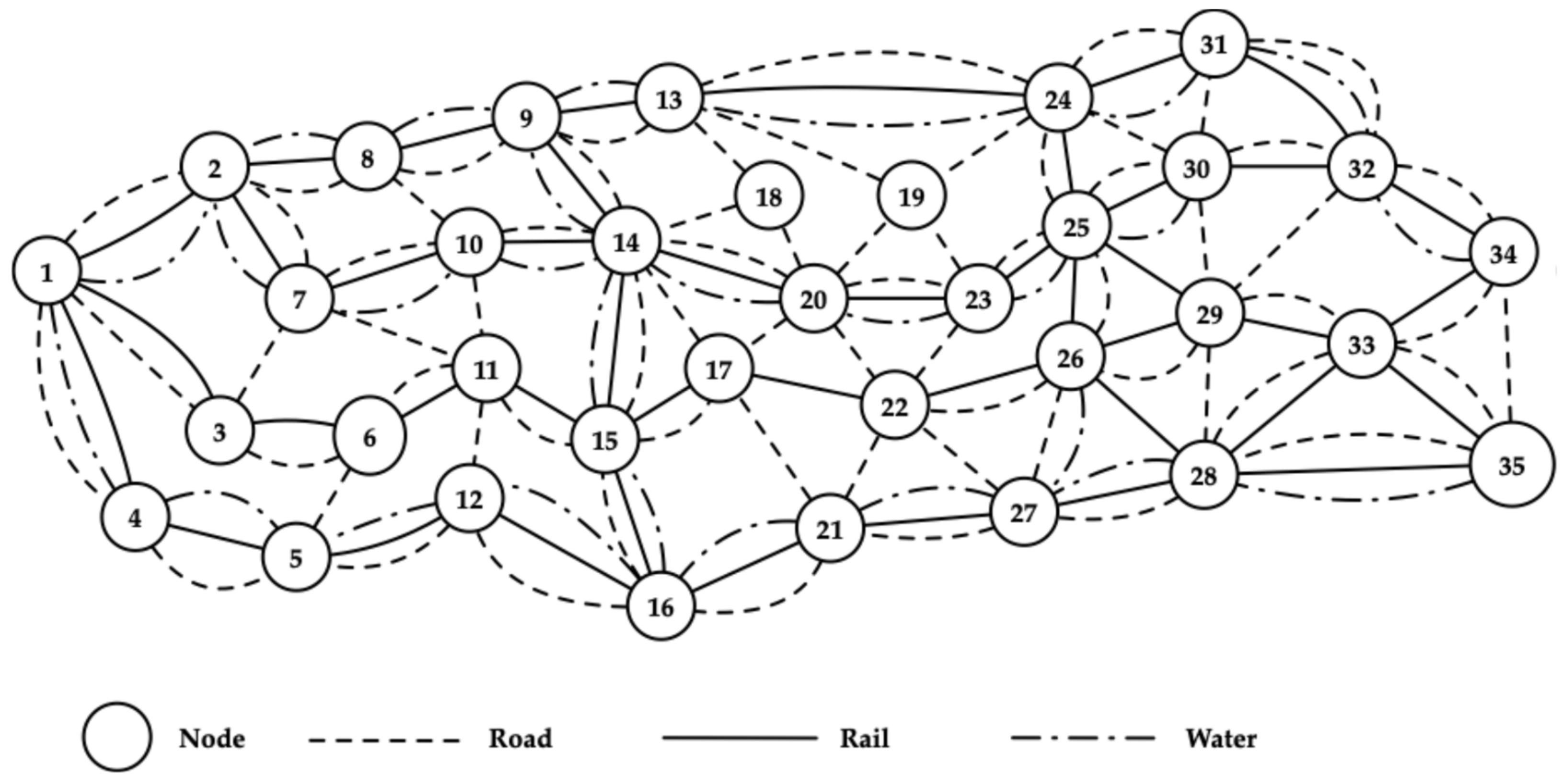
In this section, we continue to employ the 35-node intermodal network designed by Sun and Lang [
30] to verify the feasibility of the modeling and conduct further analysis to draw managerial insights, which can be seen in
Figure 1. The values of
,
,
, and
in the intermodal network all refer to the same values in Sun and Lang [
30]. The values of
,
,
,
,
,
, and
refer to the same values in Sun et al. [
20].
In this numerical case study, the origin and destination of the transportation order are node 1 and node 35, respectively. The soft time window (i.e.,
) proposed by the consignee is [25, 30] h, and the interval fuzzy demand (i.e.,
) required by the consignee is [30, 45] TEU.
and
are set as CNY 10/(TEU·h) and CNY 30/(TEU·h), respectively. Considering that a high carbon tax rate might be feasible [
18], and based on the values provided by Zhu et al. [
31], we set
as CNY 2.2/kg. In this study, we used the mathematical programming software Lingo to run the Branch-and-Bound Algorithm to solve the problem and obtain its global optimum solution.
The value of the satisfaction degree (i.e.,
) should be prescribed by the consignee before solving the model. To avoid unreliable transportation, we restrict the value of
to the interval [0.5, 1.0]. Then, we present the optimization results under different values of
, which can be seen in
Table 1.
As we can see from
Table 1, improving the satisfaction degree to make a more reliable transportation plan leads to a constant increase in both total costs and carbon emissions of the planned intermodal route. When the satisfaction degree improves from 0.5 to 1.0, the total costs increase by 58.4%. Such an improvement also increases the carbon emissions by more than five times. When improving the satisfaction level, the model tends to use a bigger deterministic demand value closer to the upper bound of the interval fuzzy demand to plan the intermodal route and determine its total costs and carbon emissions. Moreover, improving the satisfaction level makes Equations (23) and (24) hold under stricter conditions, which narrows the solution space of the problem. Therefore, the best solution becomes worse, and the objective value accordingly increases. However, the change in the time costs fluctuates when the satisfaction degree improves, while still showing a rising trend of 37.9%.
Therefore, lowering the total costs and carbon emissions of the planned intermodal route conflicts with enhancing its reliability. Moreover, when the consignee prefers a high satisfaction degree (e.g., 0.9 and 1.0) to ensure reliable transportation, the timeliness of transportation is sacrificed.
In this case, the consignee should find a balance by selecting a suitable satisfaction degree to match its requirements for costs, carbon emissions, timeliness, and reliability in a specific situation. In practice, an analytic hierarchy process method [
32] can help the consignee to find the most suitable plan, in which economics is represented by the total costs, and environmental sustainability is indicated by the carbon emissions, timeliness shown as time costs, and reliability reflected by the satisfaction level to form a comprehensive evaluation index system for selecting the most suitable intermodal route.
4.2. Feasibility Verification of the Carbon Tax Regulation
Carbon tax regulation seeks to reduce the carbon emissions associated with transportation. In this section, we first compare this regulation to neglecting carbon emission reduction to verify whether the carbon tax regulation can achieve carbon emission reduction in the problem optimization. Neglecting carbon emission reduction uses Equation (29) as the objective:
A comparison of the carbon emissions of the planned intermodal route with carbon tax regulation and without carbon emission reduction is illustrated in
Table 2.
As illustrated in
Table 2, in most decision-making cases (
= 0.6, 0.7, 0.9, and 1.0), carbon tax regulation helps to reduce the carbon emissions of the planned intermodal route. This is because minimizing the total costs helps to lower the carbon tax that is formulated as a part of the total costs, and lowering the carbon tax directly reduces carbon emissions. However, when the satisfaction degree is 0.5 or 0.8, the two situations lead to the same carbon emissions; the reason for this will be discussed in
Section 4.3.
From an overall viewpoint, the reduction in carbon emissions achieved by carbon tax regulation reaches up to 28.3% in all the decision-making cases and 42.4% in the decision-making cases where it leads to fewer carbon emissions.
Furthermore, we should check the increase in the total costs caused by the carbon tax regulation.
Table 3 gives the total costs of the planned intermodal routes with carbon tax regulation and neglecting carbon emission reduction.
As shown in
Table 3, the use of carbon tax regulation increases the total costs of the planned intermodal routes in all the decision-making cases. There is an average increase in total costs of 5.8% in all the decision-making cases and of 4.7% in the cases where the carbon tax regulation is able to reduce carbon emissions. Compared to the carbon emission reduction, we consider that such an increase in the total costs is acceptable. We thereby conclude that carbon tax regulation is generally feasible for carbon emission reduction.
Furthermore, we compare the carbon tax regulation to minimizing carbon emissions. In such a situation, Equation (30) is considered to be the objective:
The carbon emissions of the planned intermodal routes under carbon tax regulation and the minimization of carbon emissions are given in
Table 4.
As we can see from
Table 4, when the satisfaction degree is 0.5 or 0.8, the minimum carbon emissions are equal to the carbon tax regulation and neglect carbon emission reduction. In these cases, the carbon emissions and the sum of the transportation costs and time costs can be minimized at the same time, and any carbon tax rate can achieve minimum carbon emissions. Carbon tax regulation also shows a significant effect in reducing carbon emissions when the satisfaction degree is 0.6 or 0.7.
However, when the consignee prefers a higher satisfaction degree (i.e., 0.9 and 1.0), the carbon emissions resulting from carbon tax regulation are considerably greater than their minimum, and the increase in the total costs given in
Table 3 is relatively high. Therefore, the performance of the carbon tax regulation might be unacceptable. This is because in these cases, the carbon tax under the given carbon tax rate accounts for a small portion of the total costs compared to the transportation costs, and the model preferentially reduces the transportation costs in order to minimize the total costs.
To verify this reason, we increase the carbon tax rate by 5% steps until a satisfying reduction is realized. For a satisfaction degree of 0.9, increasing the carbon tax rate by at least 55% reduces carbon emissions to 4544 kg. For a satisfaction degree of 1.0, the same increase lowers carbon emissions to 4701 kg. Carbon emissions of 4544 kg and 4701 kg are very close to the minimum. However, such an increase in carbon tax rate might not be feasible in practice, since CNY 2.2/kg is already a high carbon tax rate setting, according to Zhu et al. [
31]. Its further increase might not be accepted by the government and the transportation industry.
Above all, in a practical transportation organization, carbon tax regulation should not be adopted directly because it might cause a significant increase in total costs, but not result in satisfactory carbon emission reduction. Moreover, a large carbon tax rate can significantly reduce carbon emissions, but it is unacceptable in practice. In this case, an effective carbon emission reduction approach should be regulated to seek significant carbon emission reduction, and the slight worsening of the economics of transportation, on the condition that a carbon tax is charged.
In this study, bi-objective optimization based on Equations (29) and (30) can first be employed to achieve carbon emission reduction in the planned intermodal route [
33,
34]. Then, we can combine the two objective values of the Pareto solutions using a weighted sum form that has the weights for Equations (29) and (30) at 1 and the regulated carbon tax rate, respectively. For example, when the satisfaction degree is 0.9, using the weighted sum method [
35], the Pareto solutions to the problem are presented in
Table 5. This Table also gives the total costs of the Pareto solutions when carbon tax regulation is promoted by the government and implemented by the transportation industry, and the carbon tax rate is CNY 2.2/kg.
When carbon emission reduction needs to reach the maximum, using the combination of bi-objective optimization and carbon tax regulation achieves a significant reduction effect, since it slightly increases the total costs by 4.6% and remarkably decreases the carbon emissions by 71.2% compared to carbon tax regulation alone.
4.3. Feasibility Verification of the Soft Time Window
A soft time window was used by this study to achieve timely transportation. As stated in
Section 1, there is no evidence proving its feasibility in green intermodal routing under interval fuzzy demand. In this section, we compare its optimization results to those obtained with a hard time window, so that we can reveal the feasibility of using a soft time window in problem optimization.
When there is a hard time window, transportation time should fall within this window [
36,
37]. Thus, the objective excludes the time costs and should be Equation (31). There are hard time window constraints, such as in Equations (32) and (33), which have been processed based on Equation (19):
The total costs and carbon emissions of the planned intermodal routes based on the two types of time windows are indicated in
Table 6.
Table 6 shows that when the satisfaction degree is 0.6 or 0.7, a soft time window slightly increases the total costs of the planned intermodal route compared to a hard time window. However, the two types of time windows actually generate the same intermodal routes in these cases. The difference in total costs comes from the hard time window, not including time costs in the total costs.
However, when the consignee prefers a high satisfaction degree of 0.8, 0.9, or 1.0, a soft window can reduce both total costs and carbon emissions. In the three cases, the use of a soft time window decreases the total costs by 3.2% and the carbon emissions by 15.1%, on average. Therefore, a soft time window is more suitable, especially when the consignee prefers highly reliable transportation. In these cases, using a soft time window can remarkably expand the solution space of the problem compared to a hard time window. Although worsening the timeliness by increasing the time costs, the model based on a soft time window uses a bigger solution space to find a better solution that can reduce transportation costs and carbon tax more than the increase in time costs, which leads to a decrease in total costs and carbon emissions.
Therefore, in transportation practice, the consignee should take advantage of a soft time window to achieve cost-efficient, green, and reliable intermodal transportation. The consignee should attach great importance to accurately designing its soft time window according to its post-transportation goods-processing planning.
4.4. Influence Analysis of the Uncertainty Level of the Interval Fuzzy Demand
In this study, we assume that the mean value of the interval fuzzy demand is unchangeable and decrease its spread to generate several other interval fuzzy demand scenarios in which the uncertainty level of the demand constantly decreases. Additionally, we assume that the consignee prefers highly reliable transportation and set the satisfaction degree to 0.9 or 1.0. With this consideration, the total costs and carbon emissions of the planned intermodal routes at different uncertainty levels of interval fuzzy demand are presented in
Table 7.
As shown in
Table 7, when the spread of the interval fuzzy demand decreases from 7.5 to 1.5 to lower the uncertainty level, both the total costs and carbon emissions of the planned intermodal route are significantly reduced. When the satisfaction degree is 1.0, the reductions in total costs and carbon emissions reach 32.8% and 80.6%, respectively. In the case where the satisfaction degree is 0.9, such reductions are 30.0% and 80.1%, respectively. Therefore, lowering the uncertainty level of the interval fuzzy demand is a promising approach to simultaneously achieve improved economics, environmental sustainability, and reliability for the consignee. This is because, in these cases, lowering the upper bound and increasing the lower bound of the interval fuzzy requires relaxing the condition that Equations (23) and (24) hold, and thus enlarges the solution space of the problem. This variation also makes the model use a smaller deterministic demand value to plan the intermodal route, which enables a better solution to be found and the objective value to be reduced.
Consequently, in the routing decision-making stage, the consignee should estimate demand accurately according to its post-transportation goods planning and changes in production and marketing. The consignee should also pay attention to making plans to address emergencies that lead to significant demand fluctuation. These actions can avoid underestimation of its minimum demand and overestimation of its maximum demand, which results in a decrease in the uncertainty level of the demand, as well as help the transportation organizer better organize intermodal transportation and provide the consignee with high-level transportation service.
4.5. Influence Analysis of the Capacity Level of the Intermodal Network
Capacity plays a key role in the capacitated routing problem [
38]. In this section, we set the initial capacity level of the intermodal network as the benchmark and improve it by 25% with a step size of 5%. We continue to assume that the consignee prefers highly reliable transportation and set the satisfaction degree to 0.9 or 1.0. In this situation, we can obtain the total costs and carbon emissions of the planned intermodal routes at different capacity levels of the intermodal network, which can be seen in
Table 8.
As shown in
Table 8, improving the capacity of the intermodal network decreases the total costs and carbon emissions of the planned intermodal route. When the satisfaction degree is 1.0, improving the capacity level by 20% decreases the total costs by 24.2%. Although there is fluctuation in the change in carbon emissions, this improvement can reduce carbon emissions by 81.6%. For a satisfaction degree of 0.9, improving the capacity level by 15% can achieve the above reductions. This is also because improving the capacity relaxes the condition that Equations (23) and (24) hold, and thus enlarges the solution space of the problem, which enables the problem optimization to yield a better solution and reduced objective value.
Therefore, improving capacity has the same advantages in decreasing the uncertainty of the interval fuzzy demand in planning a reliable intermodal route. The transportation organizer should thus select carriers and transfer nodes with sufficient capacity to establish an intermodal network to route the goods, which provides solid support to enhance its service level and environmental benefits. However,
Table 6 also reveals that improving the capacity level does not lead to constant reductions. When improving up to a certain degree, further improvement does not achieve any effect on optimizing planning. Consequently, the transportation organizer should not blindly expand the capacity of the intermodal network it builds, to avoid a low utilization rate and wasting transportation resources.
6. Conclusions
This study contributes to the intermodal routing problem by integrating carbon tax regulation, a soft time window, and interval fuzzy demand into the problem optimization to achieve a comprehensive balance and an improvement in the economics, timeliness, environmental sustainability, and reliability of transportation. This supplements the current intermodal routing studies that did not fully formulate all these settings and cannot achieve a comprehensive and balanced optimization of the problem, and it also helps to improve the service level of transportation provided by the transportation organizer and further enables the development and application of intermodal transportation as a sustainable means of transportation in practice.
To realize the above contributions, we propose an interval fuzzy nonlinear optimization model and further present a crisp and linear reformulation that is easily solvable. Using the proposed model, the transportation organizer can plan the best intermodal route and organize high-quality transportation to serve the consignee.
Based on a numerical case and its optimization results, we further make practical contributions to the intermodal routing problem by carrying out a systematic feasibility verification on carbon tax regulation and soft time window, and we analyzed the influence of the uncertainty level of interval fuzzy demand and the capacity level of the intermodal network on routing optimization. The practical contributions provide strategies for all the participants in intermodal transportation to better coordinate with each other to achieve efficient intermodal transportation that, in turn benefits them all as well as the environment.
In this study, we draw the following conclusions based on the optimization results:
- (1)
We confirm again that economics and environmental sustainability conflict with reliability when planning, which is also given by Guo et al. [
15]. Enhancing reliability through improving the satisfaction level from 0.5 to 1.0 increases the total costs and carbon emissions by 58.4% and 551.4%, respectively, and worsens the timeliness by 37.7%. Under this condition, the consignee can use an analytical hierarchy process method to determine the most suitable intermodal route that matches its specific requirements.
- (2)
Carbon tax regulation shows a good carbon emission reduction effect in most decision-making cases. It can achieve almost similar carbon emission reduction to the condition of minimizing carbon emissions by slightly increasing the total costs by less than 4%.
- (3)
In some cases where the consignee prefers a highly reliable intermodal route, carbon tax regulation leads to carbon emissions that are higher than the condition minimizing the carbon emissions by 252.6% and total costs that are higher than the condition neglecting the carbon emission reduction by more than 10%, which shows that the carbon emission reduction is not significant and satisfactory. In these cases, the carbon tax regulation needs to be significantly increased to CNY 3.41/kg to make the carbon tax regulation reduce more carbon emissions of the planned intermodal route; however, such a significant increase is infeasible in practice.
- (4)
To achieve improved reduction when carbon tax regulation does not satisfactorily reduce carbon emissions, a combination of bi-objective optimization and carbon tax regulation can be employed, in which a slight increase in the total costs by less than 5% can achieve a carbon emission reduction of more than 70% compared to the carbon tax regulation alone.
- (5)
We reveal that a soft time window can reduce both the costs and the carbon emissions of a reliable intermodal route by more than 3% and 15%, respectively, which confirms that the use of a soft time window in the problem optimization is feasible. The consignee should determine such a time window accurately based on its post-transportation goods processing.
- (6)
Reducing the uncertainty level of the interval fuzzy demand by lowering the spread from 7.5 to 1.5 contributes to the reduction in the total costs and carbon emissions by more than 30% and 80%, respectively. The consignee should take measures to improve the stability of the demand. This conclusion matches Guo et al. [
15].
- (7)
Improving the capacity level of the intermodal network by 15% or 20% reduces the total costs and carbon emissions of a highly reliable intermodal route by more than 20% and 80%, respectively. The transportation organizer should select carriers and transfer nodes with sufficient capacity. However, the transportation organizer should not blindly expand capacity to avoid a low utilization rate and waste transportation resources.
Based on the findings of our study, the transportation organizer can plan the best intermodal route that meets the requirements of the consignee, and the consignee can better implement its post-transportation goods processing. Moreover, this study focuses on effectively reducing the carbon emissions of intermodal transportation based on carbon tax regulation and its modification, which can also benefit the environment through environmentally sustainable planning.