You are currently viewing a new version of our website. To view the old version click .
Applied Sciences
  • Article
  • Open Access

2 December 2025

Experimental Study on Dynamic Characteristics of Cemented Tailings Backfill Under Different Tailings Gradation

,
and
1
School of Mining Engineering, North China University of Science and Technology, Tangshan 063210, China
2
Collaborative Innovation Center of Green Development and Ecological Restoration of Mineral Resources, Tangshan 063210, China
3
Mine Green Intelligent Mining Technology Innovation Center of Hebei Province, Tangshan 063210, China
4
Hebei Province Key Laboratory of Mining Development and Security Technology, Tangshan 063210, China
This article belongs to the Special Issue Preparation and Property Optimization of Backfill Materials for the Mining Industry

Abstract

The stability of cemented tailings backfill (CTB) is influenced by mining disturbance. As a property of CTB, tailings gradation (TG) is one of the factors that change its mechanical properties. Taking tailings gradation, impact amplitude, and curing age as variables, this paper focuses on the characteristics of the influence of curing age on the failure deformation, strength evolution, failure mode, and microstructure of CTB. The results show that with the average particle size of the tailings from coarse to fine, the peak stress and elastic modulus of CTB first decrease and then increase. The increase in curing age and impact amplitude can improve the elastic deformation capacity of CTB. During the post-peak phase, the stress–strain curve undergoes sequential morphological transitions, evolving from the initial “stress drop” characteristics through “post-peak plasticity” manifestations before ultimately demonstrating “post-peak ductility” behavior. This progression corresponds to CTB’s material transformation pathway, commencing as a rigid substance that first transitions into a plastic-brittle composite, subsequently develops plastic properties, and finally attains ductile material characteristics. The TG changes from T1 to T4, and the failure mode of CTB gradually changes from composite failure and shear failure to tension failure and composite failure. A CTB strength prediction model based on TG is proposed. The R2 of the model is 0.997, F = 12,855, and p < 0.001, which has high applicability. As tailings vary from T1/T2 to T4, AFt content progressively decreases, the C-S-H gel transitions from a 3D network to a flocculent structure, and the skeleton shifts from coarse to fine particles, leading to increased porosity but smaller pores.

1. Introduction

Cemented tailings backfill (CTB) is a kind of artificial structure prepared by mixing tailings, cement, and water, which is used to support the roof of the mine-out area, so as to prevent surface collapse and achieve the purpose of controlling ground pressure [1,2,3]. The dynamic disturbance caused by mining activities often causes damage and even instability in the CTB, resulting in the overall caving of the stope [4,5]. This not only seriously threatens the personal safety of mine workers, but also damages mining equipment and brings about great property losses [6,7]. Therefore, exploring the dynamic performance of CTB is an important index to evaluate its contribution to stope safety. Tailings grading is the basic attribute to characterize the grading relationship of tailings particles. The content of different particle size intervals, particle size distribution parameters, nonuniformity coefficient, and curvature coefficient affect the occurrence state, pore structure, and hydration reaction products of particles in the CTB and have a significant impact on the mechanical properties, such as deformation, strength, and failure mode.
Aiming at the dynamic characteristics of CTB, researchers have carried out many studies and achieved a series of research results. Previous studies used a split Hopkinson pressure bar (SHPB) to carry out CTB dynamic mechanical compression tests to analyze the strain rate, dynamic compressive strength, and energy evolution characteristics [8,9,10,11,12]. Some scholars also analyzed the influence of CTB’s own attributes, such as curing age, cement–sand ratio, and other variables, on its dynamic performance [13,14,15,16]. The results show that the dynamic compressive strength of CTB increases with the increase in cement–sand ratio and curing time under the same strain rate. In fact, the tailings occupy the largest proportion in the filling material, and their physicochemical properties also affect the strength of CTB. Jiang et al. [17] and Guo et al. [18] studied the influence of sulfide in tailings on the strength of backfill. The results show that the sulfide content has a low influence on the strength of the backfill, and only when the sulfide mineral content in the tailings exceeds a certain level can the strength of the backfill be damaged. By introducing the concept of packing density, Sun et al. [19] studied the influence of a tailing content of <20 μm particle size on the strength of CTB. The results showed that with the increase in tailing content of <20 μm particle size, the strength of CTB first increased and then decreased. The above research results show that the tailings gradation has a significant effect on the strength of the CTB, but it is inappropriate to use the particle size of <20 μm to characterize the particle size range of the tailings. Therefore, it is urgent to carry out further calibration and analysis of the tailings gradation, so as to explore its influence on the dynamic characteristics of CTB. However, there has been little research reported on this aspect.
The innovation of this paper is to study the influence of tailings gradation on CTB dynamic characteristics, and propose a CTB strength prediction model based on tailings gradation characteristic particle size parameters, which provides a basis for the reasonable determination of filling tailings particle size. The physical and chemical properties of tailings and cement were analyzed by XRD, XRF, and a laser particle size analyzer. With tailings gradation (TG), curing age, and impact amplitude as variables, dynamic compression tests were carried out with SHPB, and the failure deformation characteristics, strength evolution law, and failure mode of CTB were investigated. The influence of TG on the mechanical properties of CTB was emphasized. The research results provide a theoretical basis for the reliability and applicability of CTB with different TG.

2. Materials and Methods

2.1. Experimental Materials

2.1.1. Tailings

In order to reduce the influence and interference of magnetic substances on subsequent experiments, gold tailings with no magnetic or very low content of magnetic substances are selected as test materials. The tailings used in this experiment were taken from a gold mine in Shandong Province. According to the purpose of the experiment, four types of tailings with the same mineral composition but different fineness were selected, which were defined from coarse to fine as T1, T2, T3, and T4, respectively.
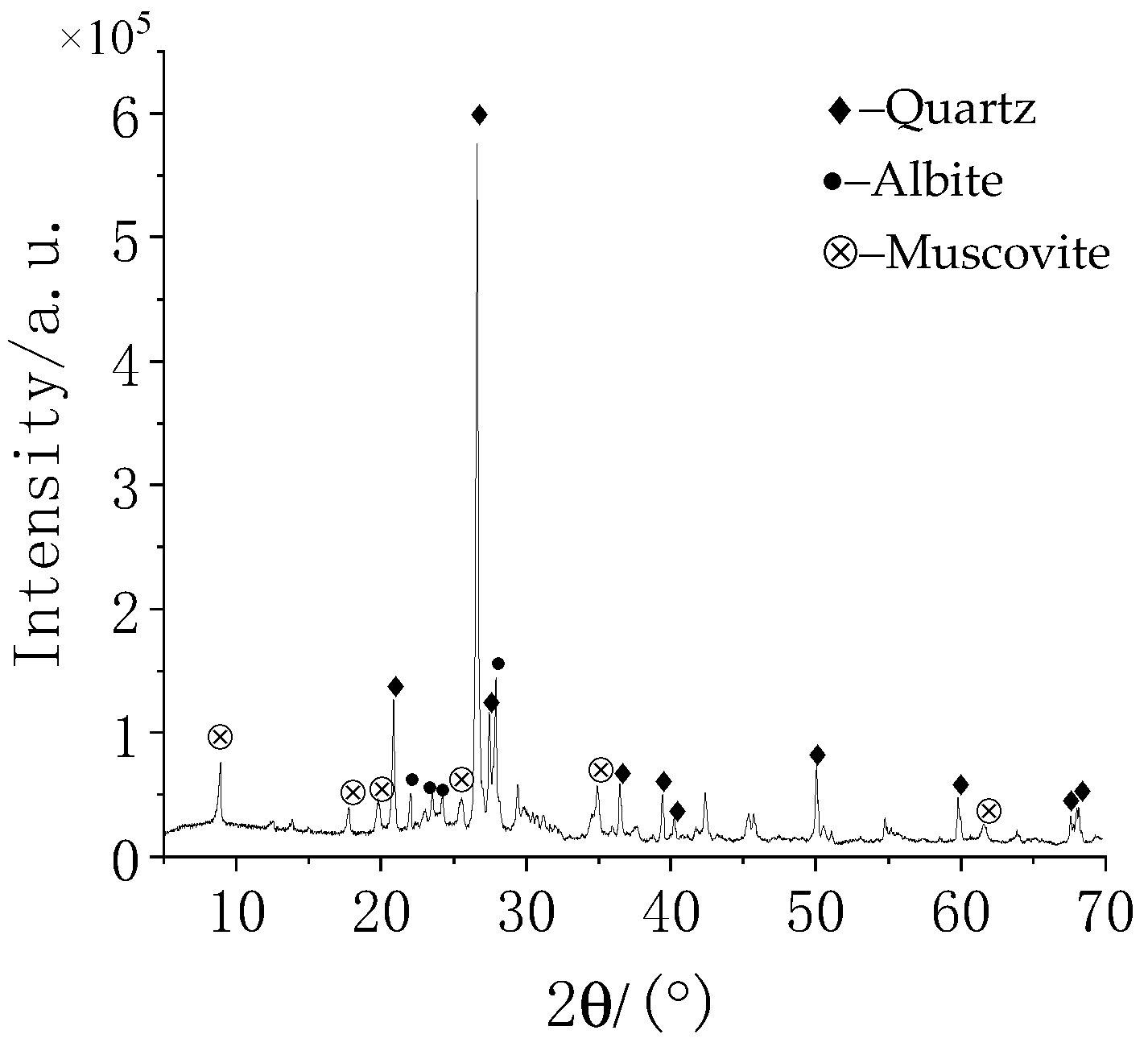
The chemical composition and content of tailings and cement were determined by X-ray fluorescence spectrometer (XRF, Panalytical Axios, Almere, The Netherlands) [20,21]. On this basis, the mineral composition of tailing sand and cement was analyzed by X-ray diffractometer (XRD, Ultima IV (185 mm), in the interval of 5° < 2Θ < 70° with a step size of Δ2Θ = 0.02°, and a scanning speed of 5°/min, using Cu–Kα radiation), as shown in Table 1 and Figure 1. The detection results show the main chemical composition of the tailings was SiO2, accounting for 71.64%, followed by Al2O3, accounting for 15.2%, and a small amount of K2O (4.65%), Na2O (3.44%), and CaO (2.38%). The main mineral composition is quartz, followed by a small amount of albite and muscovite, which is typical of high-silicon tailings.
Table 1. Main chemical composition of tailings.
Figure 1. XRD spectra of tailings.
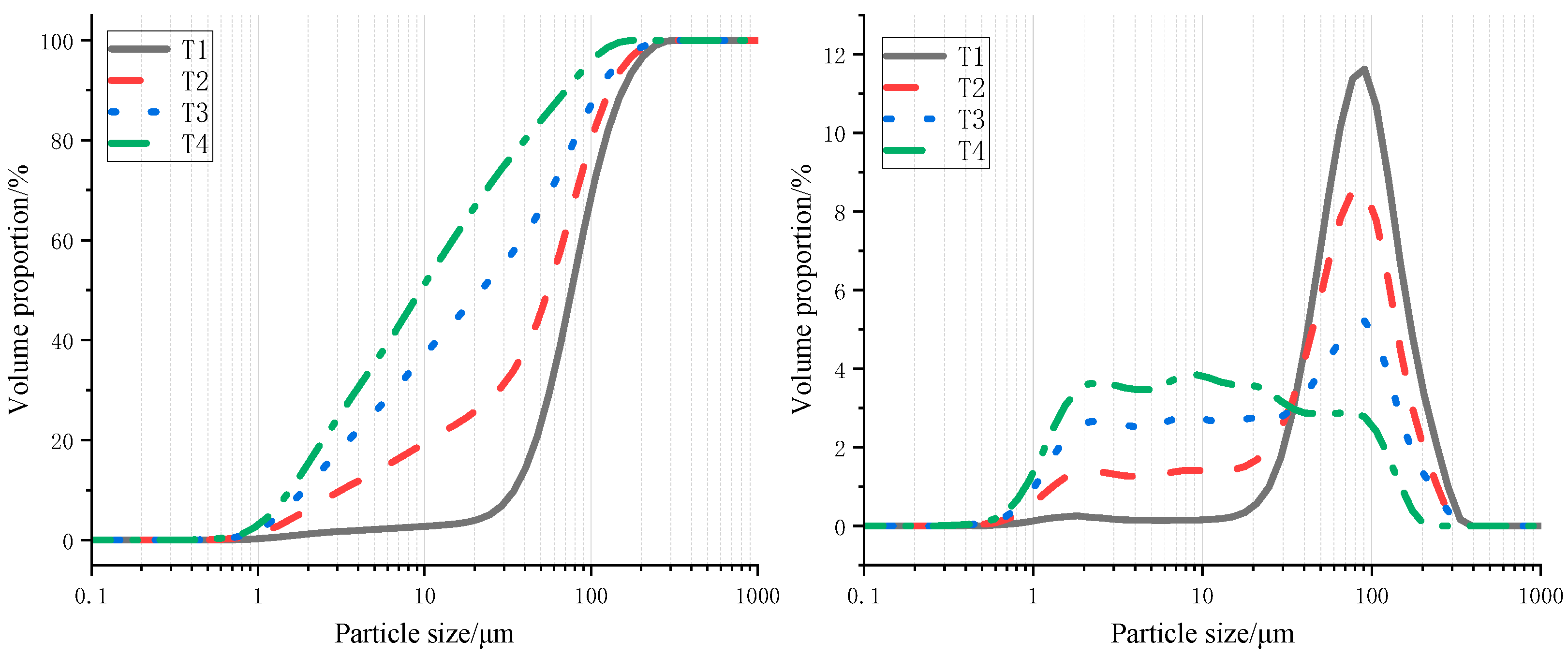
The grading curve of the tailings was measured by a laser particle size analyzer, and the specific results are shown in Figure 2.
Figure 2. Distribution curve and accumulation curve of tailings.
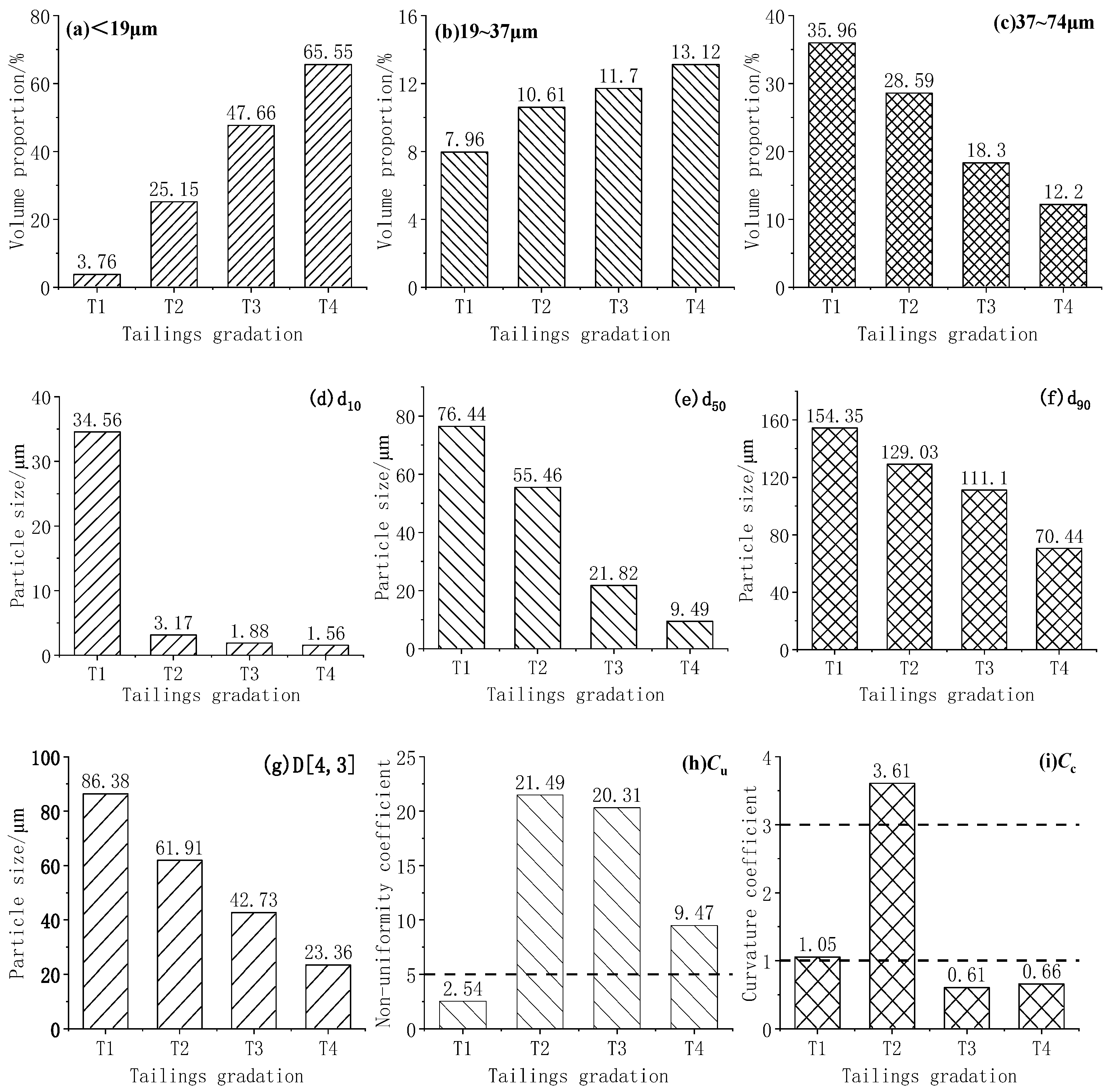
As can be seen from Figure 2, there are significant differences in the particle size distribution of the four types of tailings. In order to describe the differences in the tailings gradation more comprehensively and accurately, it is necessary to determine and calculate the characteristic parameters of tailings gradation [22,23,24]. According to the current research, engineering, application status, and the Standard for engineering classification of soil (GB/T 50145-2007 [25]), the characteristic parameters commonly used to characterize the tailings gradation are determined as: d10, d50, d90, D[4,3], Cu, Cc, C<19μm, C19~37μm, and C37~74μm. Among them, d10, d50, and d90 are the particle sizes corresponding to 10%, 50%, and 90% of the particles under the sieve, respectively; D[4,3] is the mean volume particle size; Cu is the non-uniformity coefficient; Cc is the curvature coefficient; C<19μm, C19~37μm, and C37~74μm are the contents of particles within the ranges of 0~19 μm, 19~37 μm, and 37~74 μm, respectively. The tailings gradation characteristic parameters of the four tailings are shown in Figure 3.
Figure 3. Characteristic parameters of tailings gradation.
As can be seen from Figure 3, T1 has a concentrated particle distribution and poor gradation but continuous distribution; T2 has a wide distribution and good gradation but lacks particles in the particle size range of d30 and d10; and T3 and T4 all have a wide distribution and good gradation but lack particles in the particle size range of d60 and d30. Moreover, the non-uniformity coefficients of T3 and T4 are significantly different. Therefore, the four types of tailings selected in this paper have obvious differences in particle content, particle size characteristic parameters, and grading characteristic parameters in the particle size range, which can meet the requirements of the test. The above results show that there are significant differences between the four types of tailings in grading and grading characteristic parameters, which can be utilized in this experiment study.

2.1.2. Cementing Material

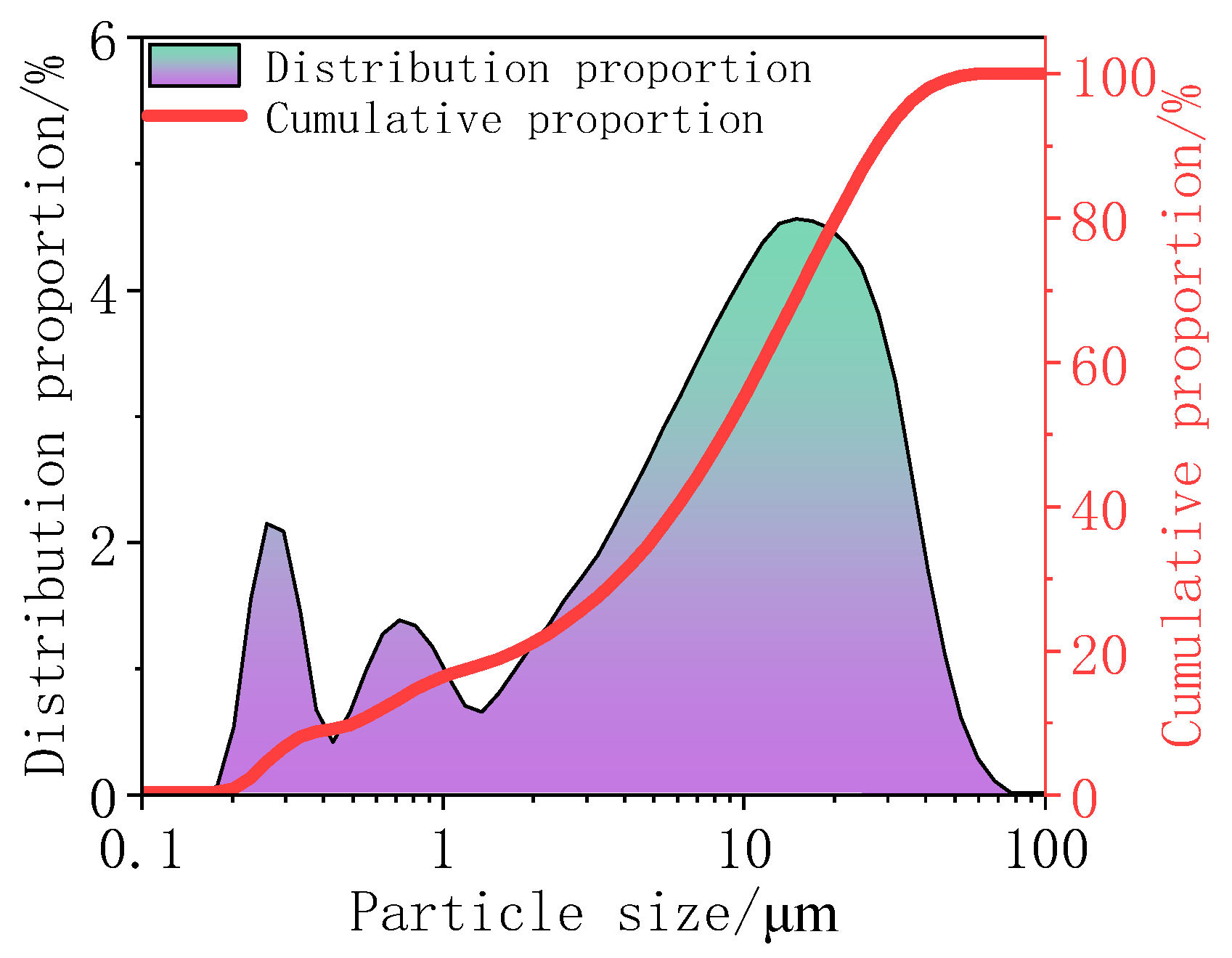
In this experiment, white Portland cement was used as the cementing material. The gradation curve of cement particles was determined by using a wet laser particle size analyzer with absolute alcohol as the dispersant. The specific results are shown in Figure 4.
Figure 4. Distribution curve and accumulation curve of cement.
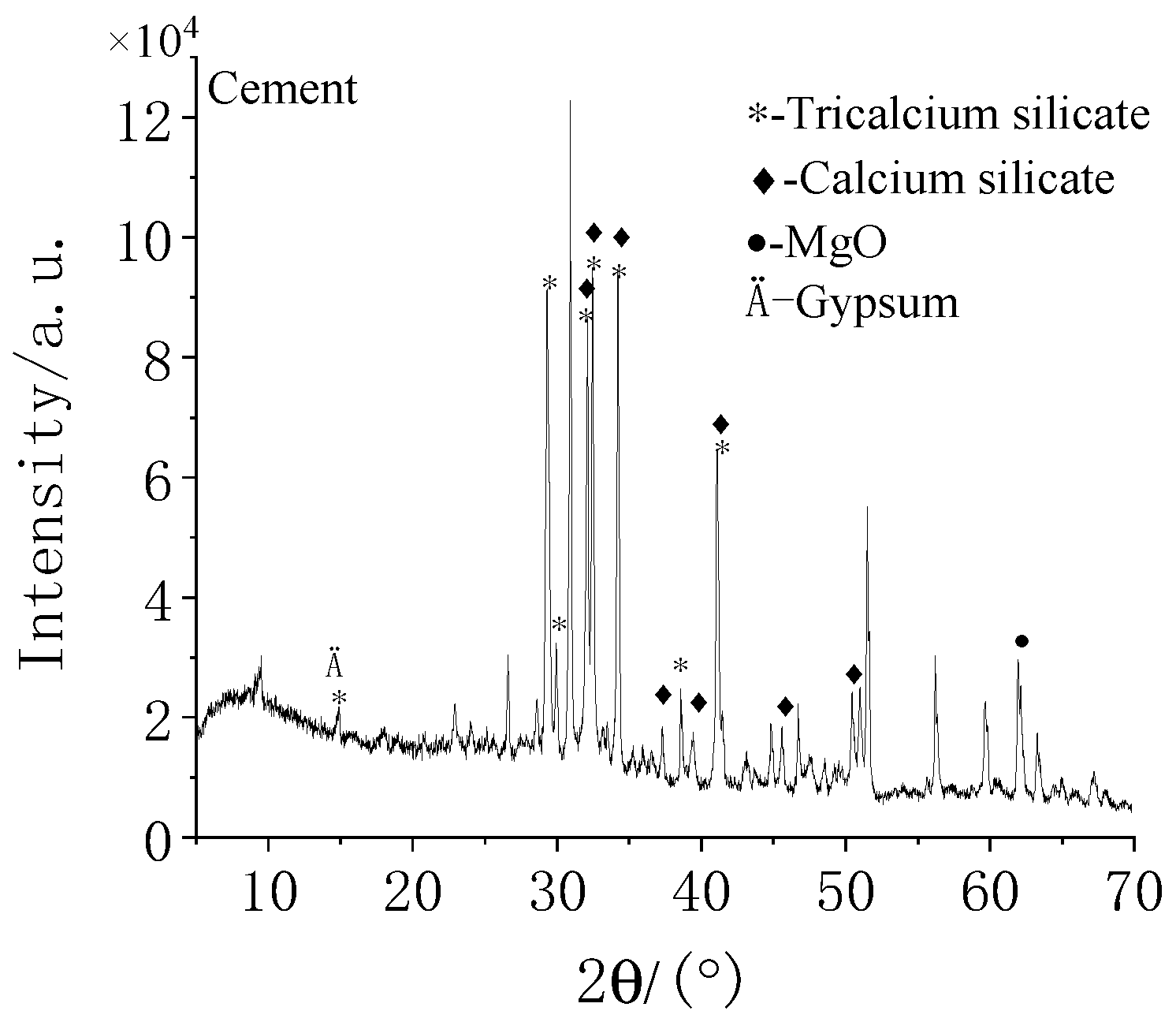
The mineral composition of cement was analyzed by XRD, as shown in Figure 5.
Figure 5. XRD spectra of cement.
According to Figure 4 and Figure 5, the main mineral composition of cement is tricalcium silicate, dicalcium silicate, and a small amount of magnesium oxide and gypsum; its weighted average particle size is 11.82 μm, and the overall particle size distribution is relatively fine.

2.2. Sample Preparation

In order to study the effects of tailings gradation on dynamic loading characteristics of CTB under different curing ages and impact amplitude, the specific test scheme is determined as follows: tailings are designated T1, T2, T3, and T4; gradations were determined; the cement–tailing ratio is set at 1:6; the curing ages selected are 3 d, 7 d, and 28 d; and the slurry concentration is 60%. The impact amplitudes selected are 40 mV, 55 mV, 70 mV, and 85 mV.
Sample preparation follows the GB/T 50081-2019 [26] Standard for test methods of concrete physical and mechanical properties. CTB specimens are prepared according to the steps of batching, pulping, grouting, scraping, demolding, and curing. The specific steps are as follows: (1) Calculate and weigh tailings, cement, and water according to the test scheme. (2) Evenly mix the tailings and cement, pour it into the mixer, and then pour the weighed water; stir for 900 s. (3) Evenly coat the inside of the grinding tool with oil, and inject the prepared filling slurry into the cylindrical mold with an inner diameter of 50 mm and a height of 25 mm. During the grouting process, pour and stir the specimen to ensure uniformity. (4) After the initial setting of the filling slurry, scrape the upper surface flat. (5) Demold the hardened paste 24 h later, and number the specimen. (6) Place the specimen in a standard curing box with a temperature of 20 °C and a humidity of 95% for curing to the required age.

2.3. Experimental Methods

2.3.1. Dynamic Characteristics Test

The Split Hopkinson pressure bar (SHPB) test platform is used in this study. The main components include a high-pressure nitrogen cylinder, launch chamber, warhead, bar device, super-dynamic strain gauge, oscilloscope, etc. Among them, the high-pressure nitrogen cylinder inflates the launching chamber to provide the power impact to the spindle-shaped warhead, and the impact amplitude is controlled by adjusting the intake volume. The rod device is composed of an incident bar, transmission rod, and absorption rod. The specific parameters are: material 40Cr alloy steel, density 7975 kg/m3, wave speed 5198 m/s, incident bar (D50 mm × 2000 mm), transmission bar (D50 mm × 2000 mm), and absorption bar (D50 mm × 1500 mm) [27,28]. The collection and storage of test data are realized through the strain gauge, data line, super-dynamic strain gauge, and oscilloscope. The SHPB is applied in the field of studying the dynamic characteristics of CTB. It is mainly based on two assumptions: the one-dimensional stress wave assumption and the uniformity assumption of the stress wave. The basic principle of the test is to place the filler specimen between the incident bar and the transmission bar. Through the compression from nitrogen gas in the shock chamber pushing the impact head, the impact head strikes the incident bar at a certain speed at the center. A stress wave is generated in the incident bar and propagates to the filler specimen at a certain wave speed. After being absorbed and dissipated by the filler, the stress wave then propagates to the transmission bar at a certain wave speed. During the propagation of the stress wave, due to the change in the medium, reflection and transmission occur at the interface. That is, reflection stress waves and transmission stress waves are generated at the contact surfaces of the impact head, filler specimen, and transmission bar. After repeated cross-media transmission and reflection, a stress equilibrium state is reached.
The “one-dimensional stress wave method” can be used to calculate the relationship between the average stress, strain, and strain rate of specimens under SHPB impact load and time, as shown in the following equation.
σ t = A e 2 A s σ I t σ R t + σ T t
ε t = 1 ρ e C e L s 0 t σ I t σ R t + σ T t d t
ε ˙ t = 1 ρ e C e L s σ I t σ R t + σ T t
Before the dynamic load measurement, the diameter, height, mass, and axial wave velocity of each specimen are measured to calculate the dynamic load parameters. The SHPB test system is used to measure the single-impulse load of specimens.
After the impact, photos are taken to record the broken shape of specimens. Three effective data points are measured under the same ratio and amplitude, and the average value is calculated as the effective data.

2.3.2. Microstructure Characteristics Test

The broken CTB fragments were collected for scanning electron microscopy (SEM, TESCAN MIRA LMS) analysis to study their microscopic morphology. To preserve the hydration state at the moment of crushing, the broken CTB specimens were immersed in anhydrous ethanol to terminate the hydration reaction. Prior to SEM observation, the preserved specimens were taken out and dried in a 40 °C oven for 12 h. Fresh cross-sections were obtained by mechanical fracturing. These specimens were then mounted on stubs using conductive adhesive and sputter-coated with a layer of gold to enhance conductivity. The specific technical parameters for SEM were as follows: secondary electron imaging mode, with a resolution of 0.9 nm, an accelerating voltage of 15 kV, and magnifications of 1000× and 5000×.

3. Results and Discussion

3.1. Deformation Characteristics of CTB

3.1.1. Post-Peak Characteristics of Stress–Strain Curve

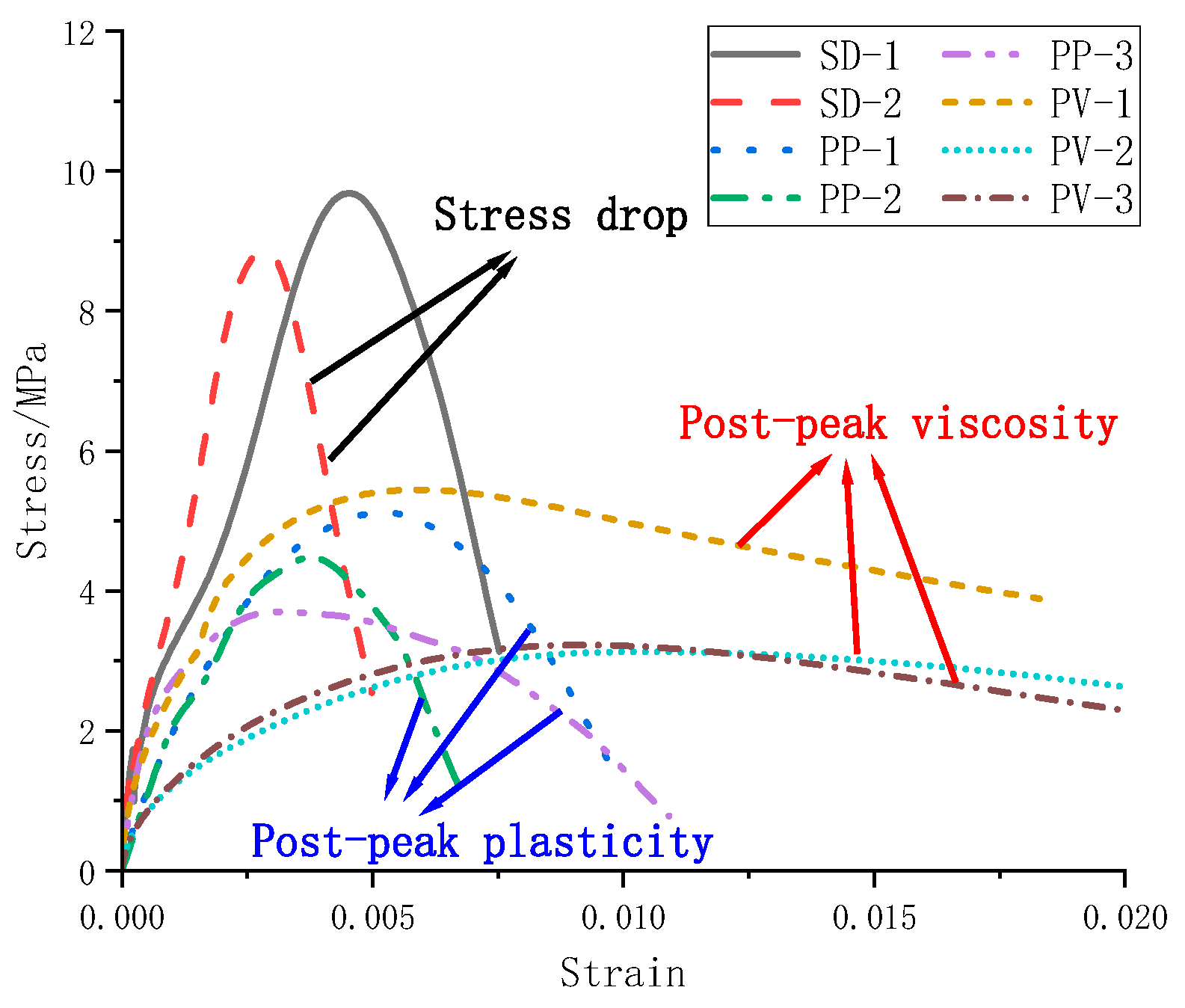
Under the impact load, the stress–strain curve of CTB mainly consists of three stages: the elastic deformation stage, the yield deformation stage, and the post-rupture stage [29,30]. According to the test results and the existing literature, factors like tailings gradation, curing age, impact amplitude, and cement-tailings ratio had little effect on the pre-peak stress–strain curve. Under dynamic loading, the pre-peak curve always changes shape in the same way: it starts as a straight line and then softens into an upward-curving arc. However, the tailings gradation significantly affects the curve after the peak stress in a predictable way. For this reason, our analysis focuses on the post-peak stage. Typical stress–strain curves for different post-peak behaviors are shown in Figure 6.
Figure 6. Stress–strain curves of different types of post-peak stages.
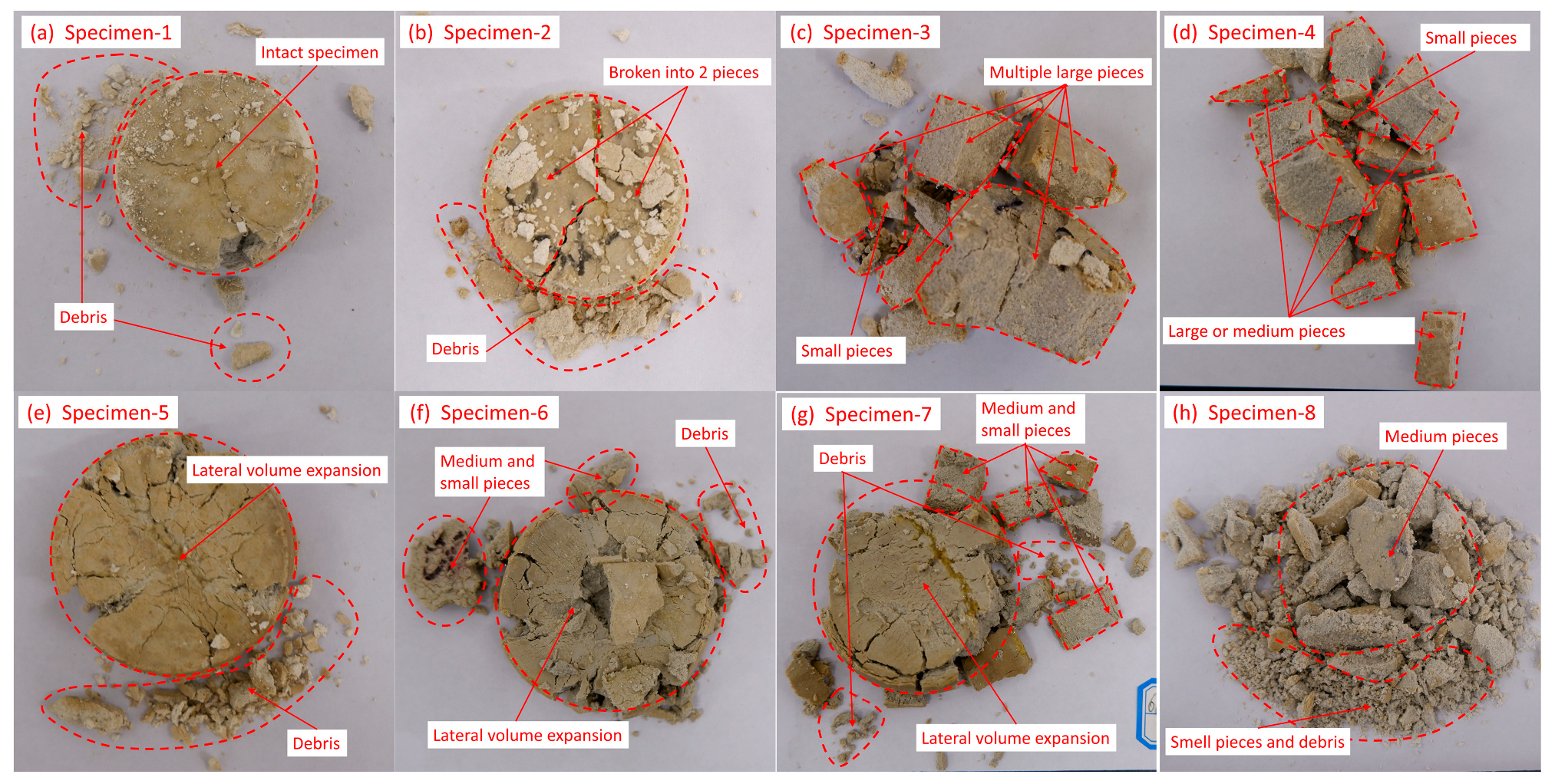
According to Figure 6, the post-peak stages of the dynamic stress–strain curve are divided into three types, namely, “stress drop” type, “post-peak plasticity” type, and “post-peak ductility” type. Among them, the CTB specimen of “stress drop” type was basically intact or broken into one to three pieces with the same thickness as the specimen after impact, accompanied by a small amount of surface debris spalling, as shown in Figure 7a,b. Because the impact load applied is less than the peak stress, the CTB specimen is in the yield deformation stage. Part of the external energy is stored in the CTB specimen in the form of elastic strain energy, and the other part is consumed by the formation of new cracks at the primary cracks and weak joints. The stored elastic strain energy is released quickly after the peak stress, and the strain change is small, with the curve showing a rapid decline in the post-peak stage. The “post-peak plastic” CTB specimens were broken into fragments with different degrees of fragmentation after impact, as shown in Figure 7c,d,h. Because the applied impact load is greater than the peak stress, the CTB is in the post-failure stage, and the external energy action forms a large number of macroscopic cracks interpenetrating with the primary cracks and weak joints, forming a fracture surface. The elastic strain energy stored after the peak stress is slowly released, and the curve in the post-peak stage shows a slow downward trend. The overall structure of the “post-peak viscous” CTB specimen was relatively intact after impact, and the sliding failure along the shear plane resulted in volume expansion, accompanied by the fall of some external small fragments, as shown in Figure 7e–g. Due to the high viscosity of the CTB specimens, a large number of macroscopic cracks are formed at the primary cracks and weak joints under the action of external energy, but no fracture surface is formed. The CTB specimens have quite high residual stress, and the curve of the post-peak stage shows an extremely slow downward trend.
Figure 7. Fracture morphology of different types of specimens in post-peak stage.

3.1.2. Effect of TG on Stress–Strain Curve

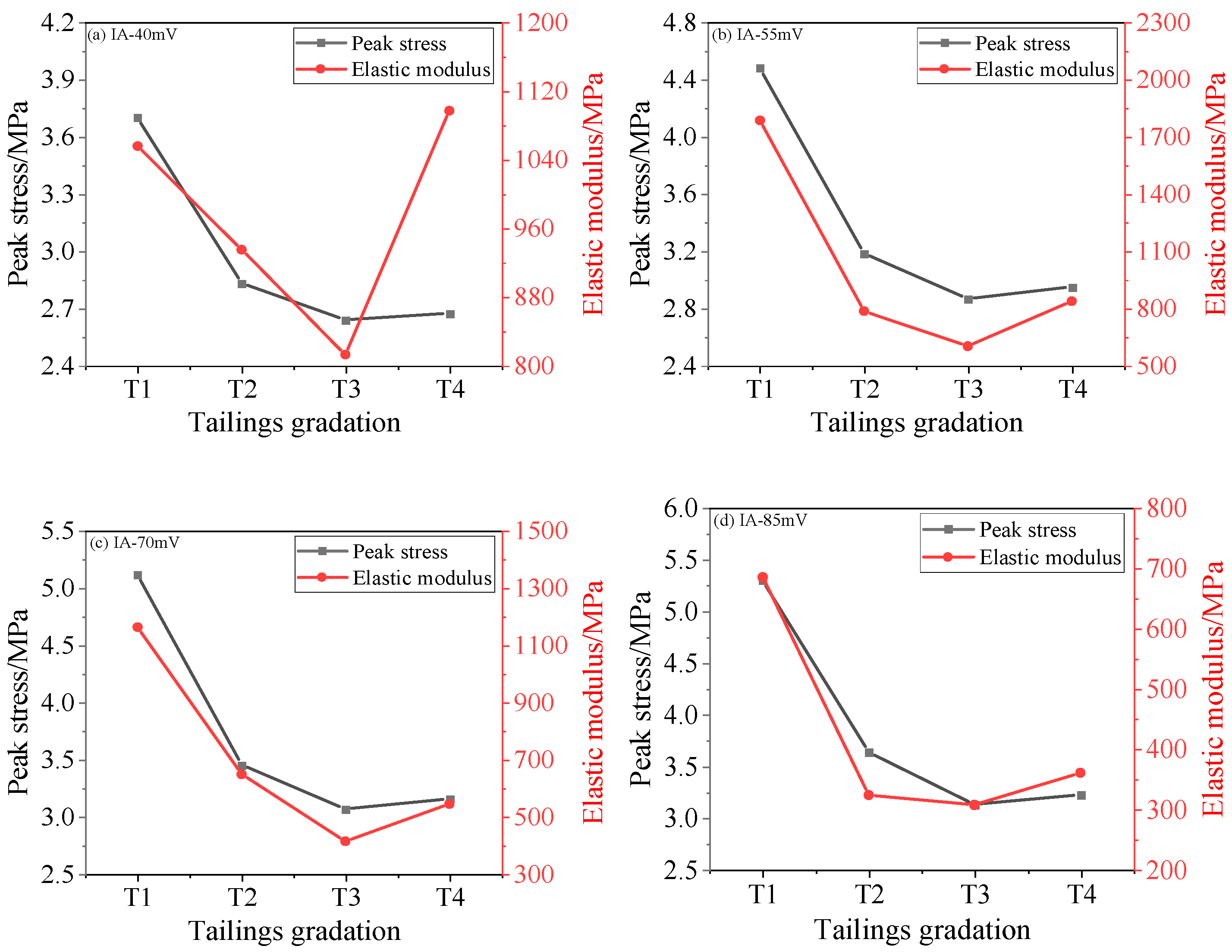
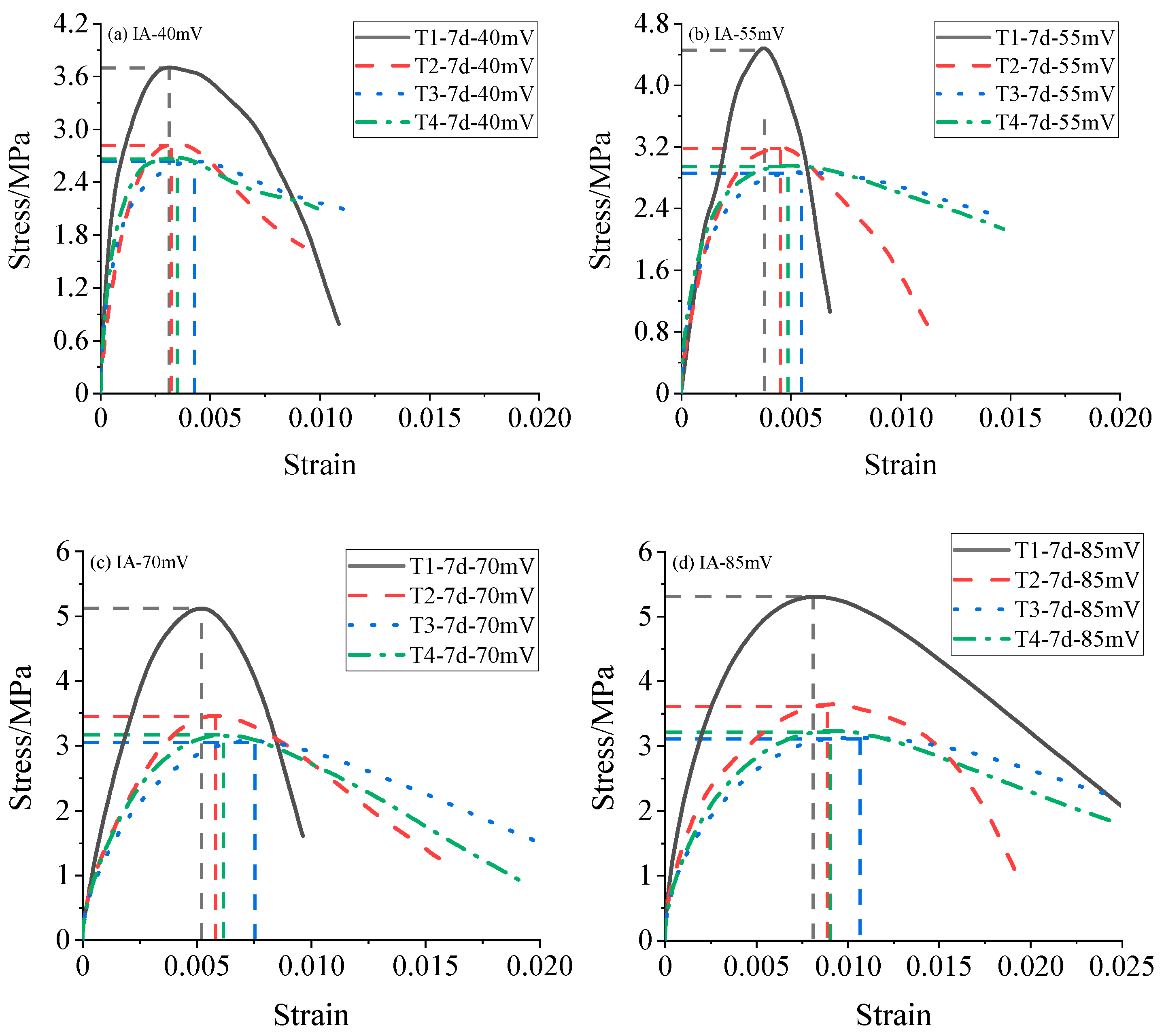
In order to study the influence of TG on the dynamic stress–strain curve of CTB, the stress–strain curves of different TG CTB at different impact amplitudes at the curing age of 7 d were drawn, as shown in Figure 8 and Figure 9.
Figure 8. Stress–strain curve of CTB under curing age of 7 d.
Figure 9. Peak stress and elastic modulus of CTB under curing age of 7 d.
Under the condition of a curing age of 7 d, when the impact amplitude is 40 mV, the stress–strain curve of T1 CTB shows a tendency to slow, at first, and then decline fast after the peak stage, which belongs to the “post-peak plasticity” type, and has certain brittleness and plasticity at the same time. The post-peak stress–strain curves of T2, T3, and T4 CTB show a tendency of, at first, rapid and then slow decline, which belongs to the “post-peak plasticity” type, and has certain plasticity and ductility. With the average particle size of the tailings from coarse to fine, the CTB gradually changes from plastic-brittle material to ductile material. When the impact amplitude is 55 mV, the stress–strain curve of the T1 CTB shows a linear and rapid decline in the post-peak stage, which belongs to the “stress drop” type and has certain brittleness. The post-peak stress–strain curve of the T2 CTB is slow at first and then decreases rapidly, which belongs to the “post-peak plasticity” type, and has certain brittleness and plasticity at the same time. The force–strain curves of the T3 and T4 CTB show a very slow decline at the post-peak stage, which belongs to the “post-peak ductility” type and has strong ductility. With the average particle size of the tailings from coarse to fine, CTB gradually changes from brittle material to plastic-brittle material to ductile material. When the impact amplitude is 70 mV, the stress–strain curve of T1 CTB shows a slow decline trend in the post-peak stage, which belongs to the “post-peak plasticity” type, and has certain brittleness and plasticity at the same time. The stress–strain curves of the T2, T3, and T4 CTB show a slow downward trend in the post-peak stage, and also belong to the “post-peak plasticity” type with strong molding. With the average particle size of the tailings from coarse to fine, CTB gradually changes from plastic-brittle material to plastic-shaped material. When the impact amplitude is 85 mV, the stress–strain curves of the T1 and T2 CTB show a linear and slow decline trend in the post-peak stage, which belongs to the “post-peak plasticity” type and has a strong plastic shape. The stress–strain curves of the T3 and T4 CTB show a very slow decline in the post-peak stage, which belongs to the “post-peak ductility” type and has strong ductility. It is concluded that with the average particle size of the tailings from coarse to fine, CTB gradually changes from a plastic material to a ductile material. When the curing age is 3 days or 28 days, the failure mode of CTB is similar to that at a curing age of 7 days.
In summary, it can be seen that the influence of TG on the pre-peak stress–strain curve of CTB is significant and has a certain regularity. With the average particle size of the tailings from coarse to fine, the peak stress and elastic modulus of CTB decreased first and then increased. The increase in curing age and impact amplitude can improve the elastic deformation capacity of CTB. The influence of TG on the post-peak stress–strain curve of CTB is also significant. With the average strength of tailing sand from coarse to fine, the curve type of post-peak stage gradually changes from “stress drop” to “post-peak plasticity” to “post-peak ductility”. The CTB is transformed from rigid material to plastic-brittle material to plastic material to ductile material. The impact also has a certain influence on the post-peak curve, which can enhance the plastic shape and ductility of CTB to a certain extent.

3.2. Evolution of Peak Strength of CTB

3.2.1. Determination of TG Characteristic Parameters

In order to analyze the degree of influence of TG on peak strength, the correlation between characteristic parameters and peak strength was analyzed. Due to the simultaneous influence of curing age and impact amplitude, the calculated correlation coefficient can only reflect the surface correlation between the characteristic parameters and the peak strength, but cannot reflect the real correlation. Therefore, the partial correlation coefficient is proposed to eliminate the influence of curing age and impact amplitude, and the partial correlation between each characteristic parameter and peak strength is analyzed according to the absolute value of the partial correlation coefficient, as shown in Table 2.
Table 2. Calculation results of partial correlation coefficient between characteristic parameters of TG and peak strength.
As can be seen from Table 2, the factors with the most significant partial correlation with peak strength are C19~37μm, d10, and D[4,3]. The partial correlation coefficients with peak strength were −0.799, 0.857, and 0.755, respectively. Both sides of the significance test met p < 0.01, indicating that there is a highly significant correlation between tailings gradation and peak strength.
As can be seen from Table 3, the correlation coefficients among the three feature parameters are −0.9907, −0.900, and 0.834, respectively, and the bilateral significance tests all meet p < 0.01, indicating that C19~37μm, d10, and D[4,3] are highly significantly correlated with each other. Therefore, there is a highly significant correlation between TG and PS of CTB under dynamic load, and the characteristic parameter of TG is d10.
Table 3. Results of correlation coefficients calculated for C19~37μm, d10, and D[4,3].

3.2.2. Effect of TG on Peak Strength

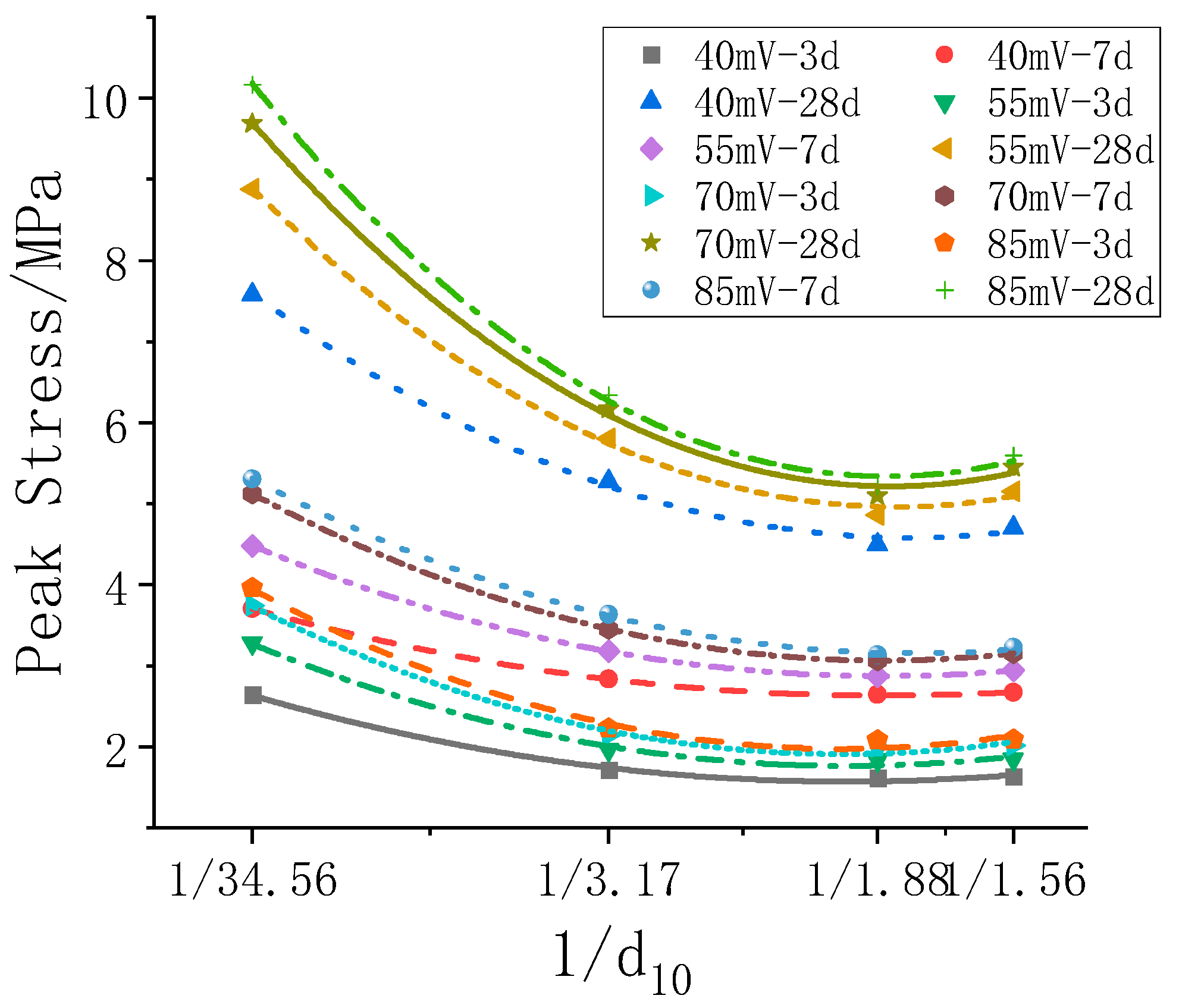
The relationship between tailings gradation (1/d10) and peak strength under different curing ages and impact amplitudes is obtained from the impact test results of CTB, as shown in Figure 10 and Table 4.
Figure 10. Relationship between d10 and peak strength.
Table 4. Fitting results of tailings gradation and peak strength.
It can be seen from Figure 10 that there is a non-monotonic relationship between the peak strength of the CTB and the tailings gradation d10. The test results show that under the condition of the same curing age and impact amplitude, the peak strength of CTB decreases first and then increases with the increasing 1/d10. That is, the peak strength first decreases with a decreasing v, reaches a minimum at a d10 of approximately 1.8 μm, and then increases with a further decrease in d10.
When d10 decreases from a higher value but remains above approximately 1.8 μm, the increasing content of fine particles fills the pores between coarse particles. This filling action compresses the growth space available for hydration products, which restricts their development. Consequently, the bonding strength between particles is weakened, leading to a reduction in the macroscopic peak strength. Once d10 decreases beyond a critical point and the fine particle content becomes excessive, the surplus particles not only fill the remaining pores but also begin to displace the original coarse particles, forming a new skeletal structure. This significantly increases the potential number of particle connections. Furthermore, these ultrafine tailings particles possess pozzolanic activity. The active SiO2 and CaO can participate in secondary hydration reactions with the cement. As d10 continues to decrease, the population of these reactive particles increases, generating additional hydration products. From a microscopic perspective, this leads to the formation of a denser network of bonds between particles. The combined effect of this increased connection quantity and the enhanced cementation consequently leads to a recovery in the macroscopic peak strength.
In summary, a strong and statistically significant correlation exists between the tailings gradation and the peak strength of the CTB. The gradation parameter d10 exhibits the strongest influence, with a correlation coefficient of 0.857 against the peak strength. Their relationship is best described by a quadratic function, with the minimum peak strength occurring at a d10 of approximately 1.8 μm. Furthermore, this fundamental relationship between d10 and peak strength remains consistent and is not altered by variations in impact amplitude and curing age.

3.2.3. Effect of Curing Age and Impact Amplitude on Peak Strength

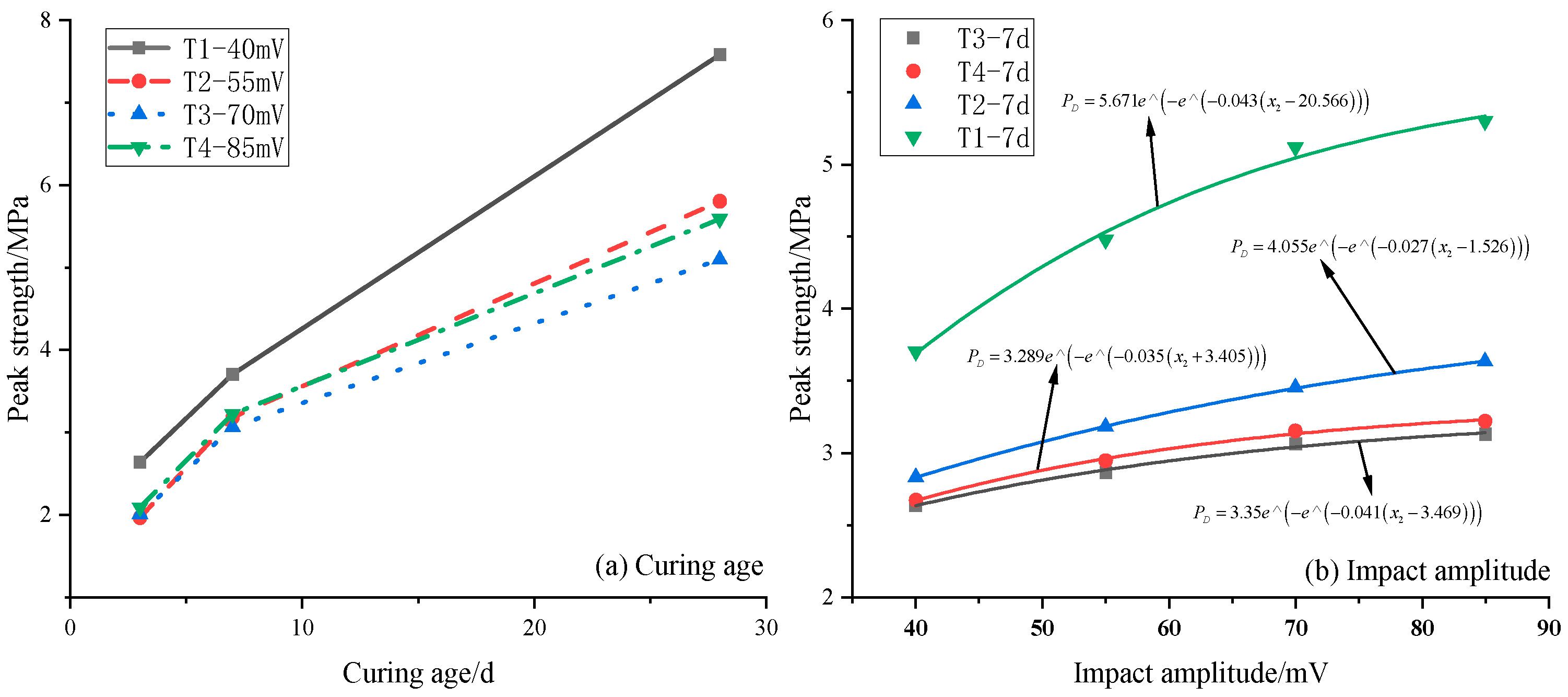
The relationship between curing age and impact amplitude and peak strength is obtained from the impact test results of CTB, as shown in Figure 11.
Figure 11. Relationship between curing age, impact amplitude, and peak strength.
It can be seen from Figure 11a that the peak strength of the CTB increases with the increase in curing age, showing an exponential growth trend from fast to slow. That is because the hydration rate of cement in the early stage of curing is fast, the CTB can quickly have early strength, and maintain a rapid hydration rate in the following period of time, so the peak strength of the CTB increases rapidly. The hydration rate decreases in the middle and late stages of curing, so the growth rate of the peak strength of the CTB slows down. It can be seen from Figure 11b that the peak strength of the CTB increases with the increase in the impact amplitude, showing the growth trend of the Gompertz model, which is initially fast, then slow, and finally tends to be stable. This is because when the impact load is applied to the CTB, the action time is very short, and the CTB lacks sufficient time to store and consume energy. According to the functional principle, the stress increases, but the greater the impact amplitude, the higher the degree of fragmentation of the CTB, and finally, the crushing failure occurs, and the speed of stress increases gradually decreases, so the peak strength of the CTB gradually slows down.

3.2.4. Peak Strength Prediction Model Based on TG

According to the above analysis, the tailings gradation, curing age, and impact amplitude of the tailings have significant effects on the peak strength of the CTB. The relationship between tailings gradation (1/d10) and peak strength is quadratic, the relationship between curing age and peak strength is exponential, and the relationship between impact amplitude and peak strength is Gompertz. Therefore, the prediction model of peak strength of CTB is established as follows:
P D = a 1 + b 1 e c 1 x 1 a 2 e e b 2 x 2 c 2 a 3 1 / d 10 b 3 2 + c 3
where PD is the dynamic compressive strength of the CTB, x1 is the curing age, x2 is the impact amplitude, d10 is the particle size corresponding to 10% of the cumulative particle size distribution in the tailings, and a1, a2, a3, b1, b2, b3, c1, c2, c3 are the undetermined coefficients of the prediction model.
In order to ensure the accuracy and stability of the regression fitting, the positive and negative values of the undetermined coefficients are judged according to the functional relationship between various factors and the peak strength, and finally, the prediction model of the peak strength of the CTB concerning the tailings gradation, curing age, and the impact amplitude is obtained.
Furthermore, in order to reduce the overfitting of the model and ensure the accuracy and reliability of the fitting, 33 sets of data were selected for the model construction, while the remaining 15 sets of data were used for model validation.
P D = 4.302 3.541 e 0.062 x 1 1.19 e e 0.038 x 2 8.938 4.012 1 / d 10 0.54 2 + 1.351 ,
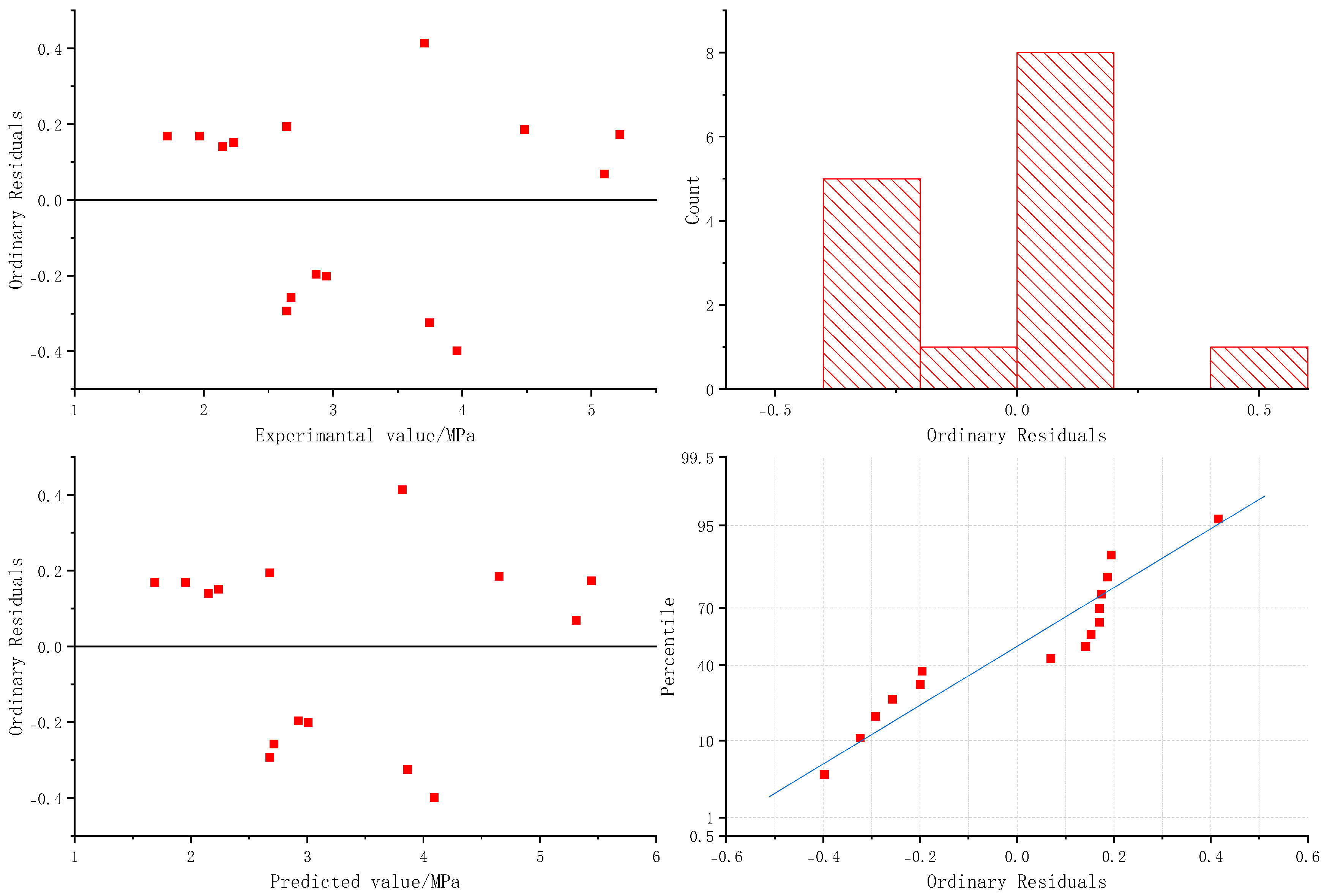
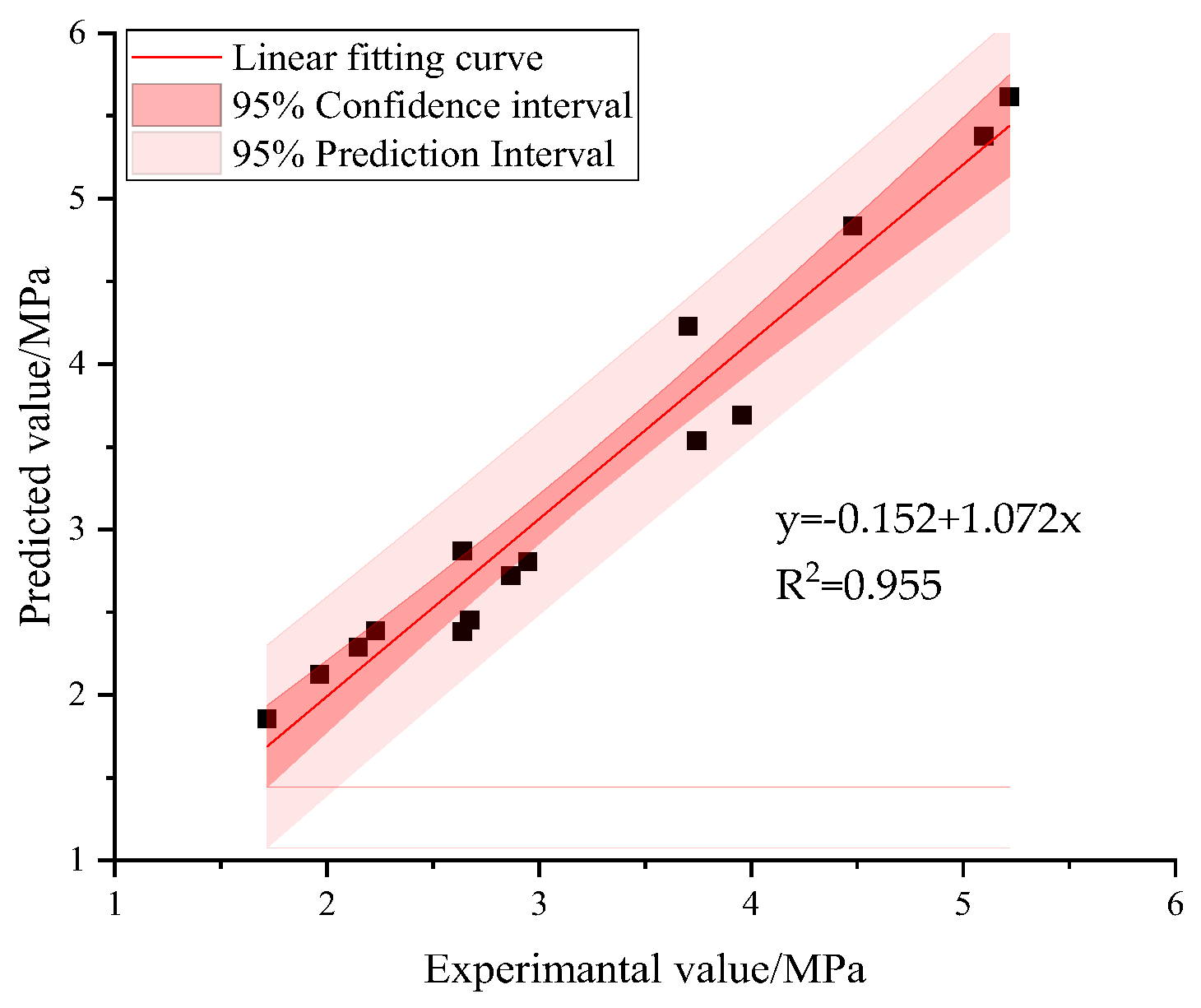
The determination coefficient R2 of the prediction model is 0.997, the F value is 12,855 > 1, the p-value is <0.001, and the average error rate is 7.421%, indicating that the fitting regression effect is better. Figure 12 shows the comparison between the actual value of the peak static load strength of CTB and the predicted value of the prediction model. Figure 13 shows the residual plot of the fitting analysis between the predicted values and the actual values. It can be seen that the prediction model has high accuracy.
Figure 12. Comparison of actual and predicted peak strength.
Figure 13. The residual of the fitting analysis.

3.3. CTB Failure Mode

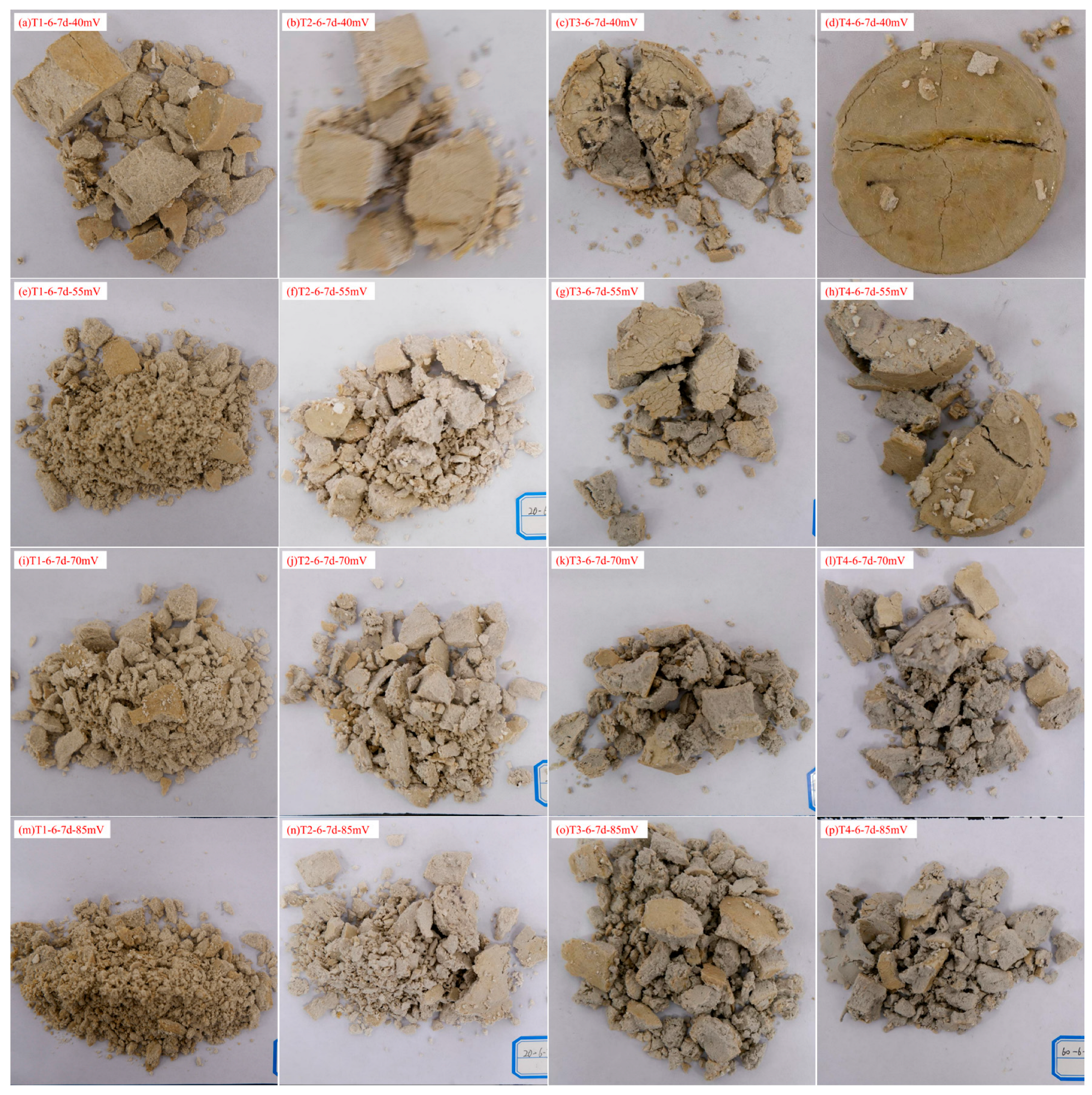
By taking pictures of the backfill after impact action, the failure forms of the backfill under different conditions were obtained, and the failure modes of the CTB under dynamic load were determined according to the failure characteristics. As the failure modes under different curing ages are similar and limited in length, this paper discusses the fracture morphology of different TG of CTB at different impact amplitudes when the curing age is 7 d, as shown in Figure 14.
Figure 14. Failure mode of CTB under the curing age of 7 d.
As can be seen from Figure 14, under the condition of a curing age of 7 d, when the impact amplitude is 40 mV, the crushing state of the T1 CTB is mainly large, followed by a small number of medium and small pieces, and a very small amount of powder debris. The CTB has a weak bearing capacity, and the failure mode is compound failure (II). The crushing state of the T2 CTB is mainly large, followed by a very small amount of medium, small, and powder-like debris. The CTB has a certain bearing capacity, and the failure mode is tensile failure (I). The crushing state of the T3 CTB is broken into multiple large pieces of the same thickness as the specimen, and a very small amount of medium, small, and powdered debris is dropped. The CTB has a certain bearing capacity, and the failure mode is tensile failure (I). The broken state of the T4 CTB is that the specimen is basically intact, and a very small amount of powdered debris falls from the surface. The CTB has quite a strong bearing capacity, and the failure mode is tensile failure (I). When the impact amplitude is 55 mV, the crushing state of the T1 CTB is mainly a small block, followed by a medium block, and a small amount of powdered debris. The CTB completely loses its bearing capacity, and the crushing mode is shear failure (IV). The crushing state of the T2 CTB is mainly large and medium blocks, followed by small blocks, and a very small amount of powdered debris. The CTB completely loses its carrying capacity, and the failure mode is compound failure (III). The crushing state of the T3 CTB is mainly large pieces, followed by a small number of medium and small pieces, and a very small amount of powdered debris. The CTB has a weak bearing capacity, and the failure mode is compound failure (II). The crushing state of the T4 CTB is broken into two large pieces with the same thickness as the specimen, as well as a very small number of medium pieces, small pieces, and powdered debris. The CTB still has a strong bearing capacity, and the failure mode is tensile failure (I). When the impact amplitude is 70 mV, the crushing state of the T1 CTB is mainly medium and small pieces, followed by powdered debris. The CTB completely loses its bearing capacity, and the crushing mode is shear failure (IV). The crushing state of the T2 CTB is mainly a medium block, followed by a large block, and a small amount of small blocks, and a very small amount of powdered debris. The CTB completely loses its carrying capacity, and the crushing mode is compound failure (III). The crushing state of the T3 CTB was mainly a medium block, followed by a small number of large and small blocks, and a very small amount of powdered debris. The CTB completely lost its capability, and the crushing mode was compound failure (III). The broken state of the T4 CTB is mainly large pieces, followed by medium pieces, and a small amount of small pieces, and a very small amount of powdered debris. When the impact amplitude is 85 mV, the breakage state of the T1 CTB is mainly small pieces, followed by medium pieces and powdered debris. The CTB completely loses its bearing capacity, and the breakage mode is shear failure (IV). The crushing state of the T2 CTB is mainly medium and small pieces, followed by a small number of large pieces and powder-like debris. The CTB completely loses its bearing capacity, and the crushing mode is compound failure (III). The crushing state of the T3 and T4 CTBs is mainly a medium block, followed by a small block, and a very small amount of large and powdered debris. The CTB completely loses its carrying capacity, and the crushing mode is compound failure (III). In summary, under the condition of curing age 3 d, the failure modes of the T1 CTB are composite failure (II) and shear failure (IV), the T2 CTB is composite failure (II) and composite failure (III), and the T3 and T4 CTB are tensile failure (I), composite failure (II), and composite failure (III).
In summary, there are four main failure modes of CTB under dynamic load: (1) Tensile failure (I)—The CTB specimen demonstrated tensile failure, forming a macroscopic crack parallel to the loading direction, and completely through the CTB specimen in the axial direction. After impact, the CTB specimen showed two crushing states, one basically intact and accompanied by debris spalling on the surface, and the other broken into several large pieces equal to the thickness of the specimen. The surface is also stripped with debris. (2) Compound failure (II)—The CTB specimen demonstrated both tensile failure and shear failure, but mainly tensile failure. After impact, the CTB specimen mainly consisted of 20~40 mm large pieces, and a small number of 2~20 mm medium-fast and small pieces, accompanied by a very small amount of powdery debris. (3) Compound failure (III)—The CTB specimen showed both tensile failure and shear failure, but mainly shear failure. After impact, the CTB specimen mainly consisted of 10~20 mm medium blocks, followed by 2~10 mm small blocks, and a small number of 20~40 mm large and powdered debris. (4) Shear failure (IV)—The CTB specimen demonstrated shear failure. After impact, the CTB specimen consisted of < 20 mm of medium pieces, small pieces, and powder fragments, and mainly small pieces of 2~10 mm.

3.4. Microstructure Analysis

3.4.1. Hydration Mechanism of CTB

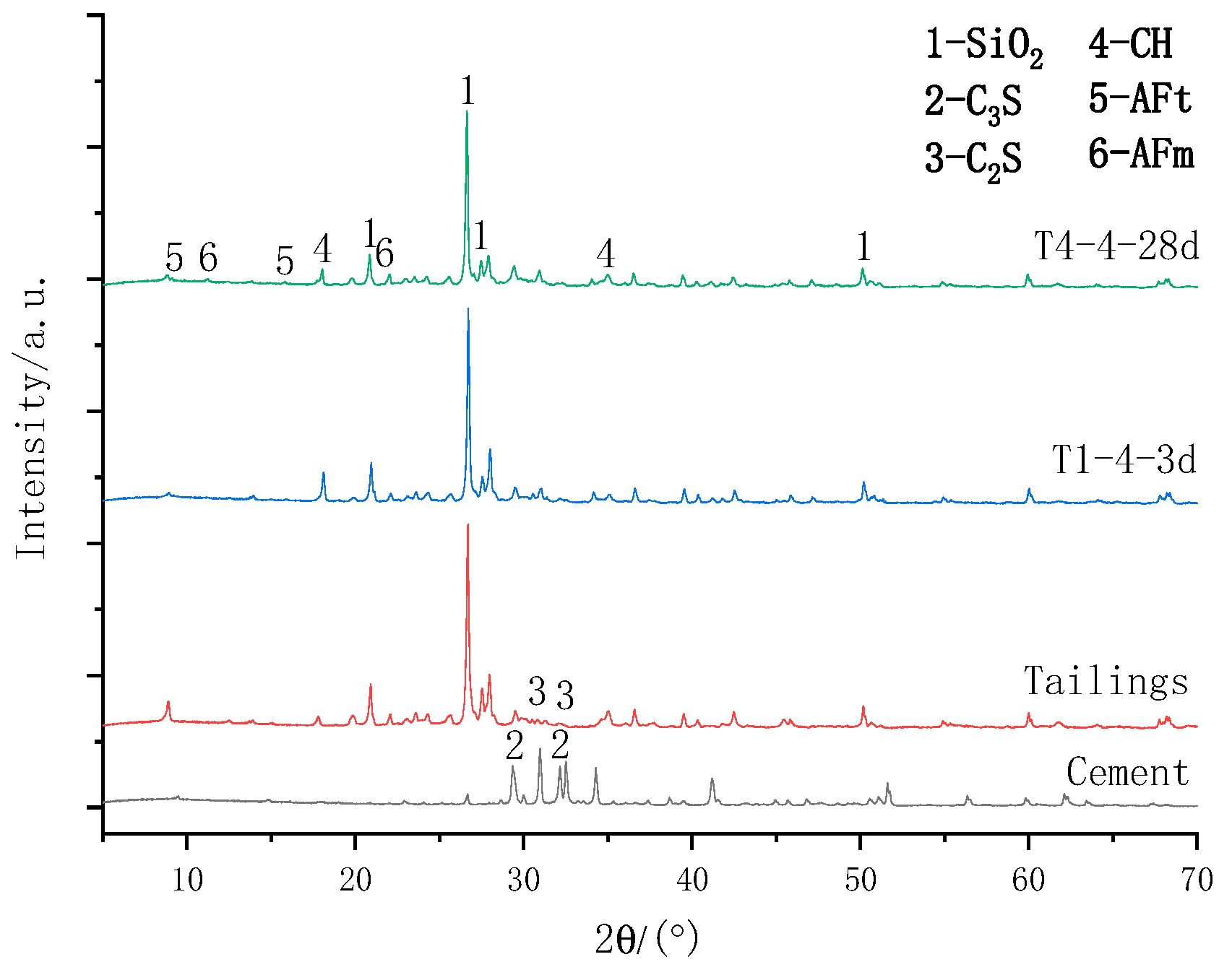
The cement was used as the cementing material in this experiment. The preparation of the CTB was mainly based on tailings, with a mass proportion of about 48% to 55%, while the mass proportion of cement was only 6.7% to 12%. Therefore, the hydration mechanism of the CTB is different from that of pure cement. Figure 15 shows the XRD diffraction patterns of cement, tailings, and CTB.
Figure 15. XRD spectra of tailings, cement, and CTB.
As can be seen from the figure, the XRD diffraction patterns of CTB have diffraction peaks of SiO2, Calcium Hydroxide (CH), Ettringite (AFt), and Monosulfate (AFm), indicating the presence of crystalline SiO2 and hydration products, such as CH, AFt, and AFm. There are a large number of low-intensity dough-like peaks in the range of 20° to 35°, but no characteristic peaks, indicating the presence of the non-crystalline hydration product, Calcium-Silicate-Hydrate (C-S-H) gel. The XRD diffraction patterns also contain diffraction peaks of C3S and C2S, and the diffraction peak intensities are relatively lower than those of cement, indicating that there is still unhydrated cement clinker in the CTB.
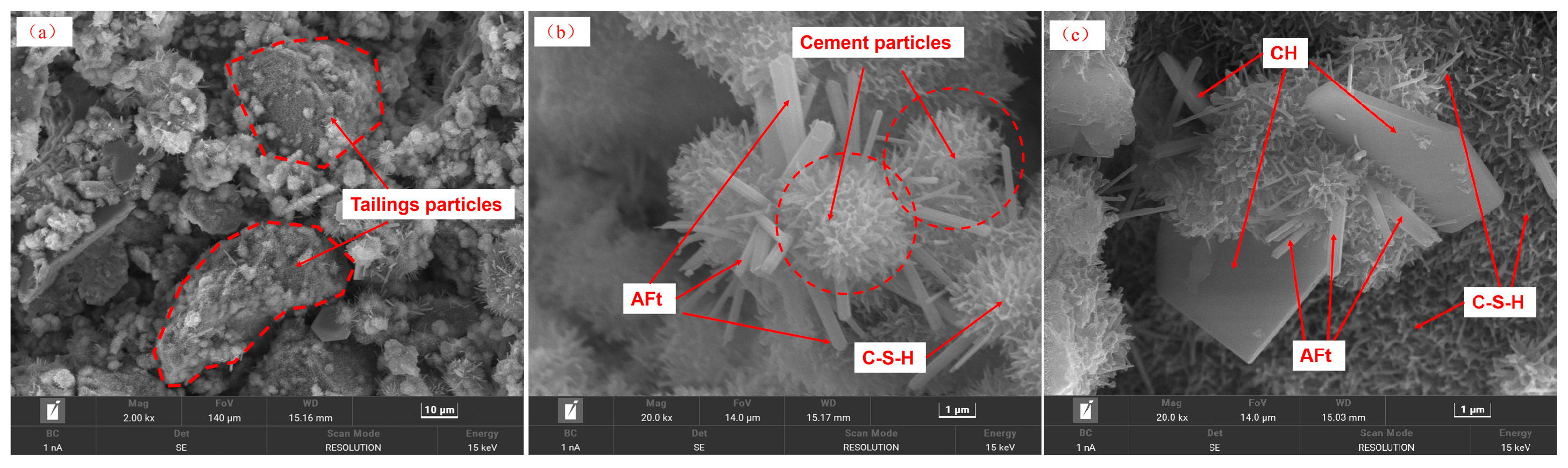
Figure 16 shows the microscopic morphology of different components in the filling body. It can be clearly observed from the figure that C-S-H gel, CH, AFt, and AFm are present, which is consistent with the conclusion of XRD analysis. The tailings particles are shown in Figure 16a, where the coarse particles are independent of each other, and the voids are filled with hydration products and fine particles. The particle surfaces are wrapped by the C-S-H gel. A typical incompletely hydrated cement clinker particle is shown in Figure 16b, which is spherical, with C-S-H gel and AFt crystals growing vertically outward on the particle surface. The morphology of the hydration products is shown in Figure 16c, where the C-S-H gel is in a three-dimensional network or flocculent structure, widely distributed on the surfaces of various particles; CH crystals are present in low amounts and fill the voids. AFt is mostly distributed on the particle surfaces and grows vertically outward, with a small amount distributed in the pores. AFm is transformed from AFt in the middle stage of hydration and is mostly mixed with the C-S-H gel, making it difficult to observe.
Figure 16. Microstructure of different components of CTB.
According to the composition of hydration products and cement, the hydration reactions occurring in the backfill are as follows:
C 3 A + CaSO 4 + H 2 O AFt C 3 S + H 2 O C - S - H + CH C 2 S + H 2 O C - S - H + CH AFt + C 3 A + H 2 O AFm
The ultrafine SiO2 and Al2O3 particles in tailings have a higher surface energy; some of the mineral particles, SiO2 and Al2O3, do not act as a backfill aggregate but participate as active materials in the hydration reaction. It increased the amount of C-S-H and C-A-H and consumed Ca(OH)2.
SiO 2 + Ca ( OH ) 2 C - S - H Al 2 O 3 + Ca ( OH ) 2 + CaSO 4 C - A - H + AFt

3.4.2. Effect of TG on Microstructure

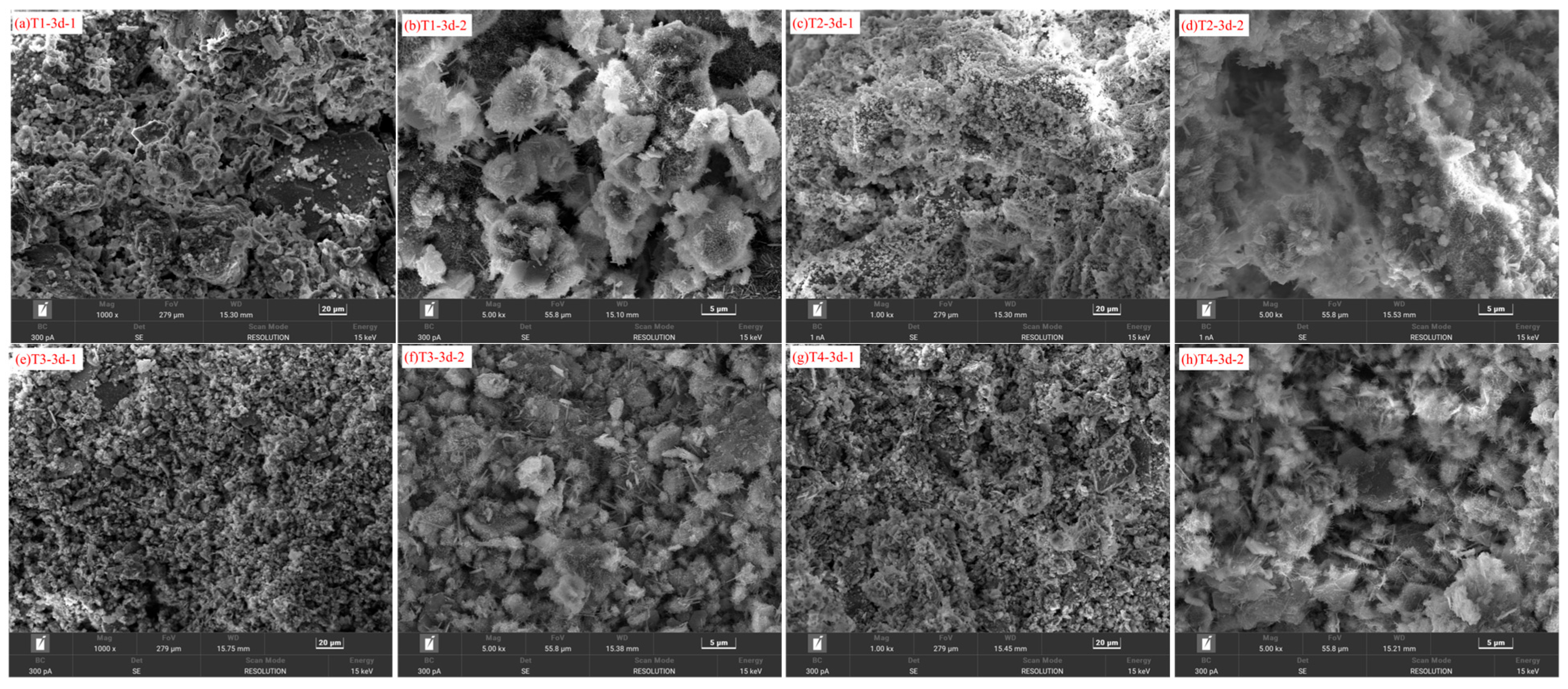
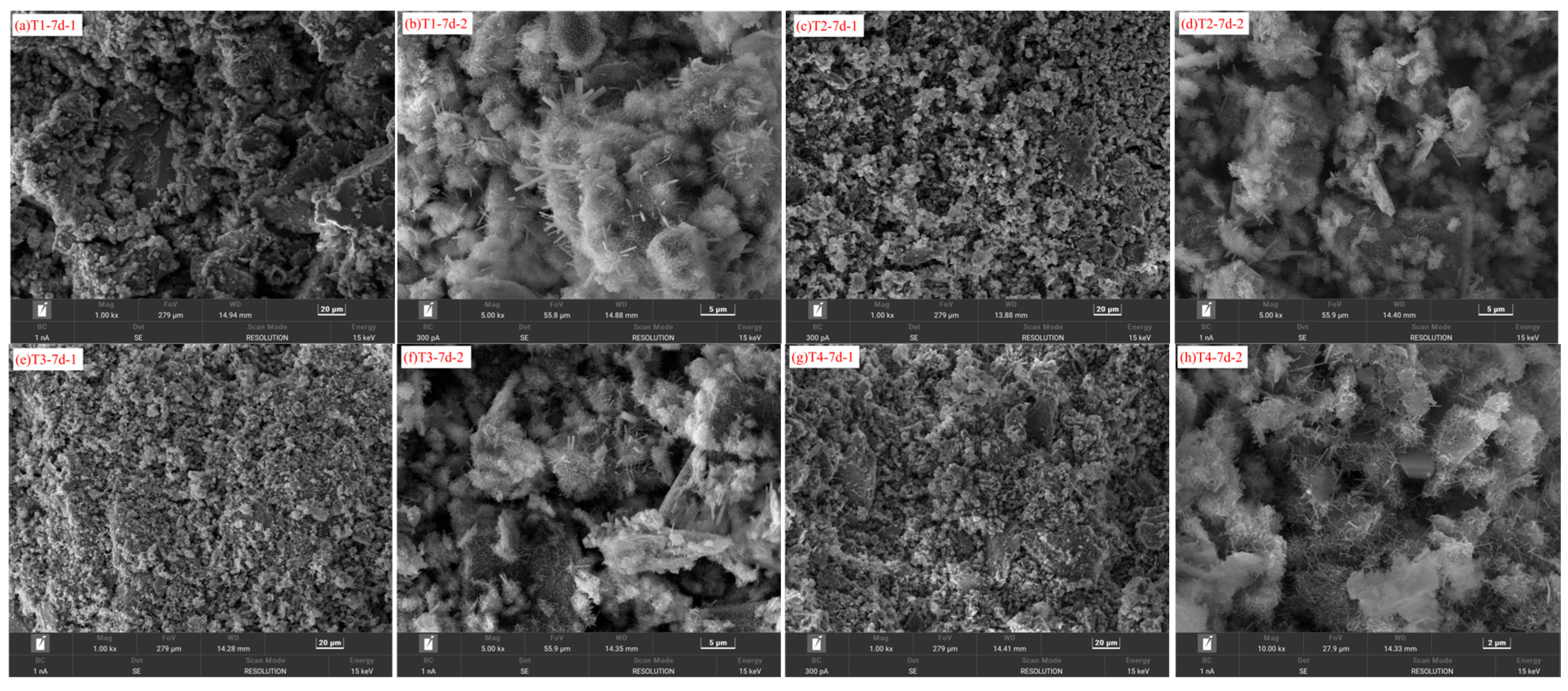
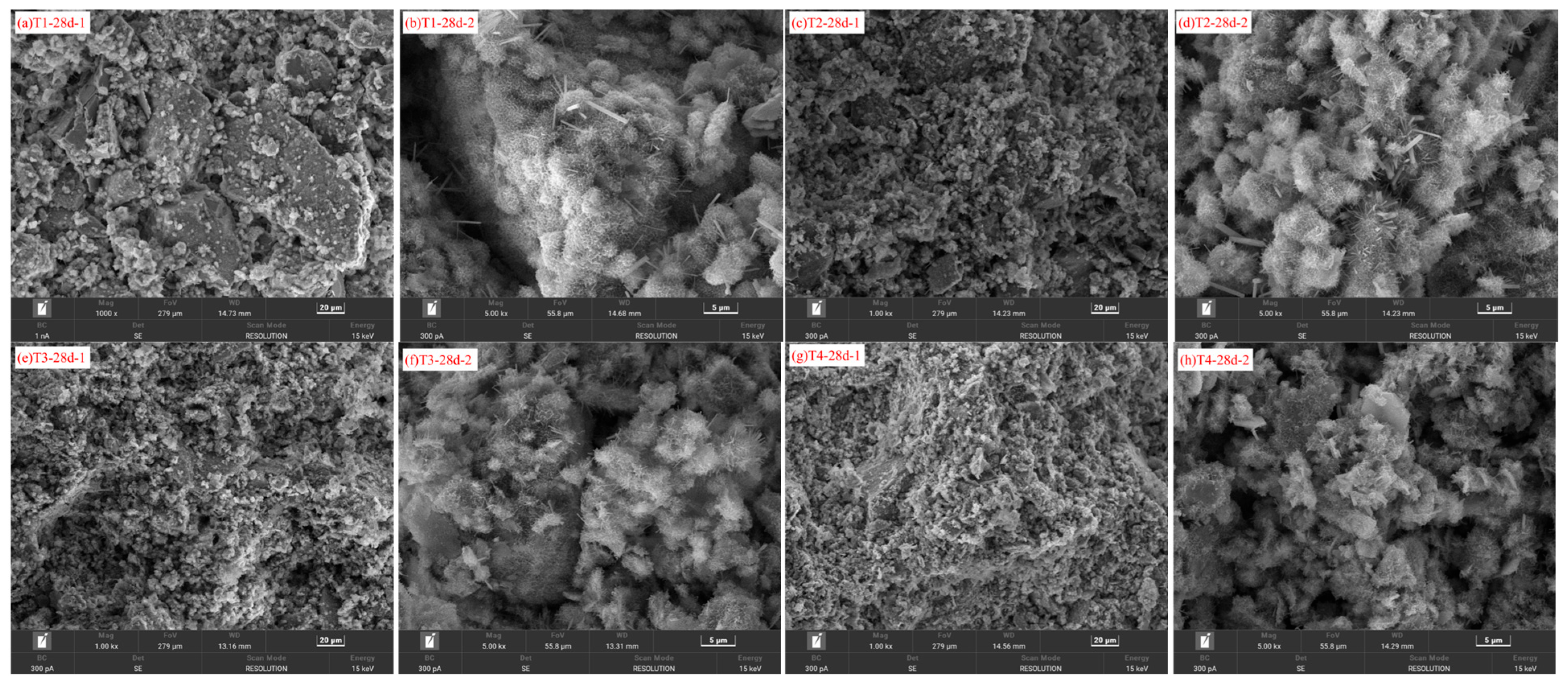
Figure 17, Figure 18 and Figure 19 show the SEM (TESCAN MIRA LMS) images of the backfill bodies with different tailings gradation at curing ages of 3 days, 7 days, and 28 days. The magnification factors are 1000 times and 5000 times.
Figure 17. Microstructure of CTB with different tailings gradation at curing age 3 d.
Figure 18. Microstructure of CTB with different tailings gradation at curing age 7 d.
Figure 19. Microstructure of CTB with different tailing gradations at curing age 28 d.
Figure 17 shows the microscopic morphology of the backfill bodies with different tailings gradation at a curing age of 3 days. From the figures, it can be seen that at a curing age of 3 days, the main hydration products of the backfill bodies are reticular or flocculent C-S-H gels and needle-rod-shaped AFt crystals. Among them, the C-S-H gels are distributed on the particle surfaces and mainly on the unhydrated cement particle surfaces, with a thin thickness and low density. The Aft crystals are distributed on the cement particle surfaces, with a size of approximately 1–2 μm. When the tailings are T1 and T2, there are more Aft in the backfill bodies, and the C-S-H gels present a three-dimensional network structure covering the particle surfaces, with the framework structure constructed by the coarse tailings particles, and the pore diameters are relatively large. The fine particles adhere to the surface of the coarse particles. When the tailings are T3, the number of Aft decreases, and the C-S-H gels simultaneously exist in a network and flocculent structure. The framework structure is constructed by the coarse and fine particles together, and the number of pores increases, but the pore diameters decrease. When the tailings are T4, the C-S-H gels are mainly in a flocculent structure, and no significant Aft can be observed. Based on the XRD analysis results, it is judged that they are encapsulated by the flocculent C-S-H gels inside, and the framework structure is constructed by the fine particles, with the coarse particles being independent and not in contact with each other.
Figure 18 shows the microscopic morphology of the backfill bodies with different tailings gradations at a curing age of 7 days. From the figure, it can be seen that compared with the curing age of 3 days, at the curing age of 7 days, the hydration products of the backfill bodies are still mainly composed of C-S-H gel and Aft crystals. Among them, the C-S-H gel originally distributed on the particle surface continues to be generated and developed, forming a certain thickness and a more compact protective layer. The number of Aft crystals significantly increases, and the size also significantly increases, approximately 2–5 μm. Compared with the curing age of 3 days, the porosity of the backfill bodies with different tailings gradations has decreased. The large pores have transformed into more numerous and smaller medium and small pores, and the density has been preliminarily improved. The fine particles in the enriched area are mixed with the C-S-H gel to form dense lumps. As the tailings gradation parameter d10 gradually decreases, the content of fine particles increases, and the number and size of the formed lumps gradually increase.
Figure 19 shows the microscopic morphology of the backfill bodies with different tailings gradations at a curing age of 28 days. From the figure, it can be seen that when the backfill bodies are cured for 28 days, the hydration products are mainly composed of C-S-H gel, Aft crystals, and AFm crystals. Among them, the thickness and density of the C-S-H gel further increase, the Aft crystals tend to stabilize or decrease, and the size change is not significant. The AFm crystals are transformed from Aft in the later stages of curing, and during the formation process, C-S-H gel is generated and grows, and the two are mixed together in the process and are closely combined with the C-S-H gel. The porosity of the backfill body further decreases, and most of the large pores and medium pores are filled or divided into smaller pores, and the density is significantly improved. For the T3 and T4 tailings backfill bodies, the number of Aft crystals is relatively significantly increased compared to the curing age of 7 days.

4. Conclusions

In this paper, the effects of tailing grades on the mechanical properties of CTB under different curing ages were investigated, and the dynamic deformation behaviors, strength evolutions, and failure modes of CTB were analyzed. The main conclusions are as follows:
(1)
The post-peak stages of dynamic stress–strain curves are divided into three types, namely, “stress drop” type, “post-peak plasticity” type, and “post-peak ductility” type.
(2)
There is a highly significant correlation between the CTB tailings gradation and the peak strength under dynamic load, when the characteristic parameter of tailings gradation is d10. With the increase in reciprocal characteristic parameters, the peak strength of the sample first decreases and then increases. The peak strength prediction model of the CTB is constructed based on the tailings gradation.
(3)
The change in tailings gradation leads to three failure modes of CTB: tensile failure, composite failure, and shear failure. As the tailing changes from T1 to T2 to T3 to T4, the failure mode of CTB gradually changes from composite failure and shear failure to tensile failure and composite failure. In the early stage of maintenance, tailings gradation has more significant influence on the failure mode of CTB.
(4)
The gradation of tailings significantly affects the pore structure and hydration products of the backfill body. The Aft of the backfill body of T1 and T2 is abundant, and the C-S-H gel forms a three-dimensional network covering the surface of the particles. The coarse particles constitute the framework, and the pores are large, while the fine particles adhere to the surface. When the tailings are T3, Aft decreases, and the C-S-H gel exists in the form of a network and flocculent together. Both coarse and fine particles jointly form the framework, and there are many pores with small diameters. When the tailings are T4, the C-S-H gel is mainly flocculent, and no obvious Aft is observed. The fine particles form the framework, and the coarse particles are isolated and do not contact each other.
In the actual preparation process of the CTB, the tailings gradation parameter d10 should be avoided in the range of 1.6~3 μm. At this time, the bearing capacity of the CTB is weak, which is not conducive to mining work.

Author Contributions

D.G.: Conceptualization, Supervision, Investigation, Writing—review and editing. H.L.: Writing—original draft, Formal analysis, Validation, Visualization, Data curation, Software, Methodology. Z.L.: Funding acquisition, Resources, Project administration, Writing—review and editing. All authors have read and agreed to the published version of the manuscript.

Funding

This research was funded by the National Natural Science Foundation of China (No. 52204134), the Hebei province Central guidance local science and technology special project funding (No. 236Z4105G), and the Natural Science Foundation of Hebei Province (No. E2024209141).

Institutional Review Board Statement

Not applicable.

Data Availability Statement

The raw data supporting the conclusions of this article will be made available by the authors on request.

Conflicts of Interest

The authors declare no conflicts of interest.

References

  1. Liu, J.; Li, G.; Yang, S.; Huang, J. Prediction Models for Evaluating the Strength of Cemented Paste Backfill: A Comparative Study. Minerals 2020, 10, 1041. [Google Scholar] [CrossRef]
  2. Amin, S.; Abbas, T.; Murat, K. A New Yield Surface for Cemented Paste Backfill Based on the Modified Structured Cam-Clay. Minerals 2025, 15, 4. [Google Scholar]
  3. Xue, G.; Yilmaz, E.; Song, W.; Cao, S. Compressive Strength Characteristics of Cemented Tailings Backfill with Alkali-Activated Slag. Appl. Sci. 2018, 8, 1537. [Google Scholar] [CrossRef]
  4. Zhao, Y.; Yang, R.; Zuo, J.; Liu, Z.; Wang, W. Dynamic response characteristics of backfill under blasting disturbance simulated through a three-dimensional model. Constr. Build. Mater. 2024, 443, 137685. [Google Scholar] [CrossRef]
  5. Sun, Q.; Li, B.; Tian, S.; Cai, C.; Xia, Y. Creep properties of geopolymer cemented coal gangue-fly ash backfill under dynamic disturbance. Constr. Build. Mater. 2018, 191, 644–654. [Google Scholar] [CrossRef]
  6. Gan, D.; Sun, H.; Xue, Z.; Liu, Z.; Yang, X. Damage evolution and strength prediction model of soda residue modified cemented tailings backfill under uniaxial compression. Constr. Build. Mater. 2023, 408, 133709. [Google Scholar] [CrossRef]
  7. Francisco, C.S.; Li, M.; Li, B.; Deon, M.G. Study of Slope Stability of the Mining Wall in an Open-Pit Coal Mine by the Paste Cut-and-Backfill Method. Appl. Sci. 2024, 14, 6141. [Google Scholar] [CrossRef]
  8. Yao, Y.; Naggar, M.; Zhang, J.; Xu, J.; Yang, J.; Li, M. Dynamic mechanical properties of coal-based solid waste cemented backfill material. J. Build. Eng. 2024, 988, 111347. [Google Scholar] [CrossRef]
  9. Xu, Z.; Bao, S.; Guo, L. Experiment investigation on dynamic failure characteristics of water-saturated frozen cement mortar with transfixion joint under confining pressure. Appl. Sci. 2022, 12, 4396. [Google Scholar] [CrossRef]
  10. Liu, Z.; Gan, D.; Sun, H.; Xue, Z.; Zhang, Y. Dynamic impact performance of cemented tailings backfill in a water-bearing environment: Coupling effects and damage characteristics. Soil Dyn. Earthq. Eng. 2025, 191, 109249. [Google Scholar] [CrossRef]
  11. Zheng, D.; Song, W.; Cao, S.; Li, J. Dynamical mechanical properties and microstructure characteristics of cemented tailings backfill considering coupled strain rates and confining pressures effects. Constr. Build. Mater. 2022, 320, 126321. [Google Scholar] [CrossRef]
  12. Lyu, H.; Chen, Y.; Pu, H.; Ju, F.; Zhang, K.; Li, Q.; Wu, P. Dynamic properties and fragmentation mechanism of cemented tailings backfill with various particle size distributions of aggregates. Constr. Build. Mater. 2023, 366, 130084. [Google Scholar] [CrossRef]
  13. Xu, W.; Li, Q.; Liu, B. Coupled effect of curing temperature and age on compressive behavior, microstructure and ultrasonic properties of cemented tailings backfill. Constr. Build. Mater. 2020, 237, 117738. [Google Scholar] [CrossRef]
  14. Sari, M.; Erol, Y.; Tugrul, K. Long-term ageing characteristics of cemented paste backfill: Usability of sand as a partial substitute of hazardous tailings. J. Clean. Prod. 2023, 401, 136723. [Google Scholar] [CrossRef]
  15. Zhao, K.; Lai, Y.; He, Z.; Liu, W.; Zhao, R.; Wang, Y.; Tian, X.; Nie, J. Study on energy dissipation and acoustic emission characteristics of fiber tailings cemented backfill with different ash-sand ratios. Process Saf. Environ. Prot. 2023, 174, 983–996. [Google Scholar] [CrossRef]
  16. Tang, R.; Zhao, B.; Xin, J.; Sun, J.; Xu, B.; Tian, C.; Ning, J.; Li, L.; Shao, X.; Ren, W. Multisolid waste collaborative production of aeolian sand-red mud-fly ash cemented paste backfill. Case Stud. Constr. Mat. 2024, 20, e02843. [Google Scholar] [CrossRef]
  17. Jiang, G.; Wu, A.; Li, H.; Wang, Y.; Wang, H. Long-term strength performance of sulfur tailings filling and its affecting factors. J. Cent. South Univ. 2018, 49, 1504–1510. [Google Scholar]
  18. Guo, J.; Qiang, H.; Wang, X.; Huang, F.; Zhang, M.; Yan, H.; Zhang, X. Experimental study and application of factors affecting the strength of high sulfur tailings cemented backfill. J. Univ. Arch. Technol. 2019, 51, 859–864. [Google Scholar]
  19. Sun, X.; Zhao, L.; Xing, J.; Qiu, J.; Li, H. Preparation of Binding Materials for Backfilling with Alkali Activated Blast Furnace Slag and Fly Ash. Metal Mine 2016, 11, 189–192. [Google Scholar]
  20. Wang, Z.; Wu, A.; Wang, S.; Zhao, Y. From performance to mechanism: Analysis of controlling strength attenuation of high-sulfur lead-zinc tailings cemented paste backfill. Miner. Eng. 2025, 225, 109233. [Google Scholar] [CrossRef]
  21. Liu, S.; Gu, H.; Yang, K.; Guo, J.; Wu, K.; Guo, L.; Yang, Z.; Xu, L. Preparation activated tailings by pH swing process: Towards yielding cemented tailings backfill and in-situ CO2 mineralization. Cement Concrete Comp. 2024, 154, 105767. [Google Scholar] [CrossRef]
  22. Huang, J.; Wu, C.; Huang, N.; Deng, L.; Zhu, D. Utilization of waste rock from a low-carbon perspective: Mechanical performance analysis of waste rock-cemented tailings backfill. J. CO2 Util. 2025, 94, 103058. [Google Scholar] [CrossRef]
  23. Zhang, C.; Guo, J.; Song, W.; Abbas, T.; Wang, X.; Xia, W. Simulation of hydration reactions and microstructural characteristics of cemented tailings backfill under temperature effects. J. Build. Eng. 2025, 470, 140573. [Google Scholar] [CrossRef]
  24. Zou, S.; Gao, Y.; Zhou, Y.; Sun, H.; Yang, Z.; Yang, C.; Chai, J.; Qian, L. Mechanical properties of organic-inorganic hybrid fiber reinforced cemented tailings backfill considering energy evolution and damage fracture characteristics. J. Mater. Res. Technol. 2025, 35, 4614–4633. [Google Scholar] [CrossRef]
  25. GB/T 50145-2007; Standard for Engineering Classification of Soil. Available online: https://www.chinesestandard.net/PDF/English.aspx/GBT50145-2007 (accessed on 26 November 2025).
  26. GB/T 50081-2019; Standard for Test Methods of Concrete Physical and Mechanical Properties. Available online: https://www.chinesestandard.net/PDF.aspx/GBT50081-2019 (accessed on 26 November 2025).
  27. Xue, G.; Erol, Y.; Feng, G.; Cao, S.; Sun, L. Reinforcement effect of polypropylene fiber on dynamic properties of cemented tailings backfill under SHPB impact loading. Constr. Build. Mater. 2021, 279, 122417. [Google Scholar] [CrossRef]
  28. Cao, S.; Erol, Y.; Song, W. Dynamic response of cement-tailings matrix composites under SHPB compression load. Constr. Build. Mater. 2018, 186, 892–903. [Google Scholar] [CrossRef]
  29. Hou, Y.; Yin, S.; Yang, S.; Chen, X.; Du, H. Mechanical properties, damage evolution and energy dissipation of cemented tailings backfill under impact loading. J. Build. Eng. 2023, 66, 105912. [Google Scholar] [CrossRef]
  30. Yin, S.; Yan, Z.; Chen, X.; Yan, R.; Chen, D.; Chen, J.; Li, G. Active roof-contact: The future development of cemented paste backfill. Constr. Build. Mater. 2023, 370, 130657. [Google Scholar] [CrossRef]
Disclaimer/Publisher’s Note: The statements, opinions and data contained in all publications are solely those of the individual author(s) and contributor(s) and not of MDPI and/or the editor(s). MDPI and/or the editor(s) disclaim responsibility for any injury to people or property resulting from any ideas, methods, instructions or products referred to in the content.

Article Metrics

Citations

Article Access Statistics

Multiple requests from the same IP address are counted as one view.