Abstract
Superabsorbents are crosslinked polymer networks composed of ionic and non-ionic monomers. Among these, polyacrylates are notable for their capacity to absorb and retain water solutions amounting to several hundred times their own weight. These superabsorbents serve various purposes, particularly in agriculture, where they are employed as soil additives to enhance physical properties and improve moisture retention. Soil respiration is a critical metric that measures the rate of organic matter decomposition and carbon cycling within the soil, both of which are vital for ecosystem functionality. Consequently, assessing the base respiration rate is one of the most prevalent microbiological analyses conducted to evaluate soil quality. This process involves quantifying the amount of carbon dioxide (CO2) released from a soil sample over a specified duration. This study demonstrates that the incorporation of polyacrylates into sandy soils, in conjunction with calcium carbonate, results in increased carbon dioxide emissions and a significant elevation in soil pH. Such alkalinization may adversely affect the health of cultivated plants, underscoring the need for careful consideration in soil management practices. In acidic loam/silt loam soils, PAA addition did not further increase CO2 emissions or pH beyond liming alone, whereas in neutral sandy soil, the combination caused a strong CO2 flush and marked alkalisation.
1. Introduction
Soil plays a crucial role in the global carbon cycle, serving as the largest terrestrial reservoir of both organic carbon (SOC) and inorganic carbon (SIC) []. One of the primary challenges to agricultural productivity and biological activity in soil ecosystems is soil acidification. This phenomenon poses a significant threat to the sustainable development of ecosystems, as changes in soil pH can impact the dynamics of SOC and SIC transformations, leading to the loss of inorganic carbon from the topsoil []. The causes of soil acidification include both natural processes, such as the leaching of alkaline cations, and human activities, particularly intensive nitrogen fertilisation []. A low pH restricts the availability of nutrients and disrupts the microbiological processes that are essential for the circulation of organic matter [].
Liming is a widely recognised agricultural practice that involves the application of calcium compounds, such as calcium carbonate (CaCO3), to enhance soil pH levels []. Improving the soil pH creates more favourable conditions for microorganisms, which can lead to an increase in their biomass and enzymatic activity. This, in turn, facilitates more efficient organic matter mineralisation processes, contributing to overall soil health and productivity [,,].
As one of the key indicators of microbial activity is soil respiration [], the measurement of respiratory activity in soil organisms, known as the respiratory exchange rate (RESP), is one of the most commonly performed microbiological analyses of soils. Respiratory activity measures the rate of organic matter decomposition and carbon cycling in the soil system [].
This soil respiration process involves two main sources:
- Autotrophic soil respiration—associated with plant roots and their symbiotic microorganisms (e.g., mycorrhizal fungi and bacteria). It can account for 10 to 90% of total soil respiration in plant ecosystems [,].
- Heterotrophic soil respiration—associated with the decomposition of organic matter by soil microorganisms. Microorganisms may decompose soil organic matter (SOM) independently of plant root function [], where the quantity and quality of SOM from above-ground and below-ground litter may also control the decomposition [].
Carbon dioxide (CO2) emissions from soils can arise from a variety of processes. One significant yet often overlooked mechanism is the chemical release of CO2 resulting from the decomposition of calcium carbonate (CaCO3). Understanding this process is important for comprehensive assessments of soil carbon dynamics [].
The presence of CaCO3 plays a significant role in shaping various soil properties, including pH levels, structural integrity, buffering capacity, nutrient availability, and microbial activity. Each of these factors directly or indirectly affects the dynamics of carbon dioxide (CO2) emissions from the soil.
Furthermore, carbon retained in the soil as carbonates has the potential to release CO2 into the atmosphere [,]. In soil environments, calcium carbonate undergoes a series of chemical reactions represented by Equations (1)–(3) [].
CaCO3 + H3O+ ⇄ Ca2+ + HCO3− + H2O
HCO3− + H3O+ ⇄ H2CO3 + H2O
H2CO3 ⇄ H2O + CO2
One of the primary mechanisms for CO2 emissions is the process of decarbonation associated with the presence of calcium carbonate (CaCO3) in the soil. This process involves the decomposition of calcium carbonate driven by the action of acidifying chemical agents. This non-biological decomposition of carbonates generates CO2 as a result of soil acidity neutralisation. When carbonates are dissolved by strong acids, 1 mole of CO2 is emitted for each mole of dissolved carbonate (Equations (1)–(3)) []. Studies conducted in Europe and North America indicate that strong acids dissolve 12–38% of the carbonates found in calcareous soils [].
In calcareous soils, high soil respiration is a critical factor influencing carbonate loss, with both soil moisture and temperature playing significant roles. Specifically, higher temperatures and humidity levels correlate with increased respiration and, consequently, greater observed carbonate loss [,]. Furthermore, soil pH directly affects the carbonates solubility [].
Contemporary interest in soil water retention technologies has led to the increased use of superabsorbent polymers (SAPs) as soil additives []. SAPs are cross-linked polyelectrolytes with a very high molecular weight that can absorb 10 times their weight in water or aqueous solutions [].
These polymers are manufactured as granules [] or fibres [] with low inherent moisture content. Upon the addition of water, these materials undergo significant expansion, absorbing anywhere from several dozen grams to 1 kg of water per 1 g of the original polymer [].
SAPs have proven to be highly effective across various industries []. They are extensively used in agriculture, horticulture, and forestry, as well as in the rehabilitation of degraded land. SAPs fulfil several important roles, including improving soil water retention, serving as carriers for slow-release fertilisers, and facilitating the application of plant protection products [,,]. They can be applied directly to the soil, injected as a hydrated gel, or dosed alongside seeds during hydroseeding operations [].
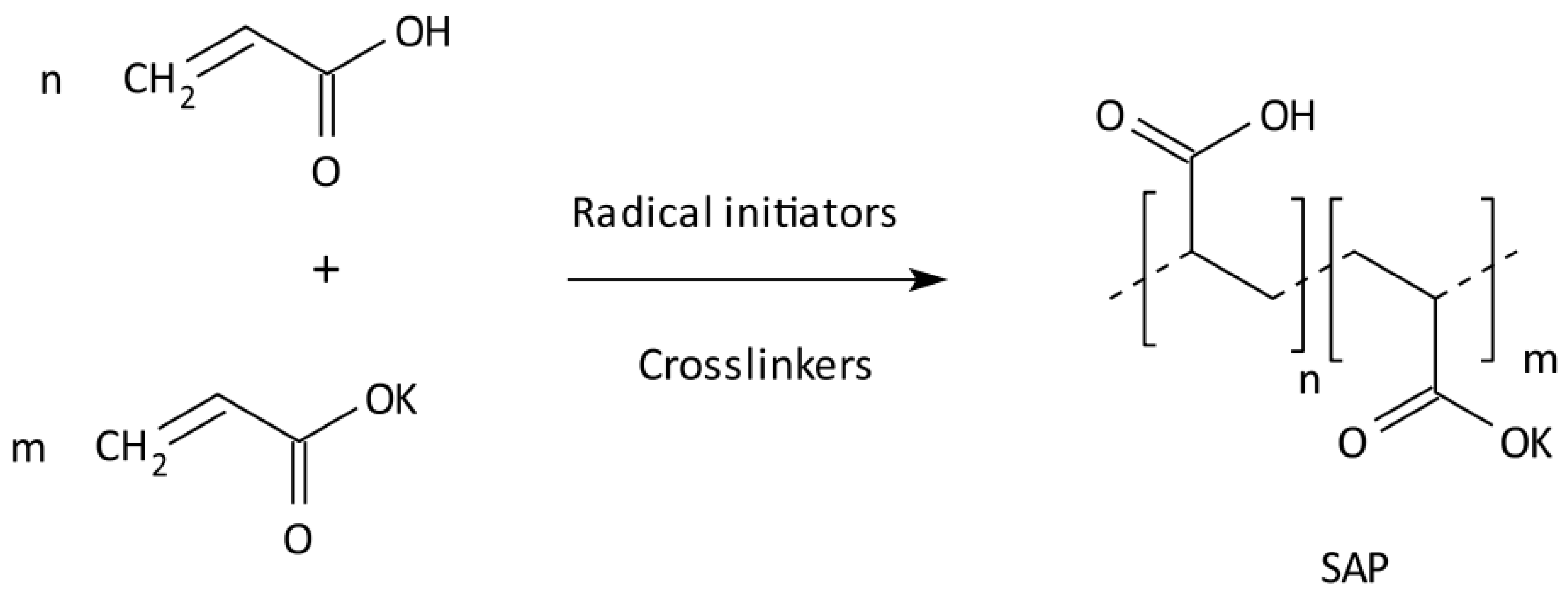
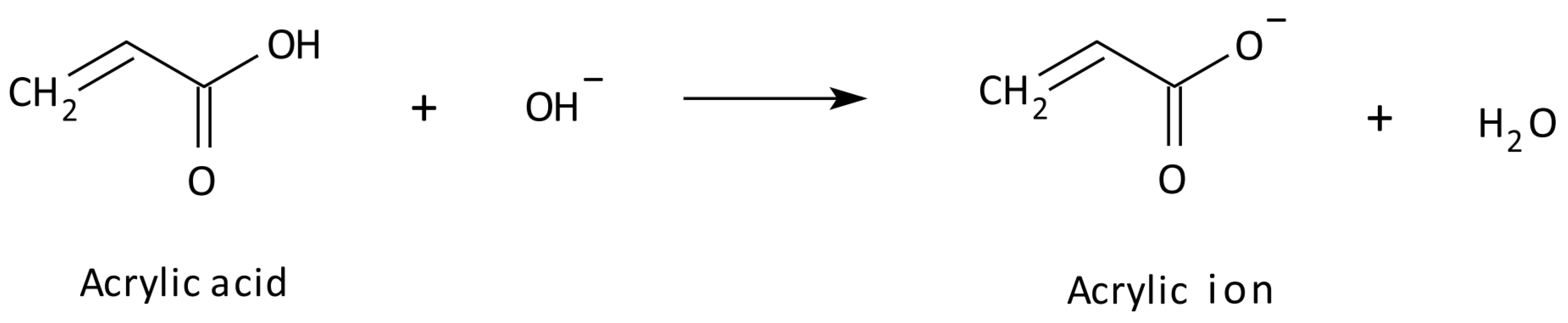
Agriculture commonly employs superabsorbents based on acrylic acid monomers. These Acrylic Superabsorbent Polymers (PAAs) are typically cross-linked polymers of acrylic acid partially neutralised with a potassium, sodium, or ammonium hydroxide solution (Figure 1). The degree of neutralisation of the carboxyl groups (Figure 2) present in the PAA varies [].
Figure 1.
Neutralisation reaction of acrylic acid.
Figure 2.
Schematic diagram of the polymerisation reaction of acrylic monomers.
Acrylic monomers undergo radical polymerisation (Figure 2) with the addition of small amounts of divinyl compounds acting as cross-linking agents [].
The effects of SAPs on soil respiration present a complex scenario. While increased moisture availability from SAPs may facilitate the microbial decomposition of organic matter, the polymer’s structural properties may simultaneously restrict gas exchange and limit substrate accessibility for microorganisms []. Additionally, there is a notable gap in existing research regarding the combined effects of liming and SAP application on carbon dioxide emission dynamics and soil biological activity.
The purpose of this investigation was to assess how the combination of calcium carbonate (CaCO3) with polymeric superabsorbent (PAA) would influence the basal respiration rate of soils, a factor that may be related to microorganism activity. The study’s central hypothesis the addition of poly(acrylic acid) increases carbon dioxide emissions from calcareous soils. This is based on the idea that poly(acrylic acid) may act as a stronger acid than carbon dioxide, thereby displacing CO2 from calcium carbonate.
2. Materials and Methods
2.1. Site Description
Soil samples were collected from three wastelands in the Małopolskie Province, specifically from Kraków, Brody, and Budzów. Control samples consisted of loose sand taken from reclaimed areas in Szczakowa.
2.2. Soil Sampling and Preparation
Soil samples were collected from the mineral layer at a depth of 0 to 5 cm using an envelope system, which included five subsamples for each laboratory sample. The samples were prepared for testing by removing plant roots and soil fauna. They were then sieved through a 2 mm mesh and divided into two parts. One part was air-dried and used for physical, physicochemical, and chemical analyses, while the other part was stored in a field-moist condition at 4 °C for biochemical analysis.
Prior to microbial analysis, the samples were adjusted to 60% of their maximum water holding capacity (WHC) and pre-incubated at 22 °C for 7 days. The sand (Sz) was dried at 105 °C, sieved through a 2 mm mesh, and then heated in a muffle furnace at 550 °C for 4 h to eliminate organic matter and sterilise the sample.
2.3. Synthesis of Cross-Linked Acrylic Polyelectrolytes
The synthesis of poly(acrylic acid) (PAA) polymer was carried out by adding an appropriate amount of acrylic acid (AA) monomer to a solution containing KOH to achieve 70%mol acid neutralisation (30%(-COOH)/70%(-COO−K+)). A crosslinking agent, N,N-methylenebisacrylamide (NMBA), was added to the mixture. Ammonium persulfate was used as the radical polymerisation initiator (APS) [,]. The polymer was dried at 120 °C to a constant weight. The water absorption capacity of the PAA after production was 340 g of demineralised water per gram of hydrogel. The pH of the hydrogel suspension in demineralised water was 7.0 ± 0.5.
2.4. Experimental Design
All analysed soil samples were found to be acidic and did not contain any carbonates. The dosage of calcium carbonate was specifically selected to constitute 5% of the total weight of the soil used for testing. Additionally, the PAA dosage was determined to be 0.2% of the weight of each respective soil sample.
2.5. Measurement of RESP
To measure basal respiration (RESP), samples (40 g d.m.) were unamended for RESP measurements and were incubated at 22 °C tight jars. The incubation time was 24 h for the determination of RESP. The jars contained small beakers with 5 mL 0.2 M NaOH to trap the evolved CO2. After the jars were opened, 2 mL 20% BaCl2 was added to the NaOH; the excess of hydroxide was titrated with 0.1 M HCl (Equation (5)) in the presence of phenolphthalein as indicator []. The released CO2 reacts with NaOH (Equation (4)). An excess of 20% barium chloride (BaCl2) was also added to precipitate barium carbonate BaCO3 from sodium carbonate Na2CO3 (Equations (4)–(6)):
CO2 + 2NaOH → Na2CO3 + H2O
NaOH + HCl → NaCl + H2O
Na2CO3 + BaCl2 → BaCO3↓ + 2NaCl
2.6. Measurement of Chemical and Physical Properties
The WHC was determined gravimetrically according to Schlichting and Blume []. The soil texture of the samples was determined hydrometrically. The content of total C was measured by dry combustion using (CS Eltra 500). The pH of the samples was measured in water (soil: liquid ratio 1:5, w:v) with a digital pH-meter (Elmetron CPC-401).
2.7. Statistical Analysis
All analyses were performed with Statgraphics 19 software (Statistical Graphics Corporation). One-way analysis of variance (ANOVA) was used to test for the effect of respiration; Multiple Range Tests—method: 95.0 percent LSD; p < 0.05.
3. Results
3.1. Physical, Chemical, and Microbial Properties of Soils Before Starting the Research
The soils examined in this study were classified according to the USDA guidelines into three categories: sand (Sz), silt loam (Br, K), and loam (B). Basal respiration (RESP) measurements revealed that the sand sample (Sz) exhibited no respiration, thereby serving as the control sample for the experiment. Among the soil samples analysed, soil B (loam) displayed the highest respiration activity, in addition to having the highest total carbon content and water holding capacity (WHC). Soils Br and K demonstrated significant similarities in their granulometric composition, carbon content, and respiration activity. Notably, all soil samples, with the exception of the sand, were found to be acidic, with pH values ranging from 5.9 to 6.2. The pH of the sand was measured at 7.0. Furthermore, the analysis indicated that the soil samples lacked substantial calcareous minerals, such as calcium carbonate. All results of this study are detailed in the accompanying Table 1.
Table 1.
Physical, chemical and microbial properties of soils before starting the research.
3.2. Soil Respiration After the Addition of Calcium Carbonate and PPA
Following a seven-day incubation period at a controlled temperature of 22 °C, the soil moisture content was consistently maintained at 60% of the WHC. Calcium carbonate (CaCO3) was subsequently added to each soil sample at a rate of 5% of the total weight of the sample. Additionally, a PPA was incorporated at a concentration of 0.2% of the total sample weight. Each soil sample underwent three repetitions of the experiment. The series of tests involved measuring basal respiration (RESP) at a constant substrate moisture content of 60% WHC at three time points: after 24 h (RESP1), after one week (RESP2), and after two weeks (RESP3) post-application of calcium carbonate and PPA. Following a two-week drying period, water was reintroduced to maintain the moisture level at 60% WHC, and respiration was measured once more (RESP4). Throughout both testing periods—before and after drying—soil sample B demonstrated the highest respiratory activity (Table 2).
Table 2.
Soil respiration after the addition of calcium carbonate and PPA.
After the experiment was completed, all pH soil samples were measured.
Limed soils and samples with simultaneous addition of PAA (CaCO3+PAA) exhibited higher pH values (pH 6.9–8.9) when compared to samples without soil additives (pH 5.8–7.0). The highest increase in pH (from 8.3 to 8.9) was observed in limed samples containing sand with PAA addition. The pH results for individual soil samples post experimental testing are summarised in Table 3.
Table 3.
pH of soil samples after testing.
4. Discussion
Based on the granulometric composition analysis, it was determined that the ordered collected soil samples were Sz—sand, Br—silt loam, K—silt loam, and B—loam (Table 1). The granulometric composition of soil contributes to variability in soil respiration rates. According to the modelled equation in this study, Dong et al. [] demonstrated that soil particle size distribution accounts for 19.6% of total soil respiration, which highlights its importance alongside biotic factors such as microorganism abundance (60%) and nutrient content (30.8%). In this study, in soil samples without the addition of PPA and calcium carbonate, an increase in the sand fraction was associated with an increase in respiration (Table 1).
Research conducted by Borges et al. [], as well as Tamir et al. [], corroborates the thesis that soils with a higher sand fraction content tend to have higher respiration due to better aeration and easier drainage when compared with other soils.
Soil respiration, particularly the release of carbon dioxide (CO2) from the soil, is influenced by both biological activity and the presence of carbonate minerals. The primary sources of CO2 in the soil include microbial and root respiration. Additionally, carbonate minerals play a significant role in CO2 emissions, particularly in calcareous soils. This occurs through the dissolution of carbonates in acidic environments, which impacts the rate at which CO2 is released from the soil surface (Equations (1)–(3)). In this context, oxonium ions (H3O+) in the soil solution can react with added calcium carbonate, leading to increased CO2 emissions in comparison to the natural respiration observed in similar soils without the calcium carbonate addition. Furthermore, elevated organic carbon content in the studied grassland soils may contribute to soil acidity (Table 1).
In this study, calcium carbonate was added to soil samples that were initially carbonate-free. The differences in CO2 emissions before and after the addition of calcium carbonate were investigated. Soil samples (Table 2) with added calcium carbonate (B1, Br1, K1) observed significantly higher respiration than control samples (B, Br, K) (Table 1). In tests containing only sand (Sz), the addition of calcium carbonate caused only trace emissions of carbon dioxide. The RESP values of acidic soils (B, Br, K) were inversely correlated with pH values in soils with a pH of 5.9 (B, Br), liming increased the RESP value by 2.4 µMCO2/g/24 h, while in samples (K) with a pH of 6.4, it increased by 0.9 µMCO2/g/24 h.
Based on a meta-analysis, Zhang et al. [] found that liming increased soil CO2 emissions by 41%. Furthermore, in their research, Ahmad et al. [] concluded that the daily rate of mineralisation and decomposition of total carbon and soil-derived carbon increased significantly after the addition of lime. Significant differences in soil respiration were noted both in soil samples with calcium carbonate addition and in samples with calcium carbonate and PAA compared to soil respiration without soil additives. The analysis results are detailed in Table 2. It is important to note that the activity of soil microorganisms, in conjunction with the acidic pH of the tested soils and the presence of organic matter, may significantly contribute to the observed increase in CO2 emissions []. Soil pH, which can be categorised as acidic, neutral, or alkaline, is influenced by a variety of factors. The primary determinants of soil pH include the chemical composition of the soil, the content of organic matter, climatic conditions, and the types of vegetation present. Several factors contribute to the acidic nature of soils, notably the type of rock matrix, which releases H3O+ and Al3+ ions into the soil during the weathering process. Additionally, a humid climate and the presence of organic matter significantly influence soil acidity, as organic matter generates CO2 and H2O during mineralisation, thereby facilitating the formation of humification and humic acids []. Numerous studies have demonstrated that the application of lime can result in an increase in soil respiration [,]. In his research, Dong [] identified that both soil moisture and carbonate content have a significant impact on CO2 emissions. Accordingly, studies on soil respiration should consider the role of CO2 emissions resulting from carbonates. Furthermore, the effects of respiration within closed containers are influenced by various factors, including physical processes such as soil moisture [], chemical interactions [], and enhanced activity of soil microorganisms [,,].
This study investigated the impact of PAA addition on CO2 emissions from limed soils. The findings demonstrated significant variations depending on the specific type of soil analysed. In natural soils with an initial acidic pH, no significant differences in CO2 emissions were observed (Table 2). CO2 emissions in both variants remained at the same level throughout the experiment (comparison of pairs B1–B2, Br1–Br2, K1–K2). Even prolonged drought followed by moistening of the samples to 60% WHC did not significantly affect the difference in respiration of the tested soils. This means that PAA does not significantly affect carbon dioxide emissions from the tested acidic soils (B, Br, K).
The primary factor influencing CO2 emissions from acidic limestone soils is the presence of naturally occurring acidic compounds in the soil [].
A completely different effect was observed in tests containing sand (Sz) with a neutral pH (Table 1). The absence of acidic substances does not significantly affect RESP after the addition of calcium carbonate, while after the addition of PAA to sandy soil (Sz2), a significant increase in CO2 emissions was observed compared to limed soil (Sz1). The experiment with sandy soil (Sz1, Sz2, Table 2) served as a control test. Additional drying of sandy soil at high temperatures (550 °C) was intended to eliminate the influence of soil microorganisms on respired CO2. Calcium carbonate, PAA, and water were added to the samples after the heating (550 °C) step, where the observed CO2 emissions were solely from calcium carbonate.
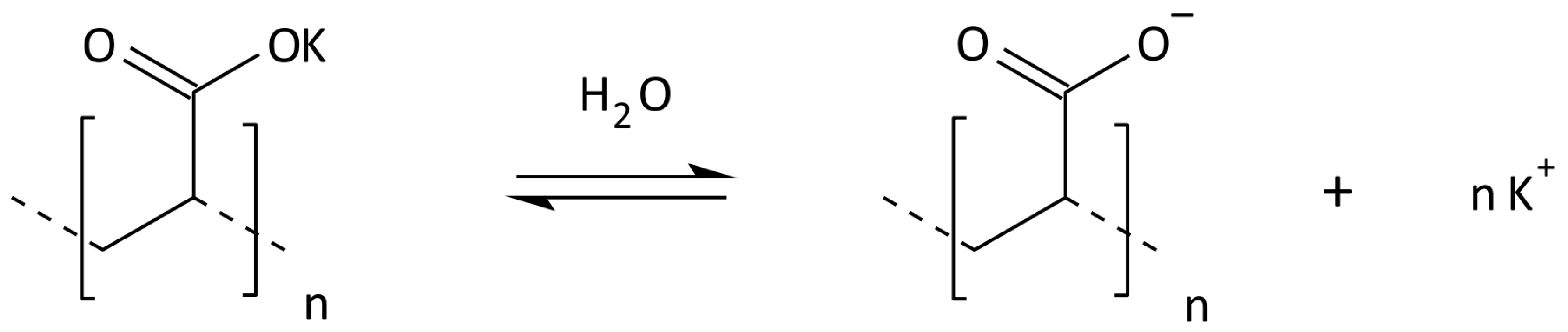
The PAA used in the experiments consisted of 30%mol poly(polyacrylic acid) and 70 mol% poly(potassium acrylate). Thanks to cross-linking, PPA is insoluble in water. From a chemical point of view, it can be treated as a polyelectrolyte that undergoes partial dissociation in water []. PAA can be treated as a buffer, i.e., a salt of weak poly(acrylic acid) and strong base (KOH) in the presence of a weak acid. Poly(acrylic acid) dissociates to release oxonium ions (H3O+) (Figure 3), while poly(potassium acrylate) dissociates into polyacrylic anions (Figure 4), which undergo hydrolysis to release hydroxyl ions (Figure 5). Depending on the pH, ionic strength, and ionic composition of the solution in which PAA macromolecules are suspended, can release varying amounts of oxonium, hydroxide, and potassium ions. The PAA used in the experiments was designed to be neutral in distilled water (pH = 7.0 ± 0.5). In this case, the amount of oxonium ions formed during dissociation was equal to the amount of hydroxyl ions that dissociated from the gel matrix (Figure 3 and Figure 5).
Figure 3.
Dissociation scheme of poly(acrylic acid).
Figure 4.
Dissociation scheme of poly(potassium acrylate).
Figure 5.
Schematic diagram of polyacrylate ion hydrolysis.
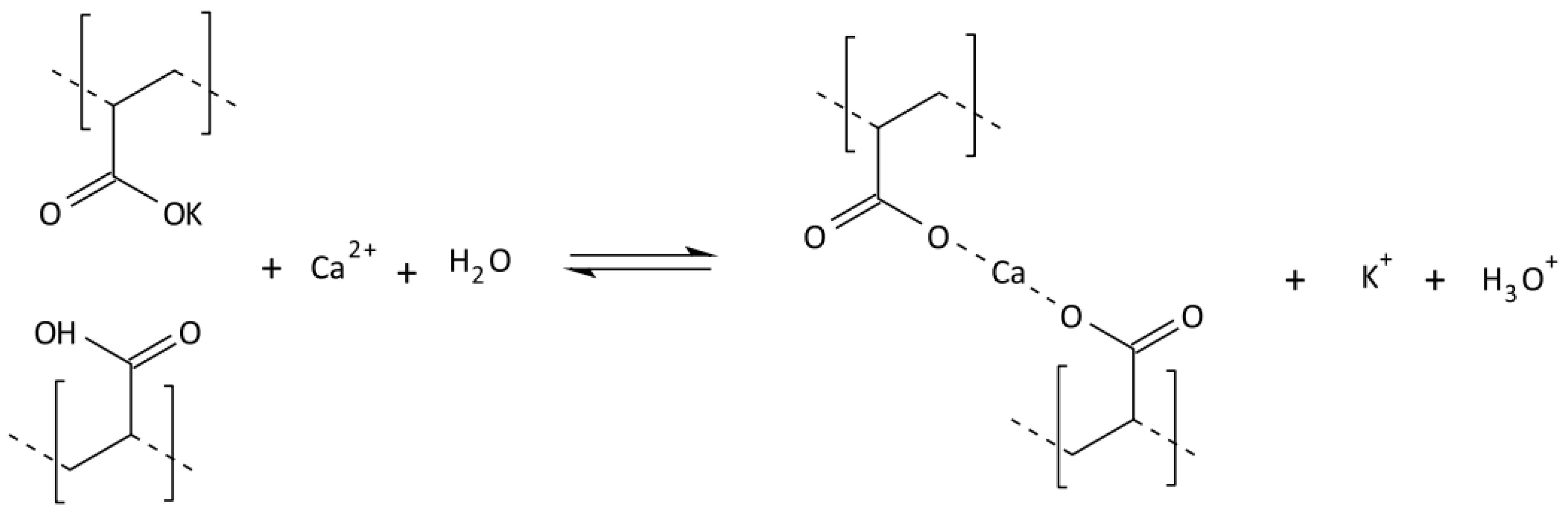
PAA also exhibits ion exchange properties []. In aqueous solutions, it acts as a cation exchanger (Figure 6 and Figure 7). PAA gel suspended in solution binds cations, especially multivalent ones, and releases potassium ions and oxonium ions (H3O+), which can contribute to environmental acidification. All of the reactions mentioned are equilibrium reactions [,].
Figure 6.
Ion exchange involving PAA and monovalent ions occurs in an aqueous environment. In the diagram, Me+ represents any monovalent cation, e.g., Na+, K+, NH4+.
Figure 7.
Ion exchange involving PAA and calcium ions, occurring in an aqueous environment. Two fragments of the polymer chain are joined together (ionic cross-linking).
Monovalent ions present in the soil, e.g., sodium, potassium, or ammonium ions, also undergo ion exchange with the PAA polyelectrolyte. Due to their lower charge, monovalent ions diffuse into the hydrogel matrix much faster than multivalent ions. During ion exchange, oxonium ions are released (Figure 6).
Multivalent ions (e.g., Ca2+, Mg2+, Zn2+) undergo ion exchange on the polymer surface in the presence of a polyelectrolyte such as PAA (Figure 7). The capacity to bind multivalent metal ions is determined by several critical factors, including the type of ion present, the pH of the solution, the cross-linking density of the polymer, and the ionic strength of the environment. Notably, the binding of calcium ions exhibits a linear relationship with the degree of neutralisation. It is important to note that the cross-linking of poly(acrylic acid) can limit the availability of carboxyl groups, thereby reducing the potential for binding multivalent metals. Furthermore, increasing the ionic strength results in heightened competition for binding sites among ions []. Calcium ions have a high affinity for PAA, releasing potassium and oxonium ions. During this reaction, secondary cross-linking of PAA chains occurs with the help of calcium ions (Figure 7), which contributes to a significant reduction in gel swelling and, consequently, a reduction in water retention [].
Carbon dioxide in the air dissolves in the soil solution (Sz1) and can trigger the dissolution of calcium carbonate, resulting in the formation of Ca2+ and HCO3− ions (Equations (1)–(3)). Ca2+ ions attach to PAA molecules (Figure 7), releasing K+ and H3O+ ions. The resulting oxonium ions are responsible for the emission of CO2 from soil samples containing sand, calcium carbonate, and PAA (Sz2) (Equations (1)–(3)).
PAA markedly enhanced abiotic CO2 release from CaCO3 only when soil buffering capacity and competing cations were low (sand); nonetheless had a negligible effect when soil buffering capacity was high (loam/silt loam soils). Changes in soil pH during liming depend on the initial pH, the amount of acids or bases added, and the buffering capacity of the soil []. According to Nelson and Su [], soil buffering capacity ensures stability in soil pH. The buffering capacity of soil depends mainly on the protonation/deprotonation of acid groups in organic matter, oxides and hydroxides; the dissolution/precipitation of carbonates; the complexation/decomplexation of aluminium by organic matter; and ion exchange. In the case of B, Br, and K soils, their buffer capacity is greater than that of pure sand, which is why we do not observe changes in the amount of CO2 emitted. Additionally, soils rich in mineral salts are characterised by high ionic strength, which reduces PAA absorption. A more compact gel structure tends to inhibit the reaction over time, as illustrated in Figure 7. The increased density of the gel reduces the diffusion of calcium ions into the polymer particles, which in turn limits the release of oxonium ions and subsequently restricts the generation of carbon dioxide.
In the experiments, an increase in pH was also observed in samples Sz2 compared to Sz1. In the remaining soil samples, B1 and B2, Br1 and Br2, and K1 and K2, the pH level remained stable at approximately 7.0. If acids stronger than carbonic acid are present in the soil, calcium carbonate dissolution occurs only with the participation of these acids. In tests with added PAA, the resulting calcium ions undergo ion exchange, releasing potassium ions. The experiment was structured as an open system, facilitating the release of carbon dioxide from the soil sample, which is then absorbed by a scrubber containing sodium hydroxide. Following the removal of carbon dioxide, the remaining constituents within the soil solution are primarily potassium and calcium salts of the acids present in the soil (B2, Br2, and K). These salts exhibit minimal hydrolysis, resulting in a leachate that is only slightly alkaline or near neutral. In the samples containing sand with an initially neutral pH (Sz), a significant observation was made following the experiment’s completion. The soil solution was found to contain potassium and calcium bicarbonates. Given that these bicarbonates are salts of strong bases and weak acids, they undergo hydrolysis (as described in Equation (7)), leading to a notable increase in pH levels within the solution. The ion-exchange properties of PAA contribute to soil alkalisation when soil acidity is lower than the amount of potassium ions released into the soil solution by the polyelectrolyte and when the soil buffering capacity is low.
Adding PAA to limed soils may lead to higher carbon dioxide emissions, particularly in sandy soils that have low mineral content. In these cases, an increase in respiration was noted only during the first 24 h. In most samples of limed soils, however, PAA did not have any significant effect on respiration.
5. Conclusions
Soil respiration is influenced not only by soil microorganisms but also by agricultural practices such as liming. In light of climate change and the imperative to reduce greenhouse gas emissions, it is crucial to deepen our understanding of how liming affects the carbon balance within soil. This exploration necessitates further research, particularly in relation to variations in the granulometric composition of the soils being studied, as well as the impact of other additives that enhance soil quality. Liming influences the dynamics of CO2 emissions from the soil and is dependent on various factors, including physicochemical properties, initial soil pH, the concentration and type of ions present, as well as moisture and temperature conditions. The incorporation of PAA into limed acidic soils did not appear to significantly influence soil respiration rates. However, it is crucial to recognise that commercially available SAPs exhibit considerable variation in their chemical composition, degree of neutralisation, and inherent pH. Consequently, a thorough characterisation of the utilised polymeric materials, particularly assessing the degree of neutralisation, is essential. This consideration is vital not only for satisfying the specific physiological requirements of cultivated plants but also for accurately predicting the potential impact on CO2 emissions. The application of SAPs alone effectively enhances the water capacity of sandy soils; however, their co-application with calcium carbonate contributes to both elevated CO2 emissions and a substantial increase in soil pH. This combination may result in excessive alkalization (pH > 8.5) within low-buffered sandy soils, a condition that could be detrimental to the growth and productivity of certain crops.
Author Contributions
Conceptualization, K.S.; methodology, K.S.; formal analysis, K.S.; writing—original draft preparation, K.S. and P.S.; writing—review and editing, L.S. and C.B.; visualisation, P.S. All authors have read and agreed to the published version of the manuscript.
Funding
Research project supported by the programme “Excellence initiative—research university” for AGH University of Krakow and as part of research related to a grant from the Ministry of Science and Higher Education (Poland) for AGH University of Krakow to maintain scientific potential (Contract no. 16.16.150.545).
Institutional Review Board Statement
Not applicable.
Informed Consent Statement
Not applicable.
Data Availability Statement
The original contributions presented in the study are included in the article, further inquiries can be directed to the corresponding author. The raw data supporting the conclusions of this article will be made available by the corresponding author on request.
Acknowledgments
An article prepared as part of the implementation of the “Initiative for Excellence—Research University” (IDUB) for AGH University of Krakow.
Conflicts of Interest
The authors declare no conflicts of interest.
Abbreviations
The following abbreviations are used in this manuscript:
| SAPs | Superabsorbent polymers |
| PAA | Acrylic superabsorbent polymers |
References
- Naorem, A.; Jayaraman, S.; Dalal, R.C.; Patra, A.; Rao, C.S.; Lal, R. Soil Inorganic Carbon as a Potential Sink in Carbon Storage in Dryland Soils—A Review. Agriculture 2022, 12, 1256. [Google Scholar] [CrossRef]
- Kim, J.H.; Jobbágy, E.G.; Richter, D.D.; Trumbore, S.E.; Jackson, R.B. Agricultural Acceleration of Soil Carbonate Weathering. Glob. Chang. Biol. 2020, 26, 5988–6002. [Google Scholar] [CrossRef]
- Goulding, K.W.T. Soil Acidification and the Importance of Liming Agricultural Soils with Particular Reference to the United Kingdom. Soil Use Manag. 2016, 32, 390–399. [Google Scholar] [CrossRef]
- Rousset, C.; Bréfort, H.; Frederico Fonseca, R.; Guyerdet, G.; Bizouard, F.; Arkoun, M.; Hénault, C. Surprising Minimisation of CO2 Emissions from a Sandy Loam Soil over a Rye Growing Period Achieved by Liming (CaCO3). Sci. Total Environ. 2024, 953, 175973. [Google Scholar] [CrossRef]
- Ekenler, M.; Tabatabai, M.A. Effects of Liming and Tillage Systems on Microbial Biomass and Glycosidases in Soils. Biol. Fertil. Soils 2003, 39, 51–61. [Google Scholar] [CrossRef]
- Kemmitt, S.J.; Wright, D.; Goulding, K.W.T.; Jones, D.L. pH Regulation of Carbon and Nitrogen Dynamics in Two Agricultural Soils. Soil Biol. Biochem. 2006, 38, 898–911. [Google Scholar] [CrossRef]
- Zhang, H.-M.; Liang, Z.; Li, Y.; Chen, Z.-X.; Zhang, J.-B.; Cai, Z.-C.; Elsgaard, L.; Cheng, Y.; Jan van Groenigen, K.; Abalos, D. Liming Modifies Greenhouse Gas Fluxes from Soils: A Meta-Analysis of Biological Drivers. Agric. Ecosyst. Environ. 2022, 340, 108182. [Google Scholar] [CrossRef]
- Urbański, K.; Jakubiak, M. Impact of land use on soils microbial activity. J. Water Land Dev. 2017, 35, 249–257. [Google Scholar] [CrossRef]
- Schlesinger, W.H.; Andrews, J.A. Soil Respiration and the Global Carbon Cycle. Biogeochemistry 2000, 48, 7–20. [Google Scholar] [CrossRef]
- Hanson, P.J.; Edwards, N.T.; Garten, C.T.; Andrews, J.A. Separating Root and Soil Microbial Contributions to Soil Respiration: A Review of Methods and Observations. Biogeochemistry 2000, 48, 115–146. [Google Scholar] [CrossRef]
- Zhang, E.; Meng, C.; Qu, J.; Zhu, Z.; Niu, J.; Wang, L.; Song, N.; Yin, Z. Dual Effects of Caragana korshinskii Introduction on Herbaceous Vegetation in Chinese Desert Areas: Short-Term Degradation and Long-Term Recovery. Plant Soil 2025. [Google Scholar] [CrossRef]
- Ferlian, O.; Wirth, C.; Eisenhauer, N. Leaf and Root C-to-N Ratios Are Poor Predictors of Soil Microbial Biomass C and Respiration across 32 Tree Species. Pedobiologia 2017, 65, 16–23. [Google Scholar] [CrossRef]
- De Long, J.R.; Jackson, B.G.; Wilkinson, A.; Pritchard, W.J.; Oakley, S.; Mason, K.E.; Stephan, J.G.; Ostle, N.J.; Johnson, D.; Baggs, E.M. Relationships between Plant Traits, Soil Properties and Carbon Fluxes Differ between Monocultures and Mixed Communities in Temperate Grassland. J. Ecol. 2019, 107, 1704–1719. [Google Scholar] [CrossRef]
- Sun, Z.; Meng, F.; Zhu, B. Influencing Factors and Partitioning Methods of Carbonate Contribution to CO2 Emissions from Calcareous Soils. Soil Ecol. Lett. 2023, 5, 6–20. [Google Scholar] [CrossRef]
- Tamir, G.; Shenker, M.; Heller, H.; Bloom, P.R.; Fine, P.; Bar-Tal, A. Can Soil Carbonate Dissolution Lead to Overestimation of Soil Respiration? Soil Sci. Soc. Am. J. 2011, 75, 1414–1422. [Google Scholar] [CrossRef]
- Ramnarine, R.; Wagner-Riddle, C.; Dunfield, K.E.; Voroney, R.P. Contributions of Carbonates to Soil CO2 Emissions. Can. J. Soil. Sci. 2012, 92, 599–607. [Google Scholar] [CrossRef]
- Ahmad, W.; Singh, B.; Dalal, R.C.; Dijkstra, F.A. Carbon Dynamics from Carbonate Dissolution in Australian Agricultural Soils. Soil Res. 2015, 53, 144. [Google Scholar] [CrossRef]
- Dong, Y.; Cai, M.; Zhou, J. Effects of Moisture and Carbonate Additions on CO2 Emission from Calcareous Soil during Closed-Jar Incubation. J. Arid Land 2014, 6, 37–43. [Google Scholar] [CrossRef]
- Hamdi, S.; Chevallier, T.; Aissa, N.B.; Hammouda, M.B.; Gallali, T.; Chotte, J.L.; Bernoux, M. Short-Term Temperature Dependence of Heterotrophic Soil Respiration after One-Month of Pre-Incubation at Different Temperatures. Soil Biol. Biochem. 2009, 43, 1752–1758. [Google Scholar] [CrossRef]
- Sroka, K.; Sroka, P. Superabsorbent Hydrogels in the Agriculture and Reclamation of Degraded Areas. Sustainability 2024, 16, 2945. [Google Scholar] [CrossRef]
- Buchholz, F.L. Superabsorbent Polymers. In Encyclopedia of Polymer Science and Technology; John Wiley & Sons, Ltd.: Hoboken, NJ, USA, 2002; ISBN 978-0-471-44026-0. [Google Scholar]
- Malik, S.; Chaudhary, K.; Malik, A.; Punia, H.; Sewhag, M.; Berkesia, N.; Nagora, M.; Kalia, S.; Malik, K.; Kumar, D.; et al. Superabsorbent Polymers as a Soil Amendment for Increasing Agriculture Production with Reducing Water Losses under Water Stress Condition. Polymers 2023, 15, 161. [Google Scholar] [CrossRef] [PubMed]
- Demitri, C.; Scalera, F.; Madaghiele, M.; Sannino, A.; Maffezzoli, A. Potential of Cellulose-Based Superabsorbent Hydrogels as Water Reservoir in Agriculture. Int. J. Polym. Sci. 2013, 2013, e435073. [Google Scholar] [CrossRef]
- Mignon, A.; De Belie, N.; Dubruel, P.; Van Vlierberghe, S. Superabsorbent Polymers: A Review on the Characteristics and Applications of Synthetic, Polysaccharide-Based, Semi-Synthetic and ‘Smart’ Derivatives. Eur. Polym. J. 2019, 117, 165–178. [Google Scholar] [CrossRef]
- Ma, X.; Wen, G. Development History and Synthesis of Super-Absorbent Polymers: A Review. J Polym Res 2020, 27, 136. [Google Scholar] [CrossRef]
- Joshi, P.P.; Van Cleave, A.; Held, D.W.; Howe, J.A.; Auad, M.L. Preparation of Slow Release Encapsulated Insecticide and Fertilizer Based on Superabsorbent Polysaccharide Microbeads. J. Appl. Polym. Sci. 2020, 137, 49177. [Google Scholar] [CrossRef]
- Saha, A.; Sekharan, S.; Manna, U. Superabsorbent Hydrogel (SAH) as a Soil Amendment for Drought Management: A Review. Soil Tillage Res. 2020, 204, 104736. [Google Scholar] [CrossRef]
- Parsakhoo, A.; Jajouzadeh, M.; Rezaee Motlagh, A. Effect of Hydroseeding on Grass Yield and Water Use Efficiency on Forest Road Artificial Soil Slopes. J. For. Sci. 2018, 64, 157–163. [Google Scholar] [CrossRef]
- Yu, H.; Lu, J.; Xiao, C. Preparation and Properties of Novel Hydrogels from Oxidized Konjac Glucomannan Cross-Linked Chitosan Forin Vitro Drug Delivery. Macromol. Biosci. 2007, 7, 1100–1111. [Google Scholar] [CrossRef]
- Ahmed, E.M. Hydrogel: Preparation, Characterization, and Applications: A Review. J. Adv. Res. 2015, 6, 105–121. [Google Scholar] [CrossRef]
- Tyliszczak, B.; Polaczek, J.; Pielichowski, J.; Pielichowski, K. Preparation and Properties of Biodegradable Slow-Release PAA Superabsorbent Matrixes for Phosphorus Fertilizers. Macromol. Symp. 2009, 279, 236–242. [Google Scholar] [CrossRef]
- Anderson, J.P.E.; Domsch, K.H. A Physiological Method for the Quantitative Measurement of Microbial Biomass in Soils. Soil Biol. Biochem. 1978, 10, 215–221. [Google Scholar] [CrossRef]
- Schlichting, E.; Blume, H.P. Bodenkundliches Praktikum: Verlag Paul Parey; Verlag Paul Parey: Hamburg, Germany, 1966. [Google Scholar]
- Borges, C.S.; Ribeiro, B.T.; Costa, E.T.D.S.; Curi, N.; Wendling, B. Effects of Phosphate, Carbonate, and Silicate Anions on CO2 Emission in a Typical Oxisol from Cerrado Region. Biosci. J. 2019, 35, 1153–1160. [Google Scholar] [CrossRef]
- Ahmad, W.; Singh, B.; Dijkstra, F.A.; Dalal, R.C.; Geelan-Small, P. Temperature Sensitivity and Carbon Release in an Acidic Soil Amended with Lime and Mulch. Geoderma 2014, 214–215, 168–176. [Google Scholar] [CrossRef]
- Shaaban, M.; Wu, L.; Peng, Q.-A.; van Zwieten, L.; Chhajro, M.A.; Wu, Y.; Lin, S.; Ahmed, M.M.; Khalid, M.S.; Abid, M.; et al. Influence of Ameliorating Soil Acidity with Dolomite on the Priming of Soil C Content and CO2 Emission. Environ. Sci. Pollut. Res. Int. 2017, 24, 9241–9250. [Google Scholar] [CrossRef] [PubMed]
- Neina, D. The Role of Soil pH in Plant Nutrition and Soil Remediation. Appl. Environ. Soil Sci. 2019, 2019, 5794869. [Google Scholar] [CrossRef]
- Fuentes, J.P.; Bezdicek, D.F.; Flury, M.; Albrecht, S.; Smith, J.L. Microbial Activity Affected by Lime in a Long-Term No-till Soil. Soil Tillage Res. 2006, 88, 123–131. [Google Scholar] [CrossRef]
- Bezdicek, D.F.; Beaver, T.; Granatstein, D. Subsoil Ridge Tillage and Lime Effects on Soil Microbial Activity, Soil pH, Erosion, and Wheat and Pea Yield in the Pacific Northwest, USA. Soil Tillage Res. 2003, 74, 55–63. [Google Scholar] [CrossRef]
- Bahram, M.; Mohseni, N.; Moghtader, M.; Bahram, M.; Mohseni, N.; Moghtader, M. An Introduction to Hydrogels and Some Recent Applications. In Emerging Concepts in Analysis and Applications of Hydrogels; IntechOpen: London, UK, 2016; ISBN 978-953-51-2510-5. [Google Scholar]
- Ma, M.; Li, Y.; Wang, D.; Li, J.; Ye, H.; Du, D.; Chi, R.; Han, Q. Highly Efficient and Sustainable Polyacrylic Acid-Polyacrylamide Double-Network Hydrogels Prepared by Cross-Linking of Waste Residues for Heavy Metals Ions Removal. J. Environ. Chem. Eng. 2024, 12, 114294. [Google Scholar] [CrossRef]
- Ehtiati, K.; Moghaddam, S.Z.; Daugaard, A.E.; Thormann, E. How Dissociation of Carboxylic Acid Groups in a Weak Polyelectrolyte Brush Depend on Their Distance from the Substrate. Langmuir 2020, 36, 2339–2348. [Google Scholar] [CrossRef]
- Laguecir, A.; Ulrich, S.; Labille, J.; Fatin-Rouge, N.; Stoll, S.; Buffle, J. Size and pH Effect on Electrical and Conformational Behavior of Poly(Acrylic Acid): Simulation and Experiment. Eur. Polym. J. 2006, 42, 1135–1144. [Google Scholar] [CrossRef]
- Kriwet, B.; Kissel, T. Interactions between Bioadhesive Poly(Acrylic Acid) and Calciumions. Int. J. Pharm. 1996, 127, 135–145. [Google Scholar] [CrossRef]
- Lee, H.X.D.; Wong, H.S.; Buenfeld, N.R. Effect of Alkalinity and Calcium Concentration of Pore Solution on the Swelling and Ionic Exchange of Superabsorbent Polymers in Cement Paste. Cem. Concr. Compos. 2018, 88, 150–164. [Google Scholar] [CrossRef]
- Latifah, O.; Ahmed, O.H.; Majid, N.M.A. Soil pH Buffering Capacity and Nitrogen Availability Following Compost Application in a Tropical Acid Soil. Compost. Sci. Util. 2018, 26, 1–15. [Google Scholar] [CrossRef]
- Nelson, P.N.; Su, N. Soil pH Buffering Capacity: A Descriptive Function and Its Application to Some Acidic Tropical Soils. Aust. J. Soil Res. 2010, 48, 201–207. [Google Scholar] [CrossRef]
Disclaimer/Publisher’s Note: The statements, opinions and data contained in all publications are solely those of the individual author(s) and contributor(s) and not of MDPI and/or the editor(s). MDPI and/or the editor(s) disclaim responsibility for any injury to people or property resulting from any ideas, methods, instructions or products referred to in the content. |
© 2025 by the authors. Licensee MDPI, Basel, Switzerland. This article is an open access article distributed under the terms and conditions of the Creative Commons Attribution (CC BY) license (https://creativecommons.org/licenses/by/4.0/).