1. Introduction
The development of self-driving technology has accelerated the commercialization of autonomous vehicles (AVs) in the automotive industry [
1]. In particular, the proportion of Level 3 or higher Level of AVs is expected to grow rapidly in the automotive market between 2025 and 2030 [
2]. Level 3 AVs are capable of autonomous driving within the operational design domain (ODD) and require a transition from the autonomous driving mode to the manual driving mode when exiting the ODD. The notification by the autonomous driving system (ADS) to the driver of the need for a transition from autonomous to manual driving mode is a take-over request (TOR). The time elapsed from the time the TOR event occurs to the time the vehicle enters the non-ODD section is defined as the take-over request lead time (TORlt). The drivers are obligated to control the vehicle safely within the TORlt when drivers receive a TOR. However, it is difficult for human drivers of AVs to react to a TOR and safely control the vehicle during the transition from autonomous to manual driving mode because drivers are often not paying attention to the driving situation and surrounding traffic conditions. Therefore, appropriate information should be provided to drivers for a TORlt to ensure safe control of the vehicle when transitioning from autonomous to manual driving mode.
Existing studies have evaluated the performance and driving safety of take-over according to TORlt. Wang et al. [
3] evaluated the driver’s take-over performance when requesting a voice-based take-over message using driving simulation. TORlt scenarios were set at 5 and 12 s. Take-over time (TOT) and time-to-collision (TTC) were used as evaluation indicators. The results showed that TOT decreased in the 5 s scenario. However, because the crash risk increases due to a decrease in TTC, providing TOR information based on a TORlt of 12 s was more appropriate than 5 s. Dogan et al. [
4] evaluated the take-over performance based on TORlt by setting five driving scenarios, including crossing an intersection, crossing an intersection with pedestrians, and the vehicle approaching from a minor road. TORlt scenarios were set at 0, 2, 4, and 6 s. The analysis using pulse deviation and TTC as evaluation indicators showed that the driver had the most stable take-over at TORlt of 2 and 4 s. Kim et al. [
5] evaluated the take-over performance and reaction time of drivers in the case of being asleep using driving simulation. TORlt scenarios were designed to be 5 and 10 s. A sleep situation was assumed by wearing a sleep mask for 12 min. The TOT was 3.77 s on average in the TORlt 5 s scenario. The lane deviation was 48% lower in the TORlt 10 s scenario than in the 5 s scenario. Du et al. [
6] studied the physiological reactions of drivers based on TORlt for Level 3 AVs. The analysis showed that a TORlt of 7 s provided emotional stability to drivers more than a TORlt of 4 s. Vlakveld et al. [
7] studied drivers’ perception and avoidance of risky situations based on TORlt in TOR scenarios. It was found in TORlt scenarios of 4 and 6 s that drivers were more aware of risky situations and could avoid collision risks. Weaver and DeLucia [
8] evaluated take-over performance and driving safety based on TORlt in conditional autonomous driving situations by a meta-analysis of 48 existing studies. TORlt scenarios were classified into short time for TORlt of 5 s or more and less than 7 s and long time for TORlt of 7 s or more and less than 9 s. The TOT decreased when TORlt was short. However, driving safety decreased after take-over when TORlt was short. Sanghavi et al. [
9] conducted a study using a decision-making system to determine the appropriate TORlt. TORlt scenarios were set at 3, 5, 7, and 9 s. The analysis showed that a TORlt of 3 s had the shortest TOT but had a high jerk value, which reduced driving safety. On the other hand, a TORlt of 7 s was the safest in terms of driving safety. Existing studies have mostly evaluated TORlt separately in terms of take-over performance and driving safety. To provide a clearer overview of these findings,
Table 1 summarizes the primary evaluation indicators, experimental tools, key results, and limitations reported in representative TORlt studies. The meta-analysis by Weaver and DeLucia [
8] was excluded from the table because its aggregated structure makes direct comparison with individual experimental studies less suitable.
Recent studies have also shown that TORs may be required not only when an AV approaches the boundary of its ODD but also when the ADS exhibits internal faults or abnormal behavior. Arslanyilmaz et al. [
10] examined a Level 3 AV scenario in which the ADS fails just before an intersection and demonstrated that providing an 8 s buffer time, compared with 4 s, leads to more stable longitudinal and lateral control and a lower collision risk during take-over. At the system level, Meléndez-Useros et al. [
11] proposed an active steering fault diagnosis framework that integrates an LSTM-based sensor fault detector with robust actuator fault estimation, allowing the steering system to maintain functionality even under combined sensor–actuator faults. Similarly, He et al. [
12] developed a BiLSTM–SPRT-based soft sensor capable of detecting rack-position sensor faults at an early stage and applied fault-tolerant control to preserve autonomous steering performance following fault detection. From the perspective of driver behavior, Chen et al. [
13] introduced an LSTM–BiLSTM–ATTENTION model that predicts driver take-over performance using vehicle states and eye-movement data, enabling the identification of drivers who may exhibit delayed or unstable control after a TOR. Collectively, these studies suggest that data-driven fault diagnosis and deep-learning-based prediction of take-over performance are becoming essential components of AV safety architectures, in which faults or anomalies detected by the ADS can trigger TORs and drivers must respond within a constrained time budget.
Most previous studies evaluated TORlt by considering either takeover performance or vehicle-interaction safety in isolation, even though both factors jointly influence real-world take-over situations. In addition, many studies have focused on component-level steering control or have assumed pre-defined time budgets for TOR, without explicitly determining an appropriate TORlt that accounts for driving behavioral interactions between AVs and following MVs. To address these limitations, the present study simultaneously examined takeover behavior and vehicle-interaction safety under identical driving conditions. A multi-agent driving simulation (MADS) was used to derive TTC-based indicators that capture real-time interaction safety, while TOT and the success rate of take-over were also measured under the same experimental conditions. These indicators were then integrated using an multi-criteria decision-making (MCDM)-based value-function approach, allowing TORlt to be evaluated in terms of driver behavior, operational safety, and scenario-specific risk. The key methodological contributions of the study are summarized as follows:
A multi-agent driving simulation design that captures real-time interactions between an autonomous vehicle and a manually driven following vehicle.
An MCDM-based integrated evaluation structure that synthesizes TOT, takeover success rate, and TTC-based conflict rate to derive a scenario-appropriate TORlt that reflects both driver behavior and interaction-based safety.
A data-driven identification of the optimal TORlt for urban road conditions, demonstrating that the proposed framework can be applied to real-world AV operational environments.
The Ministry of Land, Infrastructure and Transport (MOLIT) of Korea established safety standards for SAE Level 3 AVs in 2019 [
14,
15]. The TOR should be initiated at least 15 s prior to expected take-over situations in the safety standards. However, in 2022, MOLIT plans to revise the TORlt standard and allow AV manufacturers to set up their own standards. The take-over, in which control is transferred from the ADS to the driver in manual mode, can occur even when the human driver lacks experience or attention in the driving situation. If the driver fails to respond to the TOR within the given time, the crash potential increases. Additionally, crashes can affect not only AVs but also surrounding vehicles and traffic flow. Hence, establishing an appropriate TORlt is crucial for ensuring the safety of AVs as well as for their interactions with other surrounding vehicles. An appropriate TORlt should be established, taking into account both the performance of AVs in take-over situations and the safety aspects of interactions with surrounding vehicles. Accordingly, the optimal TORlt should be derived based on analyzing the interactions between AVs and manual-driven vehicles for safer driving.
To meet the aforementioned requirement regarding vehicle interactions in determining TORlt, this study used individual analysis indicators to evaluate TORlt scenarios of AVs entering non-ODD sections using MADS experiments. In addition, an MCDM method was used to derive the optimal TORlt by performing an integrated evaluation. MADS is an experimental environment that interconnects two driving simulators to allow simultaneous driving on the same network. Additionally, it is utilized not only to analyze individual vehicle driving behavior but also to analyze vehicle interactions. This study differs from existing studies in that it uses MADS to analyze not only the take-over performance of AVs but also driving safety due to interactions between autonomous and non-autonomous vehicles. Furthermore, requirements were established to systematically derive the optimal TORlt. Existing studies have merely set TORlt as a scenario and only derived individual analysis results for evaluation indicators. However, this study further established the criteria that need to be met to derive the optimal TORlt. Three requirements were established to determine the appropriate TORlt: minimizing TOT, maximizing the success rate of take-over, and minimizing the potential of rear-end collisions due to vehicle interactions. TOT, the success rate of take-over, and the conflict rate based on TTC were used as evaluation indicators for each requirement. Finally, existing studies only evaluated TORlt separately in terms of take-over performance and driving safety. However, this study derived the optimal TORlt by an integrated evaluation based on the MCDM method to derive the optimal TORlt, taking both aspects into account. The multi-criteria value function was utilized among various MCDM methods to quantitatively determine the final value by systematically taking into account all three evaluation indicators. In this study, the school zone was selected as the non-ODD boundary because, under Korean road safety and autonomous driving regulations, autonomous driving mode is not permitted in school-zone areas. Therefore, the experimental scenario represents a typical urban condition in which a Level 3 AV travels on a straight 50 km/h urban road segment that leads into a 30 km/h school zone where manual control is required. As such, the findings of this study should be interpreted within the context of transitions from urban ODD areas to designated non-ODD sections. The results of this study are expected to be utilized as fundamental research data for establishing TOR criteria for AVs.
The remainder of this paper is organized as follows.
Section 2 presents a methodology for determining the appropriate timing of TOR for AVs using MADS experiments.
Section 3 presents the results of analyzing evaluation indicators for each TORlt scenario and the integrated evaluation for determining the optimal TORlt. Finally, the last section describes a summary of this study and future research challenges.
2. Methods
2.1. Overall Framework
This study derived the optimal TORlt to provide TOR information to the AV driver entering the non-ODD section through multi-agent driving simulation experiments. The following requirements were established to derive the optimal TORlt. First, the TOT should be minimized. If the TOT increases, there is a higher possibility that the driver will fail to take-over before reaching the non-ODD section. Therefore, a TORlt that minimizes the TOT should be derived. Second, the success rate of take-over should be maximized. A low success rate of take-over means that many drivers fail to take-over, which can lead to dangerous situations such as accidents when transitioning from autonomous mode to manual mode. Thus, the success rate of take-over should be maximized. Third, the potential of rear-end collisions due to improper vehicle interactions between the AV and the manual vehicle (MV) should be minimized. This is because even if the AV successfully transfers control, improper interactions that would increase the crash potential should be avoided. Therefore, an optimal TORlt that maximizes all three requirements should be derived to maintain both take-over performance and driving safety.
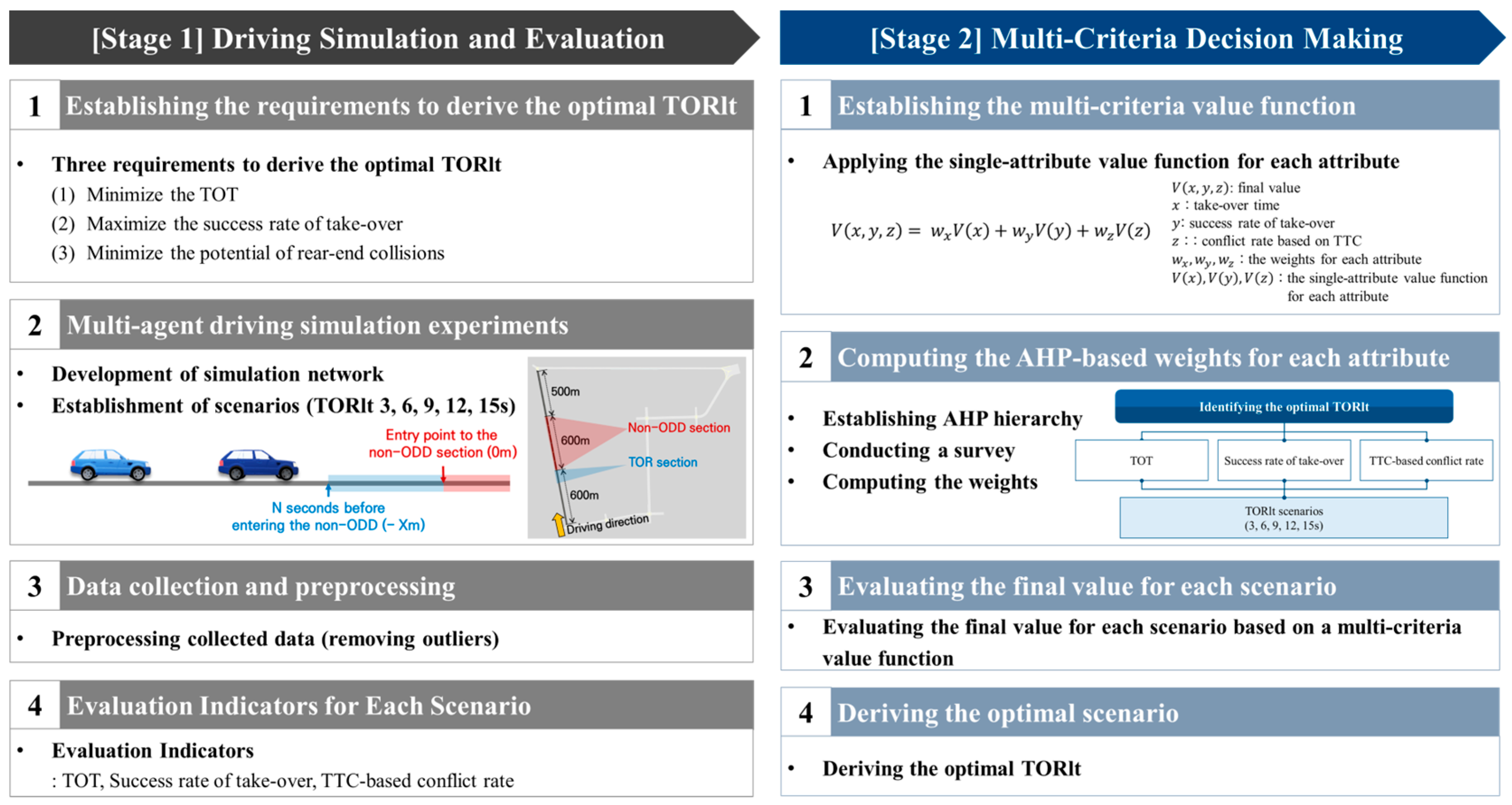
The proposed overall framework is presented in
Figure 1. This study consists of two steps: Stage 1 establishes a set of requirements for deriving the optimal TORlt. Then, each scenario is individually analyzed by evaluation indicators to identify whether a given TORlt successfully meets the requirement through the MADS experiment. Stage 2 integrates individual evaluation results based on developing a multi-criteria value function to determine the optimal TORlt. The weights for each evaluation criterion of the proposed value function are obtained by an analytical hierarchical process (AHP) method.
2.2. Driving Simulation Environment
This study constructed an experimental environment for analyzing the vehicle interaction of car-following situations by utilizing MADS, which allows two driving simulators to drive simultaneously on the same network. Additionally, driving information such as the position, speed, acceleration, brake power, and angular velocity of the lead and follow vehicles is shared in real-time. MADS is not only used to analyze driving behavior reflecting individual driver characteristics but also for analyzing vehicle interaction.
The MADS environment used in this study was implemented with a compact driving simulator (CDS). The simulator includes a quarter-car cabin (Hyundai Accent, automatic transmission) designed to replicate an actual vehicle interior. It is equipped with a 3-channel 43-inch display system, a 12.3-inch LCD instrument-cluster monitor, and a 5.1-channel audio system. In addition, an active force-feedback steering wheel is provided, along with standard driver input devices such as accelerator and brake pedals and multifunction steering controls. The CDS used in this study was constructed by INNOSIMULATION Co. (Seoul, Korea) and installed at Hanyang University ERICA campus (Ansan, Korea). The SCANeR
TM Studio software (version 2021.1) program was used to construct the driving simulation experimental network and implement the behavior of AVs. AVSimulation’s SCANeR
TM Studio is an advanced driving simulation software program based on a sophisticated physics engine that can simulate various driving situations on actual roads [
16]. The program can simulate real-world roads by reflecting a variety of variables, including weather conditions, road surface characteristics, and the road network. The program can simulate various factors affecting vehicle maneuvering, including road networks, weather conditions, and road surface characteristics. This is also useful in testing the performance of various technologies, including ADS, advanced driver assistance systems (ADAS), and human–machine interfaces (HMI).
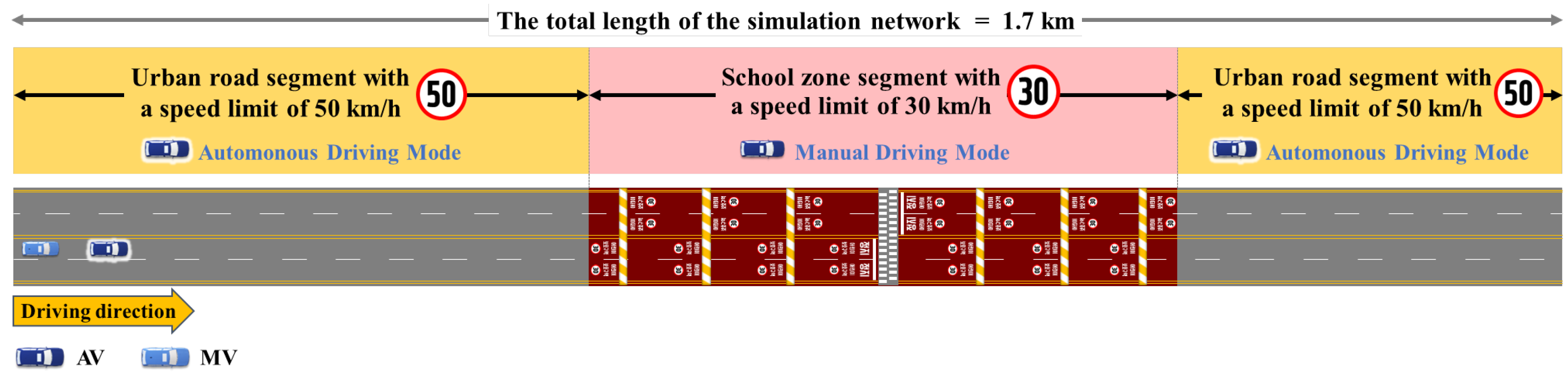
A simulated road network was designed to drive two vehicles on a 1.7 km straight section of a two-lane urban road segment. The network consists of a section of normal downtown roads with a speed limit of 50 km/h and a non-ODD section with a speed limit of 30 km/h, as shown in
Figure 2. School zones are designated areas where vehicles cannot drive in autonomous driving mode in Korea [
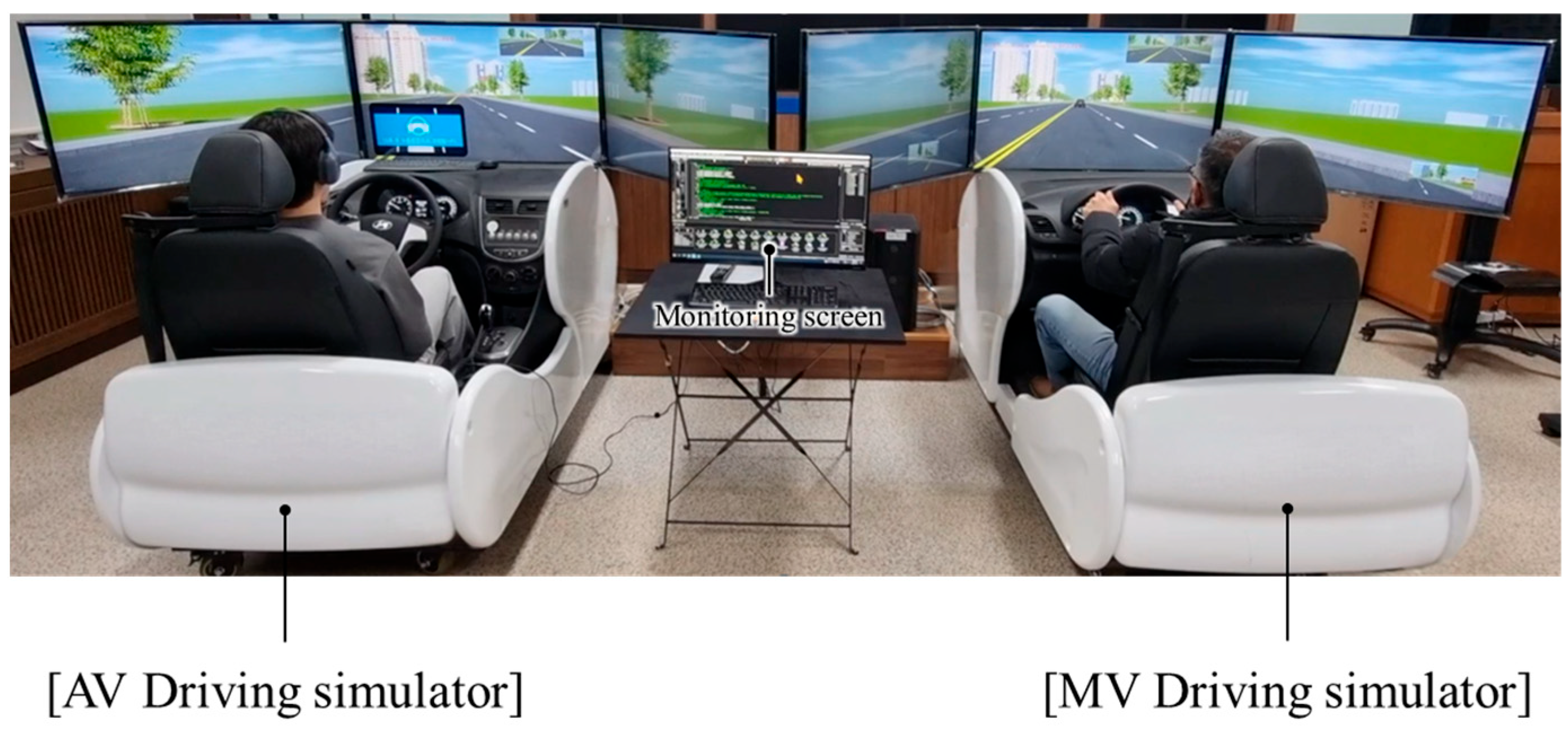
17]. Therefore, the school zone was regarded as a non-ODD section in this study. Speed bumps and unsignalized crosswalks were installed in the school zone to prevent speeding. At the start of the driving simulation, the lead vehicle test subjects were instructed to drive in autonomous mode. Before entering the non-ODD section, the AV test subjects were instructed to press a button to switch to manual mode. The following vehicle test subjects in the MV simulator were instructed to follow the AV. An example of the actual MADS experimental environment is shown in
Figure 3.
This study implemented the maneuvering of AVs in the driving simulation using the SCANeR
TM script editor module. The driving behavior of individual vehicles, including speed, acceleration, headway, etc., can be adjusted based on a set of functions provided by the SCANeR
TM script editor module. The National Highway Traffic Safety Administration (NHTSA) reported on test and evaluation methods for ADS functions [
18]. The key necessary functions for conducting the driving simulation experiment are selected to implement the maneuvering of the AV. The behavior of the AV is abstracted based on the key functions to develop the algorithm for maneuvering control of the AV. Simplifying exclusively the key features among the actual functioning features and systems is referred to as ‘abstraction’ [
19]. AVs use various vehicle sensors and communication functions to perceive the surrounding environment and determine vehicle maneuvering in the real world. Implementing all the functions of the AVs in the simulation identically to the real world may result in excessive computational load on the system [
20]. Therefore, an appropriate level of abstraction is needed. This study assumes that the driving behaviors of AVs and MVs are different to abstract the maneuvering of AVs: (1) AVs do not create a dangerous situation by themselves during driving, (2) AVs can drive continuously and stably without significant speed and acceleration fluctuations, and (3) AVs maintain consistent driving behavior under the same environmental conditions. The implementation algorithms of Maintain Speed and Lane Centering are developed to satisfy the requirements of the behavior of AVs by referring to the parameters corresponding to SAE Level 4 [
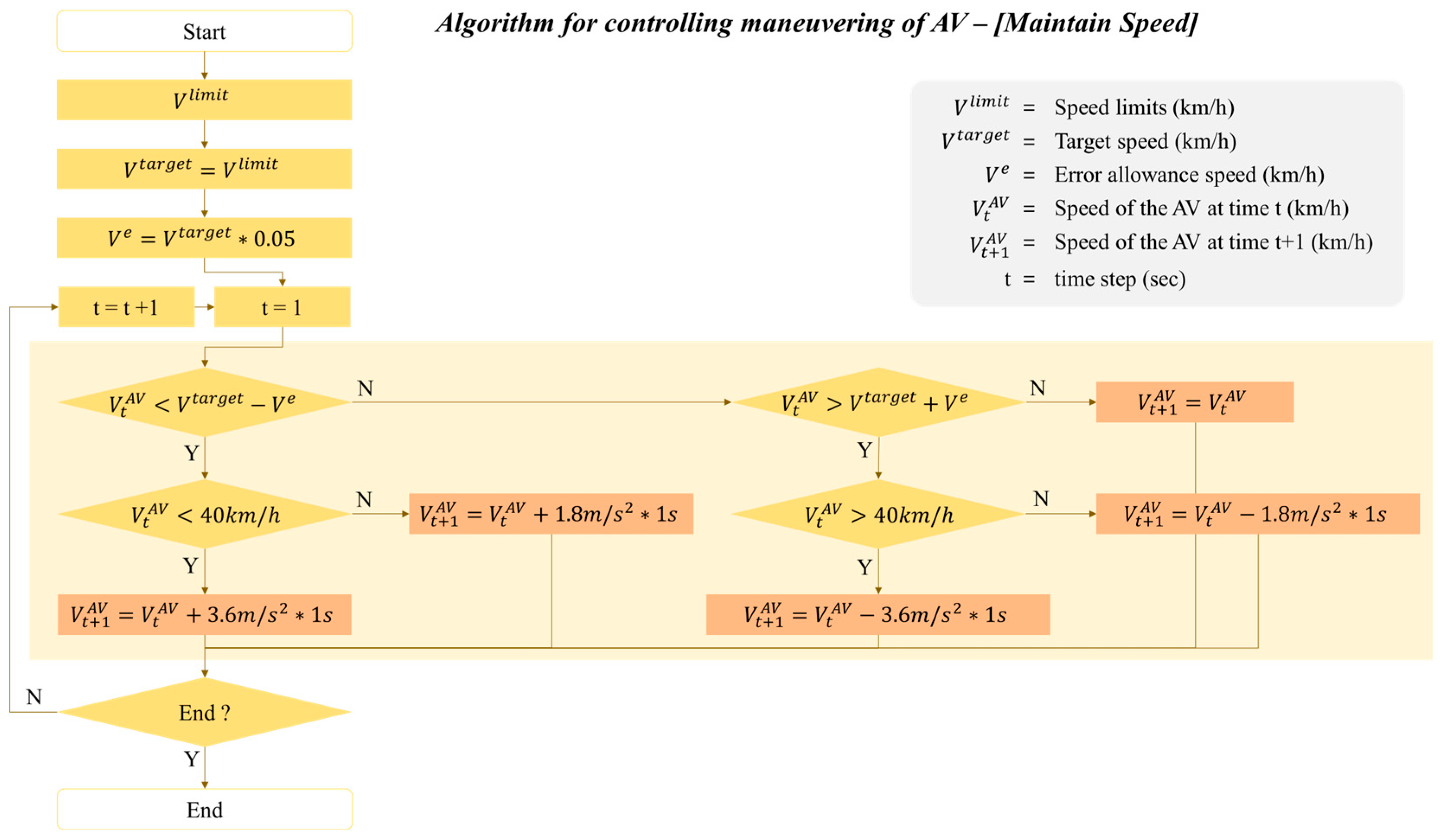
21]. An example of the algorithm for Maintain Speed is presented in
Figure 4. The maintain-speed module uses the posted speed limit, the target speed, the allowable error range, and the current vehicle speed as its primary control parameters, as presented in
Figure 4. The control logic sets a target speed based on the road’s speed limit, compares the current speed with the allowable range, and updates the next-step speed using bounded acceleration and deceleration to ensure stable longitudinal motion.
2.3. Experimental Scenario
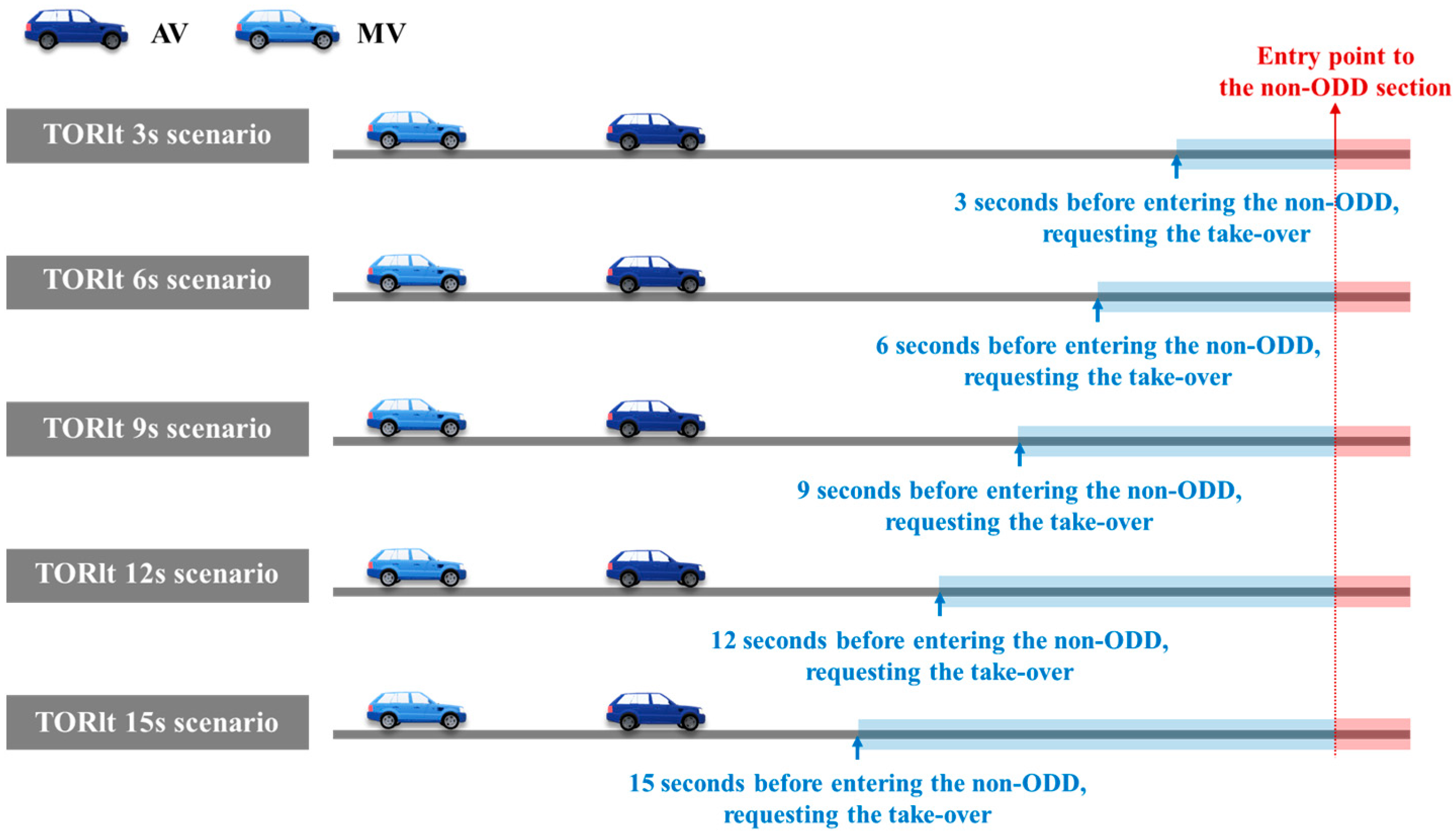
This study established five scenarios based on the timing of TOR, ranging from 3 to 15 s in 3 s increments, as shown in
Figure 5. The TORlt in all scenarios refers to the time required for the AV to reach the entry point of the non-ODD section while driving at a speed of 50 km/h. The TOR information message was displayed as soon as the AV reached the TORlt. The TOR message displayed a visual information message with images and text through the HMI, as shown in
Table 2. The message provided an announcement voice (“Switching to manual driving in N seconds. Drive safely.”, N = 3, 6, 9, 12, 15) followed by a warning sound (“beep”).
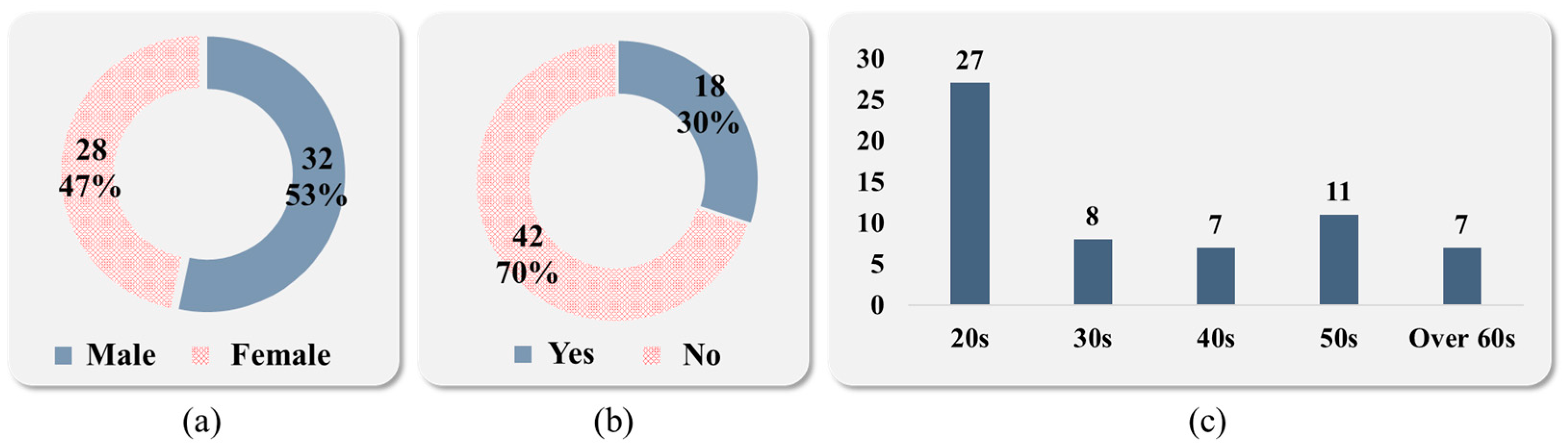
The driving simulation experiment was conducted with a total of 60 participants from 6 to 13 February 2023.
Figure 6 shows the personal characteristics of the participants (gender, age group, and experience riding in AVs). All participants were required to have at least one year of licensed driving experience at the time of recruitment to ensure a minimum driving competence level. Participants were not allowed to engage in any nondriving-related tasks (NDRTs) during the automated driving phase to maintain consistent experimental conditions. Among 60 participants, 32 were male and 28 were female. Twenty-seven of them were in their 20s, accounting for 45% of the total participants. In addition, 18 participants, which is 30% of the total, responded that they had experience riding in AVs. Depending on the experimental scenario where the lead and follow vehicles are driving simultaneously, two participants conducted the experiment together. A total of 30 pairs involved the experiment. Through the driving simulation experiment, a total of 60 datasets were collected for each scenario.
2.4. Evaluation Indicators
This study established three requirements for TORlt to determine the optimal TORlt for AVs. This study analyzed TORlt scenarios to evaluate the performance of take-over and the potential of rear-end collisions caused by inter-vehicle interactions using three evaluation indicators based on three requirements: TOT, the success rate of take-over, and the conflict rate based on TTC.
The TOT refers to the time it takes for the driver to take control of the vehicle after a TOR message is displayed. TOT is obtained by Equation (1). A shorter TOT indicates that the driver is able to take control of the vehicle more quickly. Therefore, a shorter TOT is evaluated to be a better take-over performance.
where
is defined as the take-over time (sec).
is the time when the take-over process successfully completed (sec).
is the time when the take-over request initiated (sec).
The success rate of take-over refers to the proportion of AV participants who successfully switch to manual driving mode by accurately pressing the take-over button before entering the non-ODD section after the TOR message is displayed. The experimental design defined events of successful and failed take-over to reflect the success rate of take-over. A successful take-over was defined as switching from autonomous driving to manual driving mode after the TOR message was displayed but before entering the non-ODD section. On the other hand, a failed take-over was defined as the failure to switch from autonomous driving to manual driving mode either before the TOR message is displayed or after the TOR message is displayed but before entering the non-ODD section. The success rate of take-over was computed as the ratio of the number of participants who successfully took over to manual driving mode to the total number of participants in the driving experiment, as shown in Equation (2). The higher the success rate of take-over is, the better the performance of take-over is evaluated.
When the lead and following vehicles maintain their current speed without any change in the car-following situation, a collision will occur if the speed of the following vehicle is faster [
22]. The time it takes for the lead and following vehicles to collide is defined as TTC. Equation (3) shows the calculation formula for TTC, which is a representative surrogate safety measure (SSM) used to evaluate the probability of accidents caused by vehicle interactions. A decrease in TTC indicates reduced driving safety. Existing studies evaluating the safety of urban roads using TTC set the range of the critical threshold for TTC conflict detection from 1.5 to 5 s [
23,
24]. Vogel [
25] analyzed only cases where the TTC threshold was less than 6 s as dangerous situations. The TTC conflict threshold was set at 4.5 s to calculate the TTC-based conflict rate and was used as an evaluation indicator for analyzing the probability of rear-end collisions caused by vehicle interactions in this study. The TTC-based conflict rate can be obtained by Equation (4). A decrease in the TTC-based conflict rate means that the probability of rear-end collisions caused by vehicle interactions decreases.
where
is the estimated time of collision between the following vehicle and leading vehicle at time
t (sec).
t is the observation time (sec).
is defined as spacing between the following vehicle and the preceding vehicle at time t (m).
represents speed of following vehicle (m/s) and
represents speed of preceding vehicle (m/s).
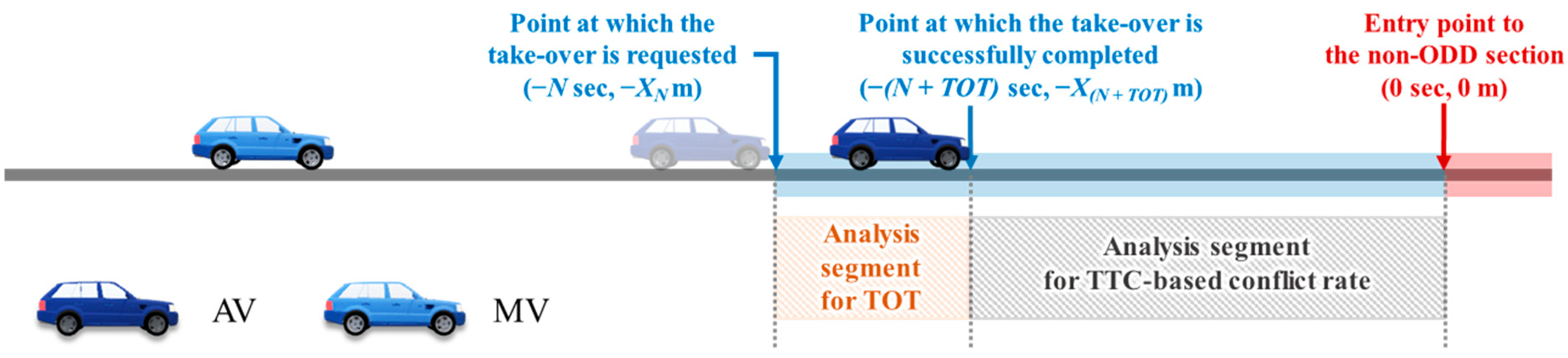
TORlt was set to
N seconds (N = 3, 6, 9, 12, 15) before entering the non-ODD section at 0 s, as shown in
Figure 7, referred to as −
N seconds. The position of the vehicle at this time was defined as −
XN m. In addition, the time at which the AV test subject successfully completed the take-over was set as −(
N + TOT) seconds. The position of the vehicle at this time was defined as −
X(N+TOT) m. The temporal range for analyzing the TOT was defined as from −
N seconds to −(
N +
TOT) seconds. The spatial range was defined as from −
XN m to −
X(N+TOT) m. The temporal range of the driving safety analysis section was defined from −(
N + TOT) seconds to 0 s, which is the entry point of the non-ODD section. The spatial range was defined from −
X(N + TOT) m to 0 m, which is at the entry point of the non-ODD section.
2.5. Multi-Criteria Decision-Making
An MCDM approach was used to derive the optimal TORlt by utilizing multiple evaluation indicators simultaneously. MCDM is used when multiple criteria need to be reflected in the decision-making process rather than a single criterion. It is a decision-making method that considers multiple conflicting objectives and determines how to balance them. MCDM is a method for making a final decision through problem definition, hierarchy establishment, value function selection, determination of relative importance (weights), and selection of alternatives using value functions [
26].
In the application of the MCDM approach in this study, the first step is to hierarchically organize multiple decision-making issues that are interrelated. The top layer of the hierarchy is the most general purpose of decision-making. The subsequent layers are composed of various factors that affect the purpose of decision-making. These factors become more specific as they go down the layers. Each element within a layer must be comparable to each other. The lowest layer of the hierarchy consists of various decision-making alternatives. The evaluation indicators for decision-making alternatives, including the TOT, success rate of take-over, and conflict rate based on TTC, were selected and analyzed to derive the optimal TORlt for AVs driving on urban roads in this study.
The value function is a function that expresses the decision-maker’s preference structure. In addition, the order of preference among alternatives exists according to the magnitude of the value function’s values. An exponential value function proposed by Kirkwood [
27] was used to calculate the final value for each TORlt scenario in this study.
The value functions are presented in Equations (5) and (6), where x* denotes the most preferred value and x
0 denotes the least preferred value. c indicates a constant that indicates the curvature of the function, which can be selected using the scale provided by Kirkwood [
27]. The parameters used in the single-attribute value functions consist of x
0, x*, and the curvature parameter c. The value x
0 represents the lowest level of desirability within the feasible domain of an attribute, while x* represents the highest level of desirability. These two values define the evaluation interval for normalizing each performance indicator to a 0–1 scale, enabling consistent comparison across indicators with different units and preference directions. The assignment of x* and x
0 depends on whether the value increases or decreases as the input value increases. Accordingly, the maximum or minimum observed value is assigned to x* or x
0 based on the direction of preference. The curvature parameter c determines the concavity or convexity of the exponential value function. Kirkwood’s mid-value method is used to select c, ensuring that the value function yields a utility of 0.5 at the midpoint between x
0 and x*. This condition ensures that the value function follows the appropriate preference direction for both beneficial and non-beneficial attributes. Accordingly, Equation (5) applies to beneficial attributes, and Equation (6) applies to non-beneficial attributes.
To establish a multi-objective value function, additive value functions, which are typically the sum of single-attribute value functions, are commonly used. By computing the weights for each attribute in the single-attribute value function, a weighted sum value function can be created [
28]. The multi-criteria value function established in this study is presented in Equation (7). The value function represented by Equation (5) was applied to the success rate of take-over, where the value of the evaluation indicator increases as the input value increases. The value functions for the TOT and conflict rate based on TTC were applied using Equation (6), where the value of each performance measure increases as the input value decreases.
where V(x,y,z) is defined as final value. x, y, and z represent the TOT, success rate of take-over, TTC-based conflict rate, respectively. V(x), V(y), and V(z) are single-attribute value functions for each attribute. w
x, w
y, and w
z are weights for each attribute. Weights are a scale that represents the relative preference between evaluation criteria. There are various techniques to determine the weighting. The AHP method was applied to estimate the weights. AHP is a hierarchical analysis technique that evaluates the relative importance (weights) of various factors through one-to-one pairwise comparisons [
29,
30].
4. Conclusions
The take-over from ADS to manual mode can occur despite driver inexperience or inattention. At this time, a delayed driver response to the TOR can increase the potential for crashes. Establishing an appropriate TORlt is crucial to ensure the safety of AVs and their interactions with surrounding vehicles. This study evaluated each indicator for the TORlt scenarios of AVs entering the non-ODD section. The MCDM method was used for integrated evaluation to derive an optimal TORlt. One distinctive feature of this study is that it analyzes not only the take-over performance of AVs but also the driving safety resulting from interactions between autonomous and non-autonomous vehicles using MADS experiments. An aspect that sets this study apart is the establishment of a systematic set of requirements to derive an optimal TORlt, which distinguishes it from approaches used in existing studies. Finally, an integrated evaluation was conducted using an MCDM method based on three evaluation indicators to derive an optimal TORlt. The established requirements for deriving an optimal TORlt include minimizing the TOT, maximizing the success rate of take-over, and minimizing the likelihood of a rear-end collision due to vehicle interactions. The simulation network was designed as a two-lane urban road in each direction with a total length of 1.7 km, which includes a school zone where AVs are restricted from driving in autonomous mode. The scenarios were set up with TORlt intervals of 3, 6, 9, 12, and 15 s. The MADS experiment was conducted with a total of 60 participants in groups of two. To evaluate the established requirements, evaluation indicators such as TOT, success rate of take-over, and conflict rate based on TTC were used as evaluation indicators. After performing a scenario-specific analysis for each evaluation indicator, an integrated evaluation using an MCDM method was conducted to derive an optimal TORlt. A multi-criteria value function was established systematically for the integrated evaluation. An AHP-based survey of transportation experts was conducted to derive the weightings of each evaluation indicator in the multi-criteria value function. The final values for each scenario were evaluated to derive an optimal TORlt.
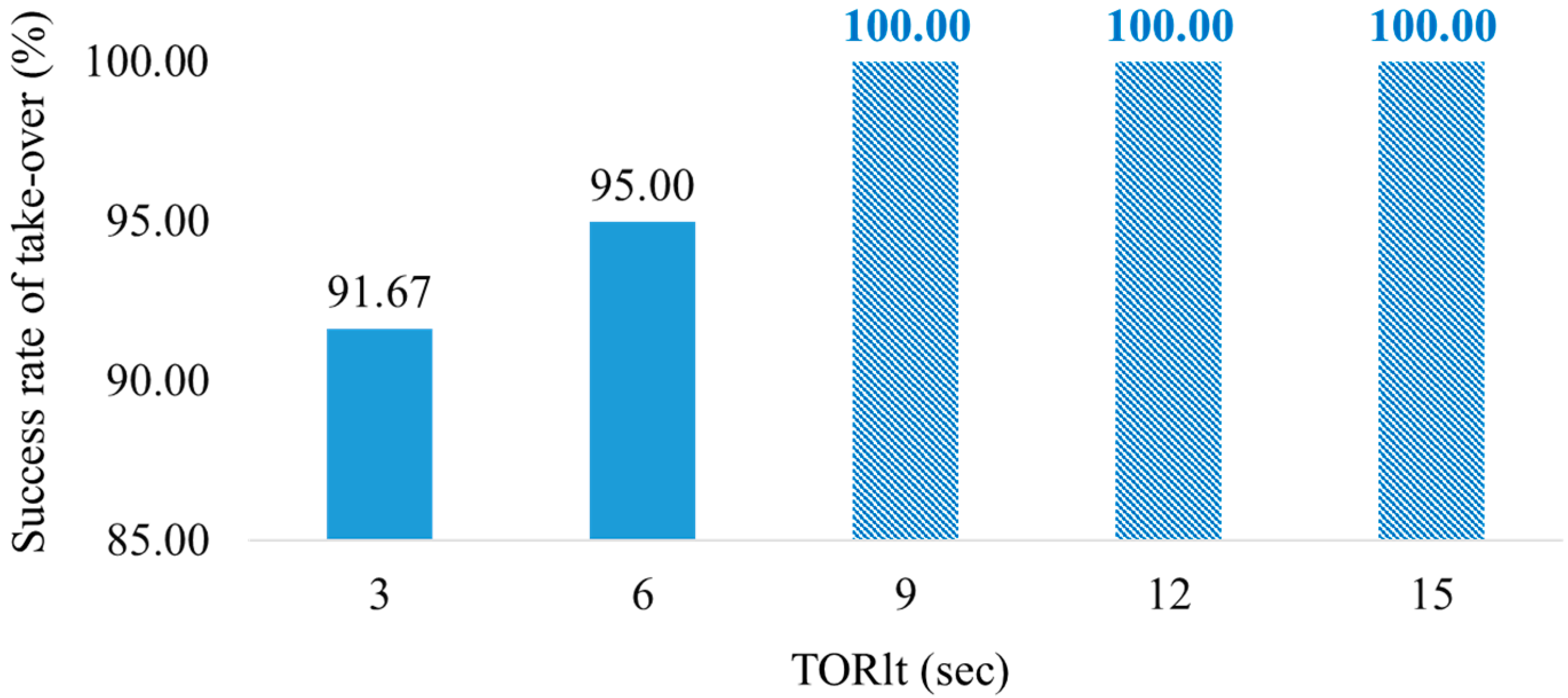
The comparative analysis of individual evaluation indicators for each scenario showed that the TOT decreased as the TORlt became shorter. The success rate of take-over was 100% for TORlt scenarios of 9 s or more. In addition, the conflict rate based on TTC was the lowest at 0.24% for the TORlt 9 s scenario. The integrated evaluation analysis using the MCDM method showed that the TORlt scenario of 9 s had the highest final value of 0.86, resulting in the optimal TORlt for AVs on urban roads being determined as 9 s. It should be noted that this optimal TORlt was derived under the specific experimental conditions of this study, including urban road geometry, transition into a school-zone non-ODD segment, and the absence of nondriving-related tasks. Therefore, this value represents a baseline TORlt for attentive drivers in controlled scenarios, and further validation is required for different ODD boundaries, road types, or driver states. The results of this study are expected to be utilized as effective foundational research for establishing standards for take-over requests for AVs in the future. Beyond serving as foundational research, the findings of this study also provide practical implications for regulatory and industrial implementation. For policymakers, the proposed TORlt evaluation framework offers a data-driven basis for defining safe and scenario-appropriate take-over request requirements for Level 3 AVs. For industry, the results can guide OEMs and ADS developers in designing take-over request strategies—including HMI timing, warning modalities, and adaptive TORlt settings that reflect scenario-specific risk. Integrating these insights into regulatory guidelines and system design processes may enhance the safety and reliability of AV operations in mixed traffic environments.
5. Limitations and Future Work
Although this study presented promising outcomes with a novel approach to determine TORlt, additional research is required to generalize the findings. First, the participant sample in this study consisted primarily of drivers in their 20s and 30s. Although efforts were made to include a broader age range, the final distribution was not fully balanced due to practical constraints. Future studies should therefore recruit more diverse age groups and AV experience levels to improve the representativeness of driver characteristics. In addition, this study did not incorporate NDRTs, such as reading, conversing, or smartphone use, which are common in Level 3 or 4 autonomous driving. More realistic experiments that reflect such driver behaviors are needed. The experimental network was also limited to a straight urban road segment without changes in horizontal or vertical alignment, suggesting that more complex road geometries—including curves, grades, intersections, and lane merges—should be examined in future work. Furthermore, future studies should include a sensitivity analysis of the AHP-derived weights. Such analysis would help examine how changes in the weights may influence the integrated evaluation results. More detailed information on drivers’ prior driving experience would help clarify the influence of individual driving backgrounds on take-over performance. Incorporating demographic characteristics, including age, gender, and prior AV riding experience, could further support understanding of their moderating effects on take-over behavior. Expanding the analysis to these individual-difference factors would enhance the applicability and robustness of the proposed TORlt evaluation framework. This study applied three simplified behavioral assumptions for the AV to ensure consistent comparison across TORlt scenarios. Future work may extend these assumptions by incorporating different AV driving tendencies such as conservative, neutral, or aggressive behavior to examine how variations in AV characteristics could influence the resulting TORlt.