Animal Protein Sources in Europe: Current Knowledge and Future Perspectives—A Review

 , ,
, , 
Featured Application
Abstract
1. Introduction
2. Global Meat Production and Consumption
3. Conventional Meat
4. Organic Meat
5. Insect Proteins
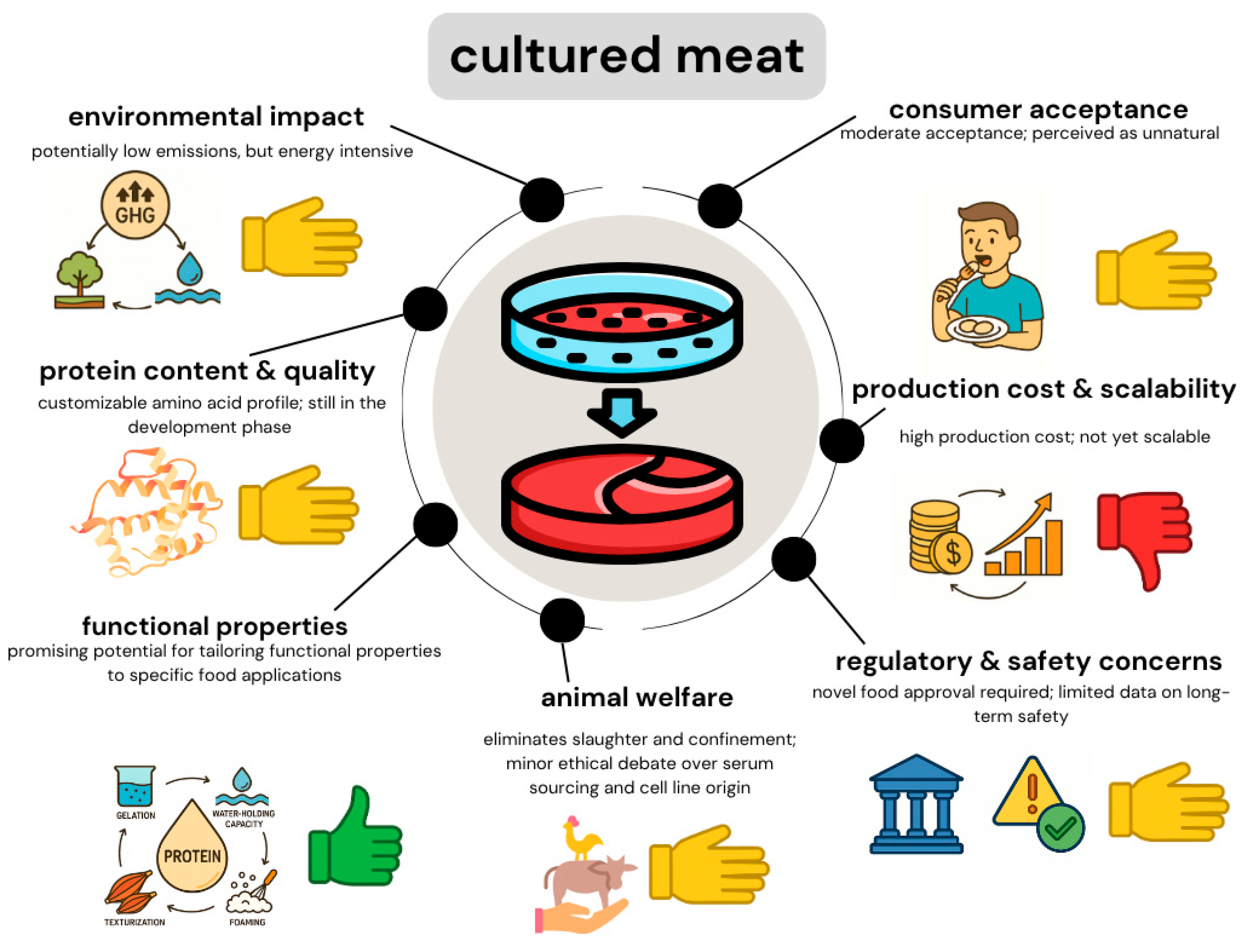
6. Cultured Meat
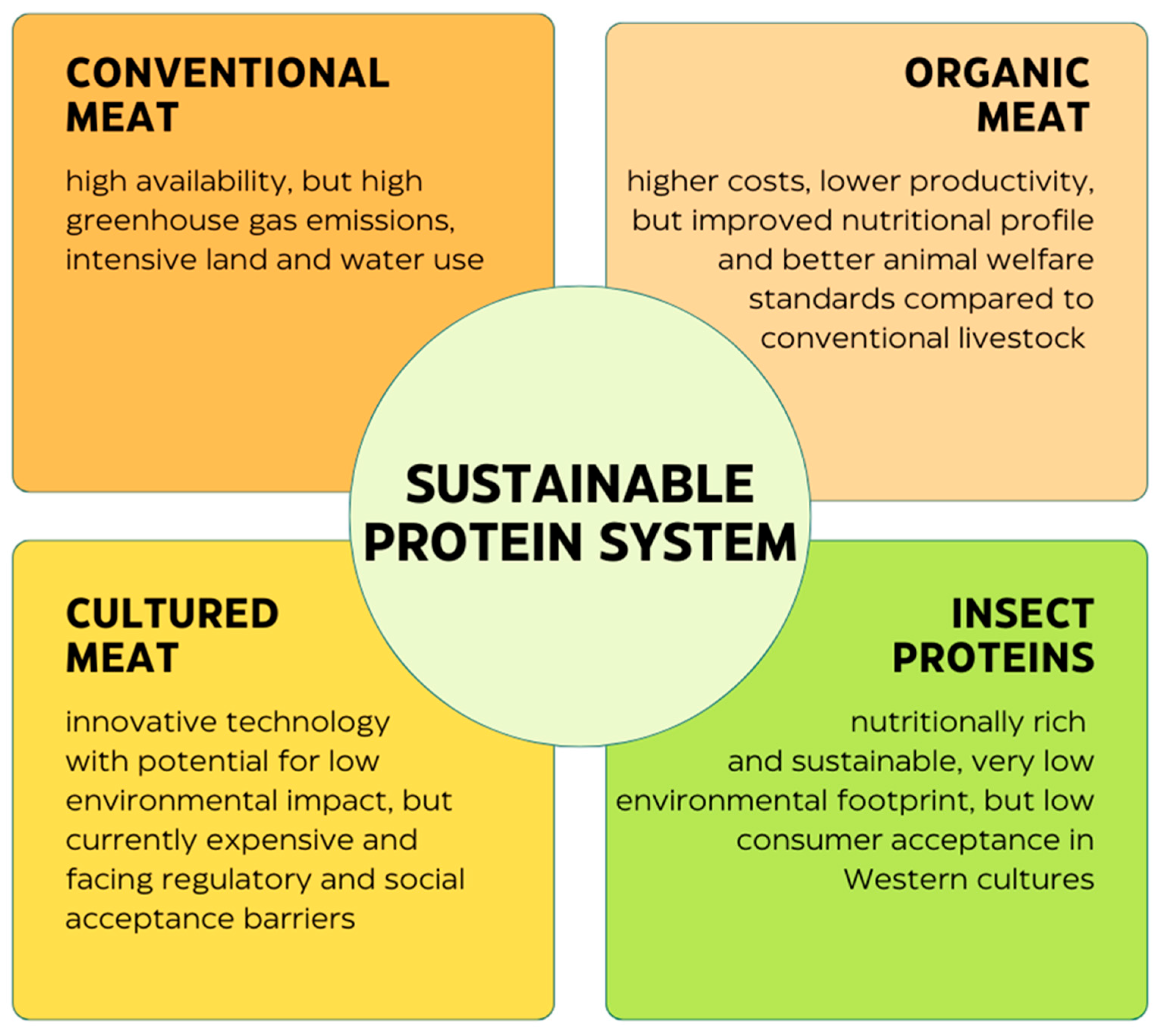
7. Future Perspectives, Challenges, and Limitations
8. Conclusions
Author Contributions
Funding
Conflicts of Interest
References
- Zhang, W.; Wang, T. Understanding Protein Functions in the Biological Context. Protein Pept. Lett. 2023, 30, 449–458. [Google Scholar] [CrossRef]
- Day, L.; Cakebread, J.A.; Loveday, S.M. Food proteins from animals and plants: Differences in the nutritional and functional properties. Trends Food Sci. Technol. 2022, 119, 428–442. [Google Scholar] [CrossRef]
- Simon, W.J.; Hijbeek, R.; Frehner, A.; Cardinaals, R.; Talsma, E.F.; van Zanten, H.H.E. Circular food system approaches can support current European protein intake levels while reducing land use and greenhouse gas emissions. Nat. Food 2024, 5, 402–412. [Google Scholar] [CrossRef]
- Ajomiwe, N.; Boland, M.; Phongthai, S.; Bagiyal, M.; Singh, J.; Kaur, L. Protein Nutrition: Understanding Structure, Digestibility, and Bioavailability for Optimal Health. Foods 2024, 13, 1771. [Google Scholar] [CrossRef] [PubMed]
- Gaudichon, C.; Calvez, J. Determinants of amino acid bioavailability from ingested protein in relation to gut health. Curr. Opin. Clin. Nutr. Metab. Care 2021, 24, 55–61. [Google Scholar] [CrossRef] [PubMed]
- European Commission. EU Agricultural Outlook for Markets, Income and Environment, 2023–2035; Publications Office of the European Union: Brussels, Belgium, 2023; Available online: https://agriculture.ec.europa.eu/system/files/2024-01/agricultural-outlook-2023-report_en_0.pdf (accessed on 27 August 2025).
- OECD/FAO. OECD-FAO Agricultural Outlook 2024–2033; OECD Publishing: Paris, France, 2024; Available online: https://www.fao.org/documents/card/en/c/cc9016en (accessed on 25 September 2025).
- Eurostat. Agricultural Production—Livestock and Meat; Eurostat: Luxembourg, 2023; Available online: https://ec.europa.eu/eurostat/statistics-explained/index.php?title=Agricultural_production_-_livestock_and_meat (accessed on 25 September 2025).
- ProVeg International; University of Copenhagen; Ghent University. Evolving Appetites: An In-Depth Look at European Attitudes Towards Plant-Based Eating. Smart Protein Project; ProVeg International: Berlin, Germany, 2023; Available online: https://food.ku.dk/english/news/2023/most-europeans-are-reducing-their-meat-consumption-eu-funded-survey-finds (accessed on 27 August 2025).
- Market Data Forecast. Europe Meat Market Size, Share & Growth Report, 2023–2033; Market Data Forecast: Hyderabad, India, 2023; Available online: https://www.marketdataforecast.com/market-reports/europe-meat-market (accessed on 27 August 2025).
- Zhao, S.; Qiu, H.; Yang, Z. Adjustment of meat consumption structure under the dual pressures of food security and low-carbon transformation: Evidence from China. Agriculture 2023, 13, 2242. [Google Scholar] [CrossRef]
- Baruselli, P.S.; Abreu, L.A.; Menchaca, A.; Bó, G.A. The future of beef production in South America. Theriogenology 2024, 215, 55–65. [Google Scholar] [CrossRef]
- Council of the European Union. Council Directive 96/22/EC of 29 April 1996 Concerning the Prohibition on the Use in Stock-Farming of Certain Substances Having a Hormonal or Thyrostatic Action and of Beta-Agonists, and Repealing Directives 81/602/EEC, 88/146/EEC and 88/299/EEC. Off. J. Eur. Communities 1996, L 125, 3–9. [Google Scholar]
- US Congress. The U.S.-EU Beef Hormone Dispute; Congressional Research Service Report R40449; US Congress: Washington, DC, USA, 2025. Available online: https://www.congress.gov/crs-product/R40449 (accessed on 2 May 2025).
- Zuidhof, M.J.; Schneider, B.L.; Carney, V.L.; Korver, D.R.; Robinson, F.E. Growth, efficiency, and yield of commercial broilers from 1957, 1978, and 2005. Poult. Sci. 2014, 93, 2970–2982. [Google Scholar] [CrossRef]
- Greenwood, P.L. An overview of beef production from pasture and feedlot globally, as demand for beef and the need for sustainable practices increase. Animal 2021, 15, 100295. [Google Scholar] [CrossRef]
- Ma, L.; Wang, L.; Zhang, Z.; Xiao, D. Research progress of biological feed in beef cattle. Animals 2023, 13, 266. [Google Scholar] [CrossRef]
- Garmyn, A. Consumer preferences and acceptance of meat products. Foods 2020, 9, 708. [Google Scholar] [CrossRef]
- Sirri, F.; Castellini, C.; Bianchi, M.; Petracci, M.; Meluzzi, A.; Franchini, A. Effect of fast-, medium- and slow-growing strains on meat quality of chickens reared under the organic farming method. Animal 2011, 5, 312–319. [Google Scholar] [CrossRef]
- Comert, M.; Şayan, Y.; Tahtabicen, E.; Yilmaz, A. Comparison of Carcass Characteristics, Meat Quality, and Blood Parameters of Slow- and Fast-Grown Female Broiler Chickens Raised in Organic or Conventional Production System. Asian-Australas. J. Anim. Sci. 2016, 29, 987–995. [Google Scholar] [CrossRef]
- FAO. Major Cuts of Greenhouse Gas Emissions from Livestock Within Reach; Food and Agriculture Organization of the United Nations: Rome, Italy, 2025; Available online: https://www.fao.org/newsroom/detail/Major-cuts-of-greenhouse-gas-emissions-from-livestock-within-reach/ (accessed on 2 May 2025).
- Skidmore, M.E.; Moffette, F.; Rausch, L.; Christie, M.; Munger, J.; Gibbs, H.K. Cattle ranchers and deforestation in the Brazilian Amazon: Production, location, and policies. Glob. Environ. Change 2021, 68, 102248. [Google Scholar] [CrossRef]
- Vidovic, N.; Vidovic, S. Antimicrobial resistance and food animals: Influence of livestock environment on the emergence and dissemination of antimicrobial resistance. Antibiotics 2020, 9, 52. [Google Scholar] [CrossRef]
- Sheffield, D.; Fiorotto, M.L.; Davis, T.A. Nutritional contributions of animal-sourced foods: Implications for dietary adequacy and health. Front. Nutr. 2024, 11, 1424912. [Google Scholar] [CrossRef]
- Prunier, A.; Heinonen, M.; Quesnel, H. High physiological demands in intensively raised pigs: Impact on health and welfare. Animal 2010, 4, 886–898. [Google Scholar] [CrossRef] [PubMed]
- Dawkins, M.S.; Layton, R. Breeding for better welfare: Genetic goals for broiler chickens and their parents. Anim. Welf. 2012, 21, 147–155. [Google Scholar] [CrossRef]
- Rodrigues, J.L.M.; Pellizari, V.H.; Mueller, R.; Baek, K.; Jesus, E.D.C.; Paula, F.S.; Mirza, B.; Hamaoui, G.S.; Tsai, S.M.; Feigl, B.; et al. Conversion of the Amazon rainforest to agriculture results in biotic homogenization of soil bacterial communities. Proc. Natl. Acad. Sci. USA 2013, 110, 988–993. [Google Scholar] [CrossRef] [PubMed]
- Hayek, M.N.; Harwatt, H.; Ripple, W.J.; Mueller, N.D. The infectious disease trap of animal agriculture. Sci. Adv. 2022, 8, eadd6681. [Google Scholar] [CrossRef] [PubMed]
- Keena, M.; Meehan, M.; Scherer, T. Environmental Implications of Excess Fertilizer and Manure on Water Quality; NDSU Extension: Fargo, ND, USA, August 2022; Available online: https://www.ndsu.edu/agriculture/extension/publications/environmental-implications-excess-fertilizer-and-manure-water-quality (accessed on 30 May 2025).
- Orzuna-Orzuna, J.F.; Godina-Rodríguez, J.E.; Garay-Martínez, J.R.; Granados-Rivera, L.D.; Maldonado-Jáquez, J.A.; Lara-Bueno, A. A Meta-Analysis of 3-Nitrooxypropanol Dietary Supplementation on Growth Performance, Ruminal Fermentation, and Enteric Methane Emissions of Beef Cattle. Fermentation 2024, 10, 273. [Google Scholar] [CrossRef]
- Sandoval, D.F.; Flores, J.F.; Enciso Valencia, K.J.; Sotelo Cabrera, M.E.; Stefan, B. Economic-environmental assessment of silvo-pastoral systems in Colombia: An ecosystem service perspective. Heliyon 2023, 9, e19082. [Google Scholar] [CrossRef]
- Hu, G.; Do, D.N.; Gray, J.; Miar, Y. Selection for Favorable Health Traits: A Potential Approach to Cope with Diseases in Farm Animals. Animals 2020, 10, 1717. [Google Scholar] [CrossRef] [PubMed]
- Heath, D.; Vehar, A.; Kouřimská, L.; Kulma, M.; Škvorová, P.; Salmonová, H.Š.; Lampová, B.; Rehman, N.; Jamnik, P.; Jeršek, B.; et al. Quality, safety and authenticity of insect protein-based food and feed: Insights from the INPROFF Project. Explor. Foods Foodomics 2024, 2, 339–362. [Google Scholar] [CrossRef]
- European Food Safety Authority (EFSA). Risk profile related to production and consumption of insects as food and feed. EFSA J. 2015, 13, 4257. [Google Scholar] [CrossRef]
- Jaworska, D.; Sadowka, A. Strategies to improve the functional value of meat and meat products. Foods 2024, 13, 2433. [Google Scholar] [CrossRef]
- Finke, M.D. Complete nutrient composition of commercially raised invertebrates used as food for insectivores. Zoo Biol. 2002, 21, 269–285. [Google Scholar] [CrossRef]
- Oonincx, D.G.A.B.; de Boer, I.J.M. Environmental impact of the production of mealworms as a protein source for humans–A life cycle assessment. PLoS ONE 2012, 7, e51145. [Google Scholar] [CrossRef]
- IFOAM. Organics Europe. Biodiversity, Soil, and Water. 2025. Available online: https://www.organicseurope.bio/what-we-do/biodiversity-soil-water/ (accessed on 1 June 2025).
- Willer, H.; Schlatter, B.; Trávníček, J. The World of Organic Agriculture: Statistics and Emerging Trends 2023; Research Institute of Organic Agriculture FiBL: Frick, Switzerland, 2023. [Google Scholar] [CrossRef]
- Seufert, V.; Ramankutty, N.; Foley, J.A. Comparing the yields of organic and conventional agriculture. Nature 2012, 485, 229–232. [Google Scholar] [CrossRef]
- Zhang, W.; Cai, X. Climate change impacts on global agricultural land availability. Environ. Res. Lett. 2011, 6, 014014. [Google Scholar] [CrossRef]
- European Commission. Control and Enforcement in Organic Farming. 2025. Available online: https://agriculture.ec.europa.eu/farming/organic-farming/controls_pl (accessed on 1 June 2025).
- Åkerfeldt, M.P.; Gunnarsson, S.; Bernes, G.; Blanco-Penedo, I. Health and welfare in organic livestock production systems—A systematic mapping of current knowledge. Org. Agric. 2020, 11, 105–132. [Google Scholar] [CrossRef]
- Średnicka-Tober, D.; Barański, M.; Seal, C.; Sanderson, R.; Benbrook, C.; Steinshamn, H.; Gromadzka-Ostrowska, J.; Rembiałkowska, E.; Skwarło-Sońta, K.; Eyre, M.; et al. Composition differences between organic conventional meat: Asystematic literature review and meta-analysis. Br. J. Nutr. 2016, 115, 994–1011. [Google Scholar] [CrossRef] [PubMed]
- Prevolnik, M.; Ocepek, M.; Čandek-Potokar, M.; Bavec, M.; Škorjanc, D. Growth, carcass and meat quality traits of pigs raised under organic or conventional rearing systems using commercially available feed mixtures. Slov. Vet. Res. 2011, 48, 15–26. [Google Scholar]
- Ribas-Agustí, A.; Díaz, I.; Sárraga, C.; García-Regueiro, J.A.; Castellari, M. Nutritional properties of organic and conventional beef meat at retail. J. Sci. Food Agric. 2019, 99, 4218–4225. [Google Scholar] [CrossRef] [PubMed]
- Alonso, M.E.; González-Montaña, J.R.; Lomillos, J.M. Consumers’ Concerns and Perceptions of Farm Animal Welfare. Animals 2020, 10, 385. [Google Scholar] [CrossRef] [PubMed]
- Mottet, A.; de Haan, C.; Falcucci, A.; Tempio, G.; Opio, C.; Gerber, P. Livestock: On our plates or eating at our table? A new analysis of the feed/food debate. Glob. Food Secur. 2017, 14, 1–8. [Google Scholar] [CrossRef]
- Wheeler, T.; von Braun, J. Climate change impacts on global food security. Science 2013, 341, 508–513. [Google Scholar] [CrossRef]
- Buratti, C.; Fantozzi, F.; Barbanera, M.; Lascaro, E.; Chiorri, M.; Cecchini, L. Carbon footprint of conventional and organic beef production systems: An Italian case study. Sci. Total Environ. 2017, 576, 129–137. [Google Scholar] [CrossRef]
- Eshel, G.; Flamholz, A.I.; Shepon, A.; Milo, R. US grass-fed beef is as carbon intensive as industrial beef and ≈10-fold more intensive than common protein-dense alternatives. Proc. Natl. Acad. Sci USA 2025, 122, e2404329122. [Google Scholar] [CrossRef]
- Daley, C.A.; Abbott, A.; Doyle, P.S.; Nader, G.A.; Larson, S. A review of fatty acid profiles and antioxidant content in grass-fed and grain-fed beef. Nutr. J. 2010, 9, 10. [Google Scholar] [CrossRef]
- Evans, N.; Cloward, J.; Ward, R.E.; van Wietmarschen, H.A.; van Eekeren, N.; Kronberg, S.L.; Provenza, F.D.; van Vliet, S. Pasture-finishing of cattle in Western U.S. rangelands improves markers of animal metabolic health and nutritional compounds in beef. Sci. Rep. 2024, 14, 20240. [Google Scholar] [CrossRef]
- Regulation (EU) 2018/848 of the European Parliament and of the Council of 30 May 2018 on Organic Production and Labelling of Organic Products, and Repealing Council Regulation (EC) No 834/2007. Off. J. Eur. Union 2018, L 150, 1–92.
- Revilla, I.; Lurueña-Martínez, M.A.; Blanco-López, M.A.; Vivar-Quintana, A.M.; Palacios, C.; Severiano-Pérez, P. Comparison of the Sensory Characteristics of Suckling Lamb Meat: Organic vs. Conventional Production. Czech J. Food Sci. 2009, 27, S267–S270. [Google Scholar] [CrossRef]
- Abdullah, F.A.A.; Hulánková, R. Comparison of Organic and Conventional Chicken Meat from the Consumer’s Perspective: Production Properties and Sensory Attributes. 2021. Available online: https://www.researchgate.net/publication/348264990_Comparison_of_organic_and_conventional_chicken_meat_from_the_consumer’s_perspective_production_properties_and_sensory_attributes (accessed on 25 September 2025).
- Tuck, S.L.; Winqvist, C.; Mota, F.; Ahnström, J.; Turnbull, L.A.; Bengtsson, J. Land-use intensity and the effects of organic farming on biodiversity: A hierarchical meta-analysis. J. Appl. Ecol. 2014, 51, 746–755. [Google Scholar] [CrossRef] [PubMed]
- Jouzi, Z.; Azadi, H.; Taheri, F.; Zarafshani, K.; Gebrehiwot, K.; Van Passel, S.; Lebailly, P. Organic farming and small-scale farmers: Main opportunities and challenges. Ecol. Econ. 2017, 132, 144–154. [Google Scholar] [CrossRef]
- Reganold, J.P.; Wachter, J.M. Organic agriculture in the twenty-first century: Challenges and opportunities. Nat. Plants 2020, 6, 76–84. [Google Scholar] [CrossRef]
- Sandhu, H.S.; Wratten, S.D.; Cullen, R. Organic agriculture and ecosystem services. Environ. Sci. Policy 2010, 13, 1–7. [Google Scholar] [CrossRef]
- Najdek, B.E.; Chaaban, N.; Therkildsen, M.; Andersen, B.V. The Impact of Storytelling about an Innovative and Sustainable Organic Beef Production System on Product Acceptance, Preference, and Satisfaction. Foods 2024, 13, 2940. [Google Scholar] [CrossRef]
- Górska-Warsewicz, H.; Żakowska-Biemans, S.; Stangierska, D.; Świątkowska, M.; Bobola, A.; Krajewski, K. Factors Limiting the Development of the Organic Food Sector—Perspective of Processors, Distributors, and Retailers. Agriculture 2021, 11, 882. [Google Scholar] [CrossRef]
- Grunert, K.G. Future Trends and Consumer Lifestyles with Regard to Meat Consumption. Meat Sci. 2006, 74, 149–160. [Google Scholar] [CrossRef]
- Harvey, D.; Hubbard, C. Reconsidering the Political Economy of Farm Animal Welfare: An Anatomy of Market Failure. Food Policy 2013, 38, 105–114. [Google Scholar] [CrossRef]
- Willer, H.; Lernoud, J. (Eds.) The World of Organic Agriculture: Statistics and Emerging Trends 2020; Research Institute of Organic Agriculture (FiBL): Frick, Switzerland; IFOAM—Organics International: Bonn, Germany, 2020. [Google Scholar]
- FAO. The State of Agricultural Commodity Markets 2020. In Agricultural Markets and Sustainable Development: Global Value Chains, Smallholder Farmers and Digital Innovations; Food and Agriculture Organization of the United Nations: Rome, Italy, 2020; Available online: https://www.fao.org/publications/soco/2020 (accessed on 29 September 2025).
- Rumpold, B.A.; Schlüter, O. Insect-based protein sources and their potential for human consumption: Nutritional composition and processing. Anim. Front. 2015, 5, 20–30. [Google Scholar]
- Oonincx, D.G.A.B.; Finke, M.D. Nutritional value of insects and ways to manipulate their composition. J. Insects Food Feed 2021, 7, 639–660. [Google Scholar] [CrossRef]
- Kisielewska, J.; Dąbrowski, M.; Bakuła, T. Perspektywa wykorzystania białka z owadów jako alternatywnego składnika pasz. Życie Wet. 2020, 95, 81–85. [Google Scholar]
- Ribeiro, J.C.; Cunha, L.M.; Sousa-Pinto, B.; Fonseca, J. Allergic risks of consuming edible insects: A systematic review. Mol. Nutr. Food Res. 2018, 62, 1700030. [Google Scholar] [CrossRef]
- Gravel, A.; Doyen, A. The use of edible insect proteins in food: Challenges and issues related to their functional properties. Innov. Food Sci. Emerg. Technol. 2020, 59, 102272. [Google Scholar] [CrossRef]
- Salter, A.M. Insect protein: A sustainable and healthy alternative to animal protein? J. Nutr. 2019, 149, 545–546. [Google Scholar] [CrossRef]
- Van Huis, A. Insects as food and feed, a new emerging agricultural sector: A review. J. Insects Food Feed 2020, 6, 27–44. [Google Scholar] [CrossRef]
- Ojha, S.; Bekhit, A.E.-D.; Grune, T.; Schlüter, O.K. Bioavailability of nutrients from edible insects. Curr. Opin. Food Sci. 2021, 41, 240–248. [Google Scholar] [CrossRef]
- Zielińska, E.; Karaś, M.; Baraniak, B. Comparison of functional properties of edible insects and protein preparations thereof. LWT 2018, 91, 168–174. [Google Scholar] [CrossRef]
- Kim, T.K.; Yong, H.I.; Kim, Y.B.; Kim, H.W.; Choi, Y.S. Edible insects as a protein source: A review of public perception, processing technology, and research trends. Food Sci. Anim. Resour. 2019, 39, 521–540. [Google Scholar] [CrossRef]
- Nikolić, K.; Tepavčević, J. Functional properties of insect proteins. AIDASCO Rev. 2024, 2, 26–31. [Google Scholar] [CrossRef]
- Queiroz, L.S.; Silva, N.F.M.; Jessen, F.; Mohammadifar, M.A.; Stephani, R.; de Carvalho, A.F.; Perrone, Ă.T.; Casanova, F. Edible insect as an alternative protein source: A review on the chemistry and functionalities of proteins under different processing methods. Heliyon 2023, 9, e14831. [Google Scholar] [CrossRef] [PubMed]
- Garrido-Ortiz, E.R.; Morales-Camacho, J.I. Production of Protein Hydrolysates with Antioxidant and Antihypertensive Activity from Edible Larvae of Aegiale hesperiaris and Comadia redtenbacheri. Foods 2025, 14, 2124. [Google Scholar] [CrossRef] [PubMed]
- Yi, L.; Lakemond, C.M.M.; Sagis, L.M.C.; Eisner-Schadler, V.; van Huis, A.; van Boekel, M.A.J.S. Extraction and Characterization of Protein Fractions from Five Insect Species. Food Chem. 2013, 141, 3341–3348. [Google Scholar] [CrossRef] [PubMed]
- Mintah, B.K.; He, R.; Agyekum, A.A.; Dabbour, M.; Golly, M.K.; Ma, H. Edible Insect Protein for Food Applications: Extraction, Composition, and Functional Properties. J. Food Process Eng. 2020, 43, e13362. [Google Scholar] [CrossRef]
- Mishyna, M.; Keppler, J.K.; Chen, J. Techno-Functional Properties of Edible Insect Proteins and Effects of Processing. Curr. Opin. Colloid Interface Sci. 2021, 56, 101508. [Google Scholar] [CrossRef]
- Rumpold, B.A.; Schlüter, O.K. Nutritional composition and safety aspects of edible insects. Mol. Nutr. Food Res. 2013, 57, 802–823. [Google Scholar] [CrossRef]
- Payne, C.L.R.; Scarborough, P.; Rayner, M.; Nonaka, K. Are edible insects more or less ‘healthy’ than commonly consumed meats? A comparison using two nutrient profiling models developed to combat over- and undernutrition. Eur. J. Clin. Nutr. 2016, 70, 285–291. [Google Scholar] [CrossRef]
- Makkar, H.P.S.; Tran, G.; Heuzé, V.; Ankers, P. State-of-the-art on use of insects as animal feed. Anim. Feed Sci. Technol. 2014, 197, 1–33. [Google Scholar] [CrossRef]
- Miglietta, P.P.; De Leo, F.; Ruberti, M.; Massari, S. Mealworms for Food: A Water Footprint Perspective. Water 2015, 7, 6190–6203. [Google Scholar] [CrossRef]
- Chavez, M. The sustainability of industrial insect mass rearing for food and feed production: Zero waste goals through by-product utilization. Curr. Opin. Insect Sci. 2021, 48, 44–49. [Google Scholar] [CrossRef]
- Eurogroup for Animals. Insect Farming: A False Solution for the EU’s Food System; Policy Brief; Eurogroup for Animals: Brussels, Belgium, 2021; Available online: https://www.eurogroupforanimals.org/files/eurogroupforanimals/2021-10/2021_10_29_pp_Insect%20farming_%20a%20false%20solution%20for%20the%20EU%27s%20food%20system_0.pdf (accessed on 1 June 2025).
- Papastavropoulou, K.; Koupa, A.; Kritikou, E.; Kostakis, M.; Proestos, C. Edible insects: Benefits and potential risk for consumers and the food industry. Biointerface Res. Appl. Chem. 2022, 12, 5131–5149. [Google Scholar] [CrossRef]
- European Union Regulation (EU) 2015/2283 of the European Parliament of the Council of 25 November 2015 on Novel Foods. Off. J. Eur. Union 2015, L327, 1–22.
- Ghosh, S.; Jung, C.; Meyer-Rochow, V.B. What governs selection and acceptance of edible insect species? In Edible Insects in Sustainable Food Systems; Halloran, A., Flore, R., Vantomme, P., Roos, N., Eds.; Springer: Cham, Switzerland, 2018; pp. 331–351. [Google Scholar] [CrossRef]
- Lange, K.W.; Nakamura, Y. Edible insects as future food: Chances and challenges. J. Future Foods 2021, 1, 38–46. [Google Scholar] [CrossRef]
- Munteanu, C.; Mireşan, V.; Răducu, C.; Ihuţ, A.; Uiuiu, P.; Pop, D.; Neacşu, A.; Cenariu, M.; Groza, I. Can cultured meat be an alternative to farm animal production for a sustainable and healthier lifestyle? Front. Nutr. 2021, 8, 749298. [Google Scholar] [CrossRef] [PubMed]
- Lee, H.-J.; Yong, H.I.; Kim, M.; Choi, Y.S.; Jo, C. Status of meat alternatives and their potential role in the future meat market—A review. Asian-Australas. J. Anim. Sci. 2020, 33, 1533–1543. [Google Scholar] [CrossRef] [PubMed]
- Rubio, N.R.; Xiang, N.; Kaplan, D.L. Plant-based and cell-based approaches to meat production. Nat. Commun. 2020, 11, 6276. [Google Scholar] [CrossRef]
- Benjaminson, M.A.; Gilchriest, J.A.; Lorenz, M. In vitro edible muscle protein production system (MPPS): Stage 1, fish. Acta Astronautica 2002, 51, 879–889. [Google Scholar] [CrossRef]
- Catts, O.; Zurr, I. Growing semi-living sculptures: The Tissue Culture & Art Project. Leonardo 2002, 35, 365–370. [Google Scholar] [CrossRef]
- Stephens, N.; Di Silvio, L.; Dunsford, I.; Ellis, M.; Glencross, A.; Sexton, A. Bringing cultured meat to market: Technical, socio-political, and regulatory challenges. Trends Food Sci. Technol. 2018, 78, 155–166. [Google Scholar] [CrossRef]
- Good Food Institute. The Science of Cultivated Meat; GFI: Washington, DC, USA, 2023; Available online: https://gfi.org/science/the-science-of-cultivated-meat (accessed on 1 September 2025).
- Good Food Institute. Good Meat and Upside Foods Approved to Sell Cultivated Chicken Following Landmark USDA Action [Press Release]. 2023. Available online: https://gfi.org/press/good-meat-and-upside-foods-approved-to-sell-cultivated-chicken-following-landmark-usda-action/ (accessed on 28 August 2025).
- Good Food Institute. Cultivated Meat’s Regulatory Pathway. 2024. Available online: https://gfi.org/resource/fda-cultivated-meat-clearance-explainer/ (accessed on 1 September 2025).
- Andrews, A. Lab-Grown Meat: Ban or Buy? Animal Legal & Historical Center; Michigan State University College of Law: East Lansing, MI, USA, 2024; Available online: https://www.animallaw.info/article/lab-grown-meat-ban-or-buy (accessed on 28 August 2025).
- Aleph Farms. Aleph Farms Granted World’s First Regulatory Approval for Cultivated Beef. 2025. Available online: https://aleph-farms.com/journals/aleph-farms-granted-worlds-first-regulatory-approval-for-cultivated-beef/ (accessed on 28 August 2025).
- Siegel-Itzkovich, J. Health Ministry Okays Selling Cultivated Steaks in Israel; The Jerusalem Post: Jerusalem, Israel, 17 January 2024; Available online: https://www.jpost.com/business-and-innovation/article-782530 (accessed on 28 August 2025).
- Food Standards Australia New Zealand (FSANZ). Approval of Cell-Based Food Products. 2025. Available online: https://www.foodstandards.gov.au (accessed on 28 August 2025).
- Nowobilska, D.; Sztuczne Mięso Będzie Produkowane w Polsce. Rekordowe Pieniądze od Rządu, Android.com.pl, 27 July 2024. Available online: https://android.com.pl/tech/777228-sztuczne-mieso-labfarm-dofinansowanie/ (accessed on 1 September 2025).
- Bryant, C.; Barnett, J. Consumer Acceptance of Cultured Meat: An Updated Review (2018–2020). Appl. Sci. 2020, 10, 5201. [Google Scholar] [CrossRef]
- Pakseresht, A.; Kaliji, S.A.; Canavari, M. Review of factors affecting consumer acceptance of cultured meat. Appetite 2022, 170, 105829. [Google Scholar] [CrossRef] [PubMed]
- Rosenfeld, D.L.; Tomiyama, A.J. Toward consumer acceptance of cultured meat. Trends Cogn. Sci. 2023, 27, 689–691. [Google Scholar] [CrossRef] [PubMed]
- Wilks, M.; Phillips, C.J.C. Attitudes to In Vitro Meat: A Survey of Potential Consumers in the United States. PLoS ONE 2017, 12, e0171904. [Google Scholar] [CrossRef]
- Verbeke, W.; Marcu, A.; Rutsaert, P.; Gaspar, R.; Seibt, B.; Fletcher, D.; Bernett, J. Would You Eat Cultured Meat? Consumers’ Reactions and Attitude Formation in Belgium, Portugal and the United Kingdom. Meat Sci. 2015, 102, 49–58. [Google Scholar] [CrossRef]
- Cornelissen, K.; Piqueras-Fiszman, B. Consumers’ perception of cultured meat relative to other meat alternatives and meat itself: A segmentation study. J. Food Sci. 2023, 88, 91–105. [Google Scholar] [CrossRef]
- Ngah, M.K.; Chriki, S.; Ellies-Oury, M.-P.; Liu, J.; Hocquette, J.-F. Consumer perception of “artificial meat” in the educated young and urban population of Africa. Front. Nutr. 2023, 10, 1127655. [Google Scholar] [CrossRef]
- Bryant, C.; van Nek, L.; Rolland, N.C.M. European Markets for Cultured Meat: A Comparison of Germany and France. Foods 2020, 9, 1152. [Google Scholar] [CrossRef]
- Martins, B.; Bister, A.; Dohmen, R.G.J.; Gouveia, M.A.; Hueber, R.; Melzener, L.; Messmer, T.; Papadopoulos, J.; Pimenta, J.; Raina, D.; et al. Advances and Challenges in Cell Biology for Cultured Meat. Annu. Rev. Anim. Biosci. 2024, 12, 345–368. [Google Scholar] [CrossRef]
- Popek, S.; Pachołek, B. A Survey on Polish Consumers’ Perceptions of Meat Produced from Stem Cells In Vitro. Mark. Sci. Res. Organ. 2021, 42, 61–74. [Google Scholar] [CrossRef]
- Sikora, D.; Rzymski, P. The Heat about Cultured Meat in Poland: A Cross-Sectional Acceptance Study. Nutrients 2023, 15, 4649. [Google Scholar] [CrossRef]
- Hamdan, M.N.; Post, M.; Ramli, M.A.; Kamarudin, M.K.; Md Ariffin, M.F.; Zaman Huri, N.M.F. Cultured Meat: Islamic and Other Religious Perspectives. Umra. J. Islam. Civilizational Stud. 2021, 8, 11–19. [Google Scholar] [CrossRef]
- Poore, J.; Nemecek, T. Reducing Food’s Environmental Impacts through Producers and Consumers. Science 2018, 360, 987–992. [Google Scholar] [CrossRef]
- Specht, L.; Welch, D.; Rees Clayton, E.M.; Lagally, C. Opportunities for Applying Biomedical Production and Manufacturing Methods to the Development of the Clean Meat Industry. Biochem. Eng. J. 2018, 132, 161–168. [Google Scholar] [CrossRef]
- European Commission. Farm to Fork Strategy—For a Fair, Healthy and Environmentally-Friendly Food System; European Commission: Brussels, Belgium, 2020; Available online: https://food.ec.europa.eu/horizontal-topics/farm-fork-strategy_en (accessed on 27 June 2025).
- European Food Safety Authority (EFSA). Novel Food; EFSA: Parma, Italy, 2025; Available online: https://www.efsa.europa.eu/en/topics/topic/novel-food (accessed on 1 September 2025).
- Biotech Campus Delft. Dutch Government Agrees to Invest €60 Million toward Building Full Cellular Agriculture Ecosystem. 2022. Available online: https://www.biotechcampusdelft.com/en/news/dutch-government-agrees-to-invest-60-million-toward-building-full-cellular-agriculture-ecosystem/ (accessed on 27 June 2025).
- European Commission. The European Green Deal; European Commission: Brussels, Belgium, 2019; Available online: https://ec.europa.eu/info/strategy/priorities-2019-2024/european-green-deal_en (accessed on 27 June 2025).
- Tuomisto, H.L. The Eco-Friendly Burger: Could cultured meat improve the environmental sustainability of meat products? EMBO Rep. 2018, 20, e47395. [Google Scholar] [CrossRef] [PubMed]
- Gil, M.; Rudy, M.; Duma-Kocan, P.; Stanisławczyk, R.; Krajewska, A.; Dziki, D.; Hassoon, W.H. Sustainability of Alternatives to Animal Protein Sources, a Comprehensive Review. Sustainability 2024, 16, 7701. [Google Scholar] [CrossRef]


Disclaimer/Publisher’s Note: The statements, opinions and data contained in all publications are solely those of the individual author(s) and contributor(s) and not of MDPI and/or the editor(s). MDPI and/or the editor(s) disclaim responsibility for any injury to people or property resulting from any ideas, methods, instructions or products referred to in the content. |
© 2025 by the authors. Licensee MDPI, Basel, Switzerland. This article is an open access article distributed under the terms and conditions of the Creative Commons Attribution (CC BY) license (https://creativecommons.org/licenses/by/4.0/).
Share and Cite
Marcinkowska-Lesiak, M.; Motrenko, M.; Niewiadomski, M.; Głuszkiewicz, I.; Wojtasik-Kalinowska, I.; Poławska, E. Animal Protein Sources in Europe: Current Knowledge and Future Perspectives—A Review. Appl. Sci. 2025, 15, 11749. https://doi.org/10.3390/app152111749
Marcinkowska-Lesiak M, Motrenko M, Niewiadomski M, Głuszkiewicz I, Wojtasik-Kalinowska I, Poławska E. Animal Protein Sources in Europe: Current Knowledge and Future Perspectives—A Review. Applied Sciences. 2025; 15(21):11749. https://doi.org/10.3390/app152111749
Chicago/Turabian StyleMarcinkowska-Lesiak, Monika, Michał Motrenko, Marcin Niewiadomski, Iga Głuszkiewicz, Iwona Wojtasik-Kalinowska, and Ewa Poławska. 2025. "Animal Protein Sources in Europe: Current Knowledge and Future Perspectives—A Review" Applied Sciences 15, no. 21: 11749. https://doi.org/10.3390/app152111749
APA StyleMarcinkowska-Lesiak, M., Motrenko, M., Niewiadomski, M., Głuszkiewicz, I., Wojtasik-Kalinowska, I., & Poławska, E. (2025). Animal Protein Sources in Europe: Current Knowledge and Future Perspectives—A Review. Applied Sciences, 15(21), 11749. https://doi.org/10.3390/app152111749