Article

Optimization of a Twistable Hovering Flapping Wing Inspired by Giant Hummingbirds Using the Unsteady Blade Element Theory


1
National Key Laboratory of Science and Technology on Aerodynamic Design and Research, School of Aeronautics, Northwestern Polytechnical University, Xi’an 710072, China
2
Research & Development Institute of Northwestern Polytechnical University in Shenzhen, Shenzhen 518057, China
3
Yangtze River Delta Research Institute of Northwestern Polytechnical University, Taicang 215400, China
*
Author to whom correspondence should be addressed.
Appl. Sci. 2023, 13(9), 5704; https://doi.org/10.3390/app13095704
Submission received: 16 February 2023 / Revised: 1 May 2023 / Accepted: 4 May 2023 / Published: 5 May 2023
(This article belongs to the Section Aerospace Science and Engineering)

Abstract

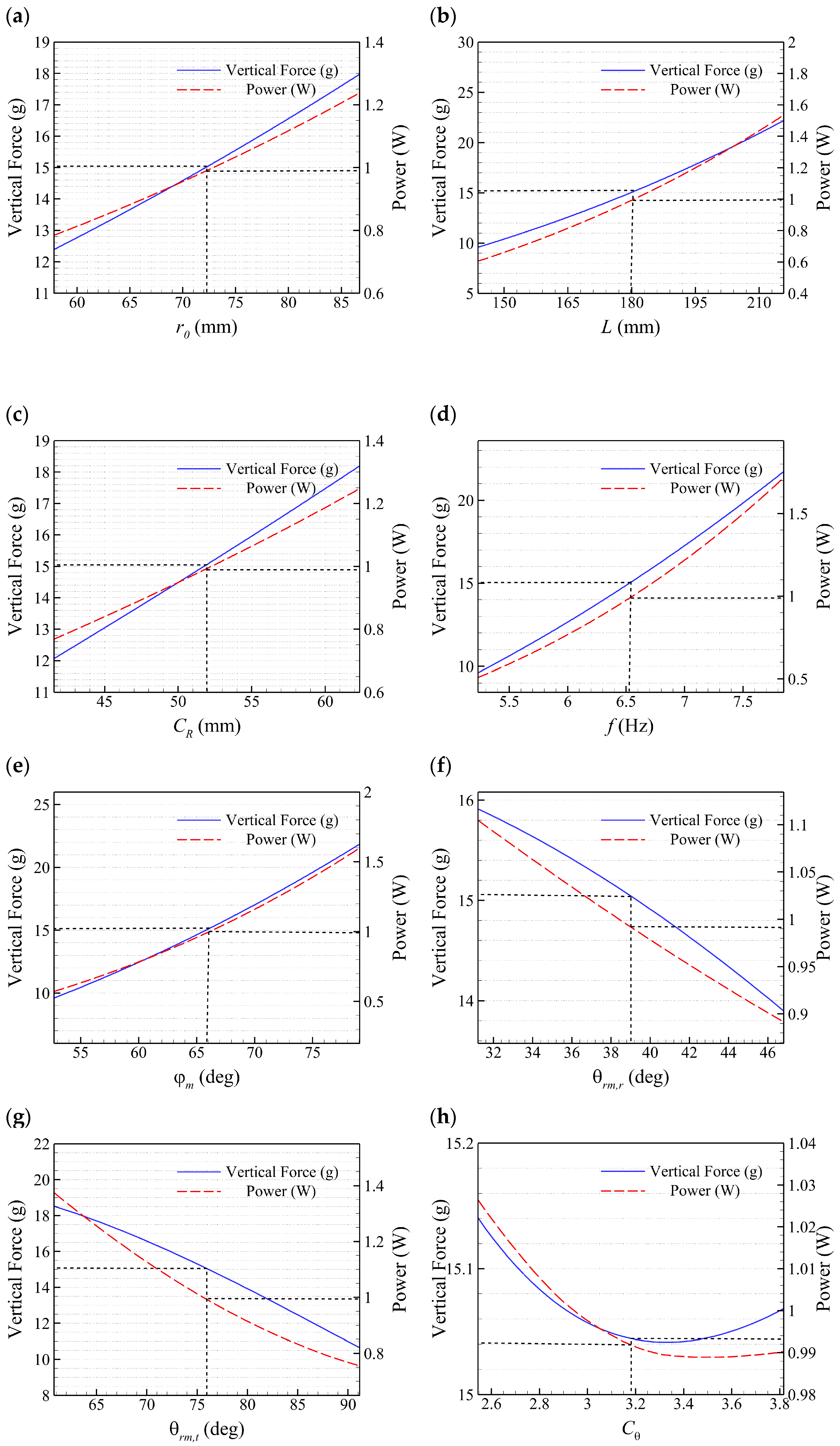
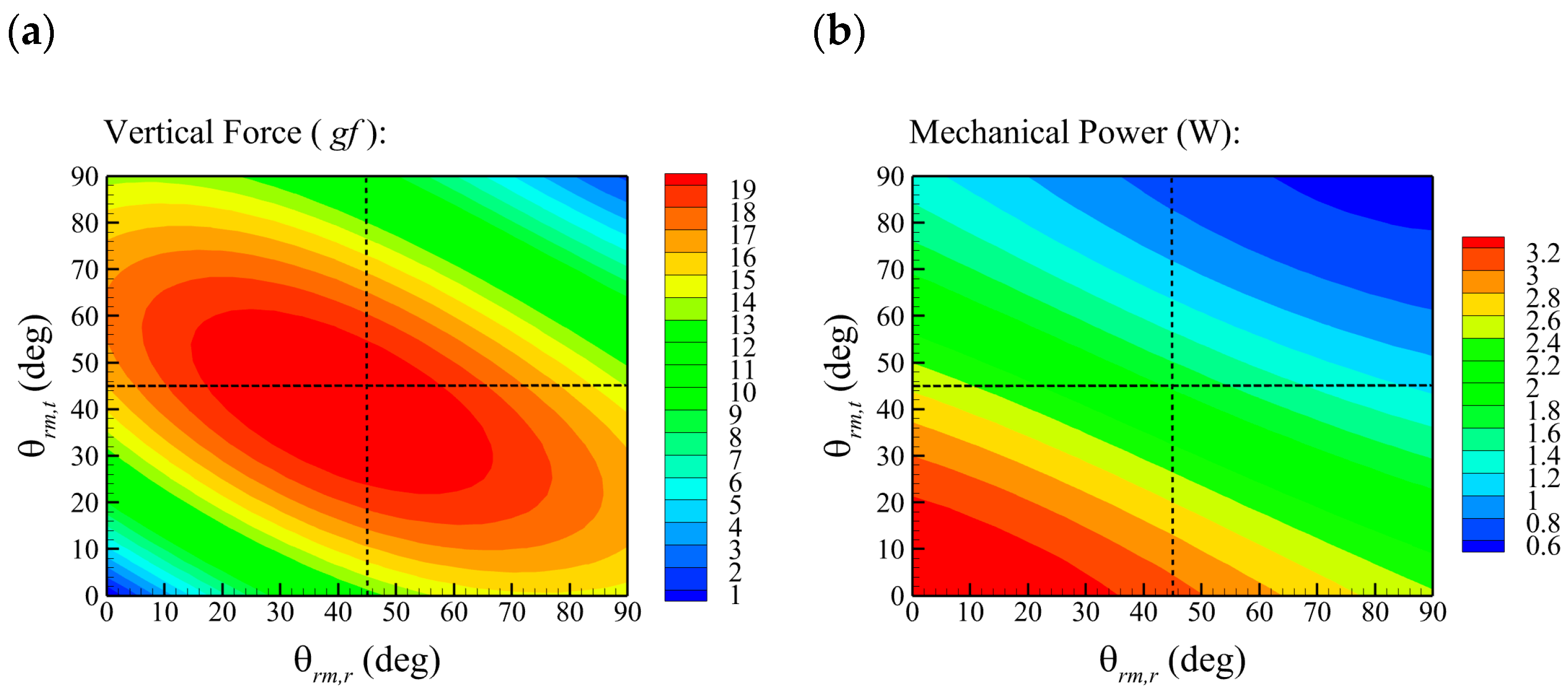
Due to the complexity of tailoring the wing flexibility and selecting favorable kinematics, the design of flapping wings is a considerably challenging problem. Therefore, there is an urgent need to investigate methods that can be used to design wings with high energy efficiency. In this study, an optimization model was developed to improve energy efficiency by optimizing wing geometric and kinematic parameters. Then, surrogate optimization was used to solve the design optimization model. Finally, the optimal design parameters and the associated sensitivity were provided. The optimized flapping wing, inspired by hummingbirds, features large geometrical parameters, a moderate amplitude of the flapping angle, and low frequency. With the spanwise twisting deformation considered in the parameterization model, the optimization solver gave an optimized wing with a pitching amplitude of approximately 39 deg at the root and 76 deg at the tip. According to the sensitivity analysis, the length of the wing, flapping frequency, and flapping amplitude are the three critical parameters that determine both force generation and power consumption. The amplitude of the pitching motion at the wing root contributes to lowering power consumption. These results provide some guidance for the optimal design of flapping wings.
Keywords: giant hummingbirds; twistable wing; design optimization; blade element theory giant hummingbirds; twistable wing; design optimization; blade element theory