
You are currently viewing a new version of our website. To view the old version click .
Applied Sciences
  • Article
  • Open Access

20 March 2023

An Intelligent Waste Management Application Using IoT and a Genetic Algorithm–Fuzzy Inference System

,
,
and
1
School of Information Technology and Engineering, Vellore Institute of Technology, Vellore 632014, Tamil Nadu, India
2
School of Electronics Engineering, Vellore Institute of Technology, Vellore 632014, Tamil Nadu, India
*
Author to whom correspondence should be addressed.
This article belongs to the Special Issue Smart Service Technology for Industrial Applications II

Abstract

The Internet of Things (IoT) is being used to create new applications for smart cities. Waste management is one issue that requires various IoT components for assistance, such as RFIDs and sensors. An efficient and innovative waste collection system is required to minimize investment, operational, and expenditure costs. In this paper, the novel idea is to develop an intelligent waste management model for smart cities using a hybrid genetic algorithm (GA)–fuzzy inference engine. The system can read, collect, and process information intelligently using a fuzzy inference engine that decides dynamically how to manage a waste collection. The aim of this model is to enhance its correctness and robustness, primarily, in addition to reducing errors that arise due to working conditions. GA is used for optimization to determine the best combination of rules for the fuzzy inference system (FIS). A Mamdani model is used to estimate waste management. The proposed model uses sensors to collect vital information, and FIS is trained using fuzzy logic to determine the probability that the smart bin is nearly full. The primary issue with the traditional genetic algorithm is that during the execution of the algorithm, there is a possibility of essential gene loss. The essential gene loss refers to information relevant to location, details regarding waste filling parameters, etc., which may lead to efficiency or accuracy loss. This problem is overcome by integrating fuzzy logic with a genetic algorithm to identify crucial genes by preserving the FIS interpretability. Our system uses cost-effective, small-size sensors and ensures this solution is reproducible. The Proteus simulator is used for experiments, and satisfactory results are obtained. Overall accuracy, precision, and recall of 95.44%, 96.68%, and 93.96% are obtained in the proposed model. Classification of recyclable items is also performed, and accuracy is determined for every item, resulting in the minimization of resource waste. The cost of manual interpretation is minimized in the intelligent smart waste management system in comparison to the traditional approach, as shown in the experiments.

1. Introduction

IoT is emerging as a promising field for devices to deliver innovative services to users through communication and exchange of information. Different domains are deploying IoT, including environmental monitoring [1] at home [2], health care [3], traffic management [4], entity tracking [5], and smart home technology [6] that uses sensors with Wi-Fi [7]. Waste management, through Radio Frequency Identification (RFID) technology [8], is analyzed by many researchers in the aspect of knowledge management [9], used in real time [10], and also in managing solid waste [11] and medical waste [12].
In our highly urban society, cities are the major locations of both resource consumption and garbage production [13]. The rise of technological and industry developments causes a significant hazardous waste management issue, demanding a for society scientific and structured smart waste disposal system using the IoT. The circular economy (CE) can minimize energy and consumption only if resource utilization is improved and recycled materials are substituted for prime resources. Poor waste collection approaches can result in various negative factors for society. The design and development of a sustainable waste management system (WMS) can provide insights into environmental issues [14]. IoT is the key pillar of a sustainable smart city. Therefore, the fundamental idea is to provide real-time data interchange, focusing on problems of waste management. In addition, it is also very important to decide whether the waste is recyclable or not and which bins should be emptied at a certain time. Efficient IoT infrastructure is required in smart cities (SC) to analyze waste awareness [15]. An IoT-facilitated smart city is a promising choice.
Ruiz et al. [16] applied deep learning and computer vision techniques to detect waste automatically. Finally, they compared different convolutional neural network (CNN) architectures such as inception, visual geometry group (VGG), and residual networks (ResNet) to classify the types of garbage. Researchers have been analyzing [17] waste management for over a century, and they have been trying out waste utilization analysis for over forty years. Our primary environmental concern is ineffective solid waste management, which is incompatible with rapid technological advancement. Hence, an intelligent IoT garbage monitoring system is to be developed for smarter and cleaner cities. With the use of the intelligent garbage box, the waste can be easily disposed of through proper segregation of waste materials. This process reduces time and effort and preserves the worker’s dignity. This effort is in tandem with the Indian Swacch Bharat Mission [18] and can be deployed all across the country.
Efficient IoT infrastructure is required in smart cities (SC) to analyze waste awareness [15]. An IoT-facilitated smart city is a promising choice. In this paper, an intelligent garbage disposal system is developed for SCs in a growing nation, likely India. However, the adoption of IoT implementation has some barriers in terms of design and optimization at the technical level. Various multi-attribute decision-making (MADM) approaches are examined in the literature to make real-world decisions. In this paper, an integration of GA with FIS is proposed for effective smart city waste management (SCWM). The idea behind the innovation of the proposed GA-FIS is to ensure that the important genes are preserved, which will be helpful to promote the vital genes in forthcoming generations and thereby enhance chromosome fitness.
The system is coined “intelligent”, as it was created using a smart GA–fuzzy reinforcer for waste detection and image classification of garbage. This work plays an important role in building smart and environment-friendly cities. By appropriately deploying this model, it helps to identify and recycle waste, segregate the carcinogenic waste, and destroy it, which greatly helps in building a hygienic green environment and thereby improving the circular economy of the nation.
In the past few years, FIS has been employed in various subjects, which are expressed in terms of “IF-THEN” rules based on expertise [19]. A set of fuzzy rules is developed with appropriate membership functions to determine the necessary input–output pairs. FIS is also known as fuzzy rule-based systems, fuzzy models, fuzzy associative memories (FAM), or fuzzy controllers. An FIS consists of five functional blocks, as shown in Figure 1. The details are given below:
  • A rule base containing a number of fuzzy if–then rules;
  • A database that determines the membership functions of the fuzzy sets used in the fuzzy rules;
  • A decision-making unit that calculates the inference operations on the rules;
  • A fuzzy interference that converts the inputs into degrees of match with semantic values;
  • A defuzzification interference that converts the fuzzy results of inference into a specific output.
The steps of fuzzy reasoning performed by FIS are as follows:
  • Compare the input variables with the membership functions to determine the membership values of each semantic label. This is called “fuzzification”.
  • Combine the membership values to determine the strength (weight) of every rule.
  • Obtain the consequent (either crisp or fuzzy) of each rule based on the firing strength.
  • Aggregate the qualified consequences to produce a crisp output. This is called defuzzification.
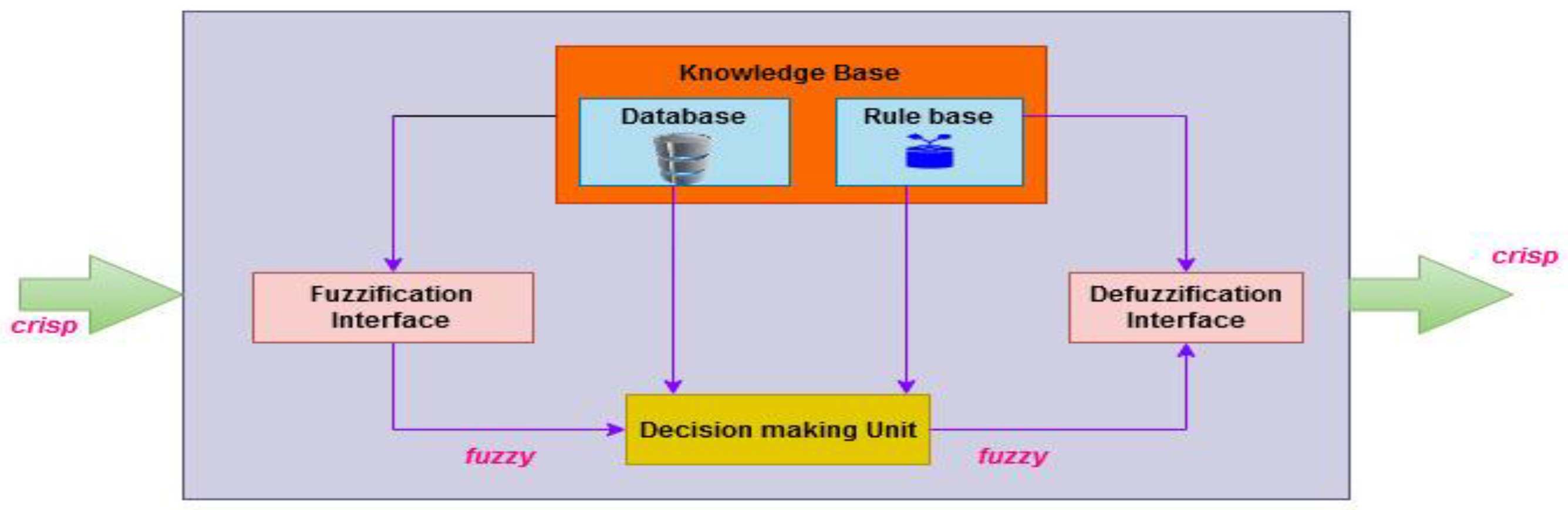
Figure 1. Functional blocks of FIS.
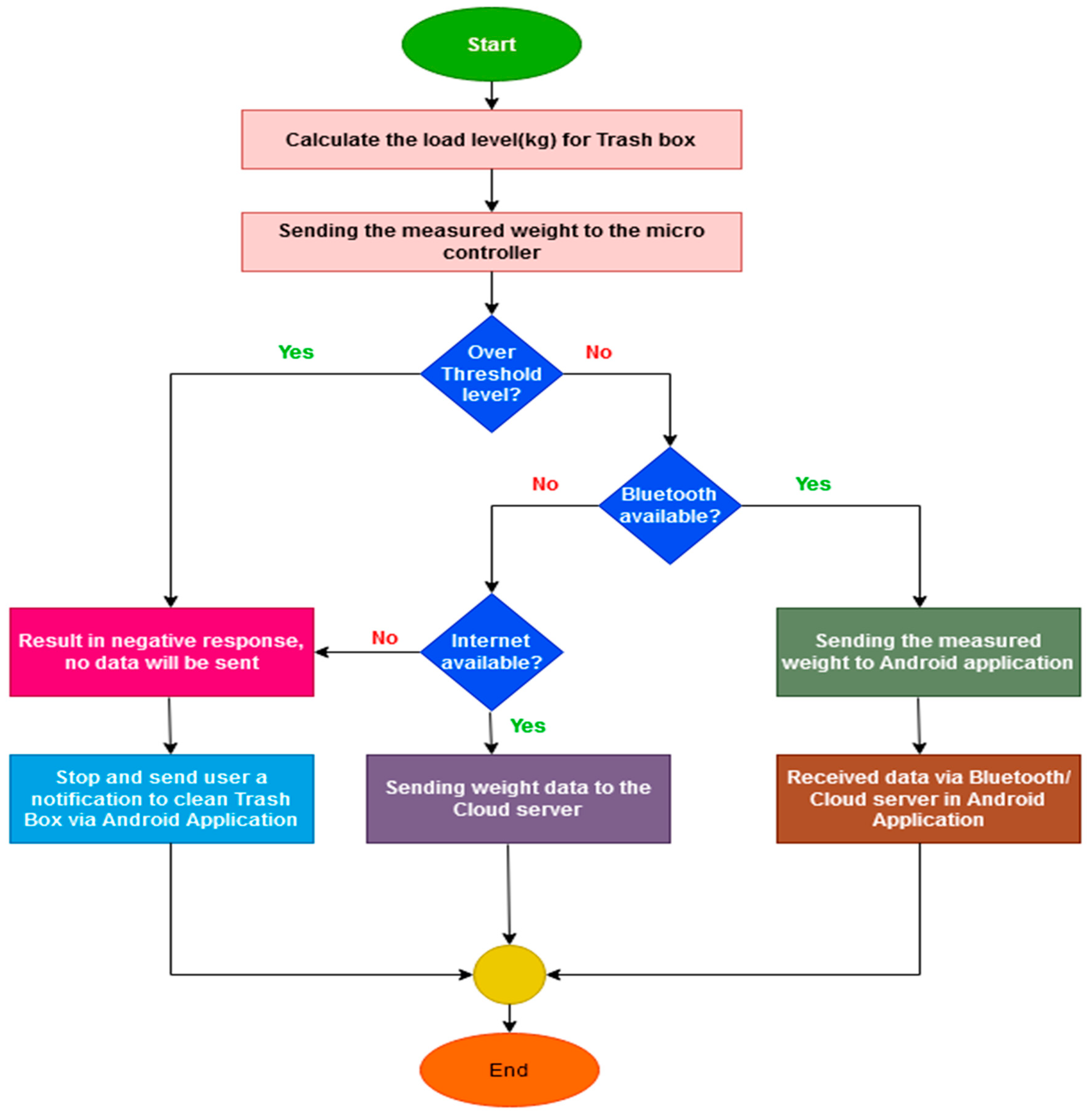
GA is utilized for the optimization of fuzzy systems [20]. The methodology of GA is detailed in Section 3.2. Figure 2 shows the flowchart of the overall study of the proposed model. The system utilizes load cells on the Arduino box, which automatically detect the stress values of any garbage placed on the panel on top of the Arduino box. This stress value determines the amount of waste that has been dumped on the system. In addition, the Smart Arduino Board panel opens a compartment below to store the waste in a garbage bin. This compartment will also detect if the waste is exceeding the garbage bin limits using ultrasonic sensors that measure whether the amount of garbage has reached its maximum. In case there is an overflow, the system will alert the client on the tracking webpage, and it will incorporate a cloud service to send alerts so that the garbage bins can be cleared out immediately.
Figure 2. Flowchart of the proposed methodology.
The contributions of this research work are given below:
  • A novel method for combining two technologies, namely IoT and fuzzy inference systems, to produce an ideal waste management solution.
  • Bio and non-bio waste image classification using a fuzzy inference system.
  • Long-range IoT waste monitoring using an Android application in real time.
The paper is summarized as follows. The literature of various IoT-based waste management solutions is discussed in Section 2. Section 3 details the proposed architecture and a detailed description of GA-FIS. Section 4 shows the experimental analysis. The paper is completed in Section 5.

2. Literature Review

There are different solutions proposed for existing problems in waste management. A few solutions are described below. The growth of information and communications technology (ICT) and its implementation in smart cities is inevitable. It provides diversified solutions to the existing scenarios with respect to smart cities and the IoT. Salehi-Amiri et al. [14] implemented an effective waste management system using vehicle routing in a two-level approach. The threshold parameter is set at level 1 using real-time data from the IoT devices. The waste in the bins is transferred at level 2, maximizing the recovery value and minimizing the visual pollution. A threshold value of around 70 to 75% provides the best solution. Wang et al. [21] used IoT devices to monitor garbage production and waste conditions, with a CNN classifier together with cloud computing methods, and the best results for waste collection were obtained. The waste is divided into six subcategories. The MobileNetV3 had a minimum running time of 261.7 ms and an accuracy of 94.26%.
Marques et al. [22] proposed a multi-level IoT infrastructure for waste management in smart cities. The architecture was built using three protocols: the Constrained Application Protocol (CoAP), the Hyper Text Transfer Protocol Secure (HTTPS), and the Message Queuing Telemetry Transport (MQTT). The MQTT protocol surpasses HTTP and is considered the best protocol, as it provides the maximum throughput with a feasible implementation in the smart city. The infrastructure is capable of managing 3902 bins simultaneously. Bano et al. [23] implemented the smart bin mechanism (SBM) by using the three R concepts, namely reduce, reuse, and recycle, along with the artificial Internet of Things (AIoT). The live data about the bin are collected, significantly reducing the time and energy spent. In addition, the labor cost is also minimized. Fuzzy logic is utilized for decision making. IoT, in conjunction with smart waste management systems, drastically reduces waste generation. Several sensors are used in order to collect the real-time data needed for collecting waste. Mishra et al. [24] significantly reduced the waste and the danger of infectious diseases in their proposed model. The uncertainty problems are resolved using fermionic fuzzy sets (FFS). It made a significant impact on the decision-making process and improved accuracy in complex environments. Mishra et al. [24] investigated smart waste management at multiple layers using FFSs combined with the Archimedean copula operator, where operations are used. Younesi et al. [25] discuss the various methods and the need for real-time data on waste management. Sensors and RFID tags are used to accomplish this. It also provides an overview of the technologies and solutions.
Kumar et al. [26] proposed a method for clearing garbage by generating an alarm at the municipal office once the basket is filled. This method was successfully implemented by making use of the Arduino UNO board and the sensor. After emptying, the in-charge person confirms that the task is over through an RFID tag. IoT and RFID were embedded to simplify this process. The microcontroller sends an alert message to the urban offices to monitor the workers involved in this cleaning process.
Shaikh et al. [27] discovered an effective system to check the level of waste, which is implemented using sensors, and the monitoring screen helps to display the output in the office. The level of trash is detected by a float level sensor installed internally in the bin. The load sensor is mounted at the bottom of the dust bin and continuously monitors the weight of the garbage inside. By interpolating artificial neural networks, Abdoli et al. [28] discovered a replacement method for predicting long-term wastes. A comparison between multivariate regression and artificial neural network (ANN) was performed. Statistical datasets of 10 years of generated solid waste from 2000–2010 for the town of Mashhad were analyzed. The best input variables were selected by comparing various environmental and socioeconomic factors. Based on the performance criteria of the ANN structures, the result was chosen. Therefore, the multilayer perception approach gives better results when compared to the existing method.
Nabavi-Pelesaraei et al. [29] proposed waste management solutions for Tehran Municipal Office, Iran, by assessing the energy flow using ANN. Recycling wastes provided an entry point for energy challenges. Authors used the Levenberg–Marquardt (LM) training algorithm and 5-7-7-11 topology for predicting recycled items, which therefore influence environmental emissions. They achieved better performance with accuracy, which ranges between 0.92 and 0.978. Shu et al. [30] analyzed the solid waste ignition in Taiwan using a multilayer perceptron for the dry and wet wastes, and the heating value was low, which is the crucial parameter for incinerator capacity. Adamovic et al. [31] developed a model for producing energy from the solid waste collected in European and Balkan countries. Sensitivity analyses and correlation techniques were used to enhance their model.
Bircanoglu et al. [32] proposed a method for sustaining the economy through waste recycling, and they discovered the most efficient method using deep convolutional neural networks. The major disadvantage of such systems is slow prediction. Therefore, to enhance the performance of the projection, dense block skip connections were modified. In a layered network, the number of parameters was reduced to 3 million out of 7 million using the RecycleNet model. By incorporating advanced decision support techniques into smart cities, the authors [33] implemented a useful waste disposal model.For providing the evidence to the authorities as well as monitoring the process periodically, surveillance cameras were incorporated into this model.
Solid wastes such as unused electronic and electric equipment are identified as an essential aspect of e-waste disposal because they contain toxic chemicals. In Malaysia, they successfully developed a smart system to collect household waste electronics [34]. Aleyadeh et al. [35] proposed two modules: the first module helps to monitor the volume of waste, and the second module implements dynamic scheduling of vehicles.
The authors [36] categorized the waste as hazardous waste, recyclable waste, and compostable waste. Different CNN-based classifier techniques such asDenseNet-121, VGG-16, MobileNet V2, and ResNet-50 for 9200 were applied and attained a maximum accuracy of 94.86% from the ResNet-50 classifier [36]. Frost et al. [37] presented a technique to classify the wastes after eating food by using the image classification model so that they can be disposed of in separate containers. A CompostNet model was deployed, which was a CNN for image classification. This application sorts the food waste according to biodegradable, recyclable, and non-biodegradable wastes and therefore can be a potential game-changer in implementing proper food disposal techniques. The limitations of computational cost and in-field application were also considered, and hence AlexNet was deployed.
Zhou et al. [38] developed a classification model by integrating three pre-trained CNN models together for incredible accuracy. Chu et al. [39] developed a multilayer hybrid deep learning system that efficiently disposes of unwanted objects scattered by the public in open space. CNN and MLP are used for extracting and consolidating the features to classify waste as recyclable or not. The cameras in the open spaces then detect the garbage, identify the type and disposal procedure, and alert the authorities accordingly to maintain a clean environment. Lanorte et al. [40] mapped and estimated the amount of agricultural plastic waste by using satellite images to capture the images. The areas that are pollution-free are differentiated from the ones that have plastic pollution using support vector machines (SVMs). Zhang et al. [41] implemented an automatic waste disposer based on the principle of Mie scattering. This method analyses the light intensity of particles under various climatic conditions and adjusts the system accordingly.
Xiao et al. [42] implemented a near-infrared hyper spectral method for classifying and extracting the types of waste. The authors used the Pythagorean Wavelet Transform to obtain the details of the waste particles. Random Forest was used to extract the key features for identifying generated waste. This technique improves waste management at construction sites. The method aims to enhance the utilization rate, improve the efficiency of processing, and minimize processing costs. Rahmad et al. [43] utilized ultrasonic sensors along with weight sensors to obtain the weight and size of waste particles and classify them into four categories: paper, glass, plastic, and metal. Supasan et al. [44] deployed robots to manage waste efficiently. The authors implemented a smart robot that detects waste and segregates it. An image processing unit allows the robot to detect the garbage lying around. In addition, sensors detect distance, weight, and other physical properties. An image dataset [45] consisting of various kinds of biomedical waste from humans, animals, labs, and hospitals is generated. The images are preprocessed using the median filtering technique for noise reduction. To categorize the cotton, plastics, and liquids, they applied the relevance vector machine. Thus, efficient monitoring and segregation of all biomedical wastes are performed to prevent any potential harm from such sources. In another study, an analysis of medical waste [46] in Uttarakhand hospitals is performed using multiple linear regressions for classification. Sohag et al. [47] proposed an automated lid along with an identification system and a communication mechanism to dynamically supervise the level of dustbins in urban areas with the help of sensors and Zigbee [48]. The data are transmitted over the adhoc network. Memon et al. [49] used ultrasonic sensors and WeMos, which helped monitor the garbage and produce accurate results.
Authors have proposed optimal resource allocation integrated with intelligent techniques [50] suitable for IoT [51] in recent years. In the IoT, a whale optimization approach (WOA) is used to reduce communication costs and optimize resource allocation [51].A comparison of the proposed model with existing approaches shows that there is a high capability to solve the resource allocation issue in the cloud. A hybrid fuzzy approach is used [52] to effectively support the decision-making process for validating the risk factors in a software project. In comparison with the existing techniques, the proposed framework indicates that this approach achieves better project performance.
Hussain et al. [53] developed a waste management and prediction and tested using a traditional K-Nearest Neighbor (KNN) and non-traditional Long Short Term Memory for creating alert messages and forecasting amount of pollutant air carbon monoxide (CO) contained in the air. The accuracy of modified LSTM and traditional LSTM are 90% and 88% respectively, to determine the future concentration of gas content in the air.
Table 1 summarizes the literature on smart garbage disposal systems in recent years. Table 2 summarizes the related works based on efficient resource allocation for IoT. Due to the disadvantages of the existing approaches, an integrated approach is proposed for an efficient smart garbage disposal system.
Table 1. Literature of smart garbage disposal systems.
Table 2. Summary of Existing Works.

3. Proposed Model

3.1. Internal Components

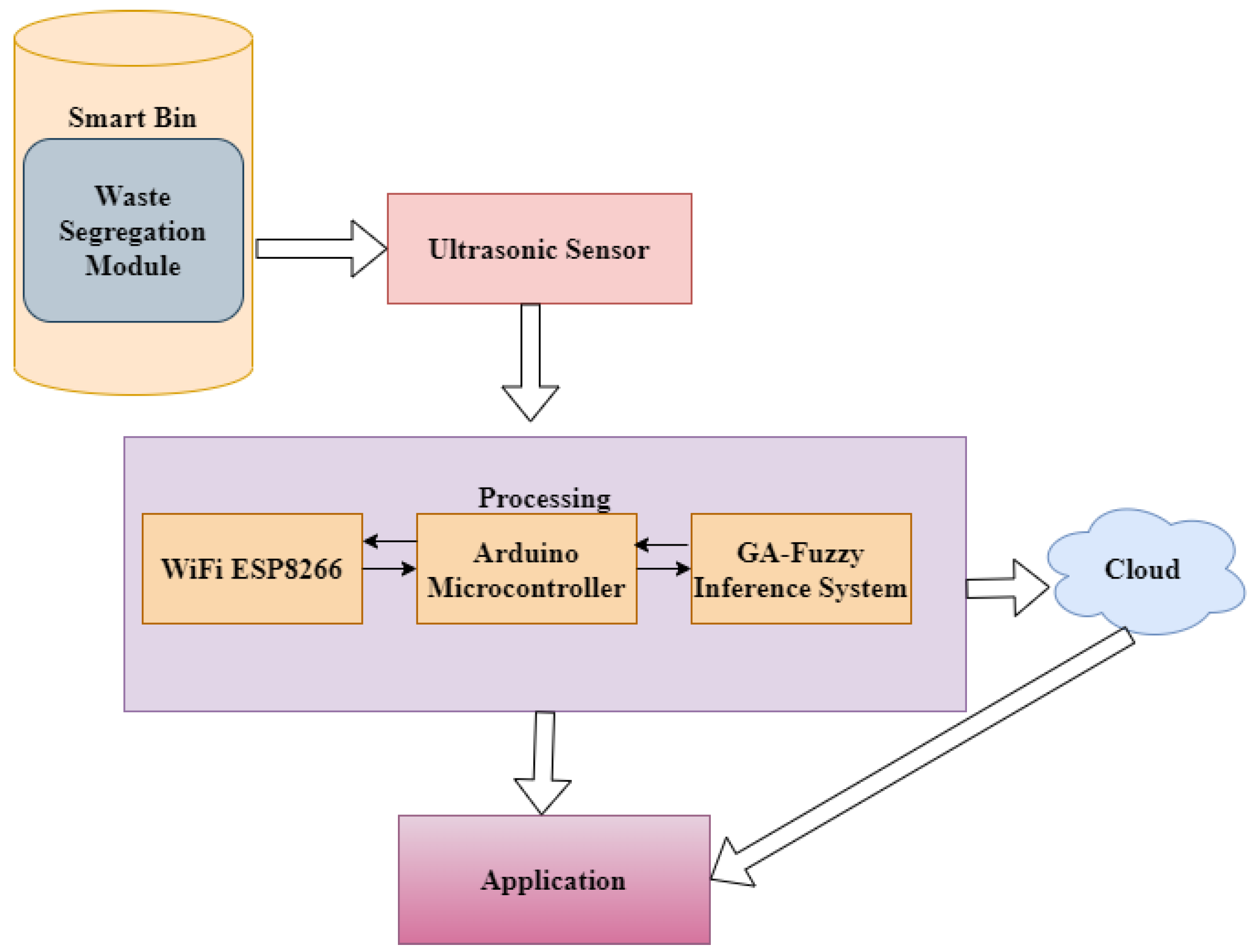
The components in the IoT smart garbage disposal system are a Bolt Wi-Fi module, a load cell, a servo motor, the HX-711 interface, an Arduino, an ultrasonic sensor, a breadboard, and junction cables. The ultrasonic sensor is placed on the inner lid toward the direction of solid waste. The live data are sent to the microcontroller for further processing and are sent to a web page via the Bolt Wi-Fi module. The module also automatically sends e-mails and alert texts to the client, stating that the trash is overflowing. The distance is measured using the ultrasonic sensor, which is integrated with the lid that indicates the trash can’s size. Thema the Arduino Uno is the system’s central component, containing Arduino’s latest microcontroller, for easier processing of data sent by sensors and further transmission to a Bluetooth or Wi-Fi module for further processing or display. The fuzzy inference system with GA for optimization is integrated with the microcontroller.
The load cell is a critical sensitivity module. It is a carefully designed metal structure that is loaded with precise locations in the system known as injury gauges, which are made up of smaller components. In this paper, Wheatstone bridge load cells are deployed, and these load cells have four balanced resistors with predetermined excitation voltages. If any resistor detects a change in value, it generates a voltage using Ohm’s Law. The HX711 load cell amplifier interface, which is an electronic scale module, converts the measured changes in resistance, and it is a 24-bit analogue to digital converter. The Arduino is connected to the 5 kg load cell interface using the HX711 module. The change in resistance is used to measure the weight of a garbage object after calibration. The servo motor is controlled by the Arduino and requires more power for mechanical output. The small service motors are directly connected to the Arduino to control the shaft position accurately. The position of the shaft is precisely controlled using motors to obtain accurate results, and the swing action of the bin is adjusted according to the weight of garbage. A sensor on the trash determines the depth of the garbage in the total bin. When the level of waste is at its maximum, the managers in the office are alerted so that the staff can take the necessary steps to empty the garbage bin.
The inclusion of a fuzzy inference with GA implementation on the Arduino Board is used to detect trash levels, weight, and so on. The GA rules are incorporated into the system design by downloading those rules onto the Arduino Board. This helps in the hardware setup for improvised decision making in the identification and segregation of waste. In addition, the Arduino Board is trained using fuzzy rules that can detect the level of waste and types such as plastic bottles, glass, etc. This technique can also help to identify the areas that need more awareness regarding sanitation and, in turn, locate which regions are the worst offenders in terms of poor sanitation and garbage maintenance. This effort can help clean up the environment in an efficient manner. Cloud middleware collects data from sensors, aggregates them, cleans them (i.e., discards or infers missing values), and sends them to an engine that is implemented in Open IoT. A fuzzy inference engine with GA is used for forecasting waste levels and to learn the selection of the daily waste bins based on historical data. The two primary components of the system are as follows:
  • Waste monitoring system: The waste monitoring system consists of an ultrasonic sensor. The sensor measures the proportion of the bin that is filled with waste. A Wi-Fi module is used to send information that can track the level of waste in the smart garbage bin so that overflow is prevented and smooth service is obtained.
  • Waste segregation system: The segregation system uses the load cell and the servo motor.
The high-level and detailed workings of the proposed model are shown in Figure 3 and Figure 4, respectively. The object falls on the midsection inside the bin, and the impact weight is read by the load cell upon contact. The subsequent weights are also read until the reading of the object weight is constant. A set of 30 continuous weight readings were measured in the previous step. The readings are split into two sets: the first set is the impact and rebound readings of the object. These are variable readings as the object rebounds upon impact. The highest reading value is obtained from this set. The second set is obtained when the object has a stable set of readings. The average of this set is determined and divided by the highest reading value of the first set. If the ratio of the two is greater than a threshold, the servo motor will be turned 90 degrees, or else 270 degrees, from its origin point. This helps calibrate the waste segregation system and accurately read all the weight values of the waste products placed on top of the smart garbage board.
Figure 3. High-level design of the proposed system.
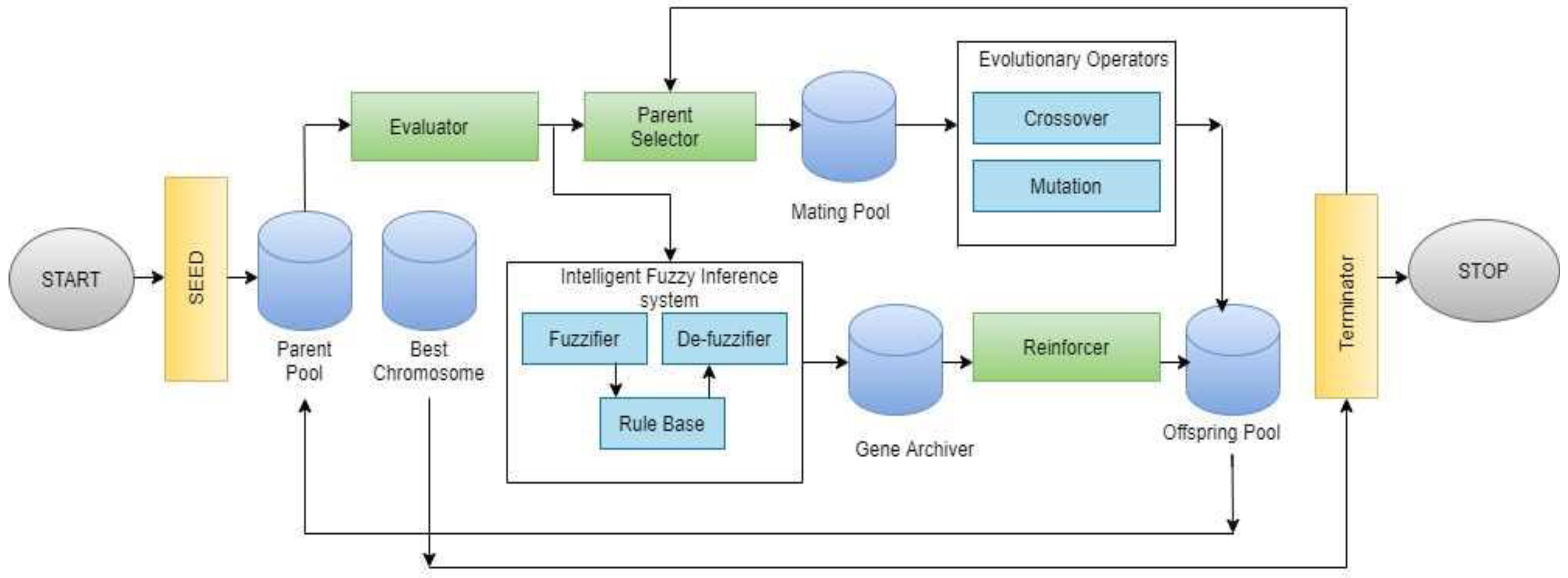
Figure 4. Detailed design of the GA–fuzzy inference model.
The garbage is placed in the smart bin, which the load cell picks up, determines the weight of the trash, and then segregates it. The ultrasonic sensor keeps track of the garbage level. If the bin level is more than half full, the information is sent to the cloud for alert generation, which allows the client to empty the bin. This work is still made smarter by the use of technology in terms of garbage collection, segregation, and indication to the concerned authorities (municipal authorities are referred to as clients). Furthermore, at the administrator’s end, this system provides a control to provide a warning signal when the garbage reaches 60, 70, 80, or 90 percent of the trash box, avoiding sanitary issues. This implementation enables the smooth and uninterrupted service of the smart container. Only authorized users can login to and utilize the system. Hence, cloud computing provides functional reliability for the city’s infrastructure with regard to security.
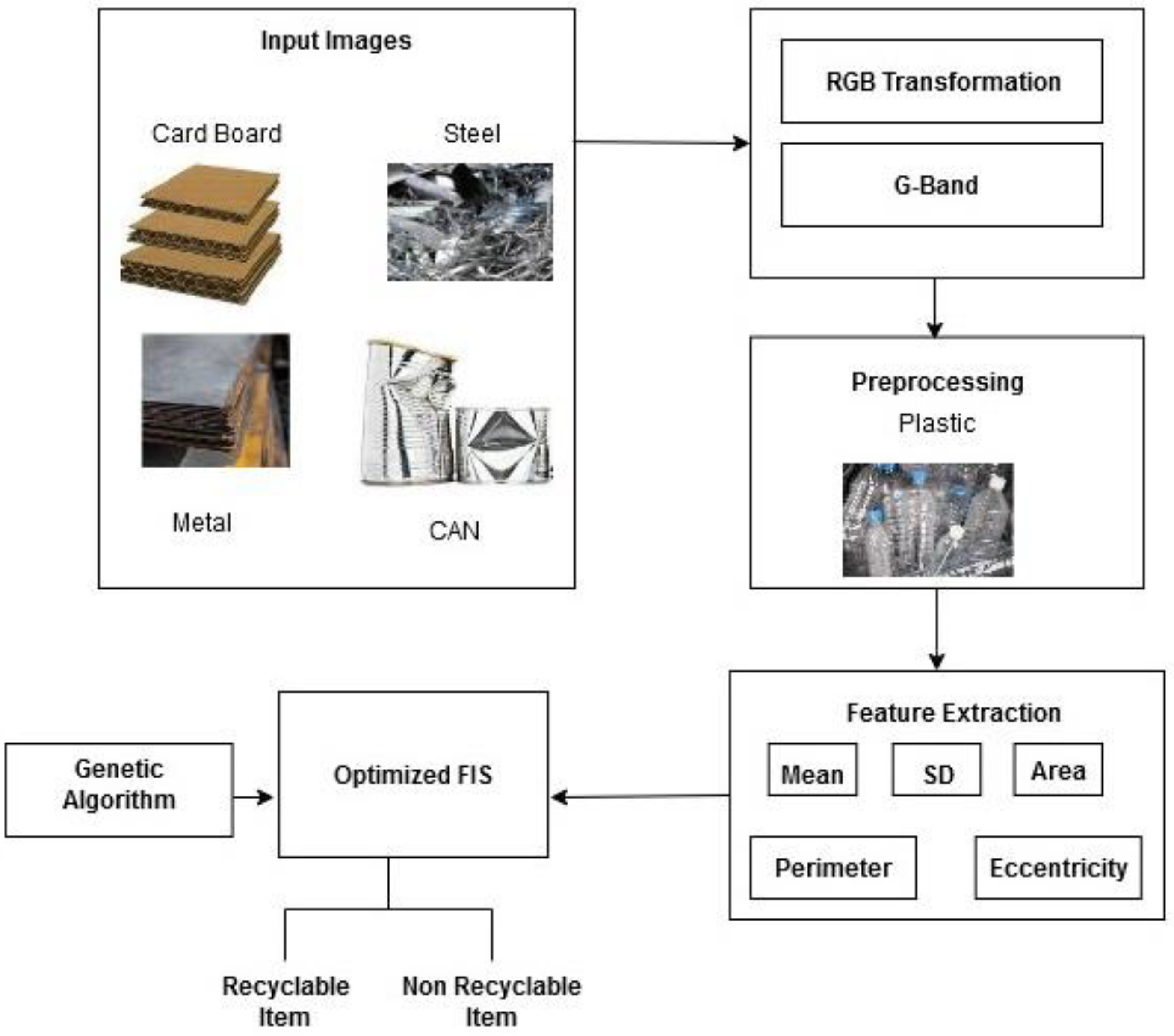
Smart systems can analyze a problem and make decisions, such as alerting the appropriate client to perform waste collection in the appropriate city location, which is a key concept, developed in the proposed system for effective problem solving. Figure 5 shows the proposed image classification model.
Figure 5. Proposed image classification model.

3.2. Methodology of Genetic Algorithm–Fuzzy Inference System (GA-FIS)

This technique is adopted to solve the waste management problem. The idea behind this technique is to ensure that essential genes are preserved, thereby promoting the vital genes in consecutive generations and improving chromosome fitness. In this approach, GA builds an ideal combination of rules and serves as an optimization tool. If the training data are insufficient, the fuzzy system employs expert knowledge. FIS provides the option to employ expert and hidden expertise simultaneously. The combination of GA and FIS is intended to improve functionality by integrating expert knowledge in the form of membership functions and fuzzy rules. The entire pseudo code is given in Appendix A Algorithm A1. The task for each block is given below.
The methodology of GA is given below:
  • Seed Block
This block will generate the chromosomes, and they will be copied to the parent pool. After copying, the parent chromosome will be executed. The binary-coded chromosome representation is utilized here.
A.
Evaluator Block
The fitness of the parent population is determined. The total load at each time slot will be calculated, and the cost will be calculated for each chromosome.
B.
Parent Selector
The selection operator plays a significant role in choosing the chromosomes for the mating pool, and it also controls the crossover and mutation processes. The selection procedure has several distinctions based on raw fitness. The only disadvantage of this method is that it produces the greatest number of fitness chromosomes. Hence, to overcome this, scaled fitness is employed in this algorithm. Spaced markers are placed equally on the scale to select the respective chromosomes. The selected chromosomes are then transferred to the mating pool.
C.
Evolutionary Operators
New offspring chromosomes are generated by merging the chromosomes in the mating pool. The primary operators are crossover and mutation. The crossover operator produces the new offspring chromosome, and the mutation operator performs the gene modification. Different mutation and crossover operators are selected based on the chromosome representation.
D.
Fuzzy Inference System
Fuzzy logic helps to identify the crucial genes among the available chromosomes. Hence, to determine the useful gene in the offspring population, fuzzy logic is incorporated in this block. A trapezoidal member function (MF) maps every element in the input space into a membership value called membership degree. Thus, it is expressed as a collection of four points (a, b, c, d) given in the below equation:
μ ( y ) = { 0 , y a , d y y a b a , a y b 1 , b y c d y d c , c y d }
In Equation (1), the Y coordinates of four edges of the underlying MF are (a < b < c < d). FIS contains the if–then rules to encode conditional propositions. The different fuzzy rules developed in our system are as follows:
  • If smart_bin_distance_sensor < 0.2 THEN;
  • Bin is empty;
  • Else if smart_bin_distance_ sensor > 0.2 AND smart_bin_distance_sensor < 0.6 THEN;
  • Bin is partial_full;
  • Else;
  • Bin is Full.
A Mamdani FIS is implemented in our proposed system. In this model, the consequences of the rules are represented using fuzzy sets. The mechanism is described below:
A.
Real inputs: The numerical data are observed as GA characteristics. The inputs are non-fuzzy values.
B.
Fuzzify inputs: All fuzzy statements are resolved to a membership degree in the range of 0 to 1.
C.
Fuzzy rules: The if–then rule statements are utilized as given below:
D.
Ri: If (in1 is A1i) and … (inm is Ami)then (out1 is B1i) and … and (outn is Bni).
E.
Fuzzy operator applied to multi antecedents: If the antecedent has multiple fragments, antecedent is resolved to a single value between 0 and 1 is performed by fuzzy logic.
F.
Applying implication technique: The degree of support is used for the entire rule to determine the output fuzzy set shape. The entire fuzzy set is assigned to the output.
G.
Aggregation: The fuzzy set Br for every rule is aggregated as a single output fuzzy set B0.
H.
Defuzzification: The defuzzification input is a fuzzy setµ which is the aggregate output fuzzy set, and the output is a single value y*. The centroid method is utilized for defuzzification.
A defuzzification process given in Equation (2) is used to extract the output as follows:
y * = d e f u z z ( B 0 ) = y y n . r = 1 n μ B r ( y ) d y y r = 1 n μ B r ( y ) d y
Defuzzified rate is the directly acceptable value of GA parameters, for example:
Output#1 is tournament selection power;
Output#2 is bit-mutation probability;
y1* = 2 represents selection of binary tournament;
y2* = 0.03 characterizes 3% mutation probability.
A test function is deployed with the integration of cosine modulation to result in local minima. The function is highly continuous and multimodal. Achieving a global minimum standardization to a zero value of the objective function facilitates minimization. The function is given below:
f 1 ( x ) = A . n + i = 1 n ( x i 2 A . cos ( 2 π . x i ) )   ,     x [ 5.12 ,   5.12 ] ; min f 1 ( x ) =                                                                 0 ,   n   d i m e n s i o n a l i t y ,   A = 10
After defuzzification, the coefficient of the below equation is used to determine the final solid waste segregation represented in Equation (3).
T o t a l w a s t e = i = 1 m a i x i + j = 1 n b i y y i j
where ai represents the population of a specific area, i; xi is the daily waste production value per person in the area i; and bij is the total area of activity j in the area i as determined by the defuzzification process. In addition, m specifies the distinct regions, and n represents the activities in every region. The estimates (xi and yij coefficients) are used to construct the waste production and determine predictions for further analysis. Thus, waste products can be estimated to enhance waste management and planning.
The approach introduces two FIS inputs, namely, fuzzy-rule-based singleton values and FIS.
The first input specifies the distance between the global average and an individual, who is represented in Equation (4).
D i s i = d = 1 N ( x i d G B d ) 2
where the distance among the global best and ith individual is given by Disi, the dimension dth of ith individual is specified as xid, and the GBd denotes the dth dimension of GB. An error of diversity (Errdiv) which is the other input is given below:
E r r d i v = D g D g o a l , g
The inputs are updated before applying the FIS in the proposed method because the magnitude order varies for these inputs while the evolutionary technique is being performed. The equations are represented in (6) and (7) below:
D i s s t d , i = { 0 , i f   D i s m a x D i s m i n = 0 , D i s i D i s m i n D i s m a x D i s m i n , o t h e r s
where the Disstd,i specifies the standardized Disi, the Dismax is the highest value of Disi, and Dismin is the lowest Disi value.
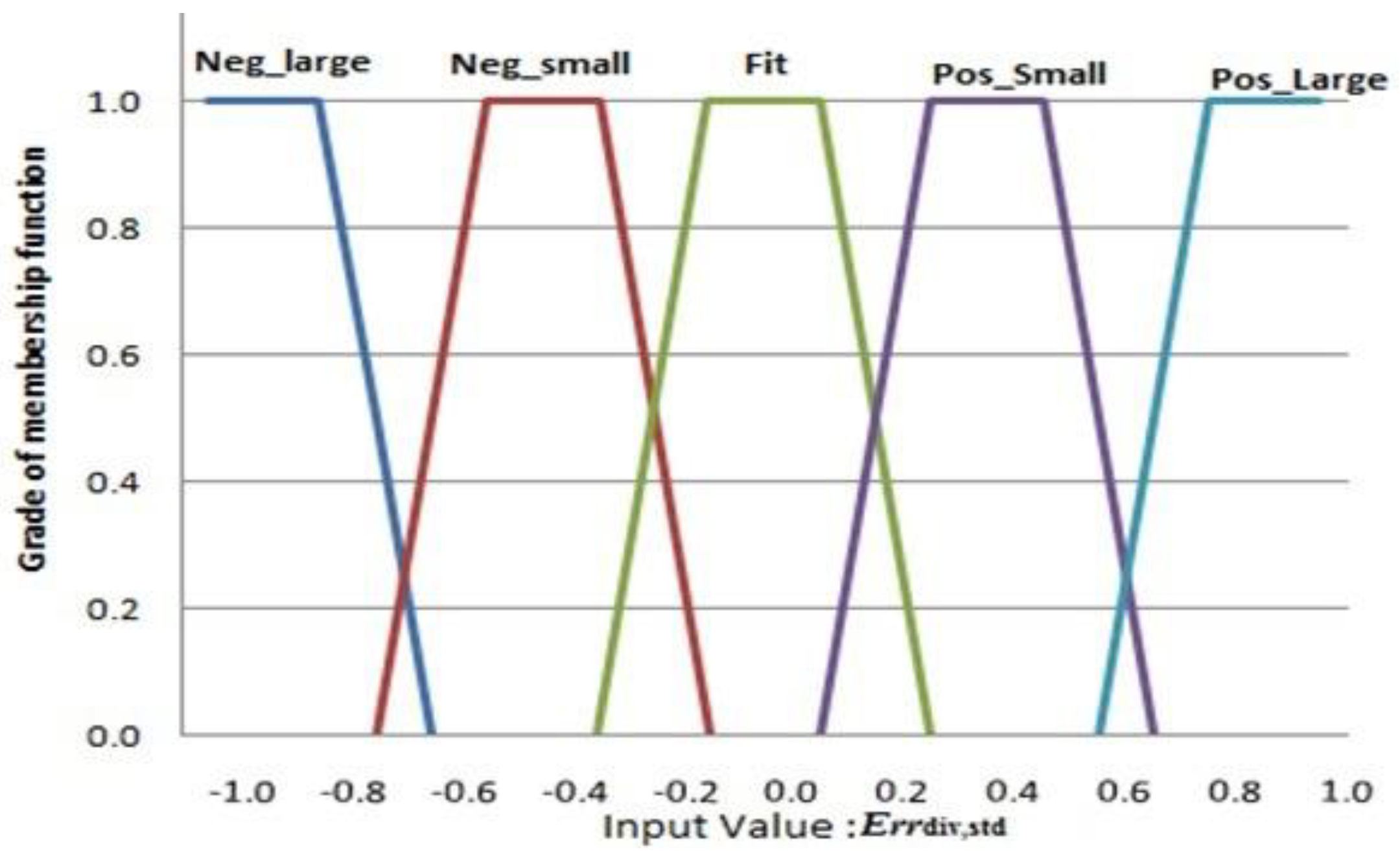
Err div , std = { 1 , if   Err div D goal , g 1 ,   D goal , g     0 0 , if   D goal , g = 0 1 , if   Err div D goal , g 1 ,   D goal , g     0 Err div D goal , g , others
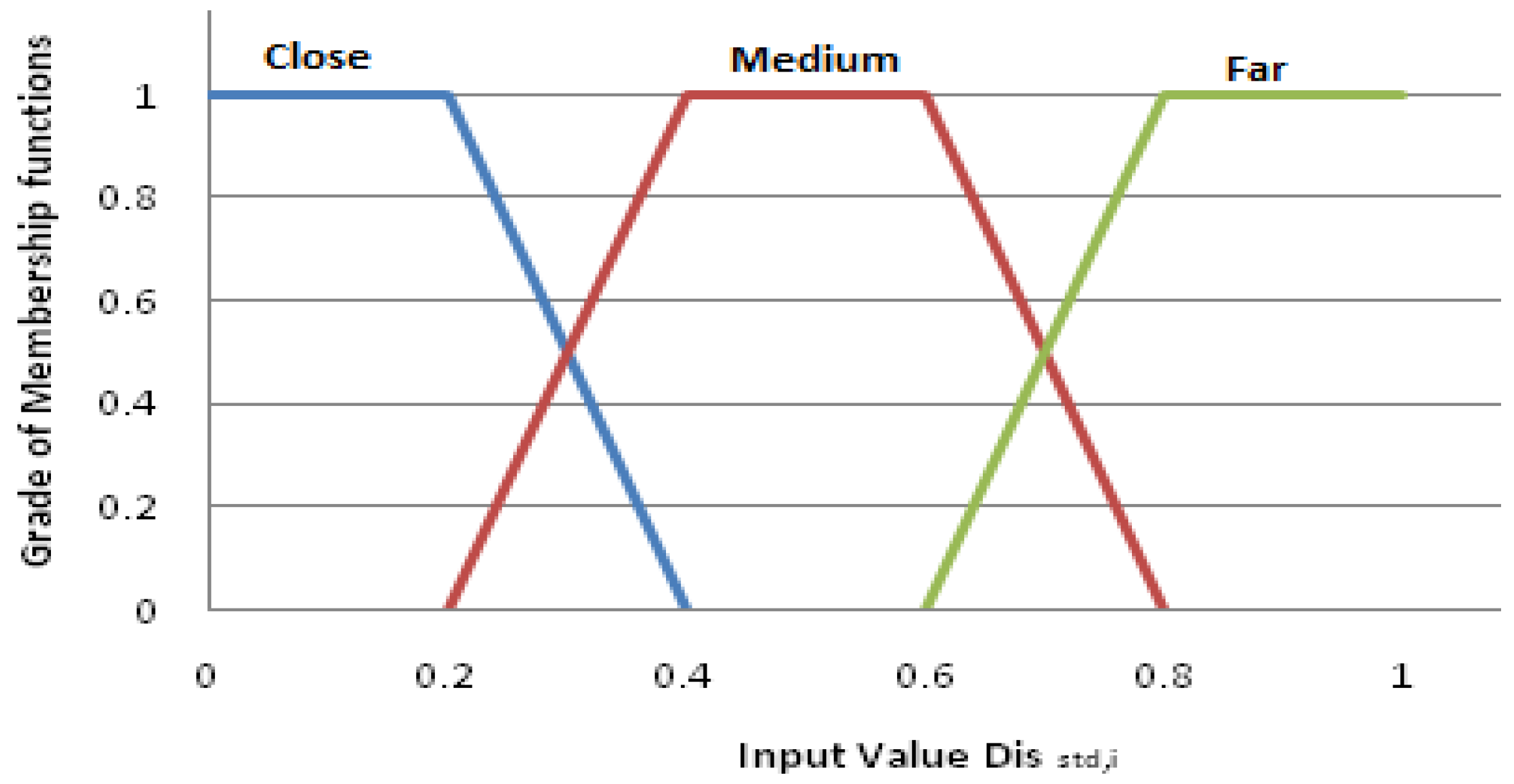
where the standardized error is given by Errdiv,std, the range is 0 to 1 for Disstd,i, and the error after adjustment is −1 to 1. Algorithm 1 and Figure 5 depict trapezoidal input membership functions. Three fuzzy sets are utilized for the first input, and the second input requires five fuzzy sets. Table 3 represents the singleton fuzzy rule base.
Table 3. The fuzzy rule base.
Algorithm 1. Pseudocode of GA–fuzzy inference system.
Begin
 // Initialize the parameters
Initialize the size_population, size_archive, size_elite, size_pool_mating, generation_max,
Probability_mutation, probablity_crossover, pool_offspring, pool_mating, pool_gene;
Initialize the utilisations_set, slots_total, utilizations_no, slots_total, utilisations_power, price_electricity;
For i = 1 to size_ population
   For each appliance j in the appliances_set
                 For t = 1 to slots_totalsj,
                 Allocate timeslot to the utilisation j within realistic time slots
    End For
   End For
End For
Initialize the following: Iteration = 1, generation_current = 1;
For generation_current = 1 to generation_max
For each chromosome i in the pool_parent
     For t = 1 to slots_total
     Determine the total load at time interval‘t’
End For
End For
Find the best chromosomes
Copy the best chromosomes into the pool_offspring
Update the current generation counter as generation_current = generation_current+1;
Return chromosome fitness value in the pool_parent

    Goto GA Block // Given in Appendix A
If generation_current equals generation_max then
Terminate the execution cycle
Output optimal chromosome
Else
Goto Parent Selection Block // Given in Appendix A
Continue with the execution cycle
End if
  • Reinforcer
Essential genes are selected and inserted into the offspring population. This selection will preserve and update the crucial genes in the successive chromosome population.
Each generation computes the population diversity. Then, the Errdiv,std and Diststd,j are calculated. The GA-FIS is calculated from the variation between existing variety, and the diversity goal then selects xbase.

3.3. Methodology for Image Classification

The major steps involved in the image classification approach are given as follows:
  • Pre-processing.
  • Feature selection.
  • Classification.
Initially, the images are gathered from the camera placed in the waste bin. Then, a filter is applied for image enhancement. Afterwards, from every image, features are collected. The selected features are sent to optimize fuzzy inference system (OFIS).
  • Image preprocessing: Images are captured from the waste bin. Then, the images are enhanced by sending them to the pre-processing unit, and the image is divided into an R, G, and B setup. The green band has more data in comparison to other colors, so the noise is reduced by deploying the green (G) band.
  • Feature selection: The color attributes and the texture are selected from the image. In this approach, from every image five features are extracted, namely the mean, standard deviation, area, perimeter, and eccentricity.
  • Mean (F1): The image with high brightness represents a higher mean, and the dark image represents a decreased mean value. The mean is calculated as given in Equation (9):
F j = 1 N i = 1 N Q j i
  • Standard deviation (F2): SD is the term used to represent square root of the variance. Low variance is obtained if the contrast is less, and high variance results for a high-contrast image. It is calculated as given in Equation (10):
F 2 = ( 1 N I = 1 N ( Q j i F j ) 2 )
  • Area (F3): A particular region is extracted from the complete image. A scalar value which represents the number of pixels in a specific area is determined.
Y   =   { FIS 1 ,   FIS 2 ,   ,   FIS d }
where FISd specifies the optimal FIS system in dth dimension.
  • Perimeter (F4): The distance around the region boundary of the input image.
  • Eccentricity (F5): The separation proportion among oval foci and the significant pivot length.
  • Optimized FIS (OFIS) for waste categorization: The waste images are categorized as recyclable and non-recyclable by OFIS. The fuzzy system consists of two major stages, which are described below:
  • Fuzzification: Input features of F1, F2, F3, F4, and F5 are transformed into fuzzy attributes. The membership function (MF) is calculated for every fuzzy variable. For every feature, fuzzy variables are categorized as low (L), medium (M), and high (H). Thus, finally, fuzzy variables are classified as recyclable and non-recyclable.
  • Defuzzification (Z): Table 4 shows the sample fuzzy rules. The FIS rule system updates the membership function’s input and output parameters. It is essential for optimal consolidation of the MF parameters.
    Table 4. Fuzzy rule samples.
The fuzzy rules are configured to indicate the waste level as well as the type of waste for segregation. They also provide information about the type of waste in this bin, such as whether it is reusable, recyclable, organic, or electronic waste.

3.4. Risk Assessment

A risk assessment is performed in the proposed method to check for environmental hazards such as air pollution, soil contamination, and water contamination. These catastrophic effects due to poor waste management are eliminated in the proposed system, as there is an IoT component integrated with AI. In medium and large-sized cities, the number of containers is in the range of hundreds or even thousands; therefore, a distributed approach to the proposed system can be implemented for every zone in the city. The proposed system treats each container as a different entity, which can change daily. As the previous fill levels of the containers are available, the AI system forecasts future fill levels based on historical data. This data will be useful in determining which containers must be collected during the next shift. The prediction of generations is very complex, because we need to model the behavior of the population which deposits its waste in a particular container. These developed models have the ability to resolve difficult risk assessment problems.
Risks can be determined as a result of the numerical value that measures the exposure to each risk level (defuzzification). It is similar to the ranking according to fact level and the exposure risk is high. Fuzzy logic models contain information about the exposure to risk or other factors that can have a huge impact. The risk-hedging cost can be considered an extra output variable in the fuzzy model. The risks of waste management using the proposed model in an emergency are dependent on various factors, such as waste management installation and operational and maintenance practices (OM). Predictive failure assessment and deterioration modeling for waste management are important because they can help waste management managers optimize future inspection plans while also avoiding unpredictable events that can endanger communities.
The complexity of the problem can be derived from the number of restrictions that can be applied to the model. Thus, the more restrictions applied to the model, the more realistic the solution obtained. In this paper, the company establishes that all the containers with fill estimation greater than 80% have to be collected. The constraints are enumerated as follows:
Containers.
  • Variable container count.
  • Different locations.
  • Adjustable unloading time.

4. Results

4.1. Experimental Analysis

The first step is to prepare all information for the model, such as zone attributes, depot attributes, vehicle attributes, and distance for every zone. In this approach, a solution is represented by a string of numbers containing a permutation of ‘m’ depots represented by the set {1, 2, 3, …, m}, n potential customers represented by the set {m+1, m+2, …, m+n}, and Ndummy Zeros to separate routes. Suppose we have two candidate depots and twelve zones in a city, as shown in Table 5. The distance for each node is calculated using the distance matrix API developed by Google based on latitude and longitude of each node. The chromosomes are the initial candidates for our proposed approach. For every chromosome, we insert a depot to serve the various zones according to the maximum waste picked up by the vehicle. A shortest distance allocation approach is implemented to determine which depot to serve the zone. A dummy zero is used in the solution to represent the separate route for each vehicle. For example, in chromosome-1, zones 5 and 14 will be served by depot 1 instead of depot 2 due to the shortest distance from the node. Thus, it is possible to minimize the total distance of each route. The solution representation for chromosome-1 is shown in Figure 6.
Table 5. An example of depot and zone attributes.
Figure 6. Solution representations for chromosome-1.
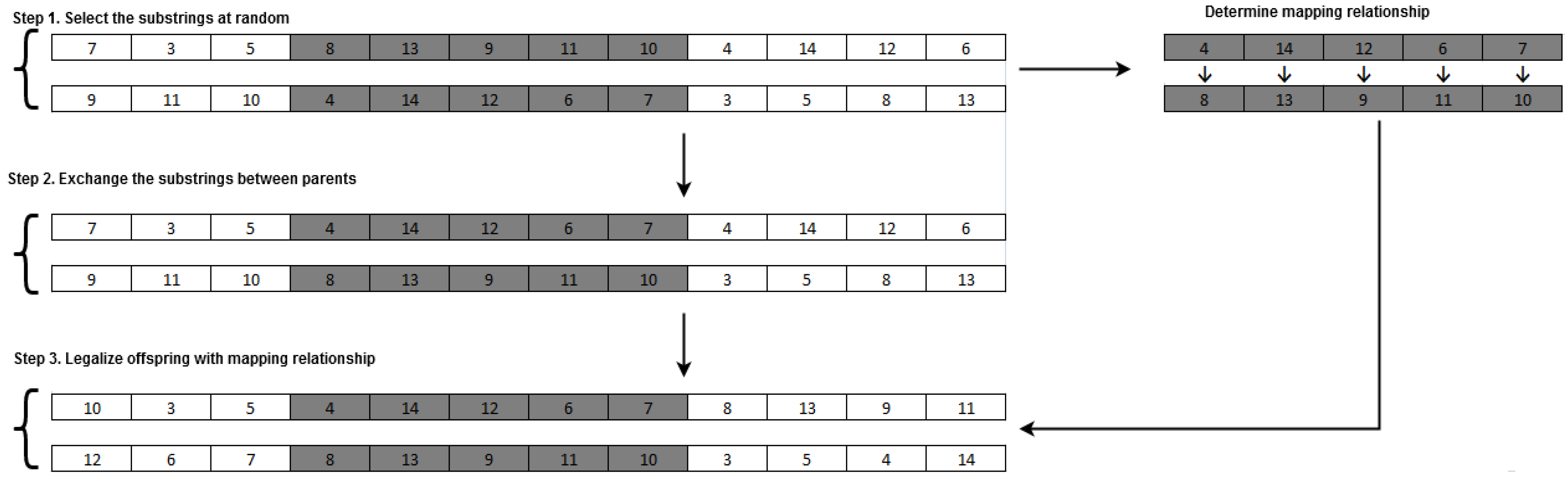
The next step is the selection process. The proposed work implements tournament selection for choosing the best candidates from the current generation in GA. These selected candidates are passed on to the next generation. After choosing the individuals using tournament selection, a new generation is created by combining parent solutions to result in a new solution in GA. We apply a new type of crossover named partially matched crossover (PMX) [59,60] to generate new offspring. This type of crossover is widely used, and the illustration is shown in Figure 7. According to Figure 7, PMX starts by selecting parents from the previous selection approach. In this example, we choose chromosome-7 as parent-1, which has the minimal fitness value. Parent-2 is generated from parent-1 by modifying the order in parent-1. The first step chooses a random segment(substrings) and copies it from parent to child. In this step, the substrings are exchanged among parents and node duplication is checked for in the strings. As there are mapping references, the duplicate nodes are replicated with another node by performing the mapping relationship. The remaining offspring can be filled similarly with the parents. The next step after crossover is the mutation operation. The mutation process is performed to increase the probability of avoiding local solutions in GA. The mutation operator alerts one or multiple genes in the children’s solutions once the crossover is completed. GA improves the population using the operators until the end condition. The output of GA is used as the initial solution for the FIS approach.
Figure 7. An illustration of the partially mapped crossover (PMX).
Table 6 specifies the experimental settings of the proposed GA-FIS parameters, namely population size (PS), dimension (N), crossover rate, and mutant factor. The analysis from the experimental results is that there is consistency through 10, 30, and 50 dimensions. Figure 8 and Figure 9 show the membership functions for the values of close, medium, and far with regard to input distance and error. Each of the color lines represent different range of membership function. For example, in Figure 9, the blue color signifies the range from 0 to 0.4 input resulting in a maximum membership, to which it can be categorized as close. The red color signifies the range of medium values between 0.2 to 0.8 input resulting in a maximum membership and green color signifies far value range from 0.6 to 1 input which can result in a maximum membership function.
Table 6. Experimental settings of the proposed GA-FIS.
Figure 8. Membership function of input Diststd,i.
Figure 9. Membership functions of input Errdiv,std.
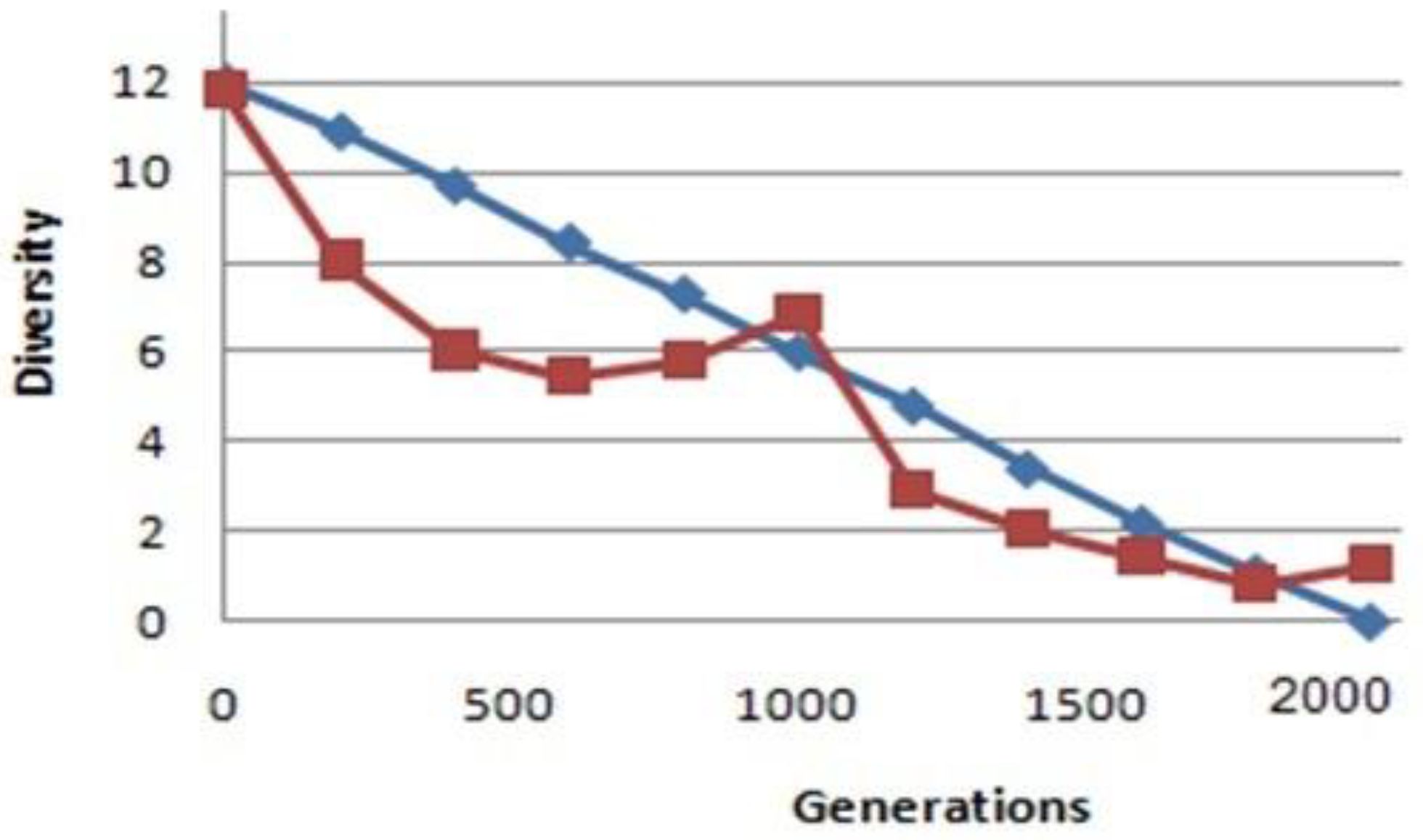
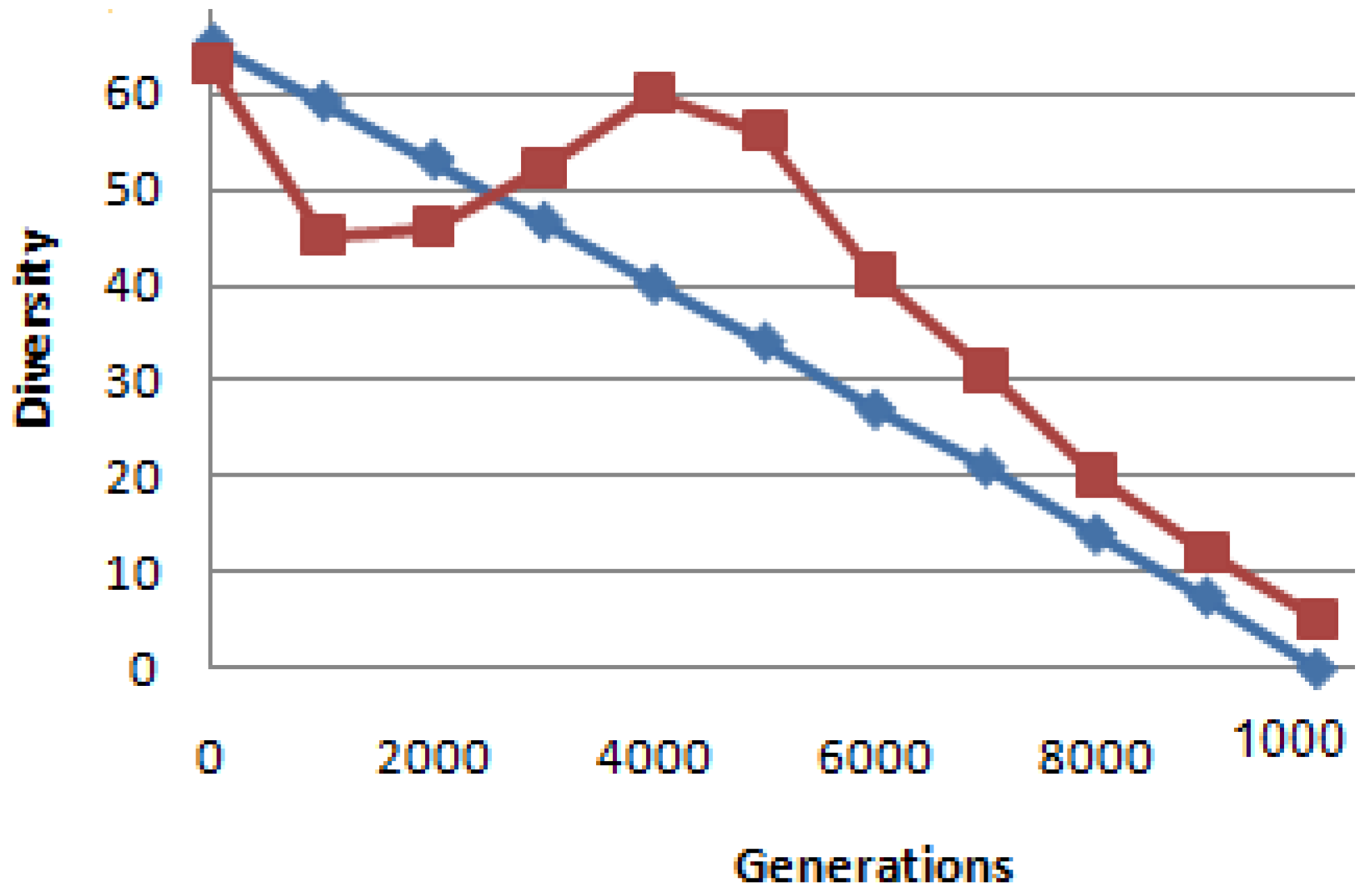
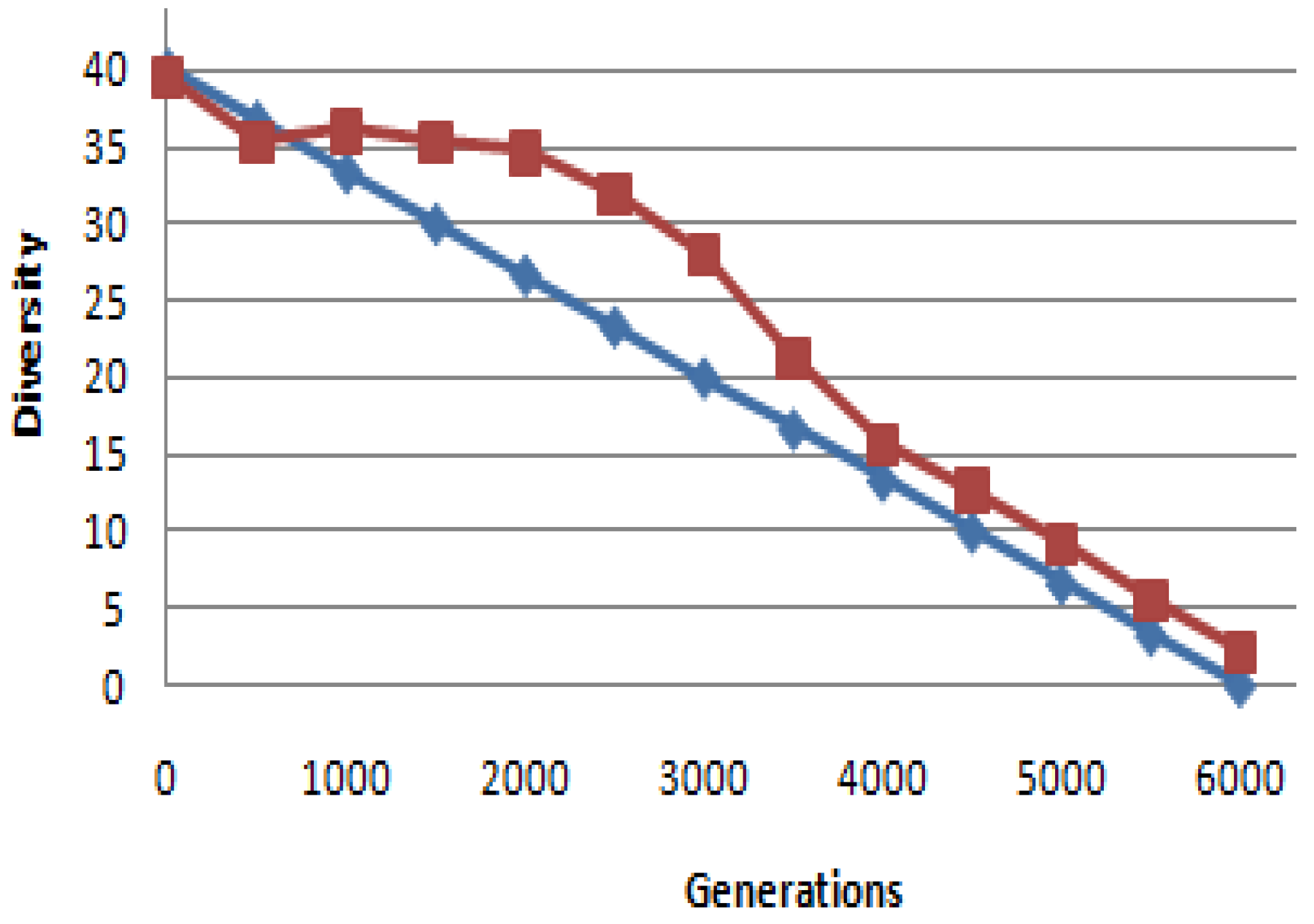
The proposed GA-FIS is analyzed with different diversity curves for various generations, namely, 10, 30, and 50, respectively. The diversity curves of multiple dimensions are compared, as shown in Figure 10, Figure 11 and Figure 12, respectively. In all these figures, the blue line represents the diversity results for the traditional GA and the red line represents the diversity results for the proposed GA-FIS. Thus, it expresses that the control diversity technique is useful and independent of the dimensions. It is inferred from the figures that the individuals of GA-FIS begin to converge because of the depreciation of diversity. The GA-FIS expands the diversity level if the value is below the goal. Therefore, if a variety is handled appropriately, the proposed approach results in superior performance.
Figure 10. Diversity curve with ten (10) generations.
Figure 11. Diversity curve with thirty (30) generations.
Figure 12. Diversity curve with fifty (50) generations.
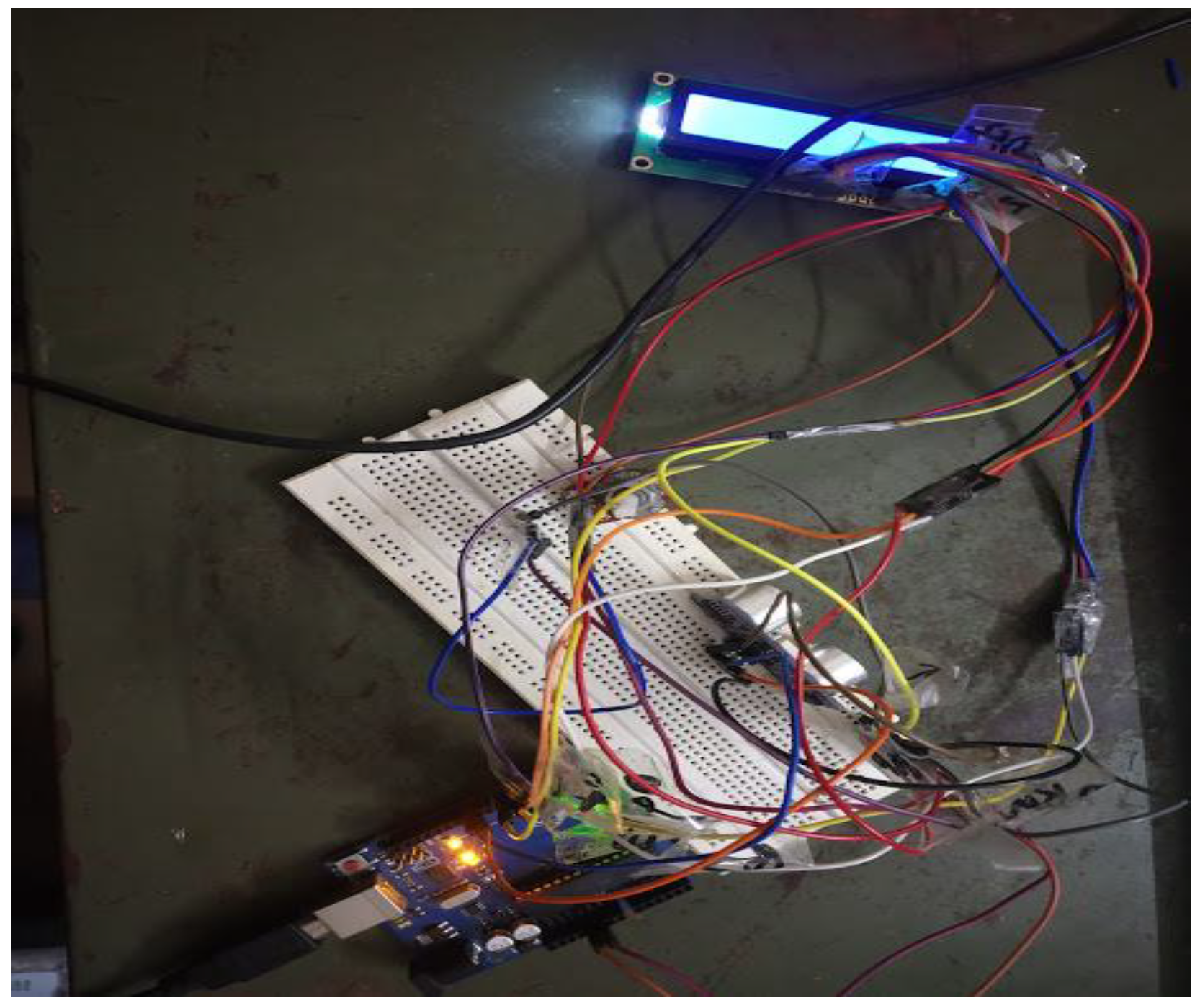
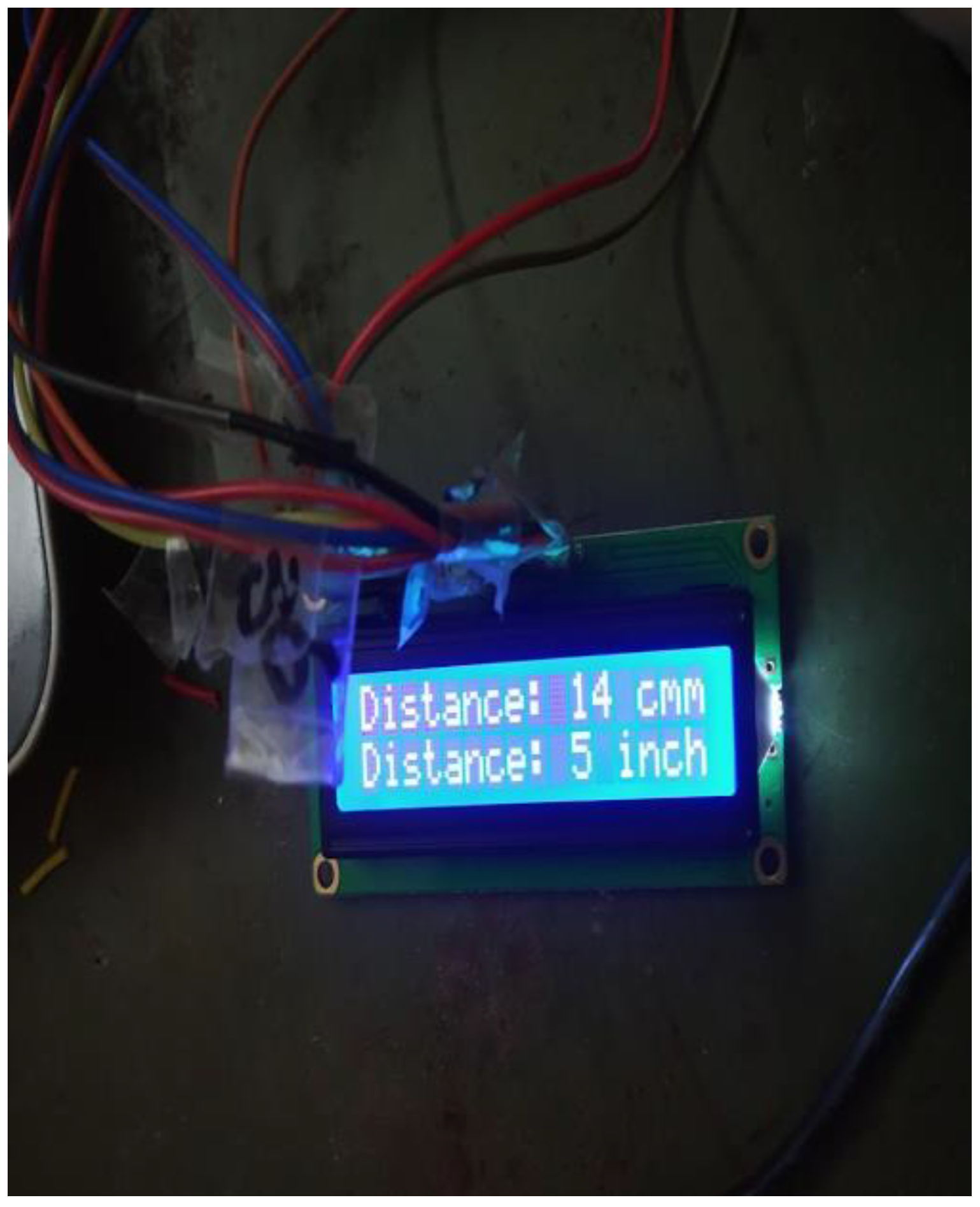
Figure 13 shows that the hardware component of the monitoring system is shown in working condition. It is inferred from Figure 14 that the monitoring system successfully manages to detect the distance between the bottom side of the lid of the bin and the garbage level of the container.
Figure 13. Implementation of the waste monitoring system.
Figure 14. Distance measuring sensor placed on the inner lid of smart bin.
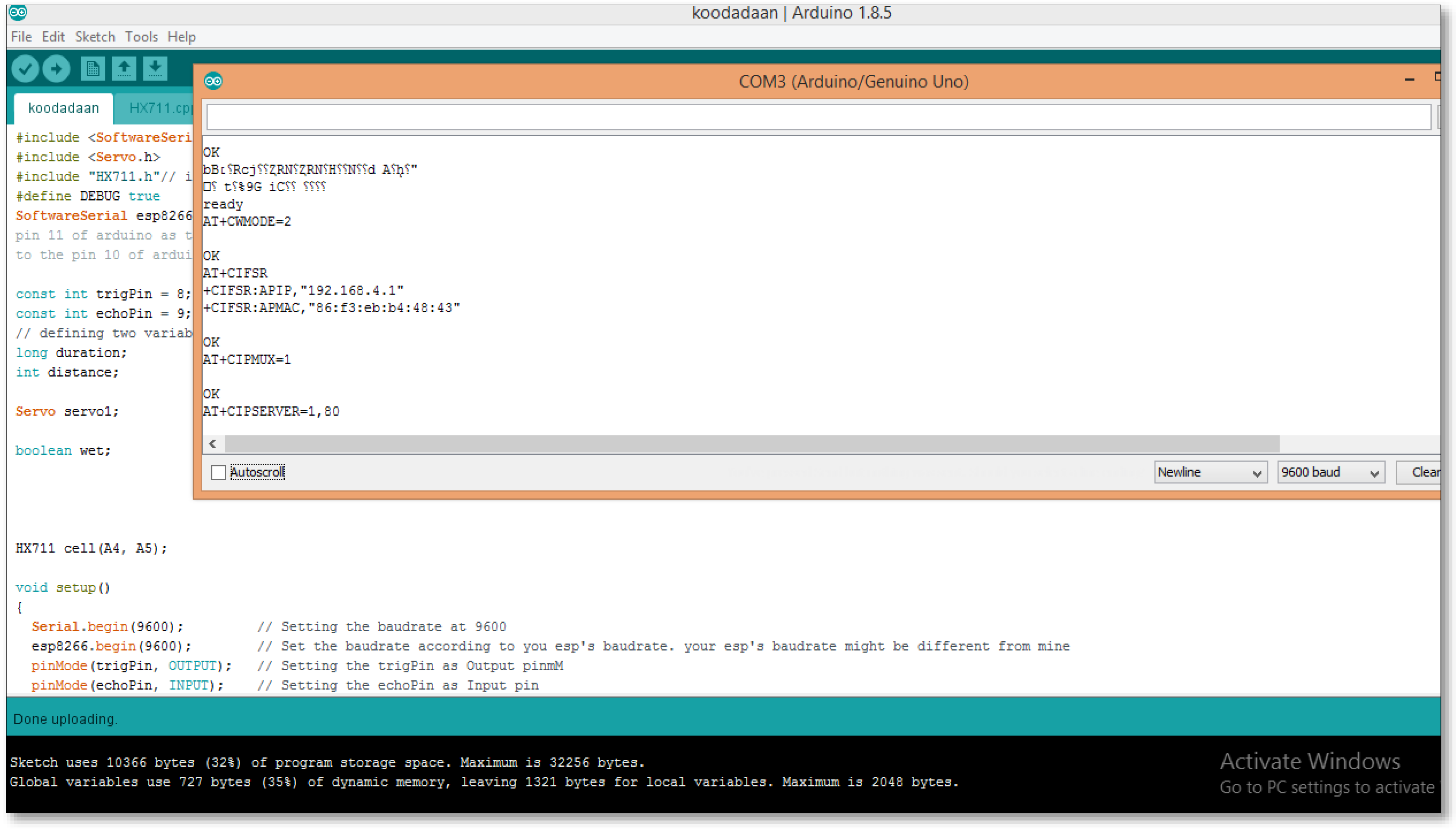
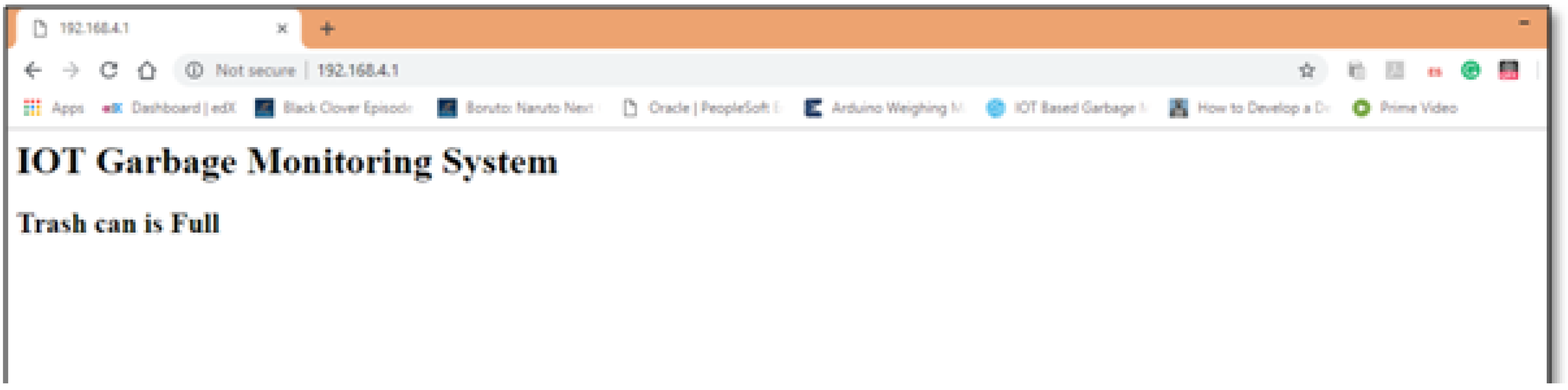
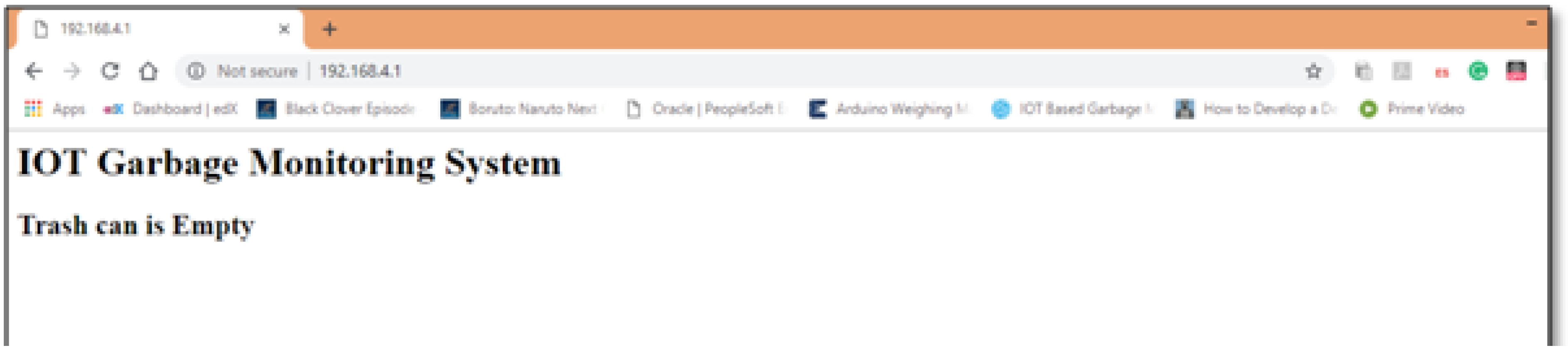
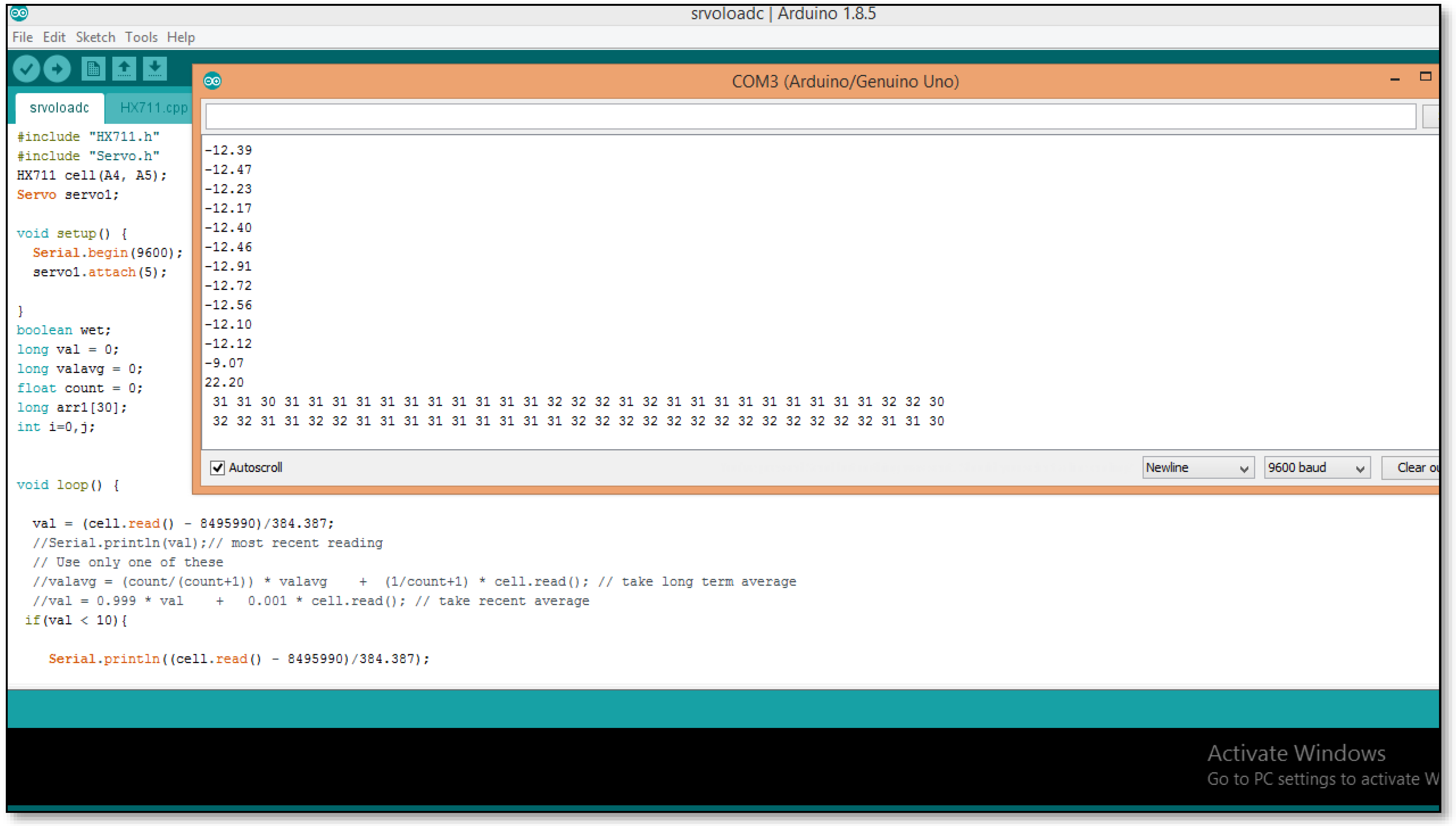
Figure 15 illustrates the successful build-up of code in our waste segregation system. Once initialized, the garbage is placed on top of the smart bin. Figure 16 shows that when metal objects are placed as waste on the smart bin, the servo motors rotate properly and segregate the waste, with the values being 32 g for the metal ball considered for demonstration. Figure 17 shows the waste segregation system displaying an alert “Trash can is full” on the webpage. Therefore, the bin has to be cleaned. Figure 18 shows the alert message “Trash is empty”, and the user can resume operations.
Figure 15. Build-up upon start of the system.
Figure 16. Weight detection for waste segregation.
Figure 17. Monitoring system output (in this case, the bin is full, the output is complete).
Figure 18. Monitoring system output (in this case, the bin is empty, the output is empty).
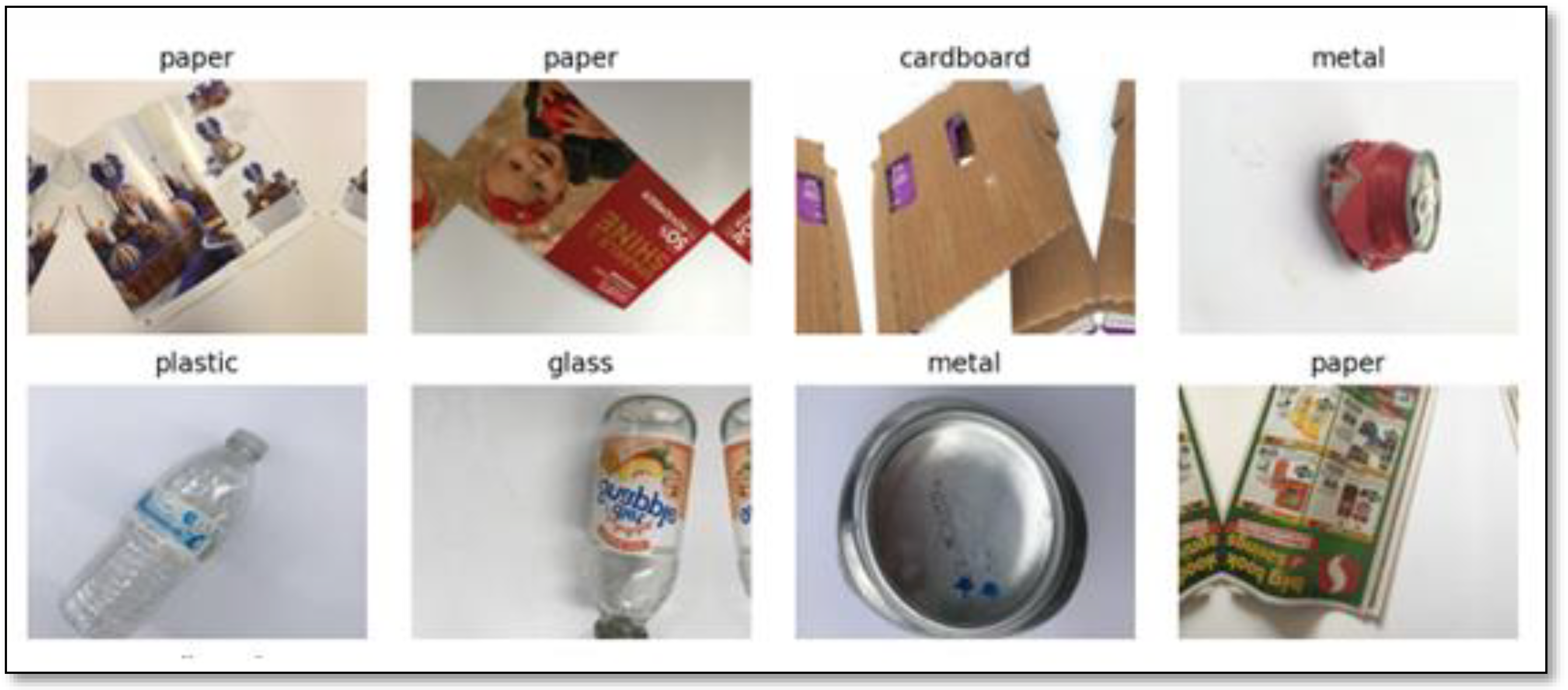
A fuzzy inference system with GA is integrated for image classification. This classification distinguishes between recyclable and non-recyclable garbage waste. Figure 19 illustrates the different kinds of waste that have been appropriately marked and recognized by the classifier.
Figure 19. Classification of all the waste particles.
Table 7 shows the experimental analysis of waste in a smart bin at various levels. The sensor placed in the inner side of the lid measures the distance of the trash in the container to determine whether it is empty or full. An alert is generated when the bin is nearly full, i.e., 2 cm from the distance of the inner lid to the container.
Table 7. Experimental analysis of waste in smart bin.
Table 8 shows the proposed model’s performance on various states of the smart bin, such as empty, partial, and full. Overall accuracy, precision, and recall of 95.44%, 96.68%, and 93.96% are obtained when combining the results of all classes. Table 9 shows the confusion matrix of the proposed model. The ability to identify paper, metal, and plastic is significantly higher in comparison to cardboard and glass. This is due to specific pixels containing white spots that were unnoticed during the prediction of the final result.
Table 8. Performance metrics of the proposed model on the various states of the smart bin.
Table 9. Confusion matrix of different waste element segregation using proposed model.

4.2. Discussion

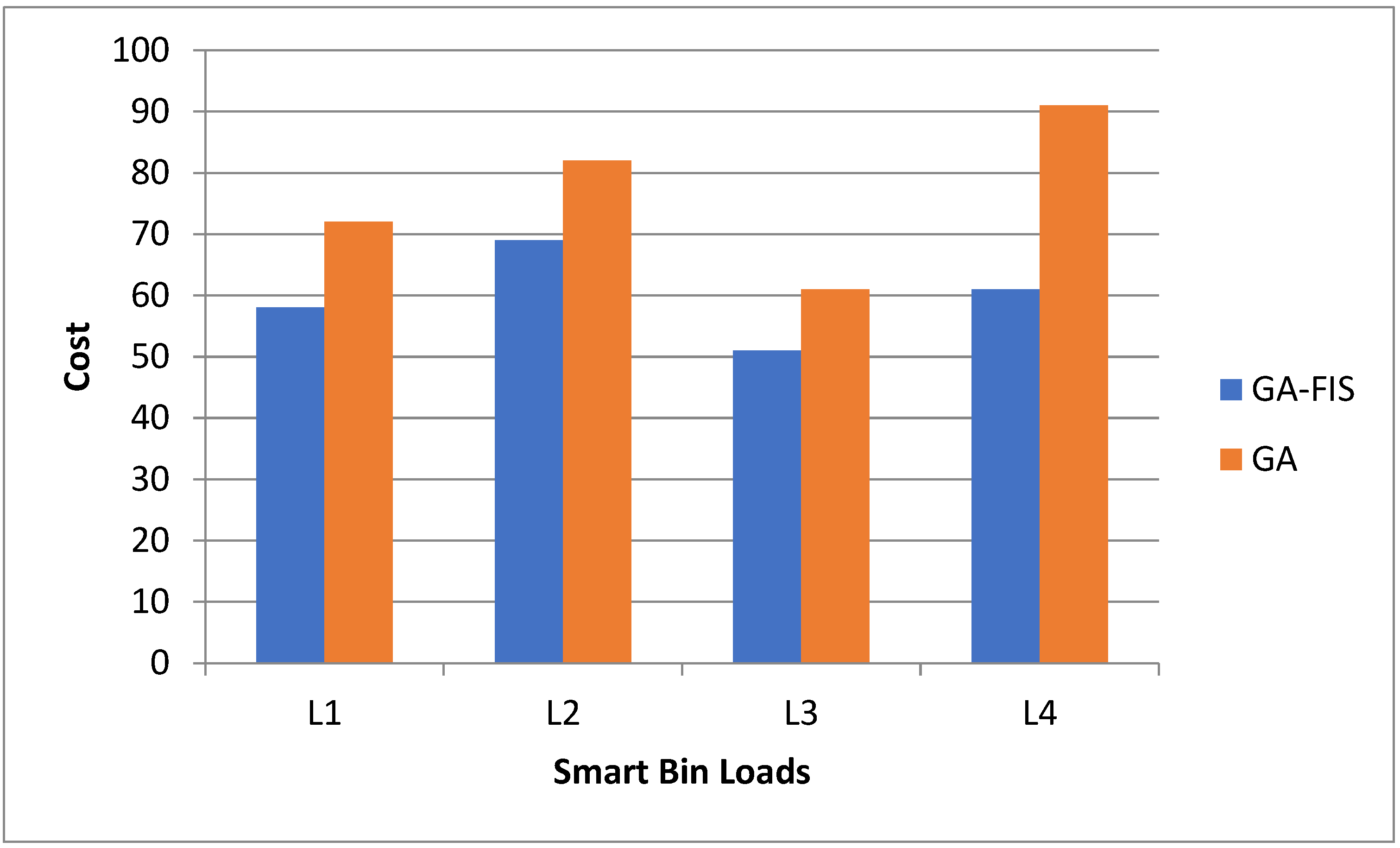
The comparison of least cost obtained by the GA-FIS with GA for the four different sets of smart bin loads is shown in Figure 20. The efficiency of GA-FIS over GA is measured in terms of percentage of cost lessened concerning four smart bin loads.
Figure 20. Performance analysis of GA-FIS with GA.
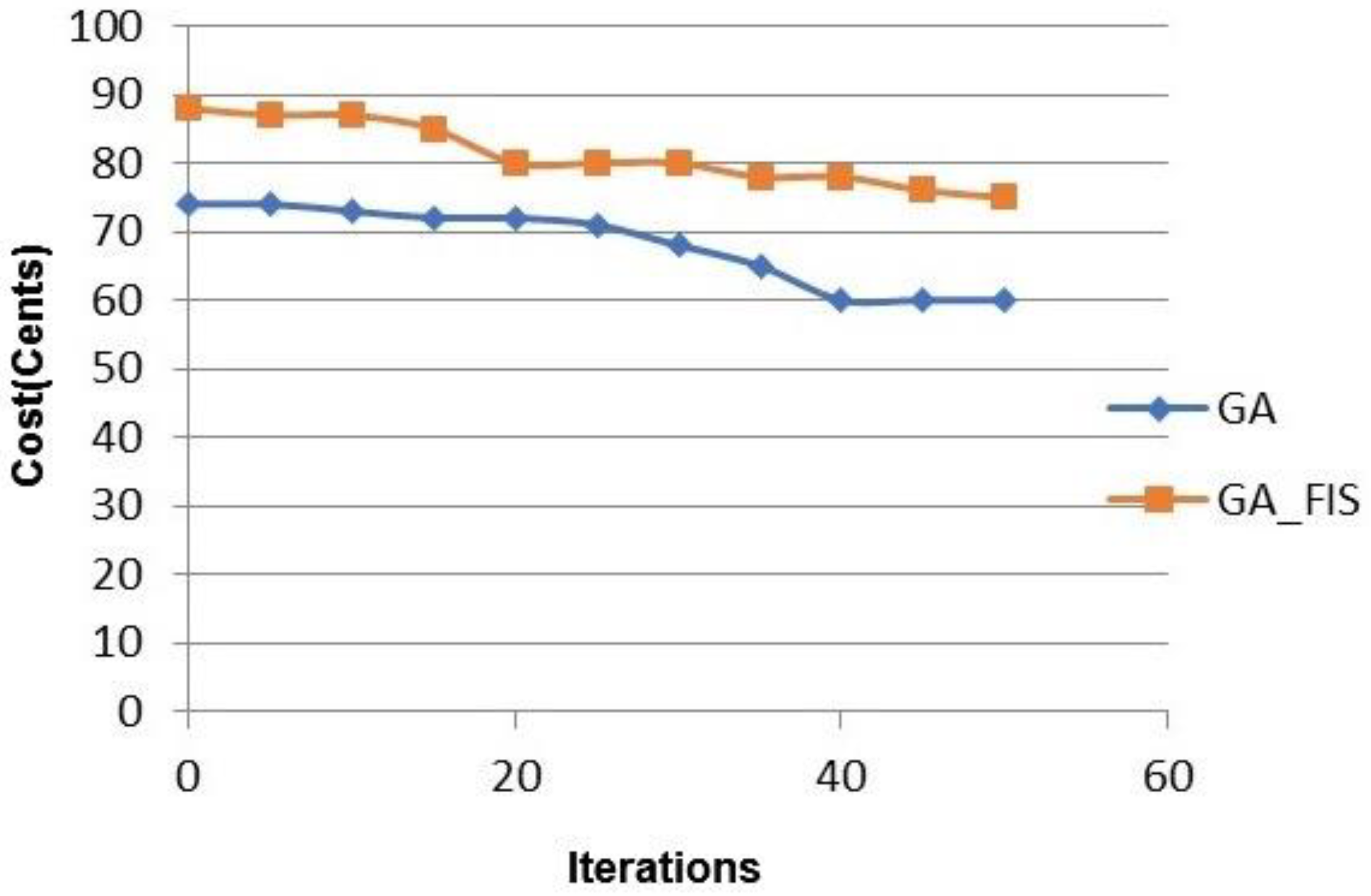
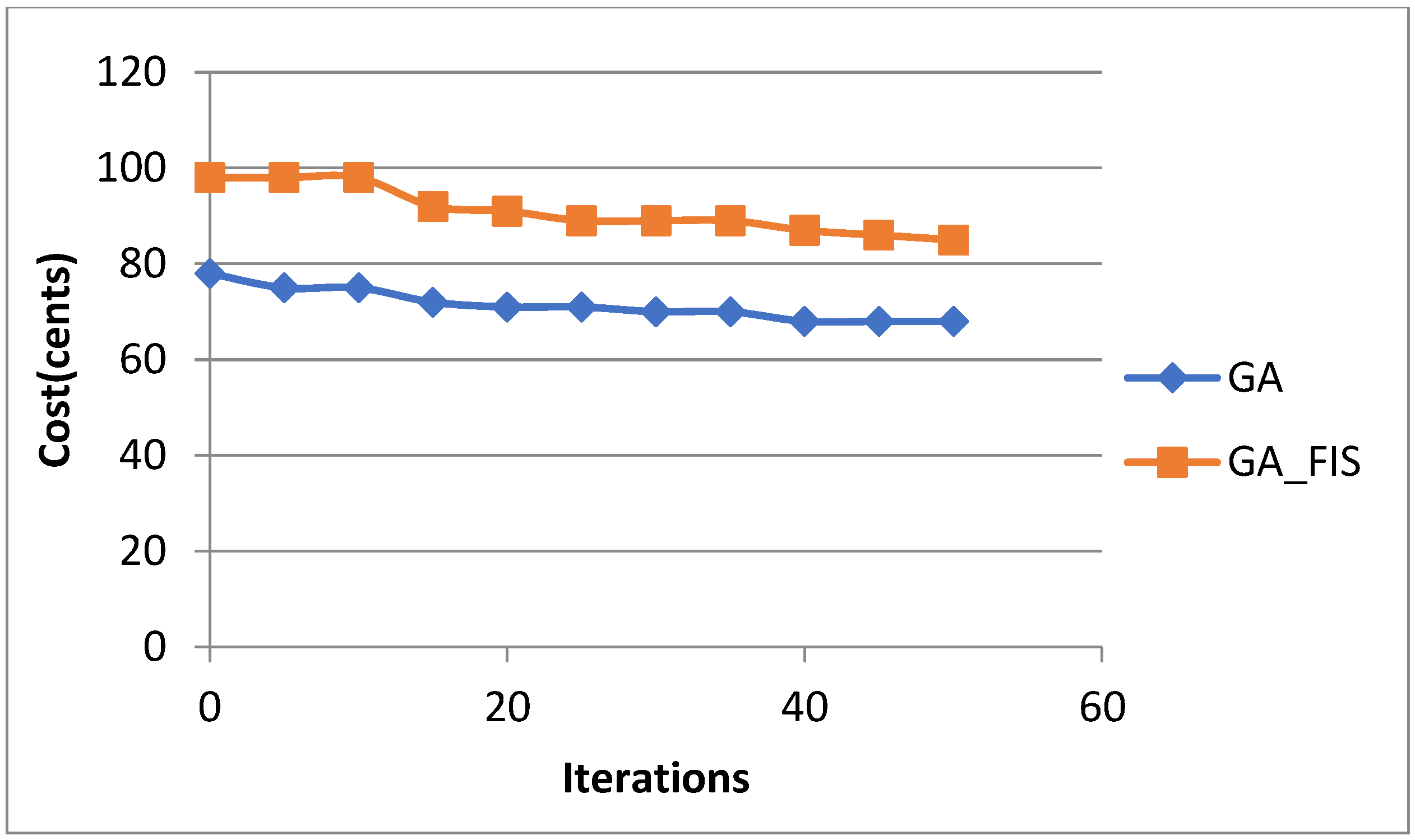
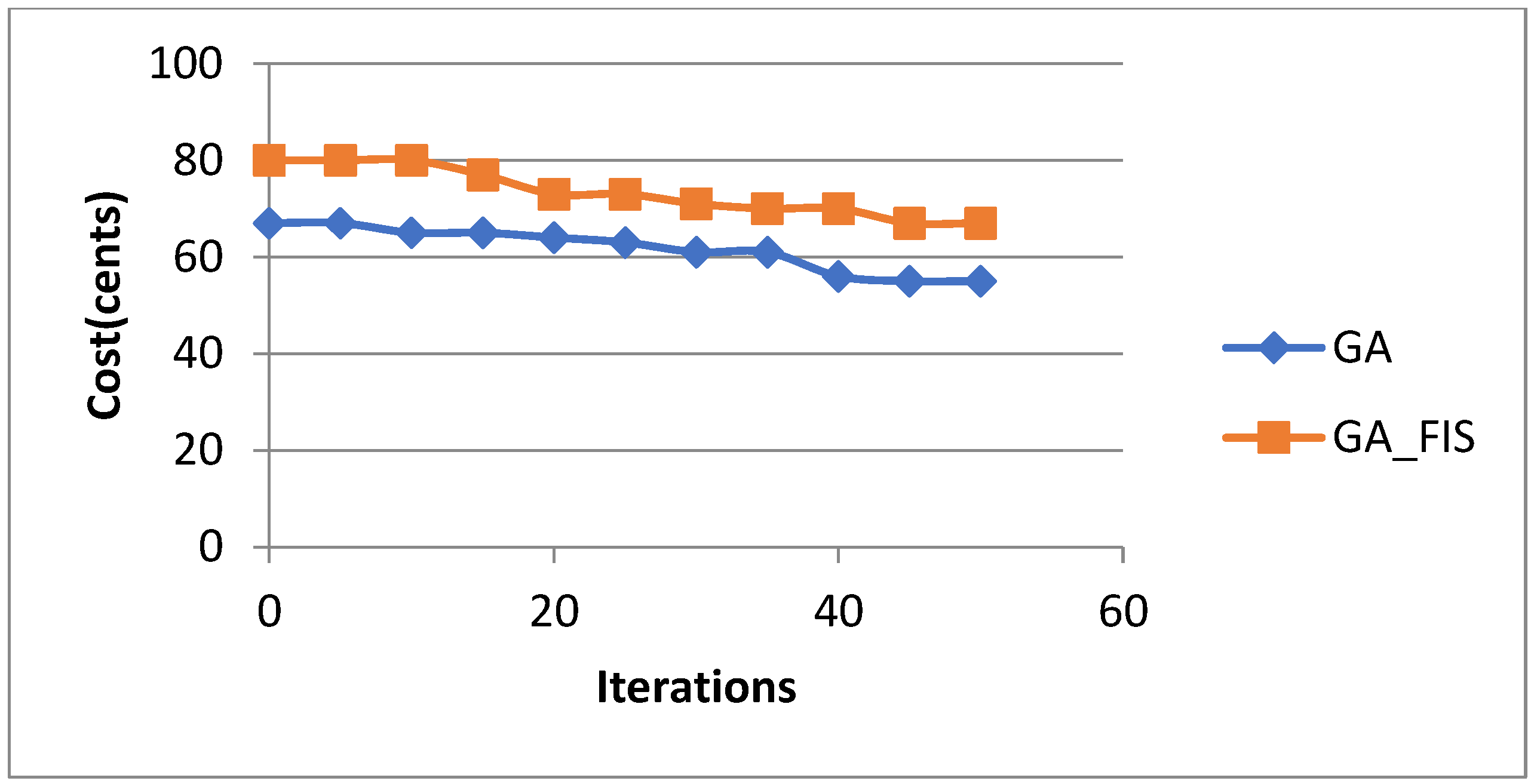
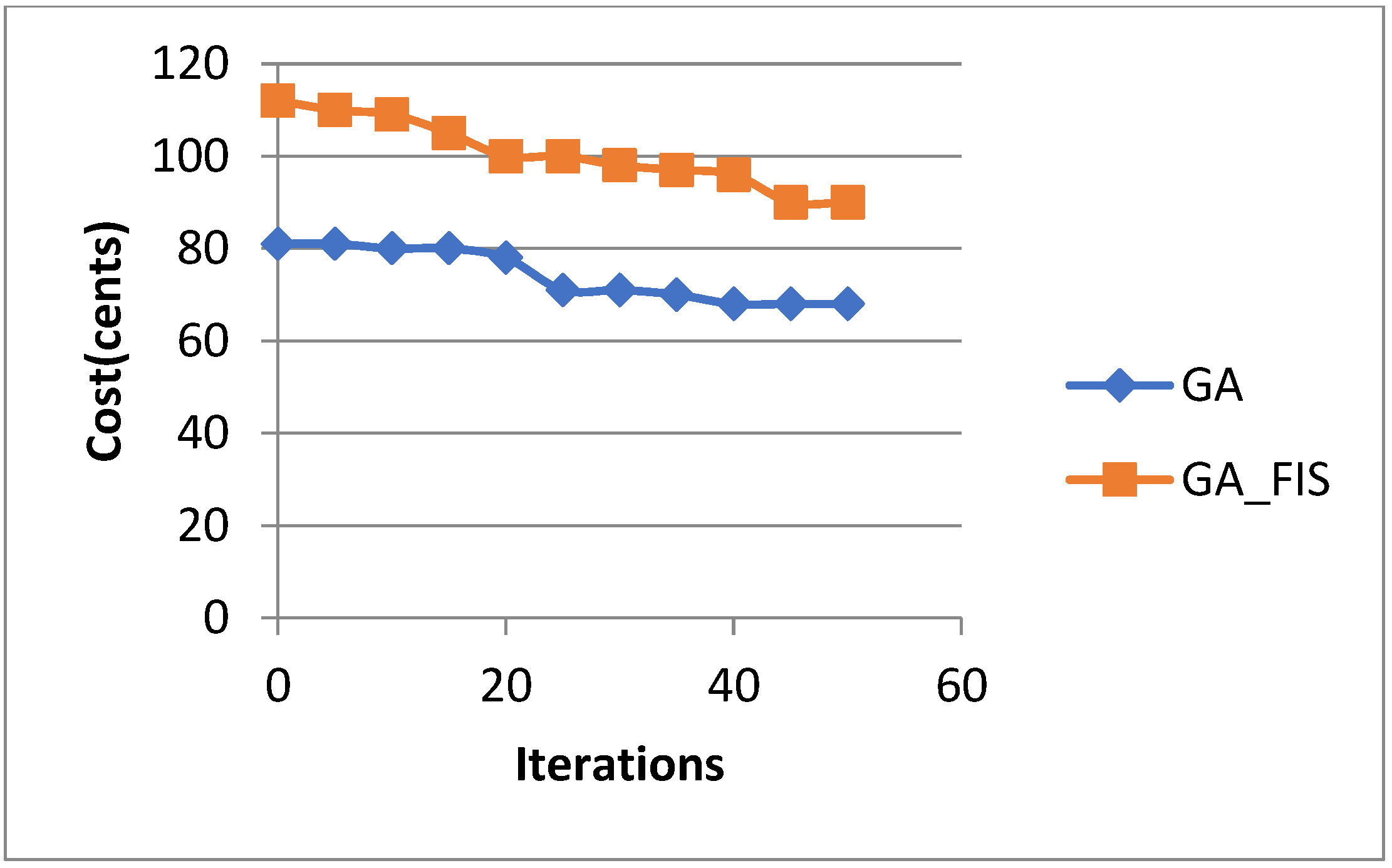
It is evident from Figure 21, Figure 22, Figure 23 and Figure 24 that GA-FIS has significant cost benefits because of the better fitness evolution for each of the smart loads one to four.
Figure 21. Fitness evolution graphs of GA_FIS and GA for smart load 1.
Figure 22. Fitness evolution graphs of GA_FIS and GA for smart load 2.
Figure 23. Fitness evolution graphs of GA_FIS and GA for smart load 3.
Figure 24. Fitness evolution graphs of GA_FIS and GA for smart load 4.
Table 10 shows the proposed GA-FIS model for waste management categorizing the various waste materials under recyclable and others. This improves the efficiency of our proposed approach.
Table 10. Categorization of waste materials using the proposed GA-FIS.
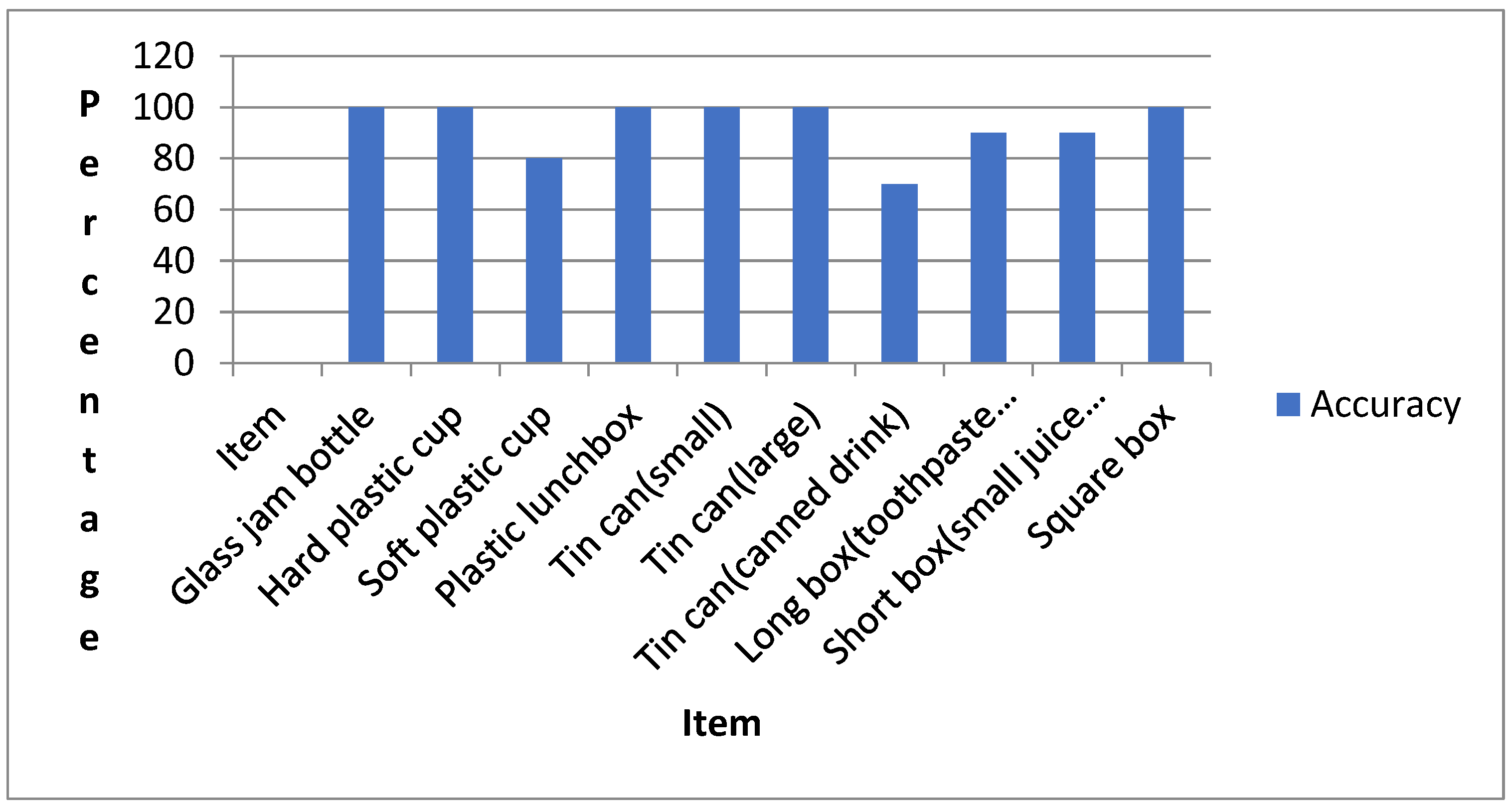
Figure 25 illustrates the accuracy results of various recyclable items in percentage. It is inferred that most of the items are classified successfully in the proposed system. However, a few items are incorrectly classified, such as soft plastic cups, long boxes, and small boxes, with accuracy rates of 80, 90, and 90 percent, respectively. The reason for the low accuracy is that the minimal weight is not counted by the weight sensor; however, when the item is placed, the pressure weight is recorded.
Figure 25. Classification test accuracy of the recyclable items.
Table 11 shows the proposed model compared with existing smart garbage systems that have deployed machine learning classifiers and deep learning techniques as documented in the literature. It is inferred that the intelligent GA-FIS model is superior in terms of accuracy, precision, and recall, as the integration of GA with FIS results in optimal accuracy by determining the best chromosomes for prediction. The GA-FIS learning and prediction times were 3 and 10 s, respectively, while those times were 223 and 345 s for the GA. Therefore, in the proposed work GA-FIS performs better, as it is widely suited for dynamic environments.
Table 11. Comparison of the proposed model with existing smart garbage systems.

5. Conclusions

This paper proposes an intelligent smart waste disposal system using GA-FIS. The system not only calculates whether the smart bin is full but also notifies the concerned people about the clearance of garbage from the bins. A Mamdani FIS is used for predicting the probability of waste to determine whether the smart bin is nearly full. The accuracy of the proposed model is 95.44%, as the integration of GA with FIS results in better fitness evolution. The derived metrics precision and recall are 96.68 and 93.96, respectively. The GA-FIS component is used to select the best rule for optimal decisionmaking and is also used for image classification of different types of waste. This system is mainly designed for outdoor use with cost-effective sensors. Categorizations of recyclable and non-recyclable items are performed to minimize resource waste. Performance analysis on other smart bin loads is conducted to compare traditional GA with the proposed GA-FIS, and it is evident that better fitness evolution results in reduced costs. The proposed algorithm performs better for a variety of reasons, ranging from waste collection, segregation, and reuse to waste recycling, as it truly improves the nation’s circular economy and also helps to improve the nation’s environmental and, as a result, sanitary conditions. A comparative analysis is performed with existing machine learning and deep hybrid models to show that the proposed model achieves superior accuracy, precision, and recall.

Author Contributions

Conceptualization, S.T.I.; Methodology, S.R.; Validation, V.M.; Writing—review and editing, A.B. All authors have read and agreed to the published version of the manuscript.

Funding

This research is funded by School of Information Technology and Engineering, Vellore Institute of Technology, Vellore-632014, Tamil Nadu, India.

Institutional Review Board Statement

Not applicable.

Conflicts of Interest

The authors state that there is no conflict of interest.

Abbreviations

ANNArtificial neural network
CNNConvolutional neural network
FISFuzzy inference system
GAGenetic algorithm
IoTInternet of Things
IFISIntelligent fuzzy inference system
MLPMulti-layer perceptron
SGSSmart garbage system

Appendix A

Algorithm A1. Pseudocode of GA block.
//block for parent selection
Determine the fitness aggregate
Place the chromosomes based on the fitness aggregate on the fitness scale
Loop
Place the indication on the fitness scale; Pick the chromosome on the fitness scale
Position the chromosome on the pool_mating
Until the pool_mating is full
Randomly create pair among chromosome in the pool_mating
For each pair of chromosomes [i, j] in the pool_mating
For each utilization,
Create a Uniform random number u €[0, 1]
If (u > 0.5)
Duplicate the genes from chromosome i for applicationkand place the selected genes into offspring_1
Duplicate the genes from chromosome j for applicationkand place the selected genes into offspring_2
Else
Replica the genes from chromosome j for applicationkand fill those genes into offspring_1
Replica the genes from chromosome i for applicationkand fill those genes into offspring_2
End if
    End For
  End For
Algorithm A2. Pseudocode of GA block continued.
Randomly apply the mutation operation in the pool_offspring based on the probability of mutation
For each utilisation i
    For each chromosome j in the pool_offspring
Get the chromosome fitness for ‘j’ and the utilisation cost ‘i
Trigger the rules after fuzzification of input values
Calculate the utilization ‘i’ usefulness in
chromosome j based on the rules
Defuzzify the output value
         End for
Calculate the usefulness of utilization i over all the chromosome in pool_offspring and store
End for
For each utilization i
Determine the usefulness for the utilization i using IFIS
     End for
Identify the most useful genes over all the chromosomes in the pool_offspring
Store the current most useful genes as new_genes along with their usefulness
Update the genes usefulness in the gene_pool
Update the gene_pool with the most useful genes found over the new_genes and the existing gene_pool, along their usefulness
Mask all the genes of each appliance in all chromosome of the offspring_pool
For each gene pattern i in the pool_gene
Randomly select chromosome j in the pool_offspring, with bits masked for the gene pattern i
Insert the gene pattern i from the pool_gene into the chromosome j
Reveal the respective bits of chromosome j in the pool_offspring
End for
End

References

  1. Lazarescu, M.T. Design of a WSN platform for long-term environmental monitoring for IoT applications. IEEE J. Emerg. Sel. Top. Circuits Syst. 2013, 3, 45–54. [Google Scholar] [CrossRef]
  2. Kelly, S.D.T.; Suryadevara, N.K.; Mukhopadhyay, S.C. Towards the implementation of IoT for environmental condition monitoring in homes. IEEE Sens. J. 2013, 13, 3846–3853. [Google Scholar] [CrossRef]
  3. Jara, A.J.; Zamora, M.A.; Skarmeta, A.F. An internet of things–based personal device for diabetes therapy management in ambient assisted living (AAL). Pers. Ubiquitous Comput. 2011, 15, 431–440. [Google Scholar] [CrossRef]
  4. Foschini, L.; Taleb, T.; Corradi, A.; Bottazzi, D. M2M-based metropolitan platform for IMS-enabled road traffic management in IoT. IEEE Commun. Mag. 2011, 49, 50–57. [Google Scholar] [CrossRef]
  5. Gama, K.; Touseau, L.; Donsez, D. Combining heterogeneous service technologies for building an Internet of Things middleware. Comput. Commun. 2012, 35, 405–417. [Google Scholar] [CrossRef]
  6. Tozlu, S.; Senel, M.; Mao, W.; Keshavarzian, A. Wi-Fi enabled sensors for the internet of things: A practical approach. IEEE Commun. Mag. 2012, 50, 134–143. [Google Scholar] [CrossRef]
  7. Li, X.; Lu, R.; Liang, X.; Shen, X.; Chen, J.; Lin, X. Smart community: An internet of things application. IEEE Commun. Mag. 2011, 49, 68–75. [Google Scholar] [CrossRef]
  8. Nielsen, I.; Lim, M.; Nielsen, P. Optimizing supply chain waste management through the use of RFID technology. In Proceedings of the 2010 IEEE International Conference on RFID-Technology and Applications, Guangzhou, China, 17–19 June 2010; pp. 296–301. [Google Scholar]
  9. Zhang, L.; Atkins, A.; Yu, H. Knowledge management application of the internet of things in construction waste logistics with RFID technology. Int. J. Comput. Sci. Commun. Technol. 2012, 5, 760–767. [Google Scholar]
  10. Chowdhury, B.; Chowdhury, M.U. RFID-based realtime smart waste management system. In Proceedings of the 2007 Australasian Telecommunication Networks and Applications Conference, Christchurch, New Zealand, 2–5 December 2007; pp. 175–180. [Google Scholar]
  11. Hannan, M.A.; Arebey, M.; Begum, R.A.; Basri, H. Radio Frequency Identification (RFID) and communication technologies for solid waste bin and truck monitoring system. Waste Manag. 2011, 31, 2406–2413. [Google Scholar] [CrossRef]
  12. Liu, H.; Yao, Z.; Chang, F.; Meijer, S. An RFID-based medical waste transportation management system: Assessment of a new model on a hospital in China. Fresenius Environ. Bull. 2020, 29, 773–784. [Google Scholar]
  13. Caferra, R.; D’Adamo, I.; Morone, P. Wasting energy or energizing waste? The public acceptance of waste-to-energy technology. Energy 2023, 263, 126123. [Google Scholar] [CrossRef]
  14. Salehi-Amiri, A.; Akbapour, N.; Hajiaghaei-Keshteli, M.; Gajpal, Y.; Jabbarzadeh, A. Designing an effective two-stage, sustainable, and IoT based waste management system. Renew. Sustain. Energy Rev. 2022, 157, 112031. [Google Scholar] [CrossRef]
  15. Akhtar, M.; Hannan, M.; Begum, R.; Basri, H.; Scavino, E. Backtracking search algorithm in CVRP models for efficient solid waste collection and route optimization. Waste Manag. 2017, 61, 117–128. [Google Scholar] [CrossRef]
  16. Ruiz, V.; Sánchez, Á.; Vélez, J.F.; Raducanu, B. Automatic image-based waste classification. In Proceedings of the International Work-Conference on the Interplay between Natural and Artificial Computation, Almería, Spain, 3–7 June 2019; pp. 422–431. [Google Scholar]
  17. Saha, H.N.; Auddy, S.; Pal, S.; Kumar, S.; Pandey, S.; Singh, R.; Singh, S.K.; Banerjee, S.; Ghosh, D.; Saha, S. Waste management using the Internet of Things (IoT). In Proceedings of the 2017 8th Annual Industrial Automation and Electromechanical Engineering Conference (IEMECON), Bangkok, Thailand, 16–18 August 2017; pp. 359–363. [Google Scholar]
  18. Swachhbharatmission. Available online: https://swachhbharatmission.gov.in/sbmcms/index.htm (accessed on 1 November 2017).
  19. Putri, S.N. Application of Fuzzy Inference System Mamdani at Pelican Crossing. In Proceedings of the International Conference on Rehabilitation and Maintenance in Civil Engineering, Surakarta, Indonesia, 8–9 July 2021; Springer: Singapore, 2023; pp. 681–691. [Google Scholar]
  20. Matousek, R.; Osmera, P.; Roupec, J. GA with fuzzy inference system. In Proceedings of the 2000 Congress on Evolutionary Computation, La Jolla, CA, USA, 16–19 July 2000; CEC00 (Cat. No. 00TH8512). Volume 1, pp. 646–651. [Google Scholar]
  21. Wang, C.; Qin, J.; Qu, C.; Ran, X.; Liu, C.; Chen, B. A smart municipal waste management system based on deep-learning and Internet of Things. Waste Manag. 2021, 135, 20–29. [Google Scholar] [CrossRef]
  22. Marques, P.; Manfroi, D.; Deitos, E.; Cegoni, J.; Castilhos, R.; Rochol, J.; Pignaton, E.; Kunst, R. An IoT-based smart cities infrastructure architecture applied to a waste management scenario. Ad Hoc Netw. 2019, 87, 200–208. [Google Scholar] [CrossRef]
  23. Bano, A.; Ud Din, I.; Al-Huqail, A.A. AIoT-based smart bin for real-time monitoring and management of solid waste. Sci. Program. 2020, 2020, 6613263. [Google Scholar] [CrossRef]
  24. Mishra, A.R.; Rani, P.; Saha, A.; Hezam, I.M.; Pamucar, D.; Marinović, M.; Pandey, K. Assessing the Adaptation of Internet of Things (IoT) Barriers for Smart Cities’ Waste Management Using Fermatean Fuzzy Combined Compromise Solution Approach. IEEE Access 2022, 10, 37109–37130. [Google Scholar] [CrossRef]
  25. Younesi, A.; Fard, H.S.; Yengikand, A.B.; Pezeshki, V. Survey on IoT-based waste Management Systems. In Proceedings of the 2022 8th International Conference on Web Research (ICWR), Tehran, Iran, 11–12 May 2022; pp. 162–167. [Google Scholar]
  26. Kumar, N.S.; Vuayalakshmi, B.; Prarthana, R.J.; Shankar, A. IoT based smart garbage alert system using Arduino UNO. In Proceedings of the 2016 IEEE Region 10 Conference (TENCON), Singapore, 22–25 November 2016; pp. 1028–1034. [Google Scholar]
  27. Shaikh, B.; Pawade, P.; Jirapure, T.; Wanjari, K.; Wankhede, S. A Review: Multipurpose Garbage Monitoring System Using IoT. Int. J. Recent Innov. Trends Comput. Commun. 2017, 5, 252–255. [Google Scholar]
  28. Abdoli, M.A.; Nezhad, M.F.; Sede, R.S.; Behboudian, S. Longterm forecasting of solid waste generation by the artificial neural networks. Environ. Sustain. 2012, 31, 628–636. [Google Scholar] [CrossRef]
  29. Nabavi-Pelesaraei, A.; Bayat, R.; Hosseinzadeh-Bandbafha, H.; Afrasyabi, H.; Berrada, A. Prognostication of energy use and environmental impacts for recycle system of municipal solid waste management. J. Clean. Prod. 2017, 154, 602–613. [Google Scholar] [CrossRef]
  30. Shu, H.Y.; Lu, H.C.; Fan, H.J.; Chang, M.C.; Chen, J.C. Prediction for energy content of Taiwan municipal solid waste using multilayer perceptron neural networks. J. Air Waste Manag. Assoc. 2006, 56, 852–858. [Google Scholar] [CrossRef]
  31. Adamović, V.M.; Antanasijević, D.Z.; Ćosović, A.R.; Ristić, M.Đ.; Pocajt, V.V. An artificial neural network approach for the estimation of the primary production of energy from municipal solid waste and its application to the Balkan countries. Waste Manag. 2018, 78, 955–968. [Google Scholar] [CrossRef]
  32. Bircanoğlu, C.; Atay, M.; Beşer, F.; Genç, Ö.; Kızrak, M.A. RecycleNet: Intelligent Waste Sorting Using Deep Neural Networks. In Proceedings of the 2018 Innovations in Intelligent Systems and Applications (INISTA), Thessaloniki, Greece, 3–5 July 2018; pp. 1–7. [Google Scholar]
  33. Medvedev, A.; Fedchenkov, P.; Zaslavsky, A.; Anagnostopoulos, T.; Khoruzhnikov, S. Waste management as an IoT-enabled service in smart cities. In Proceedings of the Conference on Smart Spaces, St. Petersburg, Russia, 26–28 August 2015; Springer: Cham, Switzerland, 2015; pp. 104–115. [Google Scholar]
  34. Kang, K.D.; Kang, H.; Ilankoon IM, S.K.; Chong, C.Y. Electronic waste collection systems using the Internet of Things (IoT): Household electronic waste management in Malaysia. J. Clean. Prod. 2020, 252, 119801. [Google Scholar] [CrossRef]
  35. Aleyadeh, S.; Taha, A.E.M. An IoT-Based Architecture for Waste Management. In Proceedings of the 2018 IEEE International Conference on Communications Workshops (ICC Workshops), Kansas City, MO, USA, 20–24 May 2018. [Google Scholar]
  36. Srinilta, C.; Kanharattanachai, S. Municipal Solid Waste Segregation with CNN. In Proceedings of the 2019 5th International Conference on Engineering, Applied Sciences and Technology (ICEAST), Luang Prabang, Laos, 2–5 July 2019; pp. 1–4. [Google Scholar]
  37. Frost, S.; Tor, B.; Agrawal, R.; Forbes, A.G. CompostNet: An Image Classifier for Meal Waste. In Proceedings of the 2019 IEEE Global Humanitarian Technology Conference (GHTC), Seattle, WA, USA, 17–20 October 2019; pp. 1–4. [Google Scholar]
  38. Zhou, Y.; Lian, J.; Han, M. Remote sensing image transfer classification based on weighted extreme learning machine. IEEE Geosci. Remote Sens. Lett. 2016, 13, 1405–1409. [Google Scholar] [CrossRef]
  39. Chu, Y.; Huang, C.; Xie, X.; Tan, B.; Kamal, S.; Xiong, X. Multilayer hybrid deep-learning method for waste classification and recycling. Comput. Neurosci. 2018, 2018, 5060857. [Google Scholar] [CrossRef]
  40. Lanorte, A.; De Santis, F.; Nolè, G.; Blanco, I.; Loisi, R.V.; Schettini, E.; Vox, G. Agricultural plastic waste spatial estimation by Landsat 8 satellite images. Comput. Electron. Agric. 2017, 141, 35–45. [Google Scholar] [CrossRef]
  41. Zhang, A.; Zhuang, P.; Shi, Y.; Zhao, D. Design of Intelligent Classification Waste Bin with Detection Technology in Fog and Haze Weather. In Proceedings of the International Conference in Communications, Signal Processing, and Systems, Urumqi, China, 20–22 July 2019; Springer: Singapore, 2019; pp. 1241–1249. [Google Scholar]
  42. Xiao, W.; Yang, J.; Fang, H.; Zhuang, J.; Ku, Y. A robust classification algorithm for separation of construction waste using NIR hyperspectralsystem. Waste Manag. 2019, 90, 1–9. [Google Scholar] [CrossRef]
  43. Rahmad, M.A.; Midi, N.S.; Zaini, S.A.; Yusoff, S.H.; Mohamad, S.Y. Material Classification of Recyclable Waste using the Weight and Size of Waste. In Proceedings of the 2018 IEEE 7th International Conference on Computer and Communication Engineering (ICCCE), Kuala Lumpur, Malaysia, 19–20 September 2018; pp. 44–49. [Google Scholar]
  44. Supasan, N.A.I.; Kaushalya, W.A.L.U.; Maduwantha, S.M.D.P.; Yasiru, M.G.A.; Wijenayake, S.J.K.; Kulathilake, K.A.S.H.; Kohomban, U. Self-controlled Robot for Collection of Light Weight Waste in a Ground Area. In Proceedings of the 2018 IEEE International Conference on Information and Automation for Sustainability (ICIAfS), Colombo, Sri Lanka, 21–22 December 2018; pp. 1–6. [Google Scholar]
  45. Thakur, V.; Ramesh, A. Analyzing composition and generation rates of biomedical waste in selected hospitals of Uttarakhand, India. J. Mater. Cycles Waste Manag. 2018, 20, 877–890. [Google Scholar] [CrossRef]
  46. Achuthan, A.; Madangopal, V.A. A Bio-Medical Waste Identification and Classification Algorithm Using Mltrp and Rvm. Iran. J. Public Health 2016, 45, 1276–1287. [Google Scholar] [PubMed]
  47. Sohag, M.U.; Podder, A.K. Smart Garbage Management System for a Sustainable Urban Life: An IoT Based Application. Internet Things 2020, 11, 100255. [Google Scholar] [CrossRef]
  48. Raaju, V.A.; Meeran, J.M.; Sasidharan, M.; Premkumar, M.K. IoT Based Smart Garbage Monitoring System Using ZigBee. In Proceedings of the 2019 IEEE International Conference on System, Computation, Automation and Networking (ICSCAN), Pondicherry, India, 29–30 March 2019; pp. 1–7. [Google Scholar]
  49. Memon, S.K.; Shaikh, F.K.; Mahoto, N.A.; Memon, A.A. IoT based smart garbage monitoring & collection system using WeMos & Ultrasonic sensors. In Proceedings of the 2019 IEEE 2nd International Conference on Computing, Mathematics and Engineering Technologies (iCoMET), Sukkur, Pakistan, 30–31 January 2019; pp. 1–6. [Google Scholar]
  50. Sangaiah, A.K.; Dhanaraj, J.S.A.; Mohandas, P.; Castiglione, A. Cognitive IoT system with intelligence techniques in sustainable computing environment. Comput. Commun. 2020, 154, 347–360. [Google Scholar] [CrossRef]
  51. Sangaiah, A.K.; Hosseinabadi, A.A.R.; Shareh, M.B.; Bozorgi Rad, S.Y.; Zolfagharian, A.; Chilamkurti, N. IoT resource allocation and optimization based on heuristic algorithm. Sensors 2020, 20, 539. [Google Scholar] [CrossRef]
  52. Sangaiah, A.K.; Samuel, O.W.; Li, X.; Abdel-Basset, M.; Wang, H. Towards an efficient risk assessment in software projects–Fuzzy reinforcement paradigm. Comput. Electr. Eng. 2018, 71, 833–846. [Google Scholar] [CrossRef]
  53. Hussain, A.; Draz, U.; Ali, T.; Tariq, S.; Irfan, M.; Glowacz, A.; Antonino Daviu, J.A.; Yasin, S.; Rahman, S. Waste Management and Prediction of Air Pollutants Using IoT and Machine Learning Approach. Energies 2020, 13, 3930. [Google Scholar] [CrossRef]
  54. Colistra, G.; Pilloni, V.; Atzori, L. The problem of task allocation in the Internet of Things and the consensus-based approach. Comput. Netw. 2014, 73, 98–111. [Google Scholar] [CrossRef]
  55. Kim, S. Asymptotic shapley value based resource allocation scheme for IoT services. Comput. Netw. 2016, 100, 55–63. [Google Scholar] [CrossRef]
  56. Kim, M.; Ko, I.Y. An efficient resource allocation approach based on a genetic algorithm for composite services in IoT environments. In Proceedings of the 2015 IEEE International Conference on Web Services, New York, NY, USA, 27 June 2015–2 July 2015; pp. 543–550. [Google Scholar]
  57. Tsai, C.W. SEIRA: An effective algorithm for IoT resource allocation problem. Comput. Commun. 2018, 119, 156–166. [Google Scholar] [CrossRef]
  58. Hatti, D.I.; Sutagundar, A.V. Fuzzy based job classification and resource allocation in IoT. In Proceedings of the 2017 International Conference on Inventive Systems and Control (ICISC), Coimbatore, India, 19–20 January 2017; pp. 1–4. [Google Scholar]
  59. Matoušek, R.; Ošmera, P.; Roupec, J. GA-FIS for Dynamic Environment. In The State of the Art in Computational Intelligence, Proceedings of the European Symposium on Computational Intelligence, Košice, Slovakia, 30 August–1 September 2000; Physica-Verlag HD: Heidelberg, Germany, 2000; pp. 191–196. [Google Scholar]
  60. Kora, P.; Yadlapalli, P. Crossover operators in genetic algorithms: A review. Int. J. Comput. Appl. 2017, 162, 1–10. [Google Scholar] [CrossRef]
Disclaimer/Publisher’s Note: The statements, opinions and data contained in all publications are solely those of the individual author(s) and contributor(s) and not of MDPI and/or the editor(s). MDPI and/or the editor(s) disclaim responsibility for any injury to people or property resulting from any ideas, methods, instructions or products referred to in the content.

Article Metrics

Citations

Article Access Statistics

Multiple requests from the same IP address are counted as one view.