
Classification of Human Motion Data Based on Inertial Measurement Units in Sports: A Scoping Review

 ,
,  , , , , and
Abstract
1. Introduction
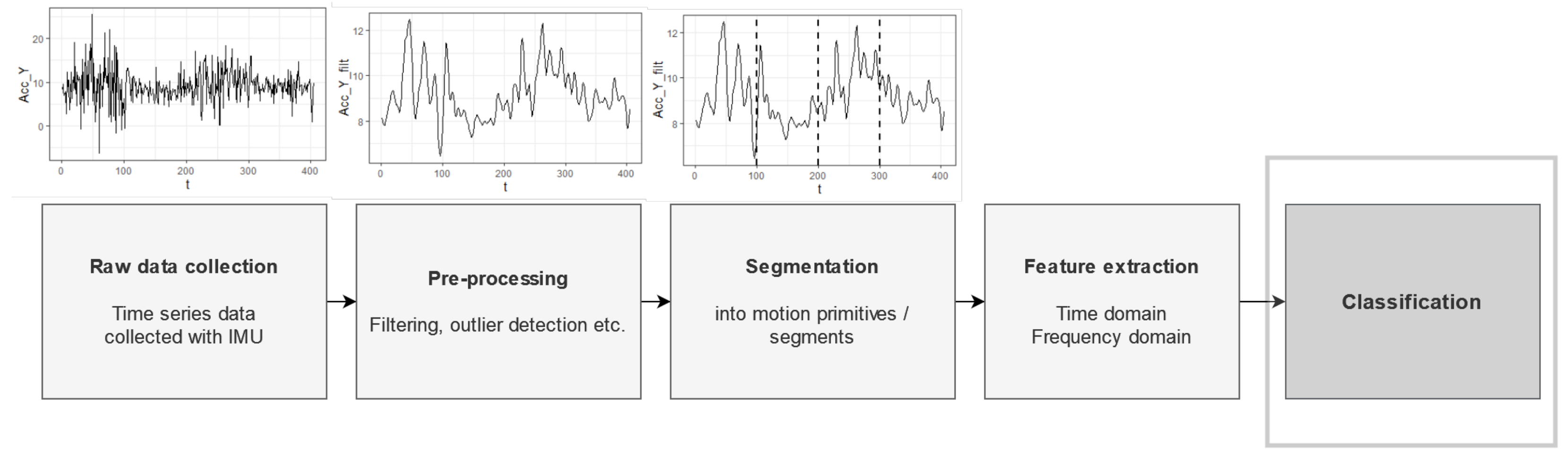
1.1. Data Bases, Key Words and Inclusion Criteria
- Data: Which data sources were used? How large was the sample size? Were resampling techniques/data augmentation techniques applied?
- Preparation: Was dimension reduction applied? How was the data set split into training and validation data?
- Methods: Which methods were used? Do these methods take into account dependencies between the segments/single movements?
- Validation: Which metrics were used for performance evaluation?
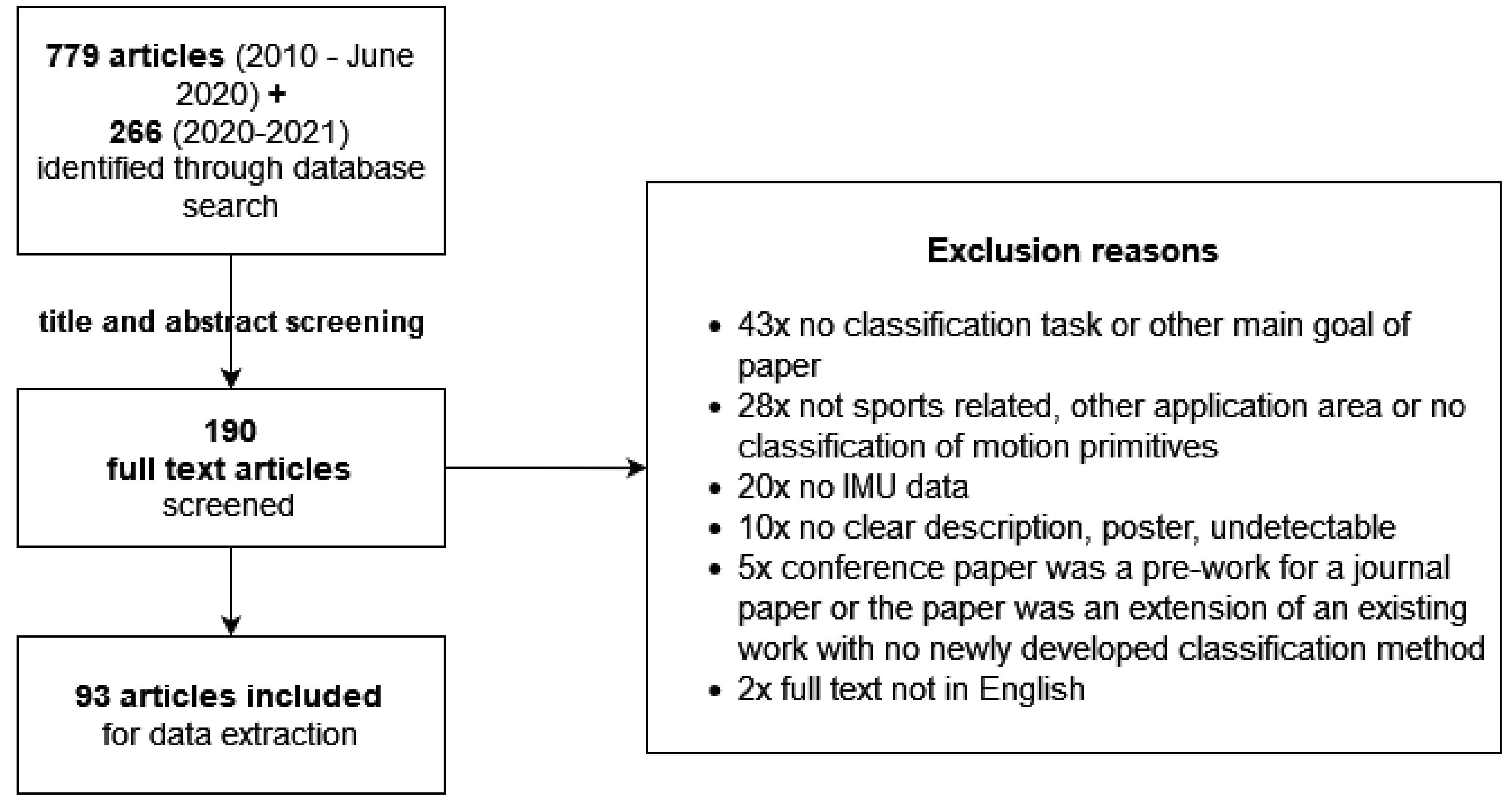
1.2. Study Selection
1.3. Data Items and Synthesis
2. Results
2.1. Data Sources and Sample
2.2. Preparation
2.3. Classification
2.3.1. Data Set Split
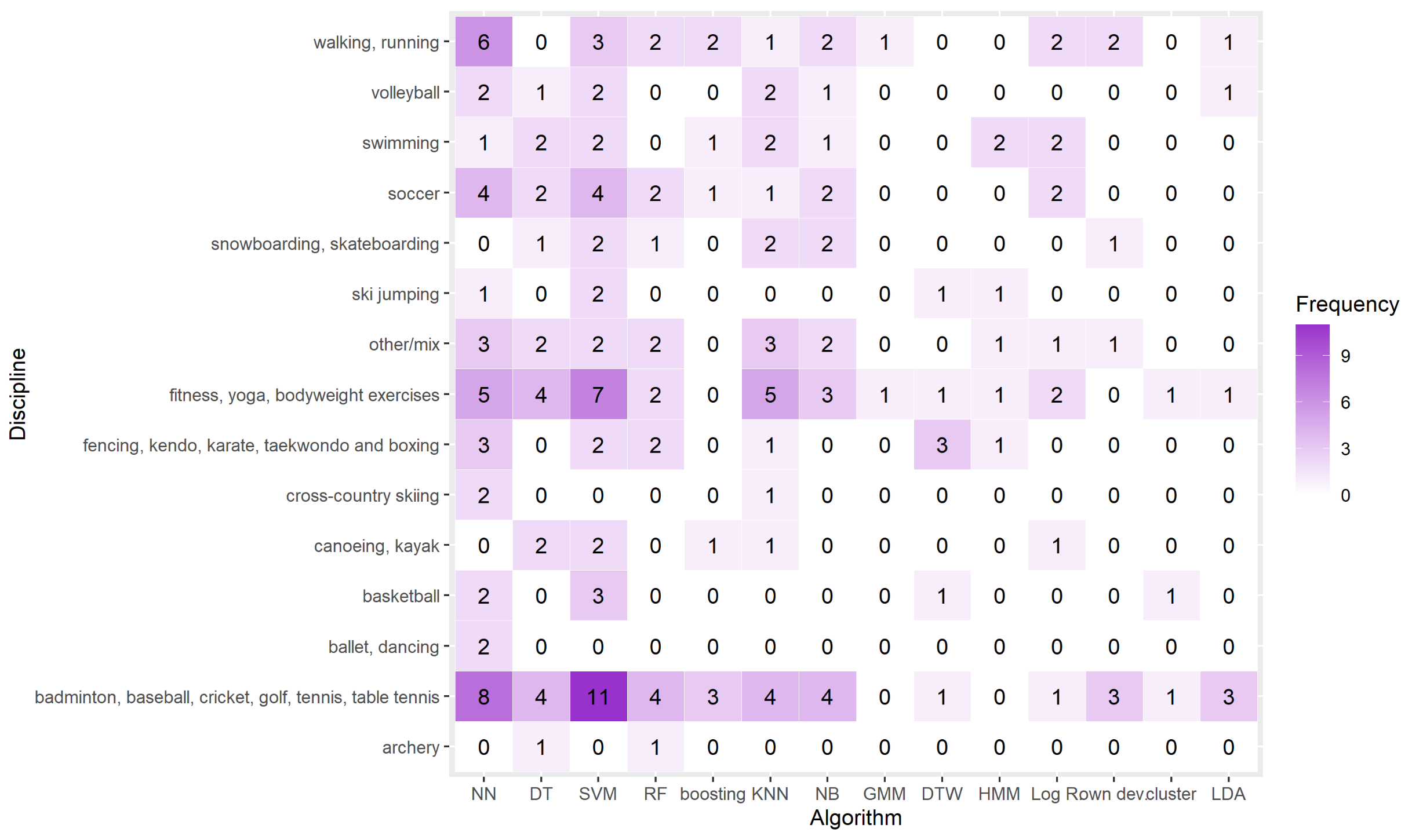
2.3.2. Classification Methods
2.3.3. Dependency Structure
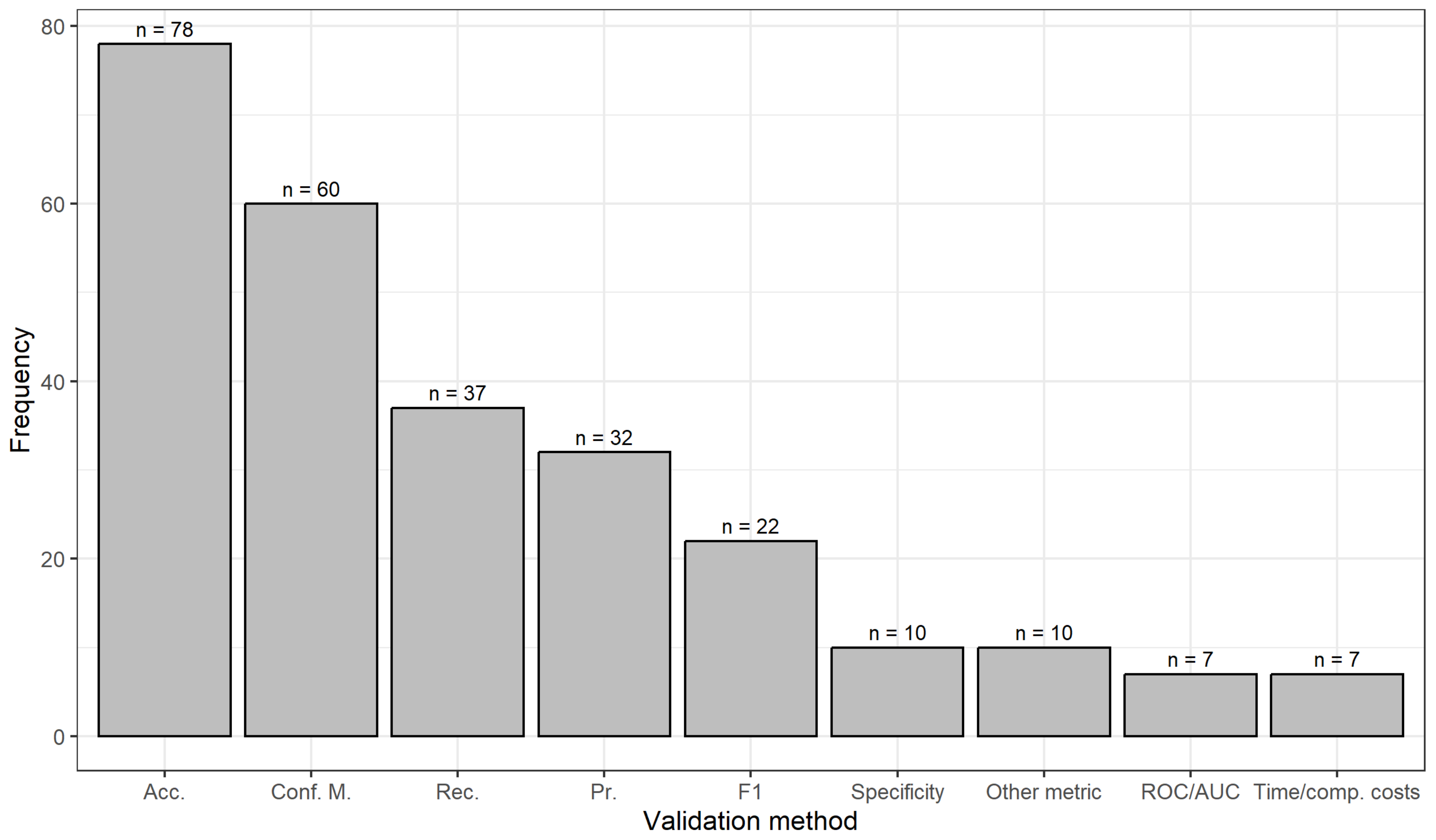
2.4. Validation
2.5. Classification Performance
3. Discussion
4. Conclusions
Author Contributions
Funding
Institutional Review Board Statement
Informed Consent Statement
Data Availability Statement
Conflicts of Interest
Appendix A. Detailed Results

| Ref. | NN | DT | SVM | RF | Boosting | KNN | NB | GMM | DTW | HMM | Log R. | Own Dev. | Cluster | LDA | Other/Details (incl. NN) |
|---|---|---|---|---|---|---|---|---|---|---|---|---|---|---|---|
| Classification of a motion primitive | |||||||||||||||
| [19] | x | ||||||||||||||
| [20] | x | x | x | radial basis function network | |||||||||||
| [21] | x | x | x | x | x | x | x | multilayer perceptron, | |||||||
| [22] | x | ||||||||||||||
| [23] | x | , | |||||||||||||
| [24] | x | ||||||||||||||
| [25] | x | ||||||||||||||
| [26] | x | ||||||||||||||
| [27] | x | longest common subsequence | |||||||||||||
| [28] | x | two-layer neural network | |||||||||||||
| [29] | x | x | learning vector quantisation | ||||||||||||
| [30] | x | ||||||||||||||
| [31] | x | ||||||||||||||
| [32] | x | x | x | ||||||||||||
| [33] | x | x | |||||||||||||
| [34] | x | ||||||||||||||
| [35] | x | ||||||||||||||
| [36] | x | x | x | x | |||||||||||
| [37] | motion template, DTW distance measure | ||||||||||||||
| [38] | x | CNN | |||||||||||||
| [39] | x | ||||||||||||||
| [40] | x | LSTM | |||||||||||||
| [41] | x | CNN | |||||||||||||
| [42] | x | ||||||||||||||
| [43] | x | Bayesian network classifier | |||||||||||||
| [44] | x | neural network binary classifiers, sequence mapping | |||||||||||||
| [45] | x | ||||||||||||||
| [46] | linear regression | ||||||||||||||
| [47] | x | x | x | ||||||||||||
| [48] | x | , LSTM, multilayer perceptron, and 2D CNNs | |||||||||||||
| [49] | x | ||||||||||||||
| [50] | x | ||||||||||||||
| [51] | x | x | |||||||||||||
| [52] | x | x | x | x | x | , Radial basis function neural network | |||||||||
| [53] | x | x | quadratic discriminant analysis | ||||||||||||
| [54] | x | NN | |||||||||||||
| [55] | x | CNN | |||||||||||||
| [56] | x | ||||||||||||||
| [57] | x | LSTM | |||||||||||||
| [58] | x | x | x | SVMs performed best when models were trained with all three phases | |||||||||||
| [59] | x | ||||||||||||||
| [60] | x | ||||||||||||||
| [61] | x | LSTM | |||||||||||||
| [62] | x | KNN with DTW | |||||||||||||
| [63] | x | ||||||||||||||
| [64] | x | feedforward neural network | |||||||||||||
| [65] | x | NN | |||||||||||||
| [66] | x | ||||||||||||||
| [67] | x | x | x | x | x | combining SVM, NN, HMM, LVQ | |||||||||
| [68] | x | x | bagging | ||||||||||||
| [69] | two-stage approach: first, rule, second bootstrap aggregated decision tree | ||||||||||||||
| [70] | x | ||||||||||||||
| [71] | x | NN | |||||||||||||
| [72] | x | x | x | x | x | the method with highest accuracy depended on the number of features used | |||||||||
| [73] | x | ||||||||||||||
| [74] | x | x | x | x | ; SVM with DTW kernel | ||||||||||
| [75] | x | LSTM, | |||||||||||||
| [76] | x | x | x | ||||||||||||
| [77] | x | ||||||||||||||
| [78] | x | , 2D-CNN | |||||||||||||
| [79] | x | x | x | NN | |||||||||||
| [80] | decision-function-based | ||||||||||||||
| [81] | x | ||||||||||||||
| [82] | x | x | x | x | x |  | hybrid NN/HMM model | ||||||||
| [83] | x | ||||||||||||||
| [84] | x | ||||||||||||||
| [85] | x | ||||||||||||||
| [86] | x | x | first: back-propagation artificial neural network; second: fuzzy C-means | ||||||||||||
| [87] | x | x | x | x | |||||||||||
| [88] |  | ||||||||||||||
| [89] | x | ||||||||||||||
| [90] | x | x | x | x | x | x | CNN | ||||||||
| [91] | x | LSTM | |||||||||||||
| [92] | x | x | |||||||||||||
| [93] | x | x | x | x | |||||||||||
| [94] | x | back-propagation neural network | |||||||||||||
| [95] | x | x | x | ||||||||||||
| [96] | x | ||||||||||||||
| Classification of a quality related outcome | |||||||||||||||
| [97] | x | x | |||||||||||||
| [98] | x | ||||||||||||||
| [99] | x | x | x | x | |||||||||||
| [100] | x | x | x | ||||||||||||
| [101] | x | DCNN | |||||||||||||
| [102] | x | ||||||||||||||
| [103] | x | ||||||||||||||
| [104] | x | , multilayer perceptron | |||||||||||||
| [105] | x | x | x | ||||||||||||
| [106] | adaptive fuzzy logic based classification module | ||||||||||||||
| [107] | x | x | radial basis function network | ||||||||||||
| [108] | x | x | SVM for throw quality, threshold based for throw identification | ||||||||||||
| [109] | x | LSTM | |||||||||||||
| [110] | x | ||||||||||||||
| [111] | x | ||||||||||||||
| Ref. | HMM | LSTM etc. | CNN | Seq | DTW/LCSS | Overlap | Other |
|---|---|---|---|---|---|---|---|
| Classification of a motion primitive | |||||||
| [19] | x | ||||||
| [20] | x | ||||||
| [21] | x | ||||||
| [22] | x | ||||||
| [23] | x | x | |||||
| [24] | x | ||||||
| [25] | x | ||||||
| [26] | x | ||||||
| [27] | x | ||||||
| [28] | x | ||||||
| [29] | x | ||||||
| [30] | x | ||||||
| [31] | x | ||||||
| [32] | x | ||||||
| [33] | x | ||||||
| [34] | x | ||||||
| [35] | x | ||||||
| [36] | x | ||||||
| [37] | x | ||||||
| [38] | x | ||||||
| [39] | x | x | |||||
| [40] | x | ||||||
| [41] | x | ||||||
| [42] | x | ||||||
| [43] | x | ||||||
| [44] | x | ||||||
| [45] | x | ||||||
| [46] | x | ||||||
| [47] | x | ||||||
| [48] | x | x | x | ||||
| [49] | x | ||||||
| [50] | x | ||||||
| [51] | x | ||||||
| [52] | x | ||||||
| [53] | x | ||||||
| [54] | x | ||||||
| [55] | x | x | |||||
| [56] | x | x | |||||
| [57] | x | ||||||
| [58] | x | ||||||
| [59] | x | ||||||
| [60] | x | ||||||
| [61] | x | ||||||
| [62] | x | ||||||
| [63] | x | ||||||
| [64] | x | ||||||
| [65] | x | ||||||
| [66] | x | ||||||
| [67] | x | x | |||||
| [68] | x | ||||||
| [69] | x | ||||||
| [70] | x | ||||||
| [71] | x | ||||||
| [72] | x | ||||||
| [73] | x | ||||||
| [74] | x | ||||||
| [75] | x | x | x | ||||
| [76] | x | ||||||
| [77] | x | ||||||
| [78] | x | x | |||||
| [79] | x | ||||||
| [80] | x | ||||||
| [81] | x | ||||||
| [82] | x | ||||||
| [83] | x | ||||||
| [84] | x | ||||||
| [85] | x | ||||||
| [86] | x | ||||||
| [87] | x | ||||||
| [88] | x | ||||||
| [89] | x | ||||||
| [90] | x | ||||||
| [91] | x | ||||||
| [92] | x | ||||||
| [93] | x | ||||||
| [94] | x | ||||||
| [95] | x | ||||||
| [96] | x | ||||||
| Classification of a quality-related outcome | |||||||
| [97] | x | x | |||||
| [98] | x | ||||||
| [99] | x | ||||||
| [100] | x | ||||||
| [101] | x | ||||||
| [102] | x | ||||||
| [103] | x | ||||||
| [104] | x | ||||||
| [105] | x | ||||||
| [106] | x | ||||||
| [107] | x | ||||||
| [108] | x | ||||||
| [109] | x | ||||||
| [110] | x | ||||||
| [111] | x | ||||||
| Ref | Conf. M. | Acc. | F1 | Pr. | Rec. | Specificity | ROC/AUC | Time/Comp. Costs | Other | Data Set Split |
|---|---|---|---|---|---|---|---|---|---|---|
| Classification of a motion primitive | ||||||||||
| [66] | x | x | x | x | 5-fold CV on training data set + leave-one-subject-out | |||||
| [64] | x | x | x | 70% training, 30% test | ||||||
| [57] | x | x | x | x | trial-based 5-fold CV | |||||
| [19] | x | x | x | x | x | |||||
| [20] | x | x | x | x | x | 10-fold CV leave-one-out | ||||
| [21] | x | x | ||||||||
| [22] | x | x | 80% training, 20% test (repeated 100 times) | |||||||
| [23] | x | x | x | x | Tennis: training set of approx. 4500 shots by 15 players; testing set of approx. 5000 shots by 16 players. Badminton: training set of approx. 3500 shots by 20 players; testing set of approx. 2000 shots by 14 players. Squash: training set of approx. 500 shots by 3 players; testing set of approx. 100 shots by 2 players | |||||
| [24] | x | x | 80% training, 20% test | |||||||
| [25] | x | x | x | mean absolute temporal difference, percentage of gait cycles missed | leave-one-out (LOO) CV | |||||
| [26] | x | 1 player left out (10 in total) | ||||||||
| [27] | x | x | x | x | leave-one-out (LOO) CV | |||||
| [28] | x | x | x | negative predictive value | split in training and tests | |||||
| [29] | x | x | x | x | 80% training, 20% testing + 10-fold CV on each training set; leave-one-subject-out CV | |||||
| [30] | x | x | x | |||||||
| [31] | x | |||||||||
| [32] | x | x | x | x | leave-one-subject-out CV | |||||
| [33] | x | x | x | x | leave-one-subject-out CV | |||||
| [34] | x | x | leave one-out | |||||||
| [35] | x | leave one-out | ||||||||
| [36] | x | x | x | x | unweighted average recall | leave-one-subject-out CV | ||||
| [37] | x | x | 50% training, 50% test | |||||||
| [38] | x | x | leave-one-out CV | |||||||
| [39] | x | x | x | x | x | 70% training, 30% recognition stage: CV | ||||
| [40] | x | 70% training, 15% validation, 15% test data | ||||||||
| [41] | x | x | 5-fold CV (50 training interactions) | |||||||
| [42] | x | x | x | x | x | x | 3-fold CV | |||
| [43] | x | |||||||||
| [44] | x | x | CV | |||||||
| [45] | x | x | leave-one-out | |||||||
| [46] | x | x | training 10 subjects (leave-subject CV), test 2 subjects | |||||||
| [47] | x | x | 10 subjects for training (leave-subject CV), one for testing | |||||||
| [48] | x | x | 60% training, 20% validation, and 20% test | |||||||
| [49] | x | x | ||||||||
| [50] | x | x | x | x | x | train/validation random splitting was made with 10:1 proportion for each class | ||||
| [51] | x | x | x | x | 10-fold CV | |||||
| [52] | x | x | x | 10-fold CV | ||||||
| [53] | x | x | x | x | x | error rate | 10-fold stratified CV + leave-one-out CV | |||
| [54] | x | x | 70% training, 15% validation, 15% test | |||||||
| [55] | x | x | 60% training (repeated several times), 40% test | |||||||
| [56] | x | x | person-dependent: 80% training, 20% test; person-independent: 10-fold leave-one-out cross-validation | |||||||
| [58] | x | x | x | x | x | x | 10-fold CV | |||
| [59] | ||||||||||
| [60] | x | x | cross-person: leave-one-subject-out; same-person: split in training and test | |||||||
| [61] | x | x | 400 training, 100 test | |||||||
| [62] | x | x | x | x | training: 5-fold CV; test with other samples from different respondents | |||||
| [63] | x | x | x | x | leave-one-subject-out CV | |||||
| [65] | x | x | ||||||||
| [67] | x | x | x | x | 10-fold CV | |||||
| [68] | x | x | x | Macro-PPV, false discovery rate | 5 CV | |||||
| [69] | x | x | 40% training; CV with 60% of the data points in test set | |||||||
| [70] | x | x | x | x | 5-fold CV (10 times repeated) | |||||
| [71] | x | x | split into training, validation and test | |||||||
| [72] | x | |||||||||
| [73] | x | x | player 1: training data; player 2: test data | |||||||
| [74] | x | x | x | x | Matthews correlation coefficient | 10-fold CV (70% training) + hold-out validation method (training set of 70% and test set of 30%), | ||||
| [75] | x | x | weighted F1 score; normalised adapative confusion matrix | training: 697 players, test: 139 players | ||||||
| [76] | x | x | ||||||||
| [77] | x | x | 50% training, 50% test | |||||||
| [78] | x | x | x | x | x | Cohen’s kappa, micro average, error rate | 20% test, 5% validation, 75% training | |||
| [79] | x | x | x | subject-wise: leave-one-person-out CV from; person dependent: 90% training, 10% test | ||||||
| [80] | x | x | cross-validated against a record of training sessions | |||||||
| [81] | x | |||||||||
| [82] | x | x | x | x | 10-fold CV, leave-one-subject-out CV | |||||
| [83] | x | x | x | x | x | 5-fold CV | ||||
| [84] | x | x | x | 10-fold CV | ||||||
| [85] | x | |||||||||
| [86] | x | recognition: 30% train, 70% test; posture evaluation: 30% training | ||||||||
| [87] | x | x | x | 3 subjects for training, 2 test; 5-fold CV | ||||||
| [88] | x | x | x | x | 70% training, 15% validation, 15% test | |||||
| [89] | x | x | x | x | ||||||
| [90] | x | x | x | x | x | 30% test, 70% training | ||||
| [91] | x | x | unseen user: leave-one-subject-out CV; overall performance: 60% training | |||||||
| [92] | x | false positive | 66.6% train, 33.3% test | |||||||
| [93] | x | x | x | 5-fold CV | ||||||
| [94] | x | 100 samples for training, 200 for testing (for each gesture); 4-fold CV | ||||||||
| [95] | x | 80% training, 20% test; leave-one-out CV | ||||||||
| [96] | x | x | 6-fold CV | |||||||
| Classification of a quality-related outcome | ||||||||||
| [97] | x | 8-fold CV | ||||||||
| [98] | x | x | x | x | 8-fold CV | |||||
| [99] | x | x | 10-fold CV | |||||||
| [100] | x | leave-one-subject-out CV | ||||||||
| [101] | x | x | normalised confusion matrix | 80% training (4-fold CV), 20% test | ||||||
| [102] | x | 10-fold CV and Leave-one-subject-out | ||||||||
| [103] | x | 10-fold CV | ||||||||
| [104] | x | x | record wise: 80% training, 20% test; subject wise: LOSO-CV | |||||||
| [105] | x | 75% training (10-fold CV), 25% test | ||||||||
| [106] | x | x | leave-one-out CV | |||||||
| [107] | x | x | x | x | 10-fold CV | |||||
| [108] | x | x | x | x | ||||||
| [109] | x | x | x | 85% training (incl. 15% validation), 15% test | ||||||
| [110] | x | x | x | x | 9 test users, 4 subjects for training | |||||
| [111] | x | x | x | 10-fold-CV | ||||||
References
- Aggarwal, J.; Cai, Q. Human Motion Analysis: A Review. Comput. Vis. Image Underst. 1999, 73, 428–440. [Google Scholar] [CrossRef]
- Colyer, S.L.; Evans, M.; Cosker, D.P.; Salo, A.I.T. A Review of the Evolution of Vision-Based Motion Analysis and the Integration of Advanced Computer Vision Methods Towards Developing a Markerless System. Sport. Med. Open 2018, 4, 24. [Google Scholar] [CrossRef] [PubMed]
- Bulling, A.; Blanke, U.; Schiele, B. A tutorial on human activity recognition using body-worn inertial sensors. ACM Comput. Surv. 2014, 46, 1–33. [Google Scholar] [CrossRef]
- Kulić, D.; Kragic, D.; Krüger, V. Learning Action Primitives. In Visual Analysis of Humans: Looking at People; Moeslund, T.B., Hilton, A., Krüger, V., Sigal, L., Eds.; Springer: London, UK, 2011; pp. 333–353. [Google Scholar] [CrossRef]
- Moeslund, T.B.; Hilton, A.; Krüger, V. A survey of advances in vision-based human motion capture and analysis. Comput. Vis. Image Underst. 2006, 104, 90–126. [Google Scholar] [CrossRef]
- Slim, S.O.; Atia, A.; Elfattah, M.M.A.; Mostafa, M.S. Survey on Human Activity Recognition based on Acceleration Data. Int. J. Adv. Comput. Sci. Appl. 2019, 10, 0100311. [Google Scholar] [CrossRef]
- Cust, E.E.; Sweeting, A.J.; Ball, K.; Robertson, S. Machine and deep learning for sport-specific movement recognition: A systematic review of model development and performance. J. Sport. Sci. 2019, 37, 568–600. [Google Scholar] [CrossRef]
- Cornacchia, M.; Ozcan, K.; Zheng, Y.; Velipasalar, S. A Survey on Activity Detection and Classification Using Wearable Sensors. IEEE Sens. J. 2017, 17, 386–403. [Google Scholar] [CrossRef]
- Wang, J.; Chen, Y.; Hao, S.; Peng, X.; Hu, L. Deep learning for sensor-based activity recognition: A survey. Pattern Recognit. Lett. 2019, 119, 3–11. [Google Scholar] [CrossRef]
- Lara, O.D.; Labrador, M.A. A Survey on Human Activity Recognition using Wearable Sensors. IEEE Commun. Surv. Tutor. 2013, 15, 1192–1209. [Google Scholar] [CrossRef]
- Ismail Fawaz, H.; Forestier, G.; Weber, J.; Idoumghar, L.; Muller, P.A. Deep learning for time series classification: A review. Data Min. Knowl. Discov. 2019, 33, 917–963. [Google Scholar] [CrossRef]
- Bagnall, A.; Lines, J.; Bostrom, A.; Large, J.; Keogh, E. The great time series classification bake off: A review and experimental evaluation of recent algorithmic advances. Data Min. Knowl. Discov. 2017, 31, 606–660. [Google Scholar] [CrossRef] [PubMed]
- Ruiz, A.P.; Flynn, M.; Large, J.; Middlehurst, M.; Bagnall, A. The great multivariate time series classification bake off: A review and experimental evaluation of recent algorithmic advances. Data Min. Knowl. Discov. 2021, 35, 401–449. [Google Scholar] [CrossRef] [PubMed]
- Pham, T.D. Time-frequency time-space LSTM for robust classification of physiological signals. Sci. Rep. 2021, 11, 6936. [Google Scholar] [CrossRef] [PubMed]
- Colquhoun, H.L.; Levac, D.; O’Brien, K.K.; Straus, S.; Tricco, A.C.; Perrier, L.; Kastner, M.; Moher, D. Scoping reviews: Time for clarity in definition, methods, and reporting. J. Clin. Epidemiol. 2014, 67, 1291–1294. [Google Scholar] [CrossRef]
- Brien, S.E.; Lorenzetti, D.L.; Lewis, S.; Kennedy, J.; Ghali, W.A. Overview of a formal scoping review on health system report cards. Implement. Sci. 2010, 5, 2. [Google Scholar] [CrossRef]
- von Elm, E.; Schreiber, G.; Haupt, C.C. Methodische Anleitung für Scoping Reviews (JBI-Methodologie). Z. Evid. Fortbild. Qual. Gesundhwes 2019, 143, 1–7. [Google Scholar] [CrossRef]
- Tricco, A.C.; Lillie, E.; Zarin, W.; O’Brien, K.K.; Colquhoun, H.; Levac, D.; Moher, D.; Peters, M.D.; Horsley, T.; Weeks, L.; et al. PRISMA Extension for Scoping Reviews (PRISMA-ScR): Checklist and Explanation. Ann. Intern. Med. 2018, 169, 467–473. [Google Scholar] [CrossRef]
- Acikmese, Y.; Ustundag, B.C.; Golubovic, E. Towards an artificial training expert system for basketball. In Proceedings of the 2017 10th International Conference on Electrical and Electronics Engineering (ELECO), Bursa, Turkey, 30 November–2 December 2017; pp. 1300–1304. [Google Scholar]
- Ahmadi, A.; Mitchell, E.; Richter, C.; Destelle, F.; Gowing, M.; O’Connor, N.E.; Moran, K. Toward Automatic Activity Classification and Movement Assessment During a Sports Training Session. IEEE Internet Things J. 2015, 2, 23–32. [Google Scholar] [CrossRef]
- Alobaid, O.; Ramaswamy, L.; Rasheed, K. A Machine Learning Approach for Identifying Soccer Moves Using an Accelerometer Sensor. In Proceedings of the 2018 International Conference on Computational Science and Computational Intelligence (CSCI), Las Vegas, NV, USA, 12–14 December 2018; pp. 1168–1174. [Google Scholar] [CrossRef]
- Amerineni, R.; Gupta, L.; Steadman, N.; Annauth, K.; Burr, C.; Wilson, S.; Barnaghi, P.; Vaidyanathan, R. Fusion Models for Generalized Classification of Multi-Axial Human Movement: Validation in Sport Performance. Sensors 2021, 21, 8409. [Google Scholar] [CrossRef]
- Anand, A.; Sharma, M.; Srivastava, R.; Kaligounder, L.; Prakash, D. Wearable Motion Sensor Based Analysis of Swing Sports. In Proceedings of the 2017 16th IEEE International Conference on Machine Learning and Applications (ICMLA), Cancun, Mexico, 18–21 December 2017; pp. 261–267. [Google Scholar] [CrossRef]
- Anik, M.A.I.; Hassan, M.; Mahmud, H.; Hasan, M.K. Activity Recognition of a Badminton Game Through Accelerometer and Gyroscope. In Proceedings of the 2016 19th International Conference on Computer and Information Technology, Dhaka, Bangladesh, 18–20 December 2016; pp. 213–217. [Google Scholar]
- Aung, M.S.H.; Thies, S.B.; Kenney, L.P.J.; Howard, D.; Selles, R.W.; Findlow, A.H.; Goulermas, J.Y. Automated Detection of Instantaneous Gait Events Using Time Frequency Analysis and Manifold Embedding. IEEE Trans. Neural Syst. Rehabil. Eng. 2013, 21, 908–916. [Google Scholar] [CrossRef]
- Bauza, C.G.; D’Amato, J.; Gariglio, A.; Abasolo, M.J.; Venere, M.; Manresa-Yee, C.; Mas-Sanso, R. A Tennis Training Application Using 3D Gesture Recognition. In Articulated Motion and Deformable Objects; Lecture Notes in Computer Science; Perales, F.J., Fisher, R.B., Moeslund, T.B., Eds.; Springer: Berlin/Heidelberg, Germany, 2012; Volume 7378, pp. 239–249. [Google Scholar]
- Büthe, L.; Blanke, U.; Capkevics, H.; Tröster, G. A wearable sensing system for timing analysis in tennis. In Proceedings of the 2016 IEEE 13th International Conference on Wearable and Implantable Body Sensor Networks (BSN), San Francisco, CA, USA, 14–17 June 2016; pp. 43–48. [Google Scholar] [CrossRef]
- Charvátová, H.; Procházka, A.; Vyšata, O.; Suárez-Araujo, C.P.; Smith, J.H. Evaluation of Accelerometric and Cycling Cadence Data for Motion Monitoring. IEEE Access 2021, 9, 129256–129263. [Google Scholar] [CrossRef]
- Dasgupta, P.; VanSwearingen, J.; Sejdic, E. “You can tell by the way I use my walk.” Predicting the presence of cognitive load with gait measurements. Biomed. Eng. Online 2018, 17, 122. [Google Scholar] [CrossRef]
- Gellaerts, J.; Bogdanov, E.; Dadashi, F.; Mariani, B. In-Field Validation of an Inertial Sensor-Based System for Movement Analysis and Classification in Ski Mountaineering. Sensors 2018, 18, 885. [Google Scholar] [CrossRef] [PubMed]
- Giandolini, M.; Poupard, T.; Gimenez, P.; Horvais, N.; Millet, G.Y.; Morin, J.B.; Samozino, P. A simple field method to identify foot strike pattern during running. J. Biomech. 2014, 47, 1588–1593. [Google Scholar] [CrossRef] [PubMed]
- Groh, B.H.; Flaschka, J.; Wirth, M.; Kautz, T.; Fleckenstein, M.; Eskofier, B.M. Wearable Real-Time Skateboard Trick Visualization and Its Community Perception. IEEE Comput. Graph. Appl. 2016, 36, 12–18. [Google Scholar] [CrossRef] [PubMed]
- Groh, B.H.; Fleckenstein, M.; Kautz, T.; Eskofier, B.M. Classification and visualization of skateboard tricks using wearable sensors. Pervasive Mob. Comput. 2017, 40, 42–55. [Google Scholar] [CrossRef]
- Hachaj, T.; Ogiela, M.R. Classification of Karate Kicks with Hidden Markov Models Classifier and Angle-Based Features. In Proceedings of the 2018 11th International Congress on Image and Signal Processing, BioMedical Engineering and Informatics (CISP-BMEI), Beijing, China, 13–15 October 2018; pp. 1–5. [Google Scholar] [CrossRef]
- Hachaj, T.; Piekarczyk, M.; Ogiela, M.R. Human Actions Analysis: Templates Generation, Matching and Visualization Applied to Motion Capture of Highly-Skilled Karate Athletes. Sensors 2017, 17, 2590. [Google Scholar] [CrossRef] [PubMed]
- Haider, F.; Salim, F.A.; Yengec Tasdemir, S.B.; Naghashi, V.; Tengiz, I.; Cengiz, K.; Postma, D.B.W.; Van Delden, R.; Reidsma, D.; Van Beijnum, B.J.; et al. Evaluation of dominant and non-dominant hand movements for volleyball action modelling. In Proceedings of the Adjunct of the 2019 International Conference on Multimodal Interaction, ICMI 2019, Suzhou, China, 14–18 October 2019; pp. 1–6. [Google Scholar] [CrossRef]
- Helten, T.; Brock, H.; Muller, M.; Seidel, H.P. Classification of trampoline jumps using inertial sensors. Sport. Eng. 2011, 14, 155–164. [Google Scholar] [CrossRef]
- Hendry, D.; Chai, K.; Campbell, A.; Hopper, L.; O’Sullivan, P.; Straker, L. Development of a Human Activity Recognition System for Ballet Tasks. Sport. Med. Open 2020, 6, 10. [Google Scholar] [CrossRef] [PubMed]
- Hoettinger, H.; Mally, F.; Sabo, A. Activity Recognition in Surfing-A Comparative Study between Hidden Markov Model and Support Vector Machine. Procedia Eng. 2016, 147, 912–917. [Google Scholar] [CrossRef]
- Holatka, A.; Suwa, H.; Yasumoto, K. Volleyball Setting Technique Assessment Using a Single Point Sensor. In Proceedings of the 2019 IEEE International Conference on Pervasive Computing and Communications Workshops (PerCom Workshops), Kyoto, Japan, 11–15 March 2019; pp. 567–572. [Google Scholar] [CrossRef]
- Hollaus, B.; Stabinger, S.; Mehrle, A.; Raschner, C. Using Wearable Sensors and a Convolutional Neural Network for Catch Detection in American Football. Sensors 2020, 20, 6722. [Google Scholar] [CrossRef] [PubMed]
- Hu, X.Y.; Mo, S.R.; Qu, X.D. Basketball Activity Classification Based on Upper Body Kinematics and Dynamic Time Warping. Int. J. Sport. Med. 2020, 41, 255–263. [Google Scholar] [CrossRef] [PubMed]
- Huang, M.; Zhao, G.; Wang, L.; Yang, F. A Pervasive Simplified Method for Human Movement Pattern Assessing. In Proceedings of the 2010 IEEE 16th International Conference on Parallel and Distributed Systems, Shanghai, China, 8–10 December 2010; pp. 625–628. [Google Scholar] [CrossRef]
- Huang, L.J.; Ma, H.; Yan, W.C.; Liu, W.D.; Liu, H.Y.; Yang, Z.Y. Sports Motion Recognition based on Foot Trajectory State Sequence Mapping. In Proceedings of the 2019 International Joint Conference on Neural Networks, Budapest, Hungary, 14–19 July 2019. [Google Scholar]
- Jang, J.; Ankit, A.; Kim, J.; Jang, Y.J.; Kim, H.Y.; Kim, J.H.; Xiong, S.; Jang, J.; Ankit, A.; Kim, J.; et al. A Unified Deep-Learning Model for Classifying the Cross-Country Skiing Techniques Using Wearable Gyroscope Sensors. Sensors 2018, 18, 3819. [Google Scholar] [CrossRef] [PubMed]
- Jensen, U.; Prade, F.; Eskofier, B.M. Classification of kinematic swimming data with emphasis on resource consumption. In Proceedings of the 2013 IEEE International Conference on Body Sensor Networks, Cambridge, MA, USA, 6–9 May 2013; pp. 1–5. [Google Scholar] [CrossRef]
- Jensen, U.; Blank, P.; Kugler, P.; Eskofier, B.M. Unobtrusive and Energy-Efficient Swimming Exercise Tracking Using On-Node Processing. IEEE Sens. J. 2016, 16, 3972–3980. [Google Scholar] [CrossRef]
- Jeong, P.; Choe, M.; Kim, N.; Park, J.; Chung, J. Physical Workout Classification Using Wrist Accelerometer Data by Deep Convolutional Neural Networks. IEEE Access 2019, 7, 182406–182414. [Google Scholar] [CrossRef]
- Kos, M.; Ženko, J.; Vlaj, D.; Kramberger, I. Tennis stroke detection and classification using miniature wearable IMU device. In Proceedings of the International Conference on Systems, Signals, and Image Processing, Bratislava, Slovakia, 23–25 May 2016; Volume 2016. [Google Scholar] [CrossRef]
- Labintsev, A.; Khasanshin, I.; Balashov, D.; Bocharov, M.; Bublikov, K. Recognition Punches in Karate Using Acceleration Sensors and Convolution Neural Networks. IEEE Access 2021, 9, 138106–138119. [Google Scholar] [CrossRef]
- Ladha, C.; Hammerla, N.Y.; Olivier, P.; Plötz, T. ClimbAX: Skill assessment for climbing enthusiasts. In Proceedings of the Ubicomp’13: Proceedings of the 2013 ACM International Joint Conference on Pervasive and Ubiquitous Computing, Zurich, Switzerland, 8–12 September 2013; pp. 235–244. [Google Scholar] [CrossRef]
- Li, H.; Yap, H.J.; Khoo, S. Motion Classification and Features Recognition of a Traditional Chinese Sport (Baduanjin) Using Sampled-Based Methods. Appl. Sci. 2021, 11, 7630. [Google Scholar] [CrossRef]
- Lisca, G.; Prodaniuc, C.; Grauschopf, T.; Axenie, C. Less Is More: Learning Insights From a Single Motion Sensor for Accurate and Explainable Soccer Goalkeeper Kinematics. IEEE Sensors J. 2021, 21, 20375–20387. [Google Scholar] [CrossRef]
- Ma, R.; Yan, D.; Peng, H.; Yang, T.; Sha, X.; Zhao, Y.; Liu, L. Basketball Movements Recognition Using a Wrist Wearable Inertial Measurement Unit. In Proceedings of the 2018 IEEE 1st International Conference on Micro/Nano Sensors for AI, Healthcare, and Robotics (NSENS), Shenzhen, China, 5–7 December 2018; pp. 73–76. [Google Scholar] [CrossRef]
- Ma, J.; Hogervorst, E.; Magistro, D.; Chouliaras, V.; Zecca, M. Development of Sensorised Resistance Band for Objective Exercise Measurement: Activities Classification Trial. In Proceedings of the 2018 40th Annual International Conference of the IEEE Engineering in Medicine and Biology Society (EMBC), Honolulu, HI, USA, 18–21 July 2018; pp. 3942–3945. [Google Scholar] [CrossRef]
- Malawski, F.; Kwolek, B. Recognition of action dynamics in fencing using multimodal cues. Image Vis. Comput. 2018, 75, 1–10. [Google Scholar] [CrossRef]
- Matsuyama, H.; Aoki, S.; Yonezawa, T.; Hiroi, K.; Kaji, K.; Kawaguchi, N. Deep Learning for Ballroom Dance Recognition: A Temporal and Trajectory-Aware Classification Model With Three-Dimensional Pose Estimation and Wearable Sensing. IEEE Sens. J. 2021, 21, 25437–25448. [Google Scholar] [CrossRef]
- McGrath, J.W.; Neville, J.; Stewart, T.; Cronin, J. Cricket fast bowling detection in a training setting using an inertial measurement unit and machine learning. J. Sport. Sci. 2019, 37, 1220–1226. [Google Scholar] [CrossRef]
- Mo, L.F.; Zeng, L.J. Running gait pattern recognition based on cross-correlation analysis of single acceleration sensor. Math. Biosci. Eng. 2019, 16, 6242–6256. [Google Scholar] [CrossRef] [PubMed]
- Nguyen, L.N.N.; Rodríguez-Martín, D.; Català, A.; Pérez-López, C.; Samà, A.; Cavallaro, A. Basketball activity recognition using wearable inertial measurement units. In Proceedings of the ACM International Conference Proceeding Series, Vilanova i la Geltru, Spain, 7–9 September 2015. [Google Scholar] [CrossRef]
- Nishizaki, H.; Makino, K. Signal Classification Using Deep Learning. In Proceedings of the 2019 IEEE International Conference on Sensors and Nanotechnology, Penang, Malaysia, 24–25 July 2019; pp. 1–4. [Google Scholar] [CrossRef]
- Nurwanto, F.; Ardiyanto, I.; Wibirama, S. Light sport exercise detection based on smartwatch and smartphone using k-Nearest Neighbor and Dynamic Time Warping algorithm. In Proceedings of the 2016 8th International Conference on Information Technology and Electrical Engineering (ICITEE), Yogyakarta, Indonesia, 5–6 October 2016; pp. 1–5. [Google Scholar] [CrossRef]
- Ogasawara, T.; Fukamachi, H.; Aoyagi, K.; Kumano, S.; Togo, H.; Oka, K. Archery Skill Assessment Using an Acceleration Sensor. IEEE Trans. Hum. Mach. Syst. 2021, 51, 221–228. [Google Scholar] [CrossRef]
- Ooi, J.H.; Gouwanda, D. Badminton stroke identification using wireless inertial sensor and neural network. Proc. Inst. Mech. Eng. Part J. Sport. Eng. Technol. 2021, in press. [Google Scholar] [CrossRef]
- Peng, K.; Zhao, Y.; Sha, X.; Ma, W.; Wang, Y.; Li, W.J. Accurate Recognition of Volleyball Motion Based on Fusion of MEMS Inertial Measurement Unit and Video Analytic. In Proceedings of the 2018 IEEE 8th Annual International Conference on CYBER Technology in Automation, Control, and Intelligent Systems (CYBER), Tianjin, China, 19–23 July 2018; pp. 440–444. [Google Scholar] [CrossRef]
- Preatoni, E.; Nodari, S.; Lopomo, N.F. Supervised Machine Learning Applied to Wearable Sensor Data Can Accurately Classify Functional Fitness Exercises within a Continuous Workout. Front. Bioeng. Biotechnol. 2020, 8, 664. [Google Scholar] [CrossRef] [PubMed]
- Qi, J.; Yang, P.; Hanneghan, M.; Tang, S.; Zhou, B. A Hybrid Hierarchical Framework for Gym Physical Activity Recognition and Measurement Using Wearable Sensors. IEEE Internet Things J. 2019, 6, 1384–1393. [Google Scholar] [CrossRef]
- Qiu, S.; Hao, Z.; Wang, Z.; Liu, L.; Liu, J.; Zhao, H.; Fortino, G. Sensor Combination Selection Strategy for Kayak Cycle Phase Segmentation Based on Body Sensor Networks. IEEE Internet Things J. 2022, 9, 4190–4201. [Google Scholar] [CrossRef]
- Rawashdeh, S.A.; Rafeldt, D.A.; Uhl, T.L. Wearable IMU for Shoulder Injury Prevention in Overhead Sports. Sensors 2016, 16, 1847. [Google Scholar] [CrossRef] [PubMed]
- Reilly, B.; Morgan, O.; Czanner, G.; Robinson, M.A. Automated Classification of Changes of Direction in Soccer Using Inertial Measurement Units. Sensors 2021, 21, 4625. [Google Scholar] [CrossRef]
- Rindal, O.M.H.; Seeberg, T.M.; Tjonnas, J.; Haugnes, P.; Sandbakk, O. Automatic Classification of Sub-Techniques in Classical Cross-Country Skiing Using a Machine Learning Algorithm on Micro-Sensor Data. Sensors 2018, 18, 75. [Google Scholar] [CrossRef]
- Sha, X.; Wei, G.; Zhang, X.; Ren, X.; Wang, S.; He, Z.; Zhao, Y. Accurate Recognition of Player Identity and Stroke Performance in Table Tennis Using a Smart Wristband. IEEE Sens. J. 2021, 21, 10923. [Google Scholar] [CrossRef]
- Shi, S.; Zhou, Q.F.; Peng, M.; Cheng, X. Utilize Smart Insole to Recognize Basketball Motions. In Proceedings of the 2018 IEEE 4th International Conference on Computer and Communications (ICCC), Chengdu, China, 7–10 December 2018; pp. 1430–1434. [Google Scholar] [CrossRef]
- Silva, V.; Ramos, J.; Leite, P.; Soares, F.; Novais, P.; Arezes, P.; Sousa, F.; Figueira, C.; Santos, A. Developing a framework for promoting physical activity in a Boccia game scenario. Comput. Methods Biomech. Biomed. Eng. Imaging Vis. 2019, 7, 632–642. [Google Scholar] [CrossRef]
- Stoeve, M.; Schuldhaus, D.; Gamp, A.; Zwick, C.; Eskofier, B.M. From the Laboratory to the Field: IMU-Based Shot and Pass Detection in Football Training and Game Scenarios Using Deep Learning. Sensors 2021, 21, 3071. [Google Scholar] [CrossRef] [PubMed]
- Strohrmann, C.; Seiter, J.; Llorca, Y.; Troester, G. Can smartphones help with running technique? Procedia Comput. Sci. 2013, 19, 902–907. [Google Scholar] [CrossRef]
- Sun, X.; Zhao, K.; Jiang, W.; Jin, X. Method of Analyzing and Managing Volleyball Action by Using Action Sensor of Mobile Device. J. Sens. 2021, 2021, 6232968. [Google Scholar] [CrossRef]
- Tabrizi, S.S.; Pashazadeh, S.; Javani, V. Comparative Study of Table Tennis Forehand Strokes Classification Using Deep Learning and SVM. IEEE Sens. J. 2020, 20, 13552–13561. [Google Scholar] [CrossRef]
- Takata, M.; Nakamura, Y.; Torigoe, Y.; Fujimoto, M.; Arakawa, Y.; Yasumoto, K. Strikes-Thrusts Activity Recognition Using Wrist Sensor Towards Pervasive Kendo Support System. In Proceedings of the 2019 IEEE International Conference on Pervasive Computing and Communications Workshops (PerCom Workshops), Kyoto, Japan, 11–15 March 2019; pp. 243–248. [Google Scholar] [CrossRef]
- Tjønnås, J.; Seeberg, T.M.; Rindal, O.M.H.; Haugnes, P.; Sandbakk, Ø. Assessment of basic motions and technique identification in classical cross-country skiing. Front. Psychol. 2019, 10, 01260. [Google Scholar] [CrossRef]
- Vales-Alonso, J.; Chaves-Diéguez, D.; López-Matencio, P.; Alcaraz, J.J.; Parrado-García, F.J.; González-Castaño, F.J. SAETA: A Smart Coaching Assistant for Professional Volleyball Training. IEEE Trans. Syst. Man Cybern. Syst. 2015, 45, 1138–1150. [Google Scholar] [CrossRef]
- Wang, J.; Wang, Z.; Gao, F.; Zhao, H.; Qiu, S.; Li, J. Swimming Stroke Phase Segmentation Based on Wearable Motion Capture Technique. IEEE Trans. Instrum. Meas. 2020, 69, 8526–8538. [Google Scholar] [CrossRef]
- Wang, Z.; Shi, X.; Wang, J.; Gao, F.; Li, J.; Guo, M.; Zhao, H.; Qiu, S. Swimming Motion Analysis and Posture Recognition Based on Wearable Inertial Sensors. In Proceedings of the 2019 IEEE International Conference on Systems, Man and Cybernetics (SMC), Bari, Italy, 6–9 October 2019; pp. 3371–3376. [Google Scholar] [CrossRef]
- Wang, W.F.; Yang, C.Y.; Guo, J.T. A Sport Recognition Method with Utilizing Less Motion Sensors. In Advances in Intelligent Systems and Computing; Genetic and Evolutionary Computing Series; Sun, H., Yang, C.Y., Lin, C.W., Pan, J.S., Snasel, V., Abraham, A., Eds.; Springer International Publishing: Cham, Switzerland, 2015; Volume 329, pp. 155–167. [Google Scholar] [CrossRef]
- Weiping, P.; Jun, W.; Xubin, X.; Zhengwei, W.; Xiaorong, D. An embedded 6-axis sensor based recognition for tennis stroke. In Proceedings of the 2017 IEEE International Conference on Consumer Electronics (ICCE), Las Vegas, NV, USA, 8–10 January 2017; pp. 55–58. [Google Scholar] [CrossRef]
- Wu, Z.; Zhang, J.; Chen, K.; Fu, C. Yoga posture recognition and quantitative evaluation with wearable sensors based on two-stage classifier and prior Bayesian network. Sensors 2019, 19, 5129. [Google Scholar] [CrossRef] [PubMed]
- Xia, K.; Wang, H.Y.; Xu, M.H.; Li, Z.; He, S.; Tang, Y.S. Racquet Sports Recognition Using a Hybrid Clustering Model Learned from Integrated Wearable Sensor. Sensors 2020, 20, 1638. [Google Scholar] [CrossRef] [PubMed]
- Zago, M.; Sforza, C.; Dolci, C.; Tarabini, M.; Galli, M. Use of Machine Learning and Wearable Sensors to Predict Energetics and Kinematics of Cutting Maneuvers. Sensors 2019, 19, 3094. [Google Scholar] [CrossRef] [PubMed]
- Zhang, Z.; Wang, N.; Cui, L. Fine-Fit: A Fine-grained Gym Exercises Recognition System. In Proceedings of the 2018 24th Asia-Pacific Conference on Communications (APCC), Ningbo, China, 12–14 November 2018; pp. 492–497. [Google Scholar] [CrossRef]
- Zhang, H.; Fu, Z.; Shu, K. Recognizing Ping-Pong Motions Using Inertial Data Based on Machine Learning Classification Algorithms. IEEE Access 2019, 7, 167055–167064. [Google Scholar] [CrossRef]
- Zhang, C.; Yang, F.; Li, G.; Zhai, Q.; Jiang, Y.; Xuan, D. MV-Sports: A Motion and Vision Sensor Integration-Based Sports Analysis System. In Proceedings of the IEEE INFOCOM 2018—IEEE Conference on Computer Communications, Honolulu, HI, USA, 16–19 April 2018; pp. 1079–1087. [Google Scholar]
- Zhang, B.; Lyu, M.; Zhang, L.; Wu, Y. Artificial Intelligence-Based Joint Movement Estimation Method for Football Players in Sports Training. Mob. Inf. Syst. 2021, 2021, 9956482. [Google Scholar] [CrossRef]
- Zhao, H.; Wang, S.; Zhou, G.; Jung, W. TennisEye: Tennis Ball Speed Estimation using a Racket-mounted Motion Sensor. In Proceedings of the 2019 18th ACM/IEEE International Conference on Information Processing in Sensor Networks (IPSN), Montreal, QC, Canada, 16–18 April 2019; pp. 241–252. [Google Scholar] [CrossRef]
- Zhao, L.; Chen, W. Detection and recognition of human body posture in motion based on sensor technology. IEEJ Trans. Electr. Electron. Eng. 2020, 15, 766–770. [Google Scholar] [CrossRef]
- Zhao, Y.; Meng, X.; Ren, X.; Lian, C.; Sun, J.; Sha, X.; Wang, S.; Li, L.; Li, W.J. Quantitative Evaluation of Gymnastics Based on Multiple MEMS Sensors. IEEE Sens. J. 2021, 21, 24531–24539. [Google Scholar] [CrossRef]
- Zheng, E.; Zhang, Z.; Mai, J.; Wang, Q.; Qiao, H. A Pilot Study on Continuous Breaststroke Phase Recognition with Fast Training Based on Lower-Limb Inertial Signals. In Proceedings of the 2019 41st Annual International Conference of the IEEE Engineering in Medicine and Biology Society (EMBC), Berlin, Germany, 23–27 July 2019; pp. 1228–1232. [Google Scholar] [CrossRef]
- Brock, H.; Ohgi, Y.; Lee, J. Learning to judge like a human: Convolutional networks for classification of ski jumping errors. In Proceedings of the 2017 ACM International Symposium on Wearable Computers—ISWC ’17, Maui, HI, USA, 11–15 September 2017; pp. 106–113. [Google Scholar] [CrossRef]
- Brock, H.; Ohgi, Y. Assessing Motion Style Errors in Ski Jumping Using Inertial Sensor Devices. IEEE Sens. J. 2017, 17, 3794–3804. [Google Scholar] [CrossRef]
- Ebert, A.; Beck, M.T.; Mattausch, A.; Belzner, L.; Linnhoff-Popien, C. Qualitative assessment of recurrent human motion. In Proceedings of the 2017 25th European Signal Processing Conference (EUSIPCO), Kos, Greece, 28 August 2017–2 September 2017; pp. 306–310. [Google Scholar] [CrossRef]
- Jensen, U.; Eskofier, B.; Dassler, F. Classification of kinematic golf putt data with emphasis on feature selection. In Proceedings of the 21st International Conference on Pattern Recognition (ICPR2012), Tsukuba, Japan, 11–15 November 2012; pp. 1735–1738. [Google Scholar]
- Jung, D.; Nguyen, M.D.; Park, M.; Kim, J.; Mun, K. Multiple Classification of Gait Using Time-Frequency Representations and Deep Convolutional Neural Networks. IEEE Trans. Neural Syst. Rehabil. Eng. 2020, 28, 997–1005. [Google Scholar] [CrossRef] [PubMed]
- Kianifar, R.; Lee, A.; Raina, S.; Kulić, D. Classification of squat quality with inertial measurement units in the single leg squat mobility test. In Proceedings of the 2016 38th Annual International Conference of the IEEE Engineering in Medicine and Biology Society (EMBC), Orlando, FL, USA, 16–20 August 2016; pp. 6273–6276. [Google Scholar] [CrossRef]
- Liang, Z.; Nishimura, T.; Iino, N.; Yoshida, Y.; Nishimura, S. Utilizing mobile devices for evaluating body trunk coordination: Feasibility and preliminary results. In Proceedings of the 2017 Tenth International Conference on Mobile Computing and Ubiquitous Network (ICMU), Toyama, Japan, 3–5 October 2017; pp. 1–6. [Google Scholar] [CrossRef]
- Liu, Q.; Mo, S.; Cheung, V.C.; Cheung, B.M.; Wang, S.; Chan, P.P.; Malhotra, A.; Cheung, R.T.; Chan, R.H. Classification of runners’ performance levels with concurrent prediction of biomechanical parameters using data from inertial measurement units. J. Biomech. 2020, 112, 110072. [Google Scholar] [CrossRef] [PubMed]
- Liu, L.; Qiu, S.; Wang, Z.L.; Li, J.; Wang, J.X. Canoeing Motion Tracking and Analysis via Multi-Sensors Fusion. Sensors 2020, 20, 2110. [Google Scholar] [CrossRef]
- Malik, O.A.; Senanayake, S.M.N.A.; Zaheer, D. An adaptive interval type-2 fuzzy logic framework for classification of gait patterns of anterior cruciate ligament reconstructed subjects. In Proceedings of the 2014 IEEE International Conference on Fuzzy Systems (FUZZ-IEEE), Beijing, China, 6–11 July 2014; pp. 1068–1075. [Google Scholar] [CrossRef]
- Mitchell, E.; Ahmadi, A.; Connor, N.E.O.; Richter, C.; Farrell, E.; Kavanagh, J.; Moran, K. Automatically detecting asymmetric running using time and frequency domain features. In Proceedings of the 2015 IEEE 12th International Conference on Wearable and Implantable Body Sensor Networks (BSN), Cambridge, MA, USA, 9–12 June 2015; pp. 1–6. [Google Scholar] [CrossRef]
- Rose, M.J.; McCollum, K.A.; Freehill, M.T.; Cain, S.M. Quantifying Throw Counts and Intensities Throughout a Season in Youth Baseball Players: A Pilot Study. J. Biomech. Eng. 2020, 143. [Google Scholar]
- Mat Sanusi, K.A.; Mitri, D.D.; Limbu, B.; Klemke, R. Table Tennis Tutor: Forehand Strokes Classification Based on Multimodal Data and Neural Networks. Sensors 2021, 21, 3121. [Google Scholar] [CrossRef] [PubMed]
- Viyanon, W.; Kosasaeng, V.; Chatchawal, S.; Komonpetch, A. SwingPong: Analysis and suggestion based on motion data from mobile sensors for table tennis strokes using decision tree. In Proceedings of the 2016 International Conference on Intelligent Information Processing, Wuhan, China, 23–25 December 2016; pp. 1–6. [Google Scholar] [CrossRef]
- Zhao, Y.R.; Salunke, S.; Leavitt, A.; Curtin, K.; Huynh, N.; Zeagler, C.; Assoc Comp, M. E-Archery: Prototype Wearable for Analyzing Archery Release. In Proceedings of the Ubicomp’16 Adjunct: Proceedings of the 2016 Acm International Joint Conference on Pervasive and Ubiquitous Computing, Heidelberg, Germany, 12–16 September 2016; pp. 908–913. [Google Scholar] [CrossRef]
- R Core Team. R: A Language and Environment for Statistical Computing; R Foundation for Statistical Computing: Vienna, Austria, 2021. [Google Scholar]
- Barredo Arrieta, A.; Díaz-Rodríguez, N.; Del Ser, J.; Bennetot, A.; Tabik, S.; Barbado, A.; Garcia, S.; Gil-Lopez, S.; Molina, D.; Benjamins, R.; et al. Explainable Artificial Intelligence (XAI): Concepts, taxonomies, opportunities and challenges toward responsible AI. Inf. Fusion 2020, 58, 82–115. [Google Scholar] [CrossRef]
- Cervantes, J.; Garcia-Lamont, F.; Rodríguez-Mazahua, L.; Lopez, A. A comprehensive survey on support vector machine classification: Applications, challenges and trends. Neurocomputing 2020, 408, 189–215. [Google Scholar] [CrossRef]
- Muscillo, R.; Conforto, S.; Schmid, M.; Caselli, P.; D’Alessio, T. Classification of Motor Activities through Derivative Dynamic Time Warping applied on Accelerometer Data. In Proceedings of the 2007 29th Annual International Conference of the IEEE Engineering in Medicine and Biology Society, Lyon, France, 22–26 August 2007; pp. 4930–4933. [Google Scholar] [CrossRef]
- Huang, S.F.; Lu, H.P. Classification of temporal data using dynamic time warping and compressed learning. Biomed. Signal Process. Control. 2020, 57, 101781. [Google Scholar] [CrossRef]
- Zhang, M.; Jiang, X.; Fang, Z.; Zeng, Y.; Xu, K. High-order Hidden Markov Model for trend prediction in financial time series. Phys. Stat. Mech. Appl. 2019, 517, 1–12. [Google Scholar] [CrossRef]
- Saeb, S.; Lonini, L.; Jayaraman, A.; Mohr, D.; Kording, K. Voodoo machine learning for clinical predictions. bioRxiv 2016. [Google Scholar] [CrossRef]
- Chawla, N.V.; Bowyer, K.W.; Hall, L.O.; Kegelmeyer, W.P. SMOTE: Synthetic Minority Over-sampling Technique. J. Artif. Intell. Res. 2002, 16, 321–357. [Google Scholar] [CrossRef]
- He, H.; Bai, Y.; Garcia, E.A.; Li, S. ADASYN: Adaptive synthetic sampling approach for imbalanced learning. In Proceedings of the 2008 IEEE International Joint Conference on Neural Networks (IEEE World Congress on Computational Intelligence), Hong Kong, 1–8 June 2008; pp. 1322–1328. [Google Scholar] [CrossRef]
- Iwana, B.K.; Uchida, S. An empirical survey of data augmentation for time series classification with neural networks. PLoS ONE 2021, 16, e254841. [Google Scholar] [CrossRef]
- Kremser, W.; Mayr, S. How Sports Scientists Explain Their Choice of Wearable. In Proceedings of the 9th International Performance Analysis Workshop and Conference & 5th IACSS Conference, Online, 30–31 August 2021; Springer International Publishing: Cham, Switzerland, 2021; pp. 156–159. [Google Scholar] [CrossRef]


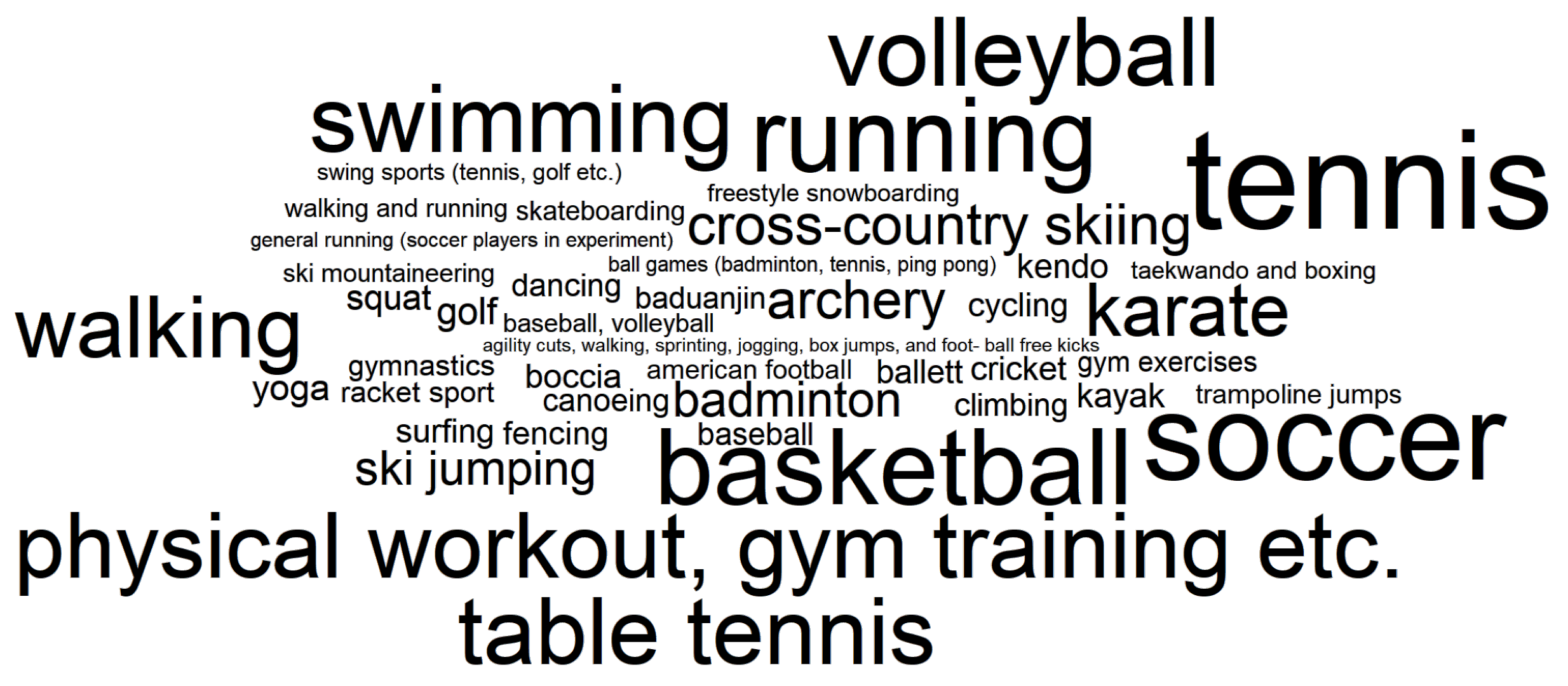


| Inclusion | Exclusion |
|---|---|
| 2010–2021 | outside 2010–2021 |
| English | full text not in English |
| classification method is clearly described | no clear description, no classification |
| active human movement | not human movement |
| IMU sensor data | image/video data |
| specific sports activity/motion primitive | general activity classification, fall detection etc. |
| Authors | Year | Discipline | Dependent Variable | Classes | Methods |
|---|---|---|---|---|---|
| Classification of a motion primitive | |||||
| Acikmese et al. [19] | 2017 | basketball | basketball exercise type | forward–backward dribbling, left–right dribbling, regular dribbling, two hands dribbling, shooting and layup | SVM |
| Ahmadi et al. [20] | 2015 | activities during sports training session | type of activity | agility cuts, walking, sprinting, jogging, box jumps, and football free kicks | KNN, radial basis function, NB, RF |
| Alobaid et al. [21] | 2018 | soccer | soccer activities | shooting the ball, passing the ball, heading the ball, running and dribbling | NB, KNN, RF, SVM, DT, multinomial logistic regression, logistic model tree, multilayer perceptron |
| Amerineni et al. [22] | 2021 | taekwondo and boxing | kicking and boxing strikes | 18 boxing punches and 24 taekwondo kicks | DTW, CNN, fusion models |
| Anand et al. [23] | 2017 | swing sports (tennis, golf etc.) | types of shots | tennis: forehand topspin, forehand slice, backhand topspin, backhand slice, serve; badminton: serve, clear, drop, smash; squash: forehand, backhand, serve | CNN, bi-directional LSTM |
| Anik et al. [24] | 2016 | badminton | badminton move | smash, serve, backhand, forehand, return | root mean square values, KNN, SVM |
| Aung et al. [25] | 2013 | walking | foot strike | heel strike, toe off, no-event | GMM |
| Bauza et al. [26] | 2012 | tennis | tennis swing patterns | forehand, backhand, volley, smash, service | DTW |
| Büthe et al. [27] | 2016 | tennis | tennis shot strokes + tennis steps | shot: forehand topspin, forehand slice, backhand topspin, backhand slice, smash; steps: shot step, side step | SVM, longest common subsequence |
| Charvátová et al. [28] | 2021 | cycling | downhill or uphill | downhill or uphill | two-layer neural network |
| Dasgupta et al. [29] | 2018 | walking | cognitive load | load (yes/no) | logistic regression, support vector machine, random forest, and learning vector quantisation |
| Gellaerts et al. [30] | 2018 | ski mountaineering | ski mountaineering activity | kickturn, skin on, skin off, backpack | threshold-based |
| Giandolini et al. [31] | 2014 | running | foot strike | rearfoot, midfoot, forefoot | threshold-based |
| Groh et al. [32] | 2016 | freestyle snowboarding | grind tricks and air tricks | Grinds: 50–50, BS-Boardslide, FS-Boardslide; Airs: Method, BS-180, FS-360 | NB, C4.5, KNN, SVM with a radial basis kernel |
| Groh et al. [33] | 2017 | skateboarding | trick performed | ollie, nollie, kickflip, heelflip, pop shove-it BS, pop shove-it FS, 360-shove-it BS, varialflip, hardflip, double kickflip, 360-flip, bail | NB, RF, linear SVM, SVM with a radial-basis kernel, KNN |
| Hachaj and Ogiela [34] | 2018 | karate | karate kicks | frontal kick, knee strike, round kick and side kick | HMM |
| Hachaj et al. [35] | 2017 | karate | karate techniques | 28 different karate techniques (e.g., different types of stances, block, kicks or punches) | DTW |
| Haider et al. [36] | 2019 | volleyball | volleyball specific actions | action (forearm pass, one hand pass, overhead pass, serve, smash, underhand pass, underhand serve, block), non-action | DT, KNN, NB, LDA, SVM |
| Helten et al. [37] | 2011 | trampoline jumps | jump classes | 13 different jump classes (e.g., Barani, half twist, pike jump) | motion templates |
| Hendry et al. [38] | 2020 | ballet | movement type | 3 levels: Level 1: jump vs. leg lift; Level 2: 3 jump types/3 direction of leg lift; Level 3: 5 laterality (landing leg)/6 laterality lifted leg | CNN |
| Hoettinger et al. [39] | 2016 | surfing | surfing on a wave | wave or not-wave | SVM, HMM |
| Holatka et al. [40] | 2019 | volleyball | setting technique | different movement setting labels | deep convolutional neural and LSTM recurrent network |
| Hollaus et al. [41] | 2020 | American football | drop or catch | catch or drop | CNN |
| Hu et al. [42] | 2020 | basketball | basketball activity | shooting, passing, lay-ups, dribbling | DTW |
| Huang et al. [43] | 2010 | walking and running | walking vs. running | walking vs. running | Bayesian network classifier |
| Huang et al. [44] | 2019 | football | football movements | walking, dribbling and stepover | neural network binary classifiers, sequence mapping |
| Jang et al. [45] | 2018 | cross-country skiing | cross-country skiing techniques | 8 different classical or skating styles | CNN-LSTM, KNN |
| Jensen et al. [46] | 2013 | swimming | swimming styles | butterfly, backstroke, breaststroke, and freestyle | classifier based on linear regression |
| Jensen et al. [47] | 2016 | swimming | swimming styles | butterfly, backstroke, breaststroke, freestyle, rest, turn | AdaBoost, logistic regression, DT, SVM |
| Jeong et al. [48] | 2019 | physical workout | physical workouts | pull up, row-barbell, bench press, dips, squat, deadlift, and military press | CNN, LSTM, SVM, multilayer perceptron, 2D CNN |
| Kos et al. [49] | 2016 | tennis | tennis stroke | serve, hit, bounce, net, and null | threshold-based |
| Labintsev et al. [50] | 2021 | karate | punch class | Yun Tsuki, Mawashi Tsuki, Age Tsuki, Uraken, no punch | CNN |
| Ladha et al. [51] | 2013 | climbing | climbing vs. non-climbing | climbing vs. non-climbing | KNN, DT, logistic regression |
| Li et al. [52] | 2021 | Baduanjin (Chinese sport) | motion class + quality | 8 standard motions | KNN, SVM, NB, logistic regression, DT, ANN, 1D-CNN |
| Lisca et al. [53] | 2021 | soccer (goalkeeper) | motion classes | dive or not dive + 27 motion classes | XGBoost, (ANN, SVM, quadratic discriminant analysis for comparison) |
| Ma et al. [54] | 2018 | basketball | basic basketball movements | 9 kinds of basic basketball movement | two-layer feedforward network |
| Ma et al. [55] | 2018 | resistance training | low-intensity resistance band activity | tummy rotation, straight arm pull, cross and pull, leg press | CNN |
| Malawski and Kwolek [56] | 2018 | fencing | type of dynamic action | 4 lunge types, step forward, step backward | DTW, SVM, RF |
| Matsuyama et al. [57] | 2021 | dancing | dance figures | 13 types of dance figures | LSTM |
| McGrath et al. [58] | 2019 | cricket | bowl or non-bowl | bowl or non-bowl | RF, linear SVM, polynomial SVM, neural network, gradient boosting (XGB) algorithms |
| Mo and Zeng [59] | 2019 | running | running gait pattern | forefoot strike or rearfoot strike | threshold-based |
| Nguyen et al. [60] | 2015 | basketball | basketball activity | walking, running, jogging, pivot, shoots from different locations, layups, sliding, sprinting, undefined | SVM |
| Nishizaki and Makino [61] | 2019 | tennis | tennis swing | player ID | LSTM |
| Nurwanto et al. [62] | 2016 | light sport exercise | light sport activity exercise | push up, sit up, squat jump | KNN with DTW |
| Ogasawara et al. [63] | 2021 | archery | shooting detection | shooting detector (yes/no) | DT |
| Ooi and Gouwanda [64] | 2021 | badminton | stroke type | backhand cross court net, backhand lift, forehand drop, forehand lift, forehand lob, forehand smash | NN |
| Peng et al. [65] | 2018 | volleyball | volleyball jumping pattern | 12 target class motions | neural network |
| Preatoni et al. [66] | 2020 | functional fitness exercises | fitness drills | 4 popular functional fitness drills | KNN, SVM |
| Qi et al. [67] | 2019 | gym physical activity | gym activity | first: free weight; non-free weight; free weight: bench press, deadlifts, squats; non-free weight: walking, running, sitting | first: SVM, second: NN, (DT, KNN, HMM for comparison) |
| Qiu et al. [68] | 2021 | kayak | rowing cycle | left blade entry, left blade pull stage, left exit stage, left recovery stage, right blade entry, right pull stage, right exit stage, the right recovery stage | SVM, KNN, DT, ensemble learning |
| Rawashdeh et al. [69] | 2016 | baseball, volleyball | throw, serve, null class | throw, serve, null class | two-stage approach: first, rule, second decision tree |
| Reilly et al. [70] | 2021 | soccer | change of direction | changes of direction | logistic model tree, RF |
| Rindal et al. [71] | 2018 | cross-country skiing | sub-technique | 8 cross-country sub-techniques | NN |
| Sha et al. [72] | 2021 | table tennis | hits and misses | hits and misses | SVM, DT, LDA, KNN, NB |
| Shi et al. [73] | 2018 | basketball | basketball motion | dribble, jump, turning around | k-means |
| Silva et al. [74] | 2019 | boccia | boccia bowl throw | gesture A, gesture B | SVM with a DTW kernel; KNN, linear SVM, RBF SVM, DT, RF, NB, Gaussian process |
| Stoeve et al. [75] | 2021 | soccer | ball contact | null, pass, shot | SVM, CNN, LSTM, convLSTM |
| Strohrmann et al. [76] | 2013 | running | arm carriage during running | arms parallel driving forward, arms aiming at symmetry line, arms crossing symmetry line | NB, KNN, SVM, logistic regression |
| Sun et al. [77] | 2021 | volleyball | action type | volleyball actions | SVM |
| Tabrizi et al. [78] | 2020 | table tennis | stroke type | topspin, push and basic | LSTM, 2D-CNN, RFB SVM |
| Takata et al. [79] | 2019 | kendo | basic strike-thrust activities and striking positions | 4 general types: Men, Tsuki, Do, Kote; further 8 detailed types | RF, SVM, KNN, NN |
| Tjønnås et al. [80] | 2019 | cross-country skiing | sub-techniques | 6 techniques | decision-function-based |
| Vales-Alonso et al. [81] | 2015 | volleyball | movement | jump detection | KNN |
| Wang et al. [82] | 2020 | swimming | swimming phase | swimming phase | SVM, NB, DT, KNN, logistic regression, hybrid NN/HMM model |
| Wang et al. [83] | 2019 | swimming | swimming style | butterfly, breaststroke, freestyle and back crawl | HMM |
| Wang et al. [84] | 2015 | ball games | discipline | badminton, tennis or ping-pong | SVM |
| Weiping et al. [85] | 2017 | tennis | tennis stroke type | forehand, backhand, serve | threshold-based |
| Wu et al. [86] | 2019 | yoga | yoga posture | 18 common yoga postures (in stand, lean and lie categories) | two-stage: back-propagation artificial neural network + fuzzy C-means |
| Xia et al. [87] | 2020 | racket sport | badminton and table tennis | 4 types of table tennis (service, stroke, spin, picking-up), 4 types of badminton (service, drive, smash, picking-up), walking | multilayer hybrid clustering |
| Zago et al. [88] | 2019 | general running (soccer players in experiment) | turn direction | left or right | LDA, SVM, boosted tree, ANN |
| Zhang et al. [89] | 2018 | gym exercises | exercise type/exercise set-up | different push-ups, and barbell curls movement | random forest |
| Zhang et al. [90] | 2019 | table tennis | ping pong basic movements | forehand attack, forehand drive, forehand chop, forehand flick, backhand control, backhand drive, backhand chop, backhand flick | |
| Zhang et al. [91] | 2018 | tennis | tennis stroke type | forehand topspin, forehand slice, backhand topspin, backhand slice, serve | LSTM |
| Zhang et al. [92] | 2021 | football | football actions | static, walking, jogging, juggling, pass, trapping, tackle, shoot | DT, SVM |
| Zhao et al. [93] | 2019 | tennis | tennis stroke style | serve, ground-stroke, volley | RF, NB, AdaBoost, SVM, DT |
| Zhao and Chen [94] | 2020 | basketball | basketball posture/action | dribbling, passing, catching, shooting | SVM, back-propagation neural network |
| Zhao et al. [95] | 2021 | gymnastics | gymnastics motion | stretching, chest, body rotation, kicking, body side, whole-body exercise | SVM, KNN, NB, DT |
| Zheng et al. [96] | 2019 | swimming | stroke phase | propulsion, glide, recovery | KNN |
| Classification of a quality related outcome | |||||
| Brock et al. [97] | 2017 | ski jumping | ski jumping motion style error | error jump/non-error jump | SVM, DTW |
| Brock and Ohgi [98] | 2017 | ski jumping | ski jumping errors | error jump/non-error jump (for 9 jump categories) | CNN, SVM, HMM |
| Ebert et al. [99] | 2017 | bodyweight exercises - fitness | quality of movement | 1 (very good) to 5 (very bad) | RF, DT, SVM, NB, Auto-WEKA |
| Jensen et al. [100] | 2012 | golf | experience level | experienced vs. unexperienced player | AdaBoost, Fisher-LDA, KNN, NB, SVM-linear, SVM-rbf |
| Jung et al. [101] | 2020 | walking | group | semiathlete, ordinary, deformity | DCNN |
| Kianifar et al. [102] | 2016 | squat | squat quality | good, (moderate), poor | SVM, linear multinomal logistic regression, DT |
| Liang et al. [103] | 2017 | chest and hip rotation/trunk movement | execution quality | good, poor | SVM |
| Liu et al. [104] | 2020 | running | performance level | competitive, recreational, or novice | gradient boosting decision tree, CNN, MLP |
| Liu et al. [105] | 2020 | canoeing | proficiency level | coach, novice | SVM, Logistic Regression, DT, XGBoost |
| Malik et al. [106] | 2014 | walking | gait patterns | normal, average, poor | adaptive fuzzy logic based classification module |
| Mitchell et al. [107] | 2015 | running | running type; synchronicity of running steps | symmetrical or asymmetrical; synchronous vs. asynchronous | RF, NB, Radial Basis Function Network |
| Rose et al. [108] | 2021 | baseball | throw identification and quality | low, medium, high | quadratic SVM |
| Sanusi et al. [109] | 2021 | table tennis | stroke quality | correct, incorrect | LSTM |
| Viyanon et al. [110] | 2016 | table tennis | quality | in, out, hitnet | DT |
| Zhao et al. [111] | 2016 | archery | archer’s release quality | good, dead, pluck | RF |
| Refs. | Number of Features before Reduction | Number of Features after Reduction |
|---|---|---|
| [19] | 153 | 28 |
| [21] | 90 | 15/25 |
| [23] | approx. 2000 | 300–500, which were further reduced |
| [34] | 8 | 5 |
| [35] | 16 | 12 |
| [52] | 306 | 96 |
| [58] | 282 | 223 |
| [65] | 32 | 24 |
| [66] | 108/216 | 20 |
| [67] | 88 | 36 |
| [68] | 23 | 4 |
| [69] | 81 | 8 |
| [70] | 25 | 16 (for RF) |
| [73] | 24 | 3 |
| [78] | 840 | 52 (for RBF-SVM) |
| [87] | 120 | 1 |
| [94] | 72 | 30 |
| [95] | 84 | 11 |
| [99] | information was compressed by a ratio of 1:109 | |
| [102] | 210 | 2 classes: 7; 3 classes: 4 |
| [103] | 97 | 45, 50, 46 |
| [104] | 132 | 6 |
| [106] | 6 | 4 |
| Split Type | Article | Total Articles |
|---|---|---|
| Subject-wise | [20,23,25,26,27,29,32,34,35,36,38,39,45,46,47,53,56,57,60,62,63,66,71,73,79,82,87,100,101,102,105,106,110] | 33 |
| Person-dependent | [26,27,56,60,91,96] | 6 |
| Random split/not clear | [19,21,22,24,28,29,30,31,33,35,37,39,40,41,42,43,44,48,49,50,51,52,53,54,55,58,59,61,64,65,66,67,68,69,70,71,72,74,75,76,77,78,79,81,82,83,84,85,86,88,89,90,92,93,94,95,97,98,99,102,103,107,108,109,111] | 65 |
| Different versions | [29,35,39,43,71,79,82,91,102,104] | 10 |
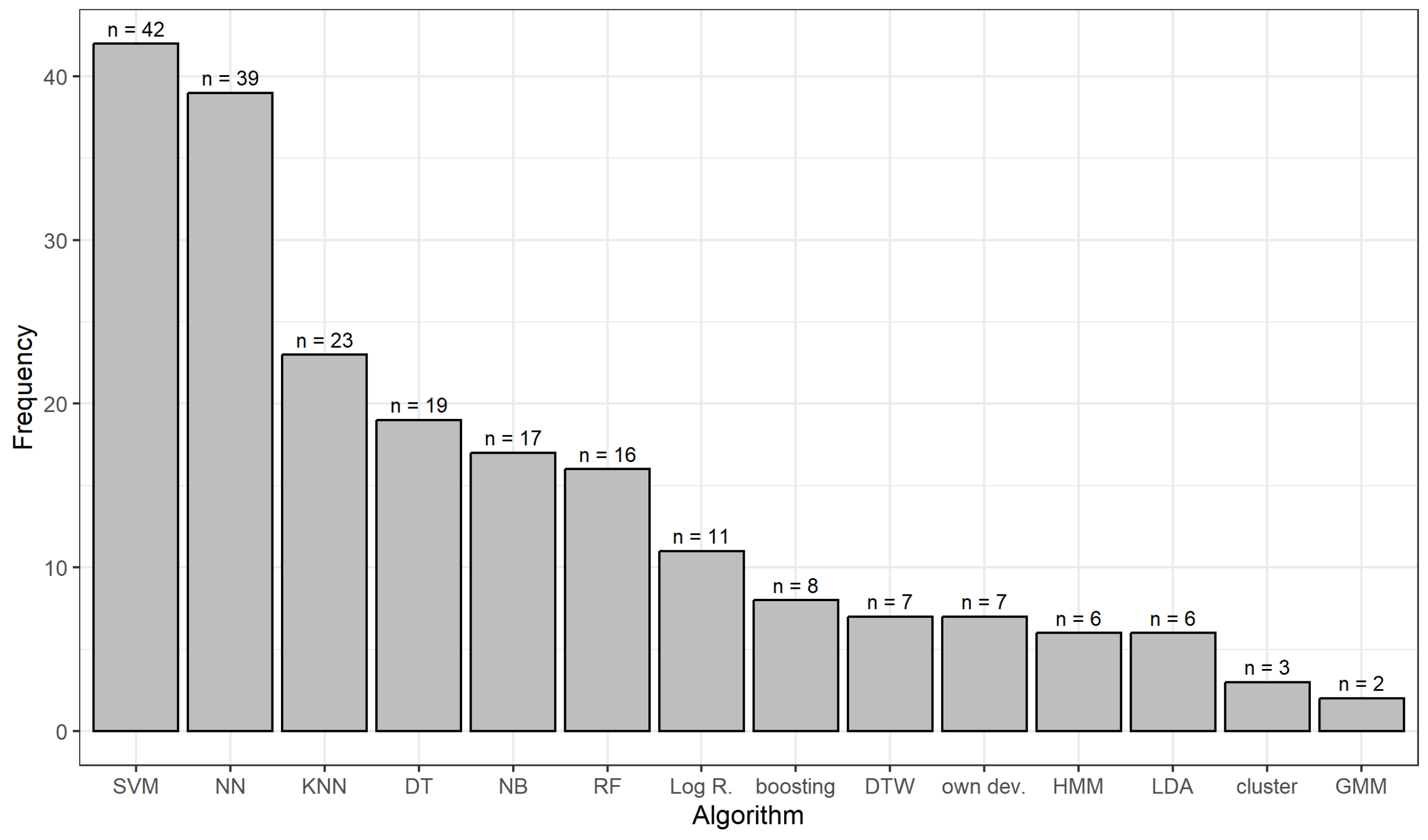
| SVM | NN | KNN | RF | DT | NB | log. reg. | Boosting | HMM | Other |
|---|---|---|---|---|---|---|---|---|---|
| 42 | 39 | 23 | 16 | 19 | 17 | 11 | 8 | 6 | 26 |
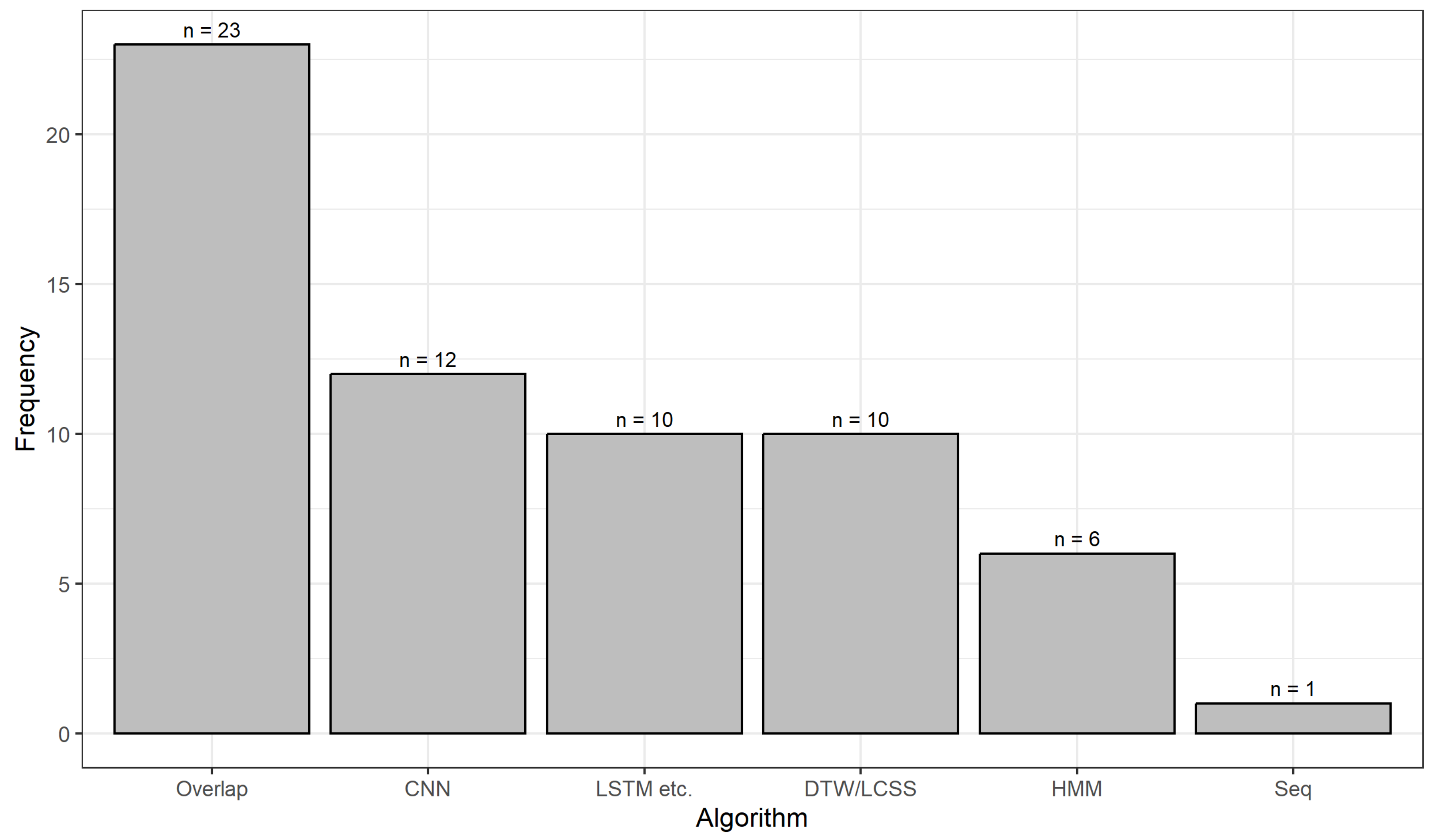
| HMM | LSTM/CNN-LSTM | CNN | Sequence Mapping | DTW/LCSS | Overlap | Other Classification Method/No Details |
|---|---|---|---|---|---|---|
| 6 | 10 | 12 | 1 | 10 | 23 | 42 |
Disclaimer/Publisher’s Note: The statements, opinions and data contained in all publications are solely those of the individual author(s) and contributor(s) and not of MDPI and/or the editor(s). MDPI and/or the editor(s) disclaim responsibility for any injury to people or property resulting from any ideas, methods, instructions or products referred to in the content. |
© 2023 by the authors. Licensee MDPI, Basel, Switzerland. This article is an open access article distributed under the terms and conditions of the Creative Commons Attribution (CC BY) license (https://creativecommons.org/licenses/by/4.0/).
Share and Cite
Kranzinger, C.; Bernhart, S.; Kremser, W.; Venek, V.; Rieser, H.; Mayr, S.; Kranzinger, S. Classification of Human Motion Data Based on Inertial Measurement Units in Sports: A Scoping Review. Appl. Sci. 2023, 13, 8684. https://doi.org/10.3390/app13158684
Kranzinger C, Bernhart S, Kremser W, Venek V, Rieser H, Mayr S, Kranzinger S. Classification of Human Motion Data Based on Inertial Measurement Units in Sports: A Scoping Review. Applied Sciences. 2023; 13(15):8684. https://doi.org/10.3390/app13158684
Chicago/Turabian StyleKranzinger, Christina, Severin Bernhart, Wolfgang Kremser, Verena Venek, Harald Rieser, Sebastian Mayr, and Stefan Kranzinger. 2023. "Classification of Human Motion Data Based on Inertial Measurement Units in Sports: A Scoping Review" Applied Sciences 13, no. 15: 8684. https://doi.org/10.3390/app13158684
APA StyleKranzinger, C., Bernhart, S., Kremser, W., Venek, V., Rieser, H., Mayr, S., & Kranzinger, S. (2023). Classification of Human Motion Data Based on Inertial Measurement Units in Sports: A Scoping Review. Applied Sciences, 13(15), 8684. https://doi.org/10.3390/app13158684