You are currently viewing a new version of our website. To view the old version click .
Applied Sciences
  • Article
  • Open Access

26 July 2023

A Toxic Style Transfer Method Based on the Delete–Retrieve–Generate Framework Exploiting Toxic Lexicon Semantic Similarity


,
and
1
KTH Royal Institute of Technology, 10044 Stockholm, Sweden
2
Intelligent Systems Group, ETSI Telecomunicación, Universidad Politécnica de Madrid, Avda. Complutense 30, 28040 Madrid, Spain
*
Author to whom correspondence should be addressed.
This article belongs to the Section Computing and Artificial Intelligence

Abstract

Whether consciously or inadvertently, our messages can include toxic language which contributes to the polarization of social networks. Intelligent techniques can help us detect these expressions and even change them into kinder expressions by applying style transfer techniques. This work aims to advance detoxification style transfer techniques using deep learning and semantic similarity technologies. The article explores the advantages of a toxicity-deletion method that uses linguistic resources in a detoxification system. For this purpose, we propose a method that removes toxic words from the source sentence using a similarity function with a toxic vocabulary. We present two models that leverage it, namely, LexiconGST and MultiLexiconGST, which are based on the Delete –Retrieve–Generate framework. Experimental results show that our models perform well in the detoxification task compared to other state-of-the-art methods. Finally, this research confirms that linguistic resources can guide deep learning techniques and improve their performance.

1. Introduction

Digital social communications have become mainstream, enabling citizens to freely express their opinions and providing visibility to minority groups. However, some phenomena, such as toxic language, can become severe barriers that limit fair and nondiscriminatory participation in public forums. Toxic language can be defined as “rude, disrespectful, or unreasonable language that is likely to make someone leave a discussion.” [1]. Still, it includes, but is not limited to, other language classification terms, such as hate speech, vulgarity, sexism, racism, or bullying, to cite a few. Its devastating effects and importance have pushed governments and international institutions combat its effects using legislative measures, mainly focused on its detection, to limit its spread. The research community has made considerable effort to contribute to this effort with two tasks: automatic toxic language detection [2,3,4] and detoxifying language models [5,6]. On the contrary, the task of rephrasing offensive content automatically requires further research. This task has great potential for practical applications, such as promoting a healthier online environment. By suggesting alternative, less emotionally charged language, an automatic rephrasing system could encourage users to reconsider their wording and express their thoughts neutrally. The main approach followed for text detoxification [7,8,9] is based on text style transfer.
Text style transfer is “a significant Natural Language Generation (NLG) task whose objective is to rephrase the text and maintain its content while altering its style” [10]. Applications range from modifying the conversational style of dialogue agents [11] to masking personal attributes such as gender to protect privacy [12]. Additionally, the task can adjust the formality of texts [13] or even generate poetry, as shown by Yang et al. [14]. The main limitation to developing effective style transfer systems is the lack of parallel corpora containing sentences in one style and their corresponding counterparts in another, with the original meaning preserved. Consequently, researchers have developed techniques that bypass the requirement for parallel corpora altogether.
Previous studies in the nonparallel data setting try to adversarially train encoder–decoder networks that learn disentangled representations of style and content from text [15,16,17] with a technique known as “implicit style–content disentanglement” (Section 2). Unfortunately, these models suffer from (a) the sparsity of their latent representations, which makes them take longer to converge and harder to train, (b) a lack of precise control over the style generated, and (c) the need to train from scratch to swap the trade-off between style transfer and content preservation. Other works approach the task with “explicit style–content disentanglement” (Section 2), such as Delete–Retrieve–Generate (DRG) [18], to build on the inductive bias that style attributes are frequently related to a specific set of tokens in text. Although Delete–Retrieve–Generate (DRG) is a step up in quality over previous research, its Delete–Generate approaches are prone to (a) disturb crucial context with the accidental replacement of core context words and (b) miss the replacement of source style words with target style words, and (c) the encoder–decoder generates nonfluent sentences and struggles with longer input text given its Long Short-Term Memory (LSTM) nature.
Sudhakar et al. [19] introduced a novel approach that overcomes some of the drawbacks mentioned above. Their system, called BlindedGST, leverages the attention weights of an unsupervised pre-trained large language model to identify style attributes and removes the need for an encoder–decoder LSTM with the use of a style conditional generative Transformer [20] that can handle long text input and generate fluent text from a sentence whose style words have been removed. The system has been evaluated for sentiment-, political-, formality-, and gender-detection tasks, leaving out the detoxification task.
In this work, we investigate the following research questions (RQs):
RQ1: Can a current nontoxic specific text style transfer method be applied to the detoxification task?. As described above, many current methods build on the DRG framework to achieve consistent results among different styles, and we want to validate their performance on the detoxification task. More specifically, we are interested in the methods that operate on a nonparallel data setting using only the Delete and Generate steps, i.e., not the Retrieve step. The two best models in this category (that we are aware of) are Mask and Infill [21] and BlindedGST [19]. We choose BlindedGST as the baseline, since it has been evaluated on multiple downstream tasks as explained above. In contrast, Mask and Infill has only been applied to sentiment transfer, and, therefore, we understand that BlindedGST is a better starting point since we expect it to generalize better to the detoxification task. Thus, we evaluated BlindedGST on several toxicity datasets.
RQ2: Can we improve this attention-based method by using linguistic resources?. As explained above, BlindedGST operates in a two-step process in which it first removes the style from the sentence and then uses a generator to transfer it to the target style. Therefore, we want to explore the advantages of a style deletion method that uses linguistic resources such as a lexicon instead of an attention-based system. For this purpose, we propose a method that removes toxic words from the source sentence using a similarity function with a toxic lexicon. Finally, our main contributions are LexiconGST and MultiLexiconGST, which are evaluated with different lexicons and similarity functions that have led, in most cases, to better performance than the BlindedGST baseline.
The remainder of this article is organized as follows. Section 2 introduces the related work. Then, Section 3 describes the proposed model. Next, Section 4 and Section 5 describe the experiments and evaluation of the model, respectively. Lastly, Section 6 discusses the conclusions of this work.

3. Proposed Approach

This section offers a formalization of the problem to solve and describes how the proposed models approach it.
Firstly, the formalization of the problem considers a dataset D formed by sentences in natural language of different styles. Each example in the dataset is ( x i , s i ) , in which x i is a sentence and s i S is the style of the sentence. We refer to the text in the same style as the text that shares specific attributes, that is, S = { p o s i t i v e , f o r m a l , t o x i c , n e u t r a l , } . We denote c as the set of words that represent the content or information that the sentence contains, such that S t y l e ( c ) S , and a as the collection of words with stylistic information. Therefore, the goal of text style transfer is to, given a source sentence x with source style s src and a desired target style s tgt , output a new sentence y that maintains as much content c as possible from x but whose style is s tgt . In particular, in the detoxification task, we consider S = { t o x i c , n e u t r a l } where s src = t o x i c and s tgt = n e u t r a l .
In order to generate this transferred style sentence y where S t y l e ( y ) = s tgt given an input sentence x with style s src , our LexiconGST model tries to learn P ( y | x , s tgt ) . We base our work on the BlindedGST [19] method; hence, the LexiconGST model is a two-step process: style deletion and style-conditioned generation.
First, we describe the style deletion component, which aims to separate style and content from the input sentence by modeling the distribution P ( c , a | x ) . The original sentence x can be fully reconstructed from c and a . For example, given “your stupid contributions are shit”, then the toxic-related words, “stupid” and “shit”, should be removed. This approach is founded on the “input reduction” method proposed in the work of Feng et al. [35], which suggests that the style of a sentence is heavily affected by the contribution of specific words or sub-phrases associated with such style. Consequently, a style classifier would be confused about the style of a sentence x whose style is s if the style-related attributes a are removed from the sentence. To detect these style attributes, we use a weighting algorithm to measure the contribution to style that each token in x makes.
In the case of neutral style, we measure the contribution of a token using the method of Sudhakar et al. [19]. A BERT classifier is fine-tuned for toxic sentence classification, and then it is used to filter out neutral tokens based on the attention weights of a selected attention head. However, when detecting and removing toxic tokens, we propose an algorithm (see Algorithm 1) that exploits token embedding similarities with a toxic lexicon. First, we use the embedding layer from a RoBERTa [36] toxicity classifier because these embeddings encode some style information. Since we are interested in the style similarity of tokens rather than semantic similarity, we follow the intuition that this embedding representation is better for our task than other semantic embeddings. Then, we employ a similarity function between the sentence’s token embeddings and the lexicon word embeddings and remove tokens whose similarity is above a predefined threshold.
Unfortunately, due to how word embeddings are generated, some words like “betrayed” (word inside one of the toxic lexicons used) and “portrayed” have high embedding similarity, which will result in the deletion of “portrayed” from the source sentence as if it were a toxic style attribute, but in reality it should remain as part of the source content. Therefore, instead of using the maximum similarity of a token with the words in a lexicon, we introduce a parameter K that alleviates this issue by averaging the top-K similarities of a word with a lexicon. This technique follows the intuition that for a given lexicon, in the case of “ass” (clearly a word to remove), the top similarities are “ass”: 1.0, “dumbass”: 0.81, and “asshole”: 0.80, ...so the average top-K similarity is still high for “ass” and the model will correctly delete it from the source text. Still, in the case of “portrayed”, the top similarities are “betrayed”: 0.75, “stoned”: 0.42, and “demented”: 0.41, so the top-K average is reduced compared to the maximum and therefore “betrayed” is not removed from the source sentence as desired. Furthermore, we found that again due to the nature of word embeddings, very common words like “had” or “they” tend to have a high similarity with a lot of words and are, in turn, deleted as if they were toxic style attribute words. To alleviate this phenomenon, we have defined the MultiLexiconGST model. This model extends LexiconGST and utilizes an additional lexicon of common words and stop words to ensure that these types of words are not deleted from the source sentence.
Algorithm 1: Similarity-based Toxic Deletion.
Ensure: 
Toxic and common words lexicon
1:
for every toxic sentence S in D  do
2:
    for every t o k e n in S do
3:
         s i m i l a r i t i e s c o s i n e _ s i m i l a r i t y ( t o k e n , t o x i c _ l e x i c o n )
4:
         s i m i l a r i t i e s t o p _ k ( s i m i l a r i t i e s )
5:
         t o k e n _ s i m a v e r a g e ( s i m i l a r i t i e s )
6:
        if  t o k e n _ s i m > t h r e s h o l d and t o k e n c o m m o n _ l e x i c o n  then
7:
           Remove t o k e n from S
8:
        end if
9:
    end for
10:
end for
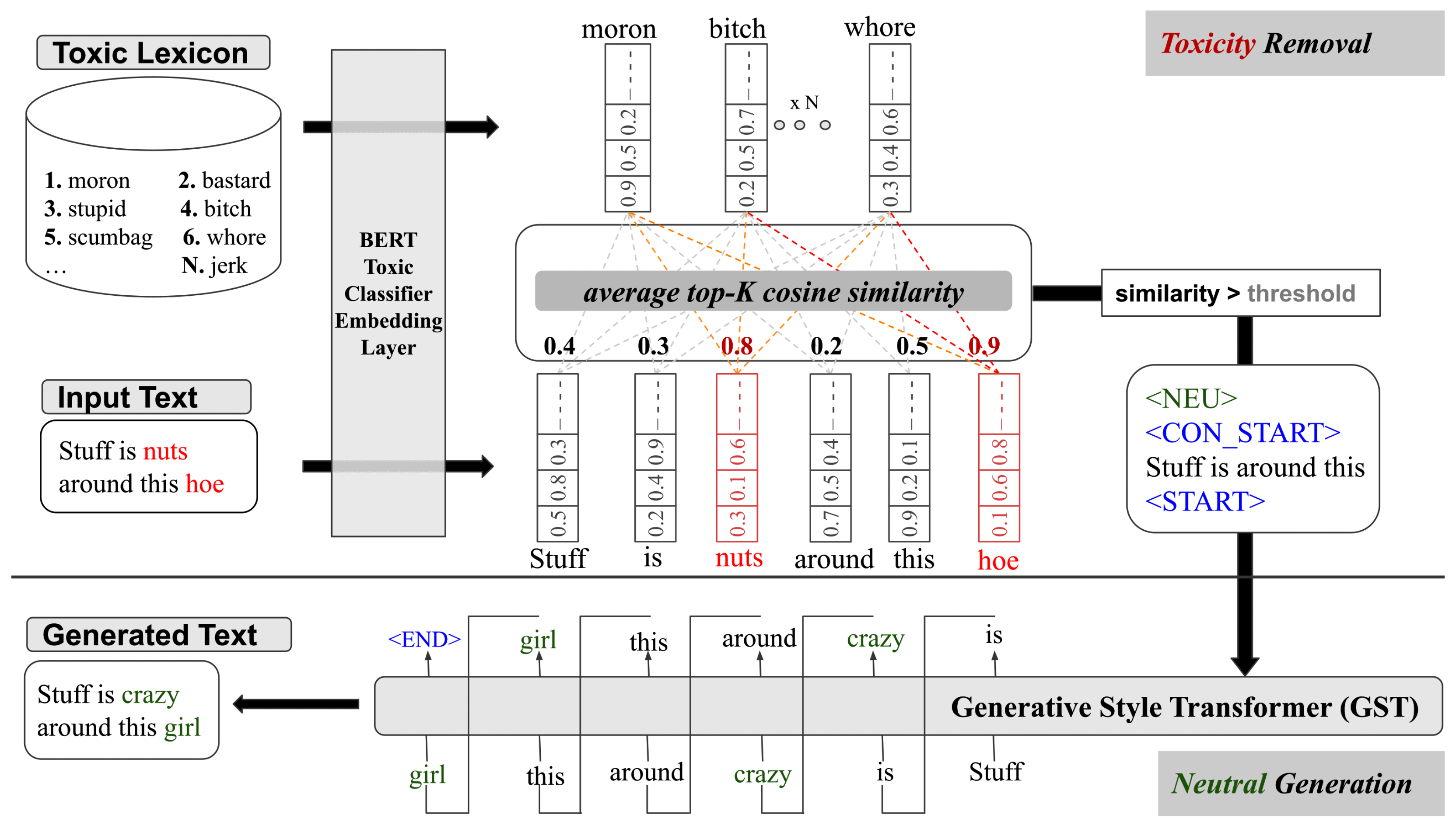
The next and last step is to generate target-style sentences, which we approach with a model that capitalizes on the benefits of transfer learning and the Transformer [20] by using an unsupervised large pre-trained language model. In detail, we use a “decoder-only” Transformer (where masked attention heads allow the model to look only at tokens to the left), namely Generative Style Transformer (GST) [19], which is based on the GPT [22]. The inspiration to use such a model comes from the recent state-of-the-art performance on different downstream tasks shown by these large pre-trained language models when fine-tuned. Specifically, GST models P ( y | c , s tgt ) by receiving c and s tgt to generate y , the sentence in the target style. Additionally, we use special tokens in the input as shown in Figure 1 where GST is fed with “<NEU> <CON_START> Stuff is around this <START>”. Concretely, we use <NEU> (Neutral) or <TOX> (Toxic) to indicate which style to generate, CON_START points where the content starts, and <START> signals where content ends and begins to generate. Finally, GST uses a softmax layer on the last Transformer block to generate, at each time step t , a probability distribution over the vocabulary of the form P ( y t | c , s tgt , y 1 , y 2 , y t 1 ) .
Figure 1. LexiconGST architecture.
In the following, we present an example that gives further insight into the LexiconGST and MultiLexiconGST models illustrated in Figure 1 and Algorithm 1, respectively. As described, LexiconGST first strips toxic words, a , from the original sentence “Stuff is nuts around this hoe” with the use of the top-K similarity of tokens with a toxic lexicon. Please note that this similarity is calculated by averaging the top-K cosine similarities between each input sentence token and all tokens from the lexicon in use. Next, the associated word is removed from the sentence if this similarity exceeds a predefined threshold. Then, a neutral sentence is generated from the toxicity-stripped sentence “Stuff is around this”, c , by using a style-conditional transformer conditioned on neutral style, s tgt . As explained previously, MultiLexiconGST extends the LexiconGST’s style deletion component by using an additional lexicon to preserve common or stop words to alleviate the issues presented below.

4. Experimental Design

In this section, we describe the datasets and lexicons used to evaluate our methods (Section 4.1), as well as define the metrics we use to evaluate them (Section 4.2). In addition, we specify the learning and inference approaches. Finally, we describe the details of the implementation of the model in Section 4.3.

4.1. Resources

To train and evaluate the performance of our style transfer model, we used two datasets that allowed us to compare our results to other works and make our results significant: (i) the English dataset from the previous Jigsaw [37] competition since it is widely used among the most recent detoxification literature [9,30]; and the (ii) ParaDetox dataset [32], which was recently released and designed specifically for the task of detoxification. Since the Jigsaw dataset has no parallel (source-to-target) sentences, we generated a neutral and toxic corpus separately. To construct the toxic corpus, the comments labeled as toxic were first split into individual sentences as the original comments may be too lengthy. Subsequently, each sentence was classified using the RoBERTa-based toxicity classifier from Dale et al. [30], which was trained on English data from the three Jigsaw datasets [37,38,39]. The toxic half of the dataset consists of sentences classified as toxic by the toxicity classifier, resulting in around 140,000 sentences (see Table 1). An equal number of nontoxic sentences were randomly selected from the sentence-separated Jigsaw data to construct the neutral half of the dataset. The test set was constructed using a similar approach to the Jigsaw competition, where 10,000 sentences with the highest toxicity scores were selected based on the toxicity classifier. On the other hand, ParaDetox is a parallel detoxification dataset collected from the large ParaNMT [33] dataset with the use of a crowd-sourced quality control pipeline. It consists of over 12,000 toxic sentences, each one having 1 to 3 neutral paraphrases. To build the toxic corpus, we just used the toxic sentences, and for the neutral corpus, we merged all available neutral sentences, which resulted in around 20,000 neutral sentences.
Table 1. Number of instances per style and split of used datasets.
We used the lexicons shown in Table 2 to experiment with our models, where five different lexicons were for toxic style deletion, and one lexicon was for the preservation of common and/or stopwords in MultiLexiconGST. The Abusive, Hurtlex, and Orthrus lexicons were taken from other works whose whole purpose was to craft such a lexicon. The other two lexicons, ParaDetox-Lex and Jigsaw-Lex, are a contribution of this work. We refer to them as dataset-specific lexicons since they were crafted specifically for each dataset, Jigsaw or Paradetox. To generate these lexicons, we first trained, for each dataset, a logistic regression toxicity classifier that approximates the weights W and biases B for the model Y = WX + B , where Y is either toxic or nontoxic and X is a vector representing the words in a sentence. Then, we interpreted the weights W given by the logistic regressor to each word as a toxicity score. Finally, we used a threshold t for this toxicity score w w o r d to select which words are included in the lexicon if w w o r d > t .
Table 2. Lexicons used in the experiments and their main characteristics.

4.2. Metrics

Since we approach the problem in a nonparallel fashion, metrics such as BLEU [44], METEOR [45], or ROUGE [46] do not have references for their evaluation. Style transfer models are expected to change the style of a sentence while preserving its content and fluently producing text. These three factors are often in conflict with each other, so a composite metric is needed to strike a balance between them. Our evaluation methodology is based on Krishna et al. [29]. We use the J metric, which is calculated by multiplying three individual metrics at the sentence level: style accuracy, content preservation, and fluency. System-level (J) is then obtained by taking the average of sentence-level J scores.
J = A C C · S I M · F L .
Sentence-level style accuracy (ACC) is evaluated using the pre-trained toxicity classifier from Dale et al. [30]. Content preservation (SIM) is evaluated by comparing the sentence-level embeddings of the original and transformed texts, calculated using the model proposed by Wieting et al. [47]. Fluency (FL) is measured using a classifier trained on the CoLA dataset to determine linguistic acceptability [48].

4.3. Implementation Details

For training, since we used a nonparallel data setting, we used the teacher-forcing decoding strategy [19] over the generated tokens of GST to minimize the reconstruction loss. Formally, GST learns to maximize the following function:
L ( Θ ) = x , s src D l o g [ P ( x | c , s src ; Θ ) ]
where for an input x , GST learns to reconstruct this input by generating y = x given c and the source style s src . In contrast, at test time, we generated the output sentence with the use of beam search with a beam width of 5 and a look-left window of 1.
Specifically, we used the PyTorch implementation of the GPT model [22] offered by the HuggingFace Transformers library (https://huggingface.co/openai-gpt, accessed on 22 July 2023). The model is pre-trained on 7000 books from the BookCorpus dataset (https://huggingface.co/datasets/bookcorpus, accessed on 22 July 2023). Its architecture accepts sequences of up to 512 tokens, and has 12 layers and 12 attention heads per block. The dimension for all internal states is 768, which includes keys, queries, values, and embeddings. Byte Pair Encoding (BPE) [49] tokenizes input text. More details can be found in the source code (https://github.com/martinigoyanes/LexiconGST, accessed on 22 July 2023).

5. Results

To analyze the performance of the models, we focused attention on the aggregated metric J. More specifically, we wanted to evaluate if the general style transfer method proposed by Sudhakar et al. [19] is valid for the detoxification task and if its model can be improved by changing its style deletion system from attention-based to lexicon-based. Additionally, the effects of different similarity functions and lexicons were analyzed. In this sense, it is important to consider that the evaluation is limited by the accuracy of the pre-trained toxic and language acceptability classifiers, as well as the performance of the model that compares sentence embeddings. Lastly, we selected the different thresholds used in the experiments. To remove toxic words based on their lexicon similarity, we picked s i m i l a r i t y _ t h r e s = 0.7 after tuning the parameters. On the contrary, for the threshold that determines whether a word is included in our dataset-specific lexicon, we chose a value that produces a lexicon size similar to the lexicons we were working with, i.e., for Jigsaw t o x i c i t y _ t h r e s = 0.8 and for ParaDetox t o x i c i t y _ t h r e s = 0.7 .
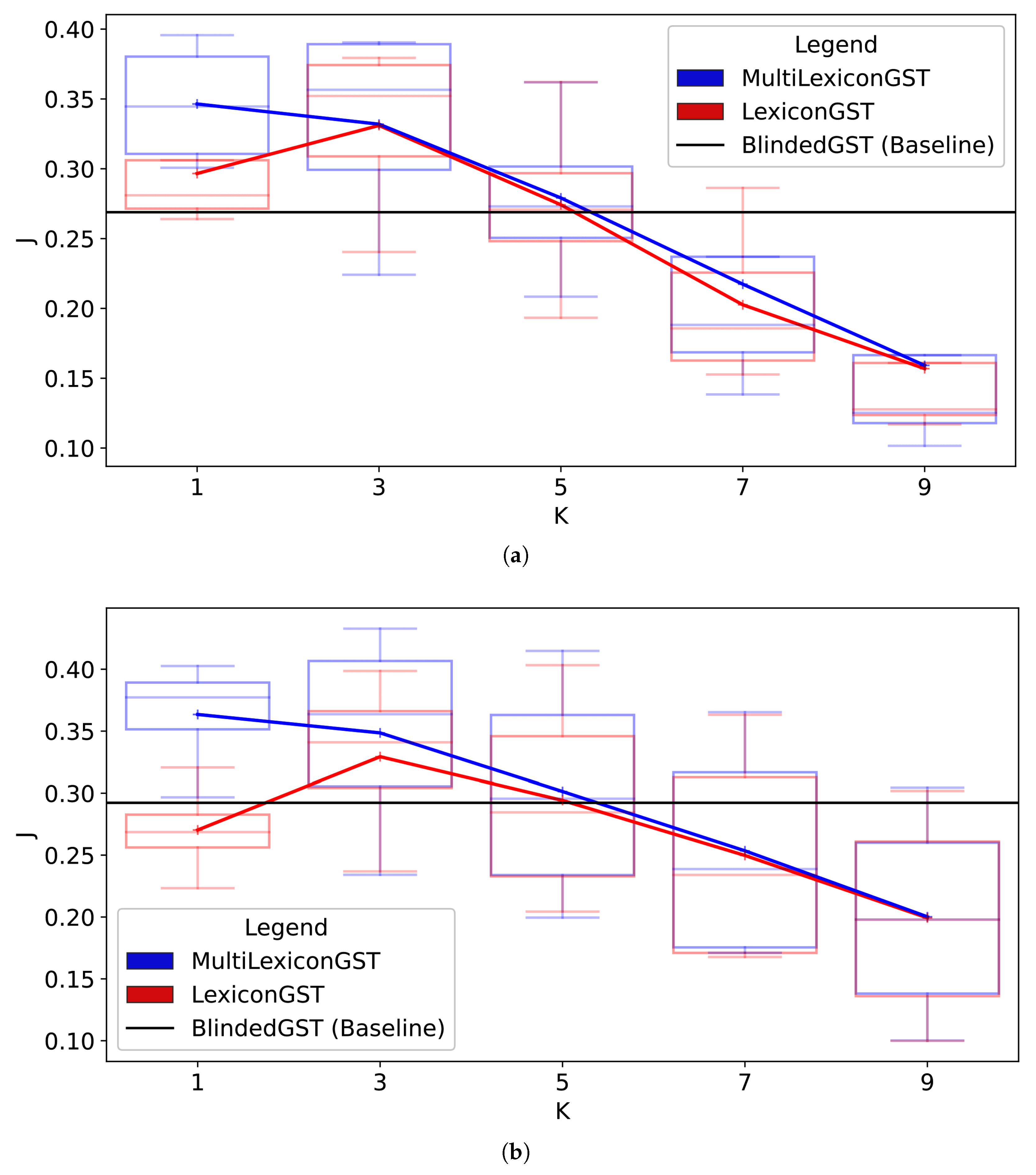
Firstly, we evaluated LexiconGST and MultiLexiconGST on multiple lexicons and used different average top-K similarity functions to find that performance depends a lot on the lexicon and the value of K. However, we discovered that, regardless of the lexicon, the best K are { 1 , 3 , 5 } by performing a grid search on the validation split. Specifically, Figure 2 shows how similarity functions that consider K > 5 words for average similarity always lead to a significant decrease in performance in contrast to when K < 5 words are considered. We also observe from this wide evaluation how the fluency (FL) and source similarity tend to increase as the style transfer strength (ACC) decreases; our intuition is that the smaller the change in style, the fewer the words that are changed from the input, which leads to a more fluent and similar sentence to the input. Secondly, in Table 3, we present our best-performing models for each lexicon and show that both MultiLexiconGST and LexiconGST outperform BlindedGST [19]. The proposed dataset-specific lexicons almost always perform best, while the Hurtlex lexicon performs the worst. More specifically, when MultiLexiconGST makes use of the dataset-specific lexicons, it yields the best J score since it is capable of decently changing the style (ACC) while maintaining high fluency (FL) thanks to the leverage of the extra lexicon Stopwords-en, which we believe allows it to be more accurate when deleting toxic words. Concretely, the biggest increase in quality ( 0.18 ) over BlindedGST is in style transfer strength (ACC) for the Jigsaw dataset. In contrast, an improvement ( 0.19 ) in fluency (FL) makes the difference for the ParaDetox dataset.
Figure 2. Performance as K increases on the validation set of both Jigsaw and ParaDetox: (a) ParaDetox. (b) Jigsaw.
Table 3. Results of the best-performing models for each lexicon on the test splits of the Jigsaw and Paradetox datasets. Best J results are indicated by bold numbers.
In order to further study the impact of the proposed methods and their performance, we conducted the Friedman statistical test [50]. This test computes a sorted ranking of approaches, offering an aggregated view of their performance across all datasets. In this way, a lower ranking indicates a better result for a certain method in comparison to the rest. Ties are resolved by averaging the ranks obtained. We performed the Friedman test with α = 0.05 , rejecting the null hypothesis.
In Table 4, it can be seen that the best model, as indicated by the Friedman test, is the MultiLexiconGST using a dataset-specific lexicon. This reinforces the observation that using domain-oriented resources leads to a performance improvement, and is consistent with our initial hypotheses. In comparison, BlindedGST is placed at the bottom of the ranking, which again indicates that introducing relevant linguistic resources effectively improves the style transfer process.
Table 4. Friedman rank of the best 9 methods.
Finally, we compared our methods with the state-of-the-art (SOTA) models shown in Table 5. To obtain a fair comparison of the methods, we left out all methods with a nontrivial “Retrieval” component (Delete–Retrieve–Generate). For example, we did not consider CondBERT [30] as the authors mention “Reranks” replacement words suggested by BERT based on the similarity of suggestions with the word to be replaced, and we consider this a retrieval method. We also left out ParaGeDi [30] since it makes use of a pre-trained paraphraser model, which we consider to be a large generalized retrieval model. Both ParaGeDi and CondBERT outperform our system, given that they use an additional component that enhances their performance. STRAP [29] uses a paraphrase as well, so it was not considered. Finally, DLSM [27] uses a very different approach (probabilistic-based rather than framework-based) from all other methods. However, both methods perform much worse than MultiLexiconGST: DLSM generates very nonfluent text and STRAP has very weak style transfer. This collection of State of the Art (SOTA) methods is shown in Table 5, where we show how our best model, MultiLexiconGST with a dataset-specific lexicon and an average top-three similarity function, not only outperforms by a wide margin the baseline BlindedGST but also has the best performance among all known competitor models. In addition, MultiLexiconGST also generates the most fluent (FL) and similar sentences to the input (SIM). Lastly, although MultiLexiconGST is behind Mask and Infill [21] or SST [28] in style transfer strength (ACC), these models perform worse in terms of fluency (FL). We attribute this to the abrupt addition of tokens associated with the target style without maintaining fluency.
Table 5. SOTA performances of methods that use a Delete and Generate framework. Best J results are indicated by bold numbers.

6. Conclusions and Future Work

In this paper, we introduce a novel algorithm for toxic style removal and present two models that leverage it, LexiconGST and MultiLexiconGST, which are based on the DRG framework. The experimental results show that our models have competitive performance in the detoxification task among the state-of-the-art methods. Specifically, our proposed methods outperform all SOTA models, which are based on the same framework. Furthermore, this research also confirms that linguistic resources can guide deep learning and improve its performance. We have also shown that the hyperparameter K helps the similarity function to adapt to the characteristics of the different lexicons.
The proposed models focus on the Delete and Generate phases, which constitutes a limitation of our models. Indeed, including a mechanism that implements a nontrivial Retrieve phase can enhance the overall performance of the system. As future work, this can be addressed by evaluating whether the proposed models can outperform SOTA methods that use a more complex Retrieve step like CondBERT and ParaGeDi [30].
Furthermore, the proposed methods use lexicons as a source of domain-centered knowledge sources. Nevertheless, deriving these lexicons and evaluating their quality are open challenges, which is a limitation of this work. This opens new avenues of research, oriented to generating and exploiting lexicons to improve the results of the task.
Finally, another line of research that emerges from our work is whether our lexicon-based approach not only outperforms the attention-based approach of Sudhakar et al. [19] on the detoxification task, but that our method can be generalized to other downstream style transfer tasks by simply selecting the appropriate style lexicon.

Author Contributions

Conceptualization: M.I., O.A. and C.Á.I.; methodology: M.I., O.A. and C.Á.I.; validation: M.I.; draft preparation: M.I., O.A. and C.Á.I.; writing—review and editing: M.I., O.A. and C.Á.I. All authors have read and agreed to the published version of the manuscript.

Funding

This research This work was supported by the European Union’s Horizon 2020 Research and Innovation Programme under project Participation (grant agreement no. 962547) and by the Spanish Ministry of Science and Innovation through the COGNOS project (PID2019-105484RB-I00).

Institutional Review Board Statement

Not applicable.

Data Availability Statement

Code and data are available at https://github.com/martinigoyanes/LexiconGST, accessed on 22 July 2023.

Conflicts of Interest

The funders had no role in the design, writing, or decision to publish the results.

Abbreviations

The following abbreviations are used in this manuscript:
ACCSentence-level style accuracy
BLEUBilingual Evaluation Understudy
DLSMDeep Latent Sequence Model
DRGDelete-Retrieve-Generate
GPTGenerative Pre-trained Transformer
GSTGenerative Style Transformer
LMLanguage Model
LSTMLong Short-Term Memory
MLMMask Language Modeling
NLGNatural Language Generation
SOTAState-of-the-Art
SSTStable Style Transformer
SOTAState of the Art

References

  1. Jigsaw. The Toxicity Issue. Can Technology Help Improve Conversations Online? Available online: https://jigsaw.google.com/the-current/toxicity/ (accessed on 8 May 2023).
  2. Zampieri, M.; Nakov, P.; Rosenthal, S.; Atanasova, P.; Karadzhov, G.; Mubarak, H.; Derczynski, L.; Pitenis, Z.; Çöltekin, Ç. SemEval-2020 Task 12: Multilingual Offensive Language Identification in Social Media (OffensEval 2020). In Proceedings of the Fourteenth Workshop on Semantic Evaluation, Online, 12–13 December 2020; pp. 1425–1447. [Google Scholar] [CrossRef]
  3. D’Sa, A.G.; Illina, I.; Fohr, D. Towards Non-Toxic Landscapes: Automatic Toxic Comment Detection Using DNN. In Proceedings of the 2nd Workshop on Trolling, Aggression and Cyberbullying, Marseille, France, 16 May 2020; pp. 21–25. [Google Scholar]
  4. Han, X.; Tsvetkov, Y. Fortifying Toxic Speech Detectors Against Veiled Toxicity. In Proceedings of the Conference on Empirical Methods in Natural Language Processing (EMNLP), Online, 12 November 2020; pp. 7732–7739. [Google Scholar] [CrossRef]
  5. Welbl, J.; Glaese, A.; Uesato, J.; Dathathri, S.; Mellor, J.; Hendricks, L.A.; Anderson, K.; Kohli, P.; Coppin, B.; Huang, P.S. Challenges in Detoxifying Language Models. In Proceedings of the Findings of the Association for Computational Linguistics: EMNLP 2021, Punta Cana, Dominican Republic, 16–20 November 2021; pp. 2447–2469. [Google Scholar] [CrossRef]
  6. Xu, C.; He, Z.; He, Z.; McAuley, J. Leashing the Inner Demons: Self-Detoxification for Language Models. In Proceedings of the AAAI Conference on Artificial Intelligence, Virtual, 22 February–1 March 2022; Volume 36, pp. 11530–11537. [Google Scholar]
  7. Nogueira dos Santos, C.; Melnyk, I.; Padhi, I. Fighting Offensive Language on Social Media with Unsupervised Text Style Transfer. In Proceedings of the 56th Annual Meeting of the Association for Computational Linguistics (Volume 2: Short Papers), Melbourne, Australia, 15–20 July 2018; pp. 189–194. [Google Scholar] [CrossRef]
  8. Tran, M.; Zhang, Y.; Soleymani, M. Towards A Friendly Online Community: An Unsupervised Style Transfer Framework for Profanity Redaction. In Proceedings of the 28th International Conference on Computational Linguistics, COLING 2020, Online, 8–13 December 2020; Scott, D., Bel, N., Zong, C., Eds.; International Committee on Computational Linguistics: New York, NY, USA, 2020; pp. 2107–2114. [Google Scholar] [CrossRef]
  9. Laugier, L.; Pavlopoulos, J.; Sorensen, J.; Dixon, L. Civil Rephrases of Toxic Texts With Self-Supervised Transformers. arXiv 2021, arXiv:2102.05456. [Google Scholar]
  10. Jin, D.; Jin, Z.; Hu, Z.; Vechtomova, O.; Mihalcea, R. Deep Learning for Text Style Transfer: A Survey. Comput. Linguist. 2022, 48, 155–205. [Google Scholar] [CrossRef]
  11. Zhou, G.; Luo, P.; Cao, R.; Lin, F.; Chen, B.; He, Q. Mechanism-aware neural machine for dialogue response generation. In Proceedings of the 31st AAAI Conference on Artificial Intelligence, San Francisco, CA, USA, 4–9 February 2017. [Google Scholar]
  12. Reddy, S.; Knight, K. Obfuscating Gender in Social Media Writing. In Proceedings of the First Workshop on NLP and Computational Social Science, Austin, TX, USA, 5 November 2016; pp. 17–26. [Google Scholar] [CrossRef]
  13. Rao, S.; Tetreault, J. Dear Sir or Madam, May I Introduce the GYAFC Dataset: Corpus, Benchmarks and Metrics for Formality Style Transfer. In Proceedings of the Conference of the North American Chapter of the Association for Computational Linguistics: Human Language Technologies, Volume 1 (Long Papers), New Orleans, LA, USA, 1–6 June 2018; pp. 129–140. [Google Scholar] [CrossRef]
  14. Yang, C.; Sun, M.; Yi, X.; Li, W. Stylistic Chinese Poetry Generation via Unsupervised Style Disentanglement. In Proceedings of the Conference on Empirical Methods in Natural Language Processing, Brussels, Belgium, 31 October–4 November 2018; pp. 3960–3969. [Google Scholar]
  15. Hu, Z.; Yang, Z.; Liang, X.; Salakhutdinov, R.; Xing, E.P. Toward Controlled Generation of Text. In Proceedings of the 34th International Conference on Machine Learning, Sydney, Australia, 6–11 August 2017; Precup, D., Teh, Y.W., Eds.; International Convention Centre: Birmingham, UK, 2017; Volume 70, pp. 1587–1596. [Google Scholar]
  16. Shen, T.; Lei, T.; Barzilay, R.; Jaakkola, T. Style transfer from non-parallel text by cross-alignment. In Proceedings of the Advances in Neural Information Processing Systems, Long Beach, CA, USA, 4–9 December 2017; pp. 6830–6841. [Google Scholar]
  17. Fu, Z.; Tan, X.; Peng, N.; Zhao, D.; Yan, R. Style transfer in text: Exploration and evaluation. In Proceedings of the 32nd AAAI Conference on Artificial Intelligence, New Orleans, LA, USA, 2–7 February 2018. [Google Scholar]
  18. Li, J.; Jia, R.; He, H.; Liang, P. Delete, Retrieve, Generate: A Simple Approach to Sentiment and Style Transfer. In Proceedings of the Conference of the North American Chapter of the Association for Computational Linguistics: Human Language Technologies, Volume 1 (Long Papers), New Orleans, LA, USA, 1–6 June 2018; pp. 1865–1874. [Google Scholar] [CrossRef]
  19. Sudhakar, A.; Upadhyay, B.; Maheswaran, A. “Transforming” Delete, Retrieve, Generate Approach for Controlled Text Style Transfer. In Proceedings of the Conference on Empirical Methods in Natural Language Processing and the 9th International Joint Conference on Natural Language Processing (EMNLP-IJCNLP), Hong Kong, China, 7 November 2019; pp. 3269–3279. [Google Scholar] [CrossRef]
  20. Vaswani, A.; Shazeer, N.; Parmar, N.; Uszkoreit, J.; Jones, L.; Gomez, A.N.; Kaiser, L.u.; Polosukhin, I. Attention is All you Need. In Advances in Neural Information Processing Systems 30; Guyon, I., Luxburg, U.V., Bengio, S., Wallach, H., Fergus, R., Vishwanathan, S., Garnett, R., Eds.; Curran Associates, Inc.: Red Hook, NY, USA, 2017; pp. 5998–6008. [Google Scholar]
  21. Wu, X.; Zhang, T.; Zang, L.; Han, J.; Hu, S. Mask and Infill: Applying Masked Language Model for Sentiment Transfer. In Proceedings of the 28th International Joint Conference on Artificial Intelligence, IJCAI 2019, Macao, China, 10–16 August 2019; Kraus, S., Ed.; pp. 5271–5277. [Google Scholar] [CrossRef]
  22. Radford, A.; Narasimhan, K.; Salimans, T.; Sutskever, I. Improving Language Understanding by Generative Pre-Training. 2018. Available online: https://www.cs.ubc.ca/~amuham01/LING530/papers/radford2018improving.pdf (accessed on 8 May 2023).
  23. Wang, Y.; Wu, Y.; Mou, L.; Li, Z.; Chao, W. Harnessing Pre-Trained Neural Networks with Rules for Formality Style Transfer. In Proceedings of the 2019 Conference on Empirical Methods in Natural Language Processing and the 9th International Joint Conference on Natural Language Processing, EMNLP-IJCNLP 2019, Hong Kong, China, 3–7 November 2019; Inui, K., Jiang, J., Ng, V., Wan, X., Eds.; Association for Computational Linguistics: Cedarville, OH, USA, 2019; pp. 3571–3576. [Google Scholar] [CrossRef]
  24. Chen, L.; Dai, S.; Tao, C.; Shen, D.; Gan, Z.; Zhang, H.; Zhang, Y.; Carin, L. Adversarial Text Generation via Feature-Mover’s Distance. arXiv 2020, arXiv:1809.06297. [Google Scholar]
  25. Yin, D.; Huang, S.; Dai, X.; Chen, J. Utilizing Non-Parallel Text for Style Transfer by Making Partial Comparisons. In Proceedings of the International Joint Conference on Artificial Intelligence, Macao, China, 10–16 August 2019. [Google Scholar]
  26. Luo, F.; Li, P.; Zhou, J.; Yang, P.; Chang, B.; Sun, X.; Sui, Z. A Dual Reinforcement Learning Framework for Unsupervised Text Style Transfer. In Proceedings of the 28th International Joint Conference on Artificial Intelligence, Macao, China, 10–16 August 2019; pp. 5116–5122. [Google Scholar] [CrossRef]
  27. He, J.; Wang, X.; Neubig, G.; Berg-Kirkpatrick, T. A Probabilistic Formulation of Unsupervised Text Style Transfer. In Proceedings of the 8th International Conference on Learning Representations, ICLR 2020, Addis Ababa, Ethiopia, 26–30 April 2020. [Google Scholar]
  28. Lee, J. Stable Style Transformer: Delete and Generate Approach with Encoder-Decoder for Text Style Transfer. In Proceedings of the 13th International Conference on Natural Language Generation, INLG 2020, Dublin, Ireland, 15–18 December 2020; pp. 195–204. [Google Scholar]
  29. Krishna, K.; Wieting, J.; Iyyer, M. Reformulating Unsupervised Style Transfer as Paraphrase Generation. In Proceedings of the Conference on Empirical Methods in Natural Language Processing (EMNLP), Online, 12 November 2020; pp. 737–762. [Google Scholar] [CrossRef]
  30. Dale, D.; Voronov, A.; Dementieva, D.; Logacheva, V.; Kozlova, O.; Semenov, N.; Panchenko, A. Text Detoxification using Large Pre-trained Neural Models. In Proceedings of the Conference on Empirical Methods in Natural Language Processing, Punta Cana, Dominican Republic, 7–11 November 2021; pp. 7979–7996. [Google Scholar] [CrossRef]
  31. Krause, B.; Gotmare, A.D.; McCann, B.; Keskar, N.S.; Joty, S.; Socher, R.; Rajani, N.F. GeDi: Generative Discriminator Guided Sequence Generation. In Proceedings of the Findings of the Association for Computational Linguistics: EMNLP 2021, Punta Cana, Dominican Republic, 16–20 November 2021; pp. 4929–4952. [Google Scholar] [CrossRef]
  32. Logacheva, V.; Dementieva, D.; Ustyantsev, S.; Moskovskiy, D.; Dale, D.; Krotova, I.; Semenov, N.; Panchenko, A. ParaDetox: Detoxification with Parallel Data. In Proceedings of the 60th Annual Meeting of the Association for Computational Linguistics (Volume 1: Long Papers), Dublin, Ireland, 22–27 May 2022; pp. 6804–6818. [Google Scholar] [CrossRef]
  33. Wieting, J.; Gimpel, K. ParaNMT-50M: Pushing the Limits of Paraphrastic Sentence Embeddings with Millions of Machine Translations. arXiv 2018, arXiv:1711.05732. [Google Scholar]
  34. Lewis, M.; Liu, Y.; Goyal, N.; Ghazvininejad, M.; Mohamed, A.; Levy, O.; Stoyanov, V.; Zettlemoyer, L. BART: Denoising Sequence-to-Sequence Pre-training for Natural Language Generation, Translation, and Comprehension. In Proceedings of the 58th Annual Meeting of the Association for Computational Linguistics, Online, 5–10 July 2020; pp. 7871–7880. [Google Scholar] [CrossRef]
  35. Feng, S.; Wallace, E.; Grissom II, A.; Iyyer, M.; Rodriguez, P.; Boyd-Graber, J. Pathologies of Neural Models Make Interpretations Difficult. In Proceedings of the Conference on Empirical Methods in Natural Language Processing, Brussels, Belgium, 31 October–4 November 2018; pp. 3719–3728. [Google Scholar]
  36. Liu, Y.; Ott, M.; Goyal, N.; Du, J.; Joshi, M.; Chen, D.; Levy, O.; Lewis, M.; Zettlemoyer, L.; Stoyanov, V. RoBERTa: A Robustly Optimized BERT Pretraining Approach. arXiv 2019, arXiv:1907.11692. [Google Scholar]
  37. Jigsaw. Toxic Comment Classification Challenge. 2018. Available online: https://www.kaggle.com/c/jigsaw-toxic-comment-classification-challenge (accessed on 1 March 2021).
  38. Jigsaw. Jigsaw Unintended Bias in Toxicity Classification. 2019. Available online: https://www.kaggle.com/c/jigsaw-unintended-bias-in-toxicity-classification (accessed on 1 March 2021).
  39. Jigsaw. Jigsaw Multilingual Toxic Comment Classification. 2020. Available online: https://www.kaggle.com/c/jigsaw-multilingual-toxic-comment-classification (accessed on 1 March 2021).
  40. Wiegand, M.; Ruppenhofer, J.; Schmidt, A.; Greenberg, C. Inducing a Lexicon of Abusive Words-–A Feature-Based Approach. In Proceedings of the Conference of the North American Chapter of the Association for Computational Linguistics: Human Language Technologies, Volume 1 (Long Papers), New Orleans, LA, 1–6 June 2018; pp. 1046–1056. [Google Scholar] [CrossRef]
  41. Plaza-Del-Arco, F.M.; Molina-González, M.D.; Ureña-López, L.A.; Martín-Valdivia, M.T. Detecting Misogyny and Xenophobia in Spanish Tweets Using Language Technologies. ACM Trans. Internet Technol. TOIT 2020, 20, 1–19. [Google Scholar]
  42. Palomino, M.; Grad, D.; Bedwell, J. GoldenWind at SemEval-2021 Task 5: Orthrus—An Ensemble Approach to Identify Toxicity. In Proceedings of the 15th International Workshop on Semantic Evaluation (SemEval-2021), Online, 5–6 August 2021; pp. 860–864. [Google Scholar] [CrossRef]
  43. Diaz, G. Stopwords-ISO/Stopwords-en: English Stopwords Collection.
  44. Papineni, K.; Roukos, S.; Ward, T.; Zhu, W.J. Bleu: A Method for Automatic Evaluation of Machine Translation. In Proceedings of the 40th Annual Meeting of the Association for Computational Linguistics, Philadelphia, PA, USA, 6–12 July 2002; pp. 311–318. [Google Scholar] [CrossRef]
  45. Banerjee, S.; Lavie, A. METEOR: An Automatic Metric for MT Evaluation with Improved Correlation with Human Judgments. In Proceedings of the ACL Workshop on Intrinsic and Extrinsic Evaluation Measures for Machine Translation and/or Summarization, Ann Arbor, MI, USA, 29 June 2005; pp. 65–72. [Google Scholar]
  46. Lin, C.Y. ROUGE: A Package for Automatic Evaluation of Summaries. In Proceedings of the Text Summarization Branches Out, Barcelona, Spain, 25–26 July 2004; pp. 74–81. [Google Scholar]
  47. Wieting, J.; Berg-Kirkpatrick, T.; Gimpel, K.; Neubig, G. Beyond BLEU: Training Neural Machine Translation with Semantic Similarity. In Proceedings of the 57th Conference of the Association for Computational Linguistics, ACL 2019, Florence, Italy, 28 July–2 August 2019; Volume 1: Long Papers; Korhonen, A., Traum, D.R., Màrquez, L., Eds.; Association for Computational Linguistics: Cedarville, OH, USA, 2019; pp. 4344–4355. [Google Scholar] [CrossRef]
  48. Warstadt, A.; Singh, A.; Bowman, S.R. Neural Network Acceptability Judgments. Trans. Assoc. Comput. Linguist. 2019, 7, 625–641. [Google Scholar] [CrossRef]
  49. Sennrich, R.; Haddow, B.; Birch, A. Neural Machine Translation of Rare Words with Subword Units. In Proceedings of the 54th Annual Meeting of the Association for Computational Linguistics, Volume 1: Long Papers, Berlin, Germany, 7–12 August 2016; pp. 1715–1725. [Google Scholar] [CrossRef]
  50. Demšar, J. Statistical Comparisons of Classifiers over Multiple Data Sets. J. Mach. Learn. Res. 2006, 7, 1–30. [Google Scholar]
Disclaimer/Publisher’s Note: The statements, opinions and data contained in all publications are solely those of the individual author(s) and contributor(s) and not of MDPI and/or the editor(s). MDPI and/or the editor(s) disclaim responsibility for any injury to people or property resulting from any ideas, methods, instructions or products referred to in the content.

Article Metrics

Citations

Article Access Statistics

Multiple requests from the same IP address are counted as one view.