Abstract
A tilt-rotor quadcopter (TRQ) equipped with four tilt-rotors is more agile than its under-actuated counterpart and can fly at any path while maintaining the desired attitude. To take advantage of this additional control capability and enhance the quadrotor system’s robustness and capability, we designed two sliding mode controls (SMCs): the typical SMC exploits the properties of the rotational dynamics, and the modified SMC avoids undesired chattering. Our simulation studies show that the proposed SMC scheme can follow the planned flight path and keep the desired attitude in the presence of variable deviations and external perturbations. We demonstrate from the Lyapunov stability theorem that the proposed control scheme can guarantee the asymptotic stability of the TRQ in terms of position and attitude following via control allocation.
1. Introduction
Due to advancements in microprocessors and sensors, quadrotors have recently received much attention, playing an increasingly important role in unmanned aerial vehicles (UAVs). Now, quadrotors can easily hover indoors or outdoors and fly fast with global positioning system (GPS) devices or tiny cameras. Generally, changing the velocities of rotors [1,2] can generate lift and steering torque to control the attitude and position of the quadcopter.
Scholars and engineers have proposed several methods to solve the control problem for a quadrotor. These methods can be divided into: PID control [3,4,5], feedback linearization [6], optimal control [7], back-stepping [8,9], SMC [10,11,12,13], robust control [14], neural control [15,16], and nonlinear control [17]. To handle uncertainty systematically, researchers have extensively applied SMCs to address the robust control problem of quadrotors.
The super-twist control algorithm [18,19,20], a second-order SMC, has been studied to alleviate harmful chattering and maintain the robust capability of first-order SMCs. The studies in [21,22,23] demonstrate the stability and finite-time convergence of the super-twist control algorithm for single-variable systems through a Lyapunov stability analysis. For instance, Xu et al. [11] studied an adaptive terminal sliding mode for a quadrotor attitude control with specified capability and input saturation. In addition, Besnard et al. [12] proposed an observer-based SMC to address model uncertainty and wind perturbation. The recent work in [24,25] introduced the perturbation observer incorporating enhanced SMC for application in quadrotor UAV control.
Recently, several control methods have been proposed to solve the localization or following problem of under-actuated quadrotors, but these methods are still insufficient and have many shortcomings. For example, if the actuator fails or the rotor is damaged, the quadrotor will crash due to a lack of actuator redundancy to restore attitude and position. Tilt-rotor quadrotors [26] can increase the degree of control freedom and provide control redundancy. Compared with under-actuated quadrotors, full-drive quadrotors have more flexibility than under-actuated quadrotors and have recently attracted the research community’s attention. Ryll et al. [27] proposed a modeling approach for an overdrive quadrotor UAV. They provide a dynamic linearization control that uses higher-order derivatives of the measured output. Hua et al. [28] studied the control of vertical take-off and landing (VTOL) vehicles with bank thrust angle limitation. The proposed control can achieve the primary and secondary goals of asymptotically stabilizing position and direction. Recently, Rashad et al. [29] reviewed various UAV designs with fully actuated multi-rotors, in the literature. They introduced the control allocation matrix to categorize the proposed hardware framework and discussed the criteria for optimizing the UAV design. Zheng et al. [30] introduced the hardware design of an experimental tilt-rotor drone that uses linear servo motors to control the tilt mechanism. The authors also implemented and tested their PD-based translation and attitude control scheme on the fully actuated prototype quadrotor. To control the hovering and fixed-wing flight of a tilt-rotor UAV and the transition between them, Willis et al. [31] proposed a control scheme, which includes a low-level angular rate controller and a variable mixer, and an LQR following control
We propose a TRQ model based on translational and rotational dynamics, perturbation, and model uncertainty. Note that the SMC presented for an under-actuated quadrotor cannot be directly applied to a tilt-rotor quadrotor. We propose an SMC scheme with control allocation, exploiting the structural features of rotational dynamics and avoiding chattering in translational dynamics to further enhance the robustness and capability of TRQ systems.
The paper is organized as follows: Section 2 discusses the TRQ’s dynamics and various drive modes. Section 3 presents the proposed SMC scheme and control assignment. Section 4 provides a stability analysis. In Section 5, the proposed SMC scheme is applied to a TRQ for numerical simulation. Section 6 gives some conclusions.
2. Dynamic Model of a Tilt-Rotor Quadcopter (TRQ) with Various Actuation Modes
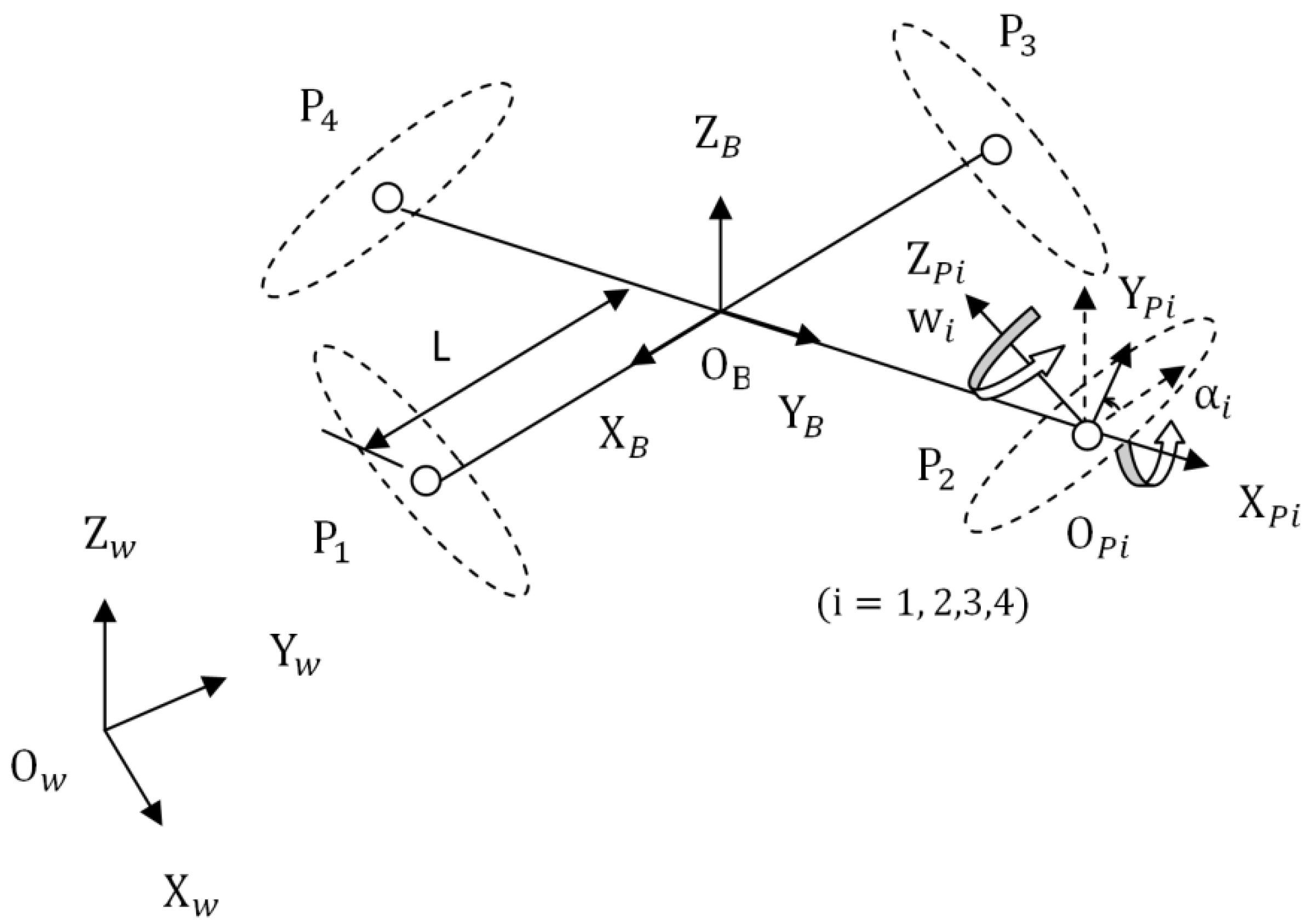
This section will establish a dynamic model from the Newton–Euler equation. First, we present the dynamics of the TRQ (Figure 1). Using the variables defined in the nomenclature, we propose various actuation modes from over-actuated, to fully actuated, to under-actuated modes.
Figure 1.
The schematic diagram of the TRQ for modeling.
2.1. Rotational and Translational Dynamics
The rotation matrix from the ith rotor frame to the body frame is
and
The angular velocity is
We define
where
The rotational dynamics of the TRQ can be formulated as:
where
The force in the rotor frame is
and the toque in body frame is
The transform between body angular rates to the Euler rates is
where
and is the attitude vector of the roll, the pitch, and the yaw angle. We denote and .
Taking the derivative of (8) and ignoring in (4), we have
We denote
Define the transform matrix
From (8), we have
It follows from (10) and (12) that
Considering the perturbation torque , we obtain
where
and is the inertia matrix, represents the centrifugal and Coriolis forces. is the vector of torques and is the perturbation torque.
The velocity in is
The derivative of velocity in can be expressed as
where
and
where . is the vector of forces.
Taking the derivative of (19), ignoring and using (20), the translational dynamics becomes
where is the perturbation force in .
2.2. Over-Actuated, Fully Actuated, and Under-Actuated Modes
Denote ,, , and , one can arrange (21) and (11) as
where
Remark 1.
Over-actuated and fully actuated modes.
For over-actuated mode, the vector of tilt angles is
By setting , the vector of tilt angles for fully actuated mode is
Remark 1.
Under-actuated mode.
By setting , the force and the torque in (23) for the under-actuated mode can be reduced as
3. Sliding Mode Path following and Control Allocation
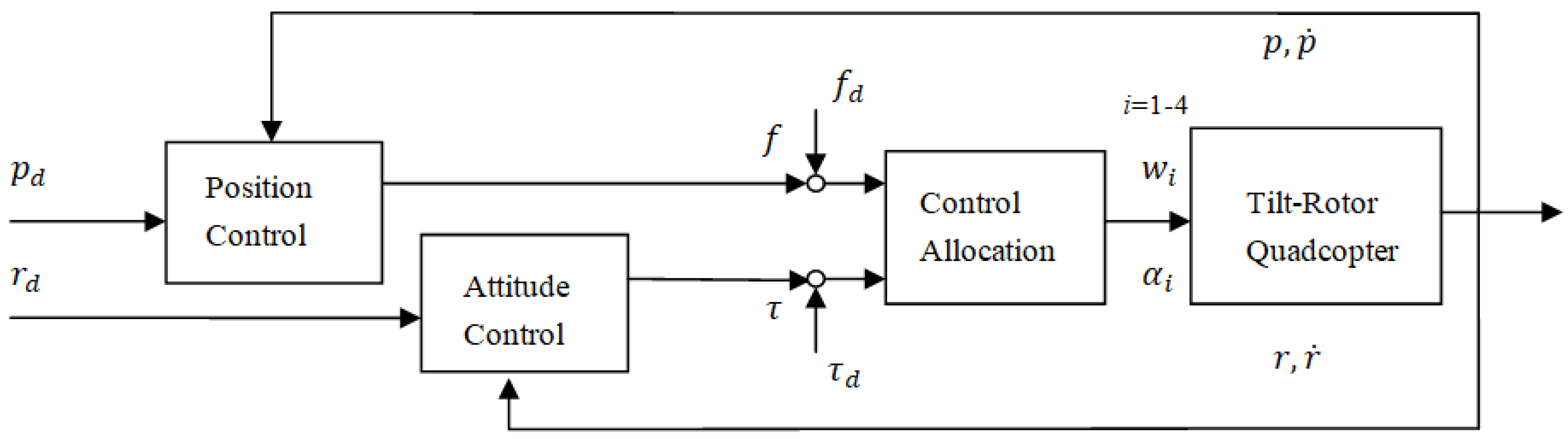
In this section, we first propose the sliding mode-based attitude and position following control via torque and force in (23). Then, we present the control allocation from the control torque and force to the speed and tilt angle of four rotors. Figure 2 illustrates the TRQ control scheme.
Figure 2.
The TRQ control scheme.
3.1. Attitude and Position following SMC
Define
and
where is the desired attitude and is the desired angular velocity.
Now, we propose the following control for attitude following to exploit the structure of the rotational dynamics:
where and denotes the nominal of . are positive diagonal matrices, is the sign function, and
We can now define
where is the desired position and is the desired velocity.
The position following control is proposed to alleviate the chattering effects as follows:
where is designed as follows:
where are positive diagonal matrices.
3.2. Control Allocation
3.2.1. Fully Actuated Mode
We use the following assumption for the fully actuated quadcopter system
Now, we propose the following steps to compute and :
Step 1: Initially, set the tilt angles (.
Step 2: Compute and from (32) and (29).
Step 3: Compute the rotor velocities.
where and .
Step 4: Compute the tilt angles from (23) and (24) using (34) as follows:
Step 5: Go to Step 2 to continue the iteration.
3.2.2. Over-Actuated Mode
We propose the steps to compute and :
Step 1: Initially, set the tilt angles .
Step 2: Compute and from (32) and (29).
Step 3: Compute the rotor velocities from (35).
Step 4: Compute the tilt angles from (23)–(25) as follows:
where and . Using the triangular identities one can use the numerical method to solve for in the system of nonlinear equations.
Step 5: Go to Step 2 to continue the iteration.
3.2.3. Under-Actuated Mode
Notice that, due to the lack of control degrees of freedom, the desired attitude and is not arbitrary for the under-actuated quadrotor.
One can obtain and by
The vector of is
4. Stability Analysis
This section presents the stability analysis of the SMC scheme. Let us use for the largest and smallest eigenvalue of a matrix . We denote the Euclidean norm for an vector by . The inertia matrix is symmetric, positive definite, and bounded by The matrix is skew-symmetric.
4.1. Sliding Mode Attitude following Control
Theorem 1.
Consider the dynamic model described in (15) and the control for attitude following in (29). The attitude following error dynamics is exponentially stable if the switching gain satisfies the following condition.
whereis a positive constant.
Proof.
and represent the nominal and , where and
The rotational dynamics can be expressed as follows:
Define
and
It follows from (48) that
Now, we propose the control
where and and are diagonal matrices. □
Define the Lyapunov function
Using (50) and taking derivative of yield
If the switching gain meets the condition as follows
where is a positive constant.
From (52), we have
The following adaptation law can replace the switching gain
where and is the obtained by filtering the using a low-pass filter
where is a positive constant.
4.2. Sliding Mode Position following Control
Theorem 2.
Consider the translational dynamic model described in (21) and the control for position following in (32)–(33). The position following error dynamics is then asymptotically stable.
Proof.
The translational dynamics is
where
The nominal dynamics is
where is the nominal mass and .
The sliding surface is
Using (57) yields
and
Define the Lyapunov function
where
It follows from (63) that
where is a diagonal matrix with diagonal elements .
Then
and
Using (62) and (65) yields
Substituting from (61) into (64), we have
We can derive from LaSalle-Yoshizawa theorem and (66) that On the basis of (62) and the Barbalat’s lemma, one can conclude that . Therefore, we have the following from (65)
which ensures that
□
5. Numerical Simulation
To illustrate the proposed control scheme’s design, we give an example of a fully actuated TRQ.
5.1. Simulation Parameters
Assuming we have
The matrix of is
We employ the following variables for simulation:
with initial conditions
and the desired positions
where The desired attitudes are
The desired path is defined as
Now, we use the following control parameters for simulation:
5.2. Simulation Results
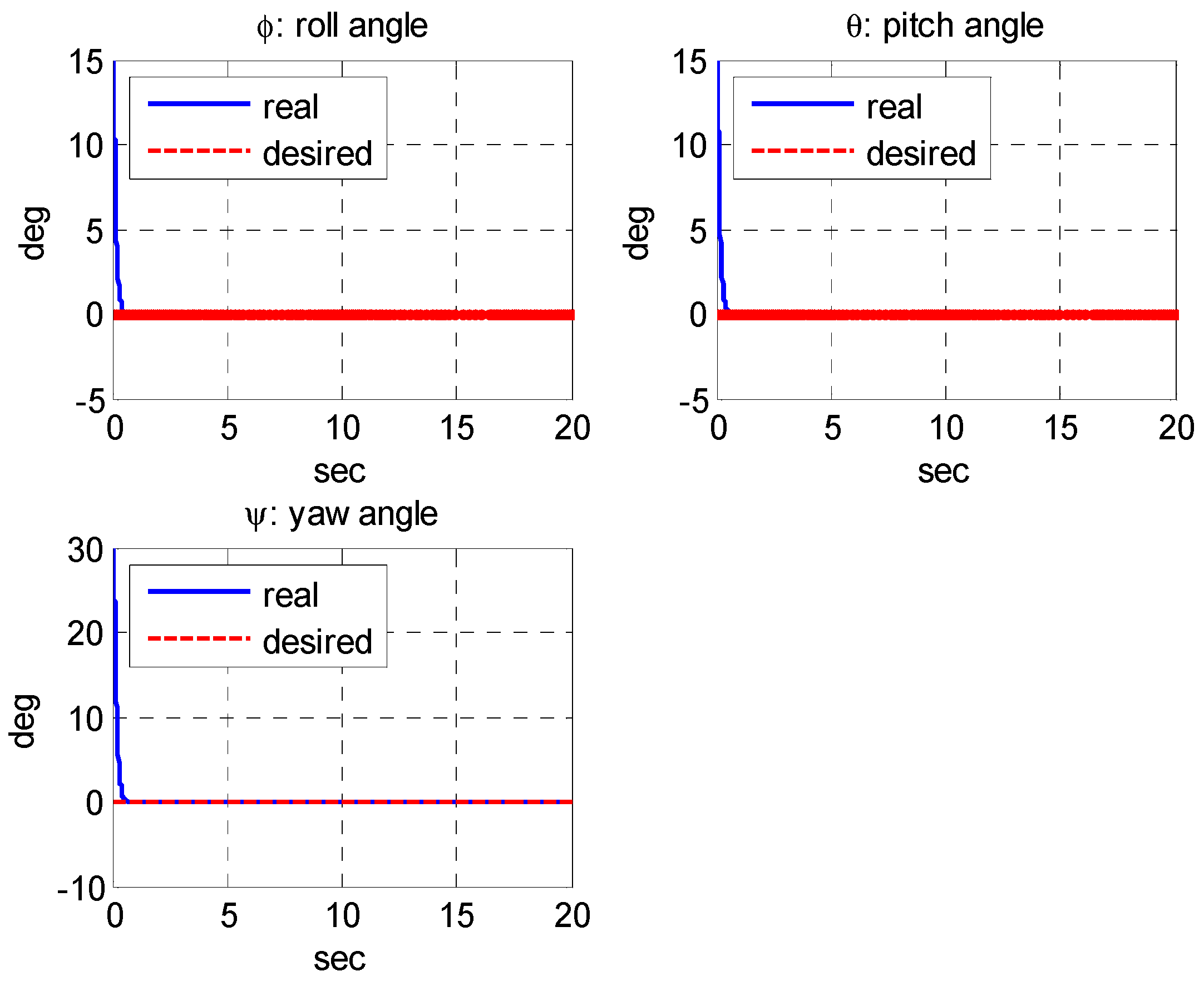
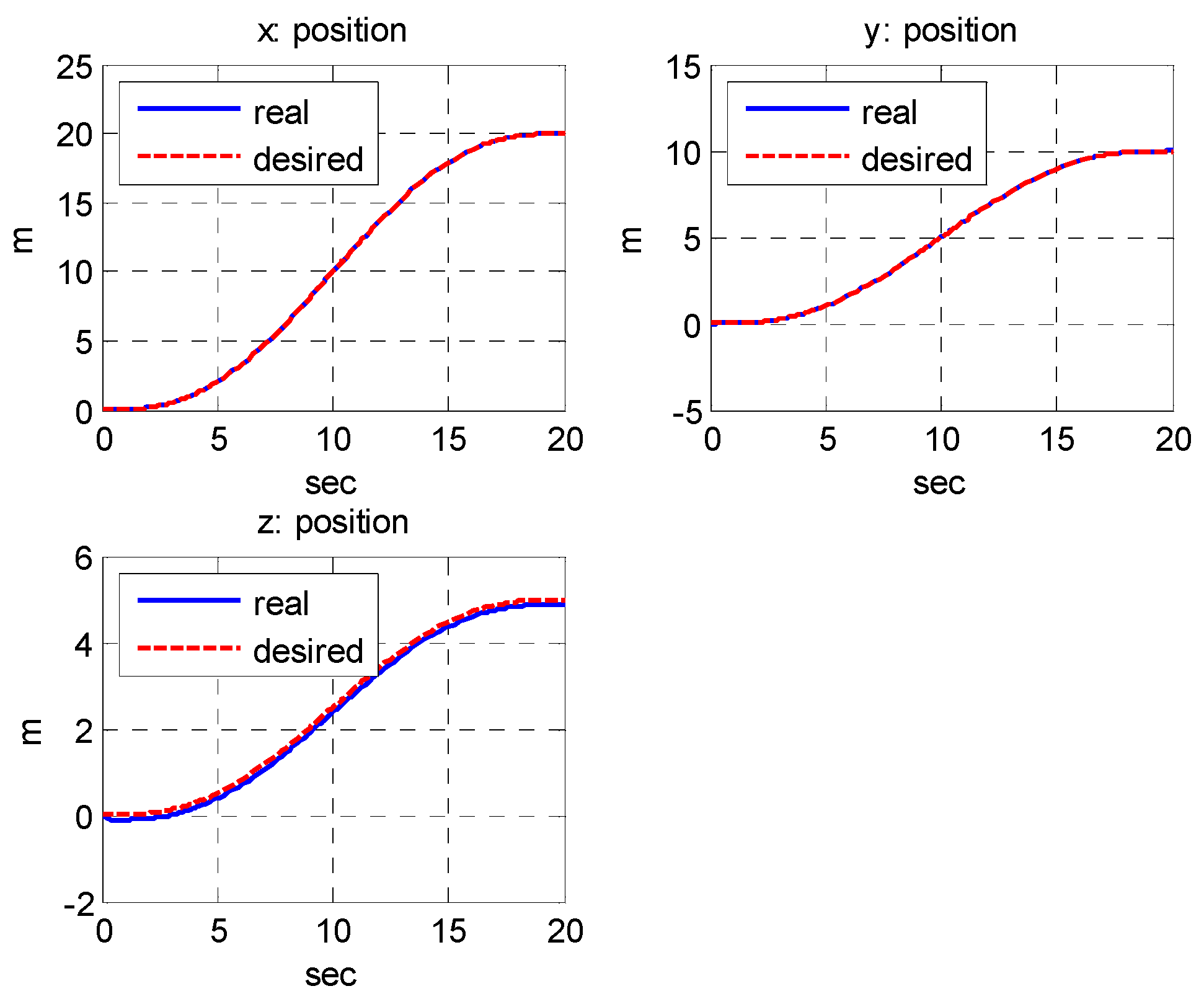
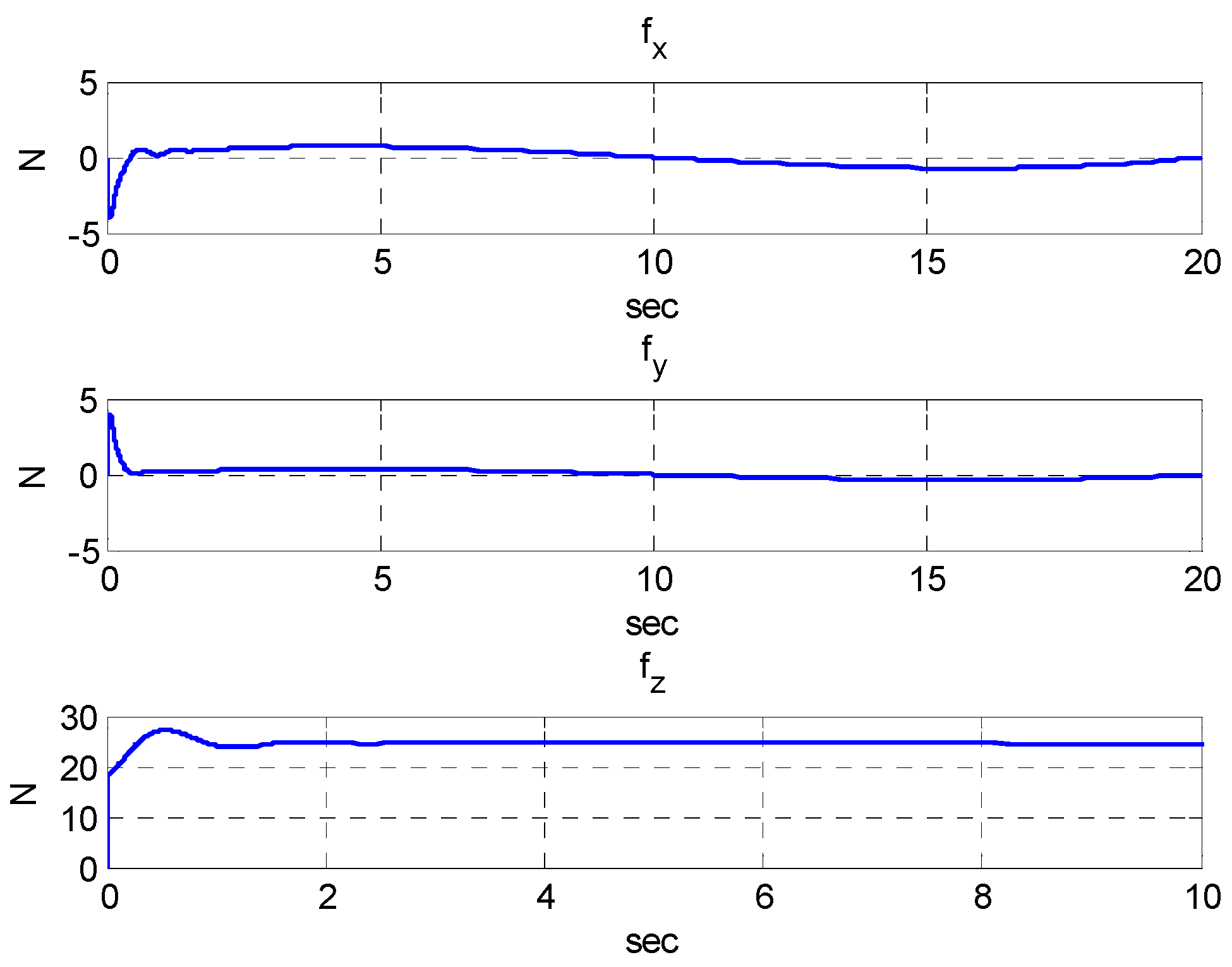
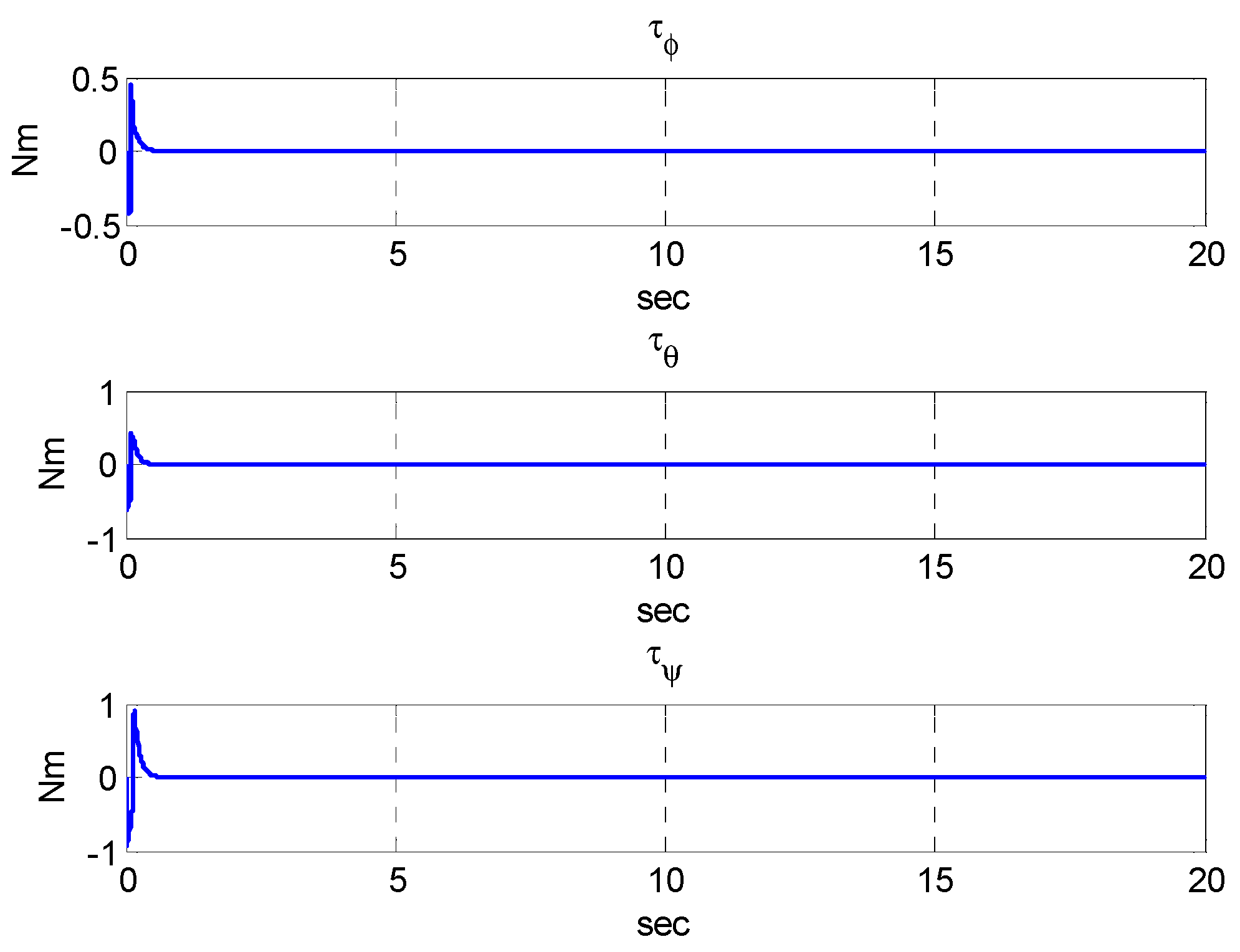
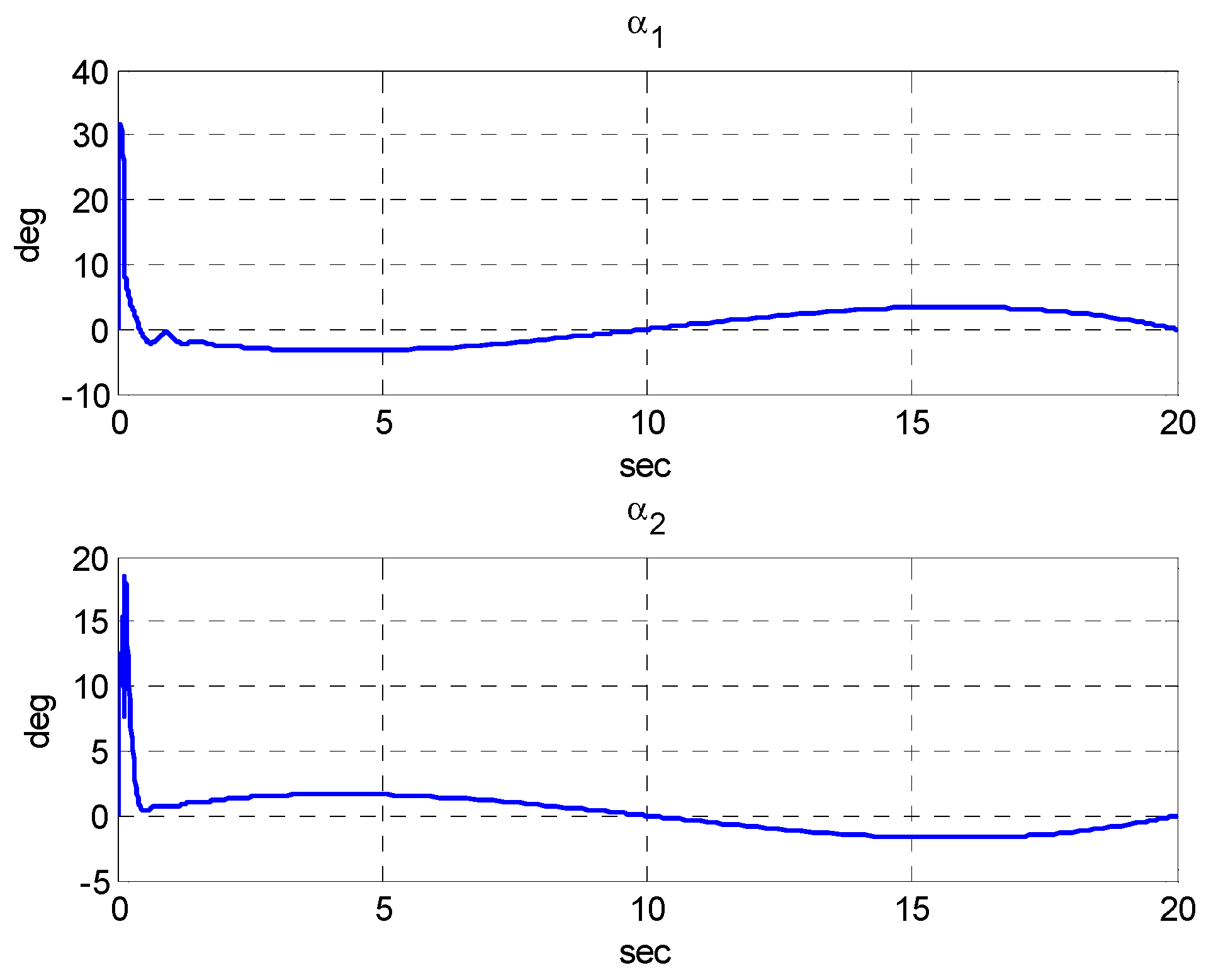
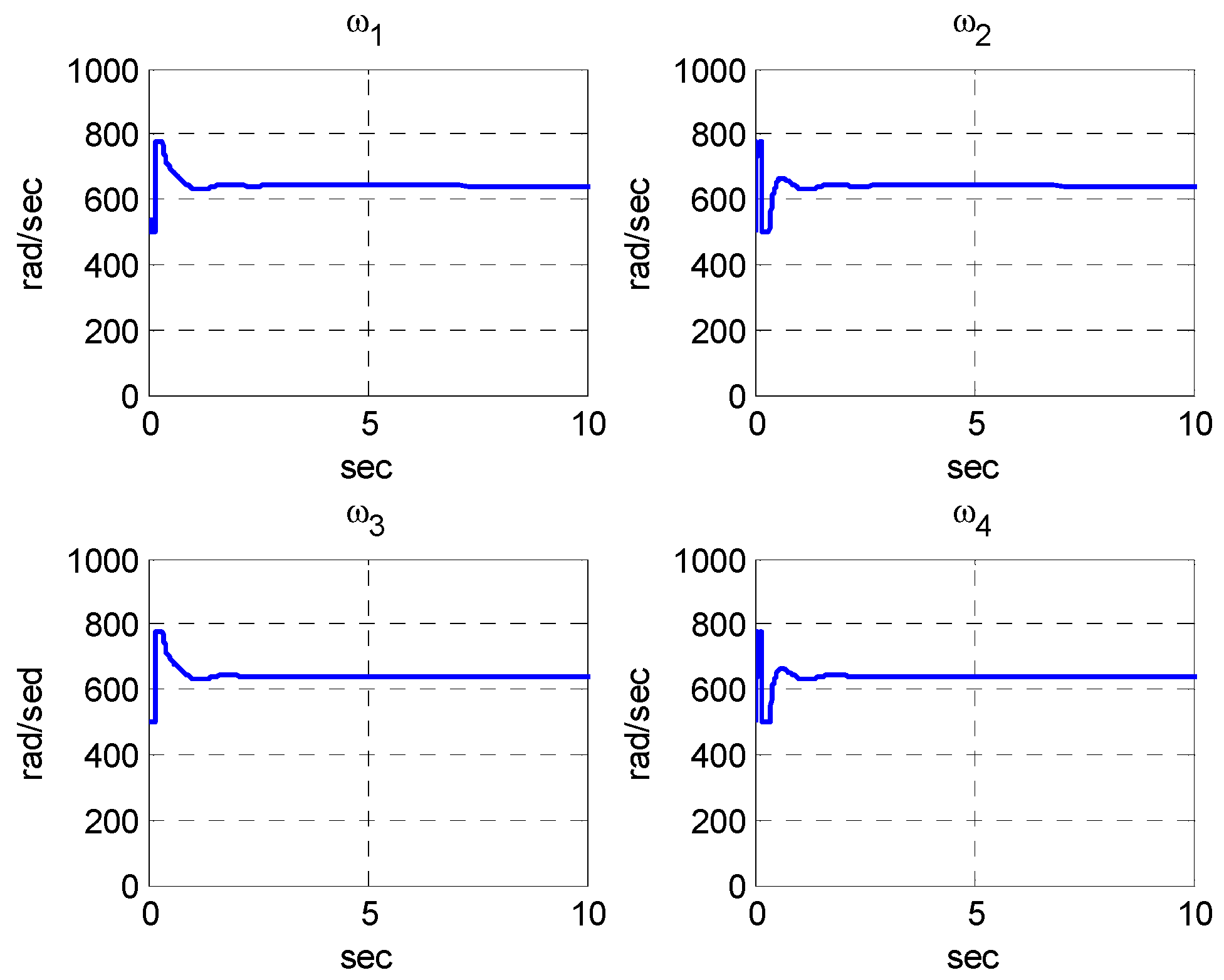
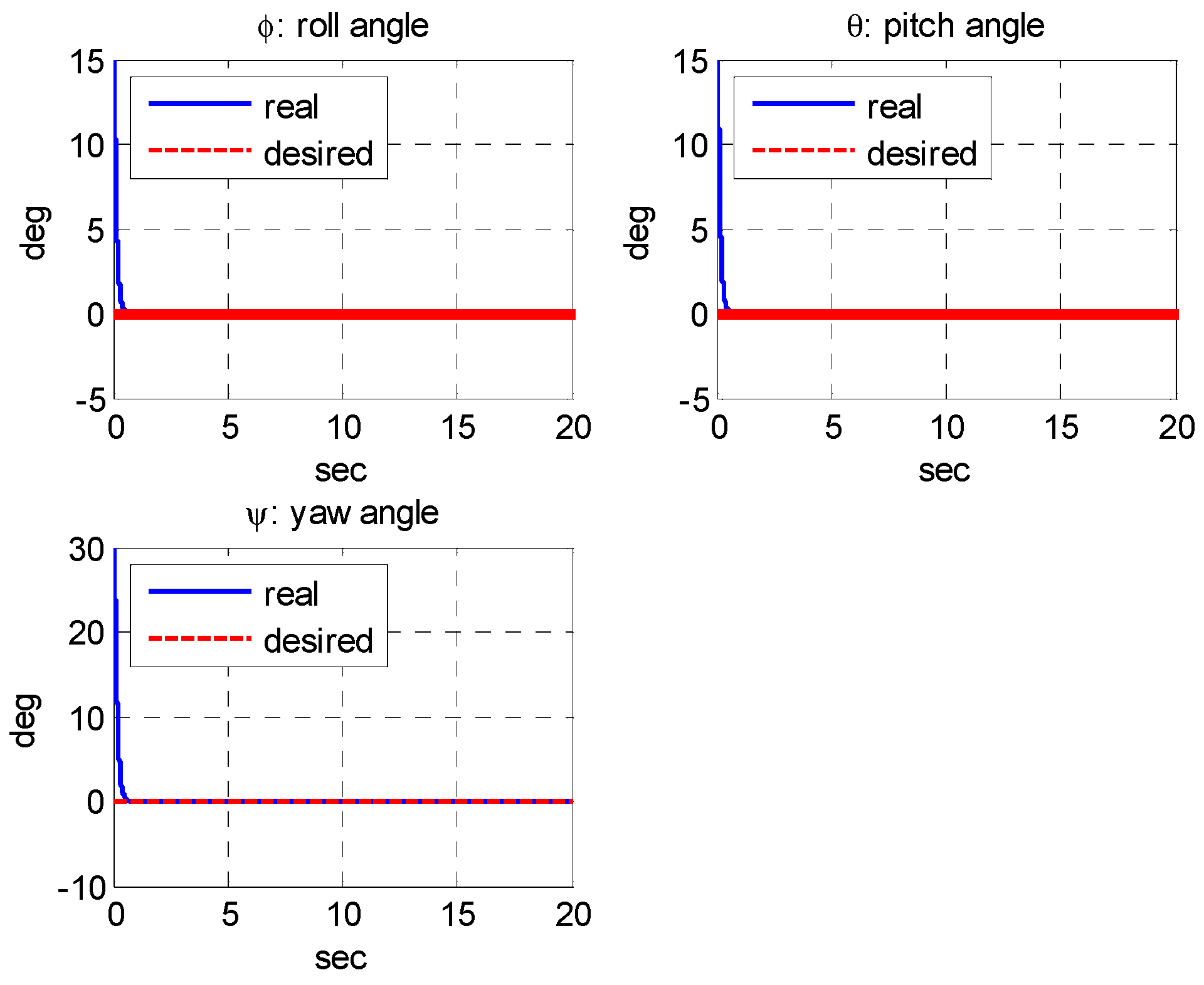
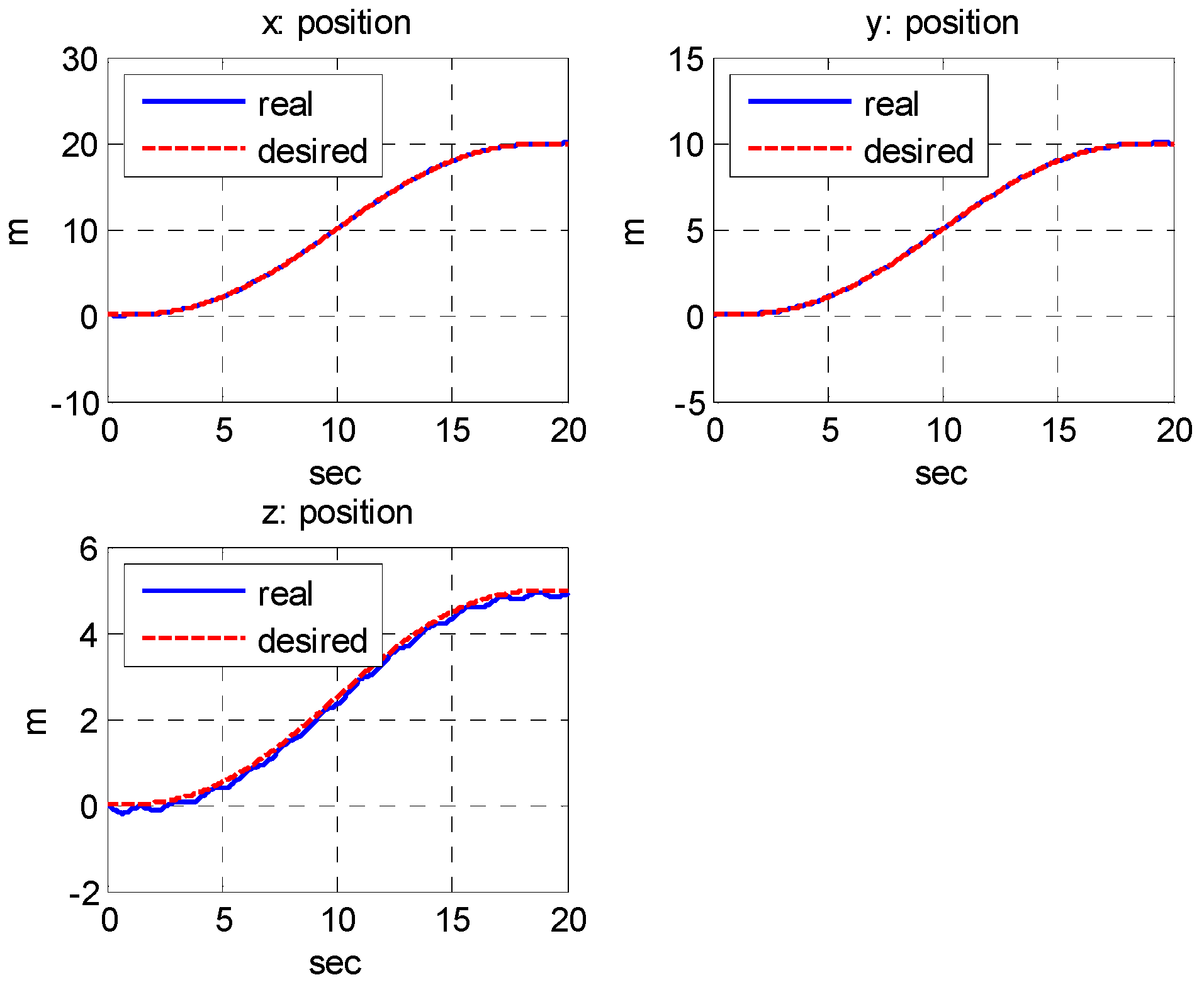
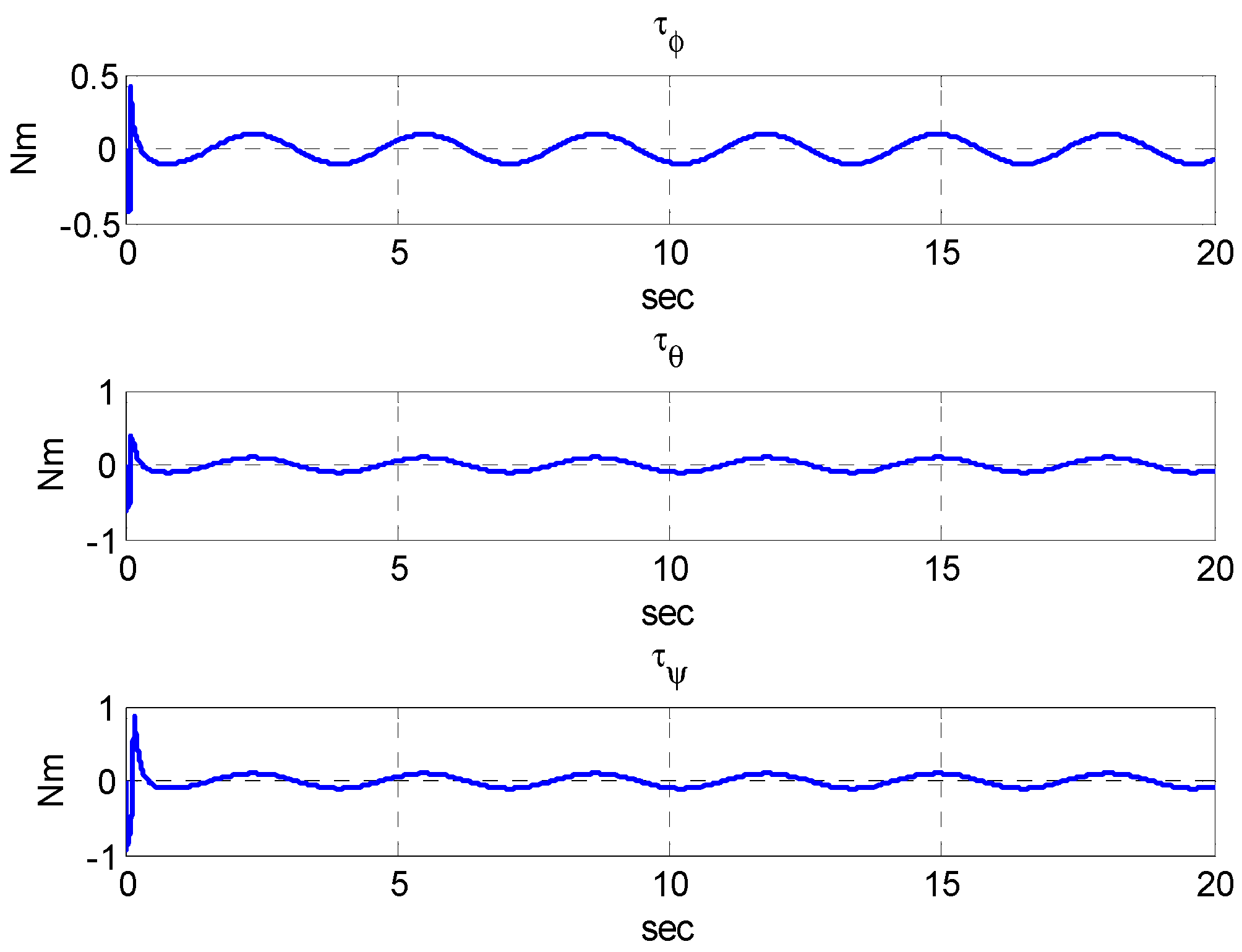
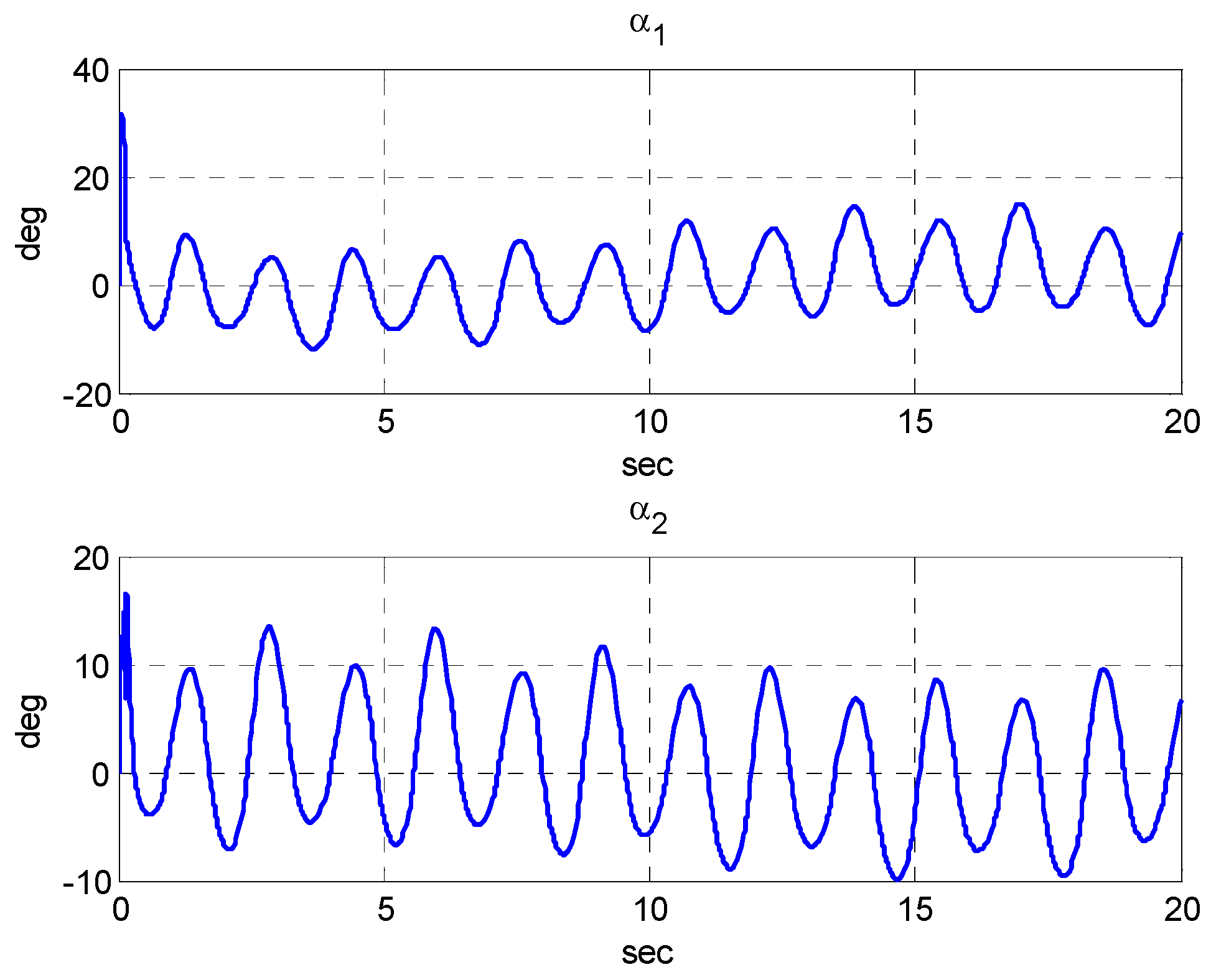
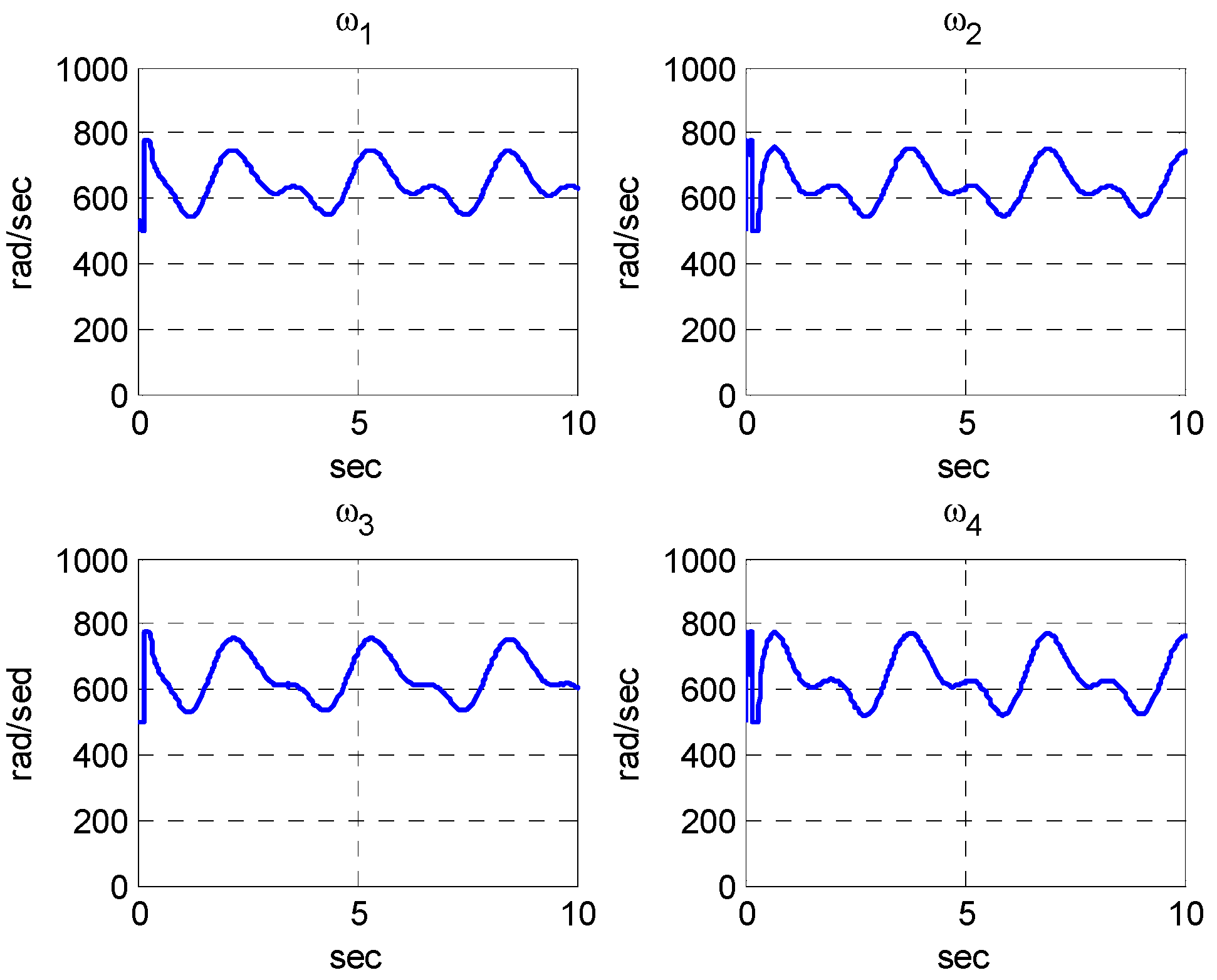
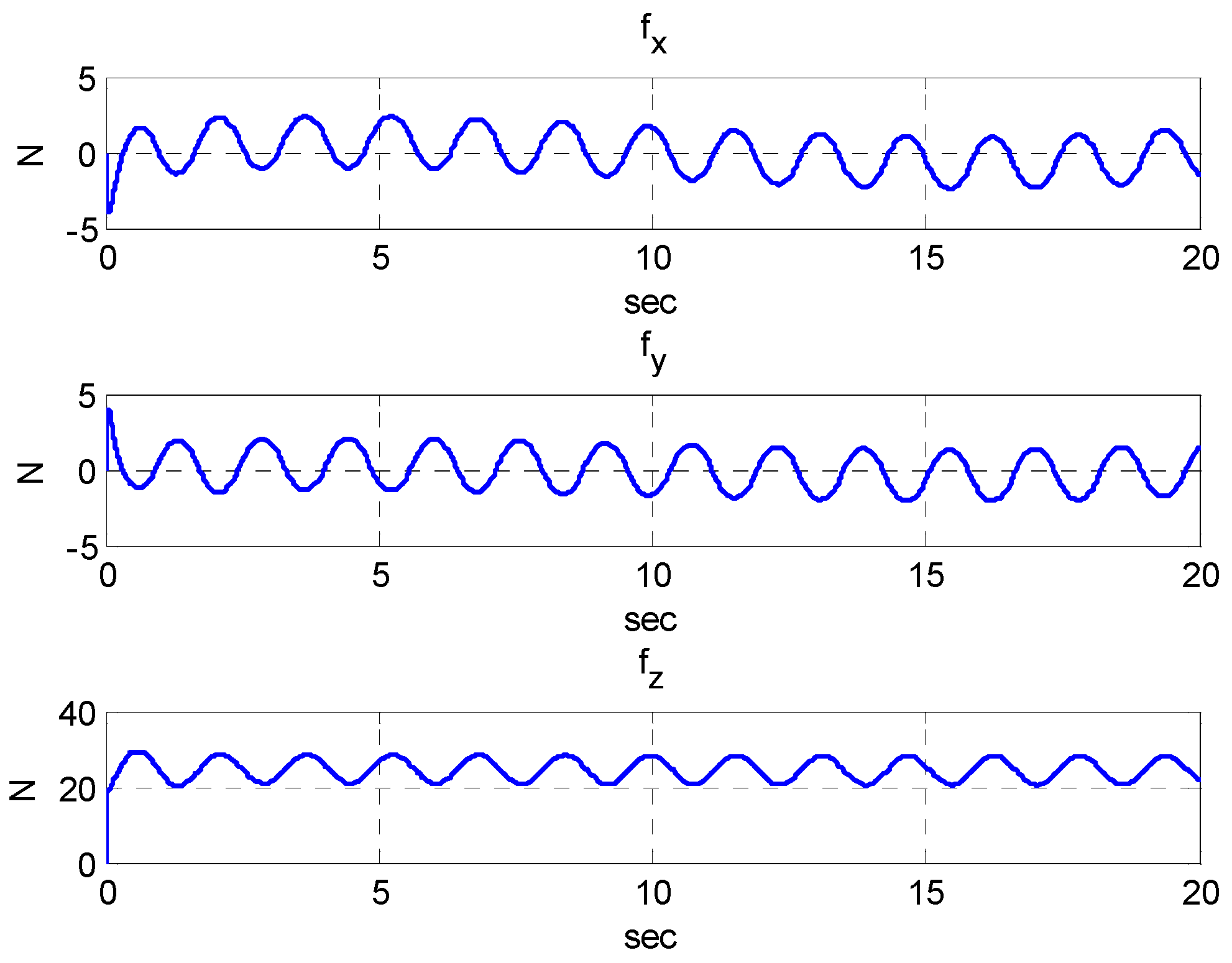
We present the simulation results of the proposed attitude and position following SMC control in Figure 3, Figure 4, Figure 5, Figure 6, Figure 7 and Figure 8. Figure 3 and Figure 4 show the attitude and position trajectories of the quadrotor with variable changes (weights increased to 125%). The simulation results in Figure 3 and Figure 4 show that the proposed SMC can successfully drive the quadrotor from the initial position through the desired path to the final destination while maintaining the desired attitude. Figure 5 and Figure 6 show the lift and steering torque produced by the four tilt-rotors of the TRQ. Figure 7 shows the path of the tilt angle with parameter deviation. The corresponding quadrotor speeds are shown in Figure 8.
Figure 3.
The attitude path with variable deviations.
Figure 4.
The position path with variable deviations.
Figure 5.
The propelling force with variable deviations.
Figure 6.
The turning torque with variable deviations.
Figure 7.
The tilt angle path with variable deviations.
Figure 8.
The rotor velocity with variable deviations.
Because the stability analysis in the previous section demonstrated robustness with respect to parameter uncertainty and external perturbations, we then further evaluated the impact of external perturbations on the TRQ. We used perturbation force [sin(4t) − sin(4t) 2sin(4t)] N and perturbation torque [0.1sin(2t) 0.1sin(2t) 0.1sin(2t)] Nm applied to TRQ for simulated motion. As shown in Figure 9, Figure 10, Figure 11, Figure 12, Figure 13 and Figure 14, we can see that the perturbation has little effect on the capability of the quadcopter because the proposed control and control assignment can reject the perturbation and return the state variables to the sliding surface.
Figure 9.
The attitude path with variable deviations and perturbations.
Figure 10.
The position path with variable deviations and perturbations.
Figure 11.
The propelling force with variable deviations and perturbations.
Figure 12.
The turning torque with variable deviations and perturbations.
Figure 13.
The tilt angle path with variable deviations and perturbations.
Figure 14.
The rotor velocity with variable deviations and perturbations.
In summary, the numerical simulation results clearly show that the proposed SMC schemes can accomplish the goal of trajectory tracking and counter the parametric variation and external disturbances in the rotation and translation of TRQ via control allocation.
6. Conclusions
This paper presents the dynamic modeling, path following, and control allocation of a TRQ. Two types of SMC are proposed to enhance the robustness and capability: one is the first-order sliding mode for attitude following and the other is the second-order sliding mode for position following. Considering the parameter changes and external perturbation, we show the stability analysis based on the Lyapunov theory that the proposed control scheme can ensure the error dynamics’ asymptotic stability for the position and attitude following. In the numerical simulation of the fully actuated mode, we demonstrated that the proposed SMC could achieve path following and attitude regulation goals in the presence of variable changes and external perturbations. The tilt-rotor quadrotor has more control degrees of freedom than the under-actuated quadrotor and, therefore, can make full use of the control redundancy to complete the simultaneous trajectory tracking and attitude control that a traditional quadrotor cannot do, and thus has a certain degree of actuator fault tolerance. In the future, we will integrate the sliding mode path following and control allocation into a fault-tolerant flight control.
Author Contributions
Conceptualization, C.-C.Y. and S.-J.W.; methodology, C.-C.Y. and S.-J.W.; software, S.-J.W.; validation, C.-C.Y. and S.-J.W.; formal analysis, C.-C.Y.; investigation, S.-J.W.; writing—original draft preparation, C.-C.Y. and S.-J.W.; writing—review and editing, C.-C.Y.; visualization, S.-J.W. All authors have read and agreed to the published version of the manuscript.
Funding
This research received no external funding.
Institutional Review Board Statement
Not applicable.
Informed Consent Statement
Not applicable.
Data Availability Statement
No new data were created or analyzed in this study. Data sharing is not applicable to this article.
Conflicts of Interest
The authors declare no conflict of interest.
Nomenclature
References
- Mahony, R.; Kumar, V.; Corke, P. Multirotor Aerial Vehicles: Modeling, Estimation, and Control of Quadrotor. IEEE Robot. Autom. Mag. 2012, 19, 20–32. [Google Scholar] [CrossRef]
- Quan, Q. Introduction to Multicopter Design and Control; Springer: Berlin/Heidelberg, Germany, 2017. [Google Scholar]
- Miranda-Colorado, R.; Aguilar, L.T. Robust PID control of quadrotors with power reduction analysis. ISA Trans. 2020, 98, 47–62. [Google Scholar] [CrossRef] [PubMed]
- Gomes, L.L.; Leal, L.; Oliveira, T.R.; Cunha, J.P.V.S.; Revoredo, T.C. Unmanned Quadcopter Control Using a Motion Capture System. IEEE Lat. Am. Trans. 2016, 14, 3606–3613. [Google Scholar] [CrossRef]
- Shankaran, V.P.; Azid, S.I.; Mehta, U.; Fagiolini, A. Improved Performance in Quadrotor Trajectory Tracking Using MIMO PI-D Control. IEEE Access 2022, 10, 110646–110660. [Google Scholar]
- Lee, D.; Kim, H.J.; Sastry, S. Feedback Linearization vs. Adaptive SMC for a Quadrotor Helicopter. Int. J. Control Autom. Syst. 2009, 7, 419–428. [Google Scholar] [CrossRef]
- Satici, A.C.; Poonawala, H.; Spong, M.W. Robust Optimal Control of Quadrotor UAVs. IEEE Access 2013, 1, 79–93. [Google Scholar] [CrossRef]
- Koksal, N.; An, H.; Fidan, B. Backstepping-based adaptive control of a quadrotor UAV with guaranteed following capability. ISA Trans. 2020, 105, 98–110. [Google Scholar] [CrossRef]
- Young-Cheol, C.; Hyo-Sung, A. Nonlinear Control of Quadrotor for Point Following: Actual Implementation and Experimental Tests. IEEE/ASME Trans. Mechatron. 2015, 20, 1179–1192. [Google Scholar]
- Perozzi, G.; Efimov, D.; Biannic, J.-M.; Planckaert, L. Path following for a quadrotor under wind perturbations: SMC with state-dependent gains. J. Frankl. Inst. 2018, 355, 4809–4838. [Google Scholar] [CrossRef]
- Xu, G.; Xia, Y.; Zhai, D.-H.; Ma, D. Adaptive prescribed capability terminal sliding mode attitude control for quadrotor under input saturation. IET Control Theory Appl. 2020, 14, 2473–2480. [Google Scholar] [CrossRef]
- Besnard, L.; Shtessel, Y.B.; Landrum, B. Quadrotor vehicle control via SMCler driven by sliding mode perturbation observer. J. Frankl. Inst. 2012, 349, 658–684. [Google Scholar] [CrossRef]
- Ricardo, J.A., Jr.; Santos, D.A.; Oliveira, T.R. Attitude Tracking Control for a Quadrotor Aerial Robot Using Adaptive Sliding Modes. In Proceedings of the XLI Ibero-Latin-American Congress on Computational Methods in Engineering (ABMEC), Foz do Iguaçu, Brazil, 16–19 November 2020. [Google Scholar]
- Islam, S.; Liu, P.X.; El Saddik, A. Robust Control of Four-Rotor Unmanned Aerial Vehicle With Perturbation Uncertainty. IEEE Trans. Ind. Electron. 2015, 62, 1563–1571. [Google Scholar] [CrossRef]
- Dierks, T.; Jagannathan, S. Output Feedback Control of a Quadrotor UAV Using Neural Networks. IEEE Trans. Neural Netw. 2010, 21, 50–66. [Google Scholar] [CrossRef] [PubMed]
- Wu, H.; Ye, H.; Xue, W.; Yang, X. Improved Reinforcement Learning Using Stability Augmentation With Application to Quadrotor Attitude Control. IEEE Access 2022, 10, 67590–67604. [Google Scholar] [CrossRef]
- Yang, S.; Xian, B. Exponential Regulation Control of a Quadrotor Unmanned Aerial Vehicle With a Suspended Payload. IEEE Trans. Control Syst. Technol. 2020, 28, 2762–2769. [Google Scholar] [CrossRef]
- Levant, A. Principles of 2-sliding mode design. Automatica 2007, 43, 576–586. [Google Scholar] [CrossRef]
- Levant, A. Sliding order and sliding accuracy in SMC. Int. J. Control 1993, 58, 1247–1263. [Google Scholar] [CrossRef]
- Utkin, V.I.; Poznyak, A.S. Adaptive SMC with application to super-twist algorithm: Equivalent control method. Automatica 2013, 49, 39–47. [Google Scholar] [CrossRef]
- Moreno, A.; Osorio, M. Strict Lyapunov functions for the super-twisting algorithm. IEEE Trans. Autom. Control 2012, 57, 1035–1040. [Google Scholar] [CrossRef]
- Pico, J.; Pico-Marco, E.; Vignoni, A.; De Battista, H. Stability preserving maps for finite-time convergence: Super-twisting sliding-mode algorithm. Automatica 2013, 49, 534–539. [Google Scholar] [CrossRef]
- Utkin, V. On convergence time and perturbation rejection of super-twisting control. IEEE Trans. Autom. Control 2013, 58, 2013–2017. [Google Scholar] [CrossRef]
- Mokhtari, A.; Benallegue, A.; Orlov, Y. Exact linearization and sliding mode observer for a quadrotor unmanned aerial vehicle. Int. J. Robot. Autom. 2006, 21, 39–49. [Google Scholar] [CrossRef]
- Beballegue, A.; Mokhtari, A.; Fridman, L. High-order sliding-mode observer for a quadrotor UAV. Int. J. Robust Nonlinear Control 2008, 18, 427–440. [Google Scholar] [CrossRef]
- Bauersfeld, L.; Spannagl, L.; Ducard, G.J.J.; Onder, C.H. MPC Flight Control for a Tilt-Rotor VTOL Aircraft. IEEE Trans. Aerosp. Electron. Syst. 2021, 57, 2395–2409. [Google Scholar] [CrossRef]
- Ryll, M.; Bülthoff, H.H.; Giordano, P.R. A Novel Overactuated Quadrotor UnmannedAerial Vehicle: Modeling, Control, and Experimental Validation. IEEE Trans. Control Syst. Technol. 2015, 23, 540–556. [Google Scholar] [CrossRef]
- Hua, M.-D.; Hamel, T.; Morin, P.; Samson, C. Control of VTOL vehicles with thrust-tilting augmentation. Automatica 2015, 52, 1–7. [Google Scholar] [CrossRef]
- Rashad, R.; Goerres, J.; Aarts, R.; Engelen, J.B.C.; Stramigioli, S. Fully Actuated Multirotor UAVs: A Literature Review. IEEE Robot. Autom. Mag. 2020, 27, 97–107. [Google Scholar] [CrossRef]
- Zheng, P.; Tan, X.; Kocer, B.B.; Yang, E.; Kovac, M. TiltDrone: A Fully-Actuated Tilting Quadrotor Platform. IEEE Robot. Autom. Lett. 2020, 5, 6845–6852. [Google Scholar] [CrossRef]
- Willis, J.; Johnson, J.; Beard, R.W. State-Dependent LQR Control for a Tilt-Rotor UAV. In Proceedings of the 2020 American Control Conference (ACC), Denver, CO, USA, 1–3 July 2020; pp. 4175–4181. [Google Scholar]
Publisher’s Note: MDPI stays neutral with regard to jurisdictional claims in published maps and institutional affiliations. |
© 2022 by the authors. Licensee MDPI, Basel, Switzerland. This article is an open access article distributed under the terms and conditions of the Creative Commons Attribution (CC BY) license (https://creativecommons.org/licenses/by/4.0/).