


Gradient Boosting over Linguistic-Pattern-Structured Trees for Learning Protein–Protein Interaction in the Biomedical Literature



Abstract
1. Introduction
2. Related Works
3. Materials and Methods
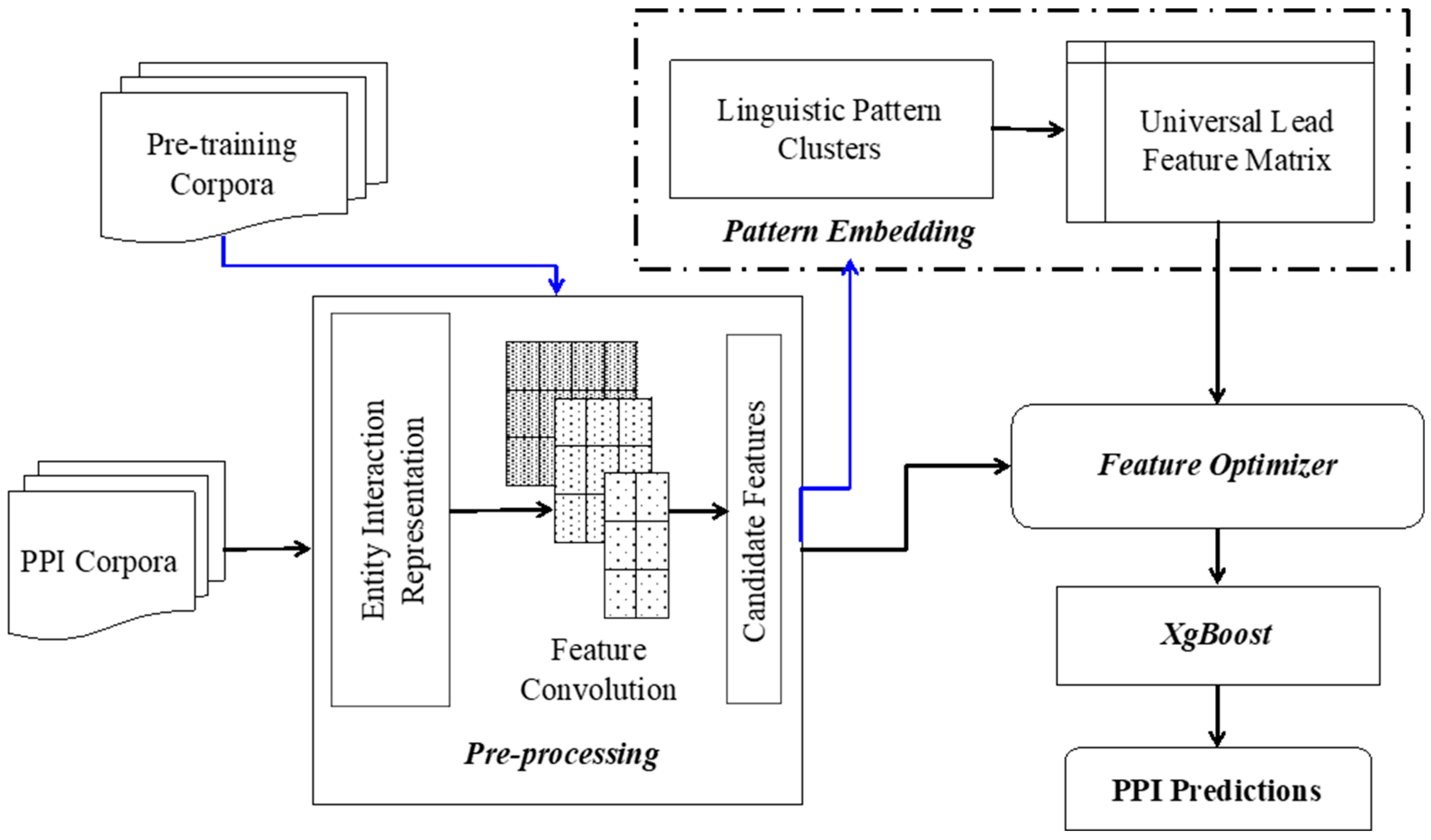
3.1. Preprocessing
3.1.1. Entity-Interaction Representation
3.1.2. Semantic Feature Convolution
3.2. Pattern Embedding and Universal Feature Matrix
3.2.1. Invariant Linguistic-Pattern Clusters
3.2.2. Universal Lead Feature Matrix
3.3. Feature Optimization
3.4. Gradient-Tree Boosting
4. Experimental Results and Discussion
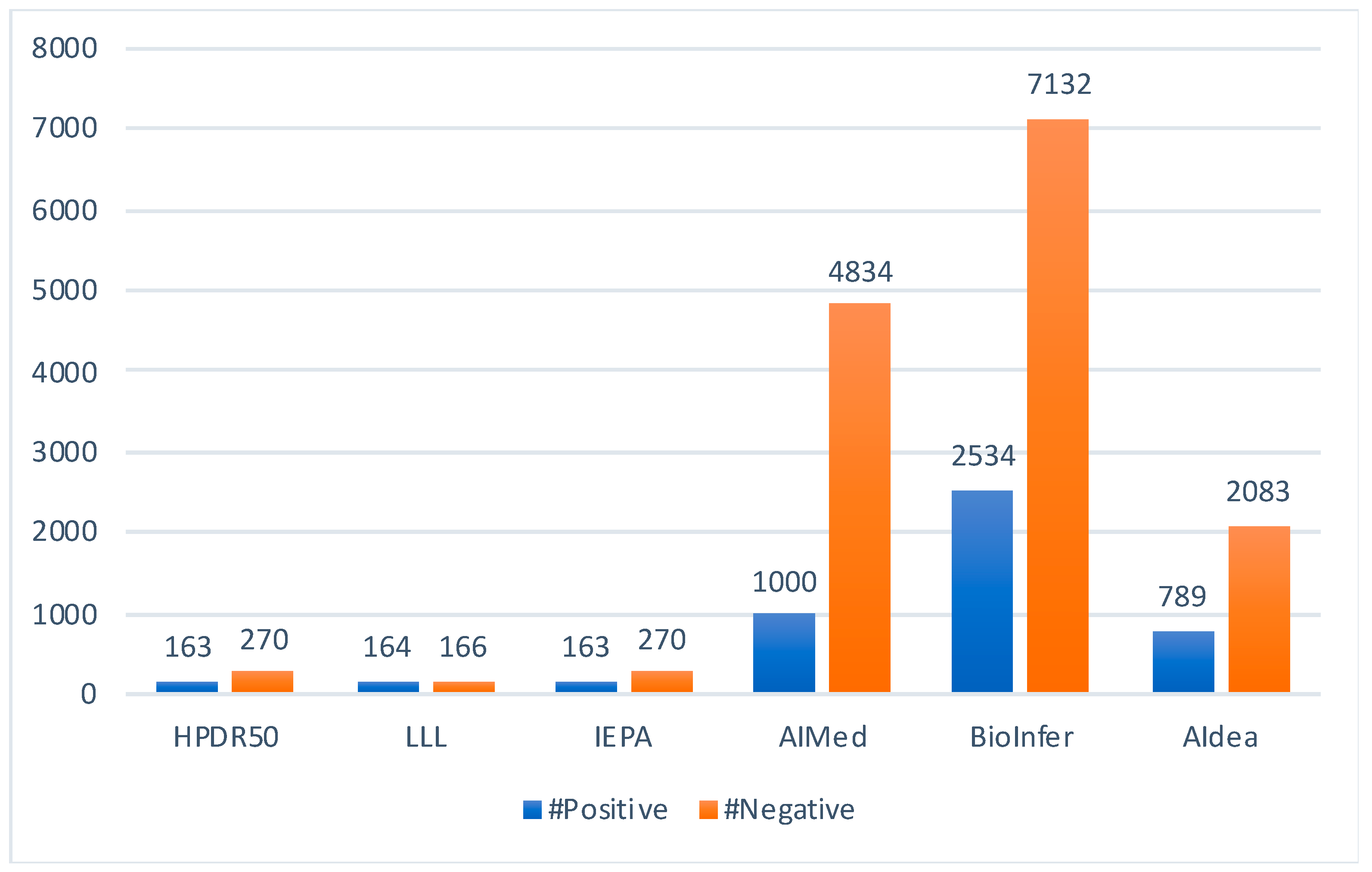
4.1. Dataset
4.2. Experimental Setup
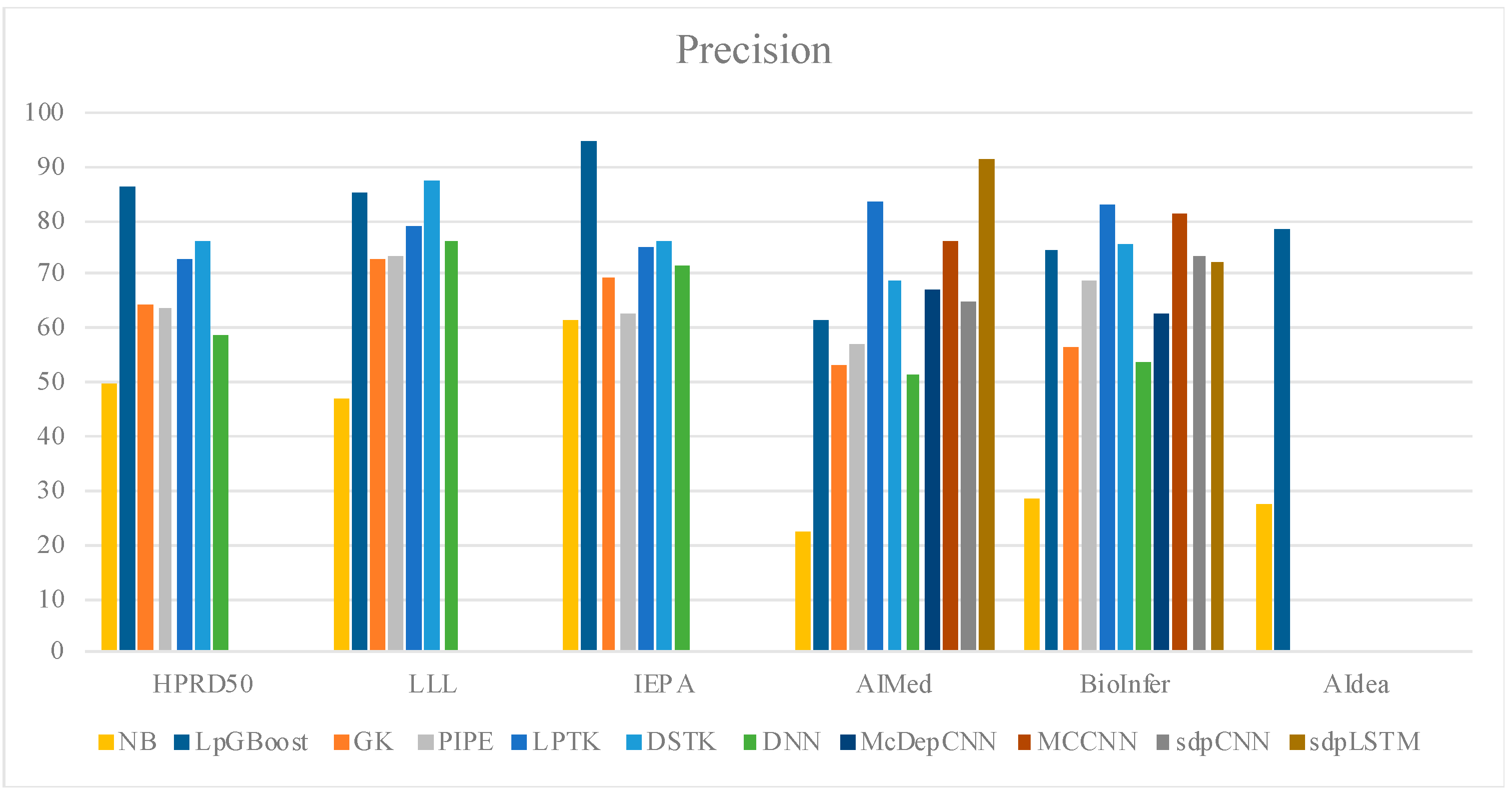
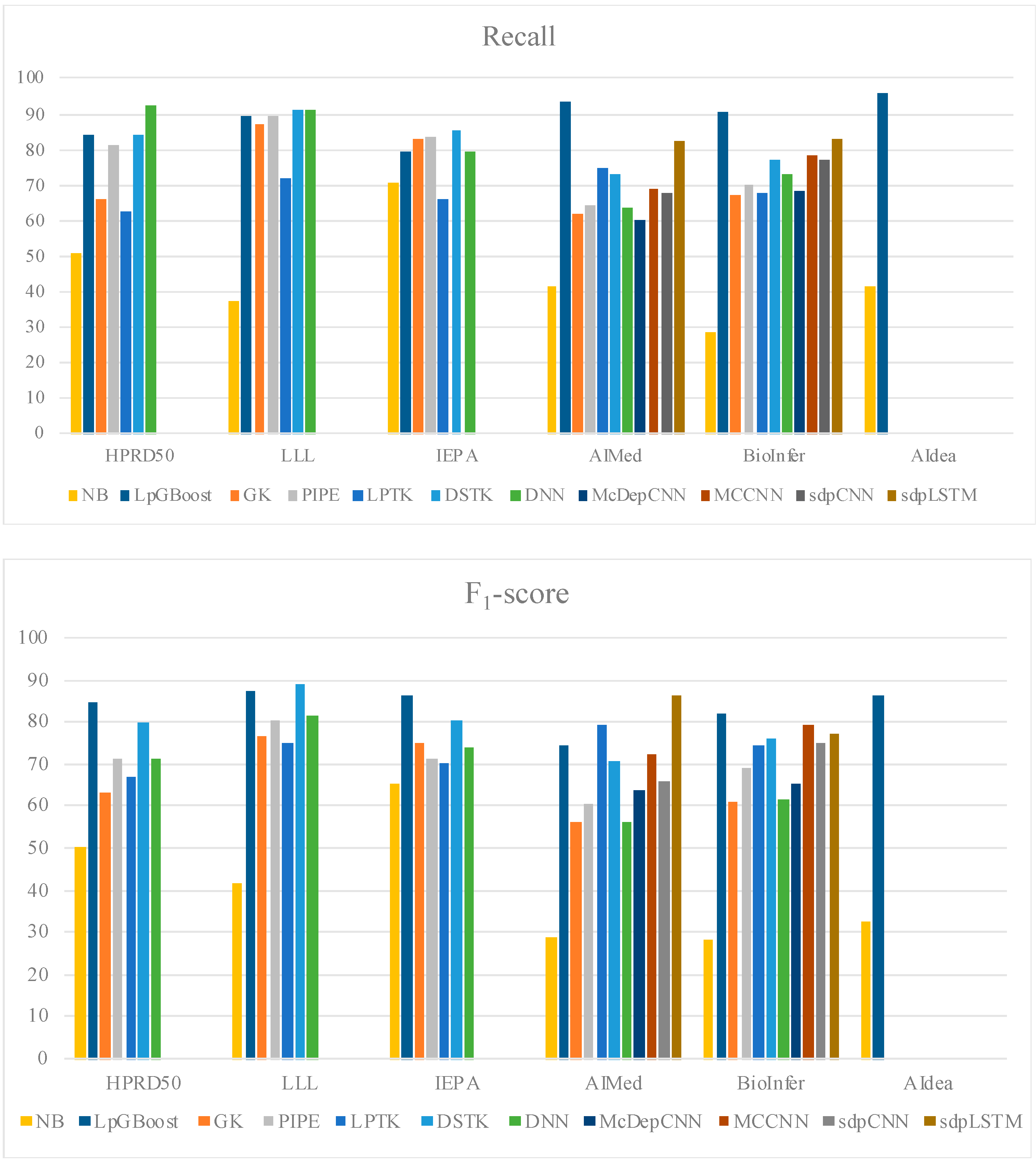
4.3. Results and Discussion
5. Conclusions
Author Contributions
Funding
Institutional Review Board Statement
Informed Consent Statement
Data Availability Statement
Conflicts of Interest
References
- Krallinger, M.; Vazquez, M.; Leitner, F.; Salgado, D.; Chatr-aryamontri, A.; Winter, A.; Valencia, A. The Protein-Protein Interaction tasks of BioCreative III: Classification/ranking of articles and linking bio-ontology concepts to full text. BMC Bioinformatics 2011, 12 (Suppl. 8), S3. [Google Scholar] [CrossRef]
- Krallinger, M.; Rabal, O.; Akhondi, S.A.; Perez, M.P.; Santamaria, J.; Rodriguez, G.P.; Tsatsaronis, G.; Intxaurrondo, A.; Lopez, J.A.; Nandal, U.; et al. Overview of the BioCreative VI chemical-protein interaction Track. In Proceedings of the 2017 BioCreative VI Workshop, Bethesda, MD, USA, 18–20 October 2017. [Google Scholar]
- Lung, P.Y.; He, Z.; Zhao, T.; Yu, D.; Zhang, J. Extracting chemical–protein interactions from literature using sentence structure analysis and feature engineering. Database 2019, 2019, bay138. [Google Scholar] [CrossRef] [PubMed]
- Pyysalo, S.; Airola, A.; Heimonen, J.; Björne, J.; Ginter, F.; Salakoski, T. Comparative analysis of five protein-protein interaction corpora. BMC Bioinform. 2008, 9, S6. [Google Scholar] [CrossRef] [PubMed]
- Murugesan, G.; Abdulkadhar, S.; Natarajan, J. Distributed smoothed tree kernel for protein-protein interaction extraction from the biomedical literature. PLoS ONE 2017, 12, e0187379. [Google Scholar] [CrossRef] [PubMed]
- Warikoo, N.; Chang, Y.C.; Hsu, W.L. LPTK: A linguistic pattern-aware dependency tree kernel approach for the BioCreative VI CHEMPROT task. Database J. Biol. Databases Curation 2018, 2018, bay108. [Google Scholar] [CrossRef] [PubMed]
- Hua, L.; Quan, C. A shortest dependency path based convolutional neural network for protein-protein relation extraction. BioMed. Res. Int. 2016, 2016, 8479587. [Google Scholar] [CrossRef] [PubMed]
- Peng, Y.; Lu, Z. Deep learning for extracting protein-protein interactions from biomedical literature. In Proceedings of the 2017 Workshop on Biomedical Natural Language Processing, Vancouver, BC, Canada, 4 August 2017; pp. 29–38. [Google Scholar]
- Quan, C.; Hua, L.; Sun, X.; Bai, W. Multichannel convolutional neural network for biological relation extraction. BioMed Res. Int. 2016, 2016, 1850404. [Google Scholar] [CrossRef] [PubMed]
- Stenetorp, P.; Topi, G.; Pyysalo, S.; Ohta, T.; Kim, J.D.; Tsujii, J. BioNLP Shared Task 2011: Supporting Resources, Proceedings of BioNLP Shared Task 2011 Workshop Companion Volume for Shared Task; Association for Computational Linguistics (ACL): Stroudsburg, PA, USA, 2011. [Google Scholar]
- Airola, A.; Pyysalo, S.; Björne, J. All-paths graph kernel for protein-protein interaction extraction with evaluation of cross-corpus learning. BMC Bioinform. 2008, 9, S2. [Google Scholar] [CrossRef] [PubMed]
- Landeghem, S.V.; Saeys, Y.; Peer, Y.V.; Baets, B.D. Extracting protein-protein interactions from text using rich feature vectors and feature selection. In Proceedings of the Third International Symposium on Semantic Mining in Biomedicine (SMBM) 2008, Turku, Finland, 1–3 September 2008. [Google Scholar]
- Erkan, G.; Özgür, A.; Radev, D.R. Semi-Supervised Classification for Extracting Protein Interaction Sentences using Dependency Parsing. In Proceedings of the Conference on Empirical Methods in Natural Language Processing-Conference on Computational Natural Language Learning (EMNLP-CoNLL) 2007, Prague, Czech Republic, 28–30 June 2007; pp. 228–237. [Google Scholar]
- Satre, R.; Sagae, K.; Tsujii, J. Syntactic features for protein-protein interaction extraction. BMC Bioinform. 2007, 2016, 246. [Google Scholar] [CrossRef]
- Chang, Y.C.; Chu, C.H.; Su, Y.C.; Chen, C.C.; Hsu, W.L. PIPE: A protein–protein interaction passage extraction module for BioCreative challenge. Database J. Biol. Databases Curation 2016, 2016, baw101. [Google Scholar] [CrossRef] [PubMed]
- Yadav, S.; Kumar, A.; Ekbal, A.; Saha, S.; Bhattacharyya, P. Feature Assisted bi-directional LSTM Model for Protein-Protein Interaction Identification from Biomedical Texts. arXiv 2018, arXiv:abs/1807.02162. [Google Scholar]
- Su, P.; Vijay-Shanker, K. Investigation of BERT Model on Biomedical Relation Extraction Based on Revised Fine-tuning Mechanism. In Proceedings of the 2020 IEEE International Conference on Bioinformatics and Biomedicine (BIBM), Seoul, Korea, 16–19 December 2020; pp. 2522–2529. [Google Scholar] [CrossRef]
- Su, P.; Vijay-Shanker, K. Investigation of improving the pre-training and fine-tuning of BERT model for biomedical relation extraction. BMC Bioinform. 2022, 23, 120. [Google Scholar] [CrossRef] [PubMed]
- Su, P.; Peng, Y.; Vijay-Shanker, K. Improving BERT Model Using Contrastive Learning for Biomedical Relation Extraction. arXiv 2021, arXiv:2104.13913. [Google Scholar]
- Warikoo, N.; Chang, Y.-C.; Hsu, W.-L. LBERT: Lexically aware Transformer-based Bidirectional Encoder Representation model for learning universal bio-entity relations. Bioinformatics 2021, 37, 404–412. [Google Scholar] [CrossRef] [PubMed]
- Wu, S.; He, Y. Enriching Pre-trained Language Model with Entity Information for Relation Classification. arXiv 2019, arXiv:1905.08284. [Google Scholar]
- Dickson, L.E. Mathematical Monongraphs Algebraic Invariants, No.14.; John Wiley: New York, NY, USA, 1914. [Google Scholar]
- Tsuruka, Y.; Tateishi, Y.; Kim, J.D.; Ohta, T.; McNaught, J.; Ananiadou, S.; Tsujii, J. Developing a Robust Part-of-Speech Tagger for Biomedical Text. In Advances in Informatics. PCI 2005. Lecture Notes in Computer Science; Bozanis, P., Houstis, E.N., Eds.; Springer: Berlin/Heidelberg, Germany, 2005; Volume 3746. [Google Scholar]
- Tsuruoka, Y.; Tsujii, J. Bidirectional Inference with the Easiest-First Strategy for Tagging Sequence Data. In Proceedings of the Conference on Human Language Technology and Empirical Methods in Natural Language Processing (HLT ‘05). Association for Computational Linguistics, Stroudsburg, PA, USA, 6–8 October 2005; pp. 467–474. [Google Scholar] [CrossRef]
- Collobert, R.; Weston, J.; Bottou, L.; Karlen, M.; Kavukcuoglu, M.; Kuksa, P. Natural Language Processing (Almost) from Scratch. J. Mach. Learn. Res. 2011, 12, 2493–2537. [Google Scholar]
- Chen, T.; Guestrin, C. XGBoost: A Scalable Tree Boosting System. In Proceedings of the 22nd ACM SIGKDD International Conference on Knowledge Discovery and Data Mining (KDD ‘16), San Francisco, CA, USA, 13–17 August 2016; pp. 785–794. [Google Scholar] [CrossRef]
- Fundel, K.; Küffner, R.; Zimmer, R. RelEx—Relation extraction using dependency parse trees. Bioinformatics 2007, 23, 365–371. [Google Scholar] [CrossRef] [PubMed]
- Krizhevsky, A.; Sutskever, I.; Hinton, G.E. ImageNet classification with deep convolutional neural networks. In Proceedings of the 25th International Conference on Neural Information Processing Systems—Volume 1 (NIPS’12); Pereira, F., Burges, C.J.C., Bottou, L., Weinberger, K.Q., Eds.; Curran Associates Inc.: Red Hook, NY, USA, 2012; Volume 1, pp. 1097–1105. [Google Scholar]
- Manning, C.D.; Schutze, H. Foundations of Statistical Natural Language Processing, 1st ed.; MIT Press: Cambridge, MA, USA, 1999. [Google Scholar]
- Segura Bedmar, I.; Martínez, P.; Herrero Zazo, M. Semeval-2013 task 9: Extraction of Drug-Drug Interactions from Biomedical Texts (Ddiextraction 2013); Association for Computational Linguistics: Stroudsburg, PA, USA, 2013. [Google Scholar]

| Study | Main Topic and Novelty | Corpus | Result |
|---|---|---|---|
| [1] | The tree-kernel-based studies exploited dependency-graph substructures (i.e., convolved sub-graphs) for classification. | PPI (AIMed) PPI (BioInfer) PPI (HPRD50) PPI (IEPA) PPI (LLL) | The overall performance on AIMed, BioInfer, HPRD50, IEPA, and LLL datasets are F1-scores of 56.4%, 61.3%, 63.4%, 75.1%, and 76.8%, respectively. |
| [6] | This study proposed a linguistic-pattern-aware dependency-tree-kernel approach and experimented with features such as interaction pattern trees or linguistic patterns to generate reduced dependency-tree representations for tree-kernel classifiers. | PPI (AIMed) PPI (BioInfer) PPI (HPRD50) PPI (IEPA) PPI (LLL) | It achieved a remarkable performance, with an F1-score of 79.1%, 74.4%, 67.1%, 75.3%, and 70.2% on AIMed, BioInfer, HPRD50, IEPA, and LLL datasets, respectively. |
| [7] | They experimented with multichannel CNN models to develop the 5-channel embedding layer and proposed a shortest-dependency-path-based convolutional neural network. | PPI (AIMed) PPI (BioInfer) | The overall performance on AIMed and BioInfer datasets can obtain F1-scores of 66.0% and 75.2%, respectively. |
| [8] | They used semantic and lexical feature information, along with word-embedding layers, to initialize 7-channel embedding. | PPI (AIMed) PPI (BioInfer) | The overall performance on AIMed and BioInfer datasets can obtain F1-scores of 63.5% and 65.3%, respectively. |
| [13] | They utilized syntactic substructures from dependency parsing to develop tree-feature labels, using a dot product. The similarity score from tree features was used with maximum-margin classifiers (SVM) for semi-supervised classification. | PPI (AIMed) CB Dataset, (BioCreative II Christine Brun Corpus) | The overall performance by using the TSVM-edit model on AIMed and CB datasets can obtain high F1-scores of 59.96% and 85.22%, respectively. |
| [16] | A feature-assisted bidirectional LSTM model was set up by composite embedding layers with bidirectional LSTM architecture. Embedding for each instance was structured around the shortest-dependency path, enriched by parts-of-speech (POS) and word-position embeddings. | PPI (AIMed) PPI (BioInfer) | It achieved a remarkable performance, with an F1-score of 86.45% and 77.35% on AIMed and BioInfer, respectively. |
| [17] | The study utilized the entire layer in the fine-tuning process of the BERT model. The core model connected LSTM on the last layer or the attention mechanism on the last layer. | PPI (AIMed) DDI ChemProt | They discovered that the key knowledge about the relations can be learned from the last layer of the BERT model, thereby achieving an overall F1-score of 82.5%, 80.7%, and 76.8% on PPI(AIMed), DDI, and ChemProt datasets, respectively. |
| [18] | They utilized the entire layer in the fine-tuning process of the BERT model. The SLL_LSTM, SLL_biLSTM, and SLL_Att models summarized the outputs of the last layer by using LSTM, biLSTM, and attention mechanism, respectively. Moreover, they added sub-domain data about protein, genes, chemicals, and drug entities. | PPI (AIMed) DDI ChemProt | The overall performance can achieve an F1-score of 84.0%, 84.0%, and 78.7% on PPI(AIMed), DDI, and ChemProt datasets, respectively. |
| [19] | They used contrastive learning and proposed two models, BERT with contrastive pre-training on the training set of the human-labeled dataset and BERT with contrastive pre-training on the data from the external knowledge base. | PPI (AIMed) DDI ChemProt | The model reached the highest F1-score of 82.9% on the DDI datasets and an F1-score of 82.7% and 78.7% on the PPI (AIMed) and ChemProt datasets, respectively. |
| [20] | This study proposed a lexically aware transformer-based BERT model, which explored both local- and global-context representations for sentence-level classification tasks. | PPI (AIMed) PPI (BioInfer) | It achieved a remarkable performance, with an F1-score of 74.00% and 72.80% on the most significant PPI corpus, AIMed, and BioInfer datasets. |
| [21] | They used cross-entropy as the loss function and applied it to drop out before each fully connected layer during training. | PPI (AIMed) PPI (BioInfer) | The overall performance on PPI (AIMed) and PPI(BioInfer) datasets can obtain F1-scores of 72.10% and 73.60%, respectively. |
| Corpus | Sentences | #Positive | #Negative |
|---|---|---|---|
| HPRD50 | 145 | 163 | 270 |
| LLL | 77 | 164 | 166 |
| IEPA | 486 | 163 | 270 |
| AIMed | 1955 | 1000 | 4834 |
| BioInfer | 1100 | 2534 | 7132 |
| AIdea | 1273 | 789 | 2083 |
| Features | Precision | Recall | F1-Score |
|---|---|---|---|
| Bag of words (BOW) | 62.4 | 50.9 | 56.0 |
| Term frequency–inverse-document frequency (Tf–IDF) | 62.9 | 49.0 | 55.1 |
| Hashing features (Hf) | 63.0 | 50.3 | 55.9 |
| Our features (linguistic pattern) | 86.1 | 84.0 | 85.0 |
| Naïve Bayes | PIPE (Kernel) | McDeepCNN | LpGBoost | ||
|---|---|---|---|---|---|
| Train | Test | F1-Score (%) | |||
| BioInfer | AIMed | 35.5 | 52.1 | 49.9 | 43.5 |
| AIMed | BioInfer | 42.0 | 58.2 | 48.0 | 49.9 |
| Model | HPRD50 | LLL | IEPA | AIMed | BioInfer | AIdea |
|---|---|---|---|---|---|---|
| Precision/Recall/F1-Score (%) | ||||||
| NB | 49.7/50.9/50.3(*) | 47.2/37.1/41.6(*) | 61.4/70.4/65.6(*) | 22.3/41.6/29.0(*) | 28.4/28.4/28.4(*) | 27.2/41.1/32.8(*) |
| GK | 64.3/65.8/63.4(*) | 72.5/87.2/76.8(*) | 69.6/82.7/75.1(*) | 52.9/61.8/56.4(*) | 56.7/67.2/61.3(*) | - |
| PIPE | 63.8/81.2/71.5(*) | 73.2/89.6/80.6(*) | 62.5/83.3/71.4(*) | 57.2/64.5/60.6(*) | 68.6/70.3/69.4(*) | - |
| LPTK | 72.7/62.2/67.1(*) | 78.9/72.1/75.3(*) | 74.8/66.1/70.2(*) | 83.6/75.0/79.1(*) | 83.0/67.5/74.4(*) | - |
| DSTK | 76.3/84.2/80.0(*) | 87.3/91.2/89.2(-) | 75.9/85.2/80.2(*) | 68.9/73.2/71.0(*) | 75.7/76.9/76.3(*) | - |
| DNN | 58.7/92.4/71.3(*) | 76.0/91.0/81.4(*) | 71.8/79.4/74.2(*) | 51.5/63.4/56.1(*) | 53.9/72.9/61.6(*) | - |
| McDepCNN | - | - | - | 67.3/60.1/63.5(*) | 62.7/68.2/65.3(*) | - |
| MCCNN | - | - | - | 76.4/69.0/72.4(*) | 81.3/78.1/79.6(*) | - |
| sdpCNN | - | - | - | 64.8/67.8/66.0(*) | 73.4/77.0/75.2(*) | - |
| sdpLSTM | - | - | - | 91.1/82.2/86.4(-) | 72.4/83.1/77.3(*) | - |
| LpGBoost | 86.1/84.0/85.0 | 84.9/89.6/87.2 | 94.6/79.4/86.3 | 61.8/93.6/74.4 | 74.7/90.9/82.0 | 78.4/95.8/86.2 |
| Feature # | Linguistic-Pattern-Based Candidate Features |
|---|---|
| f1 | [IN, NN, IN] → [NN, IN, TRIGGERPRI] |
| f2 | [IN, NN, IN] → [NN, IN, TRIGGERPRI] → [PROTEINT, IN, TRIGGERPRI] |
| f3 | [IN, NN, IN] → [NN, IN, TRIGGERPRI] → [PROTEINT, IN, TRIGGERPRI] → [PROTEINT, VBD, RB] |
| f4 | [PROTEINT, IN, TRIGGERPRI] → [PROTEINT, VBD, RB] |
| f5 | [NN, IN, TRIGGERPRI] → [PROTEINT, IN, TRIGGERPRI] → [PROTEINT, VBD, RB] |
| f6 | [IN, NN, IN] → [NN, IN, TRIGGERPRI] → [PROTEINT, IN, TRIGGERPRI] → [PROTEINT, VBD, RB] |
Publisher’s Note: MDPI stays neutral with regard to jurisdictional claims in published maps and institutional affiliations. |
© 2022 by the authors. Licensee MDPI, Basel, Switzerland. This article is an open access article distributed under the terms and conditions of the Creative Commons Attribution (CC BY) license (https://creativecommons.org/licenses/by/4.0/).
Share and Cite
Warikoo, N.; Chang, Y.-C.; Ma, S.-P. Gradient Boosting over Linguistic-Pattern-Structured Trees for Learning Protein–Protein Interaction in the Biomedical Literature. Appl. Sci. 2022, 12, 10199. https://doi.org/10.3390/app122010199
Warikoo N, Chang Y-C, Ma S-P. Gradient Boosting over Linguistic-Pattern-Structured Trees for Learning Protein–Protein Interaction in the Biomedical Literature. Applied Sciences. 2022; 12(20):10199. https://doi.org/10.3390/app122010199
Chicago/Turabian StyleWarikoo, Neha, Yung-Chun Chang, and Shang-Pin Ma. 2022. "Gradient Boosting over Linguistic-Pattern-Structured Trees for Learning Protein–Protein Interaction in the Biomedical Literature" Applied Sciences 12, no. 20: 10199. https://doi.org/10.3390/app122010199
APA StyleWarikoo, N., Chang, Y.-C., & Ma, S.-P. (2022). Gradient Boosting over Linguistic-Pattern-Structured Trees for Learning Protein–Protein Interaction in the Biomedical Literature. Applied Sciences, 12(20), 10199. https://doi.org/10.3390/app122010199

