Abstract
A new reliability estimation method based on partial multiplicative dimensional reduction is proposed for probabilistic and non-probabilistic hybrid structural systems. The proposed method is characterized by decorrelating interval input variables from random input variables using the partial multiplicative dimensional reduction method in conjunction with the weakest-link theory. In this method, the failure statistics of the original performance function are equivalent to a statical chain of two elements, in which one of the two elements represents the failures due to random input variables and the other represents the failures due to interval variables. Rather than yielding an estimated interval of failure probability, the proposed method produces a single value for failure probability, which is more meaningful for engineering. In addition, the accuracy, validity, and superiority of the proposed method are demonstrated, and the error-related properties of the proposed method are investigated.
1. Introduction
Due to the stochastic nature of loads, material strengths, geometry, and other factors, reliability-based analyses are indispensable for many engineering problems [1]. In practice, the input variables can be classified into random variables or interval variables according to their data size. For a variable with sufficient statistical data, a probability distribution can be used for its statistical description, which can be treated as a random variable [2]. On the other hand, if the statistical data of a variable is insufficient, an interval, rather than a distribution, is applied for its statistical description, which is therefore treated as an interval variable [3,4,5]. Structural systems contain both random variables and interval variables which are common in practice, and which are referred to as probabilistic and non-probabilistic hybrid structural systems whose reliability estimation is difficult, the study of which has attracted many scholars for decades [6,7,8].
In recent years, various probabilistic–interval hybrid reliability methods for solving the reliability estimation of probabilistic and non-probabilistic hybrid structural systems have been developed. Jiang et al. [9] categorized the probabilistic-interval hybrid reliability methods into three groups: loop calculation methods, surrogate models, and equivalent transformation methods. Loop calculation methods can be used for the reliability estimation of simple structures or systems [10,11], yet they are unable to solve the nested optimization problems that commonly exist in many engineering cases. In contrast, methods based on surrogate models are computationally cheaper than loop calculation methods, but they require a large number of samples to guarantee sufficient accuracy [12,13,14]. As for equivalent transformation methods, though they can circumvent difficult nested optimization problems, the transformations of the interval variables into the corresponding probabilistic variables have certain inherent restrictions that may not be applicable to many practical problems [15,16]. At this point, it is noted that the hybridization of two types of variables is one of the most challenging problems. For the treatment of interval variables, scholars have proposed methods such as the interval angular vector [17] and the Taylor expansion method [18]. Recent studies have suggested using decorrelation methods for the solution of such a difficult problem. Wang et al. [19] utilized the multiplicative dimensional reduction method (M-DRM, Toronto, ON, Canada) [20,21,22] for the decorrelation of each variable. Wei et al. [23] employed the Taylor series expansion in combination with M-DRM in order to obtain better decorrelation results. However, a total decorrelation of each input variable through M-DRM would be necessary since there exist many available methods that can deal with cases of uniformly random variables or interval variables [24]. Further, the reliability estimation obtained from a total decorrelation of each variable is usually too conservative.
Aiming at providing accurate reliability assessment for satisfactory probabilistic and non-probabilistic hybrid structural systems, this paper proposes a novel method for probabilistic–interval hybrid structural reliability estimation based on a partial M-DRM and the Weakest-link theory. In this method, the original performance function is statistically equivalent to a statical chain of two elements, in which one of the two elements represents the failures due to random input variables and the other represents the failures due to interval variables. Evidently, since the failure of any element in the chain causes the failure of the entire system, the system’s reliability is computed as the product of each element’s reliability. The rest of this paper is structured as follows: Section 2 presents the theoretical background; Section 3 proposes and validates the method; Section 4 compares the proposed method to other methods; Section 5 studies the error-related properties of the proposed method; and Section 6 demonstrates the engineering applications of the proposed method.
2. Theoretical Background
This section presents the necessary theoretical background of the proposed method, and Section 2.1 and Section 2.2 introduce the multiplicative dimensional reduction method and the weakest-link theory, respectively.
2.1. The Multiplicative Dimensional Reduction Method
Consider a performance function y(x) of an N-dimensional input variable x = [x1, …, xN]T. Its logarithmic transformation in real space is defined as:
A univariate approximation of φ(x) with respect to an arbitrary reference point c takes the following form:
Evidently, it is obtained that
and
The inverse transformation of Equation (2) yields
Substituting Equations (3) and (4) into Equation (5) yields the M-DRM approximation of y(x) [20], i.e.,
2.2. The Weakest-Link Theory
The weakest-link theory states that if the failure statistics of a structural system can be treated as a statistical chain of elements, then the structural reliability, denoted by R, equals the product of each element’s survival probability, i.e.,
where Ri denotes the survival probability of element .
Taking a logarithm of Equation (7) yields
3. A Partial Multiplicative Dimensional Reduction-Based Reliability Estimation Method
In this section, a partial multiplicative dimensional reduction-based reliability estimation method for probabilistic and non-probabilistic hybrid structural systems is presented. In addition, two numerical examples are used to demonstrate the validity of the proposed method.
3.1. Method Presentation
Given a structural system’s performance function G (X, Y) containing both random variables and interval variables as the inputs, where X = [X1, …, XN]T and Y = [Y1, …, YM]T are the random input variables and interval input variables, respectively, and G = 0, G > 0, or G < 0 indicates that the system is in the limit safety state, safe state, or failure state, respectively, the existence of cross terms between random variables and interval variables contributes considerable difficulty to the reliability estimation. Hence, a method that can reasonably eliminate these cross terms with a subtle influence on the final reliability would be quite helpful for the corresponding reliability estimation since it decorrelates the random variables X from the interval variables Y, which is the core idea for the proposed method.
In order to obtain such a decorrelation method, let us first consider the bivariate function G (X1, Y1). By using Equation (6), its M-DRM form becomes
where Xci is the mean value of Xi and Yci is the center of Yi.
Now, consider G = G (X1, X2, Y1). Similarly, by applying Equation (6) to G (X1, X2, Y1) while treating X2 as a parameter, the following is obtained:
At this point, it is noted that the above approximation holds since Equation (6) is applicable to any reference point.
Further, by substituting Equation (6) into G (X1c, X2, Y1), the following is obtained:
Substituting Equation (11) into Equation (10) yields
Through the similar process, G (X1, X2, X3, Y1) is obtained as
By using such a recursive method, G (X1, …, XN, Y1) is obtained as
Now, consider G = G (X1, …, XN, Y1, Y2). The similar operation yields
and G (X1, …, XN, Y1c, Y2) is transformed into
By substituting Equation (16) into Equation (15), one can obtain
Accordingly, G (X1, …, XN, Y1, …, YM) is finally expressed as
where Xc = [X1c, …, XNc] T is the mean vector of X and Yc = [Y1c, …, YMc] T is the center point of Y.
Therefore, the system’s performance function G (X, Y) can be finally transformed into the following separable form:
where GX = G (X, Yc), GY = G (Xc, Y), and Gc = G (Xc, Yc)−1.
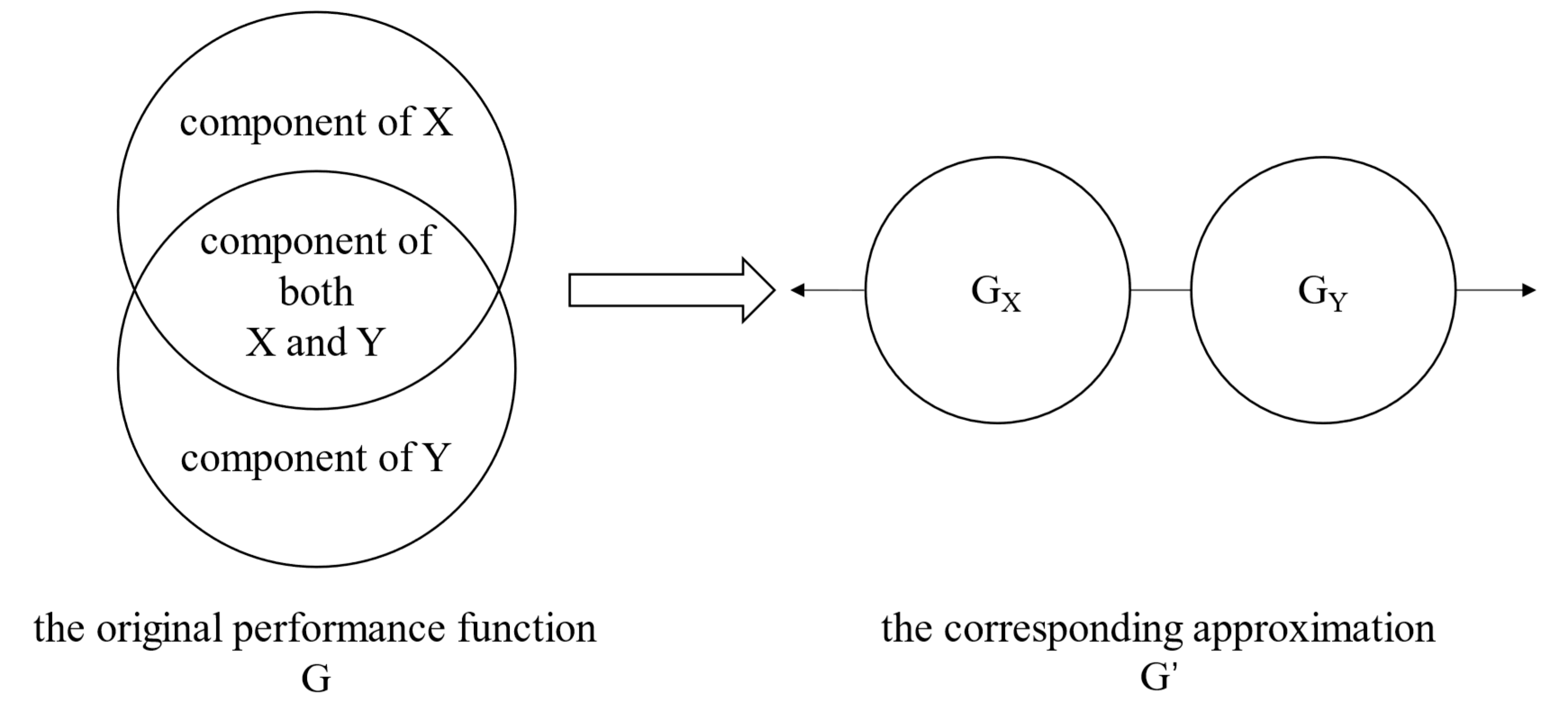
Since Gc > 0 is guaranteed for most engineering cases, G > 0 is statistically equivalent to GX · GY> 0, which means that GX and GY are identically positive or negative. On the other hand, since the chance of both GX and GY being negative is usually negligible, the condition that G > 0 can be consequently replaced by the condition of both GX and GY being positive. At this point, it is noted that the original structural system represented by G is translated to a weakest-link of two elements in which GX represents the element of random inputs and GY represents the element of interval inputs (as shown in Figure 1). Since the safety state determination and reliability estimation of either the element of random inputs or the element of interval inputs can be properly addressed by well-established probability theory [25] or the non-probabilistic theory [26], respectively, such a task can be difficult for cases when random inputs and interval inputs are coupled, and it is evident that the advantage of the proposed method is in decorrelating the random inputs from the interval inputs, making the safety state determination or reliability estimation of probabilistic and non-probabilistic hybrid structural systems considerably easier.
Figure 1.
Conceptional illustration of the proposed method.
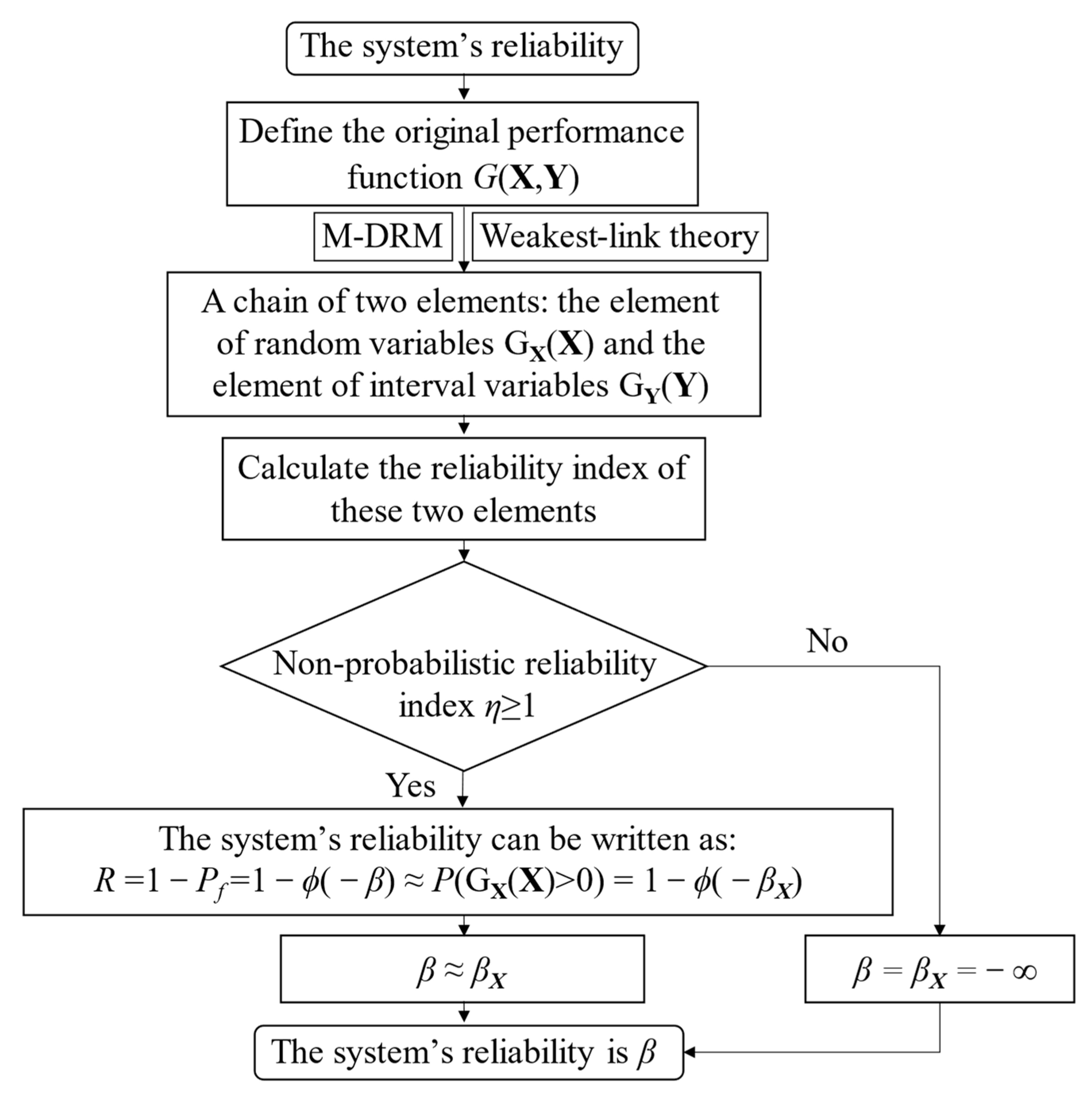
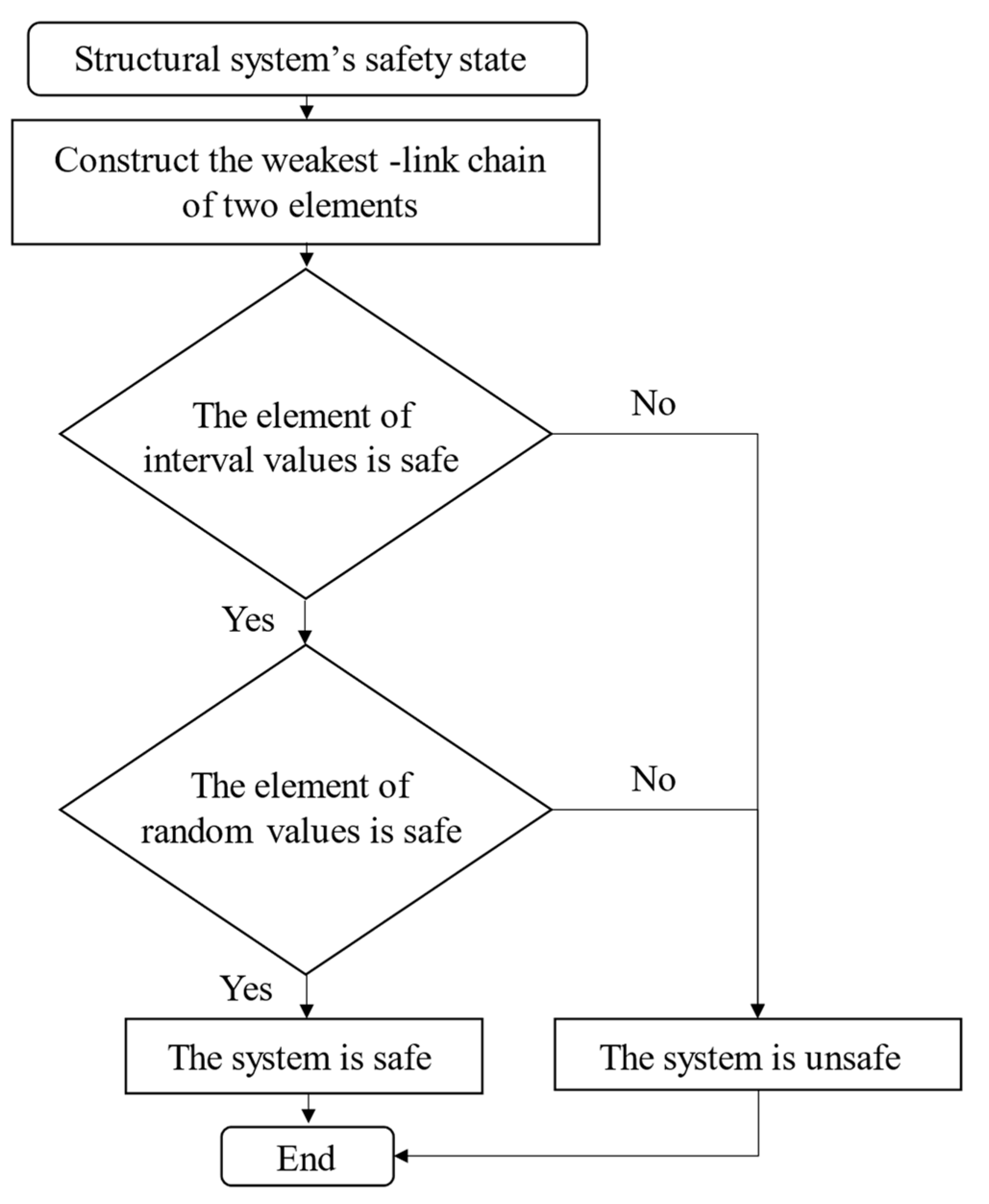
As for the determination of the system’s safety state, due to the conservatism of non-probabilistic theory, the following strategies are proposed (shown in Figure 2): if the element of interval variables is unsafe, then the system, whose reliability is zero, is unsafe; otherwise, the system’s safety state and reliability are identical to those of the element of random variables. This is because if the safety state of the element of interval values is safe, its corresponding reliability is close to 1 due to its conservative nature, and so the system’s safety state and reliability can be represented by the corresponding value of the element of random variables. Further, since reliability index-based methods such as the first-order reliability method (FORM) [27] and second-order reliability method (SORM) [28] are widely used for safety state determinations, which are applicable to both random variables and interval variables, a corresponding determination method of a system’s safety state is proposed in Table 1, where β and η represent the reliability indices for the element of random variables and the element of interval variables, respectively.
Figure 2.
Flowchart of safety state determination.
Table 1.
Estimation of structural reliability.
The target reliability index is taken from the specification requirements.
Based on the principle of the weakest-link theory, for both Case 1 and 2, the system’s reliability can be written as
where Pf is the system’s failure probability, ϕ (∙) is the standard normal cumulative distribution function, β and βX are the reliability indices of the entire system and the element of random variables, respectively, and β ≈ βX. As for Case 3, β = βX − ∞. The flow chart of reliability estimation is shown in Figure 3.
Figure 3.
The flow chart of reliability estimation.
3.2. Numerical Demonstration and Validation
In this subsection, two numerical examples are used to demonstrate and validate the proposed method, respectively.
3.2.1. A Mathematical Problem of Two Variables
The following performance function is considered:
where b1 = 2.0, b2 = 5.0, is a random variable that follows normal distribution, and p1 and p2 are interval variables. Herein, m follows a normal distribution with a mean value that equals μ and a standard deviation that equals (1 (m~ N (μ,1)), p1I = [4.4,5.6], and p2I = [1.7,2.3]).
The approximate function according to the proposed method is obtained as
Case 1: α = 3.7 and m~N (21, 1). In this case, according to the proposed method, η = 0.37 < 1, and the structural system is determined to be unsafe. The failure probability computed from the corresponding Monte Carlo Simulations (MCSs) is Pf = 15.9%, which is in line with the proposed method’s expectation.
Case 2: α = 3.7 and m ~ N (23, 1). In this case, from the proposed method, η = 1.11 > 1, β = 3.0 < α, the reliability is 99.87%, and the failure probability is 0.13%. Therefore, the system is also unsafe. On the other hand, from the MCSs, it is obtained that Pf = 0.13%.
Case 3: α = 3.7 and m ~ N (24, 1). In this case, from the proposed method, the non-probabilistic reliability index η = 1.48 > 1, β = 4.0 > α, the reliability is 99.997%, and the failure probability is 0.003%. Therefore, the system is safe, and the failure probability obtained by the MCSs is Pf = 0.003%.
3.2.2. A Cantilever Beam
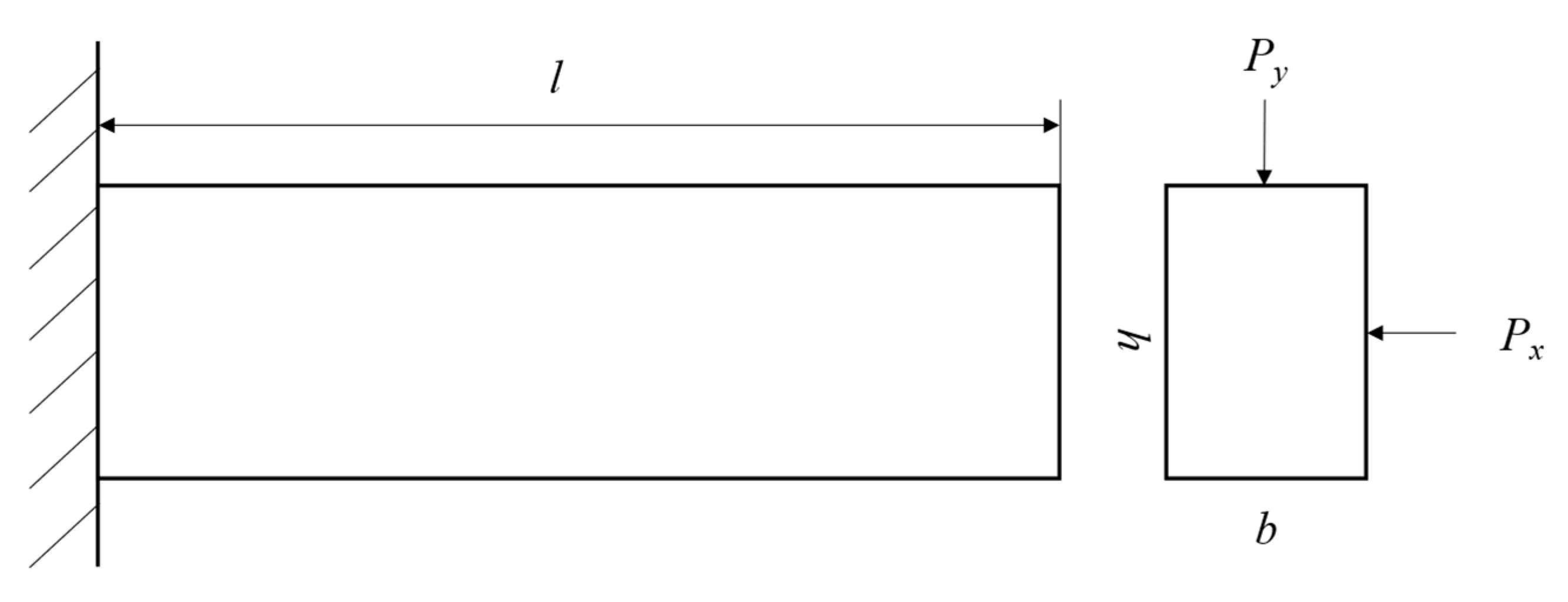
As shown in Figure 4, given a cantilever beam whose length is l, width of cross section is b, and height is h, the right end of the cantilever beam is subjected to two forces, Px and Py. l, b, and h are random variables, while Px and Py are interval variables (as shown in Table 2).
Figure 4.
Configuration of the cantilever beam.
Table 2.
Descriptions of the input variables in Section 3.2.2.
Considering that the structural failure occurs when the maximum stress at the fixed end of the cantilever beam reaches the yield strength S = 370 MPa, the performance function becomes
According to the proposed method, the following approximation is obtained:
After computation, it is obtained that η = 15.2 > 1 and βX = 1.93, indicating that the structure is unsafe.
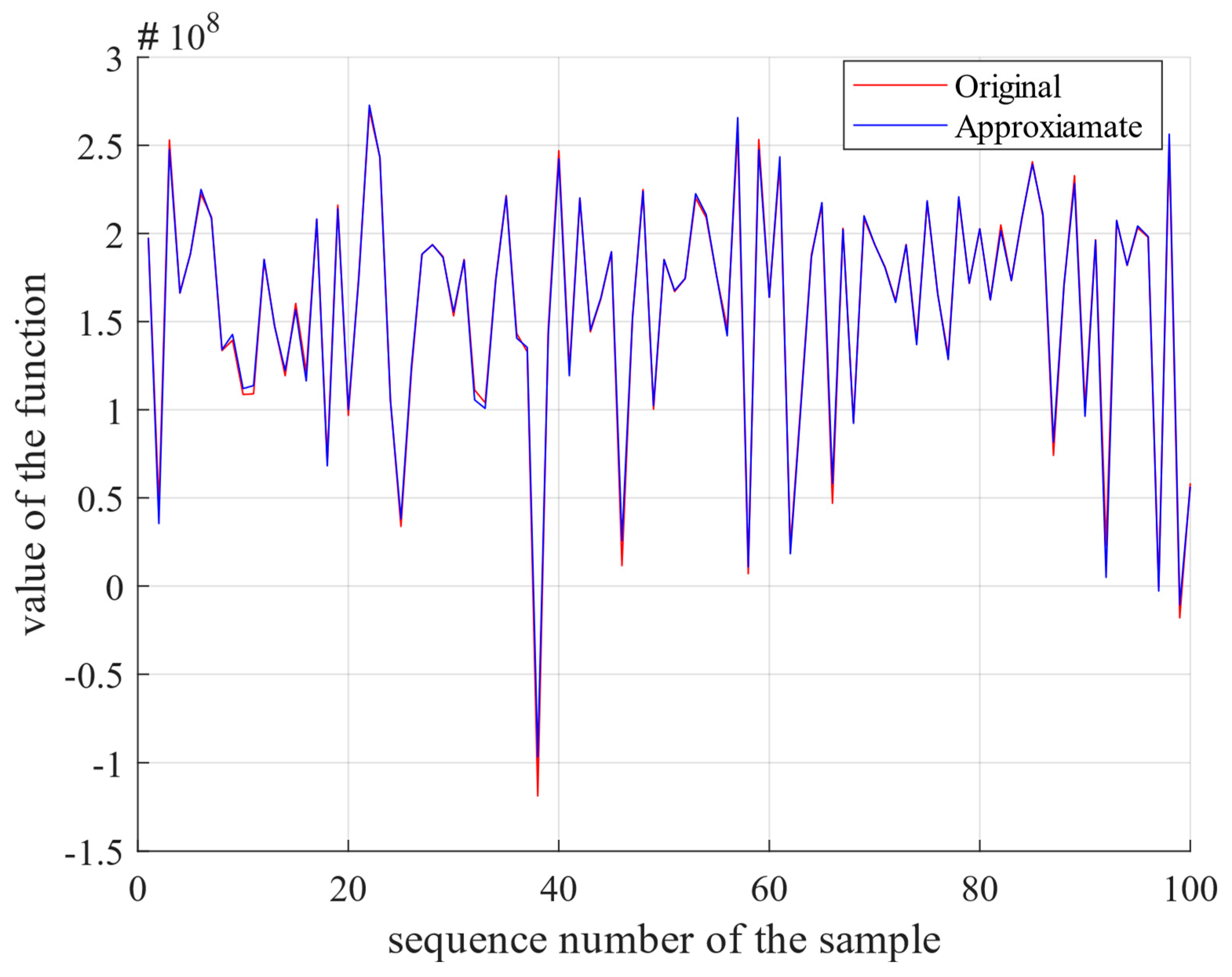
In order to test the proposed method, 100 sample values of the approximated values obtained from Equation (24) and the corresponding values obtained by the original performance function are presented and compared in Figure 5, and the close match between them can validate the proposed method.
Figure 5.
Comparison between the original function and the approximation obtained by the proposed method.
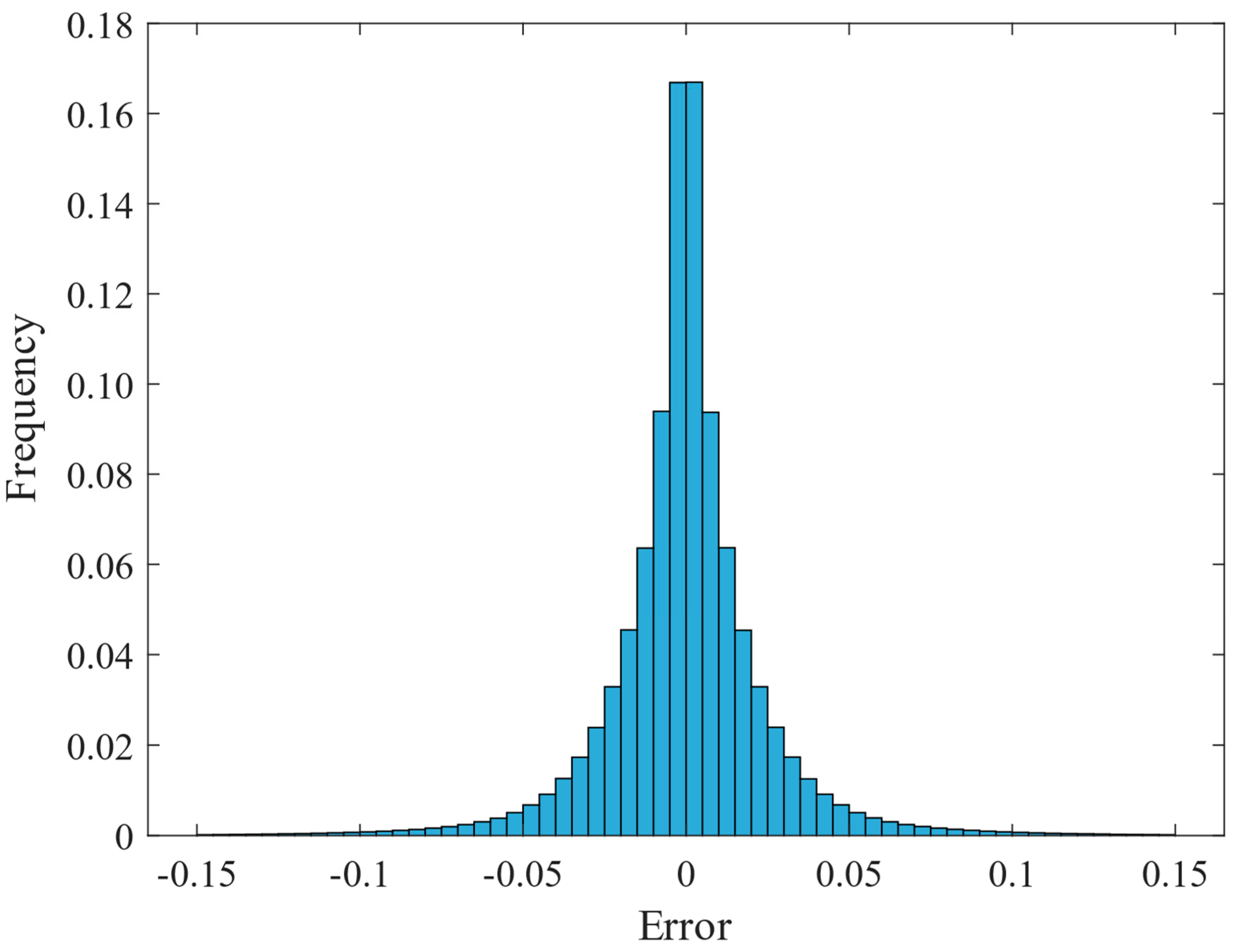
To further investigate the accuracy of the proposed method, the errors (differences between the values obtained from the proposed method and the corresponding target values) obtained from 107 samples are presented in Figure 6, from which it can be seen that the method is unbiased and sufficiently accurate.

Figure 6.
Error histogram of the proposed method.
4. Comparison with Other Methods
In this section, the advantage of the proposed method over other existing methods is demonstrated through a numerical example.
4.1. A Roof Truss
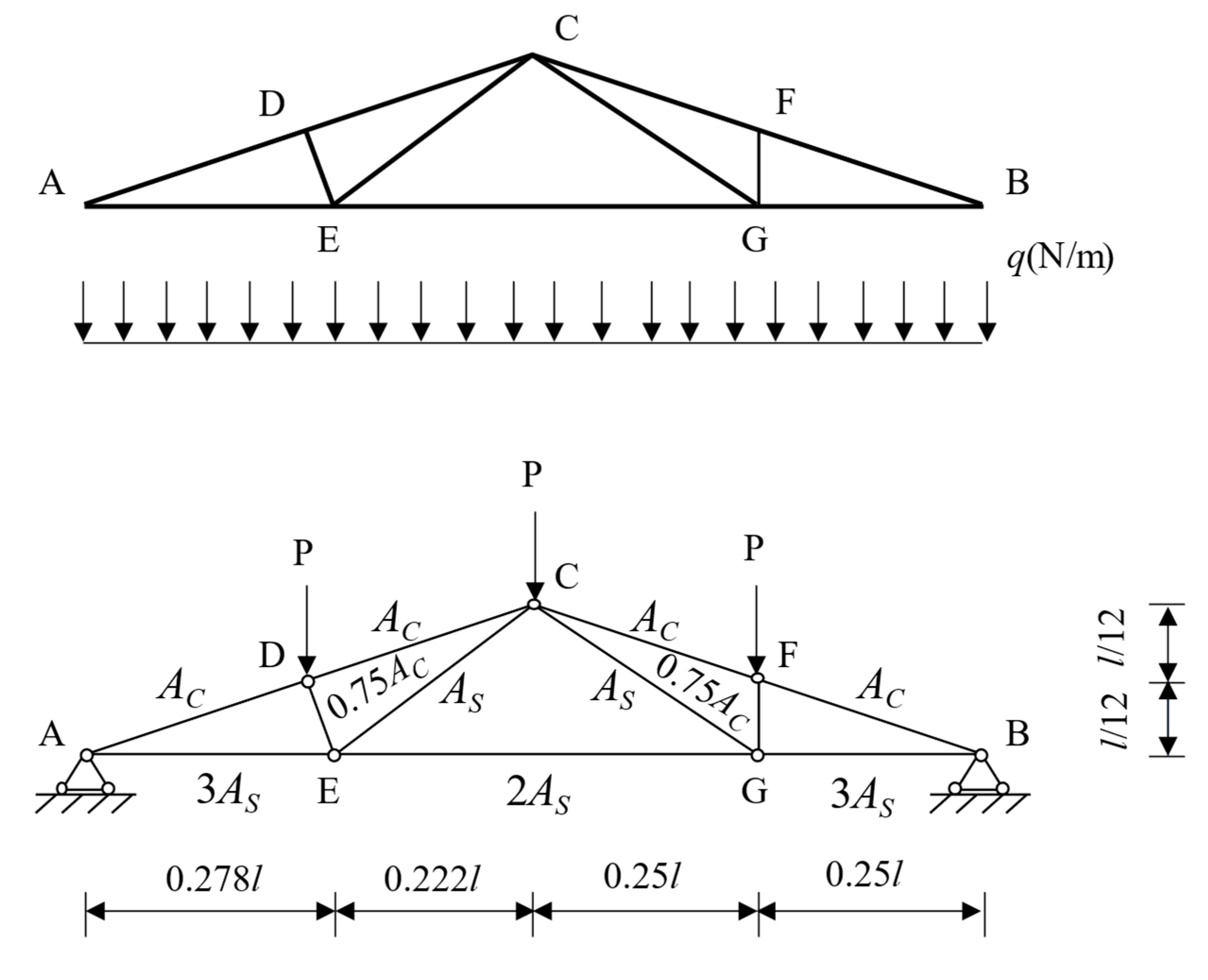
A roof truss, as shown in Figure 7, is tested to illustrate the performance of the proposed method. Through linear-elastic analysis, the perpendicular displacement g at node C can be written as
where EC and ES denote the elastic modulus of the two types of steel bars, respectively, and AC and AS represent their cross-sectional areas, respectively. The allowable value of the vertical deflection at node C is set to 0.0135 m. The performance function is therefore formulated as G = C − g, where the random variables and interval variables in this example are as given in Table 3.
Figure 7.
Configuration of roof truss.
Table 3.
Distribution of the variables in Section 4.1.
To validate its superiority, the proposed method is compared with two highly cited methods, namely the interval Monte Carlo Simulation with a genetic algorithm (MCS plus GA) proposed by Biabani-Hamedani [29], and the FORM with an M-DRM (FORM plus M-DRM) proposed by Wang [19], where the failure probability computed by an MCS using 107 samples serves as the corresponding target. The comparison result is shown in Table 4, from which it can be seen that the proposed method yields a failure probability estimation that is close to the target value, while the MCS plus GA or the FORM plus M-DRM only suggest a large interval of failure probability that can be meaningless for engineering.
Table 4.
Results comparison of the different methods.
5. Error Behavior of the Reliability Estimation
This section studies the error-related properties of the proposed method, and Section 5.1 investigates the influence of the interval variables’ distributions on the error of reliability estimation and Section 5.2 studies the convergency of error with respect to failure probability.
5.1. Influence of Interval Variables’ Distributions
The influence of the distribution types of interval variables can significantly influence the reliability estimation result, which should receive careful consideration. In order to study an element such an influence, the interval variables of Section 4.1 were assigned to different distributions (shown in Table 5) whose corresponding reliability estimation results are concluded in Table 6. It can be seen from Table 6 that the proposed method consistently gives accurate reliability estimations for all the studied distributions, which are therefore applicable to a wide range of distribution types for the interval variables. Such a result suggests that the partial decorrelation process adopted by the proposed method can decrease the influence of the distribution types of interval variables on the reliability, which also demonstrates the good robustness of the proposed method.
Table 5.
Parameters under different distribution types.
Table 6.
Comparison of different distribution types.
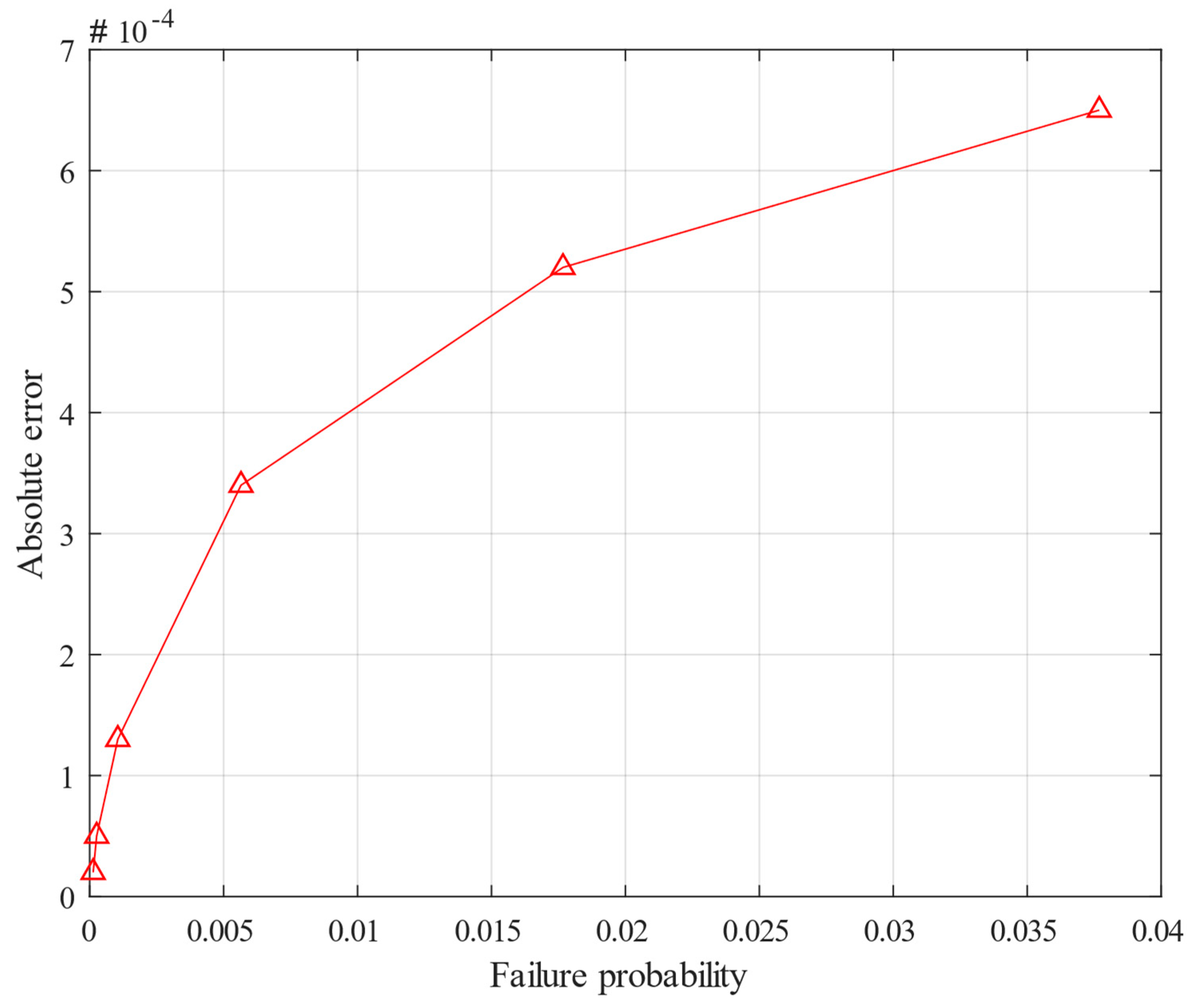
5.2. Convergency of Errors with Respect to Failure Probability
Another core property of reliability estimation methods is the convergency of errors with respect to failure probability, e.g., a method is good if the error matches the failure probability (and it is desirable if the error decreases as the failure probability decreases). To study such a convergence, different values of the failure probabilities of Section 4.1 are obtained by altering the value of , and the corresponding results of error and failure probabilities are shown in Table 7 and Figure 8. It can be seen from Figure 8 that as the failure probability decreases, the absolute error produced by the proposed method correspondingly decreases. Such a good property implies that the method can be potentially used in many engineering cases whose failure probabilities are usually sufficiently low (10−6 to 10−4).
Table 7.
Convergence analysis result of the errors with respect to the failure probabilities.
Figure 8.
Absolute error vs. failure probability.
6. Engineering Application
In this section, the proposed method is applied to an engineering example, demonstrating its engineering practicality.
6.1. An Engineering Example
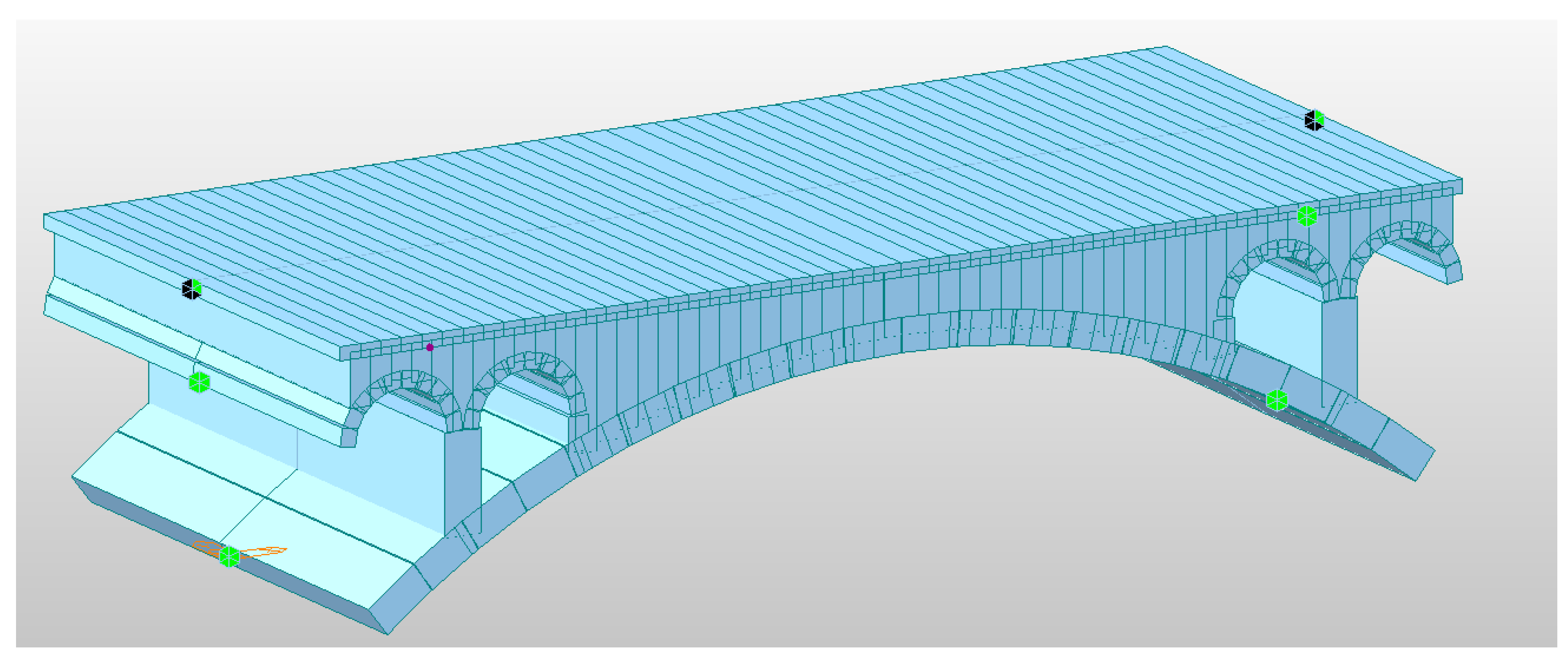
As shown in Figure 9, the finite element model of a plate arch bridge is established in MIDAS 2021. Through finite element analysis, it is known that the internal force of the midspan section of the main arch ring is consistently the largest. Therefore, the midspan section of the main arch ring is selected as the control section to evaluate the reliability assessment.
Figure 9.
The finite element model of a plate arch bridge.
For parameters that are easy to measure, such as geometric size, elastic modulus, thickness of protective layer, etc., statistical characteristics can be obtained according to existing research and the measured data. On the other hand, those parameters that cannot be easily obtained are taken as intervals according to actual experience, such as the bulk density of materials, and the coefficient of variation is considered to be 5%. The input variables are described in Table 8.
Table 8.
Values of the basic parameters in Section 6.1.
By fitting the simulation results with a response surface, it is obtained that
where x1 represents the width of the main arch ring, x2 represents the thickness of the main arch ring, x3 represents the pavement thickness, x4 represents the elastic modulus of the concrete, x5 represents the reinforcement area, and x6 represents the thickness of the protective layer. y1 is the unit weight of the concrete, y2 is the unit weight of the packing, y3 is the unit weight of the pavement, y4 is the vehicle load, and y5 is the tensile strength of reinforcement.
Finally, through the proposed method, it is obtained that the estimated reliability index is 4.2 and the reliability estimation result is 7.91 × 10⁻⁷, indicating that the structure is safe. On the other hand, the reliability estimation result obtained by the MCSs is 9.00 × 10⁻⁷, and the corresponding error is 1.09 × 10⁻⁷. Such a low value of error demonstrates the sufficient accuracy and good practicality of the proposed method.
7. Conclusions
In this paper, a novel method for the reliability estimation of probabilistic and non-probabilistic hybrid structural systems is proposed and numerically validated. Differing from those methods that produce an interval of the failure probability prediction, the proposed method yields a single value reliability prediction that is sufficiently accurate. In addition, the following conclusions are drawn:

- The decorrelation between the random variables and the interval variables decreases the influence of the interval variables’ distributions on the system’s failure probability;
- The proposed method is robust against the change of variable distributions; and
- The error of failure probability estimation produced by the proposed method decreases as the failure probability decreases, demonstrating its promising engineering potential.
Author Contributions
Conceptualization, Y.P. and Z.X.; methodology, Y.P. and Z.X.; software, Y.P.; validation, X.C. and Z.X.; formal analysis, X.C. and Q.W.; investigation, Y.P. and Z.X.; resources, X.C.; data curation, Y.P. and Z.X.; writing—original draft preparation, Y.P. and Z.X.; writing—review and editing, Y.P. and Z.X.; visualization, Y.P. and Q.W.; supervision, X.C. and Q.W.; project administration, X.C. and Z.X.; funding acquisition, X.C. and Z.X. All authors have read and agreed to the published version of the manuscript.
Funding
This work was supported by the National Natural Science Foundation of China (No. 52178301) and the Science Research Foundation of Wuhan Institute of Technology (No. K2021030).
Institutional Review Board Statement
Not applicable.
Informed Consent Statement
Not applicable.
Data Availability Statement
Data sharing is not applicable to this article.
Conflicts of Interest
The authors declare that they have no conflict of interest with respect to the study, authorship, or publication of this article.
References
- Zhou, S.; Zhang, J.; Zhang, Q.; Huang, Y.; Wen, M. Uncertainty Theory-Based Structural Reliability Analysis and Design Optimization under Epistemic Uncertainty. Appl. Sci. 2022, 12, 2846. [Google Scholar] [CrossRef]
- Madsen, H.O.; Krenk, S.; Lind, N.C. Method of Structural Safety; Courier Corporation: North Chelmsford, MA, USA, 2006. [Google Scholar]
- Impollonia, N.; Muscolino, G. Interval analysis of structures with uncertain-but-bounded axial stiffness. Comput. Methods Appl. Mech. Eng. 2011, 200, 1945–1962. [Google Scholar] [CrossRef]
- Xia, B.; Yu, D. Modified sub-interval perturbation finite element method for 2D acoustic field prediction with large uncertain-but-bounded parameters. J. Sound Vib. 2012, 331, 3774–3790. [Google Scholar] [CrossRef]
- Cheng, J.; Liu, Z.; Tang, M.; Tan, J. Robust optimization of uncertain structures based on normalized violation degree of interval constraint. Comput. Struct. 2017, 182, 41–54. [Google Scholar] [CrossRef]
- Guo, S.; Lu, Z. Hybrid probabilistic and non-probabilistic model of structural reliability. J. Mech. Strength 2002, 24, 524–526. [Google Scholar]
- Zhang, L.; Zhang, J.; You, L.; Zhou, S. Reliability analysis of structures based on a probability-uncertainty hybrid model. Qual. Reliab. Eng. 2018, 35, 263–279. [Google Scholar] [CrossRef]
- Wang, W.; Gao, H.; Zhou, C.; Zhang, Z. Reliability analysis of motion mechanism under three types of hybrid uncertainties. Mech. Mach. Theory 2018, 121, 769–784. [Google Scholar] [CrossRef]
- Jiang, C.; Zheng, J.; Han, X. Probability-interval hybrid uncertainty analysis for structures with both aleatory and epistemic uncertainties: A review. Struct. Multidip. Optim. 2017, 57, 2485–2502. [Google Scholar] [CrossRef]
- Jiang, C.; Li, W.X.; Han, X.; Liu, L.X.; Le, P.H. Structural reliability analysis based on random distributions with interval parameters. Comput. Struct. 2011, 89, 2292–2302. [Google Scholar] [CrossRef]
- Du, X. Interval Reliability Analysis. In Proceedings of the Asme International Design Engineering Technical Conferences & Computers & Information in Engineering Conference, Las Vegas, NV, USA, 4–7 September 2007. [Google Scholar]
- Zhang, J.; Xiao, M.; Liang, G.; Fu, J. A novel projection outline based active learning method and its combination with Kriging metamodel for hybrid reliability analysis with random and interval variables. Comput. Methods Appl. Mech. Eng. 2018, 341, S0045782518303293. [Google Scholar] [CrossRef]
- Changqi, L.; Behrooz, K.; Peng, Z.S.; Osman, T.; Xiao-Peng, N. Hybrid enhanced Monte Carlo simulation coupled with advanced machine learning approach for accurate and efficient structural reliability analysis. Comput. Methods Appl. Mech. Eng. 2022, 388, 114218. [Google Scholar]
- Pan, W.; Hanyuan, Z.; Huanhuan, H.; Zheng, Z.; Haihe, L. A novel method for reliability analysis with interval parameters based on active learning Kriging and adaptive radial-based importance sampling. Int. J. Numer. Methods Eng. 2022, 123, 3264–3284. [Google Scholar] [CrossRef]
- Hu, Z.; Du, X. A Random Field Approach to Reliability Analysis With Random and Interval Variables. ASCE-ASME J. Risk Uncertain Eng. Syst. Part B Mech. Eng. 2015, 1, 041005. [Google Scholar] [CrossRef]
- Peng, X.; Wu, T.; Li, J.; Jiang, S.; Qiu, C.; Yi, B. Hybrid reliability analysis with uncertain statistical variables, sparse variables and interval variables. Eng. Optim. 2017, 50, 1347–1363. [Google Scholar] [CrossRef]
- Cheng, J.; Lu, W.; Liu, Z.; Wu, D.; Gao, W.; Tan, J. Robust optimization of engineering structures involving hybrid probabilistic and interval uncertainties. Struct. Multidiscip. Optim. 2021, 63, 1327–1349. [Google Scholar] [CrossRef]
- Debiao, M.; Tianwen, X.; Peng, W.; Chao, H.; Zhengguo, H.; Zhiyuan, L. An uncertainty-based design optimization strategy with random and interval variables for multidisciplinary engineering systems. Structures 2021, 32, 997–1004. [Google Scholar]
- Wang, W.; Xue, H.; Kong, T. An efficient hybrid reliability analysis method for structures involving random and interval variables. Struct. Multidiscip. Optim. 2020, 62, 159–173. [Google Scholar] [CrossRef]
- Zhang, X.; Pandey, M. Structural reliability analysis based on the concepts of entropy, fractional moment and dimensional reduction method. Struct. Saf. 2013, 43, 28–40. [Google Scholar] [CrossRef]
- Zhang, J.; Bi, K.; Zheng, S.; Jia, H.; Zhang, D.Y. Seismic system reliability analysis of bridges using the multiplicative dimensional reduction method. Struct. Infrastruct. Eng. 2018, 14, 1455–1469. [Google Scholar] [CrossRef]
- Wenxuan, W.; Xiaoyi, W. An efficient non-probabilistic importance analysis method based on MDRM and Taylor series expansion. Proc. Inst. Mech. Eng. Part O J. Risk Reliab. 2021, 235, 391–402. [Google Scholar]
- Wei, T.; Zuo, W.; Zheng, H.; Li, F. Slope hybrid reliability analysis considering the uncertainty of probability-interval using three-parameter Weibull distribution. Nat. Hazards 2021, 105, 565–586. [Google Scholar] [CrossRef]
- Xinzhou, Q.; Bing, W.; Xiurong, F.; Peng, L. Non-Probabilistic Reliability Bounds for Series Structural Systems. Int. J. Comput. Methods 2021, 18, 2150038. [Google Scholar]
- Adrian, B.M.; Ionut, M.; Lucian, R.; Mihai, N.; Eloi, F. Reliability of probabilistic numerical data for training machine learning algorithms to detect damage in bridges. Struct. Control Health Monit. 2022, 29, e2950. [Google Scholar]
- Lei, W.; Zeshang, L.; BoWen, N.; Kaixuan, G. Non-probabilistic Reliability-based Topology Optimization (NRBTO) Scheme for Continuum Structures Based on the parameterized Level-Set method and Interval Mathematics. Comput. Methods Appl. Mech. Eng. 2021, 373, 113477. [Google Scholar]
- Dudzik, A.; Potrzeszcz-Sut, B. Hybrid Approach to the First Order Reliability Method in the Reliability Analysis of a Spatial Structure. Appl. Sci. 2021, 11, 648. [Google Scholar] [CrossRef]
- Wang, P.; Yang, L.; Zhao, N.; Li, L.; Wang, D. A New SORM Method for Structural Reliability with Hybrid Uncertain Variables. Appl. Sci. 2021, 11, 346. [Google Scholar] [CrossRef]
- Hamedani, K.B.; Kalatjari, V.R. Structural System Reliability-Based Optimization of Truss Structures Using Genetic Algorithm; Iran University of Science & Technology: Tehran, Iran, 2018. [Google Scholar]
Publisher’s Note: MDPI stays neutral with regard to jurisdictional claims in published maps and institutional affiliations. |
© 2022 by the authors. Licensee MDPI, Basel, Switzerland. This article is an open access article distributed under the terms and conditions of the Creative Commons Attribution (CC BY) license (https://creativecommons.org/licenses/by/4.0/).