


Abstract
Use of timber as a construction material has entered a period of renaissance since the development of high-performance engineered wood products, enabling larger and taller buildings to be built. In addition, due to substantial contribution of the building sector to global energy use, greenhouse gas emissions and waste production, sustainable solutions are needed, for which timber has shown a great potential as a sustainable, resilient and renewable building alternative, not only for single family homes but also for mid-rise and high-rise buildings. Both recent technological developments in timber engineering and exponentially increased use of engineered wood products and wood composites reflect in deficiency of current timber codes and standards. This paper presents an overview of some of the current challenges and emerging trends in the field of seismic design of timber buildings. Currently existing building codes and the development of new generation of European building codes are presented. Ongoing studies on a variety topics within seismic timber engineering are presented, including tall timber and hybrid buildings, composites with timber and seismic retrofitting with timber. Crucial challenges, key research needs and opportunities are addressed and critically discussed.
1. Introduction
In the past century, extensive demand for steel, concrete and masonry as construction materials pushed the development and significant advancement of building codes, standards and guidelines for structural systems based on these materials [1,2,3]. In seismically-prone areas around the globe special attention had to be paid to ensuring seismic resistance of structures as well. Seismic design of structures differs from “regular” structural design in several aspects; structural response to strong earthquakes is dynamic, nonlinear and random, whilst almost all the rest actions and responses are static, linear and deterministic. Due to globalization, seismic design of structures has recently become part of the regular structural engineering curriculum and practice, even in the areas where earthquakes are not so relevant. Past, present and future trends in analyses in seismic provisions for buildings are very well explained by Fajfar [4].
On the other hand, although serious studies on earthquakes and seismic activity began about a century ago, intense research in the field of seismic design of timber structures started only a couple of decades ago, with the advancement of engineered wood products (EWP), which enabled more complex and ambitious timber construction. Global tendency towards more sustainable, energy efficient and environmentally-friendly building solutions has further popularized timber as principle structural material.
Wood in its nature differs significantly from concrete, masonry and steel, as it is considerably lighter compared to them and it is an anisotropic natural material, while the other ones are isotropic man-made materials. These material characteristics influence significantly the overall structural and seismic performance of timber buildings. Recent technological developments and exponentially increased use of engineered wood products and wood composites reflected in deficiency of current timber norms and standards. This paper focuses on some open questions and recent developments in timber engineering regarding the use of timber in seismically active regions, on seismic design of timber structures and normative acts in Europe, and especially on the lack of information in the Eurocode 8.
Recently completed COST Action FP1402 has contributed to a better understanding and overview of broadly available scientific results and the specific information needed by the code-writers, authorities, designers and end-users in the safe, durable and efficient use of timber in structures and, consequently, increase its acceptance and use in the design of buildings. Significant progress has been made with respect to the cross-laminated timber (CLT) structures [5,6,7,8,9], timber–concrete composites [10,11,12] and understanding of the connections in timber structures [13,14,15,16]. As a result, input data for the improvement and future development of EN 1995 are given [17]. However, several topics on seismic design of timber structures still need further investigation [18].
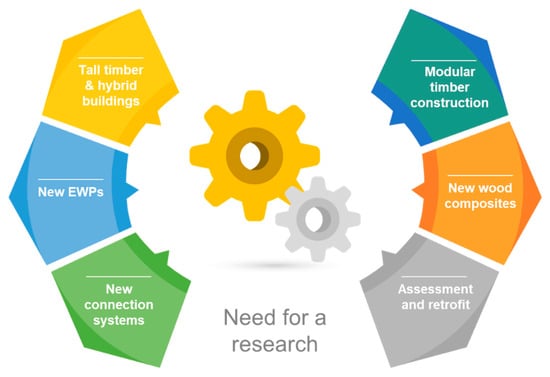
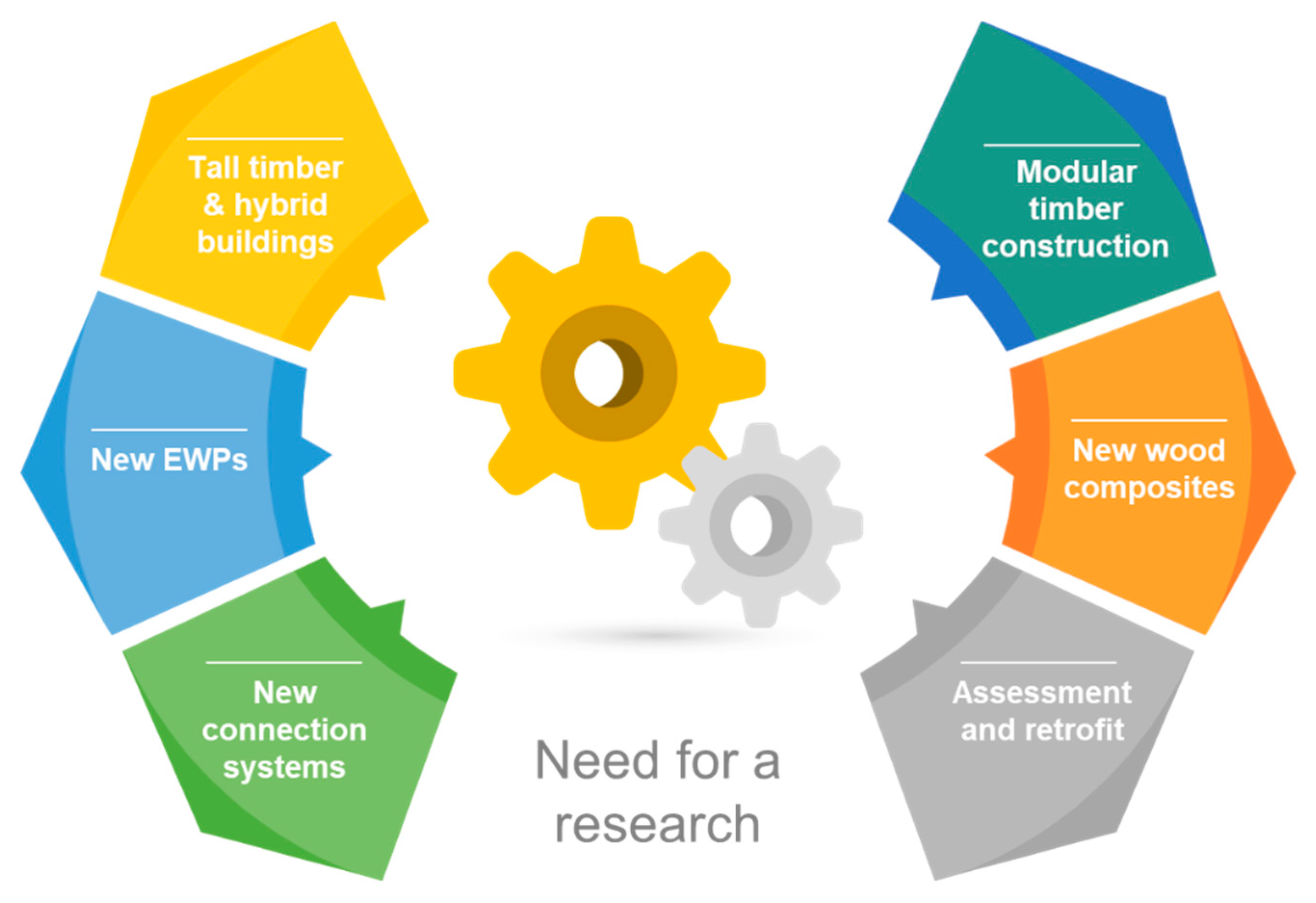
Future trends in timber construction will require major development and research on topics of: Tall timber and hybrid buildings, new engineered wood products and connection systems related to the new technologies, modular construction with timber, composites with wood, assessment of existing timber buildings and retrofitting of historical buildings with timber (Figure 1). Due to rapid development of new timber technologies, and especially due to taller and taller timber buildings, precisely defined impact of earthquakes on these structures needs to be investigated.
Figure 1.
Future need for a research in timber engineering.
2. European Seismic Design Norms, Standards and Guidelines
Recent developments in timber engineering and exponential intense of timber in construction required the evolution of currently existing standards. Materials like cross-laminated timber (CLT) proved that timber can be an excellent material for mid- and high-rise buildings even in seismic areas [19,20]. Cross-laminated timber (CLT) is used for floors and walls and can be considered as floor diaphragms and shear walls in seismic design [21,22,23]. Significant development has also been achieved at the connection level. Self-tapping screws [24,25], glued-in rods [26,27,28] and a lot of different innovative systems [29,30,31,32] show improved behavior in seismic applications than traditional dowel-type connections. At the system level, hybrid systems with concrete [33], EWPs [34,35], steel [36,37], polymers [38] and glass [39,40,41] are in development and are intensely researched.
Current seismic design approaches in building codes around the world (e.g., Eurocode (EC8) [42], NBCC [43], ASCE-7 [44]) follow force-based design methods. At the moment there are only a few norms on seismic assessment of existing structures [45,46,47,48] and future development in research shall be focused in this direction as well. Nevertheless, timber as a structural material is poorly represented in the current norms (i.e., EC8 has only four pages related to seismic design of timber structures). In the current Eurocode 8—Section 8: “Specific rules for timber buildings”, no information is provided for seismic design of widely used structural systems such as cross-laminated timber structures. In addition, no provisions are given regarding capacity design methods for different types of timber structural systems, which proved to be crucial in seismic design of timber buildings [49,50,51], as well as provisions and rules for transfer zones for continuity of shear walls along the building’s height in multi-story timber buildings. The revision process of the Eurocodes began in 2015 and the final updated version is expected to be released sometime after 2020. The new proposal of timber part, prepared by Work Group 3 of CEN Technical Committee 250 (CEN/TC 250/SC 8/WG 3), is explained by Follesa et al. [18] and is based on following modifications and recommendations:
- Changes in the general definitions and design concepts,
- Update of the list of wood-based materials,
- Definition of dissipative and non-dissipative zones,
- Update of the list of timber based structural types with addition of new structural systems (modification of the description of the existing structural types including graphic presentations of structural systems)
- Modification of behavior factors values for different ductility classes,
- Introduction of capacity design rules for each structural type and of overstrength factors to be used in the design of the brittle components,
- Modification of the current equations for safety verifications
- A new provision for application of non-linear static (pushover) analysis.
Above-mentioned new provisions and concepts of timber structures seismic design will demand additional information on mechanical properties of timber connection systems such as connection ductility under cyclic loading, overstrength factors, elastic and plastic stiffness, strength degradation properties under cyclic loading, energy dissipation properties, etc. Therefore, in the near future European technical assessment documents (ETA) for timber connections shall include more information on mechanical properties of connections under cycling loading, defined in EN 12512 standard [52].
Current trend of exponential growth of new timber buildings, larger, taller and more complex projects not only requires higher volume of engineered wood products production, but also higher demand for skilled carpenters and tradespeople with proper education and training on timber construction. Thus, in addition to the updates of the current building codes, also regulation and guidelines in the area of execution and construction supervision of timber buildings shall be improved, where contracting companies shall obtain certifications as a proof of being competent to execute such buildings. Further, regulation on periodic monitoring of structural health of timber buildings, especially tall timber buildings, shall also be addressed.
3. Timber Buildings—Future Trends and Challenges in Seismic Design
In this section, current and emerging challenges in seismic-related topics in the field of timber engineering are presented, compared and critically discussed. Due to the rapid advancement in the development of engineered wood products (EWP) and structural connections, presented earlier in this paper, more and more new applications of EWPs in timber engineering and other engineering fields have emerged. These applications extend from possibilities of building taller timber buildings, to combining timber structural systems with structural systems based on other materials such as concrete and steel, forming so called hybrid timber buildings, exhibiting even higher potential for high-rise construction but also additional challenges to overcome. Further, a combination of advanced EWPs and structural connections can also serve for new composite load-bearing assemblies, such as timber–glass composite wall systems. Finally, advanced EWPs have also been proposed for seismic retrofitting of existing buildings, not only for existing buildings with timber structure, but also existing buildings with stone, masonry and concrete frame structure. Based on the current state-of-the art, key future research and development needs and trends in these selected topics are identified and presented.
3.1. Tall Timber Buildings
European strategy for a sustainable growth and sustainable society acknowledges the importance of EU research framework programs for increasing the offer of new high-quality products and services [53,54]. Sustainable construction embraces a number of aspects, such as design and management of buildings and constructed assets, choice of materials, building performance as well as interaction with urban and economic development and management. Timber as a material and as a structural system could be an ideal material for a new era of construction. Without compromising architectural requirements, the transfer of part of the on-site construction activity to off-site production, independent from weather conditions, will ensure a more continuous activity, a better quality of the finished products and an improved control of their environmental characteristics, as discussed, for example, by [55,56,57,58].
Building with timber, in recent years, has become a huge trend among the construction sector around the world. With products like CLT, the possibilities are enormous. It is obvious that the market is changing and wood as a structural material will become more relevant and more in use in the following years. It is now well understood that the concrete and steel industries are highly energy intensive and contribute to a significant portion of global carbon emissions, and wood is becoming an obvious solution to reduce it. If sustainably sourced, timber is undoubtedly one of the most environmentally-friendly materials currently available, being a natural carbon sink and truly renewable [59].
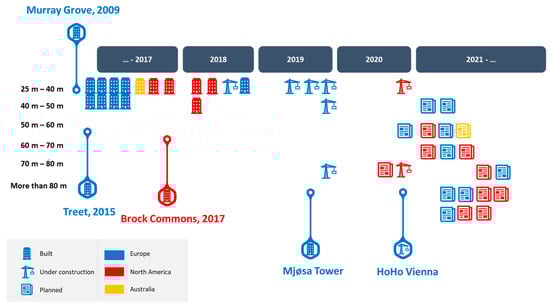
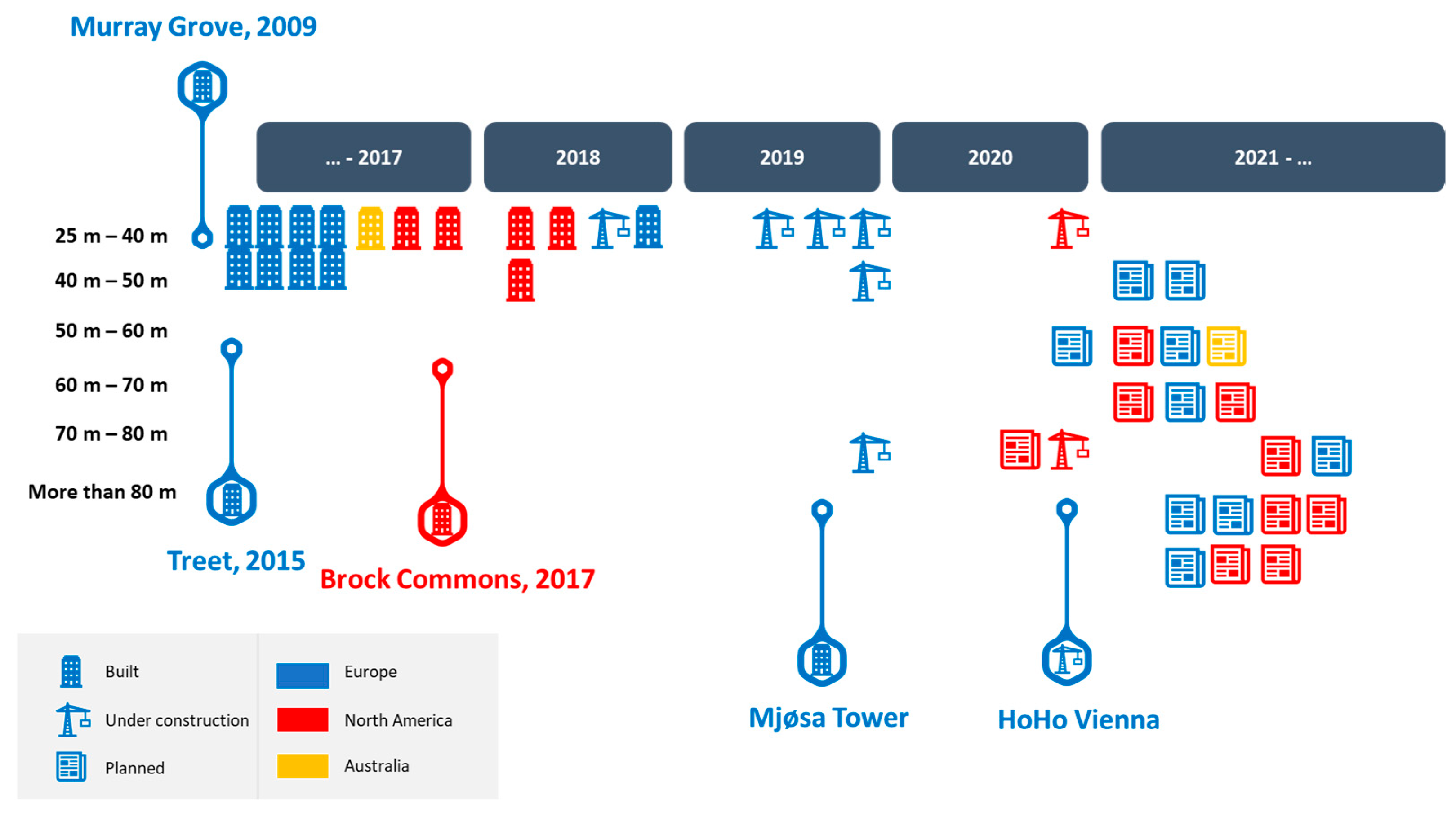
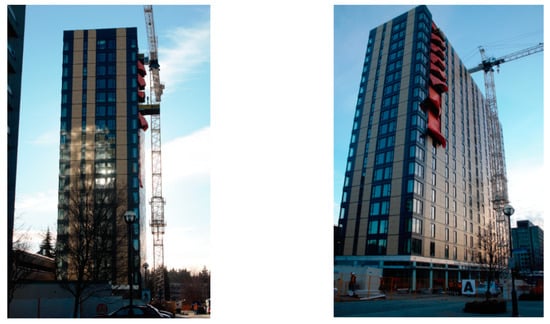
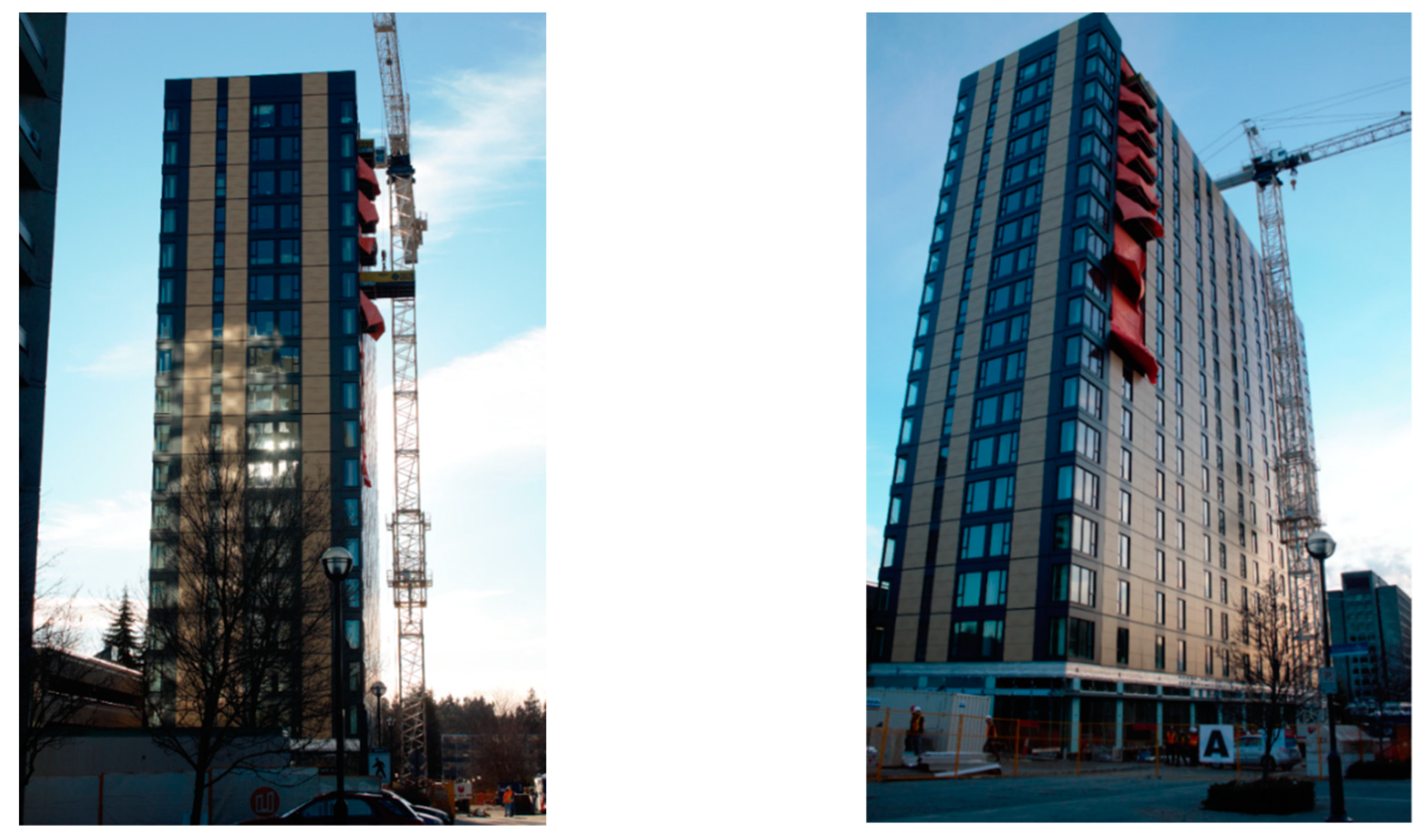
Tall timber buildings are built almost on a monthly rate and more and more are planned in the near future. Short overview of the existing tall timber building and buildings under construction are given in the Figure 2 and one erected building is shown in Figure 3.
Figure 2.
Tall timber buildings around the world—combined data [60,61,62].
Figure 3.
Tall hybrid timber building Brock Commons, Vancouver, Canada.
Although, timber has a good reputation in earthquake-prone regions, in the new era of timber skyscrapers, seismic actions and detailing require additional attention in design and construction of such structures. Tendency to build taller multi-residential and non-residential buildings with more occupants will require additional precautions. In the previous chapter it was pointed out what should change and how the design of such buildings should be done [18]. Holistic approach must be appointed to a design of such structures. Namely, in addition to conventional actions such as permanent loads, imposed loads, snow and wind, there are several additional actions which can significantly affect structural behavior of timber buildings, such as thermal actions, moisture, mold, fire, etc. Therefore, special attention has to be paid to detailing in tall timber buildings (architectural, structural and seismic detailing, special acoustics details, etc.). To prevent any potential structural damage in tall timber buildings due to aforementioned actions, continuous monitoring of buildings during their lifetime could be beneficial (installation of moisture sensors in critical places, vibration monitoring, etc.). Additional potential problems which should be addressed regarding the seismic provisions of tall timber structures are:
- Acoustic insulation requirements (tendency towards physical separation of structural elements in order to prevent sound transmission [63,64]) vs. seismic design principles requirements (tendency towards connection of structural elements in order to achieve necessary strength and stiffness) should be addressed, as some studies and technical documents show the reduction in strength and stiffness of acoustically-isolated connections in timber structures [65,66]; in addition, improved acoustic performance of timber wall and floor elements can also be achieved with additional high-density layers [67,68], resulting in higher building mass and consequently higher seismic forces;
- New types of connections and assembly tools are entering the market and their performance is critical for seismic behavior of timber buildings [22,69,70];
- Higher seismic forces in taller buildings require new types of connection systems that can accommodate strength, stiffness, ductility and energy dissipation needs [7,22,71];
- In addition to seismic actions, also wind-induced vibrations shall be furtherly addressed in tall timber buildings [72,73,74,75];
- Numerical modeling of tall timber buildings—addressing problems such as determination of vibration periods and damping [76], modeling ductility in the joints [77,78,79], selection of appropriate seismic design assumptions and procedures [80], proper simplification assumptions in FEM models of tall timber buildings and hybrid timber buildings [81], etc.
3.2. Hybrid Systems with Timber
Combining timber with other materials, to achieve composite action, enables the strength of timber to be enhanced and its shortcomings to be strengthened or eliminated. Timber is most commonly combined with concrete and steel, but recently also with glass and polymers. Pre-stressed timber buildings [82], timber–steel hybrid systems [83,84] and timber–concrete hybrid systems [33] are already in use and are proven as earthquake-resistant structural systems. Nevertheless, due to tendency towards taller and larger timber construction, and consequently higher structural performance demand, these topics continue to be furtherly explored in terms of experimental, numerical and analytical studies [36,85,86]. In this paper, hybrid systems with structural glass will be briefly addressed. While timber–concrete and timber–steel hybrid structural systems are already widely applied to mid-rise construction in practice, the timber–glass hybrid structural system is still emerging. In this section, current state-of-the-art of this hybrid structural system is presented and key open questions and challenges for its future possible launch to the construction market are discussed.
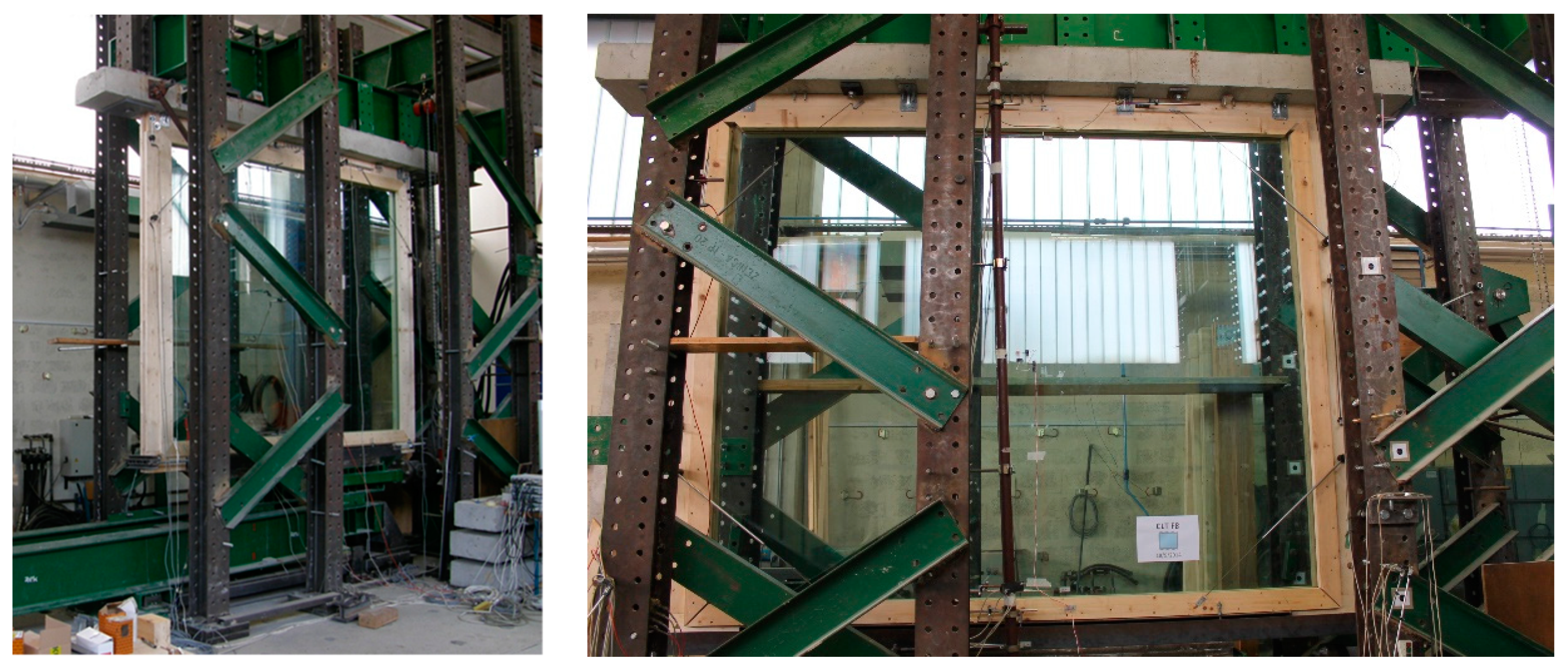
Timber and glass composite systems are lately intensely investigated due to extremely high-aesthetic and -ecological value in addition to their cost-effectiveness and the possibility of significant load transfer [40]. Nevertheless, design models and current European standards include the usage of glass panels as the secondary elements [42], which means the positive impact of these elements when transferring transverse loads caused by the earthquake have to be ignored [39]. According to the EC8, it is necessary to calculate the primary structural elements within the allowed displacements regarding the protection of the secondary elements. If the problem is approached as defined in Eurocode 5 (EC5) [87], timber wall diaphragms shall be designed to resist both horizontal and vertical actions imposed upon them, and shall be adequately restrained to avoid overturning and sliding. Racking resistance is provided by in-plane plane stiffness of board materials, diagonal bracing or moment connections. Method A from EC5 defines that shear diaphragms with windows and doors do not contribute to stability of the structure. Method B is less restrictive and it proposes to regard panel parts from each side of the opening as separate panels. Since the openings decrease the racking resistance and significantly reduce the horizontal stiffness of precast elements, glass helps to enhance these properties. In recent years several articles on quasi-static and dynamic tests of timber–structural glass composite systems were published [39,40,88,89,90,91,92,93,94] (Figure 4). The researchers have concluded that timber–structural glass load-bearing systems can be used in various construction applications, depending on the required bearing or ductility levels. Žarnić et al. [95] investigated deformation capacity, lateral strength, stiffness and strength deterioration and energy dissipation capacity in order to provide data for the future development of computational models and design guidance for the new codes. Nevertheless, it is possible to devise a combined system with timber and structural glass in which each material could transfer load, and in mutual interaction of constitutive elements could be resistant to earthquake. Several extensive tests of composite systems timber–structural glass have been conducted with various types of bonding timber and glass. Bonding glass on timber proved as a good example for accomplishing high-load-bearing of composites, but deficiencies are noticed in the level of ductility along with possible problems with the durability of the structure. Further research on timber–glass composites is needed to get the structural response in seismic actions. In addition, factor q (force reduction factor) of structures constructed with hybrid laminated glass–CLT structural panels need be derived. These results may contribute to future upgrading of EC 8 where glass-based structures are not yet addressed [95]. Besides the load-bearing characteristics and development of structural design tools the special attention need to be paid to energy efficiency of developed building components [96].
Figure 4.
An example of a timber–glass composite system [39,40,88,89,90,91,92,93,94].
3.3. Seismic Retrofitting with Timber
Seismic retrofitting can be defined as the modification of existing structures to make them more resistant to seismic activity, ground motion or soil failure due to earthquakes. Seismic retrofit strategies have been developed in the past few decades following the introduction of new seismic provisions and the availability of advanced materials. Different techniques and methods are applied for a seismic retrofitting of different structures (e.g., concrete structures [97,98,99], timber structures [35,100,101], historical and heritage structures [102,103,104] and especially masonry structures [3,105,106,107]).
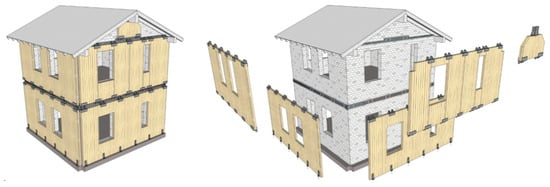
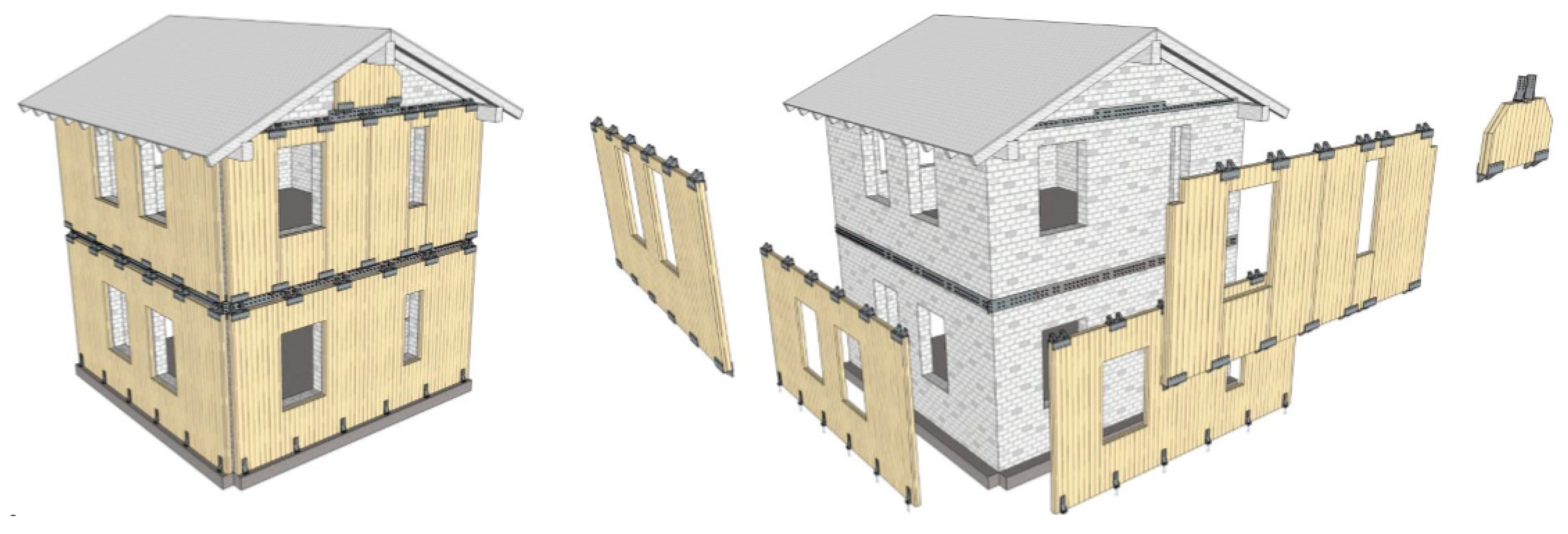
In this chapter, retrofitting of existing structures with CLT is presented. Several researchers around the world are investigating the possibility to seismically strengthen existing structures with engineered wood products (EWPs), mostly CLT. Japanese researchers [108] proposed RC frames strengthening with several narrow CLT elements bonded onto the RC frame with epoxy resin. In their strengthening method, CLT panels are infilled in the RC frame and are acting as shear walls. An Italian group of researchers [109] is developing a novel integrated retrofit solution based on the use of CLT shear walls encased as infill in existing RC framed structures (Figure 5). The idea was to increase the overall lateral stiffness of the concrete structure and to reduce the lateral drift values. The main conclusions of preliminary experimental and numerical work are that the CLT infill allowed the RC frame to reach a lower drift value and a higher peak load with respect to common masonry infills. Numerical modeling and optimal seismic retrofit design with CLT was proposed by [110]. Bahmani et al. [111] were retrofitting four-story-soft-story timber buildings with CLT. They concluded that a retrofit, in accordance with the FEMA P-807 guidelines, using CLT panels is suitable for achieving life safety performance levels during 50% MCE level earthquakes, when retrofit of all story levels is not possible due to one or more constraints.
Figure 5.
Retrofitting with CLT proposed by Sustersic [95].
Extensive research on seismic strengthening of different types of existing buildings with CLT panels was performed by Sustersic and Dujic [112]. The experimental work and numerical study were focused on typical non-earthquake-resistant older masonry and concrete structures from Southern European countries. A new outer shell is added onto existing buildings (Figure 5). It is made from CLT plates that serve as the load-bearing layer and are attached to the existing buildings with special connections. The basic idea of the proposed CLT outer envelope is that it is light (it does not contribute much to seismic forces and is easier to install), strong (timber has one of the best strength:weight ratios) and can be produced as a prefabricated system so little on-site work is necessary. Depending on the building type (concrete or masonry), the elements are anchored into buildings on floor levels, either into concrete slabs or masonry walls. The CLT is connected to the existing building with special steel brackets that offer high strength and stiffness and have a “control fuse” that enables a brittle yet predictable failure of the connection. For the unreinforced masonry walls, the most efficient mechanically-attached strengthening panel resulted in a 33% increase of idealized strength and a 166% higher idealized ultimate displacement. A substitute frame model, with concentrated plasticity for modeling URM and linear elastic shell elements combined with nonlinear springs for modeling the CLT strengthening system, could satisfactorily describe the behavior of the tested wall specimen. Finite element models of the tested RC frame, with or without masonry infill, showed that the damage in both RC frame and masonry infill is lower at equal ground acceleration when the CLT strengthening plates are installed on the structure.
The state-of-the-art research have; therefore, shown that a CLT seismic strengthening system has the potential to be used in design practice, but currently there is still a lot of ‘’unknowns’’ and further research is needed. A holistic approach should be applied—seismic and energy retrofitting—as both are very important. In addition to the currently existing regulation on energy certificates of buildings, which are informing the general public, owners and potential buyers as to which condition a building is regarding the energy consumption, a similar concept shall be established for seismic evaluation of buildings—“seismic certificates”. This will, on one hand raise awareness of current owners about the seismic health of the buildings where they live, and on the other hand additionally define and position a real estate worth on the market, and; therefore, influence the demand on the seismic retrofit of existing buildings in order to be competitive on the market.
4. Conclusions
Due to rapid development of high-performance engineered wood products and new timber technologies, resulting in taller and larger timber buildings with applications spanning through all building types, current building codes and standards reflect a deficiency of provisions for contemporary seismic design. State-of-the-art research in various fields of timber seismic design are presented in this paper and crucial challenges, research needs and opportunities are discussed.
The new generation of Eurocode 8—timber part—will address many topics which are not present in the current version. An updated list of timber-based structural systems with definitions of dissipative and non-dissipative zones in structures, which are needed for newly-introduced capacity design rules and overstrength factors for each type of structural system, will be included. Further, adapted q-behavior factors values for different ductility classes will be defined and a new procedure for application of non-linear static (pushover) analysis will be included.
Tall timber buildings with more than ten stories are already present in moderate- and high-seismic zones around the world. Further, due to climate and economic reasons, more and more conceptual architectural designs for taller timber buildings, including timber skyscrapers, are being proposed, which poses several additional engineering challenges to overcome. A holistic design approach including architectural, structural, durability, fire and acoustic designs as an integrated process is crucial, as all these topics are interrelated. Challenges in terms of numerical modeling of timber and hybrid structural systems, ensuring lateral stability due to wind and seismic actions, high-performing energy dissipating connections, acoustic insulation vs. seismic design philosophy, execution and building monitoring need to be addressed more in depth.
In addition to traditional timber composites with steel and concrete, recent research and developments have shown potential for timber–glass and timber–polymers composites as well. A timber–glass seismic-resistant structural system consists of a timber frame and a structural glass infill bonded together with adhesive, or based on friction contact forming a lateral-resisting wall system. The main advantage of this structural system is increasing lateral stability of buildings with high proportion of facades with glass surfaces by avoiding diagonal bracings or moment connections. Experimental and numerical studies have shown encouraging results in terms of load-bearing and stiffness, whereas the durability aspect needs further examination.
Cross-laminated timber (CLT) has proved to be a great solution for new mid- and high-rise timber buildings. Recently, CLT has also been studied for seismic and energy retrofitting of existing older masonry and concrete buildings, which do not meet current seismic design and energy efficiency criteria. In terms of seismic performance, increased strength and stiffness were observed, yet the research is still ongoing and needs additional investigation of connections between the CLT strengthening panels and the existing structure, with its application to a wider range of existing buildings.
New technologies and knowledge in timber engineering opened many new possibilities in timber application, not only for new timber buildings, but also in combination with other conventional building materials forming hybrid and composite assemblies and structural systems, and also for retrofitting of existing buildings. In this paper, in addition to an overview of some of the current challenges and emerging trends of seismic behavior of timber structures, the focus was set on three topics of advanced engineered wood products applications (tall timber buildings, composites with timber and seismic retrofitting with timber), which are representing new trends of timber engineering and push the boundaries of timber for the use in sustainable construction. All three discussed topics have shown lots of potential for their application in seismic areas, yet there are still several research challenges which need to be addressed in terms of seismic performance and seismic design.
Author Contributions
Conceptualization and development of the main idea of the paper, M.S., I.G. and I.Š.; methodology, M.S., I.G. and I.Š.; validation, all authors; formal analysis, M.S., I.G. and I.Š.; investigation, M.S., I.G. and I.Š.; resources, M.S., I.G. and I.Š.; photo credit, M.S.; literature review and manuscript writing related to Section 3.1., M.S. and I.G.; literature review and manuscript writing related to Section 3.2, M.S and V.R.; literature review and manuscript writing related to Section 3.3, I.G. and I.Š.; writing—original draft preparation, M.S. and I.G.; writing—review and editing, M.S., I.G., I.Š. and V.R.; visualization, M.S., I.G., I.Š.; supervision, I.Š. and V.R.; project administration, M.S.; funding acquisition, M.S. All authors have read and agreed to the published version of the manuscript.
Funding
This research was funded by the Unity through Knowledge Fund (UKF): Seismic behavior of multi-storey buildings, UKF Grant Agreement No. 18/19. Authors Iztok Sustersic and Igor Gavric gratefully acknowledge receiving funding from programme Horizon 2020 Framework Programme of the European Union; H2020 WIDESPREAD-2-Teaming: (#739574) and the Republic of Slovenia. Iztok Sustersic would also like to thank the Slovenian Research Agency ARRS for funding the bilateral project BI-US/19-21-014.
Conflicts of Interest
The authors declare no conflicts of interest. The funders had no role in the design of the study; in the collection, analyses, or interpretation of data; in the writing of the manuscript, or in the decision to publish the results.
References
- Mitrovic, S.; Causevic, M. Nonlinear static seismic analysis of structures. Građevinar 2009, 61, 521–531. [Google Scholar]
- Fischinger, M.; Kramer, M.; Isakovic, T. Seismic safety of prefabricated reinforced-concrete halls—experimental study. Građevinar 2009, 61, 1031–1038. [Google Scholar]
- Tomaževic, M. Seismic rehabilitation of existing masonry structures. Građevinar 2000, 52, 683–693. [Google Scholar]
- Fajfar, P. Analysis in Seismic Provisions for Buildings: Past, Present and Future; Springer: Cham, Switzerland, 2018; Volume 46. [Google Scholar] [CrossRef] [Scilit]
- Fink, G.; Kohler, J.; Brandner, R. Application of European design principles to cross laminated timber. Eng. Struct. 2018, 171, 934–943. [Google Scholar] [CrossRef] [Scilit]
- Brandner, R. Cross laminated timber (CLT) in compression perpendicular to plane: Testing, properties, design and recommendations for harmonizing design provisions for structural timber products. Eng. Struct. 2018, 171, 944–960. [Google Scholar] [CrossRef] [Scilit]
- Lukacs, I.; Björnfot, A.; Tomasi, R. Strength and stiffness of cross-laminated timber (CLT) shear walls: State-of-the-art of analytical approaches. Eng. Struct. 2019, 178, 136–147. [Google Scholar] [CrossRef] [Scilit]
- Nolet, V.; Casagrande, D.; Doudak, G. Multipanel CLT shearwalls: An analytical methodology to predict the elastic-plastic behaviour. Eng. Struct. 2019, 179, 640–654. [Google Scholar] [CrossRef] [Scilit]
- Danielsson, H.; Serrano, E. Cross laminated timber at in-plane beam loading—Prediction of shear stresses in crossing areas. Eng. Struct. 2018, 171, 921–927. [Google Scholar] [CrossRef] [Scilit]
- Schänzlin, J.; Fragiacomo, M. Analytical derivation of the effective creep coefficients for timber-concrete composite structures. Eng. Struct. 2018, 172, 432–439. [Google Scholar] [CrossRef] [Scilit]
- Dias, A.M.P.G.; Kuhlmann, U.; Kudla, K.; Mönch, S.; Dias, A.M.A. Performance of dowel-type fasteners and notches for hybrid timber structures. Eng. Struct. 2018, 171, 40–46. [Google Scholar] [CrossRef] [Scilit]
- Stepinac, M.; Rajčić, V.; Barbalić, J. Influence of long term load on timber-concrete composite systems. Gradjevinar 2015, 67, 235–246. [Google Scholar] [CrossRef] [Scilit]
- Jockwer, R.; Dietsch, P. Review of design approaches and test results on brittle failure modes of connections loaded at an angle to the grain. Eng. Struct. 2018, 171, 362–372. [Google Scholar] [CrossRef] [Scilit]
- Sandhaas, C.; Görlacher, R. Analysis of nail properties for joint design. Eng. Struct. 2018, 173, 231–240. [Google Scholar] [CrossRef] [Scilit]
- Cabrero, J.M.; Yurrita, M. Performance assessment of existing models to predict brittle failure modes of steel-to-timber connections loaded parallel-to-grain with dowel-type fasteners. Eng. Struct. 2018, 171, 895–910. [Google Scholar] [CrossRef] [Scilit]
- Jockwer, R.; Fink, G.; Köhler, J. Assessment of the failure behaviour and reliability of timber connections with multiple dowel-type fasteners. Eng. Struct. 2018, 172, 76–84. [Google Scholar] [CrossRef] [Scilit]
- Stepinac, M.; Cabrero, J.M.; Ranasinghe, K.; Kleiber, M. Proposal for reorganization of the connections chapter of Eurocode 5. Eng. Struct. 2018, 170, 135–145. [Google Scholar] [CrossRef] [Scilit]
- Follesa, M.; Fragiacomo, M.; Casagrande, D.; Tomasi, R.; Piazza, M.; Vassallo, D.; Canetti, D.; Rossi, S. The new provisions for the seismic design of timber buildings in Europe. Eng. Struct. 2018, 168, 736–747. [Google Scholar] [CrossRef] [Scilit]
- Jeleč, M.; Varevac, D.; Rajčić, V. Cross-laminated timber (CLT)—A state of the art report. Građevinar: Časopis Hrvatskog Saveza Građevinskih Inženjera 2018, 70, 75–95. [Google Scholar]
- Van De Kuilen, J.W.G.; Ceccotti, A.; Xia, Z.; He, M. Very tall wooden buildings with Cross Laminated Timber. Procedia Eng. 2011, 14, 1621–1628. [Google Scholar] [CrossRef] [Scilit]
- Popovski, M.; Gavric, I. Performance of a 2-Story CLT House Subjected to Lateral Loads. J. Struct. Eng. 2016, 142, E4015006. [Google Scholar] [CrossRef] [Scilit]
- Gavric, I.; Fragiacomo, M.; Ceccotti, A. Cyclic Behavior of CLT Wall Systems: Experimental Tests and Analytical Prediction Models. J. Struct. Eng. 2015, 141, 04015034. [Google Scholar] [CrossRef] [Scilit]
- Pei, S.; van de Lindt, J.W.; Popovski, M.; Berman, J.W.; Dolan, J.D.; Ricles, J.; Sause, R.; Blomgren, H.; Rammer, D.R. Cross-Laminated Timber for Seismic Regions: Progress and Challenges for Research and Implementation. J. Struct. Eng. 2016, 142, E2514001. [Google Scholar] [CrossRef] [Scilit]
- Hossain, A.; Popovski, M.; Tannert, T. Cross-laminated timber connections assembled with a combination of screws in withdrawal and screws in shear. Eng. Struct. 2018, 168, 1–11. [Google Scholar] [CrossRef] [Scilit]
- Hossain, A.; Danzig, I.; Tannert, T. Cross-Laminated Timber Shear Connections with Double-Angled Self-Tapping Screw Assemblies. J. Struct. Eng. 2016, 142, 04016099. [Google Scholar] [CrossRef] [Scilit]
- Hunger, F.; Stepinac, M.; Rajčić, V.; van de Kuilen, J.W.G. Pull-compression tests on glued-in metric thread rods parallel to grain in glulam and laminated veneer lumber of different timber species. Eur. J. Wood Wood Prod. 2016, 74, 379–391. [Google Scholar] [CrossRef] [Scilit]
- Steiger, R.; Serrano, E.; Stepinac, M.; Rajčić, V.; O’Neill, C.; McPolin, D.; Widmann, R. Strengthening of timber structures with glued-in rods. Constr. Build. Mater. 2015, 97, 90–105. [Google Scholar] [CrossRef] [Scilit]
- Vallée, T.; Tannert, T.; Fecht, S. Adhesively bonded connections in the context of timber engineering–A Review. J. Adhes. 2017, 93, 257–287. [Google Scholar] [CrossRef] [Scilit]
- Loss, C.; Piazza, M.; Zandonini, R. Connections for steel–timber hybrid prefabricated buildings. Part II: Innovative modular structures. Constr. Build. Mater. 2016, 122, 796–808. [Google Scholar] [CrossRef] [Scilit]
- Polastri, A.; Giongo, I.; Piazza, M. An Innovative Connection System for Cross-Laminated Timber Structures. Struct. Eng. Int. 2017, 27, 502–511. [Google Scholar] [CrossRef] [Scilit]
- Kraler, A.; Kögl, J.; Maderebner, R.; Flach, M. Sherpa-Clt-Connector for Cross Laminated Timber Elements. In Proceedings of the World Conference on Timber Engineering, Quebec City, QC, Canada, 10–14 August 2014. [Google Scholar]
- Pozza, L.; Scotta, R.; Trutalli, D.; Pinna, M.; Polastri, A.; Bertoni, P. Experimental and Numerical Analyses of New Massive Wooden Shear-Wall Systems. Buildings 2014, 4, 355–374. [Google Scholar] [CrossRef] [Scilit]
- Dias, A.; Skinner, J.; Crews, K.; Tannert, T. Timber-concrete-composites increasing the use of timber in construction. Eur. J. Wood Wood Prod. 2016, 74, 443–451. [Google Scholar] [CrossRef] [Scilit]
- Yagi, H.; Shioya, S.; Tomiyoshi, E. Innovative hybrid timber structures in Japan: Bending behaviour of T-shaped CLT-to-hybrid timber composite beam. In Proceedings of the WCTE 2016—World Conference on Timber Engineering, Vienna, Austria, 22–25 August 2016. [Google Scholar]
- Polastri, A.; Izzi, M.; Pozza, L.; Loss, C.; Smith, I. Seismic analysis of multi-storey timber buildings braced with a CLT core and perimeter shear-walls. Bull. Earthq. Eng. 2019. [Google Scholar] [CrossRef] [Scilit]
- He, M.; Luo, Q.; Li, Z.; Dong, H.; Li, M. Seismic performance evaluation of timber-steel hybrid structure through large-scale shaking table tests. Eng. Struct. 2018, 175, 483–500. [Google Scholar] [CrossRef] [Scilit]
- Dickof, C.; Stiemer, S.F.; Bezabeh, M.A.; Tesfamariam, S. CLT-steel hybrid system: Ductility and overstrength values based on static pushover analysis. J. Perform. Constr. Facil. 2014, 28, A4014012. [Google Scholar] [CrossRef] [Scilit]
- Schober, K.U.; Harte, A.M.; Kliger, R.; Jockwer, R.; Xu, Q.; Chen, J.F. FRP reinforcement of timber structures. Constr. Build. Mater. 2015, 97, 106–118. [Google Scholar] [CrossRef] [Scilit]
- Antolinc, D.; Žarnic, R.; Cepon, F.; Rajcic, V.; Stepinac, M. Laminated glass panels in combination with timber frame as a shear wall in earthquake resistant building design. In Proceedings of the Challenging Glass 3: Conference on Architectural and Structural Applications of Glass, CGC 2012, Delft, The Netherlands, 28–29 June 2012. [Google Scholar]
- Stepinac, M.; Rajčić, V.; Žarnić, R. Timber-structural glass composite systems in earthquake environment. Gradjevinar 2016, 68. [Google Scholar] [CrossRef] [Scilit]
- Antolinc, D.; Rajčić, V.; Žarnić, R. Analysis of hysteretic response of glass infilled wooden frames. J. Civ. Eng. Manag. 2014, 20, 600–608. [Google Scholar] [CrossRef] [Scilit]
- European Committee for Standardization (CEN). EN 1998-1:2004, Eurocode 8, Design of Structures for Earthquake Resistance, Part 1: General Rules, Seismic Actions and Rules for Buildings; CEN: Brussels, The Netherlands, 2004. [Google Scholar]
- National Research Council of Canada (NRCC). National Building Code of Canada 2015; Associate Committee on the National Building Code: Ottawa, ON, Canada, 2015. [Google Scholar]
- American Society of Civil Engineers (ASCE). ASCE 7-16, Minimum Design Loads and Associated Criteria for Buildings and Other Structures; American Society of Civil Engineers (ASCE): Reston, VA, USA, 2017. [Google Scholar]
- ASCE. Seismic Evaluation and Retrofit of Existing Buildings, ASCE/SEI 41-13; American Society of Civil Engineers: Reston, VA, USA, 2014. [Google Scholar]
- NZSEE. The Seismic Assessment of Existing Buildings, Technical Guidelines for Engineering Assessments, Part A: Assessment Objectives and Principles. Ministry of Business, Innovation and Employment; Earthquake Commission, New Zealand Society for Earthquake Engineering: Wellington, New Zealand, 2017. [Google Scholar]
- FEMA. Next-Generation Methodology for Seismic Performance Assessment of Buildings, Prepared by ATC for FEMA, FEMA P-58; Federal Emergency Management Agency: Washington, DC, USA, 2012.
- CNR. Guide for the Probabilistic Assessment of the Seismic Safety of Existing Buildings, Report CNR-DT 212/2013; CNR—Advisory Committee on Technical Recommendations for Construction: Rome, Italy, 2014. [Google Scholar]
- Trutalli, D.; Marchi, L.; Scotta, R.; Pozza, L. Capacity design of traditional and innovative ductile connections for earthquake-resistant CLT structures. Bull. Earthq. Eng. 2019, 17, 2115–2136. [Google Scholar] [CrossRef] [Scilit]
- Gavric, I.; Fragiacomo, M.; Ceccotti, A. Capacity seismic design of X-lam wall systems based on connection mechanical properties. In Proceedings of the International Council for Research and Innovation in Building and Construction, CIB-W18/46-15-2, Working Commission W18-Timber Structures, Vancouver, BC, Canada, 26–29 August 2013. [Google Scholar]
- Casagrande, D.; Doudak, G.; Polastri, A. A proposal for the capacity-design at wall- and building-level in light-frame and cross-laminated timber buildings. Bull. Earthq. Eng. 2019, 17, 3139–3167. [Google Scholar] [CrossRef] [Scilit]
- EN 12512 Timber Structures—Test Methods—Cyclic Testing of Joints Made with Mechanical Fasteners; European Committee for Standardization (CEN): Brussels, Belgium, 2001.
- United Nations. Transforming our World: The 2030 Agenda for Sustainable Development; United Nations: New York, NY, USA, 2015; Volume 25. [Google Scholar]
- Council of the European Union. A New Global Partnership for Poverty Eradication and Sustainable Development after 2015’—Council Conclusions; Council of the European Union: Brussels, Belgium, 2015. [Google Scholar]
- Quesada-Pineda, H.; Smith, R.; Berger, G. Drivers and Barriers of Cross-Laminated Timber (Clt) Production and Commercialization: A Case of Study of Western Europe’S Clt Industry. Bioprod. Bus. 2018, 3, 29–38. [Google Scholar]
- Brandner, R.; Flatscher, G.; Ringhofer, A.; Schickhofer, G.; Thiel, A. Cross laminated timber (CLT): Overview and development. Eur. J. Wood Wood Prod. 2016, 74, 331–351. [Google Scholar] [CrossRef] [Scilit]
- Ferdous, W.; Bai, Y.; Ngo, T.D.; Manalo, A.; Mendis, P. New advancements, challenges and opportunities of multi-storey modular buildings—A state-of-the-art review. Eng. Struct. 2019, 183, 883–893. [Google Scholar] [CrossRef] [Scilit]
- Pan, W.; Gibb, A.F.; Dainty, A.R.J. Perspective of UK housebuilders on the use of offsite modern methods of construction. Constr. Manag. Econ. 2007, 25, 183–194. [Google Scholar] [CrossRef] [Scilit]
- World Green Building Council Technical Report Bringing Embodied Carbon Upfront; World Green Building Council: London, UK, 2019.
- Available online: https://en.wikipedia.org/wiki/List_of_tallest_wooden_buildings (accessed on 14 February 2020).
- Kuzmanovska, I.; Gasparri, E.; Monne, D.T.; Aitchison, M. Tall timber buildings: Emerging trends and typologies. In Proceedings of the WCTE 2018—World Conf. Timber Engingeering, Seoul, South Korea, 20–23 August 2018. [Google Scholar]
- Available online: https://usfs.maps.arcgis.com/apps/Shortlist/index.html?appid=96d170159fdd4007b19599d08592f91d (accessed on 20 January 2020).
- Speranza, A.; Barbaresi, L.; Morandi, F. Experimental analysis of flanking transmission of different connection systems for CLT panels. In Proceedings of the WCTE 2016—World Conference on Timber Engineering, Vienna, Austria, 22–25 August 2016. [Google Scholar]
- Soundproofing for CLT by Stora Enso. Available online: http://www.clt.info/wp-content/uploads/2015/10/Soundproofing-for-CLT-by-Stora-Enso-EN.pdf (accessed on 7 February 2020).
- ETA-11/0496—European Technical Approval: Three-Dimensional Nailing Plate (Angle Bracket for Timber-To-Timber or Timber-To-Concrete or Steel Connections); European Organization for Technical Approvals: Brussels, Belgium, 2018.
- Titan Silent Angle Bracket for Shear Stresses with Resilient Profile—Technical Data Sheets. Available online: https://www.rothoblaas.com/products/soundproofing/resilient-profiles/titan-silent#documents (accessed on 7 February 2020).
- Homb, A. Hybrid cross-laminated timber floors. Comparison of measurements and calculations. In Proceedings of the Proceedings of the 22nd International Congress on Acoustics, Buenos Aires, Argentina, 5–9 September 2016. [Google Scholar]
- Homb, A.; Carter, C.G.; Rabold, A. Impact sound insulation of cross-laminated timber/massive wood floor constructions: Collection of laboratory measurements and result evaluation. Build. Acoust. 2017, 24, 35–52. [Google Scholar] [CrossRef] [Scilit]
- Izzi, M.; Casagrande, D.; Bezzi, S.; Pasca, D.; Follesa, M.; Tomasi, R. Seismic behaviour of Cross-Laminated Timber structures: A state-of-the-art review. Eng. Struct. 2018, 170, 42–52. [Google Scholar] [CrossRef] [Scilit]
- Niederwestberg, J.; Zhou, J.; Chui, Y.H. Comparison of theoretical and laboratory out-of- plane shear stiffness values of cross laminated timber panels. Buildings 2018, 8, 146. [Google Scholar] [CrossRef] [Scilit]
- Tomasi, R.; Smith, I. Experimental characterization of monotonic and cyclic loading responses of CLT Panel-To-Foundation Angle Bracket Connections. J. Mater. Civ. Eng. 2015, 27, 04014189. [Google Scholar] [CrossRef] [Scilit]
- Hu, L.; Omeranovic, A. Wind-induced vibration of tall wood buildings—Is it an issue? In Proceedings of the WCTE 2014—World Conference on Timber Engineering, Quebec City, QC, Canada, 10–14 August 2014. [Google Scholar]
- Johansson, M.; Linderholt, A.; Jarnerö, K.; Landel, P. Tall timber buildings—A preliminary study of wind-induced vibrations of a 22-storey building. In Proceedings of the WCTE 2016—World Conference on Timber Engineering, Vienna, Austria, 22–25 August 2016. [Google Scholar]
- Feldmann, A.; Huang, H.; Chang, W.S.; Harris, R.; Dietsch, P.; Gräfe, M.; Hein, C. Dynamic properties of tall timber structures under wind-induced vibration. In Proceedings of the WCTE 2016—World Conference on Timber Engineering, Vienna, Austria, 22–25 August 2016. [Google Scholar]
- Connolly, T.; Loss, C.; Iqbal, A.; Tannert, T. Feasibility study of mass-timber cores for the UBC tall wood building. Buildings 2018, 8, 98. [Google Scholar] [CrossRef] [Scilit]
- Andrea, P.; Luca, P. Proposal for a standardized design and modeling procedure of tall CLT buildings. Int. J. Qual. Res. 2016, 10, 607–624. [Google Scholar]
- Sustersic, I.; Fragiacomo, M.; Dujic, B. Seismic Analysis of Cross-Laminated Multistory Timber Buildings Using Code-Prescribed Methods: Influence of Panel Size, Connection Ductility, and Schematization. J. Struct. Eng. (U.S.) 2016, 142, E4015012. [Google Scholar] [CrossRef] [Scilit]
- Loss, C.; Pacchioli, S.; Polastri, A.; Casagrande, D.; Pozza, L.; Smith, I. Numerical study of alternative seismic-resisting systems for CLT buildings. Buildings 2018, 8, 162. [Google Scholar] [CrossRef] [Scilit]
- Shahnewaz, M.; Alam, S.; Tannert, T. In-plane strength and stiffness of cross-laminated timber shear walls. Buildings 2018, 8, 100. [Google Scholar] [CrossRef] [Scilit]
- Fragiacomo, M.; Dujic, B.; Sustersic, I. Elastic and ductile design of multi-storey crosslam massive wooden buildings under seismic actions. Eng. Struct. 2011, 33, 3043–3053. [Google Scholar] [CrossRef] [Scilit]
- Vassallo, D.; Follesa, M.; Fragiacomo, M. Seismic design of a six-storey CLT building in Italy. Eng. Struct. 2018, 175, 322–338. [Google Scholar] [CrossRef] [Scilit]
- Smith, T.; Pampanin, S.; Fragiacomo, M.; Buchanan, A. Design and Construction of Prestressed Timber Buildings for Seismic Areas. NZ Timber Des. J. 2008, 16, 3–10. [Google Scholar]
- Loss, C.; Frangi, A. Experimental investigation on in-plane stiffness and strength of innovative steel-timber hybrid floor diaphragms. Eng. Struct. 2017, 138, 229–244. [Google Scholar] [CrossRef] [Scilit]
- Tesfamariam, S.; Stiemer, S.F.; Dickof, C.; Bezabeh, M.A. Seismic vulnerability assessment of hybrid Steel-Timber structure: Steel moment-Resisting frames with clt infill. J. Earthq. Eng. 2014, 18, 929–944. [Google Scholar] [CrossRef] [Scilit]
- Zhang, X.; Shahnewaz, M.; Tannert, T. Seismic reliability analysis of a timber steel hybrid system. Eng. Struct. 2018, 167, 629–638. [Google Scholar] [CrossRef] [Scilit]
- Li, Z.; He, M.; Wang, X.; Li, M. Seismic performance assessment of steel frame infilled with prefabricated wood shear walls. J. Constr. Steel Res. 2018, 140, 62–73. [Google Scholar] [CrossRef] [Scilit]
- EN 1995-1-1:2004 Eurocode 5: Design of Timber Structures—Part 1-1: General—Common Rules and Rules for Buildings; CEN: Brussels, Belgium, 2004.
- Antolinc, D.; Žarni, R.; Stepinać, M.; Rajčič, V.; Krstevska, L.; Tashkov, L. Simulation of earthquake load imposed on timber-glass composite shear wall panel. In COST Action TU0905 Mid-Term Conference on Structural Glass; CRC Press: Poreč, Croatia, 2013. [Google Scholar]
- Ber, B.; Premrov, M.; Sustersic, I.; Dujic, B. Innovative earthquake resistant timber-glass buildings. Nat. Sci. 2013, 05, 63–71. [Google Scholar] [CrossRef]
- Ber, B.; Premrov, M.; Štrukelj, A.; Kuhta, M. Experimental investigations of timber-glass composite wall panels. Constr. Build. Mater. 2014, 66, 235–246. [Google Scholar] [CrossRef] [Scilit]
- Ber, B.; Sustersic, I.; Dujic, B.; Jancar, J.; Premrov, M. Seismic Shaking Table Testing of Glass-Timber Buildings. In Proceedings of the WCTE 2014—Word Conference on Timber Engineering, Quebec City, QC, Canada, 10–14 August 2014; pp. 2–8. [Google Scholar]
- Žarnić, R.; Rajčić, V. Laminated glass—timber panel as a dissipative bracing structural component for existing frame structures. In Proceedings of the 16th World Conference on Earthquake Engineering, Santiago, Chile, 9–13 January 2017. [Google Scholar]
- Žarnić, R.; Rajčić, V. Experimental investigation of laminated glass infilled CLT frames with glued-in steel rods in joints. In Proceedings of the International Conference on Structural Health Assessment of Timber Structures, Wroclaw, Poland, 9–11 September 2015. [Google Scholar]
- Rajčić, V.; Žarnić, R. Highly energy dissipative and ductile timber-glass hybrid element. In Proceedings of the World Conference on Timber Engineering, Vienna, Austria, 22–25 August 2016. [Google Scholar]
- Žarnić, R.; Rajčić, V.; Kržan, M. Response of laminated glass-CLT structural components to reverse-cyclic lateral loading. Constr. Build. Mater. 2020, 235. [Google Scholar] [CrossRef] [Scilit]
- Available online: https://www.grad.unizg.hr/vetrolignum (accessed on 22 January 2020).
- Pampanin, S.; Bolognini, D.; Pavese, A. Performance-based seismic retrofit strategy for existing reinforced concrete frame systems using fiber-reinforced polymer composites. J. Compos. Constr. 2007, 11, 211–226. [Google Scholar] [CrossRef] [Scilit]
- Valente, M.; Milani, G. Alternative retrofitting strategies to prevent the failure of an under-designed reinforced concrete frame. Eng. Fail. Anal. 2018, 89, 271–285. [Google Scholar] [CrossRef] [Scilit]
- Kurosawa, R.; Sakata, H.; Qu, Z.; Suyama, T. Precast prestressed concrete frames for seismically retrofitting existing RC frames. Eng. Struct. 2019, 184, 345–354. [Google Scholar] [CrossRef] [Scilit]
- Abdel-Aty, Y.Y.A. Proposals for seismic retrofitting of timber roofs to enhance their in-plane stiffness and diaphragm action at historical masonry buildings in Cairo. J. Cult. Herit. 2018, 32, 73–83. [Google Scholar] [CrossRef] [Scilit]
- Parisi, M.A.; Piazza, M. Seismic strengthening and seismic improvement of timber structures. Constr. Build. Mater. 2015, 97, 55–66. [Google Scholar] [CrossRef] [Scilit]
- Lourenço, P.B.; Ciocci, M.P.; Greco, F.; Karanikoloudis, G.; Cancino, C.; Torrealva, D.; Wong, K. Traditional techniques for the rehabilitation and protection of historic earthen structures: The seismic retrofitting project. Int. J. Archit. Herit. 2019, 13, 15–32. [Google Scholar] [CrossRef] [Scilit]
- ASCE/SEI, 41-17. Seismic Evaluation and Retrofit of Existing Buildings; American Society Of Civil Engineers: Reston, VA, USA, 2017. [Google Scholar] [CrossRef] [Scilit]
- Stepinac, M.; Rajčić, V.; Barbalić, J. Inspection and condition assessment of existing timber structures. Gradjevinar 2017, 69, 861–873. [Google Scholar]
- Sayin, B.; Yildizlar, B.; Akcay, C.; Gunes, B. The retrofitting of historical masonry buildings with insufficient seismic resistance using conventional and non-conventional techniques. Eng. Fail. Anal. 2019, 97, 454–463. [Google Scholar] [CrossRef] [Scilit]
- Michel, C.; Karbassi, A.; Lestuzzi, P. Evaluation of the seismic retrofitting of an unreinforced masonry building using numerical modeling and ambient vibration measurements. Eng. Struct. 2018, 158, 124–135. [Google Scholar] [CrossRef] [Scilit]
- Bournas, D.A. Concurrent seismic and energy retrofitting of RC and masonry building envelopes using inorganic textile-based composites combined with insulation materials: A new concept. Compos. Part B Eng. 2018, 148, 166–179. [Google Scholar] [CrossRef] [Scilit]
- Haba, R.; Kitamori, A.; Mori, T.; Fukuhara, T.; Kurihara, T.; Isoda, H. Development of clt panels bond-in method for seismic retrofitting of RC frame structure. J. Struct. Constr. Eng. 2016, 81, 1299–1308. [Google Scholar] [CrossRef] [Scilit]
- Stazi, F.; Serpilli, M.; Maracchini, G.; Pavone, A. An experimental and numerical study on CLT panels used as infill shear walls for RC buildings retrofit. Constr. Build. Mater. 2019, 211, 605–616. [Google Scholar] [CrossRef] [Scilit]
- Park, S.; van de Lindt, J.; Lee, S.-H. Optimal seismic retrofit design for residential structures using CLT panel and FEMA P-807 methodology. In Proceedings of the 2015 World Congress on Advances in Structura. Engineering Mechanics, Incheon, Korea, 25–29 August 2015. [Google Scholar]
- Bahmani, P.; van de Lindt, J.; Iqbal, A.; Rammer, D. Mass timber rocking panel retrofit of a four-story soft-story building with full-scale shake table validation. Buildings 2017, 7, 48. [Google Scholar] [CrossRef] [Scilit]
- Sustersic, I.; Dujic, B. Seismic strengthening of existing buildings with cross laminated timber panels. In Proceedings of the World Conference on Timber Engineering, Auckland, New Zealand, 15–19 July 2012; Volume 4, pp. 122–129. [Google Scholar]
© 2020 by the authors. Licensee MDPI, Basel, Switzerland. This article is an open access article distributed under the terms and conditions of the Creative Commons Attribution (CC BY) license (http://creativecommons.org/licenses/by/4.0/).