Article

Co-Creation of Cheese Tourism as a Business Development Strategy: Perspectives from Hoteliers


by
Maria Spilioti
* and
Konstantinos Marinakos
Department of Tourism Management, University of West Attica, 12243 Athens, Greece
*
Author to whom correspondence should be addressed.
Adm. Sci. 2026, 16(3), 123; https://doi.org/10.3390/admsci16030123
Submission received: 17 January 2026 / Revised: 13 February 2026 / Accepted: 28 February 2026 / Published: 3 March 2026

Abstract

This research aims to record hotel owners’ perceptions as subjective measures of the degree of integration of local traditional cheese varieties in the hospitality sector. Within the context of cheese tourism, this specific type of alternative tourism is operationalized through B2B co-creation among tourism businesses and cheese factories, serving as a framework for perceived business development. Specifically, this study fills a gap in the literature by exploring the managerial views on the current state of cheese tourism in relation to the entrepreneurship strengthening, the opportunities, and challenges that could favor cooperation between the two sectors. Descriptive and inductive statistics were conducted, collecting primary data from hotels in the Peloponnese, Greece, which has a long tradition of cheese production. Regional tradition and star rating determine the integration of local cheese. While 4–5-star hotels leverage cheese heritage for differentiation and experiential services, lower-end hotels face cost and supply chain barriers, requiring supporting strategies and cross-sector partnerships. The study offers original knowledge for the development of specific strategic proposals for the use of cheese tourism through co-creation for business development of hotels. Future research is recommended to record the views of all stakeholders and correlate them with objective financial performance.

1. Introduction

More and more travelers are interested in local food, making it the primary purpose of their trip (J. Kim et al., 2022; Getz & Robinson, 2014; Gurbaskan Akyuz, 2019). This ever-growing consumer trend constitutes a type of alternative tourism known as culinary, gastronomic, or cuisine tourism (Björk & Kauppinen-Räisänen, 2014). According to the IMARC Group, the global culinary tourism market was valued at $1090.48 billion in 2024. It is expected to reach $4210.19 billion by 2033, with a compound annual growth rate (CAGR) of 14.46% over 2025–2033 (IMARC Group, 2024). The above data reveal the significant potential of this type of co-creative tourism, with opportunities for growth, profitability, and competitive advantage for businesses that get involved. In this context, it is crucial to distinguish between collaboration and business-to-business (B2B) co-creation, as these two concepts are misunderstood. While collaboration refers to the cooperation of stakeholders to achieve common goals through partnerships, B2B co-creation represents a more integrated process where companies—such as hoteliers and local producers—jointly combine their resources and expertise to innovate (Sarker et al., 2012). For example, in the broader tourism sector, this situation arises when a hotel and a local producer collaboratively develop a gastronomic brand that enhances the overall destination experience (Grönroos, 2011). In contrast to simple collaboration, co-creation focuses on the joint evolution of value through continuous interaction and the integration of resources (Chathoth et al., 2013).
There are various tourist profiles, each demonstrating a different degree of interest in other types of local food or drink, as well as specific perceptions and willingness to pay for them (Sánchez-Cañizares & López-Guzmán, 2012; Getz & Robinson, 2014; Nicoletti et al., 2019; Barzallo-Neira & Pulido-Fernández, 2025). Those travelers who seek authenticity and cultural connection through food consider cheese to be a local product capable of meeting their consumption needs (Fusté-Forné & Mundet i Cerdan, 2021; Tiganis & Chrysochou, 2024; Barzallo-Neira & Pulido-Fernández, 2025).
Cheese serves as a landmark in food tourism, underscoring the importance of local agricultural products and traditional gastronomy (Fusté-Forné & Mundet i Cerdan, 2021). Magri-Harsich et al. (2024) emphasize that visitors appreciate cheese varieties produced using traditional methods and by small-scale artisanal producers. In this context, cheese tourism has emerged as a new kind of specialized gastronomic tourism, capitalizing on the expression of distinct local cultural identity through food (Magri-Harsich et al., 2024). According to Fusté-Forné (2020a), this form of tourism involves visits usually to mountainous and semi-mountainous areas with a particular tradition of cheese-making. Tourists who visit dairies and consume local cheese become familiar with agricultural inheritance traditions and become part of territorial communities (Guillén Peñafiel et al., 2024). Moreno-Lobato et al. (2023) report that cheese tourism can improve visitors’ sensorial tasting experiences, fostering an emotional bond with the region. Many studies confirm the above view, showing that these experiences enhance differentiation and emotional attachment to the destination (Kastenholz et al., 2020; Nguyen et al., 2024; Lv et al., 2024). Interactive food activities, such as collective local-food tasting sessions, interindividual preparation of traditional dishes with local ingredients, and participation in guided food tours, can influence tourists’ final destination choices (Aksenova et al., 2022).
Tourists seeking intense sensory and cultural experiences through cheese exhibit a willingness to pay higher prices for them (Tiganis & Chrysochou, 2024; Magri-Harsich et al., 2024). This consumer trend is reflected in the global cheese tourism market, reaching $7.6 billion in 2024. The market is expected to expand at a CAGR of 8.2% from 2025 to 2033, reaching $14.6 billion by 2033 (DATAINTELO, 2025). To capitalize on the above possibilities of cheese tourism, which links the agri-food and tourism sectors, close cooperation and the joint enhancement of local resources are crucial for business development (Vourdoubas, 2020).
Applying the lens of B2B co-creation to cheese tourism, G. Zhou and Chen (2023) suggest that this strategy is effective in improving a destination’s reputation and actively engaging tourists with the place brand. The concept described above is highly applicable to cheese tourism by promoting participatory processes among stakeholders from both sectors, thereby creating value for all (G. Zhou & Chen, 2023; Magri-Harsich et al., 2024). To enable visitors to enjoy cheese tourism as a complete, memorable experience, collaborative value creation between hoteliers and cheesemakers is required (Melis et al., 2023; Giannopoulos et al., 2021). This specific type of tourism promotes engagement of different stakeholders. Cheesemakers produce traditional cheese varieties; hoteliers can integrate local cheese into their offerings; and travelers who choose these destinations support local businesses while enjoying authentic experiences created by the community (Fusté-Forné & Mundet i Cerdan, 2021; Carvalho et al., 2023a; Andersson et al., 2017). Hoteliers hold a strong position in the tourism value chain and come into direct contact with travelers, acting as the primary shapers of the tourism experience, including cheese tourism activities (Prayag & Ryan, 2012; Franco et al., 2022; Garrido & Moreno-Izquierdo, 2025). In Greece, the hotel sector contributed 4.8% to national GDP in 2023 and 5.9% in 2024, supporting 6.6% of total employment (ITEP, 2025; Soklis et al., 2025). In contrast to fragmented dairies and the volatile travel agent sector, hoteliers have the institutional role of integrating local gastronomy into a comprehensive vertically integrated value chain (Tsekeris, 2024; OECD, 2025a). This strategic capability of hoteliers allows them to influence travelers’ choices more effectively. In particular, the hospitality sector generates income that is redistributed to other sectors at a significant rate, reinforcing its role as a major stakeholder for destination-based tourism research (ITEP, 2025).
Cheese tourism can be a key component of a hotel’s business development strategy (Forbord, 2016; Franco et al., 2022). By developing a long-term strategic plan that leverages the place’s gastronomic tradition, with an emphasis on cheese, hospitality businesses can gain a competitive advantage, differentiate themselves from competitors, and increase market share within their target segment. In this study, business development is examined through recording the perceptions of hotel owners as subjective performance indicators (Suna & Alvarez, 2021; Magri-Harsich et al., 2024). This type of alternative tourism can help develop strategic partnerships with businesses in other sectors that share the same clientele (Van Huylenbroeck et al., 2006; Magri-Harsich et al., 2024). Through collaboration, local resources can be utilized, leading to a mutual increase in revenue and awareness (Ciolac et al., 2020; Fusté-Forné & Mundet i Cerdan, 2021; Magri-Harsich et al., 2024).
The Peloponnese Region is the largest peninsula in Greece, with an economy primarily based on agriculture and tourism (Fotopoulou & Karkanis, 2021; OECD, 2025b; Institute for Hellenic Growth and Prosperity, 2025). The region’s primary sector represents the highest contribution to the Gross Domestic Product, specifically 2.2 times the national average, which in 2024 amounted to 201,459 billion euros (Special Program Management Service “PELOPONNESE”, 2023). The Peloponnese has extensive mountainous and semi-mountainous terrain (Bufféral et al., 2025). At the same time, natural pastures coexist, which over time favored the development of extensive sheep and goat farming (Hadjigeorgiou, 2011; Papadopoulou et al., 2020; Thanopoulos et al., 2024). Caprine and ovine milks are mainly used for cheese making, which is highly developed in the area under consideration and makes a significant contribution to the gastronomic and cultural heritage (Litopoulou-Tzanetaki & Tzanetakis, 2014). Numerous local cheese varieties are produced in the Peloponnese, some of which have a Geographical Indication status, such as Feta and Sfela, demonstrating a close anchoring to local resources, including the know-how and flora of the place (Tsouggou et al., 2024; eAmbrosia—EU, 2025). Alongside its dairy tradition, the Peloponnese is the most important wine-growing region in Greece. According to the ELSTAT (2024), the Peloponnese hosts approximately 30% of the total area of Greek vineyards, making it the largest vineyard in the country with almost 20,000 hectares of cultivation (Karagiannis & Metaxas, 2020). The region produces a variety of Protected Designation of Origin wines, such as in Nemea, highlighting the diversity of the local terroir (Miliordos et al., 2024). Cheese and wine are scientifically recognized as complementary gastronomic products (Galmarini et al., 2016; Rinaldi et al., 2024). The above specificity of the Peloponnese region, with the strong coexistence of PDO cheese and PDO wines, can create a competitive advantage for the development of gastronomic tourism (Karagiannis & Metaxas, 2020; Pamukçu et al., 2021). Cheese is a key ingredient in many traditional recipes from the Peloponnese, which together build a unique gastronomic identity for the region (Trichopoulou & Lagiou, 1997; Drinis et al., 2024). The importance of tourism for the Peloponnese region is highly regarded, contributing to the local economy. The direct contribution of tourism to the Peloponnese Region’s GDP was estimated at 4% in 2021 (INSETE, 2022). At the same time, tourism offers many indirect benefits that are difficult to assess, such as the creation and maintenance of jobs in related sectors, including agri-food (Socher & Tschurtschenthaler, 1994; Yan & Wall, 2002; He et al., 2023). However, the region has not been able to reap the benefits that other regions of Greece have, as reflected in the INSETE (2024) study. The Peloponnese region accounted for 2% of total visits, marking a 19% decreased compared to 2019 (from 899 thousand to 732 thousand). Similarly, its share of receipts was 2%, a decline of 8% from 2019 (from 417 million euros to 383 million euros). The average spending per traveler increased by 13% from 464 euros to 524 euros (INSETE, 2024).
Although cheese tourism is gaining increasing recognition in gastronomy, it has not been extensively researched in Greece, despite the existing literature at a global and European level, especially in countries with long-standing cheese-making traditions such as Spain and France (Fusté-Forné, 2020a; Dancausa Millán et al., 2021; Keskin, 2025). In particular, Magri-Harsich et al. (2024) have studied the value of cheese in the agri-food and tourism partnership, through recording the views of ten cheesemakers, and Fusté-Forné and Mundet i Cerdan (2021) examined how cheese as a tourist attraction contributes to regional development and the economic survival of food businesses, using participatory observation and unstructured interviews in livestock and dairies, at food fairs and in food retailers. However, a clear research gap is observed at the national level, where the concept remains almost entirely unexplored. In the unique research available, Koutoulas (2025) examines how a cheese factory on the island of Ios was the first business to exploit cheese tourism in the country. Therefore, while international research explores the socio-economic impact of cheese tourism, there is a lack of empirical data regarding the strategic role of co-creation between businesses in the hospitality and agri-food sectors in Greece.
The present study aims to bridge this gap by examining how the perceived potential of B2B co-creation within cheese tourism can serve as a strategic business development framework for hotel owners in the Peloponnese. This region has been chosen as a case study for the exploitation of this alternative tourism at a business level, due to its unique natural environment, rich gastronomic tradition, high local food production, and untapped tourism potential. The theoretical framework of the study is based on a quantitative research design, utilizing the concepts of cheese tourism and co-creation to examine their empirical implications on business development. The study’s research questions examine the participatory shaping and utilization of cheese tourism in hotels’ business development in the Peloponnese region. Specifically, the survey seeks to assess the attitudes of tourism business owners regarding this kind of tourism and its perceived impact on business development. By focusing on these subjective measures, the study attempts to capture the strategic mindset that precedes formal business expansion and investment decisions. Furthermore, the objective of this study is to analyze the factors that compose a comprehensive gastronomic tourism experience centered on cheese.
The article uses primary and secondary data, supported by an in-depth literature review and field research. The manuscript consists of six sections: introduction, theoretical framework, materials and methods, results, discussion and conclusions.

2. Theoretical Framework

2.1. Literature Review

Each type of cheese has unique sensory, chemical, and nutritional characteristics, often influenced by the local ecosystem, genetic diversity and variability of sheep and goat breeds, and management of ruminant animals, and the cheesemaking process (Beuvier & Duboz, 2013; Levante et al., 2021; Coelho et al., 2022; Y. Wang et al., 2024). Traditional cheesemaking know-how and knowledge are passed down across generations, incorporating local practices and methods developed through collective actions in rural communities (Bouche & Moity-Maïzi, 2009; Salameh et al., 2016; Belliggiano et al., 2024). The production of high-quality cheese appears closely linked to the region’s unique terroir, underscoring the need to preserve local agricultural heritage systems (Paxson, 2010; Chemidlin Prévost-Bouré et al., 2021). The gastronomic value of cheese is significantly enhanced when combined with other local products, such as wine. Cheese and wine are complementary products whose characteristics are shaped by terroir, including geography, geology, and climate (Paxson, 2010). This relationship is not only cultural but also sensory. Several scientific studies have addressed the gastronomic complementarity of the two products, focusing on how the astringency of the wine and the fat content of the cheese interact to create a unique organoleptic experience (Galmarini et al., 2016; Saad et al., 2021). Cheese with geographical indication maintains its authenticity, with traditional appearance and flavor, as this certification guarantees the use of local resources and their protection to ensure consistent production over time (Licitra & Carpino, 2014; Millet, 2019; Rocha et al., 2023). Beyond the above characteristics, cheesemaking traditions can function in the consumer’s mind as cultural symbols, significantly influencing the taste of the food produced (Hirtz et al., 2025). This approach transforms cheese from a simple agricultural commodity into a form of intangible heritage, as the narratives of the local community are preserved and protected through production techniques (Berno & Fusté-Forné, 2020; Varriale & Ciaravino, 2022). These traditions are characterized by remarkable spatial heterogeneity, since not all regions have the same degree of cheesemaking heritage (Paxson, 2010; Baysal & Denk, 2025). The formation of these traditions is often a result of the socio-economic development of each region (Grasseni, 2011). In the context of gastronomic tourism, this diversity in tradition offers several possibilities for destination branding (Okumus et al., 2007). It is evident that traditional cheese is unique to each region and cannot be easily reproduced elsewhere.
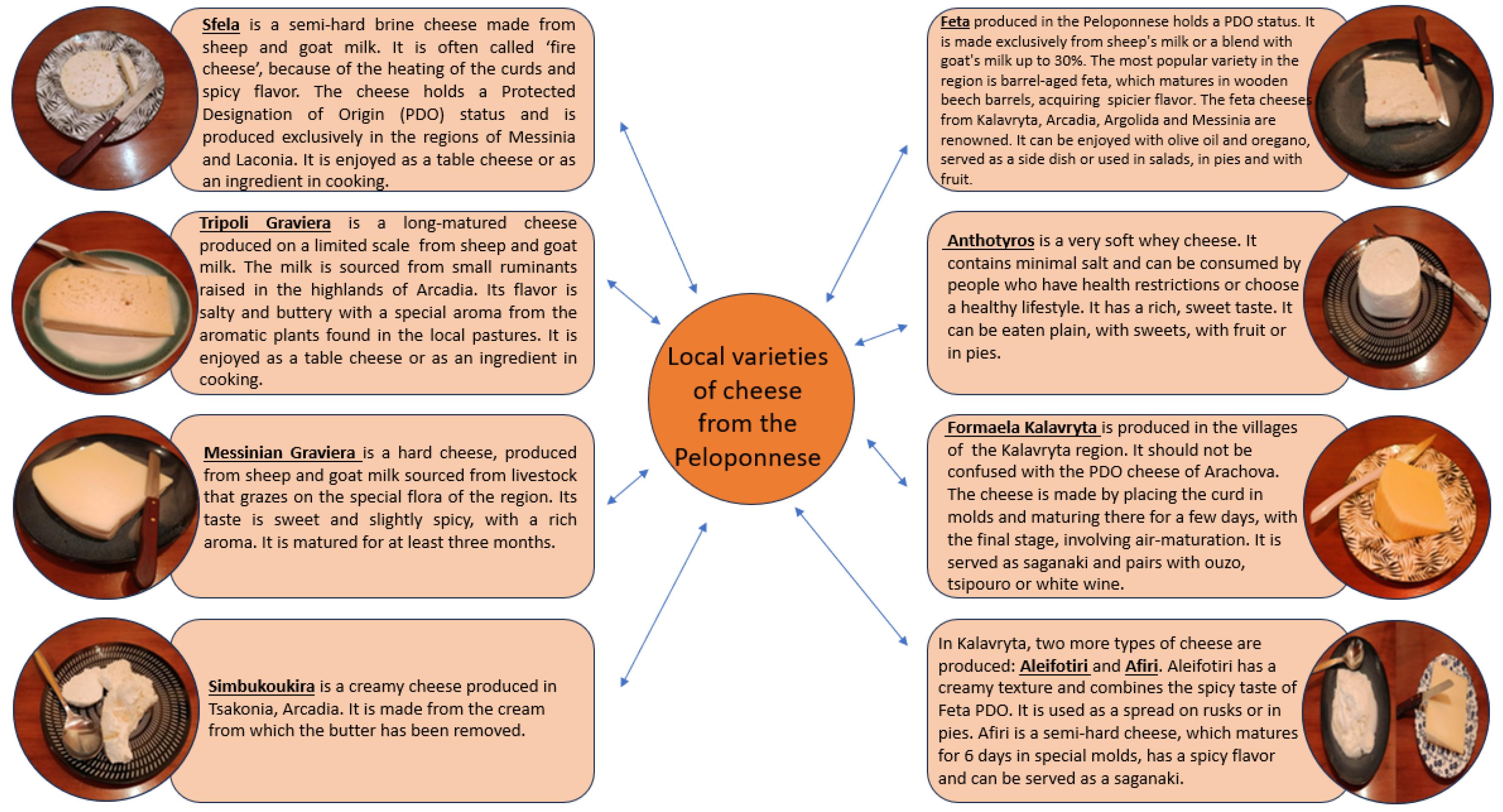
The Peloponnese has a long tradition in cheesemaking, producing a wide variety of traditional local cheese. Figure 1 illustrates the primary cheese varieties produced in the region, along with basic information about the production process and their culinary uses:
Some prefectures of the Peloponnese have had a strong cheese-making tradition since ancient times and continues to thrive today. In the prefecture of Laconia, cheese was a staple food for warriors. At that time, shepherds used animal skins to transport and ripen cheese. Messinia has a long tradition in the production of Sfela, which was historically produced in the southern Peloponnese. Cheesemaking was a key economic pillar of the region. Kalavryta, due to its intense mountainous terrain, has become an important center for cheese production. The production of barrel-aged feta cheese has a long history, which begins when the region’s nomadic herders exploited the mountain pastures, a tradition that continues today. Arcadia, with its characteristic location on the plateau of Mantinia, maintains several cheese dairies, with many of them having a history of three generations, based on traditional recipes for Feta and Graviera (Manolopoulou et al., 2003; Maniatis, 2014; Litopoulou-Tzanetaki & Tzanetakis, 2014; Tsouggou et al., 2024).
The strong influence of local agricultural resources on the organoleptic properties (sensory characteristics such as taste, aroma, color and texture) of regional cheese led to the development of cheese tourism (Montanari, 2009; Fusté-Forné & Mundet i Cerdan, 2021). This type of tourism is defined as the attribution of touristic value to cheese (Fusté-Forné & Mundet i Cerdan, 2021; Belliggiano et al., 2024). The sensory attributes of traditional cheese attract both food connoisseurs and travelers seeking to explore local culinary cultures (Montanari, 2009). Frequently, cheese tourism can be combined with wine tourism, forming a broader gastronomic experience that increases the attractiveness of rural destinations. Turner et al. (2018) highlight that the combined utilization of local wine and cheese can serve as a main tool for recognizing local identity. According to Kastenholz et al. (2020), the exceptional natural landscapes where cheesemaking activities take place can serve as significant attractions, building a unique place identity. Magri-Harsich et al. (2024) note that mountainous and semi-mountainous rural areas have played an essential role in shaping typologies for this specialized form of alternative tourism, defining the various activities related to the production, taste, and culture of cheese. Thus, cheese tourism includes visits and routes to dairies, the integration of local cheese into regional menus (e.g., hotels, restaurants), organized tasting panels, and gastronomic events and festivals dedicated to the product (Fusté-Forné, 2020b; Moreno-Lobato et al., 2023; Dimitrovski et al., 2024). In their travel narratives, tourists often use cheese to describe and better understand different cultures (Kivela & Crotts, 2009). Overall, cheese tourism can compose a complete, memorable, and authentic tourist experience (Moreno-Lobato et al., 2023).
Numerous successful examples worldwide demonstrate the tourism value of cheese, such as French Beaufort, Italian Parmigiano-Reggiano, and Mozzarella (Durrande-Moreau, 2017; Fusté-Forné & Mundet i Cerdan, 2021). In Greece, local cheese is rarely promoted as a central component of the tourist experience, except for Feta, the flagship of Greek cheese, which has been featured in many tourism promotional campaigns (Koutoulas, 2025). In 2024, the Greek Ministry of Tourism established detailed specifications required for dairies to host visitors and operate as tourist attractions. These certified businesses will bear the ‘Visitable Cheese Factory Label (SET)’ (Koutoulas, 2025). To date, cheese tourism in Greece has been studied on a limited scale, particularly regarding to participatory business development (Koutoulas, 2025). Specifically, this form of development is related to the innovation of a collaborative business model, in which stakeholders do not simply network but participate in joint value development and collective strategic planning (Bridoux & Stoelhorst, 2022; Hollebeek et al., 2022). Thus, local producers are integrated into the tourism value chain, allowing for joint planning of business functions, such as pricing of shared services provided, creating a competitive advantage for all participants (Thomas-Francois et al., 2018; Trilaksono et al., 2025).
As cheese tourism is defined, its successful development requires the participatory involvement of various stakeholders. Co-creation could be a key concept for such an effort. Most tourism research that studies co-creation refers to the active involvement of tourists in shaping tourism experiences, creating tourism products more tailored to their needs (Kastenholz & Gronau, 2022; Deng et al., 2024; Borges-Tiago & Avelar, 2025). Kraff and Jernsand (2025) approach co-creation through the participation of the local community, to define sustainable practices to protect and preserve cultural identity. In this way, benefits are created for the environment along with the empowerment of local stakeholders, who feel a sense of responsibility towards their community. According to Hamidi et al. (2019), co-creation in tourism, particularly in business-to-business (B2B) relationships, includes structured frameworks that facilitate business collaboration through the utilization of shared resources. Maziliauske (2024) reinforces the above view, stating that co-creation between tourism small and medium-sized enterprises (SMEs) and other local stakeholders regarding local procurement and local resources utilization can lead to socio-cultural sustainability. Livestock farming produces the cheese; culture, through tradition, lends uniqueness and authenticity to the product; and tourism owners utilize these elements to offer the complete experience, leveraging their existing infrastructure (Fusté-Forné & Mundet i Cerdan, 2021; De Roest & Menghi, 2000; Massacesi et al., 2025). The joint creation of a cooperation network for the promotion of local cheese among hotel businesses and local cheesemakers will enhance local business development (Duarte Alonso & O’Neill, 2010; Thomas-Francois et al., 2018). This process operationalizes B2B co-creation, serving as a perceived strategic framework for such development.
To provide authentic cheese tourism services, it is necessary to investigate the relationship between cheesemakers and hotel owners (Forbord, 2016). Hotel owners and their employees interact directly with tourists, effectively shaping meals and suggesting leisure activities (Escobar Rivera et al., 2019; Cartier & Lowry, 2025). To navigate a place, visitors mainly follow and trust the instructions and information provided by hoteliers (Artigas et al., 2017; Tussyadiah & Park, 2018). Providers of tourism experiences, who attribute tourist value to cheese, should not only highlight the product’s special taste, but also all the intangible cultural elements, such as gastronomic tradition and heritage (Guillén Peñafiel et al., 2024; Massacesi et al., 2025). The effectiveness of cultural promotion often depends on the star rating of hotels, which often acts as a proxy in the minds of guests for the quality of the services provided (Tsao, 2018). According to the signaling theory in the hospitality industry, luxury hotels (4 and 5 stars) can represent local gastronomy, as they have the necessary resources and strong brand name necessary to integrate high-quality local products into their value proposition (E. J. Kim et al., 2021; Franco et al., 2022). In contrast, the degree of cooperation between hotels with fewer stars and local cheesemakers depends on strategic planning and the constraints they have in relation to cost management. From the above, evident that that categorization of hotels into stars is a determining factor for the degree of development of co-creation with the agri-food sector (G. Zhou & Chen, 2023; Pfammatter et al., 2024). Hospitality hosts can establish stable relationships with cheesemakers, utilizing local gastronomic resources within the context of experiential experiences and integrating local cheese into the supply chain (Stoeva et al., 2024; Magri-Harsich et al., 2024). Simultaneously, by including traditional cheese in their hotel food services, they enhance the overall gastronomic experience (Hirtz et al., 2025). The development of new skills among tourism professionals regarding the better promotion of integrated experiential gastronomic experiences will enhance the acquisition of in-depth knowledge about local cheese (Montanari, 2009; Rachão et al., 2020).
The development of cheese tourism can contribute to diversifying and innovating rural areas, leading to significant business and economic growth (Magri-Harsich et al., 2024; Yusriadi et al., 2024). Cheese tourism can enhance tourist flows to a destination (Folgado-Fernández et al., 2019; Recuero Virto & Valilla Arróspide, 2024). When developing these experiences, it is crucial to protect the intangible cultural heritage to avoid over-commercialization (Maags, 2021; W. Xiao et al., 2025). Integrating cheese tourism into a region’s tourist product is an innovation, as it is a new attraction (Kuhn et al., 2024) that enriches available leisure options (Yang et al., 2024). Cheese tourism can bolster a destination’s reputation through the development of positive word-of-mouth (Nam et al., 2016). According to several studies, the gastronomic wealth combined with the promotion of cultural tourism constitutes a fundamental competitive advantage of the region, with the potential to build a unique strategy for attracting tourists (M.-P. Lin et al., 2021; Recuero Virto & Valilla Arróspide, 2024).
Business development is defined as increasing revenue, improving processes (such as reducing supply chain costs), and enchancing human resources through the aquisition of new skills to achieve organizational goals. It also involves developing innovations through the provision of new products or services, creating a competitive advantage for the business (Bush, 2005; Harrington & Voehl, 2013). However, sometimes within the hospitality sector, business growth is driven by the strategic perceptions of their owners. Therefore, perceived business growth by decision makers may reflect their assessment of growth opportunities and their readiness to innovate (Q. Xiao et al., 2012; Von Nitzsch et al., 2024). In this direction, the exchange of views and expertise will foster the development of local economies of scale (Turok & Habiyaremye, 2020). The development of cheese tourism is an innovation for Greece. It contributes to a new tourism product that has enhanced appeal to the high-end gastronomic segment of Western Europe, as well as the emerging markets of China and India, respecting the diversity of dietary habits (INSETE, 2021). Although the Chinese and Indian markets have traditionally shown lower dairy consumption due to dietary restrictions, an ever-increasing segment of high-income consumers is seeking premium artisanal cheese as part of a Westernized, gourmet lifestyle influenced by international travel (O. Wang et al., 2016; Cheng et al., 2022; Daxue Consulting, 2025; IMARC Group, 2026).
Several actions have been carried out in the Peloponnese, which may contribute to promoting local cheese as a tourist attraction of the area. The ‘cheese roads’ have been proposed by local action groups (under the Leader program) as a strategic initiative to highlight the rich cheese-making tradition of the region (Regional Development Company of Parnonas, 2025). The organization of a regional gastronomy festival, known as Peloponnese Food Stories, could foster the development of co-creative gastronomic entrepreneurship in the locale. The international promotion at EURegionsWeek in Brussels through an event on the ‘Gastronomic Heritage of the Peloponnese’, could further support this aspect (Carvalho et al., 2023b).
To develop a business development strategy for hoteliers in the Peloponnese, utilizing cheese tourism, the theoretical framework of the study was based on the existing literature on the attribution of tourism value to cheese and its utilization through business actions in collaborative networks (Forbord, 2016; Boesen et al., 2017; Andersson et al., 2017; Yong et al., 2022). The existing literature focuses mainly on the promotion of local cheese as a key component of the tourism experience and on the supply of this food to the value chain of tourism businesses (Fusté-Forné & Mundet i Cerdan, 2021; Magri-Harsich et al., 2024). The present study extends this discourse in order to outline the interconnection of agri-food and tourism through cheese, to enhance business development. However, this research diverges from existing studies, as it records the views of hoteliers regarding the business development potential of local cheese in the context of co-creation, through a quantitative approach, an area that remains under-explored in extant research.

2.2. Research Questions and Research Hypotheses

In light of the literature review, the following research questions and hypotheses were formulated:
  • Research Questions
The study addresses the following research questions:
  • How is cheese tourism utilized by hotels in the Peloponnese to enhance business development ?
  • What are hoteliers’ attitudes regarding the potential of cheese tourism to contribute to various dimensions of business development?
  • Which co-creation actions do hoteliers perceive as most effective for integrating cheese tourism into hotel services?
  • Research Hypothesis
Multi-star hotels have greater resources, investing in various co-creation activities, improving the guest experience (Sarmah & Rahman, 2018; Santos-Vijande et al., 2018). Boutique hotels emphasize interactive and emotional authenticity, providing ‘fertile ground’ for co-creative tourism (Kabra & Singh, 2025). The success of co-creation depends largely on the collaboration developed between all stakeholders. Effective collaboration can provide many benefits such as value innovation and improved market performance for tourism destinations (Melis et al., 2023). The success of co-creation depends largely on the collaboration developed between all stakeholders. Effective collaboration can provide many benefits such as value innovation and improved market performance for tourism destinations (J. Zhou et al., 2023). Cultural sustainability is an important aspect of co-creation (Lan et al., 2021). Hoteliers consider the integration of cheese tourism into the broader strategy of promoting local products to be particularly beneficial (Magri-Harsich et al., 2024). However, differences in stakeholder attitudes can affect the success of various gastronomic tourism activities, including cheese tourism (Ottenbacher & Harrington, 2013).
In this study, success is defined as a perceived outcome from the hoteliers’ perspective, which includes their evaluations of tourist flows, revenue growth, hotel reputation, guest satisfaction, and local partnerships.
A review of the existing literature led to the formulation of the following hypotheses:
H0: 
Hoteliers’ evaluations regarding the impact of co-creating cheese tourism activities as a business development strategy are similar regardless of the hotel’s star rating and irrespective of whether the region has a tradition in cheese production.
H1: 
Hoteliers’ evaluations regarding the impact of co-creating cheese tourism activities as a business development strategy differ depending on the hotel’s star rating and/or the presence of a tradition in cheese production in the region.
H0: 
Hoteliers’ assessments regarding the opportunities and obstacles to the development of co-creative cheese tourism are similar across all hotels, regardless of star rating or whether the region has a tradition in cheese production.
H1: 
Hoteliers’ assessments regarding the opportunities and obstacles to the development of co-creative cheese tourism differ depending on the hotel’s star rating and/or the presence of a tradition in cheese production in the region.
H0: 
Hoteliers’ evaluations of the perceived success of cheese tourism initiatives are similar across all hotels, regardless of star rating or whether the region has a tradition in cheese production.
H1: 
Hoteliers’ evaluations of the perceived success of cheese tourism initiatives differ depending on the hotel’s star rating and/or the presence of a tradition in cheese production in the region.

3. Materials and Methods

3.1. Aim and Objectives

The purpose of the research is to examine the role of cheese tourism within its strategic alignment with hospitality services, aiming to leverage perceived business development opportunities through managerial value co-creation intentions.
The specific objectives of the study are as follows:
  • Assessing the attitudes of hoteliers regarding the connection between the implementation of cheese tourism activities and the perceived creation of business development opportunities through the co-creation that develops between the agri-food sector and the hospitality industry.
  • Investigating the degree of recognition of local cheese as a strategic tool for creating business development opportunities, focusing on the strategic prospects identified by hoteliers as key stakeholders.
  • Identifying the challenges and perceived opportunities that influence hoteliers’ decision-making for business development and co-creation of experiences based on cheese tourism.

3.2. Sample

The research sample included exclusively key-decision makers (hoteliers) whose businesses are based in the five prefectures comprising the Peloponnese Region (Argolis, Arcadia, Corinth, Laconia and Messinia). This specific target group was chosen because their strategic perceptions as subjective performance indicators directly shape the business development of hotels. The collection of primary data took place in October, November, and December 2025. The questionnaire was distributed via email. In the event that the research participants had any questions, the researchers provided clarifications, ensuring the accuracy of the answers. The average time to complete the questionnaire was one hour.
The Peloponnese Region comprises 680 key tourism enterprises, distributed by star rating as follows: 58 are 1-star, 197 are 2-stars, 241 are 3-stars, 148 are 4-stars, and 36 are 5-stars. To achieve a representative sample, a stratified random sampling technique was utilized. Stratified sampling offered a clear advantage; by ensuring that each stratum is explicitly represented in the sample, this method prevented the underrepresentation or complete exclusion of smaller strata, which is a common risk in simple random sampling. Thus, the population was stratified by star rating, and a proportional allocation was applied to each stratum. Hotels were selected using systematic sampling within each stratum, by selecting every second hotel from the available list. The study utilized a 50% sampling fraction, resulting in a total sample of 340 enterprises (the minimum number of sample is 241 for 95% CI and 5% margin of error (Das et al., 2016).
The allocation per stratum was calculated by multiplying the relative frequency of each category by the total sample size. Consequently, the sample consisted of 29 one-star, 98 two-stars, 121 three-stars, 74 four-stars and 18 five-stars businesses. By employing this rigorous sampling method, the study ensures that the findings reflect the diverse landscape of the Peloponnesian tourism sector.
More precisely the questionnaires were distributed to 398 hotels, of which 351 responded, resulting in a response rate of 88.2%. After screening for completeness and excluding questionnaires with missing data, the final valid sample consisted of 340 hotels, which were included in the statistical analyses. This final sample size is reported consistently across all analyses presented in the study. Regarding the distribution of the sample, hotels were classified according to star rating and whether they were located in a region with a tradition in cheese production. The sample had a balanced allocation across the stars × tradition design, with adequate observations in each cell. Specifically, the distribution was as follows: 1-star hotels located in regions with a cheese production tradition (n = 13) and without such tradition (n = 16); 2-star hotels with tradition (n = 37) and without tradition (n = 61); 3-star hotels with tradition (n = 53) and without tradition (n = 68); 4-star hotels with tradition (n = 46) and without tradition (n = 28); and 5-star hotels with tradition (n = 12) and without tradition (n = 6). The total sample comprised 161 hotels in regions with a cheese production tradition and 179 in regions without, summing to 340 observations. Moreover, the number of observations per cell can be considered satisfactory in light of the underlying population mentioned above. The sample reflects this population structure reasonably well, particularly for the middle and higher star categories, supporting the robustness of comparisons across the stars × tradition cells. Finally, potential non-response bias should be acknowledged. Although the response rate was relatively high, it is possible that hotels that did not respond differ systematically from those that participated, for example in terms of management practices or strategic orientation. However, given the high proportion of responses and the close alignment between the sample and population distributions by star rating, the risk of severe non-response bias is considered limited, though it cannot be entirely ruled out.
Regarding the sample characteristics (n = 340), the participants are predominantly male with 93.8% of respondents identifying as men and only 6.2% as women. The age distribution is concentrated in the middle age groups, with the majority being between 36 and 65 years old. Specifically, the largest groups are those aged 46–55 (34.7%), followed by 56–65 (28.5%) and 36–45 (24.7%). Younger participants are minimal, with only 1.2% aged 18–25 and 5.6% aged, while those over 65 represent 5.3% of the sample.
The educational level is relatively high; more than half of respondents (56.9%) hold a university degree, 17.7% possess a master’s degree and 1.8% hold a doctorate. Only a minority have completed only high school or lower levels of education, suggesting a generally well-educated population. Most surveyed businesses are small, with 77.4% employing between 1 and 10 people. Medium-sized businesses (11–50 employees) account for 19.1%, while only a few respondents operate larger establishments with over 50 employees. The average number of rooms is 36.5, although with a high standard deviation of 54.8, indicating considerable variation in hotel size. In terms of star ratings, three-star hotels are the most common (35.6%), followed by two-star (28.8%) and four-star (21.8%) establishments. One-star (8.5%) or five-star (5.3%) hotels represents the remainder. Regarding services, only 27.1% of establishments offer catering or restaurant facilities. Finally, nearly half of the respondents (47.4%) are located in areas with a tradition of cheese production, ensuring a sample that includes both those with and without local expertise in the field. The demographic and business characteristics of the sample are summarized in Table 1.

3.3. Operationalization of Variables and Research Instrument Development

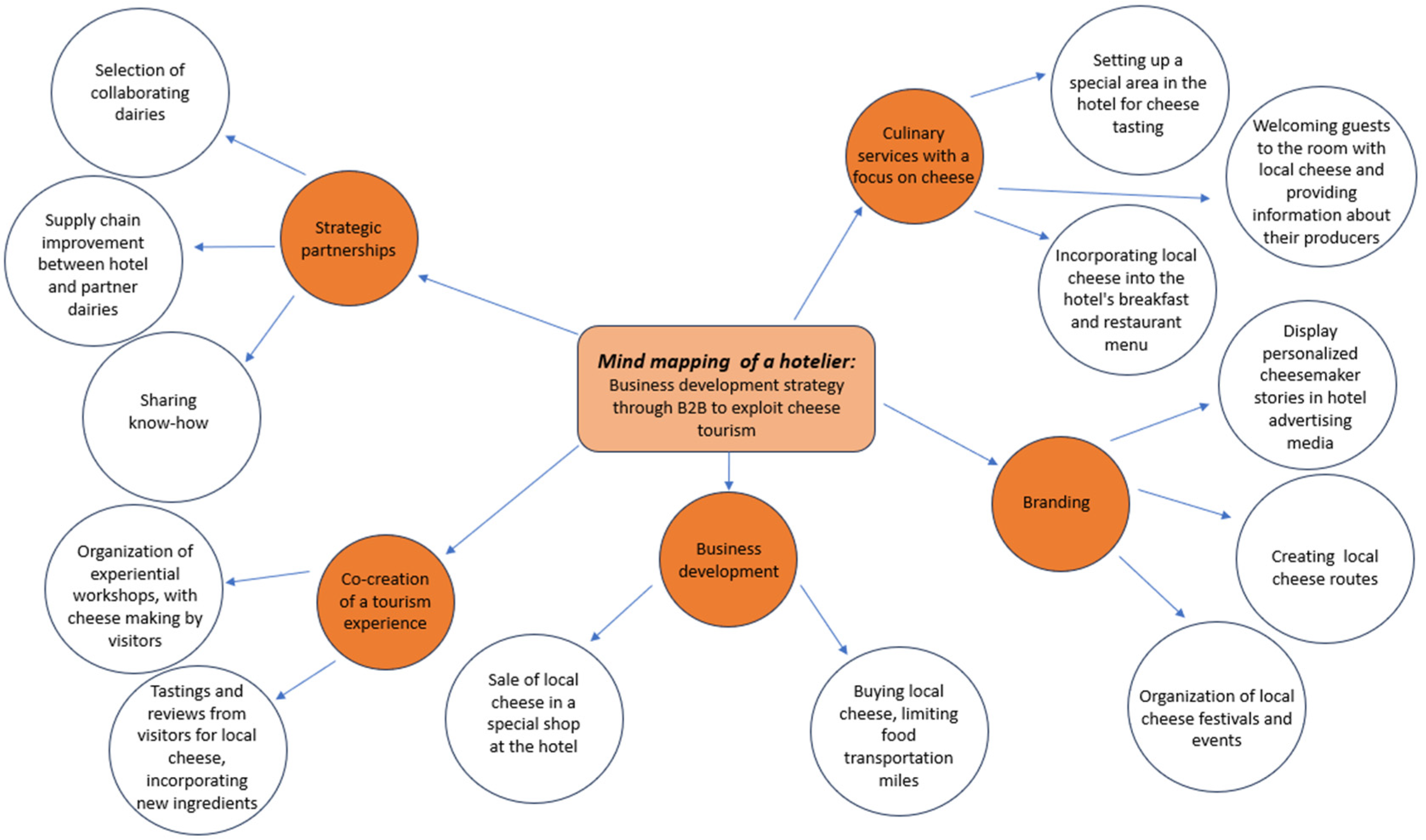
Figure 2 illustrates a hotelier’s conceptual framework centered on strategic planning for perceived business development, leveraging cheese tourism in a co-creative B2B relationships. A mind map is a conceptual model, visually representing the interconnection of various concepts and ideas, facilitating a better understanding of complex topics. This visualization served as a critical methodological tool for the authors, developed using Microsoft PowerPoint, version Microsoft 365 (Microsoft Corp., Redmond, WA, USA), to effectively connect the extensive literature review and operationalize the key dimensions of the study. The entrepreneur’s strategy is divided into main branches, such as strategic alliances, culinary integration, branding, core business functions and unique guest experiences. The sub-sectors focus on business activities aimed at building and maintaining relationships with local cheesemakers, integrating cheese into the gastronomic experience, promoting participatory hotel-cheesemaker partnerships and emphasizing interactive and experiential activities for travelers. Through mapping these dimensions, we ensured that the subsequent items of the questionnaire fully covered all aspects of the proposed B2B co-creation framework. To further clarify the operationalization of these dimensions into measurable business activities, Table 2 presents the B2B co-creation strategic framework and its connection to perceived business growth.
Following this framework, a structured questionnaire consisting of 25 questions was used as a research tool, divided into three sections:
(1)
Demographics:sixclosed-ended questions (e.g., gender, age, education) and two open-ended questions regarding the number of beds and municipality, which were analyzed quantitatively, including the classification of municipalities based on their cheese-making tradition (Drinis et al., 2024).
(2)
Current situation ofcheese tourism:six closed-ended questions addressing Research Objective 1 (RO1) regarding the assessment of attitudes toward cheese tourism and agri-food connectivity;
(3)
Agri-food and tourism business cooperation: eleven closed-ended questions addressing RO2 (recognition of local cheese as a strategic tool) and RO3 (identification of challenges and perceived opportunities).
Althoughparticipants had the opportunity to express their opinions in text form for each question, only one such response was received. Consequently, no systematic qualitative analysis was carried out, as the data did not allow for thematic saturation, and the primary focus of this study remains quantitative. Instead, these responses were used indicatively in the Discussion section to complement the quantitative findings.
The questionnaire was developed in line with the study’s three research hypotheses and aimed to capture hoteliers’ attitudes toward cheese tourism from multiple perspectives. Regarding hypothesis 1, the questions examined hoteliers’ evaluations of the impact of co-creating cheese tourism activities as a business development strategy. This section addressed current assessments of cheese tourism (4 items on a 5-point Likert scale, 1 = not at all, 2 = a little, 3 = moderately, 4 = a lot, 5 = very much, e.g., ‘The importance of including local foods or drinks in the overall tourism experience’, Cronbach’s alpha = 0.970) and participants’ responses of the agri–food tourism business collaboration leveraging cheese tourism, focusing on both existing practices and attitudes toward future cooperation (8 items on a 5-point Likert scale,1 = not at all, 2 = a little, 3 = moderately, 4 = a lot, 5 = very much, e.g., ‘The likelihood of including local cheese in your business’s menu, either at breakfast or in the restaurant’, Cronbach’s alpha = 0.867).
Hypothesis 2 was examined through questions that explored perceived opportunities (5 items on 5-point Likert scale, 1 = not at all, 2 = a little, 3 = moderately, 4 = a lot, 5 = very much, e.g., ‘Increase in tourist flows’, Cronbach’s alpha = 0.960) and barriers (7 items on 5-point Likert scale,1 = not at all, 2 = a little, 3 = moderately, 4 = a lot, 5 = very much, e.g., ‘Insufficient communication’, Cronbach’s alpha = 0.744) to the development of co-creative cheese tourism. Respondents assessed the extent to which cheese tourism could contribute to specific business benefits, as well as the extent to which various barriers hinder collaboration between cheese producers and tourism businesses.
Hypothesis 3 focused on hoteliers’ evaluations of the success of cheese tourism initiatives (4 items on a 5-point Likert scale,1 = not at all useful, 2 = a little, 3 = moderately, 4 = a lot, 5 = very useful; an additional choice in this question, ‘6 = I do not know’ was provided but excluded from the analysis, e.g., ‘Greek Breakfast’, Cronbach’s alpha = 0.946). This part of the questionnaire assessed how useful specific actions were considered to enhance business collaboration between hotels and cheese producers.
In addition to the hypothesis-based questions, the questionnaire included informational questions about the types of cheese offered (e.g., Feta PDO yes/no), the existence of restaurants or catering services (yes/no), and opportunities to purchase local food (yes/no).
The design of the questionnaire, i.e., the selection of appropriate questions, emerged after an extensive literature review (Fusté-Forné & Mundet i Cerdan, 2021; Magri-Harsich et al., 2024), brainstorming and conducting a small pilot survey involving hotel owners from all-star categories, who commented on the content of the questionnaire. Industry experts assessed the validity of the questionnaire, in order to achieve accuracy in measuring the attitudes of the participants.
In those cases, where weaknesses were found in fully recording the opinions within the questionnaire, appropriate corrections were made to enhance the clarity and validity of the tool.

3.4. Statistical Analysis

The statistical analysis was conducted with the use of the statistical software IBM SPSS Statistics, version 22.0 (IBM Corp., Armonk, NY, USA). The analysis included descriptive statistics such as frequencies, percentages, mean values and standard deviations. The participants’ answers are presented separately in relation to the level of the hotel and whether the region has or has no tradition in cheese production.
Inferential statistical tests were not applied, as in many cases the observed variability within groups was extremely limited or entirely absent, with standard deviations equal to zero. This indicates that respondents within several star–region combinations provided identical or nearly identical responses, violating key assumptions required for meaningful inferential testing, such as sufficient within-group variance and approximate normality. Under these conditions, the results of parametric or non-parametric tests would be unstable, potentially misleading, and of limited interpretative value (Tabachnick & Fidell, 2019). It is crucial to emphasize that this lack of variation is not a significant finding, reflecting a high degree of strategic consensus and institutional isomorphism within the industry. This strategic homogeneity suggests that regional traditions and hotel star ratings create a common operational framework that shapes uniform managerial perceptions (O’Neill et al., 2004; Soares et al., 2021; Tao et al., 2024). Consequently, the analysis emphasizes descriptive patterns and comparative trends across categories, which are more appropriate for accurately representing the structure of the data in this study.

4. Results

4.1. Assessment of the Current State of Cheese Tourism

As shown in Table 3, there are clear differences in attitudes toward including local foods, collaborating with local producers, and offering local cheese, based on both the hotel’s star rating and the region’s tradition in cheese production. Given that higher values indicate stronger agreement (1 = strong disagreement, 5 = strong agreement), mean scores closer to 5 reflect more positive attitudes and greater engagement with local food-related practices. For hotels located in regions with a tradition of cheese making (‘Yes’ regions), the higher mean scores indicate stronger agreement regarding the importance of including local foods and drinks in the tourism experience, as well as greater collaboration with local producers and more frequent offering of local cheese. For instance, one- to three-star hotels in these traditional regions report mean values (M) ranging from 1.2 to 2.6 for the first three variables, while the degree of organizing tasting events for one and two-star hotels is 0.0. This suggests low levels of agreement or minimal engagement in these categories. In contrast, hotels located in non-traditional regions (‘No’ regions) tend to report lower mean values for the same indicators (e.g., M = 0.2 to M = 2.0), reflecting weaker agreement across lower star categories. Notably, for four- and five-star hotels, these differences between regions diminish, as both show high levels of agreement. A consistent pattern is observed across star ratings. Agreement levels increase steadily with hotel classification, with five-star hotels exhibiting the highest mean scores (up to M = 4.0), followed by four-star and three-star hotels, while two- and one-star establishments show the lowest levels of agreement. This trend is evident across all four dependent variables examined: perceived importance of local foods, prior collaboration with local producers, and the offering of local cheese. Overall, the findings suggest that higher-rated hotels tend to express stronger agreement with and greater integration of local food products and partnerships than lower-rated ones, regardless of regional tradition.
The data presented in Table 4 illustrate distinct patterns in the types of cheese offered by hotels, revealing significant correlations between regional cheese making-traditions and hotel star rating. Hotels located in regions with a cheese-making tradition consistently offer a wider variety of local cheese. For instance, Feta PDO is highly prevalent in higher-star hotels within these traditional regions, offered by 91.3% of four-star and 91.7% of five-star hotels. In contrast, while still significant, these percentages are lower in non-traditional regions. Furthermore, cheese varieties such as Mizithra, Graviera, and Sfela PDO are predominantly found in traditional regions, particularly within the four- and five-star establishments, underscoring a strong link between regional heritage and culinary offerings. Lower-star hotels (one and two stars), exhibit limited diversity regardless of the region, typically offering basic types such as Feta or white cheese.
Specialized varieties such as Vitina Feta, Tripoli Graviera, and Kalavryta Formaela are almost exclusively restricted to mid-to-high-tier hotels in traditional regions, while Goat cheese and Anthotyro also show increased frequency in higher-rated establishments. Notably, even within non-traditional regions, higher-star hotels tend to provide a broader selection of cheese compared to lower-star hotels; however, the overall variety remains lower than in traditional regions. Furthermore, specialty cheese varieties such as Afiri, Siboukukira, and Manouri are rarely offered outside of traditional regions, and their availability is generally limited to four- or five-star hotels.
Table 5 data reveal a clear correlation between hotel star rating and the availability of restaurant or catering services, as well as opportunities for guests to purchase local foods, such as cheese. It is observed that four- and five-stars’ hotels, irrespective of their location in regions with a tradition in cheese production, consistently offer restaurant or catering services, with 100% of these establishments providing such amenities. In contrast, one- to three-star hotels do not offer these services, suggesting that lower-rated establishments are less equipped to provide on-site dining experiences. Regarding the opportunity for guests to purchase local foods, such ascheese, the pattern is even more constrained. This option is provided exclusively by five-star hotels in traditional regions and even in those cases, it is relatively rare, with only 16.7% of establishments offering such opportunities. No hotels below the five-star category or those situated in non-traditional regions offer this service.

4.2. Agri-Food—Tourism Business Collaboration Leveraging Cheese Tourism

Table 6 illustrates that most mean scores decrease steadily as hotel category rises, indicating that higher-rated hotels tend to agree more strongly with statements regarding agri-food–tourism synergy and cheese tourism. For instance, the feasibility of integrating local cheese into menus shows mean values such of 1.0 and 1.1 in one- and two-star hotels in regions with cheese-making tradition, but this figure goes to 4.0 in five-star establishments. A similar trend is observed in regions without tradition, where lower categories report means of 0.3 or 0.4, before going to 4.0 in the highest category. A similar trend is evident regarding the interest in organizing visits to local dairies. Means of 0.7 at lower-star hotels gradually are going to 4.0 at the top end, indicating very strong agreement. On-site cheese-tasting events follow the same trajectory: from approximately 0.0 and 0.1 in the lower categories to values near or at 4.0 in the upper ones. The development of a specialized cheese-tourism experience also shows an increase in mean values, moving from 0.2 in low-star hotels to 4.0 in high-star hotels. Furthermore, the willingness to allocate space for the retail and display of local cheese goes up from values like 0.0 or 0.1 to around 3.8–4.0 in the highest categories. The perceived importance of utilizing cheese with Geographical Indication (e.g., PDO) follows the same upward trend. Values such as 0.7 or 0.8 at the lower end steadily approach 4.0 as the hotel category increases. The only variable where the pattern reverses is the perceived cost of local cheese. Since a score of 5 represents strong agreement (e.g., ‘concern regarding cost’), low-star hotels express significant concern with mean scores such as 3.6. As the hotel category rises, cost-related concerns minimize, reaching values of 0.0 or 0.1 in the four- and five-star hotels. In this case, agreement decreases as the hotel rating increases, in contrast with all other variables.
Table 7 presents participants’ perceptions as subjective performance indicators of how cheese tourism contributes to various business benefits, revealing clear patterns linked to both hotel star ratings and regional traditions in cheese production. Across all five indicators, mean scores increase as hotel category increases, reflecting stronger agreement among higher-rated establishment. Given that the scale ranges from 0 to 5 (or includes values bellow 1) lower means indicate a lower perceived contribution.
Regarding the increase in tourist flows, one-star hotels in traditional regions report a mean of 0.7, two-star 0.9, three-star 2.1, four-star 2.0, and five-star 2.8. In non-traditional regions, a similar trend is observed, though means are lower for lower-star hotels (0.3 and 0.7 for one- and two-stars, respectively) and increase to 2.3 for five-star hotels. Concerning the enhancement of hotel reputation, hotels in traditional regions show means from 0.5 (one-star) to 4.0 (five-star), while non-traditional regions start at 0.2 and increase to 4.0 for the highest-star hotels. Revenue growth follows a consistent pattern, with traditional-region hotels moving from 0.2 (one-star) to 3.0 (five-star), and non-traditional from 0.2 to 3.0. Improvement in guest satisfaction shows an increase from 1.1–1.5 in lower-star hotels to 3.0–4.0 in five-star hotels. Finally, strengthening collaborations with local stakeholders exhibits the same trend, with means going up from 0.7–1.0 in low-star hotels to 3.0 in top-rated establishments.
Table 8 presents participants’ perceptions as subjective performance indicators regarding the extent to which various obstacles hinder collaboration between cheese producers and tourism businesses, with 1 indicating ‘not at all’ and 5 indicating ‘very much’ (i.e., the obstacle strongly hinders collaboration). Across most variables, a clear pattern emerges related to both hotel star ratings and regional cheese tradition.
For hotels in regions with a tradition in cheese production, ‘insufficient communication’ shows mean values of 1.6 for one-star hotels, 1.9 for two-star, 3.0 for three- and four-star, and 2.0 for five-star. In non-traditional regions, the pattern is similar but slightly higher for mid-category hotels, with three-star hotels at 3.3 and four-star at 3.0. ‘Different applied strategies’, such as the exclusion of small businesses, show comparable trends: means increase from around 1.8–1.9 in one- and two-star hotels to 3.0–3.1 in three- and four-star hotels, and remain at 3.0 for five-star hotels.
‘Divergent goals regarding quality, quantity, and price’ exhibit an opposite pattern, with one- and two-star hotels in traditional regions report relatively high means (3.6 and 3.9), indicating this obstacle is perceived as significantly more hindering for them. In contrast, higher-star hotels show lower means (up to 2.0), suggesting it is a minor concern for them. Similarly, ‘difficulties in the supply chain’ are rated high in mean (3.3–4.0) across low to mid star hotels, highlighting them as a significant hindrance. Conversely, ‘lack of business knowledge’ and ‘legislative framework’ are perceived as minimal obstacles for lower-star hotels, with means around 0.5 and 1.0, gradually becoming more relevant for higher-star hotels, where means reach 3.0. Finally, ‘lack of financial resources’ shows mixed patterns, with lower-star hotels rating it around 1.9–2.0, mid-star hotels at 3.0–3.1, and five-star hotels showing the least concern (mean of 1.0).
Table 9 presents participants’ perceptions as subjective performance indicators of the usefulness of various actions to foster business collaboration between hotels and cheese producers, with 5 representing ‘very useful’ and 1 ‘not useful at all’. Across all actions, a clear trend emerges: higher-star hotels consistently rate these initiatives as more useful, indicated by higher mean scores. For the ‘Greek Breakfast’ initiative, hotels in regions with a cheese-making tradition show a mean of 1.2 for both one- and two-star hotels, increasing to 2.0 for three-star, 3.0 for four-star, and 4.0 for five-star hotels. In non-traditional regions, the pattern is similar, with means starting at 0.9 in one-star and 0.7 in two-star, eventually reaching 4.0 in five-star hotels. The ‘Greek Cuisine’ action receives slightly lower mean scores in lower-star hotels, ranging from 0.1–0.3 in one- and two-star hotels regardless of regional tradition, increasing to 3.7 for five-star hotels.
The ‘Cheese Routes’ action shows a similar upward trend. In traditional regions, one- and two-star hotels report means of 1.2 and 1.1 respectively, rising to 3.7 in five-star hotels. In non-traditional regions, lower-star hotels rate it significantly lower (0.4 and 0.1), increasing to 3.5 for five-star hotels. Finally, the ‘Visitable Cheese Factory Label’ follows the same pattern. In traditional regions, the means starts at 0.8 for lower star hotels and reaches 3.6 in five-star hotels. In contrast, non-traditional regions show very low interest in the one- and two-star categories (0.1), which then climbs to 3.5 for five-star hotels.
Based on the analysis of the results, it follows that hoteliers’ perceptions as subjective performance indicators of cheese tourism differ from hotel star rating, indicating differentiated strategic orientations. Higher-star hotels consistently report higher mean scores, which reflect stronger interest, greater engagement, and a more positive evaluation of co-creating cheese tourism activities as a development strategy. Moreover, this pattern appears to be stable across both current practices and future collaboration intentions.
An example of the above conclusion is the interest in developing a specialized cheese tourism experience. In the case of five-star hotels, regardless of whether the region has a tradition of cheese production, the mean values are close to 4, indicating very high interest. In contrast, one- and two-star hotels report substantially lower means, suggesting limited interest.
Regional tradition in cheese production seems to exert a weaker influence. Hotels with the same star rating often show similar perceptions across regions. However, when tradition is present, hoteliers have a slightly more positive strategic orientation in cheese tourism activities. Overall, H1 (Hoteliers’ perceptions regarding the impact of co-creating cheese tourism activities as a business development strategy differ depending on the hotel’s star rating and/or the presence of a tradition in cheese production in the region) is partially confirmed, mainly due to differences associated with hotel classification.
Regarding the second hypothesis, the analysis concluded that the null hypothesis is not fully supported. Hoteliers’ perceptions as subjective performance indicators of opportunities and obstacles in co-creative cheese tourism differ primarily by hotel star rating. Higher-star hotels consistently present higher mean scores for key benefits, indicating a stronger belief that cheese tourism can enhance reputation, guest satisfaction, and collaboration with local stakeholders. Moreover, this pattern is present in both regions, regardless of whether a tradition in cheese production exists.
A clear example appears in the perceived enhancement of the hotel’s reputation. Five-star hotels report mean values close to 4, reflecting a substantial perceived benefit, while one- and two-star hotels show much lower means, indicating a weaker perceived impact.
As for the obstacles, there are differences by star rating, which are again more pronounced than regional differences. Overall, H1 (Hoteliers’ perceptions regarding the opportunities and obstacles to the development of co-creative cheese tourism differ depending on the hotel’s star rating and/or the presence of a tradition in cheese production in the region) is partially confirmed, mainly due to systematic variations linked to hotel classification rather than regional tradition.
Regarding the third hypothesis, the results suggest that the null hypothesis is not fully supported. Hoteliers’ perceptions of the success and usefulness of cheese tourism initiatives differ according to hotel star rating. Higher-star hotels consistently assign higher mean scores to all proposed actions, indicating that they perceive these initiatives as more successful and more helpful in strengthening collaboration with cheese producers. Moreover, this trend appears stable across both regions with and without a tradition in cheese production.
In the case of ‘Cheese Routes’ five-star hotels report mean values close to 4, reflecting very high perceived usefulness. In contrast, one- and two-star hotels show considerably lower means, suggesting limited perceived value. Furthermore, differences linked to regional tradition are comparatively small and inconsistent. Overall, H1 (Hoteliers’ perceptions of the success of cheese tourism initiatives differ depending on the hotel’s star rating and/or the presence of a tradition in cheese production in the region) is partially confirmed, driven mainly by systematic differences associated with hotel star rating rather than by regional cheese-making tradition.

5. Discussion

The findings of the research show that one- to three-star hotels in regions with a cheese-making tradition, are more likely to recognize the value of local cheese. Specifically, Table 3 illustrates that three-star hotels in the ‘Yes’ regions reported a mean score of 2.6, indicating stronger perceived agreement compared to the 2.0 reported by hotels of the same category in the ‘No’ regions. These hotels include the specific products more in their services and build stronger collaborations with local cheesemakers, a fact reflected in the higher mean scores (representing reported engagement) for ‘previous collaboration’ (M = 2.2 for 3-star hotels in ‘Yes’ regions vs. M = 1.9 in ‘No’ regions) and ‘frequency of local cheese provision’ (M = 2.0 vs. M = 1.9 respectively). The existence of a strong food heritage in a region can act as an incentive for incorporating local products into hotel menus, as tourists increasingly seek for authentic food experiences associated with a specific destination (Sims, 2013; Forgas-Serra et al., 2021; Rivza et al., 2022). Fusté-Forné (2020a) states that local cheese strongly represents the identity of the region. This suggests that local traditions can contribute to the transformation of lower-class hotels into main representatives of local gastronomy. Furthermore, the data in Table 3 reveal a strong trend across all hotel classifications; hotels with higher stars show the greatest involvement with local products. Across all four variables, five-star and four-star establishments consistently recorded the highest mean scores (M = 2.9 to 4.0), indicating the highest levels of reported agreement regardless of region tradition. Therefore, regional tradition and hotel category are main factors shaping practices and attitudes towards local cheese in the hospitality sector. The research of Santana-Talavera and González-Morales (2024) confirms the above, noting that luxury hotels record higher levels of consumption of local products, as they function as a tool of differentiation. A 5-star hotel owner stated during the survey: “A large portion of hotel guests are interested in the local products they taste at breakfast or in the restaurant. Specifically, they ask for specific information about them and their connection to the region”. In relation to the preference of specific types of cheese by hotel owners, the results of this study show that both the local tradition in cheese making and the hotel’s star rating play a crucial role. The greatest variety is found in high-rated hotels in traditional regions.
As illustrated in Table 4, where products like Feta PDO and Graviera reach 91.7% and 100% respectively in five-star units. Vlachou et al. (2024) point out statistically significant correlations between the hotel category and their organizational readiness in relation to the integration of local agri-food products. The Hellenic Chamber of Hotels certifies hotels with the Greek Breakfast label, which offers points in their star ranking. Tourism businesses with such certification must utilize traditional culinary recipes and offer sufficient local agri-food products, such as Tripoli Graviera or Sfela PDO. The inclusion of products with a Geographical Indication in the breakfast or restaurant menu offers additional points for this certification. Higher category hotels show particular interest in this adoption compared to 1–2-star hotels which mainly offer basic white cheese (Kyriakaki et al., 2016; Kontis & Gkoumas, 2017; Ministry of Development, 2026). According to the results of the survey (Table 5), only 4- and 5-star hotels have a restaurant or catering, with a 100% availability rate in these categories regardless of whether the hotel is located in a region with a tradition in cheese production or not. This element is in full agreement with the existing institutional framework, since it is mandatory for high-class hotels to provide such services to satisfy the needs of their customers. In lower-class hotels, it is not mandatory to have a restaurant or provide meals and they are usually limited to providing breakfast only, as confirmed by the findings of the study where 0.0% of these establishments offered on-site catering (Table 5) (Kyriakaki et al., 2016; Hotelstars Union, 2026). Regarding the integration of local food sales into the guest experience, the data from Table 5 reveal that it is closely linked both to the high standards of the hotels and to areas with an established cheesemaking heritage. Specifically, the possibility of purchasing local cheese is provided exclusively by 5-star hotels located in areas with tradition in cheese production. Even in this specific category, the rate is only 16.7%, while for all other hotel categories and hotels in non-traditional areas the rate is 0.0%. This highlights a significant gap in the promotion of local gastronomic products, especially in lower star-star hotels and regions without a traditional heritage (Santana-Talavera & González-Morales, 2024). The findings of the study show that high-star hotels can be perceived as potential ambassadors of local gastronomic culture. Their strong agreement as evidenced by mean values reaching 4.0 for 5-star establishments (Table 6), regarding the ‘Possibility of incorporating local cheese into breakfast and restaurant menus’ and the ‘Importance of using certified cheese with Geographical Indication (e.g., PDO)’, reveals their reported desire to differentiate themselves from other competing hotels through authenticity. They seem to perceive cheese not as a simple food but as an opportunity to potentially develop a holistic gastronomic experience, an intention further supported by the high interest in ‘organizing visits to dairy farms for customers’ and ‘organizing cheese tastings on site’ (average score of 4.0 for 5-star hotels, Table 6). These results align with the recommendation of Bondzi-Simpson and Ayeh (2019), who suggest that high-end hotels should offer indigenous flavors.
However, the “High cost as a barrier to sourcing local cheese” appears to be a potential inhibitor for the development of cheese tourism in this area for specific hotel categories. For 1- and 2-star hotels, this cost is a significant obstacle, with mean scores of 3.6 (Table 6) indicating strong agreement with this challenge. On the contrary, for 5-star hotels the cost of purchasing local cheese is perceived as a negligible barrier (mean score: 0.1, Table 6). Several surveys confirm the above data, showing that low- and mid-range hotels are struggling with the increase in prices of raw materials, including cheese, and are looking for ways to cut these specific costs (Mackenzie et al., 2011; Kang & Rajagopal, 2014). As a result, despite the fact that hotels may perceive a benefit to incorporate cheese tourism, they report difficulty to respond to it. This suggests the need for a supportive strategy for the successful dissemination of this specific type of alternative tourism.
Luxury hotels (4 and 5 star) are increasingly incorporating cheese with geographical indication into their menus as shown by their strong agreement with the ‘Importance of using certified cheese’ (mean scores: 3.0–4.0, Table 6). They want to comply with food quality systems, in their effort to satisfy the needs of customers who have high gastronomic demands. Menozzi et al. (2022) point out that the certification of cheese with Geographical Indication is a critical reason for choice for high-income customers, who perceive these products as a symbol of superior quality and reliability. The data presented in Table 7 demonstrate that as hotel star rating increases, participants consistently perceive greater benefits from cheese tourism across all five examined business outcomes. Higher star hotels report the strongest positive view indicated by the highest mean scores on a scale where 5 represents ‘very much’—of cheese tourism as a means of increasing tourist flows, enhancing reputation, increasing revenue, satisfying visitors, and improving collaboration with local stakeholders. For example, in terms of enhancing hotel reputation, the average rating increases significantly from 0.2–0.5 for 1-star hotels to 4.0 for 5-star hotels, regardless of the region’s tradition (Table 7). Similarly, for perceived revenue growth, 5-star hotels consistently show a stronger perceived impact (M = 3.0) compared to the 0.2 reported by 1-star hotels. The differences in the opinions of hoteliers based on hotel category in relation to the perceived business benefits of cheese tourism stem from their engagement with different consumer groups with distinct needs (Rajaguru & Hassanli, 2018; Li et al., 2020). For 1- and 2-star hotels, the target customer segment tends to choose an accommodation based on satisfying their desire to achieve reduced accommodation costs. Thus, the reputation of these hotels is mainly based on achieving the relationship of providing basic hotel services and ensuring low prices (Rondan-Cataluña & Rosa-Díaz, 2014). The implementation of cheese tourism actions would increase the hotel’s expenses, with customers unwilling to pay a premium for such services (Stangl et al., 2020). While adding local cheese to the hotel’s breakfast may pleasantly surprise guests, it is unlikely to be the primary reason for them to choose that hotel. Additionally, collaborating with local cheesemakers in the same hotel category would be difficult, because hoteliers would need small quantities of local cheese and would demand low prices (Pelegrín-Borondo et al., 2017). This situation changes for 3- and 4-star hotels, where cheese tourism serves as a tool for differentiation and value addition. It reinforces the hotel’s identity and ultimately attracts customers looking for authentic experiences. For 5-star hotels, cheese tourism can enhance the overall luxury experience. Therefore, star category is a key determinant in the perceived value of integrating local food experiences into the hotel offering (Fusté-Forné & Mundet i Cerdan, 2021; Dixit & Prayag, 2022). The results of the study indicate the obstacles that hinder business development through cheese tourism are perceived differently depending on hotel category and regional tradition. Low-star hotels (1 and 2 stars), especially in traditional areas, identify “Divergent goals regarding the quality, quantity and price of cheese” as a significant obstacle with high mean scores (M = 3.6 and M = 3.9) in Table 8. Similarly, for hotels rated 3 and 4 stars, the data from Table 8 on ‘Supply Chain Difficulties’ (high mean values ranging from 3.1 to 4.0) show that logistics challenges are a significant obstacle, supporting the view that inconsistent practices can lead to significant operational problems (Alreahi et al., 2023). In contrast, 5-star hotels may be more flexible in the supply chain or only work with producers who meet strict criteria (mean value 2.0). Kaya and Azaltun (2012) have found similar results, suggesting that these hotels have the appropriate resources, such as the use of advanced information systems, resulting in better supply chain management, effectively addressing the challenges that may arise from supplier inconsistency.
On the contrary, legislative barriers and lack of business knowledge do not seem to be a significant obstacle for low-star hotels, as the very low averages (M = 0.5 to 1.2 in Table 8) indicate that these factors affect them little (Campbell & Khodadadi, 2025). For 1- and 2-star hotels, the business processes are simplified, with straightforward procedures that do not require specialized business knowledge. On the other hand, 5-star hotels showhigher mean scores (M = 3.0), suggesting they have higher standards and require their partners to be able to meet the high demands of luxury hospitality, something that requires specialization in entrepreneurship (Özdemir et al., 2019; J. Kim et al., 2022). Lack of communication and strategic alignment are identified as barriers across all categories in Table 8, but with increasing intensity in mid-range establishments (means up to 3.3). Five-star hotels show moderate concern (mean 2.0–3.0), as they may have specialized personnel for effective communication (Kharouf et al., 2019). In relation to the quality, quantity and price objectives, low-class hotels primarily seek very low prices for large quantities (reflected in the high means in Table 8). However, this demand cannot be easily met by Greek dairies, which are distinguished mainly by the high quality of their products, which are sold at high prices. On the other hand, 5-star hotels report lower mean scores (M = 2.0), indicating they prioritize product quality, considering price as secondary importance, facilitating cooperation between agri-food and tourism businesses (Chatzipetrou & Moschidis, 2017; Vives et al., 2018; G. Lin et al., 2025). In conclusion, collaboration between cheese producers and tourism businesses is influenced by operational and local factors, with the severity of most barriers varying significantly (moving from high to lower mean values in Table 8) as the hotel category increases, making collaborations easier for higher-end hotels. The survey results (Table 9) show that the perception of the usefulness of major existing initiatives to enhance collaboration between hotels and cheese producers increases depending on the hotel category. Higher star hotels demonstrate the strongest agreement on the value of these actions, while lower star hotels are more cautious but still recognize the potential benefit. This trend is most prominent in the ‘Greek Breakfast’ and ‘Greek Cuisine’ programs. Specifically, 5-star hotels in traditional areas achieved high mean score of M = 4.0 and M = 3.7 respectively, indicating a near absolute recognition of these initiatives as ‘very useful’. In contrast, the substantially lower scores in the 1- and 2-star categories suggest a gap in perceived strategic value or resource availability for such collaborations. These findings imply that investments in structured initiatives including ‘Cheese Routes’ and ‘Visitable Cheese Factory Label’ are likely to have the greatest impact and adoption rate among mid- to high-end hotels (Jovičić et al., 2016).
The strategic alignment of hotels in the study demonstrates institutional isomorphism, confirming that regional tradition and star ratings create a single operational framework that shapes consistent managerial perceptions (O’Neill et al., 2004; Soares et al., 2021; Tao et al., 2024).
However, the research has some limitations. First, the results may not be representative, because the study focuses exclusively on the Peloponnese. Additionally, a notable limitation is the gender imbalance observed in the sample, which may affect the perceptions recorded. Furthermore, the study only records the opinions of hoteliers, without taking into account cheesemakers, tour operators and tourists. Furthermore, in keeping with the subjective nature of the research, the concept of business development was measured through management perceptions rather than objective financial metrics. While such self-reported data provides valuable information for strategic decision-making, it may be influenced by personal biases.
Thus, in order to generalize the study’s findings, geographical expansion, exploration of the views of more tourism and agri-food stakeholders, as well as the triangulation of subjective perceptions with secondary objective data (e.g., real income or employment growth) through longitudinal studies, are required. Finally, the high degree of strategic alignment observed across the sample suggests a strong institutional isomorphism, which led to limited variance in the data. While this reflects a single operational framework shaped by regional tradition and star ratings, it may obscure individual strategic nuances that could be further explored through qualitative methods.

6. Conclusions

This research reveals that cheese tourism is a critical strategic resource for the business development of hotels in the Peloponnese region. The key conclusion of the study is that the successful integration of local cheese into the tourism product depends on two main factors: the local cheese tradition and the categorization of hotels in stars. The research shows that lower-class hotels, i.e., 1–3 stars, are significantly influenced by the local tradition of cheesemaking, especially when operating in areas with a strong gastronomic heritage. In contrast, luxury hotels (4–5 stars) can act as ambassadors of local cheesemaking regardless of region, usually utilizing high-quality cheese, certified with Geographical Indication and experiential actions centered on cheese as tools for differentiation and offering a complete luxury experience. Despite the general recognition of the benefits of cheese tourism, as recorded by hoteliers’ perceptions, in improving the reputation and increasing business revenues, significant obstacles are identified that differ by hotel star category. For 1- and 2-star hotels, the high cost of sourcing local cheese and the divergence of objectives between cheesemakers and hoteliers are a hindrance, while mid-range hotels focus mainly on supply chain difficulties, inadequate communication and implementation of different business strategies. Finally, existing initiatives, such as the Greek Breakfast and the Visitable Cheese Factory Label, seem to be better utilized by high-end hotel units, which have the necessary organizational expertise.
The methodology of the study followed a quantitative approach, focusing on the hospitality sector in the Peloponnese region. Data were collected from a representative sample of hoteliers from all hotel star categories and geographical areas of the region. A structured questionnaire was used in order to record hoteliers’ perceptions regarding the current state of cheese tourism and to explore the possibilities of strategic co-creative cooperation between the agri-food and tourism sectors with the aim of business development of enterprises. The analysis of the results was done using SPSS.
  • Implications of the study
  • Theoretical implications
This study has theoretical implications, enriching the literature on cheese tourism, highlighting it as a strategic resource for the business development of hotels. It introduces the co-creation model and how it can be developed according to the views of hoteliers. Furthermore, the study identifies two critical success factors for the use of cheese tourism as a means of business development for the hospitality industry: the tradition of cheese production and the categorization of hotels with stars.
  • Practical implications
In relation to the practical implications, hotels located in areas with a cheese-making tradition can utilize local cheese to differentiate themselves from the competitors. The creation of cooperation networks between hoteliers and cheesemakers can contribute to addressing the high cost of supplies, as another practical application. Existing actions to promote cooperation between these two sectors should be further exploited. The practical application also includes the training of hotel staff.
  • Policy implications
In terms of policy, the study suggests that institutional support is essential. Policymakers should focus on financial support for low-star hotels, so that they can effectively integrate local cheese into their services. By leveraging cheese tourism, the foundations are laid for the interconnection of the primary and tertiary sectors, with significant benefits for the local economy. Institutional initiatives should also focus on regional connectivity, linking diverse areas of the Peloponnese, which have a heterogeneous cheese-making tradition, to create a coherent and inclusive cheese tourism product.
  • Strategic Recommendations
Taking into account the main findings of the study, a series of strategic recommendations can be formulated, which have been divided into four main axes. Firstly, in terms of the differentiation and upgrading of 4- and 5-star hotels, and given their greater readiness for such initiatives, holistic gastronomic experiences should be developed. In particular, the unique characteristics of local cheese of the Peloponnese should be exploited. Higher-end hotels can serve as ambassadors of the regional cheese identity, addressing identified communication gaps by organizing tastings and tours of local dairies. Furthermore, developing partnerships with dairies that are certified as open to visitors and leveraging the ‘Greek Breakfast’ initiative, including local cheese such as Sfela PDO can further strengthen the connection between luxury accommodations and local heritage. On the contrary, for 1-to-3-star hotels, the strategy implemented should focus on ensuring their economic viability by addressing their high concern regarding procurement costs. In particular, to mitigate the high cost of sourcing local cheese, it is recommended to create collective networks between smaller hotels and producers to achieve economies of scale. Hotels in this category can reposition themselves in the market, using the tradition of cheesemaking as a lever to strengthen their reputation in gastronomy. To achieve this, and considering their lack of full-service restaurants, it is necessary to integrate local cheese to a greater extent in the breakfast foods provided. In addition, it is proposed to develop specific retail points within their facilities to generate additional income. The third axis concerns the exploitation of co-creation at a practical level, which requires deeper cooperation between hoteliers and cheesemakers to resolve supply chain difficulties. This synergy should aim to bridge the gap between tourism and the agri-food sector. Hoteliers can promote the cheese heritage and cheesemakers can enrich the value chain of the gastronomy services provided. For the successful implementation of this effort, it is crucial to design educational seminars for hotel staff, addressing the reported lack of specialized knowledge, so that they can effectively communicate the cultural and sensory value of local cheese to guests. Finally, institutional support remains a critical and necessary condition to simplify the legislative framework. It is possible that financial subsidies to 1- and 2-star hotels will facilitate the purchase of local cheese, overcoming their limited financial resources and reducing the barrier to entry into cheese tourism. In addition, institutional initiatives must be developed that focus on regional connectivity, connecting hotels located in areas that do not have a strong cheesemaking tradition with neighboring gastronomic hubs, so that the cheese tourism product is coherent for the entire Peloponnese region.
  • Future Research
In the future, it would be useful to conduct consumer behavior studies, recording tourists’ preferences in relation to cheese tourism. In addition, the willingness of visitors to pay for such services, which would be provided by hotels, could be examined. The optimal structure of the cooperation network between the two sectors could be analyzed in relation to the attribution of tourist value to cheese. Finally, a comparative analysis of different regions related to this topic would be valuable.

Author Contributions

Conceptualization, M.S. and K.M.; methodology, M.S. and K.M.; investigation, M.S. and K.M.; writing—original draft preparation, M.S. and K.M.; writing—review and editing, M.S. and K.M.; visualization, M.S. and K.M.; supervision, M.S. and K.M. All authors have read and agreed to the published version of the manuscript.

Funding

This research received no external funding.

Institutional Review Board Statement

Ethical review and approval were waived for this study due to the Rules of Procedure of the Research Ethics Committee (REC), of the University of West Attica and the relevant Greek legislation, including Decision No. 24904 (State Journal B’ 1485/21 April 2020) approving the Code of Ethics and Conduct of Research and the Rules of Procedure of the Research Ethics Committee of the University of West Attica, and Law 4957/2022, Section L, articles 277–282 on Research Ethics and Deontology, for non-funded research studies involving the collection and/or processing of personal data or participation of human subjects, submission to the Committee is not mandatory for this kind of research. This study is a non-interventional research project focusing on business development strategies (co-creation of cheese tourism). The data collected from hoteliers strictly concern professional practices and institutional strategies (e.g., the use of local cheeses) and do not involve sensitive personal data, health information, or vulnerable groups. According to the institutional guidelines (the Code of Ethics and Conduct of Research of our University: https://research-ethics-comittee.uniwa.gr/kodikas-deontologias/, accessed on 27 February 2026), non-invasive research based on anonymous data from professional groups does not require formal Ethics Committee approval. Participants were fully informed about the study’s purpose and provided their consent voluntarily.

Informed Consent Statement

Informed consent for participation was obtained from all subjects involved in the study.

Data Availability Statement

The original contributions presented in this study are included in the article. Further inquiries can be directed to the corresponding author.

Conflicts of Interest

The authors declare no conflict of interest.

References

  1. Aksenova, D., Cai, W., & Gebbels, M. (2022). Multisensory prosumption: How cooking classes shape perceptions of destinations. International Journal of Contemporary Hospitality Management, 34(9), 3417–3439. [Google Scholar] [CrossRef]
  2. Alreahi, M., Bujdosó, L., David, L., & Gyenge, B. (2023). Green supply chain management in hotel industry: A systematic review. Sustainability, 15(7), 5622. [Google Scholar] [CrossRef]
  3. Andersson, T. D., Mossberg, L., & Therkelsen, A. (2017). Food and tourism synergies: Perspectives on consumption, production and destination development. Scandinavian Journal of Hospitality and Tourism, 17(1), 1–8. [Google Scholar] [CrossRef]
  4. Artigas, E. M., Yrigoyen, C. C., Moraga, E. T., & Villalón, C. B. (2017). Determinants of trust towards tourist destinations. Journal of Destination Marketing & Management, 6(4), 327–334. [Google Scholar] [CrossRef]
  5. Barzallo-Neira, C., & Pulido-Fernández, J. I. (2025). The demand for gastronomic tourism—Characterization and tourists’ profiles. Sustainability, 17(16), 7206. [Google Scholar] [CrossRef]
  6. Baysal, D. B., & Denk, E. (2025). A route suggestion for traditional cheeses: Kandirif and gorcola cheeses. In Global perspectives on cheese tourism (pp. 483–504). IGI Global Scientific Publishing. [Google Scholar] [CrossRef]
  7. Belliggiano, A., Ievoli, C., Bispini, S., & Conti, M. (2024). Food value chains configurations and resilience of rural mountain communities: Three dairy business models in central Apennines (Italy). Frontiers in Sustainable Food Systems, 8, 1436214. [Google Scholar] [CrossRef]
  8. Berno, T., & Fusté-Forné, F. (2020). Imaginaries of cheese: Revisiting narratives of local produce in the contemporary world. Annals of Leisure Research, 23(5), 608–626. [Google Scholar] [CrossRef]
  9. Beuvier, E., & Duboz, G. (2013). The microbiology of traditional hard and semihard cooked mountain cheeses. Microbiology Spectrum, 1(1), 133–150. [Google Scholar] [CrossRef] [PubMed]
  10. Björk, P., & Kauppinen-Räisänen, H. (2014). Exploring the multi-dimensionality of travellers’ culinary-gastronomic experiences. Current Issues in Tourism, 19(12), 1260–1280. [Google Scholar] [CrossRef]
  11. Boesen, M., Sundbo, D. I. C., & Sundbo, J. (2017). Local food and tourism: An entrepreneurial network approach. Scandinavian Journal of Hospitality and Tourism, 17(1), 76–91. [Google Scholar] [CrossRef]
  12. Bondzi-Simpson, A., & Ayeh, J. K. (2019). Assessing hotel readiness to offer local cuisines: A clustering approach. International Journal of Contemporary Hospitality Management, 31(2), 998–1020. [Google Scholar] [CrossRef]
  13. Borges-Tiago, M. T., & Avelar, S. (2025). Co-creation dynamics in tourism and hospitality: A horizon 2050 paper. Tourism Review, 80(1), 194–208. [Google Scholar] [CrossRef]
  14. Bouche, R., & Moity-Maïzi, P. (2009). Ecology and culture: The territorial anchorage of corsican cheese producers’ knowledge. Outlook on Agriculture, 38(2), 183–188. [Google Scholar] [CrossRef]
  15. Bridoux, F., & Stoelhorst, J. W. (2022). Stakeholder governance: Solving the collective action problems in joint value creation. Academy of Management Review, 47(2), 214–236. [Google Scholar] [CrossRef]
  16. Bufféral, S., Kranis, H., Pubellier, M., Skourtsos, E., & Wicker, V. (2025). Reactivation of the alpine nappe stack during the late-orogenic collapse of the Peloponnese (Greece). Tectonics, 44(9), e2024TC008773. [Google Scholar] [CrossRef]
  17. Bush, S. F. (2005). A techno-economic model applied to the development of new products and improved processes. Chemical Engineering Research & Design, 83(6), 646–654. [Google Scholar] [CrossRef]
  18. Campbell, F., & Khodadadi, M. (2025). Regulatory challenges and impacts on hospitality: A case study of Scotland’s self-catering sector. Current Issues in Tourism, 28, 3063–3068. [Google Scholar] [CrossRef]
  19. Cartier, E. A., & Lowry, L. L. (2025). Reconceptualizing host/tourist interactions: The connection between roles, power, and discourse in the service encounter. Tourism and Hospitality Research, 25, 339–348. [Google Scholar] [CrossRef]
  20. Carvalho, M., Kastenholz, E., & Carneiro, M. J. (2023a). Co-creative tourism experiences—A conceptual framework and its application to food & wine tourism. Tourism Recreation Research, 48(5), 668–692. [Google Scholar] [CrossRef]
  21. Carvalho, M., Kastenholz, E., Carneiro, M. J., & Souza, L. (2023b). Co-creation of food tourism experiences: Tourists’ perspectives of a Lisbon food tour. Tourist Studies, 23(2), 128–148. [Google Scholar] [CrossRef]
  22. Chathoth, P., Altinay, L., Harrington, R. J., Okumus, F., & Chan, E. S. (2013). Co-production versus co-creation: A process-based continuum in the hotel service context. International Journal of Hospitality Management, 32, 11–20. [Google Scholar] [CrossRef]
  23. Chatzipetrou, E., & Moschidis, O. (2017). An exploratory analysis of quality costing in Greek F&B enterprises. The TQM Journal, 29(2), 324–341. [Google Scholar] [CrossRef]
  24. Chemidlin Prévost-Bouré, N., Karimi, B., Sadet-Bourgeteau, S., Djemiel, C., Brie, M., Dumont, J., Campedelli, M., Nowak, V., Guyot, P., Letourneur, C., Manneville, V., Gillet, F., & Bouton, Y. (2021). Microbial transfers from permanent grassland ecosystems to milk in dairy farms in the Comté cheese area. Scientific Reports, 11(1), 18144. [Google Scholar] [CrossRef]
  25. Cheng, R., Wang, Q., & Wei, L. (2022). Income growth, employment structure transition and the rise of modern markets: The impact of urbanization on residents’ consumption of dairy products in China. PLoS ONE, 17(4), e0267006. [Google Scholar] [CrossRef]
  26. Ciolac, R., Iancu, T., Brad, I., Popescu, G., Marin, D., & Adamov, T. (2020). Agritourism activity—A “smart chance” for mountain rural environment’s sustainability. Sustainability, 12(15), 6237. [Google Scholar] [CrossRef]
  27. Coelho, M. C., Malcata, F. X., & Silva, C. C. G. (2022). Lactic acid bacteria in raw-milk cheeses: From starter cultures to probiotic functions. Foods, 11(15), 2276. [Google Scholar] [CrossRef]
  28. Dancausa Millán, M. G., Millán Vázquez de la Torre, M. G., & Hernández Rojas, R. (2021). Analysis of the demand for gastronomic tourism in Andalusia (Spain). PLoS ONE, 16(2), e0246377. [Google Scholar] [CrossRef]
  29. Das, S., Mitra, K., & Mandal, M. (2016). Sample size calculation: Basic principles. Indian Journal of Anaesthesia, 60(9), 652–656. [Google Scholar] [CrossRef]
  30. DATAINTELO. (2025). Cheese tourism market. Available online: https://dataintelo.com/report/cheese-tourism-market (accessed on 5 February 2026).
  31. Daxue Consulting. (2025). How the cheese market in China is developing despite widespread lactose-intolerance. Available online: https://daxueconsulting.com/chinas-cheese-market/ (accessed on 5 February 2026).
  32. Deng, Y., Lee, H. M., Lee, T. J., & Hyun, S. S. (2024). Co-creation of the tourist experience: A systematic assessment scale. Tourism Management Perspectives, 51, 101212. [Google Scholar] [CrossRef]
  33. De Roest, K., & Menghi, A. (2000). Reconsidering ‘traditional’ food: The case of Parmigiano Reggiano cheese. Sociologia Ruralis, 40(4), 439–451. [Google Scholar] [CrossRef]
  34. Dimitrovski, D., Joukes, V., & Scott, N. (2024). Food and wine presence and pairing within traditional restaurants’ menus as regional heritage promotional behaviour: Gemeinschaft or Gesellschaft? Journal of Sustainable Tourism, 32, 2644–2662. [Google Scholar] [CrossRef]
  35. Dixit, S., & Prayag, G. (2022). Gastronomic tourism experiences and experiential marketing. Tourism Recreation Research, 47(3), 217–220. [Google Scholar] [CrossRef]
  36. Drinis, Y. N., Masouras, T., Bembeli, P., Bizelis, J., & Economou, A. (2024). Greece’s nutritional cultural heritage, Cheesemaking and cheese. Ministry of Culture. Available online: https://www.calameo.com/books/0057419143b1a71e9053d (accessed on 20 September 2025).
  37. Duarte Alonso, A., & O’Neill, M. A. (2010). Small hospitality enterprises and local produce: A case study. British Food Journal, 112(11), 1175–1189. [Google Scholar] [CrossRef]
  38. Durrande-Moreau, A. (2017). Building on a PDO food product in order to innovate in tourism: A case study on Beaufort cheese. HAL. Post-Print hal-01549536. HAL. [Google Scholar]
  39. eAmbrosia—EU. (2025). Available online: https://ec.europa.eu/info/food-farming-fisheries/food-safety-andquality/ (accessed on 20 September 2025).
  40. ELSTAT. (2024). Available online: https://www.statistics.gr/documents/20181/45150b28-634a-e7f5-374b-ba3dbc67d402 (accessed on 4 February 2026).
  41. Escobar Rivera, D., Casadesus Fa, M., Alexandre Costa Araújo Sampaio, P., & Simon Villar, A. (2019). Exploring the Role of Service Delivery in Remarkable Tourism Experiences. Sustainability, 11(5), 1382. [Google Scholar] [CrossRef]
  42. Folgado-Fernández, J. A., Di-Clemente, E., & Hernández-Mogollón, J. M. (2019). Food festivals and the development of sustainable destinations. The case of the cheese fair in Trujillo (Spain). Sustainability, 11(10), 2922. [Google Scholar] [CrossRef]
  43. Forbord, M. (2016). Food as attraction: Connections between a hotel and suppliers of specialty food. Scandinavian Journal of Hospitality and Tourism, 16(3), 297–314. [Google Scholar] [CrossRef]
  44. Forgas-Serra, S., Majó Fernández, J., & Mundet i Cerdan, L. (2021). The value of popular cuisine in tourism: A Costa Brava case study. Journal of Tourism and Cultural Change, 19(2), 216–229. [Google Scholar] [CrossRef]
  45. Fotopoulou, M., & Karkanis, D. (2021). The agri-food industry in Greece: Regional development and prospects. Economy & Business Journal, 15(1), 194–213. [Google Scholar]
  46. Franco, S., Presenza, A., & Messeni Petruzzelli, A. (2022). Luxury hotels as orchestrators in gastronomic destination development and management: The case of Borgo Egnazia and the Itria Valley. International Journal of Contemporary Hospitality Management, 34(9), 3440–3458. [Google Scholar] [CrossRef]
  47. Fusté-Forné, F. (2020a). Developing cheese tourism: A local-based perspective from Valle de Roncal (Navarra, Spain). Journal of Ethnic Foods, 7(1), 26. [Google Scholar] [CrossRef]
  48. Fusté-Forné, F. (2020b). Savouring place: Cheese as a food tourism destination landmark. Journal of Place Management and Development, 13(2), 177–194. [Google Scholar] [CrossRef]
  49. Fusté-Forné, F., & Mundet i Cerdan, L. (2021). A land of cheese: From food innovation to tourism development in rural Catalonia. Journal of Tourism and Cultural Change, 19(2), 166–183. [Google Scholar] [CrossRef]
  50. Galmarini, M. V., Loiseau, A. L., Visalli, M., & Schlich, P. (2016). Use of multi-intake temporal dominance of sensations (TDS) to evaluate the influence of cheese on wine perception. Journal of Food Science, 81(10), S2566–S2577. [Google Scholar] [CrossRef] [PubMed]
  51. Garrido, N., & Moreno-Izquierdo, L. (2025). An analysis of the Latin America value-added chain of tourism. Tourism Economics, 32(1), 172–190. [Google Scholar] [CrossRef]
  52. Getz, D., & Robinson, R. N. (2014). “Foodies” and their travel preferences. Tourism Analysis, 19(6), 659–672. [Google Scholar] [CrossRef]
  53. Giannopoulos, A., Piha, L., & Skourtis, G. (2021). Destination branding and co-creation: A service ecosystem perspective. Journal of Product & Brand Management, 30(1), 148–166. [Google Scholar] [CrossRef]
  54. Grasseni, C. (2011). Re-inventing food: Alpine cheese in the age of global heritage. Anthropology of Food, 8, 6819. [Google Scholar] [CrossRef]
  55. Grönroos, C. (2011). Value co-creation in service logic: A critical analysis. Marketing Theory, 11(3), 279–301. [Google Scholar] [CrossRef]
  56. Guillén Peñafiel, R., Hernández Carretero, A. M., & Sánchez Martín, J. M. (2024). Intangible heritage, education and tourism as a strategy for the enhancement of the value of the dehesa and the traditional shepherd’s trade. Sustainability, 16(24), 10997. [Google Scholar] [CrossRef]
  57. Gurbaskan Akyuz, B. (2019). Factors that influence local food consumption motivation and its effects on travel intentions. Anatolia, 30(3), 358–367. [Google Scholar] [CrossRef]
  58. Hadjigeorgiou, I. (2011). Past, present and future of pastoralism in Greece. Pastoralism: Research, Policy and Practice, 1(1), 24. [Google Scholar] [CrossRef]
  59. Hamidi, F., Shams Gharneh, N., & Khajeheian, D. (2019). A conceptual framework for value co-creation in service enterprises (case of tourism agencies). Sustainability, 12(1), 213. [Google Scholar] [CrossRef]
  60. Harrington, H., & Voehl, F. (2013). Innovation management: A breakthrough approach to organizational excellence—Part 1. International Journal of Innovation Science, 5(4), 213–224. [Google Scholar] [CrossRef]
  61. He, L., Zha, J., Tang, J., Tan, T., & Yu, Q. (2023). Drivers of employment effects in tourism-related sectors: The case of Mainland China. Tourism Review, 78, 849–873. [Google Scholar] [CrossRef]
  62. Hirtz, J., Douraquia, K., Jönsson, M., & Wendin, K. (2025). Taste of tradition: Perceptual quality aspects and future prospects of three Swedish classic cheeses. Food Science and Nutrition, 13(9), e70913. [Google Scholar] [CrossRef]
  63. Hollebeek, L. D., Urbonavicius, S., Sigurdsson, V., Clark, M. K., Parts, O., & Rather, R. A. (2022). Stakeholder engagement and business model innovation value. The Service Industries Journal, 42(1–2), 42–58. [Google Scholar] [CrossRef]
  64. Hotelstars Union. (2026). Criteria of the hotelstars union. Available online: https://www.hotelstars.eu/greece/for-hotels/hsu-criteria (accessed on 20 December 2025).
  65. IMARC Group. (2024). Culinary tourism market size, share, trends and forecast by activity type, tour type, age group, mode of booking, and region 2025–2033. Available online: https://www.imarcgroup.com/culinary-tourism-market (accessed on 15 December 2025).
  66. IMARC Group. (2026). India specialty cheese market size, share, trends and forecast by product, form, distribution channel, and region, 2025–2033. Available online: https://www.imarcgroup.com/india-specialty-cheese-market (accessed on 5 February 2026).
  67. INSETE. (2021). “Greek tourism 2030|action plans” destination “Southern Peloponnese”. Available online: https://insete.gr/wp-content/uploads/pdf/proorismoi/proorismos-notia-peloponnisos.pdf (accessed on 15 December 2025).
  68. INSETE. (2022). Available online: https://insete.gr/wp-content/uploads/2020/05/22-12_Peloponnese-1.pdf (accessed on 10 October 2025).
  69. INSETE. (2024). Available online: https://insete.gr/wp-content/uploads/2024/12/24-12_Greece.pdf (accessed on 10 October 2025).
  70. Institute for Hellenic Growth and Prosperity. (2025). The Greek economy: Current state and perspectives. The American College of Greece. Available online: https://acg150.acg.edu (accessed on 15 December 2025).
  71. ITEP. (2025). Annual survey for the hotel sector 2024. Institute for Tourism Research and Forecasts. Available online: https://www.itep.gr/wp-content/uploads/2025/06/AS_2024_site_public_en_revised.pdf (accessed on 3 February 2026).
  72. Jovičić, A., Gagić, S., & Sekulić, D. (2016). Interdependance of innovativeness and category of a hotel: Case study of Serbian hotels sector. Marketing Science, 47(2), 93–103. [Google Scholar] [CrossRef]
  73. Kabra, S., & Singh, P. (2025). Envisaging creative tourism through boutique hotels: An integrated framework of transformative experience. Tourism Recreation Research, 50, 161–177. [Google Scholar] [CrossRef]
  74. Kang, S., & Rajagopal, L. (2014). Perceptions of benefits and challenges of purchasing local foods among hotel industry decision makers. Journal of Foodservice Business Research, 17(4), 301–322. [Google Scholar] [CrossRef]
  75. Karagiannis, D., & Metaxas, T. (2020). Sustainable wine tourism development: Case studies from the Greek region of peloponnese. Sustainability, 12(12), 5223. [Google Scholar] [CrossRef]
  76. Kastenholz, E., & Gronau, W. (2022). Enhancing competences for co-creating appealing and meaningful cultural heritage experiences in tourism. Journal of Hospitality & Tourism Research, 46(8), 1519–1544. [Google Scholar] [CrossRef]
  77. Kastenholz, E., Marques, C. P., & Carneiro, M. J. (2020). Place attachment through sensory-rich, emotion-generating place experiences in rural tourism. Journal of Destination Marketing & Management, 17, 100455. [Google Scholar] [CrossRef]
  78. Kaya, E., & Azaltun, M. (2012). Role of information systems in supply chain management and its application on five-star hotels in Istanbul. Journal of Hospitality and Tourism Technology, 3(2), 138–146. [Google Scholar] [CrossRef]
  79. Keskin, H. (2025). History of cheese and cheese making. In Global perspectives on cheese tourism (pp. 1–10). IGI Global Scientific Publishing. [Google Scholar] [CrossRef]
  80. Kharouf, H., Sekhon, H., Fazal-e-Hasan, S. M., Hickman, E., & Mortimer, G. (2019). The role of effective communication and trustworthiness in determining guests’ loyalty. Journal of Hospitality Marketing & Management, 28(2), 240–262. [Google Scholar] [CrossRef]
  81. Kim, E. J., Baloglu, S., & Henthorne, T. L. (2021). Signaling effects of branded amenities on customer-based brand equity. Journal of Hospitality Marketing & Management, 30(4), 508–527. [Google Scholar] [CrossRef]
  82. Kim, J., Kim, S. I., & Lee, M. (2022). What to sell and how to sell matters: Focusing on luxury hotel properties’ business performance and efficiency. Cornell Hospitality Quarterly, 63, 78–95. [Google Scholar] [CrossRef]
  83. Kivela, J., & Crotts, J. C. (2009). Understanding travelers’ experiences of gastronomy through etymology and narration. Journal of Hospitality & Tourism Research, 33(2), 161–192. [Google Scholar] [CrossRef]
  84. Kontis, A.-P., & Gkoumas, A. (2017). “Greek breakfast”: A new tourism brand name for an age-long gastronomy tradition (pp. 235–241). Springer. [Google Scholar] [CrossRef]
  85. Koutoulas, D. (2025). Creating cheese tourism from scratch: The case of Diaseli traditional cheesery on Ios Island, Greece. In Global perspectives on cheese tourism (pp. 375–388). IGI Global Scientific Publishing. [Google Scholar] [CrossRef]
  86. Kraff, H., & Jernsand, E. M. (2025). Political and relational co-creation for inclusive tourism development. Scandinavian Journal of Hospitality and Tourism, 25, 24–37. [Google Scholar] [CrossRef]
  87. Kuhn, V. R., dos Anjos, S. J. G., & Krause, R. W. (2024). Innovation and creativity in gastronomic tourism: A bibliometric analysis. International Journal of Gastronomy and Food Science, 35, 100813. [Google Scholar] [CrossRef]
  88. Kyriakaki, A., Zagkotsi, S., & Trihas, N. (2016). Gastronomy, tourist experience and location. The case of the ‘greek breakfast’. Tourismos, 11(3), 227–261. [Google Scholar] [CrossRef]
  89. Lan, T., Zheng, Z., Tian, D., Zhang, R., Law, R., & Zhang, M. (2021). Resident-tourist value co-creation in the intangible cultural heritage tourism context: The role of residents’ perception of tourism development and emotional solidarity. Sustainability, 13(3), 1369. [Google Scholar] [CrossRef]
  90. Levante, A., Bertani, G., Bottari, B., Bernini, V., Lazzi, C., Gatti, M., & Neviani, E. (2021). How new molecular approaches have contributed to shedding light on microbial dynamics in Parmigiano Reggiano cheese. Current Opinion in Food Science, 38, 131–140. [Google Scholar] [CrossRef]
  91. Li, H., Liu, Y., Tan, C.-W., & Hu, F. (2020). Comprehending customer satisfaction with hotels: Data analysis of consumer-generated reviews. International Journal of Contemporary Hospitality Management, 32(5), 1713–1735. [Google Scholar] [CrossRef]
  92. Licitra, G., & Carpino, S. (2014). The microfloras and sensory profiles of selected protected designation of origin Italian cheeses. In C. W. Donnelly (Ed.), Cheese and microbes (pp. 151–165). American Society of Microbiology. [Google Scholar] [CrossRef]
  93. Lin, G., Chen, J. L., & Song, H. (2025). EXPRESS: The heterogeneity of hotel demand curves across consumers and contexts. Journal of Hospitality & Tourism Research, 49, 1241–1255. [Google Scholar] [CrossRef]
  94. Lin, M.-P., Marine-Roig, E., & Llonch-Molina, N. (2021). Gastronomy as a sign of the identity and cultural heritage of tourist destinations: A bibliometric analysis 2001–2020. Sustainability, 13(22), 12531. [Google Scholar] [CrossRef]
  95. Litopoulou-Tzanetaki, E., & Tzanetakis, N. (2014). The microfloras of traditional Greek cheeses. Microbiology Spectrum, 2(1), 177–218. [Google Scholar] [CrossRef]
  96. Lv, X., Zhang, C., & Li, C. (2024). Beyond image attributes: A new approach to destination positioning based on sensory preference. Tourism Management, 100, 104819. [Google Scholar] [CrossRef]
  97. Maags, C. (2021). Common, luxury, and fake commodities: Intangible cultural heritage markets in China. China Perspectives, (2021/3), 7–17. [Google Scholar] [CrossRef]
  98. Mackenzie, M., Cheung, C., & Law, R. (2011). The response of hotels to increasing food costs due to food shortages. Asia Pacific Journal of Tourism Research, 16(4), 395–416. [Google Scholar] [CrossRef]
  99. Magri-Harsich, G., Fusté-Forné, F., Fernandes, C., & Vidal-Casellas, D. (2024). Artisanal food production in rural Argentina: Finding solace in cheese tourism? International Journal of Gastronomy and Food Science, 35, 100888. [Google Scholar] [CrossRef]
  100. Maniatis, G. C. (2014). The Byzantine cheesemaking industry. Byzantion, 84, 257–284. [Google Scholar] [CrossRef]
  101. Manolopoulou, E., Sarantinopoulos, P., Zoidou, E., Aktypis, A., Moschopoulou, E., Kandarakis, I. G., & Anifantakis, E. M. (2003). Evolution of microbial populations during traditional Feta cheese manufacture and ripening. International Journal of Food Microbiology, 82(2), 153–161. [Google Scholar] [CrossRef]
  102. Massacesi, C., Lovelock, B., & Carr, A. (2025). Gastronomic tourism: Collaboration between food communities of practice and hospitality providers from the Italian Dolomites. Food, Culture and Society: An International Journal of Multidisciplinary Research, 1–21. [Google Scholar] [CrossRef]
  103. Maziliauske, E. (2024). Innovation for sustainability through co-creation by small and medium-sized tourism enterprises (SMEs): Socio-cultural sustainability benefits to rural destinations. Tourism Management Perspectives, 50, 101201. [Google Scholar] [CrossRef]
  104. Melis, G., McCabe, S., Atzeni, M., & Del Chiappa, G. (2023). Collaboration and learning processes in value co-creation: A destination perspective. Journal of Travel Research, 62(3), 699–716. [Google Scholar] [CrossRef]
  105. Menozzi, D., Yeh, C.-H., Cozzi, E., & Arfini, F. (2022). Consumer preferences for cheese products with quality labels: The case of Parmigiano Reggiano and Comté. Animals, 12(10), 1299. [Google Scholar] [CrossRef]
  106. Miliordos, D. E., Goulioti, E., Lola, D., Kanapitsas, A., Kontoudakis, N., & Kotseridis, Y. (2024). Chemical and sensory differentiation of Nemea PDO sub-zones wines: Two vintages experiment. Ciência e Técnica Vitivinícola, 39(2), 103–119. [Google Scholar] [CrossRef]
  107. Millet, M. (2019). From Ossau and Iraty to PDO Ossau-Iraty: The long-term construction of a product based on two distinct places. British Food Journal, 121(12), 3062–3075. [Google Scholar] [CrossRef]
  108. Ministry of Development. (2026). Certify your accommodation for the “Greek breakfast”. Available online: https://www.gov.gr/en/upourgeia/upourgeio-anaptuxes/ksenodokheiako-epimeleterio-elladas-ksee/pistopoiese-katalumaton-gia-to-elleniko-proino (accessed on 20 September 2025).
  109. Montanari, A. (2009). Geography of taste and local development in Abruzzo (Italy): Project to establish a training and research centre for the promotion of enogastronomic culture and tourism. Journal of Heritage Tourism, 4(2), 91–103. [Google Scholar] [CrossRef]
  110. Moreno-Lobato, A., Di-Clemente, E., Campón-Cerro, A. M., & Hernández-Mogollón, J. M. (2023). Application of smellscapes and affective-cognitive analysis in memorable cheese-based tourism experiences. International Journal of Gastronomy and Food Science, 34, 100815. [Google Scholar] [CrossRef]
  111. Nam, M., Kim, I., & Hwang, J. (2016). Can local people help enhance tourists’ destination loyalty? A relational perspective. Journal of Travel & Tourism Marketing, 33(5), 702–716. [Google Scholar] [CrossRef]
  112. Nguyen, H. L., Tran, T. P., & Bui, H. L. (2024). Exploring tourists’ preference to visit domestic destination: A locavorism perspective. Current Issues in Tourism, 27(23), 4134–4147. [Google Scholar] [CrossRef]
  113. Nicoletti, S., Medina-Viruel, M. J., Di-Clemente, E., & Fruet-Cardozo, J. V. (2019). Motivations of the culinary tourist in the city of Trapani, Italy. Sustainability, 11(9), 2686. [Google Scholar] [CrossRef]
  114. OECD. (2025a). Measuring the economic impact of tourism in Greece: Guidance and action plan [OECD tourism papers, 2025/15]. OECD Publishing. [Google Scholar] [CrossRef]
  115. OECD. (2025b). Rethinking regional attractiveness in the Greek region of Peloponnese [OECD regional development papers, No. 174]. OECD Publishing. [Google Scholar] [CrossRef]
  116. Okumus, B., Okumus, F., & McKercher, B. (2007). Incorporating local and international cuisines in the marketing of tourism destinations: The cases of Hong Kong and Turkey. Tourism Management, 28(1), 253–261. [Google Scholar] [CrossRef]
  117. O’Neill, J. W., Beauvais, L. L., & Scholl, R. W. (2004). Strategic issues and determinant factors of an interorganizational macroculture in the lodging industry. Journal of Hospitality & Tourism Research, 28(4), 483–506. [Google Scholar] [CrossRef]
  118. Ottenbacher, M. C., & Harrington, R. J. (2013). A case study of a culinary tourism campaign in Germany: Implications for strategy making and successful implementation. Journal of Hospitality & Tourism Research, 37(1), 3–28. [Google Scholar] [CrossRef]
  119. Özdemir, A. İ., Colak, A., & Shmilli, J. (2019). Business process management in hotels: With a focus on delivering quality guest service. Quality & Quantity, 53(5), 2305–2322. [Google Scholar] [CrossRef]
  120. Pamukçu, H., Saraç, Ö., Aytuğar, S., & Sandıkçı, M. (2021). The effects of local food and local products with geographical indication on the development of tourism gastronomy. Sustainability, 13(12), 6692. [Google Scholar] [CrossRef]
  121. Papadopoulou, A., Ragkos, A., Theodoridis, A., Skordos, D., Parissi, Z. M., & Abraham, E. M. (2020). Evaluation of the contribution of pastures on the economic sustainability of small ruminant farms in a typical Greek area. Agronomy, 11(1), 63. [Google Scholar] [CrossRef]
  122. Paxson, H. (2010). Locating value in Artisan cheese: Reverse engineering terroir for new-world landscapes. American Anthropologist, 112(3), 444–457. [Google Scholar] [CrossRef]
  123. Pelegrín-Borondo, J., Arias-Oliva, M., & Olarte-Pascual, C. (2017). Emotions, price and quality expectations in hotel services. Journal of Vacation Marketing, 23(4), 322–338. [Google Scholar] [CrossRef]
  124. Pfammatter, A., Tanner, M. B., & Baldauf, A. (2024). Resource sharing with local partners: How do hotels benefit? International Journal of Hospitality Management, 118, 103648. [Google Scholar] [CrossRef]
  125. Prayag, G., & Ryan, C. (2012). Visitor interactions with hotel employees: The role of nationality. International Journal of Culture, Tourism and Hospitality Research, 6(2), 173–185. [Google Scholar] [CrossRef]
  126. Rachão, S., Breda, Z., Fernandes, C., & Joukes, V. (2020). Cocreation of tourism experiences: Are food-related activities being explored? British Food Journal, 122(3), 910–928. [Google Scholar] [CrossRef]
  127. Rajaguru, R., & Hassanli, N. (2018). The role of trip purpose and hotel star rating on guests’ satisfaction and WOM. International Journal of Contemporary Hospitality Management, 30(5), 2268–2286. [Google Scholar] [CrossRef]
  128. Recuero Virto, N., & Valilla Arróspide, C. (2024). Culinary destination enchantment: The strategic interplay of local gastronomy in regional tourism development. International Journal of Gastronomy and Food Science, 36, 100931. [Google Scholar] [CrossRef]
  129. Regional Development Company of Parnonas. (2025). “Peloponnesian cheese roads: Cooperation—Identity—Extroversion” in Kalavryta. Available online: https://www.parnonas.gr/12516/news/peloponnisiakoi-dromoi-toy-tyrioy-synergasia-taytotita-exostrefeia/ (accessed on 9 January 2026).
  130. Rinaldi, A., Bifulco, G., Luciano, A., Picariello, L., Moio, L., Marrone, R., Campanile, G., & Forino, M. (2024). Exploring cheese and red wine pairing by an in vitro simulation of tasting. Current Research in Food Science, 9, 100792. [Google Scholar] [CrossRef]
  131. Rivza, B., Foris, D., Foris, T., Privitera, D., Uljanova, E., & Rivza, P. (2022). Gastronomic heritage: A contributor to sustainable local tourism development. GeoJournal of Tourism and Geosites, 44(4), 1326–1334. [Google Scholar] [CrossRef]
  132. Rocha, R., Couto, N., Pinto, R. P., Vaz-Velho, M., Fernandes, P., & Santos, J. (2023). Microbiological characterization of protected designation of origin serra da estrela cheese. Foods, 12(10), 2008. [Google Scholar] [CrossRef]
  133. Rondan-Cataluña, F. J., & Rosa-Díaz, I. M. (2014). Segmenting hotel clients by pricing variables and value for money. Current Issues in Tourism, 17(1), 60–71. [Google Scholar] [CrossRef]
  134. Saad, A., Bousquet, J., Fernandez-Castro, N., Loquet, A., & Géan, J. (2021). New insights into wine taste: Impact of dietary lipids on sensory perceptions of grape tannins. Journal of Agricultural and Food Chemistry, 69(10), 3165–3174. [Google Scholar] [CrossRef]
  135. Salameh, C., Banon, S., Hosri, C., & Scher, J. (2016). An overview of recent studies on the main traditional fermented milks and white cheeses in the Mediterranean region. Food Reviews International, 32(3), 256–279. [Google Scholar] [CrossRef]
  136. Santana-Talavera, A., & González-Morales, O. (2024). Evaluating the consumption of local products in luxury hotels. Tourism and Hospitality, 5(4), 1437–1455. [Google Scholar] [CrossRef]
  137. Santos-Vijande, M. L., López-Sánchez, J. Á., & Pascual-Fernández, P. (2018). Co-creation with clients of hotel services: The moderating role of top management support. Current Issues in Tourism, 21(3), 301–327. [Google Scholar] [CrossRef]
  138. Sarker, S., Sarker, S., Sahaym, A., & Bjørn-Andersen, N. (2012). Exploring value cocreation in relationships between an ERP vendor and its partners: A revelatory case study. MIS Quarterly, 36, 317–338. [Google Scholar] [CrossRef]
  139. Sarmah, B., & Rahman, Z. (2018). Customer co-creation in hotel service innovation: An interpretive structural modeling and MICMAC analysis approach. Benchmarking: An International Journal, 25(1), 297–318. [Google Scholar] [CrossRef]
  140. Sánchez-Cañizares, S. M., & López-Guzmán, T. (2012). Gastronomy as a tourism resource: Profile of the culinary tourist. Current Issues in Tourism, 15(3), 229–245. [Google Scholar] [CrossRef]
  141. Sims, R. (2013). Food, place and authenticity: Local food and the sustainable tourism experience. Journal of Sustainable Tourism, 17(3), 321–336. [Google Scholar] [CrossRef]
  142. Soares, A. L. V., Mendes-Filho, L., & Gretzel, U. (2021). Technology adoption in hotels: Applying institutional theory to tourism. Tourism Review, 76(3), 669–680. [Google Scholar] [CrossRef]
  143. Socher, K., & Tschurtschenthaler, P. (1994). Tourism and agriculture in alpine regions. Tourism Review, 49(3), 35–41. [Google Scholar] [CrossRef]
  144. Soklis, G., Petrakos, G., & Panousi, S. (2025). The contribution of the hotel industry to the Greek economy. Tourism and Hospitality, 6(1), 11. [Google Scholar] [CrossRef]
  145. Special Program Management Service “PELOPONNESE”. (2023). Available online: https://eydpelop2127.gr/sites/default/files/field/file/media/2023-07/Concept%20Paper%20RIS3_%CE%A0%CE%95%CE%9B.pdf (accessed on 10 December 2025).
  146. Stangl, B., Prayag, G., & Polster, L. (2020). Segmenting visitors’ motivation, price perceptions, willingness to pay and price sensitivity in a collaborative destination marketing effort. Current Issues in Tourism, 23(21), 2666–2682. [Google Scholar] [CrossRef]
  147. Stoeva, S. I., van Gompel, R., Van den Bossche, L., Rogge, E., Slavova, P., Grīviņš, M., & Mileiko, I. (2024). Understanding collaboration in short food supply chains: A focus on collaborative relationships, interaction mechanisms and relational benefits. Agricultural and Food Economics, 12(1), 49. [Google Scholar] [CrossRef]
  148. Suna, B., & Alvarez, M. D. (2021). The role of gastronomy in shaping the destination’s brand identity: An empirical analysis based on stakeholders’ opinions. Journal of Hospitality Marketing & Management, 30(6), 738–758. [Google Scholar] [CrossRef]
  149. Tabachnick, B. G., & Fidell, L. S. (2019). Using multivariate statistics (7th ed.). Pearson. [Google Scholar]
  150. Tao, J., Jin, X., Cheng, H., & Wang, Q. (2024). Spatial correlation network structure of operational efficiency and its driving factors: A case study of star-rated hotels in China. PLoS ONE, 19(11), e0313500. [Google Scholar] [CrossRef] [PubMed]
  151. Thanopoulos, R., Drossinou, I., Koutroumpelas, I., Chatzigeorgiou, T., Stavrakaki, M., & Bebeli, P. J. (2024). Hilly, semi-mountainous and mountainous areas harbor landraces diversity: The case of Messinia (Peloponnese-Greece). Diversity, 16(3), 151. [Google Scholar] [CrossRef]
  152. Thomas-Francois, K., Joppe, M., & von Massow, M. (2018). Improving linkages through a service-oriented Local farmers–hotel supply chain—An explanatory case in Grenada. Tourism Planning and Development, 15(4), 398–418. [Google Scholar] [CrossRef]
  153. Tiganis, A., & Chrysochou, P. (2024). Exploring tourist preferences for local food: A Best-Worst Scaling analysis and market segmentation approach. British Food Journal, 126(12), 4093–4107. [Google Scholar] [CrossRef]
  154. Trichopoulou, A., & Lagiou, P. (1997). Healthy traditional mediterranean diet: An expression of culture, history, and lifestyle. Nutrition Reviews, 55(11), 383–389. [Google Scholar] [CrossRef] [PubMed]
  155. Trilaksono, T., Dewantara, M. H., Liu, B., & Vitriani, D. (2025). Inclusive business practice in local tourism ecosystems: Stakeholder collaboration and rebranding commercial firms. Tourism Review. ahead-of-print. [Google Scholar] [CrossRef]
  156. Tsao, W. C. (2018). Star power: The effect of star rating on service recovery in the hotel industry. International Journal of Contemporary Hospitality Management, 30(2), 1092–1111. [Google Scholar] [CrossRef]
  157. Tsekeris, T. (2024). Greek tourism in the global, national and regional value chains. Economy & Business Journal, 18(1), 214–223. [Google Scholar]
  158. Tsouggou, N., Slavko, A., Tsipidou, O., Georgoulis, A., Dimov, S. G., Yin, J., Vorgias, C. E., Kapolos, J., Papadelli, M., & Papadimitriou, K. (2024). Investigation of the microbiome of industrial PDO sfela cheese and its artisanal variants using 16S rDNA amplicon sequencing and shotgun metagenomics. Foods, 13, 1023. [Google Scholar] [CrossRef]
  159. Turner, K. L., Davidson-Hunt, I. J., & Hudson, I. (2018). Wine, cheese and building a gourmet territory: Biocultural resource-based development strategies in Bolivia. Canadian Journal of Development Studies/Revue Canadienne d’études du Développement, 39(1), 19–37. [Google Scholar] [CrossRef]
  160. Turok, I., & Habiyaremye, A. (2020). Territorial collaboration: A novel way to spread prosperity. Regional Studies, 54(12), 1776–1786. [Google Scholar] [CrossRef]
  161. Tussyadiah, I. P., & Park, S. (2018). When guests trust hosts for their words: Host description and trust in sharing economy. Tourism Management, 67, 261–272. [Google Scholar] [CrossRef]
  162. Van Huylenbroeck, G., Vanslembrouck, I., Calus, M., & Van de Velde, L. (2006). Synergies between farming and rural tourism: Evidence from Flanders. EuroChoices, 5(1), 14–21. [Google Scholar] [CrossRef]
  163. Varriale, R., & Ciaravino, R. (2022). Underground built heritage and food production: From the theoretical approach to a case/study of traditional Italian “Cave cheeses”. Heritage, 5(3), 1865–1882. [Google Scholar] [CrossRef]
  164. Vives, A., Jacob, M., & Payeras, M. (2018). Revenue management and price optimization techniques in the hotel sector: A critical literature review. Tourism Economics, 24(6), 720–752. [Google Scholar] [CrossRef]
  165. Vlachou, C., Koukousolatou, O., & Siamagka, N. T. (2024). Ready for the «Check-In» of local products on hotel menus? Gastronomy, 2(1), 1–17. [Google Scholar] [CrossRef]
  166. Von Nitzsch, J., Bird, M., & Saiedi, E. (2024). The strategic role of owners in firm growth: Contextualizing ownership competence in private firms. Strategic Entrepreneurship Journal, 18(3), 553–581. [Google Scholar] [CrossRef]
  167. Vourdoubas, J. (2020). The nexus between agriculture and tourism in the Island of Crete, Greece. Future, 8(2), 1–15. [Google Scholar] [CrossRef]
  168. Wang, O., Gellynck, X., & Verbeke, W. (2016). Perceptions of Chinese traditional food and European food among Chinese consumers. British Food Journal, 118(12), 2855–2872. [Google Scholar] [CrossRef]
  169. Wang, Y., Wang, Y., Qiu, S., Wang, B., & Zeng, H. (2024). Metagenomic and flavoromic profiling reveals the correlation between the microorganisms and volatile flavor compounds in Monascus-fermented cheese. Food Research International, 188, 114483. [Google Scholar] [CrossRef] [PubMed]
  170. Xiao, Q., O’Neill, J. W., & Mattila, A. S. (2012). The role of hotel owners: The influence of corporate strategies on hotel performance. International Journal of Contemporary Hospitality Management, 24(1), 122–139. [Google Scholar] [CrossRef]
  171. Xiao, W., Yu, B. X., & Zhang, H. (2025). Tourist loyalty in intangible cultural heritage tourism: The roles of perceived attributes, involvement, and cultural identity. Sustainability, 17(17), 8056. [Google Scholar] [CrossRef]
  172. Yan, M., & Wall, G. (2002). Economic perspectives on tourism in China. Tourism and Hospitality Research, 3(3), 257–275. [Google Scholar] [CrossRef]
  173. Yang, S., Liu, Y., & Xu, L. (2024). The effect of food tourism experiences on tourists’ subjective well-being. Heliyon, 10, e25482. [Google Scholar] [CrossRef]
  174. Yong, R. Y. M., Chua, B.-L., Han, H., & Kim, B.-Y. (2022). Taste your way across the globe: A systematic review of gastronomy tourism literature (2000–2021). Journal of Travel & Tourism Marketing, 39(7–9), 623–650. [Google Scholar] [CrossRef]
  175. Yusriadi, Y., Cahaya, A., & Masriadi, M. (2024). Tourism and farmers’ economic transformation: Lessons from North Toraja. Frontiers in Sustainable Food Systems, 8, 1487452. [Google Scholar] [CrossRef]
  176. Zhou, G., & Chen, W. (2023). Agritourism experience value cocreation impact on the brand equity of rural tourism destinations in China. Tourism Review, 78(5), 1315–1335. [Google Scholar] [CrossRef]
  177. Zhou, J., Jiang, G., Pantelous, A. A., & Yu, Y. (2023). Online–offline integrated value innovation ecosystem: A lead user perspective. IEEE Transactions on Engineering Management, 71, 8901–8922. [Google Scholar] [CrossRef]
Figure 1. The primary cheese varieties of the Peloponnese. Source: Authors own work.
Admsci 16 00123 g001
Figure 2. A B2B co-creation framework for the perceived business development of cheese tourism. Source: Authors own work.
Admsci 16 00123 g002
Table 1. Profiles of participating hoteliers and their businesses.
VariableCategories (%)
GenderMale (93.8%)/female (6.2%)
Age18–45 (31.5%), 46–65 (63.2%), >65 (5.3%)
EducationHigh school or lower (23.6%), higher education (76.4%)
Business size1–10 employees (77.4%), 11–50 (19.1%), >50 (3.5%)
Star rating1–2 stars (37.3%), 3 stars (35.6%), 4–5 stars (27.1%)
Catering servicesOffered (27.1%), not offered (72.9%)
Cheese tradition areaYes (47.4%), no (52.6%)
Table 2. B2B co-creation operationalization framework.
Co-Creation Dimension Operationalization (Activities)Business Development Outcome (Perceived)
Strategic alliancesJoint hotel—cheesemaker partnerships, exclusive supply agreementsMarket positioning: differentiation through local authenticity
Culinary integrationIncorporation of local cheese in menus, breakfast and dining synergyProduct enhancement: quality improvement
Branding and communicationCo-branding initiatives, promotion of cheese heritage in hotel marketing Reputation management: strengthening hotel brand image
Guest experiencesOn-site cheese tastings, visits to local dairies for hotel guestsRevenue growth: diversification of income streams and guest satisfaction
Core business functionsLogistics optimization, direct procurement from local dairiesCost efficiency: supply chain streamlining and local sourcing
Table 3. Current perception of cheese tourism.
Number of Stars
***************
Tradition in Cheese Production (Region)MSDMSDMSDMSDMSD
The importance of incorporating local food and beverages into the overall tourism experienceYes1.50.91.50.62.60.53.10.34.00.0
No0.51.00.30.52.00.13.00.24.00.0
The degree of past collaboration with local food and beverage producersYes1.20.71.20.52.20.43.10.33.70.5
No0.41.10.20.61.90.32.90.34.00.0
Frequency of local cheese provision at the hotel (either during breakfast or in the restaurant)Yes1.20.71.30.52.00.13.10.34.00.0
No0.61.00.40.51.90.22.90.34.00.0
The degree of organization of tastings or similar events involving local cheeseYes0.00.00.00.02.00.13.00.14.00.0
No0.00.00.00.02.00.13.00.33.70.5
Note: M = mean, SD = standard deviation, when SD = 0 means that the participants have chosen the same answer.
Table 4. Types of cheese offered by surveyed hotels.
Number of Stars
***************
Cheese TypeTradition in Cheese Production (Region)%%%%%
Feta PDOYes15.445.913.291.391.7
No18.813.141.210083.3
Vitina FetaYes7.748.637.726.141.7
No000083.3
Ziria FetaYes000016.7
No01.607.166.7
Goat cheeseYes010.818.956.575
No007.435.7100
AfiriYes000025
No000083.3
MizithraYes009.493.5100
No002.975100
GravieraYes0024.595.7100
No03.342.696.4100
Spreadable cheeseYes0008.766.7
No001.521.450
Tripoli GravieraYes08.152.828.375
No00017.9100
Sfela PDOYes15.424.335.871.7100
No000066.7
SiboukukiraYes02.71.919.650
No000050
AnthotyroYes23.18.1045.7100
No6.33.311.839.3100
Kalavryta FormaelaYes000075
No000083.3
White or feta-type cheeseYes10083.886.800
No87.595.182.400
KaseriYes61.5271717.450
No12.521.330.928.666.7
GoudaYes23.118.926.400
No18.811.536.800
ManouriYes00023.950
No00021.483.3
Table 5. Availability of on-site catering services and local cheese purchasing opportunities in surveyed hotels.
Number of Stars
***************
PracticeTradition in Cheese Production (Region)%%%%%
Restaurant or cateringYes000100100
No000100100
Guests have the opportunity to purchase local foods or drinks directly from the establishment (e.g., cheeses)Yes000016.7
No00000
Table 6. Participants’ assessments of agri-food and tourism business collaboration via cheese tourism.
Number of Stars
***************
VariableTradition in Cheese Production (Region)MSDMSDMSDMSDMSD
Possibility for incorporating local cheese into breakfast and restaurant menusYes1.10.51.00.62.00.03.00.04.00.0
No0.30.50.40.52.00.03.00.04.00.0
Interest in organizing dairy visits for clienteleYes0.70.80.70.81.90.33.00.24.00.0
No0.00.00.00.31.90.33.00.24.00.0
Interest in hosting on-site cheese tastings with local producersYes0.10.30.10.32.00.03.00.14.00.0
No0.10.30.00.12.00.23.00.03.80.4
Interest in developing collaborative cheese tourism initiativesYes0.20.40.40.52.00.03.00.04.00.0
No0.20.40.20.41.90.23.00.24.00.0
Willingness to allocate hotel space for local cheese retail displaysYes0.00.00.00.02.00.03.00.14.00.0
No0.10.30.00.01.90.32.90.33.80.4
Challenges in identifying suitable local cheese suppliersYes0.20.60.20.61.60.82.80.44.00.0
No0.90.90.50.72.00.02.90.34.00.0
Importance of using certified cheese with Geographical Indication (e.g., PDO)Yes0.70.50.80.52.10.33.00.04.00.0
No0.40.80.30.52.00.03.10.34.00.0
High cost as a barrier to sourcing local cheeseYes3.60.53.60.52.00.00.90.40.10.3
No3.60.83.80.42.00.11.10.40.00.0
Note: SD = standard deviation, when SD = 0 means that the participants have chosen the same answer.
Table 7. Participants’ evaluations of expected business benefits from cheese tourism.
Number of Stars
***************
Tradition in Cheese Production (Region)MSDMSDMSDMSDMSD
Increase in tourist flowsYes0.70.80.90.62.10.32.00.12.80.4
No0.30.50.70.62.00.02.00.02.30.5
Enhancement of the hotel’s reputationYes0.50.50.60.62.90.33.00.04.00.0
No0.20.40.30.53.00.23.00.24.00.0
Growth in revenueYes0.20.40.30.52.00.22.00.13.00.0
No0.20.40.20.42.00.02.00.03.00.0
Improvement of guest satisfactionYes1.10.51.50.52.90.33.00.04.00.0
No1.10.81.50.62.90.23.00.24.00.0
Strengthening of collaborations with local stakeholders (e.g., cheese producers, travel agencies)Yes0.80.41.00.63.00.13.00.03.00.0
No0.70.40.80.63.00.43.00.03.00.0
Note: M = mean, SD = standard deviation, when SD = 0 means that the participants have chosen the same answer.
Table 8. Assessment of obstacles to collaboration between cheese producers and tourism businesses.
Number of Stars
***************
ObstacleTradition in Cheese Production (Region)MSDMSDMSDMSDMSD
Insufficient communicationYes1.60.81.90.33.00.23.00.02.00.0
No1.60.61.90.43.30.53.00.22.00.0
Different applied strategies (e.g., exclusion of small businesses)Yes1.80.81.90.23.10.33.00.03.00.0
No1.60.71.90.33.00.23.00.03.00.0
Divergent goals regarding the quality, quantity, and price of cheeseYes3.60.53.90.33.00.03.00.12.00.0
No3.60.54.00.23.00.03.00.02.00.0
Lack of business knowledgeYes0.50.50.50.52.00.02.00.03.00.0
No0.70.60.50.52.00.02.00.03.00.0
Lack of financial resourcesYes2.00.01.90.33.10.33.00.01.00.0
No2.10.52.00.43.10.33.00.21.00.0
Difficulties in the supply chain (e.g., product shipping)Yes3.40.53.30.54.00.04.00.02.00.0
No3.20.43.10.44.00.23.90.32.00.0
Legislative framework (e.g., challenges in developing contracts)Yes1.00.40.70.52.00.12.00.13.00.0
No1.20.40.90.62.00.32.00.03.00.0
Table 9. Perceived usefulness of actions for hotel and cheese producer business collaboration.
Number of Stars
***************
Tradition in Cheese Production (Region)MSDMSDMSDMSDMSD
‘Greek Breakfast’Yes1.20.61.20.62.00.03.00.34.00.0
No0.90.80.70.81.80.43.00.24.00.0
‘Greek Cuisine’Yes0.30.50.10.30.80.82.40.63.70.5
No0.30.40.10.30.80.82.70.53.70.5
‘Cheese Routes’Yes1.20.71.10.61.90.32.90.53.70.5
No0.40.70.10.40.50.72.20.63.50.5
‘Visitable Cheese Factory Label’Yes0.80.60.80.71.60.72.70.63.60.7
No0.10.30.10.30.60.72.00.63.50.5
Note: M = mean, SD = standard deviation, when SD = 0 means that the participants have chosen the same answer, 34 (‘Greek Breakfast’), 24, 2 & 11 (‘’Visitable Cheese Factory Label’’) participants choοse the answer “I don’t know’ to the four questions above.
Disclaimer/Publisher’s Note: The statements, opinions and data contained in all publications are solely those of the individual author(s) and contributor(s) and not of MDPI and/or the editor(s). MDPI and/or the editor(s) disclaim responsibility for any injury to people or property resulting from any ideas, methods, instructions or products referred to in the content.