Emotional Intelligence, Transformational Leadership, and Team Effectiveness: A Systematic Review and Correlational Meta-Analysis

 ,
,  ,
, 

Abstract
1. Introduction
2. Materials and Methods
2.1. Methodological Design, Criteria, Questions, and Objectives
2.2. Search Strategy: Databases, Terms, and Periods
- Scopus: TITLE-ABS-KEY (“emotional intelligence) AND (“transformational leadership” OR “leadership styles”) AND (“team effectiveness”)
- Web of Science: TS = (“emotional intelligence” OR “emotional competence” OR “emotional quotient”) AND TS = (“transformational leadership” OR “leadership styles” OR “charismatic leadership”) AND TS = (“team effectiveness” OR “team performance” OR “work team efficiency”) AND TS = (“work teams” OR “group dynamics” OR “collaborative groups”)
- Science direct: (“emotional intelligence” OR “emotional competence” OR “emotional quotient”) AND (“transformational leadership” OR “leadership styles” OR “charismatic leadership”) AND (“team effectiveness” OR “team performance” OR “work team efficiency”) AND (“work teams” OR “group dynamics” OR “collaborative groups”)
- Others (Emerald, ProQuest, APA PsycNet): “emotional intelligence” AND “transformational leadership” OR “leadership styles” AND “team effectiveness” OR “work team efficiency.”
2.3. Process of Selecting and Evaluating Studies
2.4. Data Extraction and Coding Process
2.5. Procedure for Data Analysis and Synthesis
2.6. Importance and Procedure for Correlation Analysis
3. Results
3.1. Selection of Studies
3.2. Review of the Quality of the Analyzed Documents
3.3. Systematic Review
3.4. Characteristics of the Selected Studies
3.5. Theories That Address Studies
3.6. Types of Correlations and Methodological Designs Addressed in the Studies
3.7. Control Variables and Additional Variables That Research Has Addressed
3.8. Measurement Instruments
3.9. Determine the Statistical Relationship Between the Variables of Interest
3.10. Analysis by Subgroups and Meta Regression
3.11. Evaluation of the Certainty of the Evidence
4. Discussion
4.1. Limitations
4.2. Practical Implications
4.3. Implications for Future Research
5. Conclusions
Supplementary Materials
Author Contributions
Funding
Institutional Review Board Statement
Informed Consent Statement
Data Availability Statement
Conflicts of Interest
References
- Abdallah, S. A. E., & Mostafa, S. A. M. (2021). Effects of toxic leadership on intensive care units staff nurses’ emotional intelligence and their organizational citizenship behaviors. Tanta Scientific Nursing Journal, 22(3), 211–240. [Google Scholar] [CrossRef]
- Abu-Ras, W., Al-Kubaisi, A., Idris, L. B., & Aboul-Enein, B. H. (2025). The role of puppetry in mental health promotion: A scoping review of its efficacy and applications. The Arts in Psychotherapy, 92, 102251. [Google Scholar] [CrossRef]
- Ahmed, N., Irshad, R., & Jamshaid, F. M. (2014). How emotional intelligence is related to team effectiveness? The mediating role of transformational leadership style. World Applied Sciences Journal, 30(8), 943–946. [Google Scholar] [CrossRef]
- Al, D. F. S., Alshurideh, M., Al Kurdi, B., & Salloum, S. A. (2021). Enhancing our understanding of the relationship between leadership, team characteristics, emotional intelligence and their effect on team performance: A critical review. In A. E. Hassanien, A. Slowik, V. Snášel, H. El-Deeb, & F. M. Tolba (Eds.), Proceedings of the international conference on advanced intelligent systems and informatics 2020 (pp. 644–655). Springer International Publishing. [Google Scholar]
- Allen, F., Myers, S. C., & Brealey, R. A. (2017). Principios de finanzas corporativas (pp. 1–1066). McGrawHill. [Google Scholar]
- Anderson, N. R., & West, M. A. (1998). Measuring climate for work group innovation: Development and validation of the team climate inventory. Journal of Organizational Behavior, 19(3), 235–258. [Google Scholar] [CrossRef]
- Ansari, S., & Iqbal, N. (2025). Association of stress and resilience in college students: A systematic review and meta-analysis. Personality and Individual Differences, 236, 113006. [Google Scholar] [CrossRef]
- Aubé, C., & Rousseau, V. (2005). Team goal commitment and team effectiveness: The role of task interdep endence and supportive behaviors. Group Dynamics: Theory, Research, and Practice, 9(3), 189. [Google Scholar] [CrossRef]
- Balalle, H., & Pannilage, S. (2025). Reassessing academic integrity in the age of AI: A systematic literature review on AI and academic integrity. Social Sciences & Humanities Open, 11, 101299. [Google Scholar] [CrossRef]
- Barczak, G., Lassk, F., & Mulki, J. (2010). Antecedents of team creativity: An examination of team emotional intelligence, team trust and collaborative culture. Creativity and Innovation Management, 19(4), 332–345. [Google Scholar] [CrossRef]
- Bass, B. M. (1985). Leadership and performance beyond expectations. Free Press. Available online: https://books.google.com.pe/books?id=NCd-QgAACAAJ (accessed on 25 October 2025).
- Bass, B. M., & Avolio, B. J. (1990). Developing transformational leadership: 1992 and beyond. Journal of European Industrial Training, 14(5). [Google Scholar] [CrossRef]
- Bass, B. M., & Avolio, B. J. (1994). Improving organizational effectiveness through transformational leadership. SAGE Publications. Available online: https://books.google.com.pe/books?id=_z3_BOVYK-IC (accessed on 25 October 2025).
- Bass, B. M., & Riggio, R. E. (2005). Transformational leadership (2nd ed.). Psychology Press. [Google Scholar] [CrossRef]
- Bateman, B., Colin Wilson, F., & Bingham, D. (2002). Team effectiveness—Development of an audit questionnaire. Journal of Management Development, 21(3), 215–226. [Google Scholar] [CrossRef]
- Borenstein, M., Hedges, L. V., Higgins, J. P. T., & Rothstein, H. R. (2009). Introduction to meta-analysis. Wiley. [Google Scholar] [CrossRef]
- Bosch-Rekveldt, M., Bourne, M., Forster, R., Kirkham, R., & Pesämaa, O. (2023). Performance measurement in project management. International Journal of Project Management, 41(7), 102518. [Google Scholar] [CrossRef]
- Carless, S. A., Wearing, A. J., & Mann, L. (2000). A short measure of transformational leadership. Journal of Business and Psychology, 14(3), 389–405. [Google Scholar] [CrossRef]
- Cavanaugh, K. J., Logan, J. M., Zajac, S. A., & Holladay, C. L. (2021). Core conditions of team effectiveness: Development of a survey measuring Hackman’s framework. Journal of Interprofessional Care, 35(6), 914–919. [Google Scholar] [CrossRef]
- Chan, C. K. Y., & Lee, K. K. W. (2021). Reflection literacy: A multilevel perspective on the challenges of using reflections in higher education through a comprehensive literature review. Educational Research Review, 32, 100376. [Google Scholar] [CrossRef]
- Chapman, K. (2021). Characteristics of systematic reviews in the social sciences. The Journal of Academic Librarianship, 47(5), 102396. [Google Scholar] [CrossRef]
- Choi, S. B., Kim, K., & Kang, S.-W. (2017). Effects of transformational and shared leadership styles on employees’ perception of team effectiveness. Social Behavior and Personality: An International Journal, 45(3), 377–386. [Google Scholar] [CrossRef]
- Clark, W., Clark, L. A., Raffo, D., & Williams, R., Jr. (2020). Extending Fisch and Block’s (2018) tips for a systematic review in management and business literature. Management Review Quarterly, 71, 215–231. [Google Scholar] [CrossRef]
- Coronado-Maldonado, I., & Benítez-Márquez, M. D. (2023). Emotional intelligence, leadership, and work teams: A hybrid literature review. Heliyon, 9(10), e20356. [Google Scholar] [CrossRef]
- Curşeu, P. L., Chappin, M. M. H., & Jansen, R. J. G. (2018). Gender diversity and motivation in collaborative learning groups: The mediating role of group discussion quality. Social Psychology of Education, 21(2), 289–302. [Google Scholar] [CrossRef]
- Curtis, A., Luchetti, M., Prendergast, C., Ahern, E., Creaven, A.-M., Kirwan, E. M., Graham, E. K., & O’Súilleabháin, P. S. (2025). Adverse childhood experiences and loneliness: A systematic review and meta-analysis. Social Science & Medicine, 370, 117860. [Google Scholar] [CrossRef]
- Daraj, L. R., AlGhareeb, M., Almutawa, Y. M., Trabelsi, K., & Jahrami, H. (2023). Systematic review and meta-analysis of the correlation coefficients between nomophobia and anxiety, smartphone addiction, and insomnia symptoms. Healthcare, 11(14), 2066. [Google Scholar] [CrossRef]
- Davis, J., Mengersen, K., Bennett, S., & Mazerolle, L. (2014). Viewing systematic reviews and meta-analysis in social research through different lenses. SpringerPlus, 3(1), 511. [Google Scholar] [CrossRef]
- De Dreu, C. K. W. (2007). Cooperative outcome interdependence, task reflexivity, and team effectiveness: A motivated information processing perspective. The Journal of Applied Psychology, 92(3), 628–638. [Google Scholar] [CrossRef] [PubMed]
- Dimas, I. D., Teresa, R., Paulo Renato, L., & Pessoa, C. I. P. (2018). Bouncing back from setbacks: On the mediating role of team resilience in the relationship between transformational leadership and team effectiveness. The Journal of Psychology, 152(6), 358–372. [Google Scholar] [CrossRef] [PubMed]
- Dizgah, M. R., & Keshavarz, A. (2015). Investigating the relationship between emotional intelligence, transformational leadership and team effectiveness in the banks of Guilan province-Iran. Advances in Environmental Biology, 9, 992–1000. [Google Scholar]
- Dunaway, M. M. (2013). Is learning: The impact of gender and team emotional intelligence. Journal of Information Systems Education, 24(3), 189–201. [Google Scholar]
- Egitim, S. (2022). Challenges of adapting to organizational culture: Internationalization through inclusive leadership and mutuality. Social Sciences & Humanities Open, 5(1), 100242. [Google Scholar] [CrossRef]
- Endriulaitienė, A., & Cirtautienė, L. (2021). Team effectiveness in software development: The role of personality and work factors. Business: Theory and Practice, 22(1), 55–68. [Google Scholar] [CrossRef]
- Esfahani, N., & Soflu, H. G. (2011). Relationship between emotional intelligence and transformational leadership in physical education managers. Procedia-Social and Behavioral Sciences, 30, 2384–2393. [Google Scholar] [CrossRef]
- Eslava Zapata, R., Chacón Guerrero, E., & Montilla, R. E. (2022). Emotional intelligence and its relationship with leadership: Research keys. Health Leadership and Quality of Life, 1, 175. [Google Scholar] [CrossRef]
- Fareed, M. Z., Su, Q., & Awan, A. A. (2021). The effect of emotional intelligence, intellectual intelligence and transformational leadership on project success; an empirical study of public projects of Pakistan. Project Leadership and Society, 2, 100036. [Google Scholar] [CrossRef]
- Farh, C. I. C. C., Seo, M. G., & Tesluk, P. E. (2012). Emotional intelligence, teamwork effectiveness, and job performance: The moderating role of job context. Journal of Applied Psychology, 97(4), 890–900. [Google Scholar] [CrossRef]
- Fleiss, J. (1971). Measuring nominal scale agreement among many raters. Psychological Bulletin, 76, 378. [Google Scholar] [CrossRef]
- García-Morales, V. J., Lloréns-Montes, F. J., & Verdú-Jover, A. J. (2008). The effects of transformational leadership on organizational performance through knowledge and innovation. British Journal of Management, 19(4), 299–319. [Google Scholar] [CrossRef]
- Goleman, D. (1995). La inteligencia emocional (libro org, Ed.). Available online: http://LeLibros.org/ (accessed on 25 October 2025).
- Gurevitch, J., Koricheva, J., Nakagawa, S., & Stewart, G. (2018). Meta-analysis and the science of research synthesis. Nature, 555(7695), 175–182. [Google Scholar] [CrossRef] [PubMed]
- Gurrutxaga Azurmendi, A. (2015). Equipos de innovación como instrumento de cambio organizacional [Ph.D. thesis, Universidad del Pais Vasco]. Available online: https://addi.ehu.es/bitstream/handle/10810/17884/TESIS_GURRUTXAGA_AZURMENDI_AINHOA.pdf?sequence=1 (accessed on 25 October 2025).
- Guyatt, G., Oxman, A. D., Akl, E. A., Kunz, R., Vist, G., Brozek, J., Norris, S., Falck-Ytter, Y., Glasziou, P., deBeer, H., Jaeschke, R., Rind, D., Meerpohl, J., Dahm, P., & Schünemann, H. J. (2011). GRADE guidelines: 1. Introduction—GRADE evidence profiles and summary of findings tables. Journal of Clinical Epidemiology, 64(4), 383–394. [Google Scholar] [CrossRef] [PubMed]
- Hackman, J. R. (1987). The design of work teams. In The handbook of organizational behavior. Prentice Hall. [Google Scholar]
- Hackman, J. R. (1990). Groups that work (and those that don’t): Creating conditions for effective teamwork. Jossey-Bass. [Google Scholar]
- Hackman, J. R. (2002). Leading teams: Setting the stage for great performances. Harvard Business School Press. Available online: https://books.google.com.pe/books?id=snfoCQAAQBAJ (accessed on 25 October 2025).
- Harrison, H., Griffin, S. J., Kuhn, I., & Usher-Smith, J. A. (2020). Software tools to support title and abstract screening for systematic reviews in healthcare: An evaluation. BMC Medical Research Methodology, 20(1), 7. [Google Scholar] [CrossRef]
- Hernández-Torrano, D., Vella-Brodrick, D., Ibrayeva, L., Sergazina, M., Lewis, K., Burambayeva, A., & Kulsary, A. (2025). Effects of positive psychological interventions on young children’s mental health and well-being: A systematic review protocol. International Journal of Educational Research Open, 9, 100463. [Google Scholar] [CrossRef]
- Higgins, J. P. T., Thompson, S. G., Deeks, J. J., & Altman, D. G. (2003). Measuring inconsistency in meta-analyses. BMJ, 327(7414), 557–560. [Google Scholar] [CrossRef] [PubMed]
- Hur, Y. H., van den Berg, P. T., & Wilderom, C. P. M. (2011). Transformational leadership as a mediator between emotional intelligence and team outcomes. Leadership Quarterly, 22(4), 591–603. [Google Scholar] [CrossRef]
- Jaca García, C., Viles Díez, E., & Mateo Dueñas, R. (2011). Modelo de evaluación para la sostenibilidad de los equipos de mejora [Ph.D. thesis, Universidad de Navarra]. Available online: https://dadun.unav.edu/server/api/core/bitstreams/45c602fc-9b4e-49f8-a3ec-707fc5e5ef49/content (accessed on 25 October 2025).
- Jordan, P. J., & Lawrence, S. A. (2009). Emotional intelligence in teams: Development and initial validation of the short version of the Workgroup Emotional Intelligence Profile (WEIP-S). Journal of Management and Organization, 15(4), 452–469. [Google Scholar] [CrossRef]
- Kamso, M. M., Pardo, J. P., Whittle, S. L., Buchbinder, R., Wells, G., Glennon, V., Tugwell, P., Deardon, R., Sajobi, T., Tomlinson, G., Elliott, J., Kelly, S. E., & Hazlewood, G. S. (2023). Crowd-sourcing and automation facilitated the identification and classification of randomized controlled trials in a living review. Journal of Clinical Epidemiology, 164, 1–8. [Google Scholar] [CrossRef]
- Karve, S., Gupta, K., & Somaiya, K. J. (2025). Emotional intelligence and its effect on team dynamics: A systematic review. European Economic Letters (EEL), 15(1), 3026–3044. [Google Scholar] [CrossRef]
- Khalil, H., Ameen, D., & Zarnegar, A. (2022). Tools to support the automation of systematic reviews: A scoping review. Journal of Clinical Epidemiology, 144, 22–42. [Google Scholar] [CrossRef]
- Kim, K., & Ko, E. J. (2021). The influence of emotional intelligence on team cohesion and the mediating effects of self-efficacy and trust: Time-lagged approach. Team Performance Management, 27(7–8), 540–552. [Google Scholar] [CrossRef]
- Koutsioumpa, E. M. (2023). Contribution of emotional intelligence to efficient leadership. A narrative review. Technium Social Sciences Journal, 48, 204–216. [Google Scholar] [CrossRef]
- Kozlowski, S. W. J., Mak, S., & Chao, G. T. (2016). Team-centric leadership: An integrative review. Annual Review of Organizational Psychology and Organizational Behavior, 3(1), 21–54. [Google Scholar] [CrossRef]
- Kulat, G., & Shah, N. (2025). Leadership Style and it’s Impact on Sales Performance in BFSI Industry. Advances in Consumer Research, 2(1). [Google Scholar] [CrossRef]
- Ladino, M. (2025). Inteligencia emocional y efectividad en el trabajo remoto. Available online: https://repository.ugc.edu.co/items/9c4d5cd9-15a9-4b21-af21-eb957089038f (accessed on 25 October 2025).
- Landis, J. R., & Koch, G. G. (1977). The measurement of observer agreement for categorical data. Biometrics, 33(1), 159–174. [Google Scholar] [CrossRef]
- Lee, C., & Wong, C. S. (2017). The effect of team emotional intelligence on team process and effectiveness. Journal of Management and Organization, 25(6), 844–859. [Google Scholar] [CrossRef]
- Leongómez, J. (2023). Meta-análisis de correlaciones y meta-regresión en R: Guía práctica. Center for Open Science. [Google Scholar] [CrossRef]
- Li, M., Gao, Q., & Yu, T. (2023). Using appropriate Kappa statistic in evaluating inter-rater reliability. Short communication on “Groundwater vulnerability and contamination risk mapping of semi-arid Totko river basin, India using GIS-based DRASTIC model and AHP techniques”. Chemosphere, 328, 138565. [Google Scholar] [CrossRef]
- Li, Y. (2013). Construction project team effectiveness measurement method [Master’s dissertation, Harbin Institute of Technology]. [Google Scholar]
- Liu, S., Wang, Y., & Yin, H. (2025). A meta-analysis of the correlation between professional learning communities and teachers’ efficacy beliefs. Educational Research Review, 46, 100660. [Google Scholar] [CrossRef]
- Lu, L., & Fan, H.-L. (2017). Strengthening the bond and enhancing team performance. Journal of Organizational Effectiveness: People and Performance, 4(3), 182–198. [Google Scholar] [CrossRef]
- Ma, Y., Zhou, Z., Ye, C., & Liu, M. (2025). Online social support and problematic Internet Use—A meta-analysis. Addictive Behaviors, 160, 108160. [Google Scholar] [CrossRef] [PubMed]
- Madamang, I., Megawati, & Bintang, A. (2023). The role of emotional intelligence on transformational leadership in nursing managers: A systematic review. Journal of Islamic Nursing, 8(1), 1–6. [Google Scholar] [CrossRef]
- Majumder, P., & Ray, P. P. (2021). A systematic review and meta-analysis on correlation of weather with COVID-19. Scientific Reports, 11(1), 10746. [Google Scholar] [CrossRef] [PubMed]
- Malik, A. A., Muneeb, D., Khan, N., Usman, M., & Latif, K. F. (2022). The nexus of servant leadership and project success: The mediation of emotional intelligence and job stress and moderation of team effectiveness. Leadership & Organization Development Journal, 43(8), 1186–1200. [Google Scholar] [CrossRef]
- Marks, M. A., Mathieu, J. E., & Zaccaro, S. J. (2001). A temporally based framework and taxonomy of team processes. The Academy of Management Review, 26(3), 356–376. [Google Scholar] [CrossRef]
- Mathieu, J., Maynard, M. T., Rapp, T., & Gilson, L. (2008). Team effectiveness 1997–2007: A review of recent advancements and a glimpse into the future. Journal of Management, 34(3), 410–476. [Google Scholar] [CrossRef]
- Mayer, J. D., & Salovey, P. (1997). What is emotional intelligence? In Emotional development and emotional intelligence: Educational implications (pp. 3–34). Basic Books. [Google Scholar]
- Maynard, M. T., Mathieu, J. E., Rapp, T. L., & Gilson, L. L. (2012). Something(s) old and something(s) new: Modeling drivers of global virtual team effectiveness. Journal of Organizational Behavior, 33(3), 342–365. [Google Scholar] [CrossRef]
- Mburu, L. N. (2020). Manifestation of emotional intelligence and Transformational leadership in virtual teams: Case study of Nairobi technology hub. African Journal of Business Management, 14(9), 258–270. [Google Scholar] [CrossRef]
- McGrath, J. E. (1964). Social psychology: A brief introduction. Holt, Rinehart and Winston. Available online: https://books.google.com.pe/books?id=mSJivwEACAAJ (accessed on 25 October 2025).
- Melguizo-Ibáñez, E., Zurita-Ortega, F., González-Valero, G., Puertas-Molero, P., Tadeu, P., Ubago-Jiménez, J. L., & Alonso-Vargas, J. M. (2024). Los descansos activos como herramienta para mejorar la atención en el contexto educativo. Una revisión sistemática y meta-análisis. Revista de Psicodidáctica, 29(2), 147–157. [Google Scholar] [CrossRef]
- Miao, C., Humphrey, R. H., & Qian, S. (2017). A meta-analysis of emotional intelligence and work attitudes. Journal of Occupational and Organizational Psychology, 90(2), 177–202. [Google Scholar] [CrossRef]
- Mishra, N., Mishra, R., & Kumar Singh, M. (2019). The impact of transformational leadership on team performance: The mediating role of emotional intelligence among leaders of hospitality and tourism sector. International Journal of Scientific & Technology Research, 8(11), 3111–3117. Available online: www.ijstr.org (accessed on 25 October 2025).
- Mitchell, R., Boyle, B., Parker, V., Giles, M., Joyce, P., & Chiang, V. (2014). Transformation through tension: The moderating impact of negative affect on transformational leadership in teams. Human Relations, 67(9), 1095–1121. [Google Scholar] [CrossRef]
- Mntambo, N. B., & Chan, K. Y. (2024). The effects of leadership styles on enabling team effectiveness for multiple team memberships. South African Journal of Industrial Engineering, 35(3), 80–95. [Google Scholar] [CrossRef]
- Munir, S., Shakeel, M., & Waheed, K. Z. (2023). The importance of emotional intelligence for transformational leaders: A critical analysis. Pakistan Journal of Humanities and Social Sciences, 11(1), 332–339. [Google Scholar] [CrossRef]
- Murmu, S., & Neelam, N. (2022). Impact of emotional intelligence and personality traits on managing team performance in virtual interface. Asian Journal of Business Ethics, 11, 33–53. [Google Scholar] [CrossRef]
- Mysirlaki, S., & Paraskeva, F. (2019). Virtual team effectiveness: Insights from the virtual world teams of massively multiplayer online games. Journal of Leadership Studies, 13(1), 36–55. [Google Scholar] [CrossRef]
- Mysirlaki, S., & Paraskeva, F. (2020). Emotional intelligence and transformational leadership in virtual teams: Lessons from MMOGs. Leadership and Organization Development Journal, 41(4), 551–566. [Google Scholar] [CrossRef]
- Ooi, W. L., Nasser, H., Simmons, J., & Krug, I. (2025). A systematic review and meta-analysis on the temporal relationship between appearance comparisons and body dissatisfaction. Body Image, 53, 101885. [Google Scholar] [CrossRef] [PubMed]
- Othman, A., Abdullah, H., & Ahmad, J. (2009). The influence of work motivation on emotional intelligence and team effectiveness relationship. Vision: The Journal of Business Perspective, 13, 1–14. [Google Scholar] [CrossRef]
- Özaralli, N. (2003). Effects of transformational leadership on empowerment and team effectiveness. Leadership & Organization Development Journal, 24(6), 335–344. [Google Scholar] [CrossRef]
- Page, M. J., McKenzie, J. E., Bossuyt, P. M., Boutron, I., Hoffmann, T. C., Mulrow, C. D., Shamseer, L., Tetzlaff, J. M., Akl, E. A., Brennan, S. E., Chou, R., Glanville, J., Grimshaw, J. M., Hróbjartsson, A., Lalu, M. M., Li, T., Loder, E. W., Mayo-Wilson, E., McDonald, S., … Moher, D. (2021). The PRISMA 2020 statement: An updated guideline for reporting systematic reviews. Systematic Reviews, 10(1), 89. [Google Scholar] [CrossRef]
- Paolucci, N., Dimas, I. D., Zappalà, S., Lourenço, P. R., & Rebelo, T. (2018). Transformational leadership and team effectiveness: The mediating role of affective team commitment. Journal of Work and Organizational Psychology-Revista de Psicologia del Trabajo Y De Las Organizaciones, 34(3), 135–144. [Google Scholar] [CrossRef]
- Paredes-Saavedra, M., Vallejos, M., Huancahuire-Vega, S., Morales-García, W. C., & Geraldo-Campos, L. A. (2024). Work team effectiveness: Importance of organizational culture, work climate, leadership, creative synergy, and emotional intelligence in university employees. Administrative Sciences, 14(11), 280. [Google Scholar] [CrossRef]
- Park, J. S., Shin, J., & Lee, T. (2024). To believe or not to believe: Leader’s belief about emotion usefulness and its impact on team dynamics. BMC Psychology, 12(1), 737. [Google Scholar] [CrossRef]
- Pearce, C. L., & Sims, H. P., Jr. (2002). Vertical versus shared leadership as predictors of the effectiveness of change management teams: An examination of aversive, directive, transactional, transformational, and empowering leader behaviors. Group Dynamics: Theory, Research, and Practice, 6(2), 172–197. [Google Scholar] [CrossRef]
- Petticrew, M., & Roberts, H. (2006). Systematic reviews in the social sciences: A practical guide (Vol. 11). Wiley. [Google Scholar] [CrossRef]
- Polychroniou, P. V. (2009). Relationship between emotional intelligence and transformational leadership of supervisors: The impact on team effectiveness. Team Performance Management, 15(7), 343–356. [Google Scholar] [CrossRef]
- Post, C. (2015). When is female leadership an advantage? Coordination requirements, team cohesion, and team interaction norms. Journal of Organizational Behavior, 36(8), 1153–1175. [Google Scholar] [CrossRef]
- Pranckutė, R. (2021). Web of science (WoS) and Scopus: The titans of bibliographic information in today’s academic world. Publications, 9(1), 12. [Google Scholar] [CrossRef]
- Rahim, M. A., Psenicka, C., Polychroniou, P., Oh, S. Y., Ferdausy, S., & Dias, J. F. (2006). Emotional intelligence and transformational leadership: A group-level analysis in five countries. Current Topics in Management, 11(1), 223–236. [Google Scholar]
- Rahim, M. A., Psenicka, C., Polychroniou, P., & Zhao, J.-H. (2002). A model of emotional intelligence and conflict management strategies: A study in seven countries. International Journal of Organizational Analysis, 10, 302–326. [Google Scholar] [CrossRef]
- Ratan Kumar, B., & Sampath Kumar, R. (2024). Emotions and leadership: The importance of emotional intelligence in military leadership. International Journal of Engineering Technology and Management Sciences, 8(6), 38–41. [Google Scholar] [CrossRef]
- Rousseau, V., & Aubé, C. (2010). Team self-managing behaviors and team effectiveness: The moderating effect of task routineness. Group & Organization Management, 35(6), 751–781. [Google Scholar] [CrossRef]
- Salovey, P., & Mayer, J. D. (1990). Emotional intelligence. Imagination, Cognition and Personality, 9(3), 185–211. [Google Scholar] [CrossRef]
- Sarkar, M. P., & Oberoi, S. (2020). Emotional intelligence and its impact on team building through mediation of leadership effectiveness. International Journal Of Management, 11(12), 581–594. [Google Scholar] [CrossRef]
- Schardt, C., Adams, M. B., Owens, T., Keitz, S., & Fontelo, P. (2007). Utilization of the PICO framework to improve searching PubMed for clinical questions. BMC Medical Informatics and Decision Making, 7, 16. [Google Scholar] [CrossRef] [PubMed] [PubMed Central]
- Schaubroeck, J., Lam, S. S. K., & Cha, S. E. (2007). Embracing transformational leadership: Team values and the impact of leader behavior on team performance. The Journal of Applied Psychology, 92(4), 1020–1030. [Google Scholar] [CrossRef]
- Seashore, S. E. (1954). Group cohesiveness in industrial work groups. University of Michigan Press. [Google Scholar]
- Shaheen, N., Shaheen, A., Ramadan, A., Hefnawy, M. T., Ramadan, A., Ibrahim, I. A., Hassanein, M. E., Ashour, M. E., & Flouty, O. (2023). Appraising systematic reviews: A comprehensive guide to ensuring validity and reliability. Frontiers in Research Metrics and Analytics, 8, 1268045. [Google Scholar] [CrossRef]
- Siddaway, A. P., Wood, A. M., & Hedges, L. V. (2019). How to do a systematic review: A best practice guide for conducting and reporting narrative reviews, meta-analyses, and meta-syntheses. Annual Review of Psychology, 70, 747–770. [Google Scholar] [CrossRef]
- Silva, A., Dimas, I. D., Lourenço, P. R., Rebelo, T., & Freitas, A. (2020). PLS visualization using biplots: An application to team effectiveness. In O. Gervasi, B. Murgante, S. Misra, C. Garau, I. Blečić, D. Taniar, B. O. Apduhan, A. M. A. C. Rocha, E. Tarantino, C. M. Torre, & Y. Karaca (Eds.), Computational science and its applications—ICCSA 2020 (pp. 214–230). Springer International Publishing. [Google Scholar] [CrossRef]
- Sosik, J. J., Avolio, B. J., & Kahai, S. S. (1997). Effects of leadership style and anonymity on group potency and effectiveness in a group decision support system environment. Journal of Applied Psychology, 82(1), 89–103. [Google Scholar] [CrossRef]
- Stephens, J. P., Heaphy, E. D., Carmeli, A., Spreitzer, G. M., & Dutton, J. E. (2013). Relationship quality and virtuousness: Emotional carrying capacity as a source of individual and team resilience. The Journal of Applied Behavioral Science, 49(1), 13–41. [Google Scholar] [CrossRef]
- Suleman, Q., Syed, M. A., Mahmood, Z., & Hussain, I. (2020). Correlating emotional intelligence with job satisfaction: Evidence from a cross-sectional study among secondary school heads in Khyber Pakhtunkhwa, Pakistan. Frontiers in Psychology, 11, 240. [Google Scholar] [CrossRef]
- Suwandana, I. G. M. (2019). Role of transformational leadership mediation: Effect of emotional and communication intelligence towards teamwork effectiveness. International Research Journal of Management, IT and Social Sciences, 6(2), 52–62. [Google Scholar] [CrossRef]
- Tannenbaum, S. I., Beard, R. L., & Salas, E. (1992). Chapter 5 team building and its influence on team effectiveness: An examination of conceptual and empirical developments. In K. Kelley (Ed.), Advances in psychology (Vol. 82, pp. 117–153). North-Holland. [Google Scholar] [CrossRef]
- Tran, T. B. H., & Vu, A. D. (2021). Transformational leadership versus shared leadership for team effectiveness. Asian Academy of Management Journal, 26(2), 143–171. [Google Scholar] [CrossRef]
- Trică, A., Golu, F., Sava, N. I., Licu, M., Zanfirescu, Ș. A., Adam, R., & David, I. (2024). Resilience and successful aging: A systematic review and meta-analysis. Acta Psychologica, 248, 104357. [Google Scholar] [CrossRef] [PubMed]
- Tsui, A. S., Pearce, J. L., Porter, L. W., & Tripoli, A. M. (1997). Alternative approaches to the employee-organization relationship: Does investment in employees pay off? Academy of Management Journal, 40(5), 1089–1121. [Google Scholar] [CrossRef]
- Valderrama-Diaz, M. A., López-Martínez, J., & Toro, R. (2025). Estimating the effect of basic behavioral processes (access to reinforcers and experiential avoidance) on emotional disorders as transdiagnostic variables: A systematic review. Journal of Contextual Behavioral Science, 36, 100895. [Google Scholar] [CrossRef]
- van Beveren, P., Dórdio Dimas, I., Renato Lourenço, P., & Rebelo, T. (2017). Psychometric properties of the Portuguese version of the global transformational leadership (GTL) scale. Revista de Psicología Del Trabajo y de Las Organizaciones, 33(2), 109–114. [Google Scholar] [CrossRef]
- Van den Bossche, P., Gijselaers, W. H., Segers, M., & Kirschner, P. A. (2006). Social and cognitive factors driving teamwork in collaborative learning environments: Team learning beliefs and behaviors. Small Group Research, 37(5), 490–521. [Google Scholar] [CrossRef]
- Van der Wal, C. N., & Kok, R. N. (2019). Laughter-inducing therapies: Systematic review and meta-analysis. Social Science & Medicine, 232, 473–488. [Google Scholar] [CrossRef]
- Vrabii, V. (2023). Liderul transformațional prin modlelul inteligenței emoționale și eficiența lider–echipă. In Science and education: New approaches and perspectives (pp. 441–445). CEP UPSC. [Google Scholar]
- Waglay, M., Becker, J. R., Du Plessis, M., & Becker, J. (2020). The role of emotional intelligence and autonomy in transformational leadership: A leader member exchange perspective. SA Journal of Industrial Psychology, 46(1), 1–12. [Google Scholar] [CrossRef]
- Welbourne, T. M., Johnson, D. E., & Erez, A. (1998). The role-based performance scale: Validity analysis of a theory-based measure. The Academy of Management Journal, 41(5), 540–555. [Google Scholar] [CrossRef]
- Widmeyer, W. N., Brawley, L. R., & Carron, A. V. (1985). The measurement of cohesion in sport teams: The group environment questionnaire. Sports Dynamics. Available online: https://books.google.com.pe/books?id=9vO1AAAAIAAJ (accessed on 25 October 2025).
- Wong, C.-S., & Law, K. S. (2002). The effects of leader and follower emotional intelligence on performance and attitude: An exploratory study. The Leadership Quarterly, 13, 243–274. [Google Scholar] [CrossRef]
- Yang, X., Yang, J., Jia, T., Wang, L., & Zhang, J. (2024). A metaanalysis of the relationship between growth mindset and mental health in Chinese samples. Acta Psychologica, 251, 104578. [Google Scholar] [CrossRef] [PubMed]
- Zhang, Q., & Hao, S. (2022). Construction project manager’s emotional intelligence and team effectiveness: The mediating role of team cohesion and the moderating effect of time. Frontiers in Psychology, 13, 845791. [Google Scholar] [CrossRef] [PubMed]
- Zhang, Q., Hao, S., & Chung, K. S. K. (2023). The impact of project manager’s emotional intelligence on project performance: A meta-analysis. Chinese Management Studies, 17(3), 461–487. [Google Scholar] [CrossRef]
- Zhang, Y., Zhang, L., Zhu, J., Liu, C.-H., Yang, M., & Liu, G. (2023). Group leader emotional intelligence and group performance: A multilevel perspective. Asian Business & Management, 22(2), 570–592. [Google Scholar] [CrossRef]



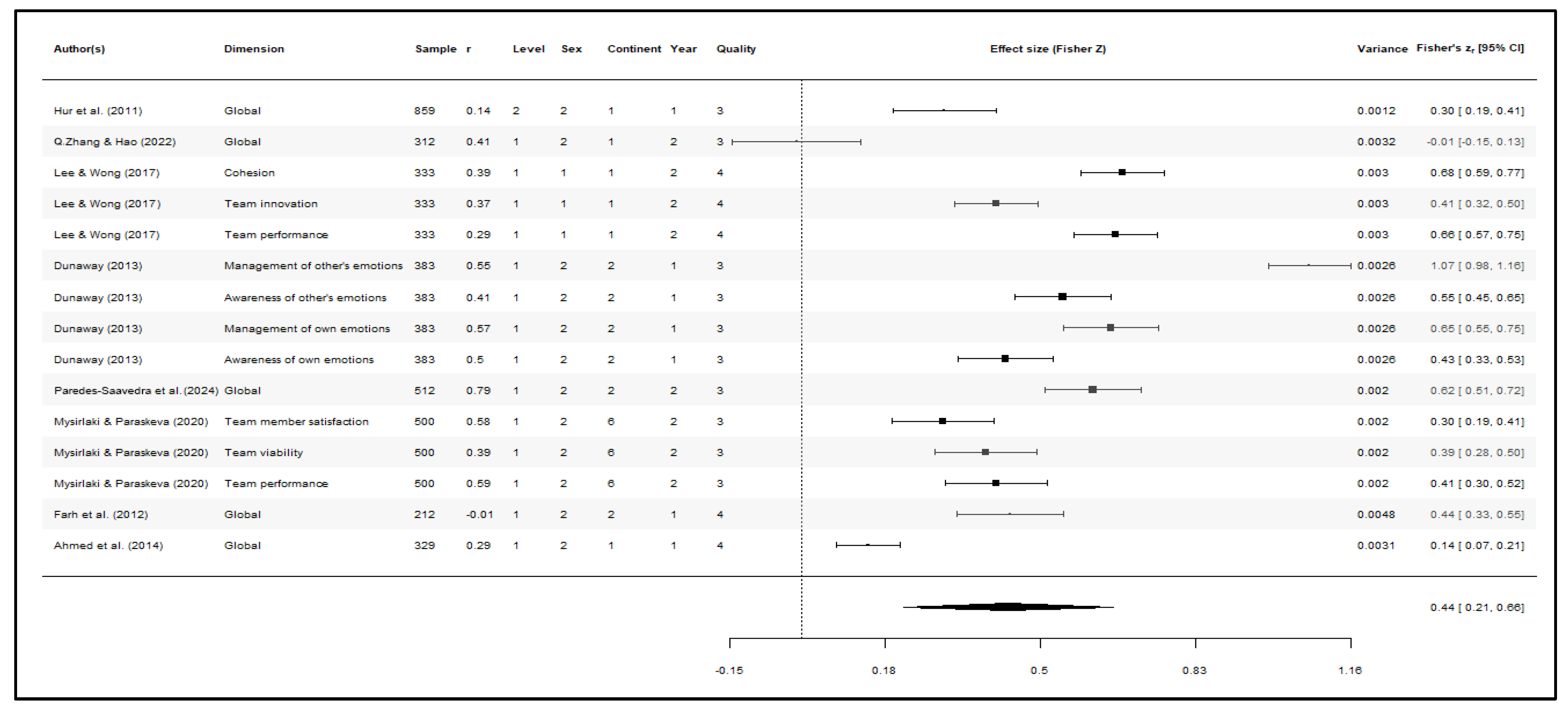

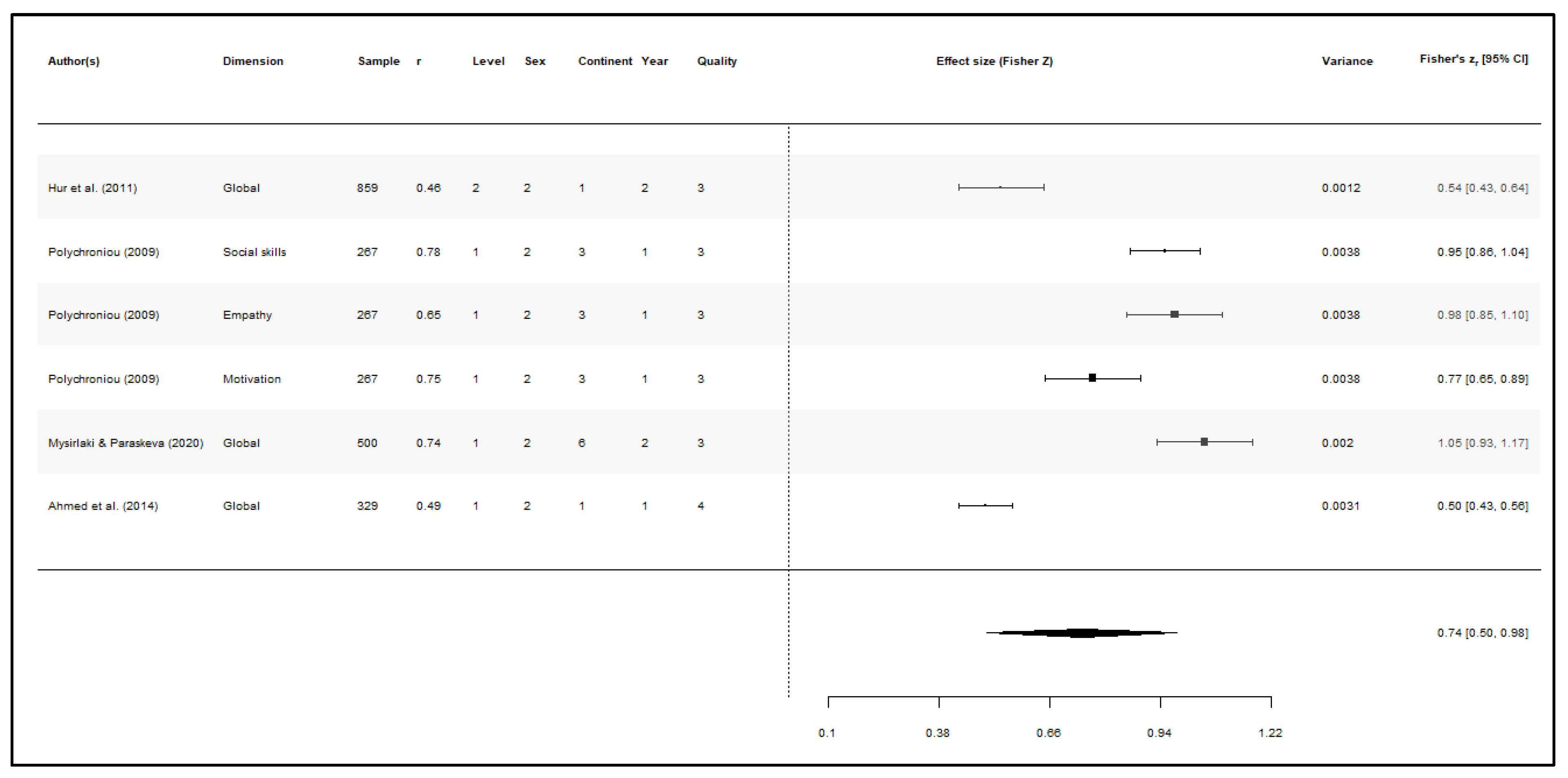


| Ac. | Keywords | Inclusion | Exclusion |
|---|---|---|---|
| Population | Work teams | Studies that analyzed work teams in different organizational contexts, sizes, geographical locations, or types of organization were included | Studies that did not assess teamwork dynamics included participants with less than six months in the organization or involved teams without a clearly defined organizational structure. |
| Intervention | EI and TL | Research that evaluated the variables of TL and/or EI in TE was considered. | Studies that did not examine the association of EI and TL with TE. |
| Outcome | Team effectiveness (TE) | Studies were selected that reported correlation coefficients between TL and/or EI and TE | Studies without a representative sample (<30 participants) or that did not report correlation coefficients. |
| Design | Observational studies | Observational studies published in peer-reviewed scientific journals were included, without restriction of language or year of publication, and with access to the full text. | Qualitative studies, theoretical papers, systematic reviews, technical reports, unpublished theses, opinion articles, and experimental or qualitative studies. |
| Dimensions | No. | Criteria |
|---|---|---|
| Research question | P01 | Is the research question clear? |
| P02 | Has the appropriate research method been chosen to answer the research question? | |
| Research sample | P03 | Was enough research data collected to ensure the validity of the results? |
| P04 | Has the research context (participants) been clearly replicated? | |
| Method | P05 | Has the author provided a detailed description of the research methodology? |
| P06 | Has the author explained the reason for the choice of the research method? | |
| P07 | Have other potentially influential variables been taken into account? | |
| P08 | Did the author provide information on the validity and reliability of the research? | |
| Data analysis | P09 | Are the data analysed appropriate? |
| P10 | Are the results presented clearly? | |
| Conclusion | P11 | How clear are the links between data, results, and interpretation? |
| No. | Author(s) | Year | VE | Variables Extra | Variables of Control | NA | Context | Design | Country | Cont. |
|---|---|---|---|---|---|---|---|---|---|---|
| 1 | Ahmed et al. (2014) | 1 | 3 | NI | Education | 1 | Services (Private Sector) | Does not indicate | Pakistan | 1 |
| 2 | Dizgah and Keshavarz (2015) | 2 | 3 | NI | NI | 1 | Service (banks) | Does not indicate | Iran | 1 |
| 3 | Mysirlaki and Paraskeva (2019) | 2 | 3 | Team cohesion, cooperative group norms, social capital, and interdependence of tasks | NI | 1 | Video game forums, social networks (Facebook and Twitter), and universities. | Does not indicate | Virtual | NI |
| 4 | Silva et al. (2020) | 2 | 1 | Confidence, Psychological Capital, Collective Behavior, Intragroup Conflict, Team Psychological Safety, Team Cohesion | NI | 2 | Service (does not indicate category, but there is a 47% majority) | Does not indicate | Brazil | 2 |
| 5 | Hur et al. (2011) | 1 | 3 | Leader Effectiveness and Service Climate | Age, education, and size | 2 | Public Sector (Cases, Law Enforcement and Administration, Additional Law) | Transversal | South Korea | 1 |
| 6 | Polychroniou (2009) | 1 | 3 | NI | NI | 1 | Services, trade, financial services, and manufacturing | Does not indicate | Greece | 3 |
| 7 | Malik et al. (2022) | 2 | 1 | Service leadership, work stress, project success | NI | 1 | Service (Non-Governmental Organizations) | Transversal | Pakistan | 1 |
| 8 | Q. Zhang and Hao (2022) | 2 | 2 | Team cohesion, Duration of the team in the project | NI | 1 | (Construction Industry) | Does not indicate | China | 1 |
| 9 | Mysirlaki and Paraskeva (2020) | 2 | 3 | NI | Sex | 1 | Virtual teams (technology company), gaming forums, Facebook, and Twitter groups. University students | Does not indicate | Virtual | NI |
| 10 | Dunaway (2013) | 1 | 2 | NI | Team size and sex | 2 | Service (Education) | Does not indicate | United States | 2 |
| 11 | Paredes-Saavedra et al. (2024) | 2 | 2 | Work environment, organizational culture, and creative synergy, Team leadership | NI | 1 | Service (Education) | Transversal | Peru | 2 |
| 12 | Farh et al. (2012) | 1 | 2 | Work performance, Work context of managerial work demands MWD | Age, sex, supervisor status, seniority at work, personality traits, cognitive ability, contextual work factors (work complexity and emotional work demands) | 1 | Service (Education) | Does not indicate | United States | 2 |
| 13 | Choi et al. (2017) | 2 | 1 | Shared leadership | Sex, Age, Education level, Seniority in the organization | 1 | Services (financial and insurance) | Transversal | South Korea | 1 |
| 14 | Paolucci et al. (2018) | 2 | 1 | Affective Team Commitment | Team size | 2 | Services, industry, and research. | Transversal | Portugal | 3 |
| 15 | Tran and Vu (2021) | 2 | 1 | Teamwork orientation, Shared leadership | NI | 1 | Services (Information Technology, Real Estate, Financial, and Educational Products) | Transversal | Vietnam | 1 |
| 16 | Lee and Wong (2017) | 2 | 2 | Team process (task conflict and relationship conflict) | Team size, age diversity, and sex. | 2 | Banking, investments, healthcare, information technology, and pharmaceuticals. | Transversal | South Korea | 1 |
| 17 | Mitchell et al. (2014) | 1 | 1 | Interprofessional Motivation; Openness to Diversity; Negative Affective Tone | Professional Diversity; Average Age; Team Size | 2 | Service (Health). | Transversal | Australia | 5 |
| 18 | Özaralli (2003) | 1 | 1 | Empowerment | NI | 1 | Private companies: Textiles, advertising, communications, construction, aviation, energy, banking, and health. | Does not indicate | Turkey | 1 |
| 19 | Dimas et al. (2018) | 2 | 1 | NI | Team size | 2 | Services and industry | Transversal | Portugal | 3 |
| 20 | Mntambo and Chan (2024) | 2 | 1 | Transactional, managerial, and laissez-faire leadership | MTM experience and number of MTMs | 1 | Service (Mining) | Does not indicate | South Africa | 4 |
| 21 | Sosik et al. (1997) | 1 | 1 | Transactional leadership, group power, and level of anonymity | NI | 2 | Service (University) | Longitudinal | United States | 2 |
| 22 | Othman et al. (2009) | 1 | 2 | Work motivation | Age, sex, marital status, educational level, work experience, and position in the company | 1 | Services (accounting, banking, consulting, banks, hotels, call centers, messaging, hotel services, insurance, investment, legal, sales and services, telecommunications). | Does not indicate | Malaysia | 1 |
| No. | Authors | TE Instrument | TL Instrument | EI Instrument |
|---|---|---|---|---|
| 1 | Ahmed et al. (2014) | Adapted (De Dreu, 2007; Schaubroeck et al., 2007; Tsui et al., 1997) | Multifactor Leadership Questionnaire (MLQ) (Bass & Avolio, 1994) | Emotional intelligence WLEIS (Wong & Law, 2002) |
| 2 | (Dizgah & Keshavarz, 2015) | Team Effectiveness questionnaire (Bateman et al., 2002) | ||
| 3 | (Mysirlaki & Paraskeva, 2019) | It was based on the IPO Framework (Hackman, 1987) | Multifactor Leadership Questionnaire (Bass & Riggio, 2005) | Emotional intelligence WLEIS (Wong & Law, 2002) |
| 4 | (Mysirlaki & Paraskeva, 2020) | It measured team performance, team members’ satisfaction, and team viability (Hackman, 1987) | Multifactor Leadership Questionnaire MLQ (Bass & Riggio, 2005) | Emotional intelligence WLEIS (Wong & Law, 2002) |
| 5 | Hur et al. (2011) | Adapted (De Dreu, 2007; Schaubroeck et al., 2007; Tsui et al., 1997) | Multifactor Leadership Questionnaire (MLQ-Form 5X-Short) 20 Bass and Avolio items from 2000 | Emotional intelligence WLEIS (Wong & Law, 2002) |
| 6 | Polychroniou (2009) | Does not indicate the name of the instrument | Multifactor Leadership Questionnaire (MLQ) (Bass, 1985) | Adapted from Emotional Quotient Index (EQI) by (Rahim et al., 2006, 2002) |
| 7 | (Malik et al., 2022) | Adopted from (Maynard et al., 2012) | N/A | Emotional intelligence WLEIS (Wong & Law, 2002) |
| 8 | (Q. Zhang & Hao, 2022) | Aplicó la escala de Y. Li (2013) | N/A | Emotional intelligence WLEIS (Wong & Law, 2002) |
| 9 | (Lee & Wong, 2017) | Measured team performance (Hackman, 1987), innovation (Anderson & West, 1998), and Cohesion (Seashore, 1954; Widmeyer et al., 1985) | N/A | WEIP-Short Version WEIP-S (Jordan & Lawrence, 2009) |
| 10 | Dunaway (2013) | Team learning beliefs & Behaviors—Questionnaire (Van den Bossche et al., 2006) | N/A | WEIP-Short Version WEIP-S (Jordan & Lawrence, 2009) |
| 11 | Farh et al. (2012) | Role-based performance scale (Welbourne et al., 1998) | N/A | Could not find |
| 12 | (Othman et al., 2009) | Team role assessment adapted from (Welbourne et al., 1998) | N/A | Emotional intelligence WLEIS (Wong & Law, 2002) |
| 13 | (Silva et al., 2020) | Team performance (Rousseau & Aubé, 2010), Quality of group experience (Aubé & Rousseau, 2005) | Developed by (Carless et al., 2000) | N/A |
| 14 | (Paredes-Saavedra et al., 2024) | Prepared by (Jaca García et al., 2011) | Scale Trait Meta-Mood Scale TMMS adopted by (Gurrutxaga Azurmendi, 2015) | N/A |
| 15 | Choi et al. (2017) | Scale developed by integrating output-and process-related items derived from previous research (Pearce & Sims, 2002) | Multifactor Leadership Questionnaire (MLQ) (Bass & Avolio, 1990) | N/A |
| 16 | Paolucci et al. (2018) | Measured team viability, quality of group experience (Aubé & Rousseau, 2005), and team process improvement (Rousseau & Aubé, 2010) | Scale developed (Carless et al., 2000) and adapted to Portuguese (van Beveren et al., 2017) | N/A |
| 17 | Tran and Vu (2021) | It measured team performance, quality of team experience, and team viability (Aubé & Rousseau, 2005) | Multifactor Leadership Questionnaire (MLQ) (Bass & Avolio, 1990) | N/A |
| 18 | Mitchell et al. (2014) | Based on (Mathieu et al., 2008) | Transformational leadership scale TLS (García-Morales et al., 2008) | N/A |
| 19 | Özaralli (2003) | Developed by the same author, measures: innovativeness, in-group communication, and performance | Multifactor Leadership Questionnaire (MLQ) (Bass & Avolio, 1990) | N/A |
| 20 | Dimas et al. (2018) | Team resilience (Stephens et al., 2013), quality of group experience, and team viability (Aubé & Rousseau, 2005) | Developed by (Carless et al., 2000) | N/A |
| 21 | (Mntambo & Chan, 2024) | Hackman’s team effectiveness survey (Cavanaugh et al., 2021) | Bass and Avolio from 2000 | N/A |
| 22 | (Sosik et al., 1997) | Longitudinal | Longitudinal | N/A |
| Rel. | Moderator | Estimate (β) | SE | p-Value | Sig. | Impact |
|---|---|---|---|---|---|---|
| 1 | Intercept | −1.126 | 0.247 | 0.031 | * | Moderate |
| 1 | Sex: Female | 0.135 | 0.098 | 0.261 | ns | Not significant |
| 1 | Continent: America | −0.167 | 0.05 | 0.079 | Small | |
| 1 | Continent: Europe | −0.132 | 0.118 | 0.382 | ns | Not significant |
| 1 | Continent: Virtual | 0.307 | 0.114 | 0.072 | Small | |
| 1 | Year: Post-2018 | 0.349 | ≈0 | <0.001 | *** | High |
| 1 | Level: Members | −0.296 | 0.05 | 0.028 | * | Moderate |
| 1 | Methodological quality | 0.415 | 0.05 | 0.014 | * | Moderate |
| 2 | Intercept | 1.174 | 1.549 | 0.587 | ns | Not significant |
| 2 | Sex: Female | −0.026 | 0.471 | 0.965 | ns | Not significant |
| 2 | Continent: America | 0.161 | 0.471 | 0.791 | ns | Not significant |
| 2 | Continent: Virtual | −0.092 | 0.408 | 0.859 | ns | Not significant |
| 2 | Year: Post-2018 | 0.274 | 0.407 | 0.623 | ns | Not significant |
| 2 | Level: Members | 0.261 | 0.471 | 0.678 | ns | Not significant |
| 2 | Methodological quality | −0.336 | 0.409 | 0.563 | ns | Not significant |
| 3 | Intercept | 0.536 | ≈0 | <0.001 | *** | Moderate |
| 3 | Continent: Europe | 0.395 | ≈0 | <0.001 | *** | High |
| 3 | Continent: Virtual | 0.453 | ≈0 | <0.001 | *** | High |
| 3 | Year: Post-2018 | −0.039 | ≈0 | <0.001 | *** | Small |
| Relation | Bias Risk | Consistency | Precision | Publication Bias |
|---|---|---|---|---|
| TL–TE | Moderate | Moderate (between-study τ2 ≈ 0.016; within-study τ2 ≈ 0.018) | [0.38, 0.61] | Begg’s test nonsignificant (τ = 0.03, p = 0.92) |
| EI–TE | Moderate | High (τ2 = 0.093 inter-study; σ2 = 0.010 intra-study) | [0.21, 0.66] | Begg’s test nonsignificant (τ = −0.29, p = 0.32) |
| EI–TL | Moderate | Moderate (τ2 = 0.044 inter-study; σ2 = 0.018 intra-study) | [0.50, 0.98] | Begg’s test indicates mild asymmetry but nonsignificant (τ = 0.33, p = 0.50) |
Disclaimer/Publisher’s Note: The statements, opinions and data contained in all publications are solely those of the individual author(s) and contributor(s) and not of MDPI and/or the editor(s). MDPI and/or the editor(s) disclaim responsibility for any injury to people or property resulting from any ideas, methods, instructions or products referred to in the content. |
© 2026 by the authors. Licensee MDPI, Basel, Switzerland. This article is an open access article distributed under the terms and conditions of the Creative Commons Attribution (CC BY) license.
Share and Cite
Paredes-Saavedra, M.; Huanca-Cruz, J.M.; Cruz, Z.R.M.-D.l.; Calsin-Pacompia, J.; Morales-García, W.C. Emotional Intelligence, Transformational Leadership, and Team Effectiveness: A Systematic Review and Correlational Meta-Analysis. Adm. Sci. 2026, 16, 116. https://doi.org/10.3390/admsci16030116
Paredes-Saavedra M, Huanca-Cruz JM, Cruz ZRM-Dl, Calsin-Pacompia J, Morales-García WC. Emotional Intelligence, Transformational Leadership, and Team Effectiveness: A Systematic Review and Correlational Meta-Analysis. Administrative Sciences. 2026; 16(3):116. https://doi.org/10.3390/admsci16030116
Chicago/Turabian StyleParedes-Saavedra, Maribel, Jhomira Milagros Huanca-Cruz, Zarai Ruth Mamani-De la Cruz, Jaquelin Calsin-Pacompia, and Wilter C. Morales-García. 2026. "Emotional Intelligence, Transformational Leadership, and Team Effectiveness: A Systematic Review and Correlational Meta-Analysis" Administrative Sciences 16, no. 3: 116. https://doi.org/10.3390/admsci16030116
APA StyleParedes-Saavedra, M., Huanca-Cruz, J. M., Cruz, Z. R. M.-D. l., Calsin-Pacompia, J., & Morales-García, W. C. (2026). Emotional Intelligence, Transformational Leadership, and Team Effectiveness: A Systematic Review and Correlational Meta-Analysis. Administrative Sciences, 16(3), 116. https://doi.org/10.3390/admsci16030116