Drivers of E-Government Adoption in Emerging Economies: A Meta-Analysis of Technology Acceptance and Service Quality Pathways




Abstract
1. Introduction
- Perceived ease of use → perceived usefulness: TAM’s proposed mechanism whereby ease of use influences usefulness perceptions requires empirical validation in e-government settings where system complexity and user digital literacy vary substantially.
- Perceived usefulness → behavioral intention: As TAM’s central hypothesis, the usefulness–intention relationship is fundamental to understanding adoption, yet its magnitude in emerging economy e-government contexts requires quantification.
- Service quality → user satisfaction: The extent to which e-government service quality drives user satisfaction remains empirically uncertain, with reported path coefficients varying widely across studies.
- Estimate pooled effect sizes for relationships between (a) perceived ease of use and perceived usefulness, (b) perceived usefulness and behavioral intention, and (c) service quality and user satisfaction.
- Assess heterogeneity in effect sizes and characterize variation patterns across studies and contexts.
- Evaluate evidence for publication bias and assess robustness of findings through comprehensive sensitivity analyses.
- Provide evidence-based recommendations for policymakers and practitioners seeking to enhance e-government adoption in resource-constrained settings.
2. Materials and Methods
2.1. Protocol and Reporting Standards
2.2. Eligibility Criteria
2.3. Information Sources and Search Strategy
2.4. Study Selection Process
2.5. Data Extraction
2.6. Quality Assessment
- Measurement reliability: Composite reliability CR > 0.70;
- Convergent validity: Average variance extracted AVE > 0.50;
- Sample size adequacy: N ≥ 200;
- Model fit adequacy: Acceptable fit on ≥2 indices (SRMR < 0.08, NFI > 0.90, CFI > 0.90, RMSEA < 0.08).
2.7. Analytical Approach
2.8. Effect Size Calculation and Synthesis
2.9. Meta-Analytic Model Specification
- Pooled effect size: Weighted mean effect β− with 95% confidence interval;
- Test of overall effect: Wald z-statistic and p-value;
- Heterogeneity statistics: Cochran’s Q, I2, τ2, and τ.
2.10. Heterogeneity Assessment
2.11. Publication Bias Assessment
2.12. Sensitivity and Influence Analysis
2.13. Statistical Software
3. Findings
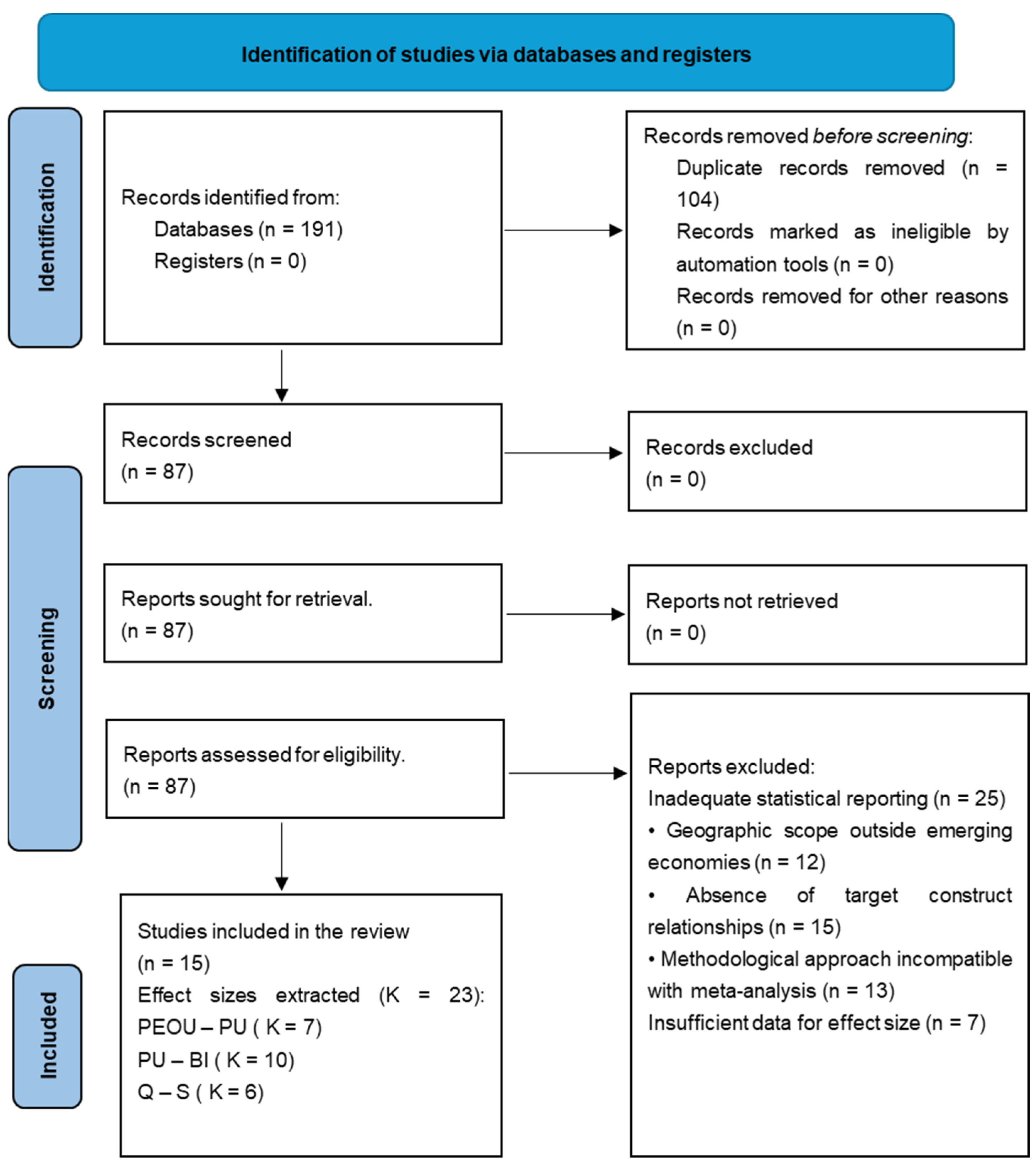
3.1. Study Selection
3.2. Study Characteristics
3.3. Meta-Analytic Findings
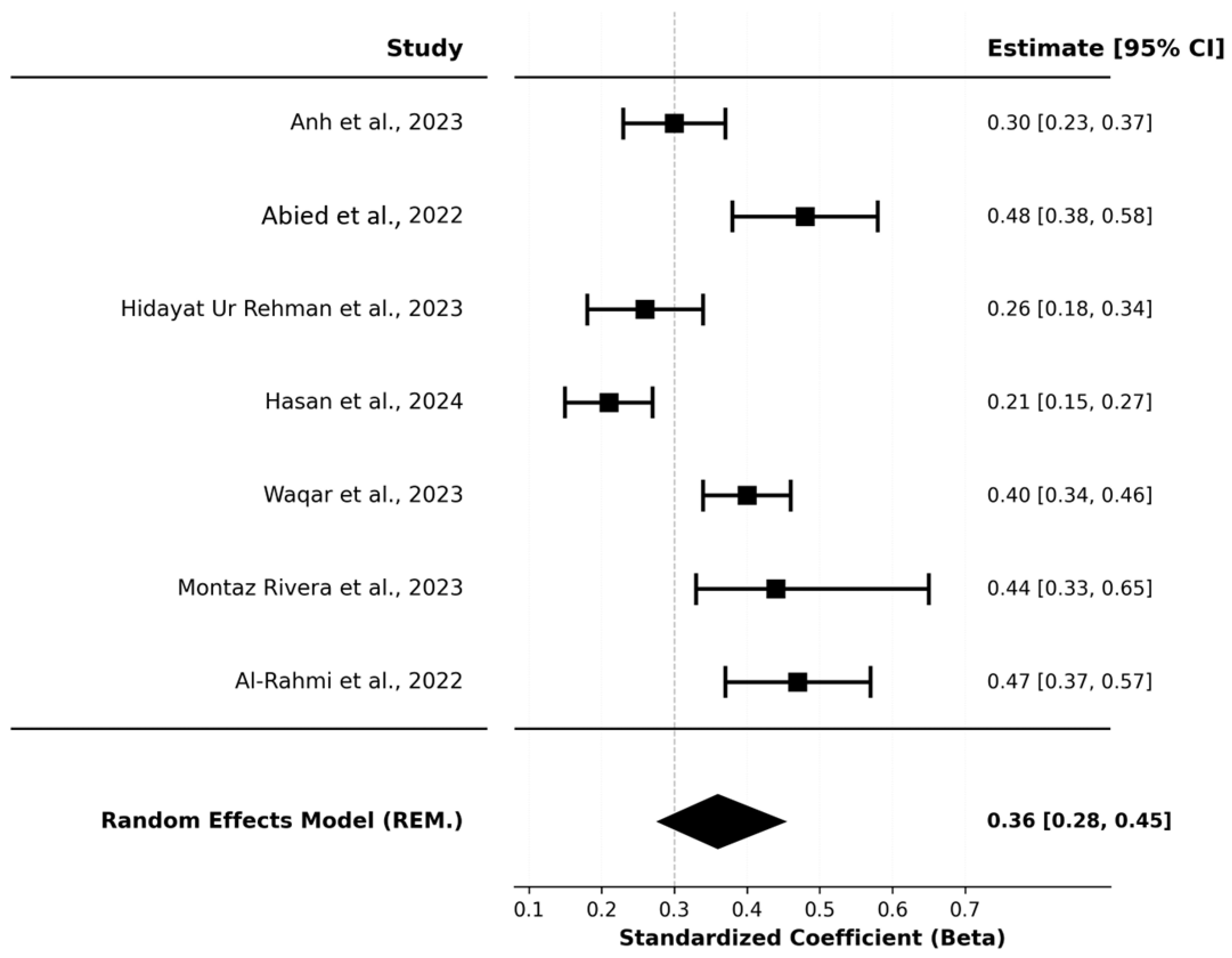
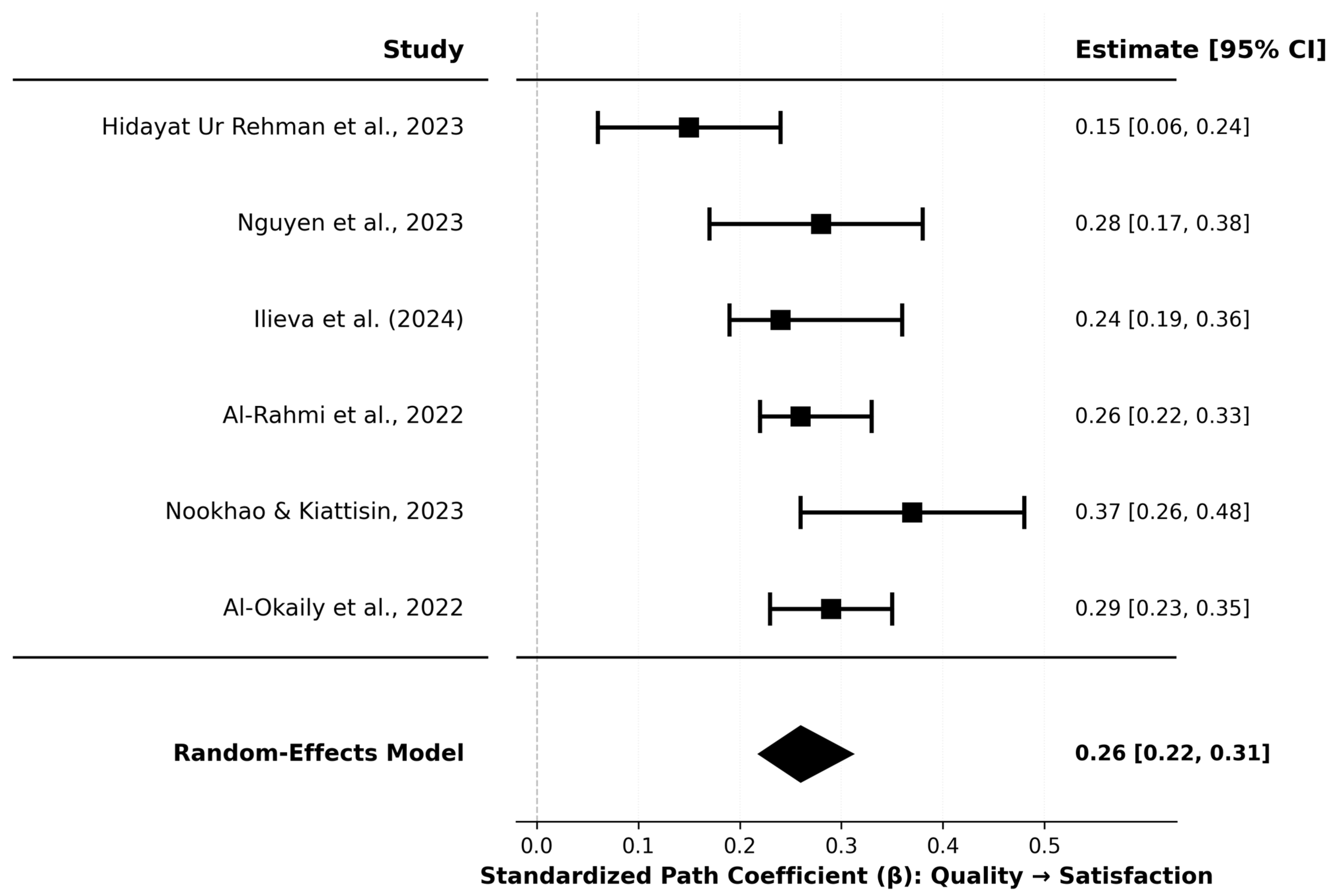
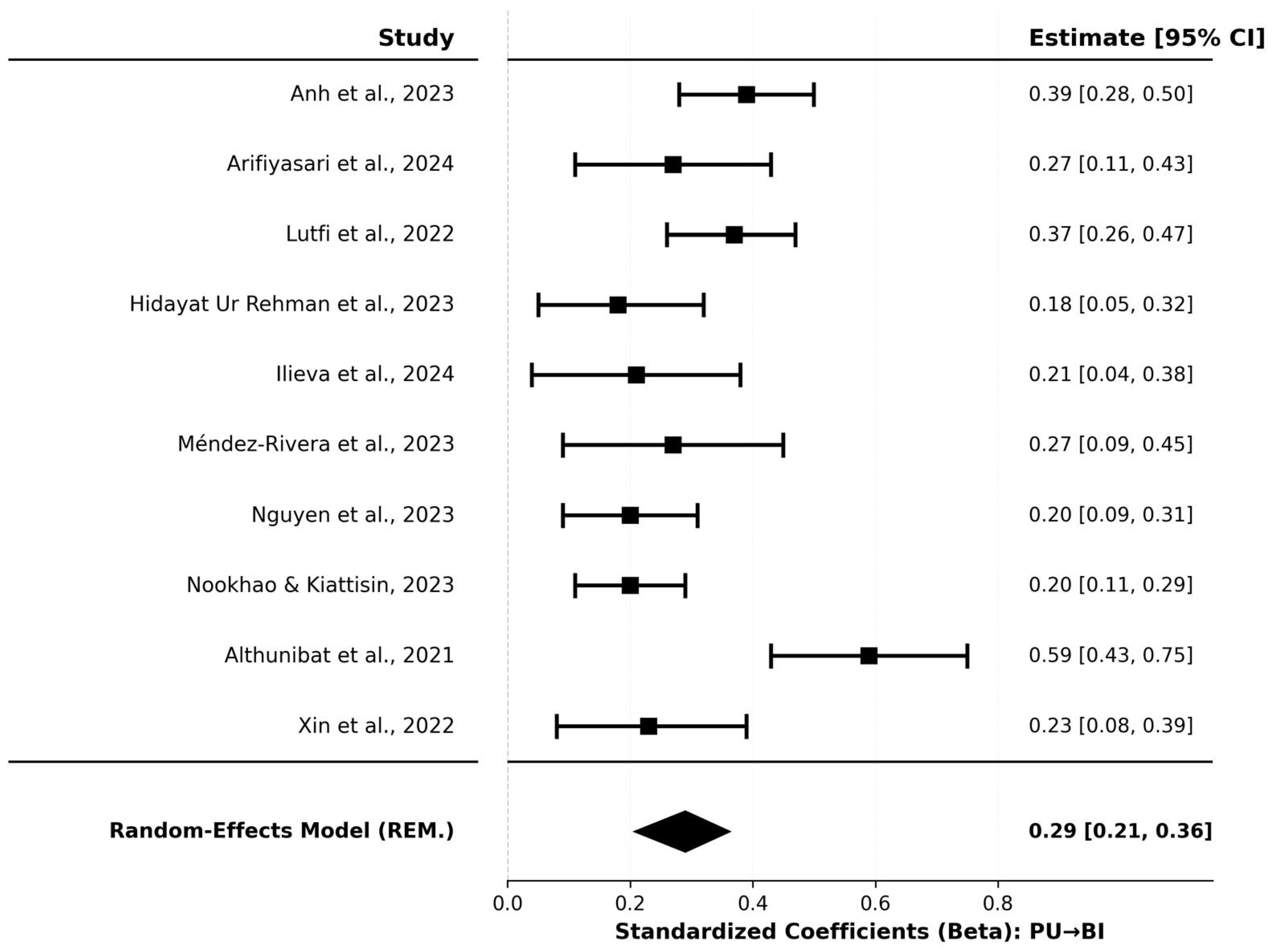
3.3.1. Pooled Effect Sizes
3.3.2. Heterogeneity Analysis
3.3.3. Publication Bias Assessment
3.3.4. Sensitivity and Influence Analysis
4. Discussion
5. Conclusions
Supplementary Materials
Author Contributions
Funding
Institutional Review Board Statement
Informed Consent Statement
Data Availability Statement
Conflicts of Interest
References
- Abied, O., Ibrahim, O., Kamal, S. N. I. M., Alfadli, I. M., Binjumah, W. M., Ithnin, N., & Nasser, M. (2022). Probing determinants affecting intention to adopt cloud technology in E-Government systems. Sustainability, 14(23), 15590. [Google Scholar] [CrossRef]
- Aboagye-Darko, D., & Mkhize, P. (2025). Unearthing the determinants of digital innovation adoption in the agricultural sector: The role of food security awareness and agricultural experience. Heliyon, 11(1), e41695. [Google Scholar] [CrossRef] [PubMed]
- Al-Okaily, M., Al-Kofahi, M., Shiyyab, F. S., & Al-Okaily, A. (2025). Determinants of user satisfaction with financial information systems in the digital transformation era: Insights from emerging markets. Global Knowledge, Memory and Communication, 74(3–4), 1171–1190. [Google Scholar] [CrossRef]
- Al-Rahmi, W. M., Uddin, M., Alkhalaf, S., Al-Dhlan, K. A., Cifuentes-Faura, J., Al-Rahmi, A. M., & Al-Adwan, A. S. (2022). Validation of an integrated IS success model in the study of e-government. Mobile Information Systems, 2022, 8909724. [Google Scholar] [CrossRef]
- Alshehri, M., Drew, S., Alhussain, T., & Alghamdi, R. (2012, December 3–5). The effects of website quality on adoption of E-Government service: An empirical study applying UTAUT model using SEM. ACIS 2012: Proceedings of the 23rd Australasian Conference on Information Systems, Sydney, Australia. [Google Scholar]
- Althunibat, A., Binsawad, M., Almaiah, M. A., Almomani, O., Alsaaidah, A., Al-Rahmi, W., & Seliaman, M. E. (2021). Sustainable applications of smart-government services: A model to understand smart-government adoption. Sustainability, 13(6), 3028. [Google Scholar] [CrossRef]
- Anh, T. T. N., Phong, N. T., & Jan, A. (2023). Teachers’ perceptions and readiness for digital transformation in education: Empirical evidence from vietnam, a developing nation. FWU Journal of Social Sciences, 17(3), 86–99. [Google Scholar] [CrossRef]
- Anityasari, M., Pamungkas, A., & Sonhaji, A. (2024). Measuring user acceptance of e-government adoption in an Indonesian context: A study of the extended technology acceptance model. International Journal of Electronic Governance, 16(2), 172–195. [Google Scholar] [CrossRef]
- Brown, S., Venkatesh, V., & Bala, H. (2006). Household technology use: Integrating household life cycle and the model of adoption of technology in households. Information Society, 22(4), 205–218. [Google Scholar] [CrossRef]
- Carter, L., & Bélanger, F. (2005). The utilization of e-government services: Citizen trust, innovation and acceptance factors. Information Systems Journal, 15(1), 5–25. [Google Scholar] [CrossRef]
- Cochran, W. G. (1954). The combination of estimates from different experiments. Biometrics, 10, 101–129. [Google Scholar] [CrossRef]
- Cohen, J. (2013). Statistical power analysis for the behavioral sciences. Routledge. [Google Scholar] [CrossRef]
- Cook, R., & Weisberg, S. (1982). Residuals and influence in regression. Available online: https://conservancy.umn.edu/items/128d305b-746c-4f3d-be1b-d0e37e7ff6e9 (accessed on 6 October 2025).
- Davis, F. D. (1989). Perceived usefulness, perceived ease of use and user acceptance of information technology. MIS Quarterly, 13(3), 319–340. [Google Scholar] [CrossRef]
- Davis, F. D., Bagozzi, R. P., & Warshaw, P. R. (1989). User acceptance of computer technology: A comparison of two theoretical models. Management Science, 35(8), 982–1003. [Google Scholar] [CrossRef]
- DeLone, W. H., & McLean, E. R. (1992). Information systems success: The quest for the dependent variable. Information Systems Research, 3(1), 60–95. [Google Scholar] [CrossRef]
- DeLone, W. H., & McLean, E. R. (2003). The DeLone and McLean model of information systems success: A ten-year update. Journal of Management Information Systems, 19(4), 9–30. [Google Scholar] [CrossRef]
- Duval, S., & Biometrics, R. T. (2000). Trim and fill: A simple funnel-plot–based method of testing and adjusting for publication bias in meta-analysis. Biometrics, 56(2), 455–463. [Google Scholar] [CrossRef] [PubMed]
- Dwivedi, Y. K., Rana, N. P., Jeyaraj, A., Clement, M., & Williams, M. D. (2019). Re-examining the unified theory of acceptance and use of technology (UTAUT): Towards a revised theoretical model. Information Systems Frontiers, 21(3), 719–734. [Google Scholar] [CrossRef]
- Egger, M., Smith, G. D., Schneider, M., & Minder, C. (1997). Bias in meta-analysis detected by a simple, graphical test. BMJ, 315(7109), 629–634. [Google Scholar] [CrossRef]
- Fornell, C., & Larcker, D. F. (1981). Evaluating structural equation models with unobservable variables and measurement error. Journal of Marketing Research, 18(1), 39–50. [Google Scholar] [CrossRef]
- Gregušová, D., Halásová, Z., & Peráček, T. (2022). eIDAS regulation and its impact on national legislation: The case of the Slovak republic. Administrative Sciences, 12(4), 187. [Google Scholar] [CrossRef]
- Hasan, A., Alenazy, A. A., Habib, S., & Husain, S. (2024). Examining the drivers and barriers to adoption of e-government services in Saudi Arabia. Journal of Innovative Digital Transformation, 1(2), 139–157. [Google Scholar] [CrossRef]
- Hidayat Ur Rehman, I., Ali Turi, J., Rosak-Szyrocka, J., Alam, M. N., & Pilař, L. (2023). The role of awareness in appraising the success of E-government systems. Cogent Business and Management, 10(1), 2186739. [Google Scholar] [CrossRef]
- Higgins, J. P. T., & Thompson, S. G. (2002). Quantifying heterogeneity in a meta-analysis. Statistics in Medicine, 21(11), 1539–1558. [Google Scholar] [CrossRef] [PubMed]
- Hu, L. T., & Bentler, P. M. (1999). Cutoff criteria for fit indexes in covariance structure analysis: Conventional criteria versus new alternatives. Structural Equation Modeling: A Multidisciplinary Journal, 6(1), 1–55. [Google Scholar] [CrossRef]
- Ilieva, G., Yankova, T., Ruseva, M., Dzhabarova, Y., Zhekova, V., Klisarova-Belcheva, S., Mollova, T., & Dimitrov, A. (2024). Factors influencing user perception and adoption of e-government services. Administrative Sciences, 14(3), 54. [Google Scholar] [CrossRef]
- King, W. R., & He, J. (2006). A meta-analysis of the technology acceptance model. Information & Management, 43(6), 740–755. [Google Scholar] [CrossRef]
- Kline, R. B. (2023). Principles and practice of structural equation modeling (Issue 4). Guilford Publications. [Google Scholar] [CrossRef]
- Lutfi, A., Alsyouf, A., Almaiah, M. A., Alrawad, M., Abdo, A. A. K., Al-Khasawneh, A. L., Ibrahim, N., & Saad, M. (2022). Factors influencing the adoption of big data analytics in the digital transformation era: Case study of Jordanian SMEs. Sustainability, 14(3), 1802. [Google Scholar] [CrossRef]
- Méndez-Rivera, C. A., Patiño-Toro, O. N., Valencia-Arias, A., & Arango-Botero, D. M. (2023). Factors influencing the adoption of e-government services: A study among university students. Economies, 11(9), 225. [Google Scholar] [CrossRef]
- Nguyen, T. T., Nguyen, T. V. T., Nguyen, T. T. T., & Nguyen, H. T. (2023). Determinants of intention towards digital transformation adoption: Evidence from vietnam’s public sector. Journal of Law and Sustainable Development, 11(11), e1646. [Google Scholar] [CrossRef]
- Nookhao, S., & Kiattisin, S. (2023). Achieving a successful e-government: Determinants of behavioral intention from Thai citizens’ perspective. Heliyon, 9(8), e18944. [Google Scholar] [CrossRef] [PubMed]
- Page, M. J., Mckenzie, J. E., Bossuyt, P. M., Boutron, I., Hoffmann, T. C., Mulrow, C. D., Shamseer, L., Tetzlaff, J. M., Akl, E. A., Brennan, S. E., Chou, R., Glanville, J., Grimshaw, J. M., Hróbjartsson, A., Lalu, M. M., Li, T., Loder, E. W., Mayo-Wilson, E., Mcdonald, S., … Moher, D. (2021). The PRISMA 2020 statement: An updated guideline for reporting systematic reviews. BMJ, 372, n71. [Google Scholar] [CrossRef] [PubMed]
- Petter, S., Delone, W., & McLean, E. R. (2013). Information systems success: The quest for the independent variables. Journal of Management Information Systems, 29(4), 7–62. [Google Scholar] [CrossRef]
- Rana, N. P., Dwivedi, Y. K., & Williams, M. D. (2015). A meta-analysis of existing research on citizen adoption of e-government. Information Systems Frontiers, 17(3), 547–563. [Google Scholar] [CrossRef]
- R Core Team. (2021). R: A language and environment for statistical computing. R Foundation for Statistical Computing. Available online: https://cir.nii.ac.jp/crid/1370013168792282134 (accessed on 6 October 2025).
- Riley, R., Higgins, J., & Deeks, J. J. (2011). Interpretation of random effects meta-analyses. BMJ, 342, d549. [Google Scholar] [CrossRef]
- Schepers, J., & Wetzels, M. (2007). A meta-analysis of the technology acceptance model: Investigating subjective norm and moderation effects. Information & Management, 44(1), 90–103. [Google Scholar] [CrossRef]
- Sterne, J. A., & Egger, M. (2001). Funnel plots for detecting bias in meta-analysis: Guidelines on choice of axis. Journal of Clinical Epidemiology, 54(10), 1046–1055. [Google Scholar] [CrossRef]
- UN E-Government Survey. (2022). Available online: https://publicadministration.un.org/egovkb/en-us/reports/un-e-government-survey-2022 (accessed on 6 October 2025).
- Venkatesh, V., Morris, M. G., Davis, G. B., & Davis, F. D. (2003). User acceptance of information technology: Toward a unified view. MIS Quarterly, 27(3), 425–478. [Google Scholar] [CrossRef]
- Viechtbauer, W., & Cheung, M. W. L. (2010). Outlier and influence diagnostics for meta-analysis. Research Synthesis Methods, 1(2), 112–125. [Google Scholar] [CrossRef] [PubMed]
- Waqar, A., Othman, I., Almujibah, H., Khan, M. B., Alotaibi, S., & Elhassan, A. A. M. (2023). Factors influencing adoption of digital twin advanced technologies for smart city development: Evidence from Malaysia. Buildings, 13(3), 775. [Google Scholar] [CrossRef]
- Xin, Y., Dilanchiev, A., Ali, M., Irfan, M., & Hong, Y. (2022). Assessing citizens’ attitudes and intentions to adopt e-government services: A roadmap toward sustainable development. Sustainability, 14(22), 15183. [Google Scholar] [CrossRef]




| Study | Year | Country | N | Population | SEM Type | Quality | Pathways * |
|---|---|---|---|---|---|---|---|
| (Anh et al., 2023) | 2023 | Vietnam | 403 | Citizens | PLS-SEM | High | PU→BI, PEOU→PU |
| (Anityasari et al., 2024) | 2024 | Indonesia | 363 | Citizens | PLS-SEM | High | PU→BI |
| (Lutfi et al., 2022) | 2022 | Jordan | 116 | Citizens | PLS-SEM | High | PU→BI |
| (Hidayat Ur Rehman et al., 2023) | 2023 | Pakistan | 264 | Citizens | PLS-SEM | High | PU→BI, PEOU→PU, Q→S |
| (Ilieva et al., 2024) | 2024 | Bulgaria | 258 | Citizens | CB-SEM | High | PU→BI, Q→S |
| (Méndez-Rivera et al., 2023) | 2023 | Colombia | 351 | Citizens | PLS-SEM | High | PU→BI, PEOU→PU |
| (Nguyen et al., 2023) | 2023 | Vietnam | 863 | Citizens | PLS-SEM | High | PU→BI, Q→S |
| (Nookhao & Kiattisin, 2023) | 2023 | Thailand | 540 | Citizens | PLS-SEM | High | PU→BI, Q→S |
| (Althunibat et al., 2021) | 2021 | Jordan | 320 | Citizens | PLS-SEM | Acceptable | PU→BI |
| (Xin et al., 2022) | 2022 | Pakistan | 599 | Citizens | PLS-SEM | High | PU→BI |
| (Abied et al., 2022) | 2022 | Libya | 200 | Students | PLS-SEM | High | PEOU→PU |
| (Hasan et al., 2024) | 2024 | Saudi Arabia | 487 | Citizens | PLS-SEM | High | PEOU→PU |
| (Waqar et al., 2023) | 2023 | Jordan | 437 | Citizens | PLS-SEM | High | PEOU→PU |
| (Al-Rahmi et al., 2022) | 2022 | Malysia | 714 | Teachers | CB-SEM | Acceptable | PEOU→PU, Q→S |
| (Al-Okaily et al., 2025) | 2022 | Jordan | 512 | Citizens | PLS-SEM | High | Q→S |
| Pathway | k | N | β (95% CI) | z | p | Q (df) | p_Q | I2 (%) | τ2 | τ | 95% PI |
|---|---|---|---|---|---|---|---|---|---|---|---|
| PEOU → PU | 7 | 2516 | 0.385 [0.300, 0.470] | 8.88 | <0.001 | 62.83 (7) | <0.001 | 89.5 | 0.0133 | 0.115 | [0.143, 0.627] |
| PU → BI | 10 | 3846 | 0.289 [0.214, 0.364] | 7.53 | <0.001 | 28.42 (9) | <0.001 | 69.5 | 0.099 | 0.107 | [0.14, 0.59] |
| Q → S | 6 | 3151 | 0.261 [0.217, 0.306] | -- | <0.001 | 11.15 (5) | 0.048 | 58.4 | 0.0017 | 0.041 | [0.18, 0.34] |
| Pathway | Egger z (p) | Trim-Fill k0 | Adjusted β (95% CI) | Leave-One-Out Range | Most Influential Study |
|---|---|---|---|---|---|
| PEOU → PU | 2.06 (0.040 *) | 0 | 0.385 [0.300, 0.470] | Minimal | Studies 4, 7 (Cook’s D: 0.20–0.25) |
| PU → BI | 01.95 (0.052) | 0 | 0.289 [0.214, 0.364] | Δβ < 0.02 | All < 0.5 |
| Q → S | 0.39 (0.696) | 2 | ~0.261 [minimal change] | 0.251–0.270 | Studies 1, 5 (Cook’s D: 0.15–0.22) |
Disclaimer/Publisher’s Note: The statements, opinions and data contained in all publications are solely those of the individual author(s) and contributor(s) and not of MDPI and/or the editor(s). MDPI and/or the editor(s) disclaim responsibility for any injury to people or property resulting from any ideas, methods, instructions or products referred to in the content. |
© 2026 by the authors. Licensee MDPI, Basel, Switzerland. This article is an open access article distributed under the terms and conditions of the Creative Commons Attribution (CC BY) license.
Share and Cite
Sheik, M.Y.; Pavlyuk, D.; Zervina, O.; Stukalina, Y. Drivers of E-Government Adoption in Emerging Economies: A Meta-Analysis of Technology Acceptance and Service Quality Pathways. Adm. Sci. 2026, 16, 83. https://doi.org/10.3390/admsci16020083
Sheik MY, Pavlyuk D, Zervina O, Stukalina Y. Drivers of E-Government Adoption in Emerging Economies: A Meta-Analysis of Technology Acceptance and Service Quality Pathways. Administrative Sciences. 2026; 16(2):83. https://doi.org/10.3390/admsci16020083
Chicago/Turabian StyleSheik, Mustafa Yaasin, Dmitry Pavlyuk, Olga Zervina, and Yulia Stukalina. 2026. "Drivers of E-Government Adoption in Emerging Economies: A Meta-Analysis of Technology Acceptance and Service Quality Pathways" Administrative Sciences 16, no. 2: 83. https://doi.org/10.3390/admsci16020083
APA StyleSheik, M. Y., Pavlyuk, D., Zervina, O., & Stukalina, Y. (2026). Drivers of E-Government Adoption in Emerging Economies: A Meta-Analysis of Technology Acceptance and Service Quality Pathways. Administrative Sciences, 16(2), 83. https://doi.org/10.3390/admsci16020083