Article

Trusting the Virtual, Traveling the Real: How Destination Trust in Video Games Shapes Real-World Travel Willingness Through Player Type Differences


by
Mohamed Ben Arbia
1,*,
Rym Bouzaabia
2 and
Marie Beck
3
1
Laboratoire ERMA, Department of Marketing, Institut Supérieur de Gestion de Sousse, Rue Abdlaaziz il Behi. Bp, Sousse 763-4000, Tunisia
2
Laboratoire de Recherche ERMA, Institut des Hautes Études Commerciales de Sousse, Route de la Ceinture Sahloul 3-BP n, Sousse 4054, Tunisia
3
IAE Lille–Univ. Lille, Université de Lille, ULR 4999–LUMEN, F-59000 Lille, France
*
Author to whom correspondence should be addressed.
Adm. Sci. 2025, 15(12), 470; https://doi.org/10.3390/admsci15120470 (registering DOI)
Submission received: 20 October 2025 / Revised: 14 November 2025 / Accepted: 19 November 2025 / Published: 30 November 2025

Abstract

As video games increasingly replicate real-world locations, they have become powerful tools influencing players’ perceptions and behaviors toward travel destinations. Based on the principles of Transfer Trust Theory (TTT), this research investigates how the trust established in a destination within a virtual game context, referred to as perceived destination trust, translates into real-world travel willingness. Using data from a survey of 262 Tunisian gamers who played games set in real-world environments, we employed a structural equation modeling approach incorporating SPSS and SmartPLS analyses. The results indicate that immersion and enjoyment of the game significantly strengthen emotional attachment and the image of the destination, thereby reinforcing perceived trust. This trust positively predicts the willingness to visit real-world destinations. Furthermore, moderation analysis reveals that this effect is more pronounced among individuals classified as Explorers and Achievers, highlighting the influence of motivational typologies on the translation of virtual behaviors into real-world actions. These results extend the scope of TTT to video game-induced tourism (VGIT), empirically validating the psychological mechanisms that link virtual trust to real-world travel behaviors. From a practical standpoint, tourism organizations and game developers are advised to collaborate on creating immersive and authentic environments that enhance destination credibility while aligning with brand objectives.

1. Introduction

Over the past two decades, the global tourism sector has undergone significant transformations driven by the rise of media-induced tourism, a phenomenon through which visual and narrative media influence travelers’ perceptions and decisions (Tzanelli, 2019; Reijnders et al., 2024). Historically, it has been reported that film and television productions have had a dominant influence on shaping individuals’ travel preferences (H. Chen et al., 2021; Dai et al., 2022); however, in recent years, the rapid expansion of the video game industry has given rise to a new type of tourism: video game-induced tourism (VGIT) (Dong et al., 2021). This phenomenon embodies the ability of video games to shape players’ perceptions of physical places, thereby motivating them to explore the destinations they encounter within virtual worlds (Żemła & Bielak, 2024). With the gaming industry’s annual revenue exceeding $179 billion and nearly 3 billion active gamers worldwide, the role of video games as a means of tourism is undeniable (Peri, 2024). In this sense, Hou (2024) found that international travelers were directly influenced by video games’ realistic depictions of real-world locations, underscoring the growing strategic value of VGIT in destination marketing. Several empirical and case-based studies illustrate this trend. For instance, Assassin’s Creed Origins was found to increase players’ reported interest in visiting Egyptian heritage sites by approximately 15% (Wang et al., 2024), while The Witcher 3 contributed to a measurable rise in visits to Polish cultural destinations (Bojanowska & Surowiec, 2022). Similarly, Microsoft Flight Simulator’s realistic portrayals of airports have inspired aviation enthusiasts to explore corresponding real-world locations (Leuze & Leuze, 2021). Although VGIT remains a relatively new research stream (Ramírez-Moreno & Leorke, 2020), growing evidence indicates that video games not only shape destination images (Shuhua et al., 2024) but also foster emotional and cognitive bonds with virtual environments through mechanisms such as place attachment and spatial presence (Moore, 2015; H. Han et al., 2019), which may in turn influence players’ travel intentions (Lian et al., 2024). Such studies remain narrow in focus, dealing only with film- and television-induced tourism.
Despite its growing importance, the role of trust in VGIT remains largely unknown. Research has shown that trust can be built around a destination and a place seen in a movie and that this can influence an individual’s decision to travel to the location seen in the movie (Juškelytė, 2016; Michopoulou et al., 2021); however, the equivalent analysis for video games has not been fully developed. In this regard, the main inquiry driving this research is the extent to which perceived trust in destinations derived from video games influences players’ propensity to visit these sites in the real-world. While VGIT is a global phenomenon, this study focuses on Tunisian gamers representing an emerging North African gaming market characterized by rapid digitalization and youth engagement. This context offers a valuable opportunity to analyze VGIT within a developing region, thereby enhancing the cross-cultural validity of the findings According to the trust transfer theory (TTT), trust established in one specific domain can be transferred to another domain (Zhang, 2018). While academic research on video game-induced tourism (VJIT) has explored relevant trust-based mechanisms, such as destination credibility and image transfer (Dubois et al., 2020; Sharma et al., 2022), there is a significant lack of direct empirical validation of TTT in this particular context. Although a large and growing body of literature has investigated how gaming environments shape destination image (Dubois et al., 2020), they ignore both the processes of trust building and how this trust is transferred into real-world travel actions. Furthermore, existing studies ignore the role of diverse player categories in modulating this process. Since player interactions with video game destinations are not uniform, it is natural that some players will develop higher emotional and cognitive connections with virtual settings than others, which affects the level of trust transfer. Understanding these dynamics is crucial for both tourism marketers and game developers seeking to leverage VGIT effectively.
The research design will expand the knowledge gap between the fields of marketing, tourism, and game studies as it examines how perceived trust in destinations in video games influences real-world travel willingness, with gamer patterns as moderators. Specifically, the study set out to answer the following questions: (1) Does perceived trust in video game locations significantly impact willingness to visit real-world destinations? (2) To what extent do player types moderate the effect of perceived destination trust on intention to travel behavior? Based on the study’s findings, it can make theoretical, empirical, and practical contributions. From a theoretical perspective, the study can extend TTT to a new field by validating its application in video game tourism. From an empirical perspective, it provides the first quantitative analysis of trust mechanisms in VGIT, and SEM is used to test the conceptual model proposed in this study. Destination marketers can use the implications of these findings to improve video game partnerships, game developers to increase the credibility of video games for tourism purposes, and travel agencies to create game-inspired tour packages.
The rest of this paper is organized as follows: the literature review will discuss media-induced tourism, TTT, destination image formation, gamer types and our hypothesis. The methodology section describes the research design, data collection method, and analytical methods, which will include SEM and SmartPLS to test the hypotheses. The results section will present empirical results, followed by a discussion that analyzes these results in light of the theoretical contributions of the study, as well as practical implications. Finally, the conclusion will present the main findings of the study, the limitations of the research, and potential directions for further investigation, to explain the increasing importance of video games in controlling tourism-related behaviors.
This research makes valuable contributions to the understanding of VGIT. It demonstrates how gaming immersion and enjoyment influence emotional attachment to video game destinations and their associated image, positively impacting destination trust and, consequently, players’ willingness to travel to these destinations in the real world. The study provides strong evidence that trust established in virtual gaming can be transferred to tangible destinations, demonstrating the relevance of TTT in modeling interactive media, including video games. Furthermore, the study’s most notable finding is the moderating role of gamer types in this relationship, with Explorers and Achievers showing the most significant influence on the relationship between trust and willingness to travel behavior. These findings enrich existing studies by clarifying how diverse gaming typologies influence intentional tourism behavior, providing a new perspective for studying the intersection between consumer behavior, gaming, and tourism. This research highlights the growing potential for synergistic collaboration between the gaming industry and the tourism sector, leveraging game-generated content to enhance destination identity and influence real-life travel decisions. Ultimately, the study promotes the integration of games into tourism marketing, highlighting how digital experiences significantly impact offline behavior. In the wake of the post-pandemic tourism recovery, such digital engagement strategies may offer innovative, sustainable, and cost-effective pathways for reactivating global travel demand.

2. Literature Review

2.1. Video Game-Induced Tourism

VGIT represents a significant evolution of media-induced tourism, offering a more interactive and participatory experience than traditional film or television tourism (Lamerichs, 2018; Dong et al., 2021). While film-induced tourism relies on passive viewing and narrative immersion (Cardoso et al., 2017; Raj, 2018), VGIT uniquely enables active engagement and replayability, allowing players to repeatedly explore and make decisions that shape their trust and attachment to virtual destinations (Rainoldi et al., 2022; Zolkifly et al., 2023). This replayability deepens familiarity and authenticity judgments psychological mechanisms rarely observed in one-time cinematic exposure, allowing players to investigate, engage, and form emotional connections with digital representations of physical locations (Moore, 2015; Isbister, 2016; Caselli et al., 2021). These interactive properties of video games go beyond passive media consumption (Sjöblom & Hamari, 2016; Bowman et al., 2020), facilitating players to develop deeper connections with virtual destinations (Sharma et al., 2022). This particular form of tourism has seen an increase in popularity, attributed to the increasing realism of gaming environments and the growing influence of gaming culture on consumer behavior (Seo et al., 2015; Coble et al., 2024). Several case studies demonstrate the significant influence of video games in shaping individuals’ travel behavior (Rapp, 2021; Sharma et al., 2022). The Assassin’s Creed video game series, which accurately reproduces historical cities such as Florence, Paris, and Athens, has increased tourism to these areas (Carvalho et al., 2019; Di Mascio, 2020; Y. Xu, 2021), with participants indicating a desire to visit locations they have previously visited in video games. Similarly, It has been mentioned in marketing literature that Grand Theft Auto V presents a highly realistic representation of Los Angeles, thus influencing perceptions of urban tourism (Wills, 2021). The Witcher III, with landscapes modeled on the real geography of Poland, has contributed to heightened interest in Polish tourism; according to Żemła and Bielak (2024), surveyed players reported increased intention to visit sites featured in the game, suggesting measurable real-world influence. Furthermore, Microsoft Flight Simulator gives players a virtual tour of the world and may change their desire to travel in real life (Sharma et al., 2022; van Nuenen, 2023). Collectively, these examples indicate that video games can function as effective marketing instruments; however, their influence is not uniform across genres or audiences, as cultural biases and representational differences can shape players’ perceptions of authenticity (Dong et al., 2021).
The effectiveness of VGIT is enhanced by psychological factors including immersion, game realism, and interactive storytelling as factors (Dong et al., 2021; Żemła & Bielak, 2024). Calleja (2012), and Peng and Ke (2015) explain that immersion is the player’s feeling of being present within the game world, which increases the likelihood of forming trust in virtual destinations. In addition, realism in visual and gameplay mechanics affects authenticity, which in turn increases the believability of locations in video games (Mochocki, 2021; Bowman et al., 2023). Interactive storytelling is also another important aspect of gameplay as it determines the player’s emotional attachment to the game environment (Toh, 2022; Passos et al., 2024; H. Chen, 2024; Gunderman, 2024). These elements somehow influence players’ perceptions of real-world travel destinations and their willingness to visit them, making VGIT an important area of study in marketing and tourism research.

2.2. Trust Transfer Theory in Marketing and Tourism

Trust Transfer Theory (TTT) provides a conceptual framework for understanding how trust established in one context can influence attitudes and behaviors in another (Stewart, 2003; Y. Lee et al., 2014). Within VGIT, this transfer occurs through familiarity and parasocial trust psychological mechanisms that emerge when players repeatedly interact with virtual destinations and perceive them as authentic extensions of reality (X. Chen et al., 2015; Rainoldi et al., 2022). Unlike in e-commerce or brand-extension contexts, however, the transfer of trust in interactive media depends on agency and immersion, which shape how players internalize credibility. While this extends TTT to a novel digital environment, it also introduces boundary conditions: player motivations, cultural proximity, and the realism of game design can constrain the extent of trust transfer (Ying et al., 2021; Mochocki, 2021). This theoretical extension of TTT toward the concept of “destination trust” is pivotal to explaining the influence of video games on travel decision-making and thus warrants further empirical investigation.

2.3. Player Types and Their Role in Consumer Behavior

Player behavior within video game environments is heterogeneous, driven by a range of distinct motivations and engagement patterns (Brühlmann et al., 2020; J. Lee & Eden, 2023). Bartle’s taxonomy identifies four basic player archetypes: Achievers, Explorers, Socializers, and Killers, each of whom interact with digital landscapes in unconventional ways (Çağlar & Kocadere, 2016; Kirchner-Krath et al., 2024). Achievers are goal-oriented and motivated by achievement (Fuß et al., 2014). Explorers seek to discover complex interactions and gain knowledge (Moradi et al., 2020). Socializers focus primarily on community engagement and shared experiences, with their actions potentially influenced by social dynamics (F. Xu et al., 2021; Zhao et al., 2021). Killers focus on aspects of competition and asserting dominance (de Lima et al., 2025). H. Han et al. (2019) argue that gamer motivations exert a significant influence on perception and trust formation, thus reinforcing the idea that gamer types act as moderators in the transfer of trust within destinations. Recognizing the moderating influence of gamer types on destination trust and travel behavior is essential for developing tailored marketing strategies that target diverse gaming demographics, thereby increasing the effectiveness of promotional efforts in game-based tourism.

2.4. Hypothesis Development

2.4.1. Game Immersion and Game Emotional Attachment

Game immersion represents the degree to which a player engages with a virtual space and is deeply committed to psychological investment (Curran, 2013). This concept has gained much attention in digital marketing and consumer behavior research because virtual experiences create stronger emotional connections (Hudson et al., 2018; Z. Huang et al., 2022). In this sense, many scholars hold the view that high levels of immersion lead gamers to develop intense emotional connections with video game components such as characters as well as environments and narratives (Rativa et al., 2020; Tu et al., 2022; Tomlinson, 2025). According to research by Dubois and Gibbs (2018), Dong (2021), and Sharma et al. (2022), immersion in a virtual environment leads video game players to develop intense emotional connections that enhance their mental attachment to video game locations. Flow theory provides evidence to support this assertion, as optimal engagement leads to attachment when people experience immersive activities (Bodzin et al., 2020). Thus, gamers who immerse themselves in highly realistic and interactive game settings experience stronger emotional connections with virtual objects and the virtual world (Coulson et al., 2012). Therefore, we hypothesize:
H1: 
Game immersion positively influences Game Emotional Attachment.

2.4.2. Game Immersion and Destination Image

Destination image represents the overall perception people have of a place based on cognitive and affective evaluations and it serves as a key element that influences their choice to visit that place (H. Kim & Chen, 2015; Woosnam et al., 2020). Research on media-induced tourism demonstrates that consumers who develop visual and experiential familiarity through digital exposure will develop strong destination images (Marchiori and Önder, 2014; Homsud, 2024). Video games that accurately depict real-world locations give players an experiential understanding of these destinations that shapes their perceptions (Alcindor et al., 2022; Rainoldi et al., 2022). Through their immersive nature, these environments engage all senses and interactive elements that create a realistic experience of personal exploration (Globa et al., 2022; Weber, 2017). Considering that video games deliver interactive and sensory-immersive experiences, they represent a distinctive medium for the reinforcement of destination imagery (Alyahya & McLean, 2021; Lv & Wu, 2021; Junko et al., 2022). Therefore, it can be concluded that immersive game settings may have a positive impact on players’ perception of destination attractiveness and authenticity. Therefore, we propose:
H2: 
Game immersion positively influences destination image.

2.4.3. Game Enjoyment and Destination Image

The phenomenon of enjoyment is a central factor in media-induced tourism (Bi et al., 2021; Dong et al., 2021). Research within the framework of consumer experience theory report that positive emotions generated by enjoyable digital interactions significantly enhance perceptions of brands and destinations (Ryoo, 2015; Kovacic & Sagovnovic, 2022; Bouzaabia et al., 2024; Pellegrino, 2024).
Notably, the association between positive gaming experiences and destination perceptions is well documented in tourism studies, where enjoyable media encounters promote a positive image of depicted locations (Pan & Hsu, 2014). Enjoyment, characterized by a pleasurable and rewarding experience, amplifies both cognitive and emotional engagement, making the virtual game environment more salient to participants (Mellecker et al., 2013; Oliver et al., 2015; Rogers et al., 2016; Bowman et al., 2016; Csontos & Heckl, 2025). Also, video games that offer compelling narratives and authentic landscapes create a strong association between player satisfaction and destination attractiveness (Calleja, 2012). Therefore, players who enjoy interacting with gaming environments are more likely to develop positive perceptions of video game destinations, which in turn influences the realistic image of these destinations (Cohen, 2013). Thus, we propose the following hypothesis:
H3: 
Game enjoyment positively influences destination image.

2.4.4. Game Enjoyment and Game Emotional Attachment

Game enjoyment encompasses the pleasure obtained from gameplay, including aspects of challenge, exploration, and interaction (Fu et al., 2008). Research within media psychology indicates that elevated levels of enjoyment promote emotional engagement, resulting in a more profound attachment to digital content (Bowman et al., 2016). When players derive enjoyment from a game, they establish significant connections with video game experiences, thereby augmenting the probability of cultivating emotional attachment to game components (Isbister, 2016; Coulson et al., 2012). In the realm of VGIT, enjoyable experiences can enhance players’ affiliations with virtual environments, rendering these locations more personally significant (Sifonis, 2017; Oleksy & Wnuk, 2017). This emotional attachment parallels that observed in real-world brand and product loyalty, wherein positive affect strengthens enduring engagement (Palomba, 2018). Thus, we propose:
H4: 
Game enjoyment positively influences game emotional attachment.

2.4.5. Game Emotional Attachment and Perceived Destination Trust

Perceived destination trust refers to the perception of a site’s reliability and credibility that consumers gain through their interaction with its representation (Abubakar et al., 2017; Abubakar, 2016; Abubakar & Ilkan, 2016; Al-Ansi & Han, 2019). Research on consumer-brand relationships shows that emotional ties increase brand trust (Loureiro et al., 2012; Handique & Sarkar, 2024). Thus, the role of emotional attachment in trust formation is crucial because consumers are more likely to trust entities with which they have emotional connections (Ouyang et al., 2017; J. I. Lee et al., 2022). Within the VGIT framework, the phenomenon of emotional attachment promotes a sense of familiarity and psychological closeness, thereby enhancing trust in a destination (Ouyang et al., 2017; Silva & Correia, 2016; Tasci et al., 2021; Qu et al., 2023). In the same vein, if players have intense emotional relationships with video game locations, they are more likely to have a trustworthy perception of these locations as real-life destinations (Salmond & Salmond, 2016; Sifonis, 2017). Thus, we propose:
H5: 
Game emotional attachment positively influences perceived destination trust.

2.4.6. Destination Image and Perceived Destination Trust

The existing literature on tourism marketing has identified a constructive association between a favorable destination image, trust levels, and high visit intentions (Jebbouri et al., 2022). In this regard, Veasna et al. (2012), Al-Ansi and Han (2019), Lian and Yu (2019), and Liu et al. (2019) advocate the proposition that a strong and positive destination image significantly influences travelers’ trust in a place. Positive portrayal of a destination across different channels generates increased trust and belief that the destination will meet or exceed expectations (Su et al., 2019; Jebbouri et al., 2022). In the realm of VGIT, destination image and credibility can be shaped and enhanced through video games, which act as an interactive and distinctive medium through the use of immersive and realistic representations (Dong, 2021; Dubois et al., 2020). Therefore, we propose the following hypothesis:
H6: 
Destination image positively influences perceived destination trust.

2.4.7. Perceived Destination Trust and Willingness to Travel to Real Destinations

According to Artigas et al. (2017) and Wang et al. (2024), trust is a critical factor in consumer decision-making in tourism. Previous studies have shown that consumers are more likely to visit places they perceive as trustworthy (Liu et al., 2019; Su et al., 2021). This relationship has been observed in film-induced tourism where trust in cinematic representations of locations has been found to increase travel motivation (Li & Liu, 2020; Domínguez-Azcue et al., 2021; J. Han et al., 2022; Luong, 2024). In the case of video game tourism, perceived trust generated by immersive experiences and favorable representations of the destination is expected to enhance travel intention (M. J. Kim et al., 2018; Lavuri & Akram, 2023; Yersüren & Özel, 2023). Since the perception of trust in a destination depends on game participation, it is reasonable to assume that visitors to a virtual destination are more likely to visit the real destination (Y. Huang et al., 2012; M. J. Kim et al., 2018; Sharma et al., 2022; Shuhua et al., 2024).
In this same sense, the virtual environment interactions and perceptions of individuals are influenced by their player typologies according to Bartle’s taxonomy (Erümit et al., 2020; Sezgin, 2020). The Achievers and Explorers who deeply engage with the game content may show stronger trust transfer effects than the Killers who pay attention to competition rather than the narrative (Fuß et al., 2014; Kocadere & Çaglar, 2018; Krappala et al., 2024). Knowing these differences will help in understanding how gaming experiences can be used to explain real-world travel behavior. Hence, it could conceivably be hypothesized that:
H7: 
Perceived destination trust positively influences willingness to travel to real destinations.
H8: 
Player types moderate the relationship between perceived destination trust and willingness to travel to real destinations.
The proposed hypotheses were used to develop the research model shown in Figure 1.

3. Methodology

3.1. Research Design

A survey-based design was utilized to gather empirical data, emphasizing the structured conceptual model and the measurement of effects. Structural Equation Modeling (SEM) was applied to validate relationships inspired by TTT. To ensure sufficient statistical power, The sampling technique used was convenience sampling, employing the approach of multiplying the number of observable variables by 10 (Akrout, 2010; Nicolaou & Masoner, 2013), Our final sample (N = 262) comfortably exceeded this threshold, ensuring robust model estimation. The quantitative methodology guarantees generalizability, statistical reliability, and replicability, thereby facilitating hypothesis testing on a large sample scale (Lim, 2024).

3.2. Data Collection and Ethical Considerations

3.2.1. Sampling Strategy

Data collection was conducted through an online survey. The survey used previously validated multi-item constructs to ensure reliability and validity. The study focused on VGIT, targeting players familiar with video games that depict real-world destinations and locations. A filtering question was included to ensure data relevance by confirming respondents’ exposure to such games (Have you played a video game that includes real-world locations?). Those who did not meet this criterion were excluded, ensuring participants were familiar with typical real-world environments.
Although all participants in the study were from Tunisia, this signifies a nascent and relatively unexamined gaming market within the North African region. Consequently, the results must be analyzed within this cultural framework, which functions as a limiting factor for broader generalization. This emphasis, however, yields significant insights into the manner in which global video game narratives influence destination trust and travel intentions among players situated outside of Western markets.
Convenience sampling, a prevalent method in digital behavioral research, was used to efficiently recruit participants through online gaming communities (Stratton, 2021). Recruitment occurred via social media and gaming forums, including Facebook, Instagram, Reddit, and Discord, where players actively engage in discussions of their gaming experiences. The final sample comprised 262 Tunisian gamers (response rate ≈ 64%), predominantly aged 18–35 (82%), with an average gaming frequency of 4.1 sessions per week. Approximately 61% identified as male and 39% as female. This demographic distribution aligns with global gamer profiles, minimizing urban-youth bias. Previous research has shown that non-probability sampling via social media yields valid insights in online behavioral contexts (Cui et al., 2022).

3.2.2. Ethical Considerations

Ethical standards were rigorously upheld to safeguard participant rights and maintain data integrity. The survey provided an informed consent declaration, detailing the study’s aim, voluntary participation, confidentiality, and the right to withdraw. No identifiable data was gathered, and data was securely stored to meet institutional ethical and data protection requirements. Ethical clearance was acquired from the university’s ethics review board, confirming compliance with established social science research protocols.

3.3. Measurement Scales

The study employed validated multi-item scales for measuring constructs in the conceptual model. Participants rated their agreement with 25 survey items on a five-point Likert scale. The constructs and measurement scales are detailed in Table 1. Game Immersion was assessed using a 6-item scale from Cuny et al. (2015). Game Enjoyment was evaluated with 3 items from Oliver and Bartsch (2009). Game Emotional Attachment utilized a 4-item scale from Folmer et al. (2013). Destination Image was measured with a 4-item scale adapted from Kock et al. (2016). Perceived Destination Trust was assessed using a 5-item scale from Teo and Liu (2007). Willingness to Travel to Real Destinations was measured with a 3-item scale from Moura et al. (2014). Player Types (Moderator) were categorized according to Bartle’s (1995) taxonomy into Achievers, Explorers, Socializers, or Killers based on gaming preferences. The use of validated instruments enhances construct validity and measurement reliability, facilitating a rigorous statistical analysis of the hypotheses.

3.4. Data Analyses

The data analyses were performed first on the Statistical Package for Social Sciences- SPSS 24 to clean data, run descriptive statistics, and check reliability assessments (Cronbach’s Alpha, Exploratory Factor Analysis). Second, we used SmartPLS 4 for Partial Least Squares Structural Equation Modeling (PLS-SEM) to examine hypothesized relationships, validate measurement models (convergent and discriminant validity), and evaluate the structural model.

4. Results

4.1. Sample Characteristics

The sample included a variety of ages, gender identities, and gaming experiences, ensuring a comprehensive representation of perspectives regarding video game tourism (see Table 2).

4.2. Assessment of the Measurement Model

To evaluate the measurement model’s validity, tests for convergent and discriminant validity were performed. Convergent validity was assessed through factor loadings, composite reliability (CR), and average variance extracted (AVE) (Ahmad et al., 2016). Table 1 illustrates that all scales’ composite reliability exceeded the 0.7 threshold, indicating robust internal consistency. Similarly, each variable’s AVE surpassed 0.50, fulfilling the criterion for convergent validity. This suggests that each construct elucidated over 50% of its variance. Additionally, all items exhibited significant factor loadings exceeding 0.700, affirming the measurement model’s reliability.
For discriminant validity assessment, we utilized the heterotrait–monotrait (HTMT) ratio, as represented in Table 3. All HTMT values remained below 0.85, signifying that the constructs are distinct and exhibit low correlation (Hamid et al., 2017).
Furthermore, the Fornell–Larcker criterion was applied, confirming that the square root of the AVE for each construct surpassed the correlations among latent variables, thereby reinforcing discriminant validity (Table 4) (Hamid et al., 2017).

4.3. Assessment of the Structural Model

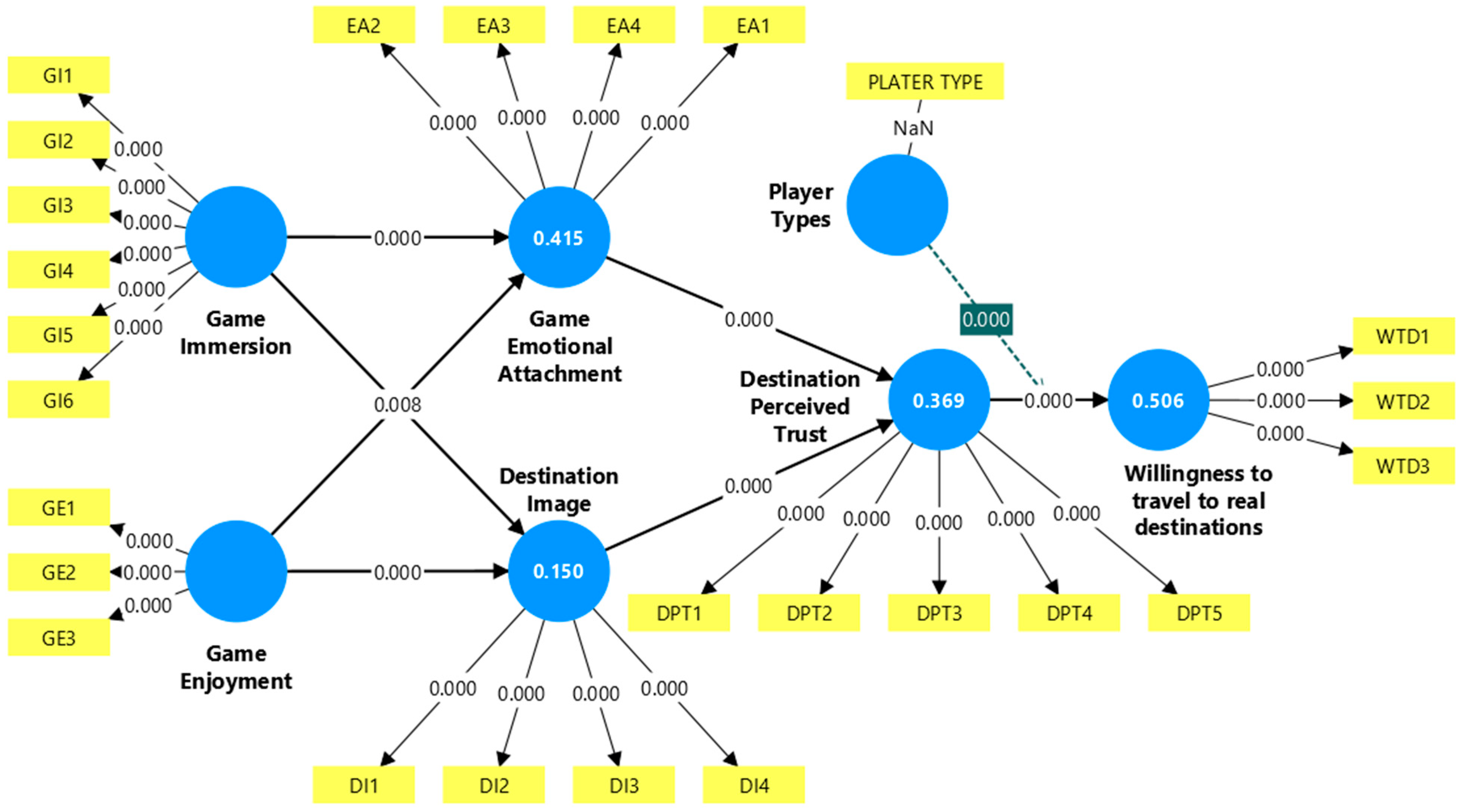
Two primary metrics utilized to assess the structural model’s fit quality were R2 and Q2 (Sobaih & Elshaer, 2022). All dependent variables exceeded the R2 threshold of 0.10, with specific values of 0.150 for Destination Image, 0.415 for Game Emotional Attachment, 0.369 for Destination Perceived Trust, and 0.505 for Willingness to Travel to Real Destinations, indicating moderate to substantial fit. R2 values are categorized as high (>0.67), moderate (0.33–0.67), and low (<0.19).
Regarding predictive relevance, all constructs recorded Q2 values above 0.1, confirming the model’s efficacy in predicting dependent variables. Notable Q2 values included 0.130 for Destination Image, 0.396 for Game Emotional Attachment, 0.354 for Destination Perceived Trust, and 0.270 for Willingness to Travel to Real Destinations, reflecting the model’s robust predictive relevance and reliability in forecasting study outcomes.

4.4. Hypothesis Testing

To evaluate the hypotheses, we employed p-values, t-values, and original sample values to determine the significance of variable relationships (Shreffler & Huecker, 2021). A relationship is deemed significant if its absolute t-statistic exceeds 1.96 and its p-value is below 0.05. Table 5 demonstrates that all proposed relationships were validated. Each path coefficient in the structural model was significant, confirming the robustness of the relationships. Taken together, these results offer compelling empirical support for the proposed model, with all hypotheses meeting the necessary significance criteria for validation (Figure 2).

5. Discussion

5.1. Interpretation of Key Findings

The findings extend the empirical results presented earlier by emphasizing how VGIT mechanisms translate into destination trust and travel willingness. Rather than reiterating the statistical outcomes, this discussion focuses on their conceptual meaning, particularly how immersion, enjoyment, and emotional attachment jointly construct perceived destination trust and, in turn, influence real-world travel willingness.
More specifically, immersion in video game environments significantly fosters players’ emotional attachment to the game. This deep emotional connection enhances their bond with virtual settings, confirming prior literature on the effects of immersive media. Furthermore, immersion also improves players’ perceptions of destination image. The more engaging and credible the representation of a location, the more positively it is perceived, influencing how players view the corresponding real-world destination. Enjoyment experienced during gameplay also emerges as a key factor. It not only contributes to positive evaluations of the destination image but also strengthens emotional attachment. Thus, video game environments that provide pleasure and emotional engagement can have a tangible effect on how players form positive perceptions of travel destinations. This emotional attachment subsequently translates into greater trust toward the destination. Players who form an affective bond with a virtual location are more likely to extend that trust to the real-world counterpart, validating the relevance of TTT in the context of VGIT. Similarly, a positive destination image formed through gameplay enhances perceived trust, underscoring the strategic role of image-building in tourism marketing.
The link between perceived trust and willingness to travel to real locations was clearly established. Players who trust the environments portrayed in video games are more inclined to consider visiting those places in real life.
Finally, gamer types were found to moderate this dynamic. Using an ANOVA analytical framework, we found Explorers exhibited the strongest moderating effect, followed by Achievers. In contrast, Socializers and Killers showed a weaker influence, as their motivations are more rooted in social interaction or competition rather than destination exploration. These findings highlight the importance of accounting for gamer typologies when studying tourism behavior influenced by video games. However, it is important to interpret these results within the Tunisian socio-cultural context, which represents an emerging but distinct gaming market in North Africa. While the observed mechanisms of trust transfer are expected to apply cross-culturally, further validation in other regions would clarify how local gaming cultures and destination familiarity shape these dynamics.

5.2. Theoretical Contributions

This research endeavor seeks to address the gap in the literature regarding the impact of perceived trust in destinations depicted in video games on real-world travel propensity. Furthermore, it contributes to the creation of a theoretical framework that aims to predict and explain how VGIT influences the willingness to travel to tangible destinations. Thus, this investigation represents a pioneering effort to assess the implications of VGIT on both perceived destination trust and willingness to travel to physical locations, while examining the extent to which player type moderate the association between perceived destination trust and willingness to travel to real-world destinations. Similarly, there is a notable absence of previous research that has systematically studied the direct effects of VGIT on both perceived destination trust and willingness to embark on trips to real-world destinations.
This research makes a significant theoretical contribution by extending the TTT to the domain of VGIT. While TTT has traditionally been applied in institutional or commercial contexts, this study broadens its application by demonstrating how trust formed in virtual environments specifically within video games can influence real-world travel intentions. The findings confirm that perceived destination trust, cultivated through game immersion and emotional engagement, plays a critical role in shaping players’ willingness to visit the actual locations depicted in video games, aligning with the research by Sharma et al. (2022). This establishes a clear theoretical link between trust developed in digital spaces and consumer behavior in the physical world. In doing so, the study complements and expands on the work of Ouyang et al. (2017), who examined the role of political trust, emotions, and event attachment in residents’ attitudes toward tourism. Whereas their model conceptualized trust as an institutional construct, our study shifts the focus to place-based trust formed in digitally mediated environments. This repositioning enables a novel application of TTT within the experiential tourism framework, moving beyond government or organizational trust to the cognitive and emotional trust generated through interactive media. Moreover, this research introduces an original moderating mechanism by incorporating gamer typologies as behavioral moderators, in contrast to the affective event attachment used by Ouyang et al. (2017). Gamer types such as Achievers and Explorers moderate the strength of the relationship between perceived trust and travel intention, revealing how individual gaming motivations influence the trust–behavior pathway. This integration of motivational and experiential variables enriches existing models of tourist behavior by emphasizing the role of immersion and emotional attachment in shaping destination perceptions. In the realm of “killer”, where tension and challenge are central to the gameplay experience, it is essential to recognize that although these elements may foster a sense of competition and psychological tension within the gameplay environment, they do not affect the realistic perception of the place. Contrary to intuitive expectations, players’ trust in a city rated as risky or challenging within the game does not appear to be significantly influenced by the tension they experience during gameplay. This observation reveals an interesting paradox: the emotional connections and trust created in the game context do not necessarily correspond to the game’s representation of risk. Indeed, Killers may experience elevated levels of tension and challenge; however, this tension is mostly confined to the game context and does not produce negative perceptions of the city itself. This finding underscores the need to reevaluate the importance of tension in gaming experiences when assessing its impact on real-world travel intentions. Conversely, “Socializers,” who engage in games mostly for the purpose of social interaction, may show a less strong association between immersion and travel intention. Their motivations are primarily focused on the relationships and social interactions fostered within the game, rather than exploring the game environment for its intrinsic value. Consequently, the impact of game-related emotional attachment on real-world trust is less pronounced for this type group. While their interactions in virtual environments may facilitate social bonds, they are less likely to develop the same degree of attachment to the destination as “Explorers” or “Achievers.”
Overall, the study advances theoretical understanding by positioning interactive media and in particular video games as legitimate environments for the formation and transfer of trust. It proposes a new framework for analyzing how digital experiences influence offline behaviors, thereby contributing to the convergence of consumer behavior, tourism research, and media studies.
With regard to player types as a moderating variable, the diverse effects of gamer types on travel willingness illustrate how individual gaming motivations can moderate the relationship between perceived destination trust and travel intentions. This represents an innovative contribution to the literature on consumer behavior, as gamer types (Achievers, Explorers, Socializers, Killers) provide distinct insights into participatory segmentation in video games. Moreover, this study also forges a link between marketing, tourism, and consumer behavior research, providing a more sophisticated understanding of how immersive media shape tourist behavior. It challenges traditional views on tourism marketing by incorporating video games as a legitimate tool for influencing travel-related perceptions and behaviors.

5.3. Practical Implications

From a practical perspective, the findings of this research provide important insights for tourism boards, game developers, and marketing professionals seeking to exploit VGIT marketing approaches.
For tourism boards, the findings underscore the potential benefits of collaborating with game developers to enhance destination branding. By incorporating real-world destinations into video games, tourism entities can cultivate emotional affiliations with gamers, particularly those who are categorized as Explorers and Achievers, who show an increased tendency to be influenced by game immersion and emotional connections. This can lead to enhanced destination recognition and increased levels of trust in the depicted locations, ultimately influencing the propensity to travel. Tourism boards can capitalize on this by partnering with popular game franchises to ensure authentic and engaging representations of destinations.
For game developers, the findings underscore the critical importance of realism and authenticity in creating video game locations. In operational terms, authenticity can be enhanced through the integration of accurate architectural modeling, local cultural narratives, and verifiable geographic data rather than generic visual cues. For instance, collaborations with tourism boards or heritage experts can ensure that in-game depictions align with actual cultural identities. Trust in destinations is largely shaped by immersion, destination image, and emotional attachment, suggesting that developers should prioritize designing visually complex, culturally grounded, and emotionally resonant environments that reflect real-world destinations rather than merely replicate them. By enhancing the real-world authenticity of video game settings, developers can boost players’ trust in these locations, thereby increasing the likelihood of real-world visits. Furthermore, understanding the moderating effects of gamer patterns enables developers to tailor video game experiences to specific motivations, whether that entails providing explorative content for Explorers or goal-based challenges for Achievers. For marketers and travel agencies, the findings suggest that VGIT packages may be an effective strategy for attracting players who have emotional and cognitive connections to virtual locations. By focusing on explorers and Achievers, marketers can create campaigns that highlight exploration and achievement motivations and that resonate more deeply with these players. A likely explanation is that video game tours or destination-focused challenges could be developed to provide a cohesive integration of real-world travel and virtual game experiences. These initiatives can be framed within game narratives and players’ emotional experiences, thus establishing a link between virtual encounters and real-world travel choices. Additionally, agencies may craft customized travel packages based on video game destinations, thus addressing the interests of different types of players and motivating them to visit locations they have previously explored in a virtual context.
In conclusion, the theoretical insights derived from this study have significant practical implications for tourism marketing and game development. By understanding how emotional attachment to a game, destination image, and trust in a destination influence travel intention, industry stakeholders can formulate more focused and engaging marketing strategies that resonate with players across different gamer types. Overall, this study bridges theoretical and practical domains by demonstrating how trust cultivated in interactive digital contexts can translate into tangible travel intentions. By articulating a model grounded in TTT, moderated by gamer typologies, and validated in an emerging market, it offers a foundation for future cross-cultural and experimental studies. This synthesis underscores VGIT’s relevance not merely as a niche trend but as an evolving intersection of media experience, consumer psychology, and tourism strategy.

6. Limitations and Future Research Directions

Although this research makes important contributions to the field of VGIT, it is important to acknowledge several limitations, each of which calls for appropriate research.
First, the geographical limitations of this analysis, limited to the Tunisian context, inherently limit the broader applicability of the findings to other geographic regions or cultural contexts. The travel preferences and motivations of Tunisian gamers may not necessarily reflect those of different cultural contexts, particularly given the globalized nature of gaming culture and the varying levels of engagement with virtual tourism. Therefore, future studies should seek to replicate this research in diverse cultural contexts to elucidate cultural differences in destination trust and travel intentions, enhancing the generalizability and comparative understanding of the findings.
Furthermore, while the current study identifies one moderating variable, it does not investigate additional factors such as nostalgia or cultural affinity. These variables can significantly influence emotional attachments to virtual environments and subsequent travel intentions. Future research endeavors should examine these additional moderating factors to enrich the current theoretical framework, with a particular focus on how nostalgic or culturally relevant gaming experiences influence confidence and propensity to travel.
The cross-sectional design precludes causal inference. While the model posits directional relationships (e.g., from trust to willingness), we cannot empirically confirm causality, and reciprocal or third-variable effects remain possible. Second, given the self-reported nature of the data, social desirability bias may have influenced responses, particularly for questions about willingness to travel. Future studies could use longitudinal or experimental designs and include behavioral or implicit measures to reduce such bias and strengthen the validity of findings.
Finally, this research does not differentiate between the effects of different game genres on VGIT. For example, open-world games such as Assassin’s Creed or GTA V offer significantly different experiences to structured simulation games such as Microsoft Flight Simulator. Future research should examine these genre-specific effects to determine how different game formats uniquely impact destination perceptions and travel intentions. These insights will greatly assist game developers and tourism marketers in strategically designing their approaches to leverage gaming experiences more effectively.

Author Contributions

Conceptualization, M.B.A. and R.B.; methodology, M.B.A. software, M.B.A. validation, R.B. and M.B.A.; formal analysis, M.B.A. investigation, M.B.A. resources, M.B.A. data curation, M.B.A. writing—original draft preparation, M.B.A. writing—review and editing, R.B. and M.B. visualization, M.B.A., R.B. and M.B. supervision, R.B. and M.B. project administration, M.B.A., R.B. and M.B. funding acquisition, M.B.A., R.B. and M.B. All authors have read and agreed to the published version of the manuscript.

Funding

This research received no external funding.

Institutional Review Board Statement

Ethical review and approval were waived for this study due to this research did not require approval from an Institutional Review Board (IRB) or Ethics Committee, as no direct human intervention or collection of sensitive personal data was involved. The survey was distributed online anonymously, and no identifiable information (such as names, contact details, or personal identifiers) was collected from participants. Therefore, the study complies with ethical standards regarding confidentiality, voluntary participation, and informed consent as outlined in the Declaration of Helsinki.

Informed Consent Statement

Not applicable.

Data Availability Statement

The raw data supporting the conclusions of this article will be made available by the authors on request.

Conflicts of Interest

The authors declare that they have no conflicts of interest.

References

  1. Abubakar, A. M. (2016). Does eWOM influence destination trust and travel intention: A medical tourism perspective. Economic Research-Ekonomska Istraživanja, 29(1), 598–611. [Google Scholar] [CrossRef]
  2. Abubakar, A. M., & Ilkan, M. (2016). Impact of online WOM on destination trust and intention to travel: A medical tourism perspective. Journal of Destination Marketing & Management, 5(3), 192–201. [Google Scholar] [CrossRef]
  3. Abubakar, A. M., Ilkan, M., Al-Tal, R. M., & Eluwole, K. K. (2017). EWOM, revisit intention, destination trust and gender. Journal of Hospitality and Tourism Management, 31, 220–227. [Google Scholar] [CrossRef]
  4. Ahmad, S., Zulkurnain, N. N. A., & Khairushalimi, F. I. (2016). Assessing the validity and reliability of a measurement model in structural equation modeling (SEM). British Journal of Mathematics & Computer Science, 15(3), 1–8. [Google Scholar] [CrossRef]
  5. Akrout, F. (2010). Les méthodes des équations structurelles. Available online: https://www.bibliotheque.nat.tn/BNT/doc/SYRACUSE/1673994/les-methodes-des-equations-structurelles?_lg=fr-FR (accessed on 7 May 2024).
  6. Al-Ansi, A., & Han, H. (2019). Role of halal-friendly destination performances, value, satisfaction, and trust in generating destination image and loyalty. Journal of Destination Marketing & Management, 13, 51–60. [Google Scholar] [CrossRef]
  7. Alcindor, M., Jackson, D., & Alcindor-Huelva, P. (2022). Heritage places as the settings for virtual playgrounds: Perceived realism in videogames, as a tool for the re-localisation of physical places. International Journal of Heritage Studies, 28(7), 865–883. [Google Scholar] [CrossRef]
  8. Alyahya, M., & McLean, G. (2021). Examining tourism consumers’ attitudes and the role of sensory information in virtual reality experiences of a tourist destination. Journal of Travel Research, 61(7), 1666–1681. [Google Scholar] [CrossRef]
  9. Artigas, E. M., Yrigoyen, C. C., Moraga, E. T., & Villalón, C. B. (2017). Determinants of trust towards tourist destinations. Journal of Destination Marketing & Management, 6(4), 327–334. [Google Scholar] [CrossRef]
  10. Bartle, R. (1995). Hearts, clubs, diamonds, spades: Players who suit MUDs. Journal of MUD Research, 1(1), 19. Available online: https://mud.co.uk/richard/hcds.htm (accessed on 7 May 2024).
  11. Bi, Y., Yin, J., & Kim, I. (2021). Fostering a young audience’s media-induced travel intentions: The role of parasocial interactions. Journal of Hospitality and Tourism Management, 47, 398–407. [Google Scholar] [CrossRef]
  12. Bodzin, A., Junior, R. A., Hammond, T., & Anastasio, D. (2020, June 21–25). An immersive virtual reality game designed to promote learning engagement and flow. 2020 6th International Conference of the Immersive Learning Research Network (iLRN) (pp. 193–198), San Luis Obispo, CA, USA. [Google Scholar]
  13. Bojanowska, A. B., & Surowiec, A. (2022). Effects of brand experience: The case of the witcher brand in the eyes of polish customers. Sustainability, 14(21), 14274. [Google Scholar] [CrossRef]
  14. Bouzaabia, O., Arbia, M. B., Varón, D. J. J., & Chui, K. T. (2024). The consequences of gamification in mobile commerce platform applications. International Journal on Semantic Web and Information Systems, 20(1), 1–20. [Google Scholar] [CrossRef]
  15. Bowman, N. D., Ahn, S. J., & Kollar, L. M. M. (2020). The paradox of interactive media: The potential for video games and virtual reality as tools for violence prevention. Frontiers in Communication, 5. [Google Scholar] [CrossRef]
  16. Bowman, N. D., Oliver, M. B., Rogers, R., Sherrick, B., Woolley, J., & Chung, M. (2016). In control or in their shoes? How character attachment differentially influences video game enjoyment and appreciation. Journal of Gaming & Virtual Worlds, 8(1), 83–99. [Google Scholar] [CrossRef]
  17. Bowman, N. D., Vandewalle, A., Daneels, R., Lee, Y., & Chen, S. (2023). Animating a plausible past: Perceived realism and sense of place influence entertainment of and tourism intentions from historical video games. Games and Culture, 19(3), 286–308. [Google Scholar] [CrossRef]
  18. Brühlmann, F., Baumgartner, P., Wallner, G., Kriglstein, S., & Mekler, E. D. (2020). Motivational profiling of league of legends players. Frontiers in Psychology, 11, 1307. [Google Scholar] [CrossRef]
  19. Calleja, G. (2012). In-game: From immersion to incorporation. Choice Reviews Online, 49(5), 49-2483. [Google Scholar] [CrossRef]
  20. Cardoso, L., Estevão, C., Fernandes, C., & Alves, H. (2017). Film induced tourism: A systematic literature review. Tourism & Management Studies, 13(3), 23–30. [Google Scholar] [CrossRef]
  21. Carvalho, B. H. M., Bertozzi, G. G. C., & Correa, C. (2019). Video games generating tourist demand: Italy and the Assassin’s Creed Series. In Sustainable tourism development (pp. 305–326). Apple Academic Press. [Google Scholar] [CrossRef]
  22. Caselli, S., Polato, F., & Salvador, M. (2021). Journeying to the actual world through digital games: The urban histories reloaded project. Mutual Images Journal, 10, 271–294. [Google Scholar] [CrossRef]
  23. Chen, H. (2024). Comparative analysis of storytelling in virtual reality games vs. traditional games. Journal of Education, Humanities and Social Sciences, 30, 163–172. [Google Scholar] [CrossRef]
  24. Chen, H., Zuo, Y., Law, R., & Zhang, M. (2021). Improving the Tourist’s perception of the tourist destinations image: An analysis of Chinese Kung Fu film and television. Sustainability, 13(7), 3875. [Google Scholar] [CrossRef]
  25. Chen, X., Huang, Q., Davison, R. M., & Hua, Z. (2015). What drives trust transfer? The moderating roles of seller-specific and general institutional mechanisms. International Journal of Electronic Commerce, 20(2), 261–289. [Google Scholar] [CrossRef]
  26. Coble, K., Ratican, J., & Hutson, J. (2024). Beyond the pixelated mirror: Understanding avatar identity and its impact on in-game advertising and consumer behavior. Metaverse, 4(2), 2377. [Google Scholar] [CrossRef]
  27. Cohen, E. L. (2013). What makes good games go viral? The role of technology use, efficacy, emotion and enjoyment in players’ decision to share a prosocial digital game. Computers in Human Behavior, 33, 321–329. [Google Scholar] [CrossRef]
  28. Coulson, M., Barnett, J., Ferguson, C. J., & Gould, R. L. (2012). Real feelings for virtual people: Emotional attachments and interpersonal attraction in video games. Psychology of Popular Media Culture, 1(3), 176–184. [Google Scholar] [CrossRef]
  29. Csontos, B., & Heckl, I. (2025). The evolution of video game accessibility on Xbox consoles in the Far Cry game series. Universal Access in the Information Society, 24(3), 2447–2466. [Google Scholar] [CrossRef]
  30. Cui, Y., Li, X., Li, J., Wang, H., & Chen, X. (2022). A survey of sampling method for social media embeddedness relationship. ACM Computing Surveys, 55(4), 1–39. [Google Scholar] [CrossRef]
  31. Cuny, C., Fornerino, M., & Helme-Guizon, A. (2015). Can music improve e-behavioral intentions by enhancing consumers’ immersion and experience? Information & Management, 52(8), 1025–1034. [Google Scholar] [CrossRef]
  32. Curran, N. (2013). The psychology of immersion and development of a quantitative measure of immersive response in games (p. 415). Available online: https://cora.ucc.ie/bitstream/10468/1102/2/CurranN_PhD2013PartialRestriction.pdf (accessed on 7 May 2024).
  33. Çağlar, Ş., & Kocadere, S. A. (2016, July 4–6). Possibility of motivating different type of players in gamified learning environments. International Conference on Education and New Learning Technologies, Barcelona, Spain. [Google Scholar]
  34. Dai, F., Wang, D., & Kirillova, K. (2022). Travel inspiration in tourist decision making. Tourism Management, 90, 104484. [Google Scholar] [CrossRef]
  35. de Lima, E. S., Neggers, M. M. E., Casanova, M. A., & Furtado, A. L. (2025). From images to stories: Exploring player-driven narratives in games. In Communications in computer and information science (pp. 228–242). Springer Nature. [Google Scholar] [CrossRef]
  36. Di Mascio, D. (2020). Architecture, narrative and interaction in the cityscapes of the Assassin’s Creed series: A preliminary analysis of the design of selected historical cities. In A new perspective of cultural DNA (pp. 125–143). Springer. [Google Scholar] [CrossRef]
  37. Domínguez-Azcue, J., Almeida-García, F., Pérez-Tapia, G., & Cestino-González, E. (2021). Films and destinations—Towards a film destination: A review. Information, 12(1), 39. [Google Scholar] [CrossRef]
  38. Dong, J. (2021). How video games induce us to travel? Examining the influence of presence and nostalgia on visit intention: Imagination proclivity as a moderator. Available online: https://atrium.lib.uoguelph.ca/xmlui/handle/10214/25685 (accessed on 7 May 2024).
  39. Dong, J., Dubois, L., Joppe, M., & Foti, L. (2021). How do video games induce us to travel?: Exploring the drivers, mechanisms, and limits of video game-induced tourism. In Audiovisual Tourism Promotion (pp. 153–172). Springer. [Google Scholar] [CrossRef]
  40. Dubois, L., & Gibbs, C. (2018). Video game–induced tourism: A new frontier for destination marketers. Tourism Review, 73(2), 186–198. [Google Scholar] [CrossRef]
  41. Dubois, L., Griffin, T., Gibbs, C., & Guttentag, D. (2020). The impact of video games on destination image. Current Issues in Tourism, 24(4), 554–566. [Google Scholar] [CrossRef]
  42. Erümit, S. F., Şılbır, L., Erümit, A. K., & Karal, H. (2020). Determination of player types according to digital game playing preferences: Scale development and validation study. International Journal of Human–Computer Interaction, 37(11), 991–1002. [Google Scholar] [CrossRef]
  43. Folmer, A., Haartsen, T., & Huigen, P. P. P. (2013). Explaining emotional attachment to a protected area by visitors’ perceived importance of seeing wildlife, behavioral connections with nature, and sociodemographics. Human Dimensions of Wildlife, 18(6), 435–449. [Google Scholar] [CrossRef]
  44. Fu, F., Su, R., & Yu, S. (2008). EGameFlow: A scale to measure learners’ enjoyment of e-learning games. Computers & Education, 52(1), 101–112. [Google Scholar] [CrossRef]
  45. Fuß, C., Steuer, T., Noll, K., & Miede, A. (2014). Teaching the achiever, explorer, socializer, and killer—Gamification in university education. In International conference on serious games (pp. 92–99). Springer International Publishing. [Google Scholar] [CrossRef]
  46. Globa, A., Beza, B. B., & Wang, R. (2022). Towards multi-sensory design: Placemaking through immersive environments—Evaluation of the approach. Expert Systems with Applications, 204, 117614. [Google Scholar] [CrossRef]
  47. Gunderman, H. C. (2024). Cosy video games as digital third places for emotional well-being: Case studies of stardew valley, coffee talk episode 2 and kinder world. Journal of Gaming & Virtual Worlds, 16(3), 333–345. [Google Scholar] [CrossRef]
  48. Hamid, M. R. A., Sami, W., & Sidek, M. H. M. (2017). Discriminant validity assessment: Use of Fornell & Larcker criterion versus HTMT criterion. Journal of Physics Conference Series, 890, 012163. [Google Scholar] [CrossRef]
  49. Han, H., Meng, B., Chua, B., Ryu, H. B., & Kim, W. (2019). International volunteer tourism and youth travelers—An emerging tourism trend. Journal of Travel & Tourism Marketing, 36(5), 549–562. [Google Scholar] [CrossRef]
  50. Han, J., Zhang, G., Xu, S., Law, R., & Zhang, M. (2022). Seeing destinations through short-form videos: Implications for leveraging audience involvement to increase travel intention. Frontiers in Psychology, 13, 1024286. [Google Scholar] [CrossRef]
  51. Handique, K., & Sarkar, S. (2024). The impact of brand love on customer loyalty: Exploring emotional connection and consumer behaviour. International Research Journal of Multidisciplinary Scope, 05(04), 1104–1120. [Google Scholar] [CrossRef]
  52. Homsud, N. (2024). The effect of destination image, travel experience, and media exposure on tourism intentions. Journal of Economics, Business and Management, 318–321. [Google Scholar] [CrossRef]
  53. Hou, Y. (2024). From virtual journeys to real travels: Exploring the impact of Chinese-themed digital games on international players’ tourism intentions. Modern Economics & Management Forum, 5(5), 910. [Google Scholar] [CrossRef]
  54. Huang, Y., Backman, S. J., Backman, K. F., & Moore, D. (2012). Exploring user acceptance of 3D virtual worlds in travel and tourism marketing. Tourism Management, 36, 490–501. [Google Scholar] [CrossRef]
  55. Huang, Z., Zhu, Y., Hao, A., & Deng, J. (2022). How social presence influences consumer purchase intention in live video com-merce: The mediating role of immersive experience and the moderating role of positive emotions. Journal of Research in Interactive Marketing, 17(4), 493–509. [Google Scholar] [CrossRef]
  56. Hudson, S., Matson-Barkat, S., Pallamin, N., & Jegou, G. (2018). With or without you? Interaction and immersion in a virtual reality experience. Journal of Business Research, 100, 459–468. [Google Scholar] [CrossRef]
  57. Isbister, K. (2016). How games move us. The MIT Press. [Google Scholar] [CrossRef]
  58. Jebbouri, A., Zhang, H., Imran, Z., Iqbal, J., & Bouchiba, N. (2022). Impact of destination image formation on tourist trust: Mediating role of tourist satisfaction. Frontiers in Psychology, 13, 845538. [Google Scholar] [CrossRef]
  59. Junko, Y., Hsu, C., & Liu, T. (2022). Video games as a media for tourism experience. In Information and communication technologies in tourism (pp. 67–71). Springer. [Google Scholar] [CrossRef]
  60. Juškelytė, D. (2016). Film induced tourism: Destination image formation and development. Regional Formation and Development Studies, 19(2), 54–67. [Google Scholar] [CrossRef]
  61. Kim, H., & Chen, J. S. (2015). Destination image formation process. Journal of Vacation Marketing, 22(2), 154–166. [Google Scholar] [CrossRef]
  62. Kim, M. J., Lee, C., & Jung, T. (2018). Exploring consumer behavior in virtual reality tourism using an extended stimulus-organism-response model. Journal of Travel Research, 59(1), 69–89. [Google Scholar] [CrossRef]
  63. Kirchner-Krath, J., Altmeyer, M., Schürmann, L., Kordyaka, B., Morschheuser, B., Klock, A. C. T., Nacke, L., Hamari, J., & von Korflesch, H. F. (2024). Uncovering the theoretical basis of user types: An empirical analysis and critical discussion of user typologies in research on tailored gameful design. International Journal of Human-Computer Studies, 190, 103314. [Google Scholar] [CrossRef]
  64. Kocadere, S. A., & Çaglar, S. (2018). Gamification from player type perspective: A case study. Educational Technology & Society, 21(3), 12–22. Available online: https://dblp.uni-trier.de/db/journals/ets/ets21.html#KocadereC18 (accessed on 7 May 2024).
  65. Kock, F., Josiassen, A., & Assaf, A. G. (2016). Advancing destination image: The destination content model. Annals of Tourism Research, 61, 28–44. [Google Scholar] [CrossRef]
  66. Kovacic, S., & Sagovnovic, I. (2022). Exploring the relationship between tourists’ emotional experience, destination personality perception, satisfaction and behavioral intentions. Psihologija, 56(3), 371–398. [Google Scholar] [CrossRef]
  67. Krappala, K., Kemppinen, L., & Kemppinen, E. (2024). Achievers, explorers, wanderers, and intellectuals: Educational interaction in a Minecraft open-world action-adventure game. Computers and Education Open, 6, 100172. [Google Scholar] [CrossRef]
  68. Lamerichs, N. (2018). Hunters, climbers, flâneurs (pp. 161–169). Routledge. [Google Scholar] [CrossRef]
  69. Lavuri, R., & Akram, U. (2023). Role of virtual reality authentic experience on affective responses: Moderating role virtual reality attachment. Journal of Ecotourism, 23(3), 347–365. [Google Scholar] [CrossRef]
  70. Lee, J., & Eden, A. (2023). How motivation and digital affordances shape user behavior in a virtual world. Media Psychology, 26(5), 551–578. [Google Scholar] [CrossRef]
  71. Lee, J. I., Dirks, K. T., & Campagna, R. L. (2022). At the heart of trust: Understanding the integral relationship between emotion and trust. Group & Organization Management, 48(2), 546–580. [Google Scholar] [CrossRef]
  72. Lee, Y., Kim, S., Lee, C., & Kim, S. (2014). The impact of a mega event on visitors’ attitude toward hosting destination: Using trust transfer theory. Journal of Travel & Tourism Marketing, 31(4), 507–521. [Google Scholar] [CrossRef]
  73. Leuze, C., & Leuze, M. (2021, March 27–April 1). Shared augmented reality experience between a Microsoft flight simulator user and a user in the real world. 2021 IEEE Conference on Virtual Reality and 3D User Interfaces Abstracts and Workshops (VRW), Lisbon, Portugal. [Google Scholar]
  74. Li, C., & Liu, C. (2020). The effects of empathy and persuasion of storytelling via tourism micro-movies on travel willingness. Asia Pacific Journal of Tourism Research, 25(4), 382–392. [Google Scholar] [CrossRef]
  75. Lian, T., Chen, M., Yu, C., & Xu, J. (2024). Research on the influence of tourism destination embedding in online games on players’ travel intentions. Journal of Management Analytics, 11(4), 601–630. [Google Scholar] [CrossRef]
  76. Lian, T., & Yu, C. (2019). Impacts of online images of a tourist destination on tourist travel decision. Tourism Geographies, 21(4), 635–664. [Google Scholar] [CrossRef]
  77. Lim, W. M. (2024). What is quantitative research? An overview and guidelines. Australasian Marketing Journal, 33(3), 325–348. [Google Scholar] [CrossRef]
  78. Liu, J., Wang, C., Fang, S., & Zhang, T. (2019). Scale development for tourist trust toward a tourism destination. Tourism Management Perspectives, 31, 383–397. [Google Scholar] [CrossRef]
  79. Loureiro, S. M. C., Ruediger, K. H., & Demetris, V. (2012). Brand emotional connection and loyalty. Journal of Brand Management, 20(1), 13–27. [Google Scholar] [CrossRef]
  80. Luong, T. (2024). The moderating role of e-word of mouth in the relationships between destination source credibility, awareness, attachment, travel motivation, and travel intention: A case study of Vietnamese film tourism. International Journal of Tourism Research, 26(4). [Google Scholar] [CrossRef]
  81. Lv, X., & Wu, A. (2021). The role of extraordinary sensory experiences in shaping destination brand love: An empirical study. Journal of Travel & Tourism Marketing, 38(2), 179–193. [Google Scholar] [CrossRef]
  82. Marchiori, E., & Önder, I. (2014). Reframing the image of a destination: A Pre-Post study on social media exposure. In Information and communication technologies in tourism (pp. 335–347). [Google Scholar] [CrossRef]
  83. Mellecker, R., Lyons, E. J., & Baranowski, T. (2013). Disentangling fun and enjoyment in exergames using an expanded design, play, experience framework: A narrative review. Games for Health Journal, 2(3), 142–149. [Google Scholar] [CrossRef]
  84. Michopoulou, E., Siurnicka, A., & Moisa, D. G. (2021). Experiencing the story. In Advances in hospitality, tourism and the services industry (AHTSI) book series (pp. 240–256). [Google Scholar] [CrossRef]
  85. Mochocki, M. (2021). Heritage sites and video games: Questions of authenticity and immersion. Games and Culture, 16(8), 951–977. [Google Scholar] [CrossRef]
  86. Moore, K. (2015). Painting the town blue and green: Curating street art through urban mobile gaming. M/C Journal, 18(4). [Google Scholar] [CrossRef]
  87. Moradi, M., Aliabadi, K., AhmadAbadi, M. R. N., Ardakani, S. P., & Nasab, Y. M. (2020). Investigating the components of educational game design based on explorer player style: A systematic literature review. DOAJ (DOAJ: Directory of Open Access Journals), 11, 139–152. [Google Scholar] [CrossRef]
  88. Moura, F. T., Gnoth, J., & Deans, K. R. (2014). Localizing cultural values on tourism destination websites. Journal of Travel Research, 54(4), 528–542. [Google Scholar] [CrossRef]
  89. Nicolaou, A. I., & Masoner, M. M. (2013). Sample size requirements in structural equation models under standard conditions. International Journal of Accounting Information Systems, 14(4), 256–274. [Google Scholar] [CrossRef]
  90. Oleksy, T., & Wnuk, A. (2017). Catch them all and increase your place attachment! The role of location-based augmented reality games in changing people—Place relations. Computers in Human Behavior, 76, 3–8. [Google Scholar] [CrossRef]
  91. Oliver, M. B., & Bartsch, A. (2009). Appreciation as audience response: Exploring entertainment gratifications beyond hedonism. Human Communication Research, 36(1), 53–81. [Google Scholar] [CrossRef]
  92. Oliver, M. B., Bowman, N. D., Woolley, J. K., Rogers, R., Sherrick, B. I., & Chung, M. (2015). Video games as meaningful entertainment experiences. Psychology of Popular Media Culture, 5(4), 390–405. [Google Scholar] [CrossRef]
  93. Ouyang, Z., Gursoy, D., & Sharma, B. (2017). Role of trust, emotions and event attachment on residents’ attitudes toward tourism. Tourism Management, 63, 426–438. [Google Scholar] [CrossRef]
  94. Palomba, A. (2018). Virtual perceived emotional intelligence: How high brand loyalty video game players evaluate their own video game play experiences to repair or regulate emotions. Computers in Human Behavior, 85, 34–42. [Google Scholar] [CrossRef]
  95. Pan, S., & Hsu, C. H. C. (2014). Framing tourism destination image: Extension of stereotypes in and by travel media. In Travel journalism: Exploring production, impact and culture (pp. 60–80). Palgrave Macmillan. [Google Scholar] [CrossRef]
  96. Passos, A., Costa, L. V., & Zagalo, N. (2024). “Looking up the camera to play right”: An interview study of the implications of cinematic storytelling in game design. In Communications in computer and information science (pp. 86–100). Springer. [Google Scholar] [CrossRef]
  97. Pellegrino, A. (2024). Experience at the core: Digital customer experience and customer satisfaction. In Decoding digital consumer behavior: Bridging theory and practice (pp. 141–149). Springer Nature. [Google Scholar] [CrossRef]
  98. Peng, Y., & Ke, D. (2015). Consumer trust in 3D virtual worlds and its impact on real world purchase intention. Nankai Business Review International, 6(4), 381–400. [Google Scholar] [CrossRef]
  99. Peri, J. (2024). Video gaming industry in the US. International Journal of Science and Research Archive, 11(1), 1257–1265. [Google Scholar] [CrossRef]
  100. Qu, Y., Han, R., & Dong, Y. (2023). An attachment-based management framework of destination attributes: Drawing on the appraisal theories of emotion. Journal of Travel Research, 63(1), 234–251. [Google Scholar] [CrossRef]
  101. Rainoldi, M., Van Den Winckel, A., Yu, J., & Neuhofer, B. (2022). Video game experiential marketing in tourism: Designing for experiences. In Information and communication technologies in tourism (pp. 3–15). Springer. [Google Scholar] [CrossRef]
  102. Raj, M. P. M. (2018). Film induced tourism model-A qualitative research study. Asian Journal of Research in Marketing, 7(2), 28–39. [Google Scholar] [CrossRef]
  103. Ramírez-Moreno, C., & Leorke, D. (2020). Promoting Yokosuka through videogame tourism (pp. 38–63). Routledge. [Google Scholar] [CrossRef]
  104. Rapp, A. (2021). Time, engagement and video games: How game design elements shape the temporalities of play in massively multiplayer online role-playing games. Information Systems Journal, 32(1), 5–32. [Google Scholar] [CrossRef]
  105. Rativa, A. S., Postma, M., & Van Zaanen, M. (2020). The influence of game character appearance on empathy and immersion: Virtual non-robotic versus robotic animals. Simulation & Gaming, 51(5), 685–711. [Google Scholar] [CrossRef]
  106. Reijnders, S., Martens, E., Castro, D., Póvoa, D., Nanjangud, A., & Schiavone, R. (2024). Media, place and tourism. Routledge. [Google Scholar] [CrossRef]
  107. Rogers, R., Woolley, J., Sherrick, B., Bowman, N. D., & Oliver, M. B. (2016). Fun versus meaningful video game experiences: A qualitative analysis of user responses. The Computer Games Journal, 6(1–2), 63–79. [Google Scholar] [CrossRef]
  108. Ryoo, J. (2015). The influence of brand experience and positive emotion on consumer-brand relationship -Focusing on smartphone brand. Journal of the Korea Contents Association, 15(10), 495–503. [Google Scholar] [CrossRef]
  109. Salmond, M., & Salmond, J. (2016). The gamer as tourist (pp. 151–163). Routledge. [Google Scholar] [CrossRef]
  110. Seo, Y., Buchanan-Oliver, M., & Fam, K. (2015). Advancing research on computer game consumption: A future research agenda. Journal of Consumer Behaviour, 14(6), 353–356. [Google Scholar] [CrossRef]
  111. Sezgin, S. (2020). Digital player typologies in gamification and game-based learning: A meta-synthesis. Bartın University Journal of Faculty of Education, 9(1), 49–68. [Google Scholar] [CrossRef]
  112. Sharma, S., Stylidis, D., & Woosnam, K. M. (2022). From virtual to actual destinations: Do interactions with others, emotional solidarity, and destination image in online games influence willingness to travel? Current Issues in Tourism, 26(9), 1427–1445. [Google Scholar] [CrossRef]
  113. Shreffler, J., & Huecker, M. R. (2021). Hypothesis testing, P values, confidence intervals, and significance. StatPearls. Available online: https://pubmed.ncbi.nlm.nih.gov/32491353/ (accessed on 7 May 2024).
  114. Shuhua, Y., Tianyi, C., & Chengcai, T. (2024). The impact of tourism destination factors in video games on players’ intention to visit. Journal of Resources and Ecology, 15(2), 474–483. [Google Scholar] [CrossRef]
  115. Sifonis, C. M. (2017, October 15–18). Attributes of ingress gaming locations contributing to players’ place attachment. CHI PLAY ‘17 Extended Abstracts: Extended Abstracts Publication of the Annual Symposium on Computer-Human Interaction in Play (pp. 569–575), Amsterdam, The Netherlands. [Google Scholar] [CrossRef]
  116. Silva, R., & Correia, A. (2016). Places and tourists: Ties that reinforce behavioural intentions. Anatolia, 28(1), 14–30. [Google Scholar] [CrossRef]
  117. Sjöblom, M., & Hamari, J. (2016). Why do people watch others play video games? An empirical study on the motivations of Twitch users. Computers in Human Behavior, 75, 985–996. [Google Scholar] [CrossRef]
  118. Sobaih, A. E. E., & Elshaer, I. A. (2022). Personal traits and digital entrepreneurship: A mediation model using SmartPLS data analysis. Mathematics, 10(21), 3926. [Google Scholar] [CrossRef]
  119. Stewart, K. J. (2003). Trust transfer on the world wide web. Organization Science, 14(1), 5–17. [Google Scholar] [CrossRef]
  120. Stratton, S. J. (2021). Population research: Convenience sampling strategies. Prehospital and Disaster Medicine, 36(4), 373–374. [Google Scholar] [CrossRef]
  121. Su, L., Lian, Q., & Huang, Y. (2019). How do tourists’ attribution of destination social responsibility motives impact trust and intention to visit? The moderating role of destination reputation. Tourism Management, 77, 103970. [Google Scholar] [CrossRef]
  122. Su, L., Yang, Q., Swanson, S. R., & Chen, N. C. (2021). The impact of online reviews on destination trust and travel intention: The moderating role of online review trustworthiness. Journal of Vacation Marketing, 28(4), 406–423. [Google Scholar] [CrossRef]
  123. Tasci, A. D., Uslu, A., Stylidis, D., & Woosnam, K. M. (2021). Place-oriented or people-oriented concepts for destination loyalty: Destination image and place attachment versus perceived distances and emotional solidarity. Journal of Travel Research, 61(2), 430–453. [Google Scholar] [CrossRef]
  124. Teo, T., & Liu, J. (2007). Consumer trust in e-commerce in the United States, Singapore and China. Omega, 35(1), 22–38. [Google Scholar] [CrossRef]
  125. Toh, W. (2022). The player experience and design implications of narrative games. International Journal of Human–Computer Interaction, 39(13), 2742–2769. [Google Scholar] [CrossRef]
  126. Tomlinson, C. (2025). Agency, consent and trauma: How narrative shapes player experiences in Baldur’s Gate 3. Journal of Gaming & Virtual Worlds, 17(1), 73–90. [Google Scholar] [CrossRef]
  127. Tu, C., Tunggal, J., & Brown, S. (2022). Character immersion in video games as a form of acting. Psychology of Popular Media, 12(4), 405–413. [Google Scholar] [CrossRef]
  128. Tzanelli, R. (2019). Unpopular culture: Ecological dissonance and sustainable futures in media-induced tourism. The Journal of Popular Culture, 52(6), 1250–1273. [Google Scholar] [CrossRef]
  129. van Nuenen, T. (2023). Traveling through video games. Taylor & Francis. [Google Scholar] [CrossRef]
  130. Veasna, S., Wu, W., & Huang, C. (2012). The impact of destination source credibility on destination satisfaction: The mediating effects of destination attachment and destination image. Tourism Management, 36, 511–526. [Google Scholar] [CrossRef]
  131. Wang, H., Gao, Z., Zhang, X., Du, J., Xu, Y., & Wang, Z. (2024). Gamifying cultural heritage: Exploring the potential of immersive virtual exhibitions. Telematics and Informatics Reports, 15, 100150. [Google Scholar] [CrossRef]
  132. Weber, J. (2017). Designing engaging experiences with location-based augmented reality games for urban tourism environments. Available online: http://eprints.bournemouth.ac.uk/27176/ (accessed on 7 May 2024).
  133. Wills, J. (2021). “Ain’t the American dream grand”: Satirical play in rockstar’s grand theft auto V. European Journal of American Studies, 16(3). [Google Scholar] [CrossRef]
  134. Woosnam, K. M., Stylidis, D., & Ivkov, M. (2020). Explaining conative destination image through cognitive and affective destination image and emotional solidarity with residents. Journal of Sustainable Tourism, 28(6), 917–935. [Google Scholar] [CrossRef]
  135. Xu, F., Tian, F., Buhalis, D., Weber, J., & Zhang, H. (2021). Tourists as Mobile Gamers: Gamification for tourism marketing (pp. 96–114). Routledge. [Google Scholar] [CrossRef]
  136. Xu, Y. (2021). Video games and tourism—Tourism motivations of Chinese video game players [Doctoral dissertation, Open Access Te Herenga Waka-Victoria University of Wellington]. [Google Scholar] [CrossRef]
  137. Yersüren, S., & Özel, Ç. H. (2023). The effect of virtual reality experience quality on destination visit intention and virtual reality travel intention. Journal of Hospitality and Tourism Technology, 15(1), 70–103. [Google Scholar] [CrossRef]
  138. Ying, T., Tang, J., Ye, S., Tan, X., & Wei, W. (2021). Virtual reality in destination marketing: Telepresence, social presence, and tourists’ visit intentions. Journal of Travel Research, 61(8), 1738–1756. [Google Scholar] [CrossRef]
  139. Zhang, J. (2018). Trust transfer in the sharing economy—A survey-based approach. Junior Management Science, 3(2), 1–32. [Google Scholar] [CrossRef]
  140. Zhao, X., Obst, P. L., White, K. M., O’Connor, E. L., & Longman, H. (2021). Network analysis among World of Warcraft players’ social support variables: A two-way approach. Journal of Gaming & Virtual Worlds, 13(3), 249–264. [Google Scholar] [CrossRef]
  141. Zolkifly, I. A., Yao, D. N. L., Theng, L. C., Sin, C. Z., An, H. Z., Jarad, M. I. Q. B., Hatta, N. M. H. B. M., & Muniandy, V. A. (2023). Leveraging Platform-Based games to propel virtual tourism. International Journal of Academic Research in Business and Social Sciences, 13(8), 897–909. [Google Scholar] [CrossRef]
  142. Żemła, M., & Bielak, M. (2024). Video game-induced tourism as a pathway for improving the tourist experience (pp. 160–172). Edward Elgar Publishing. [Google Scholar] [CrossRef]
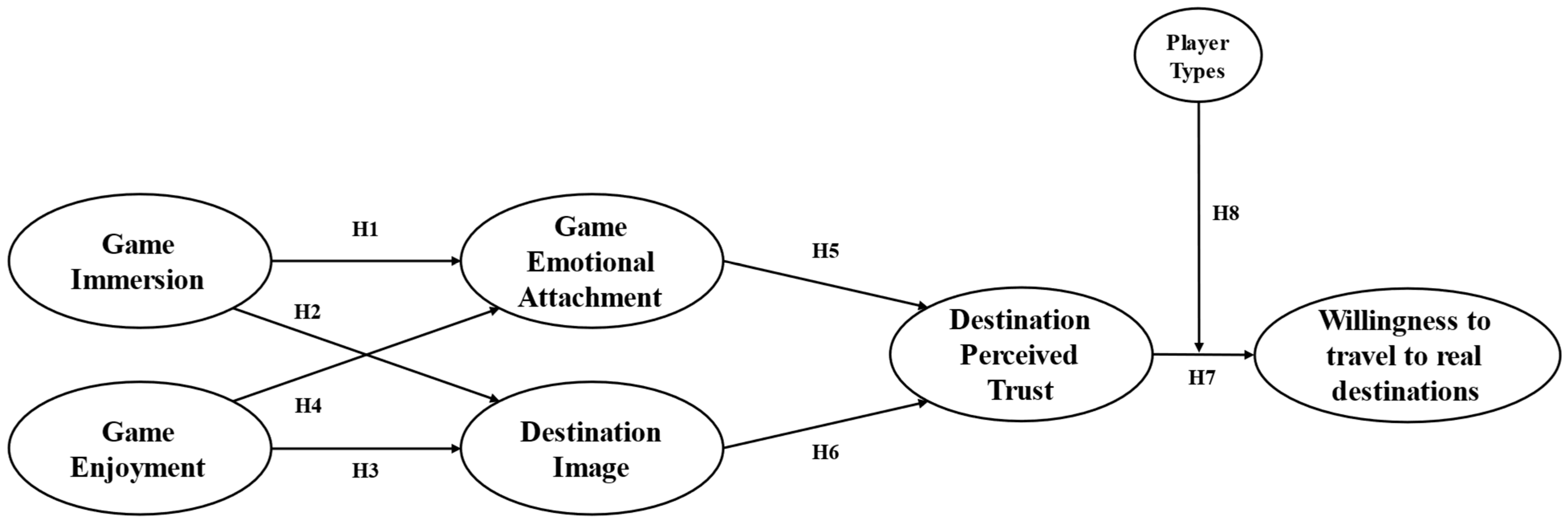
Figure 1. Conceptual model.
Admsci 15 00470 g001
Figure 2. Structural model with path coefficients.
Admsci 15 00470 g002
Table 1. Measurement scales and measurement model indices.
ConstructsMeasurement ItemsCronbach’s AlphasCRAVE
Game ImmersionGI1: The video game created a virtual environment that fully immersed me in its world.0.8920.910.64
GI2: At times, I was so engaged in the game that I lost awareness of my real surroundings.
GI3: While playing, my body was in the room, but my mind was fully inside the game world.
GI4: The game experience made me temporarily forget the reality of the outside world.
GI5: During gameplay, I was so absorbed that I forgot about events before or after my session.
GI6: The game world was so immersive that I lost awareness of my immediate physical surroundings.
Game EnjoymentGE1: When I play games featuring real-world destinations, I have a great time.0.8120.820.73
GE2: When I play games that include real-world locations, I find the experience highly entertaining.
GE3: Playing games with realistic destinations is enjoyable and fun for me.
Game Emotional AttachmentGEA1: I feel very attached to the virtual destinations I explore in the video game.0.8710.880.73
GEA2: The video games locations I visit mean a lot to me.
GEA3: I feel at home in the virtual environments created by the game.
GEA4: I would like to spend more time exploring these video game destinations.
Destination ImageDI1: Overall, traveling to a destination I see in a video game is: Bad (1)–Good (5)0.8610.870.71
DI2: Overall, traveling to a destination I see in a video game is: Negative (1)–Positive (5)
DI3: Overall, traveling to a destination I see in a video game is: Unfavorable (1)–Favorable (5)
DI4: Overall, traveling to a destination I see in a video game is: Not worthwhile (1)–Worthwhile (5)
Destination Perceived TrustDPT1: The real-world destination depicted in the video game is trustworthy.0.7560.770.51
DPT2: The information presented about the destination in the video game is reliable.
DPT3: The destination portrayed in the video game keeps promises and commitments related to its representation.
DPT4: The destination in the video game reflects my best interests and expectations for real-world visits.
DPT5: The portrayal of the destination in the video game meets my expectations of its real-world counterpart.
Willingness to travel to real destinationsWTD1: After exploring the virtual representation of a destination in a video game, I want to visit that real-world destination.0.850.860.77
WTD2: I am interested in traveling to the real-world destination I encountered in the game.
WTD3: I would recommend visiting the real-world destination portrayed in the game to others.
Players TypesThe Bartle Test classifies players of multiplayer online games into categories based on Bartle’s taxonomy of player types
Table 2. Respondent profiles.
DemographicTotal Number%
Gender
Male19875.6%
Female6424.4%
Age (years)
≤18155.7%
18–2415860.3%
25–346625.2%
35–44166.1%
45–5472.7%
55+72.7%
Gaming Frequency
Daily13250.5%
Several times a week4718%
Weekly3714%
A few times a month249%
Rarely228.5%
Table 3. Discriminant validity using heterotrait–monotrait ratios.
Destination ImageGame Emotional AttachmentDestination Perceived TrustType PlayerWillingness to Travel to Real DestinationsGame EnjoymentGame ImmersionType Player × Trust
Destination Image
Game Emotional Attachment0.404
Destination Perceived Trust0.5260.700
Type Player0.3080.1040.304
Willingness to travel to real destinations0.8250.3600.7260.475
Game Enjoyment0.3970.4880.6840.1810.583
Game Immersion0.3190.6750.6830.1150.3030.494
Type Player × Trust0.2830.1470.0790.2160.3610.1220.058
Table 4. Fornell–Larcker criterion.
Destination ImageGame Emotional AttachmentDestination Perceived TrustType PlayerWillingness to Travel to Real DestinationsGame EnjoymentGame Immersion
Destination Image0.839
Game Emotional Attachment0.3520.852
Destination Perceived Trust0.4330.5510.712
Type Player0.2870.0970.2741.000
Willingness to travel to real destinations0.7080.3120.6090.4360.877
Game Enjoyment0.3370.4130.5400.1630.4850.853
Game Immersion0.3180.6230.5760.0880.2830.4280.801
Table 5. Results of the hypotheses testing.
Original_SampleT_Statisticsp_Values
H1: Game_Immersion -> Game_Emotional_Attachment0.54696420.000
H2: Game_Immersion -> Destination Image0.21231700.002
H3: Game_Enjoyment -> Destination_Image0.24635530.000
H4: Game Enjoyment -> Game Emotional Attachment0.17926600.008
H5: Game_Emotional_Attachment -> Destination_Perceived Trust0.45582620.000
H6: Destination_Image -> Destination_Perceived_Trust0.27348340.000
H7: Destination_Perceived_Trust -> Willingnes_to_travel_to_real_destinations0.52712,4000.000
H8: Player_Types × Destination_Perceived_Trust -> Willingnes_to_travel_to_real_destinations0.27364020.000
Disclaimer/Publisher’s Note: The statements, opinions and data contained in all publications are solely those of the individual author(s) and contributor(s) and not of MDPI and/or the editor(s). MDPI and/or the editor(s) disclaim responsibility for any injury to people or property resulting from any ideas, methods, instructions or products referred to in the content.