


Status of Life Cycle Assessment (LCA) in Africa




Abstract
1. Introduction
2. Materials and Methods
3. Results
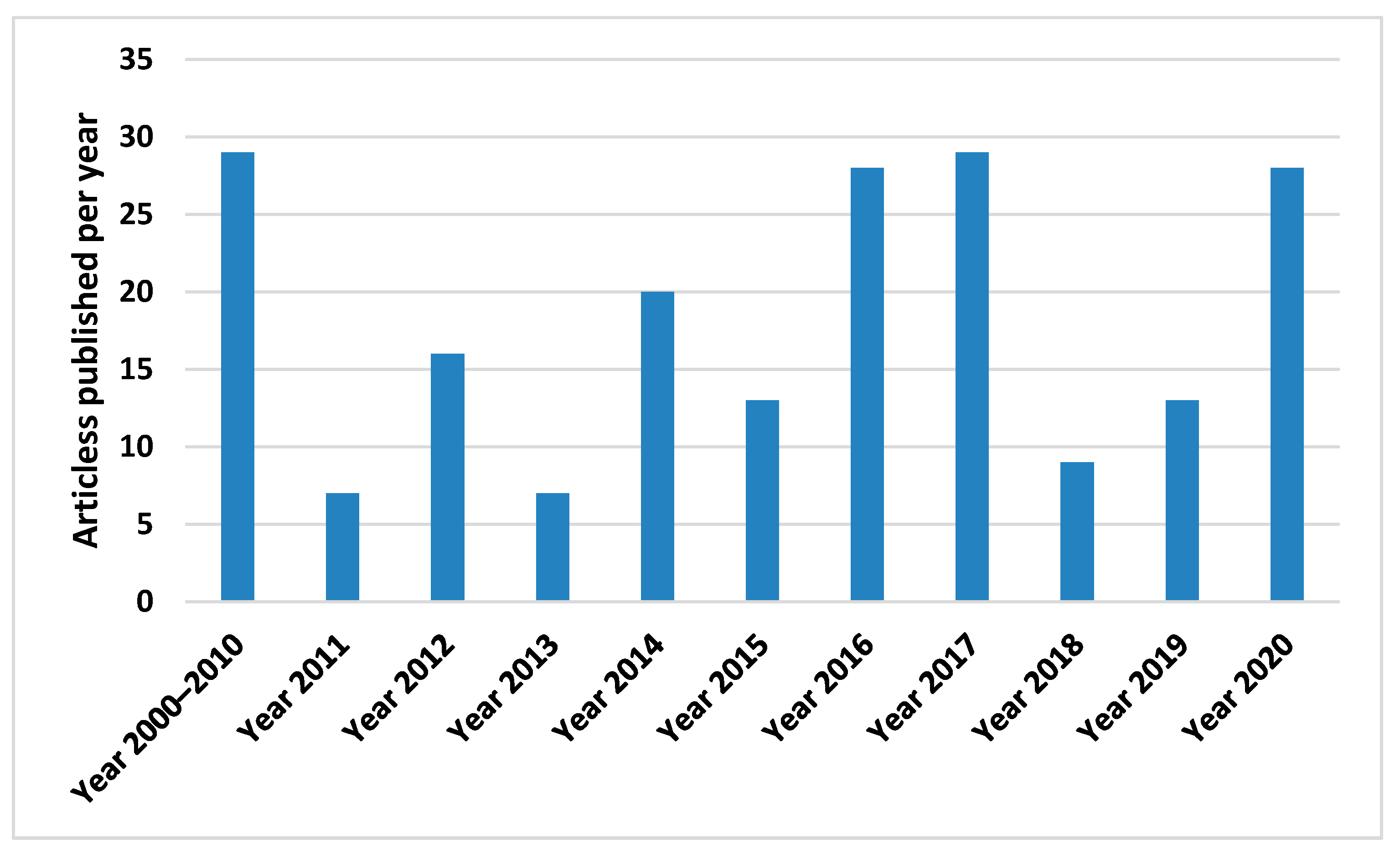
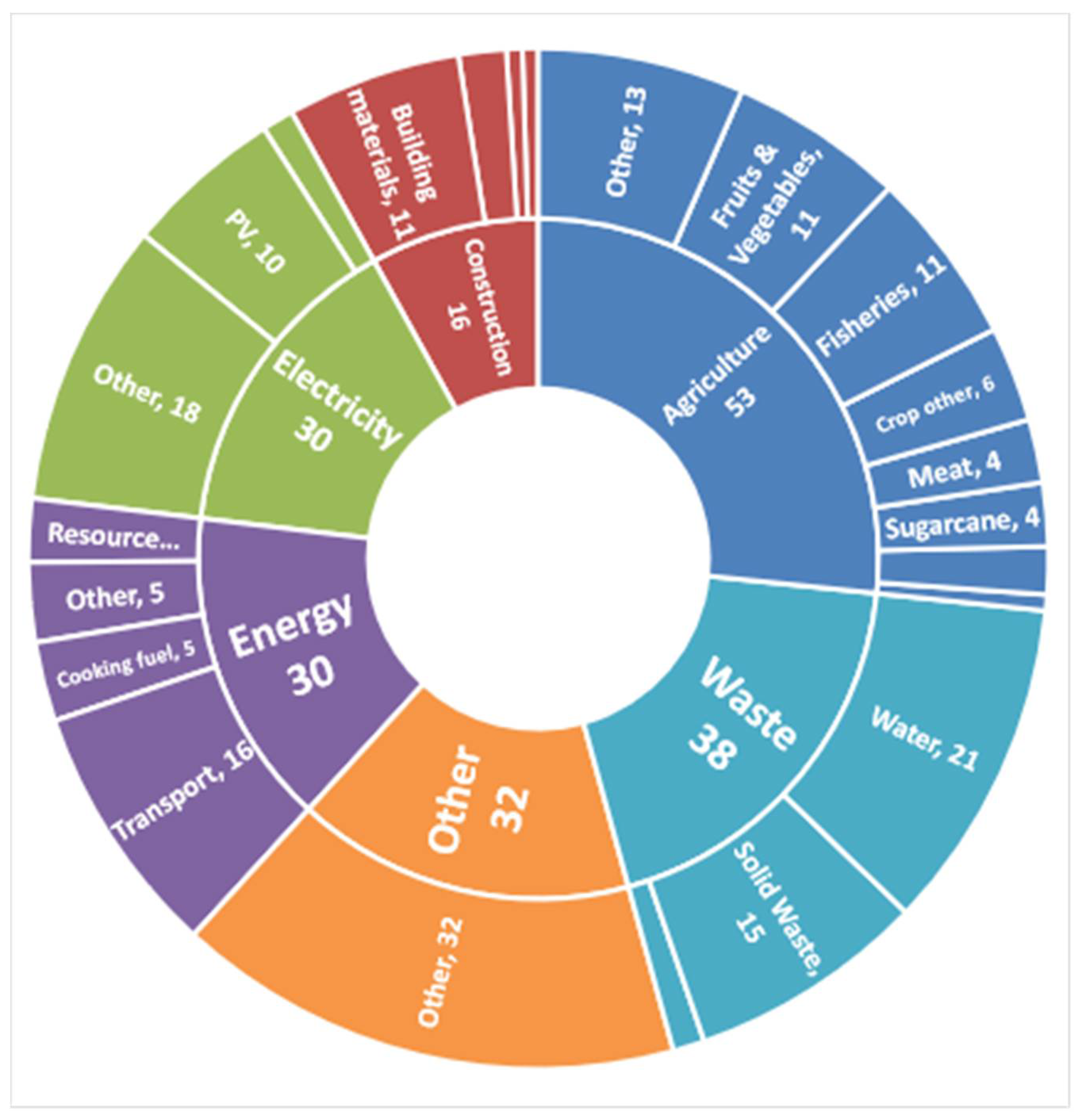
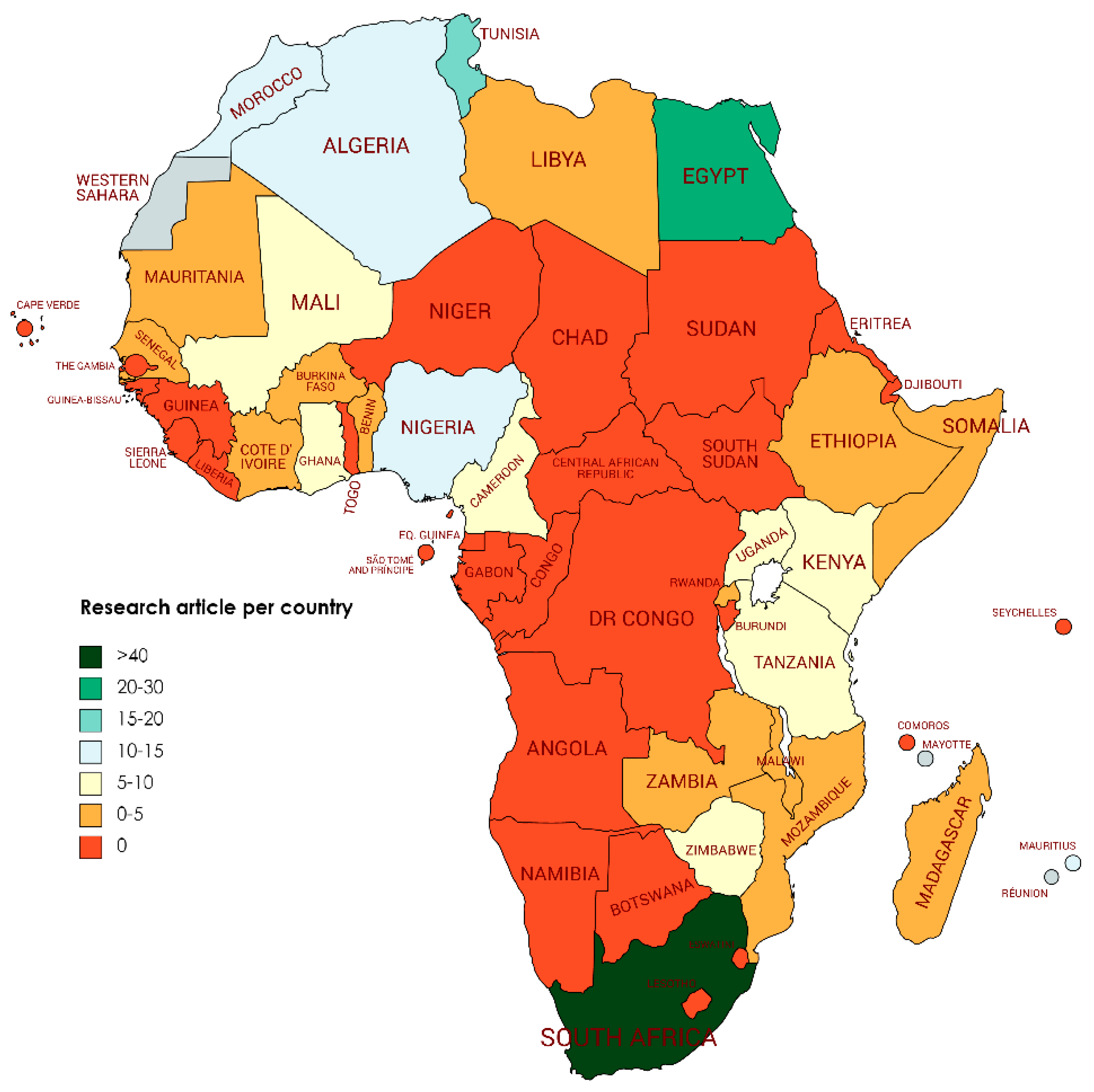
3.1. Overview
3.2. A Focus on LCA for Agricultural Products
3.3. A Focus on LCA for Energy
4. Discussion
4.1. The Need for an African LCI Database
4.2. The Need for an African LCIA Method
4.3. Future Possible Topics of LCA Research
5. Conclusions
Supplementary Materials
Author Contributions
Funding
Institutional Review Board Statement
Informed Consent Statement
Data Availability Statement
Conflicts of Interest
Appendix A

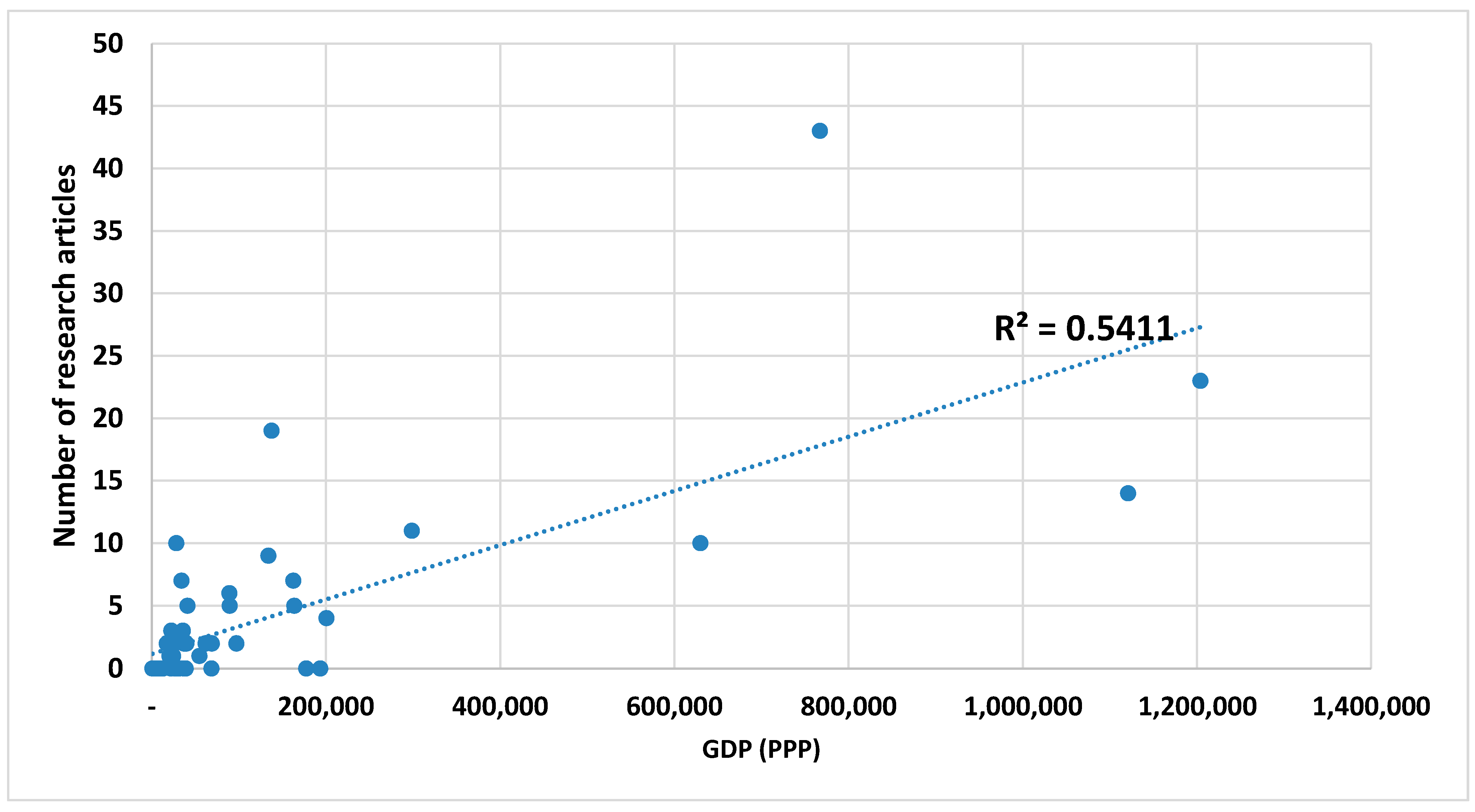
| Country | Total GDP (PPP, Million USD) | Share of GDP, Agriculture (%) [Nb of Articles] | Share of GDP, Industry (%) [Nb of Articles] | Share of GDP, Services (%) [Nb of Articles] | Total Number of Research Articles |
|---|---|---|---|---|---|
| Algeria | 630,000 | 13.3 [1] | 39.3 [4] | 47.4 [0] | 16 |
| Angola | 193,600 | 10.2 [0] | 61.4 [0] | 28.4 [0] | 0 |
| Benin | 25,390 | 26.1 [2] | 22.8 [0] | 51.1 [0] | 1 |
| Botswana | 39,010 | 1.8 [0] | 27.5 [0] | 70.6 [0] | 0 |
| Burkina Faso | 35,850 | 31 [0] | 23.9 [4] | 44.9 [0] | 4 |
| Burundi | 8007 | 39.5 [0] | 16.4 [0] | 44.2 [0] | 0 |
| Cameroon | 89,540 | 16.7 [1] | 26.5 [3] | 56.8 [1] | 5 |
| Cape Verde | 3777 | 8.9 [0] | 17.5 [0] | 73.7 [0] | 0 |
| Central African Republic | 3390 | 43.2 [0] | 16 [0] | 40.8 [0] | 0 |
| Chad | 28,620 | 52.3 [0] | 14.7 [0] | 33.1 [0] | 0 |
| Comoros | 1319 | 47.7 [0] | 11.8 [0] | 40.5 [0] | 0 |
| Democratic Republic of the Congo | 68,600 | 19.7 [0] | 43.6 [0] | 36.7 [0] | 0 |
| Djibouti | 3640 | 2.4 [0] | 17.3 [0] | 80.2 [0] | 0 |
| Egypt | 1,204,000 | 11.7 [4] | 34.3 | 54 | 13 |
| Equatorial Guinea | 31,520 | 2.5 [0] | 54.6 [0] | 42.9 [0] | 0 |
| Eritrea | 9402 | 11.7 [0] | 29.6 [0] | 58.7 [0] | 0 |
| Eswatini | 11,600 | 6.5 [0] | 45 [0] | 48.6 [0] | 0 |
| Ethiopia | 200,600 | 34.8 [2] | 21.6 [2] | 43.6 | 4 |
| Gabon | 36,660 | 5 [0] | 44.7 [0] | 50.4 [0] | 0 |
| Gambia | 5556 | 20.4 [0] | 14.2 [0] | 65.4 [0] | 0 |
| Ghana | 134,000 | 18.3 [4] | 24.5 [4] | 57.2 [0] | 8 |
| Guinea | 27,970 | 19.8 [0] | 32.1 [0] | 48.1 [0] | 0 |
| Guinea-Bissau | 3171 | 50 [0] | 13.1 [0] | 36.9 [0] | 0 |
| Ivory Coast | 97,160 | 20.1 [0] | 26.6 [1] | 53.3 [0] | 1 |
| Kenya | 163,700 | 34.5 | 17.8 | 47.5 | 7 |
| Lesotho | 6656 | 5.8 [0] | 39.2 [0] | 54.9 [1] | 1 |
| Liberia | 6112 | 34 [0] | 13.8 [0] | 52.2 [0] | 0 |
| Libya | 61,970 | 1.3 [0] | 52.3 [2] | 46.4 [0] | 2 |
| Madagascar | 39,850 | 24 [0] | 19.5 [1] | 56.4 [0] | 2 |
| Malawi | 22,420 | 28.6 [1] | 15.4 [2] | 56 [0] | 3 |
| Mali | 41,220 | 41.8 [3] | 18.1 [1] | 40.5 [0] | 6 |
| Mauritania | 17,280 | 27.8 [1] | 29.3 [1] | 42.9 [0] | 2 |
| Mauritius | 28,270 | 4 [2] | 21.8 [2] | 74.1 [9] | 13 |
| Morocco | 298,600 | 14 [4] | 29.5 [6] | 56.5 [1] | 11 |
| Mozambique | 37,090 | 23.9 [0] | 19.3 [2] | 56.8 [0] | 2 |
| Namibia | 26,600 | 6.7 [0] | 26.3 [0] | 67 [0] | 0 |
| Niger | 21,860 | 41.6 [0] | 19.5 [0] | 38.7 [0] | 0 |
| Nigeria | 1,121,000 | 21.1 | 22.5 | 56.4 | 19 |
| Republic of the Congo | 29,390 | 9.3 [0] | 51 [0] | 39.7 [0] | 0 |
| Rwanda | 24,680 | 30.9 [1] | 17.6 [0] | 51.5 [0] | 1 |
| São Tomé and Príncipe | 686 | 11.8 [0] | 14.8 [0] | 73.4 [0] | 0 |
| Senegal | 54,800 | 16.9 [1] | 24.3 [0] | 58.8 [0] | 1 |
| Seychelles | 2750 | 2.5 [0] | 13.8 [0] | 83.7 [0] | 0 |
| Sierra Leone | 11,550 | 60.7 [0] | 6.5 [0] | 32.9 [0] | 0 |
| Somalia | 20,440 | 60.2 [0] | 7.4 [0] | 32.5 [1] | 1 |
| South Africa | 767,200 | 2.8 | 29.7 | 67.5 | 21 |
| South Sudan | - [0] | - [0] | - [0] | 0 | |
| Sudan | 177,400 | 39.6 [0] | 2.6 [0] | 57.8 [0] | 0 |
| Tanzania | 162,500 | 23.4 [1] | 28.6 [6] | 47.6 [0] | 7 |
| Togo | 12,970 | 28.8 [0] | 21.8 [0] | 49.8 [0] | 0 |
| Tunisia | 137,700 | 10.1 [12] | 26.2 [5] | 63.8 [1] | 19 |
| Uganda | 89,190 | 28.2 [1] | 21.1 [1] | 50.7 [4] | 7 |
| Zambia | 68,930 | 7.5 [1] | 35.3 [1] | 57 [0] | 2 |
| Zimbabwe | 34,270 | 12 [0] | 22.2 [5] | 65.8 [2] | 7 |
| Country [Ref.] | System Boundaries | Allocation | Institution of the First Author | Location of the First Author |
|---|---|---|---|---|
| Algeria [20] | Cradle to grave | No indication/no allocation | EOST | France |
| Algeria [21] | Cradle to gate | No indication/no allocation | Boumerdes University | Algeria |
| Algeria [22] | Cradle to grave | No indication/no allocation | Boumerdes University | Algeria |
| Algeria [23] | Cradle to grave | No indication/no allocation | University of Boumerdes | Algeria |
| Algeria [24] | Cradle to gate | No indication/no allocation | BADJI Mokhtar University | Algeria |
| Algeria [25] | Cradle to grave | No indication/no allocation | University of Boumerdes | Algeria |
| Algeria [26] | Cradle to gate | No indication/no allocation | ENSSMAL | Algeria |
| Algeria [27] | Cradle to grave | No indication/no allocation | University Saad Dahlab | Algeria |
| Algeria [28] | Well-to-Tank | No indication/no allocation | Ecole Nationale Polytechnique | Algeria |
| Algeria [29] | Cradle to grave | No indication/no allocation | Bougara University | Algeria |
| Benin [30] | Cradle to gate | No indication/no allocation | CIRAD | France |
| Benin [31] | Cradle to gate | No indication/no allocation | CIRAD | France |
| Burkina Faso [32] | Cradle to grave | No indication/no allocation | Escola Tècnica Superior d’Enginyeries Industrial | Spain |
| Burkina Faso [33] | Well-to-Tank | energy allocation | Boumerdes University | Germany |
| Burkina Faso [34] | Cradle to site | No indication/no allocation | Universitat Politècnica de Catalunya (UPC) | Spain |
| Cameroon [35] | Well-to-Wheel | No indication/no allocation | KU Leuven | Belgium |
| Cameroon [36] | Cradle to grave | No indication/no allocation | University of Yaoundé | Cameroon |
| Cameroon [37] | Cradle to gate | Economic allocation | INRA | France |
| Cameroon [38] | end-of-life | No indication/no allocation | University of Yaoundé | Cameroon |
| Cameroon [39] | Well-to-Tank | energy allocation | University of Udine | Italy |
| Egypt [40] | Cradle to site/end-of-life | No indication/no allocation | Environment and Climate Research Institute, Egypt | Egypt |
| Egypt [41] | end-of-life | No indication/no allocation | National Water Research Center, Egypt | Egypt |
| Egypt [42] | Not applicable | No indication/no allocation | E-JUST | Egypt |
| Egypt [43] | Cradle to grave | No indication/no allocation | E-JUST | Egypt |
| Egypt [44] | Not applicable | No indication/no allocation | E-JUST | Egypt |
| Egypt [45] | Cradle to gate | Economic allocation | Universita Politecnica delle Marche | Italy |
| Egypt [46] | Not applicable | No indication/no allocation | E-JUST | Egypt |
| Egypt [47] | Cradle to grave | No indication/no allocation | Riga Technical University | Latvia |
| Egypt [48] | end-of-life | No indication/no allocation | E-JUST | Egypt |
| Egypt [49] | Cradle to grave | No indication/no allocation | Parthenope University of Naples | Italy |
| Egypt [50] | Cradle to gate | Mass and economic allocation | WorldFish | Malaysia |
| Egypt [51] | Not applicable | No indication/no allocation | Menoufia University | Egypt |
| Egypt [52] | Not applicable | No indication/no allocation | E-JUST | Egypt |
| Egypt [53] | Cradle to gate | Mass and energy allocation | E-JUST | Egypt |
| Egypt [54] | Cradle to gate | No indication/no allocation | Alexandria University | Egypt |
| Egypt [55] | Cradle to gate | No indication/no allocation | E-JUST | Egypt |
| Egypt [56] | end-of-life | No indication/no allocation | Alexandria University | Egypt |
| Egypt [57] | Cradle to gate | No indication/no allocation | E-JUST | Egypt |
| Egypt [58] | Cradle to grave | No indication/no allocation | Ministry of Petroleum and Mineral Resources, Alexandria, Egypt | Egypt |
| Egypt [59] | end-of-life | No indication/no allocation | Mansoura University | Egypt |
| Egypt [60] | end-of-life | No indication/no allocation | Mansoura University | Egypt |
| Egypt [61] | Cradle to gate | No indication/no allocation | Cairo University | Egypt |
| Egypt [62] | Cradle to gate | No indication/no allocation | University of Siena | Italy |
| Ethiopia [63] | Cradle to gate | No indication/no allocation | Wageningen University | Netherlands |
| Ethiopia [64] | Cradle to grave | No indication/no allocation | Universitat Hohenheim | Germany |
| Ethiopia [65] | Cradle to gate | Economic allocation | Wageningen University | Netherlands |
| Ethiopia [66] | Cradle to grave | Ecoinvent 3-allocation, default unit | Addis Ababa University | Ethiopia |
| Ghana [67] | Cradle to grave | No indication/no allocation | University of Ghana | Ghana |
| Ghana [68] | Cradle to gate | No indication/no allocation | The Hong Kong Polytechnic University | Hong Kong |
| Ghana [69] | Cradle to grave | Mass and energy allocation | University of Genoa | Italy |
| Ghana [70] | Cradle to gate | No indication/no allocation | Wageningen University | Netherlands |
| Ghana [71] | Cradle to grave | No indication/no allocation | University of Ghana | Ghana |
| Ghana [72] | Cradle to grave | No indication/no allocation | Curtin University | Australia |
| Ghana [73] | Cradle to gate | Physical and economical allocation | Wageningen University | Netherlands |
| Ghana [74] | Cradle to gate | No indication/no allocation | Kwame Nkrumah University of Science & Technology | Ghana |
| Ivory Coast [75] | Well-to-Tank | energy allocation | Universite de Toulouse | France |
| Kenya [76] | Cradle to gate | No indication/no allocation | Marks and Spencer | UK |
| Kenya [77] | Cradle to grave | No indication/no allocation | Technical University of Denmark | Denmark |
| Kenya [78] | Cradle to grave | No indication/no allocation | University of California | USA |
| Kenya [79] | Cradle to gate | No indication/no allocation | University of Michigan | USA |
| Kenya [80] | Gate to grave | No indication/no allocation | Umeå University | Sweden |
| Libya [81] | Cradle to grave | No indication/no allocation | Nottingham Trent University | UK |
| Libya [82] | Cradle to grave | No indication/no allocation | The Higher Institute of Polytechnic Professions | Libya |
| Madagascar [83] | Cradle to grave? | No indication/no allocation | University of Antananarivo | Madagascar |
| Madagascar [84] | Cradle to gate | No indication/no allocation | Université de la Réunion | France |
| Malawi [85] | Gate to gate | No indication/no allocation | Stellenbosch University | South Africa |
| Malawi [86] | Cradle to site | No indication/no allocation | Edinburgh Napier University | UK |
| Malawi [87] | Cradle to gate | Economic and mass allocation | University of Exeter | UK |
| Mali [88] | Cradle to grave | No indication/no allocation | Higher Technical Institute, Cyprus | Cyprus |
| Mali [89] | Cradle to gate | No indication/no allocation | KU Leuven | Belgium |
| Mali [90] | Cradle to gate | No indication/no allocation | KU Leuven | Belgium |
| Mali [91] | Cradle to gate | No indication/no allocation | University of South Florida | USA |
| Mali [92] | Cradle to gate | Economic allocation | CIRAD | France |
| Mauritania [93] | Cradle to gate | Mass allocation | University of Santiago de Compostela | Spain |
| Mauritania [94] | Cradle to gate | No indication/no allocation | Instituto Eduardo Torroja de ciencias de la construcción | Spain |
| Mauritius [99] | end-of-life | No indication/no allocation | University of Mauritius | Mauritius |
| Mauritius [100] | Cradle to grave | Economic allocation | University of Mauritius | Mauritius |
| Mauritius [101] | Cradle to grave | No indication/no allocation | University of Mauritius | Mauritius |
| Mauritius [102] | Cradle to grave | No indication/no allocation | University of Mauritius | Mauritius |
| Mauritius [103] | Cradle to site | Economic and mass allocation | University of Mauritius | Mauritius |
| Mauritius [104] | end-of-life | No indication/no allocation | Sotravic Lte | Mauritius |
| Mauritius [95] | Cradle to grave | Economic allocation | University of Mauritius | Mauritius |
| Mauritius [96] | end-of-life | No indication/no allocation | University of Mauritius | Mauritius |
| Mauritius [97] | Cradle to site | Economic allocation | University of Mauritius | Mauritius |
| Mauritius [98] | Cradle to grave | No indication/no allocation | University of Mauritius | Mauritius |
| Morocco [105] | Cradle to gate | Mass allocation | ADEME | France |
| Morocco [106] | Cradle to gate | No indication/no allocation | CIRAD | France |
| Morocco [107] | Cradle to gate | Economic allocation | CIRAD | France |
| Morocco [108] | Cradle to gate | No indication/no allocation | Universidad Politécnica de Madrid | Spain |
| Morocco [109] | Cradle to grave | No indication/no allocation | INES | France |
| Morocco [110] | Cradle to gate | No indication/no allocation | CIRAD | France |
| Morocco [111] | Cradle to grave | No indication/no allocation | University of Ljubljana | Slovenia |
| Morocco [112] | Cradle to gate | No indication/no allocation | Abdelmalek Essaadi University | Morocco |
| Morocco [113] | Cradle to grave | Economic allocation | CIEMAT | Spain |
| Morocco [114] | Cradle to grave? | No indication/no allocation | Mohammed V University | Morocco |
| Morocco [115] | Cradle to gate | No indication/no allocation | Mohammadia School of Engineering | Morocco |
| Mozambique [116] | Well-to-Wheel | Mass allocation | Chalmers University of Technology | Sweden |
| Mozambique [117] | Cradle to site | Mass allocation | Swedish University of Agricultural Sciences | Morocco |
| Nigeria [118] | Cradle to grave | No indication/no allocation | University of Manchester | UK |
| Nigeria [119] | Cradle to grave? | No indication/no allocation | Iowa State University | USA |
| Nigeria [120] | Cradle to gate | No indication/no allocation | Covenant University | Nigeria |
| Nigeria [121] | end-of-life | No indication/no allocation | National Water Quality Reference Laboratory Minna | Nigeria |
| Nigeria [122] | Well-to-Wheel | Mass allocation | Cranfield University | UK |
| Nigeria [123] | Gate to gate | No indication/no allocation | University of Ibadan | Nigeria |
| Nigeria [124] | Cradle to grave | No indication/no allocation | University of Tlemcen | Algeria |
| Nigeria [125] | Cradle to grave | No indication/no allocation | Hohai University | China |
| Nigeria [126] | Cradle to grave | No indication/no allocation | Nigerian Stored Products Research Institute | Nigeria |
| Nigeria [127] | Cradle to gate | No indication/no allocation | Landmark University | Nigeria |
| Nigeria [128] | Cradle to gate | No indication/no allocation | Adeleke University | Nigeria |
| Nigeria [129] | Cradle to grave | No indication/no allocation | The University of Manchester | UK |
| Nigeria [130] | Cradle to gate | No indication/no allocation | Ladoke Akintola University of Technology | Nigeria |
| Nigeria, ghhana, ivory coast [13] | Not applicable | No indication/no allocation | The University of Manchester | South Africa |
| Rwanda [131] | Cradle to gate | Mass allocation | CIRAD | France |
| Senegal [132] | Cradle to gate | Economic allocation | The Swedish Institute for Food and Biotechnology | Sweden |
| Somalia [133] | Cradle to grave | Mass allocation | University of Siena | Italy |
| South Africa [134] | Not applicable | No indication/no allocation | University of Pretoria | South Africa |
| South Africa [135] | Cradle to gate | Mass allocation | University of Pretoria | South Africa |
| South Africa [136] | Cradle to gate | No indication/no allocation | University of Natal | South Africa |
| South Africa [137] | Not applicable | No indication/no allocation | University of Pretoria | South Africa |
| South Africa [138] | Cradle to site | No indication/no allocation | University of Pretoria, | South Africa |
| South Africa [139] | Cradle to grave | No indication/no allocation | University of KwaZulu-Natal | South Africa |
| South Africa [140] | Cradle to gate | No indication/no allocation | CSIR, South africa | South Africa |
| South Africa [141] | Cradle to grave | No indication/no allocation | Huawei Technologies CO., Ltd | China |
| South Africa [142] | end-of-life | Mass allocation | University of Cape Town | South Africa |
| South Africa [143] | Cradle to gate | No indication/no allocation | University of Pretoria | South Africa |
| South Africa [144] | Cradle to gate | No indication/no allocation | University of Catania | Italy |
| South Africa [145] | Well-to-Wheel | Economic allocation | University of Stellenbosch | South Africa |
| South Africa [146] | Cradle to gate | Mass allocation | University of KwaZulu-Natal | South Africa |
| South Africa [147] | Not applicable | No indication/no allocation | University of Johannesburg | South Africa |
| South Africa [148] | Cradle to grave | No indication/no allocation | University of Cape Town | South Africa |
| South Africa [149] | Cradle to gate | Economic allocation | Stellenbosch University | South Africa |
| South Africa [150] | Cradle to grave | Physical allocation | Stellenbosch University | South Africa |
| South Africa [151] | Cradle to gate | No indication/no allocation | Zurich University of Applied Sciences | Swiss |
| South Africa [152] | Cradle to gate | Mass allocation | University of Cape Town | South Africa |
| South Africa [153] | Cradle to gate | Economic and energy allocation | Stellenbosch University | South Africa |
| South Africa [154] | Cradle to gate | Economic allocation | University of Stellenbosch | South Africa |
| South Africa [155] | Cradle to gate | Economic and energy allocation | University of Stellenbosch | South Africa |
| South Africa [156] | Cradle to gate | Economic allocation | University of Stell+D170:D182enbosch | South Africa |
| South Africa [157] | Cradle to gate | No indication/no allocation | Institute of Electronic Structure & Laser | Greece |
| South Africa [158] | Cradle to gate | No indication/no allocation | University of Johannesburg | South Africa |
| South Africa [16] | Not applicable | No indication/no allocation | University of the Witwatersrand | South Africa |
| South Africa [159] | Cradle to gate | No indication/no allocation | University of Johannesburg | South Africa |
| South Africa [160] | Cradle to gate | No indication/no allocation | Council for Scientific and Industrial Research(CSIR) | South Africa |
| South Africa [161] | Cradle to grave | No indication/no allocation | Cranfield University | UK |
| South Africa [162] | Well-to-Wheel | Mass allocation | University of Johannesburg | South Africa |
| South Africa [163] | Well-to-Tank | No indication/no allocation | University of Johannesburg | South Africa |
| South Africa [164] | Cradle to gate | No indication/no allocation | University of KwaZulu-Natal | South Africa |
| South Africa [165] | Not applicable | No indication/no allocation | University of Johannesburg | South Africa |
| South Africa [166] | Cradle to grave | No indication/no allocation | Mount Royal University Calgary | Canada |
| South Africa [167] | Cradle to grave | Mass allocation | University of Cape Town | South Africa |
| South Africa [168] | Cradle to gate | No indication/no allocation | Tshwane University of Technology | South Africa |
| South Africa [169] | Cradle to gate | No indication/no allocation | South African Sugarcane Research Institute | South Africa |
| South Africa [170] | Cradle to gate | Mass allocation | KU Leuven | Belgium |
| South Africa [171] | Cradle to gate | No indication/no allocation | University of Cape Town | South Africa |
| South Africa [172] | Cradle to gate | No indication/no allocation | University of Cape Town | South Africa |
| South Africa [173] | Well-to-Wheel | Economic allocation | University of Cambridge | UK |
| South Africa [174] | Cradle to gate | No indication/no allocation | Stellenbosch University | South Africa |
| South Africa [175] | Cradle to gate | Mass allocation | University of Natal | South Africa |
| Tanzania [176] | Cradle to grave | No indication/no allocation | University of Dar es Salaam | Tanzania |
| Tanzania [177] | Cradle to gate | No indication/no allocation | King Mongkut’s University of Technology | Thailand |
| Tanzania [178] | Well-to-Wheel | energy allocation | University of Dar es Salaam | Tanzania |
| Tanzania [179] | Cradle to site | No indication/no allocation | Tropical Pesticides Research Institute | Tanzania |
| Tanzania [180] | Cradle to gate | No indication/no allocation | Yara International | Germany |
| Tanzania [181] | Not applicable | No indication/no allocation | Tropical Pesticides Research Institute | Tanzania |
| Tanzania [182] | Cradle to gate | No indication/no allocation | Research Institute of Electric Power Industry, Japan | Japan |
| Tunisia [183] | Not applicable | No indication/no allocation | CNRS | France |
| Tunisia [184] | Cradle to gate | No indication/no allocation | Université de Monastir | Tunisia |
| Tunisia [185] | Cradle to gate | No indication/no allocation | University of Sfax | Tunisia |
| Tunisia [186] | Cradle to gate | No indication/no allocation | Universitat Autònoma de Barcelona | Spain |
| Tunisia [187] | Cradle to grave? | No indication/no allocation | IRSTEA | France |
| Tunisia [188] | Cradle to gate | No indication/no allocation | Institut National des Sciences Appliquée Technologie | Tunisia |
| Tunisia [189] | Cradle to gate | No indication/no allocation | Université de Carthage | Tunisia |
| Tunisia [190] | Cradle to gate | No indication/no allocation | Université de Carthage | Tunisia |
| Tunisia [191] | Cradle to gate | No indication/no allocation | Université de Carthage | Tunisia |
| Tunisia [192] | Cradle to gate | No indication/no allocation | National School of Engineers of Gabes | Tunisia |
| Tunisia [193] | Cradle to gate | No indication/no allocation | Gabes University | Tunisia |
| Tunisia [194] | Cradle to gate | No indication/no allocation | Université de Carthage | Tunisia |
| Tunisia [195] | Cradle to gate | No indication/no allocation | CIRAD | France |
| Tunisia [196] | Cradle to grave? | No indication/no allocation | CIRAD | France |
| Tunisia [197] | Cradle to gate | No indication/no allocation | Université de Gabès | Tunisia |
| Tunisia [198] | Cradle to grave | No indication/no allocation | CIEMAT | Spain |
| Tunisia [199] | Cradle to grave | Economic allocation | CIEMAT | Spain |
| Tunisia [200] | Cradle to gate | No indication/no allocation | (IFAPA) | Spain |
| Tunisia [201] | Cradle to gate | No indication/no allocation | Cranfield University | UK |
| Uganda [202] | Cradle to grave | No indication/no allocation | Makerere University | Uganda |
| Uganda [203] | end-of-life | No indication/no allocation | National Water & Sewerage Corporation, Uganda | Uganda |
| Uganda [204] | Cradle to grave | No indication/no allocation | University of Hohenheim | Germany |
| Uganda [205] | Cradle to gate | No indication/no allocation | University of South Florida | USA |
| Uganda [206] | end-of-life | No indication/no allocation | Makerere University | Uganda |
| Uganda [207] | Gate to gate | No indication/no allocation | Makerere University College of Agricultural & Environmental Sciences | Uganda |
| Zambia [208] | Cradle-to-gate? | No indication/no allocation | Norwegian Geotechnical Institute (NGI) | Norway |
| Zambia [209] | Cradle-to-gate? | No indication/no allocation | Norwegian Geotechnical Institute (NGI) | Norway |
| Zimbabwe [210] | Cradle to gate | Mass allocation | University of Zimbabwe, | Zimbabwe |
| Zimbabwe [211] | Cradle to gate | No indication/no allocation | University of Johannesburg | South Africa |
| Zimbabwe [212] | Cradle to grave | No indication/no allocation | University Of Johannesburg | South Africa |
| Zimbabwe [213] | Cradle to gate | No indication/no allocation | University Of Johannesburg | South Africa |
| Zimbabwe [214] | Cradle to grave | No indication/no allocation | University of Zimbabwe | Zimbabwe |
| Zimbabwe [215] | end-of-life | No indication/no allocation | University of Johannesburg | South Africa |
| Zimbabwe [216] | end-of-life | No indication/no allocation | University of Johannesburg | South Africa |
References
- United Nations. 2019 Revision of World Population Prospects. Available online: https://population.un.org/wpp/Download/Standard/Population/ (accessed on 31 December 2020).
- PWC. The World in 2050. Available online: https://www.pwc.com/gx/en/research-insights/economy/the-world-in-2050.html (accessed on 31 December 2020).
- UNEP. AEO3. Available online: https://wedocs.unep.org/handle/20.500.11822/8391 (accessed on 31 December 2020).
- WHO. Available online: https://apps.who.int/gho/data/node.main.BODAMBIENTAIRDTHS?lang=en (accessed on 31 December 2020).
- MIT Media Lab, OEC. Available online: https://oec.world/en (accessed on 31 December 2020).
- FAO. Faostat Database. Available online: http://www.fao.org/faostat/en/#data (accessed on 31 December 2020).
- Bjørn, A.; Owsianiak, M.; Laurent, A.; Molin, C.; Westh, T.B.; Hauschild, M.Z. Mapping and characterization of LCA networks. Int. J. Life Cycle Assess. 2013, 18, 812–827. [Google Scholar] [CrossRef] [Scilit]
- Karkour, S.; Ichisugi, Y.; Abeynayaka, A.; Itsubo, N. External-Cost Estimation of Electricity Generation in G20 Countries: Case Study Using a Global Life-Cycle Impact-Assessment Method. Sustainability 2020, 12, 2002. [Google Scholar] [CrossRef] [Scilit]
- Ecoinvent Database. Available online: https://www.ecoinvent.org/ (accessed on 31 December 2020).
- Huijbregts, M.A.J.; Steinmann, Z.J.N.; Elshout, P.M.F.; Stam, G.; Verones, F.; Vieira, M.; Zijp, M.; Hollender, A.; Zelm, v.R. ReCiPe2016: A harmonised life cycle impact assessment method at midpoint and endpoint level. Int. J. Life Cycle Assess. 2017, 22, 138–147. [Google Scholar] [CrossRef] [Scilit]
- Ladenika, A.O.; Bodunrin, M.O.; Burman, N.W.; Croft, J.; Engelbrecht, S.; Goga, T.; MacGregor, O.S.; Maepa, M.; Harding, K.G. Assessing the availability of life cycle assessments in Austria. Int. J. Life Cycle Assess. 2019, 24, 614–619. [Google Scholar] [CrossRef] [Scilit]
- Zanghelini, G.M.; de Souza Junior, H.R.A.; Kulay, L.; Cherubini, E.; Ribeiro, P.T.; Soares, S.R. A bibliometric overview of Brazilian LCA research. Int. J. Life Cycle Assess. 2016, 21, 1759–1775. [Google Scholar] [CrossRef] [Scilit]
- Maepa, M.; Bodunrin, M.O.; Burman, N.W.; Croft, J.; Engelbrecht, S.; Ladenika, A.O.; MacGregor, O.S.; Harding, K.G. Review: Life cycle assessments in Nigeria, Ghana, and Ivory Coast. Int. J. Life Cycle Assess. 2017, 22, 1159–1164. [Google Scholar] [CrossRef] [Scilit]
- Wiloso, E.I.; Nazir, N.; Hanafi, J.; Siregar, K.; Harsono, S.S.; Setiawan, A.A.R.; Muryanto; Romli, M.; Utama, N.A.; Shantiko, B. Life cycle assessment research and application in Indonesia. Int. J. Life Cycle Assess. 2019, 24, 386–396. [Google Scholar] [CrossRef] [Scilit]
- Burman, N.W.; Croft, J.; Engelbrecht, S.; Ladenika, A.O.; MacGregor, O.S.; Maepa, M.; Bodunrin, M.O.; Harding, K.G. Review: Life-cycle assessment, water footprinting, and carbon footprinting in Portugal. Int. J. Life Cycle Assess. 2018, 23, 1693–1700. [Google Scholar] [CrossRef] [Scilit]
- Harding, K.G.; Friedrich, E.; Jordaan, H.; le Roux, B.; Notten, P.; Russo, V.; Notten, P.; Russo, V.; Suppen-Reynaga, N.; Laan, M.v.d.; et al. Status and prospects of life cycle assessments and carbon and water footprinting studies in South Africa. Int. J. Life Cycle Assess. 2020, 26, 26–49. [Google Scholar] [CrossRef] [Scilit]
- Croft, J.; Engelbrecht, S.; Ladenika, A.O.; MacGregor, O.S.; Maepa, M.; Bodunrin, M.O.; Burman, N.W.; Goga, T.; Harding, K.G. Review: The availability of life-cycle studies in Sweden. Int. J. Life Cycle Assess. 2019, 24, 6–11. [Google Scholar] [CrossRef] [Scilit]
- Life Cycle Assessment Theory and Practice; Springer: Berlin/Heidelberg, Germany, 2018.
- IEA. Available online: https://www.iea.org/data-and-statistics?country=WEOAFRICA&fuel=Energy%20supply&indicator=ElecGenByFuel (accessed on 31 December 2020).
- Ghazi, M.; Quaranta, G.; Duplay, J.; Hadjamor, R.; Khodja, M.; Amar, H.A.; Kessaissia, Z. Life-Cycle Impact Assessment of oil drilling mud system in Algerian arid area. Resour. Conserv. Recycl. 2011, 55, 1222–1231. [Google Scholar] [CrossRef] [Scilit]
- Messaoud-Boureghda, M.Z.; Fegas, R.; Louhab, K. Study of the Environmental Impacts of Urban Wastewater Recycling (Case of Boumerdes-Algeria) by the Life Cycle Assessment Method. Asian J. Chem. 2012, 24, 339. [Google Scholar]
- Mohamed-Zine, M.; Hamouche, A.; Krim, L. The study of potable water treatment process in Algeria (boudouaou station) -by the application of life cycle assessment (LCA). J. Environ. Health Sci. Eng. 2013, 11, 37. [Google Scholar] [CrossRef] [Scilit] [PubMed]
- Boughrara, S.; Chedri, M.; Louhab, K. Evaluation of Environmental Impact of Cement Production in Algeria Using Life Cycle Assessment. ILCPA 2015, 45, 79–84. [Google Scholar] [CrossRef] [Scilit]
- Makhlouf, A.; Serradj, T.; Cheniti, H. Life cycle impact assessment of ammonia production in Algeria: A comparison with previous studies. Environ. Impact Assess. Rev. 2015, 50, 35–41. [Google Scholar] [CrossRef] [Scilit]
- Mohamed–Zine, M.B.; Ali, L.; Hamouche, A. Comparison of treatment methods for the assessment of environmental impacts of drilling muds by the LCA approach. J. Environ. Waste Manag. 2016, 3, 108–115. [Google Scholar]
- Lourguioui, H.; Brigolin, D.; Boulahdid, M.; Pastres, R. A perspective for reducing environmental impacts of mussel culture in Algeria. Int. J. Life Cycle Assess. 2017, 22, 1266–1277. [Google Scholar] [CrossRef] [Scilit]
- Kaoula, D.; Bouchair, A. Evaluation of environmental impacts of hotel buildings having different envelopes using a life cycle analysis approach. Indoor Built Environ. 2018, 27, 561–580. [Google Scholar] [CrossRef] [Scilit]
- Amouri, M.; Mohellebi, F.; Zaïd, T.A.; Aziza, M. Sustainability assessment of Ricinus communis biodiesel using LCA Approach. Clean Technol. Environ. Policy 2017, 19, 749–760. [Google Scholar] [CrossRef] [Scilit]
- Deriche, M.A.; Hafaifa, A.; Tahri, A.; Mohammedi, K.; Tahri, F. Energy and environmental performance analysis of grid-connected photovoltaic systems under similar outdoor conditions in the Saharan environment. Diagnostyka 2020, 21, 13–23. [Google Scholar] [CrossRef] [Scilit]
- Perrin, A.; Basset-Mens, C.; Huat, J.; Yehouessi, W. High environmental risk and low yield of urban tomato gardens in Benin. Agron Sustain. Dev. 2015, 35, 305–315. [Google Scholar] [CrossRef] [Scilit]
- Perrin, A.; Basset-Mens, C.; Huat, J.; Gabrielle, B. The variability of field emissions is critical to assessing the environmental impacts of vegetables: A Benin case-study. J. Clean. Prod. 2017, 153, 104–113. [Google Scholar] [CrossRef] [Scilit]
- Amante-García, B.; López Grimau, V.; Canals Casals, L. LCA of different energy sources for a water purification plant in Burkina Fasso. DWT 2017, 76, 375–381. [Google Scholar] [CrossRef] [Scilit]
- Baumert, S.; Khamzina, A.; Vlek, P.L. Greenhouse gas and energy balance of Jatropha biofuel production systems of Burkina Faso. Energy Sustain. Dev. 2018, 42, 14–23. [Google Scholar] [CrossRef] [Scilit]
- Olmedo-Torre, N.; Canals Casals, L.; Amante García, B. Sustainable design of a thermosolar electricity generation power plant in Burkina Faso. J. Environ. Manag. 2018, 226, 428–436. [Google Scholar] [CrossRef] [Scilit] [PubMed]
- Achten, W.M.J.; Vandenbempt, P.; Almeida, J.; Mathijs, E.; Muys, B. Life Cycle Assessment of a Palm Oil System with Simultaneous Production of Biodiesel and Cooking Oil in Cameroon. Environ. Sci. Technol. 2010, 44, 4809–4815. [Google Scholar] [CrossRef] [Scilit]
- Mpele, M.; Elime Bouboama, A.; Ayina Ohandja, L.M.; Madjadoumbaye, J. Life cycle assessment of the overall energy consumption of a road construction project and its management in Cameroon. Agric. Eng. Int. Cigr J. 2010, 12, 63–73. [Google Scholar]
- Efole Ewoukem, T.; Aubin, J.; Mikolasek, O.; Corson, M.; Tomedi Eyango, M.; Tchoumboue, J. Environmental impacts of farms integrating aquaculture and agriculture in Cameroon. J. Clean. Prod. 2012, 28, 208–214. [Google Scholar] [CrossRef] [Scilit]
- Elime Bouboama, A.; Mamba, M.; Tsimi, N.I. Life Cycle Assessment of Domestic Wastewater in a Neighborhood with Spontaneous Housing—A Case Study of Bonamoussadi, Yaoundé-Cameroon. Available online: http://www.aascit.org/journal/archive2?journalId=816&paperId=4171 (accessed on 2 February 2021).
- Vrech, A.; Ferfuia, C.; Bessong Ojong, W.; Piasentier, E.; Baldini, M. Energy and environmental sustainability of Jatropha-Biofuels Chain from nontoxic accessions in Cameroon. Environ. Prog. Sustain. Energy 2019, 38, 305–314. [Google Scholar] [CrossRef] [Scilit]
- El-Sayed Mohamed Mahgoub, M.; van der Steen, N.P.; Abu-Zeid, K.; Vairavamoorthy, K. Towards sustainability in urban water: A life cycle analysis of the urban water system of Alexandria City, Egypt. J. Clean. Prod. 2010, 18, 1100–1106. [Google Scholar] [CrossRef] [Scilit]
- Roushdi, M.; El-Hawary, A.; Maghoub, M. Environmental improvement of Alexandria’s wastewater treatment plants using life cycle assessment approach. Glob. Nest J. 2012, 14, 450–459. [Google Scholar]
- Ali, A.A.M.; Negm, A.; Bady, M.; Ibrahim, M.G.E. Towards an Integrated Tool to Estimate Carbon Emissions from life Cycle Assessment of Building Materials in Egypt. Available online: https://www.researchgate.net/profile/Dr_Ahmed_Ali2/publication/269393690_TOWARDS_AN_INTEGRATED_TOOL_TO_ESTIMATE_CARBON_EMISSIONS_FROM_LIFE_CYCLE_ASSESSMENT_OF_BUILDING_MATERIALS_IN_EGYPT/links/548877560cf289302e30afb2.pdf (accessed on 2 February 2021).
- Ali, A.A.M.M.; Negm, A.M.; Bady, M.F.; Ibrahim, M.G. Environmental Life Cycle Assessment of a Residential Building in Egypt: A Case Study. Procedia Technol. 2015, 19, 349–356. [Google Scholar] [CrossRef] [Scilit]
- Ali, A.A.M.; Negm, A.M.; Bady, M.F.; Ibrahim, M.G.E. Moving towards an Egyptian national life cycle inventory database. Int. J. Life Cycle Assess. 2014, 19, 1551–1558. [Google Scholar] [CrossRef] [Scilit]
- Bevilacqua, M.; Ciarapica, F.E.; Mazzuto, G.; Paciarotti, C. Environmental analysis of a cotton yarn supply chain. J. Clean. Prod. 2014, 82, 154–165. [Google Scholar] [CrossRef] [Scilit]
- Armanuos, A.M.; Negm, A.; Tahan, A.H.M.E. Life Cycle Assessment of Diesel Fuel and Solar Pumps in Operation Stage for Rice Cultivation in Tanta, Nile Delta, Egypt. Procedia Technol. 2016, 22, 478–485. [Google Scholar] [CrossRef] [Scilit]
- Fawzy, M.M.; Romagnoli, F. Environmental Life Cycle Assessment for Jatropha Biodiesel in Egypt. Energy Procedia 2016, 95, 124–131. [Google Scholar] [CrossRef] [Scilit]
- Sharaan, M.; Negm, A. Life Cycle Assessment of Dredged Materials Placement Strategies: Case Study, Damietta Port, Egypt. Procedia Eng. 2017, 181, 102–108. [Google Scholar] [CrossRef] [Scilit]
- Petrillo, A.; De Felice, F.; Jannelli, E.; Autorino, C.; Minutillo, M.; Lavadera, A.L. Life cycle assessment (LCA) and life cycle cost (LCC) analysis model for a stand-alone hybrid renewable energy system. Renew. Energy 2016, 95, 337–355. [Google Scholar] [CrossRef] [Scilit]
- Henriksson, P.J.; Dickson, M.; Allah, A.N.; Al-Kenawy, D.; Phillips, M. Benchmarking the environmental performance of best management practice and genetic improvements in Egyptian aquaculture using life cycle assessment. Aquaculture 2017, 468, 53–59. [Google Scholar] [CrossRef] [Scilit]
- Younes, M.; Huang, Y.; Hashim, I. Towards an Integrated Tool of a Life Cycle Assessment for Construction of Asphalt Pavements in Egypt. J. Earth Sci. Geotech. Eng. 2016, 6, 377–388. [Google Scholar]
- Elkafoury, A.; Negm, A. Assessment Approach of Life Cycle of Vehicles Tyres on Egyptian Road Network. Period. Polytech. Transp. Eng. 2016, 44, 75–79. [Google Scholar] [CrossRef] [Scilit]
- Yacout, D.M.M.; Soliman, N.F.; Yacout, M.M. Comparative life cycle assessment (LCA) of Tilapia in two production systems: Semi-intensive and intensive. Int. J. Life Cycle Assess. 2016, 21, 806–819. [Google Scholar] [CrossRef] [Scilit]
- Yacout, D.M.M.; Abd El-Kawi, M.A.; Hassouna, M.S. Cradle to gate environmental impact assessment of acrylic fiber manufacturing. Int. J. Life Cycle Assess. 2016, 21, 326–336. [Google Scholar] [CrossRef] [Scilit]
- Ali, A.A.M.; Negm, A.M.; Bady, M.F.; Ibrahim, M.G.E.; Suzuki, M. Environmental impact assessment of the Egyptian cement industry based on a life-cycle assessment approach: A comparative study between Egyptian and Swiss plants. Clean. Tech. Environ. Policy 2016, 18, 1053–1068. [Google Scholar] [CrossRef] [Scilit]
- Yacout, D.M.M.; Hassouna, M.S. Identifying potential environmental impacts of waste handling strategies in textile industry. Environ. Monit Assess. 2016, 188, 445. [Google Scholar] [CrossRef] [Scilit]
- Ibrahim, M.; Ali, A.A.M. Practical Case Study for Life Cycle Assessment of the Egyptian Brick Industry: A Comparative Analysis of the Japanese Industry. Available online: https://scholar.google.com/citations?user=5Ng0zOMAAAAJ&hl=en (accessed on 2 February 2021).
- Hassanain, E.M.; Yacout, D.M.M.; Metwally, M.A.; Hassouna, M.S. Life cycle assessment of waste strategies for used lubricating oil. Int. J. Life Cycle Assess. 2017, 22, 1232–1240. [Google Scholar] [CrossRef] [Scilit]
- Awad, H.; Gar Alalm, M.; El-Etriby, H.K. Environmental and cost life cycle assessment of different alternatives for improvement of wastewater treatment plants in developing countries. Sci. Total Environ. 2019, 660, 57–68. [Google Scholar] [CrossRef] [Scilit]
- Atia, N.G.; Bassily, M.A.; Elamer, A.A. Do life-cycle costing and assessment integration support decision-making towards sustainable development? J. Clean. Prod. 2020, 267, 122056. [Google Scholar] [CrossRef] [Scilit]
- Morsy, K.M.; Mostafa, M.K.; Abdalla, K.Z.; Galal, M.M. Life Cycle Assessment of Upgrading Primary Wastewater Treatment Plants to Secondary Treatment Including a Circular Economy Approach. Air Soil Water Res. 2020, 13, 117862212093585. [Google Scholar] [CrossRef] [Scilit]
- Patrizi, N.; Bruno, M.; Saladini, F.; Parisi, M.L.; Pulselli, R.M.; Bjerre, A.B.; Bastianoni, S. Sustainability Assessment of Biorefinery Systems Based on Two Food Residues in Africa. Front. Sustain. Food Syst. 2020, 4. [Google Scholar] [CrossRef] [Scilit]
- Sahle, A.; Potting, J. Environmental life cycle assessment of Ethiopian rose cultivation. Sci. Total Environ. 2013, 443, 163–172. [Google Scholar] [CrossRef] [Scilit]
- Lansche, J.; Müller, J. Life cycle assessment (LCA) of biogas versus dung combustion household cooking systems in developing countries—A case study in Ethiopia. J. Clean. Prod. 2017, 165, 828–835. [Google Scholar] [CrossRef] [Scilit]
- Woldegebriel, D.; Udo, H.; Viets, T.; van der Harst, E.; Potting, J. Environmental impact of milk production across an intensification gradient in Ethiopia. Livestock Sci. 2017, 206, 28–36. [Google Scholar] [CrossRef] [Scilit]
- Teffera, B.; Assefa, B.; Björklund, A.; Assefa, G. Life cycle assessment of wind farms in Ethiopia. Int. J. Life Cycle Assess. 2020, 21, 76–96. [Google Scholar]
- Afrane, G.; Ntiamoah, A. Analysis of the life-cycle costs and environmental impacts of cooking fuels used in Ghana. Appl. Energy 2012, 98, 301–306. [Google Scholar] [CrossRef] [Scilit]
- Ansah, M.K.; Chen, X.; Yang, H.; Lu, L.; Lam, P.T. An integrated life cycle assessment of different façade systems for a typical residential building in Ghana. Sustain. Cities Soc. 2020, 53, 101974. [Google Scholar] [CrossRef] [Scilit]
- Bianchi, F.R.; Moreschi, L.; Gallo, M.; Vesce, E.; Del Borghi, A. Environmental analysis along the supply chain of dark, milk and white chocolate: A life cycle comparison. Int. J. Life Cycle Assess. 2020, 4. [Google Scholar] [CrossRef] [Scilit]
- Eshun, J.F.; Potting, J.; Leemans, R. LCA of the timber sector in Ghana: Preliminary life cycle impact assessment (LCIA). Int. J. Life Cycle Assess. 2011, 16, 625–638. [Google Scholar] [CrossRef] [Scilit]
- Afrane, G.; Ntiamoah, A. Comparative Life Cycle Assessment of Charcoal, Biogas, and Liquefied Petroleum Gas as Cooking Fuels in Ghana. J. Ind. Ecol. 2011, 15, 539–549. [Google Scholar] [CrossRef] [Scilit]
- Engelbrecht, D.; Thorpe, M.; Mearns, K. The life cycle assessment of cyanide containers in Ghana. Ghana Min. J. 2012, 13, 56–66. [Google Scholar]
- Eshun, J.F.; Potting, J.; Leemans, R. Inventory analysis of the timber industry in Ghana. Int. J. Life Cycle Assess. 2010, 15, 715–725. [Google Scholar] [CrossRef] [Scilit]
- Ntiamoah, A.; Afrane, G. Environmental impacts of cocoa production and processing in Ghana: Life cycle assessment approach. J. Clean. Prod. 2008, 16, 1735–1740. [Google Scholar] [CrossRef] [Scilit]
- Ndong, R.; Montrejaud-Vignoles, M.; Saint Girons, O.; Gabrielle, B.; Pirot, R.; Domergue, M.; Sablayrolles, C. Life cycle assessment of biofuels fromJatropha curcasin West Africa: A field study. GCB Bioenergy 2009, 1, 197–210. [Google Scholar] [CrossRef] [Scilit]
- Sim, S.; Barry, M.; Clift, R.; Cowell, S.J. The relative importance of transport in determining an appropriate sustainability strategy for food sourcing. Int. J. Life Cycle Assess. 2007, 12, 422–431. [Google Scholar]
- Owsianiak, M.; Lindhjem, H.; Cornelissen, G.; Hale, S.E.; Sørmo, E.; Sparrevik, M. Environmental and economic impacts of biochar production and agricultural use in six developing and middle-income countries. Sci. Total Environ. 2021, 755, 142455. [Google Scholar] [CrossRef] [Scilit] [PubMed]
- Bilich, A.; Langham, K.; Geyer, R.; Goyal, L.; Hansen, J.; Krishnan, A.; Bergesen, J.; Sinha, P. Life Cycle Assessment of Solar Photovoltaic Microgrid Systems in Off-Grid Communities. Environ. Sci. Technol. 2017, 51, 1043–1052. [Google Scholar] [CrossRef] [Scilit] [PubMed]
- Heller, M.C.; Walchale, A.; Heard, B.R.; Hoey, L.; Khoury, C.K.; De Haan, S.S.; Burra, D.; Duong, T.T.; Osiemo, J.; Trinh, T.H.; et al. Environmental analyses to inform transitions to sustainable diets in developing countries: Case studies for Vietnam and Kenya. Int. J. Life Cycle Assess. 2020, 25, 1183–1196. [Google Scholar] [CrossRef] [Scilit]
- Carvalho, R.L.; Yadav, P.; García-López, N.; Lindgren, R.; Nyberg, G.; Diaz-Chavez, R.; Krishna Kumar Upadhyayula, V.; Boman, C.; Athanassiadis, D. Environmental Sustainability of Bioenergy Strategies in Western Kenya to Address Household Air Pollution. Energies 2020, 13, 719. [Google Scholar] [CrossRef] [Scilit]
- Irhoma, A.; Su, D.; Higginson, M. Life Cycle Assessment of Libyan Crude Oil. Available online: http://irep.ntu.ac.uk/id/eprint/7491/ (accessed on 2 February 2021).
- Al-Behadili, S.; El-Osta, W. Life Cycle Assessment of Dernah (Libya) wind farm. Renew. Energy 2015, 83, 1227–1233. [Google Scholar] [CrossRef] [Scilit]
- Andrianaivo, L.; Ramasiarinoro, V.J. Life Cycle Assessment and Environmental Impact Evaluation of the Parabolic Solar Cooker SK14 in Madagascar. J. Clean Energy Technol. 2014. [Google Scholar] [CrossRef] [Scilit]
- Praene, J.; Rakotoson, V. Environmental sustainability of electricity generation under insular context, An LCA-based scenario for Madagascar and Reunion island by 2050. Int. J. Eng. Res. Manag. Stud. 2017, 2, 24–42. [Google Scholar]
- Taulo, J.; Sebitosi, A. Material and energy flow analysis of the Malawian tea industry. Renew. Sustain. Energy Rev. 2016, 56, 1337–1350. [Google Scholar] [CrossRef] [Scilit]
- Mpakati-Gama, E.C.; Brown, A.; Sloan, B. Embodied energy and carbon analysis of urban residential buildings in Malawi. Int. J. Constr. Manag. 2016, 16, 1–12. [Google Scholar] [CrossRef] [Scilit]
- Pell, R.; Wall, F.; Yan, X.; Li, J.; Zeng, X. Mineral processing simulation based-environmental life cycle assessment for rare earth project development: A case study on the Songwe Hill project. J. Environ. Manag. 2019, 249, 109353. [Google Scholar] [CrossRef] [Scilit] [PubMed]
- Kalogirou, S. Thermal performance, economic and environmental life cycle analysis of thermosiphon solar water heaters. Sol. Energy 2009, 83, 39–48. [Google Scholar] [CrossRef] [Scilit]
- Almeida, J.; Moonen, P.; Soto, I.; Achten, W.M.; Muys, B. Effect of farming system and yield in the life cycle assessment of Jatropha-based bioenergy in Mali. Energy Sustain. Dev. 2014, 23, 258–265. [Google Scholar] [CrossRef] [Scilit]
- Roffeis, M.; Almeida, J.; Wakefield, M.; Valada, T.; Devic, E.; Koné, N.; Kenis, M.; Nacambo, S.; Fitches, E.; Koko, G. Life Cycle Inventory Analysis of Prospective Insect Based Feed Production in West Africa. Sustainability 2017, 9, 1697. [Google Scholar] [CrossRef] [Scilit]
- Naughton, C.C.; Zhang, Q.; Mihelcic, J.R. Modelling energy and environmental impacts of traditional and improved shea butter production in West Africa for food security. Sci. Total Environ. 2017, 576, 284–291. [Google Scholar] [CrossRef] [Scilit]
- Avadí, A.; Marcin, M.; Biard, Y.; Renou, A.; Gourlot, J.; Basset-Mens, C. Life cycle assessment of organic and conventional non-Bt cotton products from Mali. Int. J. Life Cycle Assess. 2020, 25, 678–697. [Google Scholar] [CrossRef] [Scilit]
- Vázquez-Rowe, I.; Moreira, M.T.; Feijoo, G. Environmental assessment of frozen common octopus (Octopus vulgaris) captured by Spanish fishing vessels in the Mauritanian EEZ. Mar. Policy 2012, 36, 180–188. [Google Scholar] [CrossRef] [Scilit]
- Martín-Consuegra Ávila, F.; Alonso Ruiz-Rivas, C.; Salas Serrano, J.; Legarra Sadaba, J.; Frutos Vázquez, B. Environmental assessment of a constructive system for living spaces made in Mauritania. Available online: https://www.irbnet.de/daten/iconda/CIB_DC28312.pdf (accessed on 5 February 2021).
- Ramjeawon, T. Life cycle assessment of cane-sugar on the island of mauritius. Int. J. LCA 2004, 9, 254–260. [Google Scholar] [CrossRef] [Scilit]
- Mohee, R. Life Cycle Assessment technique for sound management of organic municipal solid wastes. PIE 2005, 2, 236. [Google Scholar] [CrossRef] [Scilit]
- Ramjeawon, T. Life cycle assessment of electricity generation from bagasse in Mauritius. J. Clean. Prod. 2008, 16, 1727–1734. [Google Scholar] [CrossRef] [Scilit]
- Foolmaun, R.K.; Ramjeawon, T. Life Cycle Assessment (LCA) of PET bottles and comparative LCA of three disposal options in Mauritius. IJEWM 2008, 2, 125. [Google Scholar] [CrossRef] [Scilit]
- Unmar, G.; Mohee, R.; Rughoonundun, M. Assessing the Environmental Impacts of Municipal Solid Waste Incineration in Mauritius from a Life Cycle Perspective. Available online: https://www.semanticscholar.org/paper/Assessing-the-environmental-impacts-of-municipal-in-Unmar-Rughoonundun/db12311c369508646cff5abb3e28486d97c74bf6 (accessed on 2 February 2021).
- Foolmaun, R.K.; Ramjeeawon, T. Comparative life cycle assessment and social life cycle assessment of used polyethylene terephthalate (PET) bottles in Mauritius. Int. J. Life Cycle Assess. 2013, 18, 155–171. [Google Scholar] [CrossRef] [Scilit]
- Foolmaun, R.K.; Ramjeeawon, T. Disposal of post-consumer polyethylene terephthalate (PET) bottles: Comparison of five disposal alternatives in the small island state of Mauritius using a life cycle assessment tool. Environ. Technol. 2012, 33, 563–572. [Google Scholar] [CrossRef] [Scilit]
- Foolmaun, R.K.; Ramjeeawon, T. Comparative life cycle assessment and life cycle costing of four disposal scenarios for used polyethylene terephthalate bottles in Mauritius. Environ. Technol. 2012, 33, 2007–2018. [Google Scholar] [CrossRef] [Scilit] [PubMed]
- Brizmohun, R.; Ramjeawon, T.; Azapagic, A. Life cycle assessment of electricity generation in Mauritius. J. Clean. Prod. 2015, 106, 565–575. [Google Scholar] [CrossRef] [Scilit]
- Rajcoomar, A.; Ramjeawon, T. Life cycle assessment of municipal solid waste management scenarios on the small island of Mauritius. Waste Manag. Res. 2017, 35, 313–324. [Google Scholar] [CrossRef] [Scilit]
- Payen, S.; Basset-Mens, C.; Perret, S. LCA of local and imported tomato: An energy and water trade-off. J. Clean. Prod. 2015, 87, 139–148. [Google Scholar] [CrossRef] [Scilit]
- Bessou, C.; Basset-Mens, C.; Latunussa, C.; Velu, A.; Heitz, H.; Vannières, H.; Caliman, J.P. LCA of perennial crops: Implications of modeling choices through two contrasted case studies. In Proceedings of the LCAfood 2014, San Francisco, CA, USA, 8–10 October 2014. [Google Scholar]
- Basset-Mens, C.; Vannière, H.; Grasselly, D.; Heitz, H.; Braun, A.; Payen, S.; Koch, P.; Biard, Y. Environmental impacts of imported and locally grown fruits for the French market: A cradle-to-farm-gate LCA study. Fruits 2016, 71, 93–104. [Google Scholar] [CrossRef] [Scilit]
- Corona, B.; Escudero, L.; Quéméré, G.; Luque-Heredia, I.; San Miguel, G. Energy and environmental life cycle assessment of a high concentration photovoltaic power plant in Morocco. Int. J. Life Cycle Assess. 2017, 22, 364–373. [Google Scholar] [CrossRef] [Scilit]
- Ito, M.; Lespinats, S.; Merten, J.; Malbranche, P.; Kurokawa, K. Life cycle assessment and cost analysis of very large-scale PV systems and suitable locations in the world. Prog. Photovolt Res. Appl. 2016, 24, 159–174. [Google Scholar] [CrossRef] [Scilit]
- Bessou, C.; Basset-Mens, C.; Latunussa, C.; Vélu, A.; Heitz, H.; Vannière, H.; Caliman, J.P. Partial modelling of the perennial crop cycle misleads LCA results in two contrasted case studies. Int. J. Life Cycle Assess. 2016, 21, 297–310. [Google Scholar] [CrossRef] [Scilit]
- Stropnik, R.; Sekavčnik, M.; Ferriz, A.; Mori, M. Reducing environmental impacts of the ups system based on PEM fuel cell with circular economy. Energy 2018, 165, 824–835. [Google Scholar] [CrossRef] [Scilit]
- Errouame Mohammed and Amrani Mahacine. The Headrest Manufacturing Industry: Evaluation The Environmental impacts. Available online: http://www.arpnjournals.org/jeas/research_papers/rp_2019/jeas_0119_7540.pdf (accessed on 2 February 2021).
- Herrera, I.; Rodríguez-Serrano, I.; Garrain, D.; Lechón, Y.; Oliveira, A. Sustainability assessment of a novel micro solar thermal: Biomass heat and power plant in Morocco. J. Ind. Ecol. 2020, 24, 1. [Google Scholar] [CrossRef] [Scilit]
- Kouroum, L.A.E.; Bahi, L.; Bahi, A. Impact of Solar Water Heaters Systems on the Environment Case Study in Morocco. Available online: https://papers.ssrn.com/sol3/papers.cfm?abstract_id=3628490 (accessed on 2 February 2021).
- Bahi, Y.; Akhssas, A.; Bahi, A.; Driss Elhachmi, D. Environmental assessment of a wastewater treatment plant using life cycle assessment (lca) approach: Case of ain taoujdate morocco. Int. J. Adv. Res. Eng. Technol. (Ijaret) 2020, 11, 3628407. [Google Scholar]
- Hagman, J.; Nerentorp, M.; Arvidsson, R.; Molander, S. Do biofuels require more water than do fossil fuels? Life cycle-based assessment of jatropha oil production in rural Mozambique. J. Clean. Prod. 2013, 53, 176–185. [Google Scholar] [CrossRef] [Scilit]
- Porsö, C.; Mate, R.; Vinterbäck, J.; Hansson, P. Time-Dependent Climate Effects of Eucalyptus Pellets Produced in Mozambique Used Locally or for Export. Bioenerg. Res. 2016, 9, 942–954. [Google Scholar] [CrossRef] [Scilit]
- Gujba, H.; Mulugetta, Y.; Azapagic, A. Environmental and economic appraisal of power generation capacity expansion plan in Nigeria. Energy Policy 2010, 38, 5636–5652. [Google Scholar] [CrossRef] [Scilit]
- Bartlett, Z.; Olivares, A.; Yang, L.; Rosentrater, K.A. Economic and Environmental Analysis of Farm-Scale Biodigesters to Produce Energy for Kitchen Stove Use. Available online: https://elibrary.asabe.org/abstract.asp?aid=44877 (accessed on 2 February 2021).
- Ezema, I.C.; Olutuah, A.O.; Fagbenle, O.I. Estimating Embodied Energy in Residential Buildings in a Nigerian Context. Int. J. Appl. Eng. Res. 2015, 10, 44140–44149. [Google Scholar]
- Ogundipe, F.O.; Jimoh, O.D. Life Cycle Assessment of Municipal Solid Waste Management in Minna, Niger State, Nigeria. Int. J. Environ. Res. 2015, 9, 1305–1314. [Google Scholar]
- Onabanjo, T.; Di Lorenzo, G. Energy Efficiency and Environmental Life Cycle Assessment of Jatropha for Energy in Nigeria: A “Well-To-Wheel” Perspective. Available online: https://asmedigitalcollection.asme.org/ES/proceedings-abstract/ES2015/56840/V001T06A004/228261 (accessed on 2 February 2021).
- Ewemoje, T.A.; Oluwaniyi, O.O. Mechanised Shea Butter Production in South-Western Nigeria Using Life Cycle Assessments (LCA) Approach from Gate-To-Gate. Available online: https://cigrjournal.org/index.php/Ejounral/article/view/3557 (accessed on 2 February 2021).
- Abubakar Jumare, I.; Bhandari, R.; Zerga, A. Environmental Life Cycle Assessment of Grid-Integrated Hybrid Renewable Energy Systems in Northern Nigeria. Sustainability 2019, 11, 5889. [Google Scholar] [CrossRef] [Scilit]
- Yuguda, T.K.; Li, Y.; Xiong, W.; Zhang, W. Life cycle assessment of options for retrofitting an existing dam to generate hydro-electricity. Int. J. Life Cycle Assess. 2020, 25, 57–72. [Google Scholar] [CrossRef] [Scilit]
- Ogunjirin, O.C.; Jekayinfa, S.O.; Olaniran, J.A.; Ogunjirin, O.A. Environmental life cycle assessment of cowpea production, storage and disposal in Ilorin, Kwara State, Nigeria. Iop Conf. Ser. Earth Environ. Sci. 2020, 445, 012040. [Google Scholar] [CrossRef] [Scilit]
- Olaniran, J.A.; Jekayinfa, S.O.; Adekanye, T.A. Energy consumption and environmental burden analysis of cassava tuber production in Ogbomoso southwest Nigeria. Iop Conf. Ser. Earth Environ. Sci. 2020, 445, 012062. [Google Scholar] [CrossRef] [Scilit]
- Ogunlade, C.A.; Jekayinfa, S.O.; Olaniran, J.A.; Adebayo, A.O. Energy life-cycle assessment and economic analysis of sweet orange production in Nigeria. Available online: https://www.researchgate.net/publication/342452508_Energy_life-cycle_assessment_and_economic_analysis_of_sweet_orange_production_in_Nigeria (accessed on 2 February 2021).
- Gujba, H.; Mulugetta, Y.; Azapagic, A. Passenger transport in Nigeria: Environmental and economic analysis with policy recommendations. Energy Policy 2013, 55, 353–361. [Google Scholar] [CrossRef] [Scilit]
- Jekayinfa, S.O.; Olaniran, L.A.; Sasanya, B.F. Life cycle assessment of soybeans production and processing system into soy oil using solvent extraction process. Int. J. Prod. Lifecycle Manag. 2013, 6, 311–321. [Google Scholar] [CrossRef] [Scilit]
- Basset-Mens, C.; Rhino, B.; Ndereyimana, A.; Kleih, U.; Biard, Y. Eco-efficiency of tomato from Rwamagana district in Rwanda: From field constraints to statistical significance. J. Clean. Prod. 2019, 229, 420–430. [Google Scholar] [CrossRef] [Scilit]
- Ziegler, F.; Emanuelsson, A.; Eichelsheim, J.L.; Flysjö, A.; Ndiaye, V.; Thrane, M. Extended Life Cycle Assessment of Southern Pink Shrimp Products Originating in Senegalese Artisanal and Industrial Fisheries for Export to Europe. J. Ind. Ecol. 2011, 15, 527–538. [Google Scholar] [CrossRef] [Scilit]
- Rossi, F.; Parisi, M.L.; Maranghi, S.; Manfrida, G.; Basosi, R.; Sinicropi, A. Environmental impact analysis applied to solar pasteurization systems. J. Clean. Prod. 2019, 212, 1368–1380. [Google Scholar] [CrossRef] [Scilit]
- Brent, A.C.; Rohwer, M.B.; Friedrich, E.; Blottnitz, H.V. Status of life cycle assessment and engineering research in South Africa. Int. J. LCA 2002, 7, 167–172. [Google Scholar] [CrossRef] [Scilit]
- Brent, A.C.; Hietkamp, S. Comparative evaluation of Life Cycle Impact assessment methods with a South African case study. Int. J. LCA 2003, 8, 27–38. [Google Scholar] [CrossRef] [Scilit]
- Friedrich, E. Life-cycle assessment as an environmental management tool in the production of potable water. Water Sci. Technol. 2002, 46, 29–36. [Google Scholar] [CrossRef] [Scilit]
- Brent, A.C. A proposed lifecycle impact assessment framework for South Africa from available environmental data. S. Afr. J. Sci. 2003, 99, 115–122. [Google Scholar]
- Landu, L.; Brent, A.C. Environmental life cycle assessment of water supply in South Africa: The Rosslyn industrial area as a case study. Water SA 2006, 32, 249–256. [Google Scholar] [CrossRef] [Scilit]
- Friedrich, E.; Pillay, S.; Buckley, C.A. Environmental life cycle assessments for water treatment processes—A South African case study of an urban water cycle. Water SA 2009, 35. [Google Scholar] [CrossRef] [Scilit]
- Mashoko, L.; Mbohwa, C.; Thomas, V.M. LCA of the South African sugar industry. J. Environ. Plan. Manag. 2010, 53, 793–807. [Google Scholar] [CrossRef] [Scilit]
- Anders, S.G.A.; Han, D.; Luo, S.; Belfqih, M.; Gerber, E. Added value of Life Cycle Assessment to a Business Case Analysis of a Photovoltaic/Wind Radio Base Site Solution in South Africa. Intelec 2012, 1–7. [Google Scholar] [CrossRef] [Scilit]
- Vossberg, C.; Mason-Jones, K.; Cohen, B. An energetic life cycle assessment of C&D waste and container glass recycling in Cape Town, South Africa. Resour. Conserv. Recycl. 2014, 88, 39–49. [Google Scholar]
- Rice, G.A.; Vosloo, P.T. A life cycle assessment of the cradle-to-gate phases of clay brick production in South Africa. Eco-Archit. V Harmon. Archit. Nat. 2014, 142, 471. [Google Scholar]
- Siracusa, V.; Ingrao, C.; Lo Giudice, A.; Mbohwa, C.; Dalla Rosa, M. Environmental assessment of a multilayer polymer bag for food packaging and preservation: An LCA approach. Food Res. Int. 2014, 62, 151–161. [Google Scholar] [CrossRef] [Scilit]
- Petersen, A.; Melamu, R.; Knoetze, J.; Görgens, J. Comparison of second-generation processes for the conversion of sugarcane bagasse to liquid biofuels in terms of energy efficiency, pinch point analysis and Life Cycle Analysis. Energy Convers. Manag. 2015, 91, 292–301. [Google Scholar] [CrossRef] [Scilit]
- Pryor, S.W.; Smithers, J.; Lyne, P.; van Antwerpen, R. Impact of agricultural practices on energy use and greenhouse gas emissions for South African sugarcane production. J. Clean. Prod. 2017, 141, 137–145. [Google Scholar] [CrossRef] [Scilit]
- Ngwepe, L.L.; Aigbavboa, C.O.; Thwala, W.D. The Benefits of life Cycle Assessment: A Methodology for Buildings in South Africa. Available online: https://ujcontent.uj.ac.za/vital/access/manager/Repository/uj:21123?site_name=GlobalView&f0=bs_metadata.fulltext%3A%22false%22&f1=sm_creator%3A%22Aigbavboa%2C+C.O.%22 (accessed on 2 February 2021).
- Naicker, V.; Cohen, B. A life cycle assessment of e-books and printed books in South Africa. J. Energy S. Afr. 2016, 27, 68–77. [Google Scholar] [CrossRef] [Scilit]
- Daful, A.G.; Haigh, K.; Vaskan, P.; Görgens, J.F. Environmental impact assessment of lignocellulosic lactic acid production: Integrated with existing sugar mills. Food Bioprod. Process. 2016, 99, 58–70. [Google Scholar] [CrossRef] [Scilit]
- Crafford, P.L.; Blumentritt, M.; Wessels, C.B. The potential of South African timber products to reduce the environmental impact of buildings. S. Afr. J. Sci. 2017, 113, 1–8. [Google Scholar] [CrossRef] [Scilit]
- The Environmental Mitigation Potential of Photovoltaic-Powered Irrigation in the Production of South African Maize. Sustainability 2017, 9, 1772. [CrossRef] [Scilit]
- Russo, V.; von Blottnitz, H. Potentialities of biogas installation in South African meat value chain for environmental impacts reduction. J. Clean. Prod. 2017, 153, 465–473. [Google Scholar] [CrossRef] [Scilit]
- Farzad, S.; Mandegari, M.A.; Guo, M.; Haigh, K.F.; Shah, N.; Görgens, J.F. Multi-product biorefineries from lignocelluloses: A pathway to revitalisation of the sugar industry? Biotechnol. Biofuels 2017, 10, 87. [Google Scholar] [CrossRef] [Scilit] [PubMed]
- Mandegari, M.A.; Farzad, S.; van Rensburg, E.; Görgens, J.F. Multi-criteria analysis of a biorefinery for co-production of lactic acid and ethanol from sugarcane lignocellulose. Biofuels Bioprod. Bioref. 2017, 11, 971–990. [Google Scholar] [CrossRef] [Scilit]
- Ali Mandegari, M.; Farzad, S.; Görgens, J.F. Economic and environmental assessment of cellulosic ethanol production scenarios annexed to a typical sugar mill. Bioresour. Technol. 2017, 224, 314–326. [Google Scholar] [CrossRef] [Scilit]
- Farzad, S.; Mandegari, M.A.; Görgens, J.F. Integrated techno-economic and environmental analysis of butadiene production from biomass. Bioresour. Technol. 2017, 239, 37–48. [Google Scholar] [CrossRef] [Scilit] [PubMed]
- Papadaki, D.; Foteinis, S.; Mhlongo, G.; Nkosi, S.; Motaung, D.; Ray, S.; Tsoutsos, T.; Kiriakidis, G. Life cycle assessment of facile microwave-assisted zinc oxide (ZnO) nanostructures. Sci. Total Environ. 2017, 586, 566–575. [Google Scholar] [CrossRef] [Scilit]
- Madushela, N. Process Evaluation of a Domestic Biogas Digester. Procedia Manuf. 2017, 7, 111–117. [Google Scholar] [CrossRef] [Scilit]
- Agwa-Ejon, J.F.; Pradhan, A. Life cycle impact assessment of artisanal sandstone mining on the environment and health of mine workers. Environ. Impact Assess. Rev. 2018, 72, 71–78. [Google Scholar] [CrossRef] [Scilit]
- Masindi, V.; Chatzisymeon, E.; Kortidis, I.; Foteinis, S. Assessing the sustainability of acid mine drainage (AMD) treatment in South Africa. Sci. Total Environ. 2018, 635, 793–802. [Google Scholar] [CrossRef] [Scilit]
- Anastasopoulou, A.; Kolios, A.; Somorin, T.; Sowale, A.; Jiang, Y.; Fidalgo, B.; Parker, A.; Williams, L.; Collins, M.; McAdam, E.; et al. Conceptual environmental impact assessment of a novel self-sustained sanitation system incorporating a quantitative microbial risk assessment approach. Sci. Total Environ. 2018, 639, 657–672. [Google Scholar] [CrossRef] [Scilit]
- Pradhan, A.; Mbohwa, C. Life Cycle Assessment of Soybean Biodiesel Production in South Africa: A Preliminary Assessment. In Proceedings of the 2017 International Renewable and Sustainable Energy Conference (IRSEC), Tangier, Morocco, 4–7 December 2017; pp. 1–4. [Google Scholar] [CrossRef] [Scilit]
- Pradhan, A.; Mbohwa, C. Development of Life Cycle Inventory (LCI) for Sugarcane Ethanol Production in South Africa. In Proceedings of the 2017 International Renewable and Sustainable Energy Conference (IRSEC), Tangier, Morocco, 4–7 December 2017; pp. 1–4. [Google Scholar] [CrossRef] [Scilit]
- Goga, T.; Friedrich, E.; Buckley, C. Environmental life cycle assessment for potable water production–a case study of seawater desalination and mine-water reclamation in South Africa. Water SA 2019, 45, 700–709. [Google Scholar] [CrossRef] [Scilit]
- Kwofie, T.E.; Aigbavboa, C.O.; Thwala, W.D. Measures to improve the adoption of life cycle assessment in the South African construction industry. JEDT 2019, 18, 480–494. [Google Scholar] [CrossRef] [Scilit]
- Dunmade, I.; Madushele, N.; Adedeji, P.A.; Akinlabi, E.T. A streamlined life cycle assessment of a coal-fired power plant: The South African case study. Environ. Sci. Pollut. Res. 2019, 26, 18484–18492. [Google Scholar] [CrossRef] [Scilit]
- Chitaka, T.Y.; Russo, V.; von Blottnitz, H. In pursuit of environmentally friendly straws: A comparative life cycle assessment of five straw material options in South Africa. Int. J. Life Cycle Assess. 2020, 25, 1818–1832. [Google Scholar] [CrossRef] [Scilit]
- Mavhungu, A.; Foteinis, S.; Mbaya, R.; Masindi, V.; Kortidis, I.; Mpenyana-Monyatsi, L. Environmental sustainability of municipal wastewater treatment through struvite precipitation: Influence of operational parameters. J. Clean. Prod. 2020. [Google Scholar] [CrossRef] [Scilit]
- Van der Laan, M.; Jumman, A.; Perret, S.R. Environmental Benefits of Improved Water and Nitrogen Management in Irrigated Sugar Cane: A Combined Crop Modelling and Life Cycle Assessment Approach. Irrig. Drain. 2015, 64, 241–252. [Google Scholar] [CrossRef] [Scilit]
- Devers, L.; Kleynhans, T.; Mathijs, E. Comparative life cycle assessment of Flemish and Western Cape pork production. Agrekon 2012, 51, 105–128. [Google Scholar] [CrossRef] [Scilit]
- Fernández-Torres, M.; Randall, D.; Melamu, R.; von Blottnitz, H. A comparative life cycle assessment of eutectic freeze crystallisation and evaporative crystallisation for the treatment of saline wastewater. Desalination 2012, 306, 17–23. [Google Scholar] [CrossRef] [Scilit]
- Ras, C.; Von Blottnitz, H. A comparative life cycle assessment of process water treatment technologies at the Secunda industrial complex, South Africa. Water SA 2012, 38, 549–554. [Google Scholar] [CrossRef] [Scilit]
- Stephenson, A.L.; von Blottnitz, H.; Brent, A.C.; Dennis, J.S.; Scott, S.A. Global Warming Potential and Fossil-Energy Requirements of Biodiesel Production Scenarios in South Africa. Energy Fuels 2010, 24, 2489–2499. [Google Scholar] [CrossRef] [Scilit]
- Brent, A.; Sigamoney, R.; Von Blottnitz, H.; Hietkamp, S. Life cycle inventories to assess value chains in the South African biofuels industry. J. Energy S. Afr. 2010, 21, 15–25. [Google Scholar] [CrossRef] [Scilit]
- Pillay, S.D.; Friedrich, E.; Buckley, C.A. Life cycle assessment of an industrial water recycling plant. Water Sci. Technol. 2002, 46, 55–62. [Google Scholar] [CrossRef] [Scilit]
- Manyele, S.V. Lifecycle assessment of biofuel production from wood pyrolysis technology. Educ. Res. Rev. 2007, 2, 141–150. [Google Scholar]
- Felix, M.; Gheewala, S.H. Environmental assessment of electricity production in Tanzania. Energy Sustain. Dev. 2012, 16, 439–447. [Google Scholar] [CrossRef] [Scilit]
- Eshton, B.; Katima, J.H.; Kituyi, E. Greenhouse gas emissions and energy balances of jatropha biodiesel as an alternative fuel in Tanzania. Biomass Bioenergy 2013, 58, 95–103. [Google Scholar] [CrossRef] [Scilit]
- Felix, M.; Gheewala, S.H. Environmental toxicity potential from electricity generation in Tanzania. Int. J. Life Cycle Assess. 2014, 19, 1424–1432. [Google Scholar] [CrossRef] [Scilit]
- Plassmann, K.; Brentrup, F.; Lammel, J. Trade-offs between agricultural product carbon footprints and land use: A case study from Tanzania. Available online: https://www.researchgate.net/profile/Katharina_Plassmann (accessed on 2 February 2021).
- Felix, M. Status update on LCA studies and networking in Tanzania. Int. J. Life Cycle Assess. 2016, 21, 1825–1830. [Google Scholar] [CrossRef] [Scilit]
- Tsuchiya, Y.; Swai, T.A.; Goto, F. Energy payback time analysis and return on investment of off-grid photovoltaic systems in rural areas of Tanzania. Sustain. Energy Technol. Assess. 2020, 42, 100887. [Google Scholar]
- Hadj Amor, R.; Quaranta, G.; Gueddari, F.; Million, D.; Clauer, N. The life cycle impact assessment applied to a coastal lagoon: The case of the Slimane lagoon (Tunisia) by the study of seasonal variations of the aquatic eutrophication potential. Environ. Geol. 2008, 54, 1103–1110. [Google Scholar] [CrossRef] [Scilit]
- Jerbi, M.; Aubin, J.; Garnaoui, K.; Achour, L.; Kacem, A. Life cycle assessment (LCA) of two rearing techniques of sea bass (Dicentrarchus labrax). Aquac. Eng. 2012, 46, 1–9. [Google Scholar] [CrossRef] [Scilit]
- Fersi, S. Energy analysis and potentials of biodiesel production from Jatropha Curcas in Tunisia. Int. J. Glob. Energy Issues 2012, 35, 441–455. [Google Scholar] [CrossRef] [Scilit]
- Hjaila, K.; Baccar, R.; Sarrà, M.; Gasol, C.; Blánquez, P. Environmental impact associated with activated carbon preparation from olive-waste cake via life cycle assessment. J. Environ. Manag. 2013, 130, 242–247. [Google Scholar] [CrossRef] [Scilit] [PubMed]
- Pradeleix, L.; Roux, P.; Bouarfa, S.; Jaouani, B.; Lili-Chabaane, Z.; Bellon-Maurel, V. Environmental Impacts of Contrasted Groundwater Pumping Systems Assessed by Life Cycle Assessment Methodology: Contribution to the Water-Energy Nexus Study. Irrig. Drain. 2015, 64, 124–138. [Google Scholar] [CrossRef] [Scilit]
- Ben Jaballah, H.J.; ben Ammar, F. Life Cycle Assessment impact of fraking shale gas in Tunisia. In Proceedings of the IREC2015 The Sixth International Renewable Energy Congress, Sousse, Tunisia, 24–26 March 2015. [Google Scholar] [CrossRef]
- Ibidhi, R.; Hoekstra, A.Y.; Gerbens-Leenes, P.; Chouchane, H. Water, land and carbon footprints of sheep and chicken meat produced in Tunisia under different farming systems. Ecol. Indic. 2017, 77, 304–313. [Google Scholar] [CrossRef] [Scilit]
- Abdou, K.; Ben Rais Lasram, F.; Romdhane, M.S.; Le Loc’h, F.; Aubin, J. Rearing performances and environmental assessment of sea cage farming in Tunisia using life cycle assessment (LCA) combined with PCA and HCPC. Int. J. Life Cycle Assess. 2018, 23, 1049–1062. [Google Scholar] [CrossRef] [Scilit]
- Abdou, K.; Aubin, J.; Romdhane, M.S.; Le Loc’h, F.; Lasram, F.B.R. Environmental assessment of seabass (Dicentrarchus labrax) and seabream (Sparus aurata) farming from a life cycle perspective: A case study of a Tunisian aquaculture farm. Aquaculture 2017, 471, 204–212. [Google Scholar] [CrossRef] [Scilit]
- Mami, M.; Jeday, M.R.; Hajjaji, N. Life Cycle Assessment of Sulfuric Acid Production System in Tunisia. Available online: https://link.springer.com/chapter/10.1007%2F978-3-319-70548-4_148 (accessed on 2 February 2021).
- Maaoui, M.; Boukchina, R.; Hajjaji, N. LCA and Cherry Tomato Production in the South of Tunisia. Available online: https://link.springer.com/chapter/10.1007/978-3-319-70548-4_319 (accessed on 2 February 2021).
- Abdou, K.; Gascuel, D.; Aubin, J.; Romdhane, M.S.; Ben Rais Lasram, F.; Le Loc’h, F. Environmental life cycle assessment of seafood production: A case study of trawler catches in Tunisia. Sci. Total Environ. 2018, 610–611, 298–307. [Google Scholar]
- Jouini, M.; Burte, J.; Biard, Y.; Benaissa, N.; Amara, H.; Sinfort, C. A framework for coupling a participatory approach and life cycle assessment for public decision-making in rural territory management. Sci. Total Environ. 2019, 655, 1017–1027. [Google Scholar] [CrossRef] [Scilit]
- Pradeleix, L.; Bouarfa, S.; Bellon-Maurel, V.; Roux, P. Assessing Environmental Impacts of Groundwater Irrigation Using the Life Cycle Assessment Method: Application to a Tunisian Arid Region. Irrig. Drain. 2020, 69, 117–125. [Google Scholar] [CrossRef] [Scilit]
- Maaoui, M.; Boukchina, R.; Hajjaji, N. Environmental life cycle assessment of Mediterranean tomato: Case study of a Tunisian soilless geothermal multi-tunnel greenhouse. Environ. Dev. Sustain. 2020. [Google Scholar] [CrossRef] [Scilit]
- Herrera, I.; Rodríguez-Serrano, I.; Lechón, Y.; Oliveira, A.; Krüger, D.; Bouden, C. Sustainability assessment of a hybrid CSP/biomass. Results of a prototype plant in Tunisia. Sustain. Energy Technol. Assess. 2020, 42, 100862. [Google Scholar]
- Banacloche, S.; Herrera, I.; Lechón, Y. Towards energy transition in Tunisia: Sustainability assessment of a hybrid concentrated solar power and biomass plant. Sci. Total Environ. 2020, 744, 140729. [Google Scholar] [CrossRef] [Scilit] [PubMed]
- Ben Abdallah, S.; Elfkih, S.; Suárez-Rey, E.M.; Parra-López, C.; Romero-Gámez, M. Evaluation of the environmental sustainability in the olive growing systems in Tunisia. J. Clean. Prod. 2020, 282, 124526. [Google Scholar] [CrossRef] [Scilit]
- Abdou, K.; Le Loc’h, F.; Gascuel, D.; Romdhane, M.S.; Aubin, J.; Ben Rais Lasram, F. Combining ecosystem indicators and life cycle assessment for environmental assessment of demersal trawling in Tunisia. Int. J. Life Cycle Assess. 2020, 25, 105–119. [Google Scholar] [CrossRef] [Scilit]
- Musaazi, M.K.; Mechtenberg, A.R.; Nakibuule, J.; Sensenig, R.; Miyingo, E.; Makanda, J.V.; Hakimian, A.; Eckelman, M.J. Quantification of social equity in life cycle assessment for increased sustainable production of sanitary products in Uganda. J. Clean. Prod. 2015, 96, 569–579. [Google Scholar] [CrossRef] [Scilit]
- Oyoo, R.; Leemans, R.; Mol, A.P. Comparison of environmental performance for different waste management scenarios in East Africa: The case of Kampala City, Uganda. Habitat. Int. 2014, 44, 349–357. [Google Scholar] [CrossRef] [Scilit]
- Ekeh, O.; Fangmeier, A.; Müller, J. Quantifying greenhouse gases from the production, transportation and utilization of charcoal in developing countries: A case study of Kampala, Uganda. Int. J. Life Cycle Assess. 2014, 19, 1643–1652. [Google Scholar] [CrossRef] [Scilit]
- Prouty, C.; Zhang, Q. How do people’s perceptions of water quality influence the life cycle environmental impacts of drinking water in Uganda? Resour. Conserv. Recycl. 2016, 109, 24–33. [Google Scholar] [CrossRef] [Scilit]
- Komakech, A.; Zurbrügg, C.; Miito, G.; Wanyama, J.; Vinnerås, B. Environmental impact from vermicomposting of organic waste in Kampala, Uganda. J. Environ. Manag. 2016, 181, 395–402. [Google Scholar] [CrossRef] [Scilit]
- Mfitumukiza, D.; Nambasa, H.; Walakira, P. Life cycle assessment of products from agro-based companies in Uganda. Int. J. Life Cycle Assess. 2019, 24, 1925–1936. [Google Scholar] [CrossRef] [Scilit]
- Sparrevik, M.; Field, J.L.; Martinsen, V.; Breedveld, G.D.; Cornelissen, G. Life Cycle Assessment to Evaluate the Environmental Impact of Biochar Implementation in Conservation Agriculture in Zambia. Environ. Sci. Technol. 2013, 47, 1206–1215. [Google Scholar] [CrossRef] [Scilit]
- Smebye, A.B.; Sparrevik, M.; Schmidt, H.P.; Cornelissen, G. Life-cycle assessment of biochar production systems in tropical rural areas: Comparing flame curtain kilns to other production methods. Biomass Bioenergy 2017, 101, 35–43. [Google Scholar] [CrossRef] [Scilit]
- Mbohwa, C.; Manjera, G. An Environmental Assessment of the Life Cycle of the Plastic Carrier Bag in Zimbabwe. AMR 2007, 18–19, 501–508. [Google Scholar] [CrossRef] [Scilit]
- Mbohwa, C.T.; Mashoko, L. Application of Life Cycle Assessment in the Zimbabwean Pulp and Paper industry. Available online: http://www.lcm2007.ethz.ch/paper/Mbohwa.pdf (accessed on 2 February 2021).
- Mbohwa, C.; Ganyo, B. Using Life Cycle Assessment to Assess and Identify Improvements of the Environmental Impacts of the Vehicle Leaf Spring. Available online: https://ujcontent.uj.ac.za/vital/access/manager/Repository/uj:5174?site_name=GlobalView&view=null&f0=sm_creator%3A%22Mbohwa%2C+Charles%22&sort=ss_dateNormalized%2F (accessed on 2 February 2021).
- Mbohwa, C.; Moyo, S. Life Cycle Assessment of the Cement Industry in Zimbabwe. Available online: https://ujcontent.uj.ac.za/vital/access/manager/Repository/uj:5183?site_name=GlobalView&view=null&f0=sm_identifier%3A%22uj%3A5183%22&sort=ss_dateNormalized%2F (accessed on 2 February 2021).
- Gudekeya, L.; Mbohwa, C. Life Cycle Assessment of Steel Balls. Available online: https://ieeexplore.ieee.org/document/7093841 (accessed on 2 February 2021).
- Nhubu, T.; Muzenda, E. Determination of the Least Impactful Municipal Solid Waste Management Option in Harare, Zimbabwe. Processes 2019, 7, 785. [Google Scholar] [CrossRef] [Scilit]
- Nhubu, T.; Muzenda, E.; Mbohwa, C.; Agbenyeku, E.O.M. Comparative assessment of compositing and anaerobic digestion of municipal biodegradable waste in Harare, Zimbabwe. Environ. Prog. Sustain. Energy 2020, 39, e13376. [Google Scholar] [CrossRef] [Scilit]
- Wernet, G.; Bauer, C.; Steubing, B.; Reinhard, J.; Moreno-Ruiz, E.; Weidema, B. The ecoinvent database version 3 (part I): Overview and methodology. Int. J. Life Cycle Assess. 2016, 21, 1218–1230. [Google Scholar] [CrossRef] [Scilit]
- Life Cycle Initiative. Available online: https://www.lifecycleinitiative.org/applying-lca/lca-databases-map/ (accessed on 31 December 2020).
- Bulle, C.; Margni, M.; Patouillard, L.; Boulay, A.; Bourgault, G.; De Bruille, V.; Cao, V.; Hauschild, M.; Henderson, A.; Humbert, S.; et al. IMPACT World+: A globally regionalized life cycle impact assessment method. Int. J. Life Cycle Assess. 2019, 24, 1653–1674. [Google Scholar] [CrossRef] [Scilit]
- Inaba, A.; Itsubo, N. Preface. Int. J. Life Cycle Assess. 2018, 23, 2271–2275. [Google Scholar] [CrossRef] [Scilit]
- JRC. EDGARv5.0. Available online: https://edgar.jrc.ec.europa.eu/overview.php?v=50_GHG (accessed on 31 December 2020).
- CIA. the World Factbook. Available online: https://www.cia.gov/the-world-factbook/ (accessed on 28 January 2021).
- UNEP. Global Trade in Used Vehicles Report. Available online: https://www.unep.org/resources/report/global-trade-used-vehicles-report (accessed on 31 December 2020).
- Lenzen, M.; Sun, Y.; Faturay, F.; Ting, Y.; Geschke, A.; Malik, A. The carbon footprint of global tourism. Nat. Clim. Chang. 2018, 8, 522–528. [Google Scholar] [CrossRef] [Scilit]
- Mekonnen, M.M.; Hoekstra, A.Y. The green, blue and grey water footprint of crops and derived crop products. Available online: https://hess.copernicus.org/articles/15/1577/2011/ (accessed on 2 February 2021).
- WHO. Available online: https://www.who.int/data/gho/data/indicators/indicator-details/GHO/households-that-use-solid-fuels-for-cooking-(-) (accessed on 31 December 2020).
- WHO. Available online: https://apps.who.int/gho/data/node.main.A995 (accessed on 31 December 2020).
- World Bank. International Tourism, Number of Arrivals. Available online: https://data.worldbank.org/indicator/ST.INT.ARVL (accessed on 2 February 2021).
| Year | Country [Ref.] | Product | Functional Unit | LCI Database | LCIA Method |
|---|---|---|---|---|---|
| 2011 | Algeria [20] | Drilling mud | 1 well drilled 4100 m deep | Primary data/Existing literature/SimaPro | IMPACT 2002+ |
| 2012 | Algeria [21] | Recycled water | 5 L of recycled water intended to be used for irrigation | Primary data/Existing literature/Ecoinvent | Eco-Indicator 95 |
| 2013 | Algeria [22] | Potable water | 1 L of potable water | Primary data/SimaPro | Eco-Indicator 99 |
| 2015 | Algeria [23] | Cement | 1 ton of cement | Primary data/SimaPro 7.1 | IMPACT 2000+ |
| 2015 | Algeria [24] | Ammonia | 1 ton of anhydrous ammonia with 99.9% purity | Primary data/GEMIS | Other |
| 2016 | Algeria [25] | Drilling mud | Drilling mud treatment scenario | SimaPro 7 | Eco-Indicator 99 |
| 2017 | Algeria [26] | Mussels | 1 ton of fresh Mediterranean mussels | Primary data/Existing literature/Ecoinvent v3 | CML |
| 2017 | Algeria [27] | Hotel building | impact/occupant/m2 | Primary data/Ecoinvent | Other |
| 2017 | Algeria [28] | Biodiesel | 1 ton of biodiesel | Primary data/Existing literature/Ecoinvent v3.1 | IMPACT 2002+ |
| 2020 | Algeria [29] | PV Energy | 1 year of utilization | Primary data | Other |
| 2014 | Benin [30] | Tomatoes | 1 hectare | Primary data | ILCD |
| 2017 | Benin [31] | Tomatoes | 1 kg of product | Primary data/Existing literature/Ecoinvent v2.2 | ReCiPe2008 |
| 2016 | Burkina Faso [32] | Energy sources for a water purification plant | One year | Ecoinvent v3 | ReCiPe |
| 2018 | Burkina Faso [33] | Jatropha biofuel | hectare.year/gigajoule of J. curcas SVO or JME | Primary data/Existing literature | ReCiPe |
| 2018 | Burkina Faso [34] | PV | 1 L of oil | Ecoinvent | ReCiPe World E/A |
| 2010 | Cameroon [35] | Palm Oil | 1 MJ in a car engine | Primary data/Existing literature/LCA database | Other |
| 2010 | Cameroon [36] | Road | Number of vehicles moving on that road for a period of fifty years | Primary data/Existing literature | Other |
| 2012 | Cameroon [37] | Farms | 1 ton of fresh fish (both tilapia and African catfish) at the farm exit gate | Existing literature/Ecoinvent | CML2001 |
| 2016 | Cameroon [38] | Waste Water | 1 life-cycle | Primary data/Existing literature | Other |
| 2019 | Cameroon [39] | Jatropha | 1 MJ of JVO obtained | Primary data/Existing literature/Ecoinvent v2 | Other |
| 2010 | Egypt [40] | Wastewater | Treatment of 1 m3 of wastewater | Primary data/Existing literature | Eco-Indicator 99 |
| 2012 | Egypt [41] | Wastewater | Treatment of 1 m3 of wastewater | Existing literature | Eco-Indicator 99 |
| 2014 | Egypt [42] | Building materials (Method) | - | - | - |
| 2014 | Egypt [43] | Residential building | 1 usable floor space (m2) | Primary data/Existing literature/Ecoinvent V3 | IMPACT 2002+ |
| 2014 | Egypt [44] | Building database | - | - | - |
| 2014 | Egypt [45] | Cotton | 1 kg of dyed cotton yarn | Primary data/Ecoinvent v2 | Eco-Indicator 99 |
| 2015 | Egypt [46] | Diesel fuel, solar pump | Irrigation of 1 feddan of rice | Primary data | IMPACT 2002+ |
| 2015 | Egypt [47] | Jatropha Biodiesel | 1 ton of Jatropha Biodiesel | Primary data | IMPACT 2002+ |
| 2016 | Egypt [48] | Dredged Material | 1 trip per day | Primary data/SimaPro 8 | IMPACT 2002+ |
| 2016 | Egypt [49] | Energy system | The operation of the power supply system for a calendar year | Existing literature/ecoinvent | Eco-Indicator 99 |
| 2016 | Egypt [50] | Aquaculture | 1 ton of live tilapia at the farm gate | Primary data/Existing literature/Ecoinvent v2.2 | Other |
| 2016 | Egypt [51] | LCA tool | - | - | - |
| 2016 | Egypt [52] | Transport vehicles | Total Vehicle Kilometers Travelled (VKT) in Egypt | Primary data?/Existing literature | IMPACT 2002+ |
| 2016 | Egypt [53] | Tilapia | 1 ton of Tilapia | Primary data/Existing literature/Ecoinvent v2 | CML baseline 2000 |
| 2016 | Egypt [54] | Acrylic fiber | 1 kg production of acrylic fiber. | Primary data/Existing literature/Ecoinvent v2.2 | Eco-Indicator 99 |
| 2016 | Egypt [55] | Cement | 1 kg of cement | Primary data/Ecoinvent v3 | IMPACT 2002+ |
| 2016 | Egypt [56] | Acrylic fiber | 1000 kg production of acrylic fiber. | Primary data/Ecoinvent v2 | Eco-Indicator 99 |
| 2017 | Egypt [57] | Bricks | 1 kg of brick products | Primary data/Existing literature/IDEA | LIME2 |
| 2017 | Egypt [58] | Lubrication oil | 1000 kg lubrication used oil | Existing literature/Ecoinvent v2 | Eco-Indicator 99 |
| 2019 | Egypt [59] | Waste water | 1 m3 of treated wastewater | Primary data/Existing literature/Ecoinvent v2 | CML2000 |
| 2020 | Egypt [60] | Waste | 1 ton of waste | Primary data | Other |
| 2020 | Egypt [61] | Wastewater | 1 m3 of treated wastewater | Primary data/Gabi | ReCiPe |
| 2020 | Egypt [62] | Bioethanol | 1 ton of bioethanol | Primary data/Existing literature/Ecoinvent v3 | CML-IA |
| 2012 | Ethiopia [63] | Rose cultivation | 1 bunch of roses consisting of 20 stems | Ecoinvent v2 | CML 2 baseline 2000 |
| 2017 | Ethiopia [64] | Biogas, dung | Amount of primary energy needed to provide energy carriers | Primary data/Existing literature/ecoinvent v2.2 | CML2001 |
| 2017 | Ethiopia [65] | Milk | 1 adult cattle unit (cu)/1 kg of milk produced by a cow | Primary data/Existing literature/Ecoinvent v2.2 | Other |
| 2020 | Ethiopia [66] | Electricity from a wind farm | The generation of 1 kWh of average electricity | Primary data/Existing literature/Ecoinvent v3 | ReCiPe 2008 |
| 2012 | Ghana [67] | Cooking fuels | 1 MJ of energy delivered to the cooking pot | Primary data/Ecoinvent/Gabi 4 | CML2001 |
| 2020 | Ghana [68] | Building | 180.50 m2 gross floor area (GFA) for a lifespan of 50 years | Primary data/ICE | Other |
| 2020 | Ghana [69] | Food products | 1 kg of product/1 kcal unit | Existing literature/Ecoinvent v3.5 | CML2001/ReCiPe2008 |
| 2011 | Ghana [70] | Timber | 1 kg/1 euro/1 m3 of product produced | Existing literature | CML2000 |
| 2011 | Ghana [71] | Biogas | Production of 1 MJ of useful energy | Primary data/Ecoinvent/Gabi 4 | CML2001 |
| 2011 | Ghana [72] | Cyanide containers | 1 package | Primary data/Existing literature | Eco-Indicator 99 |
| 2010 | Ghana [73] | Timber | 1 m3/1 kg/1 euro | Primary data | Other |
| 2008 | Ghana [74] | Cocoa | 1 kg of cocoa beans processed | Primary data/Ecoinvent/Gabi 4 | CML2001 |
| 2009 | Ivory Coast [75] | Biofuel | 1 MJ of JME | Primary data/Ecoinvent | Other |
| 2007 | Kenya [76] | Food products | 1 ton of grade 1 product | Existing literature/Ecoinvent | CML baseline 2000 |
| 2016 | Kenya [77] | Biowaste | 1 kg of wet biowaste | Primary data/Existing literature/Ecoinvent v3.3 | ReCiPe 2016 |
| 2017 | Kenya [78] | Solar photovoltaic microgrid system | 1 kWh of electricity consumed by the community | Ecoinvent v2.2/Gabi 6 | ReCiPe 2008 |
| 2020 | Kenya [79] | Food products | 1 kg of edible boneless weight | Existing literature | IPCC/AWARE |
| 2020 | Kenya [80] | Bioenergy | Different scenarios | Existing literature/Ecoinvent v3.1/Agrifootprint | ReCiPe2016 |
| 2014 | Libya [81] | Crude oil | Ultimately presented in terms of the functional unit (km) | Primary data/Ecoinvent | Eco-Indicator 99 |
| 2015 | Libya [82] | Wind farm | 1 kWh of electricity produced | Primary data | Other |
| 2014 | Madagascar [83] | Solar cooker | 1 meal | Primary data | Other |
| 2017 | Madagascar [84] | Electricity generation | 1 year | Primary data/GEMIS | Other |
| 2016 | Malawi [85] | Tea | 1 kg of tea | Primary data/Existing literature | CML2002 |
| 2016 | Malawi [86] | Building materials | 1 m2 wall | Primary data/Existing literature | Other |
| 2019 | Malawi [87] | Mining products | 1 kg of rare earth oxide (REO) | Primary data/Existing literature/Ecoinvent v3/Gabi | TRACI |
| 2004 | Mali [88] | Thermosyphon solar water | 1 complete solar hot water system | Primary data/Existing literature | Other |
| 2014 | Mali [89] | Jatropha-based bioenergy | 1 MJ of electricity. | Primary data/Ecoinvent v2.2 | ReCiPe |
| 2017 | Mali [90] | Insect-based feed production | 1 kg whole dried larvae with a residual water content of less than 10% | Existing literature/Ecoinvent v3.0 | Other |
| 2017 | Mali [91] | Shea butter | 1 kg of shea butter | Primary data/Existing literature | CML 2001 |
| 2020 | Mali [92] | Cotton | 1 t and 1 ha of seed cotton at the farm gate and 1 t and 1 ha equivalent of baled cotton fiber and cottonseed at the ginning plant gate | Primary data/Ecoinvent v3/World Food LCA Database | ILCD |
| 2012 | Mauritania [93] | Octopus | 24 kg carton of frozen common octopus up to the point of import in the year 2009. | Primary data/Ecoinvent/LCA Food Database | CML baseline 2000 |
| 2014 | Mauritania [94] | Building materials | Structure and envelope of a classroom block consisting of eight modules in Nouakchott for a period of 30 years | Ecoinvent v2.2 | Other |
| 2004 | Mauritius [95] | Sugarcane | 1 ton of raw cane sugar exported | Primary data/Existing literature | CML |
| 2005 | Mauritius [96] | Biodegradable waste | Treatment of 1 kg of biodegradable wastes by composting and Anaerobic Digestion (AD) | Primary data | Other |
| 2008 | Mauritius [97] | Electricity generation bagasse | 1 GWh of electricity exported to the national electricity grid | Primary data/Existing literature/BUWAL 2000 | Eco-Indicator 99/CML World 92 |
| 2008 | Mauritius [98] | polyethylene terephthalate (PET) bottle | Use and disposal of 1000 packs of 1.5 LPET bottles, used for the packaging of 9000 liters of beverage | Primary data/BUWAL 2000 | Eco-Indicator 99 |
| 2011 | Mauritius [99] | Waste | The disposal of 300,000 tons of Municipal Solid Waste (MSW) in one year | Primary data | IMPACT 2002+ |
| 2012 | Mauritius [100] | PET bottle | 1 ton of used PET bottles supplied to the respective disposal facilities | Primary data | Eco-Indicator 99 |
| 2012 | Mauritius [101] | PET bottle | 1 ton of used PET bottles | Primary data/Existing literature/SimaPro 7.1 | Eco-Indicator 99 |
| 2012 | Mauritius [102] | PET bottle | 1 ton of used PET bottles | Primary data/Existing literature/Ecoinvent | Eco-Indicator 99 |
| 2015 | Mauritius [103] | Electricity generation | 1 MWh of electricity delivered to the consumer | Primary data/Ecoinvent v2 | CML 2 Baseline 2001 |
| 2017 | Mauritius [104] | Waste | The management of 427,687 t of MSW generated in the year 2010 | Existing literature/Ecoinvent v2.0 | CML-IA |
| 2014 | Morocco [105] | Tomatoes | 1 kg of fresh bulk tomatoes delivered at the Saint-Charles International Market entry gateway | Primary data/Ecoinvent v2.2 | ReCiPe |
| 2014 | Morocco [106] | Perennial crops | 1 kg of fresh fruits | Primary data/Ecoinvent v2.2 | ReCiPe 2008 |
| 2016 | Morocco [107] | Clementines | 1 kg raw fruit at the farm gate | Ecoinvent v2.2 | ReCiPe |
| 2016 | Morocco [108] | Photovoltaic power plant | 1 MWh | Ecoinvent v3 | ReCiPe |
| 2016 | Morocco [109] | Photovoltaic power plant | 1 MW | Ecoinvent v2.2 | Other |
| 2016 | Morocco [110] | Fresh fruit | 1 kg of fresh fruits | Primary data/Ecoinvent v2.2 | ReCiPe 2008 |
| 2018 | Morocco [111] | Electric energy | 1 kWh of produced electric energy | Primary data/Gabi/Ecoinvent v3.1 | CML2001 |
| 2019 | Morocco [112] | Automotive headrest | 1 headrest for automotive seating | Primary data/Ecoinvent | IMPACT 2002+ |
| 2020 | Morocco [113] | hybrid solar/biomass micro-cogeneration | 1 kWh of electricity | Primary data/WIOD/EORA | ILCD |
| 2020 | Morocco [114] | Solar water heater | Utilization during one year | Primary data | Other |
| 2020 | Morocco [115] | Waste Water | Treat effluent of one population equivalent for one day | Primary data | ReCiPe midpoint 2014 |
| 2013 | Mozambique [116] | Jatropha oil | 1 MJ of energy in the form of jatropha oil or fossil diesel | Primary data/Existing literature | Other |
| 2016 | Mozambique [117] | Biomass power plant | 1-GJ pellets delivered to a combined heat and power (CHP) plant | Primary data/Existing literature | Other |
| 2010 | Nigeria [118] | Future electricity scenarios | 56,160 TJ/yr for 2003; 346,000 TJ/yr for 2010; 551,000 TJ/yr for 2020; 764,000 TJ/yr for 2030 | Primary data/Existing literature/GEMIS 4.3/SimaPro | Other |
| 2014 | Nigeria [119] | Biodigesters | One meal | x | Other |
| 2015 | Nigeria [120] | Residential building | One life-cycle | Primary data | Other |
| 2015 | Nigeria [121] | Municipal solid waste management | Waste Management scenarios | Primary data/Ecoinvent | Other |
| 2015 | Nigeria [122] | Jatropha biofuel | 1 MJ of fuel used in a typical biodiesel-fired power plant/Jatropha plantation of 1 hectare (ha) over a 20-year period | Literature review/Agrifootprint/Ecoinvent | ReCiPe |
| 2016 | Nigeria [123] | Shea butter | 1 kg of shea butter | Primary data/Ecoinvent | TRACI |
| 2019 | Nigeria [124] | Electricity | 1 kWh of electricity generation | Existing literature/Gabi | CML 2001 |
| 2020 | Nigeria [125] | Electricity | 1 MWh of net electricity produced | Primary data/Ecoinvent | CML 2001 |
| 2020 | Nigeria [126] | Cowpeas | 1 ton of grain | Primary data/Gabi 8.7 | CML |
| 2020 | Nigeria [127] | Cassava | 1 ha land area | Primary data/Existing literature | Other |
| 2020 | Nigeria [128] | Sweet Oranges | 1 ha | Primary data | Other |
| 2013 | Nigeria [129] | Passenger transport | 467 billion people/km in 2003/721 billion people/km in 2020/942 billion people/.km in 2030 | Existing literature/GEMIS4.3 | CML 2001 |
| 2013 | Nigeria [130] | Biodiesel | The functional unit was defined as one kilogram of soybean | Primary data/Existing literature | Other |
| 2017 | Nigeria, Ghana, ivory coast [13] | Review | - | - | - |
| 2019 | Rwanda [131] | Tomatoes | 1 kg of tomatoes at farm-gate | Existing literature/Ecoinvent v2.2 | ILCD |
| 2011 | Senegal [132] | Shrimp products | 1 kg of shrimp and the accompanying packaging material at the point of import to Europe | Primary data/Existing literature/Ecoinvent v2 | CML 2002 |
| 2019 | Somalia [133] | Treated water | 1 L of treated water | Existing literature/Ecoinvent v3.4 | ReCiPe 2008 |
| 2002 | South Africa [134] | Review | - | - | Review |
| 2002 | South Africa [135] | Wool | 1 kg of dyed two-fold wool yarn | Primary data/Existing literature | Method |
| 2002 | South Africa [136] | Potable water | 1 kL of potable water | Primary data/Gabi 3 | ReCiPe |
| 2003 | South Africa [137] | Method | - | - | - |
| 2006 | South Africa [138] | Water supply | 1 Mℓ/d of potable water supplied at Rosslyn | Primary data | special African |
| 2009 | South Africa [139] | Urban water | 1 kL of water | Primary data/Existing literature/Gabi 3 | CML |
| 2010 | South Africa [140] | Sugar | 1 ton of raw sugar | Primary data/Ecoinvent | Eco-Indicator 99 |
| 2012 | South Africa [141] | Photovoltaic/Wind Radio | One radio base station utilization during 10 years | Primary data | ReCiPe2008 |
| 2014 | South Africa [142] | Container glass waste | 1 ton of container glass waste | Primary data/Ecoinvent v2 | Other |
| 2014 | South Africa [143] | Clay brick Walling | 1 standard brick equivalent (SBE) | Primary data/Ecoinvent v2.2 | IMPACT 2002+ |
| 2014 | South Africa [144] | Polymer bag | 1 m2 of plastic film | Primary data/Ecoinvent v2.2 | IMPACT 2002+ |
| 2015 | South Africa [145] | Biofuel | 1 km traveled | Aspen simulation/Existing literature/Ecoinvent v2.2/Greet 2.7 | Other |
| 2016 | South Africa [146] | Agriculture | 1 metric ton of extractable sucrose delivered at the mill gate in the form of sugarcane stems or billets. | Primary data/Existing literature/Greet | Other |
| 2016 | South Africa [147] | Method for constructing LCAs | - | - | - |
| 2016 | South Africa [148] | Books | The reading of 21 books by a single user in two hours per day over a four-year period | Ecoinvent v3 | ReCiPe2008 |
| 2016 | South Africa [149] | Lignocellulosic lactic acid | 1 ton of Lactic Acid (LA) produced | Aspen/Ecoinvent | ReCiPe |
| 2017 | South Africa [150] | Timber | Quantity of materials required to construct the roof truss system of a house | AUSLCI/Ecoinvent v3.1 | ReCiPe |
| 2017 | South Africa [151] | Maize | one kilogram of maize in silo storage | Primary data/Existing literature/Ecoinvent v3.3 | ILCD |
| 2017 | South Africa [152] | Meat | 1 kg of LW meat/1kg of CW meat | Primary data/Ecoinvent | CML IA |
| 2017 | South Africa [153] | Biorefineries | a biorefinery with a processing capacity of 65 (tDM/h) tons bagasse and trash per hour | Primary data/Existing literature | Eco-Indicator 99 |
| 2017 | South Africa [154] | Biorefineries | 1 MWh electricity produced | Aspen simulation/Existing literature/Ecoinvent v3 | CML-IA baseline 3.02 |
| 2017 | South Africa [155] | Biorefineries | 1 MWh electricity produced | Aspen simulation/Existing literature/Ecoinvent | CML-IA baseline 3.02 |
| 2017 | South Africa [156] | Biorefineries | 1 ton BD produced/1 MWh electricity produced | Aspen simulation/Existing literature/Ecoinvent v3 | CML-IA baseline 3.02 |
| 2017 | South Africa [157] | Zinc oxide | ZnO surface area (1 m2/g) | Primary data/Existing literature | ReCiPe |
| 2017 | South Africa [158] | Domestic Biogas Digester | 1 MJ | Primary data | Other |
| 2018 | South Africa [159] | Sandstone | 1 t of sandstone | Primary data/Existing literature | IMPACT 2002+ |
| 2018 | South Africa [160] | Acid mine drainage (AMD) treatment | 1 m3 of effluent generated by an AMD reactor | Primary data/Existing literature/Ecoinvent v3 | ReCiPe2016 |
| 2018 | South Africa [161] | Sanitation system | The provision of a sanitation service for the daily defecation of a 10-adult occupant household in South Africa | Primary data/Ecoinvent v3.0 | ReCiPe2016 |
| 2018 | South Africa [162] | Soybean Biodiesel | 1 L of Biodiesel | Existing literature | Other |
| 2018 | South Africa [163] | Sugarcane Ethanol (Inventory) | - | - | - |
| 2019 | South Africa [164] | Seawater desalination | 1 kL of potable water | Primary data/Existing literature/Ecoinvent v3 | ReCiPe |
| 2019 | South Africa [165] | Method for the Construction industry | - | - | - |
| 2019 | South Africa [166] | Coal power plant | 712-MW power-generating unit | Primary data/Ecoinvent | Eco-Indicator 99 |
| 2020 | South Africa [167] | Straw | Annual straw consumption per capita | Primary data/Existing literature/Ecoinvent v3.5 | ReCiPe |
| 2020 | South Africa [16] | Review | - | - | - |
| 2020 | South Africa [168] | Wastewater | 1 L of real wastewater | Primary data/Existing literature/Ecoinvent v3.6 | ReCiPe2016 |
| 2015 | South Africa [169] | Sugarcane | 1 ton of extractable sucrose produced leaving the farm gate | Primary data | Other |
| 2012 | South Africa [170] | Pork | 1 kg of pork (carcass weight) | Existing literature/Gabi 2006 | CML2001 |
| 2012 | South Africa [171] | Saline wastewater | A daily production of 40 ton of dehydrated sodium sulphate by each process and another 960 ton/day of “ice + liquid water” mixture in the amounts obtained by EFC. | Existing literature/Ecoinvent v2.2 | IMPACT 2002+ |
| 2012 | South Africa [172] | Water treatment | 1000 m3 of boiler feed water (BFW) | Existing literature/Ecoinvent | CML 2 baseline 2000 V2.04 |
| 2010 | South Africa [173] | Biodiesel | 1 ton of biodiesel | Primary data/Existing literature | Other |
| 2010 | South Africa [174] | Biofuel | A unit of product, over a one-year production period | Primary data/Existing literature | - |
| 2002 | South Africa [175] | Water recycling plant | 1 kL of water as supplied to industry | Primary data/Gabi3 | CML |
| 2007 | Tanzania [176] | Production of biofuels from pyrolysis of wood | One year | Primary data | Other |
| 2012 | Tanzania [177] | Electricity | The functional unit for this study is 1 MW h net electricity at the power plant. | Ecoinvent v2.2/USLCI 1.6.0 | CML(IA) |
| 2013 | Tanzania [178] | Bioethanol produced from sugarcane molasses | 1 ton of combusted jatropha biodiesel. | Primary data/Existing literature/Ecoinvent | CML (IA) |
| 2014 | Tanzania [179] | Electricity | 1 MWh gross electricity generated at the power plant. | Ecoinvent v2.2/USLCI 1.6.0 | CML (IA) |
| 2014 | Tanzania [180] | Maize | One ton of Maize | Primary data/Existing literature/Gabi 4 | Other |
| 2016 | Tanzania [181] | Review | - | - | - |
| 2020 | Tanzania [182] | PV Electricity | 1 m2 of PV module | Primary data | Other |
| 2007 | Tunisia [183] | Coastal area | 1 L of water sample | Primary data | Other |
| 2011 | Tunisia [184] | Sea bass | 1 ton of live fish weight produced. | Primary data/ecoinvent | CML 2 Baseline 2000 |
| 2012 | Tunisia [185] | Jatropha biodiesel | 1 hectare of Jatropha | Primary data/Existing literature | Other |
| 2013 | Tunisia [186] | Olive-waste cake | 1 kg of AC from by-product olive-waste cakes | Primary data/Existing literature/Ecoinvent v2.2 | CML 2 Baseline 2000 |
| 2014 | Tunisia [187] | Groundwater pumping system | 1 m3 pumped at a 35 m depth, 2 bars of pressure, and 0.9 bars of friction losses in pipes | Ecoinvent v2.2 | ReCiPe |
| 2015 | Tunisia [188] | Shale gas | 1 MJ of shale gas | Primary data | ReCiPe v1.06 |
| 2017 | Tunisia [189] | Sheep/chicken meat | 1 kg of carcass | Primary data/Existing literature | Other |
| 2017 | Tunisia [190] | Sea cages | 1 ton of live fish | Primary data/Ecoinvent v3 | Other |
| 2017 | Tunisia [191] | Seabass | 1 ton of fish at the fish farm gate | Primary data/Ecoinvent v3 | CML2 baseline 2000 |
| 2017 | Tunisia [192] | Sulfuric acid production system | 1 ton of sulfuric acid | Primary data/Ecoinvent v3 | ILCD |
| 2017 | Tunisia [193] | tomatoes | 1 ton of soilless geothermal greenhouse cherry tomatoes | Primary data/Ecoinvent v3.3 | ILCD |
| 2018 | Tunisia [194] | fisheries (seafood) | 1 ton of landed seafood by demersal trawlers in the Gulf of Gabes | Primary data/Ecoinvent v3 | CML baseline 2000 |
| 2019 | Tunisia [195] | Agricultural practices | 1 ha/1 dinar | Primary data/Existing literature/Ecoinvent | ReCiPe2016 |
| 2020 | Tunisia [196] | Ground water irrigation | Area of land cropped over 1 year | Primary data/Existing literature | ReCiPe 1.07 |
| 2020 | Tunisia [197] | Tomatoes | 1 ton of soilless cherry tomato produced. | Primary data/Ecoinvent v3.3/Agrifootprint 3.0 | ILCD |
| 2020 | Tunisia [198] | Electricity | 1 MWh of electricity generated | Primary data/WIOD/SimaPro | ILCD |
| 2020 | Tunisia [199] | Electricity | 1 kWh of electricity output | Primary data/Existing literature | ILCD |
| 2020 | Tunisia [200] | Olives | 1 ton of olives and 1 ha of cultivated olive growing area | Primary data/Ecoinvent v3.2 | ILCD |
| 2020 | Tunisia [201] | Seafood | 1 t of landed seafood | Primary data/Ecoinvent v3 | ILCD |
| 2013 | Uganda [202] | Sanitary products | Number of sanitary pads needed to provide effective protection from menstruation for one woman over one year. | Ecoinvent v2.2 | IMPACT 2002+ |
| 2014 | Uganda [203] | Waste | The waste production for the base year 2011 | Primary data/Existing literature | Other |
| 2014 | Uganda [204] | Charcoal | 1 kg of charcoal produced and utilized | Primary data/Existing literature | CML2001 |
| 2016 | Uganda [205] | Water | 3.57 L of potable water | Primary data/Existing literature/SimaPro | Eco-Indicator 99 |
| 2016 | Uganda [206] | Waste | 1 ton of impurity-free anima waste treated to produce a quality soil improver/fertilizer. | Primary data/Existing literature | CML |
| 2019 | Uganda [207] | Juice, dry fruits | 1 L of packaged juice ready for consumption/1 kg of packaged dried fruits including the non-edible parts | Primary data/Existing literature | CML2001 |
| 2012 | Zambia [208] | Biochar | 1 ton of maize | Primary data/Existing literature/Ecoinvent v2.2 | ReCiPe (a voir) |
| 2017 | Zambia [209] | Biochar production System | Preparation and sequestration of 1 kg biochar | Primary data/Existing literature/Ecoinvent v3.2 | ReCiPe |
| 2007 | Zimbabwe [210] | Plastic carrier bags | 1 kg of polyethylene | Primary data/Existing literature/Gabi 3 | Other |
| 2007 | Zimbabwe [211] | Paper | 53 gsm (g/m2) newsprint paper produced in Zimbabwe from the pulping of pinewood | Primary data | Eco-Indicator 99 |
| 2008 | Zimbabwe [212] | Vehicle leaf springs | One life-cycle | Primary data | Eco-Indicator 99 |
| 2008 | Zimbabwe [213] | Cement | 1 ton of cement | Primary data | Eco-Indicator 99 |
| 2015 | Zimbabwe [214] | Steel balls | 1 kg of steel | Primary data | Other |
| 2019 | Zimbabwe [215] | Municipal solid waste management | Annual generation of MSW | Ecoinvent v3 | ReCiPe 2016 |
| 2020 | Zimbabwe [216] | Waste | Annual biodegradable waste generation for Harare and its dormitory towns | Existing literature/Ecoinvent v3 | ReCiPe 2016 v1.02 |
| Country | Agriculture | Energy | Other |
|---|---|---|---|
| Algeria | - Wheat, one of the major crops there, was found to have a green water footprint (WF) higher than global average (3290 vs. 1277 m3/ton) [225] | - Attention could be paid to petroleum and natural gas extraction as it contributes considerably to the country’s GDP. These two sectors represent 15% of the total CO2 emissions [221]. -Electricity is almost only produced from natural gas [19], where it represents 25% of the total CO2 emissions [221] | - Road transport represents 25% of CO2 emissions [221] |
| Angola | - Cassava is a major source of revenue for agriculture, where its green WF was found to be higher than the global average (819 vs. 550 m3/ton) [225] - The burning of savanna represents more than 70% of the CO2 emissions from the agricultural sector [6] | - Oil-related extraction contributes to about 50% of the GDP [222] and about 20% of the country’s CO2 emissions [221] | - Road transport is the top sector for CO2 emissions, representing nearly 25% [221] |
| Benin | - Attention has already been paid to tomatoes as one of the major sources of agricultural revenue. A focus on cassava and yam production could be interesting, as together they represent more than 50% of the country’s agricultural revenue [6] | - More than 50% of the country’s total energy supply is from biofuel and waste products [19] | - Road transport is the top sector for CO2 emissions, accounting for nearly 75% [221] |
| Botswana | -The country’s agriculture is not well developed. Roots and tubers account for most of the production [6] | - Nearly 100% of the electricity is produced from coal [19], where the sector represents more than 50% of the CO2 emissions [221] | - Mining activities represent up to 25% of the country’s GDP [222], and this could be a potential research topic |
| Burkina Faso | - Sorghum and maize represent about 30% of crop revenue [6]. Their green WF was found to be two and three times higher, respectively, when compared with the global average [225] | - More than 95% of the households use solid fuels for cooking [226] | - Almost 50% of the country’s total CO2 emissions are due to road transport [221] - Gold mining represents a major source of revenue for exports (more than 75%) [5] |
| Burundi | - Bananas and cassava together represent about 50% of the revenue from agriculture [6]. Their green water footprint was found to be higher than the global average [225] | - More than 95% of the households use solid fuels for cooking [226] | - One third of the country’s CO2 emissions are from road transport [221] |
| Cameroon | - Exports of timber (especially to China) have been increasing in recent years (nearly 20% of the exports) [5] | - Oil production is a solid pillar of the economy [5] and it is also the highest contributor to CO2 emissions (43%) [221] | - Road transport is the 2nd highest CO2 emitter, accounting for nearly 25% of the total [221] |
| Cabo Verde | x | x | - The tourism industry mainly contributes to the economy [222] |
| Central African Republic | x | x | - Gold and diamond mining significantly contribute to the economy [5] |
| Chad | - The agricultural sector is reported to have the 4th highest CO2 emissions in Africa, especially due to savanna burning [6] | - Oil is a major source of revenue (85% of the exports) [5], where the sector represents more than more than one third of country’s CO2 emissions [221] | - Road transport accounts for more than one fifth of CO2 emissions [221] |
| Comoros | - Coconuts are a major crop product; their green water footprint was found to be twice that of the global average [225] | x | - Road transport contributes to nearly 50% of the emissions [221] |
| Congo DR | - Cassava is the major crop produced, resulting in significant land burning before plantation. The burning of savanna represents more than 80% of the CO2 emissions from the agricultural sector [6] | - Nearly 100% of the total energy supply is from biofuel and waste products [19] | - Mining products represent an important source of revenue, especially copper and cobalt [5] |
| Djibouti | x | x | - Important transportation infrastructure (e.g., Addis Ababa–Djibouti railway) has been under development recently [222]. |
| Egypt | - The use of synthetic fertilizers contributes to about one third of CO2 emissions from the agricultural sector [6] | - Electricity is mainly produced from fossil fuels (natural gas) [19], where the sector represents almost 40% of CO2 emissions [221] | - Road transport represents 20% of the CO2 emissions [221] |
| Equatorial Guinea | - Sweet potatoes and cassava are two major crops produced in the country, where their green WF was found to be four times higher than the global average [225] | - The oil industry represents an importance source of revenue (more than 80% of exports [5]) and it represents 30% of CO2 emissions [221] | - The chemical industry represents a source of revenue for exports [5], where the sector represents 30% of country CO2 emissions [221] |
| Eritrea | - Sorghum is the main crop produced, where its green WF was found with a water footprint more than twice that of the global average [225] | - Almost 100% of the electricity is produced from oil [19], where the sector accounts for more than one half of the CO2 emissions [221] | - Road transport accounts for more than 20% of CO2 emissions [221] |
| Eswatini | - Sugarcane is the major crop produced in the country [6] | - About one half of the country’s CO2 emissions are due to the electricity sector [221] | - Road transport accounts for about one third of CO2 emissions [221] |
| Ethiopia | - Emissions due to agriculture are reported to be the highest in Africa, especially due to manure management [6] | -About 90% of the country’s energy supply is from biofuel and waste products [226] | - Road transport accounts for about one third of CO2 emissions [221] |
| Gabon | - Cassava is one of the main crops produced [6], where its green WF was found to be higher than the global average (847 vs. 550 m3/ton) [225] | - The oil and natural gas sectors are the main sources of revenue for the country, representing about 50% of CO2 emissions [221] | x |
| Gambia | - Groundnuts bring important revenue to agriculture; their green WF was found to be higher than the global average (3657 vs. 2469) [225] | - More than 95% of the households use solid fuels for cooking [226] | - Road transport accounts for about 50% of the CO2 emissions [221] |
| Ghana | - The burning of savanna contributes to more than 40% of the CO2 emissions from the agricultural sector [6] | - Oil is an important source of revenue for exports [5], where the sector accounts for about 20% of the CO2 emissions [221] | - Road transport accounts for about 40% of the CO2 emissions [221] |
| Guinea | - Agriculture relies on rice production [6], where its green WF was found to be about four times higher than the global average (4004 vs. 1146 m3/ton) [225] | - The electricity sector is responsible for about 20% of the CO2 emissions [221] | - Road transport accounts for about 40% of the CO2 emissions [221] - The country’s growth relies on mining products, especially as has the highest bauxite reserve in the world [222] |
| Guinea-Bissau | - Agriculture relies extensively on rice production [6], where its green WF was found to be about three times higher than the global average (3291 vs. 1146 m3/ton) [225] | - The electricity sector is responsible for about 20% of the CO2 emissions [221] | - Road transport accounts for about 50% of the CO2 emissions [221] |
| Cote d’Ivoire | - Cocoa represents a major source of revenue [5], where the LCA results could be compared with its neighbors such as Ghana | - More than 50% of the country’s electricity is produced from fossil fuels (natural gas) [19], where the sector accounts for about one third of the CO2 emissions [221] | - Road transport accounts for about one third of the CO2 emissions [221] |
| Kenya | - Agriculture represents one third of the GDP [222]. Tea production was assessed, and maize, potatoes, or sugarcane could be also studied | - More than 80% of households use solid fuels for cooking [226] | - Kenya is the second largest market for African vehicles [227], where the sector contributes to 50% of the total CO2 emissions [221] |
| Lesotho | - Potatoes and maize are the two major crops [6] | - The electricity sector accounts for about one fifth of the CO2 emissions [221] | - Road transport accounts for about 50% of the CO2 emissions [221] |
| Liberia | - Cassava is the main crop produced [6], where its green WF was about three times higher than the global average [225] | - Almost 100% of households use solid fuels for cooking [226] | - Road transport accounts for about 40% of the CO2 emissions [221] |
| Libya | x | - The main economic resource, oil, has already received attention [82]. Apart from that, the electricity sector accounts for 40% of CO2 emissions [221] | - Road transport accounts for about 50% of the CO2 emissions [221] |
| Madagascar | - Rice, sugarcane, and cassava are the main agricultural products [6] and could receive more attention | - The electricity sector accounts for about 50% of the CO2 emissions [221] | - Road transport accounts for about 25% of the CO2 emissions [221] |
| Malawi | - The economy relies on tobacco for exports | - The electricity sector accounts for one third of the CO2 emissions [221] | - Road transport accounts for one third of the CO2 emissions [221] |
| Mali | - Rice and maize, the two main crops produced [6], were found to have a green WF twice that of the global average [225] | -Almost all households use solid fuels for cooking [226] | - Road transport and cement production each account for one third of the CO2 emissions [221] |
| Mauritania | -Rice is the major crop produced [6] | - The electricity sector accounts for about 20% of CO2 emissions [221] | - Road transport accounts for 40% of the CO2 emissions [221] |
| Mauritius | x | - Fossil fuels represent 50% of electricity production [19], accounting for more than 60% of CO2 emissions [221] | - Road transport accounts for 25% of the CO2 emissions [221] |
| Morocco | - The total energy consumption for agriculture is the third highest in Africa (more than 50,000 terajoules [6]) | - The electricity sector accounts for more than one third of the CO2 emissions [221], especially due to coal power plants [19] | - Morocco was also the first destination in Africa for tourism (2018 data [228]), and the impact of the tourism sector could receive attention |
| Mozambique | - Cassava is the major crop produced, where its green WF was found to be twice that of the global average (1077 vs. 500 m3/ton) [225] | - More than 95% of households use solid fuels for cooking [226] | - The country relies on mineral fuels (coal) and aluminum for exports [5], and extraction processes could be further analyzed |
| Namibia | - More than 50% of the CO2 emissions related to agricultural sector are due to the burning of savanna [6] | x | - The country relies on mineral extraction, such as diamond and uranium extraction. |
| Niger | - Millet is the main crop produced [6], where its green WF was found to be two times higher than the global average (10,330 vs. 4306 m3/ton) [225] | - Nearly 100% of the electricity is produced from fossil fuels (coal and oil) [19], where the sector accounts for more than 20% of the country’s CO2 emissions [221] | - Road transport accounts for 50% of the CO2 emissions [221] |
| Nigeria | - Agriculture represents the second highest CO2 emissions in Africa [221]. Cassava has received attention, and in addition, yams and maize could be examined as other major crops [6] | - Oil is a major source of revenue for the country [5], where it represents 20% of the country’s CO2 emissions [221] | - Road transport accounts for about one third of the CO2 emissions [221] |
| Republic of Congo | - Cassava and sugarcane are the two main crops [6] | - Oil a major source of revenue for exports [5], where the sector is responsible for 50% of the CO2 emissions [221] | - Road transport accounts for about one third of the CO2 emissions [221] |
| Rwanda | - The country mainly relies on agriculture, especially bananas and cassava [6] | - Almost all households use solid fuels for cooking[226] | - Road transport accounts for about 40% of the CO2 emissions [221] |
| Sao tome & Principe | - Cocoa beans are a major source of revenue for exports [5] | x | x |
| Senegal | - Rice and groundnuts are the two main crops [6] | - Most of the electricity is produced from oil, where the sector contributes to about one quarter of the CO2 emissions [221] | - Gold and phosphoric mining-related revenues have been increasing in recent years [5] and could lead to an increase in environmental impacts |
| Seychelles | x | - Electricity accounts for about one quarter of CO2 emissions [221] | - Similar to Cabo Verde, the economy is mostly driven by tourism, and this could be relevant for study |
| Sierra Leone | - Rice is the major crop produced in the country [6] | - Nearly 100% of the households use solid fuels for cooking [226] | - Mining products (titanium and aluminum) drive exports [5] |
| Somalia | - Revenues are mainly from livestock [6] (sheep and goats) | - Nearly 100% of the households use solid fuels for cooking [226] | - Road transport accounts for about 50% of the CO2 emissions [221] |
| South Africa | - The most produced crops (maize and sugarcane) have already been paid attention | - Electricity, mostly produced from coal [I1], contributes to 50% of the CO2 emissions [221] | - Road transport accounts for about 10% of the CO2 emissions [221] |
| South Sudan | x | - Oil production is a major driver of the economy [5] | x |
| Sudan | - The agricultural sector is the 3rd largest for CO2 emissions in Africa, with sugarcane, sorghum, and millet as major crops. - Sudan is also the largest exporter of Arabic gum [222] | - About half of the electricity is produced from oil [I1], where the sector accounts for about 20% of the CO2 emissions [221] | - Road transport accounts for about 50% of the CO2 emissions [221] |
| Tanzania | - Maize is the main crop produced [6], where its green WF was found to be double the global average | - More than 95% of the households use solid fuels for cooking [226] | - Road transport accounts for about 50% of the CO2 emissions [221] |
| Togo | - The economy relies on agriculture (yams, cassava, maize, sorghum) [6] | - The country has been increasing its production of oil for exports [5] | - Road transport accounts for more than 50% of the CO2 emissions [221] |
| Tunisia | - The agricultural sector has already received attention, where its energy usage was found to be the fourth highest in Africa [6] | - Electricity is mostly produced from natural gas [19], where the sector accounts for about one third of CO2 emissions [221] | - Road transport account for about one fifth of the CO2 emissions [221] |
| Uganda | - The economy mostly relies on agriculture, especially coffee [5] | - More than 95% of the households use solid fuels for cooking [226] | - Gold mining operations have been increasing in recent years [5] |
| Zambia | - Maize and cassava are the two main crops produced, where their green WFs were higher than global averages [225] | - More than 80% of the households use solid fuels for cooking [226] | - The mining industry (mostly copper) brings significant revenues [5] |
| Zimbabwe | - Sugarcane, Maize, and Cassava are the major crops [6] and tobacco also brings important revenue from exports [5] | - About 40% of the electricity is produced from coal [I1], where the sector is responsible for more than one half of the CO2 emissions [221] | - The economy depends on mining (especially gold) [5] |
Publisher’s Note: MDPI stays neutral with regard to jurisdictional claims in published maps and institutional affiliations. |
© 2021 by the authors. Licensee MDPI, Basel, Switzerland. This article is an open access article distributed under the terms and conditions of the Creative Commons Attribution (CC BY) license (http://creativecommons.org/licenses/by/4.0/).
Share and Cite
Karkour, S.; Rachid, S.; Maaoui, M.; Lin, C.-C.; Itsubo, N. Status of Life Cycle Assessment (LCA) in Africa. Environments 2021, 8, 10. https://doi.org/10.3390/environments8020010
Karkour S, Rachid S, Maaoui M, Lin C-C, Itsubo N. Status of Life Cycle Assessment (LCA) in Africa. Environments. 2021; 8(2):10. https://doi.org/10.3390/environments8020010
Chicago/Turabian StyleKarkour, Selim, Safa Rachid, Mariem Maaoui, Chia-Chun Lin, and Norihiro Itsubo. 2021. "Status of Life Cycle Assessment (LCA) in Africa" Environments 8, no. 2: 10. https://doi.org/10.3390/environments8020010
APA StyleKarkour, S., Rachid, S., Maaoui, M., Lin, C.-C., & Itsubo, N. (2021). Status of Life Cycle Assessment (LCA) in Africa. Environments, 8(2), 10. https://doi.org/10.3390/environments8020010

