Review

Review of Direct Measurement of Thermal Power Carbon Emissions: Technology Integration, Standard Alignment, and Practical Solutions for Carbon Neutrality Goals


1
National Institute of Metrology, Beijing 100029, China
2
National Metrology Data Center, Beijing 100029, China
3
Key Laboratory of Metrology Digitalization and Digital Metrology, State Administration for Market Regulation, Beijing 100029, China
4
Shaanxi Institute of Metrology Science, Xi’an 710100, China
*
Authors to whom correspondence should be addressed.
Environments 2025, 12(12), 457; https://doi.org/10.3390/environments12120457
Submission received: 30 October 2025 / Revised: 12 November 2025 / Accepted: 19 November 2025 / Published: 25 November 2025

Abstract

Global efforts to achieve carbon neutrality have highlighted the critical need for accurate carbon emissions accounting in the thermal power industry, which is a major contributor to greenhouse gas emissions worldwide. Standardized and high-precision direct measurement methods are essential to support emissions reduction strategies and carbon trading systems. Accurately measuring thermal power carbon emissions is key to “carbon peaking and carbon neutrality (dual carbon)” goals. The direct measurement method, via real-time monitoring of flue gas flow and CO2 concentration, provides high-precision data and is an important industrial direction. This paper reviews its key technologies, compares technical adaptability, anti-interference, and cost-effectiveness, sorts out domestic and international standards, and analyzes core challenges (25~50% errors from complex flow fields, environmental interference, traceability issues, high costs, and standard-engineering gaps). It forecasts future directions (flow field rectification, optical tech localization, and digital twins). The results guide enterprises to optimize monitoring, reduce carbon trading data errors, support standard formulation, and help small-medium plants promote direct measurement, accelerating the carbon neutrality process of the thermal power industry.

Graphical Abstract

1. Introduction

Global climate change has become one of the most severe challenges faced by humanity in the 21st century, and reducing greenhouse gas emissions and promoting energy structure transformation have become the consensus of countries around the world [1,2,3]. As the world’s largest energy consumer and carbon emitter, China has proposed the strategic goals of “carbon peaking before 2030 and achieving carbon neutrality before 2060” [4]. Among them, the thermal power industry, as a major area of energy consumption and carbon emissions, accounts for more than 40% of the country’s total CO2 emissions and is a key object of control in achieving the “dual carbon” goals [5]. Accurately accounting for the carbon emissions of thermal power enterprises is not only the basis for participating in carbon market trading but also the scientific basis for formulating emissions reduction strategies and evaluating their effects.
Beyond China, international frameworks such as the EU Emissions Trading System (EU ETS) [6], Intergovernmental Panel on Climate Change (IPCC) Guidelines for National Greenhouse Gas Inventories [7,8,9], and the U.S. Clean Air Act [10,11,12] have also emphasized the importance of accurate emission measurement for effective climate governance. Direct measurement technologies, featuring real-time data and high traceability, are increasingly adopted globally to address the limitations of traditional accounting methods, making their technical integration and standard alignment a shared priority for the global thermal power sector.
The main methods of carbon emissions accounting include the emissions factor method, carbon balance method, and direct measurement method [13]. The emissions factor method calculates emissions based on the product of fuel consumption and emissions factors. Due to its simplicity and low cost, it is widely used. However, its high uncertainty, with deviations exceeding 40%, make it difficult to meet the high data accuracy requirements of carbon trading [14]. The carbon balance method is based on the principle of mass conservation, calculating emissions through the difference in carbon between material inputs and outputs [15]. However, due to the complexity of enterprise production processes and the completeness of statistical data, its application scenarios are limited. The direct measurement method (abbreviated as “direct method”) involves installing online monitoring equipment in flues to measure the concentration of CO2 in flue gas and the volume flow rate of flue gas in real-time [9]. By calculation, it obtains instantaneous carbon emissions rates and cumulative emissions. With strong timeliness, traceable data, and high accuracy, it is considered the mainstream technical direction for future carbon emissions measurement.
The core of the direct measurement method lies in the accurate measurement of flue gas flow rate and CO2 concentration. However, flue gas emissions from thermal power plants involve large-diameter pipes (often more than 6 m in diameter), high humidity, high dust content, and complex flow fields (with phenomena like swirling flow, backflow, and asymmetric distribution) [16], which pose significant challenges to precise measurement. As early as the 1970s, the international community began exploring emissions measurement techniques for stationary pollution sources. For instance, the International Organization for Standardization (ISO) released the ISO 4053 series of standards [17], which first incorporated the tracer gas dilution method into the pipeline gas flow measurement specification. In the BS-EN 15259:2007 standard released by the European Union in 2007 [18], there are systematic stipulations regarding the selection of measurement cross-sections, arrangement of measurement points, measurement planning, and reporting for fixed pollution source emissions measurements. This provides a standardized framework for the implementation of the direct measurement method. It is a clear requirement that the measurement cross-section must meet the straight pipe section length of five times the hydraulic diameter upstream and two times the hydraulic diameter downstream to reduce the impact of flow field disturbances on measurements. The U.S. Environmental Protection Agency (EPA) mandates in the “Greenhouse Gas Mandatory Reporting System” that coal-fired power generation units must adopt Continuous Emission Monitoring Systems (CEMSs) [19]. It also standardizes the application of devices such as pitot tubes and ultrasonic flow meters through standards like EPA Method 1. In the U.S., the market share of ultrasonic flow meters in thermal power plants has reached 63%.
In the field of flue gas flow measurement technology, the pitot tube has become the mainstream choice for domestic thermal power companies due to its simple structure and low cost, accounting for 83% [20]. The S-type pitot tube, due to its wear resistance and anti-blocking characteristics, performs well in high-dust flue gas [21]. Xu Ruixiang et al. [22] verified the feasibility of two integration methods, equal area and equal distance, through wind tunnel experiments, finding that the measurement deviation of both methods can be controlled within 0.5% at high flow rates. However, traditional pitot tubes are point measurements and may lead to errors due to insufficient representativeness of the measurement points in complex flow fields [23]. For this reason, Liu et al. proposed combining computational fluid dynamics (CFD) to simulate flow field distribution, optimizing measurement point layout, which can reduce measurement error to 4% [24]. Gas ultrasonic flowmeters, as non-contact measuring devices, have advantages such as no pressure loss and a wide range. Li Haiyang et al. applied a 2 × 3 channel ultrasonic flowmeter in a rectangular flue, with its measurement repeatability reaching 0.8%, which is better than the 1.5% of array pitot tubes [25]. However, due to the high cost (the price of imported equipment exceeds 100,000 yuan), its domestic application accounts for only 11%. The tracer gas dilution method, as an independent measurement method, calculates flow through the principle of concentration dilution by injecting tracers such as SF6 [26], and is insensitive to complex flow fields. Bryant et al. [27] showed in experiments in a 2.4 m diameter pipe that its measurement error is 6~10%.
In the measurement of CO2 concentration, the non-dispersive infrared spectroscopy (NDIR) technology has become mainstream due to its good stability and moderate cost, accounting for over 90% of domestic pilot enterprises [28]. The HJ 870-2017 standard stipulates that its detection limit is 0.03% at a full scale of 20%, which can meet the measurement needs of CO2 concentration in thermal power flue gas (typically 12~18%) [29]. Fourier transform infrared spectroscopy (FTIR) technology can simultaneously detect multi-component gases [30,31], and Zhang et al. [32] used it to measure the concentrations of CO2, SO2, etc. in flue gas, with an accuracy of 1%, but the equipment cost is high (about 40,000~100,000 US dollars), limiting its application. Tunable diode laser absorption spectroscopy (TDLAS) technology has strong anti-interference and fast response characteristics [33,34], and Wang et al. [35] achieved a CO2 detection accuracy of 0.1%, showing great potential in high-temperature in situ measurements.
Despite the significant technological advancements in direct measurement methods, there are still many challenges: firstly, a measurement error in flow can be caused by complex flow fields, where the yaw angle of the flow field in thermal power flue gas can reach ±30° due to bends, fans, and other disturbances, leading to a deviation of up to 25% in traditional pitot tube measurements [36]; secondly, high humidity and high-dust environments can negatively impact the stability of instruments, as NDIR sensors are prone to drift due to lens fogging, and the buildup of scale on ultrasonic probes reduces signal strength [37]; thirdly, the lack of a comprehensive standard system, where there is no unified domestic standard for calibrating large-diameter pipeline flows, results in insufficient comparability of measurement results from different methods.
In summary, the development of direct measurement methods for carbon emissions from thermal power generation has evolved from manual sampling to online monitoring, and from a single technique to the integration of multiple methods. However, further research is needed in terms of adaptability under complex conditions, improvement in measurement accuracy, and standardization. This paper will systematically discuss the key technologies of direct measurement methods for carbon emissions from thermal power generation, analyze the principles and current applications of various methods, and explore future development trends, providing technical references for precise measurement of carbon emissions by thermal power companies.
This study differs from previous reviews in three key aspects of novelty: First, it integrates technical principles, standard systems, and engineering application challenges of direct carbon measurement in thermal power, forming a “technology standard challenge” three-dimensional analysis framework that avoids the one-sidedness of single-dimensional research. Second, it quantitatively compares the performance differences in mainstream technologies, providing more intuitive decision-making references for technology selection. Third, it points out the “last mile” problem of large-diameter flue traceability, which fills the gap in existing studies, which focus on equipment performance but ignore traceability systems.
In terms of theoretical contributions, this paper enriches the theoretical system of carbon measurement technology evaluation by establishing a comparative index system covering adaptability to complex flow fields, anti-interference ability, and cost-effectiveness. From an empirical perspective, the analysis of typical application cases provides practical evidence for the promotion of high-precision measurement technologies.

2. Key Technologies of Direct Measurement Method for Thermal Power Carbon Emissions

Carbon emissions are calculated by real-time monitoring of CO2 concentration in flue gas and the volume flow rate of flue gas, the core technologies of which include flue gas flow measurement and CO2 concentration measurement. The accuracy of these two types of technology directly determines the reliability of carbon emissions measurement.

2.1. Flue Gas Flow Measurement Technology

Flue gas flow measurement is one of the key links in the direct measurement method of thermal power carbon emissions, and its accuracy directly affects the results of carbon emissions measurement [38]. The commonly used flue gas flow measurement methods mainly include the pitot tube method, ultrasonic flowmeter method, and tracer gas dilution method, etc.

2.1.1. Pitot Tube Method

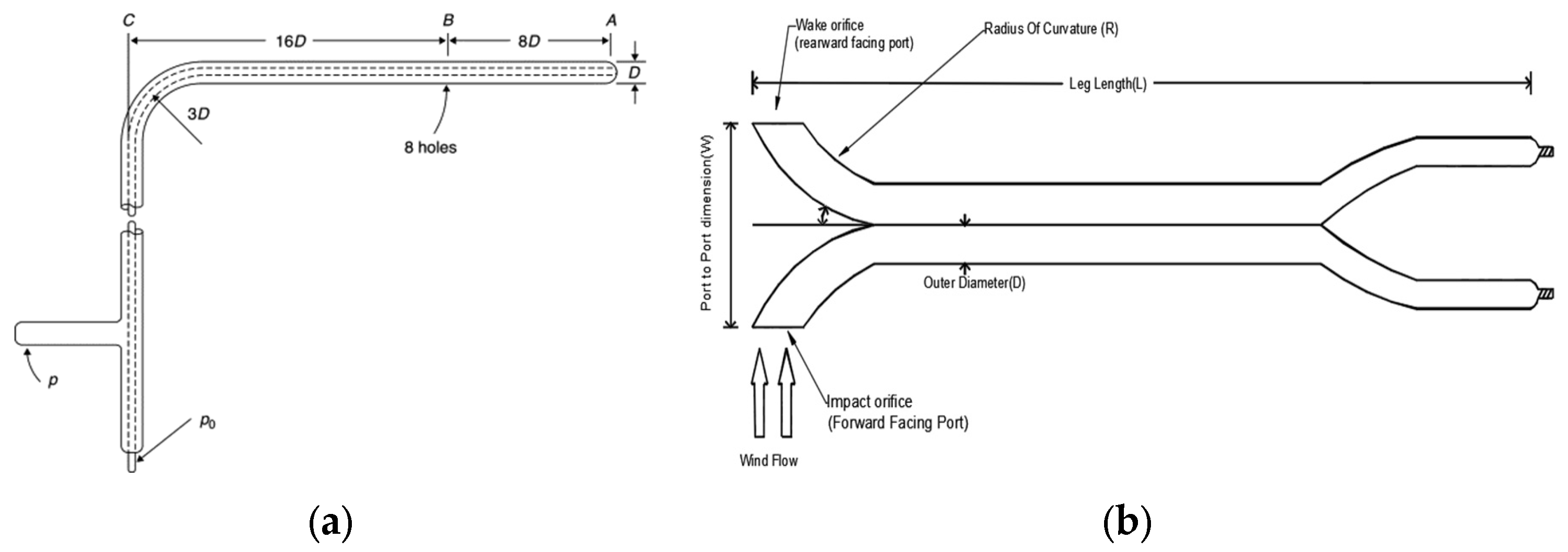
This method is based on Bernoulli’s principle, calculating fluid velocity using the pressure difference between total pressure (stagnation pressure) and static pressure. Pitot tubes are divided into L-type (Figure 1a) and S-type (Figure 1b) [21]. An L-type pitot tube has a simple structure with a single pressure-measuring tube, suitable for clean gas flow measurement. The core structure includes a total pressure hole (facing the airflow direction) and static pressure holes (perpendicular to the airflow direction). The velocity calculation formula is as follows:
v = K 2 × Δ p ρ
where v is the flow velocity, K is the pitot tube calibration coefficient, Δp is the differential pressure, and ρ is the fluid density.
L-type pitot tubes are suitable for clean gas environments but are prone to blockage in high-dust flue gas [39]. S-type pitot tubes, with dual parallel tubes and anti-blocking openings, have become the primary choice for thermal power plants due to their strong dust resistance [40]. To address flow field inhomogeneity, multi-point measurement (e.g., the equal-ring area method) is required, and the installation is recommended to have 5D upstream and 2D downstream straight pipe sections.
Figure 1. Pitot tubes are divided into (a) L-type (static pressure hole) [41] and (b) S-type (dual parallel tubes) [42]. Reprinted with permission from Refs. [41,42]. 2025, Elsevier.
Environments 12 00457 g001

2.1.2. Ultrasonic Flowmeter Method

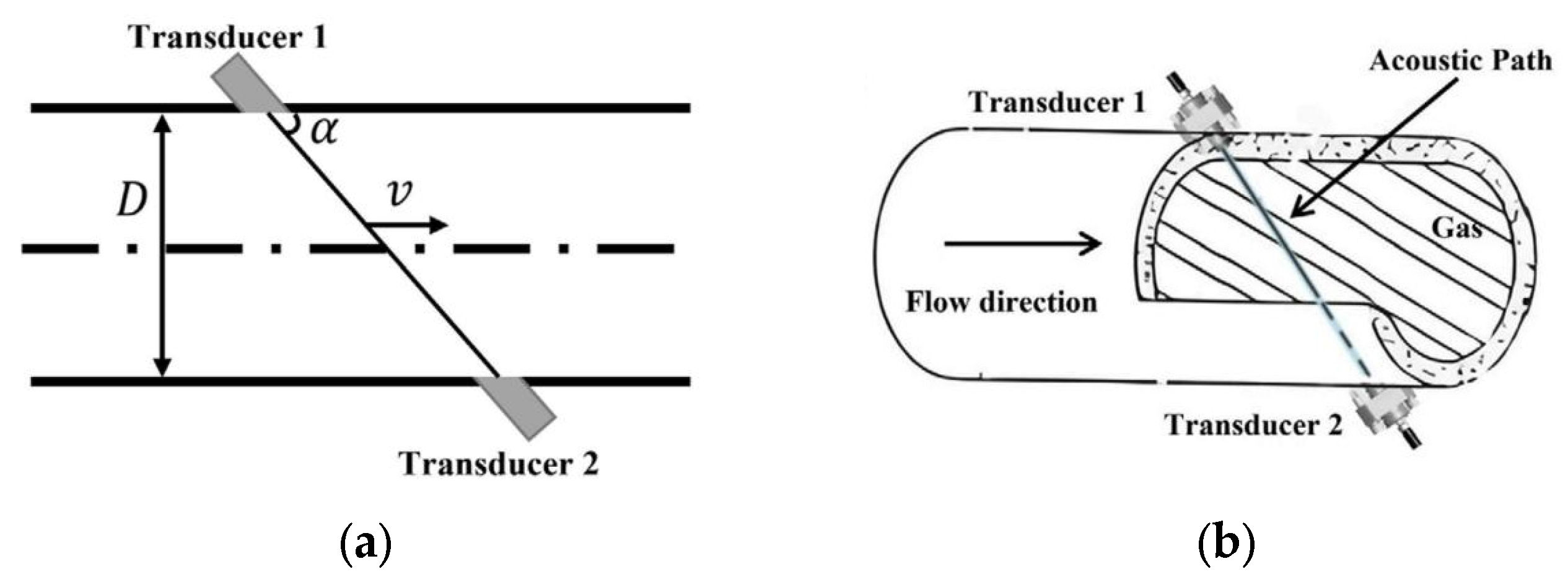
It relies on the time difference or Doppler effect of ultrasonic wave propagation in the airflow. Figure 2a and Figure 2b respectively illustrate the working principle of this method from the planar and three-dimensional perspectives. The time difference method (most widely used) calculates velocity via the propagation time difference between upstream and downstream ultrasonic signals:
V i = L i 2 cos θ × T 2 T 1 T 1 T 2
where Vi is the average flow velocity of the channel (m/s), Li is the length of the channel (m), θ is the angle between the sound wave and the pipeline axis, and T1 and T2 are the propagation times in the downstream and upstream directions, respectively.
Multi-channel (≥6 channels) ultrasonic flowmeters significantly enhance adaptability to complex flow fields by fusing multi-path data through weighted average algorithms [43]. Built-in temperature/pressure sensors enable real-time density correction, reducing annual precision attenuation to ≤0.1% [44]. However, Doppler-type ultrasonic meters (for dusty gas) have lower accuracy than time-difference types, limiting their use in high-precision scenarios.
Long-term stability in high-dust (50~100 mg/m3) and high-humidity (>15%) environments is exhibited: field tests on 600 MW coal-fired units show that ultrasonic flowmeters with self-cleaning probes (ultrasonic vibration + inert gas purge) maintain ≤±1% accuracy attenuation after 6 months of operation; without self-cleaning, probe scaling causes accuracy degradation to ±3~±5% within 3 months [45]. Humidity > 20% increases sound wave propagation deviation by 0.5~1%, which can be compensated via real-time temperature–pressure–humidity (TPH) correction algorithms [46].
Figure 2. The working principle of ultrasonic flowmeters [45]. (a) Illustrates the working principle from a planar perspective. (b) Illustrates the working principle from a three-dimensional perspective. Reprinted with permission from Ref. [45]. 2025, Elsevier.
Environments 12 00457 g002

2.1.3. Tracer Gas Dilution Method

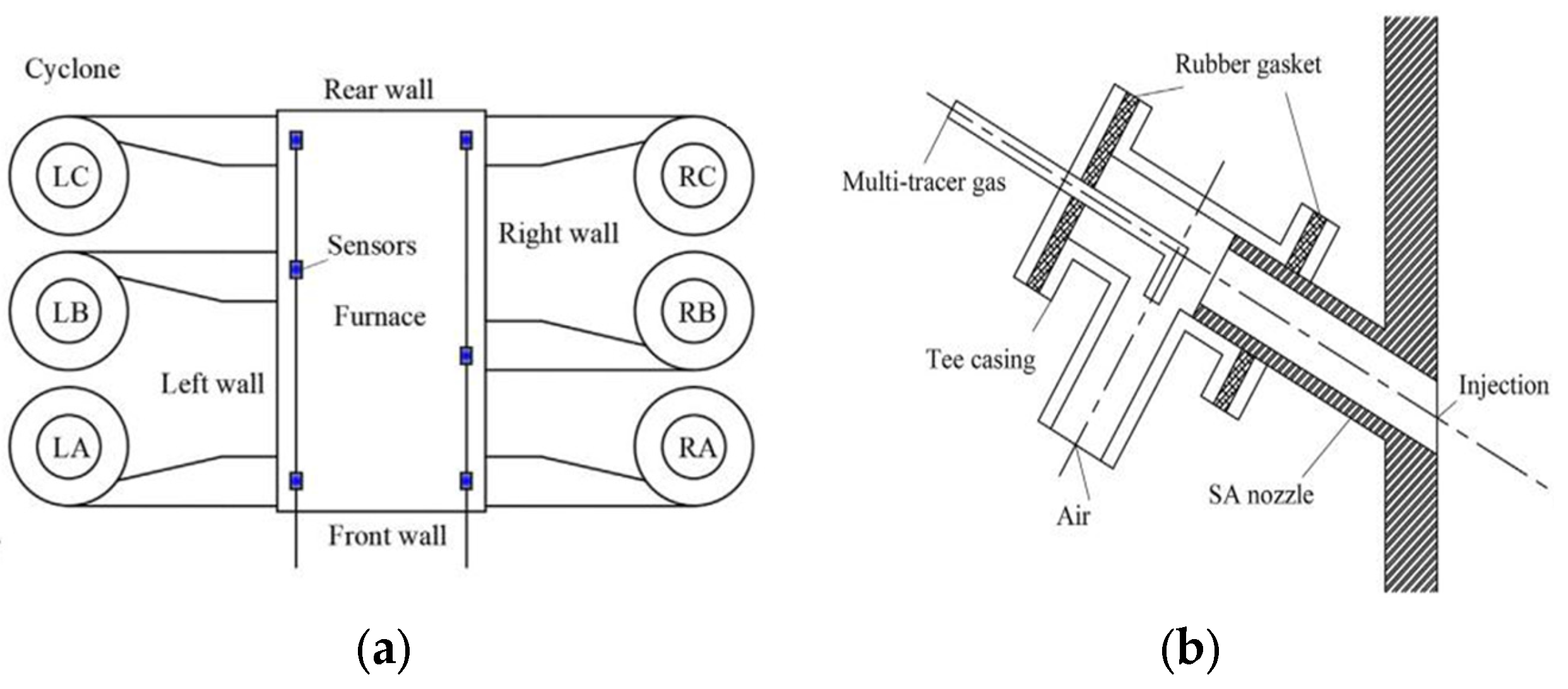
The tracer gas dilution method is an independent flow measurement method [47]. The tracer is injected at a constant rate upstream of the pipeline, the tracer concentration is measured downstream, and the flow is calculated according to the change in concentration (Figure 3). The calculation formula is as follows:
V = X T , 1 X T , D X T , D X T , U V T , 1
Among them, XT,1 is the tracer injection concentration, XT,D and XT,U are the downstream and upstream tracer concentrations, respectively, and VT,1 is the tracer injection rate. The ASTM E2029 [48] standard requires that the tracer be fully mixed with the flue gas, and the relative deviation in the downstream concentration needs to be ≤10%.
It eliminates flow field distortion interference but requires complex equipment and long measurement cycles (minutes level). It is typically used for calibration of online monitoring systems rather than real-time measurement.
Figure 3. (a) Multi-tracer gas measurement system and (b) gas injection [49]. Reprinted with permission from Ref. [49]. 2025, Elsevier.
Environments 12 00457 g003

2.1.4. Summary of Measurement Technologies

Table 1 consolidates the key parameters of mainstream flue gas flow measurement technologies:
In addition, flue structure distortions (e.g., elbows, dampers, insufficient straight pipe sections) significantly affect measurement accuracy. Table 2 quantifies error ranges of mainstream technologies across typical flue layouts, based on field test data from ISO 16911-2 and DL/T 2376-2021 [50]:
For thermal power plants, lifecycle costs (initial procurement + five-year operation/maintenance) and maintenance frequency are critical for technology selection. The following table compares key trade-offs (Table 3).
Considering the overall cost, accuracy, and maintenance trade-offs, the S-type pitot tube offers the lowest initial purchase and operation costs, making it the preferred choice for basic flow monitoring in small- and medium-sized power plants [54]. However, it requires manual cleaning of the filter every month to maintain an accuracy of ±3% to ±5%. The 3D pitot tube and domestic multi-channel ultrasonic flow meters strike a balance between accuracy (±1% to ±2%) and cost, making them suitable for medium-sized and large power plants that need to participate in domestic carbon trading. Imported ultrasonic flow meters have the best accuracy (±0.5% to ±1.5%), but they are costly and are only recommended for use in international carbon trading scenarios. The tracer gas method is more suitable as a regular calibration method for online monitoring systems rather than a real-time measurement tool due to its high single calibration cost and complex operation [45,55].

2.2. CO2 Concentration Measurement Technology

Accurately measuring the concentration of CO2 in flue gas is one of the core links in the direct measurement method of carbon emissions from thermal power generation. The flue gas in the thermal power industry is characterized by high temperature (300~400 °C), high humidity (>15%), high dust content (concentration can reach above 50 mg/m3), and multiple component interferences (including SO2, NOx, etc.), which puts stringent requirements on the anti-interference ability, stability, and accuracy of measurement technology [56]. Currently, the mainstream technologies are all based on the principle of optical absorption, including non-dispersive infrared spectroscopy (NDIR), Fourier transform infrared spectroscopy (FTIR), and tunable diode laser absorption spectroscopy (TDLAS). These three types of technologies each have their own emphases in principles, performance, and application scenarios, together forming the technical system for measuring CO2 concentration.

2.2.1. Non-Dispersive Infrared Spectroscopy (NDIR) Technology

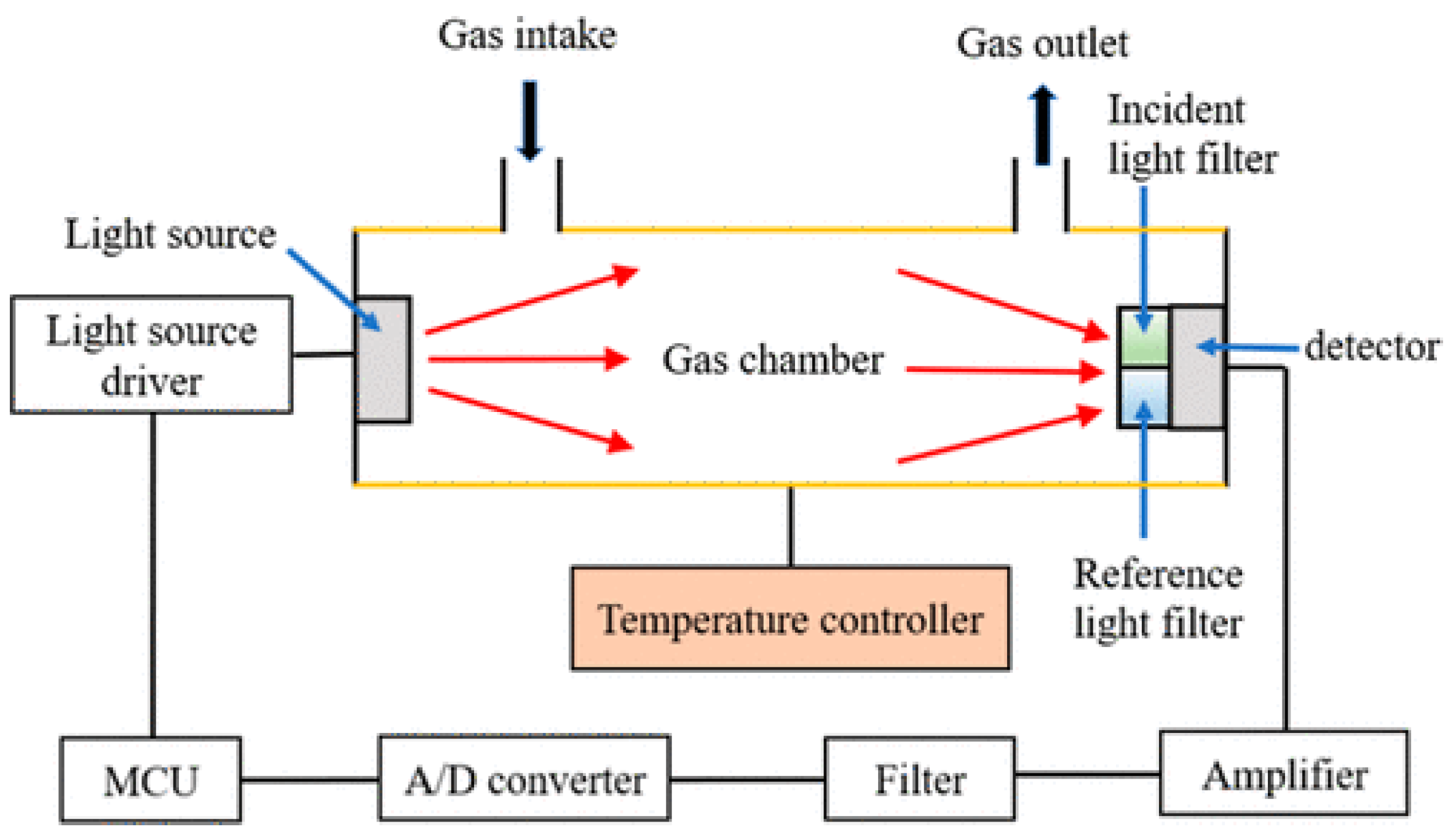
The NDIR technology is currently the most widely used CO2 concentration measurement method in the thermal power industry, based on the selective absorption principle of gas molecules to specific wavelength infrared light. Its core basis is the Lambert–Beer law [57]: when infrared light passes through CO2-containing flue gas, the light intensity in the 4.26 μm band decay due to CO2 absorption, and the degree of decay is positively correlated with CO2 concentration. Due to its simple structure, moderate cost, and good stability, this technology has accounted for more than 90% of the applications in domestic carbon monitoring pilot enterprises (Figure 4); the NDIR sensor consists of an infrared light source, a sample cell (flue gas flows through), a filter (filtering out interference wavelengths), and a detector (receiving the attenuated infrared light). The detector converts the light intensity signal into an electrical signal, and the CO2 concentration is calculated based on the Lambert–Beer law.
Technical features and advantages:
Clear measurement principle: The absorption peak of CO2 at 4.26 μm is almost interference-free from other gases (such as SO2 and NOx, whose absorption peaks are located in different wavelength bands). Through the use of filters, the target wavelength can be accurately locked, achieving a measurement accuracy of ±2% [59].
Low system cost: The unit price of domestically produced NDIR analyzers is approximately 50,000 to 100,000 yuan, which is only 1/5 to 1/10 of the cost of FTIR equipment, and it has low power consumption (<50 W), making it suitable for long-term online operation [60].
Adaptation to high concentration scenarios: The volume concentration of CO2 in thermal power flue gas is typically 12~18%, which can be fully covered by the measurement range of NDIR (0~25%), and good linearity is exhibited (non-linear error < 1%) [61].
Limitations and directions for improvement:
Sensitivity to environmental interference: Water vapor has weak absorption near 4.26 μm. When the flue gas humidity exceeds 15%, it can cause a 2~3% overestimation in the measurement value; dust adhering to the optical window will cause light intensity attenuation, requiring manual cleaning once a month [62]. Currently, through the use of a heated sampling probe (over 120 °C) and a dual-path design (measurement channel + reference channel), some of the interference can be offset, reducing the impact of humidity to within ±1% [63,64].
Long-term drift problem: The aging of the infrared source and the decline in the sensitivity of the detector will lead to a zero drift, which can reach 0.5~1% per month [65]. The novel devices, through integrating an automatic calibration module (periodically switching in a standard gas), can control the drift within 0.2%/month [66].

2.2.2. Fourier Transform Infrared Spectroscopy (FTIR) Technology

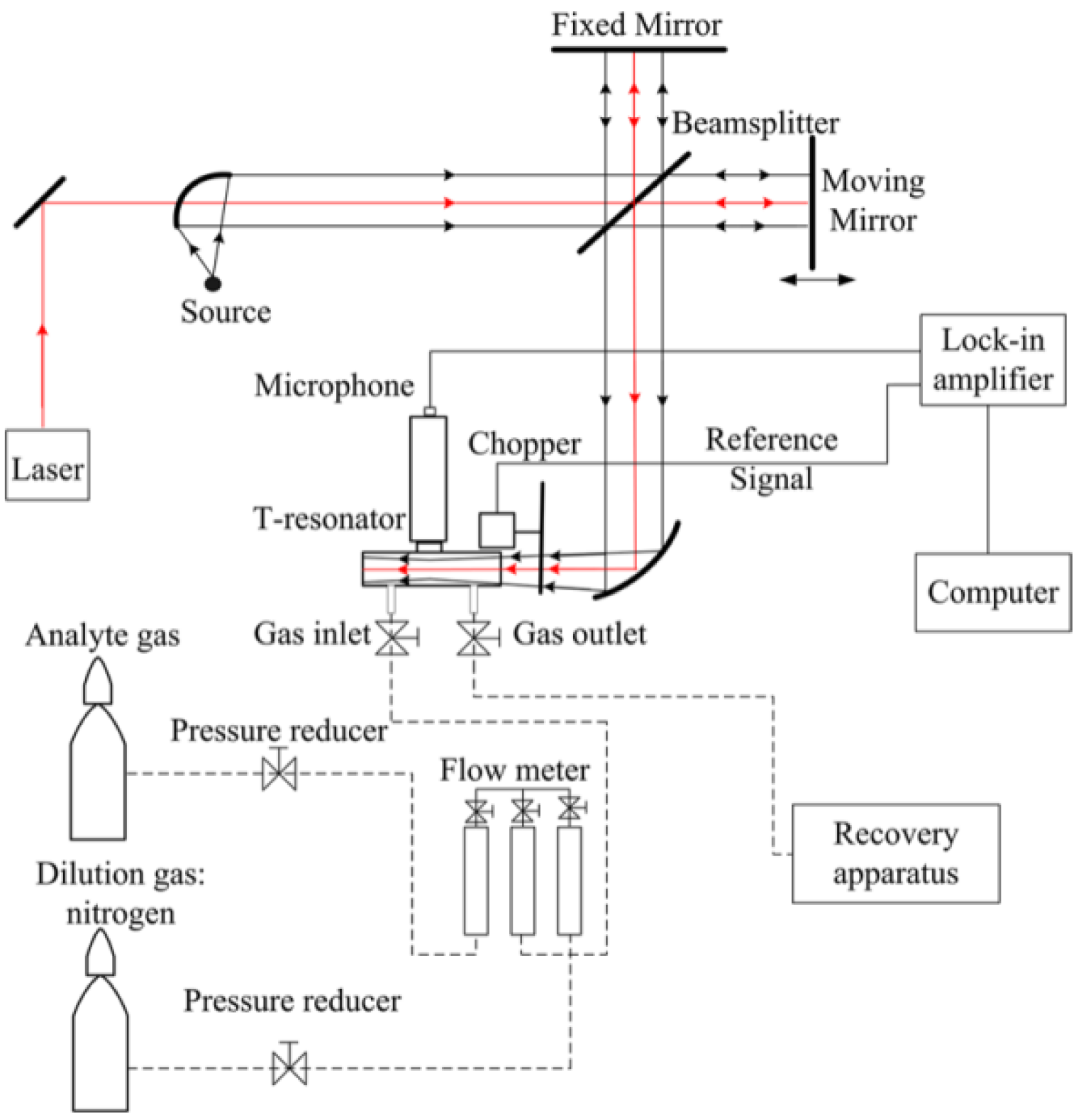
FTIR technology uses an interferometer to decompose infrared light into a full-band spectrum and obtains the absorption spectrum of flue gas through Fourier transformation. It then compares with the standard spectral library to achieve simultaneous measurement of multiple components [54]. Its spectral coverage range is wide (2~16 μm), and it can simultaneously monitor more than a dozen gases such as CO2, SO2, NOx, H2O [55], which has irreplaceable advantages in high-precision multi-parameter monitoring scenarios. Schematic diagram of the FTIR-PAS system (Figure 5): The infrared light source emits broadband light, which is split by a beamsplitter and reflected by a fixed mirror and a moving mirror to form interference light; the interference light passes through the absorption cylinder (containing flue gas) to generate photoacoustic signals, which are detected by a microphone and processed by a lock-in amplifier.
Technical features and advantages:
Multi-component synergistic monitoring: A single measurement can obtain the concentration of CO2 and other pollutants, eliminating the installation and calibration costs of multiple single-component instruments, particularly suitable for the “synergistic emissions reduction” needs of the thermal power industry.
High measurement accuracy: By utilizing a long-path reflective pool (with a light path up to 10 m), detection sensitivity is enhanced. The CO2 measurement accuracy can reach ±0.5%, and the lowest detection limit is as low as 1 × 10⁻⁶, making it suitable for trace leakage monitoring [68].
Strong anti-interference ability: The use of chemometric algorithms (such as partial least squares regression) to separate overlapping absorption peaks can effectively eliminate the influence of water vapor and dust, maintaining an accuracy of ±1% even under conditions with a humidity of >20% [69].
Limitations and directions for improvement:
High equipment cost: The imported FTIR equipment (such as Thermo Fisher Antaris IGS) has a unit price of more than 400,000 yuan, while the domestically produced equipment (such as Beijing Xuedilong) has dropped to 200,000–300,000 yuan, but the core components (interferometer, detector) still rely on imports [70].
Slow response speed: Due to the need for multiple-scan averaging, the response time is usually 5~10 s, making it difficult to capture instantaneous fluctuations in flue gas concentration (such as during rapid load changes in the unit) [59]. By optimizing the scanning frequency and algorithms, some devices have reduced the response time to 2 s [71].

2.2.3. Tunable Diode Laser Absorption Spectroscopy (TDLAS) Technology

TDLAS technology utilizes the wavelength tuning characteristics of semiconductor lasers to precisely lock onto the characteristic absorption lines of CO2 (such as 1572.3 nm), and calculates concentrations by measuring laser absorption intensity [72]. Its line width is extremely narrow (<0.001 nm), which can completely avoid the absorption peaks of other gases, and performs excellently in harsh environments such as high temperatures and high dust [73].
Technical features and advantages:
“Anti-interference ability is prominent: by selecting the isolated absorption lines of CO2 in the mid-infrared band (not affected by water vapor, SO2 interference), in situ measurement (without the need for sampling pretreatment) can be achieved. Under conditions of 300 °C high temperature and dust concentration >100 mg/m3, the measurement deviation is still <1% [74].”
Fast response: The tuning frequency of the laser can reach up to 10 kHz, with a response time of less than 1 s, enabling real-time tracking of CO2 concentration fluctuations during load changes in the unit [75].
Low maintenance requirements: Non-contact measurement is adopted, the optical path has no fragile components, and the probe is designed with a self-cleaning function (such as ultrasonic vibration for ash removal), extending the maintenance cycle to more than 6 months [76].
Limitations and directions for improvement:
Narrow measurement range: A single laser can only cover the absorption lines of one to two types of gases. If it is necessary to monitor other pollutants simultaneously, multiple devices need to be combined, increasing the cost [77].
Temperature sensitivity: The drift of the laser wavelength with temperature can lead to absorption line lock deviation. Through the temperature compensation algorithm, the influence can be reduced to ±0.1%/°C [78].
Intelligent diagnostic function: Through sensor status monitoring (such as laser power, lens contamination), real-time early warning of faults, and automatic switching to backup optical paths, the availability can be improved to over 95% [79].
TDLAS analyzers exhibit conditional stability in harsh environments: In situ tests at boiler outlets (350 °C, 80 mg/m3 dust, 18% humidity) show that probes with sapphire optical windows and air-blowing ash removal maintain ±0.1% accuracy for 8 months; without ash removal, dust accumulation on lenses leads to 0.5~1% accuracy loss per month [76]. Water vapor interference is negligible due to mid-infrared band selection (1572 nm), but condensation on laser diodes (at humidity > 25%) reduces lifespan by 30% [78].

2.2.4. Sampling and System Integration Techniques

The applicable scenarios of the three types of technologies vary in focus (Table 4):
NDIR technology: Suitable for routine monitoring in most thermal power companies, especially in scenarios with limited funds or relatively stable flue gas conditions (humidity < 15%, dust < 30 mg/m3), it can meet the basic accuracy requirements of carbon trading (±2%).
FTIR technology: Suitable for large power plants that require synergistic monitoring of multiple pollutants or enterprises participating in international carbon trading (such as the EU carbon market), its high precision and multi-parameter capabilities can meet stringent data quality requirements.
TDLAS technology: It is preferred for use in harsh conditions with high temperature, high dust, and high humidity (such as at the outlet of boiler flues), or for peak-shaving units that require a high response speed. Its in situ measurement capabilities can reduce maintenance workload.
In summary, the development of CO2 concentration measurement technology is heading towards high precision, anti-interference, and low cost. In the future, further breakthroughs are needed in the localization of core components (such as the interferometer of FTIR and the mid-infrared laser of TDLAS), optimization of sampling and calibration methods, and promotion of the collaborative application of different technologies to provide more reliable support for the precise measurement of carbon emissions in the thermal power industry.

3. Relevant Standards and Specifications

In the field of direct carbon emissions measurement in the thermal power industry, standard specifications are crucial guarantees for ensuring the accuracy, consistency, and comparability of measurement data. With the development of the carbon market and the advancement of measurement technology, domestic- and international-related standards have been continuously improved, covering various aspects including flue gas flow measurement, CO2 concentration monitoring, sampling methods, and data quality control, providing clear technical guidance for the carbon emissions measurement of thermal power enterprises.
To systematically sort out the standard system for direct carbon emissions measurement in the thermal power industry, this study formulated a clear review framework, covering research questions, objectives, methods, and tools, to ensure the comprehensiveness and rigor of standard screening and analysis.

3.1. International Standard

The International Organization for Standardization (ISO) has formulated several core standards for emissions monitoring from stationary pollution sources, providing a common framework for carbon emissions measurement all over the world.
ISO 16911 series: These include “Fixed Pollution Source Emission-Manual and Automatic Determination of Flow Rate and Volume Flow in Piping” (ISO 16911-1:2013 and ISO 16911-2:2013) [80,81], which specify the manual reference methods for flow rate and flow measurement, as well as the requirements for automatic monitoring systems. Among them, ISO 16911-1 details the technical aspects of manual flow measurement using devices such as pitot tubes, including the arrangement of measurement points, pre-investigation methods of flow fields, and data processing procedures; while ISO 16911-2 sets forth requirements for the installation, calibration, and performance evaluation of automatic measuring systems (such as ultrasonic flowmeters), emphasizing that parameters like reproducibility, peak factor, and skewness need to be assessed in the pre-investigation of the flow field, providing a basis for the selection and installation of flowmeters.
ISO 4053-1:1977 [82]: “Gas flow measurement in closed conduits—The tracer method—Part 1: General principles” first incorporated the tracer gas dilution method into the standard, providing an alternative solution for large-caliber pipeline flow measurement. It clarified the basic principles of tracer injection, mixing, and concentration detection, laying the foundation for subsequent applications of the tracer method in carbon emissions calibration.
The EU EN series standards have a mature system in the field of carbon emissions monitoring, with particular emphasis on data quality control and traceability.
EN 14181:2014: “Quality assurance for stationary source emissions—automatic measurement systems” establishes a quality assurance framework for continuous emission monitoring systems (CEMSs), requiring regular calibration, performance audit, and data validity verification for measurement systems of parameters such as flow and concentration, applicable to the daily operation and maintenance of CO2 online monitoring systems in thermal power enterprises [83].
EN 15259:2007 [84]: “Air Quality—Emission Measurement at Fixed Pollution Sources—Requirements for Measurement Section, Measurement Points and Measurement Objectives, Planning and Reporting” specifies in detail the criteria for selecting measurement sections (such as the need to be far away from bend pipes, valves, and other flow-disturbing components), the arrangement methods of measurement points (equi-area principle for circular and rectangular pipes), and the content of the measurement report. It emphasizes that a pre-investigation of the flow field is required through computational fluid dynamics (CFD) or actual measurements before the measurement to ensure the representativeness of sampling.
EN ISO 14956:2002: “Air Quality—Assessment of the Suitability of Measurement Procedures by Comparison with Required Measurement Uncertain” provides a methodology for the uncertainty evaluation of carbon emissions measurement methods, requiring thermal power companies to quantify sources of uncertainty (such as uneven flow distribution, instrument error, etc.) when reporting measurement results, ensuring data reliability.
U.S. EPA Standard Method: The U.S. Environmental Protection Agency (EPA) has formulated mandatory standards for carbon emissions monitoring in the thermal power industry, with strong operability.
EPA Method 2F: This method provides technical details for measuring flue gas flow in stacks using a three-dimensional pitot tube (five-hole probe), including probe calibration, methods for determining yaw and pitch angles, and addresses the limitations of traditional pitot tubes that cannot identify the direction of airflow. It is suitable for high-precision flow measurement under complex flow fields [3].
EPA CFR Part 60: Standards of Performance for New Stationary Sources requires power plants to install CEMS to monitor CO2 emissions, which sets clear requirements for the performance index of flow meters (such as accuracy, repeatability) and data recording frequency (once every 15 min), and mandates an annual audit of system performance through a Relative Accuracy Test Audit (RATA), where the S-type or three-dimensional pitot tube is allowed to be used as a reference method in the RATA procedure [85].

3.2. Chinese Standard

The carbon emissions monitoring standards for China’s thermal power industry started relatively late. However, in recent years, with the advancement of the “dual carbon” goals, the standard system has been rapidly improved, gradually aligning with international standards.
The flow measurement-related standard GB/T 16157-1996 [86]: “Methods for the Determination of Particulate Matter in the Exhaust Gas from Fixed Pollution Sources and Gaseous Pollutant Sampling” is one of the earliest domestic standards to regulate flue gas flow measurement. It stipulates the method of measuring flow velocity using a pitot tube (including S-type) and clarifies the principle of arranging measurement points for circular and rectangular pipelines (such as arranging points by equal area rings for circular pipelines). However, this standard does not cover new types of equipment such as ultrasonic flowmeters, and is currently still being revised to adapt to technological developments.
DL/T 2376-2021: “Technical Specifications for Continuous Monitoring of Carbon Dioxide Emissions from Thermal Power Plant Flue Gas” targets the characteristics of thermal power plants, requiring that the average flow rate relative error of the flue gas flow measurement system does not exceed ±6%, and the flow rate measurement upper limit is not less than 30 m/s; it also recommends the use of three-dimensional pitot tubes or a multi-channel ultrasonic flowmeter, while also clarifying the comparison requirements with reference methods (such as EPA Method 2F) [87].
CO2 concentration monitoring standard HJ 870-2017 [88]: “Determination of Carbon Dioxide in Waste Gas from Fixed Pollution Sources using Non-dispersive Infrared Absorption Method” specifies the method of measuring CO2 concentration using non-dispersive infrared spectroscopy (NDIR) technology. It is applicable to the online monitoring of high concentration CO2 in flue gas from thermal power enterprises, and clarifies the heating temperature of the sampling system (to avoid condensation of water vapor) and calibration frequency (once every 6 months).
HJ 75-2017: “Technical Specifications for Continuous Emission Monitoring of Flue Gas (SO2, NOx, Particulate Matter) from Fixed Pollution Sources” mainly targets conventional pollutants, but its clauses regarding the installation location of CEMS (such as the straight pipe section length requirement) and data validity verification also apply to the CO2 monitoring system, providing a reference for thermal power companies to set up a carbon monitoring platform [89].
Calibration and quality control standards JJG 1030-2007 [90]: “Verification Regulations for Ultrasonic Flowmeters” and “Verification Regulations for Pitot Tube Flowmeters” specify the calibration methods for flowmeters, requiring calibration through wind tunnel experiments before leaving the factory, and regular (usually once a year) in situ flow calibration during on-site use to ensure measurement accuracy.
“Carbon Monitoring Assessment Pilot Work Plan” (CEMB Monitoring Letter [2021] No. 435): Issued by the Ministry of Ecology and Environment, it implements the “flow-concentration” synchronous monitoring requirement in pilot enterprises, although it is not a mandatory standard. It emphasizes the use of tracer gas dilution method for on-site calibration of online flow meters, accumulating practical data for the subsequent formulation of national standards (Table 5).

3.3. Development Trend of Standard Specifications

Technological adaptability expansion: With the application of new technologies such as ultrasonic flowmeters, three-dimensional pitot tubes, and tunable diode laser absorption spectroscopy (TDLAS), existing standards are gradually incorporating the technical requirements of new devices. For example, the domestic GB/T 16157 is being revised to include the measurement layout and data processing methods of multi-channel ultrasonic flowmeters. The European Union’s EN 15259 revision plans to incorporate CFD flow field simulations as an alternative to field pre-investigations, reducing the manpower cost of on-site measurements.
Connection with the carbon market: The standard specification is extending from “pure technical requirements” to “supporting carbon trading.” The U.S. EPA has already used CEMS data as the direct basis for carbon quota accounting, requiring that measurement uncertainty must be less than 5%. China’s “Carbon Emission Rights Trading Management Method (Trial)” clearly stipulates that carbon emissions report data must comply with monitoring standards. In the future, it may further incorporate standards such as ISO 16911 and DL/T 2376 into the accounting system to strengthen data traceability.
Cross-domain collaboration: Carbon emissions measurement involves multi-dimensional data such as flow, concentration, and meteorological parameters, with standards tending towards unified collaboration. For instance, ISO 14956 and EN 14181 have achieved compatibility in uncertainty evaluation methods. Domestically, there is also promotion for the alignment of flow measurement standards (such as DL/T 2376) with CO2 concentration standards (like HJ 870), ensuring that the error of the total carbon emissions calculated by “flow × concentration” is controllable.
Relevant standards and specifications at home and abroad have established the core framework for direct measurement of thermal power carbon emissions. International standards focus on technical universality and uncertainty control, while domestic standards are gradually improving practical requirements in line with the characteristics of the thermal power industry. In the future, with the maturity of the carbon market mechanism and the innovation of measurement technology, the standards will further develop towards “full-process quality control”, “cross-technology collaboration”, and “data traceability”, providing stronger support for accurate measurement of carbon emissions in the thermal power industry. Thermal power companies need to pay close attention to the dynamics of standard updates to ensure that their monitoring systems meet the latest requirements, providing reliable data for carbon trading and emissions reduction decisions.

4. Challenges and Future Directions

The direct measurement method for carbon emissions in the thermal power generation industry faces multiple technical bottlenecks and engineering challenges in practical applications. These issues not only limit the improvement of measurement accuracy but also hinder the large-scale promotion of this method. The detailed analysis is conducted from five dimensions: flow field complexity, environmental interference, quantity traceability, cost control, and standard system.

4.1. Challenges

4.1.1. The Measurement Deviation Caused by Complex Flow Field Is Difficult to Control

The flow field characteristics of thermal power flue gas are the core factors influencing the accuracy of flow rate measurement. Due to the widespread use of bend pipes, fans, valves, and other components in the design of power plant pipelines, flue gas is prone to forming asymmetric velocity distribution, backflow, vortex, and other complex flow fields during the flow process. Measured data show that the yaw angle of flue gas in the chimney can reach ±30°, and the velocity deviation near the wall can even exceed 80% of the average velocity. This flow field distortion can cause errors of up to 25~50% for traditional single-point measurement devices (such as S-type pitot tube) [91].
Although the multi-point array type measurement and three-dimensional (3D) pitot tube technology can partially improve flow field adaptability, new problems arise [92]:
The cost of test point arrangement has surged: For large-diameter flues with a diameter of more than 6 m, at least 12 measurement points are required according to the equal area method (six points for a single diameter). The installation cost of array pitot tubes has increased by 30% to 50% compared to single-point measurement, and the maintenance difficulty has significantly increased [93].
Influence of Dynamic Changes in Flow Field: The distribution of the flow field changes in real-time with the random fluctuations in flue gas flow due to unit load variations (such as during peak shaving periods), making it difficult for static measurement point arrangements to cover all operating conditions. For instance, when the unit load increases from 50% to 100%, the velocity at the center of the flue can increase by two to three times, while the velocity near the wall lags behind, leading to an increased calculation bias in the average cross-sectional velocity [94].
Limitations of Numerical Simulation: Although computational fluid dynamics (CFD) can assist in pre-investigating the flow field, it is difficult to accurately model parameters such as the roughness of the actual flue and the thickness of ash accumulation. The deviation between simulation results and measured values often exceeds 10%; thus, it cannot completely replace on-site flow field tests [95].

4.1.2. The Continuous Interference of High Humidity and High-Dust Environment on the Stability of Instruments

The high humidity (often >15%) and high dust concentration (up to 50 mg/m3 or more) characteristics of thermal power flue gas will seriously affect the long-term operation stability of the measuring equipment.
Impact on flow measurement equipment: The pressure measurement hole of the S-type pitot tube is prone to blockage by dust, requiring at least one manual cleaning per month; otherwise, the differential pressure measurement deviation will increase to more than 10%; the probe scaling of the ultrasonic flowmeter will cause a 20~30% decay of sound waves, and in high-humidity environments, the water film formed on the probe surface will also change the path of sound wave propagation, reducing the measurement repeatability to below 1.5% [96].
Interference of CO2 concentration measurement: The optical window of the non-dispersive infrared (NDIR) sensor is prone to the condensation of water vapor and dust adhesion, and the infrared absorption signal of 4.26 μm band will be masked by the absorption peak of water vapor, resulting in a deviation of more than 5% in the measurement of CO2 concentration [58,97]; even if a heated sampling probe (over 120 °C) is used, after long-term operation, the drift amount will still accumulate to 2%/month due to lens contamination.
Shortened equipment lifespan: The combined effect of high-temperature flue gas (300~400 °C) and corrosive components (such as SO2, HCl) accelerates the aging of materials in pitot tubes and sensor probes. For instance, the metal tube of the S-type pitot tube can corrode at a rate of up to 0.1 mm per year in high-humidity flue gas, leading to a 1~2% deviation in the calibration coefficient K from its initial value [98].
Quantitative impact of high-dust/high-humidity on equipment lifespan: S-type pitot tubes corrode at 0.1 mm/year in SO2-rich (500 ppm) flue gas, leading to K coefficient deviation of 1~2% after 2 years; NDIR sensors with heated sampling probes (>120 °C) reduce humidity-induced drift from 2%/month to 0.5%/month [62,98].

4.1.3. There Is a “Last Mile” Break in the Value Traceability System

The traceability of measurement values is the foundation for ensuring the accuracy of measurement data. However, the traceability chain for large-diameter flue gas flow measurement has significant shortcomings in the on-site link.
Lack of large-caliber real flow calibration devices: The maximum caliber of existing domestic flow standard devices is mostly 1 m, which cannot cover the flue size of more than 6 m in the thermal power industry. The differences between laboratory calibration and field conditions (such as temperature, pressure, flow rate range) can cause the actual error of the equipment in the field to expand by two or three times compared to the calibration value [99].
Limitations of on-site calibration methods: The currently adopted Relative Accuracy Test Audit (RATA) mostly relies on the S-type pitot tube as a reference method. However, this method itself has biases in complex flow fields and cannot verify the performance of high-precision flow meters such as multi-channel ultrasonic flow meters [100]. Although the tracer gas dilution method is considered an ideal on-site calibration means, its equipment is complex and the operation cost is high (with a single calibration costing more than 100,000 yuan), making it difficult to be regularly applied.
Insufficient comparability of cross-device data: The measurement results of different principles of flow meters (such as pitot tube and ultrasonic) in the same flue can deviate by 5~10%, and there is a lack of unified value transfer standards, leading to frequent data disputes in carbon trading [101].

4.1.4. The Difficulty in Balancing Cost and Cost-Effectiveness

The high cost of the direct measurement method is a key factor constraining its popularization in the thermal power industry, specifically reflected in the following:
The cost of equipment procurement is high: The initial investment for a complete direct measurement method system (including multi-channel ultrasonic flowmeters, FTIR analyzers, data acquisition units) is about 1.5 to 2 million yuan, which is 10 to 15 times the cost of the emissions factor method. Among them, the unit price of imported ultrasonic flowmeters exceeds 100,000 yuan, and the price of the 3D pitot tube system reaches more than 500,000 yuan.
Continuous investment in operation and maintenance costs: Equipment requires at least two calibrations per year (standard gas, real flow calibration), with a single calibration costing approximately 50,000 yuan; in high-dust environments, the replacement cycle for sensors is shortened to 1~2 years, with annual operation and maintenance costs reaching 200~300,000 yuan.
Long cost recovery cycle: For small- and medium-sized thermal power plants (installed capacity < 300 MW), the benefits from carbon trading cannot cover the investment in direct measurement methods, leading to a lack of incentive for technological upgrades by enterprises. Surveys indicate that currently only 30% of thermal power units in the country have installed direct measurement systems that meet accuracy requirements, and these are mostly concentrated among large power generation groups.

4.1.5. There Is a Gap Between the Standard System and Engineering Practice

Although many standards have been issued both domestically and internationally (such as ISO 16911, HJ 75-2017), there are still deficiencies in the detailed specifications for large-diameter flue gas measurement.
Ambiguity in flow field pre-survey requirements: ISO 16911-2:2013 requires the assessment of flow field reproducibility, peak factor, and skewness before measurement, but does not specify the exact measurement frequency and data threshold, leading to the simplification of flow field testing in actual enterprise operations.
Lag in new technology standards: The calibration methods for new technologies such as three-dimensional (3D) pitot tube and laser doppler velocimetry (LDV) have not been incorporated into domestic standards, leaving enterprises without a basis for operation. For instance, the method for calculating the yaw angle correction coefficient of the 3D pitot tube is not stipulated in DL/T 2376-2021, leading to measurement deviations of 3% to 5% among equipment from different manufacturers.
Data validity determination lacking: The standards are unclear about the definition of “abnormal data” (such as fluctuation ranges of flow rates, threshold values for concentration changes), often leading companies to face the risk of carbon trading penalties due to disputes over data validity.
In conclusion, the promotion of direct measurement methods for carbon emissions from thermal power generation needs to break through multiple challenges such as flow field regulation, environmental adaptability, quantity traceability, cost control, and standard improvement. In the future, it is necessary to promote the balance between measurement accuracy and economy through the coordinated efforts of technological innovation and system construction, providing reliable data support for the achievement of the “dual carbon” goal (Table 6).

4.2. Future Outlook Technology Innovation

4.2.1. Technological Optimization

Flow field complexity in large-diameter flues (e.g., swirl, asymmetric distribution, backflow) is the core bottleneck limiting the accuracy of flow rate measurement. According to the requirements of BS-EN-15259:2007 [84], the ideal measurement section needs to meet the “five times the pipe diameter upstream and two times the pipe diameter downstream” straight pipe section condition, but the actual thermal power flue often cannot be achieved due to space limitations, resulting in a flow velocity distribution deviation of up to ±30%. Future technological innovation will focus on active flow field control, optimizing flow field uniformity through multi-stage combination rectification devices.
The “Plate–Cell–Contraction Section” three-stage rectifier has been verified experimentally: under extreme conditions with no straight pipe section after a single elbow or spatial elbow, it can control the flow velocity distribution coefficient within 0.8 (close to the level of fully developed flow field), with only a 17% to 35% increase in pressure loss. This technology improves the flow measurement accuracy under non-ideal flow conditions to ±2.5% by dividing the turbulent flow field, straightening the airflow direction, and adjusting the concentricity of the contraction. The next steps in research and development include optimizing the structural parameters of the rectifier using numerical simulation (CFD), designing modular rectification components for ultra-large flues over 6 m, and dynamically adjusting rectification strategies based on real-time flow field monitoring data to achieve “adaptive flow field correction”.

4.2.2. The Integration of Multi-Dimensional Measurement Technology

It is difficult to utilize traditional single-point or single-line measurements to reflect the overall velocity distribution of large-diameter flues. BS-EN-15259:2007 emphasizes that grid measurements need to divide equal area units based on the shape of the duct (rings for circular flues, blocks for rectangular flues), but multi-point arrangements will increase equipment costs and maintenance difficulties. Future innovations will promote the integration of “point–line–surface” multi-dimensional measurements.
Arrayed Sensor Network: Based on the principle of equal area distribution of S-type pitot tubes, a miniaturized, low-cost differential pressure sensor array is developed. For instance, in a circular flue with a diameter of 6 m, 96 miniature S-type pitot tubes are arranged according to twelve radial points and eight circumferential points, and data is synchronously collected through a wireless sensor network, combined with the velocity–area method to integrally calculate flow. This technology can enhance the spatial resolution to 0.5 m × 0.5 m, capturing subtle flow field features such as local vortices.
Laser Doppler Velocimetry (LDV) in Collaboration with Ultrasonics: Combining the planar scanning capabilities of LDV with the linear measurement advantages of ultrasonic flowmeters, a grid-like velocity measurement area is formed in the flue section by laser beams. The ultrasonic signals correct for deviations in flow direction, achieving real-time reconstruction of the three-dimensional flow field. This method does not require the insertion of probes, is suitable for high-dust and high-temperature environments, and the measurement uncertainty can be controlled within ±1.5%.
Tracer Gas Intelligent Sampling: A multi-point injection, multi-port sampling system was developed. By arranging eight tracer (such as SF6) injection points in a ring upstream of the flue, and correspondingly arranging 16 sampling ports downstream, the velocity field is calculated based on concentration distribution. Experiments show that the measurement error of this technology at five times the pipe diameter downstream of the bend is ≤3%, and it is not affected by flow field distortion.

4.2.3. The Localization and High Precision of Optical Detection Technology

The precision of CO2 concentration measurement directly affects the accuracy of carbon emissions quantification. Currently, the predominant technology in the country is non-dispersive infrared spectroscopy (NDIR). However, Fourier transform infrared spectroscopy (FTIR) and tunable diode laser absorption spectroscopy (TDLAS) are becoming the future direction due to their higher precision (≤1%). The technological breakthroughs include the following:
The domestication of mid-infrared laser sources: TDLAS technology relies on distributed feedback lasers (DFB) in the 1572 nm band, which are mainly imported at present. Domestic chips have now been developed, with a linewidth of ≤1 MHz, stability (long-term drift ≤ 0.1%/day) at an international level, a 60% reduction in cost, and the ability to realize in situ real-time measurement of CO2 concentration.
Multi-component synchronous monitoring: Based on FTIR technology, a broadband detection system covering the 2~16 μm wavelength range is developed to synchronously measure parameters such as CO2, O2, and H2O. By improving the interferometer resolution (≤0.01 cm−1) and signal processing algorithms (such as partial least squares regression), the cross-sensitivity of interference substances such as SO2 and NOx is reduced to below 0.5%, meeting the requirements for coordinated monitoring of multiple pollutants in thermal power flue gas.
Anti-interference hardware design: Targeting environments with high humidity (>20%) and dust (>50 mg/m3), a heated sampling probe (constant temperature at 180 °C) and a self-cleaning optical window (ultrasonic vibration + inert gas purge) were developed. This extended the equipment maintenance cycle from weekly to monthly, reducing operation and maintenance costs.

4.2.4. Intelligence and Digital Transformation

Edge Computing and Real-time Calibration: This includes integrating a microprocessor in the flow meter, establishing a flow field-error model based on historical data, and real-time correction of deviations caused by non-ideal working conditions (such as temperature fluctuations, sudden changes in flow velocity). For example, when a flow velocity fluctuation greater than 10%/min is detected, it automatically calls for backup measurement point data and enables the weighted algorithm to ensure measurement stability.
Application of Digital Twin Technology: Construct a digital twin of the flue gas flow field, drive model iteration through real-time feedback data from on-site sensors, and predict flow velocity distribution under different operating conditions. The flow field pre-investigation recommended by British Standard BS-EN-15259:2007 can be virtualized via digital twinning, reducing on-site experiment costs while optimizing the layout of measurement points (e.g., adding monitoring points in vortex areas).
Innovation in the Quantitative Value Traceability System: This consists of establishing a field calibration device based on the “standard table method + tracer method”. For example, by combining a portable ultrasonic flow standard device (with an uncertainty of ±0.1%) with an SF6 tracer system, online flow calibration is achieved in a 6 m diameter flue, addressing the discrepancy between traditional laboratory calibration and on-site conditions.

4.2.5. Innovation in Design Materials for Low-Cost and High-Reliability

Developing high-temperature-resistant (>400 °C) and corrosion-resistant ceramic-based composite materials for pitot tubes and sensor probes extends their lifespan from 1 year to 3 years; using sapphire optical windows as a replacement for traditional quartz materials enhances abrasion resistance by five times.
Modular Architecture: The flow, concentration, and temperature–pressure monitoring modules are designed as standardized components, supporting combination on demand. For instance, the basic version only retains the S-type pitot tube and NDIR module (cost ≤ 50,000 yuan), while the high-end version integrates TDLAS and laser speed measurement functions (cost ≤ 200,000 yuan), adapting to the needs of different enterprises.
“Low Power Technology: Employing energy-harvesting techniques (such as flue gas temperature difference power generation) to power sensors, combined with LoRa wireless transmission, reduces wiring costs and is applicable to the retrofitting of old power plants.”

5. Conclusions

The thermal power industry is a core global source of carbon emissions, and precise carbon emissions measurement is indispensable for achieving carbon neutrality. From a technical perspective, the S-type pitot tube remains dominant in domestic thermal power plants due to its dust resistance, but its accuracy in complex flow fields can be enhanced by combining CFD simulation and multi-point layout. Ultrasonic flowmeters, with their non-contact advantage, and TDLAS technology, with superior anti-interference and high precision, are the most promising directions for future development–domestication of core components (e.g., mid-infrared lasers, high-frequency transducers), which will be key to reducing costs and promoting large-scale application.
In terms of standards, international frameworks such as ISO 16911 and EN 15259 provide mature technical specifications for flow field pre-investigation and measurement quality control, while domestic standards (e.g., DL/T 2376-2021, GB/T 16157 revised version) are gradually aligning with international practices but still lack detailed calibration norms for new technologies like 3D pitot tubes and tracer gas methods. Bridging the gap between standards and engineering practice, especially in large-diameter flue traceability and data validity determination, is crucial for supporting global carbon trading.
To accelerate the adoption of direct measurement methods, actionable recommendations include (1) promoting flow field rectification technology and digital twin applications to improve adaptability to complex working conditions; (2) strengthening R&D on localized optical detection components to balance precision and cost; (3) establishing a unified cross-border standard alignment mechanism and traceability system to enhance data comparability; (4) developing modular and low-cost equipment packages to meet the needs of small- and medium-sized thermal power plants. These efforts will provide reliable data support for global thermal power carbon emissions control and contribute to the achievement of carbon neutrality goals.

Author Contributions

Conceptualization, J.L. and X.X.; methodology, J.L.; software, J.L.; validation, Z.L. and X.X.; formal analysis, X.X.; investigation, Z.L.; resources, X.S. and X.X.; data curation, Y.W. and F.C.; writing—original draft preparation, J.L.; writing—review and editing, J.L. and X.X.; supervision, Z.L.; project administration, J.L., X.S. and X.X.; funding acquisition, X.X. and X.S. All authors have read and agreed to the published version of the manuscript.

Funding

Science & Technology Fundamental Resources Investigation Program (Grant No. 2022FY101200); Push and Update of Metrological Information Data (APT2501-2).

Data Availability Statement

No new data were created or analyzed in this study.

Conflicts of Interest

The authors declare no conflicts of interest.

References

  1. Xia, G.; Sun, Q.; Cao, X.; Wang, J.; Yu, Y.; Wang, L. Thermodynamic analysis and optimization of a solar-powered transcritical CO2 (carbon dioxide) power cycle for reverse osmosis desalination based on the recovery of cryogenic energy of LNG (liquefied natural gas). Energy 2014, 66, 643–653. [Google Scholar] [CrossRef]
  2. Böhringer, C.; Löschel, A.; Moslener, U.; Rutherford, T.F. EU climate policy up to 2020: An economic impact assessment. Energy Econ. 2009, 31, S295–S305. [Google Scholar] [CrossRef]
  3. United States Environmental Protection Agency. Method 2F-Flow Rate Measurement with 3-D Probe; United States Environmental Protection Agency: Washington, DC, USA, 1999. [Google Scholar]
  4. Sun, L.-L.; Cui, H.-J.; Ge, Q.-S. Will China achieve its 2060 carbon neutral commitment from the provincial perspective? Adv. Clim. Change Res. 2022, 13, 169–178. [Google Scholar] [CrossRef]
  5. Zhang, C.; Zou, X.; Lin, C. Carbon Footprint Prediction of Thermal Power Industry under the Dual-Carbon Target: A Case Study of Zhejiang Province, China. Sustainability 2023, 15, 3280. [Google Scholar] [CrossRef]
  6. The EU Emissions Trading System. Available online: https://climate.ec.europa.eu/system/files/2016-12/factsheet_ets_en.pdf (accessed on 10 July 2025).
  7. IPCC. 2013 Supplement to the 2006 IPCC Guidelines for National Greenhouse Gas Inventories: Wetlands. Available online: https://www.ipcc.ch/site/assets/uploads/2018/03/Wetlands_Supplement_Entire_Report.pdf (accessed on 31 October 2025).
  8. IPCC. 2006 IPCC Guidelines for National Greenhouse Gas Inventories. Available online: https://www.ipcc-nggip.iges.or.jp/public/2006gl/index.html (accessed on 10 July 2025).
  9. IPCC. 2019 Refinement to the 2006 IPCC Guidelines for National Greenhouse Gas Inventories. Available online: https://www.ipcc-nggip.iges.or.jp/public/2019rf/index.html (accessed on 10 July 2025).
  10. Summary of the Clean Air Act. Available online: https://www.epa.gov/laws-regulations/summary-clean-air-act (accessed on 10 July 2025).
  11. The Plain English Guide to the Clean Air Act. Available online: https://www.epa.gov/sites/default/files/2015-08/documents/peg.pdf (accessed on 10 July 2025).
  12. Clean Air Act Title IV-Subchapter A: Acid Deposition Control. Available online: https://www.epa.gov/clean-air-act-overview/clean-air-act-title-iv-subchapter-acid-deposition-control (accessed on 10 July 2025).
  13. Xiong, L.; Wang, M.; Mao, J.; Huang, B. A Review of Building Carbon Emission Accounting Methods under Low-Carbon Building Background. Buildings 2024, 14, 777. [Google Scholar] [CrossRef]
  14. Madrazo, J.; Clappier, A. Low-cost methodology to estimate vehicle emission factors. Atmos. Pollut. Res. 2018, 9, 322–332. [Google Scholar] [CrossRef]
  15. Schwarzböck, T.; Rechberger, H.; Cencic, O.; Fellner, J. Determining national greenhouse gas emissions from waste-to-energy using the Balance Method. Waste Manag. 2016, 49, 263–271. [Google Scholar] [CrossRef] [PubMed]
  16. Aaron, D.; Tsouris, C. Separation of CO2 from flue gas: A review. Sep. Sci. Technol. 2005, 40, 321–348. [Google Scholar] [CrossRef]
  17. Hogeling, J. Why Is It Important to Address Measurement Quality Issues in Standards? How Standards Can Contribute? 2014. Available online: https://www.aivc.org/sites/default/files/1-2.pdf (accessed on 10 July 2025).
  18. Firdaus, E.; Saaed, K.; Bryant, D.; Jones, M.; Biggs, S.; Bahawodin, B. Assessment and modelling of the waste heat availability from gas turbine based CHP systems for ORC systems. RE&PQJ 2012, 10, 11. [Google Scholar] [CrossRef]
  19. Stolaroff, J.K.; Weber, C.L.; Scott Matthews, H. Design issues in a mandatory greenhouse gas emissions registry for the United States. Energy Policy 2009, 37, 3463–3466. [Google Scholar] [CrossRef]
  20. Bo, L.; Dongbin, W.; Tonghao, L.; Jianguo, D.; Xiangxian, L.; Junxia, W.; Hong, J. Analysis of online monitoring of flue gas CO2 concentration and flowrate from stationary sources. J. Atmos. Environ. Opt. 2025, 1–21. Available online: https://link.cnki.net/urlid/34.1298.O4.20250211.1405.002 (accessed on 10 July 2025).
  21. Zhu, W.; Zhu, J.; Xu, H.; Fan, L.; Zu, L. Flue gas on-line monitoring techniques of continuous emission monitoring system. Anal. Instrum. 2011, 83–88. Available online: https://kns.cnki.net/kcms2/article/abstract?v=0YYC1NNgyEDOGRqOAUBN04x0MhPww804tpWqhVAtHzmnC4ExKQUntrZKgt_SKCR_MQl-NqEMFStKm4GswHrUjR6FPpp1t4NRiqXAx94FHd2SkGMv9H6EQ-AqDd7NzVPYcOBJZlUs61jJSpIPYl1R2AZin_bFG7eDkCJk3N3AKZYvTWuDDUFp4mV1r7AjpUQP&uniplatform=NZKPT&language=CHS (accessed on 10 July 2025).
  22. Xu, R.; Zhai, H.; Wang, X.; Xiao, Y.; Zhang, T.; Peng, L.; Xue, L. Study on Flue Gas Flow Measurement Method Based on S-Type Pitot Tube. Metrol. Sci. Technol. 2023, 67, 39–44. [Google Scholar] [CrossRef]
  23. Yang, M.; Zhang, L.; Fang, L.; Wang, C. International Comparison of Pitot Tube for Nulling Method. ACTA Metologica Sin. 2022, 43, 1050–1057. [Google Scholar] [CrossRef]
  24. Liu, N.; Li, Z.; Shen, J. Study on the online measurement method of the flue gas flow of multi-grid. Environ. Monit. Forewarning 2013, 5, 32–34. Available online: https://kns.cnki.net/kcms2/article/abstract?v=oWJgMrFo8udJ3WIsTNADhcO-mfL3QewYRbI-gNMKOVb9qqg1khSTrB4gsivFbSjD8bo7L9zEw4xLIJLDBLpjRjMx8cbeb4qDkxK0NeZhp_llOE2OEaRXCR9tI4vYTGLCkDaC1T9ulhLf2HAu2z12GjHH8-A0C29DaetZ3_xU7giRcvOgf_ekeZH5Lc1hQaNO&uniplatform=NZKPT&language=CHS (accessed on 10 July 2025).
  25. LI, H.; Ge, Z.; Song, J. Review on the direct monitoring method of greenhouse gas emissions from stationary pollution sources. China Meas. Test 2022, 48, 181–188. Available online: https://kns.cnki.net/kcms2/article/abstract?v=0YYC1NNgyEAMwvibz-OmAcZun31hLMd8wNDmXB84GfbNCsjHQvB2t2z7fqVGuLU861lte-XWbG5yghGzQdpKhlJzzRTjeCUScWGj5u41KhIZRKvq7npIkUfzvhzywUyieypTZRN3Q_TvuMp4iJ6WtQFzQCju0XgMBXiAJULYGl2w1lts4OX5qveWDbYK0WIBtLAGllBTIOk=&uniplatform=NZKPT&language=CHS (accessed on 10 July 2025).
  26. Tombak, M.-L.; Tapaninen, U.; Kotta, J. Methods for Calculating Greenhouse Gas Emissions in the Baltic Sea Ports: A Comparative Study. Sustainability 2025, 17, 639. [Google Scholar] [CrossRef]
  27. Bryant, R.; Bundy, M.; Zong, R. Evaluating measurements of carbon dioxide emissions using a precision source—A natural gas burner. J. Air Waste Manag. Assoc. 2015, 65, 863–870. [Google Scholar] [CrossRef]
  28. Liang, J.-G.; Jiang, Y.; Wu, J.-K.; Wang, C.; von Gratowski, S.; Gu, X.; Pan, L. Multiplex-gas detection based on non-dispersive infrared technique: A review. Sens. Actuators A Phys. 2023, 356, 114318. [Google Scholar] [CrossRef]
  29. Dejie, R. Optimization of supporting design for medical waste incineration process and testing analysis of incineration system performance. J. Environ. Eng. Technol. 2024, 14, 545–550. [Google Scholar] [CrossRef]
  30. Gao, M.; Liu, W.; Zhang, T.; Liu, C.; Liu, J.; Wei, Q.; Lu, Y.; Wang, Y.; Zhu, J.; Xu, L. Passive FTIR remote sensing of gaseous pollutant in heated plume. Spectrosc. Spectr. Anal. 2006, 26, 47–50. [Google Scholar]
  31. Phillips, F.A.; Naylor, T.; Forehead, H.; Griffith, D.W.; Kirkwood, J.; Paton-Walsh, C. Vehicle ammonia emissions measured in an urban environment in Sydney, Australia, using open path fourier transform infra-red spectroscopy. Atmosphere 2019, 10, 208. [Google Scholar] [CrossRef]
  32. Zhang, S.; Qian, J.; Li, C.; Xu, L.; Gao, M.; Liu, J. Application of FTIR Spectroscopy in On-Line Monitoring of Multi Flue Gas. J. Atmos. Environ. Opt. 2016, 11, 31–36. Available online: https://kns.cnki.net/kcms2/article/abstract?v=3ruWTMGvziWo88QLiwxyAVt2a65pKrUsq2HkHz18bRDg-tk0sdSlkfn3Cw-isjyYNQ8i_AiU9iNAjQ-K5ay0Y64pk6juEn323tJyZDWop7MTclTcDVzSIOMwvtt9-nnAvUumLIOslLy8MZq8E-Ga_WhzubNuNU8SlzMXLnm0aPY=&uniplatform=NZKPT&language=CHS (accessed on 10 July 2025). [CrossRef]
  33. Durry, G.; Li, J.S.; Vinogradov, I.; Titov, A.; Joly, L.; Cousin, J.; Decarpenterie, T.; Amarouche, N.; Liu, X.; Parvitte, B.; et al. Near infrared diode laser spectroscopy of C2H2, H2O, CO2 and their isotopologues and the application to TDLAS, a tunable diode laser spectrometer for the martian PHOBOS-GRUNT space mission. Appl. Phys. B 2010, 99, 339–351. [Google Scholar] [CrossRef]
  34. Liu, W.; Xing, C. Needs and challenges of optical atmospheric monitoring on the background of carbon neutrality in China. Front. Environ. Sci. Eng. 2024, 18, 73. [Google Scholar] [CrossRef]
  35. Wang, S.; Wang, Z.; Li, Y.; Zhang, T.; Gong, W.; Wei, Y.; Zhai, R. Carbon dioxide detection system based on TDLAS technology. In Proceedings of the 2021 19th International Conference on Optical Communications and Networks (ICOCN), Qufu, China, 23–27 August 2021; pp. 1–4. [Google Scholar]
  36. Bryant, R.A.; Johnson, A.N.; Wright, J.D.; Wong, T.M.; Whetstone, J.; Moldover, M.R.; Swiggard, S.; Gunning, C.; Elam, D.L.; Martz, T. Improving Measurement for Smokestack Emissions: Workshop Summary; US Department of Commerce, National Institute of Standards and Technology: Gaithersburg, MD, USA, 2018. [Google Scholar]
  37. Fu, L.; You, S.; Li, G.; Fan, Z. Enhancing methane sensing with NDIR technology: Current trends and future prospects. Rev. Anal. Chem. 2023, 42, 20230062. [Google Scholar] [CrossRef]
  38. Li, C.; Wang, X.; Ye, H.; Wu, S.; Shi, H.; An, Y.; Sun, E. Assessment of thermal power plant CO2 emissions quantification performance and uncertainty of measurements by ground-based remote sensing. Environ. Pollut. 2024, 361, 124886. [Google Scholar] [CrossRef]
  39. Cejpek, O.; Šíp, J.; Malý, M.; Jedelský, J.; Tomáš, Z. Analysis of velocity profile measurements obtained by different methods in low-speed, small-scale wind tunnel. EPJ Web Conf. 2022, 269, 01007. [Google Scholar] [CrossRef]
  40. Kang, W.; Trang, N.D.; Lee, S.; Lee, S.H.; Choi, Y.M. Uncertainty analysis of stack gas flow measurements with an S-type Pitot tube for estimating greenhouse gas emissions using a continuous emission monitoring system. Metrologia 2020, 57, 065031. [Google Scholar] [CrossRef]
  41. Pitot-Static Tube. Available online: https://www.sciencedirect.com/topics/engineering/pitot-static-tube?__cf_chl_tk=ggECKEMshSlp_RNlqhdLPO.NOXlkNVUgUA_q8v4tbHw-1762761815-1.0.1.1-aULD48fmPOmawhwmgh2igNoencjoh0OO68g65W3aSsQ (accessed on 11 July 2025).
  42. Singh, A.; Khan, M.Z.; Yogesh; Mahto, P. The impact of low Reynolds number on coefficient of probe at different-different angle of S-type pitot tube. Mater. Today Proc. 2021, 46, 6867–6870. [Google Scholar] [CrossRef]
  43. Wu, H.; Lan, J.; Hu, Y.; Ni, P. Research on signal enhancement and flow rate calculation methods of multi-channel ultrasonic flowmeter. J. Phys. Conf. Ser. 2024, 2901, 012018. [Google Scholar] [CrossRef]
  44. Shu, Y.; Hua, C.; Zhao, Z.; Wang, P.; Zhang, H.; Yu, W.; Yu, H. Temperature Compensation Method Based on Bilinear Interpolation for Downhole High-Temperature Pressure Sensors. Sensors 2024, 24, 5123. [Google Scholar] [CrossRef] [PubMed]
  45. Cai, H.; Zhang, H.; Zhou, K.; Lin, K.; Wang, X.; Liu, W.; Tang, X.-Y. Physically Constrained Generative Adversarial Network Data Augmentation Method for Multichannel Ultrasonic Flowmeters of Natural Gas. Flow Meas. Instrum. 2025, 102, 102804. [Google Scholar] [CrossRef]
  46. Steiner, D.; Lanzerstorfer, C. Particulate emissions from biomass power plants: A practical review and measurement uncertainty issues. Clean Technol. Environ. Policy 2024, 26, 1039–1048. [Google Scholar] [CrossRef]
  47. Bryant, R.A. Uncertainty estimates of tracer gas dilution flow measurements in large-scale exhaust ducts. Flow Meas. Instrum. 2018, 61, 1–8. [Google Scholar] [CrossRef]
  48. Bryant, R.A.; Bryant, R.A. The NIST 20 MW Calorimetry Measurement System: Exhaust Flow Calibration Using Tracer Gas Dilution; US Department of Commerce, National Institute of Standards and Technology: Gaithersburg, MD, USA, 2022. [Google Scholar] [CrossRef]
  49. Zhang, Q.; Cheng, L.; Li, K.; Ma, Z.; Yu, Q. Experimental study on gas uniformity at the inlets of six cyclones in a CFB with multi-tracer gas method. Particuology 2024, 94, 187–196. [Google Scholar] [CrossRef]
  50. DL/T 2376—2021; Specification for Continuous Emissions Monitoring of CO2 in Flue Gas Emitted from Thermal Power Plants. Electric Power Press: Beijing, China, 2013.
  51. Nguyen, D.T.; Choi, Y.M.; Im, S.; Shin, J.; Kang, W. Calibration process and uncertainty estimation for 3D pitot tubes to enhance greenhouse gas emission measurements in smokestacks. Metrologia 2022, 59, 045004. [Google Scholar] [CrossRef]
  52. Kang, W.; Trang, N.D.; Lee, S.H.; Choi, H.M.; Shim, J.S.; Jang, H.S.; Choi, Y.M. Experimental and numerical investigations of the factors affecting the S-type Pitot tube coefficients. Flow Meas. Instrum. 2015, 44, 11–18. [Google Scholar] [CrossRef]
  53. Roshanaei, S.H.; Askari Moghadam, R.; Tarvirdizadeh, B.; Riahi, N. Theoretical and experimental evaluation of small flow rate ultrasonic flowmeter. J. Braz. Soc. Mech. Sci. Eng. 2022, 44, 323. [Google Scholar] [CrossRef]
  54. Delre, A.; Mønster, J.; Samuelsson, J.; Fredenslund, A.M.; Scheutz, C. Emission quantification using the tracer gas dispersion method: The influence of instrument, tracer gas species and source simulation. Sci. Total Environ. 2018, 634, 59–66. [Google Scholar] [CrossRef]
  55. Shao, L.; Riffat, S.B. Tracer-gas mixing with air: Effect of tracer species. Appl. Energy 1994, 49, 197–211. [Google Scholar] [CrossRef]
  56. Ma, S.; Chai, J.; Jiao, K.; Ma, L.; Zhu, S.; Wu, K. Environmental influence and countermeasures for high humidity flue gas discharging from power plants. Renew. Sustain. Energy Rev. 2017, 73, 225–235. [Google Scholar] [CrossRef]
  57. Mosorov, V. The Lambert-Beer law in time domain form and its application. Appl. Radiat. Isot. 2017, 128, 1–5. [Google Scholar] [CrossRef] [PubMed]
  58. Hu, B.; Huang, Y.; Liu, X.; Han, J.; Liu, W.; Xu, M. Enhancing the Accuracy of NDIR Sensors for CO2 Monitoring in Flue Gas with Particulate Matter Compensation. Energy Fuels 2025, 39, 1271–1282. [Google Scholar] [CrossRef]
  59. Woo, S.; Jong, H.; Young, M.; Jai, S.; Kyoung, S. Development of Fast-Response Portable NDIR Analyzer Using Semiconductor Devices. J. Mech. Sci. Technol. 2003, 17, 2099–2106. [Google Scholar]
  60. Li, Q.; He, Y.; Zhao, K.; Ji, J.; Li, H.; Bewley, J.M. Development and testing of NDIR-based rapid greenhouse gas detection device for dairy farms. Sustainability 2024, 16, 2131. [Google Scholar] [CrossRef]
  61. Mofarahi, M.; Khojasteh, Y.; Khaledi, H.; Farahnak, A. Design of CO2 absorption plant for recovery of CO2 from flue gases of gas turbine. Energy 2008, 33, 1311–1319. [Google Scholar] [CrossRef]
  62. Sun, Q.; Liu, T.; Yu, X.; Huang, M. Non-interference NDIR detection method for mixed gases based on differential elimination. Sens. Actuators B Chem. 2023, 390, 133901. [Google Scholar] [CrossRef]
  63. Zhang, S.; Wu, H.; Liu, S.; Zhang, L.; Xu, X.; Luo, H.; Chen, J.; Li, J.; He, T.; Zhong, F.; et al. Rotating multi-channel high-sensitivity integrating sphere gas sensing based on NDIR. Sens. Actuators B Chem. 2025, 428, 137242. [Google Scholar] [CrossRef]
  64. Ioana, I.; Popescu, F. Methods for Online Monitoring of Air Pollution Concentration; IntechOpen: London, UK, 2010; Volume 81. [Google Scholar]
  65. Wong, J.Y.; Schell, M. Zero drift NDIR gas sensors. Sens. Rev. 2011, 31, 70–77. [Google Scholar] [CrossRef]
  66. Deng, Y.; Gu, F.; Dai, W.; Liu, M.; Zhang, J. Research on NDIR three-component gas sensor and its compensation technology. Opt. Lasers Eng. 2025, 186, 108835. [Google Scholar] [CrossRef]
  67. Liu, L.; Mandelis, A.; Melnikov, A.; Michaelian, K.; Huan, H.; Haisch, C. Step-Scan T-Cell Fourier Transform Infrared Photoacoustic Spectroscopy (FTIR-PAS) for Monitoring Environmental Air Pollutants. Int. J. Thermophys. 2016, 37, 64. [Google Scholar] [CrossRef]
  68. Clarke, F.J.J.; Birch, J.R.; Chunnilall, C.J.; Smart, M.P. FTIR measurements—Standards and accuracy. Vib. Spectrosc. 2002, 30, 25–29. [Google Scholar] [CrossRef]
  69. Zhang, K.; Kwadzokpui, B.A.; Adade, S.Y.-S.S.; Lin, H.; Chen, Q. Quantitative and qualitative detection of target heavy metals using anti-interference colorimetric sensor Array combined with near-infrared spectroscopy. Food Chem. 2024, 459, 140305. [Google Scholar] [CrossRef]
  70. Chen, X.; Rickard, M.A.; Niu, Z. Applications of Portable Optical Spectrometers in the Chemical Industry. In Portable Spectroscopy and Spectrometry; John Wiley & Sons, Ltd.: Hoboken, NJ, USA, 2021; pp. 65–84. [Google Scholar] [CrossRef]
  71. Cheng, S.; Gao, M.; Xu, L.; Feng, M.; Tong, J.; JIN, L.; Li, S.; We, X.; L, X.; Liu, J.; et al. Polluted Multi-Gas Monitoring by Extraction FTlR DuringGuangzhou Asian Games. J. Atmos. Environ. Opt. 2011, 6, 351–356. Available online: https://kns.cnki.net/kcms2/article/abstract?v=oWJgMrFo8udzgAKAkdFP9PkSOC6GT3CC6ari_vQHy9gVBwfrd9L33YCuNWKWfaoAlwpYKF97u6K7nHJq-lnhDwchah4JLpem0imkbgF3w90fqmewRNas2umWO6eig_pmSgFbBiwae8IuWkOLQEp9z7PsDC6ySHwKvzSDaNcDSzdwHjZVm222PhgFYuiVt1QT&uniplatform=NZKPT&language=CHS (accessed on 11 July 2025).
  72. Zhao, A.-S.; Yang, X.; An, X.-F.; Zhang, H.; Zhang, S.-D. Study on Noise Reduction of Tunable Diode Laser Absorption Spectroscopy Detection Signal Based on Complete Ensemble Empirical Mode Decomposition with Adaptive Noise-Detrended Fluctuation Analysis-Wavelet Soft Threshold. J. Nanoelectron. Optoelectron. 2022, 17, 758–768. [Google Scholar] [CrossRef]
  73. Feng, Y.; Chang, J.; Chen, X.; Zhang, Q.; Wang, Z.; Sun, J.; Zhang, Z. Application of TDM and FDM methods in TDLAS based multi-gas detection. Opt. Quantum Electron. 2021, 53, 195. [Google Scholar] [CrossRef]
  74. Bong, C.; Lee, J.; Sun, H.; Yoo, J.; Bak, M.S. TDLAS measurements of temperature and water vapor concentration in a flameless MILD combustor. Meas. Sci. Technol. 2021, 32, 055204. [Google Scholar] [CrossRef]
  75. Lackner, M. Tunable diode laser absorption spectroscopy (TDLAS) in the process industries–a review. Rev. Chem. Eng. 2007, 23, 65–147. [Google Scholar] [CrossRef]
  76. Kamimoto, T.; Deguchi, Y.; Shisawa, Y.; Kitauchi, Y.; Eto, Y. Development of fuel composition measurement technology using laser diagnostics. Appl. Therm. Eng. 2016, 102, 596–603. [Google Scholar] [CrossRef]
  77. Qu, Z.; Werhahn, O.; Ebert, V. Thermal boundary layer effects on line-of-sight tunable diode laser absorption spectroscopy (TDLAS) gas concentration measurements. Appl. Spectrosc. 2018, 72, 853–862. [Google Scholar] [CrossRef]
  78. Zhang, T.; Zhang, G.; Liu, X.; Gao, G.; Cai, T. A TDLAS sensor for simultaneous measurement of temperature and C2H4 concentration using a differential absorption scheme at high temperature. Front. Phys. 2020, 8, 44. [Google Scholar] [CrossRef]
  79. Gong, W.; Hu, J.; Wang, Z.; Wei, Y.; Li, Y.; Zhang, T.; Zhang, Q.; Liu, T.; Ning, Y.; Zhang, W. Recent advances in laser gas sensors for applications to safety monitoring in intelligent coal mines. Front. Phys. 2022, 10, 1058475. [Google Scholar] [CrossRef]
  80. ISO 16911-1; Stationary Source Emissions-Manual and Automatic Determination of Velocity and Volume Flow Rate in Ducts. Part 1: Manual Reference Method. ISO: Geneva, Switzerland, 2013.
  81. ISO 16911-2; Stationary Source Emissions—Manual and Automatic Determination of Velocity and Volume Flow Rate in Ducts. Part 2: Automated Measuring Systems. ISO: Geneva, Switzerland, 2013.
  82. ISO 4053-1; Measurement of Gas Flow in Conduits-Tracer Methods. Part 1: General. ISO: Geneva, Switzerland, 1977.
  83. EN 14181; Stationary Source Emissions. Quality Assurance of Automated Measuring Systems. European Committee for Standardization: Brussels, Belgium, 2014.
  84. EN 15259; Air Quality-Measurement of Stationary Source Emissions—Requirements for Measurement Sections and Sites and for the Measurement Objective, Plan and Report. European Committee for Standardization: Brussels, Belgium, 2007.
  85. Relative Accuracy (RA) in EPA CAMD’s Power Sector Emissions Data. Available online: https://www.epa.gov/power-sector/monitoring-insights (accessed on 10 July 2025).
  86. GB/T 16157-1996; Determination of Particulates and Sampling Methods of Gaseous Pollutants Emitted from Exhaust Gas of Stationary Source. MEE: Beijing, China, 1996.
  87. True-PDF Full-Copy in English will be Manually Translated and Delivered via Email. Available online: https://www.chinesestandard.net/PDF/English.aspx/DLT2376-2021 (accessed on 10 July 2025).
  88. HJ 870-2017; Stationary Source Emission—Determination of Carbon Dioxide—Non-Dispersive Infrared Absorption Method. MEE: Beijing, China, 2017.
  89. HJ 75-2017; Continuous Monitoring of Flue Gas (SO2, NOx, Particulate Matter) Emissions from Stationary Pollution Sources Technical Specification. Environmental Science Press: Beijing, China, 2017.
  90. Ultrasonic Flowmeters. Available online: http://www.wlijc.com/Content/Upload/temp/3c8ca2bf.PDF (accessed on 10 July 2025).
  91. Meng, X.; Yan, B.; Gao, Y.; Wang, J.; Zhang, W.; Long, E. Factors affecting the in situ measurement accuracy of the wall heat transfer coefficient using the heat flow meter method. Energy Build. 2015, 86, 754–765. [Google Scholar] [CrossRef]
  92. Jin, R.; Geng, B.; Zhao, X.; He, M. An overview for offshore floating photovoltaic structures and their fluid dynamic issues. Phys. Fluids 2025, 37, 061301. [Google Scholar] [CrossRef]
  93. Zhu, L.; Luo, H.; Ding, H. Optimal design of measurement point layout for workpiece localization. J. Manuf. Sci. Eng. 2009, 131, 011006. [Google Scholar] [CrossRef]
  94. Knotek, S.; Workamp, M.; Geršl, J.; Schakel, M.D. Narrow stack emissions: Errors in flow rate measurement due to disturbances and swirl. J. Air Waste Manag. Assoc. 2021, 71, 46–59. [Google Scholar] [CrossRef] [PubMed]
  95. Haase, W.; Braza, M.; Revell, A. DESider–A European Effort on Hybrid RANS-LES Modelling: Results of the European-Union Funded Project, 2004–2007; Springer Science & Business Media: Berlin/Heidelberg, Germany, 2009; Volume 103. [Google Scholar]
  96. Wang, D.; Bao, A.; Kunc, W.; Liss, W. Coal power plant flue gas waste heat and water recovery. Appl. Energy 2012, 91, 341–348. [Google Scholar] [CrossRef]
  97. Dinh, T.-V.; Choi, I.-Y.; Son, Y.-S.; Kim, J.-C. A review on non-dispersive infrared gas sensors: Improvement of sensor detection limit and interference correction. Sens. Actuators B Chem. 2016, 231, 529–538. [Google Scholar] [CrossRef]
  98. Nguyen, D.T.; Choi, Y.M.; Lee, S.H.; Kang, W. The impact of geometric parameters of a S-type Pitot tube on the flow velocity measurements for greenhouse gas emission monitoring. Flow Meas. Instrum. 2019, 67, 10–22. [Google Scholar] [CrossRef]
  99. Zhai, H.; Song, X.; Wang, X.; Liu, G. Design of a Flow Automatic Calibration System Based on the Master Meter and Dynamic Weighing Methods. IEEE Access 2024, 12, 37141–37151. [Google Scholar] [CrossRef]
  100. Li, J. Experimental and Numerical Studies of Ethanol Chemical Kinetics; Princeton University: Princeton, NJ, USA, 2004. [Google Scholar]
  101. Im, S.; Nguyen, D.T.; Choi, Y.M.; Shin, J.; Kang, W. Smokestack gas velocity measurements using 3D pitot tubes in a coal-fired power plant. Flow Meas. Instrum. 2023, 91, 102347. [Google Scholar] [CrossRef]
Figure 4. Schematic diagram of the NDIR sensor [58]. Reprinted with permission from Ref. [58]. 2025, American Chemical Society.
Environments 12 00457 g004
Figure 5. FTIR-PAS schematic [67]. Reprinted with permission from Ref. [67]. 2025, Springer Nature.
Environments 12 00457 g005
Table 1. The key parameters of mainstream flue gas flow measurement technologies.
Measurement TechnologyMeasurement AccuracyResponse TimeMain Characteristics
Pitot tube method±2~±5%Real-timeLow cost; S-type anti-blocking; requires multi-point layout for complex flow fields
Ultrasonic flowmeter method±0.5~±5%Real-timeNo pressure loss; multi-channel adapts to turbulence; high cost for imported models
Tracer gas dilution method±3~±10%Minute-levelFlow field-independent; complex operation; suitable for equipment calibration
Table 2. Error variation under different flue configurations.
Measurement TechnologyStraight Pipe
(5D Upstream/2D Downstream)
After Single Elbow
(No Straight Pipe)
With Dampers
(Partial Closure)
Insufficient Straight Pipe
(2D Upstream/1D Downstream)
S-Type pitot tube method±2~±3%±15~±25%±12~±20%±8~±12%
3D-Type pitot tube method±1~±2%±8~±15%±6~±12%±4~±8%
Ultrasonic flowmeter method±0.5~±1.5%±3~±8%±2~±6%±1~±4%
Tracer gas dilution method±3~±5%±4~±7%±5~±8%±3~±6%
Note: 3D pitot tubes reduce yaw angle-induced errors via spherical probes; multi-channel ultrasonic meters mitigate turbulence impacts through cross-path data fusion. Tracer gas methods show the strongest resistance to flow field distortion but require ≥10D downstream mixing distance [27,51].
Table 3. The cost and indirect expenses of each method.
Measurement TechnologyInitial Procurement Cost (RMB)5-Year O&M Cost (RMB)Maintenance Frequency Accuracy (Typical Flue)Suitable Plant Type
S-Type pitot tube method [52]10,000~30,00020,000~50,000Monthly cleaning±3~±5%Small/medium plants
3D-Type pitot tube method [47]150,000~300,00080,000~150,000Quarterly calibration±1~±2%Large plants (carbon trading)
Ultrasonic flowmeter method [53]300,000~500,000100,000~200,000Semi-annual inspection±0.5~±1.5%Large plants (international trading)
Tracer gas dilution method [54]500,000~800,000 (portable)100,000~150,000/yearPer-use calibration±3~±7%Calibration of online systems
Table 4. A comparison table of several technologies in CO2 analyzers.
Technology TypeApplication ScopeAdvantagesDisadvantages
NDIR (Non-Dispersive Infrared)Suitable for concentration and flow measurement of conventional greenhouse gases (e.g., CO2, CH4) from stationary pollution sources (e.g., industrial boilers, chimneys) and small combustion equipment; routine carbon emissions monitoring at ambient air monitoring stations.
-
Mature technology with low cost, small equipment size, and easy maintenance;
-
Fast response speed, suitable for real-time continuous monitoring;
-
Good stability in measuring high-concentration gases.
-
Limited range of measurable gases, mainly targeting those with specific infrared absorption peaks (e.g., CO2, CH4);
-
Susceptible to interference from water vapor and dust, requiring preprocessing;
-
Moderate accuracy, with larger errors in low-concentration measurements.
FTIR (Fourier Transform Infrared)Suitable for simultaneous monitoring of multi-component gases (e.g., CO2, N2O, VOCs) from complex pollution sources (e.g., chemical industry, waste incineration); regional carbon emissions source tracing and synergistic monitoring of multiple pollutants.
-
Can measure multiple gas components (dozens or more) simultaneously without replacing sensors;
-
High measurement accuracy and strong resolution, capable of identifying trace gases;
-
Good anti-interference ability and adaptability to complex gas matrices.
-
High equipment cost, large volume, and poor portability;
-
Complex data processing, requiring professional operation;
-
Slow response speed, not suitable for ultra-rapid dynamic monitoring;
-
Significantly affected by ambient temperature and humidity, requiring constant temperature control.
TDLAS (Tunable Diode Laser Absorption Spectroscopy)Suitable for high-precision monitoring of trace/ultra-trace gases (e.g., low-concentration CO2, NH3) from pollution sources (e.g., gas turbines, vehicle exhaust); in situ real-time flow monitoring in pipelines; carbon emissions testing in high-humidity and high-dust environments.
-
Extremely high measurement accuracy (ppb level) and strong selectivity, responding only to target gas absorption lines with excellent anti-interference ability;
-
Fast response speed (millisecond level), suitable for dynamic flow monitoring;
-
Enables in situ measurement without sampling preprocessing, adapting to harsh environments;
miniaturization, with good portability for some models.
-
A single device usually measures only one to two gases; multi-component monitoring requires multiple laser combinations, increasing costs;
-
Laser wavelength is limited by target gas absorption lines, unable to measure gases without suitable absorption lines;
-
High requirements for optical path alignment, with long-term stability needing regular calibration.
Table 5. Comparison of international and Chinese emissions measurement standards.
Representative StandardsCore ContentApplication ScenariosKey Requirements
ISO 16911 SeriesManual and automatic determination methods for pipeline flow velocity/flow rateGlobally applicable for stationary pollution source emissions monitoringRequires flow field pre-investigation, equipment calibration, and performance evaluation
EN 15259:2007Specifications for measurement section selection, measurement point arrangement, and reportingEU and countries adopting EU standardsRequires straight pipe sections of five times the pipe diameter upstream and two times the pipe diameter downstream
EPA Method 2FTechnical details for flue gas flow measurement using 3D pitot tubesU.S. thermal power industryMandates CEMS installation and annual RATA
GB/T 16157-1996Pitot tube-based flow field measurement and measurement point arrangementEmissions monitoring of stationary pollution sources in ChinaIncorporates new specifications for multi-channel ultrasonic flowmeters
DL/T 2376-2021Technical requirements for continuous monitoring of CO2 emissions from thermal power plant flue gasChinese thermal power enterprisesRelative error of flow measurement ≤ ±6%; recommends 3D pitot tubes or multi-channel ultrasonic flowmeters
Table 6. Summary of practical solutions.
Technology TypeChallenges AddressedMeasurement AccuracyCost LevelScalability
Flow Field Rectification Technology (Three-Stage Rectifier)Measurement deviations caused by complex flow fields±2.5%MediumSuitable for large-diameter flues above 6 m; modular design
Multi-Dimensional Measurement Integration (Array Sensors + LDV)Insufficient representativeness of single-point measurements±1.5%Medium–HighWireless data synchronization; adaptable to dynamic flow fields
Localized Optical Detection (TDLAS Laser Source)Dependence on imported core components and high costs±0.1%Medium (60% lower than imported products)Scalable with mass production
Digital Twin TechnologyHigh cost of flow field pre-investigation and calibration deviations±2%High (initial stage), Low (long-term)Adaptable to different unit loads; remote optimization of measurement points
Low-Cost Modular DesignHigh equipment procurement and operation/maintenance costs±2~±3%LowBasic version ≤ 50,000 RMB; suitable for small- and medium-sized power plants
Disclaimer/Publisher’s Note: The statements, opinions and data contained in all publications are solely those of the individual author(s) and contributor(s) and not of MDPI and/or the editor(s). MDPI and/or the editor(s) disclaim responsibility for any injury to people or property resulting from any ideas, methods, instructions or products referred to in the content.