Fibromyalgia: Neuropsychological and Clinical Correlates in Suicidal Behavior Based on Ideation-to-Action Models—A Critical Review


Abstract
1. Introduction
2. Methods
2.1. Literature Search Strategy and Evidence Identification
2.2. Eligibility Criteria
3. Historical Background on the Study of Suicidal Behavior in Fibromyalgia
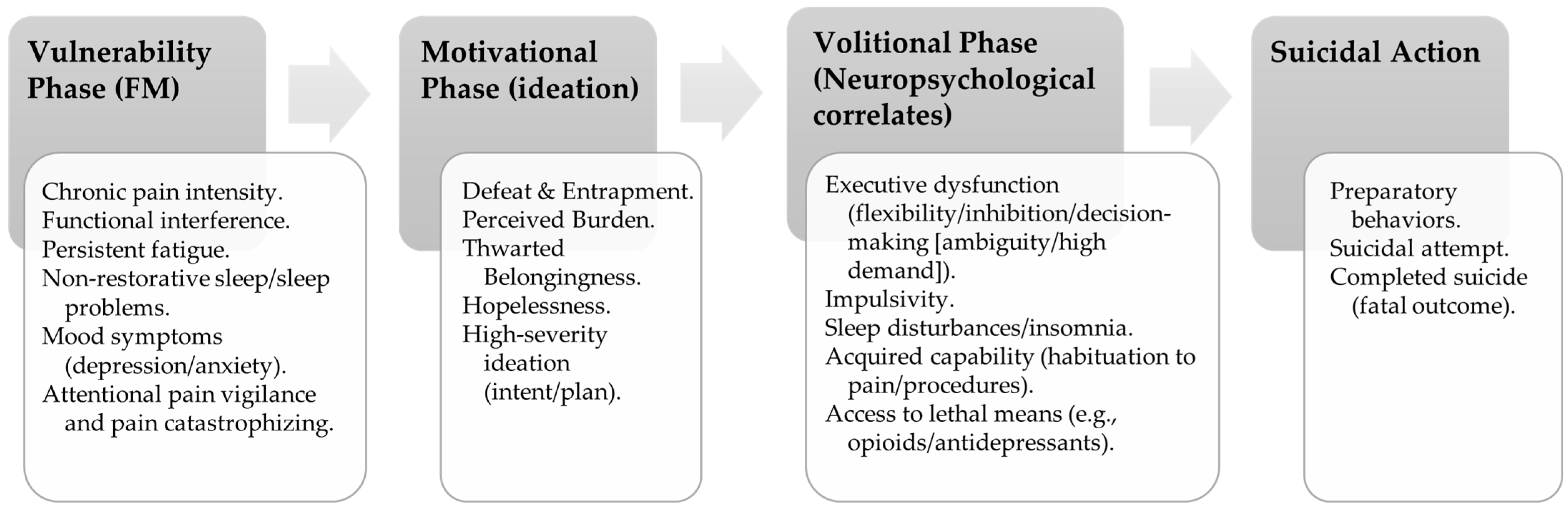
4. Neuropsychological Correlates and Suicidal Behavior in Fibromyalgia: Integration with Ideation-to-Action Models (IPTS/3ST/IMV)
5. Key Clinical Interactions: Mediation/Moderation Between Neuropsychological Deficits and Suicidal Behavior
6. Assessment of Suicidal Behavior in Fibromyalgia: Instruments and Psychometric Evidence from Ideation to Completed Suicide
7. Methodological Challenges and Clinical Implications
7.1. Critical Appraisal of the Evidence Base
7.2. Clinical Implications and Future Perspectives
- Axis 1. Phase delineation (motivational ideation versus volitional action).
- Axis 2. Phase-aligned screening and profiling (motivational versus volitional profiles).
- Axis 3. Phase-tailored intervention (targeting the predominant SB component).
8. Conclusions
Author Contributions
Funding
Institutional Review Board Statement
Informed Consent Statement
Data Availability Statement
Conflicts of Interest
Abbreviations
| FM | Fibromyalgia |
| SB | Suicidal Behavior |
| IPTS | Interpersonal Theory of Suicide |
| 3ST | Three-Step Theory |
| IMV | Integrated Motivational–Volitional Model |
| C-SSRS | Columbia Suicide Severity Rating Scale |
| PSRS | Plutchik Suicide Risk Scale |
| BDI-II | Beck Depression Inventory-II |
| SBQ-R | Suicide Behaviors Questionnaire—Revised |
| NSSI | Non-Suicidal Self-Injury |
| WHO | World Health Organization |
| INE | Instituto Nacional de Estadística |
| SMR | Standardized Mortality Ratio |
| PPEs | Previous Painful and/or Provocative Experiences |
| IGT | Iowa Gambling Task |
| VAS | Visual Analogue Scale |
| NRS | Numeric Rating Scale |
| PHQ-9 | Patient Health Questionnaire-9 |
| PCS | Pain Catastrophizing Scale |
| FIQR | Revised Fibromyalgia Impact Questionnaire |
| ICD-10 | International Classification of Diseases—Tenth Edition |
| HR | Hazard Ratio |
| RR | Risk Ratio |
| OR | Odds Ratio |
References
- Adams, H., Pendleton, C., Latimer, K., Cohen-Gadol, A. A., Carson, B. S., & Quinones-Hinojosa, A. (2011). Harvey Cushing’s case series of trigeminal neuralgia at the Johns Hopkins Hospital: A surgeon’s quest to advance the treatment of the ‘suicide disease’. Acta Neurochirurgica, 153(5), 1043–1050. [Google Scholar] [CrossRef]
- Adawi, M., Chen, W., Bragazzi, N. L., Watad, A., McGonagle, D., Yavne, Y., Kidron, A., Hodadov, H., Amital, D., & Amital, H. (2021). Suicidal behavior in fibromyalgia patients: Rates and determinants of suicide ideation, risk, suicide, and suicidal attempts—A systematic review of the literature and meta-analysis of over 390,000 fibromyalgia patients. Frontiers in Psychiatry, 12, 629417. [Google Scholar] [CrossRef] [PubMed]
- Al-Halabí, S., Sáiz, P. A., Burón, P., Garrido, M., Benabarre, A., Jiménez, E., Cervilla, J., Navarrete, M. I., Díaz-Mesa, E. M., García-Álvarez, L., Muñiz, J., Posner, K., Oquendo, M. A., García-Portilla, M. P., & Bobes, J. (2016). Validación de la versión en español de la Columbia-suicide severity rating scale (escala Columbia para evaluar el riesgo de suicidio). Revista de Psiquiatría y Salud Mental, 9(3), 134–142. [Google Scholar] [CrossRef]
- Ashrafioun, L., Bishop, T. M., & Pigeon, W. R. (2021). The relationship between pain severity, insomnia, and suicide attempts among a national veteran sample initiating pain care. Psychosomatic Medicine, 83(7), 733–738. [Google Scholar] [CrossRef] [PubMed]
- Ashrafioun, L., Kane, C., Bishop, T. M., Britton, P. C., & Pigeon, W. R. (2019). The association of pain intensity and suicide attempts among patients initiating pain specialty services. The Journal of Pain, 20(7), 852–859. [Google Scholar] [CrossRef]
- Baral, P., Udit, S., & Chiu, I. M. (2019). Pain and immunity: Implications for host defence. Nature Reviews Immunology, 19(7), 433–447. [Google Scholar] [CrossRef] [PubMed]
- Batterham, P. J., & Calear, A. L. (2021). Incorporating psychopathology into the interpersonal-psychological theory of suicidal behavior (IPTS). Suicide and Life-Threatening Behavior, 51(3), 482–491. [Google Scholar] [CrossRef]
- Bayliss, L. T., Christensen, S., Lamont-Mills, A., & Du Plessis, C. (2022). Suicide capability within the ideation-to-action framework: A systematic scoping review. PLoS ONE, 17(10), e0276070. [Google Scholar] [CrossRef]
- Beck, A. T., Steer, R. A., & Brown, G. K. (1996). Manual for the beck depression inventory–II (BDI–II). The Psychological Corporation. [Google Scholar]
- Becker, S. P., Foster, J. A., & Luebbe, A. M. (2020). A test of the interpersonal theory of suicide in college students. Journal of Affective Disorders, 260, 73–76. [Google Scholar] [CrossRef]
- Bell, T., Trost, Z., Buelow, M. T., Clay, O., Younger, J., Moore, D., & Crowe, M. (2018). Meta-analysis of cognitive performance in fibromyalgia. Journal of Clinical and Experimental Neuropsychology, 40(7), 698–714. [Google Scholar] [CrossRef]
- Benjamin, N. Z. Y., Parekh, R. S., Inban, P., Sakthi, S., Tekuru, Y., Prajjwal, P., John, J., & Sharma, R. (2025). Fibromyalgia: Advances in pathophysiology, diagnostic biomarkers, genetic insights, multisystemic involvement, and treatment updates and multidisciplinary interventions. Disease-a-Month, 71, 101965. [Google Scholar] [CrossRef]
- Bhargava, J., & Goldin, J. (2025). Fibromyalgia. In StatPearls. StatPearls Publishing. Available online: http://www.ncbi.nlm.nih.gov/books/NBK540974/ (accessed on 6 October 2025).
- Blais, R. K., & Grimm, K. J. (2025). The interpersonal theory of suicide risk in male US service members/veterans: The independent effects of perceived burdensomeness and thwarted belongingness. European Journal of Psychotraumatology, 16(1), 2439748. [Google Scholar] [CrossRef]
- Burton, C. Z., Vella, L., Weller, J. A., & Twamley, E. W. (2011). Differential effects of executive functioning on suicide attempts. The Journal of Neuropsychiatry and Clinical Neurosciences, 23(2), 173–179. [Google Scholar] [CrossRef]
- Cabo-Meseguer, A., Cerdá-Olmedo, G., & Trillo-Mata, J. L. (2017). Fibromialgia: Prevalencia, perfiles epidemiológicos y costes económicos. Medicina Clínica, 149(10), 441–448. [Google Scholar] [CrossRef] [PubMed]
- Calandre, E. P., Navajas-Rojas, M. A., Ballesteros, J., Garcia-Carrillo, J., Garcia-Leiva, J. M., & Rico-Villademoros, F. (2015). Suicidal ideation in patients with fibromyalgia: A cross-sectional study. Pain Practice, 15(2), 168–174. [Google Scholar] [CrossRef]
- Calandre, E. P., Ordoñez-Carrasco, J. L., & Rico-Villademoros, F. (2021). Marital adjustment in patients with fibromyalgia: Its association with suicidal ideation and related factors. A cross-sectional study. Clinical and Experimental Rheumatology, 39(3), 89–94. [Google Scholar] [CrossRef]
- Calandre, E. P., Vilchez, J. S., Molina-Barea, R., Tovar, M. I., Garcia-Leiva, J. M., Hidalgo, J., Rodriguez-Lopez, C. M., & Rico-Villademoros, F. (2011). Suicide attempts and risk of suicide in patients with fibromyalgia: A survey in Spanish patients. Rheumatology, 50(10), 1889–1893. [Google Scholar] [CrossRef] [PubMed]
- Calati, R., Laglaoui Bakhiyi, C., Artero, S., Ilgen, M., & Courtet, P. (2015). The impact of physical pain on suicidal thoughts and behaviors: Meta-analyses. Journal of Psychiatric Research, 71, 16–32. [Google Scholar] [CrossRef] [PubMed]
- Carneiro, B. D., Pozza, D. H., & Tavares, I. (2025a). Can gratitude ease the burden of fibromyalgia? A systematic review. Behavioral Sciences, 15, 1079. [Google Scholar] [CrossRef]
- Carneiro, B. D., Torres, S., Costa-Pereira, J. T., Pozza, D. H., & Tavares, I. (2025b). Descending pain modulation in fibromyalgia: A short review of mechanisms and biomarkers. Diagnostics, 15(21), 2702. [Google Scholar] [CrossRef]
- Chinn, S., Caldwell, W., & Gritsenko, K. (2016). Fibromyalgia pathogenesis and treatment options update. Current Pain and Headache Reports, 20(4), 25. [Google Scholar] [CrossRef]
- Chu, C., Buchman-Schmitt, J. M., Stanley, I. H., Hom, M. A., Tucker, R. P., Hagan, C. R., Rogers, M. L., Podlogar, M. C., Chiurliza, B., Ringer, F. B., Michaels, M. S., Patros, C. H. G., & Joiner, T. E. (2017). The interpersonal theory of suicide: A systematic review and meta-analysis of a decade of cross-national research. Psychological Bulletin, 143(12), 1313–1345. [Google Scholar] [CrossRef]
- Clauw, D. J. (2009). Fibromyalgia: An overview. The American Journal of Medicine, 122(12), S3–S13. [Google Scholar] [CrossRef] [PubMed]
- Clauw, D. J. (2015). Diagnosing and treating chronic musculoskeletal pain based on the underlying mechanism(s). Best Practice & Research Clinical Rheumatology, 29(1), 6–19. [Google Scholar] [CrossRef]
- Crosby, A. E., Ortega, L., & Melanson, C. (2011). Self-directed violence surveillance: Uniform definitions and recommended data elements. Centers for Disease Control and Prevention (CDC), National Center for Injury Prevention and Control.
- da Silva, M. L. A., de Souza, T. J. N., Alves-da-Silva, M. W. L., Remigio, C. M. M., Pedrosa, M. P. C., de Miranda, C. T., & de Melo Neto, V. L. (2024). Psychological pain, hopelessness and suicide ideation in female patients with fibromyalgia. Clinical Neuropsychiatry, 21(4), 229–235. [Google Scholar] [CrossRef]
- Dreyer, L., Kendall, S., Danneskiold-Samsøe, B., Bartels, E. M., & Bliddal, H. (2010). Mortality in a cohort of Danish patients with fibromyalgia: Increased frequency of suicide. Arthritis & Rheumatism, 62(10), 3101–3108. [Google Scholar] [CrossRef] [PubMed]
- Duschek, S., De Guevara, C. M. L., Serrano, M. J. F., Montoro, C. I., López, S. P., & Reyes Del Paso, G. A. (2022). Variability of reaction time as a marker of executive function impairments in fibromyalgia. Behavioural Neurology, 2022, 1821684. [Google Scholar] [CrossRef]
- Eastwood, F., & Godfrey, E. (2024). The efficacy, acceptability and safety of acceptance and commitment therapy for fibromyalgia—A systematic review and meta-analysis. British Journal of Pain, 18(3), 243–256. [Google Scholar] [CrossRef]
- Ferahman, D., Bucak, Ö. F., Arik, S., & Şahbaz, T. (2025). The hidden burden of fibromyalgia: Exploring work impairment and quality of life in caregivers. Clinical and Experimental Rheumatology, 43, 1027–1034. [Google Scholar] [CrossRef]
- Fishbain, D. A. (1999). The association of chronic pain and suicide. Seminars in Clinical Neuropsychiatry, 4(3), 221–227. [Google Scholar] [CrossRef] [PubMed]
- Fishbein, N., Bakhshaie, J., & Greenberg, J. (2025). Suicidal ideation and self-injury in trigeminal neuralgia. Journal of Pain Research, 18, 2003–2010. [Google Scholar] [CrossRef]
- García-Domínguez, M. (2025). Fibromyalgia and inflammation: Unrevealing the connection. Cells, 14(4), 271. [Google Scholar] [CrossRef]
- Gálvez-Sánchez, C. M., Duschek, S., & Del Paso, G. A. R. (2024). Is reduced health-related quality of life a primary manifestation of fibromyalgia? A comparative study with Rheumatoid arthritis. Psychology & Health, 39(4), 517–535. [Google Scholar] [CrossRef]
- Gálvez-Sánchez, C. M., Montoro, C. I., Duschek, S., & Del Paso, G. A. R. (2020). Pain catastrophizing mediates the negative influence of pain and trait-anxiety on health-related quality of life in fibromyalgia. Quality of Life Research, 29(7), 1871–1881. [Google Scholar] [CrossRef] [PubMed]
- Gálvez-Sánchez, C. M., Reyes Del Paso, G. A., & Duschek, S. (2018). Cognitive impairments in fibromyalgia syndrome: Associations with positive and negative affect, alexithymia, pain catastrophizing and self-esteem. Frontiers in Psychology, 9, 377. [Google Scholar] [CrossRef] [PubMed]
- Giakas, A., Mangold, K., Androulakis, A., Hyduke, N., Galynker, I., Thiam, M., Cai, G., & Androulakis, X. M. (2023). Risks of suicide in migraine, non-migraine headache, back, and neck pain: A systematic review and meta-analysis. Frontiers in Neurology, 14, 1160204. [Google Scholar] [CrossRef]
- Gómez-Romero, M. J., Tomás-Sábado, J., Montes-Hidalgo, J., Brando-Garrido, C., & Limonero, J. T. (2021). The suicidal behaviors questionnaire-revised. Spanish form. Death Studies, 45(8), 623–629. [Google Scholar] [CrossRef]
- Han, D.-H. (2018). The association between temporomandibular disorders and suicide ideation in a representative sample of the south korean population. Journal of Oral & Facial Pain and Headache, 28(4), 338–345. [Google Scholar] [CrossRef]
- Häuser, W., Ablin, J., Perrot, S., & Fitzcharles, M.-A. (2017). Management of fibromyalgia: Practical guides from recent evidence-based guidelines. Polish Archives of Internal Medicine, 127(1), 47–56. [Google Scholar] [CrossRef]
- Ilgen, M. A., Kleinberg, F., Ignacio, R. V., Bohnert, A. S. B., Valenstein, M., McCarthy, J. F., Blow, F. C., & Katz, I. R. (2013). Noncancer pain conditions and risk of suicide. JAMA Psychiatry, 70(7), 692. [Google Scholar] [CrossRef]
- Instituto Nacional de Estadística (INE). (2025). Estadística de defunciones según la causa de muerte. Available online: https://www.ine.es/dyngs/Prensa/es/pEDCM2024.htm (accessed on 6 October 2025).
- International Association for the Study of Pain. (n.d.). Terminology (entry: “Nociplastic pain”). Available online: https://www.iasp-pain.org/resources/terminology (accessed on 19 January 2026).
- Jiménez-Rodríguez, I., Garcia-Leiva, J., Jimenez-Rodriguez, B., Condés-Moreno, E., Rico-Villademoros, F., & Elena, C. (2014). Suicidal ideation and the risk of suicide in patients with fibromyalgia: A comparison with non-pain controls and patients suffering from low-back pain. Neuropsychiatric Disease and Treatment, 10, 625–630. [Google Scholar] [CrossRef]
- Joiner, T. (2005). Why people die by suicide. Harvard University Press. [Google Scholar]
- Jurado-Priego, L. N., Cueto-Ureña, C., Ramírez-Expósito, M. J., & Martínez-Martos, J. M. (2024). Fibromyalgia: A review of the pathophysiological mechanisms and multidisciplinary treatment strategies. Biomedicines, 12(7), 1543. [Google Scholar] [CrossRef]
- Klonsky, E. D., & May, A. M. (2015). The three-step theory (3ST): A new theory of suicide rooted in the “Ideation-to-Action” framework. International Journal of Cognitive Therapy, 8(2), 114–129. [Google Scholar] [CrossRef]
- Klonsky, E. D., May, A. M., & Saffer, B. Y. (2016). Suicide, suicide attempts, and suicidal ideation. Annual Review of Clinical Psychology, 12(1), 307–330. [Google Scholar] [CrossRef] [PubMed]
- Klonsky, E. D., Qiu, T., & Saffer, B. Y. (2017). Recent advances in differentiating suicide attempters from suicide ideators. Current Opinion in Psychiatry, 30(1), 15–20. [Google Scholar] [CrossRef] [PubMed]
- Klonsky, E. D., Saffer, B. Y., & Bryan, C. J. (2018). Ideation-to-action theories of suicide: A conceptual and empirical update. Current Opinion in Psychology, 22, 38–43. [Google Scholar] [CrossRef]
- Kroenke, K., Spitzer, R. L., & Williams, J. B. W. (2001). The PHQ-9: Validity of a brief depression severity measure. Journal of General Internal Medicine, 16(9), 606–613. [Google Scholar] [CrossRef]
- Kurita, G. P., de Mattos Pimenta, C. A., Braga, P. E., Frich, L., Jørgensen, M. M., Nielsen, P. R., Højsted, J., & Sjøgren, P. (2012). Cognitive function in patients with chronic pain treated with opioids: Characteristics and associated factors. Acta Anaesthesiologica Scandinavica, 56(10), 1257–1266. [Google Scholar] [CrossRef]
- Kwon, C.-Y., & Lee, B. (2023). Prevalence of suicidal behavior in patients with chronic pain: A systematic review and meta-analysis of observational studies. Frontiers in Psychology, 14, 1217299. [Google Scholar] [CrossRef]
- Lafuente-Castro, C. P., Ordoñez-Carrasco, J. L., Garcia-Leiva, J. M., Salgueiro-Macho, M., & Calandre, E. P. (2018). Perceived burdensomeness, thwarted belongingness and suicidal ideation in patients with fibromyalgia and healthy subjects: A cross-sectional study. Rheumatology International, 38(8), 1479–1486. [Google Scholar] [CrossRef] [PubMed]
- Laroche, F., Azoulay, D., Trouvin, A. P., Coste, J., & Perrot, S. (2019). Fibromyalgia in the workplace: Risk factors for sick leave are related to professional context rather than fibromyalgia characteristics—A French national survey of 955 patients. BMC Rheumatology, 3(1), 44. [Google Scholar] [CrossRef]
- Legarreta, M., Bueler, E., DiMuzio, J., McGlade, E., & Yurgelun-Todd, D. (2018). Suicide behavior and chronic pain: An exploration of pain-related catastrophic thinking, disability, and descriptions of the pain experience. Journal of Nervous & Mental Disease, 206(3), 217–222. [Google Scholar] [CrossRef]
- Lempp, H. K., Hatch, S. L., Carville, S. F., & Choy, E. H. (2009). Patients’ experiences of living with and receiving treatment for fibromyalgia syndrome: A qualitative study. BMC Musculoskeletal Disorders, 10(1), 124. [Google Scholar] [CrossRef] [PubMed]
- Levine, D., & Horesh, D. (2020). Suicidality in fibromyalgia: A systematic review of the literature. Frontiers in Psychiatry, 11, 535368. [Google Scholar] [CrossRef]
- Macfarlane, G. J., Kronisch, C., Dean, L. E., Atzeni, F., Häuser, W., Fluß, E., Choy, E., Kosek, E., Amris, K., Branco, J., Dincer, F., Leino-Arjas, P., Longley, K., McCarthy, G. M., Makri, S., Perrot, S., Sarzi-Puttini, P., Taylor, A., & Jones, G. T. (2017). EULAR revised recommendations for the management of fibromyalgia. Annals of the Rheumatic Diseases, 76(2), 318–328. [Google Scholar] [CrossRef] [PubMed]
- Macfarlane, G. J., McBeth, J., Silman, A. J., & Crombie, I. K. (2001). Widespread body pain and mortality: Prospective population based study Commentary: An interesting finding, but what does it. BMJ, 323(7314), 662. [Google Scholar] [CrossRef]
- McKernan, L. C., Lenert, M. C., Crofford, L. J., & Walsh, C. G. (2019). Outpatient engagement and predicted risk of suicide attempts in fibromyalgia. Arthritis Care & Research, 71(9), 1255–1263. [Google Scholar] [CrossRef]
- Montoro, C. I., & Reyes del Paso, G. A. (2015). Personality and fibromyalgia: Relationships with clinical, emotional, and functional variables. Personality and Individual Differences, 85, 236–244. [Google Scholar] [CrossRef]
- Mueller, C., Fang, Y.-H. D., Jones, C., McConathy, J. E., Raman, F., Lapi, S. E., & Younger, J. W. (2023). Evidence of neuroinflammation in fibromyalgia syndrome: A [18F]DPA-714 positron emission tomography study. Pain, 164(10), 2285–2295. [Google Scholar] [CrossRef]
- Muñoz Ladrón de Guevara, C., Fernández-Serrano, M. J., Reyes Del Paso, G. A., & Duschek, S. (2018). Executive function impairments in fibromyalgia syndrome: Relevance of clinical variables and body mass index. PLoS ONE, 13(4), e0196329. [Google Scholar] [CrossRef]
- Muñoz Ladrón de Guevara, C., Reyes Del Paso, G. A., Fernández Serrano, M. J., & Montoro, C. I. (2022). Fibromyalgia syndrome and cognitive decline: The role of body mass index and clinical symptoms. Journal of Clinical Medicine, 11(12), 3404. [Google Scholar] [CrossRef]
- Nock, M. K. (2010). Self-injury. Annual Review of Clinical Psychology, 6, 339–363. [Google Scholar] [CrossRef]
- O’Carroll, P. W., Berman, A. L., Maris, R. W., Moscicki, E. K., Tanney, B. L., & Silverman, M. M. (1996). Beyond the tower of babel: A nomenclature for suicidology. Suicide and Life-Threatening Behavior, 26(3), 237–252. [Google Scholar] [CrossRef]
- O’Connor, R. C. (2011). Towards an integrated motivational–volitional model of suicidal behaviour. In R. C. O’Connor, S. Platt, & J. Gordon (Eds.), International handbook of suicide prevention (1st ed., pp. 181–198). Wiley. [Google Scholar] [CrossRef]
- O’Connor, R. C., & Kirtley, O. J. (2018). The integrated motivational–volitional model of suicidal behaviour. Philosophical Transactions of the Royal Society B: Biological Sciences, 373(1754), 20170268. [Google Scholar] [CrossRef]
- Ordóñez-Carrasco, J. L., Sánchez-Castelló, M., Calandre, E. P., Cuadrado-Guirado, I., & Rojas-Tejada, A. J. (2021). Suicidal ideation profiles in patients with fibromyalgia using transdiagnostic psychological and fibromyalgia-associated variables. International Journal of Environmental Research and Public Health, 18(1), 209. [Google Scholar] [CrossRef] [PubMed]
- Osman, A., Bagge, C. L., Gutierrez, P. M., Konick, L. C., Kopper, B. A., & Barrios, F. X. (2001). The suicidal behaviors questionnaire-revised (SBQ-R): Validation with clinical and nonclinical samples. Assessment, 8(4), 443–454. [Google Scholar] [CrossRef]
- Peck, M. M., Maram, R., Mohamed, A., Ochoa Crespo, D., Kaur, G., Ashraf, I., & Malik, B. H. (2020). The influence of pro-inflammatory cytokines and genetic variants in the development of fibromyalgia: A traditional review. Cureus, 2(9), e10276. [Google Scholar] [CrossRef]
- Penttinen, J. (1995). Back pain and risk of suicide among Finnish farmers. American Journal of Public Health, 85(10), 1452–1453. [Google Scholar] [CrossRef] [PubMed][Green Version]
- Plutchik, R., Van Praag, H. M., Conte, H. R., & Picard, S. (1989). Correlates of suicide and violence risk 1: The suicide risk measure. Comprehensive Psychiatry, 30(4), 296–302. [Google Scholar] [CrossRef] [PubMed]
- Posner, K., Brent, D., Lucas, C., Gould, M., & Stanley, B. (2010). Columbia-suicide severity rating scale (C-SSRS) [Measurement instrument]. Columbia University Medical Center. [Google Scholar]
- Posner, K., Brown, G. K., Stanley, B., Brent, D. A., Yershova, K. V., Oquendo, M. A., Currier, G. W., Melvin, G. A., Greenhill, L., Shen, S., & Mann, J. J. (2011). The Columbia–suicide severity rating scale: Initial validity and internal consistency findings from three multisite studies with adolescents and adults. American Journal of Psychiatry, 168(12), 1266–1277. [Google Scholar] [CrossRef]
- Racine, M. (2018). Chronic pain and suicide risk: A comprehensive review. Progress in Neuro-Psychopharmacology and Biological Psychiatry, 87, 269–280. [Google Scholar] [CrossRef]
- Richard-Devantoy, S., Berlim, M. T., & Jollant, F. (2014). A meta-analysis of neuropsychological markers of vulnerability to suicidal behavior in mood disorders. Psychological Medicine, 44(8), 1663–1673. [Google Scholar] [CrossRef]
- Rizvi, S. J., Iskric, A., Calati, R., & Courtet, P. (2017). Psychological and physical pain as predictors of suicide risk: Evidence from clinical and neuroimaging findings. Current Opinion in Psychiatry, 30(2), 159–167. [Google Scholar] [CrossRef] [PubMed]
- Rubio, G., Montero, I., Jáuregui, J., Villanueva, R., Casado, M. A., Marín, J. J., & Santo-Domingo, J. (1998). Validación de la Escala de Riesgo Suicida de Plutchik en población española [Assessing the validity of the Plutchik suicide risk scale in a Spanish sample]. Archivos de Neurobiología, 2(61), 143–152. [Google Scholar]
- Saffer, B. Y., & Klonsky, E. D. (2018). Do neurocognitive abilities distinguish suicide attempters from suicide ideators? A systematic review of an emerging research area. Clinical Psychology: Science and Practice, 25(1), e12227. [Google Scholar] [CrossRef] [PubMed]
- Samartin-Veiga, N., González-Villar, A. J., & Carrillo-de-la-Peña, M. T. (2019). Neural correlates of cognitive dysfunction in fibromyalgia patients: Reduced brain electrical activity during the execution of a cognitive control task. NeuroImage Clinical, 23, 101817. [Google Scholar] [CrossRef]
- Sanz, J., Navarro, M. E., & Vázquez, C. (2003). Adaptación española del Inventario para la Depresión de Beck-II (BDI-II): 1. Propiedades psicométricas en estudiantes universitarios. Análisis y Modificación de Conducta, 124(29), 239–288. [Google Scholar]
- Sarzi-Puttini, P., Giorgi, V., Marotto, D., & Atzeni, F. (2020). Fibromyalgia: An update on clinical characteristics, aetiopathogenesis and treatment. Nature Reviews Rheumatology, 16(11), 645–660. [Google Scholar] [CrossRef]
- Silverman, M. M., Berman, A. L., Sanddal, N. D., O’Carroll, P. W., & Joiner, T. E. (2007). Rebuilding the tower of babel: A revised nomenclature for the study of suicide and suicidal behaviors. Part 2: Suicide-related ideations, communications, and behaviors. Suicide and Life-Threatening Behavior, 37(3), 264–277. [Google Scholar] [CrossRef]
- Siracusa, R., Paola, R. D., Cuzzocrea, S., & Impellizzeri, D. (2021). Fibromyalgia: Pathogenesis, mechanisms, diagnosis and treatment options update. International Journal of Molecular Sciences, 22(8), 3891. [Google Scholar] [CrossRef]
- Skljarevski, V., Zhang, S., Desaiah, D., Alaka, K. J., Palacios, S., Miazgowski, T., & Patrick, K. (2010). Duloxetine versus placebo in patients with chronic low back pain: A 12-week, fixed-dose, randomized, double-blind trial. The Journal of Pain, 11(12), 1282–1290. [Google Scholar] [CrossRef]
- Tang, N. K. Y., & Crane, C. (2006). Suicidality in chronic pain: A review of the prevalence, risk factors and psychological links. Psychological Medicine, 36(5), 575–586. [Google Scholar] [CrossRef] [PubMed]
- Timonen, M., Viilo, K., Hakko, H., Särkioja, T., Ylikulju, M., Meyer-Rochow, V. B., Väisänen, E., & Räsänen, P. (2003). Suicides in persons suffering from rheumatoid arthritis. Rheumatology, 42(2), 287–291. [Google Scholar] [CrossRef] [PubMed]
- Treister-Goltzman, Y., & Peleg, R. (2023). Fibromyalgia and mortality: A systematic review and meta-analysis. RMD Open, 9(3), e003005. [Google Scholar] [CrossRef]
- Triñanes, Y., González-Villar, A., Gómez-Perretta, C., & Carrillo-de-la-Peña, M. T. (2015). Suicidality in chronic pain: Predictors of suicidal ideation in fibromyalgia. Pain Practice, 15(4), 323–332. [Google Scholar] [CrossRef] [PubMed]
- Varallo, G., Scarpina, F., Arnison, T., Giusti, E. M., Tenti, M., Rapelli, G., Cattivelli, R., Landi, G., Tossani, E., Grandi, S., Franceschini, C., Baldini, V., Plazzi, G., Capodaglio, P., & Castelnuovo, G. (2024). Suicidal ideation in female individuals with fibromyalgia and comorbid obesity: Prevalence and association with clinical, pain-related, and psychological factors. Pain Medicine, 25(3), 239–247. [Google Scholar] [CrossRef]
- Wang, Y., Chen, S., Xu, Z., Shen, Z., Wang, Y., He, X., Cao, R., Roberts, D. L., Shi, J., & Wang, Y. (2017). Family history of suicide and high motor impulsivity distinguish suicide attempters from suicide ideators among college students. Journal of Psychiatric Research, 90, 21–25. [Google Scholar] [CrossRef]
- Wolfe, F., Clauw, D. J., Fitzcharles, M., Goldenberg, D. L., Katz, R. S., Mease, P., Russell, A. S., Russell, I. J., Winfield, J. B., & Yunus, M. B. (2010). The American college of rheumatology preliminary diagnostic criteria for fibromyalgia and measurement of symptom severity. Arthritis Care & Research, 62(5), 600–610. [Google Scholar] [CrossRef]
- Wolfe, F., Hassett, A. L., Walitt, B., & Michaud, K. (2011). Mortality in fibromyalgia: A study of 8186 patients over thirty-five years. Arthritis Care & Research, 63(1), 94–101. [Google Scholar] [CrossRef]
- Wolfe, F., Ross, K., Anderson, J., Russell, I. J., & Hebert, L. (1995). The prevalence and characteristics of fibromyalgia in the general population: Fibromyalgia prevalence and characteristics. Arthritis & Rheumatism, 38(1), 19–28. [Google Scholar] [CrossRef]
- Wolfe, F., Walitt, B. T., Katz, R. S., Lee, Y. C., Michaud, K. D., & Häuser, W. (2013). Longitudinal patterns of analgesic and central acting drug use and associated effectiveness in fibromyalgia. European Journal of Pain, 17(4), 581–586. [Google Scholar] [CrossRef] [PubMed]
- Woolf, C. J. (2011). Central sensitization: Implications for the diagnosis and treatment of pain. Pain, 152(3), S2–S15. [Google Scholar] [CrossRef]
- World Health Organization (WHO). (2016). International statistical classification of diseases and related health problems (10th rev.), Volume 1: Tabular list (5th ed.). WHO. [Google Scholar]
- World Health Organization (WHO). (2025). Suicide worldwide in 2021: Global health estimates. WHO. [Google Scholar]
- Wu, Y. L., Huang, C. J., Fang, S. C., Ko, L. H., & Tsai, P. S. (2018). Cognitive impairment in fibromyalgia: A meta-analysis of case-control studies. Psychosomatic medicine, 80(5), 432–438. [Google Scholar] [CrossRef] [PubMed]
- Yilmaz, E., & Tamam, L. (2018). Attention-deficit hyperactivity disorder and impulsivity in female patients with fibromyalgia. Neuropsychiatric Disease and Treatment, 14, 1883–1889. [Google Scholar] [CrossRef] [PubMed]


| Instrument | Assessed Factors | Scoring | Psychometric Properties | Use in FM |
|---|---|---|---|---|
| C-SSRS (Posner et al., 2011) | Ideation severity/intensity (passive/active), high-severity ideation (intent/plan), preparatory behaviors, suicide attempt (actual/aborted/interrupted) and lethality; includes an NSSI module. | Ideation severity: 1–5-point Likert scale. Intensity: sum of 5 elements (range 2–25). Ideation intensity sum range of 2–25 when ideation is present. Suicidal action type and lethality; no universal cut-offs; any action elevates risk above ideation, and ideation levels 4–5 imply greater imminence in the absence of action. | Spanish version: discrete-to-moderate psychometrics; alpha = 0.53 (intensity subscale); moderate convergent and discriminant validity; documented sensitivity to change (especially intensity). | No FM-specific validation; widely used in chronic pain. Useful to distinguish ideation (including intent/plan) from preparatory behaviors/attempts. Interpret cautiously due to symptom overlap (pain distress, depression, catastrophizing) and triangulate with pain (VAS/NRS), mood (BDI-II/PHQ-9), sleep and catastrophizing (PCS) measures, plus clinical interview and temporal evolution. |
| PSRS (Plutchik et al., 1989) | Integrating ideation (current and lifetime), communication of intent, previous attempts, affective/behavioral markers (depression/hopelessness, insomnia, loss of control/impulsivity, withdrawal), and family history; profiles current risk incorporating lifetime history. | 15 dichotomous items. Range: 0–15. Cut-off point: ≥ 6 = positive risk. | Cronbach’s α: 0.90. Test–retest: 0.89. Sensitivity 74%/Specificity 95%. Using the same cut-off, sensitivity/specificity 88% for discriminating history of attempts. | Associated with FIQR severity, pain, anxiety/depression and poor sleep quality; higher in patients reporting previous attempts. Efficient screening, but limited discrimination of behavioral subtypes and potential symptom overlap; complement with a structured interview (e.g., C-SSRS). |
| BDI-II (Item 9) (Beck et al., 1996) | Single-item marker of active suicidal ideation extracted from a depression inventory (spot indicator). | 0–3 over last 2 weeks (including today). Any score ≥ 1 warrants immediate clinical assessment; 2–3 suggests greater imminence. | Single item (internal consistency not applicable). BDI-II has validity/reliability for depression; Item 9 not validated as standalone risk tool. Item-level convergence is conceptually consistent, but evidence is limited; interpret change cautiously. | Frequently used and associated with greater clinical burden (depression, pain catastrophizing, pain/disability, poorer quality of life). Limitations: overlap with pain-related distress; provides no information on planning/behaviors and lacks universal cut-offs; does not replace a structured risk interview; triangulate with pain, mood, catastrophizing measures and temporal evolution. |
| SBQ-R (Osman et al., 2001) | Very brief self-report: lifetime attempts, recent ideation, threat of attempt, future probability. Captures time windows from lifetime to last 12 months. | 4 items (range 3–18). No universal cut-offs; typically: ≥7 (general population) and ≥8 (clinical settings) in original version. | Cronbach’s α: 0.80. Test–retest: 0.88 (Spanish version). Moderate convergent/criterion validity. Sensitivity to change plausible; interpret cautiously (limited longitudinal Spanish evidence). | Linked to depression/anxiety, poor sleep quality and functional impact in FM/chronic pain cohorts; minimal respondent burden. Limitations: overlap with depressive symptoms reactive to pain; limited detail on planning/behavioral modalities; triangulate with structured interview and pain/mood/sleep/catastrophizing measures. |
| Mortality Registries (ICD-10) | Completed suicide (fatal outcome) in administrative registries/cohort linkage. | Codes: intentional self-harm X60–X84; sequelae Y87.0. Reported as rates and comparative measures (SMR/HR/RR). | Not applicable (outcome data source; not a psychometric scale). | Clinical suitability: Not for screening (epidemiological outcome). Population-level excess mortality in FM; complements individual-level instruments. |
Disclaimer/Publisher’s Note: The statements, opinions and data contained in all publications are solely those of the individual author(s) and contributor(s) and not of MDPI and/or the editor(s). MDPI and/or the editor(s) disclaim responsibility for any injury to people or property resulting from any ideas, methods, instructions or products referred to in the content. |
© 2026 by the authors. Licensee MDPI, Basel, Switzerland. This article is an open access article distributed under the terms and conditions of the Creative Commons Attribution (CC BY) license.
Share and Cite
Muñoz Ladrón de Guevara, C.; Melero, S. Fibromyalgia: Neuropsychological and Clinical Correlates in Suicidal Behavior Based on Ideation-to-Action Models—A Critical Review. Behav. Sci. 2026, 16, 258. https://doi.org/10.3390/bs16020258
Muñoz Ladrón de Guevara C, Melero S. Fibromyalgia: Neuropsychological and Clinical Correlates in Suicidal Behavior Based on Ideation-to-Action Models—A Critical Review. Behavioral Sciences. 2026; 16(2):258. https://doi.org/10.3390/bs16020258
Chicago/Turabian StyleMuñoz Ladrón de Guevara, Cristina, and Sandra Melero. 2026. "Fibromyalgia: Neuropsychological and Clinical Correlates in Suicidal Behavior Based on Ideation-to-Action Models—A Critical Review" Behavioral Sciences 16, no. 2: 258. https://doi.org/10.3390/bs16020258
APA StyleMuñoz Ladrón de Guevara, C., & Melero, S. (2026). Fibromyalgia: Neuropsychological and Clinical Correlates in Suicidal Behavior Based on Ideation-to-Action Models—A Critical Review. Behavioral Sciences, 16(2), 258. https://doi.org/10.3390/bs16020258