

The Outcomes of Mental Health Services for Students in Rural Schools
 ,
,
Abstract
1. Introduction
1.1. Behavioral Health Outcomes of School-Based Services
Student Outcomes in Rural Settings
- What behavioral health needs are demonstrated by students referred to mental health services, as measured by the strengths and difficulties questionnaire?
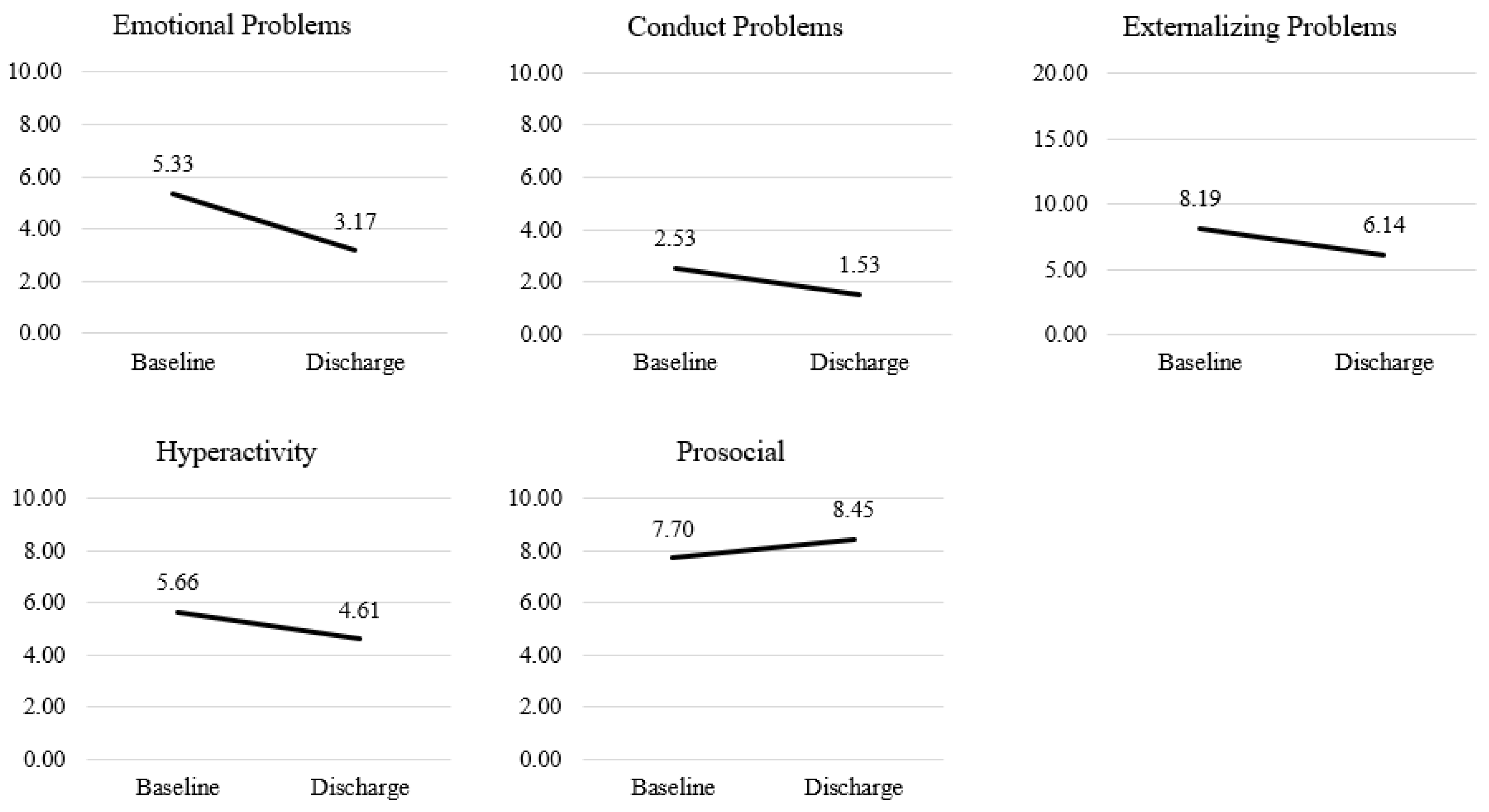
- How do the behavioral health outcomes of students receiving school-based therapeutic services change, from the start (baseline) to end (discharge) of services, as measured by the strengths and difficulties questionnaire?
2. Materials and Methods
2.1. Data Collection
2.2. Measures
2.3. Analytic Procedure
+ γ60 Non-Hispanic + u0i + rti
2.4. Population
3. Results
3.1. Student Behavioral Health Needs
3.2. Bivariate Correlations
3.3. Changes in Behavioral Health Outcomes
3.3.1. Emotional Problems
3.3.2. Conduct Problems
3.3.3. Hyperactivity
3.3.4. Prosocial Behavior
3.3.5. Externalizing Symptoms
4. Discussion
Limitations
5. Conclusions
Author Contributions
Funding
Institutional Review Board Statement
Informed Consent Statement
Data Availability Statement
Conflicts of Interest
References
- Albright, A., Michael, K., Massey, C., Sale, R., Kirk, A., & Egan, T. (2013). An evaluation of an interdisciplinary rural school mental health programme in Appalachia. Advances in School Mental Health Promotion, 6(3), 189–202. [Google Scholar] [CrossRef]
- Anderson, A. S., Siciliano, R. E., Gruhn, M. A., Bettis, A. H., Reising, M. M., Watson, K. H., Dunbar, J. P., & Compas, B. E. (2024). Youth coping and symptoms of anxiety and depression: Associations with age, gender, and peer stress. Current Psychology, 43(14), 12421–12433. [Google Scholar] [CrossRef]
- Anderson-Butcher, D., Hoffman, J., Rochman, D. M., & Fuller, M. (2017). General and specific competencies for school mental health in rural settings. In Handbook of rural school mental health (pp. 49–62). Springer International Publishing. [Google Scholar]
- Ash, T. L., Bowen, A. E., Chleborad, S., Bednarek, G., Godfrey, E., Norman, E., McGinley, M., Flack, C. E., & Garbacz, A. (2025). Perspectives on supporting youth mental health in rural communities. Journal of Rural Mental Health, 49(4), 422–432. [Google Scholar] [CrossRef]
- Ballard, K. L., Sander, M. A., & Klimes-Dougan, B. (2014). School-related and social-emotional outcomes of providing mental health services in schools. Community Mental Health Journal, 50(2), 145–149. [Google Scholar] [CrossRef] [PubMed]
- Baskin, T. W., Slaten, C. D., Sorenson, C., Glover-Russell, J., & Mersonm, D. N. (2010). Does youth psychotherapy improve academically related outcomes? A meta-analysis. Journal of Counseling Psychology, 57(3), 290–296. [Google Scholar] [CrossRef] [PubMed]
- Bates, D., Mächler, M., Bolker, B., & Walker, S. (2015). Fitting linear mixed-effects models using lme4. Journal of Statistical Software, 67(1), 1–48. [Google Scholar] [CrossRef]
- Benjamini, Y., & Hochberg, Y. (1995). Controlling the false discovery rate: A practical and powerful approach to multiple testing. Journal of the Royal Statistical Society Series B: Statistical Methodology, 57(1), 289–300. [Google Scholar] [CrossRef]
- Bickman, L., Athay, M. M., Riemer, M., Lambert, E. W., Kelley, S. D., Breda, C., Tempesti, T., Drew-Reeves, S. E., Brannan, A. M., & Vides de Andrade, A. R. (2010). Peabody treatment progress battery. Vanderbilt University. [Google Scholar]
- Cohen, J. (1988). Statistical power analysis for the behavioral sciences (2nd ed.). Lawrence Erlbaum Associates. [Google Scholar]
- Collier, T., Fairchild, A., Collins, C., Collins, D., Bresnan, P., & Weist, M. D. (2025). Initial evaluation of a comprehensive school mental health program in the rural south. Journal of Rural Mental Health, 49(2), 124–133. [Google Scholar] [CrossRef]
- Farahmand, F. K., Grant, K. E., Polo, A. J., Duffy, S. N., & DuBois, D. L. (2011). School-based mental health and behavioral programs for low-income, urban youth: A systematic and meta-analytic review. Clinical Psychology: Science and Practice, 18(4), 372. [Google Scholar] [CrossRef]
- Garbacz, S. A., Eklund, K., Kilgus, S. P., & von der Embse, N. (2024). Promoting equity and justice in school mental health. Journal of School Psychology, 104, 101318. [Google Scholar] [CrossRef]
- Gibson, J. E., Werner, S. S., & Sweeney, A. (2015). Evaluating an abbreviated version of the PATHS curriculum implemented by school mental health clinicians. Psychology in the Schools, 52(6), 549–561. [Google Scholar] [CrossRef]
- Goodman, R. (1997). The strengths and difficulties questionnaire: A research note. Journal of Child Psychology and Psychiatry, 38(5), 581–586. [Google Scholar] [CrossRef]
- Hoover, S. A. (2024). Investing in school mental health: Strategies to wisely spend federal and state funding. Psychiatric Services, 75(8), 801–806. [Google Scholar] [CrossRef] [PubMed]
- Hoover, S. A., & Bostic, J. (2021). Schools as a vital component of the child and adolescent mental health system. Psychiatric Services, 72(1), 37–48. [Google Scholar] [CrossRef] [PubMed]
- Hoover, S. A., & Mayworm, A. M. (2017). The benefits of school mental health. In K. Michael, & J. Jameson (Eds.), Handbook of rural school mental health. Springer. [Google Scholar] [CrossRef]
- Hua, L. L., Lee, J., Rahmandar, M. H., Sigel, E. J., Committee on Adolescence & Council on Injury, Violence, and Poison Prevention. (2024). Suicide and suicide risk in adolescents. Pediatrics, 153(1), e2023064800. [Google Scholar] [CrossRef] [PubMed]
- Kankaanpää, R., Töttö, P., Punamäki, R.-L., & Peltonen, K. (2023). Is it time to revise the SDQ? The psychometric evaluation of the Strengths and Difficulties Questionnaire. Psychological Assessment, 35(12), 1069–1084. [Google Scholar] [CrossRef]
- Kase, C., Hoover, S., Boyd, G., West, K., Dubenitz, J., Trivedi, P., Peterson, H., & Stein, B. (2017). Educational outcomes associated with school behavioral health interventions: A review of the literature. Journal of School Health, 87(7), 554–562. [Google Scholar] [CrossRef]
- Lee, S. W., Lohmeier, J. H., Niileksela, C., & Oeth, J. (2009). Rural schools’ mental health needs: Educators’ perceptions of mental health needs and services in rural schools. Journal of Rural Mental Health, 33(1), 26. [Google Scholar] [CrossRef][Green Version]
- McDonald, R. P. (1999). Test theory: A unified treatment. Lawrence Erlbaum. [Google Scholar]
- McNeish, D. (2018). Thanks coefficient alpha, we’ll take it from here. Psychological Methods, 23, 412–433. [Google Scholar] [CrossRef]
- Meek Farley, J., Gleason, E., Walther, J., & Saunders, D. (2025). The experiences of regional educational agency staff supporting the implementation of comprehensive school mental health systems. School Mental Health, 1–15. [Google Scholar] [CrossRef]
- Michael, K. D., Jameson, J. P., Albright, A., Sale, R., Massey, C., Kirk, A., & Egan, T. (2013). Does cognitive behavioural therapy in the context of a rural school mental health programme have an impact on academic outcomes? Advances in School Mental Health Promotion, 6, 247–262. [Google Scholar] [CrossRef][Green Version]
- Nakagawa, S., & Schielzeth, H. (2013). A general and simple method for obtaining R2 from generalized linear mixed-effects models. Methods in Ecology and Evolution, 4(2), 133–142. [Google Scholar] [CrossRef]
- Office of the Surgeon General. (2021). Protecting youth mental health: The US surgeon general’s advisory. Available online: https://pubmed.ncbi.nlm.nih.gov/34982518/ (accessed on 21 May 2025).
- Perou, R., Bitsko, R. H., Blumberg, S. J., Pastor, P., Ghandour, R. M., Gfroerer, J. C., Hedden, S. L., Crosby, A. E., Visser, S. N., Schieve, L. A., Parks, S. E., Hall, J. E., Brody, D., Simile, C. M., Thompson, W. W., Baio, J., Avenevoli, S., Kogan, M. D., & Huang, L. N. (2013). Mental health surveillance among children—United States, 2005–2011. MMWR Supplement, 62(2), 1–35. [Google Scholar]
- R Core Team. (2025). R: A language and environment for statistical computing (Version 4.5.2) [Computer software]. R Foundation for Statistical Computing. Available online: https://www.R-project.org/ (accessed on 1 October 2025).
- Rogers, M. A., Klan, A., Oram, R., Krause, A., Whitley, J., Smith, D. J., & McBrearty, N. (2024). School absenteeism and child mental health: A mixed-methods study of internalizing and externalizing symptoms. School Mental Health, 16(2), 331–342. [Google Scholar] [CrossRef]
- Rural Health Advisory Commission. (2019). State-designated shortage areas psychiatry and mental health. Available online: https://dhhs.ne.gov/RH%20Documents/State%20Shortage%20Areas%20Psychiatry%20and%20Mental%20Health%20(04-19).pdf (accessed on 21 May 2025).
- Russ-Eft, D., & Preskill, H. (2009). Evaluation in organizations: A systematic approach to enhancing learning, performance, and change (2nd ed.). Basic Books. [Google Scholar]
- SAMHSA, Center for Behavioral Health Statistics and Quality, National Survey on Drug Use and Health. (2019). Behavioral health barometer: United States, volume 6: Indicators as measured through the 2019 national survey on drug use and health and the national survey of substance abuse treatment services. Substance Abuse and Mental Health Services Administration. Available online: https://www.ncbi.nlm.nih.gov/books/NBK608219/ (accessed on 21 May 2025).
- SAMHSA’s Performance Accountability and Reporting System (SPARS). (2022). National outcome measures (NOMs) client-level measures for discretionary programs providing direct services: Services tool. Available online: https://spars.samhsa.gov/sites/default/files/2022-09/CMHSNOMSToolEnglish.pdf (accessed on 15 May 2025).
- Sanchez, A. L., Cornacchio, D., Poznanski, B., Golik, A. M., Chou, T., & Comer, J. S. (2018). The effectiveness of school-based mental health services for elementary-aged children: A meta-analysis. Journal of the American Academy of Child & Adolescent Psychiatry, 57(3), 153–165. [Google Scholar]
- Siceloff, E. R., Barnes-Young, C., Massey, C., Yell, M., & Weist, M. D. (2017). Building policy support for school mental health in rural areas. In K. Michael, & J. Jameson (Eds.), Handbook of rural school mental health. Springer. [Google Scholar] [CrossRef]
- Smith, K. E., & Pollak, S. D. (2020). Early life stress and development: Potential mechanisms for adverse outcomes. Journal of Neurodevelopmental Disorders, 12(1), 34. [Google Scholar] [CrossRef] [PubMed]
- Snijders, T. A., & Bosker, R. (2011). Multilevel analysis: An introduction to basic and advanced multilevel modeling. Sage. [Google Scholar]
- Stoffel, M., Nakagawa, S., & Schielzeth, H. (n.d.). Using partR2. Available online: https://cran.r-project.org/web/packages/partR2/vignettes/Using_partR2.html (accessed on 1 October 2025).
- Van der Graaff, J., Carlo, G., Crocetti, E., Koot, H. M., & Branje, S. (2018). Prosocial behavior in adolescence: Gender differences in development and links with empathy. Journal of Youth and Adolescence, 47(5), 1086–1099. [Google Scholar] [CrossRef]
- Walter, H. J., Kaye, A. J., Dennery, K. M., & DeMaso, D. R. (2019). Three-year outcomes of a school-hospital partnership providing multitiered mental health services in urban schools. Journal of School Health, 89(8), 643–652. [Google Scholar] [CrossRef] [PubMed]
- Watabe, Y., Stewart, J. L., Sarno Owens, J., Andrews, N., & Griffeth, J. C. (2013). Effectiveness and sustainability of school-based interventions for youth with or at risk for ADHD. School Mental Health, 5, 83–95. [Google Scholar] [CrossRef]
- World Health Organization (WHO) & United Nations Children’s Fund (UNICEF). (2024). Mental health of children and young people: Service guidance. World Health Organization and the United Nations Children’s Fund. [Google Scholar]


| SDQ Subscales | Possible Range | ω | Interpretation |
|---|---|---|---|
| Emotional problems | 0–10 | 0.84 | Higher scores indicate more problems |
| Conduct problems | 0–10 | 0.66 | Higher scores indicate more problems |
| Hyperactivity | 0–10 | 0.77 | Higher scores indicate more hyperactivity |
| Peer problems | 0–10 | 0.56 | Higher scores indicate more problems |
| Prosocial * | 0–10 | 0.84 | Higher scores indicate more prosociality |
| Total difficulties | 0–40 | 0.72 | Higher scores indicate more difficulty |
| Externalizing problems | 0–20 | 0.73 | Higher scores indicate more problems |
| Internalizing problems | 0–20 | 0.77 | Higher scores indicate more problems |
| Impact | 0–10 | 0.80 | Higher scores indicate more interference |
| PK-12th Enrollment | School District 1 (N = 3229) | School District 2 (N = 1402) | School District 3 (N = 611) | |||
|---|---|---|---|---|---|---|
| n | % | n | % | n | % | |
| Race/Ethnicity | ||||||
| Asian | 18 | 0.6 | 4 | 0.6 | 4 | 0.7 |
| Hispanic | 2474 | 76.6 | 327 | 23.3 | 32 | 5.2 |
| White | 400 | 12.4 | 1020 | 72.8 | 468 | 76.6 |
| American Indian/Alaska Native | 12 | 0.4 | 12 | 0.1 | 60 | 9.8 |
| Black or African American | 293 | 9.1 | 8 | 0.6 | 1 | 0.2 |
| Native Hawaiian or Other Pacific Islander | 7 | 0.2 | 0 | 0.0 | 0 | 0.0 |
| Two or More Races | 25 | 0.8 | 41 | 2.9 | 46 | 7.5 |
| Gender | ||||||
| Female | 1507 | 46.7 | 660 | 47.1 | 302 | 49.4 |
| Male | 1722 | 53.3 | 742 | 52.9 | 309 | 50.6 |
| Free/Reduced Lunch | 2438 | 75.5 | 772 | 55.1 | 286 | 46.8 |
| English Language Learners | 1327 | 41.1 | 102 | 7.3 | * | * |
| 2024 Graduation Rate | 96.8 | 85.0 | 94.6 | |||
| SDQ Indicator | Close to Average | Slightly Raised/Lowered | High/Low | Very High/Low | ||||
|---|---|---|---|---|---|---|---|---|
| N | % | N | % | N | % | N | % | |
| Emotional problems | 55 | 48.2 | 15 | 13.2 | 14 | 12.3 | 30 | 26.3 |
| Conduct problems | 71 | 62.3 | 21 | 18.4 | 14 | 12.3 | 8 | 7.0 |
| Hyperactivity | 62 | 54.4 | 24 | 21.1 | 16 | 14.0 | 12 | 10.5 |
| Prosocial * | 81 | 71.1 | 16 | 14.0 | 10 | 8.8 | 7 | 6.1 |
| SDQ Score | n | Min | Max | Mean | SD |
|---|---|---|---|---|---|
| Emotional problems | 114 | 0 | 10 | 4.64 | 2.50 |
| Conduct problems | 114 | 0 | 10 | 2.64 | 1.93 |
| Hyperactivity | 114 | 1 | 10 | 5.32 | 2.09 |
| Prosocial * | 114 | 1 | 10 | 7.86 | 2.00 |
| Externalizing problems | 114 | 2 | 20 | 7.95 | 3.52 |
| 1 | 2 | 3 | 4 | 5 | |
|---|---|---|---|---|---|
| 1. T1 Emotional Problems | – | ||||
| 2. T1 Conduct Problems | 0.20 | – | |||
| 3. T1 Hyperactivity | 0.52 *** | 0.39 * | – | ||
| 4. T1 Prosocial | 0.17 | −0.13 | −0.07 | – | |
| 5. T1 Externalizing Problems | 0.45 ** | 0.79 *** | 0.88 *** | −0.12 | – |
| T2 Emotional Problems | 0.51 *** | ||||
| T2 Conduct Problems | 0.54 *** | ||||
| T2 Hyperactivity | 0.66 *** | ||||
| T2 Prosocial | 0.47 *** | ||||
| T2 Externalizing Problems | 0.60 *** |
| Predictors | Emotional Problems | Conduct Problems | Hyperactivity | Prosocial | Externalizing Problems |
|---|---|---|---|---|---|
| Estimate (SE) | Estimate (SE) | Estimate (SE) | Estimate (SE) | Estimate (SE) | |
| Intercept, γ00 | 5.81 (0.45) *** | 2.76 (0.40) *** | 5.32 (0.51) *** | 7.86 (0.39) *** | 8.08 (0.76) *** |
| Time (Discharge), γ10 | −2.16 (0.33) *** | −1.00 (0.25) *** | −1.05 (0.28) ** | 0.74 (0.32) * | −2.05 (0.44) *** |
| sr2 for Time [95% CI] | 0.18 [0.01, 0.36] | 0.08 [.04, 0.33] | 0.05 [0.00, 0.29] | 0.04 [0.00, 0.27] | 0.08 [0.00, 0.37] |
| Demographic Covariates | |||||
| Gender (Male), γ20 | −2.06 (0.57) ** | −0.20 (0.51) | −1.03 (0.67) | −1.27 (0.48) * | −1.23 (0.98) |
| Race (African American), γ30 | 1.90 (1.26) | 0.95 (1.31) | 3.00 (1.46) | −1.41 (1.06) | 3.96 (2.16) |
| Race (American Indian), γ40 | 1.17 (0.92) | 0.09 (0.83) | 0.97 (1.07) | −0.09 (0.77) | 1.06 (1.58) |
| Race (Mixed Race), γ50 | −0.36 (0.80) | −0.71 (0.72) | 0.64 (0.93) | 1.70 (0.67) * | −0.07 (1.37) |
| Ethnicity (Non-Hispanic), γ60 | −0.26 (0.70) | −0.43 (0.63) | −0.60 (0.82) | 0.86 (0.59) | −1.03 (1.21) |
| Marginal R2 | 0.41 | 0.12 | 0.20 | 0.22 | 0.20 |
Disclaimer/Publisher’s Note: The statements, opinions and data contained in all publications are solely those of the individual author(s) and contributor(s) and not of MDPI and/or the editor(s). MDPI and/or the editor(s) disclaim responsibility for any injury to people or property resulting from any ideas, methods, instructions or products referred to in the content. |
© 2026 by the authors. Licensee MDPI, Basel, Switzerland. This article is an open access article distributed under the terms and conditions of the Creative Commons Attribution (CC BY) license.
Share and Cite
Meek, J.; Walther, J.; Yoon, H.; Li, M.; Luther, M.; Jeffries, J. The Outcomes of Mental Health Services for Students in Rural Schools. Behav. Sci. 2026, 16, 70. https://doi.org/10.3390/bs16010070
Meek J, Walther J, Yoon H, Li M, Luther M, Jeffries J. The Outcomes of Mental Health Services for Students in Rural Schools. Behavioral Sciences. 2026; 16(1):70. https://doi.org/10.3390/bs16010070
Chicago/Turabian StyleMeek, Jennifer, Janell Walther, HyeonJin Yoon, Mingqi Li, Megan Luther, and Jay Jeffries. 2026. "The Outcomes of Mental Health Services for Students in Rural Schools" Behavioral Sciences 16, no. 1: 70. https://doi.org/10.3390/bs16010070
APA StyleMeek, J., Walther, J., Yoon, H., Li, M., Luther, M., & Jeffries, J. (2026). The Outcomes of Mental Health Services for Students in Rural Schools. Behavioral Sciences, 16(1), 70. https://doi.org/10.3390/bs16010070