Longitudinal Evidence on Peer Victimisation and Persistent Mental Health Outcomes in Youth: A Systematic Review



Abstract
1. Introduction
Aims
- Which long-term mental health and psychosocial outcomes have been linked to peer victimisation in childhood and adolescence?
- Which moderators and mediators account for variation in these associations across studies?
- Which individual, social, and contextual factors are associated with variation in the likelihood or severity of later mental health difficulties following peer victimisation?
2. Methods
2.1. Protocol Development
2.2. Eligibility Criteria
2.3. Search Strategy
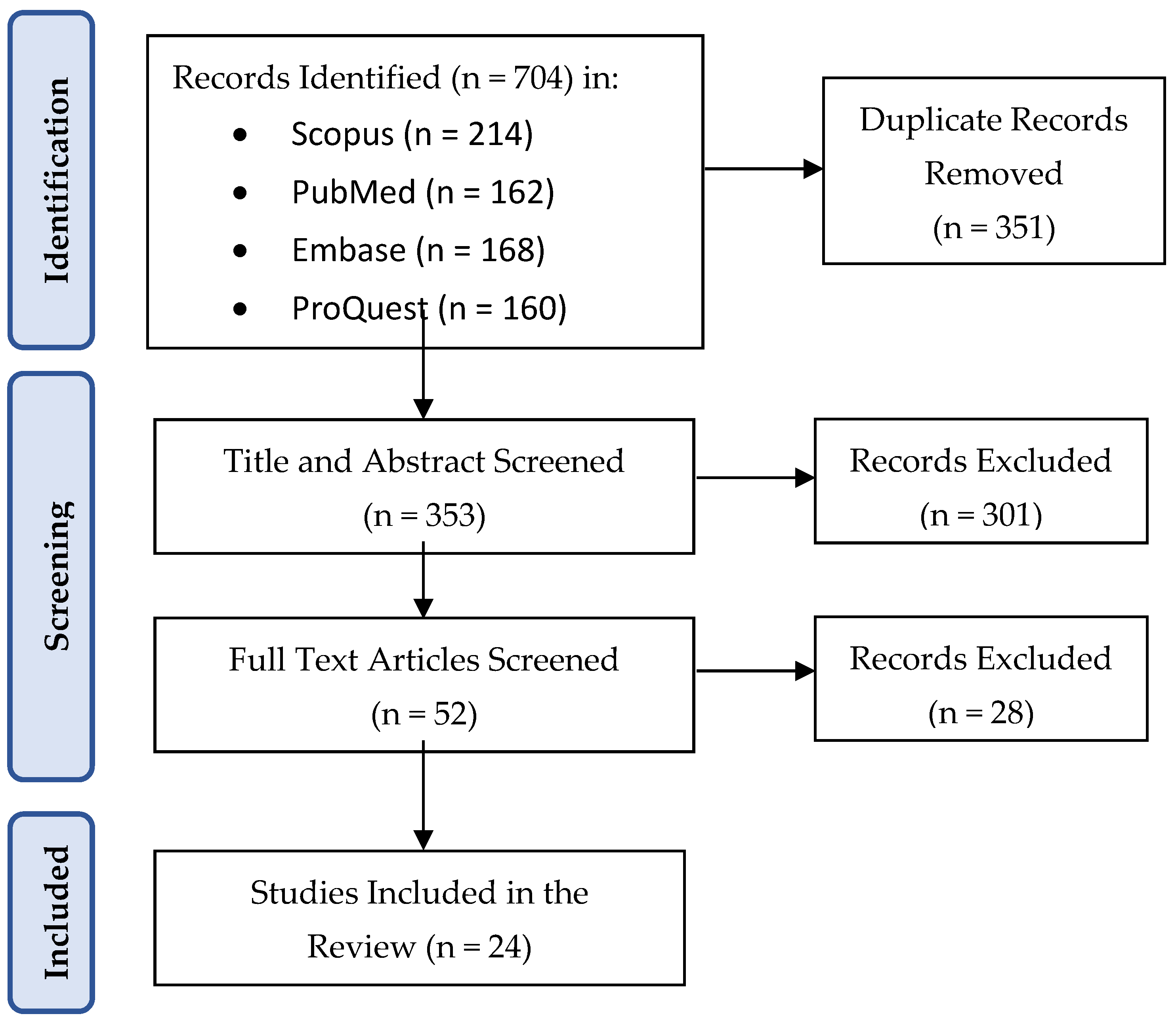
2.4. Study Selection
2.5. Certainty of Evidence
2.6. Data Extraction and Synthesis
3. Results
3.1. Quality Appraisal
3.2. Studies Characteristics
3.3. Depression
3.4. Anxiety
3.5. Post-Traumatic Stress and Trauma Symptoms
3.6. Suicidality and Self-Harm
3.7. Internalising Difficulties, Self-Esteem, and Loneliness
4. Discussion
4.1. Disorder-Specific Pathways
4.2. Limitations and Future Directions
5. Conclusions
Author Contributions
Funding
Institutional Review Board Statement
Informed Consent Statement
Data Availability Statement
Conflicts of Interest
Appendix A
References
- American Psychiatric Association. (2013). Diagnostic and statistical manual of mental disorders: DSM-5 (Vol. 5, Issue 5). American Psychiatric Association. [Google Scholar]
- Aromataris, E., Lockwood, C., Porritt, K., Pilla, B., & Jordan, Z. (2024). JBI manual for evidence synthesis. Available online: https://jira-p-us.refined.site (accessed on 10 December 2025).
- Borrow, A. P., Heck, A. L., Miller, A. M., Sheng, J. A., Stover, S. A., Daniels, R. M., Bales, N. J., Fleury, T. K., & Handa, R. J. (2019). Chronic variable stress alters hypothalamic-pituitary-adrenal axis function in the female mouse. Physiology & Behavior, 209, 112613. [Google Scholar]
- *Bouffard, L. A., & Koeppel, M. D. H. (2014). Understanding the potential long-term physical and mental health consequences of early experiences of victimization. Justice Quarterly, 31(3), 568–587. [Google Scholar] [CrossRef]
- *Boyes, M. E., Bowes, L., Cluver, L. D., Ward, C. L., & Badcock, N. A. (2014). Bullying victimisation, internalising symptoms, and conduct problems in South African children and adolescents: A longitudinal investigation. Journal of Abnormal Child Psychology, 42(8), 1313–1324. [Google Scholar] [CrossRef] [PubMed]
- *Boyes, M. E., Pantelic, M., Casale, M., Toska, E., Newnham, E., & Cluver, L. D. (2020). Prospective associations between bullying victimisation, internalised stigma, and mental health in South African adolescents living with HIV. Journal of Affective Disorders, 276, 418–423. [Google Scholar] [CrossRef] [PubMed]
- Bunea, I. M., Szentágotai-Tătar, A., & Miu, A. C. (2017). Early-life adversity and cortisol response to social stress: A meta-analysis. Translational Psychiatry, 7(12), 1274. [Google Scholar] [CrossRef]
- Catone, G., Marwaha, S., Kuipers, E., Lennox, B., Freeman, D., Bebbington, P., & Broome, M. (2015). Bullying victimisation and risk of psychotic phenomena: Analyses of British national survey data. The Lancet Psychiatry, 2(7), 618–624. [Google Scholar] [CrossRef]
- Coe, J. L., Davies, P. T., & Sturge-Apple, M. L. (2018). Family cohesion and enmeshment moderate associations between maternal relationship instability and children’s externalizing problems. Journal of Family Psychology, 32(3), 289–298. [Google Scholar] [CrossRef]
- Colizzi, M., Lasalvia, A., & Ruggeri, M. (2020). Prevention and early intervention in youth mental health: Is it time for a multidisciplinary and trans-diagnostic model for care? International Journal of Mental Health Systems, 14, 23. [Google Scholar] [CrossRef]
- Collip, D., Nicolson, N. A., Lardinois, M., Lataster, T., Van Os, J., & Myin-Germeys, I. G. (2011). Daily cortisol, stress reactivity and psychotic experiences in individuals at above average genetic risk for psychosis. Psychological Medicine, 41(11), 2305–2315. [Google Scholar] [CrossRef] [PubMed]
- Cooley, J. L., Blossom, J. B., Tampke, E. C., & Fite, P. J. (2022). Emotion regulation attenuates the prospective links from peer victimization to internalizing symptoms during middle childhood. Journal of Clinical Child and Adolescent Psychology, 51(4), 495–504. [Google Scholar] [CrossRef]
- *Copeland, W. E., Wolke, D., Angold, A., & Costello, E. J. (2013). Adult psychiatric outcomes of bullying and being bullied by peers in childhood and adolescence. JAMA Psychiatry, 70(4), 419–426. [Google Scholar] [CrossRef]
- *Cosma, A., Balazsi, R., & Băban, A. (2018). Bullying victimization and internalizing problems in school aged children: A longitudinal approach. Cognition, Brain, Behavior: An Interdisciplinary Journal, 22(1), 31–45. [Google Scholar] [CrossRef]
- Craig, W., Harel-Fisch, Y., Fogel-Grinvald, H., Dostaler, S., Hetland, J., Simons-Morton, B., Molcho, M., de Mato, M. G., Overpeck, M., Due, P., Pickett, W., HBSC Violence & Injuries Prevention Focus Group & HBSC Bullying Writing Group. (2009). A cross-national profile of bullying and victimization among adolescents in 40 countries. International Journal of Public Health, 54(Suppl. 2), 216–224. [Google Scholar] [CrossRef] [PubMed]
- Critical Appraisal Skills Programme. (2024). Available online: https://casp-uk.net/casp-tools-checklists/ (accessed on 10 December 2025).
- Daley, S. F., Waseem, M., & Nickerson, A. B. (2023). Identifying and addressing bullying. In StatPearls [Internet]. StatPearls Publishing. Available online: https://www.ncbi.nlm.nih.gov/sites/books/NBK441930/ (accessed on 10 December 2025).
- *Due, P., Damsgaard, M. T., Lund, R., & Holstein, B. E. (2009). Is bullying equally harmful for rich and poor children?: A study of bullying and depression from age 15 to 27. The European Journal of Public Health, 19(5), 464–469. [Google Scholar] [CrossRef]
- *D’Urso, G., Caravita, S. C., & Symonds, J. (2024). Bullying victimization as an adverse experience for psychosocial adjustment among Irish adolescents. International Journal of Bullying Prevention. [Google Scholar] [CrossRef]
- *Espelage, D. L., Hong, J. S., & Mebane, S. (2016). Recollections of childhood bullying and multiple forms of victimization: Correlates with psychological functioning among college students. Social Psychology of Education, 19(4), 715–728. [Google Scholar] [CrossRef]
- Fryers, T., & Brugha, T. (2013). Childhood determinants of adult psychiatric disorder. Clinical Practice and Epidemiology in Mental Health: CP & EMH, 9, 1–50. [Google Scholar] [CrossRef]
- Griffin, R. S., & Gross, A. M. (2004). Childhood bullying: Current empirical findings and future directions for research. Aggression and Violent Behavior, 9(4), 379–400. [Google Scholar] [CrossRef]
- Guyatt, G. H., Oxman, A. D., Vist, G. E., Kunz, R., Falck-Ytter, Y., Alonso-Coello, P., & Schünemann, H. J. (2008). GRADE: An emerging consensus on rating quality of evidence and strength of recommendations. BMJ: British Medical Journal, 336(7650), 924–926. [Google Scholar] [CrossRef]
- Hinduja, S., & Patchin, J. W. (2025). Cyberbullying through the lens of trauma: An empirical examination of US youth. BMC Public Health, 25, 1709. [Google Scholar] [CrossRef]
- Ho, T. C., & King, L. S. (2021). Mechanisms of neuroplasticity linking early adversity to depression: Developmental considerations. Translational Psychiatry, 11(1), 517. [Google Scholar] [CrossRef]
- Idsoe, T., Dyregrov, A., & Idsoe, E. C. (2012). Bullying and PTSD symptoms. Journal of Abnormal Child Psychology, 40(6), 901–911. [Google Scholar] [CrossRef]
- *Isaacs, J., Hodges, E. V. E., & Salmivalli, C. (2008). Long-term consequences of victimization by peers: A follow-up from adolescence to young adulthood. European Journal of Developmental Science, 2(4), 387–397. [Google Scholar] [CrossRef]
- *Iyer-Eimerbrink, P. A., & Jensen-Campbell, L. A. (2019). The long-term consequences of peer victimization on physical and psychological health: A longitudinal study. Journal of Applied Biobehavioral Research, 24(4), e12174. [Google Scholar] [CrossRef]
- Klomek, A. B., Sourander, A., & Gould, M. (2010). The association of suicide and bullying in childhood to young adulthood: A review of cross-sectional and longitudinal research findings. The Canadian Journal of Psychiatry, 55, 282–288. [Google Scholar] [CrossRef] [PubMed]
- Knudsen, E. I. (2004). Sensitive periods in the development of the brain and behavior. Journal of Cognitive Neuroscience, 16(8), 1412–1425. [Google Scholar] [CrossRef] [PubMed]
- Lau, T. W. I., Lim, C. G., Acharryya, S., Lim-Ashworth, N., Tan, Y. R., & Fung, S. S. D. (2021). Gender differences in externalizing and internalizing problems in Singaporean children and adolescents with attention-deficit/hyperactivity disorder. Child and Adolescent Psychiatry and Mental Health, 15, 3. [Google Scholar] [CrossRef] [PubMed]
- *Låftman, S. B., Grigorian, K., Lundin, A., Östberg, V., & Raninen, J. (2024). Bullying experiences before and after the transition from lower to upper secondary school: Associations with subsequent mental health in a Swedish cohort. BMC Public Health, 24(1), 27. [Google Scholar] [CrossRef]
- Ledwell, M., & King, V. (2015). Bullying and internalizing problems: Gender differences and the buffering role of parental communication. Journal of Family Issues, 36(5), 543–566. [Google Scholar] [CrossRef]
- *Lee, K. S., Wolke, D., Bärnighausen, T., Ouermi, L., Bountogo, M., & Harling, G. (2024). Sexual victimisation, peer victimisation, and mental health outcomes among adolescents in Burkina Faso: A prospective cohort study. The Lancet Psychiatry, 11(2), 134–142. [Google Scholar] [CrossRef]
- *Lereya, S. T., Copeland, W. E., Costello, E. J., & Wolke, D. (2015). Adult mental health consequences of peer bullying and maltreatment in childhood: Two cohorts in two countries. The Lancet Psychiatry, 2(6), 524–531. [Google Scholar] [CrossRef]
- *Liu, C., Liu, Z., & Yuan, G. (2020). The longitudinal influence of cyberbullying victimization on depression and posttraumatic stress symptoms: The mediation role of rumination. Archives of Psychiatric Nursing, 34(4), 206–210. [Google Scholar] [CrossRef]
- *Lund, R., Nielsen, K. K., Hansen, D. H., Kriegbaum, M., Molbo, D., Due, P., & Christensen, U. (2009). Exposure to bullying at school and depression in adulthood: A study of Danish men born in 1953. European Journal of Public Health, 19(1), 111–116. [Google Scholar] [CrossRef]
- *Manrique, M., Allwood, M. A., Pugach, C. P., Amoh, N., & Cerbone, A. (2020). Time and support do not heal all wounds: Mental health correlates of past bullying among college students. Journal of American College Health, 68(3), 227–235. [Google Scholar] [CrossRef]
- McDougall, P., & Vaillancourt, T. (2015). Long-term adult outcomes of peer victimization in childhood and adolescence: Pathways to adjustment and maladjustment. The American Psychologist, 70(4), 300–310. [Google Scholar] [CrossRef]
- McHugh, M. L. (2012). Interrater reliability: The kappa statistic. Biochemia Medica, 22(3), 276–282. [Google Scholar] [CrossRef]
- McLaughlin, K. A., Weissman, D., & Bitrán, D. (2019). Childhood adversity and neural development: A systematic review. Annual Review of Developmental Psychology, 1, 277–312. [Google Scholar] [CrossRef]
- Miller, H. H., Putzeys-Petersen, S., & Jenkins, L. (2025). Childhood Victimizing ACEs, Peer Victimization, Cyber Victimization: Gender Differences and Associations with Young Adult Psychological Distress. Journal of Child & Adolescent Trauma, 18(1), 243–255. [Google Scholar]
- Moitra, M., Owens, S., Hailemariam, M., Wilson, K. S., Mensa-Kwao, A., Gonese, G., Kamamia, C. K., White, B., Young, D. M., & Collins, P. Y. (2023). Global mental health: Where we are and where we are going. Current Psychiatry Reports, 25(7), 301–311. [Google Scholar] [CrossRef] [PubMed]
- Moore, B., & Woodcock, S. (2017). Resilience, bullying, and mental health: Factors associated with improved outcomes. Psychology in the Schools, 54(7), 689–702. [Google Scholar] [CrossRef]
- Moore, S. E., Norman, R. E., Suetani, S., Thomas, H. J., Sly, P. D., & Scott, J. G. (2017). Consequences of bullying victimization in childhood and adolescence: A systematic review and meta-analysis. World Journal of Psychiatry, 7(1), 60–76. [Google Scholar] [CrossRef]
- Murphy, F., Nasa, A., Cullinane, D., Raajakesary, K., Gazzaz, A., Sooknarine, V., Haines, M., Roman, E., Kelly, L., O’Neill, A., Cannon, M., & Roddy, D. W. (2022). Childhood trauma, the HPA axis and psychiatric illnesses: A targeted literature synthesis. Frontiers in Psychiatry, 13, 748372. [Google Scholar] [CrossRef]
- *Nania, C., Noyek, S. E., Soltani, S., Katz, J., Fales, J. L., Birnie, K. A., Orr, S. L., McMorris, C. A., & Noel, M. (2024). Peer victimization, posttraumatic stress symptoms, and chronic pain: A longitudinal examination. The Journal of Pain, 25(9), 104534. [Google Scholar] [CrossRef]
- Olweus, D., & Hart, C. H. (1993). Bullies on the playground: The role of victimization. In Children on playgrounds: Research perspectives and applications (pp. 85–128). State University of New York Press. [Google Scholar]
- Olweus, D., & Limber, S. P. (2010). Bullying in school: Evaluation and dissemination of the Olweus Bullying Prevention Program. American Journal of Orthopsychiatry, 80(1), 124–134. [Google Scholar] [CrossRef]
- *Orengul, A. C., Meral, Y., Goker, H., Orem, M. S., Zorlu, A., & Ozkececi Cifterler, H. H. (2023). Peer victimization in preadolescent children with ADHD: A controlled follow-up study. Journal of Pediatric Health Care: Official Publication of National Association of Pediatric Nurse Associates & Practitioners, 37(6), 636–642. [Google Scholar] [CrossRef]
- Ossa, F. C., Pietrowsky, R., Bering, R., & Kaess, M. (2019). Symptoms of posttraumatic stress disorder among targets of school bullying. Child and Adolescent Psychiatry and Mental Health, 13(1), 43. [Google Scholar] [CrossRef]
- Page, M. J., McKenzie, J. E., Bossuyt, P. M., Boutron, I., Hoffmann, T. C., Mulrow, C. D., Shamseer, L., Tetzlaff, J. M., Akl, E. A., Brennan, S. E., Chou, R., Glanville, J., Grimshaw, J. M., Hróbjartsson, A., Lalu, M. M., Li, T., Loder, E. W., Mayo-Wilson, E., McDonald, S., … Moher, D. (2021). The PRISMA 2020 statement: An updated guideline for reporting systematic reviews. BMJ, 372, n71. [Google Scholar] [CrossRef] [PubMed]
- Peng, C., Hu, W., Yuan, S., Xiang, J., Kang, C., Wang, M., Rong, F., Huang, Y., & Yu, Y. (2020). Self-harm, suicidal ideation, and suicide attempts in chinese adolescents involved in different sub-types of bullying: A cross-sectional study. Frontiers in Psychiatry, 11, 565364. [Google Scholar] [CrossRef] [PubMed]
- *Perren, S., Ettekal, I., & Ladd, G. (2013). The impact of peer victimization on later maladjustment: Mediating and moderating effects of hostile and self-blaming attributions. Journal of Child Psychology and Psychiatry, 54(1), 46–55. [Google Scholar] [CrossRef] [PubMed]
- Rivara, F., Menestrel, S. L., & National Academies of Sciences, Engineering, and Medicine. (2016). Consequences of bullying behavior. In Preventing bullying through science, policy, and practice. National Academies Press (US). Available online: https://www.ncbi.nlm.nih.gov/books/NBK390414/ (accessed on 10 December 2025).
- *Rudolph, K. D., Troop-Gordon, W., Hessel, E. T., & Schmidt, J. D. (2011). A latent growth curve analysis of early and increasing peer victimization as predictors of mental health across elementary school. Journal of Clinical Child & Adolescent Psychology, 40(1), 111–122. [Google Scholar] [CrossRef]
- Shetgiri, R. (2013). Bullying and victimization among children. Advances in Pediatrics, 60(1), 33–51. [Google Scholar] [CrossRef]
- Sigurdson, J. F., Undheim, A. M., Wallander, J. L., Lydersen, S., & Sund, A. M. (2015). The long-term effects of being bullied or a bully in adolescence on externalizing and internalizing mental health problems in adulthood. Child and Adolescent Psychiatry and Mental Health, 9, 42. [Google Scholar] [CrossRef]
- Smith, K. E., & Pollak, S. D. (2020). Early life stress and development: Potential mechanisms for adverse outcomes. Journal of Neurodevelopmental Disorders, 12(1), 34. [Google Scholar] [CrossRef]
- Somerville, L. H. (2013). The teenage brain: Sensitivity to social evaluation. Current Directions in Psychological Science, 22(2), 121–127. [Google Scholar] [CrossRef]
- Terr, L. C. (1991). Childhood traumas: An outline and overview. The American Journal of Psychiatry, 148(1), 10–20. [Google Scholar] [CrossRef]
- Tsomokos, D. I., & Slavich, G. M. (2024). Bullying fosters interpersonal distrust and degrades adolescent mental health as predicted by Social Safety Theory. Nature Mental Health, 2(3), 328–336. [Google Scholar] [CrossRef]
- Ttofi, M. M., Farrington, D. P., Lösel, F., & Loeber, R. (2011). The predictive efficiency of school bullying versus later offending: A systematic/meta-analytic review of longitudinal studies. Criminal Behaviour and Mental Health: CBMH, 21(2), 80–89. [Google Scholar] [CrossRef]
- *Turner, H. A., Mitchell, K. J., & Jones, L. M. (2020). Peer victimization patterns and trauma symptoms in a national longitudinal sample of youth. Violence and Victims, 35(2), 143–159. [Google Scholar] [CrossRef] [PubMed]
- Van der Kolk, B. A. (2005). Developmental trauma disorder. Psychiatric Annals, 35(5), 401–408. [Google Scholar] [CrossRef]
- Vasilopoulou, E., Karatzias, T., Hyland, P., Wallace, H., & Guzman, A. (2020). The mediating role of early maladaptive schemas in the relationship between childhood traumatic events and complex posttraumatic stress disorder symptoms in older adults (>64 years). Journal of Loss and Trauma, 25(2), 141–158. [Google Scholar] [CrossRef]
- Wang, J., Iannotti, R. J., & Nansel, T. R. (2009). School bullying among adolescents in the United States: Physical, verbal, relational, and cyber. The Journal of Adolescent Health: Official Publication of the Society for Adolescent Medicine, 45(4), 368–375. [Google Scholar] [CrossRef] [PubMed]
- Wang, S., Wu, N., Luo, D., He, Z., & Huang, Y. (2025). The longitudinal association between bullying victimization and life satisfaction among Chinese adolescents: A moderated parallel mediation model of non-suicidal self-injury, difficulties in emotional regulation, and family cohesion. Child Psychiatry & Human Development. [Google Scholar] [CrossRef]
- *Winding, T. N., Skouenborg, L. A., Mortensen, V. L., & Andersen, J. H. (2020). Is bullying in adolescence associated with the development of depressive symptoms in adulthood?: A longitudinal cohort study. BMC Psychology, 8(1), 122. [Google Scholar] [CrossRef] [PubMed]
- World Health Organization. (2018). ICD-11 for mortality and morbidity statistics (2018). World Health Organization. [Google Scholar]
- *Wright, M. F., & Wachs, S. (2019). Adolescents’ psychological consequences and cyber victimization: The moderation of school-belongingness and ethnicity. International Journal of Environmental Research and Public Health, 16(14), 2493. [Google Scholar] [CrossRef] [PubMed]
- *Wright, M. F., Wachs, S., & Gámez-Guadix, M. (2022). The role of perceived gay-straight alliance social support in the longitudinal association between homophobic cyberbullying and LGBTQIA adolescents’ depressive and anxiety symptoms. Journal of Youth and Adolescence, 51(7), 1388–1396. [Google Scholar] [CrossRef]
- Zhao, X., & Ye, W. (2025). The relationship between bullying victimization experience and post-traumatic stress symptoms in college students: The mediating role of maladaptive cognitive emotion regulation strategies and the moderating role of hope. BMC Psychology, 13(1), 1062. [Google Scholar] [CrossRef] [PubMed]


| Study | Location | n and Gender Proportion | Age Range at Victimisation Exposure | Data Collection Approach | Analytical Method | CASP Rating |
|---|---|---|---|---|---|---|
| Bouffard and Koeppel (2014) | USA | n = 7898 (51.4% female, 50.1% male) | 12–14 years | Interview data from six waves of NLSY | Regression | 11 |
| Boyes et al. (2014) | South Africa (Western Cape and Mpumalanga) | n = 3515 (57% female, 43% males) | 10–17 years | Door-to-door household sampling; interviewer-administered questionnaires | ANCOVA; Cross-Lagged SEM; Regression | 9.5 |
| Boyes et al. (2020) | South Africa (Eastern Cape) | n = 1060 (45% males, 55% females) | 10–19 years | Structured interviews and validated scales | Regression; Mediation | 10 |
| Copeland et al. (2013) | USA (Western North Carolina) | n = 1420 (49% female, 51% male) | 9–16 years | Structured interviews with parents and self | Regression | 11 |
| Cosma et al. (2018) | Romania (Cluj-Napoca and Floresti) | Final n = 102 Baseline n = 185 (47.8% male, 52.2% female) | 12–16 years | Self-report questionnaires | Cross-Lagged Panel Modelling | 10 |
| Due et al. (2009) | Denmark | n = 614 (60.3% female, 39.7% male) | 15 years | Self-report anonymous postal surveys (1990 baseline, 2002 follow-up) | Analyses of Variance (ANOVA and MANOVA); Interaction Analyses | 11.5 |
| D’Urso et al. (2024) | Ireland | n = 7525 (51.1% female, 48.9% male) | 13 years | Multi-informant (self, parents, school principal, teachers) measures, longitudinal | Path Modelling | 12 |
| Espelage et al. (2016) | USA | n = 482 (65% female, 35% male) | Undergraduate students (M = 19.98) | Survey of childhood bullying victimisation, polyvictimisation and psychological functioning | Correlational Analyses; Regression | 11 |
| Isaacs et al. (2008) | Finland | n = 177 (57.1% female, 42.9% male) | 14–15 → 22–23 years | Peer nominations in adolescence, administered questionnaires during school hours; mailed questionnaires in young adulthood | Regression; Moderation | 9.5 |
| Iyer-Eimerbrink and Jensen-Campbell (2019) | USA (Texas; school-based sample) | n = 120 (55% female, 45% male) | 12–17 years | Self- and parent-reported measures of victimisation, psychological and health | Regression | 10.5 |
| Låftman et al. (2024) | Sweden | n = 2323 (~58% female, ~42% male) | 15–16 → 17–18 → 20–21 years | Self-report surveys | Logistic Regression | 10.5 |
| Lee et al. (2024) | Burkina Faso | n = 1160 (40.4% female, 59.6% male) | 12–20 years | Standardised interviews, validated scales | Logistic and Negative Binomial Regression | 9 |
| Lereya et al. (2015) | UK (Avon) and USA (North Carolina) | ALSPAC n ≈ 4026; GSMS n ≈ 1420 (Gender proportions vary by cohort) | 8–13 years | Parent/child reports (ALSPAC); interviews (GSMS); linked follow-ups | Logistic Regression | 11.5 |
| Liu et al. (2020) | China (East China) | n = 879 (42% female, 58% male) | 12–15 years | Self-report surveys on cyberbullying, rumination, depression, PTSS | Mediation | 10.5 |
| Lund et al. (2009) | Denmark | n = 6094 men (male-only cohort) | Any school-age | 2004 questionnaire; registry linkage; self-report recall of bullying and depression | Logistic and Multivariate Logistic Regression | 10 |
| Manrique et al. (2020) | Sweden (national cohort Futura01) | n = 270 (76.7% female, 33.3% male) | 15–16 → 17–18 → 20–21 | Self-report surveys (bullying victimisation and depression), across three waves | Logistic Regression | 10.5 |
| Nania et al. (2024) | Canada (Western Canada) | n = 182 (72% female, 28% male) | 10–18 years | Baseline and 3-month follow-up surveys; pain program cohort | Mediation | 9 |
| Orengul et al. (2023) | Turkey (Istanbul) | n = 70 (~50% female, ~50% male) | 7–10 years | Screening with TDBRS, psychiatric interviews, follow-up surveys | Group Comparisons; Regression | 9.5 |
| Perren et al. (2013) | USA | n = 478 (49.8% female, 50.2% male) | 10–13 years | Child, parent, teacher questionnaires; peer reports; attribution scenarios | Mediation; Moderation | 9.5 |
| Rudolph et al. (2011) | USA | n = 433 (~55% female, ~45% male) | 7–11 years | Repeated child self-reports and teacher reports of peer victimisation; mental health questionnaires | Latent Growth Curve Models | 9.5 |
| Turner et al. (2020) | USA | n = 791 (gender distribution not specified) | 8–17 years | Youth self-report surveys (Crimes Against Children Research Centre) | Trajectory Analysis; Regression | 10 |
| Winding et al. (2020) | Denmark (West Jutland) | n = 1790 (gender distribution not specified) | 15–18 years | Self-report surveys in 2004, 2007, 2017 | Multiple Logistic Regression | 11 |
| Wright and Wachs (2019) | USA | n = 416 (~46% female, ~54% male) | 12–13 years | Self-report Questionnaires | Hierarchical Regression; Moderation | 10.5 |
| Wright et al. (2022) | USA | n = 466 (52% female, 45% male, 2% other) | 14–16 years | Self-reports questionnaires | Structural Regression model | 10 |
| Study | Type and Measurement of Peer Victimisation | Mental Health Outcome | Time from Victimisation Exposure | Main Test Statistics | Test Name | Variables Controlled for | Mediators | Moderators |
|---|---|---|---|---|---|---|---|---|
| Bouffard and Koeppel (2014) | Self-reported repeated bullying before age 12 | General Negative Mental Health (emotional/mental health problems) | 6–9 years | b = 0.509, p < 0.01 | OLS regression | Age, gender, race, marital status, household income; medication for chronic condition or learning disability | / | / |
| Boyes et al. (2014) | Social and Health Assessment Peer Victimisation Scale (9 items; adapted from MPVS); self-report via interviewer-administered survey | Internalising problems (anxiety, depression, PTSD symptoms) | 1 year | β = 0.04, p < 0.05 | Cross-lagged path models | Age, gender, poverty, urban/rural, baseline internalising scores | / | / |
| Boyes et al. (2020) | Social and Health Assessment (SAHA) Peer Victimisation Scale, 9 items; self-report (interviewer- or tablet-assisted) | Depression (D) Anxiety (A) PTSD (P) | 18 months | D: β = 0.05, p = 0.165
A: β = 0.01, p = 0.780 P: β = −0.01, p = 0.722 | Path model | Baseline depression, anxiety and PTSD, age, gender, poverty, urban/rural | * Internalised HIV stigma: D: β = 0.01, p = 0.048 A: β = 0.01, p = 0.030 P: β = 0.02, p = 0.049 | / |
| Copeland et al. (2013) | Victimisation or bullying reported by child/parent | Anxiety disorders (A) Depression (D) Suicidality (S) | ~10 years | * A: OR 4.3 (2.1–8.6) * D: OR 2.3 (0.8–6.2) * S: OR 1.2 (0.4–3.3) | Weighted logistic regression with GEE | / | / | / |
| Cosma et al. (2018) | Romanian version of the Bullying Questionnaire (Olweus & Hart, 1993) | Internalising Problems | 6 (T2) and 12 (T3) months | T1 → T2: B = 0.042, SE = 0.197, p = 0.832 T2 → T3: B = 0.212, SE = 0.206, p = 0.304 | Cross-lagged panel SEM | / | / | / |
| Due et al. (2009) | Self-reported single item: “Were you bullied at school?” | Depression | ~12 years | p = 0.0016 | General Linear Model (ANOVA) | Sex and SES | / | Bullying-depression association stronger in low SES |
| D’Urso et al. (2024) | Self-reported single item: “Have you been bullied in the last 3 months?” | Internalising problems; emotional well-being | 4 years and 7 years | B = 0.088, SE = 0.03, p < 0.01 (17 years); B = −0.064, SE = 0.03 (20 years) | Path modelling | Gender, social class, and cognitive ability | / | / |
| Espelage et al. (2016) | University of Illinois Victimisation Scale (adapted to cover entire childhood) + added cyber item | Depression (D) Anxiety (A) PTSD | A few years: from childhood to early 20s | D: β = 0.19; p < 0.001; R2 = 0.13 A: β = 0.12; p < 0.01; R2 = 0.10 PTSD: β = 0.29; p < 0.001; R2 = 0.21 | Linear regression | Gender, community violence | / | / |
| Isaacs et al. (2008) | Peer nomination of victims and self-reported victimisation | Self-esteem (SE) Depression (D) | ~ 8 years | * SE: r = −0.18, p < 0.05 * D: r = 0.26, p < 0.01 | Hybrid longitudinal path model | Baseline self-esteem and depression | / | * Family support |
| Iyer-Eimerbrink and Jensen-Campbell (2019) | Direct and Indirect Aggression Scales | Anxious Depression (AD) Withdrawn Depression (WD) PTSD | ~ 24.5 months | * AD: b = 0.23 (0.05– 0.41); p < 0.05 WD: b = 0.10; (−0.08– 0.29); p = 0.31 * PTSD: B = 0.33 0.16–0.50); p < 0.001 | Linear regressions | Gender | / | / |
| Låftman et al. (2024) | Self-reported single item | Depression symptoms (D) Anxiety symptoms (A) | ~ 3–6 years | Males: * D: OR 2.67 (0.88–8.09); A: OR 0.37 (0.05–2.85) Females: * D: OR 2.40 (1.18–4.86); *A: OR 2.37 (1.18–4.77) | Binary logistic regressions | Family type, parental education and country of birth, prior medication for depression/anxiety | / | Gender (ns) |
| Lee et al. (2024) | Self-report interview and one self-report item | Depression (D) PTSD Self-harm (SH) | 1 year | * D: b = 0.99 (0.82–1.19) * PTSD: b = 1.89 (1.13–3.17) * SH: b = 1.37 (0.77–2.45) | Weighted negative binomial regression | Age, household wealth quintile, physical fighting in the past 12 months, and baseline mental health | / | * Gender: D: F(7,376) = 3.43, p = 0.001; P: F(7,376) = 3.47, p = 0.001 SH: F(7,376) = 1.12, p = 0.35) |
| Lereya et al. (2015) | Child/parent-reported Bullying and Friendship Interview Schedule | Anxiety (A) Depression (D) Self-harm/suicidality (SS) | Two Cohorts: ALSPAC: ~ 5–10 years GSMS: ~ 3–10 years | ALSPAC: *A: OR 1.7 (1.4–2.2); * DD: OR 2.3 (1.8–3.0); * SS: OR 1.7 (1.4–2.2) GSMS: * A: OR 4.9 (2.3–10.4); * DD: OR 4.7 (2.5–8.9); * SS: OR 3.0 (1.2–7.7) | Linear regression | Sex, socioeconomic status, family instability and family dysfunction | / | / |
| Liu et al. (2020) | Self-reported Revised Cyber Bullying Inventory—Cyberbullying Subscale | Depression (D) PTSS | 8 months | * D: β = 0.39, p < 0.001 * PTSS: β = 0.27, p < 0.001 | Mediation models | Age, gender, grade, Internet use (time and frequency) | * Intrusive rumination * Deliberate Rumination | / |
| Lund et al. (2009) | Self-reported single item (retrospective) | Depression | ~45–35 years | Bullied vs. never bullied: OR 1.21 (0.88–1.66) | Linear regression | Parental mental health, adult social class | / | / |
| Manrique et al. (2020) | Adolescent Peer Relations Instrument victimisation items | Depression (D) Anxiety (A) PTSD | A few years earlier | D: Physical β = 0.20, p < 0.01; Verbal β = 0.35, p < 0.001; Social β = 0.29, p < 0.001. Model R2 = 0.20–0.28 across bullying types. A: Physical β = 0.32, p < 0.001; Verbal β = 0.3, p < 0.001; Social β = 0.35, p < 0.001. Model R2 = 0.13–0.17. PTSD: Physical β = 0.24, p < 0.001; Verbal β = 0.32, p < 0.001; Social β = 0.24, p < 0.001. Model R2 = 0.22–0.26 | Hierarchical linear regressions | Sex and race | Perceived social support partially mediated bullying → depression and bullying → PTSD; No significant mediation for anxiety. | |
| Nania et al. (2024) | Self-reported Social Experience Questionnaire | PTSS | 3 months | * PTSS: b = 1.17 (0.47–1.87), t = 3.30, p = 0.001 | Mediation model (PTSS mediator; direct path victimisation -> PTSS extracted) | Age and gender | / | / |
| Orengul et al. (2023) | Self-reported Revised Olweus Bully/Victim Questionnaire | Internalising difficulties (ID) Anxiety (A) | 1 year | ID: b = 0.27; t = 1.96; p = 0.054 | Linear regression | / | / | / |
| Perren et al. (2013) | Peer nominations of victims | Internalising difficulties (DP) | ~2 years | * ID: B = 0.20, p < 0.001 | SEM | Gender | Hostile attributions partially mediated T1 victimisation → T3 externalising (≈13% of total effect) | * Self-blame: b = 0.03, p < 0.01 and ~+ 0.04 residual change of slope per +1 unit victimisation |
| Rudolph et al. (2011) | Revised Social Experiences Questionnaire; child and teacher report | Depressive symptoms (D) | ~3 years | * D: β = 0.31, p < 0.01 (boys) β = 0.39, p < 0.001 (girls) | Latent growth curve analysis | Baseline depressive symptoms | / | Sex non-significant for depressive symptoms |
| Turner et al. (2020) | JVQ peer items (physical assault, physical intimidation, emotional bullying, dating violence) and Internet harassment item. Self-report via telephone interview | Trauma symptoms | ~2 years | b = 0.99 (0.40–1.57) | Linear regression | Age, sex, race/ethnicity, SES, family structure | / | / |
| Winding et al. (2020) | Self-reported single item | Depression | 10–13 years (victimisation assessed at 15 and 18 years) | * Age 15 bullied: OR 1.6 (1.2–2.0) * Age 18 bullied: OR 2.1 (1.4–3.0) * One age point: OR 1.8 (1.3–2.3) * Two age points: OR 2.7 (1.5–4.8) | Multiple logistic regression | Gender, parental education, split home, close friends, family functioning | / | / |
| Wright and Wachs (2019) | Self-report cyber victimisation scale | Depression (D) Anxiety (A) Loneliness (L) | 1 year | * D: β = 0.21, p < 0.01 * A: β = 0.18, p < 0.05 * L: β = 0.22, p < 0.05 | Hierarchical multiple regression | Gender, ethnicity, face-to-face victimisation, and baseline mental health | / | School belongingness: β = 0.16, p < 0.05 (D), β = 0.13, p < 0.05 (A), β = 0.15, p < 0.05 (L) |
| Wright et al. (2022) | Self-reported cyber victimisation (9 items) | Depression (D) Anxiety (A) | 1 year | * D: β = 0.32, p < 0.001 * A: β = 0.27, p < 0.001 | Structural regression | Gender and baseline mental health | / | Perceived social support: β = −0.13, p < 0.05 (D); β = −0.16, p < 0.05 (A) |
Disclaimer/Publisher’s Note: The statements, opinions and data contained in all publications are solely those of the individual author(s) and contributor(s) and not of MDPI and/or the editor(s). MDPI and/or the editor(s) disclaim responsibility for any injury to people or property resulting from any ideas, methods, instructions or products referred to in the content. |
© 2025 by the authors. Licensee MDPI, Basel, Switzerland. This article is an open access article distributed under the terms and conditions of the Creative Commons Attribution (CC BY) license (https://creativecommons.org/licenses/by/4.0/).
Share and Cite
Giuliani, A.; Petruccelli, I.; D’Urso, G. Longitudinal Evidence on Peer Victimisation and Persistent Mental Health Outcomes in Youth: A Systematic Review. Behav. Sci. 2025, 15, 1734. https://doi.org/10.3390/bs15121734
Giuliani A, Petruccelli I, D’Urso G. Longitudinal Evidence on Peer Victimisation and Persistent Mental Health Outcomes in Youth: A Systematic Review. Behavioral Sciences. 2025; 15(12):1734. https://doi.org/10.3390/bs15121734
Chicago/Turabian StyleGiuliani, Alessandra, Irene Petruccelli, and Giulio D’Urso. 2025. "Longitudinal Evidence on Peer Victimisation and Persistent Mental Health Outcomes in Youth: A Systematic Review" Behavioral Sciences 15, no. 12: 1734. https://doi.org/10.3390/bs15121734
APA StyleGiuliani, A., Petruccelli, I., & D’Urso, G. (2025). Longitudinal Evidence on Peer Victimisation and Persistent Mental Health Outcomes in Youth: A Systematic Review. Behavioral Sciences, 15(12), 1734. https://doi.org/10.3390/bs15121734