You are currently viewing a new version of our website. To view the old version click .
Behavioral Sciences
  • Article
  • Open Access

15 December 2025

Relational Aggression and Its Association with Other Forms of Aggression: An Applied Latent Profile Analysis


,
,
,
,
,
and
School of Psychology, Deakin University, Geelong, VIC 3216, Australia
*
Author to whom correspondence should be addressed.

Abstract

Relational aggression (RA) is characterised by social manipulation and covert harm, often involving fluid and overlapping experiences of both perpetration and victimisation. We used latent profile analysis (LPA) to identify subgroups of young Australian adults based on their self-reported experiences of RA and explore whether these RA typologies are associated with broader aggressive traits and behaviours. We used a community sample of Australian adults aged 18–25 (N = 206, Mean age = 21.8, SD = 2.24, 77% female). Three distinct profiles emerged: predominantly victimised, combined victims–perpetrators (enmeshed), and the uninvolved. We observed strong indications that the experience of RA, even when predominantly as victimisation, was associated with increased odds of experiencing and perpetrating any aggression or violent behaviour compared to the uninvolved (OR = 5.17, [1.42–18.87] and OR = 3.21 [1.09–9.63] for the enmeshed and victimised classes, respectively, perpetrating any violent act). Conclusion: These results suggest the bidirectional nature of RA extends into young adulthood, and that distinct RA profiles exhibit differing patterns of broader aggressive behaviour. This study highlights that any approaches to further investigating or intervening with RA require consideration of the bidirectional nature of RA between perpetration and victimisation.

1. Introduction

Relational aggression (RA) refers to non-physical behaviours intended to damage a person’s social standing or relationships, such as exclusion, rumour-spreading, or manipulation. RA has been observed in early childhood (Bowie, 2007), adolescence (Voulgaridou & Kokkinos, 2015), and adulthood (Curtis et al., 2023; Hyder et al., 2025; Patafio et al., 2025; Skvarc et al., 2023) and is associated with a range of adverse outcomes, including peer rejection, school disengagement (Buhs et al., 2006), anxiety (Shell et al., 2014), and depressive symptoms (McIver et al., 2019). Despite RA being well-studied in childhood and adolescence, less is known about the experiences of early adulthood and how such experiences present within an overall pattern of aggressive behaviour.
Unlike other forms of aggression that may reflect impulsive or reactive responses to threat, RA is frequently goal-directed and instrumental, employed to navigate or manipulate social hierarchies (Mayeux, 2013). This differentiates it conceptually from more general models of aggression, which often centre on frustration–aggression pathways or dominance through physical threat. An individual’s social relationships are a common target for aggression and frequently manifest as a form of bullying. Bullying is generally defined as intentional, aggressive behaviour involving a power imbalance between perpetrator and victim, and the experience typically occurs more than once (Ostrov et al., 2018a). Relational bullying specifically involves the intent to directly or indirectly damage the social standing of another person, though power imbalances are often less clearly visible to observers (Gong et al., 2024). Narrowing further, RA definitionally does not require a power imbalance and occurs in contexts of otherwise co-equal relationships (such as friendships; Ostrov et al., 2018b).
A notable feature of RA is the overlap between victimisation and perpetration. Research across aggression typologies—including cyberbullying (Guo, 2016; Rice et al., 2015), community violence (Desmarais et al., 2014), and dating violence (Haynie et al., 2013)—demonstrates that individuals often occupy both roles. This dual experience is consistent with the General Aggression Model (GAM; Allen et al., 2018), which posits that aggression results from the interaction of proximal factors (e.g., emotional arousal, situational context) and distal influences (e.g., traits, beliefs). Over time, repeated experiences with aggression—whether as a perpetrator or victim—may reinforce aggressive scripts and normalise hostile behaviour (DeWall et al., 2011). This point is important as it indicates that even non-perpetrating victims of aggression may, in time, engage in future aggressive behaviours. At least some parts of this cycle are attributable to a trauma response against aggression (e.g., Horowitz et al., 2015; Jenkins et al., 2022), and research has recently demonstrated that traumatic experiences in childhood and adolescence predict aggressive behaviour in young adulthood (Curtis et al., 2024). Literature strongly indicates the improved efficacy of trauma-informed interventions for reducing violence and recidivism in children and youth (Zettler, 2020). So, it follows that improved understanding of the combined victim–perpetrator experience could be used to improve interventions for adults.
The GAM further clarifies how aggressive behaviour becomes reinforced over time. Specifically, repeated exposure to aggression alters cognitive–affective processes, heightens hostile attribution biases, and strengthens aggressive scripts, making aggressive responses more likely in future interactions (Anderson & Bushman, 2002; DeWall et al., 2011). Importantly, this learning process can be driven by victimisation as well as perpetration: experiences of harm may cultivate defensive aggression, hypervigilance to social threat, and expectations that interpersonal contexts are hostile (Allen et al., 2018). In RA contexts, where social exclusion and threat to belonging are central features, these internalised scripts may be particularly influential, contributing to the observed victim–perpetrator overlap (Guo, 2016; Rice et al., 2015). From this perspective, the overlap reflects a developmental process in which proximal emotional responses interact with pre-existing vulnerabilities to increase the likelihood that victims later engage in aggression (Horowitz et al., 2015; Jenkins et al., 2022).
Importantly, the overlap in roles does not apply to all individuals. Latent class and profile analyses in bullying and aggression research have revealed subgroups with distinct roles—victims, aggressors, bystanders, or those “enmeshed” individuals who occupy both roles (Demaray et al., 2021; Giang & Graham, 2007). However, the extent to which such distinctions exist within RA, particularly among adults, remains unclear. The transition from adolescence into young adulthood represents a critical period for emergent mental ill-health and decreased wellbeing (McGorry et al., 2024), concurrent with a shift from having school as a primary social context in childhood/adolescence towards other social contexts in adulthood, including workplaces, romantic relationships, and professional or community groups. This diversification in social relationships represents an important transition in interpersonal relationship development; since adulthood provides greater opportunity for an individual to exist within multiple social groups, there exists, in theory, a greater opportunity for the experience of RA. As such, young adulthood represents an ideal time to better understand negative social behaviours such as RA and how the extension of these from school yard behaviour to occurring in the workplace and adult relationships can be disrupted.
Given that there is established literature that suggests a bidirectional nature of aggression more broadly, a logical extension is to explore the nature of this in RA and how it relates to other types of aggressive behaviour among young adults. Research on children supports this reciprocity: longitudinal studies show significant correlations between RA and future physical aggression, including physical violence (Crick et al., 2006a, 2006b; Underwood et al., 2009). Crucially, however, almost no research exists investigating whether this association persists among adults. While some studies link RA to physical aggression or romantic conflict (Goldstein et al., 2007; Kamaluddin et al., 2024; Storch et al., 2004), these often assess perpetration only, and few explore victim–perpetrator subtypes in adult populations.

The Present Study

The current study addresses these gaps by using latent profile analysis (LPA) to identify subgroups of young adults based on their self-reported experiences of RA victimisation and perpetration. We aim to (1) explore whether RA typologies are consistent with other forms of aggressive behaviour and (2) investigate whether any identified typologies are associated with broader aggressive traits and behaviours. Guided by elements of the GAM, we hypothesise that both victimisation and perpetration will be associated with higher levels of aggressive behaviour compared to uninvolved individuals. We further expect that those occupying both victim and perpetrator roles (i.e., “enmeshed”) will report the highest levels of aggression. In contrast, those reporting only one experience (victim or perpetrator) will report elevated levels that are comparatively lower than combined victims–perpetrators. By identifying distinct RA profiles and their broader behavioural correlates, this study can offer greater theoretical clarity and practically inform tailored prevention and intervention efforts for RA.

2. Materials and Methods

2.1. Sample

Across 2021 and 2022, we recruited two large samples of Australian residents through paid (Facebook, Instagram) and unpaid (Twitter, Reddit) advertisements on social media and measured RA, general aggressive behaviour, and trait aggression. All participants provided written informed consent before beginning the study and were offered the opportunity to opt in for a prize draw for AUD 50 e-vouchers. Participants who opted in provided a contact email address that was stored separately and unlinked from participant data, and so all participants were anonymised. For this analysis, we limited the sample to individuals who affirmed they were residing in Australia and were aged between 18 and 25 to control for non-linear patterns of aggression over the life span from childhood to middle adulthood, leaving the focus of this research on emerging adulthood. Our final sample consisted of 209 emerging adults (mean age of 21.8 years, SD = 2.24), including n = 39 males (19%), n = 158 females (77%), and n = 9 (4%) individuals who identified as non-binary or otherwise gender diverse. Just over one half of the sample reported experiencing some form of aggression victimisation (53%), with verbal aggression being the most reported modality (40.3% of the sample). A quarter of the sample reported engaging in at least one aggressive act in the past 12 months, the most common form being verbal aggression (28.3% of the sample). See Table 1 for more details.
Table 1. Sample characteristics and descriptives.

2.1.1. Relational Aggression

RA was measured using the Self-Report of Aggression and Social Behaviour Measure (Murray-Close et al., 2010). We used nine items corresponding to self-reported RA perpetration in the past year (e.g., “I have intentionally ignored a person until they gave me my way about something” or “I have spread rumours to be mean”), and another four items to measure victimisation (e.g., “A friend of mine has gone ‘behind my back’ and shared private information about me with other people”). Responses for all items were recorded on a 7-point Likert scale ranging from 1 (not true at all) to 7 (very true). The mean of each subscale was calculated, with higher scores indicative of higher RA. Reliability for the perpetration scale was generally good at α = 0.83 (Murray-Close et al., 2010); α = 0.84 for the current study, and generally acceptable for the victimisation scale at α = 0.76 (Kretschmer et al., 2017), although it was good in the current study; α = 0.84.

2.1.2. Trait Aggression

We used the 12-item Buss-Perry Aggression Questionnaire (BPAQ) Short Form (Bryant & Smith, 2001) to measure trait aggression. The BPAQ is organised into four scales: physical (Items 1, 4, 8), verbal (Items 2, 5, 9), anger (Items 6, 10, 12), and hostility (Items 3, 7, 11), each scored on a 5-point Likert scale from 1 (very unlike me) to 5 (very like me) to indicate how uncharacteristic or characteristic each statement describes the individual. The mean score is taken from the appropriate items, and higher scores are indicative of greater levels of trait aggression. Example items are “given enough provocation, I may hit another person” and “I have trouble controlling my temper”. Reliability ranges from adequate to good across the subscales: physical aggression (α = 0.64), verbal aggression (α = 0.63), anger (α = 0.82), and hostility (α = 0.86) (Bryant & Smith, 2001). In the current study, our scales generally performed better: α = 0.71, 0.79, 0.88, and 0.73, respectively.

2.1.3. Socioeconomic Status

We measured socioeconomic status using the Index of Relative Socio-Economic Disadvantage (IRSD). The IRSD is an index constructed from census data on income, education, employment, housing, and family structure for local government areas in Australia. Higher values represent higher levels of relative economic advantage (Australian Bureau of Statistics [ABS]; ABS, 2021). The median IRSD score for Australia is approximately 1000, with an interquartile range of around 900 to 1050. Participants provided their postcode, which was then matched to the published IRSD data.

2.1.4. Aggressive Behaviour

We used a self-report measure for the experience of aggressive and violent acts in the past 12 months, adapted from the Alcohol/Drug-Involved Family Violence in Australia (ADIVA) study (Mayshak et al., 2020). Participants reported the number of times they experienced (as either perpetrator or victim) four types of aggressive behaviour: physical violence, verbal aggression, sexual violence, and unwanted sexual attention. Items are dichotomised into positive and negative cases of past-year experience of aggressive acts. Comparable adaptations have been made for this measure elsewhere (Hyder et al., 2017).

2.2. Analysis

We used LPA to identify latent clusters of participants who report experience with RA. We expected four distinct clusters of participants, corresponding to those who were primarily victims of RA, those who reported perpetrating RA without victimisation themselves, participants who reported neither, and those who reported elevated levels of both. We conceptualised these groups as the victimised, perpetrators, uninvolved, and the enmeshed.
We conducted LPA using the tidyLPA package (Rosenberg et al., 2018) in R 4.4.1 (Team, 2025). These packages allow the fitting of models with varying or equal variances and varying or zero covariances. We examined models with two to four distinct clusters and used Akaike, Bayesian, and Sample Akaike Information Criteria (AIC, BIC, and SABIC), as well as Integrated Completed Likelihood (ICL), all of which use lower values to indicate better fit. Additionally, we used entropy, minimum probability, and minimum group size, where higher values are desired. Sample size determination for LPA is complex, but sample sizes as small as N = 30 are adequate for models with fewer indicators, larger anticipated separation between classes, and class proportions of at least 10% of the sample (Nylund-Gibson & Choi, 2018). Our use of two indicators and the expectation that our four anticipated groups would present four maximally distinct classes indicates that our sample is adequately powered for our hypothesised model.
Having identified a suitable number of groups, we then planned a series of inferential analyses to examine four distinct patterns of aggression. First, we performed bivariate correlations between all variables in the analysis to confirm our theoretical expectations that aggression traits and behaviours would significantly correlate regardless of group classification (See Table 2). Second, we examined patterns across RA and general aggression traits across the three classes. Finally, we performed binary logistic regression on all aggressive perpetration and victimisation acts, provided that at least 5% of participants within each class reported at least one act within the last 12 months (i.e., any perpetration, verbal perpetration, physical perpetration, victimisation; see Table 3). Given the well-established associations between demographic factors and reported aggressive behaviour (e.g., Zinkiewicz et al., 2016), we included age, gender, and socioeconomic status as covariates in the logistic models.
Table 2. Correlations between victimisation, perpetration, and trait aggression.
Table 3. Means and standard deviations for aggressive traits by latent class.
While the presence of outliers and non-normal distributions can aid in the subjective interpretation of latent participant clusters, this contributes to poorer-fitting models. We therefore examined to determine the normal distribution of residuals for all variables within the model. All aggression variables required transformation: the BPAQ and RA variables were corrected using a log10 transformation. Finally, homogeneity of variance was not satisfied for RA perpetration and RA victimisation, and so Welch’s ANOVA was used with Games–Howell tests for pairwise comparisons. Otherwise, we used parametric approaches.

3. Results

Bivariate correlations for all aggression outcomes are reported in Table 2. We observed strong concordance—almost all outcomes are significantly correlated with each other in the expected manner. All victimisation experiences of past-year aggressive behaviour are intercorrelated, and except for unwanted sexual attention, are all significantly associated with RA victimisation. Perpetration of any aggressive behaviour in the past year was significantly correlated with past-year victimisation of all kinds. However, RA perpetration was correlated with all modes of past-year aggressive behaviour perpetration but uncorrelated with physical, sexual, and unwanted sexual attention victimisation.

3.1. LPA

We expected to find four clusters of participants with distinct patterns of RA perpetration and victimisation corresponding to predominantly perpetrators, predominantly victims (the victimised), perpetrator–victims (enmeshed), and uninvolved participants. A three-class solution, however, identified three distinct groups: predominantly victims, combined high perpetration and victimisation, and the uninvolved. A three-class solution with equal variances and zero covariances was selected—fit indices (BIC, SABIC, and entropy) indicated best fit among all the three and four-class solutions, and all classes exceeded 10% of the sample, edging out the four-class solution (see Table A1, Appendix A). We examined class differences in distal outcomes using two approaches. The naïve approach assigned participants to their most likely class, while the BCH three-step method accounted for classification uncertainty by weighting contributions according to posterior probabilities. The final three-class LPA solution showed good separation (entropy = 0.85), with high posterior probabilities for assigned classes (median = 0.99, mean = 0.96) and a minimum of the diagonal = 0.90, indicating minimal classification ambiguity. Class-specific means were largely consistent across methods. For example, untransformed trait hostility means were 2.74, 2.18, and 2.63 (naïve) versus 2.42, 2.07, and 2.63 (BCH-adjusted) across victim, uninvolved, and enmeshed classes, with similar small shifts (≤0.3) across other outcomes. This suggests that classification uncertainty had minimal impact on group differences, and conclusions based on the naïve approach remain robust.

3.2. Between-Latent Class Aggression and Aggressive Traits

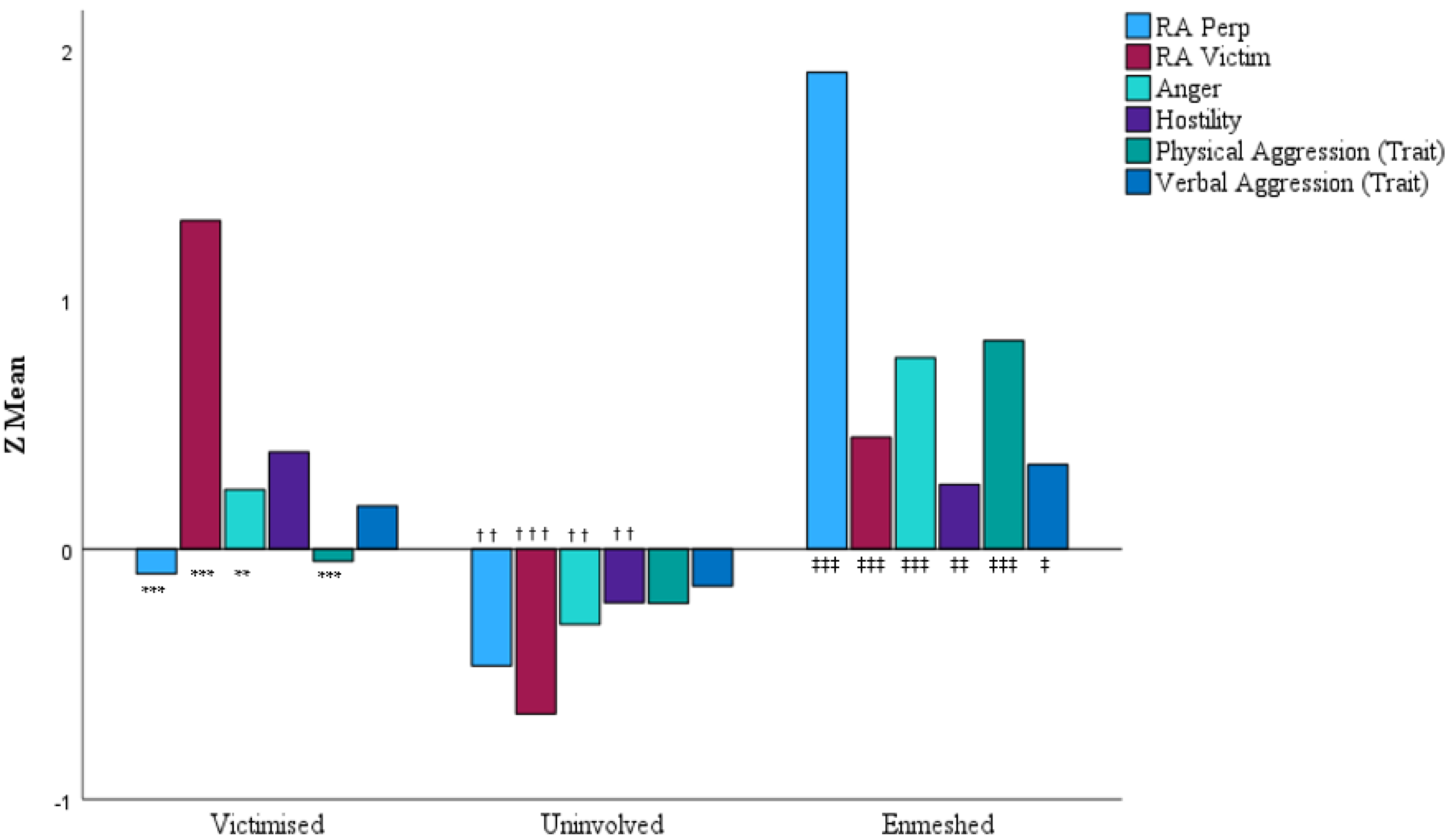
In a validity test of our developed latent classes, we observed significant omnibus tests for all aggression trait outcomes across the three RA classes. As expected, we observed significant, distinctive patterns of RA perpetration and victimisation congruent with our established classes. Additionally, we observed substantially congruent findings across our trait aggression measures. Enmeshed participants had greater trait levels of anger, hostility, and verbal and physical aggression in comparison to the uninvolved, and higher trait levels of anger and physical aggression, but not hostility or verbal aggression, compared to the victimised. The victimised had greater levels of trait anger and hostility compared to the uninvolved, but not trait physical or verbal aggression (see Table 3). Observed differences across measures tended to be statistically large when comparing the enmeshed to the uninvolved (e.g., the largest BPAQ difference is for anger; SMD = 1.26 [CI95% 0.84–1.69]) but smaller between the victimised and the uninvolved (e.g., the smallest significant difference is for BPAQ Anger, SMD = 0.54 [CI95% 0.18–0.9]). See Table 3 for descriptive statistics, Figure 1 for standardised representation for each class, and Table A2 (Appendix A) for omnibus test statistics.
Figure 1. RA and trait aggression across latent profiles. Note: *, †, and ‡ represent pairwise comparisons between victimised–enmeshed, victimised–uninvolved, and enmeshed–uninvolved, respectively. Singular, double, and triple symbols represent significance of <0.05, <0.01, and <0.001, respectively. Variables have been standardised for clarity.

3.3. Between-Latent Class Aggression and Aggressive Behaviours and Experiences

Reported rates of victimisation and perpetration corresponded with expected values (Table 3). The enmeshed group reported the highest rates of “all perpetration” (n = 16, 51.6%) in the class, which also corresponded to the enmeshed rate of verbal aggression perpetration. The enmeshed also reported the highest rates of overall victimisation (n = 22, 70.1%), with the largest proportion again from verbal aggression (n = 21, 67.7%). The only outcome that was not highest among the enmeshed was unwanted sexual attention victimisation, which was narrowly exceeded by the victim class (n = 19, 41.3% compared to n = 11, 35.5%).
Regarding the association of classes with aggressive behaviours and experiences, only two of the six tested models met overall statistical significance (see Table 4). However, we observed some stark individual differences in behaviour outcomes. The enmeshed were significantly more likely to report the perpetration of any aggressive act (OR = 5.17, [1.42–18.87], any victimisation (OR = 9.38, [1.08–81.73], verbal aggressive acts (OR = 5.26, [1.46–19.69]; all inverted odds from Table 4), and more likely be physically victimised in the past 12 months compared to the uninvolved (OR = 4.81 [1.16–19.97). The victimised were more likely to engage in aggressive acts compared to the uninvolved, and marginally more likely to have been physically victimised (OR = 3.21 [1.09–9.63]). There was no difference in the odds of these acts for the enmeshed and the victimised class.
Table 4. Associations of latent profiles and experience of aggressive behaviours and experiences.

4. Discussion

The current study had two aims: (1) to identify person-level profiles of RA based on victimisation and perpetration rates and (2) to explore how these profiles relate to experiences of other forms of aggression in emerging adults. We used LPA on self-reported RA and logistic regression to assess the likelihood of other aggressive behaviours. We identified three latent profiles: a victimised group (high victimisation, low perpetration), an enmeshed group (high on both victimisation and perpetration), and an uninvolved group (low on both victimisation and perpetration). This aligned with expectations, except for the absence of a distinct perpetration-only group. This absence may reflect strong victim–perpetrator overlap, which is consistent with research across aggression typologies more broadly (e.g., Desmarais et al., 2014; Guo, 2016; Haynie et al., 2013), sample size limitations, and relatively low overall rates of “pure” perpetration. Given our data relied upon self-report, it is likely that social desirability bias was influential, though it could also reflect a scarcity of those most predisposed to engaging in antisocial behaviour (e.g., the estimated prevalence of antisocial personality disorder is around 2-3% in the general population (Fisher et al., 2024), equal to a small handful of individuals in our sample). It could also suggest that RA perpetration is more closely linked with other forms of aggression than victimisation alone.
Trait and behavioural indicators of aggression varied across profiles. Notably, hostility levels were equally high among both the enmeshed and victimised groups, suggesting that victimisation may foster hostile attribution styles. This is consistent with the GAM’s feedback loop conceptualisation of hostility (Allen et al., 2018). However, without a high-perpetration/low-victimisation group, this remains speculative. Further, anger levels were highest in the enmeshed group, followed by the victimised, then uninvolved participants, aligning with evidence that hostile interpretations often precede anger and aggressive behaviour (Wilkowski & Robinson, 2010). A similar pattern was observed for physical and verbal aggression, where only the enmeshed group reported substantially elevated scores. These findings suggest that victimisation alone may foster hostility, but co-occurring victimisation and perpetration are more strongly associated with broader aggressive tendencies.
Consistent with this interpretation, both enmeshed and victimised participants reported comparable odds of engaging in and experiencing aggressive behaviour, and both reported much greater odds than uninvolved individuals. That is, there was no behavioural distinction between the enmeshed and victim-only groups in terms of actual aggressive acts. This finding corresponds with our expectation that even when participants report low levels of perpetration of RA, other forms of aggressive behaviour are elevated. The enmeshed group also had markedly higher odds of experiencing physical victimisation, about four times that of the uninvolved, suggesting this group may be embedded in broader aggressive social dynamics. This aligns with previous findings linking RA and non-RA across populations, including those with mental illness (Desmarais et al., 2014). We found no significant associations between age, gender, or socioeconomic status (SES) and aggressive behaviour outcomes. While the null effect of age may be unsurprising given our focus on emerging adults, it is noteworthy that gender was unrelated, as RA has traditionally been characterised as more common among women. However, research from the past decade challenges this gendered view (Voulgaridou & Kokkinos, 2015), and our recent work suggests that personality rather than demographics is a more robust predictor of relational aggression (Patafio et al., 2025).

4.1. Limitations

This study is limited by its cross-sectional design, which precludes inferences about causal direction between victimisation, perpetration, and aggressive traits or behaviours. Future research should incorporate longitudinal or momentary assessment methods to better model temporal patterns and directional effects. Likewise, our methodology did not allow us to determine whether participants were reporting on the same relationships for both victimisation and perpetration, which would allow us to pinpoint whether a shift from victim to perpetrator represents retaliation or whether it might signal a general increase in aggression towards other peers. Additionally, the small sample and, therefore, small numbers within profiles mean that these findings should be considered tentative and indicate the need for replication in a larger and more varied sample. Relatedly, our age and location restrictions temper our optimism that these findings are generalisable, despite being largely congruent with expectations and observed findings in other cohorts. While social media use is approximately equal between genders globally or skewed toward males (Larson, 2025), we also acknowledge that our sample was disproportionately female. While the full impact is unknown, such a disparity may have been influential despite our inclusion of gender as a covariate.
Lastly, rates of non-RA and violent behaviour across the entire sample were generally low. Although dichotomising these variables enabled some meaningful group comparisons, model fit was generally poor, and the estimates for the enmeshed group had wide confidence intervals. These findings should therefore be interpreted as indicative rather than definitive. Further to this, whilst dichotomising these variables assisted in comparisons, it also likely created substantial heterogeneity within the groups (not aggressive/violent vs. aggressive/violent), as those who engaged in verbal aggression on one occasion in the past 12 months were combined with those who may have engaged in physical aggression weekly over the same period. Further, as exemplars were not provided for each type of aggression, it is difficult to discern what behaviours participants considered “verbal aggression”, and this may have included using a negative tone, swearing, shouting, or threatening another person. Future research would benefit from providing further details to participants to ensure they understand what each type of aggression entails.

4.2. Implications

Our findings confirm that RA may not exist in isolation but as part of a broader aggression profile. Interventions targeting one form of aggression may subsequently influence others, positively or through substitution. For instance, reductions in RA may reduce other forms of aggressive behaviour by interrupting or moderating the feed-forward mechanisms proposed by the GAM. It is also conceivable that more overt aggression may represent a reaction to sustained RA victimisation, or that escalating aggression spans multiple forms. However, intervening in RA can be beneficial. For example, classroom programs targeting RA have been shown to reduce physical victimisation (Dailey et al., 2015). However, far less is known about RA intervention for adults, where the closest analogue—workplace bullying—has shown mixed intervention success (Hodgins et al., 2014). Bullying prevention initiatives within universities have demonstrated some efficacy via a “strengths-based” approach that enlists the support of witnesses, bystanders, and other third-parties to empower victims and would-be victims, rather than a deficit model that reacts to reported bullying (Cismaru & Cismaru, 2018). Since RA inherently involves the use of third parties (e.g., as a means to exclude or as a conduit of rumours), interventions that foster inclusive environments are likely to be more resistant to the emergence of RA. To develop more effective interventions, future research should explore how these patterns evolve over time and under what conditions RA leads to escalation into other aggressive behaviours. For practitioners, the findings emphasise the importance of understanding who is attending an intervention, what differing needs they may have, and targeting them accordingly. In particular, the identification of enmeshed individuals may be key to preventing broader cycles of interpersonal harm.

5. Conclusions

Consistent with the GAM, RA experiences exist in comparable typologies to other forms of aggressive behaviour, and these experiences appear to align with experiences of other forms of aggressive behaviour, including violence. The absence of a perpetration-only profile also reinforces the idea that RA involvement is often reciprocal or embedded within ongoing relational conflict, aligning with research showing substantial overlap between victimisation and perpetration across aggression domains. The higher odds of physical victimisation among enmeshed individuals further indicate that relationally aggressive contexts may escalate or spill over into other, more overt, forms of harm. Our findings suggest that correlations between forms of aggression and aggressive behaviour are comparable in emerging adulthood as in earlier developmental periods, necessitating continued age-appropriate efforts tailored to reducing RA. Universities and workplaces represent key opportunities for intervention and prevention.

Author Contributions

Conceptualisation, D.S., B.P., S.H., and R.M.; methodology, D.S. and S.H.; software, D.S.; validation, D.S., B.P., S.H., and R.M.; formal analysis, D.S., B.P., and S.H.; investigation, D.S., B.P., S.H., and R.M.; data curation, D.S.; writing—original draft preparation, D.S.; writing—review and editing, D.S., B.P., S.H., T.H., A.C., M.B., and R.M.; visualisation, D.S. All authors have read and agreed to the published version of the manuscript.

Funding

This research received no external funding.

Institutional Review Board Statement

This study was conducted in accordance with the Declaration of Helsinki and approved by the Institutional Review Board of Deakin University (2021-041; approved 1 March 2021).

Data Availability Statement

Data are available upon request from the corresponding author.

Conflicts of Interest

The authors declare no conflicts of interest.

Abbreviations

The following abbreviations are used in this manuscript:
GAMGeneral Aggression Model
LPALatent Profile Analysis
RARelational Aggression

Appendix A

Table A1. Fit indices of latent profiles.
ModelkAICBICSABICICLEntropyPminPmaxNminNmax
12121812401218−12640.810.930.960.380.62
13111411471115−11680.900.910.970.160.61
14112011631121−12560.670.000.960.000.60
22111511441115−11760.750.910.950.490.51
23106611121068−11430.850.900.950.140.57
24NA
32120312291204−12420.890.970.970.400.60
33111611521117−11730.900.920.970.160.61
34112211671123−12650.660.000.970.000.61
62111311491114−11660.850.940.980.440.56
63109011451092−11840.780.840.970.250.47
64NA
Note: k = number of classes, Pmin/Pmax = posterior probability minimum/maximum for class membership, Nmin/Nmax = sample proportion for smallest and largest classes. Parameters for selected model are in boldface.
Table A2. Comparative aggression traits and behaviours across latent classes.
Omnibus TestMSDVictimised–EnmeshedVictimised–UninvolvedEnmeshed–Uninvolved
RA. PerpetrationWelch’s F(2, 82) = 152, p < 0.001 MD = −0.32, t(72.3) = −13.4, p < 0.001MD = 0.09, t(73.1) = 3.96, p = 0.001MD = −0.41, t(75.1) = −23.98, p < 0.001
Victimised0.210.13
Uninvolved0.120.12
Enmeshed0.530.07
RA. VictimisationWelch’s F(2, 89) = 279, p < 0.001 MD = 0.16, t(54.4) = 7.34, p < 0.001MD = 0.51, t(160.8) = 23.72, p < 0.001MD = −0.35, t(90.8) = −13.53, p < 0.001
Victimised0.730.08
Uninvolved0.220.19
Enmeshed0.560.10
AngerFisher’s F(2, 181) = 23, p < 0.001 MD = −0.13, t(71) = −2.69, p = 0.009MD = 0.11, t(152) = 2.99, p = 0.003MD = −0.24, t(141) = −6.25,
p < 0.001
Victimised0.290.23
Uninvolved0.180.19
Enmeshed0.420.17
HostilityFisher’s F(2, 181) = 6.8, p = 0.001 MD = 0.01, t(70) = 0.16, p = 0.872MD = 0.1, t(151) = 3.04, p = 0.003MD = −0.1, t(141) = −2.67, p = 0.008
Victimised0.400.19
Uninvolved0.300.19
Enmeshed0.400.15
Physical (Trait)Fisher’s F(2, 182) = 15, p < 0.001 MD = −0.16, t(71) = −3.68, p < 0.001MD = 0.03, t(152) = 1, p = 0.320MD = −0.19, t(141) = −5.53, p < 0.001
Victimised0.180.18
Uninvolved0.150.16
Enmeshed0.340.19
Verbal (Trait)Fisher’s F(2, 181) = 2.9, p = 0.06 MD = −0.04, t(71) = −0.96, p = 0.340MD = 0.04, t(151) = 1.24, p = 0.217MD = −0.08, t(140) = −2.4, p = 0.0177
Victimised0.350.19
Uninvolved0.320.16
Enmeshed0.390.16
Note: All outcomes have been log10-transformed. Right-most columns represent differences in means between classes for continuous variables.

References

  1. ABS. (2021). Socio-Economic Indexes For Areas (SEIFA), Australia. Available online: https://www.abs.gov.au/statistics/people/people-and-communities/socio-economic-indexes-areas-seifa-australia/latest-release (accessed on 13 November 2025).
  2. Allen, J. J., Anderson, C. A., & Bushman, B. J. (2018). The general aggression model. Current Opinion in Psychology, 19, 75–80. [Google Scholar] [CrossRef]
  3. Anderson, C. A., & Bushman, B. J. (2002). Human aggression. Annual Review of Psychology, 53(1), 27–51. [Google Scholar] [CrossRef] [PubMed]
  4. Bowie, B. H. (2007). Relational aggression, gender, and the developmental process. Journal of Child and Adolescent Psychiatric Nursing, 20(2), 107–115. [Google Scholar] [CrossRef] [PubMed]
  5. Bryant, F. B., & Smith, B. D. (2001). Refining the architecture of aggression: A measurement model for the buss–Perry aggression questionnaire. Journal of Research in Personality, 35(2), 138–167. [Google Scholar] [CrossRef]
  6. Buhs, E. S., Ladd, G. W., & Herald, S. L. (2006). Peer exclusion and victimization: Processes that mediate the relation between peer group rejection and children’s classroom engagement and achievement? Journal of Educational Psychology, 98(1), 1–13. [Google Scholar] [CrossRef]
  7. Cismaru, M., & Cismaru, R. (2018). Protecting university students from bullying and harassment: A review of the initiatives at Canadian Universities. Contemporary Issues in Education Research, 11(4), 145–152. [Google Scholar] [CrossRef]
  8. Crick, N. R., Ostrov, J. M., Burr, J. E., Cullerton-Sen, C., Jansen-Yeh, E., & Ralston, P. (2006a). A longitudinal study of relational and physical aggression in preschool. Journal of Applied Developmental Psychology, 27(3), 254–268. [Google Scholar] [CrossRef]
  9. Crick, N. R., Ostrov, J. M., & Werner, N. E. (2006b). A Longitudinal study of relational aggression, physical aggression, and children’s social–Psychological adjustment. Journal of Abnormal Child Psychology, 34(2), 127–138. [Google Scholar] [CrossRef]
  10. Curtis, A., Harries, T., Bereznicki, H., Skvarc, D., Patafio, B., Hyder, S., & Mayshak, R. (2023). Facet-level impulsivity and proactive and reactive relational aggression. Personality and Individual Differences, 213, 112320. [Google Scholar] [CrossRef]
  11. Curtis, A., Harries, T., Skvarc, D., Guala, T., Enticott, P. G., & Miller, P. G. (2024). Childhood maltreatment and adult aggression: The moderating role of neurocognitive ability and substance use. Child Abuse & Neglect, 158, 107094. [Google Scholar] [CrossRef]
  12. Dailey, A. L., Frey, A. J., & Walker, H. M. (2015). Relational aggression in school settings: Definition, development, strategies, and implications. Children & Schools, 37(2), 79–88. [Google Scholar] [CrossRef]
  13. Demaray, M. K., Malecki, C. K., Ryoo, J. H., & Summers, K. H. (2021). Deconstructing bullying roles: A longitudinal latent profile analysis of bullying participant behaviors for students in grades 4 through 12. Journal of School Psychology, 86, 32–48. [Google Scholar] [CrossRef] [PubMed]
  14. Desmarais, S. L., Van Dorn, R. A., Johnson, K. L., Grimm, K. J., Douglas, K. S., & Swartz, M. S. (2014). Community violence perpetration and victimization among adults with mental illnesses. American Journal of Public Health, 104(12), 2342–2349. [Google Scholar] [CrossRef]
  15. DeWall, C. N., Anderson, C. A., & Bushman, B. J. (2011). The general aggression model: Theoretical extensions to violence. Psychology of Violence, 1(3), 245–258. [Google Scholar] [CrossRef]
  16. Fisher, K. A., Torrico, T. J., & Hany, M. (2024). Antisocial personality disorder. In StatPearls [Internet]. StatPearls Publishing. [Google Scholar]
  17. Giang, M. T., & Graham, S. (2007). Using latent class analysis to identify aggressors and victims of peer harassment. Aggressive Behavior, 34(2), 203–213. [Google Scholar] [CrossRef]
  18. Goldstein, S. E., Chesir-Teran, D., & McFaul, A. (2007). Profiles and correlates of relational aggression in young adults’ romantic relationships. Journal of Youth and Adolescence, 37(3), 251–265. [Google Scholar] [CrossRef]
  19. Gong, Z., Tang, Z., Zhou, J., Han, Z., & Zhang, J. (2024). A comparison of definitions of school bullying among students, parents, and teachers: An experimental study from China. Children and Youth Services Review, 161, 107693. [Google Scholar] [CrossRef]
  20. Guo, S. (2016). A meta-analysis of the predictors of cyberbullying perpetration and victimization. Psychology in the Schools, 53(4), 432–453. [Google Scholar] [CrossRef]
  21. Haynie, D. L., Farhat, T., Brooks-Russell, A., Wang, J., Barbieri, B., & Iannotti, R. J. (2013). Dating violence perpetration and victimization among U.S. adolescents: Prevalence, patterns, and associations with health complaints and substance use. Journal of Adolescent Health, 53(2), 194–201. [Google Scholar] [CrossRef]
  22. Hodgins, M., MacCurtain, S., & Mannix-McNamara, P. (2014). Workplace bullying and incivility: A systematic review of interventions. International Journal of Workplace Health Management, 7(1), 54–72. [Google Scholar] [CrossRef]
  23. Horowitz, D., Guyer, M., & Sanders, K. (2015). Psychosocial approaches to violence and aggression: Contextually anchored and trauma-informed interventions. CNS Spectrums, 20(3), 190–199. [Google Scholar] [CrossRef] [PubMed]
  24. Hyder, S., Coomber, K., Pennay, A., Droste, N., Curtis, A., Mayshak, R., Lam, T., Gilmore, W., Chikritzhs, T., & Miller, P. G. (2017). Correlates of verbal and physical aggression among patrons of licensed venues in Australia. Drug and Alcohol Review, 37(1), 6–13. [Google Scholar] [CrossRef] [PubMed]
  25. Hyder, S., Mayshak, R., Skvarc, D., Harris, N., Curtis, A., Harries, T., Benstead, M., & Patafio, B. (2025). The social impact of relational aggression on adults mental health. Current Psychology, 44(18), 15340–15350. [Google Scholar] [CrossRef]
  26. Jenkins, L. N., Miller, H. H., Kaminski, S., & Putzeys, S. (2022). Re-conceptualizing peer victimization as a potentially traumatic event. International Journal of Bullying Prevention, 5(2), 151–160. [Google Scholar] [CrossRef]
  27. Kamaluddin, M. R., Munusamy, S., Sheau Tsuey, C., Abdullah, H., & Nor, M. (2024). Relational aggression in romantic relationship: Empirical evidence among young female adults in Malaysia. BMC Psychology, 12(1), 305. [Google Scholar] [CrossRef]
  28. Kretschmer, T., Veenstra, R., Branje, S., Reijneveld, S. A., Meeus, W. H. J., Deković, M., Koot, H. M., Vollebergh, W. A. M., & Oldehinkel, A. J. (2017). How competent are adolescent bullying perpetrators and victims in mastering normative developmental tasks in early adulthood? Journal of Abnormal Child Psychology, 46(1), 41–56. [Google Scholar] [CrossRef]
  29. Larson, S. (2025). Social media users 2025 (global data & statistics). Priori Data. [Google Scholar]
  30. Mayeux, L. (2013). Understanding popularity and relational aggression in adolescence: The role of social dominance orientation. Social Development, 23(3), 502–517. [Google Scholar] [CrossRef]
  31. Mayshak, R., Curtis, A., Coomber, K., Tonner, L., Walker, A., Hyder, S., Liknaitzky, P., & Miller, P. (2020). Alcohol-involved family and domestic violence reported to police in Australia. Journal of Interpersonal Violence, 37(3–4), NP1658–NP1685. [Google Scholar] [CrossRef]
  32. McGorry, P. D., Mei, C., Dalal, N., Alvarez-Jimenez, M., Blakemore, S. J., Browne, V., Dooley, B., Hickie, I. B., Jones, P. B., McDaid, D., Mihalopoulos, C., Wood, S. J., El Azzouzi, F. A., Fazio, J., Gow, E., Hanjabam, S., Hayes, A., Morris, A., Pang, E., … PSych, D. C. (2024). The Lancet Psychiatry Commission on youth mental health. The Lancet Psychiatry, 11(9), 731–774. [Google Scholar] [CrossRef]
  33. McIver, T. A., Bosma, R. L., Goegan, S., Sandre, A., Klassen, J., Chiarella, J., Booij, L., & Craig, W. (2019). Functional connectivity across social inclusion and exclusion is related to peer victimization and depressive symptoms in young adults. Journal of Affective Disorders, 253, 366–375. [Google Scholar] [CrossRef]
  34. Murray-Close, D., Ostrov, J. M., Nelson, D. A., Crick, N. R., & Coccaro, E. F. (2010). Proactive, reactive, and romantic relational aggression in adulthood: Measurement, predictive validity, gender differences, and association with Intermittent Explosive Disorder. Journal of Psychiatric Research, 44(6), 393–404. [Google Scholar] [CrossRef] [PubMed]
  35. Nylund-Gibson, K., & Choi, A. Y. (2018). Ten frequently asked questions about latent class analysis. Translational Issues in Psychological Science, 4(4), 440–461. [Google Scholar] [CrossRef]
  36. Ostrov, J. M., Blakely-McClure, S. J., Perry, K. J., & Kamper-DeMarco, K. E. (2018a). Definitions—The form and function of relational aggression. In The development of relational aggression (pp. 13–28). Oxford University Press. [Google Scholar]
  37. Ostrov, J. M., Kamper-DeMarco, K. E., Blakely-McClure, S. J., Perry, K. J., & Mutignani, L. (2018b). Prospective associations between aggression/bullying and adjustment in preschool: Is general aggression different from bullying behavior? Journal of Child and Family Studies, 28(9), 2572–2585. [Google Scholar] [CrossRef]
  38. Patafio, B., Skvarc, D., Mayshak, R., Harries, T., Curtis, A., Benstead, M., Hayley, A., McNeil, D. G., Bereznicki, H., & Hyder, S. (2025). Dark and light personalities: A utilitarian perspective on their impact on relational aggression. Personality and Individual Differences, 242, 113209. [Google Scholar] [CrossRef]
  39. Rice, E., Petering, R., Rhoades, H., Winetrobe, H., Goldbach, J., Plant, A., Montoya, J., & Kordic, T. (2015). Cyberbullying perpetration and victimization among middle-school students. American Journal of Public Health, 105(3), e66–e72. [Google Scholar] [CrossRef]
  40. Rosenberg, J., Beymer, P., Anderson, D., van Lissa, C. j., & Schmidt, J. (2018). tidyLPA: An R package to easily carry out Latent Profile Analysis (LPA) using open-source or commercial software. Journal of Open Source Software, 3(30), 978. [Google Scholar] [CrossRef]
  41. Shell, M. D., Gazelle, H., & Faldowski, R. A. (2014). Anxious solitude and the middle school transition: A diathesis × stress model of peer exclusion and victimization trajectories. Developmental Psychology, 50(5), 1569–1583. [Google Scholar] [CrossRef]
  42. Skvarc, D. R., Harries, T., Harris, N., Hyder, S., Patafio, B., Howard, D., Bereznicki, H. G. K., Curtis, A., Benstead, M., & Mayshak, R. (2023). Cognitive control moderates the maturation of relational aggression in adults. Personality and Individual Differences, 212, 112267. [Google Scholar] [CrossRef]
  43. Storch, E. A., Bagner, D. M., Geffken, G. R., & Baumeister, A. L. (2004). Association between overt and relational aggression and psychosocial adjustment in undergraduate college students. Violence and Victims, 19(6), 689. [Google Scholar] [CrossRef]
  44. Team, R. C. (2025). R: A language and environment for statistical computing. Available online: https://cran.r-project.org/ (accessed on 13 November 2025).
  45. Underwood, M. K., Beron, K. J., & Rosen, L. H. (2009). Continuity and change in social and physical aggression from middle childhood through early adolescence. Aggressive Behavior, 35(5), 357–375. [Google Scholar] [CrossRef]
  46. Voulgaridou, I., & Kokkinos, C. M. (2015). Relational aggression in adolescents: A review of theoretical and empirical research. Aggression and Violent Behavior, 23, 87–97. [Google Scholar] [CrossRef]
  47. Wilkowski, B. M., & Robinson, M. D. (2010). the anatomy of anger: An integrative cognitive model of trait anger and reactive aggression. Journal of Personality, 78(1), 9–38. [Google Scholar] [CrossRef]
  48. Zettler, H. R. (2020). Much to do about trauma: A systematic review of existing trauma-informed treatments on youth violence and recidivism. Youth Violence and Juvenile Justice, 19(1), 113–134. [Google Scholar] [CrossRef]
  49. Zinkiewicz, L., Curtis, A., Meurer, H., & Miller, P. (2016). Demographic risk factors for alcohol-related aggression in and around licensed venues. Alcohol and Alcoholism, 51(2), 196–200. [Google Scholar] [CrossRef]
Disclaimer/Publisher’s Note: The statements, opinions and data contained in all publications are solely those of the individual author(s) and contributor(s) and not of MDPI and/or the editor(s). MDPI and/or the editor(s) disclaim responsibility for any injury to people or property resulting from any ideas, methods, instructions or products referred to in the content.

Article Metrics

Citations

Article Access Statistics

Multiple requests from the same IP address are counted as one view.