Prevention of Postpartum Depression via a Digital ACT-Based Intervention: Evaluation of a Prototype Using Multiple Case Studies


Abstract
1. Background
1.1. Acceptance and Commitment Therapy (ACT) in the Perinatal Period
1.2. Digital Interventions for Perinatal Mental Health
1.3. Present Research
2. Materials and Methods
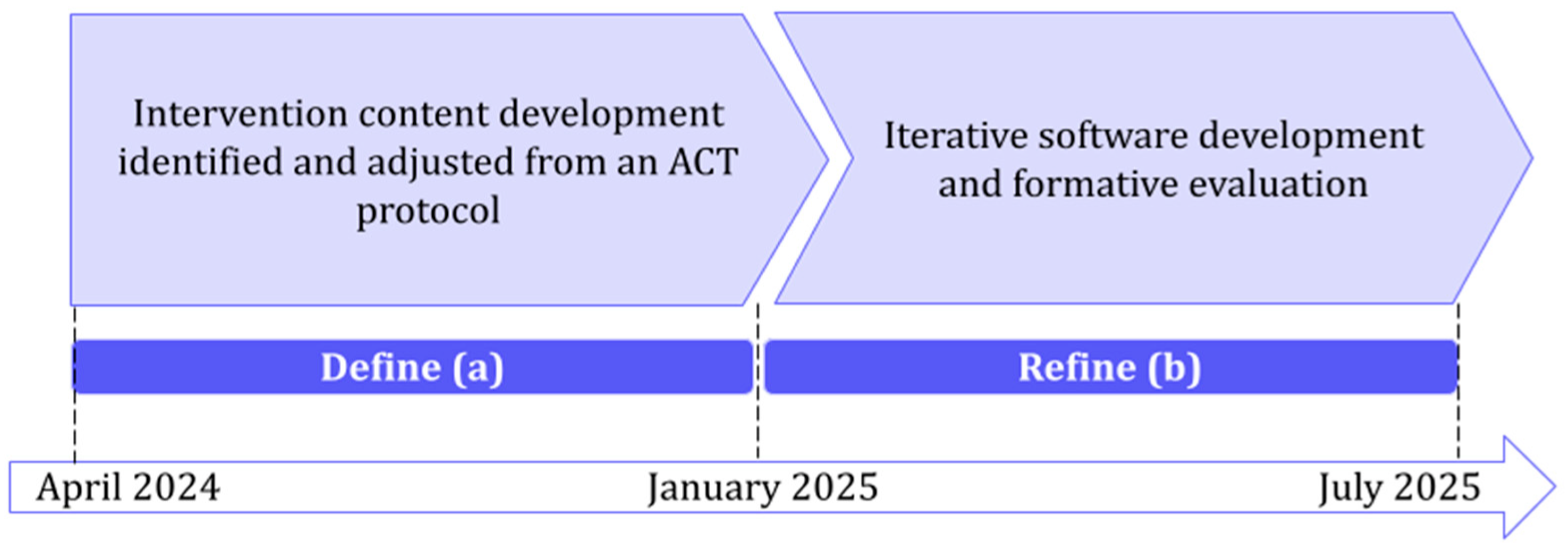
2.1. Intervention Content Development
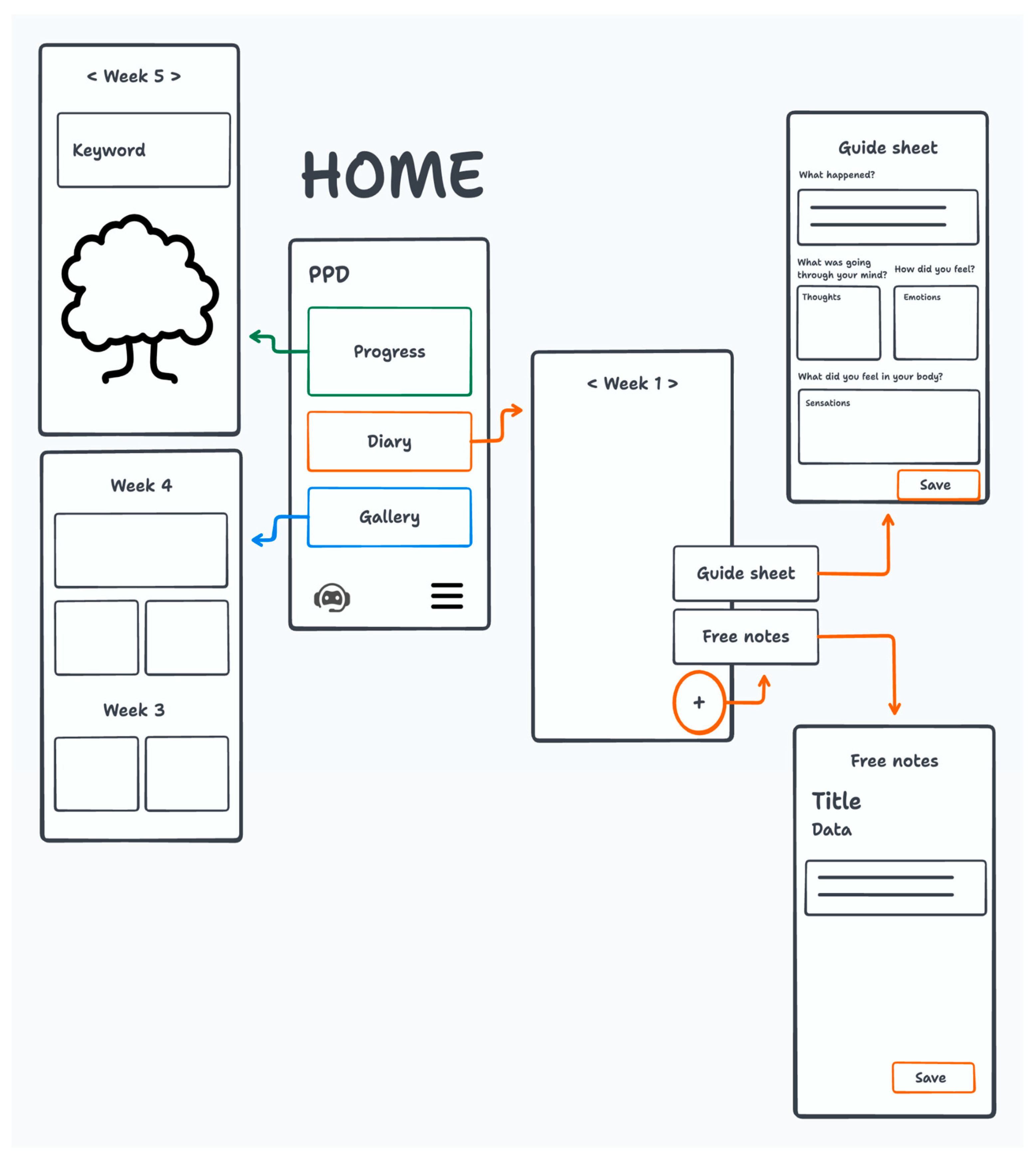
Functions of App Sections
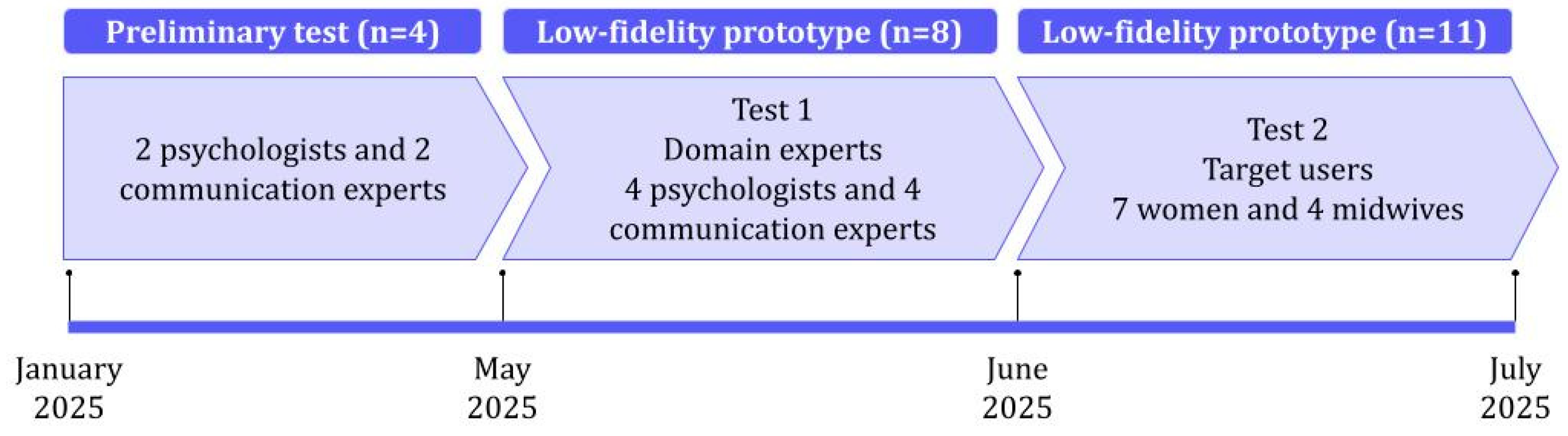
2.2. Iterative Software Development and Formative Evaluation
2.2.1. Study Aims: Quantitative and Qualitative Components
2.2.2. Variables Identification
2.2.3. Procedure
- (1)
- Presentation of the participant information sheet and informed consent;
- (2)
- A two-week interaction period with the REA prototype (one session every other day), with each session lasting about 15 min;
- (3)
- Testing on the participant’s own smartphone;
- (4)
- Exploration of the interface and sections through mock-ups;
- (5)
- ACT-based dialogue sessions delivered via WhatsApp, using structured prompts with predefined buttons and optional free-text responses;
- (6)
- Free-text inputs were not analysed at this prototype stage, as this was outside the primary objectives of the study;
- (7)
- Participants were informed that reminders and activity feedback would be implemented in future versions.
2.2.4. Data Analysis
3. Results
3.1. Quantitative Results
3.2. Qualitative Results
3.2.1. Theme 1: Communication and Interaction with the Chatbot
3.2.2. Theme 2: Module Structure
3.2.3. Theme 3: Multimedia Materials
3.2.4. Theme 4: Content and Personalization
3.2.5. Overall Assessment
3.2.6. Insights into the Effectiveness of the Intervention
3.2.7. Suggestions for Improvement
- Enhance the realism of video content—a psychologist noted that, although they found the current material appealing, incorporating more realistic videos could better engage adult women, as the current videos appear to be primarily targeted at children and adolescents.
- Clarify the chatbot’s purpose and limitations. According to a psychologist, it is essential to manage users’ expectations to avoid unrealistic assumptions and to ensure they understand that guidance will be provided throughout the intervention.
- Users could be encouraged to record their thoughts and reflections throughout the intervention—as noted by a psychologist, this may help them maintain coherence in their thinking and clarify the underlying psychological constructs.
- Add a section dedicated to supplementary material—a psychologist highlighted the potential benefit of offering additional resources or external links for users interested in deepening their understanding of specific concepts.
- Enhance initial rapport-building and space to express themselves and feel more actively involved in the interaction—while a psychologist proposed engaging the user by building a connection at the beginning of the intervention through personal questions (e.g., ‘What is your occupation?’), a mother suggested that the chatbot could increase user involvement by asking questions on a weekly basis.
- Reduce repetitiveness in message content—a communication expert expressed concern about the repetition of certain messages across sessions, suggesting that key concepts could be reiterated using varied wording and phrasing.
4. Discussion
Strengths, Limitations, and Future Directions
5. Conclusions
Author Contributions
Funding
Institutional Review Board Statement
Informed Consent Statement
Data Availability Statement
Acknowledgments
Conflicts of Interest
Abbreviations
| PPD | Postpartum depression |
| ACT | Acceptance and Commitment Therapy |
| DTx | Digital Therapeutics |
| uMARS | User Version of the Mobile Application Rating Scale |
| CBT | Cognitive Behavioural Therapy |
| WHO | World Health Organization |
| SH+ | Self-Help Plus |
| RCT | Randomized Controlled Trial |
Appendix A

| Variable | Subvariables | Items |
|---|---|---|
| Communication | empathy and listening skills | judgmental—welcoming, passive listening—active listening, alarming—reassuring, indifferent—sensitive, cold—warm |
| fluency and fluidity | non-sliding—sliding | |
| chatbot interaction | boring—engaging, inefficient—efficient, slow—fast, heavy—adequate | |
| vocabulary | abstruse—understandable, technical—common | |
| Module structure | single interaction duration | long—short, challenging—easy |
| Materials | audio recordings | unpleasant—pleasant, stressful—relaxing, hindering—helpful, useless—functional |
| images and videos | unimaginative—creative, hindering—supportive, unpleasant—pleasant | |
| Contents | content evaluation | boring—interesting, soporific—stimulating, of little value—of great value |
| clarity of content | confused—clear, abstruse—understandable |
Appendix B
| Topic Investigated | Questions |
|---|---|
| Set 1: Interaction | 1.1 How did you feel about the interaction with REA? Were there enough alternatives among the replies to REA? 1.2 What was the feature of the interaction that you liked the most? And the one you liked the least? 1.3 Have you ever made the mistake of clicking the answer button on a question? Have you wished you could have gone back? |
| Set 2: Communication mode | 2.1 If something was not clear to you at first, do you find there is then a way to investigate the topic further? 2.2 Did you like answering the question “How are you?” from session 2 with emojis, or did you prefer to answer with words? 2.3 Is the mode of communication (length of sentences, terms used) appropriate for the content? |
| Set 3: Involvement and constancy | 3.1 Was the communication with the chatbot engaging? Did it entice you to get involved and be consistent in activities? 3.2 Overall, was the intervention personalized for you? Give a level of personalization from 0 to 10. |
| Set 4: General questions | 4.1 Do you have any concerns? Do you have any criticism? 4.2 When would be the ideal time to take this intervention for a pregnant woman or a breast cancer patient? |
| Set 5: Technical implementation | 5.1 Would reminders help you be more consistent in doing exercises or completing dialogues? 5.2 Would you like to receive the pop-up message that you reached the goal as soon as you did? Or would you prefer to receive it at the end of the week? 5.3 Would you like to receive the sticker in black and white for completing the dialogue and then coloured for completing the exercises? Or would you prefer it to be gradually coloured as you proceeded to complete the exercises? |
References
- Agrawal, P., Bhatia, M. S., & Malik, S. C. (1997). Post partum psychosis: A clinical study. International Journal of Social Psychiatry, 43(3), 217–222. [Google Scholar] [CrossRef] [PubMed]
- Biaggi, A., Conroy, S., Pawlby, S., & Pariante, C. M. (2016). Identifying the women at risk of antenatal anxiety and depression: A systematic review. Journal of Affective Disorders, 191, 62–77. [Google Scholar] [CrossRef] [PubMed]
- Branquinho, M., Rodriguez-Muñoz, M. D. L. F., Maia, B. R., Marques, M., Matos, M., Osma, J., Moreno-Peral, P., Conejo-Cerón, S., Fonseca, A., & Vousoura, E. (2021). Effectiveness of psychological interventions in the treatment of perinatal depression: A systematic review of systematic reviews and meta-analyses. Journal of Affective Disorders, 291, 294–306. [Google Scholar] [CrossRef] [PubMed]
- Brockington, I. F., Margison, F. R., Schofield, E., & Knight, R. J. E. (1988). The clinical picture of the depressed form of puerperal psychosis. Journal of Affective Disorders, 15(1), 29–37. [Google Scholar] [CrossRef]
- Chen, C., Wang, X., Xu, H., & Li, Y. (2023). Effectiveness of digital psychological interventions in reducing perinatal depression: A systematic review of meta-analyses. Archives of Women’s Mental Health, 26(4), 423–439. [Google Scholar] [CrossRef]
- Clinkscales, N., Golds, L., Berlouis, K., & MacBeth, A. (2023). The effectiveness of psychological interventions for anxiety in the perinatal period: A systematic review and meta-analysis. Psychology and Psychotherapy: Theory, Research and Practice, 96(2), 296–327. [Google Scholar] [CrossRef]
- Czajkowski, S. M., Powell, L. H., Adler, N., Naar-King, S., Reynolds, K. D., Hunter, C. M., Laraia, B., Olster, D. H., Perna, F. M., Peterson, J. C., Epel, E., Boyington, J. E., & Charlson, M. E. (2015). From ideas to efficacy: The ORBIT model for developing behavioral treatments for chronic diseases. Health Psychology, 34(10), 971–982. [Google Scholar] [CrossRef]
- Dalton, K. (1971). Prospective study into puerperal depression. British Journal of Psychiatry, 118(547), 689–692. [Google Scholar] [CrossRef]
- Danaher, B. G., Milgrom, J., Seeley, J. R., Stuart, S., Schembri, C., Tyler, M. S., Ericksen, J., Lester, W., Gemmill, A. W., Kosty, D. B., & Lewinsohn, P. (2013). MomMoodBooster web-based intervention for postpartum depression: Feasibility trial results. Journal of Medical Internet Research, 15(11), e242. [Google Scholar] [CrossRef]
- Dilworth, S., Higgins, I., Parker, V., Kelly, B., & Turner, J. (2014). Patient and health professional’s perceived barriers to the delivery of psychosocial care to adults with cancer: A systematic review. Psycho-Oncology, 23(6), 601–612. [Google Scholar] [CrossRef]
- Firrahmawati, L., Wasityastuti, W., Kandarina, B. J. I., Marti, E., Chandra, L. A., & Sulistianingsih, A. (2025). The efficacy of collaborative psychological interventions in reducing anxiety levels in pregnant women: A systematic review and meta-analysis. BMC Pregnancy and Childbirth, 25(1), 431. [Google Scholar] [CrossRef]
- Fonseca, A., Monteiro, F., Alves, S., Gorayeb, R., & Canavarro, M. C. (2019). Be a mom, a web-based intervention to prevent postpartum depression: The enhancement of self-regulatory skills and its association with postpartum depressive symptoms. Frontiers in Psychology, 10, 265. [Google Scholar] [CrossRef]
- Hayes, S. C., Luoma, J. B., Bond, F. W., Masuda, A., & Lillis, J. (2006). Acceptance and commitment therapy: Model, processes and outcomes. Behaviour Research and Therapy, 44(1), 1–25. [Google Scholar] [CrossRef] [PubMed]
- Hayes, S. C., Strosahl, K., Wilson, K. G., & Strosahl, K. (1999). Acceptance and commitment therapy: An experiential approach to behavior change. Guilford Press. [Google Scholar]
- Jamovi—Open statistical software for the desktop and cloud. (n.d.). Available online: https://www.jamovi.org/ (accessed on 13 August 2025).
- King, A. P., & Eckersley, R. J. (2019). Statistics for biomedical engineers and scientists: How to visualize and analyze data. Academic Press, an imprint of Elsevier. [Google Scholar]
- Klausen, D. E. (n.d.). Manuale (ACT) per la prevenzione del disagio e della depressione post partum. Available online: https://cdn.prod.website-files.com/58be906764167da73c14f01c/6560d86118646b2cccb0bb56_Manuale-ACT-per-Disagio-e-Depressione-PostPartum-OK.pdf (accessed on 25 September 2025).
- Lega, I., Mastroeni, S., Ferraro, C., Bauer, A., Bucciarelli, M., Andreozzi, S., Pizzi, E., Donati, S., & The Group for Maternal Mental Health in the First 1000 Days of Life . (2024). Perinatal mental health care in the Italian mental health departments: A national survey. European Psychiatry, 67(1), e46. [Google Scholar] [CrossRef] [PubMed]
- Meng, W., Shalayiding, S., Wang, X., Sailike, B., & Jiang, T. (2025). Relationship between prenatal anxiety, depression, pregnancy stress and their social determinants. BMC Psychology, 13(1), 905. [Google Scholar] [CrossRef] [PubMed]
- Milgrom, J., Danaher, B. G., Gemmill, A. W., Holt, C., Holt, C. J., Seeley, J. R., Tyler, M. S., Ross, J., & Ericksen, J. (2016). Internet cognitive behavioral therapy for women with postnatal depression: A randomized controlled trial of MumMoodBooster. Journal of Medical Internet Research, 18(3), e54. [Google Scholar] [CrossRef]
- Morgan, D. (1996). Focus groups. Annual Review of Sociology, 22, 129–152. [Google Scholar] [CrossRef]
- Morselli, S., Sebastianelli, A., Domnich, A., Bucchi, C., Spatafora, P., Liaci, A., Gemma, L., Gravas, S., Panatto, D., Serni, S., & Gacci, M. (2021). Translation and validation of the Italian version of the user version of the Mobile Application Rating Scale (uMARS). Journal of Preventive Medicine and Hygiene, 62(1), E243–E248. [Google Scholar] [CrossRef]
- O’hara, M. W., & Swain, A. M. (1996). Rates and risk of postpartum depression—A meta-analysis. International Review of Psychiatry, 8(1), 37–54. [Google Scholar] [CrossRef]
- O’Mahen, H. A., Woodford, J., McGinley, J., Warren, F. C., Richards, D. A., Lynch, T. R., & Taylor, R. S. (2013). Internet-based behavioral activation—Treatment for postnatal depression (Netmums): A randomized controlled trial. Journal of Affective Disorders, 150(3), 814–822. [Google Scholar] [CrossRef]
- Osgood, C. E., Suci, G. J., & Tannenbaum, P. H. (1957). The measurement of meaning. University of Illinois Press. [Google Scholar]
- Pritchard, D. B., & Harris, B. (1996). Aspects of perinatal psychiatric illness. British Journal of Psychiatry, 169(5), 555–562. [Google Scholar] [CrossRef]
- Rizzi, S., Fietta, V., Gios, L., Poggianella, S., Pavesi, M. C., De Luca, C., Marroni, D., Paoli, C., Gianatti, A., Burlon, B., Chiodega, V., Endrizzi, B., Giordano, A., Biagioli, F., Albertini, V., Purgato, M., Barbui, C., Guella, C., Gadotti, E., … Taddei, F. (2025). A chatbot-based version of a World Health Organization–Validated intervention (self-help plus) for stress management in pregnant women: Protocol for a usability study. JMIR Research Protocols, 14, e53891. [Google Scholar] [CrossRef]
- Saltzman, L. Y., Hansel, T. C., & Bordnick, P. S. (2020). Loneliness, isolation, and social support factors in post-COVID-19 mental health. Psychological Trauma: Theory, Research, Practice, and Policy, 12(S1), S55–S57. [Google Scholar] [CrossRef]
- Stoyanov, S. R., Hides, L., Kavanagh, D. J., & Wilson, H. (2016). Development and validation of the user version of the mobile application rating scale (uMARS). JMIR mHealth and uHealth, 4(2), e72. [Google Scholar] [CrossRef]
- Terry, G., Hayfield, N., Clarke, V., & Braun, V. (2017). Thematic analysis. Available online: https://uwe-repository.worktribe.com/output/888518/thematic-analysis (accessed on 25 September 2025).
- Tomczak, M., & Tomczak-Łukaszewska, E. (2014). The need to report effect size estimates revisited. An overview of some recommended measures of effect size. TRENDS in Sport Sciences, 21, 19–25. [Google Scholar]
- Waters, C. S., Annear, B., Flockhart, G., Jones, I., Simmonds, J. R., Smith, S., Traylor, C., & Williams, J. F. (2020). Acceptance and Commitment Therapy for perinatal mood and anxiety disorders: A feasibility and proof of concept study. British Journal of Clinical Psychology, 59(4), 461–479. [Google Scholar] [CrossRef]
- World mental health report: Transforming mental health for all (1st ed.). (2022). World Health Organization.
- Yalom, I. D. (1968). «Postpartum Blues» syndrome: A description and related variables. Archives of General Psychiatry, 18(1), 16. [Google Scholar] [CrossRef]
- Yao, X., Mikhelson, M., Watkins, S. C., Choi, E., Thomaz, E., & de Barbaro, K. (2023). Development and evaluation of three chatbots for postpartum mood and anxiety disorders (Versione 1). arXiv. [Google Scholar] [CrossRef]


| Week | Topics |
|---|---|
| Week 0 | Screening and Enrolment. |
| Week 1 | Awareness, values, automatic and conscious thoughts |
| Week 2 | Practice, contacting the present moment |
| Week 3 | Acceptance, adjusting thoughts |
| Week 4 | Committed action, setting priorities |
| Week 5 | Defusion, detachment from thoughts |
| Week 6 | Focusing, different facets of the self |
| Week 7 | Contacting the present moment, review |
| Week 8 | Acceptance, conclusions |
| Participants, n (%) | Values, Mean (SD) | Values, Median (Range) | W | p Value | r | |
|---|---|---|---|---|---|---|
| Empathy and listening | 16 (100) | 3.76 (0.53) | 3.70 (3.00–5.00) | 120.00 | <0.001 | 1.00 |
| Smoothness and fluidity | 16 (100) | 3.94 (0.57) | 4.00 (3.00–5.00) | 91.00 | <0.001 | 1.00 |
| Chatbot interaction | 16 (100) | 3.72 (0.56) | 3.75 (2.25–4.75) | 114.00 | 0.002 | 0.90 |
| Lexicon | 16 (100) | 4.34 (0.81) | 4.50 (2.00–5.00) | 131.50 | <0.001 | 0.93 |
| Session duration | 16 (100) | 3.00 (0.66) | 3.00 (2.00–4.50) | 21.00 | 0.904 | −0.07 |
| Audio tracks | 16 (100) | 3.78 (0.50) | 4.00 (3.00–5.00) | 120.00 | <0.001 | 1.00 |
| Infographics and videos | 16 (100) | 3.81 (0.76) | 4.00 (2.34–5.00) | 101.00 | 0.002 | 0.92 |
| Content evaluation | 16 (100) | 3.98 (0.59) | 4.00 (2.67–5.00) | 119.00 | <0.001 | 0.98 |
| Content clarity | 16 (100) | 4.44 (0.63) | 4.75 (3.50–5.00) | 136.00 | <0.001 | 1.00 |
| Participants, n (%) | Values, Mean (SD) | Values, Median (Range) | W | p Value | r | |
|---|---|---|---|---|---|---|
| Engagement | 16 (100) | 3.45 (0.51) | 3.40 (2.40–4.40) | 108.00 | 0.007 | 0.80 |
| Functionality | 16 (100) | 4.13 (0.93) | 4.25 (1.00–5.00) | 121.00 | 0.006 | 0.78 |
| Aesthetics | 16 (100) | 3.79 (0.89) | 4.00 (1.00–4.67) | 105.00 | 0.011 | 0.75 |
| Information | 16 (100) | 4.20 (0.53) | 4.25 (3.00–5.00) | 120.00 | <0.001 | 1.00 |
| Subjective items | 16 (100) | 3.17 (0.54) | 3.00 (2.50–4.50) | 38.00 | 0.304 | 0.38 |
| Perceived impact | 16 (100) | 3.56 (0.72) | 3.67 (1.67–5.00) | 79.00 | 0.020 | 0.74 |
| Variable and Subvariable | Positive Aspects | Negative Aspects | Quotes |
|---|---|---|---|
| Communication | |||
| Empathy & Listening | Engaging (n = 4), encouraging (n = 4), patient, welcoming, and friendly. | Lack of recognition of emotions and feelings. | “I appreciated how it managed to be both formal and friendly”. |
| Flow & Smoothness | Hybrid interaction (n = 2), including both open-ended and closed-ended questions. Smooth interaction flow (n = 3) and effective communication style. | Delays between consecutively generated messages by the chatbot, difficulties in expressing and tracking one’s own thoughts, and challenges in formulating responses to certain questions. | “I found it a bit difficult when I was asked to express my thoughts after being given the words ‘milk’ or ‘parenting.’” |
| Chatbot Interaction | Adequate number of response options (n = 3), ease of use (n = 4), comfort, interactivity (n = 2), and overall pleasant experience. The use of reminders (n = 2) and the option to pause were appreciated. | Inadequate response options, a predominance of closed-ended questions, rigidity, boredom, limited interactivity, and low personalisation. | “The chatbot allowed you to choose whether to continue or not; you weren’t obliged to, so in my opinion, that’s fair.” |
| Lexical Choice | Accessible language (n = 2), and terminology appropriate to the content (n = 6). | Terminology suited mainly to a highly educated population. | “The language used appeared overly technical for a general audience, […] some terms and expressions were, in my opinion, not easily understandable.” |
| Module Structure | |||
| Single Interaction Duration | Appropriate length of messages and sentences (n = 5), which are associated with videos and exercises. Brief sessions. | Redundancy across sessions, excessive message length. | “I found it positive that the sessions were fairly short.” |
| Materials | |||
| Audio Tracks | __a | Coldness and low empathy. | “The videos felt really cold to me, meaning they lacked empathy.” |
| Images & Videos | Simple animations, clear concepts, and emphasis on key words. | Repetition (n = 2). Videos were overly minimal and lacked realism. | “The repetitions felt somewhat redundant and, as a result, tedious and boring […].’” |
| Content | |||
| Content Evaluation | Non-trivial language, appropriate for a pregnant audience. Concrete and relevant content. | Surface-level and repetitive content. Shallow and insufficiently personalised responses (n = 2). | “The app is a very useful tool, but only in the hands of people who already have certain kinds of resources” |
| Content Clarity | Good referencing of previously presented content. Simple and clear. | Not adequately tailored to disadvantaged or vulnerable populations. | “At certain points […], it would provide a recap, which was very helpful for staying engaged with the topic.” |
| Insights into the Effectiveness of the Intervention | __ a | __ a | “It is especially useful for a woman who is pregnant for the first time.” |
Disclaimer/Publisher’s Note: The statements, opinions and data contained in all publications are solely those of the individual author(s) and contributor(s) and not of MDPI and/or the editor(s). MDPI and/or the editor(s) disclaim responsibility for any injury to people or property resulting from any ideas, methods, instructions or products referred to in the content. |
© 2025 by the authors. Licensee MDPI, Basel, Switzerland. This article is an open access article distributed under the terms and conditions of the Creative Commons Attribution (CC BY) license (https://creativecommons.org/licenses/by/4.0/).
Share and Cite
Nicoletti, A.E.; Rizzi, S.; Fait, S.; Mayora-Ibarra, O. Prevention of Postpartum Depression via a Digital ACT-Based Intervention: Evaluation of a Prototype Using Multiple Case Studies. Behav. Sci. 2025, 15, 1723. https://doi.org/10.3390/bs15121723
Nicoletti AE, Rizzi S, Fait S, Mayora-Ibarra O. Prevention of Postpartum Depression via a Digital ACT-Based Intervention: Evaluation of a Prototype Using Multiple Case Studies. Behavioral Sciences. 2025; 15(12):1723. https://doi.org/10.3390/bs15121723
Chicago/Turabian StyleNicoletti, Anna Elena, Silvia Rizzi, Stefano Fait, and Oscar Mayora-Ibarra. 2025. "Prevention of Postpartum Depression via a Digital ACT-Based Intervention: Evaluation of a Prototype Using Multiple Case Studies" Behavioral Sciences 15, no. 12: 1723. https://doi.org/10.3390/bs15121723
APA StyleNicoletti, A. E., Rizzi, S., Fait, S., & Mayora-Ibarra, O. (2025). Prevention of Postpartum Depression via a Digital ACT-Based Intervention: Evaluation of a Prototype Using Multiple Case Studies. Behavioral Sciences, 15(12), 1723. https://doi.org/10.3390/bs15121723