

Systematic Review

Effectiveness of Social Problem-Solving Interventions for Children with Autism Spectrum Disorder: A Systematic Review and Meta-Analysis
1
Faculty of Education, East China Normal University, Shanghai 200062, China
2
Sichuan Revolutionary Old Area Development Research Center, Sichuan University of Arts and Science, Dazhou 635000, China
*
Author to whom correspondence should be addressed.
Sheng Xu and Shaoju Jin Contributed equally, should be considered joint first author.
Behav. Sci. 2025, 15(12), 1708; https://doi.org/10.3390/bs15121708 (registering DOI)
Submission received: 16 October 2025 / Revised: 1 December 2025 / Accepted: 3 December 2025 / Published: 10 December 2025

Abstract

Social problem-solving (SPS) is a core component of social-emotional learning (SEL) that integrates cognitive, emotional, and behavioral processes essential for adaptive social functioning. Children with autism spectrum disorder (ASD) often experience persistent difficulties in these domains, highlighting the need for effective interventions. This meta-analysis quantitatively synthesized evidence on the effectiveness of SPS interventions for children with ASD. Nineteen group-design studies involving 741 participants met inclusion criteria. Using random-effects models, the pooled results revealed a significant, moderate overall effect on SPS competence (Cohen’s d = 0.53, 95% CI [0.15, 1.01], p < 0.05). Subgroup analyses further indicated that teacher-led and school-based implementations produced stronger effects than researcher-led interventions in non-school contexts, underscoring the importance of ecological validity. SPS interventions also generated moderate-to-large improvements in related SEL domains, including social skills, emotion recognition, theory of mind, and executive function. These findings support SPS as a pivotal mechanism for promoting social-emotional development in children with ASD. Future research should employ more rigorous designs, report implementation fidelity, and examine the sustainability of teacher-led interventions within naturalistic school settings.

1. Introduction

Social and emotional skills acquired in childhood are critical predictors of lifelong well-being. During this key stage, children develop the ability to regulate emotions, understand others’ perspectives, and resolve social problems. These abilities provide a foundation for positive peer relationships, academic success, and mental health (Domitrovich et al., 2017; Jones et al., 2017). However, children and adolescents with autism spectrum disorder (ASD) often struggle in these areas. They face challenges with social-emotional reciprocity, nonverbal communication, and building relationships (American Psychiatric Association, 2013). In school settings, these difficulties can lead to peer rejection and isolation, making it hard to form friendships (Bauminger & Kasari, 2000; Bauminger et al., 2003). Without proper support, these social challenges can worsen, increasing the risk for social withdrawal, behavior problems, and related mental health conditions (Tantam, 2003; Locke et al., 2017; Reid et al., 2020).
The framework of Social and Emotional Learning (SEL) offers a systematic approach to cultivating these essential competencies. According to the Collaborative for Academic, Social, and Emotional Learning (CASEL), SEL comprises five core domains: self-awareness, social awareness, self-management, responsible decision-making, and relationship skills (CASEL, 2018). Within this framework, Social Problem-Solving (SPS) emerges as a central integrative skill. Unlike broad social skills training that often focuses on teaching discrete behaviors, SPS is distinct in its focus on the underlying cognitive processes (McNair et al., 2024). SPS refers to the cognitive behavioral process individuals use to identify, evaluate, and resolve interpersonal challenges (Nezu, 2004). Conceptually, SPS acts as a central integrative skill that links cognition (e.g., executive control), emotion (e.g., regulation), and behavior. It links core cognitive processes such as flexibility, perspective-taking, and executive control, which are frequently areas of difficulty for children with ASD (Baron-Cohen et al., 1985; Mazefsky & White, 2014). Accordingly, explicit instruction in SPS offers a structured pathway for these children to develop adaptive reasoning (McNair et al., 2024). SPS instruction typically progresses through a cognitive-emotional-behavioral sequence that includes identifying the social problem and contextual cues, interpreting others’ intentions and emotions, generating alternative solutions, evaluating the potential consequences of each option, and selecting and enacting an adaptive response. This sequence illustrates how SPS skills intersect with multiple social and cognitive domains and why SPS-based interventions may support broad improvements in social–emotional functioning.
SPS interventions are typically grounded in established theoretical frameworks. The Social Information Processing Model conceptualizes social decision-making as a stepwise process of cue encoding, interpretation, response generation, and evaluation (Crick & Dodge, 1994). The Problem-Solving Therapy Model emphasizes the influence of cognitive orientation and strategy use on adaptive problem resolution (Nezu, 2004). The Interpersonal Cognitive Problem-Solving Model applies structured training to teach children to generate and evaluate multiple social solutions (Spivack & Shure, 1976). These frameworks conceptualize SPS as a multistep cognitive-behavioral process. Accordingly, most SPS interventions use strategies such as direct instruction, modeling, and role-playing to teach these steps. Although initial studies have shown promising effects (Bauminger, 2002; Bonete et al., 2015, 2016, 2022; Szumski et al., 2019), the broader evidence base has yet to be systematically synthesized.
Although SEL research within ASD education has grown rapidly, existing systematic reviews and meta-analyses primarily address adjacent domains. For instance, reviews of social skills interventions (Alahmari et al., 2025; Bellini et al., 2007; Gates et al., 2017; Miller et al., 2014) typically focus on broad skill-building programs that do not specifically target the multistep reasoning processes involved in SPS. Reviews of emotion recognition (Berggren et al., 2018; Zhi et al., 2021), self-management (Carr et al., 2014; Scheibel et al., 2024), and theory of mind (Fletcher-Watson et al., 2014) examine related constructs but do not isolate SPS as a core instructional focus. While these reviews have established the efficacy of broad social interventions, they often treat social skills training as a monolithic category, overlooking the specific cognitive mechanisms. Similarly, reviews on isolated skills like emotion recognition or theory of mind do not address how these component skills are integrated into the complex decision-making required for real-world social adaptation.
To date, no systematic review or meta-analysis has specifically synthesized the evidence for interventions that feature SPS as a core component, although related meta-analyses have examined overlapping constructs. This gap is particularly notable given that recent evidence has revealed that discrete SPS components, such as problem identification and solution evaluation, contribute uniquely and jointly to social functioning in autistic youth (McNair et al., 2024). These findings underscore the need for comprehensive analyses that capture both the overall efficacy of SPS interventions and the mechanisms underlying their effects. Consequently, there is an urgent need for a comprehensive quantitative synthesis to evaluate the efficacy of these interventions and pinpoint key moderators influencing their outcomes.
To address these gaps, the present study conducted the first systematic review and meta-analysis of SPS-based interventions for children and adolescents with ASD. By synthesizing quantitative evidence across multiple domains, this study aims to evaluate the overall efficacy of SPS interventions, examine contextual and implementation moderators, and assess the methodological quality of existing research. The research questions of this study include the following:
(1) What are the common characteristics of SPS-based interventions for youth with ASD (e.g., participants, components, and settings)?
(2) What are their overall effects on SPS competence and related SEL abilities?
(3) Which contextual and implementation factors (e.g., setting, implementer type, intervention duration) moderate intervention outcomes?

2. Materials and Methods

This systematic review and meta-analysis followed the Preferred Reporting Items for Systematic Reviews and Meta-Analyses (PRISMA) 2021 guidelines (Table S6) (Page et al., 2021) and was pre-registered with the International Prospective Register of Systematic Reviews (PROSPERO, CRD420251165241).

2.1. Search Strategy

A systematic literature search was conducted on 17 March 2025, across seven core electronic databases to identify relevant studies published up to that date. Databases included ERIC (ProQuest), EBSCOhost (encompassing PsycINFO, Academic Search Premier, Psychological and Behavioral Sciences Collection, and Education Full Text), Social Science Citation Index (Web of Science), and PsycNET (PsycARTICLES). The search focused on title, abstract, and subject fields, using Boolean operators and truncation (asterisk *) to capture lexical variants and different word forms. The search strategy combined three conceptual blocks: (1) Population terms: “autism*” OR “autistic” OR “ASD” OR “HFA” OR “Asperger” OR “PDD”; (2) Intervention targets: “social problem solving” OR “interpersonal problem solving” OR “problem-solving skills” OR “cognitive-behavior*” OR “social emotional learning” OR “conflict problem resolution”; and (3) Intervention type: “intervention*” OR “training” OR “program” OR “therapy” OR “treatment”.
Boolean operators AND/OR were used to combine these blocks to ensure comprehensive retrieval of relevant studies. Search strings were adapted to the specific syntax and indexing rules of each database. A full record of database-specific search strings, syntax specifications, and the number of records retrieved from each database is provided in Supplementary Materials (Table S1). In addition, reference lists of identified articles, previous systematic reviews, and meta-analyses were manually screened to identify further eligible studies. No language restrictions were applied, although only studies with full-text availability in English were included in the quantitative synthesis. Although we aimed for comprehensive coverage, we prioritized peer-reviewed journals to ensure the methodological quality of the evidence. Grey literature, such as dissertations and conference abstracts, was screened but ultimately excluded if it had not been published in a peer-reviewed venue. This rigorous search process ensured comprehensive coverage of both published and peer-reviewed research relevant to SPS interventions for children and adolescents with ASD.

2.2. Inclusion and Exclusion Criteria

Studies were included if they met the following criteria. (1) They were published in peer-reviewed journals between January 1990 and January 2025. Non-peer-reviewed articles, conference presentations, dissertations, and studies not written in English were excluded to ensure the reliability and accessibility of data. (2) Participants were children and adolescents aged 4–18 years with a formal diagnosis of ASD. Studies that primarily included participants with attention-deficit/hyperactivity disorder, other developmental disorders, or typically developing children were excluded, in order to maintain focus on the target population. (3) Studies employed a group-based experimental design, including randomized controlled trials (RCTs) and quasi-experimental studies with a comparison or control group. Single-case designs, descriptive studies, qualitative research, and literature reviews were excluded to ensure methodological rigor and comparability across studies. (4) The independent variable was defined as any intervention incorporating SPS components grounded in behavioral, cognitive-behavioral, or social-cognitive frameworks. Interventions that focused solely on inclusion policies or environmental modifications without direct SPS instruction were excluded. (5) The dependent variables included SPS ability and related social-emotional competencies, such as social skills, emotion recognition, theory of mind, and executive function. Studies were required to report quantitative results for at least one of these domains, reflecting measurable improvements in SEL among children with ASD. (6) Studies needed to provide sufficient statistical information to calculate standardized effect sizes (Cohen’s d). Eligible studies reported either group means and standard deviations at post-test, or sample sizes and inferential statistics (e.g., t, F, or χ2 values) that could be converted into standardized mean differences. Studies lacking adequate data for effect size computation were excluded.
Together, these criteria ensured that the meta-analysis synthesized only rigorous, quantitatively analyzable studies that directly examined SPS-related social-emotional outcomes in children and adolescents with ASD.

2.3. Data Extraction and Coding

The coding form was designed to capture both descriptive and quantitative information necessary for meta-analytic synthesis. The coding form included participant demographics, intervention details, study characteristics, outcome measures, and all relevant statistical data required to calculate standardized effect sizes. The full descriptions of all coded variables, operational definitions, and coding rules are presented in Supplementary Materials (Table S2). Data extraction was conducted by five trained coders, three doctoral students and two co-authors, who followed a structured training protocol. Coding disagreements were resolved through discussion and consensus meetings (Burla et al., 2008). To balance reliability and efficiency, 15% of studies were triple-coded, 28% were double-coded, and the remaining studies were coded independently. Inter-coder reliability was excellent, with Cohen’s kappa reaching κ = 0.89 for triple-coded studies and κ = 0.87 for double-coded studies, indicating substantial to near-perfect reliability consistent with established benchmarks (Landis & Koch, 1977; κ > 0.81 = almost perfect, 0.61–0.80 = substantial).

2.4. Study Quality and Risk of Bias Assessment

Methodological quality and risk of bias were assessed using the What Works Clearinghouse (WWC) Standards Handbook, Version 4.1 (What Works Clearinghouse, 2020). The WWC framework evaluates the internal validity of group design studies across five key domains: (1) randomization; (2) participant attrition; (3) baseline equivalence between groups; (4) reliability and validity of outcome measures; (5) confounding factors. Based on these domains, each study was assigned one of three ratings: Meets WWC Standards Without Reservations, Meets WWC Standards with Reservations, or Does Not Meet WWC Standards. This classification provides a systematic and transparent method for assessing the overall methodological rigor and the strength of evidence contributed by each study. By applying the WWC standards, we ensured a consistent and replicable evaluation of study quality, which not only informed interpretation of the meta-analytic results but also helped identify potential sources of heterogeneity across studies. This approach strengthens confidence in the validity of synthesized findings and aligns with best practices for rigorous evidence synthesis in behavioral intervention research.

2.5. Data Synthesis and Statistical Analysis

All statistical analyses were conducted using Comprehensive Meta-Analysis (CMA) 3.0. Prior to synthesis, data were screened for outliers through visual inspection of forest plots, with no extreme values identified (Baker & Jackson, 2008). To ensure consistent interpretation across studies, all outcomes were coded so that a positive effect size uniformly indicated an improvement in the target skill. Standardized mean differences (Cohen’s d) with 95% confidence intervals (CIs) were calculated for each outcome. Effect sizes were calculated from post-test means and standard deviations when available, or estimated from other reported statistics (e.g., t-values, p-values) when necessary (Wilson & Lipsey, 2001). Standardized effect sizes were interpreted following conventional guidelines, with values of 0.20, 0.50, and 0.80 representing small, medium, and large effects, respectively (Lakens, 2013).
Heterogeneity was examined using the Cochrane Q and I2 statistics. Conventionally, I2 values of 25%, 50%, and 75% are interpreted as indicating low, moderate, and high heterogeneity, respectively (DerSimonian & Laird, 1986). Outcome data were pooled using a random effects model to account for expected variability in study characteristic and interventions. Sensitivity analyses were conducted using fixed effects models to verify the robustness of the findings when heterogeneity was low (Higgins et al., 2003).
Sensitivity analysis and potential publication bias were evaluated using leave-one-out sensitivity analyses, funnel plots, and Egger’s regression test (p < 0.05 indicating potential bias) (Egger et al., 1997). The fail-safe N was calculated to estimate the number of missing null studies needed to nullify the observed effects (Rosenthal, 1979). When evidence of bias was detected, the trim-and-fill procedure was applied to generate adjusted pooled estimates (Duval & Tweedie, 2000). This comprehensive analytic approach ensured accurate estimation, accounted for between-study variability, and strengthened confidence in the validity of findings regarding the efficacy of SPS interventions for children and adolescents with ASD.

3. Results

3.1. Study Selection

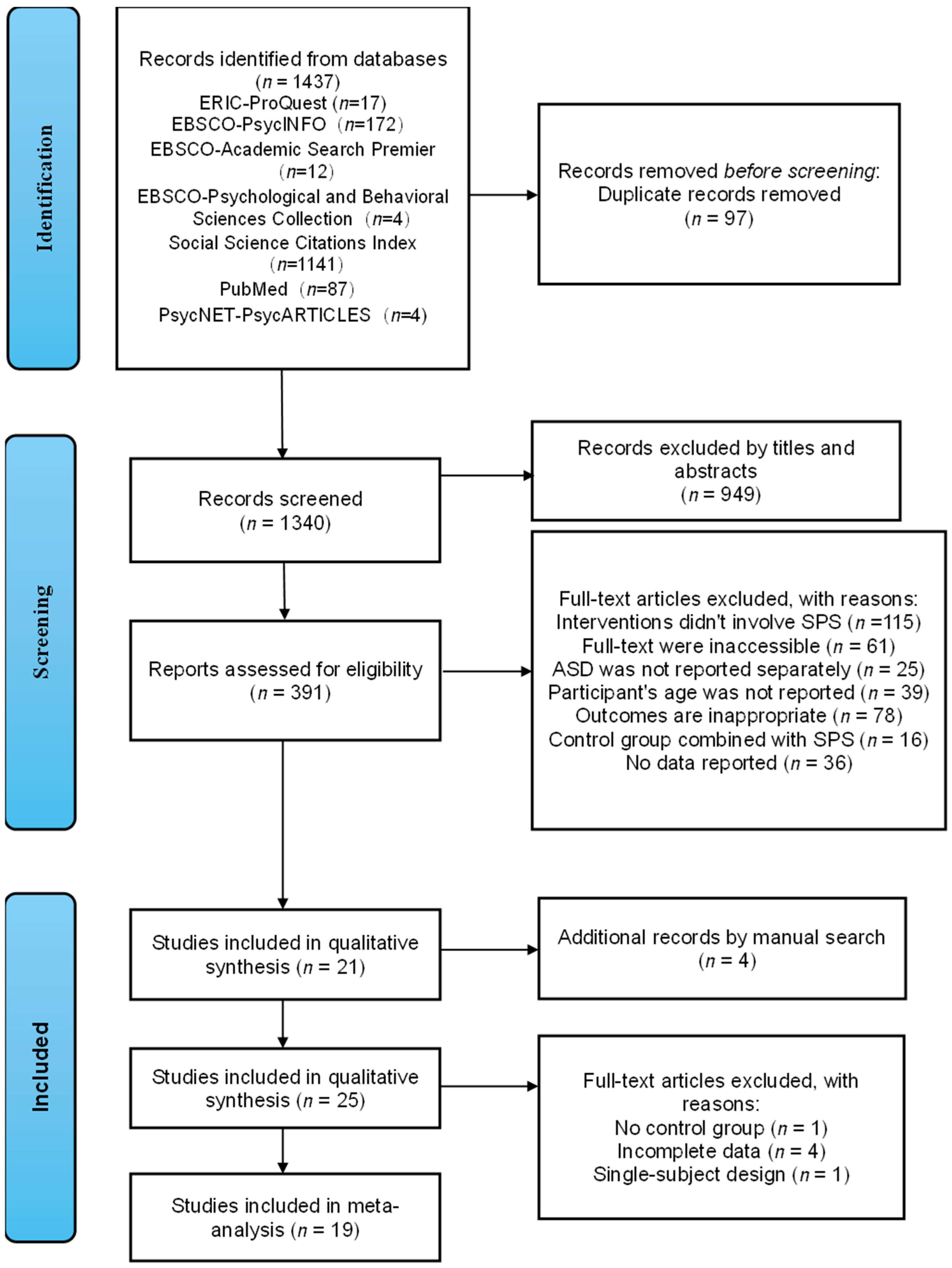
The study selection process is illustrated in the PRISMA flow diagram (Figure 1). The initial database search yielded 1437 records, which were reduced to 1340 after duplicate removal. These records underwent a systematic multi-stage screening process, including title, abstract, and full-text review. In addition, a manual search of reference lists identified four additional eligible articles. Following this comprehensive screening, 25 studies met the inclusion criteria and were retained for qualitative synthesis. Six studies were excluded from the quantitative analysis due to insufficient statistical data or the absence of a control or comparison group, resulting in a final sample of 19 studies included in the meta-analysis.

3.2. Characteristics of Included Studies

To address Research Question 1, the characteristics of the included studies were synthesized and summarized (Table 1).

3.2.1. Participant and Study Characteristics

Nineteen intervention studies involving a total of 741 participants with ASD were included. The overall sample was predominantly male (88%). Participants’ ages ranged from 4 to 18 years, with most studies focusing on school-aged children (6–12 years; n = 11), followed by adolescents (12–18 years; n = 6) and preschoolers (4–6 years; n = 2). The majority of studies were conducted in high-income countries, particularly Israel (n = 6) and the United States (n = 6). In terms of research design, 10 studies employed quasi-experimental methods, whereas nine used RCTs. Reporting of key methodological features varied: 11 studies (58%) reported treatment fidelity, six (32%) included follow-up or maintenance assessments, and eight (42%) assessed social validity. Although the evidence base is growing, inconsistencies in methodological reporting limit comparability across studies.

3.2.2. Intervention Characteristics

Interventions were delivered in various settings, most frequently in schools (n = 11). The predominant delivery format was small-group instruction (n = 16), typically involving three to five participants per group. Intervention agents varied and included teachers (n = 8), researchers (n = 5), graduate students (n = 5), and collaborative teams (n = 8). Intervention dosage demonstrated substantial variability: the most common frequency was one session per week (n = 13), sessions typically lasted 20–60 minutes (n = 11), and total intervention duration most often ranged from 12 to 28 weeks (n = 11). This variation reflects differences in program design and feasibility across educational and clinical contexts.

3.2.3. SPS Components and Implementation Roles

The role of the SPS component was classified into three categories:
(1) Primary Focus (n = 6): Programs such as the I Can Problem Solve curriculum directly taught foundational concepts, emotion recognition, and interpersonal problem-solving steps to enhance children’s SPS skills (Bauminger, 2002; Szumski et al., 2019). Other cognitive-behavioral therapy-based programs used computer-assisted formats or role-playing to train conflict negotiation and problem-solving (Bonete et al., 2016; Hochhauser et al., 2018; Eden & Oren, 2021).
(2) Component of SEL curriculum (n = 9): SPS was embedded within broader SEL frameworks such as Social Skills Training (Bauminger, 2007a, 2007b), Secret Agent Society (Einfeld et al., 2018), and the Social Competence Intervention (Stichter et al., 2010, 2012). These typically integrated SPS within cognitive-behavioral therapy-based SEL curricula to promote generalizable competencies (Koning et al., 2013; Lee et al., 2019).
(3) Component of multi-component interventions (n = 4): SPS was one of several coordinated therapeutic components. These comprehensive programs integrated SPS instruction with a focus on related domains, such as targeting executive function deficits (e.g., flexibility, planning) or using engaging formats like game-based curricula and computer-based vignettes to teach a combination of social and problem-solving skills (Beaumont & Sofronoff, 2008; Bauminger et al., 2013; Kenworthy et al., 2014; Chou, 2024).

3.2.4. Outcome Variables and Informants

The most frequently evaluated outcomes were social skills (n = 16), SPS competence (n = 14), and emotion recognition (n = 13). These domains were predominantly assessed through informant reports, with teacher ratings serving as the primary data source. In contrast, theory of mind was assessed in eight studies, most often using direct performance-based measures (n = 6). Executive function outcomes appeared in four studies, relying mainly on informant-based evaluations. This heavy reliance on subjective informant measures, particularly for social domains, highlights a potential source of measurement bias and underscores the need for more standardized, performance-based assessments in future research. This distribution highlights a continued reliance on subjective measures, particularly for social domains, and underscores the need for more standardized, performance-based assessments in future research.

3.3. Methodological Quality and Risk of Bias

The methodological quality of the 19 included studies was evaluated according to the WWC Standards Handbook (Version 4.1). A detailed breakdown of study ratings is presented in Supplementary Materials (Table S3). Six studies met WWC Standards without reservations, typically RCTs characterized by low attrition and baseline equivalence. Another six studies met WWC Standards with reservations, most often due to methodological concerns such as high participant attrition or unaddressed group differences at baseline. The remaining seven studies did not meet WWC Standards, primarily because they relied on single-group pre–post designs lacking a control or comparison condition. Overall, nearly two-thirds demonstrated at least moderate rigor, though variability underscores the need for stronger adherence to reporting standards.

3.4. Overall Effects of SPS Interventions

To address Research Question 2, a meta-analysis examined the effects of SPS interventions on SPS competence and related SEL domains. Individual effect sizes are listed in Supplementary Table S4.

3.4.1. Effect on SPS Competence

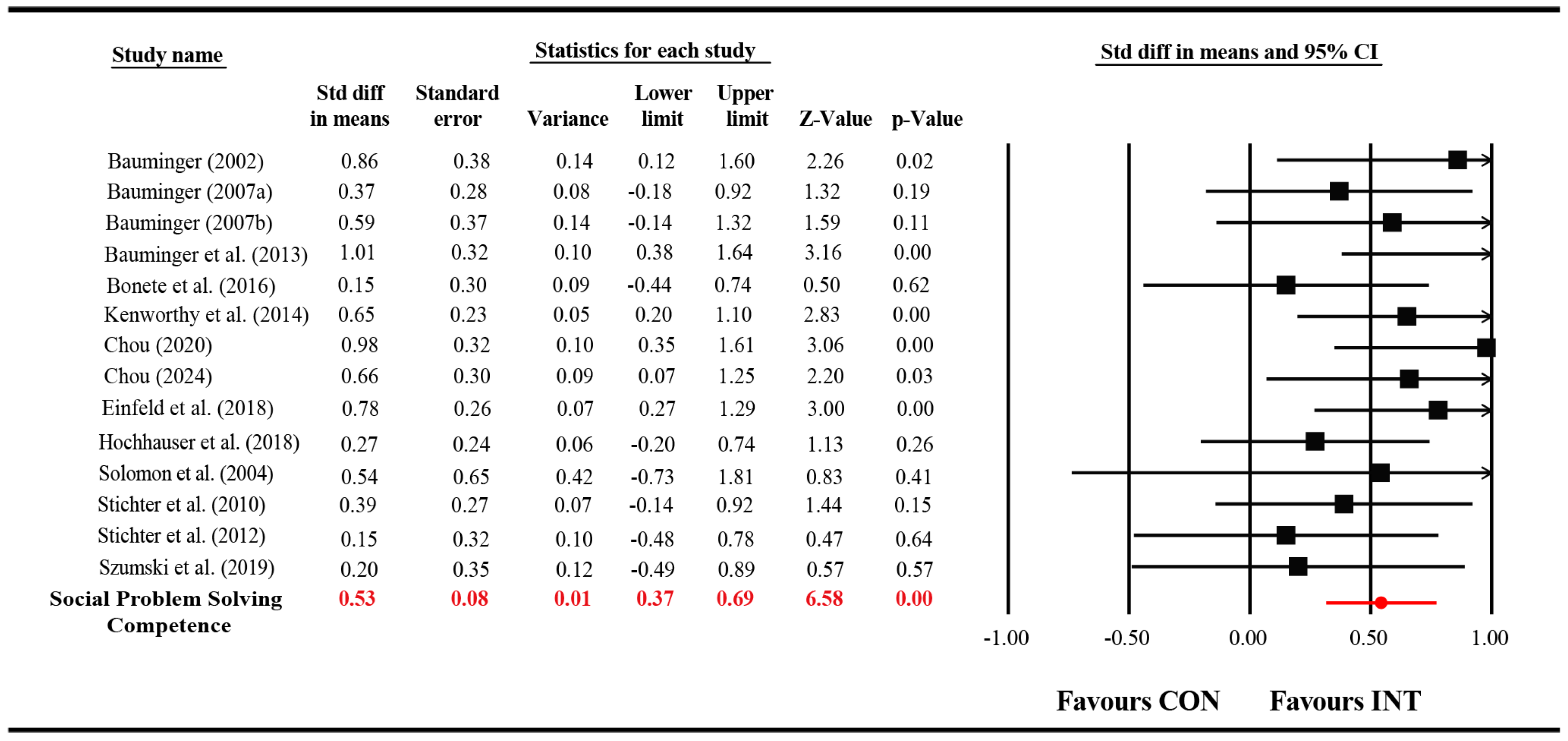
Fourteen studies (k = 14) assessed SPS competence. Heterogeneity was non-significant, Q (13) = 12.02, p = 0.52, I2 = 0.0%, supporting a fixed-effects model. The pooled standardized mean difference indicated a moderate positive effect (d = 0.53, SE = 0.08, 95% CI [0.15, 1.01], p < 0.05) (Figure 2). These findings show that SPS-targeted interventions significantly improved participants’ ability to identify, generate, and apply social solutions. The low heterogeneity (I2 = 0.0%) suggests a remarkable consistency in the intervention’s effect on this core cognitive skill across diverse study settings and populations, reinforcing the robustness of SPS training.
The modest magnitude likely reflects the complexity of SPS, which requires repeated practice and contextual generalization.

3.4.2. Effects on SEL-Related Competence

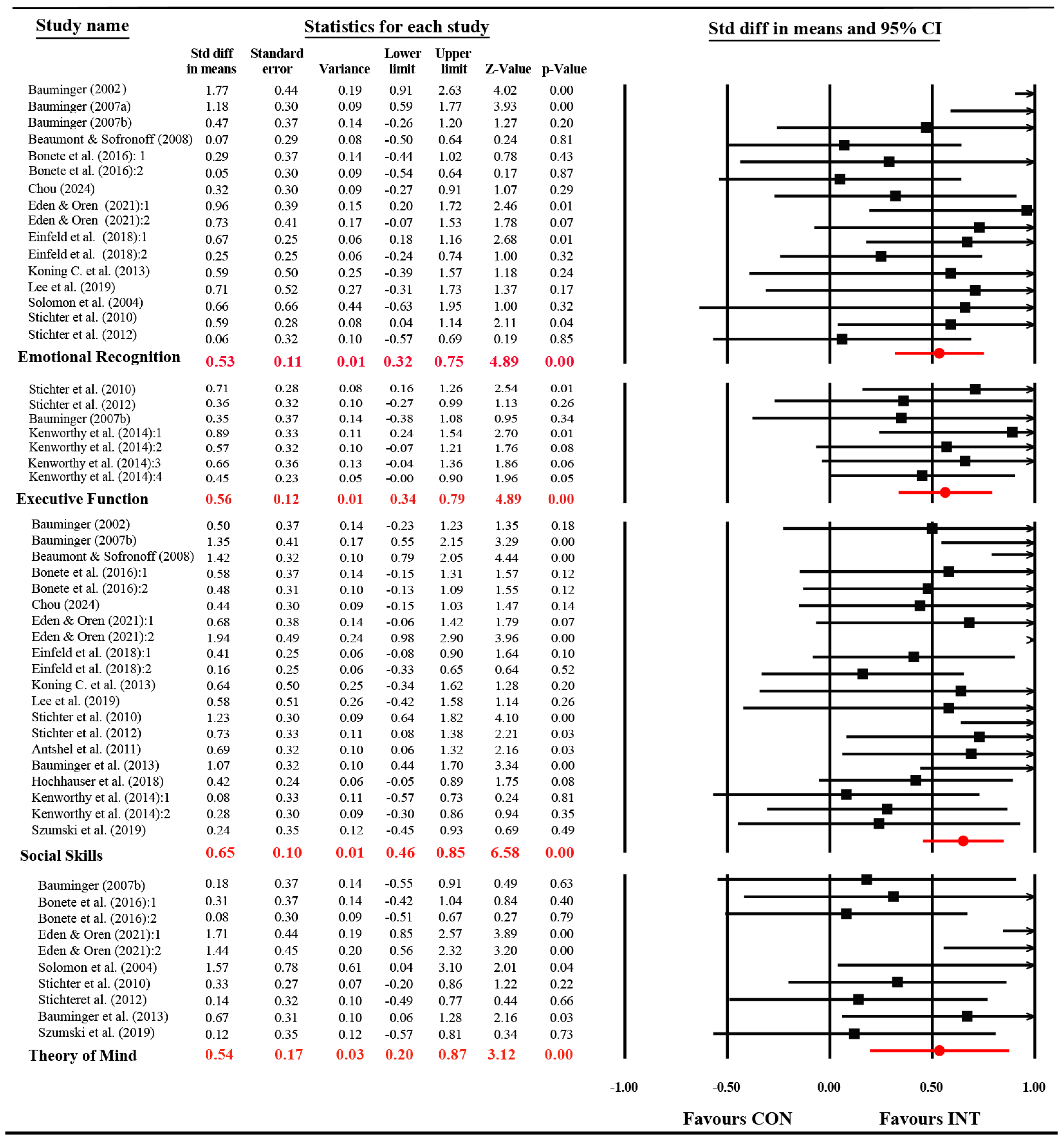
To further address Research Question 2, separate meta-analyses were conducted across four SEL-related outcome domains: emotion recognition, executive function, social skills, and theory of mind. The pooled results are summarized in Figure 3.
(1) Emotional Recognition: Thirteen studies (k = 16) reported emotion recognition outcomes, showing moderate heterogeneity (Q (15) = 24.00, p = 0.06; I2 = 37.50%). The meta-analysis revealed a significant medium effect (d = 0.53, SE = 0.10, 95% CI [0.32, 0.74], p < 0.05). This result indicates that SPS-based activities, which often involve interpreting social cues, may successfully facilitate broader emotion decoding skills.
(2) Executive Function: Four studies (k = 7) assessed executive function outcomes and showed no heterogeneity (I2 = 0.0%). A fixed-effect model indicated a medium-sized significant effect (d = 0.56, 95% CI [0.35, 0.89], p < 0.001). Sensitivity analysis using a random-effects model yielded nearly identical results, confirming the robustness of this effect. Similarly to SPS competence, the absence of heterogeneity (I2 = 0.0%) implies that the impact of SPS interventions on executive function is highly consistent across studies, supporting the theoretical link between problem-solving and executive control.
(3) Social Skills: Sixteen studies (k = 20) examined social skills outcomes. The heterogeneity test indicated moderate variability (Q (19) = 33.60, p = 0.02; I2 = 43.61%), supporting the use of a random-effects model. The pooled estimate revealed a significant moderate-to-large effect (d = 0.65, SE = 0.10, 95% CI [0.24, 1.42], p < 0.05). This finding underscores the practical relevance of SPS-based instruction for real-world social functioning, although the moderate heterogeneity suggests that effectiveness may vary depending on contextual factors.
(4) Theory of Mind: Eight studies (k = 10) evaluated theory of mind outcomes, with moderate heterogeneity (Q (9) = 19.81, p = 0.01; I2 = 54.57%). The random-effects analysis revealed a significant, medium effect (d = 0.54, SE = 0.17, 95% CI [0.08, 1.71], p < 0.01). The pattern aligns with the conceptual overlap between theory of mind and SPS. Both require perspective taking and inferential reasoning about others’ intentions. These results highlight that SPS-focused interventions may indirectly enhance theory of mind through repeated practice in social reasoning and reflective dialogue.

3.5. Moderator Analyses of SPS Effects

To address Research Question 3, subgroup analyses were conducted to identify moderators influencing the effectiveness of SPS interventions (see Table 2). A significant moderation effect emerged for implementer type (QB (2) = 7.31, p = 0.03), with teacher-led (d = 0.72) and collaborative (d = 0.63) programs yielding stronger effects than researcher-led interventions (d = 0.20). This finding highlights the critical role of practitioners, whose ongoing engagement and ecological familiarity with the classroom environment may facilitate the generalization and maintenance of skills better than transient researcher-led sessions. A marginally significant moderation was also found for setting (QB (1) = 3.46, p = 0.06), as school-based programs (d = 0.61) outperformed those in non-school contexts (d = 0.26), further suggesting that ecological validity and opportunities for real-world practice are key drivers of success. No other moderators including dosage variables (frequency, session length, total duration) or SPS component type reached statistical significance, though longer and more integrated interventions tended to show larger effects.

3.6. Publication Bias and Sensitivity Analyses

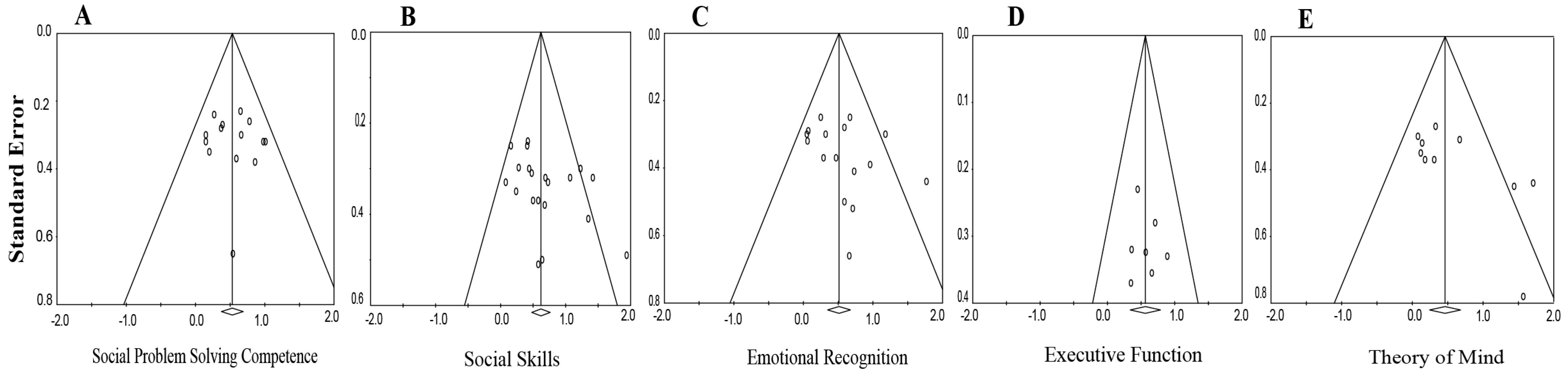
Publication bias was examined both SPS competence and related SEL domains using funnel plots (Figure 4), Egger’s regression tests, and trim-and-fill corrections (see Supplementary Table S5). Results varied by outcome. No bias was detected for SPS competence (Egger’s test, p = 0.74), indicating strong confidence in the primary effect. For SEL-related outcomes, potential asymmetry was observed in social skills (p = 0.064) and theory of mind (p = 0.039), while emotion recognition showed visual but not statistical evidence of bias (p = 0.21). After trim-and-fill adjustment, effect sizes decreased modestly from d = 0.53 to 0.34 for emotion recognition and from d = 0.54 to 0.43 for theory of mind, yet remained significant. Bias assessment for executive function (k = 7) was inconclusive due to limited power. Overall, findings suggest the robustness of SPS intervention effects, though some inflation due to selective reporting cannot be ruled out. Future studies should strengthen transparency through preregistration and open data practices.

4. Discussion

This systematic review and meta-analysis provide the first quantitative synthesis of evidence on SPS interventions for children with ASD. Across 19 studies, SPS interventions produced moderate and statistically significant improvements in SPS competence, confirming their potential to enhance core social-emotional abilities. Subgroup analyses further showed that interventions led by teachers or collaborative teams in school settings yielded the strongest effects, highlighting the critical role of ecological validity. Beyond SPS competence, these interventions also generated moderate-to-large gains across related SEL domains, including social skills, emotion recognition, theory of mind, and executive function, demonstrating their broad and cross-domain impact. Collectively, these findings highlight SPS as a promising, integrative framework for promoting social-emotional functioning in ASD. Nevertheless, variations in methodological quality, with only a subset of studies meeting high evidence standards, limit the strength and generalizability of these conclusions.

4.1. Summary of Key Findings

Our review shows that SPS interventions represent an emerging and expanding focus within ASD education. Most studies were published between 2010 and 2019, reflecting growing scholarly and practical interest in the association between social-emotional competence and quality of life (Cohen, 2006; Osher et al., 2016). This trend highlights the need to systematically integrate SPS and SEL frameworks into educational curricula for children with ASD. However, all identified studies were conducted in high-income countries or regions, revealing a clear geographical and demographic imbalance. The absence of research in low and middle-income settings limits the cross-cultural generalizability of current findings (Durkin et al., 2015; Franz et al., 2017). Participant samples were also predominantly male (≈88%), leaving the effects of SPS interventions for females with ASD largely underexplored a critical gap for future research.
Implementation characteristics further varied across studies. SPS was most often delivered as a component within a broader SEL curriculum, though several studies positioned it as the central focus or part of a multi-component behavioral program. Most interventions occurred in school-based small group formats led by teachers or interdisciplinary teams. However, limited reporting on implementation fidelity, maintenance effects, and social validity remains a consistent weakness across the literature (Reichow et al., 2008; Wong et al., 2015). Without these data, the durability and ecological relevance of intervention outcomes remain uncertain.

4.2. Interpretation of Findings

This meta-analysis provides the first quantitative evidence that SPS interventions produce significant and broad benefits for children and adolescents with ASD. Across five outcome domains, SPS interventions yielded consistent, medium-sized effects, confirming their efficacy in enhancing core social emotional functioning. These results support the theoretical premise that SPS represents a pivotal skill driving cascading improvements across related domains, including social cognition, emotion understanding, and self-regulation. Interestingly, the consistency of intervention effects varied by domain: improvements in core SPS ability and executive function were robust and uniform, whereas gains in social skills, emotion recognition, and theory of mind showed significant heterogeneity. This suggests that while SPS interventions reliably strengthen foundational cognitive skills, the translation of these gains into broader social-emotional competencies may be influenced by contextual factors and individual differences (Pellicano, 2010).
Importantly, moderator analyses revealed that teacher-led, school-based interventions produced substantially larger effects compared to researcher-led or clinic-based programs. This finding underscores the critical role of ecological validity. This pattern suggests that social learning processes are best supported in environments offering repeated natural practice, authentic feedback, and peer interaction. In classrooms, teachers can incorporate SPS principles into daily routines, such as conflict resolution, cooperative learning, or classroom management, transforming interventions into sustained social teaching practices rather than discrete lessons (Kasari & Patterson, 2012). Conversely, researcher-led programs or clinic-based programs often lack these real-world contingencies, which likely accounts for their weaker transfer effects (Rotheram-Fuller et al., 2010).
The cross-domain gains observed in emotion recognition, theory of mind, and executive function further illuminate the mechanisms underlying SPS interventions. These outcomes imply that SPS training engages both cognitive and affective systems, helping children integrate reasoning, emotion, and behavior into a unified decision-making process (Fisher & Happé, 2005). Importantly, recent micro-level research offers mechanistic support for these macro-level findings. McNair et al. (2024) demonstrated that SPS is not a monolithic skill but a reasoning process that integrates multiple social-cognitive abilities. Together, these results suggest that SPS interventions promote cognitive restructuring of social reasoning, producing generalized and durable benefits beyond task-specific skill acquisition.
Finally, the results of publication bias analyses suggest that the effects on emotion recognition and theory of mind may be modestly overestimated. However, adjusted estimates continue to demonstrate statistical significance, affirming the overall robustness of the intervention effects while underscoring the importance of future replication studies to precisely determine their magnitude (Egger et al., 1997; Sterne & Egger, 2001).

4.3. Implications and Contributions

The findings from this meta-analysis support the positioning of SPS interventions as a valuable evidence-based practice for children with ASD. Based on our moderator analysis, which showed that teacher-led interventions in school settings, practitioners should use approaches that fit naturally into everyday settings (Rotheram-Fuller et al., 2010). Incorporating SPS instruction in the classroom enables modeling, peer practice, and instant feedback, which are key to helping skills transfer beyond isolated training settings (Kasari & Patterson, 2012). Therefore, practitioners should regularly include elements like parent training and community activities, and evaluating the effectiveness based on their impact in daily life (Dale et al., 2022; McConachie et al., 2018).
Moreover, SPS can function as a modular component within comprehensive SEL or cognitive-behavioral programs, enhancing its scalability across educational settings (Durlak et al., 2011). Its consistent impact supports its consideration for inclusion within Individualized Education Programs (IEPs) and broader school-based frameworks, such as Positive Behavioral Interventions and Supports (PBIS) or CASEL-aligned curricula. Educators can adapt the cognitive steps of problem solving, identifying problems, generating alternatives, and evaluating consequences into explicit classroom strategies aligned with everyday learning goals. Recent evidence shows that such school-based SPS interventions can reduce teacher-reported problem behaviors by up to 50% while increasing academic engagement (Peng et al., 2024). Consistent improvements in executive function suggest that integrating cognitive support (e.g., planning, inhibition, flexibility) within SPS training may produce synergistic benefits (Pellicano, 2012). Embedding these cognitive scaffolds within meaningful social contexts not only enhances transfer but also reflects a behavioral cognitive synthesis increasingly recognized as essential for effective ASD intervention. Taken together, these findings justify the inclusion of SPS training in teacher preparation, professional development, and clinical practice guidelines.
Theoretically, this meta-analysis advances a social-cognitive integration framework for understanding intervention effects in ASD. Unlike generic social skills training, SPS interventions are explicitly grounded in the social information processing model (Crick & Dodge, 1994), which conceptualizes social behavior as the product of sequential cognitive steps involving perception, interpretation, response generation, and evaluation. By quantifying effects across multiple domains, this review offers the first large-scale empirical validation of SPS as a central mediating process linking cognitive and emotional development in ASD (Chan & Leung, 2022).
The findings further support a collaborative social-cognitive model, emphasizing that social challenges in ASD stem from interdependent deficits in executive function, perspective taking, and metacognitive problem-solving rather than isolated behavioral impairments. SPS interventions appear effective precisely because they target this underlying cognitive network, promoting internalized reasoning and emotional regulation instead of surface-level behavioral compliance (Pellicano, 2010). By reframing intervention from training behaviors to cultivating reasoning processes, this meta-analysis deepens theoretical understanding and provides a mechanistic foundation for designing ecologically valid, cognitively informed SEL interventions (Lerner et al., 2012).

4.4. Limitations and Future Directions

Several limitations should be consideration.
First, generalizability is limited by sampling bias and uneven methodological rigor. Most studies were conducted in high-income countries, and approximately two-thirds did not fully meet WWC standards due to inadequate randomization, small samples, or incomplete reporting. Furthermore, the heavy reliance on subjective informant ratings (e.g., teacher or parent reports) for outcomes like social skills carries a risk of rater bias and may inflate effect sizes compared to blinded, performance-based assessments.
Second, publication bias for emotion recognition and theory of mind outcomes indicates a field-wide positive-result bias, potentially overestimating effects. Large-scale, preregistered trials with open data sharing and the inclusion of null findings are necessary to improve evidence transparency and reproducibility.
Third, the limited reporting of fidelity, maintenance, and social validity constrains understanding of sustainability. Without long-term follow-up data, it remains unclear whether SPS gains endure to become self-sustaining competencies as children develop.
Future research should prioritize three key areas: (1) Methodological rigor: adopting rigorous experimental designs with blinded, performance-based outcome measures; (2) Ecological validity: developing and testing teacher-led models in diverse cultural contexts; and (3) Longitudinal design: incorporating follow-up assessments to examine the durability and real-world transfer of intervention effects.

5. Conclusions

This systematic review and meta-analysis provide the first comprehensive quantitative synthesis of SPS interventions for children with ASD. The findings reveal consistent, moderate-to-strong improvements in SPS competence and related social–emotional domains, including social skills, emotion recognition, theory of mind, and executive function. These results support SPS as a core mechanism within the SEL framework that integrates cognition, emotion, and behavior. Crucially, teacher-led, school-based delivery emerged as most effective, emphasizing the paramount value of ecological validity. When SPS instruction is woven into classroom interactions, children benefit from authentic social practice, feedback, and peer modeling that promote lasting generalization. Despite methodological variability and limited cultural diversity, this meta-analysis establishes a solid empirical foundation for future inquiry. Advancing this field will require ecologically grounded, fidelity-monitored, and collaboratively implemented interventions that connect theory-driven design with real-world educational contexts. Collectively, the evidence identifies SPS as a promising, scalable, and mechanism-based approach for fostering meaningful social–emotional growth in children with ASD.

Supplementary Materials

The following supporting information can be downloaded at: https://www.mdpi.com/article/10.3390/bs15121708/s1, Table S1: Full Search Strings for Each Database; Table S2: The description of codes; Table S3: Methodological Quality Assessment of Included Studies Based on WWC Standards; Table S4: Summary of Meta-Analytic Effects for SPS Competence and SEL-Related Outcomes; Table S5: Publication bias tests and trim-and-fill results. Table S6: PRISMA_Checklist.

Author Contributions

Conceptualization, S.J. and S.X.; methodology, S.J. and Y.Z.; formal analysis, S.J. and H.H.; investigation, H.Z. and C.Z.; resources, C.Z. and S.X.; data curation, H.Z.; writing—original draft preparation, S.J.; writing—review and editing, S.X. and C.Z.; supervision, S.X. and Y.Z.; project administration, S.X.; funding acquisition, S.J. and S.X. All authors have read and agreed to the published version of the manuscript.

Funding

This research was funded by the Shanghai Philosophy and Social Science Planning Project (Grant No. 2024BJC004) and the Chinese Association for Improving Birth Outcome and Child Development Research Project (Grant No. 2024K031).

Institutional Review Board Statement

Not applicable.

Informed Consent Statement

Not applicable.

Data Availability Statement

The data that support the findings of this study are available from the corresponding authors upon reasonable request. Supplementary datasets, coding protocols, and analysis scripts are provided in the Supplementary Materials.

Acknowledgments

Sincere appreciation is extended to the authors of the primary studies included in this systematic review and meta-analysis, whose rigorous work and contributions provided the essential foundation for the present research.

Conflicts of Interest

The authors declare no conflicts of interest.

References

  1. Alahmari, F. S., Alhabbad, A. A., Alshamrani, H. A., & Almuqbil, M. A. (2025). Effectiveness of social skills training interventions for children with autism spectrum disorder. Saudi Medical Journal, 46(3), 226–237. [Google Scholar] [CrossRef]
  2. American Psychiatric Association. (2013). Diagnostic and statistical manual of mental disorders: DSM-5. American Psychiatric Association. [Google Scholar] [CrossRef]
  3. Antshel, K. M., Polacek, C., McMahon, M., Dygert, K., Spenceley, L., Dygert, L., Miller, L., & Faisal, F. (2011). Comorbid ADHD and anxiety affect social skills group intervention treatment efficacy in children with autism spectrum disorders. Journal of Developmental & Behavioral Pediatrics, 32(6), 439–446. [Google Scholar] [CrossRef]
  4. Baker, R., & Jackson, D. (2008). A new approach to outliers in meta-analysis. Health Care Management Science, 11(2), 121–131. [Google Scholar] [CrossRef]
  5. Baron-Cohen, S., Leslie, A. M., & Frith, U. (1985). Does the autistic child have a “theory of mind”? Cognition, 21(1), 37–46. [Google Scholar] [CrossRef] [PubMed]
  6. Bauminger, N. (2002). The facilitation of social-emotional understanding and social interaction in high-functioning children with autism: Intervention outcomes. Journal of Autism and Developmental Disorders, 32(4), 283–298. [Google Scholar] [CrossRef] [PubMed]
  7. Bauminger, N. (2007a). Brief report: Group social-multimodal intervention for HFASD. Journal of Autism and Developmental Disorders, 37(8), 1605–1615. [Google Scholar] [CrossRef] [PubMed]
  8. Bauminger, N. (2007b). Brief report: Individual social-multi-modal intervention for HFASD. Journal of Autism and Developmental Disorders, 37(8), 1593–1604. [Google Scholar] [CrossRef]
  9. Bauminger, N., Eden, S., Zancanaro, M., Weiss, P. L., & Gal, E. (2013). Increasing social engagement in children with high-functioning autism spectrum disorder using collaborative technologies in the school environment. Autism, 17(3), 317–339. [Google Scholar] [CrossRef]
  10. Bauminger, N., & Kasari, C. (2000). Loneliness and friendship in high-functioning children with autism. Child Development, 71(2), 447–456. [Google Scholar] [CrossRef]
  11. Bauminger, N., Shulman, C., & Agam, G. (2003). Peer interaction and loneliness in high-functioning children with autism. Journal of Autism and Developmental Disorders, 33(5), 489–507. [Google Scholar] [CrossRef]
  12. Beaumont, R., & Sofronoff, K. (2008). A multi-component social skills intervention for children with asperger syndrome: The junior detective training program. Journal of Child Psychology and Psychiatry, 49(7), 743–753. [Google Scholar] [CrossRef]
  13. Bellini, S., Peters, J. K., Benner, L., & Hopf, A. (2007). A meta-analysis of school-based social skills interventions for children with autism spectrum disorders. Remedial and Special Education, 28(3), 153–162. [Google Scholar] [CrossRef]
  14. Berggren, S., Fletcher-Watson, S., Milenkovic, N., Marschik, P. B., Bölte, S., & Jonsson, U. (2018). Emotion recognition training in autism spectrum disorder: A systematic review of challenges related to generalizability. Developmental Neurorehabilitation, 21(3), 141–154. [Google Scholar] [CrossRef]
  15. Bonete, S., Calero, M. D., & Fernández-Parra, A. (2015). Group training in interpersonal problem-solving skills for workplace adaptation of adolescents and adults with asperger syndrome: A preliminary study. Autism, 19(4), 409–420. [Google Scholar] [CrossRef] [PubMed]
  16. Bonete, S., Molinero, C., & Garrido-Zurita, A. (2022). Generalization task for developing social problem-solving skills among young people with autism spectrum disorder. Children, 9(2), 166. [Google Scholar] [CrossRef] [PubMed]
  17. Bonete, S., Molinero, C., & Mata, S. (2016). Effectiveness of manualised interpersonal problem-solving skills intervention for children with autism spectrum disorder (ASD). Psicothema, 28(3), 304–310. [Google Scholar] [CrossRef] [PubMed]
  18. Burla, L., Knierim, B., Barth, J., Liewald, K., Duetz, M., & Abel, T. (2008). From text to codings: Intercoder reliability assessment in qualitative content analysis. Nursing Research, 57(2), 113–117. [Google Scholar] [CrossRef] [PubMed]
  19. Carr, M. E., Moore, D. W., & Anderson, A. (2014). Self-management interventions on students with autism: A meta-analysis of single-subject research. Exceptional Children, 81(1), 28–44. [Google Scholar] [CrossRef]
  20. CASEL. (2018). Advancing social and emotional learning. Available online: https://casel.org/ (accessed on 14 October 2025).
  21. Chan, J. K. Y., & Leung, P. W. L. (2022). Common outcome, different pathways: Social information-processing deficits in autism spectrum disorder and attention-deficit/hyperactivity disorder. World Journal of Psychiatry, 12(2), 286–297. [Google Scholar] [CrossRef]
  22. Chou, Y.-C. (2020). Navigation of social engagement (NOSE) project: Using a self-directed problem-solving model to enhance social problem-solving and self-determination in youth with autism spectrum disorders. Education and Training in Autism and Developmental Disabilities, 55(1), 101–114. [Google Scholar] [CrossRef]
  23. Chou, Y.-C. (2024). Emotional bug-out bag: The effectiveness of an empathy intervention model for students with autism spectrum disorder. Education and Training in Autism and Developmental Disabilities, 59(4), 403–415. [Google Scholar] [CrossRef]
  24. Cohen, J. (2006). Social, emotional, ethical, and academic education: Creating a climate for learning, participation in democracy, and well-being. Harvard Educational Review, 76(2), 201–237. [Google Scholar] [CrossRef]
  25. Crick, N. R., & Dodge, K. A. (1994). A review and reformulation of social information-processing mechanisms in children’s social adjustment. Psychological Bulletin, 115(1), 74–101. [Google Scholar] [CrossRef]
  26. Dale, B., Rispoli, K., & Ruble, L. (2022). Social emotional learning in young children with autism spectrum disorder. Perspectives on Early Childhood Psychology and Education, 6(2), 271–294. [Google Scholar] [CrossRef]
  27. DerSimonian, R., & Laird, N. (1986). Meta-analysis in clinical trials. Controlled Clinical Trials, 7(3), 177–188. [Google Scholar] [CrossRef]
  28. Domitrovich, C. E., Durlak, J. A., Staley, K. C., & Weissberg, R. P. (2017). Social-emotional competence: An essential factor for promoting positive adjustment and reducing risk in school children. Child Development, 88(2), 408–416. [Google Scholar] [CrossRef] [PubMed]
  29. Durkin, M. S., Elsabbagh, M., Barbaro, J., Gladstone, M., Happe, F., Hoekstra, R. A., Lee, L.-C., Rattazzi, A., Stapel-Wax, J., Stone, W. L., Tager-Flusberg, H., Thurm, A., Tomlinson, M., & Shih, A. (2015). Autism screening and diagnosis in low resource settings: Challenges and opportunities to enhance research and services worldwide. Autism Research, 8(5), 473–476. [Google Scholar] [CrossRef] [PubMed]
  30. Durlak, J. A., Weissberg, R. P., Dymnicki, A. B., Taylor, R. D., & Schellinger, K. B. (2011). The impact of enhancing students’ social and emotional learning: A meta-analysis of school-based universal interventions. Child Development, 82(1), 405–432. [Google Scholar] [CrossRef] [PubMed]
  31. Duval, S., & Tweedie, R. (2000). Trim and fill: A simple funnel-plot-based method of testing and adjusting for publication bias in meta-analysis. Biometrics, 56(2), 455–463. [Google Scholar] [CrossRef]
  32. Eden, S., & Oren, A. (2021). Computer-mediated intervention to foster prosocial ability among children with autism. Journal of Computer Assisted Learning, 37(1), 275–286. [Google Scholar] [CrossRef]
  33. Egger, M., Smith, G. D., Schneider, M., & Minder, C. (1997). Bias in meta-analysis detected by a simple, graphical test. BMJ, 315(7109), 629–634. [Google Scholar] [CrossRef]
  34. Einfeld, S. L., Beaumont, R., Clark, T., Clarke, K. S., Costley, D., Gray, K. M., Horstead, S. K., Redoblado Hodge, M. A., Roberts, J., Sofronoff, K., Taffe, J. R., & Howlin, P. (2018). School-based social skills training for young people with autism spectrum disorders. Journal of Intellectual & Developmental Disability, 43(1), 29–39. [Google Scholar] [CrossRef]
  35. Fisher, N., & Happé, F. (2005). A training study of theory of mind and executive function in children with autistic spectrum disorders. Journal of Autism and Developmental Disorders, 35(6), 757–771. [Google Scholar] [CrossRef]
  36. Fletcher-Watson, S., McConnell, F., Manola, E., & McConachie, H. (2014). Interventions based on the theory of mind cognitive model for autism spectrum disorder (ASD). Cochrane Database of Systematic Reviews, 2014, CD008785. [Google Scholar] [CrossRef]
  37. Franz, L., Chambers, N., von Isenburg, M., & de Vries, P. J. (2017). Autism spectrum disorder in sub-saharan africa: A comprehensive scoping review. Autism Research, 10(5), 723–749. [Google Scholar] [CrossRef]
  38. Gates, J. A., Kang, E., & Lerner, M. D. (2017). Efficacy of group social skills interventions for youth with autism spectrum disorder: A systematic review and meta-analysis. Clinical Psychology Review, 52, 164–181. [Google Scholar] [CrossRef]
  39. Higgins, J. P. T., Thompson, S. G., Deeks, J. J., & Altman, D. G. (2003). Measuring inconsistency in meta-analyses. BMJ, 327(7414), 557–560. [Google Scholar] [CrossRef]
  40. Hochhauser, M., Weiss, P. L., & Gal, E. (2018). Enhancing conflict negotiation strategies of adolescents with autism spectrum disorder using video modeling. Assistive Technology, 30(3), 107–118. [Google Scholar] [CrossRef] [PubMed]
  41. Jones, S. M., Barnes, S. P., Bailey, R., & Doolittle, E. J. (2017). Promoting social and emotional competencies in elementary school. Future of Children, 27(1), 49–72. [Google Scholar] [CrossRef]
  42. Kasari, C., & Patterson, S. (2012). Interventions addressing social impairment in autism. Current Psychiatry Reports, 14(6), 713–725. [Google Scholar] [CrossRef] [PubMed]
  43. Kenworthy, L., Anthony, L. G., Naiman, D. Q., Cannon, L., Wills, M. C., Luong-Tran, C., Werner, M. A., Alexander, K. C., Strang, J., Bal, E., Sokoloff, J. L., & Wallace, G. L. (2014). Randomized controlled effectiveness trial of executive function intervention for children on the autism spectrum. Journal of Child Psychology and Psychiatry and Allied Disciplines, 55(4), 374–383. [Google Scholar] [CrossRef] [PubMed]
  44. Koning, C., Magill-Evans, J., Volden, J., & Dick, B. (2013). Efficacy of cognitive behavior therapy-based social skills intervention for school-aged boys with autism spectrum disorders. Research in Autism Spectrum Disorders, 7(10), 1282–1290. [Google Scholar] [CrossRef]
  45. Lakens, D. (2013). Calculating and reporting effect sizes to facilitate cumulative science: A practical primer for t-tests and ANOVAs. Frontiers in Psychology, 4, 863. [Google Scholar] [CrossRef]
  46. Landis, J. R., & Koch, G. G. (1977). The measurement of observer agreement for categorical data. Biometrics, 33(1), 159–174. [Google Scholar] [CrossRef] [PubMed]
  47. Lee, G. T., Feng, H., Xu, S., & Jin, S.-J. (2019). Increasing “object-substitution” symbolic play in young children with autism spectrum disorders. Behavior Modification, 43(1), 82–114. [Google Scholar] [CrossRef] [PubMed]
  48. Lerner, M. D., White, S. W., & McPartland, J. C. (2012). Mechanisms of change in psychosocial interventions for autism spectrum disorders. Dialogues in Clinical Neuroscience, 14(3), 307–318. [Google Scholar] [CrossRef]
  49. Locke, J., Williams, J., Shih, W., & Kasari, C. (2017). Characteristics of socially successful elementary school-aged children with autism. Journal of Child Psychology and Psychiatry, 58(1), 94–102. [Google Scholar] [CrossRef]
  50. Mazefsky, C. A., & White, S. W. (2014). Emotion regulation: Concepts & practice in autism spectrum disorder. Child and Adolescent Psychiatric Clinics of North America, 23(1), 15–24. [Google Scholar] [CrossRef]
  51. McConachie, H., Livingstone, N., Morris, C., Beresford, B., Le Couteur, A., Gringras, P., Garland, D., Jones, G., Macdonald, G., Williams, K., & Parr, J. R. (2018). Parents suggest which indicators of progress and outcomes should be measured in young children with autism spectrum disorder. Journal of Autism and Developmental Disorders, 48(4), 1041–1051. [Google Scholar] [CrossRef]
  52. McNair, M. L., Mondejar, V., Libsack, E. J., Mordekai, N. H., McKown, C., Russo-Ponsaran, N. M., & Lerner, M. D. (2024). Examining the process and impact of social problem solving in autistic children. Journal of Autism and Developmental Disorders, 55(3), 789–802. [Google Scholar] [CrossRef] [PubMed]
  53. Miller, A., Vernon, T., Wu, V., & Russo, K. (2014). Social skill group interventions for adolescents with autism spectrum disorders: A systematic review. Review Journal of Autism and Developmental Disorders, 1(4), 254–265. [Google Scholar] [CrossRef]
  54. Nezu, A. M. (2004). Problem solving and behavior therapy revisited. Behavior Therapy, 35(1), 1–33. [Google Scholar] [CrossRef]
  55. Osher, D., Kidron, Y., Brackett, M., Dymnicki, A., Jones, S., & Weissberg, R. P. (2016). Advancing the science and practice of social and emotional learning. Review of Research in Education, 40(1), 644–681. [Google Scholar] [CrossRef]
  56. Page, M. J., McKenzie, J. E., Bossuyt, P. M., Boutron, I., Hoffmann, T. C., Mulrow, C. D., Shamseer, L., Tetzlaff, J. M., Akl, E. A., Brennan, S. E., Chou, R., Glanville, J., Grimshaw, J. M., Hróbjartsson, A., Lalu, M. M., Li, T., Loder, E. W., Mayo-Wilson, E., McDonald, S., … Moher, D. (2021). The PRISMA 2020 statement: An updated guideline for reporting systematic reviews. BMJ, 372, n71. [Google Scholar] [CrossRef]
  57. Pellicano, E. (2010). The development of core cognitive skills in autism: A 3-year prospective study. Child Development, 81(5), 1400–1416. [Google Scholar] [CrossRef]
  58. Pellicano, E. (2012). The development of executive function in autism. Autism Research and Treatment, 2012(1), 146132. [Google Scholar] [CrossRef]
  59. Peng, J., Li, J., Li, D., Fang, Y., Zhang, C., Fraser, M. W., & Guo, S. (2024). Systematic review and meta-analysis of interventions to improve children’s social information-processing skills. Research on Social Work Practice, 34(5), 507–534. [Google Scholar] [CrossRef]
  60. Reichow, B., Volkmar, F. R., & Cicchetti, D. V. (2008). Development of the evaluative method for evaluating and determining evidence-based practices in autism. Journal of Autism and Developmental Disorders, 38(7), 1311–1319. [Google Scholar] [CrossRef]
  61. Reid, K. B., Sacrey, L.-A. R., Zwaigenbaum, L., Raza, S., Brian, J., Smith, I. M., Bryson, S., Armstrong, V., Roberts, W., Szatmari, P., Vaillancourt, T., & Roncadin, C. (2020). The association between social emotional development and symptom presentation in autism spectrum disorder. Development and Psychopathology, 32(4), 1206–1216. [Google Scholar] [CrossRef]
  62. Rosenthal, R. (1979). The file drawer problem and tolerance for null results. Psychological Bulletin, 86(3), 638–641. [Google Scholar] [CrossRef]
  63. Rotheram-Fuller, E., Kasari, C., Chamberlain, B., & Locke, J. (2010). Social involvement of children with autism spectrum disorders in elementary school classrooms. Journal of Child Psychology and Psychiatry and Allied Disciplines, 51(11), 1227–1234. [Google Scholar] [CrossRef]
  64. Scheibel, G., Zaeske, L. M., Malone, E. J., & Zimmerman, K. N. (2024). A meta-analysis of self-management interventions for students with ASD. Research in Autism Spectrum Disorders, 110, 102294. [Google Scholar] [CrossRef]
  65. Solomon, M., Goodlin-Jones, B. L., & Anders, T. F. (2004). A social adjustment enhancement intervention for high functioning autism, Asperger’s syndrome, and pervasive developmental disorder NOS. Journal of Autism and Developmental Disorders, 34(6), 649–668. [Google Scholar] [CrossRef] [PubMed]
  66. Spivack, G., & Shure, M. B. (1976). The problem-solving approach to adjustment. A guide to research and intervention. Jossey-Bass. [Google Scholar]
  67. Sterne, J. A. C., & Egger, M. (2001). Funnel plots for detecting bias in meta-analysis: Guidelines on choice of axis. Journal of Clinical Epidemiology, 54(10), 1046–1055. [Google Scholar] [CrossRef]
  68. Stichter, J. P., Herzog, M. J., Visovsky, K., Schmidt, C., Randolph, J., Schultz, T., & Gage, N. (2010). Social competence intervention for youth with Asperger syndrome and high-functioning autism: An initial investigation. Journal of Autism and Developmental Disorders, 40(9), 1067–1079. [Google Scholar] [CrossRef]
  69. Stichter, J. P., O’Connor, K. V., Herzog, M. J., Lierheimer, K., & McGhee, S. D. (2012). Social competence intervention for elementary students with Aspergers syndrome and high functioning autism. Journal of Autism and Developmental Disorders, 42(3), 354–366. [Google Scholar] [CrossRef] [PubMed]
  70. Szumski, G., Smogorzewska, J., Grygiel, P., & Orlando, A.-M. (2019). Examining the effectiveness of naturalistic social skills training in developing social skills and theory of mind in preschoolers with ASD. Journal of Autism and Developmental Disorders, 49(7), 2822–2837. [Google Scholar] [CrossRef] [PubMed]
  71. Tantam, D. (2003). The challenge of adolescents and adults with Asperger syndrome. Child and Adolescent Psychiatric Clinics of North America, 12(1), 143–163. [Google Scholar] [CrossRef]
  72. What Works Clearinghouse. (2020). What Works Clearinghouse standards handbook, version 4.1. U.S. Department of Education, Institute of Education Sciences, National Center for Education Evaluation and Regional Assistance. Available online: https://ies.ed.gov/ncee/wwc/Handbooks (accessed on 24 November 2025).
  73. Wilson, D. B., & Lipsey, M. W. (2001). The role of method in treatment effectiveness research: Evidence from meta-analysis. Psychological Methods, 6(4), 413–429. [Google Scholar] [CrossRef]
  74. Wong, C., Odom, S. L., Hume, K. A., Cox, A. W., Fettig, A., Kucharczyk, S., Brock, M. E., Plavnick, J. B., Fleury, V. P., & Schultz, T. R. (2015). Evidence-based practices for children, youth, and young adults with autism spectrum disorder: A comprehensive review. Journal of Autism and Developmental Disorders, 45(7), 1951–1966. [Google Scholar] [CrossRef]
  75. Zhi, W., Cheong, L. S., & Jing, T. (2021). Meta-analysis of emotion recognition intervention effects and influencing factors in autism spectrum disorder. Education and Training in Autism and Developmental Disabilities, 56(4), 479–493. [Google Scholar] [CrossRef]
Figure 1. The flow diagram of study selection procedure.
Behavsci 15 01708 g001
Figure 2. Forest plot of SPS competence outcomes. Note: The statistics displayed in red represent the overall pooled effect size derived from the fixed-effects model.
Behavsci 15 01708 g002
Figure 3. Summary of pooled effects across SEL-related domains. Note: The statistics displayed in red represent the overall pooled effect size estimates for each outcome domain. Citations followed by numeric suffixes (e.g., :1, :2) indicate distinct effect sizes extracted from a single study.
Behavsci 15 01708 g003
Figure 4. Funnel plots for publication bias across outcome domains. Note. (A) Social Problem-Solving Competence; (B) Social Skills; (C) Emotion Recognition; (D) Executive Function; and (E) Theory of Mind. Each circle represents the effect size (Cohen’s d) from an individual study, plotted against its standard error (y-axis). The vertical solid line indicates the pooled summary effect size, and the diagonal lines represent the pseudo 95% confidence interval.
Behavsci 15 01708 g004
Table 1. Summary of included studies and intervention characteristics.
StudyParticipant CharacteristicsIntervention CharacteristicsStudy CharacteristicsOutcome Variables
& Informants
CountryNMaleAgeSettingProgramDeliveryDurationRole of SPSDesignTx FidFol-UpSoc
Val
SPSSSERToMEF
Antshel et al. (2011)USA83748–12×SAEISG by GS/team1/week; 60 min/peer; 10wComp of SELQuasi×++×PR×××
Bauminger (2002)Israel15118–17SchoolICPSSG by Ts/team2/week; 3 h/peer; 28wPrimaryQuasi+×+TRTR, OTR××
Bauminger (2007a)Israel26246–12SchoolSSTSG by Ts/team2/week; 90 min/peer; 28wComp of SELQuasi××+TRTR, OTR, DATR, DATR, DA
Bauminger (2007b)Israel19187–12SchoolSSTI by Ts/team2/week; 3 h/peer; 28wComp of SELQuasi××+TR×TR, DA××
Bauminger et al. (2013)Israel22188–12SchoolCBT- CISG by Ts1/week; 45 min/peer; 12wMultiQuasi××+TR, OTR, O×TR, O×
Beaumont and Sofronoff (2008)Australia49447–11University laboratoryJDTPSG by GS/team1/week; 60 min/peer; 9wMultiRCT++××PRTR, DA××
Bonete et al. (2016)Spain37337–13Community rehabilitation centerSCI-ChildrenSG by Rs1/week; 60 min/peer; 10wPrimaryQuasi+××CR, DACR, DACR, DACR, DA×
Chou (2020)China443712–16SchoolNOSEI, SG by Rs/Ts1/week; 15wPrimaryRCT+××TR××××
Chou (2024)China765612–16SchoolBoBSG by Ts1/week; 2 h/peer; 12wMultiRCT+××TRTRTR××
Einfeld et al. (2018)Australia84758–15SchoolSASSG by Ts/team1/week; 90 min/peer; 13wComp of SELQuasi++×RR, DATR, PRTR, PR××
Eden and Oren (2021)Israel58555–6PreschoolCBTSG by Rs1/week; 30 min/peer; 8wPrimaryRCT+×××RRRR, ORR, O×
Hochhauser et al. (2018)Israel615512–18SchoolCONTACTSG by Rs1/week; 60 min/peer; 6wPrimaryRCT+++RRRR×××
Kenworthy et al. (2014)USA67597–11SchoolUOTSG by team1/week; 30–40 min/peer; 28wMultiRCT+++TRTR, PR××TR, PR, DA
Koning et al. (2013)Canada151510–12×CBTSG by Rs1/week; 120 min/peer; 15wComp of SELRCT+×××PRPR××
Lee et al. (2019)USA877–8University laboratoryCBII/SG by GS1/week; 45 min/peer; 14wComp of SELQuasi×++×PRPR××
Solomon et al. (2004)USA18188–12University centerSAEISG by team1/week; 90 min/peer; 20wComp of SELRCT××+CR, DA×CR, DACR, DA×
Stichter et al. (2010)USA272711–14University laboratorySCISG by Ts2/week; 60 min/peer; 10wComp of SELQuasi×××TRPRTRTR, DAPR
Stichter et al. (2012)USA20196–10University laboratorySCI-ESG by GS2/week; 60 min/peer; 10wComp of SELQuasi×××TR, DATR, PRTR, DATR, DAPR
Szumski et al. (2019)Poland1284–7PreschoolICPSSG by GS5/week; 20 min/peer; 8wPrimaryRCT+××TRTR, DA×TR, DA×
Note. + = Yes/Assessed/Reported; × = No/Not Assessed/Not Reported. BoB = Bug-out Bags; CBI = Cognitive Behavioral Intervention; CBT = Cognitive Behavioural Therapy; CBT-CI = CBT-Combined Intervention; Comp of SEL = SPS as a component of a broader SEL curriculum; CONTACT = Conflict Orientation and Negotiation Training in Children and Teens; CR = Clinician rating; DA = Direct assessment; Design = Study Design; Duration = Intervention duration and frequency; EF = Executive Function; ER = Emotion Recognition; Fol-Up = Follow-up assessment; GS = Graduate students; I = Individual delivery; ICPS = I Can Problem Solve; JDTP = The Junior Detective Training Program; Multi = SPS as part of multi-component program; NOSE = Navigation of Social Engagement Project; O = Observation; PR = Parent rating; Primary = SPS as the primary focus; Quasi = Quasi-experimental design; RCT = Randomized controlled trial; RR = Researcher rating; Rs = Researchers; SAS = The Secret Agent Society Program; SCI = Social Competence Intervention; SG = Small group delivery; Soc Val = Social validity; SPS = Social Problem-Solving; SST = Social Skills Training; Team = Multidisciplinary team; ToM = Theory of Mind; TR = Teacher rating; Ts = Teachers; Tx fid = Treatment fidelity; UOT = Unstuck and On Target.
Table 2. Moderator analyses of SPS intervention effects.
Moderator VariableSubgroupkES95% CII2 (%)Qdfp
LowerUpper
Intervention SettingSchool100.610.430.7903.4610.06
Non-school40.26−0.050.580
Implementer Type Teacher40.720.431.010.487.31 *20.03
Researcher40.20−0.080.490
Team60.630.380.880
Session frequency1 times/week 80.610.410.819.721.6310.20
≥2 times/week 60.400.140.650
Session Length20–60 min70.410.200.6210.683.3320.18
60–90 min30.580.220.940
>90 min40.770.441.100
Total
Duration
<8 weeks20.24−0.140.6303.0420.21
8–12 weeks60.520.290.7521.53
≥12 weeks60.660.400.910
Role of SPS ComponentPrimary50.440.170.7033.062.4020.30
Comp of SEL60.470.220.720
Multi30.740.431.050
Notes. k = The number of ES; ES = Cohen’s d; CI = confidence interval; df = degree of freedom; Q = Q test heterogeneity; * = statistically significant.
Disclaimer/Publisher’s Note: The statements, opinions and data contained in all publications are solely those of the individual author(s) and contributor(s) and not of MDPI and/or the editor(s). MDPI and/or the editor(s) disclaim responsibility for any injury to people or property resulting from any ideas, methods, instructions or products referred to in the content.