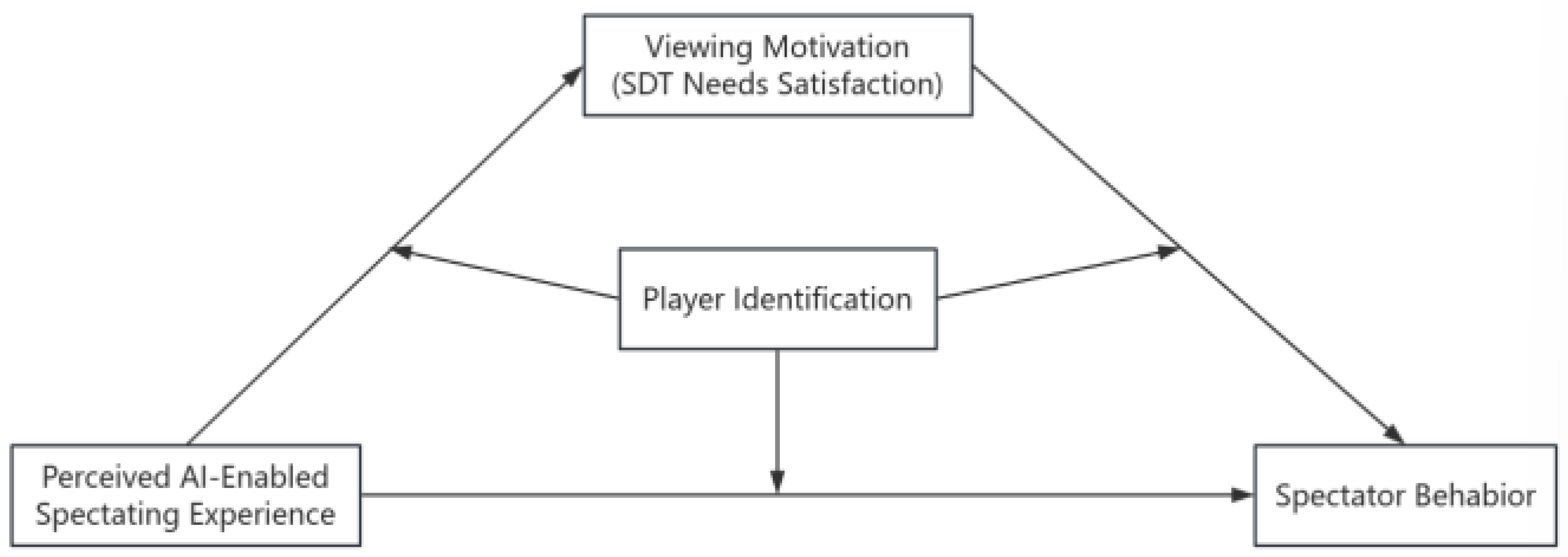
Impact of Artificial Intelligence on Spectator Viewing Behavior in Sports Events: Mediating Role of Viewing Motivation and Moderating Role of Player Identification
Abstract
1. Introduction
2. Literature Review
2.1. Definition and Development of Artificial Intelligence
2.1.1. Enlightenment Period (1950s–1970s)
2.1.2. Knowledge Engineering Period (1970s–1990s)
2.1.3. Data-Driven Period (1990s–Present)
2.2. Artificial Intelligence Classification
2.3. Impact of Artificial Intelligence on Spectator Behavior
2.4. Social Identity Theory and Player Identity
2.4.1. Overview of Social Identity Theory
2.4.2. The Impact of Artificial Intelligence on Spectator Player Identity
2.5. Self-Determination Theory (SDT) and Spectator Motivation
2.5.1. Overview of Self-Determination Theory
2.5.2. The Impact of Artificial Intelligence on Audience Motivational Needs
3. Research Hypothesis
3.1. The Relationship Between Artificial Intelligence, Spectator Motivation, and Spectator Behavior
3.2. The Mediating Effect of Motivation to Watch Games and the Moderating Effect of Players’ Identification
4. Research Methods
4.1. Data Collection
4.2. Variable Design
4.2.1. Dependent Variable: Match Watching Behavior
4.2.2. Independent Variable: Perceived AI-Enabled Spectating Experience
4.2.3. Moderating Variable: Player Identification
4.2.4. Mediating Variable: Motivation to Watch the Game
4.2.5. Control Variables
4.3. Measurement Model Evaluation
4.4. Ethical Statement
5. Results
5.1. Descriptive Statistics of Main Variables
5.2. The Mediating Effect of Spectators’ Motivation Between AI and Willingness to Watch
5.3. The Mediating Effect of Spectator Motivation Between AI and Recommendation Intention
5.4. Moderated Mediator Model Testing
6. Discussion and Conclusions
6.1. Key Findings
6.2. Theoretical Implications
6.3. Practical Implications
6.4. Limitations and Future Research
Author Contributions
Funding
Institutional Review Board Statement
Informed Consent Statement
Data Availability Statement
Acknowledgments
Conflicts of Interest
References
- Annamalai, B., Yoshida, M., Varshney, S., Pathak, A. A., & Venugopal, P. (2021). Social media content strategy for sport clubs to drive fan engagement. Journal of Retailing and Consumer Services, 62, 102648. [Google Scholar] [CrossRef]
- Bergkvist, L., & Rossiter, J. R. (2007). The predictive validity of multiple-item versus single-item measures of the same construct. Journal of Marketing Research, 44(2), 175–184. [Google Scholar] [CrossRef]
- Bhardwaj, A., Bharany, S., & Kim, S. (2024). Fake social media news and distorted campaign detection framework using sentiment analysis & machine learning. Heliyon, 10(16), e36049. [Google Scholar] [CrossRef]
- Bitrián, P., Buil, I., & Catalán, S. (2021). Enhancing user engagement: The role of gamification in mobile apps. Journal of Business Research, 132, 170–185. [Google Scholar] [CrossRef]
- Bostrom, N. (2014). Superintelligence: Paths, dangers, strategies. Oxford University Press. [Google Scholar]
- Boyatzis, R. E. (2008). Competencies in the 21st century. Journal of Management Development, 27(1), 5–12. [Google Scholar] [CrossRef]
- Cameron, J. E. (2004). A three-factor model of social identity. Self and Identity, 3(3), 239–262. [Google Scholar] [CrossRef]
- Carlson, B. D., & Donavan, D. T. (2013). Human brands in sport: Athlete brand personality and identification. Journal of Sport Management, 27(3), 193–206. [Google Scholar] [CrossRef]
- Chan-Olmsted, S. M. (2019). A review of artificial intelligence adoptions in the media industry. International Journal on Media Management, 21(3–4), 193–215. [Google Scholar] [CrossRef]
- Deci, E. L., & Ryan, R. M. (2000). The “what” and “why” of goal pursuits: Human needs and the self-determination of behavior. Psychological inquiry, 11(4), 227–268. [Google Scholar] [CrossRef]
- Deci, E. L., & Ryan, R. M. (2002). Handbook of self-determination research. University of Rochester Press. [Google Scholar]
- Delipetrev, B., Tsinaraki, C., & Kostic, U. (2020). Historical evolution of artificial intelligence. Publications Office of the European Union. [Google Scholar]
- Ding, J. (2018). Deciphering China’s AI dream: The context, components, capabilities, and consequences of China’s strategy to lead the world in AI. Future Of Humanity Institute. [Google Scholar]
- Fink, J. S., Parker, H. M., Brett, M., & Higgins, J. (2009). Off-field behavior of athletes and team identification: Using social identity theory and balance theory to explain fan reactions. Journal of Sport Management, 23(2), 142–155. [Google Scholar] [CrossRef]
- Fotache, M., Cojocariu, I. C., & Bertea, A. (2021, June 18–19). High-level machine learning framework for sports events ticket sales prediction. 22nd International Conference on Computer Systems and Technologies (pp. 55–60), Ruse, Bulgaria. [Google Scholar]
- Gardner, H. E. (1999). Intelligence reframed: Multiple intelligences for the 21st century. Hachette UK. [Google Scholar]
- Gupta, K. P. (2020). Investigating the adoption of MOOCs in a developing country: Application of technology-user-environment framework and self-determination theory. Interactive Technology and Smart Education, 17(4), 355–375. [Google Scholar] [CrossRef]
- Heere, B., & James, J. D. (2007). Sports teams and their communities: Examining the influence of team identification on the community’s social capital. Journal of Sport Management, 21(4), 519–544. [Google Scholar] [CrossRef]
- High-Level Expert Group on Artificial Intelligence. (2019). Ethics guidelines for trustworthy AI, 6. Available online: https://www.aepd.es/sites/default/files/2019-09/ai-definition.pdf (accessed on 27 November 2025).
- Innes, J. M., & Morrison, B. W. (2024). Social identities and the roles of artificial intelligence. In A. Elliott (Ed.), The De Gruyter handbook of artificial intelligence, identity and technology studies (De Gruyter Handbooks of Digital Transformation, Vol. 1, pp. 73–100). De Gruyter. [Google Scholar] [CrossRef]
- Kaplan, A., & Haenlein, M. (2019). Siri, Siri, in my hand: Who’s the fairest in the land? On the interpretations, illustrations, and implications of artificial intelligence. Business Horizons, 62(1), 15–25. [Google Scholar] [CrossRef]
- Krizhevsky, A., Sutskever, I., & Hinton, G. E. (2017). ImageNet classification with deep convolutional neural networks. Communications of the ACM, 60(6), 84–90. [Google Scholar] [CrossRef]
- LeCun, Y., Bengio, Y., & Hinton, G. (2015). Deep learning. Nature, 521(7553), 7553. [Google Scholar] [CrossRef]
- Lock, D., & Heere, B. (2017). Identity crisis: A theoretical analysis of ‘team identification’ research. European Sport Management Quarterly, 17(4), 413–435. [Google Scholar] [CrossRef]
- Luthans, F., Welsh, D. H. B., & Taylor, L. A. (1988). A descriptive model of managerial effectiveness. Group & Organization Studies, 13(2), 148–162. [Google Scholar] [CrossRef]
- Macarthy, A. (2021). 500 social media marketing tips: Essential advice, hints and strategy for business: Facebook, Twitter, Pinterest, Google+, YouTube, Instagram, LinkedIn, and more. CreateSpace Independent Publishing Platform. [Google Scholar]
- Manganelli, L., Thibault-Landry, A., Forest, J., & Carpentier, J. (2018). Self-determination theory can help you generate performance and well-being in the workplace: A review of the literature. Advances in Developing Human Resources, 20(2), 227–240. [Google Scholar] [CrossRef]
- McCarthy, J., Minsky, M. L., Rochester, N., Corporation, I. B. M., & Shannon, C. E. (1955). A proposal for the Dartmouth summer research project on artificial intelligence (Vol. 2). Standford University Press. [Google Scholar]
- Minsky, M. (1968). Semantic information processing. MIT Press. [Google Scholar]
- Peng, Y., Han, J., Zhang, Z., Fan, L., Liu, T., Qi, S., Feng, X., Ma, Y., Wang, Y., & Zhu, S. C. (2023). The Tong test: Evaluating artificial general intelligence through dynamic embodied physical and social interactions. Engineering, 12, 12–22. [Google Scholar] [CrossRef]
- Rizzo, L., Brick, J. M., & Park, I. (2004). A minimally intrusive method for sampling persons in random digit dial surveys. Public Opinion Quarterly, 68(2), 267–274. [Google Scholar] [CrossRef]
- Samoili, S., Righi, R., Cardona, M., Lopez Cobo, M., Vazquez-Prada Baillet, M., & De Prato, G. (2020). TES analysis of AI worldwide ecosystem in 2009–2018. Publications Office of the European Union. [Google Scholar]
- Standage, M., Sebire, S. J., & Loney, T. (2008). Does exercise motivation predict engagement in objectively assessed bouts of moderate-intensity exercise?: A self-determination theory perspective. Journal of Sport and Exercise Psychology, 30(4), 337–352. [Google Scholar] [CrossRef] [PubMed]
- Stoldt, G. C., Dittmore, S. W., Ross, M., & Branvold, S. E. (2020). Sport public relations. Human Kinetics Publishers. [Google Scholar]
- Teixeira, S., Oliveira, Z., & Souza, E. (Eds.). (2023). Using influencer marketing as a digital business strategy. IGI Global. [Google Scholar]
- Turner, J. C., Brown, R. J., & Tajfel, H. (1979). Social comparison and group interest in ingroup favouritism. European Journal of Social Psychology, 9(2), 187–204. [Google Scholar] [CrossRef]
- Underwood, R., Bond, E., & Baer, R. (2001). Building service brands via social identity: Lessons from the sports marketplace. Journal of Marketing Theory and Practice, 9(1), 1–13. [Google Scholar] [CrossRef]
- Vallerand, R. J. (2007). Intrinsic and extrinsic motivation in sport and physical activity: A review and a look at the future. In G. Tenenbaum, & R. C. Eklund (Eds.), Handbook of sport psychology (3rd ed., pp. 59–83). John Wiley. [Google Scholar]
- Ventura, J. (2017). “We created that space with everybody:” Constructing a community-based space of belonging and familia in a latina/o youth group. Association of Mexican American Educators Journal, 11(1), 23–37. [Google Scholar] [CrossRef]
- Wang, X., Wang, Z., & Yan, Y. (2021). Application of artificial intelligence and transformation of sports communication. Journal of Shanghai University of Sport, 45(2), 57–64. [Google Scholar] [CrossRef]
- Wann, D. L., Waddill, P. J., Polk, J., & Weaver, S. (2011). The team identification–social psychological health model: Sport fans gaining connections to others via sport team identification. Group Dynamics: Theory, Research & Practice, 15(1), 75. [Google Scholar] [CrossRef]
- Winand, M., Schneiders, C., Merten, S., & Marlier, M. (2021). Sports fans and innovation: An analysis of football fans’ satisfaction with video assistant refereeing through social identity and argumentative theories. Journal of Business Research, 136, 99–109. [Google Scholar] [CrossRef]
- Xie, G., & Wang, X. (2024). Exploring the impact of ai enhancement on the sports app community: Analyzing human-computer interaction and social factors using a hybrid SEM-ANN approach. International Journal of Human–Computer Interaction, 41, 8734–8755. [Google Scholar] [CrossRef]
- Xu, Y., Liu, X., Cao, X., Huang, C., Liu, E., Qian, S., Liu, X., Wu, Y., Dong, F., Qiu, C.-W., & Qiu, J. (2021). Artificial intelligence: A powerful paradigm for scientific research. The Innovation, 2(4), 21. [Google Scholar] [CrossRef]
- Yao, W., & Li, C. (2024). Human-machine collaboration: Transformation and construction of sports event referee mode. Journal of Shanghai University of Sport, 48(2), 70–79. [Google Scholar] [CrossRef]
- Ye, Y., Zhu, H., Deng, X., & Mu, Z. (2019). Negative workplace gossip and service outcomes: An explanation from social identity theory. International Journal of Hospitality Management, 82, 159–168. [Google Scholar] [CrossRef]
- Zadeh, A. H., Farhang, M., Zolfagharian, M., & Hofacker, C. F. (2023). Predicting value cocreation behavior in social media via integrating uses and gratifications paradigm and theory of planned behavior. Journal of Research in Interactive Marketing, 17(2), 195–214. [Google Scholar] [CrossRef]


| Factor Name | Observed Variable |
|---|---|
| Perceived AI-Enabled Spectating Experience (EXP) | 1-1 I think AI technology (such as personalized recommendations and game data analysis) can improve my viewing experience (EXP1) |
| 1-2 I think artificial intelligence technology makes me better understand sports events (EXP2) | |
| 1-3 AI can help me match viewers with similar interests (EXP3) | |
| 1-4 The AI-driven interactive features (such as virtual communities, real-time win rate predictions) have enhanced my interaction with the players in the event. (EXP4) | |
| Viewing Motivation (SDT Needs Satisfaction) (MOT) | 2-1 My ability to freely express my opinions and viewpoints on the tennis match (MOT1) |
| 2-2 The sense of acquiring new knowledge and skills while watching the tennis match (MOT2) | |
| 2-3 The sense of resonance I can obtain in the relevant tennis event communities or on social media (MOT3) | |
| The Willingness To Watch (WAT) | 3-1 I am willing to watch the game again (WAH1) |
| 3-2 I am willing to participate in events related to the game (WAH2) | |
| 3-3 I am willing to purchase products related to the game (WAH3) | |
| The Willingness To Recommend (REC) | 4-1 I am willing to recommend and invite others to watch the game (REC1) |
| 4-2 I am willing to share information about the game with others (REC2) |
| Latent Construct | Observed Item | Factor Loading | Cronbach’s α | Average Variance Extracted | CR |
|---|---|---|---|---|---|
| Perceived AI-Enabled Spectating Experience | EXP1 | 0.789 | 0.925 | 0.648 | 0.880 |
| EXP2 | 0.829 | ||||
| EXP3 | 0.793 | ||||
| EXP4 | 0.808 | ||||
| Viewing Motivation (SDT Needs Satisfaction) | MOT1 | 0.754 | 0.900 | 0.588 | 0.811 |
| MOT2 | 0.778 | ||||
| MOT3 | 0.769 | ||||
| The Willingness to Watch | WAT1 | 0.834 | 0.903 | 0.692 | 0.875 |
| WAT2 | 0.812 | ||||
| WAT3 | 0.849 | ||||
| The Willingness to Recommend | REC1 | 0.807 | 0.875 | 0.637 | 0.778 |
| REC2 | 0.790 |
| Perceived AI-Enabled Spectating Experience | Motivation to Watch the Game | The Willingness to Watch | The Willingness to Recommend | |
|---|---|---|---|---|
| Perceived AI-Enabled Spectating Experience | 0.805 | |||
| Viewing Motivation (SDT Needs Satisfaction) | 0.634 | 0.767 | ||
| The Willingness to Watch | 0.582 | 0.615 | 0.832 | |
| The Willingness to Recommend | 0.557 | 0.532 | 0.658 | 0.798 |
| Variable Name | Sample Size | Mean | Median | Standard Deviation | Minimum | Maximum |
|---|---|---|---|---|---|---|
| Willingness to watch the game | 272 | 3.665 | 4 | 1.067 | 1 | 5 |
| Willingness to recommend | 272 | 3.813 | 4 | 1.041 | 1 | 5 |
| Perceived AI experience | 272 | 18.22 | 18 | 4.452 | 5 | 25 |
| Player identity | 272 | 3.794 | 4 | 1.010 | 1 | 5 |
| Viewing motivation (SDT Needs Satisfaction) | 272 | 22.11 | 23 | 5.127 | 6 | 30 |
| Age | 272 | 2.886 | 2 | 1.360 | 1 | 6 |
| Gender | 272 | 1.493 | 1 | 0.501 | 1 | 2 |
| Frequency of watching games | 272 | 2.607 | 3 | 1.189 | 1 | 4 |
| Dependent Variable: Motivation to Watch the Game | Dependent Variable: Willingness to Watch the Game | |||||||
|---|---|---|---|---|---|---|---|---|
| Variable Name | SE | t | 95%CI | SE | t | 95%CI | ||
| Perceived AI experience | 0.1471 | 0.0100 | 14.68 *** | [0.1274,0.1668] | 0.0680 0.3259 | 0.0154 0.0698 | 4.43 *** | [0.0378,0.0982] [0.1885,0.4633] |
| Viewing motivation (SDT Needs) | 4.67 *** | |||||||
| R2 | 0.4602 | 0.3989 | ||||||
| F | 56.91 *** | 35.30 *** | ||||||
| Dependent Variable: Motivation to Watch the Game | Dependent Variable: Willingness to Recommend | |||||||
|---|---|---|---|---|---|---|---|---|
| Variable Name | SE | t | 95%CI | SE | t | 95%CI | ||
| Perceived AI experience | 0.1471 | 0.0100 | 14.68 *** | [0.1274,0.1668] | 0.0579 0.3724 | 0.0156 0.0708 | 3.72 *** | [0.0272,0.0885] [0.2331,0.5117] |
| Viewing motivation (SDT Needs) | 5.26 *** | |||||||
| R2 | 0.4602 | 0.3497 | ||||||
| F | 56.91 *** | 28.61 *** | ||||||
| Direct Effect | Indirect Effects | Total Effect | Hypothesis Verification | |
|---|---|---|---|---|
| Perceived AI experience → motivation to watch the game → willingness to recommend | 0.0579 *** | 0.0548 *** | 0.1126 *** | H4b is established |
| Dependent Variable: Motivation to Watch the Game | Dependent Variable: Willingness to Watch the Game | |||||||
| Variable Name | SE | t | 95%CI | SE | t | 95%CI | ||
| Perceived AI experience | 0.0910 | 0.0279 | 3.26 ** | [0.0360,0.1460] | 0.0425 | 0.0175 | 2.43 ** | [0.0247,0.0977] |
| Player identity | 0.3149 | 0.1329 | 2.37 ** | [0.0532,0.5766] | 0.2825 | 0.1511 | 1.87 * | [0.2030,0.3620] |
| AI × player identity | 0.0020 | 0.0072 | 0.28 | [−0.0121,0.0162] | 0.0429 | 0.0620 | 0.69 | [0.0595,0.1453] |
| Viewing motivation (SDT) | 0.7094 | 0.2207 | 3.21 *** | [0.3451,1.0737] | ||||
| Motivation × player identity | 0.2809 | 0.1035 | 2.72 *** | [0.1102,0.4517] | ||||
| R2 | 0.5377 | 0.4070 | ||||||
| F | 51.38 *** | 22.56 *** | ||||||
| Dependent Variable: Motivation to Watch the Game | Dependent Variable: Willingness to Recommend | |||||||
| Variable Name | SE | t | 95%CI | SE | t | 95%CI | ||
| Perceived AI experience | 0.0767 | 0.0202 | 3.80 *** | [0.0434,0.1099] | 0.1740 | 0.1042 | 1.67 * | [0.0020,0.3459] |
| Player identity | 0.1626 | 0.0959 | 1.70 * | [0.0044,0.3209] | 0.1381 | 0.0744 | 1.85 * | [0.0499,0.4260] |
| AI × player identity | 0.0081 | 0.0052 | 1.56 | [−0.0005,0.0166] | 0.0116 | 0.0121 | 0.96 | [0.0316,0.0084] |
| Viewing motivation (SDT) | 0.5841 | 0.2222 | 2.62 *** | [0.2173,0.9509] | ||||
| Motivation × player identity | 0.1621 | 0.0485 | 3.34 *** | [0.0821,0.2422] | ||||
| R2 | 0.6774 | 0.4436 | ||||||
| F | 65.72 *** | 26.21 *** | ||||||
Disclaimer/Publisher’s Note: The statements, opinions and data contained in all publications are solely those of the individual author(s) and contributor(s) and not of MDPI and/or the editor(s). MDPI and/or the editor(s) disclaim responsibility for any injury to people or property resulting from any ideas, methods, instructions or products referred to in the content. |
© 2025 by the authors. Licensee MDPI, Basel, Switzerland. This article is an open access article distributed under the terms and conditions of the Creative Commons Attribution (CC BY) license (https://creativecommons.org/licenses/by/4.0/).
Share and Cite
Min, J.; Xie, Q.; Liu, Y. Impact of Artificial Intelligence on Spectator Viewing Behavior in Sports Events: Mediating Role of Viewing Motivation and Moderating Role of Player Identification. Behav. Sci. 2025, 15, 1702. https://doi.org/10.3390/bs15121702
Min J, Xie Q, Liu Y. Impact of Artificial Intelligence on Spectator Viewing Behavior in Sports Events: Mediating Role of Viewing Motivation and Moderating Role of Player Identification. Behavioral Sciences. 2025; 15(12):1702. https://doi.org/10.3390/bs15121702
Chicago/Turabian StyleMin, Jie, Qing Xie, and Yongjian Liu. 2025. "Impact of Artificial Intelligence on Spectator Viewing Behavior in Sports Events: Mediating Role of Viewing Motivation and Moderating Role of Player Identification" Behavioral Sciences 15, no. 12: 1702. https://doi.org/10.3390/bs15121702
APA StyleMin, J., Xie, Q., & Liu, Y. (2025). Impact of Artificial Intelligence on Spectator Viewing Behavior in Sports Events: Mediating Role of Viewing Motivation and Moderating Role of Player Identification. Behavioral Sciences, 15(12), 1702. https://doi.org/10.3390/bs15121702