When Fast Thinking Meets Bad Emotion: The Effect of Intuitive Processing Modes and Negative Moods on Moral Hypocrisy

Abstract
1. Introduction
1.1. Intuitive Processing Modes and Moral Hypocrisy
1.2. Intuitive Processing Modes, Negative Moods and Moral Hypocrisy
1.3. Research Overview
2. Study 1
2.1. Method
2.1.1. Participants
2.1.2. Materials
2.1.3. Procedure
2.2. Data Analysis
2.2.1. Power Analysis
2.2.2. Assumption Checks
2.3. Results
2.3.1. Manipulation Check
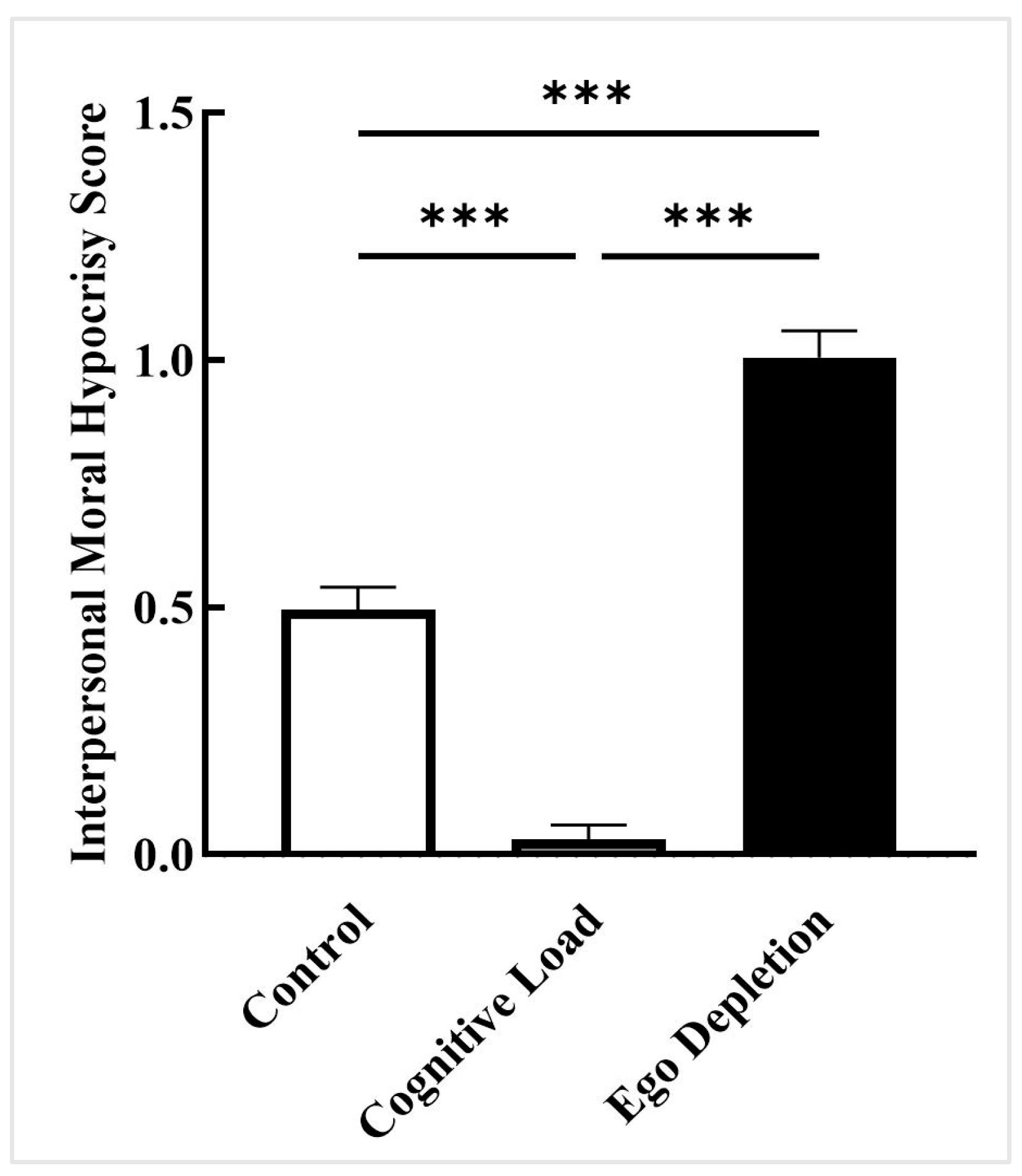
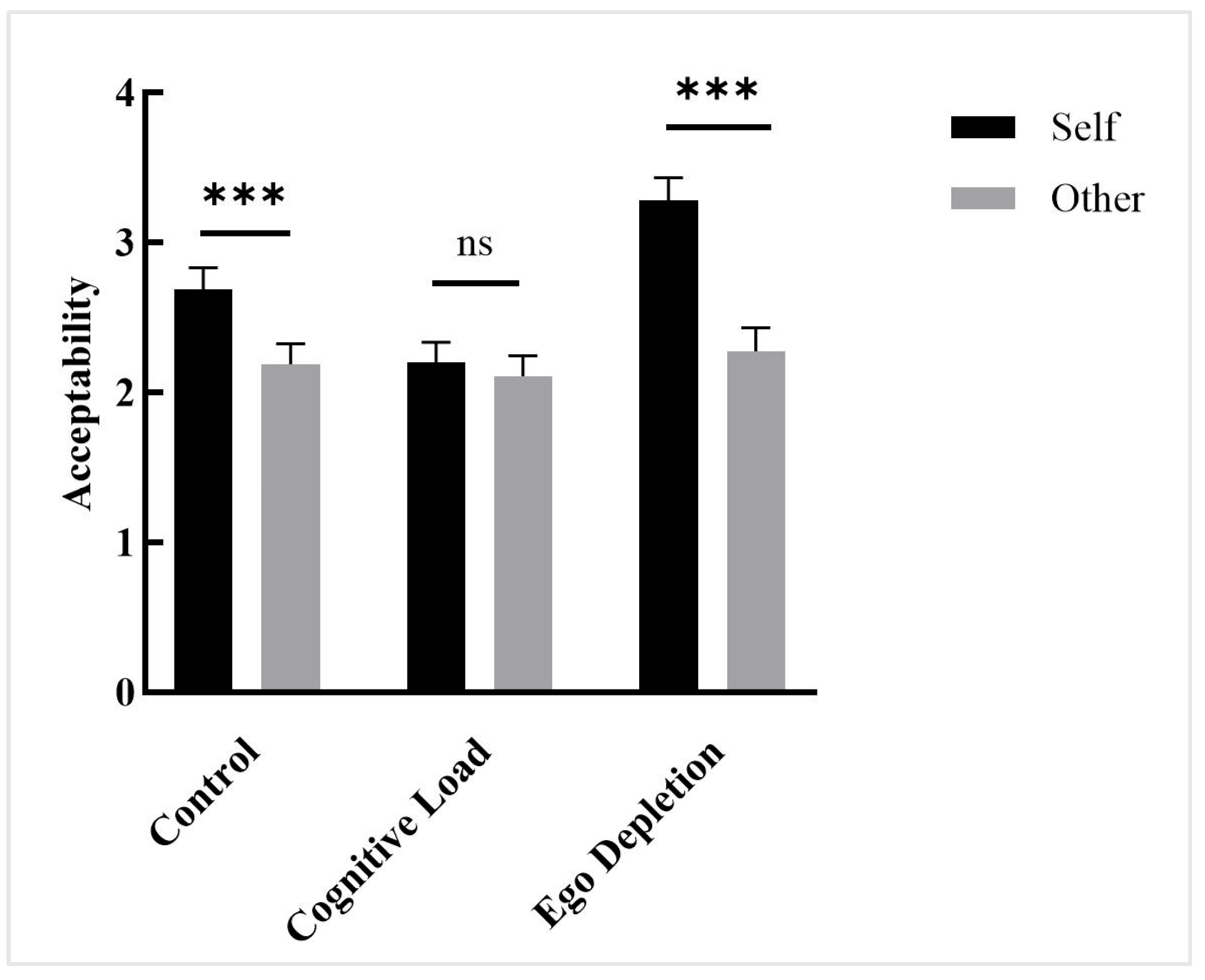
2.3.2. Effects of Different Intuitive Processing Modes on Interpersonal Moral Hypocrisy
2.4. Discussion
3. Study 2
3.1. Method
3.1.1. Participants
3.1.2. Material
3.1.3. Procedure
3.2. Data Analysis
3.2.1. Power Analysis
3.2.2. Assumption Checks
3.3. Results
3.3.1. Manipulation Check
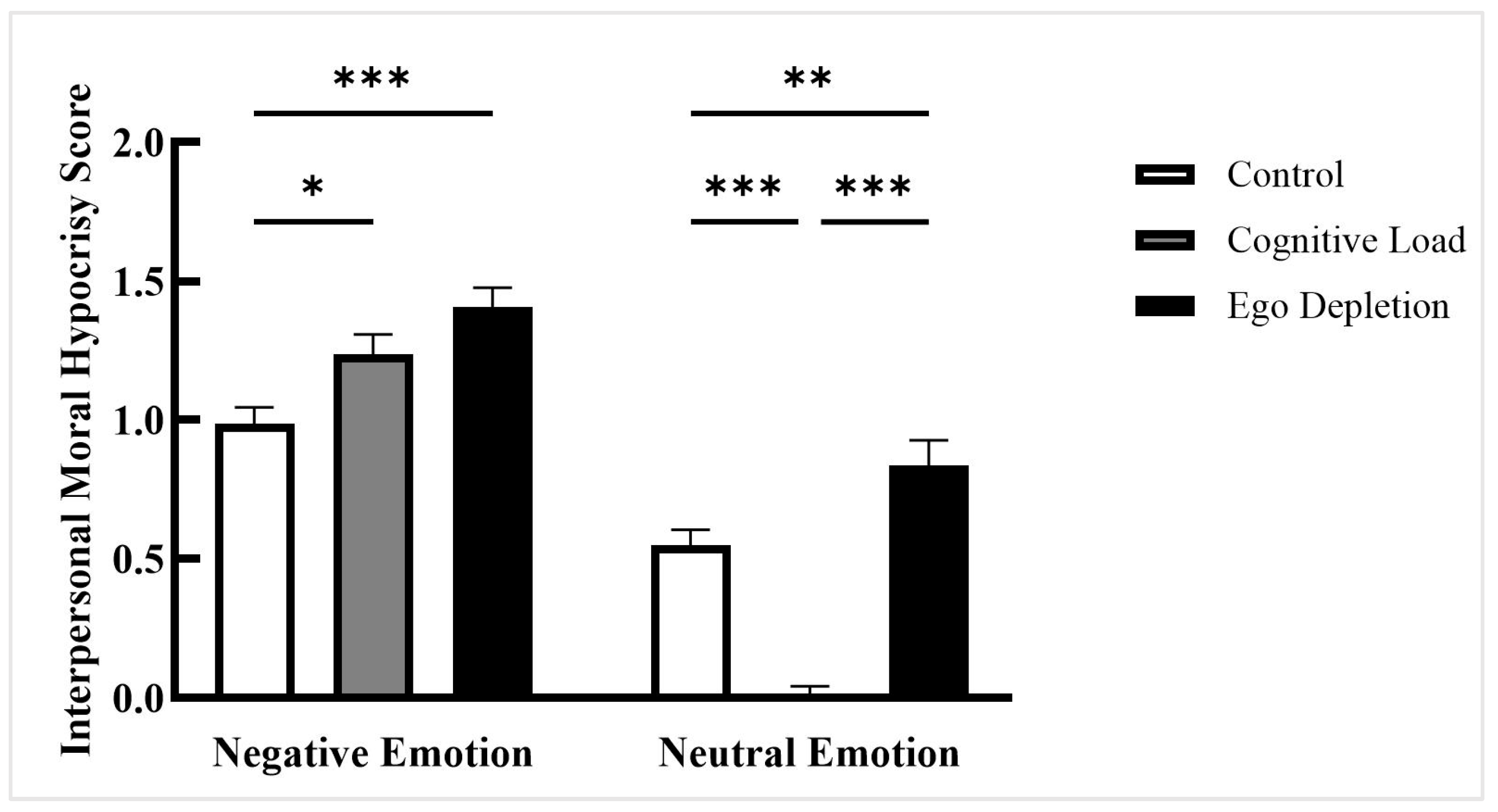
3.3.2. Effects of Intuitive Processing Modes and Negative Moods on Interpersonal Moral Hypocrisy
3.4. Discussion
4. Study 3
4.1. Method
4.1.1. Participants
4.1.2. Material
4.1.3. Procedure
4.2. Data Analysis
4.2.1. Power Analysis
4.2.2. Assumption Checks
4.3. Results
4.3.1. Manipulation Check
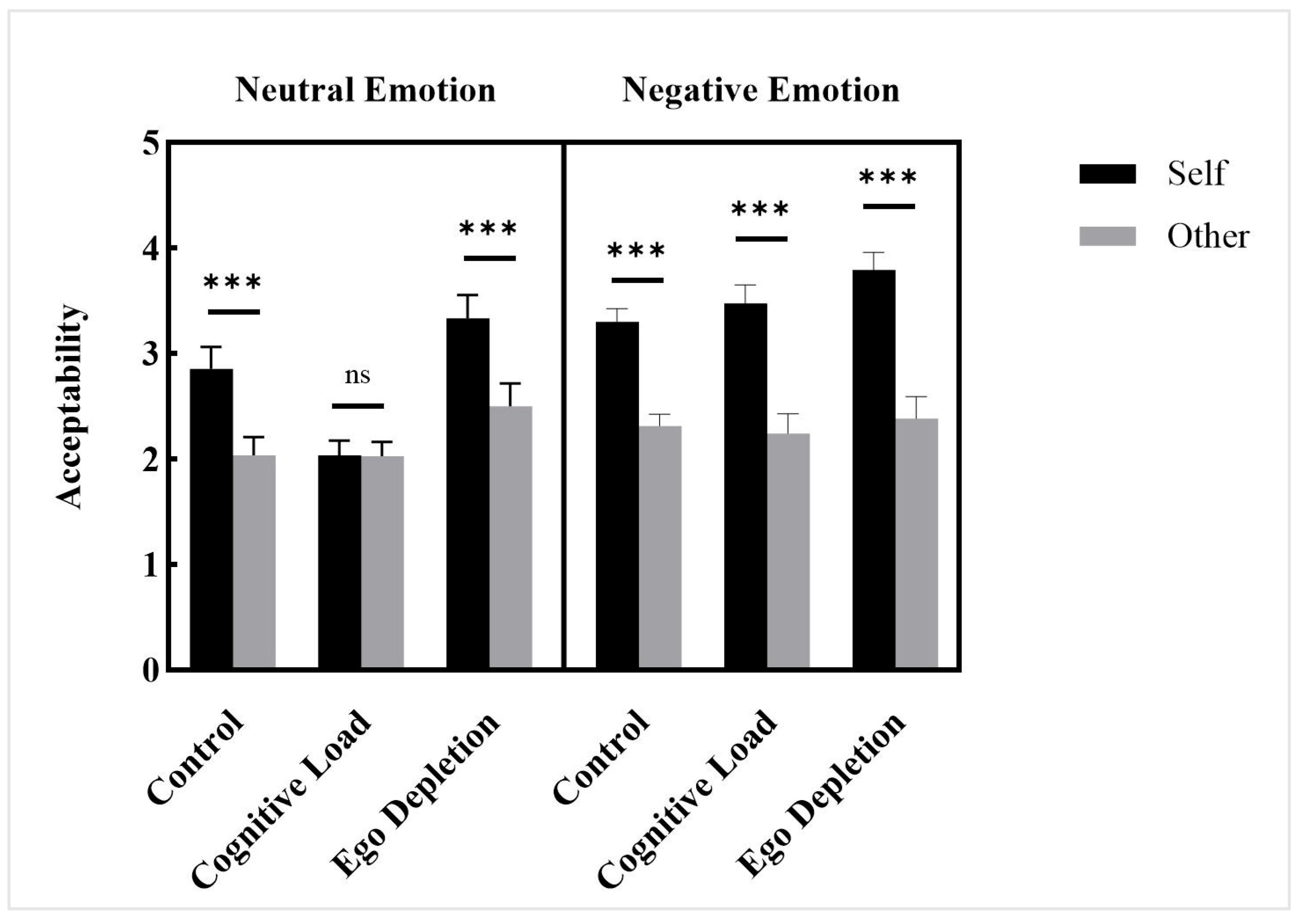
4.3.2. Effects of Intuitive Processing Modes and Negative Moods on Intrapersonal Moral Hypocrisy
4.4. Discussion
5. General Discussion
5.1. Effects of Intuitive Processing Modes on Moral Hypocrisy
5.2. Effects of Intuitive Processing Modes and Negative Moods on Moral Hypocrisy
5.3. Differences Between Interpersonal and Intrapersonal Moral Hypocrisy
5.4. Limitations
5.5. Future Research Directions
6. Conclusions
Author Contributions
Funding
Institutional Review Board Statement
Informed Consent Statement
Data Availability Statement
Acknowledgments
Conflicts of Interest
Appendix A

| Group | M | SD | t | df | p | Cohen’s d | |
|---|---|---|---|---|---|---|---|
| Task difficulty | Control | 2.180 | 1.137 | −8.091 | 98 | <0.001 | −1.618 |
| Ego depletion | 4.340 | 1.507 | |||||
| Effort expenditure | Control | 2.640 | 1.549 | −10.451 | 98 | <0.001 | −2.090 |
| Ego depletion | 5.700 | 1.374 | |||||
| Fatigue | Control | 2.140 | 1.262 | −8.871 | 98 | <0.001 | −1.774 |
| Ego depletion | 4.560 | 1.459 | |||||
| Depletion | Control | 2.340 | 1.437 | −6.424 | 98 | <0.001 | −1.285 |
| Ego depletion | 4.260 | 1.549 |
| Group | M | SD | t | df | p | Cohen’s d | |
|---|---|---|---|---|---|---|---|
| Task difficulty | Control | 2.986 | 1.819 | −2.922 | 137 | 0.004 | −0.496 |
| Ego depletion | 3.857 | 1.696 | |||||
| Effort expenditure | Control | 3.681 | 2.125 | −5.027 | 137 | <0.001 | −0.853 |
| Ego depletion | 5.300 | 1.645 | |||||
| Fatigue | Control | 2.406 | 1.556 | −8.618 | 137 | <0.001 | −1.462 |
| Ego depletion | 4.857 | 1.788 | |||||
| Depletion | Control | 2.870 | 1.635 | −5.655 | 137 | <0.001 | −0.959 |
| Ego depletion | 4.400 | 1.555 |
| Sum of Squares | df | Mean Square | F | p | ||
|---|---|---|---|---|---|---|
| Within subjects effects | ||||||
| Time point | 4867.618 | 1 | 4867.618 | 478.719 | <0.001 | 0.699 |
| Time point × Mood type | 1757.272 | 1 | 1757.272 | 172.824 | <0.001 | 0.456 |
| Residuals | 2094.611 | 206 | 10.168 | |||
| Between subjects effects | ||||||
| Mood type | 4131.541 | 1 | 4131.541 | 58.960 | <0.001 | 0.223 |
| Residuals | 14,435.091 | 206 | 70.073 |
| M | SD | t | df | p | Cohen’s d | ||
|---|---|---|---|---|---|---|---|
| Mood type | |||||||
| Negative mood | Pre-test | 9.567 | 6.849 | −24.767 | 206 | <0.001 | −1.729 |
| Post-test | 20.519 | 6.015 | |||||
| Neutral mood | Pre-test | 7.375 | 5.543 | −6.175 | 206 | <0.001 | −0.431 |
| Post-test | 10.106 | 6.832 | |||||
| Time point | |||||||
| Pre-test | Negative mood | 9.567 | 6.849 | 2.537 | 206 | 0.012 | 0.346 |
| Neutral mood | 7.375 | 5.543 | |||||
| Post-test | Negative mood | 20.519 | 6.015 | 11.667 | 206 | <0.001 | 1.644 |
| Neutral mood | 10.106 | 6.832 |
| Group | M | SD | t | df | p | Cohen’s d | |
|---|---|---|---|---|---|---|---|
| Task difficulty | Control | 2.457 | 1.125 | −8.237 | 139 | <0.001 | −1.387 |
| Ego depletion | 4.225 | 1.406 | |||||
| Effort expenditure | Control | 3.071 | 1.255 | −8.997 | 139 | <0.001 | −1.515 |
| Ego depletion | 5.141 | 1.467 | |||||
| Fatigue | Control | 2.429 | 1.071 | −12.459 | 139 | <0.001 | −2.099 |
| Ego depletion | 5.085 | 1.432 | |||||
| Depletion | Control | 2.643 | 1.252 | −9.216 | 139 | <0.001 | −1.552 |
| Ego depletion | 4.549 | 1.205 |
| Sum of Squares | df | Mean Square | F | p | ||
|---|---|---|---|---|---|---|
| Within subjects effects | ||||||
| Time point | 2021.261 | 1 | 2021.261 | 216.106 | <0.001 | 0.508 |
| Time point × Mood type | 214.152 | 1 | 214.152 | 22.896 | <0.001 | 0.099 |
| Residuals | 1954.801 | 209 | 9.353 | |||
| Between subjects effects | ||||||
| Mood type | 58.860 | 1 | 58.860 | 3.204 | 0.075 | 0.015 |
| Residuals | 3839.420 | 209 | 18.370 |
| M | SD | t | df | p | Cohen’s d | ||
|---|---|---|---|---|---|---|---|
| Mood type | |||||||
| Negative mood | Pre-test | 7.170 | 2.535 | −13.811 | 209 | <0.001 | −1.558 |
| Post-test | 12.972 | 4.086 | |||||
| Neutral mood | Pre-test | 7.848 | 2.752 | −6.995 | 209 | <0.001 | −0.793 |
| Post-test | 10.800 | 4.980 | |||||
| Time point | |||||||
| Pre-test | Negative mood | 7.170 | 2.535 | −1.861 | 209 | 0.064 | −0.182 |
| Neutral mood | 7.848 | 2.752 | |||||
| Post-test | Negative mood | 12.972 | 4.086 | 3.465 | 209 | <0.001 | 3.465 |
| Neutral mood | 10.800 | 4.980 |
References
- Achtziger, A., Alós-Ferrer, C., & Wagner, A. K. (2016). The impact of self-control depletion on social preferences in the ultimatum game. Journal of Economic Psychology, 53, 1–16. [Google Scholar] [CrossRef]
- Bago, B., Bonnefon, J.-F., & De Neys, W. (2021). Intuition rather than deliberation determines selfish and prosocial choices. Journal of Experimental Psychology: General, 150(6), 1081–1094. [Google Scholar] [CrossRef]
- Bago, B., & De Neys, W. (2019). The intuitive greater good: Testing the corrective dual process model of moral cognition. Journal of Experimental Psychology: General, 148(10), 1782–1801. [Google Scholar] [CrossRef]
- Bai, L., Ma, H., Huang, Y. X., & Luo, Y. J. (2005). The development of native Chinese affective picture system—A pretest in 46 college students. Chinese Mental Health Journal, 19(11), 719–722. [Google Scholar]
- Batson, C. D., Kobrynowicz, D., Dinnerstein, J. L., Kampf, H. C., & Wilson, A. D. (1997). In a very different voice: Unmasking moral hypocrisy. Journal of Personality and Social Psychology, 72(6), 1335–1348. [Google Scholar] [CrossRef]
- Batson, C. D., Thompson, E. R., Seuferling, G., Whitney, H., & Strongman, J. A. (1999). Moral hypocrisy: Appearing moral to oneself without being so. Journal of Personality and Social Psychology, 77(3), 525–537. [Google Scholar] [CrossRef] [PubMed]
- Baumeister, R. F., & Alghamdi, N. G. (2015). Role of self-control failure in immoral and unethical actions. Current Opinion in Psychology, 6, 66–69. [Google Scholar] [CrossRef]
- Baumeister, R. F., André, N., Southwick, D. A., & Tice, D. M. (2024). Self-control and limited willpower: Current status of ego depletion theory and research. Current Opinion in Psychology, 60, 101882. [Google Scholar] [CrossRef]
- Baumeister, R. F., Bratslavsky, E., Muraven, M., & Tice, D. M. (1998). Ego depletion: Is the active self a limited resource? Journal of Personality and Social Psychology, 74(5), 1252–1265. [Google Scholar] [CrossRef]
- Baumeister, R. F., & Exline, J. J. (1999). Virtue, personality, and social relations: Self-control as the moral muscle. Journal of Personality, 67(6), 1165–1194. [Google Scholar] [CrossRef] [PubMed]
- Baumeister, R. F., Muraven, M., & Tice, D. M. (2000). Ego depletion: A resource model of volition, self-regulation, and controlled processing. Social Cognition, 18(2), 130–150. [Google Scholar] [CrossRef]
- Blanca, M., Alarcón, R., Arnau, J., Bono, R., & Bendayan, R. (2017). Non-normal data: Is ANOVA still a valid option? Psicothema, 4(29), 552–557. [Google Scholar] [CrossRef]
- Blanca, M., Arnau, J., García-Castro, F., Alarcón, R., & Bono, R. (2023). Non-normal data in repeated measures ANOVA: Impact on type I error and power. Psicothema, 1(35), 21–29. [Google Scholar] [CrossRef]
- Bono, R., Blanca, M. J., Arnau, J., & Gómez-Benito, J. (2017). Non-normal distributions commonly used in health, education, and social sciences: A systematic review. Frontiers in Psychology, 8, 1602. [Google Scholar] [CrossRef]
- Capraro, V. (2024). The dual-process approach to human sociality: Meta-analytic evidence for a theory of internalized heuristics for self-preservation. Journal of Personality and Social Psychology, 126(5), 719–757. [Google Scholar] [CrossRef] [PubMed]
- Chvaja, R., Kundt, R., & Lang, M. (2020). The effects of synchrony on group moral hypocrisy. Frontiers in Psychology, 11, 544589. [Google Scholar] [CrossRef] [PubMed]
- Dahò, M. (2025). Emotional responses in clinical ethics consultation decision-making: An exploratory study. Behavioral Sciences, 15(6), 748. [Google Scholar] [CrossRef]
- Dang, J., Barker, P., Baumert, A., Bentvelzen, M., Berkman, E., Buchholz, N., Buczny, J., Chen, Z., Cristofaro, V. D., de Vries, L., Dewitte, S., Giacomantonio, M., Gong, R., Homan, M., Imhoff, R., Ismail, I., Jia, L., Kubiak, T., Lange, F., … Zinkernagel, A. (2020). A multilab replication of the ego depletion effect. Social Psychological and Personality Science, 12(1), 14–24. [Google Scholar] [CrossRef]
- De Neys, W. (2023). Advancing theorizing about fast-and-slow thinking. Behavioral and Brain Sciences, 46, e111. [Google Scholar] [CrossRef]
- De Neys, W., & Pennycook, G. (2019). Logic, fast and slow: Advances in dual-process theorizing. Current Directions in Psychological Science, 28(5), 503–509. [Google Scholar] [CrossRef]
- De Vries, M., Holland, R. W., Corneille, O., Rondeel, E., & Witteman, C. L. M. (2012). Mood effects on dominated choices: Positive mood induces departures from logical rules. Journal of Behavioral Decision Making, 25(1), 74–81. [Google Scholar] [CrossRef]
- Dong, M., Kupfer, T. R., Yuan, S., & van Prooijen, J.-W. (2023). Being good to look good: Self-reported moral character predicts moral double standards among reputation-seeking individuals. British Journal of Psychology, 114(1), 244–261. [Google Scholar] [CrossRef]
- Dong, M., van Prooijen, J.-W., & van Lange, P. A. M. (2019). Self-enhancement in moral hypocrisy: Moral superiority and moral identity are about better appearances. PLoS ONE, 14(7), e0219382. [Google Scholar] [CrossRef]
- Dong, M., van Prooijen, J.-W., Wu, S., & van Lange, P. A. M. (2022). Culture, status, and hypocrisy: High-status people who don’t practice what they preach are viewed as worse in the United States than China. Social Psychological and Personality Science, 13(1), 60–69. [Google Scholar] [CrossRef]
- Drolet, A., & Luce, M. F. (2004). The rationalizing effects of cognitive load on emotion-based trade-off avoidance. Journal of Consumer Research, 31(1), 63–77. [Google Scholar] [CrossRef]
- Du, X. F., Liu, N. N., Jia, Q. N., & Wu, J. X. (2019). Guilt proneness moderates the after-effects of ego depletion on hypocrisy. Personality and Individual Differences, 151, 109516. [Google Scholar] [CrossRef]
- Ellemers, N., Van Der Toorn, J., Paunov, Y., & Van Leeuwen, T. (2019). The psychology of morality: A review and analysis of empirical studies published from 1940 through 2017. Personality and Social Psychology Review, 23(4), 332–366. [Google Scholar] [CrossRef]
- Evans, J. S. B. T., & Stanovich, K. E. (2013). Dual-process theories of higher cognition: Advancing the debate. Perspectives on Psychological Science, 8(3), 223–241. [Google Scholar] [CrossRef]
- Fan, L., Zhou, Y., Lin, S., & Sun, B. (2025). Stay hungry for morality: The inhibitory effect of high moral identity and moral elevation on moral licensing. Journal of Social Psychology, 165, 896–910. [Google Scholar] [CrossRef] [PubMed]
- Fan, W., Yang, Y., Zhang, W., & Zhong, Y. (2021). Ego depletion and time pressure promote spontaneous deception: An event-related potential study. Advances in Cognitive Psychology, 17(3), 239–249. [Google Scholar] [CrossRef]
- Finney, S. J., & DiStefano, C. (2006). Non-normal and categorical data in structural equation modeling. Structural Equation Modeling: A Second Course, 10(6), 269−314. [Google Scholar]
- Fu, X., Lu, Z., & Kou, Y. (2015). Effects of a stranger’s presence and behavior on moral hypocrisy. Acta Psychologica Sinica, 47(8), 1058. [Google Scholar] [CrossRef]
- Gailliot, M. T., & Baumeister, R. F. (2007). Self-regulation and sexual restraint: Dispositionally and temporarily poor self-regulatory abilities contribute to failures at restraining sexual behavior. Personality and Social Psychology Bulletin, 33(2), 173–186. [Google Scholar] [CrossRef]
- Gailliot, M. T., Baumeister, R. F., DeWall, C. N., Maner, J. K., Plant, E. A., Tice, D. M., Brewer, L. E., & Schmeichel, B. J. (2007). Self-control relies on glucose as a limited energy source: Willpower is more than a metaphor. Journal of Personality and Social Psychology, 92(2), 325–336. [Google Scholar] [CrossRef]
- Gangemi, A., Rizzotto, C., Riggio, F., Dahò, M., & Mancini, F. (2025). Guilt emotion and decision-making under uncertainty. Frontiers in Psychology, 16, 1518752. [Google Scholar] [CrossRef] [PubMed]
- Greene, J. D., Morelli, S. A., Lowenberg, K., Nystrom, L. E., & Cohen, J. D. (2008). Cognitive load selectively interferes with utilitarian moral judgment. Cognition, 107(3), 1144–1154. [Google Scholar] [CrossRef]
- Greene, J. D., Sommerville, R. B., Nystrom, L. E., Darley, J. M., & Cohen, J. D. (2001). An fMRI investigation of emotional engagement in moral judgment. Science, 293(5537), 2105–2108. [Google Scholar] [CrossRef] [PubMed]
- Hagger, M. S., Wood, C., Stiff, C., & Chatzisarantis, N. L. D. (2010). Ego depletion and the strength model of self-control: A meta-analysis. Psychological Bulletin, 136(4), 495–525. [Google Scholar] [CrossRef] [PubMed]
- Haidt, J. (2001). The emotional dog and its rational tail: A social intuitionist approach to moral judgment. Psychological Review, 108(4), 814–834. [Google Scholar] [CrossRef] [PubMed]
- Halali, E., Bereby-Meyer, Y., & Meiran, N. (2014). Between self-interest and reciprocity: The social bright side of self-control failure. Journal of Experimental Psychology: General, 143(2), 745–754. [Google Scholar] [CrossRef] [PubMed]
- Harwood, J., Paolini, S., Joyce, N., Rubin, M., & Arroyo, A. (2011). Secondary transfer effects from imagined contact: Group similarity affects the generalization gradient. British Journal of Social Psychology, 50(1), 180–189. [Google Scholar] [CrossRef]
- Helion, C., & Ochsner, K. N. (2018). The role of emotion regulation in moral judgment. Neuroethics, 11(3), 297–308. [Google Scholar] [CrossRef]
- Huang, L., Yang, T. Z., & Ji, Z. M. (2003). Applicability of the positive and negative affect scale in Chinese. Chinese Mental Health Journal, 17(1), 54–56. [Google Scholar]
- Isler, O., & Yilmaz, O. (2023). How to activate intuitive and reflective thinking in behavior research? A comprehensive examination of experimental techniques. Behavior Research Methods, 55(7), 3679–3698. [Google Scholar] [CrossRef]
- Kirschner, P. A., Sweller, J., Kirschner, F., & Zambrano R., J. (2018). From cognitive load theory to collaborative cognitive load theory. International Journal of Computer-Supported Collaborative Learning, 13(2), 213–233. [Google Scholar] [CrossRef] [PubMed]
- Kline, R. B. (2020). Becoming a behavioral science researcher: A guide to producing research that matters (2nd ed.). The Guilford Press. [Google Scholar]
- Lammers, J. (2012). Abstraction increases hypocrisy. Journal of Experimental Social Psychology, 48(2), 475–480. [Google Scholar] [CrossRef]
- Lammers, J., Stapel, D. A., & Galinsky, A. D. (2010). Power increases hypocrisy: Moralizing in reasoning, immorality in behavior. Psychological Science, 21(5), 737–744. [Google Scholar] [CrossRef] [PubMed]
- Li, K. Z., He, N., Li, H., & Han, Y. W. (2021). Be strict with self or others: Study on the dual process mechanism of moral hypocrisy. Journal of Psychological Science, 44(6), 1396. [Google Scholar] [CrossRef]
- Lin, S. C., & Miller, D. T. (2021). A dynamic perspective on moral choice: Revisiting moral hypocrisy. Organizational Behavior and Human Decision Processes, 164, 203–217. [Google Scholar] [CrossRef]
- Liu, Y., Dai, C., & Cao, Y. (2025). Cognitive load and moral decision-making in moral dilemmas under virtual reality: The role of empathy for pain. Current Psychology, 44(6), 5279–5297. [Google Scholar] [CrossRef]
- Maranges, H. M., Schmeichel, B. J., & Baumeister, R. F. (2017). Comparing cognitive load and self-regulatory depletion: Effects on emotions and cognitions. Learning and Instruction, 51, 74–84. [Google Scholar] [CrossRef]
- Martin, J. W., Buon, M., & Cushman, F. (2021). The effect of cognitive load on intent-based moral judgment. Cognitive Science, 45(4), e12965. [Google Scholar] [CrossRef]
- Martín, M., & Valiña, M. D. (2023). Heuristics, biases and the psychology of reasoning: State of the art. Psychology, 14(2), 264–294. [Google Scholar] [CrossRef]
- Mieth, L., Buchner, A., & Bell, R. (2021). Cognitive load decreases cooperation and moral punishment in a prisoner’s dilemma game with punishment option. Scientific Reports, 11(1), 24500. [Google Scholar] [CrossRef]
- Mills, C., Wu, J., & D’Mello, S. (2019). Being sad is not always bad: The influence of affect on expository text comprehension. Discourse Processes, 56(2), 99–116. [Google Scholar] [CrossRef]
- O’Connor, K., Effron, D. A., & Lucas, B. J. (2020). Moral cleansing as hypocrisy: When private acts of charity make you feel better than you deserve. Journal of Personality and Social Psychology, 119(3), 540–559. [Google Scholar] [CrossRef] [PubMed]
- Paxton, J. M., Ungar, L., & Greene, J. D. (2012). Reflection and reasoning in moral judgment. Cognitive Science, 36(1), 163–177. [Google Scholar] [CrossRef]
- Peng, M., & Zhang, L. (2016). How disgust affects moral judgment across age groups. Journal of Psychological Science, 39(5), 1110–1115. [Google Scholar]
- Polman, E., & Ruttan, R. L. (2012). Effects of anger, guilt, and envy on moral hypocrisy. Personality and Social Psychology Bulletin, 38(1), 129–139. [Google Scholar] [CrossRef]
- Russell, P. S., & Giner-Sorolla, R. (2011). Social justifications for moral emotions: When reasons for disgust are less elaborated than for anger. Emotion, 11(3), 637–646. [Google Scholar] [CrossRef]
- Schmeichel, B. J., Vohs, K. D., & Baumeister, R. F. (2003). Intellectual performance and ego depletion: Role of the self in logical reasoning and other information processing. Journal of Personality and Social Psychology, 85(1), 33–46. [Google Scholar] [CrossRef] [PubMed]
- Schnall, S., Haidt, J., Clore, G. L., & Jordan, A. H. (2008). Disgust as embodied moral judgment. Personality and Social Psychology Bulletin, 34(8), 1096–1109. [Google Scholar] [CrossRef]
- Shen, W. B., & Liu, C. (2012). Critical review on psychological studies on moral hypocrisy. Advances in Psychological Science, 20(5), 745. [Google Scholar] [CrossRef]
- Shenhav, A., Rand, D. G., & Greene, J. D. (2012). Divine intuition: Cognitive style influences belief in god. Journal of Experimental Psychology: General, 141(3), 423–428. [Google Scholar] [CrossRef]
- Shi, R., & Liu, C. (2019). Intuition-based prosociality: Thinking based on social heuristics hypothesis. Advances in Psychological Science, 27(8), 1468–1477. [Google Scholar] [CrossRef]
- Steiger, J. H. (2004). Beyond the F test: Effect size confidence intervals and tests of close fit in the analysis of variance and contrast analysis. Psychological Methods, 9(2), 164–182. [Google Scholar] [CrossRef]
- Sun, J. Q., Gu, X., Wu, S., Wang, X., & Jin, S. H. (2012). Psychological mechanism of moral hypocrisy: Explanations based on dual-process theory. Chinese Journal of Clinical Psychology, 20(4), 580–584. [Google Scholar]
- Swann, W. B., Jr., Gómez, Á., Buhrmester, M. D., López-Rodríguez, L., Jiménez, J., & Vázquez, A. (2014). Contemplating the ultimate sacrifice: Identity fusion channels pro-group affect, cognition, and moral decision making. Journal of Personality and Social Psychology, 106(5), 713–727. [Google Scholar] [CrossRef]
- Teeny, J. D., Lanzalotta, J. V., & Petty, R. E. (2024). Understanding the magnitude of hypocrisy in moral contradictions: The role of surprise at violating strong attitudes. Personality and Social Psychology Bulletin, 50(12), 1661–1674. [Google Scholar] [CrossRef] [PubMed]
- Valdesolo, P., & DeSteno, D. (2007). Moral hypocrisy: Social groups and the flexibility of virtue. Psychological Science, 18(8), 689–690. [Google Scholar] [CrossRef] [PubMed]
- Valdesolo, P., & DeSteno, D. (2008). The duality of virtue: Deconstructing the moral hypocrite. Journal of Experimental Social Psychology, 44(5), 1334–1338. [Google Scholar] [CrossRef]
- van Merriënboer, J. J. G., & Sweller, J. (2005). Cognitive load theory and complex learning: Recent developments and future directions. Educational Psychology Review, 17(2), 147–177. [Google Scholar] [CrossRef]
- van ’t Veer, A. E., Stel, M., & van Beest, I. (2014). Limited capacity to lie: Cognitive load interferes with being dishonest. Judgment and Decision Making, 9(3), 199–206. [Google Scholar] [CrossRef]
- Vranka, M., & Houdek, P. (2024). Moral hypocrisy and the dichotomy of hypothetical versus real choices in prosocial behavior. Journal of Economic Psychology, 105, 102772. [Google Scholar] [CrossRef]
- Warner, C. H., Fortin, M., & Melkonian, T. (2024). When are we more ethical? A review and categorization of the factors influencing dual-process ethical decision-making. Journal of Business Ethics, 189(4), 843–882. [Google Scholar] [CrossRef]
- Weiss, A., & Burgmer, P. (2021). Other-serving double standards: People show moral hypercrisy in close relationships. Journal of Social and Personal Relationships, 38(11), 3198–3218. [Google Scholar] [CrossRef]
- Weiss, A., Burgmer, P., & Mussweiler, T. (2018). Two-faced morality: Distrust promotes divergent moral standards for the self versus others. Personality and Social Psychology Bulletin, 44(12), 1712–1724. [Google Scholar] [CrossRef] [PubMed]
- Weiss, A., Forstmann, M., & Burgmer, P. (2021). Moralizing mental states: The role of trait self-control and control perceptions. Cognition, 214, 104662. [Google Scholar] [CrossRef]
- Wheatley, T., & Haidt, J. (2005). Hypnotic disgust makes moral judgments more severe. Psychological Science, 16(10), 780–784. [Google Scholar] [CrossRef] [PubMed]
- Wu, B. P., & Gao, S. L. (2013). Moral hypocrisy: An opportunistic adaptive strategy. Advances in Psychological Science, 20(6), 926–934. [Google Scholar] [CrossRef]
- Xie, W., Lu Sing, J. L., Martinez-Flores, A., & Zhang, W. (2022). Induced negative arousal modulates the speed of visual working memory consolidation. Emotion, 22(1), 179–197. [Google Scholar] [CrossRef]
- Ye, S. Q., Yin, J. T., Li, Z. X., & Luo, J. L. (2023). The influence mechanism of emotion on intuitive and analytical processing. Advances in Psychological Science, 31(5), 736–746. [Google Scholar] [CrossRef]
- Yhan, D. H., & Li, X. D. (2012). The effect of ego-depletion on working memory and its elimination. Journal of Psychological Science, 35(3), 608. [Google Scholar]
- Yu, Y., & Zhang, Y. (2024). The general factor of personality and moral hypocrisy: A moderated mediation model. Psychology in The Schools, 61(2), 706–726. [Google Scholar] [CrossRef]
- Zhang, H., Ma, H. Y., Xu, F. M., & Shi, Y. W. (2018). Fairness preferences in the ultimate game: A dual-system theory perspective. Advances in Psychological Science, 26(2), 319. [Google Scholar] [CrossRef]
- Zhang, L., Li, Z., Wu, X., & Zhang, Z. (2017). Why people with more emotion regulation difficulties made a more deontological judgment: The role of deontological inclinations. Frontiers in Psychology, 8, 2095. [Google Scholar] [CrossRef] [PubMed]
- Zhao, N., Duan, Y., & Zhang, H. (2024). Generosity in poverty: The impact of material scarcity from a self-construction perspective. Acta Psychologica Sinica, 56(9), 1176. [Google Scholar] [CrossRef]
- Zheng, M., Wang, L., & Tian, Y. (2025). Does cognitive load influence moral judgments? The role of action–omission and collective interests. Behavioral Sciences, 15(3), 361. [Google Scholar] [CrossRef]


| Consistency of Task Choices | Negative Moods | Neutral Moods | ||||
|---|---|---|---|---|---|---|
| Control | Cognitive Load | Ego Depletion | Control | Cognitive Load | Ego Depletion | |
| Inconsistency | 20 (0.800) | 19 (0.826) | 23 (0.793) | 12 (0.480) | 3 (0.107) | 20 (0.741) |
| Consistency | 5 (0.200) | 4 (0.174) | 6 (0.207) | 13 (0.520) | 25 (0.893) | 7 (0.259) |
| Total | 25 | 23 | 29 | 25 | 28 | 27 |
Disclaimer/Publisher’s Note: The statements, opinions and data contained in all publications are solely those of the individual author(s) and contributor(s) and not of MDPI and/or the editor(s). MDPI and/or the editor(s) disclaim responsibility for any injury to people or property resulting from any ideas, methods, instructions or products referred to in the content. |
© 2025 by the authors. Licensee MDPI, Basel, Switzerland. This article is an open access article distributed under the terms and conditions of the Creative Commons Attribution (CC BY) license (https://creativecommons.org/licenses/by/4.0/).
Share and Cite
Sun, B.; Yang, P.; Fan, L.; Shao, Y.; Tang, X. When Fast Thinking Meets Bad Emotion: The Effect of Intuitive Processing Modes and Negative Moods on Moral Hypocrisy. Behav. Sci. 2025, 15, 1683. https://doi.org/10.3390/bs15121683
Sun B, Yang P, Fan L, Shao Y, Tang X. When Fast Thinking Meets Bad Emotion: The Effect of Intuitive Processing Modes and Negative Moods on Moral Hypocrisy. Behavioral Sciences. 2025; 15(12):1683. https://doi.org/10.3390/bs15121683
Chicago/Turabian StyleSun, Binghai, Pengli Yang, Liting Fan, Yuting Shao, and Xin Tang. 2025. "When Fast Thinking Meets Bad Emotion: The Effect of Intuitive Processing Modes and Negative Moods on Moral Hypocrisy" Behavioral Sciences 15, no. 12: 1683. https://doi.org/10.3390/bs15121683
APA StyleSun, B., Yang, P., Fan, L., Shao, Y., & Tang, X. (2025). When Fast Thinking Meets Bad Emotion: The Effect of Intuitive Processing Modes and Negative Moods on Moral Hypocrisy. Behavioral Sciences, 15(12), 1683. https://doi.org/10.3390/bs15121683